

What Parallel Twin Screw Extruders Do and Why Your Supplier Matters
Imagine investing six figures in a piece of equipment only to discover, months into production, that your supplier can't deliver replacement screws on time or lacks the engineering depth to help you troubleshoot a compounding issue. That scenario plays out more often than most plastics processors expect. It starts with understanding exactly what you're buying and who you're buying it from.
What Is a Parallel Twin Screw Extruder
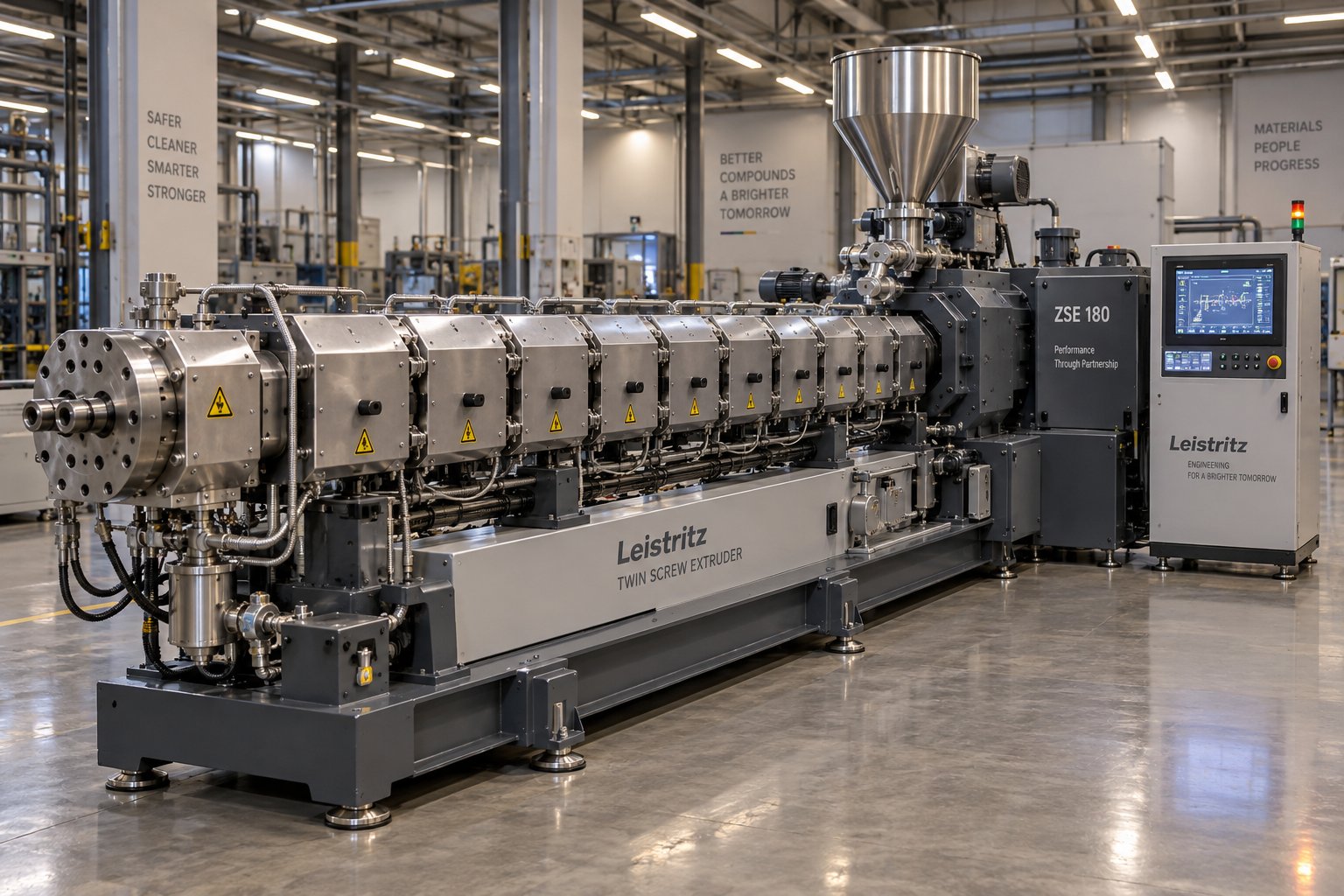
A parallel twin screw extruder is an advanced processing machine built around two intermeshing screws arranged side by side inside a heated barrel. These screws rotate together to perform four essential functions: mixing, compounding, devolatilization, and conveying of polymer materials. The twin screw design creates uniform shear forces that produce consistent melt quality, making this extruder twin screw configuration indispensable for applications ranging from polymer compounding and masterbatch production to reactive extrusion and recycling.
What sets the parallel twin screw extruder apart from a single screw extruder? A single screw system relies on friction-driven conveying and offers limited mixing capability. It works well for straightforward melting and forming tasks but struggles with complex formulations. A conical twin screw extruder, by contrast, uses two tapered screws that converge toward the discharge end, generating high pressure in a compact footprint. However, conical designs are typically limited to specific applications like PVC profile extrusion and lack the modular flexibility that parallel configurations provide.
The parallel design's real advantage lies in its modularity. Screw elements can be rearranged, swapped, and customized to handle different materials and formulations on the same machine. As one industry comparison highlights, a parallel twin-screw extruder is "configured like a Lego," enabling processors to adjust parameters freely and adapt to different applications without purchasing entirely new equipment. That versatility is precisely why twin screw extruders dominate compounding operations worldwide.
Why Your Choice of Supplier Impacts Production Outcomes
Here's what catches many buyers off guard: the extruder twin screw machine sitting on your production floor is only as reliable as the company standing behind it. Your parallel twin screw extruder supplier determines far more than the initial build quality. They shape your after-sales support experience, your spare parts lead times, the depth of customization available for your specific process, and ultimately your long-term total cost of ownership.
Think about it this way. Two twin screw extruders with identical spec sheets can deliver wildly different production outcomes depending on whether the supplier engineered the screw configuration for your exact material or simply shipped a generic setup. NIST's Manufacturing Extension Partnership reinforces this principle in broader supplier selection guidance, noting that manufacturers should look beyond cost per unit and evaluate a supplier's capabilities, quality systems, and capacity to grow alongside your business.
Choosing a parallel twin screw extruder supplier is a partnership decision, not a purchasing transaction. The right partner delivers process expertise, responsive technical support, and a component supply chain that keeps your line running for years, not just through the warranty period.
This article is not another listicle of manufacturers. Instead, you'll walk away with a technical buyer's framework covering machine fundamentals, co-rotating versus counter-rotating design trade-offs, a supplier taxonomy that reveals hidden business model differences, application-to-specification mapping, a weighted evaluation methodology, pricing and total cost analysis, red flags to watch for, and the critical role that component quality plays in long-term extruder performance. Each section builds on the last so you can approach your next supplier conversation with clarity and confidence.
The foundation for all of that starts with understanding the technical specifications that separate a well-built twin screw extruder from an underperforming one, and recognizing which details on a spec sheet actually matter for your process.
Technical Fundamentals Every Buyer Should Understand Before Choosing a Supplier
A spec sheet full of numbers means very little if you don't know which numbers actually drive process performance. Most supplier listicles skip this step entirely, assuming you already speak the language of twin screw extrusion fluently. The reality? Even experienced processors benefit from a structured refresher on the core subsystems that determine whether an extruder delivers consistent output or chronic headaches. Let's break down the three pillars every buyer should evaluate.
Screw Geometry and Configuration Basics
The extruder screw is where material transformation happens. In a parallel twin screw extruder, two intermeshing screws are assembled from individual modular elements, each engineered for a specific task. Picture it like building a custom toolkit: you select the right combination of elements, arrange them along a shaft, and the resulting screw profile dictates how your material behaves from feed throat to die.
There are four primary element categories you'll encounter:
- Conveying elements - These deep-flighted segments transport material forward without applying significant shear. Larger pitch elements move bulk material quickly, while shorter pitch elements compress and meter the melt toward the discharge end.
- Kneading elements - The workhorses of mixing. Wider kneading blocks generate dispersive mixing through intense shear and elongational forces that break down agglomerates. Narrower blocks favor distributive mixing, spreading the dispersed phase evenly without aggressive particle size reduction.
- Reverse (re-conveying) elements - These push material backward, creating a restriction that forces the melt to spend more time in high-shear zones upstream. They're typically shorter than the screw diameter to prevent dangerous pressure spikes.
- Toothed mixing elements - Specialty segments that combine forward conveyance with even ingredient blending, often placed before compression zones to homogenize solid and liquid components.
The arrangement of these elements along the shaft is where art meets engineering. As NC State Extension research explains, no gold standard exists for screw profile design because every material exhibits unique flow properties influenced by temperature, shear rate, and extruder geometry. Forward kneading elements offer gentler mixing, neutral elements increase residence time aggressively, and reverse kneading blocks create maximum restriction for the highest shear input.
Why does this matter for supplier evaluation? A supplier who manufactures modular screw elements in-house and employs engineers capable of optimizing screw configurations for your specific material gives you a measurable production advantage. A supplier who ships a one-size-fits-all profile leaves the optimization burden entirely on your team.
Barrel Design and Heating-Cooling Zones
If the screw extruder is the heart of the system, the barrel is the body that contains and regulates everything happening inside. Modern twin screw extruder barrels are segmented into modular sections, typically four to five L/D (length-to-diameter) units each. This segmentation enables processors to configure barrel zones for distinct functions: solid feeding, liquid injection, side feeding, venting, and closed-section compounding.
Each barrel segment houses its own heating and cooling systems. State-of-the-art designs use internal cartridge heaters paired with internal cooling bores positioned close to the barrel liner for rapid, precise temperature response. This dual-control architecture matters because screw extrusion processes demand tight thermal management. A barrel that overheats during high-rpm operation degrades shear-sensitive polymers; one that cools too slowly creates temperature inconsistencies that show up as defects in your finished product.
Barrel liner material is another critical variable that separates premium equipment from budget builds:
- Nitrided steel - A baseline hardening treatment suitable for non-abrasive polymers. Hardened depth is relatively shallow, so wear life is limited under aggressive conditions.
- Bimetallic liners - Feature a hard protective coating, typically 1-2 mm thick, bonded to the barrel bore. Bimetallic construction provides superior resistance to abrasion and corrosion, making it the preferred choice for processing recycled materials, filled compounds, or PVC formulations that accelerate wear.
- Tungsten carbide and powdered metallurgy (PM) inserts - The highest tier of abrasion resistance, specified for extremely filled or mineral-loaded compounds where standard liners would erode within months.
When comparing suppliers, don't just ask what barrel materials are available. Ask what materials they recommend for your specific application and why. A technically strong supplier will match metallurgy to your process demands rather than defaulting to the cheapest option.
Feed Systems and Downstream Integration
A twin screw extruder doesn't operate in isolation. The feed system upstream and the downstream equipment determine whether your extruder system delivers consistent, production-ready output or requires constant babysitting.
On the feed side, two primary options exist. Volumetric feeders deliver material at a constant volume rate, which works for simple, uniform feedstocks. Gravimetric (loss-in-weight) feeders maintain a constant mass flow rate by continuously adjusting the feed mechanism based on real-time weight measurement from a hopper load cell. When multiple feed streams enter the extruder, gravimetric feeders are essential for maintaining formulation accuracy. Side stuffers, which are essentially small co-rotating twin screw augers, push fillers, reinforcements, or heat-sensitive additives into the melt stream downstream, bypassing the high-shear melting zone to preserve material integrity.
On the discharge side, the screw extrusion process feeds into pelletizing systems (strand cut or die face), film dies, profile dies, or other shaping equipment. The entire line, from feeder to final product takeaway, must be configured as a cohesive unit. This is exactly where a knowledgeable supplier adds significant value: they help you configure the complete line rather than leaving you to integrate third-party components on your own.
Before you request your first quotation, make sure you can compare these key technical specifications across every supplier on your shortlist:
- Torque density - The amount of torque available per unit of screw center distance, directly affecting maximum throughput for high-viscosity materials
- Specific energy consumption - Kilowatts per kilogram of output, a critical efficiency metric for long-term operating cost
- L/D ratio range - Determines how many unit operations (mixing, venting, side feeding) the process section can support
- Screw speed capabilities - Maximum RPM, which influences residence time, mixing intensity, and throughput ceiling
- Output capacity by screw diameter class - The realistic throughput range for the specific screw OD you're evaluating, not just a headline number
These five parameters form the technical backbone of any meaningful supplier comparison. A supplier who can clearly explain the trade-offs within each specification, such as why higher free volume from a deeper channel means less available shaft torque, is demonstrating the engineering depth you'll rely on long after the purchase order is signed.
Of course, specifications only tell half the story. The type of twin screw design, co-rotating versus counter-rotating, fundamentally changes which applications the machine can handle and which suppliers are best positioned to support your process.
Co-Rotating vs Counter-Rotating Double Screw Extruder Designs Compared
Here's something many suppliers won't volunteer upfront: the direction your screws rotate changes nearly everything about how material behaves inside the barrel. Two parallel twin screw extruders can look almost identical on the outside yet deliver fundamentally different mixing dynamics, shear profiles, and process outcomes based solely on whether the screws spin the same way or in opposite directions. Understanding this distinction before you start contacting suppliers prevents a costly mismatch between your application and the machine you end up buying.
Co-Rotating Parallel Twin Screw Extruders Explained
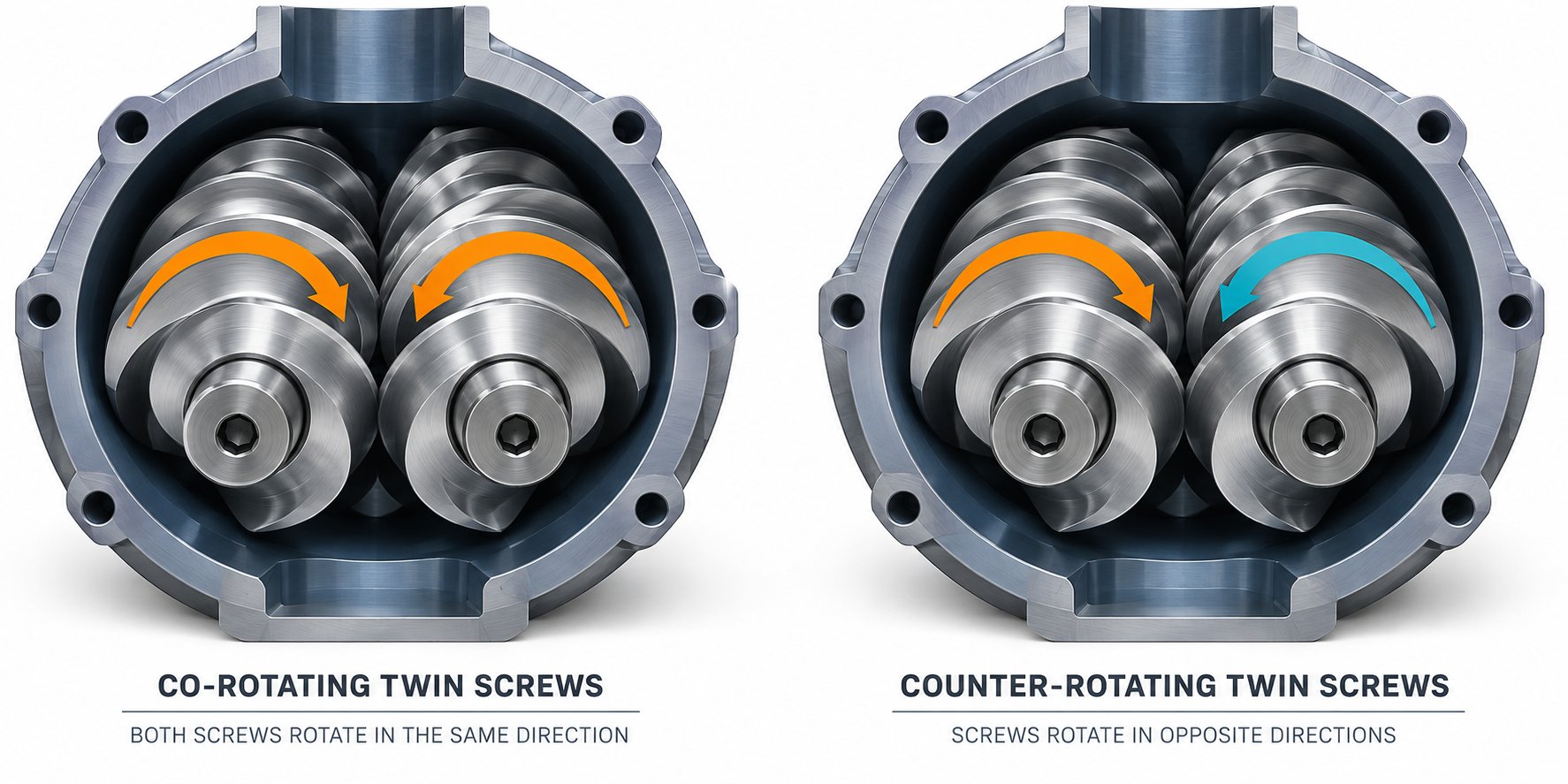
In a co rotating twin screw extruder, both screws turn in the same direction with a fully intermeshing geometry. Imagine two gears spinning together rather than against each other. Material gets forcibly handed off from one screw flight to the next at the intermeshing region, following a figure-eight flow path along the length of the barrel. This constant transfer between screws creates an intensely mixed, highly uniform melt.
What makes this design so dominant in compounding? Three characteristics stand out:
- High shear intensity - Intense shear fields develop both between the screws and between the screw tips and barrel wall. Kneading block elements add elongational flow, imposing a complex deformation history on the material that breaks down filler agglomerates, controls phase morphology in polymer alloys, and promotes mass transfer during reactive extrusion.
- Self-wiping action - Because surface velocities at the intermesh point run in opposite directions, each screw continuously scrapes material off the other. This self-wiping behavior suppresses stagnation, prevents material degradation from extended heat exposure, and keeps the residence time distribution narrow.
- Modular design flexibility - The combination of screw elements can be designed freely, allowing engineers to control exactly where and how much energy is input to the material along the process section.
Typical applications include polymer compounding with inorganic and organic fillers, masterbatch production, polymer alloy and blend development, reactive extrusion involving polymerization or compatibilization, and devolatilization. The co rotating twin screw extruder is, by a wide margin, the most widely used configuration in the plastics and chemical industries for mixing-intensive processes.
Counter-Rotating Parallel Twin Screw Extruders Explained
Flip one screw's rotation direction and the entire flow dynamic changes. In a counter-rotating double screw extruder, the two screws spin in opposite directions, drawing material into the intermeshing region and advancing it forward through a series of separated C-shaped cavities. Rather than the aggressive figure-eight transfer of co-rotation, material here moves within enclosed pockets, compressed and pushed along by the screw geometry itself.
The mixing mechanism shifts as well. Instead of high-shear dispersive blending, counter-rotating designs rely primarily on compressive and elongational deformation at the intermeshing zone. Technovel's extrusion engineering team describes this as a calendering effect: material passes between the screws much like it would between calender rolls, undergoing repeated compression and elongation under relatively gentle conditions. Shear stress and the associated shear-induced heating stay significantly lower than in co-rotation.
Why does that matter? Materials like rigid PVC combine a low thermal decomposition temperature with poor melt flow. Push them through high-shear co-rotating screws and you risk degradation before the compound ever reaches the die. A counter-rotating double screw extruder machine, by contrast, operates at high fill levels and low rotational speeds, keeping extrusion temperatures well below the degradation threshold while still achieving stable forming.
Typical applications center on PVC pipe and profile extrusion, PVC sheet production, and processing of other shear-sensitive or thermally unstable materials. The counter-rotating configuration also provides strong positive-displacement conveying, which means stable high-pressure output without relying on a separate gear pump.
How This Comparison Affects Supplier Selection
Here's the practical takeaway that ties this technical comparison directly to your sourcing decisions: not every parallel twin screw extruder supplier offers both configurations, and many specialize heavily in one type. The co-rotating intermeshing design dominates the compounding and chemical processing sectors, so the majority of suppliers you'll encounter build their product lines around this configuration. Counter-rotating specialists tend to cluster around PVC processing markets and may offer deep application expertise that generalist suppliers lack.
Before you send a single RFQ, confirm two things. First, does the supplier manufacture the rotation type your application actually demands? Second, and more importantly, does their engineering team have demonstrated experience optimizing screw configurations and process parameters for that specific configuration? A supplier who primarily builds co-rotating machines but lists a counter-rotating model in their catalog may not have the depth of process knowledge to support you when a PVC formulation runs into trouble on the production floor.
A conical twin screw extruder, which uses tapered screws in a counter-rotating arrangement, sometimes enters these conversations as an alternative for PVC extrusion. While conical designs offer a compact footprint and strong pressure generation, they lack the modular barrel and screw flexibility of the parallel layout, making them less adaptable when your product mix evolves over time.
The following table summarizes the key differences to keep in mind as you evaluate suppliers against your specific process requirements:
| Comparison Dimension | Co-Rotating Parallel Twin Screw | Counter-Rotating Parallel Twin Screw |
|---|---|---|
| Typical Applications | Polymer compounding, masterbatch, reactive extrusion, devolatilization, nanocomposites | PVC pipe and profile extrusion, PVC sheet, shear-sensitive and thermally unstable materials |
| Shear Intensity | High - intense shear fields between screws and between screw tips and barrel wall | Low to moderate - relies on compressive and elongational deformation (calendering effect) |
| Dispersive Mixing | Excellent - kneading elements break down agglomerates through shear and elongational forces | Moderate - effective for gentle dispersion of additives, less aggressive particle size reduction |
| Distributive Mixing | Excellent - material repeatedly transfers between screws, promoting uniform distribution | Limited - material mainly advances within C-shaped cavities with restricted lateral exchange |
| Self-Wiping Action | Strong - opposite surface velocities at intermesh continuously scrape screws clean | Weak - movement pattern less favorable for cleaning; dead zones can form near screw channel roots |
| Maximum Screw Speed | Up to 1,200+ RPM on high-speed models | Up to ~600 RPM (high-speed versions); below 50 RPM for low-speed late-fusion PVC models |
| Pressure-Building Capability | Moderate - often requires gear pump for shape extrusion | Strong - positive-displacement C-chamber conveying builds stable die pressure |
| Typical Supplier Category | Most major compounding equipment OEMs; widest supplier selection globally | PVC extrusion specialists and select OEMs; narrower but more application-focused supplier pool |
Knowing which column your application falls into narrows your supplier shortlist before you even pick up the phone. But rotation type is only one layer of the decision. The business model behind your supplier, whether they're a vertically integrated OEM, an assembly-focused manufacturer, or a trading company reselling third-party equipment, shapes the quality, support, and pricing you'll actually receive.
Understanding the Different Types of Twin Screw Extruder Suppliers
Picture two companies, both calling themselves twin screw extruder manufacturers. One operates CNC machining centers, runs a metallurgical lab, and tests every machine with live polymer before shipment. The other sources finished barrels from one vendor, gearboxes from another, assembles them under its own brand, and ships the unit with a spec sheet it didn't engineer. Both websites say "manufacturer." Both offer competitive pricing. Yet the post-purchase experience, from technical support depth to spare parts quality, will be dramatically different.
Most buyers never see this distinction because no one categorizes the supplier landscape for them. What follows is a practical taxonomy that reveals the business model behind the brand so you can evaluate what you're actually buying into.
Vertically Integrated OEMs vs Assembly-Focused Manufacturers
A vertically integrated OEM designs and produces every critical component in-house: screws, barrels, gearboxes, drive systems, and control architectures. When a production issue arises, their engineers can trace the problem from screw metallurgy to PLC logic without involving a single outside party. That closed-loop capability translates into faster troubleshooting, tighter quality control, and the ability to customize screw configurations for specific polymers and formulations rather than defaulting to generic designs.
As RCO Engineering notes, vertically integrated manufacturing gives companies complete oversight from raw materials to final assembly, reducing errors and ensuring each product meets exact specifications. In the context of twin screw extrusion equipment, this means the same engineering team that selects the barrel steel also programs the nitriding furnace cycle and verifies hardness depth before assembly. The trade-off? Premium pricing. Maintaining in-house machining, heat treatment, and test extrusion infrastructure requires significant capital investment that gets passed along to the buyer.
Assembly-focused manufacturers take a different path. They source screws from one specialized vendor, barrels from another, and gearboxes from a third, then integrate these components into a finished machine under their own nameplate. This model can deliver competitive pricing because the assembler avoids the capital burden of running its own foundry, machining center, and metallurgical lab. Quality, however, becomes a function of supply chain management rather than direct manufacturing control. When the screw vendor changes steel grades or the gearbox supplier adjusts bearing specifications, the assembler may not catch the shift until a customer reports problems on the production floor.
Pros of Vertically Integrated OEMs
- Direct control over metallurgy, machining tolerances, and heat treatment quality
- Faster engineering response because design, production, and testing teams are unified
- Deeper customization capabilities for application-specific screw and barrel configurations
- Consistent spare parts quality since replacement components come from the same production line
Cons of Vertically Integrated OEMs
- Typically higher upfront pricing reflecting in-house infrastructure investment
- Potentially longer lead times during peak production periods
- Product range may be narrower due to focused specialization
Pros of Assembly-Focused Manufacturers
- Competitive pricing driven by lower capital overhead
- Flexibility to source best-in-class components from specialized vendors
- Faster entry into new machine categories without building manufacturing capability from scratch
Cons of Assembly-Focused Manufacturers
- Limited ability to troubleshoot component-level issues without involving third-party vendors
- Variable quality depending on current supply chain partners
- Spare parts may come from different sources over time, creating consistency risks
Trading Companies and Component Specialists
Here's where the landscape gets murkier. Some entities listed as twin screw extruder manufacturers on B2B platforms are actually trading companies with limited or no manufacturing capability. Industry sourcing data suggests that 30 to 50 percent of self-declared "manufacturers" on major platforms are trading companies operating under factory-sounding names. They purchase finished or semi-finished machines from third-party factories, apply their own branding, and sell with professional-looking documentation that obscures the true origin.
Why is this a problem? A trading company cannot explain its nitriding parameters because it didn't perform the treatment. It cannot customize a screw profile because it doesn't employ screw design engineers. Your technical questions get forwarded, often with translation delays and information loss at every handoff. When a quality issue surfaces after commissioning, you're negotiating with an intermediary who has no direct control over the resolution.
Component specialists sit at the opposite end of this spectrum. Rather than selling complete machines, these companies focus on specific critical parts—typically screws, barrels, or gearboxes—and invest deeply in the metallurgy, precision machining, and application engineering required to make those components perform at the highest level. For buyers, component specialists serve a valuable role both during initial machine configuration and throughout the equipment's operational life, when replacement wear parts become an ongoing procurement need. A strong twin-screw extruder manufacturer will welcome collaboration with reputable component specialists rather than viewing them as threats to aftermarket revenue.
Sourcing Geography Considerations
Where your extruder manufacturer is located introduces another layer of trade-offs that go beyond the price on the quotation. Geography affects communication cadence, lead times, shipping logistics, service response, and even the regulatory certifications included as standard.
You'll encounter three primary sourcing regions, each with distinct characteristics worth weighing against your priorities:
Chinese Extruder Manufacturers
- Price competitiveness — Manufacturing cost advantages driven by advanced CNC automation, lean production methods, and domestic supply chain scale enable pricing that can run 40 to 60 percent below European equivalents for comparable specifications
- Rapidly improving quality standards — Leading Chinese extruder manufacturers now operate ISO 9001-certified facilities with coordinate measuring machines, in-house metallurgical testing, and full production test runs that rival established global competitors
- Turnkey system integration — Many Chinese suppliers offer complete production lines, including feeders, pelletizers, and downstream equipment, rather than standalone extruders, simplifying multi-vendor coordination
- Considerations — Time zone differences can slow communication cycles; buyers should verify OEM status carefully given the higher prevalence of trading companies in the region; on-site service for international customers may require longer response windows
European OEMs
- Legacy engineering depth — Decades of incremental refinement in gearbox design, screw element geometry, and process control architecture, with some brands carrying over a century of compounding equipment experience
- Premium certifications — CE and TÜV certifications often included as standard; strong positioning in regulated industries like pharmaceuticals and food processing where documented compliance history matters
- High specific torque and speed — Top-tier European machines push torque densities above 15 Nm/cm³ and screw speeds past 1,200 RPM, delivering maximum performance for the most demanding applications
- Considerations — Premium pricing reflects both engineering investment and higher operating costs; product offerings may focus on the extruder itself rather than complete integrated lines, leaving downstream integration to the buyer or third parties
North American Suppliers
- Proximity advantages — Shorter shipping distances, same or similar time zones, and no language barriers streamline communication, logistics, and service response for buyers operating in the Americas
- Technical innovation — Select North American manufacturers lead in specialized innovations like quick-change screw systems and application-specific configurations engineered for flexible manufacturing environments
- Local service infrastructure — Regional service centers, readily available spare parts inventories, and on-site technical assistance that minimize downtime when issues arise
- Considerations — Smaller number of domestic manufacturers compared to China or Europe means a narrower selection pool; pricing generally reflects higher labor and operational costs
No single region produces universally superior equipment. The best extruder manufacturer for your operation depends on which combination of price, performance, support infrastructure, and certification requirements aligns with your specific production goals. A processor running high-performance engineering plastics in a regulated market may find European torque density and certification depth worth the premium. A compounder scaling up masterbatch capacity on a tight capital budget may extract far more value from a verified Chinese OEM delivering comparable specifications at substantially lower cost.
The supplier's business model and geography tell you a great deal about what to expect. But those factors only become meaningful once you've mapped them against your specific application requirements—the polymer systems you process, the throughput targets you need to hit, and the downstream configurations your products demand. That application-first perspective is what transforms a general supplier comparison into a targeted sourcing decision.
Matching Your Application to the Right Compounding Twin Screw Extruder and Supplier
Most buyers start their search by browsing supplier catalogs and comparing machine specs. That's backwards. The strongest sourcing decisions begin with your application, then reverse-engineer the specifications and supplier capabilities required to run it well. Think of it this way: you wouldn't shop for a vehicle by comparing horsepower charts before deciding whether you need a pickup truck or a sedan. The same logic applies to selecting an extruder for polymer compounding, recycling, or specialty processing. Your process defines the machine. The machine defines the supplier.
Compounding and Masterbatch Production Requirements
Polymer compounding and masterbatch production place the heaviest demands on mixing performance. Whether you're dispersing carbon black into a polyethylene carrier, blending flame retardants into engineering plastics, or producing color concentrates at tight tolerance levels, the compounding extruder must deliver three things simultaneously: high torque density for processing viscous melts, excellent dispersive and distributive mixing uniformity, and the flexibility to reconfigure screw elements when your formulation changes.
A twin screw compounding extruder built for these applications typically operates at high screw speeds with aggressive kneading block sequences designed to break down filler agglomerates and distribute additives evenly throughout the polymer matrix. Torque density becomes the critical bottleneck. If the gearbox can't sustain the mechanical load at the screw speed your formulation demands, throughput hits a ceiling long before the barrel's thermal capacity is reached.
What does this mean for supplier selection? You need a partner with demonstrated screw element optimization experience for dispersive mixing, not just a catalog of kneading blocks. Ask prospective suppliers which screw configurations they've developed for materials similar to yours. A supplier who has fine-tuned element stagger angles and kneading block widths for your polymer family will get you to stable production faster than one offering generic profiles. Pilot testing capability on a lab or production-scale compounding twin screw extruder is a strong indicator that the supplier invests in application engineering rather than just hardware assembly.
Recycling and Pelletizing Applications
Processing recycled polymers introduces a set of challenges that don't exist with virgin materials. Contamination from mixed-stream collection, residual moisture, fluctuating melt flow index from batch to batch, and volatile organic compounds trapped in degraded polymer chains all conspire to make recycling one of the most demanding applications for any twin screw extruder.
These challenges translate directly into supplier requirements. Effective devolatilization is non-negotiable. Coperion's process engineering data demonstrates that twin screw extruders equipped with properly configured vacuum venting sections can reduce volatile organic compounds from thousands of parts per million to well below 500 ppm in polymers like LLDPE and SBR. Achieving those levels requires barrel segments with optimized vent port placement, vacuum system integration, and the option to inject water or other stripping agents to further intensify degassing.
Barrel wear protection is equally critical. Recycled feedstocks often carry abrasive contaminants—glass fiber fragments, mineral residues, metalite particles—that chew through standard nitrided barrels in a fraction of the time that virgin processing would. Suppliers experienced in recycling applications specify bimetallic or tungsten carbide-lined barrels as standard rather than treating them as upgrades.
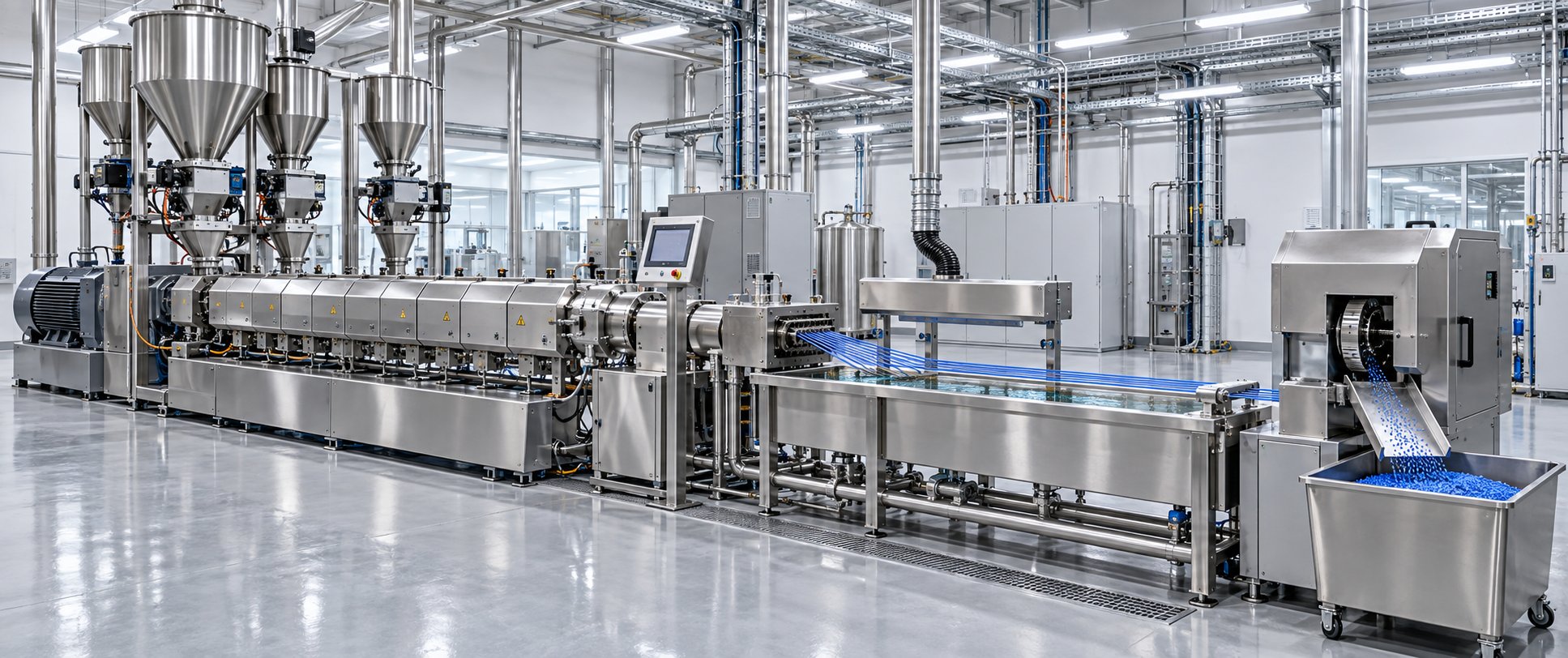
On the downstream side, recycling operations frequently pair the extruder with a screw extruder granulator or strand pelletizing system to produce clean, uniform pellets from variable-quality input. A supplier who understands the full recycling line, from contaminated flake intake through devolatilization to finished pellet, can configure equipment that handles real-world feedstock variation instead of performing only under lab-clean conditions.
Reactive Extrusion and Specialty Processing
Reactive extrusion pushes the twin screw extruder beyond its traditional role as a mixing machine and into service as a continuous chemical reactor. As AIMPLAS research explains, reactive extrusion (REX) combines chemical synthesis or modification with compounding, devolatilization, and granulation in a single continuous step. The extruder becomes the reactor vessel, and the screw configuration controls residence time, mixing intensity, and heat transfer—all of which directly govern reaction conversion and product properties.
Common reactive extrusion processes include grafting reactions such as maleic anhydride functionalization of polyolefins, crosslinking for thermoplastic vulcanizates, chain extension for recycled PET, and ring-opening polymerization for bioplastics like PLA. These applications often require extended L/D ratios—typically 44:1 and higher, sometimes reaching 90:1 in tandem configurations—to provide sufficient residence time for reactions with fast but not instantaneous kinetics.
Filled polymer compounding with high loadings of glass fiber, mineral fillers, or nanoparticles raises its own set of demands: precise side-feeding to introduce abrasive fillers downstream of the melting zone, fiber-length preservation through carefully calibrated shear profiles, and robust wear protection across every barrel segment that contacts the filled melt.
For any of these specialty applications, look for suppliers who employ process engineers—not just mechanical engineers—and who can support your development with simulation software, pilot-scale trial capacity, and documented experience scaling reactive or high-fill processes from lab to production. A screw extruder granulator configuration suited for reactive compounds may differ significantly from one designed for standard compounding, and only a supplier with REX process knowledge will recognize that distinction during the quoting stage.
Regardless of your application category, a disciplined evaluation process keeps you from chasing the wrong suppliers. Follow these steps to work from process requirements to a qualified shortlist:
- Define your application precisely — Document the polymer system, filler types and loading levels, throughput targets, and final product specifications including pellet geometry, residual volatile limits, and mechanical property requirements.
- Identify the critical extruder specifications — Map your application demands to specific technical parameters: required torque density, minimum L/D ratio for your unit operations, number of venting and side-feeding positions, barrel metallurgy class, and screw speed range.
- Match specifications to supplier capabilities — Screen potential suppliers against both the machine specs and the application engineering depth your process demands. Eliminate any supplier who cannot demonstrate relevant experience with your material family and process type.
- Request application-specific references — Ask each remaining supplier for reference customers running similar polymers, fillers, or reactive chemistries. A supplier confident in their capability will connect you with existing users willing to share their experience.
This reverse-engineering approach flips the typical buying process on its head. Instead of comparing brochures and hoping the specs line up, you arrive at each supplier conversation with a clear technical brief that forces meaningful answers. The next question becomes how to evaluate those answers systematically—using a structured framework that weights the factors most critical to your long-term production success.
A Practical Framework for Evaluating and Vetting Twin Screw Extruder Suppliers
Having a clear technical brief is only half the battle. You still need a consistent method for comparing the suppliers who respond to it. Most buyers default to a side-by-side price comparison, pick the lowest number, and cross their fingers. That approach ignores the reality that two quotes at different price points can represent wildly different levels of engineering support, component quality, and long-term reliability. A weighted scoring framework brings structure to what is otherwise a subjective, gut-feel decision—forcing you to define what matters most before the first sales presentation clouds your judgment.
The framework below adapts proven supplier evaluation methodology to the specific demands of sourcing a parallel twin screw extruder. Each criterion carries a suggested weight reflecting its relative impact on production outcomes. You can adjust the percentages to match your priorities, but the discipline of assigning weights is what prevents a single impressive demo or an aggressive discount from distorting the decision.
Technical Capability and Customization Depth
This is the single highest-weighted category for a reason. A supplier's engineering depth determines whether your extruder arrives preconfigured for your material or requires months of trial-and-error optimization on your production floor.
Start by evaluating the engineering team itself. Does the supplier employ screw design engineers who use simulation software to model flow behavior, shear distribution, and residence time for your specific polymer system? Or do they rely on standard configurations pulled from a catalog? Suppliers who invest in computational tools and experienced process engineers can predict performance before cutting metal, saving you time and scrap during commissioning.
Pilot testing facilities offer the strongest signal of technical commitment. A supplier operating a laboratory twin screw extruder or a lab scale extruder line specifically for customer trials demonstrates that they've invested in proving their screw and barrel designs under real processing conditions. When you can run your actual material on a laboratory scale extruder before committing to a production machine, you reduce scale-up risk dramatically. Lab extruder trials also generate specific energy consumption data, torque curves, and product quality benchmarks that become the foundation for your production equipment specification.
Ask pointed questions about customization willingness. Can the supplier modify screw element geometry, barrel vent port placement, or side-feeder positioning to suit your process, or are you locked into a fixed platform? A manufacturer who treats every order as a custom engineering project—even when the platform is standardized—will deliver a machine that runs better from day one.
After-Sales Infrastructure and Spare Parts
The relationship between you and your supplier doesn't peak at delivery. It peaks during your first unplanned shutdown, when a worn screw element or a failed barrel heater threatens to halt your production line. That's when after-sales infrastructure either saves you or exposes gaps that were invisible during the sales process.
Spare parts availability deserves close scrutiny. Replacement screws and barrels are the most frequently needed wear components, and lead times for these parts vary enormously across suppliers. Industry data on maintenance costs indicates that maintenance expenses typically represent 10 to 20 percent of total ownership costs over an extruder's life, with preventive maintenance alone accounting for 40 to 50 percent of that total. If your supplier stocks common wear parts with a 95 percent or higher fill rate and can ship within 24 to 48 hours, you're looking at days of downtime rather than weeks. If they manufacture parts to order with six-to-eight-week lead times, a single barrel liner replacement could cost you far more in lost production than the part itself.
Beyond parts logistics, evaluate these after-sales factors before signing anything:
- Technical service responsiveness — Does the supplier offer remote diagnostics, video-assisted troubleshooting, or dedicated service engineers assigned to your account?
- Training programs — Will they train your operators on screw configuration changes, barrel maintenance procedures, and control system operation at your facility or theirs?
- Warranty terms — What's covered, for how long, and what conditions void the warranty? Pay special attention to whether wear parts carry any coverage or are excluded entirely.
- Regional service centers — A supplier with service technicians in your geographic region can respond to emergencies in hours rather than scheduling a cross-continental trip that takes days to arrange.
Certifications, References, and Financial Stability
Certifications serve as a baseline filter, not a competitive differentiator. ISO 9001 demonstrates that a supplier operates a documented quality management system. CE marking confirms compliance with European safety and performance directives. These are table stakes. If a supplier can't produce current ISO or CE documentation, they shouldn't make your shortlist.
Reference customers, on the other hand, reveal what certifications can't: how the equipment actually performs under sustained production conditions and how the supplier behaves when problems arise. Request a reference list with contact details, and actually make the calls. Ask references about commissioning support quality, spare parts lead times, how the supplier handled warranty claims, and whether they would buy from the same supplier again. If a supplier hesitates to provide references or offers only vague testimonials without verifiable contacts, treat that as an early warning sign.
Visiting an existing installation—whether in person or through a structured virtual tour—gives you the clearest picture of build quality, operator satisfaction, and real-world production performance. Sounds like a significant time investment? Consider that a poorly chosen extruder ties up capital and production capacity for a decade or more. A single site visit can surface issues that no brochure or video call ever will.
Financial stability deserves attention because your supplier relationship extends well beyond the delivery date. If a supplier faces financial distress two years into your ownership, spare parts supply, warranty fulfillment, and technical support all become uncertain. Look for indicators like years in business, facility investment patterns, and workforce stability. You don't need a forensic audit—but you do need confidence that the company will still be operational and responsive when you need your first major overhaul.
The table below translates these evaluation categories into a weighted scoring framework you can apply directly to your supplier shortlist. Score each supplier on a 1-to-5 scale for every criterion, multiply by the weight, and sum the results for a total that makes comparison objective and transparent.
| Evaluation Criterion | Suggested Weight | What to Assess |
|---|---|---|
| Technical Capability | 25% | Engineering team depth, screw design software, laboratory extruder or pilot testing facilities, process simulation capability |
| Customization Ability | 15% | Willingness to modify screw profiles, barrel configurations, vent placement, and feed system integration for your specific application |
| After-Sales Support | 20% | Spare parts fill rate and lead times, technical service responsiveness, training programs, regional service center presence |
| Certifications and References | 15% | ISO 9001, CE marking, verifiable reference customers running similar applications, willingness to facilitate site visits |
| Geographic Proximity | 10% | Shipping logistics, time zone alignment, language compatibility, on-site service response time |
| Price Competitiveness | 15% | Purchase price relative to specifications delivered, transparency of quotation breakdown, included versus optional items |
| Total | 100% |
Notice that price competitiveness carries only 15 percent of the total weight. That's intentional. A supplier who scores poorly on technical capability or after-sales support but wins on price will cost you more over the machine's lifetime through suboptimal process performance, longer troubleshooting cycles, and expensive downtime waiting for spare parts.
The lowest purchase price and the lowest total cost of ownership are almost never the same number. Prioritize total value—engineering depth, service reliability, and component longevity—over the initial line item on a quotation.
A structured framework gives you defensible, data-driven supplier rankings. But even the highest-scoring supplier on your matrix needs to pass a financial reality check. Understanding what drives extruder pricing, where hidden costs lurk, and how total cost of ownership unfolds over a decade of production is what separates informed buyers from those who learn expensive lessons after the purchase order is signed.
Twin Screw Extruder Price Landscape and Total Cost of Ownership
Here's a frustrating reality every buyer encounters: you can request quotes from five different suppliers for what appears to be the same machine and receive prices that differ by a factor of three or more. One supplier quotes $85,000. Another quotes $250,000. A third comes in at $400,000. All three claim their parallel twin screw extruder meets your throughput and torque requirements. So what's going on? The answer isn't that someone is lying—it's that extruder pricing is driven by a layered set of variables that most quotations don't break down transparently. Understanding those variables is the only way to compare offers on equal footing and avoid the trap of choosing the lowest number without knowing what it actually buys you.
Key Cost Drivers for Parallel Twin Screw Extruders
Every twin screw extruder price reflects a stack of engineering, material, and configuration decisions. When quotes diverge dramatically, at least one of these variables is different between them—even if the headline specifications look similar on paper.
Screw diameter class is the single biggest determinant of base cost. Volumetric capacity scales roughly with the cube of screw diameter, so a jump from a 50 mm to a 92 mm machine doesn't just double the price—it can multiply it several times over. The gearbox, motor, barrel mass, and supporting frame all scale up with diameter, and each of those subsystems carries its own cost curve.
L/D ratio extends the price further. A 48:1 machine requires more barrel segments, more heating and cooling zones, a longer frame, and additional screw elements compared to a 32:1 unit of the same diameter. Each added barrel section brings its own heaters, thermocouples, cooling circuits, and machined liner surfaces. Longer machines also demand more floor space, heavier foundations, and more complex installation—costs that rarely appear on the equipment quotation itself.
Torque rating and gearbox class introduce another significant price tier. Standard gearboxes operating in the 5 to 10 Nm/cm³ specific torque range cost substantially less than high-performance units pushing beyond 15 Nm/cm³. That premium buys you the ability to process high-viscosity melts and heavily filled compounds without hitting the gearbox's mechanical limits. If your application demands it, there's no shortcut—underpowered gearboxes fail under sustained high-torque loads, and a gearbox rebuild on a mid-size machine can easily reach $30,000 to $80,000.
Material of construction for barrels and screws directly affects both upfront and long-term costs. Standard nitrided steel barrels sit at the entry level. Bimetallic liners with iron-based or nickel-based alloys occupy the mid-tier, offering significantly better abrasion and corrosion resistance. Tungsten carbide inserts or powdered metallurgy barrel segments represent the premium tier, specified for extremely abrasive compounds where standard liners would erode within months. The gap between the cheapest and most wear-resistant barrel configuration can represent 20 to 40 percent of the total machine price.
Automation level ranges from basic temperature controllers and manual screw speed adjustment to fully integrated PLC and HMI platforms with recipe management, data logging, remote monitoring, and closed-loop gravimetric feed control. Modern control systems add $15,000 to $40,000 or more to a project, but they also reduce operator error, enable faster changeovers, and provide the process data you need for quality audits and troubleshooting.
Included downstream equipment is where quotations become especially tricky to compare. One supplier might quote a standalone extruder. Another bundles feeders, a strand pelletizer, cooling bath, and control panel into a turnkey line at a higher headline price that actually delivers better per-component value. Always clarify what's included before placing two quotes side by side.
Total Cost of Ownership Beyond Purchase Price
Imagine buying the least expensive twin screw extruder for sale on your shortlist, only to discover over the next five years that it consumes 40 percent more energy per kilogram of output, requires screw replacements every 18 months instead of every five years, and sits idle for unplanned maintenance twice as often as the runner-up. That scenario isn't hypothetical. Industry TCO analysis suggests that initial purchase price represents only 30 to 50 percent of what you'll actually spend over a five-year ownership horizon—with energy consumption, wear parts replacement, downtime losses, and service contracts making up the larger share.
The total cost picture breaks down into five ongoing cost categories that every buyer should model before signing a purchase order:
Energy consumption varies significantly with drive efficiency, barrel insulation quality, and how well the screw profile matches your material. A machine with a specific energy consumption of 1.5 kWh/kg running 2,000 hours annually at 500 kg/h throughput burns far less electricity than a less efficient unit drawing 2.5 kWh/kg for the same output. Over five years, that efficiency gap can translate into tens of thousands of dollars in utility costs alone.
Wear parts replacement cycles represent the most underestimated ongoing expense. Screws and barrels are consumable items whose replacement frequency depends on the materials you process, the metallurgy of the components, and how well the screw configuration matches your application. Running abrasive mineral-filled compounds through standard nitrided barrels might demand relining or replacement every 12 to 18 months. The same barrel in a bimetallic construction processing unfilled polymers could last five to ten years. Each replacement cycle carries not just the cost of the parts but also the production downtime during the changeover.
Downtime costs multiply quickly. Every hour your extruder sits idle translates into lost production revenue, idle labor, missed delivery commitments, and potential contract penalties. A machine that suffers 10 percent unplanned downtime versus one running at 99 percent availability represents a staggering difference in annual output—and in revenue.
Spare parts pricing and lead times deserve their own line in your cost model. Some suppliers price replacement screw elements and barrel sections competitively as part of a long-term relationship strategy. Others treat aftermarket parts as a high-margin profit center, charging premiums that can approach the cost of the original components. Request spare parts pricing in writing during the quotation stage, not after the machine is installed and you have no negotiating leverage.
Service contract terms vary from basic warranty extensions to comprehensive agreements covering preventive maintenance visits, remote diagnostics, priority parts fulfillment, and annual performance audits. A well-structured service contract can reduce total maintenance spend by preventing small issues from escalating into costly failures. A poorly structured one adds fixed cost with little tangible benefit.
The math is straightforward but routinely ignored: a higher-priced machine from a supplier with lower energy consumption, longer wear life, faster spare parts delivery, and responsive technical support almost always delivers a lower total cost of ownership than a bargain-priced alternative that nickels-and-dimes you across every one of these categories for a decade.
New vs Used vs Refurbished Equipment Economics
Not every buyer needs—or can afford—a brand-new machine. The used extrusion equipment market exists because twin screw extruders are engineered for longevity. Well-maintained units commonly deliver 20 to 30 years of service life, and machines entering the secondary market often still carry decades of productive capacity. Plant closures, capacity upgrades, and process changes release fully operational equipment that a savvy buyer can acquire at 40 to 60 percent below new-equipment pricing.
When does buying used make financial sense? If you're running an established, well-understood process with standard formulations—and your capital budget is constrained—a used twin screw extruder for sale in good mechanical condition can deliver excellent value. Startups testing market demand before committing to full-scale investment, and plants expanding capacity alongside existing equipment where in-house maintenance expertise already exists, are ideal candidates for the secondary market.
Refurbished equipment occupies the middle ground. A used machine that receives new barrel liners, fresh screw elements, a gearbox rebuild, and a modern control system upgrade can operate within 5 to 10 percent of original OEM specifications at a total project cost 30 to 50 percent below a new build. This hybrid approach—mechanically proven platform with modern process intelligence—often delivers the strongest return on investment for buyers who need reliability without the 12-to-18-month lead time of a new order.
Buying new is justified when your application demands the latest generation of specific torque, energy efficiency, or process control capabilities that simply don't exist in used inventory. Regulatory requirements in pharmaceutical or food-contact applications may necessitate full documentation traceability from machine build through qualification. And if maximum energy efficiency is a priority, modern drives and optimized barrel insulation reduce specific energy consumption meaningfully compared to older-generation machines.
Regardless of which path you choose, every quotation you receive—whether for new, used, or refurbished equipment—should itemize the following cost components so you can compare apples to apples:
- Base machine price — extruder with gearbox, motor, barrel, and screw set as specified
- Control system — PLC, HMI, wiring, sensors, and software, specified by platform and capability level
- Downstream equipment — feeders, pelletizer, cooling system, die, and any ancillary items included or quoted separately
- Barrel and screw metallurgy specifications — exact material grades for liners, screw elements, and any wear-resistant treatments applied
- Spare parts package — recommended initial inventory with per-item pricing for future orders
- Freight, rigging, and installation — transportation to your site, crane and rigging services, foundation requirements, utility connections, and commissioning support
- Training — operator and maintenance training scope, duration, location, and whether it's included or charged separately
- Warranty terms — coverage duration, what's included versus excluded, and conditions that void the warranty
- Service contract options — preventive maintenance agreements, remote support packages, and priority parts fulfillment programs with annual costs stated
Any supplier who resists providing this level of detail is making it harder for you to compare their offer fairly—which should raise questions about what the vague line items are actually covering. A transparent quotation signals a supplier confident enough in their value proposition to let you see exactly where your money goes.
Pricing clarity gets you to an informed shortlist. But the final qualification step—spotting the warning signs that a supplier may not deliver on their promises and conducting rigorous due diligence before you commit—is what protects your investment from risks that no spec sheet or price breakdown can reveal.
Red Flags and Due Diligence When Qualifying Twin Screw Extruder Suppliers
A polished website, an impressive catalog, and an aggressive price can all mask problems that only surface after your deposit has cleared. The most expensive mistake in capital equipment purchasing isn't overpaying for a good machine—it's paying anything at all for a bad one. Before you commit to a purchase order, you need to know what warning signs to watch for, how to verify that a supplier is who they claim to be, and how to structure your request for quotation so the responses you receive are genuinely comparable.
Warning Signs That a Supplier May Not Deliver
Some red flags are subtle. Others practically wave themselves in your face. The key is recognizing them before they cost you money, not after. Here are the patterns that experienced buyers learn to spot—sometimes only after a painful first lesson:
Unwillingness to provide reference customers. Every legitimate parallel twin screw extruder supplier has satisfied customers willing to take a phone call. If a supplier deflects your request for references with excuses about confidentiality agreements or simply never follows through, you're likely dealing with a company that either has no installed base or has one that wouldn't recommend them. As supplier reliability research emphasizes, a pattern of unresolved complaints or missing verifiable references is among the strongest signals that something is wrong.
Vague technical responses. Ask a specific question about screw element metallurgy, torque density at a given screw speed, or barrel liner hardness depth. A real manufacturer answers directly because they engineered the product. A trading company posing as one deflects, gives generic responses, or promises to "check with the factory"—revealing that the technical knowledge sits somewhere else entirely.
No in-house engineering team. If you can't speak with a screw design engineer or a process engineer during the evaluation phase, chances are none exist on staff. A supplier without engineering depth cannot customize screw configurations, troubleshoot processing issues, or support you during commissioning with anything beyond the instruction manual.
Inconsistent certifications. ISO 9001 certificates with expired validity dates, CE declarations that don't match the specific machine model being quoted, or company names on certification documents that differ from the entity you're negotiating with should all trigger a pause. Name mismatches across documents—business license, invoices, and daily communication—are rarely innocent when they form a pattern.
Inability to demonstrate pilot or test runs. A supplier confident in their equipment invites you to watch your material run through their machine. A supplier who can't offer a trial run—or who insists the machine will "work fine" without testing your specific formulation—is asking you to gamble your capital budget on an assumption.
Pressure to commit without site visits. Claims of limited production slots, artificial pricing deadlines, or discounts that expire next week are high-pressure tactics designed to short-circuit your vetting process. Genuine manufacturers with real demand don't need to manufacture urgency. They welcome scrutiny because scrutiny confirms what they already know about their capabilities.
Pricing significantly below market rate with no clear explanation. When one quote comes in 50 percent below every other offer and the supplier can't articulate what engineering or material choices justify the gap, something is being cut—barrel metallurgy, gearbox bearing quality, control system components, or compliance steps. An unexplained steep discount usually signals hidden compromise, not exceptional value.
The cheapest quote often signals the highest risk. When a supplier's price sits dramatically below the market without a transparent explanation, the savings you see on the quotation are typically paid back through inferior materials, missing certifications, or service gaps that surface after the warranty expires.
Due Diligence Steps Before Signing a Purchase Order
Spotting red flags tells you when to slow down. Due diligence tells you how to verify whether a concern is a genuine problem or an explainable anomaly. Think of it as a structured investigation that builds confidence incrementally—each step either strengthens your trust or reveals a reason to walk away.
Follow this sequence before committing to any extruder machine for sale, whether from a domestic supplier or an overseas manufacturer:
- Request and independently verify certifications. Don't accept a PDF at face value. Cross-check ISO certificate numbers against the issuing body's online registry. Confirm CE declarations reference the correct machine models and applicable directives. Verify that the company name, registration address, and scope of certification align with the entity you're negotiating with.
- Conduct a factory audit—virtual or in-person. A structured factory audit evaluates production capabilities, quality management systems, incoming material controls, testing equipment calibration, and workforce competence. Even a live video walkthrough of the actual production floor—not a showroom or sales office—provides significantly more confidence than catalog images. Auditors compare documented procedures with actual factory practices, which is exactly where discrepancies between marketing claims and manufacturing reality become visible.
- Test your materials on the supplier's pilot line. Ship a representative batch of your polymer, filler, or compound to the supplier's facility and request a supervised trial run. Document throughput rates, specific energy consumption, melt temperature profiles, and product quality. If the supplier has no pilot line or refuses to run trials, that absence is itself informative.
- Confirm spare parts pricing and lead times in writing. Request a formal quotation for common replacement items—screw elements, barrel segments, barrel heaters, and thermocouple assemblies—with stated lead times. Get this documented before the purchase, when you still have negotiating leverage. Comparing aftermarket pricing across suppliers often reveals more about long-term cost than the machine price itself.
- Check third-party reviews and industry reputation. Search industry forums, trade show exhibitor histories, and B2B platform reviews for patterns. A single negative review is normal for any business; a pattern of similar complaints around late delivery, quality disputes, or unresponsive service tells a different story. Contact references independently—don't rely on curated testimonials the supplier provides without verifiable contact details.
- Evaluate financial stability indicators. Verify the company's registration date against their claimed years of experience. A business registered recently that claims decades of history is a deliberate misrepresentation. Look for signs of sustained investment—facility expansions, new machinery, workforce growth—that indicate a company building for the long term rather than operating on thin margins with no reinvestment buffer.
Any combination of factory access reluctance plus payment terms that skip the standard deposit-and-balance structure should be treated as close to a hard stop. Legitimate manufacturers generally work on a 30 percent deposit with the balance due upon inspection or prior to shipment, paid into a verifiable company account. Full payment upfront through untraceable channels is a serious flag regardless of how attractive the pricing appears.
How to Structure RFQs for Accurate Comparison
Even among legitimate, qualified suppliers, comparing quotes is impossible if each one formats their response differently, bundles different items, and uses different assumptions about your process. The fix? Control the format from the start by issuing a well-structured request for quotation that forces every respondent into a consistent template.
Your RFQ should specify the following technical inputs so that suppliers quote against identical requirements rather than their own interpretations of what you might need:
- Material type and formulation — Base polymer, filler types and loading percentages, additive packages, and any reactive chemistry involved
- Throughput target — Required output in kg/h under steady-state production conditions, with the specific material you've described
- Screw diameter preference — If you have an existing platform to match, or a target diameter range based on your application mapping
- L/D ratio requirement — Minimum process length needed for your unit operations (melting, mixing, venting, side feeding)
- Barrel metallurgy requirement — Specify the abrasion and corrosion class your material demands so every supplier quotes the same liner grade
- Downstream requirements — Pelletizer type (strand or die face), cooling method, and any ancillary systems you need integrated or quoted separately
- Control system specifications — PLC platform, HMI requirements, data logging needs, and remote access capabilities
Equally important is structuring the required response format. Ask every supplier to itemize the same cost categories outlined in the pricing section of this article: base machine, control system, downstream equipment, barrel and screw metallurgy, spare parts package, freight and installation, training, warranty terms, and service contract options. When responses arrive in identical formats, you can load them into a side-by-side comparison matrix without guessing which supplier included feeders and which one didn't.
Set a clear submission deadline and state your evaluation timeline so suppliers know when to expect a decision. Include a section asking each respondent to provide reference customers running similar materials, certifications with current validity dates, and spare parts pricing for standard wear items. This front-loads the due diligence information you'll need later and signals to every supplier that you're running a serious, structured evaluation—not fishing for the lowest number.
A disciplined RFQ process protects you from apples-to-oranges comparisons, but it also protects good suppliers from being undercut by competitors who win on price by omitting critical scope. Both sides benefit when the rules of engagement are clear from the start.
With your shortlist vetted and your quotations structured for honest comparison, one critical dimension remains that many buyers overlook entirely: the quality of the wear components inside the machine. Screws and barrels aren't just parts on a bill of materials—they're the components that determine whether your extruder delivers consistent output for years or starts degrading the day the warranty expires.
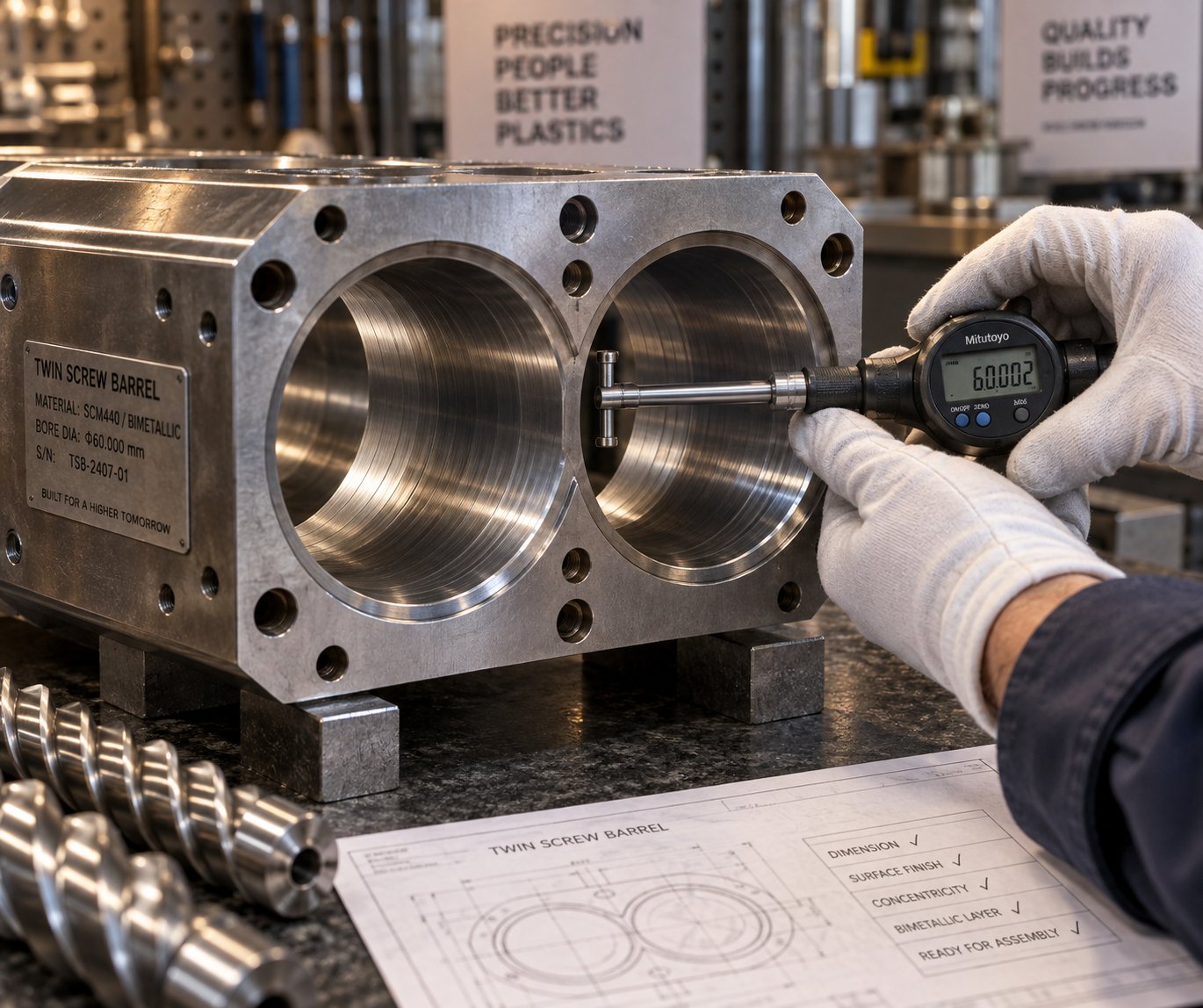
How Critical Components Like Screws and Barrels Shape Supplier Value
Your extruder's nameplate says one thing. The metal inside the barrel says something else entirely. Two machines built on the same platform, with the same gearbox and the same motor, can deliver dramatically different production outcomes based solely on the quality of the twin screw and barrel assembly doing the actual work. That distinction matters because screws and barrels are not permanent fixtures—they're wear components that degrade over time, and their replacement quality determines whether your extruder maintains peak performance or slowly drifts into inefficiency, defects, and unplanned shutdowns.
Most buyers focus their entire evaluation on the complete machine supplier and never think twice about where the wear components come from or who engineers them. That's a blind spot worth correcting.
Why Barrel and Screw Quality Defines Extruder Longevity
Every kilogram of polymer, filler, and additive that passes through your barrel extruder imposes mechanical friction, chemical exposure, and thermal stress on the screw flights and barrel bore. Over thousands of production hours, these forces erode the precision-machined surfaces that maintain the tight clearances responsible for mixing efficiency, pressure stability, and melt uniformity. When clearances open up due to wear, you'll notice the symptoms before you see the cause: inconsistent pellet quality, rising specific energy consumption, declining throughput at the same screw speed, and increasing melt temperature variation across zones.
The wear mechanism isn't uniform, either. Research from Nanjing Haisi's engineering team identifies five primary factors that accelerate barrel and screw degradation: normal abrasive wear from fillers like calcium carbonate and glass fiber, corrosive wear from chemically aggressive additives, zone-specific intensified wear at the feeding section, filler introduction points, mid-barrel deflection zones, and discharge areas, thermal degradation of metal properties under sustained high temperatures, and oxidation driven by moisture and trapped air inside the barrel. Each of these mechanisms attacks different regions of the extrusion barrel at different rates, which means wear doesn't happen evenly—it concentrates in predictable high-stress zones that a knowledgeable component supplier can anticipate and engineer against.
Material selection for the plastic extruder screw and barrel liner is where longevity is won or lost. Three tiers of protection are standard across the industry:
- Nitrided steel (e.g., 38CrMoAlA) — Surface-hardened to a depth of approximately 0.5 to 0.8 mm. This baseline treatment handles non-abrasive and lightly filled polymers cost-effectively but wears quickly under aggressive conditions. Expect replacement cycles of one to two years when processing highly filled compounds.
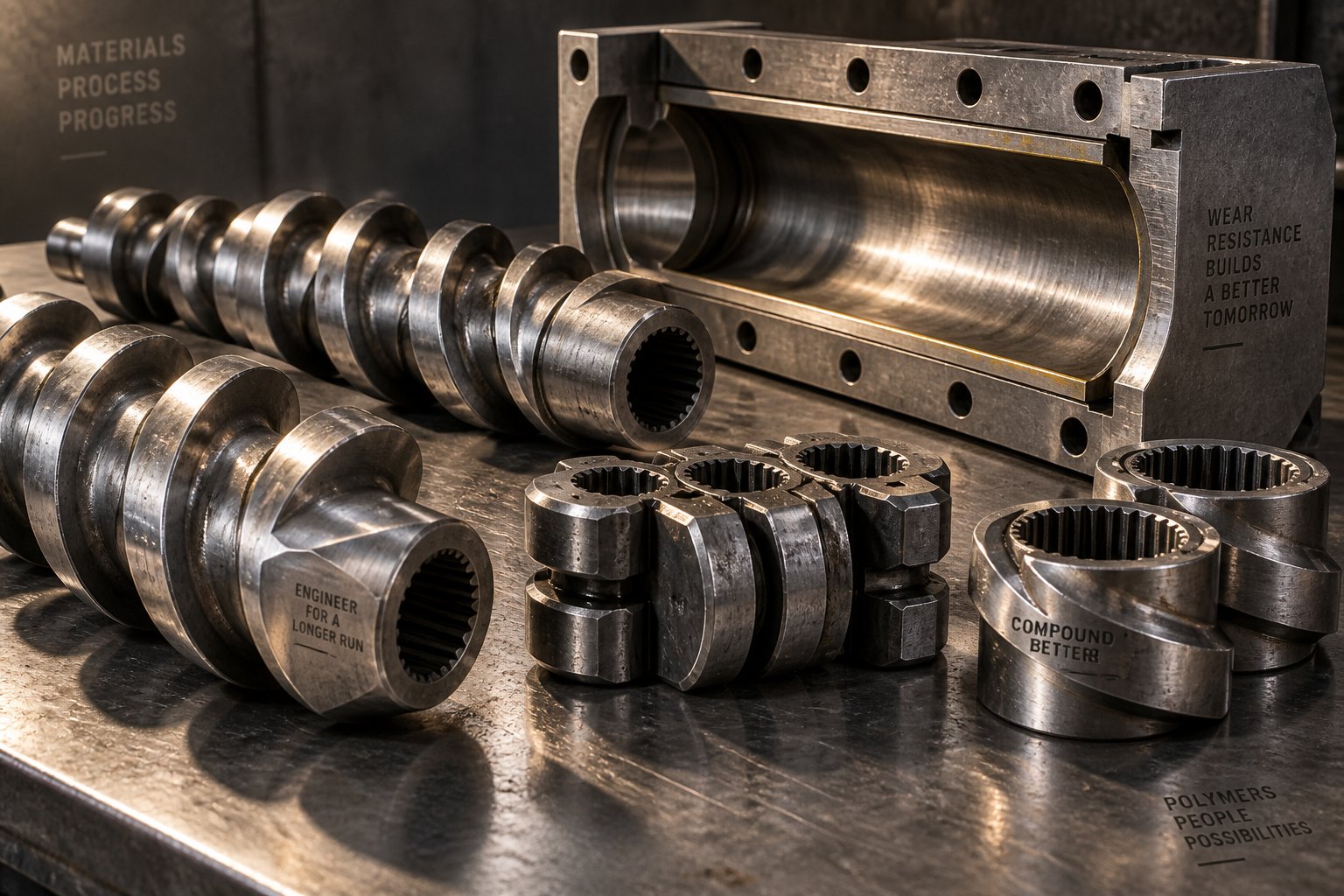
- Bimetallic liners (e.g., Ni60, X800 alloys) — A thick layer of wear-resistant alloy, typically 1 to 2 mm, bonded to the barrel bore through centrifugal casting or hot isostatic pressing. Bimetallic construction resists both abrasion and corrosion, extending barrel life by a factor of two to three compared to nitriding alone. This is the go-to specification for compounding operations running mineral fillers, glass fiber reinforcements, or recycled feedstocks.
- Powder metallurgy (PM) steel and tungsten carbide inserts — The premium tier, specified for the most abrasive compounds. PM steel offers a finer, more uniform grain structure with minimal segregation of alloying elements like nickel, chromium, and molybdenum, delivering superior mechanical strength and wear resistance under extreme conditions.
Here's what your screw plastic extruder OEM may not emphasize: the barrel liner and screw element metallurgy they install at the factory isn't necessarily the best metallurgy for your specific application. It's the metallurgy that fits their standard build specification or their preferred supply chain. When your process involves abrasive fillers, corrosive chemistries, or high-temperature engineering polymers, the factory-default components may wear out far faster than application-optimized alternatives sourced from a specialist.
Evaluating Component Suppliers for Custom Barrel Solutions
This is where the component-specialist supplier model discussed earlier in this article moves from concept to practical value. Rather than relying exclusively on your extruder OEM for every replacement barrel and screw set, experienced processors increasingly work with dedicated component manufacturers who focus their entire R&D and production capability on engineering barrels and screws for specific process demands.
Why go outside the OEM? Three reasons come up consistently. First, component specialists often offer deeper metallurgical expertise because wear parts are their core business, not a secondary product line attached to complete machine sales. Second, specialists can engineer barrels compatible with multiple OEM platforms, giving you sourcing flexibility rather than locking you into a single supply chain. Third, lead times and pricing from a focused manufacturer competing for your wear-parts business are frequently more favorable than aftermarket pricing from the original equipment supplier.
A concrete example of this model in practice is NANHAIYA, a component supplier that engineers custom parallel twin screw barrels tailored to specific application demands. Their product range supports compounding, recycling, pelletizing, granulation, and masterbatch producers—exactly the spread of applications where barrel wear patterns differ significantly and where generic one-size-fits-all liners underperform. For processors exploring barrel replacement or upgrade options across any of these application types, NANHAIYA's approach illustrates the value of working with a supplier whose entire focus is optimizing the components that directly contact your material.
Whether you're evaluating NANHAIYA or any other component specialist, apply these criteria to separate genuine engineering partners from commodity parts resellers:
- Application-specific customization — Can the supplier recommend and manufacture barrel liner materials, bore finishes, and cooling channel configurations optimized for your specific polymer, filler type, and processing temperature? A supplier who asks detailed questions about your formulation before quoting demonstrates the engineering mindset you want.
- Material engineering expertise — Do they offer a range of metallurgical options—nitrided, bimetallic, PM steel, tungsten carbide—and can they explain the performance trade-offs for your application? A specialist who defaults to a single material for every customer isn't truly customizing.
- Compatibility with multiple OEM platforms — Can they manufacture barrels that fit your specific extruder make and model, with precise bore tolerances, mounting dimensions, and heating or cooling port configurations? Cross-platform compatibility is a hallmark of an experienced component supplier with a broad installed base.
- Lead times and inventory strategy — Do they stock semi-finished barrel blanks for common screw diameter classes, enabling faster turnaround on custom orders? Or does every order start from raw material procurement? The difference between a four-week and a twelve-week lead time on a replacement extrusion barrel can mean tens of thousands of dollars in lost production.
- Quality verification and documentation — Do they provide hardness test reports, dimensional inspection data, metallographic analysis, and material certifications with every shipment? Reliable documentation protects you during audits and gives you a baseline for tracking wear rates over time.
The screw plastic extruder market has matured to the point where no single supplier—OEM or specialist—holds a monopoly on quality. The smartest procurement strategies treat machine sourcing and component sourcing as complementary decisions rather than a single bundled purchase. Your extruder OEM delivers the platform. Your component specialist delivers the wear-part performance that keeps that platform running at peak efficiency year after year.
Building these parallel supplier relationships—one for the complete machine, another for the components that define its daily output quality—is a core element of the holistic sourcing strategy that transforms a one-time equipment purchase into a long-term production advantage. The final step is pulling every evaluation dimension covered in this article into a clear, actionable roadmap you can follow from first specification through final supplier selection.
Your Actionable Roadmap to Choosing the Right Twin Screw Extruder Supplier
You've absorbed the technical fundamentals, dissected the differences between co-rotating and counter-rotating designs, mapped supplier business models, reverse-engineered application requirements into specifications, applied a weighted evaluation framework, analyzed total cost of ownership, identified red flags, and recognized the strategic importance of component quality. That's a lot of ground. The risk now is that all of this knowledge stays theoretical—filed away in your mind but never translated into a disciplined sourcing process. So let's compress everything into a roadmap you can execute starting this week.
Your Supplier Selection Roadmap
Whether you're sourcing your first twin screw extruder machine or replacing an aging line, the sequence matters. Skipping steps or rearranging them introduces the same blind spots this entire article was written to eliminate. Follow this progression from initial scoping through final commitment:
- Lock down your application requirements. Document the polymer system, filler types and loadings, throughput targets, product specifications, and any regulatory constraints. Be specific—"polymer compounding" is not a requirement; "compounding 40% glass-fiber-reinforced PA6 at 800 kg/h with sub-200 ppm residual volatiles" is.
- Identify the extruder configuration your process demands. Use the co-rotating versus counter-rotating comparison to determine the rotation type, then establish the minimum L/D ratio, torque density class, barrel metallurgy tier, and number of venting and side-feeding positions your unit operations require.
- Categorize potential suppliers by business model. Separate vertically integrated OEMs from assembly-focused manufacturers and trading companies. Eliminate any entity that cannot demonstrate in-house engineering capability relevant to your configuration and application type.
- Issue a structured RFQ with standardized response requirements. Specify identical technical inputs, cost breakdown categories, and documentation requests for every supplier on your shortlist. This single step prevents the apples-to-oranges comparisons that derail most capital equipment decisions.
- Apply the weighted evaluation framework. Score every qualified response across technical capability, customization depth, after-sales infrastructure, certifications, geographic proximity, and price competitiveness. Let the numbers guide your shortlist rather than a compelling sales presentation or an eye-catching discount.
- Conduct thorough due diligence on your top two or three candidates. Verify certifications independently, audit the factory, test your material on their pilot line, confirm spare parts pricing and lead times in writing, and call reference customers. Any supplier who resists transparency at this stage is telling you something important.
- Negotiate on total cost of ownership, not purchase price alone. Factor in energy efficiency, wear parts replacement cycles, service contract terms, training, and spare parts economics. The goal is the lowest decade-long cost, not the lowest line item on a purchase order.
This sequence works for any extruder machine for plastic processing—compounding, recycling, reactive extrusion, or masterbatch production. The specifics inside each step change with your application, but the structure remains constant because it forces you to make decisions in the right order: application first, specifications second, supplier qualification third, and commercial negotiation last.
Building a Long-Term Supplier Partnership
The best procurement outcomes don't end when the machine arrives on your production floor. They evolve into ongoing partnerships where your suppliers actively contribute to process optimization, equipment longevity, and operational efficiency improvements year after year. Research into long-term supplier partnerships consistently shows that committed relationships deliver preferential pricing on repeat purchases, priority service response during unplanned shutdowns, early access to technology upgrades, and collaborative problem-solving that standalone transactions simply cannot replicate.
Think of your supplier network as having two complementary layers. The first layer is your complete extruder machine for plastic compounding or processing—the OEM who delivers the platform, the gearbox, the drive system, and the control architecture. The second layer is your component partners: the specialists who engineer the screws, barrels, and wear parts that determine daily output quality and long-term maintenance costs. These two layers don't compete; they reinforce each other.
For processors whose evaluation process includes barrel sourcing, replacement, or upgrade planning, specialists like NANHAIYA offer custom parallel twin screw barrels engineered for compounding, recycling, pelletizing, granulation, and masterbatch applications—providing a focused component partnership that complements your primary equipment supplier.
Evaluate both your OEM and your component partners using the same rigor: technical depth, responsiveness, customization willingness, and long-term viability. A twin screw extruder machine represents a capital commitment measured in decades, not quarters. The suppliers you choose today will shape your production quality, your maintenance burden, and your competitive position for years to come. Treat that decision accordingly.
Supplier selection is not a procurement task—it is a strategic investment. The companies you partner with today determine the quality, efficiency, and reliability of your production for the next ten to twenty years. Invest the time upfront, and the returns compound for the life of the equipment.
Frequently Asked Questions About Choosing a Parallel Twin Screw Extruder Supplier
1. What is the difference between a co-rotating and counter-rotating parallel twin screw extruder?
Co-rotating twin screw extruders feature screws spinning in the same direction, producing high shear and excellent dispersive mixing with strong self-wiping action. They dominate polymer compounding, masterbatch production, and reactive extrusion. Counter-rotating designs spin screws in opposite directions, creating a gentler calendering effect with lower shear intensity. This makes them ideal for thermally sensitive materials like PVC pipe and profile extrusion. The rotation type you need directly narrows which suppliers can genuinely support your application, since many manufacturers specialize in only one configuration.
2. How do I tell if a twin screw extruder supplier is a real manufacturer or a trading company?
Start by asking detailed technical questions about screw element metallurgy, barrel liner hardness depth, or torque density at specific screw speeds. A genuine manufacturer answers directly because they engineered the product, while a trading company typically deflects or promises to check with the factory. Request a factory audit, either virtual or in-person, to verify CNC machining centers, metallurgical labs, and assembly lines on the actual production floor. Also cross-check ISO certificates against the issuing body's registry and confirm the company name matches across all documents. Industry estimates suggest 30 to 50 percent of self-declared manufacturers on B2B platforms are actually trading intermediaries.
3. What factors most affect the price of a parallel twin screw extruder?
The biggest cost driver is screw diameter class, since volumetric capacity scales roughly with the cube of screw diameter, pulling gearbox, motor, and barrel costs up accordingly. L/D ratio adds cost through extra barrel segments, heaters, and cooling circuits. Torque rating and gearbox class create significant price tiers, with high-performance units above 15 Nm/cm3 commanding substantial premiums. Barrel and screw metallurgy, ranging from basic nitrided steel to tungsten carbide inserts, can represent 20 to 40 percent of total machine price. Automation level and included downstream equipment such as feeders and pelletizers further widen the gap between quotations.
4. Why should I consider a specialized component supplier for twin screw extruder barrels and screws?
Specialized component suppliers focus their entire R&D and production on engineering wear parts for specific process demands, often delivering deeper metallurgical expertise than what an extruder OEM provides as a secondary product line. They can manufacture barrels compatible with multiple OEM platforms, giving you sourcing flexibility and competitive pricing. For example, NANHAIYA engineers custom parallel twin screw barrels for compounding, recycling, pelletizing, granulation, and masterbatch applications, tailoring liner materials and bore configurations to each processor's formulation. Working with a dedicated component partner alongside your machine OEM creates a dual-layer supplier strategy that optimizes both equipment performance and long-term wear-part costs.
5. What should I include in an RFQ when sourcing a twin screw extruder?
A well-structured RFQ should specify your base polymer and filler types with loading percentages, throughput targets in kg/h, preferred screw diameter and minimum L/D ratio, barrel metallurgy class matching your material's abrasiveness, downstream equipment requirements like pelletizer type and cooling method, and control system specifications including PLC platform and data logging needs. Equally important is requiring every supplier to itemize costs in identical categories: base machine, control system, downstream equipment, barrel and screw metallurgy grades, spare parts package with per-item pricing, freight and installation, training scope, warranty terms, and service contract options. This standardized format eliminates apples-to-oranges comparisons and reveals which suppliers are transparent about where your budget goes.
Written by
Nanhaiya Technical Team
Zhoushan Nanhaiya Plastic Machinery Co., Ltd.
The Nanhaiya technical team supports screw and barrel manufacturing projects through application review, technical communication, custom manufacturing coordination, and production and quality control.
Discuss Your Application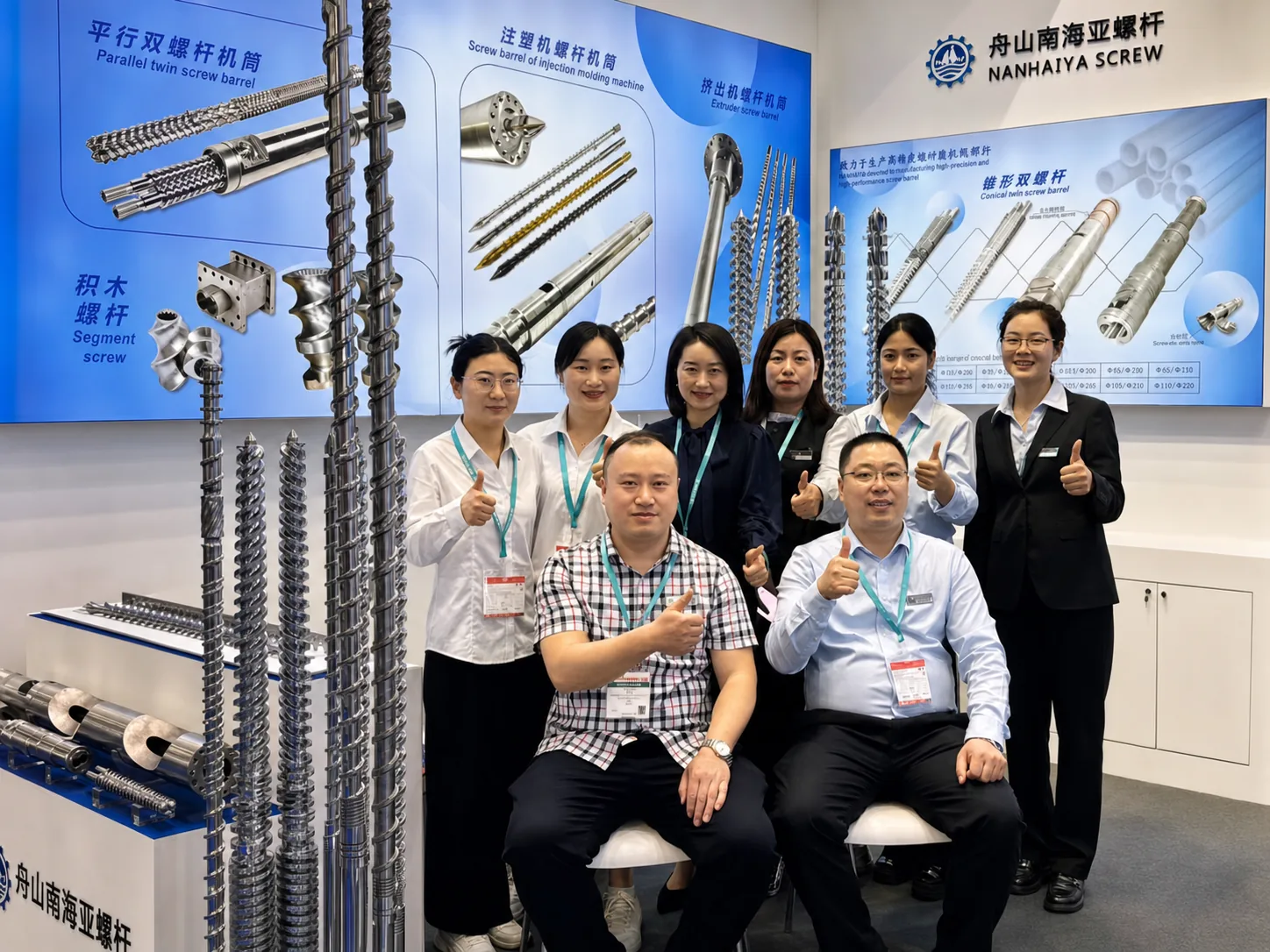
Related Articles
More insights on screw barrel technology and plastics processing.
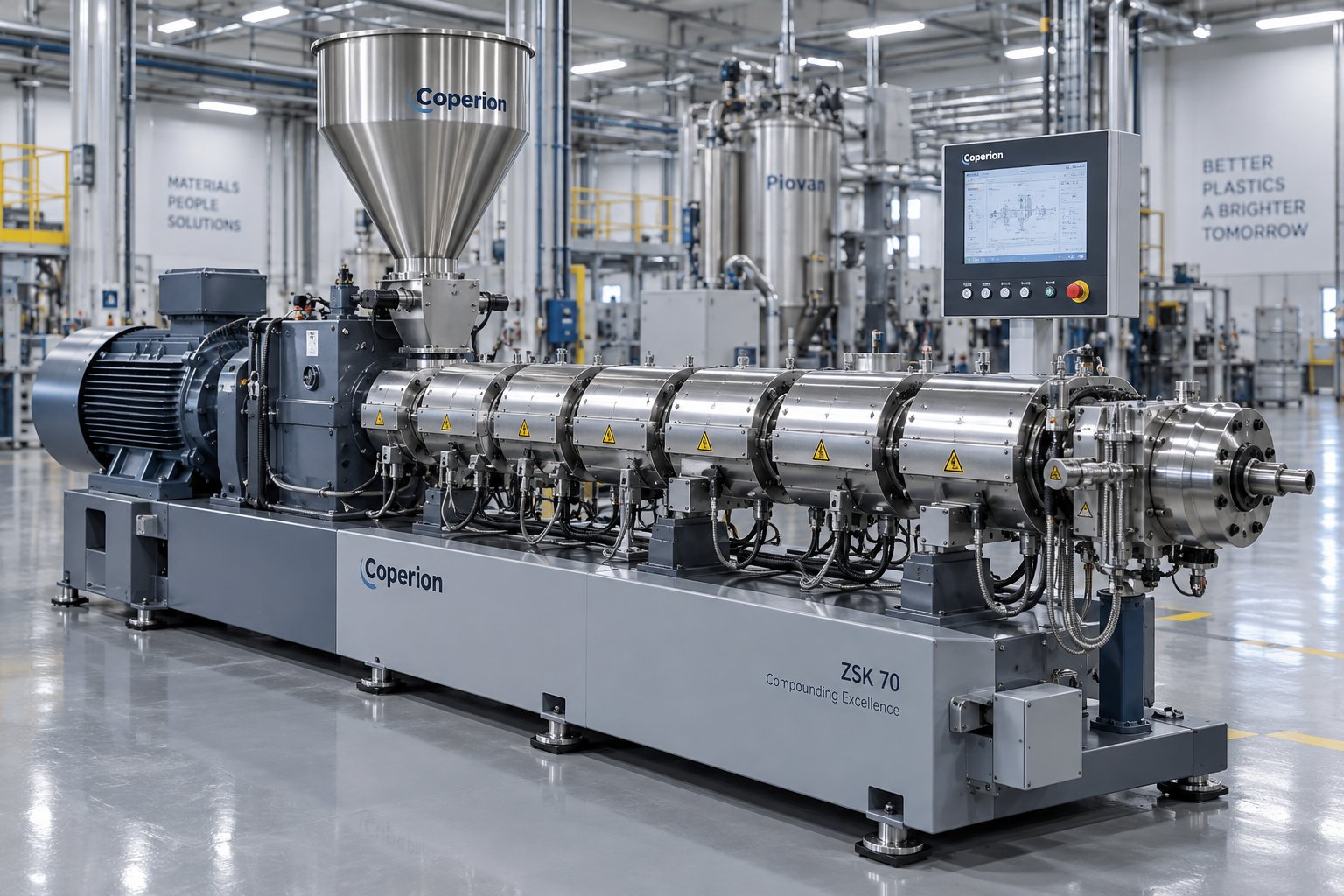
What Your Single Screw Extruder Manufacturer Won't Tell You
Oct 10, 2026
Learn how to evaluate single screw extruder manufacturers with this buyer-focused guide covering specs, configurations, material matching, and a ready-to-use selection checklist.
Read Article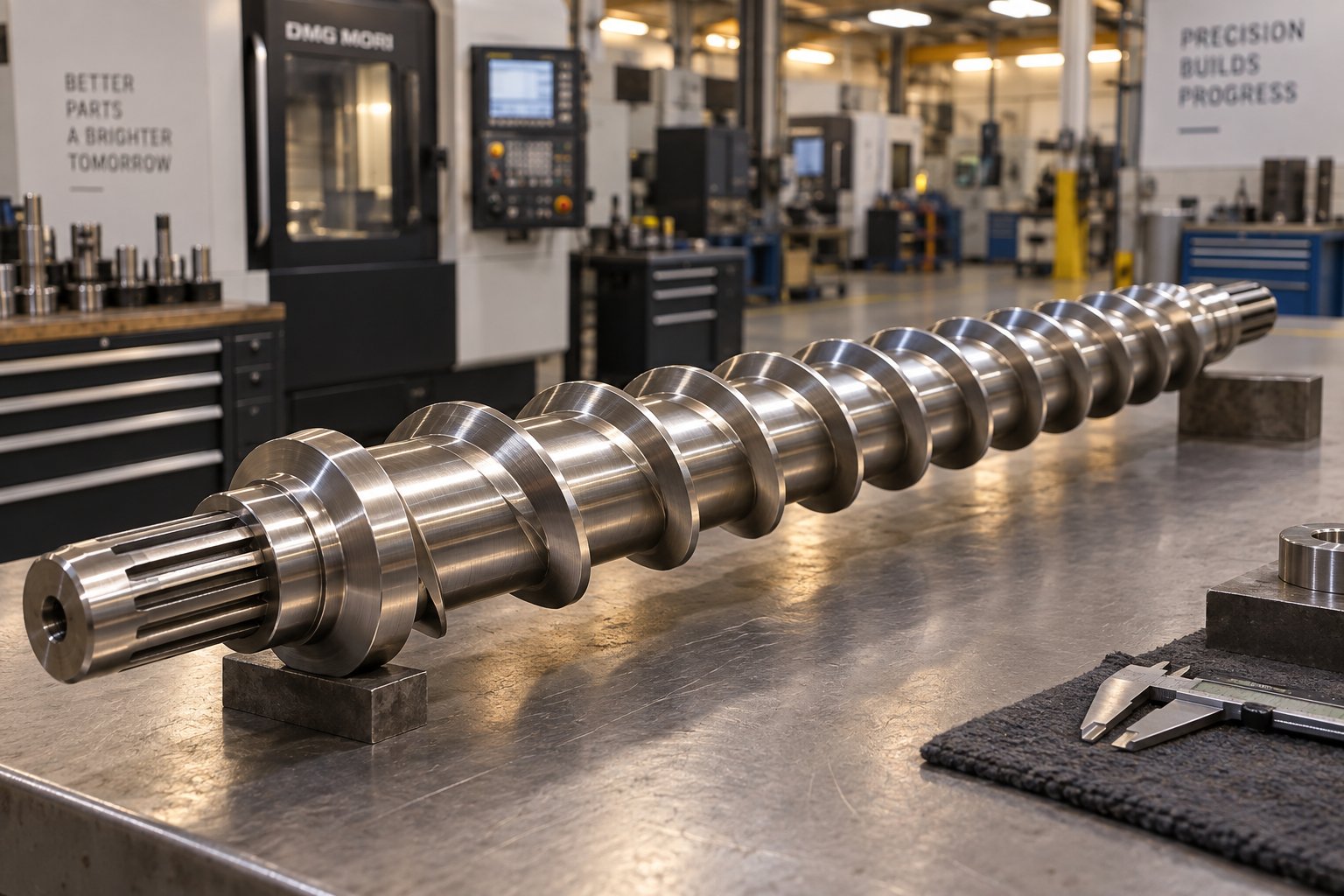
Plastic Extruder Screw Price Demystified: From Steel To Sticker
Oct 10, 2026
What drives plastic extruder screw price? This independent guide breaks down diameter, L/D ratio, metallurgy, order volume, and total cost of ownership factors.
Read Article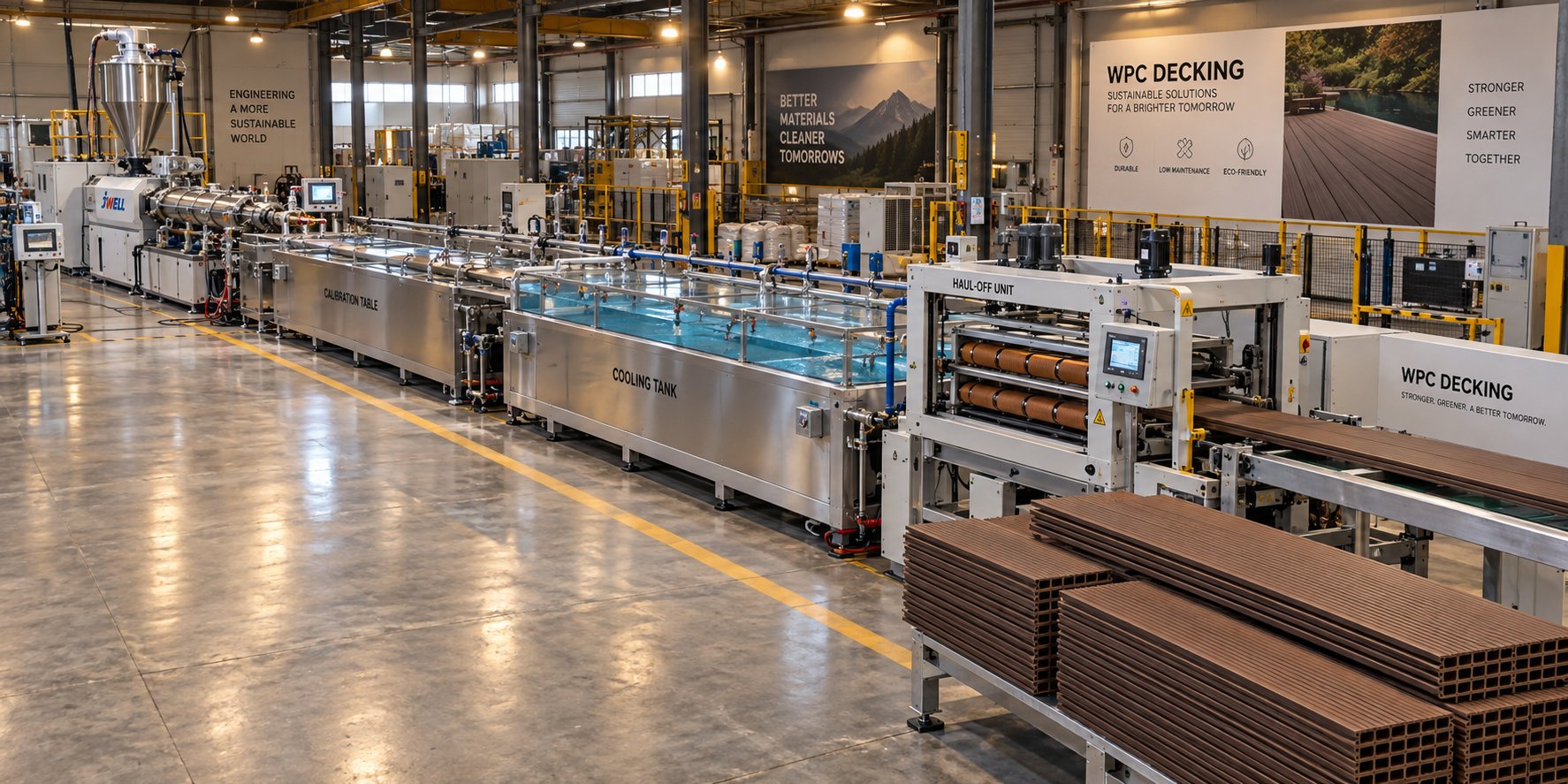
What No Supplier Tells You About WPC Decking Making Machines
Oct 6, 2026
Learn how a WPC decking making machine works, compare extruder types, formulations, and production methods, plus get a buyer checklist to evaluate any supplier.
Read ArticleLooking for something else?
Search by material, symptom or product and jump straight to the relevant page.
These are navigation suggestions based on keyword matching — not a quotation, not a delivery commitment, and not a substitute for engineering review. Final specification is confirmed by our engineers against your drawings and processed material.
Need help with screw barrel selection?
Share your machine model, processed material and application. Our team can help with pricing and technical support.