

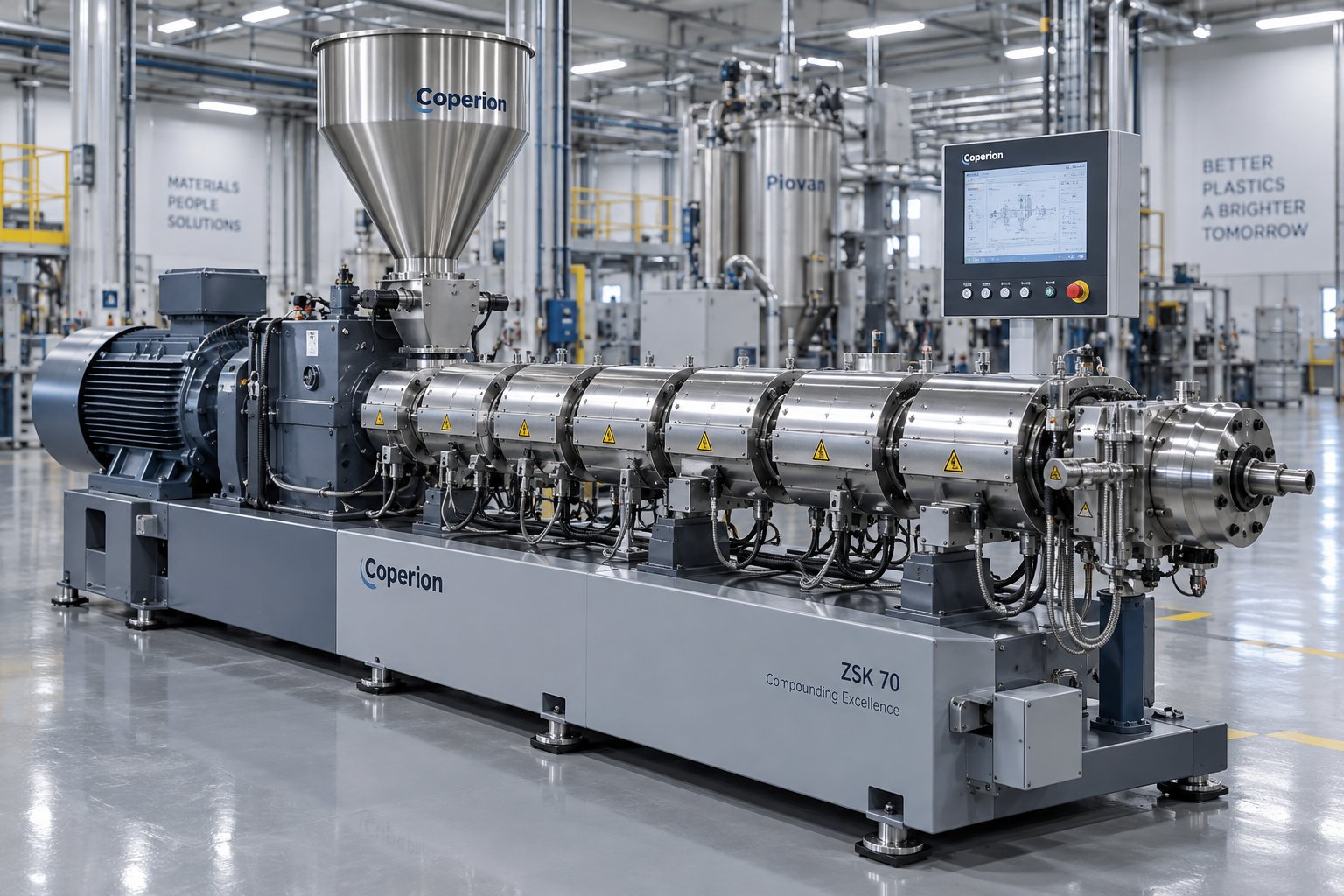
What Single Screw Extruders Do and Why the Right Manufacturer Matters
You're comparing spec sheets, requesting quotes, and scrolling through manufacturer websites that all look remarkably similar. Every supplier claims superior engineering. Every brochure promises reliable output. So how do you actually tell the difference between a single screw extruder manufacturer that will support your production for a decade and one that disappears after the invoice clears?
That question drives everything in this guide. But first, let's establish what you're actually buying.
What Is a Single Screw Extruder
A single screw extruder is a continuous processing machine built around one rotating screw housed inside a heated barrel. Raw thermoplastic material - typically pellets, granules, or powder - enters through a feed hopper, and the screw conveys it forward through distinct heating and compression zones. Along the way, the polymer melts, mixes, and builds pressure before being forced through a shaped die to produce a continuous product.
A single screw extruder is an industrial extruder that uses one helical screw rotating inside a heated barrel to melt, homogenize, and continuously shape thermoplastic polymers into profiles, pipes, films, sheets, and other finished forms.
This extrusion extruder type remains the workhorse of the plastics industry. Its relative simplicity, broad material compatibility, and proven reliability make it the default choice for everything from PVC pipe production to blown film lines and wire coating applications. Among all plastic extruders used in thermoplastic processing worldwide, single screw designs account for the largest installed base by a wide margin.
Why Your Manufacturer Choice Matters More Than You Think
Here's what most buyers overlook: the machine itself is only part of the equation. Two plastic extruder systems with identical screw diameters, motor ratings, and published output ranges can deliver wildly different results on your production floor. The gap comes down to the manufacturer behind the machine.
Engineering support determines whether your screw geometry is optimized for your specific polymer and product - or simply pulled from a standard catalog. Customization capability dictates whether you can adapt the extruder to evolving material requirements or tighter tolerances down the road. Spare parts availability and after-sales response times directly influence how many hours of unplanned downtime you absorb each year.
As Reifenhauser's service model illustrates, leading manufacturers treat inspection, maintenance, and modernization as ongoing commitments - not afterthoughts. Screws and barrels face extreme daily loads, and professional service intervals can be the difference between predictable upkeep and costly emergency repairs.
This article is written entirely from your perspective as a buyer. You won't find product pitches here. Instead, you'll find the technical context, evaluation frameworks, and pointed questions that help you separate genuinely capable manufacturers from those who simply look good on paper. The differences start at the component level - with the screw, barrel, and drive system that form the mechanical heart of every single screw extruder.
How a Single Screw Extruder Works from Hopper to Die
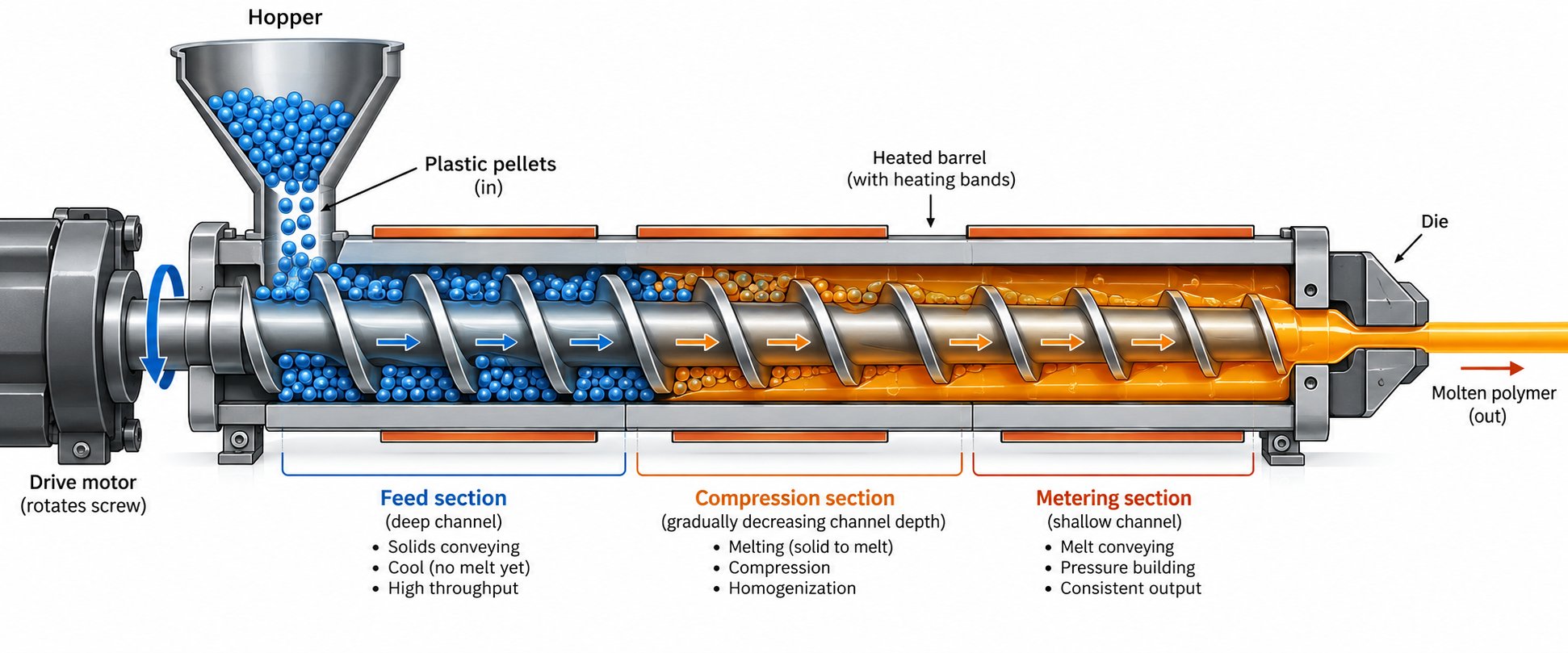
Every screw extruder follows the same fundamental logic: feed solid polymer in one end, deliver a homogeneous melt out the other. Simple in concept - but the engineering that makes it work reliably, shift after shift, involves far more nuance than most spec sheets reveal. Understanding what's inside the machine gives you a sharper eye when evaluating manufacturers and a common vocabulary to use during technical discussions.
Core Components of a Single Screw Extruder
Strip away the control panel and safety covers, and a single screw extrusion system breaks down into six primary components. Each one plays a distinct role in transforming raw pellets into a continuous, shaped product:
- Hopper: The feed throat and hopper sit at the rear of the machine, channeling pellets, granules, or flake by gravity into the barrel. Some designs include forced-feed or grooved feed throat sections to improve material intake consistency - especially important for low-bulk-density or recycled feedstocks.
- Barrel: A precision-bored steel cylinder that houses the screw. The barrel provides the stationary surface against which the polymer is conveyed and sheared. Barrel quality - including bore tolerance, surface hardness, and wear-resistant linings - directly affects melt consistency and machine lifespan.
- Screw: The heart of the operation. This single extruder screw rotates inside the barrel, conveying material forward while generating the friction and pressure needed for melting. The radial clearance between screw and barrel is typically held to a ratio of about 0.001 relative to screw diameter - meaning a 1-inch screw pairs with a 1.001-inch bore. That tight tolerance is expensive to maintain over long lengths, which is one reason quality varies so dramatically between manufacturers.
- Drive System (Motor and Gearbox): Provides the torque and rotational speed to turn the screw. The drive must deliver consistent torque across the full operating range, particularly when processing high-viscosity materials that resist screw rotation.
- Heating and Cooling Zones: Band heaters and thermocouples segmented along the barrel establish distinct temperature zones. Contrary to what you might expect, barrel heaters in a screw extruder account for only about 10-20% of the total energy that melts the polymer. The majority comes from frictional and viscous shear heating generated by the screw itself.
- Die: The shaped exit tooling that determines the final cross-section of the extrudate - whether it's a round pipe, flat sheet, annular film bubble, or complex window profile. Between the screw tip and the die, a breaker plate and mesh filter screen remove contaminants and eliminate the rotational memory of the melt to prevent the extrudate from curling.
Here's the critical takeaway for buyers: the plastic extruder screw and barrel are both the highest-wear and highest-impact components in the system. Their metallurgy, surface treatment, and geometric precision determine melt quality, energy efficiency, and how many processing hours you get before performance degrades. When evaluating a manufacturer, the engineering depth behind these two components tells you more than any marketing brochure.
The Three Zones of Plasticization
Imagine following a single pellet on its journey through the barrel. It passes through three distinct geometric zones on the screw, each designed to accomplish a specific stage of the screw extrusion process:
Feed Zone (Solid Conveying): The screw flights are deepest here. Pellets drop from the hopper into these channels, and the relative motion between the rotating screw and stationary barrel pushes them forward as a compacted solid plug. At this stage, all pellets move at roughly the same velocity. The feed zone's job is simple but essential: deliver a consistent, steady mass of material into the barrel. Inconsistent feeding here creates output fluctuations that cascade through the entire line.
Compression Zone (Melting and Compacting): This is where the real transformation happens. The screw flight depth decreases gradually, squeezing the material into a smaller volume. That compression, combined with frictional heat from the barrel wall and inter-pellet contact, initiates melting. As the solid-to-melt ratio shifts, viscous shear heating takes over as the dominant heat source - the molten polymer resists the screw's motion, and that resistance generates internal heat. A properly designed compression zone reduces melt temperature variation, leading to more consistent wall thickness in pipe extrusion, more uniform gauge in film production, and fewer rejects across the board.
The compression ratio - the ratio of flight depth in the feed zone to flight depth in the metering zone - must match the polymer being processed. According to established processing guidelines, typical compression ratios range from 2:1 to 4:1, with polyolefins like PE and PP requiring higher ratios (3.0-4.0:1) and thermally sensitive materials like PVC needing lower ratios (around 2.5:1) to avoid degradation.
Metering Zone (Homogenizing and Pressurizing): The flight depth remains constant here, creating stable drag flow that homogenizes the melt and builds the consistent pressure needed to push material through the die. Mixing occurs naturally as the polymer spirals forward, blending any remaining temperature variations and distributing colorants or additives. Some screw designs incorporate specialized mixing elements in this zone - such as Maddock or pineapple mixers - to further improve melt uniformity.
You'll notice a pattern: the geometry of a single extruder screw across these three zones determines virtually everything about how efficiently a given polymer is processed. Two screws with the same diameter but different zone lengths, compression ratios, or flight designs will produce dramatically different melt quality from the same raw material. This is exactly why the best manufacturers engineer screw geometry around your specific application rather than pulling a general-purpose design off the shelf.
How the Drive System Influences Performance
The drive system rarely gets the attention it deserves during the buying process, yet it directly shapes your operating costs, maintenance schedule, and product quality. Most screw extruder configurations use one of three motor and drive arrangements:
DC Motor with Gear Reducer: The legacy standard. DC drives offer straightforward speed control and have a long track record. However, they require brush maintenance, consume more energy at typical operating speeds, and generate significant noise on the production floor.
AC Motor with Gear Reducer: The current mainstream choice. AC drives eliminate brush maintenance and offer improved efficiency over DC systems. The mechanical gearbox still introduces energy losses, vibration, and periodic maintenance requirements - but overall, AC-geared systems represent a solid balance of cost and performance.
AC Direct-Drive (Permanent Magnet Synchronous Motor): The emerging alternative. Direct-drive systems eliminate the gearbox entirely, coupling a high-torque, low-speed motor directly to the screw. Testing by Davis-Standard on a 2.5-inch, 30:1 L/D extruder showed that direct-drive configurations consumed 10-15% less power than AC-geared systems and were up to 70 times quieter at typical operating speeds. The trade-off? Higher upfront cost - roughly $20,000 more for a 3-inch extruder - and current limitations on maximum screw diameter (around 4.5 inches) and overspeed capability.
Why does this matter for your buying decision? Drive type affects your electricity bill every hour the machine runs, dictates how often you schedule gearbox inspections and oil changes, and influences torque consistency at low speeds - critical for maintaining melt pressure stability during startup or when processing shear-sensitive materials. Some manufacturers highlight direct-drive options prominently; others never mention them. Asking specifically about drive technology and its impact on total cost of ownership is one of the fastest ways to gauge a manufacturer's transparency and engineering depth.
With the mechanical fundamentals in clear view, the natural next question becomes: how do you translate these components and zones into the specific numbers - screw diameter, L/D ratio, output rate - that actually appear on a quotation?
Key Technical Specifications Every Buyer Should Understand
Specification sheets are full of numbers. Screw diameter, L/D ratio, compression ratio, output range, motor power - they're all listed neatly in columns. But here's the problem: those numbers mean very little unless you understand what they actually determine on your production floor. A 90 mm single screw extruder machine from one supplier and a 90 mm machine from another can share identical headline specs yet deliver vastly different results depending on how each parameter was engineered for your application.
This section translates the raw numbers into the business outcomes they control - throughput, product quality, energy cost, and flexibility - so you can read any quotation with sharper eyes.
Screw Diameter and What It Determines
Screw diameter is the single most important sizing parameter on any plastic extruder machine. Commonly ranging from 20 mm for lab-scale and micro-extrusion work up to 300 mm or more for high-volume commodity production, this dimension directly correlates with output capacity. A larger screw displaces more material per revolution, which means higher potential throughput.
But throughput isn't the only thing that scales with diameter. Larger screws require more powerful drive systems to generate sufficient torque, more floor space for the longer barrels that accompany them, and heavier infrastructure to support and install the equipment. The relationship between screw diameter and channel depth also shifts: feed section depth is typically 10-15% of the screw diameter, so a 100 mm screw has significantly deeper channels than a 50 mm screw, processing a proportionally larger volume of material per flight.
What does this mean practically? If your production target is 80 kg/hr of polyethylene pipe, you don't simply pick the smallest machine that lists 80 kg/hr as its maximum. Running any plastic extruding machine at its absolute ceiling leaves no headroom for material variability, startup waste, or future capacity growth. Experienced buyers typically size for 70-80% of rated maximum throughput - a detail manufacturers rarely volunteer during the quoting process.
Understanding L/D Ratio and Compression Ratio
Two ratios appear on every single screw extrusion machine specification sheet, and both deserve more attention than they usually get.
L/D Ratio (Length-to-Diameter): This describes how long the screw is relative to its diameter. Standard single screw extruders typically range from 20:1 to 30:1, though some specialized designs extend to 36:1 or beyond. In practical terms, a higher L/D ratio gives the polymer more residence time inside the barrel - more time to absorb heat, more shear history, and more opportunity for thorough mixing and melting.
When does that matter? If you're processing engineering polymers like polycarbonate or filled compounds that need thorough melting and homogenization, a 28:1 or 30:1 L/D ratio can be the difference between a uniform melt and one riddled with unmelts or temperature inconsistencies. But for simple polyolefin processing - standard PE or PP with no special additives - a 24:1 ratio may deliver perfectly acceptable results at lower capital cost and reduced energy consumption. Longer barrels aren't automatically better; they're better when your material and product actually demand it.
Compression Ratio: This describes the volume change from the deep channels of the feed zone to the shallow channels of the metering zone. A compression ratio of 3:1, for example, means the feed channel holds three times the volume of the metering channel. That progressive squeezing is what drives melting and compaction.
Different polymers demand different compression ratios, and this is where a manufacturer's engineering depth shows. As noted by SpecialChem's extrusion screw design guide, unfilled polypropylene typically requires a volumetric compression ratio in the 3.5 to 3.75:1 range, while a 40% talc-filled polypropylene drops to 2.75-3.25:1 because the non-compressible filler already occupies channel volume. Use the wrong ratio and you'll see barrel temperature overrides, excessive wear, and inconsistent output - problems that no amount of process tuning can permanently fix.
Imagine you're evaluating two quotes for an extruder machine for plastic compounding. Both list a 90 mm, 30:1 L/D screw. But if one supplier asks detailed questions about your resin grade, filler loading, and target throughput while the other simply offers a catalog screw, you already know which manufacturer is engineering the compression ratio for your material and which is hoping a general-purpose design will be close enough.
Output Rate and Motor Power Considerations
Output rate - measured in kg/hr or lbs/hr - is typically the first number buyers compare across quotes. It's also the most commonly misunderstood.
Throughput doesn't depend on machine size alone. It's a function of screw speed (RPM), screw geometry, and the specific polymer being processed. A 75 mm extruder running PE at 120 RPM will deliver a very different output than the same machine running rigid PVC at 30 RPM. Material density plays a direct role: bulk density in the feed zone is only 40-60% of solid density, and melt density at the discharge end runs roughly 85-95% of solid density. Those density transitions, combined with volumetric efficiency losses from backpressure and screw-to-barrel clearance, mean the actual output you measure at the die is always lower than the theoretical maximum.
Motor power ties directly into this equation. Higher-viscosity materials - engineering polymers, heavily filled compounds, recycled feedstocks with inconsistent melt flow - resist screw rotation more aggressively, demanding greater torque. If the motor and gearbox can't deliver consistent torque at operating speed, you'll see screw speed fluctuations that translate directly into output surging, wall thickness variation, and rejected product. It's worth noting that increasing RPM by just 25% typically increases power draw by 35-45% and raises melt temperature by 8-15°C - a relationship that makes motor sizing a careful balance between throughput ambition and thermal control.
When reviewing any extruder machine for plastic processing, ask the manufacturer to specify output rates for your exact polymer grade, not just a generic "PE/PP" figure. The table below provides general industry ranges to help you benchmark what you see on quotations:
| Extruder Category | Screw Diameter | L/D Ratio | Typical Output Range (PE/PP) | Motor Power |
|---|---|---|---|---|
| Small / Lab-Scale | 20-45 mm | 20:1 - 25:1 | 5-50 kg/hr | 3-15 kW |
| Medium / Production | 50-90 mm | 25:1 - 30:1 | 50-350 kg/hr | 15-110 kW |
| Large / High-Volume | 100-150 mm | 28:1 - 36:1 | 400-2,000 kg/hr | 110-500+ kW |
Keep in mind that PVC throughput typically runs 20-30% lower than PE/PP on the same machine due to lower processing speeds and the material's thermal sensitivity. Filled or recycled materials introduce additional derating depending on filler type and loading level.
These specifications tell you what a machine can do. But two extruders with the same diameter, L/D, and motor power can still behave quite differently depending on their barrel and screw configuration - smooth bore versus grooved feed, vented versus sealed, barrier flight versus conventional. That's the next layer of the decision.
Single Screw Extruder Configurations and When to Use Each
Manufacturer catalogs often list configuration codes like S, SM, SMT, or SG next to their single screw plastic extruder models - yet rarely explain what those designations mean for your process. Even well-known suppliers such as Milacron extruder lines reference these variants without spelling out the practical trade-offs. The result? Buyers compare machines without realizing they're looking at fundamentally different barrel and screw architectures suited to very different applications.
Let's decode the four most common configurations so you can match each one to the job it does best.
Smooth Bore vs. Grooved Feed Extruders
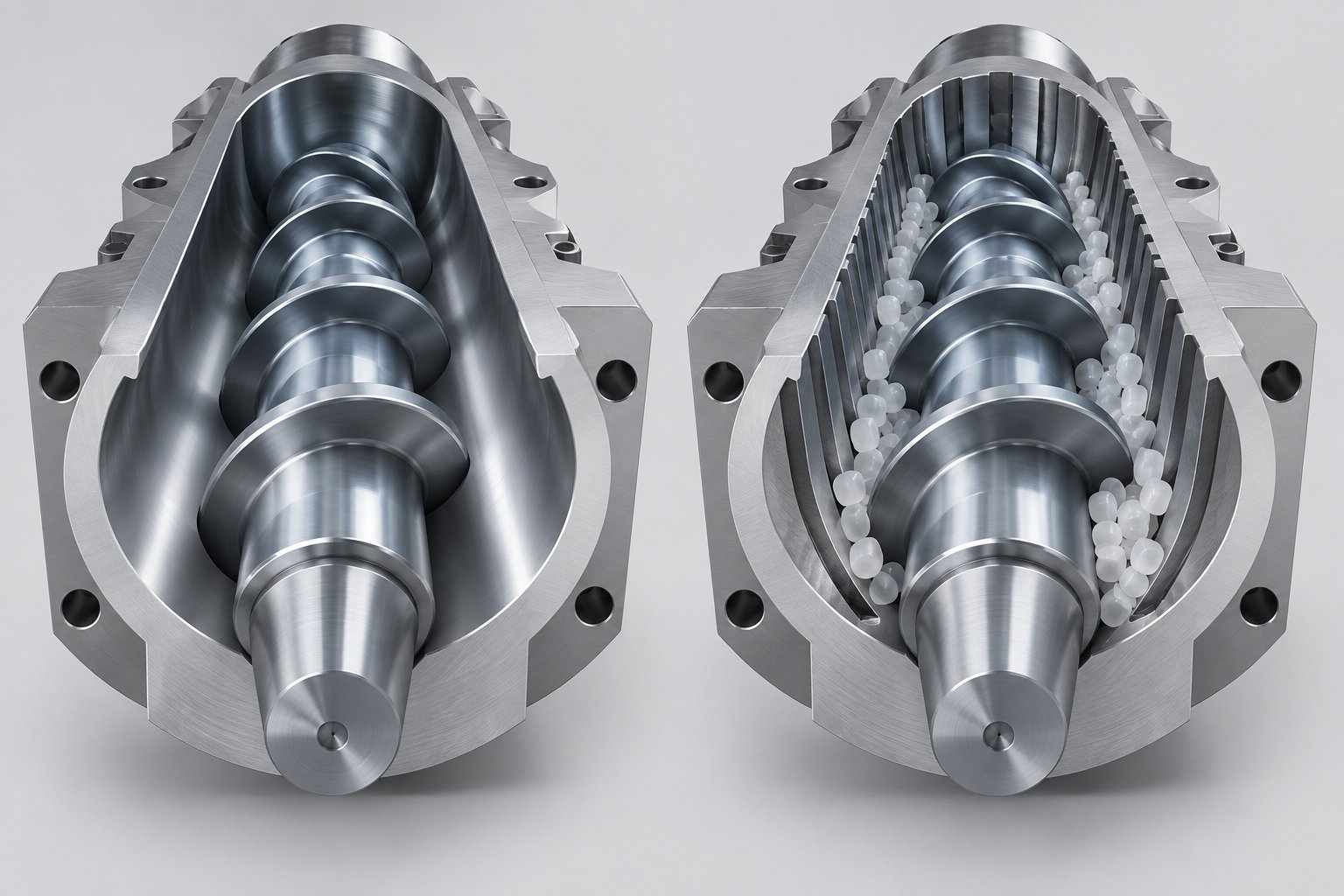
Most screw extruders ship with a smooth bore barrel - a polished, uninterrupted inner surface from the feed throat to the discharge end. Smooth bore designs rely on friction between the polymer and the barrel wall to convey pellets forward. They're versatile, relatively simple to maintain, and handle the widest range of thermoplastics without modification.
Grooved feed extruders take a different approach. Longitudinal grooves machined into the feed section create a mechanical interlock with the incoming pellets, producing what engineers call "positive conveying." Instead of depending on friction alone, the grooves physically grip the solid bed and push it forward at a rate determined almost entirely by screw speed. The outcome is a more predictable, higher-throughput feeding mechanism - especially valuable for polyolefins like HDPE and PP.
Performance data from Davis-Standard illustrates the advantage clearly. In side-by-side testing at 1,100 lbs/hr with high-viscosity HDPE, a 3.5-inch (90 mm) grooved feed extruder outperformed a larger 4.5-inch (114 mm) smooth bore machine - delivering lower melt temperatures, reduced power consumption, and improved energy efficiency. The annual energy savings alone reached $26,800 to $38,800 per machine, while CO2 emissions dropped by 227,800 to 329,800 lbs depending on the resin grade.
Sounds like a clear winner? Not always. Grooved feed sections generate significantly higher barrel pressures, which demand heavier barrel construction and more robust thrust bearings. They also tend to be less forgiving of material changes - switching from HDPE to a different polymer family may require feed section modifications. For processors running multiple materials on the same line, a smooth bore plastic single screw extruder often provides the flexibility that grooved feed designs sacrifice for sheer throughput.
Vented vs. Non-Vented Barrel Designs
Standard extruders are sealed systems - polymer enters, melt exits, and any moisture or volatile gases trapped in the material have nowhere to go except into your final product. That's perfectly fine when processing virgin, pre-dried pellets. But when your feedstock is hygroscopic, recycled, or contaminated with residual moisture, those trapped volatiles cause bubbles, surface defects, and degraded mechanical properties.
Vented (or degassing) extruders solve this by incorporating a decompression zone partway along the barrel where screw flight depth suddenly increases, dropping the melt pressure to near-atmospheric levels. A vacuum port positioned over this zone draws out moisture and volatiles before the second stage of the screw re-compresses and meters the cleaned melt toward the die.
The engineering behind vented screw plastic extruder designs is more nuanced than it appears. As extrusion expert Jim Frankland explains, the second stage must convey more material than the first stage produces - otherwise melt backs up through the vent opening, defeating the entire purpose. That balance depends on channel depth, head pressure, and polymer viscosity, making two-stage screw design a task where guesswork can be costly.
Vented configurations are increasingly important as the industry processes more post-consumer recycled (PCR) feedstocks. They eliminate the need for a separate pre-drying step - saving floor space, energy, and cycle time - while removing volatiles that would otherwise compromise product quality.
Barrier Screw Designs and Mixing Elements
Conventional single-flight screws melt polymer gradually across the compression zone, but the solid-melt boundary is chaotic and inconsistent. Barrier screws introduce a secondary flight - slightly lower than the primary flight - that physically separates the remaining solid bed from the molten polymer. As melting progresses, molten material crosses over the barrier flight into a dedicated melt channel while solids remain confined and continue absorbing energy.
This forced separation dramatically improves melting efficiency and melt uniformity. Barrier screw technology originated in rubber processing in the early 1960s and was adopted for thermoplastics within the following decade, quickly becoming the state of the art for demanding applications where melt quality is critical.
Mixing elements added to the metering zone further refine the melt. The most common types include:
- Maddock (Leroy/UCC) mixers: High-shear dispersive mixers that force polymer through tight clearances, breaking up any remaining unmelted particles. Best suited for conventional (non-barrier) screws where supplemental melting capacity is needed.
- Pineapple mixers: Distributive designs that divide and recombine the melt at varying angles, creating chaotic mixing patterns. Highly effective for color distribution and thermal homogenization.
- Pin mixers: Create exponential melt divisions based on the number of pins and rows, excellent for blending components with substantially different viscosities.
Here's the insight many buyers miss: barrier screws and high-shear mixers are not always a good pairing. If a properly designed barrier section has already completed melting, adding a dispersive mixer after it unnecessarily raises melt temperature, increases energy consumption, and reduces output due to added pressure drop. In most cases, a distributive mixer - such as a pineapple or pin design - is the better companion for a barrier screw, providing homogenization without the thermal penalty.
The table below compares these four configurations side by side to help you match the right architecture to your processing needs:
| Configuration | Best-Suited Polymers | Key Advantages | Trade-Offs | Typical Applications |
|---|---|---|---|---|
| Smooth Bore | Wide range: PVC, PS, ABS, engineering resins | Versatile; handles frequent material changes; simpler maintenance | Lower solids conveying efficiency for polyolefins; output limited by friction | General-purpose extrusion, profile, sheet |
| Grooved Feed | HDPE, PP, LLDPE, other polyolefins | Higher throughput at lower melt temperature; improved energy efficiency; smaller machine footprint for equivalent output | Higher barrel pressures; heavier construction required; less flexibility for material changes | Pipe extrusion, blown film, high-output polyolefin lines |
| Vented (Degassing) | Hygroscopic resins (nylon, PET), recycled/PCR feedstocks | Removes moisture and volatiles in-line; eliminates pre-drying step; improves product quality from contaminated feedstocks | More complex screw design; lower output vs. comparable single-stage screw; requires careful second-stage balancing | Recycling lines, PCR processing, compounding moisture-sensitive materials |
| Barrier Screw | Polyolefins, PS, PET, engineering polymers | Superior melting efficiency; improved melt uniformity; reduced temperature variation | Higher screw manufacturing cost; less tolerant of material changes without screw swap; pairs best with distributive (not dispersive) mixers | Blown film, cast film, precision pipe, sheet requiring tight gauge tolerances |
Choosing among these configurations is rarely a binary decision. Many production lines combine features - a grooved feed section paired with a barrier screw, for instance, or a vented barrel with distributive mixing elements at the discharge end. The right combination depends entirely on what you're processing and what your end product demands - which is exactly why the next step is mapping specific applications to the extruder setup that serves them best.
Industry Applications Matched to the Right Extruder Setup
Configurations don't exist in a vacuum - they exist to solve specific production problems. Yet most manufacturer websites list application keywords without ever connecting them to the barrel architecture, screw geometry, or drive requirements that make each one work. The result is a frustrating gap between "we do pipe extrusion" and the engineering detail you actually need to make a confident purchasing decision.
Here's the mapping most suppliers leave out of the conversation.
Pipe and Tubing Extrusion
Pipe production is one of the highest-volume applications for any plastic extrusion machine, spanning PVC water and sewer pipe, HDPE gas distribution lines, PPR hot-water piping, and precision medical tubing. What unites these products - despite their wildly different materials and dimensions - is a shared demand for consistent melt pressure at the die. Even small pressure fluctuations translate into wall thickness variation, which can push finished pipe outside of standard tolerances.
For polyolefin pipe (HDPE and PPR), grooved feed extruders paired with barrier screw designs deliver the best combination of throughput and melt uniformity. The grooved feed section locks in a predictable solids conveying rate, while the barrier flight ensures complete melting before the melt reaches the die. A dedicated PVC extruder, on the other hand, typically uses a smooth bore barrel with a low-compression screw - avoiding the excessive shear and frictional heat that would thermally degrade this sensitive polymer.
It's worth noting that plastic tube extruder setups vary dramatically depending on tube diameter and wall thickness. A medical catheter line running at 25 mm diameter demands entirely different screw geometry and temperature control precision than a 630 mm HDPE water main. When manufacturers claim broad "pipe and tube" capability, ask them to specify which diameter ranges and materials their standard screw designs actually cover - and where custom engineering begins.
Film Blowing and Sheet Extrusion
Blown film and flat die sheet lines both produce flat or tubular products, but their demands on the extruder differ in important ways.
In blown film production, the polymer exits through an annular die and inflates into a thin bubble. Melt homogeneity is everything here - any thermal inconsistency or unmelted particle creates a visible defect in the finished film. That's why blown film lines frequently specify higher L/D ratios (28:1 to 30:1) to extend residence time and improve mixing. Barrier screws with distributive mixing elements are common on premium film lines for exactly this reason.
Sheet extrusion through a flat die places a premium on output stability rather than extreme melt refinement. Thick sheets destined for thermoforming can tolerate slightly broader temperature windows, but the extruder must deliver rock-steady volumetric flow to maintain consistent gauge across the full die width. As SpecialChem's extrusion guide notes, the end-product thickness in flat sheet extrusion is governed primarily by take-off speed at a given extruder output and width - meaning any output surge from the extruder creates a direct thickness defect in the final product.
Profile Extrusion and Wire Coating
When you look at a PVC window frame, a composite decking board, or a complex weatherstrip, you're seeing the product of a plastic profile extrusion machine operating at the tightest dimensional tolerances in the industry. Profiles require not only consistent melt pressure but also uniform melt temperature across the entire cross-section of the die - otherwise the extrudate warps, sinks, or develops surface defects as it cools.
Plastic profile manufacturing extruders for PVC window systems typically feature smooth bore barrels, conical or parallel twin-screw designs for the primary extruder, and single screw co-extruders for cap layers. However, single screw machines remain common for simpler profiles, weather seals, and trim where material complexity is lower. Dimensional accuracy in these applications depends heavily on the metering zone's ability to deliver pulse-free flow - a characteristic driven by screw design, drive torque consistency, and precise temperature control across all barrel zones.
Wire and cable coating represents a specialized niche where the extruder must apply a uniform polymer layer over a continuously moving conductor. Melt pressure control is critical because even minor surges create insulation thickness variations that compromise electrical performance. These lines typically run at high speeds with relatively small screw diameters (45-90 mm), and the crosshead die geometry imposes significant backpressure that the screw must overcome without fluctuation.
Pelletizing and Recycling Applications
Single screw extruders play a vital role in compounding, pelletizing, and recycling operations - applications where the goal is to produce uniform pellets from raw, blended, or reclaimed materials rather than a finished product shape. A screw extruder granulator setup pairs the extruder with a strand die or underwater pelletizer to cut the extruded melt into consistent pellets for resale or downstream processing.
Recycling lines face unique challenges that standard production extruders aren't designed for. Post-consumer feedstocks arrive with inconsistent bulk density, variable moisture content, and unpredictable contamination levels. Vented extruder designs are especially valuable here because they remove trapped moisture and volatile gases in-line, eliminating the need for a separate pre-drying step that adds cost and floor space. As outlined in Haisi Extrusion's pelletizing screw guide, venting screws feature a decompression area after the initial compression zone where the screw root diameter suddenly decreases, dropping internal pressure so trapped gases can be vacuumed out before the second compression stage rebuilds pressure for extrusion through the die.
For screw extruder granulator lines processing abrasive recycled or mineral-filled materials, wear-resistant bimetallic barrels and hardened screw flights aren't optional upgrades - they're baseline requirements for acceptable service life. Without them, screw-to-barrel clearances open up within months, degrading output consistency and melt quality long before the machine reaches its expected maintenance interval.
The summary below maps each application to the extruder configuration and polymer types best suited to it:
- PVC Pipe: Smooth bore barrel, low-compression screw (2.0-2.5:1), L/D 24:1-28:1. Key polymers: rigid PVC, CPVC.
- HDPE/PPR Pipe: Grooved feed section, barrier screw, L/D 28:1-33:1. Key polymers: HDPE, PP-R, PE-RT.
- Blown Film: Smooth bore or grooved feed, barrier screw with distributive mixer, L/D 28:1-30:1. Key polymers: LDPE, LLDPE, HDPE, mLLDPE.
- Flat Sheet: Smooth bore, standard or barrier screw, L/D 24:1-30:1. Key polymers: PP, PS, PET, ABS.
- Window and Construction Profiles: Smooth bore (or conical twin-screw for complex PVC profiles), L/D 20:1-25:1. Key polymers: PVC, WPC composites.
- Wire and Cable Coating: Smooth bore, high-precision metering zone, L/D 24:1-28:1. Key polymers: PE, XLPE, PVC, fluoropolymers.
- Pelletizing and Compounding: Smooth bore or grooved feed, three-zone or barrier screw, L/D 26:1-30:1. Key polymers: PP, PE, PS, masterbatch carriers.
- Recycling: Vented barrel with two-stage screw, wear-resistant construction, L/D 30:1-36:1. Key polymers: rPET, rHDPE, rPP, mixed post-consumer streams.
A clear pattern emerges from this mapping: the application defines the configuration, and the configuration defines the manufacturer capabilities you should be evaluating. A supplier who excels at PVC pipe extruders may have limited experience engineering grooved feed blown film lines - and vice versa. Knowing which configuration your application demands gives you a concrete framework for testing whether a prospective manufacturer's technical depth actually matches your production reality.

How to Evaluate and Compare Single Screw Extruder Manufacturers
You know which configuration your application requires. You understand the specs that matter. But when three or four plastic extruder suppliers land on your shortlist - each claiming superior engineering, responsive service, and competitive pricing - how do you objectively separate the contenders from the pretenders?
Most buyers default to price comparison because it's the easiest metric to quantify. That's a mistake. The lowest quote often reflects corners cut in metallurgy, drive components, or post-sale support infrastructure - costs that resurface as unplanned downtime, premature wear, and frustrating spare parts delays months after the purchase order closes. What you need is a structured evaluation framework that weighs the factors actually driving long-term production value.
Technical Capability and Customization Range
Start here, because this is where you'll find the widest variation between single screw extruder manufacturers. A genuinely capable extruder manufacturer designs screws and barrels in-house, using engineering teams who understand how polymer rheology interacts with screw geometry. They'll ask detailed questions about your resin grades, filler loadings, target throughputs, and dimensional tolerances before recommending a configuration - not after.
Look for these indicators of engineering depth:
- In-house screw and barrel design: Manufacturers who engineer their own screws can customize L/D ratios, compression ratios, and flight geometries for specific polymers. Those who outsource this work typically offer only catalog designs with limited modification options.
- Range of machine sizes: A broad portfolio spanning small-diameter lab units through large production machines suggests genuine manufacturing capability rather than assembly of purchased components.
- Material-specific expertise: Can the supplier specify different barrel metallurgies for abrasive glass-filled compounds versus corrosive fluoropolymers? This level of customization reflects real application knowledge.
Manufacturers like Milacron emphasize in-house engineering and proprietary screw technologies, while companies like Bausano highlight their patented drive systems and modular customization alongside a comprehensive service ecosystem. Both approaches have merit - the key is verifying that the claimed engineering capability actually extends to your specific application rather than existing only in marketing materials.
After-Sales Support and Spare Parts Infrastructure
Imagine your extruder screw shows accelerated wear after eight months of processing a new glass-filled compound. How quickly can your plastic extruder manufacturer deliver a replacement? Two days? Two weeks? Eight weeks?
That answer defines the real cost of your equipment choice. Spare parts lead times can mean the difference between a brief planned maintenance window and weeks of unplanned downtime that ripple through your entire production schedule. According to industry data from Kerke's downtime analysis, for a typical compounding operation producing 500 kg/hr of product valued at $2/kg, a single hour of downtime represents $1,000 in lost production value - and that's before counting restart scrap, labor costs, and missed delivery penalties.
Evaluate every prospective plastic extruder machine manufacturer on these after-sales dimensions:
- Spare parts stocking policy: Does the manufacturer maintain regional inventory of high-wear items (screws, barrel liners, heater bands, thermocouples), or is everything manufactured to order?
- Response times: What is the committed response time for critical failures? Leading manufacturers typically respond to warranty claims within 48 hours and dispatch replacement parts within 7 days for major components.
- Field service coverage: Does the supplier maintain service engineers in your region, or does every service call require international travel with associated delays and costs?
- Remote troubleshooting: Can the manufacturer diagnose issues via phone, video, or connected PLC systems without waiting for a technician to arrive on-site?
A useful litmus test: ask for contact information of two or three reference customers in your region who have purchased similar equipment. Any manufacturer confident in their after-sales performance will provide these references without hesitation.
Regional Considerations and Industry Certifications
Where a manufacturer is based shapes more than just the price tag. European, North American, and Asian plastic extruder suppliers each bring distinct strengths and trade-offs to the table.
European manufacturers (Germany, Italy, Austria) have built reputations on manufacturing precision, advanced metallurgy, and rigorous quality management systems. They typically command premium pricing - often 40-60% above comparable Asian equipment, as comparative analyses by JWELL have documented - but offer strong residual value, established service networks, and deep application expertise in high-precision segments.
North American manufacturers like Davis-Standard offer proximity advantages for buyers in the Americas: shorter lead times, local field service, and familiarity with regional electrical and safety standards. Their engineering depth in film, tubing, and medical extrusion is well-documented.
Asian manufacturers - particularly leading Chinese suppliers - have closed the quality gap significantly over the past decade, investing heavily in CNC machining, precision monitoring, and ISO-certified quality systems. They deliver superior capital efficiency with typical lead times of 12-20 weeks versus 20-30 weeks for European equivalents. The important caveat: quality variation within the Asian market remains wider than within the European sector, making supplier due diligence especially critical.
Regardless of origin, treat industry certifications as baseline qualifiers rather than differentiators. ISO 9001 quality management certification, CE marking for European market compliance, and UL listing for electrical safety are minimum expectations for any credible manufacturer - not competitive advantages. Their absence, however, is a red flag.
The evaluation framework below consolidates these criteria into a scoring tool you can apply when comparing any group of single screw extruder manufacturers side by side:
| Evaluation Category | What to Assess | Score 1 (Weak) | Score 3 (Adequate) | Score 5 (Strong) |
|---|---|---|---|---|
| Technical Capability | In-house screw/barrel design, engineering team depth, application testing facilities | Catalog-only designs; no in-house engineering | Limited customization; some in-house design | Full in-house design with polymer-specific optimization and testing lab |
| Customization Options | Range of L/D ratios, barrel configurations, drive types, and screw geometries offered | Fixed configurations only | Moderate flexibility within standard platforms | Fully configurable screw, barrel, drive, and control systems |
| Service Infrastructure | Field service engineers, remote support, response time commitments | No regional presence; email-only support | Regional service partners; phone support | Dedicated field engineers in your region; remote PLC access; guaranteed response times |
| Spare Parts Availability | Stocking policy, lead times for high-wear items, regional warehousing | All parts manufactured to order (6-10 week lead time) | Common wear parts stocked centrally (2-4 week delivery) | Regional inventory of screws, barrels, heaters, and controls (same-week delivery) |
| Industry Experience | Years in operation, installed base, reference customers in your application segment | Limited track record; few verifiable installations | Established manufacturer with general extrusion experience | Deep expertise in your specific application with verifiable reference sites |
| Energy Efficiency Features | Drive technology, insulation, motor efficiency ratings, published energy data | Standard AC motor with no efficiency data provided | IE3 motors; basic barrel insulation; general efficiency claims | Direct-drive or high-efficiency options; published kWh/kg data; energy recovery systems |
| Geographic Support Coverage | Proximity of service, parts, and training resources to your facility | Manufacturer located in a different continent with no local presence | Distributor or agent in your country | Direct subsidiary or service center within practical travel distance |
Apply this framework by scoring each shortlisted manufacturer across all seven categories, then weighting the scores based on your operational priorities. A processor running 24/7 on a single critical production line should weight service infrastructure and spare parts availability heavily. A facility with in-house maintenance capability and multiple redundant lines might prioritize technical capability and energy efficiency instead.
No single manufacturer scores a perfect 5 across every category - and any supplier who claims otherwise deserves extra scrutiny. The goal isn't finding a flawless partner; it's identifying which trade-offs you can live with and which ones will cost you production hours, quality rejects, or competitive position over the life of the equipment.
Of course, this framework assumes you're buying new. For many operations, the smartest path forward isn't a brand-new machine at all - it's a strategic combination of new and used equipment that balances capital efficiency against performance requirements.
New vs. Used Single Screw Extruders and the Smart Middle Ground
Every OEM manufacturer wants you to buy new. Every used equipment dealer wants you to buy secondhand. Neither side has much incentive to help you figure out which option actually fits your situation - or to mention the hybrid strategy that often delivers the best value of all.
When Buying New from an OEM Makes Sense
Certain scenarios make new equipment the only defensible choice. If you're processing advanced engineering polymers or specialty compounds that demand precise screw geometry, tight thermal control, and specific barrel metallurgies, a purpose-built extruder system engineered around your material eliminates the guesswork. The same applies when your production line requires tolerances tight enough that even minor screw wear creates rejects - think medical tubing or optical-grade film.
New plastic extruder machines also make sense for greenfield projects targeting specific energy efficiency benchmarks. As noted by Aaron Equipment's new vs. used comparison, new extruders come with the latest drive and control technology, full manufacturer warranty, and access to ongoing technical support - advantages that de-risk high-value production lines where unplanned downtime carries steep financial consequences. Customization options are another decisive factor: a new machine can be configured precisely for your resin, throughput target, and downstream integration needs from day one.
The trade-offs? Higher upfront capital expenditure and potentially long lead times - particularly for heavily customized configurations from European or North American OEMs, where 20-30 week delivery windows are common.
When Used or Refurbished Extruders Are a Viable Option
Used single screw extruders occupy a legitimate place in the market, especially for processors running standard polyolefins or commodity polymers on secondary production lines. If your capital budget is constrained or you need equipment operational quickly, a well-maintained used machine can deliver proven performance at a fraction of new equipment cost - often with immediate availability.
But "well-maintained" is doing a lot of heavy lifting in that sentence. The risks are real: unknown wear history on the screw and barrel, outdated drive systems that consume more energy and require obsolete replacement parts, control platforms that may no longer receive software updates, and - critically - no manufacturer warranty to fall back on when problems surface. As Arlington Machinery's inspection team emphasizes, there is no way to accurately determine the condition or value of an extruder without measuring screw and barrel wear. Damage or wear on these main components leads to increased energy use, reduced throughput, and potential for further equipment damage.
The screw and barrel are the most critical wear components in any used extruder purchase - and replacing them with high-quality, precision-manufactured replacements can restore near-original performance at a fraction of new machine cost.
Before committing to any used extruder system, insist on detailed screw and barrel measurement reports showing flight diameter, root diameter, and bore dimensions at regular intervals along the full length. If the seller can't provide these, you're buying blind.
Hybrid Approach and Replacement Components
Here's the option most buyers never consider - and most sellers never suggest. A used extruder's frame, gearbox, and motor are often in perfectly serviceable condition long after the screw and barrel have worn beyond acceptable tolerances. Instead of buying everything new or gambling on worn internals, you can purchase a used machine for its structural and mechanical foundation and then invest in new, precision-engineered screws and barrels purpose-built for your specific polymer and application.
This hybrid approach delivers several advantages. You capture the capital savings of used plastic extruder machines - typically 40-60% below new equipment pricing - while installing the components that actually determine melt quality and output consistency at OEM or better specifications. A new screw designed with optimized compression ratios, barrier flights, and appropriate mixing elements for your exact resin can outperform the original equipment's standard catalog screw. And a new bimetallic barrel with wear-resistant linings matched to your material's abrasiveness resets the wear clock entirely.
Specialized component manufacturers like NANHAIYA focus specifically on custom and replacement single screw barrels for pipe, film, sheet, pelletizing, and recycling extrusion lines - making them a natural partner for this kind of strategic equipment rehabilitation. By pairing a structurally sound used frame with precision-manufactured new internals, you get a production-ready extruder that costs less than new, performs better than used, and is configured precisely for what you're actually processing.
Whether you go new, used, or hybrid, one factor remains constant: the screw and barrel must be matched to the specific polymer running through them. That material-to-configuration relationship is where many purchasing decisions go wrong - and where getting it right pays dividends in output quality, energy efficiency, and component lifespan.
Matching Polymers and Materials to the Right Screw Configuration
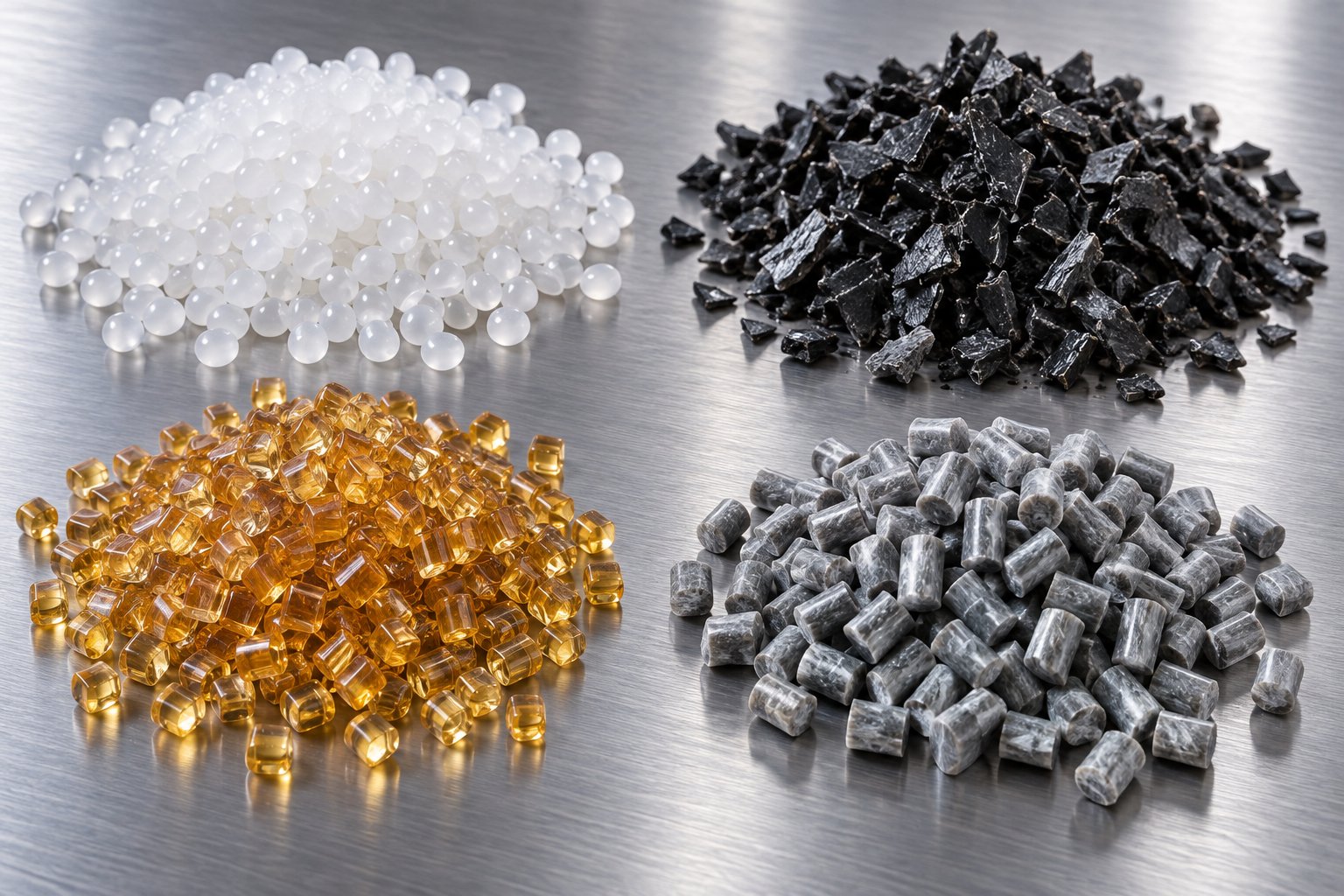
Every polymer behaves differently inside the barrel. It melts at a different rate, tolerates a different amount of shear, and punishes design mistakes in its own particular way. Yet most manufacturer quotations specify screw geometry as though the material is an afterthought - listing a single "general-purpose" screw that supposedly handles everything from soft polyethylene to rigid polycarbonate. That approach might get you running, but it won't get you running well.
Selecting the right extruder for polymer processing starts with understanding how your material's thermal sensitivity, crystallinity, viscosity, and abrasiveness interact with screw geometry, barrel metallurgy, and temperature control. Here's a material-by-material breakdown that connects each polymer family to the screw configuration it actually demands.
Polyolefins and Commodity Polymers
PE, PP, and PS represent the highest-volume polymers processed on single screw machines worldwide - and for good reason. They're relatively forgiving. Polyethylene and polypropylene are semi-crystalline, meaning they absorb significant energy during melting but produce clean, predictable melts once fully plasticized. Polystyrene is amorphous, melting more gradually without a sharp transition point.
That forgiving nature doesn't mean configuration is irrelevant. A pp extruder running homopolymer at high throughput benefits substantially from a grooved feed section, which mechanically grips the pellets and creates positive solids conveying regardless of friction conditions. Compression ratios for polyolefins typically fall in the 2.5:1 to 3.0:1 range, with HDPE often pushing toward the higher end due to its greater density change during melting. Standard L/D ratios of 24:1 to 28:1 handle most commodity applications, though blown film lines processing LLDPE blends often extend to 30:1 for improved melt homogeneity.
The bottom line for commodity polymers: you have wide latitude in screw design, but optimizing compression ratio and feed section geometry for the specific grade still delivers measurable gains in output rate and energy efficiency. A polymer extruder machine tuned for HDPE pipe resin won't run LDPE film resin at peak efficiency - even though both are "polyethylene."
Engineering and Specialty Polymers
Step into engineering polymers and the margin for error shrinks dramatically. PVC, polycarbonate, polyamide (nylon), polyester, and high-performance resins like POM and PPO each impose strict processing constraints that demand material-specific screw designs.
PVC is the most prominent example. It's thermally sensitive - the gap between its processing temperature and degradation temperature is narrow, leaving very little room for error. Excessive shear or residence time triggers decomposition, releasing hydrochloric acid that corrodes barrel linings and contaminates the product. PVC screws use low compression ratios (around 2.0-2.5:1), shallow metering depths, and slow rotational speeds to keep shear heating under control. Barrel linings must resist corrosive attack - nickel-alloy or chrome-plated bores are standard for serious PVC processing.
A polycarbonate extruder faces different challenges. PC's high melt viscosity demands substantial motor torque and higher barrel temperatures (typically 260-310°C), while its sensitivity to moisture means feedstock must be dried to below 0.02% moisture content or processed on a vented barrel. Higher L/D ratios of 28:1 to 32:1 provide the extended residence time needed for thorough melting of this viscous material, and compression ratios push into the 3.5:1 to 4.5:1 range typical of high-density engineering resins.
Polyamides (PA6, PA66) share the moisture sensitivity of polycarbonate but add a tendency toward oxidative degradation at processing temperatures. A polyester extruder setup - whether for PET or PBT - must contend with hydrolytic degradation if any residual moisture remains, making vented barrel designs or rigorous pre-drying absolutely essential. These materials also benefit from barrier screw designs that accelerate melting efficiency without extending thermal exposure time.
Recycled and Filled Materials
If engineering polymers narrow the margin for error, recycled and filled materials eliminate it entirely.
Post-consumer recycled (PCR) feedstocks arrive with variable melt flow indexes, inconsistent bulk density, unknown contamination levels, and residual moisture. Every batch is slightly different. Vented extruder designs become nearly mandatory here, removing moisture and volatiles that would otherwise produce bubbles, voids, and surface defects in the final product. Higher L/D ratios (30:1 to 36:1) provide the additional mixing and residence time needed to homogenize these inconsistent inputs.
Glass-filled, mineral-filled, and calcium carbonate-filled compounds introduce a separate problem: abrasion. Glass fibers act like sandpaper against the screw flights and barrel bore, accelerating wear at rates that can reduce component life by 50% or more compared to unfilled processing. The solution is bimetallic barrel construction - where a wear-resistant alloy liner is bonded to the structural steel core - combined with hardened or tool-steel screw flights. According to industry testing, bimetallic barrels deliver 3 to 7 times higher abrasion resistance than standard nitrided barrels, dramatically extending service intervals and maintaining the tight screw-to-barrel clearances that consistent output depends on.
When evaluating any polymer extruder for filled material processing, ask the manufacturer specifically about barrel liner alloy options and screw flight hardening methods. A supplier who offers only standard nitrided steel for glass-filled compounds either doesn't understand the application or doesn't expect long-term repeat business.
The following ranking organizes polymers from most forgiving to most challenging to process on a single screw extruder, with the key configuration consideration for each:
- LDPE / LLDPE - Low melting point, broad processing window. Key consideration: optimize compression ratio for the specific density and melt index of your grade.
- PS (Polystyrene) - Amorphous with gradual melting behavior. Key consideration: moderate compression ratios (2.5-3.0:1); avoid excessive residence time to prevent yellowing.
- PP (Polypropylene) - Semi-crystalline with higher melting point than PE. Key consideration: grooved feed sections improve conveying consistency; match compression ratio to homopolymer vs. copolymer grade.
- HDPE - High crystallinity creates sharp melting transition. Key consideration: grooved feed nearly essential for high throughput; barrier screws improve melt uniformity.
- PET (Polyester) - Moisture-sensitive and prone to hydrolytic degradation. Key consideration: aggressive pre-drying or vented barrel required; higher L/D ratios (28:1+) for complete melting.
- PA / Nylon - Hygroscopic with narrow thermal stability window. Key consideration: vented design or pre-drying mandatory; corrosion-resistant barrel linings recommended for certain grades.
- PC (Polycarbonate) - Very high melt viscosity requiring substantial torque. Key consideration: high compression ratios (3.5-4.5:1), extended L/D ratios, and pre-drying to below 0.02% moisture.
- PVC - Thermally sensitive with corrosive degradation products. Key consideration: low compression ratio (2.0-2.5:1), slow screw speeds, and corrosion-resistant barrel metallurgy are non-negotiable.
- Glass-filled / mineral-filled compounds - Highly abrasive with reduced melt flow. Key consideration: bimetallic barrels and hardened screw flights mandatory; expect 30-50% shorter component life than unfilled processing even with upgraded metallurgy.
- Post-consumer recycled blends - Variable quality, contaminated, moisture-laden. Key consideration: vented two-stage screw design, bimetallic construction, and robust filtration systems. The most demanding application for any single screw extruder.
This ranking isn't academic - it's your shortcut to asking better questions during manufacturer conversations. When a supplier claims their standard polymer extruder machine handles "all thermoplastics," you now know the specific configuration requirements that separate genuine capability from marketing optimism. A screw designed for LDPE won't survive a month of glass-filled nylon, and a barrel lined for commodity polyolefins will corrode within weeks of PVC processing.
Matching material to configuration protects your investment. But knowing what to ask - and when to ask it - protects your entire purchasing process. That's where a structured selection checklist becomes your most practical tool.
Your Single Screw Extruder Manufacturer Selection Checklist
Everything covered so far - screw geometry, barrel configurations, drive systems, material matching, manufacturer evaluation criteria - amounts to knowledge. Knowledge is valuable, but it doesn't close deals or prevent bad ones. What closes deals is preparation: knowing exactly what you need before the first RFQ goes out, and knowing exactly what to ask once conversations begin.
This final section distills the entire article into two actionable checklists and a clear roadmap for starting your search. Bookmark this page. Print it out. Bring it to your next procurement meeting. It's designed to be the single most practical resource you use during the selection process for any single screw plastic extruder machine.
Your Pre-RFQ Preparation Checklist
Before you contact a single manufacturer, you need internal clarity. Incomplete RFQs produce incomplete quotes - and incomplete quotes lead to mid-project surprises that blow budgets and timelines. Work through every item on this list with your production, engineering, and maintenance teams before reaching out:
- Define your target polymers precisely. Not just "polyethylene" - specify the grade, melt flow index, filler type and loading percentage, and whether you'll process virgin resin, recycled feedstock, or both. As the material-matching section made clear, a screw designed for LDPE film resin won't perform well on glass-filled nylon.
- Establish your throughput requirements. Specify your target output in kg/hr or lbs/hr, including both your current production demand and realistic growth projections for the next 3-5 years. Remember the 70-80% rule - size for your target output to fall at 70-80% of rated maximum, not at the ceiling.
- Document your product dimensions and tolerances. Wall thickness ranges, diameter specifications, gauge tolerance bands, surface finish requirements - whatever defines a saleable product in your application. These tolerances drive screw design, die engineering, and temperature control precision requirements.
- Map your upstream and downstream equipment. Will the extruder feed into an existing downstream line (calibration tank, haul-off, cutter, winder) or a new one? What are the interface requirements for controls integration, line speed synchronization, and physical connections? A plastics extruder doesn't operate in isolation - it's one component in a coordinated production system.
- Measure your floor space and utility constraints. Available footprint, ceiling height, electrical supply (voltage, phase, available amperage), cooling water capacity, compressed air availability, and ambient temperature range all influence which machine configurations are practical for your facility.
- Set a realistic budget range. Include not just the machine purchase price but also installation, commissioning, operator training, initial spare parts inventory, and the first year of maintenance. Total cost of ownership, not sticker price, is the number that matters.
- Establish your timeline. When does the extruder need to be producing saleable product? Work backward from that date to account for manufacturing lead time (12-30 weeks depending on supplier and customization level), shipping, installation, commissioning, and operator training. Rushed timelines lead to compromised specifications.
Completing this checklist before engaging suppliers accomplishes two things. It gives manufacturers the information they need to provide accurate, application-specific quotations instead of generic estimates. And it gives you an immediate quality filter - any supplier who doesn't ask about at least half of these items during initial conversations probably isn't engineering a solution for your application.
Critical Questions to Ask Every Manufacturer
Armed with your internal specifications, you're ready to evaluate suppliers. These questions go beyond the standard "what's your price and lead time" dialogue. They're designed to reveal engineering depth, service commitment, and long-term partnership potential - the factors that determine whether your extruder for plastic processing delivers value for a decade or becomes a maintenance headache within two years.
- Screw and barrel metallurgy options: What alloy grades do you offer for the screw and barrel? Do you provide bimetallic barrel linings for abrasive materials? What surface treatments or coatings are available for corrosion resistance? Can you specify metallurgy matched to my exact polymer and filler combination?
- Lead times for custom configurations: If I need a non-standard L/D ratio, grooved feed section, vented barrel, or barrier screw design, how does that affect delivery time compared to your standard models? What is your current production backlog?
- Spare parts stocking policy: Which high-wear components (screws, barrel liners, heater bands, thermocouples, drive belts) do you keep in regional inventory? What are typical lead times for replacement screws and barrels manufactured to order? Do you offer expedited production for emergency replacements?
- Field service coverage area: Do you have service engineers located within practical travel distance of my facility? What is your guaranteed response time for critical failures? What does a typical service call cost, and what's included in warranty versus out-of-warranty visits?
- Factory Acceptance Testing (FAT) protocols: Do you offer witnessed test runs before shipment? Will you run my actual resin during the FAT? What performance criteria - throughput, melt temperature, energy consumption, dimensional output - are verified and documented during testing? As detailed FAT guidance emphasizes, a strong protocol should define the accepted object, representative feedstock, pass/fail criteria, evidence records, witness authority, and the deviation process - not just a brief demonstration that the machine turns on.
- Energy consumption data: Can you provide published or tested kWh/kg data for my specific polymer at my target throughput? What drive technology (AC geared, direct-drive) is standard, and what energy-efficient options are available? How does your machine's specific energy consumption compare to the previous generation or competitor models?
- Reference customer contacts: Can you provide contact information for two or three customers processing similar materials on similar equipment in my region? Are site visits to reference installations possible?
Pay attention not just to the answers but to how they're delivered. A manufacturer that responds with precise, material-specific technical detail reveals genuine engineering capability. One that deflects technical questions toward pricing discussions or vague assurances is telling you something important about where their real expertise ends.
Where to Start Your Search
With your preparation complete and your questions ready, the practical challenge becomes knowing where to begin. The plastics extruder market spans hundreds of manufacturers across dozens of countries, and no single directory covers them all comprehensively. A structured search strategy keeps the process manageable.
Start with your application, not a brand name. Use the configuration mapping from this article to identify the barrel architecture and screw type your application demands - then search specifically for manufacturers with documented experience in that configuration. An energy-efficient plastic profile extruders supplier with deep PVC expertise may have little relevant experience in blown film, and vice versa. Matching your application to a manufacturer's proven specialty narrows the field faster than any general search.
Leverage industry trade shows and associations. Events like K (Dusseldorf), NPE (Orlando), and Chinaplas provide direct access to competing manufacturers in a single location. Industry associations such as the Society of Plastics Engineers (SPE) and regional plastics trade groups maintain member directories and publish technical resources that can guide your shortlist.
Don't overlook specialized component suppliers. Your search doesn't have to begin and end with complete machine OEMs. For operations needing custom or replacement single screw barrels - whether for pipe, film, sheet, pelletizing, or recycling lines - specialized component manufacturers offer precision-engineered solutions that can upgrade existing equipment or support new builds. NANHAIYA, for example, provides custom single screw barrels for plastic extrusion across the full range of processing applications, making them a practical resource for both the hybrid purchase strategy discussed earlier and ongoing maintenance of any installed extruder. Component specialists like these complement OEM manufacturer selection by giving you an independent supply chain for the highest-wear, highest-impact parts in the system.
Request multiple quotes with identical specifications. Use the same internal specification document for every RFQ to enable true apples-to-apples comparison. Apply the seven-category scoring framework from the manufacturer evaluation section to each response, weighting categories according to your operational priorities. The plastic profile extruders supplier who scores highest overall - not just lowest on price - is the partner most likely to deliver long-term production value.
Selecting the right single screw extruder manufacturer is ultimately a decision about partnership, not just machinery. The extruder you install will run for years, possibly decades. The manufacturer behind it will either support that entire lifecycle with engineering expertise, responsive service, and available spare parts - or fade into the background after the invoice clears. Everything in this guide is designed to help you tell the difference before you sign the purchase order, not after.
Frequently Asked Questions About Single Screw Extruder Manufacturers
1. What should I look for when choosing a single screw extruder manufacturer?
Focus on seven core evaluation areas: in-house screw and barrel engineering capability, customization flexibility for L/D ratios and screw geometries, after-sales service response times, regional spare parts stocking policies, documented experience in your specific application segment, energy efficiency options such as direct-drive technology, and geographic proximity of field service engineers. Scoring each manufacturer on a 1-5 scale across these categories and weighting them based on your operational priorities - for example, 24/7 operations should heavily weight spare parts availability - produces a far more reliable comparison than price alone.
2. What is the difference between a single screw extruder and a twin screw extruder?
A single screw extruder uses one helical screw rotating inside a heated barrel to melt, convey, and pressurize thermoplastic polymers. It excels at high-volume, steady-state production of pipes, films, sheets, and profiles. A twin screw extruder uses two intermeshing screws and offers superior mixing and compounding capability, making it better suited for blending additives, color concentrates, or reactive processing. Single screw machines are generally simpler, less expensive, and easier to maintain, which is why they account for the largest installed base in thermoplastic extrusion worldwide.
3. How do I determine the right screw diameter and L/D ratio for my application?
Screw diameter directly controls output capacity - common sizes range from 20 mm for lab work up to 300+ mm for high-volume commodity production. Size your machine so your target throughput falls at 70-80% of rated maximum, leaving headroom for material variability and future growth. L/D ratio determines residence time and mixing quality: ratios of 24:1 to 26:1 suit standard polyolefin processing, while engineering polymers and filled compounds typically need 28:1 to 36:1 for thorough melting and homogenization. A capable manufacturer will recommend both parameters based on your specific resin grade, filler loading, and product tolerances rather than offering a one-size-fits-all catalog option.
4. Is it better to buy a new or used single screw extruder?
It depends on your application, budget, and risk tolerance. New machines are the clear choice for specialty polymers, tight-tolerance products, or greenfield projects requiring full warranty coverage and the latest drive technology. Used extruders suit standard polyolefin processing on secondary lines with constrained budgets, but carry risks around unknown screw and barrel wear, outdated controls, and no manufacturer warranty. A smart middle ground many buyers overlook is purchasing a structurally sound used frame and drive, then investing in new precision-manufactured screws and barrels from specialists like NANHAIYA - capturing 40-60% capital savings while installing components optimized for your exact polymer and application.
5. What extruder configuration works best for processing recycled plastics?
Recycled and post-consumer feedstocks are among the most demanding materials for single screw extruders due to variable moisture content, inconsistent melt flow, and potential contamination. Vented (degassing) barrel designs are nearly essential - they remove trapped moisture and volatiles in-line without requiring a separate pre-drying step. Higher L/D ratios of 30:1 to 36:1 provide additional mixing time to homogenize inconsistent inputs. Because recycled streams are often abrasive, bimetallic barrel liners and hardened screw flights are baseline requirements rather than optional upgrades, delivering 3 to 7 times the abrasion resistance of standard nitrided steel and dramatically extending service intervals.
Written by
Nanhaiya Technical Team
Zhoushan Nanhaiya Plastic Machinery Co., Ltd.
The Nanhaiya technical team supports screw and barrel manufacturing projects through application review, technical communication, custom manufacturing coordination, and production and quality control.
Discuss Your Application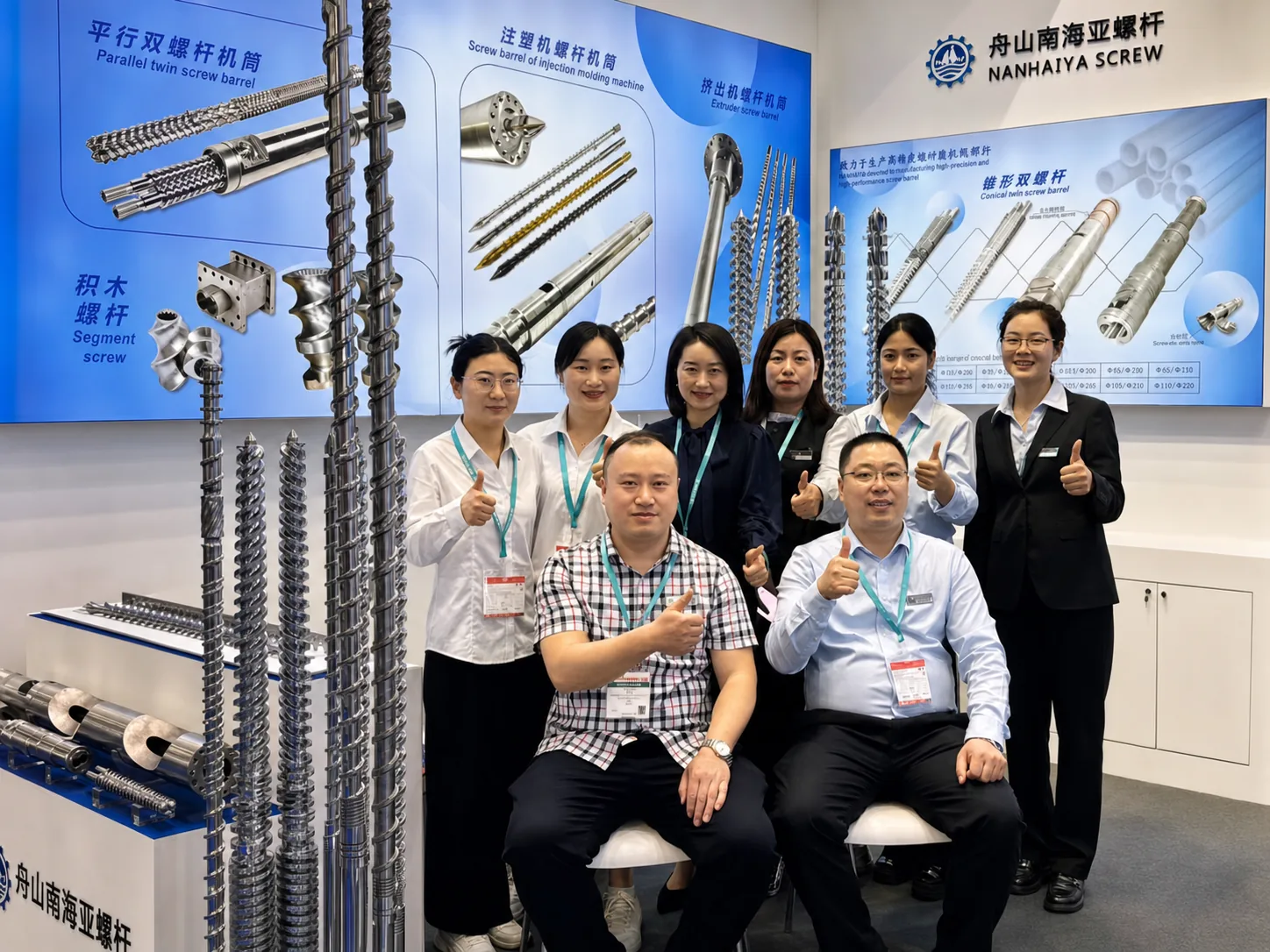
Related Articles
More insights on screw barrel technology and plastics processing.
Plastic Extruder Screw Price Demystified: From Steel To Sticker
Oct 10, 2026
What drives plastic extruder screw price? This independent guide breaks down diameter, L/D ratio, metallurgy, order volume, and total cost of ownership factors.
Read Article
What No Supplier Tells You About WPC Decking Making Machines
Oct 6, 2026
Learn how a WPC decking making machine works, compare extruder types, formulations, and production methods, plus get a buyer checklist to evaluate any supplier.
Read Article
Plastic Granulator Machine Exposed: What Your Supplier Won't Explain
Oct 6, 2026
Learn how plastic granulator machines work, compare types and blade designs, match resins to setups, and calculate true ownership costs before buying.
Read ArticleLooking for something else?
Search by material, symptom or product and jump straight to the relevant page.
These are navigation suggestions based on keyword matching — not a quotation, not a delivery commitment, and not a substitute for engineering review. Final specification is confirmed by our engineers against your drawings and processed material.
Need help with screw barrel selection?
Share your machine model, processed material and application. Our team can help with pricing and technical support.