

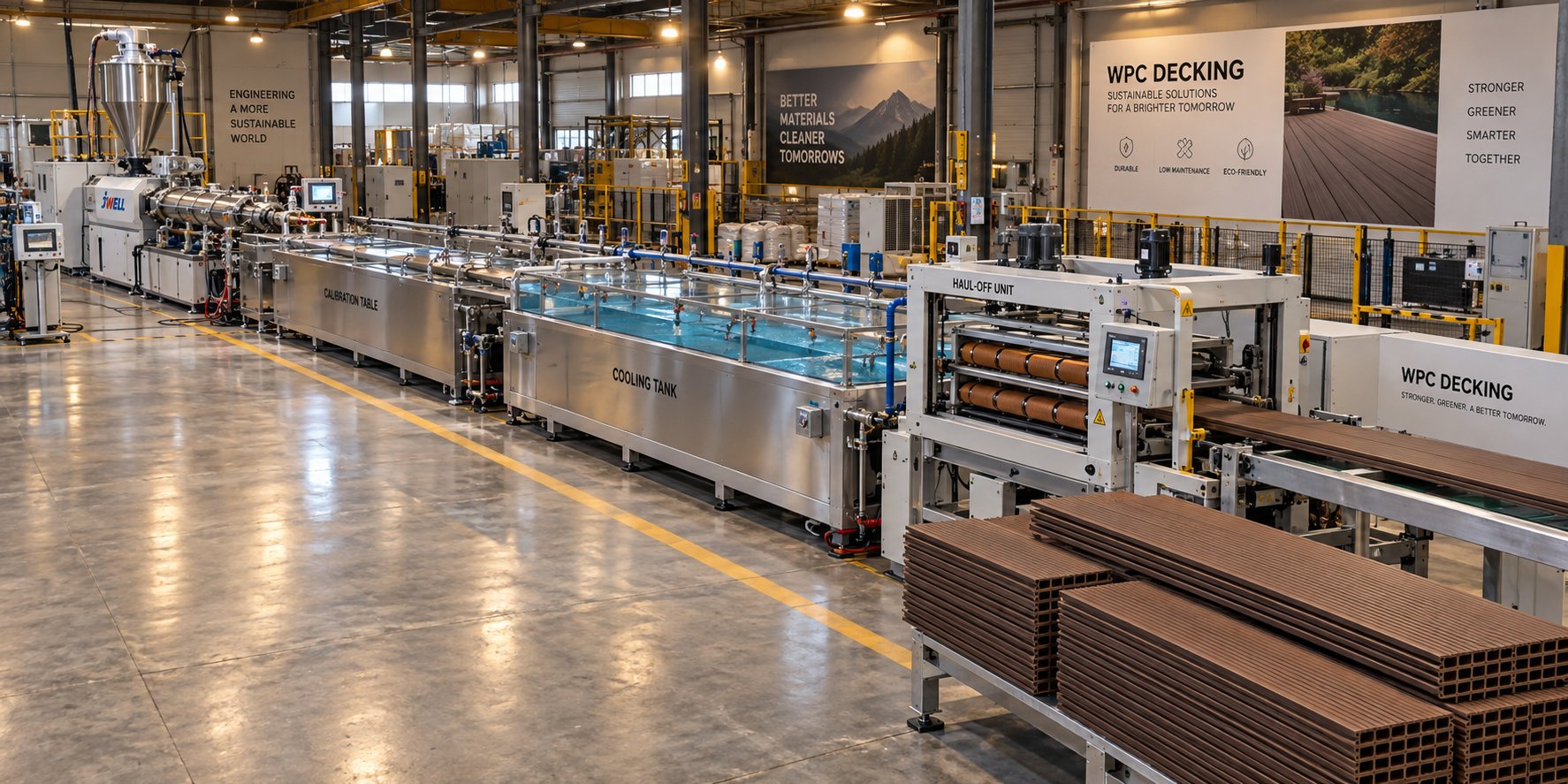
WPC地板制造机究竟能做什么
想象一下这样一条生产线:它以锯末和回收塑料为原料,通过一系列精密设计的系统进行加工,最终在另一端输出成品甲板板材,即可直接安装。这正是WPC甲板生产线的工作原理——了解其内部运作机制,是决定投资成败的关键。
大多数供应商只会提供规格表和报价。他们很少解释这套设备是如何将原材料转化为成品的,为什么某些配置适用于某些材料,以及如何区分可靠的生产线和几个月内就会出问题的生产线。本文将改变这种现状。它将深入探讨材料科学、机械工程、生产流程以及买方评估标准,这些都是您在签署采购订单前需要了解的。
WPC地板制造机究竟是什么?
木塑复合地板生产线是一套完整的木塑复合地板生产线,它将木纤维(通常是木粉)与热塑性聚合物(例如PVC、PE或PP)混合,然后将混合物挤出成成品地板型材。该生产线包含多个集成单元:用于原材料制备的高速混合系统、用于熔化和成型的双螺杆或单螺杆挤出机、用于尺寸精度校准的校准台、用于固化的冷却槽、用于保持生产线速度稳定的牵引装置、用于长度切割的切割锯以及用于收集成品板材的自动堆垛机。
那么,WPC地板生产线是如何运作的呢?首先,将木粉、聚合物树脂和化学添加剂等原材料称重、配料,并在冷热混合机中进行混合。均匀的混合物随后进入挤出机料斗,由旋转螺杆将其输送通过加热的料筒区域。在可控的温度、压力和剪切力作用下,混合物塑化成均匀的熔体,并被挤压通过成型模具,形成地板的横截面形状。下游设备随后进行校准、冷却、拉伸、切割和堆垛等工序——所有工序都同步进行,以保持严格的尺寸公差。WPC地板挤出生产线上的每个单元都必须协调运行;任何环节的偏差都会影响最终产品的质量。
谁需要这套设备?为什么?
该设备的主要用户可分为三类:寻求产品线多元化的成熟建材制造商、寻求垂直整合的建材供应公司,以及首次涉足复合地板市场的创业者。这三类用户都有一个共同的动机——全球对WPC复合地板的强劲且不断增长的需求。
What is driving that demand? Several powerful market forces. WPC decking resists moisture, mold, and insect damage far better than natural timber. It does not splinter, warp, or rot under normal outdoor conditions, and it requires virtually no seasonal staining or sealing. For building owners, that translates into significantly lower lifecycle maintenance costs. At the same time, green-building regulations in North America, Europe, and parts of Asia increasingly favor materials containing recycled content. Because WPC formulations can incorporate recycled wood waste and post-consumer plastics, they align with sustainability standards that pure lumber cannot match.
WPC decking outperforms both pure wood and pure plastic in outdoor durability — wood alone absorbs moisture and degrades, plastic alone lacks rigidity and natural aesthetics, but the composite leverages the structural contribution of wood fibers with the weather resistance of thermoplastic polymers to deliver a product engineered for long-term outdoor exposure.
This combination of performance advantages and regulatory tailwinds is why manufacturers across the globe are investing in WPC decking extrusion lines for manufacturers at an accelerating pace. Yet the equipment itself is only as good as the operator's understanding of it. The formulation you run, the extruder type you choose, and the downstream components you specify all interact in ways that determine product quality, production efficiency, and ultimately profitability.
The real story behind these machines — the material science that governs how wood fibers and polymers actually bond inside the barrel — is where smart purchasing decisions begin.
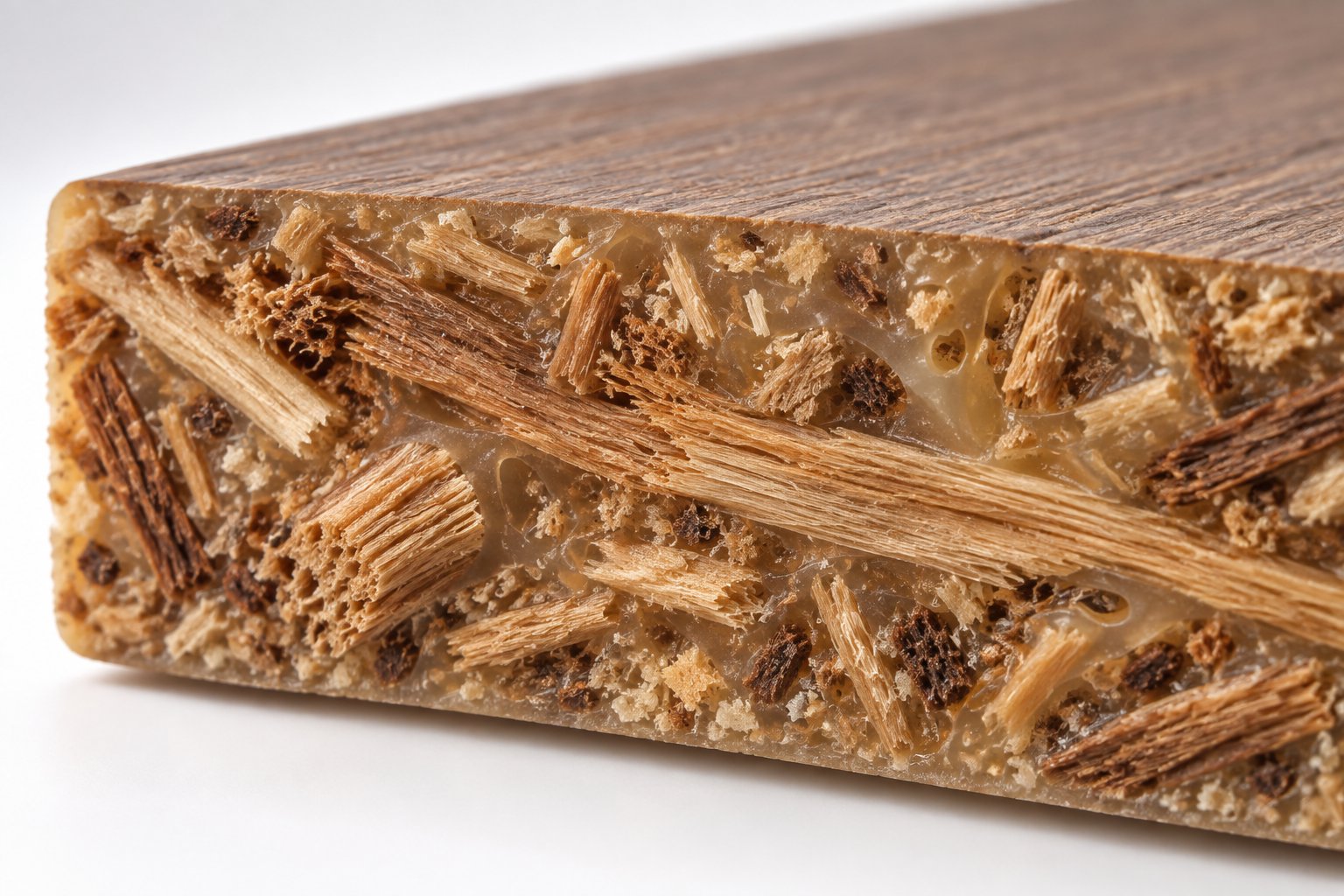
WPC Raw Material Formulation and the Science Behind It
Before you compare extruder models or request quotations, you need to understand what is actually happening inside the barrel of a WPC decking making machine. The formulation you choose — the specific blend of wood flour, polymer resin, and additives — dictates which machine configuration will work, which processing temperatures to set, and ultimately how your finished decking performs outdoors. Yet this is the part most equipment suppliers skip entirely.
How Wood Fibers and Thermoplastic Polymers Bond
Wood flour and plastic do not naturally want to mix. Wood fibers are hydrophilic — they attract water and have polar hydroxyl groups on their surfaces. Thermoplastic polymers like PE, PP, and PVC are hydrophobic — they repel water and are nonpolar. When you force these two materials together inside an extruder, the result without intervention is poor adhesion, weak mechanical properties, and a product prone to delamination or blistering under outdoor stress.
This is where coupling agents enter the picture. The most widely used coupling agents for WPC extrusion are maleic-anhydride-grafted polymers, such as maleic anhydride polypropylene (MAPP) for PP-based composites or maleic anhydride polyethylene (MAPE) for PE-based formulations. These molecules act as chemical bridges: the maleic anhydride end reacts with the hydroxyl groups on the wood fiber surface, while the polyolefin backbone entangles with the polymer matrix. Research published in the Journal of Composite Materials demonstrated that WPC samples containing 3 wt% maleic anhydride achieved the highest tensile strength, reinforcing the principle that proper coupling agent dosage is essential for composite integrity.
A concise review on WPC components further notes that more than 40 types of coupling agents are currently applied in WPC production, including isocyanates, silanes, and anhydride-modified copolymers. The choice depends on the specific resin system and wood filler being used.
Moisture control is equally critical in the wood flour and polymer bonding process. Raw wood flour typically contains 5–15% moisture. If that moisture enters the extruder barrel, it generates steam pockets inside the melt, causing surface blistering, internal voids, and inconsistent density in the finished board. For reliable extrusion, wood flour must be dried to below 1–3% moisture content before processing — and stored in sealed containers to prevent reabsorption. Skipping this step is one of the most common causes of production defects that operators struggle to diagnose.
PVC-WPC vs PE-WPC vs PP-WPC Formulations
Not all wood plastic composites are created equal. The polymer matrix you select fundamentally changes your processing parameters, additive requirements, and the machine configuration you need. Here is where the three dominant resin systems differ:
| Parameter | PVC-Based WPC | PE-Based WPC (HDPE/LDPE) | PP-Based WPC |
|---|---|---|---|
| Processing Temperature Range | 150–185 °C | 160–200 °C | 170–200 °C |
| Typical Wood Flour Loading | 40–60 wt% | 40–70 wt% | 40–65 wt% |
| Key Additives Required | Heat stabilizers, lubricants, impact modifiers, UV stabilizers | Coupling agents (MAPE), lubricants, UV stabilizers, colorants | Coupling agents (MAPP), lubricants, UV stabilizers, foaming agents |
| Product Rigidity | High — inherently rigid | Moderate — more flexible | Moderate to high |
| Product Weight (Solid Profile) | Heaviest (density ~1.03 g/cm³) | Lighter (density ~0.95 g/cm³) | Moderate (density ~0.9–1.05 g/cm³) |
| Weathering Behavior | Good UV resistance with stabilizers; lower moisture absorption | Excellent moisture resistance; may fade without UV stabilizers | Good stiffness retention; requires UV protection for color |
| Preferred Extruder Type | Conical twin-screw | Parallel twin-screw or single-screw (with pre-compounded pellets) | Parallel twin-screw or conical twin-screw |
Why does this matter for equipment selection? PVC has a narrow processing window — it degrades quickly if overheated — so it demands the precise temperature control and low-shear conveying that conical twin-screw extruders provide. PE and PP tolerate higher temperatures and broader processing windows, opening the door to parallel twin-screw systems or even single-screw extruders when using pre-compounded WPC pellets. Choosing a machine without first locking down your formulation is like buying an engine before deciding which fuel you plan to burn.
Processing temperature limits also tie directly to wood fiber stability. Cellulose fibers begin to thermally degrade around 200–220 °C, and this ceiling drops further as wood flour content increases. Staying within the right temperature envelope for your chosen resin system protects both the polymer from degradation and the wood fibers from charring.
Critical Additives and Their Roles
Beyond the base polymer and wood flour, a carefully engineered additive package makes the difference between a decking board that lasts a decade outdoors and one that fails within a season. Each additive category plays a specific role:
- Coupling agents — Create chemical bonds between the hydrophilic wood fiber surface and the hydrophobic polymer matrix, dramatically improving tensile strength, flexural strength, and dimensional stability. Typical dosages range from 1–5 wt% depending on wood flour loading and resin type.
- Lubricants — Reduce friction between the melt and the barrel, screw, and die surfaces. External lubricants (such as PE waxes and zinc stearates) prevent sticking to metal components and lower processing temperatures, while internal lubricants reduce melt viscosity and shear forces at high throughput rates.
- UV stabilizers — Protect the finished board from photodegradation caused by ultraviolet radiation. Without stabilizers, WPC decking can lighten by more than 10% in color and lose measurable flexural modulus after prolonged sun exposure. Hindered amine light stabilizers (HALS) and UV absorbers are the most common choices for outdoor decking.
- Foaming agents — Reduce product density and material cost by introducing a controlled cellular structure within the profile, particularly useful for hollow decking designs. Chemical blowing agents (CBAs) can reduce WPC density by approximately 30%, improving impact strength and reducing raw material consumption per linear meter of board.
- Colorants and pigments — Provide the wood-grain aesthetics consumers expect. Some pigments double as light stabilizers, offering an additional layer of UV protection.
- Biocides — Guard against fungal and mold attack on the wood component. Although the polymer matrix encapsulates and partially protects wood particles, higher wood flour loadings increase susceptibility to biological degradation, making biocide addition a practical necessity for high-wood-content formulations.
Formulation knowledge is not optional — it is the prerequisite for every machine decision that follows. The resin system dictates your extruder type. The additive package dictates your mixing intensity and barrel temperature profile. The wood flour specification dictates your drying and feeding equipment. Get the formulation wrong, and even the most expensive production line will underperform.
With the chemistry defined, the next logical question is how all of these raw materials actually move through the production line — step by step, from the mixer hopper to the finished board on the stacking table.
The Complete WPC Decking Production Process Step by Step
Knowing what goes into a WPC formula is one thing. Watching that formula travel through an entire production line — from loose powder to a finished decking board — is where the real understanding clicks. The WPC decking production process step by step is a tightly choreographed sequence, and every stage either adds value or introduces a defect. Here is the full wood plastic composite extrusion workflow, broken into the three phases your material passes through before it becomes a sellable product.
Raw Material Preparation and High-Speed Mixing
Production starts long before the extruder. Raw materials — wood flour, polymer resin (powder or pellets), coupling agents, lubricants, UV stabilizers, colorants, and any foaming agents — must first be precisely weighed and batched according to the target formulation. Even a small deviation in the wood-to-polymer ratio shifts density, strength, and surface finish in the finished board.
The batched ingredients are loaded into a high speed mixer for WPC production, typically a hot-cold mixer system. Inside the hot mixer, high-speed blade rotation generates friction heat that raises the blend temperature to around 100–120 °C. This friction heat serves a critical purpose: it activates coupling agents, drives residual moisture out of the wood flour, and pre-disperses additives throughout the polymer matrix. The blend then transfers immediately into a cold mixer, where slow-speed agitation and a water-cooled jacket bring the temperature back down to a safe storage level — usually below 40 °C — preventing premature plasticization or clumping.
Why does this stage matter so much? Improper mixing is the root cause of many downstream defects that operators spend hours chasing. Poorly dispersed coupling agents lead to weak fiber-matrix bonding. Residual moisture pockets cause blistering during extrusion. Uneven colorant distribution creates streaking on the board surface. A reliable WPC production workflow treats mixing not as a simple blending step but as the quality foundation for every stage that follows.
Extrusion and Die Forming
The pre-mixed blend is conveyed — by vacuum loader or screw feeder — into the extruder hopper. From here, rotating screws carry the material forward through a series of controlled heat zones along the barrel. Each zone is set to a specific temperature, progressively melting the polymer while keeping the wood fibers below their thermal degradation threshold.
As the screws rotate, they do more than just transport material. They apply shear and compression that break down any remaining agglomerates, force trapped air and volatiles out through vacuum venting ports, and plasticize the blend into a homogeneous melt. Picture toothpaste being squeezed through a tube — except this "toothpaste" is a carefully engineered composite moving at pressures that can exceed 200 bar.
At the end of the barrel, the pressurized melt is forced through a profile die. This die is essentially a precision-machined steel block with internal flow channels shaped to the exact cross-section of your decking board — whether that is a solid plank or a hollow multi-chamber profile. Die design directly controls surface quality, wall thickness uniformity, and flow balance. If the die channels are poorly balanced, one side of the profile exits faster than the other, causing warping or dimensional inconsistency before the board even reaches cooling.
Consistent melt temperature and pressure at the die face are non-negotiable for uniform output. A temperature spike of just a few degrees can degrade PVC or char wood fibers at the surface, while a pressure drop causes short shots or density variations along the board length.
Calibration Through Stacking
The hot, soft profile emerging from the die is far from a finished product. It still needs to be sized, solidified, pulled, cut, and collected — and each of these downstream steps must happen in precise sequence. Here is the WPC decking calibration and cooling process in order:
- Vacuum calibration table — The still-pliable profile enters a water-cooled stainless steel calibrator where vacuum suction pulls the outer surfaces against precision-machined sizing plates. This locks the profile into its exact dimensional specifications — width, height, and wall thickness — while the initial layer of cooling begins. Without proper vacuum calibration, profiles shrink unevenly and fall out of tolerance.
- Spray or immersion cooling tanks — The calibrated profile passes through one or more cooling tanks, where water sprays or full immersion extract heat and solidify the composite throughout its cross-section. Thicker or solid profiles require longer cooling sections to prevent residual internal heat from causing post-extrusion warping. The balance between cooling rate and residual stress is a critical engineering tradeoff — cool too fast and internal stresses build up; cool too slowly and line speed drops.
- Haul-off (puller) machine — A caterpillar-track or belt-type puller grips the cooled profile and draws it through the entire downstream section at a constant, controlled speed. The haul-off is the pacemaker of the line. Its speed, combined with the extruder output, determines how much material is deposited per meter of board — directly affecting wall thickness, meter weight, and dimensional stability.
- Cutting saw — A planetary saw or flying saw cuts the continuous profile into programmed lengths without stopping the line. Flying saws travel with the profile during the cut, ensuring clean, square ends with no line interruption. Cutting tolerance typically needs to stay within ±1 mm for commercial decking products.
- Automatic stacker — Finished boards are transferred onto a stacking table or collection rack, organized for inspection, packaging, and shipment. Automated stackers reduce handling damage and labor cost while keeping pace with line output.
The entire WPC decking extrusion line must be speed-synchronized from extruder to stacker — if any single unit runs at a mismatched speed, the profile warps, wall thickness drifts, or dimensional tolerances fail, turning saleable boards into scrap.
This synchronization principle is easy to underestimate. You might look at the control panel and see every machine running at a stable setpoint. But as extrusion engineers emphasize, if the actual melt output from the extruder does not match the pulling speed of the haul-off, meter weight shifts immediately — and dimensional problems follow within seconds. A speed change at one end of the line ripples through every downstream unit. That is why experienced operators adjust one variable at a time and wait for stabilization before making further corrections.
The production process itself is consistent regardless of which resin system you run. What changes dramatically, however, is the type of extruder at the heart of the line — and that choice has more impact on output quality, throughput, and operating cost than most buyers realize.
Comparing Extruder Types Used in WPC Decking Production
The extruder is the engine of any WPC decking making machine — and just like engines, not all designs are built for the same job. Choosing between a conical twin-screw, a parallel twin-screw, or a single-screw extruder is one of the most consequential decisions you will make when specifying a production line. Yet most suppliers quote you whatever model they stock without explaining why that architecture suits — or does not suit — your specific formulation, output target, and budget.
Here is what you actually need to know.
Conical Twin-Screw Extruders for PVC-Based WPC
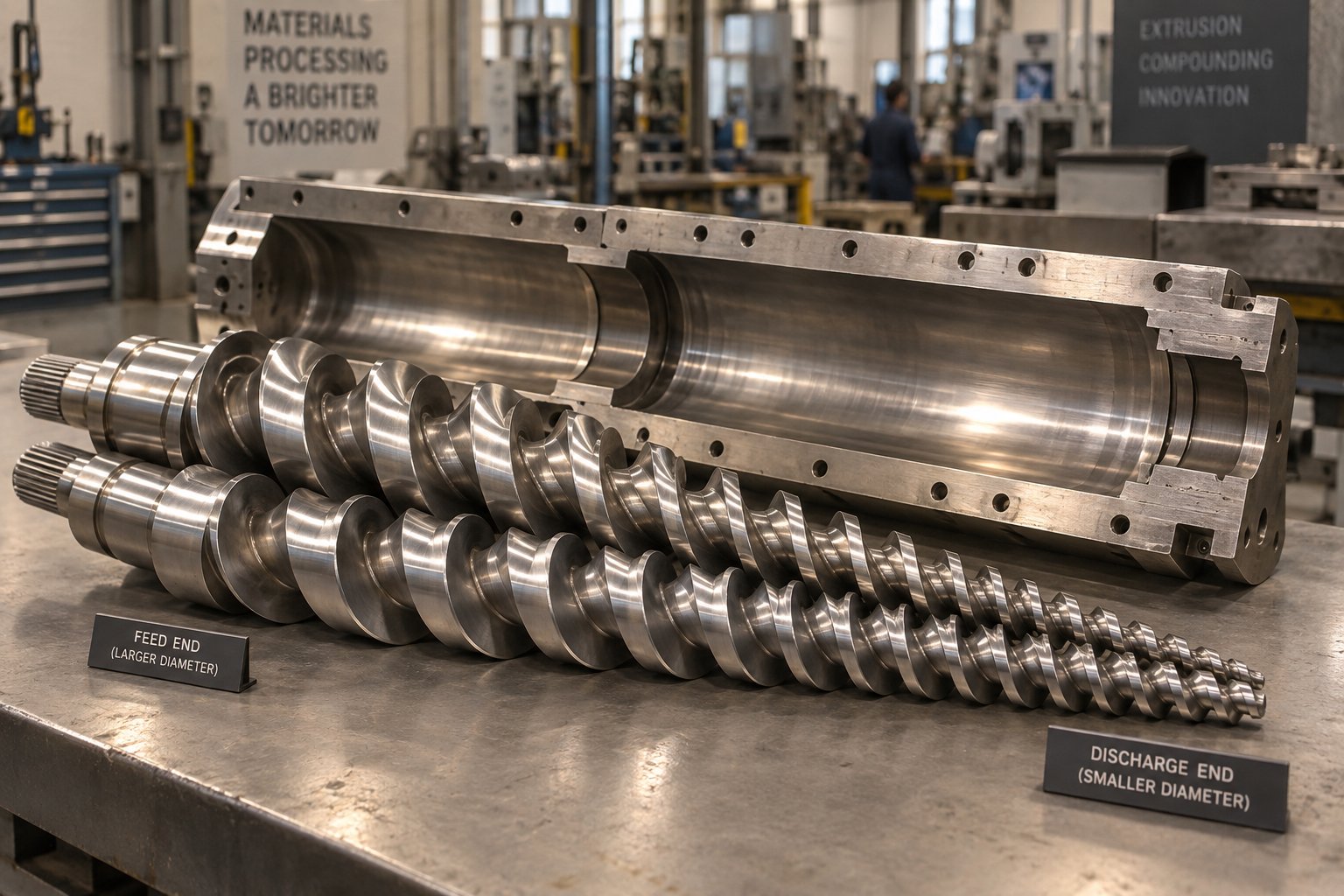
If you are running a PVC-based WPC formulation — and a large share of the global decking market does — the conical twin-screw extruder is the dominant choice for good reason. Its defining feature is two counter-rotating screws that taper from a large diameter at the feed end to a smaller diameter at the discharge end. This tapering geometry creates a natural, progressive compression ratio — typically 3:1 to 4:1 — that builds melt pressure efficiently without relying on high screw speeds.
Why does that matter? PVC has a notoriously narrow processing window. Push the melt temperature even slightly above approximately 200 degrees Celsius and the polymer begins to degrade, releasing hydrochloric acid gas that corrodes equipment and discolors the product. The conical twin-screw extruder for WPC decking addresses this challenge in three ways:
- Low-speed, high-torque operation — Screw speeds typically range from 15 to 45 rpm, generating far less frictional heat than high-speed alternatives. This keeps melt temperatures safely within PVC's processing envelope.
- Excellent dispersive mixing — The intermeshing, counter-rotating screw geometry creates a self-wiping action that continuously renews material on screw surfaces. Wood flour particles are distributed uniformly throughout the PVC matrix without requiring aggressive kneading blocks that could overheat the melt.
- Generous feed intake — The large-diameter feed zone accommodates the low bulk density of PVC dry blends mixed with wood flour, preventing bridging and feed inconsistencies that plague undersized feed sections.
Industry data from comparative studies between conical and parallel systems shows conical extruders processing 50-percent wood flour WPC at melt temperatures below 175 degrees Celsius, with specific energy consumption of 0.15 to 0.22 kWh/kg — meaningfully lower than parallel alternatives on the same material. For PVC-based WPC decking producers, this translates to lower energy bills and reduced risk of thermal degradation in every meter of board produced.
At the heart of this performance sits the screw barrel assembly. Think of it as the precision core of the entire extruder — the component where all the plasticizing, mixing, and pressure-building actually happens. The barrel must maintain tight tolerances between its inner bore and the screw flights to ensure stable melt pressure and consistent output. Even minor wear on flight lands or barrel liners disrupts the compression ratio, and that disruption shows up immediately as surface defects, density variations, or inconsistent board dimensions.
Parallel Twin-Screw and Single-Screw Alternatives
Conical twin-screws are not the only option, and they are not always the best one. Your formulation and production scale determine whether a parallel twin-screw or single-screw extruder fits better.
Parallel twin-screw extruders maintain a constant screw diameter along their entire length, with compression achieved through changes in screw pitch, channel depth, and modular kneading block configurations. This architecture excels in two scenarios: PE- and PP-based WPC production requiring higher throughput, and compounding applications where you need to produce uniform WPC pellets before profile extrusion. Parallel systems typically operate at higher screw speeds — 30 to 60 rpm or more for WPC — and their longer L/D ratios (28:1 to 36:1 versus the conical's effective 22:1 to 28:1) provide extended mixing length for superior melt homogeneity. The tradeoff? Higher shear heat, greater energy consumption, and faster screw wear from the increased peripheral speed.
Single-screw extruders enter the picture primarily in two-step production workflows, where pre-compounded WPC pellets — already homogeneously mixed in a prior compounding step — are remelted and shaped into profiles. Without the positive conveying and self-wiping action of twin screws, single-screw machines struggle with raw wood flour blends. However, they offer the lowest capital cost and simplest operation, making them attractive for smaller operations processing pre-made granules.
The table below gives you a side-by-side comparison — use it when evaluating any twin screw vs single screw WPC extruder proposal:
| Parameter | Conical Twin-Screw | Parallel Twin-Screw | Single-Screw |
|---|---|---|---|
| Compression Mechanism | Tapering screw geometry (natural compression) | Screw pitch, channel depth, and kneading blocks | Decreasing channel depth along screw length |
| Ideal Resin Systems | PVC-based WPC, rigid PVC | PE-based WPC, PP-based WPC, compounding | Pre-compounded WPC pellets (any resin) |
| Typical Output Range | 100–500 kg/h | 300–800+ kg/h | 80–300 kg/h |
| Mixing Quality | Very good — self-wiping, low-shear dispersive mixing | Excellent — extended L/D and modular mixing zones | Moderate — limited distributive mixing capability |
| Typical Screw Speed (WPC) | 15–45 rpm | 30–60+ rpm | 40–100 rpm |
| Capital Cost Tier | Medium | High | Low |
Notice the pattern: the best extruder type for PVC WPC production is the conical twin-screw because of PVC's heat sensitivity and the low-shear processing it demands. For PE- and PP-based WPC at high volumes, parallel twin-screws pull ahead on throughput and melt consistency. Single-screws fill a niche for smaller-scale or second-step operations where the compound is already homogeneous.
Why Screw and Barrel Quality Determines Output Stability
Regardless of which extruder architecture you choose, one truth remains constant: the screw and barrel are the most critical wear components in the entire line. And WPC extrusion is uniquely punishing on these parts.
Wood flour is highly abrasive. It contains natural silica particles that act like fine sandpaper against the screw flights and barrel inner wall during every rotation. Over thousands of operating hours, this abrasion widens the clearance between the screw flight tips and the barrel bore. As that gap increases, the screw loses compression efficiency — melt pressure becomes unstable, output rates fluctuate, and surface defects begin appearing on the finished boards. WPC equipment specialists report that once the screw-to-barrel clearance exceeds its designed tolerance, operators encounter unstable plasticization, uneven material discharge, and frequent material jams — problems that compound rapidly if left unaddressed.
Screw and barrel wear in wood plastic composite extrusion is not a question of "if" but "when." Field data from conical twin-screw installations shows typical screw life of 6,000 to 8,000 operating hours on 50-percent wood flour WPC formulations, with highly filled compounds shortening that window to 4,000 to 6,000 hours. The variables that influence wear rate include wood flour content and species (hardwood is more abrasive than softwood), screw speed, barrel temperature control, and the surface treatment of the screw itself — standard nitrided screws wear faster than bimetallic or dual-alloy hard-faced alternatives.
This is where proactive sourcing becomes a competitive advantage. When your screw and barrel reach the end of their service window, the speed at which you can source precision replacements determines how long your line sits idle. Manufacturers running conical twin-screw systems for WPC, PVC pipe, PVC profile, or foam board extrusion can source custom-engineered replacement barrels from specialists like NANHAIYA, which designs conical twin screw barrels specifically for stable plasticizing performance across these demanding applications. Having a reliable barrel supplier in your supply chain means planned maintenance stays planned — rather than turning into unplanned downtime that costs far more than the replacement part itself.
Investing in high-quality screw and barrel components — whether nitrided, chrome-plated, or bimetallic — also pays dividends in daily output consistency. A barrel holding its bore tolerance delivers uniform melt pressure revolution after revolution, which translates directly into consistent board density, smooth surface finish, and tight dimensional control at the calibration table downstream.
The extruder gets the most attention during the purchasing process, and rightly so. But each component surrounding it — the feeding system, the profile die, the calibration table, the cooling tanks, and the surface treatment units — plays an equally important role in determining what comes off the end of the line. Understanding these supporting systems is what separates a buyer who gets a production line from one who gets a profitable production line.
Essential WPC Decking Extrusion Line Components Explained
Every supplier brochure lists the same equipment stations: feeder, die, calibrator, cooling tank, haul-off, saw, stacker. What they rarely do is explain why each unit matters — or how one specification choice ripples through the entire line. Understanding these WPC decking extrusion line components individually is what turns a generic equipment list into a production system that actually delivers consistent boards shift after shift.
Feeding Systems and Volumetric vs Gravimetric Dosing
Imagine your formulation calls for 55% wood flour and 40% PVC resin, with the remaining 5% split across coupling agents, lubricants, and UV stabilizers. If the feeding system delivers 58% wood flour one minute and 52% the next, every board produced during that fluctuation has different density, flexural strength, and surface texture. The feeder is where product consistency either begins or breaks down.
Two dosing approaches dominate the market: volumetric and gravimetric.
A volumetric feeder delivers material based on volume per unit of time — essentially, it pushes a set amount of space-worth of material into the extruder at a fixed rate. It is simpler, less expensive, and perfectly adequate when your raw materials have consistent bulk density. The catch? Wood flour bulk density fluctuates depending on moisture content, particle size distribution, and how tightly it packs in the hopper. A volumetric feeder cannot detect or compensate for those shifts. If the density changes, the actual mass of material entering the extruder changes — and your wood-to-polymer ratio drifts silently.
A gravimetric feeder solves this problem by measuring the actual weight of material dispensed in real time using loss-in-weight technology. A load cell continuously monitors the hopper weight, and the controller automatically adjusts motor speed whenever it detects a deviation from the target feed rate. Fluctuations in material density, moisture content, or even hopper refill events are compensated for on the fly — without operator intervention. The result is tighter control over the wood-to-polymer ratio, more consistent product density, and reduced waste from off-spec boards.
The tradeoff is straightforward: gravimetric systems cost more upfront but typically deliver a faster return on investment through reduced additive waste and fewer rejected boards. For producers running expensive UV stabilizers or coupling agents at precise dosages, the savings on material alone often justify the upgrade. Smaller operations with stable, pre-tested raw material batches may find volumetric dosing sufficient — but anyone scaling up or processing variable-quality wood flour should seriously consider gravimetric control.
Profile Dies and Their Impact on Decking Geometry
The profile die is where your composite melt transforms from a formless, pressurized mass into the exact cross-section of your finished decking board. Think of it as the mold at the end of the extruder — except unlike injection molding, this mold runs continuously, and even tiny imbalances in flow distribution show up as defects across every meter of board produced.
Several die design factors directly affect quality:
Die land length — the final parallel section of the flow channel before the melt exits — controls surface smoothness. A longer land gives the melt more time to relax and form a uniform skin, but too much length increases back-pressure and reduces output. Die temperature must be independently controlled, because even a 3-5 degree Celsius variation across the die face creates differential flow speeds that warp the profile.
Flow channel balancing is especially critical in multi-cavity dies, where two or more decking profiles are extruded simultaneously from a single extruder. Each cavity must receive identical melt volume per unit time. Unbalanced channels mean one profile exits thicker or faster than its neighbor, forcing operators to discard mismatched boards or run the line below capacity.
The choice between a hollow vs solid WPC decking profile die carries significant economic implications. Hollow profiles — typically featuring two to four internal chambers — use less raw material per linear meter and produce a lighter board that is easier to handle and ship. According to WPC extrusion line engineering guides, hollow decking dies use internal mandrels supported by spider legs or bridge elements to create the chambers. Each mandrel support produces a weld line where split melt streams rejoin, and the die must ensure sufficient weld-line pressure to create a mechanically sound bond — otherwise that weld line becomes a structural weak point under load.
Solid decking dies are simpler to design and produce boards with higher load-bearing capacity, making them the preferred choice for heavy-traffic commercial installations or structural applications where span ratings under standards like ASTM D7032 must be achieved without the complexity of hollow chamber geometry. However, solid profiles consume more material and weigh more, raising both production cost and shipping expense per board.
Die changeover capability also matters for production flexibility. A line designed with a standardized die clamp size and consistent calibrator mounting positions allows operators to switch between different decking profiles — or even switch from decking to fencing or cladding profiles — with minimal downtime.
Downstream Equipment and Auxiliary Systems
Everything after the die exists to transform a hot, soft extrudate into a dimensionally accurate, surface-finished, cut-to-length board. Here is what each downstream unit does and why it matters:
- Vacuum calibration tables — Pull the still-pliable profile against precision sizing plates using vacuum suction and chilled water (typically 10-15 degrees Celsius). Sizing accuracy depends on vacuum zone configuration and water temperature control. Undersized calibrators — a common cost-cutting mistake — force slower line speeds and can reduce output by 20-40% below the extruder's rated capacity.
- Spray cooling tanks vs immersion tanks — Spray tanks offer gentler, more gradual cooling that reduces internal stress buildup, making them preferable for thicker or solid profiles prone to warping. Immersion tanks provide faster, more aggressive cooling suited to thinner or hollow profiles where residual heat exits quickly. Many production lines combine both: a spray section first, followed by immersion.
- Caterpillar haul-offs vs belt haul-offs — Caterpillar-type pullers use opposing tracked pads that grip the full top and bottom surfaces of the profile, providing strong, uniform pulling force ideal for heavy WPC boards. Belt haul-offs use continuous belts for gentler contact, reducing surface marking on softer profiles. For WPC decking, caterpillar haul-offs with adjustable grip pressure are the standard choice.
- Cutting systems — Travelling or flying saws move with the profile during the cut, maintaining a clean, square end without stopping the line. Encoder-based length control keeps cutting tolerance within plus or minus one millimeter for commercial decking products.
- Embossing and brushing units — Online embossing rollers press wood-grain or anti-slip textures into the still-warm board surface. Wire brushing stations create a natural, weathered appearance. These surface treatments add slip resistance critical for outdoor decking safety and differentiate a commodity board from a premium product.
- Automatic stackers — Collect finished boards onto racks or pallets, reducing manual handling, minimizing surface damage, and keeping pace with continuous line output.
The equipment that truly separates basic decking lines from premium ones, however, is the co-extrusion cap-layer unit. A co-extrusion system adds a secondary extruder — typically a single-screw model in the 25-45 mm range — that feeds a polymer-rich cap layer through a dedicated co-extrusion die mounted ahead of the calibrator. This cap layer bonds to the WPC core while both materials are still molten, creating molecular adhesion rather than mechanical attachment.
Why does this matter? The co-extrusion cap layer for composite decking acts as a protective shield against UV radiation, moisture penetration, staining, and surface abrasion. The outer shell typically contains concentrated UV stabilizers, pigments, and weather-resistant polymers that far exceed what is economically feasible to blend into the entire board core. The result is dramatically improved color retention, reduced fading, and a sealed surface that inhibits mold and mildew growth — all without increasing the overall material cost proportionally, because the expensive protective compounds are concentrated in a thin outer layer rather than distributed throughout the full profile thickness.
For producers targeting the premium residential or commercial decking segment, co-extrusion capability is rapidly becoming a baseline expectation rather than a luxury upgrade. Boards with a capped surface command higher price points and longer warranty coverage, directly improving both revenue per linear meter and brand positioning.
Each of these components can be configured to varying levels of sophistication — but the fundamental architecture of the line also depends on a more strategic decision: whether to run a one-step direct extrusion process or a two-step compounding-then-extrusion approach. That choice reshapes your equipment list, floor plan, and operating economics from the ground up.
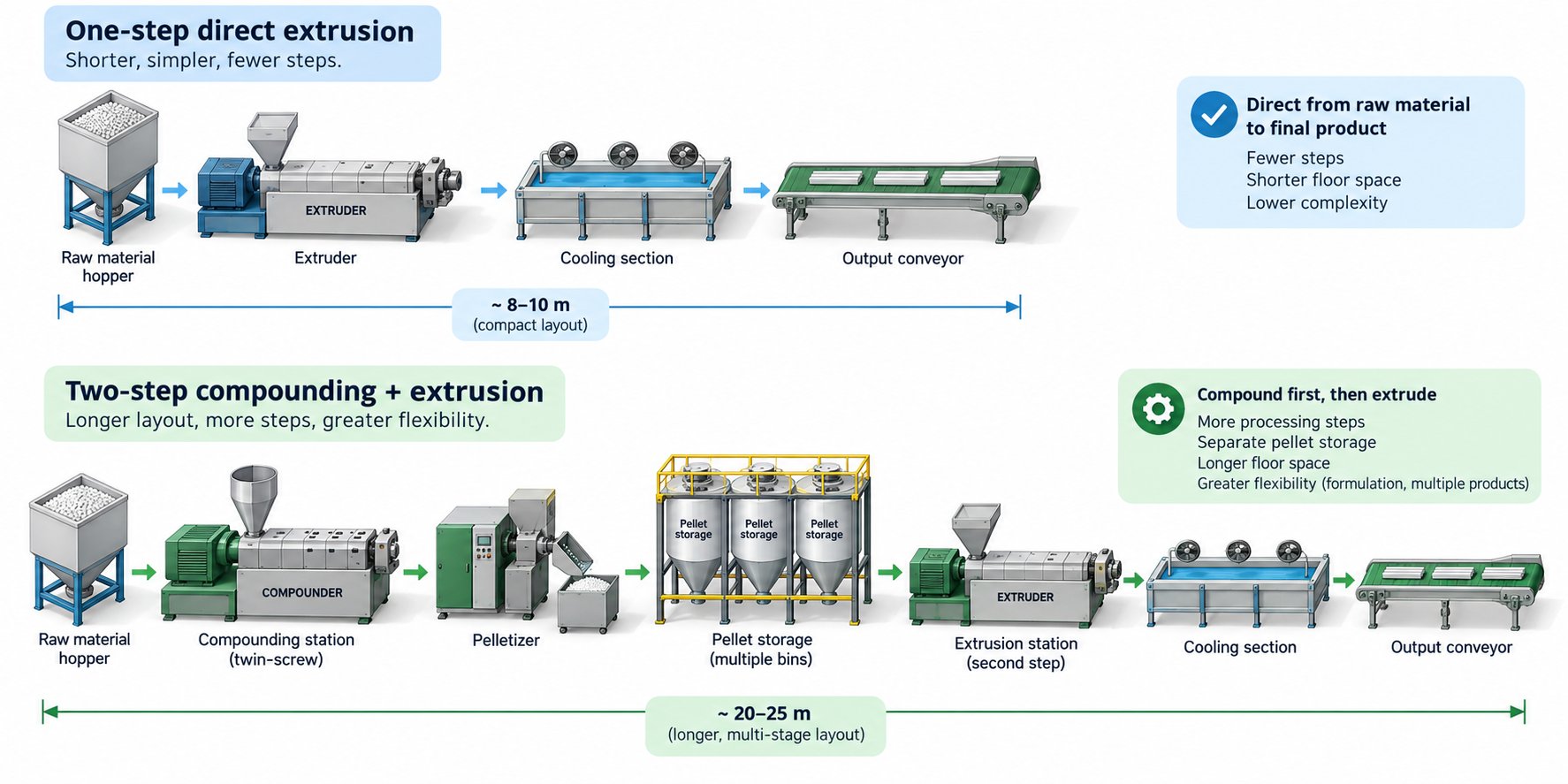
One-Step vs Two-Step WPC Manufacturing Methods Compared
Your extruder type, die design, and downstream equipment all matter — but they sit inside a larger strategic framework that most suppliers gloss over entirely. Before you finalize a production line layout, you need to answer a more fundamental question: should your operation run a one-step direct extrusion process or a two-step compounding-then-extrusion process? This single decision reshapes your capital budget, energy bill, factory footprint, and product consistency in ways that ripple through every operating day.
One-Step Direct Extrusion Method
In a one-step process — often called direct extrusion WPC decking production — raw materials move straight from the hot-cold mixer into the profile extruder without any intermediate pelletizing stage. Wood flour, polymer powder or pellets, coupling agents, and all other additives are pre-blended, then fed directly into the twin-screw extruder, which simultaneously compounds the ingredients and shapes them through the profile die in a single thermal cycle.
The appeal is obvious. You eliminate an entire piece of equipment — the pelletizer — along with the energy cost of heating the material twice and the floor space that second machine occupies. For small-to-medium producers, especially those running PVC-based WPC formulations on conical twin-screw extruders, this approach keeps startup capital lower and simplifies the factory layout.
Pros
- Lower capital cost — No compounding extruder or pelletizing system to purchase, install, and maintain.
- Reduced energy consumption — The material is heated through its plasticization cycle only once, avoiding the energy penalty of remelting pre-made pellets.
- Smaller floor-space footprint — The line runs from mixer to finished board without an intermediate processing island, freeing factory space for storage or additional downstream equipment.
- Higher fiber length retention — Research comparing melting processes for WPC found that one-step processing preserved 11% more fiber length than equivalent two-step methods using the same twin-screw compounder, because the wood fibers avoid the mechanical stress of a second plasticization cycle.
Cons
- More demanding formulation control — Because compounding and profile shaping happen simultaneously, you have no opportunity to test the compound's quality before it becomes a finished board. Any batching error shows up directly as scrap product.
- Sensitivity to raw material variation — If your wood flour supplier delivers batches with fluctuating moisture content, particle size, or bulk density, the extruder must absorb those variations in real time. Without a pre-compounding step to buffer inconsistencies, output quality can drift.
- Higher thermal load on wood fibers — Although fiber length is preserved, the same research noted that one-step processing produced significantly higher thermal degradation of the wood component. The extended dwell time inside the integrated compounding-extrusion barrel — especially in systems with melt buffer reservoirs — exposes wood fibers to elevated temperatures longer, leading to increased discoloration, higher volatile organic compound (VOC) emissions, and potentially reduced structural integrity of the fibers.
- Best suited to specific extruder types — One-step direct extrusion works most reliably with conical twin-screw extruders processing PVC-based WPC, where the low-shear, counter-rotating screw design can handle raw dry blends effectively. Attempting one-step production with a single-screw extruder on uncompounded material typically results in poor fiber dispersion and inconsistent melt quality.
Two-Step Compounding Then Extrusion Method
The two-step approach splits the process into two distinct thermal cycles. First, all ingredients — wood flour, polymer resin, and additives — are compounded in a dedicated mixing system such as a parallel twin-screw extruder, a co-kneader, or even a heating-cooling mixer. This compounding stage produces uniform WPC pellets (granulate) that are cooled, stored, and then fed into a second extruder — often a single-screw or twin-screw profile machine — for final shaping through the die.
The intermediate pelletizing step is essentially a quality checkpoint. You can test the compound's melt flow, color, density, and mechanical properties before committing to profile extrusion. If a batch of wood flour arrives out of spec, you discover the problem at the pellet stage rather than in a pile of rejected decking boards.
Pros
- Superior material homogeneity — Dedicated compounding equipment — particularly co-rotating parallel twin-screw extruders with extended L/D ratios and modular mixing zones — delivers thorough distributive and dispersive mixing that ensures every pellet has the same wood-to-polymer ratio, additive dispersion, and color consistency.
- Quality verification before final shaping — WPC pelletizing before profile extrusion creates a natural inspection point. Pellets can be lab-tested for melt flow index, moisture content, and mechanical properties, catching raw material issues before they become finished-product defects.
- Reduced thermal damage in gentle compounding methods — The comparative processing study demonstrated that two-step methods using a heating-cooling mixer or internal mixer produced the lowest levels of thermal degradation, the least discoloration, and the best tensile properties — even with shorter average fiber lengths. The structural integrity of the wood fiber mattered more than its length.
- Production and sales flexibility — WPC pellets are themselves a marketable product. Producers can sell compounded pellets to other processors who lack compounding capability, creating an additional revenue stream and improving equipment utilization during periods of low decking demand.
Cons
- Higher energy consumption — The material goes through two full heat-and-cool cycles. Compounding heats the blend to melt temperature, the pellets are cooled and stored, then reheated to melt temperature again during profile extrusion. This double thermal cycle increases specific energy consumption per kilogram of finished product.
- Additional equipment cost — A complete compounding line — compounder, pelletizer, cooling conveyor, pellet dryer, and storage silos — represents a substantial capital addition on top of the profile extrusion line itself.
- Larger production floor required — Two separate processing islands with associated material handling, storage, and quality control areas demand significantly more factory floor space than a single integrated line.
Which Method Fits Your Operation
There is no universally correct answer — the best manufacturing method for WPC decking depends on your scale, your resin system, your raw material supply stability, and your tolerance for process complexity. The table below compresses the core tradeoffs into a side-by-side view:
| Factor | One-Step (Direct Extrusion) | Two-Step (Compounding + Extrusion) |
|---|---|---|
| Capital Investment | Lower — no compounding line required | Higher — separate compounder, pelletizer, and storage needed |
| Energy Usage per Kilogram | Lower — single thermal cycle | Higher — double heat-and-cool cycle |
| Material Consistency | Good with stable raw materials; sensitive to batch variation | Excellent — compound is homogenized and testable before extrusion |
| Floor-Space Requirement | Smaller — single integrated line | Larger — two processing areas plus pellet storage |
| Labor Intensity | Lower — fewer machines to operate and monitor | Higher — compounding and extrusion each require trained operators |
| Best-Suited Extruder Type | Conical twin-screw (PVC-WPC); some parallel twin-screw setups | Parallel twin-screw compounder + single-screw or twin-screw profile extruder |
| Ideal Producer Profile | Small-to-medium PVC-WPC producers with consistent raw material sources | Large-volume PE/PP-WPC operations, compound suppliers, or producers requiring maximum quality control |
As a practical guideline: if you are a small or mid-sized manufacturer entering the PVC-WPC decking market with a reliable wood flour supplier, a one-step direct extrusion line built around a conical twin-screw extruder offers the most capital-efficient path to production. You get from raw material to finished board in a single pass, with lower energy and space requirements.
Conversely, if your operation targets PE- or PP-based WPC at high volumes, sources wood flour from multiple suppliers with variable quality, or plans to sell compounded pellets alongside finished decking, a two-step process gives you the material consistency and quality verification that large-scale production demands. The added investment pays for itself through fewer rejected boards, tighter process control, and the flexibility to serve both the pellet and finished-product markets.
Whichever route you choose, the production method you select shapes every subsequent purchasing decision — from extruder specifications to downstream equipment sizing. That brings us to the next critical question most buyers struggle with: how do you actually evaluate and compare the machines themselves across different suppliers, when every quote seems to present different numbers in different formats?
How to Choose a WPC Decking Making Machine the Right Way
Every supplier sends a quote. Most quotes look different — different line items, different specification formats, different bundles of included and excluded equipment. When you are comparing three or four proposals side by side, it can feel like comparing apples to engine blocks. The solution is not to trust whichever quote looks cheapest or most polished. The solution is to build your own evaluation framework first, then hold every supplier's offer against it.
That framework starts not with the machine, but with you.
Defining Your Production Requirements First
Before you contact a single supplier, you need clear answers to a set of fundamental questions. These answers become your WPC extrusion line buyer checklist — the filter through which every proposal either passes or fails. Skip this step, and you risk buying a line that is either undersized for your market ambitions or overpowered for your actual demand.
Here is what you should define before requesting any quotation:
- Target output capacity — Express this in both kg/h and linear meters/min for your specific profile. A 300 kg/h extruder produces very different meter counts depending on whether you are running a heavy solid board or a lightweight hollow profile.
- Decking profile dimensions and type — Specify the width, thickness, and whether you need solid or hollow cross-sections. Hollow profiles require more complex dies and calibrators, which affects pricing and lead time.
- Target resin system — PVC, PE, or PP? As covered earlier, your resin choice dictates your extruder type, processing temperatures, and additive package. A supplier quoting a single-screw machine for raw PVC-WPC dry blends is a mismatch you want to catch immediately.
- Available factory floor space — Measure the actual footprint you can dedicate, including clearance for material handling, maintenance access, and future expansion. A full extrusion line can stretch 25 to 40 meters in length.
- Local power supply — Confirm the voltage, phase configuration, and available amperage at your facility. A line requiring 380V three-phase power will not run on a site wired for 220V without costly electrical upgrades.
- Budget range — Set a realistic ceiling that includes not just the equipment purchase but also installation, commissioning, training, spare parts inventory, and the first six months of raw materials.
With these parameters locked down, you have a concrete brief to send to suppliers — and a baseline for comparing every response you receive on equal terms.
Key Machine Specifications to Compare Across Suppliers
Supplier brochures emphasize whatever makes their equipment look best. Your job is to request the same standardized set of key specifications for WPC decking machine proposals from every vendor, so you are comparing identical data points rather than marketing narratives.
Use the following table as a template. Send it to each supplier and ask them to fill in their values:
| Specification | What It Means | Why It Matters |
|---|---|---|
| Extruder Model and Screw Diameter | Identifies the extruder type (conical twin, parallel twin, or single) and the physical size of the screws | Determines maximum throughput potential and suitability for your resin system |
| Screw L/D Ratio | Length-to-diameter ratio of the screw — higher ratios provide longer mixing and plasticizing zones | Affects melt homogeneity and the extruder's ability to handle high wood-flour loadings without inadequate mixing |
| Main Motor Power (kW) | The drive motor rating that determines available torque and screw speed range | Underpowered motors limit output and may stall under high-viscosity WPC formulations |
| Heating Zone Count | Number of independently controlled temperature zones along the barrel and die | More zones allow finer temperature profiling, critical for preventing PVC degradation and wood-fiber charring |
| Maximum Output Capacity (kg/h) | The highest sustained throughput the extruder can achieve on a specified formulation | Must match or exceed your target production volume — but always ask which formulation was used to derive the number |
| Line Speed Range (m/min) | The speed range of the haul-off and downstream equipment | Must be synchronized with extruder output; too narrow a range limits your ability to fine-tune board weight and dimensions |
| Total Installed Power (kW) | Combined electrical load of all equipment in the line | Determines your electrical infrastructure requirements and directly affects energy cost per kilogram of output |
| Machine Dimensions (L x W x H) | Physical footprint of the entire line including all downstream units | Must fit within your available factory space with clearance for operation, maintenance, and material flow |
One detail that catches many first-time buyers off guard: the "maximum output capacity" a supplier quotes is almost always measured under ideal lab conditions with a specific formulation. A conical twin-screw extruder rated at 400 kg/h on a 50% wood flour PVC blend may only deliver 280 kg/h on a 65% wood flour formulation because higher filler content increases melt viscosity and slows throughput. Always ask the supplier to specify the exact formulation, wood flour percentage, and profile geometry used to generate their output claim. If they cannot or will not provide that context, the number is essentially meaningless.
Questions to Ask WPC Machine Suppliers and Red Flags to Watch
Specifications tell you what the machine can theoretically do. The right questions tell you what working with that supplier will actually be like. When you are comparing proposals, these are the questions to ask WPC machine suppliers before making any commitment:
- Does the quoted price include all downstream equipment, or just the extruder? Some quotes cover only the extruder and die, leaving you to source and integrate calibration tables, cooling tanks, haul-offs, saws, and stackers separately — at additional cost and complexity.
- What is the warranty scope and duration? Clarify whether the warranty covers parts only, parts and labor, or full replacement. Ask specifically about wear components like screws and barrels — some suppliers exclude them from warranty coverage since they are consumable items.
- Can you provide reference customer contacts running the same formulation and profile type? A supplier confident in their equipment will connect you with existing customers who can speak candidly about performance, reliability, and after-sales support.
- What spare-parts inventory do you maintain, and what are typical lead times for critical components? A screw or barrel replacement that takes 12 weeks to arrive means 12 weeks of lost production. Suppliers with regional warehousing or fast-turnaround manufacturing partners reduce that risk dramatically.
- What installation and commissioning support is included? Determine whether the supplier sends engineers to your site for installation, line startup, and operator training — and whether that support is included in the quoted price or billed separately.
- What is the expected lead time from order confirmation to shipment? Lead times for custom WPC lines can range from 60 to 120 days. Unrealistically short promises may indicate the supplier is quoting stock machines that may not match your specifications.
- Do you offer formulation development support or trial runs on a test line? Suppliers with in-house test extrusion capabilities can validate your formulation on their equipment before you commit, reducing startup risk significantly.
Equally important is knowing what to watch out for. Certain patterns should raise immediate concern during your evaluation:
- Reluctance to share reference customers — As supplier evaluation experts note, a complete absence of references should raise serious concerns. A reputable supplier will have a history of partnerships they are willing to share.
- Vague or inconsistent specifications — If a supplier cannot clearly state the screw diameter, L/D ratio, or motor power of the extruder they are quoting, they may be reselling equipment they do not fully understand or manufacturing to inconsistent standards.
- Unusually low pricing without clear justification — A quote dramatically below competitors often masks hidden costs — missing downstream units, inferior component quality, or no after-sales support infrastructure. Perform what procurement professionals call a margin analysis: if the numbers do not realistically cover materials, labor, and overhead, something is being cut.
- No after-sales support infrastructure — Ask where the nearest service engineer is located and how quickly they can respond to a breakdown. A supplier with no field support team, no spare-parts depot, and no documented maintenance protocol is essentially selling you an orphan machine.
- Resistance to factory visits or restricted access during tours — Transparent manufacturers welcome inspection of their production floor, assembly processes, and quality control procedures. Selective restrictions without clear justification — such as legitimate IP protection under NDA — can indicate the supplier is concealing process weaknesses or capacity limitations.
Sounds like a lot of homework? It is. But this upfront diligence costs you nothing except time — while a poorly chosen line can cost hundreds of thousands in lost production, rejected boards, and equipment that never quite performs as promised. The evaluation framework above gives you a structured, repeatable process for comparing any supplier's offering against your actual production needs rather than against their sales pitch.
Selecting the right equipment, though, is only half the equation. Even a perfectly specified line produces defective boards if process parameters drift or machine components wear beyond tolerance — and knowing how to prevent those defects is where most operators find themselves flying blind.
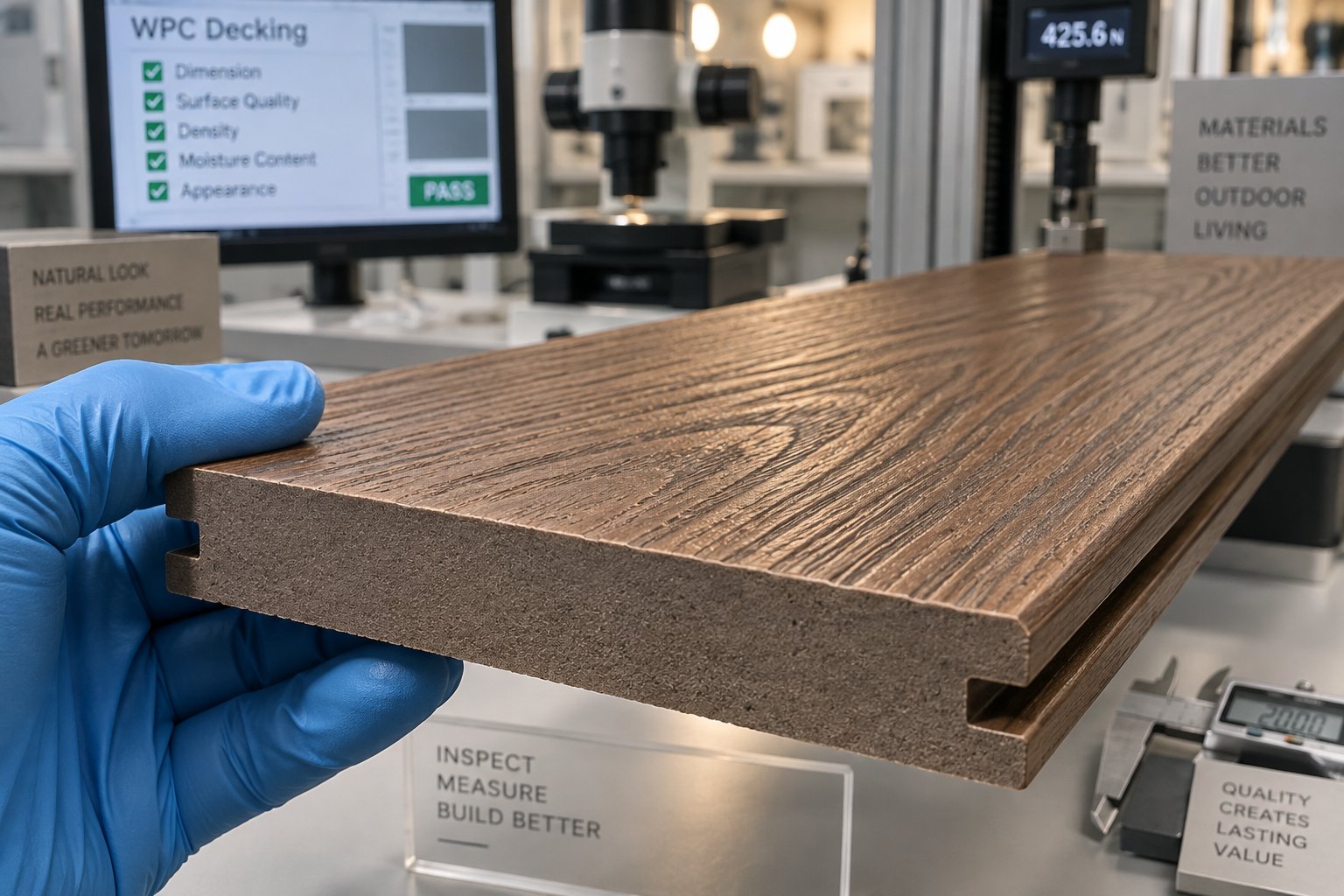
Quality Control and Preventing Common WPC Decking Extrusion Defects
You have selected the right extruder, dialed in your formulation, and synchronized your downstream equipment. The line is running. Boards are coming off the stacker. And then you notice it — a faint blister on the surface, a slight bow along the length, or a color shift that was not there an hour ago. What went wrong?
This is the part of WPC decking production that no equipment brochure covers. Suppliers sell you the machine. They rarely teach you how to diagnose what happens when the machine produces something other than a perfect board. Yet understanding common WPC decking extrusion defects and solutions is arguably more valuable than understanding the machine itself — because defects are where profit disappears. Every warped, blistered, or discolored board that gets pulled off the line is raw material you paid for, energy you consumed, and labor time you cannot recover.
The good news? Nearly every WPC defect traces back to a specific, identifiable root cause — and most of those causes are preventable through proper machine design, correct process settings, and disciplined monitoring.
Common WPC Decking Defects and Their Root Causes
When a defect appears on your finished board, resist the urge to immediately adjust the nearest temperature dial. Effective troubleshooting starts with identifying the defect category, tracing it to its root cause, and then applying the targeted corrective action. The table below covers the six most frequent defects encountered in WPC decking production — and what to do about each one.
| Defect | Root Cause | Corrective Action |
|---|---|---|
| Surface blistering | Excess moisture in wood flour (above 1-3%); barrel temperature too high causing steam pocket formation; insufficient vacuum venting | Pre-dry wood flour to below 1.5% moisture; reduce barrel temperatures in the compression and metering zones by 5-10 degrees Celsius; verify vacuum port is clear and maintaining target vacuum level |
| Warping or bowing | Uneven cooling across the profile cross-section; asymmetric melt flow distribution in the die; haul-off speed mismatch creating uneven internal stress | Balance cooling water spray coverage on all profile surfaces; adjust die flow restrictors for uniform exit velocity; verify haul-off speed matches extruder output precisely |
| Uneven wall thickness | Worn screw flights reducing compression consistency; misaligned die lips or mandrel supports; inconsistent melt pressure from feed fluctuations | Inspect and replace worn screw and barrel components; re-center die alignment using feeler gauges; switch to gravimetric feeding for consistent material delivery |
| Poor wood-fiber dispersion (visible fiber clumps or weak spots) | Inadequate mixing in the hot-cold mixer stage; incorrect screw design lacking sufficient distributive mixing zones; coupling agent under-dosed or improperly activated | Extend hot-mixer cycle time to ensure full pre-dispersion; reconfigure screw with additional mixing elements; verify coupling agent dosage and confirm mixer temperature reaches activation threshold |
| Shark-skin or rough surface texture | Melt fracture caused by excessive shear stress at the die exit; die land too short for the melt viscosity; die temperature too low causing premature skin solidification | Increase die temperature to reduce surface melt viscosity; extend die land length or polish die surfaces to reduce friction; reduce line speed slightly to lower volumetric flow rate through the die |
| Discoloration (yellowing, browning, or dark streaks) | Polymer thermal degradation from excessive barrel temperature or prolonged residence time; wood-fiber scorching from localized hot spots; material stagnation in dead zones within the barrel or die | Lower barrel zone temperatures, particularly in the metering section; reduce screw speed to decrease frictional heat generation; clean screw channels and die flow paths to eliminate material accumulation zones |
Notice a pattern? Surface blistering in wood plastic composite boards almost always traces back to moisture — either in the raw material or generated by excessive heat within the barrel. WPC processing specialists confirm that ambient moisture in raw wood flour typically ranges from 3-10%, and without complete degassing before the melt seals, water vapor expands and creates bubbles, internal voids, and rough surfaces on finished profiles. Pre-drying wood flour to below 1.5% moisture and ensuring vacuum venting ports operate at -0.08 MPa or stronger eliminates this defect category almost entirely.
Discoloration is the second most misdiagnosed issue. Operators often blame the colorant, but the real culprit is usually thermal degradation — either of the polymer or the wood fibers. Lignin in natural wood fibers begins oxidizing and scorching once temperatures exceed roughly 190 degrees Celsius, producing black speckles and off-odors while reducing finished-product strength. The corrective approach is straightforward: lower mixing zone temperatures by 5-10 degrees Celsius and reduce screw RPM to cut frictional heat buildup.
How to prevent warping in WPC decking production deserves special attention because warping is cumulative — it may not be visible at the cutting saw but becomes apparent hours later as internal stresses relax. The root cause is almost always asymmetric cooling. If the top surface of a board cools faster than the bottom, differential shrinkage creates a bow. Ensuring uniform water spray coverage on all exposed surfaces, maintaining consistent cooling water temperature across tank zones, and avoiding abrupt temperature drops in the first calibration stage all reduce residual stress buildup.
Machine Design Features That Improve Quality
A skilled operator can compensate for a mediocre machine — for a while. But consistent, shift-after-shift quality comes from machine design features that prevent defects structurally rather than requiring constant manual intervention. When evaluating any WPC decking making machine, look for these engineering characteristics:
- Precise multi-zone temperature control — Each heating zone along the barrel should have independent PID-controlled heaters and cooling fans. More zones mean finer temperature profiling, which prevents localized overheating that causes polymer degradation or wood-fiber charring. A quality line typically features 5 to 8 barrel zones plus 2 to 4 independent die zones.
- High-torque, low-speed drives — Particularly critical for PVC-based WPC, where excessive screw speed generates frictional heat that degrades the heat-sensitive polymer. High-torque gearboxes allow the extruder to maintain strong conveying force and compression at low RPM, keeping melt temperatures safely within the processing window.
- Vacuum venting ports on the barrel — These extraction points, positioned after the initial melting zone, pull moisture and volatile organic compounds out of the melt mid-process. Without adequate venting, trapped gases expand during final shaping and create internal voids or surface blisters. Effective systems maintain vacuum levels at or below -0.08 MPa and include easily cleanable filter screens to prevent clogging.
- Uniform-flow die designs — Dies engineered with balanced flow channels ensure the melt exits at equal velocity across the entire profile cross-section. Imbalanced flow creates differential shrinkage, where one section of the board cools under tension while another cools under compression — the textbook recipe for warping and dimensional inconsistency.
Among all these features, one factor stands above the rest in its impact on daily output quality: the condition of the screw and barrel. A well-maintained screw and barrel with the correct compression ratio is the single most important factor for consistent melt quality. When the clearance between screw flight tips and barrel bore stays within its designed tolerance, every revolution delivers the same compression, the same shear, and the same melt pressure. The moment wear opens that gap beyond specification, melt pressure becomes erratic — and every defect in the table above becomes more likely to appear.
WPC decking quality control during extrusion ultimately depends on one principle: prevent variation. Consistent raw material moisture, consistent feeding rates, consistent barrel temperatures, consistent screw-barrel clearances, and consistent cooling — eliminate variation at each stage, and defect rates drop dramatically.
Process Monitoring and Industry Standards
Catching defects after they have already been cut, stacked, and shipped is the most expensive quality control strategy possible. In-line monitoring shifts the detection point upstream — ideally to the moment the variation first occurs — so operators can correct parameters before scrap accumulates.
Three in-line monitoring tools deliver the highest return for WPC extrusion operations:
- Melt pressure transducers — Installed at the barrel end and near the die entrance, these sensors track real-time melt pressure. A sudden drop signals feed interruption, screw wear, or temperature deviation. A gradual upward drift may indicate a clogging screen pack or material viscosity shift. Operators who monitor pressure trends — rather than just instantaneous values — can anticipate problems before they produce defective boards.
- Infrared temperature sensors — Non-contact sensors positioned at the die exit measure the actual surface temperature of the extrudate as it emerges. This reading often differs from the barrel thermocouple readings because frictional heat and shear effects create temperature gradients the barrel sensors cannot detect. Comparing die-exit temperature against the barrel setpoints reveals whether the melt is hotter or cooler than intended — information that directly prevents thermal degradation and surface defects.
- Gravimetric throughput tracking — Continuous weight-per-unit-time measurement of extruder output provides an objective indicator of process stability. If throughput fluctuates by more than 2-3%, something in the system has changed — feed rate, melt viscosity, screw wear, or temperature — and the root cause needs investigation before product quality drifts outside specification.
Beyond in-process monitoring, finished WPC decking products should meet recognized performance standards that validate structural adequacy, durability, and safety for end users. In North America, ASTM D7032 provides the standard specification for establishing performance ratings for wood-plastic composite deck boards, addressing factors such as load-bearing capacity, deflection limits, and long-term structural integrity. Additional ASTM testing methodologies cover weathering resistance, slip resistance, fire behavior, and fastener withdrawal strength, creating a comprehensive quality framework for composite decking.
European markets apply a different set of requirements. The EN 15534 series specifically addresses wood-plastic composites, establishing classification, specification, and marking requirements for WPC products used in construction. CE marking certification requires comprehensive documentation of manufacturing processes, quality control procedures, and product performance data — and maintaining compliance demands ongoing surveillance audits and detailed production records.
Readers should verify current applicable standards directly from official standards bodies such as ASTM International or the European Committee for Standardization (CEN), as standard editions and requirements evolve over time. What matters from a machine buyer's perspective is this: if you plan to sell into regulated markets, your production line must be capable of consistently producing boards that meet these benchmarks. That means your equipment — from feeder accuracy to die flow balance to cooling uniformity — must hold tighter tolerances than a line producing for unregulated markets, and your monitoring systems must generate the data trail that auditors expect to see.
Preventing defects and meeting standards protects your product quality. But quality is only half of the profitability equation — the other half is understanding what it actually costs to produce each meter of board, and where those costs can be optimized without sacrificing the consistency your customers depend on.
Understanding Costs and Building a Profitable WPC Production Line
A production line that makes perfect boards every shift still fails as a business if the economics do not work. Yet most buyers fixate on the equipment purchase price — a single number that tells you almost nothing about what it actually costs to produce each meter of decking over the life of the line. The real question is not "how much does the machine cost?" but rather "what will it cost me to produce a board, and how quickly will this investment pay for itself?"
Answering that requires pulling apart the WPC decking making machine price factors that drive quotes up or down, understanding the ongoing operating costs that dwarf the initial purchase, and building a supply chain that keeps the line running profitably for years — not just months.
What Drives WPC Decking Machine Pricing
If you request quotes from five different suppliers for what appears to be the same production line, you will likely receive five dramatically different numbers. That is not necessarily because someone is overcharging or underquoting — it is because the cost of a WPC decking production line depends on a stack of variables that suppliers package differently.
The primary price drivers include:
- Extruder size and type — A conical twin-screw extruder with a 65 mm screw diameter costs significantly less than a 92 mm model. Parallel twin-screw systems typically carry a higher price tag than conical equivalents at similar output ratings due to more complex gearbox and barrel engineering.
- Automation level — A manually operated line where workers adjust settings, transfer boards, and monitor gauges by hand costs less upfront than a semi-automatic or fully automatic system with PLC-controlled temperature profiling, automatic die-lip adjustment, and robotic stacking. The gap between manual and fully automated configurations can represent 30-50% of the total line cost.
- Brand origin and manufacturing location — Equipment manufactured in different regions carries different labor, material, and overhead cost structures. A European-built extruder and a Chinese-built extruder with identical specifications will carry very different price tags, though the performance gap has narrowed considerably as leading Asian manufacturers have invested in precision machining and quality systems.
- Downstream units included — This is where quotes become deceptive if you are not careful. Some suppliers quote the extruder, die, and calibration table only — leaving you to source cooling tanks, haul-offs, saws, embossing units, and stackers separately. Others bundle the complete line. Always request an itemized equipment list with individual pricing so you can compare like-for-like across vendors.
- Control-system sophistication — The PLC brand (Siemens, Omron, or a domestic alternative), touchscreen HMI size and functionality, and the number of automated control loops all affect cost. More sophisticated controls improve consistency and reduce operator dependency but add to the initial investment.
- After-sales support package — Installation supervision, operator training, commissioning assistance, and warranty terms are sometimes included in the quoted price and sometimes billed as extras. A quote that excludes commissioning support may look cheaper on paper but cost more in practice when you factor in hiring third-party technicians to start up the line.
The single most effective tactic for honest price comparison? Request itemized quotes from every supplier using the standardized specification template from the evaluation section earlier in this article. When each line item is broken out — extruder, die, calibrator, cooling system, haul-off, saw, stacker, controls, installation, and training — the true cost differences become visible, and you can identify exactly where one supplier is saving money and whether those savings come at the expense of components you actually need.
Calculating Production ROI and Operating Costs
The purchase price of a WPC decking making machine is a one-time event. Operating costs repeat every single production day. Understanding the WPC extrusion line ROI and operating costs means mapping out where your money goes after the equipment is installed and the first board rolls off the stacker.
Five cost categories dominate ongoing production economics:
| Cost Category | Typical Share of Total Production Cost | Key Variables That Drive It |
|---|---|---|
| Raw materials (wood flour, polymer, additives) | Largest — often 55-70% | Resin price volatility, wood flour sourcing distance, additive package complexity, scrap rate and recyclability |
| Energy consumption | 10-20% | Extruder motor size, number of heating zones, dryer energy demand, cooling pump loads, automation level |
| Labor | 5-15% | Automation level, shift structure, operator skill requirements, local wage rates |
| Maintenance and spare parts | 3-8% | Screw and barrel replacement frequency, die maintenance, saw blade wear, sensor calibration |
| Facility costs (rent, utilities, insurance) | 5-10% | Floor-space footprint, local utility rates, environmental compliance requirements |
The relationship between output capacity and per-meter production cost is straightforward but powerful: higher-capacity lines spread fixed costs — labor, facility overhead, equipment depreciation — across more output. A line producing 400 kg/h carries roughly the same labor and facility cost as a line producing 250 kg/h, but the cost per kilogram of finished product drops substantially because those fixed expenses divide across 60% more output. This is why undersizing your line to save on capital often backfires — the per-unit economics punish you every production hour.
Energy consumption deserves particular attention because it varies significantly across machine configurations. A one-step PVC-WPC line on a conical twin-screw extruder consumes less energy per kilogram than a two-step PE-WPC process that heats the material twice. Fully automatic lines with variable-frequency drives on the extruder motor, cooling pumps, and haul-off consume measurably less electricity than fixed-speed alternatives — the drives modulate power draw to match actual load rather than running at full capacity continuously. Industry comparisons confirm that WPC extrusion carries inherently higher energy consumption than pure PVC processing, primarily because of the extensive drying requirements for wood flour and the higher melt viscosities involved.
To reduce WPC decking production cost on an ongoing basis, focus on the controllable levers: minimize scrap rates through consistent feeding and proper formulation control, negotiate volume pricing on raw materials, schedule preventive maintenance to avoid unplanned shutdowns, and invest in energy-efficient drives and heating systems that pay for themselves within 12-18 months of continuous operation.
Building a Reliable Supply Chain for Long-Term Production
Here is something first-time buyers rarely consider: the day you commission your WPC decking line is not the end of the purchasing process — it is the beginning of an ongoing supply chain relationship that determines whether your operation stays profitable or slowly bleeds margin through downtime, delayed repairs, and inconsistent raw materials.
Three supply chain pillars support long-term production success:
Wear parts sourcing — Screws and barrels are consumable components in WPC extrusion, not permanent ones. Wood flour's abrasive nature means these parts wear on a predictable schedule, and waiting until they fail to order replacements is the most expensive strategy possible. Spare parts strategy experts emphasize that stocking decisions should be based on a structured evaluation of criticality, failure probability, and lead time — parts whose failure stops the entire line deserve priority stocking regardless of their individual cost. For WPC and PVC extrusion producers running conical twin-screw systems, sourcing high-quality replacement barrels from specialized manufacturers like NANHAIYA ensures consistent plasticizing performance and minimizes unplanned downtime. NANHAIYA supports PVC pipe, profile, board, foam board, and WPC extrusion lines with custom-engineered conical twin screw barrels designed for the demanding wear conditions these applications impose. Having a trusted barrel supplier with proven lead times in your supply chain means a scheduled barrel swap stays on schedule — rather than stretching into weeks of lost production while you scramble to source a replacement.
Raw material consistency — Your formulation only works if every batch of wood flour, polymer resin, and additive arrives within specification. Establish quality agreements with your suppliers that define acceptable ranges for moisture content, particle size distribution, melt flow index, and purity. Test incoming materials before they enter the mixer — not after they have already produced a run of off-spec boards.
Technical support access — When a process problem arises that your operators cannot resolve, how quickly can you reach someone who can? Whether that support comes from the original equipment manufacturer, a third-party extrusion consultant, or a peer network of WPC producers, having a defined escalation path prevents minor issues from becoming major production losses. Suppliers who include ongoing technical support in their after-sales package — not just a warranty card — deliver measurably more value over the life of the equipment.
The total cost of ownership — including spare parts, energy consumption, raw material waste, and unplanned downtime — matters far more than the initial purchase price. A line that costs 15% less to buy but runs 10% less efficiently, consumes more energy, and requires frequent emergency repairs will cost you significantly more over five years than a higher-quality alternative that runs reliably shift after shift.
Investing in a WPC decking making machine is not a single transaction — it is the start of a production operation that succeeds or fails based on how well you understand your materials, your machine, and your ongoing costs. The suppliers who help you see the full picture — from formulation science to screw wear rates to downstream component sizing — are the ones worth partnering with. The ones who only show you the price tag are selling you a number, not a solution.
Frequently Asked Questions About WPC Decking Making Machines
1. What is a WPC decking making machine and what does it include?
A WPC decking making machine is a complete extrusion production line that converts wood flour and thermoplastic polymers into finished composite decking boards. A typical line includes a high-speed hot-cold mixer for raw material preparation, a twin-screw or single-screw extruder for melting and shaping, a profile die, a vacuum calibration table for dimensional accuracy, spray or immersion cooling tanks, a haul-off puller for consistent line speed, a flying or planetary cutting saw, and an automatic stacker. Some premium lines also include co-extrusion units that apply a weather-resistant polymer cap layer over the WPC core for superior UV resistance and color retention.
2. Which extruder type is best for WPC decking production?
The best extruder type depends on your resin system and production scale. Conical twin-screw extruders are the dominant choice for PVC-based WPC because their tapering screw geometry provides high compression at low screw speeds, minimizing shear-induced degradation of heat-sensitive PVC. Parallel twin-screw extruders excel at PE- and PP-based WPC where higher throughput and extended mixing lengths are needed. Single-screw extruders are primarily used in two-step processes where pre-compounded WPC pellets are remelted for final profile shaping. Each architecture carries different capital costs, energy profiles, and maintenance requirements, so your formulation must be finalized before selecting an extruder.
3. What is the difference between one-step and two-step WPC manufacturing?
One-step (direct extrusion) feeds raw wood flour, polymer, and additives directly from the mixer into the profile extruder, completing compounding and shaping in a single thermal cycle. It requires lower capital investment, less energy, and a smaller factory footprint. Two-step manufacturing first compounds all ingredients into uniform WPC pellets using a dedicated compounder, then remelts those pellets in a separate profile extruder. This approach delivers superior material homogeneity and allows quality testing at the pellet stage, but it costs more in equipment and energy. Small-to-medium PVC-WPC producers typically favor one-step, while large-volume PE/PP-WPC operations benefit from two-step processing.
4. How do you prevent common defects like blistering and warping in WPC decking extrusion?
Surface blistering is almost always caused by excess moisture in wood flour or barrel temperatures that are too high, generating steam pockets inside the melt. The fix is pre-drying wood flour below 1.5% moisture content and ensuring vacuum venting ports maintain at least -0.08 MPa. Warping results from uneven cooling across the profile cross-section or asymmetric die flow. Balancing cooling water spray coverage on all board surfaces, maintaining uniform cooling water temperature, and precisely matching haul-off speed to extruder output eliminates most warping. Regular screw and barrel inspection is also critical, as worn components cause unstable melt pressure that triggers multiple defect types simultaneously.
5. How often do screws and barrels need replacement on a WPC extrusion line?
木粉含有天然二氧化硅,对螺杆叶片和筒体衬里具有很强的磨蚀性。在加工含50%木粉的木塑复合材料(WPC)配方的锥形双螺杆系统中,螺杆的典型寿命为6000至8000个工作小时,而对于高填充率的配方,寿命则降至4000至6000小时。影响磨损率的因素包括木材种类(硬木的磨蚀性更强)、螺杆转速、温度控制精度以及螺杆表面处理——双金属或硬面螺杆的使用寿命明显长于标准氮化螺杆。主动从NANHAIYA(nhyscrews.com)等专业筒体制造商采购,可确保按时获得替换件,从而避免代价高昂的计划外停机。
Written by
Nanhaiya Technical Team
Zhoushan Nanhaiya Plastic Machinery Co., Ltd.
The Nanhaiya technical team supports screw and barrel manufacturing projects through application review, technical communication, custom manufacturing coordination, and production and quality control.
Discuss Your Application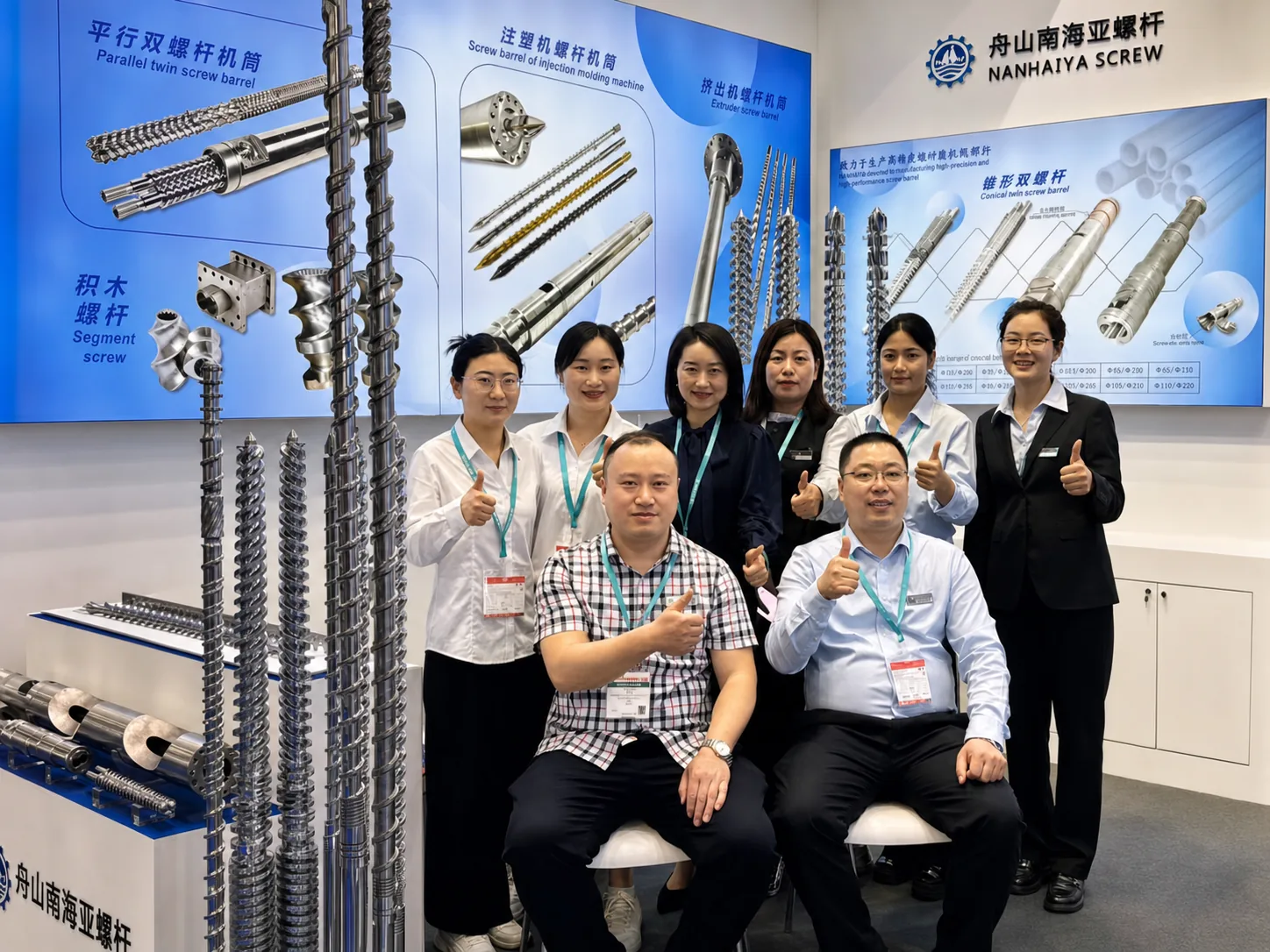
Related Articles
More insights on screw barrel technology and plastics processing.
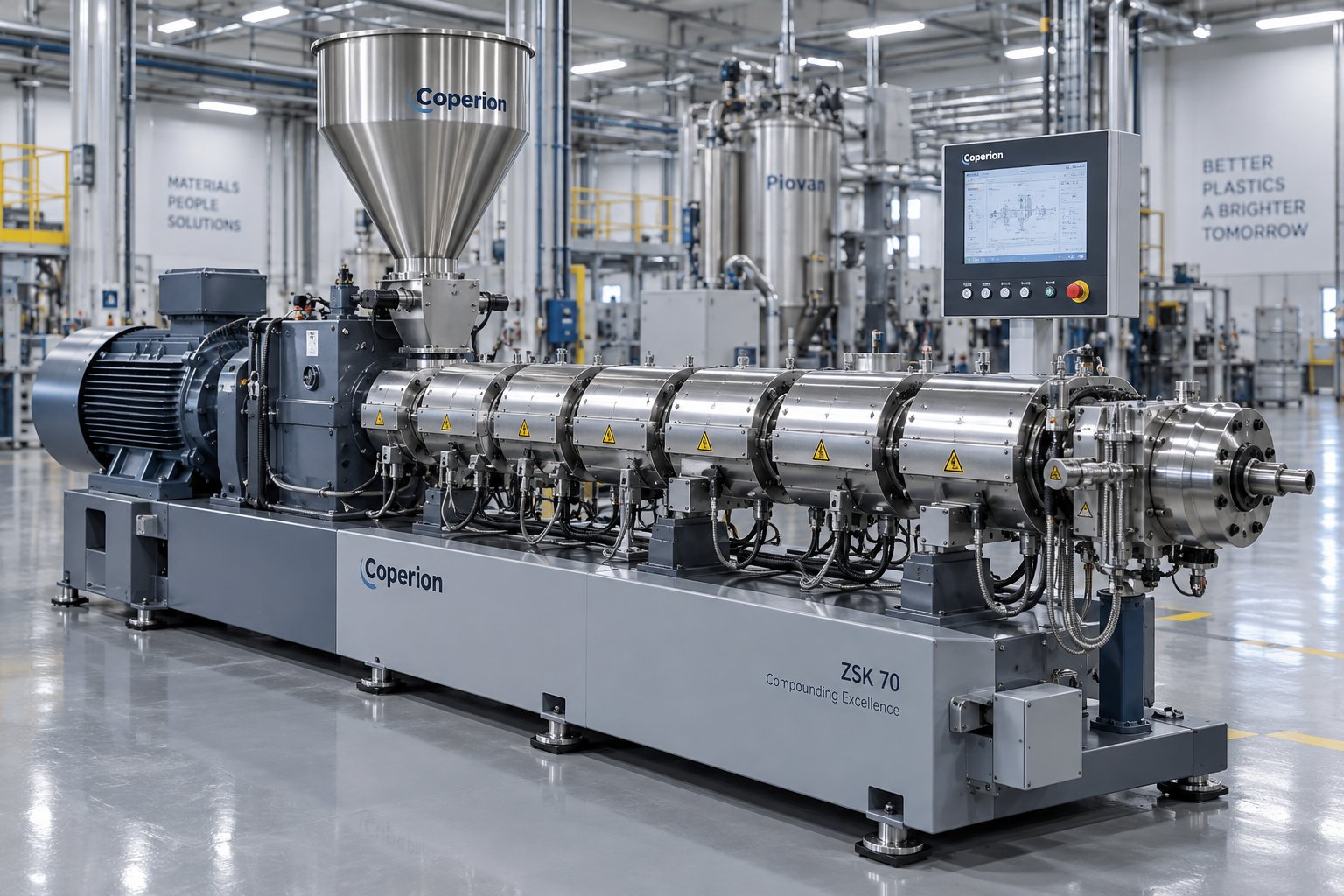
What Your Single Screw Extruder Manufacturer Won't Tell You
Oct 10, 2026
Learn how to evaluate single screw extruder manufacturers with this buyer-focused guide covering specs, configurations, material matching, and a ready-to-use selection checklist.
Read Article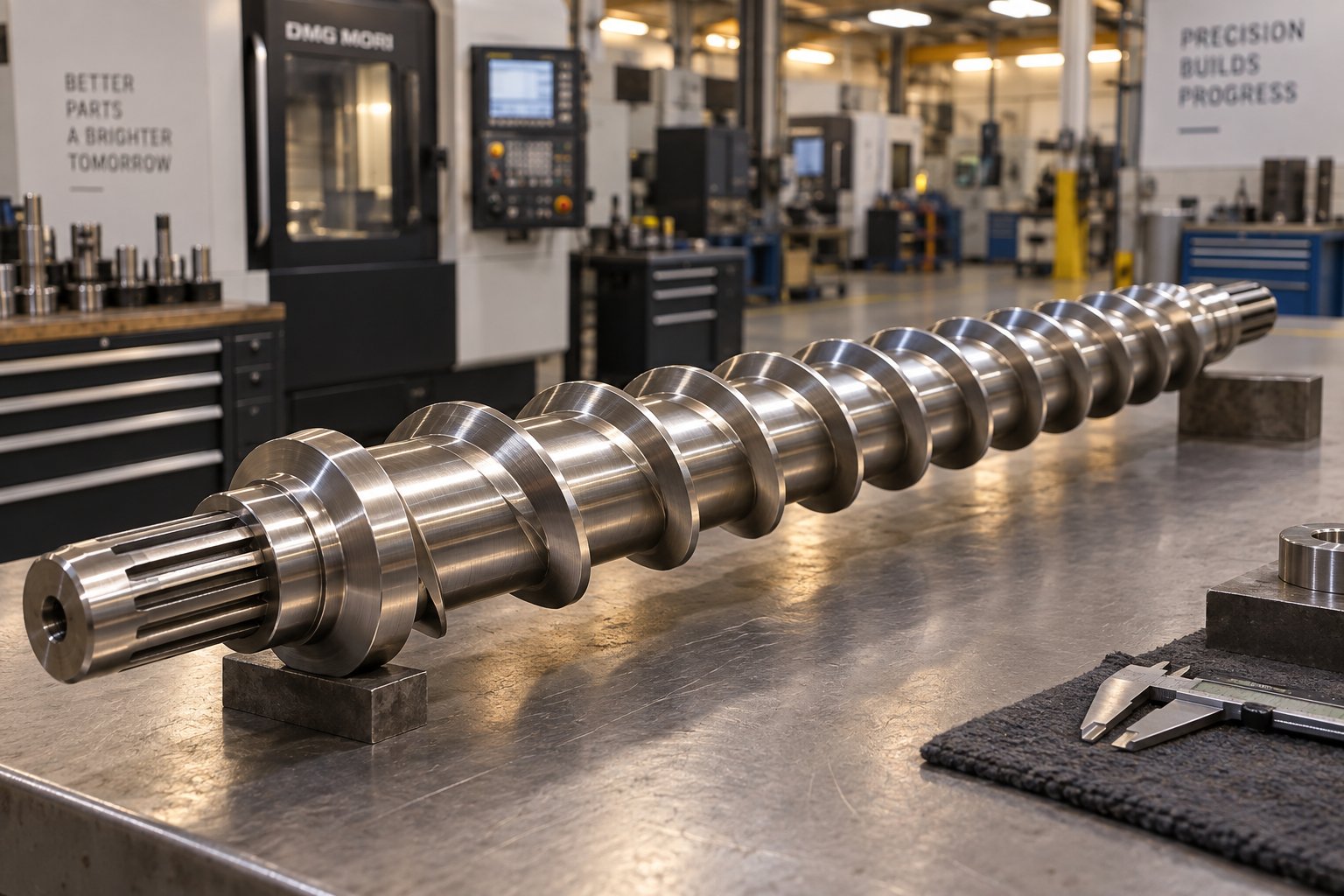
Plastic Extruder Screw Price Demystified: From Steel To Sticker
Oct 10, 2026
What drives plastic extruder screw price? This independent guide breaks down diameter, L/D ratio, metallurgy, order volume, and total cost of ownership factors.
Read Article
Plastic Granulator Machine Exposed: What Your Supplier Won't Explain
Oct 6, 2026
Learn how plastic granulator machines work, compare types and blade designs, match resins to setups, and calculate true ownership costs before buying.
Read ArticleLooking for something else?
Search by material, symptom or product and jump straight to the relevant page.
These are navigation suggestions based on keyword matching — not a quotation, not a delivery commitment, and not a substitute for engineering review. Final specification is confirmed by our engineers against your drawings and processed material.
Need help with screw barrel selection?
Share your machine model, processed material and application. Our team can help with pricing and technical support.