

塑料造粒机的作用及其重要性
想象一下这样的工厂车间:每一个不合格的瓶盖、每一条修剪过的边角料、每一个失败的原型产品都被扔进垃圾箱。每天成千上万个生产周期,如此大量的可用塑料最终都会被送往垃圾填埋场。塑料造粒机的存在正是为了阻止这种浪费——但大多数买家并不完全了解这台设备的实际作用,也不明白它为何如此重要。让我们来详细了解一下。
什么是塑料造粒机
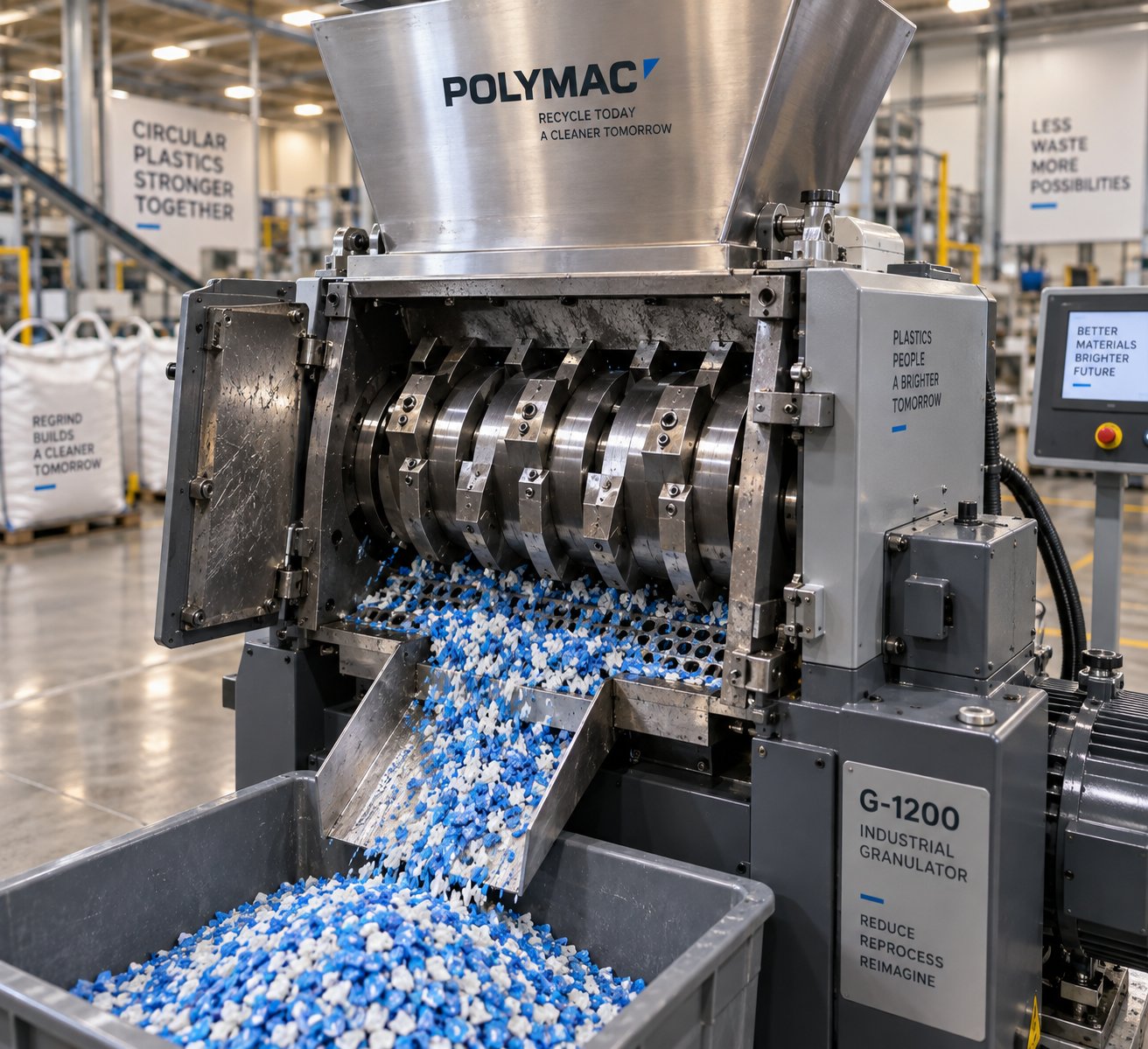
塑料造粒机是一种尺寸缩小设备,它将塑料废料——例如浇口、流道、次品、边角料和消费后废料——切割成细小均匀的颗粒或薄片,称为再生料。这些再生料可以直接送回注塑机和挤出机等生产设备,将废料转化为可重复利用的原材料。
那么,造粒机的核心部件是什么呢?它本质上是一个精密切割系统。塑料原料进入料斗,落入切割室。切割室内,高速旋转的转子配备锋利的刀片,将原料切割到固定的底刀上——可以把它想象成一把动力强劲的工业级剪刀,不停地运转。切割室底部的穿孔筛网起到把关的作用:只有足够小的颗粒才能通过筛孔,成为成品颗粒。过大的碎片则留在切割室内,继续被切割,直到达到目标尺寸。这种简单而有效的机制确保了颗粒尺寸的一致性,这对稳定的下游加工至关重要。
输出颗粒的大小完全取决于筛孔的直径,这使得操作人员能够进行精确控制。无论工厂需要用于重型挤出的粗颗粒还是用于薄壁成型的细颗粒,选择合适的筛网都能轻松实现这一调整。
为什么造粒机在塑料行业中如此重要
塑料造粒机的真正价值远不止于粉碎废料。它从经济和环境两方面改变了行业格局。在生产过程中,注塑成型和吹塑成型等工艺不可避免地会产生废料——尾料、毛刺、飞边和次品都是不可避免的副产品。如果没有造粒机,所有这些材料都会变成昂贵的废弃物。而有了造粒机,它们就能转化为可直接用于生产的再生料,几乎可以立即重新投入生产循环。
This is what the industry calls closed-loop manufacturing. You produce a part, capture the scrap, granulate it on-site, and blend the regrind back into your raw material feed. The result? Lower virgin resin purchases, reduced waste disposal costs, and a significantly smaller environmental footprint. Facilities running beside-the-press granulators, for instance, can reclaim scrap within minutes of it being generated — no stockpiling, no waiting, no wasted floor space.
Granulators are the backbone of circular plastics processing. Without reliable size reduction at the point of production, the entire concept of closed-loop manufacturing falls apart — no matter how advanced the downstream recycling technology becomes.
The economic case is equally compelling. Virgin resin prices fluctuate with petrochemical markets, and every kilogram of regrind that replaces virgin material shields a manufacturer from that volatility. For high-volume operations processing engineering-grade resins like polycarbonate or nylon, the savings can be substantial — sometimes recovering the granulator's purchase price within months.
From an environmental perspective, granulators help divert massive volumes of industrial plastic waste from landfills. They also reduce the carbon emissions tied to producing and transporting new resin. As sustainability mandates tighten globally, the ability to demonstrate measurable material reclamation isn't just a nice-to-have — it's becoming a competitive requirement.
Yet despite this importance, most buyers evaluate granulators based on price alone, overlooking the engineering details that separate a productive machine from a costly headache. The differences between rotor designs, blade materials, and machine categories can dramatically affect output quality, maintenance costs, and overall return on investment — factors that suppliers rarely explain upfront.
Granulator vs. Shredder vs. Crusher vs. Pulverizer
Here's a scenario that trips up even experienced buyers: you need to reduce plastic scrap to a reprocessable size, so you start shopping — and immediately run into granulators, shredders, crushers, and pulverizers that all claim to do the job. They look similar in catalog photos, share overlapping terminology, and suppliers aren't always motivated to clarify which one you actually need. The result? Expensive mismatches where equipment either can't handle the input or produces the wrong output. Let's cut through the confusion.
How Granulators Differ from Shredders and Crushers
Each of these four machine types occupies a distinct role in the size-reduction hierarchy, and understanding that hierarchy prevents costly purchasing mistakes.
A granulator is a precision sizing tool. It uses a high-speed rotor — typically spinning at 400 to 800 RPM — where rotating knives shear material against stationary bed knives in a scissor-like action. A perforated screen beneath the rotor controls final particle size, usually in the 6 to 12 mm range. Nothing exits the chamber until it's small enough to pass through that screen. This is what makes granulators ideal for producing uniform regrind that feeds directly back into injection molding machines, extruders, or compounding lines without further processing.
A shredder, by contrast, is built for brute-force primary reduction. It operates at lower speed but higher torque, often using a hydraulic pusher to force bulky, irregular items — drums, pallets, bumpers, baled scrap — into contact with the rotor. The output is coarse chips, typically tens of millimeters across, suitable for volume reduction and downstream feeding rather than direct reprocessing.
A plastic crusher in many markets is actually used interchangeably with "granulator," but in broader industrial contexts, crushers employ jaw or impact mechanisms to break down dense, rigid materials through compressive force. Think jaw crushers processing rocks and construction debris — they're common in mining and demolition but rarely the right choice for plastics recycling where clean, consistent particle geometry matters.
A pulverizer goes even finer. These machines grind material into powder form through impact, friction, or attrition — essential in applications like rotational molding or specialty compounding where extremely fine particle sizes are required, but overkill for standard regrind production.
Here's the insight most suppliers skip: these machines often work in sequence, not as substitutes for one another. In many recycling operations, a shredder performs the initial size reduction on bulky or irregularly shaped scrap, breaking it down into manageable chips. Those chips then feed into a granulator for final, precision sizing into uniform flakes suitable for washing, extrusion, or direct reuse. Treating them as competing technologies leads to the wrong purchase; recognizing them as complementary stages leads to better line design.
Choosing the Right Size-Reduction Equipment
The right machine depends on three factors: what your material looks like going in, what particle size must come out, and what happens downstream. The table below maps each equipment type against the dimensions that matter most for plastics processing.
| Selection Factor | Granulator | Shredder | Crusher | Pulverizer |
|---|---|---|---|---|
| Output Particle Size | 6 - 12 mm (screen-controlled flakes) | 20 - 80 mm (coarse chips) | 10 - 100+ mm (variable, compression-based) | 0.1 - 0.5 mm (fine powder) |
| Typical Input Materials | Sprues, runners, bottles, rigid parts, pre-shredded chips | Drums, pallets, bumpers, baled scrap, pipes, film bales | Dense rigid materials, rocks, concrete, heavy industrial waste | Pre-granulated plastics, polymers for rotomolding, specialty compounds |
| Throughput Capacity | Low to high (25 - 3,000+ kg/hr depending on model) | Medium to very high (200 - 10,000+ kg/hr) | High (application-dependent) | Low to medium (precision-focused) |
| Energy Consumption | Moderate (high-speed rotor, efficient cutting) | Moderate to high (high torque, continuous force) | High (compressive force on dense materials) | High (friction and impact grinding) |
| Best-Fit Application | Producing uniform regrind for direct reprocessing or washing lines | Primary volume reduction of bulky or irregular scrap | Breaking down dense, rigid non-plastic materials | Creating fine powders for specialty applications |
Notice how granulators occupy the precision middle ground — they aren't designed to swallow a full pallet whole (that's the shredder's job), and they don't produce the ultra-fine powder a pulverizer delivers. Instead, they're engineered to create the exact particle size and uniformity that downstream extruders and molding machines demand. When your goal is production-ready regrind with consistent flow characteristics, a granulator is the right tool.
For facilities handling diverse scrap streams — large post-consumer items alongside smaller in-house waste — a two-stage shredder-granulator setup often delivers the best results. The shredder tames the chaotic feed into uniform chips, and the granulator refines those chips into precisely sized flakes. Trying to force a single machine to handle both stages almost always means compromising on either feed capability or output quality.
Of course, knowing which category of equipment you need is only the first decision. Within granulators alone, there are distinct subtypes — beside-the-press units, central systems, heavy-duty models — each engineered for very different production scenarios and throughput demands.
Types of Plastic Granulators by Application and Capacity
Picking the right equipment category matters more than most buyers realize. An undersized unit chokes on your scrap volume and creates bottlenecks. An oversized one drains capital and wastes floor space. The difference between a profitable granulation setup and a frustrating one often comes down to matching the machine's design intent — where it sits, how much it handles, and what kind of material it's built to process — to your actual production reality.
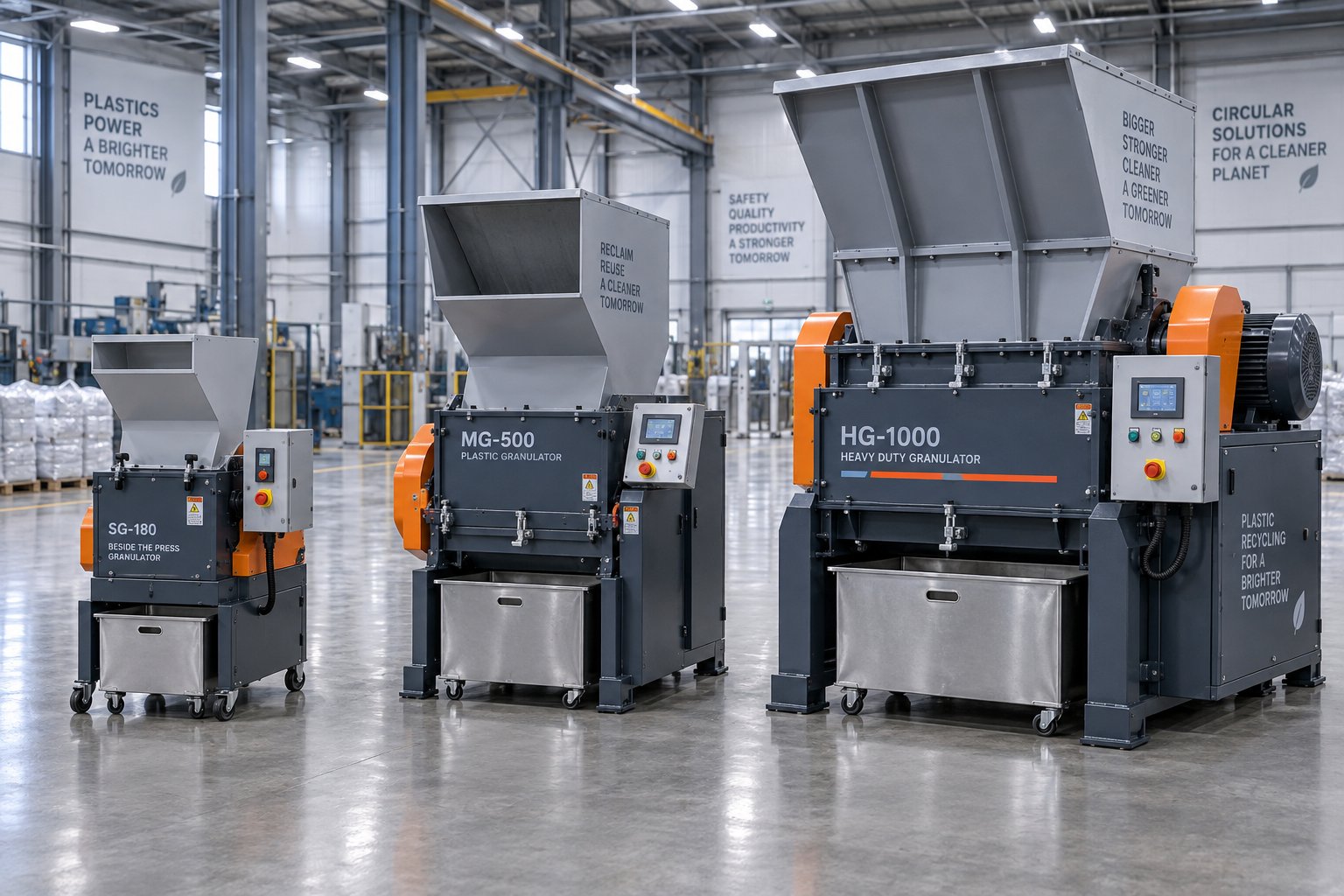
Plastic granulators generally fall into three major categories based on their placement within a facility and the throughput they're designed to deliver. Each category targets a specific operational scenario, and understanding the boundaries between them prevents the kind of mismatch that leads to either chronic underperformance or unnecessary spending.
Beside-the-Press Granulators for Injection and Blow Molding
Imagine a runner dropping out of an injection mold every 30 seconds. Where does it go? With a beside-the-press granulator positioned right next to the molding machine, it goes directly into the cutting chamber, gets reduced to regrind within seconds, and feeds back into the hopper — often blended with virgin resin at ratios of 15 to 30 percent. That's closed-loop recycling happening in real time, without forklifts, storage bins, or material handling delays.
These compact units are purpose-built for low-volume, continuous scrap recovery at individual machines. They handle sprues, runners, small reject parts, and edge trim as fast as the production process generates them. Typical throughput ranges from 50 to 300 kg/hr, powered by motors in the 5.5 to 18.5 kW range — enough for single-machine operations without dominating the production floor.
Noise is a practical concern here. Because these granulators operate inches from machine operators, they're usually designed to run quieter than their larger counterparts. Low-speed rotor configurations spinning at 300 to 500 RPM keep sound levels manageable, and many models include sound-dampening enclosures to further reduce operator exposure. Some screenless, low-speed designs produce uniform regrind with minimal fines and virtually no dust — a critical advantage in cleanroom or medical manufacturing environments where contamination control is non-negotiable.
- Typical motor power: 5.5 - 18.5 kW
- Rotor speed: 300 - 500 RPM (low-speed designs common)
- Throughput range: 50 - 300 kg/hr
- Ideal for: Injection molding runners and sprues, blow molding flash and tails, small reject parts
- Key advantage: Immediate scrap reuse with zero material handling — regrind returns to production within the same cycle
- Capital cost range: $5,000 - $25,000
The economic logic is straightforward: every kilogram of runner that goes back into the hopper is a kilogram of virgin resin you don't purchase. For operations running engineering-grade materials like polycarbonate or glass-filled nylon — where resin costs can exceed $4 per kilogram — a beside-the-press unit often pays for itself within months.
Central Granulators for High-Volume Operations
What happens when you're running 10, 20, or 50 molding machines on the same production floor? Placing individual granulators beside each press becomes impractical — the noise compounds, maintenance multiplies, and floor space disappears. That's where central granulators earn their place.
A central granulator is a high-capacity industrial granulator installed in a dedicated area — often a separate room or enclosure — that receives scrap from multiple production lines simultaneously. Conveyors, pneumatic transport systems, or collection carts funnel waste from across the facility into a single, powerful machine built to handle the combined volume. Think of it as the centralized recycling hub for an entire plant.
These machines run significantly more power than their beside-the-press counterparts. Motor ratings typically fall between 30 and 110 kW, with throughput capacities ranging from 500 to over 3,000 kg/hr depending on the material and configuration. Their larger cutting chambers accept thicker runners, bigger reject parts, and mixed scrap streams that would overwhelm a compact unit. The trade-off? Higher noise levels, a larger footprint, and the need for material transport infrastructure — conveyors, blowers, and storage silos — to feed scrap in and move regrind out.
- Typical motor power: 30 - 110 kW
- Rotor speed: 400 - 700 RPM
- Throughput range: 500 - 3,000+ kg/hr
- Ideal for: Multi-line manufacturing plants, centralized recycling operations, material recovery facilities (MRFs)
- Key advantage: Consolidates scrap processing from an entire production floor into one optimized system
- Capital cost range: $15,000 - $80,000
Central granulators also offer flexibility that beside-the-press units can't match. Because they process mixed scrap from various machines and resin types, they're often equipped with quick-change screens, adjustable rotor speeds, and robust blade systems designed to tolerate the variability inherent in consolidated waste streams. For recycling facilities handling post-industrial or post-consumer material, a central system is typically the backbone of the entire operation.
One detail buyers frequently overlook: the conveyor and feeding infrastructure for a central system can add 20 to 40 percent to the total project cost beyond the granulator itself. Budget for the complete material handling loop — not just the machine.
Heavy-Duty and Thermoforming Granulators
Standard plastic granulators handle runners, caps, and lightweight trim efficiently. But what about a 15-kilogram purging from an extrusion line? Or a thick-walled HDPE pipe section? Or a continuous sheet of thermoformed skeleton waste rolling off a packaging line? These materials demand specialized equipment that goes beyond what central or beside-the-press models are designed to handle.
Heavy-duty granulators are engineered for punishment. They feature reinforced rotor shafts, oversized bearings, and hardened cutting components — often SKD-11 or carbide-tipped blades — that withstand the extreme forces involved in cutting thick, dense, or abrasive plastics. Motor power reaches 75 to 150 kW or higher, and the cutting chambers are built wider and deeper to accept large, irregular items like pipe sections, automotive bumpers, purgings, and thick profiles. These industrial granulators represent the upper end of capacity and durability in the granulator spectrum.
- Typical motor power: 45 - 150+ kW
- Rotor configuration: Solid or closed rotors for maximum cutting force on dense material
- Throughput range: 800 - 3,500 kg/hr
- Ideal for: Thick-walled pipe and profiles, large purgings, automotive parts, drum recycling, post-consumer rigid plastics
- Key advantage: Handles materials and part sizes that would stall or damage standard granulators
- Capital cost range: $35,000 - $200,000+
Thermoforming granulators occupy a different niche entirely. Thermoforming processes — used to produce cups, trays, clamshells, and blisters — generate continuous sheets of skeleton waste (the leftover web after parts are die-cut). This waste is thin, wide, and produced at high speed, requiring a granulator designed to accept and process a continuous web without jamming or wrapping around the rotor.
- Typical motor power: 15 - 55 kW
- Rotor width: Extended to match the full width of the thermoforming sheet (often 800 mm to 1,500 mm or more)
- Throughput range: 200 - 1,500 kg/hr
- Ideal for: Skeleton web waste from cup, tray, blister, and clamshell thermoforming lines
- Key advantage: Wide-mouth feed opening accepts continuous sheet material inline with the thermoforming process, preventing accumulation and manual handling
The critical takeaway across all three categories is this: choosing the wrong type doesn't just mean suboptimal performance — it means real financial consequences. A beside-the-press unit forced to handle thick pipe chunks will burn through blades and stall repeatedly. A heavy-duty machine grinding small sprues wastes tens of thousands in capital and energy on capability you'll never use. Matching the granulator category to your specific scrap type, volume, and production workflow is the single most important decision in the purchasing process.
Yet even after selecting the right category, performance varies dramatically based on what's happening inside the machine — specifically, the rotor design, blade geometry, and screen configuration that determine how efficiently material gets cut and how consistent the output really is.
Cutting Chamber Design and Blade Technology Explained
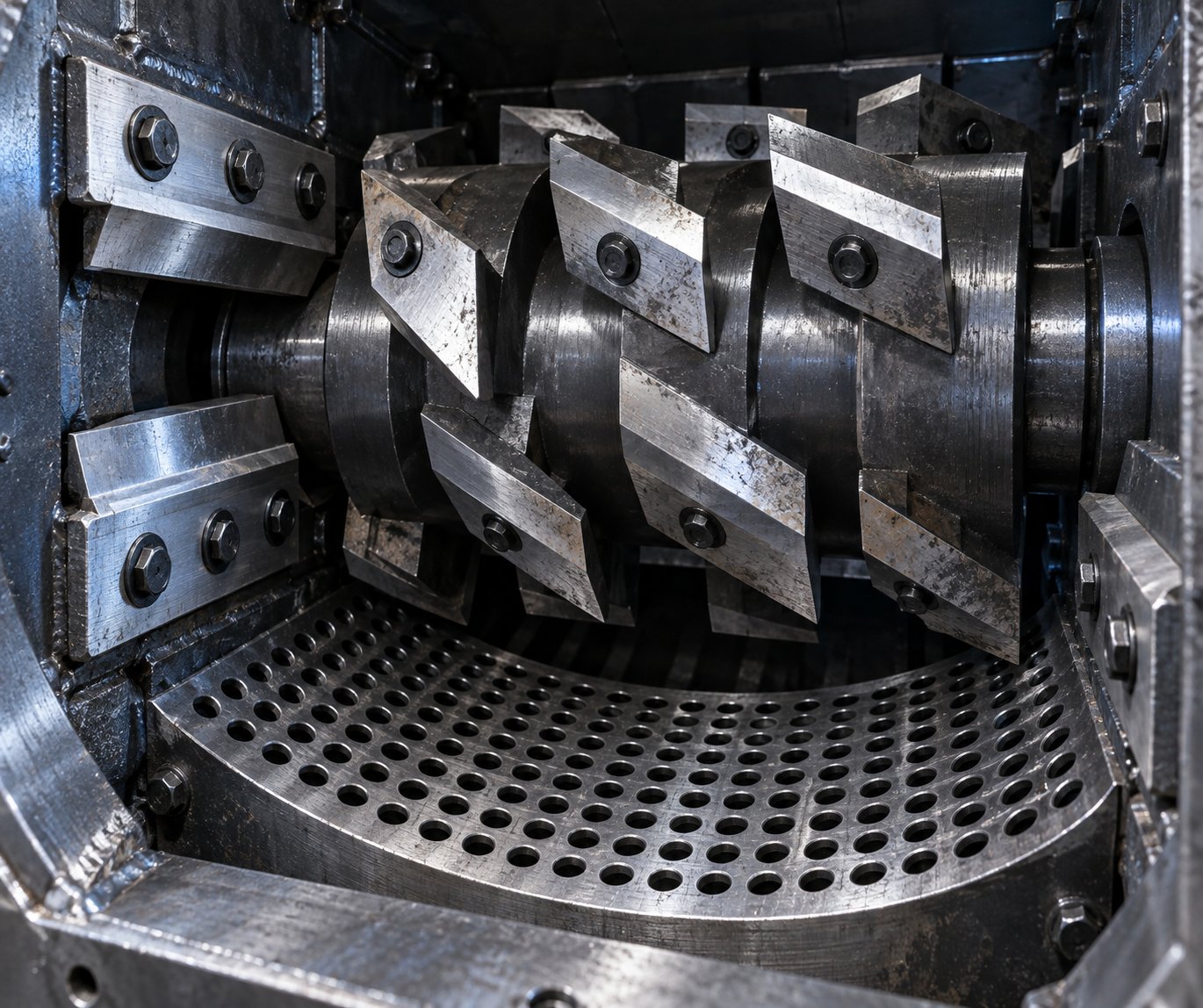
Strip away the hopper, the motor, and the frame, and what you're left with is the part of the machine that actually does the work: the cutting chamber. This is where raw scrap becomes uniform regrind — or where it turns into a dusty, inconsistent mess that clogs downstream equipment. The difference depends almost entirely on three engineering decisions: rotor configuration, blade design, and screen selection. Suppliers rarely walk buyers through these details, yet they determine everything from energy consumption and noise levels to regrind quality and maintenance costs. If you're evaluating any plastic granulating machine, this is where your attention belongs.
Rotor Configurations and Their Impact on Performance
The rotor is the spinning heart of every plastics granulator. It carries the cutting knives, generates the shearing force, and dictates how material behaves inside the chamber. But not all rotors are created equal — and the wrong choice for your application creates problems that no amount of motor power can fix.
There are two fundamental rotor designs, and each excels in very different scenarios:
Open rotors feature exposed spaces between the knife mounts and the central shaft, allowing unrestricted airflow through the cutting chamber. This design runs cooler, making it the go-to choice for heat-sensitive resins like PVC or for granulating parts that are still warm from processing. The open structure also allows bulky, hollow parts — bottles, containers, large blow-molded items — to collapse into the cutting zone before the blades engage. You'll find open rotors on machines handling thin-wall parts, film, and applications where heat buildup could degrade the polymer or cause material to fuse inside the chamber.
Closed or solid rotors eliminate those open spaces entirely. The solid mass between the knife mounts adds significant inertia and provides a much stronger knife-mounting arrangement. When the rotor spins, that added mass stores kinetic energy — like a flywheel — delivering brute cutting force that powers through thick-walled parts, dense purgings, and heavy scrap without stalling. If you're processing large cold purgings, pipe sections, or thick profiles, a solid rotor is the configuration that keeps the machine cutting rather than bogging down.
Beyond these two primary types, staggered and staggered/segmented rotors offer a compelling middle ground. Staggered designs arrange the knives at offset angles around the rotor, so instead of all blades hitting the material simultaneously, they engage sequentially — producing a scissor-like cutting action. The practical impact? Lower instantaneous torque demand, which translates directly to reduced energy consumption and noise. Segmented rotors in a helical pattern take this further, delivering more cuts per revolution while maintaining a constant cutting circle even after sharpening. This minimizes screen plugging, heat buildup, and fines — a meaningful advantage in high-throughput operations.
The takeaway isn't that one rotor type is universally better. It's that the rotor must match your feedstock. Light, hollow parts on a solid rotor waste energy. Dense, thick-walled scrap on an open rotor risks stalling and overheating. Getting this match right at purchase time saves years of frustration.
Blade Types, Materials, and Maintenance Intervals
If the rotor is the engine, the blades are the business end. Their geometry, steel composition, and condition determine whether your granulator machine for plastic produces clean, uniform regrind — or generates excessive fines, dust, and wasted energy.
Blade geometry falls into three primary categories:
Straight knives mount parallel to the rotor axis and engage the full length of material simultaneously. They're simple, easy to sharpen, and work well for brittle plastics that fracture cleanly. However, that full-width engagement demands higher instantaneous cutting force and generates more noise.
Staggered knives are offset along the rotor, creating a progressive, scissor-like cut that reduces the force needed at any given moment. This arrangement handles most heavy, thick-walled parts effectively while drawing less horsepower and producing less noise than straight configurations.
Helical or chevron-pattern knives angle across the rotor in a spiral arrangement, providing a continuous shearing action rather than discrete impacts. They deliver the highest throughput-per-horsepower ratio and produce the most uniform regrind, but they're more complex and expensive to sharpen. These are common on high-volume central and heavy-duty machines where output consistency justifies the added maintenance cost.
Blade material is where many buyers unknowingly accept compromises that cost them for years. Two options dominate the market:
D2 tool steel remains the industry workhorse. It's a high-carbon, high-chromium cold-work steel that reaches roughly 55 to 62 HRC after heat treatment. Its chromium-rich carbides provide strong resistance to the abrasive sliding wear that dulls cutting edges — exactly the type of wear that plastic granulation imposes. D2 offers an excellent balance of edge retention, resharpening capability, and cost. For unfilled commodity resins like PP, PE, and ABS, D2 blades deliver reliable service life at a manageable price point.
Carbide-tipped blades step in when D2 isn't enough. Glass-filled compounds, mineral-reinforced resins, and contaminated post-consumer scrap can reduce D2 blade life by 50 to 80 percent compared to clean, unfilled plastic. Carbide inserts resist this abrasive wear far longer, extending service intervals significantly — but at a higher upfront cost per blade set. For operations running highly filled engineering resins, the math almost always favors carbide over frequent D2 replacements.
There's a less glamorous blade material detail that matters just as much: chrome-vanadium steel (CVS). It's tougher and more resistant to chipping than D2, making it a practical choice for applications where tramp metal contamination is a risk. However, CVS wears faster, so you'll sharpen more often.
The cutting gap — the clearance between rotating rotor knives and stationary bed knives — is arguably the single most critical adjustment on any plastics granulator, and it's the one most frequently neglected. Industry engineering guidance puts the optimal range at roughly 0.15 to 0.30 mm. Here's why precision matters so much in both directions:
Set the gap too wide, and blades tear and smear plastic instead of shearing it cleanly. The result is ragged particles, elevated fines, inconsistent granule sizes, and wasted motor energy — because the rotor works harder to rip material apart rather than cut it. Let the gap drift past about 0.5 mm and you're losing a meaningful share of motor energy to inefficiency.
Set the gap too tight, and you accelerate knife wear dramatically while increasing the risk of metal-to-metal contact if any hard contamination enters the chamber. Energy draw spikes, heat builds, and blade life plummets.
A five-minute check with a feeler gauge on a regular schedule protects both your regrind quality and your power bill. Yet many operators treat gap adjustment as an annual task rather than a routine one — and wonder why their output quality degrades between blade changes.
Screen Selection and Granule Size Control
The screen is the final gatekeeper in the cutting chamber. Every piece of plastic stays inside the chamber, getting cut and recut, until it's small enough to pass through the screen's perforations. This means the screen hole diameter directly dictates the maximum particle size in your output — making screen selection one of the most consequential and least discussed decisions in granulator setup.
Different downstream processes demand different granule specifications. Injection molding typically requires regrind in the 6 to 8 mm range for consistent feeding and melting. Extrusion applications may accept slightly coarser material at 8 to 12 mm. Compounding and pelletizing lines have their own tolerances based on extruder screw geometry and die configuration. Selecting a screen that's too coarse produces oversized particles that cause feeding problems and uneven melt flow. Too fine, and throughput drops sharply because material recirculates in the chamber longer, generating more fines, heat, and energy consumption.
Rotor speed and screen size interact more than most operators realize. At slower rotor speeds, smaller screen holes with a thinner screen body produce more uniform particles and higher throughput — because each granule gets adequate time to orient and pass through a hole rather than being carried past it. At higher speeds, larger screen holes are needed to compensate for the velocity that sweeps particles around the chamber, though this increases the range of particle sizes in the output. Reversible screens extend useful life by offering a fresh wear surface when one side wears thin.
Keeping the cutting chamber performing at its best requires disciplined, routine attention to all three components — rotor, blades, and screen. Here are the key maintenance items that prevent gradual quality degradation:
- Blade sharpening frequency: Inspect edges every shift for chips or visible dulling. Sharpen or rotate when motor amperage rises above baseline or fines content increases noticeably. Glass-filled and mineral-reinforced compounds demand significantly more frequent sharpening than unfilled resins.
- Cutting gap verification: Check rotor-to-bed-knife clearance weekly with a feeler gauge. Maintain the 0.15 to 0.30 mm range. Re-adjust after every blade sharpening or replacement, since material removal during sharpening changes knife geometry.
- Screen inspection: Examine weekly for enlarged holes, cracks, edge separation, and material buildup. Replace immediately if holes are visibly deformed or oversized particles appear in regrind. Clean blocked perforations to maintain throughput.
- Rotor and bearing check: Monthly inspection for shaft runout, bearing temperature, and unusual vibration. Lubricate per manufacturer schedule. Annual full bearing inspection and drive belt tensioning.
- Cutting chamber cleaning: Weekly removal of accumulated fines, resin buildup, and debris between the screen and chamber walls. Material buildup restricts airflow and increases operating temperature.
These maintenance items aren't optional extras — they're the line between a machine that produces quality regrind year after year and one that slowly degrades into an energy-wasting source of inconsistent output. Deferred knife maintenance doesn't just produce bad regrind. It increases motor energy draw, accelerates bearing stress, and shortens the machine's overall service life in ways that compound over time.
Of course, even a perfectly maintained cutting chamber won't deliver ideal results if the material going into it behaves unpredictably. Different plastic resins respond to the granulation process in fundamentally different ways — and understanding those differences is what separates operators who produce premium regrind from those constantly battling quality issues.
How Different Plastic Resins Affect Granulation Performance
A granulator for plastic doesn't care what resin you feed it — it will spin and cut regardless. But the results vary wildly depending on the polymer. The same blade setup, rotor speed, and screen configuration that produces perfect regrind from ABS can generate sticky clumps from LDPE, toxic fumes from PVC, or destroy a blade set in days when processing glass-filled nylon. Yet most equipment purchases happen without any serious discussion of resin-specific behavior. Suppliers sell machines. They rarely ask what you're actually cutting.
Understanding how different plastics respond inside the cutting chamber is what separates operators running efficient plastic granulating machines from those constantly fighting quality issues, excessive fines, and premature wear.
Granulating Rigid vs. Flexible Plastics
Rigid resins like PET, polycarbonate, ABS, and acrylic behave predictably in most granulators for plastics. They fracture cleanly under the scissor-like shearing action of rotor and bed knives, producing well-defined granules with minimal dust. Standard D2 tool steel blades at conventional clearances handle these materials efficiently, and output consistency tends to be high. If you're processing clean, rigid thermoplastic scrap, a properly configured machine delivers reliable results without special modifications.
Flexible resins are a completely different challenge. Materials like LDPE, LLDPE, TPE, TPU, and soft PVC don't shatter — they deform. When a blade strikes flexible plastic, the material bends and stretches rather than fracturing. The result? Incomplete cuts, stringy particles, material wrapping around the rotor, and granules that clump together instead of flowing freely through the screen. You'll notice throughput dropping while motor amperage climbs — the machine is working harder but producing less.
Effective granulation of flexible plastics demands a different approach: sharper blade edges, tighter rotor-to-bed-knife clearances (closer to 0.10 mm), and sometimes slower rotor speeds that allow the blade to complete its shearing action before the material deforms away from the cutting edge. For extremely soft or stretchy materials, some operations turn to cryogenic assistance — chilling the material with liquid nitrogen or dry ice before it enters the chamber. The cold makes the polymer temporarily brittle, allowing it to fracture cleanly like a rigid resin. It adds cost, but for certain feedstocks, it's the only way to produce usable regrind.
Temperature Sensitivity and Brittleness Factors
Every plastic granulation machine generates heat through friction. Blades striking material, granules recirculating against the screen, and rotor momentum all contribute thermal energy that builds inside the cutting chamber during continuous operation. For most commodity resins, this heat is manageable. For heat-sensitive polymers, it's a serious problem.
PVC is the most prominent example. When granulator friction pushes chamber temperatures above roughly 140 to 160 degrees Celsius, PVC begins to thermally degrade, releasing hydrogen chloride gas — a corrosive, harmful byproduct that endangers operators and corrodes machine components. As one industry guide emphasizes, PVC granulators should incorporate water-cooled rotors or chambers, air cooling systems for continuous production, and temperature monitoring devices to prevent overheating. Reducing rotor speed also limits frictional heat generation, though it reduces throughput proportionally. Open rotor designs, with their superior airflow, are strongly preferred for PVC applications because they dissipate heat far more effectively than closed rotors.
Hygroscopic materials like nylon (PA6, PA66) present a subtler challenge. Nylon absorbs atmospheric moisture readily, and while this doesn't directly affect the mechanical cutting process, it has major downstream consequences. Moisture-laden regrind fed into an extruder or injection molding machine causes splay marks, bubble formation, and degraded mechanical properties in finished parts. Processors who granulate nylon must either dry the regrind before reprocessing or ensure extremely short storage times between granulation and reuse. Ignoring moisture content produces regrind that looks fine but performs poorly — a hidden quality trap.
Filled and reinforced compounds accelerate blade wear dramatically. Glass-fiber-reinforced engineering plastics are among the most blade-hostile materials a granulator encounters. Glass fiber has a Mohs hardness of approximately 5 to 6 — hard enough to abrade even high-quality tool steel with every cut. According to testing by Pulian, blade wear rates on glass-filled nylon can run five to twenty times faster than on standard unfilled plastics. A D2 steel blade set that lasts three months on clean PP may need sharpening every two to three weeks on PA with 30% glass fiber content. Carbon-fiber-reinforced compounds are even more severe. Upgrading to tungsten carbide-tipped blades — which last five to eight times longer than standard D2 steel in abrasive applications — becomes a financial necessity rather than a luxury. The higher upfront cost per blade set is recovered quickly through dramatically fewer replacements and less downtime.
Mineral-filled resins (talc, calcium carbonate, glass beads) fall somewhere between unfilled and fiber-reinforced in terms of wear severity, but they still shorten blade life noticeably. Any operation processing filled compounds should factor accelerated blade consumption into its operating cost projections from day one — not discover it as a surprise six months after commissioning.
| Resin Category | Example Materials | Recommended Rotor Type | Blade Material | Screen Size Range | Special Handling Notes |
|---|---|---|---|---|---|
| Commodity Rigid | PP, PE (HDPE), PS, ABS | Open or closed (application-dependent) | D2 tool steel (SKD11) | 6 - 12 mm | Standard configuration; minimal special requirements |
| Engineering Rigid | PET, PC, PA (nylon), POM | Closed rotor for thick parts; open for thin | D2 tool steel; carbide for filled grades | 6 - 10 mm | Nylon requires drying after granulation; POM can off-gas formaldehyde at high temperatures |
| Heat-Sensitive | PVC (rigid and flexible) | Open rotor (superior heat dissipation) | D2 tool steel | 6 - 10 mm | Water-cooled chamber or slower rotor speed required; temperature monitoring essential to prevent degradation and HCl release |
| Flexible / Elastomeric | LDPE, LLDPE, TPE, TPU, soft PVC | Open rotor with tight clearance | High-speed steel (M2) or D2 with razor-sharp edge | 8 - 12 mm | Tighter blade gap (~0.10 mm); may require cryogenic pre-cooling; risk of rotor wrapping |
| Glass/Mineral-Filled | PA+GF, PBT+GF, PP+talc, PC+GF | Closed or solid rotor | Tungsten carbide-tipped (strongly recommended) | 6 - 10 mm | Blade wear 5 - 20x faster than unfilled resins; mandatory dust collection; rigorous metal detection before feed |
The pattern in this table reveals something important: there is no universal granulator setup. Each resin family demands a specific combination of rotor type, blade material, clearance setting, and sometimes auxiliary equipment like cooling systems or cryogenic feeders. Operators who ignore these distinctions and run a single configuration for every material will inevitably produce inconsistent regrind — which cascades into problems downstream.
And that downstream connection matters more than most people realize. The quality of what comes out of the granulator — particle size uniformity, absence of fines, freedom from thermal degradation — directly determines how well that regrind performs when it reaches the extruder, compounder, or molding machine. A granulator producing clean, consistent output makes every piece of equipment after it run more smoothly. A granulator producing degraded, inconsistent regrind introduces variability that propagates through the entire production line.
Where the Granulator Fits in Production and Recycling Lines
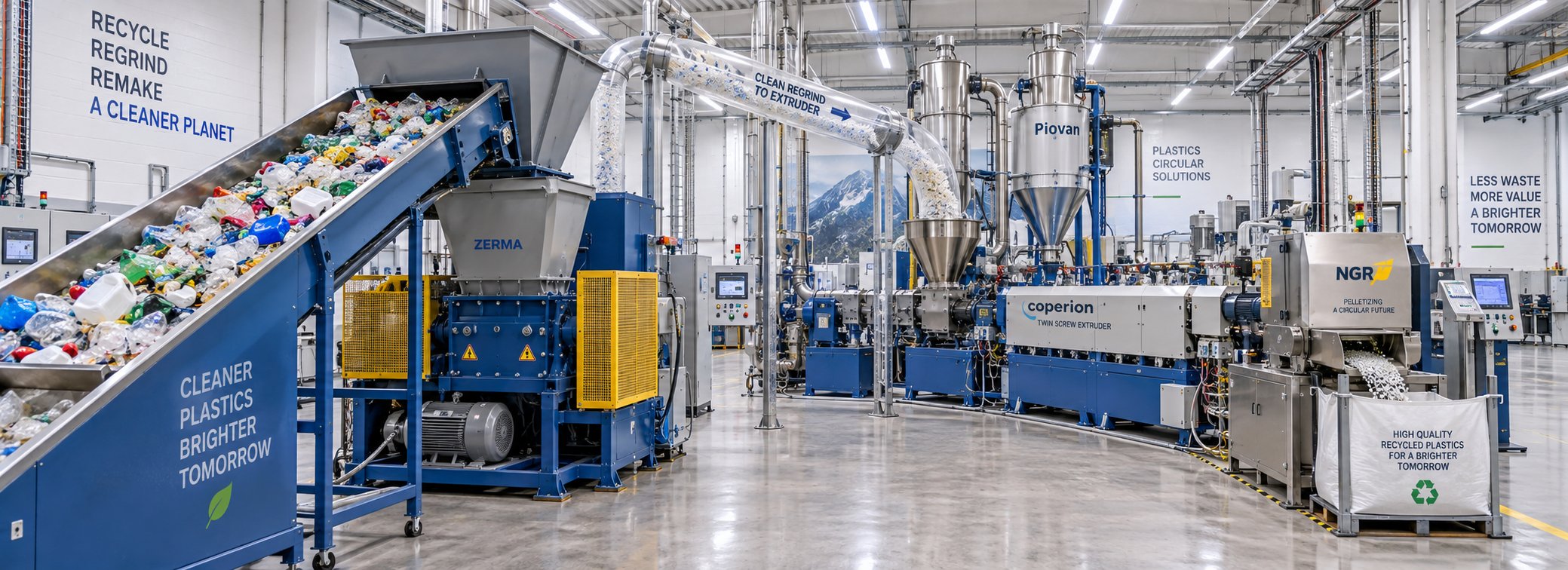
That downstream connection introduced at the end of the last section — how regrind quality shapes everything that follows — deserves a much wider lens. A plastic granulator machine doesn't operate in isolation. It sits at a precise midpoint in a larger chain of equipment, receiving prepared material from upstream systems and feeding its output into downstream processing that ultimately produces finished pellets or production-ready regrind. Understanding this full chain reveals why the granulator's role is so pivotal, and why neglecting the equipment on either side of it undermines the entire operation.
Whether you're running an in-house closed-loop system alongside injection molding lines or operating a full-scale plastic recycling granulator machine facility processing post-consumer bales, the workflow follows the same fundamental logic: prepare the material, reduce it to uniform size, and process it into a reusable form. The granulator is the bridge between raw scrap and reusable output — and everything that touches the material before and after it matters.
Upstream Equipment and Material Preparation
What feeds a granulator determines how well it performs. Dump contaminated, oversized, or metal-laden scrap directly into the cutting chamber and you're inviting blade damage, motor overloads, and inconsistent output. Proper upstream preparation isn't optional — it's protective infrastructure for the granulator itself.
The upstream chain typically includes three critical components:
Conveyors transport scrap from production machines, collection points, or storage areas to the granulator's feed hopper. In centralized systems, belt conveyors or pneumatic transport lines collect material from multiple production machines and deliver it to a single industrial plastic granulator in a dedicated processing area. For beside-the-press setups, gravity or short incline conveyors handle the shorter distance. The conveyor's speed and capacity must match the granulator's throughput rating — feeding too fast causes jams and motor overloads, while feeding too slowly wastes machine capacity.
Metal detectors are arguably the most important piece of upstream equipment, yet they're the one buyers most frequently skip to save cost. This is a dangerous economy. A single bolt, screw, or piece of tooling debris that enters the cutting chamber can shatter blade tips, gouge the rotor, damage the screen, and — in severe cases — crack the chamber housing itself. The resulting downtime, repair costs, and replacement parts easily exceed the price of the metal detector many times over. As Dynamic Conveyor points out, metal detector conveyors are capable of detecting all metals — steel, aluminum, copper, brass, and stainless steel — and will automatically stop the conveyor and trigger an alarm when contamination is identified. Think of it as an insurance policy for your granulator blades. Injection molding and blow molding processors don't always recognize the importance of including metal detection as part of their scrap grinding process, but the cost of a single metal strike event typically makes the case permanently.
Primary shredders handle the oversized items that exceed the granulator's feed opening or cutting capacity. Large purgings, full containers, pipe sections, and baled post-consumer waste all need to be broken down into manageable pieces before they reach the granulator. The shredder performs this coarse volume reduction — producing chips in the 20 to 80 mm range — so the granulator can perform precision final sizing without being overwhelmed. In recycling operations handling mixed post-consumer streams, a shredder-granulator sequence is the standard configuration, not an exception.
Downstream Processing After Granulation
The regrind exiting a granulator's screen isn't always the final product. In many operations — particularly recycling facilities and compounding plants — it's an intermediate material that requires further classification, transport, and thermal processing before it becomes a finished, saleable pellet.
Here's what typically happens after the granulator does its work:
Classifiers and vibratory screeners separate the granulator's output into three fractions: target-size granules, undersized fines, and occasional oversized particles that slipped through damaged screen areas. Removing fines is critical because they cause feeding inconsistencies in extruder hoppers, create dust hazards, and reduce the bulk density of regrind — all problems that degrade downstream processing efficiency.
Blower and pneumatic conveying systems move classified regrind from the granulator discharge to storage silos, blending stations, or directly to extruder feed hoppers. Pneumatic transport eliminates manual material handling, reduces contamination risk, and enables continuous automated operation. For industrial granulators serving centralized systems, the pneumatic loop connects the granulator to the rest of the plant's material flow infrastructure.
Extruders and compounding lines represent the final thermal processing stage. Regrind enters the extruder, where it's melted, filtered through screen packs to remove remaining micro-contaminants, homogenized, and pushed through a pelletizing die to produce uniform pellets. These pellets are the standardized raw material form that injection molding machines, film lines, and sheet extrusion equipment require. The quality of the granulator's output — particle size consistency, absence of fines, freedom from degradation — directly determines how smoothly the extruder runs, how effectively the melt filters, and how uniform the final pellets turn out.
In compounding and pelletizing applications, the extruder's twin screw barrel is one of the most critical wear components in the entire downstream chain. It endures constant abrasion from filled resins, corrosion from reactive additives, and thermal cycling that degrades lesser materials over time. The barrel's bore geometry, metallurgy, and manufacturing precision directly affect mixing efficiency, melt quality, and throughput stability. For operations processing recycled regrind — especially filled or contaminated streams — a poorly performing barrel introduces the very inconsistencies that careful granulation was designed to eliminate. Suppliers like NANHAIYA offer custom-engineered parallel twin screw barrels built specifically for demanding mixing, conveying, and pelletizing applications across recycling, masterbatch, and compounding operations, ensuring the downstream equipment matches the quality of the upstream size reduction.
The full material flow from raw scrap to finished pellet follows a logical sequence. Here's how each step connects in a typical recycling or reclamation line:
- Scrap collection and sorting: Post-industrial waste (runners, sprues, rejects) or post-consumer material (bottles, containers, film) is gathered, sorted by resin type, and staged for processing.
- Metal detection and removal: Conveyors pass material through metal detectors to identify and eject any metallic contamination before it reaches cutting equipment.
- Primary size reduction (if needed): Bulky or oversized items pass through a shredder for coarse volume reduction into chips suitable for granulator feeding.
- Granulation: The plastic recycling granulator machine performs precision final sizing, producing uniform regrind at the target particle size controlled by screen selection.
- Classification and fines removal: Vibratory screeners or air classifiers separate target-size regrind from fines and any oversized particles.
- Washing and drying (recycling lines): Post-consumer regrind goes through friction washers, float-sink tanks, and centrifugal dryers to remove labels, adhesives, dirt, and moisture.
- Pneumatic conveying to storage: Clean, classified regrind is blown to storage silos or blending stations where it awaits extrusion.
- Extrusion and pelletizing: Regrind is fed into a twin screw extruder, melted, filtered, degassed, and cut into uniform pellets — the final, market-ready product.
- Quality testing and packaging: Finished pellets undergo melt flow, color, and contamination testing before packaging for sale or internal reuse.
Notice that the granulator sits at step four — the critical transition point between raw scrap and processable material. Everything upstream exists to protect and feed it properly. Everything downstream depends on the consistency and quality of its output. A granulator producing uneven regrind with excessive fines forces the extruder to work harder, clogs screen packs faster, and introduces variability into pellet quality that no amount of downstream adjustment can fully correct.
This system-level perspective also explains why evaluating a granulator in isolation — based solely on its motor power, price, or throughput rating — misses the larger picture. The machine's real value emerges only when it's properly integrated into the complete line: fed by reliable conveyors and metal detection, paired with appropriate classification equipment, and connected to downstream extrusion systems with components engineered to handle the specific demands of recycled material processing.
Still, even the best-integrated system carries ongoing costs that extend far beyond the initial equipment purchase. Blades dull, screens wear, motors draw power, and unexpected problems surface during daily operation — realities that shape the true financial picture of owning and operating a granulator over its full service life.
Maintenance, Troubleshooting, and True Cost of Ownership
Here's a number that should change how you evaluate any plastic granulator machine: the purchase price often represents the smallest line item in the total cost you'll pay over the equipment's lifetime. A machine running for a decade racks up energy bills, blade replacements, screen changes, and downtime events that collectively dwarf whatever appeared on the original invoice. Yet most buyers focus almost exclusively on that invoice number, sign off when it comes in under budget, and then spend years absorbing costs they never anticipated. That's the gap between granulator price and true cost of ownership — and it's where the real financial decision lives.
Understanding Total Cost Beyond Purchase Price
Think of granulator ownership like car ownership. The sticker price gets you in the door. Fuel, tires, oil changes, and repairs determine what the vehicle actually costs you over 150,000 miles. The same logic applies here, except the recurring costs are steeper and compound faster.
Energy consumption is the single largest ongoing expense — and the one most frequently overlooked during the buying process. Published benchmarks place granulator energy consumption in the range of roughly 40 to 150 kWh per ton depending on material type and machine configuration. To put that in concrete terms: a 1-ton/hour granulator running 4,000 hours per year on rigid HDPE at $0.10/kWh generates approximately $20,000 to $24,000 in annual electricity cost alone. Over ten years, that's $200,000 or more — easily exceeding the purchase price of most central and heavy-duty machines several times over. A machine that tears instead of shears, or runs an unnecessarily small screen, burns extra money on the power bill every single hour it operates.
Blade sharpening and replacement form the second major cost category. A quality tool-steel blade set can typically be reground six to ten times before requiring full replacement — which stretches the per-set investment considerably if you plan for it. But inferior blade steel from lower-cost machines may only survive three to four regrinds before cracking, effectively doubling or tripling your blade expenditure over the machine's life. Add screen replacements, belt changes, bearing services, and motor maintenance, and the consumables budget becomes a significant annual line item.
Downtime is the cost nobody writes a check for directly, yet it often inflicts the most damage. When a granulator goes down unexpectedly, it doesn't just stop grinding — it can halt entire production lines that depend on its regrind output. Industry maintenance data suggests that disciplined preventive maintenance can extend equipment life from a typical 8 to 10 years to 12 to 15 years, which means the difference between proactive and reactive maintenance is essentially getting five extra years of productive service from the same capital investment.
Regrind value — the cost people forget entirely — can dwarf all the others. Clean, correctly sized, low-fines regrind displaces virgin resin at near-equivalent value. Contaminated or off-spec output gets downgraded, sold at a fraction, or landfilled. The machine producing better regrind isn't just cheaper to run; it generates a more valuable product every hour. That's the difference between treating your granulator as a cost center and treating it as a resin-recovery asset.
This lifecycle perspective also reframes the new vs. used equipment decision. A used plastic granulator can make strong economic sense for low-utilization applications — occasional purging reduction, light-duty trim grinding, or backup capacity. When the machine won't run thousands of hours annually, recurring costs stay relatively small and the purchase savings remain meaningful. But buying a used plastic granulator for sale on price alone for a high-volume, high-hours application is a different calculation entirely. Worn blade seats, degraded cutting chambers, less efficient older motors, and harder-to-source replacement parts on discontinued models can quietly erode whatever you saved at purchase within the first year or two of heavy operation. Match the buying logic to how hard the machine will actually work.
Preventive Maintenance Schedules and Wear Parts
A structured maintenance rhythm is what separates granulators that deliver a decade of reliable service from machines that spiral into chronic breakdowns. The good news? The schedule itself isn't complicated. The challenge is actually following it consistently.
Daily or per-shift checks catch problems before they escalate. Visually inspect the hopper and feed area for foreign objects. Listen for unusual sounds — grinding, rattling, or metallic pinging — that signal loose hardware or tramp metal. Verify that the motor draws normal amperage at steady-state operation. Check that safety interlocks, guards, and emergency stops function correctly. Clean accumulated fines from the discharge area and screen housing.
Weekly tasks focus on cutting performance. Check rotor-to-bed-knife clearance with a feeler gauge and adjust back to the 0.15 to 0.30 mm range if drift has occurred. Inspect blade edges for visible chips, rounding, or discoloration. Examine the screen for cracked welds, enlarged holes, or material buildup blocking perforations. Verify belt tension and inspect airflow pathways for blockages that could cause heat buildup.
Monthly inspections address mechanical integrity. Check bearing temperatures using a contact thermometer or infrared gun — rising temperature trends warn of lubrication breakdown or misalignment. Inspect the rotor for shaft runout and any signs of imbalance. Examine the cutting chamber walls and screen cradle for wear, cracks, or deformation. Review motor amperage trends; a gradual upward drift signals dull blades, tightening clearances, or screen degradation. Lubricate all grease points per manufacturer specifications.
Annual service covers the deeper mechanical layer: full bearing replacement or repacking, drive belt replacement, comprehensive electrical inspection, and a complete blade and screen overhaul. This is also the time to assess whether the cutting chamber itself shows enough wear to warrant resurfacing or replacement — especially in operations processing abrasive filled compounds.
Knowing which parts wear and what signals replacement turns maintenance from guesswork into a predictable budget item. Here are the most common wear components and their typical replacement indicators:
- Rotor knives: Replace when edges can no longer be resharpened to a clean edge (typically after 6 to 10 regrinds), when chipping becomes frequent, or when cracks appear at mounting holes.
- Bed knives (stationary blades): Replace when wear land exceeds manufacturer tolerance, when regrind shows increased fines despite proper rotor knife condition, or when clearance can no longer be adjusted within specification.
- Screens: Replace when holes are visibly elongated or enlarged, when cracks form at weld points or edges, or when oversized particles consistently appear in output.
- Bearings: Replace when temperature exceeds manufacturer baseline by more than 15 to 20 degrees Celsius, when vibration analysis shows degradation, or at the manufacturer's recommended hour interval — whichever comes first.
- Drive belts: Replace when cracking, glazing, or visible stretching appears, or when belt tension can no longer be maintained within adjustment range.
- Hopper liners and chamber liners: Replace when wear-through becomes visible or when material buildup patterns indicate surface degradation that affects feed behavior.
Troubleshooting Common Granulator Problems
Even well-maintained machines develop operational issues. The key is recognizing symptoms early and tracing them to root causes before they cascade into expensive failures. Dull knives don't just produce bad regrind — they increase motor load, accelerate bearing stress, and generate excess heat that degrades everything inside the chamber. A clogged screen doesn't just reduce throughput — it forces material to recirculate longer, producing fines and raising energy consumption. Every symptom connects to a cause, and every cause has a fix.
The following reference matrix covers the most frequent problems operators encounter. Bookmark it — you'll use it more than you'd expect.
| Problem | Likely Cause(s) | Solution |
|---|---|---|
| Excessive fines and dust in output | Dull or chipped blades; rotor-to-bed-knife clearance too wide (beyond 0.5 mm); screen holes too small for material | Sharpen or replace blades; reset clearance to 0.15 - 0.30 mm; evaluate screen hole diameter against target granule size |
| Uneven or inconsistent granule size | Damaged or worn screen with enlarged holes; unevenly worn rotor knives; one or more bed knives loose or misaligned | Inspect and replace screen; sharpen or replace full knife set (never mix worn and new blades); re-torque bed knife mounting bolts |
| Motor overload / tripping | Feed rate exceeds machine capacity; rotor jammed by oversized or non-cuttable material; severely dull blades increasing cutting resistance | Reduce feed rate or install metered feeding; clear jam following lockout/tagout procedures; sharpen blades and verify clearance |
| Excessive noise or vibration | Loose rotor knives or mounting hardware; blade imbalance after uneven sharpening; worn bearings; foreign object in chamber | Torque all knife and hardware fasteners to specification; ensure knife sets are match-ground to equal weight; replace bearings; inspect and clear chamber |
| Reduced throughput | Clogged or blinded screen perforations; dull blades causing material to recirculate excessively; belt slippage reducing rotor speed | Clean or replace screen; sharpen blades; adjust or replace drive belts and verify rotor RPM |
| Overheating / material discoloration | Inadequate airflow through cutting chamber; clearance too tight causing excessive friction; processing heat-sensitive resin without cooling | Clear airflow obstructions; widen clearance slightly within specification; reduce rotor speed or add water cooling for heat-sensitive materials like PVC |
| Granulator won't start | Safety interlock not engaged (hopper open, access door ajar); thermal overload tripped; electrical fault | Verify all safety circuits and interlocks are properly closed; allow motor to cool and reset overload; inspect electrical connections and contactors |
A useful pattern emerges from this matrix: the majority of granulator problems trace back to just two root causes — blade condition and clearance setting. Maintaining sharp, properly gapped knives prevents most of the symptoms on this list before they ever appear. As AEC's maintenance guidance notes, dull knives increase amp draw, raise vibration, generate excess fines, and push noise levels higher — a cascade of degradation that starts with a single neglected maintenance task. Rising motor current is often the earliest detectable signal that blades need attention, making regular amperage monitoring one of the simplest and most valuable diagnostic habits an operator can develop.
The granulation machine price you pay at purchase buys you hardware. What you invest in maintenance, energy management, and operational discipline determines whether that hardware delivers value for five years or fifteen. Facilities that treat maintenance as an optional activity to defer when budgets tighten inevitably end up spending more — on emergency repairs, lost production, degraded regrind quality, and premature machine replacement — than those that build a modest, consistent maintenance rhythm into daily operations from the start.
Cost management and troubleshooting keep existing equipment productive. But the technology itself isn't standing still — emerging innovations in motor efficiency, smart monitoring, and safety engineering are redefining what a modern granulator can deliver and how it integrates into increasingly automated manufacturing environments.
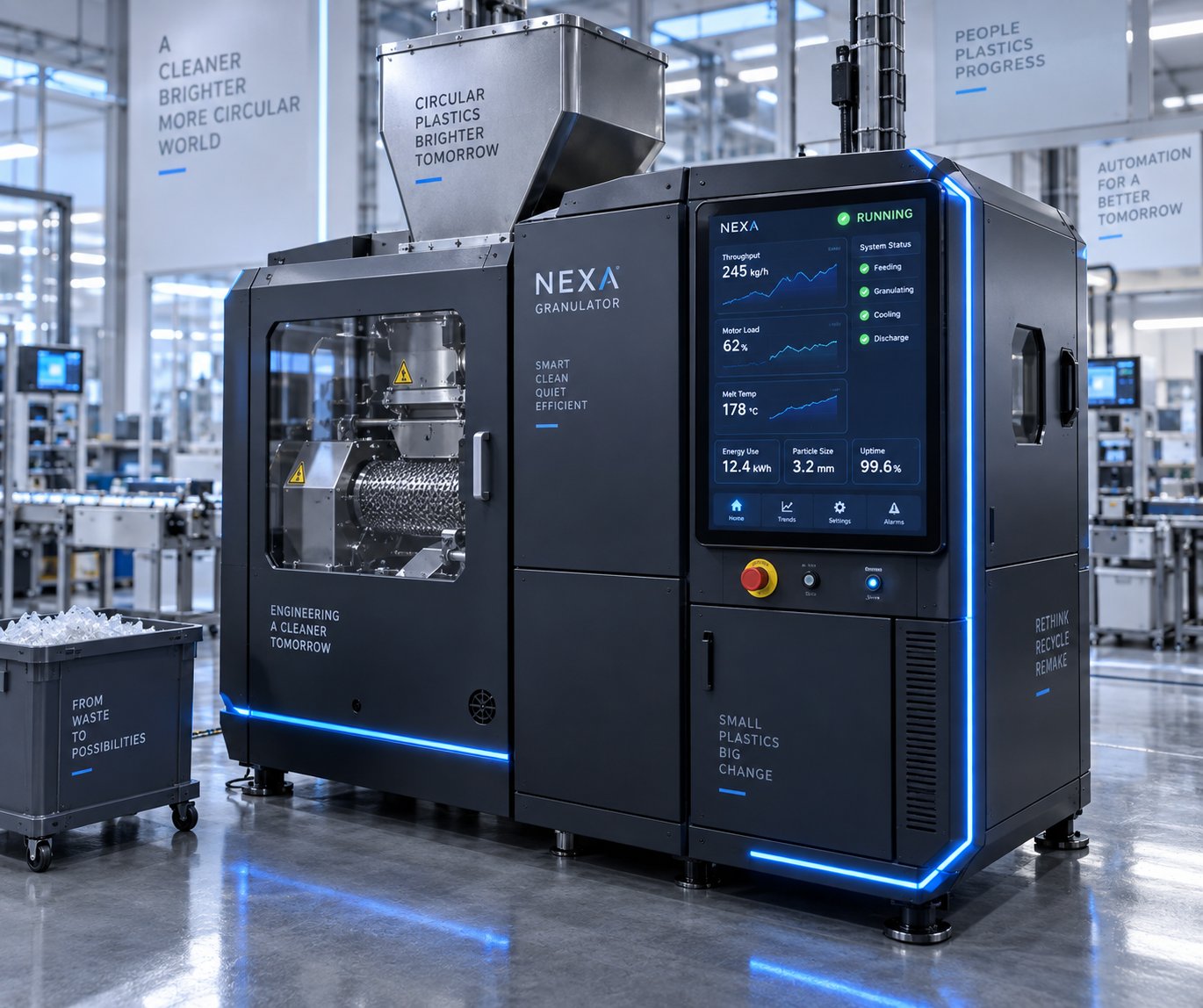
Emerging Trends in Granulator Technology and Smart Manufacturing
The granulator sitting on your factory floor today probably looks a lot like the one installed ten years ago — a steel box with spinning blades, a motor, and a screen. From the outside, not much has changed. But inside the engineering, and especially in the digital layer now wrapping around that steel box, a quiet revolution is underway. Modern plastic granulator machines are becoming smarter, quieter, more energy-efficient, and far more integrated into facility-wide production intelligence than anything the previous generation offered. If you're planning equipment purchases for the next five to ten years, these trends will shape what you buy and how it operates.
Energy Efficiency and Low-Noise Engineering
Energy cost, as the previous section made clear, dominates the total cost of ownership for any granulator running significant hours. That reality has pushed manufacturers to rethink motor selection, rotor geometry, and acoustic design from the ground up — not as afterthoughts, but as core engineering priorities.
On the motor side, high-efficiency IE3 and IE4 premium-efficiency motors are rapidly becoming standard on new equipment. Compared to the older IE1 motors still running on many legacy machines, an IE4 motor delivers measurably lower electrical losses at equivalent output — savings that compound across thousands of operating hours annually. For facilities running granulators on two or three shifts, the motor upgrade alone can shave a meaningful percentage off annual electricity costs without changing anything else about the machine's operation.
Rotor geometry innovations go further. As Topstar's low-speed granulator design demonstrates, shifting from conventional high-speed rotors to low-speed, high-torque configurations running at 20 to 28 RPM fundamentally changes the energy equation. Higher rotor speeds generate significant air resistance inside the cutting chamber and increase friction on granule surfaces, wasting electrical input on airflow and heat rather than productive cutting. Low-speed rotors concentrate energy on mechanical shearing — the actual work — resulting in fewer kilowatt-hours per kilogram of processed material. The trade-off is throughput speed, but for many applications the energy math strongly favors the slower, more deliberate approach.
Noise reduction has evolved from a nice-to-have feature into a regulatory and workforce necessity. Conventional rapid granulators and rapid grinders operating at full speed can exceed 100 dB — loud enough to cause hearing damage during prolonged exposure and well above the 85 dB threshold that triggers mandatory hearing protection under OSHA and EU standards. Modern designs attack noise at multiple levels simultaneously: low-speed rotors reduce aerodynamic and impact noise at the source, double-walled soundproof enclosures filled with acoustic foam absorb radiated sound, and elastomer vibration-isolation mounts prevent structural noise from transmitting through the floor. The result? Machines operating below 80 dB — quiet enough to sit near operators without hearing protection requirements and without the fatigue that high-noise environments impose on workers over full shifts.
Hollow-shaft gear motor drives represent another engineering leap. By integrating the motor and reduction gears into a single compact unit that directly drives the rotor shaft, these designs eliminate the separate gearbox, couplings, and belt systems found on traditional machines. Fewer mechanical components means fewer vibration sources, lower maintenance burden, sealed lifetime-lubricated bearings, and a significantly smaller footprint — a meaningful advantage for beside-the-press installations where floor space is at a premium.
Smart Monitoring and Industry 4.0 Integration
Imagine knowing your granulator blades need sharpening three days before output quality starts to decline — not because someone checked, but because the machine told you. That's the shift smart monitoring delivers, and it's transforming size reduction from a standalone, manually supervised operation into a connected, data-driven process step.
Newer plastic granulator machines feature sensor arrays monitoring multiple parameters in real time: motor load and amperage trends, bearing temperature, vibration signatures, rotor speed, throughput rates, and even acoustic profiles. These data streams feed into local controllers or plant-wide manufacturing execution systems (MES), creating a continuous digital picture of machine health and performance. Instead of relying on calendar-based maintenance schedules or waiting for obvious symptoms like rising noise or visible fines, operators receive condition-based alerts that flag developing problems weeks before they cause downtime.
The predictive maintenance capabilities built on this sensor data are particularly powerful. As Industry 4.0 maintenance research shows, AI-powered analytics can now detect early-stage process deviations that precede failure — extending prediction windows to 8 to 12 weeks on well-instrumented rotating equipment. Applied to granulators, this means bearing degradation, blade wear progression, and screen fatigue can be tracked and trended rather than discovered during emergency breakdowns. Plants with condition monitoring connected to maintenance systems report 40 to 60 percent reductions in unplanned failures within the first year of deployment. For granulators feeding critical production lines, that reduction translates directly into protected uptime and consistent regrind quality.
Automation extends beyond monitoring into material handling. Automated feed systems with metered conveyors regulate scrap input to match the granulator's optimal throughput rate — preventing the overfeeding that causes motor overloads and the underfeeding that wastes capacity. Integrated pneumatic conveying on the discharge side moves regrind directly to storage silos or extruder hoppers without manual intervention. Combined, these systems enable lights-out operation in high-volume recycling and compounding facilities, where granulators run continuously across unattended shifts with only exception-based human oversight.
Smart granulators transform size reduction from a standalone, manually monitored operation into an integrated, data-driven process step — where blade condition, energy consumption, and output quality are continuously optimized by the same digital infrastructure managing the rest of the production floor.
Safety innovation is advancing in parallel with digital integration. Modern hopper designs incorporate extended feed throats and baffles that make it physically impossible for operators to reach into the cutting zone — a critical improvement over older open-hopper designs where reach-in injuries remained a persistent risk. Automatic rotor-stop mechanisms, triggered by safety interlock switches on access doors and maintenance panels, halt the cutting chamber within seconds of any guard being opened. PLC-based intelligent overload systems detect abnormal motor current — such as a metal contaminant striking a blade — and reverse or shut down the rotor within milliseconds, preventing catastrophic damage. As Wintech's safety analysis details, the gap between traditional and modern safety-enhanced granulators is dramatic: noise levels drop from over 100 dB to below 80 dB, manual feeding is replaced by automated conveyors, and open hoppers give way to interlocked, sensor-monitored enclosures.
Compliance standards continue to tighten as well. Evolving CE marking requirements in Europe and UL certification standards in North America increasingly mandate specific safety features — interlocked guards, emergency stop placement, electrical fault protection — as baseline requirements rather than optional upgrades. Machines designed and certified to these standards aren't just safer; they're easier to insure, simpler to permit, and more straightforward to integrate into facilities with rigorous EHS programs.
The broader trajectory here is clear: the granulator is no longer just a mechanical cutting tool. It's becoming a networked, self-reporting node in an increasingly automated production ecosystem — one where energy use is optimized per kilogram, maintenance is scheduled by algorithm rather than calendar, and safety systems operate proactively rather than reactively. Facilities investing in this generation of equipment aren't just buying quieter, more efficient machines. They're building the sensor data and digital infrastructure that future autonomous manufacturing systems will require.
Technology trends tell you where the industry is heading. But translating that knowledge into a smart purchasing decision — matching the right machine, the right features, and the right supplier to your specific operation — requires a practical framework that pulls together everything covered so far.
How to Select the Right Plastic Granulator for Your Operation
You've seen the rotor designs, blade materials, resin behaviors, maintenance realities, and emerging smart technologies. That's a lot of knowledge — but knowledge without a decision framework leaves you scrolling through listings for a plastic granulator for sale without any structured way to evaluate what you're actually looking at. This section changes that. It distills everything covered so far into a practical, step-by-step process you can follow the next time you're specifying equipment, requesting quotes, or comparing options.
Whether you're sourcing your first small plastic granulator for a single injection molding cell or scaling up to a centralized system feeding a full recycling line, the selection logic follows the same sequence. Get the order right, and the decision becomes clear. Skip a step, and you risk buying a machine that looks good on paper but underperforms in your facility.
Key Factors for Matching a Granulator to Your Application
Every granulator purchase should start with the application — not the catalog. Suppliers list motor power, rotor speed, and throughput ratings, but none of those numbers mean anything until you've defined what you're actually processing. Here are the primary selection criteria, ranked in the order they should drive your decision:
1. Material type and form. This is the single most consequential variable. Are you grinding rigid injection runners, flexible film trim, thick-walled pipe sections, or mixed post-consumer bales? As the resin chapter made clear, rigid ABS and stretchy LDPE demand completely different blade configurations, rotor types, and clearance settings. The physical form matters equally — a continuous thermoforming web requires a wide-mouth feed opening that a standard central machine doesn't have, while large purgings demand heavy-duty cutting force that a beside-the-press unit can't deliver. Define your material first, and half the options on the market immediately disqualify themselves.
2. Required throughput. Calculate your actual scrap generation rate in kilograms per hour — not your wishful estimate, but a measured figure based on real production data. Then apply a 1.3 to 1.5x safety margin to accommodate peak volumes and material variability. A facility generating 600 kg/hr of scrap needs a machine rated for at least 780 to 900 kg/hr to avoid bottlenecks during heavy production runs. Remember that manufacturer throughput ratings are typically measured on ideal material at generous screen sizes — real-world capacity on your specific feedstock may run 60 to 80 percent of the published number.
3. Target granule size. Your downstream process dictates the screen hole diameter you need. Injection molding generally requires 6 to 8 mm regrind for consistent feeding. Extrusion and compounding applications may accept 8 to 12 mm. Choosing the largest screen size your downstream equipment can handle maximizes throughput and minimizes fines — don't default to a finer screen than your process actually demands.
4. Noise restrictions and work environment. A beside-the-press unit running at 300 RPM in a low-speed configuration keeps noise manageable on a production floor where operators work adjacent to the machine all shift. A high-speed central granulator generating 95 dB belongs in a separate enclosure or dedicated grinding room. If your facility operates under strict noise regulations or shares space with sensitive processes, this constraint can override throughput preferences and steer you toward low-speed or sound-insulated designs.
5. Available floor space and infrastructure. Compact beside-the-press granulators need roughly 1 to 2 square meters and a standard electrical connection. Mid-range central units require 4 to 6 square meters plus conveyor access and pneumatic discharge piping. Heavy-duty industrial machines demand 8 to 12 square meters, three-phase power up to 130 kW, and often a concrete foundation engineered for vibration loads. Measure your space — including vertical clearance for hopper access — before falling in love with a machine that physically won't fit.
These five factors map directly to the equipment categories covered earlier. A single injection molding operation producing light runners and small rejects points clearly toward a beside-the-press unit. A multi-line manufacturing plant consolidating scrap from dozens of machines needs a central system with conveyor infrastructure. A recycler processing thick HDPE pipe or automotive bumpers requires heavy-duty capability. Match the application profile to the category, and you've narrowed the field from hundreds of machines to a manageable shortlist.
Evaluating Suppliers and Building a Complete Processing Line
Finding the right machine is only half the challenge. Finding the right supplier — and thinking beyond the granulator itself — determines whether your investment performs as expected over its full service life.
When evaluating suppliers, whether you're browsing plastic grinders for sale online or meeting manufacturers at trade shows, look beyond the quoted price to these indicators of long-term value:
Blade steel quality and documentation. A reputable supplier specifies the exact steel grade (D2, SKD-11, carbide) and provides hardness certifications for blade sets. Vague descriptions like "high-quality steel" without grade documentation are a warning sign. As the blade technology section detailed, the difference between a properly hardened D2 blade and an underspec knockoff shows up in sharpening intervals, edge retention, and total cost per operating hour — not on the purchase invoice.
Replacement parts availability. Every granulator consumes wear parts — blades, screens, bearings, belts, and liners. Ask how quickly the supplier can ship replacement knife sets and screens. Ask whether those parts are stocked domestically or require international shipping with weeks of lead time. A machine with no readily available parts becomes a liability the moment something wears out.
Technical support and material trials. The best suppliers offer to run your specific material on the proposed machine before purchase. Send 50 to 200 kg of your actual scrap and verify real-world throughput, granule quality, noise levels, and energy consumption — not the numbers from a brochure tested on clean HDPE. Vendors who refuse material trials are signaling uncertainty about their machine's performance on your feedstock. That's a risk you shouldn't accept on a five- or six-figure capital expenditure.
Certifications and compliance. Verify that the equipment carries legitimate CE marking (for EU markets), UL certification (for US operations), and meets OSHA machine guarding standards. Counterfeit CE marks are common in the granulator import market — request certificate numbers and confirm them independently with the issuing body. Properly certified equipment is easier to insure, simpler to permit, and protects your facility from regulatory exposure.
Equally important is recognizing that the granulator is one component in a larger system. Its performance depends on what feeds it and what processes its output. Upstream, you need reliable conveyor systems and metal detection to protect the cutting chamber. Downstream, classifiers, pneumatic conveying, and extrusion equipment must be sized and specified to handle the regrind your granulator produces. A mismatch at any point in this chain creates bottlenecks that no single piece of equipment can solve alone.
For compounding and pelletizing operations — where granulator regrind feeds directly into an extruder for melt processing — the quality of downstream extruder components is especially critical. The twin screw barrel endures constant abrasion, thermal stress, and corrosive exposure from recycled material streams that carry residual contaminants and fillers. A barrel that wears prematurely or provides inconsistent mixing undermines every quality gain the granulator delivered. NANHAIYA provides custom-engineered parallel twin screw barrels built for recycling, granulation, and masterbatch applications — designed to maintain bore precision and mixing performance under the demanding conditions that recycled regrind processing imposes.
Pulling it all together, here's a step-by-step selection checklist you can follow when evaluating any plastic granulator machine for purchase:
- Document your material: Record the resin type(s), physical form (runners, film, pipe, mixed), wall thickness, and whether the material is filled, reinforced, or contaminated. This determines rotor type, blade material, and any special handling requirements.
- Measure your scrap volume: Track actual scrap generation in kg/hr over a representative production period. Apply a 1.3 to 1.5x safety factor to calculate the minimum rated throughput your granulator needs.
- Specify output requirements: Define the target granule size based on your downstream process. Confirm with your extruder or molding equipment supplier what regrind particle size range they can accept without feeding or quality issues.
- Assess site constraints: Measure available floor space, ceiling height, electrical capacity, noise limits, and access for maintenance. Rule out any machines that exceed your physical or infrastructure constraints.
- Match the granulator category: Based on steps one through four, determine whether you need a beside-the-press, central, heavy-duty, or thermoforming unit. Don't over-buy capacity you won't use or under-buy and create a production bottleneck.
- Request material trials: Send your actual scrap to shortlisted suppliers and evaluate real-world throughput, output quality, energy draw, and noise on your specific material — not their demonstration samples.
- Verify blade and wear part supply: Confirm steel grades, hardness certifications, domestic parts stocking, and typical lead times for replacement knife sets and screens.
- Check certifications independently: Request CE, UL, or other relevant certificate numbers and verify them directly with the certifying body before committing.
- Evaluate total cost of ownership: Calculate projected energy cost, blade replacement frequency, screen changes, and maintenance labor over 10 years. Compare lifecycle costs across shortlisted machines — not just purchase prices.
- Spec the complete line: Ensure upstream feeding, metal detection, downstream classification, conveying, and extrusion components are sized and integrated with the granulator. Budget an additional 15 to 25 percent beyond the granulator price for installation and ancillary equipment.
This checklist works whether you're sourcing a compact unit for a single molding cell or specifying a heavy-duty system for a high-volume recycling operation. The key principle is the same in every case: the best granulator for sale isn't the one with the lowest price tag or the most impressive throughput number. It's the one that matches your material, your volume, your downstream process, and your operational reality — backed by a supplier who provides the parts, support, and technical honesty to keep it performing for a decade or more.
The plastics industry isn't getting simpler. Sustainability mandates are tightening, resin costs are volatile, and the competitive advantage of efficient in-house material reclamation keeps growing. A well-chosen, properly integrated plastic granulator machine isn't just a piece of equipment — it's the foundation of a production strategy that turns waste into value, reduces dependence on virgin material, and positions your operation for the demands ahead.
Frequently Asked Questions About Plastic Granulator Machines
1. What is the difference between a plastic granulator and a shredder?
A plastic granulator uses high-speed rotating knives shearing against stationary bed knives to produce uniform, screen-controlled regrind typically sized between 6 and 12 mm - ready for direct reprocessing in extruders or molding machines. A shredder operates at lower speed with higher torque to perform coarse volume reduction on bulky items like drums, baled scrap, and pallets, producing irregular chips in the 20 to 80 mm range. In many recycling lines, these machines work in sequence: the shredder breaks down oversized material first, then the granulator performs precision final sizing. They are complementary stages rather than interchangeable equipment.
2. How do I choose the right size granulator for my plastic recycling operation?
Start by measuring your actual scrap generation rate in kilograms per hour over a representative production period, then apply a 1.3 to 1.5x safety factor to determine the minimum rated throughput. Next, identify your material type and physical form - rigid runners, flexible film, thick pipe, or mixed post-consumer waste - since this dictates rotor configuration and blade material. Define the target granule size based on downstream equipment requirements, typically 6 to 8 mm for injection molding and 8 to 12 mm for extrusion. Finally, assess site constraints including floor space, ceiling height, electrical supply, and permissible noise levels. Matching these criteria to the correct category - beside-the-press, central, heavy-duty, or thermoforming - prevents costly mismatches.
3. How often should plastic granulator blades be sharpened or replaced?
Blade sharpening frequency depends heavily on the material being processed. Standard unfilled commodity resins like PP and PE allow D2 tool steel blades to run for weeks or even months between sharpenings. Glass-fiber-reinforced compounds can accelerate wear by 5 to 20 times, requiring sharpening every two to three weeks. Monitor motor amperage during operation - a gradual rise above the established baseline is the earliest reliable signal that blades are dulling. Quality D2 blade sets can typically be reground 6 to 10 times before full replacement is needed. Upgrading to tungsten carbide-tipped blades for abrasive materials extends service intervals by 5 to 8 times, reducing both downtime and long-term blade costs.
4. Can you granulate flexible plastics like LDPE and TPE in a standard granulator?
Flexible plastics like LDPE, LLDPE, TPE, and TPU present unique challenges because they deform and stretch rather than fracture cleanly under standard cutting conditions. Processing them effectively requires sharper blade edges, tighter rotor-to-bed-knife clearances around 0.10 mm, and sometimes reduced rotor speeds. For extremely soft or stretchy materials, cryogenic pre-cooling with liquid nitrogen or dry ice temporarily embrittles the polymer so it fractures like a rigid resin. Without these adjustments, flexible plastics tend to wrap around the rotor, produce stringy particles, and cause throughput to drop while motor amperage climbs. An open rotor configuration with superior airflow is also preferred to manage heat buildup.
5. What downstream equipment is needed after a plastic granulator in a recycling line?
造粒后,再生料通常会经过振动筛或气流分级机,将目标粒径的颗粒与细粉和少量过大颗粒分离。然后,气力输送系统将分级后的再生料输送到储料仓或混合站。在完整的回收生产线中,清洗和干燥阶段会去除消费后物料上的标签、粘合剂和污染物。最后的热处理阶段使用双螺杆挤出机将再生料熔化、过滤、脱气并造粒成均匀的颗粒。挤出机部件的质量,尤其是双螺杆料筒的质量,在这一阶段至关重要。像南海亚这样的供应商提供定制设计的平行双螺杆料筒,专为回收、母料和混炼应用而设计,以确保在处理再生料时保持熔体质量和产量的一致性。
Written by
Nanhaiya Technical Team
Zhoushan Nanhaiya Plastic Machinery Co., Ltd.
The Nanhaiya technical team supports screw and barrel manufacturing projects through application review, technical communication, custom manufacturing coordination, and production and quality control.
Discuss Your Application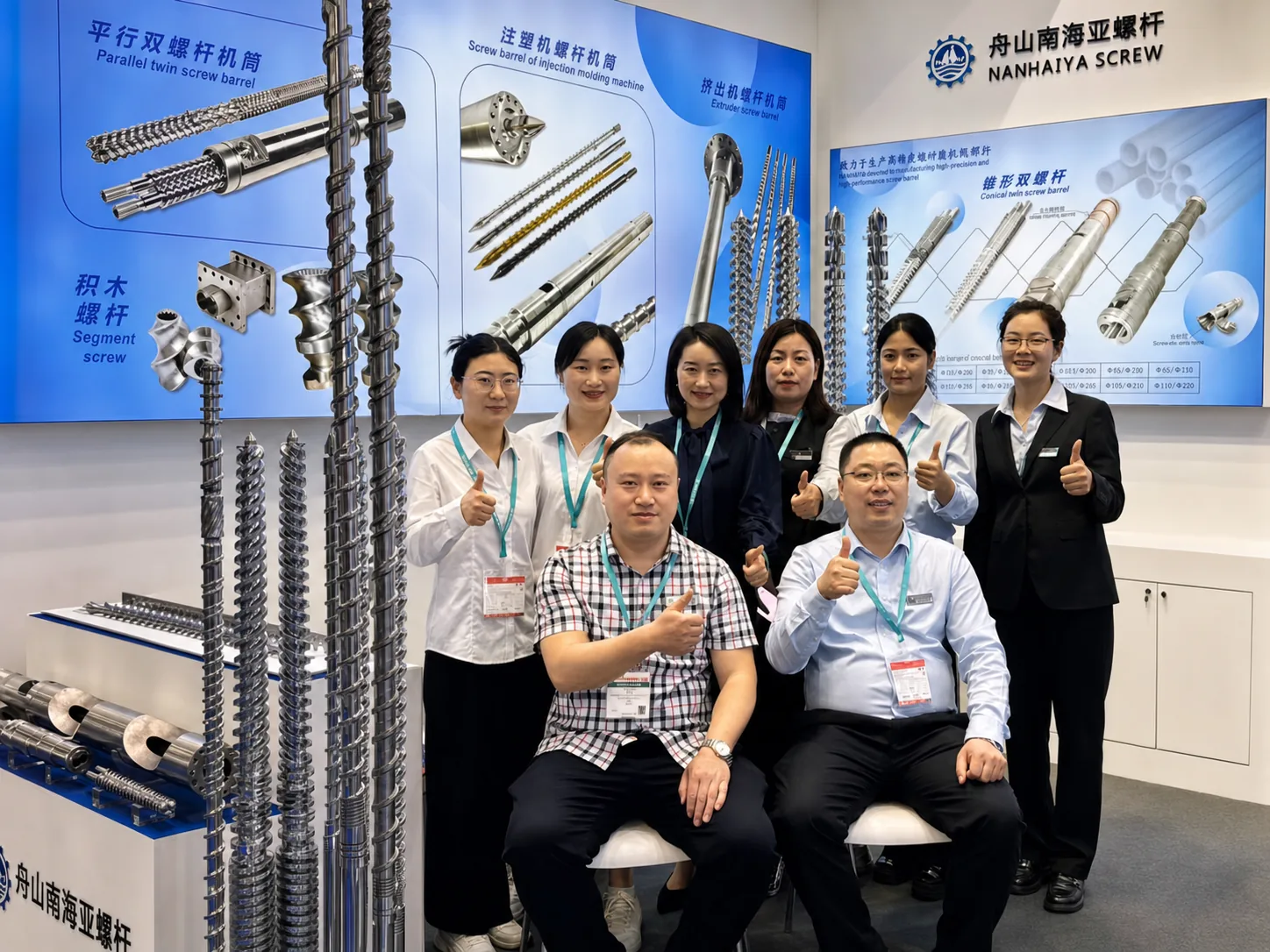
Related Articles
More insights on screw barrel technology and plastics processing.
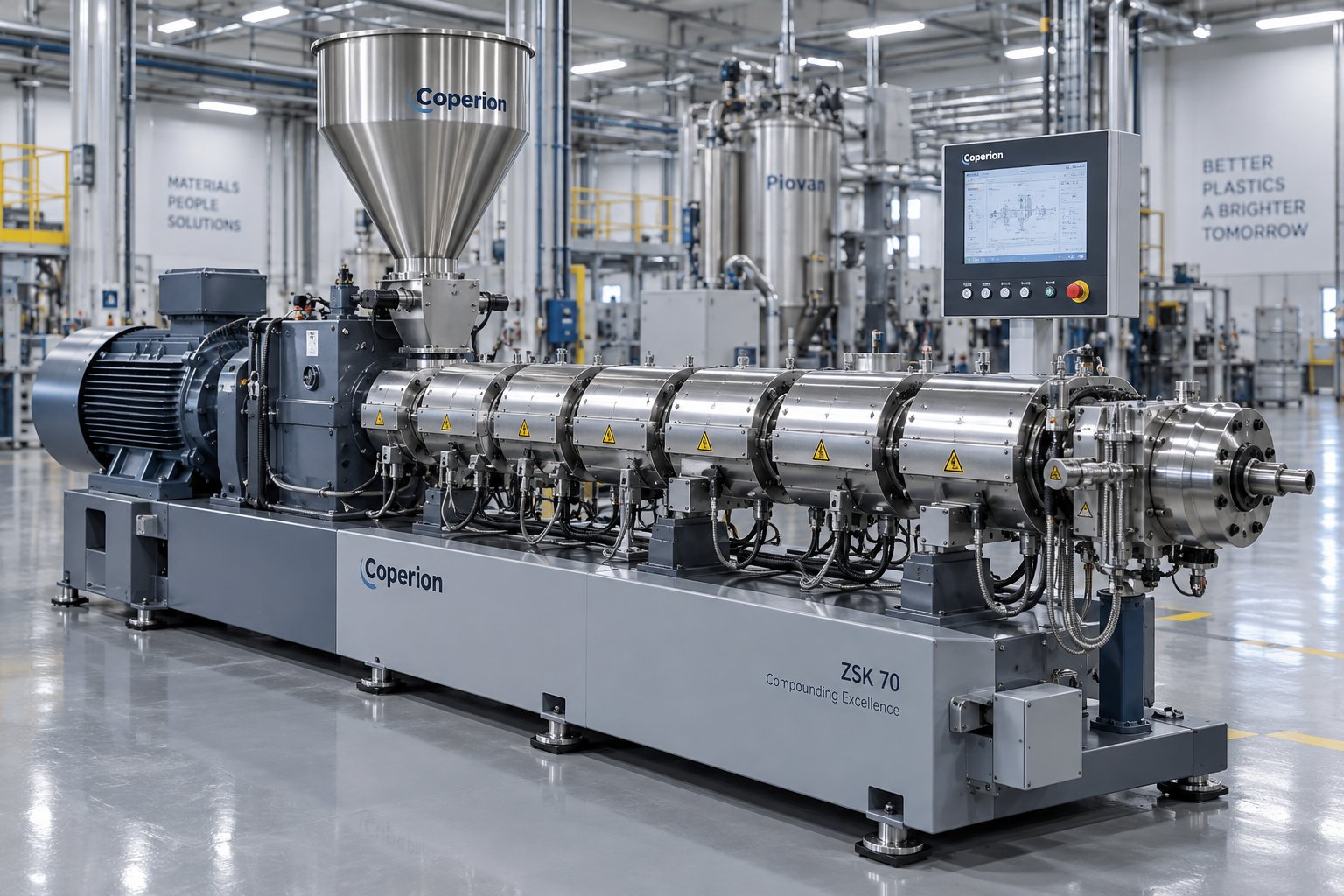
What Your Single Screw Extruder Manufacturer Won't Tell You
Oct 10, 2026
Learn how to evaluate single screw extruder manufacturers with this buyer-focused guide covering specs, configurations, material matching, and a ready-to-use selection checklist.
Read Article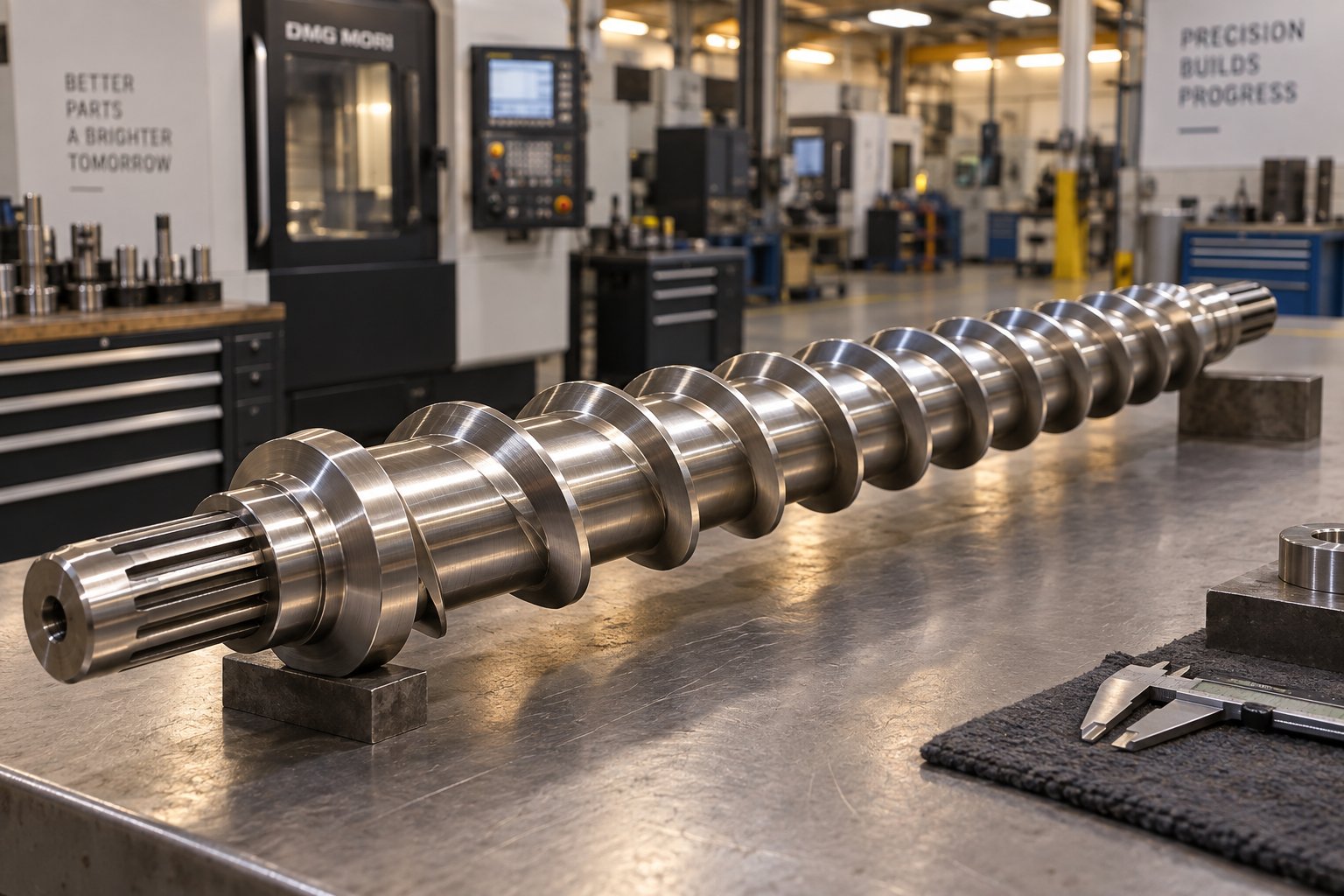
Plastic Extruder Screw Price Demystified: From Steel To Sticker
Oct 10, 2026
What drives plastic extruder screw price? This independent guide breaks down diameter, L/D ratio, metallurgy, order volume, and total cost of ownership factors.
Read Article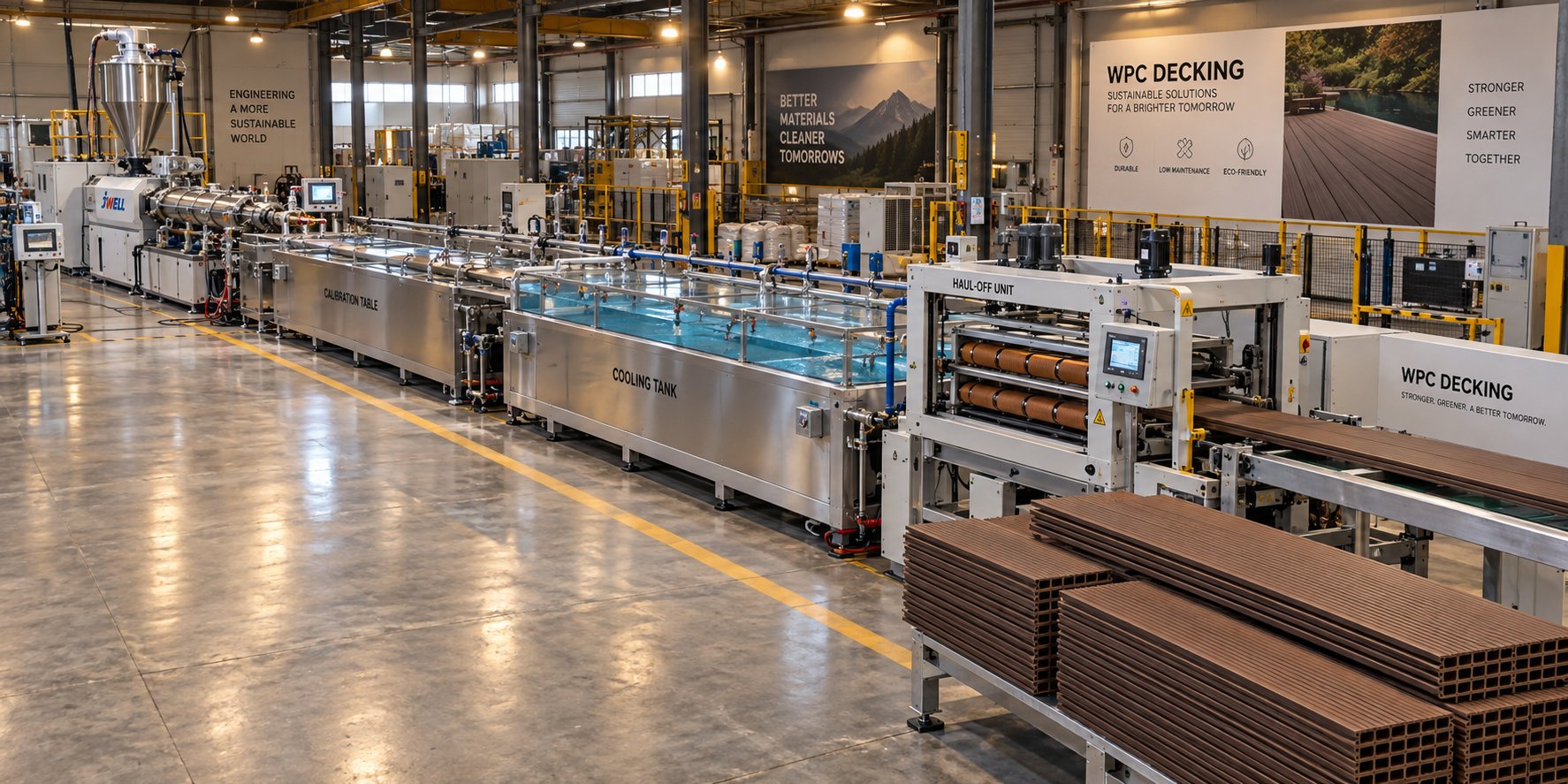
What No Supplier Tells You About WPC Decking Making Machines
Oct 6, 2026
Learn how a WPC decking making machine works, compare extruder types, formulations, and production methods, plus get a buyer checklist to evaluate any supplier.
Read ArticleLooking for something else?
Search by material, symptom or product and jump straight to the relevant page.
These are navigation suggestions based on keyword matching — not a quotation, not a delivery commitment, and not a substitute for engineering review. Final specification is confirmed by our engineers against your drawings and processed material.
Need help with screw barrel selection?
Share your machine model, processed material and application. Our team can help with pricing and technical support.