

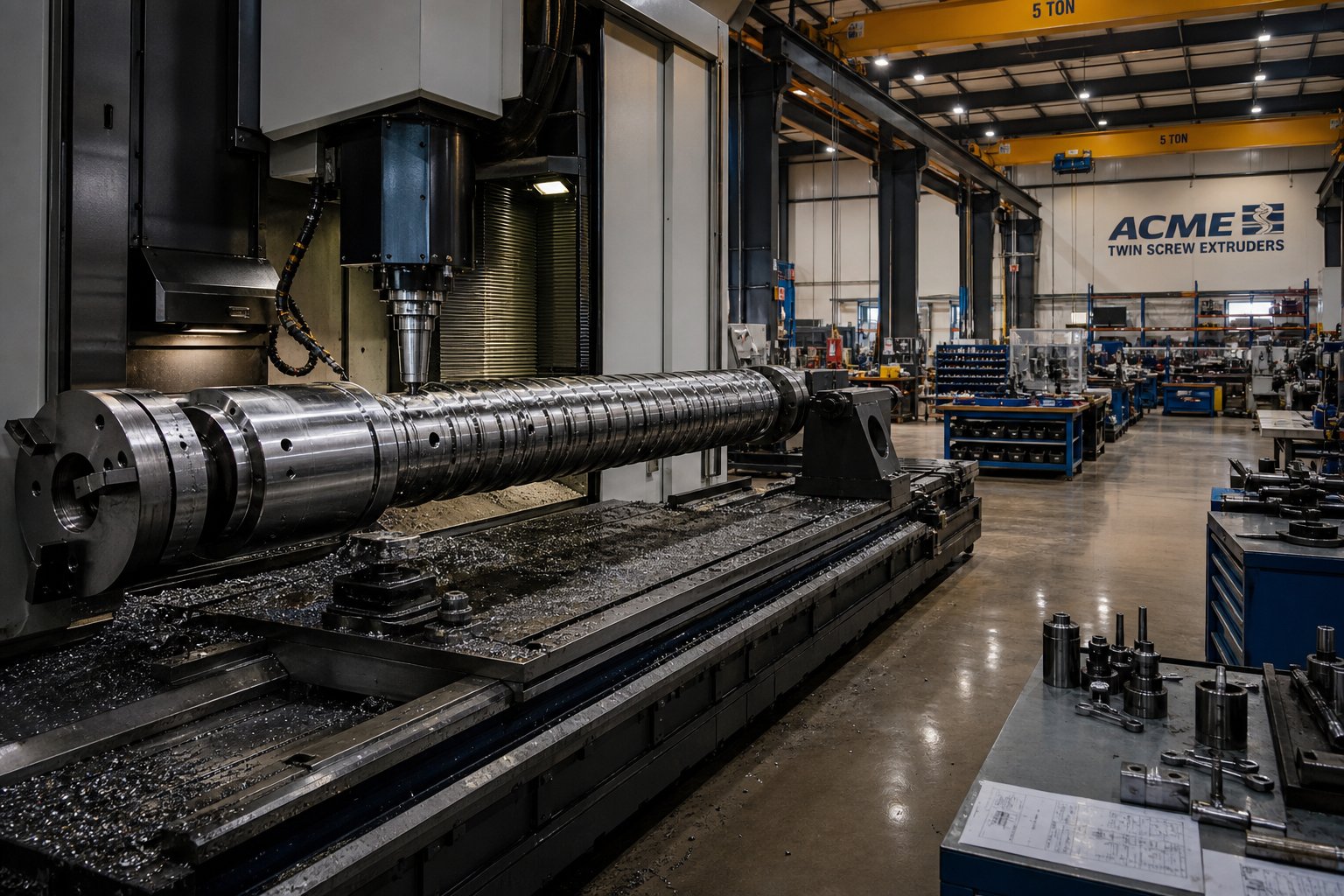
What a Twin Screw Extruder Factory Actually Does
Imagine you're sourcing a twin screw extruder for a compounding line. You receive quotes from five different "manufacturers"—but how many of them actually build the machine? A surprising number of suppliers in this space are trading companies or assemblers who rebrand equipment produced elsewhere. A genuine twin screw extruder factory is something fundamentally different, and recognizing that difference can save you years of headaches.
Defining the Twin Screw Extruder Factory
A twin screw extruder factory is a facility that designs, machines, assembles, and tests complete twin screw extrusion systems under one roof. Unlike a trading company that sources finished machines or an assembler that bolts together purchased subcomponents, a true factory controls the critical production stages that determine machine quality.
These core functions include:
- Precision machining of screws and barrels — CNC-machining screw elements from tool steel blanks and deep-hole boring barrels to tight tolerances.
- Drive system integration — selecting, sizing, and coupling motors and gearboxes engineered for the torque and speed profiles each double screw extruder demands.
- Control system engineering — designing PLC and HMI architectures that manage temperature zones, screw speed, feed rates, and safety interlocks across the entire extruder system.
- Final assembly with test runs — stacking barrel sections, installing twin screw elements, aligning the drivetrain, and running actual material to validate performance before shipment.
When all of these capabilities exist within a single operation, the factory can trace every component from raw steel billet to finished machine. That traceability is what separates a manufacturer from a middleman.
Why the Factory Behind the Machine Matters
You'll notice that two twin screw extruders with nearly identical spec sheets can perform very differently on your production floor. The reason often has nothing to do with the numbers on paper—it comes down to the factory that built them.
A factory's depth of engineering capability, metallurgy expertise, and quality control infrastructure directly determines how reliably the machine runs, how long wear parts last, and how much value you extract over a 15- to 20-year service life. Factories with in-house metallurgical labs can verify heat treatment results. Those with dedicated test extrusion lines can catch problems before the machine ever ships. And operations that maintain calibrated coordinate measuring machines can hold the dimensional accuracy that keeps a twin screw extruder running smoothly at high torque.
The difference between a true manufacturer and a reseller is the ability to control every stage of production—from raw steel to finished extruder.
This matters for procurement professionals and engineers alike. When you understand what happens inside a real factory, you can ask sharper questions during supplier verification, spot gaps in a trading company's story, and ultimately make sourcing decisions grounded in evidence rather than brochures.
This article is built as a factory-first resource. Every section ahead is designed to give you the technical vocabulary, evaluation frameworks, and practical checklists you need to identify genuine manufacturers—and confidently skip the middlemen. The place to start is where every machine begins: the manufacturing floor itself.
How Factories Manufacture Twin Screw Extruders
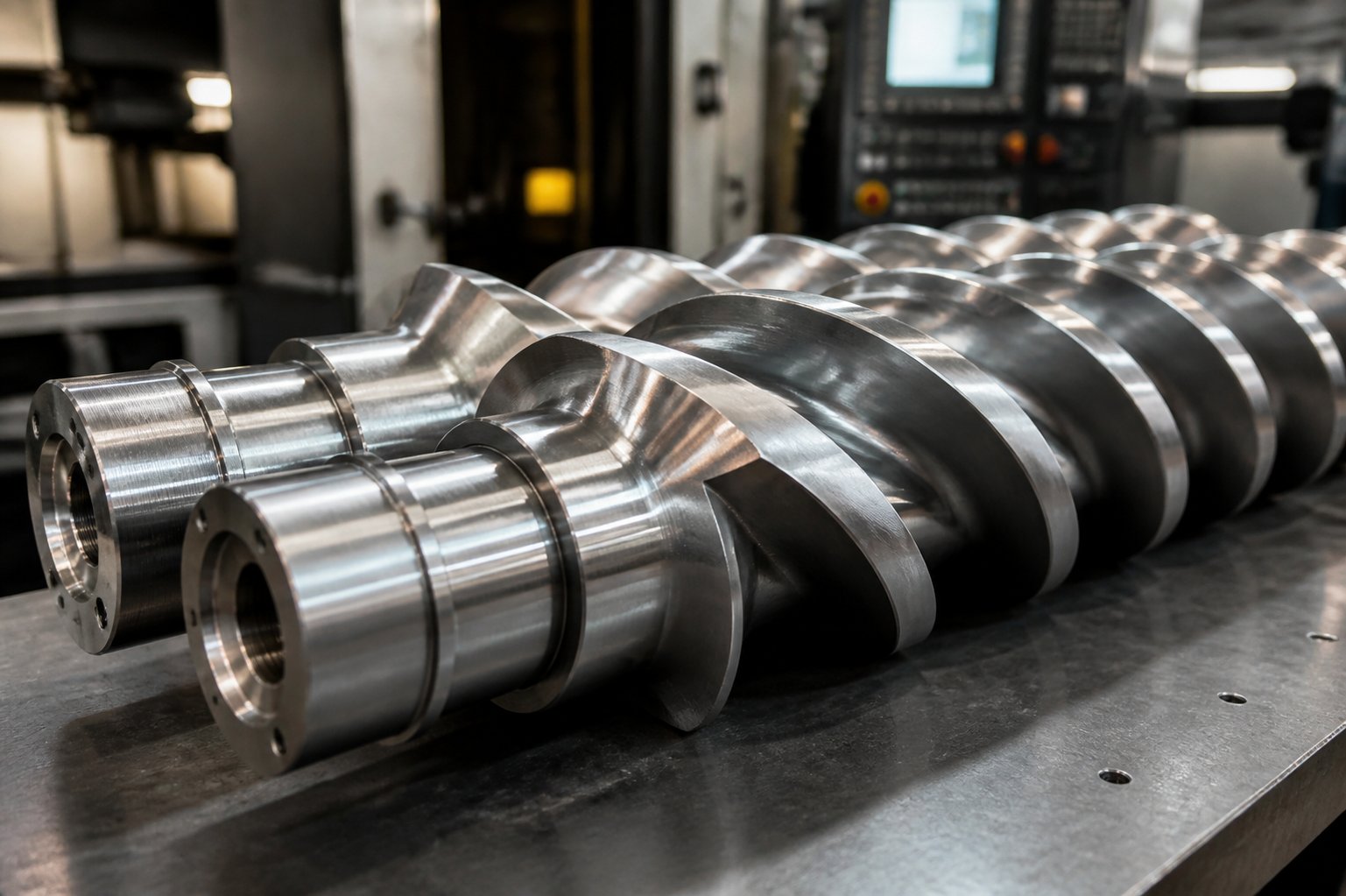
Walk onto the floor of a capable twin screw extruder factory and you'll see a production sequence that touches nearly every discipline in mechanical engineering—metallurgy, precision machining, thermal processing, and systems integration. Each stage either builds quality into the machine or introduces weaknesses that surface months later on your production line. Understanding these stages gives you the vocabulary to separate serious manufacturers from those cutting corners.
Barrel Manufacturing and Precision Boring
Every extrusion barrel starts as a steel billet. The choice of base steel—typically high-grade alloy steel selected for thermal conductivity and machinability—sets the foundation. From there, the factory performs deep-hole boring to create the twin-bore figure-eight profile that houses both screws. This is not a forgiving process. Bore straightness and surface finish must fall within tight tolerances, often measured in hundredths of a millimeter, because even minor deviations cause uneven screw-to-barrel clearance, accelerating wear and degrading melt consistency.
After boring, the barrel undergoes honing to achieve precise surface roughness. For applications involving abrasive fillers or corrosive polymers, factories insert bimetallic liners—centrifugally cast alloy layers that bond metallurgically to the barrel's inner surface. These liners dramatically extend barrel life in demanding screw extrusion environments.
Each extrusion barrel is then machined with heating and cooling channels. The layout of these channels across multiple barrel zones determines how precisely the factory—and ultimately you—can control temperature during processing. A well-engineered extruder feed barrel section, for example, uses aggressive cooling to prevent premature melting that would starve downstream zones.
Screw Element Machining and Metallurgy
The extruder screw elements are where the real processing action happens—conveying, melting, mixing, and pressure building all depend on element geometry. Factories CNC-machine these elements from tool steel blanks, cutting complex flight profiles with sub-millimeter accuracy. The choice of base steel matters enormously: common grades include AISI 4140 and 4340 for general applications, while demanding jobs may call for specialized steels like H-13 or CPM 9V that respond better to surface hardening.
Heat treatment is the critical step that transforms a machined blank into a durable, wear-resistant component. Ion/plasma nitriding forms chromium nitride layers on the screw surface, producing hardness values exceeding 70 HRC equivalent in steels like Nit135M and H-13—enough to handle highly abrasive glass-filled or mineral-filled compounds. Gas nitriding serves shorter elements well, while ion/plasma nitriding in vertical vacuum chambers accommodates longer screws where uniform case depth is essential. For the most aggressive applications, factories apply HIP (Hot Isostatic Pressing) coatings that deliver even greater protection against both abrasion and corrosion.
This metallurgical expertise is exactly what separates a genuine factory from a reseller. A trading company cannot explain its nitriding parameters, case depth targets, or hardness profiles—because it didn't perform the treatment.
Assembly, Alignment, and Test Runs
Final assembly is where individual components become a functioning machine. The gearbox—engineered to deliver the specific torque density and speed range the twin screw extrusion process demands—is coupled to the motor and aligned with the barrel stack. Barrel sections are bolted together in sequence, with each joint face checked for flatness and parallelism. Screws are then installed, and the entire drivetrain is verified for concentricity.
The most telling indicator of a quality factory is what happens next: the test run. Reputable manufacturers load actual polymer material into the machine and run full production trials before shipment. These trials validate throughput, torque loading, temperature profile accuracy, and melt quality under real-world conditions. Factories that skip this step—or only run the machine empty—leave critical validation to the buyer's own production floor, where the cost of discovering problems is exponentially higher.
Here is the full sequential workflow that a capable factory follows from raw material to finished machine:
- Steel billet selection and incoming material certification
- Deep-hole boring and honing of barrel blanks
- Bimetallic liner insertion (for wear-resistant configurations)
- Machining of heating/cooling channels and barrel zone features
- CNC machining of screw elements from tool steel blanks
- Heat treatment—nitriding, carburizing, or HIP coating of screw elements
- Gearbox assembly and drive system integration
- Barrel stacking, screw installation, and drivetrain alignment
- Control system wiring, PLC programming, and safety interlock verification
- Factory test run with polymer material to validate performance
- Final inspection, documentation, and packaging for shipment
Buyers who understand this twin screw extrusion process at the manufacturing level hold a significant advantage during factory audits. You know which questions to ask at each stage, which records to request, and which shortcuts to watch for. That awareness becomes even more valuable when you realize not every company claiming to be a factory actually performs all of these steps—a distinction the next section breaks down in detail across different extruder types and design philosophies.
Types of Twin Screw Extruders Produced at Scale
Every manufacturing step covered above—barrel boring, screw element machining, heat treatment, assembly—varies depending on which type of twin screw extruder the factory builds. And here's what many buyers miss: a factory's specialization in one extruder category often reveals far more about its engineering depth than any marketing brochure. The design philosophy behind each machine type dictates the tooling, metallurgy, and assembly precision a factory must master. So which designs dominate the market, and how do they differ?
Co-Rotating Intermeshing Twin Screw Extruders
If you're in polymer compounding, masterbatch production, or reactive extrusion, you'll almost certainly encounter a co rotating twin screw extruder. In this design, both screws rotate in the same direction, and their flights intermesh closely. That intermeshing geometry creates a self-wiping action—each screw continuously cleans material off the other, preventing stagnation zones where degradation could occur.
The real advantage is mixing performance. Co-rotating designs deliver outstanding dispersive and distributive mixing, making them the preferred choice for blending polymers with fillers, additives, pigments, and reinforcing fibers. They handle complex, multi-component formulations while maintaining consistent output quality across batches.
From a factory perspective, co-rotating twin screw extruders are built around modularity. Both the screw elements and barrel sections are designed as interchangeable segments. Imagine rearranging building blocks—you can swap conveying elements for kneading blocks, add venting zones, or insert side-feeder barrels to change the machine's processing behavior without replacing the entire screw or barrel assembly. This modularity means the factory must machine dozens of different element geometries to extremely tight tolerances so they fit together seamlessly on a common splined shaft.
Throughput is another strong point. Co-rotating machines achieve high output rates because the intermeshing screws generate strong forward conveying forces. For production-scale compounding lines processing hundreds or thousands of kilograms per hour, this design dominates.
Counter-Rotating and Conical Twin Screw Designs
Counter-rotating twin screw extruders flip the rotation direction—one screw turns clockwise while the other turns counterclockwise. This opposite motion creates strong, positive conveying forces while applying lower shear between the screw flights. Why does that matter? Certain materials, particularly PVC compounds, are highly sensitive to shear and heat. Excessive shear can degrade PVC, causing discoloration or releasing corrosive gases. Counter-rotating designs keep shear gentle enough to process these materials safely, which is why they're widely preferred for PVC pipe, profile extrusion, cable coatings, and rigid sheet production.
The conical twin screw extruder takes this concept further by tapering the screws from a large diameter at the feed end to a smaller diameter at the discharge end. This taper delivers two practical benefits: it generates high compression ratios that efficiently densify and melt bulky feedstocks, and it packs this capability into a remarkably compact footprint. Factories producing conical designs face unique machining challenges—tapering both the screw elements and the barrel bore while maintaining precise clearances along the entire length requires specialized equipment and tooling that not every manufacturer possesses.
Parallel vs Conical Geometry Differences
When you're evaluating twin screw extruders, the parallel-versus-conical distinction is one of the most consequential geometry decisions you'll make.
A parallel twin screw extruder maintains a constant screw diameter from feed zone to discharge. This uniform geometry allows for longer processing zones, which translates to more barrel sections, more temperature control zones, and more opportunities to add side feeders or venting ports along the length. For demanding compounding tasks—think high-filler-loading engineering plastics or multi-stage reactive extrusion—that extended processing length is essential for achieving thorough mixing and complete reactions.
Conical designs, by contrast, sacrifice processing length for compression efficiency. The tapering screws naturally build pressure as material moves toward the smaller-diameter discharge end, making them ideal for direct extrusion applications where the material exits through a die rather than being pelletized. Rigid PVC window profiles, for example, are a classic conical twin screw application because the design provides the melt pressure and homogeneity needed for dimensionally accurate profile shapes.
The table below puts these three major categories side by side, giving you a quick reference to match your application requirements against the right machine architecture—and, by extension, the right type of factory specialization to look for.
| Parameter | Co-Rotating Intermeshing | Counter-Rotating Parallel | Conical Twin Screw |
|---|---|---|---|
| Typical Applications | Polymer compounding, masterbatch, reactive extrusion, nanocomposites, pharmaceutical HME | PVC pipe and profile, cable coating, rigid and flexible sheet | Rigid PVC profiles, window frames, direct extrusion of shear-sensitive compounds |
| Mixing Capability | Excellent dispersive and distributive mixing; self-wiping action prevents dead zones | Moderate mixing; lower shear protects heat-sensitive materials | Moderate mixing; compression-driven homogenization |
| Throughput Range | High — from lab-scale (~1 kg/hr) to production-scale (2,000+ kg/hr) | Moderate to high — typically 50 to 1,500+ kg/hr depending on screw diameter | Low to moderate — commonly 20 to 800 kg/hr; compact design limits volume |
| Compression Behavior | Achieved through screw element selection (kneading blocks, restrictive elements) | Moderate natural compression from counter-rotating flight interaction | High natural compression from tapered screw geometry |
| Modularity | Highly modular — interchangeable screw elements and barrel segments | Limited modularity — screws often one-piece or semi-modular | Minimal modularity — fixed taper geometry constrains reconfiguration |
| Factory Specialization Required | Precision CNC for multiple element profiles; high-torque gearbox engineering | PVC-specific metallurgy and corrosion-resistant barrel liners | Taper machining expertise; compact drivetrain integration |
This comparison highlights a practical reality: no single factory excels at every extruder type. A manufacturer that builds world-class co-rotating compounders may have limited experience with conical PVC machines, and vice versa. When you're shortlisting twin screw extruders for a specific project, identifying which design category your application falls into narrows your factory search immediately. You're not just choosing a machine—you're choosing a factory whose entire engineering culture, tooling investment, and metallurgical expertise align with the demands of that particular design.
Of course, knowing the right extruder type is only half the equation. The technical specifications within each category—screw diameter, L/D ratio, torque density, and throughput capacity—vary enormously across factories, and understanding those ranges is essential for evaluating whether a manufacturer can genuinely deliver what your process requires.
Key Technical Specifications Every Buyer Should Evaluate
Specification sheets are the language factories use to describe their machines—but only buyers who understand that language can read between the lines. Every twin screw extruder machine ships with a datasheet listing screw diameter, L/D ratio, motor power, and throughput claims. The trouble is, those numbers mean very different things depending on the context. A 65 mm screw extruder built for laboratory development work and a 65 mm machine engineered for round-the-clock production compounding may share the same diameter yet deliver vastly different performance, durability, and value. The specifications below are the ones that separate informed procurement from guesswork.
Screw Diameter, L/D Ratio, and Torque Density
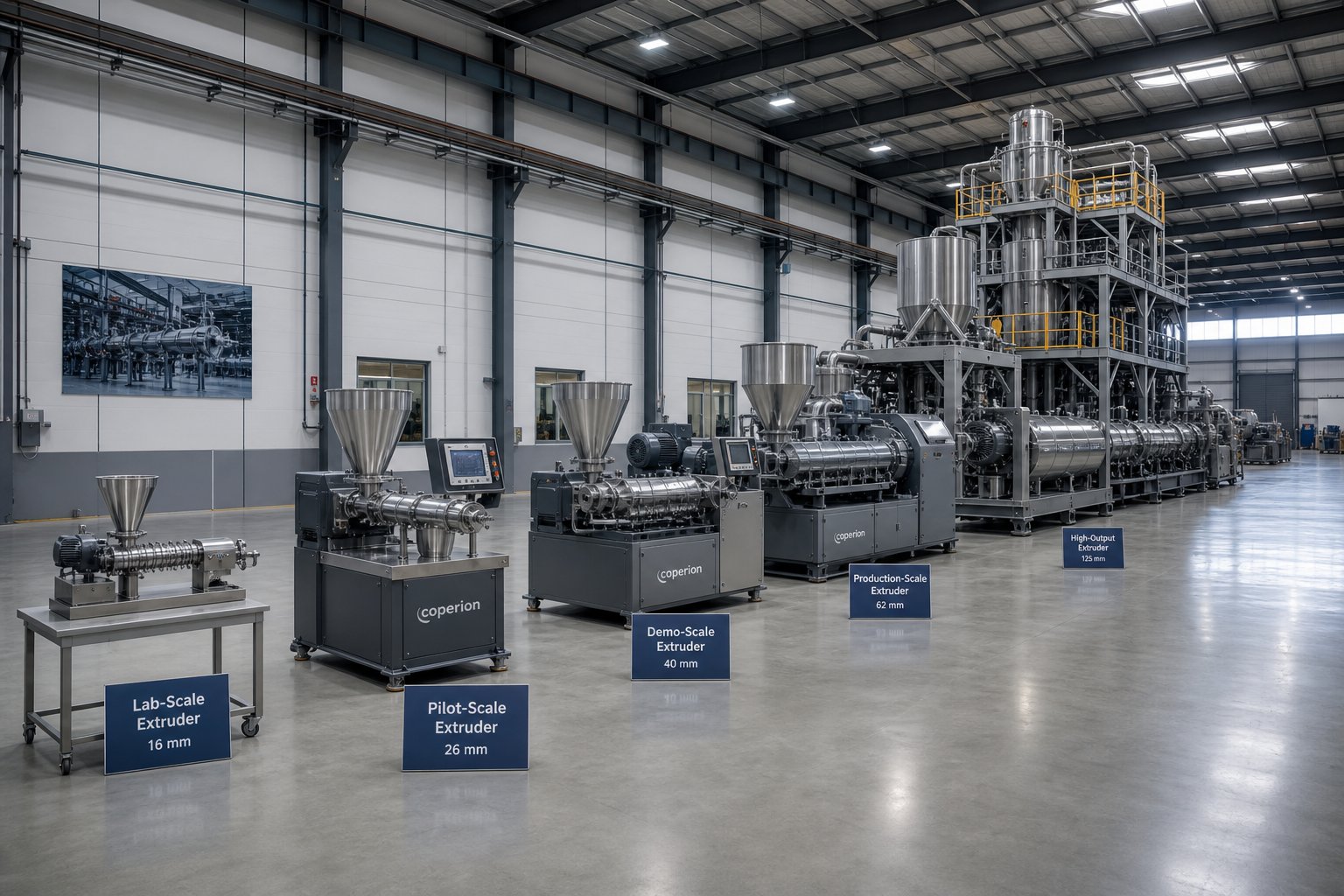
Screw diameter is the single most consequential sizing parameter because throughput scales roughly with the cube of the diameter. Factories typically produce machines across a wide spectrum:
- Lab scale extruder units (16–27 mm): Built for R&D, formulation screening, and small-batch trials. A laboratory twin screw extruder in this range might process anywhere from 1 to 50 kg/hr—enough to validate a recipe without consuming large volumes of expensive raw material.
- Pilot-scale machines (30–50 mm): Bridge the gap between lab and production. These machines help engineers confirm that a formulation developed on a lab extruder will scale successfully, with throughputs typically ranging from 50 to 300 kg/hr.
- Production-scale machines (52–133+ mm): Designed for continuous commercial operation. Outputs here can reach several thousand kilograms per hour for the largest diameters, handling everything from high-filler compounding to reactive extrusion at industrial volumes.
The L/D ratio—the screw's working length divided by its diameter—determines how much processing the material experiences inside the barrel. Most co-rotating twin screw extruders fall in the 32:1 to 52:1 range, though configurations extending to 68:1 are available for processes demanding extended residence time, multiple venting stages, or complex multi-step reactions. A longer L/D gives you more barrel zones for feeding, mixing, degassing, and pressure building—but it also demands a stiffer, more precisely engineered screw shaft to prevent deflection at high speeds.
Torque density, expressed in Nm/cm³, is where many buyers get caught off guard. This metric describes how much rotational force the gearbox can deliver relative to the screw shaft cross-section. Higher torque density means the machine can process more viscous materials, handle higher filler loadings, and maintain stable operation under demanding conditions. Entry-level machines may offer torque densities around 5–7 Nm/cm³, while premium-tier factories engineer gearboxes delivering 8 Nm/cm³ and above—with some high-performance lab units reaching nearly 10 Nm/cm³ and industrial machines climbing past 13 Nm/cm³. When you're evaluating a twin screw extruder machine for engineering polymers or highly filled compounds, torque density often matters more than raw motor horsepower.
Throughput Capacity and Drive System Configurations
Sounds straightforward—bigger motor, more output, right? Not quite. Real-world throughput depends on the interplay between motor power, gearbox ratio, and screw speed range. A factory might offer a 200 kW motor geared to 600 rpm or a 400 kW motor geared to 1,200 rpm on the same frame size. As industry experts have noted, both configurations deliver identical torque to the screws—the difference lies in the available speed range. If your process doesn't benefit from high screw speeds, specifying the larger motor adds cost without adding value.
The metric that ties everything together is specific energy, measured in kWh/kg. This tells you how much electrical energy the motor puts into each kilogram of processed material. Lower specific energy generally means higher efficiency—the machine is doing its job without wasting power as excess heat or unnecessary shear. Tracking specific energy across production runs also serves as a powerful diagnostic tool: a sudden change in this value, with all other conditions held constant, signals that something in the feedstock or machine condition has shifted. Factories that provide specific energy data from their test runs give buyers a baseline for monitoring long-term machine health.
Barrel Zone Configuration and Temperature Control
Temperature control precision can make or break product quality, especially for heat-sensitive polymers or reactive extrusion processes. Each barrel section typically represents one independently controlled temperature zone, with dedicated heating elements and cooling channels.
Production-scale machines commonly feature 8 to 12 or more barrel zones, each spanning approximately 4–5 L/D of processing length. The heating element wattage per zone must be sufficient to bring the barrel from ambient temperature to processing temperature within a reasonable startup window, while the cooling system—usually water-circulated through channels machined into each barrel segment—must counteract the heat generated by viscous shear during steady-state operation.
What separates a well-engineered factory offering from a marginal one? Look at the details: Are the cooling channels positioned symmetrically around the bore for uniform temperature distribution? Does the factory use cartridge heaters or band heaters, and are they sized to handle rapid temperature transitions? Can each zone be independently controlled, or do some zones share thermocouples? These design choices directly affect process stability, and they're questions worth asking during any factory evaluation.
The table below consolidates typical specification ranges that factories offer across three common production scales. Use it as a reference when comparing datasheets—but keep in mind that the numbers only tell part of the story.
| Specification | Lab Scale | Pilot Scale | Production Scale |
|---|---|---|---|
| Screw Diameter (mm) | 16–27 | 30–50 | 52–133+ |
| L/D Ratio | 32:1 to 68:1 | 36:1 to 52:1 | 32:1 to 52:1 |
| Torque Density (Nm/cm³) | 8.0–9.9 | 6.5–11.0 | 5.0–13.6 |
| Max Throughput (kg/hr) | 1–250 | 50–500 | 150–8,000+ |
| Motor Power (kW) | 2.2–75 | 37–200 | 55–1,200+ |
| Barrel Zones (typical) | 4–8 | 6–10 | 8–14+ |
| Max Screw Speed (rpm) | 600–1,000 | 400–800 | 250–800 |
Specification sheets alone cannot reveal manufacturing quality. Two machines with identical published specs may differ dramatically in metallurgy, machining precision, and assembly standards—differences that only a factory audit can expose.
This is the fundamental tension every buyer faces: specifications are necessary for shortlisting, but they're never sufficient for a final decision. A datasheet can tell you the screw diameter is 75 mm and the torque density is 11.3 Nm/cm³, but it can't tell you whether the gearbox gears were hobbed from case-hardened alloy steel or cut from inferior material. It can't tell you whether the barrel bores were honed to a consistent surface finish or rushed through production. And it certainly can't tell you whether the factory that printed the datasheet actually built the machine—or simply purchased it from someone else and applied its own label. That distinction between genuine manufacturers, trading companies, and contract producers deserves its own examination.
OEM Factories vs Trading Companies vs Contract Manufacturers
A datasheet might look flawless, and the website might say "manufacturer" in bold lettering across every page. But in the twin screw extruder market, the entity behind those claims falls into one of three very different categories—and misidentifying which one you're dealing with is one of the costliest mistakes a buyer can make. Industry sourcing data suggests that 30 to 50 percent of self-declared "manufacturers" on major B2B platforms are actually trading companies operating under factory-sounding names. When you're purchasing capital equipment that your production line will depend on for 15 to 20 years, that distinction matters enormously.
OEM Factories with Full In-House Manufacturing
A true OEM twin screw extruder factory controls the entire production chain—from raw steel intake through casting, precision machining, heat treatment, assembly, and final test runs. Every critical process that determines machine quality happens within the same facility or closely managed satellite workshops under unified engineering oversight.
What does full in-house capability actually look like? Picture walking through the facility and seeing each of these operational areas:
- CNC machining centers — multi-axis machines dedicated to boring barrels, cutting screw element flight profiles, and machining gearbox housings. The brand, age, and calibration records of these machines tell you a lot about dimensional accuracy.
- Coordinate measuring machines (CMMs) — precision inspection instruments that verify bore straightness, screw element tolerances, and shaft concentricity to micron-level accuracy. A factory without a CMM cannot objectively prove its own machining quality.
- Metallurgical laboratory — equipped with hardness testers, spectrometers for alloy verification, and microscopy for inspecting nitriding case depth and microstructure. This is where an extruder manufacturer validates that heat treatment actually achieved the specified surface hardness and diffusion profile.
- Dedicated test extrusion line — a fully equipped setup where finished machines run actual polymer material before shipment. This includes gravimetric feeders, downstream pelletizing equipment, and data acquisition systems for logging torque, temperature, and throughput during trials.
When all of these elements exist under one roof, the factory can respond to engineering problems in real time. A screw element that doesn't meet hardness specs gets caught in the metallurgical lab—not on your production floor six months after delivery. That closed-loop quality system is the defining characteristic of genuine twin screw extruder manufacturers.
Trading Companies and Private Label Resellers
Here's where buyers get burned. Trading companies and private label resellers market themselves as manufacturers, often with professional websites featuring stock factory photos, impressive-sounding certifications, and sales staff with "Factory Manager" in their email signatures. Behind the branding, they're sourcing finished machines—or partially assembled units—from third-party factories and applying their own nameplates.
Why is this a problem? Because a trading company has no production line to fix a defect, no metallurgist to verify heat treatment quality, and no engineering team to customize screw configurations for your specific process. Your technical questions get forwarded to the actual factory, often with translation delays and information loss at every handoff. If a quality issue emerges after delivery, you're negotiating with an intermediary who has no direct control over the resolution.
Several telltale signs consistently reveal a trading company posing as a twin-screw extruder manufacturer:
- Inability to discuss machining tolerances or metallurgy. Ask about barrel bore tolerance, screw element hardness specifications, or nitriding case depth. A genuine factory engineer answers these questions without hesitation. A trader deflects, provides vague responses, or needs several days to "check with the technical team."
- No factory tour availability. Real factories operate production lines five or six days a week—their floor is always available for a walk-through. A company that continually avoids video calls, refuses factory visits, or only provides carefully edited marketing videos likely doesn't own the facility.
- Inconsistent lead times. A trading company's delivery timeline depends on whichever third-party factory is actually building your machine. Lead times shift unpredictably because the trader doesn't control the production schedule.
- Suspiciously broad product catalogs. Genuine extruders manufacturers specialize. Their catalog is deep within a narrow range of machine types. If a "manufacturer" offers twin screw extruders alongside injection molding machines, blown film lines, recycling systems, and industrial mixers—all under one brand—you're almost certainly looking at an aggregator, not a maker.
Contract Manufacturers and Their Role
Between full OEM factories and pure traders sits a third category that buyers often overlook: contract manufacturers. These are legitimate production facilities that build machines to another company's specifications and engineering drawings. An established European or American extruder brand, for instance, might design its machines in-house but outsource fabrication to a contract manufacturer in a lower-cost region, retaining control over design IP, quality standards, and final acceptance testing.
Contract manufacturers can be excellent partners—they have real machining capability, real heat treatment infrastructure, and real assembly floors. The key difference is that they don't own the product design and typically don't sell directly to end users. If you encounter a contract manufacturer marketing machines under its own brand, investigate carefully: do they have genuine engineering expertise for the designs they're selling, or are they reproducing another company's blueprints without the process knowledge that informed those designs?
Across all three categories, a consistent set of warning signals can help you quickly filter out companies that aren't what they claim:
- No photos or videos of actual machining operations—only glamour shots of finished, painted machines
- Vague or evasive answers when asked about steel grades, heat treatment processes, or surface hardness values
- No test run data, material trial reports, or performance validation records available for review
- Unwillingness to allow factory visits or live, unscripted video calls showing the production floor
- Product catalogs spanning unrelated equipment categories—extruders, crushers, conveyors, and packaging machines all under one roof
- No material certifications, raw material traceability records, or calibration documentation for inspection instruments
- Engineering staff who cannot explain the rationale behind screw configuration recommendations for your application
Any two or three of these red flags appearing together strongly suggests you're dealing with a trader rather than a genuine factory. The practical consequence? You'll pay a 5 to 25 percent markup embedded in the price, lose direct access to engineering support, and have limited recourse if quality issues arise after commissioning.
Identifying the right type of supplier is only the first filter, though. Even among verified OEM factories, capabilities diverge sharply depending on which industries and applications they serve—and the factory that excels at general-purpose compounding equipment may be entirely wrong for food-grade, pharmaceutical, or battery material processing.
Application-Specific Factory Selection for Twin Screw Extruder Plastic Processing
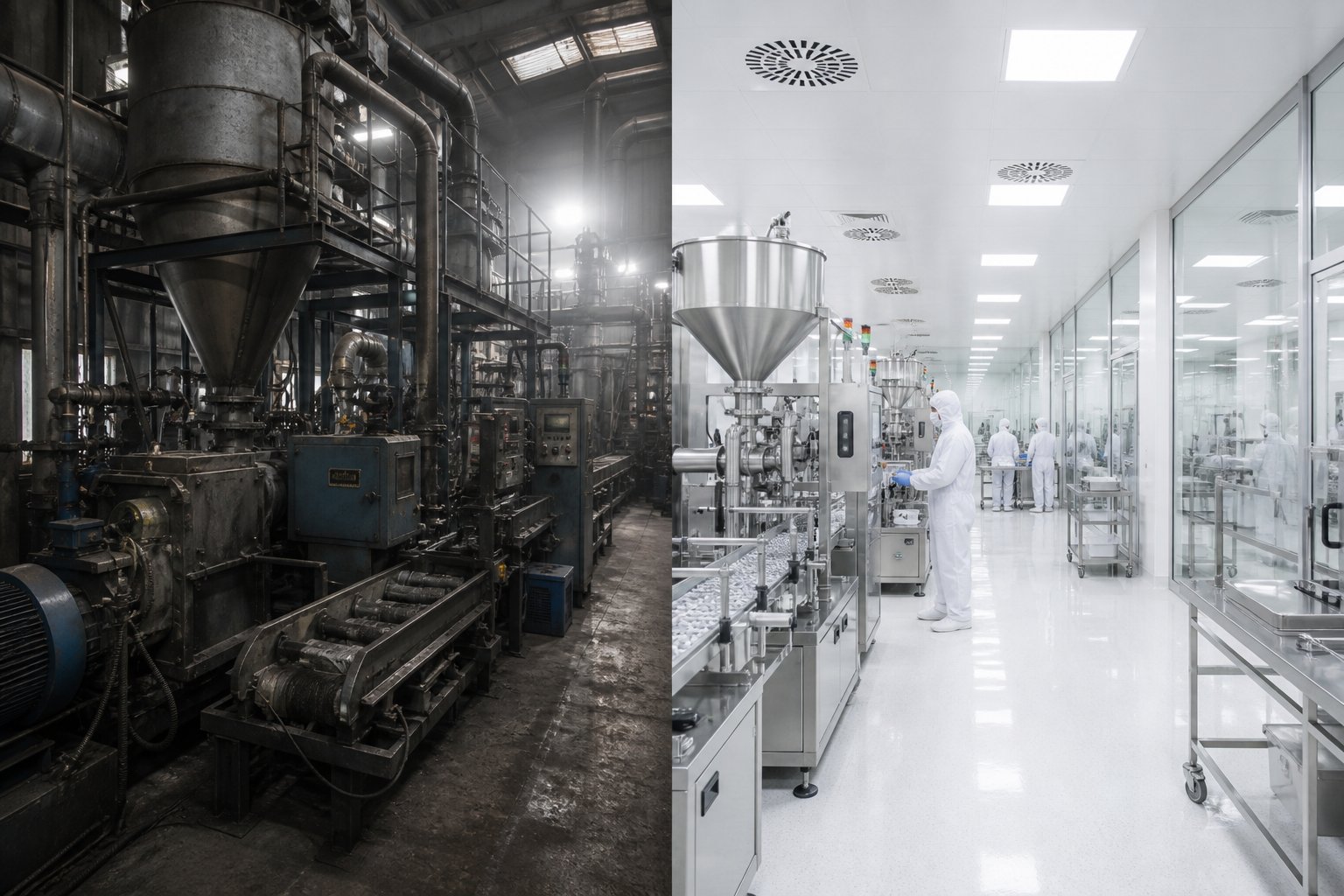
A verified OEM factory with excellent machining capability still might not be the right fit for your project. Why? Because the industry you operate in dictates a completely different set of factory requirements beyond general manufacturing quality. A compounding twin screw extruder built for polyolefin masterbatch and one engineered for pharmaceutical hot melt extrusion may look similar in photographs, but the materials of construction, design philosophy, certifications, and downstream integration demanded by each application are worlds apart.
Matching your application to the right type of manufacturer is arguably as important as verifying OEM status in the first place. Here's how factory requirements shift across the major end-use sectors.
Plastics Compounding and Masterbatch Production
Compounding and masterbatch represent the largest single market for co-rotating twin screw extruders. If you're dispersing pigments, blending mineral fillers, incorporating flame retardants, or reinforcing polymers with glass fiber, your factory needs to demonstrate specific capabilities that directly affect machine longevity and output consistency.
Start with the gearbox. High-filler and high-viscosity formulations generate enormous resistance against screw rotation, especially during startup or surge conditions. Factories serving the compounding sector engineer high torque density gearboxes—often in the 11.3 to 15 Nm/cm³ range—designed to handle sustained loads without overheating or premature bearing failure. As masterbatch production specialists note, processing high-concentration carbon black or titanium dioxide masterbatches demands both high-shear screw configurations and high-torque drive systems to break down stubborn pigment agglomerates while maintaining stable throughput.
Wear protection comes next. Abrasive fillers like calcium carbonate, talc, and glass fiber grind through standard screw elements and barrel liners at an alarming rate. A factory targeting compounding applications should offer:
- Wear-resistant screw elements — tool steels with nitrided or HIP-coated surfaces rated for abrasive service
- Bimetallic barrel liners — centrifugally cast alloys bonded to the barrel bore for extended life in mineral-filled and glass-reinforced applications
- Gravimetric feeding systems — loss-in-weight feeders that maintain accurate formulation ratios for consistent color and additive content across batches
- Downstream pelletizing integration — strand pelletizers, underwater pelletizing systems, or water-ring cutters matched to the extruder's throughput and the material's melt behavior
Factories that supply compounding lines typically build complete systems—not just the extruder for polymer processing, but the entire line from feeder to pellet silo. When evaluating these manufacturers, ask whether they engineer their own downstream equipment or source it from third parties. Both approaches can work, but the integration quality and single-source accountability differ significantly.
Food, Pharmaceutical, and Specialty Applications
Step into a factory that builds extruders for food or pharmaceutical processing, and you'll immediately notice the differences. The assembly environment is cleaner. The surface finishes are smoother. The documentation packages are thicker. These aren't cosmetic choices—they're regulatory requirements that fundamentally change how a factory designs, machines, and assembles every component.
For food-grade applications, the factory must use materials of construction that comply with FDA Title 21 CFR standards—meaning all product-contact surfaces are manufactured from non-reactive, non-absorptive metals. In practice, this translates to stainless steel screws, barrels, and die components, with specific surface finish standards defined by Ra (roughness average) values. A polished stainless steel barrel interior at Ra 0.4 µm or better prevents product buildup and enables thorough cleaning between runs. GMP-series twin screw extruders designed for medical and pharmaceutical use take this further with sanitary ground and polished stainless steel parts, quick-release couplings for cleaning access, FDA-approved paints, gear oils, and lubricants, plus validated PLC controls with calibrated thermocouples and transducers.
The hot melt extruder used in pharmaceutical applications presents its own unique demands. Hot melt extrusion (HME) processes active pharmaceutical ingredients with thermoplastic carriers to create amorphous solid dispersions that improve drug bioavailability. This requires factory expertise in precise temperature control across narrow processing windows—sometimes within +/- 1°C—and tight management of residence time distribution to prevent API degradation. Factories serving this sector often maintain cleanroom or controlled-environment assembly areas and provide full IQ/OQ (installation qualification/operational qualification) documentation packages that support the buyer's own validation protocols.
When you're sourcing for these applications, the factory's quality management system isn't just a checkbox—it's the backbone of your regulatory compliance strategy. Look for manufacturers with documented experience in pharmaceutical or food processing validation, not simply general-purpose ISO 9001 certification.
Recycling, Battery Materials, and Emerging Sectors
Two rapidly growing sectors—plastics recycling and battery electrode manufacturing—are pushing twin screw extruder factories into entirely new engineering territory.
Recycling applications expose machines to some of the harshest operating conditions imaginable. Post-consumer plastic waste arrives contaminated with paper labels, adhesives, metal fragments, sand, and moisture. A factory building extruders for recycling must engineer machines that tolerate these contaminants without rapid degradation. That means extra-hardened screw elements, reinforced barrel liners rated for highly abrasive service, robust melt filtration integration, and multi-stage degassing systems capable of removing volatile contaminants and moisture from degraded feedstocks. The machine's screw design also needs to handle wildly inconsistent melt viscosity—a reality that general-purpose compounding extruders are rarely optimized for.
Battery electrode manufacturing flips the challenge from ruggedness to precision. Twin-screw extrusion in battery production involves continuous mixing of cathode or anode slurries from active materials, binders, conductive additives, and solvents. The process demands contamination-free environments, with some manufacturers claiming impurity levels as low as 0.5 ppm using appropriate screw and barrel materials. Factories serving the battery sector must ensure particle-free processing conditions, moisture control (sometimes requiring inert gas atmospheres), and extremely uniform dispersion quality—because even minor variations in electrode slurry composition translate directly into inconsistent battery cell performance.
Emerging applications in biodegradable polymer compounding, solid-state battery electrolyte processing, and continuous pharmaceutical manufacturing are expanding these demands further. Each of these sectors requires factory capabilities that go well beyond assembling a standard machine and painting it the customer's preferred color.
The table below maps major application sectors against the specific factory capabilities, certifications, and equipment configurations buyers should verify during the selection process:
| Application Sector | Key Certifications | Materials of Construction | Specialized Downstream Equipment | Typical Extruder Configuration |
|---|---|---|---|---|
| Plastics Compounding & Masterbatch | ISO 9001; CE marking | Nitrided tool steel screws; bimetallic barrel liners; standard alloy steel housings | Gravimetric feeders, strand or underwater pelletizers, cooling conveyors | Co-rotating, 36:1–52:1 L/D, high torque density (11–15 Nm/cm³) |
| Food Processing | ISO 9001; FDA 21 CFR compliance; GFSI-aligned standards | Stainless steel product-contact surfaces; food-grade lubricants; polished finishes (Ra ≤ 0.8 µm) | Sanitary die designs, food-grade cooling systems, clean conveying | Co-rotating, 24:1–40:1 L/D, sanitary barrel design with CIP capability |
| Pharmaceutical (HME) | ISO 9001; FDA compliance; GMP documentation; IQ/OQ support | Stainless steel screws and barrels; FDA-approved paints, oils, lubricants; Ra ≤ 0.4 µm finishes | Precision die systems, film/sheet takeoff, tablet presses, granulators | Co-rotating, 25:1–40:1 L/D, validated PLC controls, cleanroom assembly |
| Plastics Recycling | ISO 9001; CE marking | Extra-hardened screw elements; heavy-duty bimetallic barrels; corrosion-resistant alloys | Melt filtration (continuous screen changers), multi-stage degassing, pelletizing | Co-rotating, 40:1–52:1 L/D, high torque, aggressive venting configuration |
| Battery Electrode Manufacturing | ISO 9001; cleanroom or dry-room protocols | Low-contamination screw/barrel alloys; inert gas compatible seals; moisture-resistant designs | Slot-die coaters, sheet dies, calendar rolls, solvent management systems | Co-rotating, 24:1–40:1 L/D, precision dosing, controlled atmosphere capability |
Notice how dramatically the requirements shift across these columns. A factory that excels at building rugged recycling extruders with aggressive wear protection may have zero experience with the polished stainless steel finishes and GMP documentation packages that pharmaceutical buyers require. Conversely, a factory specializing in pharmaceutical-grade machines may lack the high-torque gearbox engineering and heavy-duty metallurgy that compounding and recycling applications demand.
This is precisely why application-specific factory selection matters: you're not just buying a machine that meets a specification—you're buying into a factory's accumulated expertise in solving the problems your industry creates. The right factory has already encountered your processing challenges, engineered solutions, and validated them across dozens of installations in your sector. The wrong factory, no matter how capable in a different domain, will be learning on your dime.
Recognizing which factory type aligns with your application is a strong first filter. But even within the right specialization, manufacturing quality varies—and the only reliable way to verify it is to see the factory floor yourself. The question becomes: what exactly should you look for when you walk through those doors?
How to Audit and Evaluate a Twin Screw Extruder Factory
You've identified the right extruder type for your application, narrowed the field to verified OEM factories, and confirmed that their specialization aligns with your industry. The next step—and arguably the most consequential one—is verifying manufacturing quality firsthand. A factory audit transforms assumptions into evidence. Yet most buyers walk into a facility without a structured plan, leaving them impressed by a clean reception area while missing the details that actually predict machine performance. Here's how to approach a factory visit like a seasoned procurement engineer.
Planning the Factory Visit and Pre-Audit Research
Effective audits begin weeks before you step onto the factory floor. Showing up prepared signals to the manufacturer that you're a serious buyer—and it ensures you spend your limited time on-site asking the right questions instead of gathering information you could have reviewed remotely.
Start with documentation requests. Ask the factory for its current equipment list, including CNC machine brands, models, and quantities. Request copies of their ISO 9001 certificate—this is the baseline quality management system standard that any credible twin-screw extruder machine manufacturer should hold. For machines destined for European markets, verify CE marking compliance. If your application involves hazardous environments—processing flammable solvents or volatile dust-generating materials—ATEX certification becomes essential.
Beyond certifications, dig into the factory's track record. Ask for three to five customer reference contacts, ideally in your industry segment. Study any published case studies or application reports on their website. Review their product range to confirm it's focused rather than suspiciously broad—a lesson from the OEM-versus-trader analysis covered earlier. If the factory has participated in industry exhibitions like Chinaplas, K Show, or NPE, their booth history and exhibited machine configurations offer another data point on specialization depth.
This pre-audit homework achieves two things: it filters out factories that can't produce basic documentation, and it gives you a baseline against which to compare what you actually observe during the visit.
What to Inspect on the Factory Floor
When you walk through the production facility—whether in person or via a live, unscripted video tour—your eyes should follow a systematic path. Think of it as reading the factory like a book, where every detail tells a story about how this manufacturer actually builds its machines.
CNC machine tools: Look at the brands and approximate age. Factories using well-known precision machining brands—Mazak, DMG Mori, Okuma, or equivalent-quality domestic brands—signal investment in accuracy. Older machines can still produce excellent work if well-maintained, but check for excessive wear, oil leaks, or jury-rigged modifications. Are the machines actively running production, or do they look dormant?
Cleanliness and organization: Factories that practice 5S workplace organization—sort, set in order, shine, standardize, sustain—tend to embed discipline into their manufacturing processes. A cluttered, disorganized floor often correlates with sloppy production habits. Look for clearly marked workstations, labeled tool storage, and unobstructed walkways.
Measuring instrument calibration: Walk up to any coordinate measuring machine, micrometer, or hardness tester on the floor and check the calibration sticker. Is it current? Does the factory maintain a calibration schedule with documented records? Expired calibration or inadequate equipment undermines confidence in every dimensional check the factory claims to perform. This single observation can tell you more about quality culture than an hour of boardroom presentations.
Raw material storage and traceability: Examine how steel billets, tool steel blanks, and purchased components are stored. Are materials identified with heat numbers, grade markings, and incoming inspection tags? Can the factory trace a finished screw element back to the specific steel lot it was machined from? Effective traceability is the foundation of quality accountability—without it, the factory cannot investigate or prevent recurring material defects.
Test extrusion line: This is the single most revealing area of any extruder twin screw manufacturing facility. A dedicated test line—complete with feeders, pelletizer, data acquisition system, and material handling—proves that the factory validates every machine before shipment under real processing conditions. If the test line looks dusty, underequipped, or clearly staged for visitor photos, treat it as a warning sign.
Red Flags That Signal Quality Risks
Even factories that pass initial screening can reveal problems during an on-site visit. Certain warning signs, especially when they appear in combination, strongly suggest that a manufacturer is cutting corners—or isn't actually performing all the manufacturing steps it claims.
- Copied screw element designs without proper engineering validation — The factory offers screw configurations that look identical to well-known OEM designs but cannot explain the engineering rationale behind element sequencing, flight geometry, or kneading block stagger angles.
- Substandard metallurgy with no material certifications — Steel arrives without mill certificates, and the factory cannot provide spectrometer analysis results or hardness test reports for finished screw elements and barrel liners.
- No in-house test run capability — The factory assembles machines but has no means to run them with actual polymer material before shipping. You're essentially paying for an untested assembly.
- Empty or disorganized spare parts inventory — A factory that builds machines at volume maintains organized stock of common wear parts, screw elements, and barrel segments. An empty parts room suggests low production volume or no aftermarket support infrastructure.
- Reluctance to share heat treatment records — Nitriding depth, surface hardness values, and furnace cycle logs are standard documentation for any competent metallurgical operation. Factories that treat this data as confidential are often hiding inconsistent or substandard treatment results.
- Engineering staff unable to discuss screw design rationale — When you ask why a specific kneading block configuration was recommended for your application, the engineer should reference material properties, shear requirements, and mixing objectives—not simply say "this is our standard design."
Any buyer evaluating a twin screw extruder for sale should treat these warning signs as deal-breakers when multiple flags appear simultaneously. A single minor gap might be addressable through corrective action. Three or more together suggest systemic quality management failures that will inevitably manifest as machine problems on your production floor.
A factory's willingness to be transparent—opening its doors, sharing records, and answering technical questions without evasion—is itself one of the most reliable quality indicators available to buyers.
Manufacturers that welcome scrutiny do so because their processes withstand it. They know that an informed buyer who sees their metallurgical lab, reviews their calibration records, and watches a test run in progress will leave more confident—not less. Conversely, factories that control the narrative through polished presentations while deflecting requests for floor access or documentation are telling you something important about what they're hiding.
A thorough factory audit protects your investment at the point of purchase. But even the most capable factory delivers a machine that will eventually need replacement wear parts, consume energy costs, and require maintenance—expenses that accumulate long after the purchase order is signed. The real financial picture only comes into focus when you look beyond the initial price tag and model the total cost of owning and operating that machine across its full service life.
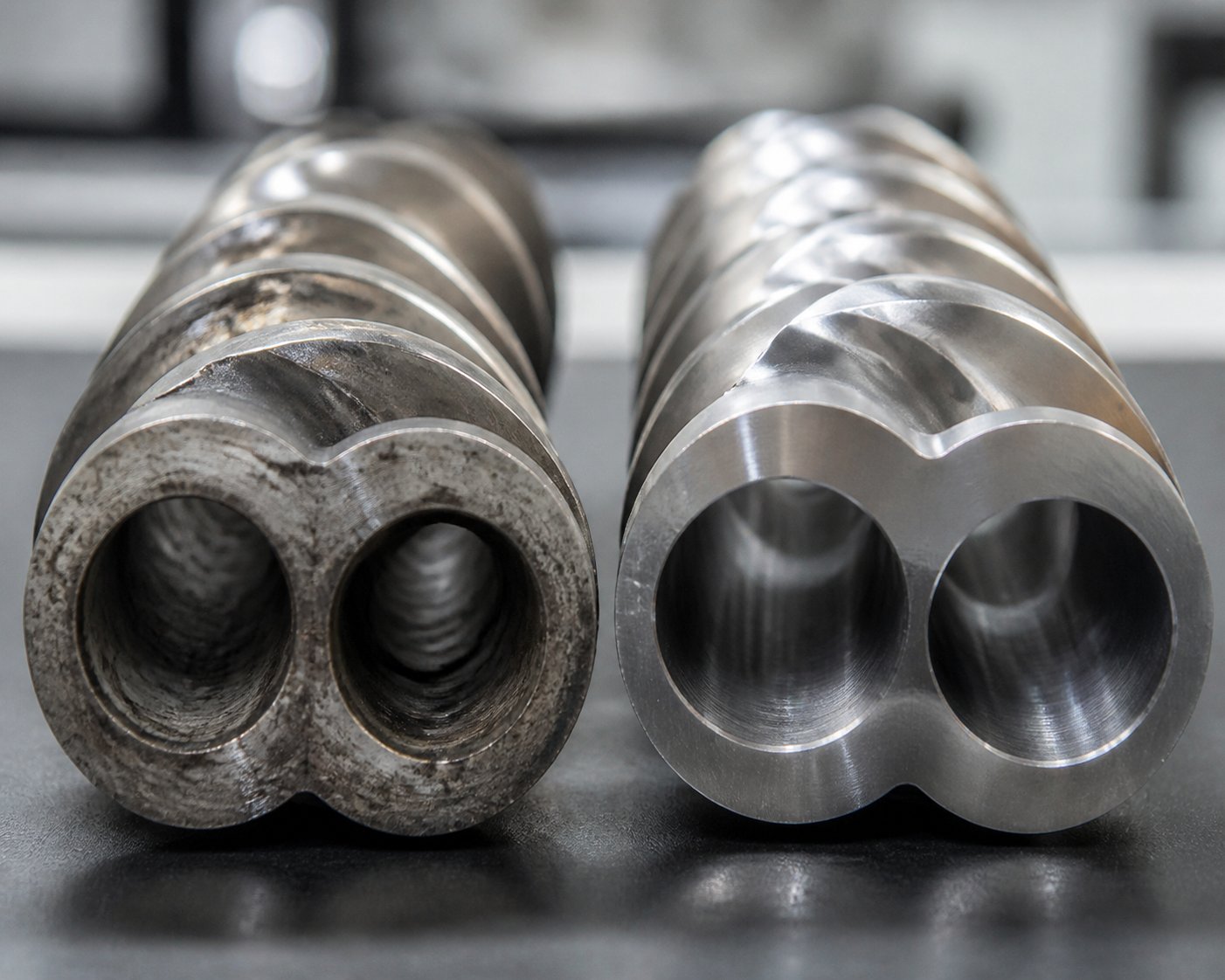
Total Cost of Ownership Beyond the Twin Screw Extruder Price
Here's an uncomfortable truth most purchasing conversations avoid: the twin screw extruder price printed on your purchase order is often the smallest financial commitment you'll make over the machine's life. A production-scale extruder can run for 15 to 20 years. During that span, the ongoing costs of energy, maintenance, wear part replacement, and unplanned downtime can dwarf the original capital expenditure by a factor of three to five. Yet most buyers fixate on securing the lowest upfront quote—and end up paying far more in the long run.
Reframing your purchasing decision around total cost of ownership is the single most powerful shift you can make when evaluating any twin screw extruder factory.
Initial Purchase Price vs Lifetime Operating Cost
Think of the purchase price as a down payment on a decades-long operating relationship. The machine itself—frame, gearbox, barrels, screws, motor, and control system—represents the visible cost. What's less visible, and far more consequential, are the ongoing expenses that accumulate year after year:
- Energy consumption — motor electricity costs running 16 to 24 hours per day, 250+ days per year
- Wear part replacement — screw elements, barrel liners, and sealing components that degrade with every processing hour
- Maintenance labor — planned shutdowns for inspections, screw pulls, barrel measurements, and gearbox servicing
- Unplanned downtime — the most expensive category, where a single catastrophic failure can halt production for days
- Production quality losses — degraded output consistency from worn screws and barrels that haven't been replaced on schedule
- Spare parts inventory carrying costs — stocking critical components so replacements don't require weeks of lead time
Data from extrusion maintenance operations illustrates how dramatic the gap between reactive and proactive cost management can be. A catastrophic screw seizure—including emergency teardown, replacement parts, lost production, and restart—can cost anywhere from $23,000 to over $116,500 per event. A planned screw replacement guided by predictive wear data? Roughly $3,500 to $8,500 total. The delta on a single incident pays for an entire monitoring infrastructure. Multiply that across a 15-year machine life, and the factory that built a more durable, better-engineered screw plastic extruder delivers compounding financial returns long after delivery.
Wear Part Replacement as a Major Cost Driver
If there's one cost category that separates a premium twin screw extruder factory from a budget competitor, it's wear part longevity. Screw elements and barrel liners are consumable components—every hour of operation removes material from flight lands, mixing zones, and bore surfaces. The rate of degradation depends on what you're processing. Glass-fiber-reinforced polymers, mineral-filled compounds, and recycled feedstocks with contaminants accelerate wear dramatically compared to unfilled resins.
Factories that invest in high-quality metallurgy—proper nitriding case depths, verified surface hardness, and advanced coatings like HIP—produce plastic extruder screw elements and barrel liners that last significantly longer between replacements. Tracking indirect wear indicators during operation, such as output decline at rated RPM, rising motor amperage, or increasing specific energy consumption, allows you to predict replacement timing weeks in advance rather than reacting to a catastrophic failure at 2 AM on a weekend.
Beyond replacement frequency, procurement cost per replacement cycle matters enormously over a machine's lifespan. OEM aftermarket channels for twin screw and barrel components often carry substantial markups. Sourcing replacement screw and barrel components from factory-direct suppliers—such as NANHAIYA's screw barrel product range—can significantly reduce procurement costs while ensuring dimensional accuracy and metallurgical quality for extrusion, injection molding, compounding, and pelletizing applications. When you're replacing screw elements every 3,000 to 8,000 operating hours in abrasive service, even a modest per-unit savings compounds into substantial savings across the machine's operational life.
Energy Efficiency and Drive System Quality
Energy is the silent budget killer. A production-scale extruder drawing 400 kW and running two shifts daily consumes electricity worth tens of thousands of dollars annually—every year for the machine's entire service life. The specific energy metric, measured in kWh/kg, captures how efficiently the drive system converts electrical power into useful processing work. Lower specific energy means less wasted power dissipated as unnecessary heat or excessive shear.
Two factory-level decisions directly influence energy efficiency. First, motor selection: modern IE3 and IE4 high-efficiency motors reduce electrical losses by 2 to 5 percent compared to older designs—a difference that scales meaningfully at 400+ kW draw. Second, gearbox engineering: an optimized gearbox with precision-ground gears, quality bearings, and proper lubrication systems minimizes mechanical losses between the motor and the screws. Factories that use commodity gearboxes to hit a lower price point are effectively transferring the cost to your electricity bill for the next two decades.
Before committing to any factory, model these total cost of ownership categories against your projected operating profile:
- Annual energy cost — motor power draw x operating hours x electricity rate
- Wear part replacement budget — estimated replacement intervals x component cost per cycle
- Scheduled maintenance labor — planned shutdowns, screw pulls, inspections, and calibration
- Unplanned downtime risk — probability and cost of emergency repairs based on machine quality tier
- Production quality cost — scrap rate increases and customer complaints linked to worn components
- Spare parts procurement — lead times, inventory carrying cost, and availability of factory-direct alternatives
When you run these numbers across a realistic 15- to 20-year horizon, the factory offering the lowest twin screw extruder price almost never delivers the lowest total cost. The machine built with superior metallurgy, tighter machining tolerances, and a more efficient drive system costs more on day one—but that premium is typically recovered within the first three to five years through lower energy bills, fewer wear part replacements, and dramatically less unplanned downtime. The remaining 10 to 15 years of operation represent pure savings.
This financial reality reshapes how you should approach the entire sourcing process. Armed with a clear picture of what a machine truly costs over its lifetime, you can build a shortlist of factories based on value rather than price—and move from research into a structured procurement action plan.
Your Action Plan for Confident Twin Screw Extruder Factory Sourcing
Every evaluation framework, technical specification, and audit checkpoint covered in this article converges on a single practical challenge: translating knowledge into a purchase decision you'll still be satisfied with a decade from now. Research without execution is just reading. And in the twin screw extrusion equipment market, hesitation or disorganized procurement processes cost buyers real money—through delayed projects, mismatched machines, or partnerships with the wrong suppliers. What follows is a structured path from shortlisting to signed purchase order, built on every principle discussed so far.
Building Your Factory Shortlist
Imagine starting with a list of 15 potential suppliers and needing to narrow it to three viable candidates worth a factory audit. How do you cut efficiently without missing a strong option or wasting time on a weak one? Apply the criteria from this article as sequential filters—each one eliminates companies that can't meet your requirements.
Filter 1: Verify OEM status. Does the company machine its own screws and barrels, integrate its own gearboxes, and run test extrusions on-site? If the evidence isn't clear—no machining facility photos, vague answers about metallurgy, a product catalog spanning unrelated equipment categories—remove them. You're looking for genuine twin-screw extruder manufacturers, not intermediaries with polished websites.
Filter 2: Confirm technical specifications match your application. Does the factory produce machines in the screw diameter, L/D ratio, and torque density range your process demands? A factory specializing in lab-scale 20 mm units won't serve a buyer needing a 95 mm production compounder—and vice versa. Match machine class to your throughput targets and material processing requirements before engaging further.
Filter 3: Validate certifications and industry experience. ISO 9001 is baseline. CE marking matters for European deployment. FDA compliance and GMP documentation are non-negotiable for pharmaceutical or food applications. Beyond certificates, ask for customer references in your specific sector. A factory with 50 installations in PVC pipe extrusion but none in engineering plastics compounding may lack the metallurgical and screw design expertise your application demands.
Filter 4: Plan factory audits for your top candidates. Use the audit framework from the previous sections—inspect CNC machine tools, calibration records, raw material traceability, and the test extrusion line. A factory that welcomes this scrutiny has earned confidence. One that deflects or controls your access has not.
Filter 5: Model total cost of ownership. Request specific energy data from test runs, wear part replacement pricing, and maintenance schedules. Run the numbers across a 15-year operating horizon. The factory offering the lowest purchase price frequently delivers the highest lifetime cost when energy consumption, wear part frequency, and downtime risk are factored in. Two double screw extruder machine options with a $50,000 price gap at purchase can reverse that relationship entirely over a decade of operation.
By the time you've applied all five filters, your shortlist should contain two to four factories—each verified as a genuine manufacturer, technically capable of building your machine, experienced in your industry, and transparent enough to welcome audit scrutiny. That's a shortlist worth investing procurement resources in.
Securing Reliable Screw and Barrel Supply Chains
Here's a dimension most buyers overlook entirely during the equipment purchase process—and then scramble to address when the first set of twin screws shows wear 18 months into production. Selecting the right extruder factory is only half of a long-term procurement strategy. The other half is establishing a dependable supply chain for the replacement screws and barrels your machine will consume throughout its operational life.
Why does this matter so much? Because screw elements and barrel liners are consumable components. Every operating hour removes material from flight surfaces and bore walls, and the rate of degradation depends entirely on what you're processing. Glass-fiber-filled engineering polymers, mineral-loaded masterbatches, and contaminated recycling feedstocks accelerate wear dramatically. In abrasive service, you may replace screw elements every 3,000 to 8,000 hours—meaning a machine running two shifts will need new components every one to three years.
Relying solely on your extruder's original manufacturer for these replacements creates two risks. First, OEM aftermarket pricing often carries substantial markups over factory-direct alternatives—sometimes 40 to 60 percent more for dimensionally identical components. Second, single-source dependency leaves you vulnerable to supply disruptions, extended lead times, or discontinued part numbers if the OEM shifts its product strategy.
The smarter approach is to establish relationships with specialized screw and barrel manufacturers early—ideally during the original equipment procurement phase, not after a production emergency forces a rushed search. Factory-direct suppliers like NANHAIYA serve plastic extrusion plants with components for extrusion, injection molding, compounding, pelletizing, and replacement projects. Working with a dedicated manufacturer ensures dimensional accuracy and metallurgical quality while eliminating the OEM markup that inflates long-term maintenance budgets. For operations running twin-screw extruders across multiple production lines, this kind of supply chain diversification isn't optional—it's essential for controlling costs and maintaining uptime.
When evaluating potential wear part suppliers, apply the same rigor you'd use for the extruder factory itself. Can they provide material certifications and hardness test data? Do they manufacture to your machine's specific tolerances, or do they offer generic fits that require on-site modification? Can they deliver within lead times that align with your planned maintenance windows? These questions separate reliable partners from opportunistic sellers.
Your Five-Step Procurement Action Plan
Whether you're a first-time buyer specifying your inaugural compounding line or a seasoned procurement team replacing aging equipment, this sequence turns everything covered in this article into a repeatable process:
- Define application requirements and specifications. Lock down your material types, throughput targets, filler loadings, and downstream integration needs before requesting any quotes. Specify the screw diameter range, L/D ratio, torque density class, and barrel zone configuration your process demands. Ambiguity at this stage guarantees mismatched quotes that can't be compared meaningfully.
- Identify and shortlist genuine OEM factories. Apply the OEM verification criteria—machining capability evidence, metallurgical expertise, focused product catalogs, and willingness to host factory visits. Eliminate trading companies and private label resellers using the red flag checklist. Target two to four verified manufacturers whose specialization aligns with your industry.
- Conduct factory audits using the checklist from this article. Inspect CNC equipment, calibration records, raw material traceability, heat treatment documentation, and the test extrusion line. Evaluate 5S practices, engineering staff depth, and the factory's willingness to answer technical questions transparently. For international sourcing where physical visits aren't immediately practical, request live, unscripted video tours as a preliminary screening step.
- Request test run data and customer references. Ask each shortlisted factory to provide documented results from test extrusions—ideally with materials similar to yours. Review torque loading, temperature profiles, throughput achieved, and melt quality data. Contact three to five existing customers in your application segment and ask about machine reliability, technical support responsiveness, and wear part longevity.
- Establish wear part supply relationships for ongoing maintenance. Before finalizing the extruder purchase, identify and qualify at least one factory-direct screw and barrel supplier—such as NANHAIYA—who can provide replacement components with verified dimensional accuracy and metallurgical quality. Negotiate pricing, confirm lead times, and place a sample order for validation. This proactive step protects your operation from OEM aftermarket markups and single-source supply risks for the life of the machine.
This five-step sequence typically takes 8 to 16 weeks from initial specification development through purchase order placement for a production-scale twin-screw extruder. Compressing it further risks skipping critical validation steps that protect a six-figure capital investment. Extending it beyond necessary timelines, on the other hand, delays production capacity and revenue generation. Balance thoroughness with decisiveness.
Informed buyers who understand factory operations, manufacturing quality indicators, and supply chain economics consistently achieve better outcomes in machine performance, uptime, and total value than those who source on price alone.
The twin screw extrusion equipment market rewards preparation. Every hour you invest in verifying a factory's OEM status, auditing its manufacturing processes, modeling total cost of ownership, and securing a reliable wear parts supply chain pays dividends across the 15 to 20 years that machine will run on your production floor. The middlemen, the traders, and the lowest-bidder manufacturers depend on buyers who skip these steps. Don't be that buyer.
Twin Screw Extruder Factory FAQs
1. How can I tell if a twin screw extruder supplier is a real factory or a trading company?
Genuine factories can discuss machining tolerances, metallurgy details like nitriding case depth and steel grades, and they welcome on-site or live video factory tours. Trading companies typically give vague technical answers, avoid facility visits, show inconsistent lead times, and offer suspiciously broad product catalogs spanning unrelated equipment categories. Requesting material certifications, heat treatment records, and test run data quickly exposes resellers who lack in-house manufacturing capability.
2. What is the difference between co-rotating and counter-rotating twin screw extruders?
Co-rotating twin screw extruders have both screws turning in the same direction with intermeshing, self-wiping flights, delivering excellent dispersive and distributive mixing for compounding, masterbatch, and reactive extrusion. Counter-rotating designs rotate screws in opposite directions, generating lower shear that protects heat-sensitive materials like PVC. Your application dictates the choice: co-rotating suits high-performance mixing tasks, while counter-rotating excels in PVC pipe, profile extrusion, and shear-sensitive processing.
3. What key specifications should I evaluate when buying a twin screw extruder?
Focus on screw diameter (which governs throughput capacity), L/D ratio (determining processing length, typically 32:1 to 52:1), torque density in Nm/cm3 (critical for viscous or highly filled materials), motor power, maximum screw speed, and the number of independently controlled barrel zones. Torque density is especially important for demanding applications and varies from around 5 Nm/cm3 on entry-level machines to over 13 Nm/cm3 on premium units. Always request test run data to verify published specifications under real processing conditions.
4. How do I conduct a proper factory audit for a twin screw extruder manufacturer?
Start with pre-audit research: request equipment lists, ISO 9001 certificates, and customer references. On-site, inspect CNC machine tool brands and condition, check calibration stickers on measuring instruments, review raw material traceability systems, and evaluate the test extrusion line for active use. Key red flags include no material certifications, copied screw designs without engineering rationale, empty spare parts inventories, and engineering staff unable to explain screw configuration choices for your specific application.
5. Why should I source replacement screw and barrel components from a factory-direct supplier?
OEM aftermarket channels often mark up replacement screws and barrels by 40 to 60 percent over factory-direct alternatives. Since these are consumable components replaced every 3,000 to 8,000 operating hours in abrasive service, the cost difference compounds significantly over a machine's 15- to 20-year lifespan. Specialized factory-direct suppliers like NANHAIYA (nhyscrews.com/products) manufacture replacement components with verified dimensional accuracy and metallurgical quality, reducing procurement costs while eliminating single-source supply chain risk.
Written by
Nanhaiya Technical Team
Zhoushan Nanhaiya Plastic Machinery Co., Ltd.
The Nanhaiya technical team supports screw and barrel manufacturing projects through application review, technical communication, custom manufacturing coordination, and production and quality control.
Discuss Your Application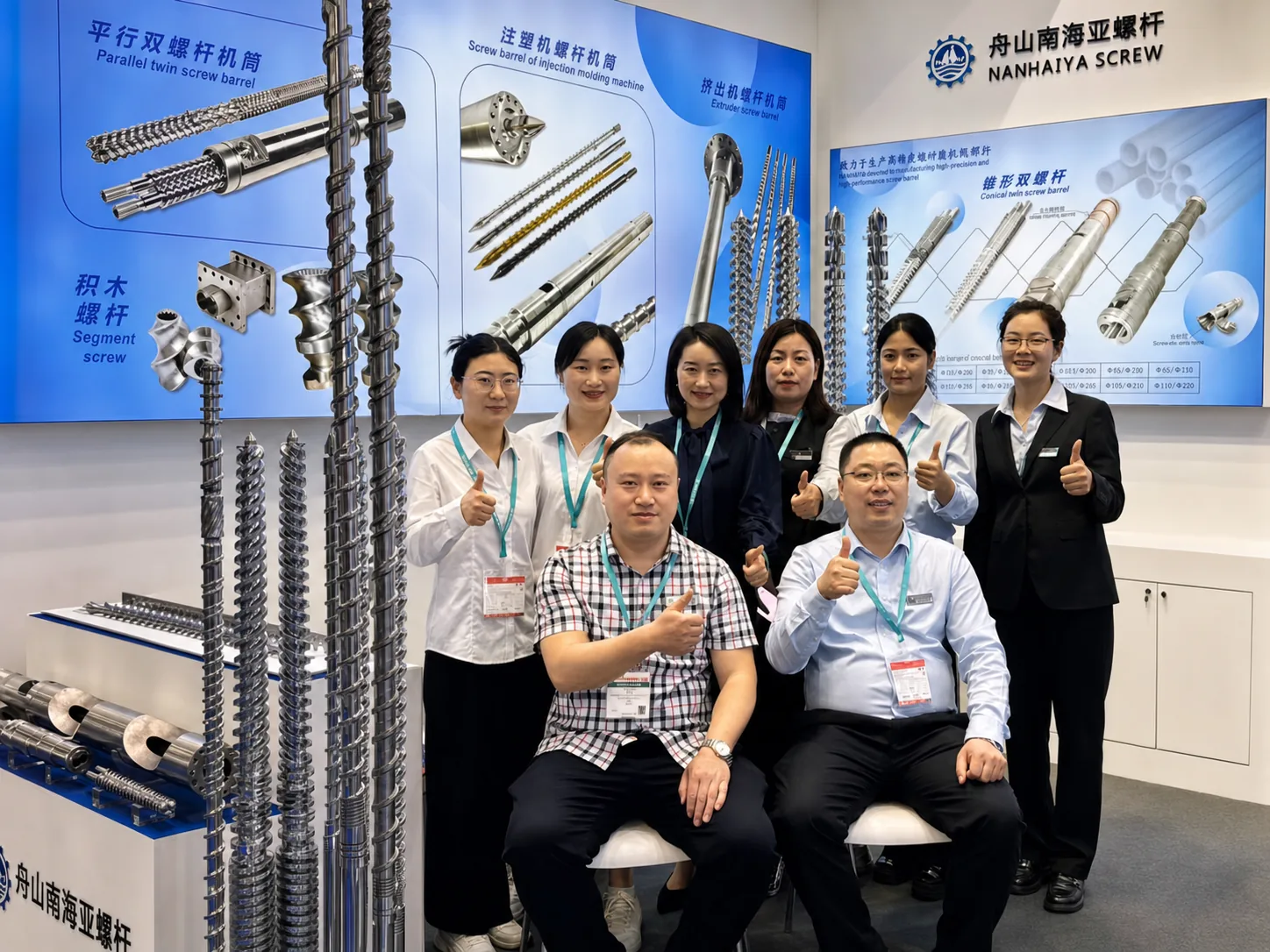
Related Articles
More insights on screw barrel technology and plastics processing.

Single Screw Extruder Supplier Red Flags You Can't Afford To Miss
Oct 22, 2026
Learn how to evaluate a single screw extruder supplier with this buyer's guide covering pricing, screw and barrel tech, new vs used trade-offs, and red flags.
Read Article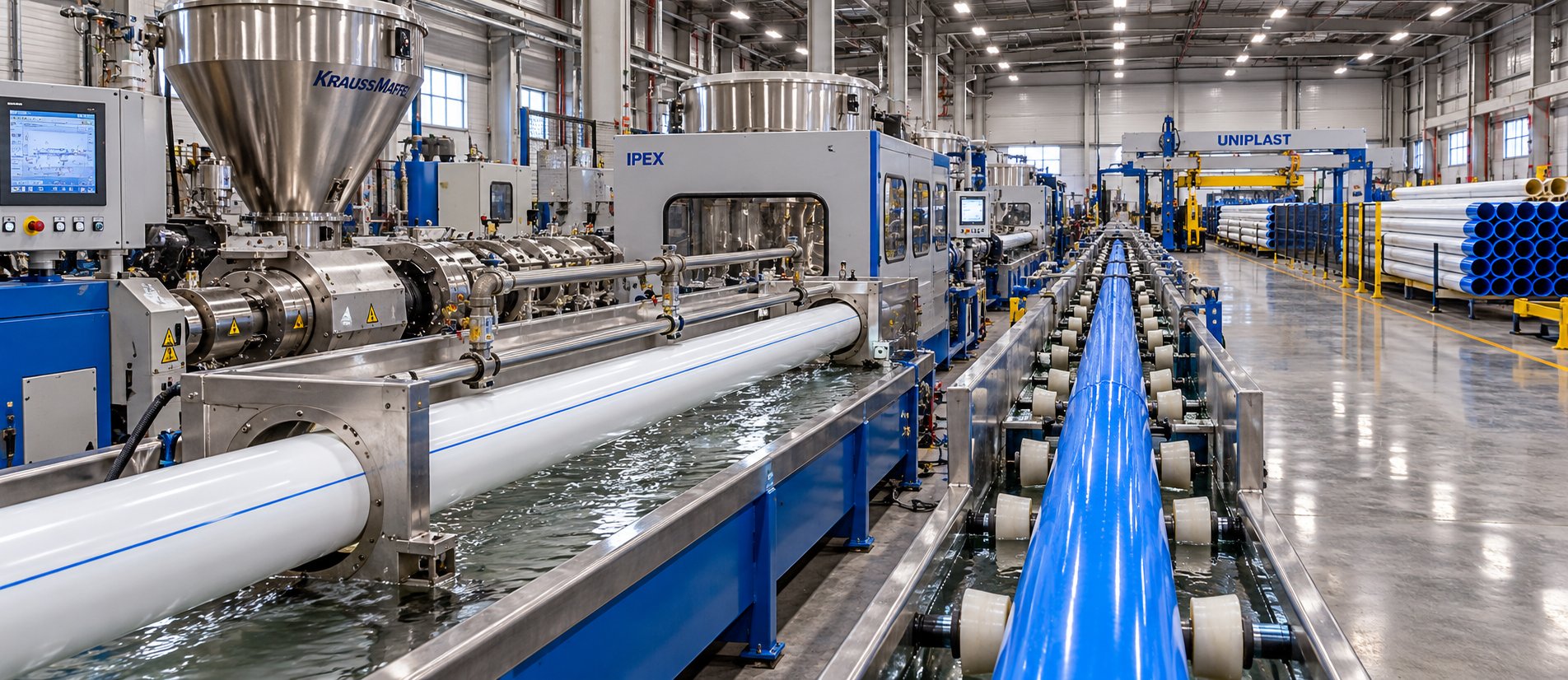
HDPE Pipe Making Machine Decoded: From Specs to Smart Purchase
Oct 15, 2026
Learn how HDPE pipe making machines work, from extruder specs and extrusion process steps to automation levels, maintenance costs, and smart buying tips.
Read Article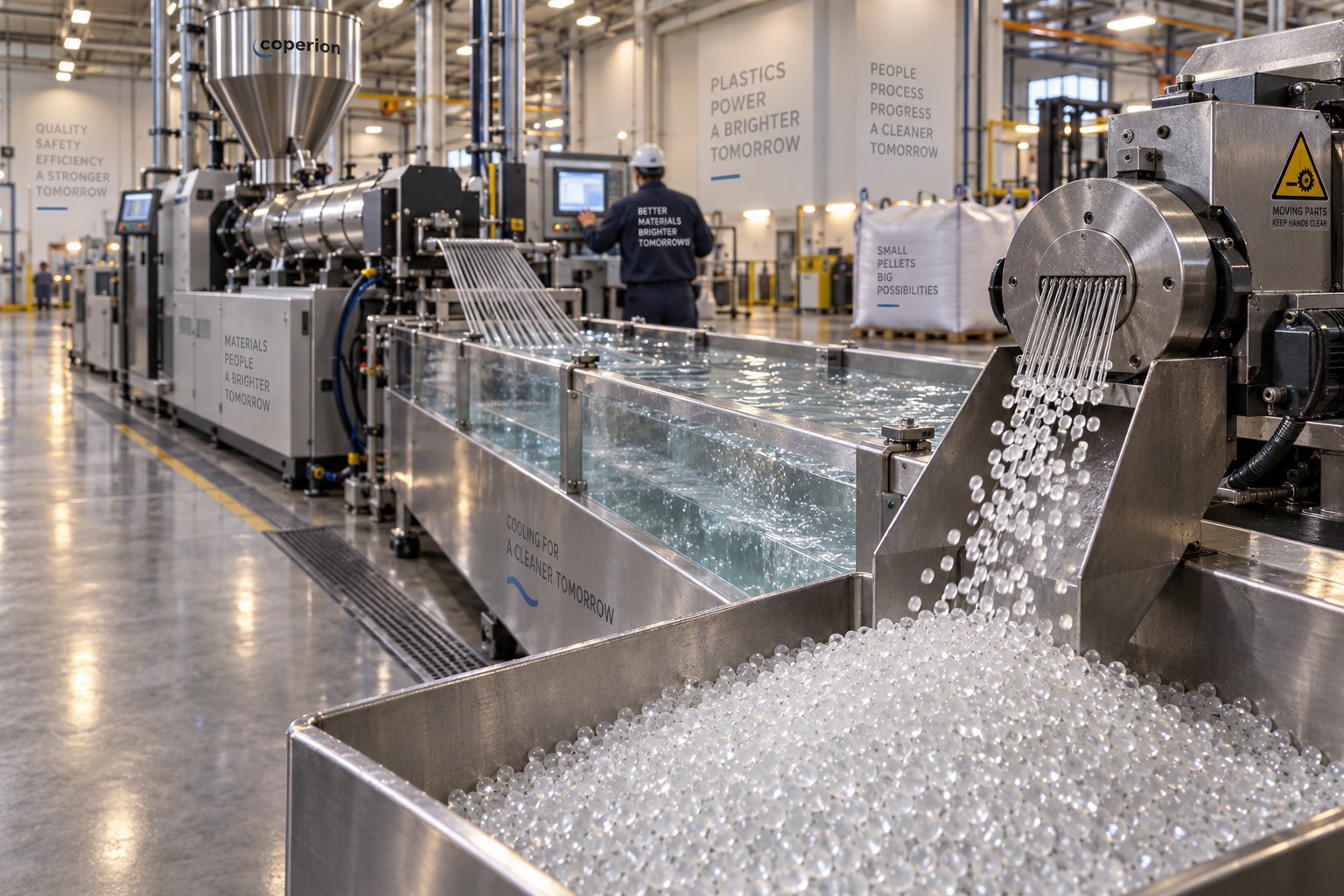
Pick the Wrong Plastic Pelletizing Line and You Pay Twice
Oct 14, 2026
Learn how to spec the right plastic pelletizing line for your resin, throughput, and budget. Covers strand, underwater, and air-cooled systems plus ROI planning.
Read ArticleLooking for something else?
Search by material, symptom or product and jump straight to the relevant page.
These are navigation suggestions based on keyword matching — not a quotation, not a delivery commitment, and not a substitute for engineering review. Final specification is confirmed by our engineers against your drawings and processed material.
Need help with screw barrel selection?
Share your machine model, processed material and application. Our team can help with pricing and technical support.