


What a Single Screw Extruder Does and Why Supplier Selection Is Critical
Imagine investing six figures in a machine that runs 24/7 — only to discover your supplier vanishes when a critical barrel needs replacing. That scenario plays out more often than you'd think, and it starts with a single overlooked step: vetting the company behind the equipment.
What Is a Single Screw Extruder
Before evaluating any supplier, you need a firm grasp of the technology itself. A single screw extruder is one of the most widely used machines in the plastics and polymer processing industry, yet its purpose is straightforward.
A single screw extruder is a machine that uses a single rotating screw inside a heated cylindrical barrel to melt, mix, and force thermoplastic polymers through a shaped die, producing continuous profiles such as pipes, films, sheets, and pellets.
The concept is deceptively simple — feed polymer pellets or powder into a hopper, let the screw convey and compress the material through progressively hotter barrel zones, and push the resulting melt through a die that defines the final shape. In practice, though, the engineering behind a reliable single screw extruder machine determines everything from melt consistency to energy consumption and uptime.
Applications span an enormous range. Pipe and profile extrusion, blown and cast film production, sheet lines, pelletizing systems, and plastics recycling operations all depend on single screw extrusion technology. That breadth is exactly why plastic extruders of this type remain the workhorse of the industry — and why the supplier standing behind your machine matters so much.
Why Your Supplier Choice Matters
A plastic extruder machine is not a commodity purchase you make once and forget. The supplier relationship extends across the entire lifecycle of the equipment: engineering consultation during specification, screw and barrel customization for your specific polymer, commissioning support, spare parts availability, and field service years down the road. The NIST Manufacturing Extension Partnership emphasizes that manufacturers should evaluate suppliers on total cost of ownership rather than unit price alone — and that understanding a supplier's capabilities, quality systems, and capacity is essential for sound decision-making.
Most resources available online either sell machines or list used equipment. Few — if any — walk a plastics processor through the complete buyer journey in a single guide. This article fills that gap, giving you a structured framework to evaluate every single screw extruder supplier on your shortlist, spot red flags early, and make a purchasing decision you won't regret.
That framework starts with understanding how the machine actually works — because the questions you ask a supplier about screw geometry, barrel metallurgy, and zone control will reveal more about their engineering depth than any sales brochure ever could.
How a Single Screw Extruder Works from Pellet to Product
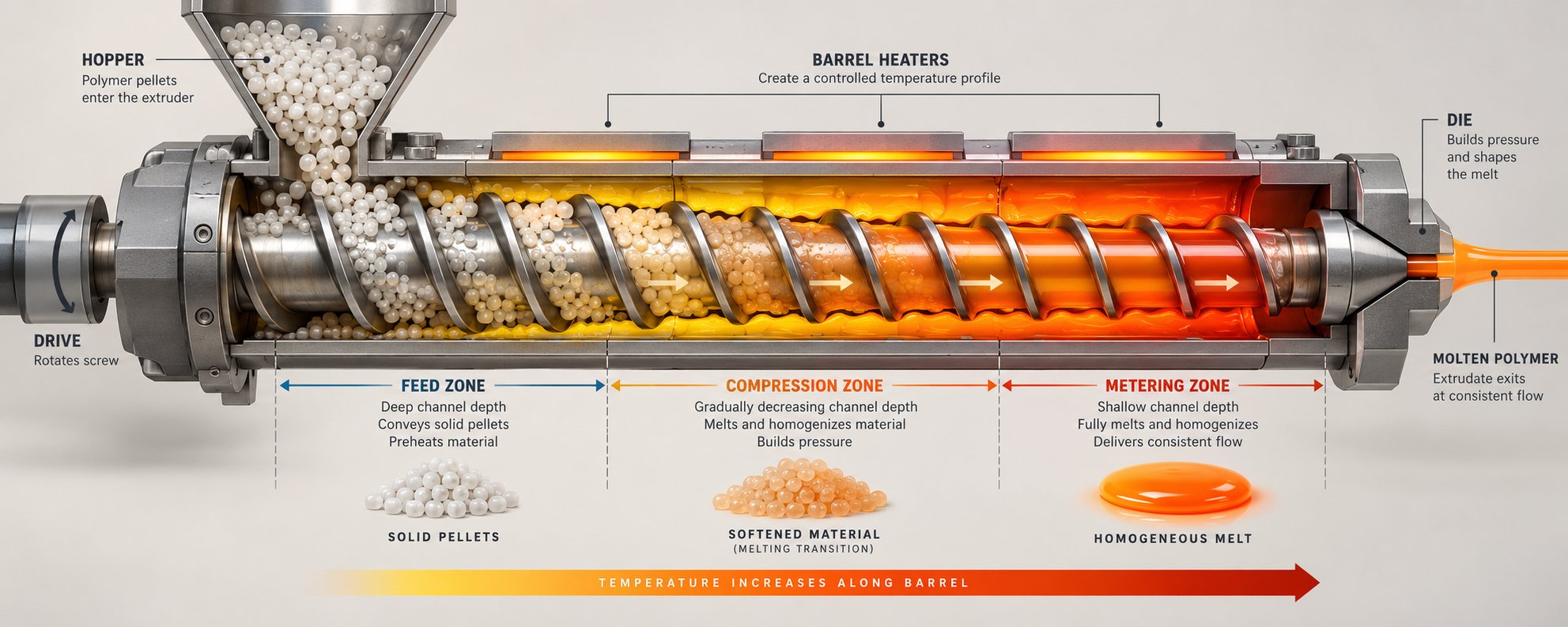
Picture a handful of plastic pellets. In a matter of seconds, a screw extruder transforms those solid granules into a uniform, pressurized melt ready to be shaped into pipe, film, or sheet. The process looks seamless from the outside, but inside the barrel, three distinct zones do very different jobs — and the quality of each zone's engineering separates a capable supplier from a mediocre one.
The plasticating process begins when pellets drop from the hopper into the barrel's feed throat. As the single extruder screw rotates — typically at speeds well under one mile per hour at the barrel wall, even at 100 rpm — frictional drag between the barrel surface and the polymer drives the material forward. Heat generated by mechanical shear, combined with external barrel heaters, progressively melts the plastic. By the time the material reaches the screw tip, it should be a homogeneous melt at a consistent temperature and pressure, ready to flow through the die.
That "should" is the operative word. Melt quality hinges on how well the screw's three functional zones handle the transition from solid pellet to pressurized liquid.
Feed Zone, Compression Zone, and Metering Zone Explained
A standard single screw extrusion machine divides the screw into three zones, each with a unique channel geometry tailored to a specific stage of the melting process. The Plastics Extrusion Operating Manual by Allan Griff describes this classic three-zone layout as the foundation of virtually all single screw designs.
| Zone | Channel Depth | Primary Function | Key Design Variables |
|---|---|---|---|
| Feed Zone | Deep and constant | Accepts solid pellets from the hopper and conveys them forward; expels trapped air rearward | Channel depth relative to pellet size, flight width (~10% of barrel diameter), surface finish for optimal friction |
| Compression Zone | Gradually decreasing (tapered) | Compacts the solids, squeezes out interstitial air, and initiates melting through shear and conducted heat | Compression ratio (typically 2:1 to 4:1), taper rate, number of turns |
| Metering Zone | Shallow and constant | Homogenizes the melt and builds consistent pressure to push material through the die | Channel depth, length, flight clearance to barrel wall (0.005–0.010 in. on new screws) |
The compression ratio — the volume of the first flight divided by the volume of the last — is one of the most frequently discussed screw specifications. It typically falls between two and four, but as Griff notes, it's an "indefinite number" that can't fully describe a screw unless at least one channel depth is also known. When you're evaluating a supplier, asking how they select compression ratio and channel depths for your specific resin tells you whether they're engineering a solution or simply quoting catalog dimensions.
Most single screw extrusion systems use a square-pitch design, meaning the distance from one flight to the next equals the screw diameter. This makes it easy to estimate L/D ratio just by counting turns — a handy detail during factory inspections. Common L/D ratios sit around 24:1, though longer screws at 30:1 or more are used when additional melting, mixing, or devolatilization capacity is needed.
The Role of the Barrel in Heat Transfer and Wear Resistance
The screw gets most of the attention, but the barrel is its indispensable partner. Think of the barrel as both a heat exchanger and a wear surface — two roles that demand very different engineering considerations.
External electric heating bands wrapped around the barrel supply conducted heat to the polymer, especially in the early stages of processing before shear heating takes over. Cooling channels or blowers on individual barrel zones allow operators to remove excess heat and fine-tune melt temperature. This zone-by-zone thermal control is what lets a processor run the same machine across different polymers simply by adjusting the temperature profile.
Wear resistance, however, is where barrel construction quality truly separates suppliers. Barrels are steel cylinders, but the inner surface takes a relentless beating from abrasive fillers, glass fibers, and mineral-loaded compounds. Advanced Heat Treat Corp. highlights that plastic materials frequently contain abrasive components such as metal fragments or glass reinforcing fillers, causing severe wear on extruder components during operation. To combat this, high-quality suppliers offer:
- Bimetallic liners — a centrifugally cast wear-resistant alloy bonded to the inside of a structural steel shell, providing excellent abrasion and corrosion resistance.
- Nitrided steel barrels — a thermochemical surface treatment that produces hard chromium nitride layers capable of withstanding elevated processing temperatures, with surface hardness exceeding 70 HRc equivalent in advanced alloys like Nit135M and H-13.
- Specialized coatings — options such as tungsten carbide or nickel-based alloys for processors running highly corrosive resins like PVC or fluoropolymers.
A supplier who glosses over barrel liner options or offers only a single metallurgy for every application is a red flag worth noting. Barrel and screw replacement is an ongoing operational cost, and the materials chosen at the point of purchase directly influence how many running hours you'll get before a rebuild is needed.
Understanding these internal mechanics does more than satisfy curiosity. It equips you with the technical vocabulary to distinguish between a supplier that engineers machines for your specific polymer and one that ships generic equipment off the floor — a distinction that becomes even sharper when you start comparing single screw technology against its twin screw counterpart.
Single Screw vs Twin Screw Extruders and When Each Technology Fits
Here's a question that trips up more buyers than you'd expect: are you absolutely sure a single screw machine is the right fit for your application? Engaging a supplier before answering that question can lead to months of wasted quoting, or worse, a capital investment that underperforms from day one. The distinction between single screw and twin screw extruders isn't about which technology is "better" — it's about which one matches your process requirements, material characteristics, and production economics.
Single Screw vs Twin Screw Extruder Performance Comparison
Both screw extruders melt and convey polymer, but they do it through fundamentally different mechanisms. A single screw machine relies on friction between the barrel wall and the solid polymer bed to drag material forward, while a twin screw extruder uses the intermeshing action of two screws to positively convey, shear, and mix material with far greater control over residence time and mixing intensity.
That mechanical difference cascades into nearly every performance metric a buyer cares about. The table below breaks down the practical implications across the criteria that matter most during supplier evaluation.
| Criteria | Single Screw Extruder | Twin Screw Extruder |
|---|---|---|
| Mixing Capability | Moderate — adequate for pre-compounded resins; limited distributive and dispersive mixing without specialized screw elements | High — modular screw configurations with kneading blocks deliver intensive distributive and dispersive mixing |
| Throughput Range | Broadly scalable; high output rates achievable at given screw diameters because less energy is consumed on mixing | Typically 30-50% lower throughput than equivalent-diameter single screw machines due to longer residence time and mixing resistance |
| Material Flexibility | Best suited for single-polymer processing with pre-compounded pellets; limited ability to handle highly filled or multi-component feeds | Handles multi-component feeds, high filler loadings (up to 60%+), reactive extrusion, and thermally sensitive blends |
| Energy Efficiency | Lower specific energy consumption, typically 0.15-0.30 kWh/kg depending on polymer and application | Higher specific energy consumption, typically 0.25-0.45 kWh/kg, with 20-40% of energy devoted to mixing |
| Capital Cost | Lower — simpler drive, single barrel, and fewer components reduce initial investment | Higher — complex gearboxes, longer L/D ratios, and modular screw elements increase purchase price by 30-75% |
| Maintenance Complexity | Simpler design with fewer wear points; screw and barrel component life of 8,000-15,000+ operating hours | More complex; mixing elements and kneading blocks create additional wear points with component life of 4,000-8,000 hours |
| Ideal Applications | Pipe, film (blown and cast), sheet, profile extrusion, pelletizing, and recycling of pre-compounded materials | Compounding, masterbatch production, polymer blending, reactive extrusion, and highly filled formulations |
You'll notice that the differences aren't subtle. A single screw extruder excels at doing one thing exceptionally well — taking a pre-formulated resin and turning it into a finished product at high volume and low energy cost. A twin screw extruder, by contrast, earns its higher price tag by performing work that a single screw physically cannot: intensive mixing, ingredient incorporation, and devolatilization across multiple configurable processing zones.
When a Single Screw Extruder Is the Right Choice
If your operation runs pre-compounded pellets through a steady-state process — think HDPE pipe, LLDPE blown film, PP sheet, PVC profiles, or PET pelletizing — a single screw machine is almost certainly the right technology. These applications demand consistent melt delivery at high throughput rates, not the intensive blending a twin screw provides. The simpler mechanical design translates directly into lower capital outlay, reduced spare parts inventory, and longer intervals between major maintenance events.
Twin screw extruders earn their place when the process itself requires the machine to do the compounding work: blending two or more polymers, dispersing pigments at masterbatch-level concentrations, incorporating 30-60% mineral filler, or performing reactive extrusion. In those scenarios, the modular screw elements and tight intermeshing geometry of a co-rotating twin screw are indispensable.
A practical way to frame the decision: if your raw material arrives as a ready-to-process pellet, start your supplier search in the single screw category. If your raw material needs to be created by mixing multiple ingredients, you're looking at a twin screw line — and the twin screw extruder price will reflect that added complexity. That price differential is significant enough that "twin screw extruder price" ranks among the most searched buyer terms in this industry, precisely because processors want to understand the total investment gap before committing to a technology path.
There's also a middle ground worth knowing about. Some buyers explore the secondary market for twin screw extruders for sale when budgets are tight and the application sits on the boundary between technologies. You may even encounter a used twin screw extruder for sale at a price point comparable to a new single screw line. That can be tempting, but it introduces a different set of trade-offs — warranty limitations, unknown wear history on kneading elements, and potentially outdated control systems — that deserve careful scrutiny before signing a purchase order.
The key takeaway is this: confirming the right technology before you contact suppliers prevents you from comparing apples to oranges during the quoting process. A supplier who immediately pushes a twin screw when your application clearly calls for a single screw — or vice versa — is showing you something important about their engineering judgment.
With the technology question settled, the next logical step is understanding the specific extruder configurations available within the single screw category itself — because not all single screw machines are built alike, and matching the right barrel and screw design to your polymer is where supplier expertise truly gets tested.
Extruder Configurations and Material Compatibility You Should Know
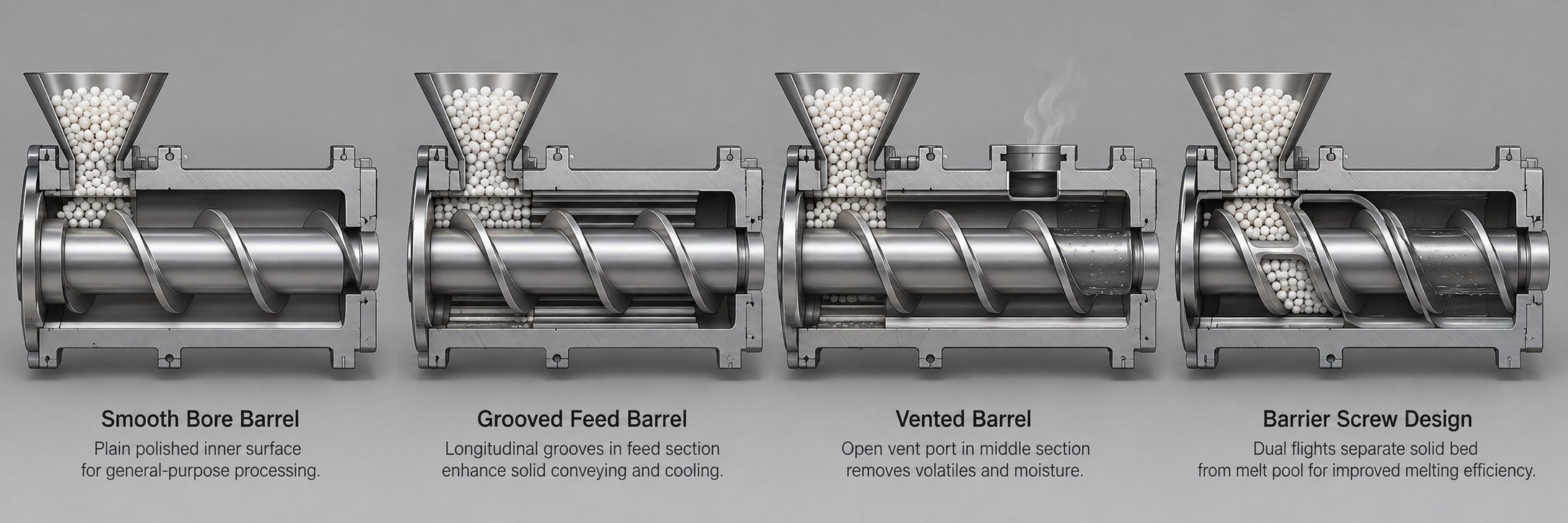
Not every single screw plastic extruder is built the same way. The barrel feed section, screw geometry, and venting capability all vary depending on the polymer being processed and the performance targets your application demands. A supplier who offers only one configuration for every job is essentially handing you a one-size-fits-all solution in an industry where material science dictates machine design. Understanding the four primary configurations — smooth bore, grooved feed, vented, and barrier screw — gives you the vocabulary to separate genuine engineering expertise from catalog-level quoting.
Smooth Bore, Grooved Feed, and Vented Extruder Configurations
Each configuration addresses a different processing challenge. When you're evaluating a plastic single screw extruder for your line, the right choice depends on the polymer, throughput targets, and product quality requirements you're working with.
Smooth Bore Extruders
- The feed section has a polished, unmodified barrel bore — the most traditional and widely used design.
- Material transport depends entirely on the frictional difference between the barrel wall and the screw surface; higher barrel friction drives the solid bed forward.
- Well suited for shear-sensitive polymers like PVC and for applications where gentle processing preserves material properties.
- Offers broad versatility across a wide resin range, making it the default choice for general-purpose extrusion lines running multiple materials.
- Capital cost is typically lower than grooved feed alternatives, and screw design changes are simpler to implement.
Grooved Feed Extruders
- The feed section contains longitudinal or helical grooves machined into the barrel bore, dramatically increasing friction on the solid polymer bed.
- According to Davis-Standard's comparative testing, groove feed extruders achieve higher output rates with lower melt temperatures than smooth bore machines of the same diameter — a 3.5-inch (90 mm) groove feed unit matched the throughput of a 4.5-inch (114 mm) smooth bore machine at 1,100 lb/hr while consuming significantly less energy.
- Particularly effective for high-viscosity polyolefins such as HDPE and UHMWPE, where the positive solids conveying mechanism decouples output rate from downstream melt pressure.
- Requires an intensively cooled feed section to prevent premature melting in the grooves, adding design complexity and cost.
- Ideal for pipe extrusion and blown film applications where consistent, high-volume throughput and energy savings justify the upfront investment.
Vented (Degassing) Extruders
- Feature a two-stage screw design with a decompression zone and an open vent port in the barrel, allowing trapped moisture, air, and volatile gases to escape before the melt enters the metering section.
- As Zhoushan Juyuan Machinery explains, the first stage melts and conveys the material while the second stage removes volatiles through the vent, producing bubble-free, homogeneous melt.
- Essential for processing hygroscopic resins — PA (nylon), PET, and PC — that absorb atmospheric moisture and would otherwise produce surface defects, voids, or reduced mechanical properties.
- Frequently used in recycling lines where regrind contains residual moisture or contaminants, eliminating the need for a separate pre-drying step.
- A polyester extruder processing PET, for example, benefits enormously from vented barrel design because PET is highly sensitive to hydrolytic degradation when moisture is present in the melt.
Barrier Screw Designs
- Incorporate a secondary flight — the barrier flight — that separates the solid bed from the melt pool, forcing molten polymer across the barrier into a dedicated melt channel.
- GSmach's guide to screw types notes that barrier screws promote uniform melting and reduce unmelted particles, making them a standard upgrade for crystalline polymers like PE and PP.
- Deliver more consistent melt temperature and pressure than conventional three-zone screws, which directly translates into tighter dimensional tolerances on the finished product.
- Best for high-output applications running semi-crystalline polyolefins where melt uniformity is critical — pipe, sheet, and heavy-gauge film.
- Typically paired with a mixing section (such as a Maddock or spiral mixer) near the screw tip to further homogenize the melt before it reaches the die.
When speaking with a supplier, ask which of these configurations they offer — and more importantly, which one they recommend for your specific resin and application. A vendor who defaults to smooth bore for every inquiry may lack the engineering depth to optimize your process.
Material Compatibility and Polymer Selection
The extruder machine for plastic processing is only as effective as its compatibility with the polymer being run. Screw geometry, barrel metallurgy, and temperature control strategy all shift depending on the resin's melt behavior, thermal sensitivity, and abrasiveness. Here's how the most common polymers align with single screw processing:
PVC (Polyvinyl Chloride) — One of the most processed polymers globally, yet one of the most demanding. PVC is thermally sensitive and releases corrosive hydrochloric acid when overheated. A polymer extruder handling PVC requires a low compression ratio screw (typically 2:1 to 2.5:1), precise zone-by-zone temperature control, and corrosion-resistant barrel liners — usually nickel-based bimetallic alloys. Suppliers with genuine PVC experience will specify these details without prompting.
PE (Polyethylene) — LDPE, LLDPE, HDPE — The polyolefin family is the bread and butter of single screw extrusion. PE processes reliably across smooth bore and grooved feed configurations. HDPE, with its higher viscosity and crystallinity, benefits significantly from barrier screw designs and grooved feed sections. LDPE and LLDPE, commonly used in film, run well on conventional three-zone screws with compression ratios around 3:1 to 3.5:1.
PP (Polypropylene) — Similar in processing behavior to PE but with a sharper melting point and narrower processing window. PP demands tight temperature uniformity and benefits from barrier screw designs that prevent unmelted particles — a common source of gels in PP film and sheet. Suppliers should demonstrate familiarity with PP's tendency to degrade under excessive shear.
PET (Polyethylene Terephthalate) — Highly hygroscopic and sensitive to hydrolytic degradation. A polyester extruder designed for PET almost always requires a vented barrel configuration or thorough pre-drying of the resin to below 50 ppm moisture. Barrel metallurgy must resist the mildly corrosive byproducts of PET degradation. Suppliers who treat PET like just another polyolefin are signaling inexperience.
ABS (Acrylonitrile Butadiene Styrene) — An amorphous engineering resin that processes at moderate temperatures but is sensitive to excessive shear, which can degrade the rubber phase responsible for impact strength. Screws with moderate compression ratios (around 2.5:1) and gentle mixing sections preserve mechanical properties.
Specialty and Filled Materials — Glass-fiber-reinforced compounds, mineral-filled resins, and fluoropolymers each introduce unique challenges. Abrasive fillers demand bimetallic barrels and hardened screw flights. Corrosive polymers like PVDF require specialized alloy liners. Any credible supplier will ask about your filler content and type during the first technical conversation — if they don't, consider it a warning sign.
A supplier's depth of experience with your target polymer is one of the most reliable indicators of their overall capability. The screw geometry, barrel liner selection, and thermal management approach must all be tuned to the resin's specific melt behavior. A supplier who treats every polymer the same way will deliver a machine that works — but never one that performs at its best.
This material-specific thinking carries directly into your next major decision as a buyer: whether to invest in a brand-new machine engineered precisely for your resin and application, or to pursue used equipment where configuration compromises are almost inevitable.
New vs Used Single Screw Extruders and the Trade-Offs of Each Path
Configuration is only half the equation. The other half is sourcing strategy — and it's a decision that shapes your total investment, production timeline, and supplier relationship for years to come. Buying a brand-new machine from an OEM and purchasing used extruders from the secondary market are two fundamentally different paths, each with distinct advantages and risks that deserve structured evaluation rather than gut instinct.
Buying New from OEM Manufacturers and System Integrators
A new single screw extruder engineered and built to your specifications offers the highest degree of control over every performance variable. You're not inheriting someone else's compromises — you're defining the screw geometry, barrel metallurgy, drive system, and control architecture from scratch.
The practical advantages stack up quickly:
- Full warranty coverage — OEM warranties typically run 12 months or longer, covering mechanical, electrical, and control system components. This means unplanned failures during the critical startup phase are the supplier's problem, not yours.
- Custom screw and barrel design — your polymer, filler content, and throughput targets dictate the compression ratio, barrier flight geometry, and liner metallurgy rather than the other way around.
- Latest drive technology — modern AC direct-drive systems eliminate the gearbox entirely, reducing mechanical losses, noise, and maintenance points. Gear-reduced drives remain common and cost-effective, but direct-drive configurations deliver measurable energy savings over 15-20 year machine lifespans.
- Modern controls — PLC-based systems with touchscreen HMIs, remote diagnostics, and data logging are standard on new builds, enabling real-time process optimization and predictive maintenance.
- Documented compliance — ISO 9001 quality management certification and CE marking confirm that the machine was designed, built, and tested against recognized international standards.
To get the most out of the new-equipment path, structure your RFQ carefully. Include your target polymer, required throughput range, L/D ratio preference, barrel liner specification, drive type, control system requirements, and any downstream integration needs. A well-documented RFQ — much like the specification-first approach recommended for industrial component sourcing — produces comparable quotes from multiple suppliers and eliminates the ambiguity that leads to cost surprises after the purchase order is signed.
Buying Used Extruders and What to Watch For
The secondary market for used single screw extruders is substantial, and for good reason. A used machine can cut your upfront capital outlay dramatically — some industry sources indicate savings of 40-60% compared to equivalent new equipment — while delivering production capacity in weeks rather than the months-long lead times typical of custom-built machines.
That speed and savings come with trade-offs you need to evaluate honestly. Used extrusion equipment carries inherent uncertainties that no broker's listing can fully resolve:
- Screw and barrel wear — the most critical inspection point. Industry guidelines on extruder screw wear identify falling specific output, rising melt temperature, and higher motor amperage as warning signs that flight-to-barrel clearance has widened beyond design tolerance. Always measure both the screw OD and barrel bore ID before purchasing — a rebuilt screw dropped into a worn barrel won't restore original performance.
- Control system age — machines with obsolete PLCs or relay-based controls may still run, but spare parts become scarce and integration with modern plant networks is difficult or impossible.
- Drive condition — gearbox wear, motor insulation degradation, and outdated drive electronics are expensive to remedy and easy to miss during a quick walkthrough.
- Limited or no warranty — most used extruder equipment sells "as-is" or with a short broker warranty that covers far less than an OEM guarantee.
Energy efficiency is another factor buyers often overlook when browsing used extruders for sale. A machine built 15 years ago may consume 10-18% more energy than a modern equivalent due to degraded insulation, older motor technology, and less precise thermal control. Over thousands of operating hours annually, that efficiency gap compounds into a substantial hidden cost.
The table below provides a side-by-side framework for weighing these two sourcing paths against the criteria that matter most to your bottom line.
| Criteria | New Single Screw Extruder | Used Single Screw Extruder |
|---|---|---|
| Upfront Cost | Higher — reflects custom engineering, new components, and current material prices | Lower — typically 40-60% less than new equivalent, depending on age and condition |
| Lead Time | Longer — 12 to 24+ weeks for custom-built machines | Shorter — in-stock machines can ship within days to weeks |
| Customization | Full — screw, barrel, drive, and controls specified to your exact process | Limited — you adapt your process to the machine's existing configuration |
| Warranty | Comprehensive OEM warranty (typically 12+ months) | Minimal or no warranty; "as-is" sales are common |
| Energy Efficiency | Optimized — modern motors, insulation, and drive technology reduce kWh/kg | Degraded — older technology and component wear increase energy consumption 10-18% |
| Resale Value | Higher residual value; well-maintained machines retain 30-50% of purchase price | Lower residual; already depreciated, further age reduces market appeal |
Neither path is universally right or wrong. A startup scaling quickly on a proven resin may find that used extrusion equipment gets them to market faster while preserving cash for downstream tooling. An established processor adding capacity for a new polymer grade will almost certainly benefit from a new machine engineered to that specific material's demands. The red flag isn't choosing one path over the other — it's making the decision without understanding the full cost picture on both sides.
That cost picture extends well beyond the purchase price, whether the machine is new or used. Energy consumption, spare parts, training, and maintenance accumulate quietly over a machine's lifetime, and the suppliers who help you model those numbers upfront are the ones worth keeping on your shortlist.
Pricing Factors and Total Cost of Ownership for Single Screw Extruders
Every buyer eventually asks the same question: how much does a single screw extruder actually cost? And every supplier gives some variation of the same non-answer: "it depends." Frustrating as that response is, it's honest — because the plastic extruder machine price you'll pay is shaped by at least half a dozen interacting variables, none of which can be isolated from the others. The real problem isn't that pricing information is unavailable. It's that almost no one in this industry explains what drives the number so buyers can make meaningful comparisons across quotes.
Price Ranges and Factors That Influence Cost
Imagine two single screw extruders sitting side by side on a factory floor. Both have 90 mm screws. Both run polyethylene. Yet one costs significantly more than the other. Why? Because the extruder machine price reflects a stack of engineering and commercial decisions — not just the screw diameter printed on the nameplate.
Here are the primary variables that move the needle on cost:
- Machine size (screw diameter and L/D ratio) — This is the single biggest cost driver. A 45 mm laboratory-scale extruder and a 150 mm production workhorse occupy completely different price brackets. Longer L/D ratios (30:1 vs. 24:1) add barrel length, heating zones, and structural support, all of which increase both material and machining costs.
- Drive power and motor type — The motor and drive package can represent 20-30% of the total machine cost. AC inverter-duty motors are standard, but high-efficiency IE4 synchronous reluctance motors — like the ABB SynRM package installed at Radius Systems — deliver up to 15% energy savings and reduced maintenance, justifying a premium upfront. Direct-drive configurations that eliminate the gearbox entirely push the initial price higher still, but remove a major maintenance liability.
- Barrel metallurgy — A standard nitrided steel barrel costs considerably less than a bimetallic-lined barrel with a centrifugally cast wear-resistant alloy. If you're processing glass-filled or mineral-loaded compounds, the bimetallic option isn't optional — it's the difference between 4,000 and 12,000+ hours before a reline. That metallurgy choice shows up directly in the plastic extrusion machine cost.
- Control system sophistication — Basic relay-and-contactor controls on the low end versus fully integrated PLC systems with touchscreen HMI, recipe management, data logging, and remote diagnostics on the high end. Modern controls add to the purchase price but reduce scrap, speed up changeovers, and enable predictive maintenance that pays for itself.
- Customization level — A standard catalog machine with a general-purpose screw ships faster and costs less. A machine with a custom barrier screw, application-specific compression ratio, vented barrel configuration, and tailored downstream integration requires more engineering hours — and the price reflects that.
- Brand positioning and origin — Machines from established European or North American OEMs carry higher price tags that reflect decades of application engineering, documented quality systems, and robust aftermarket networks. Equipment from emerging-market manufacturers may offer lower entry prices, but buyers should scrutinize build quality, component sourcing, and long-term support availability before assuming the savings are real.
When you see a plastic extruder machine for sale — whether from an OEM, a system integrator, or a used-equipment dealer — the listing price alone tells you almost nothing. Two machines at the same price point can deliver vastly different lifetime value depending on how these variables stack up. The plastic extruder price that matters isn't the one on the invoice. It's the one that accounts for every dollar you'll spend over the next 15 to 20 years of operation.
Total Cost of Ownership Beyond the Purchase Price
Here's where most supplier conversations fall short. A salesperson will quote the machine, maybe bundle in commissioning, and move on. But the purchase price typically represents only 25-35% of what you'll actually spend over the machine's productive life. The remaining 65-75% hides in operating costs that accumulate quietly — and the supplier you choose directly influences how large those costs become.
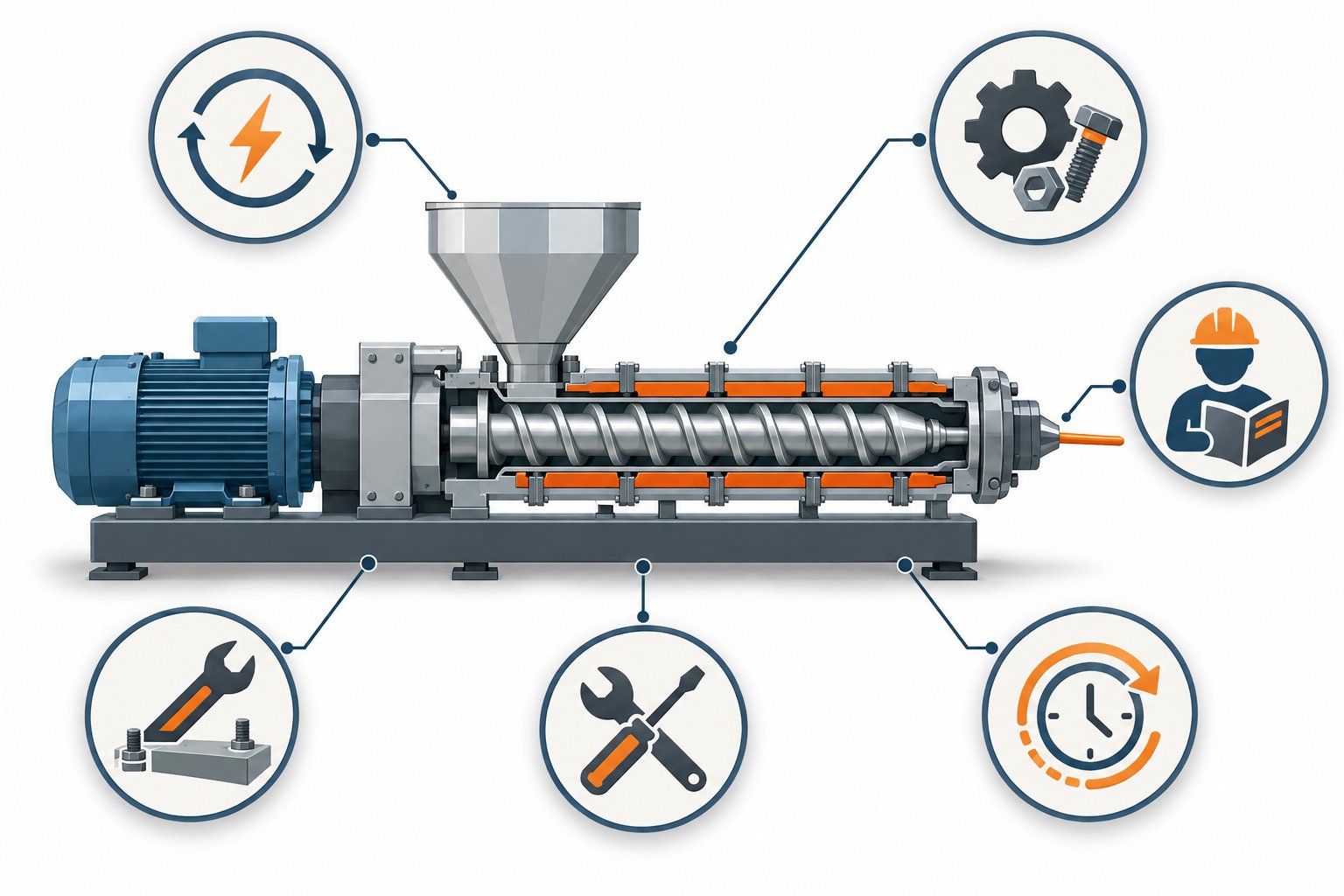
Before signing any purchase order, model these total cost of ownership (TCO) line items against your production plan:
- Installation and site preparation — Foundations, electrical distribution, cooling water connections, compressed air supply, ventilation, and rigging. These costs vary dramatically by facility and are almost never included in the machine quote.
- Commissioning and startup support — Factory acceptance testing (FAT) at the supplier's facility and site acceptance testing (SAT) at your plant confirm that the machine meets agreed performance specs. Skipping these steps saves a few thousand dollars and risks months of troubleshooting.
- Operator training — A well-trained crew extracts more output, generates less scrap, and catches wear issues before they become catastrophic failures. Ask whether the supplier includes hands-on training or charges separately.
- Energy consumption — For a machine running 6,000+ hours annually, electricity is often the single largest operating cost after raw material. Modern drive technology makes a measurable difference here. The Radius Systems case study documented 8-15% energy savings simply by replacing a legacy DC motor with an IE4 SynRM package on one extrusion line — plus over £2,000 in annual maintenance cost avoidance from eliminating DC motor brush changes and inspections. Barrel insulation jackets, which reduce radiated heat loss from barrel heaters, can yield an additional 5-10% reduction in heating energy. Over a decade of operation, these efficiency gains compound into five- and six-figure savings.
- Preventive maintenance — Screw and barrel inspection intervals, gearbox oil changes, bearing replacements, heater band monitoring, and thermocouple calibration. A supplier who provides a documented PM schedule with recommended intervals and estimated costs is giving you a planning tool, not just a machine.
- Spare parts availability and cost — Heater bands, thermocouples, barrel liners, screw tips, thrust bearings, and drive components all have finite lifespans. Ask your supplier about spare parts lead times, stocking policies, and whether third-party replacement components are compatible. A machine with proprietary parts from a single-source supplier creates a dependency that can get expensive fast.
- Screw and barrel replacement — This is the most significant recurring capital expense. Depending on the polymer and filler content, screws and barrels may need rebuilding or replacement every 8,000 to 15,000 operating hours. Budgeting for this replacement cycle — and identifying reliable component suppliers in advance — prevents production interruptions when wear inevitably reaches its limit.
- Resale or disposal value — Well-maintained single screw extruders from reputable OEMs retain meaningful residual value on the secondary market. Machines with documented maintenance history, current-generation controls, and standard screw diameters are significantly easier to sell than custom or obscure-brand equipment.
The true cost of a single screw extruder is never the purchase price — it is the sum of every dollar spent acquiring, operating, maintaining, and eventually replacing the machine over its full productive life.
Supply chain reliability has become an equally critical factor in recent years. Lead time predictability for both new machines and replacement components can vary widely depending on the supplier's manufacturing capacity, raw material sourcing, and geographic location. A supplier quoting a 16-week delivery that stretches to 28 weeks disrupts your capital planning, delays revenue, and may force you into expensive interim solutions. During the evaluation process, ask for references from recent buyers and verify whether quoted lead times were actually met.
Modeling TCO before committing to a purchase also reveals something else: it forces you to think about the type of supplier relationship you need. A machine vendor who disappears after shipment is a fundamentally different partner than one who stocks your spare parts, provides field service technicians, and offers screw and barrel upgrades as your product mix evolves. That distinction — between a transaction and a partnership — becomes even clearer when you look at how different categories of suppliers operate across the global landscape.
Understanding the Global Supplier Landscape and Aftermarket Support
Not every organization selling extrusion equipment operates the same way. The company behind your quote might design and manufacture machines in-house, assemble lines from third-party components, resell someone else's inventory, or broker used equipment from decommissioned plants. Each of these supplier types brings a different combination of engineering capability, customization depth, and long-term support — and confusing one for another is a costly mistake that shapes your experience for the entire life of the machine.
Supplier Categories: OEMs, Integrators, Distributors, and Used Dealers
When you start searching for single screw extruder manufacturers or browsing listings for an extruder machine for sale, you'll encounter four fundamentally different types of organizations. Understanding what each one actually does — and, just as importantly, what it doesn't do — keeps you from expecting OEM-level engineering support from a company that's really just a reseller.
Think of it this way. An OEM is the company that designs the screw geometry, machines the barrel, selects the drive components, and writes the control software. A system integrator takes that extruder and combines it with a die, cooling tank, haul-off, and cutter to deliver a complete production line. A distributor acts as a point of sale — stocking equipment, providing product knowledge, and handling transactions without necessarily performing installation or custom engineering. And a used-equipment dealer sources secondhand machines, sometimes refurbishes them, and resells them to buyers looking for faster delivery and lower upfront cost.
The table below maps these four categories against the criteria that matter most during your evaluation process.
| Supplier Type | Typical Offering | Customization Level | Aftermarket Support | Best For |
|---|---|---|---|---|
| OEM Manufacturer | Designs and builds complete extruders in-house; controls screw, barrel, drive, and controls specification | High — custom screw geometry, barrel metallurgy, and control architecture tailored to your polymer and application | Strong — direct access to engineering, documented spare parts programs, field service, and upgrade paths | Buyers requiring application-specific machines, full warranty coverage, and long-term technical partnership |
| System Integrator | Assembles turnkey extrusion lines by combining extruders, dies, downstream equipment, and controls from multiple vendors | Moderate to High — line-level customization with component selection flexibility, though individual machine design depends on the OEM partner | Varies — strong integrators maintain service teams and spare parts inventory; weaker ones rely on individual component OEMs for support | Buyers who need a complete production line engineered, installed, and commissioned as a single-source project |
| Distributor / Reseller | Stocks and sells equipment from one or more manufacturers; provides product selection guidance and handles transactions | Low — limited to options available within the represented manufacturer's catalog | Limited — can facilitate warranty claims and spare parts orders but typically lacks in-house engineering or field service capability | Buyers who know exactly what they need and want fast access to in-stock or standard-catalog equipment |
| Used-Equipment Dealer | Sources, inspects, and sometimes refurbishes secondhand extrusion equipment for resale | Minimal — you purchase the machine in its existing configuration with limited modification options | Minimal to None — most sales are as-is; spare parts sourcing and technical support fall entirely on the buyer | Budget-conscious buyers, startups needing fast capacity, or processors seeking a specific legacy model |
You'll notice a pattern: the more distance between you and the organization that actually engineered the machine, the thinner the aftermarket support becomes. A distributor can get you a replacement heater band, but they probably can't redesign your screw for a new polymer grade. A used-equipment dealer can deliver a machine in two weeks, but when the gearbox fails six months later, you're on your own. That's not a reason to avoid these channels — it's a reason to match your expectations to the supplier type you're engaging.
Regional Considerations and Aftermarket Support
Geography adds another layer of complexity. Where a supplier manufactures, warehouses spare parts, and stations field technicians directly affects your lead times, shipping costs, and response speed when something goes wrong at 2 a.m. on a Friday.
The global extrusion machinery market — projected to grow from $9.1 billion in 2026 to $13.1 billion by 2033 — is concentrated in three major regions, each with distinct buyer implications:
- Asia Pacific — Home to the largest concentration of single screw extruder manufacturers, particularly in China and Taiwan. Competitive pricing and broad product catalogs are the draw. The trade-off can be longer ocean freight lead times, time-zone gaps for technical support, and variable quality control across the wide range of producers in the region. Buyers evaluating Asian-sourced plastic extrusion machine for sale listings should verify build quality, component sourcing, and the supplier's actual — not claimed — service infrastructure in their region.
- Europe — Known for precision engineering, energy efficiency, and robust compliance with CE marking and machine safety directives. European OEMs often lead in recycling-compatible and high-performance extrusion technology. Higher equipment prices reflect tighter tolerances, premium components, and comprehensive documentation. Aftermarket networks across the EU tend to be well-developed, though buyers in other regions should confirm local service availability.
- North America — A mature market with established OEMs and strong aftermarket infrastructure. Brands like Davis-Standard have built reputations on decades of application engineering and field support. A Davis-Standard extruder, for instance, represents the kind of documented performance history and spare parts availability that reduces long-term operational risk. North American buyers benefit from shorter domestic shipping, same-time-zone technical support, and a deep pool of trained service technicians — advantages that become particularly valuable when production uptime is non-negotiable.
Regardless of region, evaluate any supplier's service infrastructure with the same rigor you apply to the machine itself. Ask these questions before you commit:
- Where are spare parts warehoused, and what is the typical fulfillment lead time for critical components like barrel liners, screw tips, and drive parts?
- Does the supplier maintain field service technicians in your geography, or do they rely on third-party contractors?
- Can they support retrofits and upgrades — such as control system modernization or screw redesign — as your production requirements evolve?
- What certifications does the supplier hold? ISO 9001 quality management certification and CE marking should be treated as minimum standards, not differentiators. Their presence confirms a baseline commitment to documented quality systems; their absence is a disqualifying red flag.
- Does the supplier offer factory acceptance testing (FAT) and site acceptance testing (SAT) as part of the purchase? These protocols verify that the machine meets agreed performance specifications before it leaves the factory and again after installation — a rigorous quality gate that protects both parties.
The search for extrusion equipment for sale can surface hundreds of options across all four supplier categories and multiple continents. That abundance is a double-edged sword. More choices mean more opportunities to find exactly the right machine — but also more chances to engage a supplier whose support model doesn't match your operational needs. Mapping each prospect onto the supplier-type and regional-support frameworks above filters the noise and focuses your shortlist on partners who can deliver not just a machine, but the ongoing relationship your production line depends on.
One area where that ongoing relationship proves especially critical is screw and barrel technology — the components that wear, that need periodic replacement, and that must be precisely matched to your polymer if the machine is going to perform at its engineered potential.
Screw and Barrel Technology as a Key Supplier Differentiator
Every component on a single screw plastic extruder machine will eventually need attention — motors get serviced, heaters get swapped, thermocouples get recalibrated. But no component influences day-to-day production quality more directly, or wears out more consequentially, than the screw and barrel. These two parts define your melt quality, throughput consistency, and energy efficiency. They're also the components most likely to expose the gap between a supplier who truly understands your process and one who simply ships hardware.
Why does this matter so much for supplier evaluation? Because screw and barrel decisions aren't one-time events. They're recurring operational investments. Plastics Technology notes that original screw-to-barrel clearances are typically just 0.001 inch per side per inch of diameter — and as soon as the screw begins rotating, wear starts. The harder the material, the faster those clearances widen. Over time, melting efficiency drops, operators compensate with higher screw speeds and backpressure adjustments, and production gradually degrades until a rebuild or replacement becomes unavoidable. The supplier who provides your screw and barrel — whether at initial purchase or as replacement components years later — directly controls how well your machine performs across every operating hour.
Screw Geometry and Customization Options
Imagine two processors both running HDPE pipe on identical-diameter extruders. One achieves uniform wall thickness with minimal gels. The other fights melt inconsistencies on every shift. The difference often traces back to screw geometry — specifically, how well the screw's design variables are tuned to the polymer's melt behavior, throughput target, and downstream die requirements.
A screw plastic extruder relies on precise geometric relationships between several interdependent variables. When a supplier discusses customization, these are the parameters they should be adjusting — and the ones you should be asking about:
- Flight depth (channel depth) — Determines the volume of material the screw can convey and directly affects shear rate. NC State Extension's research on screw profile design confirms that channel depth decreases progressively from the conveying zone through compression to metering, with deeper channels enabling gentle material transport in the feed section and shallower channels intensifying shear and pressure in the metering zone. A supplier who proposes a single channel depth across all applications is ignoring the fundamentals.
- Compression ratio — The ratio of the feed zone channel volume to the metering zone channel volume, typically ranging from 2:1 for shear-sensitive materials like PVC up to 4:1 for semi-crystalline polyolefins like HDPE. This ratio governs how aggressively the screw compacts and melts the solid bed. Too high a ratio for a given resin can cause solids wedging — a condition where unmelted material plugs the channel and forces the screw against the barrel wall, causing galling and accelerated wear on both components.
- Mixing sections — Distributive mixing elements (like pineapple or spiral mixers) spread the melt evenly without imposing excessive shear, while dispersive mixing elements (like Maddock or fluted mixers) break down agglomerates and unmelted particles. The NC State research distinguishes these two mechanisms clearly: distributive mixing spreads the dispersed phase without breaking down particles, while dispersive mixing applies strong shear stress to break apart clumps. A well-engineered screw places the right type of mixer in the right location — typically near the screw tip, just upstream of the die — to address specific melt uniformity challenges without degrading shear-sensitive polymers.
- Barrier flights — A secondary flight that physically separates the solid bed from the melt pool, forcing molten polymer across the barrier clearance into a dedicated melt channel. Barrier screws deliver more consistent melt temperature and fewer unmelted particles than conventional three-zone designs, making them a standard recommendation for high-output polyolefin processing. Suppliers who offer barrier flight designs as a standard option — rather than an expensive add-on — signal deeper application engineering capability.
- Venting ports — Two-stage screw designs incorporate a decompression zone that drops melt pressure, allowing a barrel vent port to extract moisture, volatiles, and trapped gases before the melt enters the final metering section. Essential for hygroscopic resins like PET and nylon, and increasingly common in recycling applications where incoming material carries residual contamination.
So when should you insist on a custom screw design versus accepting a standard geometry? A useful rule of thumb: if your application involves a single, well-characterized polymer processed in steady-state at moderate throughput, a standard screw with proven geometry for that resin family may perform perfectly. But if you're pushing throughput limits, processing filled or abrasive compounds, running multiple resin families on the same machine, or targeting tight dimensional tolerances on the finished product, a custom-designed screw pays for itself quickly in reduced scrap, lower energy consumption, and longer intervals between rebuilds.
The red flag is a supplier who never asks about your polymer, filler content, or production targets before recommending a screw. Plastic screw machining to tight tolerances is expensive — and a supplier who skips the engineering conversation either can't do the analysis or doesn't think it matters. Both are disqualifying.
Barrel Construction and Wear Protection Technologies
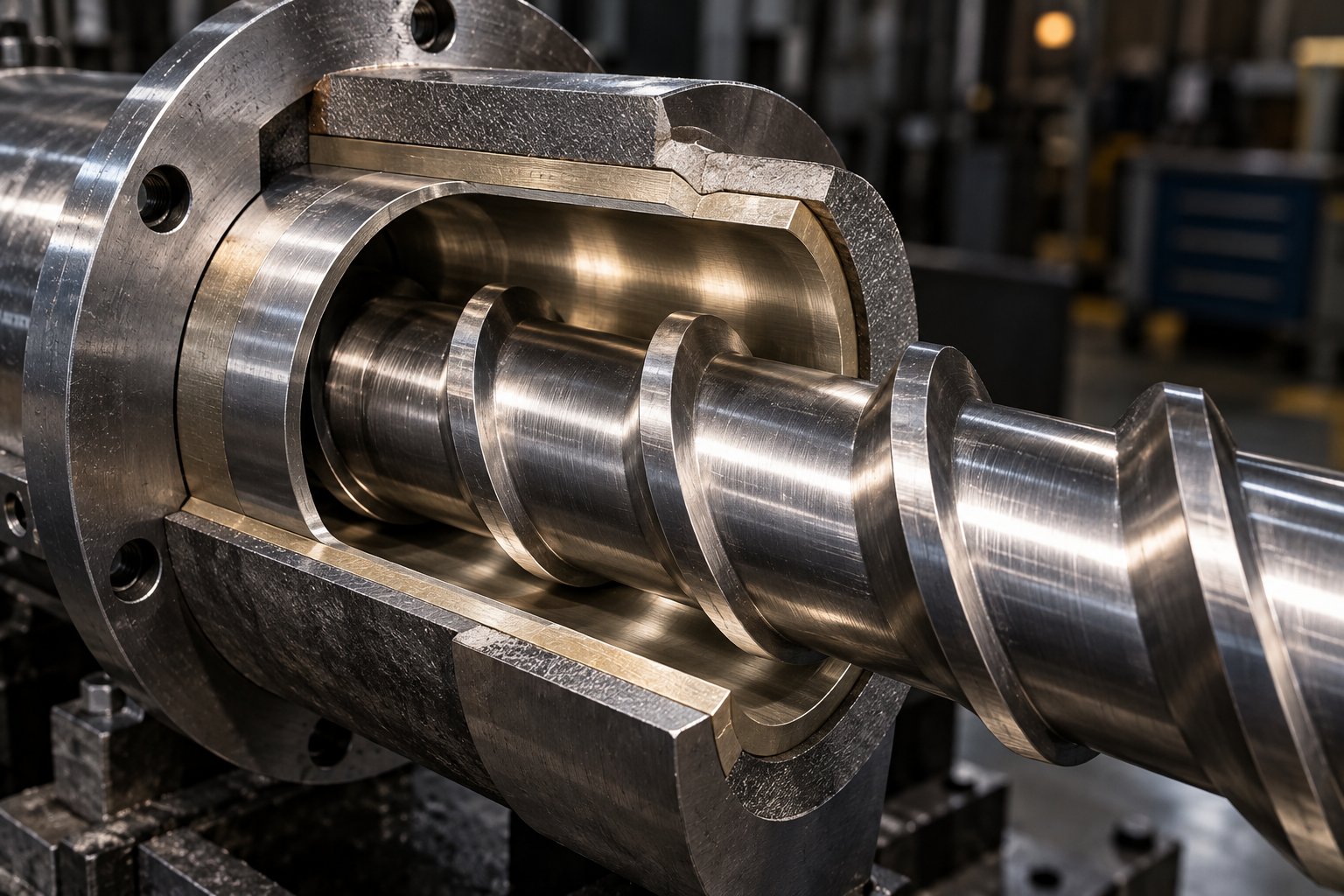
The barrel receives far less attention than the screw in most buyer conversations, yet it's the component that takes the most punishment — and the one whose metallurgy most directly determines how many operating hours you'll get before a costly replacement becomes necessary.
Three wear mechanisms attack barrel surfaces simultaneously. Industry analysis from Plastics Technology identifies these as adhesive wear (metal-to-metal contact between screw flights and barrel wall), abrasive wear (the most common type, caused by fillers, reinforcements, and contaminants in the resin), and corrosive wear (chemical attack from polymers that release aggressive byproducts during processing, such as PVC's hydrochloric acid or fluoropolymer degradation products). Each mechanism demands a different metallurgical defense strategy, and the barrel technologies available from your supplier determine which threats your machine can withstand.
Nitrided steel barrels are the baseline option. A thermochemical surface treatment creates a hard nitrogen-diffused layer on the barrel bore, providing moderate wear resistance at a lower cost. Nitrided barrels perform adequately for unfilled polyolefins and other non-abrasive resins. However, as Tan Star Industries notes, the limitations of conventional nitrided barrels become increasingly apparent as plastic materials grow more diverse and demanding — particularly with fiber-reinforced polymers and highly corrosive compounds.
Bimetallic barrels represent a significant step up. A bimetallic screw barrel consists of two distinct layers: a high-strength alloy steel substrate providing structural rigidity, and a centrifugally cast inner alloy layer — typically nickel-based or tungsten-based — engineered for wear and corrosion resistance. This composite design extends barrel life by three to five times compared to nitrided barrels when processing abrasive materials. The centrifugal casting process spins molten alloy inside the barrel shell at high speed, ensuring dense bonding between layers and uniform alloy thickness throughout the bore. After casting, precision heat treatment and CNC machining guarantee concentricity and surface hardness uniformity — critical for maintaining the tight flight-to-bore clearances that determine melting efficiency.
Specialized coatings and alloys address the most aggressive processing environments. Tungsten carbide-rich alloys protect against extreme abrasion from glass-fiber loadings of 30% or higher. Nickel-chromium-boron alloys resist the corrosive attack of halogenated polymers. The Plastics Technology analysis emphasizes that specifying compatible metals between screw flight hardfacing and barrel lining material is essential — softer alloys have a greater tendency to gall against harder surfaces, potentially accelerating wear rather than preventing it.
Here's the practical reality: screw and barrel replacement is not an "if" — it's a "when." Depending on your polymer, filler content, and operating hours, you'll face this expense every 8,000 to 15,000 hours. That recurring cost makes the availability of quality aftermarket screw and barrel components a critical factor in your overall supplier strategy. A supplier who can deliver a replacement barrel quickly — engineered for your specific application — prevents what would otherwise become days or weeks of unplanned downtime while you scramble to source a component.
This is where specialist component suppliers earn their place in your vendor network. NANHAIYA, for example, focuses specifically on custom and replacement single screw barrels for plastic extrusion, covering applications across pipe, film, sheet, pelletizing, recycling, and general-purpose extrusion lines. Having a dedicated barrel and screw specialist in your supply chain — separate from your primary machine OEM — creates redundancy that reduces your vulnerability to lead time surprises and single-source dependency. It's the same logic that drives processors to qualify multiple resin suppliers rather than relying on a single source for a critical raw material.
The broader point applies to every supplier on your shortlist: ask not only about the machine they're selling today, but about the screw and barrel support they can provide five, ten, and fifteen years from now. A supplier who engineers excellent initial components but offers no rebuild or replacement path is handing you a ticking clock — and when it runs out, you'll be starting your supplier search all over again under production pressure.
Screw geometry, barrel metallurgy, and wear protection strategy aren't isolated technical topics. They're concrete, testable indicators of a supplier's engineering depth. The supplier who walks you through compression ratio selection, recommends the right liner alloy for your filler package, and has a documented plan for aftermarket component supply is demonstrating exactly the kind of long-term partnership thinking that separates a good purchase from a regrettable one — and that's precisely the mindset you need when building your final evaluation checklist.
Your Actionable Supplier Evaluation Checklist and Next Steps
Compression ratios, barrel metallurgy, TCO modeling, supplier categories, regional logistics — by this point, you've absorbed a substantial amount of technical and commercial intelligence. The challenge now isn't knowledge. It's execution. How do you translate everything above into a repeatable, defensible process that consistently leads you to the right single screw extruder supplier for your specific operation?
The answer is a structured evaluation workflow you can follow step by step, from the first internal requirements meeting through the final handshake. Every red flag discussed in this article — the supplier who skips the engineering conversation, the one who can't explain barrel liner options, the dealer selling as-is equipment with no wear measurements — becomes easy to spot when you're working from a disciplined checklist rather than gut instinct.
Supplier Evaluation Checklist for Plastics Processors
Print this out, share it with your procurement and engineering teams, and use it as your scoring framework during the selection process. Each step builds on the one before it, and skipping any single gate increases your risk of a costly mismatch.
- Define your application and polymer requirements in writing. Specify the target polymer (including grade and filler content), required throughput range, end product geometry, and critical quality parameters such as dimensional tolerances and surface finish. This document becomes the foundation of every supplier conversation and ensures you're comparing quotes against the same baseline — not against each vendor's interpretation of a vague phone call.
- Confirm single screw is the correct technology. Review the performance comparison in this guide to verify that your application — whether pipe, film, sheet, profile, pelletizing, or recycling — aligns with single screw strengths. If your process requires intensive compounding or high filler incorporation, a twin screw path may be warranted, and pursuing the wrong technology wastes everyone's time.
- Determine new vs. used sourcing strategy. Evaluate your capital budget, lead time constraints, customization needs, and risk tolerance. New machines offer full warranty, custom engineering, and modern efficiency. Used equipment offers speed and lower upfront cost. Some buyers explore both simultaneously — reviewing a plastic extruder for sale on the secondary market while requesting OEM quotes — to establish a realistic cost and capability benchmark across both paths.
- Identify the appropriate supplier category. Decide whether you need an OEM manufacturer, a system integrator for turnkey line delivery, a distributor for standard catalog equipment, or a used-equipment dealer. Match your support expectations to the supplier type — and document those expectations in your RFQ so there's no ambiguity about what you're buying beyond the machine itself.
- Verify certifications and quality standards. Treat ISO 9001 quality management certification and CE marking as non-negotiable baselines. Request certificate numbers, issuing bodies, validity dates, and exact scope — a certificate covering "sales activities" is materially different from one covering "design and manufacturing." As ZetarMold's buyer checklist emphasizes, verify certificates through the issuing body rather than accepting scanned images at face value.
- Request and compare structured RFQs. Mandate line-item pricing that separates machine cost, drive package, control system, commissioning, training, and spare parts kits. A weighted scoring framework — with criteria such as technical fit, total cost of ownership, implementation support, and vendor stability defined before proposals arrive — prevents post-hoc rationalization of the decision your team wanted to make anyway. Require every vendor to quote against the same specification document from Step 1.
- Evaluate aftermarket support and spare parts availability. Ask where spare parts are warehoused, what fulfillment lead times look like for critical components (barrel liners, screw tips, heater bands, drive parts), and whether the supplier maintains field service technicians in your geography. A machine with no aftermarket backbone becomes a liability the moment its first component wears out.
- Model total cost of ownership over 10-15 years. Include installation, energy consumption at your projected operating hours, preventive maintenance intervals, screw and barrel replacement cycles, operator training, and eventual resale value. The supplier whose upfront quote is 15% higher but whose TCO is 20% lower over a decade is the better investment — and you can't see that without running the numbers.
- Conduct factory acceptance testing (FAT) before shipment. A rigorous FAT protocol verifies that the machine meets all agreed-upon specifications before it leaves the manufacturer's floor. This includes dimensional verification, motor and drive performance, control system loop testing, safety interlock validation, and a review of all engineering documentation. Skipping FAT to save time or cost is one of the most expensive shortcuts a buyer can take — issues caught at the factory cost a fraction of what they cost to resolve after the machine is bolted to your floor.
- Plan for site acceptance testing (SAT) after installation. SAT confirms the machine performs correctly under your actual operating conditions — your polymer, your cooling water, your electrical supply, your downstream equipment. Define pass/fail criteria in the purchase contract before the order is placed, not after the machine arrives.
Each of these ten steps is a gate. Passing through all of them doesn't guarantee a perfect outcome, but it eliminates the most common and most expensive failure modes — the ones that stem from incomplete information, mismatched expectations, or supplier relationships that looked solid on paper but had no substance behind the brochure.
Building Your Shortlist and Making the Final Decision
A disciplined checklist narrows the field. The final decision, though, comes down to judgment — and the best framework for that judgment is straightforward: shortlist suppliers who demonstrate genuine engineering depth, documented application experience with your target polymer, and a robust aftermarket support infrastructure that extends years beyond the initial sale.
Engineering depth shows itself in the questions a supplier asks you. A vendor who inquires about your filler package, compression ratio preferences, barrel cooling requirements, and downstream die geometry before quoting is doing the work. One who sends a catalog price within 24 hours of your first email is selling hardware, not solutions. The difference between those two approaches predicts the quality of every interaction you'll have over the next decade.
Application experience is verifiable. Ask for reference customers running the same polymer family on the same extruder model. Call those references and ask the questions that sanitized testimonials never answer: How was commissioning? What surprised you? Would you buy from them again? What do you wish you'd negotiated differently? These conversations reveal more about a supplier's true capability than any factory tour.
Aftermarket support is where long-term partnerships are either built or broken. Your screw and barrel will eventually wear. Your control system will eventually need updating. Your production requirements will eventually change. The supplier who can support all three of those inevitabilities — with stocked spare parts, field-capable technicians, and the engineering ability to redesign your screw for a new resin — is worth a premium over one who treats the purchase order as the finish line.
For screw and barrel sourcing specifically, consider building relationships with specialist component suppliers alongside your primary machine OEM. Companies like NANHAIYA, which specialize in custom and replacement single screw barrels across diverse extrusion applications — pipe, film, sheet, pelletizing, and recycling — can be a valuable addition to any processor's supplier network. Having a qualified barrel and screw source on call reduces your dependency on any single vendor and shortens your response time when wear-driven replacements become urgent. It's one element of a complete supplier strategy, not a substitute for one.
If you're browsing listings for a used extruder for sale alongside your new-equipment evaluation, apply the same checklist rigor to both paths. A used machine that checks eight out of ten boxes at half the price of a new one may be the right call for your situation — but only if you've verified screw and barrel condition, control system viability, and drive health with the same discipline you'd bring to an OEM specification review. The red flags don't change just because the price is lower.
The best single screw extruder supplier relationship balances upfront cost with long-term operational partnership — because the machine you buy today will demand support, spare parts, and engineering expertise for the next fifteen to twenty years.
Whether you're evaluating extruders for sale from global OEMs, reviewing plastic extruders for sale on the secondary market, or sourcing replacement components for an existing line, the framework is the same: define your requirements first, score every supplier against them, verify claims with evidence, and choose the partner — not just the price — that protects your production over the full lifecycle of the equipment. That's not a procurement philosophy. It's a red flag filter that works every time you use it.
Frequently Asked Questions About Choosing a Single Screw Extruder Supplier
1. What should I look for when evaluating a single screw extruder supplier?
Focus on five core areas: engineering depth (do they ask about your polymer, filler content, and throughput targets before quoting?), application experience with your specific resin family, aftermarket support infrastructure including spare parts warehousing and field service coverage, verifiable certifications such as ISO 9001 and CE marking, and transparent total cost of ownership modeling that accounts for energy consumption, screw and barrel replacement cycles, and preventive maintenance over 10-15 years. A supplier who skips the technical conversation and jumps straight to pricing is a significant red flag.
2. How much does a single screw extruder cost and what drives the price?
Pricing varies widely based on screw diameter and L/D ratio, drive power and motor type (AC inverter vs. direct-drive), barrel metallurgy (nitrided steel vs. bimetallic liners), control system sophistication, customization level, and brand origin. The purchase price typically represents only 25-35% of lifetime spending. Energy consumption, screw and barrel replacements every 8,000-15,000 operating hours, spare parts, training, and maintenance make up the remaining 65-75%. Requesting line-item quotes from multiple suppliers against identical specifications is the most reliable way to compare real costs.
3. What is the difference between a single screw extruder and a twin screw extruder?
A single screw extruder uses friction-driven conveying to melt pre-compounded pellets into finished products like pipe, film, and sheet at high throughput and lower energy cost. A twin screw extruder uses intermeshing screws for intensive mixing, compounding, and reactive extrusion of multi-component formulations. Single screw machines cost 30-75% less, have simpler maintenance, and excel in steady-state production. Twin screw machines are necessary when the process itself must blend polymers, disperse pigments, or incorporate high filler loadings. Confirming the right technology before contacting suppliers prevents mismatched quotes.
4. Should I buy a new or used single screw extruder?
New machines offer full OEM warranty, custom screw and barrel engineering for your exact polymer, modern energy-efficient drives, and current-generation controls — but come with higher upfront cost and 12-24+ week lead times. Used equipment can reduce capital outlay by 40-60% with near-immediate availability, but carries trade-offs in warranty coverage, unknown wear history, potentially obsolete controls, and 10-18% higher energy consumption. Always measure screw OD and barrel bore ID on used machines before purchasing, verify control system compatibility, and inspect drive condition to avoid hidden costs that erode the apparent savings.
5. Why is screw and barrel quality important when choosing an extruder supplier?
The screw and barrel are the highest-wear components on any single screw extruder and directly determine melt quality, throughput consistency, and energy efficiency. Original clearances of just 0.001 inch per side per inch of diameter widen continuously during operation, degrading performance over time. Barrel metallurgy — nitrided steel, bimetallic liners, or specialized corrosion-resistant alloys — dictates component life, which can range from 4,000 to 15,000+ hours depending on the polymer and filler content. Suppliers like NANHAIYA who specialize in custom and replacement single screw barrels across pipe, film, sheet, pelletizing, and recycling applications provide a critical aftermarket resource that reduces unplanned downtime when rebuilds become necessary.
Written by
Nanhaiya Technical Team
Zhoushan Nanhaiya Plastic Machinery Co., Ltd.
The Nanhaiya technical team supports screw and barrel manufacturing projects through application review, technical communication, custom manufacturing coordination, and production and quality control.
Discuss Your Application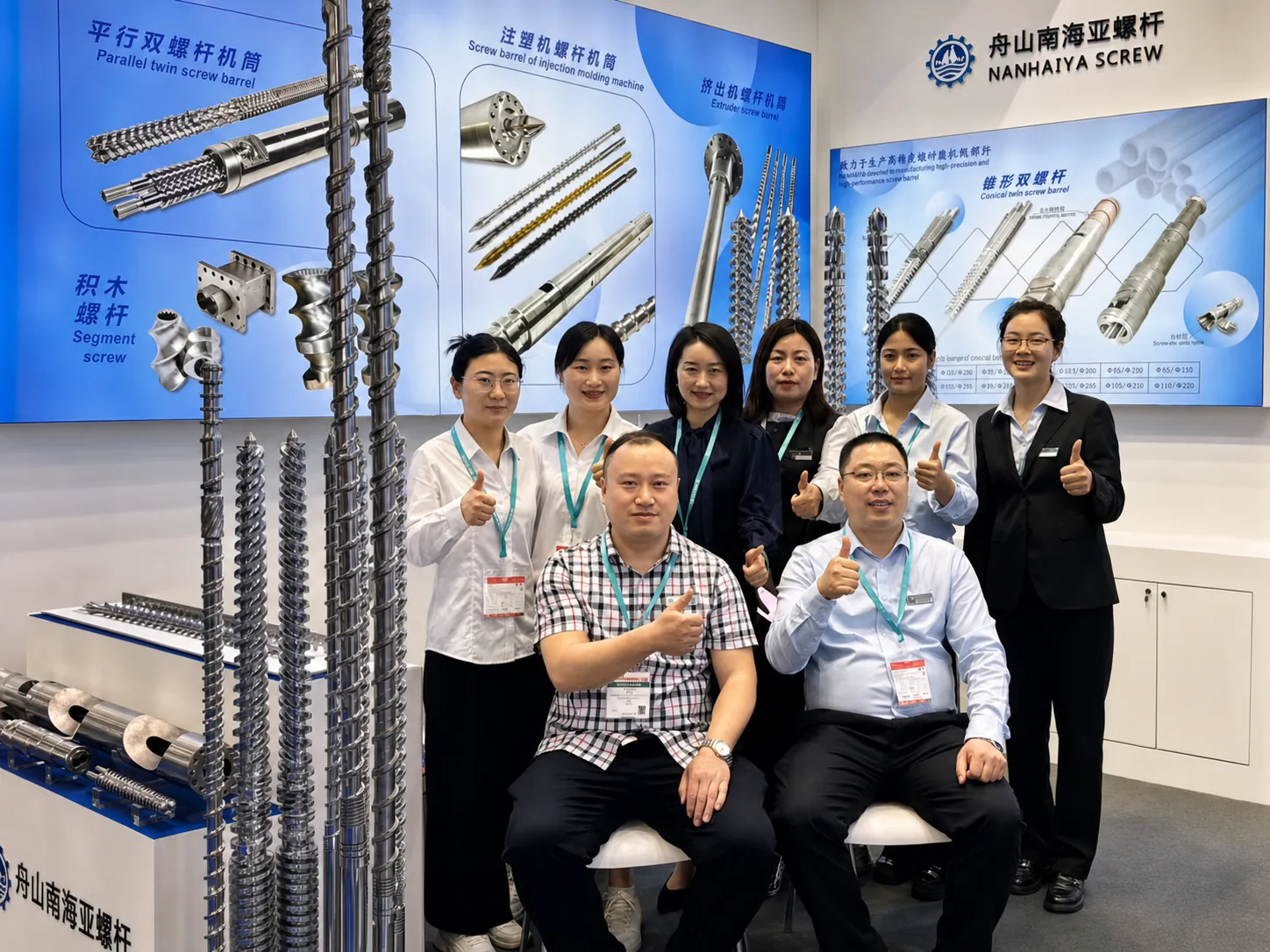
Related Articles
More insights on screw barrel technology and plastics processing.
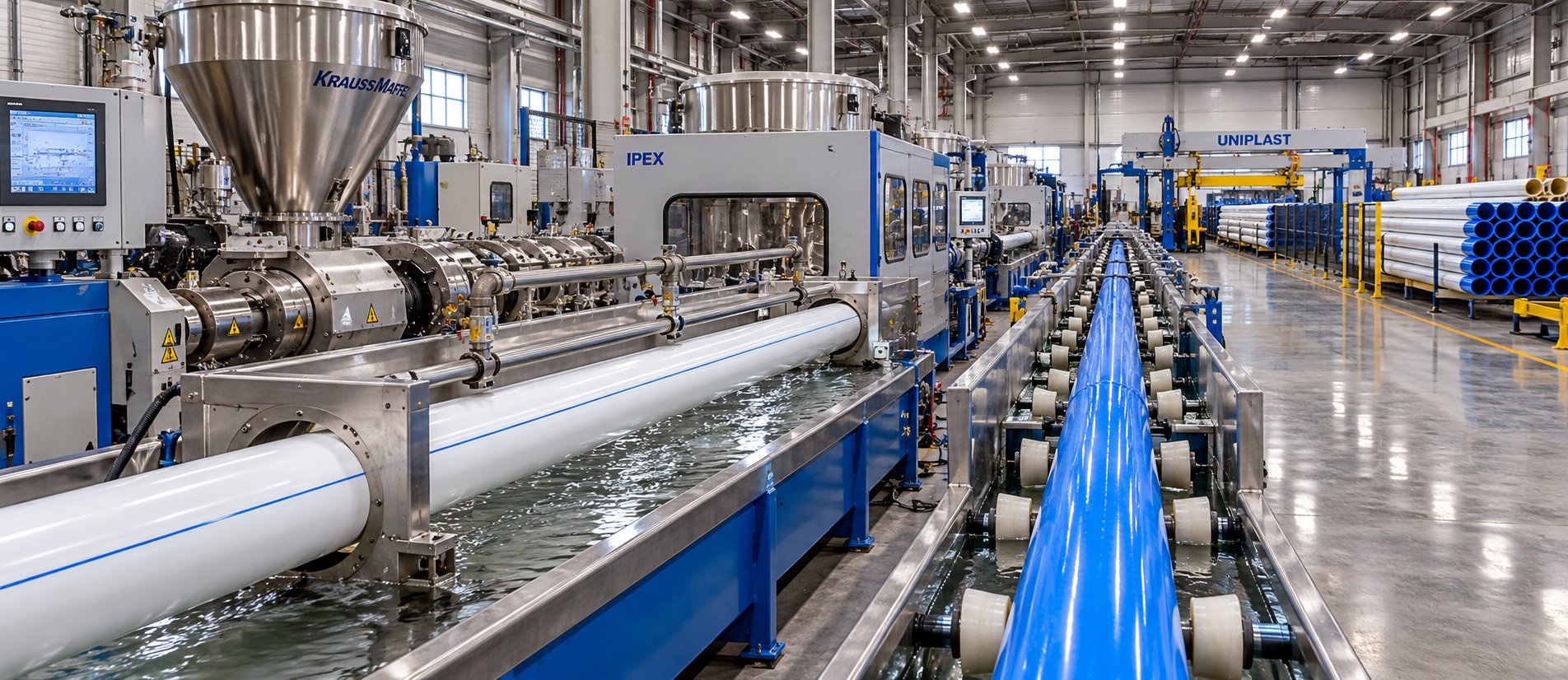
HDPE Pipe Making Machine Decoded: From Specs to Smart Purchase
Oct 15, 2026
Learn how HDPE pipe making machines work, from extruder specs and extrusion process steps to automation levels, maintenance costs, and smart buying tips.
Read Article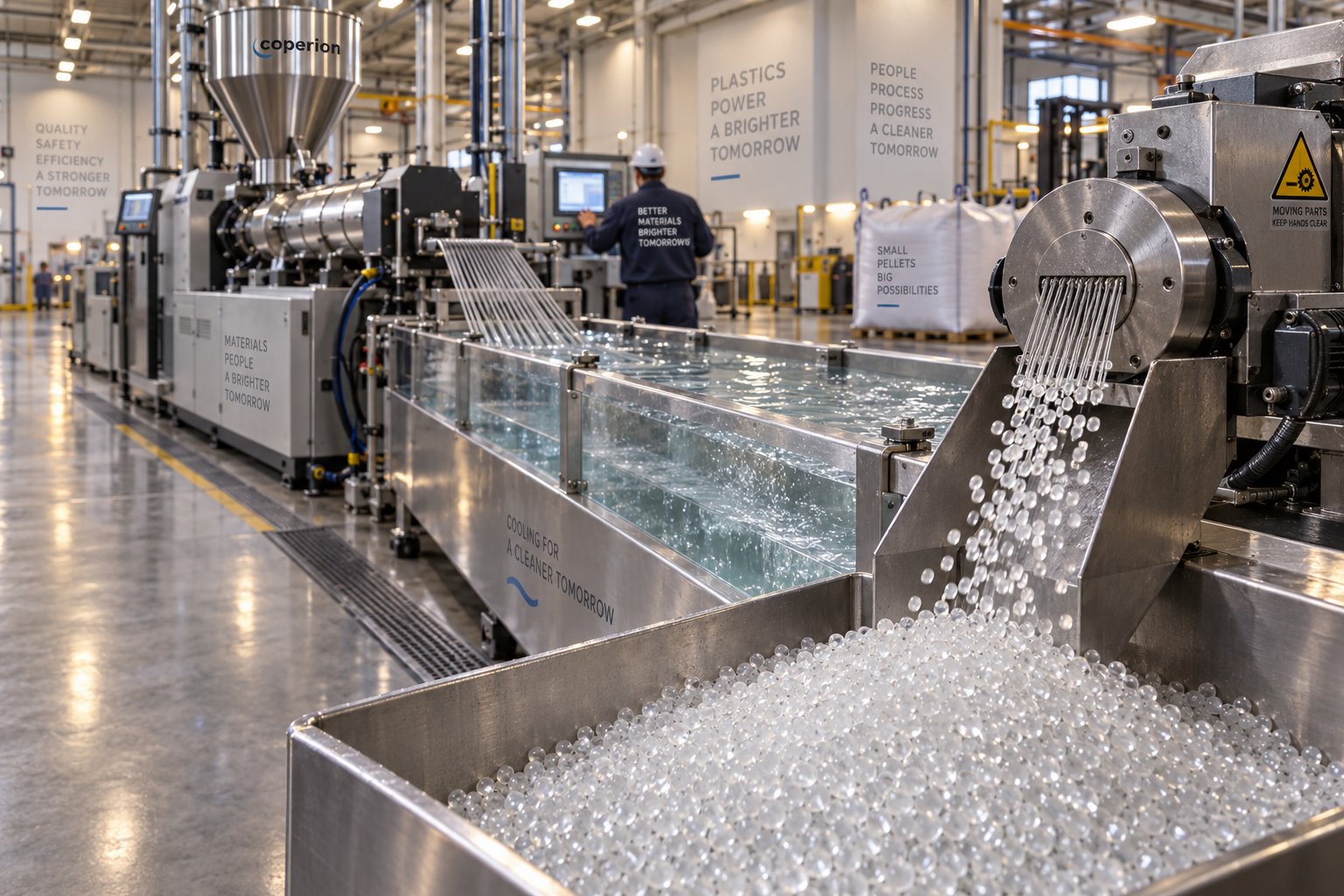
Pick the Wrong Plastic Pelletizing Line and You Pay Twice
Oct 14, 2026
Learn how to spec the right plastic pelletizing line for your resin, throughput, and budget. Covers strand, underwater, and air-cooled systems plus ROI planning.
Read Article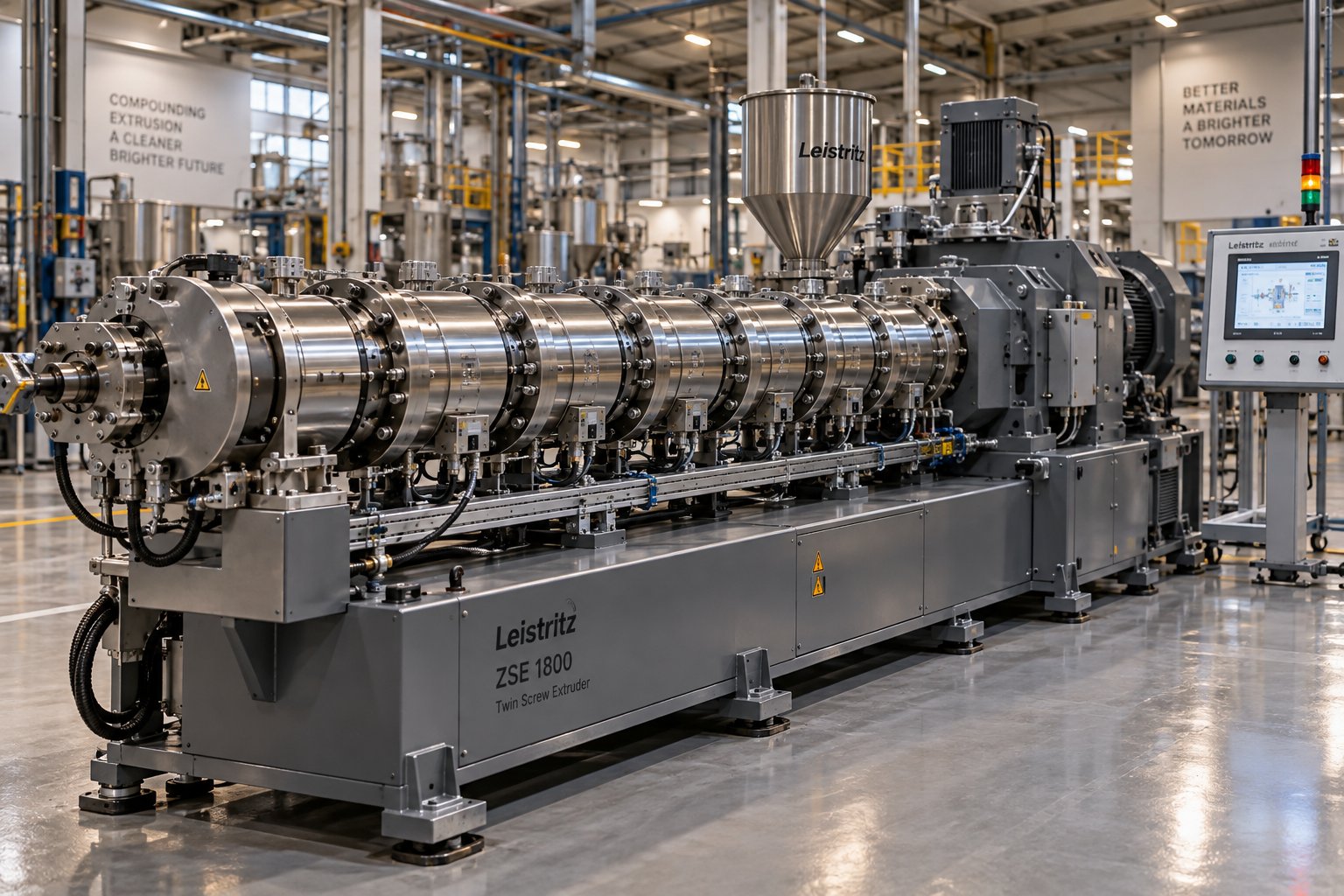
Co Rotating Twin Screw Extruder Manufacturer: Beyond The Brochure
Oct 13, 2026
Learn how to evaluate a co rotating twin screw extruder manufacturer using specs, TCO analysis, red flags, and a step-by-step buyer framework.
Read ArticleLooking for something else?
Search by material, symptom or product and jump straight to the relevant page.
These are navigation suggestions based on keyword matching — not a quotation, not a delivery commitment, and not a substitute for engineering review. Final specification is confirmed by our engineers against your drawings and processed material.
Need help with screw barrel selection?
Share your machine model, processed material and application. Our team can help with pricing and technical support.