

What a Plastic Pelletizing Line Does and Who Needs One
Imagine spending six figures on equipment only to discover it can't handle your feedstock. That scenario plays out more often than you'd think, and it almost always traces back to a misunderstanding of what a pelletizing line actually does and which version fits the job.
What Is a Plastic Pelletizing Line
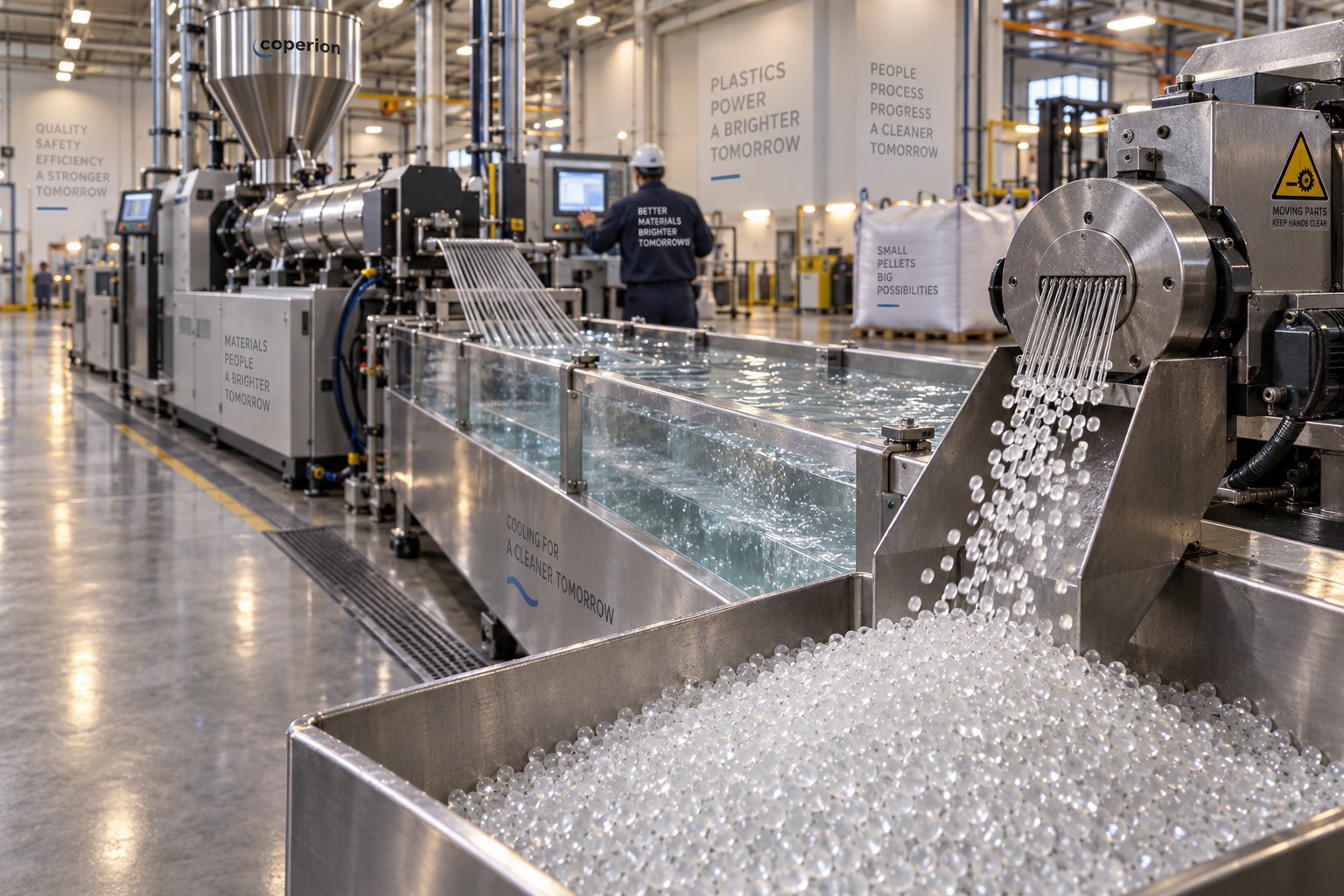
A plastic pelletizing line is an integrated production system that converts raw, compounded, or recycled plastic into uniform pellets by feeding material through an extruder, filtering contaminants from the melt, shaping the polymer through a die, cooling the output, and cutting it into consistently sized granules ready for downstream manufacturing.
So what is a pelletizer within this larger system? It refers specifically to the cutting stage, but the line itself encompasses every step from raw input to finished pellet. Material enters through a feeder or conveyor, moves into a heated extruder barrel where rotating screws melt and homogenize the polymer, then passes through a screen changer that strips out impurities. The clean melt is forced through a die plate, rapidly cooled using water or air, and sheared into pellets by a precision cutter. Each stage depends on the one before it. A weak link anywhere in the sequence degrades the final product, which is exactly why choosing the right configuration matters so much.
Why Pelletizing Lines Matter Across the Plastics Industry
Plastic pelletizing isn't a single-purpose process reserved for recyclers. The technology serves a surprisingly broad range of operations, each with distinct demands:
- Recyclers converting post-consumer film, bottles, or mixed rigid flakes into reusable resin pellets.
- Compounders blending base polymers with fillers, flame retardants, or impact modifiers to create performance-engineered resins.
- Masterbatch producers concentrating color pigments or additive packages into carrier pellets for precise dosing.
- Virgin resin processors shaping reactor-output polymer into a standardized, market-ready pellet form.
A recycler processing washed LDPE film faces entirely different challenges than a compounder producing glass-fiber-reinforced nylon. The extruder type, screw geometry, filtration strategy, cooling method, and cutting technology all shift based on the application. No single off-the-shelf configuration covers every case, and assuming otherwise is exactly how buyers end up paying twice: once for the wrong line and again to fix it.
This guide is built as a decision-engineering resource. Rather than listing product specs, it walks through every variable that shapes a successful pelletizing operation, from core components and cutting technologies to material-specific setups, throughput planning, cost analysis, and quality control. The goal is straightforward: help you match the right equipment to your actual process before a purchase order locks you in.
That match starts with understanding what sits inside a pelletizing line and how each component influences the one downstream.
Core Components of a Pelletizing Line From Feed to Finish
Every piece of plastic pelletizing equipment in the line exists for a reason, and skipping over even one component during the selection process creates problems that ripple downstream. Think of the system as a chain: the feeder sets the pace, the extruder does the heavy lifting, and the filtration-die-cooling-cutting sequence determines what your pellets actually look like when they hit the storage bin.
Here is the full sequence, laid out in the order material actually travels through a pelletizing machine:
- Feeding and pre-treatment - volumetric or gravimetric feeders, shredders, densifiers, or cutter compactors
- Conveying - belt conveyors, auger systems, or forced-feed mechanisms
- Extrusion - single-screw or twin-screw extruder with screw barrel assembly
- Melt filtration - screen changer with mesh packs to remove contaminants
- Die plate - shapes the melt into strands or droplets at the extrusion head
- Cooling - water bath, water ring, underwater chamber, or air system
- Pelletizer cutter - rotating blades shear cooled or molten strands into uniform pellets
- Drying, classifying, and packaging - centrifugal dryers, vibrating screens, bagging systems
Each of these stages deserves a closer look.
Feeding, Conveying, and Pre-Treatment Equipment
What happens before the extruder matters more than most buyers realize. If material enters the barrel inconsistently, you'll see surging output, uneven melt quality, and pellets that vary in size from one minute to the next.
Two feeder categories dominate. Volumetric feeders deliver material at a set speed regardless of density variations. They're simple and affordable, but any fluctuation in bulk density translates directly into feed-rate swings. Gravimetric feeders weigh material in real time and adjust the feed rate automatically, which keeps the extruder loaded at a constant mass flow. For operations where consistency is non-negotiable, gravimetric is the safer bet.
Low-bulk-density materials like film scraps or woven bags present a unique challenge. You can't just dump a pile of fluffy film into a hopper and expect the screw to grab it. That's where densifiers, cutter compactors, and forced-feed systems come in. A cutter compactor, for example, combines cutting, compacting, and pre-heating into one upstream unit, dramatically increasing the apparent density before material ever reaches the barrel. Shredders play a similar upstream role for rigid scrap, reducing oversized chunks into pieces the feeder can handle uniformly.
The principle is straightforward: garbage in, garbage out. Upstream preparation directly governs downstream pellet quality.
Extruder Types and Their Roles
The extruder is the heart of any pelletizing machine plastic processors invest in. It melts the polymer, mixes in additives, removes trapped gases and moisture through devolatilization, and generates the pressure needed to push melt through the die. Two architectures cover the vast majority of applications.
Single-screw extruders use one rotating screw inside a heated barrel. They excel at processing clean, pre-sorted, and relatively homogeneous feedstocks, making them a natural fit for straightforward recycling lines handling washed HDPE flake or pre-compounded regrind. Their mechanical simplicity keeps capital costs lower and maintenance schedules lighter.
Twin-screw extruders run two intermeshing screws, either co-rotating or counter-rotating, and they unlock capabilities a single screw simply cannot match. The intermeshing design delivers far superior distributive and dispersive mixing, which is essential when you're blending fillers, colorants, flame retardants, or reinforcing fibers into a base resin. Compounding, masterbatch production, and mixed-material recycling streams almost always demand twin-screw technology because the screw barrel assembly can be configured with modular elements, each segment tuned for a specific function like conveying, kneading, venting, or pressure buildup.
Choosing the wrong extruder type is one of the costliest mistakes in line specification. A single-screw unit forced to compound glass fiber will produce poorly dispersed, inconsistent pellets. A twin-screw system running clean, single-resin regrind adds unnecessary capital and operating expense. The material and the application dictate the choice, not the price tag alone.
Filtration, Die, Cooling, and Cutting Systems
Filtration is the most overlooked component in the entire line, yet it directly controls both uptime and pellet purity. The screen changer sits between the extruder and the die, catching contaminants like paper fibers, metal fragments, wood particles, and degraded polymer gels before they reach the pellet.
Three screen changer categories are widely used. Manual slide-plate changers are the simplest: an operator slides a plate out, replaces the clogged screen, and restarts flow. Production halts during every change. Hydraulic piston changers use dual-piston designs to swap screens without fully stopping the line, diverting melt flow from a dirty screen to a clean one. Continuous backflush changers take it further, automatically reversing a small portion of clean melt through the screen to flush contaminants, which dramatically extends screen life and reduces operator intervention. For high-contamination recycling streams, continuous systems pay for themselves quickly in reduced downtime alone.
The extruder screen packs themselves typically use woven wire mesh in layered configurations. A fine filtration layer, commonly ranging from 60 to 1,000 microns, sits between coarser support meshes that prevent deformation under pressure.
After filtration, the clean melt reaches the die plate, where it's forced through precision-machined holes to form strands, droplets, or ribbons depending on the cutting technology. The cooling system, whether a water bath, water ring, underwater chamber, or air stream, solidifies the polymer before the pelletizer cutter shears it into finished granules. Blade sharpness, rotational speed, and alignment against the die face all influence pellet geometry, so the cutter demands regular attention despite being the final component in the sequence.
How these cutting and cooling systems pair together defines an entirely separate set of trade-offs, and the differences between strand, water-ring, underwater, and air-cooled configurations are significant enough to warrant their own comparison.
Pelletizing Systems Compared: Strand vs Water-Ring vs Underwater vs Air-Cooled
The cutting and cooling method you select shapes nearly every downstream outcome: pellet geometry, throughput ceiling, operating cost, and even which resins the line can handle at all. Four pelletizing systems dominate the market, each built around a fundamentally different sequence of when the blade meets the polymer relative to when the polymer meets the coolant. Pick the wrong one and you're locked into limitations that no amount of extruder tuning can fix.
Strand Pelletizing
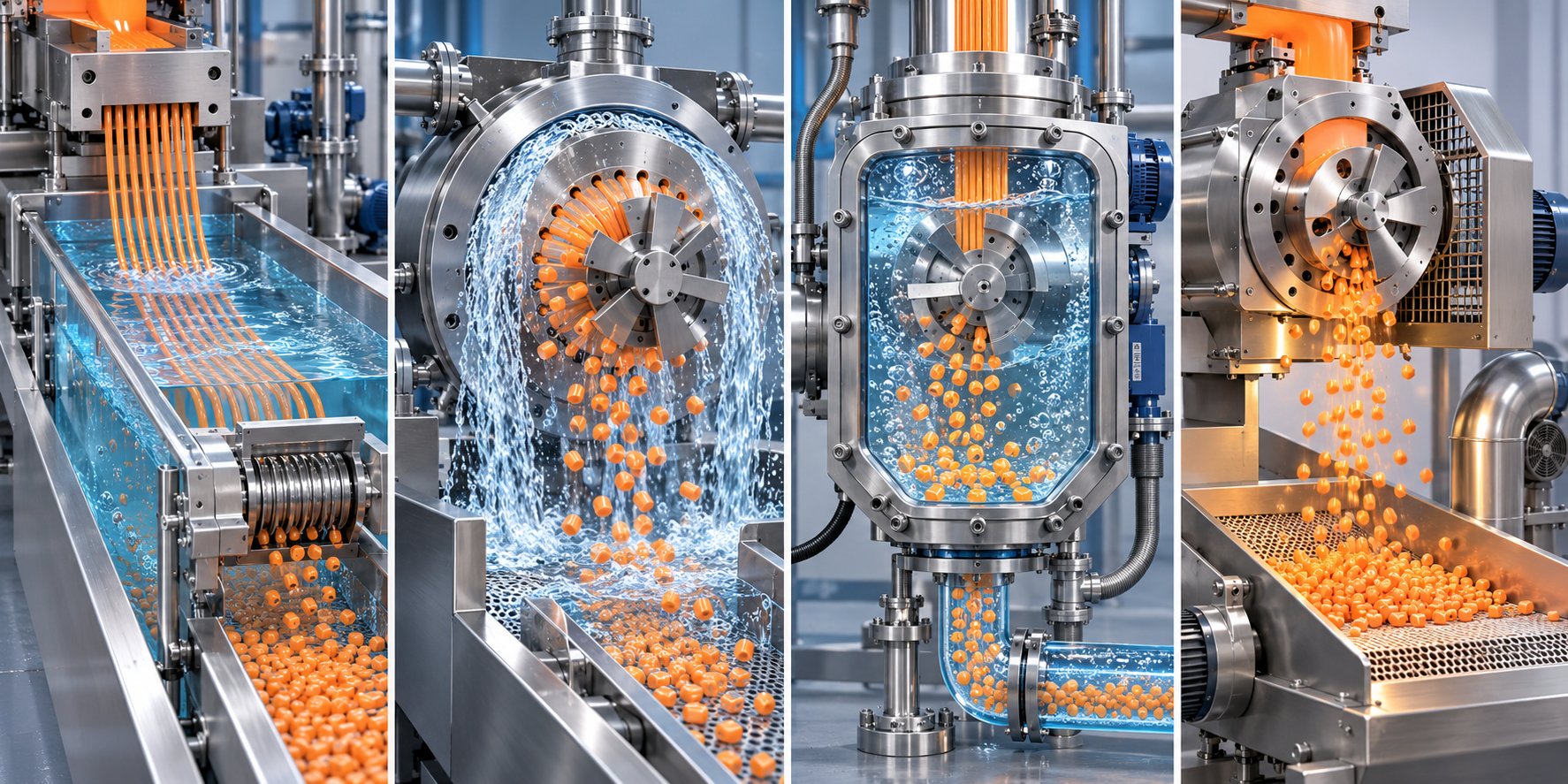
Strand pelletizing follows a simple principle: cool first, then cut. Molten polymer exits the die plate as continuous strands, sometimes as many as 75 at once, travels through a water bath or water slide where it solidifies, passes through an air knife or dewatering unit, and then feeds into a rotary pelletizer cutter that chops the hardened strands into cylindrical pellets.
Why is this the most widely installed entry-level technology? Cost and simplicity. The tooling is inexpensive, blade changes take minutes, and cleaning between color or resin changeovers is fast, making strand systems a natural fit for toll compounders running dozens of short-run jobs per month. Strand cutters handle a broad range of rigid polymers including ABS, PS, PC, and general-purpose polyolefins.
The trade-offs are real, though. Stringing up those 75 strands at every startup is labor-intensive. Dropped strands during the run are a recurring nuisance that wastes material and demands constant operator attention. High-melt-flow resins stretch and deform before the cutter reaches them, producing dog-bone pellets and excessive fines. And the water bath itself creates a significant floor-space footprint. According to Plastics Technology, strand pelletizers can reach throughputs up to roughly 20,000 kg/h, so the common assumption that strand equals small-scale is a misconception. Capacity isn't the limitation; automation and material compatibility are.
Water-Ring and Underwater Pelletizing
Both water-ring and underwater pelletizing systems are die-face cutters, meaning the blade shears molten polymer right as it exits the die holes, before solidification. The critical difference between the two lies in how much water surrounds the cut.
Water-ring pelletizing keeps the die face in open air. Rotating knives cut the melt at the die surface, and the freshly sheared pellets are flung outward into an annular ring of water that quenches and transports them to a centrifugal dryer. You'll notice this pelletizing system produces rounded, lens-shaped pellets, somewhat like aspirin tablets, rather than true spheres. It works best with high-melt-strength materials like PE, PP, and polystyrene, where the polymer holds its cut shape just long enough for water contact. Sticky or high-temperature resins such as PET and polyamides fall outside its working window entirely. Water-ring units top out at around 5,000 kg/h, the strictest throughput ceiling among the three water-based methods, but they're compact, moderately priced, and straightforward to operate.
Underwater pelletizing submerges the entire cutting chamber in pressurized process water. The blade cuts the melt at the die face while the polymer is already underwater, and surface tension pulls each droplet into a near-perfect sphere before it solidifies. Those spherical pellets pack denser, flow more reliably into hoppers, and resist bridging, giving underwater systems a measurable quality advantage. This is also the only method capable of producing the sub-millimeter micropellets used in masterbatch, expandable polystyrene, and rotomolding.
Underwater systems handle virtually any polymer, from PET and polyamide to hot melts and recycled blends, and they scale to the highest throughputs available, approximately 31,750 kg/h per Nordson data published in Plastics Technology. Automation is extensive: PLC-controlled water bypass, polymer diverter valves, and automated blade-pressure adjustment minimize operator intervention. The downside? Highest capital cost, greatest system complexity, and a strict requirement for precise water temperature control. If process water drifts from the setpoint, malformed "worm-like" pellets and die freeze-off follow quickly. Both water-ring and underwater lines also generate process wastewater containing plastic fines and dust, so you'll need to factor in filtration and water treatment when planning utility infrastructure.
Air-Cooled Die-Face Pelletizing
Imagine a material that degrades on contact with water or sticks into clumps the moment moisture touches a freshly cut surface. That's the reality with PVC, certain soft LDPE films, EVA, and some thermoplastic elastomers. Air-cooled die-face pelletizing solves the problem by eliminating water from the equation entirely.
The process uses hot-face cutting, just like underwater and water-ring methods, with rotating knives shearing molten polymer at the die. Instead of water quench, pellets drop away from the die face and cool in an ambient or forced-air stream. The result is a lens-shaped or slightly teardrop-shaped pellet, less uniform than underwater spheres but perfectly adequate for materials where moisture sensitivity outweighs geometric precision.
Air-cooled systems carry the lowest energy requirements of any pelletizing cutter technology since there's no chiller, no water pump, and no drying stage. Maintenance is straightforward. The trade-off is throughput: air removes heat far less efficiently than water, so capacity typically tops out well below what water-based methods achieve, generally in the range of 80 to 800 kg/h. For PVC processors and specialty compound operations where controlled thermal exposure is critical, though, air cooling isn't a compromise. It's the only viable path.
Side-by-Side Technology Comparison
The table below consolidates every major variable across all four pelletizing systems into a single reference. Use it to narrow your shortlist before diving into material-specific configuration details.
| Factor | Strand Pelletizing | Water-Ring Pelletizing | Underwater Pelletizing | Air-Cooled Die-Face |
|---|---|---|---|---|
| Ideal Material Types | ABS, PS, PC, rigid polyolefins, engineering plastics | PE, PP, polystyrene, film recycling | PET, PA/nylon, masterbatch, TPE, virtually any polymer | PVC, soft LDPE, EVA, moisture-sensitive compounds |
| Throughput Range | Up to ~20,000 kg/h | Up to ~5,000 kg/h | Up to ~31,750 kg/h | 80 - 800 kg/h |
| Pellet Shape | Cylindrical with flat ends | Lens / aspirin-tablet | Spherical (best uniformity) | Lens / teardrop |
| Water Requirement | Water bath or water slide (high volume) | Moderate (recirculating ring + dryer) | High (pressurized process-water loop + chiller) | None |
| Energy Consumption | Moderate (no chiller, but drying needed) | Moderate | Higher (chiller + water pumps + dryer) | Lowest (no water handling) |
| Maintenance Complexity | Low (simple mechanics, but manual strand-up) | Low to moderate (easy blade changes) | High (pressurized water box, diverter valves, PLC controls) | Low |
| Automation Potential | Limited (operator-dependent startups) | Moderate | Highest (PLC-controlled startup, bypass, blade pressure) | Limited |
| Relative Capital Cost | $ (Lowest) | $$ (Mid-tier) | $$$ (Highest) | $ (Low) |
A quick scan reveals the central tension: cost and simplicity sit on one end of the spectrum, while throughput capacity, pellet quality, and material versatility sit on the other. No single system wins every category, which is exactly why the decision must start with your specific resin, your target volume, and the pellet specifications your downstream customers demand.
Those resin-specific demands, it turns out, don't just influence which cutting technology you choose. They reshape the entire line configuration, from extruder architecture and barrel temperatures to screw element geometry and filtration strategy, in ways that vary dramatically from one polymer family to the next.
Material-Specific Configuration for Every Major Plastic Type
Here's a reality check most equipment guides skip: a plastic pellet making machine tuned for HDPE bottles will underperform, overheat, or outright fail when you feed it nylon or PVC. The resin dictates everything, from barrel temperature profiles and screw designs to the cutting method that makes physical sense. Buying a line without first locking in your material family is like ordering shoes without knowing your size. You might get lucky, but the odds aren't in your favor.
Below is a polymer-by-polymer breakdown covering the full spectrum of materials a pelletizing line for recycling or compounding might encounter, including several that most competitor guides ignore entirely.
Polyolefin Lines for HDPE, LDPE, and PP
Polyolefins are the workhorse feedstocks of the recycling industry, and they're also the most forgiving family to pelletize. HDPE, LDPE, and PP all process at relatively low melt temperatures, typically between 180 and 240 degrees Celsius, which reduces thermal stress on the barrel and screw while keeping energy costs manageable.
For clean, pre-sorted streams like washed HDPE bottle flake or post-industrial PP regrind, a single-screw extruder handles the job well. The polymer melts predictably, doesn't require aggressive dispersive mixing, and flows through the die with stable pressure. Water-ring pelletizing is a popular pairing for these materials because polyolefins have enough melt strength to hold their shape during die-face cutting, producing consistent lens-shaped pellets without the complexity or cost of an underwater system.
Recycled film feedstocks, however, introduce complications that clean rigid flake doesn't. LDPE film and PP woven bags carry significantly more trapped moisture, residual inks, adhesive contamination, and volatile organic compounds. A pelletizing line for recycling these materials almost always requires a vented or two-stage extruder barrel with vacuum degassing ports to pull off gases before they form bubbles in the pellet. Aggressive melt filtration, often with continuous backflush screen changers rated at 100 to 150 mesh, becomes essential to intercept paper fibers, label fragments, and degraded polymer gels. Without both degassing and fine filtration, you'll produce pellets riddled with surface bubbles, black specks, and inconsistent melt flow index, exactly the defects that push recycled resin prices down to scrap-grade levels.
PP raffia and woven bag scrap behave similarly to film during processing: low bulk density, a tendency toward yellowing if overheated, and a narrow window between adequate melting and thermal degradation. A cutter compactor or densifier upstream is non-negotiable for both film and woven feedstocks, as typical PE film bulk density sits at just 30 to 60 kg per cubic meter, far too light for the screw to grab without pre-densification.
Engineering Plastics and High-Performance Resins
Step outside the polyolefin family and the rules change fast. ABS, PA (nylon 6 and nylon 66), PET, PC, PPS, and POM are classified as engineering plastics because they deliver mechanical strength, thermal resistance, and dimensional stability that commodity resins can't match. They also demand a fundamentally different line configuration.
Why? Three reasons converge. First, melt temperatures climb significantly, often above 260 degrees Celsius for ABS and PET, and past 300 degrees Celsius for PC and PPS. The barrel, screw elements, and die must be built from alloys that withstand prolonged high-temperature exposure without premature wear. Second, many engineering plastic applications involve compounding: blending the base resin with glass fiber, carbon fiber, mineral fillers, impact modifiers, or flame retardants. A single-screw extruder simply cannot deliver the distributive and dispersive mixing required to uniformly incorporate these additives. As Nanjing Hundred Horse notes, engineering plastic compounding demands accurate melting, controlled shear to protect reinforcement fiber length, and precise temperature management for heat-sensitive resin systems. That's twin-screw territory.
Co-rotating parallel twin-screw extruders dominate this space because their modular screw elements can be arranged in purpose-built sequences: conveying sections to move material forward, kneading blocks to intensify shear and mixing, reverse elements to increase residence time where needed, and venting zones to pull off moisture and volatiles under vacuum. For shear-sensitive materials like POM or long-glass-fiber-reinforced PA, the kneading intensity and screw speed must be carefully calibrated to avoid degrading the very properties the compound is designed to deliver.
The cutting system shifts too. Sticky, high-temperature melts like PET, nylon, and PC struggle with strand pelletizing because the strands sag, stretch, or break before reaching the cutter. Underwater pelletizing becomes the go-to technology here. The pressurized water chamber quenches the melt instantly at the die face, freezing each pellet into a near-perfect sphere before stickiness becomes a problem. For PET specifically, the line typically also includes a crystallizer downstream, because amorphous PET pellets clump together in storage unless crystallized shortly after cutting.
PVC and Moisture-Sensitive Materials
PVC occupies a category of its own, and for good reason. It has the narrowest processing window of any commodity polymer. Push barrel temperatures above roughly 200 degrees Celsius and PVC begins to degrade, releasing corrosive HCl gas that attacks the screw, barrel, and die while discoloring the pellet. The entire pvc pelletizing machine configuration revolves around minimizing thermal exposure.
Instead of relying on high temperatures for melting, PVC extrusion uses controlled shear and gradual heating to achieve stable plasticization, a concept that's easy to misunderstand if you're accustomed to polyolefin processing. Twin-screw extruders, particularly conical twin-screw designs, are commonly used for PVC because they provide strong mixing capabilities at lower rotational speeds, reducing frictional heat buildup. The barrel is divided into multiple precisely controlled heating zones, each set to incrementally soften the material without crossing the degradation threshold. Screw metallurgy matters as well: bimetallic barrels with corrosion-resistant linings are standard to resist HCl attack over the long haul.
And here's where the cutting method becomes a non-negotiable material constraint rather than a preference. Water contact is problematic for PVC pellets. Air-cooled die-face cutting eliminates moisture from the equation entirely, allowing freshly cut pellets to cool in a forced-air stream without risking surface defects or moisture absorption. For most PVC recyclers processing pipe, profile offcuts, or cable insulation scrap, the dominant route is actually pulverizing to powder rather than pelletizing, because many downstream PVC applications prefer powder feed. Where pellets are specifically required, short L/D ratio barrels that minimize residence time are the safest configuration.
Other moisture-sensitive materials, including certain EVA compounds and soft thermoplastic elastomers, follow the same air-cooled logic. If your resin degrades, discolors, or foams on contact with water, the answer is always air cooling at the die face.
Quick-Reference Configuration by Material Family
For fast scanning, here are the key configuration differences across every major polymer group covered above:
- HDPE / LDPE / PP (clean rigid): Single-screw extruder, water-ring or strand pelletizing, standard mesh filtration, processing temps 180-240 °C.
- LDPE film / PP woven (recycled): Single-screw with vented barrel and vacuum degassing, cutter compactor upstream, continuous backflush screen changer, water-ring pelletizing.
- ABS: Twin-screw extruder for compounding or single-screw for clean regrind, strand or underwater pelletizing, barrel temps 220-260 °C.
- PA / Nylon (PA6, PA66): Twin-screw extruder with modular screw elements, underwater pelletizing, pre-drying of feedstock required, barrel temps 250-290 °C.
- PET: Single-screw (fiber grade) or twin-screw (compounding), underwater or strand pelletizing, crystallizer downstream, barrel temps 270-290 °C, strict moisture control below 0.05%.
- PC / PPS / POM: Twin-screw extruder, underwater pelletizing, high-temperature barrel alloys, controlled shear for degradation-sensitive grades.
- PVC: Conical or parallel twin-screw, bimetallic corrosion-resistant barrel, air-cooled die-face cutting, short L/D ratio, strict temp limit below 200 °C.
- PS / EPS: Single-screw extruder, strand pelletizing for rigid PS, cold press densification before extruding EPS foam, adequate drying to prevent surface bubbles.
Every entry on that list reflects a different balance of thermal demands, mixing intensity, and cutting compatibility. Choosing the right material-specific configuration is half the battle. The other half is sizing the line correctly for your target throughput and understanding the energy costs that come with it, variables that scale in ways most buyers don't anticipate until the first electricity bill arrives.
Throughput Planning and Energy Efficiency by Line Configuration
That first electricity bill has a way of rewriting your entire business case. A line with the right pelletizing technology for your resin can still drain profitability if its throughput capacity and energy profile don't match your production targets. Most buyers fixate on the extrusion pelletizing machine itself and overlook how dramatically the surrounding infrastructure, staffing model, and power demand shift as output scales up.
Understanding those scaling relationships before committing capital separates operators who grow profitably from those who plateau under unexpected overhead.
Throughput Tiers and What Each Requires
Pelletizing line throughput capacity doesn't scale linearly. Double the output target and you won't simply double the motor size. Cooling systems grow disproportionately, automation becomes a necessity rather than a luxury, and floor space requirements jump in ways that catch first-time buyers off guard.
Here's how the picture changes across four broad capacity tiers:
| Throughput Tier | Typical Extruder Type | Motor Class | Cooling System | Operators per Shift | Floor Space Category |
|---|---|---|---|---|---|
| Pilot / Lab (up to ~100 kg/h) | Small single-screw or co-rotating twin-screw | 7.5 - 30 kW | Compact water bath or air cooling | 1 | Small workshop (~50 - 100 m²) |
| Small Production (~100 - 500 kg/h) | Single-screw (recycling) or twin-screw (compounding) | 30 - 110 kW | Water bath, water-ring, or small underwater unit | 1 - 2 | Moderate bay (~150 - 400 m²) |
| Mid-Volume (~500 - 2,000 kg/h) | Large single-screw or mid-size twin-screw | 110 - 400 kW | Water-ring or underwater with recirculating chiller | 2 - 3 | Dedicated hall (~400 - 800 m²) |
| High-Volume (2,000+ kg/h) | High-capacity single-screw or large twin-screw | 400 - 1,500+ kW | Underwater pelletizing with industrial chiller loop, centralized water treatment | 3 - 5 (heavily automated) | Large production facility (800+ m²) |
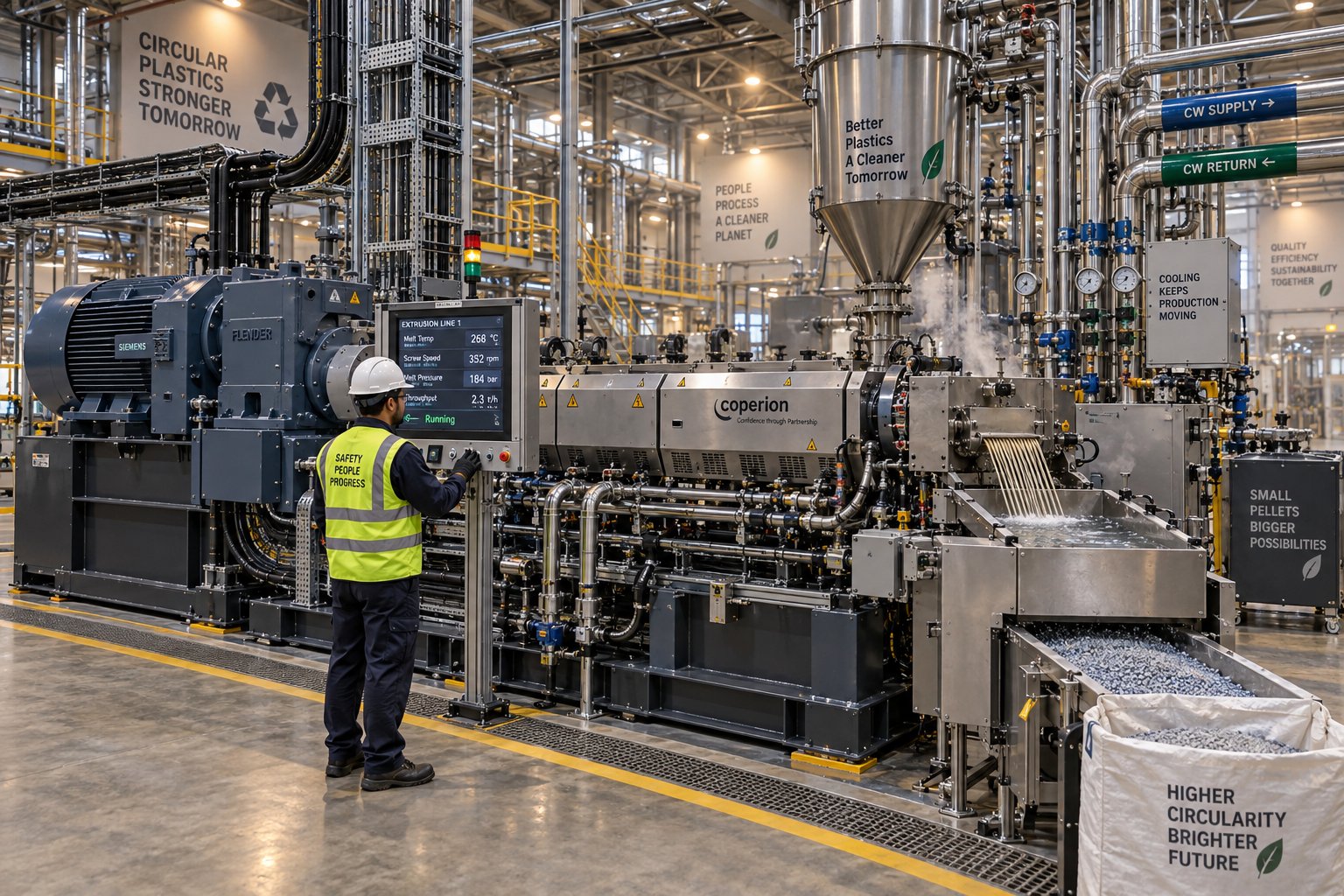
A few patterns emerge immediately. At pilot scale, a single operator runs the entire line, and air cooling or a basic water bath handles thermal management. Push past 500 kg/h and you'll notice cooling infrastructure growing faster than the extruder itself: recirculating chiller loops replace simple water baths, and process water treatment systems become a real utility cost. At high-volume production, automation isn't optional. PLC-controlled startup sequences, automatic blade-pressure adjustment, and real-time process monitoring are what keep a 1,000+ kW extrusion pelletizing machine running profitably around the clock without a crew of six hovering over it every shift.
Staffing scales slower than throughput when automation is designed in from the start. A well-automated 2,000 kg/h line might need only one more operator per shift than a 300 kg/h line running manual strand-up. That labor efficiency gap alone can justify the higher capital cost of pelletizer equipment with integrated controls, especially in markets where skilled labor is scarce.
Energy Consumption and Operational Cost Drivers
Energy often represents one of the largest recurring expenses in a pelletizing operation, and it comes from more places than most people expect. The four primary consumers are:
- Extruder drive motor - the single largest power draw, responsible for screw rotation, shear generation, and melt pressure buildup.
- Barrel heaters - electric band or cartridge heaters that maintain the temperature profile along the barrel length.
- Cooling water pumps and chillers - circulate and chill process water for water-ring or underwater cutting systems.
- Pelletizer motor and auxiliaries - the cutter drive, centrifugal dryer, vibratory classifier, and conveying blowers.
How much energy each subsystem consumes depends heavily on three variables: the material being processed, the extruder architecture, and the cooling method.
Material influence: Lower-melting polymers like PE and PP require less thermal energy to plasticize than engineering resins like PC or PET. That difference translates directly into reduced heater demand and lower motor torque for the screw. All else being equal, running a polyolefin line costs less per kilogram than running a nylon compounding line.
Extruder type: Twin-screw extruders tend toward higher specific energy consumption (SEC) than single-screw machines processing the same resin. The intermeshing screw geometry generates more internal shear, which is exactly why twin-screw systems excel at compounding, but that mixing intensity draws more power from the drive motor. A general-purpose screw design mismatched to the resin type makes the problem worse, as research on extrusion efficiency confirms that an optimized screw geometry creates effective melting through controlled shear heat, keeping the motor within its efficient operating range, while a poorly matched design forces the motor to work harder per kilogram of output.
Cooling method: Underwater pelletizing systems carry additional energy overhead because pressurized water loops and industrial chillers run continuously during production. Air-cooled die-face cutting sits at the opposite end, requiring no water pumps or chiller energy at all.
The metric that ties all these factors together is specific energy consumption (SEC), expressed in kilowatt-hours per ton of pellets produced. SEC gives you a single number to benchmark line efficiency regardless of throughput. A line producing 500 kg/h and consuming 150 kW has a very different SEC profile than a 2,000 kg/h line consuming 400 kW, even though the larger line draws more absolute power, its per-ton cost is substantially lower. Tracking SEC over time also reveals hidden problems: rising SEC at constant throughput usually signals screw wear, fouled screens, or degrading barrel insulation.
Practical steps to reduce energy consumption exist at every tier. Industry data suggests that modern upgrades, including high-efficiency IE3/IE4 motors, variable frequency drives, and improved barrel insulation, can cut energy usage by 20% to 40%. Variable frequency drives (VFDs) alone can achieve 20% to 50% savings on motors running under variable loads, such as shredders and conveyors, by matching motor speed to actual process demand rather than running at full speed continuously. Even a straightforward measure like installing thermal insulation jackets on barrel heater bands has been shown to reduce heating-zone electrical usage by 15% to 25% while improving workplace safety.
These gains aren't theoretical. They show up on every monthly utility invoice and compound over years of operation, which is why energy analysis deserves the same attention as resin compatibility and pellet quality when specifying a line. And that leads directly into the financial question most buyers struggle to answer confidently: what does the entire investment actually look like, from purchase order through the first few years of production?
Investment Costs and ROI Framework for Pelletizing Lines
Here's the question that makes or breaks most projects: what does the total pelletizing line cost actually look like once you account for everything beyond the equipment invoice? Most buyers focus almost exclusively on the price of the pelletizing machine itself, treat installation as an afterthought, and then scramble for budget when facility upgrades, utility connections, and commissioning expenses arrive. The result is a project that runs 30% to 50% over its original estimate before a single pellet rolls off the line.
Breaking the investment into its real categories, and understanding how ongoing expenses interact with pellet quality and revenue, is the only reliable way to avoid that trap.
Capital Investment Categories
A plastic pelletizer machine doesn't operate in isolation. The total capital outlay divides into four distinct buckets, and ignoring any one of them is how first-time investors blow past their targets.
- Equipment procurement: The extruder, die head, pelletizer cutter, screen changer, feeders, cooling system, dryer, classifier, and conveyors. Together, the extruder and pelletizing system represent the largest share of equipment spend. According to field data from over 500 installations across 80+ countries, the pelletizing block (extruder + melt filter + die-face cutter) is the single most expensive component in roughly 80% of lines delivered, driven by precision engineering requirements for polymer pressure control and thermal management.
- Installation and commissioning: Mechanical assembly, electrical wiring, piping connections, alignment, test runs, and operator training. Expect an installation premium of 8% to 15% on top of FOB equipment pricing. Commissioning alone can take one to three weeks depending on line complexity, and the labor, travel, and material consumed during startup trials all carry real costs.
- Facility preparation: This is the category buyers underestimate most consistently. Reinforced flooring rated for heavy machinery, three-phase electrical substations and transformer upgrades, water supply and drainage infrastructure, ventilation and dust collection systems, and wastewater treatment if you're running a water-ring or underwater pelletizer. Industry benchmarks show that machinery accounts for only 40% to 50% of total project investment, meaning facility work, utilities, permits, and working capital consume the other half.
- Spare parts inventory: Screw elements, barrel liners, die plates, screen packs, pelletizer blades, heater bands, bearings, and seals. Stocking critical wear items from day one prevents costly unplanned downtime. A common budgeting rule allocates 3% to 5% of equipment CAPEX annually for spare parts depreciation, accrued monthly.
When evaluating a supplier quote, look for itemized motor brands and power ratings, blade steel grades (D2 or SKD-11 indicate quality), screen mesh specifications, and a clear scope covering installation, commissioning, and training. A single lump-sum bid that bundles everything together often conceals 12% to 20% in cost categories that surface only during deployment.
Operating Expenses and ROI Framework
Capital gets you to production. Operating expenses determine whether that production ever earns its keep. The major ongoing cost categories for any pelletizing operation are:
- Energy: Typically the largest monthly surprise. The EU JRC benchmarks average plant-level electricity consumption at 61.1 kWh per ton of recycled plastic. At industrial tariffs of $0.10 to $0.15 per kWh, even a mid-scale line running 16 hours a day racks up thousands in monthly electrical expenses.
- Labor: Operators, forklift drivers, sorting staff, maintenance technicians, and supervisors. Costs vary enormously by region, but staffing rarely drops below two people per shift once throughput exceeds 300 kg/h.
- Maintenance and wear parts: Screw elements wear, barrel liners erode, die plates clog, screen packs foul, and pelletizer blades dull. These aren't optional replacements; they're consumables baked into every hour of run time.
- Raw material / feedstock: For recyclers, this means baled post-consumer waste at market rates. For compounders, it includes base resin plus fillers, additives, and colorants. Feedstock is almost always the single largest variable cost line.
- Waste disposal: Reject material, contaminated filter screenings, and process wastewater all carry disposal or treatment costs that scale with contamination levels.
The ROI framework connecting these expenses to financial outcomes is simpler than most people expect. Revenue comes from pellet sales (or internal cost savings if the pellets feed your own downstream molding or extrusion operations). Total ownership cost accumulates from capital amortization plus every operating line item listed above. The ratio between the two, tracked monthly, tells you whether the line is earning or burning.
What makes this framework genuinely useful is one insight most cost analyses miss: pellet quality directly affects selling price. A line producing pellets with inconsistent size, excessive fines, surface bubbles, or poor color uniformity sells at a discount, sometimes 20% to 40% below prime-grade pricing. That means every configuration decision covered in earlier sections, from extruder type and screw geometry to filtration strategy and cutting method, isn't just a technical choice. It's a financial one. A robust payback model should test conservative, base, and upside scenarios rather than relying on a single optimistic projection, because the spread between a 13-month payback and a 27-month payback often hinges on utilization rate and output quality rather than equipment sticker price.
Field experience across hundreds of installations suggests that 18 to 36 months is a realistic conservative payback window for total startup investment when equipment, facility, and working capital are included. Plants that miss this window almost always share the same root causes: oversized equipment running below capacity, feedstock supply that never materialized at projected volumes, or pellet quality too low to command target pricing.
That last point, oversizing, raises a question worth addressing head-on: how do you scale a pelletizing operation intelligently, and when does it make more sense to start small, outsource, or skip pelletizing entirely?
Scaling Your Pelletizing Operation and Knowing When to Upgrade
Starting big sounds ambitious. It also accounts for most of the oversizing failures that sink plastic recycling pelletizing projects within their first two years. The smarter path, proven across countless operations, is to start with a throughput tier that matches your validated material supply and confirmed buyer demand, then grow the line in stages as both solidify.
That sounds simple enough. In practice, each stage of a pelletizing line scale up introduces its own set of chokepoints, and if you don't plan for them, your expansion stalls at the weakest link.
Scaling From Pilot to Full Production
Most successful operations follow a recognizable trajectory. They begin with a smaller extruder pelletizer setup, sometimes at pilot or small-production scale, to prove out a feedstock stream, test pellet quality with buyers, and learn the process before locking in heavy capital. That first line acts as a proving ground. Once demand outpaces capacity and the material supply stabilizes, scaling begins.
Here's where the bottlenecks hide. Each of these subsystems can become the rate-limiting step as you push for higher output:
- Feeding consistency: A volumetric feeder that ran fine at 200 kg/h may starve the extruder at 600 kg/h. Surging feed creates melt-pressure fluctuations, and those fluctuations show up as pellet size variation. Gravimetric feeders or higher-capacity cutter compactors often become the first necessary upgrade.
- Filtration capacity: Field data from real recycling plants shows screen changers account for roughly 32% of all reported downtime events, the single largest bottleneck sub-component. A manual slide-plate changer that required one swap per shift at low throughput might need swapping every two hours at higher volumes. Upgrading to a continuous backflush screen changer is frequently the unlock that lets the rest of the line breathe.
- Cooling system throughput: Water-ring or underwater systems sized for 300 kg/h can't simply be run faster. Water flow rate, chiller capacity, and centrifugal dryer throughput all need to scale in concert. Undersized cooling leads to sticky, malformed pellets or clumping in the classifier.
- Pellet handling and packaging: Conveyors, buffer silos, vibrating screens, and bagging systems are often the last components anyone thinks about upgrading, and they're the first to jam when throughput doubles.
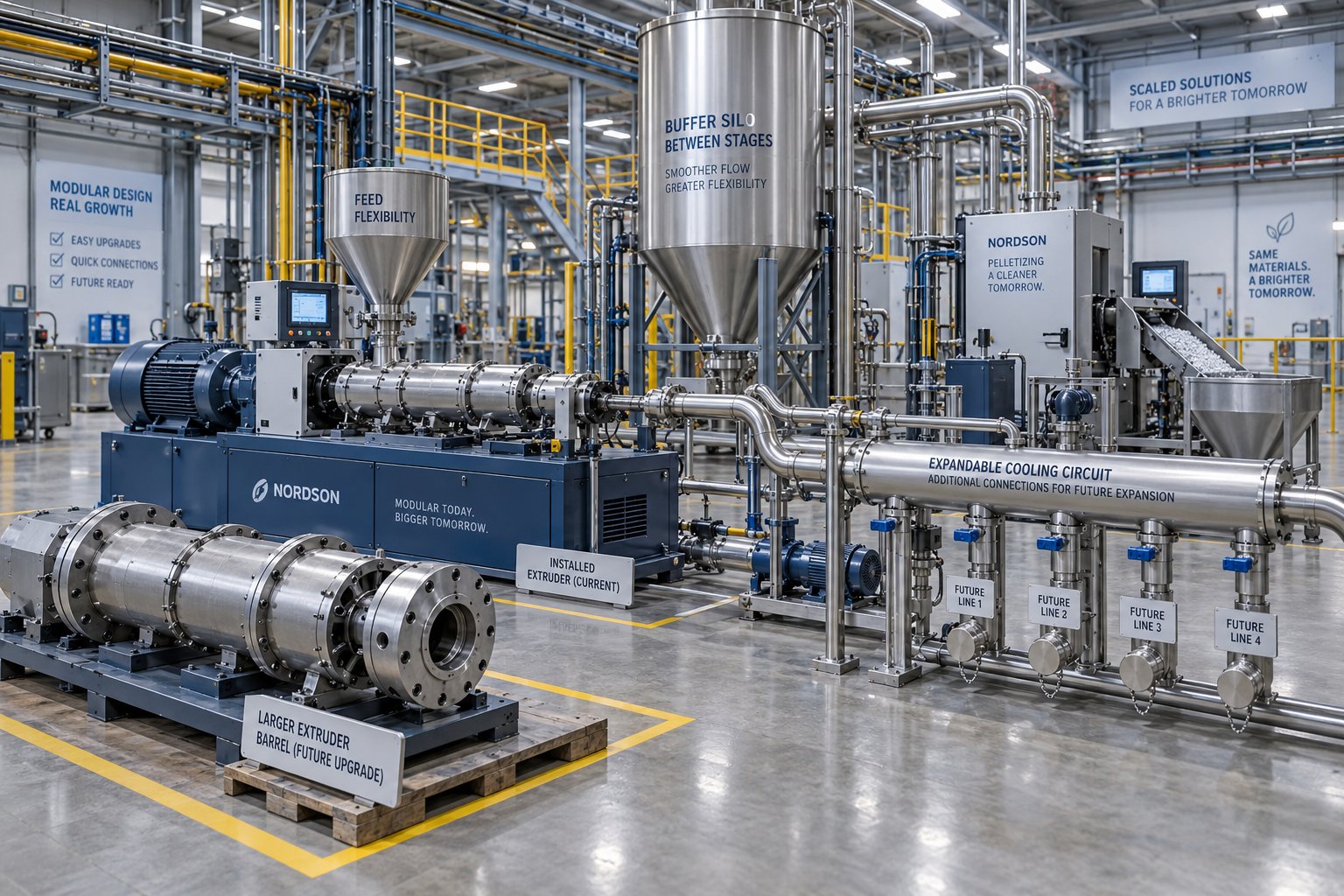
The smartest approach to scaling is modular. Rather than replacing the entire line, design the initial installation with upgrade paths built in. Choose an extruder frame and gearbox rated for a larger motor than you need on day one. Install cooling-water piping with capacity headroom. Spec a pelletizer cutter that accepts higher-speed drives. These choices cost marginally more upfront but let you swap individual components without tearing out the whole system. A line that scales in steps avoids the all-or-nothing capital gamble of buying a massive system you might not fill for years.
Integrating Into Broader Operations
A pelletizing line never operates in a vacuum. Where it sits within the broader production flow determines whether it runs smoothly or becomes a scheduling headache for every department around it.
In a recycling plant, the extruder pelletizer typically sits downstream of washing, drying, and sorting. Baled post-consumer waste enters one end of the facility as dirty mixed plastic; washed, dried flake exits the preparation stage and feeds into the pelletizing line. The critical coordination challenge here is throughput synchronization. If your washing line delivers 800 kg/h of clean flake but your pelletizing line can only process 500 kg/h, you either accumulate a growing mountain of intermediate material or throttle back the wash line and waste its capacity. Buffer silos between the washing stage and the extruder help absorb short-term surges, but they don't fix a chronic mismatch. Size both stages to the same target output from the start.
In a compounding facility, the line sits between raw material storage and downstream forming operations like injection molding or sheet extrusion. Here, synchronization means matching pellet production schedules to downstream consumption rates. Overproducing pellets ties up working capital in inventory; underproducing creates downtime on the molding floor. Many compounders use intermediate storage silos with automated level sensors that trigger pelletizing runs based on real-time demand signals from downstream equipment.
Quality-control checkpoints belong at every handoff point. Inline melt-flow index testing after the die, moisture checks on cooled pellets, and visual inspection via camera-based sorting systems all prevent off-spec material from reaching storage or, worse, a customer. Each checkpoint adds modest cost but catches problems before they compound into a full silo of reject pellets.
When You Might Not Need a Pelletizing Line
This might seem like a strange section in an article about pelletizing lines, but honest guidance builds more trust than a blanket recommendation to buy. The truth is, pelletizing isn't always the right move. Three alternatives deserve serious evaluation before you commit capital:
- Direct extrusion from flake: If your end product is extruded sheet, pipe, or profile, you may be able to skip the pelletizing step entirely and feed washed, dried flake directly into the final product extruder. This eliminates an entire melt cycle, saving both energy and thermal degradation. The catch? Flake feeding is less consistent than pellet feeding, and your product extruder needs to tolerate wider input variability. For clean, single-resin streams with modest contamination, direct extrusion is a legitimate cost saver.
- Toll processing through a third-party pelletizer: Experienced toll processors offer pelletizing as a service, which means you ship them flake or regrind and receive finished pellets back. This path eliminates capital investment, avoids facility preparation costs, and lets you test market demand with zero equipment risk. The trade-off is margin: toll fees eat into your per-kilogram profit, and you lose control over scheduling, quality tuning, and lead times. Toll processing works best as a validation step or for intermittent, low-volume streams that don't justify a dedicated line.
- Purchasing pre-pelletized material: If your core business is molding or converting rather than recycling, buying pellets from established suppliers may be cheaper than operating your own line. Run the numbers honestly: the total ownership cost of a pelletizing operation, including energy, labor, maintenance, and facility overhead, often exceeds the per-kilogram premium of purchasing finished pellets, particularly at volumes below 200 to 300 tons per month.
The decision criteria for each path ultimately come down to volume, margin, quality control, and strategic positioning. Toll processing is ideal for testing. Direct extrusion suits vertically integrated producers with clean feedstock. Purchasing pellets makes sense when your volume doesn't justify equipment ownership. And investing in your own line becomes the clear winner when you need full control over quality, scheduling, and per-kilogram cost at sustained high volumes.
Whichever path you choose, one factor remains constant: the pellets your line, toll processor, or supplier delivers must meet the quality specifications your downstream process demands. And pellet quality, as it turns out, isn't just a matter of buying good equipment. It's engineered into the line at a component level, starting with the screw barrel assembly that controls everything from melt homogeneity to additive dispersion.
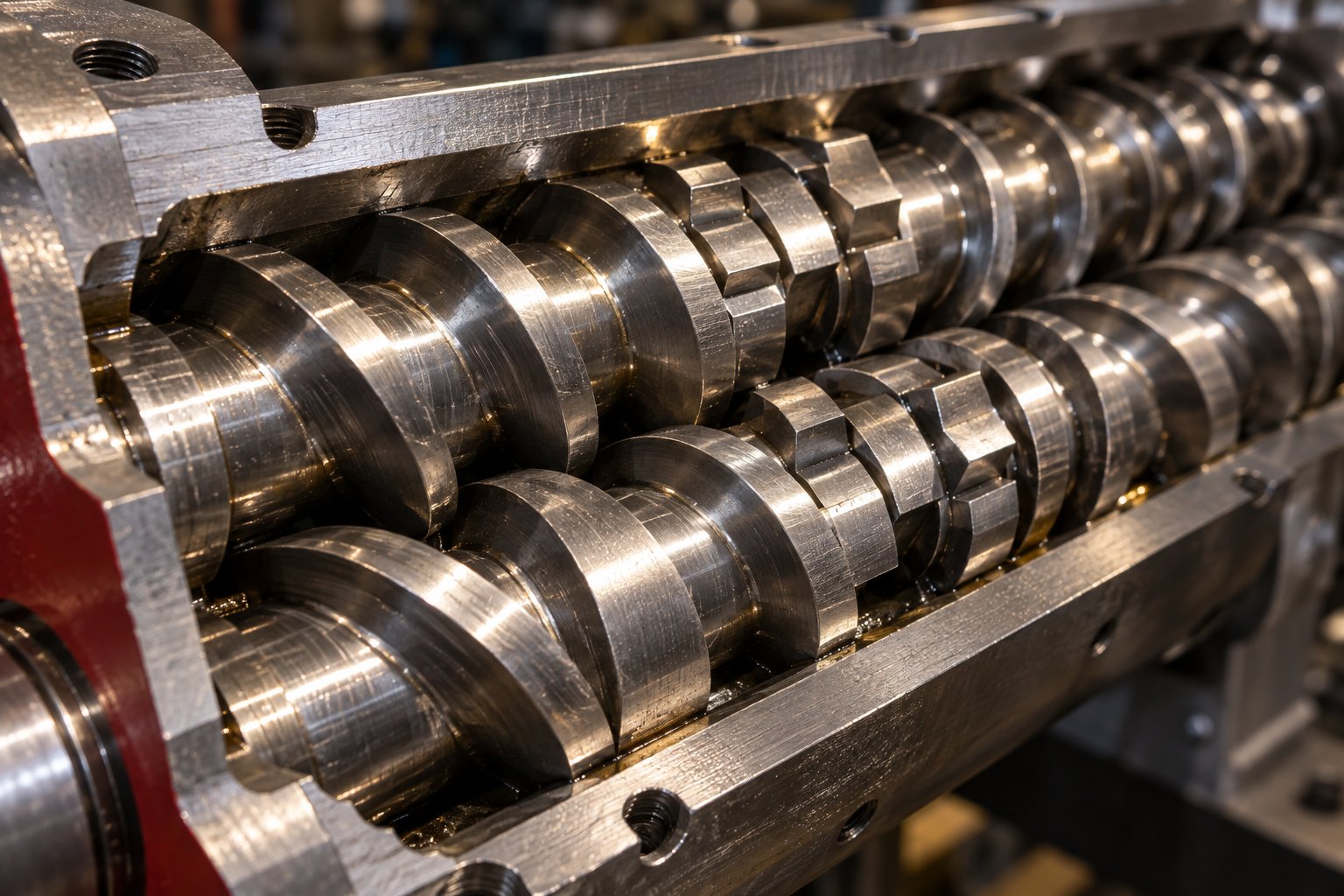
Pellet Quality Control and the Role of Screw Barrel Engineering
A plastic pelletizer can run at target throughput, hit its energy benchmarks, and still fail commercially if the pellets coming off the line don't meet buyer specifications. Quality is where configuration decisions translate into revenue, or lost contracts. Yet most equipment guides treat pellet quality as an afterthought, something that just "happens" if you buy the right machine. In reality, it's engineered into the line at the component level, and the single most influential component is the one buried inside the barrel.
What Defines High-Quality Pellets
Ask ten downstream processors what "quality" means and you'll get ten different answers, but every one of them maps back to a handful of measurable parameters:
- Size uniformity: Pellets within a tight dimensional range feed predictably through hoppers, gravimetric dosing units, and injection molding screws. Oversized or undersized outliers cause bridging, surging, or uneven plastication in the end-use machine.
- Bulk density: Consistent bulk density across batches means operators don't have to recalibrate feed settings constantly, which reduces changeover time and scrap rates downstream.
- Moisture content: Excess moisture causes splay marks, bubbles, and hydrolytic degradation in moisture-sensitive resins like PET and nylon. Specifications often demand moisture levels below 0.02% to 0.05% depending on the polymer.
- Melt flow index (MFI) consistency: Batch-to-batch MFI drift signals thermal degradation or inconsistent mixing. Tracking MFI over time serves as an early-warning system for process problems long before visual defects appear.
- Color uniformity: Particularly critical for masterbatch and compounded resins, where even slight shade variation between pellet lots triggers customer rejections.
- Absence of fines, tails, and gels: Fines (dust-like fragments) clog pneumatic conveying lines and create explosion risks. Tails (elongated whiskers attached to pellets) indicate poor cut quality. Gels, those hard, often discolored specks formed by thermally degraded and cross-linked polymer, are a leading reason recycled pellets fail incoming inspection.
Here's the part most buyers miss: different end-use applications weight these parameters differently. An injection molder producing transparent food packaging demands near-zero gels and extremely tight MFI tolerance. A pipe extruder cares more about bulk density consistency and the absence of voids. A blown film producer obsesses over size uniformity because even minor pellet-size variation translates into gauge fluctuation across the web. Your quality targets aren't universal; they're dictated by where your pellets end up.
So how do you control these parameters? Some originate in the cutting and cooling stage, but the majority trace back upstream, to the extruder's screw and barrel assembly, where the polymer melt is actually formed.
How the Screw Barrel Assembly Drives Output Quality
Imagine trying to bake a uniform loaf of bread with an oven that has hot spots, cold zones, and an unreliable thermostat. That's essentially what happens when a poorly designed or worn screw barrel assembly tries to produce consistent pellets. The screw and barrel are the primary determinants of three quality-critical functions: melt homogeneity, additive dispersion, and devolatilization efficiency.
Melt homogeneity means every fraction of the polymer stream exits the die at the same temperature, viscosity, and pressure. Inhomogeneous melt produces pellets that vary in density, crystallinity, and mechanical properties within the same batch. The screw geometry, specifically the arrangement of conveying, compression, and metering sections in a single-screw design, or the sequence of conveying elements, kneading blocks, and reverse elements in a twin-screw setup, directly controls how evenly the polymer is plasticized.
Dispersion quality matters whenever the formulation includes fillers, pigments, flame retardants, or reinforcing fibers. Poor dispersion leaves undispersed agglomerates in the pellet, creating weak spots in molded parts or visible specks in film. As NC State Extension research on screw profile design explains, wider kneading elements promote dispersive mixing that breaks down clumps through strong shear stress, while narrower kneading elements contribute distributive mixing that spreads the dispersed phase evenly. The arrangement matters too: forward kneading elements are less aggressive, neutral elements increase residence time and energy input, and reverse kneading blocks push material backward to create maximum restriction and shear. Getting this sequence wrong for a given formulation means either under-mixed pellets or thermally degraded ones.
Devolatilization removes trapped moisture, residual monomers, and volatile organic compounds before they become bubbles frozen inside the pellet. Twin-screw extruders handle this particularly well because partially filled conveying zones upstream of vent ports allow volatiles to escape at atmospheric pressure or under vacuum. According to process data from Thermo Fisher Scientific's twin-screw compounding research, screw speed and feed rate have the greatest impact on melt temperature and residence time distribution, both of which directly influence how effectively volatiles are removed before the melt reaches the die.
This is precisely where twin-screw systems pull ahead for compounding and masterbatch applications. Their modular screw architecture lets engineers configure element-by-element sequences tailored to a specific resin and formulation. Need more shear for dispersing carbon black? Add wider kneading blocks. Processing a shear-sensitive biopolymer? Switch to gentler toothed mixing elements that provide distributive blending without excessive energy input. That tunability doesn't exist in a single-screw design, where the screw is typically a single machined piece with a fixed compression ratio.
But screw geometry is only half the equation. Metallurgy and wear resistance determine how long that carefully tuned geometry actually lasts. Abrasive fillers like glass fiber, calcium carbonate, and titanium dioxide erode flight lands and barrel walls over hundreds of operating hours. As wear progresses, the clearance between screw flights and barrel bore increases, melt leaks backward across flights, pressure generation drops, and mixing efficiency deteriorates. The result? Pellet quality drifts downward gradually, often so slowly that operators don't notice until a customer rejects a shipment.
Wear-resistant barrel linings and hardened screw elements are the defense. Bimetallic barrels with high-alloy inner sleeves, nitrided or coated screw surfaces, and application-matched steel grades extend service intervals and maintain tight tolerances far longer than standard tool-steel components. For operations running highly filled compounds or abrasive recycled streams, the barrel and screw specification isn't a place to cut corners.
NANHAIYA's custom parallel twin screw barrels illustrate what application-specific barrel engineering looks like in practice. Designed for compounding, recycling, pelletizing, granulation, and masterbatch operations, these barrels pair wear-resistant metallurgies with geometries optimized for the shear profiles and conveying demands of each application. Rather than offering a single general-purpose barrel and hoping it fits, the approach matches alloy composition and dimensional tolerances to the specific resin, filler loading, and throughput the line will actually run. That kind of precision keeps the melt homogeneity, dispersion quality, and devolatilization performance consistent over thousands of operating hours instead of degrading after the first few hundred.
Pellet quality, in other words, isn't something you inspect at the end of the line and hope for the best. It's built into the screw barrel assembly from the moment the line is specified, and it's maintained through metallurgical choices that resist the wear every production hour inflicts. Getting these upstream decisions right is what separates pellets that command premium pricing from pellets that sell at a discount, a distinction that carries financial weight far beyond the cost of the components themselves.
Quality engineering and component selection, however, don't happen in a regulatory vacuum. Emissions limits, wastewater regulations, noise codes, and permitting requirements all shape which technologies you can actually deploy at your site, and overlooking them can delay a project by months or derail it entirely.
Compliance Checklist and Building Your Optimal Plastic Pelletizing Line
A perfectly configured extruder plastic pelletizing line means nothing if local regulations prevent you from operating it. Emissions permits, wastewater discharge limits, noise ordinances, and zoning approvals all carry the power to delay a project by months, inflate budgets with retrofit costs, or shut down a running operation entirely. These aren't afterthoughts. They're constraints that should shape technology selection from the very first equipment conversation.
Regulatory and Environmental Considerations
Every pelletizing operation generates some combination of airborne emissions, process wastewater, and noise. How much of each depends directly on the technology choices covered throughout this article, which is exactly why compliance planning and line specification need to happen in parallel rather than sequentially.
Emissions controls: Melting plastic releases volatile organic compounds (VOCs), particulate matter, and in some cases hazardous air pollutants depending on the resin and any additives present. PVC lines produce trace hydrochloric acid gas. Recycled feedstocks carrying residual inks, adhesives, or food contamination off-gas compounds that virgin resin never would. Most jurisdictions require a permit-to-operate that specifies allowable emission levels, and meeting those levels typically demands fume extraction hoods over the die area, activated carbon or catalytic oxidizer systems for VOC abatement, and enclosed pelletizing chambers that prevent fugitive dust. Facilities processing post-consumer material should anticipate stricter scrutiny than those running clean industrial regrind.
Wastewater treatment: Water-ring and underwater pelletizing systems generate continuous process wastewater streams containing fine plastic particles, dissolved additives, and thermal degradation byproducts. The U.S. EPA's Plastics Molding and Forming Effluent Guidelines under 40 CFR Part 463 regulate direct dischargers in the plastics industry, covering process water used to cool or clean plastic products and equipment. Facilities that discharge to municipal sewer systems fall under the General Pretreatment Regulation at 40 CFR Part 403. Beyond federal rules, emerging legislation like the Plastic Pellet Free Waters Act (H.R. 7634) specifically targets pre-production plastic pellet materials, proposing requirements for zero-discharge containment at facilities that make, use, package, or transport pellets. If your line uses any water-based cooling or cutting method, budget for closed-loop water recirculation, filtration to capture microplastic fines, and potentially a dedicated wastewater treatment system before discharge.
Noise regulations: Shredders, granulators, extruder gearboxes, pelletizer cutters, and pneumatic conveying blowers all generate significant noise. Many industrial zones cap permissible levels at 75 to 85 dB(A) at the property boundary. Acoustic enclosures, vibration-dampening mounts, and silenced blower intakes are common mitigation measures, but they add cost and floor space. Factor them in during facility layout planning rather than as expensive retrofits after the first neighbor complaint.
Local permitting: Zoning approval, building permits, fire department inspections, electrical certification, and environmental impact assessments vary by municipality but share one thing in common: they take longer than anyone expects. In many regions, securing a full operating permit for a new plastic pelletizing machine installation takes three to nine months. Starting the permitting process in parallel with equipment procurement, rather than after delivery, avoids the costly scenario of a fully installed line sitting idle while paperwork clears.
Your Pelletizing Line Decision Checklist
Every section of this article addressed a specific decision point. Taken individually, each seems manageable. Taken together, they form a complex web of interdependencies where one wrong choice cascades into problems downstream. The checklist below synthesizes those decisions into a structured sequence you can follow from initial concept through to commissioning.
- Identify your material type and feedstock characteristics. Pin down the exact resin family, contamination level, bulk density, and moisture content. A peletizer designed for clean HDPE flake won't survive mixed post-consumer film with 5% contamination. Your material dictates every subsequent choice.
- Set your throughput target based on validated supply and confirmed demand. Don't size for aspirational volume. Match capacity to the feedstock you can actually source today, with modular headroom for growth. Review the throughput tier table to understand how motor class, cooling infrastructure, and staffing scale with output.
- Select the pelletizing technology that fits your resin and quality requirements. Strand for rigid polymers and short-run flexibility. Water-ring for polyolefins at moderate throughput. Underwater for high-volume, high-quality spherical pellets across virtually any polymer. Air-cooled die-face for PVC and moisture-sensitive materials. Cross-reference the technology comparison table against your specific resin and pellet shape specification.
- Choose the extruder type and specify the screw barrel assembly. Single-screw for clean, single-resin recycling streams. Twin-screw for compounding, masterbatch, filled systems, and mixed-material processing. The screw geometry, element sequence, and barrel metallurgy must be matched to your formulation's shear, mixing, and devolatilization demands.
- Define your filtration strategy. Manual screen changers work for clean feedstock at low throughput. Hydraulic piston changers suit moderate contamination. Continuous backflush systems are essential for high-contamination recycled streams where screen changes would otherwise dominate your downtime budget.
- Confirm cooling and cutting method compatibility. Ensure your cooling system capacity matches the throughput target with margin. Verify that the process water temperature control range, chiller capacity, and dryer throughput align with the pelletizing technology selected in step three.
- Plan facility and utility infrastructure. Map out reinforced flooring, three-phase electrical supply, transformer capacity, water supply and drainage, ventilation, dust collection, and wastewater treatment. Remember that facility preparation often consumes 50% or more of total project investment.
- Address regulatory compliance early. Initiate emissions permits, wastewater discharge approvals, noise assessments, and zoning applications in parallel with equipment procurement. Identify which regulations apply to your specific technology selections and site location before finalizing purchase orders.
- Select suppliers based on application expertise, not just price. Evaluate the extruder and pelletizing system supplier's track record with your specific resin and application. For critical wear components, source from specialists with proven metallurgical and geometric expertise for your operating conditions. NANHAIYA's parallel twin screw barrels, for example, are engineered specifically for compounding, recycling, pelletizing, and masterbatch applications with wear-resistant alloys and application-tuned geometries, the kind of component-level specialization that maintains output consistency over thousands of hours in demanding mixing and conveying environments. Pairing a well-specified plastic pelletizing machine with application-matched wear components from proven specialists protects your long-term operational reliability far more effectively than choosing every component from the lowest bidder.
- Commission with documented acceptance criteria. Define measurable pass/fail benchmarks for pellet size distribution, bulk density, moisture content, MFI consistency, and throughput rate before the commissioning engineer arrives. Run extended trial batches at target operating conditions rather than accepting a brief demonstration at reduced speed.
Print this list. Walk through it in order. Every step that gets skipped or shortcut becomes a cost you pay later, often at multiples of what addressing it upfront would have required. The title of this article isn't hypothetical. Operators who pick the wrong line, skip the compliance homework, or spec components without understanding their material's demands genuinely do end up paying twice: once for the mistake and again for the correction.
A plastic pelletizing line is a significant capital commitment, but it's also one of the most controllable investments in plastics manufacturing. The technology is mature. The decision variables are well understood. The information exists to get it right the first time. The only question is whether you use it.
Frequently Asked Questions About Plastic Pelletizing Lines
1. What is the difference between a single-screw and twin-screw extruder in a pelletizing line?
A single-screw extruder uses one rotating screw and works best for clean, pre-sorted feedstocks like washed HDPE flake or single-resin regrind. It offers lower capital and maintenance costs. A twin-screw extruder runs two intermeshing screws that deliver superior mixing and devolatilization, making it essential for compounding filled resins, producing masterbatch, and processing mixed recycled streams. Choosing incorrectly is one of the most expensive mistakes in line specification, so always let your material and application drive the decision rather than price alone.
2. How much does a plastic pelletizing line cost?
Total investment varies widely based on throughput, resin type, and pelletizing technology. The equipment itself, including the extruder, die, pelletizer, and auxiliaries, typically accounts for only 40% to 50% of total project cost. Facility preparation, electrical upgrades, water infrastructure, installation, commissioning, and spare parts inventory make up the rest. Many first-time buyers underestimate these non-equipment costs by 30% to 50%. A realistic conservative payback window for total startup investment runs 18 to 36 months when all cost categories are included.
3. Which pelletizing method is best for recycled plastic?
The best method depends on the specific polymer being recycled. Water-ring pelletizing pairs well with polyolefins like HDPE, LDPE, and PP because these resins have sufficient melt strength for die-face cutting. Underwater pelletizing handles a wider range of recycled materials including PET and nylon, offering superior pellet uniformity and the highest throughput ceilings. Strand pelletizing suits rigid engineering plastic regrind like ABS and PC. For PVC scrap, air-cooled die-face cutting is essential to avoid moisture-related degradation. Always match the cutting technology to your resin's thermal and rheological behavior.
4. What factors affect pellet quality in a pelletizing line?
Pellet quality depends on size uniformity, bulk density, moisture content, melt flow index consistency, color uniformity, and absence of fines or gels. The screw barrel assembly is the single most influential component, governing melt homogeneity, additive dispersion, and volatile removal. Screw geometry, element sequencing, and barrel metallurgy all shape these outcomes. Wear-resistant components, such as NANHAIYA's custom parallel twin screw barrels engineered for compounding and pelletizing applications, help maintain tight dimensional tolerances and consistent output quality over thousands of operating hours.
5. How do I choose the right throughput capacity for my pelletizing line?
Size your line to match validated feedstock supply and confirmed buyer demand rather than aspirational volume. Pilot-scale lines under 100 kg/h suit material and market testing. Small production lines at 100 to 500 kg/h work for established but growing operations. Mid-volume lines at 500 to 2,000 kg/h require dedicated cooling infrastructure and increased automation. High-volume lines above 2,000 kg/h demand industrial chiller loops, PLC-controlled systems, and larger facilities. A modular approach, specifying an extruder frame and gearbox rated for future motor upgrades, lets you scale without replacing the entire system.
Written by
Nanhaiya Technical Team
Zhoushan Nanhaiya Plastic Machinery Co., Ltd.
The Nanhaiya technical team supports screw and barrel manufacturing projects through application review, technical communication, custom manufacturing coordination, and production and quality control.
Discuss Your Application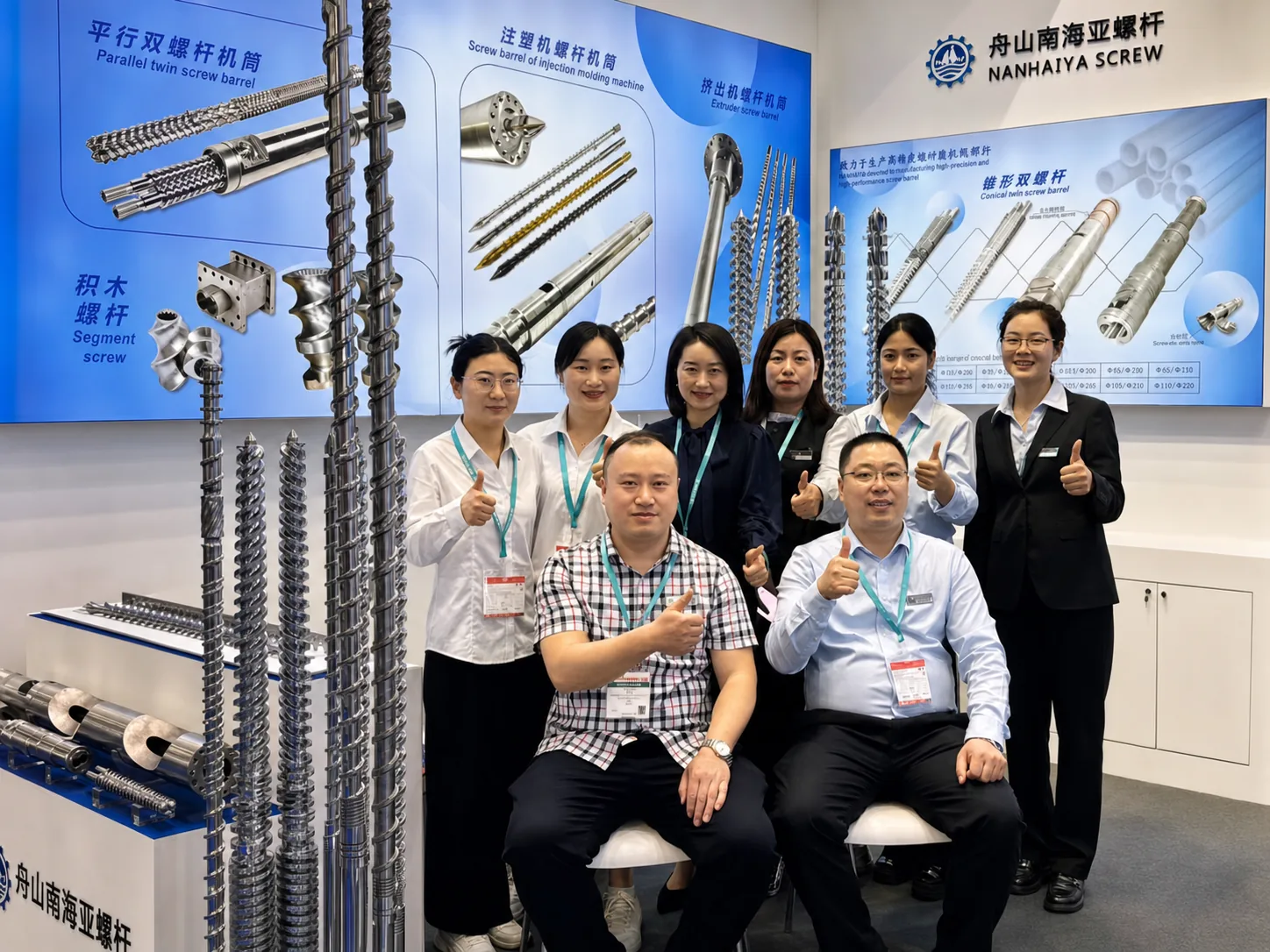
Related Articles
More insights on screw barrel technology and plastics processing.
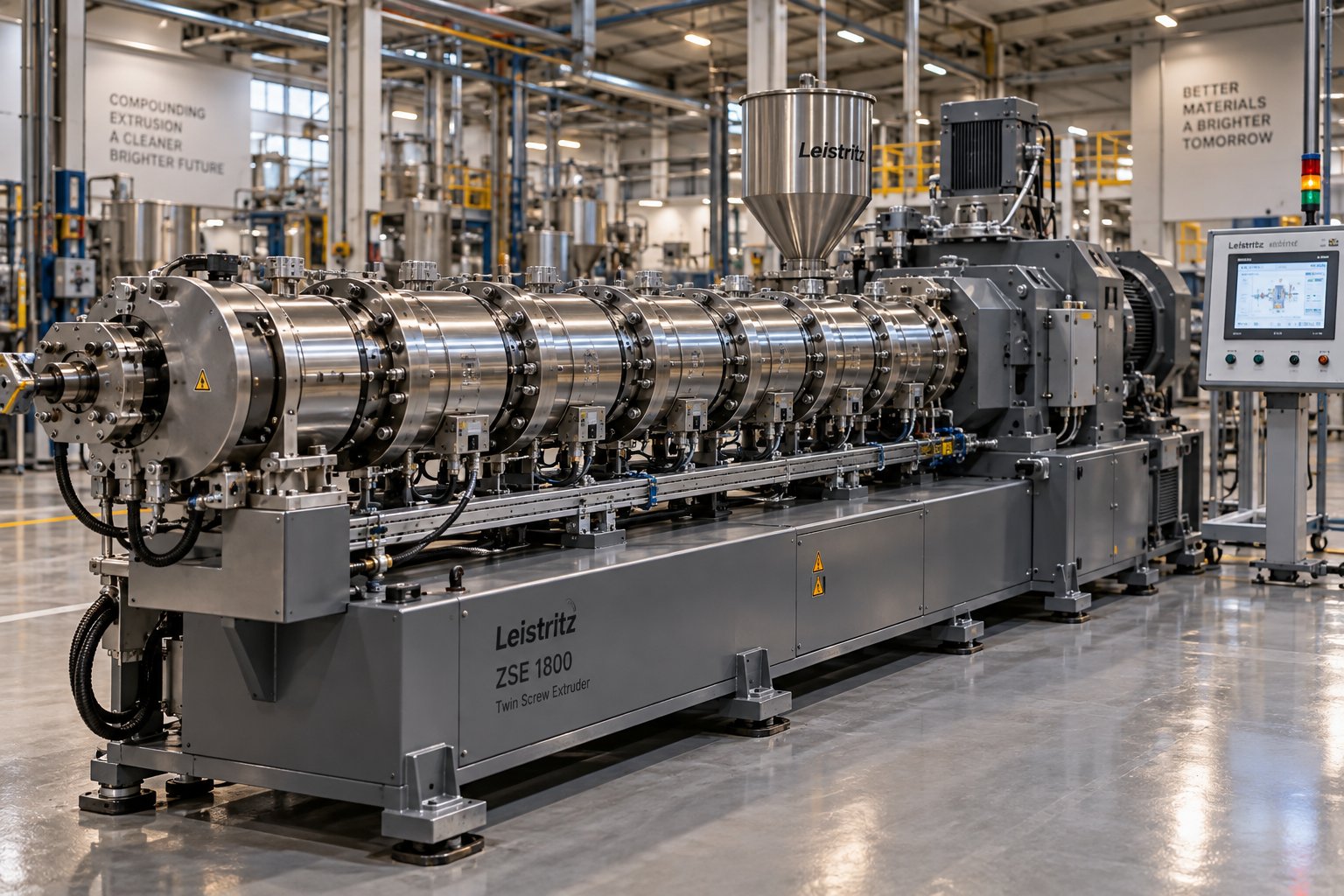
Co Rotating Twin Screw Extruder Manufacturer: Beyond The Brochure
Oct 13, 2026
Learn how to evaluate a co rotating twin screw extruder manufacturer using specs, TCO analysis, red flags, and a step-by-step buyer framework.
Read Article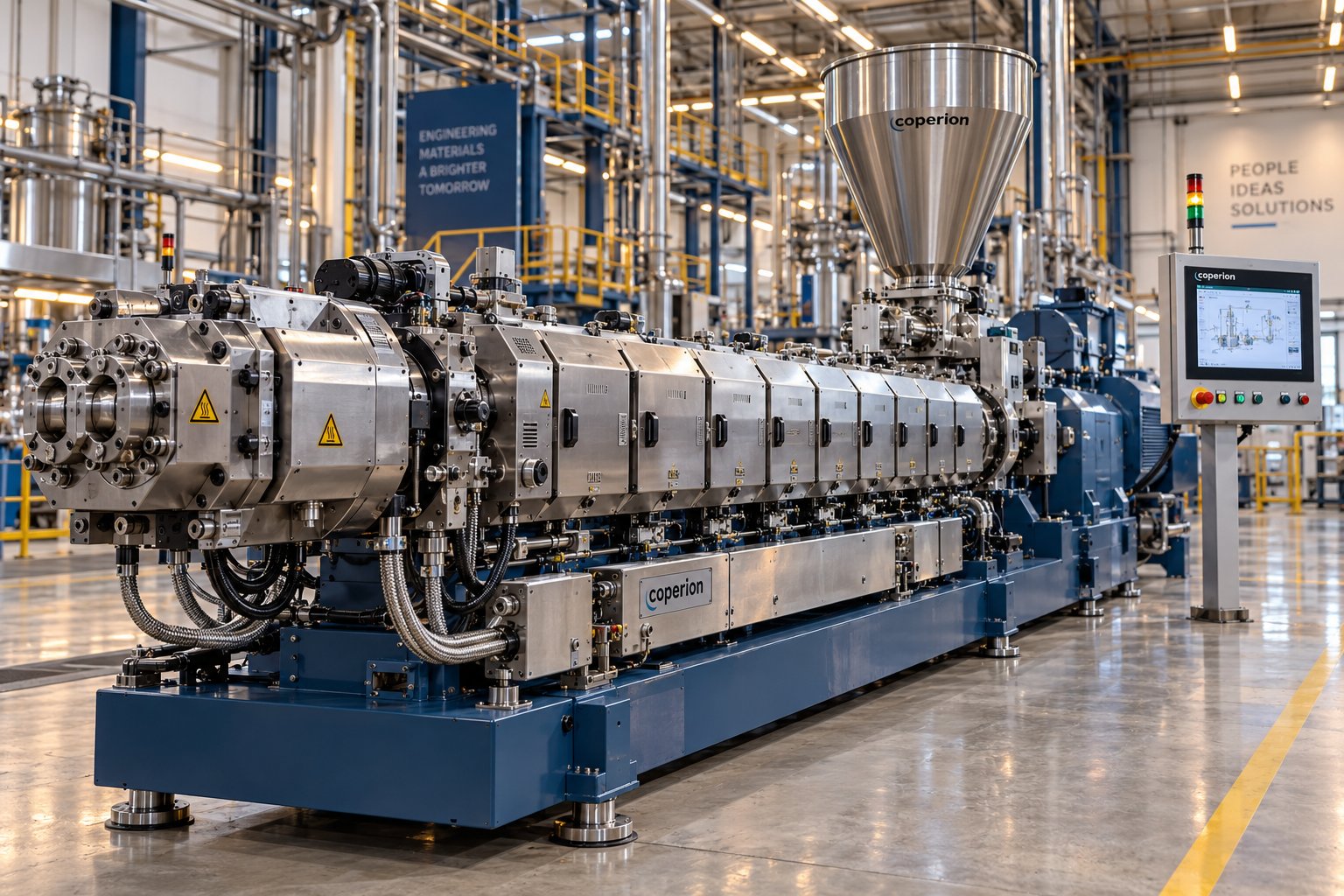
Stop Overpaying: How To Read Any Parallel Twin Screw Extruder Price
Oct 13, 2026
Learn what drives parallel twin screw extruder price from lab to production scale. Compare specs, metallurgy, manufacturer tiers, and total cost of ownership.
Read Article
What Nobody Tells You Before Buying A PP Pipe Extruder Machine
Oct 12, 2026
Learn how a PP pipe extruder machine works, key components, material grades, quality standards, and a practical buyer selection framework for long-term ROI.
Read ArticleLooking for something else?
Search by material, symptom or product and jump straight to the relevant page.
These are navigation suggestions based on keyword matching — not a quotation, not a delivery commitment, and not a substitute for engineering review. Final specification is confirmed by our engineers against your drawings and processed material.
Need help with screw barrel selection?
Share your machine model, processed material and application. Our team can help with pricing and technical support.