

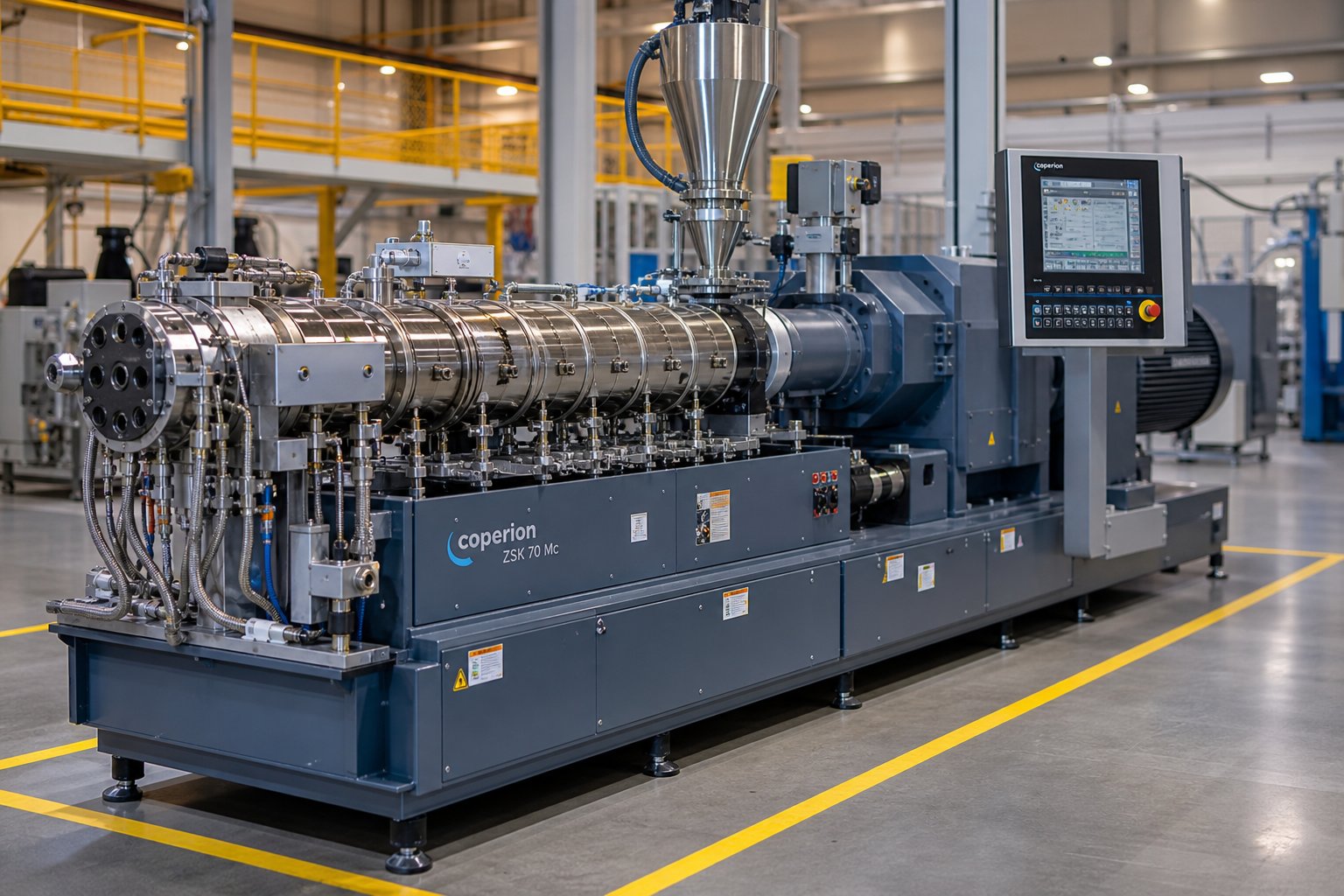
What Are Twin Screw Extruders and Why Buy Used
Imagine you need to blend, melt, and shape raw polymers into a precise, production-ready compound — all in a single, continuous process. That's exactly what twin screw extruders do, and they've become the workhorses of plastics compounding, food processing, and pharmaceutical manufacturing worldwide.
A twin screw extruder is an extrusion machine that uses two co-rotating or counter-rotating screws mounted inside a heated barrel to continuously convey, melt, mix, devolatilize, and shape materials — delivering precise control over shear, temperature, and residence time in a single processing step.
For processors exploring the secondary market, used twin screw extruders offer a practical path to added capacity and new capabilities — often at 40% to 60% less than new-equipment pricing, with dramatically shorter lead times. But what makes this category of used extruders worth serious consideration? It starts with understanding how these machines work and why quality units regularly become available.
How Twin Screw Extruders Work
Picture two long, helical screws sitting side by side inside a cylindrical barrel. As they rotate, raw material — typically plastic pellets, powders, or additives — enters through a feed throat and gets carried forward along the barrel's length. Along the way, friction and external heater bands raise the material temperature, melting it into a viscous flow.
What makes these extruders so versatile is their modular design. The barrel is divided into individual sections, each independently heated and cooled. The screws themselves are assembled from interchangeable elements — conveying flights, kneading blocks, and mixing discs — that snap onto a central spline shaft. This modularity means a single machine can be reconfigured for vastly different tasks simply by rearranging its screw elements.
A typical processing sequence flows through three broad zones:
- Feed zone: Material enters the barrel and is conveyed forward by deep-flighted screw elements.
- Mixing and melting zone: Kneading blocks apply intensive shear, melting the polymer and dispersing additives uniformly throughout the matrix.
- Discharge zone: The homogenized melt is pressurized and pushed through a die or into downstream pelletizing equipment.
You'll notice this layout gives processors fine-tuned control over every stage — temperature, shear intensity, and how long material stays in each zone. That level of precision is why the plastic extruder machine format dominates applications from color masterbatch to engineering-grade compounds.
Why the Used Equipment Market Exists
First-time buyers often wonder: if these machines are so capable, why would anyone sell one? The answer has far less to do with equipment failure than most people assume.
Twin screw extruders are engineered for longevity. Hardened barrel liners, wear-resistant screw metallurgy, and heavy-duty gearboxes give well-maintained units service lives spanning 20 to 30 years — sometimes longer. When a used twin screw extruder appears on the market, the reason is almost always business-driven rather than mechanical:
- Plant closures or consolidations release fully operational equipment from facilities that simply no longer need it.
- Capacity upgrades prompt companies to sell smaller machines when they invest in higher-throughput replacements.
- Process changes make a particular configuration redundant — a compounder shifting product lines may no longer need a specific screw diameter or L/D ratio.
- Surplus inventory from OEMs, leasing companies, or distributors adds additional supply to the secondary market.
The result is a steady flow of used extruders for sale that still carry decades of productive life. For buyers willing to invest time in proper evaluation, these machines deliver serious processing capability at a fraction of new-equipment cost. The key, of course, is knowing exactly what to look for — and that starts with understanding the fundamental configuration differences that separate one twin screw design from another.
Twin Screw Extruder Configurations Explained
Not every twin screw extruder machine is built the same way — and the differences aren't cosmetic. Three core configuration variables shape how a machine handles material, and each one directly affects what applications a unit can serve. When you're evaluating used equipment listings, recognizing these distinctions is the fastest way to separate machines that fit your process from those that never will.
Co-Rotating vs Counter-Rotating Designs
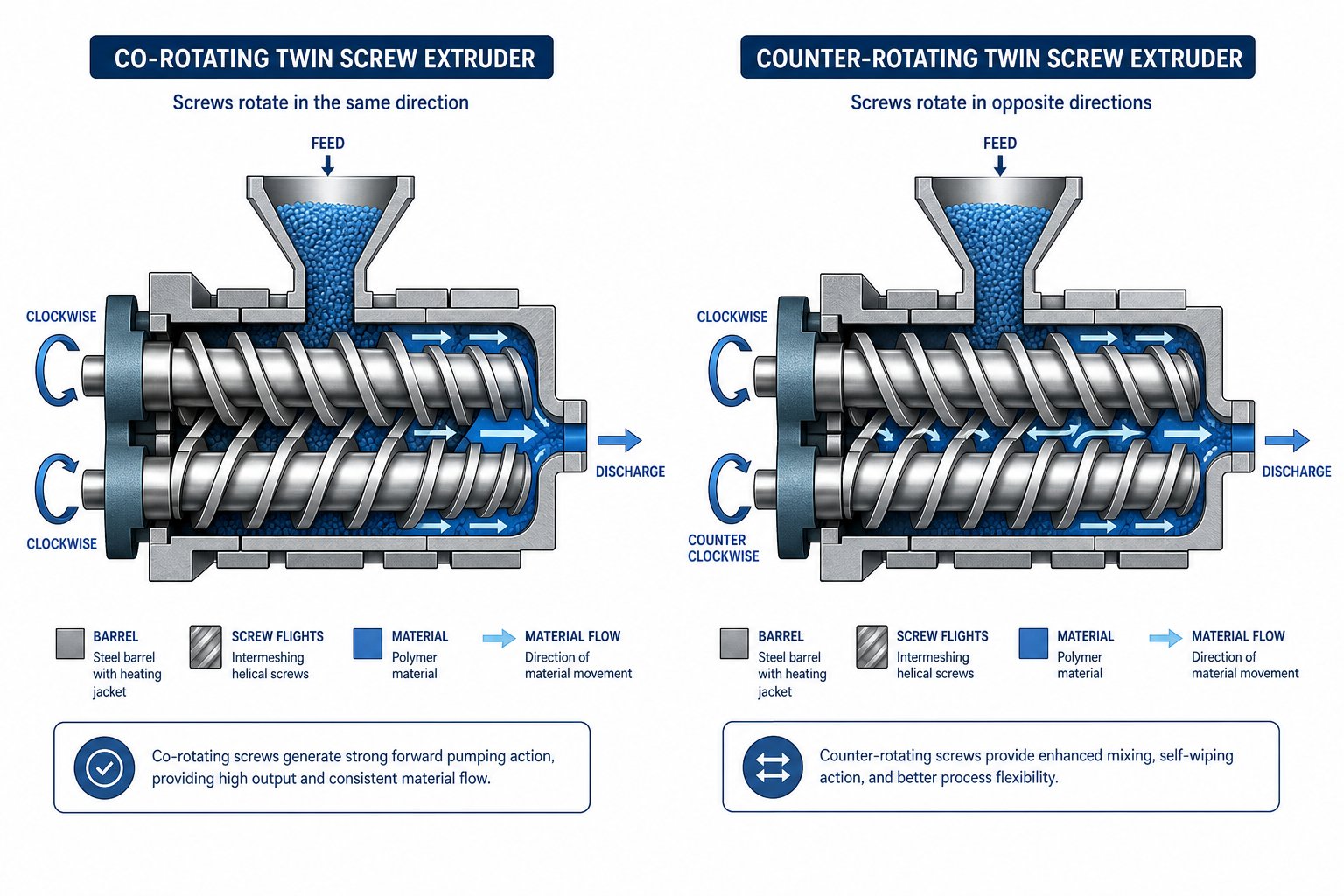
The most fundamental split in twin-screw extruder design comes down to rotation direction. In a co-rotating setup, both screws turn the same way — typically toward each other at the top. This creates an intense, figure-eight material flow pattern and a self-wiping action where each screw continuously cleans the other's surface. The result? Superior distributive and dispersive mixing, minimal dead zones, and high throughput rates. That's why co-rotating designs dominate plastics compounding, masterbatch production, and reactive extrusion.
Counter-rotating twin-screw extruders spin their screws in opposite directions. Material gets trapped in C-shaped chambers between the screw flights, creating a gentle, positive-displacement conveying action. You'll find these machines throughout PVC pipe and profile extrusion, where the lower shear and tighter control over residence time prevent thermal degradation of heat-sensitive formulations.
Here's a quick comparison to keep the differences clear:
| Parameter | Co-Rotating | Counter-Rotating |
|---|---|---|
| Typical Applications | Compounding, masterbatch, reactive extrusion | PVC pipe, profiles, sheet extrusion |
| Mixing Intensity | High — excellent dispersive and distributive mixing | Moderate — gentler shear, more controlled |
| Throughput Capacity | Higher — efficient material conveyance at elevated RPM | Lower — positive displacement limits speed |
| Self-Wiping Capability | Yes — screws continuously clean each other | Limited — material can stagnate in flight channels |
| Common Materials Processed | Engineering polymers, filled compounds, polymer blends | PVC dry blends, WPC, heat-sensitive formulations |
Intermeshing vs Non-Intermeshing Configurations
Within both rotation types, a second variable matters: how closely the screws engage. Intermeshing designs — where the flight of one screw fits into the channel of the other — give processors precise control over shear rate and residence time distribution. Most modern double screw extruder machines use an intermeshing layout because it maximizes mixing efficiency and minimizes material bypass.
Non-intermeshing configurations leave a wider gap between the screws, creating a less constrained flow path. These screw extruder designs handle higher-viscosity or shear-sensitive materials more gently and can tolerate larger particle sizes in the feed. You'll occasionally encounter non-intermeshing units in specialty rubber compounding or adhesive processing applications.
Parallel vs Conical Barrel Geometry
The third configuration variable is barrel shape. Parallel twin-screw extruders maintain uniform screw diameter from feed to discharge. This geometry allows longer L/D ratios and greater modularity — you can add or remove barrel sections to fine-tune processing length. Parallel layouts dominate plastics compounding and offer the broadest flexibility for reconfiguration, which is a real advantage when buying used.
Conical designs, by contrast, use tapered screws that are wider at the feed end and narrow toward the discharge. The tapering creates a natural compression ratio and fits larger bearings at the feed end where torque loads are highest. A conical twin-screw extruder machine is commonly found in PVC processing, smaller-scale compounding, and laboratory environments. However, conical units offer less modularity — barrel sections aren't interchangeable across zones, and screw elements are typically one-piece designs rather than segmented assemblies.
For buyers shopping the secondary market, this distinction carries practical weight. A parallel double screw extruder can often be reconfigured with new screw elements to suit a completely different application. A conical unit, while excellent within its designed purpose, gives you less room to pivot. Matching the right configuration to your process upfront saves time, money, and a warehouse full of regret — but configuration alone doesn't tell the whole story. The specifications printed on a machine's nameplate reveal whether it can actually meet your throughput, torque, and processing demands.
Key Specifications Every Buyer Must Understand
A nameplate full of numbers means nothing if you can't connect those numbers to real-world processing outcomes. Yet most used equipment listings throw specifications at buyers — screw diameter, L/D ratio, motor power — without explaining what any of it actually means for the material you're trying to run. That gap between raw data and practical understanding is where costly purchasing mistakes happen.
Three specification categories separate an extruder that fits your process from one that bottlenecks it on day one: L/D ratio, specific torque, and the relationship between screw diameter and free volume. Get comfortable with these, and you'll read any listing like an engineer — not a gambler.
L/D Ratio and Processing Flexibility
The L/D ratio — total screw length divided by screw diameter — tells you how much processing real estate the machine offers. Think of it as floor space in a factory: the more you have, the more operations you can fit under one roof.
Each functional zone along the barrel (conveying, melting, mixing, venting, pressure buildup) typically occupies one barrel segment roughly 4D in length. A 40:1 L/D machine gives you ten of these segments — enough room for complex formulations requiring vacuum devolatilization, side-feeding of fillers, and multiple mixing stages. A shorter 28:1 ratio might handle simple blending tasks just fine, but try cramming a multi-stage compounding process into that footprint and something has to give.
Modern production-class extruder machines commonly fall between 32:1 and 52:1. When evaluating a used listing, match the L/D ratio to the number of processing functions your application demands. A machine that's too short forces compromises — eliminating a vent port or shortening a mixing zone — that show up as product quality problems downstream. Too long, and you're paying for barrel length that extends residence time unnecessarily, which raises degradation risk for heat-sensitive polymers and inflates energy costs.
Specific Torque and Its Impact on Filled Compounds
Here's where many buyers get blindsided. You find an industrial extruder with impressive motor power and solid throughput claims — then discover it can't process your 40% calcium carbonate-filled compound without hitting its torque ceiling.
Specific torque, measured in Nm/cm³, quantifies how much rotational force the gearbox and shaft can actually deliver to the screw elements relative to shaft size. It's the real bottleneck in high-fill applications. Standard machines typically operate in the 5 to 10 Nm/cm³ range, while high-performance units designed for engineering thermoplastics and heavily filled formulations push beyond 15 Nm/cm³.
Why does this matter so much for used equipment buyers? Because a polymer extruder rated at 200 kW might look identical on paper to another 200 kW unit — but if one has a gearbox delivering 8 Nm/cm³ and the other delivers 14 Nm/cm³, their processing capabilities for filled compounds are worlds apart. If you're running glass-fiber-reinforced polyamide or mineral-loaded polypropylene, torque density should be one of the first numbers you check on any listing. A practical guideline: target machines that allow you to operate at roughly 80% of continuous torque capacity, leaving headroom for process variability and cold-start surges.
Screw Diameter, Free Volume, and Throughput
Screw diameter is the single specification that sets the scale of your entire operation. But bigger doesn't automatically mean better — and advertised throughput numbers can be deeply misleading without context.
Volumetric capacity scales roughly with the cube of screw diameter. That nonlinear relationship means jumping from a 50 mm to a 70 mm extrusion extruder doesn't just nudge throughput upward — it can multiply output by a factor of nearly three. For buyers evaluating used listings, this makes diameter selection a high-stakes decision that directly shapes production economics.
Equally important is free volume — the open space between the screws and barrel bore where material actually travels. Free volume is governed by the Do/Di ratio (outer screw diameter divided by root diameter). A higher ratio creates deeper screw channels and roughly 40% more free volume compared to lower-ratio designs of the same outer diameter. That extra space is critical if you're processing low bulk density feedstocks like recycled flake, powders, or expanded microspheres — materials that need room to enter the barrel before they can be compacted and melted.
The trade-off? Deeper channels mean a smaller shaft core, which limits torque transmission. An extruder for polymer compounding with heavy filler loads may need a lower Do/Di ratio (and less free volume) to gain the shaft strength required for high-torque processing. Matching this ratio to your feedstock characteristics is one of the most underappreciated evaluation steps in the used equipment market.
Before committing to any used twin screw extruder, make sure you can compare these essential specifications across every listing you're considering:
- Screw diameter — sets the throughput scale of the machine
- L/D ratio — determines available processing zones
- Specific torque (Nm/cm³) — defines capacity for filled and high-viscosity compounds
- Maximum RPM — affects shear rate and mixing intensity
- Motor power (kW or HP) — total energy available for processing
- Number of barrel zones — indicates thermal control granularity
- Maximum throughput (kg/hr) — always ask what material this was rated for
One final piece of advice: always request the original specification sheet and, if available, the machine's operating history. A spec sheet confirms what the machine was built to do. An operating history reveals what it actually did — including the materials processed, hours logged, and any modifications made over its service life. Together, these documents transform a used listing from a leap of faith into an informed evaluation. And that evaluation becomes even more valuable when you know exactly what physical signs to look for during an on-site inspection.
How to Inspect and Evaluate Used Twin Screw Extruders
Specification sheets tell you what a machine was designed to do. A hands-on inspection tells you what it can still do. That distinction is everything when you're committing real capital to used extrusion equipment — because wear, neglect, and hidden damage don't show up in PDF datasheets. They show up inside barrels, behind gearbox covers, and in maintenance logs that may or may not exist.
A structured evaluation framework turns a stressful purchase into a confident one. Here's exactly what to check — and what should make you walk away.
Barrel and Screw Element Wear Assessment
Barrel and screw wear is the single most important variable in determining the remaining productive life of any used extruder. Fortunately, it's also measurable.
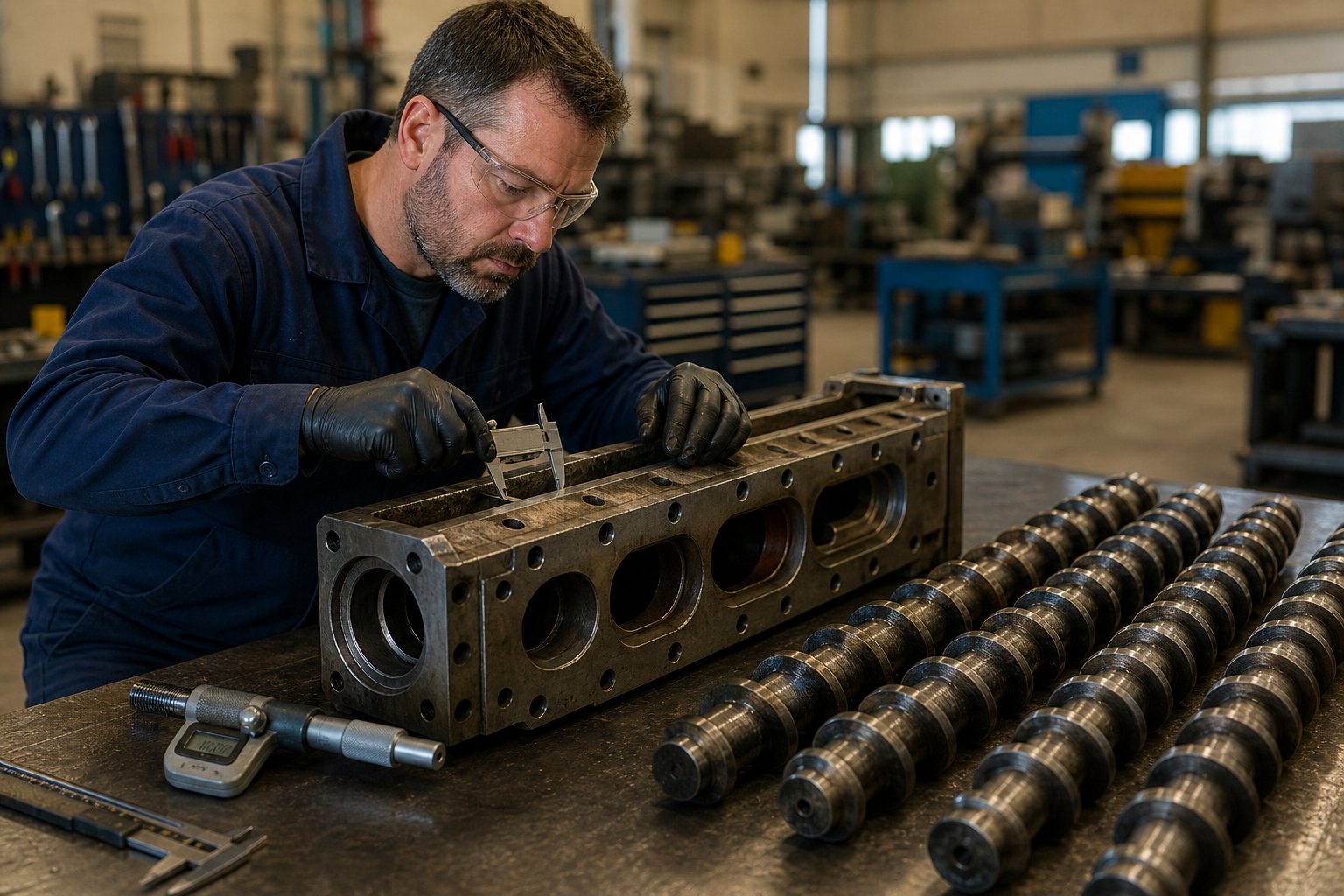
Start with the barrel bore. Using precision calipers or an ultrasonic thickness gauge, measure the inner diameter at multiple points along the barrel — feed zone, transition zone, and metering zone at minimum. Compare each reading to the OEM specification. Industry data shows that a barrel inner diameter increase exceeding 0.20 mm from the original spec typically warrants relining or replacement. Uneven wear across zones — say, excessive enlargement in the feed section but minimal change near the discharge — points to alignment issues or feeding problems that may have stressed other components too.
Screw elements require equal scrutiny. Check flight tip clearance (the gap between the screw flight outer edge and the barrel wall) at several points. A flight clearance exceeding 0.15 mm generally means the element needs replacement. On kneading blocks, inspect lobe profiles for rounding or asymmetric wear — degraded kneading blocks lose mixing efficiency rapidly, which directly impacts compound quality.
Pay special attention to wear patterns. Consistent, symmetrical wear across all elements suggests normal service life progression. Localized gouging, one-sided wear, or deep scratching often signals screw-to-barrel contact from misalignment, foreign object damage, or improper screw element assembly. These patterns reveal operational history that no seller's description can capture.
Gearbox and Drive System Evaluation
The gearbox is the most expensive single component on a twin screw extruder — and the one most buyers overlook during inspections. A gearbox rebuild on a mid-size machine can easily run $30,000 to $80,000, so catching problems here is critical.
Begin with oil analysis. Request recent lab results showing particulate counts, metal content, moisture levels, and viscosity. Elevated iron or bronze particles indicate gear tooth or bearing wear. Dark, burnt-smelling oil suggests the unit has run at excessive temperatures. If no oil analysis records exist, that itself is a data point about how the machine was maintained.
During a powered test run, listen carefully. Healthy gearboxes produce a consistent, low-frequency hum. Clicking, grinding, or intermittent knocking sounds point to damaged gear teeth or failing bearings. Use a vibration meter if possible — baseline vibration data from the OEM can help you distinguish normal operating signatures from developing faults.
Motor hour readings provide context but not conclusions. A machine with 40,000 hours on a well-maintained drive system may be in better shape than a 10,000-hour unit that was run hard on abrasive compounds with infrequent oil changes. Hours tell you quantity of use; maintenance records tell you quality of care.
Red Flags That Signal Hidden Problems
Some warning signs should immediately sharpen your skepticism — or send you looking at the next listing. When evaluating any used twin screw extruder for sale, watch for these issues:
- Barrel discoloration or heat damage: Blue or rainbow-colored barrel sections indicate temperatures far exceeding normal operating ranges, which can compromise metallurgical properties and liner integrity.
- Mismatched or non-OEM replacement parts: Inconsistent barrel section finishes, oddly fitting screw elements, or cobbled-together adapters suggest the machine was repaired on the cheap — and may have dimensional inconsistencies that accelerate further wear.
- Missing maintenance records: No documentation means no way to verify oil change intervals, wear measurements, or component replacements. You're buying blind.
- Signs of corrosive material processing: Pitting, surface etching, or unusual discoloration inside barrel bores and on screw element surfaces may indicate the machine processed halogenated polymers (like PVC) or aggressive flame-retardant compounds that accelerate corrosive wear on metal surfaces.
- Cracked barrel sections: Even hairline cracks can propagate under operating pressures and temperatures. Cracked barrels are a safety concern, not just a maintenance one.
- Excessive vibration during test runs: Vibration beyond OEM baseline levels suggests bearing degradation, shaft imbalance, or misalignment — problems that cascade through the entire drive train over time.
The single best piece of advice? Always request a powered test run before finalizing any purchase. Running the machine under load reveals problems that static inspection simply cannot — unusual noises, temperature irregularities, vibration patterns, and control system responsiveness all become visible only during operation. If a seller won't allow a test run, ask why. A legitimate answer (the machine is disassembled for shipping, for example) is different from evasion.
Bring a qualified technician to on-site inspections whenever possible. Even experienced buyers benefit from a second set of trained eyes, especially for gearbox evaluation and electrical system assessment. The cost of a technician's travel and time is trivial compared to discovering a $50,000 gearbox problem after the bill of sale is signed.
A thorough inspection before purchase is always cheaper than a surprise rebuild after one. Every dollar spent on due diligence protects thousands in post-acquisition risk.
Whether you're browsing a plastic extruder machine for sale at an auction, negotiating with a dealer, or buying directly from a processor, this inspection framework applies equally. The used plastics machinery market rewards prepared buyers and penalizes assumptions. Document every measurement, photograph every anomaly, and let the data — not the asking price — guide your decision.
Of course, knowing what to inspect is only half the equation. Knowing which brands hold their value, maintain robust parts availability, and carry strong reputations in the secondary market gives you an entirely different kind of advantage when narrowing your search.
Major OEM Brands in the Used Twin Screw Market
Brand recognition carries real weight in the used equipment market — but not for the reasons most buyers assume. The name on the nameplate doesn't just signal prestige. It determines whether you can source replacement barrel liners three years from now, whether a local technician knows the gearbox layout, and whether resale value holds if your plans change. Among twin screw extruder manufacturers, these practical realities vary dramatically, and understanding the landscape before you start shopping gives you a serious edge.
European and American Twin Screw Extruder Brands
If you've spent any time browsing used listings, one name appears more often than any other: Coperion. Originally established as Werner & Pfleiderer in 1879, this German extruder manufacturer built its reputation around the ZSK co-rotating twin screw platform — a design that has undergone continuous refinement for over six decades. A used Werner & Pfleiderer twin screw extruder (or its modern Coperion equivalent) commands premium pricing on the secondary market, but that premium comes with a tangible benefit: the deepest aftermarket parts ecosystem of any brand. Screw elements, barrel sections, and gearbox components are widely available from both OEM and third-party sources.
Leistritz occupies a different but equally respected niche. Known for modular barrel and screw architecture, Leistritz machines show up frequently in pharmaceutical hot melt extrusion, specialty chemical processing, and research environments. Their ZSE series offers excellent configurability, which makes used units particularly appealing for buyers who need to adapt a machine to a new application. Parts availability is solid, though more specialized than Coperion's broader network.
KraussMaffei Berstorff brings strength in both co-rotating and counter-rotating configurations. Their KMD series counter-rotating extruders are a staple in PVC processing, while the ZE series serves compounding and reactive extrusion. You'll encounter these machines across European and North American facilities that process everything from rigid PVC profiles to polyolefin compounds.
On the North American side, Entek has carved out a distinctive position among extruder manufacturers — not just as a machine builder, but as a major supplier of replacement screw elements and barrel sections compatible with multiple OEM platforms. This dual role makes Entek-branded machines particularly practical on the used market because sourcing wear parts is straightforward and competitively priced.
Asian Twin Screw Extruder Manufacturers
Japan Steel Works (JSW) produces some of the highest-torque, highest-throughput twin screw extruders available anywhere. Their TEX series machines are common in large-volume compounding operations across Asia and increasingly in North America and Europe. Used JSW units represent serious processing capability, though parts sourcing can require longer lead times outside of Asian markets.
Chinese plastic extruder manufacturers have expanded their presence in the used market significantly. Brands like Nanjing KYmach and CPM's Ruiya platform offer functional machines at lower price points. When evaluating these units, pay particular attention to metallurgy specifications for barrel liners and screw elements — material quality can vary more widely among extrusion equipment manufacturers from this region than among established European or Japanese builders.
The following table summarizes what you'll typically encounter when comparing major brands in the secondary market:
| Brand | Used Market Availability | Aftermarket Parts Access | Known Specializations | General Price Positioning |
|---|---|---|---|---|
| Coperion (Werner & Pfleiderer) | High — most frequently listed | Excellent — OEM and third-party | Co-rotating compounding, masterbatch, reactive extrusion | Premium |
| Leistritz | Moderate | Good — OEM-supported | Pharma, specialty chemicals, modular R&D platforms | Mid to Premium |
| KraussMaffei Berstorff | Moderate | Good — strong European network | PVC processing, polyolefin compounding | Mid to Premium |
| Entek | Moderate (North America) | Excellent — also supplies cross-compatible parts | Compounding, replacement wear components | Mid-range |
| JSW (Japan Steel Works) | Lower outside Asia | Moderate — longer lead times in Western markets | High-torque, large-volume compounding | Premium |
| Chinese Manufacturers (various) | Growing rapidly | Variable — brand-dependent | Cost-effective compounding, recycling lines | Budget to Mid-range |
One critical takeaway from this comparison: the purchase price of a used twin screw extruder is only part of the equation. A bargain-priced machine from a brand with limited aftermarket support can quietly become the most expensive equipment in your plant once you're waiting eight weeks for a replacement barrel section. Before committing, verify that screw elements, barrel liners, heater bands, and gearbox components are available — and at what cost and lead time — for the specific brand and model you're considering.
Brand and configuration narrow your search. But the smartest buyers go one step further — they define the application first, then let material requirements, throughput targets, and industry-specific standards dictate exactly which machine fits the job.
Applications and Industries That Drive Equipment Selection
A machine's brand and specs look great on paper — but they only matter if they align with what you're actually producing. The most common mistake buyers make in the used market is shopping by price or availability first, then trying to retrofit a process around whatever they purchased. Smarter buyers flip that sequence: define the application, then find equipment that serves it.
Plastics Compounding and Masterbatch Production
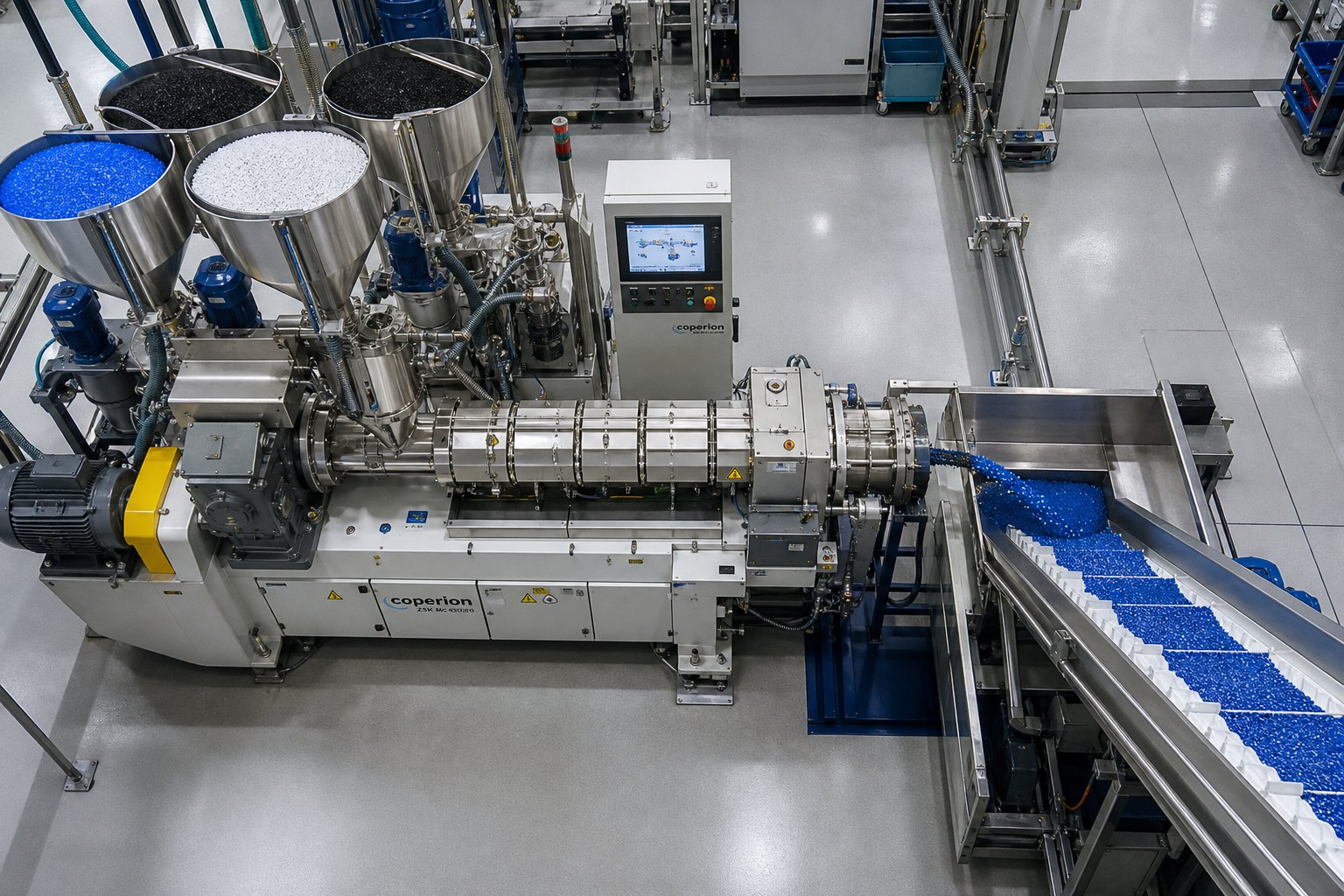
Plastics compounding remains the single largest application for co-rotating twin screw plastic extruders, and it's where the majority of used inventory originates. The work covers a broad spectrum — color concentrate masterbatch, mineral-filled compounds, polymer blends, flame-retardant formulations, and additive incorporation into base resins.
What separates one compounding job from another, though, is the material itself. Running commodity resins like polyethylene or polypropylene at moderate filler loadings is relatively forgiving — most mid-range plastic compounding equipment handles it without issue. Engineering polymers like polyamide, polycarbonate, or PBT raise the bar considerably. These resins demand higher melt temperatures (often above 280°C), greater torque for viscous flow, and tighter thermal uniformity across barrel zones. A compounding extruder that excels at PE masterbatch may hit its torque ceiling the moment you introduce 30% glass fiber into a PA6 matrix.
When shopping for used plastic extruders aimed at compounding work, let your most demanding formulation set the minimum requirements — not your easiest one. A machine sized for your toughest job handles everything below it comfortably.
Recycling, Food Processing, and Specialty Applications
Beyond traditional compounding, twin screw extruders serve several industries with very different performance priorities.
Plastics recycling has become one of the fastest-growing segments driving demand for used equipment. Recycling applications rely heavily on devolatilization — removing moisture, residual monomers, and contaminants from post-consumer or post-industrial feedstocks — followed by melt filtration and regranulation. Machines destined for recycling duty need robust wear resistance because contaminated feedstocks introduce abrasive particles, metal fragments, and inconsistent melt behavior that accelerate barrel and screw degradation.
Food and pet food processing represents an entirely different set of requirements. Machines from manufacturers like Clextral and Bühler are commonly used for cooking extrusion, protein texturization, and snack production. Used equipment entering this space must meet food-grade standards that go beyond mechanical condition.
Pharmaceutical hot melt extrusion — used for drug delivery systems including sustained-release tablets and amorphous solid dispersions — demands the tightest process controls of any application. Precise temperature management across every barrel zone, full process documentation, and validated cleaning procedures are non-negotiable.
Each of these industries carries specific requirements that buyers should evaluate before committing to any listing:
- Food-grade applications: Require specific barrel metallurgy (typically stainless steel contact surfaces), hygienic design features, and documented cleanability standards that meet FDA or equivalent regulatory frameworks.
- Recycling applications: Demand hardened barrel liners and wear-resistant screw elements capable of handling contaminated, abrasive feedstocks without rapid degradation. A plastic pipe extrusion machine repurposed for recycling, for instance, may lack the wear protection needed for post-consumer waste streams.
- Pharmaceutical processing: Requires precise, independently controlled temperature zones, GMP-compliant documentation, and materials of construction verified against pharmacopeial standards.
Counter-rotating machines also find strong footholds in specific niches. A pvc extruder machine built for rigid profile production, for example, uses gentle positive-displacement conveying that prevents the thermal degradation PVC is notorious for — a capability that co-rotating designs can't replicate as effectively at comparable throughput rates.
Matching Used Equipment to Your Application
Here's the encouraging reality for used equipment buyers: twin screw extruders are among the most adaptable machines in any processing plant. The modular screw and barrel architecture that makes these machines so versatile when new carries the same advantage on the secondary market.
Imagine you find a used co-rotating unit that was previously running color masterbatch. Your application is mineral-filled polypropylene compound. The barrel sections, gearbox, motor, and frame are application-agnostic — they don't care what material runs through them. By swapping in higher-shear kneading blocks, adjusting conveying element pitch, and potentially adding a side feeder port, the same machine transforms into a capable filled-compound production line.
That said, reconfigurability has practical limits. You can change screw elements and add barrel sections on most parallel machines, but you can't change the fundamental screw diameter, gearbox torque rating, or motor power. Those fixed parameters set the ceiling on what any reconfiguration can achieve.
Before you start browsing listings, define three things clearly:
- Material requirements: What polymers, fillers, and additives will you process? What are their melt temperatures, viscosities, and abrasion characteristics?
- Throughput targets: What production rate do you need in kg/hr, and at what product quality standard?
- Regulatory or industry standards: Does your end product require food-contact compliance, pharmaceutical-grade documentation, or UL-listed compound certification?
With those answers in hand, you can evaluate any used listing against objective criteria rather than gut feeling. And because screw element configurations can be modified to suit new processes, a well-chosen used machine often delivers more versatility than buyers initially expect — provided the core platform matches the application's non-negotiable requirements.
Finding the right machine, however, is only part of building a functional production line. The extruder itself is just the centerpiece — and without the right ancillary equipment, refurbishment plan, and spare parts pipeline, even the best-matched machine won't reach its full potential.
Ancillary Equipment, Refurbishment, and Spare Parts Sourcing
A twin screw extruder doesn't produce anything by itself. It melts, mixes, and pressurizes — but without the surrounding extruder system of feeders, pelletizers, cooling lines, and controls, that homogenized melt has nowhere useful to go. Buyers who budget exclusively for the extruder and treat everything else as an afterthought routinely discover that downstream extrusion equipment and ancillary systems cost as much as the machine itself — sometimes more. Planning for the complete line from the start is the difference between a smooth commissioning and a stalled project.
Essential Ancillary and Downstream Equipment
When evaluating any used twin screw extruder listing, ask one simple question: what's included, and what isn't? Many listings advertise the extruder alone, leaving buyers to source everything upstream and downstream independently. Here's what a complete production line typically requires alongside the extruder:
- Gravimetric or volumetric feeders: Control material input rates with precision. Gravimetric (loss-in-weight) feeders deliver tighter accuracy for demanding formulations, while volumetric feeders suffice for simpler recipes.
- Strand pelletizers or underwater pelletizing systems: Convert extruded strands into uniform pellets. Underwater systems suit high-throughput operations and sticky materials; strand pelletizers are simpler and more common on the used market.
- Cooling baths or air-cooling conveyors: Solidify and temper strands or pellets before collection. Water bath length and temperature control directly affect pellet quality.
- Vacuum venting systems: Extract moisture, volatiles, and trapped air during processing — essential for recycled polymers and hygroscopic materials.
- Melt pumps and screen changers: Stabilize discharge pressure and filter contaminants from the melt stream, particularly important in recycling and film-grade compounding.
- A plastic extrusion puller: Maintains consistent strand tension between the die and pelletizer, preventing diameter variation and breakage.
- Control systems: PLC and HMI panels that manage barrel temperatures, screw speed, feeder rates, and downstream synchronization.
Compatibility deserves careful attention. Not all downstream polymer extrusion equipment interfaces seamlessly with every extruder brand or model generation. Mechanical bolt patterns, electrical signal protocols, and communication standards can differ enough between manufacturers to require custom adapters or integration work. A pelletizer designed for one OEM's die face geometry may not mount directly onto another's discharge flange. When extrusion equipment for sale is listed as a "complete line," verify that every component was actually designed to work together — or budget for the integration engineering if they weren't.
Refurbishment and Reconditioning Options
Here's the good news about used extruding equipment: almost every major system on a twin screw extruder can be restored to near-original performance. The question isn't whether refurbishment is possible — it's which components justify the investment and in what order.
A systematic refurbishment typically addresses these areas:
- Barrel relining or replacement: Worn barrels can be bored out and fitted with new nitrided alloy steel bushings, or relined with bimetallic alloy coatings 1 to 2 mm thick, then precision-ground to finished dimensions.
- Screw element replacement or re-machining: Flight tips can be rebuilt through hard-facing overlay with chromium-tungsten-cobalt alloys, though industry practice limits this to roughly three refurbishment cycles before substrate integrity becomes a concern.
- Gearbox rebuilds: Bearing replacement, seal renewal, gear tooth inspection, and fresh synthetic gear oil restore the mechanical backbone of the machine.
- Motor refurbishment: Rewinding or replacing aging DC motors — or upgrading to modern AC inverter-duty motors with variable frequency drives — can improve energy efficiency by 10% to 20%.
- Heater band and thermocouple replacement: These thermal components degrade predictably with age. Replacing them across all barrel zones restores accurate temperature control, which directly impacts product consistency.
- Control system upgrades: Swapping obsolete PLC hardware and analog controllers for modern platforms adds recipe storage, data logging, remote monitoring, and compatibility with plant-wide SCADA systems.
When all of these systems are addressed methodically, refurbished plastic extrusion machinery can operate within 5% to 10% of original OEM specifications — at a total investment still well below new-equipment pricing. The key is sequencing: restore wear surfaces first, then mechanical systems, then thermal and electrical components. Upgrading controls on a machine with worn screws wastes the precision those controls provide.
Sourcing Replacement Parts and Aftermarket Support
Every refurbishment plan — and every long-term maintenance budget — ultimately depends on one practical question: where do you actually get the parts? This is the factor that separates a machine you can maintain affordably for a decade from one that becomes a sourcing headache after the first wear cycle.
OEM replacement components from major manufacturers like Coperion or KraussMaffei Berstorff guarantee dimensional accuracy and metallurgical specification, but they carry premium pricing — often three to five times the cost of functionally equivalent aftermarket alternatives. For older or discontinued machine models, original parts may not even be available, leaving custom fabrication as the only path forward.
This reality makes specialized aftermarket suppliers essential partners rather than optional alternatives. Suppliers like NANHAIYA focus specifically on extruder spare parts — screw-related components, heater bands, thermocouples, die heads, pelletizing blades, and custom-manufactured parts produced from engineering drawings or physical samples. That ability to reverse-engineer a worn component and deliver a dimensional match is especially valuable when you're working with older machines where OEM parts pipelines may no longer exist. For maintenance teams and machine rebuilders, having a supplier who can replicate critical wear parts from a sample eliminates the risk of extended downtime while waiting for sourcing solutions.
Before finalizing any used equipment purchase, build a replacement parts checklist and verify sourcing viability for every critical wear item:
- Screw elements (conveying, kneading, mixing, and reverse elements)
- Barrel liners or complete barrel segments
- Heater bands and thermocouples for each barrel zone
- Die heads, die plates, and strand guides
- Pelletizing blades and cutter components
- Gearbox bearings, seals, and thrust washers
Total up the estimated replacement costs for components needing immediate attention, add that figure to the purchase price, and you'll arrive at a realistic acquisition cost. That number — not the listing price alone — is the one that deserves comparison against new equipment quotes and competing used listings. An attractive headline price on extrusion equipment loses its appeal quickly once replacement parts, reconditioning labor, and commissioning costs enter the equation.
Getting the parts strategy right feeds directly into the bigger financial question every buyer faces: what does this machine actually cost to own, operate, and maintain over its remaining service life — and how does that total compare to buying new?
Total Cost of Ownership and Making the Right Purchase Decision
The listing price on a twin screw extruder for sale is the number that gets your attention. The total cost of ownership is the number that determines whether that purchase was smart or expensive. These two figures can diverge by 30% to 50% or more once you account for transportation, installation, refurbishment, spare parts, and years of ongoing maintenance. Buyers who understand the full cost picture negotiate better deals, avoid hidden traps, and make acquisition decisions rooted in economics rather than impulse.
What Drives Used Twin Screw Extruder Pricing
When you browse twin screw extruders for sale, you'll notice a wide pricing spread — even among machines with similar screw diameters. That variance isn't random. Several factors interact to set market value, and understanding them helps you spot both genuine bargains and overpriced listings.
Brand reputation exerts the strongest influence. A used Coperion ZSK or JSW TEX commands a premium because buyers know parts are accessible and resale value holds. Lesser-known brands may offer equivalent mechanical capability at a lower extruder machine price, but the discount reflects the higher long-term sourcing risk covered in earlier sections.
Screw diameter and L/D ratio set the machine's productive scale. Larger diameters and longer L/D ratios mean higher throughput potential and greater processing flexibility — both of which push prices upward. A 92 mm, 48:1 co-rotating unit will typically cost several times more than a 40 mm, 32:1 machine, all else being equal.
Machine age and operating hours provide context, though they're less decisive than many buyers assume. A 15-year-old machine with documented maintenance and moderate hours can outperform a five-year-old unit that was run 24/7 on abrasive compounds without proper care. Condition always trumps age.
Barrel and screw condition directly affect whether the machine is production-ready or requires immediate capital investment. Units with recently relined barrels and fresh screw elements justify higher asking prices — you're paying for work you won't need to do yourself.
Control system generation matters more than some buyers realize. A machine still running 1990s-era analog controls functions mechanically, but integrating it into a modern plant environment requires a control upgrade that can add $15,000 to $40,000 to the project cost. Units with modern PLC and HMI platforms carry a premium but eliminate that hidden expense.
Included ancillary equipment rounds out the value equation. A complete line — extruder plus feeders, pelletizer, cooling system, and controls — often represents substantially better value than piecing together individual components from separate sellers. When comparing an extruder machine for sale as a standalone unit versus a complete system, always calculate what the missing components would cost to source independently.
Total Cost of Ownership Beyond the Purchase Price
Here's where most buyers underestimate what they're committing to. The purchase price is one line item in a much longer financial picture. Industry analysis consistently shows that acquisition cost represents only a fraction of the total economic impact an extrusion machine generates across its useful life — with energy consumption, maintenance, downtime, and parts replacement making up the larger share of lifetime costs.
The following framework captures every major cost category you should budget for when evaluating extruders for sale on the secondary market:
| Cost Category | What It Covers | Typical Range (% of Purchase Price) |
|---|---|---|
| Acquisition Cost | Machine purchase price, dealer fees, inspection costs | Base cost (100%) |
| Transportation and Rigging | Freight, crane rental, specialized hauling for heavy equipment | 5% – 15% |
| Installation and Commissioning | Foundation work, utility connections, alignment, startup support | 8% – 20% |
| Refurbishment and Upgrades | Barrel relining, screw replacement, control system modernization | 10% – 40% |
| Spare Parts Inventory | Critical wear items to avoid production downtime | 5% – 15% |
| Ongoing Maintenance (Annual) | Scheduled wear part replacement, lubricants, labor | 3% – 8% per year |
| Operator Training | Process training, safety certification, control system familiarization | 2% – 5% |
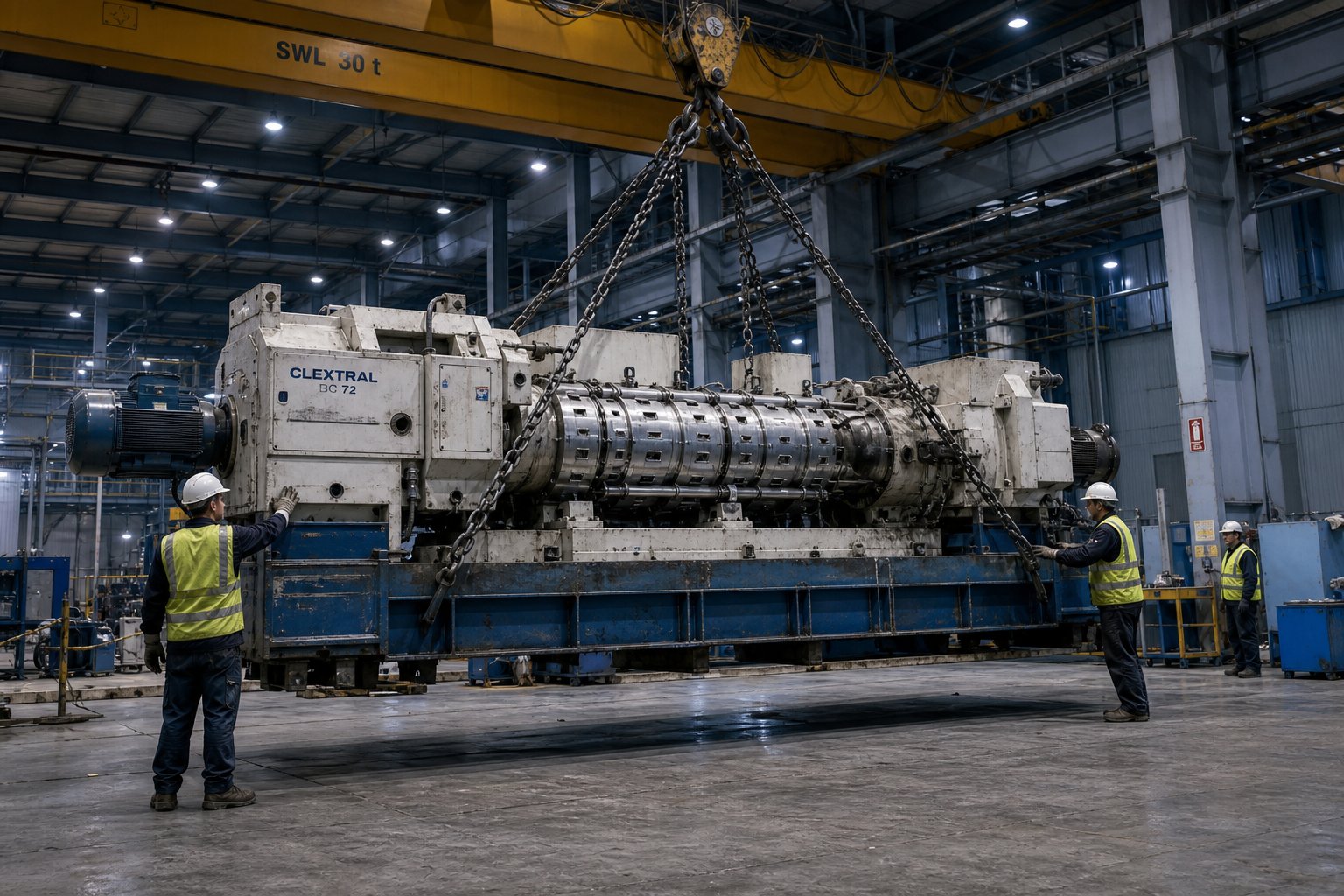
Transportation deserves special emphasis because it catches first-time buyers off guard. A mid-size twin screw extruder with gearbox, motor, and barrel assembly can weigh 8,000 to 20,000 kg or more. Moving that mass from seller to buyer requires flatbed trailers, crane services at both ends, and potentially oversize load permits. Cross-border shipments add customs brokerage, duties, and port handling. For large machines, transportation and rigging alone can represent a five-figure expense.
Ongoing maintenance costs accumulate quietly but relentlessly. Screw elements, barrel liners, heater bands, and thermocouples are consumable items that require periodic replacement — the interval depending on materials processed and operating intensity. Sourcing these wear components from aftermarket suppliers like NANHAIYA rather than relying exclusively on OEM channels can meaningfully reduce annual maintenance spend, particularly for screw elements, heater bands, and other high-turnover parts. Over a five-year ownership horizon, the cumulative savings on replacement components often exceed the difference between a "good deal" and an "average" purchase price — making parts sourcing strategy one of the most effective levers for controlling total cost of ownership.
Used vs Refurbished vs New — A Decision Framework
There's no universally correct answer to the used-versus-new question. The right choice depends on your specific financial position, production requirements, timeline, and risk tolerance. But you can systematically determine which path makes the most sense by matching your situation against these scenarios:
Used equipment (as-is or lightly reconditioned) makes the strongest case when:
- Budget constraints limit upfront capital, and you need processing capacity now rather than in 6 to 12 months
- The application involves a proven, well-understood process where cutting-edge technology isn't required
- You're expanding capacity alongside existing equipment and already have in-house maintenance expertise
- You're a startup testing market demand before committing to full-scale new equipment investment
- The plastic extruder machine price on the new market exceeds your available capital by a wide margin
Refurbished equipment delivers the best value when:
- You want near-new mechanical reliability without the 12- to 18-month lead time of a new build
- A specific brand or model configuration exists in the used market but needs reconditioning to meet your production standards
- You require updated controls and safety systems but the core mechanical platform (gearbox, barrel, frame) has substantial remaining life
- Total project cost needs to stay 30% to 50% below new equipment pricing while minimizing post-commissioning risk
New equipment is justified when:
- Your application demands the latest generation of specific torque, energy efficiency, or process control capabilities that simply aren't available in the used market
- Regulatory requirements (pharmaceutical, food-contact) necessitate full documentation traceability from machine build through qualification
- The exact screw diameter, L/D ratio, and configuration you need doesn't appear in used inventory at the required condition level
- Maximum energy efficiency is a priority — modern drives and optimized barrel insulation can reduce specific energy consumption meaningfully compared to older-generation machines
- You need full OEM warranty coverage and integrated commissioning support
In practice, many successful buyers blend these approaches. Imagine purchasing a well-maintained used extruder at an attractive twin screw extruder price, then investing in a control system upgrade and fresh screw elements to create a hybrid — a mechanically proven platform with modern process intelligence. This approach often delivers 70% to 80% of new-machine performance at 40% to 60% of new-machine cost, with a commissioning timeline measured in weeks rather than months.
Whatever path you choose, build the full cost picture before committing. Add the acquisition cost, transportation, installation, refurbishment, initial spare parts inventory, and first-year maintenance into a single number. Compare that total — not just the listing price — against competing options. The extruder for sale that looks cheapest on the listing page may carry the highest true cost once every supporting expense enters the ledger. Conversely, a higher-priced unit in better condition, from a brand with accessible aftermarket parts, frequently delivers the lowest total cost of ownership over a five- to ten-year operating horizon.
The used twin screw extruder market rewards buyers who do the math, inspect thoroughly, and plan beyond the purchase order. Every section of this guide exists to give you the tools to do exactly that — so when you find the right machine at the right price, you'll recognize it not by luck, but by preparation.
Frequently Asked Questions About Used Twin Screw Extruders
1. How much do used twin screw extruders typically cost compared to new ones?
Used twin screw extruders generally sell for 40% to 60% less than equivalent new machines. However, the listing price is only part of the picture. Buyers should factor in transportation (5%–15% of purchase price), installation (8%–20%), potential refurbishment (10%–40%), and an initial spare parts inventory (5%–15%). Brand reputation, screw diameter, L/D ratio, barrel and screw condition, control system age, and included ancillary equipment all influence market pricing. A complete cost analysis that accounts for every post-purchase expense gives a far more accurate comparison against new equipment quotes.
2. What should I inspect before buying a used twin screw extruder?
Focus on three critical areas: barrel and screw wear, gearbox health, and overall machine history. Measure barrel bore diameter at multiple points and compare readings to OEM specs — increases exceeding 0.20 mm typically call for relining. Check screw element flight tip clearance (over 0.15 mm usually means replacement is needed) and look for asymmetric wear on kneading blocks. For the gearbox, request oil analysis results and listen for abnormal noises during a powered test run. Red flags include barrel heat discoloration, mismatched non-OEM parts, missing maintenance records, and evidence of corrosive material processing. Always request a powered test run and bring a qualified technician for on-site evaluation.
3. What is the difference between co-rotating and counter-rotating twin screw extruders?
Co-rotating twin screw extruders have both screws turning in the same direction, producing a self-wiping action and intense mixing that suits plastics compounding, masterbatch production, and reactive extrusion. Counter-rotating designs spin screws in opposite directions, creating gentle positive-displacement conveying ideal for heat-sensitive materials like PVC. Co-rotating machines offer higher throughput and superior dispersive mixing, while counter-rotating units provide tighter residence time control. Your material type and application determine which design is appropriate — choosing the wrong rotation type cannot be corrected after purchase.
4. How long do used twin screw extruders last, and can they be refurbished?
Well-maintained twin screw extruders commonly deliver 20 to 30 years of service life, and many units entering the used market still have decades of productive capacity remaining. Nearly every major system is refurbishable: barrels can be relined with bimetallic alloy coatings, screw elements can be rebuilt through hard-facing overlay, gearboxes can be overhauled with new bearings and seals, and control systems can be upgraded to modern PLC platforms. Refurbished machines can operate within 5% to 10% of original OEM specifications. Aftermarket parts suppliers such as NANHAIYA (nhyscrews.com) offer replacement screw components, heater bands, die heads, and custom parts fabricated from drawings or samples, which helps extend machine life affordably.
5. What ancillary equipment do I need alongside a used twin screw extruder?
A complete production line requires gravimetric or volumetric feeders for material input, a strand pelletizer or underwater pelletizing system, cooling baths or air-cooling conveyors, vacuum venting systems for moisture and volatile removal, melt pumps and screen changers for pressure stabilization and filtration, a puller for consistent strand tension, and a PLC-based control system. Compatibility matters — bolt patterns, electrical protocols, and die face geometry can differ between manufacturers. When a listing advertises a 'complete line,' verify that every component was designed to work together. Budget for integration engineering if components come from different OEMs or different eras of the same brand.
Written by
Nanhaiya Technical Team
Zhoushan Nanhaiya Plastic Machinery Co., Ltd.
The Nanhaiya technical team supports screw and barrel manufacturing projects through application review, technical communication, custom manufacturing coordination, and production and quality control.
Discuss Your Application
Related Articles
More insights on screw barrel technology and plastics processing.

Single Screw Extruder Supplier Red Flags You Can't Afford To Miss
Oct 22, 2026
Learn how to evaluate a single screw extruder supplier with this buyer's guide covering pricing, screw and barrel tech, new vs used trade-offs, and red flags.
Read Article
HDPE Pipe Making Machine Decoded: From Specs to Smart Purchase
Oct 15, 2026
Learn how HDPE pipe making machines work, from extruder specs and extrusion process steps to automation levels, maintenance costs, and smart buying tips.
Read Article
Pick the Wrong Plastic Pelletizing Line and You Pay Twice
Oct 14, 2026
Learn how to spec the right plastic pelletizing line for your resin, throughput, and budget. Covers strand, underwater, and air-cooled systems plus ROI planning.
Read ArticleLooking for something else?
Search by material, symptom or product and jump straight to the relevant page.
These are navigation suggestions based on keyword matching — not a quotation, not a delivery commitment, and not a substitute for engineering review. Final specification is confirmed by our engineers against your drawings and processed material.
Need help with screw barrel selection?
Share your machine model, processed material and application. Our team can help with pricing and technical support.