

What Co-Rotating Twin Screw Extruders Are and Why Supplier Selection Matters
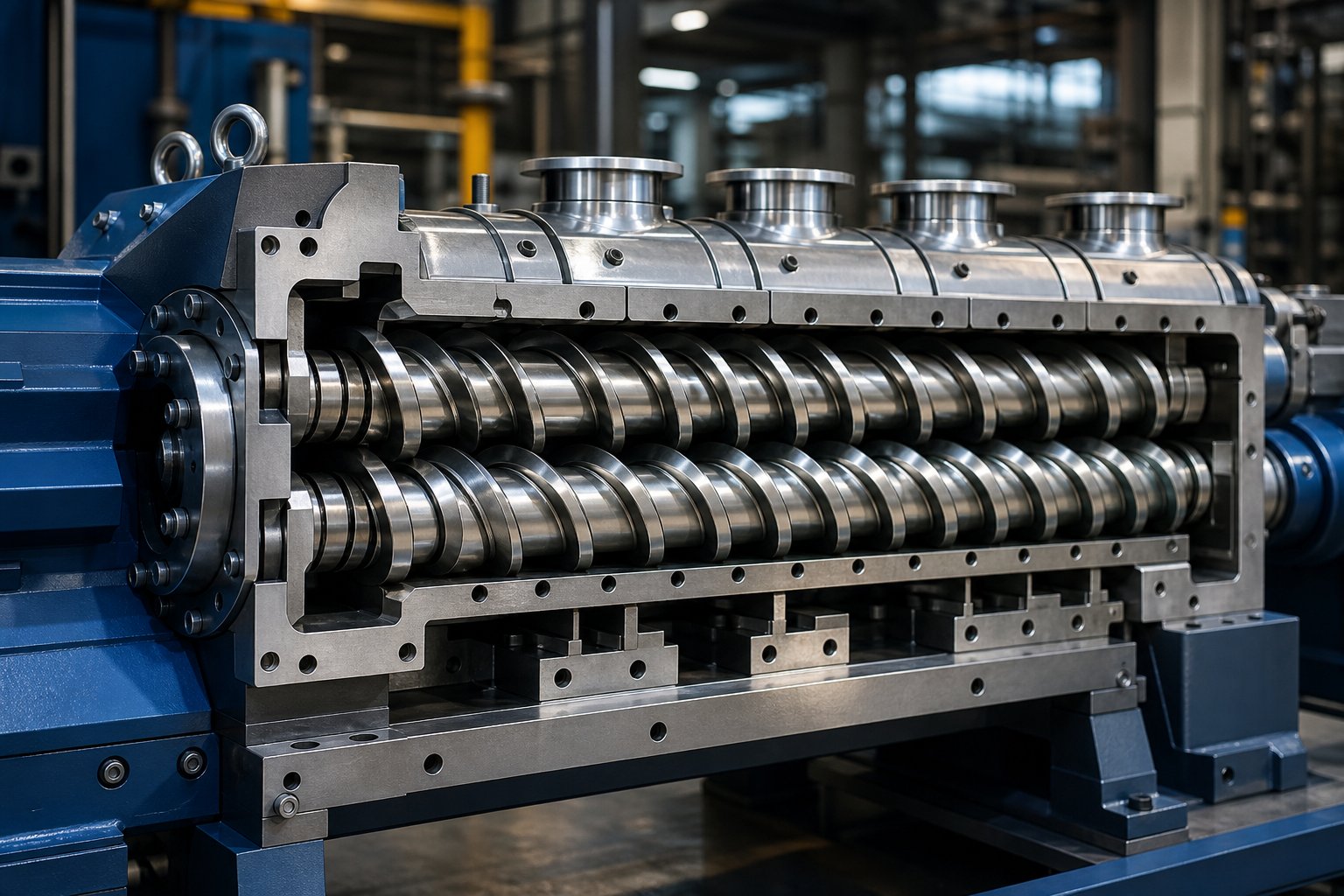
A co-rotating twin screw extruder is a polymer processing machine that uses two intermeshing screws, rotating in the same direction inside a modular barrel, to melt, mix, and shape plastic materials with exceptional precision. These machines dominate compounding, masterbatch production, and reactive extrusion because their design delivers something no other extruder type can match: intense, uniform mixing combined with reliable self-wiping action that keeps the barrel clean between material changes.
This article is not a manufacturer catalog. It is an independent buyer's resource — built to help you ask sharper questions, spot weak suppliers, and protect your investment long before a purchase order is signed.
How Co-Rotating Twin Screw Extruders Work
Imagine two helical screws placed side by side inside a figure-eight barrel bore, both spinning in the same direction. As they rotate, the flight of one screw wipes the root of the other. This intermeshing, self-wiping geometry is the core reason co-rotating twin screw extruders excel at distributive and dispersive mixing — every particle of polymer, filler, or additive gets forced through high-shear zones repeatedly.
Material moves through three distinct processing stages. First, the feeding zone accepts raw material — pellets, powders, or liquids — through gravimetric or volumetric feeders. Next, the compression and melting zone uses a combination of barrel heat and mechanical shear from kneading block elements to convert solid feedstock into a homogeneous melt. Finally, the melt conveying zone builds pressure and pushes the processed material toward a die or pelletizer. Each stage can be fine-tuned through screw element selection and barrel temperature profiles, which is why a co-rotating twin screw extruder for compounding offers such remarkable process flexibility.
Why Your Supplier Choice Defines Production Success
Here is where most buyers underestimate the stakes. Selecting a co-rotating twin screw extruder supplier is not a one-time purchasing event — it is the start of a relationship that will shape your production uptime, material quality, and profitability for years. Spare parts availability, technical support responsiveness, and the ability to customize screw and barrel configurations for evolving product lines all matter far more than the initial quote.
The NIST Manufacturing Extension Partnership highlights a principle that applies directly here: many manufacturers default to a transactional, cost-per-unit mindset when evaluating suppliers, while the real measure of value is total cost of ownership across the full production lifecycle. A twin screw extruder supplier selection guide should push you beyond price and toward partnership quality.
Choosing the right supplier is as important as choosing the right extruder specifications. The best machine, paired with a supplier who cannot support it, becomes your most expensive liability.
Spare parts that arrive in days versus weeks, engineering staff who can reconfigure your screw profile for a new resin grade, warranty terms that are clearly documented rather than buried in fine print — these factors separate suppliers who sustain your production from those who simply ship a machine and disappear. The gap between the two becomes painfully obvious only after commissioning, which is exactly why this guide exists.
Yet before evaluating any supplier, you need clarity on a more fundamental question: is a co-rotating design actually the right configuration for your application — or would a counter-rotating or single screw extruder serve you better?
Co-Rotating vs Counter-Rotating Twin Screw Extruders Compared
That fundamental question — which configuration actually matches your process — trips up more buyers than any pricing negotiation ever will. A surprising number of procurement teams request quotes for co-rotating machines without fully understanding why the rotation direction matters, or whether a counter-rotating or even single screw design might be the smarter fit. Getting this wrong means overspending on capability you do not need, or worse, buying a machine that physically cannot handle your material.
The distinction comes down to how the two screws interact with each other and with the material trapped between them. Both configurations use two screws inside a figure-eight barrel bore. But the direction those screws turn changes everything about pressure generation, mixing intensity, and self-cleaning behavior.
Rotation Direction and Its Impact on Processing
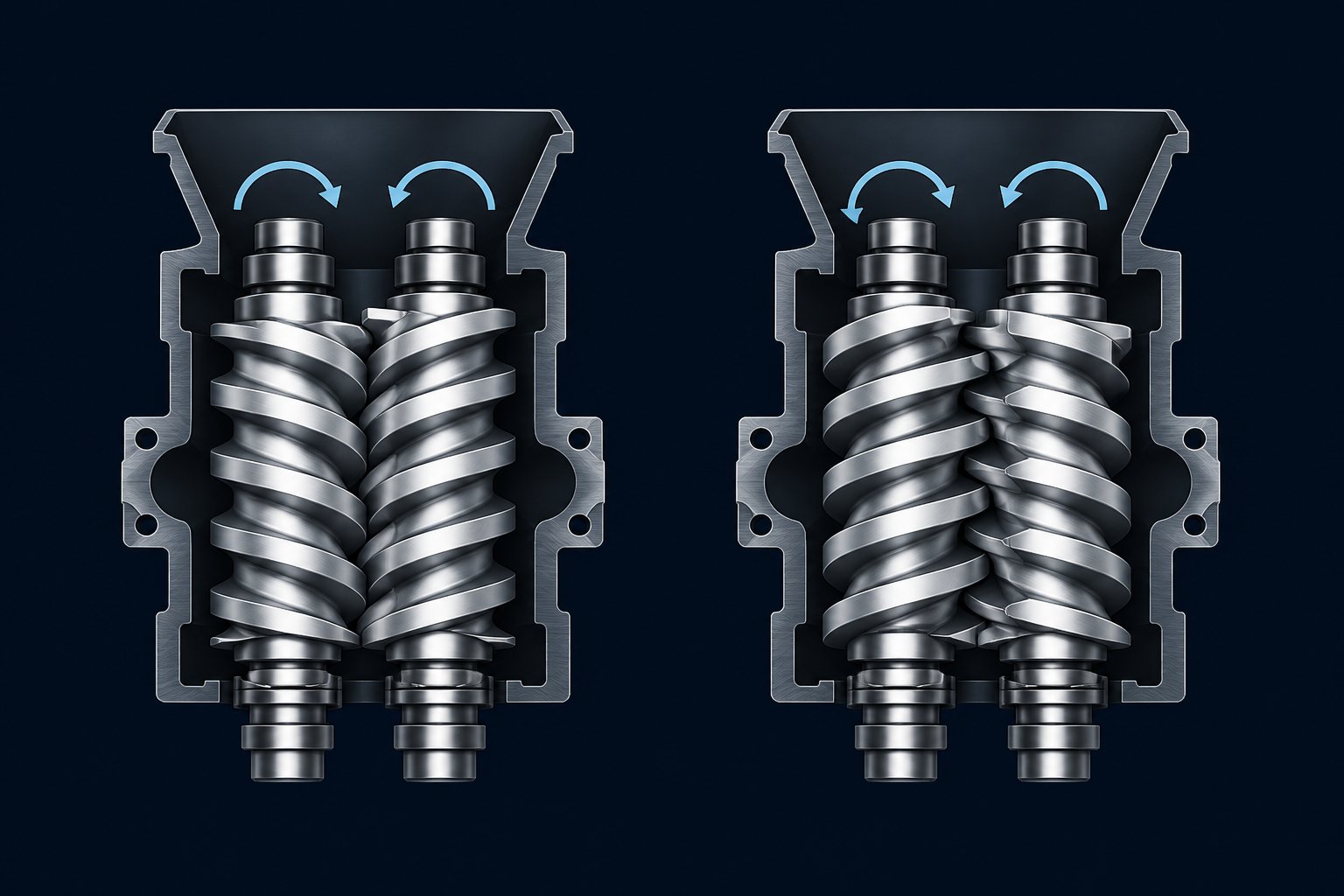
In a co-rotating twin screw extruder, both screws spin in the same direction — either both clockwise or both counterclockwise. Because the screws intermesh tightly, one screw's flight continuously wipes the other screw's root surface. This self-wiping action is not just a cleaning convenience. It is the mechanical reason co-rotating machines deliver superior distributive and dispersive mixing. Material cannot stagnate in dead zones. Instead, it is constantly folded, stretched, and reoriented as it travels down the barrel.
You'll notice the practical payoff immediately during material changeovers. Because the self-wiping twin screw extruder design prevents polymer from clinging to screw surfaces, purging between color or resin changes takes far less time. For operations running heat-sensitive polymers — think PLA, certain TPUs, or EVOH — this also means less thermal degradation, since material spends less time sitting in hot zones.
Counter-rotating screws, by contrast, turn toward each other at the nip point. Picture two calendar rolls pressing together: material gets squeezed between the screws under high localized pressure. This calender-like compression generates excellent pressure-building capability, which is exactly what rigid PVC profile and pipe extrusion demands. A twin screw extruder for PVC profile extrusion is almost always a counter-rotating, conical design because the process needs controlled pressure and gentle plasticization rather than aggressive mixing.
The tradeoff? Counter-rotating designs typically run at lower screw speeds, produce lower throughput per unit of screw diameter, and offer less mixing intensity. Their intermeshing geometry also creates higher localized wear at the nip zone, which limits maximum speed before mechanical risk increases.
Co-rotating twin screw extruder mixing efficiency, on the other hand, scales well with screw speed. Modern co-rotating machines routinely operate above 600 RPM — some exceeding 1,200 RPM — because the self-wiping geometry distributes forces more evenly and avoids the concentrated stress points inherent in counter-rotating designs.
When to Choose Each Configuration
The decision between co-rotating and counter-rotating is rarely ambiguous once you map it against your actual processing requirements. The following comparison lays out the key differences across the criteria that matter most during supplier evaluation:
| Criterion | Co-Rotating Twin Screw | Counter-Rotating Twin Screw |
|---|---|---|
| Mixing Efficiency | High — excellent distributive and dispersive mixing through repeated folding and shearing | Moderate — good compression mixing but limited distributive capability |
| Throughput Capacity | High — scales with screw speed; suitable for large-volume compounding | Lower — constrained by nip-zone pressure limits and lower max screw speeds |
| Self-Cleaning Capability | Excellent — intermeshing, self-wiping geometry minimizes material residue | Limited — material can accumulate in calender nip zones |
| Typical Applications | Polymer compounding, masterbatch, reactive extrusion, devolatilization, filled compounds, recycling | Rigid PVC pipe and profile, PVC window frames, some sheet applications |
| Screw Speed Range | Wide — commonly 200 to 1,200+ RPM | Narrow — typically 5 to 50 RPM (conical) or up to 200 RPM (parallel counter-rotating) |
| Wear Characteristics | Distributed evenly along barrel and screw elements; modular replacement possible | Concentrated at nip point; conical screws often require full replacement |
| Material Changeover Time | Fast — self-wiping action reduces purge material and downtime | Slower — residual material requires more extensive purging |
If your operation centers on compounding engineering plastics with glass fiber, blending color masterbatch, processing recycled feedstock with variable melt behavior, or running reactive extrusion chemistries, a co-rotating machine is almost certainly the right architecture. The self-wiping advantage alone justifies it for any production environment where frequent recipe or color changes are part of daily operations.
If you are extruding rigid PVC profiles, pipes, or window frames from powder dry-blend, counter-rotating conical designs remain the industry standard — and trying to force a co-rotating machine into that role typically creates more problems than it solves.
There is also a third option worth addressing briefly. For simpler applications — stable pellet-fed production of PE pipe, PP sheet, single-resin film, or basic tubing — a single screw extruder often makes more practical and economic sense. Single screw machines excel when the material is already compounded, the formulation does not change frequently, and the primary job is steady melting and pressure building rather than intensive mixing. As one industry guideline puts it: the better machine is the one that solves the actual processing problem without adding unnecessary cost, cleaning burden, and operator complexity.
So here is the honest self-check before you start requesting quotes from any co-rotating twin screw extruder supplier: does your process genuinely require the mixing intensity, throughput flexibility, and self-cleaning capability that co-rotating designs provide? If the answer is yes, the next challenge shifts from choosing the right machine type to decoding the technical specifications that separate a good machine from a great one — and that requires understanding a vocabulary most suppliers assume you already know.
Essential Technical Specifications Every Buyer Must Understand
That vocabulary gap — where suppliers speak in spec-sheet shorthand and buyers nod along without fully grasping the numbers — is exactly where bad purchasing decisions take root. A supplier quotes a torque density of 11.3 Nm/cm³ and a competitor quotes 8.2 Nm/cm³. Which is better? Better for what? Without understanding what those numbers actually mean for your specific compounding application, you are comparing labels instead of capabilities.
This section breaks down the technical specifications that appear on virtually every co-rotating twin screw extruder quotation. Think of it as a decoder ring for spec sheets — one that lets you evaluate suppliers on equal footing regardless of how polished their sales presentations look.
Torque Density and Why It Signals Machine Quality
If you could pick only one number to assess the mechanical backbone of a co-rotating twin screw extruder, torque density would be it. Measured in Nm/cm³, torque density quantifies the torque delivered per unit of shaft cross-sectional area — essentially, how much twisting force the gearbox and screw shafts can transmit relative to their physical size.
Why does this matter? Because torque is what drives the screws through high-viscosity melts, filled compounds loaded with 40% glass fiber, or mineral-packed masterbatch formulations. When the material resists being pushed, sheared, and mixed, the torque demand spikes. If the gearbox cannot handle that demand, one of two things happens: either the machine's safety system cuts throughput to protect the drivetrain, or — in a worst-case scenario — mechanical failure damages the gearbox or screw shafts.
Imagine running a 50% calcium carbonate-filled polypropylene compound. The motor has plenty of kilowatts available. The screw speed is well within range. But the gearbox hits its torque ceiling at 70% of your target feed rate. You are effectively paying for a machine that cannot run at its advertised capacity with your actual material. This is the most common — and most expensive — specification mismatch in the industry.
Modern high-performance machines achieve torque densities of 15 to 18+ Nm/cm³, representing a roughly 30% jump over previous-generation equipment. Standard machines typically fall in the 5 to 10 Nm/cm³ range, while high-torque platforms push beyond 15 Nm/cm³. Some suppliers prominently publish their torque density figures — values like 10.3 Nm/cm³ are common among mid-range offerings — while others bury this specification or omit it entirely. That omission itself tells you something.
| Torque Density Range (Nm/cm³) | Classification | Typical Application Suitability |
|---|---|---|
| 5 – 10 | Standard | Unfilled polymers, low-viscosity blends, color concentrates |
| 10 – 15 | High Torque | Moderate-fill compounding, engineering thermoplastics |
| 15 – 18+ | Ultra-High Torque | Highly filled compounds, glass-reinforced materials, reactive extrusion |
Here is a practical guideline most salespeople will not volunteer: plan to operate at roughly 80% of continuous torque capacity and 80% of maximum screw speed. That margin absorbs process variability, cold-start torque spikes — which can exceed steady-state values by 20% to 40% — and the reality that peak torque ratings on spec sheets often represent intermittent duty, not continuous operation. Treating the peak number as your buying criterion is a recipe for a machine that redlines under normal production conditions.
When comparing twin screw extruder technical specifications across suppliers, always ask: is the quoted torque density a continuous rating or a peak rating? A supplier confident in their gearbox engineering will answer that question without hesitation.
L/D Ratio, Screw Speed, and Barrel Zone Configurations
Torque tells you how much force the machine can deliver. The L/D ratio tells you how much processing real estate it gives you to work with.
L/D ratio — length-to-diameter ratio — is simply the total screw length divided by the screw's outer diameter. A machine with a 40 mm screw diameter and a 1,600 mm screw length has an L/D ratio of 40:1. That number determines how many distinct functional zones you can fit along the barrel: feeding, melting, mixing, venting, side-feeding, and pressure buildup before the die.
Each functional zone typically occupies one barrel segment roughly 4D in length (four times the screw diameter). So a 40:1 machine gives you approximately ten barrel segments to allocate across your process. Sounds generous — until you map out a complex compounding operation that needs solids conveying, two melting and mixing stages, a side-feed port for glass fiber, vacuum devolatilization, and a pressure-building section. That is seven distinct zones at minimum, leaving slim margin for optimization on a shorter machine.
The practical breakdown for L/D ratio selection in twin screw extruder compounding applications looks like this:
- 28:1 to 36:1 — suitable for simpler blending, color concentrate production, or processes requiring minimal mixing stages
- 36:1 to 44:1 — the workhorse range for general compounding with one mixing zone, atmospheric venting, and moderate process complexity
- 44:1 to 52:1 — required for complex formulations involving multiple mixing zones, vacuum devolatilization, downstream fiber feeding, or reactive extrusion chemistries
- 52:1 and above — reserved for highly specialized reactive extrusion or tandem processing where extended residence time is non-negotiable
Longer is not automatically better. Every additional barrel segment increases energy consumption, extends the material's residence time at elevated temperatures — raising degradation risk for heat-sensitive polymers — and adds to capital cost. The right L/D ratio matches the complexity of your process. Nothing more, nothing less.
Screw speed adds another dimension. Modern co-rotating machines typically offer maximum speeds between 300 and 1,200+ RPM. Higher speeds generate greater shear rates, which intensify dispersive mixing — useful for breaking apart pigment agglomerates in masterbatch or distributing nano-scale additives. But higher speed also means more frictional heat generation within the melt, which can push temperature-sensitive materials past their degradation threshold.
The relationship is direct: at a given screw geometry, doubling the RPM roughly doubles the shear rate. A process running at 400 RPM delivers a fundamentally different shear and thermal history than the same process at 800 RPM — even with identical barrel temperature setpoints. This is why specific throughput, measured in kg/h per RPM, is such a valuable comparison metric. It normalizes output against screw speed, letting you see how efficiently the machine converts each revolution into material movement.
Barrel zone configuration ties all of this together. Modern co-rotating extruders use modular, segmented barrels — individual sections bolted together, each with independent heating elements and cooling channels. This modularity means you can arrange open feed barrels, closed processing barrels, side-feed sections, and venting barrels in whatever sequence your process requires. Change the formulation next year? Rearrange the barrel layout and swap screw elements instead of buying a new machine.
The number of independently controlled barrel zones — typically 6 to 12+ on production-scale equipment — directly determines your thermal control granularity. A reactive extrusion process might need a sharp temperature ramp in zones 2 and 3 to initiate a catalyst, followed by aggressive cooling in zones 6 and 7 to prevent runaway exothermic reactions. Without enough independently controlled zones, you cannot achieve that kind of precision.
Before requesting quotes from any supplier, assemble this minimum specification checklist. These are the numbers you need side by side to make a meaningful twin screw extruder technical specifications comparison:
- Torque density (Nm/cm³) — continuous rating, not peak
- L/D ratio — confirm segment length (4D vs. 5D) to validate zone count
- Screw diameter (mm) — defines throughput scale and scale-up compatibility
- Maximum screw speed (RPM) — evaluate alongside torque, not in isolation
- Number of barrel zones — independently heated and cooled
- Motor power (kW) — cross-reference with geared speed range to calculate available torque
- Specific throughput (kg/h per RPM) — the truest apples-to-apples performance metric
Any supplier who cannot — or will not — provide clear answers to all seven of these data points deserves scrutiny. Transparency on specifications is the baseline test of technical credibility. And that raises a deeper question most buyers never think to ask: who exactly is on the other side of that quotation? The answer varies far more than most people realize — and the type of supplier you are dealing with shapes everything from pricing transparency to long-term technical support.
Understanding the Types of Twin Screw Extruder Suppliers
The company behind that quotation might be the engineering team that designed the gearbox, machined the barrel liners, and assembled the machine on their own factory floor. Or it might be a trading office that purchased the same machine from that factory, relabeled it, marked it up, and forwarded you a polished PDF. From the outside, both websites can look equally professional. Both answer emails promptly. Both quote competitive prices. But the difference between a direct OEM manufacturer and a trading company reshapes everything — your warranty protection, your access to technical support, and your ability to get custom configurations when your process demands them.
This is the supplier classification topic that almost nobody in the industry talks about openly. Yet understanding who you are actually dealing with is the single most important step in learning how to find a reliable twin screw extruder supplier.
Direct OEM Manufacturers vs Trading Companies vs Distributors
Every co-rotating twin screw extruder supplier you encounter falls into one of three archetypes. Each has a legitimate role in the market — but the value they deliver, and the risks they introduce, differ dramatically.
Direct OEM manufacturers design, engineer, and build machines or components in their own facilities. They employ the mechanical engineers who calculate shaft deflection, the metallurgists who specify barrel liner compositions, and the assembly technicians who align gearbox shafts to micron-level tolerances. When you call with a technical question about screw element geometry or barrel venting placement, the person who answers either designed it or works ten meters from the person who did. This proximity between buyer and engineering team translates into the deepest customization capability, the most reliable warranty accountability, and the fastest resolution when something goes wrong during commissioning.
Trading companies occupy a different space entirely. They source machines from OEM factories — sometimes multiple factories — and resell them under their own brand or a white-label identity. Pricing is often lower because trading companies shop aggressively among manufacturers and absorb thinner margins. The tradeoff? Limited technical depth. When you ask a trading company about modifying a screw configuration for your specific resin system, the answer often takes days because your question has to travel from the trading company's sales office to the actual factory's engineering team and back. Warranty chains become murky: if a gearbox fails eighteen months into operation, who is responsible — the trading company that sold it or the factory that built it? As sourcing industry analysts note, trading companies often position themselves based on the relative leverage between buyer and manufacturer, which means your interests may not always come first in a dispute.
Authorized regional distributors represent a specific OEM within a defined territory. They provide local-language support, faster in-region service response, and sometimes maintain spare parts inventory closer to your facility. The premium you pay — typically 10% to 25% above direct OEM pricing — buys convenience and accessibility. For buyers in regions where the OEM has no direct sales office, a strong distributor relationship can significantly reduce lead times on spare parts and service calls.
The challenge is that these categories are not always transparent. A trading company may present itself as a manufacturer. A distributor may imply exclusivity it does not actually hold. The following twin screw extruder supplier types comparison highlights where the differences matter most:
| Evaluation Criterion | Direct OEM Manufacturer | Trading Company | Authorized Distributor |
|---|---|---|---|
| Pricing Transparency | High — costs tied directly to materials, labor, and engineering | Variable — markup structures often undisclosed; may shop among multiple factories | Moderate — OEM base price plus published distribution margin |
| Customization Ability | Extensive — in-house engineering can modify screw geometry, barrel metallurgy, and control systems | Limited — must relay customization requests to the actual factory, often with communication loss | Dependent on OEM — distributor facilitates but does not engineer modifications |
| Technical Support Depth | Direct access to design engineers, process specialists, and assembly teams | Surface-level product knowledge; deep technical questions require factory escalation | Trained on OEM product line; can resolve common issues but escalates complex cases |
| Spare Parts Availability | Full inventory of proprietary components; fastest sourcing for non-standard parts | Dependent on factory relationship; delays likely for specialized or obsolete components | May hold regional stock of fast-moving wear parts; non-standard items routed through OEM |
| Warranty Reliability | Clear accountability — one entity designed, built, and warrants the equipment | Unclear chain — disputes may involve finger-pointing between trading company and factory | Backed by OEM warranty; distributor acts as local warranty administrator |
| Communication Directness | Direct line to decision-makers and technical staff | Filtered through sales intermediaries; information latency is common | Good regional responsiveness; complex matters still route to OEM headquarters |
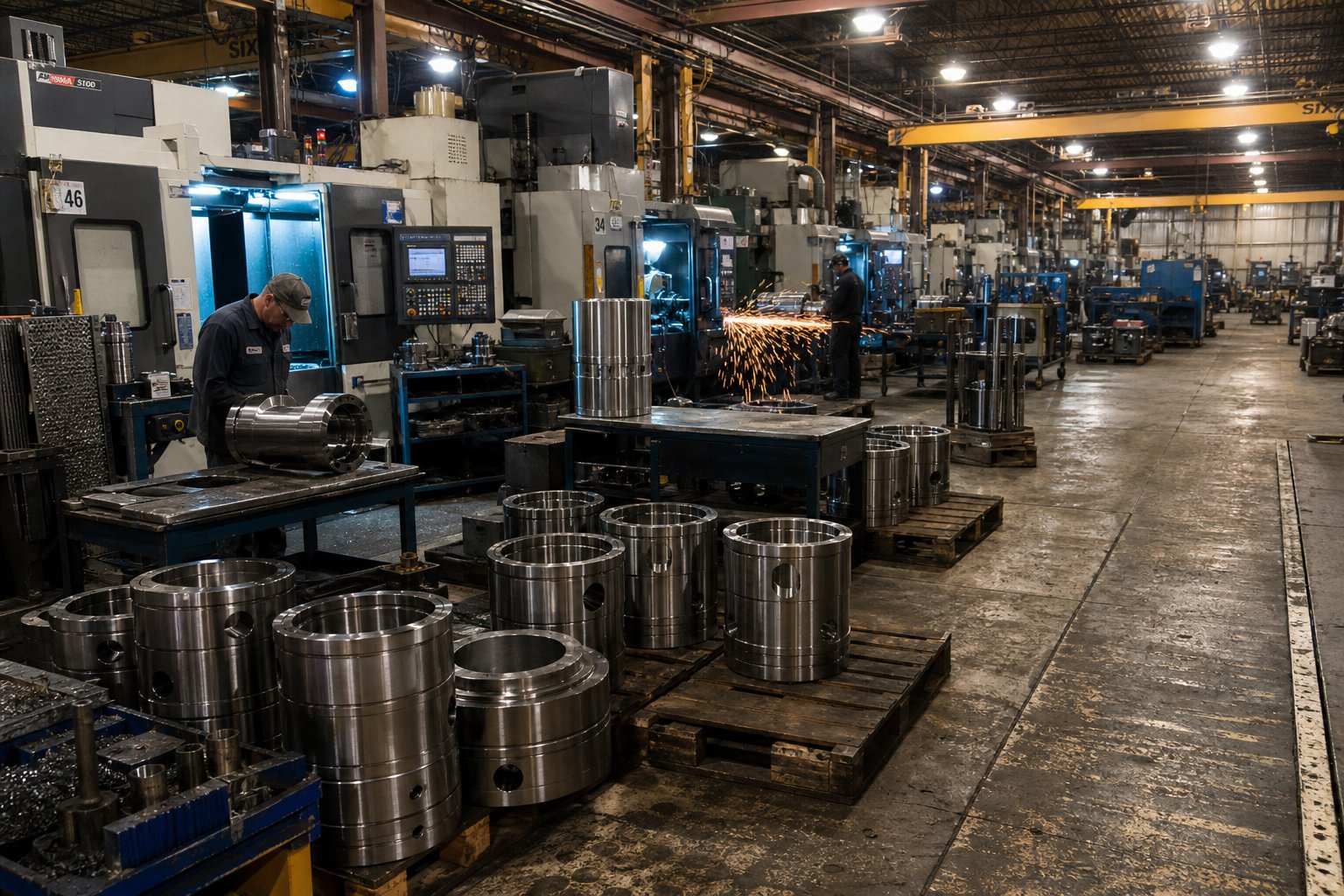
How do you tell which type you are dealing with? Ask to tour the factory — either in person or via a live video walkthrough. A genuine OEM manufacturer will show you CNC machining centers, barrel bore honing equipment, gearbox assembly areas, and quality inspection stations. A trading company, when pressed, will either decline the request, offer photos instead of live access, or arrange a visit to someone else's facility. Another telling signal: ask who designed the screw element geometry your machine will use. An OEM answers immediately with specifics. A trading company hesitates or deflects.
Regional Supplier Landscape and What to Expect
Geography shapes more than shipping costs. The region where your supplier operates influences engineering philosophy, pricing structure, communication style, and the kind of after-sales infrastructure you can realistically expect.
Chinese manufacturers represent the fastest-growing segment of the global twin screw extruder market. Over the past decade, Chinese twin screw extruder manufacturer quality has advanced significantly — several domestic OEMs now produce machines with torque densities, metallurgical standards, and control system sophistication that compete directly with European equipment at 40% to 60% lower price points. The strongest Chinese suppliers invest heavily in their own gearbox manufacturing, CNC barrel machining, and R&D departments. The weaker ones assemble machines from outsourced components with minimal quality integration. The spread in quality within China is wider than in any other manufacturing region, which makes supplier vetting especially critical when sourcing from this market.
Practical expectations: lead times typically range from 8 to 16 weeks for standard configurations. Communication is generally conducted in English via email and messaging apps, though nuance can be lost in translation during complex technical discussions. After-sales service infrastructure varies enormously — top-tier Chinese OEMs maintain overseas service engineers and regional spare parts depots, while smaller factories rely entirely on remote support.
German and Italian manufacturers have long set the benchmark for precision engineering and process know-how in twin screw extrusion. Their machines command premium pricing — often two to three times the cost of comparable Chinese equipment — justified by decades of application expertise, tighter manufacturing tolerances, and extensive global service networks. Buyers choosing European equipment typically gain access to pilot plant testing, material-specific process optimization, and well-documented training programs. The tradeoff is cost, longer delivery timelines of 20 to 30+ weeks, and less pricing flexibility on spare parts and service contracts.
Japanese manufacturers occupy a distinct position — known for exceptional tight-tolerance engineering, particularly in gearbox and screw shaft manufacturing. Japanese suppliers tend to offer fewer machine model variations but execute each one with remarkable consistency. Communication styles favor detailed written documentation over informal discussions, and decision-making timelines during quoting can feel slower compared to Chinese or European suppliers. After-sales support is typically excellent but concentrated in Asia-Pacific markets.
For international buyers weighing these regions, the decision is rarely just about machine price. Consider these practical factors:
- Lead time sensitivity — If your production line is down and you need a replacement machine fast, a Chinese OEM with an 8-week lead time may outweigh a European supplier quoting 26 weeks, regardless of brand prestige.
- Communication infrastructure — Can the supplier assign a dedicated English-speaking project engineer to your order, or will you communicate through a rotating sales team?
- After-sales service reach — Does the supplier have service engineers or authorized partners in your country or region? A factory visit during commissioning is standard, but what happens when a bearing fails at 2 AM on a Tuesday eighteen months later?
- Spare parts logistics — Where is the nearest spare parts warehouse? Shipping a replacement barrel segment from Nanjing to Sao Paulo takes a very different number of days than shipping from Stuttgart to Sao Paulo.
- Payment and trade terms — Chinese suppliers commonly accept L/C or T/T payment structures with milestone-based schedules. European suppliers may require larger upfront deposits with less flexible terms.
No single region owns a monopoly on quality or value. The smartest buyers evaluate individual suppliers on their own merits — using the same technical and commercial criteria regardless of whether the factory is in Nanjing, Milan, or Osaka. The differentiator is always the specific company, its engineering capability, and its commitment to supporting your production after the machine leaves their loading dock.
Knowing the supplier archetypes and regional landscape puts you in a stronger negotiating position. But recognizing a good supplier is only half the equation — you also need a structured, repeatable method for scoring and comparing the candidates on your shortlist against the criteria that actually predict long-term partnership success.
A Structured Framework for Evaluating Twin Screw Extruder Suppliers
A repeatable scoring method sounds great in theory. In practice, most buyers default to gut instinct — a factory tour that felt professional, a salesperson who answered emails quickly, a price that landed under budget. None of those impressions are meaningless, but none of them reliably predict whether a supplier will still be solving your problems three years into production. What you need is a twin screw extruder supplier evaluation checklist that forces every candidate through the same gauntlet of questions — so the comparison reflects capability, not charisma.
This framework splits into two dimensions: what the supplier can engineer, and how well they support what they sell after your wire transfer clears.
Technical Capability Assessment Criteria
A supplier's engineering depth determines the ceiling on what your extruder can do — not just at commissioning, but as your product portfolio evolves. When you evaluate extruder supplier technical capability, you are really asking: can this company solve problems I have not encountered yet?
Start with screw element customization. A capable supplier maintains a broad library of conveying elements, kneading blocks, and specialized mixing elements — and employs engineers who can configure them into application-specific profiles. Ask whether they design their own screw element geometries or source standard profiles from a third-party catalog. An OEM that designs its own elements can modify tip angles, stagger sequences, and disc widths to fine-tune dispersive versus distributive mixing for your exact formulation. A supplier working from a fixed menu cannot.
Barrel metallurgy is equally revealing. You want to hear specific options: nitrided steel for standard polymers, bimetallic liners with nickel-cobalt-tungsten carbide matrices for abrasive compounds, and corrosion-resistant alloys for halogenated or chemically aggressive materials. If the answer is simply "hardened steel barrels" with no elaboration, that supplier likely does not serve applications demanding anything beyond baseline wear resistance.
Then push deeper. Can they provide process simulation support — predicting fill levels, shear rates, and residence time distribution before you commit to a screw configuration? Do they operate a pilot extrusion line where you can run your actual material at relevant throughput before finalizing the machine design? Pilot-line availability is a strong signal. A supplier willing to let you test your resin on their equipment before purchase is demonstrating confidence in their platform and genuine interest in application fit.
Ask about material-specific processing experience directly. "We handle all polymers" is a marketing answer. "We have fourteen installations running 40% glass-filled PA6.6 at throughputs above 800 kg/h" is an engineering answer. The difference between those two responses tells you whether the supplier has actually solved your problem before — or is planning to learn on your machine.
Throughput testing methodology deserves its own question. How does the supplier validate output claims? What material, die configuration, and back-pressure condition were used during testing? As covered in the specifications chapter, a throughput figure generated with neat polyethylene through an open barrel exit means something entirely different from the same figure achieved with your 30% mineral-filled formulation. Suppliers who document test conditions transparently are the ones whose numbers you can trust during capacity planning.
Service Infrastructure and Long-Term Partnership Indicators
Technical capability gets the machine running. Service infrastructure keeps it running — and this is where the twin screw extruder after-sales support criteria separate genuine partners from transactional vendors.
The following checklist covers the service and support dimensions that most directly predict whether a supplier relationship will feel like a partnership or a recurring headache. Use it as a scoring tool during your RFQ process — send these questions to every shortlisted candidate and compare not just the answers, but the speed and completeness with which they respond.
- Certifications and quality management systems — Does the supplier hold ISO 9001 or equivalent quality management certification? Is the certification current, and does the certified scope cover the specific factory site and product type you are purchasing? Verify independently rather than accepting a PDF at face value.
- Reference customers in your specific application area — Can the supplier connect you with existing customers running similar materials and processes? Anonymized case studies are acceptable when customer confidentiality applies, but the supplier should provide enough detail — material type, throughput range, years in operation — to be verifiable.
- Spare parts inventory and delivery timelines — What wear components does the supplier stock? Where are they warehoused? What is the realistic delivery time to your facility for critical items like screw elements, barrel segments, and heating bands? A supplier quoting "two weeks" for barrel delivery but warehousing inventory 8,000 miles from your plant is not offering two-week delivery — they are offering two weeks plus international freight.
- Technical training and installation support — Does the supplier provide operator training during commissioning? Is it included in the purchase price or billed separately? How many days are allocated, and does the training cover screw changeover procedures, barrel maintenance, and process troubleshooting — or just basic startup and shutdown sequences?
- Warranty terms and scope — What exactly is covered, for how long, and under what conditions? An extruder supplier warranty and spare parts assessment should examine whether the warranty covers only manufacturing defects or extends to process performance guarantees. Are wear components like screws and barrel liners included or explicitly excluded? Where are exclusions documented?
- Communication responsiveness during quoting — Track how quickly and thoroughly each supplier responds to your initial technical questions. A supplier that takes ten days to answer a straightforward question about torque density during the sales phase — when motivation to impress you is at its highest — will not get faster after they have your deposit.
- After-sales engineering support availability — When you need to reconfigure your screw profile for a new resin grade or troubleshoot a mixing deficiency two years into operation, who answers the phone? Is engineering support available, or does the relationship end at the loading dock? Ask for the name and contact information of the after-sales engineer assigned to your region.
- Documentation quality — Request sample documentation from a previous project: assembly drawings, barrel and screw element part number systems, electrical schematics, maintenance schedules, and operating manuals. Thorough documentation signals a supplier that expects a long-term relationship. Sparse or generic documentation signals one that does not.
Here is where context matters: not every buyer should weight these criteria equally. Your priorities shift depending on where you stand in the equipment lifecycle.
First-time buyers — companies purchasing their first co-rotating twin screw extruder — should weight technical training, installation support, and after-sales engineering availability heavily. You are building operational knowledge from zero, and a supplier who provides thorough onboarding dramatically shortens the time between commissioning and stable, optimized production. Reference customers matter more here too, because you lack the internal experience to independently validate a supplier's claims.
Replacement buyers — operations replacing aging equipment or switching suppliers — can shift weight toward spare parts logistics, warranty scope, and pricing transparency. Your team already understands the process. What you need is a supplier whose components arrive fast, whose replacement parts perform reliably, and whose commercial terms are clear enough to avoid surprises on the next purchase order. Communication responsiveness still matters, but deep hand-holding during startup is less critical when your operators already know how to run a twin screw line.
Regardless of buyer profile, one principle holds: score every supplier against the same checklist using the same scale. A structured evaluation exposes gaps that polished sales presentations are specifically designed to conceal. And the most consequential gap of all — the one that directly ties supplier choice to your daily production costs — involves the physical components that wear out fastest: the barrels and screw elements whose modularity, metallurgy, and replaceability define how much value your machine retains over its operating life.
Why Modular Barrel and Screw Design Should Influence Your Supplier Choice
Those barrels and screw elements that wear out fastest are also the components that reveal the most about a supplier's long-term value. A machine with a beautifully engineered gearbox and a powerful motor still grinds to a halt when a single barrel segment wears through — and what happens next depends entirely on how that barrel was designed. Was it a monolithic, one-piece construction that forces you to scrap the entire assembly? Or was it a modular system where you can unbolt one worn segment, slide in a replacement, and resume production within hours?
That distinction — monolithic versus modular — is not just a design preference. It is a financial decision that compounds over years of operation. And it is one of the clearest indicators of whether a co-rotating twin screw extruder supplier is thinking about your first purchase or your next decade of production.
How Modular Barrel Segments Reduce Downtime and Extend Machine Life
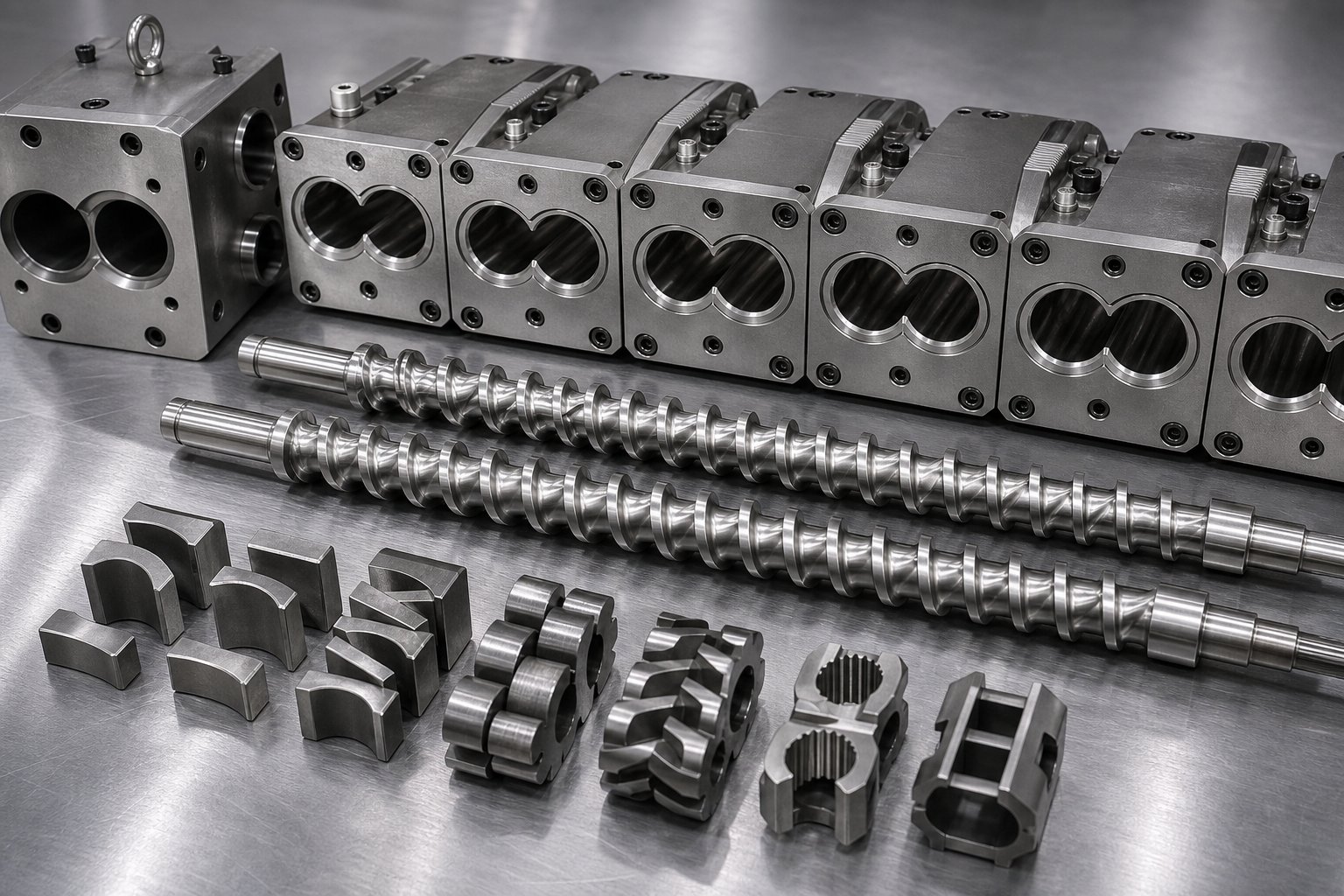
Modern co-rotating twin screw extruders use segmented, bolted barrel sections rather than a single continuous tube. Each segment is typically four to six screw diameters long, independently heated and cooled, and designed to be removed and replaced without disturbing the rest of the barrel assembly. When one segment wears beyond tolerance — and in high-abrasion applications, that can happen well before adjacent segments show measurable degradation — you replace only that section.
The economics are striking. A complete barrel assembly for a mid-sized 65 mm twin screw extruder can cost $10,000 to $50,000 depending on metallurgy, according to industry cost data. A single replacement barrel segment runs $1,000 to $3,000. If wear concentrates in the two or three barrel zones aligned with your kneading blocks — which it almost always does — replacing those segments costs a fraction of what a full barrel swap would demand. Multiply that saving across several replacement cycles over a machine's ten-to-fifteen-year operational life, and modular barrel design easily pays for any premium it carries at initial purchase.
Downtime savings are equally significant. Swapping a single bolted segment takes a maintenance team hours, not days. Compare that to the logistics of removing, shipping, and replacing an entire monolithic barrel — a process that can sideline a production line for a week or more when you factor in shipping lead times and reinstallation alignment.
But modularity only delivers these benefits if the replacement barrel segments for your co-rotating extruder are actually available when you need them. This is where supplier selection becomes critical. A supplier with a deep inventory of standard barrel segments and the manufacturing capability to produce custom configurations on reasonable lead times protects your uptime. A supplier who quotes eight to twelve weeks for a single replacement segment turns a routine wear event into a production crisis.
Barrel Liner Materials for High-Wear Applications
The barrel segment itself is only as good as the liner protecting its bore. And in high-wear applications — glass-fiber-filled compounds, mineral-loaded masterbatch, recycled plastics contaminated with metal fragments or sand — the liner material is the single largest factor determining how long each segment lasts before replacement.
Three liner technologies cover the vast majority of compounding applications:
- Nitrided steel — Surface-hardened to 65-70 HRC through gas or plasma nitriding, producing a hardened case roughly 0.4 to 0.6 mm deep. Adequate for unfilled commodity polymers like PE and PP, where abrasive loads are minimal. Cost-effective, but the thin hardened layer means once abrasive fillers penetrate past it, wear accelerates rapidly.
- Bimetallic liners — A wear-resistant alloy centrifugally cast inside a structural steel shell, creating a liner 1.5 to 3.0 mm thick. Iron-based bimetallic compositions (Fe-Cr-B alloys, 58-62 HRC) handle moderately filled compounds — calcium carbonate at 20-40% loading, talc-filled polypropylene, mid-range fiber content. Nickel-based compositions (Ni-Cr-B-W alloys, 60-65 HRC) add critical corrosion resistance for PVC processing or halogenated flame retardant compounds, where hydrogen chloride gas would destroy unprotected steel within months.
- Tungsten carbide liners — WC-rich alloys embedded in a nickel or cobalt matrix, reaching 65-75 HRC. Essential for twin screw barrel applications involving glass-fiber-reinforced engineering plastics at 30%+ loading, where even standard bimetallic liners wear at commercially unacceptable rates. Field data from compounding operations consistently shows tungsten carbide liners lasting three to five times longer than standard iron-based bimetallic alternatives under severe abrasion.
Here is the detail most salespeople skip: wear does not distribute evenly along the barrel. A barrel zone housing aggressive 60-degree or 90-degree kneading blocks will degrade far faster than adjacent zones containing simple conveying elements. This uneven wear pattern is precisely why modular twin screw extruder barrel segments matter so much — you can specify premium tungsten carbide liners only in the high-wear kneading zones while using more economical bimetallic or nitrided segments elsewhere. That zone-by-zone liner strategy cuts your barrel investment without sacrificing protection where it counts.
The quality and availability of these replacement barrel segments is a direct reflection of a supplier's long-term value proposition. A supplier worth partnering with will not only offer multiple metallurgical options but will help you map the right liner to each barrel position based on your specific compound, filler type, and throughput rate. For operations in compounding, masterbatch, recycling, and pelletizing that need replacement or custom-configured parallel twin screw barrels, specialist component suppliers like NANHAIYA offer custom metallurgical options tailored to high-wear applications — a resource worth evaluating alongside your broader supplier assessment when barrel replacements or upgrades enter the picture.
Screw Element Configuration and Application Matching
The barrel protects the bore. The screw elements define the process. And the way those elements are arranged along the shaft — their sequence, geometry, and combination — creates the processing profile that determines whether your compound comes out right or wrong.
Three element categories form the building blocks of virtually every twin screw extruder screw element configuration:
Conveying elements use deep helical flights to move material downstream. Large-pitch versions at the feed throat maximize volumetric intake. Tighter-pitch versions downstream rebuild pressure before venting sections or the die. They do their job with minimal shear, which is why they appear in feed zones and between intensive mixing sections where the melt needs a thermal recovery zone.
Kneading blocks are where the real mixing happens. A kneading block consists of staggered oval discs — each offset from the previous one at a specific angle. A 30-degree stagger provides gentle forward-conveying mixing. A 60-degree stagger delivers intense dispersive shear for breaking apart pigment agglomerates or distributing nano-fillers. A 90-degree, or neutral, stagger generates maximum shear with zero forward conveying — essentially a dam that forces material to stay in the high-shear zone longer. Disc width matters too: wider discs push more polymer over the flight tip and through the barrel-wall gap, intensifying shear heat.
Mixing and restrictive elements round out the toolkit. Toothed mixing elements (ZME or TME types) split and recombine the melt stream through interlocking teeth — excellent for distributive blending of liquid additives or color concentrates without the heat generation of kneading blocks. Reverse-pitch conveying elements actively push material backward, creating a melt seal necessary for effective vacuum devolatilization. Each element type contributes a specific function, and their power emerges from how they interact within a single profile.
This is where supplier capability diverges sharply. A supplier offering a broad screw element library — with multiple kneading block stagger angles, varying disc widths, several mixing element geometries, and reverse elements in different lengths — gives you the flexibility to fine-tune your process as formulations change. A supplier selling fixed, pre-configured screw designs with no modularity locks you into a single processing profile. When your customer requests a new filler loading, a different base resin, or a tighter color-dispersion specification, the modular system adapts. The fixed design forces a compromise — or a new machine.
Applications where barrel and screw modularity is especially critical include:
- Filled compound processing — Glass fiber, calcium carbonate, talc, and mineral fillers at 20-60% loading demand zone-specific liner upgrades and screw profiles that balance mixing intensity against fiber-length preservation or filler dispersion targets.
- Recycling operations with variable feedstock — Post-consumer or post-industrial streams change batch to batch. Modular barrel configurations allow adding or repositioning venting sections, side-feed ports, and mixing zones to accommodate fluctuating moisture content, melt-flow variability, and contaminant levels.
- Color masterbatch production requiring frequent changeovers — Self-wiping screw geometry combined with modular barrel access points minimizes purge material and downtime between color changes. Operations running fifteen or more color changes per week recoup modularity premiums within the first year.
- Reactive extrusion with corrosive chemistries — Grafting, crosslinking, or polymerization reactions can release acidic or alkaline byproducts. Modular barrels let you isolate the reaction zone with corrosion-resistant nickel-based liners while keeping lower-cost segments in non-reactive zones.
The bottom line is straightforward: when evaluating any co-rotating twin screw extruder supplier, ask to see their screw element catalog and barrel segment options. Count the variations available. Ask how quickly they can deliver replacement segments in your preferred liner material. Ask whether their engineers will help you design an application-specific screw profile — or whether they expect you to accept a standard configuration and figure out the rest yourself.
A supplier who invests in modularity is a supplier who expects the relationship to last. And that mindset — thinking beyond the initial sale — connects directly to a financial reality most equipment quotations conveniently ignore: the total cost of owning and operating these components over the full lifecycle of the machine.
Total Cost of Ownership When Selecting a Supplier
Every quotation you receive for a co-rotating twin screw extruder — or its replacement components — features one number printed larger than the rest: the purchase price. It is the first thing buyers compare, the first thing procurement teams plug into spreadsheets, and the first thing that distorts the decision. Because that number, no matter how large it looks, typically represents only a fraction of what the machine will actually cost you over its operational life.
The twin screw extruder total cost of ownership includes every dollar spent from the moment you sign the purchase order to the day the machine is decommissioned. And the supplier you choose influences nearly every line item on that ledger — often more than the initial price tag itself.
Beyond Machine Price — The True Cost Components
Think of your extruder investment the way you would think about buying a commercial vehicle. The sticker price matters, but fuel economy, tire replacement frequency, warranty coverage, and roadside assistance availability determine whether that vehicle earns or drains money over 300,000 miles. The same logic applies here.
A comprehensive TCO calculation for a co-rotating twin screw extruder or its key components should account for all of the following:
- Initial machine or component cost — the quoted purchase price including any configuration options or customizations
- Shipping and import duties — international freight, customs clearance, and any applicable tariffs, which can add 8% to 20% on top of FOB pricing depending on origin and destination
- Installation and commissioning — rigging, utility connections, mechanical alignment, and the supplier's on-site commissioning support
- Operator training — initial training during startup plus ongoing skill development as formulations or personnel change; training investments typically range from $2,000 to $5,000 per operator depending on program depth
- Energy consumption per kilogram of throughput — co-rotating twin screw systems typically consume 0.12 to 0.22 kWh per kilogram of processed material, and small efficiency differences between machine designs compound into significant annual costs at 5,000+ operating hours
- Scheduled maintenance costs — routine servicing, lubrication, heating element replacement, and preventive inspections, which typically run $8,000 to $25,000 annually for twin screw systems
- Extruder spare parts cost over time — screw element sets, barrel segment replacements, gearbox servicing, seals, and thermocouples; complete screw element sets alone can range from $20,000 to $100,000 depending on configuration and metallurgy
- Unplanned downtime costs from component failure — every hour a production line sits idle waiting for a replacement part has a revenue cost that dwarfs the part itself; for a line generating $500 per hour in saleable output, each percentage point of availability represents roughly $25,000 annually
- Eventual upgrade or replacement costs — barrel bore wear-out, gearbox overhauls at 25,000 to 40,000 operating hours, or control system modernization as technology advances
Add those categories together over a ten-year equipment lifespan and the picture shifts dramatically. Industry cost projections show that a mid-range twin screw extruder system with total ten-year ownership costs of $2 million to $2.9 million carries an initial purchase price that accounts for less than 20% of that total. The remaining 80%+ flows through operational expenses, maintenance, and spare parts — categories where supplier quality has an outsized influence.
How Supplier Choice Directly Impacts Total Cost of Ownership
Here is where the connection between supplier evaluation and financial outcomes becomes concrete. Each TCO component listed above is not a fixed number — it shifts based on who supplied the equipment or components.
Consider barrel segments. A lower-cost barrel set using basic nitrided steel might save you $3,000 on the initial purchase. But if those barrels wear through in six months processing a 30% glass-fiber-filled PA6 compound, you are buying replacements twice a year. A premium bimetallic or tungsten carbide-lined segment from a supplier who understands your material lasts eighteen to twenty-four months under the same conditions. Over five years, the "cheap" option costs you three to four times more in parts alone — and that calculation does not even include the production hours lost during each swap.
Spare parts logistics tell a similar story. A supplier with no regional parts inventory means every replacement barrel segment or screw element ships from the factory — adding one to four weeks of transit time to what should have been a routine maintenance event. Those co-rotating extruder maintenance and downtime costs accumulate quietly. You will not see them on the original invoice, but your production manager feels them on every late shipment to a customer.
Training is another lever. A supplier who provides thorough, hands-on operator training during commissioning — covering not just startup sequences but screw changeover procedures, barrel wear inspection techniques, and process troubleshooting — reduces scrap rates, energy waste, and the frequency of panic calls to the supplier's service line. A supplier who drops off the machine and emails a PDF manual leaves your team to learn through expensive trial and error.
Even energy consumption ties back to supplier quality. A well-engineered gearbox with high torque density runs the screws at optimal speed without the motor straining near its rated limit. A less efficient drivetrain wastes kilowatts on mechanical friction that never reaches the polymer. Over 5,000 operating hours per year, even a 5% difference in specific energy consumption translates to thousands of dollars annually.
The lowest-priced supplier is rarely the lowest-cost supplier over a machine's full lifecycle. Price is what you pay on the invoice. Cost is what you pay over ten years of production.
So how do you compare twin screw extruder supplier pricing on a true cost basis rather than a sticker-price basis? Request lifecycle cost projections during the quoting process. Ask each supplier to estimate annual spare parts consumption based on your specific material and throughput. Ask for documented wear-life data from reference installations running similar compounds. Ask what training, commissioning, and warranty support is included in the quoted price versus billed as extras.
Suppliers who respond with detailed, material-specific projections are telling you they have enough installation history to back their claims with data. Suppliers who deflect these questions — or respond with generic statements about "long wear life" and "high reliability" — are telling you something too. And that difference in transparency is just one entry in a longer catalog of warning signs that separate trustworthy suppliers from those who look great on paper but crumble under scrutiny.

Red Flags and Warning Signs When Vetting Suppliers
Transparency gaps during the quoting phase are not random oversights — they are patterns. And those patterns, once you learn to recognize them, predict exactly the kind of problems that surface six months after commissioning when the salesperson who charmed you has moved on to the next prospect. Every experienced buyer has a story about a twin screw extruder supplier who looked perfect on paper: responsive emails, competitive pricing, a polished website full of professional factory photos. Then the barrel wore through in four months, the warranty claim went unanswered for weeks, and the "factory" turned out to be a trading office renting someone else's production floor.
The warning signs when buying a twin screw extruder are almost always visible before the purchase order is signed. The trick is knowing where to look — and having the discipline to walk away when the red flags stack up, even when the price looks attractive.
Warning Signs in Supplier Communication and Documentation
The way a supplier communicates during the sales phase — when their motivation to impress you is at its peak — sets the ceiling for every interaction that follows. If the experience already feels inconsistent or evasive before money changes hands, it will not improve afterward.
Watch for these twin screw extruder supplier red flags during your evaluation:
- Vague or incomplete technical specifications on product pages — A supplier listing "high torque" and "excellent mixing" without publishing actual torque density values, L/D ratios, or specific throughput data is hiding behind adjectives instead of engineering. Every credible OEM publishes quantifiable specs.
- Reluctance to provide reference customers or case studies — When a supplier claims hundreds of installations but cannot connect you with a single customer running a similar application, those installations may not exist — or the customers may not be satisfied enough to speak on their behalf.
- Inconsistent information between sales conversations and written quotes — If a salesperson verbally promises a 14 Nm/cm³ torque density but the formal quotation lists 10.5 Nm/cm³, that discrepancy signals either carelessness or deliberate inflation during verbal discussions. Either one erodes trust.
- No clear warranty terms, or conditions buried in fine print — Warranty scope should be explicit: what is covered, what is excluded, for how long, and under what conditions. A supplier who deflects warranty questions or delivers a 30-page contract with exclusions scattered across multiple appendices is engineering deniability, not protection.
- Inability to explain their manufacturing process or quality control steps — Ask how they verify barrel liner hardness, what tolerances they hold on screw element outer diameters, or how they validate gearbox assembly. A real manufacturer answers these questions fluently. A reseller stumbles.
- Pressure tactics or unusually short quote validity periods — "This price is only good for 48 hours" or "We have one machine in stock and another buyer is interested" are classic high-pressure sales techniques designed to bypass your due diligence. A confident supplier gives you time to evaluate because they know their offering withstands scrutiny.
Any single item on this list might have an innocent explanation. Two or three appearing together form a pattern that demands a harder look — or a different supplier.
Structural Red Flags That Signal Long-Term Risk
Surface-level communication issues are easy to spot. Structural problems run deeper and take more effort to uncover — but they carry far greater consequences because they signal fundamental weaknesses in the supplier's business model, not just sloppy salesmanship.
These are the warning signs that experienced procurement teams investigate before committing to a purchase order:
- Cannot show their own factory — This is the single most reliable indicator of a trading company reselling white-label equipment. Industry verification data suggests that 15-30% of suppliers listed on major B2B marketplaces are trading companies or intermediaries rather than actual manufacturers. If a supplier declines a factory tour — in person or via live video — or offers photos instead of real-time access, assume you are not dealing with the entity that actually builds the machine.
- No published certifications or quality management documentation — ISO 9001 certification for the specific factory site and product line is a baseline expectation, not a differentiator. Expired certificates, certificates issued by non-accredited bodies, or certificates covering a different facility than the one manufacturing your equipment are all disqualifying issues. Verify certificate numbers independently with the issuing body rather than accepting a PDF forwarded by the supplier.
- Absence of after-sales support infrastructure — Ask for the name and direct contact information of the service engineer assigned to your region. A supplier who cannot provide this — or redirects all post-sale inquiries through a generic sales email — has not invested in the infrastructure needed to support your equipment beyond delivery.
- Extremely low pricing without transparent explanation — A quote that undercuts every competitor by 40% is not a bargain — it is an unanswered question. Legitimate cost reductions come from specific, explainable sources: lower labor costs in the manufacturing region, standardized rather than custom configurations, or higher production volumes spreading fixed costs. If the supplier cannot articulate exactly why their price is so much lower, the savings are likely coming from places you do not want them to come from — thinner barrel walls, lower-grade steel, or components sourced from unvetted subcontractors.
- No engineering staff available for technical discussions — During your evaluation, request a technical call with a process engineer — not a salesperson — to discuss your specific application, screw configuration options, and barrel metallurgy. A supplier whose entire customer-facing team consists of sales staff with no engineering backup is either a trading company or an OEM that has not invested in the expertise needed to support complex applications.
How do you verify extruder manufacturer quality before the purchase order locks you in? Three concrete steps separate thorough buyers from hopeful ones:
First, request a factory tour or live virtual facility walkthrough. Watch for active CNC machining of barrel bores, screw element grinding stations, assembly areas with machines in various stages of completion, and quality inspection equipment like coordinate measuring machines or hardness testers. A real factory has a rhythm — workers moving, chips flying, inspection instruments in use. A staged showroom feels static.
Second, ask for metallurgical test reports on barrel and screw materials. A mill test report documents a material's chemical composition and mechanical properties — hardness, yield strength, and alloy verification — providing objective proof that the liner or screw element meets the specification claimed by the supplier. Any reputable manufacturer either generates these reports through their own quality lab or obtains them from their material suppliers and makes them available upon request. A supplier who cannot produce metallurgical documentation for their barrel liners is asking you to trust marketing claims instead of measured data.
Third, verify claimed certifications independently. Contact the issuing certification body directly. Confirm that the certificate number is valid, that the certified scope covers the product type you are purchasing, and that the certification applies to the specific factory site — not a sister company or a different facility in another province. This step takes thirty minutes and eliminates one of the most common forms of supplier misrepresentation in international equipment procurement.
These verification steps are not paranoia — they are standard due diligence for any capital equipment purchase where the wrong supplier choice can cost you years of production headaches. And once you have eliminated the pretenders, the final step is converting your remaining candidates into a ranked shortlist using a decision-tree methodology that moves you from evaluation to a confident purchasing decision.
Building Your Supplier Shortlist and Making the Right Decision
Eliminating unqualified suppliers is the easier half of the equation. The harder half — and the part that actually determines your production outcomes — is ranking the credible candidates that survive your vetting process and committing to one with confidence. Most buyers stall at this stage. Three or four suppliers have passed the red-flag screen, their spec sheets look comparable, and the pricing differences are narrow enough to agonize over. Without a structured decision path, the choice defaults to whoever has the most persuasive salesperson or the lowest number on the last line of the quote.
A better approach exists. By working through a sequence of clearly defined decision points — each one building on the answers from the step before — you can transform a subjective gut-feel selection into a repeatable, defensible process. Think of it as a co-rotating twin screw extruder buying guide that works whether you are sourcing a complete production line or a single set of replacement barrel segments.
A Decision-Tree Approach to Shortlisting Suppliers
Each step below narrows the field. Skip a step, and you risk making a decision with incomplete information. Follow them in order, and the right supplier typically surfaces before you reach the final stage.
- Confirm your application type and processing requirements. Are you compounding filled engineering thermoplastics? Producing color masterbatch with frequent changeovers? Running reactive extrusion with corrosive byproducts? Recycling post-consumer streams with variable contamination? The application defines the machine architecture, barrel metallurgy, and screw configuration — which in turn defines which suppliers have relevant experience and which are guessing.
- Define your throughput, material, and quality targets. Specify the output rate you need in kg/h with your actual formulation — not with neat polyethylene on an open barrel. Document the base resin, filler type and loading percentage, additive package, and the quality metrics that matter to your customers: dispersion level, melt temperature uniformity, pellet geometry, or mechanical property retention. These numbers become the yardstick against which every supplier's proposal gets measured.
- Determine whether you need a complete extruder system, replacement components, or both. This decision reshapes your entire supplier search. A buyer sourcing a full twin screw extrusion line needs a machinery OEM with system integration capability — gearbox, motor, barrel, screws, feeders, pelletizer, and controls all working together. A buyer replacing worn barrel segments or upgrading screw elements for a new formulation needs a component specialist with deep metallurgical expertise and fast delivery logistics. Some operations need both: a primary machinery supplier for the platform and a dedicated component supplier for ongoing wear-part replenishment.
- Identify whether you need a direct OEM, component specialist, or regional distributor. Revisit the supplier archetypes covered earlier. Direct OEMs deliver the deepest customization and accountability. Component specialists — suppliers who focus specifically on barrels, screw elements, or gearbox components — often carry broader metallurgical options and faster turnaround than full-machine OEMs for whom replacement parts are a secondary business. Regional distributors add value when local service presence and same-language communication outweigh the cost premium.
- Apply the evaluation framework to score your top three candidates. Use the eight-point checklist from the evaluation section — certifications, reference customers, spare parts logistics, training, warranty scope, communication responsiveness, after-sales engineering access, and documentation quality. Score each candidate on the same scale. Weight the criteria according to whether you are a first-time buyer building operational knowledge or a replacement buyer prioritizing parts availability and delivery speed. Let the numbers, not the sales presentations, reveal the ranking.
- Request quotes, reference customers, and material test reports. Ask every shortlisted supplier for a formal quotation that itemizes what is included versus billed separately — commissioning support, training, spare parts kits, and freight. Request contact details for at least two reference customers processing similar materials at comparable throughput. And ask for documented material test data: barrel liner hardness reports, screw element metallurgical certificates, and — for complete machines — throughput validation records from pilot trials or comparable installations.
- Conduct a factory audit or virtual facility review before final selection. This is the step buyers most frequently skip — and the one that most frequently prevents catastrophic supplier mistakes. A live walkthrough of machining centers, assembly areas, quality inspection stations, and raw material storage tells you more about a supplier's real capability in thirty minutes than months of email exchanges. For international purchases where travel is impractical, insist on a real-time video tour guided by a factory engineer, not a pre-recorded marketing video.
This twin screw extruder supplier decision checklist is deliberately sequential. Each step produces information that feeds the next. Trying to jump straight to step six — requesting quotes — without completing steps one through four means you are comparing proposals you do not fully understand against requirements you have not fully defined. That is how buyers end up with machines that technically match the spec sheet but practically miss the application.
Building Reliable Supplier Partnerships for the Long Term
The purchase order is not the finish line. It is the starting point of a relationship that will either support your production or slowly undermine it. The best supplier partnerships evolve well beyond transactional purchasing into something closer to a technical collaboration — where both sides invest in the relationship because both sides benefit from its success.
What does that look like in practice? A machinery OEM that proactively contacts you when they release a new screw element geometry that could improve dispersion in your specific compound. A component supplier who tracks the wear-life data from your barrel replacements and recommends a liner upgrade when your filler loading increases. A service engineer who answers a troubleshooting call on a Saturday because they understand that your production line does not observe business hours.
Building a long-term extruder supplier partnership requires intentional effort from both sides. From your end, that means sharing enough process information for the supplier to make meaningful recommendations — resin grades, filler types, throughput targets, and quality challenges. Treating your supplier as a proprietary-information vault where nothing goes in and nothing comes out makes it impossible for them to add value beyond shipping boxes when you place an order.
From the supplier's end, partnership means investing in your success after the invoice is paid. Providing wear-part lifecycle data so you can plan maintenance windows instead of reacting to failures. Offering process optimization suggestions based on their experience across hundreds of installations. Maintaining spare parts inventory positioned close enough to your facility that a routine barrel swap does not become a three-week production gap.
For operations that rely heavily on barrel and screw element replacements — compounding plants running abrasive formulations, masterbatch producers cycling through dozens of color changes monthly, recycling facilities processing contaminated feedstock — building a reliable supply chain for wear parts deserves as much strategic attention as selecting the original machinery supplier. Component specialists who focus on parallel twin screw barrels and screw elements often provide faster delivery, broader metallurgical options, and more application-specific guidance than full-machine OEMs for whom replacement components are a side business. NANHAIYA, for example, specializes in parallel twin screw barrel replacements and custom configurations for compounding, masterbatch, recycling, and pelletizing operations — the kind of focused component supplier worth evaluating when you are building a wear-part supply chain that prioritizes delivery speed and metallurgical fit alongside price.
The pattern that separates successful equipment buyers from frustrated ones is remarkably consistent. Informed buyers who understand how co-rotating twin screw extruders work, who recognize the differences between supplier types, who evaluate candidates against a structured checklist rather than gut instinct, and who look beyond the purchase price to total cost of ownership consistently achieve better production outcomes. They experience fewer unplanned shutdowns. Their barrel and screw replacements arrive before the old ones fail. Their supplier picks up the phone when something goes wrong.
Salespeople will not tell you most of what this guide covers — not because they are dishonest, but because their job is to close the sale, not to coach you through the evaluation. Your job is different. Your job is to protect your production, your capital, and your team's ability to deliver quality product on schedule, year after year. The suppliers worth partnering with will respect that — and the ones who do not were never the right choice to begin with.
Frequently Asked Questions About Co-Rotating Twin Screw Extruder Suppliers
1. What is the difference between a co-rotating and counter-rotating twin screw extruder?
Co-rotating twin screw extruders have both screws spinning in the same direction, producing a self-wiping, intermeshing action ideal for intensive mixing, compounding, and high-throughput applications. Counter-rotating designs turn screws toward each other, generating high calender-like pressure suited primarily for rigid PVC pipe and profile extrusion. Co-rotating machines typically operate at much higher screw speeds (200 to 1,200+ RPM versus 5 to 200 RPM), offer faster material changeovers due to self-cleaning geometry, and deliver superior distributive and dispersive mixing. Your application type — compounding versus profile extrusion — is the primary factor that determines which configuration is appropriate.
2. How do I tell if a twin screw extruder supplier is a real manufacturer or a trading company?
The most reliable method is requesting a live factory tour or real-time video walkthrough. A genuine OEM manufacturer will show active CNC machining centers, barrel bore honing equipment, screw element grinding stations, gearbox assembly areas, and quality inspection instruments in use. Trading companies typically decline live access, offer pre-recorded videos or static photos, or arrange visits to a facility they do not own. Additional verification steps include asking who designed the screw element geometry, requesting metallurgical test reports for barrel liners, and independently confirming ISO certifications with the issuing body. Industry estimates suggest 15-30% of suppliers on major B2B platforms are intermediaries rather than actual manufacturers.
3. What torque density should I look for in a co-rotating twin screw extruder?
Torque density, measured in Nm/cm3, indicates how much twisting force the gearbox delivers relative to shaft size. Standard machines fall in the 5 to 10 Nm/cm3 range and suit unfilled polymers and low-viscosity blends. High-torque platforms at 10 to 15 Nm/cm3 handle moderate-fill compounding and engineering thermoplastics. Ultra-high-torque machines exceeding 15 Nm/cm3 are necessary for heavily filled compounds, glass-reinforced materials, and reactive extrusion. A practical rule is to plan operations at roughly 80% of the continuous torque rating to absorb process variability and cold-start torque spikes. Always confirm whether a supplier's quoted figure represents continuous or peak duty.
4. Why is modular barrel design important when choosing a twin screw extruder supplier?
Modular barrel construction uses individually bolted segments rather than a single continuous tube. When wear concentrates in specific zones — typically those aligned with kneading blocks — you replace only the affected segments instead of scrapping the entire barrel assembly. A single replacement segment may cost $1,000 to $3,000 versus $10,000 to $50,000 for a full barrel. Modularity also allows zone-by-zone metallurgical optimization: tungsten carbide liners in high-abrasion kneading zones and more economical bimetallic or nitrided segments elsewhere. Suppliers like NANHAIYA specialize in parallel twin screw barrel replacements with custom metallurgical options, making them valuable component partners for compounding, masterbatch, and recycling operations.
5. What is the total cost of ownership for a co-rotating twin screw extruder?
The purchase price typically represents less than 20% of total ten-year ownership costs, which industry projections place at $2 million to $2.9 million for mid-range systems. Major cost components beyond the initial price include shipping and import duties (8-20% on top of FOB pricing), installation and commissioning, operator training ($2,000-$5,000 per operator), energy consumption (0.12-0.22 kWh per kilogram processed), annual scheduled maintenance ($8,000-$25,000), spare parts over time (screw element sets alone range from $20,000-$100,000), unplanned downtime losses, and eventual gearbox overhauls or upgrades. Supplier quality directly influences most of these ongoing costs, which is why evaluating lifecycle cost projections matters more than comparing initial quotes.
Written by
Nanhaiya Technical Team
Zhoushan Nanhaiya Plastic Machinery Co., Ltd.
The Nanhaiya technical team supports screw and barrel manufacturing projects through application review, technical communication, custom manufacturing coordination, and production and quality control.
Discuss Your Application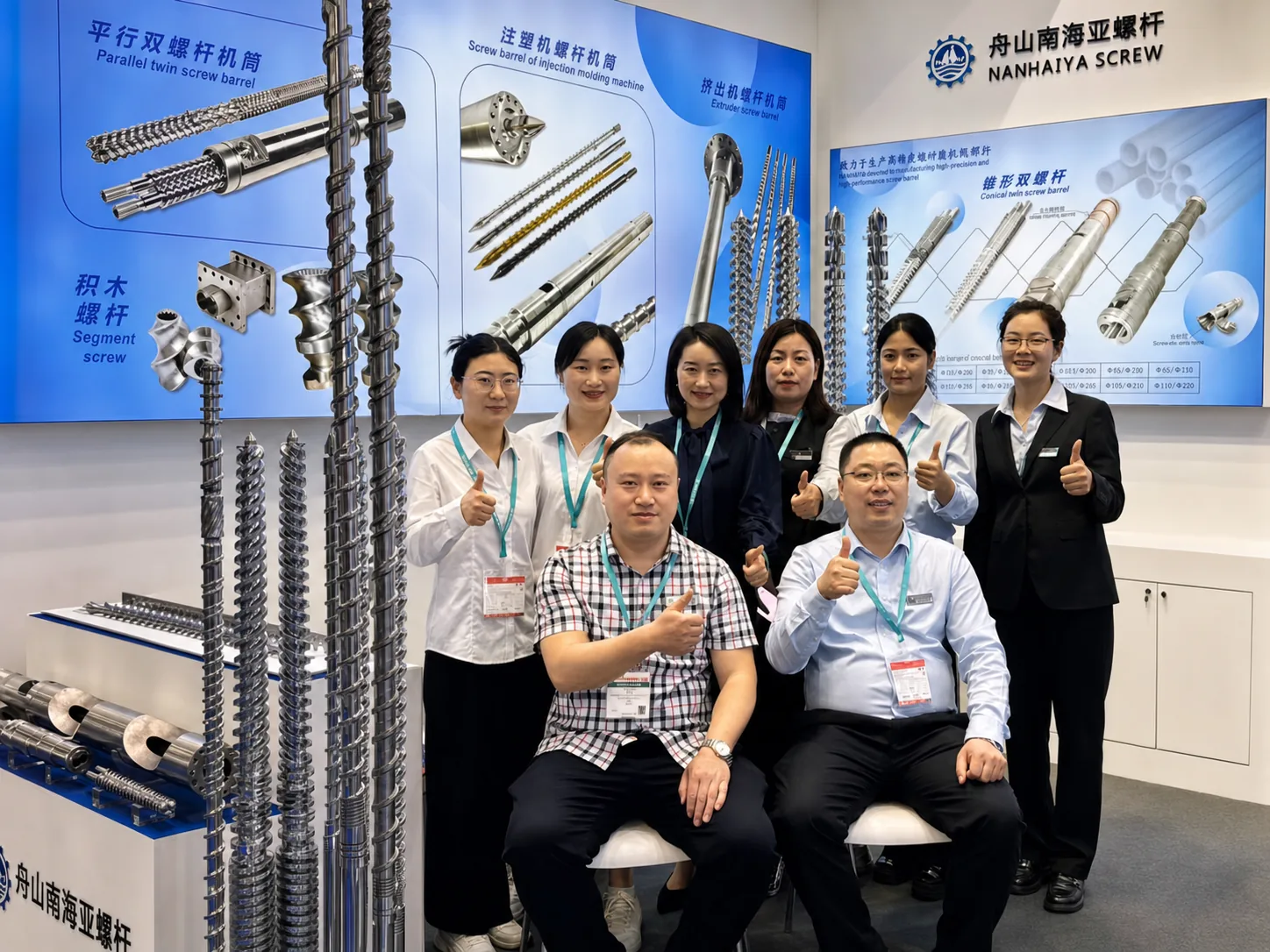
Related Articles
More insights on screw barrel technology and plastics processing.
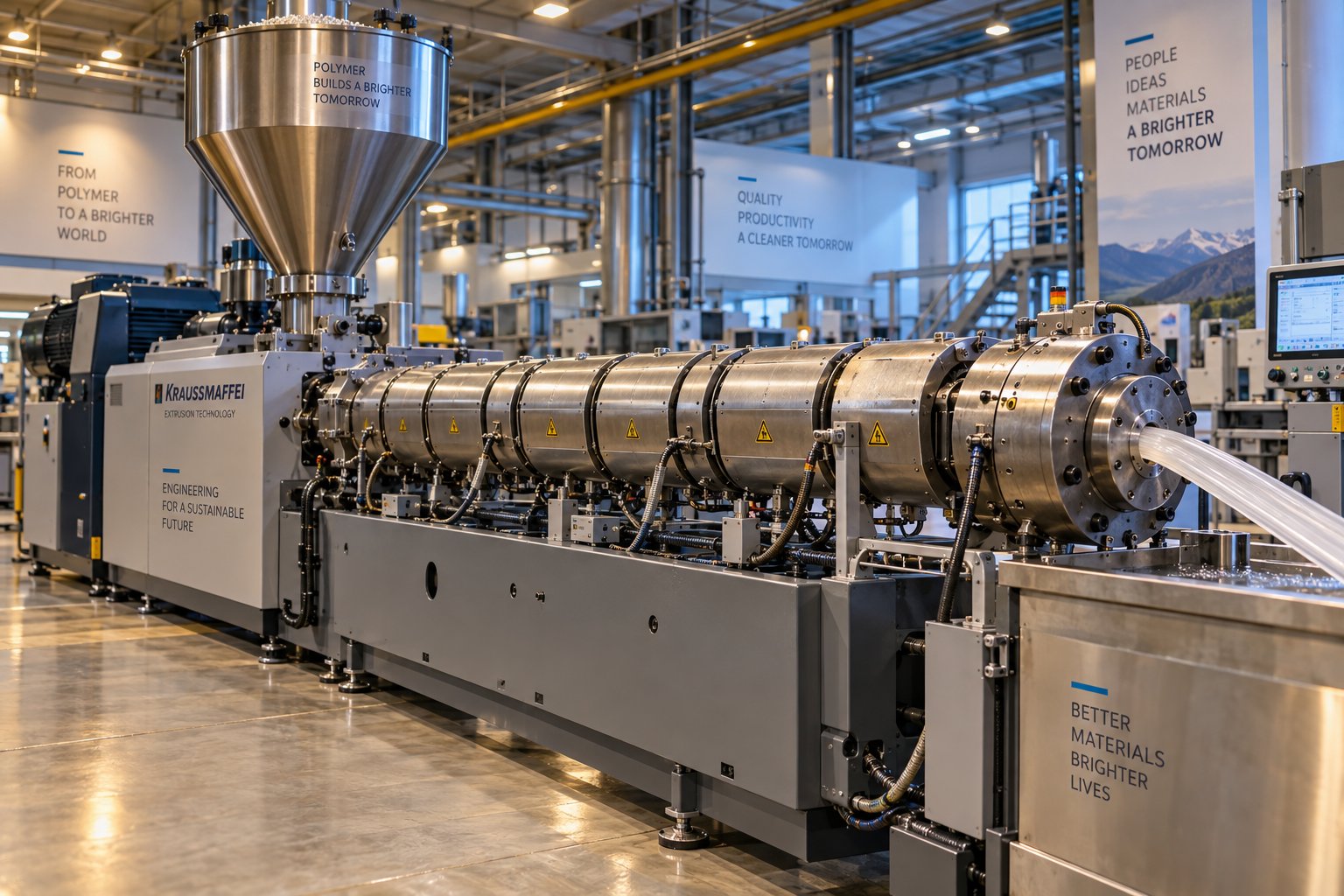
Extruder Machine Decoded: From Raw Pellet To Finished Product
Oct 6, 2026
Learn how an extruder machine works, compare single-screw vs. twin-screw types, and get expert guidance on specs, troubleshooting, and selection.
Read Article
PE Pipe Making Machine Decoded: From Raw Resin to Flawless Pipe
Oct 4, 2026
Learn how a PE pipe making machine works, from resin to finished pipe. Covers components, material grades, automation, troubleshooting, and buyer selection tips.
Read Article
PVC Profile Making Machine Decoded: From Raw Resin To Profit
Oct 3, 2026
Learn how a PVC profile making machine works — extrusion process steps, key technical parameters, die design, calibration methods, maintenance, and total cost of ownership.
Read ArticleLooking for something else?
Search by material, symptom or product and jump straight to the relevant page.
These are navigation suggestions based on keyword matching — not a quotation, not a delivery commitment, and not a substitute for engineering review. Final specification is confirmed by our engineers against your drawings and processed material.
Need help with screw barrel selection?
Share your machine model, processed material and application. Our team can help with pricing and technical support.