

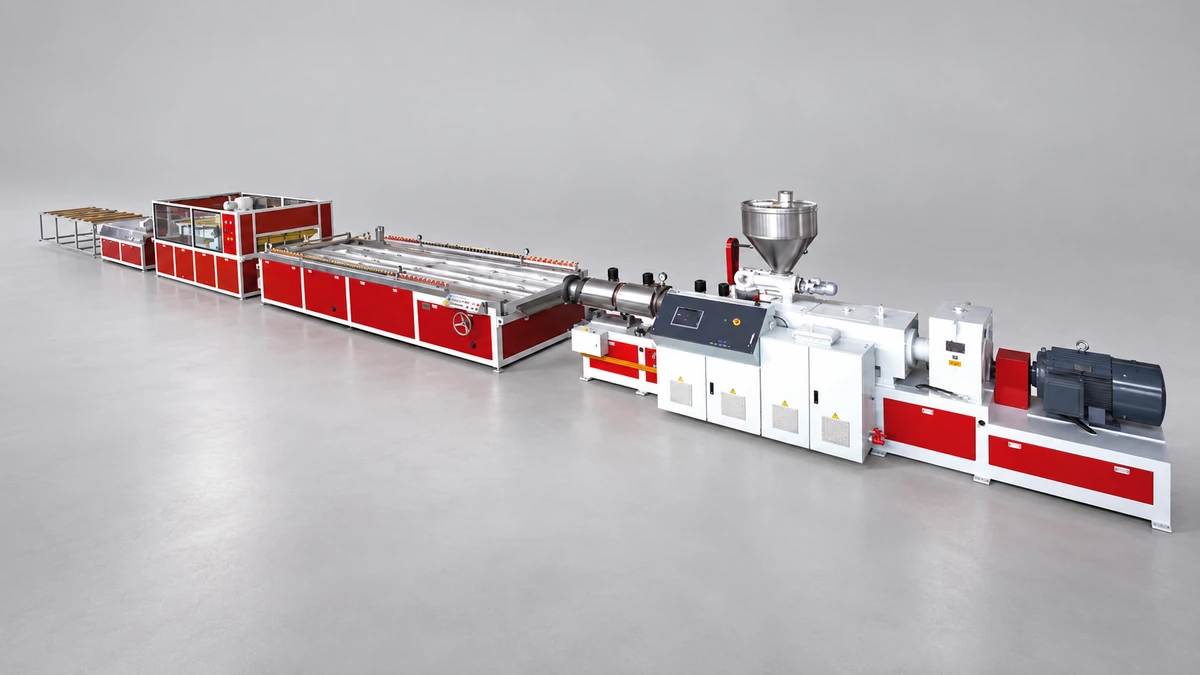
What Is a WPC Extrusion Machine and How Does It Work
Imagine blending sawdust with plastic and turning that mixture into a perfectly shaped deck board, door frame, or wall panel — all in one continuous process. That is exactly what a WPC extrusion machine does, and getting the selection right can make or break a manufacturing operation.
A WPC extrusion machine is a specialized production system that melts, mixes, and shapes a blend of thermoplastic resin and wood fiber (or wood flour) into continuous profiles through a shaped die. It is the core equipment in any wood-plastic composite production line.
Whether you are a manufacturer scaling up production, an investor evaluating a new facility, or a procurement team sourcing equipment from a China WPC extrusion machine supplier, understanding how this machinery works is the first step toward avoiding costly mistakes.
What WPC Means and Why It Matters
WPC stands for Wood-Plastic Composite — an engineered material created by combining a thermoplastic resin such as PVC, PE, or PP with wood fiber or wood flour. Wood flour itself is widely available, derived from planer shavings, sawdust, and other residues of the woodworking industry. The thermoplastic matrix binds these organic particles together, and performance-enhancing additives like compatibilizers, UV stabilizers, and pigments fine-tune the final product's properties.
Why does this hybrid material matter? It merges the natural aesthetic and stiffness of wood with the moisture resistance, durability, and moldability of plastic. Unlike solid wood, WPC panels won't rot, warp, or attract termites. Unlike pure plastic, they offer a convincing wood-grain texture and better rigidity. A review published in Polymers highlights that WPC applications now span the automotive industry, construction, furniture, and consumer goods — driven by a growing demand for sustainable, low-maintenance alternatives to traditional materials.
How the Extrusion Process Creates WPC Products
Extrusion is the dominant manufacturing technology for WPC products, especially in decking and the building industry. Here is how the process transforms raw ingredients into a finished profile:
- Raw material preparation — Wood flour is dried, and polymer resin is blended with additives in high-speed mixers to form a homogeneous compound.
- Feeding — The compound enters the extruder barrel through a hopper or forced-feed system, typically as powder, pellets, or granules.
- Melting and mixing — One or more rotating screws convey the material forward, applying heat and shear to melt the polymer and thoroughly disperse the wood particles throughout the matrix.
- Shaping through a die — The homogeneous melt is pushed through a precision-engineered die that defines the profile's cross-sectional geometry.
- Calibration and cooling — The still-soft profile passes through a vacuum calibration unit and cooling tanks to lock in its dimensions.
- Cutting and finishing — A haul-off unit pulls the profile at a controlled speed, and an automatic saw cuts it to the required length.
Several extruder types can serve this process — single-screw, co-rotating twin-screw, and counter-rotating twin-screw machines — each with distinct advantages depending on the resin system and product requirements. The end products range widely: composite decking boards, interior and exterior wall panels, WPC door frames, flooring planks, and facade cladding. A WPC profile extrusion machine configured for door panels, for instance, demands different die geometry and downstream handling than one producing wide decking boards.
Choosing the right equipment starts with understanding a factor most buyers overlook entirely — the resin system their formulation is built on, and how profoundly it changes every machine specification downstream.
PVC-Based vs Polyolefin-Based WPC Extrusion Explained
The resin you build your formulation around does not just affect material properties — it reshapes the entire machine you need to buy. This is the single most consequential distinction in WPC processing, yet most buyers treat PVC-based and polyolefin-based composites as interchangeable when shopping for equipment. They are not. The polymer matrix determines your extruder type, barrel temperature profile, screw geometry, and even your downstream calibration setup. Getting this wrong means purchasing a machine that fights your formulation instead of complementing it.
PVC-Based WPC Extrusion Characteristics
PVC (polyvinyl chloride) is a thermally sensitive polymer with a relatively narrow processing window. In a WPC formulation, that sensitivity becomes even more critical because wood flour begins to degrade at temperatures not far above PVC's own melting range. The result? You need equipment built for precise, gentle processing.
PVC-based WPC typically runs on conical twin-screw extruders — the workhorse of PVC profile manufacturing worldwide. These machines operate at lower processing temperatures, generally in the 150–190 °C range, which keeps both the polymer and wood fiber safely below their degradation thresholds. PVC's inherent rigidity means the finished profiles deliver excellent structural performance without heavy reinforcement, making this resin system the go-to choice for door frames, wall panels, interior cladding, and foam board.
Why conical twin-screw extruders specifically? Their tapered screw design creates natural compression from the wide feed end to the narrow discharge end. This geometry provides strong self-feeding capability while generating lower shear heat — exactly what a thermally sensitive PVC compound demands. As processing data from Wings Plastic shows, conical twin-screw extruders run at relatively low screw speeds of 15–40 rpm, further minimizing frictional heat buildup. For any buyer evaluating a WPC door frame extrusion machine, understanding this PVC-conical pairing is foundational.
Temperature control precision matters enormously here. Even a 10 °C overshoot in a single barrel zone can trigger PVC degradation, releasing hydrochloric acid that corrodes equipment and ruins product quality. Processors rely on multi-zone PID controllers and carefully balanced lubricant packages to keep the melt flowing smoothly without thermal spikes.
PE and PP-Based WPC Extrusion Characteristics
Polyolefin-based WPC — built on high-density polyethylene (HDPE) or polypropylene (PP) — takes a fundamentally different processing approach. These resins tolerate higher temperatures, offer a wider processing window, and bond differently with wood fiber compared to PVC.
PE and PP-based formulations typically process on parallel twin-screw extruders (co-rotating or counter-rotating) or, in simpler setups using pre-compounded pellets, single-screw machines. Parallel twin-screw extruders feature higher L/D ratios of 20:1 to 32:1, providing longer residence time for thorough mixing and multiple venting zones for moisture removal — both critical when working with high wood-fiber loads.
One major advantage of PE-based WPC? You can push wood-flour loading significantly higher, sometimes reaching 60–70% by weight. Higher filler content reduces raw material costs and can improve stiffness, though it also increases abrasive wear on screws and barrels. PP-based composites, meanwhile, offer higher heat-deflection temperatures, making them better suited for applications with elevated thermal demands.
Baerlocher's technical overview highlights that polyolefin-based WPC is typically processed through direct extrusion and injection molding, producing products like composite decking, outdoor furniture components, and exterior cladding — applications where weatherability and moisture resistance outweigh the need for PVC's inherent rigidity.
How Resin Choice Affects Machine Selection
So how do these two resin families stack up when you are comparing equipment? The table below breaks down the key parameters that WPC extrusion machine manufacturers use to configure their lines — and the parameters you should use to evaluate them.
| Parameter | PVC-Based WPC | PE/PP-Based WPC |
|---|---|---|
| Typical Extruder Type | Conical twin-screw | Parallel twin-screw or single-screw |
| Processing Temperature Range | 150–190 °C | 160–210 °C (PE); 170–220 °C (PP) |
| Common Product Applications | Door frames, wall panels, foam board, interior profiles | Decking, outdoor cladding, railing, furniture components |
| Wood-Flour Loading Range | 30–55% by weight | 40–70% by weight |
| Shear Sensitivity | High — requires gentle, controlled shear | Moderate — tolerates higher shear and mixing intensity |
| Downstream Equipment | Vacuum calibration tables, moderate cooling lengths | Extended cooling tanks, heavier haul-off units for denser profiles |
Notice how the differences cascade through the entire production line, not just the extruder itself. A buyer sourcing a WPC board extrusion machine for PE-based decking will need longer cooling sections, different die designs, and more aggressive venting compared to someone producing PVC-based wall panels on a conical twin-screw setup. Ignoring these distinctions is exactly where most purchasing decisions go sideways.
The resin system tells you which family of extruder to consider. But within each family — conical twin-screw, parallel twin-screw, and single-screw — the technical differences in screw geometry, throughput, and mixing capability run deep enough to deserve their own close examination.
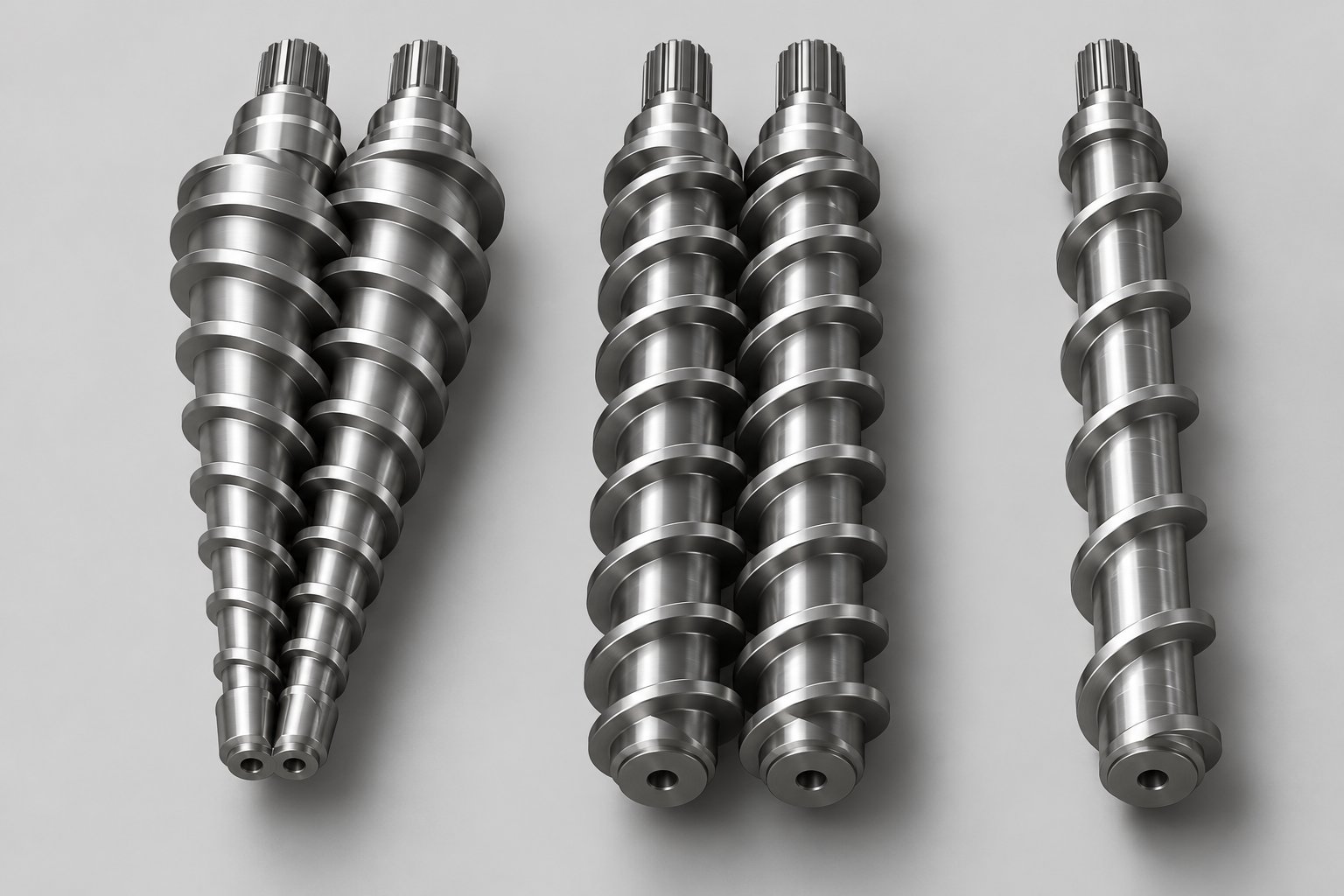
Conical vs Parallel Twin-Screw vs Single-Screw Extruders
Knowing you need a twin-screw extruder is only half the answer. The specific screw geometry — conical or parallel — along with the option of a single-screw machine in certain roles, shapes everything from plasticizing efficiency to achievable throughput. Yet many buyers comparing the best WPC board extrusion machine price quotes never dig into why one extruder type costs more or delivers different results than another. The distinctions are mechanical, and they matter.
Conical Twin-Screw Extruders for WPC
Picture two tapered screws sitting side by side inside a barrel that mirrors their shape — wide at the feed opening, narrowing toward the discharge end. That taper is the defining feature. At the large-diameter feed zone, the screws offer generous volume for pulling in low-bulk-density WPC powder mixes without the need for a force-feed device. As material travels toward the smaller discharge end, the decreasing channel depth builds pressure naturally, compacting and plasticizing the melt progressively.
This geometry delivers several practical advantages for WPC processing:
- Excellent self-feeding — the large intake area handles bulky wood-flour and PVC powder blends efficiently.
- Lower shear heat generation — critical for thermally sensitive PVC-based WPC, where even small temperature spikes can degrade both polymer and fiber.
- Strong plasticizing at moderate screw speeds — typical operating speeds of 15–40 rpm reduce frictional wear while maintaining consistent melt quality.
- Compact footprint — because the screws taper, the overall barrel length stays shorter than parallel designs with comparable output.
It is no coincidence that conical twin-screw extruders dominate PVC-based WPC production globally. If you are evaluating the best WPC door panel extrusion machine price for a PVC-based line, a conical twin-screw will almost certainly anchor that configuration.
Parallel Twin-Screw Extruders for WPC
Parallel twin-screw extruders use two cylindrical screws of equal diameter running inside a straight barrel. They come in two variants: co-rotating (both screws turn the same direction) and counter-rotating (screws turn in opposite directions). Co-rotating designs are especially popular for compounding and high-throughput WPC extrusion because their intermeshing action delivers superior distributive and dispersive mixing — exactly what you need when blending high percentages of wood fiber into a polyolefin matrix.
Key characteristics set parallel machines apart from their conical counterparts:
- Higher L/D ratios — typically ranging from 28:1 to 40:1 or beyond, providing extended residence time for thorough homogenization and multiple venting zones for moisture extraction.
- Modular screw elements — conveying elements, kneading blocks, and mixing segments can be rearranged along the shaft to fine-tune shear intensity, pressure buildup, and degassing for a specific WPC formulation.
- Higher throughput potential — parallel designs can be extended in length more readily than conical machines, scaling output without requiring a larger screw diameter.
- Wider processing window — the longer barrel and flexible screw configuration accommodate PE- and PP-based WPC formulations that tolerate (and benefit from) higher shear and temperature ranges.
Counter-rotating parallel extruders, meanwhile, generate higher localized shearing forces. This can be advantageous for intensive compounding but demands careful temperature monitoring to prevent wood-fiber degradation — a trade-off that influences both machine cost and operating complexity.
Single-Screw Extruders in WPC Applications
Single-screw machines play a narrower but still relevant role in WPC manufacturing. You will most often find them serving as secondary extruders in co-extrusion setups, applying a thin protective cap layer over a WPC core profile. They also handle simpler profiles when processors use pre-compounded WPC pellets that have already been thoroughly mixed in a twin-screw compounding step.
Their advantages are straightforward: lower capital cost, simpler operation, and easier maintenance. The trade-off? Limited mixing capability. A single screw cannot achieve the dispersive blending that wood-fiber and raw-polymer formulations require, which is why single-screw machines rarely serve as the primary extruder on a WPC line processing dry-blend or powder feedstock. When you see the best WPC board extrusion processing machines price listed for a single-screw setup, verify whether it is intended for pre-compounded material — otherwise, product quality will almost certainly suffer.
The table below puts all three extruder types side by side across the parameters that drive purchasing decisions.
| Parameter | Conical Twin-Screw | Parallel Twin-Screw | Single-Screw |
|---|---|---|---|
| Screw Geometry | Tapered — large feed end, narrow discharge end | Cylindrical — uniform diameter throughout | Single cylindrical screw |
| Typical L/D Ratio Range | 16:1 – 25:1 | 28:1 – 40:1+ | 24:1 – 34:1 |
| Best-Suited Resin Type | PVC-based WPC | PE/PP-based WPC; compounding | Pre-compounded WPC pellets; co-extrusion cap layers |
| Mixing Efficiency | Good — adequate for PVC dry-blend formulations | Excellent — modular elements allow precise tuning | Limited — requires pre-mixed or pelletized input |
| Output Capacity Range | 80 – 400+ kg/hr (depending on screw diameter) | 150 – 1,000+ kg/hr | 50 – 250 kg/hr (in WPC context) |
| Typical WPC Applications | Door frames, wall panels, foam board, interior profiles | Decking, thick outdoor profiles, high-fill composites | Cap layers in co-extrusion; simple profiles from pellets |
One variable that does not show up in spec sheets but dramatically affects long-term cost is screw and barrel wear resistance. Wood fiber is abrasive — silica content in wood flour, compounded with mineral fillers like calcium carbonate, grinds away at screw flights and barrel bores with every processing hour. Some manufacturers address this with DIN 8550 nitrided steel screws hardened to 65–70 HRC, a meaningful indicator of durability. But metallurgy choices go deeper than a hardness number, and the real-world impact of screw wear on output quality, energy consumption, and the best WPC deccan extrusion machine price over a five-year ownership cycle deserves its own focused discussion — which is exactly where this article heads after mapping out the full extrusion line from upstream to downstream.
Complete WPC Extrusion Line Components and Equipment
An extruder — however well-specified — is only one station in a production line that may include a dozen or more machines working in precise coordination. Buyers who fixate on extruder specs while glossing over the equipment upstream and downstream are setting themselves up for bottlenecks, quality issues, and unexpected capital requests months after commissioning. A complete WPC extrusion line stretches from raw-material handling all the way through stacking, and every piece in that chain influences finished-product quality.
Upstream Equipment and Raw Material Handling
Before any material touches the extruder barrel, it must be properly compounded and conditioned. That process starts in a high-speed mixer — sometimes called a hot mixer — where polymer resin, wood flour, compatibilizers, stabilizers, lubricants, and pigments are blended at high RPM until frictional heat raises the batch temperature enough for initial absorption and dispersion of additives into the resin. The hot blend then transfers into a cooling mixer that drops the temperature quickly, preventing premature gelation and ensuring the compound flows freely as a dry blend.
Feeding that compound into the extruder with repeatable precision is the next challenge. Gravimetric feeders weigh material in real time and adjust dosing to maintain a target feed rate, which directly controls output consistency. Volumetric feeders are simpler and cheaper, but they cannot compensate for bulk-density variations in wood-flour blends the way gravimetric systems can. For low-bulk-density powder mixes — common in PVC-based WPC — a forced-feed hopper or crammer feeder pushes material into the screw flights, preventing bridging and starve-feeding.
Wood flour itself introduces a unique upstream requirement: pre-drying. Wood fiber is hygroscopic, readily absorbing ambient moisture, and feeding it into a hot barrel with moisture content above 1–3% creates steam. That steam generates surface blistering, internal voids, and porosity that no amount of downstream trimming can fix. Flash dryers and paddle dryers are the most common pre-drying technologies, rapidly reducing moisture to safe levels before the material enters the mixing stage. Some lines use side-force feeders to introduce dried wood fiber after the polymer has already melted, a process design that allows lower temperature settings in the fiber-contact zones and better preserves the natural color and fiber structure of the wood.
Die Head Design and Its Impact on Product Quality
If the extruder is the heart of a WPC line, the die head is where intentions become geometry. The extrusion die defines the profile's cross-sectional shape — every groove in a decking board, every hollow chamber in a door frame, every tongue-and-groove interlock in a flooring plank.
What separates a well-designed die from a mediocre one? Flow-channel balancing. WPC melt does not behave like a simple Newtonian fluid; it is a shear-thinning composite with suspended wood particles that can create uneven flow patterns. The die's internal channels must be shaped so that melt velocity is uniform across the entire profile cross-section. If one area flows faster than another, the profile warps, develops uneven wall thickness, or shows visible flow lines on the surface. Simulation research on PVC profile extrusion demonstrates that even small geometric transitions inside the die — such as moving from a conical feed zone to a rectangular profile channel — can generate localized shear deformations high enough to degrade thermally sensitive materials.
Die-lip geometry also plays a decisive role in surface finish. The final parallel land length at the die exit controls die swell — the tendency of the viscoelastic melt to expand after leaving a restricted channel. Too short a land, and die swell becomes excessive, distorting the profile before it reaches calibration. For multi-cavity dies that produce two or more profiles simultaneously (a common approach to boost throughput for narrower products like wall ceiling trims), uniform melt distribution across every cavity is essential. Even slight imbalances mean one cavity produces dimensionally accurate profiles while another runs out of spec. Buyers evaluating the best WPC wall ceiling extrusion machine price should verify that multi-cavity die balancing has been validated — ideally through computational flow simulation before the die is machined.
Downstream Calibration, Cooling, and Finishing
Once the profile exits the die, it is hot, soft, and dimensionally unstable. Everything that follows is designed to lock in the shape, cool the material, and prepare it for delivery. As downstream equipment specialists note, the extruder makes the shape possible, but the downstream section makes it stable, measurable, and ready to ship.
Here is the typical downstream sequence for a WPC profile line, in order:
- Vacuum calibration table — The still-soft profile enters a calibration sleeve or block where vacuum pressure pulls the outer surfaces firmly against precision-machined tooling. This is the first quality gate: if calibration is weak, no later station can correct the geometry.
- Spray cooling tanks — Water sprays or immersion baths progressively remove heat from the profile. Cooling must be thorough enough that the product remains dimensionally stable after cutting and stacking. Insufficient cooling length at higher line speeds is a frequent — and frequently misdiagnosed — cause of post-production warping.
- Haul-off unit — Servo-controlled caterpillar pads or belt pullers grip the cooled profile and draw it through the line at a precise, constant speed. This speed, relative to extruder output, directly controls wall thickness. Even small speed oscillations create repeating thickness variations across every board or panel produced.
- Cutting station — A flying saw or planetary saw cuts the continuous profile to programmed lengths without stopping the line. Flying saws move with the profile during the cut, ensuring clean, square end faces even at high line speeds.
- Online embossing or brushing unit (optional) — Heated rollers press a realistic wood-grain texture into the profile surface, or wire-brush stations create a weathered-wood aesthetic. These inline finishing steps eliminate the need for secondary processing, significantly reducing cost per unit for manufacturers chasing the best WPC floor profile extrusion machine price or the best WPC flooring extrusion machine price.
- Automatic stacking system — Finished profiles are counted, sorted, and stacked onto pallets or racks for packaging and shipping.
Every station in this sequence must be synchronized. A haul-off running slightly out of step with the cutter produces inconsistent lengths. A cooling section too short for the line speed delivers profiles that look correct at the saw but warp overnight on the pallet. When evaluating quotes, resist the temptation to judge a line solely by extruder specifications — the downstream equipment can represent 30–40% of total line cost, and skimping here almost always costs more in reject rates and rework than the upfront savings.
Getting the hardware right, however, only solves half the operational puzzle. The two most process-sensitive variables in WPC manufacturing — moisture in the wood flour and temperature across the barrel zones — demand constant, precise management, and mishandling either one can undermine even the most perfectly configured production line.
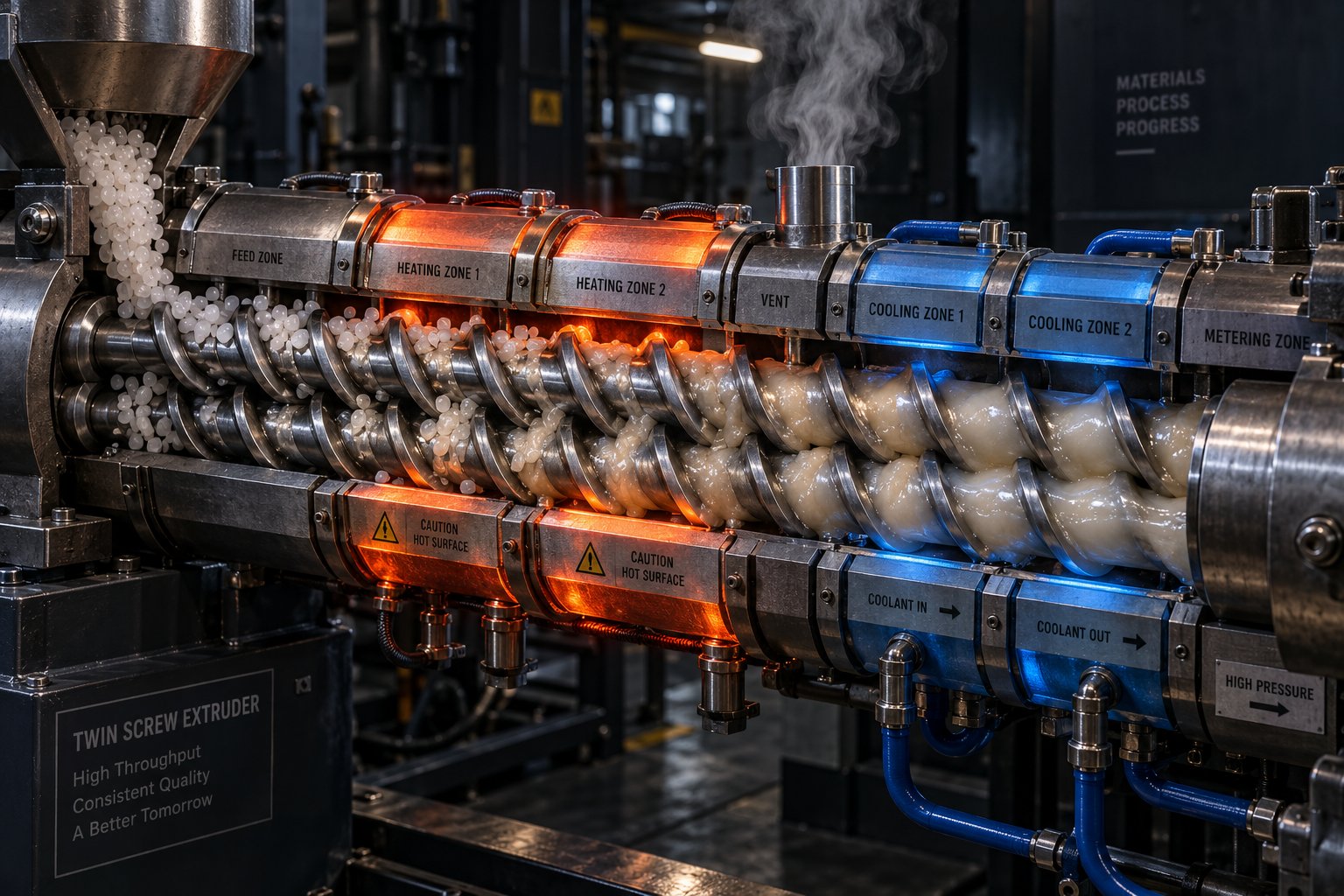
Moisture Control and Temperature Zone Management
Wood flour does not behave like a plastic pellet. It absorbs water from the air, holds onto it stubbornly, and releases it explosively as steam the moment barrel temperatures climb — all while the polymer surrounding it demands enough heat to melt and flow properly. This tug-of-war between moisture sensitivity and thermal demand is the central operational challenge of every WPC extrusion machine, and it trips up experienced plastics processors just as often as newcomers. Mastering it requires coordinated control of two tightly linked systems: the moisture state of incoming wood fiber and the temperature profile across every barrel zone.
Why Moisture Control Is Critical in WPC Processing
Wood flour is hygroscopic by nature. Even material that leaves a dryer at less than 1% moisture content can reabsorb several percentage points of water within hours if stored in a humid warehouse. Imagine feeding that material into a barrel heated to 170 °C or higher — the absorbed water instantly flashes to steam, and that steam has nowhere to go except through the melt itself.
The consequences are immediate and visible:
- Surface blistering — Steam trapped near the profile surface erupts as bubbles during or just after die exit, leaving pockmarks and rough patches that no amount of sanding can fully repair.
- Internal voids and porosity — Steam pockets deep inside the profile create hollow spots that weaken mechanical properties, particularly flexural strength and screw-holding capacity — critical performance metrics for decking and structural profiles.
- Foaming in non-foamed products — Uncontrolled moisture acts as an unintended blowing agent, reducing density inconsistently and producing dimensional variations across the production run.
- Inconsistent output rate — Steam pressure fluctuations inside the barrel cause surging, where the melt alternately speeds up and slows down through the die, creating visible thickness bands in the finished profile.
Preventing these defects starts well upstream of the extruder. Pre-drying systems — flash dryers for rapid high-volume throughput or paddle dryers for more gentle, uniform treatment — reduce wood-flour moisture content to safe levels, typically below 1–3% depending on the formulation. Research on WPC thermal properties confirms that test-grade wood fibers are dried at 105 °C for 12 hours to achieve moisture content below 1%, illustrating how seriously even laboratory-scale processing treats this variable. In production environments, continuous dryers operate inline, keeping cycle times manageable.
Drying alone is not a complete solution, though. Some residual moisture and volatile compounds always survive the pre-drying step, especially when wood-flour loading reaches 50–70% by weight. This is where degassing and venting zones in the extruder barrel become essential. Strategically placed vent ports — often connected to a vacuum venting system — allow steam and volatile organic compounds to escape from the melt before it reaches the die. Vacuum-assisted venting pulls residual gases out far more effectively than atmospheric vents, and it is standard on most twin-screw WPC extrusion machines. As SHARC's buyer guidance emphasizes, effective vacuum degassing directly impacts product appearance and long-term dimensional stability.
Inline moisture sensors add another layer of protection. Mounted at the feed hopper or just before the extruder throat, these sensors measure wood-flour moisture in real time and trigger alarms — or automatic feed adjustments — when content exceeds the safe threshold. For operations processing hundreds of kilograms per hour, catching a moisture excursion in the first minutes rather than discovering it as a bin of rejected profiles saves meaningful production cost.
Temperature Zone Management Across the Barrel and Die
A typical WPC extruder barrel is divided into multiple independently controlled heating and cooling zones — anywhere from four to eight or more, depending on barrel length and L/D ratio. Each zone has its own set of heater bands and cooling channels (usually forced-air blowers or water-jacket circuits), governed by PID controllers that hold each zone within a few degrees of its setpoint. But setting those temperatures is not a matter of dialing in one number and walking away. The profile from feed throat to die exit follows a deliberate thermal curve, and every zone has a distinct role.
Here is how the zones generally function:
- Feed zone — Temperatures here stay deliberately low. The goal is to convey solid material forward without premature melting, which would cause the powder to stick to the screw and barrel walls. Premature melting leads to bridging — a blockage where semi-molten material clogs the feed throat, starving downstream zones and causing output interruptions.
- Compression (transition) zone — Temperature rises progressively. The decreasing screw-channel depth compresses the material while barrel heat and frictional shear initiate plasticizing. This is where the polymer begins to melt and encapsulate the wood particles.
- Metering zone — Temperature stabilizes at the target melt temperature. The fully plasticized compound is homogenized and pressurized for consistent delivery to the die. Fluctuations here translate directly into pressure surging and uneven output.
- Die zone — Die temperature is fine-tuned independently to control surface quality. Too cold, and the melt drags against the die walls, causing surface streaking. Too hot, and die swell increases, distorting the profile geometry before calibration can correct it.
- Calibrator zone — Though technically downstream, calibrator temperature is part of the thermal management chain. Cooling the calibration sleeve too aggressively can freeze the profile surface while the core remains soft, leading to residual stress and delayed warping.
The temperature profile across the barrel and die must balance thorough plasticizing of the polymer matrix against thermal degradation of wood fiber. Overheating destroys cellulose structure, generates odor, and discolors the product; underheating leaves unmixed polymer and weak fiber-matrix bonding.
This balance is especially delicate for PVC-based WPC. As discussed in earlier sections, PVC's thermal degradation onset sits uncomfortably close to its processing temperature — a narrower processing window than PE or PP-based composites enjoy. A PE-based WPC formulation might tolerate a 40–50 °C spread between minimum processing temperature and the onset of wood-fiber degradation. A PVC-based formulation may offer only 15–25 °C of usable range. That tighter window demands more precise zone controllers, faster-responding heaters, and more effective cooling systems on the barrel. Buyers shopping for a cheap price WPC extrusion machine should be cautious: lower-cost machines sometimes achieve their price point by using fewer temperature zones or less accurate controllers, making it nearly impossible to hold PVC-based formulations within their safe processing envelope.
Screw rotation itself contributes a significant share of the thermal energy — frictional heat from polymer shearing and wood-fiber grinding accounts for the majority of energy input once the material is fully compacted. In fact, for many WPC formulations, the barrel heaters serve primarily during startup. During steady-state operation, the cooling systems work harder than the heaters, bleeding off excess frictional heat to prevent temperature creep. This is why barrel cooling capacity is just as important as heating capacity when evaluating an extruder — a distinction that spec sheets sometimes obscure by listing only heater wattage.
Processors working with a cheap price WPC flooring extrusion machine or a higher-end line alike will find that the interplay between moisture and temperature is not a set-and-forget exercise. Ambient humidity changes with the season, wood-flour batches vary in particle size and species, and even slight shifts in line speed alter the shear-heat profile. Consistent product quality demands ongoing monitoring and adjustment — which is precisely why advanced lines integrate real-time temperature data logging, trending software, and automatic closed-loop feedback from melt-pressure sensors to screw-speed controllers.
Dialing in these process variables, however, only delivers consistent output if the finished profiles actually meet the standards your customers and markets require. Dimensional tolerances, surface quality thresholds, and mechanical performance benchmarks are not arbitrary — they are codified in industry standards, and your machine's precision determines whether your products pass or fail those tests.
Quality Standards and Production Capacity Planning
You can dial in moisture control to the decimal point and hold barrel temperatures within a degree of your setpoint — but none of that matters if the profiles rolling off the end of the line fail a compliance test at the customer's receiving dock. Industry standards do not care how sophisticated your process controls are. They care about measurable outcomes: dimensional tolerances, surface quality, flexural strength, and long-term durability under real-world conditions. And every one of those outcomes traces directly back to the precision of your WPC extrusion machine and the downstream equipment surrounding it.
Equally overlooked in the purchasing process? Capacity planning. Buyers frequently choose an extruder based on its maximum rated output without working backward from their actual annual production targets, shift schedules, and product mix. The result is either an oversized machine burning energy at half capacity or an undersized one running at redline — accelerating wear, destabilizing melt quality, and driving up reject rates.
Industry Standards for WPC Products and How Machines Affect Compliance
Two standards dominate the global WPC landscape, and your target export market determines which one governs your product specifications.
ASTM D7032 is the benchmark in North America. It establishes performance ratings for wood-plastic composite deck boards, stair treads, guards, and handrails — covering structural adequacy, load-bearing capacity, deflection limits, and long-term durability. As industry analysis of WPC quality frameworks explains, ASTM testing protocols also evaluate weathering resistance, slip resistance, fire behavior, and fastener withdrawal strength. Manufacturers use these results to validate product warranties and set performance expectations across different climate zones.
EN 15534 is the European counterpart, covering classification, specification, and marking of WPC products used in construction. Compliance with EN 15534 requires CE marking — a process that demands comprehensive documentation of manufacturing parameters, quality control procedures, and finished-product test data. European standards also address environmental considerations including recycled content, formaldehyde emissions, and end-of-life recyclability, reflecting broader EU policies around circular economy principles.
Here is what most buyers miss: meeting these standards is not purely a formulation challenge. Machine precision plays a direct and measurable role in pass-or-fail outcomes.
- Die tolerances — A die that produces uneven wall thickness across the profile cross-section creates localized weak points. When an ASTM D7032 structural load test applies concentrated force to those thin spots, the board deflects beyond allowable limits or fails prematurely — even though the formulation itself is perfectly adequate.
- Calibration accuracy — Dimensional tolerance testing requires profiles to fall within tight width, height, and straightness windows. A vacuum calibration table that cannot hold consistent vacuum across its zones allows the still-soft profile to drift dimensionally, producing boards that pass visual inspection but fail caliper measurement.
- Consistent output — Mechanical property testing under ASTM and EN protocols assumes homogeneity within and between production batches. An extruder with poor temperature stability or worn screws that cause melt surging produces profiles with variable density and fiber distribution. Those inconsistencies show up as unpredictable flexural strength and impact resistance values — exactly the kind of scatter that causes a batch to fail statistical acceptance criteria.
- Surface quality — Both standards include visual and tactile surface assessments. Blistering from inadequate degassing, streaking from unbalanced die flow, or haul-off marks from a poorly adjusted puller can all push otherwise compliant products into rejection.
The takeaway? A cheap WPC extrusion machine that saves 15–20% on purchase price but cannot hold tight die tolerances, maintain stable melt pressure, or deliver consistent calibration vacuum may cost far more in rejected shipments and failed compliance audits than the premium it avoided. When you are producing for markets governed by ASTM D7032 or EN 15534, machine precision is not optional — it is a compliance requirement.
Matching Machine Capacity to Market Demands
Sizing a WPC extrusion line is arithmetic — but the kind of arithmetic where plugging in the wrong assumptions at the start compounds into a six-figure mistake by the time the machine hits the factory floor. The process starts with your annual tonnage target and works backward to an hourly output requirement that accounts for real-world operating conditions, not catalog fantasy numbers.
Imagine you need 3,000 metric tons of finished WPC decking per year. Sounds like a single number, but unpacking it reveals several variables:
- Operating hours per year — A single-shift operation (8 hours/day, 250 days/year) gives you roughly 2,000 hours. Double shifts push that to 4,000 hours. Triple-shift, 24/6 operations can reach 6,000+ hours annually.
- Line efficiency — No extrusion line runs at 100% uptime. Startup scrap, color changeovers, planned maintenance, and unplanned stoppages eat into productive hours. A realistic efficiency factor for a well-run WPC line falls in the 75–85% range.
- Required output rate — Divide your annual target by net operating hours (total hours multiplied by efficiency). For 3,000 tons on double shifts at 80% efficiency: 3,000,000 kg ÷ (4,000 × 0.80) = approximately 938 kg/hr.
That calculated rate is your minimum sustained output requirement — not the number you match to an extruder's maximum rating. As capacity planning guidance from extrusion engineers warns, a machine designed to run at its maximum theoretical throughput performs poorly when daily requirements sit well below that ceiling, while consistently running at redline accelerates screw and barrel wear and destabilizes melt temperatures. The practical rule: size the extruder so your nominal daily production sits at 60–80% of the machine's rated maximum output.
Screw diameter is the single strongest predictor of an extruder's output capacity class. Larger screws move more material per revolution, deliver higher torque, and accommodate bigger die cross-sections. The relationship is not perfectly linear — formulation, screw speed, and profile geometry all influence actual throughput — but screw diameter gives you the clearest starting framework for matching machine size to production volume.
The table below maps general capacity tiers to screw size, approximate output ranges, and typical product applications. These figures represent conical twin-screw extruders for PVC-based WPC, which is the most common configuration globally. Parallel twin-screw machines for PE/PP-based composites can deliver higher throughputs at comparable screw diameters due to higher operating speeds.
| Capacity Tier | Conical Screw Diameter (Small End) | Approximate Output Range (kg/hr) | Typical Shift Configuration | Typical Product Applications |
|---|---|---|---|---|
| Small-Scale / Startup | 51–65 mm (e.g., SJSZ-51/105, SJSZ-65/132) | 80–250 | Single or double shift | Specialty profiles, narrow wall panels, door frame components, small-batch custom orders |
| Mid-Scale | 65–80 mm (e.g., SJSZ-65/132, SJSZ-80/156) | 150–400 | Double or triple shift | Standard decking boards, flooring planks, mid-volume wall cladding, regional distribution |
| Large-Scale / High-Volume | 80–92 mm+ (e.g., SJSZ-80/156 and above) | 300–600+ | Triple shift or continuous | High-volume decking for large distributors, multi-profile lines, co-extruded premium products |
A WPC decking line commissioning guide notes that an SJSZ-65/132 machine — a mid-capacity conical twin-screw — is commonly used for 140 mm x 25 mm hollow decking boards at outputs of 150–250 kg/hr, while larger SJSZ-80/156 machines suit wider boards or higher-throughput requirements. Those real-world benchmarks give you concrete reference points when evaluating quotes.
One more factor trips up buyers who focus exclusively on extruder output: downstream bottlenecks. Even if your extruder can push 400 kg/hr, the line only delivers 400 kg/hr of finished product if the calibration table, cooling tanks, haul-off, and cutter can all keep pace. An undersized calibrator — often the first item trimmed to reduce a cheap WPC board extrusion processing machines price — forces slower line speeds and can reduce actual output by 20–40% below the extruder's rated capacity. You end up paying for extruder horsepower you can never fully use.
For manufacturers scaling from a single-line startup to multi-line operations, the capacity planning exercise repeats with each expansion. Adding a second line doubles theoretical capacity but also doubles demand on shared infrastructure — raw material storage, mixing systems, warehouse space, and quality-testing bandwidth. Buyers evaluating a cheap price WPC profile extrusion machine for a second or third line should verify that their upstream compounding and downstream handling can absorb the added volume without becoming the new constraint.
Standards define what your products must achieve. Capacity planning determines whether your equipment can deliver that quality at the volume your market demands. Yet both depend on a factor that degrades quietly over thousands of operating hours — the condition of the screws and barrels doing the heavy lifting inside the extruder. And in WPC processing, where wood fiber grinds away at every metal surface it contacts, wear is not a distant maintenance concern. It is a daily reality that shapes product quality from the very first shift.
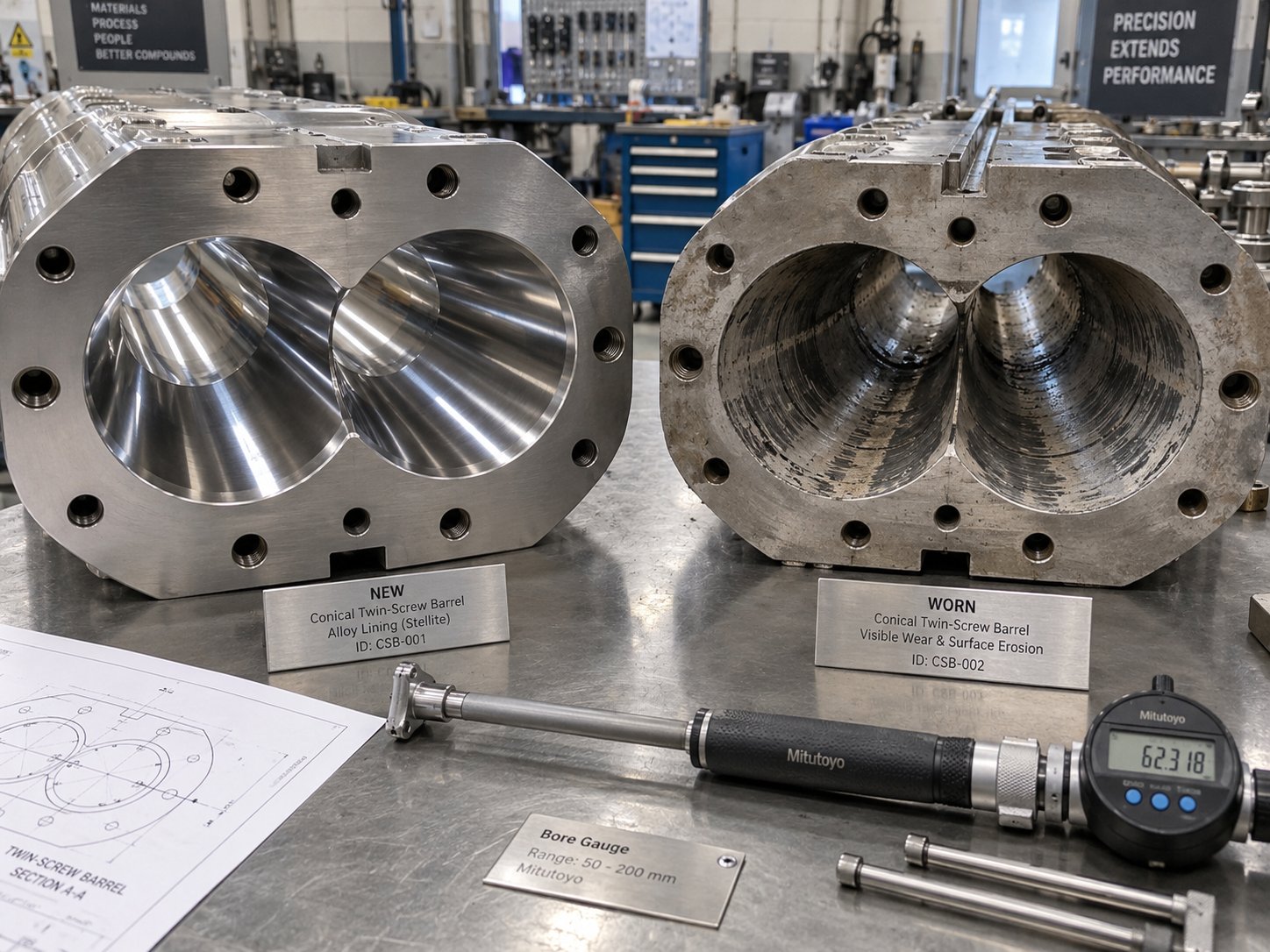
Screw and Barrel Wear in WPC Machines and Maintenance
Every hour your WPC extrusion machine runs, wood fiber is quietly grinding away the metal surfaces that make plasticizing possible. Unlike processing neat polymers, where wear progresses at a manageable pace over years, WPC compounds accelerate the destruction of screws and barrels in ways that catch many operators off guard. The abrasive load is relentless — and the financial consequences of ignoring it extend far beyond the cost of replacement parts. Reduced plasticizing efficiency, rising energy bills, inconsistent melt quality, and eventually compromised product that fails compliance testing: these are the cascading effects of unchecked wear.
Understanding why wear accelerates in WPC processing — and what metallurgical solutions and maintenance practices actually slow it down — is essential for anyone who wants to control operating costs over the full ownership cycle. Buyers shopping for a cheap WPC flooring extrusion machine or a high-output decking line alike face the same reality: the screw and barrel are consumable components, and the materials they are made from determine how often you stop production to replace them.
Why Screw and Barrel Wear Is Accelerated in WPC Processing
What makes wood-plastic composites so punishing on extruder internals? The answer starts inside the wood flour itself. Wood fiber naturally contains silica — a hard mineral embedded within the cell walls of trees. When wood flour is milled into fine particles for WPC compounding, that silica becomes an abrasive agent distributed throughout the entire melt stream. Every screw rotation drags millions of these micro-abrasive particles across the screw flight lands and barrel bore, slowly removing material from both surfaces.
The abrasion does not stop with silica. Most WPC formulations also include mineral fillers — calcium carbonate and talc are among the most common — added to improve stiffness, reduce cost, or modify surface properties. These fillers compound the abrasive load significantly. As Nanjing Haisi's engineering analysis highlights, fillers like calcium carbonate and glass fiber wear down metal surfaces much faster than molten polymers alone, and the feeding zone — where solid particles first contact the barrel wall — experiences some of the most aggressive mechanical wear in the entire extruder.
Imagine the screw flights as a plow blade cutting through soil mixed with sand and gravel. Over time, even hardened steel wears thin. The same principle applies inside a WPC extruder barrel, but at elevated temperatures and pressures that further weaken the metal's resistance to abrasion. As Plastics Technology's screw-life research explains, the original clearances between the barrel bore and screw flight outside diameter are typically just 0.001 inch per side per inch of diameter. Even small amounts of material loss from wear cause those clearances to grow — and the consequences snowball from there.
Here is how progressive screw and barrel wear degrades your operation:
- Reduced plasticizing efficiency — As the gap between screw flight and barrel wall increases, melt leaks backward past the flights instead of being pushed forward. This backflow reduces effective output and leaves partially unplasticized material in the melt stream.
- Inconsistent output — Wider clearances allow pressure fluctuations that cause melt surging — the rhythmic speeding and slowing of material through the die that creates visible thickness variations in finished profiles.
- Higher energy consumption — Operators compensate for lost efficiency by increasing screw speed, raising barrel temperatures, or adjusting backpressure. Each of these tweaks consumes more energy, and the incremental adjustments often go unnoticed until they become dramatic.
- Compromised product quality — Uneven melting, inconsistent density, and variable fiber dispersion all degrade mechanical properties and surface finish. Products that passed ASTM D7032 or EN 15534 testing during initial commissioning may start failing as wear accumulates — a delayed-action problem that often blindsides manufacturers months into a production campaign.
The wear pattern is not uniform along the barrel, either. Twin-screw extruder studies identify four primary high-wear zones: the feeding zone (where solid particles create heavy mechanical friction), filler introduction zones (where abrasive additives first contact the screws), the middle barrel section (where axial pressure can cause screw deflection and barrel scraping), and the discharge zone (where the cantilevered screw end sags under gravity). For WPC processors, the feeding zone takes the worst punishment because dry wood flour — with its embedded silica — is at peak abrasiveness before it becomes encapsulated by molten polymer.
Wear-Resistant Materials and Surface Treatments
Since you cannot eliminate the abrasive nature of wood-flour compounds, the most effective defense is building screws and barrels from materials tough enough to resist it. This is where metallurgy becomes a procurement decision — and where the difference between a five-year component life and a two-year life often comes down to the alloy specification on a purchase order.
Nitrided screws are the baseline standard for WPC extrusion. The nitriding process — typically gas nitriding conforming to DIN 8550 — diffuses nitrogen into the steel surface, creating a hard case layer that resists abrasive wear. High-quality nitrided screws achieve surface hardness in the 65–70 HRC range, providing meaningful protection against the silica and mineral fillers in WPC formulations. However, nitriding is a surface treatment only — once the hardened layer wears through (typically 0.3–0.7 mm deep depending on the process), the softer base steel underneath erodes quickly. This is why nitrided screws, while cost-effective for moderate-wear applications, may not deliver adequate life in high-fill WPC lines running 50–70% wood-flour content.
Bimetallic barrels take protection a step further. Instead of relying on surface treatment alone, these barrels are lined with a wear-resistant alloy layer typically 1–2 mm thick, centrifugally cast onto the inner bore of a structural steel outer shell. The alloy lining — commonly a nickel-cobalt or tungsten-carbide-rich composition — provides sustained abrasion and corrosion resistance that far outlasts nitrided surfaces. As the working surface wears, you are still cutting through hard alloy rather than hitting soft backing steel. For WPC processors, bimetallic barrels are not a luxury; they are a practical necessity on any line expected to run thousands of hours per year at high wood-flour loading.
Other metallurgical options include powder metallurgy (PM) steels for screw elements, which offer finer, more uniform grain structure and higher mechanical strength compared to conventional alloy steels. PM steel screws provide superior wear and corrosion resistance due to minimal segregation of hardening elements like nickel, chromium, and molybdenum throughout the material — an important advantage when processing WPC formulations that combine abrasive fillers with thermally aggressive PVC resin.
Die components deserve attention too. The die channels that shape the final profile face constant abrasion from the WPC melt stream, and worn die lips produce inconsistent profile geometry and degraded surface finish. Hardened tool steels — often through-hardened rather than surface-treated — are standard for die inserts and flow-channel components in WPC applications.
Preventive Maintenance Best Practices and Service Life
Even the best metallurgy buys time rather than immunity. Wear is inevitable in WPC processing, which makes preventive maintenance the difference between controlled, scheduled component changes and emergency shutdowns that wreck production targets. The goal is straightforward: measure wear progression, predict when performance will drop below acceptable limits, and replace components before product quality suffers.
Glycon Corp.'s research on screw and barrel life optimization describes this as identifying the "point of diminishing returns" — the threshold where incremental machine adjustments (higher screw speed, raised temperatures, increased backpressure) can no longer compensate for worn clearances without measurably impacting production efficiency or part quality. If you chart your operating parameters against output rate and scrap rate over time, the inflection point where those curves diverge tells you exactly when replacement is overdue.
Here are the key maintenance checkpoints every WPC processor should follow:
- Measure screw flight outside diameter at regular intervals — Compare against original specifications to track wear progression. A wear allowance of 0.1–0.2 mm per side is typical before plasticizing efficiency begins to degrade noticeably.
- Gauge barrel bore diameter — Use a telescoping bore gauge or inside micrometer to measure the barrel I.D. at multiple points along its length. Ovality or localized enlargement indicates zones of accelerated wear that may require bore honing or barrel replacement.
- Inspect for adhesive wear and scoring — Look for galling marks, burrs on screw flight trailing edges, and scoring on the barrel bore surface. These indicate metal-to-metal contact, often caused by screw deflection, misalignment, or solids wedging in the feed section.
- Check screw straightness before reinstalling — A bent screw concentrates contact pressure against the barrel wall, accelerating local wear and potentially damaging the barrel bore. Straightness and concentricity verification should be standard procedure after every removal.
- Monitor operating parameters as wear indicators — Gradually rising screw speed, increasing barrel zone temperatures, growing backpressure settings, and declining output rate at constant settings all signal progressing wear — even when you have not pulled the screw for physical inspection.
- Track energy consumption per kilogram of output — As clearances increase and operators compensate, specific energy consumption (kWh/kg) climbs. Plotting this metric over time provides an objective wear trend that supports replacement-timing decisions.
- Verify screw-to-barrel alignment during reinstallation — Misalignment between the gearbox output and barrel bore introduces eccentric loading that causes uneven wear patterns. Alignment checks are especially important after gearbox service or barrel changes.
- Schedule replacements during planned downtime — Having spare screws and barrels on hand allows changeovers during scheduled maintenance windows rather than emergency stops. Unplanned downtime for component sourcing can cost days of lost production.
Replacement timing varies widely depending on formulation, output rate, and component metallurgy. Lines running high-fill PE-based WPC with calcium carbonate at triple-shift intensity may need screw and barrel replacement every 12–18 months. PVC-based lines with moderate wood-flour loading and bimetallic barrels can push well beyond 24 months. The only reliable guide is your own measurement data — not a manufacturer's generalized estimate.
This is exactly where sourcing quality replacement components becomes a strategic concern rather than a routine procurement task. A replacement barrel machined to loose tolerances or manufactured from inadequate alloys will wear out faster than the original, creating a frustrating cycle of frequent changeovers and escalating costs. Suppliers who specialize in extrusion barrel and screw manufacturing for specific applications — rather than generic metalworking shops — deliver measurably better results. For example, NANHAIYA focuses specifically on custom and replacement conical twin screw barrels for PVC and WPC extrusion, engineering their components for stable plasticizing performance across the demanding wear conditions that wood-fiber compounds impose. For manufacturers running conical twin-screw machines — the dominant configuration in PVC-based WPC production — partnering with a specialist supplier like this ensures that replacement barrels match the precision, alloy quality, and dimensional consistency the extruder was designed around, rather than introducing a weak link into an otherwise well-optimized line.
The cheap WPC floor profile extrusion machine price you negotiated means little if you are replacing screws and barrels twice as often because the replacement parts could not withstand WPC's abrasive demands. Total cost of ownership — including wear-part consumption, energy creep, and scrap from degrading melt quality — almost always favors investing in properly specified metallurgy and sourcing from manufacturers who understand the unique punishment WPC inflicts on every metal surface inside the extruder.
Wear management keeps your existing line productive. But the WPC industry itself is not standing still — co-extrusion, foamed-core technology, and inline surface finishing are reshaping what a production line can deliver, and each of these advancements introduces its own set of machine requirements that go well beyond a standard single-layer extrusion setup.
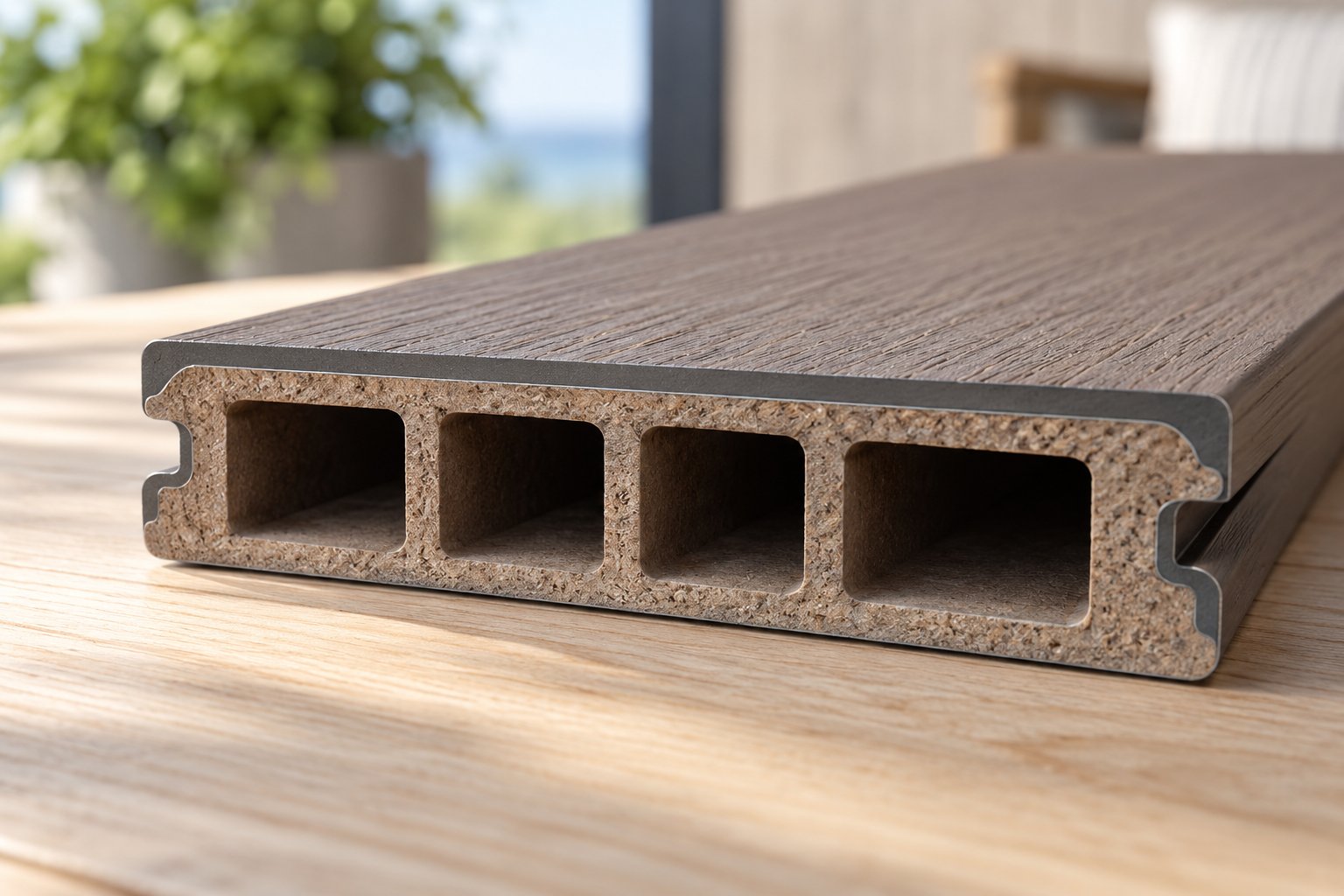
Advanced WPC Extrusion Technologies and Innovations
A standard single-layer WPC profile line still covers the bulk of global production — but the market is moving. Buyers demanding better UV resistance, lighter weight, and more convincing wood-grain aesthetics are pushing manufacturers toward multi-layer, foamed-core, and inline-finished products. Each of these technologies changes the machine configuration in meaningful ways, and understanding those changes separates buyers who invest for the next decade from those who purchase equipment that is already a generation behind.
Co-Extrusion Technology for Capped WPC Products
Imagine running your WPC core profile through the die while simultaneously wrapping it in a thin, weather-resistant polymer shell — bonded at the molecular level, not glued or laminated after the fact. That is co-extrusion, and it has become the defining upgrade in premium composite decking and cladding.
The process adds a secondary extruder — typically a single-screw or smaller parallel twin-screw machine — that feeds a polymer-rich cap layer into a specially designed co-extrusion die. As engineering analysis of co-extruded decking systems explains, the bonding between the cap and core happens while both materials remain molten, creating molecular adhesion rather than a mechanical attachment that could delaminate over time. The inner WPC core provides structural strength and stiffness, while the outer cap layer — loaded with UV stabilizers, pigments, and scratch-resistant additives — shields the composite from sunlight, staining, and surface abrasion.
The practical benefits are substantial. Co-extruded boards deliver significantly better color retention in high-UV environments, resist red wine and grease stains that would permanently mark an uncapped board, and maintain a consistent surface finish across years of foot traffic. For manufacturers, co-extrusion opens access to premium price tiers that single-layer profiles simply cannot reach. The trade-off? Added capital cost for the secondary extruder, a more complex die, and tighter process control to ensure the cap layer thickness remains uniform around the entire profile perimeter.
Buyers evaluating a cheap WPC profile extrusion machine should consider whether their target market will demand capped products within the next three to five years. Retrofitting a co-extrusion station onto a line not originally designed for it is possible but rarely cost-efficient — the die, calibration tooling, and control system often need complete replacement.
Foamed WPC Extrusion for Lightweight Profiles
Solid WPC profiles are dense — often heavier than the wood they replace. Foamed-core extrusion solves this by introducing a cellular structure inside the profile, reducing material density by 20–40% while preserving the structural integrity needed for wall panels, door frames, and interior trim applications.
Two foaming approaches dominate WPC production:
- Chemical foaming — A chemical foaming agent (CFA), typically azodicarbonamide or a sodium bicarbonate/citric acid blend, is pre-mixed into the WPC compound. As barrel temperatures trigger the agent's decomposition, gases like nitrogen or CO2 release directly into the melt, forming bubbles that expand after the material exits the die. Foaming technology comparisons note that chemical foaming requires minimal additional hardware — often just the masterbatch addition — making it accessible even on existing lines. The trade-off is limited expansion ratios and less uniform cell structure compared to physical methods.
- Physical foaming — Supercritical CO2 or nitrogen is injected directly into the melt under high pressure. When the pressurized material exits the die, the sudden pressure drop triggers rapid cell nucleation, producing a finer, more uniform closed-cell structure. Physical foaming achieves higher expansion ratios and yields lightweight profiles with better mechanical consistency, but it demands specialized high-pressure injection equipment, modified screw designs, and precise temperature control across every barrel zone.
Foaming changes the machine requirements in ways that go beyond just adding a blowing agent. Screw geometry needs modification — typically longer compression zones and gentler metering sections to prevent premature cell collapse. Die geometry must account for post-die expansion, and calibration tooling needs redesigning to accommodate the foamed profile's different cooling behavior. Temperature precision becomes even more critical because the foaming window — the narrow range where cell nucleation proceeds uniformly without collapse or blowout — is tighter than standard solid extrusion.
For buyers shopping for a cheap WPC wall panel extrusion machine price or a cheap WPC wall ceiling extrusion machine price, foamed WPC lines are particularly relevant. Wall panels and ceiling trims benefit directly from reduced weight — lighter boards are easier to handle during installation, reduce shipping costs, and place less load on mounting structures. PVC-based foamed WPC board has become one of the fastest-growing product categories in interior construction, and manufacturers who lack foaming capability are increasingly locked out of this segment.
Online Embossing, Brushing, and Surface Finishing
A perfectly extruded WPC board with a smooth, uniform surface still looks like plastic. Customers expect wood grain — and increasingly, they expect it to feel like wood under bare feet and fingertips. Online surface finishing delivers that realism directly on the extrusion line, eliminating the need for costly secondary processing.
Inline embossing uses heated steel rollers engraved with realistic wood-grain patterns. Positioned after the calibration table while the profile surface is still warm enough to deform plastically, these rollers press deep, detailed textures into the board. The result is a three-dimensional grain pattern that closely mimics natural wood — including the subtle randomness that makes boards look authentic rather than stamped from a repeating mold. Manufacturers running co-extruded lines get even better embossing results because the polymer-rich cap layer accepts fine detail more readily than a high-fill WPC core surface.
Wire-brushing units offer an alternative aesthetic — a weathered, hand-scraped look that appeals to customers seeking a rustic or reclaimed-wood style. Rotating wire brushes remove a thin layer of the softer polymer matrix from the surface, exposing the harder wood fibers and creating a textured, matte finish that feels distinctly different from a smooth or embossed board.
Both finishing methods integrate directly into the extrusion line between the cooling section and the cutter, adding no more than a few meters of line length and minimal additional cycle time. For manufacturers calculating the total cost per board, eliminating a separate offline finishing step — with its own labor, floor space, handling, and scrap — often justifies the embossing or brushing station's capital cost within the first year of operation.
Taken together, these technologies are reshaping what a modern WPC production line looks like and what it can deliver. Here is a summary of the key trends and their primary benefits:
- Co-extrusion with polymer cap layer — Superior UV resistance, stain protection, enhanced surface aesthetics, and access to premium market segments.
- Chemical foaming for lightweight profiles — Lower material costs, reduced product weight, simpler equipment requirements, suitable for wall panels and interior trim.
- Physical foaming for high-performance cellular structures — Finer cell uniformity, higher expansion ratios, better mechanical consistency, ideal for structural applications demanding weight reduction.
- Inline embossing — Realistic wood-grain textures applied directly on the line, eliminating secondary processing and reducing per-unit finishing costs.
- Wire brushing — Weathered, hand-scraped surface aesthetics created inline, appealing to rustic and reclaimed-wood design trends.
- Multi-layer die and tooling integration — Enables combining foamed cores with solid skins or co-extruded caps in a single pass, maximizing material efficiency and product differentiation.
Each of these innovations demands specific machine capabilities — from secondary extruders and modified screw designs to specialized dies and precise downstream finishing stations. A production line configured solely for basic solid-core profiles cannot pivot to co-extruded, foamed, or embossed products without significant retooling. That reality makes technology roadmapping an essential part of the machine selection process, not an afterthought. The question every buyer should ask before signing a purchase order is not just "what do I need to produce today?" but "what will my customers expect from this line three years from now?" — and that forward-looking perspective is exactly what separates a smart equipment investment from a costly one.
How to Choose the Right WPC Extrusion Machine
Technology options, extruder types, metallurgy specifications, and capacity tiers — by this point, you have a solid technical foundation. But knowledge alone does not close a deal or prevent a purchasing mistake. The gap between understanding WPC extrusion and actually selecting the right machine lies in applying a structured decision framework that accounts for your specific product targets, operational reality, and long-term supply chain resilience. Most buyers skip this framework entirely, defaulting to whoever quotes the lowest price or the fastest delivery. That shortcut is exactly where the costliest errors begin.
Key Factors When Evaluating a WPC Extrusion Machine
Think of machine selection as a decision tree, not a shopping list. Each choice narrows the field and eliminates options that look attractive on paper but fail in practice. Here is the sequence that experienced procurement teams follow — and the order matters.
1. Target product type. Are you producing decking boards, wall panels, door frames, flooring planks, or facade cladding? The product defines the die geometry, calibration approach, and downstream finishing requirements. A line optimized for wide, flat decking boards handles cooling and haul-off very differently than one producing narrow, hollow door frame profiles. Buyers searching for a china pvc wpc foaming board extrusion machine factory, for instance, need equipment configured for foamed PVC board — a distinct die design, modified screw geometry, and calibration setup compared to solid PE-based decking lines.
2. Resin system. This is the foundational decision. PVC-based WPC points you toward conical twin-screw extruders with lower processing temperatures and gentle shear. PE or PP-based composites steer toward parallel twin-screw machines with higher L/D ratios and more aggressive mixing capability. Choosing the wrong extruder family for your resin system is not a minor inefficiency — it is a fundamental mismatch that no amount of parameter tuning can overcome.
3. Required output capacity. Work backward from your annual tonnage target, accounting for shift configuration, realistic line efficiency (75–85%), and the principle that your nominal daily production should sit at 60–80% of the machine's rated maximum. Oversizing wastes capital and energy; undersizing accelerates wear and destabilizes quality.
4. Available floor space and utilities. A complete WPC line — from mixer to stacker — can stretch 30 to 50 meters or more depending on profile size and cooling requirements. Ceiling height, electrical supply capacity, water availability for cooling systems, and ventilation for degassing exhaust all constrain what you can practically install.
5. Budget range and total cost of ownership. The purchase price is the opening number, not the final one. As sourcing guides for global buyers emphasize, total cost of ownership over five years can vary by 40–60% between suppliers when you factor in energy consumption, wear-part replacement frequency, spare parts pricing, and unplanned downtime costs. A machine priced significantly below market average often achieves that discount through cheaper metallurgy, fewer temperature zones, or lower-grade drive components — savings that reverse themselves within the first two years of operation.
6. After-sales support and technical training. Can the supplier provide on-site commissioning, operator training, formulation guidance, and responsive spare-parts fulfillment? An unplanned production stoppage can cost thousands of dollars per day in lost output. Suppliers who assign a dedicated after-sales engineer and guarantee spare-parts shipping within 72 hours deliver measurably better uptime than those offering only email support.
Sourcing from China and Evaluating Manufacturers
China accounts for a dominant share of global WPC extrusion equipment production, and for good reason. The country's manufacturing base offers an unmatched combination of pricing, variety, and engineering capability — from entry-level single-line setups to fully integrated multi-line turnkey operations. Major manufacturing hubs in Jiangsu, Anhui, Zhejiang, and Guangdong provinces each bring regional specializations, giving buyers access to dozens of qualified machine builders within a few hundred kilometers of each other.
That abundance, however, creates its own challenge. When you are searching for a china pvc wpc foaming board extrusion machine manufacturer or any WPC line supplier, distinguishing a genuine manufacturer from a trading company reselling someone else's equipment requires deliberate verification. Here is what a thorough evaluation looks like:
- Factory visit or virtual audit — Request a live video tour showing machining, assembly, and testing areas. Legitimate manufacturers welcome this; trading companies deflect or stall. For orders above $50,000, consider hiring an independent auditor such as SGS or Bureau Veritas — a typical audit costs $500–$1,500 and provides objective verification of production capability.
- Reference customer checks — Ask for contact details of existing customers producing similar WPC products. Speaking directly with operators who have run the machine for 12 months or more reveals reliability issues, service responsiveness, and real-world output rates that no sales brochure will mention.
- Machine trial runs — A reputable manufacturer will demonstrate the line running your specific formulation (or a close approximation) at the factory before shipment. This trial validates output rate, surface quality, dimensional accuracy, and temperature stability under realistic conditions.
- Spare parts availability and pricing — Request a priced spare-parts list covering screws, barrels, die components, heater bands, thermocouples, and drive belts before signing the contract. Suppliers who are transparent about consumable costs upfront are far more likely to support you fairly after the sale.
- Technical training and commissioning support — Verify that the contract includes on-site installation supervision, operator training, and a defined warranty period with clear terms. Some suppliers offer remote commissioning via video call as a cost-effective alternative for experienced teams, but first-time WPC processors benefit enormously from hands-on guidance during the initial production ramp-up.
- Certification verification — Request ISO 9001 and CE certificates, then confirm their validity directly with the issuing bodies. As industry sourcing experts warn, fraudulent certificates exist in the market. Independent verification takes minutes and eliminates a significant risk.
Buyers exploring china pvc wpc foaming board extrusion machine wholesale options should apply these same evaluation criteria regardless of order volume. Wholesale pricing can offer meaningful per-unit savings on multi-line purchases, but only if the underlying equipment quality supports sustained production without excessive downtime or premature component failure.
One factor deserves special emphasis during supplier evaluation: wear-part sourcing. The screws and barrels inside a WPC extruder are consumable components that degrade under the abrasive load of wood fiber and mineral fillers. If the machine manufacturer sources these components from a third-party metalworking shop with no specific extrusion expertise, replacement parts may not match the precision, alloy quality, or dimensional consistency of the originals. Verifying where the manufacturer sources — or recommends sourcing — conical twin screw barrels and screws is a due-diligence step that directly affects your long-term operating costs.
Building a Reliable Supply Chain for Wear Parts
Your machine purchase is a one-time capital event. Your wear-part supply chain is an ongoing operational relationship that will outlast the machine's warranty by years. Screw and barrel replacements, die inserts, heater bands, and thermocouple assemblies are not emergency purchases you want to scramble for when production is down — they are planned consumables that should be sourced, stocked, and rotated on a predictable schedule.
For conical twin-screw extruders — the dominant configuration in PVC-based and PVC-WPC production — the barrel is one of the highest-value and longest-lead-time replacement components. A barrel machined from the wrong alloy or finished to loose tolerances will wear out faster than the original, trapping you in a frustrating replacement cycle that drives up cost per kilogram of output. This is why specialist suppliers matter. NANHAIYA, for example, focuses specifically on custom and replacement conical twin screw barrels for PVC and WPC extrusion lines, engineering each barrel for stable plasticizing performance under the high-abrasion conditions that wood-fiber compounds create. For manufacturers who depend on conical twin-screw machines for their WPC or PVC production, having a specialist like this in the supply chain means replacement barrels arrive with the right alloy specification, bore precision, and heat-treatment profile — rather than a generic component that introduces a quality variable into an otherwise stable process.
Whether you source wear parts from your machine manufacturer, a dedicated component specialist, or both, the following procurement checklist helps ensure you are building a supply chain that supports uninterrupted production:
- Obtain original dimensional specifications — Request detailed drawings of screws, barrels, and die components from the machine manufacturer at the time of purchase. These become your reference standard for evaluating any replacement supplier's output.
- Verify alloy and heat-treatment certifications — Replacement barrels and screws should come with material certificates documenting alloy composition, hardness testing results, and heat-treatment process records. Without these, you have no way to confirm the component meets the wear-resistance standard your formulation demands.
- Establish lead times for critical components — Conical twin screw barrels typically require 4–8 weeks for custom manufacturing. Knowing your supplier's lead time allows you to order replacements well before the installed components reach their wear limit.
- Stock fast-wear items on-site — Heater bands, thermocouples, feed-throat liners, and cutting blades should be kept in inventory. These are low-cost items with high downtime impact if unavailable.
- Negotiate pricing for recurring orders — If you operate multiple lines or anticipate regular replacement cycles, discuss volume pricing or annual supply agreements with your component supplier. Predictable ordering benefits both parties.
- Test replacement components against originals — When switching to a new wear-part supplier, run the replacement component for a defined trial period and compare output quality, energy consumption, and wear rate against the original manufacturer's parts. Data-driven qualification eliminates guesswork.
- Maintain a supplier backup — Relying on a single source for critical components creates supply-chain risk. Qualify at least two suppliers for your highest-consumption wear parts — especially screws and barrels — so that a production disruption at one supplier does not cascade into your own downtime.
The buyers who get WPC extrusion machine selection right are not the ones who find the lowest quote or the flashiest catalog. They are the ones who treat the purchase as a system-level decision — matching extruder type to resin chemistry, sizing capacity to realistic production targets, verifying supplier credibility through independent checks, and building a wear-part supply chain that keeps the line running profitably for years after the commissioning engineers leave. Every section of this article has built toward that same conclusion: in WPC extrusion, the machine is only as good as the decisions surrounding it.
Frequently Asked Questions About WPC Extrusion Machines
1. What is the difference between a conical twin-screw and a parallel twin-screw extruder for WPC?
Conical twin-screw extruders use tapered screws that naturally compress material from a wide feed end to a narrow discharge end, generating lower shear heat — ideal for thermally sensitive PVC-based WPC. They typically operate at 15-40 rpm with L/D ratios of 16:1 to 25:1. Parallel twin-screw extruders feature cylindrical screws with higher L/D ratios (28:1 to 40:1+) and modular screw elements, delivering superior mixing intensity and higher throughput suited to PE/PP-based WPC with heavier wood-flour loading. The choice depends entirely on your resin system and target product.
2. Why do screws and barrels wear out faster in WPC extrusion than in standard plastic processing?
Wood flour naturally contains silica — a hard mineral embedded in tree cell walls — that acts as a micro-abrasive distributed throughout the melt stream. Most WPC formulations also include mineral fillers like calcium carbonate and talc, which compound the abrasive effect. This accelerated wear widens the clearance between screw flights and barrel bore, causing reduced plasticizing efficiency, melt surging, higher energy consumption, and eventually compromised product quality. Bimetallic barrels with wear-resistant alloy linings and nitrided screws (65-70 HRC) are standard countermeasures, and specialist suppliers like NANHAIYA offer custom conical twin screw barrels engineered specifically for the demanding conditions WPC compounds impose.
3. How do I calculate the right output capacity for a WPC extrusion line?
Start with your annual tonnage target and divide by your net operating hours — total shift hours multiplied by a realistic efficiency factor of 75-85%. For example, 3,000 metric tons per year on double shifts at 80% efficiency requires approximately 938 kg/hr sustained output. Then size your extruder so that daily nominal production sits at 60-80% of the machine's rated maximum, avoiding both underutilization and redline operation that accelerates wear. Critically, verify that downstream equipment — calibration tables, cooling tanks, haul-off, and cutters — can match the extruder's throughput, since an undersized downstream section can reduce actual output by 20-40%.
4. What industry standards apply to WPC products and how does the extrusion machine affect compliance?
ASTM D7032 governs WPC decking performance in North America, covering structural load capacity, weathering resistance, and slip resistance. EN 15534 is the European standard addressing classification, specification, and CE marking requirements. Machine precision directly impacts compliance: uneven die tolerances create localized weak points that fail load tests, inconsistent calibration vacuum causes dimensional drift, and worn screws that produce melt surging lead to variable density and mechanical properties across production batches. Investing in equipment with tight die tolerances, stable melt-pressure control, and high-quality wear components is essentially a compliance requirement for export-grade WPC products.
5. What is co-extrusion in WPC manufacturing and is it worth the investment?
Co-extrusion applies a thin, weather-resistant polymer cap layer over a WPC core profile during the extrusion process using a secondary extruder and a specialized die. The cap bonds molecularly with the core while both materials are molten, providing superior UV resistance, stain protection, scratch resistance, and enhanced surface aesthetics compared to single-layer profiles. While it adds capital cost for the secondary extruder and more complex tooling, co-extruded boards access premium price tiers that single-layer products cannot reach. Buyers should evaluate whether their target market will demand capped products within three to five years, as retrofitting co-extrusion capability onto an existing line is rarely cost-efficient.
Written by
Nanhaiya Technical Team
Zhoushan Nanhaiya Plastic Machinery Co., Ltd.
The Nanhaiya technical team supports screw and barrel manufacturing projects through application review, technical communication, custom manufacturing coordination, and production and quality control.
Discuss Your Application
Related Articles
More insights on screw barrel technology and plastics processing.
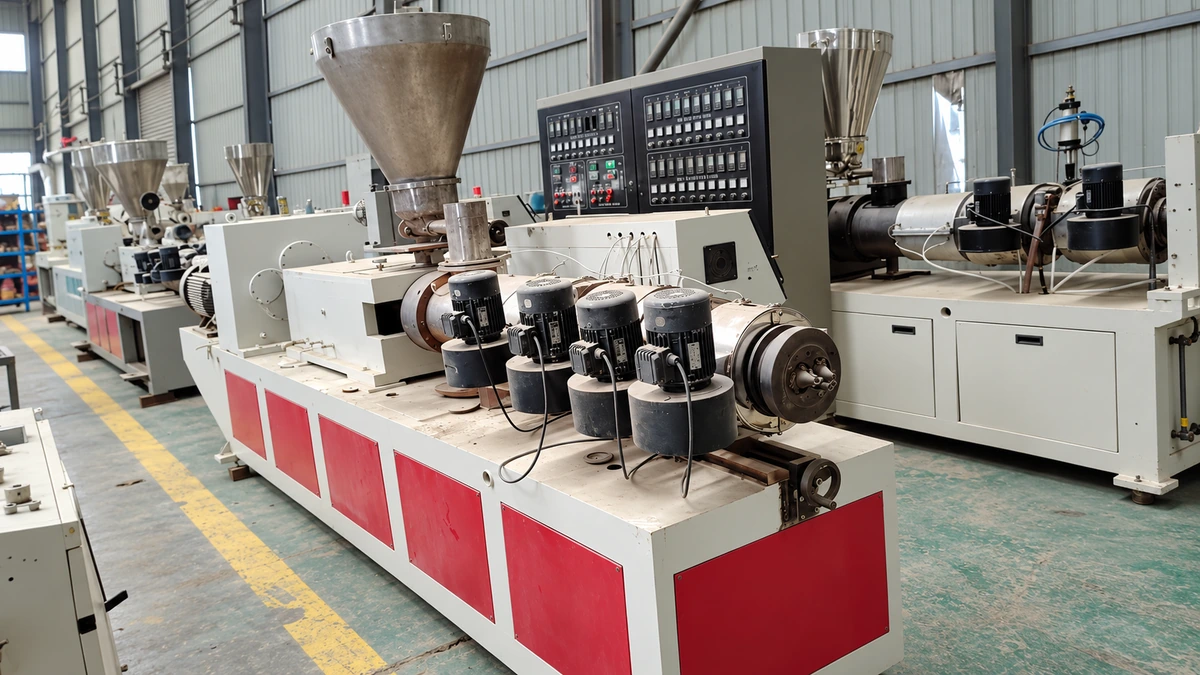
Counter Rotating Twin Screw Extruder Manufacturer: What Buyers Miss
Oct 29, 2026
Learn how to evaluate a counter rotating twin screw extruder manufacturer with expert guidance on gearbox engineering, barrel metallurgy, TCO analysis, and a sourcing checklist.
Read Article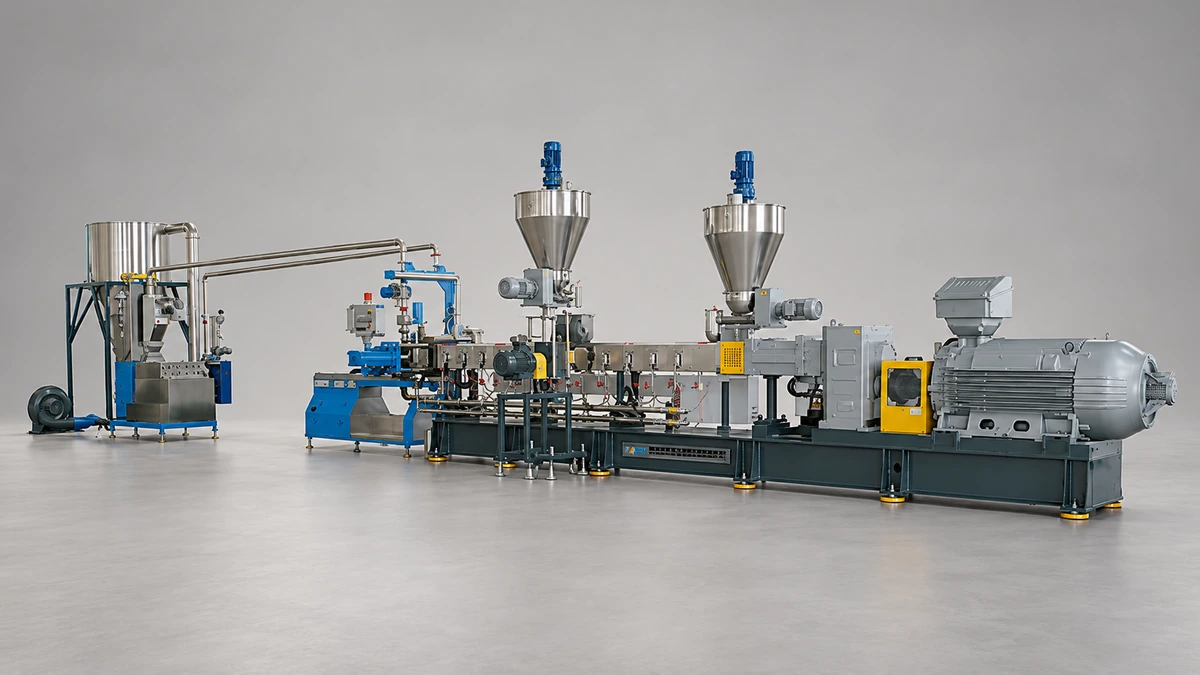
What Your Parallel Twin Screw Extruder Manufacturer Won't Tell You
Oct 27, 2026
Learn how to evaluate a parallel twin screw extruder manufacturer beyond spec sheets. Covers gearbox quality, barrel metallurgy, TCO analysis, and a 5-stage vendor selection framework.
Read Article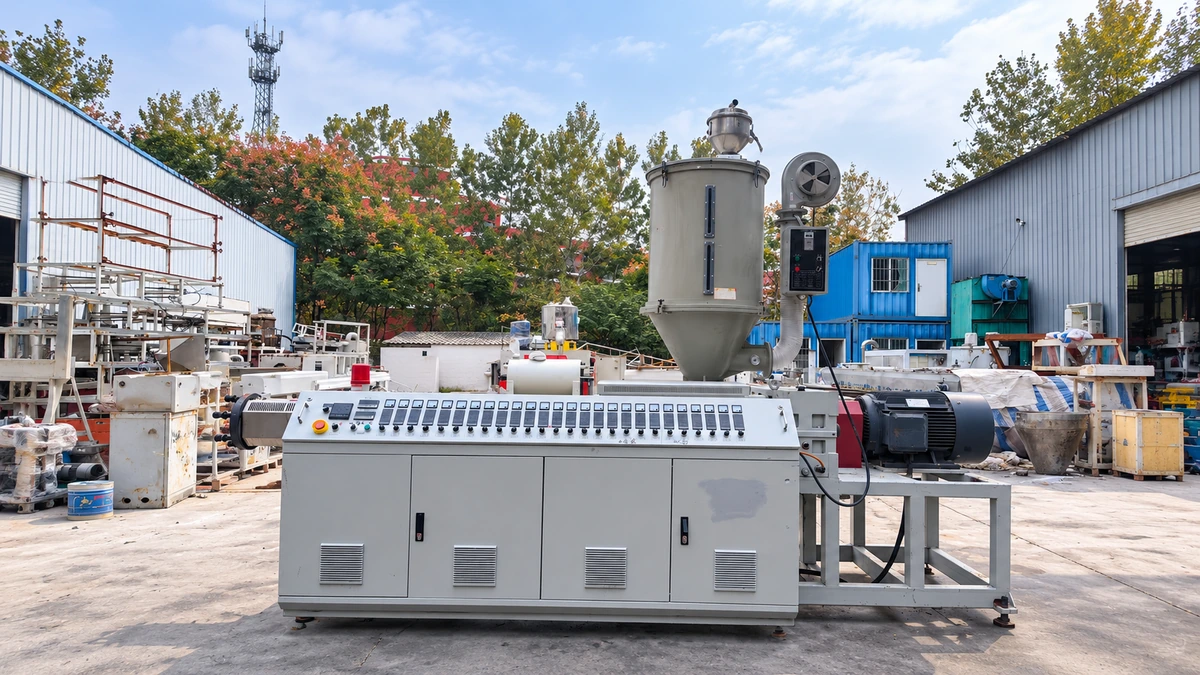
Single Screw Extruder Supplier Red Flags You Can't Afford To Miss
Oct 22, 2026
Learn how to evaluate a single screw extruder supplier with this buyer's guide covering pricing, screw and barrel tech, new vs used trade-offs, and red flags.
Read ArticleLooking for something else?
Search by material, symptom or product and jump straight to the relevant page.
These are navigation suggestions based on keyword matching — not a quotation, not a delivery commitment, and not a substitute for engineering review. Final specification is confirmed by our engineers against your drawings and processed material.
Need help with screw barrel selection?
Share your machine model, processed material and application. Our team can help with pricing and technical support.