

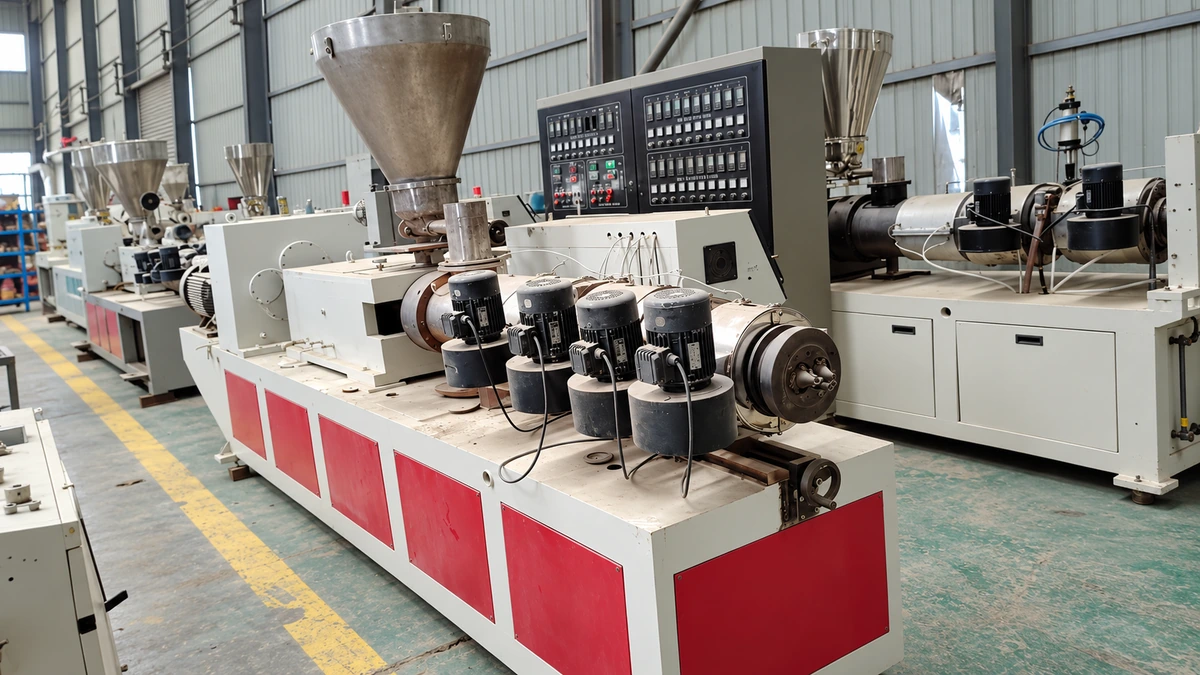
What Is a Counter-Rotating Twin Screw Extruder and Why Manufacturers Matter
Imagine you're sourcing a twin screw extruder for PVC pipe production or high-filler compounding. You request quotes from five different manufacturers, and every response looks competent on paper. But here's what most buyers miss: counter-rotating technology carries engineering demands that sharply separate specialized builders from generalists. Choosing the wrong supplier doesn't just cost money upfront—it quietly erodes performance, uptime, and product quality for years.
This guide serves a dual purpose. It gives you a rigorous technical education on counter-rotating extrusion mechanics, and it hands you a practical framework for evaluating manufacturers so you can spot genuine expertise before signing a purchase order.
Defining the Counter-Rotating Twin Screw Extruder
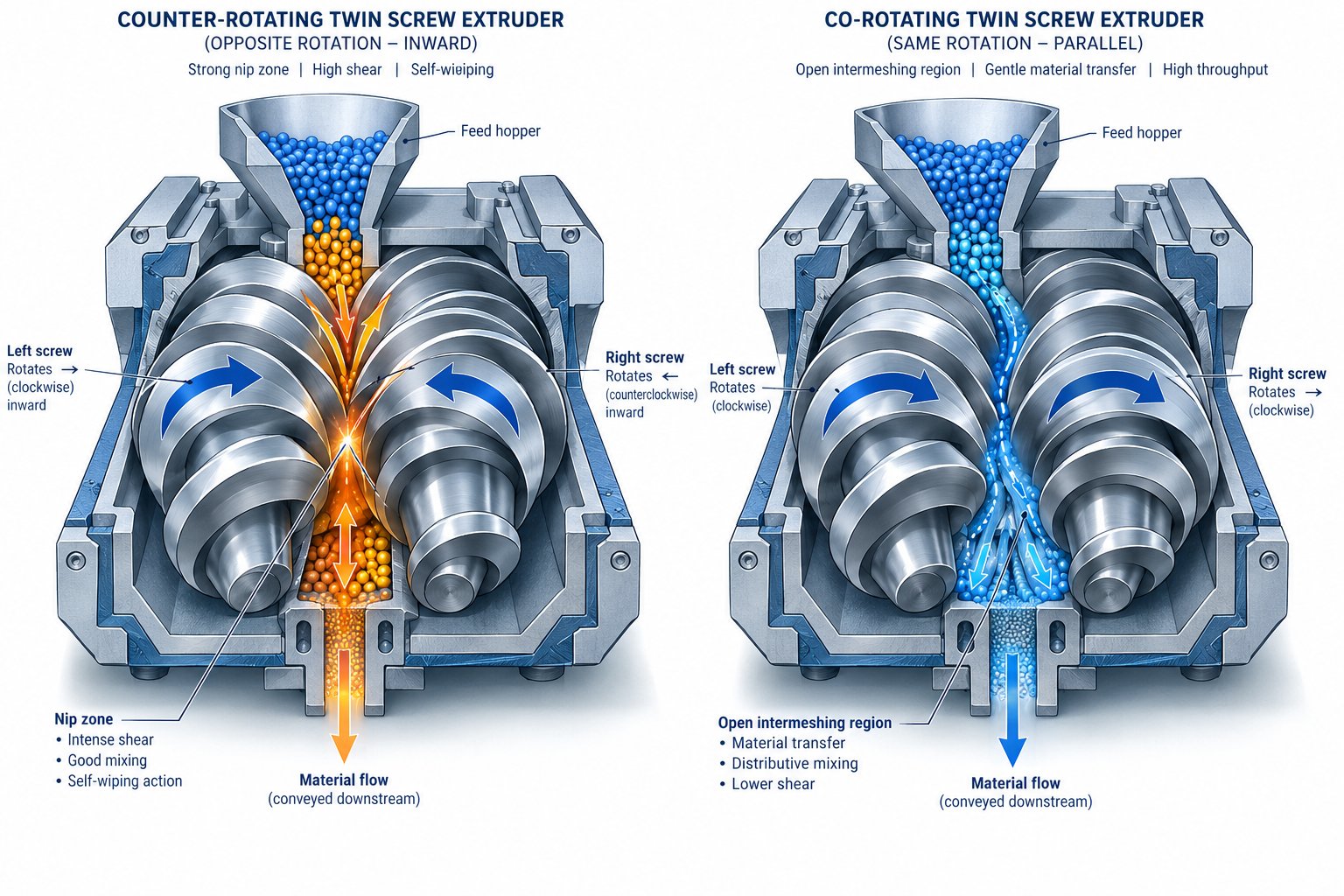
A counter-rotating twin screw extruder is a polymer processing machine that uses two intermeshing screws rotating in opposite directions within a shared barrel. Unlike co-rotating designs where both screws turn the same way, the counter-rotating configuration forces material through a nip zone between the screws, creating positive displacement conveying, controlled pressure buildup, and gentle low-shear mixing—making it the preferred twin screw extruder for pressure-sensitive applications such as PVC profile extrusion, pipe production, and high-filler compounding.
That distinction—screws turning toward each other rather than in the same direction—might sound like a minor mechanical detail. In reality, it fundamentally changes how the machine conveys material, generates pressure, and handles heat-sensitive polymers. A co-rotating twin screw extruder excels at high-shear dispersive mixing and is the standard workhorse for compounding operations. A counter-rotating system, by contrast, behaves more like a positive displacement pump: it traps material in closed chambers between screw flights and pushes it forward with remarkable consistency. This is why processors working with rigid PVC, heavily filled compounds, or direct profile extrusion gravitate toward counter-rotating platforms, whether they choose a conical twin screw extruder with tapered screws or a parallel configuration with uniform-diameter screws.
Why Manufacturer Choice Is Critical for Counter-Rotating Systems
Not every company building twin screw extruders has equal command of counter-rotating engineering. The reason is straightforward: these machines impose fundamentally different mechanical stresses on their drivetrain and barrel components compared to co-rotating designs.
Consider the gearbox alone. Counter-rotating systems generate significantly higher axial thrust loads because the screws push material forward under substantial back pressure. As Transcyko's engineering documentation highlights, appropriately rated thrust bearings on output shafts are critical to withstand these loads—premature bearing wear is one of the most common failure modes in counter-rotating gearboxes. High-precision gear grinding to DIN4 standards and multi-stage gearing solutions are required to reliably deliver the torque densities these machines demand, often reaching 16–18 Nm/cm³ per shaft.
Beyond the gearbox, screw metallurgy diverges as well. Counter-rotating extruders frequently process abrasive mineral fillers and corrosive PVC compounds, requiring nitrided steels or bimetallic barrel linings that a manufacturer focused primarily on co-rotating compounders may not routinely engineer. Process expertise matters too—screw geometry for a century twin screw extruder line running rigid PVC window profiles looks nothing like the screw design for a co-rotating compounder blending engineering thermoplastics.
The bottom line? A counter rotating twin screw extruder manufacturer must demonstrate dedicated R&D, in-house gearbox engineering capability, and deep application knowledge in the specific materials you process. Treating counter-rotating equipment as a secondary product line is a red flag—and understanding exactly why requires a closer look at the mechanics that make these machines unique.
How Counter-Rotating Twin Screw Extruders Work Mechanistically
The opposite rotation of twin screws isn't just a directional curiosity—it creates an entirely different set of flow physics inside the barrel. Every design decision a manufacturer makes, from screw geometry to gearbox sizing, stems from these underlying mechanics. If you're evaluating equipment, understanding these principles helps you judge whether a supplier truly engineers for this configuration or simply adapts co-rotating designs.
Four mechanical principles define how twin screw extrusion works in counter-rotating systems:
- Calendering effect — Material is squeezed between the screws at the nip region, generating controlled pressure through compressive and elongational deformation.
- Positive displacement conveying — Closed C-shaped chambers between screw flights trap and transport material forward like a series of moving pistons.
- Superior pressure generation — The combination of calendering and displacement pumping builds high melt pressure without relying on drag flow alone.
- Low-shear mixing — Dispersion occurs primarily through compression and elongation rather than the intense shear fields found in co-rotating machines.
The Calendering Effect and Positive Conveying Action
Picture two rollers turning toward each other with a thin layer of material between them. That's essentially what happens at the intermeshing region of a counter-rotating twin screw. As both screws rotate inward, they drag material into a narrowing gap—the nip zone—where it undergoes compressive and elongational deformation similar to a calender roll pair. Research conducted on a 55 mm diameter closely intermeshing counter-rotating extruder at Yildiz Technical University measured pressure differences of 4.7 to 7.1 MPa across this nip region, confirming that the calender analogy isn't just conceptual—it produces real, quantifiable forces.
Those forces are significant enough to push screws toward the barrel wall with separating loads exceeding one metric ton even in a modest lab scale twin screw extruder. This physical reality is precisely why manufacturer quality matters: gearbox thrust bearings, screw deflection resistance, and barrel wear resistance all trace directly back to the calender gap forces.
Beyond the nip, the screws form helically distorted C-shaped chambers between their flights. Because the flights of one screw penetrate the channels of the other, these chambers become effectively sealed volumes that move material axially—functioning like a displacement pump. Each chamber captures a discrete pocket of material and conveys it forward with minimal backflow. The result is highly predictable throughput that depends primarily on screw speed and geometry rather than downstream resistance. For processors who need consistent output in twin screw extrusion—think uniform wall thickness in pipes or dimensional precision in profiles—this positive displacement behavior is the core advantage.
Engineering Trade-Offs That Shape Design Philosophy
Every advantage comes with a constraint. The same calender gap mechanics that produce excellent pressure buildup also generate enormous separating forces that grow rapidly with rotational speed. As noted in polymer processing literature, large-diameter closely intermeshing counter-rotating extruders are generally limited to less than 50 RPM—and at high screw speeds, calender pressures can become so extreme that the melt film against the barrel fails, effectively allowing the extruder to wear itself out. Wider gaps would reduce these forces but sacrifice the positive displacement capacity that defines the machine's value.
This creates a clear trade-off profile:
- Lower maximum screw speeds compared to co-rotating designs, which routinely operate at 300–1,200 RPM.
- Higher pressure output per revolution, enabling direct extrusion through complex dies without requiring a separate melt pump.
- Gentler material handling, since reduced speed and low shear keep frictional heating minimal—critical for thermally sensitive polymers.
- More demanding gearbox engineering, because thrust loads are substantially higher per unit of throughput.
These trade-offs aren't weaknesses—they're the reason counter-rotating systems dominate specific application spaces. A Technovel technical column highlights that rigid PVC, with its low thermal decomposition temperature and poor melt flow, benefits directly from the counter-rotating machine's ability to operate at high fill levels and low rotational speeds while the calendering effect provides adequate dispersive mixing without dangerous temperature spikes.
For buyers, the practical takeaway is this: a manufacturer whose twin screw platform is primarily engineered for high-speed co-rotating compounding may undersize thrust bearings, specify insufficient barrel wear protection, or overlook the screw deflection management that counter-rotating mechanics demand. The physics are different, so the engineering must be different too. That divergence in design requirements becomes even more apparent when comparing the two configurations side by side across key performance parameters.
Counter-Rotating vs Co-Rotating Twin Screw Extruders Compared
Selecting between counter-rotating and co-rotating twin screw extruders is not a question of which machine is "better." It's a question of which machine fits your process. Both configurations use two intermeshing screws inside a shared barrel, yet the direction those screws turn produces dramatically different flow physics, shear environments, and pressure characteristics. Treating them as interchangeable—or assuming one is universally superior—is among the costliest mistakes buyers make when evaluating twin screw extruders.
The table below distills the core differences into a practical side-by-side reference.
| Parameter | Counter-Rotating | Co-Rotating |
|---|---|---|
| Screw Rotation Direction | Opposite (screws turn inward toward each other) | Same direction (both screws turn together) |
| Shear Intensity | Low to moderate — relies on compressive and elongational deformation | High — intense shear fields between screws and between screw and barrel |
| Pressure Generation | Superior — positive displacement pumping builds high melt pressure | Moderate — pressure depends on drag flow and screw element configuration |
| Throughput Control | Highly predictable — sealed C-shaped chambers convey discrete material volumes | Variable — throughput influenced by degree of fill and downstream resistance |
| Typical Screw Speed Range | 5–50 RPM (large diameter); up to ~150 RPM (smaller conical designs) | 300–1,200 RPM |
| Dominant Application Areas | PVC pipe and profile extrusion, high-filler compounding, heat-sensitive polymers | Polymer compounding, masterbatch, reactive extrusion, nanocomposites |
| Gearbox Complexity | High — must handle extreme axial thrust loads and torque distribution between opposing shafts | Moderate — thrust loads lower relative to torque; standard designs widely available |
| Self-Wiping Capability | Limited — geometry does not fully self-wipe | Excellent — fully intermeshing geometry minimizes dead zones |
| Residence Time Distribution | Narrow at low speeds; controlled by chamber geometry | Narrow — self-wiping action suppresses stagnation |
Key Performance Differences Between Counter and Co-Rotating Designs
You'll notice the sharpest divergence in shear intensity and pressure generation. A Technovel engineering analysis explains that co-rotating designs generate high shear stress between the screws and between screw and barrel, with kneading blocks adding an elongational flow component. That complex deformation history is exactly what breaks up filler agglomerates in engineering plastic compounding or controls phase morphology in polymer alloys. If your operation demands distributive mixing at the microscopic level, co-rotating is the standard extruder for polymer compounding applications.
Counter-rotating systems play a fundamentally different game. Instead of overwhelming material with shear energy, they rely on the calendering effect at the intermeshing region—repeated compressive and elongational deformation under relatively gentle conditions. As the same Technovel source notes, this mechanism is particularly well matched to PVC formulations, where moderate dispersion is more desirable than fully microscopic breakup. The positive displacement action also means melt pressure stays remarkably stable, which directly translates into consistent wall thickness when extruding pipes or dimensional precision in complex profiles.
Gearbox engineering represents another critical gap. Counter-rotating gearboxes must manage thrust loads that co-rotating designs simply don't face at the same intensity. This is one of the durable twin screw systems challenges that separates genuine specialists from generalist builders—if a manufacturer can't detail their thrust bearing capacity and torque distribution approach, their counter-rotating offering likely borrows engineering from a co-rotating platform without proper adaptation.
When to Choose Counter-Rotating Over Co-Rotating
Choosing between these configurations comes down to three practical decision criteria:
- Thermal sensitivity — If your material degrades at the shear-induced temperatures a co-rotating machine generates, a counter-rotating system's low-speed, low-shear environment protects product quality. Rigid PVC is the textbook example, but certain medical-grade polymers and biodegradable resins benefit from the same gentle handling.
- High filler loading — Compounds exceeding 60% mineral filler by weight need the positive conveying action that prevents material starvation. The sealed C-shaped chambers in counter-rotating designs maintain consistent feeding even with difficult powder-based formulations.
- Direct extrusion to a die — Profile, pipe, and sheet applications demand stable melt pressure delivery. The displacement-pump behavior of counter-rotating twin screw and barrel assemblies eliminates the pressure fluctuations that compromise dimensional accuracy in finished products.
Many processors operate both types across different product lines—a co-rotating compounder for masterbatch production alongside a counter-rotating line for PVC pipe extrusion. The key insight is that these are complementary technologies, not competing ones. Your application dictates the architecture, and the architecture dictates which manufacturers deserve a spot on your shortlist.
Yet even after committing to counter-rotating technology, another decision awaits that most buyers underestimate: should the screws be conical or parallel? That choice carries its own set of engineering trade-offs and directly shapes which suppliers can truly serve your needs.
Conical vs Parallel Counter-Rotating Extruder Decision Framework
Most buyer guides stop at "counter-rotating vs. co-rotating." They leave you stranded at the next fork in the road: conical or parallel? This is where manufacturer shortlists start to narrow dramatically, because the two sub-types serve different processing philosophies, and most twin screw extruder manufacturers specialize in one or the other. Picking the wrong geometry doesn't just limit your throughput—it locks you into a supplier ecosystem that may not align with your long-term production goals.
The table below lays out the structural and performance differences between conical and parallel counter-rotating designs across the dimensions that matter most during equipment selection.
| Dimension | Conical Counter-Rotating | Parallel Counter-Rotating |
|---|---|---|
| Barrel Geometry | Tapered — screws narrow from a large feed diameter to a smaller discharge diameter | Uniform — both screws maintain constant diameter along the full barrel length |
| Feeding Behavior | Excellent for dry-blend powders; large feed opening accepts bulky, low-density materials easily | Good with pellets and powders; may require crammer feeders for very low bulk density materials |
| Compression Ratio | Built into the taper geometry — natural compression without complex screw element design | Achieved through screw pitch and flight depth changes — more design flexibility but more engineering effort |
| L/D Ratio Flexibility | Fixed by taper angle; typically 17:1 to 26:1 | Highly flexible; ranges from 24:1 to 40:1 or higher depending on application |
| Typical Output Range | 50–1,500 kg/h for most standard models | 100–3,000+ kg/h with scalability through larger diameters and extended barrels |
| Machine Footprint | Compact — tapered barrel shortens overall length | Longer — uniform diameter requires more floor space for equivalent processing length |
| Screw Configuration Modularity | Limited — one-piece or segmented screws with fewer element options | High — segmented screw elements can be reconfigured for different materials and processes |
| Dominant Applications | Rigid PVC pipe, PVC profile extrusion, WPC, dry-blend processing | Compounding, pelletizing, masterbatch, recycling, multi-material formulations |
Conical Counter-Rotating Extruders and Their Ideal Applications
Think of a conical twin extruder as a purpose-built specialist. The tapered screws—wider at the feed end, narrower at the discharge—create a natural compression zone without requiring complex screw element engineering. Material enters a large, open feed section that accommodates the low bulk density typical of PVC dry-blend powders, then gets progressively compressed as it moves toward the smaller-diameter metering zone. This geometric compression generates the high pressures needed for pipe and profile dies while keeping shear forces gentle enough to protect heat-sensitive PVC from thermal degradation.
That natural fit with PVC processing explains why conical designs dominate rigid PVC pipe production, window profile extrusion, and wood-plastic composite (WPC) lines worldwide. The compact footprint is another practical advantage—tapered barrels are inherently shorter than their parallel equivalents, making conical machines attractive for facilities with limited floor space. Additionally, conical screws can often be advanced forward to compensate for wear at the discharge end, extending service intervals and reducing replacement costs.
The trade-off? Flexibility. With a fixed taper angle dictating the compression ratio, you can't easily reconfigure a conical screw extruder for dramatically different materials or processes. The L/D ratio is geometrically constrained, typically falling between 17:1 and 26:1. For dedicated PVC operations running consistent formulations, that limitation rarely matters. For facilities needing to switch between product families, it becomes a bottleneck.
Parallel Counter-Rotating Extruders and Where They Excel
Parallel counter-rotating designs trade that built-in simplicity for versatility. Because the screws maintain a constant diameter along the entire barrel, engineers can stretch the L/D ratio to 40:1 or beyond—providing extended mixing, venting, and reaction zones that a conical geometry simply cannot accommodate. Rollepaal's engineering analysis confirms that parallel configurations also offer greater screw design freedom, with fewer mechanical constraints limiting how processing zones are arranged. Extending output on a parallel twin screw extruder machine is often as straightforward as lengthening the barrel and adding screw pitch sections, whereas a conical unit would require increasing the screw diameter—a far more expensive proposition.
This modularity makes parallel counter-rotating systems the stronger choice for compounding and pelletizing operations where formulations change frequently. Segmented screw elements can be rearranged to optimize mixing intensity, residence time, and venting positions for each new material. Processors handling recycled feedstocks, mineral-filled masterbatches, or multi-polymer blends benefit from this adaptability. Parallel systems also scale more effectively to high throughput ranges, with large-diameter models exceeding 3,000 kg/h—a capacity tier where conical machines become mechanically impractical.
The processing window for parallel designs can also be wider. Rollepaal notes that conical extruders sometimes present a narrow operating window for PVC, where achieving optimal gelation at the vent zone without causing air inclusions requires careful balancing. Parallel machines, with their additional venting flexibility and longer processing length, can ease that compromise—an increasingly relevant advantage as PVC pipe diameters grow and throughput demands escalate.
A Practical Decision Framework for Buyers
Strip away the technical details and the decision becomes application-driven. Ask yourself three questions:
- Is your primary material PVC dry-blend? If yes, and your products are pipes or profiles within standard output ranges, a conical counter-rotating machine is the proven, cost-effective default. Its natural compression geometry and compact footprint are engineered precisely for this workflow.
- Do you need formulation flexibility or high throughput scalability? If your production involves multiple materials, frequent recipe changes, or output targets above 1,500 kg/h, a parallel counter-rotating system gives you the L/D ratio range, screw modularity, and barrel extensibility to adapt without replacing the entire machine.
- What does your manufacturer actually specialize in? This is the question buyers most often forget. Twin screw extruder manufacturers tend to concentrate their R&D, tooling, and application engineering on one sub-type. A supplier with decades of conical PVC extrusion installations may lack the screw element library and process data to optimize a parallel compounding line—and vice versa.
Manufacturer specialization frequently mirrors this conical-versus-parallel divide. Suppliers rooted in PVC pipe and profile markets typically build their twin screw platforms around conical geometry. Those serving compounding, recycling, and masterbatch markets lean toward parallel configurations. Recognizing which camp a supplier belongs to—and whether that aligns with your actual processing requirements—prevents the expensive mismatch of buying a machine from a manufacturer whose core expertise lies elsewhere.
Geometry and manufacturer alignment set the foundation, but neither tells the full story without examining what happens when specific materials meet the screw flights. The real performance proof for any counter-rotating system shows up in how it handles the particular polymers and fillers running through it every day.
Material-Specific Advantages of Counter-Rotating Extrusion
A twin-screw extruder's true value isn't revealed on a spec sheet—it shows up on the production floor, where a specific polymer or filler compound either processes cleanly or causes hours of downtime. Counter-rotating designs earn their place in certain applications not because they're universally superior, but because the physics of low-shear calendering and positive displacement conveying solve problems that other architectures simply cannot. For buyers evaluating a counter rotating twin screw extruder manufacturer, the critical question is whether that supplier has deep experience with your material category—not just extrusion in general.
Three material families highlight where these machines are indispensable.
Processing Heat-Sensitive Materials Like PVC
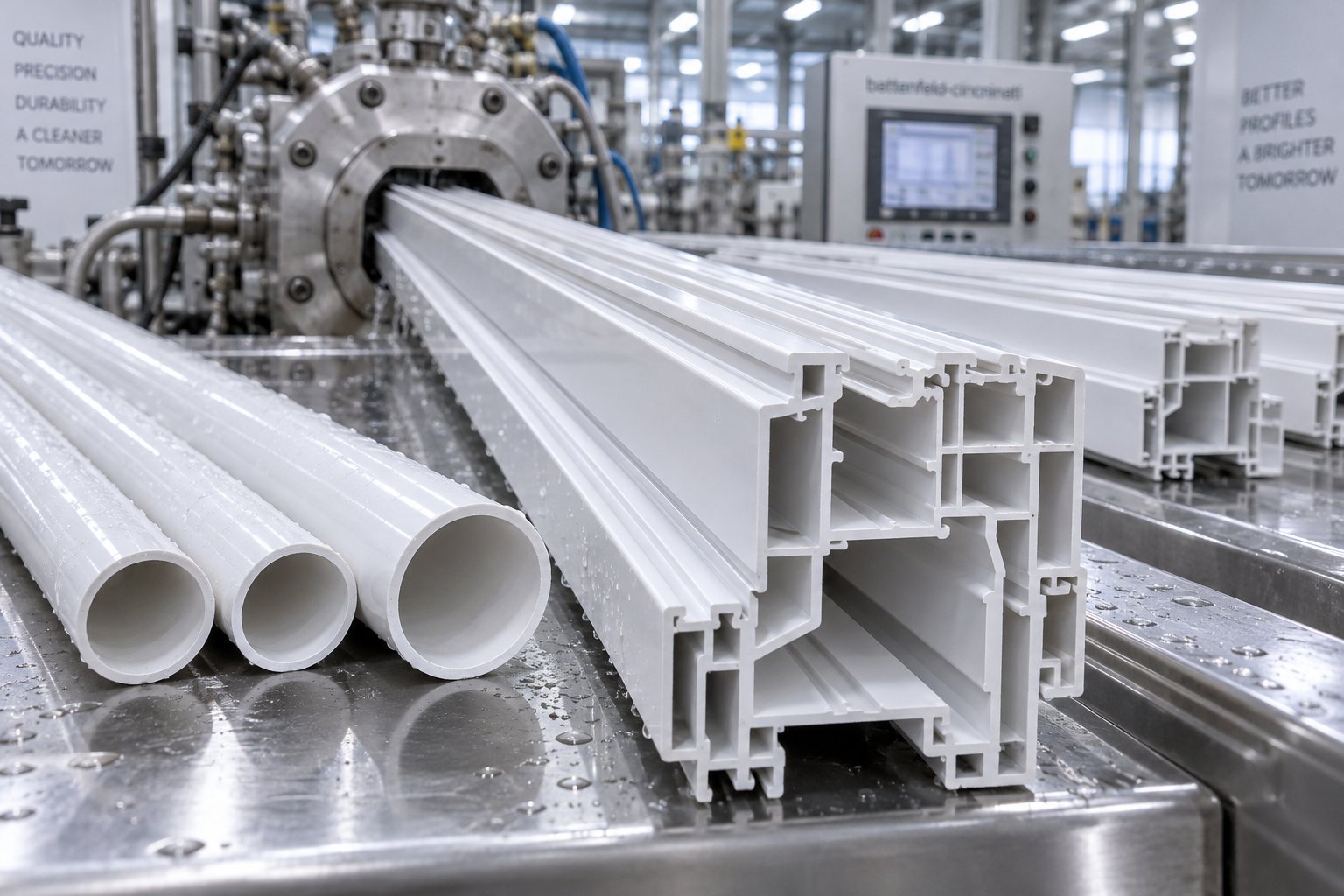
Rigid PVC sits at the intersection of two difficult properties: a low thermal decomposition temperature and poor melt flow. Push the material too hard with high shear, and it degrades rapidly—releasing hydrochloric acid gas, discoloring the product, and contaminating the barrel. Run it too gently, and it won't gelate properly, leaving you with a weak, brittle end product. Counter-rotating extrusion threads that needle precisely.
A Technovel engineering column explains why: the counter-rotating configuration allows the extrusion temperature to be held low through operation at high fill levels and low rotational speed, while the calendering effect generated between the screws enables stable forming of PVC pipes, sheets, and profile extrusion products. Material undergoes repeated compressive and elongational deformation in the intermeshing zone—dispersing stabilizers, lubricants, and pigments without the violent shear fields that trigger thermal runaway.
Here's why that matters practically for a double screw extruder running rigid PVC:
- Controlled thermal history — Low screw speeds (often below 50 RPM on large-diameter machines) minimize frictional heat generation, keeping barrel temperatures within the narrow processing window PVC demands.
- Adequate dispersive mixing without overheating — The calendering effect at the intermeshing region provides what Technovel describes as "moderate dispersion"—sufficient to uniformly distribute additives but gentle enough to avoid the microscopic breakdown that would overheat the compound.
- Stable melt delivery to the die — Positive displacement conveying eliminates the pressure surges that cause dimensional variation in extruded profiles and pipes, producing consistent wall thickness batch after batch.
- Reduced degradation risk — Because shear stress and associated heating stay low, processors can run longer campaigns without the carbonization buildup that plagues higher-shear systems processing PVC.
This is precisely why the counter-rotating twin-screw extruder has become the industry standard for rigid PVC pipe, window profiles, siding, and sheet. When you evaluate manufacturers for PVC applications, look for suppliers who can discuss gelation behavior, stabilizer dispersion strategies, and die pressure stability in detail—not just quote screw diameters and motor sizes.
High-Filler-Loading Compounds and Abrasive Materials
Imagine feeding a compound that's 70% calcium carbonate and 30% polyolefin into an extruder. The material barely flows. It's abrasive. It wants to starve the screw channels, clog the feed throat, and wear through barrel walls in months rather than years. This is the daily reality for processors manufacturing filled masterbatches, wood-plastic composites, and mineral-loaded building materials—and it's a scenario where counter-rotating technology consistently outperforms alternatives.
The advantages are mechanical and metallurgical:
- Positive conveying prevents material starvation — The sealed C-shaped chambers between screw flights grip and transport even poorly flowing powders and high-filler blends with minimal backflow. Unlike drag-flow-dependent co-rotating systems, a parallel twin screw extruder in counter-rotating mode doesn't rely on material viscosity to maintain throughput—the geometry does the work.
- Consistent pressure buildup at extreme filler ratios — Compounds loaded with 60–80% mineral filler by weight produce unstable melt pressures in machines that depend on melt cohesion for conveying. Counter-rotating displacement pumping maintains uniform output pressure even when the "melt" is more powder than polymer.
- Compressive mixing distributes fillers without destroying polymer chains — The calendering effect disperses filler agglomerates through elongational deformation rather than shear-induced breakup. This preserves polymer molecular weight while still achieving adequate filler distribution—a balance that directly impacts final product strength.
- Low-speed operation reduces abrasive wear rates — Running at 10–40 RPM instead of 400+ RPM dramatically extends barrel and screw service life when processing highly abrasive minerals like calcium carbonate, talc, or wood flour.
Even with low-speed operation, abrasive compounds eventually wear through standard steel. This is where a manufacturer's metallurgical expertise becomes a genuine differentiator. Leading builders of counter-rotating systems deploy specific wear solutions matched to the severity of the application:
- Nitrided steel barrels — Surface-hardened through gas nitriding to resist moderate abrasion; suitable for lightly filled PVC formulations.
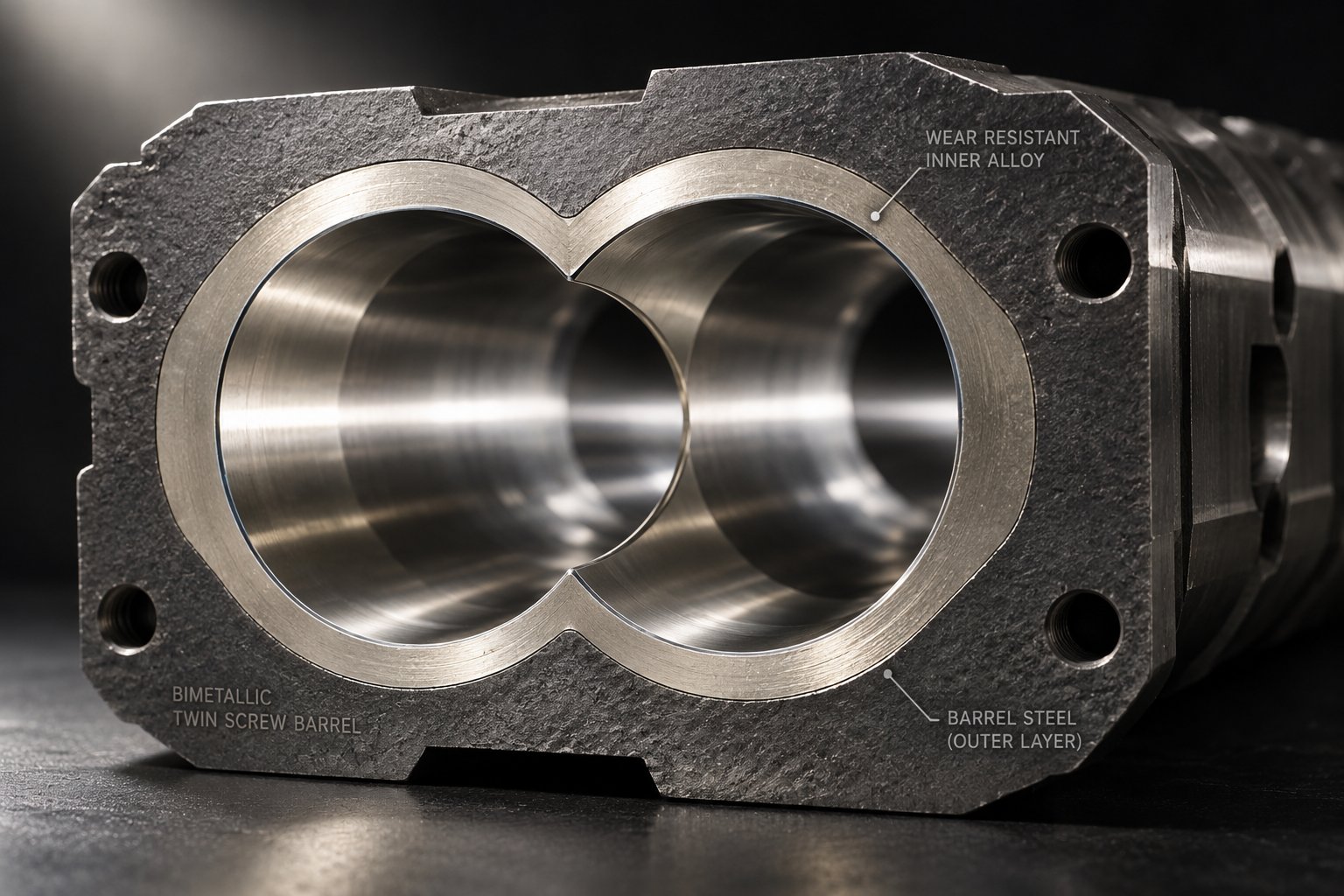
- Bimetallic barrel liners — A wear-resistant alloy centrifugally cast inside the barrel bore, providing superior hardness (typically 58–65 HRC) for heavily filled and abrasive compounds. Research documenting barrel wear in a nitrided parallel twin barrel running highly filled PVC for over 10,000 hours showed significant material loss concentrated between the 30-degree and 60-degree angles from the vertical—exactly where calender gap separating forces push the screws against the barrel wall.
- Powder metallurgy (PM) screw elements — Screw flights fabricated from tool steel powders sintered to near-full density, delivering hardness values above 60 HRC while maintaining toughness against impact from hard filler particles.
When a manufacturer can't articulate which barrel and screw metallurgy options they offer for your specific filler type and loading level, that's a clear signal their counter-rotating expertise may be shallow. The best suppliers match metallurgy to your compound's abrasive index, not just sell you a standard barrel and hope for the best.
Profile and Pipe Extrusion Applications
Dimensional precision in extruded profiles and pipes depends on one upstream variable more than any other: melt pressure stability at the die entrance. Even small pressure fluctuations translate into wall thickness variation, surface defects, and out-of-spec product that must be scrapped or downgraded. This is where the displacement-pump character of counter-rotating extrusion delivers its most commercially visible benefit.
Consider what happens during profile extrusion of a complex window frame cross-section. The die has multiple flow channels with different resistance paths. Any pulsation in melt delivery causes uneven filling—thicker walls in some sections, thinner in others. A counter-rotating twin-screw extruder's sealed C-shaped chambers deliver material in discrete, uniform volumes that produce a remarkably flat pressure curve at the die inlet. The result is consistent geometry across the entire production run.
- Uniform melt delivery — Positive displacement action eliminates the pressure surges inherent in drag-flow-based conveying, keeping die inlet pressure variation within tight tolerances (often less than +/- 2% of setpoint).
- Stable output rate — Because throughput depends on screw speed and chamber volume rather than melt viscosity or downstream backpressure, output stays consistent even as processing conditions drift slightly during long production campaigns.
- Direct extrusion capability — Counter-rotating systems generate enough melt pressure to push material through complex dies without requiring a secondary melt pump—a cost and maintenance advantage that co-rotating compounders, which typically pelletize rather than extrude directly, don't offer.
- Reduced post-extrusion correction — Stable melt pressure means fewer dimensional excursions that require downstream calibration adjustments, reducing scrap rates and operator intervention.
For pipe extrusion—whether PVC pressure pipe, drainage pipe, or multi-layer conduit—the same principle applies at larger scale. Wall thickness uniformity directly determines pressure rating, and consistent melt delivery from the extruder is the foundation of that uniformity. Manufacturers with strong pipe extrusion credentials will typically show reference installations with documented wall thickness tolerances and long-term dimensional stability data, not just throughput numbers.
Material-specific performance ultimately hinges on how well a manufacturer understands the interplay between their machine design and your compound's behavior. That understanding doesn't exist in a vacuum—it's shaped by where a manufacturer sits in the global supply chain, what regional engineering traditions they draw from, and whether counter-rotating systems represent their core identity or just another catalog entry.
Global Landscape of Counter-Rotating Extruder Manufacturers
Regional engineering traditions don't just influence brand identity—they shape the very design DNA of the machines you're evaluating. A counter rotating twin screw extruder manufacturer headquartered in southern Germany approaches gearbox tolerances, barrel metallurgy, and application support very differently than a factory in China's Yangtze River Delta. Neither origin automatically guarantees superiority, but understanding these regional patterns helps you decode what's really behind a quote—and what might be missing from it.
European Manufacturers and Engineering Heritage
Germany, Austria, and Italy have been the historical epicenters of counter-rotating screw extrusion technology, particularly for PVC pipe and profile production. Companies rooted in these markets developed their counter-rotating platforms alongside the European construction industry's explosive growth in PVC building products during the latter half of the 20th century. That heritage shows up in specific engineering choices: precision-ground gearboxes rated for decades of continuous operation under high axial thrust, barrel bores held to single-digit micron tolerances, and comprehensive service networks capable of dispatching field engineers across multiple continents.
European builders like Battenfeld-Cincinnati—whose counter-rotating and co-rotating twin screw systems are engineered for high throughput PVC, PE, and PP processing across 120+ countries—exemplify this tradition. KraussMaffei, Reifenhauser, and several Austrian specialists have similarly built reputations around advanced barrel heating and cooling zone design, wear-resistant screw materials like nitride steel and bimetallic coatings, and seamless integration with downstream calibration and haul-off equipment.
The trade-off is price. Premium European counter-rotating lines frequently cost two to four times more than comparable-output machines from Asian suppliers. That premium reflects real engineering depth—but it also means buyers must honestly assess whether their application demands those tolerances or whether a well-built machine from another region would deliver equivalent performance at their specific throughput and material requirements.
Chinese Manufacturers and the Value Proposition Shift
If you explored the Chinese twin screw extruder market a decade ago, you'd have found primarily budget-tier equipment targeting domestic PVC processors. That landscape has changed dramatically. China's twin screw extruder industry now exceeds 15 billion yuan in market size, with overseas market share reaching 15% and manufacturers concentrated in Nanjing and Zhangjiagang increasingly competing on sophistication rather than price alone.
Nanjing, in particular, has emerged as a global manufacturing hub. The city hosts over 90% of China's twin screw extruder production, creating a dense ecosystem of machine builders, component suppliers, screw element fabricators, and gearbox specialists that feeds both domestic and export markets. Manufacturers in this cluster now hold CE, ISO 9001, and TUV Rheinland certifications, and several have adopted European gearbox designs or formed joint ventures with Western engineering firms to close the technology gap.
For buyers sourcing counter-rotating equipment, the practical implication is significant. Chinese manufacturers offering conical twin screw systems for PVC pipe and profile extrusion—the largest single application category—have reached quality levels that satisfy many mid-tier production requirements at price points 40–60% below European equivalents. Laboratory twin screw extruder and benchtop twin screw extruder models from Chinese suppliers have also matured, giving R&D teams and universities access to counter-rotating test platforms without the capital outlay that European lab twin screw extruder units typically demand. Some Chinese builders have even expanded into parallel counter-rotating platforms for compounding and recycling applications, though depth of application engineering in these newer segments varies widely between suppliers.
The risk lies in assuming that all Chinese manufacturers have made this leap equally. The Nanjing cluster alone contains dozens of builders at vastly different capability tiers—from companies with dedicated R&D centers and in-house gearbox design to workshops that assemble machines from purchased components with minimal process engineering support. Price alone won't tell you which category a supplier falls into.
Evaluating Manufacturers by Capability, Not Just Geography
Here's the uncomfortable truth: a manufacturer's country of origin is a starting clue, not a verdict. A German brand that built its reputation on co-rotating compounders may offer a counter-rotating model as an afterthought—borrowing gearbox architecture that wasn't designed for the thrust loads counter-rotating mechanics impose. Meanwhile, a Chinese supplier that has spent fifteen years refining conical counter-rotating lines for PVC pipe may possess deeper application expertise in that niche than a European generalist with a broader catalog.
The real differentiators cut across geography entirely. When evaluating any counter rotating twin screw extruder manufacturer, regardless of origin, look for these capability markers:
- Dedicated counter-rotating R&D — Does the company invest in counter-rotating screw geometry development as a distinct program, or does it adapt co-rotating designs? Ask to see patent filings, published technical papers, or documented process development work specific to counter-rotating platforms.
- In-house gearbox design and manufacturing — The gearbox is the most mechanically demanding component in a counter-rotating system. Manufacturers who design and build their own gearboxes—or maintain long-standing partnerships with specialized gearbox engineers—demonstrate a level of commitment that catalog assemblers cannot match.
- Application-specific screw geometry expertise — A supplier should be able to show you screw designs optimized for your exact material and output requirements. Generic screw configurations offered across all applications are a warning sign, especially in screw extrusion processes where compound-specific optimization drives quality and efficiency.
- Reference installations in your target application — Nothing replaces proof of performance. Request a list of installations processing your material category, at your target throughput range, with contact information for reference visits. Manufacturers confident in their counter-rotating track record will share these readily; those who hesitate likely lack the depth of field experience your project demands.
Geography shapes starting assumptions, but capability assessment is what protects your investment. The most expensive sourcing mistakes happen when buyers anchor their decision on brand origin rather than verified engineering depth—or conversely, when they chase the lowest quote without confirming that the supplier truly understands the unique demands of counter-rotating technology. Either shortcut leads to the same destination: a machine that underperforms its specifications within the first year of operation.
Knowing what separates a capable manufacturer from a catalog assembler raises a natural follow-up: what specific questions should you ask during the RFQ process, and what red flags reveal shallow expertise before you've committed capital?
How to Evaluate a Counter-Rotating Extruder Manufacturer Before You Buy
You've narrowed the field to counter-rotating technology, identified whether conical or parallel geometry fits your application, and started collecting quotes. This is the moment most buyers let their guard down—they compare prices, skim spec sheets, and assume that any company listing "counter-rotating twin screw extruder" in its catalog genuinely understands the engineering behind it. That assumption costs processors thousands in unplanned downtime, premature wear, and machines that never hit their rated throughput.
The RFQ stage is your best—and often your last—opportunity to separate a true counter rotating twin screw extruder manufacturer from a company that simply assembles one. The questions you ask, the responses you scrutinize, and the warning signs you catch during this process determine whether your equipment investment pays off for a decade or turns into a three-year headache.
Essential Questions for the RFQ Process
Think of these questions as diagnostic tools. Each one targets a specific area where counter-rotating expertise either reveals itself or falls apart. A manufacturer that answers confidently and with technical specifics is demonstrating depth. One that deflects, generalizes, or promises to "get back to you" on fundamental design parameters is telling you something important—even if that's not what they intend.
- What is the gearbox thrust bearing capacity, and how is torque distributed between the two screws? — This is the single most revealing question you can ask. Counter-rotating gearboxes face extreme axial thrust loads that co-rotating designs don't encounter at the same intensity. A knowledgeable manufacturer will cite specific bearing ratings (in kilonewtons), explain whether torque splits equally between shafts or follows a specific distribution ratio, and describe the gear stage architecture—spur, helical, or planetary. Vague answers like "our gearbox is heavy-duty" without numbers should raise immediate concern. As documented in gearbox engineering references, appropriately rated thrust bearings on output shafts are critical to withstand the separating forces generated at the intermeshing zone, and multi-stage gearing solutions ground to DIN4 standards are the baseline for reliable torque delivery.
- What barrel metallurgy options do you offer for my specific material? — A manufacturer processing PVC dry-blend needs different barrel protection than one handling 70% calcium carbonate filler. Ask whether the supplier offers nitrided steel, bimetallic centrifugal-cast liners, or powder metallurgy options—and which they recommend for your compound's abrasive and corrosive characteristics. The right answer is specific to your formulation, not a one-size-fits-all recommendation.
- How modular is the screw design, and what does your screw element replacement program look like? — Counter-rotating screw modularity varies significantly between conical and parallel designs. For a parallel counter-rotating double screw extruder machine, ask how many discrete element types are available, whether elements can be individually replaced without pulling the full screw assembly, and what lead times apply for replacement elements. For conical systems, ask about screw advancement capability to compensate for wear and the cost structure for full screw replacement versus segment repair.
- Can you provide energy consumption data at my target throughput and material? — Not just motor nameplate power—actual kilowatt-hours per kilogram of output for a formulation comparable to yours. Manufacturers with genuine application experience maintain this data from commissioning reports and ongoing production monitoring. Those without it are guessing at performance.
- Who are your reference customers running my application? — Request names, locations, and—critically—permission to contact them or visit their facilities. A co rotating twin screw extruder manufacturer that also lists counter-rotating machines may have hundreds of co-rotating references but only a handful of counter-rotating installations. The depth of that reference list tells you exactly how central this technology is to their business.
- What compliance certifications does the machine carry? — CE marking, ISO 9001 quality management, and, depending on your market, UL listing or specific regional electrical safety standards. Certification isn't just a checkbox—it confirms that the manufacturer subjects its designs to third-party scrutiny. Absence of certifications on a machine destined for export is a serious gap, particularly for counter-rotating systems where gearbox and electrical safety under high-thrust operating conditions demand validated engineering.
- What after-sales support structure do you maintain? — Ask about spare parts warehousing, barrel relining services, field service engineer availability, and technical training programs. A manufacturer that sells the machine but can't support it after installation forces you to solve every maintenance challenge independently—or scramble for third-party help when something fails mid-campaign.
Red Flags When Evaluating Manufacturers
Not every warning sign announces itself loudly. Some are subtle—a missing detail in a proposal, an overly confident claim without supporting data, or an eagerness to close the deal without discussing your process requirements. Here are the patterns experienced buyers have learned to watch for:
- Inability to provide specific counter-rotating gearbox specifications — If a supplier can detail co-rotating gearbox torque densities down to Nm/cm³ but goes quiet when you ask the same question about their counter-rotating unit, the design likely borrows from the co-rotating platform without proper adaptation for opposing-screw thrust loads.
- Identical screw geometries offered for vastly different applications — A manufacturer proposing the same screw configuration for rigid PVC pipe extrusion and high-filler masterbatch compounding either doesn't understand the material-specific optimization these processes demand or doesn't invest in application engineering. Both co rotating and counter rotating twin screw extruder platforms require tailored screw designs—generic geometry is a compromise that hurts your output quality.
- Absence of application engineering support — If the sales process jumps from "what size machine do you need?" directly to a quote without any discussion of your formulation, throughput targets, downstream equipment, or quality requirements, the manufacturer is selling hardware, not solutions. Counter-rotating systems are deeply application-dependent, and a supplier who doesn't ask about your process can't optimize their machine for it.
- No spare parts inventory or barrel relining services — Counter-rotating extruders processing abrasive or corrosive materials consume wear parts on a predictable schedule. A manufacturer without a stocked parts program or barrel relining capability is leaving you exposed to extended downtime every time a screw element wears out or a barrel liner thins beyond tolerance.
- Reluctance to share reference installations — This is one of the clearest signals. Manufacturers proud of their counter-rotating track record will connect you with existing customers readily. Those who hedge—"we have many installations but cannot share details"—often lack the reference depth to support their claims.
- Vague output capacity claims without specifying material and conditions — A spec sheet that reads "throughput: up to 1,500 kg/h" without stating the material, filler loading, screw speed, and die configuration is marketing, not engineering. Actual throughput depends on your specific compound's rheology, and any manufacturer worth considering will qualify their numbers accordingly.
- No test run capability or willingness — If a manufacturer cannot or will not run your material on a production or pilot machine before purchase, you're buying a promise instead of proven performance. Suppliers with genuine confidence in their counter-rotating platforms maintain trial facilities and welcome material testing.
Barrel and Screw Quality as a Manufacturer Differentiator
Beyond the machine frame and gearbox, barrel and screw metallurgy is where a manufacturer's true depth of expertise becomes measurable. These are the components that directly contact your material, endure the abrasion and corrosion your compound delivers, and ultimately determine how long the machine performs at specification before requiring costly intervention.
Two barrel construction approaches dominate the counter-rotating market, and a manufacturer's ability to explain when each applies reveals their engineering maturity:
- Nitrided steel barrels — The base barrel material (typically 38CrMoAlA or equivalent) undergoes gas nitriding to achieve surface hardness values around HV 950 or above—equivalent to roughly HRC 55–58. As metallurgical documentation confirms, this treatment provides wear resistance maintained at operating temperatures of 350–450 degrees Celsius, improved fatigue resistance from compressive stress in the nitride layer, and enhanced corrosion resistance through a chemically stable surface. Nitrided barrels are cost-effective and suitable for moderately abrasive applications like standard PVC processing, but they have a hard limit: once the nitride layer wears through to the softer base metal beneath, degradation accelerates rapidly.
- Bimetallic barrels — A wear-resistant alloy (commonly nickel-boron or iron-boron-based compositions) is centrifugally cast into the barrel bore, creating a liner with hardness values typically reaching HRC 59–65. This approach offers significantly longer service life when processing highly abrasive fillers—calcium carbonate, glass fiber, wood flour—or corrosive compounds. The liner can also be engineered for specific chemical resistance profiles, making bimetallic construction the standard for demanding compounding and pelletizing environments.
On the screw side, the distinction between solid machined screws and powder metallurgy (PM) screw elements carries similar weight. Solid screws machined from tool steel and surface-hardened through nitriding serve well in moderate applications. PM elements—fabricated from sintered tool steel powders—achieve hardness levels above HRC 60 while maintaining the toughness needed to resist impact from hard filler particles. For counter-rotating machines processing mineral-loaded compounds at high throughput, PM screw elements can double or triple the interval between replacements compared to conventionally hardened alternatives.
Suppliers who specialize in custom twin screw and barrel solutions bring an additional layer of value to this equation. NANHAIYA, for example, engineers parallel twin screw barrels specifically for demanding compounding and pelletizing applications—providing bimetallic liner options, precise bore tolerances, and metallurgy matched to the abrasive or corrosive characteristics of each customer's material. This kind of component-level specialization matters for two reasons: it supports long-term equipment performance for processors handling difficult materials, and it gives buyers an independent source of high-quality wear components that isn't tied to a single machine OEM's pricing or lead time structure.
When a manufacturer discusses barrel and screw options in generic terms—"we use high-quality steel"—without specifying alloy grades, hardness values, or application-matched recommendations, you're seeing the surface of a capability gap that will eventually show up as premature wear, unplanned downtime, and replacement parts that don't match your processing demands. The best counter-rotating extruder builders treat metallurgy as a core engineering discipline, not an afterthought.
Evaluating a manufacturer's technical depth and component quality protects you at the point of purchase. But equipment cost extends far beyond the invoice—energy consumption, wear part replacement cycles, gearbox maintenance intervals, and eventual resale value all shape the true financial picture. Understanding total cost of ownership is where informed sourcing decisions gain their sharpest edge.
Total Cost of Ownership and Emerging Trends in Twinscrew Extrusion
Two manufacturers quote you essentially identical counter-rotating extruders. One costs $380,000. The other costs $510,000. Which is the better deal? If your answer is "the cheaper one," you're making the same mistake that drains millions from processing operations worldwide every year. The purchase price of a compounding extruder or direct-extrusion line typically represents only 25–35% of what you'll spend over the machine's operational lifetime. Energy, wear parts, gearbox maintenance, downtime, and eventual replacement or resale account for the rest—and counter-rotating systems carry a TCO profile that differs meaningfully from co-rotating platforms.
Yet almost no manufacturer voluntarily breaks this down for you. They quote machine price, maybe mention motor efficiency, and move on. The buyers who win are the ones who force that conversation before signing.
Total Cost of Ownership Beyond the Purchase Price
Counter-rotating twin screws operate at fundamentally lower speeds than their co-rotating counterparts—often 10–50 RPM versus 300–1,200 RPM. That speed difference ripples through every cost category in ways that aren't immediately obvious.
Consider energy consumption first. Lower screw speeds mean reduced frictional heating inside the barrel, which translates into less cooling demand and, in many pressure-driven applications, lower specific energy consumption per kilogram of output. A counter-rotating line extruding rigid PVC pipe at 30 RPM consumes significantly less drive energy per kilogram than a co-rotating compounder running the same polymer at 600 RPM—even accounting for the co-rotating machine's higher throughput. For processors running 24/7 operations, the difference in annual electricity cost can exceed the gap between machine purchase prices within three to five years.
Wear parts tell a different story. Because counter-rotating mechanics generate high separating forces at the intermeshing zone—forces that push twin screws against the barrel wall at predictable angular positions—barrel liner wear follows a characteristic pattern. Research on parallel counter-rotating barrels has documented concentrated wear between 30 and 60 degrees from vertical, exactly where calender gap forces are highest. Screw flight edges in the intermeshing region erode faster than in co-rotating designs operating on the same material. For abrasive compounds loaded with calcium carbonate, talc, or wood flour, barrel relining or replacement may be needed every 8,000–15,000 operating hours depending on metallurgy choices—a cost that varies enormously based on whether the manufacturer offers bimetallic liners, and whether those liners are available domestically or must be shipped internationally.
Gearbox maintenance is the third pillar buyers underestimate. The extreme axial thrust loads inherent to counter-rotating operation place continuous stress on thrust bearings, gear teeth, and lubrication systems. A well-engineered gearbox from a manufacturer with dedicated counter-rotating design capability might deliver 40,000–60,000 hours before a major overhaul. A gearbox adapted from a co-rotating platform—where thrust loads are a fraction of what counter-rotating mechanics impose—may fail at half that interval. The cost of a gearbox rebuild, including bearing replacement, gear regrinding, and production downtime during the repair, can rival 15–25% of the original machine price.
To structure your TCO comparison, request data from each manufacturer organized around these components:
| TCO Component | What to Request from Manufacturer | Why It Matters for Counter-Rotating Systems |
|---|---|---|
| Acquisition Cost | Full machine price including gearbox, drive, barrel, screws, controls, and commissioning | Establishes baseline—but represents only a fraction of lifetime cost |
| Energy Cost per kg of Output | Specific energy consumption (kWh/kg) at your target throughput and material | Lower screw speeds reduce drive energy, but actual values depend on compound viscosity and die resistance |
| Wear Parts Annual Cost | Estimated replacement schedule and unit pricing for screw elements, barrel liners, and seals | Counter-rotating calender forces create predictable but concentrated wear patterns—metallurgy choices directly control replacement frequency |
| Maintenance Schedule | Recommended intervals for gearbox oil changes, bearing inspection, barrel bore measurement, and screw clearance checks | High-thrust gearboxes require more frequent monitoring than co-rotating equivalents; missed intervals accelerate failure |
| Expected Gearbox Service Life | Hours to first major overhaul and estimated rebuild cost | The most expensive single maintenance event—wide variation between manufacturers reveals gearbox design quality |
| Resale Value | Typical depreciation curve and secondary market demand for the specific model | Well-known brands and standard configurations retain value; niche or proprietary designs depreciate faster |
Here's the practical takeaway: when you lay these numbers side by side, that $130,000 gap between two quotes often inverts. A machine with a higher purchase price but superior gearbox engineering, bimetallic barrel options, and readily available wear parts may cost 20–30% less over a ten-year operating horizon than its cheaper competitor. Manufacturers who proactively present TCO projections—rather than forcing you to assemble the picture yourself—are signaling both transparency and confidence in their equipment's long-term performance.
Emerging Trends Shaping the Next Generation of Counter-Rotating Extruders
The counter-rotating extruder market isn't standing still. Several technology trends are reshaping what buyers should expect from their next equipment investment—and what questions they should be asking manufacturers about future-readiness.
Advanced wear-resistant materials for barrels and screws. Metallurgy continues to evolve beyond conventional nitriding and standard bimetallic alloys. Newer powder metallurgy compositions incorporating tungsten carbide particles in a nickel or cobalt matrix are extending barrel liner life by 50–100% in highly abrasive applications. On the screw side, high-velocity oxygen fuel (HVOF) thermal spray coatings are gaining traction as a method to apply extremely hard, thin coatings to screw flight surfaces without altering the base element's geometry or toughness. Manufacturers investing in these technologies—or partnering with component specialists who offer them—give processors a path to longer service intervals and lower per-kilogram wear costs.
Energy-efficient direct-drive systems. Traditional counter-rotating extruders use belt-and-pulley or gear-coupled motor configurations to connect the main drive to the gearbox input shaft. Direct-drive architectures—where a high-torque, low-speed motor couples directly to the gearbox without intermediate transmission losses—are emerging as a meaningful efficiency upgrade. Eliminating belts and pulleys removes 3–5% of drive train energy loss while also reducing maintenance touchpoints (no belt tensioning, no pulley alignment, no belt replacement). For twinscrew systems already operating at low RPM, the proportional energy savings are significant because drive losses represent a larger share of total power consumption at low speeds.
Industry 4.0 integration. Real-time torque monitoring on counter-rotating gearboxes is becoming a practical tool for predictive maintenance rather than a marketing buzzword. By continuously tracking torque signatures on each screw shaft independently, processors can detect bearing degradation, gear wear, or material feeding anomalies weeks before they cause unplanned shutdowns. Coperion's expanded predictive maintenance platform exemplifies this trend—new condition-monitoring modules enable processors to plan maintenance windows based on actual equipment condition rather than calendar-based schedules, directly increasing overall equipment effectiveness (OEE). Digital twin simulation is another emerging capability, allowing manufacturers to model screw geometry changes, throughput scenarios, and thermal profiles virtually before committing to physical hardware modifications.
Growing demand from recycling applications. Mechanical recycling of post-consumer and post-industrial plastic waste is creating new demand for counter-rotating extrusion platforms. Recycled feedstocks are inherently variable in bulk density, contamination level, and melt behavior—characteristics that benefit from the positive displacement conveying and gentle shear environment counter-rotating twin screws provide. Unlike virgin pellet processing, recycled material streams often contain paper, metal fragments, and mixed polymer fractions that require robust feeding, effective venting, and forgiving melt conveyance. Counter-rotating systems' ability to maintain stable throughput despite inconsistent feed properties makes them increasingly attractive for recycling compounders and pelletizers seeking reliable output from unpredictable inputs.
Each of these trends carries a practical implication for how you evaluate manufacturers. A supplier that can discuss direct-drive options, torque monitoring integration, and advanced barrel metallurgies isn't just selling you today's machine—they're demonstrating an engineering trajectory that protects your investment's relevance over its full operating life. Conversely, a manufacturer whose technology roadmap hasn't evolved beyond the designs they offered a decade ago may deliver a perfectly functional machine today that becomes increasingly expensive to maintain and difficult to upgrade tomorrow.
Technology trends and TCO modeling sharpen your financial analysis. But translating all of this—technical evaluation, manufacturer capability assessment, cost modeling, and future-readiness—into a repeatable sourcing workflow requires a structured checklist that ensures nothing falls through the cracks when the pressure to finalize a purchase decision intensifies.
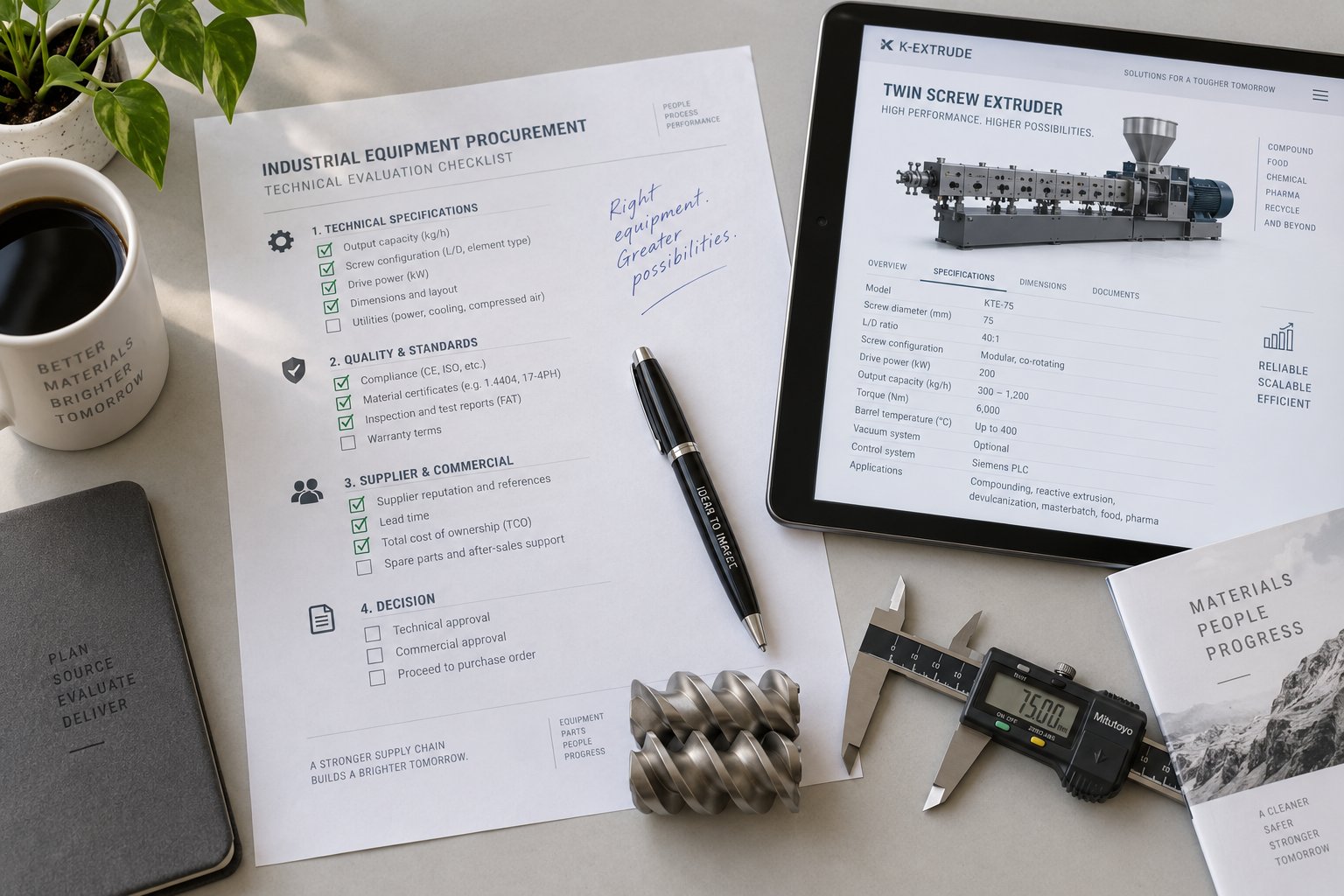
Your Counter-Rotating Extruder Manufacturer Selection Checklist
You've absorbed the mechanics, compared configurations, dissected TCO projections, and cataloged red flags. The challenge now isn't knowledge—it's execution. When you're fielding multiple proposals, coordinating input from engineering, operations, and procurement, and facing pressure to commit, even well-informed buyers lose track of critical evaluation criteria. A structured checklist eliminates that risk. It forces consistency across every manufacturer on your shortlist, surfaces gaps that polished sales presentations are designed to conceal, and creates a documented decision trail that protects your team if questions arise after the purchase order is signed.
What follows is a step-by-step workflow and a comprehensive capability grid you can print, share with stakeholders, and carry into every factory visit, RFQ review, and final decision meeting.
Step-by-Step Manufacturer Evaluation Workflow
Imagine trying to compare three or four screw extruders from different manufacturers without a defined sequence. You'd end up with incomplete data from one supplier, detailed specs from another, and no consistent basis for comparison. The twin screw extrusion process for selecting a manufacturer should follow its own disciplined flow—just like the material processing it supports.
- Define your application requirements in writing. Document your target materials, filler types and loading levels, required throughput in kg/h, downstream integration needs (die type, pelletizing method), dimensional tolerances for finished products, and any regulatory constraints. This document becomes the baseline every manufacturer must respond to identically.
- Shortlist manufacturers with demonstrated counter-rotating core competency. Filter your initial list by verifying that each candidate builds counter-rotating systems as a primary product line—not a secondary offering behind a co-rotating portfolio. Check for dedicated counter-rotating R&D, published application data, and a reference installation count that reflects genuine market presence in your target application.
- Submit a structured RFQ with identical specifications to all shortlisted candidates. Provide the same technical package to every bidder. Include your application document, request specific gearbox thrust bearing ratings, barrel metallurgy recommendations for your material, screw element modularity details, and energy consumption data at your target operating conditions. Standardized inputs yield comparable outputs.
- Evaluate gearbox and metallurgy specifications against your process demands. Score each response on the specificity and relevance of their gearbox engineering data, barrel liner options, and screw element material grades. A twin screw compounding extruder handling 60% mineral filler demands bimetallic barrels and powder metallurgy screw elements—any manufacturer recommending standard nitrided steel for that application isn't matching their offering to your reality.
- Request reference site visits or detailed reference interviews. Contact at least two existing customers per shortlisted manufacturer—processors running similar materials at comparable throughput ranges. Ask about uptime history, spare parts lead times, how the manufacturer responded to equipment problems, and whether actual performance matched the original proposal's claims.
- Compare TCO projections over a minimum seven-to-ten-year horizon. Demand energy cost per kilogram, wear part replacement schedules with pricing, gearbox overhaul intervals and estimated costs, and maintenance labor requirements. The lowest-sticker-price machine frequently becomes the most expensive to own when these numbers are stacked honestly.
- Negotiate after-sales terms before finalizing the purchase. Lock in spare parts pricing guarantees, barrel relining service availability, technical training schedules, warranty duration and coverage scope, and remote diagnostics support. These terms are far easier to negotiate before the purchase order than after the machine is on your floor and the manufacturer's leverage has shifted.
This sequence isn't arbitrary—each step builds the information foundation the next step requires. Skipping ahead to price negotiation before completing reference checks, for example, leaves you comparing numbers without the context needed to interpret what those numbers actually buy.
Manufacturer Capability Checklist for Informed Sourcing
The checklist below consolidates every evaluation dimension covered in this guide into a single scoring grid. Use it to rate each manufacturer on a consistent scale—whether that's a simple yes/no, a 1-to-5 score, or a traffic-light system that suits your procurement team's workflow. The categories are weighted toward the factors that most directly determine long-term equipment performance and total cost of ownership for counter-rotating platforms specifically.
| Category | Evaluation Item | What to Verify |
|---|---|---|
| Technical Design | In-house gearbox engineering for counter-rotating thrust loads | Confirm manufacturer designs and builds gearboxes internally or maintains a dedicated engineering partnership; request thrust bearing capacity ratings in kN and torque density in Nm/cm³ |
| Barrel metallurgy matched to your material | Verify availability of nitrided steel, bimetallic centrifugal-cast liners, and powder metallurgy options; confirm which they recommend for your specific compound | |
| Screw element modularity and replacement capability | Determine how many discrete element types are available, whether individual elements can be swapped without full screw removal, and replacement lead times | |
| Energy consumption data at target throughput | Request verified kWh/kg figures measured under conditions matching your material, filler loading, and die resistance—not just motor nameplate power | |
| Screw geometry optimization for your application | Confirm the manufacturer offers application-specific screw designs rather than generic configurations applied across all materials | |
| Barrel relining services | Determine whether the manufacturer provides barrel bore reconditioning or relining in-house, and at what cost and turnaround time | |
| Quality and Compliance | ISO 9001 quality management certification | Request current certificate and most recent audit report; verify the certificate covers the manufacturing facility producing your machine |
| CE marking and applicable regional certifications | Confirm CE compliance for European markets; UL or CSA for North America; verify electrical panel certification matches your facility standards | |
| Dimensional inspection and material traceability | Ask for sample inspection reports showing barrel bore tolerances, screw element dimensional verification, and material test certificates traceable to specific heat lots | |
| Counter-rotating-specific test protocols | Verify the manufacturer tests assembled machines under load conditions representative of counter-rotating thrust and torque profiles—not just no-load spin tests | |
| After-Sales Support | Spare parts inventory and delivery lead times | Request a critical spare parts list with current stock status; confirm whether common wear items ship within days or require weeks of manufacturing lead time |
| Field service engineer availability and response times | Document the nearest service center location, average response time for urgent support requests, and whether remote diagnostics are available on the control platform | |
| Operator and maintenance training programs | Confirm whether training is conducted at the manufacturer's facility, on-site at your plant, or both; ask about refresher course availability as your team evolves | |
| Screw element replacement programs | Determine whether the manufacturer offers scheduled replacement contracts, consignment stock arrangements, or volume pricing for ongoing wear part procurement | |
| Technical application engineering support | Assess whether the manufacturer provides ongoing process optimization assistance—screw configuration adjustments, formulation troubleshooting, throughput optimization—beyond initial commissioning | |
| Commercial Terms | TCO projection transparency | Evaluate whether the manufacturer proactively provides lifetime cost modeling or whether you must assemble the picture from fragmented data |
| Warranty scope and duration | Confirm what is covered (gearbox, barrel, screws, controls, drive), for how long, and under what operating conditions the warranty remains valid | |
| Reference installations in your target application | Require verifiable customer names processing similar materials at comparable throughputs; contact at least two references independently | |
| Financial stability and market longevity | Research ownership structure, years in operation, and whether the company has the financial foundation to support your machine over its 10-15 year lifecycle | |
| Technology roadmap alignment | Ask where the manufacturer is investing over the next three to five years—Industry 4.0, direct-drive systems, advanced metallurgy, recycling applications—and assess whether that trajectory supports your evolving needs |
Scoring each manufacturer against this grid won't eliminate all risk—no checklist can. But it will expose the gaps that matter most: the supplier who quotes aggressively but stocks no spare parts, the one with an impressive factory but zero counter-rotating reference sites in your application, or the brand with strong heritage whose technology roadmap hasn't advanced in a decade.
For processors who source barrels and screw components independently—whether as replacements for aging equipment or as upgraded components for existing lines—specialized component manufacturers complement the OEM relationship by providing procurement teams with responsive, cost-effective alternatives. NANHAIYA exemplifies this approach, engineering custom parallel twin screw barrels for compounding, recycling, pelletizing, granulation, and masterbatch production. Their focus on application-matched metallurgy and precise bore tolerances makes them a practical sourcing partner for extending equipment life and optimizing performance across both co-rotating and counter-rotating platforms—particularly for operations where OEM replacement part lead times or pricing create production vulnerability.
Every item on this checklist traces back to a principle established earlier in this guide: the machine you buy is only as good as the manufacturer's ability to support it over its full operational life. Price gets you through the door. Engineering depth, component quality, and after-sales infrastructure determine whether you're still satisfied with your decision five years from now. The buyers who invest the time to evaluate systematically—asking the hard questions, verifying the answers, and scoring every candidate against the same rigorous standard—are the ones who never look back with regret.
Frequently Asked Questions About Counter Rotating Twin Screw Extruder Manufacturers
1. What is the difference between a counter-rotating and co-rotating twin screw extruder?
In a counter-rotating twin screw extruder, the two screws turn in opposite directions, creating a calendering nip zone and positive displacement conveying that generates high melt pressure with low shear. Co-rotating designs spin both screws the same way, producing intense shear fields ideal for dispersive mixing. Counter-rotating systems typically operate at 5-150 RPM and excel in PVC processing, high-filler compounding, and direct profile or pipe extrusion. Co-rotating machines run at 300-1,200 RPM and dominate polymer compounding, masterbatch, and reactive extrusion. The gearbox engineering also differs significantly—counter-rotating gearboxes must handle far greater axial thrust loads, making dedicated design expertise a key manufacturer differentiator.
2. How do I choose between a conical and parallel counter-rotating twin screw extruder?
The choice is application-driven. Conical counter-rotating extruders feature tapered screws that naturally create compression, making them the default for rigid PVC pipe and profile extrusion, WPC, and dry-blend powder processing. They offer compact footprints and L/D ratios of 17:1 to 26:1. Parallel counter-rotating extruders maintain a constant screw diameter, providing greater L/D flexibility (up to 40:1+), higher throughput scalability, and modular screw element configurations. They suit compounding, pelletizing, recycling, and formulations requiring frequent recipe changes. Manufacturer specialization typically follows this divide, so verifying that a supplier's core R&D aligns with your chosen geometry is essential.
3. What questions should I ask a counter-rotating twin screw extruder manufacturer during the RFQ process?
Start with gearbox thrust bearing capacity in kilonewtons and torque distribution between the two screw shafts—this single question reveals genuine counter-rotating engineering depth. Follow up by asking about barrel metallurgy options (nitrided steel vs. bimetallic liners) matched to your specific material, screw element modularity and replacement lead times, verified energy consumption data in kWh per kilogram at your target throughput, reference customers processing similar materials, CE or ISO compliance certifications, and after-sales support structure including spare parts stocking and barrel relining services. Manufacturers who answer with specific data demonstrate real expertise; those offering vague or generic responses likely lack dedicated counter-rotating design capability.
4. Why is barrel and screw metallurgy important when selecting a counter-rotating extruder manufacturer?
Counter-rotating extruders generate high separating forces at the intermeshing zone, pushing screws against the barrel wall and creating concentrated wear patterns. For abrasive compounds with mineral fillers like calcium carbonate or wood flour, standard nitrided barrels may wear through in thousands of hours. Bimetallic centrifugal-cast barrel liners (HRC 59-65) and powder metallurgy screw elements (HRC 60+) can double or triple service intervals. Specialized component manufacturers such as NANHAIYA engineer custom parallel twin screw barrels with application-matched metallurgy for compounding, recycling, and pelletizing, giving processors an independent source of high-quality wear components that extends equipment life regardless of the original machine OEM.
5. What is the total cost of ownership for a counter-rotating twin screw extruder?
The purchase price typically represents only 25-35% of lifetime cost. Key TCO components include energy consumption per kilogram of output (often lower than co-rotating systems due to reduced screw speeds), wear part replacement frequency for screw elements and barrel liners (driven by your compound's abrasiveness and the manufacturer's metallurgy options), gearbox overhaul intervals (well-engineered units last 40,000-60,000 hours versus half that for adapted co-rotating designs), maintenance labor, downtime costs, and eventual resale value. Requesting structured TCO projections from each manufacturer—covering acquisition, energy, wear parts, maintenance schedules, and gearbox service life—often reveals that a higher-priced machine with superior engineering costs significantly less over a ten-year operating horizon.
Written by
Nanhaiya Technical Team
Zhoushan Nanhaiya Plastic Machinery Co., Ltd.
The Nanhaiya technical team supports screw and barrel manufacturing projects through application review, technical communication, custom manufacturing coordination, and production and quality control.
Discuss Your Application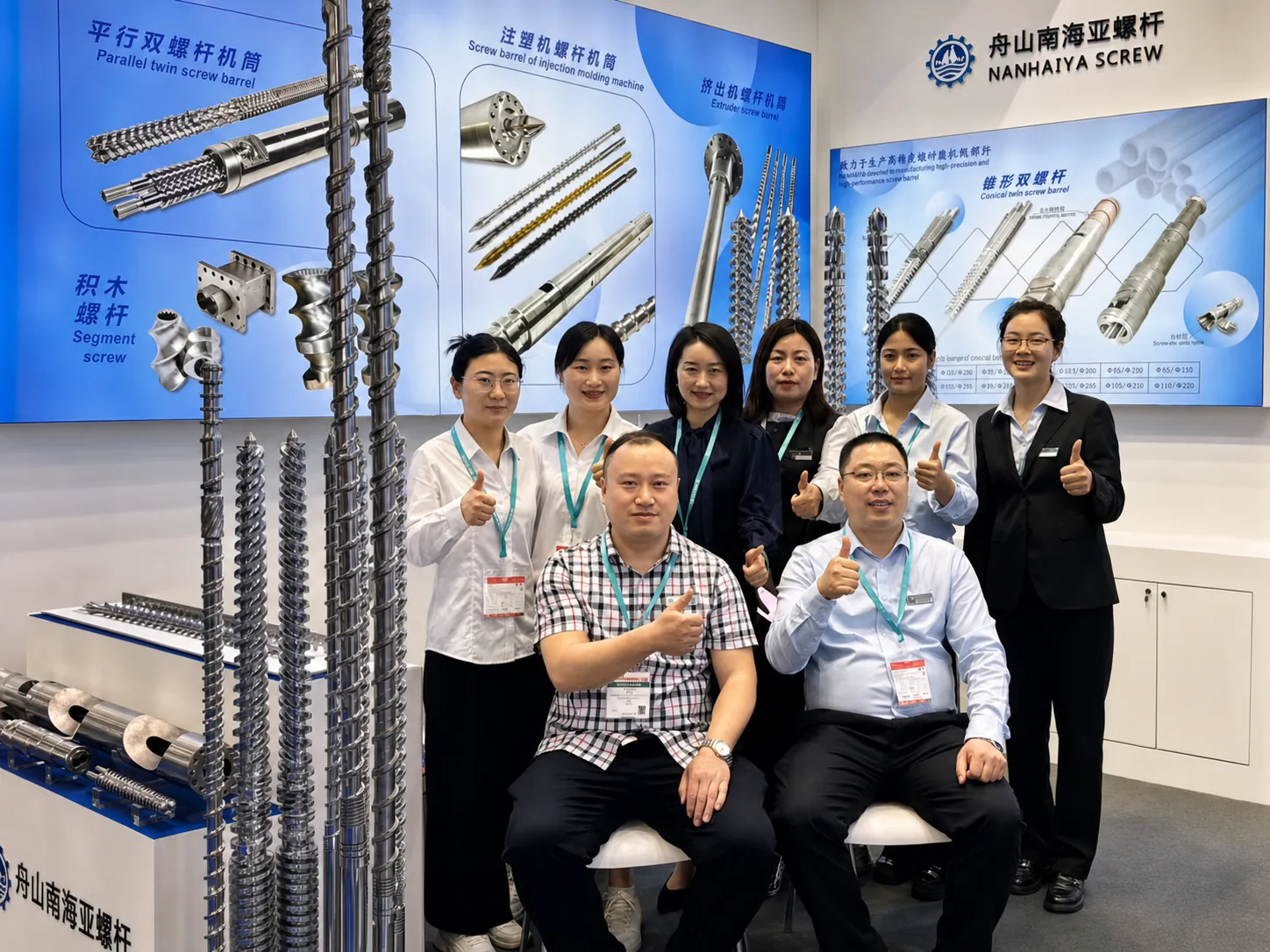
Related Articles
More insights on screw barrel technology and plastics processing.
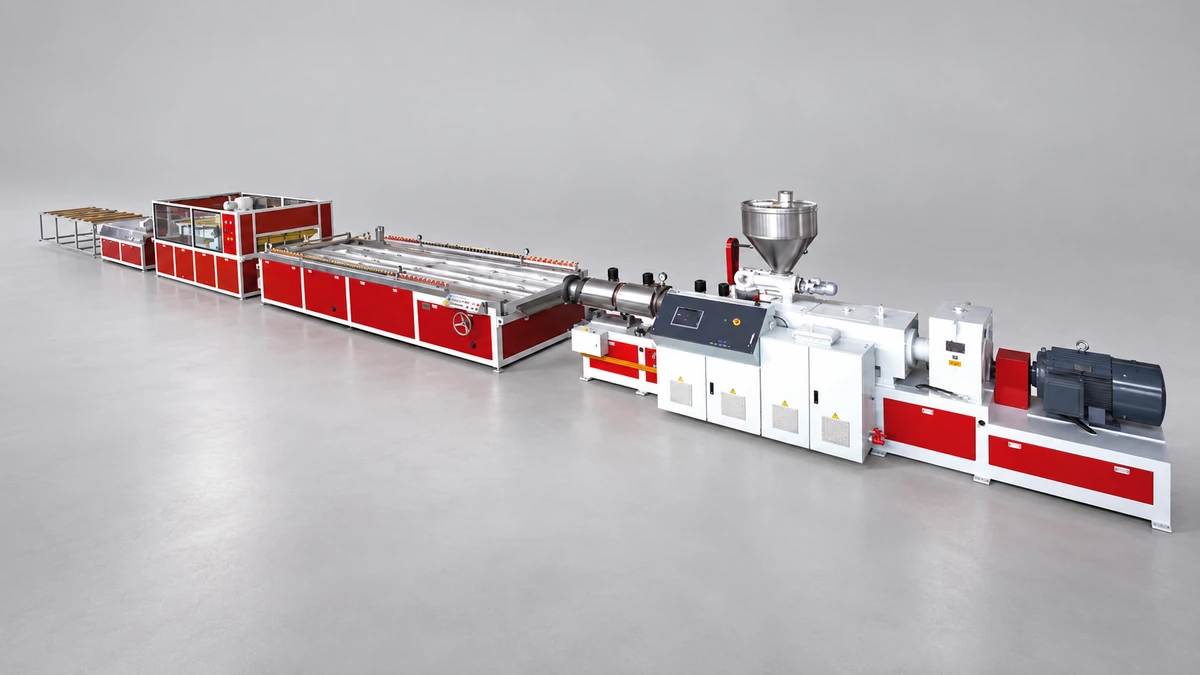
What Most Buyers Get Wrong About WPC Extrusion Machine Selection
Oct 29, 2026
Learn how to select the right WPC extrusion machine by comparing extruder types, resin systems, wear-part metallurgy, and capacity planning to avoid costly mistakes.
Read Article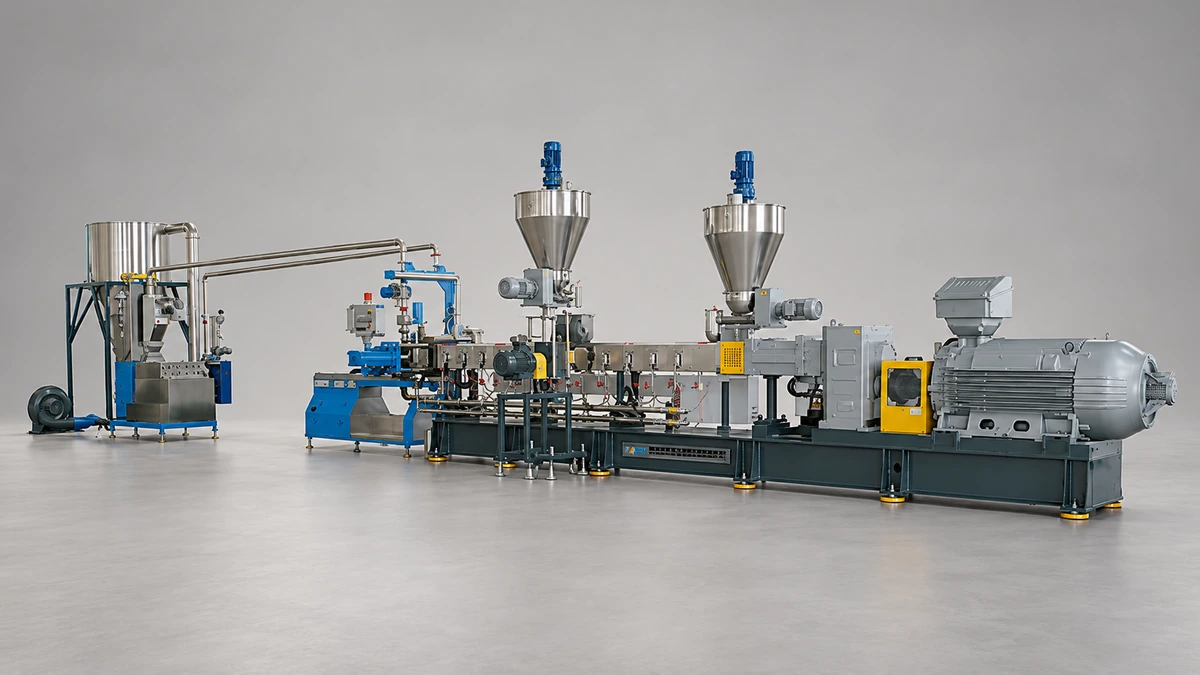
What Your Parallel Twin Screw Extruder Manufacturer Won't Tell You
Oct 27, 2026
Learn how to evaluate a parallel twin screw extruder manufacturer beyond spec sheets. Covers gearbox quality, barrel metallurgy, TCO analysis, and a 5-stage vendor selection framework.
Read Article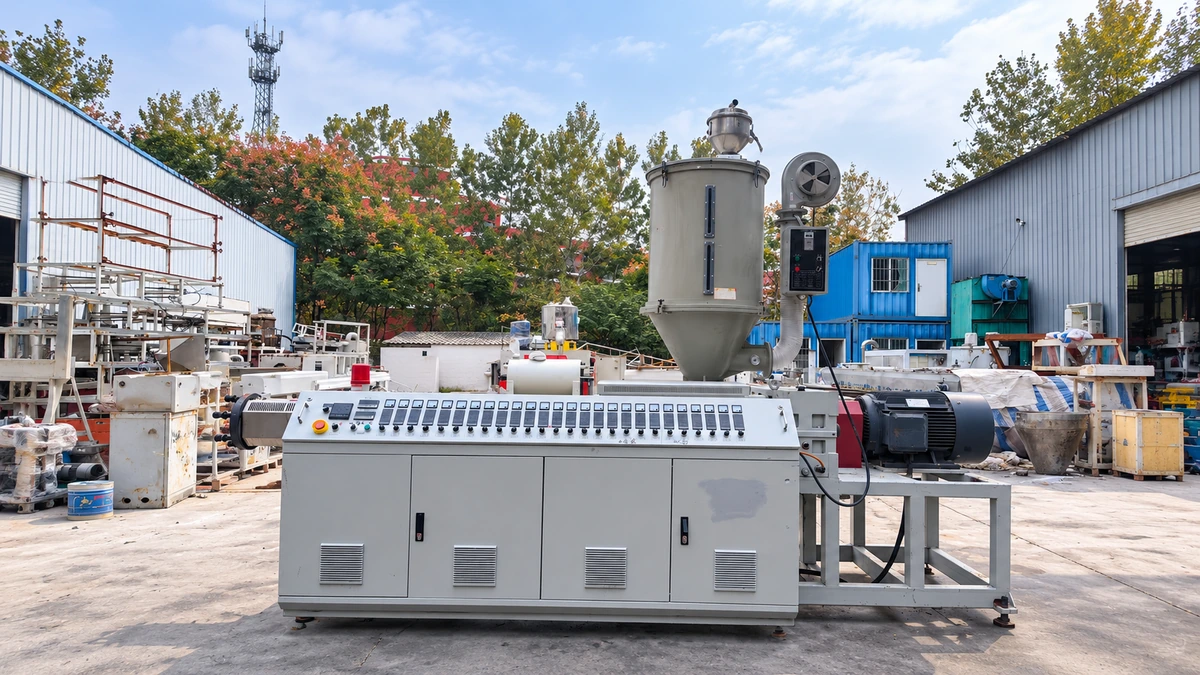
Single Screw Extruder Supplier Red Flags You Can't Afford To Miss
Oct 22, 2026
Learn how to evaluate a single screw extruder supplier with this buyer's guide covering pricing, screw and barrel tech, new vs used trade-offs, and red flags.
Read ArticleLooking for something else?
Search by material, symptom or product and jump straight to the relevant page.
These are navigation suggestions based on keyword matching — not a quotation, not a delivery commitment, and not a substitute for engineering review. Final specification is confirmed by our engineers against your drawings and processed material.
Need help with screw barrel selection?
Share your machine model, processed material and application. Our team can help with pricing and technical support.