

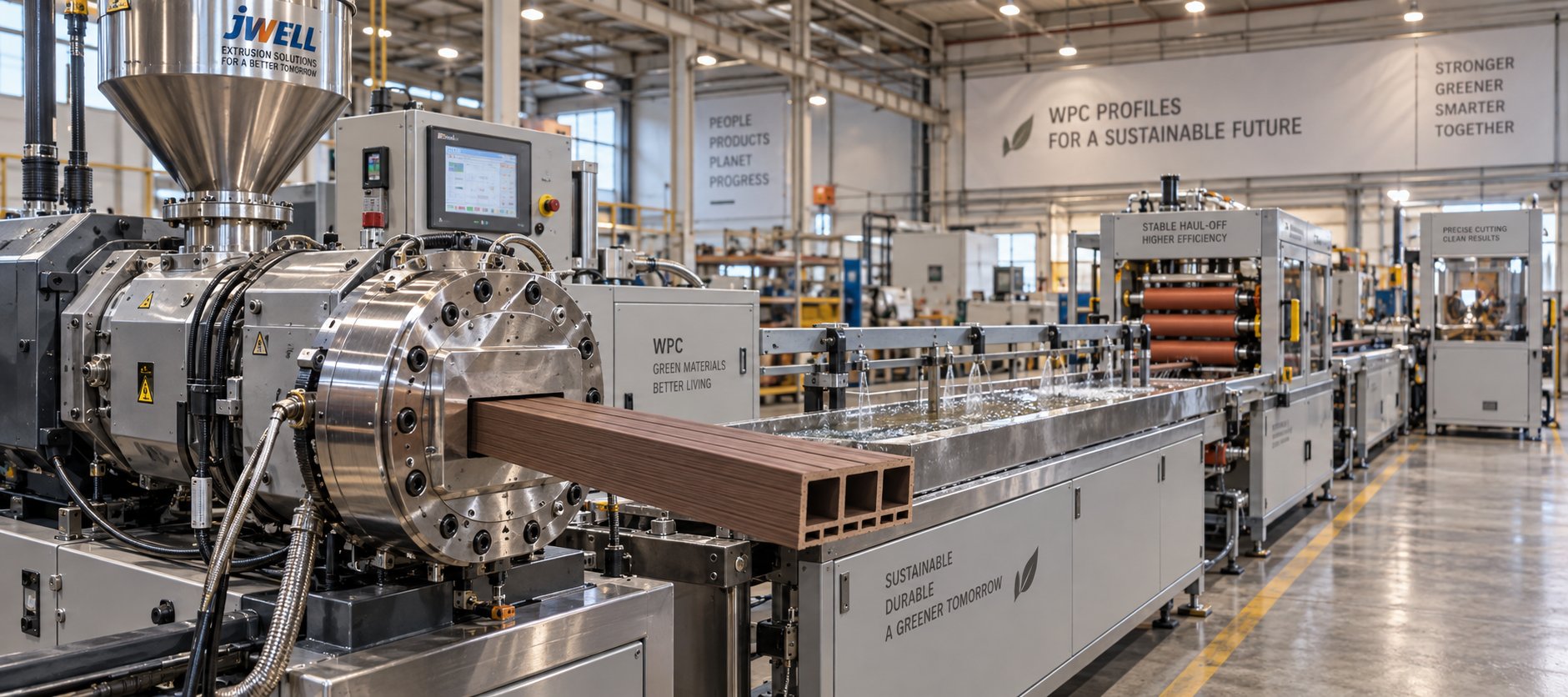
什么是WPC型材挤出生产线?它为何如此重要?
想象一下这样的生产系统:它利用锯末和回收塑料,一次性连续生产出耐候性强的甲板板材、时尚的墙板或坚固的门框。这个系统就是木塑复合材料(WPC)型材挤出生产线,它位于建筑材料制造领域增长最快的细分市场之一的核心位置。
定义WPC型材挤出生产线
WPC是木塑复合材料的缩写,它是一种融合了木材天然美感和热塑性聚合物韧性的混合材料。用于加工这种材料的挤出生产线远非只是在普通塑料机上加装一个不同的模具那么简单。
WPC型材挤出生产线是一个集成生产系统,它将热塑性聚合物(PVC、PE或PP)与木纤维或木粉混合,然后通过精密设计的加热模具输送、熔化、成型、冷却和切割混合物,制成连续的型材。
从原材料混合机到末端的自动堆垛机,生产线上的每个工位都经过专门设计,以处理一种与纯塑料特性截然不同的材料。木纤维会给生产过程带来水分、热敏性和磨损性。忽略其中任何一个因素,都会导致表面起泡、型材烧焦或设备过早损坏。正因如此,专用的WPC型材挤出生产线才作为一个独立的设备类别而存在,而不是传统聚合物挤出生产线的简单变体。
WPC型材的主要应用
木塑复合材料的多功能性使其在多个建筑和建筑设计市场中脱颖而出。每种产品类别对型材几何形状、表面光洁度和机械性能都有独特的要求——这反过来又决定了挤出生产线的配置方式。
- 露台板材——按用量计算是最大的单一应用领域,需要宽而厚的型材,且密度均匀,并具有优异的抗紫外线性能,以适应户外环境。WPC木塑露台板材型材挤出生产线通常具备共挤出功能,以添加保护性表层。
- 墙面覆层板——更薄的型材,尺寸公差严格,带有压纹木纹纹理,适用于外墙安装。
- 门窗框架——复杂的空心横截面,需要精确的模具工程和扩展的校准表。
- 围栏和栏杆——必须满足承重标准,同时还要能抵抗腐烂和虫害的结构型材。
- 凉棚板条和景观元素——既美观又耐用的型材,能够经受持续的风吹雨打。
The global WPC market reflects this breadth of application. Valued at USD 8.97 billion in 2025, the wood-plastic composites market is projected to reach USD 25.02 billion by 2035, expanding at a CAGR of 10.85%. Building and construction alone accounts for nearly 47% of total demand, with extruded WPC holding a dominant 70% share of all product types. Those numbers explain why manufacturers worldwide are investing in WPC profiles line extrusion machines capable of meeting surging order volumes.
Why WPC Requires Specialized Extrusion Equipment
If you've run a standard PVC or polyethylene extrusion line, you might wonder why the same equipment can't simply process a wood-fiber blend. The short answer: wood fiber changes everything.
Three fundamental challenges set WPC apart from pure polymer processing:
- Moisture reactivity — wood flour naturally absorbs atmospheric water. Even small amounts of residual moisture flash into steam inside the heated barrel, creating voids, rough surfaces, and structural weakness.
- Thermal sensitivity — cellulose fibers begin to degrade and discolor at temperatures that many polymers handle easily. The processing window shrinks dramatically, demanding precise zone-by-zone temperature control.
- Abrasiveness — silica within wood cell walls acts like fine sandpaper against screw flights, barrel bores, and die channels, accelerating wear far beyond what virgin polymer extrusion produces.
These three variables ripple through every engineering decision on the line — from screw geometry and barrel metallurgy to die flow balancing and downstream cooling length. Generic plastic processing equipment simply cannot manage the delicate balance between polymer melting and wood fiber preservation, a reality that leads to weak, crumbly, or visually defective profiles.
Understanding these material-driven constraints is the first step toward running a profitable WPC operation. The interplay between moisture, heat, and abrasion shapes not just the equipment you select, but every formulation decision and process parameter you'll encounter along the way.
Material Science Behind Wood-Plastic Composite Extrusion
Wood fiber isn't just an inert filler tossed into a polymer stream. At loading rates of 40-70% by weight, it becomes the dominant phase in the composite — and it brings chemistry and physics that pure plastic extrusion never has to confront. Every design choice on a WPC profile extrusion line, from the steel alloy lining the barrel bore to the length of the cooling tank, traces back to three material-science realities baked into the wood fiber itself.
Think of it this way: polymers are forgiving. They melt predictably, tolerate a wide temperature range, and slide smoothly over polished metal. Wood fiber does none of those things. It holds moisture, burns at relatively low temperatures, and grinds away at every metal surface it touches. Understanding these behaviors at a scientific level is what separates a stable, profitable extrusion operation from one plagued by scrap, downtime, and inconsistent output.
Moisture Sensitivity and Its Impact on Extrusion Stability
Wood flour is naturally hygroscopic. Even kiln-dried material will re-absorb atmospheric moisture during storage and handling. By the time it reaches the extruder hopper, residual moisture levels can easily sit in the range of 2-8% unless deliberate pre-drying steps are in place.
Why does that matter so much? Imagine tiny water droplets trapped inside a pressurized melt stream heated well above 100 °C. Those droplets flash into steam almost instantly, expanding with enormous force. The result is a cascade of defects:
- Internal voids — microscopic steam pockets that weaken the profile's cross-section and reduce load-bearing capacity.
- Surface blistering — steam migrating toward the profile skin creates rough, pitted finishes that no amount of downstream embossing can hide.
- Density inconsistency — random void distribution makes profile weight unpredictable from meter to meter, causing quality-control failures.
Research into wood flour-HDPE composites highlights how the heterogeneous composition of WPC amplifies these effects. Non-uniform fiber distribution within the polymer matrix means moisture pockets aren't evenly spread either, leading to localized defects that are difficult to predict or control without proper upstream treatment.
The practical countermeasures are non-negotiable for any WPC profile extrusion line. Pre-drying wood flour — typically in a hot-air or fluid-bed dryer — must bring residual moisture below 1-2% before blending. Inside the extruder itself, strategically placed vacuum degassing ports pull volatiles and residual steam out of the melt before it reaches the die. Skip either step, and you'll watch reject rates climb with every production hour.
Thermal Degradation Thresholds of Cellulose Fiber
Here's the fundamental tension in every WPC extrusion process: the polymer matrix needs enough heat to fully melt and flow, yet the wood fiber inside that same melt will begin to degrade if temperatures push too high. The processing window is remarkably narrow compared to standard plastics.
Cellulose — the primary structural component of wood fiber — remains relatively stable in dry conditions up to roughly 200-300 °C, depending on its chemical composition. However, the hemicellulose fraction, which is always present in wood flour derived from commercial pulp, begins decomposing around 220 °C, and lignin can start breaking down even lower, near 160 °C. Once degradation kicks in, you'll see dark specks, discoloration, off-gassing, and a burnt smell — all signs that the wood fiber is charring inside the barrel.
This constraint plays out differently depending on the polymer matrix chosen for the composite:
- PVC-based WPC — PVC gelates and processes at lower temperatures, generally in the 150-180 °C range. This sits comfortably below the danger zone for most wood fibers, making a PVC WPC profile extrusion line somewhat more forgiving on thermal management. The trade-off is PVC's own sensitivity to shear-induced degradation, which demands careful screw-speed control.
- PE-based WPC — HDPE and LDPE require higher melt temperatures, often 170-200 °C. A PE WPC profile extrusion line operates closer to cellulose's degradation threshold, leaving a much tighter margin for error. Any hot spots in the barrel — caused by a failing heater band or poor temperature-controller tuning — can push local temperatures past the point of no return.
- PP-based WPC — Polypropylene's processing temperatures overlap even more with the wood-fiber danger zone, and its higher crystallinity can demand additional shear energy, further compressing the safe window.
In practical terms, operators running a PE WPC profile floor extrusion production line or a WPC door profile extrusion line must monitor zone temperatures obsessively. A deviation of just 10-15 °C in the wrong barrel section can shift output from premium-grade boards to unsellable scrap. That reality is why modern WPC extrusion lines divide the barrel and die into numerous independently controlled heating and cooling zones — a topic explored in detail later in this article.
Abrasiveness of Wood Fiber on Metal Components
The third challenge is mechanical, and it hits the bottom line hard. Wood cell walls contain silica — a mineral compound that, even in small concentrations, acts as a persistent micro-abrasive against every metal surface the composite contacts during processing.
In a pure polymer extrusion line, a well-maintained screw and barrel set might run for years before wear affects performance. In WPC extrusion, that timeline compresses dramatically. The high wood-fiber loading means billions of tiny abrasive particles are being driven under pressure across screw flights, barrel bore surfaces, and die flow channels during every rotation. Over time, this action erodes flight crests, widens the barrel bore diameter, and roughens die land surfaces.
The consequences of unchecked wear are progressive and costly:
- Loss of plasticizing efficiency — as the gap between screw flight and barrel wall grows, the extruder loses its ability to build consistent pressure and fully homogenize the melt.
- Increased energy consumption — a worn screw-barrel set requires higher motor loads to achieve the same output rate.
- Inconsistent output — variable melt pressure translates directly into dimensional fluctuation in the finished profile.
Industry practice addresses this through specialized metallurgical treatments. Nitrided screw and barrel sets form a high-hardness surface layer that resists abrasion and reduces the friction coefficient — a solid baseline for standard WPC formulations. For high-fill or high-output scenarios, bimetallic barrel liners with welded high-alloy wear-resistant layers offer even greater protection, extending service cycles by two to three times compared to conventional carbon-steel components. Die flow channels benefit from similar hardening treatments or replaceable wear inserts in high-contact zones.
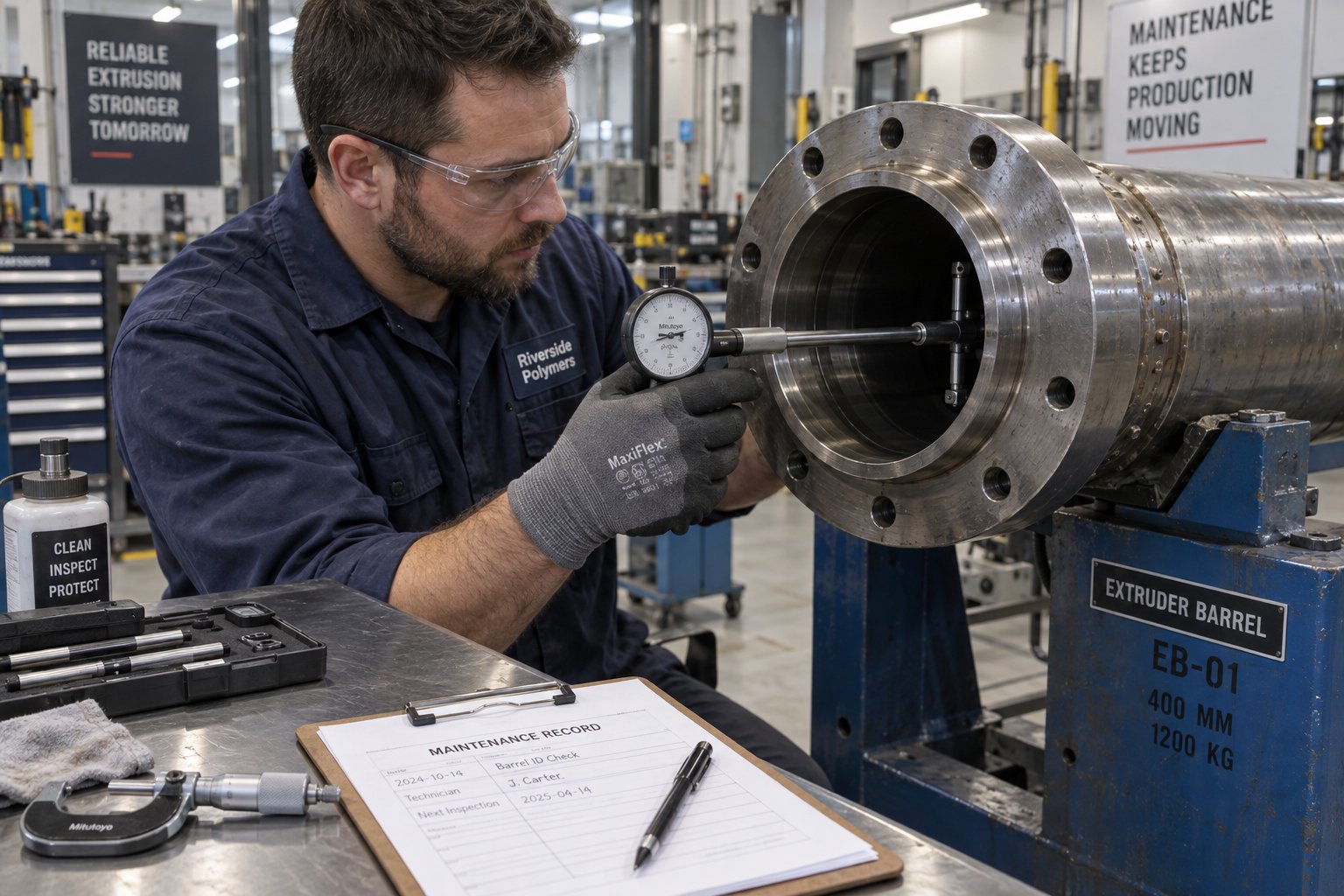
Choosing the right metallurgical solution isn't just an equipment procurement decision — it's an ongoing operating-cost calculation. A barrel that wears out prematurely doesn't just cost money to replace; it degrades product quality for weeks before the wear becomes obvious enough to trigger action. Regular bore-diameter measurement and flight-height inspection belong on every WPC operator's maintenance calendar.
These three material-driven constraints — moisture, thermal sensitivity, and abrasion — don't operate in isolation. They interact. Excessive moisture forces operators to raise temperatures to compensate for poor melt quality, which pushes wood fibers closer to degradation. Degraded fiber generates more abrasive char particles, accelerating screw and barrel wear. The cycle feeds itself unless every upstream variable is controlled before the blend ever enters the extruder — which is precisely why the mixing and compounding stage deserves far more attention than it typically receives.
Upstream Preparation from Mixing to Compounding
Here is a reality most equipment brochures gloss over: the quality of a finished WPC profile is largely decided before the material ever touches the extruder screw. Moisture, thermal sensitivity, and abrasion — the trio of challenges outlined above — are all magnified or minimized by what happens in the upstream mixing and compounding stage. Get this phase right, and the extrusion line runs smoothly with minimal scrap. Get it wrong, and no amount of downstream fine-tuning will compensate for an inconsistent, poorly prepared feed blend.
Think of upstream preparation as the foundation of a building. You can install the finest fixtures inside, but if the foundation shifts, cracks show up everywhere. The same principle applies to every WPC profile extrusion line factory, whether it operates in China, Southeast Asia, or Europe. Consistent raw material preparation is the single greatest predictor of consistent profile output.
Raw Material Selection and Incoming Quality Control
A WPC formulation is not a two-ingredient recipe. It is a carefully balanced cocktail of polymer, natural fiber, and a suite of functional additives — each one playing a specific role in processability, durability, or aesthetics. Here is what goes into the hopper before a single gram enters the extruder:
- Thermoplastic resin — PVC powder, PE pellets, or PP granules form the polymer matrix. Resin grade, melt flow index, and particle form factor all influence how readily the polymer wets and encapsulates wood fiber during compounding.
- Wood flour or fiber — typically comprising 40-70% of the formulation by weight. Species (pine, spruce, oak, bamboo, or even rice husk), mesh size, and aspect ratio all affect mechanical properties and processing behavior. Research into WPC composition shows that commercially available wood flour generally targets a 60-80 mesh particle size (roughly 177-250 micrometers in diameter), providing a favorable balance between melt flow and flexural modulus.
- Coupling agents — maleic anhydride grafted polyolefins (MAPE for PE matrices, MAPP for PP) or silane-based agents bridge the hydrophobic polymer and the hydrophilic wood fiber, dramatically improving interfacial adhesion and tensile strength.
- Lubricants — external lubricants like zinc stearate and PE waxes prevent the compound from sticking to barrel walls and screw flights, while internal lubricants reduce melt viscosity and shear heating. Both are essential for protecting thermally sensitive wood fiber during processing.
- Stabilizers — heat stabilizers prevent PVC degradation; antioxidants guard PE and PP against thermo-oxidative breakdown during repeated melt exposure.
- UV inhibitors — hindered amine light stabilizers (HALS) and UV absorbers protect outdoor profiles from photodegradation and color fading.
- Pigments — iron oxide, carbon black, or organic colorants deliver the desired wood-tone aesthetic. Certain pigments also function as supplementary UV blockers.
- Foaming agents — chemical blowing agents such as sodium bicarbonate or azodicarbonamide reduce profile density by introducing a controlled cellular structure, yielding lighter boards that are easier to handle and install.
Sounds like a lot to keep track of? It is — and that is exactly why incoming quality control matters so much. Every batch of wood flour should be tested for moisture content and particle-size distribution before it enters the mixer. A handheld moisture meter and a vibrating sieve stack are inexpensive compared to the cost of a production run ruined by wet or oversized particles. Polymer resin lots should be verified for melt flow index and bulk density to ensure feeder accuracy. Any WPC profile extrusion line factory in China or elsewhere that skips these incoming checks is essentially gambling on product consistency batch after batch.
Hot-Cold Mixer Systems for WPC Formulation
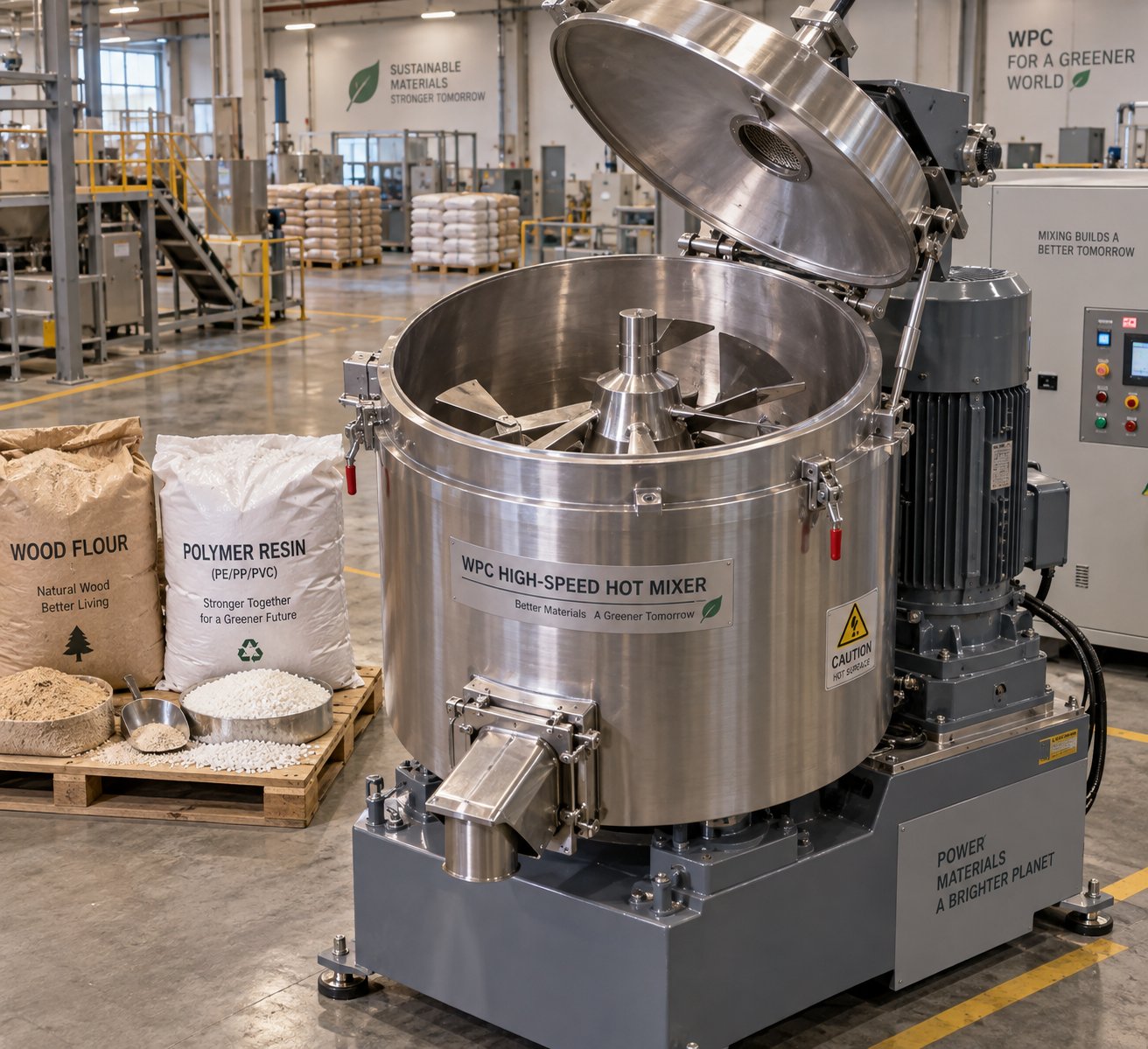
Imagine trying to fold flour into melted butter with a spoon — it clumps, it resists, and the result is uneven. WPC mixing faces a similar challenge at industrial scale: hydrophobic polymer and hydrophilic wood flour naturally repel each other. The hot-cold mixer system solves this by using controlled friction heating and rapid cooling in a two-stage process.
Stage 1 — High-speed hot mixer. Raw materials are loaded into a vertically oriented, high-intensity mixer. The impeller rotates at high speed, generating frictional heat that raises the blend temperature progressively. This serves multiple purposes simultaneously:
- Surface moisture on wood flour evaporates and is vented out of the mixer, reducing residual moisture to well below 1%.
- Coupling agents, lubricants, and stabilizers soften and absorb into the polymer particle surfaces, promoting uniform additive distribution.
- The elevated temperature improves the wettability between polymer and wood, encouraging preliminary adhesion without reaching full melt.
Research comparing different compounding approaches at the Technical University of Rosenheim found that heating-cooling mixer (HCM) compounding produced the lowest thermal damage to wood fibers among the methods tested, as measured by oxidation induction time and volatile organic compound emissions. The dry-blending action of the HCM avoids forcing wood fibers into direct contact with a fully molten polymer stream — a key advantage over extruder-based compounding, where shear forces and melt temperatures are inherently higher.
Stage 2 — Cooling mixer. The heated blend is transferred directly into a lower-speed, water-jacketed cooling mixer. Here, the material temperature drops rapidly. For PVC-based WPC, this step is critical: it prevents premature gelation that would make the blend impossible to feed into the downstream extruder. The cooled blend exits as a free-flowing dry mix or semi-agglomerated powder, ready for storage or immediate extrusion.
Batch sizes and cycle times vary by equipment capacity and formulation, but the hot-cold mixer sequence is the workhorse of WPC upstream preparation across wpc profile extrusion line factories worldwide. Its ability to drive off moisture, distribute additives, and pre-condition the blend — all without fully melting the polymer — makes it uniquely suited to the thermal constraints of wood-fiber processing.
Pelletizing vs. Direct Powder Extrusion
With a properly mixed and cooled WPC blend in hand, manufacturers face a strategic fork in the road: compound the blend into pellets first, or feed the powder mix directly into the profile extrusion line?
Both approaches are used commercially, and neither is universally superior. The right choice depends on production volume, profile complexity, available capital, and how tightly you need to control process variability. Here is how they compare:
Pelletizing (two-step process): The dry blend is fed into a parallel or co-rotating twin-screw compounding extruder, where it is fully melted, homogenized, degassed, extruded as strands, cooled in a water bath, and chopped into uniform pellets. These pellets are then stored and later fed into the profile extrusion line as a ready-to-melt feedstock. The twin-screw compounder provides intense dispersive mixing that ensures coupling agents are uniformly grafted to fiber surfaces and additive packages are thoroughly distributed.
Direct powder extrusion (one-step process): The dry blend from the hot-cold mixer is fed directly into the profile extruder — typically a conical twin-screw unit for PVC-based WPC. The extruder handles melting, homogenizing, degassing, and shaping in a single pass. This eliminates the compounding step entirely, saving energy, floor space, and capital investment.
The trade-offs between these two paths are significant enough to warrant a side-by-side comparison:
| Factor | Pelletizing (Two-Step) | Direct Powder Extrusion (One-Step) |
|---|---|---|
| Feed consistency | Excellent — uniform pellet size ensures stable gravimetric feeding and predictable melt behavior | Good but variable — powder bulk density fluctuations can cause feed surges and output instability |
| Additive dispersion | Superior — dedicated compounding screw geometry maximizes distributive and dispersive mixing | Adequate for standard formulations; complex additive packages may not distribute as uniformly |
| Capital cost | Higher — requires a separate compounding extruder, water bath, pelletizer, dryer, and storage silos | Lower — only the hot-cold mixer and profile extrusion line are needed |
| Energy consumption | Higher — the material undergoes two full melt cycles, increasing total specific energy input | Lower — single melt cycle reduces cumulative thermal and mechanical energy load on wood fibers |
| Thermal load on wood fiber | Greater — each melt cycle exposes wood to elevated temperatures, increasing risk of degradation and VOC emissions | Lower — one-time melting preserves more of the fiber's structural integrity |
| Suitability for complex profiles | Excellent — consistent pellet feedstock simplifies die pressure control for intricate hollow cross-sections | Workable but demanding — powder feeding requires tighter extruder process control and experienced operators |
| Production flexibility | High — pellets can be stockpiled and run on multiple lines or sold as compound to third parties | Moderate — the blend must be used relatively quickly to avoid moisture re-absorption |
In practice, many large-scale WPC profile extrusion line factories — particularly those producing PE- or PP-based composites — favor the pelletizing route because the consistent feed behavior simplifies high-speed, multi-shift operations. Manufacturers running PVC-based WPC, where the conical twin-screw extruder is already optimized for powder intake, more commonly choose direct extrusion to reduce energy cost and minimize thermal exposure. The study from the Technical University of Rosenheim reinforces this logic: among all compounding methods tested, processes that limited the number of melt cycles and reduced dwell time at elevated temperatures produced lower VOC emissions and less discoloration in the final part — clear indicators of preserved wood-fiber integrity.
Whichever path a manufacturer selects, the upstream preparation stage establishes the baseline that every downstream station inherits. A well-mixed, properly dried, and uniformly compounded feed blend enters the extruder ready to be shaped. A poorly prepared one carries its defects forward — through the die, through the calibrator, and straight into the finished stack. That handoff from compounding to extrusion is where material science meets mechanical engineering, and it is exactly where the step-by-step process walkthrough picks up.
Step-by-Step WPC Profile Extrusion Process Explained
A properly compounded WPC blend — whether pelletized or in dry-mix powder form — arrives at the extruder hopper carrying all the formulation work invested upstream. From this point forward, the material passes through a tightly choreographed sequence of mechanical stations, each one building on the last. Miss a beat at any stage and defects cascade downstream, showing up as warped boards, rough surfaces, or profiles that fail dimensional inspection.
What does this journey actually look like from hopper to finished stack? Let's walk through every station in order, explaining what happens inside the machine and why each step directly shapes the quality of the final WPC profile.
Feeding, Melting, and Plasticizing in the Extruder
Everything begins at the feed throat. A gravimetric feeder — or in simpler setups, a volumetric feeder — meters the WPC blend into the extruder at a precisely controlled rate. Why does feeding accuracy matter so much? Because even slight surges or starve cycles in the feed stream create pressure fluctuations inside the barrel, and those fluctuations translate directly into density variations and dimensional inconsistency in the finished profile.
Gravimetric feeders weigh the material in real time and adjust the feed rate automatically, compensating for bulk-density differences between batches. This is especially important for direct powder extrusion, where the low and variable bulk density of WPC dry blends can cause erratic flow. Pellet-fed lines enjoy more stable volumetric behavior, but even here, gravimetric control provides the tightest output consistency.
Once inside the barrel, the blend encounters the twin-screw assembly — the mechanical heart of any WPC profile extrusion line. Conical twin-screw extruders dominate PVC-based WPC processing because their tapered geometry offers a natural advantage: the wider feed-end diameter provides generous intake volume for bulky powder blends, while the narrowing barrel progressively compresses the material as it moves forward. Parallel twin-screw extruders are more common for PE- and PP-based composites, particularly when processing pre-compounded pellets.
Regardless of screw configuration, the extruder performs four critical functions in sequence:
- Conveying — screw flights grip the solid blend and push it forward. Deep-flight, wide-pitch conveying elements in the feed zone maximize intake and prevent material bridging — a frequent headache with low-density wood flour blends, as highlighted in twin-screw processing guidance for WPC compounding.
- Melting and plasticizing — as the material advances into the compression zone, decreasing flight depth and rising barrel temperatures combine shear energy with conducted heat to melt the polymer matrix around the wood fibers. The goal is full polymer fusion without overheating the cellulose. Screw compression ratio, flight depth, and the placement of mixing elements all determine how uniformly this happens.
- Degassing — strategically positioned vacuum ports along the barrel draw out residual moisture and volatile organic compounds released by the heated wood fiber. Multi-stage degassing is standard practice: an atmospheric vent first releases free steam after initial melting, followed by a high-vacuum zone that extracts deeper-trapped moisture and volatiles. Skipping or under-sizing this step invites internal voids and surface blistering — the exact defects discussed in the material science section above.
- Pressure building — the metering zone at the screw tips generates the stable, consistent melt pressure needed to push the homogeneous composite through the die. Pressure stability here dictates how evenly the die fills, which directly controls profile wall thickness and density uniformity.
Screw design is where art meets engineering in WPC extrusion. Too much shear energy and the wood fibers scorch, producing the dark specks and burnt odor that signal lignin degradation. Too little shear and the polymer fails to fully encapsulate the fibers, leaving weak interfacial bonds and rough, porous surfaces. Low-shear distributive mixing elements — rather than aggressive kneading blocks designed for mineral-filled plastics — wrap the molten polymer evenly around wood particles without chopping fibers or generating excessive frictional heat. This design philosophy is central to any WPC profile extrusion line from China or elsewhere that aims for consistent, defect-free output.
Die Shaping and Initial Profile Formation
Imagine squeezing thick peanut butter through a cookie press — that analogy captures the essence of what happens at the extrusion die, though at far higher pressures and temperatures. The die receives the pressurized, homogeneous WPC melt from the extruder and distributes it into the exact cross-sectional geometry of the target profile: a solid decking plank, a hollow door frame, a tongue-and-groove cladding panel, or any other custom shape.
WPC die design differs from standard polymer die engineering in several important ways:
- Higher melt viscosity — wood-fiber-loaded melts resist flow more stubbornly than pure polymer. Die channels must be wider and land lengths shorter to prevent excessive pressure drop, which would starve thin-walled sections or cause melt fracture.
- Fiber orientation effects — wood particles tend to align along the direction of flow inside narrow die channels. While some orientation improves longitudinal stiffness, excessive alignment weakens the profile in the transverse direction. Skilled die engineers use flow restrictors, pre-distribution chambers, and graduated channel geometries to manage fiber orientation and achieve balanced mechanical properties across the profile's cross-section.
- Flow balancing — complex profiles with both thick and thin wall sections require careful balancing so that melt velocity is uniform across the entire die exit. Unbalanced flow shows up immediately as profile distortion — one side bulging while the other side starves. Adjustable flow restrictors and replaceable choke bars give operators the ability to fine-tune balance during startup without removing the die for re-machining.
The profile emerges from the die lip as a continuous, semi-molten extrudate — visually recognizable in shape but still soft and dimensionally unstable. It's hot, pliable, and vulnerable to gravity-induced sagging or surface marking. What happens in the next few meters of travel determines whether that soft shape becomes a precision-dimensioned product or an out-of-tolerance reject.
Calibration, Cooling, and Dimensional Locking
You'll notice that the extrudate leaving the die doesn't simply cool on its own in open air. If it did, gravity and internal stresses would distort the profile beyond any usable tolerance within seconds. Instead, the still-soft profile enters a vacuum calibration table positioned immediately after the die — and this station is where final dimensions are locked in.
Here is how it works: the profile slides into a precision-machined sizing sleeve (or set of sleeves for complex hollow sections) mounted inside a sealed chamber. A vacuum pump draws air out of the chamber, creating negative pressure that pulls the profile's outer surface firmly against the inner walls of the sizing sleeve. This external suction holds the profile in its intended geometry while cooling water — circulated through channels in the sleeve or sprayed directly — removes heat and solidifies the polymer matrix.
WPC profiles demand longer calibration and cooling sections than equivalent pure-polymer profiles for a straightforward physical reason: the wood fiber within the composite acts as a thermal insulator. Heat trapped in the profile's core takes longer to migrate outward, meaning the interior remains soft and pliable even after the surface has solidified. Pulling a profile out of the cooling section prematurely results in post-cooling shrinkage, warping, or internal stress that manifests as bowed boards days after production.
After the vacuum calibration section, the profile typically passes through one or more spray cooling tanks where water jets continue extracting residual heat. The combination of vacuum calibration followed by spray cooling is the industry standard for most WPC profile extrusion lines in China and globally, balancing dimensional precision with throughput speed. Some manufacturers add immersion cooling baths for particularly thick or dense profiles that retain heat stubbornly.
By the time the profile exits the final cooling station, it is dimensionally stable, rigid, and cool enough for mechanical handling — ready for the haul-off, cutter, and stacker stations that complete the production sequence.
Here is the complete station-by-station sequence that every WPC profile passes through, from raw blend to finished product:
- Feeding — gravimetric or volumetric feeder delivers a controlled flow of WPC blend into the extruder hopper.
- Extruder — conical or parallel twin-screw unit conveys, melts, mixes, degasses, and pressurizes the composite melt.
- Die — the extrusion die shapes the pressurized melt into the target cross-sectional profile geometry.
- Calibration — vacuum sizing sleeves pull the soft extrudate into precise final dimensions.
- Cooling tank — spray or immersion cooling solidifies the profile through its full cross-section.
- Haul-off — caterpillar or belt haul-off pulls the cooled profile at a constant speed synchronized with extruder output.
- Cutter — a flying saw or planetary cutter trims the continuous profile into specified lengths without stopping the line.
- Stacker — an automated stacking system receives cut profiles and organizes them onto pallets or into bundles for packaging and shipment.
Each station in this sequence depends on every station before it. A feed-rate fluctuation at station one ripples forward as a density variation by station four and a dimensional rejection by station six. A temperature miscalculation in the extruder barrel produces a melt-quality problem that no amount of calibration refinement can correct. That interconnectedness is precisely why manufacturers shopping for a wpc profile extrusion line for sale evaluate the entire integrated system — not just the extruder alone.
The stations from feeding through cooling define the profile's internal structure, dimensions, and surface foundation. Yet the downstream equipment — haul-off, cutter, and stacker — plays an equally decisive role in determining whether that foundation translates into sellable product or costly scrap. Surface marking from a poorly adjusted haul-off, ragged cuts from a dull blade, or handling damage from manual stacking can downgrade an otherwise perfect profile in an instant.
Downstream Equipment That Shapes Final Profile Quality
A WPC profile can survive every upstream challenge — proper drying, precise temperature control, flawless die balancing — and still end up as rejected scrap because of what happens in the last few meters of the production line. Surface scratches from a misaligned haul-off, ragged edges from a worn saw blade, or chipped corners from manual handling all downgrade product that was otherwise manufactured to spec. Yet downstream equipment rarely receives the engineering attention it deserves when manufacturers evaluate a wpc profile extrusion line pricelist or request quotes from suppliers.
These final stations — haul-off, cutter, and stacker — aren't accessories bolted on as an afterthought. They are precision-engineered components that directly determine how many meters of sellable product leave your factory floor each shift versus how many end up in the regrind bin.
Haul-Off Units and Their Role in Surface Quality
Imagine a tug-of-war between the extruder pushing the profile forward and the haul-off pulling it downstream. If both forces aren't perfectly balanced and synchronized, the profile stretches, compresses, or drifts sideways — producing dimensional variation that no downstream trimming can fix.
Two main haul-off designs dominate WPC profile extrusion lines:
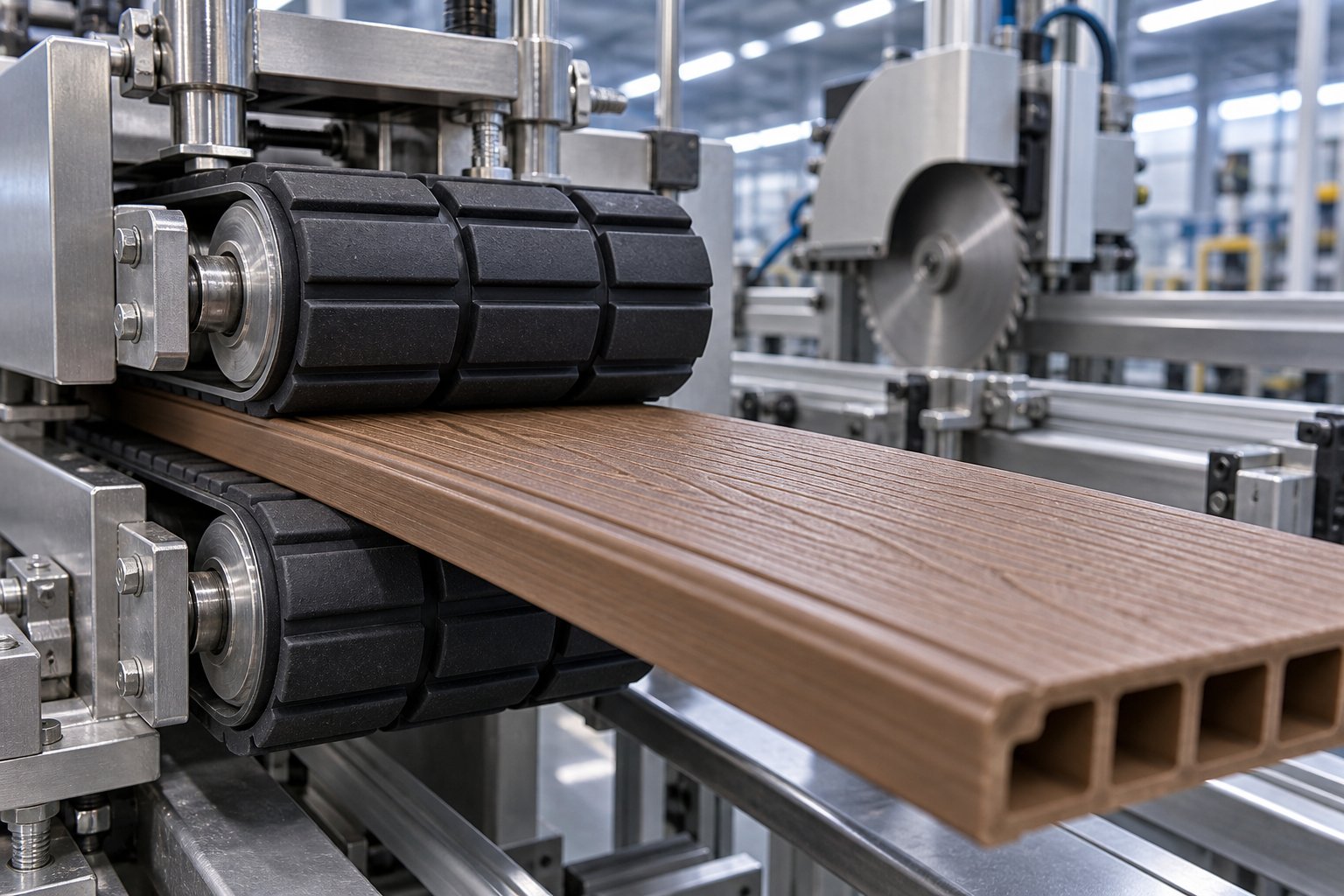
- Caterpillar (track) haul-offs — two opposing belts of rubber or polyurethane pads grip the top and bottom surfaces of the profile and pull it forward at a servo-controlled speed. The large contact area distributes clamping pressure evenly, reducing the risk of localized compression marks. This design handles heavy, wide profiles like decking boards and thick cladding panels particularly well.
- Belt-type haul-offs — flat belts ride over the profile surfaces with lower clamping force, suited for thinner or more delicate cross-sections where excessive grip pressure could distort the geometry.
Why does the distinction matter for WPC specifically? Wood-plastic composite profiles are softer at elevated temperatures than their pure-polymer counterparts. The wood fiber disrupts the polymer's crystalline structure, lowering surface hardness in the warm zone immediately after the cooling tank. A caterpillar pad set too tight, or a belt surface that's worn rough, will emboss compression marks into the still-warm profile skin — defects that become permanently visible once the board cools to ambient temperature.
Consistent pulling speed is equally critical. If the haul-off runs even slightly faster than the extruder's output rate, the profile stretches and thins. Too slow, and the profile bunches, thickens, or sags between the cooling tank and the haul-off entry. Modern servo-driven haul-offs communicate directly with the extruder's control system, automatically adjusting speed in real time to maintain constant line tension. This closed-loop synchronization is a feature worth prioritizing when reviewing a high quality wpc profile extrusion line pricelist, because the cost difference between a basic haul-off and a servo-synchronized unit is minor compared to the reject savings it delivers.
Cutting Systems for WPC Profiles
The profile emerges from the haul-off as a continuous, moving strand that needs to be trimmed into discrete lengths — without stopping the line. Two cutting technologies handle this job in WPC production, each with distinct strengths.
Flying-saw cutters clamp onto the moving profile, travel with it at line speed, and make a cut using a circular saw blade. The saw retracts, returns to its starting position, and waits for the next length signal. As Plastics Technology notes, traveling-saw cutters are commonly mounted on tables that move at extrusion line speed — the extrudate is momentarily clamped so that extrusion, saw, and table all travel together during the cut. Unlike displacement-style cutters, saws remove a narrow swath of material and create dust that must be collected via a vacuum system.
Planetary cutters take a different approach. A cutting wheel sits inside a rotating ring that orbits the profile's circumference, gradually pressing inward to split the material apart without removing any material at all. The result is an exceptionally clean, chip-free, particle-free cut — described by industry experts as the most trouble-free cutter type, often eliminating the need for secondary finishing operations entirely. The trade-off? Planetary cutters typically cost more, cut more slowly, and max out at lower line speeds.
Blade material is another consideration unique to WPC. The silica content in wood fiber chews through standard steel saw blades quickly. Carbide-tipped or diamond-coated blades extend service life significantly but add to the consumable cost — a factor that should appear in any realistic wpc profile extrusion line quotes you evaluate.
| Criteria | Flying-Saw Cutter | Planetary Cutter |
|---|---|---|
| Cut quality | Good — clean cuts with proper blade selection, but may leave minor burrs on rigid WPC | Excellent — chip-free, distortion-free cuts with no material loss |
| Line speed compatibility | High — servo-controlled traveling tables match fast extrusion speeds accurately | Moderate — orbital cutting action limits maximum compatible line speed |
| Dust generation | Significant — saw removes a kerf of material, requiring vacuum dust collection | Minimal — material is displaced, not removed, producing virtually no particulate |
| Blade life with WPC | Moderate — abrasive wood fiber accelerates wear; carbide tips recommended | Longer — cutting wheel contacts the material gradually with lower abrasive load per revolution |
| Suitability for hollow profiles | Adequate — but internal webs may chip or deform under saw impact | Superior — gradual orbital pressure cleanly parts hollow walls without collapsing chambers |
| Suitability for solid profiles | Excellent — high saw torque cuts through thick solid cross-sections efficiently | Workable but slower — thick solid profiles extend cutting cycle time |
For most WPC decking and cladding operations running solid profiles at moderate to high line speeds, flying-saw cutters offer the best balance of throughput and cost. Hollow door frames, window profiles, and premium products destined for automated assembly — where cut quality directly affects fitment — benefit from the planetary cutter's precision.
Automatic Stacking and Packaging Integration
What happens after the cut? In many older production facilities, workers manually lift each cut profile off the runout table, carry it to a pallet, and stack it by hand. This approach introduces three problems at once: labor cost, handling damage, and inconsistent stack patterns that complicate downstream shipping and inventory management.
Automated stacking systems eliminate all three. Modern inline stackers — such as Exelliq's iQ Stack — receive each cut profile on a roller conveyor, rotate it up to 180 degrees via a turning unit if needed, then push it sideways onto supporting arms for temporary staging. Once a complete layer accumulates, gripper units pick up the entire layer, the supporting arms swivel aside, and the profiles are placed into a transport rack. The process repeats automatically until the rack is full, at which point the system pushes the completed rack out and feeds an empty one in.
Integration with the upstream cutter's control signal is what makes this seamless. The stacker knows exactly when each cut profile arrives, its length, and its orientation — no manual intervention, no miscounts, and no collision risks. Optional features like automatic insertion of separating strips, inline weight measurement, and camera-based optical quality inspection add further layers of quality assurance before the product ever reaches the warehouse.
The payoff is straightforward: fewer workers handling heavy boards in a hot production environment, fewer scuffed or chipped profiles reaching customers, and a packing pattern optimized for shipping efficiency. For any manufacturer reviewing a high quality wpc profile extrusion line price, the stacker is the station most likely to deliver rapid payback through reduced labor and reject costs — even though it sits at the very end of the line and rarely appears in headline specifications.
Downstream equipment completes the physical product. Yet achieving a premium surface finish — especially for outdoor decking and cladding exposed to years of UV and weather — often demands more than a single-material extrusion approach. Adding a protective cap layer through co-extrusion opens up an entirely different level of product performance and market positioning, and it requires its own set of equipment decisions.
Co-Extrusion vs. Mono-Extrusion for WPC Profiles
A single-layer WPC decking board installed on a sun-drenched terrace faces the same UV bombardment across its entire cross-section — yet the only surface that actually needs to resist fading, scratching, and staining is the thin outer skin exposed to the sky. Manufacturing the entire profile from expensive, UV-stabilized engineered polymer to protect just that outer surface is like painting an entire house with automotive-grade clearcoat. It works, but it's an expensive way to solve a surface problem.
Co-extrusion flips that logic. It wraps a high-performance polymer shell around a cost-effective WPC core in a single production pass, delivering premium surface protection without inflating raw material cost across the full profile thickness. The technology isn't new — it's been standard practice in PVC window profiles and multilayer packaging films for decades — but its application to wood-plastic composites has accelerated sharply as outdoor product warranties extend to 25 years and buyers demand fade-resistant, scratch-proof finishes straight out of the box.
So how does this actually work on a WPC profile extrusion line, what extra equipment does it require, and when does the investment make financial sense over simpler mono-extrusion?
How Co-Extrusion Adds a Protective Cap Layer
Picture two rivers merging into one channel. That's essentially what happens inside a co-extrusion die. A primary extruder — the same conical or parallel twin-screw unit discussed in earlier sections — pushes the WPC core substrate forward as a pressurized, homogeneous melt. Simultaneously, a secondary extruder feeds a pure polymer cap layer through a dedicated flow channel built into the die assembly. The two melt streams converge just before the die exit, with the cap layer wrapping around the core profile's exterior surfaces before the combined structure emerges as a single, bonded extrudate.
The cap layer is typically a specialty polymer selected specifically for outdoor surface performance:
- ASA (acrylonitrile styrene acrylate) — the most widely used cap material for premium WPC decking and cladding. ASA's acrylic rubber component delivers exceptional UV resistance and color stability. Third-party testing on ASA-capped panels has demonstrated Grade 4 color fastness after 3,000 hours of accelerated UV aging, a benchmark that uncapped or standard-capped WPC rarely matches under equivalent exposure conditions.
- PMMA (polymethyl methacrylate) — offers outstanding optical clarity and weather resistance, sometimes used where a glossy or high-sheen finish is desired.
- Modified PVC — a cost-effective cap option for PVC-based WPC profiles, providing improved UV and stain resistance compared to the core material while maintaining material compatibility for easier recycling.
The cap layer doesn't need to be thick to be effective. Even a layer measured in fractions of a millimeter provides a continuous barrier that shields the wood-fiber-loaded core from UV radiation, moisture ingress, and surface abrasion. Because the cap is a pure polymer — free of wood flour — it resists staining, cleans easily, and accepts wood-grain embossing with sharper, more consistent texture than a filled WPC surface can achieve.
Why does this matter economically? The expensive engineering polymer is concentrated only where it's needed — at the surface. The bulk of the profile remains standard WPC, keeping overall material cost per linear meter far below what a solid engineered-polymer profile would require. That cost structure is precisely why co-extruded WPC has become the dominant format for outdoor decking and cladding in markets where the best wpc profile extrusion line price still needs to deliver premium end-product performance.
Equipment Additions for a Co-Extrusion Setup
Converting a mono-extrusion line into a co-extrusion line isn't as simple as bolting a second extruder onto the frame. Several additional components must be integrated, each with its own control requirements:
- Secondary extruder — typically a single-screw unit sized to the cap layer's throughput requirement, which is a fraction of the primary extruder's output. Single-screw extruders suit this role well because cap resins like ASA and PMMA are homogeneous polymers that don't need the intensive mixing of a twin-screw design.
- Co-extrusion distribution block or multi-manifold die — this is the critical hardware. A distribution block receives the cap melt from the secondary extruder and distributes it evenly around the core profile's perimeter before both streams enter the final die land together. Alternatively, a multi-manifold die keeps the two melt streams in separate channels until the very last moment before die exit, giving finer control over cap-layer thickness on each face of the profile. Multi-manifold designs cost more but allow independent adjustment of cap thickness on top, bottom, and side surfaces — a valuable feature when the top face of a decking board needs heavier UV protection than the hidden underside.
- Separate material handling and drying system — cap resins like ASA are hygroscopic. Even small amounts of moisture cause splay marks, cloudiness, and adhesion failure at the core-cap interface. A dedicated desiccant dryer and sealed hopper system for the cap resin is non-negotiable.
- Independent temperature control zones — the secondary extruder, distribution block, and cap-layer flow channels each require their own heating zones with independent controllers. Cap polymers process at different temperatures than the WPC core, and any thermal mismatch at the merge point causes delamination or flow instability.
These additions increase capital cost, floor space, and operator training requirements. However, for manufacturers targeting the outdoor decking and cladding segment, co-extrusion capability often determines whether a product line can compete at premium price points — making the incremental investment a market-access decision rather than a pure cost calculation.
When to Choose Co-Extrusion Over Mono-Extrusion
Not every WPC profile justifies the added complexity. The decision between co-extrusion and mono-extrusion hinges on the end product's exposure conditions, market positioning, and warranty requirements. Here are the scenarios where co-extrusion earns its keep:
- High-UV-exposure applications — decking, cladding, fencing, and pergola components installed in full sun demand surface protection that wood-fiber-loaded mono-extrusion simply cannot sustain over a multi-decade service life.
- Premium product positioning — buyers in developed markets expect consistent color, smooth texture, and stain resistance. A co-extruded cap layer delivers all three without requiring the entire profile to carry the cost of premium polymer.
- Strong warranty expectations — 20- to 25-year fade-resistance warranties are increasingly standard for competitive WPC decking brands. Meeting those warranties with mono-extruded product requires heavy UV-stabilizer loading throughout the profile — a cheap wpc profile extrusion line approach that raises raw-material cost and still falls short of what a dedicated cap layer achieves.
- Wood-grain embossed surface layers — co-extrusion produces a cleaner, sharper embossed texture because the cap surface is pure polymer, free of the wood particles that interrupt pattern definition in mono-extruded surfaces.
- Fire-performance requirements — specialized cap formulations, such as flame-retardant ASA systems, can achieve fire ratings like Class B under EN 13501-1 without loading the entire WPC core with heavy flame-retardant additives that reduce flexural strength.
Contrast those scenarios with situations where mono-extrusion remains the practical choice:
- Indoor applications — interior wall panels, baseboard trim, and furniture components face minimal UV exposure, eliminating the primary driver for a cap layer.
- Budget-driven projects — markets where price sensitivity outweighs surface-performance expectations favor a low price wpc profile extrusion line configuration without co-extrusion overhead.
- Simple profile geometries — flat boards and basic rectangular sections with limited aesthetic requirements can be produced faster and more cost-effectively as single-layer products.
- Startup operations — manufacturers entering the WPC market often begin with mono-extrusion to build process expertise before adding co-extrusion capability as product demand matures.
In practice, many manufacturers run both configurations on the same line, adding or removing the secondary extruder and co-extrusion die head depending on the production schedule. A cheap price wpc profile extrusion line designed with this modularity in mind gives growing operations the flexibility to serve both economy and premium segments without investing in entirely separate production systems.
Whether a profile exits the die as a single-layer or a cap-wrapped composite, its quality ultimately depends on how precisely temperature, pressure, and melt flow are managed zone by zone across the barrel, die, and calibrator — and on the wear condition of the screw and barrel set doing the heavy lifting inside.
Temperature Management and Screw Barrel Engineering
Temperature and mechanical hardware are two sides of the same coin inside any WPC profile extrusion line. Set the thermal profile wrong, and even a perfectly engineered screw cannot produce a homogeneous melt. Install the right temperature map on a worn-out barrel, and the extruder still churns out inconsistent, energy-hungry output. Mastering both simultaneously — zone-by-zone thermal choreography and the metallurgical integrity of the screw-barrel set — is what separates operators who hit spec on the first run from those who burn through shift after shift chasing defects.
Temperature Zone Strategy Across Barrel, Die, and Calibrator
A typical WPC extrusion line divides into multiple independently controlled heating and cooling zones, each tuned to a specific stage of the material's transformation. Think of it as a relay race where each runner hands off the baton at a precise temperature — too hot or too cold at any handoff, and the entire sequence stumbles.
Here is the general thermal strategy, moving from hopper to die exit:
- Feed zone (moderate temperatures) — this section stays relatively cool, typically in the 30 °C to 60 °C range, to keep the WPC blend solid and flowing freely. Setting the feed zone too warm softens powder prematurely, causing bridging and blockages. Too cold, and moisture condenses on metal surfaces, reintroducing the very steam problem you worked so hard to eliminate upstream.
- Compression and melting zones (progressive increase) — temperatures climb through this region to fully plasticize the polymer matrix around wood fibers. For common WPC formulations, melting zone temperatures typically range between 160 °C and 200 °C, depending on whether PVC or polyolefin serves as the base resin. The key word is progressive — gradual heating avoids thermal shock that can scorch fiber surfaces while the polymer core remains unmelted.
- Metering zone (slight reduction) — the temperature dips slightly below the melting zone peak to reduce shear-generated heat while keeping the melt fluid enough for uniform die feeding. Fluctuations here translate directly into pressure surges and dimensional instability in the finished profile.
- Die zone (carefully managed) — die temperature directly controls surface finish and dimensional accuracy. An overly cool die causes premature solidification, rough surfaces, and internal stresses. Too hot, and the profile sags or distorts under its own weight. Operators typically set die temperatures slightly below the metering zone — warm enough for smooth flow, cool enough for shape retention.
- Calibrator zone (active cooling) — vacuum calibration sleeves and spray-cooling tanks rapidly extract remaining heat, locking the profile's final dimensions. Because wood fiber acts as a thermal insulator within the composite, WPC profiles require extended cooling sections compared to pure-polymer equivalents.
Contrast this tightly managed thermal cascade with standard PVC pipe extrusion, which tolerates a broader temperature window and is far more forgiving of zone-to-zone fluctuations. In WPC processing, cellulose degradation begins creeping in above roughly 200 °C, and the gap between "polymer not yet fully melted" and "wood fiber starting to char" can be as narrow as 20-30 °C in PE-based formulations. That razor-thin margin is why every wpc profile extrusion line manufacturer in China — or anywhere else — builds multiple independent control loops into the barrel and die heater circuits, often supplemented by real-time PID controllers and automated sensor feedback systems that catch deviations before they reach the profile surface.
External factors compound the challenge. Ambient temperature, cooling water supply temperature, and even seasonal humidity shifts alter the barrel's heat balance. A WPC profile extrusion line supplier in China shipping equipment to a facility in the Middle East, where ambient temperatures exceed 45 °C, must account for drastically reduced barrel heat-loss rates compared to a Northern European installation. Field data from WPC installations in the Middle East confirms that hot-climate facilities typically require oversized cooling capacity and barrel-insulation adjustments to maintain stable melt temperatures during summer production runs.
Why Screw Geometry Matters for WPC Processing
If the temperature profile is the recipe, then the screw is the chef executing it. Screw geometry determines how aggressively the material is compressed, how much shear heat is generated internally, and how thoroughly the polymer encapsulates each wood particle. Get the geometry wrong, and no temperature setting can compensate.
The conical twin-screw design has become the dominant choice for PVC-based WPC extrusion for several geometry-driven reasons:
- Large feed-end diameter — the wider intake section provides generous channel volume to accept the low-bulk-density powder blends typical of PVC-WPC formulations. Standard parallel twin-screw extruders, with their constant diameter, offer less intake capacity for the same nominal screw size.
- Natural compression ratio — the tapering geometry progressively reduces channel volume as material advances toward the discharge end. This creates a compression ratio of approximately 3:1 to 4:1 built into the hardware itself, compacting and densifying the blend gradually rather than relying on aggressive kneading blocks that spike shear energy.
- Low peripheral speed at the feed section — the larger diameter feed end rotates at a lower surface speed than the smaller discharge end, reducing frictional heat generation precisely where the material is most sensitive to premature degradation. Conical extruders processing high-fill WPC typically run at just 15 to 25 rpm, keeping melt temperatures comfortably below cellulose degradation thresholds.
Three additional screw-design parameters shape WPC melt quality in any extruder configuration:
- Compression ratio — the ratio of feed-zone channel volume to metering-zone channel volume. Higher ratios drive more aggressive densification, which benefits low-bulk-density wood flour blends but risks shear-induced fiber scorching if pushed too far.
- L/D ratio (length-to-diameter) — conical screws typically operate at L/D values of 22:1 to 28:1, providing adequate residence time for plasticization and degassing in a compact footprint. Parallel screws run longer, at 28:1 to 36:1, offering more mixing length and superior thermal homogeneity — an advantage for precision profiles but at the cost of greater floor space and higher specific energy input.
- Mixing-element placement — distributive mixing elements positioned after the primary melting zone promote even fiber wetting without the aggressive shear that kneading blocks impose. Placing them too early in the screw causes unmelted polymer to pack around fibers rather than flow around them; too late, and the melt enters the metering zone with poor dispersion that no downstream pressure can correct.
For PE- and PP-based WPC, parallel twin-screw extruders remain common — particularly when pre-compounded pellets rather than powder blends are the feedstock. Their longer barrel and modular screw elements accommodate more flexible zone configurations, and the higher screw speeds deliver greater throughput for high-volume operations. The trade-off is higher shear-heat generation and faster abrasive wear, both of which demand closer monitoring and more frequent maintenance intervention.
Barrel Wear and Metallurgical Solutions
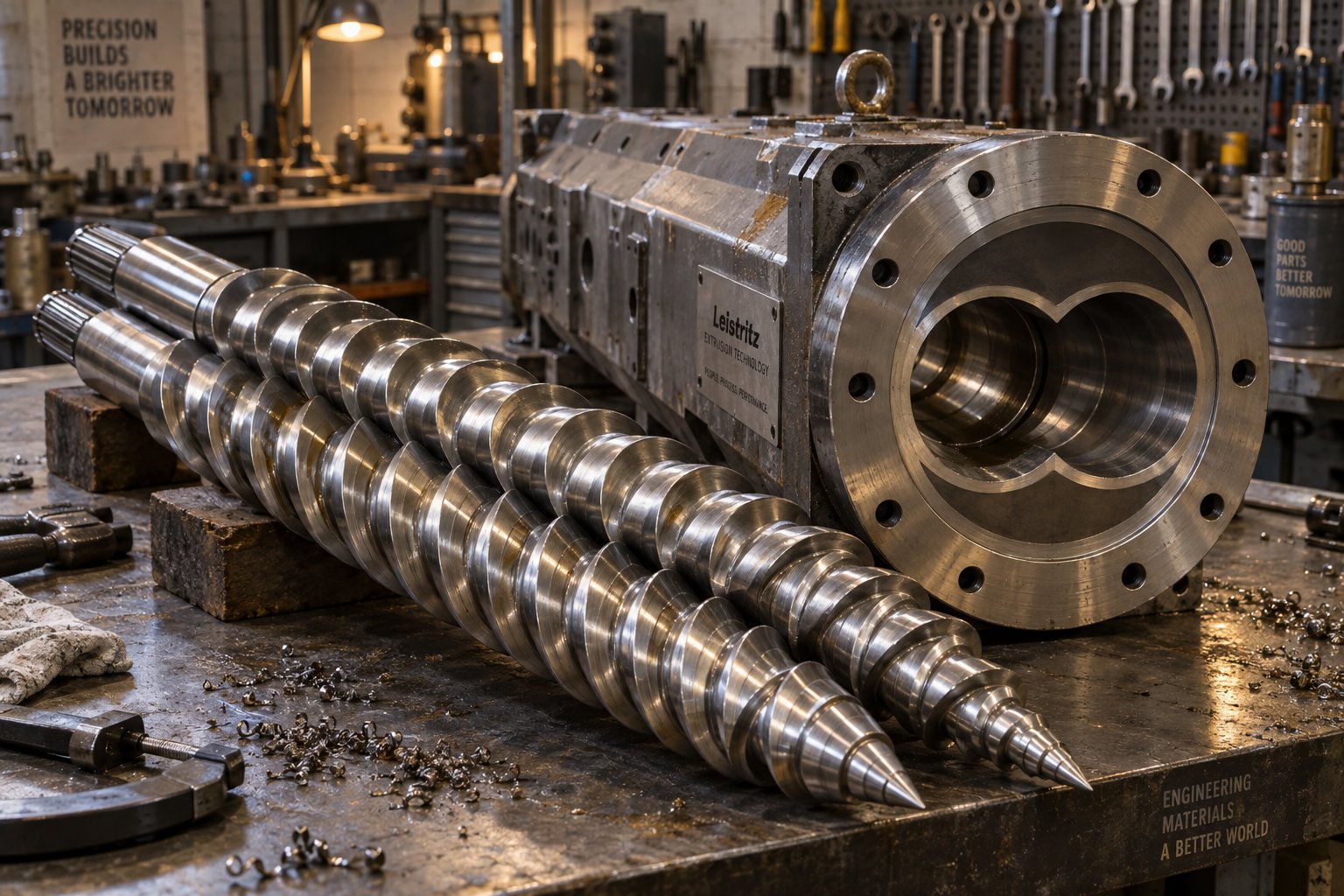
Every revolution of the screw pushes billions of silica-bearing wood particles against the barrel bore surface. Over thousands of operating hours, this micro-abrasive action progressively widens the bore diameter and erodes screw flight crests — a wear pattern that degrades plasticizing efficiency long before it becomes visible to the naked eye. The consequences are subtle at first and then increasingly expensive: rising energy consumption, declining output consistency, and eventually a complete loss of the tight screw-barrel clearance that enables proper melt pressurization.
The screw and barrel are the most performance-critical wear components on any WPC profile extrusion line. Their dimensional precision directly determines melt homogeneity, energy efficiency, and final profile consistency — and once clearance exceeds tolerance, no process adjustment can recover what worn metal has lost.
Conventional nitrided steel barrels offer a cost-effective starting point. The nitriding process creates a hard surface layer that resists initial abrasion and reduces the friction coefficient between the melt and barrel wall. For standard WPC formulations at moderate output rates, nitrided barrels provide acceptable service life. However, as bimetallic barrel engineering data demonstrates, once the hardened nitrided layer erodes through — which happens faster with high wood-filler loadings — the softer substrate beneath wears rapidly, and degradation accelerates in a self-reinforcing cycle.
For WPC profile extrusion line suppliers and manufacturers who need extended barrel life under abrasive conditions, three metallurgical countermeasures have become standard practice:
- Bimetallic barrel liners — a wear-resistant alloy liner is centrifugally cast inside the steel barrel body, creating a metallurgical bond that resists delamination under thermal cycling and pressure fluctuations. The inner alloy — typically a nickel-based matrix reinforced with hard carbide particles — delivers both abrasion resistance and corrosion protection in a single engineered layer. Bimetallic liners can extend barrel service life two to three times compared to conventional nitrided construction.
- Nitrided steel treatment (enhanced formulations) — advanced gas-nitriding processes can achieve deeper and harder case depths than traditional treatment, providing improved durability at a lower cost than full bimetallic construction. This option suits moderate-filler WPC lines where budget constraints limit the move to bimetallic.
- Specialized alloy compositions for screw flights — screw flight crests, which bear the highest abrasive contact pressure, benefit from stellite or tungsten carbide hard-facing applied to the flight tips. This localized reinforcement preserves the critical screw-to-barrel clearance even as the bulk of the screw body shows minimal wear.
Selecting a screw and barrel supplier who genuinely understands WPC-specific wear patterns — not just generic plastics processing — is critical for minimizing unplanned downtime and keeping per-kilogram production costs predictable. This is where specialized component manufacturers add measurable value. NANHAIYA's conical twin screw barrels, for example, are engineered specifically for PVC and WPC extrusion environments. Their product range covers both custom-built and drop-in replacement barrels designed for stable plasticizing performance across demanding formulations, supported by production-matched engineering services that help operators specify the right metallurgical solution for their particular wood-filler loading and throughput targets. For any china wpc profile extrusion line manufacturer evaluating screw-barrel sourcing, partnering with a supplier whose core competence aligns with WPC's unique abrasive and thermal demands delivers a measurable return in uptime and output consistency.
Temperature discipline and screw-barrel integrity work in tandem. A thermally well-managed barrel running on a worn screw set wastes energy and produces variable melt quality. A new screw set installed in a barrel with compromised temperature-control hardware overheats wood fibers and accelerates the very wear cycle you're trying to prevent. Both systems must be maintained — and specified — as a coordinated pair, a principle that carries directly into how manufacturers should plan line capacity, select extruder size, and evaluate equipment suppliers for long-term operational success.
Capacity Planning and Line Selection Criteria
A perfectly engineered screw-barrel set running inside a thermally optimized extruder still won't deliver profitability if the line is sized wrong for the business behind it. An oversized line burning energy at half capacity is just as costly as an undersized one running at redline to meet orders it was never built to handle. Yet capacity planning — the disciplined process of translating market demand into a concrete equipment specification — is the step most manufacturers rush through or skip entirely, seduced by headline output numbers on a spec sheet rather than grounding their investment in actual production math.
How do you move from "we need more WPC profiles" to a purchase order for the right extrusion line? It starts with arithmetic, sharpens with profile engineering, and finishes with a hard look at who's building the equipment.
Estimating Required Line Output and Capacity
Every capacity calculation begins with the same question: how many kilograms per hour must the extruder deliver to meet your annual production targets? The answer isn't a single number pulled from a catalog — it's derived from your specific operating reality.
Here is the framework, step by step:
- Define your target annual production volume. Express this in tons per year or linear meters per year, depending on how your market measures demand. If customers order in linear meters, convert to mass using the profile's weight per meter — a figure determined by cross-section geometry, wall thickness, and compound density.
- Calculate available operating hours. A factory running two 8-hour shifts, five days a week, 50 weeks a year has 4,000 gross hours available. Three shifts bump that to 6,000 hours. Subtract planned maintenance windows, public holidays, and any seasonal shutdowns to get net available hours.
- Apply a realistic efficiency factor. No extrusion line runs at 100% utilization. Startup scrap during each production run, color and profile changeovers, unplanned stops for thermocouple failures or vacuum pump issues, and occasional material quality deviations all consume productive time. A well-run WPC line typically achieves 75-85% overall equipment effectiveness (OEE). New operations or lines running frequent changeovers may sit closer to 65-70%.
- Derive the required output rate. Divide your annual tonnage target by the product of net operating hours and the efficiency factor. The result is the minimum sustained output rate in kg/h that the extruder must deliver — and this number becomes the primary specification driving extruder selection.
Sounds straightforward? The trap is in the assumptions. Overestimating efficiency inflates your apparent capacity on paper while leaving the real production floor short of output every month. Underestimating demand growth locks you into a machine that maxes out just as your order book expands. As extrusion engineering analysis warns, a machine designed to run at its maximum theoretical throughput performs poorly when daily requirements sit well below that ceiling — extended melt residence times cause thermal degradation, while low screw speeds fail to generate adequate shear for proper mixing.
The practical guideline: size the extruder so your nominal daily production target sits at roughly 60-80% of the machine's rated maximum output. This leaves headroom for demand spikes without forcing the line to idle at inefficiently low throughput during slower periods. If your maximum theoretical output requirement exceeds 80% of the extruder's mechanical limit, you're already undersized for growth — a scenario where the line runs constantly at redline, accelerating screw and barrel wear, destabilizing melt temperatures, and creating exactly the kind of dimensional instability and degradation that drives reject rates upward.
One more variable deserves attention: downstream bottlenecks. Even if the extruder can push 300 kg/h, the line only delivers 300 kg/h of finished product if the calibration table, cooling tank, haul-off, and cutter can all keep pace. Industry guidance on extrusion output capacity reinforces that vacuum calibration tanks, cooling systems, haul-off machines, and cutting machines all influence the final production rate of a complete line. An undersized calibrator — one of the most common cost-cutting mistakes in WPC line procurement — forces slower line speeds and can reduce output by 20-40% below the extruder's rated capacity, as field commissioning data from experienced WPC line builders confirms.
Matching Extruder Size to Profile Complexity
Output rate gets you to the right extruder class. Profile geometry narrows it down to the exact model. A flat, solid decking plank measuring 140 mm x 25 mm imposes very different die pressure and torque demands than a multi-chamber hollow door frame with thin internal webs, snap-fit grooves, and co-extruded cap layers on three faces.
Why does geometry matter mechanically? Complex cross-sections with thin walls, sharp corners, and internal hollow chambers require higher melt pressure at the die to force the viscous WPC compound through narrow flow channels evenly. Higher die pressure demands greater extruder thrust force — and that thrust is ultimately limited by motor power, gearbox torque capacity, and screw diameter. Specify an extruder without enough torque for your target profile, and operators are forced to slow the line, starve the die, or overheat the melt to reduce viscosity — none of which produces acceptable product.
When evaluating extruder specifications for a china wpc profile extrusion line or any other sourcing origin, these are the key parameters to match against your profile requirements:
- Screw diameter — directly determines pumping capacity. Common conical twin-screw designations like SJSZ-65/132 (65 mm small-end, 132 mm large-end) suit mid-scale production of standard decking and cladding at 150-250 kg/h, while larger SJSZ-80/156 units handle wider boards or higher throughput targets, according to WPC line setup specifications.
- Drive motor power — must deliver sufficient torque across the full operating speed range. Higher wood-fiber loading increases melt viscosity and demands more motor power per kilogram of output. Processing 60% wood-fill WPC requires measurably more drive energy than a 40% formulation at the same throughput.
- Torque rating — the gearbox's continuous torque capacity sets the absolute ceiling on how much resistance the screw can push against. Hollow profiles with high die-land pressure consume more torque than simple solid sections. Running close to the gearbox torque limit invites premature gear wear and, in extreme cases, mechanical failure.
- Maximum output rate — stated in kg/h for a reference material and profile. Verify whether the manufacturer's rated output refers to pure PVC, standard WPC, or a specific formulation — output varies significantly across material types even on the same hardware, as extrusion capacity guidelines emphasize.
- Number of venting ports — WPC processing demands effective degassing to remove residual moisture and volatiles. At minimum, one atmospheric vent and one vacuum vent are standard. High-fill formulations or direct-from-powder processing may require additional venting zones, which in turn demands a longer barrel — pushing the specification toward a higher L/D ratio.
Matching these parameters to your actual profile portfolio — not to a hypothetical "typical" product — prevents the costly mismatch where an extruder sized for simple flat boards struggles to produce the complex hollow sections that represent your highest-margin products.
Evaluating Manufacturers and Sourcing Options
With a clear output target and profile complexity map in hand, the next challenge is finding the right equipment partner. A factory price wpc profile extrusion line from an unfamiliar supplier might look attractive on a quotation spreadsheet, but equipment procurement is a relationship that extends years beyond the purchase date. The line needs commissioning support, process optimization, spare parts, and eventual wear-component replacement — all of which depend on the supplier's long-term commitment and technical depth.
Here are the practical criteria experienced buyers weigh when evaluating suppliers:
- Technical support capability — can the supplier provide process engineering guidance during commissioning and startup? Do they employ engineers with hands-on WPC extrusion experience, or is their expertise limited to general plastics processing? The distinction matters because WPC's thermal and abrasive constraints demand formulation-specific parameter tuning that generic machine builders rarely possess.
- Spare-parts availability — an extruder sitting idle for three weeks waiting for a replacement thermocouple or heater band is a profitability disaster. Evaluate whether the supplier stocks critical spare parts and can ship them within days rather than months.
- Installation and commissioning services — the best-equipped line in the world delivers nothing until it's properly installed, aligned, and tuned to produce on-spec profiles at target speed. Suppliers who offer on-site commissioning with experienced technicians reduce the ramp-up period from weeks to days, as commissioning experience reports consistently confirm.
- Reference installations in similar applications — ask for site visits or video documentation of lines running the same profile type and formulation you intend to produce. A supplier with verified installations in WPC decking carries more credibility than one whose reference list is dominated by pure-PVC pipe or cable trunking.
- Proximity for after-sales support — geographic closeness reduces response time for warranty service, technical troubleshooting, and training visits. For buyers located far from the equipment manufacturer, evaluate whether the supplier maintains regional service partners or field engineers in your market.
Many manufacturers worldwide source their WPC extrusion equipment from China, where a dense concentration of extrusion line factories, die tooling workshops, and component suppliers creates a competitive ecosystem that's difficult to match elsewhere. China wpc profile extrusion line wholesale channels offer broad configuration options across every capacity range — from compact starter lines for new entrants to fully automated, multi-line installations for high-volume producers. The sheer number of competing manufacturers drives pricing pressure, but it also means quality varies widely. Buyers pursuing wpc profile extrusion line wholesale in china benefit from requesting factory audits, third-party quality inspections, and documented test-run results before committing to a purchase order.
A reputable wpc profile extrusion line wholesaler will welcome scrutiny rather than deflect it. They'll provide detailed Bill of Materials documentation identifying the origin and grade of every major component — from the gearbox and motor brand to the barrel alloy specification and the PLC controller model. They'll share video of your specific profile running on their line during a factory acceptance test. And they'll guarantee post-delivery support in writing, not just verbally.
Ultimately, the wholesale wpc profile extrusion line market rewards informed buyers. The capacity planning framework, extruder sizing discipline, and supplier evaluation criteria outlined here transform a complex capital equipment decision from an overwhelming catalog comparison into a structured engineering process — one where every specification traces back to your production goals, your profile geometry, and your long-term operating cost reality. That same disciplined approach extends into what happens after the line is installed and running: the maintenance schedules, wear-part replacement strategies, and sustainability practices that determine whether the equipment delivers profitable output for years or decades.
Maintenance, Wear Parts, and Sustainable WPC Extrusion Operations
A well-specified, properly commissioned WPC profile extrusion line is a significant capital asset — but capital assets only generate returns when they're running. Every hour of unplanned downtime erodes margins through lost production, wasted material, and emergency repair costs that dwarf the price of the preventive measures that could have avoided them. And because WPC processing is inherently more abrasive and thermally demanding than pure polymer extrusion, the maintenance intervals that work fine for a standard PVC pipe line will leave a WPC operation chronically behind on upkeep, chasing failures instead of preventing them.
Pair that operational reality with growing market pressure to demonstrate environmental responsibility, and you'll find that maintenance strategy and sustainability practice are more closely linked than most manufacturers realize. A line that runs efficiently wastes less energy. Components that last longer consume fewer raw materials in replacement cycles. Scrap that gets reground and fed back into the process stays out of landfills. These aren't abstract ideals — they're measurable cost reductions built on disciplined daily habits.
Preventive Maintenance Schedules for WPC Lines
Reactive maintenance — waiting for something to break before fixing it — is the most expensive way to run any extrusion operation. For WPC lines, it's especially punishing because the abrasive nature of wood fiber accelerates wear on components that might last years in virgin polymer service. Shifting to a structured preventive schedule transforms maintenance from a crisis response into a predictable operating cost, and the framework is straightforward once you commit to the discipline.
Daily checks — these take minutes but catch problems before they compound:
- Clean die lips and any accumulated buildup around the die exit. WPC melt residue carbonizes quickly at processing temperatures, and charred particles breaking loose contaminate the profile surface.
- Verify thermocouple readings across all barrel, die, and calibrator zones. A thermocouple drifting even 5-10 °C from its setpoint can push wood fibers into the degradation window discussed earlier. Industry maintenance guidance recommends continuously logging thermal zone temperatures to track baseline system health over time.
- Inspect lubrication points on the gearbox, haul-off drive, and cutter mechanism. Confirm grease levels and look for discoloration that signals overheating.
- Clear residual material from the feed throat and hopper walls. WPC powder blends are hygroscopic — leftover material exposed to ambient air overnight absorbs moisture and disrupts the next shift's feed consistency.
- Listen for unusual vibrations in the drive motor and gearbox. A sudden change in vibration signature often precedes bearing failure, and catching it early avoids catastrophic damage.
Weekly inspections — these go deeper into mechanical condition:
- Check calibration table alignment. Even minor shifts in the vacuum sizing sleeves cause dimensional drift that accumulates over a full week's production before anyone notices the profiles are out of spec.
- Verify vacuum pump oil level and suction performance. A vacuum pump losing suction reduces calibration pressure, producing profiles that cool with slightly oversized dimensions — subtle enough to pass visual inspection but problematic enough to fail gauge checks at the customer's receiving dock.
- Inspect haul-off pads for wear, glazing, or embedded debris. Worn pads lose grip and mark soft profile surfaces — exactly the kind of defect that downgrades otherwise perfect product.
- Check drive chain slack, belt tensions, and coupling alignments on all downstream equipment. Established maintenance practices emphasize weekly mechanical checks on transmission components to maintain drive efficiency and prevent sudden failures during production.
Periodic overhauls — scheduled quarterly, semi-annually, or based on accumulated operating hours:
- Measure screw flight height and barrel bore diameter to quantify wear progression. This is the single most valuable measurement on any WPC line — it tells you exactly how much plasticizing efficiency you've lost and how close the screw-barrel set is to replacement threshold.
- Change gearbox oil based on actual operating hours and oil condition analysis, not calendar time alone. Gearbox oil sampling dictates lubricant replacements based on operational data, catching metal particle contamination that signals internal gear wear before it escalates.
- Test heater band resistance across all zones. A heater band with rising resistance delivers less heat for the same current draw, creating cold spots that throw off the carefully tuned thermal profile the line depends on.
- Calibrate temperature controllers and pressure transducers against reference standards. Sensor drift is invisible to operators but cumulative in its effect on product quality.
The key principle underlying all of these routines is simple: WPC's abrasive nature demands shorter maintenance intervals than pure polymer extrusion. A barrel measurement schedule that works on a 12-month cycle for PVC pipe might need to compress to 6 months — or even quarterly — for a line running 60% wood-fill WPC at high throughput. Adjust intervals based on your actual formulation, output rate, and observed wear trends, not on generic manufacturer recommendations designed for less demanding applications.
Wear-Part Replacement and Cost Optimization
Screws and barrels are the highest-value consumable components on any WPC extrusion line. A single conical twin-screw barrel set represents a substantial investment, and its replacement cycle directly impacts both capital budgets and daily operating economics. Understanding when to replace — and partnering with the right supplier — turns this cost center into a controllable, predictable expense rather than a surprise that derails quarterly financials.
How do you know when the barrel clearance has exceeded tolerance? Regular bore-diameter measurement is the definitive answer. As extrusion engineering research explains, the flight clearance for a new screw is typically the nominal screw diameter divided by 1000 — meaning a 65 mm screw starts with roughly 0.065 mm of clearance per side. As wood fiber's silica content grinds away at flight crests and barrel bore surfaces over thousands of hours, that clearance widens progressively.
The consequences follow a predictable curve:
- Early-stage wear — clearance increases slightly. The operator compensates by bumping screw speed a few rpm to maintain output rate. Energy consumption ticks upward, but product quality remains acceptable.
- Mid-stage wear — clearance reaches two to three times the original specification. Melt leakage over the flight tips increases, reducing the extruder's specific rate (output per rpm) and raising discharge temperatures. As wear analysis data demonstrates, a screw with 0.011 inches of wear can raise discharge temperatures by 10 °C or more at the same output rate — pushing WPC formulations dangerously close to the cellulose degradation threshold.
- Late-stage wear — clearance exceeds four times original tolerance. The extruder can no longer maintain target output at acceptable melt temperatures. Operators must reduce throughput by 10-20% to keep discharge temperatures within range, directly cutting the line's production capacity and profitability.
The economics of replacement timing are straightforward: a new or refurbished screw-barrel set costs a fixed amount, while the production losses from running worn components compound daily. The optimal replacement point is where the cumulative cost of reduced output, increased energy consumption, and rising reject rates exceeds the investment in new components. Waiting until the hard facing on flight tips is completely worn through — a common but expensive habit — means you've already absorbed weeks or months of degraded performance that the replacement investment could have prevented.
One practical tip from industry experts: keep a spare screw set in storage. When the current set reaches its replacement threshold, swap in the spare immediately — minimizing line downtime to a single shift rather than the weeks it can take to order, manufacture, and ship a new set. Seasoned practitioners also advise limiting screw refurbishment to no more than three cycles, because repeated hard-facing welding deteriorates the base metal and increases the risk of delamination during production.
For WPC profile extrusion line manufacturers and operators seeking both custom-engineered and drop-in replacement conical twin screw barrels, partnering with a specialist supplier delivers measurable advantages in lead time, metallurgical precision, and production-matched fit. NANHAIYA's conical twin screw barrels are purpose-built for PVC and WPC extrusion applications, backed by engineering services that match barrel alloy selection, bore tolerance, and surface treatment to each customer's specific formulation and throughput profile. Their replacement barrels are dimensioned to drop directly into existing extruder frames without modification — cutting changeover time and getting the line back to full output within hours rather than days. For any wholesale wpc profile extrusion line supplier evaluating component sourcing for after-market support, a reliable barrel partner with WPC-specific expertise reduces warranty claims and strengthens the value proposition to end customers.
Sustainability Through Regrind Recovery and Recycled Feedstock
Every WPC extrusion line generates waste. Startup scrap produced during the first minutes of each run, off-spec profiles pulled during color changeovers, and trim offcuts from the cutter all represent material that has already consumed energy, labor, and raw ingredients. Sending that material to a landfill is the most expensive disposal option available — because you're throwing away not just plastic and wood flour, but all the processing cost embedded in them.
The good news? WPC is inherently recyclable within the same production process. Thermoplastic matrices can be re-melted repeatedly, and wood fiber retains useful reinforcing properties through multiple processing cycles, provided thermal exposure is managed. This creates a closed-loop opportunity that reduces both material cost and environmental footprint simultaneously.
Here are the key sustainability practices that forward-thinking WPC profile extrusion line manufacturers are integrating into their operations:
- Regrind reintroduction — startup scrap, trim offcuts, and off-spec profiles are granulated in-line or batch-granulated and blended back into the virgin formulation, typically at 5-15% loading. The regrind displaces an equivalent amount of virgin material, directly reducing per-meter raw material cost. Properly managed regrind programs add virtually no quality penalty — the key is consistent granule size and controlled blending ratios.
- Recycled polymer sourcing — post-consumer recycled HDPE and PP can substitute for a significant portion of the virgin resin in WPC formulations. Research into WPC material composition confirms that recycled thermoplastics perform comparably to virgin grades in composite applications when properly sorted and cleaned. For manufacturers already running PE-based WPC, sourcing post-consumer HDPE from bottle-recycling streams offers both cost savings and a marketable sustainability narrative.
- Reclaimed wood fiber — sawmill dust, furniture manufacturing waste, and demolition wood can all serve as wood-flour feedstock, diverting industrial byproducts from disposal into value-added composite products. Species consistency and contamination control remain important quality gates, but the supply chain infrastructure for reclaimed wood fiber is well-established in most manufacturing regions.
- Energy-efficient drive systems — modern servo-driven extruder motors and variable-frequency drives on downstream equipment reduce specific energy consumption (kWh per kg of output) by 15-30% compared to older fixed-speed systems. For a line running two or three shifts, that efficiency gain compounds into substantial annual energy cost savings and reduced carbon intensity per unit of production.
- Heat recovery from cooling water — the cooling tanks and calibration sections on a WPC line reject large quantities of thermal energy into the cooling water circuit. Heat exchangers can capture a portion of this energy and redirect it to pre-heat incoming raw materials, warm factory space during winter months, or supplement hot-water systems — converting waste heat into productive use rather than dumping it through a cooling tower.
These practices aren't aspirational targets for some distant future — they're proven, commercially implemented strategies already running at wholesale price wpc profile extrusion line installations worldwide. The manufacturers who adopt them gain a double advantage: lower operating costs that improve competitiveness, and a sustainability story that resonates with architects, builders, and end consumers increasingly selecting materials based on environmental credentials as much as price and performance.
From the first gram of wood flour weighed on an incoming moisture meter to the last profile stacked onto a shipping pallet, every stage of the WPC extrusion process connects to every other. Material science dictates equipment design. Equipment condition drives product quality. Maintenance discipline protects equipment condition. And sustainability practices close the loop by turning waste streams back into feedstock. Understanding this interconnected system — not just the extruder at its center — is what transforms a wpc profile extrusion line from an expensive piece of machinery into a profitable, resilient manufacturing platform built to perform for years.
Frequently Asked Questions About WPC Profile Extrusion Lines
1. What is the difference between a WPC profile extrusion line and a standard plastic extrusion line?
A WPC profile extrusion line is specifically engineered to handle the unique challenges of wood-plastic composite processing. Unlike standard plastic extrusion equipment, it must manage residual moisture in wood flour through pre-drying systems and vacuum degassing ports, maintain a narrow thermal window to prevent cellulose degradation above approximately 200 degrees Celsius, and resist accelerated abrasive wear caused by silica in wood cell walls. These requirements dictate specialized screw geometry, bimetallic or nitrided barrel liners, extended cooling sections due to wood fiber's insulating properties, and multi-zone independent temperature control that standard polymer lines do not provide.
2. Should I choose pelletizing or direct powder extrusion for WPC production?
The choice depends on your resin type, production scale, and profile complexity. Pelletizing uses a separate compounding extruder to create uniform pellets before profile extrusion, delivering excellent feed consistency and superior additive dispersion — ideal for PE or PP-based WPC and complex hollow profiles. Direct powder extrusion feeds the dry blend straight into the profile extruder, reducing energy input and thermal exposure to wood fibers. PVC-based WPC processors often prefer this route because conical twin-screw extruders handle low-bulk-density powder efficiently. Pelletizing adds capital cost and a second melt cycle, while direct extrusion demands tighter process control and more experienced operators.
3. How do I determine the right extruder size for my WPC profile extrusion line?
首先计算所需的产量(公斤/小时):用年度吨位目标除以净运行小时数,再乘以75-85%的实际效率系数。然后,选择一台额定最大产量比所需产量高20-40%的挤出机,使日产量达到机器产能的60-80%左右。型材的复杂性也很重要——薄壁空心型材比简单的实心板材需要更高的模头压力和更大的挤出机扭矩。需要评估的关键规格包括螺杆直径、驱动电机功率、扭矩额定值、WPC配方的最大产量以及用于脱气的排气口数量。
4. 我应该何时投资WPC型材的共挤出能力?
当您的型材需要长时间暴露在户外紫外线下,或市场要求20-25年的抗褪色质保,或高端定位需要颜色一致且表面耐刮擦时,共挤出工艺就显得尤为重要。该工艺通过一次挤出,将一层薄薄的ASA、PMMA或改性PVC表层包裹在WPC芯材周围,从而将昂贵的工程聚合物集中在表面。其他设备包括辅助单螺杆挤出机、共挤出分配模块或多歧管模头、专用表层树脂干燥系统以及独立的温控区。对于室内应用、预算有限的市场或几何形状简单的型材,单挤出工艺仍然更实用且更具成本效益。
5. WPC挤出生产线上的螺杆和料筒应该多久更换一次?
更换时间取决于配方中的木粉填充量、生产速率和料筒材质,而非固定的时间表。定期测量筒径和螺杆螺纹高度是关键指标——当间隙超过原规格的三到四倍时,塑化效率会显著下降,出料温度会升高,产品一致性也会变差。与标准氮化料筒相比,双金属料筒内衬可将使用寿命延长两到三倍。像南海亚这样的专业公司提供定制的即插即用型锥形双螺杆料筒,专为满足木塑复合材料(WPC)的磨损性要求而设计,帮助操作人员最大限度地减少换型停机时间,并保持稳定的塑化性能。
Written by
Nanhaiya Technical Team
Zhoushan Nanhaiya Plastic Machinery Co., Ltd.
The Nanhaiya technical team supports screw and barrel manufacturing projects through application review, technical communication, custom manufacturing coordination, and production and quality control.
Discuss Your Application
Related Articles
More insights on screw barrel technology and plastics processing.
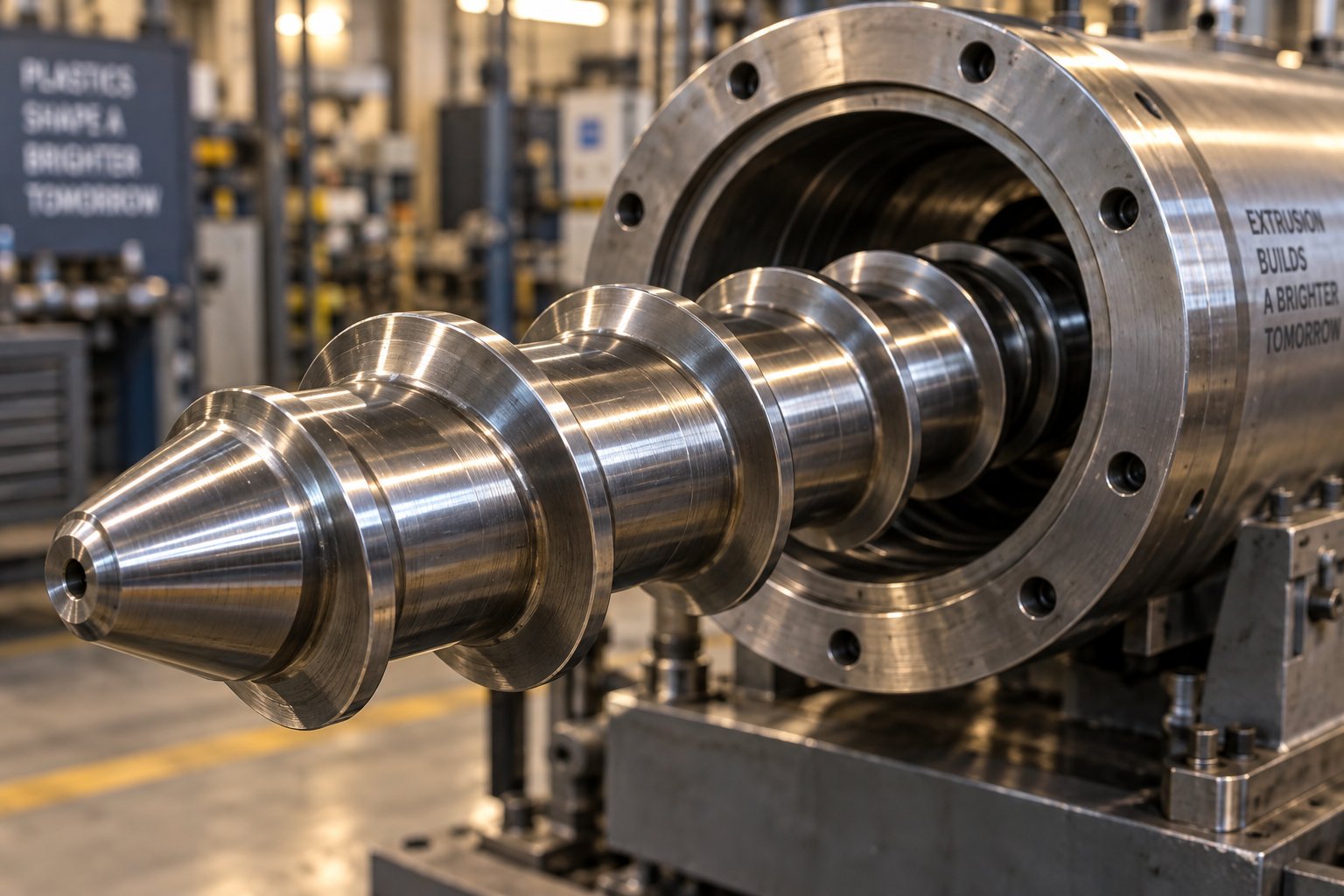
What Nobody Tells You About Screw Barrel For Plastic Machine Design
Oct 10, 2026
Learn how screw barrel for plastic machine design affects melt quality, throughput, and wear life. Covers geometry, resin matching, troubleshooting, and sourcing.
Read Article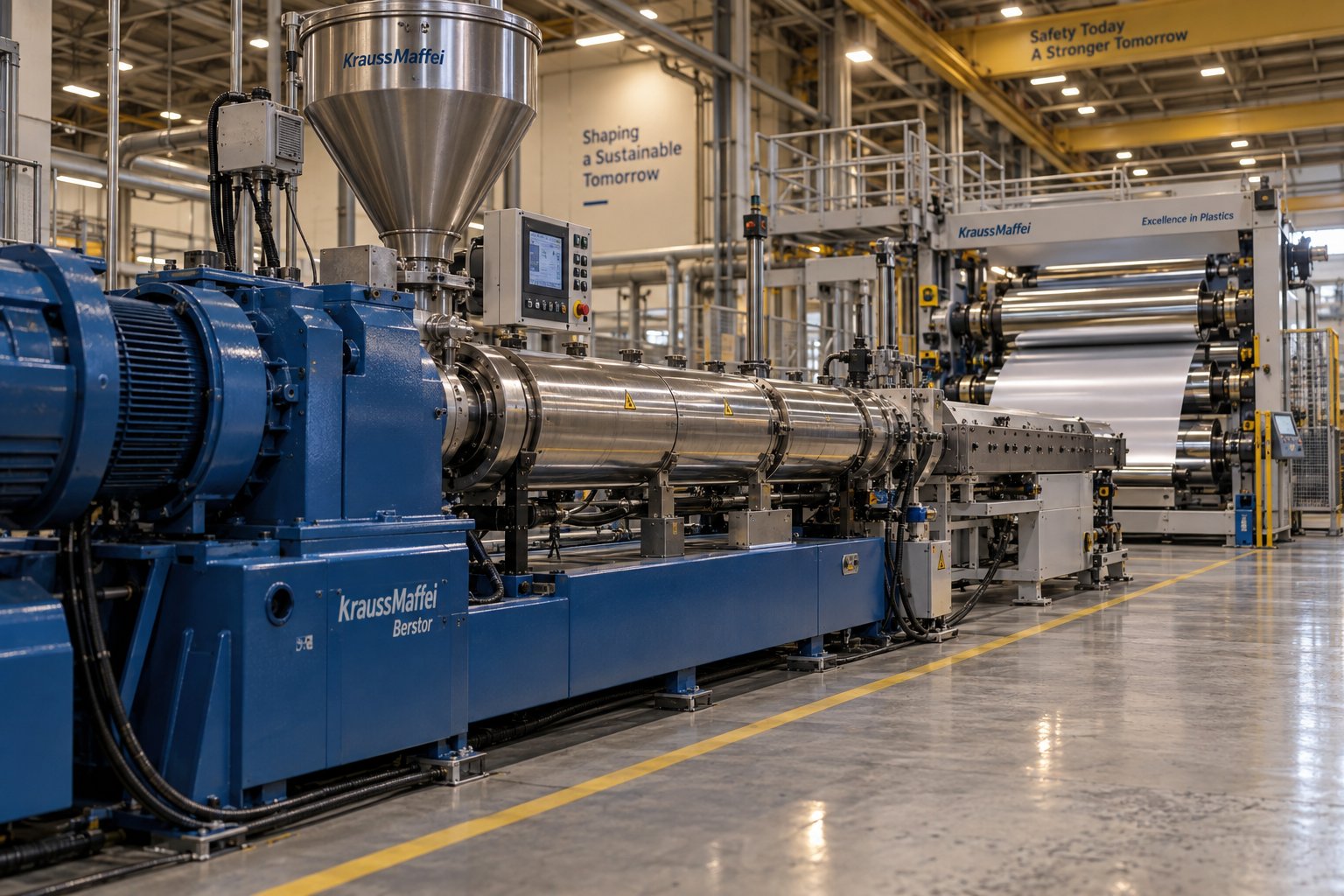
Single Screw Extruder for Sheet: Stop Guessing, Start Specifying
Oct 9, 2026
Learn how to specify a single screw extruder for sheet production. Covers screw geometry, resin-specific processing, troubleshooting, and maintenance best practices.
Read Article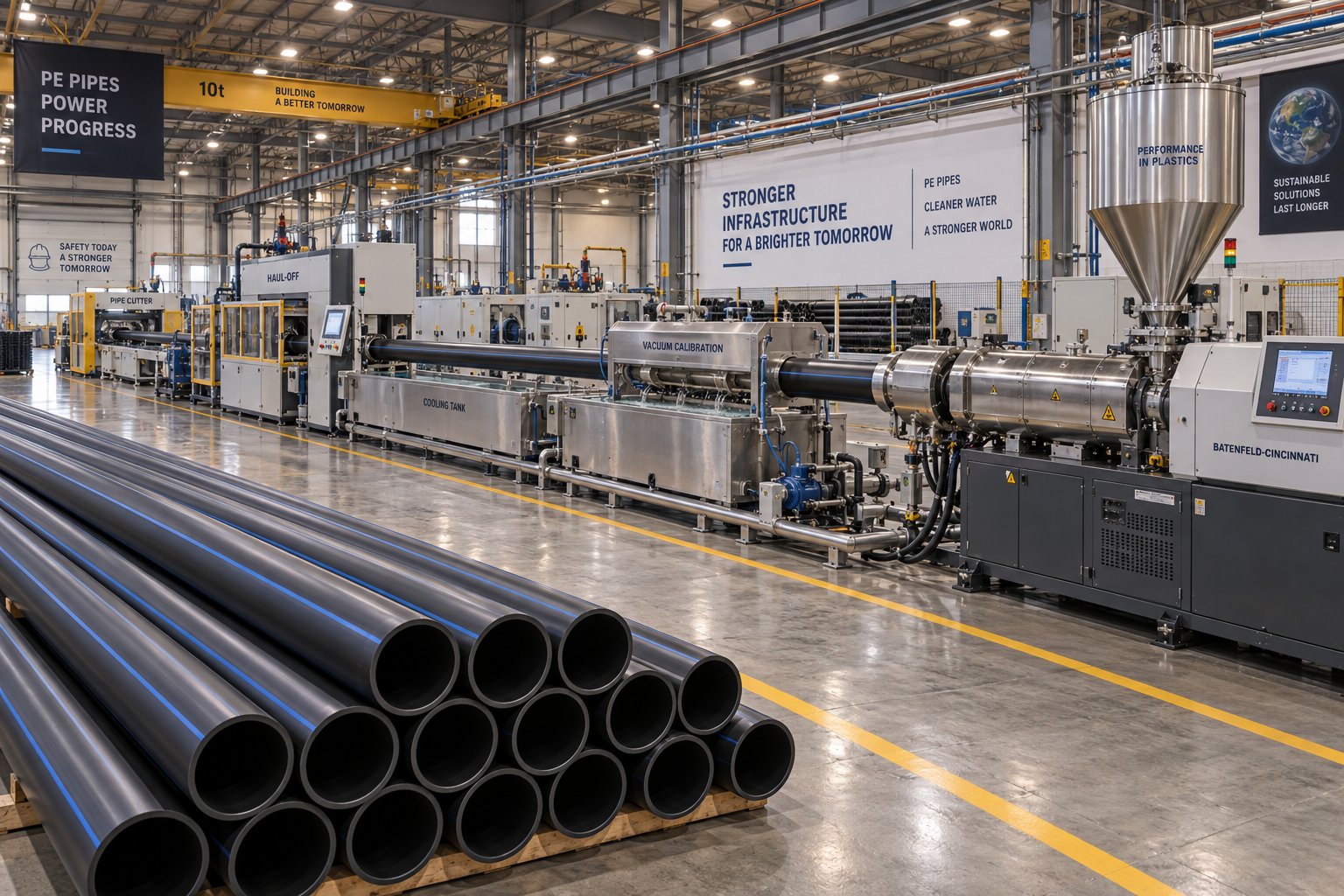
PE Pipe Extruder Machine: What Datasheets Won't Tell You
Oct 9, 2026
Learn how a PE pipe extruder machine works, key specs explained, material grade selection, maintenance tips, and buyer guidance beyond the datasheet.
Read ArticleLooking for something else?
Search by material, symptom or product and jump straight to the relevant page.
These are navigation suggestions based on keyword matching — not a quotation, not a delivery commitment, and not a substitute for engineering review. Final specification is confirmed by our engineers against your drawings and processed material.
Need help with screw barrel selection?
Share your machine model, processed material and application. Our team can help with pricing and technical support.