

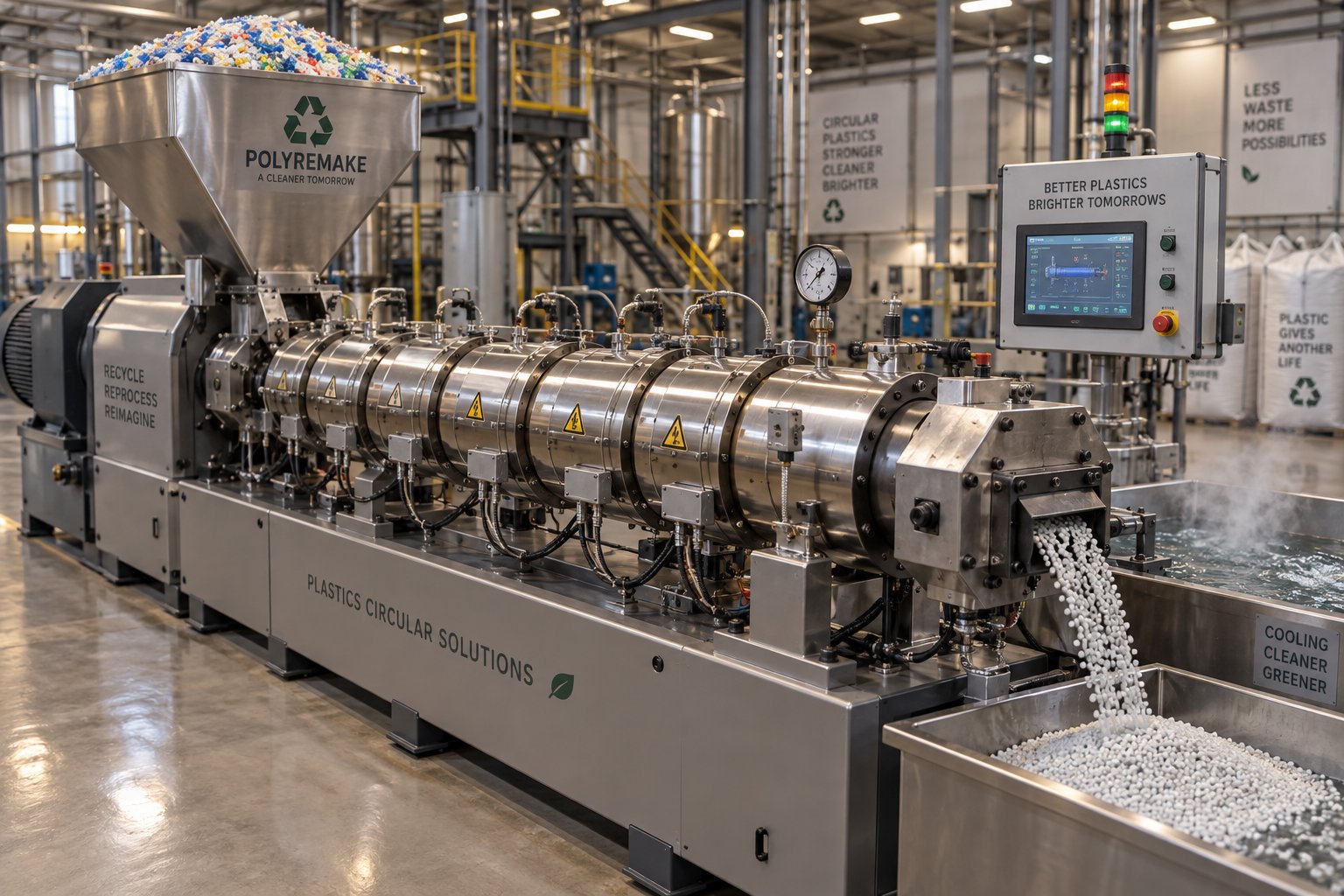
What a Single Screw Extruder Does in Plastic Recycling
Imagine a machine that takes messy, inconsistent plastic flakes — the kind left over after shredding and washing post-consumer bottles, film, or containers — and transforms them into uniform, market-ready pellets. That is exactly the job of a single screw extruder for recycling. It sits at the heart of nearly every plastics recycling line, bridging the gap between raw waste material and a reusable commodity.
A single screw extruder is a thermoplastic processing machine that uses one rotating helical screw inside a heated barrel to convey, melt, compress, and pressurize plastic waste into a homogeneous melt, which is then shaped through a die and cut into pellets ready for remanufacturing.
Defining the Single Screw Extruder
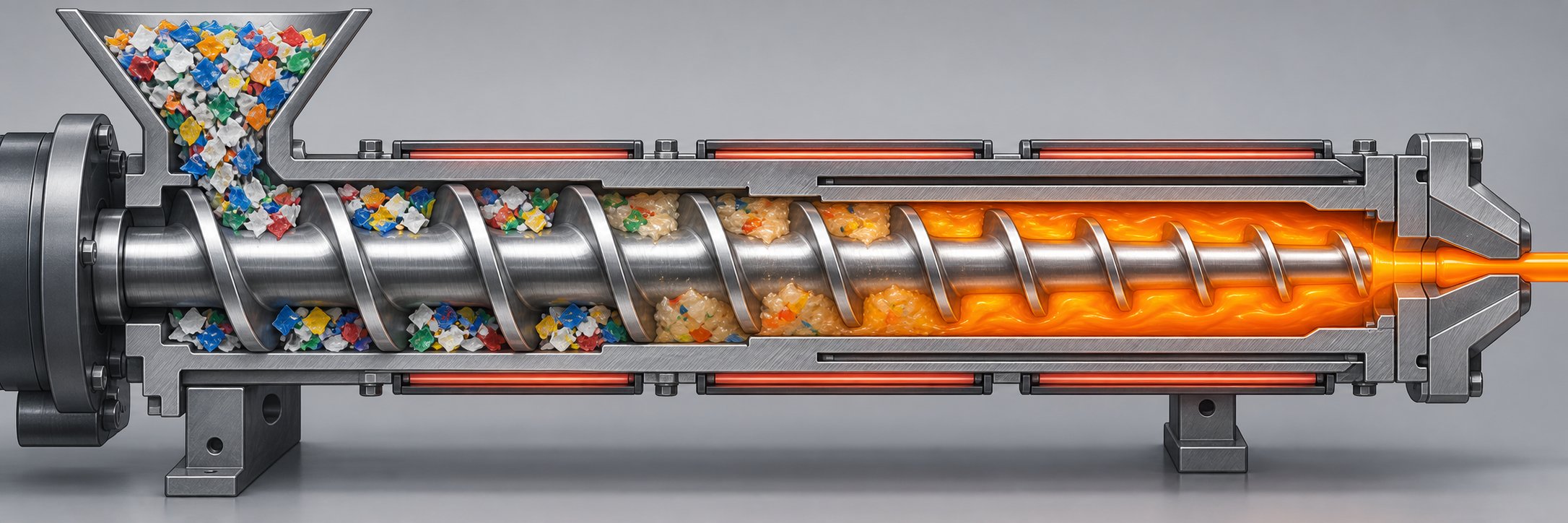
At its core, every single screw extruder machine works on a straightforward principle. A motor drives a single helical screw that rotates inside a tightly fitted, temperature-controlled barrel. As the screw turns, it grabs plastic material from the feed hopper, pushes it forward along the barrel, and subjects it to increasing heat and pressure. Friction between the plastic, the screw flights, and the barrel wall generates a significant portion of the melting energy, while external band heaters supply the rest. By the time the material reaches the far end, it has transformed from loose flakes or regrind into a fully molten, pressurized stream ready to be pushed through a die.
This simplicity is precisely why the single screw plastic extruder remains the workhorse of the recycling industry. Fewer moving parts mean lower maintenance demands, reduced capital cost, and easier day-to-day operation compared to more complex twin screw alternatives. For recycling operations processing relatively clean, single-resin streams — think post-consumer HDPE bottles or post-industrial PP scrap — a well-configured extrusion extruder delivers excellent throughput with reliable consistency.
Why Recycling Demands Specialized Extrusion
Processing recycled plastic is fundamentally different from extruding virgin resin. When you work with virgin pellets, feedstock quality is predictable: uniform pellet size, consistent melt flow index, minimal moisture, and zero contamination. Recycled material offers none of those luxuries. Consider what a typical recycling extruder must handle:
- Variable feedstock quality: Flakes from different collection batches may differ in size, thickness, and polymer grade.
- Contamination: Residual labels, adhesives, food residues, and mixed-in foreign polymers are common.
- Moisture content: Washed flakes often retain surface moisture that can cause defects during melting.
- Mixed melt flow indices: Even within a single resin type, post-consumer streams blend material from dozens of manufacturers with different formulations.
These challenges mean a plastic extruder designed for virgin resin production often underperforms when fed recycled material. Screw geometry, barrel venting, filtration systems, and feeding mechanisms all need to be adapted — or purpose-built — for the realities of post-consumer and post-industrial waste streams.
Who Benefits from This Technology
Whether you are a recycling plant operator evaluating new equipment, a business owner scaling up a washing-and-pelletizing line, or an engineer optimizing an existing setup, understanding how these machines work is essential. This guide is built as a practical resource — walking through screw design, degassing, material-specific processing, cost considerations, and real-world troubleshooting — so you can make informed decisions rather than relying solely on equipment sales pitches.
The mechanics behind this technology are elegant, but getting peak performance from recycled feedstock requires attention to details that general-purpose extrusion manuals rarely cover. The most critical of those details begins inside the barrel itself, where the journey from loose flakes to molten polymer unfolds across three distinct processing zones.
From Flakes to Pellets Inside the Recycling Extruder
So how does a heap of washed, shredded plastic flakes actually become a bag of clean, uniform pellets? The answer lies in a carefully orchestrated sequence of physical and thermal transformations that happen along the length of a single screw extrusion machine. Every inch of that barrel has a specific job, and understanding what happens at each stage gives you real control over output quality.
Here is the complete process, broken down into the major stages that recycled material passes through from hopper to finished pellet:
- Feeding: Washed and sized flakes enter the extruder through a hopper mounted above the feed throat.
- Conveying and preheating: The rotating screw grabs material and pushes it forward through the feed zone, where frictional heat begins warming the flakes.
- Compression and melting: The screw channel gets progressively shallower, squeezing the material. Combined with barrel heat, this converts solid flakes into a molten mass.
- Metering: The fully molten plastic enters a shallow, constant-depth section that stabilizes pressure and homogenizes the melt.
- Degassing (if equipped): Moisture and trapped volatiles escape through a vent port in the barrel.
- Melt filtration: The melt passes through a screen changer or continuous melt filter that catches contaminant particles, unmelted fragments, and foreign material.
- Die extrusion: Clean melt is forced through a die plate containing multiple small holes, forming strands or directly feeding an underwater pelletizer.
- Pelletizing and cooling: Strands are cooled in a water bath and chopped into pellets by a strand pelletizer, or cut at the die face by an underwater or water-ring system.
Each stage depends on the one before it. Skip a step or get one wrong, and it cascades through the rest of the line. Let's look at the three critical barrel zones in detail.
Feed Zone and Handling Recycled Flakes
The feed zone is where everything starts — and where recycling operations face their first major challenge. This section of the screw has deep, constant-depth channels designed to grab incoming material and convey it forward. With virgin pellets, feeding is effortless because uniform pellet shapes flow freely and pack tightly. Recycled flakes are a different story entirely.
Imagine pouring a handful of cornflakes into a funnel versus pouring marbles. The cornflakes tangle, bridge, and trap air between them. Recycled plastic flakes behave the same way. Film flakes are especially problematic — their low bulk density means the screw channels fill mostly with air rather than plastic. The result? Dramatically reduced throughput and erratic output.
This is where force-feeding systems become essential. A crammer feeder uses a secondary auger or ram mechanism mounted above the feed throat to actively push low-bulk-density flakes into the screw channel, replacing gravity with mechanical force. These devices can restore throughput on a screw extruder to levels approaching pellet-fed rates, even with challenging materials like film scrap or foam regrind. Without a crammer, operators often find their machine running at a fraction of its rated capacity simply because the screw cannot grab enough material per revolution.
Grooved feed sections offer another solution. These barrels feature machined grooves — axial or helical — in a separately water-cooled feed zone that grip the incoming flakes and prevent them from spinning with the screw rather than moving forward. This improved intake is particularly helpful with slippery, high-crystallinity resins like HDPE.
Compression and Melting of Post-Consumer Waste
As material advances past the feed zone, it enters the compression (or transition) zone — the section where the real transformation happens. Here, the screw channel depth gradually decreases, and you can think of it as the walls slowly closing in on the plastic. This shrinking volume does three critical things simultaneously:
- Expels trapped air: The air captured between flakes during feeding gets pushed backward toward the open feed throat rather than traveling forward into the melt.
- Increases pressure: The tightening channel compacts the flakes against the hot barrel wall, building the pressure needed to drive material toward the die.
- Generates frictional heat: Plastic rubbing against the barrel wall, the screw root, and other flakes creates significant shear heating that, combined with external barrel heaters, melts the material.
Melting in a screw extruder does not happen all at once. A thin film of molten plastic forms where the compacted material contacts the heated barrel wall. The screw's rotation continuously scrapes this melt film off and replaces it with fresh solid material — a process that repeats over and over as the plastic moves downstream. The rate at which this happens determines overall melting efficiency and, ultimately, how fast you can run the line without pushing unmelted particles through to the die.
For recycled material, the compression zone is particularly demanding. Flakes are irregularly shaped and vary in thickness, so they do not compact as predictably as uniform pellets. Residual moisture flashes into steam in this zone, and any remaining contaminants begin to decompose. These factors make screw geometry and barrel temperature profiles in the compression zone some of the most consequential design decisions for any recycling extruder.
Metering, Filtration, and Pelletizing
By the time the plastic reaches the metering zone — the final section of the screw — it should be fully molten. This zone features a shallow, constant-depth channel that serves as the precision stage of the process. Its job is to stabilize the melt pressure and deliver a consistent, homogeneous flow to the downstream equipment. Think of it as the quality-control checkpoint inside the barrel: any inconsistencies in temperature, pressure, or melt uniformity here will show up directly in your finished pellets.
Many recycling screws incorporate mixing elements in or near the metering zone. Distributive mixing sections split and recombine the melt stream to improve thermal uniformity, while dispersive elements break down any remaining gels or agglomerates. A common design places a Maddock-style mixing section a few turns before the screw tip, where paired flutes and a barrier ridge force the melt to pass through a tight clearance — straining out unmelted particles and shearing the melt for better consistency.
Once the melt exits the screw, it passes through a screen changer or continuous melt filter. This is a non-negotiable component on any recycling line. Screen packs — fine metal meshes supported by a breaker plate — trap contaminant particles, degraded polymer fragments, and any foreign material that survived washing. Automatic or hydraulic screen changers allow operators to swap clogged screens without stopping the line, which is critical when processing post-consumer waste with unpredictable contamination levels.
After filtration, the clean melt reaches the die and the extruder pelletizer stage. Two pelletizing approaches dominate recycling applications:
- Strand pelletizing: Melt exits the die as multiple thin strands, runs through a water-cooling bath, and feeds into a strand cutter that chops them into cylindrical pellets. Simple and cost-effective, but sensitive to strand breakage with low-melt-strength materials.
- Underwater pelletizing: Melt is cut directly at the die face by rotating blades inside a water-filled chamber. This pelletizing extruder configuration produces uniform, spherical pellets and handles a wider range of resins — though at a higher equipment cost.
The pellets are dried, classified by size, and collected for packaging or direct use in downstream manufacturing. Every component — from the crammer feeder at the start to the pelletizer at the end — must work in harmony to keep the line running efficiently.
Getting this process right, however, depends heavily on something that is easy to overlook: the geometry of the screw itself. Small changes in channel depth, pitch, and flight design can dramatically shift melting behavior, output consistency, and the quality of the finished pellet.
Screw Design Principles That Drive Recycling Performance
You already know that a single screw plastic extruder machine has three barrel zones — feed, compression, and metering. But the way those zones are shaped and proportioned is what separates a machine that produces clean, consistent pellets from one that constantly fights surging output, unmelted specks, and degraded material. That shaping comes down to screw geometry, and a handful of design parameters have an outsized impact on how well your extruder handles recycled feedstock.
Sounds technical? It does not have to be. Think of the screw as a carefully sculpted corkscrew whose proportions control how aggressively it grabs, squeezes, melts, and pushes your material forward. Changing any one of those proportions shifts the entire balance of the process. Here is what matters most — and why.
L/D Ratio and Compression Ratio Explained
Two numbers define the fundamental character of any extruder for polymer recycling: the L/D ratio and the compression ratio.
L/D ratio stands for the length-to-diameter ratio of the screw. If you have a screw with a 100 mm diameter and a 3,000 mm working length, you have a 30:1 L/D ratio. A longer screw relative to its diameter gives the plastic more time and distance inside the barrel — more time to absorb heat, more channel length for melting, and more opportunity for mixing. For virgin resin extrusion, an L/D of 24:1 to 28:1 is common. Recycling extruders typically run longer, in the range of 30:1 to 36:1, because the inconsistent nature of post-consumer flakes demands that extra residence time to achieve a fully homogeneous melt.
Imagine rushing through a meal versus savoring it slowly. A short screw rushes the material — fine when the feedstock is perfectly uniform, but a recipe for trouble when your flakes vary in size, moisture content, and contamination level. The longer barrel gives the polymer extruder room to thoroughly melt everything and blend temperature differences before the material reaches the die.
Compression ratio describes how much the screw channel shrinks from the feed zone to the metering zone. It is calculated by dividing the channel depth at the feed end by the channel depth at the metering end. A compression ratio of 3:1 means the channel at the start is three times deeper than at the finish. That shrinking channel is what squeezes out trapped air and forces the flakes against the hot barrel wall to melt.
Here is where recycling gets tricky. Virgin pellets have a high bulk density — they pack tightly, so a moderate compression ratio works well. Recycled flakes, especially film scrap, are fluffy and full of air. They need deeper feed channels to capture enough material per screw revolution, combined with a compression ratio carefully matched to the material's bulk density. Too much compression too quickly and you jam the feed; too little and you cannot build enough pressure to fully melt and convey the plastic. Typical recycling screws use compression ratios between 2.5:1 and 4:1, depending on the resin and flake geometry.
Barrier Screws and Mixing Elements for Recycled Material
A standard single-flighted screw relies on a gradual channel-depth reduction to melt the plastic. It works, but it has a limitation: the boundary between solid and molten material inside the channel is unpredictable, especially with irregular recycled flakes. Chunks of unmelted plastic can break loose from the solid bed and ride the melt stream all the way to the die, showing up as specks or gels in your pellets.
Barrier screw designs solve this problem elegantly. They introduce a secondary flight — a thin barrier ridge — that runs alongside the main flight through the compression zone. This barrier divides the screw channel into two sub-channels: one for the remaining solids and one for the accumulating melt. The clearance over the barrier flight is tight enough that only molten plastic can pass through. Solid fragments are held back in the solids channel until they finish melting. The result is a cleaner, more complete melt by the time the material reaches the metering zone — a meaningful advantage when your feedstock quality varies from batch to batch.
Even with a barrier design, the melt can still carry thermal gradients and minor compositional inconsistencies, particularly when you are processing post-consumer waste with mixed melt flow indices. This is where mixing elements come in. As NC State Extension's extrusion research explains, mixing during extrusion performs two distinct functions:
- Distributive mixing evenly spreads the melt components without applying intense force — imagine folding cake batter to blend it uniformly. On a single screw, pin-style or pineapple mixing sections split and recombine the melt stream repeatedly to eliminate temperature variations and spread additives or colorants evenly.
- Dispersive mixing applies strong shear stress to break down clumps, gels, or agglomerates of material. Maddock (or Union Carbide) mixing sections are the most common dispersive element on a single screw recycling line. They force the entire melt through a narrow gap between a barrier ridge and the barrel wall, shearing apart any remaining unmelted particles or contaminant clusters.
Many recycling screws combine both types. A typical configuration might use a barrier flight through the compression zone for controlled melting, followed by a dispersive Maddock section and then a distributive pin mixer before the screw tip. This layered approach compensates for the feedstock variability that makes an extruder machine for plastic recycling fundamentally harder to optimize than one running virgin resin.
How Screw Geometry Affects Pellet Quality
Every parameter discussed above cascades directly into the quality of your finished pellets. Here is a practical summary of the key screw design variables and what they control on the production floor:
- L/D ratio (30:1 to 36:1 for recycling): Longer ratios improve melt homogeneity and allow adequate degassing zones; too short and you get inconsistent melt temperature and unmelted particles.
- Compression ratio (typically 2.5:1 to 4:1): Must match the bulk density of your feedstock; incorrect ratios cause feeding instability or incomplete melting.
- Barrier flight design: Separates solids from melt during compression, reducing unmelted specks and improving pellet clarity and consistency.
- Dispersive mixing elements: Break down gels, contaminant agglomerates, and unmelted fragments — directly reducing defects visible in the finished pellet.
- Distributive mixing elements: Homogenize melt temperature and composition, critical for uniform pellet color and mechanical properties.
- Flight pitch and depth: Influence conveying rate, shear intensity, and residence time — all of which affect throughput and thermal exposure.
Getting these parameters right is not about chasing a single "perfect" screw. It is about matching the screw geometry to your specific resin, your flake quality, and your throughput targets. A screw optimized for post-consumer HDPE bottles will perform poorly on LDPE film regrind because the bulk densities, melting behaviors, and shear sensitivities are fundamentally different.
Yet even a perfectly designed screw cannot overcome one persistent challenge that recycled feedstock brings to the barrel: trapped moisture and volatile contaminants that turn into gas pockets the moment the plastic melts. Dealing with those gases requires a specialized barrel configuration that most virgin-resin extruders simply do not have.
Vented Degassing Extruders and Why They Matter for Recycling
Moisture and volatiles are invisible saboteurs. You can nail the screw geometry, dial in your barrel temperatures perfectly, and still end up with pellets riddled with bubbles, voids, and silver streaks — all because trapped gases had no way out. For any industrial extruder processing post-consumer waste, a vented degassing configuration is not a luxury feature. It is the difference between pellets your buyer accepts and pellets that get rejected at the dock.
In recycling extrusion, degassing is often the single most important factor separating saleable pellets from rejected output — because no amount of downstream quality control can fix gas pockets and voids that formed inside the barrel.
Why Recycled Plastics Produce Volatiles During Extrusion
When you extrude virgin resin, the material arrives dry, clean, and thermally stable. Recycled flakes carry baggage. Even after thorough washing, residual surface moisture clings to flake surfaces and hides in micro-crevices. Adhesive residues from labels break down into volatile organic compounds at processing temperatures. Printing inks off-gas. Residual food contamination decomposes. And hygroscopic polymers like PET actively absorb atmospheric moisture during storage between the wash line and the extruder.
The moment these flakes melt inside the barrel, every one of those contaminants becomes a gas. Water flashes to steam. Organic residues decompose into low-molecular-weight volatiles. As Edwards Vacuum notes, effective degassing removes residual moisture, air, monomers, oligomers, solvents, and decomposition products that would otherwise degrade the final product. Without an exit path, these gases remain trapped in the melt and manifest as visible defects in the finished pellets — foaming, internal voids, surface pitting, and the characteristic silver streaks that immediately signal a moisture problem to any experienced operator.
How Vented Barrel Configurations Remove Moisture and Gas
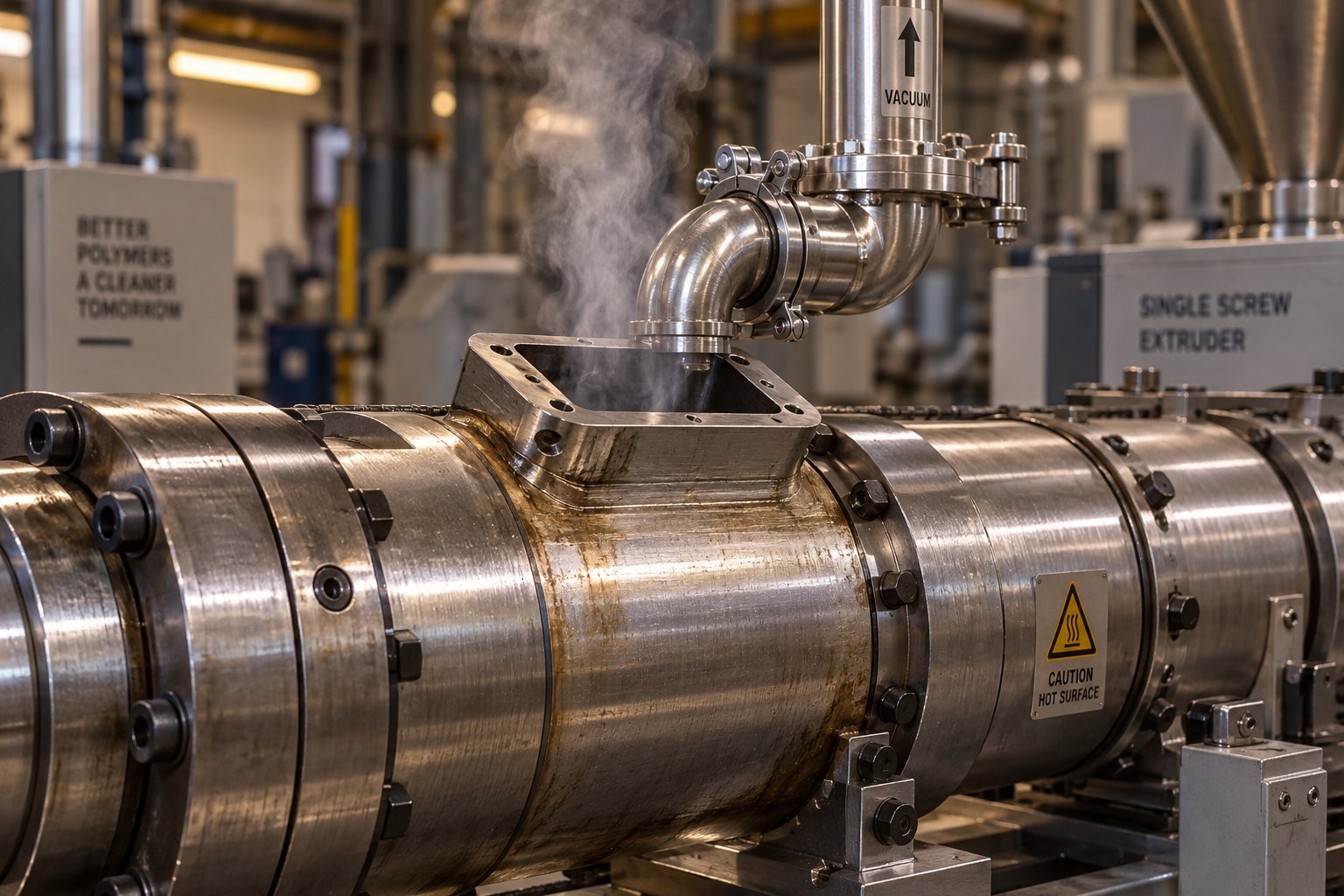
A vented plastic extruder machine solves this problem through clever screw engineering. Here is how it works: the screw is designed with a deliberate decompression zone — a section where the channel depth suddenly increases, dropping the melt pressure close to zero. At this low-pressure point, a vent port is machined into the barrel wall. Gases that were dissolved or trapped under pressure in the melt suddenly have room to expand and escape, rising out through the open vent.
Most recycling configurations connect the vent port to a vacuum pump, which actively pulls volatiles out rather than relying on atmospheric venting alone. Vacuum levels typically range from 1 to 200 mbar depending on the application, with deeper vacuum pulling more aggressively for heavily contaminated or moisture-laden feedstock. The extracted gases pass through a condensation trap that captures volatiles before they reach the pump, keeping the system clean and efficient.
Think of it like opening a pressure cooker's valve. The steam inside needs a controlled release point, and the decompression zone in the screw creates exactly that. After the vent, the screw channel depth decreases again, recompressing the now-degassed melt and building pressure for the metering zone, filtration, and die. The key engineering challenge is ensuring the decompression zone drops pressure enough for effective gas release without allowing molten polymer to creep up through the vent port — a messy condition operators call "vent flow" that immediately shuts down production.
Single-Vent vs Dual-Vent Extruder Setups
Not all recycling feedstocks are equally challenging, and the number of vent ports on your plastics extrusion equipment should match the severity of the volatile load you are dealing with.
Single-vent configurations are the most common setup for recycling plastic extruders processing pre-dried or moderately moist flakes. One decompression zone and vent port, positioned roughly two-thirds down the barrel, handles the bulk of moisture and volatile removal. This works well for post-industrial regrind, washed HDPE bottle flakes with controlled moisture levels, and most PP recycling streams where feedstock preparation is thorough.
Dual-vent configurations add a second decompression-and-venting stage further downstream. This setup is warranted when you are dealing with:
- High-moisture feedstock: Flakes coming directly off a wash line without adequate drying, or hygroscopic resins like PET and nylon that re-absorb moisture quickly.
- Heavily printed or labeled material: Post-consumer packaging with significant ink and adhesive contamination that generates large volumes of volatiles during melting.
- Mixed post-consumer streams: Material with unpredictable contamination profiles where a single vent simply cannot extract enough gas in one pass.
The trade-off with dual-vent systems is complexity and cost. The screw must incorporate two separate decompression-recompression sequences, which typically demands a longer L/D ratio — often 36:1 or higher — and increases the precision required in screw manufacturing. The barrel needs two vacuum connections, two condensation traps, and more instrumentation. But for operations processing unwashed or partially dried post-consumer waste, the second vent can eliminate the need for energy-intensive pre-drying equipment entirely, offsetting the higher machine cost with savings in upstream energy consumption.
The practical takeaway is straightforward: match your degassing capability to your feedstock's moisture and contamination profile. Over-specifying wastes capital; under-specifying produces defective pellets. And because feedstock quality in recycling is inherently variable, many operators find that a vented extruder gives them a safety margin that a non-vented machine simply cannot provide — turning borderline material into acceptable output on days when flake moisture creeps above target.
Degassing capability, however, is only one half of the configuration decision recyclers face. The other half involves choosing between single screw and twin screw architectures altogether — a comparison that looks very different when evaluated through the specific lens of recycling economics and operational realities.
Single Screw vs Twin Screw Extruders for Recycling Compared
Choosing between a single screw and a twin screw extruder is one of the most consequential decisions in any recycling operation — and generic comparisons built around virgin-resin processing rarely tell the whole story. Recycling introduces variables that shift the calculus dramatically: contamination levels, moisture loads, mixed-resin batches, and the economic reality of turning low-value waste into a saleable commodity on thin margins. What matters here is not which machine is "better" in the abstract, but which architecture fits your specific feedstock, your throughput targets, and your budget.
Key Decision Factors for Recycling Operations
When you are evaluating the plastic extrusion equipment market for a recycling line, eight factors consistently rise to the top of the decision matrix. Capital cost is the obvious starting point — a twin screw extruder price typically runs two to five times higher than a comparable single screw system, driven by the complex gearbox, modular screw elements, and tighter manufacturing tolerances required for intermeshing screws. But purchase price alone is misleading without weighing energy consumption, maintenance burden, operator skill requirements, and the machine's tolerance for the kind of feedstock your operation actually handles.
The following table breaks down these factors side by side, focused specifically on recycling applications rather than general-purpose extrusion:
| Decision Factor | Single Screw Extruder | Twin Screw Extruder |
|---|---|---|
| Capital Cost | Lower — typically 2x to 5x less than twin screw for comparable throughput | Higher — complex gearbox, modular screws, and precision engineering drive up cost |
| Throughput Range | Wide range; large-diameter machines readily exceed 1,500 kg/hr on clean streams | Comparable at smaller diameters; large-scale recycling throughput often requires bigger frames |
| Energy Efficiency | Generally lower specific energy (kWh/kg) for single-resin, clean feedstock | Can achieve competitive or lower specific energy when intensive mixing is required |
| Contamination Tolerance | Moderate — relies on upstream washing and melt filtration to manage contaminants | Higher — superior mixing and self-wiping action handle contaminated streams more effectively |
| Moisture Sensitivity | Managed via vented barrel configurations; adequate for pre-dried or moderately moist flakes | Strong inherent degassing due to intermeshing geometry; handles high-moisture feedstock more aggressively |
| Mixed-Resin Handling | Limited — best with single-resin or closely compatible blends | Excellent — intensive distributive and dispersive mixing handles multi-resin and filled streams |
| Maintenance Complexity | Lower — simpler design, fewer wear components, in-house service often feasible | Higher — modular screw elements, tight tolerances, and specialized service requirements increase cost and downtime |
| Operator Skill Level | Moderate — straightforward controls and fewer process variables to manage | Higher — more parameters, complex screw configurations, and process interactions demand advanced training |
| Cleaning / Material Changeover | Faster and simpler — single screw pulls out in one piece for cleaning | More involved — segmented screws and tight barrel tolerances require careful disassembly |
| Best-Suited Recycling Streams | Clean post-industrial scrap, sorted post-consumer HDPE, PP, LDPE, and PS | Mixed post-consumer waste, engineering plastics, heavily printed film, fiber-reinforced regrind |
Where Single Screw Extruders Excel in Recycling
For the majority of commercial recycling operations — those processing sorted, washed, single-resin streams — a single screw extruder remains the most practical and cost-effective choice. Picture a facility pelletizing washed HDPE bottle flakes or post-industrial PP trim. The feedstock is reasonably consistent, contamination is controlled through upstream preparation, and the goal is high-volume output at the lowest possible cost per kilogram. In this scenario, a well-configured single screw machine with a vented barrel and proper melt filtration delivers reliable pellet quality day after day.
The economic advantages compound over time. Lower maintenance costs — with annual routine maintenance often ranging from a few thousand to around $15,000 compared with $20,000 to $35,000 for twin screw systems — mean the gap between the two technologies widens across a ten-year equipment lifespan. Simpler mechanical design translates to higher availability rates, often 92% to 96% with proper upkeep. And when parts do wear, replacement screws and barrels are more affordable and more readily available, including through aftermarket suppliers that keep lead times short.
There is also a practical reality that rarely appears in equipment brochures: operator accessibility. Many recycling facilities, particularly in emerging markets or smaller operations, cannot recruit or retain the highly trained technicians that a twin screw system demands. A single screw line is forgiving enough for operators with solid but not specialized training to run effectively — reducing labor costs and turnover risk simultaneously.
When a Twin Screw Extruder Is the Better Choice
Honesty matters here. There are recycling applications where insisting on a single screw machine will cost you more in rejected output, downtime, and frustrated customers than the upfront savings are worth. If your operation faces any of these scenarios, a twin screw extruder deserves serious consideration:
- Heavily contaminated post-consumer streams: When feedstock carries significant residual printing ink, adhesives, multi-layer laminate fragments, or organic contamination that cannot be fully removed by washing, twin screw systems provide the intensive mixing and degassing needed to produce an acceptable melt.
- Mixed-resin recycling: Processing commingled plastics — say, a blend of PE and PP from a materials recovery facility — requires the dispersive mixing capability that intermeshing twin screws deliver. A single screw simply cannot homogenize incompatible polymers effectively.
- Reactive compounding and upcycling: Operations adding chain extenders to rebuild molecular weight in degraded PET, or blending compatibilizers into mixed-resin streams, need the precise residence time distribution and mixing intensity that twin screw geometry provides.
- Fiber-reinforced or heavily filled regrind: Engineering plastic waste containing glass fibers or high mineral filler loadings demands the conveying and mixing characteristics of a co-rotating twin screw to maintain fiber length and achieve uniform dispersion.
Many advanced recycling facilities are also adopting two-stage extrusion lines that combine both technologies: a single screw extruder with a large L/D ratio handles pre-melting and coarse filtration in the first stage, while a co-rotating twin screw handles deep degassing, additive blending, and fine modification in the second. This hybrid approach captures the cost efficiency and throughput of single screw technology while leveraging twin screw mixing where it matters most.
If you are exploring the used twin screw extruder for sale market to reduce capital outlay, be cautious. A used twin screw extruder can offer significant savings, but worn screw elements and barrel liners in a twin screw system degrade mixing performance far more noticeably than equivalent wear in a single screw — making thorough inspection of wear components essential before purchasing secondhand equipment.
Ultimately, the right architecture depends less on which technology is "superior" and more on what your material actually demands. And what your material demands — barrel temperatures, screw speeds, drying requirements, and degradation risks — varies enormously depending on which resin you are recycling.
Material Compatibility and Processing Parameters by Resin Type
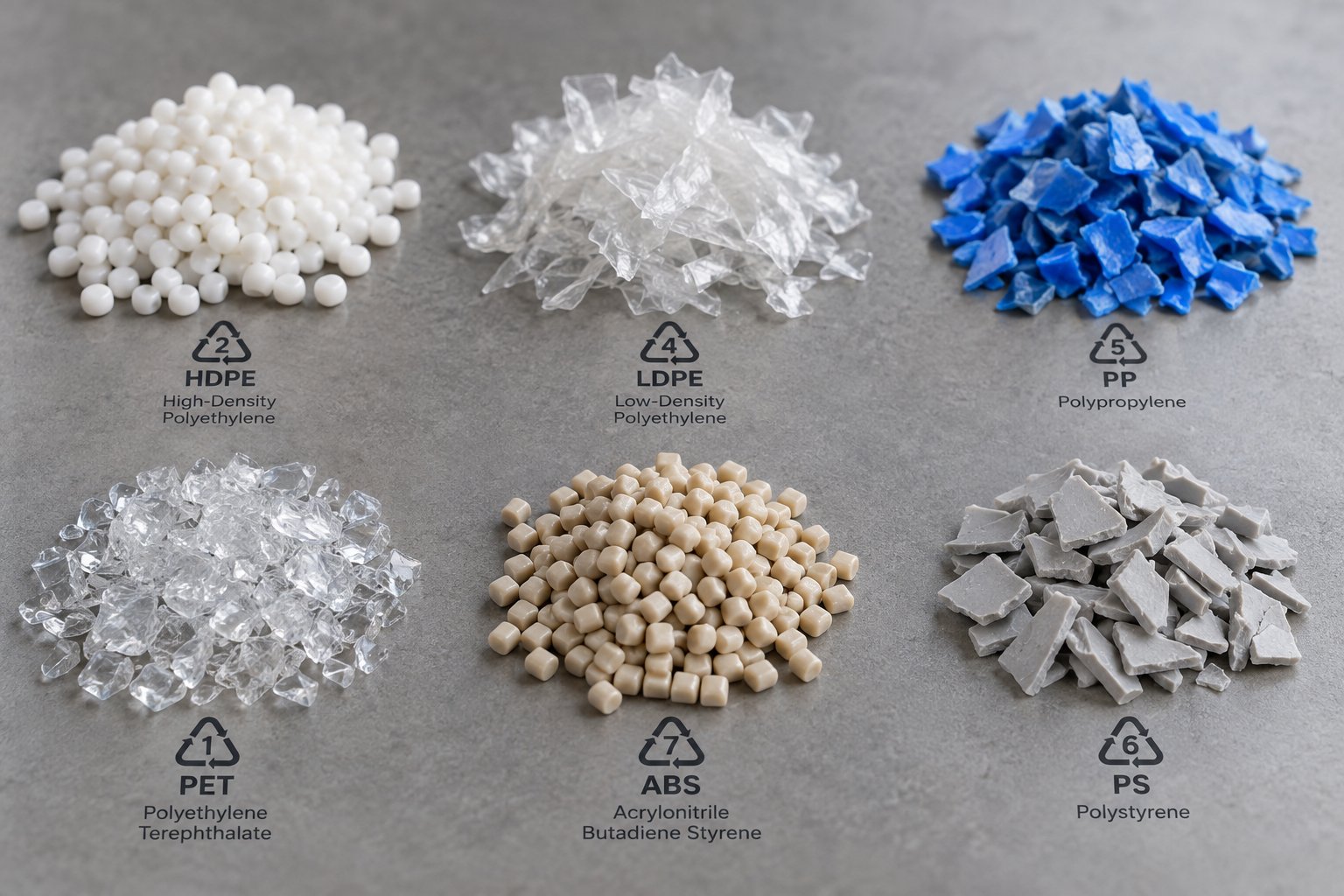
Every thermoplastic has its own personality inside the barrel. HDPE behaves nothing like PET, and LDPE film flakes create headaches that rigid PP regrind never will. Running a single screw extruder for recycling effectively means understanding how each resin responds to heat, shear, and pressure — and adapting your setup accordingly. Treat all resins the same and you will either degrade the sensitive ones or under-process the stubborn ones.
The table below provides a general-reference guide for the six most commonly recycled thermoplastics. Keep in mind that exact temperatures and screw speeds vary by grade, equipment manufacturer, and flake quality — always cross-reference with your material data sheets and equipment documentation for precise setpoints.
| Resin Type | General Barrel Temperature Range | Key Processing Challenges | Recommended Screw Features |
|---|---|---|---|
| HDPE | 190 - 240 °C (varies by grade) | High melt viscosity; can generate excessive shear heat at high screw speeds; residual contaminants from post-consumer bottles | Moderate compression ratio (3:1 to 3.5:1); barrier flight for controlled melting; grooved feed zone improves intake of slippery flakes |
| LDPE | 160 - 220 °C (varies by grade) | Very low bulk density film flakes; low melt strength causes strand breakage during pelletizing; prone to thermal degradation at high temperatures | High compression ratio (3.5:1 to 4.5:1) to compensate for low bulk density; shorter L/D acceptable if feedstock is clean; force-feeder often essential |
| PP | 200 - 250 °C (varies by grade) | Sensitive to oxidative degradation; narrow processing window for some copolymer grades; mixed MFI in post-consumer streams | Moderate compression ratio; mixing elements for melt homogenization; vented barrel recommended to remove oxidation byproducts |
| PET | 260 - 290 °C (varies by grade) | Hygroscopic — requires thorough drying (typically below 50 ppm moisture) to prevent hydrolytic degradation; high processing temperatures; prone to IV (intrinsic viscosity) loss | Longer L/D (34:1+); dual-vent degassing strongly recommended; low-shear metering zone to minimize chain scission |
| ABS | 210 - 250 °C (varies by grade) | Sensitive to moisture; yellowing and gloss loss from thermal degradation; butadiene component degrades under excessive heat history | Moderate compression ratio; dispersive mixing to break down any rubber-phase agglomerates; vented configuration for moisture removal |
| PS | 180 - 230 °C (varies by grade) | Brittle at room temperature — pellet breakage during cutting; relatively easy to melt but sensitive to overheating; styrene monomer off-gassing at elevated temperatures | Lower compression ratio (2.5:1 to 3:1); moderate screw speed to limit shear heating; vented barrel to capture styrene monomer vapors |
Note: Temperature ranges above are general guidelines for recycled grades. Actual setpoints depend on your specific material grade, flake moisture level, throughput rate, and equipment configuration. Always consult your resin supplier's processing data sheet and your extruder manufacturer's documentation before finalizing barrel profiles.
Processing HDPE and LDPE Recycled Flakes
HDPE and LDPE are the two highest-volume polyolefins in the recycling stream, but they behave very differently inside a plastic extruding machine. HDPE — sourced primarily from milk jugs, detergent bottles, and rigid containers — arrives as relatively dense, uniform flakes that feed well into a standard hopper. Its high melt viscosity means the screw generates substantial shear heat during compression, so operators often find the barrel heaters cycling off in the compression and metering zones because the material is self-heating. The practical risk here is overheating: excessive screw speed drives temperatures beyond the target range, causing oxidative degradation that yellows the pellets and reduces impact strength.
LDPE tells a completely different story. Most recycled LDPE comes from agricultural film, stretch wrap, or shopping bags — materials that shred into thin, lightweight flakes with extremely low bulk density. Imagine trying to push feathers into a meat grinder. Without a crammer or force-feeding system, a standard hopper-fed extruder runs at a fraction of its rated capacity because the screw channels fill with air instead of plastic. A higher compression ratio — often 3.5:1 to 4.5:1 — helps compensate by providing deeper feed channels and more aggressive volume reduction through the transition zone.
LDPE also has notoriously low melt strength, which creates problems downstream. During strand pelletizing, the molten strands sag and break easily in the cooling bath if the melt temperature or line speed is not carefully controlled. Many recyclers processing LDPE opt for underwater or water-ring pelletizing systems instead, where the die-face cutting eliminates the strand breakage problem entirely. On a pp extruder or HDPE line, strand pelletizing works reliably — but when you switch that same plastic tube extruder configuration to LDPE film scrap, you quickly learn why pelletizing method matters as much as the extruder itself.
Recycling PP, PET, and Styrenics on a Single Screw Line
Polypropylene is forgiving to extrude but unforgiving when it comes to degradation. PP is particularly sensitive to oxidative breakdown during thermal processing — each heat cycle clips polymer chains and reduces melt viscosity. You will notice this as a gradual increase in melt flow rate across successive recycling passes. For a recycling operator running post-consumer PP containers, this means the pellets may process fine today but become progressively less suitable for demanding applications unless stabilizer additives are incorporated during extrusion. A vented barrel helps by removing oxidation byproducts, and mixing elements ensure any added stabilizers disperse uniformly through the melt.
PET is the most technically demanding resin on this list. It is hygroscopic, meaning it absorbs moisture from the air — and that moisture triggers hydrolytic degradation the moment the polymer reaches processing temperature. Water molecules attack the ester linkages in the PET chain, splitting them apart and causing a measurable drop in intrinsic viscosity (IV). The result is weaker, more brittle pellets that cannot meet specifications for bottle-grade or fiber-grade applications. Thorough pre-drying to below 50 ppm moisture content is non-negotiable, and a dual-vent degassing configuration provides an additional safety net for any residual moisture that slips through. PET recycling extruding machines also benefit from longer L/D ratios — typically 34:1 or above — to provide adequate residence time for gentle, thorough melting without excessive shear that further accelerates chain scission.
ABS and PS — the styrenics — are comparatively easier to process but carry their own risks. ABS contains a butadiene rubber phase that degrades under prolonged heat exposure, causing yellowing and loss of impact strength. PS melts readily at moderate temperatures, but overheating drives off styrene monomer, which creates both a quality issue and a workplace safety concern. Both resins benefit from moderate screw speeds and vented barrels. PS is also brittle at room temperature, so pellet geometry and cutter speed need attention to avoid excessive fines and broken pellets during the cutting stage.
Managing Polymer Degradation Across Multiple Heat Histories
Here is a reality that every recycler must confront: every time a thermoplastic passes through an extruder, it degrades. The polymer chains get shorter. Molecular weight drops. Mechanical properties — tensile strength, elongation at break, impact resistance — decline incrementally with each processing cycle. This is not a defect in your equipment or technique; it is fundamental polymer science.
The mechanisms vary by resin type. Polyolefins like HDPE and PP primarily undergo thermal and oxidative degradation — heat and oxygen work together to break carbon-carbon bonds along the backbone chain. PET suffers hydrolytic chain scission when moisture is present, and thermal degradation when it is not. Styrenics lose rubber-phase integrity in ABS and evolve monomer in PS. But the cumulative effect is the same across all resins: each heat history pushes the material further from its original properties.
Practical strategies for managing this degradation include:
- Blending with virgin resin: Many recyclers blend a percentage of virgin pellets with recycled flakes to maintain target mechanical properties. Common ratios range from 70/30 to 50/50 recycled-to-virgin, depending on the application's performance requirements.
- Adding stabilizer packages: Antioxidants (such as hindered phenols), UV stabilizers, and processing aids can be metered into the feed throat or introduced as a masterbatch. These additives scavenge free radicals and slow chain-breaking reactions, extending the usable life of the polymer across additional recycling loops.
- Minimizing thermal exposure: Running at the lowest effective barrel temperature, optimizing screw speed to reduce unnecessary shear, and using appropriately sized equipment to avoid long residence times all reduce the thermal load on each pass. As noted in screw design literature, resins that melt easily — like LDPE — may benefit from a shorter L/D screw that melts and discharges the material quickly, minimizing time at elevated temperature.
- Targeting appropriate end markets: Not every recycled pellet needs to match virgin-grade performance. Routing material with multiple heat histories toward less demanding applications — construction lumber, drainage pipe, non-structural packaging — preserves value without requiring costly interventions to restore properties.
Understanding how your specific resin degrades — and building countermeasures into both your screw configuration and your operational practices — is what separates recyclers who maintain pellet value over time from those who watch their output quality erode batch after batch. The material science, however, is only half the picture. The other half is economics: what it actually costs to run these machines, where the money goes, and how those costs stack up across different equipment choices.
Economics and Total Cost of Ownership for Recycling Extruders
Pellet quality and resin compatibility determine whether your output sells. But economics determine whether your operation survives. The plastic extruder machine price on a supplier's quote sheet is only the opening chapter of a much longer financial story — one that includes energy bills, wear part replacements, unplanned downtime, and the labor cost of keeping a trained crew on the floor. Understanding where the money actually goes over a machine's ten-to-fifteen-year productive life is what separates recyclers who scale profitably from those who struggle to break even.
Energy Consumption and Throughput Efficiency
Two components dominate the energy draw of any single screw extruder for recycling: the drive motor and the barrel heaters. The motor does the heavy lifting — converting electrical power into the mechanical torque that rotates the screw, generating the friction and pressure needed to melt and convey recycled flakes. Barrel heaters supplement the process by maintaining target zone temperatures, but during steady-state operation on polyolefins like HDPE or PP, the screw's shear heating often generates enough thermal energy that heaters cycle off in the compression and metering zones. In practice, the drive motor accounts for roughly 70% to 85% of total machine energy consumption, with heaters and auxiliaries covering the balance.
What matters most is not total kilowatt draw but specific energy consumption — the energy required per kilogram of output, typically expressed as kWh/kg. This metric captures how efficiently your machine converts electricity into finished pellets. A well-optimized single screw recycling line processing clean HDPE flakes can achieve specific energy figures that are meaningfully lower than a twin screw system handling the same material, simply because the simpler conveying mechanism generates less parasitic energy loss. However, if that same single screw machine is undersized for the job — forcing higher screw speeds and longer run times to hit throughput targets — specific energy climbs and the cost advantage erodes.
Scale matters here too. A small laboratory extruder or lab scale extruder used for feedstock testing and recipe development may consume only a few kilowatts but processes just kilograms per hour. These laboratory scale extruder setups are invaluable for evaluating new waste streams before committing to full-production runs, but their economics are about risk reduction, not per-kilogram efficiency. At the other end of the spectrum, high-volume industrial lines running 120 mm or 150 mm screws push throughputs well above a thousand kilograms per hour, where even fractional improvements in specific energy translate into significant annual savings. Matching machine size to your actual throughput requirement — rather than buying the biggest extruder machine for sale on a supplier's list — is one of the simplest ways to keep plastic extrusion cost under control.
Screw and Barrel Wear as an Ongoing Cost Factor
Here is a cost that catches many first-time recycling operators off guard: your screw and barrel are consumables. They wear. And as they wear, your machine quietly becomes less efficient, less consistent, and more expensive to run — long before anything visibly breaks.
Wear concentrates in the high-pressure zones, particularly the metering section where fully molten polymer is pressurized against the die. Over thousands of operating hours, the radial clearance between screw flight tips and the barrel bore widens. When that clearance grows, molten plastic leaks backward over the flights instead of being pumped forward. The operator sees declining throughput at the same screw speed. The instinctive response — cranking up the RPM to compensate — drives energy consumption higher and accelerates wear even further. Industry data suggests that increasing flight clearance from 0.1 mm to 0.5 mm on a 90 mm single screw can reduce output by 8% to 15% while raising specific energy consumption by 6% to 12%.
Recycled feedstock accelerates this cycle. Contaminant particles that survive melt filtration — sand, metal fines, glass fragments, calcium carbonate residue — act as abrasives that grind away screw flight surfaces and barrel liners faster than clean virgin resin ever would. Processing post-consumer waste with inconsistent contamination profiles makes wear rates harder to predict and preventive maintenance scheduling more critical.
The quality of replacement components matters enormously. Sourcing a replacement barrel from a specialist supplier like NANHAIYA — which offers custom wear-resistant barrel linings and screw geometries tailored to recycled feedstock — can restore an aging extruder to peak performance without the cost of purchasing an entirely new machine. Conversely, bargain-priced aftermarket parts machined from lower-grade alloys or ground to loose tolerances can leave your machine permanently underperforming its original specification, trapping you in a cycle of frequent changeouts and inconsistent pellet quality.
Total Cost of Ownership vs Twin Screw Alternatives
Evaluating extrusion equipment for sale based on sticker price alone is like choosing a delivery truck based on its paint color. The real financial picture emerges when you add up every cost category across the machine's operational life. Here are the major components that make up the total cost of ownership for a recycling extruder:
- Initial capital expenditure: Machine purchase price, installation, commissioning, and any required facility modifications (electrical service, cooling water, ventilation).
- Energy costs: Ongoing electricity consumption for the drive motor, barrel heaters, and auxiliary equipment (vacuum pumps, pelletizer drives, cooling systems), measured as cost per kilogram of output.
- Wear part replacement: Screws, barrels, barrel liners, screw tips, and screen changer components — the primary consumables that require periodic replacement based on operating hours and feedstock abrasiveness.
- Preventive and unplanned maintenance: Scheduled service (gearbox oil changes, bearing inspections, heater band replacements) plus the cost of unplanned breakdowns and emergency repairs.
- Downtime and lost production: Every hour the machine is offline represents lost output and potentially missed customer commitments — often the single largest hidden cost in the equation.
- Operator training and labor: The ongoing cost of recruiting, training, and retaining operators qualified to run the equipment effectively and safely.
- Changeover and cleaning time: Labor and scrap material consumed when switching between resin types or colors, which varies significantly between single and twin screw configurations.
When you compare single screw and twin screw systems through this lens, the gap is more nuanced than the purchase price suggests. A single screw system carries lower costs in nearly every individual category — industry cost analyses place ten-year TCO for a mid-range single screw system at roughly 15% to 30% below a comparable twin screw platform. Lower capital outlay, less frequent wear part replacement, simpler maintenance, and reduced training burden all contribute. For recycling operations processing sorted, reasonably clean single-resin streams, the single screw's TCO advantage is clear and consistent.
But context shifts the math. If a twin screw system eliminates the need for a separate pre-compounding step, reduces scrap rates on contaminated feedstock, or enables you to produce higher-margin upcycled compounds, the per-kilogram economics can tilt in the twin screw's favor despite its higher absolute cost. The right question is never "which machine is cheaper?" It is "which machine produces acceptable pellets from my specific feedstock at the lowest total cost per kilogram over the equipment's lifetime?"
For most recyclers evaluating a plastic extruder machine for sale, the practical advice is straightforward: request itemized quotes from suppliers, project each cost category across your planned operating hours and annual throughput, and compare the results over a ten-year horizon. That exercise — not the number on the first page of a proposal — reveals the true cost of your investment.
Cost control, however, depends on more than smart purchasing. The fastest way to blow your budget is losing production hours to avoidable problems — surging output, melt defects, clogged screens, and feeding inconsistencies that trace back to causes most operators can diagnose and fix on the floor if they know where to look.
Troubleshooting Common Single Screw Recycling Extrusion Problems
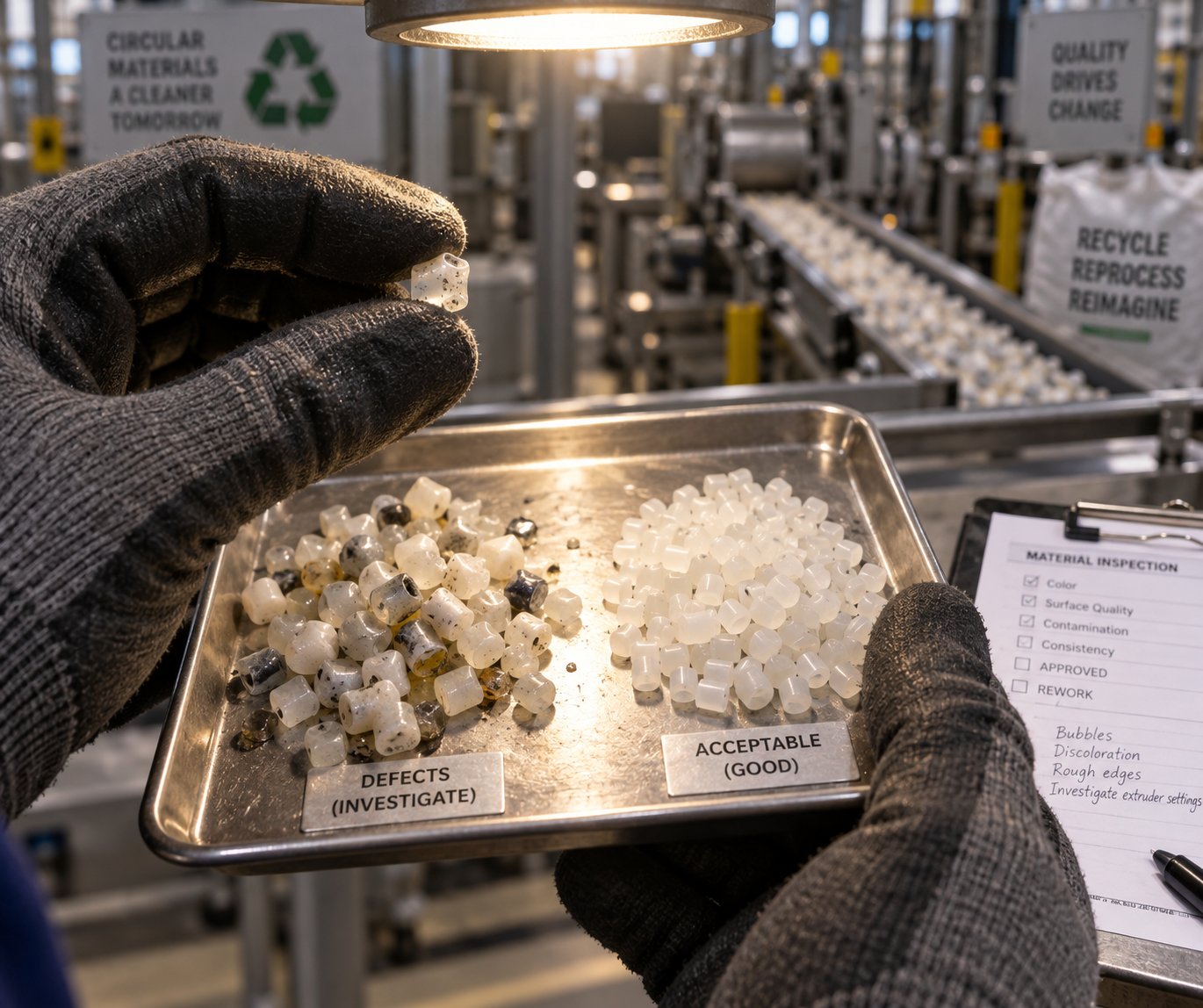
Production floors do not run on theory — they run on fast diagnosis and faster fixes. Every hour spent chasing a melt quality defect or fighting an inconsistent feed is an hour of lost output, wasted energy, and margin slipping away. The frustrating part? Most problems on a single screw extruder for recycling trace back to a surprisingly short list of root causes. Knowing that list — and knowing which lever to pull for each issue — turns a reactive scramble into a routine adjustment.
Whether you are running brand-new extruding equipment or maintaining a used extruder that has logged tens of thousands of hours, the failure modes are remarkably consistent. The table below covers the six most common problems recycling operators encounter, along with their likely causes and practical solutions you can reference right on the production floor.
| Problem | Likely Causes | Recommended Solutions |
|---|---|---|
| Output surging (inconsistent flow rate) | Inconsistent flake size causing erratic feeding; bridging in the hopper; worn screw flights increasing back-leakage over flights; fluctuating barrel temperatures | Install or recalibrate a crammer or force-feeder; screen flakes for uniform sizing before the hopper; measure screw flight clearance and replace worn screw if clearance exceeds tolerance; check heater band function and thermocouple accuracy zone by zone |
| Unmelted particles or specks in pellets | Insufficient melting due to low barrel temperature or excessive screw speed; oversized or thick flakes that cannot melt within the available residence time; worn barrier flights allowing solids to bypass the melt channel | Increase barrel temperature in the compression zone incrementally; reduce screw RPM to extend residence time; verify upstream shredder screen size produces flakes within the screw's design range; inspect barrier flight condition and replace if worn |
| Bubbles, voids, and silver streaks in pellets | Excessive moisture in feedstock; insufficient degassing vacuum; blocked or fouled vent port; feedstock stored in humid conditions after drying | Verify pre-dryer output moisture levels match resin requirements (e.g., below 50 ppm for PET); check vacuum pump performance and vent condensation traps; clean vent port if polymer buildup restricts gas flow; store dried flakes in sealed containers or feed directly from dryer to extruder |
| Frequent screen pack blockages | High contamination levels in feedstock — paper fiber, wood, metal fines, incompatible polymers; degraded polymer gels from overheating; screen mesh too fine for the contamination profile | Improve upstream washing and sorting to reduce contaminant load; review barrel temperature profile for hot spots that accelerate degradation; use a coarser primary screen backed by a finer secondary screen to extend pack life; upgrade to a continuous or hydraulic screen changer for uninterrupted operation |
| Thermal degradation (discoloration, odor, brittleness) | Barrel temperatures set too high; excessive residence time from oversized machine or low throughput rate; dead spots in the melt channel where material stagnates; degraded heater band creating localized hot spots | Reduce barrel temperature setpoints, starting from the metering zone backward; match extruder size to actual throughput needs to avoid long residence times; inspect screw and die adapter for hang-up areas where material can stagnate and cook; replace malfunctioning heater bands and verify thermocouple placement |
| Inconsistent feeding of low-bulk-density flakes | Gravity-fed hopper cannot deliver enough material to fill screw channels; film flakes bridging across the feed throat; static charge causing flakes to cling to hopper walls | Install a crammer feeder or agitated hopper with break-bridge device; use a grooved feed section barrel for better flake intake; add an anti-static treatment or grounding system to the hopper; ensure feed throat cooling is functioning to prevent premature softening and sticking |
Feeding and Output Inconsistency Issues
Output surging — that rhythmic pulsing where pellet size and strand thickness cycle between thick and thin — is the most visible symptom of a feeding problem. You will see it immediately on the cooling bath as strands speed up and slow down, and your pelletizer will produce a mix of oversized and undersized pellets that fails quality checks. The root cause almost always lives upstream of the barrel: flakes that are too inconsistent in size, too fluffy to gravity-feed reliably, or bridging inside the hopper.
Before blaming the extruder, check the obvious. Is your shredder producing a consistent flake size? A mix of large chunks and fine dust feeds erratically no matter how well your screw is designed. Are you running film flakes without a force-feeder? That is like asking a straw to suck up cotton balls — the screw channels fill with air pockets instead of plastic, and output swings wildly with every variation in the loose flake bed above the feed throat.
Worn screw flights compound the problem. As the radial clearance between the flight tips and barrel wall increases over thousands of hours, molten plastic leaks backward over the flights during each rotation. This back-leakage reduces net forward conveyance and introduces pressure fluctuations that show up as surging at the die. If your used plastic extruders have been processing abrasive post-consumer waste for extended periods, flight wear should be the first thing you measure when output consistency declines. A feeler gauge check at multiple points along the screw length takes minutes and can save days of chasing phantom process issues.
Melt Quality Defects and Their Root Causes
Unmelted particles, gels, and moisture-related defects are the three melt quality problems that recyclers encounter most frequently — and each one tells a different diagnostic story.
Unmelted particles or specks visible in pellets point to insufficient thermal energy input. Either the barrel is too cool in the compression zone, the screw is spinning too fast for the material to absorb enough heat, or the incoming flakes are simply too large or too thick for the screw's residence time to handle. Thick-walled container flakes, for instance, take significantly longer to melt through their cross-section than thin film flakes of the same resin. If your upstream shredder screen has worn and is letting oversized pieces through, those chunks survive the compression zone and show up as visible defects in the pellet.
Bubbles, voids, and silver streaks are the calling cards of moisture. Even a fraction of a percent of residual water content can produce visible defects in moisture-sensitive resins like PET or ABS. But even relatively tolerant polyolefins will show surface imperfections when flake moisture is excessive. If you are seeing these defects, work backward: check your pre-dryer discharge moisture, verify that the degassing vacuum is pulling at the correct level, and inspect the vent port for polymer buildup that restricts gas escape. On used extruder equipment that has been in service for years, vent ports can gradually narrow from accumulated polymer residue that hardens in place — a simple cleaning often restores degassing performance dramatically.
Gels — those small, translucent, fish-eye-like imperfections embedded in otherwise clear pellets — typically result from crosslinked or partially degraded polymer fragments. They resist melting at normal processing temperatures and pass through standard screen packs because they are soft enough to deform under pressure. Dispersive mixing elements on the screw help by applying intense shear to break these down, but persistent gel issues often indicate a feedstock problem — contamination with crosslinked material, or degraded polymer from stagnation points inside the barrel and die adapter.
Preventing Thermal Degradation and Die Buildup
Thermal degradation is the slow, silent killer of pellet quality. Unlike a feeding problem that announces itself immediately through surging output, degradation creeps in gradually. You might notice pellets darkening in color over a production shift, or a faint burning odor near the die that was not there when the line started. Impact test results on finished pellets begin trending downward. By the time the problem is obvious, you have already produced hours of off-spec material.
The most common cause is straightforward: barrel temperatures set higher than the resin actually needs. Operators sometimes compensate for poor melting — caused by a worn screw or oversized flakes — by cranking up heater setpoints rather than addressing the root cause. This creates a vicious cycle: higher temperatures degrade the polymer, which generates more volatile byproducts, which fouls screens faster, which increases back-pressure, which further raises melt temperature. If your current setup demands barrel temperatures well above the recommended range for your resin just to produce a clean melt, the screw — not the heater — is the component that needs attention.
Die buildup is the downstream companion to degradation. As polymer degrades, it deposits carbonized residue around die holes and on the die face. These deposits gradually restrict flow, distort strand geometry, and eventually break off into the melt stream as black specks that contaminate the pellet. Regular die cleaning on a scheduled basis — rather than waiting until buildup is visually obvious — prevents the worst of this. Some operators apply die surface treatments or coatings that reduce adhesion, extending intervals between cleanings.
Behind all of these issues sits one common thread that experienced recyclers learn early: the quality of your feedstock preparation determines at least half of your extrusion success. Inadequate washing leaves contaminants that foul screens and degrade in the barrel. Inconsistent shredding produces flakes that feed erratically and melt unevenly. Insufficient drying introduces moisture that causes bubble defects and, in PET, irreversible chain scission. Every dollar invested in better washing, drying, and sizing upstream pays for itself many times over in reduced troubleshooting, lower scrap rates, and more consistent pellet quality coming off the line.
Solving today's production problems is essential — but the most forward-thinking recyclers are also watching how the technology itself is evolving. Advances in screw geometry, barrel materials, and drive systems are steadily expanding what a single screw platform can handle, opening doors that were closed just a few years ago.
Innovations and Choosing the Right Screw Barrel for Recycling
Troubleshooting keeps your line running today. But the recycling extrusion landscape is shifting fast, and the single screw platforms hitting the market are far more capable than machines built even a decade ago. New developments in barrel engineering, screw geometry, and drive technology are closing performance gaps that once pushed recyclers toward costlier twin screw systems — making it worth asking what your next upgrade or purchase should look like.
Emerging Innovations in Recycling Extrusion Technology
Three innovations stand out for their practical impact on recycling throughput, energy costs, and pellet quality:
Grooved feed barrel technology addresses one of the oldest headaches in recycling extrusion — getting low-bulk-density flakes into the screw efficiently. Precision-machined axial or helical grooves in a separately cooled feed zone grip incoming flakes mechanically, preventing them from spinning with the screw rather than advancing forward. The result is a dramatic improvement in solids conveying, particularly with slippery HDPE and fluffy LDPE film scrap. Recyclers who retrofit grooved feed sections onto existing machines often report throughput gains of 15% to 30% on film flake streams without increasing screw speed — a meaningful productivity boost with zero additional energy per kilogram.
Optimized screw geometries for post-consumer waste are moving beyond one-size-fits-all designs. Leading single screw extruder manufacturers now offer application-specific screw profiles engineered around the unique melting behavior, bulk density, and contamination profile of recycled feedstocks. Variable-pitch feed sections that gradually accelerate material into the compression zone, wave-style barrier designs that intensify melting without excessive shear, and multi-stage mixing sections tuned for degraded polymer rheology all reflect a design philosophy that treats recycling as its own discipline — not an afterthought of virgin-resin processing.
Energy-efficient direct-drive motor systems are replacing traditional gearbox-coupled drives on new extrusion lines. By eliminating the gearbox — a maintenance-intensive component that wastes 3% to 5% of input energy as heat and friction — direct-drive configurations deliver torque more efficiently, run quieter, and reduce the overall machine footprint. For recyclers evaluating plastic extruders for sale or upgrading aging lines, a direct-drive option can lower annual energy costs meaningfully while cutting one of the most common mechanical failure points out of the system entirely. As demand grows for sustainable manufacturing, sourcing from an energyefficient plastic profile extruders supplier who integrates these motor technologies is becoming a competitive differentiator for recycling operations focused on reducing their carbon footprint.
How to Match Screw and Barrel Specs to Your Recycling Needs
Innovation only delivers value when it matches your actual operating conditions. Choosing a screw and barrel configuration for a recycling line is not about chasing the newest catalog feature — it is about aligning four variables into a coherent setup:
- Target resin: Your primary polymer dictates compression ratio, L/D requirements, barrel temperature capability, and whether you need single or dual venting. An HDPE bottle flake line and a PET tray recycling line demand fundamentally different screw profiles.
- Throughput requirement: Screw diameter and L/D ratio set your maximum output ceiling. Oversizing wastes capital and energy; undersizing forces excessive screw speeds that accelerate wear and degrade the polymer.
- Feedstock quality: The cleaner and more consistent your incoming flakes, the simpler — and less expensive — your screw and barrel configuration can be. Dirty, high-moisture, or mixed-resin streams push you toward longer L/D ratios, dual venting, and more aggressive mixing elements.
- End-market specifications: Pellets destined for food-contact packaging need tighter degassing and filtration than pellets going into drainage pipe. Your downstream customer's quality requirements should flow backward into your screw and barrel selection.
Think of these four factors as corners of a box. Your ideal configuration sits inside that box — constrained by all four simultaneously. A plastic profile extruders supplier or screw manufacturer who asks detailed questions about all four variables before recommending a configuration is far more likely to deliver a system that performs on the floor than one who simply quotes a standard catalog model.
Finding a Reliable Screw and Barrel Supplier
Your extruder is only as good as its core wear components. Whether you are sourcing a complete plastic extruder for sale, upgrading an existing line, or replacing worn parts on a machine that has logged years of service, the screw and barrel supplier you choose has an outsized impact on pellet quality, uptime, and long-term operating cost.
Here are the key criteria for evaluating screw and barrel suppliers for recycling applications:
- Recycling-specific design capability: Can the supplier engineer screw geometries and barrel configurations tailored to post-consumer and post-industrial feedstocks, rather than offering only general-purpose designs?
- Wear-resistant material options: Does the supplier offer bimetallic barrel linings, nitrided steel, or tungsten carbide coatings that extend service life when processing abrasive recycled material?
- Custom manufacturing: Can they produce screws and barrels to your specific L/D ratio, compression ratio, and mixing element requirements — or are you limited to off-the-shelf sizes?
- Compatibility with existing equipment: A quality supplier should be able to manufacture replacement barrels and screws that fit your current extruder frame, allowing you to upgrade performance without purchasing an entirely new machine.
- Technical support and lead times: Responsive engineering consultation and reasonable delivery schedules matter — a worn barrel sitting on backorder for months costs you far more in lost production than the component itself.
- Track record across resin types: Look for suppliers who have delivered solutions across HDPE, LDPE, PP, PET, and styrenics recycling, since each resin imposes different demands on metallurgy and geometry.
Suppliers like NANHAIYA exemplify this specialist approach — offering custom single screw barrels engineered for recycling lines, with wear-resistant linings and application-specific screw designs that address the exact challenges covered throughout this guide. For recyclers running extruders for sale in the aftermarket or maintaining legacy equipment, sourcing precision replacement barrels from a dedicated manufacturer can restore — or even exceed — original machine performance at a fraction of the cost of full equipment replacement.
The single screw extruder for recycling is not going anywhere. Its mechanical simplicity, proven economics, and steadily advancing technology make it the foundation of profitable recycling operations worldwide. The recyclers who thrive are those who look beyond the machine as a commodity purchase and treat screw and barrel selection as a strategic decision — one shaped by their resin, their feedstock, their market, and their commitment to continuous improvement. Whether you are commissioning your first line or optimizing your tenth, the right configuration and the right supply partners turn plastic waste into a consistent, valuable product — flake by flake, pellet by pellet.
Frequently Asked Questions About Single Screw Extruders for Recycling
1. What is the difference between a single screw extruder and a twin screw extruder for plastic recycling?
A single screw extruder uses one helical screw inside a heated barrel and is ideal for processing sorted, single-resin recycled streams at lower capital and maintenance costs. A twin screw extruder uses two intermeshing screws and excels at handling heavily contaminated, mixed-resin, or reactive-compounding applications that demand intensive mixing. For most commercial recycling operations running clean HDPE, LDPE, PP, or PS flakes, a single screw system offers the best balance of cost efficiency, reliability, and operator accessibility. Twin screw systems become the better choice when feedstock contamination is severe or when blending incompatible polymers.
2. What L/D ratio is best for a recycling single screw extruder?
Recycling extruders typically use L/D (length-to-diameter) ratios between 30:1 and 36:1, which is longer than the 24:1 to 28:1 range common in virgin resin extrusion. The longer barrel provides additional residence time needed to thoroughly melt inconsistent recycled flakes, accommodate degassing vent zones, and achieve a homogeneous melt. PET recycling lines often require 34:1 or higher to allow gentle melting without excessive shear, while cleaner polyolefin streams may perform well at 30:1. Matching the L/D ratio to your target resin and feedstock quality is critical for consistent pellet output.
3. Why is degassing important in a recycling extruder?
Recycled plastic flakes carry residual moisture, adhesive residues, printing inks, and organic contaminants that turn into gas once the material melts inside the barrel. Without a vented degassing system, these trapped gases produce bubbles, voids, and silver streaks in finished pellets, often rendering them unsaleable. Vented extruder barrels feature a decompression zone where melt pressure drops, allowing volatiles to escape through a vent port connected to vacuum. Dual-vent configurations are recommended for high-moisture feedstocks like unwashed PET or heavily printed post-consumer film, while single-vent setups handle pre-dried or moderately moist flakes effectively.
4. What types of recycled plastic can a single screw extruder process?
A properly configured single screw extruder can process all major recycled thermoplastics including HDPE, LDPE, PP, PET, ABS, and PS. Each resin requires specific barrel temperature profiles, compression ratios, and screw features. HDPE and PP are the most straightforward to recycle on single screw lines, while LDPE film flakes demand force-feeding systems and higher compression ratios due to low bulk density. PET requires thorough pre-drying below 50 ppm moisture and longer L/D ratios. Suppliers like NANHAIYA offer custom single screw barrels engineered for specific resin types and recycling applications at nhyscrews.com.
5. How do I troubleshoot output surging on a single screw recycling extruder?
Output surging — the rhythmic pulsing of strand thickness and pellet size — almost always originates from feeding inconsistencies. Start by checking flake size uniformity from your shredder, as a mix of large chunks and fine dust feeds erratically regardless of screw quality. For low-bulk-density film flakes, install a crammer or force-feeder to replace unreliable gravity feeding. Measure screw flight clearance at multiple points along the barrel, since worn flights allow molten plastic to leak backward over the flights, reducing net conveyance and creating pressure fluctuations. Also verify that all barrel heater bands and thermocouples are functioning correctly, as temperature fluctuations in the compression zone directly affect melt consistency.
Written by
Nanhaiya Technical Team
Zhoushan Nanhaiya Plastic Machinery Co., Ltd.
The Nanhaiya technical team supports screw and barrel manufacturing projects through application review, technical communication, custom manufacturing coordination, and production and quality control.
Discuss Your Application
Related Articles
More insights on screw barrel technology and plastics processing.
What Nobody Tells You About Screw Barrel For Plastic Machine Design
Oct 10, 2026
Learn how screw barrel for plastic machine design affects melt quality, throughput, and wear life. Covers geometry, resin matching, troubleshooting, and sourcing.
Read Article
Single Screw Extruder for Sheet: Stop Guessing, Start Specifying
Oct 9, 2026
Learn how to specify a single screw extruder for sheet production. Covers screw geometry, resin-specific processing, troubleshooting, and maintenance best practices.
Read Article
PE Pipe Extruder Machine: What Datasheets Won't Tell You
Oct 9, 2026
Learn how a PE pipe extruder machine works, key specs explained, material grade selection, maintenance tips, and buyer guidance beyond the datasheet.
Read ArticleLooking for something else?
Search by material, symptom or product and jump straight to the relevant page.
These are navigation suggestions based on keyword matching — not a quotation, not a delivery commitment, and not a substitute for engineering review. Final specification is confirmed by our engineers against your drawings and processed material.
Need help with screw barrel selection?
Share your machine model, processed material and application. Our team can help with pricing and technical support.