

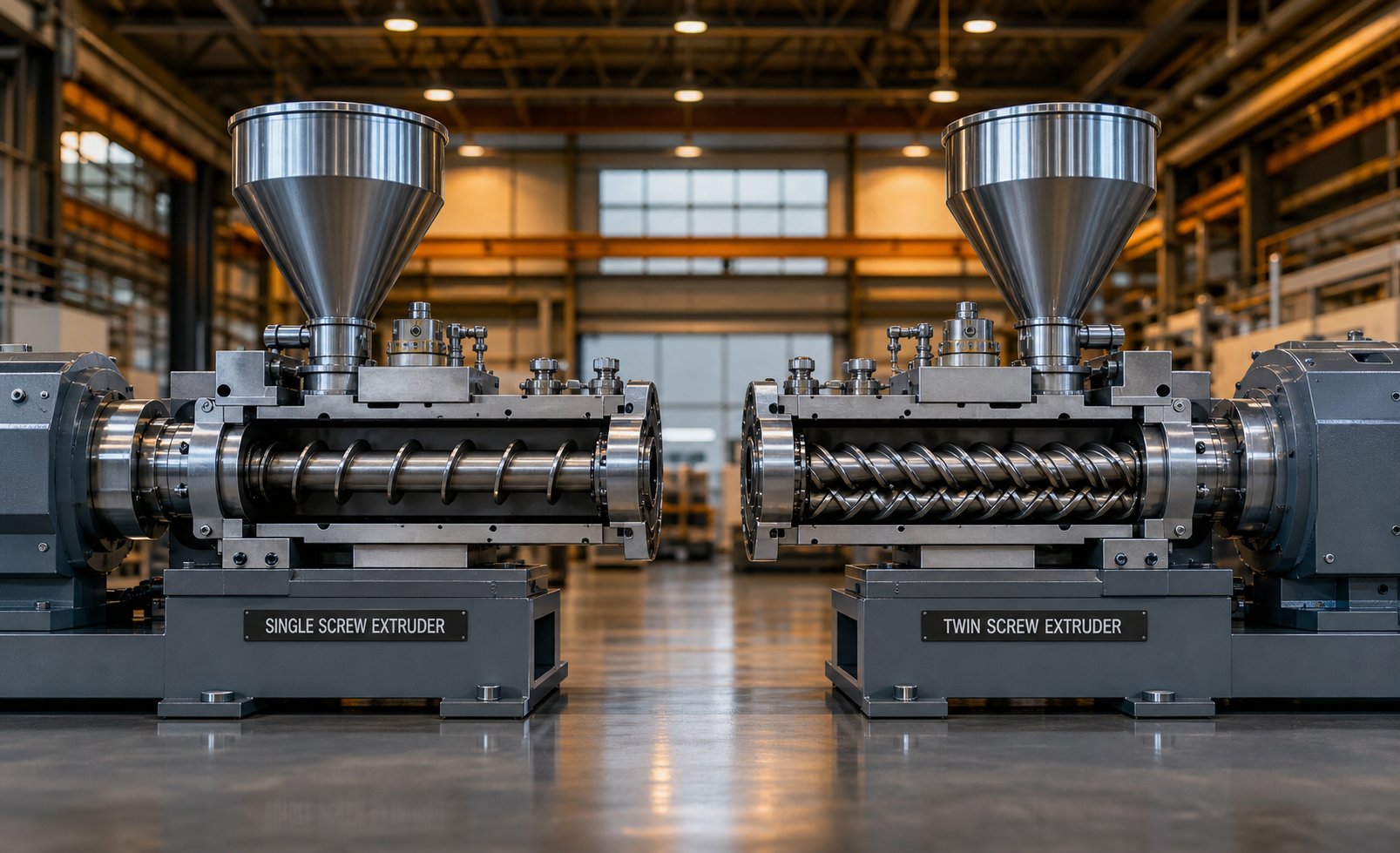
Why the Single vs Twin Screw Extruder Decision Defines Your Production Line
Imagine committing to a piece of equipment that shapes every kilogram of product your plant produces for the next ten to fifteen years. That's exactly what happens when you select between a single screw extruder and a twin screw extruder. This single decision ripples through your throughput rates, product consistency, energy bills, maintenance budgets, and ultimately your bottom line. Get it right, and your production line runs lean. Get it wrong, and you're locked into workarounds that quietly drain profitability year after year.
Most guides comparing single vs twin screw extruders treat the choice as a simple either-or. They rarely dig into the critical subtypes — like the significant performance gap between co-rotating and counter-rotating twin screw configurations — that can make or break an application. That oversimplification leads buyers into costly mismatches they don't fully recognize until the equipment is bolted to the floor.
So, what's an extruder at its core? A screw extruder is a machine that uses one or more rotating screws inside a heated barrel to melt, mix, and push polymer material through a shaped die, producing a continuous output. It's the engine behind everything from plastic pipes and packaging films to compounded masterbatch pellets and 3D printing filament. The specific screw configuration you choose determines how much mixing, shearing, and pressure-building that engine can deliver — and which materials it can handle well.
Why This Comparison Matters More Than You Think
The stakes here are higher than a purchase price on a quote sheet. A single screw extruder optimized for simple pellet processing costs a fraction of a twin screw compounder, but installing it on a line that demands intensive mixing will produce inconsistent output, excessive scrap, and constant quality firefighting. Conversely, specifying a twin screw extruder machine for a straightforward pipe line that only needs stable melt delivery adds unnecessary complexity, training burden, and maintenance cost with no real production benefit.
Choosing the wrong extruder type can lock a plant into suboptimal throughput and excessive maintenance costs for a decade or more — a mistake that no amount of process tweaking can fully correct.
The real challenge isn't deciding whether twin screw technology is "better." It's matching the right configuration to your specific material, mixing demand, and production goal. That requires understanding not just two categories, but five distinct configurations — each with different strengths, trade-offs, and ideal use cases.
What This Ranked Review Covers
This article goes beyond the generic single-versus-twin breakdown. You'll find a ranked review of five extruder configurations, each evaluated against weighted criteria that reflect real-world production priorities:
- Single screw extruder — the high-volume workhorse for pre-compounded resin processing
- Co-rotating parallel twin screw extruder — the compounding and reactive extrusion leader
- Modular screw barrel component systems — the precision components that determine performance across every configuration
- Counter-rotating parallel twin screw extruder — the shear-sensitive specialist most guides ignore entirely
- Conical twin screw extruder — compact power built specifically for PVC and WPC applications
You'll also find content gaps filled that competitor articles miss completely: a direct co-rotating vs counter-rotating comparison table, a total cost of ownership framework you can populate with your own data, and industry-specific selection guidance that maps applications to configurations. Every recommendation is written from an independent, non-manufacturer perspective — because nearly every other guide on this topic comes from an equipment seller with a product line to push.
The evaluation starts with the criteria themselves — six weighted factors that separate a truly informed equipment decision from an expensive guess.
How We Evaluated and Ranked Each Extruder Configuration
A fair comparison between screw extruders demands more than listing features side by side. Equipment manufacturers — and they author nearly every competing guide you'll find on this topic — naturally emphasize the criteria that favor their product lines. Our methodology takes a different approach: an independent, non-manufacturer framework built around six criteria that reflect what actually drives production-line success and long-term profitability.
These rankings evaluate general configuration strengths, not specific machine models. A co-rotating twin screw extruder from one OEM may outperform another in practice depending on build quality, controls, and screw element metallurgy. The goal here is to help you identify which type of screw extrusion platform fits your application before you ever request a quote.
Six Criteria We Used to Rank Each Extruder Type
Each configuration was scored against these six factors, chosen because they collectively determine whether an extruder delivers consistent, cost-effective output across its operational life:
- Mixing and dispersive capability — Determines whether the extruder can achieve the level of homogeneity your formulation demands, from simple melting to nano-scale dispersion.
- Throughput capacity range — Defines the production volume window, from pilot-scale development to full commercial output, that a configuration can realistically serve.
- Process flexibility and modular configuration — Measures how easily you can reconfigure screw geometry, venting positions, and barrel layout to handle new materials or formulations without purchasing new equipment.
- Total cost of ownership — Captures the complete financial picture: purchase price, energy consumption, wear part replacement frequency, maintenance labor, and unplanned downtime over a typical equipment lifecycle.
- Material compatibility breadth — Reflects how wide a range of polymers, fillers, and additives the configuration can process effectively without degradation or feeding issues.
- Scale-up predictability — Evaluates how reliably process parameters transfer from lab or pilot equipment to full production — a factor that research into specific mechanical energy matching has shown can derail commercialization if underestimated.
How We Weighted Each Factor
Not every criterion carries equal importance. Mixing capability and process flexibility receive the highest weights because they define the ceiling of what twin screw extruders — or any configuration — can accomplish. An extruder with excellent throughput but poor mixing locks you into a narrow set of simple applications. Conversely, strong mixing and modular flexibility let you adapt as product lines evolve, protecting your capital investment against market shifts.
| Criterion | Weight | Why It Matters |
|---|---|---|
| Mixing & Dispersive Capability | 25% | Sets the upper limit on product quality and formulation complexity your line can handle |
| Process Flexibility & Modularity | 20% | Determines how many different products and formulations you can run on a single machine |
| Total Cost of Ownership | 20% | Reveals the true financial impact beyond sticker price — energy, wear parts, downtime, and labor over 10+ years |
| Material Compatibility Breadth | 15% | Dictates whether the extruder can handle your current materials and future formulation changes |
| Throughput Capacity Range | 10% | Ensures the configuration matches your volume requirements without oversizing or bottlenecking |
| Scale-Up Predictability | 10% | Reduces risk when transitioning from development to commercial production — critical for new product launches |
You'll notice that purchase price alone doesn't dominate the weighting. That's intentional. A lower-cost single screw extrusion system that requires frequent screw barrel replacements, struggles with changeovers, and limits your product range can easily cost more over five years than a higher-priced twin screw platform that runs broader formulations with less downtime. The TCO lens keeps the evaluation honest.
With these criteria defined, each configuration gets measured on equal footing — starting with the most widely installed extruder type on the planet: the single screw.
Single Screw Extruder Machine – The Proven Workhorse for Straightforward Processing
The single screw extruder holds a distinction no other configuration can claim: it is the most widely installed polymer extrusion machine in the world. Its popularity isn't accidental. For processors running pre-compounded resins through well-defined, high-volume production lines, a single extruder screw delivers exactly what's needed — reliable melting, stable pressure generation, and consistent output — at the lowest capital and operating cost of any configuration reviewed here.
But popularity doesn't mean universality. The single screw extrusion machine operates on a fundamentally different conveying principle than twin screw designs, and that difference creates both its greatest strengths and its clearest limitations. Understanding where this workhorse excels — and where it falls short — is the first step toward making a selection you won't regret.
How Single Screw Conveying Actually Works
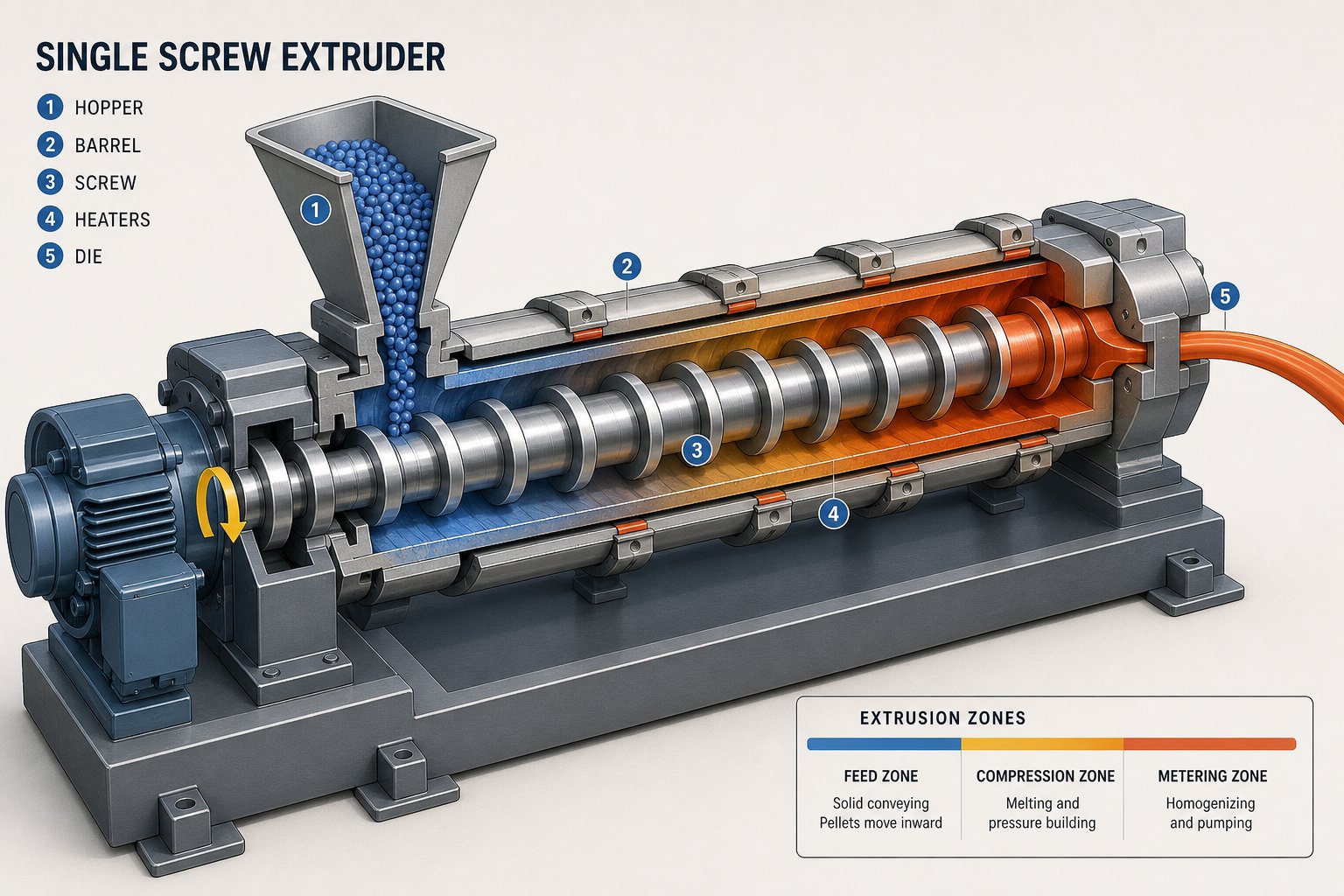
Here's the key technical distinction that shapes everything else about single screw performance: it is a drag-flow device, not a positive-displacement pump. Material moves forward because friction between the polymer and the barrel wall exceeds friction between the polymer and the screw root. The barrel is stationary, the screw rotates, and the resulting frictional forces drag material along the helical channel toward the die. Remove that friction differential — say, by processing a slippery additive-loaded compound — and conveying efficiency drops significantly.
This drag-flow mechanism means output rate is highly dependent on material properties and back pressure from the die. Unlike intermeshing twin screws that actively push material forward regardless of friction conditions, a single screw extruder machine's throughput fluctuates with changes in polymer viscosity, pellet bulk density, or die resistance.
The screw itself is divided into three functional zones, each performing a distinct role in the process:
- Feed zone — Features the deepest channel depth. Solid pellets or powder enter from the hopper and are compacted into a solid plug. Deep flights allow easy intake of bulk material, and frictional drag at the barrel surface initiates forward conveyance.
- Compression (transition) zone — Channel depth decreases progressively, compressing the solid plug against the heated barrel wall. A thin melt film forms at the barrel surface, and the enormous viscous dissipation in this film generates most of the energy needed to melt the polymer. The compression ratio — feed channel depth divided by metering channel depth — directly governs melting efficiency and typically ranges from 2:1 to 4:1 depending on the polymer.
- Metering zone — The shallowest channel section. By this point, the polymer is fully molten. This zone homogenizes the melt temperature, builds die pressure, and delivers a consistent volumetric flow to the screen pack and die.
One critical point that separates single screw designs from their twin screw counterparts: screw geometry is typically fixed. The feed depth, compression ratio, and metering depth are machined into a single piece of steel. You can't rearrange kneading blocks or add venting sections the way you can with modular twin screw elements. If your process requirements change, you're ordering a new screw — or living with suboptimal performance.
Where Single Screw Extruders Excel
Despite their mixing limitations, single screw extruders dominate several major application segments precisely because those applications don't demand intensive compounding. When the resin arrives pre-compounded and the job is to melt it cleanly and push it through a die at high rates, this configuration is hard to beat:
- Blown film extrusion — Producing packaging films, agricultural films, and stretch wrap from polyethylene and copolymers
- Cast film and sheet extrusion — Manufacturing flat films and thermoforming sheet from PET, PS, PP, and other resins
- Pipe and profile extrusion — Continuous production of plastic pipe, tubing, and profiles from pre-compounded material
- Wire and cable coating — Applying insulation layers at high line speeds with stable melt delivery
- Sheet extrusion — Producing thick sheet for signage, construction, and industrial applications
- 3D printing filament production — Extruding precision-diameter filament from single-resin feedstock
In each of these cases, the material has already been compounded — the additives, colorants, and stabilizers are pre-dispersed. The extruder's job is to melt, homogenize temperature, build pressure, and pump. A single screw extrusion machine handles this combination efficiently, with lower energy consumption per kilogram than a twin screw running the same simple task.
Honest Pros and Cons
Pros
- Lower capital cost — Simpler mechanical design with one screw, one barrel, and a less complex gearbox translates to a significantly lower purchase price than any twin screw alternative
- Simpler operation and maintenance — Fewer moving parts and straightforward controls mean less specialized operator training and lower routine maintenance costs
- Lower energy consumption per kg for straightforward applications — When the task is simple melting and pumping, the single screw's drag-flow mechanism delivers adequate output with less specific energy input than a twin screw would require for the same job
- Proven reliability for high-volume single-resin runs — Decades of field history across thousands of installations confirm that a well-maintained single screw extruder can deliver consistent output for years with minimal unplanned downtime
Cons
- Limited mixing and compounding capability — The drag-flow mechanism provides only modest distributive mixing. While mixing pins and specialized sections like Maddock or Dulmage elements improve homogeneity, they can't match the dispersive intensity of intermeshing twin screws
- Fixed screw geometry restricts process optimization — Unlike modular twin screw designs where kneading blocks and conveying elements can be rearranged, a single screw's zone lengths and compression ratio are permanently machined. Adapting to a new material or formulation often means purchasing a completely new screw
- Poor self-cleaning behavior — Material tends to stagnate in the channel, especially at flight roots and transition zones. This makes color and material changeovers slow and wasteful — a real cost driver for plants running multiple products
- Longer residence time distribution can degrade heat-sensitive materials — Broad residence time spread means some material spends significantly longer in the heated barrel than average, creating degradation risk for temperature-sensitive polymers
One practical detail that doesn't get enough attention: wear patterns on single screw extruders concentrate heavily on the metering zone flights and the corresponding barrel liner section. This makes sense — the metering zone sees the highest shear stress as fully molten polymer is pressurized against the die. Over time, the radial clearance between flight tip and barrel widens, leakage flow increases, and pumping efficiency drops. The quality of replacement screw barrels has an outsized impact on how quickly the extruder returns to peak performance after a rebuild. Inferior metallurgy or dimensional tolerances in replacement components can leave an extruder permanently underperforming its original spec.
For processors whose applications fall squarely in the single screw's sweet spot, it remains the smartest investment per dollar spent. But the moment a production line demands intensive mixing, modular process flexibility, or fast changeovers between diverse formulations, the drag-flow mechanism hits a ceiling that no screw modification can fully overcome — and that's precisely where co-rotating twin screw technology takes over.
Co-Rotating Parallel Twin Screw Extruder – The Compounding and Mixing Champion
The single screw's drag-flow ceiling is exactly why the co-rotating parallel twin screw extruder exists. Where single screw designs depend on friction to move material forward, a co-rotating twin screw compounding extruder uses two intermeshing screws rotating in the same direction to actively push material through the barrel — a fundamentally different conveying principle that unlocks an entirely different class of process capability.
Picture two screws meshing together like gears, their flights wiping each other's surfaces as they turn. Material caught between the screws is transferred from one screw channel to the other in a figure-eight flow pattern, creating intense mixing while simultaneously driving the melt forward. This positive-displacement conveying action means throughput depends primarily on screw speed and geometry — not on friction conditions at the barrel wall. The practical result? You get precise, predictable output regardless of whether you're processing a slippery plasticizer-loaded compound or an abrasive mineral-filled masterbatch.
This positive-displacement behavior also enables something single screws simply cannot do: starve feeding. Instead of flood-feeding the hopper and letting the screw gobble material at whatever rate friction allows, a gravimetric feeder meters material into the barrel at a controlled rate independent of screw speed. You can run the screws faster to increase shear and mixing energy without proportionally increasing throughput — or slow the feed rate to extend residence time for reactive processes. This decoupling of throughput from screw speed is a fundamental advantage in twin screw extrusion that gives process engineers a degree of control no flood-fed system can match.
Why Co-Rotating Twins Dominate Compounding
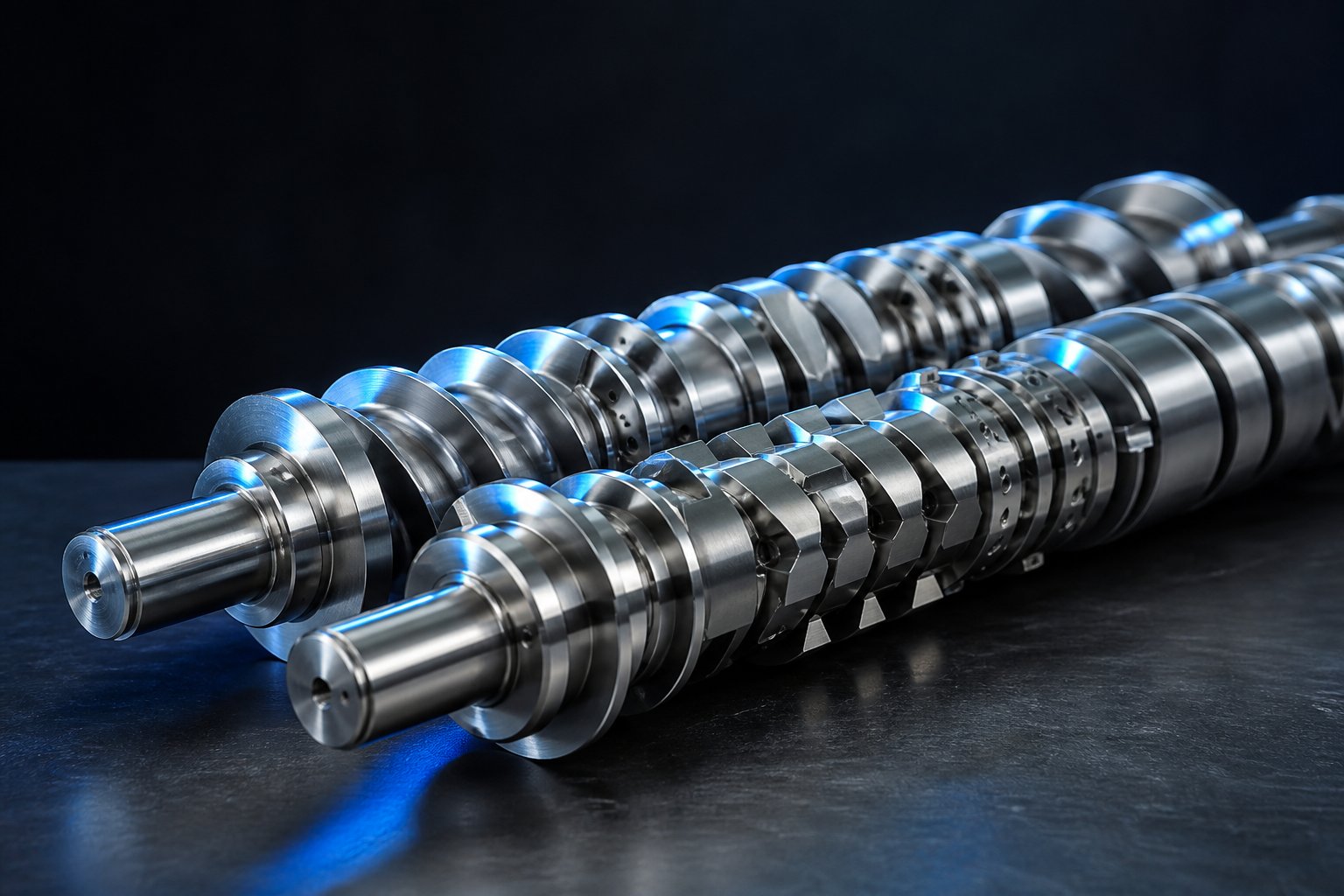
The real magic of the co-rotating parallel twin screw extruder isn't just how it conveys material — it's how completely you can customize the process happening inside the barrel. Unlike a single screw machined from one solid piece of steel, a co-rotating twin screw system uses modular screw elements that slide onto keyed shafts. Each element performs a specific function, and rearranging them transforms the machine's behavior:
- Conveying elements — Forward-pitch flights that transport material along the barrel. Varying the pitch changes conveying speed and fill level in each zone.
- Kneading blocks — Stacks of offset lobes that shear and fold the melt. Stagger angle (30°, 60°, or 90°) determines how aggressively the block mixes versus conveys. A 90° neutral kneading block creates maximum shear with zero forward conveying — ideal for breaking up filler agglomerates.
- Mixing elements — Specialized geometries like gear-type or toothed elements that split and recombine melt streams for distributive mixing without excessive shear — useful for blending temperature-sensitive additives.
- Reverse elements — Backward-pitch flights that create a dam in the channel, forcing material to fill completely upstream. These establish seal zones for vacuum venting ports and extend residence time in targeted barrel sections.
By combining these elements in different sequences, an engineer can build a screw profile that conveys gently in the feed zone, melts aggressively in the compression zone, applies intense dispersive mixing in the kneading zone, vents volatiles in a decompression zone, and then builds die pressure in the metering zone — all within a single barrel. Technovel's technical documentation notes that this freedom to reconfigure the screw and barrel layout is one of the most distinctive features of a twin screw extruder, allowing a single machine to handle a wide range of operating conditions from product development to mass production.
This modularity is genuinely unmatched by any other extruder configuration. Need to add glass fiber downstream to avoid breaking long fibers? Install a side feeder port midway along the barrel and configure conveying elements to accept the addition. Switching from a high-filler masterbatch to a reactive polymer blend next week? Swap out a few kneading blocks to adjust shear intensity, and you're running a different process on the same machine.
One detail worth emphasizing: screw element quality and metallurgy directly impact how long this modularity stays effective. Kneading block tips see enormous shear stress and abrasive contact, especially in mineral-filled compounds. Elements manufactured from tool steels with insufficient hardness or inconsistent dimensional tolerances wear unevenly, degrade mixing performance, and eventually force premature replacement. The twin screw compounding extruder is only as good as its wear components.
Advanced Process Capabilities Most Guides Ignore
Most comparisons stop at "twin screws mix better." That's true but incomplete. Co-rotating twin screw extrusion platforms enable several advanced processes that competing configurations handle poorly or not at all:
Devolatilization through multiple vacuum venting ports. The ability to create fully filled seal zones using reverse elements means engineers can position two, three, or even four vacuum vent ports along the barrel. Each vent pulls residual monomers, moisture, trapped air, or solvent from the melt under deep vacuum. This is critical for recycled polymer processing, where incoming flake carries moisture and contaminants, and for pharmaceutical hot-melt extrusion, where solvent removal must be tightly controlled. Industry sources confirm that atmospheric vents remove entrapped air and volatile gases while vacuum vents extract moisture, solvents, or low-molecular-weight compounds — both enabled by the co-rotating twin screw's modular barrel design.
Reactive extrusion for polymer modification. Imagine running a chemical reaction — grafting maleic anhydride onto polyethylene, for example — continuously inside an extruder instead of in a batch reactor. The co-rotating twin screw's precise residence time control, independent temperature zone management, and ability to inject liquid reactants at specific barrel positions make it the standard platform for reactive extrusion. The balance between shear and residence time is critical in these applications, and the fully intermeshing screw's efficient energy transfer promotes reactions while suppressing unwanted polymer chain scission.
Nano-composite compounding. Dispersing nano-scale fillers like carbon nanotubes, nano-clays, or graphene into polymer matrices demands extreme dispersive mixing at controlled temperatures. The high shear stress generated in the intermeshing zone of co-rotating screws breaks apart agglomerates that would remain intact in any single screw or counter-rotating design. Even high-viscosity resins and composite systems with high filler content achieve uniform melting and mixing through controlled shear adjustment.
One more advantage that often tips the decision for plants running multiple products: the self-wiping action of intermeshing co-rotating screws. Because each screw's flight crest wipes the root of the opposing screw, material cannot stagnate on the screw surface. Dead spots — the enemy of every processor who has ever found degraded black specks in a light-colored product — are minimized. This wiping effect also means changeovers between materials or colors are dramatically faster than on a single screw, where channels must be mechanically purged or flushed with purge compound. For a plant running six or eight formulations in a week, the time and scrap savings from fast self-cleaning alone can justify the higher capital cost of the twin screw platform.
Pros and Cons of Co-Rotating Twin Screw Extruders
Pros
- Unmatched mixing and dispersive capability — The intermeshing, self-wiping screw geometry delivers the highest dispersive and distributive mixing intensity of any extruder configuration, essential for compounding, polymer alloys, and nano-filler dispersion
- Modular screw configuration — Interchangeable kneading blocks, conveying elements, mixing elements, and reverse elements allow complete process customization without buying new equipment
- Excellent self-cleaning — Wiping action between screws eliminates dead spots, reduces degradation risk, and enables fast product changeovers
- Precise residence time control — Starve-feeding and modular element placement give engineers independent control over throughput, shear input, and how long material stays in the barrel
- Ideal for heat-sensitive materials — Narrow residence time distribution means every particle of material spends roughly the same time at processing temperature, preventing the thermal degradation tails that plague single screw designs
- Superior scale-up predictability — Process parameters developed on small-diameter co-rotating twins transfer to larger machines more reliably than any other configuration, reducing commercialization risk for new formulations
Cons
- Higher capital investment — Two screws, a more complex gearbox with synchronized output shafts, modular barrels, and precision-ground screw elements all contribute to a purchase price significantly above single screw alternatives
- More complex operation requiring trained personnel — The flexibility that makes co-rotating twins powerful also demands operators and process engineers who understand screw configuration, starve-feed ratios, and multi-zone temperature control
- Higher specific energy consumption for simple melting tasks — If your application only requires melting and pumping a pre-compounded resin, a co-rotating twin screw will consume more energy per kilogram than a single screw doing the same job — you're paying for mixing capability you aren't using
- Barrel and screw element wear requires high-quality replacement components — Modular elements are individually replaceable, which is convenient, but each element must meet tight dimensional and metallurgical specifications. Substandard replacement parts introduce clearance inconsistencies that degrade mixing uniformity and accelerate wear on adjacent elements
The co-rotating parallel twin screw extruder earns its position at the top of the compounding hierarchy for good reason. But raw capability isn't the only factor that determines real-world extruder performance. Between the machine frame and the final product, every kilogram of polymer passes through a single critical interface — the screw and barrel surfaces themselves — and the quality of those components often matters more than the brand name on the gearbox.
Screw Barrel Systems – Precision Components That Maximize Any Extruder
Every extruder comparison eventually focuses on configuration type, throughput specs, and gearbox torque ratings. Fair enough — those factors matter. But here's what nearly every guide overlooks entirely: the component that wears fastest and impacts output quality most directly isn't the gearbox, the motor, or the control system. It's the screw and barrel assembly. Whether your plant runs a single screw extruder, a parallel twin screw compounder, or a conical twin for PVC profiles, the metallurgy, dimensional precision, and surface treatment of those screw barrel components quietly govern your throughput consistency, product quality, and maintenance intervals every single production hour.
Think of it this way — you can select the perfect extruder configuration for your application and still underperform if the screw and barrel components inside it are substandard. The extruder frame is the platform. The screw barrel is the engine.
Why Screw Barrel Quality Is the Most Overlooked Performance Factor
Screw and barrel wear is a gradual process that often goes unnoticed until performance has already degraded significantly. As Plastics Technology has documented, the majority of wear concentrates in high-pressure zones — particularly the transition section and the last few turns of the metering section — where elevated pressure and temperature intensify friction between the screw flight outer diameter and the barrel bore.
Here's what happens as that wear progresses: the radial clearance between flight tips and the barrel wall widens. Once it does, leakage flow increases — molten polymer slips backward over the flight tips instead of being pumped forward. The operator sees reduced throughput and rising melt temperatures. To compensate, screw speed goes up, which drives energy consumption higher and accelerates wear even further. Industry data suggests that increasing flight clearance from 0.1 mm to 0.5 mm in a 90 mm single screw extruder reduces output by roughly 8% to 15% at constant screw speed, with a corresponding 6% to 12% increase in specific energy consumption.
Mixing sections, barrier flights, and kneading block tips on twin-screw extruder machines are equally vulnerable. As dispersive mixing elements wear, their ability to break up filler agglomerates and produce isothermal melt diminishes. The result? Inconsistent color dispersion, uneven filler distribution, and products that fail quality checks — problems that trace directly back to worn components, not extruder design.
The real cost multiplier hits when replacement parts enter the picture. Inferior aftermarket screw barrels — machined from lower-grade steels, nitrided to inconsistent case depths, or ground to loose dimensional tolerances — can actually reduce extruder performance below the level of the worn components they replaced. A screw plastic extruder is only as precise as its replacement parts allow it to be. Plants that source the cheapest available replacement components often find themselves trapped in a cycle of frequent changeouts, quality variability, and maintenance firefighting that no amount of process optimization can fix.
Matching Screw Barrel Specifications to Your Extruder Type
Different extruder configurations place fundamentally different demands on their screw and barrel assemblies. A single screw barrel needs optimized compression ratios and wear-resistant metering zone surfaces. A parallel twin screw barrel requires modular segments with precise bore alignment across multiple sections. A conical twin screw barrel demands tapered geometry with tight tolerances on the converging bore profile. And injection molding screw barrels face entirely different thermal cycling and pressure demands than continuous extrusion components.
NANHAIYA's screw barrel product collection covers all four of these categories, giving engineers and equipment buyers a single source to directly compare options across extruder types. The table below maps each product category to its typical applications, key material options, and processing advantages:
| Product Category | Typical Applications | Key Material Options | Processing Advantages |
|---|---|---|---|
| Single Screw Barrels | Blown film, cast film, pipe, profile, sheet extrusion, 3D filament | Nitrided alloy steel, bimetallic liners (iron-based and nickel-based) | Optimized compression ratios for stable melt delivery; wear-resistant metering zone surfaces extend replacement intervals |
| Parallel Twin Screw Barrels | Compounding, masterbatch, reactive extrusion, devolatilization, recycling | Nitrided steel, bimetallic lined segments, tool steel inserts | Modular barrel segments with precise bore alignment; supports multi-zone temperature control and side feeding ports |
| Conical Twin Screw Barrels | PVC profiles, PVC pipe, WPC decking, foam board | Nitrided alloy steel, bimetallic liners with high corrosion resistance | Tapered bore geometry matched to progressive compression; corrosion-resistant options for HCl-generating PVC formulations |
| Injection Molding Screw Barrels | Injection molding of commodity and engineering plastics, filled compounds | Nitrided steel, bimetallic construction, tool steel options for abrasive resins | Engineered for thermal cycling and high injection pressures; surface treatments matched to specific resin families |
Having a single supplier that covers all major extruder configurations simplifies procurement significantly — especially for plants operating mixed extruder fleets. Instead of managing separate vendor relationships for each machine type, engineers can standardize component quality and documentation across the entire operation. That consistency matters when you're tracking wear patterns and predicting replacement schedules across a dozen different lines. It also eliminates the risk of receiving components built to different quality standards from different single screw extruder manufacturers or twin screw parts suppliers.
Pros and Cons
Pros
- Comprehensive coverage of all major extruder configurations from one supplier — Single screw, parallel twin screw, conical twin screw, and injection molding screw barrel options are available within one product collection, eliminating multi-vendor complexity
- Direct comparison tools for engineers — Buyers can evaluate screw barrel specifications across extruder types side by side, making it easier to match component metallurgy and geometry to specific processing demands
- Spare-part availability reduces unplanned downtime — Stocking replacement components from a supplier with broad product coverage means faster turnaround when a worn screw barrel needs replacement, whether it's for a twin-screw extruder machine or a single screw line
- Supports both new builds and replacement needs — Whether you're specifying components for a new extruder installation or sourcing aftermarket replacements for aging equipment, the same product categories apply
Cons
- Requires buyers to verify dimensional compatibility with their specific OEM equipment — Screw barrel assemblies must match the exact bore diameter, length, mounting interface, and clearance specifications of your particular extruder model. Dimensional verification before ordering is essential to avoid fit issues
- Component selection benefits from technical consultation for specialized applications — Highly abrasive compounds, corrosive PVC formulations, or reactive extrusion processes may require specific alloy combinations and surface treatments that go beyond standard catalog options. Engaging the supplier's engineering team early helps avoid costly mismatches
Screw barrel quality sets the floor beneath everything an extruder can achieve. But the type of extruder still determines the ceiling — and two distinct twin screw configurations remain in this review that most comparisons never even mention. The first is a design built specifically for materials that can't survive the aggressive shear of a co-rotating machine: the counter-rotating parallel twin screw extruder.
Counter-Rotating Parallel Twin Screw Extruder – The Shear-Sensitive Specialist
Every twin-screw extruder is not created equal — and confusing the two main subtypes is one of the most expensive mistakes a buyer can make. The previous section covered co-rotating twins and their unmatched mixing intensity. But what happens when that very intensity becomes a liability? Materials like rigid PVC have a narrow thermal processing window and degrade rapidly under high shear. Push them through a co-rotating compounder, and you risk decomposition, discoloration, and HCl gas release before the melt ever reaches the die. The counter-rotating parallel twin screw extruder exists precisely because some materials demand gentleness, not aggression.
In a counter-rotating double screw extruder, the two screws rotate in opposite directions. Where co-rotating screws hand material off in a figure-eight flow pattern, counter-rotating screws draw material inward at the nip point — the gap where the two screws mesh most closely. This inward compression creates what engineers call a calendering effect: material is squeezed between the screws much like a sheet passing through calender rolls. Technovel's extrusion research confirms that material in this intermeshing region undergoes repeated compressive and elongational deformation, achieving dispersion under relatively gentle conditions rather than through the intense shear fields characteristic of co-rotating designs.
The practical result? Lower shear stress, less frictional heat generation, and higher pressure buildup. Counter-rotating twin-screw extruders operate at high fill levels and comparatively low screw speeds — a combination that keeps the melt temperature low while still generating the die pressure needed for direct profile and pipe extrusion. Material transport depends strongly on screw rotation itself, producing stable output even without the friction-dependent conveying that limits single screw machines.
Co-Rotating vs Counter-Rotating – The Distinction Nobody Explains
Ask most equipment guides to explain the difference between co-rotating and counter-rotating twin-screw extruders, and you'll get a sentence or two at best. That's a problem, because these two configurations are not interchangeable. Selecting the wrong subtype means either destroying shear-sensitive material with excessive mixing energy or hobbling a compounding operation with insufficient dispersive capability. The table below lays out the critical distinctions side by side:
| Characteristic | Co-Rotating Parallel Twin | Counter-Rotating Parallel Twin |
|---|---|---|
| Shear Intensity | High — strong shear fields between screws and between screw and barrel | Low to moderate — calendering effect provides compressive rather than shearing deformation |
| Pressure Generation | Moderate — optimized for mixing, not pressure buildup | Excellent — high fill and inward nip geometry create strong die pressure |
| Self-Wiping Capability | Excellent — opposite velocity at meshing zone scrapes accumulated material | Limited — same-direction velocity at screw surfaces in the nip reduces wiping effectiveness |
| Throughput Range | High — starve-fed operation scales well across wide output ranges | Moderate — lower material output efficiency compared to co-rotating designs |
| Primary Applications | Compounding, reactive extrusion, devolatilization, nano-composites | PVC pipe and profile extrusion, shear-sensitive sheet, masterbatch with gentle mixing |
Notice that self-wiping capability — one of the co-rotating twin's greatest strengths — is significantly weaker in counter-rotating designs. In the co-rotating configuration, the velocity directions of the screw edge and screw groove in the meshing area are opposite, producing high relative speed and effective scraping of adhered material. In a counter-rotating twin-screw extruder, the screw surfaces at the nip move in the same direction, which reduces that cleaning action. This means longer changeover times and greater care needed to prevent stagnation in dead zones — a trade-off that's acceptable when you're running dedicated PVC lines but problematic for plants switching formulations frequently.
Ideal Applications for Counter-Rotating Twins
Counter-rotating parallel twin-screw extruders have carved out a dominant position in applications where controlled shear and high output pressure matter more than mixing versatility. You'll find them anchoring production lines for:
- PVC profile extrusion — Window frames, door profiles, trim, and other building products where rigid PVC must be processed without thermal degradation
- PVC pipe production — Pressure and drainage pipe systems that demand consistent wall thickness and dimensional stability from a shear-sensitive formulation
- Sheet and film from shear-sensitive formulations — Applications where the calendering effect delivers adequate dispersion without the aggressive shear that would degrade the polymer matrix
- Masterbatch production with gentle mixing requirements — Certain color and additive concentrates where moderate dispersive mixing preserves pigment particle structure or prevents premature additive activation
The PVC connection is worth emphasizing. Rigid PVC has a decomposition temperature dangerously close to its processing temperature, and it exhibits poor melt flow even when properly stabilized. Technical analysis from Technovel notes that counter-rotating twin screw extruders allow extrusion temperature to be held low through operation at high fill and low rotational speed — exactly the conditions rigid PVC demands. Combined with the calendering-driven dispersion of stabilizers and lubricants, this makes counter-rotating twins the default choice for PVC building product manufacturers worldwide.
Pros and Cons
Pros
- Excellent pressure generation for direct extrusion — The inward-rotating nip geometry and high-fill operation produce strong, stable die pressure without requiring a separate melt pump in most profile and pipe applications
- Lower shear protects heat-sensitive PVC formulations — Compressive and elongational deformation replaces the aggressive shear of co-rotating designs, keeping melt temperature within the narrow safe window for rigid PVC
- Good mixing at moderate intensity — The calendering effect provides effective dispersive mixing of stabilizers, lubricants, and fillers without overshearing the polymer matrix
- Positive conveying action — Material transport relies on screw rotation rather than barrel-wall friction, delivering more consistent output than drag-flow single screw designs
Cons
- Lower maximum throughput than co-rotating designs — Counter-rotating geometry limits output efficiency, and at larger diameters (above approximately 80 mm), manufacturers often shift to parallel configurations or conical designs to maintain acceptable production rates
- Limited self-wiping compared to co-rotating — Same-direction surface velocities at the nip reduce the self-cleaning effect, making material and color changeovers slower and increasing the risk of stagnation-related degradation
- Less modular screw configuration flexibility — Counter-rotating screws typically offer fewer interchangeable element options than co-rotating systems, restricting the ability to fine-tune shear profiles and mixing intensity for different formulations
- Narrower application range — Optimized for shear-sensitive processing and direct extrusion, this double screw extruder configuration lacks the versatility to handle the broad range of compounding, reactive, and devolatilization tasks where co-rotating twins excel
Counter-rotating parallel twins solve a specific, high-value problem: processing materials that fall apart under aggressive shear. But they aren't the only counter-rotating option available. Shrink the barrel into a tapered cone, converge the screws from a wide feed opening to a narrow discharge, and you get a configuration that takes the counter-rotating principle even further — the conical twin screw extruder, built from the ground up for PVC and wood-plastic composite processing.
Conical Twin Screw Extruder – Compact Power for PVC and WPC Processing
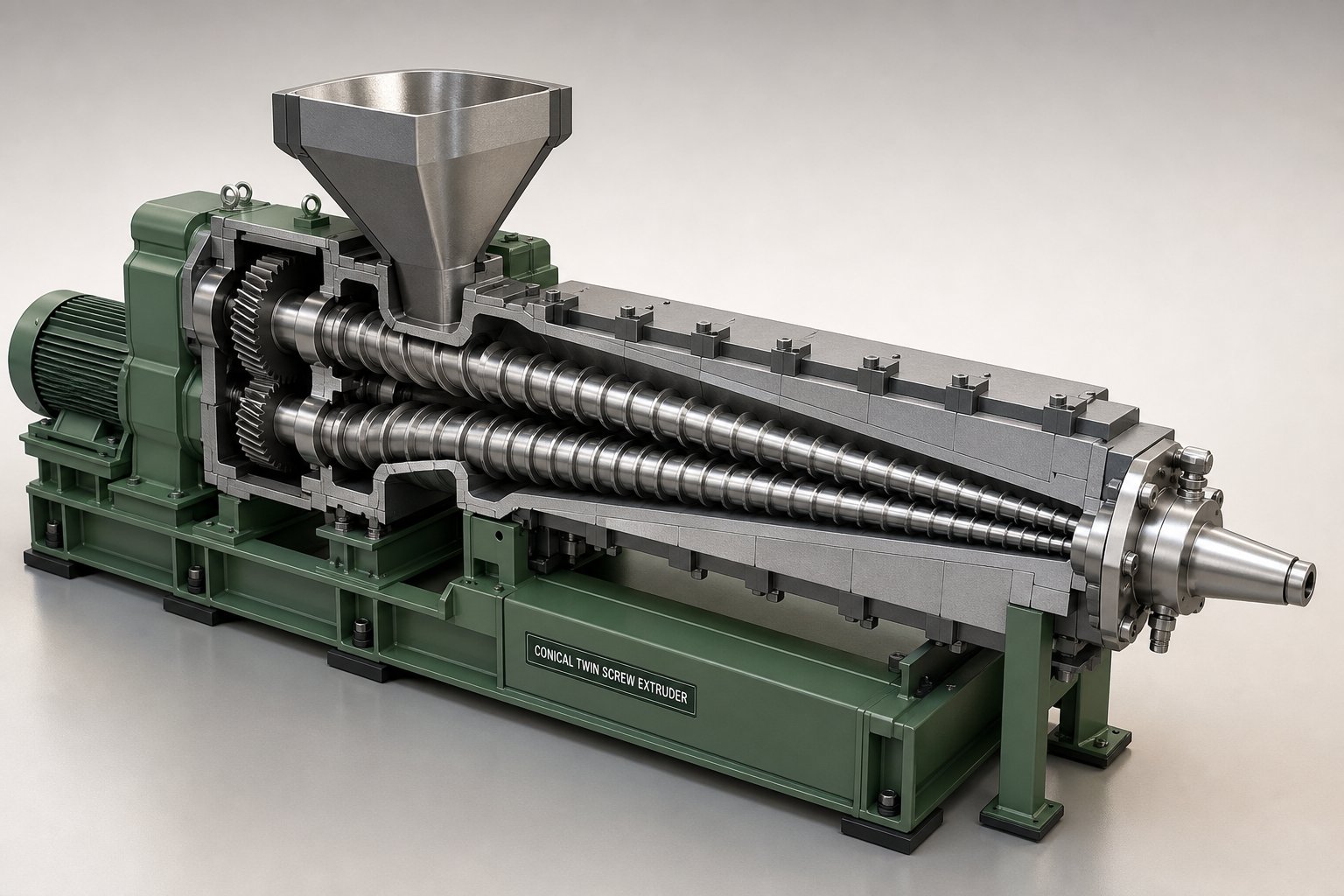
The counter-rotating parallel twin screw handles shear-sensitive PVC well, but it still uses constant-diameter screws arranged side by side — a geometry that imposes constraints on feed intake area and gearbox packaging. Imagine taking those two parallel screws and tapering them: large diameter at the feed end, small diameter at the discharge end, with the screw axes converging toward the die. That's exactly what a conical twin screw extruder machine does, and the resulting geometry solves several problems that parallel designs can't address as elegantly.
Conical twins are a specialized counter-rotating configuration. The screws rotate in opposite directions, maintaining the same low-shear calendering effect discussed in the previous section. But the taper introduces processing advantages that make this extruder twin screw design the dominant choice in PVC and WPC building products manufacturing worldwide.
How Conical Geometry Creates Processing Advantages
The tapered profile delivers a built-in trick that parallel screws need complex zone engineering to replicate: a natural compression ratio created by the geometric transition from large to small diameter. Material enters at the wide feed end, where the oversized screw diameter provides a large intake opening capable of swallowing high volumes of low-bulk-density powder — exactly what you need when feeding dry-blend PVC compound directly from a mixer without pre-pelletizing. As the material travels forward along the taper, the decreasing screw diameter compresses it progressively, melting and densifying the powder into a homogeneous melt without requiring the carefully optimized compression zone transitions that a parallel twin or single screw design demands.
This natural compression eliminates much of the screw zone optimization headache that process engineers face on parallel configurations. For many standard PVC formulations, a well-designed conical screw profile works effectively right out of the box — no kneading block rearrangement, no trial-and-error element swaps. You set your temperatures, dial in your feed rate, and run.
The gearbox design amplifies this advantage further. Because the screws diverge at the feed end — spreading apart rather than running side by side — there's physical room for larger bearings and wider gear faces than a parallel twin of equivalent output could accommodate. The result is higher torque transmission capacity relative to the machine's overall size, a critical factor when processing stiff, high-viscosity PVC dry blends that resist rotation. You'll also notice that this diverging screw arrangement gives the double screw extruder machine a noticeably smaller footprint than a parallel twin delivering comparable output — a practical consideration for plants where floor space is already tight.
Best Applications for Conical Twin Screws
Conical twin screw extruders have earned their reputation in a tightly focused set of applications. If you walk through a PVC building products factory anywhere in the world, chances are high that the primary extrusion lines are running conical twins. Their sweet spot includes:
- PVC window profiles — Multi-cavity profiles with tight dimensional tolerances for residential and commercial fenestration systems
- PVC pipe and fittings — Pressure and non-pressure pipe systems from 20 mm diameter up to medium-diameter drainage pipe
- PVC foam board — Lightweight, closed-cell foam panels used in signage, cabinetry, and interior construction
- WPC (wood-plastic composite) decking — Composite boards blending wood flour with PVC or PE matrices, requiring gentle processing to avoid fiber degradation
- Siding and exterior trim — Weather-resistant PVC profiles for residential cladding and architectural accents
The common thread? Every one of these applications involves processing PVC dry blend or wood-fiber composites — materials that benefit from the conical twin's combination of low shear, high compression, and generous feed intake. Industry analysis confirms that conical twins deliver low-shear processing with stable temperature control, making them the natural fit for heat-sensitive PVC and WPC formulations that would risk degradation in higher-shear equipment.
Pros and Cons
Pros
- Excellent for direct PVC dry-blend processing — Large feed opening accepts low-bulk-density powder directly from the high-speed mixer, eliminating the pre-compounding or pelletizing step that other configurations require
- Compact footprint — Diverging screw geometry and tapered barrel reduce the machine's overall length and width compared to parallel twins of equivalent throughput, freeing valuable floor space
- Strong pressure generation — Progressive compression along the taper builds high, stable die pressure for direct extrusion of profiles and pipe without supplemental melt pumps
- High torque capacity relative to size — The wider gearbox housing at the feed end accommodates robust bearings and gear trains, delivering reliable torque even with demanding PVC formulations
- Lower energy consumption in PVC applications — Low screw speeds and natural compression minimize frictional heat, reducing both energy input and cooling requirements compared to higher-speed parallel configurations
Cons
- Limited to counter-rotating operation only — The converging screw geometry is inherently incompatible with co-rotating motion, locking you out of the intense dispersive mixing capability that co-rotating designs provide
- Less versatile outside PVC and WPC applications — Conical twins are purpose-built machines. Attempting to run engineering plastics, polyolefin compounding, or reactive extrusion on a conical twin typically yields poor mixing and suboptimal throughput
- Fixed screw geometry limits process optimization — Like single screw designs, conical twin screws are typically one-piece constructions without interchangeable elements. Adjusting the screw profile for a different formulation means ordering a new screw set
- Smaller maximum throughput compared to large parallel twins — The tapered design limits the discharge end diameter, capping the maximum volumetric output below what a large-bore parallel twin screw extruder machine can achieve in high-capacity compounding operations
Conical twins represent focused engineering — a configuration that does one family of jobs exceptionally well rather than trying to be everything to everyone. That focus makes them the clear winner for PVC and WPC processors but a poor fit for operations needing broad material versatility. With all five configurations reviewed, the question shifts from understanding individual strengths to seeing them side by side — and matching them to specific industries, applications, and cost realities.
Head-to-Head Comparison With Total Cost of Ownership Framework
Reading through five individual configuration profiles gives you depth. But when it's decision time, depth alone isn't enough — you need everything laid flat on one surface so the trade-offs become unmistakable. That's what this section delivers. Instead of the single oversimplified table you'll find in every competing guide, you'll get three distinct comparison frameworks: one mapping performance features, one structuring total cost of ownership, and one pointing you toward the right configuration for your specific industry.
Treat these tables as decision-support tools, not absolute verdicts. Every plant's material mix, production volume, and operational maturity will shift the balance. But the patterns across these comparisons are consistent enough to eliminate poor-fit configurations early and focus your evaluation where it belongs.
Feature-by-Feature Comparison Table
This first table captures the core performance characteristics you've seen discussed across the preceding reviews — consolidated into a single view. Ratings reflect general configuration strengths rather than any specific machine model, because a well-built plastic single screw extruder from a quality OEM will outperform a poorly manufactured twin screw on almost every metric. Configuration type sets the ceiling; build quality determines how close you get to it.
| Performance Feature | Single Screw | Co-Rotating Parallel Twin | Counter-Rotating Parallel Twin | Conical Twin |
|---|---|---|---|---|
| Mixing Capability | Limited | Excellent | Good | Moderate |
| Throughput Range | Good to Excellent | Excellent | Moderate | Good |
| Process Flexibility | Limited | Excellent | Moderate | Limited |
| Self-Cleaning | Limited | Excellent | Moderate | Moderate |
| Pressure Generation | Good | Moderate | Excellent | Excellent |
| Energy Efficiency | Excellent (simple tasks) | Good (mixing-intensive tasks) | Good | Good to Excellent (PVC) |
| Capital Cost | Low | High | Moderate to High | Moderate |
| Maintenance Complexity | Low | High | Moderate | Moderate |
| Material Versatility | Moderate | Excellent | Moderate | Limited |
| Scale-Up Predictability | Moderate | Excellent | Good | Good |
A few patterns jump out immediately. Single screw extrusion dominates on cost and simplicity but hits a wall on mixing and flexibility. Co-rotating twin screw technology leads nearly every performance category but carries the highest capital and maintenance burden. Counter-rotating and conical twins occupy the middle ground — specialized configurations that excel within their target applications but lack the broad versatility of co-rotating designs.
Notice that energy efficiency isn't a clean win for any single configuration. A twin screw burning more watts per hour but completing a compounding task in fewer passes — or eliminating a separate pre-compounding step entirely — can deliver lower total energy cost per kilogram of finished product than a single screw that needs multiple processing stages to achieve the same result. Context determines which efficiency metric actually matters to your operation.
Total Cost of Ownership Framework
Purchase price gets all the attention during procurement negotiations, but it typically represents only 15% to 25% of what you'll actually spend over an extruder's productive life. TCO analysis from Insta-Pro International highlights a pattern that repeats across the extrusion industry: customers who choose equipment based on the lowest upfront price frequently circle back within two or three years expressing regret — because ongoing spare parts, maintenance costs, and lost revenue from downtime erode the initial savings quickly.
The table below isn't filled with fabricated dollar amounts. Instead, it provides a structured framework you can populate with actual quotes from your shortlisted suppliers. Comparing configurations on equal footing across these six TCO categories will reveal cost differences that a simple price-per-machine comparison never captures.
| TCO Category | Single Screw | Co-Rotating Parallel Twin | Counter-Rotating Parallel Twin | Conical Twin |
|---|---|---|---|---|
| Initial Equipment Cost | Lowest — simpler gearbox, single screw, less precision machining | Highest — dual synchronized shafts, modular barrel segments, precision screw elements | Moderate to High — intermeshing counter-rotating gearbox adds complexity over single screw | Moderate — compact design offsets twin-screw mechanical complexity |
| Annual Energy Cost Impact | Low for simple melting and pumping; rises if used for tasks requiring multiple passes | Higher per hour but often lower per kg of compounded product due to single-pass processing | Moderate — low screw speeds reduce energy draw but lower throughput extends run times | Low to Moderate — natural compression and low speeds minimize frictional energy input |
| Wear Part Replacement Frequency | Moderate — screw replacement every 8,000–15,000 hours; barrel relining less frequent | Higher — individual kneading blocks and mixing elements wear faster under abrasive compounds; modular replacement limits cost per event | Moderate — lower shear reduces element wear but limited self-wiping can cause localized degradation | Moderate — low-speed operation reduces abrasive wear; fixed screw design means full screw replacement when worn |
| Downtime for Maintenance | Low — simpler design enables faster repairs, often by in-house personnel | Higher — screw element swaps and barrel segment access require trained technicians and longer windows | Moderate — less complex than co-rotating but more involved than single screw servicing | Moderate — compact layout can complicate access but fewer modular components simplify procedures |
| Operator Training Requirements | Basic — straightforward controls with fewer adjustable parameters | Advanced — starve-feeding, multi-zone temperature control, screw configuration decisions require deeper process knowledge | Moderate — simpler than co-rotating but more nuanced than single screw operation | Moderate — relatively standardized PVC process parameters reduce the learning curve |
| Process Changeover Time | Long — poor self-cleaning behavior requires purging or mechanical cleaning between runs | Short — excellent self-wiping action minimizes transition scrap and time between formulations | Moderate — limited wiping extends changeovers compared to co-rotating designs | Moderate to Long — dedicated PVC lines rarely change formulations, but when they do, fixed screw geometry slows the process |
Here's how to use this framework: request itemized quotes from each equipment supplier and plug the numbers into these categories. Then project the costs over a ten-year operational window at your planned annual running hours. Industry cost data suggests that a mid-range single screw system accumulates $1.7M to $2.4M in ten-year TCO, while a comparable-output twin screw system lands between $2.0M and $2.9M. The gap narrows — or even reverses — when the twin screw eliminates a pre-compounding step, reduces scrap rates, or enables higher-margin product formulations that single screw extrusion simply can't produce.
Industry-Specific Quick Selection Guide
Sometimes the fastest path to a good decision isn't comparing features — it's starting from your industry and working backward to the configuration that fits. No competitor guide on page one offers this level of structured, industry-specific direction. The table below maps six major application sectors to their recommended extruder configuration, with a one-line rationale explaining the match.
| Industry / Application | Recommended Configuration | Why This Configuration Fits |
|---|---|---|
| Plastics Compounding & Masterbatch | Co-Rotating Parallel Twin Screw | Unmatched dispersive mixing, modular screw profiles, and fast changeovers handle diverse filler and pigment loadings across multiple formulations |
| PVC Profiles & Pipe | Conical Twin Screw (standard) or Counter-Rotating Parallel Twin (high-output) | Low-shear processing protects thermally sensitive PVC; conical geometry accepts dry-blend powder directly without pre-pelletizing |
| Food Extrusion | Co-Rotating Parallel Twin Screw | Precise residence time control, multiple feed and vent ports, and self-cleaning hygiene suitability meet the mixing and safety demands of food-grade processing |
| Pharmaceutical Hot-Melt Extrusion | Co-Rotating Parallel Twin Screw | Narrow residence time distribution, exact temperature zone control, and scale-up predictability are essential for API dispersion and regulatory validation |
| Plastics Recycling | Co-Rotating Parallel Twin Screw (contaminated streams) or Single Screw (clean regrind) | Twin screw handles moisture, contaminants, and devolatilization for post-consumer waste; single screw suffices for clean, pre-sorted industrial regrind |
| 3D Printing Filament | Single Screw | Stable melt pressure delivery and low capital cost are ideal for the consistent, single-resin extrusion that precision filament production demands |
Notice a pattern? The twin screw earns its recommendation wherever mixing complexity, material sensitivity, or formulation diversity drive the process. The single screw wins when the job is straightforward melting and pumping of a known material at the lowest possible cost per kilogram. And the conical twin occupies its own lane — purpose-built for PVC dry-blend processing with an efficiency that neither parallel twins nor single screws can match in that specific niche.
These tables give you the map. But a map only helps if you know where you're standing — and the most common selection mistakes don't come from misreading feature charts. They come from assumptions buyers make before they ever open a comparison guide.
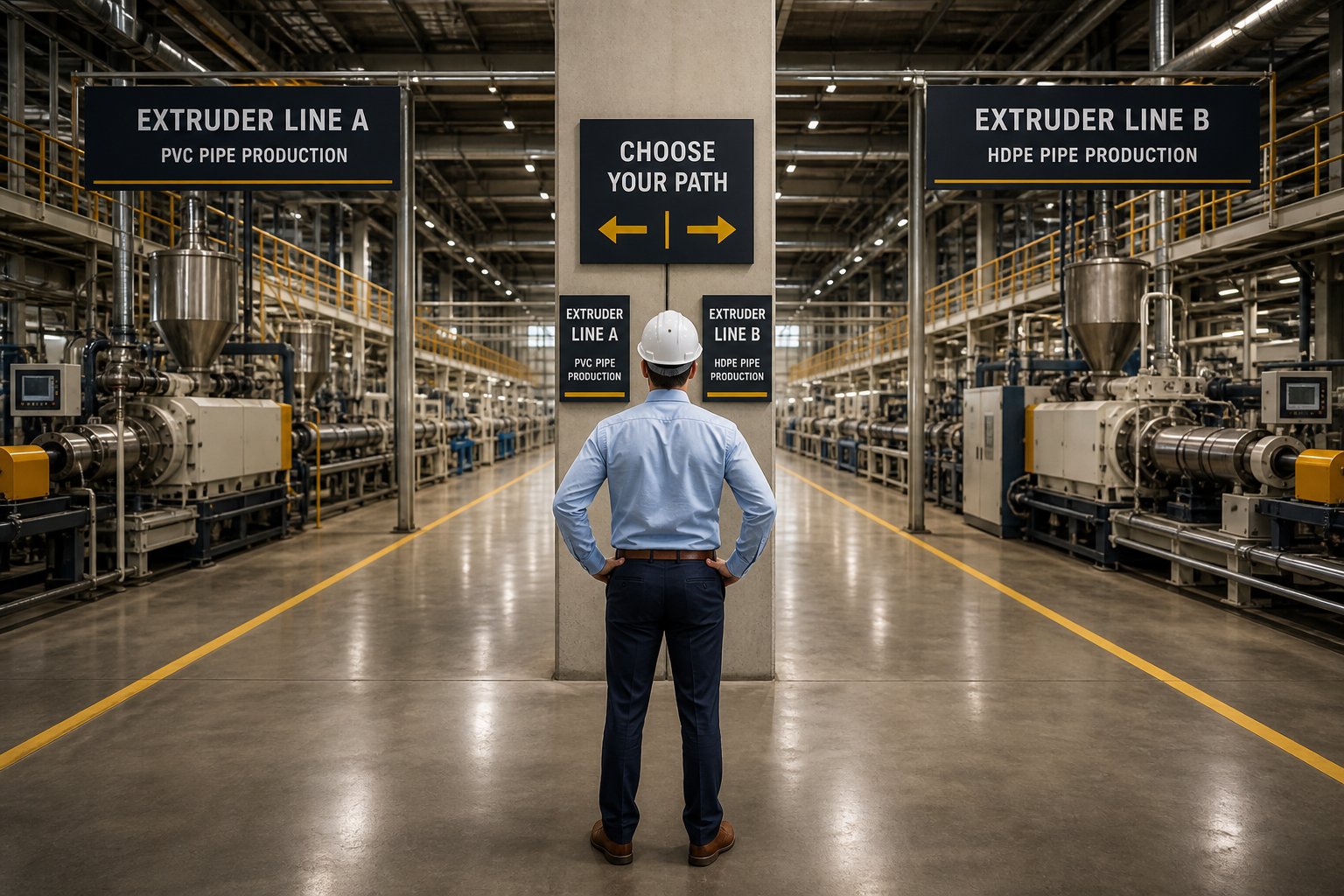
Final Recommendations: Avoid These Selection Mistakes With Your Twin Screw or Single Screw Plastic Extruder
You've seen five configurations dissected across weighted criteria, compared head-to-head in feature tables, and mapped to specific industries. That's useful — but information alone doesn't prevent bad decisions. What prevents bad decisions is knowing which assumptions trip buyers up most frequently and having a clear, repeatable framework for narrowing your options before you ever contact a supplier.
This final section distills everything above into actionable guidance organized by the decisions you'll actually face. No generic "it depends on your application" hand-waving. Instead, you'll get the three factors that do the most filtering work, the specific mistakes that burn the most money, and a practical starting point for turning your configuration choice into a component specification.
Match Your Application to the Right Configuration
Here's the good news: you don't need to evaluate all five configurations against every criterion to land on the right answer. Three decision factors — applied in sequence — will narrow most buyers down to one or two configurations worth investigating further. Rank them in this order:
- Required mixing intensity — This is the single most powerful filter. If your process demands dispersive mixing — breaking apart filler agglomerates, distributing nano-additives, or reacting modifiers into the polymer chain — you need a co-rotating parallel twin screw extruder. Full stop. No single screw plastic extruder, counter-rotating twin, or conical design can deliver the shear intensity and residence time control that intensive compounding requires. Conversely, if your feedstock arrives pre-compounded and your job is simply to melt and shape it, paying for twin screw mixing capability you'll never use wastes capital and complicates operations.
- Material sensitivity to shear and heat — Once you know your mixing requirement, the second filter asks whether your material can survive the shear levels your mixing choice implies. Rigid PVC, certain biodegradable polymers, and shear-sensitive masterbatch formulations will degrade in a high-shear co-rotating twin. These materials steer you toward counter-rotating parallel twins or conical twins, which deliver adequate dispersion through compressive and elongational deformation rather than aggressive shearing. If your material tolerates shear well — polyolefins, most engineering plastics, filled compounds — this filter simply confirms your first-choice configuration rather than redirecting it.
- Production volume and changeover frequency — The third filter addresses operational reality. A plant running a single PVC profile formulation 24/7 needs a dedicated conical twin screw — maximum efficiency, minimum complexity. A compounder producing fifteen different color masterbatches per week needs a co-rotating twin screw extruder plastic processors can reconfigure and clean quickly between runs. A film line running one LDPE grade at 500 kg/hr needs a single screw that delivers stable output at the lowest cost per kilogram. Volume and changeover frequency determine whether the operational overhead of a more flexible machine pays for itself or simply adds unnecessary cost and training burden.
Apply these three factors honestly to your specific situation, and you'll eliminate at least two or three configurations before any supplier walks through your door. That focus saves you weeks of evaluation time and protects you from the persuasive pressure of equipment salespeople pushing configurations that don't match your actual needs.
Common Mistakes That Cost Plants Thousands
Even experienced buyers make predictable errors when comparing single vs twin screw extruders. These mistakes don't always show up immediately — some take months or years to reveal their full financial impact. Watch for these:
- Choosing a twin screw plastic extruder for simple single-resin extrusion where a single screw performs better at lower cost. This is the most common overcapitalization mistake in the industry. A twin screw compounding extruder running pre-compounded polyethylene for blown film consumes more energy, requires more skilled operators, demands more maintenance, and costs two to three times more upfront — all while delivering no measurable quality or throughput advantage over a single screw doing the same job. The twin screw's mixing superiority is irrelevant when there's nothing complex to mix.
- Ignoring the co-rotating vs counter-rotating distinction. As the comparison table in the previous section showed, these two twin screw subtypes are not interchangeable. A plant that specifies a co-rotating twin for direct PVC profile extrusion will fight thermal degradation issues from day one. A plant that buys a counter-rotating twin expecting it to compound glass-fiber-reinforced nylon will get inadequate dispersion and poor fiber wetting. This distinction gets zero attention in most buying guides — and it's one of the costliest oversights a buyer can make.
- Selecting equipment based solely on purchase price without TCO analysis. Industry case studies demonstrate how dramatically TCO can diverge from sticker price. A masterbatch producer switching from a lower-cost single screw to a twin screw extruder saw scrap rates drop from 12% to under 0.5% and product pricing jump 35% — delivering payback in under three months despite a purchase price more than double the single screw alternative. The cheapest machine on the quote sheet is rarely the cheapest machine to own over a decade of production.
- Neglecting screw barrel component quality and replacement part sourcing. This is the silent profit killer. As Plastics Technology reports, wear on screw flights and barrel surfaces begins the moment the screw starts rotating. The original clearance between flight land and barrel wall is typically just 0.001 inch per side per inch of diameter — and as that clearance widens, melting efficiency degrades, output drops, and energy consumption rises. Plants that source the cheapest aftermarket replacement screws and barrels often find performance drops below even the worn components they replaced, trapping the operation in a cycle of premature changeouts and quality inconsistency.
Every one of these mistakes stems from the same root cause: evaluating the extruder purchase as an isolated equipment decision instead of a system-level commitment that includes configuration type, operational demands, and component quality over the machine's full productive life.
Where to Start Your Evaluation
Once you've identified your target configuration using the three-factor framework above, resist the impulse to jump straight into OEM machine quotes. There's a step most buyers skip that pays dividends later: evaluate screw barrel component suppliers early in the process, not as an afterthought when wear parts eventually need replacement.
Why? Because the screw and barrel assembly is the component you'll replace most frequently over the extruder's life. Knowing what's available — in terms of metallurgy options, dimensional precision, surface treatments, and delivery timelines — before you finalize your machine purchase lets you factor realistic replacement costs into your TCO calculation. It also protects you from discovering two years in that affordable, high-quality replacement parts for your chosen OEM's equipment are difficult to source.
NANHAIYA's product catalog offers a practical starting point for this step. Engineers can compare screw barrel options across single screw, parallel twin screw, and conical twin screw configurations in one place — making it straightforward to match component specifications to your selected extruder type regardless of which OEM builds the machine itself. Having visibility into replacement component availability and options before you commit to a platform gives you negotiating leverage with equipment suppliers and prevents procurement surprises down the road.
The extruder configuration determines capability, but screw barrel quality determines consistency and uptime. Choose the right type for your application, then protect that investment with components built to hold tolerance over thousands of operating hours.
Comparing single vs twin screw extruders isn't a one-time exercise — it's a decision framework you'll return to every time your product mix shifts, your volume targets change, or your wear components come due for replacement. Apply the three-factor filter, avoid the mistakes that trap other buyers, and treat component quality as seriously as machine selection. Do that, and the extruder you install today will still be the right choice a decade from now.
Frequently Asked Questions About Single vs Twin Screw Extruders
1. What is the main difference between a single screw and a twin screw extruder?
The core difference lies in the conveying mechanism. A single screw extruder relies on frictional drag between the polymer and barrel wall to move material forward, making it a drag-flow device best suited for melting and pumping pre-compounded resins. A twin screw extruder uses two intermeshing screws that actively push material forward through positive displacement, enabling far superior mixing, independent control of throughput and screw speed via starve feeding, and the ability to handle complex compounding tasks. This fundamental distinction means single screws excel at cost-effective processing of simple formulations, while twin screws are essential when intensive dispersive mixing, devolatilization, or reactive extrusion is required.
2. When should I choose a single screw extruder over a twin screw extruder?
A single screw extruder is the smarter investment when your application involves melting and shaping pre-compounded resin without needing intensive mixing. Typical applications include blown film, cast film, pipe and profile extrusion from pre-mixed pellets, wire coating, sheet extrusion, and 3D printing filament production. In these scenarios, the single screw delivers lower capital cost, simpler operation, reduced maintenance, and lower energy consumption per kilogram compared to a twin screw performing the same straightforward task. Choosing a twin screw for these applications leads to unnecessary overcapitalization and operational complexity with no measurable quality or throughput benefit.
3. What is the difference between co-rotating and counter-rotating twin screw extruders?
Co-rotating twin screws turn in the same direction, creating a figure-eight material flow pattern with high shear intensity and excellent self-wiping action. This makes them ideal for compounding, reactive extrusion, and nano-composite dispersion. Counter-rotating twin screws turn in opposite directions, drawing material inward at the nip point to produce a calendering effect with lower shear and higher pressure buildup. This gentler processing protects heat-sensitive materials like rigid PVC. These subtypes are not interchangeable — specifying a co-rotating twin for PVC profile extrusion risks thermal degradation, while a counter-rotating twin cannot deliver the dispersive mixing needed for advanced compounding. Suppliers like NANHAIYA at nhyscrews.com/products offer screw barrel components for both parallel and conical twin screw configurations, helping plants match components to the correct subtype.
4. How does total cost of ownership differ between single and twin screw extruders?
Purchase price typically represents only 15% to 25% of an extruder's lifetime cost. A single screw system generally has lower upfront cost, simpler maintenance, and reduced energy consumption for basic melting tasks. However, twin screw extruders can deliver lower total cost per kilogram of finished product when they eliminate pre-compounding steps, reduce scrap rates, or enable higher-margin formulations. Industry data shows ten-year TCO for mid-range single screw systems at roughly $1.7M to $2.4M versus $2.0M to $2.9M for comparable twin screw systems — but this gap narrows or reverses when accounting for single-pass processing, faster changeovers, and reduced quality rejections. A proper TCO analysis must include energy costs, wear part replacement frequency, downtime, operator training, and changeover time.
5. How often do extruder screw barrels need replacement, and does component quality matter?
Single screw barrels typically require replacement every 8,000 to 15,000 operating hours, while twin screw kneading blocks and mixing elements may wear faster under abrasive compounds. Component quality has an outsized impact on performance — increasing flight clearance from 0.1 mm to 0.5 mm in a 90 mm single screw can reduce output by 8% to 15% while raising specific energy consumption by 6% to 12%. Inferior aftermarket replacements machined from lower-grade steel or ground to loose tolerances can leave an extruder performing worse than before the rebuild. Sourcing from suppliers that cover all major configurations — such as NANHAIYA's product line at nhyscrews.com/products, which includes single screw, parallel twin screw, conical twin screw, and injection molding barrels — ensures consistent metallurgy and dimensional precision across your entire extruder fleet.
Written by
Nanhaiya Technical Team
Zhoushan Nanhaiya Plastic Machinery Co., Ltd.
The Nanhaiya technical team supports screw and barrel manufacturing projects through application review, technical communication, custom manufacturing coordination, and production and quality control.
Discuss Your Application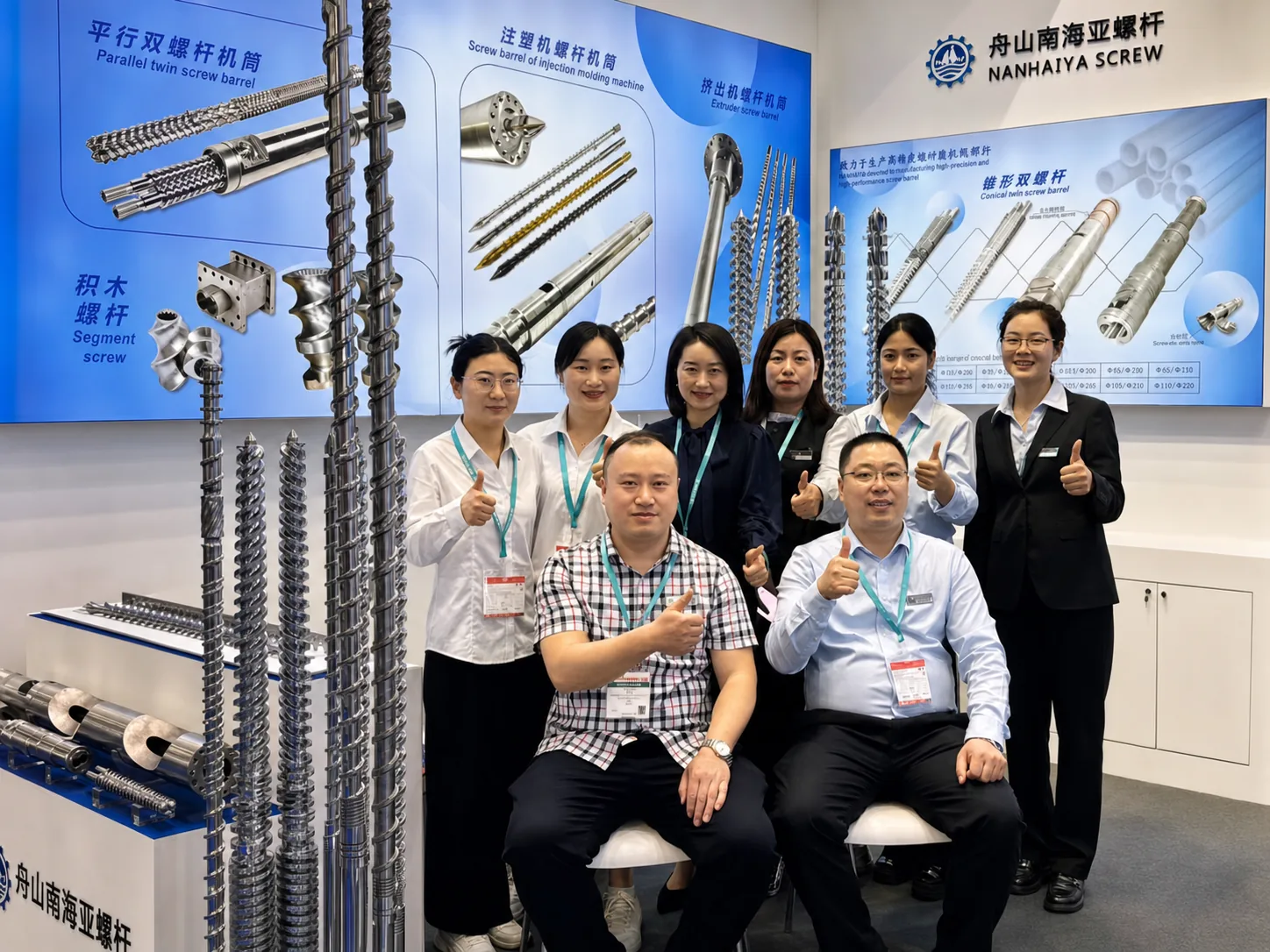
Related Articles
More insights on screw barrel technology and plastics processing.
Extruder Machine Decoded: From Raw Pellet To Finished Product
Oct 6, 2026
Learn how an extruder machine works, compare single-screw vs. twin-screw types, and get expert guidance on specs, troubleshooting, and selection.
Read Article
PE Pipe Making Machine Decoded: From Raw Resin to Flawless Pipe
Oct 4, 2026
Learn how a PE pipe making machine works, from resin to finished pipe. Covers components, material grades, automation, troubleshooting, and buyer selection tips.
Read Article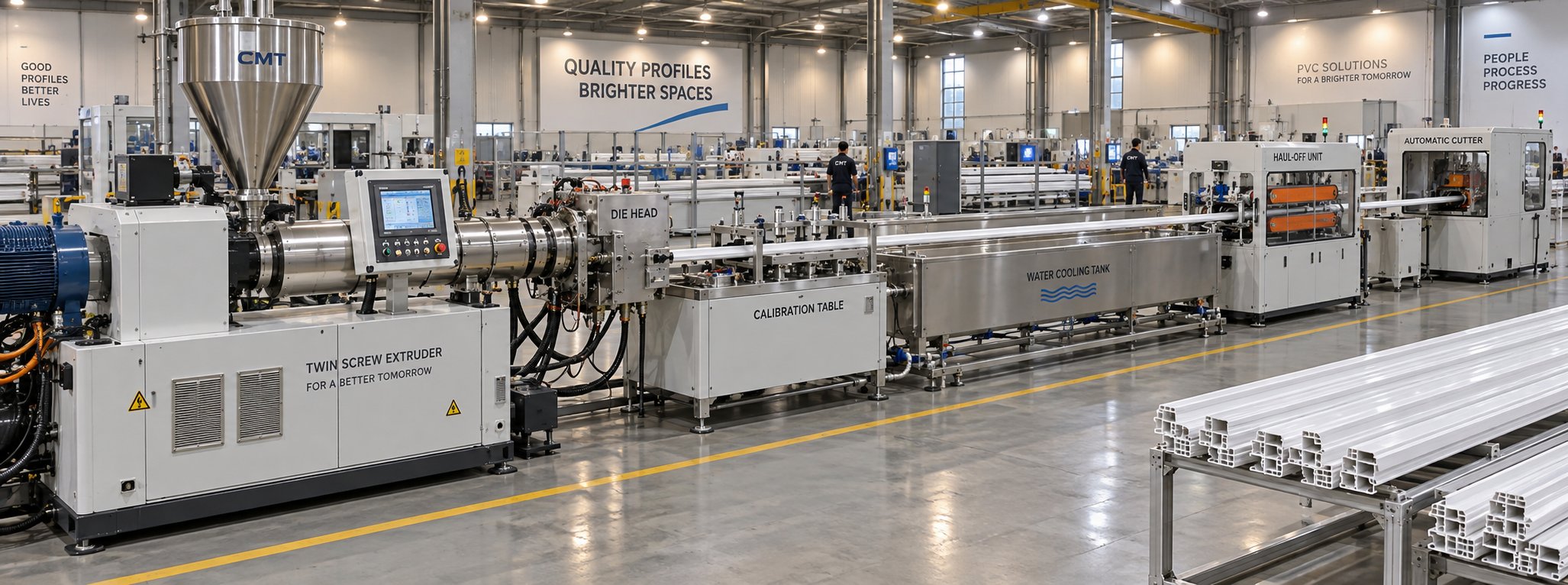
PVC Profile Making Machine Decoded: From Raw Resin To Profit
Oct 3, 2026
Learn how a PVC profile making machine works — extrusion process steps, key technical parameters, die design, calibration methods, maintenance, and total cost of ownership.
Read ArticleLooking for something else?
Search by material, symptom or product and jump straight to the relevant page.
These are navigation suggestions based on keyword matching — not a quotation, not a delivery commitment, and not a substitute for engineering review. Final specification is confirmed by our engineers against your drawings and processed material.
Need help with screw barrel selection?
Share your machine model, processed material and application. Our team can help with pricing and technical support.