

What a Laboratory Twin Screw Extruder Is and Why Researchers Rely on It
Imagine you have a novel polymer blend, a promising pharmaceutical compound, or an experimental food ingredient -- but only a few hundred grams of raw material to work with. Running trials on a full-size production line would burn through your entire supply in seconds. That is exactly the problem a laboratory twin screw extruder is built to solve.
What Is a Laboratory Twin Screw Extruder
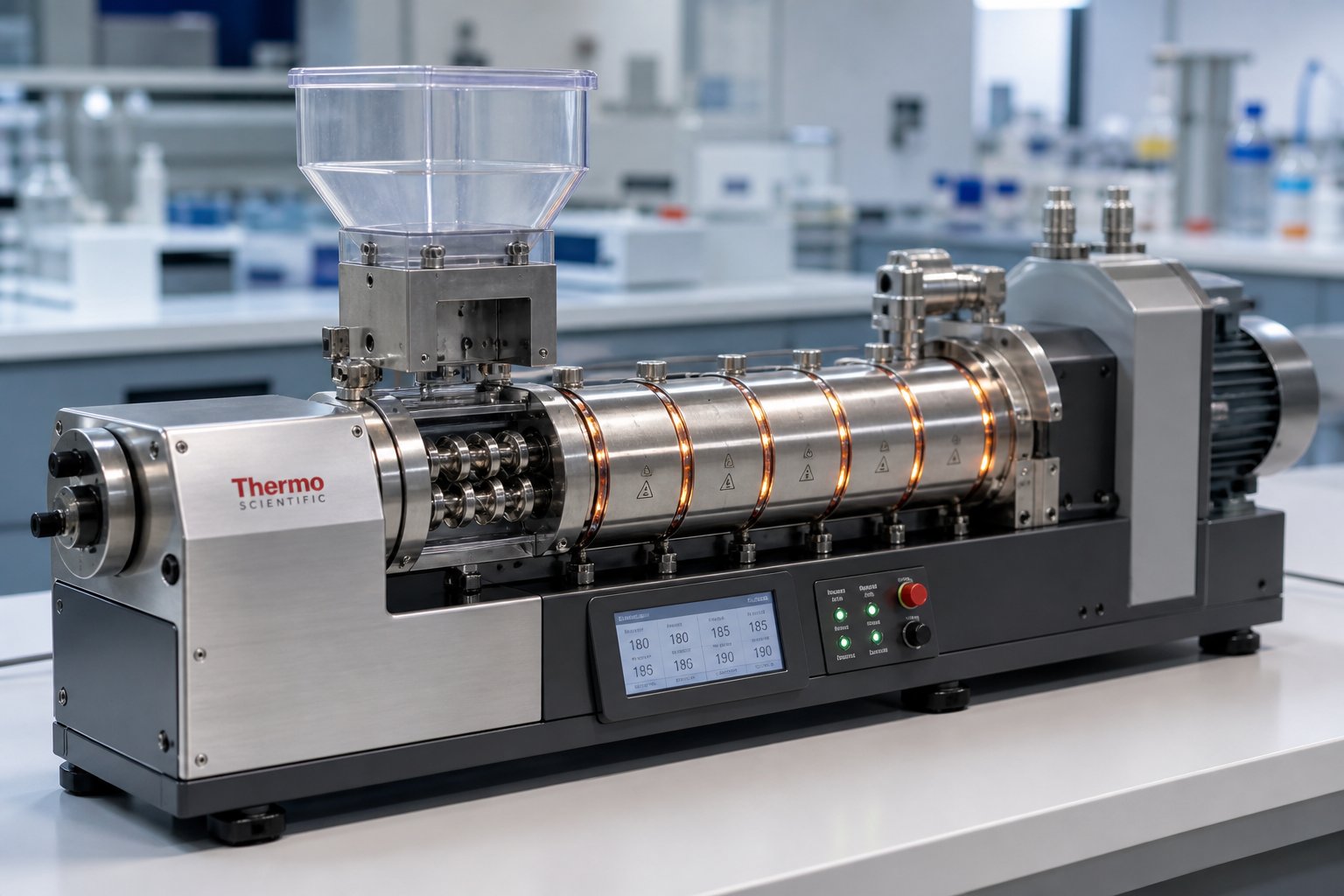
A laboratory twin screw extruder is a compact, research-grade processing machine that uses two intermeshing screws rotating inside a temperature-controlled barrel to convey, melt, mix, and shape materials at small scale -- typically handling throughputs from a few hundred grams up to several kilograms per hour.
Unlike production-scale equipment that processes tons of material per hour, a laboratory extruder is purpose-built for precision, not volume. The two screws intermesh tightly as they turn, creating intensive shearing and folding action that blends components at a molecular level. Researchers can independently control barrel temperature across multiple zones, adjust screw speed, and modify the screw profile itself -- all within a machine that fits comfortably on a lab bench.
Who uses these machines? The user base is remarkably diverse. Formulation chemists rely on them to screen polymer blends and additive packages. Polymer scientists study melt behavior and rheological properties in real processing conditions. Pharmaceutical engineers use them for hot-melt extrusion to improve drug bioavailability. Food scientists explore ingredient texturization and plant-based protein structuring. In every case, the goal is the same: generate meaningful process data with minimal material consumption.
Why Lab-Scale Extrusion Matters for R&D
The core value proposition comes down to three things: material conservation, speed, and data quality. When raw materials cost hundreds of dollars per kilogram -- or simply do not exist in large quantities yet -- a lab extruder lets you run dozens of formulation trials with what a production machine would consume in a single startup purge.
Speed matters just as much. Researchers can iterate through multiple screw configurations, temperature profiles, and feed rates in a single day. That rapid parameter screening compresses development timelines from months to weeks, generating reliable data that directly informs scale-up decisions.
You might wonder: why not just use a single-screw lab machine? Single-screw extruders are simpler and less expensive, but they fall short when mixing intensity and process flexibility are priorities. A twin screw design delivers far superior distributive and dispersive mixing, handles a wider range of material viscosities, and offers self-wiping capability that reduces cross-contamination between experiments. For compounding advanced materials such as filled plastics, biopolymers, and pharmaceutical carriers, the twin screw architecture is the clear choice.
This guide takes a vendor-neutral, education-first approach. Rather than spotlighting a single product line, you will find practical technical knowledge -- from specifications and screw element design to scale-up methodology -- that helps you make informed decisions regardless of which equipment brand you are evaluating.
Key Technical Specifications Every Researcher Should Understand
Selecting the right lab scale twin screw extruder starts with understanding what the numbers on a spec sheet actually mean for your experiments. A machine with impressive-sounding motor power might still fall short if its torque rating cannot handle your filled formulation. A compact benchtop twin screw extruder with a short barrel might save bench space but limit the number of processing zones you can configure. Every parameter on a data sheet connects to a practical processing outcome -- and reading them as a system, rather than as isolated figures, separates productive equipment decisions from expensive mistakes.
Critical Specifications That Define Lab Extruder Performance
Six core parameters shape what a laboratory scale extruder can and cannot do. Here is what each one means in the context of small-scale research:
- Screw diameter (mm): This is the baseline scale of your process. Smaller diameters (10-16 mm) conserve material -- sometimes processing batches as small as 10 to 50 grams -- while larger lab diameters (20-27 mm) produce data that correlates more reliably with production equipment. Volumetric capacity scales roughly with the cube of the diameter, so even a modest jump from 16 mm to 27 mm represents a significant increase in throughput potential.
- L/D ratio: The total screw length divided by the screw diameter determines your available "processing real estate." A 25:1 ratio suits simple melting and mixing tasks, while a 40:1 ratio accommodates multiple functional zones -- melting, intensive mixing, venting, side-feeding, and pressure buildup -- within a single barrel. Longer is not automatically better, though. Excessive L/D extends residence time and increases the risk of thermal degradation for heat-sensitive materials.
- Throughput capacity: Lab scale extruder models typically deliver grams per hour to roughly 5 kg/hr. The exact range depends on screw diameter, free volume, screw speed, and material properties. For early-stage formulation screening where material is scarce, throughputs measured in hundreds of grams per hour are often ideal.
- Motor power (kW): Raw power ratings can be misleading at lab scale. A 0.5 kW motor geared for low speed delivers very different torque than a 3 kW motor geared for high speed. The critical relationship is Torque = 9550 x kW / max RPM. At small diameters, torque per unit volume matters more than headline kilowatt figures because the tiny screw shafts limit how much force can actually reach the material.
- Maximum RPM: Lab machines commonly range from 200 to over 1,000 RPM. Higher speeds generate greater shear rates and more intensive dispersive mixing -- valuable for breaking apart pigment agglomerates or distributing nanofillers. However, shear-sensitive polymers and pharmaceutical formulations often require moderate speeds to avoid degradation.
- Number of barrel zones: Each independently heated and cooled zone gives you finer control over the temperature profile along the barrel. A micro-extruder with three zones offers limited flexibility, while a lab machine with six to eight zones lets you create complex thermal profiles that mirror production-scale conditions.
One detail that spec sheets rarely highlight deserves special attention: heat transfer behavior at small diameters is fundamentally different from larger equipment. The surface-area-to-volume ratio is dramatically higher on a 16 mm lab machine than on a 70 mm production unit. Barrel heaters and cooling systems exert a much stronger influence on melt temperature at lab scale, which means a process that runs perfectly at a given setpoint on your benchtop twin screw extruder may behave differently when scaled up -- not because of an error, but because the physics of heat transfer have shifted.
How to Read a Lab Extruder Spec Sheet
Spec sheets can feel overwhelming when every twin screw extruder machine on the market presents its parameters differently. The table below cuts through that noise by organizing typical specification ranges across three common laboratory size classes. These are general industry-standard values rather than any single manufacturer's lineup, so you can use them as a vendor-neutral reference regardless of which brand you are evaluating.
| Specification | Micro / Benchtop (10-16 mm) | Standard Lab (20-27 mm) | Pilot-Bridge (30+ mm) |
|---|---|---|---|
| Screw Diameter | 10-16 mm | 20-27 mm | 30-50 mm |
| L/D Ratio | 20:1 to 32:1 | 25:1 to 40:1 | 32:1 to 48:1 |
| Typical Throughput | 50 g/hr to 1 kg/hr | 0.5 kg/hr to 5 kg/hr | 5 kg/hr to 50+ kg/hr |
| Motor Power | 0.5 kW to 1.5 kW | 1.5 kW to 5 kW | 5 kW to 25 kW |
| Max RPM | 200 to 800 RPM | 300 to 1,000 RPM | 300 to 1,200 RPM |
| Number of Barrel Zones | 3 to 5 | 5 to 8 | 6 to 10 |
| Primary Use Case | Micro-batch screening, material compatibility, API feasibility | Formulation development, parameter optimization, small-batch production | Scale-up validation, process transfer studies, pre-production trials |
A few patterns in this table are worth noting. L/D ratios and barrel zone counts both expand as screw diameter increases, reflecting the need for more processing flexibility as experiments move closer to production-relevant conditions. Maximum RPM ranges converge at the standard lab and pilot-bridge levels because both classes increasingly use drive and gearbox technology similar to full-scale production machines.
Also notice the throughput jump between size classes. A standard lab scale extruder at 20-27 mm can produce enough material for mechanical testing, film casting, or pellet production -- tasks that a 12 mm micro-extruder simply cannot support in practical quantities. Choosing the right size class depends on balancing material availability against data quality requirements: the smallest twin screw extruder machine that gives you meaningful, scalable results is usually the best fit for R&D budgets.
These specifications define what a machine can deliver mechanically. But the real processing magic happens inside the barrel, where individual screw elements -- conveying flights, kneading blocks, mixing discs, and reverse elements -- work together to transform raw feedstock into a homogeneous melt. How those elements are arranged changes everything about shear, residence time, and mixing intensity.
Screw Elements and Modular Configuration Strategies
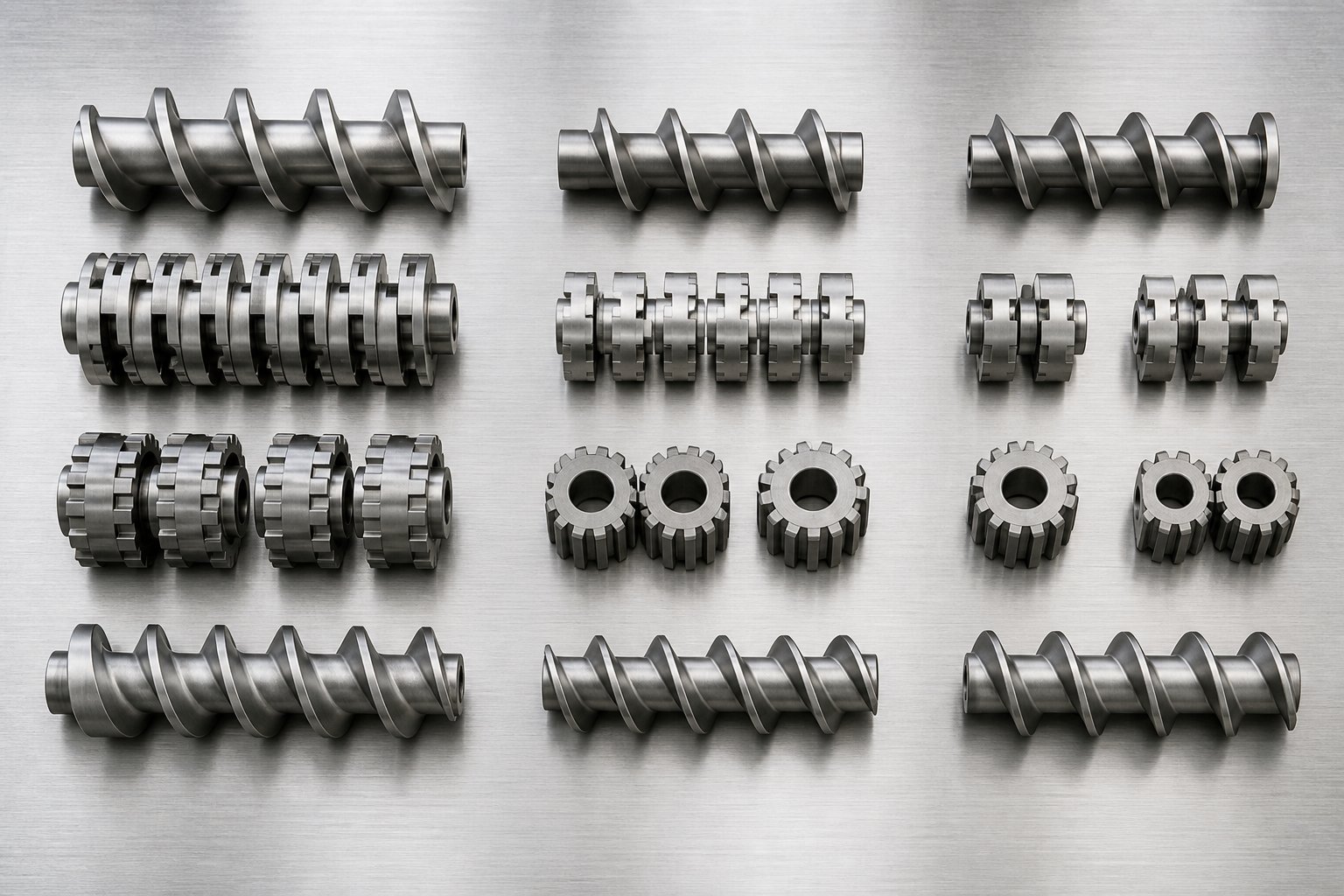
Every laboratory twin screw extruder ships with a set of individual screw elements that slide onto splined shafts running the full length of the barrel. Think of these elements as building blocks. By rearranging them, you effectively redesign how material flows, melts, mixes, and pressurizes -- all without changing the machine itself. This modular architecture is what gives twin screws their extraordinary versatility, and understanding each element type is arguably the most practical skill a researcher can develop.
Essential Screw Element Types and Their Functions
Each extruder screw profile is assembled from a limited family of element categories, yet the combinations they produce are nearly endless. Here are the primary types you will encounter, listed in the order material typically meets them during screw extrusion:
- Conveying elements -- These forward-pitch flight elements transport material downstream without applying significant shear. Deeper channels and wider pitch move larger volumes per revolution, while tighter pitch compresses the material and builds modest pressure. In the feed zone, specialized SK (feed) elements with a flattened pushing surface help material drop into the screw root more efficiently -- critical when handling low-bulk-density powders.
- Kneading blocks -- Staggered disc elements that deliver the core mixing action inside a screw extruder. The offset angle between adjacent discs controls intensity: 30-degree stagger provides gentle distributive mixing with a forward-conveying effect, 60-degree stagger increases shear while maintaining some forward push, and 90-degree (neutral) stagger stops conveying entirely, maximizing energy input and residence time. Wider discs promote dispersive mixing that breaks apart agglomerates, while narrower discs favor distributive blending that spreads components evenly without particle size reduction.
- Mixing elements -- Designs such as toothed mixing elements (TME or ZME) use rows of interlocking teeth rather than solid discs. They provide gentle homogenization with forward conveying, making them ideal for blending liquid additives or heat-sensitive ingredients without the aggressive shear that kneading blocks generate. Placed before a compression zone, they unify solid and liquid phases before final melt formation.
- Reverse elements -- Left-handed pitch flights that push material backward against the main flow. This creates a local pressure dam, forcing the upstream zone to fill completely and dramatically extending residence time in the preceding mixing section. Reverse elements are typically kept shorter than the screw diameter to avoid dangerous pressure spikes and excessive mechanical strain on the twin screws.
Each element type shifts three interconnected process variables. Conveying elements keep fill level low and residence time short. Kneading blocks raise shear rate and fill level while slowing throughput. Reverse elements maximize fill and residence but restrict forward flow. Balancing these trade-offs is the heart of profile design.
Building a Screw Configuration for Your Experiment
Designing a screw profile follows a logical sequence that mirrors the material's journey through the barrel. A typical layout moves through these functional zones:
- Feed and conveying zone: Wide-pitch conveying elements accept material from the feeder and transport it forward. The goal is smooth intake without premature melting.
- Melting and mixing zone: A transition to tighter-pitch conveyors compresses the material, followed by kneading blocks that apply shear to initiate melting and blending. The number and aggressiveness of kneading blocks depend on the material's melt viscosity and sensitivity to thermal degradation.
- Secondary feed or vent zone: A return to open conveying elements creates a partially filled, low-pressure region. This space can accommodate a side feeder for adding fillers downstream or a vacuum vent for removing moisture and volatiles.
- Metering and pressure zone: Tight-pitch conveying elements at the discharge end build the melt pressure required to push material through a die or strand pelletizer.
In practice, configuration is always material- and process-dependent. A shear-sensitive biopolymer might need narrow kneading discs at moderate stagger angles, while a heavily filled masterbatch demands aggressive 90-degree blocks backed by reverse elements to ensure complete dispersion. Researchers routinely iterate through multiple profiles during formulation development -- sometimes testing three or four configurations in a single day -- which is precisely why the modular, slide-on-shaft design is so valuable at lab scale.
The interplay between element selection and mechanical architecture adds another layer of complexity. Whether the twin screws rotate in the same direction or opposite directions fundamentally changes how kneading blocks and reverse elements interact with the material -- a distinction that shapes both mixing quality and the path to scale-up.
Co-Rotating vs Counter-Rotating Twin Screw Designs Compared
Screw element selection determines what happens to your material. But the direction those twin screws rotate determines how it happens -- altering flow patterns, shear distribution, self-cleaning behavior, and ultimately your scale-up pathway. Two architectures dominate the laboratory landscape, each with distinct strengths. A third, less common geometry fills a specific niche. Choosing the right one before you begin experimenting saves significant time and avoids generating data that cannot translate to your target production platform.
Co-Rotating Intermeshing Design
In a co rotating twin screw extruder, both screws turn in the same direction -- typically with a fully intermeshing, self-wiping profile. As the screws rotate, the flight tip of one screw sweeps the root of the other, pushing material forward in a figure-eight flow pattern along the barrel length. This continuous self-wiping action is the defining advantage of the co-rotating design for laboratory use, and it creates several practical benefits researchers rely on daily:
- Excellent mixing efficiency: Material passes repeatedly through high-shear zones at the screw intermesh and between the flight tips and barrel wall. A historical and technical review published in AAPS PharmSciTech identifies five distinct shear regions in any twin-screw extruder cross-section, with the co-rotating intermesh providing particularly effective extensional and distributive mixing.
- Self-cleaning capability: Because each screw wipes the other, very little material remains stuck to metal surfaces. This matters enormously in R&D settings where you might process a dozen different formulations in a single week. Residual contamination between experiments drops dramatically compared to non-wiping designs.
- Well-understood scale-up pathways: The co-rotating intermeshing platform has been the dominant architecture in plastics compounding since the 1980s. Decades of published research, modeling tools, and production-scale equipment with matching geometries make it far easier to translate lab data to full-scale manufacturing.
- High attainable screw speeds: Co-rotating machines can reach 1,200+ RPM, enabling short residence times as brief as five seconds. For heat-sensitive APIs or thermally unstable biopolymers, that speed means less degradation.
These characteristics explain why the co-rotating design is the preferred twin-screw extruder platform for polymer compounding, pharmaceutical hot-melt extrusion, reactive extrusion, and nanocomposite development. If your research falls into any of these categories, a co-rotating intermeshing machine is almost certainly the starting point.
Counter-Rotating and Conical Configurations
Counter-rotating designs flip the script: the two screws turn in opposite directions. Instead of wiping material from one screw to the other, the opposing surface velocities at the intermesh force material upward through the gap between the screws -- a mechanism often described as a "calendering" action. This creates a very different mixing and conveying environment.
In a parallel twin screw extruder with counter-rotating geometry, the material forms enclosed C-shaped chambers between flights. These chambers act almost like positive-displacement pumps, pushing material forward with minimal back-leakage. The result is a tighter residence time distribution and gentler overall processing -- advantages that matter when you are working with shear-sensitive PVC compounds, certain reactive systems, or formulations where consistent melt history is critical.
A conical twin screw extruder takes the counter-rotating concept further by tapering the screws from a large feed diameter down to a smaller discharge diameter. This geometry provides generous intake volume for bulky or low-density powders, then progressively compresses the material as it moves toward the die. Conical machines are a staple in PVC profile and pipe research, where high feed intake and controlled compression matter more than aggressive mixing intensity.
Sounds like counter-rotating designs have clear advantages -- so why are they not more widely used in labs? The trade-offs become apparent at higher speeds. Because the intermeshing flights push toward each other rather than wiping apart, screw deflection and metal-to-metal contact increase with RPM. Most counter-rotating machines are limited to roughly 600 RPM for the high-speed variant and below 50 RPM for low-speed late-fusion models. That speed constraint limits throughput flexibility and the range of specific energy inputs you can explore.
The table below summarizes how the three main architectures compare across the criteria researchers care about most:
| Criterion | Co-Rotating Intermeshing | Counter-Rotating Parallel | Counter-Rotating Conical |
|---|---|---|---|
| Mixing Intensity | High -- strong dispersive and distributive mixing via figure-eight flow | Moderate -- effective calendering gap mixing, gentler overall shear | Low to moderate -- compression-driven mixing, minimal high-shear zones |
| Self-Wiping Capability | Excellent -- each screw continuously wipes the other | Limited -- opposing rotation reduces wiping efficiency | Limited -- similar to parallel counter-rotating |
| Shear Generation | High -- adjustable via kneading block selection and screw speed | Moderate -- controlled by calender gap and element geometry | Low -- progressive compression rather than shear-intensive zones |
| Throughput Consistency | Good -- starve-fed operation with rate set by feeders | Very good -- C-shaped chambers provide near-positive displacement | Very good -- tapered geometry ensures consistent forward conveyance |
| Typical Lab Applications | Polymer compounding, hot-melt extrusion, reactive extrusion, nanocomposites | PVC compounding, shear-sensitive blends, controlled-release formulations | PVC profile/pipe R&D, low-bulk-density powder processing |
| Scale-Up Predictability | Excellent -- extensive production-scale equivalents and published scaling models | Good -- well-established for PVC; fewer published models for pharma/specialty | Moderate -- limited to specific PVC and related product lines |
Choosing the Right Architecture for Your Research
Your decision should be driven by two factors: the material you are processing and the production platform you ultimately aim to reach.
If your work involves compounding thermoplastics, developing amorphous solid dispersions for pharmaceutical delivery, or blending nanofillers into polymer matrices, the co rotating twin screw extruder is the default choice. Its mixing versatility, self-cleaning efficiency, and broad availability of matching production equipment make it the lowest-risk path for most formulation development programs.
If you are focused on PVC-based research -- profiles, pipes, or rigid foam -- a counter-rotating machine (parallel or conical) aligns with the production equipment your formulation will eventually run on. The gentler shear profile also suits materials that degrade under aggressive mixing. Some pharmaceutical studies have even demonstrated that counter-rotating intermeshing designs can produce amorphous solid dispersions with a narrower residence time distribution than co-rotating equivalents, which may benefit certain controlled-release formulations.
When you are uncertain, consider the installed base in your target industry. A co rotating and counter rotating twin screw extruder may share the same lab footprint and similar price points, but the downstream implications -- available scale-up data, process modeling tools, and production-line compatibility -- differ significantly. Selecting the architecture that mirrors your eventual manufacturing line simplifies every step that follows, from parameter optimization to regulatory documentation.
Of course, choosing a mechanical architecture is only half the equation. The materials you feed into that architecture -- their melt viscosity, thermal sensitivity, abrasiveness, and moisture content -- impose their own set of constraints on barrel materials, screw element selection, and downstream processing equipment.
Material Compatibility and Industry Applications Across Verticals
A perfectly configured screw profile and the ideal mechanical architecture still cannot guarantee good results if the material itself is incompatible with the barrel metallurgy, the available temperature range, or the shear environment the machine creates. Material properties are the ultimate driver of every equipment decision -- from which screw elements to install to what barrel liners to specify. Understanding which materials lab twin screw extruders handle well, and what properties to evaluate before your first trial, prevents costly surprises and wasted feedstock.
Polymers and Advanced Compounds
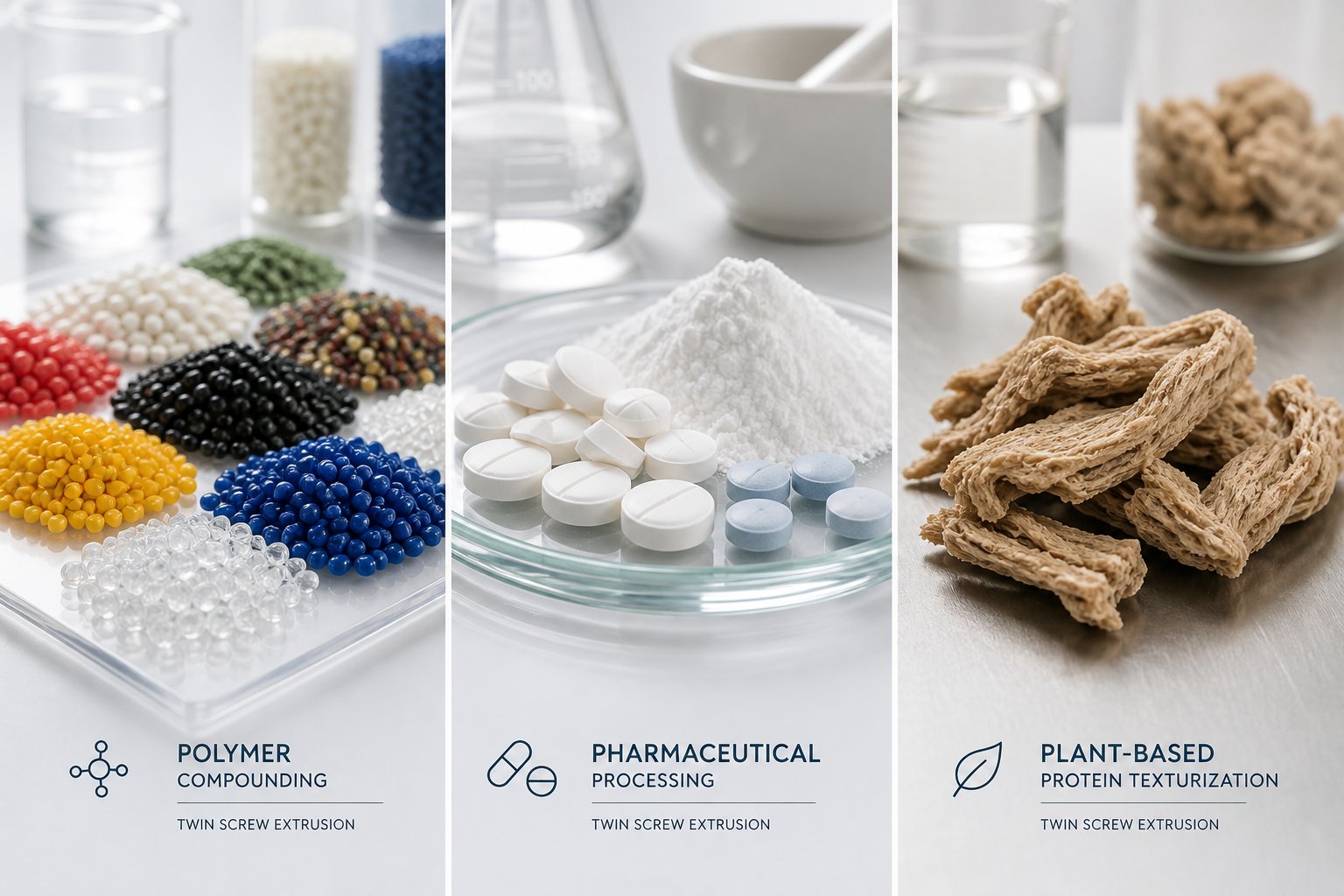
Thermoplastic compounding remains the largest application category for any compounding twin screw extruder at lab scale. Polyolefins like polyethylene and polypropylene are workhorses for blend development and additive screening. Engineering plastics -- nylon, polycarbonate, PBT -- demand higher barrel temperatures and wear-resistant screw elements, especially when reinforced with glass fiber or mineral fillers. Biodegradable polymers such as PLA and PHA have surged in research volume, but their narrow processing windows and sensitivity to moisture require careful thermal profiling and pre-drying.
Recycled resins introduce their own challenges. Batch-to-batch variation in melt flow index, contamination levels, and degradation history means researchers often need to screen multiple screw configurations to find a stable operating point. Masterbatch development -- concentrating pigments, flame retardants, or UV stabilizers into a carrier resin -- pushes a compounding extruder toward aggressive kneading profiles to achieve uniform dispersion. Nanocomposite formulation takes this further, requiring high shear to exfoliate clay platelets or distribute carbon nanotubes without damaging them.
3D printing filament R&D has become another fast-growing use case. Researchers use a polymer extruder at lab scale to test novel filament compositions -- blending base polymers with performance additives or conductive fillers -- before committing to continuous filament production lines. When working with a twin screw extruder plastic processing setup, melt flow index, thermal degradation temperature, and filler abrasiveness are the three material properties that most directly influence barrel material selection and screw element geometry. Highly abrasive formulations, for example, may require powder-metallurgy barrel liners and hard-coated screw elements to prevent rapid wear even at low throughputs.
Pharmaceutical Hot-Melt Extrusion Applications
The pharmaceutical industry's adoption of lab-scale twin screw extrusion has accelerated sharply, driven in part by FDA guidance encouraging continuous manufacturing approaches. A hot melt extruder at laboratory scale lets formulation scientists screen API-polymer combinations rapidly -- testing whether a drug candidate forms a stable amorphous solid dispersion (ASD) in a given carrier polymer, and at what drug loading.
Why does this matter? Many drug compounds in development pipelines are poorly water-soluble. Dispersing the API molecularly within a polymer matrix through hot-melt extrusion can dramatically enhance bioavailability, improving how much drug actually reaches the bloodstream. Research published in AAPS PharmSciTech confirms that HME produces solid dispersions and controlled-release formulations with tightly controlled residence time and temperature -- critical for maintaining API stability.
Co-rotating, self-wiping designs dominate pharmaceutical R&D for practical reasons. The self-cleaning action minimizes cross-contamination between API formulations, and the well-documented scale-up pathways give regulatory teams confidence that lab-generated data will translate to GMP production. Pharmaceutical engineers also value the ability to integrate process analytical technology -- inline NIR probes, melt pressure sensors -- directly into the extruder barrel, supporting the quality-by-design framework regulators expect.
Food Science and Emerging Applications
Beyond polymers and pharmaceuticals, lab twin screw extruders serve a growing roster of non-traditional applications. Food scientists use them to study ingredient texturization -- transforming starch, protein, and fiber blends into structured products with controlled texture and density. Plant-based protein extrusion research, in particular, has exploded as manufacturers race to develop meat analogs with realistic fibrous structure. A polyester extruder setup is occasionally repurposed in food labs for high-temperature texturization trials, since the barrel and screw metallurgy designed for engineering plastics handles the elevated temperatures these formulations require.
Battery technology represents one of the most compelling emerging applications. As detailed in an interview with a Thermo Fisher Scientific process specialist, lab-scale twin screw extruders are used for continuous cathode and anode slurry mixing, solvent-free electrode paste compounding, and separator foil development. The extruder's ability to deliver adjustable, high-shear mixing in a continuous process -- with residence times measured in minutes rather than the hours required by planetary mixers -- makes it a strong alternative for battery material researchers.
Other emerging fields include catalytic material development, where precise blending of active components onto support substrates benefits from the extruder's controlled shear environment, and reactive extrusion for chemical synthesis and grafting reactions that require exact residence time and temperature control.
Regardless of industry, researchers should evaluate the same core set of material property factors before selecting equipment and configuring a screw profile:
- Melt viscosity range: Determines required torque, screw speed, and element geometry. Ultra-low-viscosity melts may leak past flight clearances on machines designed for standard polymers.
- Thermal sensitivity: Materials prone to degradation at processing temperatures need short residence times, gentle kneading profiles, and precise zone-by-zone temperature control.
- Moisture content: Hygroscopic materials may require pre-drying, vacuum venting zones, or atmospheric devolatilization during extrusion.
- Filler loading: High filler percentages increase melt viscosity, torque demand, and barrel wear. Side-feeding downstream of the melt zone protects fragile fillers from excessive shear.
- Abrasive component content: Glass fibers, mineral fillers, and certain pigments accelerate screw and barrel wear. Hardened or coated metallurgies extend service life significantly.
- Required residence time: Reactive processes and devolatilization need longer residence, achieved through reverse elements, lower screw speeds, or extended L/D ratios.
Matching these material characteristics to the right extruder for polymer, pharmaceutical, food, or battery applications is only part of the equation. The machine itself is just the core -- what surrounds it in the form of feeders, downstream equipment, and process monitoring tools determines the range of experiments you can actually run and the quality of data you collect.
Essential Accessories and Process Monitoring Technology
Picture a laboratory twin screw extruder sitting on your bench, barrel heated and screws turning -- but with no way to feed material at a consistent rate, no equipment to collect and shape the extrudate, and no sensors recording what is actually happening inside the melt. The machine runs, but the experiment produces nothing usable. That scenario illustrates a reality many first-time buyers overlook: the extruder itself is only the engine. The peripheral ecosystem surrounding it determines what experiments you can perform and how trustworthy your data will be.
Feeding Systems and Downstream Equipment
Feed accuracy is the single biggest variable researchers underestimate at lab scale. When your total throughput is measured in hundreds of grams per hour, even a minor fluctuation in feed rate creates significant composition swings in the melt. Two feeder types serve this role, and the choice between them has real consequences:
- Volumetric feeders deliver material based on screw speed alone -- simple and affordable, but blind to changes in bulk density. If your powder settles or bridges in the hopper, the actual mass flow rate drifts without warning.
- Gravimetric feeders continuously weigh the material and adjust screw speed in real time to maintain a target mass flow. The cost is higher, but the feed precision -- often within 1% of setpoint -- makes them essential for pharmaceutical formulations, low-dose additive studies, and any experiment where composition accuracy matters.
Downstream of the die, a range of peripherals transforms raw extrudate into the sample format your testing protocol requires. Selecting the right combination depends entirely on what you need to measure or produce. The table below maps the most common peripheral categories to their function and the research scenarios where they become necessary.
| Peripheral Category | Function | When Researchers Need It |
|---|---|---|
| Strand pelletizer | Pulls cooled extrudate strands through a cutting head to produce uniform pellets | Compounding studies requiring pelletized samples for injection molding or second-pass extrusion |
| Underwater pelletizer | Cuts the melt directly at the die face submerged in water, producing spherical pellets | Sticky or low-viscosity formulations that cannot form stable strands; hot-melt pharmaceutical granules |
| Film and sheet die | Spreads the melt into a thin, flat extrudate for film or sheet production | Barrier film development, packaging material screening, membrane research |
| Profile die | Shapes the melt into custom cross-sectional geometries (tubes, rods, channels) | Medical tubing R&D, PVC profile development, specialty extrusion studies |
| Cooling bath / air ring | Removes heat from the extrudate to solidify it before further handling | Nearly all strand and profile extrusion setups; critical for crystallization-sensitive polymers |
| Haul-off unit | Provides controlled pulling tension and speed to maintain consistent extrudate dimensions | Film, sheet, profile, and filament production where dimensional accuracy is required |
| Side feeder | Introduces fillers, fibers, or secondary components downstream of the melt zone | Glass fiber compounding, nanocomposite blending, and any formulation where shear-sensitive additives must bypass the primary melting zone |
Process Analytical Technology and Data Acquisition
Generating samples is only half the job. Understanding why a formulation behaves the way it does -- and proving it to a regulatory body or a scale-up team -- requires process data captured in real time. Modern lab extruders increasingly integrate with process analytical technology (PAT) tools that convert a barrel extruder from a black box into a transparent, data-rich processing environment.
The most common PAT integrations include:
- Inline melt pressure sensors: Mounted at strategic barrel positions and immediately before the die, these transducers track pressure buildup that signals changes in viscosity, fill level, or developing blockages.
- Melt temperature probes: Immersion-style thermocouples or infrared sensors measure actual melt temperature, which often deviates from barrel setpoint temperatures due to shear heating -- especially at high screw speeds.
- NIR spectroscopy: Near-infrared probes installed in the barrel wall or at the die monitor chemical composition in real time. In pharmaceutical twin-screw granulation, NIR analysis enables real-time adjustment of process parameters, significantly reducing material waste and accelerating optimization within a single extrusion run.
- Torque and motor load trending: Continuous logging of drive torque provides a direct proxy for specific mechanical energy input -- one of the most important scale-independent process descriptors for future scale-up.
- Data acquisition software: Centralized platforms capture all sensor feeds, time-stamp them against screw speed and feeder output, and generate process trend files. These datasets become the foundation for quality-by-design (QbD) approaches that regulatory agencies increasingly expect, particularly in pharmaceutical continuous manufacturing.
Emerging PAT methods are pushing the boundaries further. Researchers at McMaster University have developed inline acoustic emission sensors that predict particle size distribution during twin-screw granulation with prediction errors as low as 2%, offering a complementary approach to optical imaging in dusty production environments. These advances illustrate how the data collection ecosystem around a lab extruder is evolving as rapidly as the machines themselves.
Building an Integrated Extruder System
When you think about configuring a complete extruder system, consider the extruder feed barrel interface as your first critical integration point. The barrel zone where material enters must match the feeder's output characteristics -- powder flow properties, volumetric density, and feed rate range all influence whether the material drops smoothly into the screw flights or bridges and starves the process. Modular barrel sections make this interface far more flexible: individual barrel zones can be swapped to accommodate atmospheric vents, vacuum ports for devolatilization, liquid injection nozzles for plasticizers or reactive agents, and side-feeding inlets for downstream filler addition.
This modularity means a single base machine can serve radically different experimental programs simply by reconfiguring the barrel layout and swapping peripherals. A polymer compounding setup on Monday -- with a side feeder, cooling bath, and strand pelletizer -- can become a pharmaceutical hot-melt extrusion line on Wednesday with a syringe pump for liquid API, an inline NIR probe, and a film die for producing thin dosage forms.
The takeaway is straightforward: budgeting for the extruder alone leaves you with an incomplete tool. Allocating resources for precision feeders, appropriate downstream equipment, and robust PAT instrumentation from the outset builds an integrated extruder system capable of producing publication-quality data and supporting confident decisions about process optimization. Those decisions, of course, must also account for the less glamorous but equally critical realities of keeping the equipment running safely and cost-effectively over its full service life.
Maintenance, Safety, and Total Cost of Ownership
A well-equipped laboratory twin screw extruder can run reliably for years -- or it can become a source of contaminated samples, safety incidents, and unexpected repair bills within months. The difference almost always comes down to how diligently the team maintains the equipment, follows safety protocols, and plans for the true long-term costs of ownership. These unglamorous operational realities rarely appear in product brochures or competitor articles, yet they directly determine whether your investment delivers consistent research value or constant frustration.
Cleaning and Material Changeover Best Practices
In a production plant, an extruder might run the same resin for weeks between changeovers. In a research lab, you might process a dozen different formulations in a single week. That pace makes fast, thorough cleaning not just convenient but essential -- any residual material from your last experiment becomes contamination in your next one. Cross-contamination can invalidate an entire batch of carefully measured samples, wasting both time and scarce raw materials.
Four practical cleaning methods cover the spectrum from quick turnaround to deep restoration:
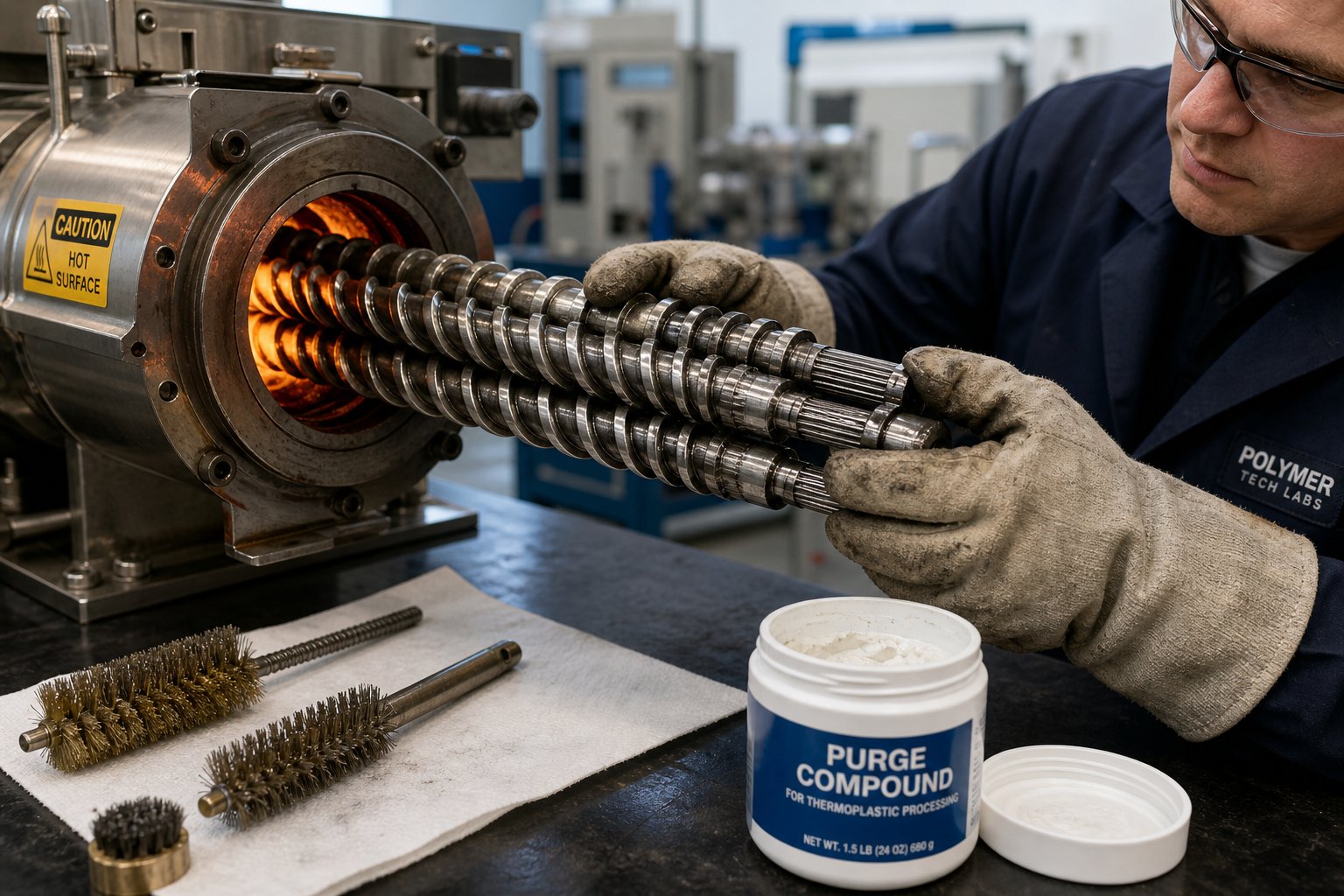
- Purging compounds: The everyday workhorse for routine color or material changeovers. Commercial purge compounds contain chemical cleaning agents and mechanical scrubbing media that outperform raw production resin in clearing tight clearances around kneading blocks and mixing elements. As purging specialists and equipment manufacturers have jointly noted, using commodity resin as a purge substitute is poor economics -- it lacks the scrubbing power to drag stubborn colorants and degraded polymer out of dead zones. A useful operator technique is to "pulse" the screw RPM, surging between low and high speeds to create pressure spikes that mechanically shock residue off barrel walls. Most routine changeovers complete in 15 to 30 minutes with a quality purge compound.
- Pull-and-manual-clean: When purging alone cannot clear heavy carbon buildup or when switching between drastically different materials -- say, a dark flame-retardant compound to a clear medical-grade polymer -- you physically pull the screws from the barrel. The critical rule: clean while hot. Polymer in a melt state wipes off readily, but cooled, carbonized residue bonds stubbornly to metal. Use brass brushes and brass scrapers exclusively. Steel tools seem faster, but they scratch through the thin nitrided surface layer (typically only 0.4 to 0.8 mm deep at HV 900-1100 hardness) that protects the screw elements. Every scratch becomes a micro-crater that traps and re-carbonizes polymer on future runs -- a form of permanent damage no purge compound can reverse.
- Ultrasonic cleaning and thermal burnout: Individual screw elements removed from the shaft can be placed in an ultrasonic bath to dissolve residual polymer from tight geometries, particularly the staggered disc gaps inside kneading blocks. For severely carbonized elements, a temperature-controlled fluidized-sand burnout oven heats the parts uniformly to decompose hardened plastic without the localized overheating that warps and anneals metal. Avoid open-flame torching -- an acetylene flame at roughly 3,100 degrees Celsius far exceeds the 480-560 degree Celsius tempering range of typical screw alloys, and even a brief dwell can permanently soften localized areas.
- High-pressure water washing (hydro-cleaning): Automated hydro-cleaning machines blast residue off with high-kinetic water jets. This method is completely non-destructive -- no heat warping, no surface scratching -- and reaches dead zones inside kneading blocks that are difficult to access by hand. The capital cost is significant, but for high-value modular element sets processed frequently, the long-term preservation of screw integrity often justifies the investment.
One frequently overlooked step: always photograph the screw element layout and orientation before disassembly. Modular elements must go back onto the splined shaft in the correct order and phase angle. Reassembling from memory risks misalignment that can snap a shaft or gouge the barrel liner on the very first rotation after startup.
Safety Considerations in Research Environments
A laboratory extruder is a compact machine, but it concentrates several serious hazards into a small footprint. Barrel surfaces routinely exceed 300 degrees Celsius. Rotating screws create nip points at the feed throat that can catch loose clothing, gloves, or hair in milliseconds. Volatile additives, solvents, and degradation gases release fumes that accumulate quickly in enclosed lab spaces. Treating these risks as an afterthought invites incidents that are entirely preventable.
Critical safety practices every lab team should enforce:
- Heat protection: Barrel and die surfaces cause severe contact burns instantly. Use insulated barrel covers where available, and always wear heat-resistant gloves rated for the operating temperature when handling dies, adapters, or screw elements during changeover.
- Nip-point awareness: Never reach into or near the feed throat while screws are rotating. Interlocked feed hopper guards should remain in place during operation. If your machine lacks an interlock, treat the feed zone as a no-hands zone at all times.
- Personal protective equipment (PPE): At minimum, wear safety glasses, heat-resistant gloves, long sleeves, and closed-toe shoes. When processing materials that produce fine dust or volatile fumes, add respiratory protection rated for the specific hazard.
- Ventilation: Operate extruders under local exhaust ventilation or inside a fume hood when processing materials that release volatile organic compounds, HCl (from PVC), or decomposition gases. Monitor air quality if processing unfamiliar formulations for the first time.
- Startup and shutdown sequences: Always heat the barrel to operating temperature before engaging the screw drive -- starting cold risks snapping screw shafts against solidified polymer. During shutdown, purge residual material while the barrel is hot, then reduce temperatures gradually. Never leave a loaded, heated barrel unattended.
- Lockout/tagout: Before pulling screws, changing dies, or performing any maintenance that exposes moving parts, de-energize the drive motor and apply lockout/tagout procedures. This applies even in academic labs where the culture may feel more informal than a production facility.
Understanding Total Cost of Ownership
When evaluating twin screw extruders for sale, the purchase price on the quotation is just the visible tip of a much larger cost structure. Budget-conscious research teams -- especially university labs and startup R&D departments -- benefit from mapping the full cost of ownership before committing, rather than discovering hidden expenses after installation.
Think of total cost in four categories:
Installation requirements: A lab extruder needs more than a bench and a power outlet. Electrical supply must match the motor and heater specifications -- some machines require three-phase power that may not exist in older lab buildings. Cooling water lines or chillers serve barrel cooling zones and downstream water baths. Adequate ventilation infrastructure is essential for processing any material that produces fumes. Floor space must accommodate not just the extruder but feeders, downstream equipment, and safe operator access on all sides.
Ongoing maintenance: Screw elements wear over time, particularly when processing abrasive formulations with glass fiber or mineral fillers. Replacing a full set of modular elements on a lab machine can represent a meaningful expense. Barrel liners experience similar wear and may need replacement or re-lining after extended service. Heater bands eventually fail -- they are consumable components with finite life cycles. Gearbox oil changes, thermocouple calibration, and drive belt inspections round out the routine maintenance calendar.
Consumable costs: Commercial purging compounds, replacement thermocouples, pressure transducer diaphragms, and die tooling are recurring expenses that accumulate steadily. Labs that run frequent changeovers -- common in formulation screening programs -- consume more purge material per month than a production line running a single product.
Training investment: Operating a twin screw extruder safely and productively requires hands-on training in screw configuration, process optimization, cleaning procedures, and safety protocols. Staff turnover in academic labs and contract research organizations means training is not a one-time expense but a recurring one. Factoring in initial operator training courses, ongoing skill development, and the productivity loss during a new user's learning curve gives a more realistic picture of the true twin screw extruder price beyond the sticker on the machine.
None of these cost categories should discourage investment -- a well-maintained lab extruder delivers years of productive service and generates data worth many times its total cost. The point is simply that informed budgeting, covering the full lifecycle from installation through consumables and training, prevents the unpleasant surprise of discovering that a machine you could afford to buy is one you struggle to operate sustainably.
Even with maintenance mastered and costs mapped, some research challenges resist standard solutions. When off-the-shelf screw configurations cannot deliver the shear profile, residence time, or wear resistance your application demands, the next step involves working with specialists who design custom elements tailored to your exact processing requirements.
Optimizing Custom Screw Design for Specialized Research
Standard screw element kits cover an impressive range of processing scenarios -- conveying, melting, mixing, venting, and pressure buildup all handled through a modular catalog of off-the-shelf components. For many polymer compounding and formulation screening tasks, those catalog elements are more than adequate. But research, by definition, pushes into territory where "standard" no longer applies. When your material behaves unlike anything the original equipment manual anticipated, or when your process objective demands a shear profile, residence time, or wear resistance that no stock configuration can deliver, the gap between what you need and what you have becomes the single biggest bottleneck in your development program.
When Standard Screw Configurations Fall Short
Imagine you are developing a ceramic-filled polymer composite with 60% mineral loading. The abrasive filler chews through nitrided screw elements in weeks. Or perhaps you are running reactive extrusion with a monomer that has the viscosity of warm honey -- so low it leaks past standard flight clearances and floods the upstream vent port. Maybe your biopolymer exhibits yield-stress behavior that causes it to plug conventional kneading blocks entirely. These are not hypothetical edge cases. They are the kinds of challenges that surface regularly in advanced R&D labs, and they expose the limits of one-size-fits-all element libraries.
Several specific scenarios consistently push researchers beyond what off-the-shelf twin screw and barrel components can handle:
- Highly filled formulations with abrasive components: Glass fiber loadings above 40%, ceramic powders, and metallic fillers accelerate wear dramatically. Standard nitrided elements lose dimensional accuracy within weeks of continuous operation, degrading mixing quality and torque consistency. Custom elements machined from powder-metallurgy tool steels or coated with tungsten carbide maintain tight clearances far longer, protecting both data quality and equipment investment.
- Ultra-low-viscosity melts: Certain waxes, hot-melt adhesives, and low-molecular-weight reactive systems flow so easily that they backflow past standard flight tips and flood atmospheric vents. Custom elements with tighter radial clearances, modified flight geometries, or dedicated seal sections contain these melts without the pressure spikes that choke throughput.
- Reactive extrusion requiring precise residence time control: When your barrel doubles as a chemical reactor, the residence time distribution must be narrow and reproducible. Standard mixing elements may not provide the exact combination of fill level and forward conveyance needed. Custom restrictive elements -- purpose-designed dams, modified reverse sections with calibrated bypass channels -- give you the ability to dial in residence within seconds rather than minutes.
- Novel biopolymers with unusual rheological behavior: Materials like thermoplastic starch, chitin derivatives, and protein-based blends often exhibit shear-thickening, yield stress, or extreme moisture sensitivity that confounds conventional kneading block arrangements. Custom element profiles shaped through simulation-guided design can accommodate these non-Newtonian behaviors, preventing the stalling and surging that ruin experimental consistency.
In each of these cases, the solution follows a similar pattern: modify the element geometry, upgrade the metallurgy, or adjust the L/D configuration to match the material's actual behavior rather than forcing the material through a profile designed for something else. The modular barrel architecture that makes twin screw compounding extruders so versatile is the same feature that makes custom solutions practical -- individual elements and barrel sections can be swapped without replacing the entire machine.
Partnering with Screw Design Specialists
Designing custom screw elements for a lab twin screw extruder is not the same as designing them for a 92 mm production machine. At lab scale, tolerances are tighter in absolute terms, screw shafts are more fragile, and torque budgets are severely constrained. A kneading block geometry that works beautifully at 40 mm diameter may generate destructive stress concentrations when scaled down to 16 mm -- the physics of bending moment and torsional load do not shrink linearly with diameter. This means the design partner you choose must understand the unique mechanical constraints of compact equipment, not simply scale down production-grade drawings.
Experienced twin screw extruder manufacturers and specialist component suppliers bring process knowledge that goes beyond machining capability. They understand how a specific element geometry interacts with your material's rheology, how barrel liner metallurgy affects heat transfer at small diameters, and how to iterate quickly through design revisions without the lead times and minimum-order quantities that large OEMs often impose on custom work.
When evaluating a custom screw design partner, prioritize these criteria:
- Material science expertise: The partner should demonstrate working knowledge of tool steel grades, powder metallurgy alloys, hard-facing coatings, and corrosion-resistant treatments -- and how each performs against specific polymer families and filler types. A twin-screw extruder manufacturer that understands metallurgy at the element level, not just the machine level, delivers components with measurably longer service life.
- Lab-scale manufacturing capability: Not every machining facility can hold the sub-0.02 mm tolerances required for screw elements at 12-27 mm diameters. Verify that the partner has CNC equipment, inspection tools, and documented quality processes calibrated for small-diameter precision work. NANHAIYA, for example, specifically serves R&D labs, universities, and pilot-line operators with custom screw and barrel solutions designed for compact equipment and specialized materials -- a focus that ensures their tooling and quality systems are tuned for the dimensions and tolerances lab researchers actually work with.
- Rapid prototyping turnaround: Research timelines rarely tolerate 12-week lead times for a single custom element. Look for partners who can deliver prototype elements in days to weeks, not months. Rapid iteration lets you test a design concept, evaluate results, and refine the geometry within a single experimental campaign rather than waiting an entire quarter between attempts.
- Willingness to support experimental applications: Some component suppliers focus exclusively on replacing worn-out standard parts for established production processes. That is a valuable service, but it is not the same as co-developing a novel element geometry for a material that has never been extruded before. The right partner approaches your unusual request as an engineering challenge rather than a deviation from their catalog. Ask for examples of non-standard projects they have completed -- custom flight profiles, specialized mixing geometries, or prototype barrel liners for corrosive chemistries.
- Cross-scale design perspective: If your lab results will eventually need to translate to pilot or production scale, your design partner should understand how a custom lab element maps to larger-diameter equivalents. A geometry that solves your 20 mm problem but has no viable 40 mm or 62 mm counterpart creates a scale-up dead end. Partners who think about production-scale translation from the outset -- designing lab elements with proportional geometries that scale predictably -- save you from having to re-engineer the entire screw profile when throughput targets increase.
The value of this partnership becomes most apparent when your research reaches the transition point between "it works in the lab" and "we need to make it work at scale." Custom screw configurations that were designed with geometric scalability in mind carry their processing advantages forward into pilot equipment and production lines -- a continuity that collapses development timelines and reduces the costly trial-and-error that plagues scale-up programs built on ad hoc lab solutions.
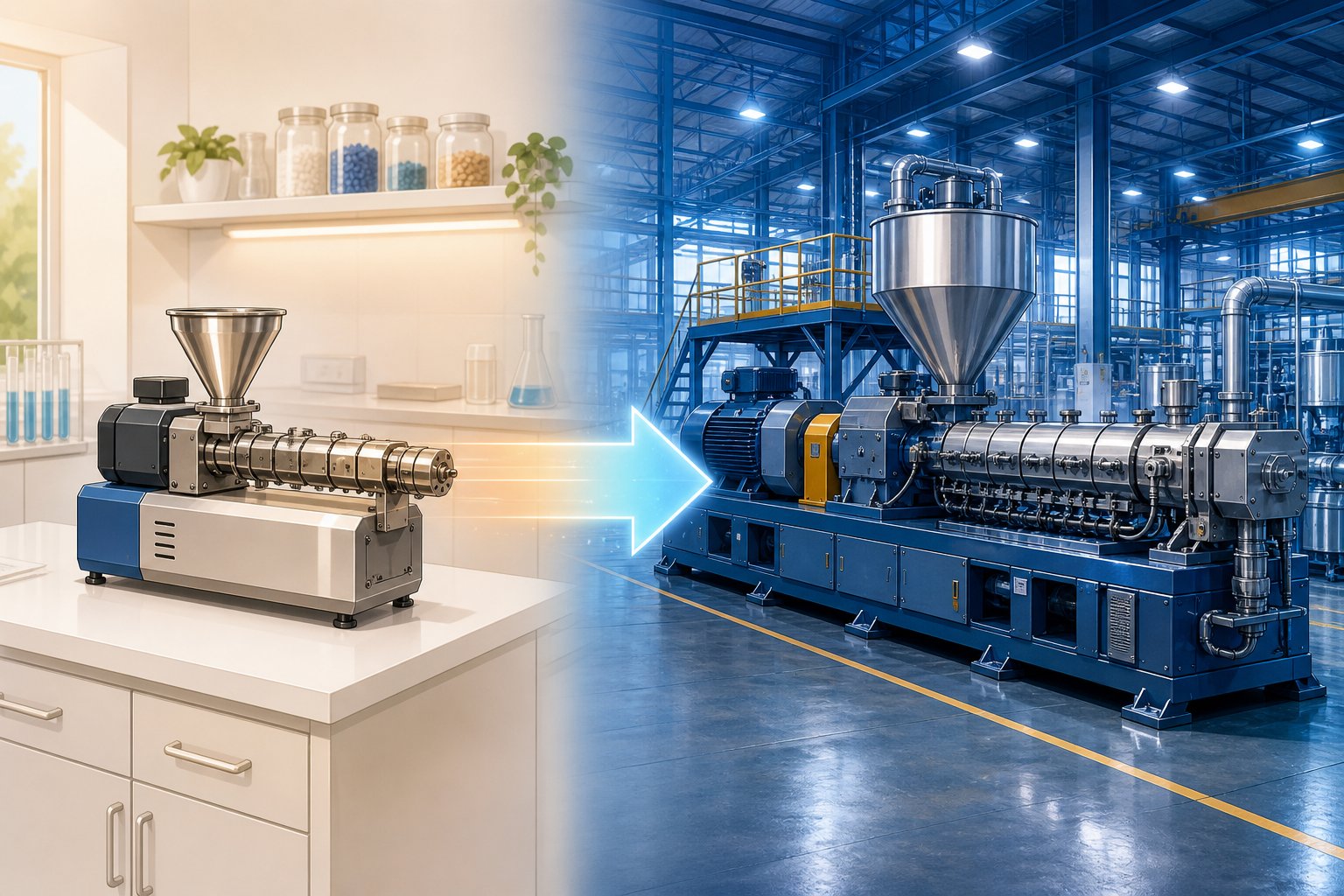
Scaling Up From Lab Bench to Production Line
A laboratory twin screw extruder generates beautiful data -- optimized screw profiles, stable melt temperatures, perfect pellet morphology. Then someone asks the inevitable question: "Can we make this at 500 kg/hr?" That moment, where a promising lab result meets the reality of commercial-scale manufacturing, is where many development programs stall. The physics of extrusion do not scale linearly. Doubling the screw diameter does not simply double the throughput -- it transforms the relationships between shear, heat transfer, residence time, and fill behavior in ways that can completely undermine a process that worked flawlessly on the bench.
Understanding the foundational principles of twin screw extrusion scale-up, and the pitfalls that derail it, is what separates a smooth technology transfer from an expensive series of production-floor surprises.
Scale-Up Principles and Dimensionless Parameters
Scale-up theory for the twin screw extrusion process rests on a deceptively simple starting point: geometric similarity. If your lab extruder and your production machine share the same L/D ratio, the same outer-diameter-to-inner-diameter (OD/ID) ratio, and proportionally equivalent screw element profiles, you have the best possible foundation for transferring process conditions across scales. The barrel inner diameter D serves as the characteristic length, and every scaling calculation builds outward from that single dimension.
The real challenge is deciding what to hold constant as the machine grows. Two classical models frame the boundaries of this decision, as Technovel's extrusion engineering column explains clearly:
- The cubic law (volumetric scale-up): Throughput scales with the cube of the diameter ratio -- Q ∝ D³. This approach treats the extruder interior as a three-dimensional volume and assumes identical screw speed and shear rate at both scales. Scaling from a 15 mm lab machine to a 60 mm production unit (a diameter ratio of 4) theoretically yields a 64-fold throughput increase. The productivity gain is enormous, but peripheral speed rises sharply, shear heating intensifies, and the thermal history each particle of material experiences can shift dramatically.
- The square law (heat-transfer scale-up): Throughput scales with the square of the diameter ratio -- Q ∝ D². This model prioritizes preserving the thermal energy exchange between barrel and melt, recognizing that barrel surface area (the primary heat-transfer interface) grows only with D² while internal volume grows with D³. The same 15 mm to 60 mm jump yields a 16-fold throughput increase -- more modest, but with far better preservation of the material's temperature-time history.
In practice, real operating conditions fall somewhere between these two extremes. Moving toward the cubic law maximizes production capacity but risks altering melt quality. Moving toward the square law preserves material history but sacrifices throughput. As Technovel's engineers put it, scale-up is fundamentally "a design process of selecting the single point best suited to the objective from the countless options that exist between the square and the cube."
Two scale-independent process descriptors help researchers anchor that selection point with quantitative precision:
- Specific mechanical energy (SME): The energy per unit mass transferred from the motor through the screws into the compound. SME is calculated from motor power, screw speed, torque utilization, and throughput rate. A case study published by Plastics Technology demonstrated that matching the SME obtained on a 26 mm laboratory extruder (0.083 kWh/kg) was the single most reliable predictor of successful scale-up to 40 mm pilot and 92 mm production equipment. When process adjustments at each larger scale brought SME back into alignment with the lab benchmark, both process stability and product quality were restored.
- Specific thermal energy (STE): The heat energy per unit mass contributed by barrel heaters and removed by cooling systems. While harder to measure directly than SME, STE becomes increasingly important at larger diameters where barrel heating and cooling influence a proportionally smaller fraction of the total melt volume.
Residence time distribution (RTD) is a third critical descriptor. Research at TU Dortmund has shown that individual screw element types produce characteristic, quantifiable RTD signatures that depend on element geometry and dimensionless volume flow -- not on absolute machine size. This means RTD data collected on a lab-scale double screw extruder can be used to predict residence behavior on geometrically similar production equipment, provided the screw element sequence is preserved proportionally.
Common Scale-Up Challenges and How to Avoid Them
Even with geometric similarity, matched SME targets, and well-characterized RTD profiles, the twin screw extrusion process at production scale introduces variables that simply do not exist -- or do not matter -- at lab scale. Researchers who anticipate these pitfalls collect the right data early and avoid costly rework later.
- Heat transfer differences between small and large barrels: This is the single most underappreciated scale-up factor. The area-to-volume (A/V) ratio of the barrel bore decreases sharply as diameter increases. A 16 mm lab barrel has an A/V ratio roughly four times higher than a 60 mm production barrel. Barrel heaters and cooling channels that dominate temperature control at lab scale become progressively less effective as the machine grows. The practical consequence: identical temperature setpoints and screw speeds on a small and large machine will not reproduce the same melt temperature history. Shear heating, which the lab barrel's generous surface area easily dissipated, accumulates inside the larger machine's melt bulk with no efficient escape path.
- Changed surface-to-volume ratios affecting thermal profiles: Related to heat transfer but distinct in its implications -- the shift in surface-to-volume ratio means that production-scale processes are inherently more adiabatic. The melt temperature becomes increasingly controlled by screw speed, element geometry, and fill level rather than by barrel zone setpoints. Researchers who rely heavily on barrel temperature as a control lever at lab scale often find that same lever has far less authority at production scale.
- Feed behavior shifts at higher throughputs: Powder flow characteristics that are invisible at 500 g/hr can become process-stopping problems at 200 kg/hr. Bridging in larger hoppers, segregation of blended components during transport, and feeder pulsation at higher screw speeds all introduce composition variability that the lab process never experienced. The Dow case study referenced earlier encountered exactly this -- a raw material that created a lubricating effect along barrel and screw surfaces at the 92 mm scale, a phenomenon that was entirely absent on the 26 mm lab machine and only hinted at on the 40 mm pilot unit.
- Die pressure scaling: The pressure required to push material through a die scales non-linearly with throughput, melt viscosity, and die geometry. A strand die that runs at 20 bar on your lab extruder may require 80+ bar on a double screw extruder machine at production throughput -- demanding a complete redesign of the die, breaker plate, and screen pack configuration.
- Torque and power limitations: Production extruders may not have the same torque-per-unit-volume as lab machines. A screw profile that runs comfortably at 60% torque on a 26 mm extruder might demand 95% on a geometrically similar 92 mm machine, leaving no headroom for process variability.
The common thread across all these challenges is information. Thorough data collection at lab scale -- enabled by PAT tools, precise feeders, and detailed process logging -- dramatically reduces scale-up risk. Every melt pressure reading, torque trend, and temperature profile you capture during lab experiments becomes a data point your scale-up team can use to predict, diagnose, and correct problems on larger equipment before they waste material and production time.
Choosing Equipment That Supports Seamless Scale-Up
Scale-up does not begin when your lab results are finalized. It begins the day you select your lab extruder. Choosing a machine with geometric proportions -- OD/ID ratio, L/D ratio, and screw element families -- that mirror an available production-scale platform simplifies every downstream transition. When the lab and production machines share the same element catalog at different diameters, screw profile translation becomes a matter of proportional substitution rather than complete redesign.
This is where working with screw design specialists early in the process pays its largest dividends. A custom lab-scale screw configuration designed with production-scale translation in mind avoids the dead-end scenario described in the previous chapter: a profile that solves your 20 mm problem brilliantly but has no viable 60 mm or 92 mm equivalent. NANHAIYA's custom screw design services address this directly, offering lab-scale configurations engineered with proportional geometries that map to larger-diameter production equipment -- serving as a practical bridge for teams planning future scale-up while still solving the immediate processing challenge at bench scale.
Beyond screw geometry, consider these equipment-level decisions that influence scale-up success:
- Match the architecture: If your production line uses co-rotating intermeshing equipment, your lab machine should too. Data generated on a counter-rotating lab extruder translates poorly to a co-rotating production line -- the flow patterns, mixing mechanisms, and residence time characteristics are fundamentally different.
- Invest in process instrumentation from day one: SME, melt temperature, die pressure, and RTD data are only useful for scale-up if you actually collect them during lab trials. Retrofitting sensors after the fact means your early -- and often most valuable -- experimental runs lack the process data your scale-up team will need later.
- Document everything: Screw element sequence, orientation, barrel zone configuration, feeder calibration, and downstream settings should be recorded for every run. When a production engineer asks "what exactly did you run on the lab machine?" three years from now, a complete process record is the difference between a smooth transfer and a frustrating reconstruction effort.
Ultimately, scaling from a laboratory twin screw extruder to a production-class double screw extruder machine is not a single leap but a deliberate sequence of engineering decisions. Each decision -- from initial equipment selection and screw profile design through PAT instrumentation and data analysis -- either adds clarity to the scale-up path or introduces ambiguity that multiplies at every subsequent step. The researchers who treat their lab extruder not as an isolated screening tool but as the first stage of a continuous development pipeline are the ones who reach production with the fewest surprises and the fastest timelines.
Frequently Asked Questions About Laboratory Twin Screw Extruders
1. What is the typical throughput range of a laboratory twin screw extruder?
Throughput depends on screw diameter class. Micro or benchtop units (10-16 mm screws) handle roughly 50 g/hr to 1 kg/hr, making them ideal for early-stage screening with scarce materials. Standard lab extruders (20-27 mm) reach 0.5 to 5 kg/hr, enough to produce pellets for mechanical testing or film casting. Pilot-bridge machines (30 mm and above) push 5 to 50+ kg/hr for pre-production validation. Actual rates also vary with material viscosity, screw speed, and element configuration.
2. What is the difference between co-rotating and counter-rotating twin screw extruders?
Co-rotating extruders spin both screws in the same direction, creating a self-wiping figure-eight flow pattern that delivers excellent dispersive and distributive mixing. They dominate polymer compounding, pharmaceutical hot-melt extrusion, and nanocomposite research due to superior mixing efficiency and well-documented scale-up pathways. Counter-rotating extruders turn the screws in opposite directions, producing a gentler calendering action with tighter residence time distribution. They suit shear-sensitive materials like PVC compounds. Conical counter-rotating variants add progressive compression for bulky, low-density powders. Your choice should align with the production platform you eventually plan to scale into.
3. How do you clean a twin screw extruder between experiments?
Four methods cover routine to deep cleaning. Purge compounds are the everyday solution, clearing residual material in 15-30 minutes when combined with RPM pulsing. For heavy contamination or drastic material changes, pull the screws while hot and clean with brass brushes -- never steel tools, which scratch protective nitrided surfaces. Individual elements can go into an ultrasonic bath or a controlled-temperature burnout oven to remove carbonized residue. High-pressure water (hydro-cleaning) machines offer a completely non-destructive option for frequently serviced element sets. Always photograph the element layout before disassembly to ensure correct reassembly order and phase alignment.
4. Can a laboratory twin screw extruder be used for pharmaceutical hot-melt extrusion?
Yes, and adoption is growing rapidly. Lab-scale twin screw extruders allow pharmaceutical engineers to screen API-polymer combinations for amorphous solid dispersions, evaluate drug loading limits, and optimize bioavailability enhancement -- all with minimal active ingredient consumption. Co-rotating self-wiping designs are preferred for GMP-adjacent work because they minimize cross-contamination and support inline PAT tools such as NIR probes and melt pressure sensors. FDA guidance encouraging continuous manufacturing has further accelerated pharmaceutical adoption, making lab extruder data directly relevant to regulatory filings.
5. How do you scale up results from a lab twin screw extruder to production?
Successful scale-up starts with geometric similarity -- matching the OD/ID ratio, L/D ratio, and screw element families between lab and production machines. Specific mechanical energy (SME) is the most reliable scale-independent parameter to hold constant across sizes. Researchers should also track residence time distribution and specific thermal energy at lab scale. Key pitfalls include heat transfer differences (the barrel surface-area-to-volume ratio drops sharply at larger diameters), feed behavior changes at higher throughputs, and non-linear die pressure scaling. Working with custom screw design specialists like NANHAIYA early in the process ensures lab configurations have viable production-scale equivalents, preventing costly redesigns during technology transfer.
Written by
Nanhaiya Technical Team
Zhoushan Nanhaiya Plastic Machinery Co., Ltd.
The Nanhaiya technical team supports screw and barrel manufacturing projects through application review, technical communication, custom manufacturing coordination, and production and quality control.
Discuss Your Application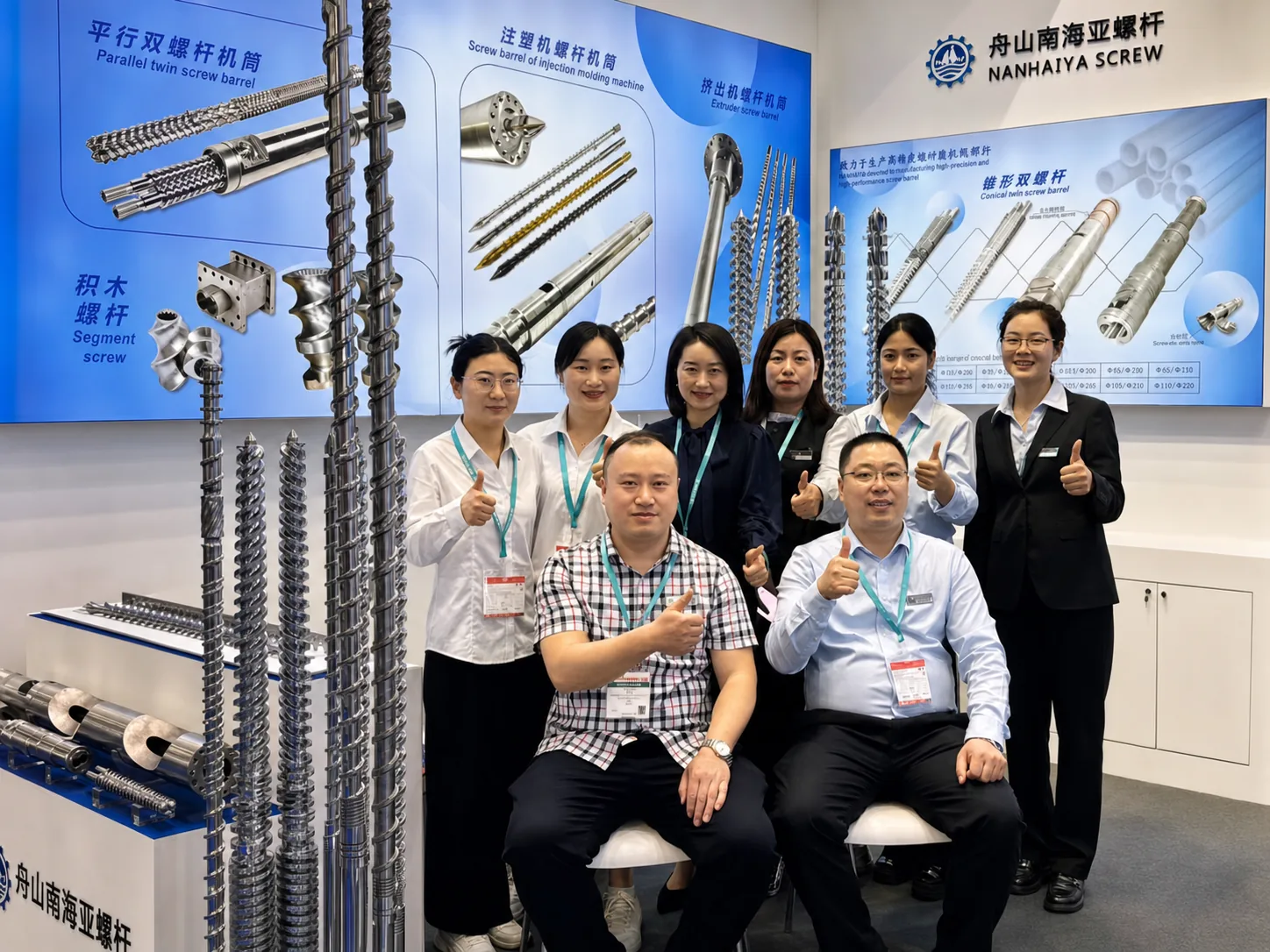
Related Articles
More insights on screw barrel technology and plastics processing.
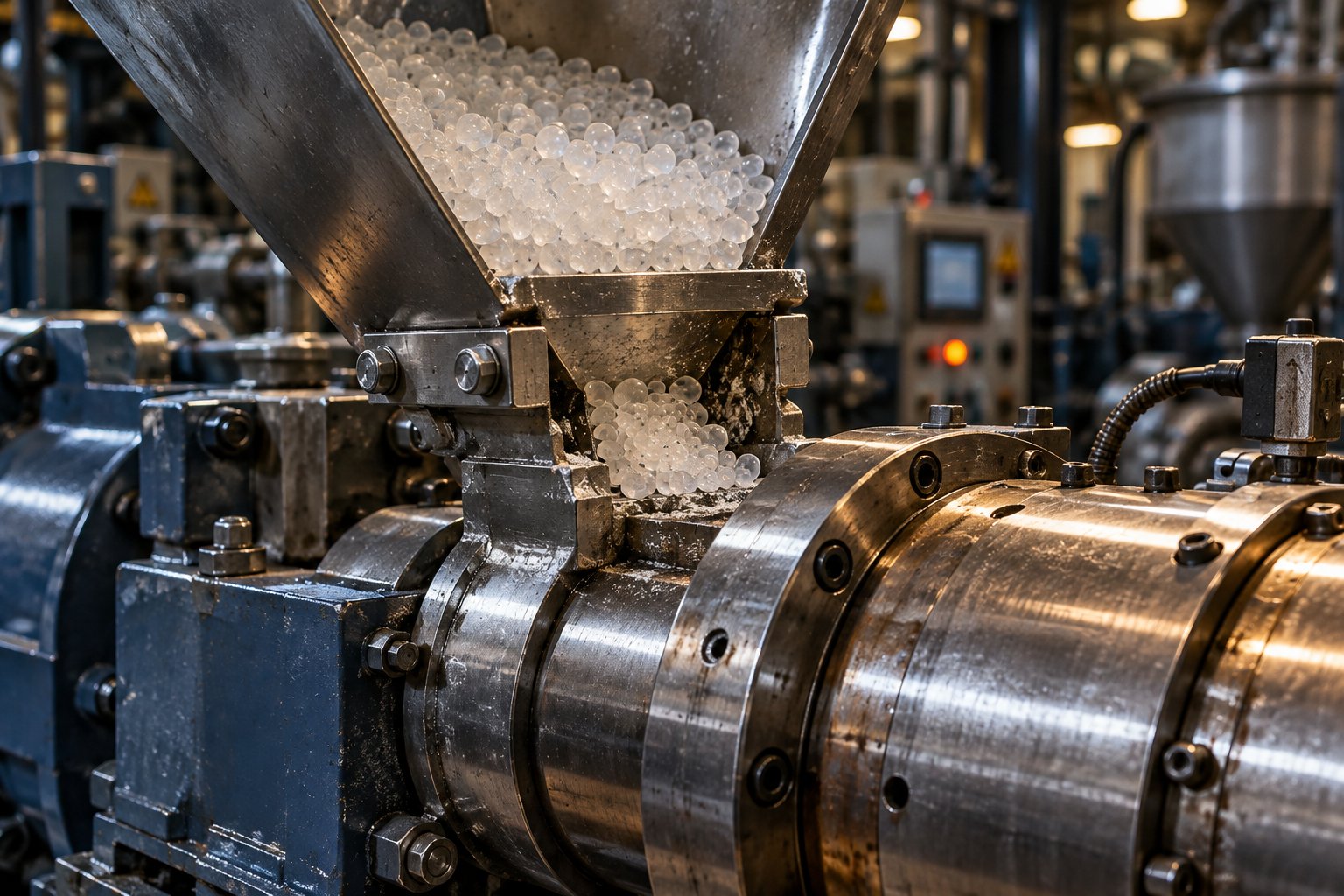
Your Extruder Feeding Instability Isn't Random — Here's Why
Oct 22, 2026
Extruder feeding instability causes surging output and scrap. Learn the 6 root causes, polymer-specific fixes, wear diagnostics, and preventive protocols.
Read Article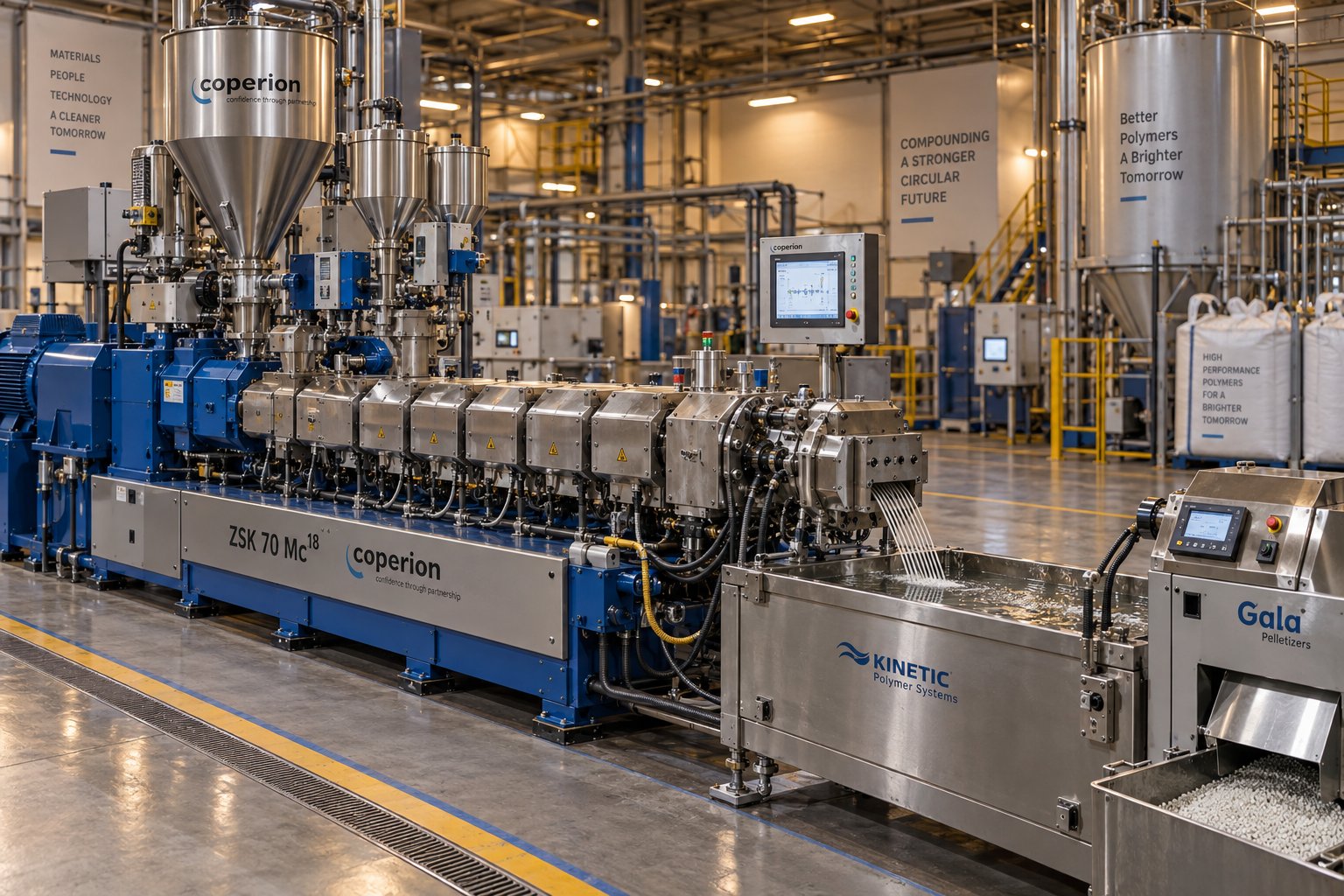
Parallel Twin Screw Extruder for Compounding Demystified: Lab to Line
Oct 21, 2026
Learn how a parallel twin screw extruder for compounding works—from screw element design and zone configuration to lab-to-production scale-up and process optimization.
Read Article
Twin Screw Extruder for PVC: The Setup Mistake Draining Profit
Oct 21, 2026
Learn how to match twin screw extruder configurations to PVC applications. Covers conical vs parallel, counter-rotating vs co-rotating, wear management, and troubleshooting.
Read ArticleLooking for something else?
Search by material, symptom or product and jump straight to the relevant page.
These are navigation suggestions based on keyword matching — not a quotation, not a delivery commitment, and not a substitute for engineering review. Final specification is confirmed by our engineers against your drawings and processed material.
Need help with screw barrel selection?
Share your machine model, processed material and application. Our team can help with pricing and technical support.