

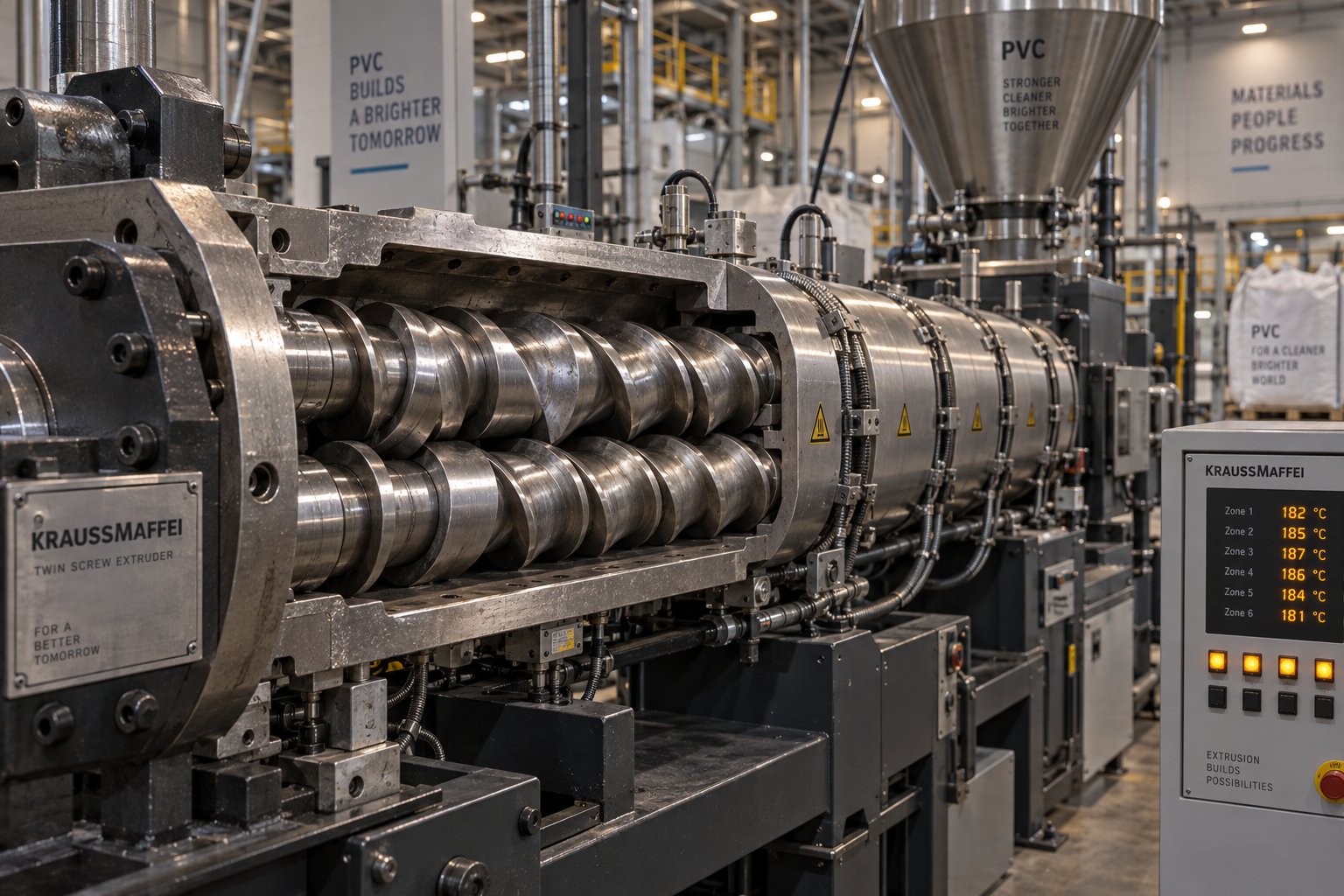
What Is a Twin Screw Extruder for PVC and Why Does It Matter
A twin screw extruder for PVC is a specialized plasticizing machine that uses two intermeshing screws, rotating inside a heated barrel, to melt, mix, and shape polyvinyl chloride compounds into finished products like pipes, profiles, sheets, and foam boards. Unlike polyethylene or polypropylene, PVC cannot simply be thrown into any extruder and expected to behave. It fights back — and the consequences of ignoring that reality show up fast on the production floor.
Twin screw extruders come in two primary geometric configurations — conical (tapered screws) and parallel (uniform-diameter screws) — and two rotational modes: counter-rotating and co-rotating. Each combination serves different PVC applications, and choosing incorrectly can mean the difference between stable output and chronic quality failures. This guide takes an engineering-first approach to help you understand exactly why these distinctions matter and how they affect your bottom line.
What Makes PVC Different from Other Thermoplastics
Imagine a material that starts decomposing almost as soon as it reaches the temperature needed to process it. That is PVC in a nutshell. Most commodity thermoplastics offer a comfortable gap between their melting point and their degradation temperature. PVC does not. Rigid PVC typically processes between 170 and 195 degrees Celsius, yet thermal degradation begins around 210 degrees Celsius with rapid dechlorination — the release of hydrochloric acid gas. This narrow thermal processing window leaves almost no room for error.
PVC is also highly shear-sensitive. Excessive mechanical energy from the screw generates frictional heat inside the melt, pushing localized temperatures past the degradation threshold even when barrel heaters are set correctly. The result? Yellowing, black specks, brittleness, and in severe cases, corrosive HCl gas attacking machine components from the inside out. On top of that, PVC dry blends have low bulk density and poor flow characteristics compared to pelletized resins, making consistent feeding and densification a genuine engineering challenge.
Why Twin Screw Extruders Dominate PVC Processing
Single screw extruders work well enough when you are processing pre-compounded PVC pellets with simple formulations. But for rigid PVC extrusion from dry blend — which is how most PVC pipe, profile, and sheet manufacturers operate — twin screw extruders are the industry standard. The reason comes down to three critical advantages.
First, the intermeshing screw design creates a self-wiping action. Material does not stagnate in dead zones where it could overheat and degrade. Second, twin screw systems deliver controlled, predictable shear rather than the uneven shear profiles common in single-screw machines. This matters enormously for a heat-sensitive polymer. Third, the two-screw geometry provides superior distributive and dispersive mixing, ensuring that stabilizers, lubricants, fillers, and impact modifiers are homogeneously blended throughout the PVC melt — all without excessive temperature rise.
PVC requires gentle but thorough plasticizing within a narrow temperature band, making twin screw technology the industry standard for rigid PVC pipe, profile, sheet, and foam board production.
These advantages explain why most modern PVC extruder lines rely on twin screw designs. Yet the real performance differences emerge when you look deeper — at how counter-rotating and co-rotating configurations handle PVC melt flow in fundamentally different ways, and why choosing between conical and parallel geometries depends on your specific product, output target, and formulation.
Counter-Rotating vs Co-Rotating Twin Screw Configurations for PVC
The direction your screws rotate might sound like a minor engineering detail. It is not. For PVC processing, rotation direction determines whether the melt flows gently through controlled chambers or gets subjected to intense shearing forces that can push a heat-sensitive polymer past its degradation threshold in seconds. This single variable — counter-rotating versus co-rotating — is arguably the most consequential decision in the entire twin screw extrusion process for PVC, yet it rarely receives the technical explanation it deserves.
Here is the short version: counter-rotating intermeshing twin screw extruders dominate rigid PVC production worldwide, with tens of thousands of installations across pipe, profile, sheet, and board manufacturing. Co-rotating machines have their place, but it is a much narrower one. The reasons are rooted in the physics of how each design moves material through the barrel.
How Counter-Rotating Screws Protect PVC from Degradation
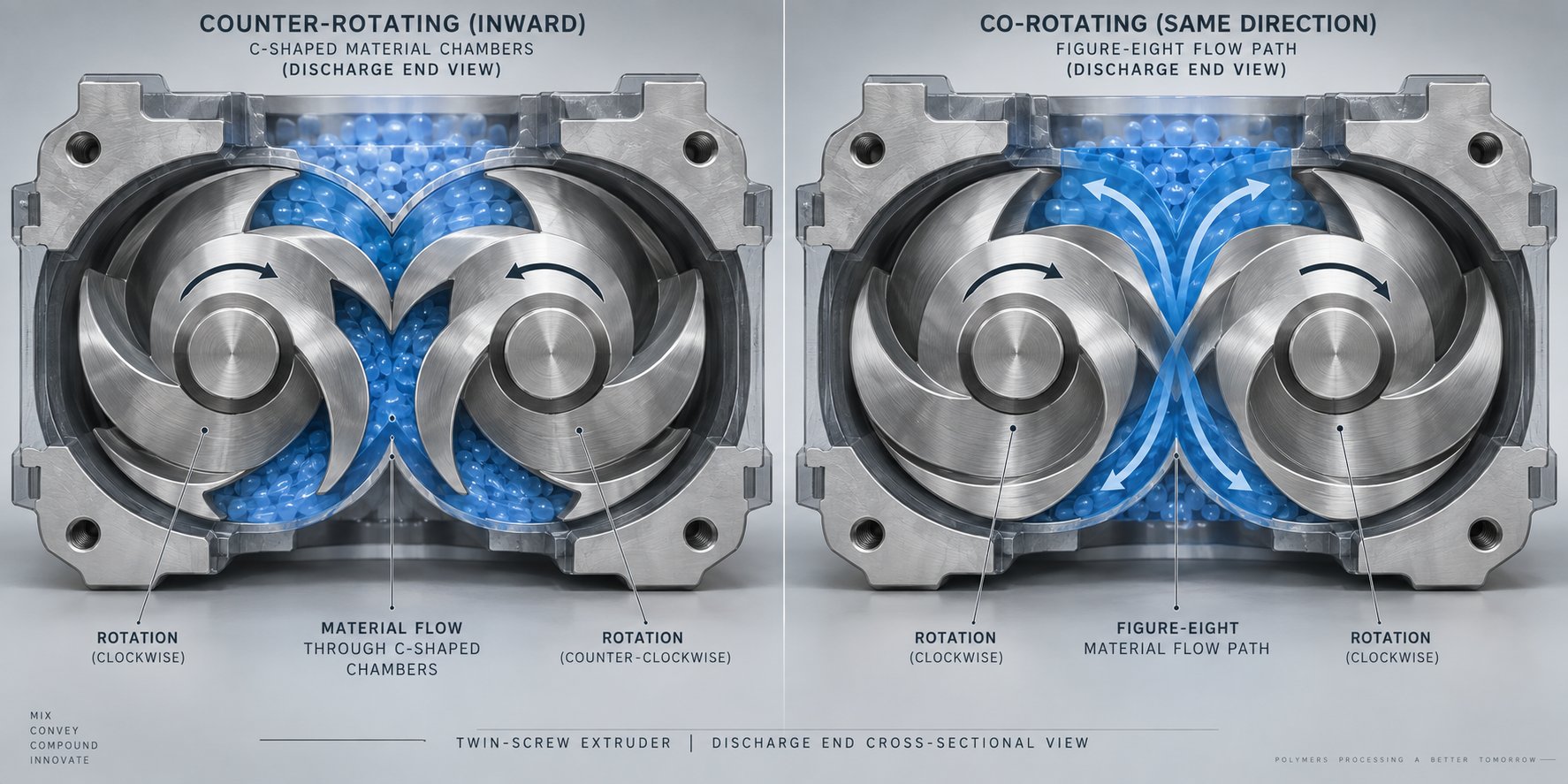
Picture two gears meshing together — one turning clockwise, the other counterclockwise. In a counter-rotating twin-screw extruder machine, the screws rotate toward each other at the top of the barrel, drawing material down into the intermeshing zone. This geometry creates something unique: closed, C-shaped chambers between the screw flights and the barrel wall. Each chamber acts like a discrete pocket, trapping a fixed volume of PVC compound and pushing it forward with minimal backflow or leakage.
This positive-displacement conveying mechanism is what gives counter-rotating designs their decisive advantage for PVC. Because the material is essentially locked into these chambers and moved forward in a controlled, predictable manner, two critical parameters stay tightly managed:
- Residence time: Every particle of PVC spends a nearly uniform amount of time inside the barrel. No material lingers in stagnant zones long enough to overheat and release HCl. No material races through too quickly without proper fusion.
- Shear input: Instead of the aggressive wiping action found in co-rotating machines, counter-rotating screws produce a calendering effect at the intermeshing region. Material passes between the screws much like polymer passing through calender rolls — experiencing compressive and elongational deformation rather than high rotational shear. This gentle yet effective mixing keeps the melt temperature low and predictable.
The calendering effect is particularly well matched to PVC formulations. Rigid PVC does not need the intense microscopic dispersion that some engineering polymers demand. What it needs is moderate, even mixing of stabilizers and lubricants throughout the melt, without localized hot spots. The compressive deformation between counter-rotating screws delivers exactly that. As extrusion specialists at Technovel note, this mechanism allows extrusion temperature to be held low through operation at high fill and low rotational speed — precisely the conditions rigid PVC requires.
Counter-rotating machines also run at significantly lower screw speeds than their co-rotating counterparts. Typical operating speeds for PVC pipe and profile extrusion fall below 50 rpm, compared to co-rotating machines that can exceed 600 rpm for compounding applications. Lower speed means less frictional heat generation, less mechanical stress on the PVC molecular chains, and a wider safety margin within that narrow thermal processing window.
When Co-Rotating Twin Screws Are Used for PVC
Does this mean co-rotating extruders have no role in PVC processing? Not quite — but their applications are fundamentally different. A co-rotating plastic twin screw extruder excels at high-intensity distributive mixing. Both screws turn in the same direction, creating a figure-eight material flow path where compound is continuously handed off from one screw to the other. This produces excellent homogeneity and is ideal for breaking down additive agglomerates, dispersing nanoscale fillers, or creating highly uniform masterbatch concentrates.
For PVC specifically, co-rotating twin screw extruders find use primarily in upstream compounding and masterbatch production — operations where the goal is to pre-disperse pigments, stabilizer packages, or specialty additives into a PVC carrier resin before the compound is pelletized and later fed into a counter-rotating machine for final shape extrusion. The high shear fields in co-rotating machines are beneficial here because the compounding step prioritizes dispersion quality, and the resulting pellets will later be processed under gentler conditions.
The tradeoff is real, though. Co-rotating designs generate substantially more shear heat, which demands careful barrel temperature management and shorter residence times to prevent PVC degradation. The self-wiping action — a genuine advantage for preventing stagnation — also means material experiences more intensive mechanical energy input per screw revolution. For direct extrusion of rigid PVC products from dry blend, this combination of higher shear and less precise residence time control makes co-rotating machines a riskier choice.
| Parameter | Counter-Rotating (Intermeshing) | Co-Rotating (Intermeshing) |
|---|---|---|
| Typical PVC Applications | Pipe, profile, sheet, foam board extrusion from dry blend | PVC compounding, masterbatch production, pelletizing |
| Shear Level | Low to moderate; calendering-type deformation | High; intense rotational and extensional shear |
| Residence Time Control | Tight and predictable (closed C-shaped chambers) | Broader distribution; influenced by degree of screw fill |
| Mixing Intensity | Moderate dispersive; good for PVC additive incorporation | High dispersive and distributive; excellent filler breakup |
| Temperature Control | Excellent; low shear heat generation at low rpm | More challenging; requires active cooling to offset shear heating |
| Typical Screw Speed | 5 to 50 rpm | 100 to 600+ rpm |
| Common End Products | PVC pressure pipe, drainage pipe, window profiles, rigid sheet, foam board, WPC decking | PVC color masterbatch, stabilizer concentrates, compounded pellets |
The table above makes the pattern clear: when your goal is to transform a PVC dry blend into a finished extruded product, counter-rotating is the proven path. When your goal is to create a highly dispersed compound or masterbatch for later processing, co-rotating earns its place. Confusing these roles — or assuming that the higher mixing intensity of a co-rotating machine automatically produces a better PVC product — is one of the more expensive mistakes a processor can make.
Rotation direction, however, is only half the configuration story. The physical geometry of the screws themselves — whether they taper from a wide feed end to a narrow discharge (conical) or maintain a uniform diameter throughout (parallel) — introduces another layer of performance tradeoffs that directly affect feed efficiency, torque capacity, and the range of PVC products you can produce on a single line.
Conical vs Parallel Twin Screw Extruders for PVC
Screw geometry shapes everything about how PVC moves through the barrel — how it feeds, how it compresses, and how much torque the machine can deliver to the melt. Two distinct geometric approaches dominate the twin screw plastic extruder landscape for PVC: conical designs with tapered screws that narrow from feed end to discharge, and parallel designs with uniform-diameter screws running at a constant center distance. Both are counter-rotating in the vast majority of PVC installations, but their physical shape creates dramatically different processing characteristics that directly affect which products you can run, how much output you can achieve, and what tradeoffs you will live with daily.
This distinction might seem like a straightforward engineering preference, but for PVC processors it influences capital cost, floor space, maintenance complexity, and formulation flexibility. Choosing the wrong geometry for your product mix is one of those decisions that quietly erodes profitability for years before anyone traces the problem back to the original equipment specification.
Conical Twin Screw Extruders and Their PVC Advantages
Imagine a pair of screws shaped like elongated cones — wide at the feed opening where raw PVC dry blend enters the barrel and progressively narrowing toward the discharge end where plasticized melt exits through the die. That tapering geometry is the defining feature of a conical twin screw extruder machine, and it solves several PVC-specific challenges simultaneously.
The first advantage is feed efficiency. PVC dry blend — the powdery mix of resin, stabilizers, lubricants, and fillers that most rigid PVC manufacturers use — has notoriously low bulk density, typically ranging from 0.45 to 0.65 g/cm3. That fluffy powder needs a large intake opening to enter the extruder at a consistent rate without bridging or starving. The wide diameter at the feed end of a conical screw provides exactly that: a generous, oversized entry zone that accepts low-density powder reliably, even without force-feeding equipment in many applications.
The second advantage is progressive compression. As the screws taper toward the discharge, the channel volume naturally decreases. This built-in compression ratio densifies the PVC powder gradually — squeezing out trapped air, increasing material-to-barrel contact for heat transfer, and building melt pressure without relying solely on restrictive screw element designs. The result is a natural pressurization path that achieves excellent melt quality even at lower screw speeds, which is critical for a heat-sensitive polymer.
The third advantage is torque capacity. Because the screw root diameter is widest at the feed end — where the drive gears and bearings connect — conical designs inherently accommodate larger, more robust gearbox components. The wider root diameter translates to higher torque transmission capability relative to the overall machine footprint. This mechanical advantage allows conical machines to push viscous rigid PVC melt through demanding dies at lower rpm without overstressing the drive system.
These combined characteristics explain why conical twin screw extruders have been the workhorse of the PVC industry for decades. You will find them running PVC pressure pipe, drainage pipe, window profiles, rigid sheet, and foam board in factories worldwide. For small to mid-range output requirements — roughly 50 to 800 kg/h depending on screw diameter — a conical PVC extruder machine often represents the most practical and cost-effective solution.
Parallel Twin Screw Extruders for PVC Applications
Parallel twin screw extruders take a fundamentally different approach. Both screws maintain the same diameter from the feed zone to the metering zone, running side by side at a fixed center distance throughout the barrel length. This uniform geometry changes the engineering equation in several important ways — some advantageous, some involving tradeoffs that PVC processors need to weigh carefully.
The most significant benefit is screw design freedom. Parallel machines, particularly in modern configurations, use modular screw element systems where individual conveying, kneading, and mixing elements can be rearranged along the screw shaft. Need to adjust the compression profile for a different PVC formulation? Swap out a few elements rather than replacing the entire screw. This modularity gives parallel extruders a flexibility advantage that becomes increasingly valuable when a production line handles multiple PVC compound recipes or product types.
Parallel designs also excel at scalability. When higher output is the goal, the barrel and screw assembly can be extended in length — stretching from a standard 22D (length-to-diameter ratio) to 33D or even 36D — by adding barrel sections and screw elements. This increases residence time and processing capacity without requiring a jump to a larger screw diameter. As pipe extrusion specialists at Rollepaal point out, conical machines cannot be lengthened in the same way; increasing their output typically requires moving to a larger-diameter machine entirely.
For large-diameter PVC pipe production and high-throughput applications, parallel extruders are increasingly the preferred choice. The wider processing window — particularly the ability to achieve thorough gelation without over-fusing material near the vent zone — gives processors more operating headroom. Parallel machines can deliver output rates exceeding 1,500 kg/h in the largest configurations, making them essential for high-volume PVC pipe manufacturers serving infrastructure markets.
The tradeoffs? Parallel twin screw extruders generally require a larger installation footprint due to the straight barrel layout. They also lack the natural compression advantage of tapered geometry, which means screw element configuration must be more carefully engineered to achieve the progressive densification that PVC dry blend demands. Feeding low-bulk-density PVC powder into the smaller, uniform-diameter feed opening can sometimes require dedicated force-feeding or side-feeding systems — an added cost and complexity that conical machines often avoid.
| Feature | Conical Twin Screw Extruder | Parallel Twin Screw Extruder |
|---|---|---|
| Feed Capability | Excellent for low-bulk-density PVC powder; large feed opening | Smaller feed zone; may need force-feeding for PVC dry blend |
| Typical Output Range | 50 to 800 kg/h | 200 to 1,500+ kg/h |
| Torque Transmission | High torque at low speed due to wide root diameter at feed end | Requires advanced gearbox design; improved by modern FEM-calculated drives |
| Screw Modularity | Limited; screws are typically one-piece or semi-modular | Highly modular; individual elements can be rearranged for different formulations |
| Typical PVC End Products | PVC pipe, window profiles, rigid sheet, foam board, WPC decking | Large-diameter PVC pipe, high-output pipe lines, multi-layer pipe systems |
| Machine Footprint | Compact; tapered barrel shortens overall length | Larger; straight barrel requires more floor space |
| Output Scalability | Limited; requires diameter increase for higher output | Flexible; barrel length can be extended (22D to 36D) for more capacity |
| Processing Window | Effective but can be narrower at higher output targets | Wider; better gelation control without over-fusion at the vent zone |
As a general industry guideline: choose a conical twin screw extruder when producing PVC pipe, profiles, sheet, or foam board at small to medium output volumes where compact footprint, powder feeding simplicity, and lower capital cost are priorities. Choose a parallel twin screw extruder when scaling to high-output production, running large-diameter pipe, or needing the flexibility to reconfigure screw geometry across multiple PVC formulations.
Neither geometry is universally superior — each earns its place based on your product, your output targets, and how many different PVC formulations your line needs to handle. A manufacturer running a single rigid PVC pipe recipe at 400 kg/h will reach a very different conclusion than one producing three PVC compound variants at 1,200 kg/h on the same line.
The extruder geometry and rotation direction set the mechanical foundation. But even a perfectly configured machine will underperform — or outright fail — if the PVC formulation it processes is not matched to the screw design. Rigid PVC-U, flexible PVC, chlorinated PVC-C, and foam compounds each behave differently inside the barrel, demanding distinct temperature profiles, compression ratios, and screw element strategies that go far beyond choosing conical or parallel.
How PVC Formulation Variants Impact Extruder Selection
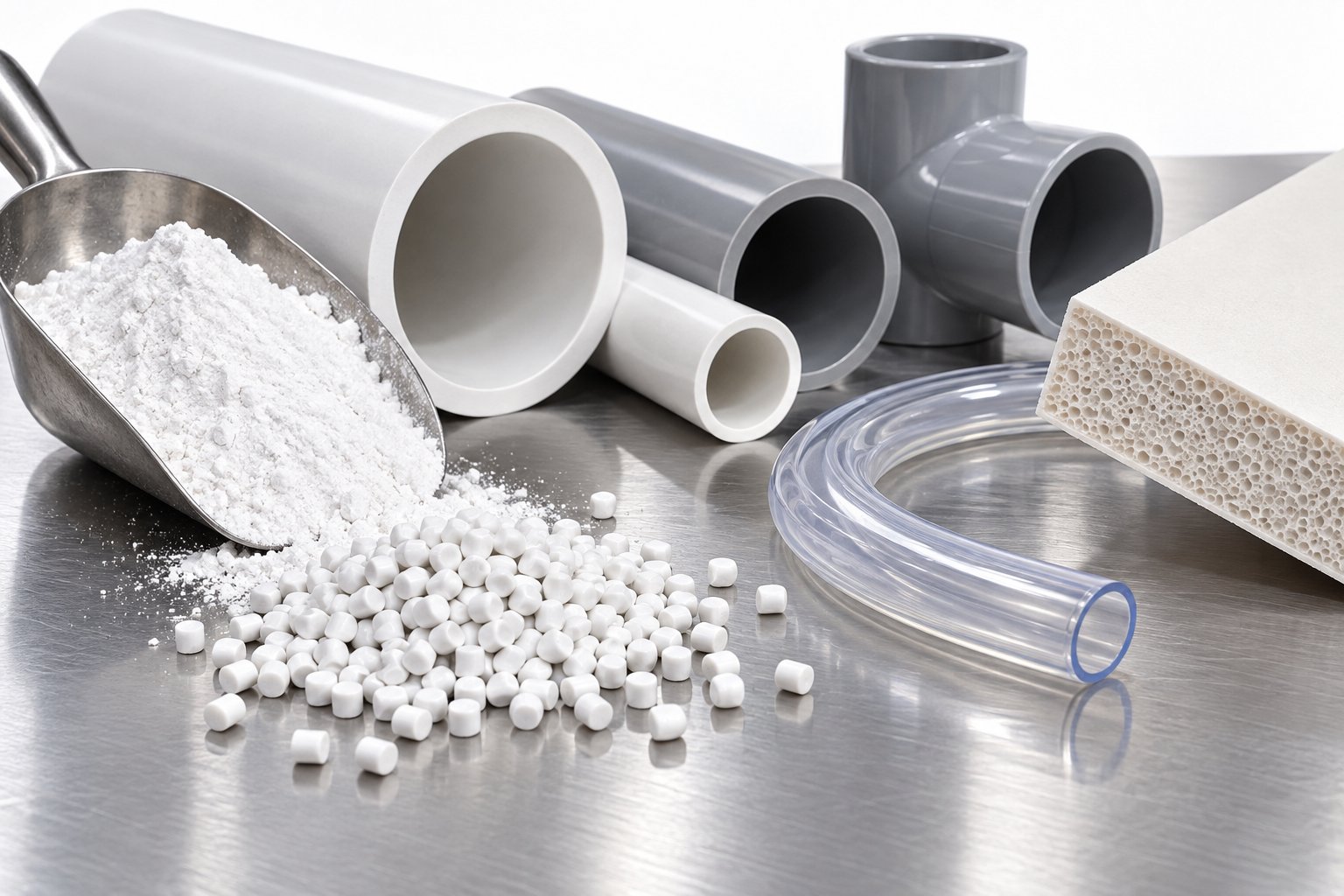
A twin screw extruder perfectly dialed in for rigid PVC-U pipe can produce catastrophic results with a PVC foam board compound loaded through the same hopper. Same machine, same barrel, same screws — completely different outcome. The reason is straightforward: PVC is not one material. It is an entire family of formulations, each with its own melt rheology, thermal sensitivity, and processing behavior. Treating them interchangeably is one of the fastest ways to burn through screws, barrels, and profit margins simultaneously.
Every PVC variant — from unplasticized rigid pipe compound to heavily plasticized flexible cable insulation — places unique demands on screw geometry, barrel zone temperatures, compression ratio, and screw speed. Understanding these differences before configuring an extruder PVC line is not optional. It is the foundation of stable, profitable pvc plastic extrusion.
Rigid PVC-U and PVC-C Processing Requirements
Rigid PVC-U (unplasticized polyvinyl chloride) accounts for the largest share of extrusion PVC production globally. Think pressure pipes, drainage systems, window profiles, and electrical conduit. These formulations contain no plasticizer — or less than 5 phr — so the resin itself must be fused entirely through mechanical and thermal energy input from the extruder.
The typical processing window for rigid PVC-U sits between 170 and 195 degrees Celsius, with degradation lurking just above 210 degrees Celsius. This leaves a usable band of roughly 15 to 40 degrees, depending on the stabilizer system and lubricant balance. Screws designed for PVC-U must deliver gentle but thorough fusion — high enough compression to densify powder and develop melt pressure, yet low enough shear to avoid localized overheating. Counter-rotating conical screws with compression ratios typically between 2.0:1 and 2.5:1 handle this balance well for most rigid pipe and profile applications.
PVC-C (chlorinated polyvinyl chloride) raises the stakes further. With a higher chlorine content than standard PVC, PVC-C offers superior heat resistance and chemical resistance — making it ideal for hot water piping and industrial chemical transport. But that additional chlorination narrows the thermal processing window even more. PVC-C compounds typically require barrel zone temperatures controlled within plus or minus 2 degrees Celsius across all zones, with precise ramping profiles that prevent any zone from overshooting. Screw speed must be kept especially low, and barrel heating zones need individually calibrated PID controllers with fast response times. Even minor temperature excursions can trigger rapid dechlorination, releasing HCl at rates that corrode barrel linings and destroy melt quality within minutes.
Flexible PVC and Foam PVC Formulation Challenges
Add 30 to 80 phr of plasticizer to a PVC formulation and you are working with what is essentially a different polymer inside the extruder. Flexible PVC — used for cable insulation, medical tubing, garden hose, and automotive seals — behaves with much lower melt viscosity, earlier fusion onset, and significantly reduced shear sensitivity compared to its rigid counterpart. Sounds easier to process? Not exactly.
The lower viscosity means the material generates less frictional heat on its own, so barrel heating must compensate. At the same time, the reduced melt strength makes flexible PVC prone to surging if screw speed is set too high relative to the formulation's viscosity. Lower compression ratios — typically 1.5:1 to 2.0:1 — prevent over-pressurizing a melt that simply cannot support it. Plasticizers like DOP reduce intermolecular forces between PVC chains, allowing molecules to slide past each other more freely. This fundamentally changes the screw design requirements: conveying elements need wider channel depths, and mixing zones must be less aggressive to avoid overworking an already-fluid melt.
PVC foam board compounds introduce an entirely different set of challenges. These formulations incorporate chemical blowing agents — most commonly azodicarbonamide (ADC) — that decompose during processing to release nitrogen gas, creating the cellular structure that gives foam board its low density and insulation properties. The screw design must include specific decompression zones where the melt pressure drops in a controlled manner, allowing gas dissolution and cell nucleation to occur without premature blowing or cell collapse.
As foam extrusion specialists have documented, barrel zones 3 and 4 are critical — the melt must reach 160 to 175 degrees Celsius in these sections for proper gas dissolution and controlled cell formation. If the screw generates excessive shear in the decompression zone, cell walls rupture, density becomes unpredictable, and the board develops honeycomb defects visible on cross-section. Achieving consistent foam density within plus or minus 0.03 g/cm cubed requires tight coordination between screw speed (typically 25 to 35 rpm), back pressure (8 to 12 MPa), and die gap geometry — a level of process precision that goes far beyond what standard rigid PVC screw designs can deliver.
WPC (wood-plastic composite) formulations with a PVC matrix add yet another layer of complexity. Wood fiber content, often 40 to 60 percent by weight, dramatically increases melt viscosity and introduces abrasive particles that accelerate screw and barrel wear. Screw designs for WPC must balance aggressive enough mixing to disperse wood fibers uniformly while managing the moisture that wood fiber releases during processing — typically through dedicated venting zones positioned between the mixing and metering sections.
How PVC Additives Influence Screw Design
Every additive in a PVC formulation changes how the compound behaves inside the extruder. A screw geometry optimized for one additive package can underperform or create defects when the formulation shifts. Here is how each major additive category affects melt rheology and, by extension, screw element selection:
- Stabilizers (tin-based, calcium-zinc, lead-based in legacy systems): Stabilizers prevent PVC degradation by scavenging released HCl and interrupting the dechlorination chain reaction. Organotin stabilizers can act as mild internal lubricants, slightly reducing melt viscosity and easing flow through restrictive screw geometries. Calcium-zinc systems, now the dominant choice in European and many Asian markets due to environmental regulations phasing out lead, tend to produce slightly higher melt viscosities and may require adjusted screw speed profiles to compensate. Legacy lead-based stabilizers offered excellent thermal stability at low cost but are being eliminated from most global markets.
- Lubricants (internal and external): Internal lubricants like fatty acid esters reduce intermolecular friction within the PVC melt, lowering apparent viscosity and allowing higher screw speeds without proportional shear heat buildup. External lubricants such as paraffin wax and polyethylene wax form a boundary layer between the melt and metal surfaces — barrel wall, screw flights, die land — preventing adhesion and reducing frictional drag. The balance between internal and external lubrication directly affects how aggressively the screw can convey and compress material. Too much external lubricant can cause slippage in the feed zone, reducing conveying efficiency and starving downstream sections.
- Impact modifiers (CPE, ACR, MBS): These rubber-phase additives improve the toughness of rigid PVC products but alter melt behavior in concentration-dependent ways. At low loadings, impact modifiers like CPE can reduce viscosity by increasing free volume within the PVC matrix. At higher concentrations, they create entangled networks that increase melt viscosity and resistance to flow. Screw mixing sections must disperse these modifiers thoroughly to avoid rubbery agglomerates that show up as surface defects or weak points in the final product.
- Fillers (CaCO3, TiO2, wood fiber): Calcium carbonate is the most common PVC filler, used to reduce material cost and improve stiffness. As filler loading increases, melt viscosity rises because the particles obstruct polymer chain mobility. Finer particle sizes with higher surface area produce an even more pronounced viscosity increase. TiO2, added for opacity and UV resistance, has a similar effect at much lower loadings. These abrasive particles also accelerate screw and barrel wear — a factor that influences metallurgical specifications as much as screw geometry.
- Processing aids (acrylic-based): Acrylic processing aids promote earlier fusion of the PVC melt, improve melt elasticity, and reduce melt fracture at the die exit. They effectively widen the processing window, allowing slightly higher screw speeds or temperatures without degradation. For complex profile geometries or foam board applications where melt strength is critical, processing aid selection can determine whether a given screw design produces acceptable output or chronic quality problems.
The practical implication is clear: you cannot spec a screw design in isolation from the formulation. A screw optimized for a PVC-U pipe compound running 15 phr CaCO3 with tin stabilizer and CPE impact modifier will not perform the same way when the line switches to a PVC foam board formula using calcium-zinc stabilizer, 5 phr ADC blowing agent, and acrylic processing aid. The melt viscosity profile, fusion behavior, and thermal sensitivity all shift — and the screw must accommodate those shifts or the product suffers.
This formulation-dependent reality extends beyond the screw and barrel to the complete extrusion line. Each PVC product category — pipe, profile, sheet, foam board, WPC, pelletizing — pairs a specific formulation type with a specific extruder configuration and a specific set of downstream equipment, creating processing combinations that demand attention to every link in the chain.
PVC Product Applications and Their Extruder Requirements
A PVC pipe extruder running drainage conduit at 400 kg/h and a foam board line producing lightweight advertising panels at 250 kg/h might both use conical counter-rotating twin screw technology — yet their screw geometries, temperature profiles, die pressures, and downstream equipment could not be more different. Each PVC product category carries its own set of engineering constraints, and matching those constraints to the right extruder configuration is what separates profitable operations from ones bleeding money through scrap, downtime, and rework.
Too many equipment discussions stop at "pipe and profile." In reality, the PVC product landscape spans pressure pipe, drainage pipe, conduit, window profiles, rigid sheet, foam board (in both Celuka and free-foam variants), WPC decking, cable compound, and pelletized compound — each demanding a distinct combination of screw design, barrel zoning, and downstream calibration.
PVC Pipe and Profile Extrusion Requirements
PVC pipe extrusion is not a single category. Pressure pipe, drainage pipe, and electrical conduit each impose different demands on the pipe extruder, and treating them interchangeably leads to dimensional failures, poor surface finish, or insufficient mechanical properties.
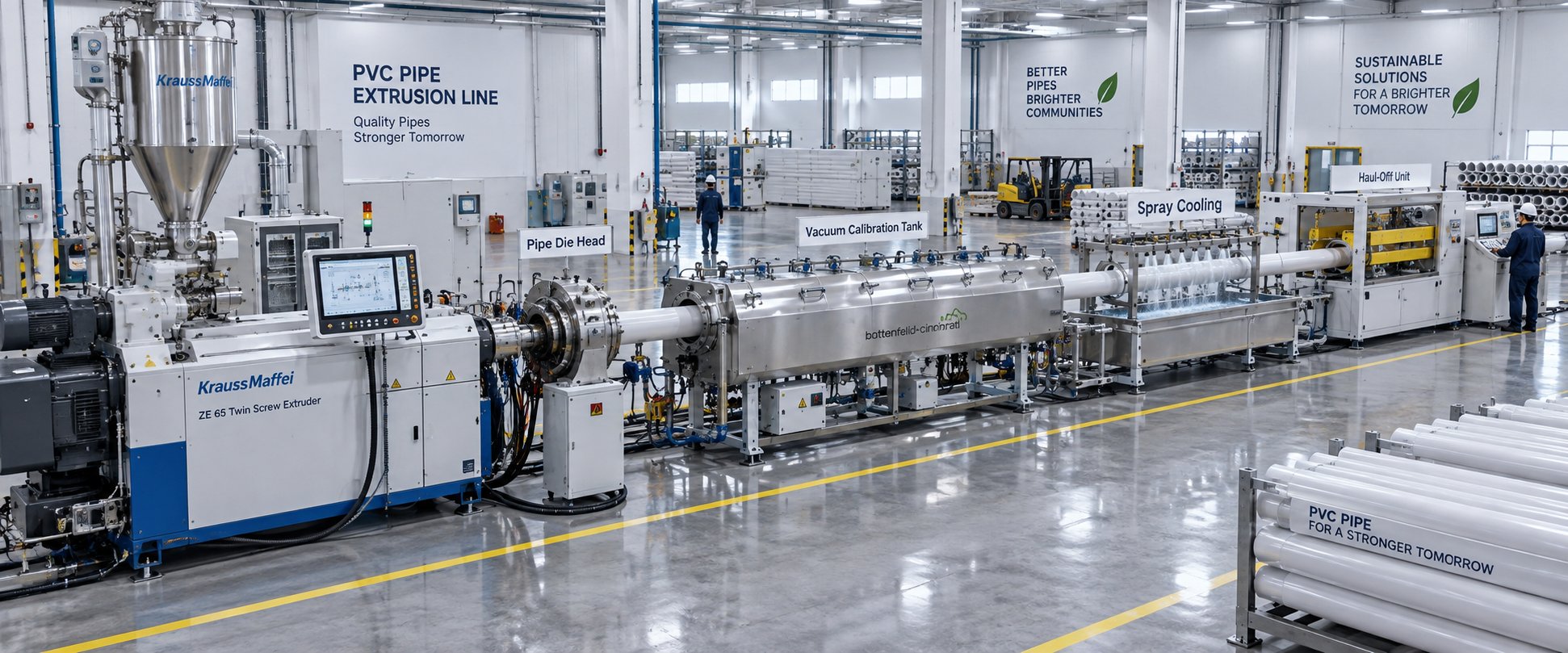
PVC pressure pipe — used for municipal water supply and irrigation — must meet strict wall thickness tolerances, typically within plus or minus 0.1 mm, and demands high melt homogeneity to pass hydrostatic pressure testing. The plastic pipe extrusion machine for this application needs a screw design that delivers thorough gelation without overheating, because under-fused material creates weak points that fail under sustained internal pressure. Die pressure runs higher than in drainage applications, often between 15 and 25 MPa, requiring robust die head construction and precise melt distribution. Downstream, the pipe passes through a vacuum calibration tank that locks in the outer diameter, followed by spray cooling tanks that solidify the wall structure before haul-off and cutting.
Drainage pipe and sewer pipe operate at lower internal pressures but prioritize high output speeds and consistent outer diameter for joint compatibility. The pipe extrusion machinery for drainage applications often runs at higher screw speeds than pressure pipe lines because the wall thickness requirements are less demanding, and the focus shifts toward maximizing throughput per hour. Surface finish matters less here than in pressure pipe, but ring stiffness — the pipe's ability to resist soil loading — depends directly on consistent wall thickness and gelation quality.
Electrical conduit pipe is typically smaller in diameter and thinner-walled, running at very high line speeds. The extruder must maintain stable output at these elevated speeds without surging, which requires tight coordination between screw rpm, feed rate, and haul-off speed. Even minor output fluctuations create wall thickness variations that cause conduit to fail bending or impact tests.
PVC window profiles represent an entirely different branch of pipe extrusion machinery engineering — despite sometimes running on the same conical twin screw extruder platform. Profile dies are geometrically complex, with multiple hollow chambers and thin walls that require exceptionally uniform melt pressure distribution across the die cross-section. Unlike pipe extrusion, where a single annular die opening shapes the product, profile dies may have dozens of flow channels feeding different sections of a window frame cross-section. The downstream calibration setup is equally complex: dry calibration tables with vacuum slots hold the intricate profile shape while cooling water removes heat. Any variation in melt temperature or screw output shows up immediately as warping, dimensional drift, or surface defects on the finished profile.
PVC Sheet, Foam Board, and WPC Decking Extrusion
PVC rigid sheet production demands what pipe extrusion does not always prioritize: gauge consistency across the full width of the sheet. A sheet die distributes melt laterally across widths that can exceed 2,000 mm, and any rheological inconsistency — caused by uneven plasticizing in the extruder — manifests as thickness variation from edge to center. The twin screw extruder feeding a sheet die needs excellent melt homogeneity and consistent pressure, typically achieved through a conical or parallel counter-rotating design paired with a gear pump for pressure stabilization.
PVC foam board extrusion splits into two fundamentally different processes, and each demands specific screw design considerations. In the free-foam process, the polymer melt exits the die and expands freely in open air before entering the sizing calibrator, producing a uniform micro-cellular core with a matte surface finish. The Celuka process, by contrast, forces the outer surface of the melt against a chilled calibrator immediately at the die exit, creating a dense, rigid skin while the interior foams inward. Celuka boards achieve much higher surface hardness — suitable for furniture, cabinetry, and CNC routing — but the process demands higher melt pressure, more precise die head engineering, and significantly greater cooling capacity.
Both foam processes rely on screw designs that include decompression zones where melt pressure drops in a controlled manner, allowing chemical blowing agents to nucleate gas cells without premature expansion. The critical difference is that Celuka processing generates higher backpressure at the die, which feeds back into the screw design — requiring stronger conveying elements in the metering section and more robust thrust bearing assemblies in the gearbox.
WPC decking with a PVC matrix introduces the challenge of handling abrasive wood fiber while maintaining melt quality. Wood fiber content typically ranges from 40 to 60 percent by weight, and the cellulose begins thermally degrading above 190 degrees Celsius — dangerously close to PVC's own processing range. Counter-rotating extruders are the standard choice here because they operate at low screw speeds, keeping shear heat manageable. The extruder must also handle moisture removal through atmospheric and vacuum venting, since even 1 to 2 percent residual moisture in the wood fiber causes surface blistering and internal voids in the finished decking profile. PVC-based WPC typically runs on counter-rotating machines with screw speeds below 50 rpm, as higher speeds generate excessive shear heat that degrades both the wood fiber and the PVC matrix simultaneously.
Specialty PVC Applications
Beyond the major product categories, several specialty PVC applications place their own unique demands on extruder configuration:
- PVC cable compound extrusion: Flexible PVC formulations with 40 to 80 phr plasticizer are applied as insulation and jacketing over copper or aluminum conductors using crosshead extrusion dies. The extruder must deliver extremely consistent output — fluctuations of even 1 to 2 percent cause insulation thickness variations that fail electrical testing. Single screw extruders handle this application well when processing pre-compounded pellets, but twin screw machines are used upstream to produce the compounded pellet itself, dispersing flame retardants, plasticizers, and stabilizers into a homogeneous compound.
- PVC pelletizing and compounding: This is the domain where co-rotating twin screw extruders earn their place in PVC processing. The goal is to blend raw PVC resin with a full additive package — stabilizers, lubricants, impact modifiers, pigments, and fillers — into uniform pellets for later processing on single screw or counter-rotating machines. High dispersive mixing intensity is required, and the pelletized output must have consistent composition from pellet to pellet. Strand pelletizing and underwater pelletizing are the two dominant downstream configurations.
- PVC corrugated pipe: A corrugated pipe machine for PVC uses a twin screw extruder feeding a specialized die and corrugator unit that forms the characteristic ribbed wall structure. The extruder must deliver steady, pulsation-free output to match the continuous movement of the corrugator mold blocks, and the PVC formulation requires enhanced impact resistance to survive the aggressive forming process.
| Application Category | Typical Extruder Type | Typical Output Range | Key Screw Design Features | Critical Quality Parameters | Downstream Equipment |
|---|---|---|---|---|---|
| PVC Pressure Pipe | Conical counter-rotating (small to mid); parallel counter-rotating (large diameter) | 150 to 1,200 kg/h | High compression ratio (2.2:1 to 2.5:1); long metering zone for melt homogeneity | Wall thickness tolerance; hydrostatic burst strength; surface smoothness | Vacuum calibration tank, spray cooling tanks, haul-off, planetary cutter |
| PVC Drainage / Sewer Pipe | Conical or parallel counter-rotating | 200 to 1,500 kg/h | Moderate compression; optimized for higher screw speed and throughput | Ring stiffness; consistent OD for joint fit; impact resistance | Vacuum calibration, spray cooling, haul-off, saw cutter, socketing machine |
| Electrical Conduit | Conical counter-rotating | 80 to 400 kg/h | Short L/D; fast conveying elements for high line speed | Wall thickness uniformity; bend test compliance; surface finish | Vacuum sizing, cooling trough, high-speed haul-off, rotary cutter |
| PVC Window Profile | Conical counter-rotating | 80 to 350 kg/h | Moderate compression; excellent melt pressure uniformity for complex die flow | Dimensional accuracy across profile cross-section; color consistency; surface gloss | Dry calibration table with vacuum, water bath cooling, protective film applicator, profile cutter |
| PVC Rigid Sheet | Conical or parallel counter-rotating | 200 to 800 kg/h | Long metering section for melt pressure stability; gear pump recommended | Gauge consistency (thickness variation across width); surface clarity; flatness | Sheet die, polishing calender rolls, cooling conveyor, edge trimmer, stacker |
| PVC Foam Board (Free Foam) | Conical counter-rotating | 150 to 500 kg/h | Decompression zone for blowing agent activation; low-shear metering section | Density uniformity (plus or minus 0.03 g/cm cubed); cell structure consistency; surface texture | Free-foam die, sizing calibrator, cooling section, haul-off, edge trimmer, cross cutter |
| PVC Foam Board (Celuka) | Conical counter-rotating | 100 to 400 kg/h | Higher compression in metering zone; reinforced conveying elements for elevated backpressure | Surface hardness (Shore D); skin thickness uniformity; screw-holding capability | Celuka die with integrated calibrator contact, high-capacity chilled water system, haul-off, cutter |
| WPC Decking (PVC Matrix) | Conical counter-rotating | 100 to 400 kg/h | Wear-resistant screw flights; atmospheric and vacuum venting for moisture removal; low-speed operation | Moisture content below 1%; wood fiber dispersion; dimensional stability | Profile die, dry calibration, cooling, embossing unit (optional), haul-off, saw cutter |
| PVC Pelletizing / Compounding | Co-rotating parallel twin screw | 200 to 2,000 kg/h | Modular kneading blocks for dispersive mixing; multiple feed and vent ports | Pellet composition uniformity; dispersion quality; thermal stability of compound | Die face, strand cooling bath or underwater pelletizer, classifier, bagging system |
Every row in that table represents a distinct processing ecosystem. The extruder is the heart, but it only functions correctly when the screw design, barrel temperature profile, die geometry, and downstream equipment are all calibrated for the specific product and formulation. A mismatch at any link — say, a pressure pipe screw design running a foam board compound — cascades into quality failures that are expensive to diagnose and even more expensive to fix.
Yet even when the extruder configuration is perfectly matched to the product, there is a hidden cost driver that most processors underestimate until it starts showing up in falling output rates and rising reject percentages: the accelerated wear that PVC inflicts on screws and barrels through a unique combination of chemical corrosion and physical abrasion that no other commodity thermoplastic replicates.
Screw and Barrel Wear in PVC Processing and How to Manage It
Polyethylene wears out screws and barrels slowly and predictably. Polypropylene is gentle on metal surfaces. PVC? PVC attacks from two directions at once — chemically and mechanically — creating a wear mechanism so aggressive that it can reduce barrel service life by 40 to 60 percent compared to equivalent throughput of non-halogenated polymers. If you operate PVC extruders and have not built a component replacement strategy around this reality, you are almost certainly spending more on unplanned downtime and scrap than you realize.
This dual-attack wear pattern is the single biggest maintenance cost driver in PVC pipe, profile, sheet, and foam board production. Understanding why it happens — and what material and maintenance strategies counter it — separates processors who replace screws and barrels on a predictable schedule from those who discover worn components only after output drops and reject rates climb.
Why PVC Destroys Screws and Barrels Faster Than Other Polymers
Imagine sandpaper grinding against a metal surface that is simultaneously being weakened by acid. That is essentially what happens inside a PVC extruder barrel during every production run. The mechanism has two components, and their interaction creates a destructive feedback loop far worse than either would produce alone.
The first component is chemical corrosion. Even under well-controlled processing conditions, trace amounts of HCl gas escape from the PVC melt as thermal degradation occurs at a micro-level. This hydrochloric acid attacks the inner barrel wall and screw flight surfaces, particularly in regions where melt temperature peaks — typically the transition and metering zones. Corrosive additives and reactive agents degrade the inner wall of the barrel, creating microscopic pitting that roughens what should be a smooth, precision-machined surface. During shutdown periods, residual PVC left inside the barrel continues releasing HCl as it cools slowly, meaning corrosion does not stop when the machine turns off.
The second component is mechanical abrasion. Most PVC formulations contain mineral fillers — calcium carbonate at loadings of 5 to 40 phr, titanium dioxide for opacity, and in WPC applications, wood fiber at 40 to 60 percent by weight. These particles are hard. CaCO3 sits at 3 on the Mohs hardness scale, TiO2 at 5.5 to 6.5, and they continuously scour the barrel liner and screw flights during rotation. As extrusion wear research confirms, fillers like calcium carbonate and glass fiber wear down metal surfaces far faster than molten polymers alone.
Here is where the feedback loop kicks in: HCl corrosion weakens the surface hardness of the barrel liner, creating a softened layer that abrasive fillers then strip away far more easily than they could remove intact metal. The freshly exposed metal underneath is now vulnerable to the next round of corrosion, and the cycle accelerates. Over weeks and months, this corrosion-abrasion synergy widens the clearance between screw flights and barrel wall — the most critical dimensional relationship in any extruder. When that clearance exceeds specification, melt leaks backward over the flights instead of being pushed forward, output drops, melt temperature rises as the screw works harder to compensate, and degradation worsens — which releases more HCl, accelerating the cycle further.
The high-wear zones in a twin screw extruder are not uniform. Four areas experience the heaviest damage: the feeding zone where solid particles mechanically abrade during initial conveying, the filler incorporation zone where abrasive particles first contact screw flights at high concentration, the transition zone where axial pressure and screw deflection force flight edges against the barrel wall, and the discharge zone where cantilevered screw tips sag under gravity and scrape the barrel bottom. For PVC extruders specifically, the transition and metering zones see the worst corrosion because melt temperatures peak there, maximizing HCl release.
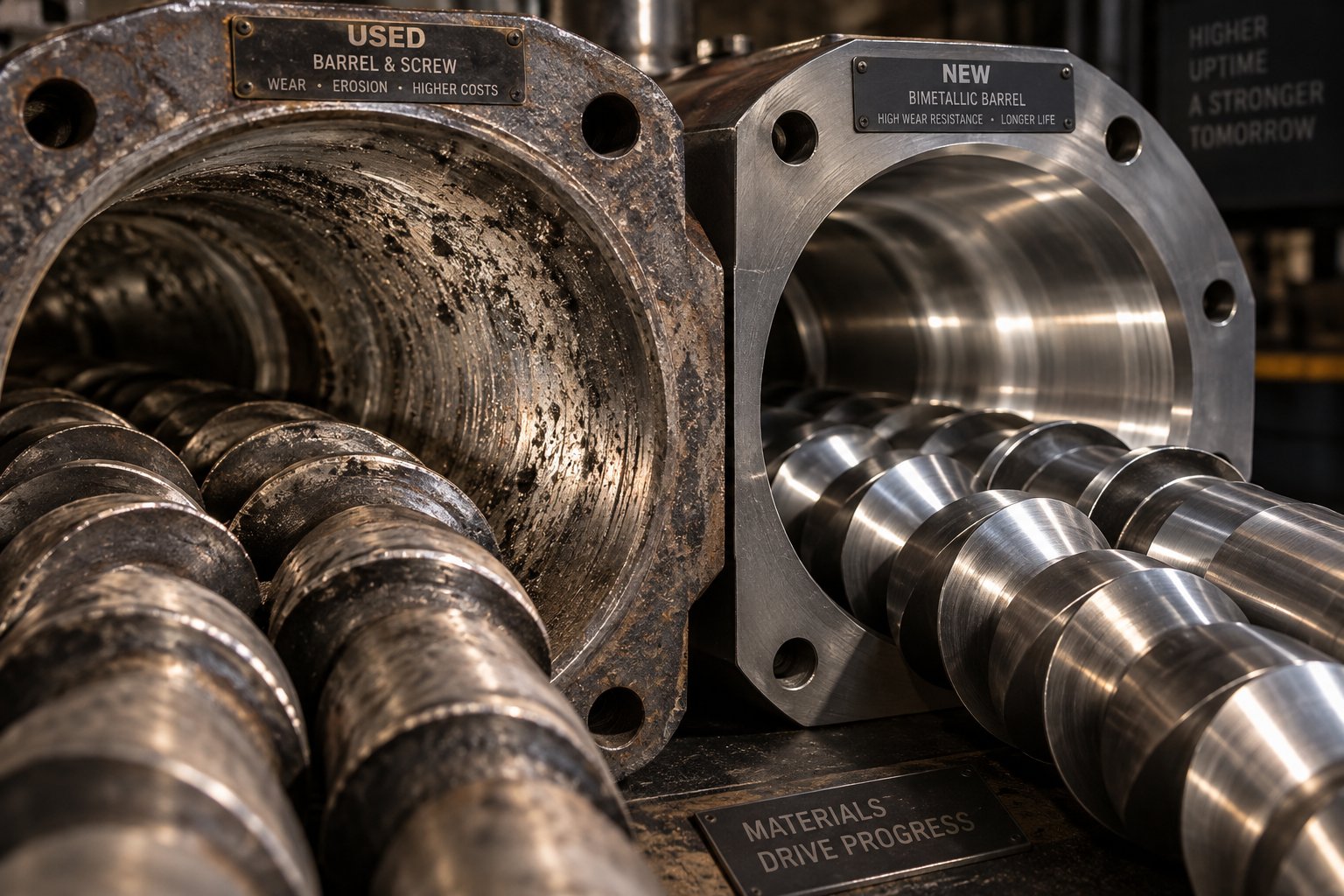
Metallurgical selection is the first line of defense. Standard nitrided steel barrels — adequate for polyolefins — are simply insufficient for sustained PVC processing. The industry standard for PVC extruder barrels is bimetallic construction: a high-strength alloy steel outer shell provides structural rigidity while a centrifugally cast inner liner of nickel-based or tungsten-based alloy resists both corrosion and abrasion. This composite approach extends barrel life by three to five times compared to conventional nitrided barrels, according to bimetallic barrel manufacturers. High-nickel alloys (such as Ni-based alloys with boron additions) are particularly effective against HCl corrosion, while high-boron alloys provide superior abrasion resistance for heavily filled compounds. For screw flights, hard-facing with cobalt-based alloys (Stellite) or tungsten carbide coatings protects the high-wear flight edges where clearance loss is most damaging.
Preventive Maintenance Best Practices for PVC Extruder Barrels
The right metallurgy buys time. Preventive maintenance buys predictability. Without a structured maintenance program tailored to PVC's unique wear characteristics, even the best bimetallic barrels will fail prematurely — and when they do, the cost is not just the replacement component but the lost production, wasted material during restart, and quality issues that often precede an unplanned shutdown by weeks.
Industry maintenance guidelines recommend that barrel clearance for a screw should be approximately 0.001 to 0.0015 inches per side per inch of diameter. For a typical conical twin screw barrel running PVC, that translates to total diametral clearance of roughly 0.10 to 0.20 mm depending on screw size. When clearance exceeds this range, you will see declining output at the same screw rpm, rising melt temperatures as backflow over worn flights generates additional shear heat, and eventually visible quality degradation — surface roughness, inconsistent wall thickness, or yellowing from extended residence time in expanded clearance zones.
A practical PVC extruder maintenance checklist should include these critical items:
- Monthly clearance monitoring: Use a bore gauge to measure barrel inner diameter at the feeding zone, transition zone, metering zone, and discharge zone. Compare against baseline measurements recorded at installation. Track the wear rate in millimeters per 1,000 operating hours to predict replacement timing.
- Quarterly visual inspection: Remove screws and use a borescope to inspect the barrel interior for corrosion pitting, scoring marks, and alloy liner erosion. Pay special attention to the transition zone where HCl concentration peaks. Screw flights should maintain their squared edges — rounding indicates abrasive wear that widens clearance and reduces conveying efficiency.
- Output tracking as a wear indicator: Log kg/h output at standardized screw speed, formulation, and temperature settings weekly. A gradual decline — even 3 to 5 percent over several months — often signals progressive clearance increase before any dimensional measurement confirms it. This is typically the earliest detectable sign of barrel wear in PVC extruders.
- Proper shutdown purging: Never leave PVC compound sitting in the barrel during extended shutdowns. Residual PVC continues releasing HCl as barrel temperatures cool through the degradation range, bathing metal surfaces in acid for hours. Purge the barrel thoroughly with a PVC-compatible purging compound or a stable polyolefin grade before shutdown. Run the purge material at reduced speed until exiting material is clean and free of discoloration.
- Thermocouple and heater verification: Confirm that all thermocouples are fully inserted and making contact with the barrel steel. A thermocouple that reads 5 degrees low because it has backed out of its well causes the controller to overheat that zone — pushing the PVC melt closer to degradation and accelerating HCl-driven corrosion in that section.
- Feed throat cooling channel inspection: Deposits and scale buildup in the feed throat cooling channels reduce cooling efficiency, causing premature softening of PVC at the feed opening. This leads to bridging and inconsistent feeding — problems often misdiagnosed as formulation issues when the root cause is maintenance neglect.
- Screen changer and pvc extrusion die inspection: Check breaker plate sealing surfaces and die flow channels for corrosion pitting or material buildup. HCl exposure affects these downstream components as well, and corroded surfaces in the screen changer or die create flow restrictions and dead zones that worsen melt quality.
- Run-time-based scheduling: Convert calendar-based maintenance to run-hour-based scheduling. A barrel that has run 4,000 hours in a year needs attention regardless of whether the calendar says it has been six months or twelve since the last inspection. Installing a run-hour meter wired into the stop/start circuit provides the data foundation for predictive maintenance.
One often-overlooked element of a PVC barrel maintenance strategy is the quality of the replacement components themselves. Not all bimetallic barrels are manufactured to the same standard — variations in centrifugal casting parameters, alloy composition, heat treatment protocols, and final machining tolerances directly affect how long a replacement barrel holds its dimensional precision under PVC processing conditions. For PVC pipe, profile, board, foam board, and WPC manufacturers running conical twin screw machines, sourcing replacement conical twin screw barrels from a specialist like NANHAIYA — whose product line focuses specifically on stable plasticizing performance for PVC applications — ensures that barrel quality supports the production uptime your maintenance program is designed to protect. A bargain-priced barrel that wears out 30 percent faster than a precision-manufactured one is no bargain at all when you factor in the downtime, output loss, and labor cost of an additional mid-year replacement.
Effective barrel and screw maintenance keeps PVC extruders running within specification. But even well-maintained machines produce rejects when processing parameters are set incorrectly — and PVC's narrow operating window means that temperature, speed, and venting errors that would be harmless on polyethylene show up immediately as visible defects, dimensional failures, or unstable output that sends operators scrambling for answers.
Troubleshooting Common PVC Twin Screw Extrusion Problems
Your barrel is in spec. Your screws passed inspection last month. Yet the pvc extrusion machine is spitting out yellowed pipe, rough-surfaced profiles, or output that surges every few minutes. Sound familiar? For PVC processors, the gap between a properly maintained machine and a properly configured process is where most profit disappears — and the culprits are almost always hiding in temperature settings, screw speed choices, or venting parameters that looked reasonable on paper but clash with the realities of PVC's unforgiving processing window.
This troubleshooting section is built as an operational reference. Instead of vague advice, you will find specific symptoms mapped to root causes, diagnostic methods, and corrective actions drawn from the most common failures seen across pvc pipe extrusion and profile lines worldwide.
Temperature Profile and Screw Speed Mistakes
The single most common setup error on a PVC twin screw extruder is a barrel temperature profile that is either too hot or too cold — and sometimes both simultaneously across different zones. PVC's usable processing window is so narrow that a 10-degree overshoot in one barrel zone can trigger localized degradation while adjacent zones are still struggling to fuse the compound properly.
When barrel temperatures run too high, especially in the metering and die zones, the result is thermal degradation visible as yellowing, brown streaks, or in severe cases, black specks from carbonized material. As PVC troubleshooting specialists note, yellowing is most commonly driven by high melt temperature, long residence time, hot start and stop events, or insufficient stabilization synergy — not just one factor in isolation. The diagnostic approach is to track the Yellowness Index at steady state, at 60 minutes, and at end of run. If discoloration worsens progressively, the heat history — not the stabilizer dosage — is usually the first variable to investigate.
Temperatures set too low create the opposite failure mode: poor fusion. The PVC compound never fully gelates, leaving partially fused particles visible as white marks when you bend the finished product. This is especially common in extrusion pvc pipe applications where operators drop temperatures to extend barrel life, inadvertently sacrificing the mechanical integrity the pipe needs to pass pressure testing. A simple bend test on a sample cut from the line reveals under-fusion immediately — white stress marks at the bend point indicate insufficient melt temperature or inadequate screw speed for the formulation's fusion requirements.
Screw speed errors compound temperature problems. Running the screw too fast relative to the formulation's viscosity generates excessive frictional heat — pushing melt temperature above the degradation threshold even though the barrel heaters are set conservatively. Running too slowly starves downstream zones, extends residence time, and can cause stagnation in low-flow areas where degradation begins silently.
One often-overlooked setup mistake involves the feed throat cooling. Inadequate cooling at the feed section allows PVC powder to soften prematurely and bridge across the feed opening, leading to irregular material delivery. The result is erratic output and unpredictable melt quality — symptoms that operators frequently misattribute to formulation inconsistency or hopper flow problems when the real cause is a partially blocked cooling water channel under the feed throat.
Venting Problems, Plate-Out, and Uneven Wall Thickness
Vacuum venting is essential in PVC twin screw extrusion for removing trapped air, moisture, and volatile decomposition products from the melt before it reaches the die. Get it wrong, and the consequences show up in every meter of product that leaves the line.
Insufficient vacuum — typically below 20 inches of mercury when the process requires 25 or more — fails to extract dissolved gases from the melt. The trapped volatiles nucleate as bubbles inside the pipe wall or sheet cross-section, creating internal voids that weaken the product structurally. You will catch this by cutting cross-sections and examining them under magnification, or more reliably, by tracking a sudden drop in hydrostatic test results on pressure pipe.
Excessive vacuum creates the opposite headache. When the vacuum pump pulls too hard, it can draw molten PVC up into the vent port, plugging the opening entirely. As venting experts at CPM Century Extrusion explain, melt also reaches the vacuum vent when the backup length — the length of filled screw needed to develop die pressure — extends past the vent opening. This happens when screens foul, die holes partially freeze, or screw wear in the pumping section reduces conveying efficiency. Once the vent plugs, all gas removal stops, voids appear in the product, and an operator must clear the vent manually or shut the line down.
Plate-out — the gradual buildup of waxy or chalky deposits on die lips, calibrator surfaces, and barrel vent areas — is a frustration that many PVC processors accept as inevitable. It should not be. Plate-out is most often driven by lubrication imbalance: too much external lubricant or an incompatible wax blend causes additive migration to metal surfaces, where it accumulates and eventually scores or streaks the product surface. The diagnostic clue is the deposit texture. Waxy, oily residue points to external lubricant excess, while hard, chalky buildup suggests stabilizer or filler migration. Rebalancing internal versus external lubricant ratios — and validating the fix by tracking cleaning intervals — addresses the root cause rather than just scraping deposits between shifts.
Uneven wall thickness in pvc pipe extrusion is routinely blamed on die design when the actual source is upstream. Worn screw flights that have lost their sharp edges no longer convey material uniformly, creating pressure pulsations that translate into thickness variation around the pipe circumference. Die misalignment, inconsistent haul-off speed, and uneven cooling in the calibration tank also contribute — but if the wall thickness variation follows a periodic pattern, suspect the screw flights first. A clearance check on the high-wear zones typically confirms whether screw wear is the culprit.
| Symptom | Likely Root Cause | Diagnostic Method | Corrective Action |
|---|---|---|---|
| Surface degradation / yellowing | Barrel temperature too high; excessive residence time; weak stabilizer synergy; hot start/stop cycles | Track Yellowness Index (YI) at steady state, 60 min, and end of run; identify hot zones with melt temperature probes | Reduce barrel zone temperatures (especially adaptor and die zones); shorten residence time; improve stabilizer/co-stabilizer synergy; manage hot-hold procedures during downtime |
| Poor fusion (whitening on bending) | Barrel temperature too low; screw speed too low for formulation viscosity; insufficient compression ratio | Perform bend test on cut samples — white stress marks indicate under-fusion; check melt temperature at die exit with handheld probe | Increase barrel zone temperatures in fusion zones (zones 2 and 3); raise screw speed incrementally; verify screw design matches formulation requirements |
| Rough surface finish | Incomplete plasticization; contaminated raw materials; worn screw and barrel creating inconsistent melt; die lip damage or deposits | Visual and tactile surface inspection; check die lip for scoring or plate-out deposits; compare surface quality at different screw speeds | Optimize melt temperature for full fusion; clean or polish die lips; replace worn screw elements; verify raw material cleanliness and dry blend homogeneity |
| Dimensional instability (wall thickness variation, ovality) | Worn screw flights causing pressure pulsation; die misalignment; inconsistent haul-off speed; uneven calibration tank cooling | Measure wall thickness at multiple circumferential points; check for periodic thickness pattern (screw-related) vs. one-sided bias (die alignment); log haul-off speed consistency | Check and replace worn screw flights; realign die centering bolts; calibrate haul-off speed controller; equalize vacuum and water temperature in calibration tank |
| Surging / output fluctuation | Feed throat bridging from inadequate cooling; lubrication imbalance causing slip-stick in feed zone; temperature profile mismatch causing inconsistent gelation; worn screw flights reducing conveying stability | Monitor motor amperage for periodic oscillation; observe feed throat for powder bridging; log output weight per minute over 30-minute period | Clean and restore feed throat cooling channels; rebalance internal/external lubricant ratio; adjust temperature profile to stabilize fusion point location; replace worn conveying elements |
| Internal bubbles / voids | Insufficient vacuum at vent port; moisture in raw materials; thermal degradation releasing HCl gas; vent port plugging with melt | Cut pipe or sheet cross-sections and examine under magnification; check vacuum gauge stability; test raw material moisture content | Increase vacuum level; dry raw materials or improve pre-mixing; move vacuum vent upstream or extend barrel to increase pumping length; install vent stuffer if melt repeatedly plugs vent port |
| Plate-out / die lip buildup | External lubricant excess or wax incompatibility; stabilizer migration; temperature profile causing partial melt re-solidification near die | Inspect deposit texture (waxy vs. chalky); track cleaning interval frequency; check whether buildup worsens at higher output or with external wax increase | Rebalance internal vs. external lubricant ratio; optimize wax package for compatibility; adjust die zone temperatures; validate fix by monitoring cleaning intervals |
The troubleshooting matrix above covers the defects that account for the vast majority of PVC extrusion scrap and downtime. Notice a pattern: many of these problems share overlapping root causes — worn screws, temperature misconfiguration, and lubrication imbalance appear repeatedly across multiple symptom categories. That overlap means a single unaddressed issue can trigger a cascade of defects that appear unrelated on the surface but trace back to one correctable source.
Fixing these problems one at a time is essential for stable production. But there is a broader question most PVC processors eventually confront: how much is each kilogram of output actually costing when you factor in energy consumption, component replacement cycles, downtime hours, and the hidden expenses that never appear on the machine's purchase invoice?
Energy Efficiency and Total Cost of Ownership for PVC Extruders
When evaluating a twin screw extruder price, most buyers fixate on the number printed on the purchase order. That number matters — but it represents a surprisingly small fraction of what the machine will actually cost over its productive life. Energy bills, replacement screws and barrels, maintenance labor, unplanned downtime, and scrap losses accumulate relentlessly, month after month, year after year. Two machines with identical purchase prices can differ by hundreds of thousands of dollars in total operating cost over a decade, depending on how efficiently they convert electricity into plasticized PVC and how long their wear components survive the corrosive, abrasive environment inside the barrel.
For PVC processors evaluating a twin screw extruder for sale, the real question is not "what does this machine cost?" but "what will each kilogram of output cost me over the next ten years?" Answering that question requires looking at energy consumption drivers and total cost of ownership with the same engineering rigor applied to screw design and temperature profiles.
Energy Consumption Factors in PVC Twin Screw Extrusion
Energy cost per kilogram of PVC output depends on a handful of variables that interact in ways many processors underestimate. The good news? PVC is inherently one of the most energy-efficient thermoplastics to extrude. PVC requires approximately three times less drive energy than polyolefins, making it a favorable material from a specific energy standpoint. The typical specific energy consumption for PVC pipe extrusion sits around 100 Wh/kg at the extruder, with an additional 15 to 25 Wh/kg consumed by the die — and optimized systems can approach a theoretical minimum of 80 Wh/kg.
But that efficiency advantage only materializes when the extrusion system is designed and operated to capture it. Here are the key variables that determine whether your energy cost per kilogram lands closer to the theoretical minimum or balloons well beyond it:
- Screw design efficiency: A well-designed screw converts mechanical energy from the drive motor into melt preparation through controlled shear — essentially using the screws themselves to heat and homogenize the PVC dry blend. When screw design efficiently transfers motor energy to the material, less external barrel heating is needed and less cooling is required to remove excess shear heat. A poorly designed screw wastes drive energy as heat that must then be removed by barrel cooling, effectively paying twice — once for the motor power that generated the heat and again for the cooling system that removes it.
- Drive motor technology: AC servo motors with variable frequency drives have largely replaced older DC motor systems in modern extruder lines. The efficiency gain is not trivial — AC drives typically operate at 92 to 96 percent electrical efficiency compared to 85 to 90 percent for DC systems. Direct-drive configurations that eliminate gearbox losses add another 2 to 4 percent efficiency improvement, though they require more sophisticated motor control. For a machine running 6,000 hours per year, even a 5 percent improvement in drive efficiency translates to meaningful annual savings.
- Barrel heating and cooling balance: Imagine heating your house while running the air conditioner at the same time. That is exactly what happens in an extruder where excessive barrel heating in one zone forces aggressive cooling in the next. Modern PVC extrusion systems prefer air cooling of the cylinder and closed internal screw cooling over fluid-based systems, because these approaches reduce both maintenance requirements and energy consumption. A balanced thermal profile — where the screw's frictional energy input closely matches the melt temperature target — minimizes the need for either supplemental heating or active cooling.
- Screw speed versus specific energy input: Running the screw faster does not always mean higher output efficiency. At elevated speeds, the proportion of energy wasted as excess shear heat increases nonlinearly. PVC's heat sensitivity makes this particularly costly — higher screw speeds generate more frictional heat that must be removed by barrel cooling, while simultaneously narrowing the safety margin before degradation begins. The sweet spot for most PVC applications balances screw speed against specific energy input to maximize throughput without pushing cooling systems into overdrive.
Conical twin screw extruders hold a natural advantage in this energy equation. The tapered screw geometry reduces the required drive torque relative to output because the melt is progressively compressed as channel volume decreases toward the discharge end. Counter-rotating conical extruders typically operate at 30 to 150 rpm — far below the 400 to 900 rpm range of co-rotating parallel machines — meaning less energy is consumed by frictional losses and less cooling capacity is needed to offset shear heating. For dedicated PVC pipe and profile operations, this lower-speed, higher-torque operating profile often delivers the best energy cost per kilogram of finished product.
Evaluating Total Cost of Ownership Beyond Purchase Price
Experienced buyers shopping for twin screw extruders for sale know that the invoice price is just the entrance fee. The real financial commitment unfolds over 10 to 15 years of operation, and the factors that drive that long-term cost rarely correlate with the initial purchase price in the way most buyers expect.
Consider this scenario: Machine A costs 15 percent less than Machine B. But Machine A's barrels wear out 30 percent faster due to lower-grade bimetallic alloy, its drive motor consumes 8 percent more electricity per kilogram, and its screw elements need replacement every 14 months instead of every 22 months. Within three years, Machine A has cost more in total than Machine B — and the gap widens every year thereafter.
Here are the cost factors that experienced PVC processors rank from highest to lowest long-term impact when evaluating total cost of ownership:
- Energy cost per kilogram of output: This is the single largest operating expense over the machine's lifetime. Even small differences in specific energy consumption — 10 to 15 Wh/kg — compound into substantial sums across millions of kilograms processed annually. A line producing 500 kg/h running 6,000 hours per year processes 3,000 metric tons. At $0.10 per kWh, a 15 Wh/kg efficiency difference costs $4,500 per year — $45,000 over a decade.
- Screw and barrel replacement frequency and cost: In PVC processing, the corrosion-abrasion synergy discussed earlier means replacement cycles are shorter than for most other polymers. A high-quality bimetallic barrel lasting 18,000 operating hours versus a lower-grade one lasting 12,000 hours means one fewer replacement cycle over a six-year period — saving not just the component cost but the 24 to 48 hours of downtime each swap requires.
- Unplanned downtime costs: Every hour a PVC line sits idle costs the processor in lost output, labor overhead, and restarting waste. Machines with better wear resistance, more reliable drive systems, and faster diagnostic capabilities minimize these unplanned stops. The financial impact depends on your specific output value, but for a mid-size pipe line, unplanned downtime typically costs $500 to $2,000 per hour in lost contribution margin.
- Maintenance labor: Modular screw designs that allow individual element replacement without removing the entire screw assembly reduce maintenance labor hours significantly. Barrel designs with accessible thermocouple wells, standardized heater band sizing, and clear wear measurement points cut inspection time.
- Spare parts availability: A twin screw extruder price looks attractive until you discover that replacement gearbox components require 16-week lead times from a single overseas supplier. Machines supported by manufacturers with regional spare parts inventories and standardized component dimensions keep lines running when something fails unexpectedly.
- Production flexibility: An extruder that can efficiently process multiple PVC formulations — rigid pipe compound one week, foam board compound the next — amortizes its cost across more product lines. Parallel machines with modular screw configurations score higher here; conical machines optimized for a single product type may deliver lower per-kilogram cost on that specific product but offer less flexibility.
- Initial machine purchase price: Yes, this matters — but it ranks last for a reason. Spread across 10 to 15 years of operation, the purchase price difference between competing machines is typically dwarfed by the cumulative differences in energy consumption and component replacement costs.
Component replacement cost and frequency often outweigh the initial machine purchase price over a multi-year operating period — which is precisely why barrel and screw quality matters more than most processors realize when they are writing purchase orders.
The total cost of ownership perspective reframes the entire equipment purchasing decision. A twin screw extruder for PVC is not a one-time capital expense — it is a long-term operating commitment where energy efficiency, wear component longevity, and maintenance accessibility determine profitability far more than the sticker price. Processors who evaluate these factors systematically before signing a purchase order consistently outperform those who buy on price alone and discover the true cost incrementally, one unplanned barrel replacement and one electricity bill at a time.
All of these cost considerations — energy, wear, downtime, flexibility — ultimately feed into a single practical decision: which specific extruder configuration and component specification best fits your PVC application, your production volume, and your long-term operating economics? That decision framework is where engineering analysis and financial reality converge.
Selecting the Right Twin Screw Extruder and Components for PVC
Every technical insight covered so far — rotation direction, screw geometry, formulation behavior, wear mechanisms, troubleshooting patterns, and total cost of ownership — converges on one practical question: which specific configuration should you buy, and what component specifications should you demand? Getting this wrong is the setup mistake referenced in this article's title, and it drains profit not through a single dramatic failure but through years of incremental inefficiency that compounds silently on every shift.
The good news? The decision logic is systematic, not guesswork. Your PVC application dictates the formulation, the formulation dictates the extruder type, and the extruder type dictates the screw geometry and barrel specification. Follow this chain correctly, and every downstream choice — die design, calibration equipment, cooling strategy — falls into place. Break it at any link, and you are fighting compensating adjustments for the life of the line.
Matching Your PVC Application to the Right Extruder Configuration
Think of the selection process as a funnel. You start broad — what product are you making? — and each subsequent decision narrows the options until you land on a specific machine configuration with defined screw geometry, barrel metallurgy, and processing parameters. Here is the sequence:
Product type → PVC formulation → conical vs. parallel → counter-rotating vs. co-rotating → screw geometry and barrel specifications → downstream equipment.
Skip a step, and you risk the kind of mismatch that a veteran process engineer at JURRY Extrusion describes: spending half a million dollars on a production line that is fundamentally wrong for the application — not because the equipment is defective, but because the selection was wrong. A parallel twin screw extruder chosen for a PVC-only operation will work, but it will consume more energy and cause more wear than a properly specified conical machine. Conversely, a conical machine forced into high-output polyolefin service becomes a throughput bottleneck within months.
The decision matrix below synthesizes the application-specific guidance from every preceding section into a single reference. Each row maps a major PVC product category to its recommended extruder type, screw configuration, barrel specification, and the critical processing parameter that most determines product quality for that application.
| PVC Application | Recommended Extruder Type | Screw Configuration | Key Barrel Specification | Critical Processing Parameter |
|---|---|---|---|---|
| PVC Pipe (pressure, drainage, conduit) | Conical counter-rotating (small to mid output); parallel counter-rotating (large diameter, high output) | Compression ratio 2.2:1 to 2.5:1; long metering zone for melt homogeneity | Bimetallic liner with high-nickel alloy for HCl resistance; conical twin screw barrel with tight dimensional tolerances | Melt temperature uniformity within ±3°C across die exit for consistent wall thickness and hydrostatic strength |
| PVC Window Profile | Conical counter-rotating | Moderate compression; screw geometry optimized for uniform melt pressure distribution across complex die cross-sections | Bimetallic barrel with precision bore finish; corrosion-resistant alloy for long campaign runs | Die pressure uniformity — pressure variation across multi-chamber profile die must stay below 5% for dimensional accuracy |
| PVC Rigid Sheet | Conical or parallel counter-rotating; gear pump recommended downstream | Extended metering section for pressure stabilization; moderate compression ratio | High-nickel bimetallic liner; consistent bore diameter for stable output to gear pump | Gauge consistency — thickness variation across sheet width must stay within ±0.05 mm for quality acceptance |
| PVC Foam Board (Free Foam and Celuka) | Conical counter-rotating | Decompression zone for blowing agent activation; Celuka requires stronger conveying elements in metering zone for higher backpressure | Bimetallic barrel rated for chemical blowing agent exposure; precision bore for consistent melt delivery | Foam density control within ±0.03 g/cm³; screw speed 25–35 rpm with back pressure 8–12 MPa |
| WPC Decking (PVC Matrix) | Conical counter-rotating | Wear-resistant screw flights (hard-faced); atmospheric and vacuum venting for moisture removal; low-speed operation below 50 rpm | High-boron bimetallic liner for abrasion resistance against wood fiber; corrosion-resistant alloy for HCl and wood acid exposure | Moisture removal below 1% residual; wood fiber dispersion uniformity; melt temperature below 190°C to prevent cellulose degradation |
| PVC Pelletizing / Compounding | Co-rotating parallel twin screw | Modular kneading blocks for high dispersive mixing; multiple side feed and vent ports; L/D 32:1 to 48:1 | Modular barrel sections; segmented liner design for zone-specific wear replacement | Dispersion quality — additive and filler distribution uniformity from pellet to pellet; compound thermal stability |
Notice the pattern in the barrel specification column: every PVC application calls for bimetallic construction, but the specific alloy priority shifts depending on the formulation. Pipe and profile applications — where CaCO3 filler loadings are moderate and HCl corrosion is the dominant wear driver — benefit most from high-nickel alloy liners. WPC applications, where abrasive wood fiber dominates, demand high-boron alloys that prioritize hardness. Foam board applications need barrels that maintain precise bore dimensions over long campaigns because even minor clearance changes affect the delicate pressure balance required for consistent cell structure.
This is why treating barrel selection as an afterthought — or worse, defaulting to the cheapest available option — undermines every upstream decision you made correctly. A PVC pipe extrusion machine configured with the right screw geometry, the right temperature profile, and the right downstream equipment will still underperform if the barrel wears out of specification six months ahead of schedule because its alloy composition was not suited to the formulation.
Sourcing Quality Replacement Screws and Barrels
Here is a reality that experienced PVC processors understand but newcomers often learn the hard way: over a 10-year operating horizon, you will likely purchase two to four sets of replacement screws and barrels for a single double screw extruder machine running PVC. The quality of those replacement components — not just the original equipment — determines your long-term production stability and cost per kilogram.
Generic screw and barrel suppliers who manufacture components across dozens of polymer applications rarely optimize for PVC's unique corrosion-abrasion profile. The metallurgical requirements are specific: centrifugal casting parameters must produce a dense, void-free alloy liner bonded to the barrel shell; alloy composition must balance HCl corrosion resistance with abrasive wear resistance for the filler types in your formulation; heat treatment protocols must achieve the target surface hardness without introducing residual stresses that cause premature cracking; and final machining tolerances must hold bore diameter within 0.02 mm across the full barrel length to maintain the screw-to-barrel clearance that controls melt leakage and conveying efficiency.
For PVC pipe, profile, board, foam board, and WPC manufacturers running conical twin screw machines — which represent the majority of PVC extrusion installations worldwide — sourcing replacement components from a specialist manufacturer makes a measurable difference. NANHAIYA, for example, focuses specifically on conical twin screw barrels for PVC applications, with product lines designed around the stable plasticizing performance and dimensional precision that PVC processing demands. Their emphasis on application-specific customization — matching barrel alloy, bore geometry, and thermal specifications to specific PVC product types including pipe, profile, sheet, foam board, and WPC — reflects the kind of specialization that generic component suppliers typically cannot provide. When a replacement barrel maintains its dimensional specification for 18,000 operating hours instead of 12,000, the cost savings in avoided downtime, reduced scrap during the wear-out period, and deferred next-replacement compound significantly.
Whether you source from NANHAIYA or another specialist, the evaluation criteria remain the same. Use this checklist when assessing any screw and barrel supplier for your PVC extrusion operation:
- PVC-specific metallurgical expertise: Can the supplier specify and verify the alloy composition of their bimetallic liners? Do they offer different alloy grades for corrosion-dominant applications (pipe, profile) versus abrasion-dominant applications (WPC, heavily filled compounds)?
- Dimensional precision and quality documentation: Does the supplier provide bore diameter measurement reports across the full barrel length? Can they hold bore tolerances within 0.02 mm? Do they supply hardness test certificates for the liner alloy?
- Application-specific customization: Will the supplier adjust barrel zone lengths, cooling channel placement, and liner alloy based on your specific PVC formulation and product type — or do they offer only standard catalog configurations?
- OEM compatibility verification: Can the supplier match the mounting dimensions, thermocouple well positions, heater band specifications, and flange interfaces of your existing extruder without requiring machine modifications?
- Lead time and inventory support: What is the typical delivery timeline for replacement barrels? Does the supplier maintain inventory of common conical twin screw barrel sizes, or is every order manufactured from scratch? For high-volume PVC operations, a 12-week lead time on a critical barrel replacement can mean $50,000 or more in lost production.
- Technical support and wear analysis: Does the supplier offer wear measurement guidance, recommend alloy grades based on your formulation's filler content and stabilizer system, and help diagnose premature wear patterns? A supplier that sells components without understanding how they fail in PVC service is selling hardware, not solutions.
- Reference installations in your product category: Has the supplier's barrel performed in PVC pipe production? In foam board? In WPC? A barrel that works well for rigid pipe may not have the right alloy balance for a WPC line running 50 percent wood fiber. Ask for references in your specific application segment.
The pp pvc pipe extrusion line supplier you choose for the complete machine matters — but so does every component supplier you rely on for the decade of replacements that follow. A pvc pipe extrusion machine is only as reliable as its most wear-prone part, and in PVC processing, that part is always the barrel.
PVC extrusion technology continues advancing. Optimized replacement screw designs are now demonstrating that simply swapping worn screws for geometrically improved replacements can double throughput, reduce additive consumption by 30 percent, and widen processing windows — turning a routine maintenance event into a genuine process upgrade. The processors who treat every barrel change and screw replacement as an opportunity to refine their process, rather than merely restoring the status quo, are the ones who pull ahead in an industry where margins are measured in fractions of a cent per kilogram. Your extruder configuration sets the foundation. Your component quality sustains it. And your willingness to continuously improve the details determines whether that foundation supports a profitable operation or quietly drains the profit you worked to build.
Frequently Asked Questions About Twin Screw Extruders for PVC
1. Why is a twin screw extruder preferred over a single screw extruder for PVC processing?
PVC has a very narrow thermal processing window — it begins degrading around 210 degrees Celsius while needing temperatures of 170 to 195 degrees Celsius for proper fusion. Twin screw extruders provide three decisive advantages over single screw machines for handling this sensitivity: self-wiping screw action that eliminates stagnant zones where material could overheat, controlled and predictable shear that prevents localized hot spots, and superior distributive mixing that blends stabilizers, lubricants, and fillers homogeneously without excessive temperature rise. Single screw extruders can work for pre-compounded PVC pellets, but most rigid PVC pipe, profile, and sheet manufacturers process directly from dry blend powder, which requires the gentle yet thorough plasticizing that only twin screw technology reliably delivers.
2. What is the difference between counter-rotating and co-rotating twin screw extruders for PVC?
Counter-rotating twin screw extruders are the industry standard for direct PVC product extrusion such as pipes, profiles, sheets, and foam boards. Their screws rotate toward each other, creating closed C-shaped chambers that move material forward with minimal backflow, tight residence time control, and low shear through a calendering-like effect. This keeps melt temperatures predictable and prevents degradation. Co-rotating extruders, where both screws turn the same direction, generate much higher shear and are primarily used for upstream PVC compounding and masterbatch production where intense dispersive mixing of additives is the priority. Using a co-rotating machine for direct rigid PVC extrusion from dry blend risks excessive shear heat and degradation because these machines typically run at 100 to 600-plus rpm versus the 5 to 50 rpm range of counter-rotating designs.
3. Should I choose a conical or parallel twin screw extruder for PVC pipe production?
For small to mid-range PVC pipe output — roughly 50 to 800 kg/h — a conical counter-rotating twin screw extruder is typically the most practical choice. Its tapered screws accept low-bulk-density PVC dry blend efficiently through a large feed opening, provide natural compression without complex screw element design, and deliver high torque at low speeds thanks to the wider root diameter at the feed end. For large-diameter pipe or high-throughput operations exceeding 800 to 1,500 kg/h, parallel counter-rotating extruders become advantageous because their barrel length can be extended for greater capacity, and their modular screw elements allow reconfiguration for different PVC formulations. The choice ultimately depends on your target output volume, product diameter range, and whether you need to run multiple compound recipes on the same line.
4. How often should screws and barrels be replaced on a PVC twin screw extruder?
Replacement intervals vary based on barrel metallurgy, PVC formulation, and filler content, but most PVC processors should expect to replace barrels every 12,000 to 18,000 operating hours. PVC creates a uniquely aggressive wear environment because HCl gas from thermal degradation corrodes metal surfaces while abrasive fillers like calcium carbonate and titanium dioxide physically erode them — a destructive feedback loop that accelerates wear faster than in polyolefin processing. High-quality bimetallic barrels with nickel-based or boron-based alloy liners significantly extend service life compared to standard nitrided steel. Sourcing precision-manufactured replacement conical twin screw barrels from PVC-focused specialists like NANHAIYA (nhyscrews.com) ensures that dimensional tolerances and alloy quality support longer campaigns and more stable plasticizing performance between replacements.
5. What causes yellowing and surface defects in PVC twin screw extrusion?
Yellowing in extruded PVC products is most commonly caused by barrel temperatures set too high — particularly in the adaptor and die zones — combined with extended residence time that allows thermal degradation to progress. Even a 10-degree overshoot in one barrel zone can trigger localized dechlorination. Other contributors include hot start-stop cycles, insufficient stabilizer-co-stabilizer synergy, and worn screw flights that extend residence time in widened clearance zones. Rough surface finish, another common defect, typically stems from incomplete plasticization, contaminated raw materials, or plate-out deposits on die lips. Tracking the Yellowness Index at steady state and at 60-minute intervals helps isolate whether the problem is heat-history-driven or stabilizer-related. Corrective actions include reducing zone temperatures, optimizing screw speed for the formulation viscosity, and maintaining proper screw-to-barrel clearance through regular wear monitoring.
Written by
Nanhaiya Technical Team
Zhoushan Nanhaiya Plastic Machinery Co., Ltd.
The Nanhaiya technical team supports screw and barrel manufacturing projects through application review, technical communication, custom manufacturing coordination, and production and quality control.
Discuss Your Application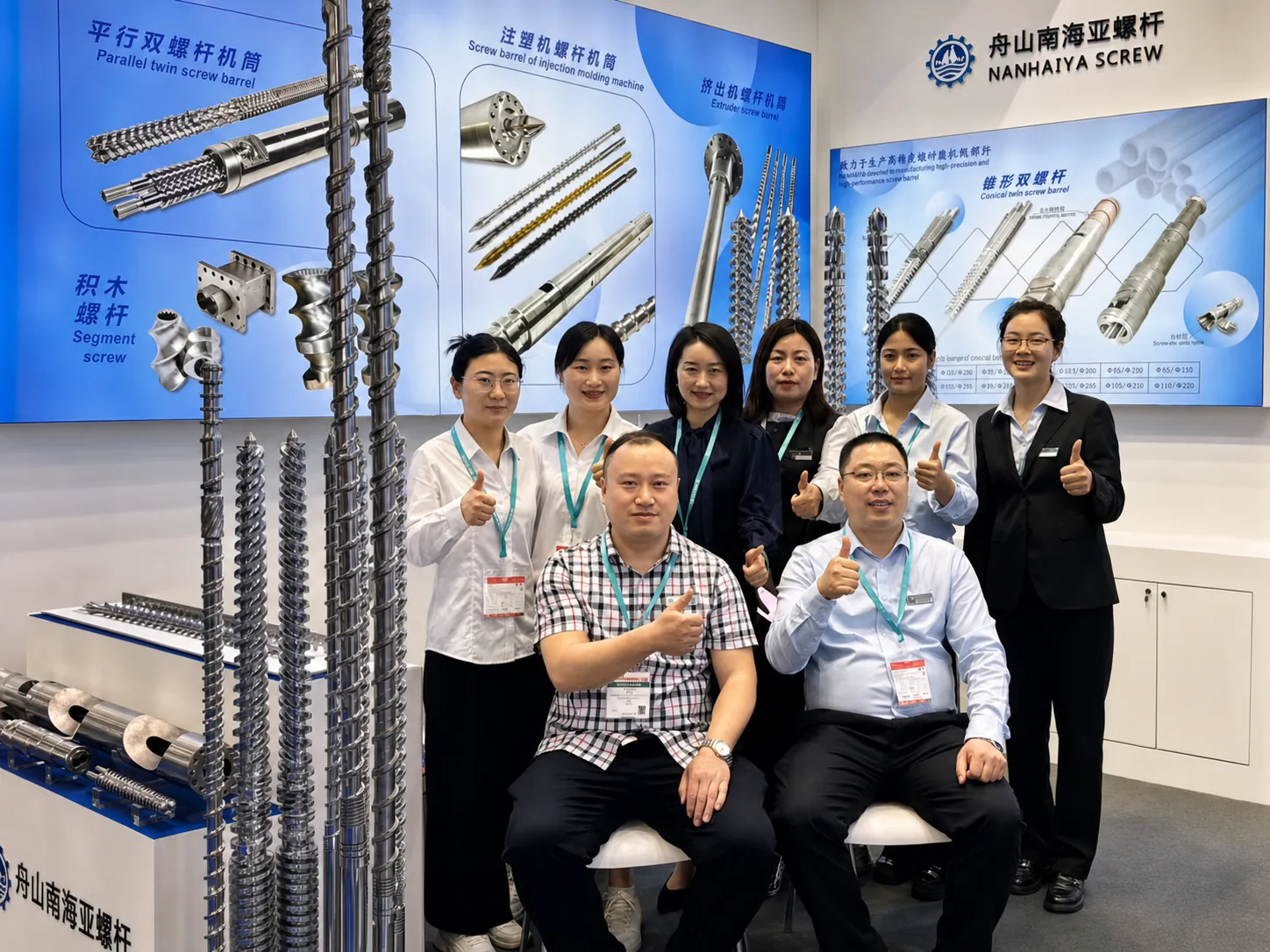
Related Articles
More insights on screw barrel technology and plastics processing.
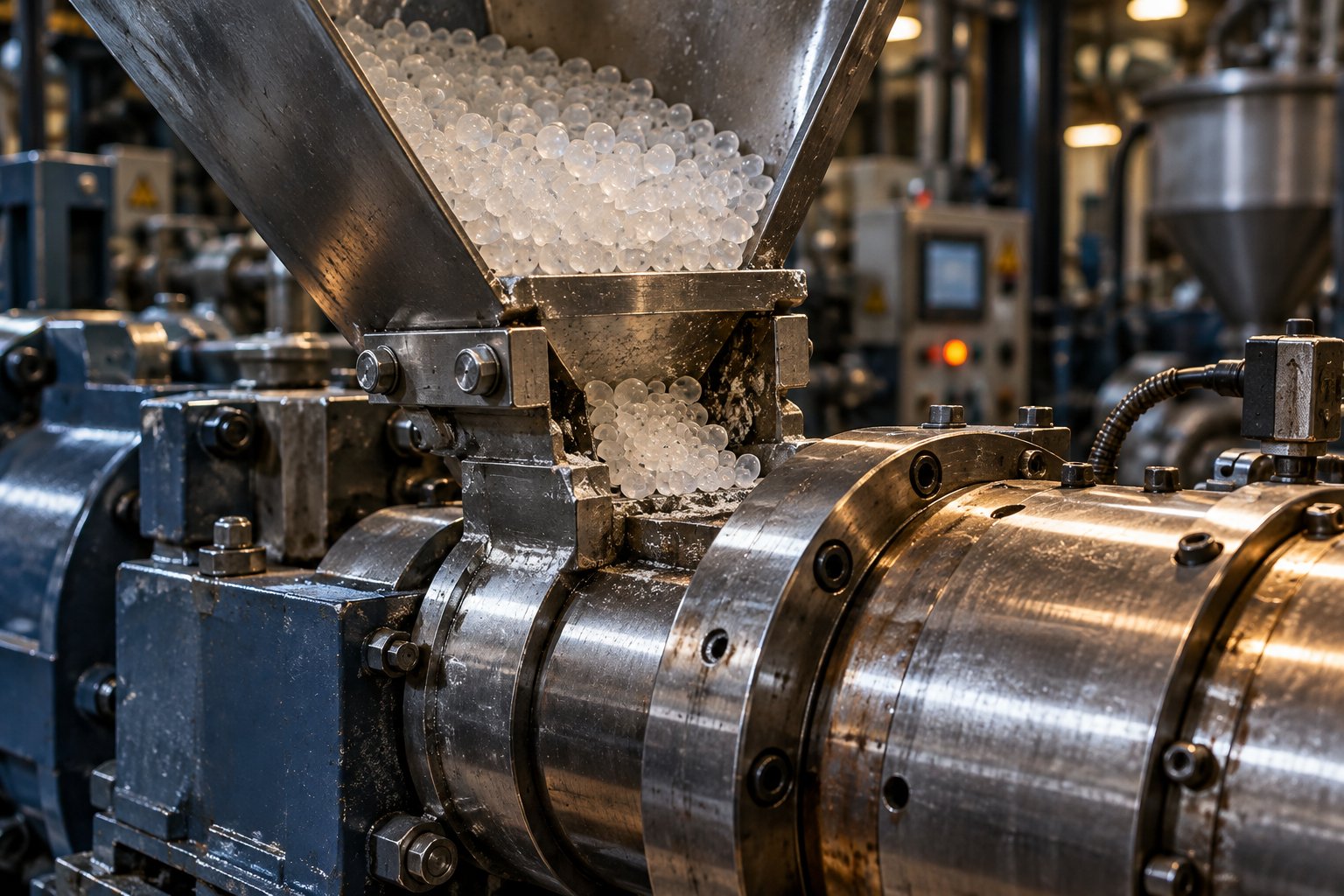
Your Extruder Feeding Instability Isn't Random — Here's Why
Oct 22, 2026
Extruder feeding instability causes surging output and scrap. Learn the 6 root causes, polymer-specific fixes, wear diagnostics, and preventive protocols.
Read Article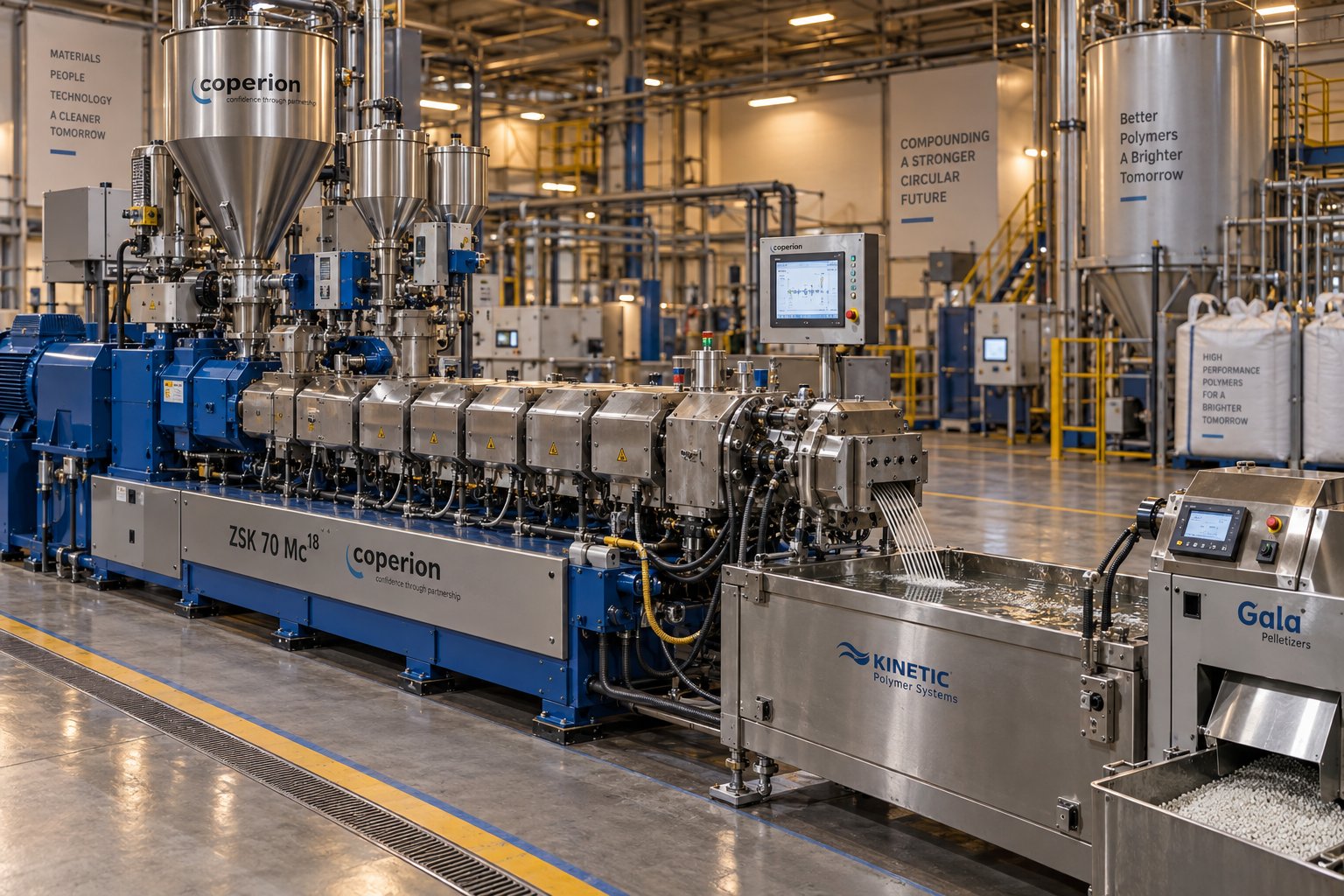
Parallel Twin Screw Extruder for Compounding Demystified: Lab to Line
Oct 21, 2026
Learn how a parallel twin screw extruder for compounding works—from screw element design and zone configuration to lab-to-production scale-up and process optimization.
Read Article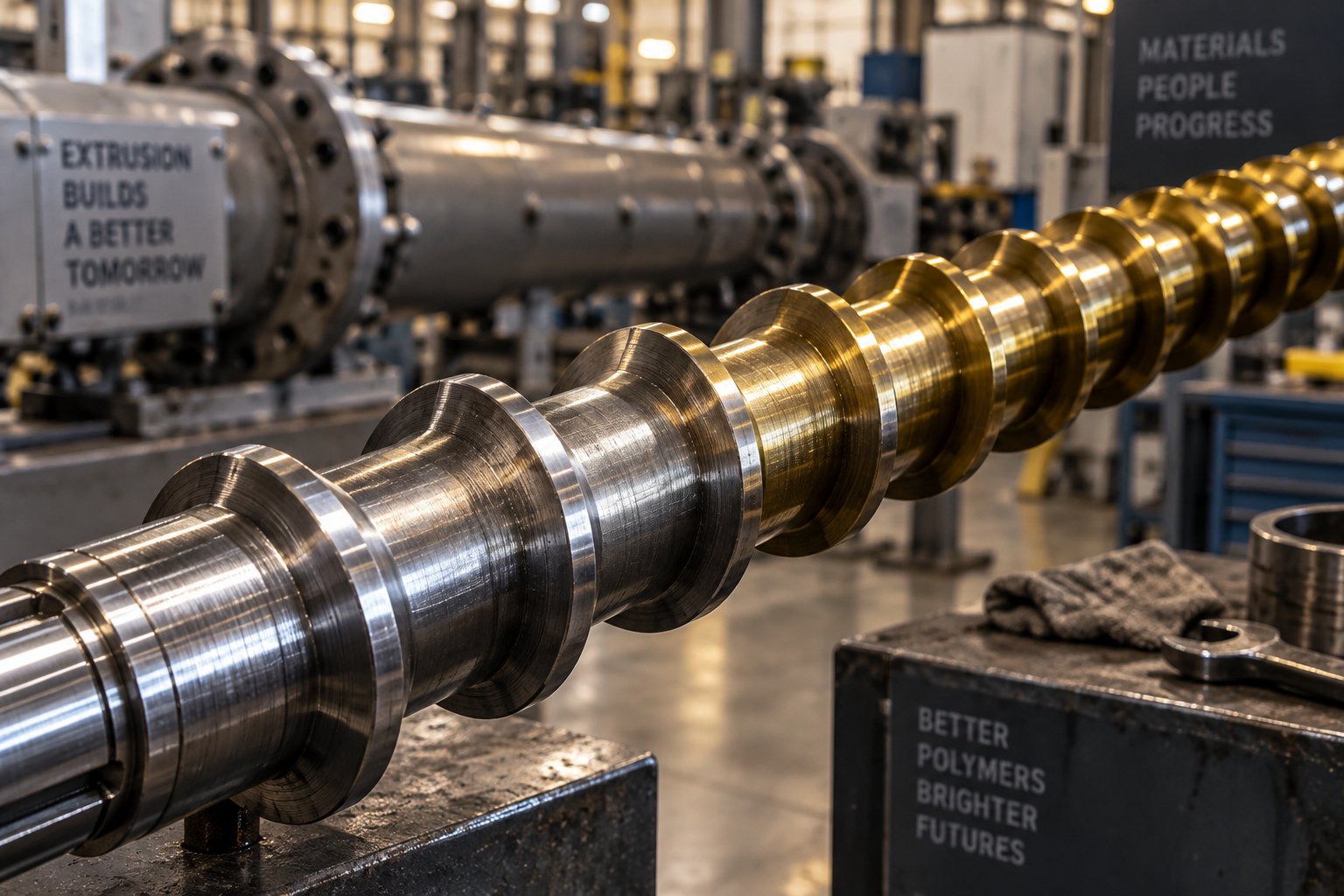
Plastic Extruder Screw Material Decoded: From Metallurgy to ROI
Oct 20, 2026
Learn how to select the right plastic extruder screw material — from carbon steel to bimetallic PM tool steels — matched to your resin, filler, and cost targets.
Read ArticleLooking for something else?
Search by material, symptom or product and jump straight to the relevant page.
These are navigation suggestions based on keyword matching — not a quotation, not a delivery commitment, and not a substitute for engineering review. Final specification is confirmed by our engineers against your drawings and processed material.
Need help with screw barrel selection?
Share your machine model, processed material and application. Our team can help with pricing and technical support.