

What an Extruder Screw Barrel Does and Why Recycling Demands More
Imagine feeding a mix of shredded milk jugs, crushed detergent bottles, and random film scraps into an extrusion line and expecting perfectly uniform pellets to come out the other end. That's the daily reality for plastics recyclers — and the component standing between chaotic input and consistent output is the extruder screw barrel. When this assembly is poorly matched to recycling conditions, pellet quality suffers in ways that cost real money downstream.
What Is an Extruder Screw Barrel
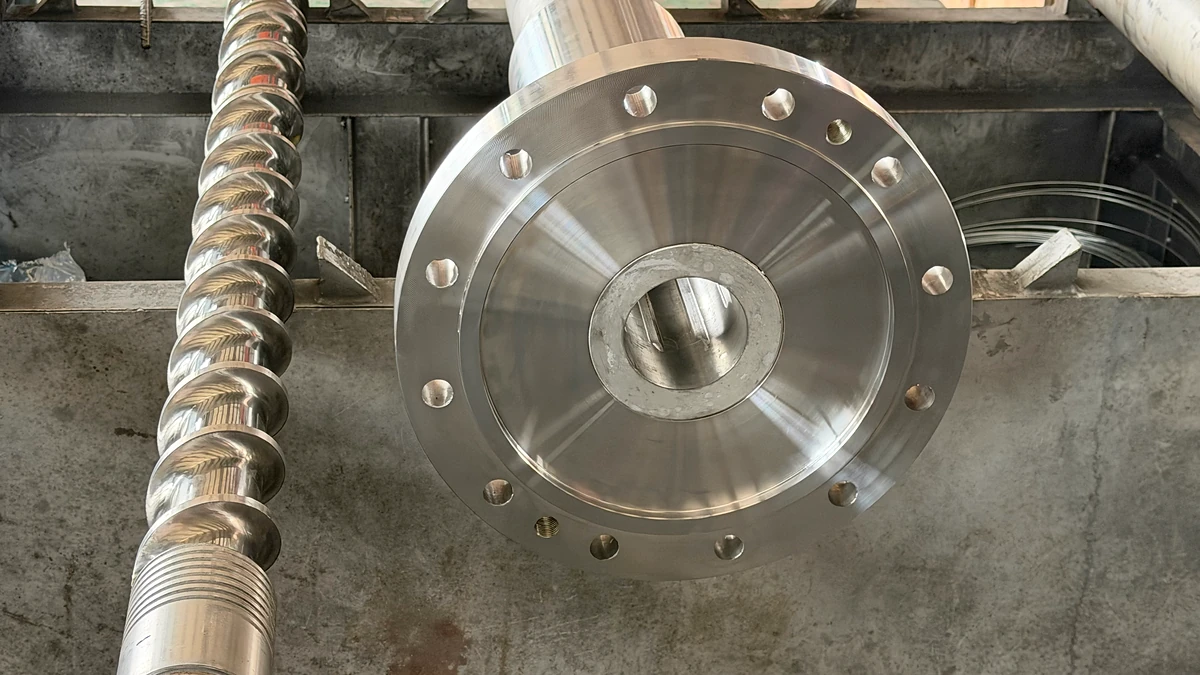
At its core, a screw barrel extruder is the heart of any plastics extrusion line. It consists of two primary parts: a hardened cylindrical barrel and a precision-machined helical screw that rotates inside it. Together, these components perform three essential functions — conveying raw plastic forward, melting it through a combination of mechanical shear and conducted heat, and homogenizing the molten polymer into a uniform stream ready for pelletizing, film casting, or profile extrusion.
An extruder screw barrel is a matched assembly of a rotating helical screw inside a heated cylindrical barrel that conveys, melts, and homogenizes plastic material — serving as the primary processing unit in any extrusion-based recycling line.
Within a recycling extrusion line, the screw barrel assembly sits between the feed system (hoppers, crammer feeders, or force-feeders that introduce shredded flake or regrind) and the die head or pelletizer. The barrel houses external heating and cooling zones that work in concert with the screw's mechanical energy to control melt temperature. The inner barrel surface typically features a bimetallic or nitrided lining to resist wear, while the screw flights are engineered with specific channel depths, compression ratios, and flight geometries tailored to the material being processed. As research in applied plastics engineering highlights, the screw design chosen ultimately determines the performance of the entire extrusion system and is rightly considered the heart of the process.
Extruder screws and barrels may look similar whether they're installed in a virgin-resin compounding plant or a post-consumer recycling facility. But the demands placed on them couldn't be more different — and that difference is where most pellet quality problems begin.
Why Recycling Places Greater Demands on Screw Barrel Design
Virgin resin arrives at a processing facility in a predictable state: uniform pellet size, consistent melt flow index, controlled moisture content, and virtually zero contamination. Recycled feedstock offers none of those guarantees. Five challenges unique to recycling push extruder screw barrel design well beyond what standard configurations can handle:
- Moisture content. Recycled flake — especially post-consumer PET and washed polyolefin — carries significantly higher residual moisture than virgin pellets. Excess moisture triggers hydrolytic degradation and causes bubbles, voids, and inconsistent melt viscosity. Screw barrel designs for recycling often need vacuum venting or multi-stage atmospheric venting to strip this moisture mid-process.
- Contamination. Labels, adhesives, inks, residual food traces, and foreign polymers are everyday realities in recycled streams. These contaminants generate volatiles during melting, accelerate abrasive and corrosive barrel wear, and introduce gels and discoloration into the final pellet. A plastic extruder screw barrel intended for recycling must account for these aggressors in both its geometry and its metallurgy.
- Mixed polymer streams. Post-consumer bales rarely contain a single resin. Even well-sorted streams include trace quantities of incompatible polymers with different melting points and viscosities. The screw must deliver enough dispersive and distributive mixing to handle these inconsistencies without creating unmelted particles or phase-separated domains in the pellet.
- Degraded molecular chains. Recycled polymers have already been through at least one heat history. Their molecular weight is lower, their melt strength is reduced, and they're more susceptible to further oxidative degradation. Excessive shear or residence time inside the barrel compounds the problem, making screw geometry a critical balancing act between thorough melting and gentle processing.
- Variable bulk density. Unlike uniform virgin pellets, recycled feedstock comes as flake, film, regrind, or agglomerate — each with a different bulk density. Low-bulk-density materials like film fluff can starve the feed zone and cause output instability unless grooved-feed-barrel technology or crammer feeders compensate for the inconsistency.
These five factors interact with each other in unpredictable ways. A batch of washed HDPE flake might arrive wetter than the last, with more label contamination and a slightly different melt flow index. The screw barrel assembly must accommodate all of that variability without a line stoppage or a quality failure. It's a tall order, and it explains why sourcing from a barrel screw extruder factory in China or anywhere else demands a recycling-specific engineering conversation rather than a catalog selection.
The sections ahead break down exactly how screw configuration, zone design, material-specific specifications, feedstock preparation, and wear management all converge on a single outcome: the quality of the recycled pellet your line produces.
Single-Screw vs. Twin-Screw Barrel Configurations for Recycling
Every one of those five recycling challenges — moisture, contamination, mixed polymers, degraded chains, and variable bulk density — lands squarely on the extruder screw and barrel. But here's the thing: not every barrel screw extruder handles those challenges the same way. The fundamental split in the industry comes down to single-screw versus twin-screw configurations, and choosing the wrong one for your feedstock is one of the fastest ways to kill pellet quality before the material ever reaches the die.
Single-Screw Extruder Barrels and Where They Excel in Recycling
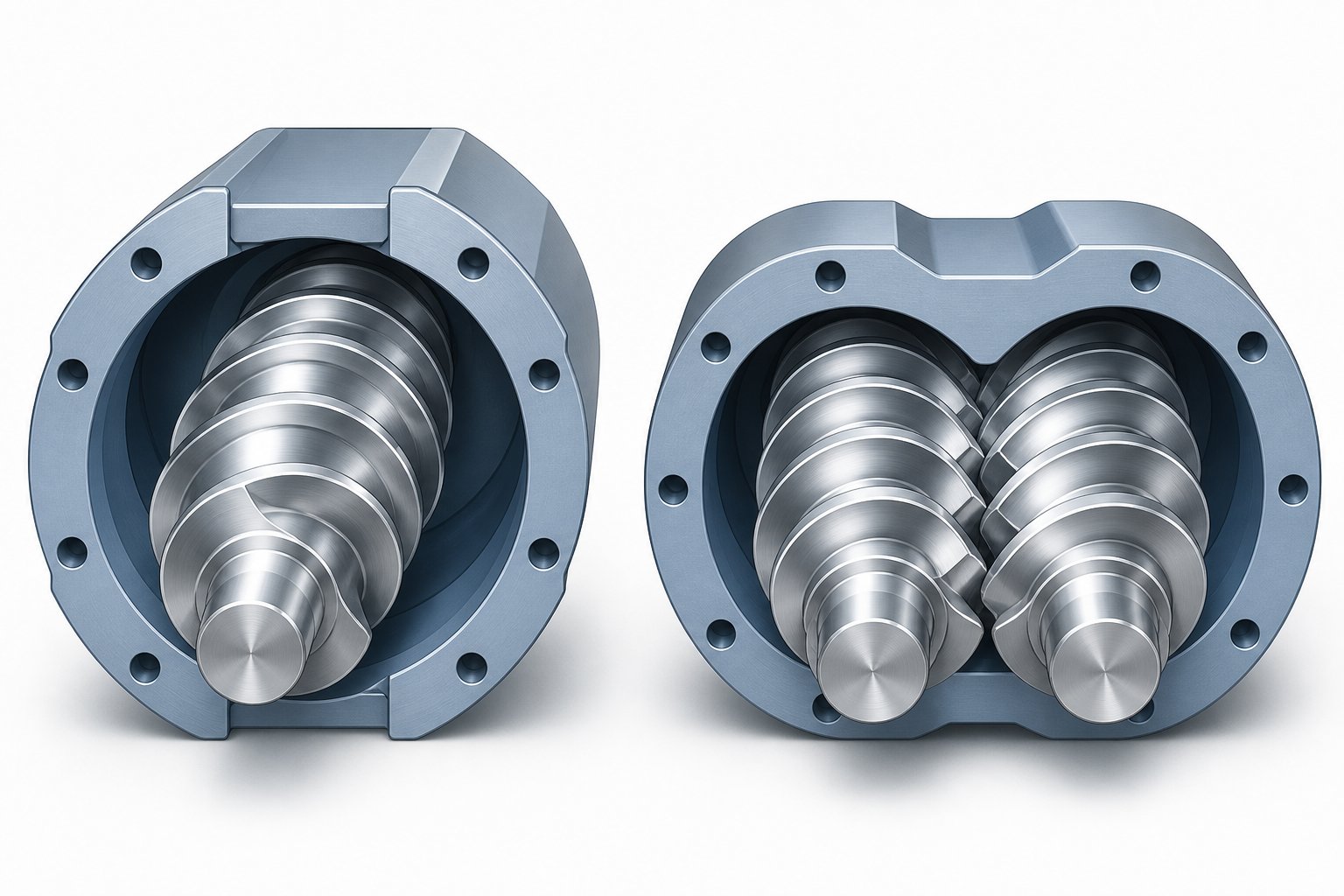
A single-screw system does exactly what the name suggests — one helical screw rotates inside one cylindrical barrel. Its mechanical simplicity is its greatest strength. Fewer moving parts mean lower capital cost, easier maintenance, and predictable wear-part management, which matters when you're running a lean operations team.
Where single-screw extruder barrels truly shine in recycling is pressure generation and melt stability. These machines routinely build and sustain pressures above 3,000 psi — sometimes significantly higher — making them the natural choice when your process depends on pushing melt through fine-mesh screen changers for contamination removal. As Plastics Technology notes, single-screw extruders are high-pressure devices designed to build and stabilize elevated pressures, and they're also more forgiving of contaminants in the process stream compared to tightly intermeshing twin-screw designs.
For recycling operations processing clean, pre-sorted, single-polymer streams — think post-industrial edge trim, in-house regrind, or well-washed HDPE bottle flake — a single-screw setup delivers reliable output at a lower operating cost. Typical recycling-grade single-screw configurations use L/D ratios between 28:1 and 36:1, with compression ratios in the range of 2.5:1 to 4:1 depending on the polymer. Output consistency is strong as long as the feedstock remains reasonably uniform in bulk density and contamination level.
The trade-off? Single-screw designs offer only basic mixing capability. The material follows a single helical path down the barrel, and while barrier flights and mixing elements like Maddock sections can improve homogeneity, they can't match the intensive distributive and dispersive mixing a twin-screw delivers. When your recycled feedstock is predictable, that's perfectly fine. When it's not, you'll start seeing the consequences in your pellets.
Twin-Screw Extruder Barrels for Complex Recycling Feedstocks
Twin-screw extruder barrels use two co-rotating, intermeshing screws inside a figure-eight-shaped barrel bore. This geometry fundamentally changes how material moves through the system. Instead of following a single helical channel, polymer transfers between the two screws multiple times, passing through high-shear intermeshing zones that deliver far superior mixing intensity.
Several characteristics make the twin-screw configuration the preferred extruder barrel and screw setup for demanding recycling applications:
- Superior mixing. Co-rotating intermeshing screws provide both dispersive mixing (breaking down agglomerates and incompatible polymer domains) and distributive mixing (spreading additives, colorants, and minor-phase polymers evenly throughout the melt). This is critical when processing post-consumer streams that contain trace incompatible resins.
- Self-wiping action. The intermeshing screw geometry means each screw continuously wipes the other's surface, minimizing dead spots where material could stagnate, degrade, and generate black specks — a constant concern with recycled feedstock that already carries a thermal history.
- Modular screw elements. Most twin-screw systems use a building-block screw design. Conveying elements, kneading blocks, reverse elements, and mixing sections can be rearranged on a splined shaft to optimize the screw profile for different feedstocks without buying an entirely new screw.
- Multi-stage venting. The starve-fed nature of twin-screw extruders — where screw speed is independent of feed rate — allows partially filled conveying zones underneath vent ports. This makes it straightforward to integrate atmospheric and vacuum venting at multiple points along the barrel, stripping moisture and volatiles from wet or contaminated recycled streams.
These advantages come with real trade-offs, though. Twin-screw systems typically operate at less than 1,500 psi — far below the pressures a single-screw generates — which means filtration-intensive recycling processes often require a gear pump between the extruder and the screen changer. The tight extruder screw barrel clearance between intermeshing screws also makes twin-screw systems more vulnerable to damage from hard contaminants like metal fragments or stones. Capital cost is typically two to three times higher, driven by complex high-torque gearboxes, modular screw elements manufactured from premium alloy steels, and more sophisticated control systems.
| Comparison Criteria | Single-Screw Extruder Barrel | Twin-Screw Extruder Barrel |
|---|---|---|
| Mixing Quality | Basic; improved with barrier flights and Maddock mixers | Excellent dispersive and distributive mixing via intermeshing elements |
| Feedstock Flexibility | Best for clean, single-polymer, pre-sorted streams | Handles mixed polymers, contaminated, and variable-quality feedstock |
| Moisture Handling | Limited venting; typically requires pre-drying | Multi-stage vacuum and atmospheric venting; can process wetter feeds |
| Throughput Range | Wide range; scales well for high-volume single-resin recycling | Moderate to high; output rate tied to screw speed and feed rate independently |
| Pressure Generation | High (3,000+ psi); ideal for fine filtration | Low (typically under 1,500 psi); often needs a gear pump for filtration |
| Contaminant Tolerance | More forgiving of hard foreign objects in the feed stream | Tight clearances make it vulnerable to damage from metal or stone fragments |
| Maintenance Complexity | Simpler; fewer wear components, faster service routines | Higher; modular elements require careful reassembly, gearbox service is specialized |
| Capital Cost | Lower initial investment | Typically 2-3x higher due to gearbox, modular screws, and controls |
Choosing the Right Configuration for Your Recycling Operation
So which setup belongs on your recycling line? The answer isn't about which machine is "better" — it's about matching the extruder screw and barrel configuration to your specific feedstock condition and the pellet quality your customers demand.
Use this decision logic as a starting point:
- Choose a single-screw barrel when your feedstock is pre-sorted, single-polymer, reasonably clean, and your process is primarily melt-filter-pelletize. If your success metric is stable melt pressure through fine-mesh filtration and consistent pellet dimensions, a well-specified single-screw line is often the more practical and cost-effective choice.
- Choose a twin-screw barrel when your feedstock is post-consumer, multi-polymer, or heavily contaminated, and when pellet quality depends on mixing intensity, additive dispersion, or aggressive devolatilization. If your customers test for dispersion-sensitive properties — impact strength, color consistency, or odor — twin-screw processing gives you the tools to hit those targets.
- Consider a tandem (two-stage) system when neither configuration alone covers all your requirements. The most advanced recycling lines pair a single-screw extruder for pre-melting and coarse filtration with a co-rotating twin-screw for degassing, additive compounding, and fine homogenization. This two-stage approach integrates the high-pressure pumping strength of the single-screw with the superior dispersion capabilities of the twin-screw — and it's increasingly recognized as the preferred solution for producing high-quality recycled materials from challenging feedstocks.
The configuration you select, however, is only the first decision. What happens inside each zone of that barrel — from the moment recycled flake enters the feed throat to the instant homogenized melt exits the metering section — has an equally dramatic impact on pellet quality.
Understanding the Three Functional Screw Zones in a Plastic Extruder Screw Barrel
Picture a recycled HDPE flake entering the feed throat of your extruder. It's irregular in shape, lighter than a virgin pellet, and carrying trace moisture from a wash line. Over the next few seconds, that flake must be grabbed, compressed, fully melted, degassed, and pushed out as a perfectly homogeneous melt stream. Every inch of the screw and barrel extruder is engineered to make that transformation happen — and it does so across three distinct functional zones, each with recycling-specific demands that generic screw designs routinely fail to meet.
The Feed Zone and Managing Irregular Recycled Feedstock
The feed zone is where material enters the barrel, and it's the first place recycling operations diverge sharply from virgin processing. Virgin resin arrives as uniform pellets with a bulk density typically between 30 and 40 lb/ft³. Recycled feedstock? Not even close. Shredded film fluff can measure as low as 3-5 lb/ft³. Regrind flake from bottles might reach 20-25 lb/ft³. Agglomerated material lands somewhere in between. These variations mean the feed zone must work harder — and smarter — to maintain a consistent mass flow into the compression zone downstream.
This is where grooved-feed-barrel technology becomes especially relevant for recyclers. A grooved feed section features axial grooves machined into the barrel bore directly downstream of the hopper opening — typically 8 to 18 grooves evenly spaced around the circumference, each 0.15-0.3 in. wide and tapering from a starting depth of 0.12-0.37 in. down to zero over three to four barrel diameters. As Plastics Technology details, these grooves mechanically lock the solid material against the barrel wall, dramatically increasing the forward conveying force and producing 20-40% higher output per RPM compared to smooth-bore designs of the same diameter.
For recycling, though, grooved feeds introduce a trade-off. They perform best with consistent particle size and dedicated polymer streams. When regrind percentages fluctuate or particle geometry varies widely — common realities in post-consumer recycling — the grooves can cause feed-rate instability. Screw channel depths in the feed zone must also be shallower with grooved bores (roughly 0.25-0.4 in. on a 3.5-in. screw versus 0.6-0.7 in. for smooth bore) to maintain high forward force and adequate compression entering the heated barrel. For operations running highly variable recycled streams, smooth-bore feeds paired with crammer feeders or gravimetric dosing systems often provide more stable results.
The Compression Zone and Handling Contamination During Melting
The compression zone — sometimes called the transition zone — is where solid plastic transforms into a melt. Channel depth progressively decreases along the screw length, compacting the material, squeezing out trapped air, and increasing shear-generated heat. For virgin resin processing, this zone is relatively straightforward. For recycling, it's where the real engineering challenges concentrate.
Compression ratios for recycling screws typically range from 2.5:1 to 4:1, but the optimal value depends heavily on the incoming material. Research at the University of Massachusetts Lowell demonstrated that a mixing screw design with a compression ratio as high as 3.75:1 effectively plasticated coarse recycled polypropylene pellets of varying sizes, colors, and compositions — confirming that recycled feedstocks often benefit from higher compression to ensure complete melting despite their irregular geometry and inconsistent thermal properties.
The critical recycling-specific concern in this zone is volatile management. Labels, adhesive residues, printing inks, and residual moisture all generate gases as the material heats. If those volatiles can't escape, they become trapped in the melt as bubbles, surface defects, or internal voids in the finished pellet. Venting ports — either atmospheric or vacuum-assisted — are positioned along the barrel in this region to extract gases before the melt fully seals. As SpiraMelt Technologies explains, a vented screw works by reducing melt pressure to atmospheric pressure at the vent opening so that molten resin doesn't pump out the port while volatiles are extracted. Multi-flighted vent sections separate the melt into rope-like strands, increasing exposed surface area and naturally improving degassing efficiency — an approach that directly addresses the heavy volatile loads typical of post-consumer recycled streams.
Screw geometry in this zone also needs to account for the fact that recycled material melts less predictably. Degraded molecular chains, mixed polymers with different melting points, and filler content variations all disrupt the classic Tadmor melting model where a solid bed reduces progressively against the barrel wall. Barrier-flight designs can help by separating the molten and solid phases, preventing re-insulation of the solid bed and ensuring more uniform melting — but they must be paired with appropriate venting to handle the volatiles that barrier screws tend to trap.
The Metering Zone and Ensuring Consistent Output Quality
The metering zone is the final section of the screw, and its job is deceptively simple: deliver a uniform, fully homogenized melt at stable pressure to the die or pelletizer. In practice, this zone determines whether your recycled pellets meet downstream processor specifications or get rejected.
Channel depth in the metering zone is constant — and shallow — to build and maintain the pressure needed to push melt through screen packs, breaker plates, and die heads. For a recycling-grade extruder screw barrel, metering-zone channel depth is typically 10-15% of the screw diameter, though the exact dimension depends on the target throughput and the polymer's melt viscosity. The research from UMass Lowell found that a metering section with a channel depth equal to 10% of the screw diameter and a tightly controlled pitch provided stable mass output that scaled linearly with screw speed — a characteristic essential for the consistent pellet sizing recycling customers demand.
Melt pressure stability in this zone directly affects pellet dimensional uniformity. Pressure fluctuations — often called surging — cause the die throughput to pulse, producing oversized and undersized pellets in the same batch. In recycling, surging is far more common than in virgin processing because the metering zone receives melt of inconsistent viscosity and temperature from upstream zones struggling with variable feedstock. Mixing elements at the end of the metering zone — Maddock mixers, pineapple mixers, or spiral mixing sections — act as a final equalizer, breaking up any remaining thermal or compositional inconsistencies before the melt exits the barrel.
Every extruder screw barrel manufacturer should tailor zone-by-zone geometry to the specific recycling application rather than offering generic designs. The following summary outlines key design parameters across all three zones for recycling extrusion:
- Feed zone: Channel depth of 15-20% of screw diameter (shallower for grooved-bore barrels); flight width approximately 10% of screw diameter; pitch equal to 1x screw diameter (standard) or variable for enhanced feeding; designed for low-bulk-density, irregular recycled feedstock.
- Compression zone: Compression ratio of 2.5:1 to 4:1 depending on polymer type and contamination level; gradual channel depth taper over 4-8 screw diameters; flight width maintained or slightly increased for seal integrity; venting ports positioned for volatile removal from labels, inks, and moisture.
- Metering zone: Channel depth of 10-15% of screw diameter (constant); pitch equal to or slightly less than 1x screw diameter; flight width approximately 10% of screw diameter; mixing elements (Maddock, spiral, or kneading sections) incorporated to ensure thermal and compositional homogeneity before the die.
These parameters aren't academic suggestions — they're the engineering foundation that separates a plastic extruder screw barrel producing spec-grade recycled pellets from one generating rejects. And those parameters change significantly depending on which polymer you're recycling, because a compression ratio that works beautifully for HDPE can cause severe degradation in PET.
Matching Screw Barrel Specifications to Recycled Polymer Types
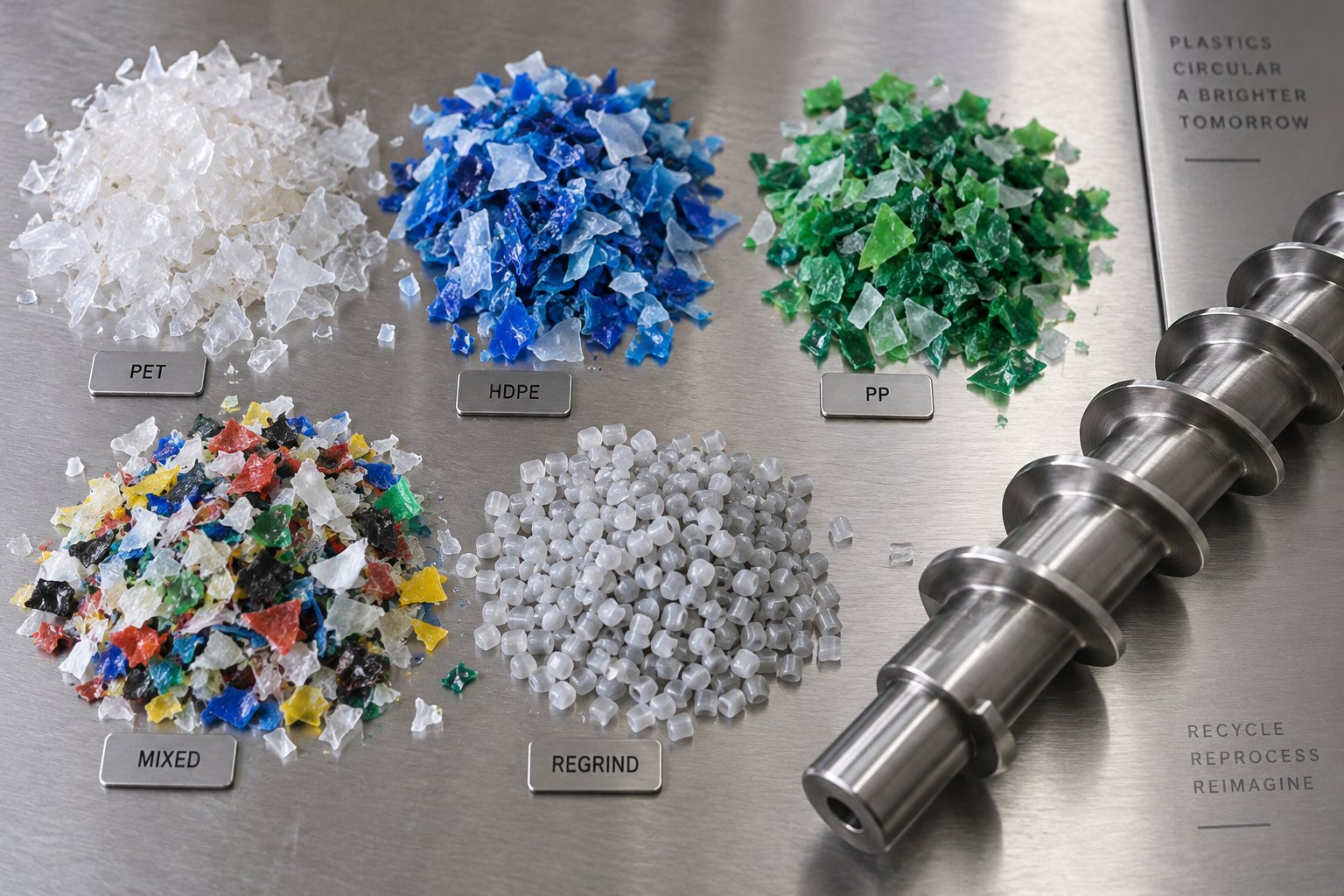
A compression ratio that melts HDPE flake cleanly will thermally destroy recycled PET. A gentle shear profile that protects degraded polypropylene chains will leave polystyrene full of unmelts. Every recycled polymer carries its own processing personality — shaped by melt temperature range, shear sensitivity, moisture tolerance, and degradation history — and the screw barrel for extruder systems must be engineered to respect those differences. Generic, one-size-fits-all screw geometries are one of the most common reasons recycled pellet quality falls short of downstream specifications.
Screw Barrel Requirements for Recycling PE and PP Polyolefins
Polyolefins — HDPE, LDPE, and PP — represent the largest share of recycled plastic globally. In the United States alone, polyethylene and polypropylene account for roughly 63% of all plastic waste. Their relatively wide processing windows (typically 180-240°C for PE, 190-260°C for PP) make them forgiving compared to engineering resins, but recycled polyolefins introduce complications that virgin grades don't.
The central concern is oxidative degradation. Every heat cycle a polyolefin has endured — from original manufacturing to consumer use to the recycling extruder — chips away at its molecular weight. Recycled HDPE from blow-molded bottles has already been through at least one high-shear injection-blow process. Recycled LDPE film may have been reprocessed multiple times. Each pass shortens polymer chains through thermo-oxidative chain scission, reducing melt strength and impact performance in the final pellet.
What does this mean for your single screw extruder barrel or twin-screw setup? You need to minimize additional thermal history while still achieving complete melting and homogeneity. Practically, that translates to:
- Moderate compression ratios (2.5:1 to 3.5:1). Too aggressive a compression generates excessive shear heat, accelerating chain scission. Too gentle, and you risk unmelted particles in the output — especially with thick-walled HDPE regrind that takes longer to melt through than thin-gauge film flake.
- L/D ratios of 28:1 to 34:1. Longer screws provide more residence time for gentle melting without requiring high screw speeds that spike shear rates. For LDPE film recycling, the lower end of this range often suffices because thin film melts quickly. For chunky HDPE regrind, lean toward the higher end.
- Venting for trapped air and moisture. Washed polyolefin flake retains surface moisture. LDPE film in particular tends to trap air pockets due to its low bulk density and tendency to bridge in the feed throat. At least one atmospheric vent in the transition zone prevents bubble formation in pellets.
- Distributive mixing sections. Recycled polyolefin streams often carry color contamination, varying melt flow indices (even within a single bale), and trace amounts of incompatible polymers. A Maddock mixer or pineapple-style distributive mixing section in the metering zone helps blend these inconsistencies without the aggressive shear that dispersive mixing elements would impose.
PP deserves special attention because its recycled form is particularly prone to beta-scission — a degradation mechanism where the polymer chain breaks preferentially at tertiary carbon sites, causing a rapid drop in molecular weight and a corresponding rise in melt flow rate. Recycled PP frequently has a melt flow index two to five times higher than its virgin equivalent. Screw designs for recycled PP should therefore prioritize low shear intensity, shorter metering zones to reduce residence time, and barrel temperatures at the lower end of the processing window to slow oxidative reactions.
Screw Barrel Considerations for PET and Moisture-Sensitive Polymers
If polyolefins are the forgiving end of the recycling spectrum, PET sits firmly at the demanding extreme. This polymer's hygroscopic nature and narrow processing window make it one of the most challenging resins to recycle through extrusion — and the screw barrel design either enables success or guarantees degradation.
The moisture issue is severe. PET must be processed with a moisture content below 0.02 wt.% to avoid hydrolytic degradation. Research published in Recycling demonstrated that undried recycled PET exhibited a melt flow index nearly 2.5 times higher than properly dried material — a viscosity collapse driven by virtually instantaneous hydrolysis during processing. Even after drying at 120-150°C for four hours, PET can reabsorb enough atmospheric moisture to exceed the critical 0.02 wt.% threshold within just 15 minutes of exposure to 50% relative humidity. That means the screw barrel system must function as a secondary line of defense against moisture, not rely solely on upstream drying.
This is where twin screw extruder barrels with vacuum venting capabilities prove invaluable. Studies have shown that vacuum-vented extrusion can remove volatiles and residual moisture so effectively that the pre-drying step can be shortened or even eliminated. In a single screw extruder barrel, a vented two-stage screw design accomplishes a similar function — the screw diameter drops sharply after the first compression zone, creating a low-pressure decompression section where a barrel vent extracts moisture and volatiles before the second metering stage rebuilds pressure.
Beyond venting, several screw barrel design elements are critical for recycling PET:
- Barrier-flight screws. PET's narrow safe processing window (250-270°C) means unmelted solid regions can persist alongside overheated melt if the melting process isn't tightly controlled. Barrier flights physically separate the melt pool from the remaining solid bed, ensuring progressive and uniform melting. Combined with grooved-bore feed sections, barrier screws significantly improve conveying consistency with recycled PET flake.
- L/D ratios of 24:1 to 30:1 for single-screw systems and 32:1 to 40:1 for twin-screw extruder barrels. The shorter single-screw ratios keep residence time low, minimizing thermal degradation. Twin-screw systems use higher L/D values to accommodate multiple venting and mixing zones while maintaining gentle shear through starve-fed operation.
- Compression ratios of 3:1 to 3.25:1. These moderate ratios provide enough compaction for complete melting without generating excessive shear heat — essential for a polymer that begins degrading rapidly above 280°C and produces harmful byproducts like acetaldehyde and formaldehyde at that temperature.
- Distributive mixing elements only. PET is temperature-sensitive rather than shear-sensitive, meaning dispersive mixers that apply high localized shear stress don't improve melt homogeneity and can cause localized overheating. Distributive mixers — Saxton, pin, and pineapple mixing sections — separate and recombine the melt stream without aggressive shear, producing uniform output temperature and composition.
Recycled PET carries an additional complication: molecular weight is already reduced from prior processing. Lower molecular weight means more chain ends, and chain ends are more susceptible to thermal and thermo-oxidative degradation than mid-chain segments. This creates a compounding cycle — the more degraded the PET, the faster it degrades further. Every unnecessary second of residence time and every extra degree of barrel temperature accelerates this spiral. The screw barrel design must therefore prioritize short, efficient processing paths with minimal dead volume.
Mixed-Stream and Post-Consumer Recycling Screw Barrel Strategies
Mixed-polymer bales represent the toughest challenge in mechanical recycling. Imagine a single feed stream containing PE, PP, PET, PS, and trace nylons — each with a different melting point, melt viscosity, and degradation threshold. No single compression ratio, barrel temperature, or shear intensity is optimal for all of them simultaneously. The screw barrel system must become a compromise engine, balancing conflicting requirements well enough to produce a usable pellet.
This is where modular twin screw extruder barrels earn their place. The building-block screw element approach allows recyclers to assemble custom screw profiles from conveying elements, kneading blocks, reverse elements, and toothed mixing sections — each performing a specific function at a specific position along the barrel. For mixed-stream recycling, a typical profile might include:
- Deep-flight conveying elements in the feed zone (like SK 40/40 type elements with high free volume) to handle the unpredictable bulk density of mixed bale material.
- Forward kneading blocks (e.g., KP 45/5/20 R) positioned early in the melting zone for initial dispersive mixing — breaking apart agglomerates and beginning to blend incompatible polymer phases.
- Reverse kneading elements (e.g., KBW 45/5/30 L) at strategic intervals to slow forward flow, increase residence time locally, and apply maximum shear where the most stubborn polymer phases need to be incorporated.
- Venting zones with narrow-pitch conveying elements (SE 20/20) to create partially filled barrel sections where moisture, trapped air, and decomposition volatiles can escape through barrel ports.
- Toothed mixing elements (Z 8/3/20 type) positioned before the final compression zone to provide distributive mixing that evenly disperses the various polymer phases without adding excessive shear energy.
The key principle is that no single screw geometry handles mixed streams well — only a carefully sequenced combination of element types can achieve acceptable results. And even then, the output from mixed-stream recycling typically requires aggressive screen filtration and often produces pellets suited for lower-specification applications like lumber alternatives, parking bumpers, or non-structural injection molding.
L/D ratios for mixed-stream recycling almost always fall at the high end — 36:1 to 48:1 — because the barrel must accommodate enough functional zones (multiple kneading sections, multiple vents, extended mixing) to process fundamentally incompatible materials into a somewhat homogeneous melt.
The following table maps recommended screw barrel specifications to the six most common recycled polymer categories. Use it as a starting-point reference when specifying or evaluating your extrusion equipment:
| Specification | HDPE | LDPE | PP | PET | PS | Mixed Stream |
|---|---|---|---|---|---|---|
| Recommended L/D Ratio | 30:1 - 34:1 | 28:1 - 32:1 | 28:1 - 34:1 | 24:1 - 30:1 (single) / 32:1 - 40:1 (twin) | 26:1 - 30:1 | 36:1 - 48:1 (twin preferred) |
| Compression Ratio | 3:1 - 3.5:1 | 2.5:1 - 3:1 | 2.5:1 - 3.5:1 | 3:1 - 3.25:1 | 2.5:1 - 3:1 | 2.5:1 - 3.5:1 (varies by dominant resin) |
| Barrel Lining Treatment | Bimetallic or nitrided; abrasion-resistant for filled grades | Standard nitrided; upgrade for abrasive post-consumer streams | Nitrided or bimetallic; corrosion-resistant if flame-retardant residues present | Corrosion-resistant bimetallic (nickel-based alloys); acid-resistant to PET decomposition byproducts | Standard nitrided; upgrade for filled or flame-retardant grades | High-wear bimetallic (tungsten carbide overlay); corrosion- and abrasion-resistant |
| Venting Requirements | 1 atmospheric vent minimum; vacuum vent for wet flake | 1-2 atmospheric vents (trapped air from film); vacuum vent optional | 1 atmospheric vent; vacuum vent for washed post-consumer flake | Vacuum venting strongly recommended; multi-stage venting for recycled flake | 1 atmospheric vent minimum; vacuum vent for foam scrap | Multi-stage vacuum + atmospheric venting required |
| Key Design Notes | Moderate shear; barrier flights improve melt uniformity; grooved feed for flake | Gentle shear; avoid aggressive compression that overheats thin-gauge film melt | Low shear critical; short metering zone to limit residence time; watch for beta-scission | Barrier-flight screw preferred; distributive mixers only; minimize residence time and dead volume | Low shear; avoid overheating (generates styrene monomer); smooth-bore feed often preferred | Modular twin-screw with kneading blocks, reverse elements, and toothed mixers; aggressive filtration downstream |
This table isn't a substitute for application-specific engineering — your exact feedstock contamination level, target pellet specification, and throughput requirement all influence the final design. But it provides the polymer-matched starting point that most screw barrel specifications lack, and it highlights a truth recyclers discover the hard way: switching between polymer types without adjusting your screw profile is a guaranteed path to quality problems. The real-world variability hiding inside each of these polymer categories — lot-to-lot MFI swings, mixed label content, filler surprises — adds yet another layer of complexity that upstream preparation and feedstock management must address.
How Feedstock Variability and Pre-Processing Shape Screw Barrel Selection
Lot-to-lot MFI swings, hidden filler loads, and label contamination don't just create headaches during extrusion — they dictate which barrel and screw extruder configuration you should have specified in the first place. Here's a connection most equipment discussions overlook entirely: the quality of everything that happens before plastic enters your feed throat directly determines how hard your screw barrel has to work and how long it will last. A well-prepared feedstock stream can run beautifully on a straightforward screw design. A poorly prepared stream will punish even premium equipment.
How Pre-Processing Steps Interact with Screw Barrel Requirements
Think of pre-processing as a series of filters. Each step removes a category of variability that would otherwise land on the screw barrel to manage. When a step is skipped or done poorly, the barrel absorbs the consequence — through accelerated wear, degraded output quality, or both.
Here's the chain, and how each stage reduces downstream screw barrel demands:
- Sorting (manual or automated). Removes incompatible polymers, metals, paper, and non-plastic contaminants. Effective sorting means your screw barrel doesn't need to handle wildly different melting points and viscosities in the same stream. Poor sorting forces you toward aggressive kneading-block configurations and higher L/D ratios — or toward accepting lower-quality output.
- Shredding and size reduction. Converts bales, bottles, and film into a more uniform particle size. Consistent particle geometry improves feed-zone stability and makes grooved-feed barrels practical. Oversized chunks or extreme fines from a dull shredder cause surging and bridging that no screw geometry can fully compensate for.
- Washing and decontamination. Strips surface dirt, adhesive residues, food waste, and soluble contaminants. Thorough washing lets you run with fewer venting stages and less aggressive barrel temperatures. Inadequate washing means every label fragment and adhesive trace generates volatiles inside the barrel, accelerating corrosive wear and producing gels in your pellets.
- Drying. Reduces moisture content to safe processing levels — critical for hygroscopic polymers like PET, but also important for washed polyolefins carrying surface moisture. Effective drying simplifies screw barrel requirements significantly: you can often eliminate vacuum venting entirely. Skip this step, and you'll need multi-stage vacuum ports, corrosion-resistant barrel linings, and screw designs engineered for two-phase (melt plus steam) flow.
- Metal detection and removal. Captures ferrous and non-ferrous contaminants that would otherwise damage screw flights and barrel bores. A single bolt or staple passing through tight extruder screw barrel clearances — especially in twin-screw systems — can score flight lands and barrel walls, creating dead spots where material stagnates and degrades. The cost of extruder screw and barrel repair from a single metal-contamination event can easily exceed the price of a quality inline metal detector.
The takeaway is simple: every dollar invested in pre-processing is a dollar you don't spend on premium screw metallurgy, aggressive barrel linings, or premature replacement parts. When evaluating a barrel screw extruder for sale, the smartest recyclers assess their upstream preparation quality first and spec their extrusion equipment accordingly — rather than buying the most expensive barrel and hoping it compensates for a weak wash line.
Designing for Feedstock Inconsistency in Real-World Recycling
Even with excellent pre-processing, recycled feedstock is inherently variable in ways that virgin resin never is. You'll notice these inconsistencies showing up as subtle — and sometimes not-so-subtle — shifts in extruder behavior across a single production run:
- Melt flow index variation. A bale of nominally "HDPE" post-consumer bottle flake can contain material from dozens of different resin grades, each with a different molecular weight and MFI. One section of the bale might run at 0.3 g/10 min; the next jumps to 1.2 g/10 min. The screw barrel must homogenize these viscosity differences into a consistent melt — something a simple conveying-and-compression design can't do reliably.
- Mixed labels, adhesives, and coatings. Even "sorted" streams carry residual paper labels, pressure-sensitive adhesives, metallic inks, and UV coatings. These materials decompose at temperatures below the host polymer's melt point, generating volatile organic compounds that require venting and leaving behind residues that act as nucleation sites for gels.
- Color contamination. A handful of red caps mixed into a natural HDPE stream creates visible color streaks unless the screw delivers enough distributive mixing to disperse the pigment evenly. Color consistency is often the first quality attribute downstream customers check — and the first to fail when mixing intensity is insufficient.
- Filler content fluctuations. Recycled PP from automotive or appliance streams can carry calcium carbonate, talc, or glass fiber at varying loading levels. These abrasive fillers wear screw flights and barrel bores unevenly, change melt rheology, and alter compression behavior in ways that a screw optimized for unfilled resin can't accommodate.
- Degraded molecular weight. As discussed in the polymer-specific section, recycled material has already lost molecular weight. But the degree of degradation varies within a single batch — some flakes have been through one heat history, others through three or four. This creates a melt with a broad molecular weight distribution that behaves differently from any single-grade virgin resin.
Screw barrel designs engineered for these realities share several common features. Barrier-screw designs separate the solid and melt phases with a secondary flight, preventing solid particles from bypassing the melting zone and appearing as unmelts in the output. Grooved-feed barrels — when matched with consistent particle size from a quality shredder — lock material against the barrel wall and maintain stable forward conveyance even when bulk density fluctuates batch to batch. And mixing elements positioned strategically along the screw length address the compositional variability that barrier flights and grooved feeds can't solve alone.
For single-screw systems, Maddock-style dispersive mixers and pineapple-type distributive mixers are the primary tools. Maddock mixers force the melt through a series of narrow channels that shear apart agglomerates and unmixed domains. Pineapple mixers split and recombine the melt stream repeatedly, evening out temperature and composition gradients without adding aggressive shear energy. The best recycling screws combine both types — a Maddock section early in the metering zone to catch any remaining unmelts, followed by a distributive section near the screw tip to polish the melt before it hits the screen changer.
Twin-screw systems offer far more flexibility through kneading blocks of varying stagger angles and widths. Narrow kneading discs at 30° provide gentle distributive mixing; wide discs at 60° or 90° deliver intense dispersive action. Reverse-stagger kneading blocks create local backpressure, increasing residence time in specific zones where stubborn contaminants or incompatible phases need more work. The ability to know how to remove extruder screw from barrel — or more precisely, to slide individual elements off the splined shafts — and rearrange the profile is what makes twin-screw platforms uniquely suited to the unpredictable world of recycling.
Modular Screw Elements for Flexible Recycling Operations
This reconfigurability deserves a closer look, because it fundamentally changes the economics of recycling extrusion. Coperion's Peter von Hoffmann put it directly: "On a single-screw extruder, you would need to order an entirely new screw. On a twin screw, you simply rearrange segments. That modularity is a genuine advantage."
Here's the practical scenario. Imagine your facility processes washed HDPE bottle flake three days a week and switches to mixed-color PP automotive regrind for the remaining two. With a monolithic single-piece screw, you have two choices: run a compromise geometry that's suboptimal for both materials, or keep two complete screws in inventory and swap them out — a process that can take several hours and requires precise alignment on reinstallation.
A modular twin-screw element system changes that equation entirely. The same splined shaft accepts interchangeable conveying elements, kneading blocks, reverse elements, and mixing sections. Switching from an HDPE-optimized profile (moderate kneading, single vent, gentle metering) to a PP-focused configuration (reduced shear, shorter mixing zone, additional conveying length) takes one to two hours on a medium-sized machine — and doesn't require purchasing or storing a second complete screw assembly.
The flexibility goes deeper than simple material changes. Modular elements let recyclers adapt to quality variation within the same polymer type. When a particularly dirty batch of HDPE arrives with higher-than-normal label contamination, operators can insert additional kneading blocks ahead of the vent port to improve volatile extraction — then remove them when the feedstock quality improves. This responsive approach reduces scrap rates and keeps pellet quality within specification without over-engineering the permanent screw design.
Key modular element types recyclers should stock include:
- Standard conveying elements in multiple pitch lengths (e.g., 20mm, 30mm, 40mm pitch) — the backbone of any profile, controlling residence time and fill level.
- Forward kneading blocks at 30°, 45°, and 60° stagger angles — providing a range of mixing intensities from gentle blending to aggressive dispersive shear.
- Reverse kneading blocks — used sparingly to create local backpressure, increase mixing intensity, and improve melt seal before vent ports.
- Toothed mixing elements — excellent for distributive mixing and final melt homogenization with minimal shear energy input.
- Narrow-pitch conveying elements — positioned under vent ports to maintain partially filled channels and allow efficient degassing.
The modular approach also reduces long-term capital expenditure. Instead of replacing an entire custom screw when a single section wears — which is inevitable in abrasive recycling environments — operators replace only the worn elements. A set of kneading blocks that processes glass-fiber-filled PP regrind might last six months before needing replacement. With a monolithic screw, that localized wear would require a full rebuild or replacement costing many times more.
This kind of operational flexibility is exactly what separates recycling facilities that consistently hit quality targets from those that struggle every time the feedstock changes. But flexibility in screw design is only half the equation — what those screws produce at the die end is what ultimately determines whether your recycled pellets sell at a premium or get downgraded. The link between screw barrel engineering choices and measurable pellet quality attributes is where most recyclers have the biggest knowledge gap.
How Screw Barrel Design Determines Recycled Pellet Quality
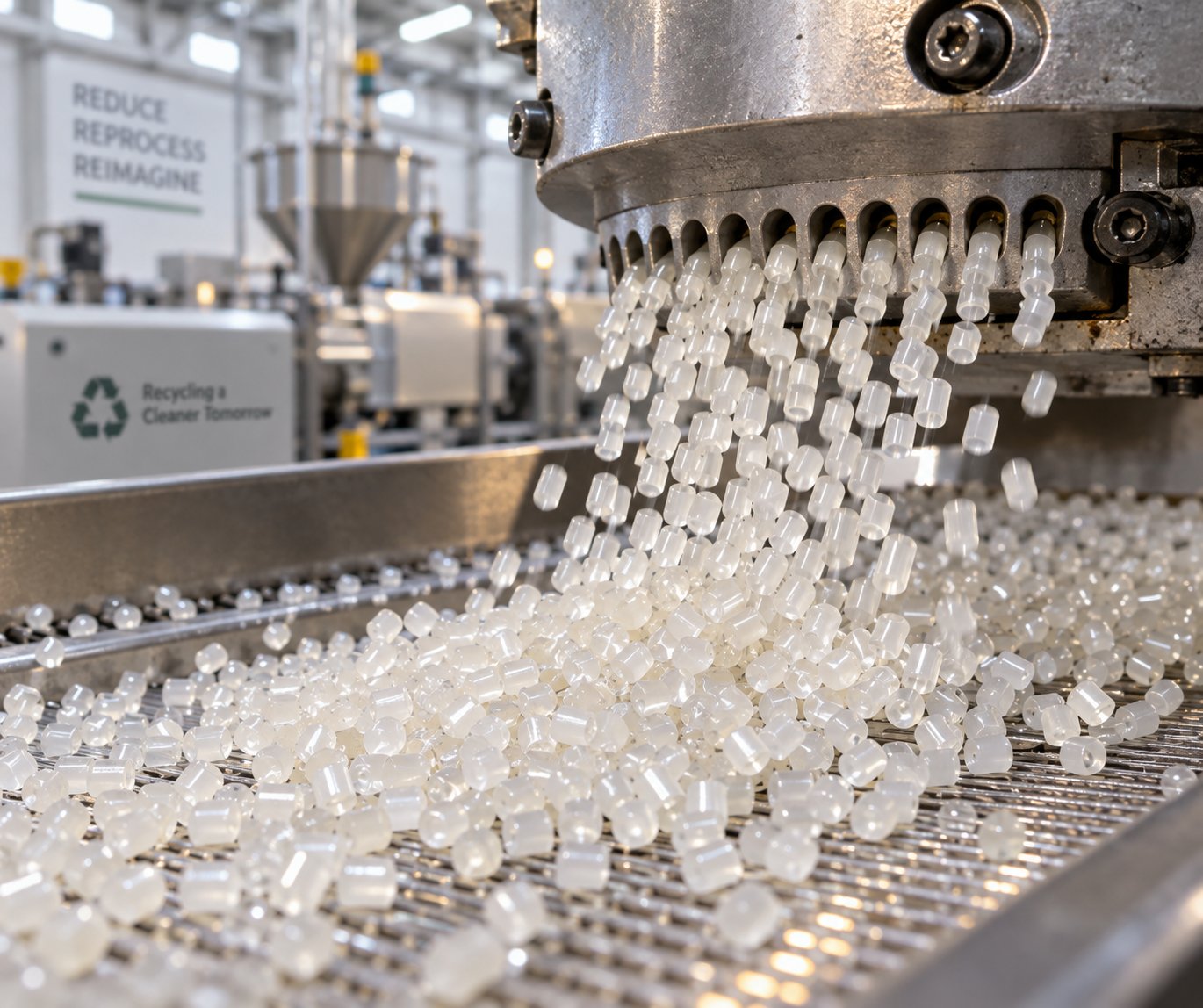
You've optimized your wash line, invested in optical sorting, and dialed in your pre-drying parameters. Yet the pellets coming off your strand cutter still get rejected by downstream converters for inconsistent sizing, poor color, or visible specks. What's going wrong? In most cases, the answer traces directly back to your extruder screw barrel design — the single engineering variable that translates raw recycled feedstock into a saleable commercial product.
Recyclers tend to focus heavily on upstream preparation and downstream pelletizing equipment while treating the screw barrel as a static piece of hardware that "just melts plastic." That mindset is costly. Every measurable pellet quality attribute — dimensional uniformity, mechanical performance, color stability, and freedom from gels — is shaped by decisions made inside the barrel, not at the die face or in the cooling bath. Let's trace those connections explicitly.
Pellet Consistency and Dimensional Uniformity
When a downstream injection molder or sheet extruder buys your recycled pellets, the first thing they need is consistent feeding behavior in their own equipment. Pellets that vary in diameter, length, or bulk density cause dosing errors, bridging in hoppers, and shot-to-shot weight variation. And the root cause of inconsistent pellet dimensions almost always lives in the metering zone of your screw.
Here's why. Pellet size is governed by the volumetric flow rate of melt exiting the die. If that flow rate pulses — even slightly — the strand cutter or underwater pelletizer produces alternating oversized and undersized pellets in the same batch. These pulses, commonly called surging, originate from melt pressure instability in the metering zone. As MD Plastics explains, cyclic flow at the die, weight variation, and dimensional drift typically result from melting that jumps forward and back along the screw, unstable solids conveying, or a compression zone mismatched to the resin being processed.
In recycling, surging is far more prevalent than in virgin processing for a straightforward reason: the metering zone receives melt of inconsistent viscosity. One moment it's processing well-melted, low-viscosity material from a section of the bale with higher MFI. The next, a slug of higher-molecular-weight material arrives with significantly different flow resistance. If the metering channel depth and flight geometry aren't designed to dampen these viscosity swings, pressure at the die fluctuates and pellet dimensions follow.
The extruder screw barrel design fixes for surging include:
- Optimized metering-zone channel depth. A shallower metering channel generates higher shear and more stable pressure — but too shallow increases melt temperature excessively in degradation-sensitive recycled polymers. The sweet spot depends on the polymer and throughput target.
- Mixing elements before the screw tip. Maddock-style or spiral mixers positioned at the end of the metering zone break up thermal and compositional inconsistencies, delivering a more uniform melt viscosity to the die.
- Proper die-head compatibility. The screw barrel's output pressure profile must match the die's flow resistance. A mismatch — common when recyclers repurpose equipment originally designed for different polymers — amplifies pressure fluctuations rather than dampening them.
Imagine your downstream customer running a thin-wall packaging line. Their gravimetric feeder expects pellets within a tight bulk density window. Pellets that swing between 2.5 mm and 4.0 mm in diameter — a common result of metering-zone surging — create exactly the kind of feeding inconsistency that triggers rejects and erodes your reputation as a reliable pellet supplier.
Mechanical Properties and Color Control in Recycled Output
Pellet dimensions are the visible quality metric. Mechanical properties and color are the ones that determine whether your pellets command a premium price or get downgraded to low-specification applications. Both are directly controlled by what happens inside the barrel.
The critical concept is thermal history — the total amount of heat and shear energy a polymer absorbs during processing. Recycled material already carries one or more prior thermal histories from its original manufacturing. Every additional second of residence time and every extra degree of melt temperature inside your extruder adds to that cumulative burden. Research from the Slovak University of Technology demonstrated this effect precisely: repeated thermo-mechanical processing of bottle-grade PET through a co-rotating twin-screw extruder caused progressive chain scission, with intrinsic viscosity dropping from approximately 0.80 to 0.65 dL/g over four processing cycles. That molecular weight loss directly reduced elongation at break from about 84% to 60% — a measurable decline in toughness that limits the recycled material's suitability for demanding applications.
Improper extruder screw barrel design accelerates this degradation through two mechanisms:
- Excessive shear. A compression ratio that's too aggressive, a metering channel that's too shallow, or mixing elements with insufficient clearance all generate more mechanical energy than needed. That energy converts directly to heat inside the polymer, pushing melt temperature above safe limits. For recycled polyolefins, excessive shear causes thermo-oxidative chain scission. For PET, it triggers hydrolytic and thermal degradation simultaneously.
- Extended residence time. Dead spots in the screw geometry — regions where material stagnates rather than flowing forward — expose polymer to heat for far longer than the average residence time suggests. Even a few grams of material trapped behind an improperly radiused flight or in an overly deep Maddock mixer flute will degrade over hours, eventually breaking free and contaminating the output.
Color degradation follows the same path. The same Slovak University study found that repeated processing caused systematic material darkening, with a strong linear correlation between lightness (L*) and intrinsic viscosity. In practical terms, if your recycled pellets are yellowing or darkening compared to earlier production runs, the screw barrel is likely imposing more thermal history than necessary — either through worn geometry that's changed the shear profile or through a design that was never optimized for the recycled polymer's degradation sensitivity.
An optimized particle extruder screw barrel for recycling minimizes thermal history while still achieving complete melting and homogeneity. That means moderate compression ratios matched to the specific polymer, properly sized mixing sections that homogenize without over-shearing, and screw geometries free of dead spots where material can stagnate and cook. It's a balancing act — and one that generic screw designs, engineered for the wider processing windows of virgin resins, consistently get wrong when applied to recycled feedstocks.
Reducing Gels, Unmelts, and Contamination in Finished Pellets
Gels and unmelts are the defects that recycled pellet buyers fear most. A single gel-contaminated batch can shut down a blown film line for hours. Unmelted particles in injection-molded parts cause surface defects, stress concentrations, and field failures. Both trace directly back to screw barrel engineering.
Gels in recycled pellets come from two primary sources. The first is crosslinked polymer — material that has been exposed to heat and oxygen for so long that its chains have bonded together into an insoluble network. These crosslinked particles won't melt regardless of temperature and pass through the extruder as hard specks. As Plastics Technology details, degraded resin forms in regions of the screw that are stagnant or have extremely long residence times — and once formed, small process perturbations cause the degraded material to separate from the screw and flow out with the extrudate, creating gels in the final product.
The second source is highly entangled polymer chains — high-molecular-weight species that are technically molten but haven't been subjected to enough shear stress to disentangle. These appear as soft, translucent gels that are often mistaken for unmelted particles. Hot-stage microscopy reveals that they melt at the same temperature as the surrounding matrix but resolidify first upon cooling because their entangled structure resists flow.
Screw barrel design addresses each gel type differently:
- Crosslinked gels cannot be eliminated by screw design alone — they require screen changers with appropriate mesh sizes downstream of the extruder. However, the screw barrel's job is to prevent new crosslinked gels from forming. That means eliminating dead spots: ensuring flight radii in the metering section are at least 1.5 times the local channel depth (as recommended by Dow's screw design research), avoiding overly deep Maddock mixer flutes that create stagnant edges, and designing barrier sections with sufficient lead-length transitions so that no channels operate partially filled.
- Entangled gels respond to controlled shear stress. A Maddock mixer with a mixing-flight undercut of approximately 0.5% of the barrel diameter generates enough shear stress (100-200 kPa) to disentangle these species without degrading the surrounding polymer. The standard industry practice of setting the undercut at 1-1.5% of barrel diameter — adequate for color dispersion — often falls short for entangled gel mitigation in recycled streams.
- Unmelted particles result from insufficient melting capacity relative to throughput. In recycling, where feedstock particle size and thermal properties vary, the screw speed that works for one batch may exceed the melting capacity for the next. Barrier-flight screws with properly sized Maddock mixers near the discharge end serve as a safety net — trapping, melting, and dispersing solid fragments before they reach the die.
Proper compression ratios tie all three defect types together. Too low a compression ratio leaves insufficient shear for complete melting and gel disentanglement. Too high a ratio generates excessive temperatures that accelerate crosslinking in oxygen-exposed dead zones. The extruder twin screw barrel offers an advantage here because its modular kneading blocks can be fine-tuned to deliver exactly the shear intensity needed — no more, no less — at each point along the barrel.
Screw barrel design is the primary controllable variable linking raw recycled feedstock to saleable pellet quality. Upstream preparation determines what enters the barrel; downstream equipment shapes the final pellet form. But the engineering decisions embedded in screw geometry, mixing element selection, and barrel metallurgy determine whether the melt emerging from the die is commercially viable or destined for downgrade.
Recognizing this connection between engineering choices and commercial outcomes shifts the conversation from "which barrel should I buy" to "how do I protect this investment over its operating life." Recycling environments impose some of the harshest wear conditions any screw barrel will ever face — and how you manage that wear directly determines how long your pellet quality stays on-spec.
Maintenance, Wear Patterns, and Rebuild vs. Replace Decisions for Plastic Extruder Screw and Barrel Systems
Harsh wear conditions don't just threaten pellet quality — they threaten your bottom line. A plastic extruder screw and barrel running contaminated post-consumer feedstock will wear at two to five times the rate of an identical assembly processing neat virgin resin. Every tenth of a millimeter of bore enlargement or flight-tip erosion widens the screw-to-barrel gap, allowing melt to leak backward over the flights instead of moving toward the die. Operators compensate by running hotter, faster, and at higher backpressure — all of which accelerate further degradation and inflate energy costs per pound of output. Understanding the specific wear mechanisms at work in recycling, choosing the right protective treatments, and knowing exactly when to rebuild versus replace are the three decisions that control your long-term cost of ownership.
Common Wear Patterns in Recycling Screw Barrels
Wear inside a screw and barrel for extruder systems isn't a single phenomenon. Three distinct mechanisms attack the barrel bore and screw flights — and recycling environments routinely trigger all three simultaneously.
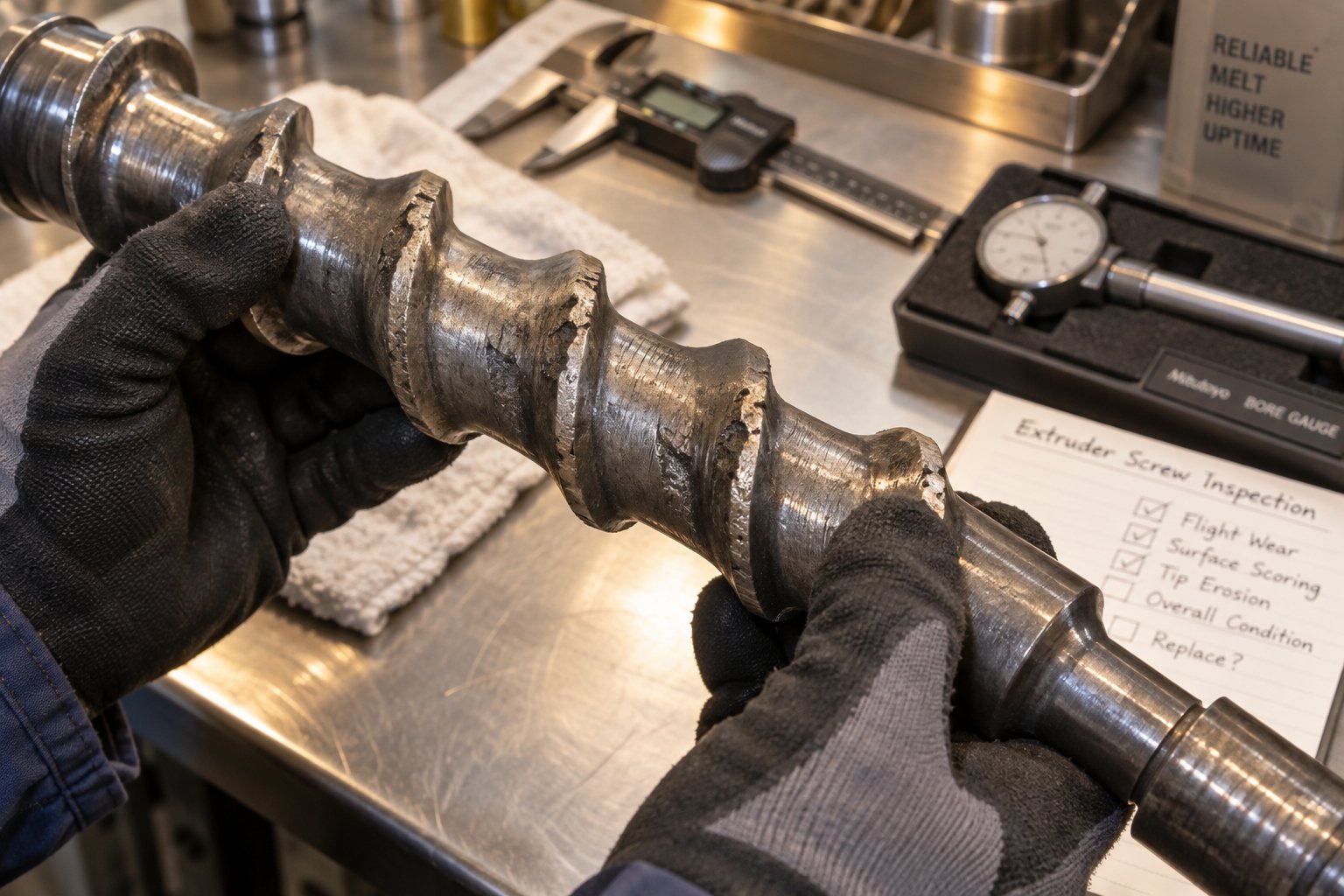
Abrasive wear is the most common form of degradation in plastics machinery. Hard particles trapped between the screw flight lands and the barrel wall grind material away from both surfaces with every rotation. In recycling, the abrasive agents go far beyond intentional fillers like glass fiber or calcium carbonate. Metal fragments from shredders, grit from unwashed agricultural film, sand from construction waste streams, and even dried adhesive residues act as continuous abrasive media. The damage appears as smooth, almost polished bore enlargement and rounded flight edges — subtle at first, but steadily widening the clearance that your metering zone depends on for stable pressure generation.
Adhesive wear is more violent and more preventable. It occurs when the screw flight lands physically contact the barrel wall, creating microscopic welds that immediately fracture and tear metal from one surface to the other. Evidence includes scoring lines along the bore, galled patches, and rolled or missing hardfacing on flight lands. Cold starts without adequate soak time, misaligned barrels, and solids wedging — where unmelted recycled material jams the screw channel and forces the screw sideways against the barrel — are the primary culprits. Recycling operations are particularly vulnerable because irregular feedstock particle shapes and variable bulk densities increase the likelihood of channel plugging in the compression zone.
Corrosive wear plays by entirely different rules. Hardness is nearly irrelevant here — what matters is chemical resistance at the molecular level. Recycled PVC releases hydrochloric acid during processing. Flame retardants decompose into acidic byproducts. Residual food waste and organic contamination generate corrosive volatiles. Even moisture reacting with certain polymer degradation products creates a mildly acidic environment inside the barrel. Corrosive wear doesn't enlarge the bore uniformly. Instead, it produces pitting, rough etched textures, and localized material loss — damage that concentrates in the metering zone and vent areas where melt temperatures peak and corrosive gases linger.
Here's what makes recycling especially destructive: these mechanisms combine. Corrosion roughens the bore surface, and those roughened areas become anchor points where abrasive particles dig in more effectively. This erosion-corrosion synergy produces damage rates far exceeding what either mechanism would cause alone. A single screw extruder screw and barrel processing washed HDPE with residual label adhesive, for example, faces simultaneous abrasive wear from paper fiber residues and corrosive attack from adhesive decomposition products — a combination that can cut barrel life in half compared to running the same polymer in clean, virgin form.
Wear patterns also manifest differently along the screw zones. The feed zone sees the heaviest abrasive damage because solid particles — still hard and angular — are being compressed against the barrel wall under high force. The compression zone endures a mix of abrasive and adhesive wear, particularly where solids wedging risks are highest. The metering zone is most vulnerable to corrosive attack because melt temperatures are at their peak and decomposition gases reach their highest concentration, especially near vent ports.
Barrel Lining and Screw Surface Treatments for Extended Life
Choosing the right protective treatment for your single screw extruder screw barrel or twin-screw assembly is effectively choosing how many operating hours you'll get before wear degrades your pellet quality. The options range from economical baseline protection to extreme-service solutions — and the right choice maps directly to the dominant wear mechanism in your specific recycling application.
- Nitrided barrels (gas-nitrided 4140 or 4340 steel). The most economical option. A hardened case layer on the bore surface provides moderate wear resistance suitable for non-abrasive, non-corrosive recycled streams. Best fit: clean, pre-sorted polyolefin regrind with minimal contamination. Inadequate for filled compounds, post-consumer streams with unknown contaminants, or any resin that releases corrosive byproducts.
- Iron-boron bimetallic linings. A centrifugally cast alloy lining inside a conventional steel barrel body. Delivers a dramatic leap in abrasion resistance — at least four times the service life of nitrided barrels in abrasive applications. Best fit: recycled polyolefins with moderate filler content, post-industrial regrind containing mineral fillers, and general high-wear recycling operations where corrosion is not the primary threat.
- Nickel-boron bimetallic linings. Shifts the balance toward corrosion resistance while maintaining good wear performance. Forms a passive oxide layer that shields the underlying metal from acid penetration. Best fit: recycled streams that release mildly corrosive volatiles — washed PET flake, recycled nylon, or polyolefin streams carrying flame-retardant residues.
- Cobalt-nickel bimetallic linings. Engineered specifically for resistance to hydrochloric acid and other aggressive chemical attacks. Best fit: recycled PVC, CPVC, and any recycling stream where halogenated contaminants or flame-retardant decomposition products create a corrosive processing environment.
- Tungsten carbide composite linings. The highest combined wear and corrosion resistance available, with macro hardness reaching HRC 62-68 and micro hardness exceeding DPH 4000. Best fit: the most demanding recycling applications — mixed post-consumer streams with unknown contamination profiles, glass-fiber-filled recycled compounds, and multi-material custom recyclers who switch frequently between aggressive feedstock types.
- Screw flight hardfacing (stellite, tungsten carbide overlay). Applied to the screw flight lands to resist abrasive erosion. Stellite alloys offer good all-around protection at moderate cost. Tungsten carbide overlays provide maximum abrasion resistance for screws processing heavily filled or contaminated recycled material. The hardfacing material must be metallurgically compatible with the barrel lining — incompatible alloys increase galling risk and can accelerate adhesive wear rather than prevent it.
One key point recyclers often overlook: the screw and barrel must be specified as a matched pair. A perfectly lined barrel paired with a screw whose flight hardfacing promotes galling against that specific liner chemistry will wear faster than a moderately specified set with compatible metallurgy. Industry guidance recommends maintaining a hardness differential of at least 5-8 HRC between the barrel liner and the screw surface, with the barrel being the harder component.
Rebuild vs. Replace Decision Framework
At some point, every screw and barrel for extruder systems reaches a condition where continuing to run costs more than stopping to rebuild or replace. The question is whether you catch that crossover point proactively — or discover it when your pellets get rejected.
Monitoring extruder screw barrel clearance is the primary diagnostic metric. The standard method involves inserting a calibrated bore gauge at regular intervals along the barrel length and recording the inside diameter at multiple angular positions, then comparing those readings against the original specification. Diametral clearance equals the measured barrel ID minus the measured screw OD. For example, a barrel bore measuring 100.30 mm against a screw OD of 99.80 mm yields 0.50 mm diametral clearance — a value that must be judged against the OEM's allowable limits for that specific machine, not against a universal threshold.
Between scheduled measurements, the extruder itself broadcasts wear signals through its operating data. Watch for these red flags:
- Declining output at constant screw speed — especially dropping below 85% of rated capacity, which suggests excessive leakage flow over worn flights.
- Melt temperature running 8-15°F above setpoint without heater changes — indicating increased shear from compensatory speed adjustments.
- Motor amperage climbing 5-10% above baseline — the drive working harder to maintain throughput through a widened bore.
- Increasing surging, pellet size variation, or visible unmelts — all symptoms of a metering zone that can no longer maintain stable pressure.
When measurements confirm excessive wear, the decision framework breaks down into four paths:
| Condition | Recommended Action | Key Considerations |
|---|---|---|
| Dimensions within approved limits; surfaces intact; process meets quality targets | Continue and monitor | Shorten the next inspection interval if wear rate is accelerating; document baseline readings for trend analysis |
| Screw flight wear is repairable; core, straightness, and metallurgy remain suitable | Rebuild the screw (re-chrome, re-flight, re-hardfaced) | Specialist must document restored geometry, coating hardness, and concentricity; rebuilt screw must be measured against the existing barrel bore |
| Barrel bore is enlarged but structural shell is sound; design permits relining | Reline the barrel | Bimetallic barrels can often be honed and relined at lower cost than full replacement; screw must be matched to the new bore dimension |
| Cracks, deep scoring, severe ovality, extensive corrosion, or prior rebuild history makes restoration unreliable | Replace the part | Evaluate as a matched pair — a new screw in a badly worn barrel, or vice versa, leaves excessive clearance and shortens the new component's life |
The most expensive mistake recyclers make isn't choosing the wrong action — it's waiting too long to act. Running a worn screw barrel assembly past the point of diminishing returns doesn't just cost you pellet quality. It burns extra energy per pound processed, increases scrap rates, and forces process adjustments that mask the real problem until a catastrophic quality failure forces an emergency shutdown. Industry experience shows that processors who chart performance metrics — kg/hr per RPM, specific energy consumption, reject rates — against periodic clearance measurements can predict replacement timing with enough accuracy to schedule the work during planned downtime rather than reacting to a crisis at 2 a.m.
Proper initial specification matters here more than most recyclers realize. A barrel lining matched to your actual recycling feedstock — not to a generic OEM assumption about what you might process — extends service life, delays the rebuild/replace decision, and reduces lifetime cost per ton of pellets produced. The upfront investment in appropriate metallurgy pays back through fewer unplanned shutdowns, longer intervals between maintenance events, and consistent pellet quality that holds your customers' trust over years of operation.
Wear management keeps your equipment producing quality pellets. But what happens when pellet quality problems appear and the root cause isn't obvious? Many extrusion issues that operators attribute to feedstock or process settings actually trace back to screw barrel design choices — and diagnosing those connections requires a different kind of troubleshooting lens.
Diagnosing Common Recycling Extrusion Problems Through Screw Barrel Design
A recycling line rarely fails in a dramatic, obvious way. Instead, quality erodes gradually — pellet dimensions drift wider, color shifts a shade darker, reject rates creep up a percentage point per month. Operators respond by tweaking barrel temperatures, adjusting screw speed, or swapping screen packs. These adjustments sometimes mask the symptoms for a few shifts, but the underlying problem persists because it lives inside the barrel and screw of an extruder, not in the process settings layered on top.
The troubleshooting approach that follows flips the conventional sequence. Rather than chasing process parameters, it starts with the extrusion defect itself and traces the cause backward into screw barrel geometry, metallurgy, and wear condition. For recycling operations — where feedstock variability amplifies every design shortcoming — this root-cause perspective prevents weeks of trial-and-error tuning that never reaches the real source of the problem.
Poor Melt Homogeneity and Surging Output
Surging — the rhythmic pulsing of melt pressure and output rate — is the most disruptive quality problem a recycling extruder can exhibit. Pellet dimensions oscillate, strand breakage spikes at the pelletizer, and downstream customers reject entire lots for inconsistent bulk density. Yet operators frequently misdiagnose surging as a temperature control issue and respond by adjusting heater setpoints, which rarely addresses the actual cause.
Research by Mark Spalding at Dow identifies the most common root cause of flow surging in smooth-bore extruders as improper temperatures in the solids conveying section — specifically, a feed casing or screw root that runs too hot. In one documented case, an 8-inch two-stage extruder processing PS began surging because its screw cooling hole extended only 4 diameters past the feed pocket while the solids conveying section was 7 diameters long. The screw overheated, retarding forces exceeded forwarding forces, and the specific rate cycled wildly between 14 and 23 kg/(hr·rpm). Extending the cooling hole to the full length of the conveying section permanently eliminated the problem.
For recycling operations, surging triggers are even more varied because feedstock inconsistency introduces additional instability sources:
- Inadequate compression ratios. A compression ratio too low for the recycled feedstock's bulk density leaves partially melted material entering the metering zone. Viscosity fluctuations in this incompletely melted stream cause pressure oscillations at the die. Recycled film flake — with bulk densities as low as 3-5 lb/ft³ — is particularly prone to this because it compresses far less predictably than uniform virgin pellets.
- Worn metering zones. As flight tips erode and barrel bore enlarges, melt leaks backward over the flights instead of building stable forward pressure. The extruder compensates by cycling screw speed higher, which generates more shear heat and accelerates degradation — a feedback loop that worsens both surging and pellet quality simultaneously.
- Insufficient mixing sections. Variable-viscosity recycled melt arriving at the die without passing through adequate mixing elements produces localized pressure differentials across the die face. Strands exiting at different velocities from adjacent die holes create pellet weight variation that no downstream adjustment can correct.
The fix isn't a temperature tweak. It's a screw barrel design review: verify that compression ratios match the actual (not assumed) bulk density of your recycled feed, measure metering-zone clearances against OEM specifications, and confirm that mixing elements ahead of the die provide enough homogenization to dampen the viscosity swings inherent in recycled streams.
Excessive Wear, Discoloration, and Degraded Output
When recycled pellets start yellowing, losing impact strength, or showing brittleness that wasn't present in earlier production runs, the instinct is to blame feedstock quality. Sometimes that's correct. But often, the degradation originates inside the extruder itself — caused by a screw barrel that's either wearing beyond tolerance or was never properly specified for the recycled material being processed.
The mechanism is straightforward. Processing contaminated or abrasive recycled streams without appropriate barrel lining or screw coating accelerates wear, as covered in the previous section. That wear changes the screw geometry in ways that compound degradation. As MD Plastics explains, when wear changes channel depth and compression characteristics, the melting location shifts downstream — and the process becomes unstable even if temperatures stay "normal." Operators respond by increasing screw speed to recover lost throughput, which generates more shear heat. They may also raise barrel temperatures to compensate for delayed melting, adding conducted heat on top of already elevated mechanical heat input.
The result is a double penalty: the polymer absorbs more total thermal energy than necessary, and its residence time in the hottest zones increases. For recycled polymers that already carry prior thermal history, this additional energy input pushes molecular weight loss past the threshold where mechanical properties and color noticeably degrade. Yellowing in recycled polyolefins and darkening in recycled PET are classic symptoms of this progressive cycle.
A twin screw barrel extruder offers some inherent protection against this problem because its self-wiping screw geometry reduces dead spots where material can stagnate and overheat. Single-screw systems are more vulnerable, particularly in the metering zone where material spends the longest time at peak temperature. In either configuration, the corrective approach includes:
- Measuring actual clearances and comparing against baseline to quantify geometry drift.
- Reducing screw speed and adjusting backpressure to lower shear energy input — accepting a modest throughput reduction rather than degrading the polymer.
- Evaluating whether the barrel lining and screw hardfacing match the abrasive and corrosive profile of the current recycled feedstock, not the stream the equipment was originally purchased for.
Gels, Black Specks, and Unmelted Particles
These three defects look different in the finished pellet but share a common origin: flawed screw geometry that either traps material too long or processes it too briefly.
Black specks are the most feared contaminant in recycled pellets — and diagnosing their source requires systematic pattern reading before any corrective action. As Jinxin Extruder's diagnostic framework emphasizes, the occurrence pattern is the fastest clue. Specks that worsen after startup or restart point to degraded material retained in the screw barrel during shutdown — polymer that sat at melt temperature, crosslinked, and releases as charred fragments when flow resumes. Specks that increase steadily during a production run suggest die build-up or adapter dead spots where material accumulates and degrades over hours.
Inside the screw barrel itself, black specks form in dead spots — regions of the screw geometry where material stagnates instead of flowing forward. Common culprits include:
- Flight root transitions with insufficient fillet radii, creating pockets where melt sits motionless while surrounding material flows past.
- Overly deep Maddock mixer flutes where material at the channel edges sees negligible shear and excessive heat exposure.
- Worn or damaged barrier flights that create partially filled sub-channels — trapping small volumes of polymer for extended periods before they eventually break free as degraded particles.
Unmelted particles result from the opposite problem — material passing through the compression zone too quickly or with too little shear energy to fully transition from solid to melt. In recycling, this happens frequently when feedstock particle size or bulk density changes between batches. A screw designed for uniform 8mm regrind pellets may lack the melting capacity to fully process a batch of coarser 15mm flake at the same throughput. Barrier-flight designs mitigate this risk by physically separating solids from melt, but they must be paired with mixing elements downstream that catch and finish melting any particles that slip through.
Even operators running smaller-scale setups — including those using a 3d filament extruder screw and barrel for recycled feedstock into filament — encounter these same gel and unmelt problems when screw geometry doesn't match the recycled material's melting behavior. Scale changes; the physics does not.
The following diagnostic table maps the most common recycling extrusion symptoms to their likely screw barrel root causes and the design corrections that address them. Use it as a first-pass reference when quality problems appear — before adjusting process parameters that may only mask the underlying issue.
| Extrusion Problem | Likely Screw Barrel Root Cause | Recommended Design Correction |
|---|---|---|
| Surging / pulsating output | Compression ratio too low for feedstock bulk density; worn metering-zone flights; overheated screw root in feed section | Increase compression ratio to match actual recycled feed density; restore metering clearances; extend or improve screw cooling in the feed zone |
| Yellowing or darkening of pellets | Excessive residence time from dead spots or oversized channels; shear overheating from worn geometry prompting speed compensation | Eliminate dead volumes in screw transitions; restore proper clearances; reduce screw speed and accept modest throughput adjustment |
| Declining impact strength / brittleness | Excessive thermal history from aggressive compression ratio or too-shallow metering channel generating unnecessary shear | Moderate compression ratio for the specific recycled polymer; deepen metering channel within pressure-stability limits; shorten metering zone to reduce residence time |
| Black specks (startup-related) | Material retained in dead spots during shutdown degrades and releases on restart | Redesign screw transitions with adequate fillet radii (minimum 1.5x channel depth); review shutdown purge procedure; consider screw geometry with self-cleaning characteristics |
| Black specks (during production run) | Stagnant zones in Maddock mixer flutes, barrier-flight sub-channels, or adapter geometry | Reduce mixer flute depth; verify barrier-flight channel fill; inspect and streamline adapter and die flow paths |
| Gels (crosslinked particles) | Dead spots exposing polymer to extended high-temperature residence; insufficient downstream filtration | Eliminate stagnation zones; pair with screen changer using appropriate mesh; monitor barrel temperature in metering and vent zones |
| Gels (entangled high-MW species) | Insufficient dispersive shear in mixing section; Maddock undercut too large for the application | Reduce mixing-flight undercut to approximately 0.5% of barrel diameter; add or reposition dispersive mixing elements in metering zone |
| Unmelted particles in pellets | Insufficient compression for feedstock particle size; no barrier flight to separate solids from melt; throughput exceeding screw melting capacity | Add barrier-flight section; install Maddock mixer near discharge to catch escaping solids; reduce throughput or increase L/D ratio for adequate melting length |
| Inconsistent pellet dimensions | Melt pressure instability from worn metering zone or inadequate mixing before the die | Restore metering-zone clearances; add or upgrade mixing elements before screw tip; verify die-head flow resistance matches screw output pressure profile |
| Excessive barrel / screw wear rate | Barrel lining or screw hardfacing not matched to recycled feedstock's abrasive and corrosive profile | Upgrade to bimetallic barrel lining suited to dominant wear mechanism; apply compatible hardfacing to screw flights; improve upstream metal detection and feedstock cleaning |
Notice a pattern in that table: nearly every recommended correction points back to screw barrel geometry, metallurgy, or wear condition — not to process parameter adjustments. Temperature setpoints, screw speed, and backpressure are important tuning variables, but they operate within the boundaries that the screw barrel design establishes. When those boundaries are wrong — whether from initial misspecification or progressive wear — no amount of process tuning produces consistently good pellets from recycled feedstock.
This diagnostic perspective also reveals an uncomfortable truth: many recyclers are running equipment that was adequately designed for the feedstock they used to process but is mismatched to the material they're processing today. Feedstock sources evolve, contamination profiles shift, and downstream quality requirements tighten. The screw barrel that produced acceptable pellets three years ago may now be the root cause of chronic quality issues — not because it wore out, but because the application changed around it. Recognizing when that mismatch has occurred is the first step toward selecting a manufacturer who can engineer a solution matched to your current reality.
Selecting a Trusted Extruder Screw Barrel Manufacturer for Recycling
Recognizing that your current screw barrel is mismatched to your feedstock is only half the battle. The other half is finding a manufacturer capable of engineering a replacement that actually solves the problem — not one who ships a catalog geometry that repeats the same mistakes with shinier metal. Recycling applications demand a level of customization and application-specific expertise that most general-purpose barrel screw extruder factory operations simply don't offer. The evaluation criteria that follow will help both plant operators and procurement teams separate manufacturers who genuinely understand recycling extrusion from those who merely list it on a capabilities brochure.
Key Evaluation Criteria for Screw Barrel Suppliers
When you're sourcing a screw barrel assembly for a recycling line, the questions you ask during the quoting process reveal more about a supplier's capabilities than any glossy product catalog. A manufacturer that asks detailed questions about your feedstock — polymer type, contamination profile, upstream preparation quality, target pellet specifications — is already demonstrating recycling-specific expertise. One that jumps straight to dimensions and delivery timelines likely treats your recycling application identically to a virgin-resin compounding job.
Use this evaluation framework to compare potential suppliers systematically:
- In-house metallurgy and material science capability. Can the manufacturer select and verify barrel lining alloys, screw base materials, and hardfacing treatments based on your specific recycled feedstock's abrasive and corrosive profile? A supplier with in-house metallurgical testing — hardness verification, alloy composition analysis, microstructure examination — ensures that the protective treatments specified on paper actually end up on the finished part. As the PIPLL buyer's guide emphasizes, the manufacturer should state which surface or component receives the protective system and why — not leave it to a generic catalog recommendation.
- CNC machining precision and quality documentation. Screw flight geometry, channel depth tolerances, and bore concentricity directly determine pellet quality. Ask for inspection records that document critical dimensions — applicable diameters, pitch, flight widths, drive-end features, and surface hardness checks — specific to your ordered part, not inferred from a general factory description.
- Customization depth. Does the manufacturer design screw profiles matched to your recycling application, or do they offer a limited range of standard geometries? Recycling demands custom compression ratios, venting configurations, mixing element placement, and zone-by-zone channel depth optimization. A manufacturer who approaches your order with a design review — examining machine data, polymer grade, recycled content, process symptoms, and wear history — is working at a fundamentally different level than one offering off-the-shelf replacements.
- Recycling-application expertise. Has the supplier actually engineered screw barrels for post-consumer recycling, mixed-stream processing, or contaminated feedstock? Ask for case references. A manufacturer with genuine recycling experience understands the volatile management, feedstock variability, and wear acceleration challenges discussed throughout this article — and builds those realities into the design rather than discovering them after installation.
- Lead time and inventory strategy. Recycling lines can't afford extended downtime waiting for custom parts. Evaluate whether the manufacturer maintains raw material inventory, stocks common modular elements, or offers expedited production for critical replacements.
- After-sales technical support. The relationship shouldn't end at shipment. A strong manufacturer provides installation guidance, helps troubleshoot performance issues, and offers wear-monitoring support that extends the service life of the components they supply.
One often-overlooked factor deserves emphasis: manufacturer-direct sourcing. When you buy through a reseller or trading company, you lose direct access to the engineering team that designed your screw barrel. That disconnect matters enormously in recycling, where process conditions change, feedstock sources evolve, and the ability to call the people who built your equipment — to discuss a wear pattern, request a profile modification, or order a matched replacement element — can mean the difference between a two-day fix and a two-week ordeal. Whether you're evaluating a barrel screw extruder in China or a European specialist, prioritize direct manufacturer relationships over intermediary convenience.
Why Custom-Engineered Screw Barrels Outperform Generic Options in Recycling
Everything this article has covered — zone-by-zone design parameters, polymer-specific compression ratios, wear-matched metallurgy, modular element strategies — points to a single conclusion: recycling extrusion is too variable and too demanding for one-size-fits-all screw barrel solutions. A screw geometry designed for virgin HDPE compounding will underperform on recycled HDPE bottle flake. A barrel lining specified for unfilled polypropylene will wear prematurely when processing post-consumer PP with calcium carbonate residues. Generic designs aren't wrong in an absolute sense — they're wrong for your specific combination of feedstock, contamination profile, throughput target, and pellet quality requirement.
Custom engineering addresses this mismatch at the design stage rather than forcing operators to compensate with process adjustments after installation. A well-engineered custom screw barrel accounts for your actual feedstock bulk density in the feed-zone channel depth, your measured contamination levels in the barrel lining selection, your venting needs in the port placement, and your downstream pellet specifications in the mixing element configuration. The result is equipment that runs closer to its optimal operating point from day one — producing better pellets, wearing more slowly, and consuming less energy per kilogram of output.
Manufacturers who specialize in recycling applications bring this kind of design depth to the table. NANHAIYA, for example, engineers custom parallel twin screw barrels specifically for compounding, recycling, pelletizing, and granulation applications — supporting masterbatch producers and recyclers who need screw barrel assemblies matched to demanding mixing and conveying conditions. Their focus on recycling-specific challenges, including the feedstock variability and contamination management issues discussed throughout this article, reflects the kind of application-depth that differentiates a specialist manufacturer from a general-purpose machining shop. Recyclers evaluating suppliers should look for this level of targeted expertise — whether from NANHAIYA or from other manufacturers who demonstrate genuine, documented experience with recycled polymer processing.
The barrel of twin screw extruder systems used in recycling must handle far more aggressive conditions than their virgin-processing counterparts. Suppliers who have engineered barrels specifically for these environments — accounting for the corrosive volatiles, abrasive contaminants, and thermal stresses unique to recycled streams — deliver components with measurably longer service life and more consistent pellet quality. That's not a marketing claim; it's an engineering reality rooted in the wear mechanisms and design principles covered in previous sections.
Matching screw barrel specifications to your specific recycling feedstock and output requirements is the single most impactful decision an operator can make. No amount of process optimization compensates for a screw barrel that was never designed for the material it processes.
Industry resources on American Kuhne news tech tips extruder screw and barrel wear reinforce this principle: the greatest gains in extruder performance and component longevity come not from running harder or hotter, but from specifying the right geometry and metallurgy for the actual processing duty from the start. For recyclers, that means investing the time upfront to evaluate manufacturers against the criteria outlined above — verifying their recycling expertise, reviewing their design methodology, and confirming that the screw barrel assembly they deliver is truly engineered for your operation rather than adapted from a virgin-resin template.
The recycling industry's shift toward higher-quality output, tighter pellet specifications, and food-grade recycled content will only intensify the demands placed on extruder screw barrel systems. Operators who partner with manufacturers capable of application-specific custom engineering — and who treat screw barrel selection as a strategic decision rather than a commodity purchase — position themselves to meet those demands consistently, profitably, and with the kind of pellet quality that earns long-term customer trust.
Frequently Asked Questions About Extruder Screw Barrels for Recycling
1. What makes an extruder screw barrel for recycling different from one used for virgin resin?
Recycling screw barrels must handle five challenges absent in virgin processing: higher moisture content, contamination from labels and adhesives, mixed polymer streams with varying melting points, degraded molecular chains from prior heat histories, and inconsistent bulk density from flake or regrind feedstock. These factors demand specialized venting ports, wear-resistant bimetallic or tungsten carbide barrel linings, tailored compression ratios, and mixing elements like kneading blocks or Maddock mixers that homogenize variable melt viscosities. A barrel designed for clean virgin pellets will wear faster, produce more gels and unmelts, and deliver inconsistent pellet quality when forced to process post-consumer recycled material.
2. Should I use a single-screw or twin-screw extruder barrel for plastic recycling?
The choice depends on your feedstock condition and pellet quality targets. Single-screw extruder barrels excel with clean, pre-sorted, single-polymer streams like post-industrial regrind, offering simpler maintenance and superior pressure generation above 3,000 psi for fine filtration. Twin-screw extruder barrels are preferred for post-consumer recycling, mixed-polymer streams, or heavily contaminated feedstock because they deliver superior dispersive and distributive mixing, self-wiping action that prevents black specks, modular screw reconfiguration, and multi-stage vacuum venting. Some advanced recycling lines use tandem systems that combine both configurations to leverage the strengths of each.
3. What compression ratio should a recycling extruder screw have?
Optimal compression ratios vary by polymer type. HDPE recycling typically requires 3:1 to 3.5:1, while LDPE and PS perform better at a gentler 2.5:1 to 3:1 to avoid overheating thin-gauge melt. Recycled PP benefits from moderate ratios around 2.5:1 to 3.5:1 with low shear to prevent beta-scission. PET demands tightly controlled ratios of 3:1 to 3.25:1 paired with vacuum venting and barrier flights. Mixed-stream recycling uses variable ratios depending on the dominant resin. Setting the compression ratio too high generates excessive shear that degrades already-weakened recycled polymer chains, while too low a ratio leaves unmelted particles in the output.
4. How do I know when to rebuild or replace a worn recycling extruder screw barrel?
Monitor diametral clearance between the screw OD and barrel ID using calibrated bore gauges at regular intervals. Key warning signs include output dropping below 85% of rated capacity at constant screw speed, melt temperature running 8-15 degrees F above setpoint, motor amperage climbing 5-10% above baseline, and increasing surging or pellet size variation. If screw flight wear is repairable and core metallurgy remains sound, rebuilding through re-chroming or re-flighting is cost-effective. If the barrel bore shows cracks, deep scoring, severe ovality, or extensive corrosion, full replacement is recommended. Always evaluate the screw and barrel as a matched pair, since pairing a new component with a heavily worn counterpart shortens service life.
5. How does pre-processing quality affect extruder screw barrel requirements in recycling?
Every upstream pre-processing step directly reduces how hard your screw barrel must work. Effective sorting eliminates incompatible polymers, allowing simpler screw geometries instead of aggressive kneading-block configurations. Consistent shredding improves feed-zone stability and makes grooved-feed barrels practical. Thorough washing removes adhesive and food residues that would otherwise generate corrosive volatiles inside the barrel. Proper drying can eliminate the need for costly vacuum venting stages. Quality metal detection prevents catastrophic damage to tight screw-barrel clearances. Investing in upstream preparation lets you specify a less complex, longer-lasting screw barrel assembly rather than over-engineering the extrusion equipment to compensate for poor feedstock preparation.
Written by
Nanhaiya Technical Team
Zhoushan Nanhaiya Plastic Machinery Co., Ltd.
The Nanhaiya technical team supports screw and barrel manufacturing projects through application review, technical communication, custom manufacturing coordination, and production and quality control.
Discuss Your Application
Related Articles
More insights on screw barrel technology and plastics processing.
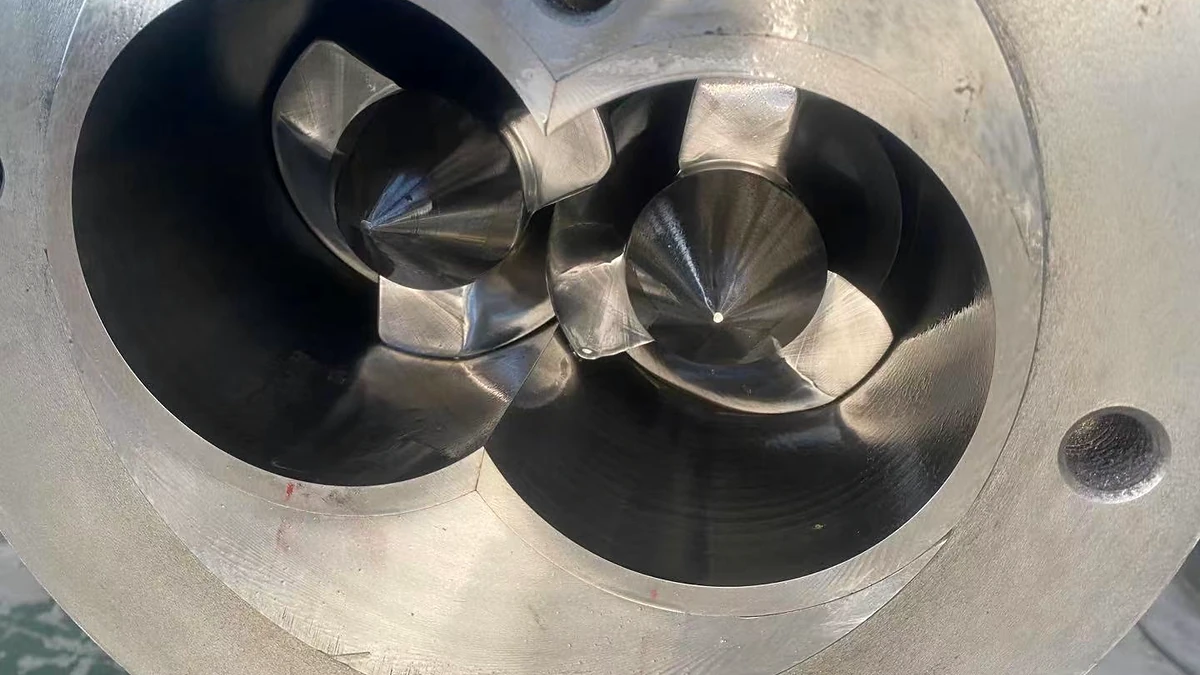
Wrong Screw Barrel For PVC Pipe Quietly Kills Output Quality
Oct 29, 2026
Learn how to choose the right screw barrel for PVC pipe extrusion. Covers sizing, materials, coatings, troubleshooting, and total cost of ownership guidance.
Read Article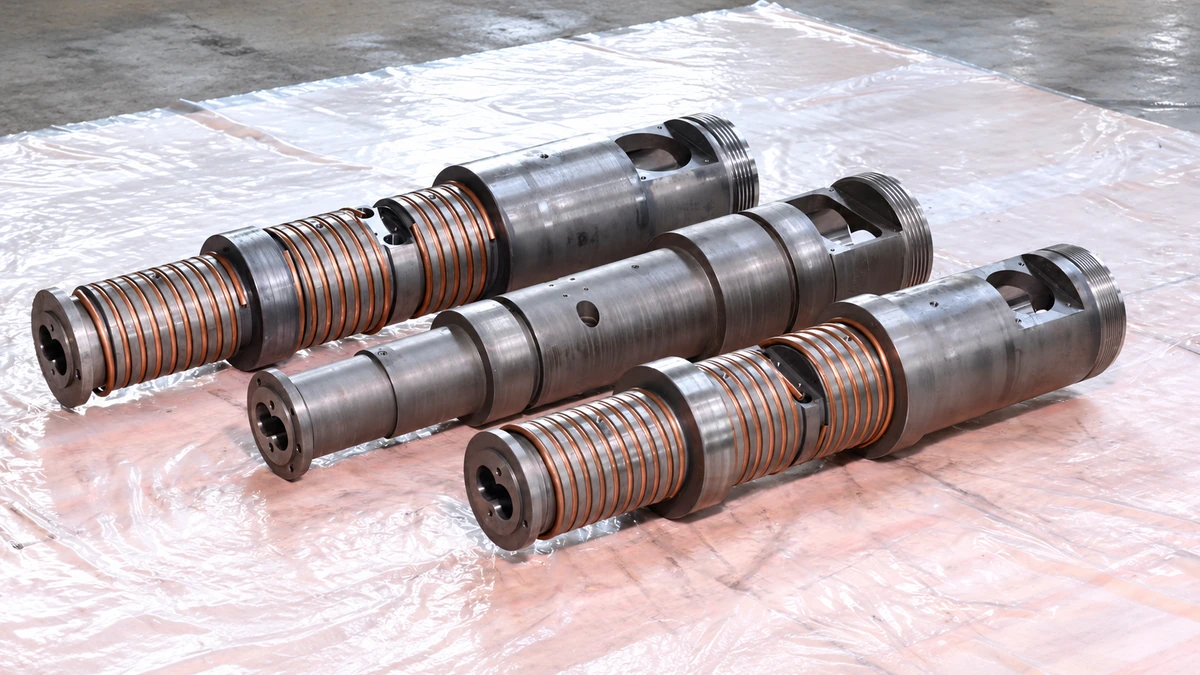
Inside an Extruder Barrel Manufacturer: From Raw Steel to Replacement
Oct 28, 2026
Learn how an extruder barrel manufacturer turns raw steel into precision barrels — covering materials, bimetallic vs nitrided linings, wear modes, and supplier evaluation.
Read Article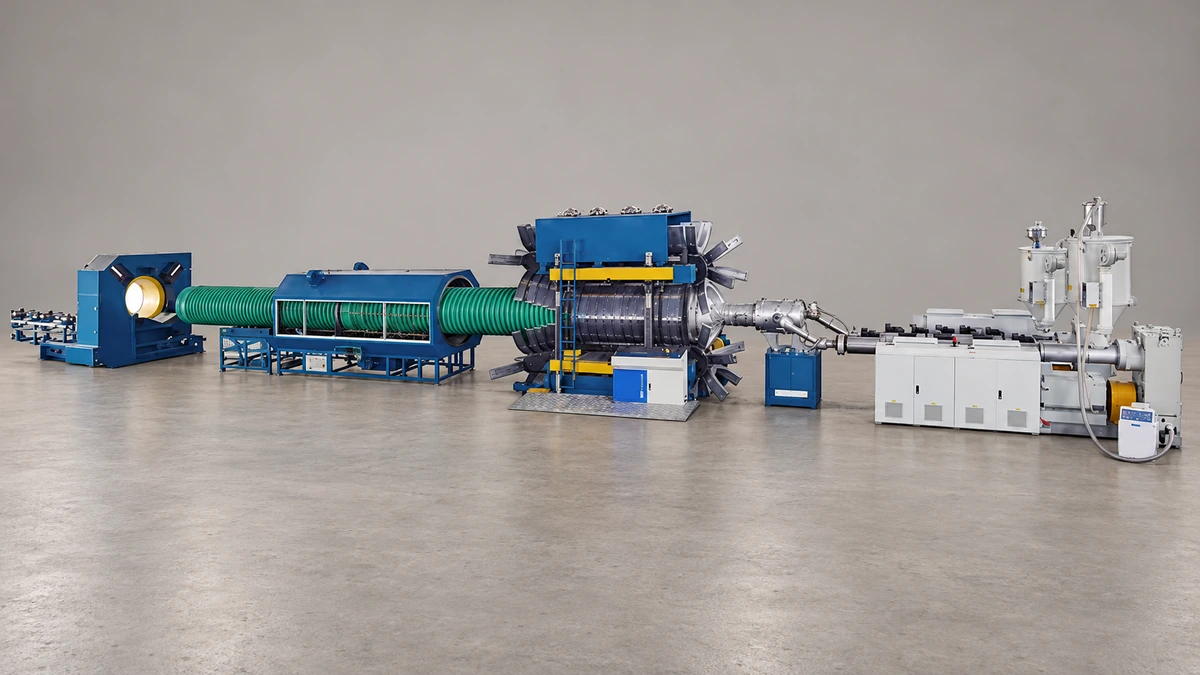
HDPE Pipe Extrusion Machine Decoded: From Resin to Finished Pipe
Oct 28, 2026
Learn how an HDPE pipe extrusion machine works — from extruder types and die heads to downstream equipment, specs by diameter class, and a buyer's checklist.
Read ArticleLooking for something else?
Search by material, symptom or product and jump straight to the relevant page.
These are navigation suggestions based on keyword matching — not a quotation, not a delivery commitment, and not a substitute for engineering review. Final specification is confirmed by our engineers against your drawings and processed material.
Need help with screw barrel selection?
Share your machine model, processed material and application. Our team can help with pricing and technical support.