

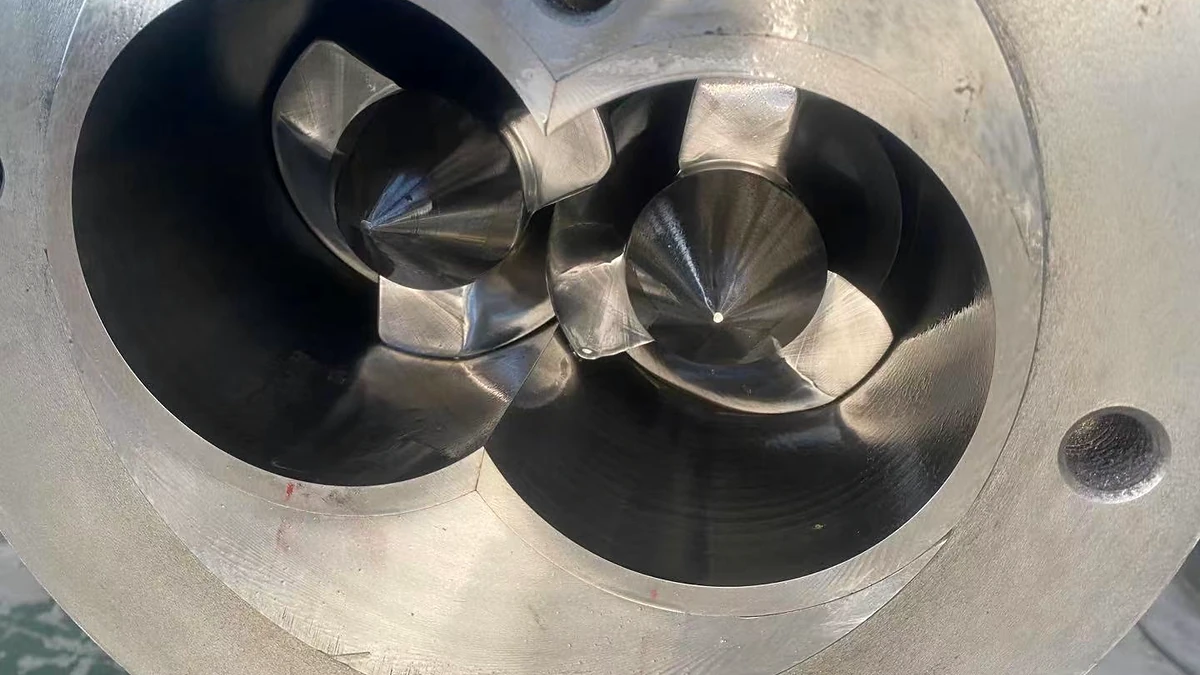
What Is a Screw Barrel for PVC Pipe Extrusion
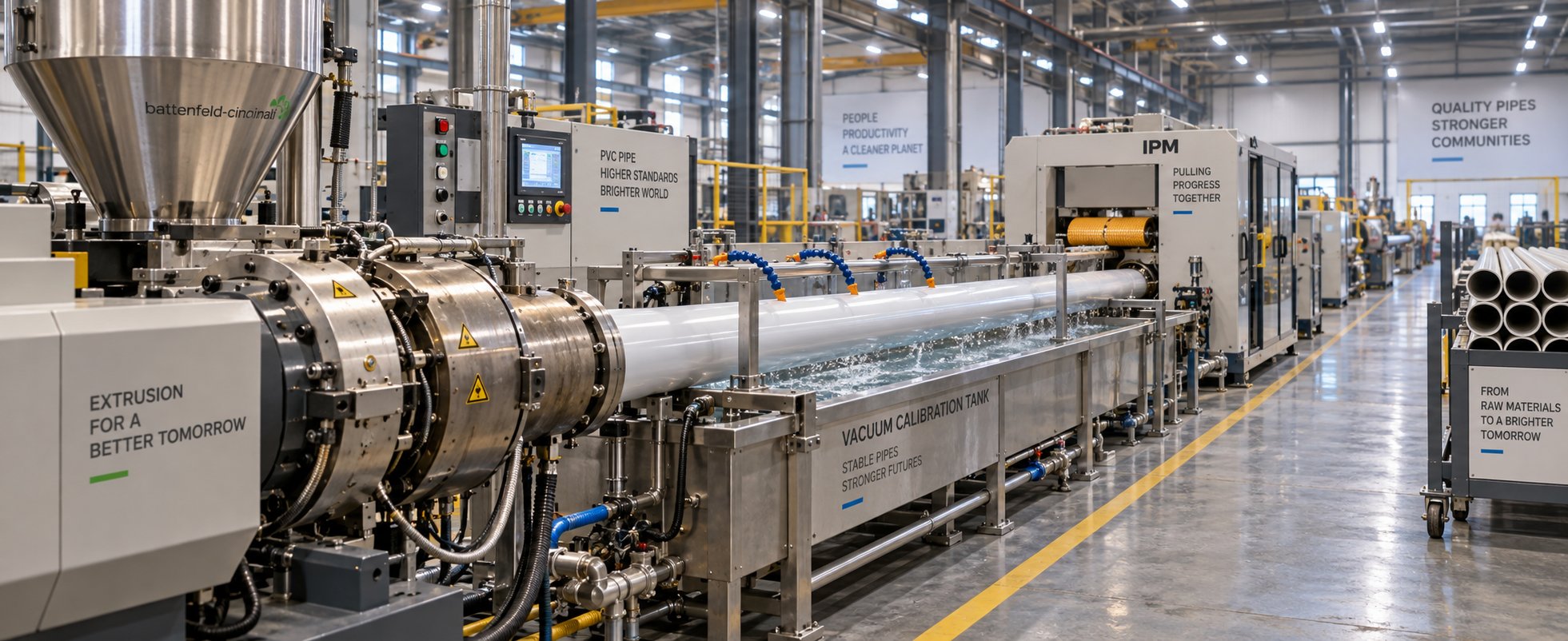
A screw barrel for PVC pipe extrusion is the central assembly inside an extruder machine where raw PVC dry-blend is transformed into a continuous, uniform melt ready to be shaped by a pipe die. Think of it as the heart of your entire production line. The screw rotates inside a precisely machined cylindrical barrel, performing four critical jobs in sequence: conveying the powdered compound forward, compressing it under increasing pressure, melting and fusing the particles through controlled friction and external heat, and finally homogenizing everything into a consistent melt stream. Without this assembly functioning correctly, every downstream component — from the die head to the calibration sleeve — receives an inconsistent feed, and your finished pipe suffers.
What a Screw Barrel Does in PVC Pipe Production
Imagine feeding a fine, powdery PVC dry-blend into a hopper. The screw barrel's job is to take that loose powder and deliver a perfectly plasticized melt at the other end — at the right temperature, the right pressure, and with zero unmelt particles or degraded spots. The rotating screw flights grab material in the feed zone, gradually compact it through a compression zone where frictional and conducted heat begin the fusion process, and then push the fully gelled melt through a metering zone that stabilizes pressure before it enters the pipe die. Every millimeter of screw geometry and every degree of barrel temperature influences whether you get a flawless pipe or a reject.
This is where PVC pipe production diverges sharply from extruding more forgiving polymers like polyethylene or polypropylene. With PE or PP, you'll notice a wide processing window — the material tolerates temperature swings and shear variations without dramatic consequences. PVC is a fundamentally different animal.
Why PVC Pipe Demands Specialized Screw Barrel Engineering
PVC is inherently sensitive to heat. When exposed to excessive temperatures or prolonged residence time, it degrades and releases hydrochloric acid (HCl) — a corrosive gas that attacks metal surfaces inside the barrel and contaminates the melt. Unlike PE, which flows into a low-viscosity liquid, PVC transitions into a gelled, elastic-plastic state. Too much shear generates destructive frictional heat; too little shear leaves unfused particles embedded in the pipe wall.
This narrow processing window creates a unique engineering challenge. The screw barrel must generate enough mechanical energy to fully fuse PVC particles while staying well below the degradation threshold. Get it wrong, and you'll see yellowing, black specks, rough surfaces, or brittle pipe walls — defects that often trace directly back to the screw barrel rather than the formulation or die.
PVC is thermally processed in a narrow window between fusion and degradation, making screw barrel selection more consequential than for most other polymers.
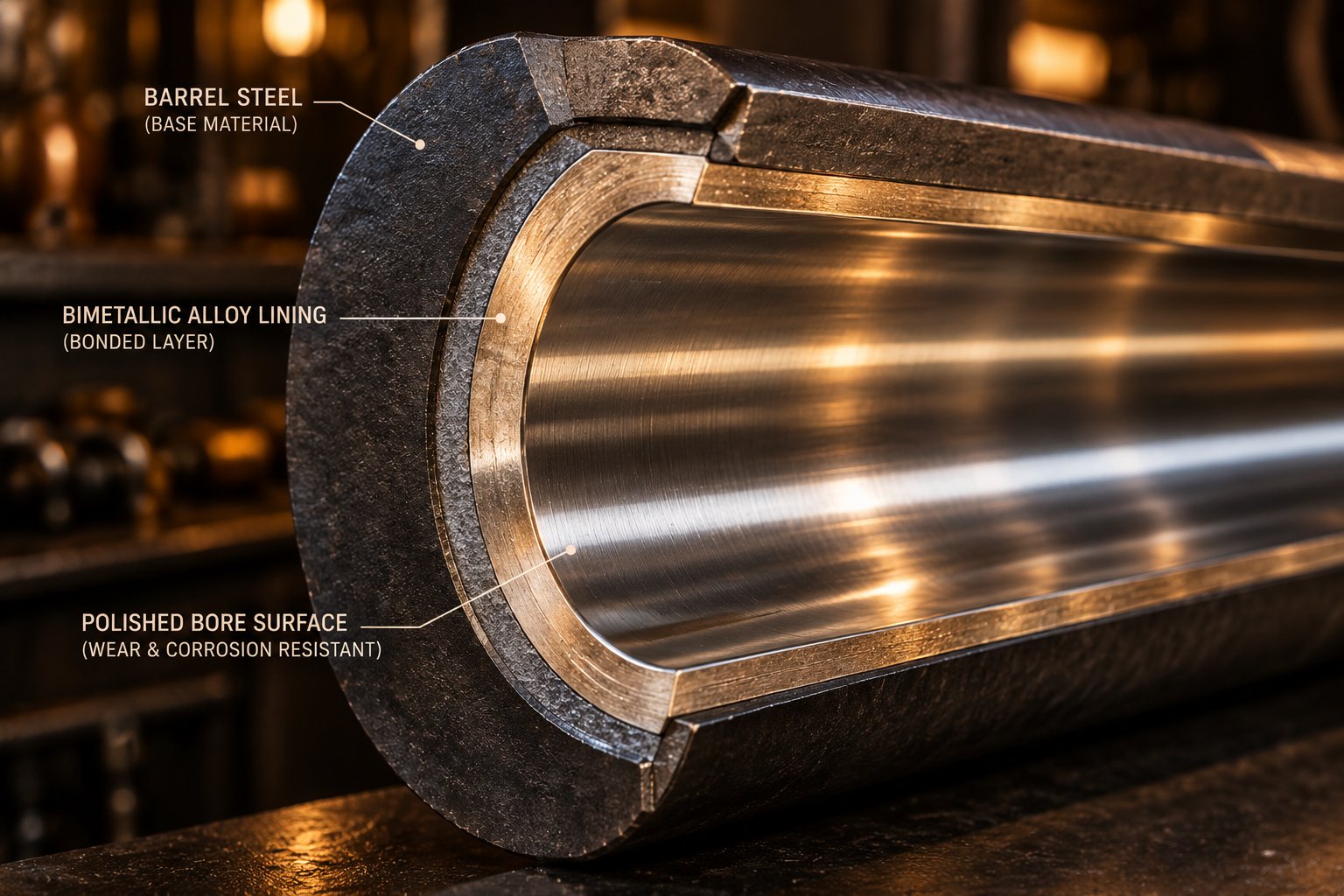
Common PVC pipe compounds also contain abrasive calcium carbonate fillers and chemical stabilizers that accelerate wear on standard steel components. That is exactly why many manufacturers invest in a bimetallic screw barrel — a design featuring a hard, corrosion-resistant alloy lining bonded to the barrel's inner bore. This protective layer resists both the chemical attack from HCl and the physical abrasion from filled compounds, extending service life significantly compared to conventional nitrided steel alone.
Choosing the wrong screw barrel configuration, geometry, or material grade doesn't announce itself with a dramatic failure. Instead, it quietly erodes output quality: wall thickness drifts out of tolerance, surface finish degrades, scrap rates creep upward, and energy consumption climbs — all before the root cause becomes obvious. The differences between available configurations are where the real decision-making begins.
Single Screw vs Twin Screw Barrel Configurations for PVC Pipe
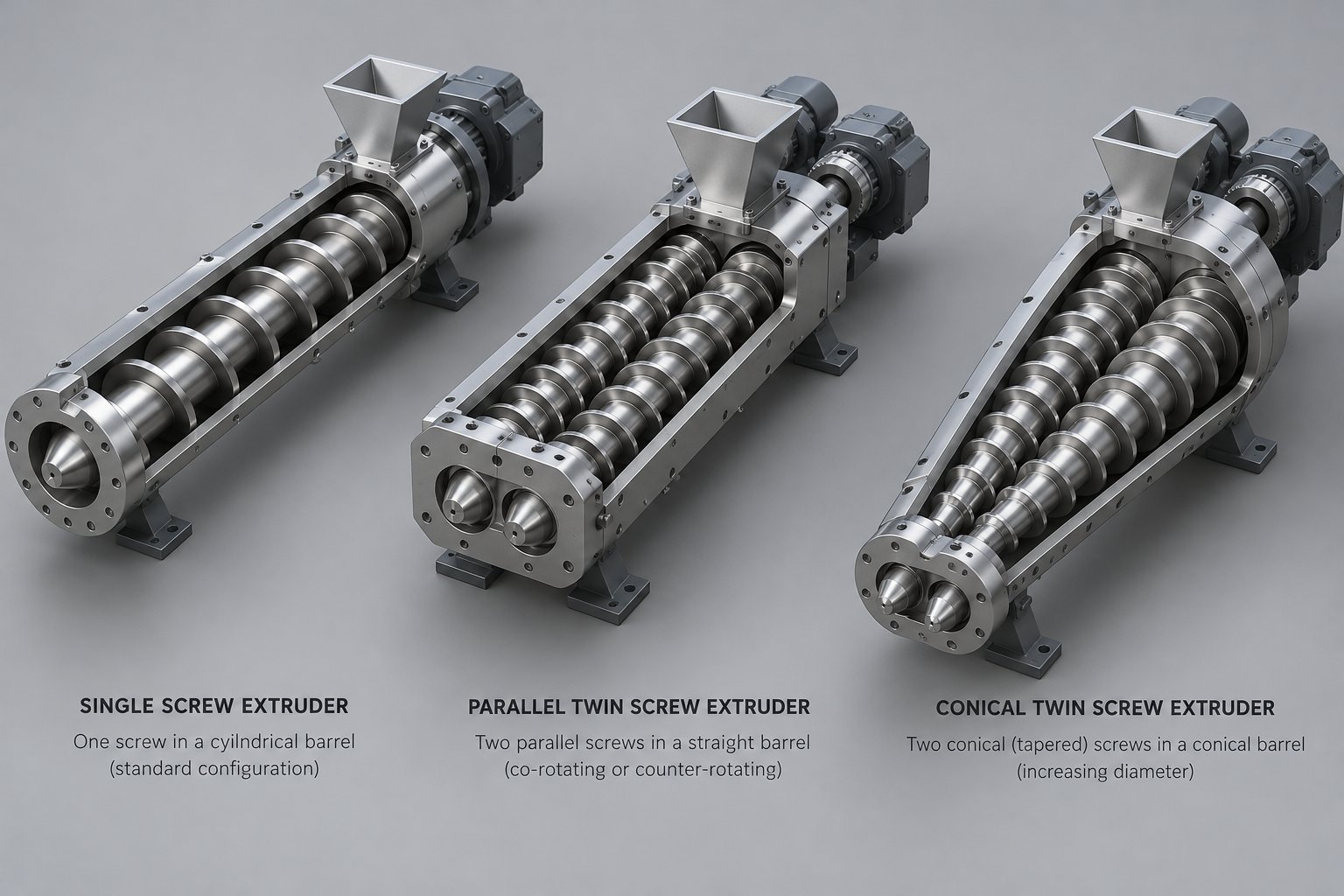
Not every barrel screw configuration handles PVC the same way. In fact, the geometry and drive arrangement of your extruder's screw system is arguably the first and most consequential choice you'll make when setting up — or upgrading — a PVC pipe line. Three primary configurations exist, and each brings a distinctly different set of trade-offs to the table.
Single Screw Barrels for PVC Pipe
A single-screw extruder uses one rotating screw inside a cylindrical barrel. It is the simplest, most affordable configuration available. For general-purpose plastics extrusion, single-screw setups are workhorses. For PVC pipe, though, they carry real limitations. A single screw relies heavily on barrel friction and shear to melt the material, which means it generates more frictional heat per unit of output. When you're working within PVC's tight thermal window, that extra shear heat becomes a liability rather than an asset.
That said, single-screw barrels aren't obsolete in PVC pipe production. They can perform adequately for flexible PVC pipe or operations processing recycled PVC that has already been compounded and pelletized. In these cases, the material arrives pre-gelled, reducing the plasticizing burden on the screw. You'll also find single-screw systems where smaller-diameter pipes are produced in low-volume runs and capital cost is a primary concern.
Parallel Twin Screw Barrels vs Conical Twin Screw Barrels
Twin-screw extruders solve the mixing and heat-control problems that single screws struggle with. Two intermeshing screws create positive conveying action, meaning the material is pushed forward mechanically rather than relying on friction alone. This results in lower shear heat, better distributive mixing, and a more uniform melt — all critical for rigid PVC pipe quality.
Parallel twin-screw barrels feature two screws of equal diameter running side by side. They deliver excellent mixing intensity and handle high-fill PVC compounds containing heavy CaCO3 loadings or specialty additives. However, they are less common on standard PVC pipe lines because their geometry generates more shear than a conical design at equivalent output rates.
Conical twin-screw barrels dominate rigid PVC-U pipe production worldwide, and the reason is purely geometric. The screws taper from a large feed-end diameter to a smaller discharge-end diameter. This taper generates powerful conveying force at low screw speeds — typically 15 to 35 RPM — which drastically reduces shear heat. For a thermally sensitive polymer like PVC, that gentle processing approach is not optional; it is essential. The conical design also provides a naturally increasing compression along the screw length, making it easy to achieve the gradual, controlled fusion PVC demands. Much like how a binding barrel screw draws two components tightly together through precise mechanical engagement, the intermeshing conical screws create a positive, controlled grip on the PVC compound that eliminates slippage and dead zones.
| Configuration Type | Typical PVC Pipe Diameter Range | Mixing Capability | Shear Heat Generation | Energy Efficiency | Best Suited Application |
|---|---|---|---|---|---|
| Single Screw | 16 mm – 200 mm | Moderate — limited distributive mixing | High — relies on friction-driven melting | Lower — higher motor load per kg of output | Flexible PVC pipe, recycled PVC, low-volume lines |
| Parallel Twin Screw | 20 mm – 400 mm | Excellent — strong dispersive and distributive mixing | Moderate — positive conveying reduces but does not eliminate shear | Moderate — efficient for high-fill compounds | Heavily filled PVC compounds, specialty formulations |
| Conical Twin Screw | 16 mm – 630 mm+ | Very Good — intermeshing geometry ensures thorough fusion | Low — tapered design and low RPM minimize frictional heat | High — low screw speed reduces motor energy consumption | Rigid PVC-U pressure and drainage pipe, CPVC pipe |
Which Configuration Matches Your PVC Pipe Line
If you're producing rigid PVC-U pipe — which covers the vast majority of municipal water, sewer, and conduit applications — a conical twin-screw barrel is almost certainly the right choice. The low-shear, high-conveying characteristics align perfectly with PVC's processing requirements. For plants running heavily filled compounds at high throughput, a parallel twin-screw setup deserves evaluation, particularly when mixing intensity outweighs shear concerns. And for smaller operations running flexible or recycled PVC, a single-screw barrel keeps capital costs manageable while still producing acceptable pipe quality.
Selecting the right configuration sets the foundation, but it only tells half the story. The physical dimensions of the barrel — screw diameter, length-to-diameter ratio, and compression ratio — determine whether that configuration actually delivers the melt quality and throughput your pipe line requires.
Screw Barrel Sizing for PVC Pipe Diameter and Throughput
A twin screw barrel matched to the right configuration still underperforms if its physical dimensions don't align with your target pipe size and production speed. Screw diameter, length-to-diameter ratio, and compression ratio work together to determine how much PVC the system can plasticize, how gently it does so, and whether the resulting melt is uniform enough to produce pipe within specification. Getting these numbers right isn't guesswork — it's engineering rooted in the relationship between geometry and thermal behavior.
Common Conical Twin Screw Barrel Sizes and Output Ranges
Conical twin screw barrels are identified by their screw diameter pair — the larger number represents the feed-end diameter and the smaller number represents the discharge-end diameter. This taper is the defining feature, and larger diameter pairs handle proportionally greater material volumes per revolution. Think of it this way: a wider screw opening accepts more PVC dry-blend per turn, while the narrowing channel progressively compresses and fuses it as it moves toward the die.
The table below shows the most widely used conical twin screw barrel sizes in PVC pipe production, along with general output guidance. Exact throughput varies depending on formulation, screw speed, and die resistance, so consult your equipment manufacturer's data sheets for precise values specific to your line.
| Nominal Screw Diameter Pair (mm) | Approximate L/D Ratio Range | Typical PVC Pipe OD Range (mm) | Indicative Throughput (kg/h) |
|---|---|---|---|
| 51/105 | 22:1 – 25:1 | 16 – 63 | 80 – 150 |
| 55/110 | 22:1 – 25:1 | 16 – 110 | 100 – 200 |
| 65/132 | 22:1 – 26:1 | 50 – 200 | 180 – 350 |
| 80/156 | 22:1 – 26:1 | 110 – 400 | 300 – 550 |
| 92/188 | 22:1 – 26:1 | 200 – 630+ | 450 – 800+ |
You'll notice a clear pattern: as the screw diameter pair increases, both the achievable pipe size and hourly output climb substantially. A 51/105 barrel suits smaller-diameter conduit and plumbing pipe, while a 92/188 handles large-bore municipal water mains or sewer lines. Selecting barrel screws undersized for your target pipe diameter forces higher screw speeds to compensate, which drives up shear heat — exactly what PVC can't tolerate.
How L/D Ratio and Compression Ratio Affect PVC Pipe Quality
The length-to-diameter ratio describes how long the screw is relative to its diameter. As extrusion engineering references note, the most common L/D values fall around 24:1, with some systems extending to 30:1 or more. For conical twin screw barrel setups in PVC pipe production, the typical range sits between 22:1 and 26:1. Why does this matter? A longer L/D gives the PVC compound more residence length — more time and barrel surface area for heat transfer and gradual fusion. That gentler, more thorough melting process directly benefits PVC's narrow thermal window by reducing the risk of localized overheating or incomplete plasticization.
Compression ratio is equally critical. It measures the volume ratio between the first screw flight and the last, and for rigid PVC pipe, it typically falls in the range of 2.0 to 3.0. A ratio below 2.0 provides insufficient compaction, leaving air pockets and poorly fused particles in the melt. Push above 3.0, and excessive compression generates too much back-pressure and frictional heat, risking degradation and HCl release. The sweet spot depends on your specific formulation — lightly filled PVC-U compounds often run well around 2.0 to 2.5, while heavily filled binding barrel screws compounds with 15+ phr CaCO3 may benefit from ratios closer to 2.5 to 3.0 for adequate densification.
Here's the practical takeaway: L/D ratio and compression ratio aren't independent variables. A longer L/D lets you use a gentler compression gradient spread over more screw turns, which produces a more homogeneous melt with lower peak temperatures. Shortening the L/D forces the same compression into fewer turns, steepening the pressure rise and intensifying localized shear. For a polymer as unforgiving as PVC, that difference often shows up as subtle wall-thickness inconsistencies or surface roughness that only becomes obvious when the pipe fails a pressure test or dimensional inspection.
Sizing the barrel correctly locks in the physics. Yet even a perfectly dimensioned twin screw barrel will fail prematurely if the steel alloy and surface treatment can't withstand PVC's corrosive chemistry and abrasive filler loads — a material selection challenge that deserves its own close examination.
Screw Barrel Materials and Coatings for PVC Pipe Processing
PVC doesn't just flow through your screw barrel — it attacks it. Every hour the line runs, two destructive forces work simultaneously against the steel surfaces: hydrochloric acid corrodes from the inside out, while abrasive calcium carbonate fillers grind away mechanical integrity. A barrel sized perfectly for your pipe diameter and throughput will still fail prematurely if the base alloy and surface treatment aren't engineered to survive this dual assault. Understanding why specific steel grades and coatings exist for PVC pipe extrusion is the difference between a screw barrel that lasts and one that quietly degrades your output for months before anyone notices.
Why PVC's Corrosive Chemistry Demands Specific Alloy Grades
When PVC reaches processing temperatures — typically between 170 °C and 200 °C for rigid pipe compounds — it begins releasing hydrogen chloride gas. This HCl combines with any trace moisture to form hydrochloric acid, which directly attacks metal surfaces. Imagine acid slowly etching into your barrel bore with every production cycle. Pitting appears first, then roughens the bore surface, then grows deep enough to trap degraded material and contaminate the melt. A standard carbon steel barrel on a PVC line doesn't last — it corrodes.
On top of the chemical attack, rigid PVC pipe compounds commonly contain CaCO3 fillers at loadings of 5 to 20+ phr (parts per hundred resin) along with titanium dioxide and other mineral additives. These particles are mechanically abrasive, grinding against screw flight tips and barrel walls with every rotation. So the screw barrel faces corrosion and abrasion simultaneously — and a material that resists one threat but not the other will still fail.
This is why the base steel alloy is not a generic decision. Two grades dominate PVC pipe screw barrel manufacturing, and each serves a specific functional purpose:
38CrMoAlA is the workhorse screw material for PVC extrusion. It is a chromium-molybdenum-aluminum nitriding steel, and its value lies in that aluminum content. During gas nitriding, the aluminum reacts to form an exceptionally hard nitride case on the surface — typically reaching 850 to 1,100 HV — while the core retains its toughness and fatigue resistance. That combination of a rock-hard surface and a resilient core is precisely what a PVC pipe screw needs: hardness to resist filler abrasion on the outside, toughness to absorb torsional loads on the inside.
42CrMo (AISI 4140) is the standard base material for barrel bodies, particularly in conical twin screw barrels used on PVC pipe lines. It is a forged alloy steel prized for its excellent core strength and machinability. Unlike 38CrMoAlA, its primary role isn't to take a nitrided surface directly — though it can be nitrided for lighter-duty applications. Instead, 42CrMo typically serves as the structural body into which a bimetallic liner is centrifugally cast. Think of 42CrMo as the strong skeleton and the liner as the armor.
Why not just use one alloy for everything? Because the screw and barrel face different stress profiles. The screw endures torsional loads and direct contact with abrasive compound across its full flight surface; 38CrMoAlA's superior nitriding response makes it the better screw material. The barrel body needs to withstand clamping forces, thermal cycling, and internal pressure while providing a stable bore geometry; 42CrMo's forging characteristics and core strength make it the better structural host for a barrel — especially when a protective liner handles the corrosion and wear fight at the bore surface.
Nitriding vs Bimetallic vs Tungsten Carbide Barrel Linings
The base steel gives the screw barrel its bones. Surface treatment gives it its armor. For PVC pipe processing, three surface protection strategies exist, and each targets a different threat level.
Gas nitriding is the baseline treatment for PVC pipe screw barrels. During nitriding, the steel part is heated in a nitrogen-rich atmosphere, and nitrogen atoms diffuse into the surface to form a hard, wear-resistant nitride layer. This layer provides good abrasion resistance and reasonable chemical stability against mild HCl exposure. For PVC pipe lines running clean compounds with low filler content — say under 5 phr CaCO3 — a nitrided 38CrMoAlA screw paired with a nitrided 42CrMo barrel can deliver acceptable service life at a modest cost. However, nitriding alone is weaker against concentrated HCl pitting than more advanced treatments, so it's best considered a foundation layer rather than a standalone solution for aggressive PVC compounds.
Bimetallic linings step up protection significantly. A bimetallic barrel has a corrosion- and wear-resistant alloy — typically a nickel-based or tungsten-carbide-loaded composition — metallurgically bonded to the inside of the bore through centrifugal casting. Instead of relying on the base steel's surface to fight HCl and fillers, the working surface becomes a dedicated alloy engineered specifically for that job. For PVC pipe operations running compounds with 10+ phr CaCO3, CPVC formulations, or any line logging 5,000+ annual production hours, bimetallic conical twin screw barrels routinely outlast nitrided-only equivalents by a substantial margin. The higher upfront cost pays for itself through reduced downtime and fewer unplanned barrel replacements.
Tungsten carbide coatings represent the extreme end of abrasion protection. These overlays — applied to screw flight lands or barrel bore surfaces — are extraordinarily hard and resist mechanical wear from heavily filled compounds far better than nitriding or standard bimetallic alloys. When your PVC pipe compound contains 20+ phr CaCO3 or includes hard mineral fillers like talc or wollastonite, tungsten carbide extends component life dramatically. The catch? Carbide alone doesn't offer the same level of HCl corrosion resistance as a nickel-based bimetallic lining. Using carbide as a default "best" option when the primary threat is corrosion — not abrasion — is a common and costly mistake. In many PVC pipe applications, the smartest approach combines a bimetallic barrel liner for corrosion protection with carbide-faced screw flights for abrasion resistance.
| Surface Treatment | Primary Strength | Primary Weakness | Best PVC Pipe Application | Relative Cost |
|---|---|---|---|---|
| Gas Nitriding | Good general hardness and moderate wear resistance | Limited protection against concentrated HCl pitting | Low-filler PVC-U pipe, lighter-duty lines | Low |
| Bimetallic Lining (Ni-based) | Excellent HCl corrosion resistance plus good wear resistance | Higher upfront cost | Standard to heavily filled PVC-U pipe, CPVC pipe | Medium-High |
| Tungsten Carbide Overlay | Superior abrasion resistance against hard mineral fillers | Does not fully protect against HCl corrosion alone | Highly filled PVC compounds (20+ phr CaCO3) | High |
| Bimetallic + Carbide (combined) | Dual protection against both corrosion and heavy abrasion | Highest cost; justified only for the most demanding compounds | Extreme-duty PVC pipe with high filler and high output | Highest |
Choosing the Right Coating Based on Your PVC Compound
So how do you decide? Rather than defaulting to the most expensive option or copying what worked on a different line, match your surface treatment to three concrete variables:
- Compound abrasiveness: Assess your CaCO3 and mineral filler loading. Below 5 phr, nitriding may suffice. Between 5 and 15 phr, a bimetallic lining significantly extends barrel life. Above 15–20 phr, consider tungsten carbide overlays on screw flights paired with a bimetallic barrel bore.
- Annual production hours: A line running 2,000 hours per year on a mild PVC compound may get by with nitrided components for years. A line running 6,000+ hours annually on an aggressive compound will burn through nitrided surfaces fast. Higher utilization rates shift the economics decisively toward bimetallic protection, because the per-hour cost drops while the cost of unplanned downtime climbs.
- Budget constraints vs. total cost: A nitrided screw barrel for PVC pipe costs less upfront. But if it needs replacement twice as often, plus you factor in the scrapped pipe, lost production hours, and energy wasted running a worn bore, the "cheaper" option becomes the more expensive one. Frame every coating decision around cost per operating hour, not the purchase order alone.
- Formulation chemistry: CPVC and chlorinated PVC compounds release HCl more aggressively than standard PVC-U. If your pipe line processes CPVC — even occasionally — corrosion resistance must be the priority, making a bimetallic lining the minimum standard regardless of filler content.
The rule of thumb experienced PVC pipe processors follow is straightforward: solve corrosion first, then layer on abrasion protection as your filler loading demands it. A screw barrel that is carbide-hard but corrosion-weak will still pit and fail on a PVC line — and a pitted bore contaminates every meter of pipe it produces.
Material and coating selection determines how long the screw barrel survives. But the real question is whether it produces acceptable pipe in the first place — and that depends on how well the barrel's geometry matches the specific PVC formulation flowing through it.
How PVC Pipe Formulations Influence Screw Barrel Specifications
A PVC pipe formulation is not a single recipe — it is a family of recipes, each engineered for a different service condition. Pressure pipe, drainage pipe, and hot-water pipe all start from PVC resin, but the stabilizer system, lubricant package, filler loading, and impact modifier content vary dramatically between them. Those formulation differences don't just change the pipe's performance in the ground. They change how the compound behaves inside your barrel and screw, and that behavior dictates what screw geometry and barrel temperature settings will actually work.
Rigid PVC-U Pressure Pipe Screw Barrel Requirements
Rigid PVC-U pressure pipe — manufactured to standards like ASTM D1785 or ISO 1452 — carries the tightest quality expectations of any PVC pipe category. These pipes must hold sustained internal pressure, sometimes exceeding 200 psi at room temperature, so the compound demands thorough fusion with zero voids, unmelt particles, or weak weld lines. Formulations typically use moderate CaCO3 filler loadings (5–15 phr), tin- or calcium-zinc-based stabilizer systems for maximum thermal stability, and acrylic or CPE impact modifiers to ensure toughness.
What does this mean for the twin screw and barrel? The moderate filler loading keeps abrasive wear manageable, but the emphasis on complete, even fusion pushes the ideal compression ratio toward the 2.2–2.8 range. Flight depths in the metering zone need to stay shallow enough to generate adequate back-pressure for full gelling, yet deep enough in the feed zone to accept the bulky dry-blend efficiently. Barrel temperature zones typically run between 300 °F and 340 °F (150–170 °C), rising gradually from feed to die — any spike risks degradation, and any cold spot leaves unfused particles that become stress concentrators in the finished pipe wall.
Non-pressure PVC-U drainage pipe — the kind installed in sewer, stormwater, and vent applications — uses a different formulation calculus. Because the pipe doesn't need to withstand sustained internal pressure, manufacturers push CaCO3 filler content higher, sometimes well beyond 20 phr, to reduce raw material cost. Higher filler means more abrasive compound flowing through the barrel and screw. The stabilizer package may be simpler, and impact modifier levels are often reduced. Flight depths can be slightly more generous in the metering zone since the melt doesn't need the same extreme homogeneity demanded by pressure-rated pipe. Compression ratios around 2.5–3.0 work well to densify the heavily filled compound, though exceeding 3.0 risks excessive shear heating. As industry experts note, some drainage pipe formulations reach 100 phr or higher CaCO3 loading, which shifts the barrel lining decision firmly toward bimetallic or carbide-protected surfaces.
CPVC and Specialty Pipe Formulation Considerations
Chlorinated PVC (CPVC) pipe — used in hot-water distribution systems — is the most thermally demanding formulation you can run through a PVC extrusion line. CPVC has a higher chlorine content than standard PVC, which raises its crystalline melting point but simultaneously narrows the gap between fusion and degradation even further. Processing data from Sekisui Specialty Chemicals shows that CPVC extrusion barrel temperatures run between 340 °F and 410 °F (170–210 °C) — higher than PVC, yet with less margin for error. Screw rotation speeds must be set lower than PVC to avoid excess shear, and the recommended compression ratio for single-screw CPVC profiles sits between 2.5 and 3.2.
For conical twin-screw extrusion of CPVC pipe, compression ratios on the gentler end — around 2.0–2.5 — help avoid localized overheating. Flight geometry should minimize dead zones where stagnant material can degrade and release concentrated HCl. CPVC's higher viscosity compared to standard PVC also means the barrel and screw must handle greater torque demands without creating the pressure spikes that accelerate wear. Tight barrel temperature zoning — often requiring four to five independently controlled zones — is non-negotiable. Even a 10 °F overshoot in one zone can trigger visible degradation streaks in the finished pipe.
How Pipe Standards Drive Screw Barrel Geometry Decisions
Every PVC pipe that leaves your line must meet dimensional tolerances defined by the applicable standard. ASTM D1785 Schedule 40, for example, specifies outer diameter tolerances as tight as ±0.005 inches for pipes under 3 inches and minimum wall thicknesses that cannot be compromised. ISO 1452 imposes similar constraints on ovality and wall uniformity for pressure-rated systems. These tolerances are not generous — they assume the melt entering the die is perfectly homogeneous in temperature, viscosity, and composition.
Pipe pressure ratings are directly downstream of melt quality — no barrel and screw combination that produces an inconsistent melt will ever yield pipe that reliably meets its rated service pressure.
When the screw barrel geometry doesn't match the formulation, the melt arrives at the die with temperature gradients, viscosity variations, or partially fused particles. The die can't fix those problems; it simply shapes them into the pipe wall. The result is uneven wall thickness, internal voids, or weak fusion seams that pass visual inspection but fail hydrostatic pressure testing. In drainage pipe, these defects may cause premature joint leaks. In pressure pipe, they can cause catastrophic failure. In CPVC hot-water pipe, a degraded zone becomes a ticking clock for brittle cracking under sustained thermal stress.
Matching barrel geometry to formulation is preventive quality control at the most fundamental level. Yet even a perfectly matched system drifts out of specification over time as wear accumulates — and recognizing the specific defects that signal screw barrel deterioration is the next critical skill PVC pipe producers need to develop.
Troubleshooting PVC Pipe Defects Linked to Screw Barrel Issues
Formulation and geometry might be dialed in perfectly on day one, but extrusion is a process that slowly erodes its own tooling. Wear doesn't announce itself with a dramatic failure — it creeps in, showing up first as subtle quality shifts that are easy to blame on raw material variability or operator error. Knowing which pipe defect points back to which screw barrel problem saves you weeks of misguided troubleshooting and thousands of dollars in unnecessary formulation adjustments.
PVC Pipe Defects Traced to Screw Barrel Wear
Every common PVC pipe defect has a mechanical signature. When you see a recurring quality issue on the line, the screw barrel should be one of the first places you investigate — not the last. The table below maps five of the most frequent rigid PVC pipe extrusion defects to their likely screw barrel root causes, along with the diagnostic approach and recommended corrective action.
| Pipe Defect | Likely Screw Barrel Root Cause | Diagnostic Approach | Corrective Action |
|---|---|---|---|
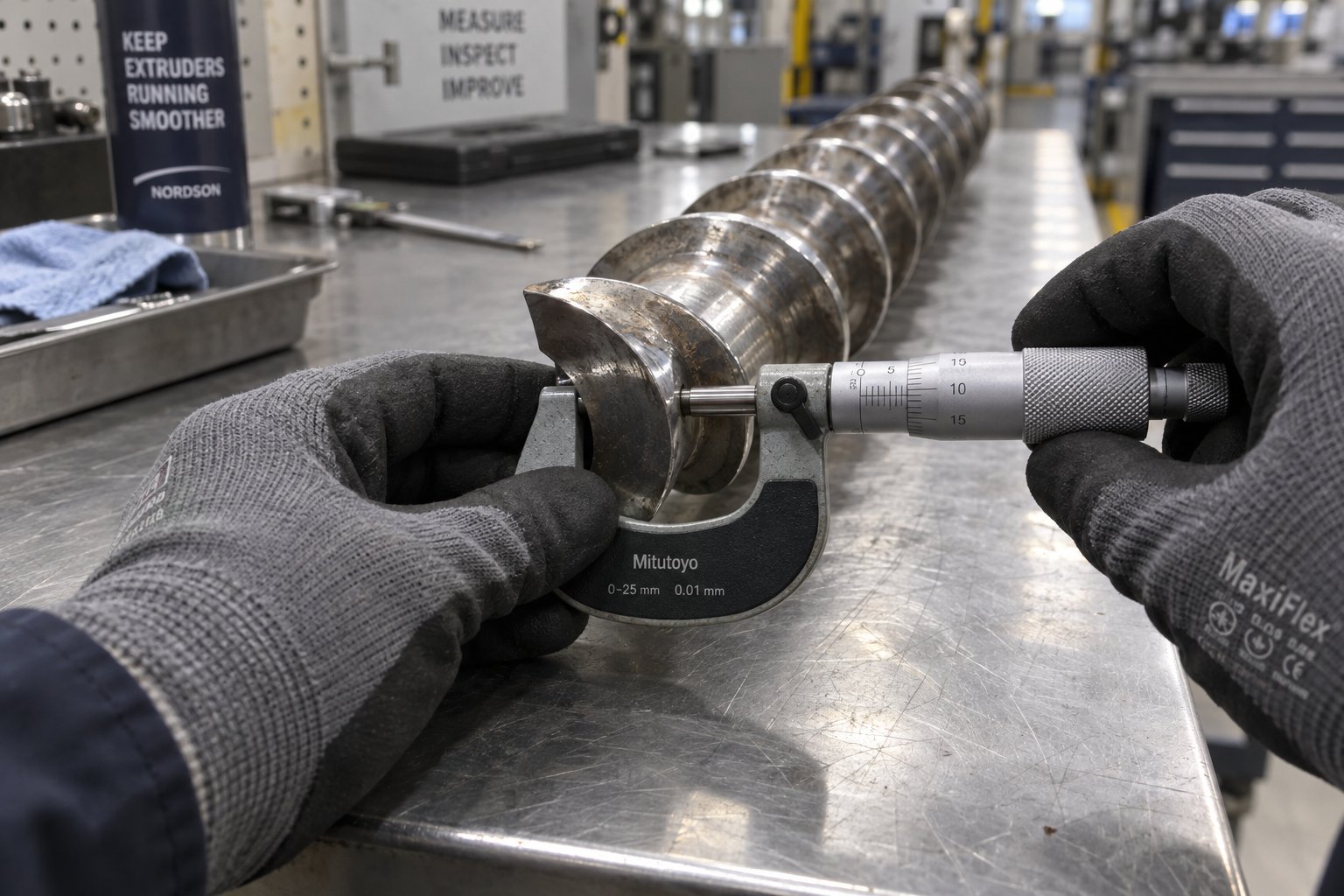
| Uneven wall thickness | Worn screw flights creating inconsistent melt pressure across the die face; excessive clearance allows melt to leak backward over flights unevenly | Measure screw flight OD at multiple points along the screw length using an outside micrometer; compare to original specification. Check barrel bore concentricity. | If flight wear exceeds 2x original clearance, replace or refurbish the screw. Verify barrel alignment and bore roundness. |
| Poor inner or outer surface finish | Excessive shear from incorrect compression ratio or a worn barrel bore that creates uneven melt film thickness against the barrel wall | Inspect barrel bore for scoring, pitting, or uneven wear using a bore scope. Review screw geometry against formulation requirements. | If bore surface is scored or pitted, replace barrel or re-line with bimetallic sleeve. If compression ratio is mismatched, adjust by switching to a screw with appropriate geometry. |
| Yellowing or burning (black specks, brown streaks) | Dead spots from excessive clearance between screw and barrel where stagnant PVC degrades and periodically flushes into the melt stream | Pull the screw and inspect for carbonized residue buildup in areas of excessive clearance. Check for hang-up points at transitions between screw zones. | If clearance has opened beyond 3x–4x the original spec, replace the binding barrel and screw set. Clean all dead zones thoroughly. Review shutdown purging procedure. |
| Poor weld or fusion lines visible in pipe wall | Insufficient plasticizing capacity from wrong L/D ratio or too-low compression ratio, resulting in partially fused melt entering the die's spider or mandrel support | Cut cross-sections of the pipe and examine under magnification for unfused grain boundaries. Review screw L/D and compression ratio against formulation data sheet. | If screw geometry doesn't match formulation, replace screw with correct L/D and compression ratio. If barrel temperature zones are improperly set, adjust zone temperatures to ensure progressive fusion. |
| Rough surface with visible unmelt particles | Inadequate mixing from worn screw geometry — eroded flight lands and reduced channel depth decrease the compressive and shearing action needed to fully fuse PVC dry-blend | Examine pipe surface under magnification for discrete PVC particles. Pull the screw and measure flight depth, flight width, and flight land condition at feed, compression, and metering zones. | If flight lands are rounded or channels are worn shallow, replace the screw. If only the feed zone is worn, evaluate whether a refurbished screw with re-applied hard facing is economical. |
You'll notice a pattern in the table: most defects trace back to dimensional changes caused by progressive wear. A new screw barrel for PVC pipe has precisely engineered clearances — typically the nominal screw diameter divided by 1,000 on each side. As extrusion wear research from Plastics Technology explains, a 3.5-inch extruder starts life with roughly 0.004 inches of flight clearance per side. Every fraction of a thousandth beyond that specification degrades melt pressure consistency, increases leakage flow, and raises discharge temperature. On a thermally sensitive polymer like PVC, those shifts translate into visible pipe defects far sooner than they would on polyethylene or polypropylene.
Measuring Barrel Bore Wear and Screw Flight Clearance
Guessing at wear levels is a common — and expensive — mistake. Accurate measurement requires pulling the screw from the barrel during a scheduled shutdown and taking readings with the right instruments.
For the screw, use an outside micrometer to measure the outer diameter of the flight tips at several positions along the screw's length: feed zone, compression zone, and metering zone. Compare each reading against the manufacturer's original dimensional certificate. Wear tends to concentrate in areas of highest solids contact — often the transition between the compression and metering zones — so don't rely on a single measurement point.
For the barrel bore, use a telescoping bore gauge or three-point inside micrometer inserted at multiple axial positions and rotational orientations. This reveals not just how much the bore has enlarged, but whether it has worn out of round — an ovality issue that creates uneven melt film thickness and directly causes wall-thickness variation in the finished pipe. Industry guidelines note that barrels with iron-based bimetallic liners typically last about three times the service life of a screw, but this assumes proper alignment and normal operating conditions.
Compare your measured values to these general replacement thresholds:
- Flight clearance at 2x original specification: Monitor closely. Performance degradation is beginning, and discharge temperatures may be rising. Acceptable for non-critical drainage pipe but approaching limits for pressure-rated pipe.
- Flight clearance at 3x–4x original specification: Replace or refurbish. Specific output rate has dropped measurably, screw speed has increased to compensate, and PVC pipe quality consistency is compromised. As extrusion experts point out, some noncritical applications tolerate 4x clearance, but critical-duty processes like pressure pipe should trigger replacement well before this point.
- Hard facing completely worn through: Replace the screw immediately. Without the protective hard-face layer, base steel wears exponentially faster, and metal contamination of the PVC melt becomes a real risk.
- Barrel bore enlarged beyond liner thickness: For bimetallic barrels, once wear approaches the roughly 0.060-inch liner thickness, the protective alloy is nearly consumed. Continued operation exposes the softer base steel, accelerating bore deterioration and contaminating the melt.
Keep a dimensional log for every screw and barrel set on the production floor. Recording measurements at each scheduled inspection creates a wear-rate trend line that lets you predict replacement timing rather than react to failures. That predictive approach transforms unplanned shutdowns into scheduled maintenance windows — a distinction that directly impacts your production uptime and total operating cost.
Of course, knowing when wear has crossed the line is only half the equation. The other half is understanding what to do about it — whether to refurbish, replace, or adjust your maintenance practices to slow the progression in the first place.
Screw Barrel Maintenance and Lifecycle Management for PVC Pipe Lines
A dimensional log tells you where wear stands today. A maintenance program tells you how to stretch the interval between today's reading and the day you're forced to shut down. PVC pipe extrusion is particularly unforgiving of deferred maintenance because every hour a degraded extruder screw barrel runs, HCl and abrasive fillers accelerate wear at a compounding rate. The processors who get the longest life from their equipment aren't lucky — they're disciplined about inspections, decisive about refurbishment timing, and meticulous about how they start and stop the line.
Inspection Schedules and Wear Measurement Methods
How often should you inspect extruder screws and barrels on a PVC pipe line? Reiloy USA's preventive maintenance guidance recommends setting up inspections every six months when running filled or reinforced resins until wear trends are established. For unfilled PVC compounds, an annual inspection cycle serves as a reasonable starting baseline. PVC pipe production, however, almost always involves CaCO3 fillers, so the six-month cadence is a safer default. Between formal inspections, routine visual checks during every scheduled line shutdown can catch problems early — look for discoloration on the screw surface, carbon buildup, scoring marks, or pitting that indicates HCl attack.
A structured preventive maintenance program doesn't just measure wear. It tracks it. Recording clearance readings at each inspection creates a trend line you can use to forecast when a component will cross the replacement threshold. As industry experts note, once wear trends are established, you can schedule repairs or replacements proactively — eliminating the costly surprises of unplanned downtime. Over time, you'll also notice that worn components show their influence in rising cycle times, climbing scrap rates, increasing energy consumption, and growing downtime. Any drift in those metrics should trigger an immediate wear check, even if the next scheduled inspection is months away.
When to Refurbish vs Replace Your Screw Barrel
Not every worn screw barrel needs to be scrapped. Refurbishment — re-building a worn component to restore its original dimensions and performance — can be a highly cost-effective alternative to buying new, but only when the wear hasn't crossed certain thresholds. The decision comes down to what's damaged, how deeply, and whether the remaining base material can accept a repair.
For screws, common refurbishment methods include PTA (plasma transferred arc) weld overlay on eroded flight crests, surface hard chrome plating to restore flowability and dimensional accuracy, straightening if the screw has developed a slight bow, and full-length polishing. According to Nan Yun Industrial's refurbishment data, PTA welding on a white steel base repair can restore a screw to its original condition and more than double its service life compared to its pre-refurbishment nitrided state. That makes refurbishment attractive when flight crests are worn but the core screw body remains straight and structurally sound.
For barrels, refurbishment options include bore grinding to restore true roundness and straightness, re-nitriding after grinding to re-establish the hardened surface layer, and bore hard chrome plating. Barrels that have developed ovality from uneven wear require horizontal boring to correct concentricity before the bore can be ground to the required diameter. However, if a bimetallic liner has worn through to the softer base steel — or if the bore has enlarged so far that grinding would remove the entire protective layer — refurbishment is no longer viable. At that point, replacement is the only option that preserves pipe quality.
Here's a practical decision framework: if the refurbishment cost exceeds 50–60% of a new component's price and the component has already been rebuilt once, replacement typically delivers better long-term economics. A fresh screw barrel for PVC pipe starts the wear clock at zero with full design tolerances, while a second refurbishment builds on a thinner base with diminishing returns.
Startup and Shutdown Best Practices for PVC Lines
The way you start and stop your extrusion line has a direct and measurable impact on barrel life. PVC's tendency to degrade and release corrosive HCl means that any compound left sitting in a hot barrel during idle periods actively attacks metal surfaces. Proper shutdown and startup procedures are not optional courtesies — they are barrel-life insurance.
Davis-Standard's feedscrew and barrel maintenance series emphasizes that the key to a successful shutdown is purging the current resin at operating temperature, then introducing a more thermally stable material at a lower temperature before the system stops. For PVC pipe lines, this is especially critical — degraded PVC left clinging to screw flights and barrel walls overnight becomes a concentrated source of HCl that corrodes metal and contaminates the next production run with black specks or brown streaks. Reiloy USA recommends always removing corrosive and filled resins before idling equipment.
On restart, the same logic applies in reverse: heat the barrel gradually, soak at a lower-than-operating temperature to ensure the remaining polymer is fully molten, then bring temperatures up to production levels before introducing fresh PVC compound. Rushing this sequence — cranking barrel heaters to full operating temperature while stagnant material sits inside — guarantees localized degradation and accelerated corrosion.
For PVC pipe operations specifically, follow these best practices to protect your investment:
- Purging protocol: At the end of every production run, purge PVC compound from the barrel with a thermally stable purging compound or a polyolefin (such as HDPE) that won't degrade at PVC processing temperatures. A quality commercial purging compound designed to cool, shrink, and pull residue away from metal surfaces is more effective than regrind alone. Run the purge until discharge material is visually clean and free of discoloration.
- Temperature ramp-down sequence: Reduce barrel zone temperatures in stages — drop 30–50 °F increments while the purge material is still flowing. This lowers the thermal exposure of both the residual polymer and the barrel steel. Shut down the screw only after barrel temperatures have dropped below the PVC degradation threshold and purge material has displaced the compound throughout the entire flow path.
- Startup heat-soak: On restart, bring barrels to an intermediate temperature first — roughly 50–75 °F below your production setpoint — and hold for 15 to 30 minutes to ensure the polymer sealed inside is fully softened. Then raise to production temperature and soak again before starting screw rotation. Starting rotation with cold, solidified material inside risks screw breakage and barrel bore damage.
- Storage of spare components: Spare extruder screws and barrels should be stored in a dry, climate-controlled environment with a light coating of rust-preventive oil on all machined surfaces. Don't store them like plastic barrels with screw on lids left outdoors — exposure to humidity causes surface corrosion on nitrided or machined steel, and even minor surface rust can compromise bore tolerances or flight dimensions when the spare is finally installed.
- Screw pull and cleaning schedule: Pair every preventive maintenance inspection with a thorough screw pull. Use a commercial purging compound before pulling to reduce manual cleaning time and minimize the risk of damaging flight surfaces with mechanical scraping tools.
A disciplined maintenance program doesn't just extend the service life of individual components. It stabilizes the entire production process by keeping clearances tight, bore geometry consistent, and melt quality predictable from shift to shift. That stability has a direct financial impact — one that goes far beyond the invoice price of a replacement screw barrel and into the broader economics of energy, scrap, and line efficiency.
Total Cost of Ownership When Selecting a Screw Barrel
Maintenance discipline keeps your screw and barrel running longer — but "longer" only matters if the economics behind the component add up over its full service life. Too many procurement decisions start and end at the purchase order price. A screw barrel extruder component that costs 20% less upfront but drives higher energy bills, more scrap, and frequent unplanned stoppages is the most expensive option on the floor. The real question isn't "what does this barrel cost?" It's "what does this barrel cost me per kilogram of good pipe produced?"
Energy, Scrap, and Downtime Costs Driven by Barrel Quality
Every aspect of screw barrel quality ripples outward into your operating budget. A well-engineered barrel with proper compression geometry and tight bore tolerances lets the screw do its work at lower RPM, which directly reduces motor load. Plastics Technology research confirms that as clearances increase from wear, operators compensate by raising screw speed, adjusting temperatures, and increasing backpressure — each adjustment consuming more energy while delivering diminishing returns. On a PVC pipe line running 6,000+ hours annually, even a 5–8% increase in specific energy consumption per kilogram adds up to a significant cost over a barrel's lifetime.
Scrap tells a similar story. Consistent melt quality — uniform temperature, stable pressure, no unmelt particles — is the only thing that keeps pipe within dimensional tolerances. A worn or poorly designed barrel produces melt variations that the die can't correct, and every off-spec pipe length goes straight to regrind or waste. Processors running heavily filled PVC drainage pipe often accept higher scrap rates as "normal" when the real culprit is a barrel bore that has quietly enlarged beyond acceptable tolerances.
Downtime is where the numbers get truly painful. An unplanned line shutdown to swap a failed screw barrel doesn't just cost the price of the replacement part. It costs the production hours lost, the labor to pull and reinstall, the startup scrap generated during restart, and the customer orders that slip. A higher-quality component from a reputable screw barrel manufacturer — one built with the right alloy, proper heat treatment, and precision-ground tolerances — delays that shutdown by thousands of operating hours.
Rank these cost factors by their typical magnitude on a PVC pipe line, and a clear hierarchy emerges:
- Scrap and reject costs — Off-spec pipe is your single largest hidden expense. A barrel that can't deliver homogeneous melt generates waste on every meter of pipe produced, and the cost compounds across every shift.
- Unplanned downtime — Emergency shutdowns for barrel or screw replacement dwarf the cost of the component itself. Lost production capacity, expedited shipping for replacement parts, and overtime labor make each unplanned event disproportionately expensive.
- Energy consumption — Higher screw speeds and elevated barrel temperatures used to compensate for wear increase kWh per kilogram of output. Over a year of continuous operation, this energy penalty alone can approach the price of a new screw and barrel set.
- Scheduled maintenance costs — More frequent inspections, earlier refurbishment cycles, and shorter replacement intervals all add labor and parts costs that accumulate quietly on the maintenance ledger.
- Raw material waste from poor melt quality — Inconsistent fusion leads to higher additive consumption as operators increase stabilizer or lubricant dosing to compensate for processing instability that originates in the barrel, not the formulation.
How the Screw Barrel Impacts Your Entire Extrusion Line
A PVC pipe extrusion line is a chain, and the screw barrel is the first functional link. Rollepaal's extrusion optimization research makes the point clearly: a good fit between the extruder, die, and formulation is the best guarantee for higher output rates, lower reject, and improved reproducibility. When the barrel delivers an inconsistent melt, every downstream component absorbs the consequences.
The die head receives a melt stream with temperature gradients and pressure fluctuations, producing uneven wall distribution that no amount of die-lip adjustment can fully correct. The calibration sleeve struggles to size a pipe whose walls vary in thickness and stiffness, leading to ovality issues. The haul-off unit must accommodate dimensional inconsistency, and if it can't, you get stretching, compression marks, or pull-off failures. Even the saw or cutter at the end of the line sees increased reject rates when pipes arrive out of round or with surface defects.
Imagine upgrading your die head, installing a precision calibration system, and investing in a servo-driven haul-off — then feeding the entire line through a worn barrel that delivers melt with 15 °F temperature swings across its cross-section. You'll capture a fraction of the performance those downstream upgrades were designed to deliver. The screw barrel sets the ceiling for every component that follows it. A quality barrel doesn't just protect itself — it unlocks the full capability of everything downstream.
Framing the purchase decision around total cost of ownership shifts the conversation from "which barrel is cheapest" to "which barrel delivers the lowest cost per meter of certified pipe." That shift in perspective naturally leads to the next question: how do you identify a supplier capable of delivering on that promise?
How to Evaluate and Select the Right Screw Barrel Supplier
Total cost of ownership gives you the right lens — but you still need to point it at the right supplier. A barrel screw extruder component is not a commodity fastener you can swap between vendors without consequence. The steel grade, nitriding depth, bore tolerance, and flight geometry all live inside the part where you can't see them. That invisibility makes supplier selection one of the highest-stakes decisions on any PVC pipe line, because the quality gaps only reveal themselves thousands of operating hours later.
Key Criteria for Evaluating Screw Barrel Suppliers
Think of supplier evaluation as a five-layer filter. Each layer eliminates candidates that look capable on paper but can't deliver in practice.
Manufacturing precision. A screw barrel for PVC pipe demands bore tolerances measured in hundredths of a millimeter. Ask whether the supplier machines, heat-treats, and finishes components in-house or outsources critical steps. In-house control over nitriding, bimetallic lining, and final grinding means tighter consistency between the barrel you approve as a sample and the one that arrives six months later as a replacement.
Material and coating certifications. Reputable suppliers document every alloy grade, nitriding hardness range, and liner composition with traceable inspection reports. If a manufacturer can't provide a specification sheet listing values like nitrided hardness (HV 850–1,000), nitrided case depth (0.45–0.70 mm), and alloy hardness for bimetallic liners, you're buying on faith rather than evidence.
Custom screw and barrel engineering. PVC pipe formulations vary — a pressure pipe compound with 8 phr CaCO3 behaves very differently inside a barrel than a drainage compound loaded at 25 phr. A supplier worth partnering with employs engineers who can tailor compression ratio, flight depth, and barrel lining to your specific formulation rather than shipping a one-size-fits-all geometry.
Technical support depth. The relationship doesn't end at delivery. When a defect appears on your pipe line six months in, can the supplier's engineering team diagnose whether the root cause is barrel wear, screw geometry mismatch, or a formulation change? Suppliers who offer ongoing technical consultation — not just sales follow-ups — protect your production quality over the long term.
Replacement lead times. A worn barrel waiting eight to twelve weeks for a replacement means eight to twelve weeks of degraded pipe quality or a full production stop. Evaluate whether the supplier maintains inventory of common conical twin screw barrel sizes or can manufacture custom replacements within a compressed timeline. Every week of lead time carries a real production cost.
Before you send your first RFQ, arm yourself with the questions that separate serious manufacturers from trading companies reselling unknown workshops. Here are the essentials:
- Do you manufacture screws and barrels in-house, or do you outsource machining and heat treatment to third parties?
- What base steel grades do you use for PVC pipe screw barrels, and can you provide material certificates with each shipment?
- What nitriding hardness, case depth, and surface roughness values do you guarantee — and how do you verify them before shipment?
- Can you provide a custom screw and barrel design optimized for my specific PVC pipe formulation and target output rate?
- What bimetallic lining alloys do you offer, and what hardness and alloy depth can you achieve?
- What is your standard lead time for replacement barrels in my screw diameter pair, and can you expedite if my line is down?
- Do you have engineering staff available for technical support after delivery — not just sales representatives?
- Can you provide reference contacts from existing PVC pipe customers running similar formulations and barrel sizes?
Any supplier who answers these questions with specifics — alloy grades, hardness ranges, engineering headcount, verifiable references — is demonstrating the transparency that correlates with consistent product quality. Vague deflections or marketing generalities should narrow your shortlist quickly.
Finding a Supplier That Understands PVC Pipe Extrusion Demands
The PVC pipe segment demands more from a screw barrel partner than most other extrusion applications. HCl corrosion, abrasive fillers, and the narrow fusion-to-degradation window mean your supplier needs genuine plastics processing expertise — not just metalworking capability. Look for manufacturers whose product lines and engineering resources are concentrated in PVC-related extrusion rather than spread thinly across unrelated industries.
As one concrete example, NANHAIYA specializes in conical twin screw barrels engineered for PVC pipe, PVC profile, PVC board, foam board, and WPC extrusion. Their focus on application-specific barrel design — with custom geometry and lining options matched to individual PVC formulations — reflects the kind of specialization that supports stable plasticizing performance across production campaigns. For processors managing multiple lines or running abrasive compounds that accelerate wear cycles, a dedicated component manufacturer like NANHAIYA provides a sourcing channel that can complement your OEM relationship with competitive lead times and formulation-matched engineering.
Ultimately, the right supplier isn't the one with the lowest quote or the flashiest catalog. It's the one whose manufacturing depth, material expertise, and technical support infrastructure align with the realities of PVC pipe production — where every degree of temperature control, every tenth of a millimeter of bore tolerance, and every hour of uptime translates directly into meters of certified pipe leaving your line.
Frequently Asked Questions About Screw Barrels for PVC Pipe
1. What type of screw barrel is best for rigid PVC pipe extrusion?
Conical twin screw barrels are the dominant choice for rigid PVC-U pipe production. Their tapered geometry generates strong conveying force at low screw speeds (typically 15-35 RPM), which minimizes shear heat — a critical advantage given PVC's narrow processing window between fusion and degradation. For heavily filled PVC compounds, parallel twin screw barrels may be considered, while single screw setups can work for flexible or recycled PVC pipe at lower production volumes.
2. Why does PVC pipe extrusion require specialized screw barrel materials and coatings?
PVC releases corrosive hydrochloric acid (HCl) during thermal processing, which attacks standard steel barrel surfaces. Additionally, most PVC pipe compounds contain abrasive CaCO3 fillers at loadings up to 20+ phr. This dual threat of corrosion and abrasion demands specialized solutions: nitriding steel alloys like 38CrMoAlA for screws, forged 42CrMo for barrel bodies, and protective surface treatments ranging from gas nitriding to bimetallic linings and tungsten carbide overlays depending on compound aggressiveness and production volume.
3. How do I choose the right conical twin screw barrel size for my PVC pipe line?
Conical twin screw barrel size is selected based on your target pipe diameter and throughput requirements. Common sizes range from 51/105 mm (suitable for 16-63 mm pipe at 80-150 kg/h) up to 92/188 mm (for 200-630+ mm pipe at 450-800+ kg/h). The L/D ratio, typically between 22:1 and 26:1, and compression ratio (2.0-3.0 for rigid PVC) must also match your specific formulation. Manufacturers like NANHAIYA offer custom conical twin screw barrels engineered for specific PVC pipe formulations and output targets.
4. What PVC pipe defects indicate screw barrel wear or problems?
Key defects linked to screw barrel issues include uneven wall thickness (worn screw flights causing inconsistent melt pressure), poor surface finish (excessive shear from incorrect compression ratio or scored barrel bore), yellowing or black specks (dead spots from excessive screw-barrel clearance trapping degraded PVC), visible weld lines (insufficient plasticizing from wrong L/D or compression ratio), and rough surfaces with unmelt particles (eroded flight lands reducing mixing action). Regular clearance measurements help detect wear before defects become severe.
5. How often should screw barrels be inspected on a PVC pipe extrusion line?
For PVC pipe lines running CaCO3-filled compounds, a formal inspection every six months is recommended until wear trends are established. Unfilled PVC operations may start with annual inspections. Between formal checks, perform visual assessments during every scheduled shutdown, looking for screw discoloration, carbon buildup, scoring, or pitting. Record clearance measurements at each inspection to build a trend line that predicts replacement timing. Flight clearance exceeding 2x the original specification signals close monitoring, while 3x-4x warrants replacement or refurbishment.
Written by
Nanhaiya Technical Team
Zhoushan Nanhaiya Plastic Machinery Co., Ltd.
The Nanhaiya technical team supports screw and barrel manufacturing projects through application review, technical communication, custom manufacturing coordination, and production and quality control.
Discuss Your Application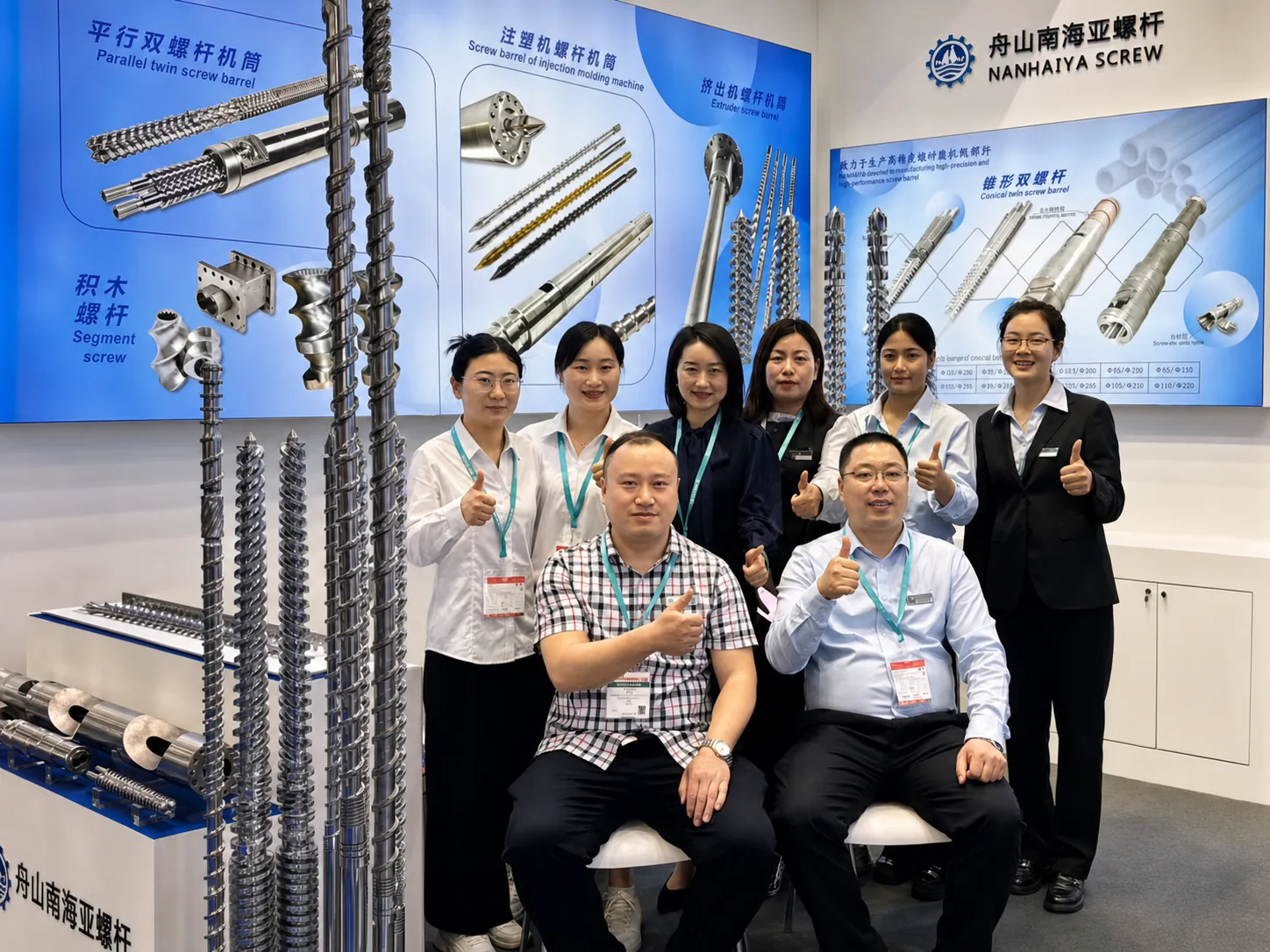
Related Articles
More insights on screw barrel technology and plastics processing.
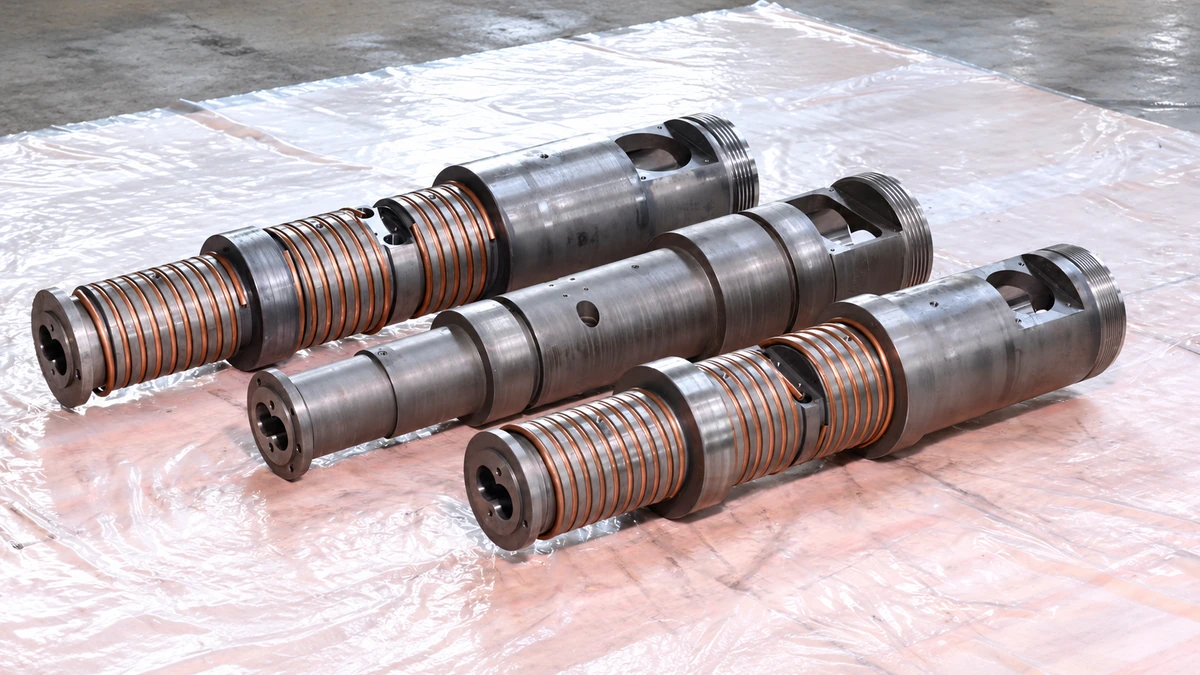
Inside an Extruder Barrel Manufacturer: From Raw Steel to Replacement
Oct 28, 2026
Learn how an extruder barrel manufacturer turns raw steel into precision barrels — covering materials, bimetallic vs nitrided linings, wear modes, and supplier evaluation.
Read Article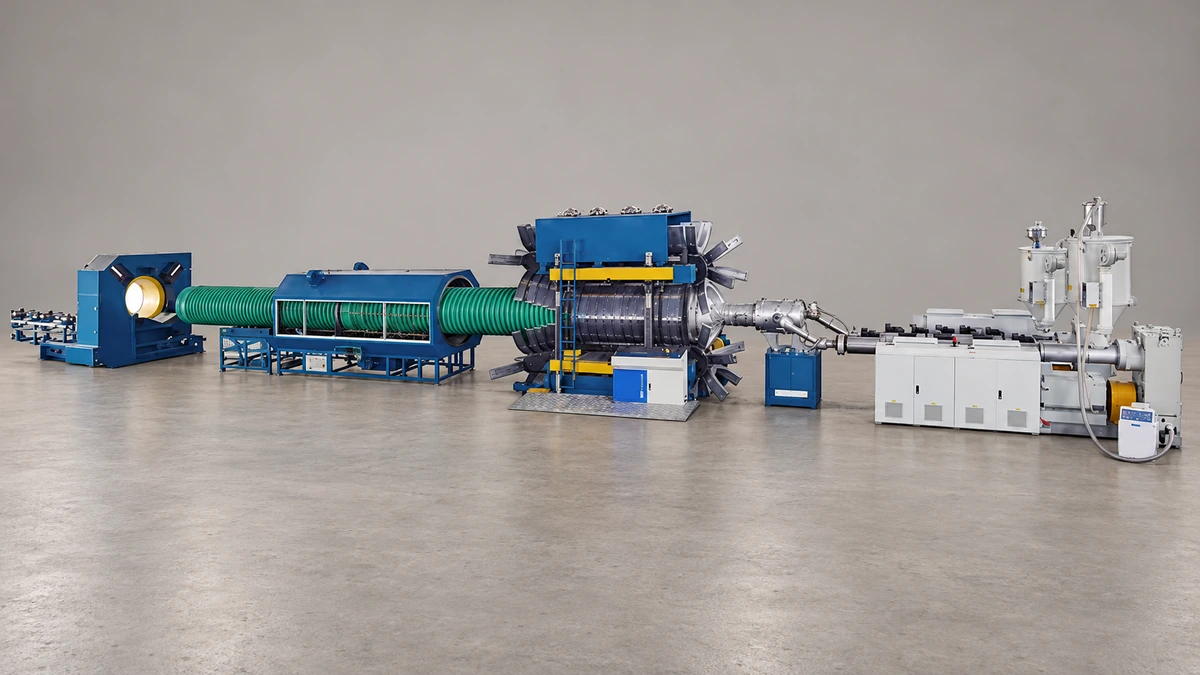
HDPE Pipe Extrusion Machine Decoded: From Resin to Finished Pipe
Oct 28, 2026
Learn how an HDPE pipe extrusion machine works — from extruder types and die heads to downstream equipment, specs by diameter class, and a buyer's checklist.
Read Article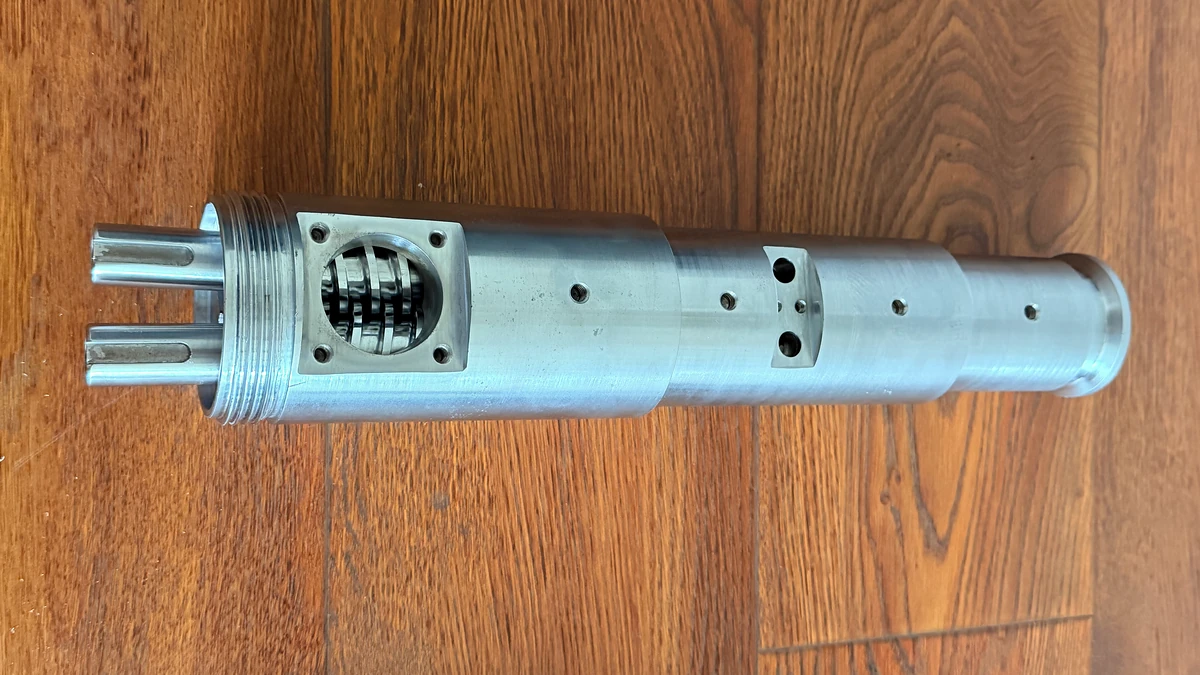
Screw Barrel Design Decoded: From Zone Geometry To Zero Defects
Oct 28, 2026
Master screw barrel design with this engineer's guide to zone geometry, polymer-specific parameters, material selection, defect troubleshooting, and simulation tools.
Read ArticleLooking for something else?
Search by material, symptom or product and jump straight to the relevant page.
These are navigation suggestions based on keyword matching — not a quotation, not a delivery commitment, and not a substitute for engineering review. Final specification is confirmed by our engineers against your drawings and processed material.
Need help with screw barrel selection?
Share your machine model, processed material and application. Our team can help with pricing and technical support.