

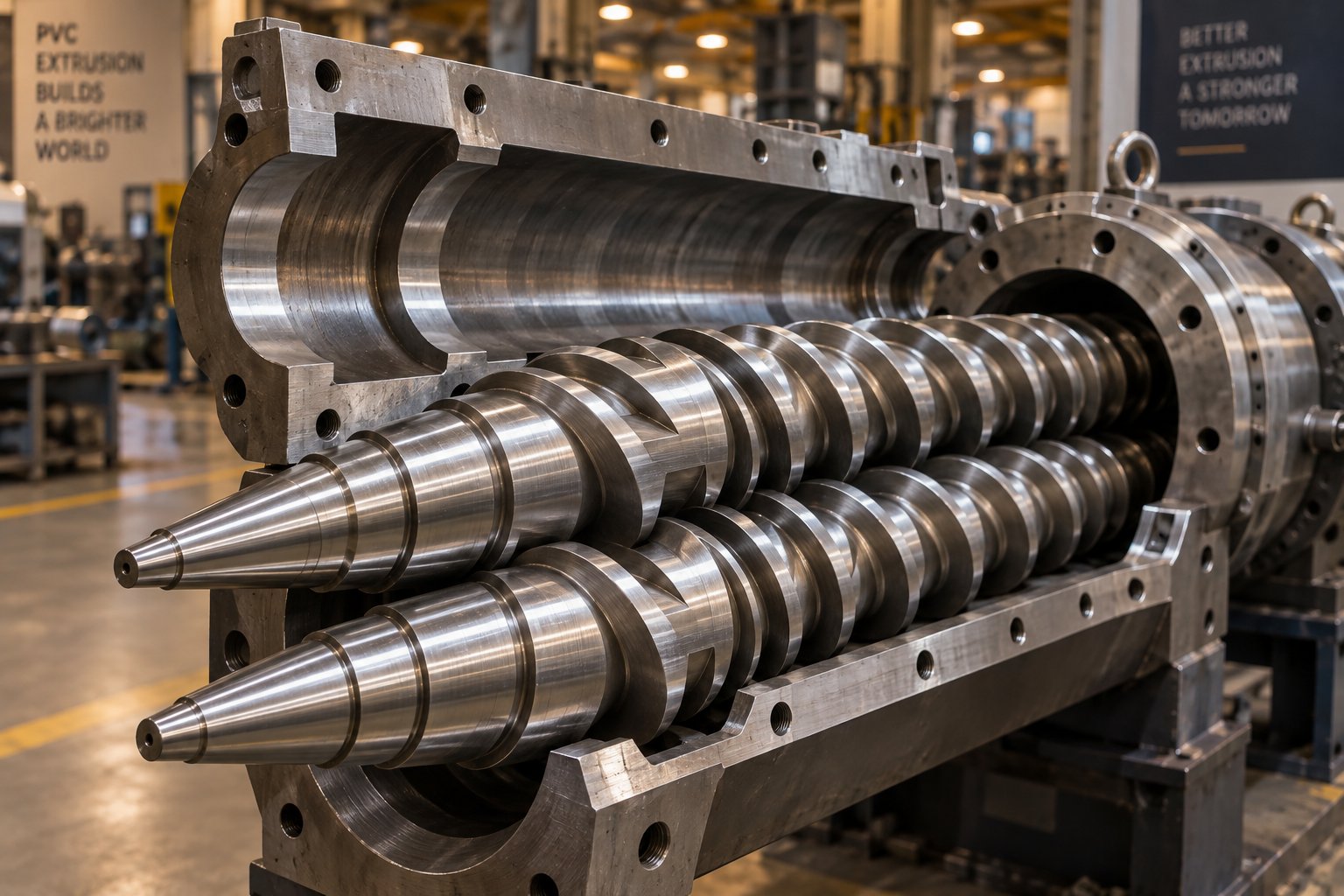
What Makes PVC Extrusion Screw Barrels Different From Standard Designs
Imagine running a PVC compound through a screw barrel originally designed for polyethylene. Within minutes, you'll notice brown streaks in the extrudate, a sharp chemical smell near the die, and a melt that looks anything but uniform. The equipment isn't broken — it's simply wrong for the job.
What Is an Extruder Screw Barrel for PVC
An extruder screw barrel for PVC is a purpose-built assembly consisting of three core components: a rotating screw (or pair of screws), a cylindrical barrel with a wear-resistant liner, and a series of precisely controlled heating and cooling zones along the barrel's length. Together, these elements convey PVC dry blend or granules from the feed throat, gradually fuse the compound through a combination of conducted heat and controlled friction, and deliver a homogeneous melt to the die under consistent pressure.
Every section of the screw — the feed zone, compression zone, and metering zone — must be engineered around PVC's specific thermal and rheological behavior. Unlike polyolefins such as PE or PP, which tolerate a broad range of processing temperatures and aggressive shear input, PVC demands a far more deliberate approach. The screw barrel isn't just hardware; it's the single most critical factor determining whether PVC fuses properly or degrades catastrophically.
PVC's unique chemistry — its thermal sensitivity, corrosive byproducts, and shear sensitivity — means generic extruder screws and barrels designed for PE or PP will cause resin degradation, poor fusion, and accelerated equipment wear.
Why PVC Cannot Use Standard Polyolefin Screw Designs
Three fundamental differences separate PVC from standard polyolefins, and each one directly shapes how the screw barrel must be designed.
First, PVC has a dangerously narrow processing temperature window. The gap between the temperature needed for proper fusion and the temperature that triggers decomposition is far smaller than what you'd encounter with PE or PP. Polyolefins can absorb substantial heat energy — roughly three times more specific energy input than PVC — without risk of chemical breakdown. PVC offers no such margin for error.
Second, when PVC overheats, it doesn't simply soften unevenly or discolor slightly. It chemically decomposes and releases hydrochloric acid (HCl) gas — a corrosive byproduct that attacks metal surfaces inside the barrel and on screw flights. This reaction doesn't just ruin the product; it eats away at the equipment itself.
Third, PVC is highly shear-sensitive. Aggressive screw geometry — deep channels, high compression ratios, fast transitions — generates excessive frictional heat that pushes the melt past its safe limit. A counter-rotating twin screw design operating at lower RPM is the industry standard precisely because it delivers positive displacement and uniform mixing without the dangerous shear spikes a conventional single-screw polyolefin setup would create.
These three constraints — thermal sensitivity, corrosive degradation byproducts, and shear sensitivity — make screw geometry, barrel metallurgy, and temperature zoning decisions far more consequential for PVC than for any other commodity thermoplastic. Get any one of them wrong, and the result is burned resin, premature equipment failure, or both.
The real question, then, isn't whether your screw barrel matters — it's whether the design accounts for exactly how PVC behaves under heat and pressure inside that barrel.
Understanding PVC's Thermal Sensitivity and Degradation Risks
PVC doesn't give you a second chance. Polyethylene and polypropylene can absorb sloppy temperature control and still produce a usable part. PVC punishes every degree of excess heat with irreversible chemical breakdown — and the consequences extend far beyond a rejected product.
PVC's Narrow Processing Temperature Window
Most rigid PVC formulations require melt temperatures between roughly 160°C and 200°C. That sounds like a reasonable range until you compare it to polyolefins, which can tolerate processing windows two to three times wider. With PVC, the gap between the temperature needed for proper fusion and the onset of thermal decomposition is razor-thin — sometimes as little as 10–15°C depending on the stabilizer package and formulation.
What does this mean in practice? Every heating zone along the extruder feed barrel must deliver gradual, tightly controlled heat input. A spike in just one zone — or a thermocouple that drifts out of calibration — can push the melt past its safe limit. Barrel temperature profiles for PVC typically ramp slowly through the feed and compression sections, then hold steady or even decrease slightly toward the metering end to prevent accumulated heat from crossing the degradation threshold.
HCl Release and Its Impact on Barrel and Screw Longevity
When PVC overheats, it doesn't merely soften unevenly. It undergoes dehydrochlorination — a chemical reaction where chlorine atoms strip away from the polymer chain, releasing hydrochloric acid gas. Research on PVC pyrolysis confirms that this first-stage decomposition is dominated by HCl release, with nearly all chlorine content separating from the polymer at relatively moderate temperatures.
HCl gas is intensely corrosive. It attacks the inner surfaces of the barrel liner, pits screw flight edges, and erodes metal components throughout the system. Even small, repeated episodes of localized degradation — from a stagnant melt pocket or a worn section allowing extended residence time — generate enough HCl to accelerate wear far beyond what abrasion alone would cause. This corrosive mechanism is why every extruder screw and barrel designed for PVC must use specialized metallurgy and surface treatments that resist acid attack.
How Shear Sensitivity Constrains Screw Design
Here's where PVC processing gets especially tricky. Frictional heat generated by the rotating extrusion screw can easily exceed the heat supplied by barrel heaters — and unlike conducted heat, shear-generated heat is difficult to remove quickly. Aggressive screw geometry with deep channels and high compression ratios creates intense localized shearing that spikes melt temperature well above what the barrel thermocouples report.
PVC screws must therefore use shallower compression ratios, typically around 1.6:1 to 2.0:1, compared to the 2.5:1 to 3.5:1 range common in polyolefin designs. Gentler transitions between zones and reduced flight depths limit the mechanical energy converted into heat. The goal is to fuse PVC through controlled conduction rather than brute-force friction — a fundamentally different plasticizing philosophy than what works for PE or PP.
- Thermal sensitivity: A narrow 160–200°C processing window leaves almost no margin between proper fusion and decomposition.
- Corrosive byproducts: Dehydrochlorination releases HCl gas that aggressively attacks barrel liners and screw surfaces.
- Shear sensitivity: Excessive mechanical energy from aggressive screw geometry causes localized overheating that barrel cooling cannot compensate for quickly enough.
Each of these challenges individually demands careful engineering. Together, they dictate very specific screw geometry parameters — L/D ratios, compression ratios, flight depths, and channel designs — that differ substantially from anything used in polyolefin extrusion.
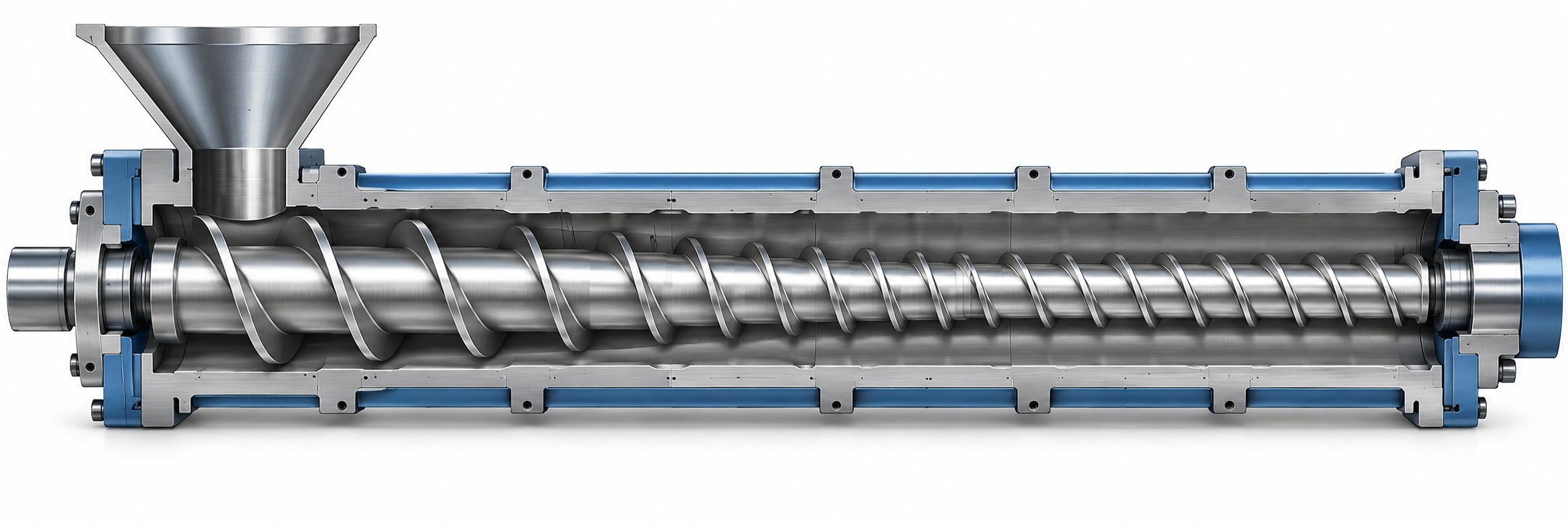
Critical Screw Geometry Parameters Optimized for PVC Processing
Those three constraints — thermal sensitivity, corrosive byproducts, and shear sensitivity — aren't abstract chemistry lessons. They translate directly into hard numbers: specific L/D ratios, compression ratios, flight depths, and channel dimensions that a plastic extruder screw must hit to process PVC safely. Miss any of these targets, and you're back to burned resin and premature wear. Let's break down exactly what the geometry should look like.
Recommended L/D Ratios for PVC Screw Design
The length-to-diameter (L/D) ratio is one of the first specifications that separates a PVC-grade screw from a general-purpose polyolefin design. Why does it matter so much? A longer screw means more residence time inside the barrel — and for a material that degrades within seconds of exceeding its safe temperature, every additional moment counts against you.
Conical twin screw systems, the dominant configuration for rigid PVC pipe and profile, typically operate with effective L/D ratios in the range of 22:1 to 26:1. The tapered geometry naturally provides high feed capacity at the large-diameter inlet while compressing material progressively toward the smaller-diameter discharge end. That taper does double duty: it limits residence time while still delivering thorough plasticizing.
Parallel twin extruder screws tell a different story. Because their diameter remains constant along the full length, designers historically relied on shorter L/D ratios around 20:1. Industry trends have pushed that figure considerably higher. As polymer engineering specialist Shayan Moin notes, parallel twin screws have evolved from roughly 20 L/D three decades ago to 40 L/D in many current configurations — a shift driven by the demand for higher throughput and better melt homogeneity. Extending parallel screws from 32 L/D to 34–35 L/D alone can boost production output by as much as 25%, provided the gearbox has sufficient energy density.
Single screw configurations for PVC tend to fall in the 24:1 to 30:1 range, though they are far less common for rigid formulations. The critical takeaway? Regardless of screw type, the L/D ratio must balance two competing goals: enough length to achieve full fusion and homogeneous melt quality, but not so much that extended residence time invites thermal degradation.
Compression Ratio and Flight Depth for Shear-Sensitive PVC
Compression ratio — the relationship between the channel depth in the feed zone and the channel depth in the metering zone — controls how aggressively material is compacted and sheared as it moves through the screw. For polyolefins like PE and PP, compression ratios of 2.5:1 to 4.0:1 are standard. Those aggressive ratios generate heavy frictional heat, which polyolefins absorb without consequence.
PVC cannot tolerate that level of mechanical energy input. A typical screw plastic extruder designed for rigid PVC uses compression ratios between 1.6:1 and 2.5:1 — significantly gentler than polyolefin designs. Flexible PVC formulations, which contain plasticizers that act as internal lubricants, can sometimes handle slightly higher ratios, but the ceiling remains well below what PE or PP processing demands.
Flight depth plays a directly related role. Deeper channels in the feed zone accommodate PVC's low bulk density powder, while shallower metering-zone channels deliver the controlled shear needed for final homogenization. The transition between these depths must be gradual. Abrupt depth changes create sudden pressure spikes — and as GermanTwinscrewS CEO Ernest Kruger explains, "wear is the result of sudden increases of pressure in most cases, which causes some melt turbulence that damages the screw." A smooth, continuous compression profile eliminates these localized stress points, extending screw life while protecting melt quality.
Helix Angle and Channel Design Considerations
Beyond compression ratio and flight depth, three additional geometry factors determine how efficiently a plastic extruder screw conveys and plasticizes PVC: flight width, helix angle, and channel depth-to-width ratio.
Flight width — the thickness of the screw flight measured along the barrel axis — affects both conveying capacity and the shear applied to material pressed between the flight tip and the barrel wall. Wider flights increase shearing action. For PVC, narrower flights are generally preferred to minimize frictional heat generation while maintaining adequate pumping pressure.
Helix angle, the angle of the screw flight relative to a plane perpendicular to the screw axis, directly influences conveying rate and the residence time of material in each zone. Standard square-pitch designs (where pitch equals diameter) produce a helix angle of approximately 17.66°. Adjusting this angle changes the balance between forward conveyance and shear input. PVC applications benefit from configurations that favor efficient forward transport over aggressive mixing.
Channel depth and width together determine the screw's volumetric capacity and the shear rate experienced by the melt. As NC State Extension research on screw profile design confirms, decreasing either channel depth or width increases the shear input to the material — a critical consideration when processing a shear-sensitive polymer like PVC.
Here's where formulation complexity enters the picture. PVC compounds loaded with high percentages of mineral fillers — calcium carbonate at 100 PPH or even 150 PPH in some pipe applications, or titanium dioxide in profile and sheet products — behave very differently from unfilled compounds. Filled formulations have higher melt viscosity and require deeper channels to prevent excessive pressure buildup. Unfilled or lightly filled PVC compounds, by contrast, flow more easily and can use shallower channel geometries for tighter shear control. Matching channel design to the specific filler type and loading level isn't optional — it's essential for preventing both degradation and premature wear of your extruder screws.
| Parameter | PVC (Rigid) — Conical Twin | PVC (Rigid) — Parallel Twin | PVC — Single Screw | General-Purpose Polyolefin (PE/PP) |
|---|---|---|---|---|
| L/D Ratio | 22:1 – 26:1 | 30:1 – 40:1 | 24:1 – 30:1 | 24:1 – 36:1 |
| Compression Ratio | 1.6:1 – 2.2:1 | 1.8:1 – 2.5:1 | 1.8:1 – 2.5:1 | 2.5:1 – 4.0:1 |
| Feed Zone Flight Depth | Deep (accommodates low-bulk-density powder) | Deep | Moderate to deep | Moderate |
| Metering Zone Flight Depth | Shallow (controlled shear) | Shallow to moderate | Shallow | Shallow (high shear acceptable) |
| Compression Transition | Gradual taper (inherent to conical design) | Gradual, continuous | Gradual | Can be abrupt |
| Preferred Flight Width | Narrower (reduced shear) | Narrower | Narrower | Standard to wider |
Note: Specific values vary by formulation, output requirements, and equipment manufacturer. Always consult your screw barrel supplier for recommendations tailored to your exact PVC compound and production conditions.
Getting these geometry parameters right is only half the equation. Even a perfectly designed screw profile will fail prematurely if the barrel liner and screw surface can't withstand the corrosive HCl and abrasive fillers that PVC processing throws at them — which raises an entirely different set of material selection decisions.
Screw Barrel Materials and Surface Treatments for PVC Resistance
A perfectly optimized screw geometry means nothing if the metal underneath can't survive what PVC throws at it. HCl gas gnaws at barrel surfaces from the inside. Calcium carbonate and titanium dioxide fillers grind down flight edges like fine sandpaper running at high speed. Choosing the right metallurgy for your extruder barrel isn't a luxury — it's the difference between years of reliable service and a catastrophic failure that shuts down a production line.
Nitrided Steel Barrels and Their Role in PVC Corrosion Resistance
Gas nitriding is the baseline surface-hardening process used for many extruder barrels. During nitriding, nitrogen atoms diffuse into the steel surface at elevated temperatures, forming a hard compound layer that resists both wear and mild corrosion. The most common substrate is 38CrMoAlA nitriding steel, which is widely used across standard extrusion and injection molding applications.
Typical nitriding depths range from 0.3 mm to 0.7 mm, creating a surface hardness of roughly 900–1100 HV. For processing virgin PVC with low filler content and a well-stabilized formulation, a properly nitrided extrusion barrel can deliver acceptable service life at a reasonable cost. You'll find nitrided barrels performing well in many flexible PVC applications where filler percentages stay modest and degradation risks remain controlled.
The limitation? That hardened layer is thin. Once abrasive fillers wear through it, the softer base steel beneath erodes rapidly. And nitriding offers only moderate resistance to the hydrochloric acid that PVC degradation generates. For rigid PVC compounds — especially those loaded with mineral fillers running at high output rates — nitriding alone often falls short. That's where bimetallic construction becomes essential.
Bimetallic Alloy Options Ranked by PVC Suitability
A bimetallic extruder barrel features a wear-resistant alloy liner centrifugally cast inside the barrel bore. Unlike nitriding, which modifies the existing steel surface, bimetallic construction adds a distinct alloy layer — typically 1.5 mm to 3.0 mm thick — that can be specifically selected for the dominant wear mechanism in your application.
Not all bimetallic liners are equal for PVC. The alloy family matters enormously because PVC presents a dual challenge: corrosive attack from HCl gas and abrasive wear from fillers. Some alloys excel at one but fail at the other. Requesting "bimetallic" without specifying the alloy is like ordering "metal" without naming the grade — you might get exactly the wrong material for your conditions.
Here's how the major alloy families stack up for PVC processing:
| Alloy Family | Corrosion Resistance (HCl) | Abrasion Resistance | Recommended PVC Application |
|---|---|---|---|
| Nickel-Based (e.g., Hastelloy, Inconel-type alloys) | Excellent | Moderate | Unfilled or lightly filled rigid PVC where HCl corrosion is the primary wear driver |
| Nickel-Boron with Tungsten Carbide Matrix | Very Good | Excellent | Highly filled rigid PVC (high CaCO3 or TiO2) requiring both corrosion and abrasion protection |
| Cobalt-Based (e.g., Stellite-type alloys) | Good | Very Good | Moderately filled PVC compounds; good general-purpose PVC choice |
| Iron-Based (e.g., high-chrome white iron alloys) | Fair | Very Good | Budget-conscious PVC lines with moderate corrosion risk; better suited for polyolefins than PVC |
| Tungsten Carbide in Nickel Matrix (HIP barrels) | Excellent | Excellent | Premium PVC processing; highest protection level for corrosive and abrasive conditions simultaneously |
Among these options, nickel-based alloys stand out for PVC because of their inherent resistance to the acids PVC produces. As Plastics Technology notes, nickel-rich alloys such as Hastelloy, Inconel, and Monel "are not affected by the acids" generated during processing of corrosive polymers. HIP (hot isostatic pressing) barrels represent the top tier — their nickel-rich boron alloy layer containing molybdenum with a matrix of borides and carbides provides outstanding protection against both HCl corrosion and filler abrasion simultaneously, though at a significantly higher price point.
Iron-based liners, while cost-effective for polyolefin extruder barrels, offer only fair resistance to hydrochloric acid. They can work for short-run PVC applications or tightly budgeted operations, but you'll likely see faster bore wear and more frequent replacement intervals compared to nickel-based alternatives.
Screw Surface Treatments and Coatings
While the barrel liner protects the bore, the screw itself is equally exposed to HCl attack and filler abrasion. Screw surface treatments must be chosen based on which wear mechanism dominates in your specific PVC formulation.
The three most common approaches are:
- Hard chrome plating: A thin, hard electroplated layer that provides a smooth, low-friction surface with moderate corrosion resistance. Chrome plating works well for unfilled or lightly filled PVC where surface smoothness and release properties matter most. However, as the reference material from Plastics Technology cautions, even small holes, chips, or cracks in plating can expose the base metal to acid attack. Chrome plating is also not recommended for highly corrosive applications like fluoropolymer processing, and the same caution applies to PVC lines experiencing frequent degradation events.
- Tungsten carbide thermal spray coatings (HVOF): High-velocity oxy-fuel sprayed tungsten carbide coatings deliver exceptional hardness and abrasion resistance. These coatings are the preferred choice when processing heavily filled PVC compounds where CaCO3 or TiO2 at high loadings act as aggressive abrasives. The coating bonds mechanically and metallurgically to the screw surface, creating a dense, wear-resistant barrier that outlasts chrome plating by a significant margin in abrasive environments.
- PVD (Physical Vapor Deposition) coatings: Specialized PVD coatings such as titanium nitride (TiN) or chromium nitride (CrN) offer excellent surface hardness, corrosion resistance, and a very low friction coefficient. These thin-film coatings are particularly useful on screw flights where both corrosion protection and reduced material adhesion are needed. PVD coatings can complement other treatments — for instance, a nitrided base screw with PVD-coated flight tips combines baseline hardness with superior surface performance.
The decision framework is straightforward. When HCl corrosion is the primary threat — as with unfilled or lightly filled rigid PVC — prioritize nickel-based alloy liners on the barrel side and chrome or PVD coatings on the screw. When abrasive filler wear dominates — think PVC pipe compounds loaded with 50+ PHR of calcium carbonate — shift toward tungsten carbide liners and HVOF-coated screws. Many real-world PVC operations face both mechanisms simultaneously, which is exactly why dual-protection strategies combining a corrosion-resistant barrel liner with an abrasion-resistant screw coating often deliver the best total service life.
Selecting the right materials for your screw and barrel surfaces is a critical investment decision, but it's not the only architecture choice that shapes PVC processing performance. The fundamental extruder configuration — conical twin, parallel twin, or single screw — determines how all these material and geometry decisions come together in practice.
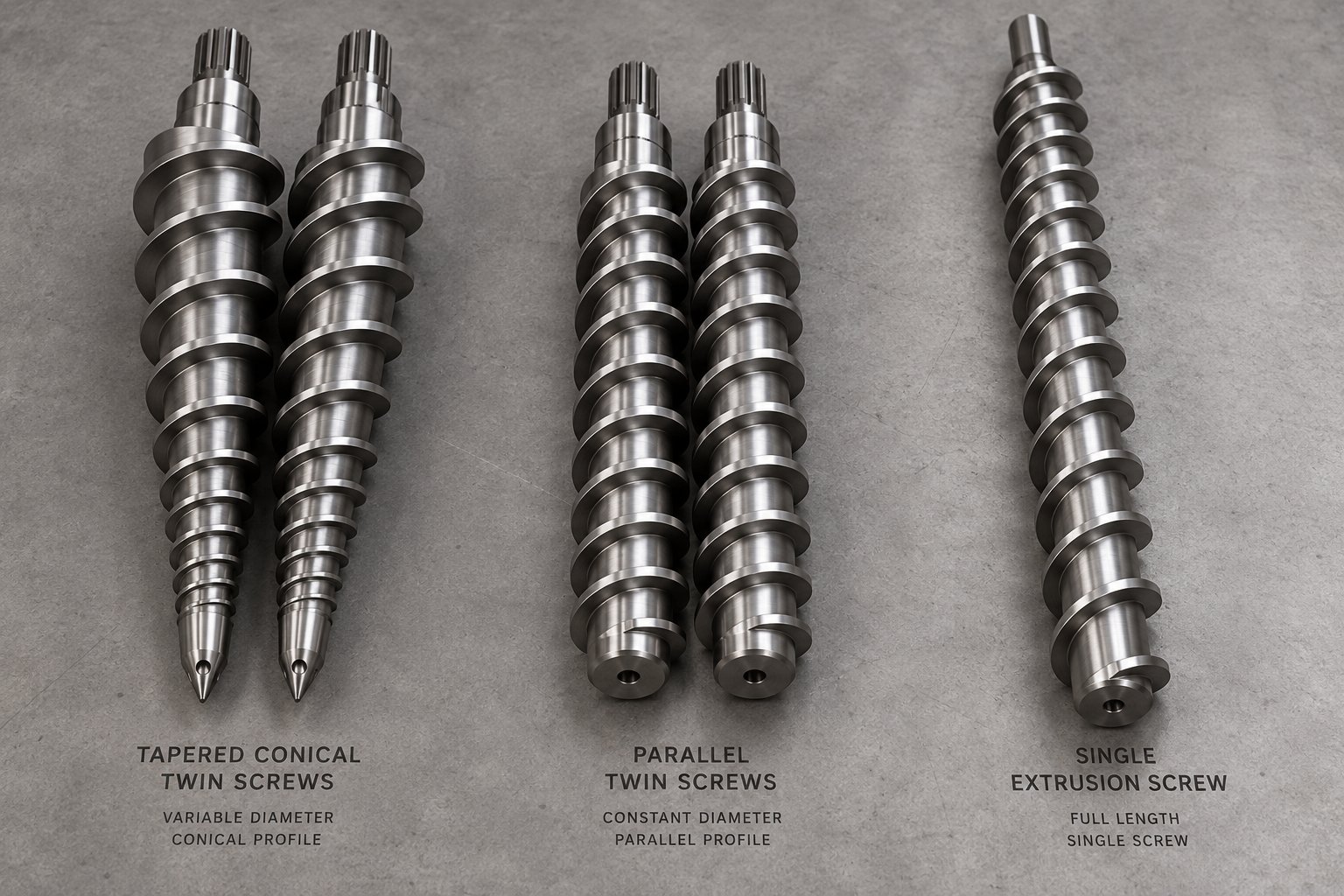
Conical Twin Screw vs. Parallel Twin Screw vs. Single Screw for PVC
Barrel metallurgy and screw coatings protect against what PVC does to your equipment — but the extruder architecture you choose determines how PVC behaves inside that equipment in the first place. Three configurations dominate the market, and each one handles PVC's thermal sensitivity, shear demands, and output requirements very differently. Picking the wrong platform means fighting the machine on every production run.
Conical Twin Screw Barrels for PVC Pipe and Profile
Picture two screws that taper from a large diameter at the feed end down to a smaller diameter at the discharge. That taper is the defining feature of a conical twin screw barrel, and it's the reason this design dominates rigid PVC processing worldwide.
The large inlet diameter provides generous feeding capacity — essential when you're handling low-bulk-density PVC dry blend powder. As material advances toward the smaller discharge end, the gradually decreasing channel volume creates progressive compression. This means intensive plasticizing happens in the compression zone, while shear naturally reduces toward the metering end where PVC is most vulnerable to overheating. The result is a gentle, controlled fusion process that keeps melt temperature within PVC's narrow safe window.
Counter-rotating conical twins also deliver positive displacement conveying, which translates to consistent output pressure with minimal backflow. You'll find these systems running the vast majority of rigid PVC pipe, window profile, sheet, and board extrusion lines around the world. Manufacturers like NANHAIYA build purpose-engineered conical twin screw and barrel systems specifically for PVC pipe, profile, board, foam board, and WPC extrusion — focusing on stable plasticizing performance with custom and replacement barrel solutions that match the exact demands of each application.
The trade-off? Conical designs have a fixed screw profile. Once manufactured, the geometry cannot be reconfigured for different materials. And as Rollepaal's engineering team explains, conical machines cannot easily be made longer to increase output — their diameter must increase instead, which limits scalability at higher throughput targets. The processing window can also be relatively narrow; achieving optimal gelation while effectively venting air sometimes requires careful compromise.
Parallel Twin Screw Systems for Compounding and Specialty PVC
Parallel twin screw extruders take a fundamentally different approach. Two screws of identical diameter run side by side along the full barrel length, and they can be configured as either co-rotating or counter-rotating.
Co-rotating parallel twins excel at compounding. Their intermeshing, self-wiping design delivers intense distributive and dispersive mixing — exactly what you need when blending PVC with impact modifiers, stabilizer packages, pigments, or high loadings of mineral fillers. The modular screw design is a major advantage here. Imagine building with blocks: you can rearrange conveying elements, kneading blocks, and mixing sections along the shaft to fine-tune the screw profile for each specific formulation.
Counter-rotating parallel twins, meanwhile, serve a middle ground between conical machines and co-rotating systems. They provide positive displacement similar to conical designs but with greater freedom in screw length. Advances in FEM-based gearbox design have dramatically improved parallel twin reliability, and these machines can be extended — stretching from 22D to 33–36D, for example — by lengthening the barrel sections to boost output while maintaining similar processing conditions.
For larger pipe diameters and higher-volume PVC production, parallel configurations are increasingly favored because they offer a wider processing window and more flexibility in screw design for optimal melt quality.
Single Screw Options and Their Limitations With PVC
Can a single screw extruder process PVC? Yes — but with significant caveats. Single screw extruders lack the positive displacement and self-wiping action that twin screw barrel systems provide. This means PVC dry blend, which doesn't melt in a clean, well-defined manner like polyolefin pellets, can create inconsistent conveying and poor plasticizing uniformity.
To make single screw extruders work with PVC, engineers must incorporate specialized features: barrier screws that separate solid and molten PVC into distinct channels, dedicated mixing sections to improve melt homogeneity, and carefully calibrated compression profiles that avoid shear spikes. Even with these modifications, single screw configurations are generally limited to flexible PVC applications — think garden hose, cable insulation, and medical tubing — or lower-output rigid PVC lines where the capital cost of twin screw extruders isn't justified.
The absence of intermeshing, self-cleaning action also creates a practical risk. Dead spots where PVC can stagnate and degrade are harder to eliminate in a single screw channel, making burn marks and discoloration more likely if operating parameters aren't tightly managed.
| Criteria | Conical Twin Screw | Parallel Twin Screw | Single Screw |
|---|---|---|---|
| PVC Suitability | Excellent — purpose-built for rigid PVC | Very Good — ideal for compounding; growing in direct extrusion | Limited — requires specialized screw design |
| Output Range | Low to moderate (scalability limited by taper geometry) | Moderate to high (extendable barrel length) | Low to moderate |
| Shear Control | Excellent — natural shear reduction toward discharge | Good — adjustable via modular screw elements | Fair — harder to manage without barrier designs |
| Mixing Capability | Good — adequate for most rigid PVC formulations | Excellent — superior distributive and dispersive mixing | Moderate — requires added mixing sections |
| Screw Profile Flexibility | Fixed — cannot be reconfigured after manufacture | High — modular elements allow profile changes | Fixed |
| Typical PVC Applications | Pipe, profile, window frame, sheet, board, foam board, WPC | PVC compounding, large-diameter pipe, specialty formulations | Flexible PVC tubing, cable insulation, low-volume rigid PVC |
Choosing the right extruder architecture is a foundational decision, but the story doesn't end there. A conical twin screw barrel running PVC pipe needs different specifications than one producing foam board or wood-plastic composite — and those product-specific differences in screw geometry, temperature profiling, and wear resistance are exactly where many processors leave performance on the table.
How Screw Barrel Requirements Vary Across PVC Product Types
Most PVC processing guides treat the material as though every formulation behaves the same way inside a barrel extruder. In reality, the screw and barrel specifications that keep a PVC pipe line running smoothly can cause serious problems on a foam board or WPC extrusion line. Filler type, filler loading, foaming agents, recycled content — each variable reshapes what the screw geometry and barrel metallurgy must deliver. If you're specifying components based on "PVC" alone, you're almost certainly leaving quality, throughput, or equipment life on the table.
PVC Pipe and Fitting Extrusion Requirements
Pipe extrusion is arguably the most demanding rigid PVC application when it comes to melt homogeneity. Imagine a pressure-rated water pipe with even a small zone of under-fused material — that weak spot becomes a failure point under sustained hydraulic pressure. Every millimeter of the pipe wall must have uniform gelation and consistent molecular entanglement.
What does this mean for the screw extruder? The screw profile needs to deliver exceptionally uniform melt temperature across the entire cross-section of the melt stream, with minimal variation from the channel center to the barrel wall. Barrel temperature profiles in pipe extrusion typically follow a carefully staged ramp — gradually increasing through the feed and compression zones, then holding steady or decreasing slightly toward the die to prevent localized overheating at the discharge end.
Pipe formulations frequently contain calcium carbonate filler at loadings ranging from 5 PHR for pressure-rated pipe to 100 or even 150 PHR in some non-pressure applications. Those high filler loadings dramatically increase abrasive wear on screw flights and extrusion barrels, making bimetallic barrel liners and tungsten carbide screw coatings essential for maintaining acceptable service life. Consistent output pressure is equally critical — any pulsation from the screw translates directly into wall thickness variation in the finished pipe.
PVC Profile and Window Frame Extrusion Demands
Profile extrusion flips the priority. Where pipe demands uniform wall thickness under pressure, window and door profiles demand dimensional precision across complex, multi-chamber cross-sections. A window profile might feature thin walls, hollow chambers, and reinforcement slots — all of which require the melt to flow evenly through intricate die geometries without variation in viscosity or temperature.
That places extraordinary demands on the screw's mixing capability. Even slight melt-temperature differences across the melt stream will cause differential die swell and uneven flow rates through the die's multiple channels. The result? Warped profiles, inconsistent wall thicknesses, and dimensional rejects. Screw designs for profile extrusion often incorporate enhanced mixing elements or additional flights near the discharge to improve melt uniformity before the compound enters the die.
Profile formulations also differ from pipe compounds. They typically include impact modifiers, UV stabilizers, and TiO2 pigment for white coloration — additives that must be thoroughly distributed throughout the melt. Poor distributive mixing from a worn screw shows up as color streaks, surface imperfections, or inconsistent impact strength across the profile's cross-section.
PVC Sheet, Foam Board, and WPC Extrusion Considerations
Foam PVC and wood-plastic composite (WPC) extrusion introduce challenges that neither pipe nor profile processing fully prepares you for. Both applications push screw barrel systems harder in ways that compound wear and degrade process control simultaneously.
Foam PVC relies on chemical blowing agents — compounds that decompose at specific temperatures to generate gas cells within the PVC matrix. Here's the catch: if the screw generates too much shear heat or the barrel temperature profile overshoots by even a few degrees, the blowing agent activates prematurely. The result is uneven cell structure, collapsed foam, or surface blistering. Precise temperature control through every barrel zone is non-negotiable, and screw geometry must minimize frictional heat spikes that barrel cooling cannot correct quickly enough.
WPC extrusion presents an entirely different threat. Wood fiber and wood flour are intensely abrasive — far more aggressive than calcium carbonate at equivalent loadings. These natural fibers also absorb moisture, which generates steam inside the barrel and accelerates both corrosive and hydrolytic degradation of PVC. Extrusion barrels on WPC lines wear significantly faster than those on standard rigid PVC lines, and processors frequently report screw replacement intervals as short as one to one-and-a-half years when running highly abrasive formulations. Premium bimetallic liners with tungsten carbide matrices and HVOF-coated screws aren't just recommended for WPC — they're practically mandatory for any operation expecting reasonable uptime.
Recycled and Reground PVC Processing Challenges
Recycled PVC streams throw every variable into play at once. When you're processing post-consumer or post-industrial regrind, you're dealing with material that has already been through at least one heat history — meaning its stabilizer package is partially consumed, its molecular weight distribution has shifted, and its remaining thermal stability is reduced. The margin between successful re-fusion and degradation shrinks dramatically.
Contamination compounds the problem. Metal fragments, incompatible polymers, paper labels, and inconsistent filler content all appear in recycled PVC streams. Metal contaminants gouge barrel walls and screw flights. Incompatible polymers create stagnation zones and die buildup. Batch-to-batch variation in filler content means the wear mechanism changes unpredictably — one batch might be mildly abrasive, the next aggressively so.
For recycled PVC, robust material selections for both barrel liners and screw surfaces are essential. Nitrided barrels that perform adequately on virgin PVC often fail prematurely when exposed to the variable corrosion and abrasion loads that regrind introduces. Processors handling significant recycled content should budget for bimetallic barrels with nickel-based or tungsten carbide liners as standard rather than optional upgrades.
- PVC pipe and fittings: Prioritize melt homogeneity, consistent output pressure, and abrasion-resistant barrel liners for high-filler formulations.
- PVC profile and window frames: Focus on superior mixing capability, minimal melt-temperature variation, and screw designs that ensure thorough additive distribution.
- PVC foam board: Demand precise temperature control across all barrel zones and low-shear screw geometry that prevents premature blowing agent activation.
- WPC extrusion: Specify premium wear-resistant barrel liners and screw coatings to withstand aggressive abrasion from wood fiber content.
- Recycled and reground PVC: Select robust bimetallic barrels and hardened screw surfaces to handle variable contamination, inconsistent filler loads, and reduced thermal stability.
Each of these applications places unique stresses on screw and barrel components — stresses that accumulate over weeks and months of continuous operation. Recognizing which wear patterns develop in your specific PVC product line, and knowing when that wear has crossed the threshold from manageable to production-threatening, is the next critical skill that separates proactive maintenance from costly emergency shutdowns.
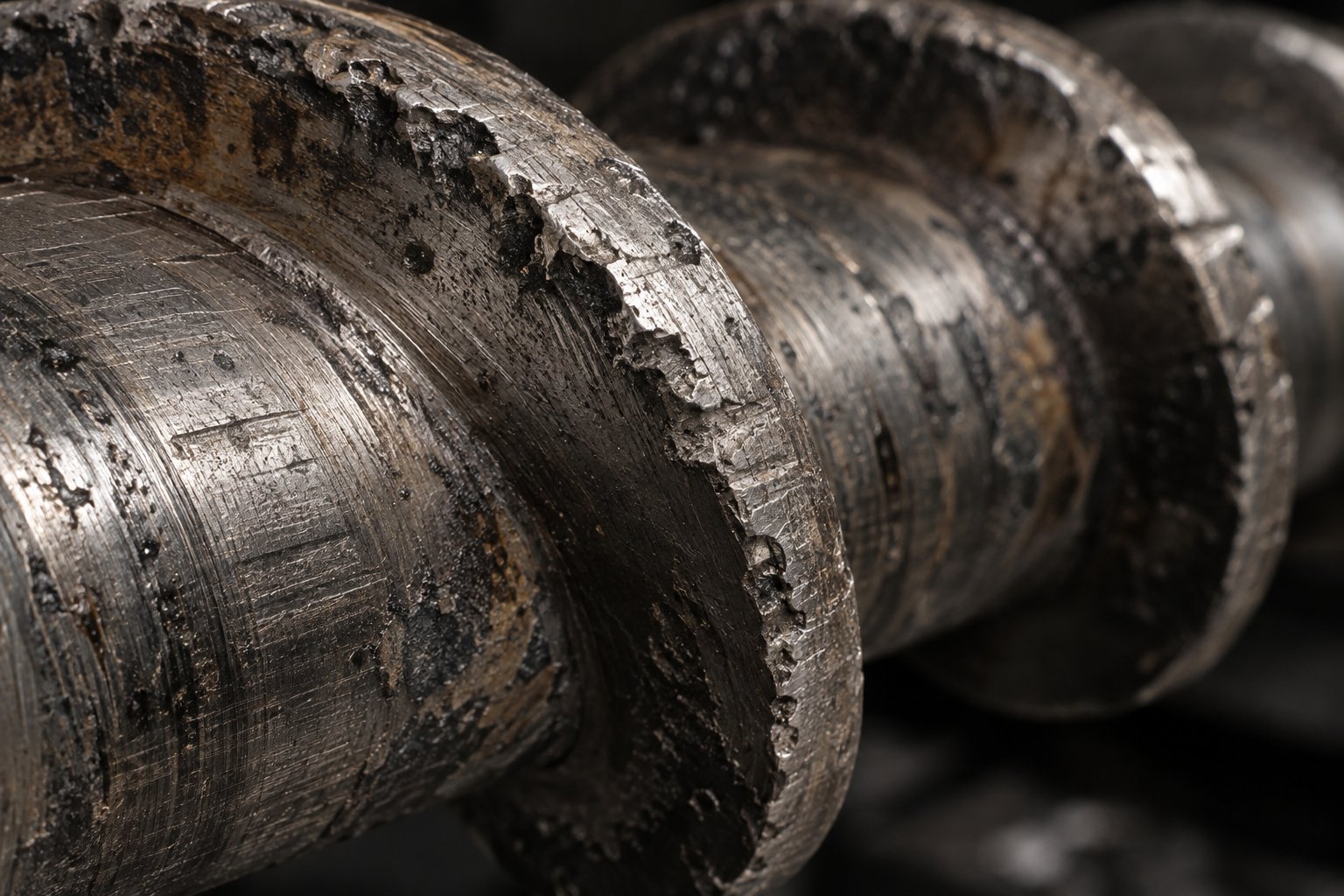
Wear Patterns and Failure Modes Specific to PVC Screw Barrels
Wear doesn't announce itself with alarms and flashing lights. It creeps in — a fraction of a millimeter here, a shallow pit there — until one morning your operator notices the output has dropped, the melt temperature has climbed, and there are brown specks showing up in finished product. By that point, the damage inside your screw and barrel has been building for weeks or months. Knowing what to look for, and when to act, can mean the difference between a planned replacement and an emergency shutdown that costs far more than the parts themselves.
Corrosive Wear From HCl Attack on Barrel Liners
Corrosion from hydrochloric acid is the signature failure mode of PVC processing equipment. Even with well-stabilized formulations and properly managed barrel temperatures, trace amounts of HCl are always present during PVC extrusion. Every minor degradation event — a momentary temperature spike, a stagnant melt pocket in a dead zone, or a feed interruption that extends residence time — generates additional acid that attacks exposed metal surfaces.
You'll recognize HCl corrosion by its distinctive appearance. Instead of the smooth, polished look that abrasive wear leaves behind, corrosive attack produces small craters and pitting scattered across the barrel bore and screw flight surfaces. These pits are deceptive. They may look minor during a visual inspection, but each one acts as a trap where PVC melt can stagnate, degrade further, and release more HCl — creating a self-accelerating cycle of damage. As factory-level failure analysis confirms, visible pitting on a barrel bore generally means the part needs replacing before it fails catastrophically.
Dimensionally, corrosive wear often appears uneven. Rather than a uniform increase in bore diameter, you'll measure localized enlargement concentrated in areas where melt temperature runs highest or where the screw geometry creates zones of extended material residence. The compression-to-metering transition zone is a frequent hot spot because this is where PVC experiences the highest thermal stress and is most likely to release HCl gas.
Abrasive Wear From PVC Fillers and Additives
Corrosion may be the more chemically dramatic failure mode, but abrasive wear is often the faster killer — especially on lines running heavily filled rigid PVC. Calcium carbonate, titanium dioxide, and silica impurities in lower-grade CaCO3 act as microscopic cutting tools, progressively grinding down screw flight tips and widening the clearance between the screw outer diameter and the barrel wall.
The wear rate is proportional to filler hardness, particle size, loading percentage, and screw RPM. Maintenance data from WPC and SPC extrusion lines shows that CaCO3 loadings above 30 PHR can reduce screw and barrel service life by 40–60%, while SPC flooring formulations with CaCO3 exceeding 200 PHR slash component life by 70–80%. Even processors who have moved from a used twin screw extruder to a newer machine often underestimate how rapidly filler-driven wear degrades the replacement components if the barrel metallurgy hasn't been upgraded to match the compound.
So how do you measure it? Two methods form the standard practice:
- Bore diameter measurement: Using a telescoping bore gauge or internal micrometer, measure the barrel bore at multiple points along its length and at several angular positions. Compare readings against the original bore specification. A bore diameter increase beyond 0.30–0.40 mm signals that the barrel is approaching its service limit; increases beyond 0.50–0.70 mm typically demand replacement.
- Screw flight diameter measurement: Pull the screw and measure the outer diameter of the flight tips with a micrometer at multiple positions along the screw length. As flights thin, the radial clearance between screw and barrel grows — and with it, the opportunity for melt backflow, reduced conveying efficiency, and inconsistent output.
Tracking these measurements quarterly — and plotting the trend over time — transforms guesswork into data. A typical conical twin screw barrel (SJZ 65/132) ships with a radial flight-to-barrel clearance of 0.15–0.25 mm per side. When that clearance grows to 0.40–0.50 mm, performance is already declining. At 0.55–0.65 mm, replacement becomes unavoidable.
Recognizing When Screw Barrel Clearance Demands Replacement
Dimensional measurements tell you what's happening inside the barrel — but on a running production line, the first signs of excessive wear usually show up as performance symptoms long before anyone pulls the screw for inspection. The challenge is recognizing these symptoms for what they are, rather than masking them with process adjustments that only buy time.
As Plastics Technology documents, operators facing gradual wear tend to compensate by increasing screw speed, adjusting barrel temperatures, or raising backpressure. These incremental tweaks often go unnoticed until they dramatically impact part quality or productivity — a point of diminishing returns where no further adjustment can compensate for the lost mechanical efficiency.
For PVC, the consequences are amplified. Raising screw speed to recover lost output also increases shear heat — pushing an already temperature-sensitive polymer closer to degradation. Increasing barrel temperature to improve fusion in a worn metering zone risks triggering HCl release. Every compensating adjustment available to the operator moves PVC closer to the edge of its processing window.
Here are the most reliable indicators that your screw and barrel clearance has crossed the threshold into production-threatening territory:
- Declining output at constant RPM: Widened clearance allows melt to flow backward over the screw flights rather than advancing toward the die, reducing net throughput even though the screw turns at the same speed.
- Rising melt temperature: Increased backflow and reduced conveying efficiency force the PVC to spend more time in the barrel, absorbing additional heat that pushes it toward degradation.
- Visible screw flight edge rounding: When you pull the screw, sharp flight edges that have been ground down into rounded profiles confirm significant abrasive material loss.
- Increasing energy consumption: The motor works harder against growing clearances and lost pumping efficiency, drawing more amperage at the same RPM setting — a trend that weekly motor load monitoring can catch early.
- Inconsistent product dimensions: Wall thickness variation in pipe, weight fluctuations in profile, or density inconsistencies in foam board all trace back to output surging caused by intermittent melt backflow through worn clearances.
The real danger isn't the wear itself — it's the delay between when wear begins affecting product quality and when someone identifies the root cause. Many processors chase downstream problems for weeks — adjusting die temperatures, changing calibrators, tweaking haul-off speeds — before anyone thinks to measure the screw and barrel. Recording baseline performance data when components are new, then tracking output, motor load, and melt temperature trends against those benchmarks, is the simplest way to catch wear early and plan replacement on your schedule rather than the machine's.
Worn clearances don't just reduce output and waste energy. They create the exact conditions — stagnation zones, extended residence time, uneven melt temperatures — that cause the PVC extrusion defects processors dread most: burn marks, poor fusion, surging, and plate-out. Connecting those defects directly back to screw and barrel condition is the troubleshooting step most operations miss entirely.
Troubleshooting PVC Extrusion Defects Caused by Screw and Barrel Wear
Here's a scenario most PVC processors know too well: brown specks appear in the extrudate, wall thickness starts drifting, and a waxy residue builds up on downstream tooling. The instinct is to adjust the die, change the calibration tank, or blame the raw material supplier. Nine times out of ten, the real culprit is sitting inside the barrel — worn screw flights, enlarged bore clearances, and stagnation zones that no amount of downstream tweaking can fix. Connecting specific product defects back to their screw and barrel root causes is the fastest way to stop chasing symptoms and start solving problems.
Burn Marks and Discoloration Linked to Barrel Dead Spots
Brown or black specks in rigid PVC extrudate are almost always degraded resin — tiny pockets of material that overheated and broke down chemically before being carried into the product stream. The question is where that degradation happened, and why.
When screw flights wear down and the radial clearance between the screw outer diameter and barrel wall increases, two things change simultaneously. First, the worn clearance allows PVC melt to leak backward over the flight tips instead of advancing toward the die. Second — and this is the part most operators miss — those widened gaps create stagnation zones where a thin film of PVC clings to the barrel wall and sits there, cooking. PVC doesn't need much encouragement to degrade. A few extra seconds of residence time in a 190°C zone is enough to trigger dehydrochlorination, turning a thin layer of resin into a charred, acid-releasing deposit.
These deposits don't stay put forever. As fresh melt flows past, shear forces periodically tear fragments loose, sweeping carbonized particles downstream and embedding them in the finished product as visible burn marks. The pattern is telling: if specks appear intermittently rather than continuously, you're likely looking at a dead spot that fills, degrades, and periodically sheds material. That's a hallmark of extruder screw wear issues rather than a formulation or temperature-setting problem.
Worn barrel surfaces compound the issue. Corrosive pitting from HCl attack creates micro-cavities that trap PVC melt in locations the screw can no longer sweep clean. As Jwell's analysis of PVC screw wear notes, most barrel wear concentrates above the vacuum port and in the metering section — precisely the areas where PVC spends the longest time at elevated temperatures. Once pitting establishes itself in these high-temperature zones, the barrel essentially manufactures its own contamination with every rotation of the screw.
Poor Fusion and Inconsistent Melt Temperature
Burn marks are visible and alarming, but under-plasticized PVC is a quieter, arguably more dangerous defect. A pipe or profile that looks fine on the surface but contains zones of poorly fused material will fail mechanically — sometimes catastrophically — under pressure or impact loading. And worn screw and barrel components are a leading cause.
Think about what happens when flight tips lose their sharp edges and the screw-to-barrel seal degrades. The screw's ability to build and maintain pressure in the compression and metering zones drops. Material that should be tightly compressed and intensively worked slips backward, bypassing the very zones designed to complete fusion. The result is a melt stream where some material is fully plasticized and some is not — a patchwork that no die or calibrator can correct after the fact.
Melt-temperature variation across the melt stream is the measurable consequence. In a healthy system, the temperature difference between the center of the melt and the barrel-wall region stays within a few degrees. In a system with significant screw wear, that differential can widen dramatically. The material closest to the barrel wall receives adequate heat input, while material in the deeper channel regions — now effectively under-sheared because of reduced screw-to-barrel interaction — remains cooler and less homogeneous.
This inconsistency shows up in finished products as reduced impact strength, visible flow lines, and stress whitening under deformation. In pipe extrusion, it manifests as failed pressure tests. In profile extrusion, it appears as corner cracking or delamination at weld lines. Operators sometimes attempt to compensate by raising barrel temperatures or increasing screw speed. Both responses are counterproductive with PVC: higher barrel temperatures risk degradation, and faster screw speed adds shear heat unevenly — making the temperature variation worse, not better.
Any injection screw or extrusion screw that has lost significant flight material can no longer deliver the controlled, uniform plasticizing action PVC demands. Unlike polyolefins that can tolerate a wider range of melt conditions and still produce acceptable parts, PVC's narrow processing window means even modest wear-induced inconsistencies translate directly into mechanical failures in the final product.
Surging, Output Fluctuation, and Plate-Out Issues
Output surging — that rhythmic pulsation in extrudate flow rate — is one of the most disruptive process instabilities in PVC extrusion. When it hits, everything downstream suffers: wall thickness oscillates, haul-off tension fluctuates, and dimensional tolerances become impossible to maintain.
Excessive screw-to-barrel clearance is a primary mechanical driver of surging. As Jwell's engineering team explains, barrel wear creates excessive clearance that reduces the seal in the metering section, allowing melt to leak backward. This leakage fluctuates with melt viscosity changes, producing a periodic surge pattern tied directly to screw rotation frequency. Even 0.5 mm of flight wear in a standard-sized extruder can generate noticeable output variation under high-backpressure conditions.
For PVC specifically, surging carries an additional penalty beyond dimensional variation. Each surge cycle alters the residence time of material inside the barrel. During the low-output trough, PVC dwells longer in heated zones, absorbing additional thermal energy. During the high-output peak, material moves through faster but under inconsistent pressure. This cyclical variation in residence time and pressure creates conditions ripe for localized degradation — which brings us back to HCl release, more corrosion, and accelerating wear.
Plate-out — the waxy, sometimes chalky deposit that accumulates on die lips, calibrator surfaces, and downstream rollers — is another defect with roots in screw and barrel condition. When PVC partially degrades inside a worn barrel, low-molecular-weight degradation products, lubricant breakdown compounds, and destabilized additives migrate to the melt surface. These volatile or semi-volatile substances condense on cooler downstream surfaces as a tenacious film. An injection molding barrel or extrusion barrel experiencing internal degradation will continuously feed these contaminants into the melt stream, making plate-out a chronic rather than occasional problem.
Operators often treat plate-out as a formulation issue — adjusting lubricant ratios or switching stabilizer packages — when the actual source is degradation happening upstream inside worn equipment. Cleaning the die and recalibrating lubricant levels provides temporary relief, but the deposits return within hours if the root cause remains a barrel with compromised surfaces and enlarged clearances that promote material stagnation and thermal breakdown.
| Defect | Likely Screw/Barrel Root Cause | Recommended Corrective Action |
|---|---|---|
| Burn marks / brown or black specks | Dead spots from enlarged screw-to-barrel clearance; corrosion pitting trapping and degrading PVC melt | Measure bore diameter and screw flight OD; replace barrel liner or screw if clearance exceeds threshold; inspect for pitting in metering and compression zones |
| Poor fusion / under-plasticized melt | Worn screw flights reducing compression and mixing efficiency; melt backflow bypassing plasticizing zones | Pull and measure screw; check flight edge sharpness; replace screw if flight wear exceeds 0.3-0.5 mm; avoid compensating with higher temperature or RPM |
| Output surging / periodic flow fluctuation | Excessive screw-to-barrel clearance allowing cyclic melt backflow; feed system inconsistency compounded by worn metering section | Confirm surge origin with melt pressure transducer data; measure metering zone clearance; replace worn components; verify feed system calibration |
| Dimensional variation (wall thickness, weight) | Output instability from worn metering zone; inconsistent melt pressure caused by degraded screw pumping efficiency | Track output and motor load trends; compare to baseline data from new components; schedule replacement when dimensional rejects exceed acceptable rates |
| Plate-out (waxy deposits on die and downstream equipment) | Internal PVC degradation from stagnation zones in worn barrel; barrel pitting releasing degradation byproducts into melt stream | Inspect barrel bore for corrosion damage; replace pitted barrel sections; do not rely solely on formulation adjustments if barrel condition is compromised |
The pattern across all five defects is consistent: worn screw and barrel components create conditions — stagnation, backflow, extended residence time, uneven shear — that push PVC past its narrow processing limits. Fixing the defect downstream without addressing the upstream mechanical cause is treating a symptom while the disease progresses. A structured approach to specifying, selecting, and sourcing the right replacement components is what separates processors who keep chasing quality problems from those who eliminate them at the source.
How to Select and Specify the Right PVC Screw Barrel
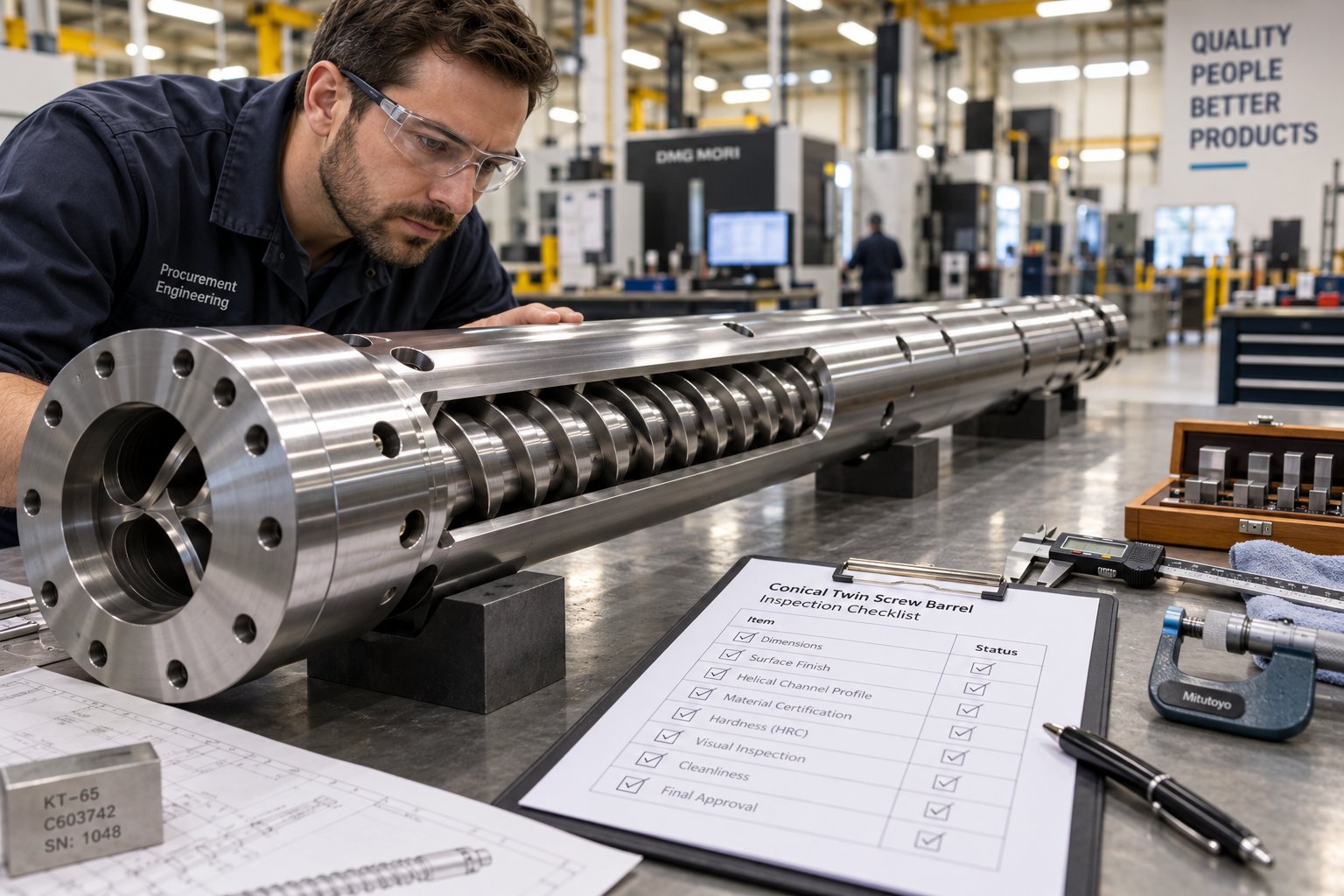
Identifying the root cause of a PVC defect is half the battle. The other half is making sure the replacement screw and barrel you order actually solves the problem instead of recreating it. Too many procurement teams fire off a quick RFQ with nothing more than a machine model number and a vague request for "PVC-grade components." That approach invites generic quotes, mismatched metallurgy, and components that wear out just as fast as the ones they replaced. A structured specification process eliminates that risk before a single dollar leaves your budget.
Essential Specifications to Define Before Ordering
Think of this as a pre-flight checklist. Every detail you pin down before requesting quotes sharpens the supplier's ability to deliver exactly what your process needs — and protects you from costly assumptions on either side.
- Extruder make and model: Include the manufacturer name, machine series, and year of manufacture. Whether you're running a Davis-Standard extruder, a Battenfeld Cincinnati, a Krauss Maffei, or a Chinese-made platform, the supplier needs this to confirm bore dimensions, flange patterns, and drive compatibility.
- Screw configuration type: Specify conical twin, parallel twin, or single screw — and for twins, whether counter-rotating or co-rotating. Each architecture has completely different geometry, clearance requirements, and metallurgical demands.
- Screw diameter and L/D ratio: Provide both the nominal diameter (or diameter range for conical systems) and the length-to-diameter ratio. These two numbers define the physical envelope and the residence time profile.
- PVC formulation details: State whether you're running rigid or flexible PVC. Include the filler type (CaCO3, TiO2, wood flour), filler percentage, and any specialty additives like foaming agents, impact modifiers, or flame retardants. A supplier who doesn't ask about your formulation isn't designing for your actual wear conditions.
- Target output rate: Specify the throughput you need in kg/hr. This directly influences channel depth, flight geometry, and the thermal balance the screw must achieve.
- Barrel liner material preference: Based on your dominant wear mechanism — corrosive, abrasive, or both — indicate whether you need nitrided, nickel-based bimetallic, tungsten carbide matrix, or another liner grade. If you're unsure, a qualified supplier should help you decide based on your formulation data.
- Required delivery timeline: Be realistic but specific. Rushing an order adds 20–50% in expedite premiums, and a compressed timeline may force the supplier to substitute materials or skip quality verification steps.
A complete specification package eliminates the back-and-forth that delays quotes and introduces errors. If you have engineering drawings or dimensional reports from the worn components, include those too — they give the supplier a direct reference for reverse engineering.
Evaluating Screw Barrel Suppliers for PVC Expertise
Not every screw barrel manufacturer understands PVC. A shop that routinely produces screws for polyolefin film lines may have excellent machining capability but zero experience with the alloy chemistries, compression ratios, and surface treatments that PVC demands. When evaluating a potential supplier, look beyond the quote sheet and probe for four capabilities that directly predict whether the components will perform in your application.
PVC-specific metallurgical expertise. Can the supplier explain which bimetallic alloy resists HCl attack and why? Do they stock or routinely cast nickel-based liners, or do they default to iron-based alloys better suited for polyolefins? A supplier who processes PVC orders regularly — like NANHAIYA, which specializes in conical twin screw barrels for PVC pipe, profile, board, foam board, and WPC extrusion — will discuss alloy selection in terms of your specific formulation rather than offering a one-size-fits-all catalog grade.
Reverse-engineering capability. When a worn screw arrives without drawings, the supplier needs to measure, model, and reproduce the original geometry — or improve upon it. This requires CMM equipment, experienced engineers, and documented procedures for translating a physical sample into a manufacturable design.
Custom design capability. If your process has changed since the original components were installed — a new filler package, a higher output target, a shift from virgin to recycled PVC — you need a supplier who can redesign the screw geometry and recommend updated metallurgy rather than simply copying the old parts. Some US extruders built decades ago shipped with screw designs optimized for formulations that no longer exist in today's market. Replacing worn components with identical copies perpetuates limitations that a modern design could eliminate.
Production support and responsiveness. Screw and barrel failures don't wait for business hours. Ask how the supplier handles urgent orders. Do they maintain spare inventory for common configurations? Can they expedite a critical replacement without sacrificing material quality? A supplier who treats your emergency as routine is one who has invested in the infrastructure — inventory, staffing, logistics — to back up their promises.
When sourcing replacement components for well-known platforms, you'll often find aftermarket specialists who can match or exceed OEM specifications at shorter lead times. Whether you're replacing the original screws on a Davis-Standard extruder for sale on the secondary market or upgrading worn components on a line you've operated for years, the evaluation criteria remain the same: metallurgical depth, engineering capability, PVC application experience, and responsiveness under pressure.
Total Cost of Ownership vs. Upfront Price
Here's where procurement decisions go wrong more often than anywhere else. A quote arrives showing one supplier at $8,000 and another at $14,000 for what appears to be the same conical twin screw barrel. The $8,000 option wins the purchase order — and then costs three times more over the next two years.
Why? Because a screw barrel built with an iron-based liner and basic nitrided screw for a heavily filled rigid PVC application might last 8 to 12 months before clearance wear degrades output. A properly specified nickel-based bimetallic barrel paired with HVOF-coated screws running the same compound might deliver 24 to 36 months of service. Factor in the replacement cost, the labor for each changeover, the lost production during downtime, the scrap generated while the line ran degraded, and the energy penalty from pushing worn components harder — and the "expensive" option becomes the obvious bargain.
The math is straightforward. Documented TCO analysis across compounding, pipe, and profile applications consistently shows that premium materials correctly matched to the actual wear mechanism deliver 1.5x to 3.5x cost advantages over commodity alternatives when measured over a realistic 36-month production horizon. The initial purchase price represents a fraction of the total economic impact — downtime, scrap, energy waste, and replacement frequency dominate the equation.
Selecting properly engineered PVC-specific screw barrels — with metallurgy matched to your formulation's corrosive and abrasive demands — reduces total cost of ownership through longer service life, lower scrap rates, and fewer unplanned production interruptions.
Keeping a spare set of critical components in inventory is the final piece of the puzzle. Ordering a backup screw and barrel alongside your primary replacement lowers the per-unit cost by spreading setup charges across multiple parts, and it eliminates the expedite premiums that inevitably hit when a worn component finally fails with no replacement on hand. Tag each spare with its machine designation, original order number, and key dimensions, and store it properly — lightly oiled and wrapped in VCI paper. When the time comes, your maintenance team swaps in the spare during a planned window instead of scrambling through a week of degraded production while a rush order crosses an ocean.
The processors who consistently get the best performance and the longest life from their PVC screw barrel systems aren't the ones who negotiate the lowest price on every order. They're the ones who define their specifications completely, choose suppliers with genuine PVC metallurgical expertise, and evaluate every component purchase against the total cost it will generate — or prevent — over its full productive life.
Frequently Asked Questions About Extruder Screw Barrels for PVC
1. Why can't I use a standard polyolefin screw barrel for PVC extrusion?
PVC has a much narrower processing temperature window than PE or PP — typically only 160-200°C with as little as 10-15°C separating proper fusion from decomposition. When overheated, PVC releases hydrochloric acid (HCl) gas that corrodes barrel liners and screw flights. It is also highly shear-sensitive, meaning aggressive screw geometry designed for polyolefins generates localized hot spots that trigger degradation. A PVC-specific screw barrel uses lower compression ratios (1.6:1 to 2.5:1 versus 2.5:1 to 4.0:1 for polyolefins), gentler compression transitions, and corrosion-resistant metallurgy to handle these unique challenges safely.
2. What is the best barrel liner material for PVC extruder barrels?
The best liner depends on whether your dominant wear mechanism is corrosive (from HCl gas) or abrasive (from mineral fillers like CaCO3 or TiO2). Nickel-based bimetallic alloys such as Hastelloy or Inconel-type liners offer excellent HCl corrosion resistance and suit unfilled or lightly filled rigid PVC. For heavily filled compounds, a nickel-boron matrix with tungsten carbide particles provides both corrosion and abrasion protection. HIP (hot isostatic pressing) barrels represent the premium tier for the most demanding PVC applications. Standard nitrided steel barrels can work for flexible PVC with low filler content but typically fall short for rigid, high-output PVC lines.
3. How do I know when my PVC screw and barrel need replacement?
Watch for these key performance indicators: declining output at constant screw RPM, rising melt temperature without changes to barrel settings, increasing motor amperage draw, inconsistent product dimensions such as wall thickness variation, and visible burn marks or brown specks in the extrudate. Physically, pull the screw and check for rounded flight edges and reduced flight outer diameter. Measure the barrel bore at multiple points — a radial clearance increase beyond 0.40-0.50 mm per side on a conical twin (or beyond manufacturer thresholds for your specific machine) signals that replacement is necessary. Tracking these measurements quarterly helps you plan replacements proactively.
4. What type of extruder is best for rigid PVC pipe and profile extrusion?
Conical twin screw extruders are the most widely used configuration for rigid PVC pipe and profile. Their tapered screw design provides high feed capacity at the inlet, progressive compression through the barrel, and naturally reduced shear toward the discharge end — matching PVC's need for gentle, controlled plasticizing. Counter-rotating conical twins also deliver positive displacement conveying for consistent output pressure. Manufacturers like NANHAIYA build purpose-engineered conical twin screw barrel systems specifically for PVC pipe, profile, board, foam board, and WPC applications. Parallel twin screws are gaining ground for larger-diameter pipe and compounding, while single screw extruders are generally limited to flexible PVC or lower-output applications.
5. How does PVC filler content affect screw and barrel wear rates?
Mineral fillers like calcium carbonate and titanium dioxide act as microscopic abrasives that grind down screw flight tips and widen barrel bore clearances over time. Higher filler loadings accelerate this wear dramatically — CaCO3 above 30 PHR can reduce component life by 40-60%, while SPC flooring formulations exceeding 200 PHR CaCO3 can slash service life by 70-80%. Wood fiber in WPC compounds is even more aggressive, sometimes requiring screw replacement every 12-18 months. To combat filler-driven wear, processors should specify bimetallic barrel liners with tungsten carbide matrices and HVOF-coated screw flights rather than relying on standard nitrided components.
Written by
Nanhaiya Technical Team
Zhoushan Nanhaiya Plastic Machinery Co., Ltd.
The Nanhaiya technical team supports screw and barrel manufacturing projects through application review, technical communication, custom manufacturing coordination, and production and quality control.
Discuss Your Application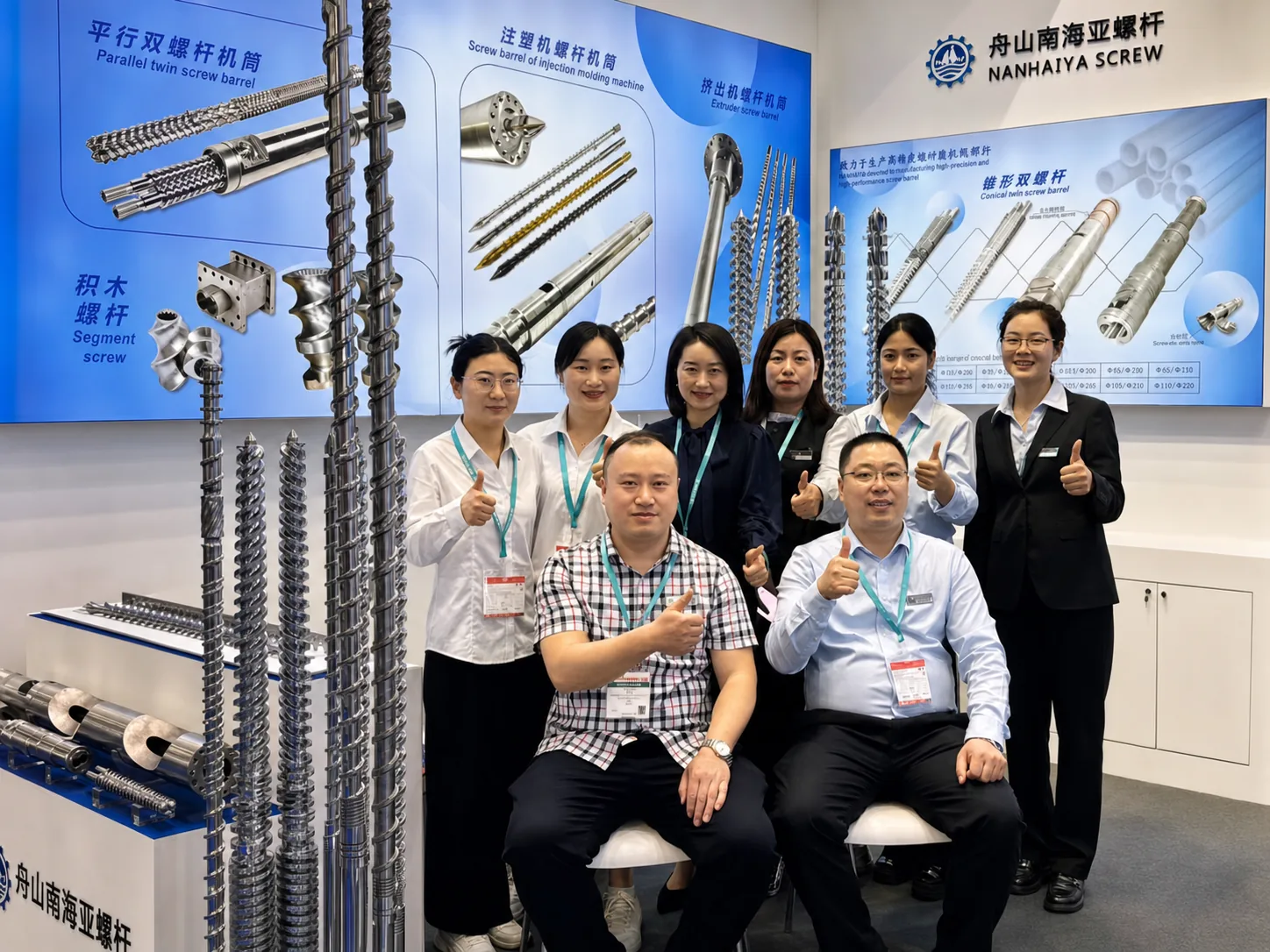
Related Articles
More insights on screw barrel technology and plastics processing.
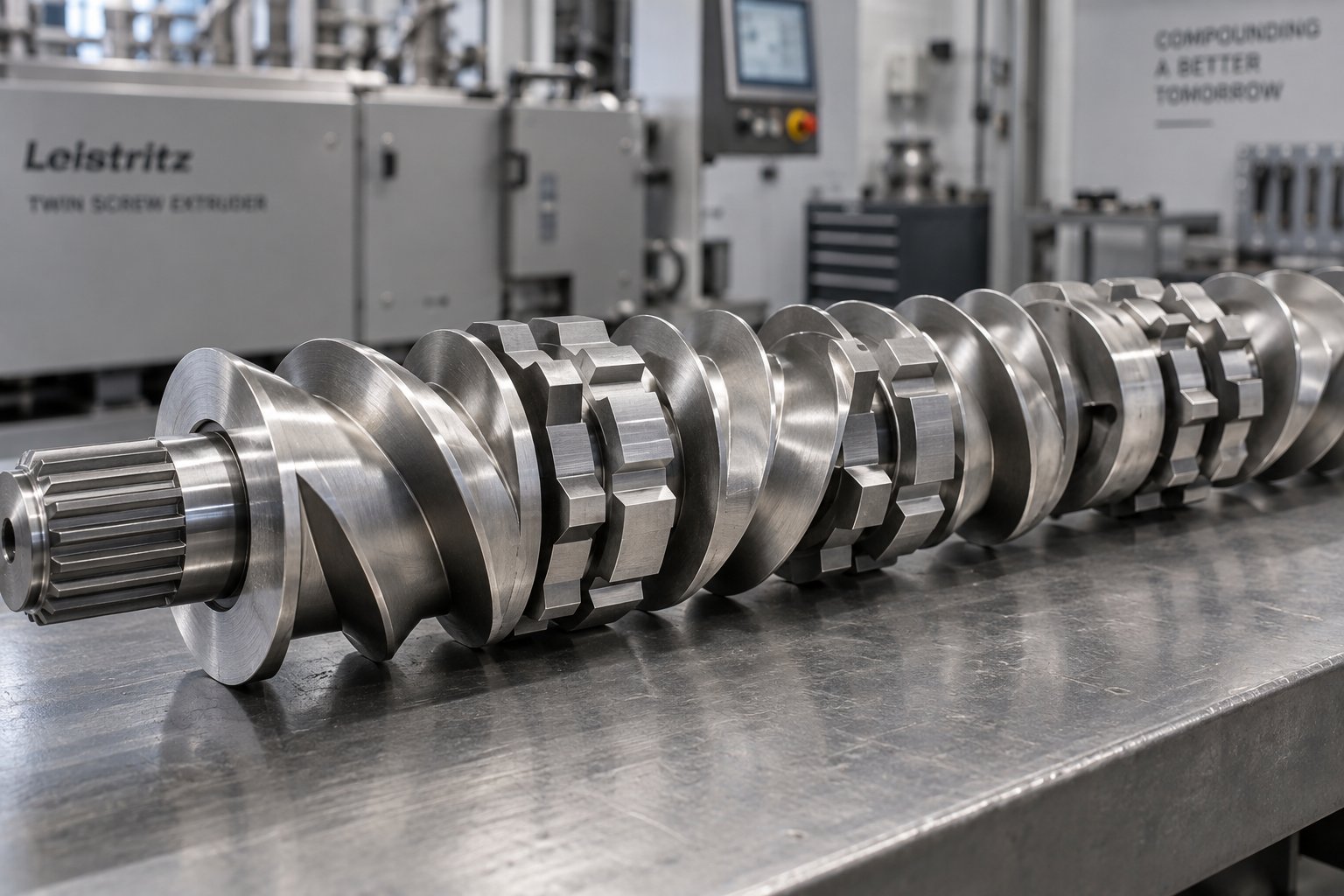
Twin Screw Extruder Screw Decoded: Geometry, Wear & Profile Fixes
Oct 14, 2026
Master twin screw extruder screw design: geometry parameters, kneading block stagger angles, element classification, wear mechanisms, and profile troubleshooting fixes.
Read Article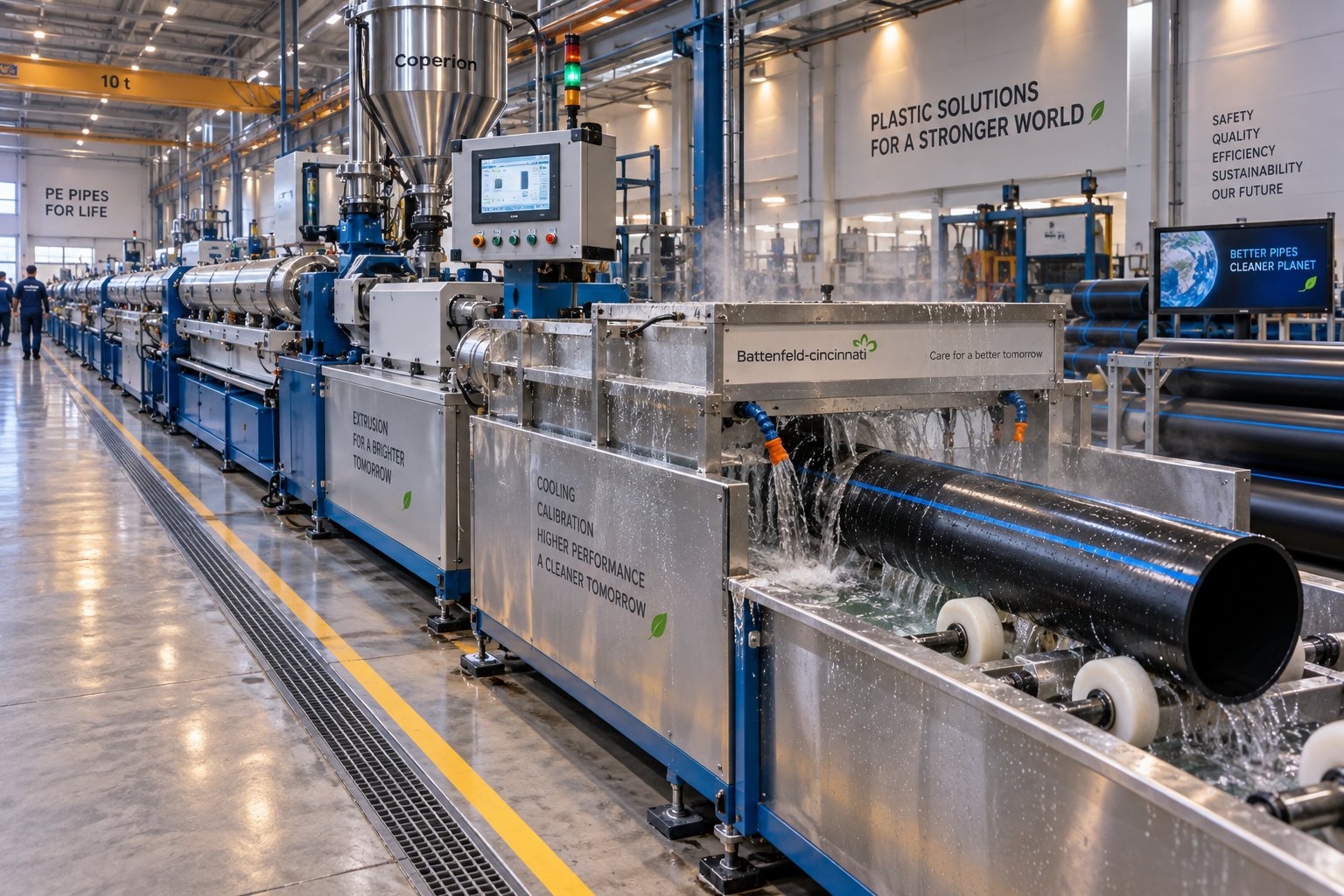
Plastic Pipe Extruder Decoded: Screw Design to Flawless Pipe
Oct 13, 2026
Learn how a plastic pipe extruder works — from screw and barrel design to material-specific processing, defect troubleshooting, and line sizing for PVC, HDPE, and PP-R pipe.
Read Article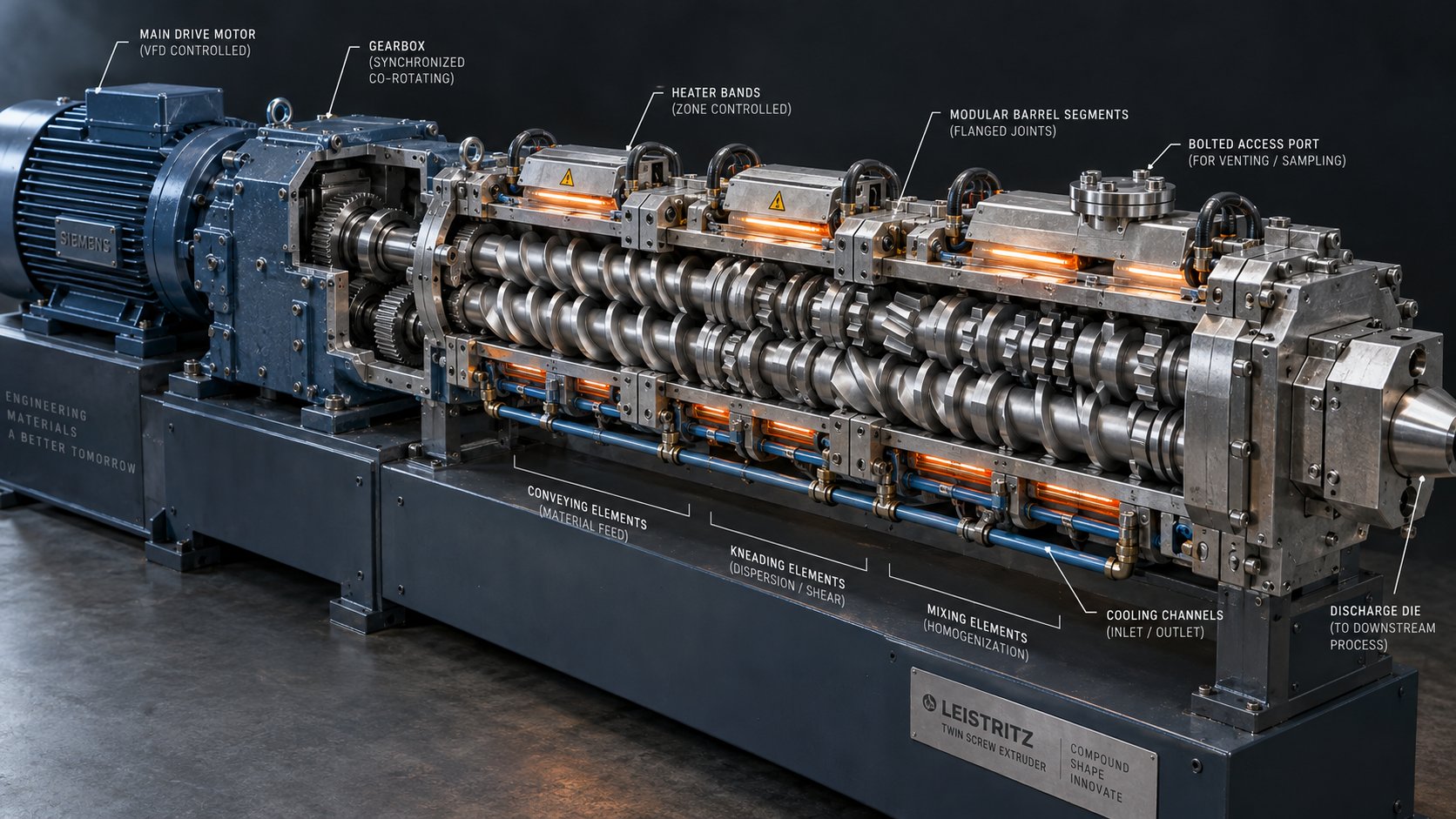
Co Rotating Twin Screw Extruder Parts: From Drive To Die Face
Oct 12, 2026
Complete guide to co rotating twin screw extruder parts — screw elements, kneading blocks, barrel segments, drive components, and material grades explained for sourcing and optimization.
Read ArticleLooking for something else?
Search by material, symptom or product and jump straight to the relevant page.
These are navigation suggestions based on keyword matching — not a quotation, not a delivery commitment, and not a substitute for engineering review. Final specification is confirmed by our engineers against your drawings and processed material.
Need help with screw barrel selection?
Share your machine model, processed material and application. Our team can help with pricing and technical support.