

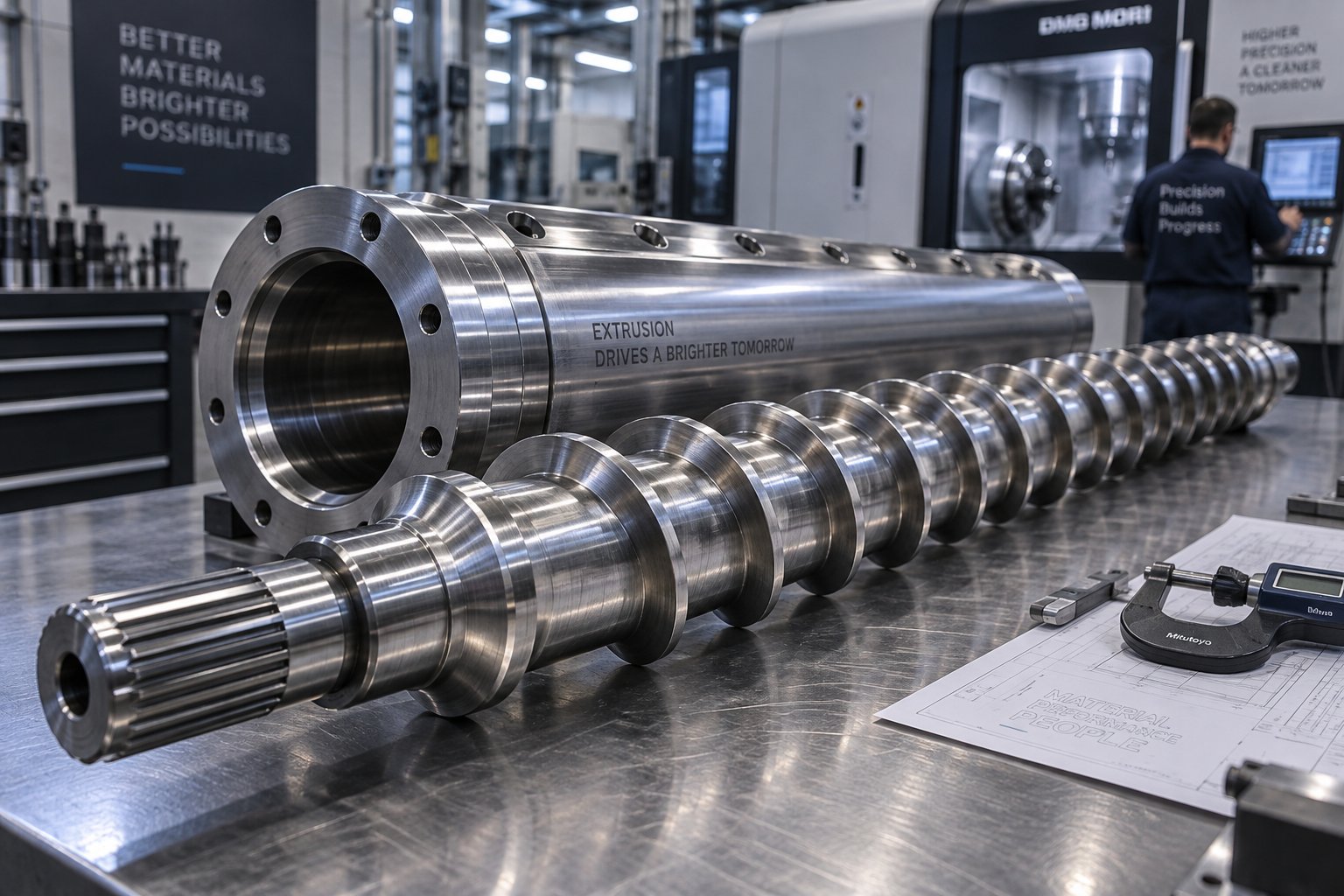
What an Extruder Screw Barrel Supplier Actually Does
When a plastic extrusion or injection molding line underperforms, the root cause often traces back to one pair of components: the screw and barrel. These two parts control how raw resin is conveyed, melted, mixed, and pressurized before it ever reaches a die or mold. So who designs, manufactures, and delivers these mission-critical assemblies? That responsibility falls on a specialized type of partner most processors interact with more than almost any other vendor.
An extruder screw barrel supplier is a manufacturer or distributor that engineers, produces, and delivers custom or replacement screw-and-barrel assemblies for plastic extrusion and injection molding lines, combining expertise in metallurgy, precision machining, and polymer processing to optimize melt quality, throughput, and component longevity.
Defining the Role of an Extruder Screw Barrel Supplier
Imagine ordering a replacement gear from a general industrial parts catalog. You get a commodity item stamped to standard dimensions. An extruder screw barrel works nothing like that. Every screw flight geometry, every barrel bore finish, and every alloy selection is tied to a specific resin, a specific output target, and a specific machine platform. A qualified supplier understands how an extruder feed barrel interacts with resin pellet characteristics, how compression ratios influence melt uniformity, and why the wrong surface treatment can cut component life in half.
This application-specific design knowledge is what separates a true screw barrel specialist from a general machining shop. Specialists invest in material science capabilities, including bimetallic linings and advanced nitriding processes, that directly determine how long extruder screws and barrels survive in abrasive or corrosive processing environments. Industry data suggests that selecting the right barrel material can extend service life by up to 25%, making the supplier's metallurgical expertise a measurable economic lever.
Why Supplier Selection Directly Affects Production Performance
The extruder screw barrel is not a passive wear part you swap out and forget. It directly governs energy consumption per kilogram of throughput, melt temperature consistency, and the volume of scrap your line generates. A supplier who understands your resin portfolio and production targets can recommend flight designs, alloy grades, and clearance tolerances that reduce all three cost drivers simultaneously. A supplier who simply ships metal to a drawing cannot.
This article is built for procurement professionals, plant managers, and maintenance teams who need more than a catalog. In the sections ahead, you will find a practical framework for evaluating suppliers, understanding the true cost drivers behind screw and barrel pricing, and recognizing when your current components are quietly draining margin. The first step is knowing exactly which screw and barrel types exist and where each one fits.
Understanding the Major Screw and Barrel Types
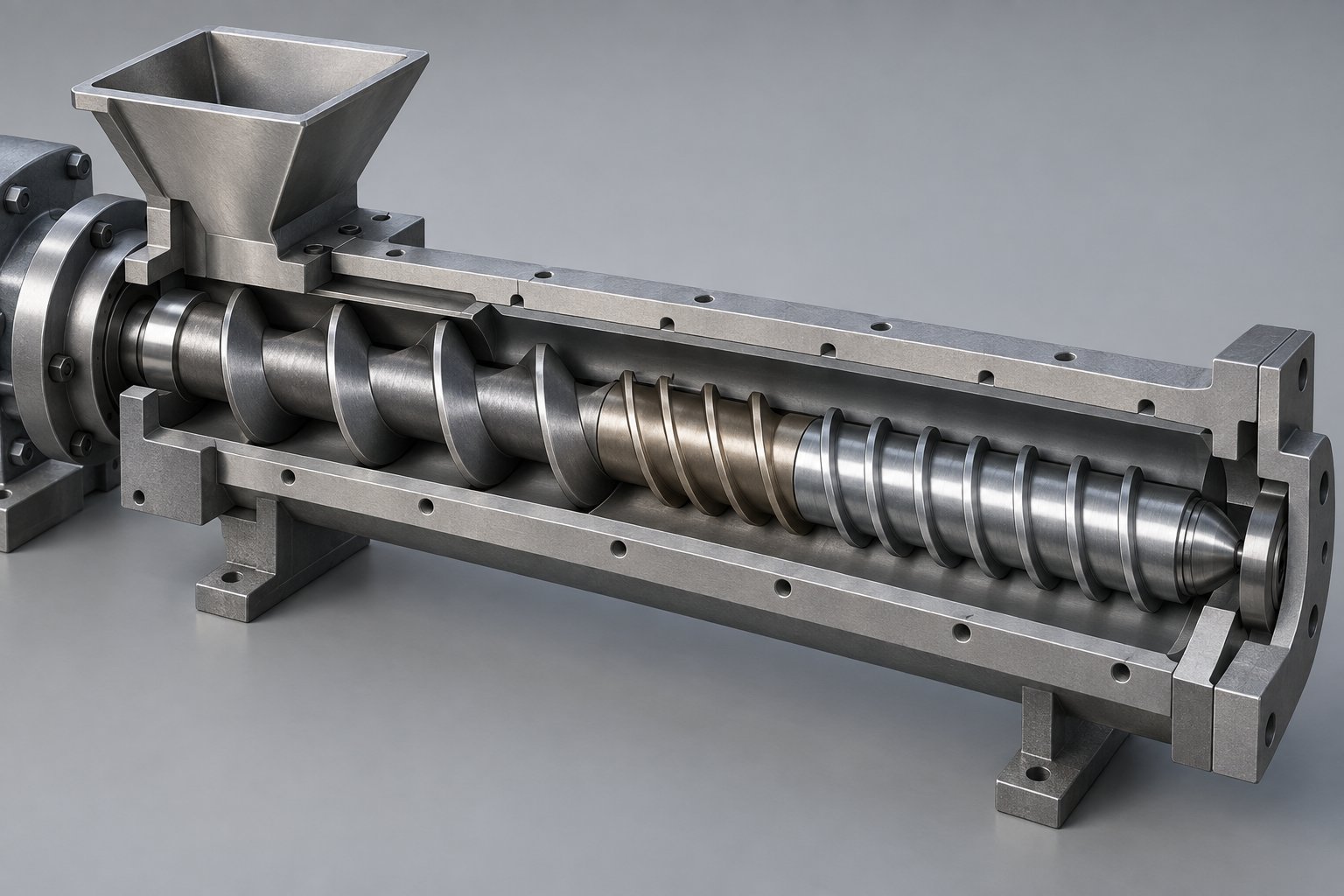
Knowing that your supplier's expertise matters is one thing. Knowing what you are actually buying is another. When you start sourcing components, you will encounter a surprisingly wide range of extruder screw designs and barrel constructions, each engineered for a specific processing challenge. Some suppliers, like Texas-based SpiraMelt, list options such as barrier, vented, grooved feed, foam, and mixing screws, but they rarely explain which polymer family or application each one suits best. That gap can leave buyers guessing, and guessing with screw selection usually means leaving throughput and margin on the table.
Single Screw Designs and Their Ideal Applications
The most common starting point is the general-purpose metering screw, sometimes called a feed screw in catalog shorthand. It features three distinct zones: a deep-channeled feed section that conveys pellets forward, a tapered compression section that melts the resin through shear and barrel heat, and a shallow metering section that homogenizes the melt and builds pressure. This extrusion screw design works well for standard polyolefins like PE and PP where the melting behavior is predictable.
When melting efficiency becomes a bottleneck, a barrier screw introduces a secondary flight that physically separates the solid bed from the melt pool. The result is faster, more uniform melting, which translates to higher output at the same RPM and fewer un-melted particles in the final product. Barrier screws are particularly effective for semi-crystalline resins such as nylon and PET.
For moisture-sensitive materials like ABS or polycarbonate, a vented extruder screw includes a decompression zone midway along its length. This zone allows trapped moisture and volatiles to escape through a barrel vent port, eliminating the need for a separate pre-drying step in some applications. Mixing screws, on the other hand, incorporate dispersive or distributive elements, such as Maddock mixers or pineapple sections, to break up pigment agglomerates or blend additives evenly into the melt stream. Grooved-feed designs pair a specially machined feed zone on the barrel with a modified screw geometry to dramatically increase solids conveying rates, making them a go-to choice for high-output HDPE pipe and blown film lines.
| Screw Type | Best-Suited Polymer Family | Typical Application |
|---|---|---|
| General-Purpose Metering | PE, PP, PS | Sheet extrusion, general profiles |
| Barrier | Nylon, PET, LLDPE | High-output film, fiber spinning |
| Vented | ABS, PC, PMMA | Moisture-sensitive extrusion |
| Mixing (Dispersive/Distributive) | Color concentrates, filled compounds | Masterbatch, pigment blending |
| Grooved-Feed | HDPE, UHMWPE | High-output pipe, blown film |
Twin Screw Barrel Configurations for Compounding
Single screw designs handle the majority of straightforward extrusion tasks, but compounding, blending, and reactive processing demand something different. A twin screw barrel houses two intermeshing screws that work together to deliver intense mixing and precise heat control. Co-rotating twin screws spin in the same direction and excel at distributive mixing tasks like compounding glass-fiber-reinforced engineering plastics or blending polymer alloys. Counter-rotating twin screws turn in opposite directions and generate high pressures suited to PVC profile extrusion and calender feeding. The modular segmented design of most twin screw barrels allows processors to rearrange screw elements, kneading blocks, and barrel sections to fine-tune the process for each formulation.
Barrel Liner Materials and Wear Protection
The barrel is far more than a hollow cylinder. Its internal surface treatment determines how long the entire assembly lasts before clearance wear erodes your process stability. Smooth-bore barrels made from nitrided alloy steel, typically grades like 38CrMoAlA, offer a hardened surface layer in the range of 55-60 HRC that handles standard resins like PE and PP at a cost-effective price point. They are the workhorse choice for processors running non-abrasive materials under moderate conditions.
When you process glass-filled polymers, mineral-loaded compounds, or corrosive resins like PVC, a bimetallic-lined barrel becomes essential. This construction bonds a wear-resistant alloy liner, often tungsten carbide or nickel-based alloy, to the inside of a standard alloy steel body. The result is an internal hardness reaching 62-70 HRC with far superior corrosion and abrasion resistance. The initial investment is higher, but the extended operational life and lower replacement frequency often make bimetallic the more economical option over a full production cycle. Grooved-feed barrels add another dimension: precision-machined longitudinal or helical grooves in the feed zone that increase friction on the pellets, boosting solids conveying pressure independent of screw speed.
Choosing the right combination of screw geometry and barrel material is only half the equation. Equally important is recognizing when your current components have worn past the point where they can deliver consistent results, a challenge that reveals itself through a predictable set of warning signs on the production floor.
Signs Your Extruder Screw and Barrel Need Replacement
Your extruder does not stop working the moment a screw or barrel begins to wear. Instead, it slowly bleeds margin. Output creeps down a few percentage points. Melt temperature drifts above set points. Scrap bins fill a little faster each week. These changes happen gradually enough that operators often compensate without realizing they are masking a mechanical problem. Recognizing the symptoms early, before they snowball into unplanned downtime, is one of the most cost-effective skills a maintenance team can develop.
Process Symptoms That Signal Screw and Barrel Wear
The earliest clue is usually a drop in specific rate, the output in pounds or kilograms per hour divided by screw RPM. When extruder screws wear, the flight clearance between the screw tip and the extruder barrel wall increases. Molten polymer leaks backward over the flights instead of being pushed forward, so the operator has to raise screw speed just to hold the same throughput. As extrusion experts at Plastics Technology have documented, a worn 100-mm screw processing 1 MI polyethylene at 150 kg/hr can require significantly higher RPM to maintain rate, while discharge temperature climbs toward levels that compromise downstream processes like blown film.
Rising melt temperature is the next red flag. Wider flight clearance reduces the heat-transfer coefficient at the barrel wall because the polymer film between the flight land and the barrel grows thicker. The result is higher shear heating, less efficient barrel cooling, and discharge temperatures that creep 8 to 15 degrees Fahrenheit above the original set point. If a blown film line or profile die has a narrow processing window, that temperature increase alone can force a rate reduction of 10 to 13 percent, directly cutting profitability.
You will also notice quality problems in the finished product. Streaks, gels, and un-melted particles appear when the screw and barrel can no longer deliver a homogeneous melt. Color dispersion becomes inconsistent. Wall thickness variation increases on pipe or tubing lines. Predictive maintenance data confirms that melt pressure micro-surging, a symptom of inconsistent solid bed breakup caused by worn screw geometry, often shows up as dimensional variation before anyone suspects mechanical wear.
Here is a scannable checklist of warning signs your maintenance team should watch for:
- Declining output rate at the same RPM, requiring higher screw speed to hold throughput
- Discharge melt temperature rising more than 5-8°F above historical baselines
- Visible streaks, gels, or un-melted particles in the extrudate
- Increased motor amperage or specific energy consumption (kWh per lb or kg)
- Higher scrap or reject rates in downstream products without a material or tooling change
- Melt pressure instability or surging that was not present when components were new
- Inconsistent color dispersion or additive distribution across the product cross-section
What Is Physically Happening Inside the Machine
Every one of those process symptoms traces back to a measurable mechanical cause. The most common is flight land wear. The hard-facing on screw flight tips is typically about 0.060 inches thick. As abrasive fillers like glass fiber, calcium carbonate, or silica grind against the flight lands hour after hour, that hard-facing erodes and the clearance per side grows. For a standard screw, the new flight clearance is roughly the nominal diameter divided by 1000. A 3.5-inch screw, for example, starts life with about 0.004 inches of clearance per side. When that gap doubles or triples, back-leakage becomes severe enough to degrade both output and melt quality.
On the barrel side, bore enlargement from abrasive or corrosive resins widens the internal diameter unevenly, often concentrating wear in the transition and metering zones where pressures and temperatures are highest. Poor barrel alignment or warped barrels caused by faulty heater bands can accelerate this wear pattern by pushing the screw into the barrel wall, creating localized metal-to-metal contact.
Injection molding applications add another wear point: the check ring and seat at the screw tip. When the check-ring seat wears, molten polymer leaks back during injection, leading to short shots, inconsistent cushion, and part weight variation. This type of screw and barrel degradation often gets misdiagnosed as a process control issue rather than a mechanical one.
How to Measure Wear Before It Becomes Critical
Waiting for symptoms to appear on the production floor means wear has already cost you money. A proactive measurement program catches degradation early and turns emergency replacements into planned maintenance events. During scheduled shutdowns, pull the screw and measure the outside diameter of the flight lands with a micrometer at multiple points along the screw length. Compare readings against the original print dimensions. Simultaneously, use a telescoping bore gauge or a calibrated inside micrometer to check the barrel bore at several axial locations, rotating the gauge to identify out-of-round wear patterns.
Industry guidelines suggest that when flight clearance reaches roughly four times the original value, performance degradation is significant for most applications. Critical-duty processes like medical tubing or optical film may require replacement at just two times the original clearance. On the other end of the spectrum, non-critical applications like corrugated pipe can sometimes tolerate much higher wear before product quality suffers.
For operations that want continuous insight without pulling the screw, indirect monitoring fills the gap. Tracking the ratio of output to screw speed over time reveals a gradual downward slope as wear progresses. Monitoring motor amperage at a fixed RPM and comparing melt temperature to set point temperature provides additional data points. After two or three screw replacement cycles with full data, you can predict the next replacement window within weeks, not just react when quality falls apart.
A spare screw kept in storage eliminates the longest variable in the equation: lead time. When your current screw reaches end of life, the spare goes in during a planned changeover rather than an emergency shutdown. That spare strategy, however, depends on knowing the right supplier type to source it from, and the differences between your options are larger than most buyers realize.
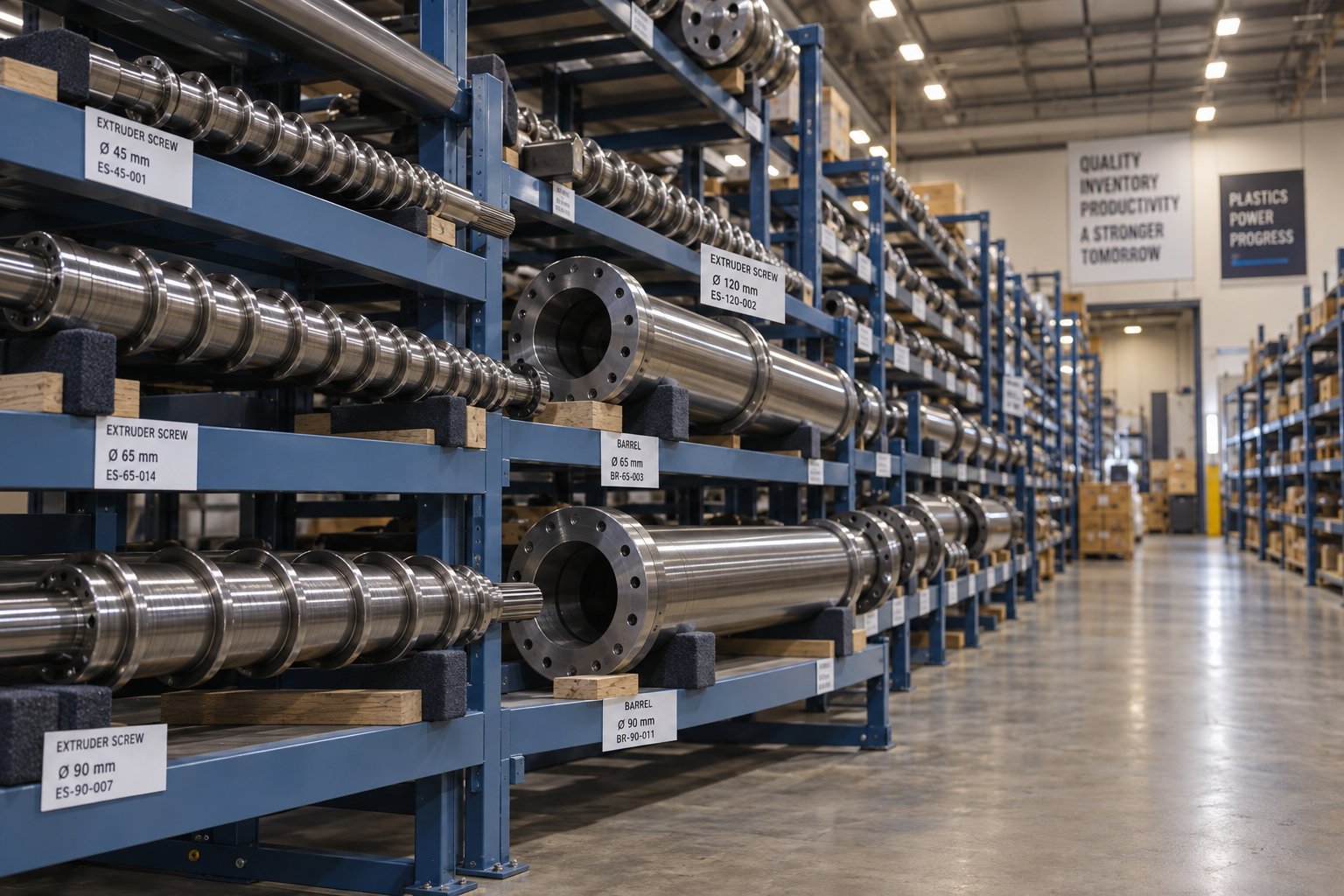
OEM vs Aftermarket vs Refurbished Supplier Types Compared
Most buyers think of an extruder screw barrel supplier as a single category. In practice, the market breaks into three distinct supplier types, each with its own strengths, blind spots, and cost profiles. Choosing the wrong type for your situation can mean overpaying for a routine replacement, waiting weeks longer than necessary, or installing a bargain component that wears out before it pays for itself. Here is a practical breakdown of each.
OEM Screw Barrel Suppliers and When They Make Sense
OEM suppliers manufacture the original screws and barrels that ship with new extrusion or injection molding machines. When you buy a Davis-Standard extruder, for instance, the screw and barrel inside it were designed, specified, and often produced by or for Davis-Standard to match that machine's drive characteristics, barrel heating profile, and intended resin range. Ordering replacement components through the same OEM channel guarantees exact-spec fit, validated metallurgy, and full alignment with the machine builder's engineering records.
That precision comes at a cost. OEM pricing carries the overhead of the machine builder's brand, engineering validation, and distribution network. Lead times tend to stretch longer, too, because orders may pass through a specification approval process before manufacturing even begins. If you are running a Davis-Standard extruder for sale on tight production deadlines, waiting six to ten weeks for an OEM screw can be painful. Still, OEM sourcing makes clear sense for warranty-covered machines, proprietary geometries that aftermarket shops cannot replicate accurately, or mission-critical lines where any deviation from the original design introduces unacceptable risk.
Aftermarket Custom Fabricators as an Alternative
Aftermarket fabricators reverse-engineer existing screw and barrel designs or develop improved versions based on a customer's specific processing goals. These shops typically operate with dedicated CNC machining centers and in-house metallurgical capabilities, allowing them to offer faster turnaround than OEM channels. Many can work from a worn sample screw, an engineering drawing, or even basic dimensions and produce a replacement in a fraction of the OEM lead time.
The real advantage, though, goes beyond speed. A skilled aftermarket supplier can recommend metallurgical upgrades that the original machine builder never offered. Imagine you purchased your extruder a decade ago with a standard nitrided barrel, and you have since switched from unfilled PP to a 30% glass-filled nylon. An aftermarket fabricator can supply a bimetallic-lined barrel with a tungsten-carbide-rich alloy layer that dramatically outlasts the original. As Glycon Corp.'s Jeff Kuhman notes, matching flight hardfacing material to the barrel lining alloy is critical for avoiding galling and premature wear, a nuance that experienced aftermarket specialists understand deeply. Pricing sits in the moderate range, sometimes lower and sometimes comparable to OEM, depending on the complexity of the part and the alloys involved.
Used and Refurbished Component Dealers
At the budget end of the spectrum, dealers in used plastics equipment sell pre-owned screws, barrels, and sometimes complete plasticating assemblies pulled from decommissioned or upgraded lines. Arlington Machinery, for example, performs detailed bore-gauge and flight-diameter measurements on every extruder it handles, publishing inspection reports so buyers know exactly what they are getting. You might find a used twin screw extruder barrel set at a fraction of new-component cost, which can be a smart move for a secondary line, a prototype operation, or a startup that needs to minimize capital outlay.
The trade-off is risk. A used screw may have thousands of hours of hidden wear in the transition zone. Bore measurements might show acceptable average dimensions while masking localized washout at a single point. Without thorough inspection data, including flight OD measurements at every other flight and bore readings every two to three inches, you are buying uncertainty. Reputable dealers mitigate that risk with transparent reports; less scrupulous ones skip the work entirely.
Sitting between all three categories are distributor-resellers, intermediaries who do not manufacture anything themselves but aggregate inventory from multiple OEM and aftermarket sources. They can simplify procurement by offering a single point of contact for screws, barrels, heater bands, and thermocouples. The downside is an added margin layer and, in many cases, limited technical depth. A distributor can quote a part number, but they rarely have the application engineering expertise to recommend a design change that would improve your process.
| Supplier Type | Typical Lead Time | Relative Cost | Best Use Case |
|---|---|---|---|
| OEM (Machine Builder) | 6-12 weeks | Premium | Warranty replacements, proprietary designs, mission-critical lines |
| Aftermarket Custom Fabricator | 3-6 weeks | Moderate | Metallurgical upgrades, resin changes, faster turnaround needs |
| Used / Refurbished Dealer | Immediate to 2 weeks (if in stock) | Budget | Secondary lines, prototyping, capital-constrained operations |
| Distributor / Reseller | Varies by source | Moderate to Premium | Consolidated purchasing, multi-component orders |
Each supplier type fills a legitimate role. The real question is not which one is best in the abstract but which one fits the specific situation you face right now: a warranty machine, an aging line that needs better metallurgy, or a tight budget that demands creative sourcing. What many buyers overlook, however, is a fourth option that sits between full replacement and used components, one that can stretch your existing investment further when the conditions are right.
Repair and Refurbishment vs Full Replacement Decisions
Refurbishment is that fourth option, and it deserves more attention than most buyers give it. Rather than scrapping a worn screw or barrel and purchasing a brand-new assembly, skilled shops can rebuild worn components to near-original specifications at a fraction of the replacement cost. The catch is that refurbishment only makes sense under the right conditions. Push past certain wear thresholds and you are pouring money into a part that will fail again in months.
When Refurbishment Is a Smart Investment
Several proven techniques can restore performance to worn screws and extruder barrels. For screws with eroded flight lands, hard-facing or re-welding the flight tips with abrasion-resistant alloys like Stellite or tungsten-carbide composites rebuilds the original diameter and restores proper clearance. J-groove welding targets the push side of flights in the feed and transition zones, which is exactly where abrasive fillers like glass fiber and mica concentrate their damage. For smaller-diameter screws, spray welding and fusion with tungsten-carbide-suspended alloys can encapsulate the entire root surface for comprehensive protection.
On the barrel side, re-nitriding can restore surface hardness on an extrusion barrel that has lost its case-hardened layer but still has an acceptable bore diameter. Re-sleeving, where a worn bore section is bored out and a new hardened liner is pressed or bonded in, addresses localized wear without replacing the entire barrel body. Re-chroming the bore is another option for certain barrel designs, though it is less common in high-wear applications.
A practical rule of thumb borrowed from general maintenance management applies here: if the refurbishment cost exceeds roughly 50% of the replacement cost, replacement usually makes better financial sense. Some organizations set that threshold higher, but the principle holds. Refurbishment works best when wear is caught early, the base metal is structurally sound, and the screw geometry still matches your current resin and process requirements.
Conditions That Make Full Replacement the Better Path
Certain types of damage push a component past the point of economical repair. When an extrusion barrel bore has enlarged beyond the manufacturer's maximum allowable tolerance, re-sleeving may no longer be practical because the remaining wall thickness cannot support the mechanical and thermal loads. Cracking in the barrel body, whether from thermal fatigue or excessive internal pressure, is a safety-critical condition that no amount of liner work can fix. On the screw side, deep root erosion in the transition zone, especially the kind caused by running improperly designed screws with highly filled composites, can weaken the core to the point where welding simply adds surface material to a structurally compromised shaft.
Replacement also becomes the smarter investment when your processing requirements have changed since the original components were installed. Suppose you have shifted from unfilled polypropylene to a 40% talc-filled compound. As polymer processing research demonstrates, filled resins demand different compression ratios, barrier flight clearances, and barrel liner materials than neat resins. Refurbishing an old screw to its original geometry solves the wear problem but does nothing to optimize it for the new material. Ordering a replacement screw with an adjusted volumetric compression ratio and pairing it with a bimetallic-lined barrel containing tungsten-carbide particles in the liner matrix can extend barrel life by four to five times compared to older liner technology. That upgrade turns a forced replacement into a genuine process improvement.
The hidden cost angle is what seals the decision in many cases. Running worn extrusion barrels and screws does not just reduce throughput. It inflates energy bills because the motor works harder to push polymer past widened clearances. It increases scrap rates because melt homogeneity suffers. It shortens downstream tooling life because inconsistent melt pressure accelerates die wear. When you add those ongoing losses together, a component that looks like it has "a few more months left" may actually be more expensive to keep running than to replace today. The goal is to minimize total cost of ownership, not just delay the next purchase order.
Before making the call, walk through this decision checklist:
- Bore diameter measurements: Is the barrel still within the manufacturer's allowable wear tolerance, or has it exceeded the maximum bore specification?
- Crack and fatigue inspection: Has magnetic particle or dye-penetrant testing revealed any cracks in the barrel body or screw root?
- Screw flight OD measurements: Are flight lands worn beyond the point where hard-facing can rebuild them to print dimensions?
- Resin abrasiveness: Are you running glass-filled, mineral-filled, or other abrasive compounds that will re-wear a refurbished component faster than a new bimetallic assembly?
- Process match: Does the current screw geometry still match your resin portfolio, or have material changes made the original design suboptimal?
- Remaining production life expectation: Will the machine remain in service long enough for a new component to pay back its higher upfront cost through lower operating expenses?
- Refurbishment-to-replacement cost ratio: Does the refurbishment quote fall below or above the 50% threshold relative to full replacement?
This checklist turns an emotional decision into a data-driven one. But gathering that data is only useful if you know how to evaluate the supplier who will ultimately manufacture or refurbish the part, and the criteria for that evaluation go well beyond price and lead time.
Key Criteria for Evaluating a Screw Barrel Supplier
Price and lead time sit on the surface of every quote. Dig underneath, and you will find the factors that actually determine whether a supplier protects your production or quietly drains it. Most procurement teams compare line-item costs across three or four bids without scoring the technical capabilities behind those numbers. The result is a purchasing decision that looks smart on a spreadsheet but reveals its weaknesses six months later when a plastic extruder screw wears out ahead of schedule or a barrel bore drifts out of tolerance before its expected service life is halfway through.
The framework below gives your team a structured way to score any extruder screw barrel supplier, whether you are vetting feed screw manufacturers for a single-screw line or evaluating a shop that specializes in injection molding screws and barrels. Use it as a checklist during supplier qualification, and you will surface the gaps that catalogs and sales calls tend to gloss over.
Manufacturing Precision and Metallurgical Expertise
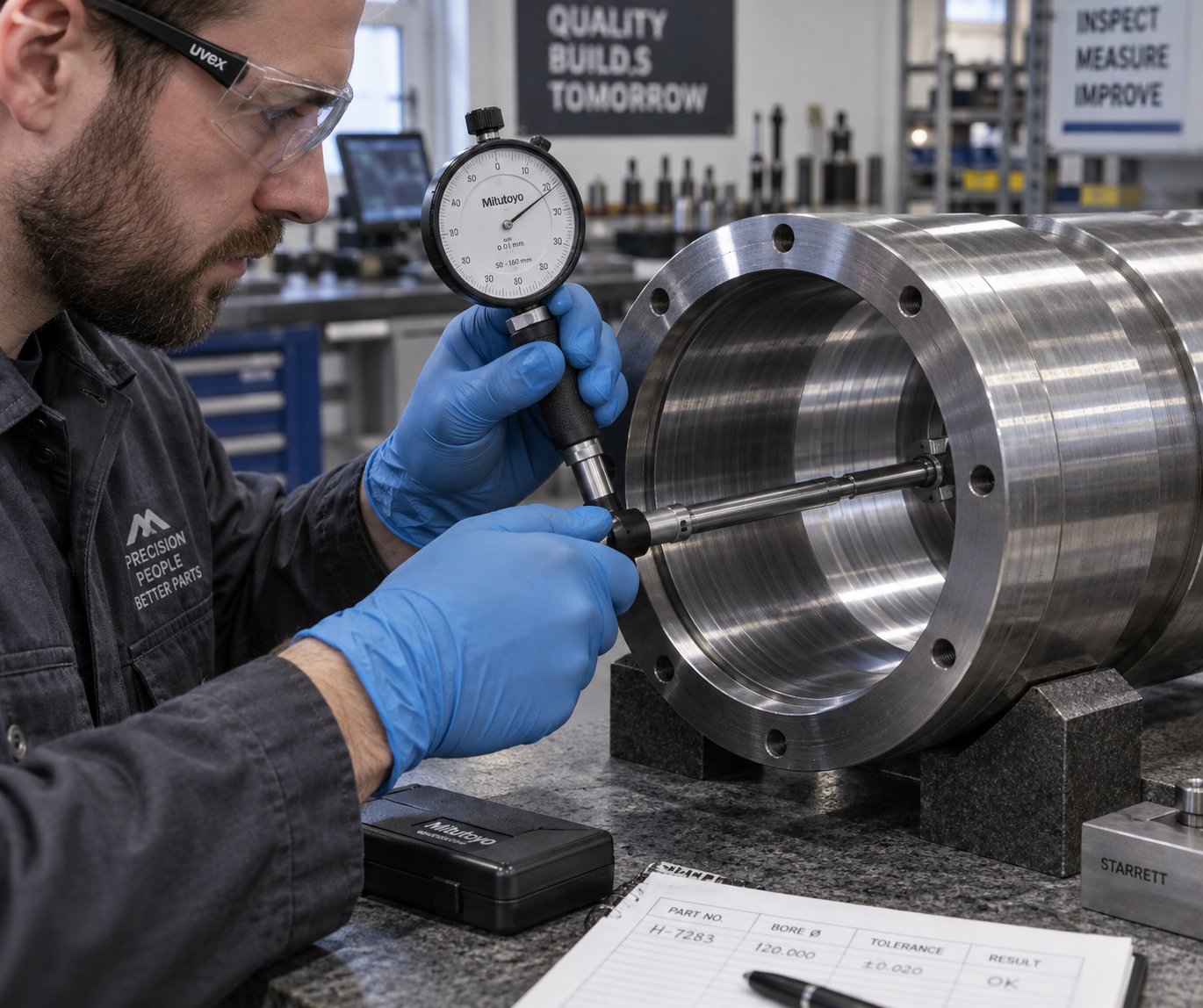
A screw barrel is only as good as the machines and materials that produce it. You want to see evidence of CNC machining centers capable of holding tight bore straightness and concentricity across long barrel lengths. Ask how the supplier verifies bore dimensions after machining. Do they use calibrated bore gauges at multiple axial stations and clock concentricity, or do they rely on a single spot check? A manufacturer operating a 100,000 m² facility with dedicated deep-hole drilling and honing equipment signals a different level of process control than a general job shop running a manual lathe.
Metallurgical expertise separates competent suppliers from exceptional ones. The right partner can recommend steel grades like 38CrMoAlA or SKD61 based on your resin, explain why a nitrided barrel with HV 850-1000 surface hardness suits your unfilled PP line, and then pivot to a bimetallic lining with HRC 58-65 alloy hardness when you introduce recycled glass-filled nylon. If a supplier cannot name the alloy options, the nitriding case depth range, or the coating process they use, the conversation has not reached a professional level yet.
Customization Capabilities and Design Support
Off-the-shelf screws fit off-the-shelf situations, and those situations are rarer than most catalogs suggest. A capable supplier should reverse-engineer a worn screw from a physical sample, optimize flight geometry for a new resin, or work directly from your engineering drawings with full GD&T interpretation. That requires in-house engineering staff, not just a quoting desk. Suppliers with dedicated R&D teams, some employing 25 or more engineers focused on product development, can adapt compression ratios, mixing section designs, and flight clearances to your specific process rather than handing you a standard catalog number.
When you are sourcing a screw plastic extruder component for a specialized application, such as processing corrosive flame-retardant compounds or running recycled feedstock with variable contamination, design support is not a nice-to-have. It is the difference between a part that lasts and one that fails early.
Certifications, Warranty, and After-Sales Service
Certifications provide a baseline, not a guarantee. ISO 9001 indicates a controlled quality management system, but it does not automatically mean superior screw performance. Look deeper. Request the certificate number, the issuing body, the scope of certification, and the expiry date. Beyond ISO, ask for material traceability documentation that connects the finished part back to the steel billet, and request third-party inspection reports for critical dimensions like bore diameter, surface roughness, and nitrided case depth.
Warranty terms reveal how much confidence the supplier has in their own product. A vague promise of "satisfaction guaranteed" means far less than a written warranty that defines coverage duration, failure modes included, and the resolution process. After-sales responsiveness matters just as much. When a screw breaks mid-run at 2 a.m. on a Thursday, you need to know that your supplier will pick up the phone, review your order history, and start working on a replacement, not route you through a generic support queue.
Here is the complete evaluation framework your procurement team can use as a scoring template:
- CNC machining precision: Verify bore straightness, concentricity measurement methods, and flight-dimension tolerances against industry benchmarks.
- Metallurgical capability: Confirm the range of steel grades, bimetallic alloy options, nitriding processes, and surface treatment technologies the supplier controls in-house.
- Customization and engineering support: Assess whether the supplier can reverse-engineer from samples, optimize designs for specific resins, and provide application engineering consultation.
- Quality certifications and traceability: Review ISO 9001 scope, material certificates, heat-treatment records, and third-party dimensional inspection reports.
- Technical support depth: Evaluate the size of the engineering team, their experience with your polymer families, and their willingness to recommend design changes based on operating data.
- Warranty coverage: Compare warranty duration, covered failure modes, and the process for filing and resolving claims across suppliers.
- Lead time reliability: Request historical on-time delivery rates, not just quoted lead times, and ask for references you can verify.
- After-sales responsiveness: Test communication speed during the quoting phase as a proxy for how responsive the supplier will be when you have an urgent production problem.
- Reference accounts: Ask for contact information from two or three customers running similar resins, machine platforms, or production volumes to yours.
- Sample inspection reports: Request a sample report from a recent order to evaluate the depth and professionalism of their quality documentation before you commit.
Score each criterion on a simple 1-to-5 scale, weight the categories that matter most to your operation, and total the results. You will likely find that the lowest-priced bid and the highest-scoring supplier are rarely the same, which raises a question that deserves its own analysis: what actually drives the price of a custom screw and barrel, and how should you think about cost beyond the number on the quote?
Pricing Factors and Total Cost of Ownership
A quote arrives with a single number at the bottom. Maybe it looks reasonable. Maybe it looks high. Either way, that number tells you almost nothing about the value behind it. Two barrels priced 30% apart could deliver identical service life, or the cheaper one could wear out in half the time and cost you far more in lost throughput, scrap, and energy than the difference you saved on the purchase order. Understanding what actually drives screw and barrel pricing, and reframing every purchase as a total-cost-of-ownership decision, is how smart procurement teams avoid the trap of buying on price alone.
What Drives the Price of a Custom Screw and Barrel
Material selection is the single largest variable in component cost. A standard nitrided 4140 steel screw costs significantly less than one machined from a premium tool steel like D2 or H13. Move to a bimetallic barrel with a centrifugally cast tungsten-carbide-rich alloy liner, and the raw material cost alone can be two to three times higher than a simple nitrided bore. Tungsten carbide coatings applied to flight lands or mixing elements add another layer of expense, but for processors running abrasive glass-filled or mineral-loaded resins, these coatings can extend useful life so dramatically that skipping them becomes the more expensive choice over a full production cycle.
Machining complexity is the second major cost driver. A straightforward metering screw with uniform flight geometry is relatively fast to produce on a CNC lathe. Add a barrier flight with tight secondary clearance tolerances, a Maddock mixing section, a vented decompression zone, or a custom profile designed for a specific resin, and machining time climbs steeply. Each additional feature requires separate tooling setups, tighter dimensional verification, and often specialized finishing operations. For a twin screw and barrel assembly, the complexity multiplies further because segmented screw elements and modular barrel sections each demand individual machining, heat treatment, and inspection before final assembly.
Order volume plays a role that surprises some first-time buyers. A single replacement extrusion screw barrel carries the full setup cost for that job, from CNC programming to alloy sourcing to quality documentation. Order three or five identical units and the per-piece cost drops noticeably because setup time is amortized across multiple parts. Finish requirements, including surface roughness specifications on the bore, chrome plating on screw roots, or precision-ground flight lands, add cost proportional to the tightness of the tolerance and the number of finishing passes required.
| Pricing Factor | Impact on Cost | Buyer Consideration |
|---|---|---|
| Base steel grade (e.g., 4140 vs. H13) | Moderate to High | Match alloy to resin abrasiveness; premium steel lasts longer in demanding applications |
| Bimetallic barrel lining | High | Essential for glass-filled, mineral-filled, or corrosive resins; compare liner alloy composition |
| Tungsten carbide flight coating | Moderate to High | Extends flight life in abrasive service; weigh coating cost against replacement frequency |
| Screw geometry complexity (barrier, mixing, vented) | Moderate | Custom profiles cost more upfront but can improve throughput and reduce scrap |
| Order quantity | Moderate (inversely) | Ordering spares alongside replacements lowers per-unit cost and eliminates future lead-time risk |
| Surface finish and tolerance class | Low to Moderate | Tighter bore finishes improve melt quality but add machining time; specify only what your process demands |
| Freight and import duties | Low to Moderate | International orders may carry duties, crating, and ocean freight; factor these into landed cost comparisons |
| Expedite premiums | Moderate to High | Rush orders can add 20-50% to the base price; maintaining spares eliminates this cost entirely |
Lead Times Across Different Supplier Categories
Price is only useful if the component arrives when you need it. Lead times vary dramatically depending on the supplier type you choose, and those differences shape the real cost of procurement in ways that a quote alone cannot capture.
Aftermarket custom fabricators specializing in screw extruders typically deliver replacement components in three to six weeks for standard configurations. They control their own production schedules, stock common alloy grades, and can often begin machining within days of order confirmation. For processors running barrel extruder assemblies that need a metallurgical upgrade alongside the replacement, this turnaround can mean the difference between a planned weekend changeover and weeks of running a degraded process.
OEM channels for machines like Davis-Standard extruders or other major platforms often take longer, sometimes eight to twelve weeks or more. The added time stems from specification approval workflows: the order may route through the machine builder's engineering department for design verification before it reaches the manufacturing floor. That process protects specification integrity but creates delays that can be costly when your line is already showing symptoms of wear.
Used and refurbished component dealers operate on the opposite end of the timeline. If the part you need sits in their measured inventory, delivery can happen within days. The trade-off, as covered earlier, is the uncertainty around remaining service life. Logistics costs layer on top of every scenario. Domestic freight for a six-foot barrel is not trivial, and international shipments add ocean or air freight charges, customs brokerage fees, and potential import duties that can shift the cost comparison between a domestic and an overseas supplier by five to fifteen percent depending on the commodity classification and destination country.
Expedite premiums deserve special attention because they represent pure waste, money spent not on a better component but simply on faster delivery of the same one. Rush charges of 20 to 50% above base price are common across all supplier types. Every dollar spent on expediting is a dollar that could have been avoided by keeping a spare extrusion screw barrel on the shelf. That insight connects directly to the total-cost-of-ownership mindset.
Here is the core principle: a lower purchase price means nothing if the component wears out in half the time, produces excessive scrap, or forces you to run at reduced speed. Plastics Technology reinforces this point, noting that as screw and barrel clearances increase from wear, operators compensate with higher screw speeds, elevated barrel temperatures, and increased backpressure, all of which consume more energy and degrade part quality. Those incremental adjustments are invisible on a purchase order but very real on a utility bill and a scrap report. A bimetallic barrel that costs 40% more upfront but delivers three times the service life in an abrasive-resin application is not the expensive option. It is the cheap one, measured over its full productive life.
Total cost of ownership means summing the purchase price, freight and duties, installation labor, the energy penalty of running worn components, scrap costs during the degradation curve, and the lost production value during changeover downtime. When you frame the decision that way, the best-value supplier is rarely the one with the lowest line-item price. It is the one whose metallurgical choices, machining precision, and design expertise keep your process running at peak efficiency for the longest stretch between replacements.
That calculation changes again, sometimes significantly, depending on where in the world your supplier is located and how you structure the supply chain around them.
Domestic vs International Supply Chain Strategies
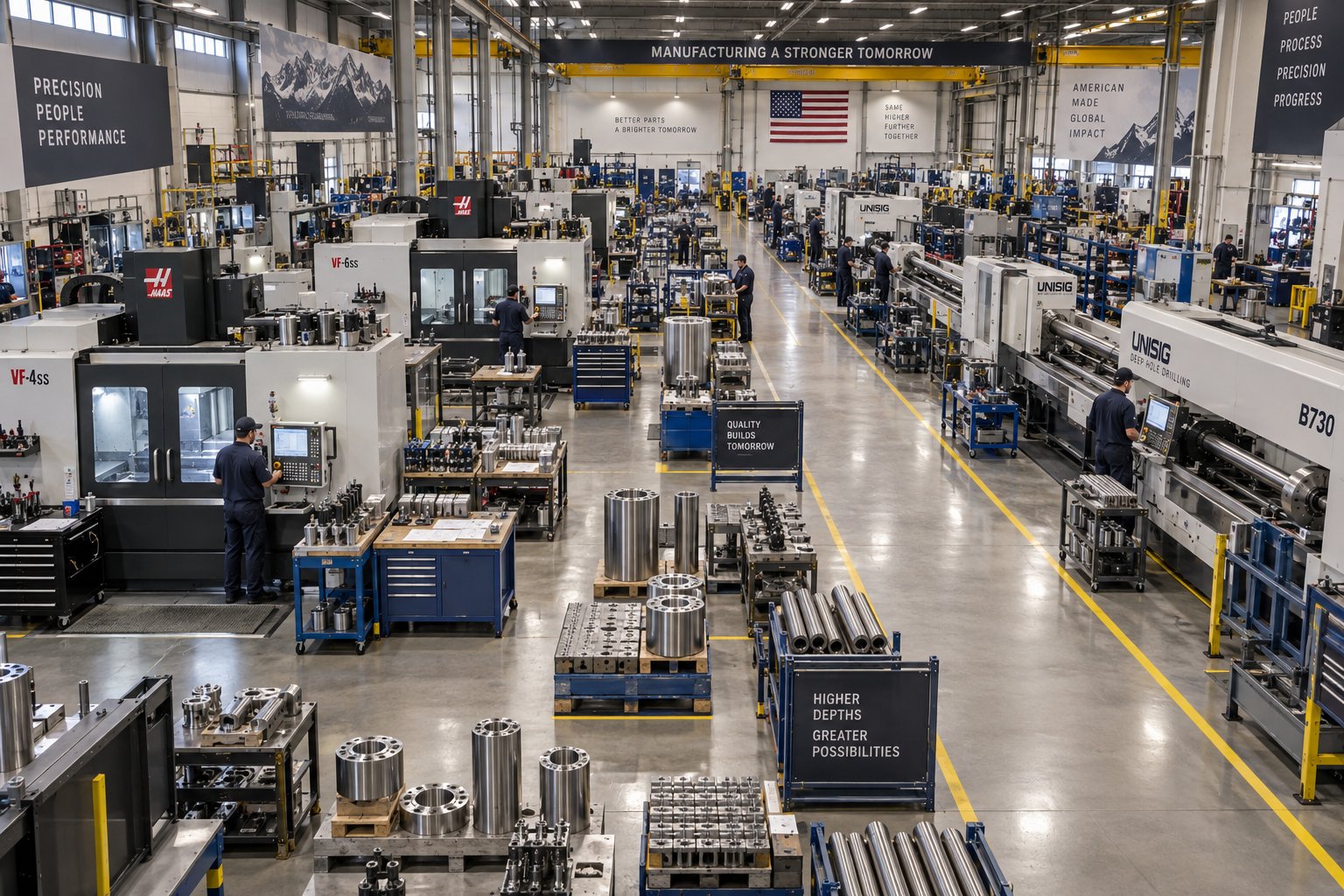
Geography shapes every variable in the cost equation: price, lead time, communication speed, quality oversight, and logistical complexity. Yet most buyers default to whichever supplier type they have always used without stepping back to evaluate whether a domestic source, an international factory-direct manufacturer, or a hybrid approach would better serve their production goals. For operations running US extruders on tight schedules with demanding resin portfolios, this decision deserves the same rigor as the metallurgical and design evaluations covered earlier.
Benefits of Sourcing From Domestic Suppliers
A domestic extruder screw barrel supplier eliminates several friction points that international sourcing introduces. Communication happens in real time, in the same time zone, and without language barriers that can cause costly misunderstandings on critical dimensions. If a bore tolerance or flight geometry needs clarification mid-production, a quick phone call resolves it the same day rather than waiting overnight for a response across a twelve-hour time difference.
Site visits are another practical advantage. You can walk a domestic supplier's shop floor, inspect their CNC machining centers, review their bore-gauging procedures in person, and meet the engineers who will design your injection molding screws. That firsthand visibility builds confidence in ways that a PDF quality manual never can. Shipping times shrink dramatically as well. A finished barrel crated in the Midwest reaches a plant in the Southeast in days, not the four to six weeks that ocean freight from Asia typically requires. For emergency replacements, domestic sourcing can be the difference between a three-day fix and a month of running degraded.
Pros
- Same-day communication and engineering collaboration
- Shorter freight times and simpler logistics
- Easier facility audits and relationship building
- No import duties, customs delays, or currency fluctuation risk
Cons
- Higher labor and overhead costs reflected in component pricing
- Smaller supplier pool for highly specialized alloy work
- Capacity constraints during peak demand periods in the domestic market
Evaluating Factory-Direct International Manufacturers
International manufacturers, particularly those operating factory-direct models, can offer meaningful cost advantages driven by lower labor rates, integrated raw material sourcing, and large-scale production infrastructure. The key word here is "factory-direct." When you buy through a trading company or broker, you lose visibility into who actually machines the part, what alloys they use, and how they control quality. A factory-direct supplier, by contrast, owns the entire manufacturing process from billet to finished component, giving you a single accountable source.
For example, NANHAIYA operates as a factory-direct manufacturer that works with plastic processors, equipment builders, and maintenance teams to supply custom and replacement screw barrels for both extrusion and injection molding applications. Browsing a manufacturer's product catalog, like NANHAIYA's, is a practical first step for evaluating whether their range covers your machine platforms, resin types, and component specifications before investing time in a formal quoting process. This kind of direct access lets buyers assess customization depth, available barrel liner materials, and injection molding feedscrew configurations without intermediary markups layered on top.
The cost savings from international factory-direct sourcing can be substantial, often 25 to 40 percent below comparable domestic quotes for standard configurations. However, those savings only hold if the component meets specification and arrives on time. A barrel that shows up with a bore two thousandths oversize or a screw with improper flight hardfacing chemistry costs far more in rework, returns, and lost production than the discount ever saved.
Quality Assurance Protocols for Overseas Orders
Vetting an international supplier demands a more structured approach than domestic sourcing because you cannot simply drive over and inspect parts on the shop floor. Industry best practices for sourcing precision-machined components internationally emphasize several key protocols that apply directly to screw and barrel procurement:
- Material certifications: Require mill certificates for every steel grade used, traceable back to the billet source. Verify that the alloy composition matches your specification, not just a generic grade designation.
- Dimensional inspection reports: Request bore diameter readings at multiple axial stations, screw flight OD measurements at every third or fourth flight, and concentricity verification. Reports should include the instrument used, its calibration date, and the operator's identification.
- Pre-shipment audits: For first orders or high-value components, consider engaging a third-party inspection service in the supplier's region to verify dimensions, surface hardness, and visual condition before the part ships.
- Trial orders: Start with a single screw or barrel rather than committing to volume. Run the trial component in production, measure its performance against your baseline data, and expand the relationship only after results confirm the supplier's capability.
Communication discipline is equally critical. As GD&T best practices from precision machining professionals emphasize, clear engineering drawings with proper geometric dimensioning and tolerancing callouts eliminate ambiguity that verbal descriptions or rough sketches invite. Define acceptance criteria in writing before the order starts: maximum allowable bore diameter, minimum nitrided case depth, required surface roughness range, and any other critical-to-quality dimensions. A structured approval workflow, where the supplier submits a first-article inspection report for review before producing the balance of the order, catches problems at the cost of one part rather than an entire batch.
Language differences compound the risk if not managed proactively. Choose suppliers with proficient English-language engineering staff, and confirm understanding by asking them to restate your specifications in their own words rather than simply acknowledging receipt. Establishing a shared terminology document for recurring orders, covering terms like "flight clearance," "compression ratio," and "liner alloy designation," prevents the kind of quiet misinterpretation that surfaces only after the parts arrive.
The smartest sourcing strategy for many operations is not purely domestic or purely international but a deliberate blend. Keep a domestic aftermarket fabricator as your primary partner for urgent replacements and complex custom designs where iterative engineering collaboration matters most. Develop a qualified international factory-direct source for planned replacements, spare inventory builds, and standard configurations where lead time is flexible and cost savings compound over multiple orders. That dual-supplier model hedges against both price pressure and supply disruption, giving your procurement team leverage and resilience simultaneously.
Whichever geographic strategy you adopt, the real payoff comes not from a single transaction but from a sustained relationship with a supplier who learns your equipment, your resins, and your production rhythm over time.
Building a Supplier Partnership for Long-Term Production Success
A purchase order lands on a supplier's desk, the part ships, and both parties move on. That transactional pattern repeats across hundreds of screw barrel orders every year, and it quietly costs processors more than most realize. Every time you start from scratch with a new vendor or treat a repeat order like a first-time inquiry, you lose institutional knowledge that directly affects component quality, lead time, and total cost.
Why Long-Term Supplier Partnerships Reduce Risk
Imagine your supplier already has your barrel bore dimensions, screw flight geometry files, alloy preferences, and resin portfolio on record from previous orders. When you call for a replacement, there is no reverse-engineering phase, no back-and-forth over tolerances, and no risk that a critical dimension gets lost in translation. The order moves straight into production because the engineering work was done, verified, and documented months or even years ago.
That familiarity compounds over time. A supplier who understands that you run 30% glass-filled nylon on Line 3 and unfilled HDPE on Line 7 can proactively flag when a screw extruder design that worked for your old material may underperform with a new formulation you mentioned during a routine call. They notice patterns in your reorder frequency that suggest accelerated wear on a specific machine and recommend a metallurgical upgrade before the problem escalates into unplanned downtime. This kind of anticipatory support is impossible in a one-off transactional relationship. It only develops when a supplier invests in learning your operation, and that investment only happens when they see a long-term commitment in return.
Stability in the supply relationship also reduces quality variance. A supplier producing your fifth reorder of the same injection screw has refined their setup, validated their process, and resolved any first-article discrepancies long ago. Each successive order benefits from that accumulated precision. Contrast that with switching suppliers every cycle to chase a slightly lower quote: each new vendor starts at zero, with all the first-order risks of dimensional deviation, alloy substitution, or finish inconsistencies that come with an unproven source.
Building a Spare-Parts and Replacement Strategy
The most expensive screw barrel in your operation is the one you do not have when you need it. Unplanned downtime on an extrusion or injection molding line can cost thousands of dollars per hour in lost production, and the root cause is often not a catastrophic failure but a worn component that finally crossed the performance threshold with no replacement ready to install.
A spare-parts strategy eliminates that vulnerability. Work with your supplier to identify the critical components for each production line, typically the screws and barrels for your highest-volume or tightest-tolerance machines, and order spares alongside your next replacement cycle. As the pricing analysis earlier in this article showed, ordering multiple units in a single batch lowers per-piece cost by spreading setup charges across more parts. You save money on the purchase and eliminate the expedite premiums that inevitably hit when you need a rush replacement.
Store spares properly: lightly oiled, wrapped in VCI (vapor corrosion inhibitor) paper, and kept in a climate-controlled area. Tag each component with its machine designation, original order number, and key dimensions so that when a changeover happens, your maintenance team can pull the right part without searching through old purchase orders. A good supplier will maintain a digital record of every screw and barrel they have built for you, making reorders as simple as referencing a previous job number.
Your Next Steps Toward Smarter Supplier Selection
The best extruder screw barrel supplier is not the one with the lowest quote but the one whose metallurgical expertise, machining precision, and application knowledge keep your process running at peak efficiency for the longest interval between replacements, delivering the lowest total cost of ownership over the full production lifecycle.
Everything covered in this article, from screw types and wear diagnostics to supplier evaluation frameworks and geographic sourcing strategies, points toward a single principle: treat screw and barrel procurement as a strategic function, not an administrative one. Here are concrete steps you can take this week to start putting that principle into practice:
- Apply the 10-point evaluation framework from the supplier criteria section to score your current vendors and identify capability gaps you may be overlooking.
- Pull your most recent bore-gauge and screw-OD measurements, compare them against original print dimensions, and flag any components approaching replacement thresholds.
- Request sample inspection reports from at least two new potential suppliers to benchmark the depth and professionalism of their quality documentation against what you currently receive.
- Collect quotes from multiple supplier types, including OEM, aftermarket, and factory-direct international sources, for the same screw barrel specification so you can compare landed cost, lead time, and warranty terms side by side.
- Explore factory-direct options like NANHAIYA's product catalog to evaluate whether their custom and replacement screw barrel range for extrusion and injection molding aligns with your machine platforms and resin requirements.
- Place a trial order with your top-ranked new supplier candidate before committing to volume. Run the component in production, measure output rate, melt temperature, and energy consumption against your baseline, and let the data guide the decision.
- Identify the two or three most critical screw and barrel assemblies in your plant and order spares now, while lead times are predictable and you are not under emergency pressure.
- Schedule a quarterly review with your primary supplier to discuss upcoming resin changes, machine additions, and wear trends so they can anticipate your needs rather than simply react to orders.
The processors who consistently get the best value from their screw extruder components are not the ones who negotiate the hardest on price. They are the ones who invest in understanding what drives cost, measure wear before it becomes a crisis, and build supplier relationships deep enough that their partner's engineering team becomes a genuine extension of their own. That is the competitive advantage no catalog can sell you, and no competitor can easily replicate.
Frequently Asked Questions About Extruder Screw Barrel Suppliers
1. How do I know when my extruder screw and barrel need replacement?
Watch for declining output at the same RPM, melt temperatures rising 5-8°F above historical baselines, visible streaks or un-melted particles in the extrudate, increased motor amperage, and higher scrap rates. These symptoms indicate that flight clearance between the screw and barrel wall has widened due to wear, allowing molten polymer to leak backward over the flights. A proactive bore-gauging and screw-OD measurement program during scheduled shutdowns catches degradation before it triggers unplanned downtime or quality failures.
2. What is the difference between OEM, aftermarket, and refurbished screw barrel suppliers?
OEM suppliers provide exact-spec replacements validated by the original machine builder, offering guaranteed fit at premium pricing and longer lead times of 6-12 weeks. Aftermarket custom fabricators reverse-engineer or improve existing designs, often delivering in 3-6 weeks at moderate cost with the ability to recommend metallurgical upgrades. Refurbished or used component dealers sell pre-owned parts at budget prices with immediate availability, though buyers must carefully verify remaining service life through detailed inspection reports before purchasing.
3. Should I refurbish a worn screw and barrel or buy new replacements?
Refurbishment makes financial sense when wear is caught early, the base metal is structurally sound, and the refurbishment cost stays below roughly 50% of full replacement cost. Techniques like re-welding flight tips with Stellite or re-nitriding barrels can restore near-original performance. However, if bore enlargement exceeds the manufacturer's maximum tolerance, cracks are present, or your resin portfolio has changed significantly since the original design, full replacement with upgraded metallurgy and optimized geometry delivers better long-term value.
4. What factors drive the price of a custom extruder screw and barrel?
The biggest cost variable is material selection: a bimetallic barrel with a tungsten-carbide-rich alloy liner can cost two to three times more than a standard nitrided bore. Machining complexity adds cost when barrier flights, mixing sections, or custom profiles require additional setups and tighter tolerances. Order volume matters too, since setup charges are amortized across multiple units, lowering per-piece cost. Freight, import duties for international orders, and expedite premiums of 20-50% for rush delivery also significantly affect the final landed cost.
5. How do I evaluate an international extruder screw barrel supplier for quality?
Start by requiring mill certificates traceable to the billet source for every steel grade used. Request dimensional inspection reports with bore readings at multiple axial stations and screw flight OD measurements. For first orders, engage a third-party inspection service in the supplier's region for a pre-shipment audit. Place a trial order with a single component, run it in production, and measure performance against your baseline before committing to volume. Factory-direct manufacturers like NANHAIYA allow buyers to evaluate product range and customization capabilities directly, eliminating intermediary markups and improving accountability.
Written by
Nanhaiya Technical Team
Zhoushan Nanhaiya Plastic Machinery Co., Ltd.
The Nanhaiya technical team supports screw and barrel manufacturing projects through application review, technical communication, custom manufacturing coordination, and production and quality control.
Discuss Your Application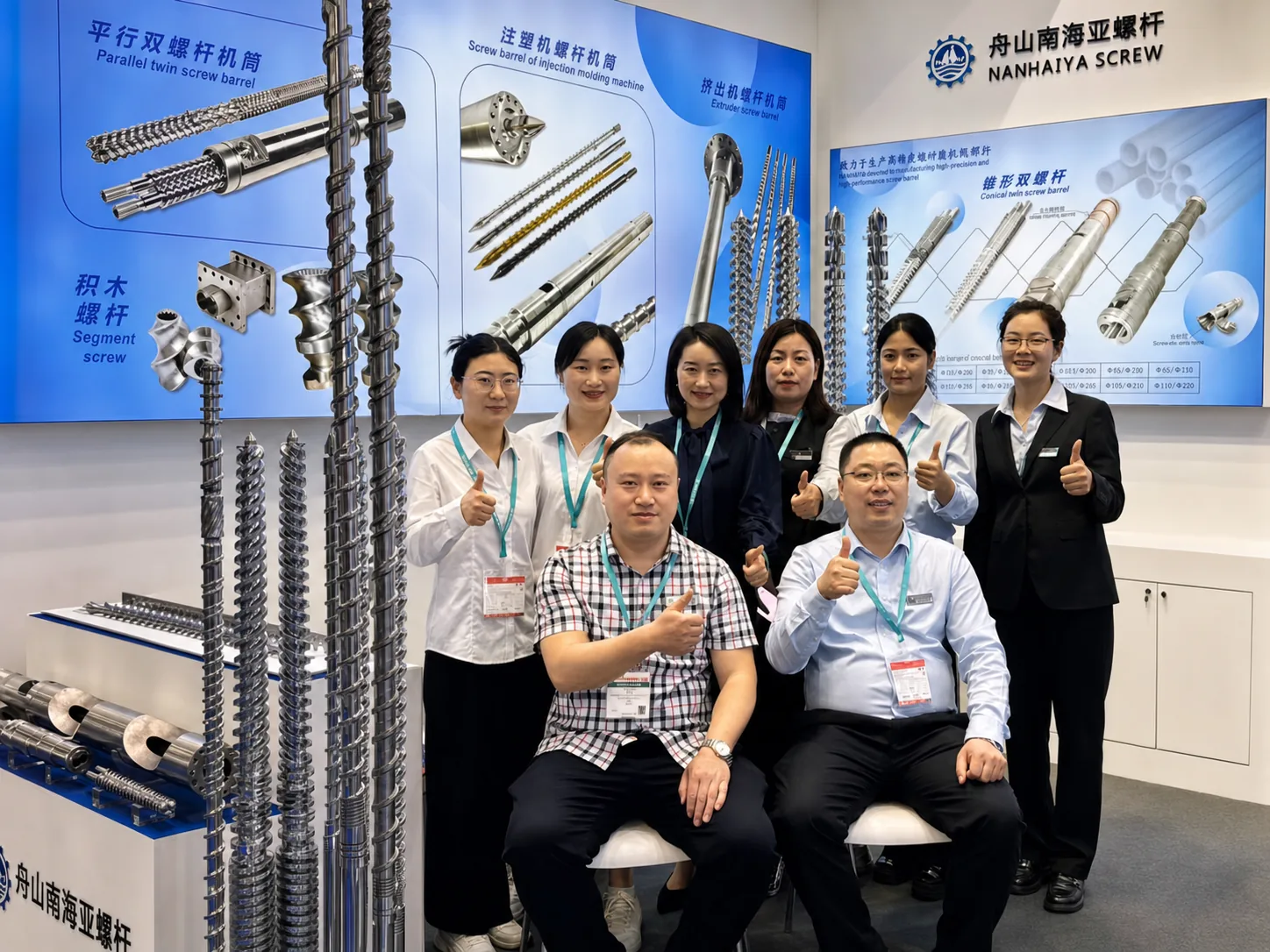
Related Articles
More insights on screw barrel technology and plastics processing.
What Your Single Screw Extruder Manufacturer Won't Tell You
Oct 10, 2026
Learn how to evaluate single screw extruder manufacturers with this buyer-focused guide covering specs, configurations, material matching, and a ready-to-use selection checklist.
Read Article
Plastic Extruder Screw Price Demystified: From Steel To Sticker
Oct 10, 2026
What drives plastic extruder screw price? This independent guide breaks down diameter, L/D ratio, metallurgy, order volume, and total cost of ownership factors.
Read Article
What No Supplier Tells You About WPC Decking Making Machines
Oct 6, 2026
Learn how a WPC decking making machine works, compare extruder types, formulations, and production methods, plus get a buyer checklist to evaluate any supplier.
Read ArticleLooking for something else?
Search by material, symptom or product and jump straight to the relevant page.
These are navigation suggestions based on keyword matching — not a quotation, not a delivery commitment, and not a substitute for engineering review. Final specification is confirmed by our engineers against your drawings and processed material.
Need help with screw barrel selection?
Share your machine model, processed material and application. Our team can help with pricing and technical support.