

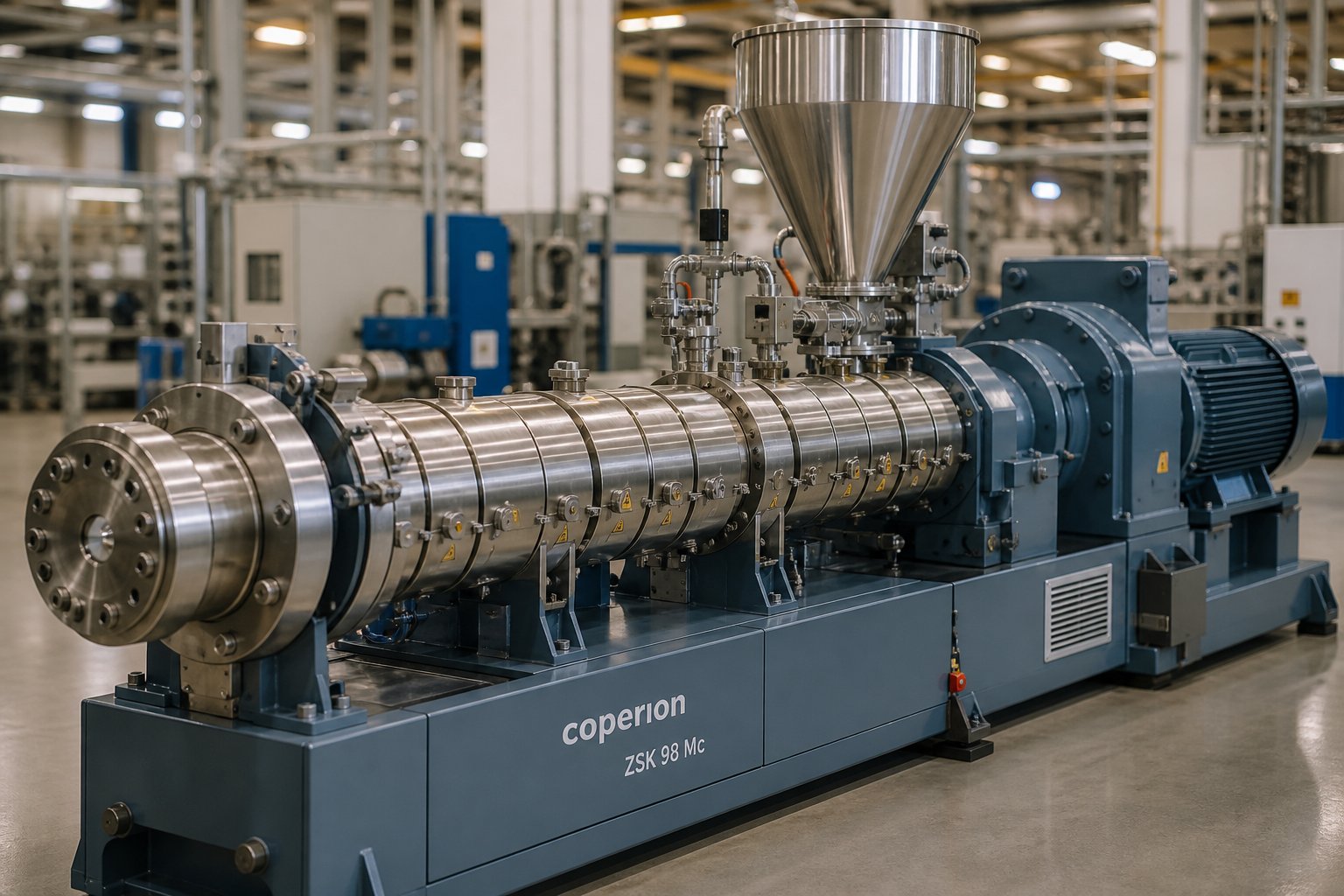
What Is a Werner & Pfleiderer Twin Screw Extruder
Imagine you're browsing a used-equipment listing or reading a machine nameplate on a production floor, and you spot the name "Werner & Pfleiderer" stamped across a twin screw extruder. The company no longer exists under that name, yet its machines are everywhere. So what exactly are you looking at, and why does it matter?
Defining the Werner & Pfleiderer ZSK Platform
A Werner & Pfleiderer twin screw extruder refers to a co-rotating, intermeshing twin-screw extruder originally developed and manufactured under the ZSK product designation by the Stuttgart-based German engineering firm Werner & Pfleiderer. The ZSK platform became the benchmark for polymer compounding, reactive extrusion, and a wide range of continuous processing tasks across the plastics, chemical, food, and pharmaceutical industries.
A Werner & Pfleiderer twin screw extruder is a co-rotating, closely intermeshing twin screw extrusion system — first delivered in 1957 under the ZSK designation — that uses modular, self-wiping screw elements inside a segmented barrel to achieve precise mixing, melting, and devolatilization. It is widely regarded as the original platform from which all modern co-rotating twin screw extruders evolved.
Werner & Pfleiderer didn't just build a machine. The company, through the pioneering work of engineers like Rudolf Erdmenger, developed the fully self-wiping screw profile for co-rotating intermeshing screws — a breakthrough that made the ZSK functional across a remarkably wide range of material viscosities and frictional properties. That single innovation is the reason the ZSK architecture became the gold standard. Today's twin screw extruders across virtually every major manufacturer trace their fundamental design principles back to this platform.
One of the core advantages of twin screw extruder technology in the co-rotating configuration is its ability to handle an enormous variety of processing tasks within a single modular framework. From dispersing nano-fillers in engineering plastics to devolatilizing moisture-sensitive polymers, the ZSK's design philosophy — segmented barrels, interchangeable screw elements, and precise thermal control — set the template that the entire industry still follows.
Why People Still Search for This Brand
Here's what catches many buyers off guard: Werner & Pfleiderer no longer operates as an independent company. The extrusion division was acquired and eventually folded into Coperion, which continues to develop and manufacture the ZSK line from Stuttgart, Germany. Yet the Werner & Pfleiderer name refuses to fade from industry vocabulary — and for good reason.
Thousands of W&P-branded machines remain in active service on production floors worldwide. When a plant manager needs replacement barrels, screw elements, or gearbox service for a machine stamped "Werner & Pfleiderer," that's the term they search. When a buyer evaluates a used twin screw extruder at auction or through a broker, the listing almost always uses the original brand name rather than Coperion. And when process engineers discuss legacy equipment in technical forums, "W&P" is the shorthand everyone recognizes.
This persistence creates a real information gap. Equipment dealers list specs and prices. Coperion's own materials focus on current-generation ZSK models. But nobody connects the dots for the person who needs to understand the full picture — the heritage behind the machine, how to interpret its specifications, what to inspect before buying used, and where to source compatible parts. That's exactly the gap this article fills. Whether you're operating, evaluating, or sourcing components for one of these machines, the sections ahead break down everything that typical equipment listings and service pages leave out.
The History of Werner & Pfleiderer and the Rise of ZSK
Every machine on your production floor has a backstory, but few carry a lineage as consequential as a Werner & Pfleiderer twin-screw extruder. The ZSK didn't appear overnight. It was the product of decades of engineering ambition, wartime research pivots, corporate reinventions, and a relentless push toward higher performance. Understanding that history isn't just trivia — it helps you decode model generations, anticipate parts compatibility, and appreciate why certain design choices were made in the machine you're running or considering buying.
Origins and the Invention of the ZSK
Werner & Pfleiderer's roots stretch back to nineteenth-century Stuttgart, where the company built its reputation as a manufacturer of industrial mixing and kneading equipment. For decades, W&P served bakeries, chemical plants, and other process industries with heavy-duty machinery. But the breakthrough that would define the company's legacy began not inside its own walls — it started in the laboratories of Germany's chemical industry.
In the early 1940s, two engineers — Rudolf Erdmenger and Walter Meskat — began developing co-rotating screw concepts at the IG Farben plant in Wolfen. Their goal was to create a continuous mixing device capable of handling high-viscosity materials with consistent quality. The work was interrupted by the war, but Erdmenger continued refining the concept afterward as part of Bayer's High-Viscosity Technology Group in Leverkusen. His critical contribution? The fully self-wiping screw profile for co-rotating intermeshing screws — a geometry that prevented material from stagnating inside the barrel and enabled processing across an extraordinarily wide viscosity range.
In 1953, Werner & Pfleiderer acquired an exclusive license from Bayer to commercialize Erdmenger's invention. Interestingly, the original prototype featured vertically arranged screws — a configuration that looks nothing like the horizontal twin-screw extruders familiar today. W&P invested four additional years of intensive development to transform that laboratory concept into a production-ready machine. The result was the first commercial ZSK delivery in 1957, marking the birth of a platform that would reshape the entire compounding industry.
The Coperion Transition and Brand Legacy
Corporate ownership of the ZSK platform changed hands several times over the following decades. Krupp acquired Werner & Pfleiderer, integrating it into the ThyssenKrupp industrial group. Then, around 2000-2001, Georg Fischer AG of Switzerland and an investor group purchased Krupp Werner & Pfleiderer and combined it with Buss (kneader manufacturer) and Waeschle (resin conveying) to form Coperion — a company that claimed the title of the world's largest maker of compounding and mixing machines. The ZSK line continued under the Coperion banner, manufactured in Stuttgart with U.S. operations in Ramsey, New Jersey.
Here's a condensed timeline that puts the key milestones in sequence:
- 19th Century — Werner & Pfleiderer founded in Stuttgart as an industrial mixing and kneading equipment manufacturer.
- 1943 — Rudolf Erdmenger and Walter Meskat begin co-rotating screw research at the IG plant in Wolfen.
- 1945-1953 — Erdmenger develops the fully self-wiping screw profile at Bayer's High-Viscosity Technology Group; W&P acquires the exclusive commercialization license.
- 1957 — First commercial ZSK twin screw extruder delivered, producing a throughput of approximately 170 kg/h.
- 1960s-1990s — Decades of continuous development expand the ZSK range across screw diameters from 18 mm to 420 mm, dramatically increasing torque density, screw speed, and throughput capacity.
- 2000-2001 — Coperion formed through the acquisition and merger of W&P, Buss, and Waeschle under Georg Fischer AG, consolidating the ZSK platform within a broader process technology group.
- Present — Coperion continues ZSK development, with current models achieving specific torques up to 18 Nm/cm³ and screw speeds reaching 1,800 min¹.
So why does the Werner & Pfleiderer name still dominate search queries and equipment listings? The answer is straightforward: thousands of W&P-branded twin-screw extruders remain in active production around the world. Many were built during the brand's most prolific decades and are nowhere near the end of their mechanical lifespan. The twin screw extruders market for used and refurbished equipment catalogs these machines under the original nameplate because that's what's stamped on the gearbox housing, the barrel segments, and the control panel. Buyers searching for a coperion twin screw extruder often discover that the machine they're evaluating actually carries Werner & Pfleiderer markings — and they need documentation, specifications, and parts references tied to that original identity. Even technical documents and spec sheets — the kind of coperion twin screw extruder pdf files engineers download for cross-referencing — frequently include legacy W&P model designations alongside current Coperion nomenclature.
This layered history means that the machine sitting on a broker's lot isn't just "old equipment." It's a specific generation of a continuously evolved platform, and knowing where it falls on the timeline above tells you a great deal about its torque class, screw speed capability, and barrel design — details that directly influence what the machine can process and what replacement components it requires.
How the ZSK Co-Rotating Twin Screw Extruder Works
Knowing a machine's history is one thing. Understanding the engineering principles that make it work is what separates a confident buyer or operator from someone flying blind. The Werner & Pfleiderer ZSK platform didn't become the industry standard by accident — it earned that position through an elegant mechanical concept that remains remarkably effective decades after its invention. Let's break it down in plain terms.
The Co-Rotating Intermeshing Mechanism
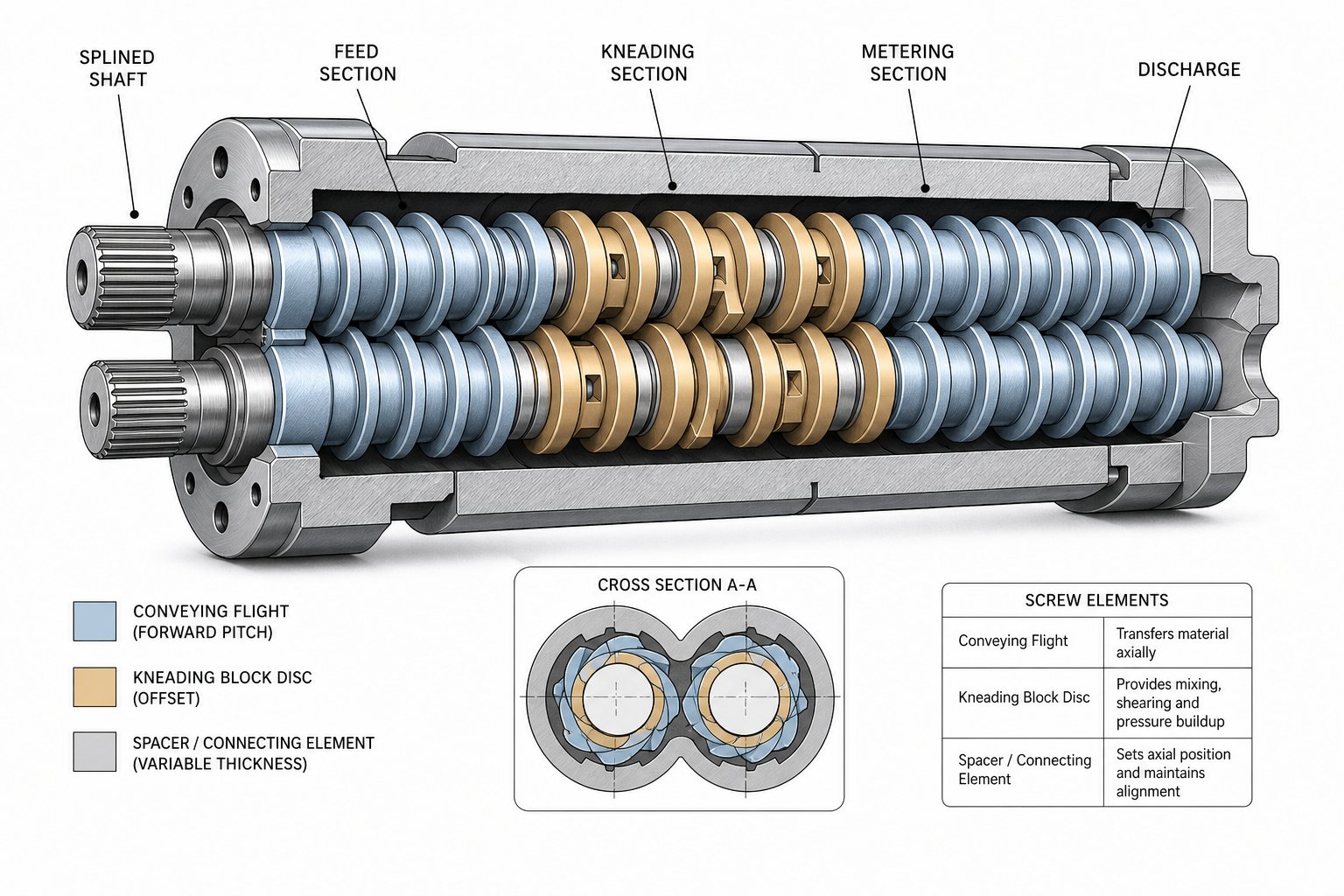
Picture two parallel screws sitting side by side inside a barrel bore shaped like a figure eight. Both screws rotate in the same direction — that's what makes this a co-rotating twin screw extruder. The screws are positioned so closely that the flights of one screw reach into the channel of the other, creating what engineers call an intermeshing configuration.
Why does that matter? Because this tight intermeshing produces a self-wiping action. As the screws turn, each one continuously scrapes material off the surface of the other. Nothing stagnates. Nothing builds up or degrades inside the barrel from excessive heat exposure. This self-wiping screw element geometry, originally identified as the Erdmenger profile, is the defining feature of the ZSK platform — and the reason it handles everything from heat-sensitive polymers to abrasive mineral-filled compounds with such consistency.
Here's where the design gets truly versatile. The screws aren't single monolithic pieces. They're built from individual modular screw elements that slide onto a splined shaft. Engineers select and arrange three primary types of elements to create a customized screw profile:
- Conveying elements — These feature deep helical flights designed to move material forward through the barrel efficiently, with minimal shear input. Larger pitch elements transport high volumes of bulk material, while smaller pitch elements compress and meter the melt toward the die.
- Kneading blocks — The workhorses of mixing. Each kneading block consists of several lobed discs stacked at offset angles. Wider disc kneading blocks deliver aggressive dispersive mixing that breaks down agglomerates, while narrower disc configurations promote gentler distributive mixing that spreads additives evenly throughout the polymer matrix.
- Mixing elements — Specialized elements like toothed mixing discs combine forward conveying with distributive blending. They're particularly useful for incorporating liquid additives or homogenizing solid-liquid combinations before the compression zone.
The arrangement of these screw elements twin screw extruder engineers choose isn't random. It's a deliberate sequence engineered to match the specific material and process. As NC State Extension researchers note, configuring a screw profile is "a blend of art and science" — every material has unique flow properties influenced by temperature, shear rate, and extruder geometry. That's why the modular approach W&P pioneered with the ZSK remains so powerful: you can reconfigure the same machine for entirely different applications simply by rearranging the elements on the shaft.
Functional Zones Along the Barrel
When you trace material from the feed throat to the die of a ZSK, it passes through a series of distinct functional zones. Each zone is defined by the screw element configuration beneath it and the barrel section surrounding it. Think of it as an assembly line inside a single machine — each station performs a specific job before handing material off to the next.
A typical process sequence on a parallel twin screw extruder looks like this:
- Solids conveying — Raw material (pellets, powder, or flakes) drops into the feed throat and is carried forward by large-pitch conveying elements. The goal here is gentle transport without premature melting or compaction.
- Plasticating (melting) — Kneading blocks and narrower-pitch conveying elements work together to apply shear and frictional heat. The polymer transitions from solid to melt. Barrel heaters assist, but most of the energy comes from mechanical work.
- Dispersive mixing — Wide-disc kneading blocks generate high shear forces that break down filler agglomerates, rupture pigment clusters, and achieve fine-scale dispersion. Reverse-pitch elements placed downstream create a flow restriction, or "melt seal," that forces material through the high-shear zone.
- Distributive mixing — Narrow-disc kneading blocks and toothed mixing elements spread the dispersed components evenly throughout the polymer matrix. The emphasis shifts from breaking things apart to blending them uniformly.
- Devolatilization — Open barrel vents (atmospheric or vacuum) allow trapped moisture, solvents, or reaction byproducts to escape. Conveying elements with deeper channels reduce pressure and increase surface area, promoting efficient gas removal.
- Pressure buildup — Tight-pitch conveying elements at the end of the screw compress the homogenized melt and generate the pressure needed to push it through the die or into downstream equipment like a pelletizer.
The table below maps each zone to the screw elements that define it and the primary function each zone serves:
| Processing Zone | Primary Screw Element Type | Function |
|---|---|---|
| Solids Conveying | Large-pitch conveying elements (e.g., SK 40/40) | Transport raw material from the feed throat without applying significant shear |
| Plasticating / Melting | Progressively smaller-pitch conveying elements + forward kneading blocks | Apply shear and frictional heat to transition polymer from solid to melt |
| Dispersive Mixing | Wide-disc kneading blocks (e.g., KBW 45/5/30) + reverse elements | Break down agglomerates and achieve fine-scale dispersion of fillers and pigments |
| Distributive Mixing | Narrow-disc kneading blocks (e.g., KP 45/5/20) + toothed mixing elements | Spread dispersed components uniformly throughout the polymer matrix |
| Devolatilization | Deep-channel conveying elements under open or vacuum barrel vents | Remove moisture, volatiles, and reaction byproducts from the melt |
| Pressure Buildup | Tight-pitch conveying elements (e.g., SE 10/20) | Compress melt and generate pressure for die extrusion or pelletizing |
This modular zone-by-zone philosophy was central to what made the corotating twin screw extruder concept so revolutionary when W&P first commercialized it. Instead of designing a fixed screw for a single application, engineers gained the freedom to reconfigure the same intermeshing twin screw extruder for polymer compounding on Monday and reactive extrusion on Thursday — simply by swapping elements along the shaft and adjusting barrel temperature profiles. That flexibility is precisely why the co-rotating twin screw extruder architecture W&P established with the ZSK remains the foundation of modern compounding extruder design across every major manufacturer.
Yet flexibility in screw configuration is only half the story. The way these machines are classified — and the fundamental choice between co-rotating and counter-rotating designs — determines which applications a twin screw extruder can realistically serve. That distinction is where many equipment buyers get tripped up.
Co-Rotating vs Counter-Rotating Twin Screw Configurations
You'll encounter the terms "co-rotating" and "counter-rotating" constantly when shopping for, evaluating, or reading about twin screw extruders. Yet surprisingly few resources explain what the difference actually means for your process — or why Werner & Pfleiderer committed the ZSK platform exclusively to one of those two configurations. This distinction isn't academic. It's the single most important fork in the road when selecting a twin screw extruder, and getting it wrong means buying a machine fundamentally mismatched to your production needs.
How Co-Rotating and Counter-Rotating Designs Differ
At the most basic level, the difference between co rotating and counter rotating twin screw extruder designs comes down to which direction each screw turns relative to its neighbor.
In a co-rotating machine — like every ZSK ever built — both screws spin in the same direction. Material gets pulled into the intermeshing zone, wiped off one screw surface and transferred to the other, then pulled through again. This continuous exchange produces the self-wiping action discussed in the previous section: nothing stagnates, residence time distribution stays tight, and mixing intensity can be tuned from gentle blending to aggressive dispersive shear simply by rearranging screw elements. The result is a machine purpose-built for compounding, reactive extrusion, devolatilization, and any process where thorough, uniform mixing matters more than raw pressure output.
A counter rotating twin screw extruder works on an entirely different principle. Here, the screws turn toward each other at the top of the barrel bore (or away from each other, depending on convention). Material entering the nip between the screws gets squeezed through a narrow gap — a calendering-like action that generates substantial localized pressure. Counter-rotating designs excel at positive-displacement conveying, meaning they push material forward in discrete, well-defined pockets rather than through the open-channel mixing that co-rotating screws create.
Why does this matter? Because each mechanism maps to a fundamentally different set of applications. The high-shear, open-mixing character of co-rotating machines makes them dominant in polymer compounding and masterbatch production. The pressure-generating, gentle-conveying nature of counter-rotating machines makes them the standard for profile extrusion — particularly PVC pipes, window frames, and siding. If you've ever seen a pvc twin screw extruder on a pipe production line, it was almost certainly counter-rotating.
The table below lays out the key differences side by side:
| Factor | Co-Rotating (e.g., W&P ZSK) | Counter-Rotating |
|---|---|---|
| Screw Rotation | Both screws turn in the same direction | Screws turn toward each other (or away) |
| Self-Wiping Capability | Fully self-wiping; material continuously transferred between screws | Limited or no self-wiping; material conveyed in closed pockets |
| Mixing Intensity | High — adjustable from distributive to aggressive dispersive mixing | Lower — primarily extensional and calendering-type mixing |
| Pressure Generation | Moderate; pressure built primarily in the metering zone | High; positive-displacement conveying generates substantial pressure |
| Throughput Capacity | Very high at elevated screw speeds (up to 1,800 rpm on modern ZSK models) | Lower; speed-limited to avoid excessive inter-screw shear |
| Typical Applications | Polymer compounding, reactive extrusion, masterbatch, devolatilization, recycling | PVC pipe and profile extrusion, sheet extrusion, some food processing |
| Common Barrel Geometry | Parallel (horizontal, equal-diameter screws) | Often conical (tapered screws); some parallel designs exist |
Why Configuration Matters for Equipment Selection
Here's where the geometry question gets practical. A conical twin screw extruder — one where the screws taper from a large diameter at the feed end to a smaller diameter at the discharge — is almost always counter-rotating. The tapering geometry gives the gearbox more room at the back end of the screws while still generating high compression toward the die. This makes conical machines mechanically elegant for PVC processing, where the material needs steady, controlled pressure buildup rather than intense dispersive mixing. As Rollepaal notes, conical extruders historically offered mechanical advantages for gearbox packaging, though their processing window can be relatively narrow — particularly when balancing gelation quality against venting efficiency.
A co-rotating parallel twin screw extruder like the ZSK takes the opposite approach. Equal-diameter screws running in parallel offer maximum flexibility in screw length, element configuration, and processing window width. You can extend the barrel with additional segments, add side feeders for downstream filler introduction, or insert multiple vacuum vent ports — none of which is straightforward on a conical machine. Parallel co-rotating designs also scale more easily to larger sizes and higher throughputs, which is why they dominate compounding plants processing engineering plastics, filled masterbatch, and recycled polymers.
Imagine you're evaluating a used Werner & Pfleiderer machine. The very first question to answer isn't about screw diameter or motor power — it's about configuration. Every ZSK is a co-rotating parallel machine. If the listing describes a counter-rotating or conical unit under the W&P name, you're likely looking at a different product line or a misidentified machine entirely. Confirming the configuration tells you immediately whether the extruder suits your intended application: compounding and reactive processing point you toward a co-rotating ZSK, while PVC pipe or profile production calls for a counter-rotating platform from a different manufacturer lineage.
Getting this first decision right saves you from a costly mismatch. But configuration alone doesn't tell you everything about a machine's capability. The real performance story lives in the specifications — L/D ratio, torque density, screw speed range, and motor power — and knowing how to read those numbers is what separates informed buyers from everyone else.
Key Specifications That Define W&P Extruder Performance
Spec sheets for a twin screw extruder machine can feel like alphabet soup — L/D ratios, specific torque values, screw speed ranges, kilowatt ratings — all thrown at you with zero explanation of what any of it means for your actual process. Sellers list numbers. Brokers repeat them. But rarely does anyone tell you why a particular number matters or how it shapes what the machine can realistically do on your production floor.
That gap between raw data and practical understanding is exactly where costly purchasing mistakes happen. Let's translate these specifications into decisions you can actually use.
L/D Ratio and What It Tells You About Processing Capability
The length-to-diameter ratio — universally abbreviated as L/D — is the single most quoted specification on any twin-screw extruder machine listing. It describes the relationship between the total processing length of the barrel and the nominal diameter of the screws. A ZSK with a 40 mm screw diameter and a 1,600 mm barrel length has an L/D of 40:1.
Why should you care? Because L/D determines how many functional zones you can fit along the screw. Each zone — feeding, melting, mixing, venting, pressurizing — occupies physical space. A short machine forces you to compromise: maybe you get adequate mixing but sacrifice a vacuum vent port, or you manage devolatilization but can't fit a downstream side-feeding station for filler addition.
Werner & Pfleiderer ZSK models have been produced across a wide L/D spectrum:
- 28:1 to 32:1 — Compact configurations typical of older W&P generations or straightforward compounding tasks with minimal devolatilization requirements. You'll also find these ratios on a laboratory twin screw extruder used for small-batch development work where process simplicity matters more than multi-stage functionality.
- 36:1 to 42:1 — The most common range for general-purpose polymer compounding, masterbatch production, and moderate reactive processing. Enough length for two mixing zones, a vent port, and adequate pressure buildup.
- 44:1 to 48:1 and beyond — Extended configurations designed for complex operations: multi-stage devolatilization (common in recycling), reactive extrusion requiring controlled residence time, or processes that demand several sequential side-feeding points. Modern ZSK platforms can reach L/D ratios of 56:1 or higher by adding barrel segments.
Here's the practical takeaway: when you see a used W&P extruder listed at L/D 32:1, you know it's a shorter machine with limited zone flexibility. That doesn't make it bad — it makes it suited to simpler processes. If your application involves reactive chemistry, multiple filler additions, or aggressive volatile removal, you need a longer barrel. Conversely, overpaying for extreme L/D on a straightforward color concentrate line wastes capital.
Torque Density and Screw Speed Significance
If L/D tells you how much space you have to work with, torque density tells you how much work the machine can actually do. Specific torque — measured in Newton-meters per cubic centimeter (Nm/cm³) — quantifies the mechanical energy the drive system can deliver to the material through the screw shafts relative to the available free volume inside the barrel.
Think of it this way. Two ZSK machines might share the same screw diameter and L/D ratio, but if one delivers 8 Nm/cm³ of specific torque and the other delivers 13.6 Nm/cm³, they are fundamentally different animals. The higher-torque machine can process more viscous materials, push higher filler loadings, and sustain greater throughput rates before the drive system hits its limit. Werner & Pfleiderer — and later Coperion — progressively increased torque density across successive ZSK generations:
- Early ZSK models (1960s-1970s) — Specific torque in the range of approximately 5-8 Nm/cm³. Adequate for the polymer grades and filler concentrations common at that time, but limiting by modern standards.
- ZSK Mega Compounder era — A significant jump to around 11.3 Nm/cm³, enabling higher throughput per unit screw volume and allowing operators to process tougher formulations.
- Current-generation ZSK Mc18 — Specific torque reaching 18 Nm/cm³, representing a generational leap that opened the door to highly filled compounds, low-MFI polymers, and maximized output rates.
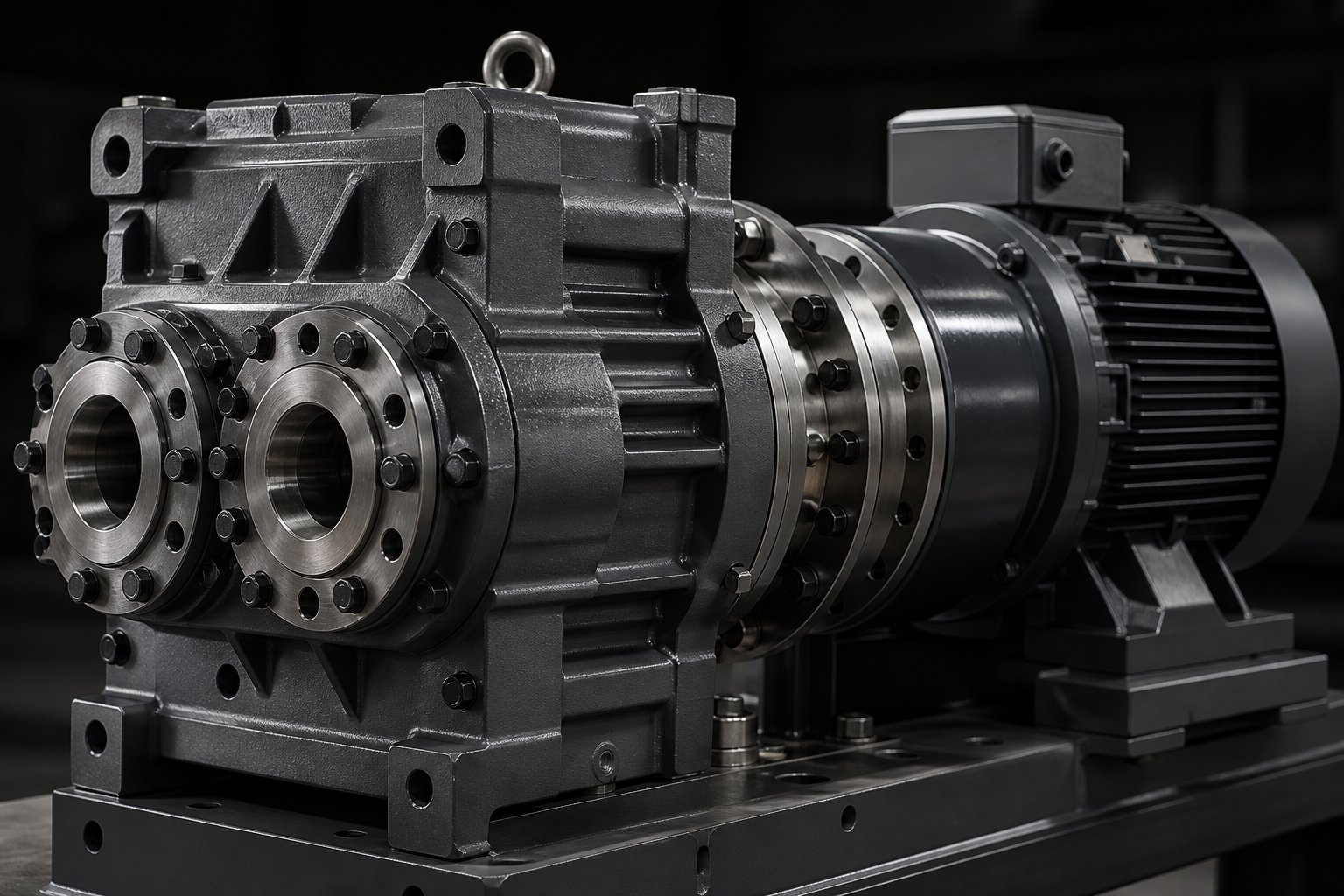
Screw speed amplifies the effect of torque. Older W&P machines commonly ran at maximum speeds of 300-500 rpm. Modern ZSK platforms reach 1,200 to 1,800 rpm. Higher speed means higher shear rate, faster material turnover, and increased throughput — but also more frictional heat generation, which matters enormously for thermally sensitive polymers. When evaluating a used machine, checking the maximum rated screw speed tells you whether the drive train and twin screw extruder gearbox belong to an earlier, lower-speed generation or a more modern high-speed platform.
Motor Power and Gearbox Considerations
Motor power and gearbox design tie everything together. The electric motor provides raw rotational energy; the gearbox steps that energy down to the appropriate speed while multiplying torque. A larger motor doesn't automatically mean more capability at the screw tips — it means more capability only if the gearbox can transmit that power without exceeding its rated torque capacity.
Here's a scenario that trips up buyers: you find a W&P twin screw extruder listed with a 200 kW motor and assume it's a high-performance machine. But if the gearbox is original to a 1980s-vintage platform with a lower torque rating, the motor may never deliver its full potential because the gearbox becomes the bottleneck. Conversely, a machine with a well-maintained, properly rated twin screw extruder gearbox matched to its motor can operate reliably at full load for decades — which is why so many W&P machines from the 1990s are still producing today.
When reviewing any listing — whether for a laboratory twin screw extruder or a full-scale production line — pay attention to the relationship between motor kW, gearbox output torque, and maximum rated screw speed. These three values define the machine's real performance ceiling far more accurately than any single spec in isolation.
The table below summarizes the key specifications you'll encounter and translates each one into what it actually means for your process:
| Specification | What It Measures | Typical ZSK Range | What It Means for Processing |
|---|---|---|---|
| L/D Ratio | Processing length relative to screw diameter | 28:1 to 48:1+ (extendable via barrel segments) | Determines how many functional zones (mixing, venting, feeding) can be configured along the screw; higher ratios suit complex, multi-stage processes |
| Screw Diameter | Nominal bore diameter of each screw | 18 mm (lab) to 420 mm (large-scale production) | Directly scales throughput capacity; larger diameters handle higher volumetric flow rates |
| Screw Speed Range | Rotational speed of the screws (rpm) | 300-500 rpm (older) to 1,200-1,800 rpm (modern) | Higher speeds increase shear rate, mixing intensity, and throughput but also elevate frictional heating |
| Specific Torque (Nm/cm³) | Torque delivered per unit of free volume in the process section | ~5-8 (early) to 18 (current Mc18) | Defines the machine's ability to process high-viscosity or heavily filled materials at target throughput rates |
| Motor Power (kW) | Electrical power input to the drive system | Varies by screw diameter and generation (e.g., 9 kW for a ZSK 26 up to 1,600+ kW for a ZSK 380) | Sets the upper limit of energy available for material processing; must be matched to gearbox torque rating |
| Gearbox Torque Rating | Maximum continuous torque the gearbox can transmit to the screw shafts | Proportional to motor power and gear reduction ratio | The true performance bottleneck — a motor can only deliver what the gearbox can handle without mechanical failure |
Notice how every specification connects to every other one. A twin screw extruder machine isn't defined by a single headline number — it's defined by the balance among all of these parameters. A high motor power paired with a weak gearbox is a mismatch. A generous L/D ratio on a low-torque platform limits your ability to use those extra barrel segments for intensive mixing. Understanding these relationships is what prevents you from overpaying for specs you can't fully use — or underpaying for a machine that can't meet your process demands.
And while the twin screw extruder price on any used W&P listing reflects factors like age, condition, and market demand, the specifications above are what determine the machine's value to your specific operation. A well-matched, properly maintained ZSK at a moderate price point will outperform a mismatched premium unit every time.
Specifications tell you what a machine can do in theory. The real proof shows up in the applications those capabilities serve — and the industries that have relied on W&P extruders to handle their most demanding production challenges for decades.
Industries and Applications Powered by W&P Extruders
A machine's specifications define what it can do. Its application history tells you what it actually does — day after day, shift after shift, under real production pressures. The Werner & Pfleiderer ZSK didn't earn its reputation in a laboratory. It earned it on factory floors processing abrasive mineral fillers, heat-sensitive engineering resins, recycled post-consumer waste, and reactive chemistries that would overwhelm lesser equipment. When you understand these applications, you also understand why barrel and screw element condition matters so much when evaluating any W&P machine.
Compounding and Masterbatch Production
Polymer compounding is the ZSK's home turf. Imagine a base resin — polypropylene, polyamide, polycarbonate — that needs to become something more than a generic pellet. It needs impact modifiers blended in, glass fibers wetted and distributed, UV stabilizers dispersed at molecular-level uniformity, or flame retardants loaded at concentrations exceeding 60% by weight. That's the job of a compounding twin screw extruder, and it's where the ZSK's self-wiping co-rotating design delivers its greatest advantage.
The intermeshing screw geometry creates five distinct shear regions — channel, overflight, lobal pool, intermesh, and apex — each contributing to the overall mixing quality. As industry researchers have documented, this combination of dispersive and distributive mixing zones enables a twin screw compounding extruder to break down filler agglomerates while simultaneously spreading those particles evenly throughout the polymer matrix. The result? Engineering plastics with consistent mechanical properties, batch after batch.
Consider what happens when you're producing a filler masterbatch twin screw extruder operation loaded with calcium carbonate at 70-80% concentration. The sheer volume of abrasive mineral passing through the barrel subjects every flight tip, every kneading block lobe, and every barrel bore surface to relentless wear. The ZSK handles the mixing challenge beautifully — its modular screw profile can be configured with aggressive dispersive kneading blocks in the early mixing zone and gentler distributive elements downstream to avoid over-shearing the polymer — but the mechanical toll on hardware is enormous. Talc, glass fiber, and calcium carbonate don't care about your machine's pedigree. They grind metal regardless.
Color masterbatch production demands a different kind of precision. Here, the goal is complete dispersion of pigment agglomerates — often down to individual particles — without degrading the carrier resin. The plastic twin screw extruder excels because the operator can tune the screw profile to deliver just enough shear to rupture pigment clusters while keeping melt temperature within safe limits. Tight barrel temperature control, combined with the ZSK's short and predictable residence time distribution, prevents thermal degradation that would shift color values and ruin a batch.
Even specialty applications like powder coating twin screw extruder processing rely on these same principles. Powder coating formulations — typically thermoset resins blended with pigments, flow agents, and hardeners — require thorough mixing at temperatures below the crosslinking threshold. The ZSK's precise thermal management and modular screw flexibility make it a natural fit for these formulations, where overheating by even a few degrees can trigger premature curing inside the barrel.
Recycling and Reactive Processing Applications
Plastic recycling is reshaping how compounders think about their equipment. Post-industrial regrind and post-consumer waste present challenges that virgin-resin compounding never does: contamination, moisture, mixed polymer fractions, and unpredictable melt behavior. Yet the twin screw extruder plastic recycling sector has grown steadily because the co-rotating platform's strengths — efficient devolatilization, multi-stage venting, and sequential downstream feeding — align directly with what recycled feedstocks demand.
A Plastics Technology analysis of twin screw recycling systems highlights several real-world configurations. In PET and PLA edge-trim reclaim, the co-rotating extruder devolatilizes residual moisture from in-house trim, eliminating the costly drying step while minimizing IV loss from hydrolysis. Nylon fiber reclaim from baled carpet waste uses crammer-assisted feeding and multi-stage vacuum venting to remove spin-finish volatiles before the reclaimed polymer is either pelletized or directly spun into new fiber. Even fractional-melt HDPE scrap has been intentionally degraded inside a high-speed twin screw system — running at 1,000+ rpm with elevated temperature setpoints — to raise the melt flow index into a range suitable for injection molding, achieving near-100% raw material utilization.
Reactive extrusion pushes the ZSK into territory that few other machine types can reach. Grafting maleic anhydride onto polyolefin backbones, chain-extending recycled PET to recover molecular weight, or performing controlled peroxide degradation of polypropylene for melt-blown nonwovens — each of these processes requires exact control over temperature, residence time, and shear intensity. The ZSK's modular barrel and screw architecture lets engineers place reactive zones precisely where they're needed, introduce liquid reagents through injection ports at calculated positions, and vent reaction byproducts before they degrade the final product.
Here's a summary of the major application categories where W&P twin screw extruders have been deployed for decades:
- Polymer compounding — Blending base resins with impact modifiers, stabilizers, flame retardants, and processing aids to produce engineering-grade compounds
- Filler and color masterbatch — High-concentration dispersion of calcium carbonate, talc, titanium dioxide, carbon black, and organic pigments into carrier resins
- Plastic recycling and pelletizing — Processing post-industrial regrind and post-consumer waste through melting, devolatilization, filtration, and re-pelletizing
- Reactive extrusion — Performing chemical reactions (grafting, chain extension, controlled degradation, crosslinking) within the extruder barrel under precisely managed conditions
- Devolatilization — Removing solvents, moisture, monomers, and other volatiles from polymer melts through atmospheric and vacuum venting stages
- Direct extrusion — Producing finished or semi-finished products (sheet, film, profiles, fibers) directly from the compounding extruder, bypassing intermediate pelletizing
Every one of these applications shares a common thread: extreme demands on hardware. Mineral-filled compounds erode barrel bores and screw flight tips through abrasive wear. Reactive chemistries attack metallurgical surfaces through corrosion. High-throughput recycling operations subject machines to thermal cycling, contamination-induced pressure spikes, and extended run times that accelerate fatigue. The modular design philosophy W&P built into the ZSK was never just about processing flexibility — it was also about serviceability. Worn barrel segments can be replaced individually. Damaged screw elements can be swapped without dismantling the entire shaft. Expensive corrosion-resistant metallurgies can be deployed selectively, only in the zones where chemical attack is most severe.
That built-in serviceability matters most when a machine has been running hard for years or even decades. And for anyone operating or acquiring a used Werner & Pfleiderer extruder, the condition of those consumable components — barrels, screw elements, and the mechanical drive system behind them — is what separates a machine with years of productive life remaining from one facing an expensive overhaul.
How to Evaluate a Used Werner & Pfleiderer Extruder
You've found a used twin screw extruder for sale with the Werner & Pfleiderer nameplate, the ZSK designation checks out, and the price looks right. Before you sign anything, how do you know whether you're buying a machine with another decade of production ahead of it — or an expensive rebuild project disguised by a fresh coat of paint?
Most used equipment listings give you a photo gallery, a spec sheet, and maybe a short run history. What they don't give you is a framework for interpreting what you're looking at. Barrel bore dimensions, screw element flight conditions, gearbox oil analysis, and control system vintage all tell a story — but only if you know how to read it. Here's the evaluation approach that separates a smart acquisition from a regrettable one.
Barrel and Screw Element Wear Assessment
Start with the components that take the most punishment: the barrel segments and the modular screw elements. These are consumable parts by design. Werner & Pfleiderer engineered the ZSK so that worn barrels and elements could be replaced individually without scrapping the entire machine. That's the good news. The practical implication? Worn hardware doesn't automatically disqualify a used twin screw extruder — it simply factors into your total cost of ownership calculation, provided quality replacements are available.
Here's what to measure and inspect:
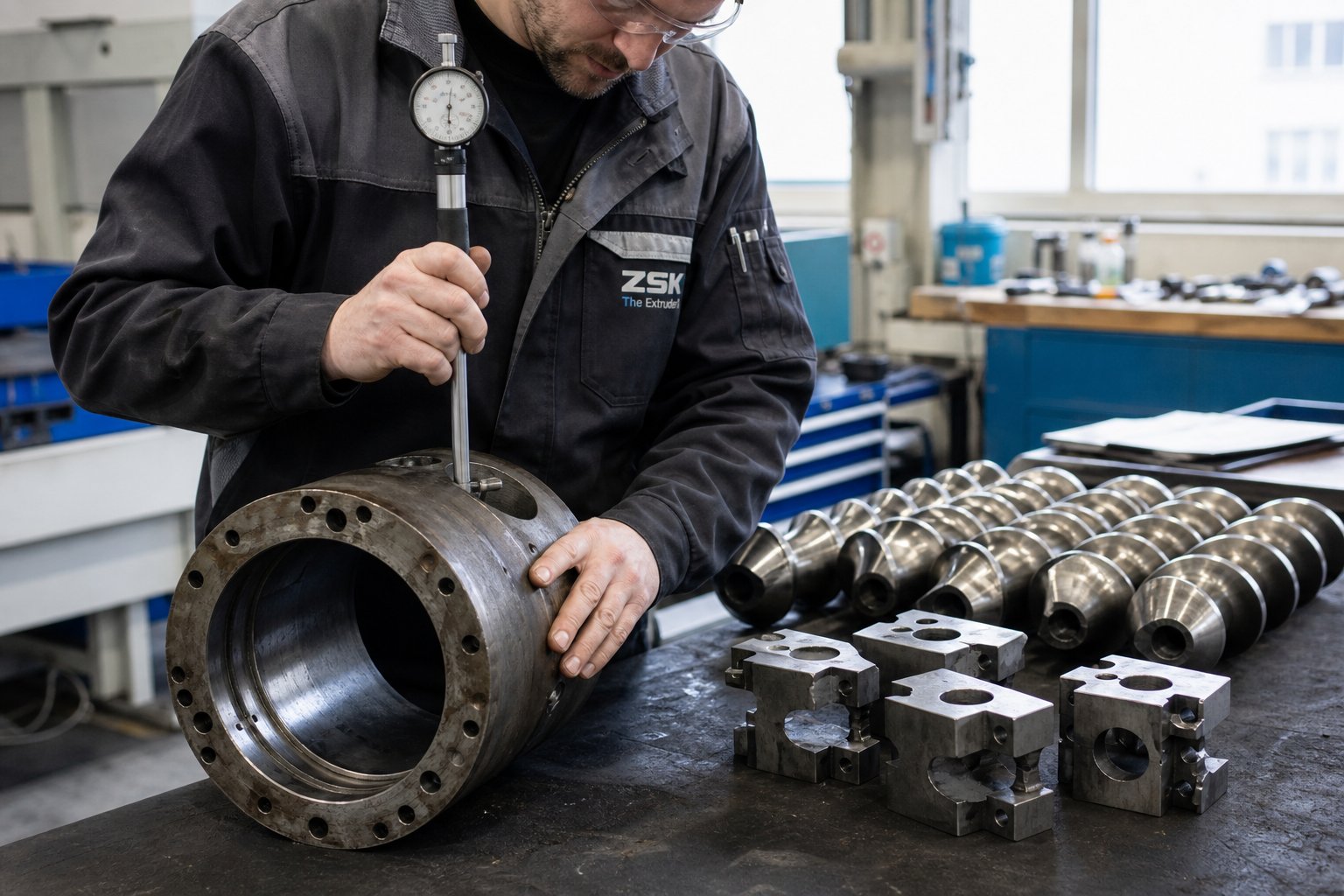
- Barrel bore diameter — Use a bore gauge to measure the internal diameter of each barrel segment at multiple points along its length. Compare these readings against the original manufacturer tolerances. Even fractions of a millimeter beyond spec matter. Enlarged bores allow material to bypass screw flights rather than being conveyed and mixed properly, directly reducing output quality and throughput efficiency.
- Screw element flight tip wear — Measure the outer diameter of conveying elements at several points using a micrometer. Industry practice typically flags elements with more than 0.2 mm of radial wear on the flight tips as candidates for replacement. Worn flights widen the gap between the element and the barrel wall, reducing conveying efficiency and degrading the self-wiping action that defines the ZSK's performance.
- Kneading block lobe condition — Inspect each lobe of every kneading block for rounding, chipping, or asymmetric wear patterns. Kneading blocks do the heaviest mixing work, and their lobes experience the most intense material contact. Uneven wear across lobes indicates the machine may have been running with misaligned screws or processing highly abrasive formulations without appropriate metallurgical protection.
- Corrosion and pitting — Look for surface pitting, chemical etching, or discoloration inside barrel bores and on screw element surfaces. These signs suggest the machine processed corrosive materials — acidic flame retardants, halogenated polymers, or reactive chemistries — and the damage may extend deeper than what's visible. Pitted surfaces trap degraded material, creating contamination points that affect product purity.
Keep a critical perspective when evaluating barrel and screw element condition. A machine that processed 70% calcium carbonate masterbatch for five years will show significant abrasive wear, but the gearbox, motor, and frame may be in excellent shape. If quality aftermarket barrels and screw elements are readily sourced — and they are for ZSK platforms — the rebuild math can work strongly in your favor compared to buying new equipment.
Gearbox and Drive System Evaluation
The gearbox is the most expensive single component in a twin screw extruder, and it's also the one that's hardest to assess from a listing photo. A thorough gearbox evaluation separates serious buyers from casual browsers.
Start by requesting oil analysis results. Gearbox lubricant tells you what's happening inside the housing without opening it. Elevated iron particle counts suggest gear tooth wear. Copper or bronze particles indicate bearing cage degradation. Water contamination points to seal failure or condensation issues. If the seller can't provide oil analysis, that itself is information — it suggests the gearbox hasn't been monitored systematically. Coperion's own condition monitoring systems for ZSK gearboxes track both vibration signatures and oil quality continuously, underscoring how seriously the OEM takes these parameters. If the machine you're evaluating lacks such monitoring, insist on fresh oil sampling and independent lab analysis before purchase.
Bearing play is the next checkpoint. Excessive radial or axial play in the gearbox output bearings transmits directly to the screw shafts, causing uneven screw-to-barrel clearances that accelerate wear across every element on the machine. With the screws removed, you can sometimes detect bearing play by hand — but quantified measurements from a vibration analysis specialist are far more reliable.
Gear tooth condition matters enormously for long-term reliability. Pitting, spalling, or scoring on gear teeth indicates fatigue or lubrication failures. Modern ZSK gearboxes use involute toothing produced through cold-hammering processes for superior torque transmission, but older W&P units may have earlier-generation tooth profiles with lower fatigue limits. Ask for the gearbox's maintenance history and any records of prior rebuilds.
Finally, evaluate the control system. Older Werner & Pfleiderer machines often shipped with analog instrumentation or early-generation PLCs that are now obsolete. Outdated controls don't prevent the machine from running, but they limit your ability to monitor process parameters accurately, integrate with plant-wide data systems, or implement modern safety interlocks. Budget for a control system retrofit if the machine carries original 1980s- or early 1990s-era electronics — the mechanical platform may be excellent, but the brain needs an upgrade.
Parts Compatibility and the Coperion Connection
Here's the reassuring reality for anyone considering a W&P purchase: the ZSK platform never died. Coperion continues to manufacture and develop ZSK extruders in Stuttgart using the same fundamental dimensional standards Werner & Pfleiderer established. That continuity means many replacement parts — barrel segments, screw elements, shaft components, and even gearbox internals — maintain dimensional compatibility with older W&P machines.
Beyond OEM sourcing through Coperion, a robust aftermarket ecosystem of third-party barrel and screw element manufacturers has grown around the ZSK platform precisely because so many of these machines remain in active service worldwide. Used twin screw extruders bearing the W&P nameplate are supported by multiple independent suppliers who produce compatible barrels in various metallurgies (nitrided steel, bimetallic liners, tungsten carbide coatings) and screw elements engineered to match original dimensional specifications. This aftermarket competition keeps replacement costs manageable and lead times shorter than OEM-only sourcing would allow.
The availability of quality replacement components is arguably the strongest argument for buying a used W&P ZSK. Unlike obscure or discontinued machine platforms where parts sourcing becomes a nightmare, the ZSK's market dominance created a self-sustaining support infrastructure. As long as you verify dimensional compatibility before ordering — screw diameter, shaft spline profile, barrel segment length, and bore geometry — you'll find multiple sourcing options for virtually every wear component on the machine.
Before committing to any purchase, use this consolidated checklist to structure your evaluation:
- Measure barrel bore diameters against original tolerances at multiple points per segment
- Inspect screw element flight tips for radial wear exceeding 0.2 mm and kneading block lobes for rounding or chipping
- Check for corrosion, pitting, or chemical etching on all material-contact surfaces
- Request or commission independent gearbox oil analysis (iron particles, copper/bronze content, water contamination)
- Assess gearbox bearing play through vibration analysis or manual inspection with screws removed
- Inspect gear teeth for pitting, spalling, or scoring; request maintenance and rebuild history
- Verify motor power rating, gearbox torque rating, and maximum screw speed — confirm these three values are properly matched
- Evaluate the control system vintage: identify PLC model, HMI generation, and sensor calibration status
- Confirm the ZSK model designation and generation to establish parts compatibility with current Coperion and aftermarket suppliers
- Obtain a complete run history if available — materials processed, operating hours, and prior rebuild records
A used Werner & Pfleiderer twin screw extruder evaluated against this checklist gives you a clear, quantified picture of where the machine stands and what it will cost to bring it to full operational capability. The barrel and screw elements may need replacement — and in many cases, that's expected and budgetable. The gearbox and drive system, however, are where hidden costs lurk. Get those right, and you've likely secured a machine with years of reliable production ahead of it at a fraction of new-equipment cost.
Of course, knowing what to replace is only half the equation. Knowing where to source those replacement barrels and screw elements — and how to judge the quality of what you're buying — determines whether your refurbished machine performs like the original or falls short of its potential.
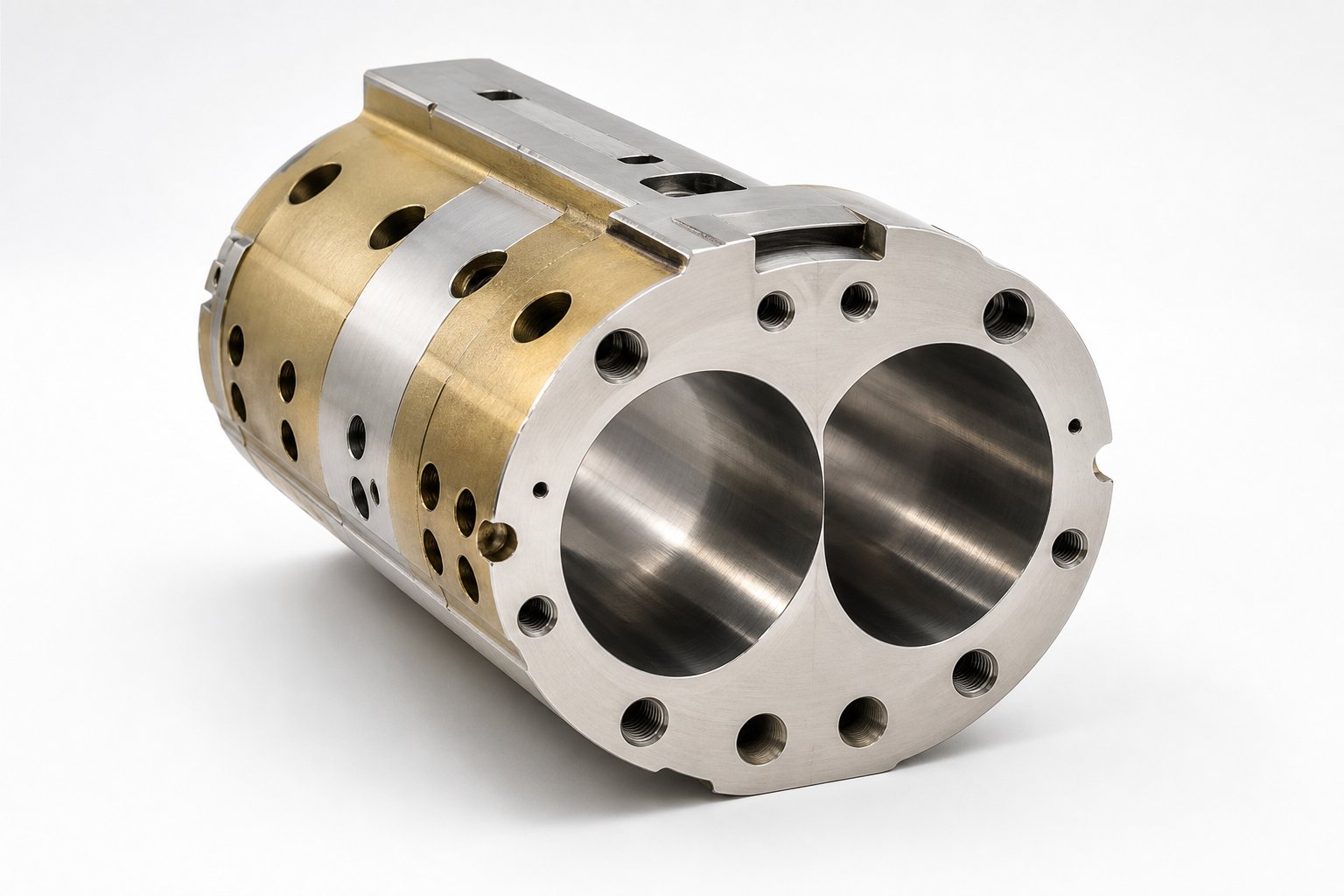
Replacement Barrels and the Aftermarket Parts Ecosystem
Your evaluation checklist confirmed that the barrels and screw elements need replacing — and as discussed, that's a perfectly normal finding on a used Werner & Pfleiderer twin screw extruder with years of production behind it. The question now shifts from what needs replacing to who supplies the replacement and how you judge whether what they're offering will actually perform. This decision directly determines whether your refurbished ZSK runs like it did when it left Stuttgart — or falls short within months.
OEM vs Aftermarket Replacement Barrels
Two sourcing paths exist for every extruder twin screw barrel and screw element on a W&P machine, and each comes with distinct trade-offs.
The first path is OEM sourcing through Coperion. Because Coperion is the direct corporate descendant of Werner & Pfleiderer, their replacement barrels and screw elements carry the exact dimensional specifications, metallurgical standards, and quality documentation of the original platform. For operators running current-generation ZSK machines under warranty or service contracts, OEM parts are often the default choice. The trade-off? Lead times can stretch to several months, and pricing reflects the premium associated with any original equipment manufacturer.
The second path runs through aftermarket twin screw extruder suppliers — independent manufacturers who produce compatible barrels and screw elements engineered to match ZSK dimensional standards. This aftermarket ecosystem exists specifically because thousands of W&P-branded machines remain in active service worldwide, creating sustained demand for replacement hardware that the OEM alone cannot efficiently serve. For owners of legacy W&P machines — particularly older generations where Coperion's support focus has naturally shifted toward current models — aftermarket suppliers often provide shorter lead times, competitive pricing, and metallurgical options tailored to specific processing challenges.
Think of it this way: twin screw extruder machine manufacturers build the platform, but the aftermarket keeps it running. Both sourcing paths are legitimate. The critical variable isn't who made the barrel — it's whether the barrel meets the technical criteria your application demands. And those criteria deserve a closer look.
What to Look for in a Quality Replacement Barrel
Not all aftermarket barrels are created equal. A replacement barrel that doesn't match the original bore tolerance, uses an inferior liner alloy, or lacks proper hardness documentation can accelerate screw element wear, degrade mixing performance, and shorten the interval between your next replacement cycle. Here's what separates a quality extruder twin screw barrel from a cheap imitation.
Metallurgical composition is your starting point. The lining material must match the demands of your specific process. As aftermarket specialists have documented, ZSK barrel liners are selected based on application type:
| Application Type | Recommended Lining | Key Features |
|---|---|---|
| High-wear filler compounds (CaCO3, glass fiber, talc) | Cr26, WR13, tungsten carbide-reinforced | High hardness (up to HV 1,200-1,400 for WC liners), exceptional abrasion resistance |
| Corrosive materials (halogenated polymers, acidic additives) | SAM26, nickel alloy, 316L | Acid-resistant, durable against chemical attack |
| General engineering plastics | Cr12MoV, 38CrMoAlA (nitrided) | Good heat treatment response, impact resistance, cost-effective |
| Food-grade extrusion | 316L, lead-free alloy | Safe for food contact, FDA compliant |
For heavily filled compounds — the kind of 30-65% glass fiber or mineral loading that many W&P machines were built to handle — tungsten carbide-reinforced bimetallic liners represent the severe-duty standard. These liners incorporate WC particles cast into the alloy matrix during centrifugal casting, extending barrel life by roughly four to five times compared to plain bimetallic alternatives. That kind of longevity improvement can completely change the economics of running an older ZSK on abrasive formulations.
Beyond metallurgy, several additional quality indicators separate a reliable twin-screw extruder manufacturer of aftermarket barrels from a substandard one. When evaluating any supplier, verify the following:
- Bore tolerance precision — The barrel bore must be honed to within the original ZSK specification for the specific screw diameter. Even 0.05 mm of deviation changes the screw-to-barrel clearance, affecting self-wiping efficiency and accelerating element wear.
- Liner hardness documentation — Reputable suppliers provide hardness test reports (Vickers or Rockwell) for every barrel shipped. Without documented hardness values, you have no way to verify the liner's wear resistance claims.
- Dimensional compatibility verification — Center distance between barrel bores, overall segment length, bolt hole patterns, heating/cooling channel positions, and thermocouple port locations must all match the original W&P configuration. A barrel that fits mechanically but misaligns thermally undermines process control.
- Liner bonding integrity — In bimetallic construction, the bond between the liner and the outer barrel body must be metallurgically sound. Poor bonding leads to liner separation under thermal cycling — a catastrophic failure mode that contaminates product and destroys screw elements.
- Surface finish quality — The inner bore should be honed to a specified surface roughness (typically Ra 0.4 or better). Rough surfaces increase frictional drag, promote material adhesion, and accelerate wear on screw element flight tips.
Suppliers like NANHAIYA exemplify the specialized aftermarket approach — offering custom parallel twin screw barrels engineered for the demanding mixing, conveying, granulation, and high-wear processing conditions that W&P extruders typically encounter. Their focus on serving compounding, pelletizing, recycling, and masterbatch manufacturers running twin-screw extrusion lines means the barrels are designed with these exact application stresses in mind, rather than being generic catalog items adapted after the fact. When evaluating any twin screw extruder manufacturers in the aftermarket space, look for this kind of application-specific engineering focus rather than one-size-fits-all offerings.
One often-overlooked consideration: barrel replacement is also the right time to evaluate whether your machine needs upgraded ancillary components. Sidefeeders for twin screw extruders, for example, attach directly to barrel segments and require precise port alignment. If you're replacing barrels, confirm that sidefeeder port geometry matches your existing downstream feeding equipment — or take the opportunity to add a sidefeeder station that the original barrel configuration didn't include.
Ultimately, the right aftermarket barrel partner extends your W&P machine's productive life by years or even decades, at a fraction of new-equipment cost. The wrong one turns a sound mechanical investment into a recurring maintenance headache. Ask for metallurgical certifications, dimensional inspection reports, and hardness documentation before placing any order. The suppliers who provide these without hesitation are the ones worth your business — and the ones who will keep your legacy ZSK performing at the level Werner & Pfleiderer originally intended.
Werner & Pfleiderer Twin Screw Extruder FAQs
1. What happened to Werner & Pfleiderer and who makes ZSK extruders now?
Werner & Pfleiderer's extrusion division was acquired through a series of corporate transitions — first by Krupp, then ThyssenKrupp — before being combined with Buss and Waeschle around 2000-2001 to form Coperion under Georg Fischer AG. Coperion continues manufacturing and developing the ZSK twin screw extruder line from Stuttgart, Germany. Despite the brand change, thousands of original W&P-stamped machines remain in active production globally, and the used-equipment market still lists them under the Werner & Pfleiderer name because that is what appears on their nameplates, gearbox housings, and control panels.
2. Are replacement parts for old Werner & Pfleiderer extruders still available?
Yes, replacement parts remain widely available through two channels. Coperion, as the direct corporate successor, supplies OEM barrels and screw elements that maintain original ZSK dimensional specifications. Additionally, a robust aftermarket ecosystem of independent manufacturers — such as NANHAIYA (nhyscrews.com), which produces custom parallel twin screw barrels for compounding, recycling, and masterbatch applications — offers compatible components often at shorter lead times and competitive pricing. Because the ZSK platform's dimensional standards have remained consistent across generations, aftermarket barrels and screw elements can be sourced in various metallurgies including nitrided steel, bimetallic liners, and tungsten carbide coatings to match specific processing demands.
3. What is the difference between co-rotating and counter-rotating twin screw extruders?
In a co-rotating twin screw extruder like the W&P ZSK, both screws spin in the same direction, producing a self-wiping intermeshing action ideal for polymer compounding, reactive extrusion, and devolatilization. Counter-rotating designs feature screws turning toward each other, generating high calendering forces and positive-displacement conveying suited to PVC pipe and profile extrusion. Co-rotating machines offer superior mixing flexibility and higher throughput at elevated screw speeds, while counter-rotating units excel at pressure generation. The ZSK was designed exclusively as a co-rotating parallel platform, so any listing describing a counter-rotating or conical W&P unit likely involves a different product line or a misidentified machine.
4. What should I inspect before buying a used Werner & Pfleiderer twin screw extruder?
Focus on three critical areas. First, measure barrel bore diameters against original tolerances and inspect screw element flight tips for radial wear exceeding 0.2 mm — worn barrels and elements are expected consumables and replaceable through aftermarket suppliers. Second, request independent gearbox oil analysis to check for elevated iron particles, copper or bronze content, and water contamination, then assess bearing play through vibration analysis. The gearbox is the most expensive component and the hardest to evaluate visually. Third, verify the control system vintage — machines from the 1980s or early 1990s often carry obsolete PLCs requiring modernization. Always confirm the ZSK model designation and generation to ensure parts compatibility with current Coperion and aftermarket sources.
5. What does the L/D ratio mean on a ZSK twin screw extruder and why does it matter?
The L/D (length-to-diameter) ratio describes the processing length of the barrel relative to the screw diameter. ZSK models range from about 28:1 for compact or laboratory setups to 48:1 and beyond for complex multi-stage processes. A higher L/D ratio provides more physical space to configure distinct functional zones — feeding, melting, mixing, devolatilization, and pressure buildup — along the screw. Shorter machines (28:1 to 32:1) suit simpler compounding tasks, while extended configurations (44:1+) are necessary for reactive extrusion, multi-stage vacuum venting, or processes requiring several sequential side-feeding points. Understanding L/D helps you match the machine to your specific process complexity without overpaying for unnecessary barrel length.
Written by
Nanhaiya Technical Team
Zhoushan Nanhaiya Plastic Machinery Co., Ltd.
The Nanhaiya technical team supports screw and barrel manufacturing projects through application review, technical communication, custom manufacturing coordination, and production and quality control.
Discuss Your Application
Related Articles
More insights on screw barrel technology and plastics processing.
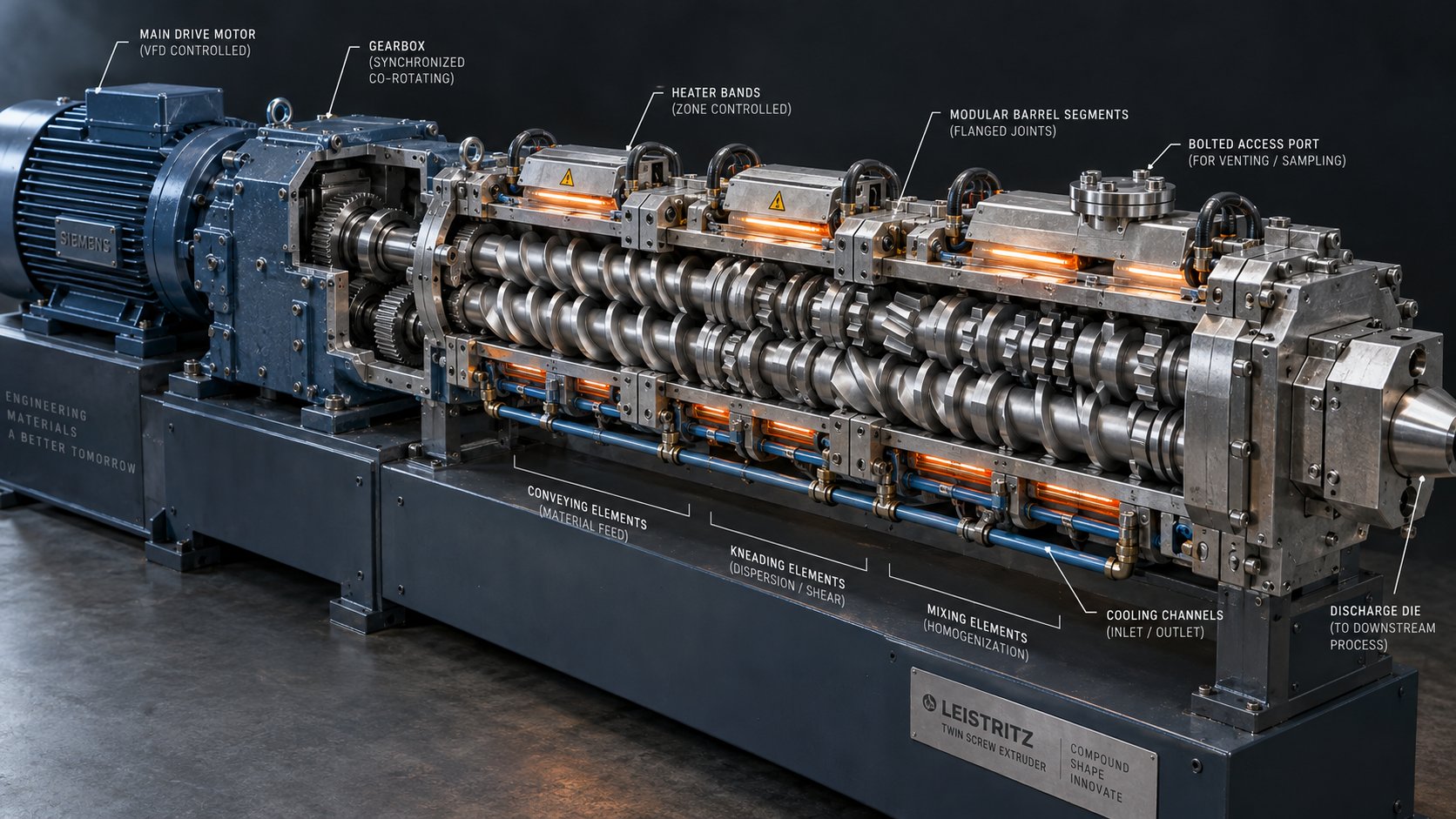
Co Rotating Twin Screw Extruder Parts: From Drive To Die Face
Oct 12, 2026
Complete guide to co rotating twin screw extruder parts — screw elements, kneading blocks, barrel segments, drive components, and material grades explained for sourcing and optimization.
Read Article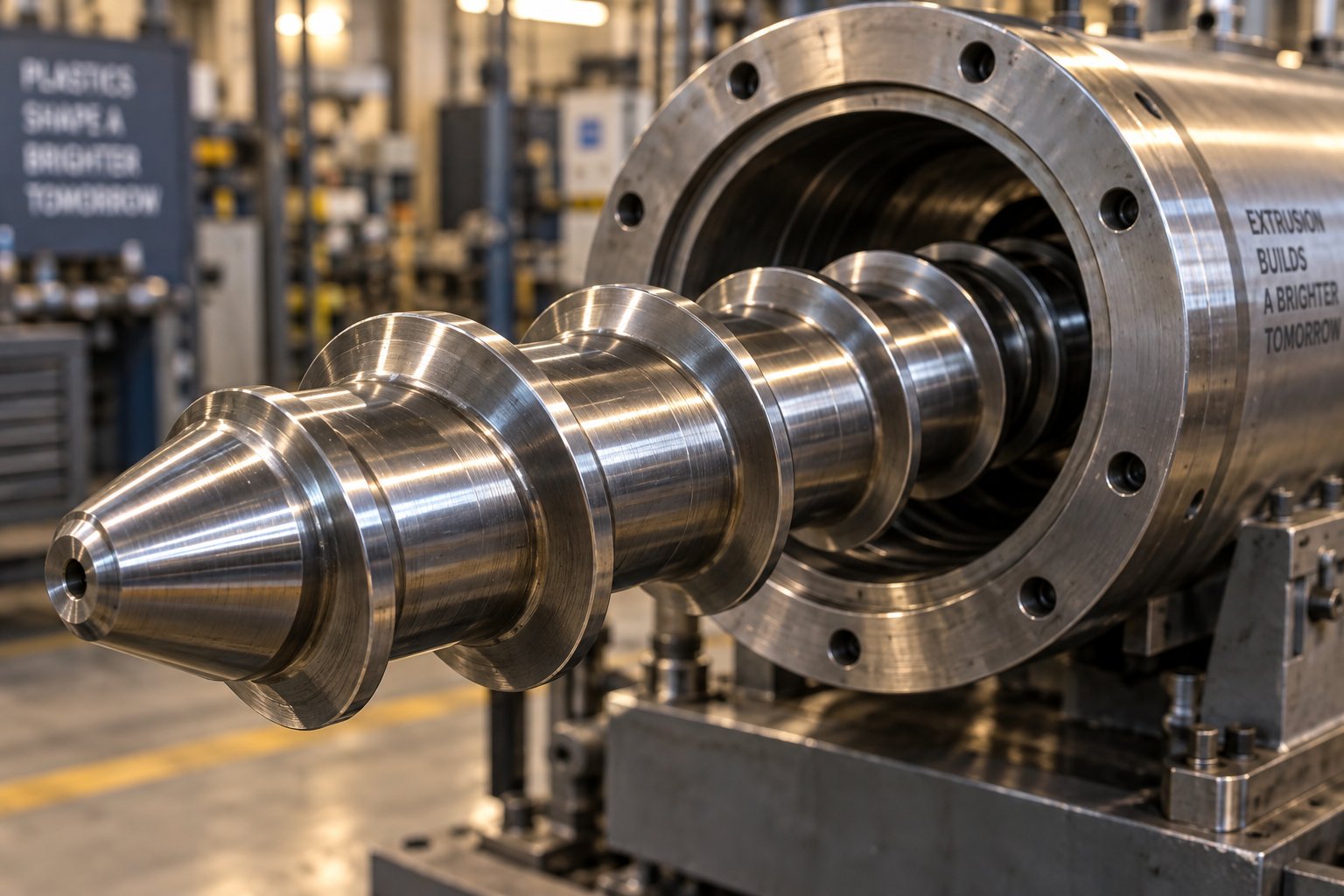
What Nobody Tells You About Screw Barrel For Plastic Machine Design
Oct 10, 2026
Learn how screw barrel for plastic machine design affects melt quality, throughput, and wear life. Covers geometry, resin matching, troubleshooting, and sourcing.
Read Article
Single Screw Extruder for Sheet: Stop Guessing, Start Specifying
Oct 9, 2026
Learn how to specify a single screw extruder for sheet production. Covers screw geometry, resin-specific processing, troubleshooting, and maintenance best practices.
Read ArticleLooking for something else?
Search by material, symptom or product and jump straight to the relevant page.
These are navigation suggestions based on keyword matching — not a quotation, not a delivery commitment, and not a substitute for engineering review. Final specification is confirmed by our engineers against your drawings and processed material.
Need help with screw barrel selection?
Share your machine model, processed material and application. Our team can help with pricing and technical support.