

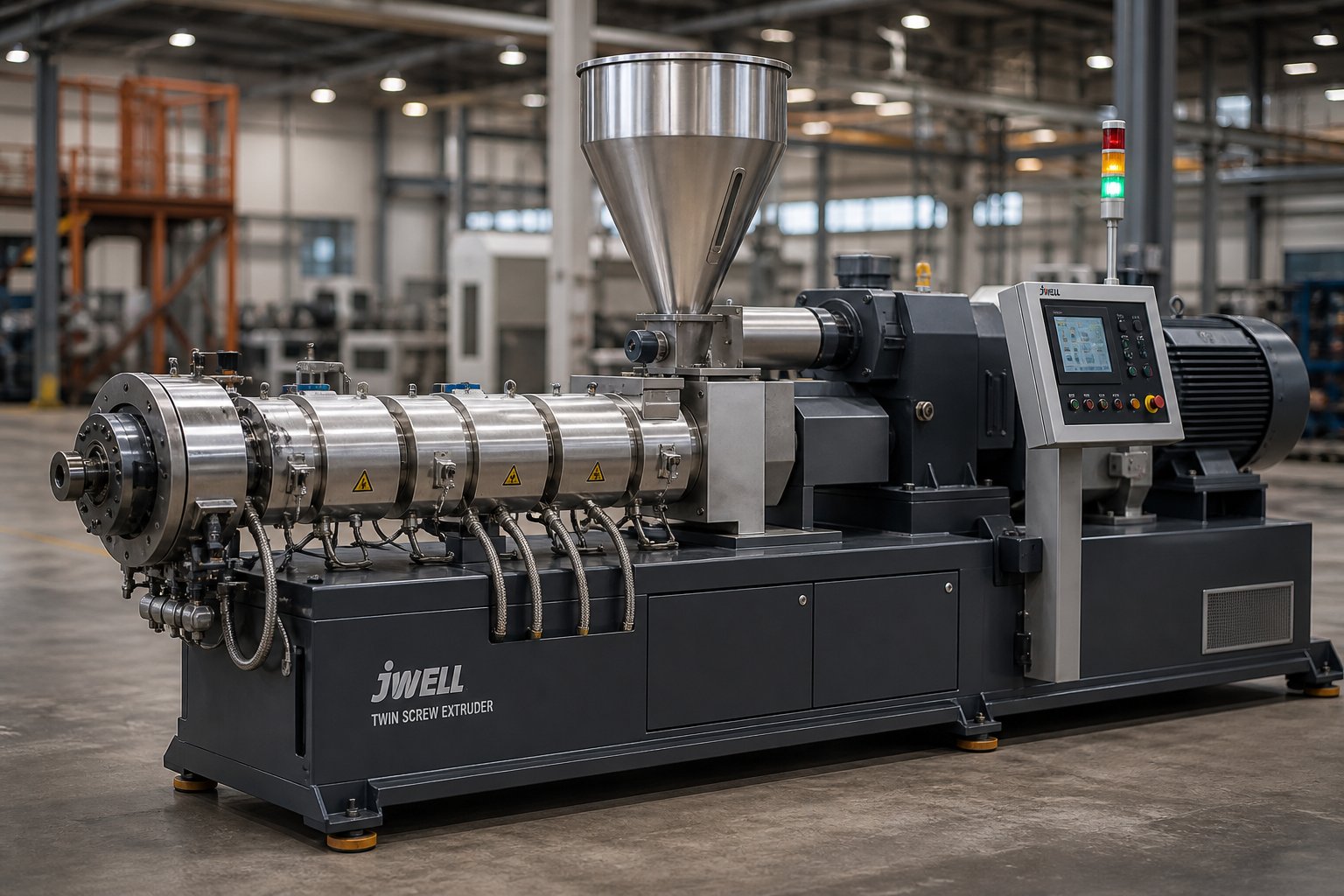
Understanding Twin Screw Extruders and the Used Equipment Market
A twin screw extruder is an industrial processing machine that uses two intermeshing, parallel screws rotating inside a heated barrel to convey, melt, mix, and shape polymer materials into finished or semi-finished products. These machines are the backbone of modern plastic compounding, masterbatch production, reactive extrusion, and recycling operations — and when you find a used twin screw extruder for sale from a reputable source, you gain access to that same industrial-grade capability at a fraction of the original investment.
This article is your unfiltered buyer's guide. It covers everything sellers rarely explain upfront: machine types, critical specifications, hands-on inspection techniques, brand comparisons, spare parts sourcing, and total cost of ownership. Whether you are a compounder scaling up a new formulation or a recycler adding processing capacity, the information here will help you evaluate any listing with confidence.
What Is a Twin Screw Extruder and How Does It Work
Imagine two large screws — each fitted with carefully sequenced conveying, kneading, and mixing elements — spinning in tight synchronization inside a segmented, temperature-controlled barrel. Raw material enters through a feed hopper, and within seconds the screws convey it forward, generate frictional heat, compress and melt the polymer, and then force the homogenized melt through a die or into a pelletizer. That entire journey, from solid pellet to finished compound, happens continuously and at high throughput rates.
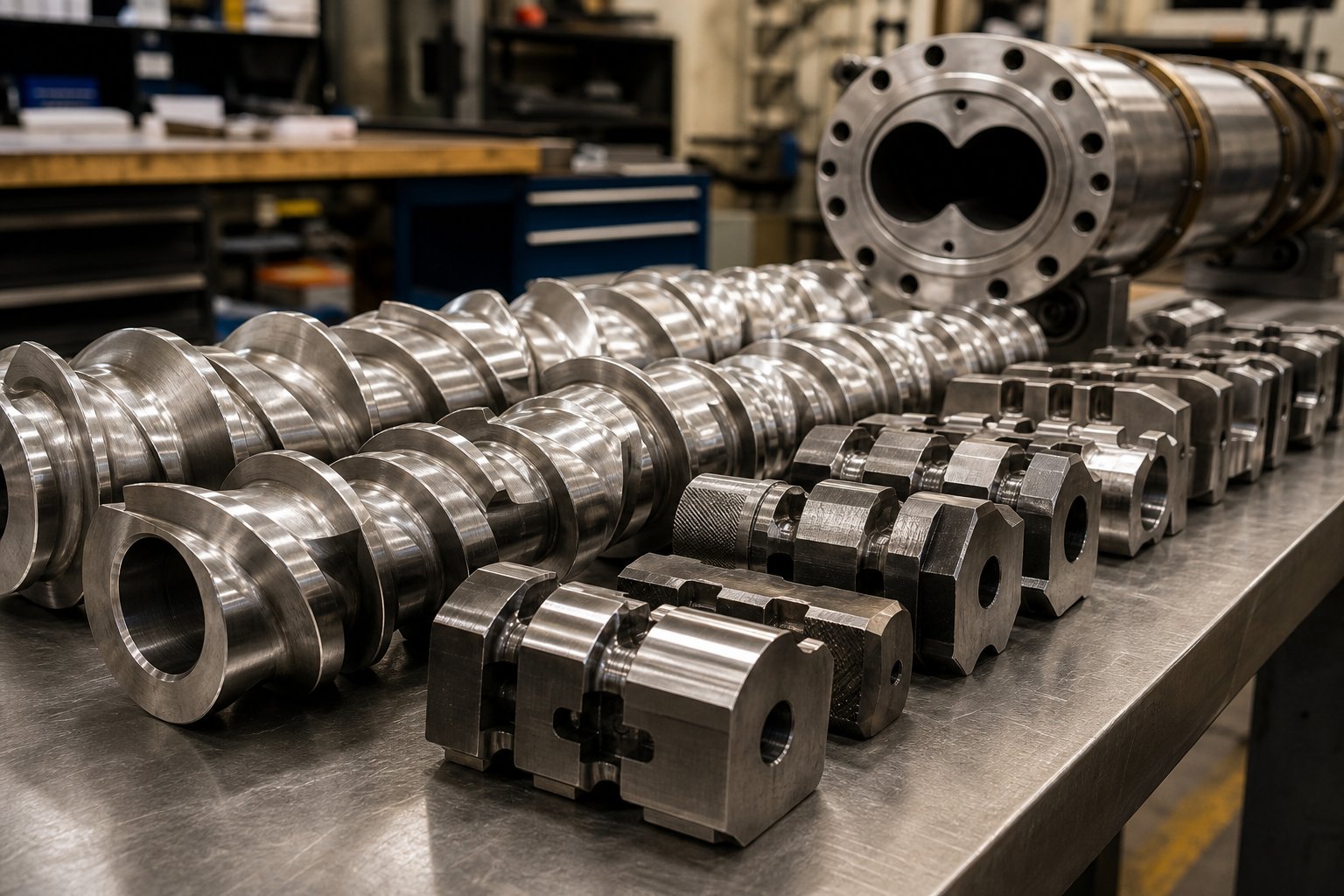
The real power of twin screw extruders lies in their modular screw design. Operators can rearrange individual screw elements — conveying flights, kneading blocks, mixing sections, and reverse elements — to fine-tune shear intensity, residence time, and distributive mixing for a specific formulation. This flexibility is why the same plastic extruder platform can handle everything from color masterbatch and glass-fiber-reinforced engineering plastics to devolatilization of moisture-sensitive resins.
Applications extend well beyond plastics. Twin screw extruders are also widely used in food processing for texturized snacks and cereals, in pharmaceutical manufacturing for hot-melt extrusion of drug delivery systems, and in rubber compounding. That broad application base is exactly what keeps the used equipment market so active — when one processor upgrades or changes product lines, the machine they release is often perfectly suited to another operation's needs.
Why the Used Equipment Market Is Thriving
Several market forces create a steady supply of quality used extruders. Plant closures, corporate mergers, capacity upgrades to larger-diameter machines, and product line changes all push well-maintained equipment onto the secondary market. For buyers, this translates into a compelling strategic advantage: instead of waiting months for a new plastic extrusion machine to be manufactured, shipped, and commissioned, a used unit can often be delivered, installed, and running production within weeks.
Speed is only part of the equation. Capital risk drops dramatically when you buy proven equipment with a documented production history rather than committing to a new machine that still needs to be validated on your specific formulations.
Used twin screw extruders typically sell for 30% to 60% of the cost of an equivalent new unit — and when properly inspected and maintained, they can deliver comparable throughput and product quality for years of additional service life.
That price advantage matters in a market where new high-capacity twin screw extruders can range from $200,000 to well over $1,000,000 depending on screw diameter, output capacity, and control system sophistication. Used extruders for sale at a fraction of those figures free up capital for auxiliary equipment, raw materials, or facility improvements that directly impact profitability.
The catch? Not every listing represents a good deal. Screw wear, gearbox fatigue, obsolete controls, and missing documentation can turn a bargain into a money pit. That reality is precisely why the chapters ahead break down machine types, brand heritage, specification decoding, and a step-by-step inspection process — the details sellers rarely volunteer but every buyer needs to understand.
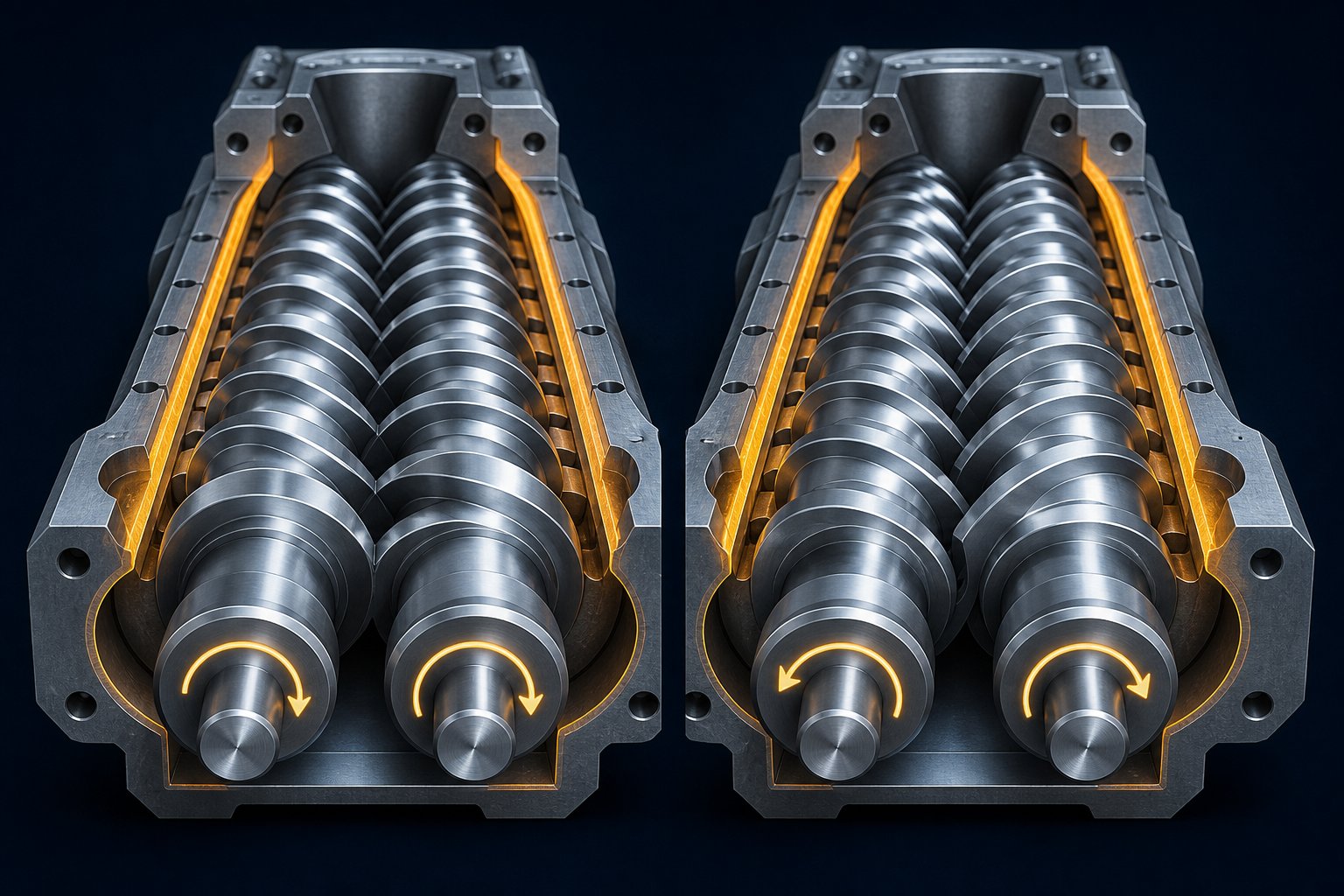
Co-Rotating vs Counter-Rotating Twin Screw Extruders Explained
Every listing for a used twin screw extruder for sale will identify the machine as either co-rotating or counter-rotating. Most buyers glance at this detail and move straight to the price. That is a mistake. The rotation direction of the screws fundamentally determines what a machine can do, what materials it handles best, and whether it fits your process. Choosing the wrong configuration means fighting the physics of the machine every day it runs.
The distinction is straightforward in principle. In a co-rotating twin-screw extruder, both screws spin in the same direction — either both clockwise or both counterclockwise. In a counter-rotating design, one screw turns clockwise while the other turns counterclockwise. That single difference in rotation creates dramatically different shear profiles, mixing behaviors, and pressure-building characteristics, which in turn dictate the applications each type excels at.
Co-Rotating Twin Screw Extruders and Their Best Applications
The co-rotating twin screw extruder is, by a wide margin, the more versatile and widely used configuration. When you browse used equipment listings, the majority of machines you encounter from major OEMs — Coperion ZSK, Leistritz ZSE, Berstorff ZE series, JSW TEX — will be co-rotating designs. There is a good reason for that dominance.
In a co-rotating configuration, the fully intermeshing screw geometry creates a flow field where material is forcibly transferred from one screw flight to the next at the intermeshing zone. This produces a self-wiping action that continuously scrapes material off the screw surfaces and barrel wall, minimizing stagnation and dead zones. Imagine two gears turning together — material cannot cling to one screw because the other constantly sweeps it forward. The result is a narrow residence time distribution, meaning every particle of material spends roughly the same amount of time inside the barrel. That consistency is critical for reactive extrusion, heat-sensitive polymers, and any process where thermal uniformity affects product quality.
Mixing performance is where the co-rotating screw extruder truly shines. Intense shear fields develop both between the two screws and between each screw and the barrel wall. Add kneading blocks and specialized mixing elements into the modular screw configuration, and you introduce elongational flow components that break up filler agglomerates, disperse pigments at the microscopic level, and promote the mass transfer needed for chemical reactions during reactive processing. The ability to freely rearrange screw element combinations means operators can fine-tune energy input to match each specific formulation.
These characteristics make the co-rotating configuration the standard choice for:
- Plastic compounding — blending polymers with inorganic fillers, glass fibers, carbon fibers, and nanoscale additives like carbon nanotubes or cellulose nanofibers
- Color masterbatch production — achieving uniform pigment dispersion at high throughput rates
- Polymer alloys and blends — controlling phase morphology when combining immiscible polymers
- Reactive extrusion — in-barrel polymerization, grafting, and compatibilization reactions that require precise thermal and shear control
- Devolatilization — removing moisture, solvents, and volatile compounds from polymer melts
For buyers shopping the used market, this means co-rotating machines offer the broadest application flexibility. A double screw extruder originally used for engineering plastic compounding can often be reconfigured with different screw elements and die heads to produce masterbatch or process recycled materials — a versatility that protects your investment if production requirements shift over time.
Counter-Rotating Designs for Profile and Pipe Extrusion
Counter-rotating twin screw extruders occupy a more specialized but equally important niche. When the screws turn in opposite directions, material is drawn into the intermeshing zone and compressed as it advances forward. Transport depends heavily on the screw rotation itself, and stable extrusion can be achieved even at comparatively low rotational speeds under high-fill conditions.
The key advantage? Lower shear stress. In a counter-rotating design, mixing relies primarily on compressive and elongational deformation rather than the intense shear fields characteristic of co-rotating machines. A calendering effect at the intermeshing region — similar to what happens between calender rolls — disperses additives under relatively gentle conditions. Material passes through repeated compressive and elongational cycles, achieving adequate dispersion without the aggressive shear heating that can degrade thermally sensitive polymers.
This gentle processing profile makes the counter-rotating configuration ideal for rigid PVC. PVC has a notoriously low thermal decomposition temperature combined with poor melt flow — a combination that punishes machines generating excessive shear heat. A counter-rotating pvc extruder machine holds extrusion temperatures low through high-fill, low-RPM operation, enabling stable forming of pipes, sheets, window profiles, and siding without triggering degradation. It is no coincidence that counter-rotating twins have dominated rigid PVC processing since the technology's commercial introduction in the late 1950s.
On the used market, you will find counter-rotating machines most commonly in complete PVC processing lines — often bundled with downstream calibration tables, haul-offs, and cutters. A used pvc extrusion machine line can represent exceptional value because PVC processors frequently upgrade entire lines at once, releasing well-maintained equipment that has years of service life remaining.
Counter-rotating extruders come in two sub-configurations worth understanding:
- Parallel twin screw — both screws have the same diameter along their entire length, offering higher throughput capacity and preferred for larger pipe and profile lines
- Conical twin screw — screws taper from a larger diameter at the feed end to a smaller diameter at the discharge, allowing wider bearing spacing in compact machines and commonly used in small-to-medium PVC lines
The following table provides a side-by-side comparison to help you quickly evaluate which configuration matches your application when reviewing used equipment listings:
| Feature | Co-Rotating Twin Screw Extruder | Counter-Rotating Twin Screw Extruder |
|---|---|---|
| Screw Rotation | Both screws rotate in the same direction | Screws rotate in opposite directions |
| Shear Level | High — intense shear fields between screws and barrel | Low to moderate — relies on compressive and elongational deformation |
| Self-Wiping Capability | Yes — fully self-wiping in intermeshing designs, minimizing dead zones | Limited — material transport depends on screw rotation and high fill levels |
| Mixing Mechanism | Dispersive and distributive mixing via kneading blocks and shear | Calendering effect at intermeshing zone provides gentle dispersion |
| Typical Applications | Compounding, masterbatch, reactive extrusion, polymer blends, devolatilization | PVC pipe, PVC profiles, sheets, and applications needing low shear |
| Common OEM Brands | Coperion (ZSK), Leistritz (ZSE), Berstorff (ZE), JSW (TEX), Toshiba | Bausano (MD), Cincinnati (Argos/Konos), KraussMaffei, Battenfeld, Reifenhauser |
| Screw Speed Range | High RPM capability (often 300-1200+ RPM) | Lower RPM operation (typically 5-60 RPM for PVC applications) |
| Pressure Buildup | Moderate — often requires a melt pump for die pressure | High — efficient pressure generation for direct die extrusion |
| Used Market Availability | High — most common type in used equipment listings worldwide | Moderate — often sold as part of complete PVC processing lines |
Understanding the co-rotating and counter-rotating twin screw extruder distinction is not just academic — it directly determines whether a machine on the secondary market will perform on your production floor. A buyer who needs high-intensity compounding will waste money on a counter-rotating machine, no matter how attractive the price. Conversely, running rigid PVC through a co-rotating unit designed for compounding risks thermal degradation and inconsistent output.
Yet configuration alone does not tell the full story. The brand name stamped on the machine carries its own set of implications for parts availability, rebuild potential, and long-term value — factors that separate a smart purchase from a costly headache.
Top Twin Screw Extruder Brands on the Used Market
Brand names in used equipment listings are more than labels. They are shorthand for engineering lineage, spare parts ecosystems, and — critically — the ease or difficulty of keeping a machine running five years after you buy it. Sellers list "Coperion ZSK 40" or "Berstorff ZE 60" and expect buyers to know what that means. Most buyers don't. Here is what each major brand heritage actually signals about parts availability, rebuild potential, and resale value when you are evaluating a used twin screw extruder for sale.
Coperion and Werner Pfleiderer Heritage Machines
If one name dominates the used twin screw extruder market, it is Coperion — and understanding why requires a brief history lesson. The original co-rotating, fully self-wiping twin screw extruder was developed in the 1940s by Rudolf Erdmenger and Walter Meskat, and the first commercial ZSK unit was delivered by Werner & Pfleiderer in 1957. Coperion later acquired Werner & Pfleiderer and continued developing the ZSK platform, which has evolved through multiple generations — from the early ZSK models with specific torque densities around 3.7 Nm/cm3 to the modern ZSK Mc18 achieving 18 Nm/cm3 and screw speeds up to 1,200 RPM.
What does this mean for used equipment buyers? Several things. First, the sheer number of ZSK machines produced over nearly seven decades means the secondary market consistently carries Coperion extruder inventory across a wide range of screw diameters and vintages. Second, the modular barrel and screw element design — a Werner & Pfleiderer innovation that became the industry standard — means reconfiguring a used machine for a different application is straightforward. You can swap kneading blocks, adjust conveying element pitch, and add devolatilization zones without replacing the entire screw shaft.
The catch with older Werner & Pfleiderer extruder models is the control system. A mechanically sound ZSK from the 1990s may still have its original relay logic or early-generation PLC controls. The gearbox, barrel, and screws can deliver another decade of service, but the electrical cabinet likely needs a full retrofit with modern drives and a current-generation PLC. Budget accordingly — a controls upgrade on a legacy werner & pfleiderer twin screw extruder can run $30,000 to $80,000 depending on machine size and automation requirements.
Resale value remains strong. A well-maintained Coperion extruder holds its value better than virtually any other brand on the secondary market, precisely because buyers trust the engineering heritage and know that replacement screw elements, barrel segments, and gearbox components are available from both OEM and aftermarket sources.
Berstorff and Other Leading OEM Brands
Berstorff is a name you will encounter frequently when searching for used compounding equipment, particularly in European and North American listings. Originally an independent German manufacturer with roots dating back to 1838, Berstorff is now part of the KraussMaffei Group. Their ZE series co-rotating twin screw extruders — including the current ZE BluePower line with torque densities up to 16 Nm/cm3 — have been workhorses in compounding, recycling, and petrochemical applications for decades.
For used equipment buyers, the berstorff extruder heritage carries a practical implication: parts sourcing runs through KraussMaffei's aftermarket channels, which remain active and well-stocked for most ZE models. Older Berstorff machines — those manufactured before the KraussMaffei acquisition — may require more effort to source specific barrel liners or proprietary gearbox components, but aftermarket twin screw extruder manufacturers and parts specialists can typically supply compatible screw elements and wear parts.
Beyond these two dominant European brands, several other OEMs appear regularly in used equipment listings. Each carries distinct advantages and sourcing considerations:
- Leistritz (Germany) — ZSE Series: Renowned for pharmaceutical-grade and specialty polymer applications. Leistritz machines are highly modular with the ZSE MAXX platform offering up to 15 Nm/cm3 torque density. Common in lab-to-pilot scale used listings. Parts availability is good through the manufacturer, though aftermarket options are more limited than for Coperion or Berstorff.
- JSW / Japan Steel Works (Japan) — TEX Series: The TEX Alpha III achieves 18.2 Nm/cm3 specific torque — among the highest in the world. JSW has delivered over 2,300 TEX units globally. Used JSW machines are less common in Western markets but represent excellent value when available. Parts sourcing requires working through JSW's service network or specialized dealers familiar with Japanese OEM specifications.
- Toshiba Machine / Shibaura (Japan): Produces the TEM series of co-rotating twins widely used in Asian compounding operations. Occasionally appears in used listings outside Asia. Parts availability outside Japan can be challenging without an established dealer relationship.
- Davis-Standard (USA) — Gemini Series: Known for conical and co-rotating configurations with exceptional long-term durability. Some Davis-Standard extruders remain in service after 50 years. Strong North American parts and service support makes used units attractive for US-based buyers.
- ENTEK (USA) — HT and QC3 Series: US-built machines with 18 Nm/cm3 torque density on the HT72 platform. Relatively newer install base means fewer used units available, but domestic manufacturing ensures fast spare parts delivery for North American operations.
- Bausano (Italy) — MD Series: Specializes in counter-rotating designs for PVC pipe and profile. The MD Nextmover features patented MultiDrive technology. Common in used PVC processing lines, particularly in European and Middle Eastern markets.
- Battenfeld-Cincinnati (Germany/Austria) — TwinEX Series: Another strong counter-rotating brand for PVC processing. The twinEX line features maintenance-free screw cooling and advanced wear protection. Often found in complete used pipe extrusion lines.
A pattern emerges from this list: the more established the brand and the larger its global install base, the easier and cheaper it is to source parts and find technicians who know the machine. A used Coperion or berstorff extruder may cost more upfront than a unit from a lesser-known regional manufacturer, but the total cost of ownership over five to ten years often favors the recognized brand because replacement screw elements, barrel liners, and gearbox rebuilds are competitively priced through multiple supply channels.
Lesser-known or regional brands — particularly from manufacturers without a global service network — can represent genuine value for buyers with in-house engineering capability. If your maintenance team can reverse-engineer a screw element profile and work with aftermarket parts suppliers, you can save significantly on the purchase price. If you rely on OEM support for troubleshooting and parts, stick with the established names.
Brand tells you where a machine came from. Specifications tell you what it can actually do — and decoding those numbers is where most buyers feel lost.
Key Specifications Every Buyer Must Understand
Used equipment listings throw numbers at you — screw diameter, L/D ratio, motor kW, RPM, torque density, heating zones, max throughput. Sellers assume you know what they all mean. Most buyers nod along, compare prices, and hope for the best. That approach is how you end up with a twin screw extruder machine that looks right on paper but cannot handle your formulation on the production floor.
Each specification describes a specific aspect of machine capability. Miss the significance of even one parameter, and you risk buying an extruder machine that is undersized for your throughput targets, incapable of processing your polymer at the required shear intensity, or simply too small to accommodate the number of processing zones your formulation demands. Here is what every number actually tells you — and why it matters when evaluating a used twin screw extruder for sale.
Screw Diameter and L/D Ratio Decoded
Screw diameter is the single most important sizing parameter on any listing. It determines throughput capacity, torque requirements, and — because production capacity scales roughly with the square of screw diameter — even small differences in diameter translate into significant differences in output. A 50mm machine does not produce "a little less" than a 65mm machine; it produces roughly 60% less under comparable conditions.
Diameter ranges break into three practical categories:
- Laboratory extruder and pilot-scale units (under 30mm): Screw diameters in the 16mm to 27mm range are designed for R&D formulation trials, small-batch specialty compounds, and academic research. These machines process material in quantities measured in single-digit kg/hr — ideal for validating a formulation before committing to production-scale equipment. On the used market, lab-scale units from Leistritz, Coperion, and Thermo Fisher are common and relatively affordable.
- Mid-range production machines (30mm to 90mm): This is the sweet spot for most compounding operations. Screw diameters of 35mm to 75mm handle throughputs from roughly 50 kg/hr to several hundred kg/hr, covering everything from specialty masterbatch runs to mid-volume engineering plastic compounding. The majority of used equipment listings for a double screw extruder machine fall in this range.
- Large-scale industrial extruder units (90mm to 180mm+): High-volume compounders, petrochemical producers, and large recycling operations run machines with screw diameters exceeding 90mm — and the biggest platforms reach 140mm to 180mm. These machines push throughputs well beyond 1,000 kg/hr but come with proportionally massive motor, gearbox, and utility requirements. Used units at this scale represent substantial capital savings versus new, though transportation and rigging costs are significant.
The second number you will see paired with screw diameter is the L/D ratio — the total barrel length divided by the screw diameter. Think of it this way: screw diameter tells you how much material the machine can push through per revolution, while L/D ratio tells you how much processing the material receives during its journey through the barrel.
Most co-rotating twin screw extruders on the used market fall between 32:1 and 48:1 L/D. Shorter ratios in the 20:1 to 28:1 range suit applications needing minimal residence time — color masterbatch, thermally sensitive polymers, or simple blending tasks where material degradation is a concern. Medium ratios of 32:1 to 36:1 cover the widest range of general-purpose compounding, including fiber reinforcement and standard filler incorporation. Longer ratios of 40:1 to 48:1 provide extra barrel length for complex tasks like devolatilization, reactive extrusion, and processing heavily filled compounds that need extended mixing and degassing zones.
Here is the practical takeaway: a machine with a 32:1 L/D ratio physically cannot accommodate enough processing zones for a formulation that requires multiple kneading sections, side feeding, and two-stage vacuum venting. You would need a 40:1 or longer barrel to fit all those functional zones. Conversely, running a thermally sensitive material through an unnecessarily long barrel exposes it to heat for longer than needed, risking degradation. Match the L/D ratio to your process complexity, not to a bigger-is-better assumption.
Motor Power and Torque Ratings That Matter
When you see "110 kW" or "200 HP" in a listing, that number describes the motor's power output — essentially, the total energy available to turn the screws. More power generally means more throughput potential, but raw horsepower alone does not tell the full story. Two machines with identical motor ratings can perform very differently depending on how that power is delivered to the screws.
This is where specific torque density becomes critical. Torque density, measured in Nm/cm3 (Newton-meters per cubic centimeter of free volume between the screws), describes how much force the gearbox can transmit to each screw shaft at a given diameter. A plastic extruder machine with higher torque density can push more material through the barrel at lower screw speeds, or it can handle higher-viscosity materials and heavily filled compounds without overloading the drive system.
Older machines from the 1980s and 1990s typically offered torque densities in the 5 to 9 Nm/cm3 range. Modern platforms — and well-maintained used units from the 2010s onward — achieve 11.3 to 18+ Nm/cm3. That difference is not cosmetic. Higher torque density allows you to process the same formulation at lower screw speeds, which reduces shear heating, improves product quality, and extends screw and barrel life. If you are compounding high-fill mineral compounds or engineering plastics with 40% to 60% glass fiber loading, you need every bit of torque the gearbox can deliver.
Maximum screw speed (RPM) works hand-in-hand with torque. Higher RPM capability enables greater throughput on low-viscosity materials and improves distributive mixing in formulations that benefit from intense shear. Co-rotating twin-screw extruder machines commonly offer maximum screw speeds of 300 to 1,200 RPM, though actual operating speed depends on the polymer and formulation. Running a machine at its rated maximum RPM with a high-viscosity compound will overdraw the motor and risk gearbox damage — a scenario that matters enormously when buying used, because you need to assess whether previous owners consistently ran the machine within its design envelope.
The number of heating and cooling zones along the barrel is another specification buyers often overlook. Each zone represents an independently controlled temperature segment. More zones give you finer control over the thermal profile — critical for processes where material must be gradually heated, or where specific sections need cooling to prevent premature crosslinking or degradation. A typical mid-size machine has 8 to 12 barrel zones, while longer L/D units may have 14 or more. Verify that all thermocouples and heater bands in each zone are functional; replacing them across a 12-zone barrel adds cost that many sellers do not disclose.
Maximum throughput capacity (kg/hr) appears in many listings, but treat this number with caution. Throughput depends on screw configuration, material density, fill level, and formulation complexity — not just machine hardware. A machine rated at 500 kg/hr on neat polyethylene may only achieve 200 kg/hr on a heavily filled calcium carbonate compound. Always ask: rated throughput on what material, at what screw speed, with what screw configuration?
| Specification | What It Means | Typical Ranges | Why It Matters to Buyers |
|---|---|---|---|
| Screw Diameter (mm) | The outer diameter of each screw, determining the machine's size class and throughput potential | 16mm - 180mm+ | Directly controls production capacity; output scales roughly with the square of diameter |
| L/D Ratio | Barrel length divided by screw diameter; indicates how many processing zones can fit along the barrel | 20:1 - 48:1 (most common: 32:1 to 40:1) | Higher ratios allow more kneading, venting, and side-feeding zones for complex formulations |
| Motor Power (kW / HP) | Total electrical power available to drive the screws via the gearbox | 5 kW (lab) to 1,500+ kW (large production) | Determines maximum energy input; must match formulation viscosity and fill level demands |
| Max Screw Speed (RPM) | The highest rotational speed the screws can achieve under load | 300 - 1,200 RPM (co-rotating); 5 - 60 RPM (counter-rotating PVC) | Higher RPM increases throughput and shear; must be balanced against material sensitivity |
| Specific Torque Density (Nm/cm3) | Torque transmitted per unit of free screw volume; measures the gearbox's force delivery efficiency | 5 - 18+ Nm/cm3 | Higher torque density enables processing of high-viscosity and heavily filled compounds at lower speeds |
| Number of Barrel Zones | Independently controlled heating/cooling segments along the barrel length | 4 - 6 (lab/short L/D) to 10 - 16 (production/long L/D) | More zones provide finer temperature profile control; verify all zones are fully operational on used units |
| Max Throughput (kg/hr) | Maximum output rate under optimal conditions with a specific material and screw configuration | 1 - 10 kg/hr (lab) to 5,000+ kg/hr (large industrial) | Rated throughput varies dramatically by formulation — always ask what material and conditions were used |
Specifications are the language of used equipment listings. Learning to read them fluently protects you from buying a machine that looks like a bargain but cannot meet your production requirements. Yet even perfect specs on paper mean nothing if the machine itself is worn out, poorly maintained, or hiding mechanical problems behind a fresh coat of paint. The real test comes when you stand in front of the equipment, open the barrel, and inspect what is inside.
The Complete Pre-Purchase Inspection Checklist
Specifications tell you what a machine was designed to do. Inspection tells you what it can still do. That distinction is everything when you are standing in front of a used twin screw extruder with a seller quoting an attractive price and pressuring you toward a quick decision. The barrel might look clean. The paint might be fresh. The motor might hum nicely at startup. None of that reveals whether the screw elements are worn past tolerance, the gearbox bearings are three months from failure, or the thermocouples in zones six through ten are reading phantom temperatures.
Hidden wear is the number one financial risk in any used extruder purchase. Damage or wear on an extruder's main components can lead to increased energy use, reduced throughput, and potential for equipment damage — costs that accumulate silently before erupting as unplanned downtime. The checklist below gives you a systematic method for evaluating used extrusion equipment before you commit a single dollar.
Inspecting Screws and Barrel Condition
If you take only one piece of advice from this entire article, let it be this: screw and barrel condition is the single most important factor when buying a used twin screw extruder. Every other component — the gearbox, the motor, the controls — can be repaired or upgraded at known costs. But if the screws and barrel are severely worn, you are essentially buying a shell that needs its heart rebuilt.
Start by requesting that the barrel be purged and cleaned before your visit. Reputable dealers already do this — professional evaluators empty the barrel with purging compound, then clean the bore with brass gauze while it cools to room temperature. If a seller resists cleaning the barrel for inspection, treat that as a red flag.
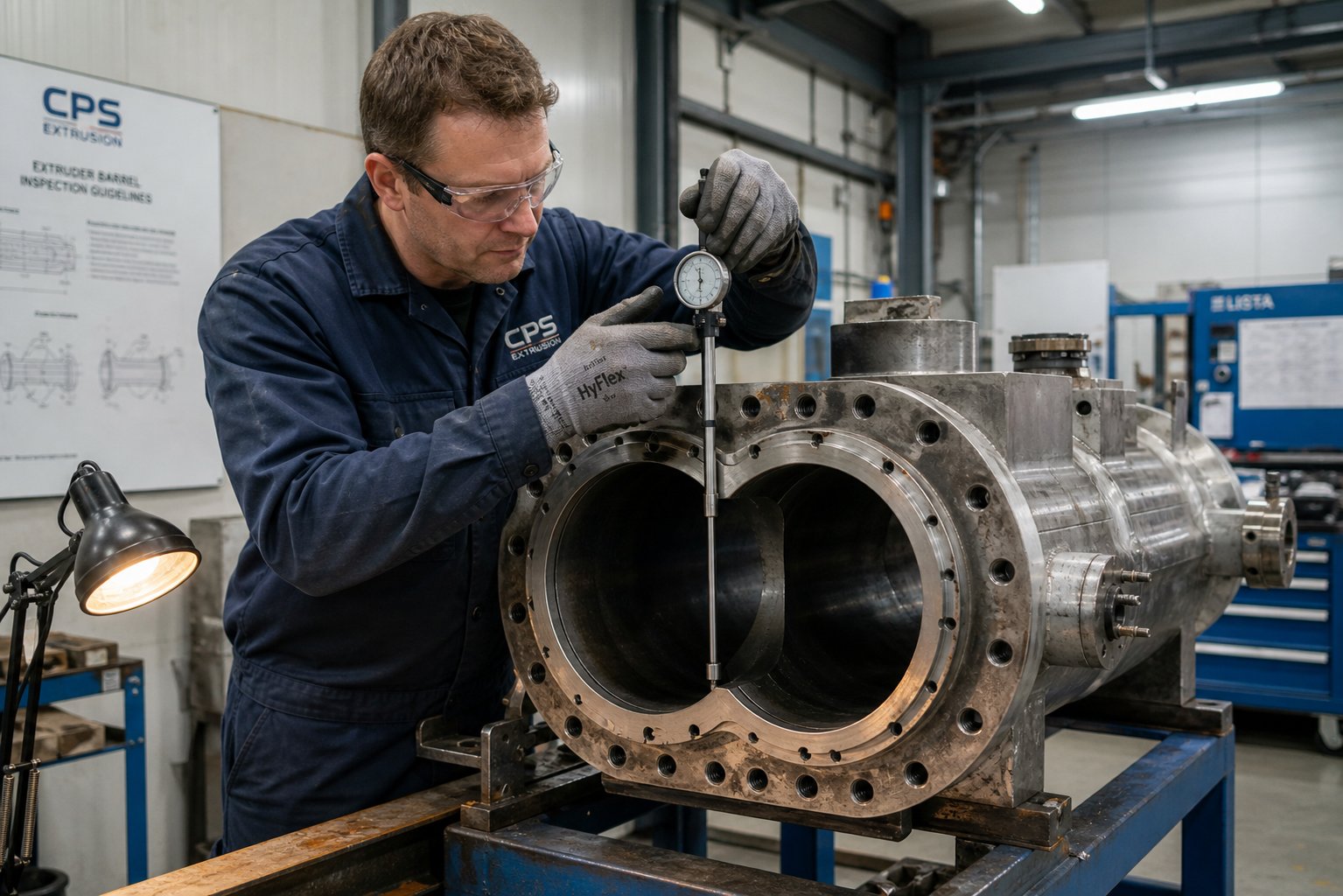
For the barrel, use a dial bore gauge and micrometer to measure the internal diameter every two to three inches along the full length. Frequent, closely spaced measurements pick up localized wear zones that a quick visual check would miss entirely. Pay special attention to the middle sections of the barrel where polymer melting occurs — this is where the most aggressive wear typically concentrates. Also examine the feed throat area for cracks, washout spots, and dimensional distortion. Compare your measurements against the OEM's original bore specification to calculate the actual wear percentage.
For modular screw elements — the standard configuration on co-rotating screw extruders — inspect each element individually. Measure flight tip outer diameter against the original specification to determine wear. Look closely for scoring, corrosion, and pitting on flight surfaces and kneading block lobes. On twin screw machines, the clearance between intermeshing screw flights is critical: excessive clearance reduces self-wiping efficiency, degrades mixing performance, and allows polymer to stagnate and degrade in dead zones. Ask whether the current screw configuration is the original layout or has been rearranged for a specific application — this tells you how the machine was actually used, not just what it was theoretically capable of.
A practical rule of thumb: if screw element wear exceeds 10% to 15% of original flight diameter, budget for replacement elements. If barrel bore wear exceeds OEM tolerance by more than 0.1mm to 0.2mm per side (depending on machine size), the barrel sections likely need re-lining or replacement.
Gearbox Health and Electrical System Evaluation
The gearbox is the second most expensive component to repair on any twin screw extruder, and its condition is far harder to assess visually than screws and barrels. You cannot see bearing races or gear tooth flanks without disassembly — but you can gather strong diagnostic signals without taking anything apart.
Start with oil analysis. A gearbox oil sample analyzed for wear metals, contamination, and fluid condition reveals internal health with a precision no external observation can match. Iron levels above 200 ppm signal critical gear tooth or bearing race wear, while copper spikes indicate bronze bushing degradation. Water contamination above 0.1% causes hydrogen embrittlement in bearing steel and drastically reduces oil film strength — an early failure risk that is invisible to the eye. If the seller cannot provide recent oil analysis results, request permission to draw a sample and send it to an independent lab. The test costs under $100 and can save you tens of thousands.
Listen to the gearbox during a powered run. Healthy gearboxes produce a consistent, even hum. Grinding, clicking, whining at specific intervals, or rhythmic knocking all indicate bearing defects, gear tooth damage, or misalignment. Ask about the gearbox maintenance history — when the oil was last changed, whether bearings have been replaced, and whether any overload events or emergency shutdowns are documented.
Electrical systems deserve equal scrutiny, especially on older used extruder equipment. Open the control cabinet and assess the condition of wiring, contactors, fuses, and circuit boards. Check whether the PLC platform is still supported by its manufacturer — legacy systems from the 1990s or early 2000s may still function but cannot be reprogrammed, expanded, or serviced if a board fails. Variable frequency drives should show no error codes and should ramp the motor smoothly through its speed range without hesitation or current spikes.
Walk the entire barrel and verify every heater band and thermocouple. Power up each heating zone individually and confirm that the temperature controller reads accurately and reaches the setpoint within a reasonable time. A zone that heats slowly, overshoots wildly, or reads erratically has a failing heater band, a degraded thermocouple, or a wiring fault — all repairable, but the cost adds up quickly across eight to fourteen zones.
Documentation and Test Run Requirements
The paperwork behind a machine matters almost as much as the metal. Request maintenance logs covering the machine's entire service history — oil change intervals, screw element replacements, barrel measurements, gearbox rebuilds, and any recorded process upsets or overload events. Original OEM drawings for the screw configuration, barrel layout, and gearbox assembly are invaluable during future maintenance. Machines sold without documentation are not necessarily bad, but you should discount the price to compensate for the increased uncertainty.
A powered test run — ideally under load with polymer material — is the gold standard for pre-purchase validation. Run a short extrusion trial and inspect the extruded product for uniformity, surface finish, and dimensional consistency. Watch for temperature instability, torque fluctuations, unusual vibrations, and any leaks from barrel segment joints. If the seller refuses a test run, treat the listing as an as-is purchase and price it accordingly.
Use the following step-by-step checklist during any on-site evaluation of used extrusion equipment for sale:
- Visual exterior inspection — check for cracks, corrosion, fluid leaks, missing guards, and signs of structural damage or collision impact.
- Barrel purge and bore measurement — clean the barrel, then measure internal diameter at 2-3 inch intervals and compare to OEM specifications.
- Screw element inspection — remove and individually measure each modular element for flight diameter wear, scoring, corrosion, and kneading block lobe condition.
- Gearbox oil sample — draw or request an oil sample for independent laboratory analysis of wear metals, contamination, and viscosity.
- Gearbox listening test — run the gearbox at multiple speeds and listen for abnormal noise patterns including grinding, clicking, or periodic knocking.
- Motor and drive test — verify smooth startup, check current draw against rated specifications, and ramp through the full speed range looking for hesitation or faults.
- Heating zone verification — power each barrel zone independently and confirm accurate temperature control, reasonable heat-up time, and stable setpoint maintenance.
- Thermocouple and heater band check — verify that every thermocouple reads accurately and every heater band delivers consistent output without dead spots.
- Control system evaluation — identify the PLC platform and software version, confirm the system is still supported, and verify that all I/O points are functional.
- Safety system test — confirm that emergency stops, barrel guards, interlock switches, and overload protections all function correctly.
- Documentation review — collect or verify maintenance logs, original OEM drawings, screw configuration records, and any process validation data.
- Loaded test run — process material through the machine and evaluate product quality, torque stability, temperature consistency, and overall machine behavior under production conditions.
Every item on this list addresses a specific category of hidden cost that only surfaces after installation. Screw wear you did not measure becomes a $15,000 element replacement. A gearbox bearing defect you did not hear becomes a $50,000 emergency rebuild three months into production. A control system you did not evaluate becomes a six-week retrofit project that idles your entire compounding line.
Thorough inspection eliminates surprises — but it also shapes the most consequential decision you will face after choosing a machine: should you buy a professionally refurbished unit with verified components and a warranty, or purchase an as-is machine at a deeper discount and manage the rebuild yourself?
Refurbishment Options and Spare Parts Sourcing
The inspection is complete. You know the screw wear percentages, the gearbox oil analysis results, and the state of every heating zone. The question that follows shapes your entire cost structure for the next five to ten years: do you buy a professionally refurbished twin screw compounding extruder that arrives turnkey-ready, or do you purchase an as-is unit at a steeper discount and handle the rebuild in-house?
Neither answer is universally correct. Each path carries a distinct risk profile, cost timeline, and operational implication. Understanding exactly what refurbishment includes — and what it costs when you source the parts yourself — separates confident buyers from those who learn expensive lessons after the machine hits the production floor.
Refurbished vs As-Is Purchasing and What to Expect
A refurbished machine is not simply a used machine with fresh paint. Professional refurbishment is a structured restoration process where a dealer or rebuilder disassembles the equipment, inspects every critical component against OEM specifications, replaces worn parts, upgrades outdated systems, and validates performance before resale. Think of it as the difference between buying a car that has been "detailed" and one that has gone through a full mechanical overhaul with documented service records.
When a reputable dealer refurbishes a compounding extruder, the scope typically covers these major line items:
- Screw elements — worn conveying flights, kneading blocks, and mixing elements are measured, and any elements exceeding wear tolerances are replaced with new OEM or aftermarket equivalents. Screw shafts are inspected for twists, bends, and spline wear. Replacement frequency depends on processing abrasiveness, but elements running mineral-filled compounds may need replacement every 2,000 to 5,000 operating hours.
- Barrel sections — bore diameter is measured and compared to original specifications. Worn barrels are either re-lined with new bimetallic or nitrided liners, or replaced entirely. Barrel refurbishing — which involves removing the worn process liner and shrink-fitting a new solid oval liner into the housing — typically costs 65% to 85% of a new barrel section, restoring the bore to original dimensional specifications.
- Gearbox rebuild — bearings, seals, and gear sets are inspected and replaced as needed. Oil is flushed and replaced. Backlash is measured and adjusted. A full gearbox rebuild on a mid-size machine can represent 10% to 20% of the total refurbishment cost.
- Heater bands and thermocouples — all barrel heating elements and temperature sensors are tested and replaced if degraded. These components are relatively inexpensive individually but add up across 10 to 14 barrel zones. Typical replacement cycle: every 3 to 5 years under normal production conditions.
- Electrical and control system upgrades — legacy PLCs, analog drives, and outdated HMI panels are replaced with current-generation equivalents. Variable frequency drives are tested or swapped. Wiring is inspected and repaired. This is often the single most expensive refurbishment line item on older industrial extrusion machinery.
- Cosmetic restoration and safety compliance — guards, covers, and enclosures are repaired or replaced. The machine is repainted. Safety interlocks and emergency stops are verified functional. While cosmetic, fresh paint also serves as corrosion protection.
- Operational warranty — professional rebuilders typically offer a limited warranty — often 90 days to one year — covering the refurbished components. This warranty is the clearest signal that distinguishes a genuine refurbishment from a superficial cleanup.
The pricing difference between refurbished and as-is is significant. A refurbished unit might sell for 40% to 65% of the cost of an equivalent new machine, while an as-is unit might go for 20% to 40%. That gap — potentially tens of thousands of dollars on a production-size extruder — reflects the labor, parts, and risk transfer embedded in professional refurbishment.
So when does each option make sense? Refurbished machines are the smarter choice for buyers who need production-ready plastic compounding equipment with minimal commissioning time, who lack in-house rebuild expertise, or who cannot tolerate unplanned downtime during the first year of operation. As-is purchases make sense for buyers with experienced maintenance teams, access to affordable replacement parts, and the flexibility to absorb a rebuild timeline of weeks or months before the machine enters full production. Companies that routinely acquire and rebuild used plastics extrusion machinery often prefer the as-is route specifically because their internal teams can execute rebuilds at lower cost than a dealer charges.
Sourcing Replacement Parts for Used Extruders
Here is the detail sellers almost never mention: the purchase price of a used extruder for polymer processing is only the beginning. The real long-term cost driver is spare parts. Screw elements wear. Barrel liners erode. Heater bands burn out. Thermocouples drift. Die heads need replacement. Pelletizing blades dull. Every one of these components must be sourced, stocked, or ordered on short notice — and the price difference between OEM and aftermarket supply channels can be staggering.
OEM replacement parts are engineered for exact fit and guaranteed compatibility, but they come with premium pricing and, in some cases, extended lead times. A single OEM screw element for a major-brand co-rotating twin screw extruder can cost several hundred to over a thousand dollars, and a full set of elements for a production machine might run $15,000 to $50,000 or more depending on diameter and metallurgy. Multiply that by the replacement frequency dictated by your material's abrasiveness, and parts become a major recurring expense.
Aftermarket parts suppliers have emerged to fill this gap. These specialists reverse-engineer screw elements, barrel liners, and wear components to match OEM dimensional and metallurgical specifications — often at 30% to 60% less than OEM pricing. The trade-off, as industry analysis highlights, is that aftermarket parts may require closer verification of fit and material quality. For critical components like gearbox internals, OEM parts often remain the safer investment. For high-turnover wear items like screw elements, heater bands, and thermocouples, quality aftermarket suppliers deliver significant cost savings without compromising performance.
The challenge intensifies with older or discontinued models. If you purchased a 1990s-vintage machine from a brand that has since been acquired or exited the market, OEM parts channels may be limited or closed entirely. This is where aftermarket specialists become not just a cost-saving option but a practical necessity. Suppliers like NANHAIYA specialize in extruder spare parts including screw-related components, heater bands, thermocouples, die heads, and pelletizing blades — and critically, they manufacture custom parts from drawings or samples. That capability is invaluable for maintenance teams working with legacy machines where original components are no longer cataloged. Rather than scrapping a mechanically sound extruder because one proprietary element is unavailable, you can have it reverse-engineered and manufactured to specification.
A practical spare parts strategy for any used twin screw extruder purchase looks like this: stock a critical spares kit at commissioning — at minimum, one complete set of high-wear screw elements, a spare set of heater bands for the most demanding barrel zones, backup thermocouples, and pelletizer blades. Identify both OEM and aftermarket sources before you need them under the pressure of an unplanned shutdown. Establish relationships with aftermarket suppliers who can turn around custom components within days rather than weeks. The buyers who do this operate their used equipment with the same uptime reliability as new machines — at a fraction of the capital cost.
Refurbishment decisions and parts sourcing strategies shape the ongoing cost picture, but they represent only a portion of the total financial commitment. Transportation, rigging, installation, utilities, auxiliary equipment, and operator training all add layers of cost that the listing price never reveals.
Total Cost of Ownership for Used Twin Screw Extruders
You found a used twin screw extruder for sale at what seems like an incredible twin screw extruder price — maybe 40% of what the same machine would cost new. You run the numbers, and the savings look enormous. But here is the uncomfortable truth that sellers rarely spell out: the listing price is only one line item on a much longer invoice. Transportation, rigging, foundation work, electrical connections, auxiliary equipment, spare parts inventory, operator training, and commissioning downtime all pile on top. Ignore these costs during the buying process, and your "bargain" quietly becomes a budget overrun.
Building a realistic total cost of ownership framework before you commit is the only way to know whether a specific extruder machine for sale actually delivers the savings it promises on paper.
Beyond the Purchase Price — Hidden Costs to Budget For
Imagine this scenario: you close the deal on a 75mm co-rotating twin screw extruder at $120,000 — a fraction of the plastic extruder machine price for a comparable new unit. The machine is solid, the inspection checked out, and the screw elements have acceptable wear. Then reality sets in.
Shipping a multi-ton extruder from the seller's warehouse to your facility is not a standard freight delivery. Heavy machinery requires flatbed or specialized transport, professional rigging at both ends, and potentially crane service for offloading and positioning. For a mid-size production machine, transportation and rigging alone can run $5,000 to $25,000 depending on distance, machine weight, and site accessibility. International shipments add customs brokerage, import duties, and ocean freight surcharges that can push logistics costs significantly higher.
Once the machine arrives, it needs a home. Foundation requirements depend on machine size and vibration characteristics — some installations need reinforced concrete pads engineered to specific load and levelness tolerances. Utility connections add another layer: dedicated electrical service sized to the motor (a 200 kW drive needs substantial switchgear), cooling water supply for barrel temperature control, and compressed air for pneumatic actuators and downstream equipment. Electrical installation alone can cost $8,000 to $30,000 when you factor in disconnect switches, conduit runs, and compliance with local codes.
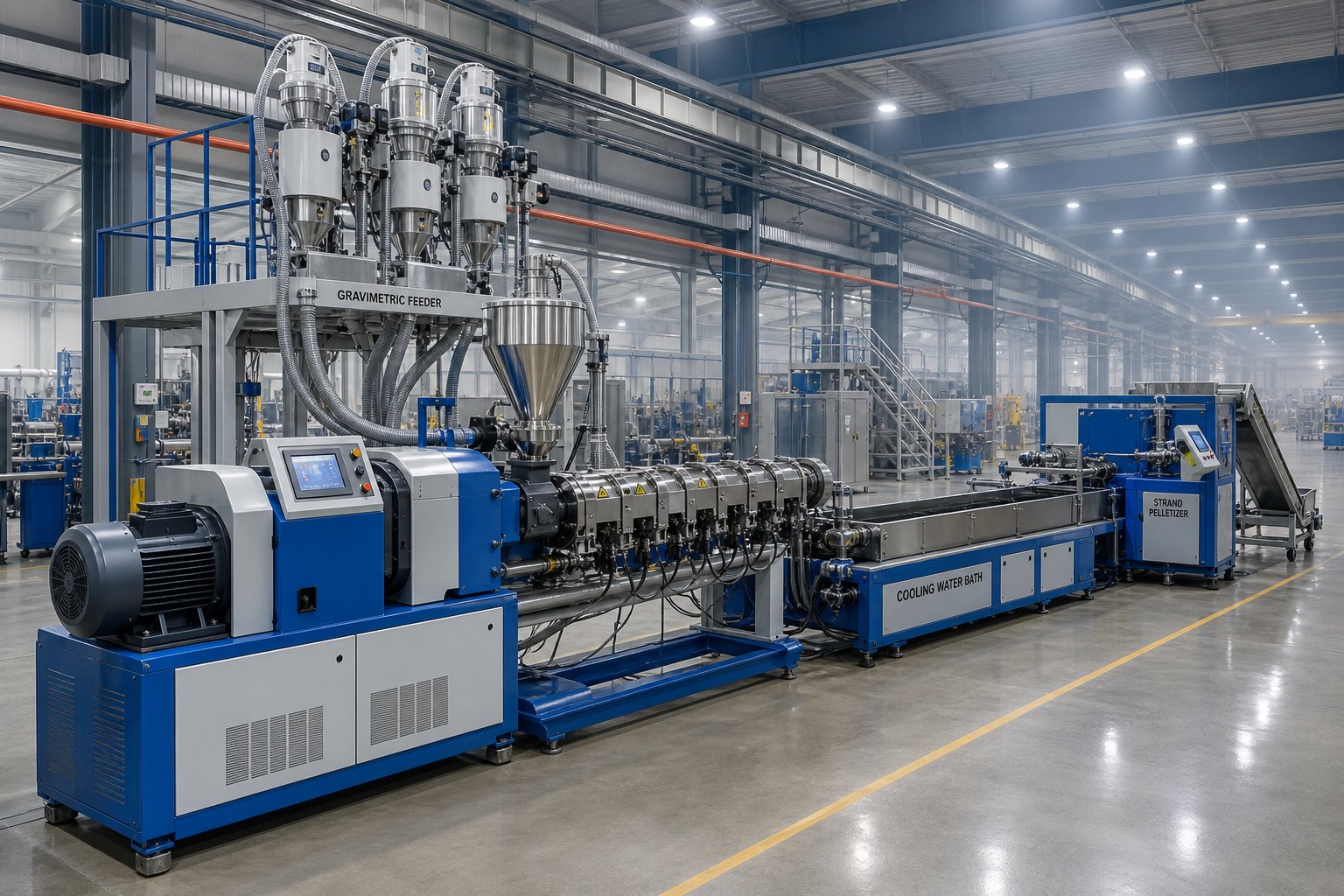
The cost category that blindsides many first-time buyers is auxiliary equipment. A twin screw extruder does not operate in isolation. You need gravimetric or volumetric feeders to deliver raw materials at controlled rates, a strand pelletizer or underwater pelletizing system to cut the extrudate, a cooling conveyor or water bath, and material handling systems for finished pellets. If the machine you are buying was stripped from a complete line, each auxiliary component must be sourced, matched, and integrated separately. For a mid-range compounding line, auxiliary equipment can represent 30% to 50% of the total capital outlay — a substantial addition to the plastic extrusion machine cost that the extruder listing price never hints at.
Operator training is another expense that gets overlooked. Even experienced extrusion operators need familiarization time on a different machine platform, especially if the control system, screw configuration philosophy, or safety interlocks differ from what they have run before. Training costs — whether through a dealer, an independent consultant, or internal time investment — typically range from $2,000 to $10,000 depending on machine complexity and crew size.
Finally, budget for commissioning downtime. The period between machine delivery and stable production output is rarely zero. Dialing in screw configurations, optimizing temperature profiles for your specific formulations, troubleshooting unexpected issues with older controls or worn components — all of this consumes days or weeks of non-productive time. For operations where every hour of downtime has a direct revenue impact, this hidden plastic extrusion cost deserves an explicit line item in your budget.
Calculating Real Savings Compared to Buying New
So does buying used still make financial sense after accounting for all these additional costs? In most cases, yes — but only when you build the comparison honestly. The framework is straightforward: add every cost category for the used purchase scenario, do the same for a new machine purchase, and compare the totals side by side over a defined operating period.
New plastic extrusion machinery carries its own set of additional costs — installation, utilities, and auxiliary equipment are required regardless of whether the extruder is new or used. The difference is that new machines typically arrive with OEM commissioning support, operator training, a comprehensive warranty, and components at zero hours of wear. Those benefits reduce risk and unplanned maintenance costs in the early years of ownership.
Industry data consistently shows that used equipment typically sells for 40% to 70% below new pricing, and over a 10-year operating period, the total cost of ownership for used equipment runs 25% to 45% lower than new — even after accounting for higher maintenance costs. The previous owner absorbs the steepest depreciation curve, which means your asset retains a higher percentage of its purchase price throughout your holding period.
The savings equation tilts even further toward used equipment when you factor in lead time. A new twin screw extruder from a major European or Japanese OEM can take 6 to 18 months for delivery — and custom configurations may stretch beyond that. During every month you wait, you are not producing. A used machine available in 2 to 4 weeks lets you capture revenue immediately, and that accelerated return on investment often outweighs the incremental maintenance expense.
Where does the equation shift toward new? When you need cutting-edge torque density and throughput that only current-generation gearboxes deliver. When customer contracts mandate equipment manufactured within a specific vintage window. When the pvc extrusion machine price gap between new and used narrows because demand for a specific model is high and supply is limited. And when the cost of upgrading a used machine's controls, drives, and safety systems approaches the premium you would pay for a factory-fresh unit with everything integrated from day one.
The following table provides a total cost of ownership template you can populate with your own quotes and estimates for any used twin screw extruder under consideration:
| Cost Category | Description | Typical Range (Used Mid-Size Extruder) | Your Estimate |
|---|---|---|---|
| Machine Purchase Price | Negotiated price for the extruder as listed (refurbished or as-is) | $50,000 - $250,000 | |
| Transportation & Rigging | Flatbed shipping, crane service, offloading, and positioning at your facility | $5,000 - $25,000 (domestic); higher for international | |
| Foundation & Installation | Concrete pad preparation, machine leveling, and anchoring | $3,000 - $15,000 | |
| Electrical Connections | Disconnect switch, conduit, wiring to main panel, code compliance | $8,000 - $30,000 | |
| Cooling Water System | Chiller, piping, manifolds, and connections for barrel cooling | $5,000 - $20,000 | |
| Compressed Air Supply | Dedicated air line, regulator, and dryer for pneumatic components | $1,000 - $5,000 | |
| Auxiliary Equipment | Feeders, pelletizer, cooling conveyor/water bath, material handling | $30,000 - $150,000 (if not bundled with extruder) | |
| Control System Upgrade | PLC replacement, new drives, HMI panel, and rewiring (if needed) | $15,000 - $80,000 (only for older machines) | |
| Initial Spare Parts Inventory | Critical screw elements, heater bands, thermocouples, pelletizer blades | $5,000 - $25,000 | |
| Operator Training | Machine familiarization, safety procedures, process optimization guidance | $2,000 - $10,000 | |
| Commissioning Downtime | Lost production days during installation, startup, and process optimization | 1 - 4 weeks (value depends on your production revenue per day) | |
| Total Estimated Cost | Sum of all line items = true acquisition cost | ||
One critical decision embedded in this framework deserves special attention: auxiliary equipment bundling. Whenever possible, seek used extruder lines that include feeders, pelletizers, and cooling systems as a package. Dealers who sell complete lines often price the bundle at a significant discount compared to sourcing each component individually. More importantly, equipment that ran together on the same production floor is already matched in capacity and throughput — eliminating the integration headaches that arise when you pair a used extruder with mismatched downstream equipment from different sources.
If a bundled line is not available, approach auxiliary equipment procurement with the same rigor you applied to the extruder itself. Feeder capacity must match the extruder's maximum throughput. Pelletizer speed and cutting configuration must suit your target pellet size and material characteristics. Cooling system capacity must handle the thermal load at full production rates. Mismatches in any of these areas create bottlenecks that throttle your line's real-world output below the extruder's rated capability.
Armed with a complete cost picture — from the listing price through commissioning and spare parts — you can compare any used opportunity against a new machine quote on genuinely equal terms. The buyers who build this analysis before negotiating purchase price consistently make smarter decisions. The buyers who skip it consistently discover costs they wish they had anticipated.
A thorough cost framework puts you in control of the financial decision. The remaining variable — and one that carries just as much weight — is where you actually buy the machine and how to evaluate the seller standing behind it.
Where to Buy and How to Choose the Right Seller
You have the specification knowledge, a pre-purchase inspection checklist, a spare parts strategy, and a total cost of ownership framework. Every one of those tools sharpens your ability to evaluate equipment — but none of them matters if you are shopping in the wrong place or trusting the wrong seller. The purchasing channel you choose determines what protections you get, what risks you absorb, and how much leverage you hold when something goes wrong after the invoice is paid.
Three distinct channels dominate the market for used twin screw extruders for sale: professional equipment dealers, direct plant sales, and online auction platforms. Each serves a different buyer profile, and the trade-offs between them are more nuanced than most listings reveal.
Established Dealers vs Direct Plant Sales and Auctions
Professional used equipment dealers are the closest thing this market has to a curated retail experience. Established dealers typically acquire machines from plant closures, capacity upgrades, and trade-ins, then inspect, clean, and sometimes refurbish equipment before listing it for resale. The best dealers maintain warehouse inventory, offer powered test runs on-site, and provide limited operational warranties — often 30 to 90 days on mechanical components. That warranty is not just a piece of paper; it represents the dealer's own financial bet that the machine performs as described.
What do you pay for that layer of protection? A premium, naturally. Dealer pricing on a twin screw extruder for sale typically runs 15% to 30% above what the same machine might fetch through a direct sale or auction. But consider what that premium buys: verified condition documentation, a single point of accountability, and — critically — logistical support. Many established dealers coordinate shipping, rigging, and even installation assistance, sparing you the headache of managing a multi-vendor logistics chain on your own. For buyers who lack in-house engineering teams or who are purchasing their first used extruder, the dealer channel reduces risk significantly.
A helpful benchmark from industry experience: used equipment should generally cost around 50% less than equivalent new equipment. If a dealer's asking price pushes above that threshold for a machine in average condition, you have room to negotiate — or reason to explore alternative channels.
Direct plant sales sit at the opposite end of the risk spectrum. When a compounder closes a facility, consolidates production lines, or switches product families, the equipment often gets offered directly to buyers — sometimes through plant managers, sometimes through corporate asset recovery departments. Pricing tends to be aggressive because the seller wants machines off the floor quickly, and you may find a plastic extruder for sale alongside feeders, pelletizers, and cooling systems as a bundled package at substantial discounts.
The catch? You are buying from a motivated seller who is not in the equipment business. Test runs may not be possible if the plant has already disconnected utilities. Documentation might be scattered across filing cabinets or lost entirely. Warranty coverage is essentially nonexistent — the transaction is as-is, where-is, and often governed by a purchase agreement drafted by the seller's legal team with minimal buyer protections. Direct plant purchases reward buyers who bring their own inspection expertise and are comfortable managing risk independently.
Online auction platforms represent a third path that has gained traction over the past decade. As auction specialists note, the online channel puts equipment in front of qualified buyers nationwide within weeks rather than months, creating competitive bidding that often surfaces fair market pricing. Some platforms provide condition reports, photo documentation, and removal coordination.
Auction buying works well for experienced purchasers who know exactly what specifications they need and can evaluate a machine from photos, condition reports, and limited inspection windows. The competitive bidding environment can produce genuine bargains — particularly for less common configurations or machines from lesser-known brands that attract fewer bidders. The downside is limited or no opportunity for a thorough hands-on inspection before bidding, compressed timelines for removal after winning, and buyer's premiums (typically 10% to 18%) that inflate the effective purchase price above the hammer number. Always factor the premium, applicable sales tax, and rigging costs into your maximum bid — not just the listing price.
Where to Find Quality Used Twin Screw Extruders
The market for plastic extruders for sale has matured considerably. Large dealers maintaining inventories of dozens or even hundreds of machines signal a healthy, liquid marketplace where buyers have genuine selection and price competition works in their favor. Specialized plastics equipment dealers, general industrial machinery brokers, and online marketplaces like Surplus Record all list twin screw extruders alongside single-screw machines, downstream equipment, and complete extrusion lines.
When evaluating any seller — dealer, plant, or auctioneer — reputation is your first filter. Look for verifiable transaction history, industry association memberships (such as MDNA for machinery dealers), and references from previous buyers. A seller who has been in the used equipment business for a decade or more has a track record you can research. A first-time liquidator selling a plastic extruder machine for sale from a single closing plant does not — which does not make them dishonest, but it does mean you carry more due diligence responsibility.
Regardless of the channel, the following questions should be part of every conversation before you commit to a purchase:
- Can you provide a powered test run? If yes, under what conditions — dry run only, or under load with material? If no, why not, and how is the price adjusted to reflect the increased buyer risk?
- What documentation is available? Maintenance logs, original OEM drawings, screw configuration records, gearbox service history, and any barrel bore measurements from previous inspections.
- What is the machine's complete processing history? What materials were run, at what throughput rates, and for how many operating hours? Machines that processed abrasive glass-filled compounds wear differently than those running neat polymers.
- Is the sale as-is or does it include any warranty? If warranted, what components are covered, for how long, and what is the remedy — repair, replacement, or refund?
- What is included in the sale? Confirm whether the listing covers only the extruder or includes auxiliary equipment such as feeders, pelletizers, die heads, and spare parts. A plastic extrusion machine for sale that includes a complete downstream package is worth substantially more than an isolated extruder.
- Who handles shipping and rigging? Does the seller coordinate logistics, or is the buyer responsible for arranging transport and removal? What is the deadline for equipment removal from the seller's facility?
- Are replacement parts readily available for this model? Ask the seller directly — and verify independently through OEM and aftermarket channels — whether screw elements, barrel segments, and control system components can be sourced without extended lead times.
- Has the machine been modified from its original OEM configuration? Barrel extensions, non-standard gearbox ratios, and aftermarket drive retrofits all affect future parts compatibility and resale value.
Sellers who answer these questions thoroughly and transparently are the ones worth doing business with. Sellers who deflect, provide vague responses, or pressure you to close quickly before you can verify details are telling you everything you need to know — just not with words.
The best used equipment purchases are not won on price alone. They are won by buyers who combine specification knowledge, hands-on inspection discipline, realistic total cost analysis, and a reliable parts sourcing strategy into a single decision framework.
That last element — parts sourcing — deserves emphasis as you finalize any purchase. Identifying both OEM and aftermarket suppliers before you sign the purchase agreement gives you immediate access to wear components the moment production begins. Aftermarket specialists like NANHAIYA, who supply screw-related components, heater bands, thermocouples, die heads, pelletizing blades, and custom parts manufactured from drawings or samples, are particularly valuable for buyers acquiring older or discontinued models where OEM channels have narrowed. Having these relationships established at commissioning — rather than scrambling during an unplanned shutdown — is what separates operators who run used extruders for sale-level savings with new-machine reliability from those who spend their savings on emergency repairs.
Buying a used twin screw extruder is not a leap of faith. It is an engineering and financial decision that rewards preparation. You now have every tool this guide can offer: the technical understanding to match machine type to application, the specification literacy to decode any listing, a brand-by-brand map of parts availability and resale value, an inspection protocol that catches hidden problems before they become your problems, a refurbishment and spare parts strategy that controls long-term costs, a total cost of ownership framework that reveals the true price behind the sticker, and a purchasing channel comparison that matches your risk tolerance to the right seller type. Apply them together, and the used equipment market becomes exactly what it should be — a strategic advantage, not a gamble.
Frequently Asked Questions About Used Twin Screw Extruders
1. How much does a used twin screw extruder cost compared to a new one?
Used twin screw extruders generally sell for 30% to 60% of the price of an equivalent new machine. A mid-size production unit (50mm to 75mm screw diameter) typically ranges from $50,000 to $250,000 depending on brand, condition, and whether it has been professionally refurbished. New high-capacity units from major OEMs can exceed $1,000,000. Over a 10-year operating period, total cost of ownership for used equipment runs roughly 25% to 45% lower than new, even after factoring in higher maintenance and rebuild expenses. However, buyers must also budget for transportation, rigging, installation, electrical connections, auxiliary equipment, spare parts inventory, and commissioning — costs that can add $70,000 to $200,000 or more on top of the listing price.
2. What is the difference between co-rotating and counter-rotating twin screw extruders?
Co-rotating twin screw extruders have both screws spinning in the same direction, producing high shear, self-wiping action, and superior dispersive mixing. They dominate compounding, masterbatch production, reactive extrusion, and devolatilization applications. Counter-rotating extruders have screws turning in opposite directions, generating lower shear through a calendering effect at the intermeshing zone. This gentler processing makes them ideal for thermally sensitive materials like rigid PVC used in pipe and profile extrusion. On the used market, co-rotating machines are far more common and versatile, while counter-rotating units are typically found in complete PVC processing lines. Choosing the wrong configuration for your application leads to product quality issues that no amount of process optimization can fix.
3. How do I inspect a used twin screw extruder before buying?
Start with the screws and barrel — the most critical and expensive components. Request a purged and cleaned barrel, then use a dial bore gauge to measure internal diameter every 2-3 inches along its full length. Inspect each modular screw element for flight tip wear, scoring, and corrosion. Next, obtain a gearbox oil sample for lab analysis — iron levels above 200 ppm indicate serious internal wear. Listen to the gearbox at multiple speeds for grinding or knocking. Power up each barrel heating zone individually and verify thermocouple accuracy. Evaluate the PLC and drive system for compatibility with current platforms. Finally, request a loaded test run with polymer material and inspect the output for uniformity, surface finish, and dimensional consistency. Always review maintenance logs and OEM documentation before committing.
4. Should I buy a refurbished or as-is used twin screw extruder?
Refurbished machines cost 40% to 65% of new pricing and arrive with replaced screw elements, re-lined barrels, rebuilt gearboxes, new heater bands, upgraded controls, and a limited warranty — typically 90 days to one year. As-is units sell for 20% to 40% of new but require you to budget for your own rebuild. Choose refurbished if you need production-ready equipment with minimal commissioning time and lack in-house rebuild expertise. Choose as-is if your maintenance team can reverse-engineer components, source aftermarket parts from specialists like NANHAIYA, and absorb a rebuild timeline of weeks or months. Companies that routinely acquire used equipment often prefer as-is purchases because their internal teams execute rebuilds at lower cost than dealer refurbishment fees.
5. Where can I find replacement parts for older or discontinued twin screw extruder models?
OEM replacement parts offer guaranteed compatibility but carry premium pricing and sometimes extended lead times — a single screw element can cost several hundred to over $1,000. Aftermarket suppliers reverse-engineer components to match OEM specifications at 30% to 60% lower cost, making them essential for high-wear items like screw elements, heater bands, thermocouples, and pelletizer blades. For older or discontinued models where OEM channels have closed, aftermarket specialists become a necessity rather than an option. Suppliers such as NANHAIYA (nhyscrews.com) manufacture custom extruder spare parts from drawings or samples, including screw components, die heads, and wear parts — a critical capability for keeping legacy machines operational when original components are no longer cataloged.
Written by
Nanhaiya Technical Team
Zhoushan Nanhaiya Plastic Machinery Co., Ltd.
The Nanhaiya technical team supports screw and barrel manufacturing projects through application review, technical communication, custom manufacturing coordination, and production and quality control.
Discuss Your Application
Related Articles
More insights on screw barrel technology and plastics processing.
Extruder Machine Decoded: From Raw Pellet To Finished Product
Oct 6, 2026
Learn how an extruder machine works, compare single-screw vs. twin-screw types, and get expert guidance on specs, troubleshooting, and selection.
Read Article
PE Pipe Making Machine Decoded: From Raw Resin to Flawless Pipe
Oct 4, 2026
Learn how a PE pipe making machine works, from resin to finished pipe. Covers components, material grades, automation, troubleshooting, and buyer selection tips.
Read Article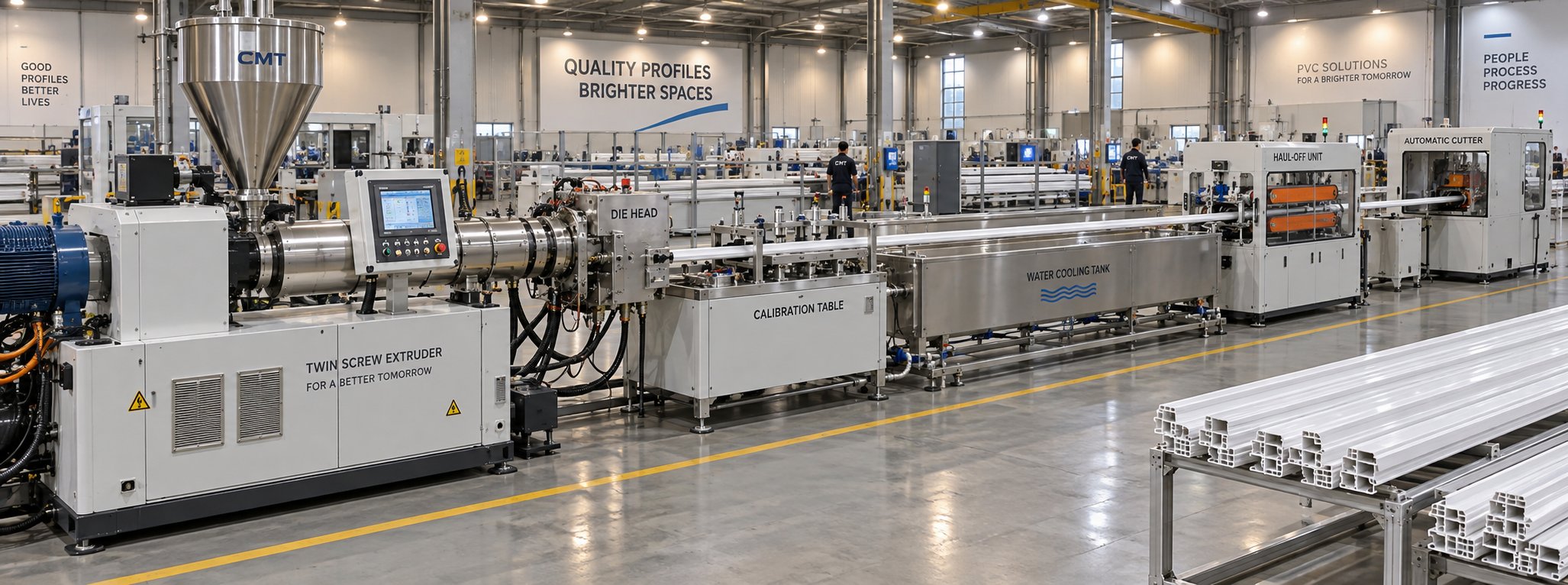
PVC Profile Making Machine Decoded: From Raw Resin To Profit
Oct 3, 2026
Learn how a PVC profile making machine works — extrusion process steps, key technical parameters, die design, calibration methods, maintenance, and total cost of ownership.
Read ArticleLooking for something else?
Search by material, symptom or product and jump straight to the relevant page.
These are navigation suggestions based on keyword matching — not a quotation, not a delivery commitment, and not a substitute for engineering review. Final specification is confirmed by our engineers against your drawings and processed material.
Need help with screw barrel selection?
Share your machine model, processed material and application. Our team can help with pricing and technical support.