

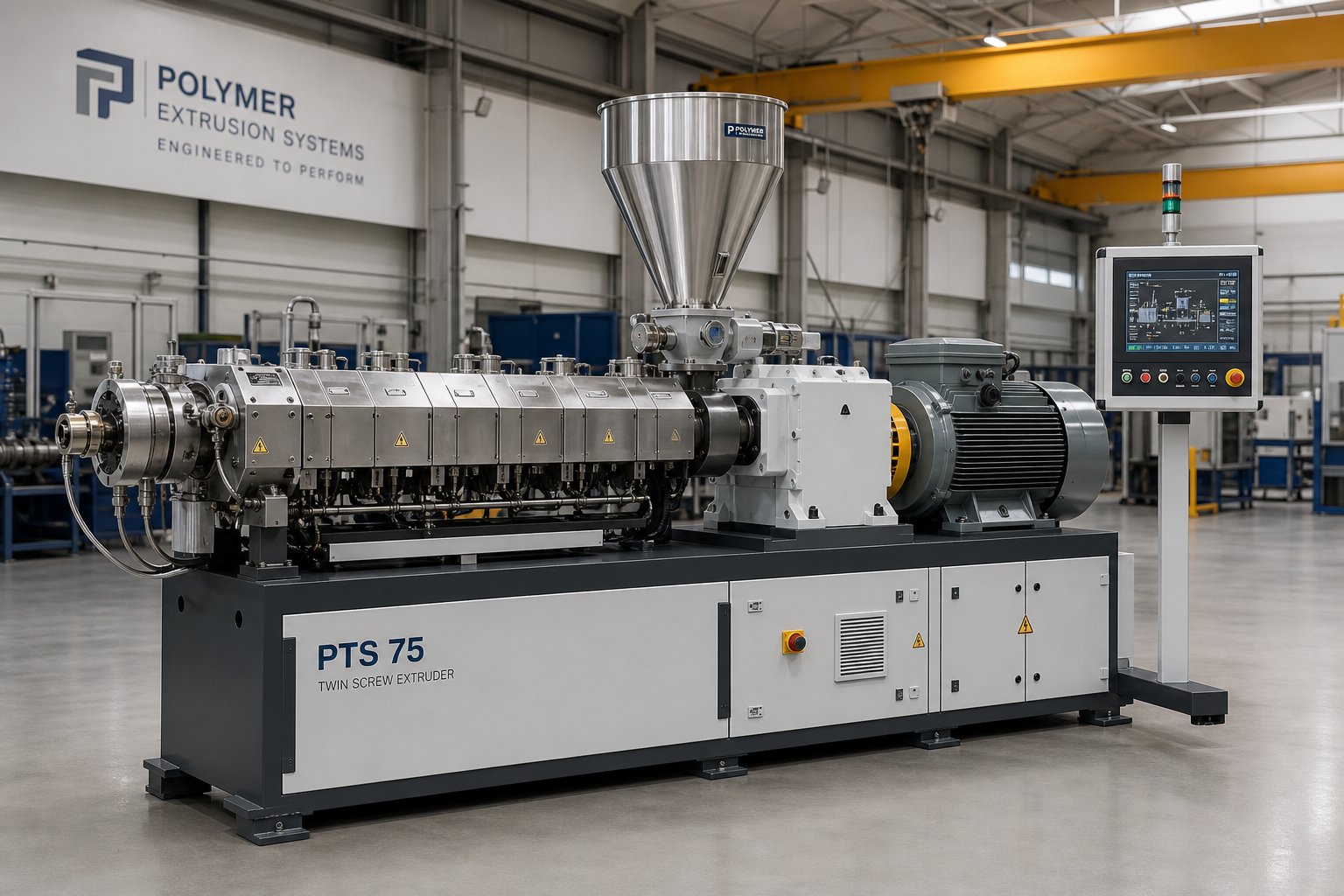
Understanding the Twin Screw Extruder and the Used Equipment Market
Imagine finding a production-ready compounding line at a fraction of new equipment cost — only to discover, months later, that worn screws and an aging gearbox quietly drained your savings. That scenario plays out more often than most sellers will admit. This guide exists to make sure it doesn't happen to you.
What Is a Twin Screw Extruder
At its core, a twin screw extruder is a continuous processing machine built for demanding mixing, compounding, and material conversion tasks that single screw designs simply cannot handle with the same precision.
A twin screw extruder uses two intermeshing, co-rotating or counter-rotating screws housed inside a heated barrel to melt, mix, convey, and shape polymer materials. Its modular screw and barrel design allows processors to tailor configurations for compounding, reactive extrusion, devolatilization, and pelletizing applications.
What separates twin screw extruders from their single screw counterparts is versatility. While used single screw extruders excel at straightforward melting and conveying, twin screw machines deliver superior dispersive and distributive mixing — making them the workhorse behind engineering plastics, color masterbatch, filled compounds, and recycled polymer formulations. The pair of intermeshing screws creates a self-wiping action that improves material homogeneity and allows processors to handle complex, multi-component recipes with consistency.
Why the Used Market Matters for Plastics Processors
The demand for used extrusion equipment has grown steadily as compounders, recyclers, and contract manufacturers look for proven production capacity without the extended lead times and heavy capital commitment that new machines require. Buyers span a wide range — from startups entering the compounding space on a lean budget to established plants adding secondary lines for new product development or overflow capacity.
A used twin screw extruder offers a compelling shortcut: real throughput, field-proven reliability, and significantly lower upfront cost. Yet the used extruder market rewards informed buyers and punishes hasty ones. Listings are packed with specifications — screw diameter, L/D ratio, torque ratings — that mean little without context, and critical details about wear condition or parts availability are often buried or missing entirely.
That's exactly the gap this article fills. In the sections ahead, you'll walk through operating principles, co-rotating versus counter-rotating configurations, the specifications that actually drive machine value, brand landscape insights, wear component inspection priorities, refurbishment economics, and post-purchase steps from installation to first production runs. Consider it the checklist sellers hope you skip — and the one that separates a smart acquisition from an expensive lesson.
How Twin Screw Extruders Work and Why It Matters to Buyers
A used equipment listing can tell you a machine's brand, screw diameter, and motor horsepower — but none of that matters if you don't understand what actually happens inside the barrel. Grasping the operating principles of a twin screw extruder machine gives you the ability to read between the lines of any spec sheet, spot missing components, and evaluate whether a particular configuration will deliver the performance your process demands.
Core Operating Principles of Twin Screw Extrusion
Every twin-screw extruder follows a continuous process flow that transforms raw polymer — pellets, powder, or flake — into a homogeneous melt ready for pelletizing, sheeting, or profiling. Here's how material moves from hopper to die head, step by step.
The journey begins at the feeding zone. Raw material enters the barrel through a hopper, typically metered by a gravimetric or volumetric feeder that controls the rate precisely. Some formulations require additives like glass fibers or mineral fillers to be introduced downstream through side feeders — a detail worth checking on any used machine, because the number and position of feed ports determine recipe flexibility.
Once inside the barrel, the two intermeshing screws grab the material and begin conveying it forward. Unlike single screw designs that rely primarily on frictional drag, twin-screw extruders use positive displacement conveying — the intermeshing flights push a defined volume of material forward with each rotation. This creates a narrower residence time distribution, meaning every particle spends roughly the same amount of time in the barrel. The result? More consistent processing and more predictable product quality.
As material advances, it encounters the melting and mixing zones. Barrel heaters supply external thermal energy, but a significant portion of the melting comes from shear energy generated by the screws compressing and working the material against barrel walls. Specially designed kneading and mixing elements intensify this action, breaking down agglomerates, dispersing additives, and blending multiple components into a uniform melt. For reactive extrusion applications, these zones also provide the controlled thermal and shear environment that drives chemical reactions.
Further along the barrel, you'll often find venting or devolatilization zones — open barrel sections where vacuum is applied to extract moisture, trapped air, or volatile byproducts. This step is critical for recycled polymers, hygroscopic materials, and reactive processes that generate gaseous byproducts. When evaluating used extrusion equipment, check whether vent ports are present, and whether they include vacuum stuffer hardware to prevent material from escaping through the vent opening.
Finally, the homogeneous melt reaches the discharge zone, where the screws build pressure to push material through a die head. The die shapes the melt into strands for pelletizing, a sheet for calendering, or a profile for downstream forming. The entire sequence — feeding, conveying, melting, mixing, venting, and discharge — happens continuously in a single pass, which is what makes twin-screw extruders so efficient for high-volume compounding operations.
The defining feature that ties all of this together is modular screw design. Individual screw elements — each with a specific geometry and function — slide onto splined shafts and lock together in a custom arrangement. Processors can reconfigure these elements to change how aggressively the machine mixes, how long material resides in each zone, and where venting or side feeding occurs. This modularity is a tremendous advantage, but it also means that when you're evaluating a used twin-screw extruder, you're really evaluating two things: the machine frame and drive, and the screw element inventory that comes with it.
Why Screw Element Design Drives Performance
Sounds complex? It doesn't have to be. Think of screw elements like building blocks — each shape serves a purpose, and the order you stack them in determines how the machine behaves. Different geometries control three critical variables: residence time (how long material stays in each zone), shear intensity (how aggressively the machine works the material), and mixing efficiency (how thoroughly components are blended).
As NC State Extension's research on screw profile design emphasizes, there is no universal screw configuration — every material exhibits unique flow properties influenced by temperature, shear rate, and extruder geometry. That's exactly why the screw element inventory accompanying a used machine is as important as the machine frame itself. A well-maintained gearbox paired with the wrong screw configuration won't produce acceptable product.
Here are the four primary screw element types you'll encounter in any twin-screw extruder, and what each one does:
- Conveying elements — Feature deep, helical flights that move material forward through the barrel with minimal shear input. They dominate the feeding zone and areas where gentle transport is needed. Deeper flights mean higher conveying volume with less energy input into the material.
- Kneading blocks — Consist of staggered disc-shaped lobes that shear, compress, and fold the material. Wide kneading discs promote dispersive mixing (breaking down agglomerates), while narrow discs favor distributive mixing (spreading components evenly). Forward-staggered kneading blocks convey while mixing; neutral or reverse-staggered blocks restrict flow and increase residence time for more intensive processing.
- Mixing elements (toothed or gear-type) — Use interlocking tooth profiles to split and recombine material flow without generating excessive shear. They're ideal for blending shear-sensitive additives or achieving fine distributive mixing where kneading blocks would be too aggressive.
- Reverse elements — Mirror the geometry of conveying elements but with opposite-hand flights, pushing material backward. This creates a flow restriction and pressure seal, forcing material to fully fill upstream zones. Reverse elements are essential for creating effective venting and devolatilization zones, because they maintain a melt seal that prevents vacuum from pulling material through the vent port.
When you inspect a used twin-screw extruder, ask the seller for a complete screw element inventory list — not just confirmation that "screws are included." You'll want to know the quantity, type, and condition of each element, along with whether spare elements are available. A machine listed with only one screw configuration and no extra elements may limit your processing flexibility or force an immediate parts purchase. Understanding these fundamentals puts you in a position to evaluate whether a specific machine's configuration matches the application you have in mind — before you sign anything.
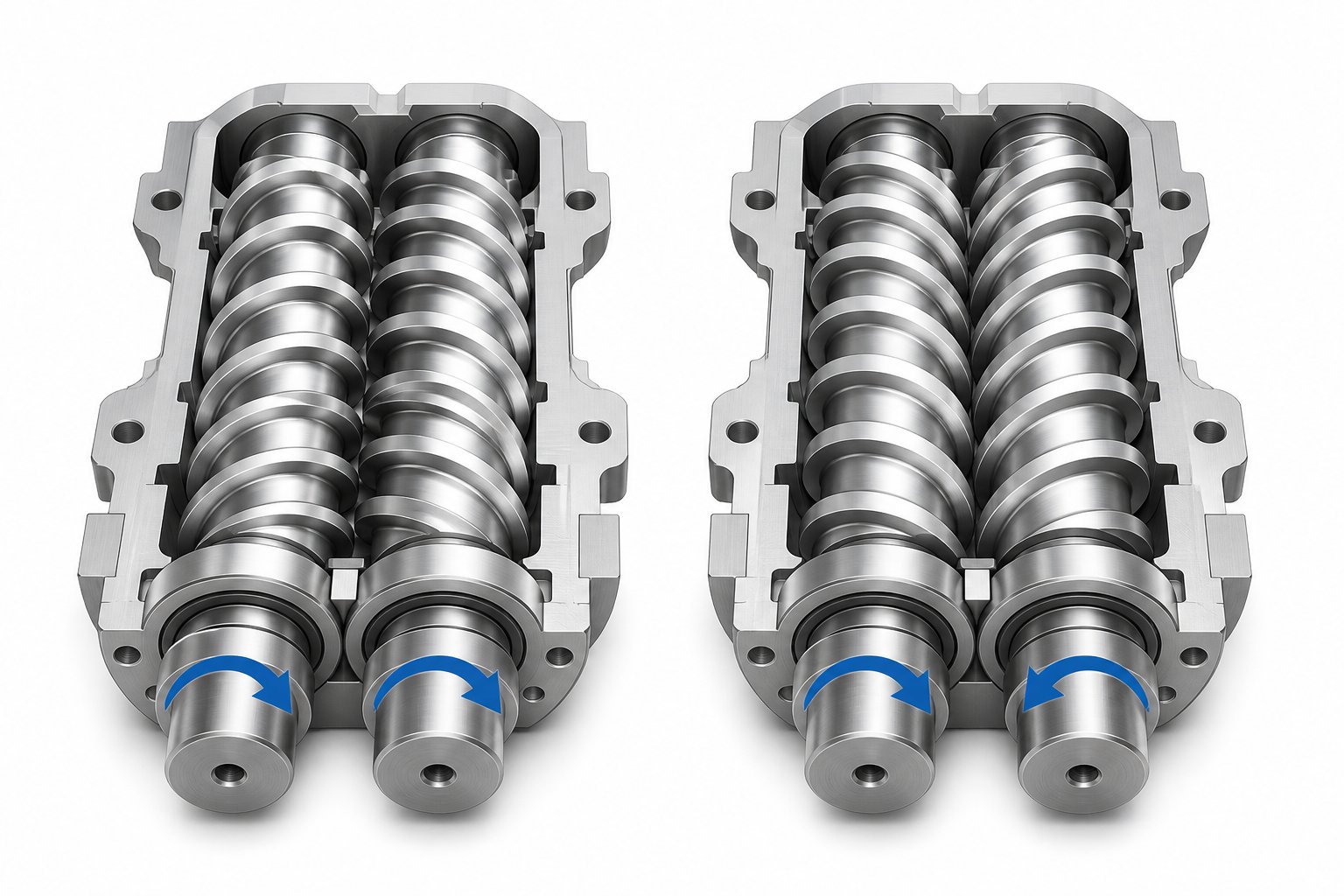
Co-Rotating vs Counter-Rotating Configurations Explained
You've seen the terms in every listing — "co-rotating" or "counter-rotating" — often buried in a spec table with zero explanation. Yet this single distinction shapes everything about how a double screw extruder machine performs: the shear it generates, the materials it handles well, and the applications it serves. Choosing the wrong configuration for your process is like buying a dump truck when you needed a delivery van — technically both are vehicles, but one will never do the other's job efficiently.
Co-Rotating Twin Screw Extruders and Their Applications
In a co-rotating twin screw extruder, both screws turn in the same direction. A fully intermeshing geometry is the standard, meaning the flights of one screw mesh tightly into the channels of the other. This arrangement creates a distinctive flow pattern: material is forcibly transferred from one screw to the next at the intermeshing zone, producing intense shear fields between the screws and between each screw and the barrel wall.
What does that mean in practical terms? Three things that matter to any buyer evaluating a double screw extruder:
- High shear and mixing intensity — Kneading blocks and mixing elements work alongside the intermeshing geometry to impose complex deformation on the polymer melt. This is exactly what you need to break down filler agglomerates, control phase morphology in polymer alloys, or drive chemical reactions in reactive extrusion.
- Self-wiping action — Because the flights of one screw continuously sweep the surface of the other, material doesn't stagnate or adhere to the screw surfaces. This keeps the residence time distribution narrow — critical for heat-sensitive polymers and reactive processes where even small pockets of over-processed material can degrade product quality.
- Flexible screw configuration — The modular element design covered in the previous section reaches its full potential in co-rotating machines. Processors can arrange conveying, kneading, mixing, and reverse elements in virtually any combination to fine-tune energy input and residence time for a specific formulation.
These characteristics make co-rotating designs the dominant choice for polymer compounding, color masterbatch production, reactive extrusion, filled compound processing, and nanocomposite development. If you're shopping the used market for a compounding line, you'll notice that the vast majority of available machines are co-rotating designs from established OEMs — simply because they represent the largest installed base worldwide.
Counter-Rotating Configurations and When They Excel
Flip the rotation direction on one screw and the processing behavior changes dramatically. In a counter-rotating twin screw extruder, the screws turn in opposite directions, drawing material inward at the intermeshing region and advancing it forward under compression. Transport depends heavily on screw rotation itself rather than the complex handoff pattern seen in co-rotating designs, which means stable extrusion is achievable even at comparatively low rotational speeds.
The defining characteristic here is gentleness. Shear stress between the screws is substantially lower than in co-rotating machines, and the associated shear-induced heating is minimized. Instead of relying on aggressive shear fields for mixing, counter-rotating extruders use a calendering effect at the intermeshing zone — material undergoes repeated compressive and elongational deformation as it passes between the screws, achieving dispersion under controlled, moderate conditions.
Why does that matter? Consider rigid PVC — a material with a notoriously low thermal decomposition temperature and poor melt flow. Subject it to the high shear of a co-rotating machine and you risk degradation before the compound ever reaches the die. A counter-rotating extruder, by contrast, holds extrusion temperatures low through high-fill, low-speed operation, making it the standard for PVC pipe, sheet, and profile extrusion. The same gentle processing suits wood-plastic composites, calcium carbonate-filled compounds, and any application where shear-sensitive materials must retain their structural integrity through the extrusion process.
Counter-rotating machines also come in two geometric variations — parallel and conical. Parallel designs maintain a constant screw diameter along the barrel length, favoring high-output applications with modular barrel sections. Conical designs feature tapered screws that provide enhanced compression in a shorter barrel, which can be advantageous for compact production lines. Both styles appear in used listings, and understanding the distinction helps you match machine geometry to your floor space and throughput requirements.
Matching Configuration to Your Processing Needs
Before you start browsing listings, you need a clear answer to one question: which configuration fits your application? The table below puts the key differences side by side so you can make that call with confidence.
| Criteria | Co-Rotating Twin Screw Extruder | Counter-Rotating Twin Screw Extruder |
|---|---|---|
| Typical Applications | Polymer compounding, masterbatch, reactive extrusion, nanocomposites, recycled polymer processing | Rigid PVC pipe and profiles, WPC, calcium carbonate compounds, shear-sensitive formulations |
| Shear Level | High | Low to moderate |
| Mixing Intensity | Excellent dispersive and distributive mixing | Moderate — relies on calendering and compressive action |
| Self-Wiping Capability | Yes — continuous flight-to-flight wiping | Limited |
| Throughput Range | Wide — lab scale to high-volume production | Moderate — optimized for controlled, steady output |
| Screw Speed Range | Moderate to high RPM | Typically lower RPM |
| Pressure Generation | Moderate | High — strong positive conveying |
| Common Industries | Compounding, automotive, packaging, recycling, pharmaceuticals | PVC construction products, building materials, wood-plastic composites |
Here's a simple decision framework. If your process demands intensive mixing, high shear dispersion, or the flexibility to run multiple formulations on a single line, a co-rotating machine is almost certainly the right fit. If you're processing PVC, wood-plastic composites, or other materials that degrade under aggressive shear, a counter-rotating design will protect product quality and give you the pressure stability these applications require.
Keep in mind that co-rotating and counter-rotating twin screw extruder designs also differ in parts ecosystems and aftermarket support. Co-rotating machines from major OEMs have a deeper pool of available replacement screw elements and barrel liners on the used market, simply because more units have been manufactured. Counter-rotating machines — especially conical variants — may require more targeted sourcing for wear parts. Factor this into your total cost analysis before committing to a purchase, because a bargain on the machine itself means little if replacement parts carry a premium or require extended lead times.
With configuration settled, the next layer of the puzzle is understanding the specifications that define a machine's capacity and value — screw diameter, L/D ratio, torque density, and motor power — the numbers that separate a machine that fits your process from one that falls short.
Key Specifications That Determine Twin Screw Extruder Machine Value and Fit
Every used equipment listing throws the same numbers at you — 50mm, 36:1, 150kW — as if the digits alone should justify the asking price. For experienced processors, these specs paint an immediate picture of what a machine can do. For everyone else, they're just numbers on a page. The real purchasing intelligence lies in understanding what each specification controls, how the values interact, and which ranges match your actual production targets. Get this wrong and you'll either overpay for capacity you'll never use or, worse, buy a plastic twin screw extruder that chokes on your first real production run.
Screw Diameter and Its Impact on Throughput
If you could learn only one number from a listing, screw diameter should be it. Measured in millimeters, this single dimension is the primary determinant of how much material a twin screw compounding extruder can process per hour — and it directly influences the twin screw extruder price on both the new and used markets.
The relationship isn't linear, either. Throughput capacity scales roughly with the square of the screw diameter. Double the diameter and you don't just double output — you roughly quadruple it. That's why the jump from a 26mm pilot machine to a 50mm production unit represents a massive leap in capability, not just a modest step up.
Used machines span a wide range. Laboratory units start around 16–20mm, suitable for formulation development and small-batch testing at rates measured in single-digit kilograms per hour. Pilot-scale machines in the 25–35mm range bridge the gap between lab trials and full production, offering enough throughput for product qualification and market sampling. Production machines typically start at 40mm and extend beyond 130mm for high-volume compounding operations pushing several thousand kilograms per hour.
When you're matching diameter to your needs, start with your required annual output and work backward to an hourly throughput target. Then look for machines sized to deliver that rate comfortably — not at maximum capacity, but at a sustainable operating point that leaves room for screw speed adjustment and formulation changes. A machine running perpetually at its ceiling wears faster and leaves zero margin for process optimization.
L/D Ratio and What It Tells You About Processing Capability
The length-to-diameter ratio — commonly written as L/D — tells you how much processing length the barrel provides relative to the screw diameter. Think of it as the machine's "runway." A longer runway gives material more time and more zones for feeding, melting, mixing, venting, and pressure building before it exits through the die.
Modern twin-screw extruder machines typically feature L/D ratios between 32:1 and 48:1. Older units — the kind you'll frequently encounter on the used market — sometimes run shorter at 24:1 to 28:1. That doesn't automatically make them inferior, but it does limit what they can handle. A shorter L/D ratio works well for straightforward compounding of thermally sensitive materials that benefit from minimal residence time. Longer ratios — 36:1 and above — provide the space needed for complex formulations requiring multiple side feeding ports, vacuum venting stages, or extended mixing zones.
Here's a practical guideline drawn from common industry applications:
- 20:1 to 28:1 — Simple color masterbatch, thermally sensitive blending, PVC compounding where short residence time prevents degradation.
- 28:1 to 36:1 — General-purpose compounding, engineering plastics, fiber reinforcement, and moderate filler loading — the sweet spot for versatility.
- 36:1 to 48:1 — Reactive extrusion, devolatilization, highly filled compounds, recycled polymer processing, and any formulation requiring multiple downstream feed or vent positions.
When comparing used listings, pay close attention to L/D ratio alongside screw diameter. Two machines with identical 50mm screws can behave very differently if one runs at 32:1 and the other at 40:1. The longer machine offers greater process flexibility, which typically commands a higher price — but only justifies that premium if your application actually needs the extra processing length.
Torque Density and Drive Power Ratings
Torque density is the specification most buyers overlook — and the one that most directly determines whether a machine can handle demanding materials like glass-filled polyamide, mineral-loaded compounds, or high-viscosity engineering resins. It measures how much rotational force the gearbox and drive system can deliver relative to the screw cross-section, expressed in Nm/cm3.
Why does this matter on a used machine? Because torque is what pushes material through the barrel against viscous resistance. Higher-viscosity or heavily filled formulations demand substantially more torque than neat polymers. If the gearbox can't deliver enough energy to the screws, you'll hit the torque limit before reaching your target throughput — effectively making the machine smaller than its screw diameter suggests.
Modern high-performance twin screw extruders achieve torque densities around 18 Nm/cm3, representing a roughly 30% increase over older-generation designs that typically operated in the 10–13 Nm/cm3 range. Many used machines on the market fall into that older category, which doesn't disqualify them — but it does mean you need to verify whether the available torque matches the rheological demands of your specific materials.
Motor power, expressed in kilowatts (kW), is the more visible specification in listings — but it only tells part of the story. A 150kW motor paired with a worn gearbox delivering poor efficiency won't perform like a 110kW motor behind a well-maintained, high-torque-density gear train. When evaluating a used twin-screw extruder, always ask about gearbox history: oil analysis records, bearing condition, and any documented backlash measurements. A reliable operating guideline is to run at roughly 80% of continuous-rated torque and speed, which provides headroom for process variations without stressing the drive system.
The true capacity of a used twin screw extruder is not defined by screw diameter alone — it is the intersection of screw diameter, L/D ratio, and torque density that determines what the machine can actually produce at your target throughput and quality.
Specification Ranges by Machine Class
The table below organizes general industry-standard specification ranges by machine class, giving you a quick reference for evaluating whether a listed machine falls into the laboratory, pilot, or production category — and what performance envelope to expect.
| Machine Class | Typical Screw Diameter | Common L/D Ratios | Approximate Throughput Range | Typical Motor Power |
|---|---|---|---|---|
| Laboratory | 16–26 mm | 24:1 to 40:1 | 0.5–30 kg/h | 2–15 kW |
| Pilot | 27–40 mm | 28:1 to 44:1 | 20–200 kg/h | 15–75 kW |
| Production | 40–135+ mm | 32:1 to 48:1 | 150–4,000+ kg/h | 55–1,500+ kW |
These ranges reflect general industry patterns for co-rotating twin screw extruders — the most common type on the used market. Actual specifications vary by manufacturer, model generation, and any modifications made during the machine's service life.
Before committing to any purchase, request the full OEM specification sheet and compare it against your documented process requirements: target throughput, material viscosity range, required number of feed and vent ports, and maximum screw speed. If the seller can't provide original specs, treat that gap as a red flag — not necessarily a deal-breaker, but a signal that additional due diligence on wear condition and component completeness becomes absolutely critical.
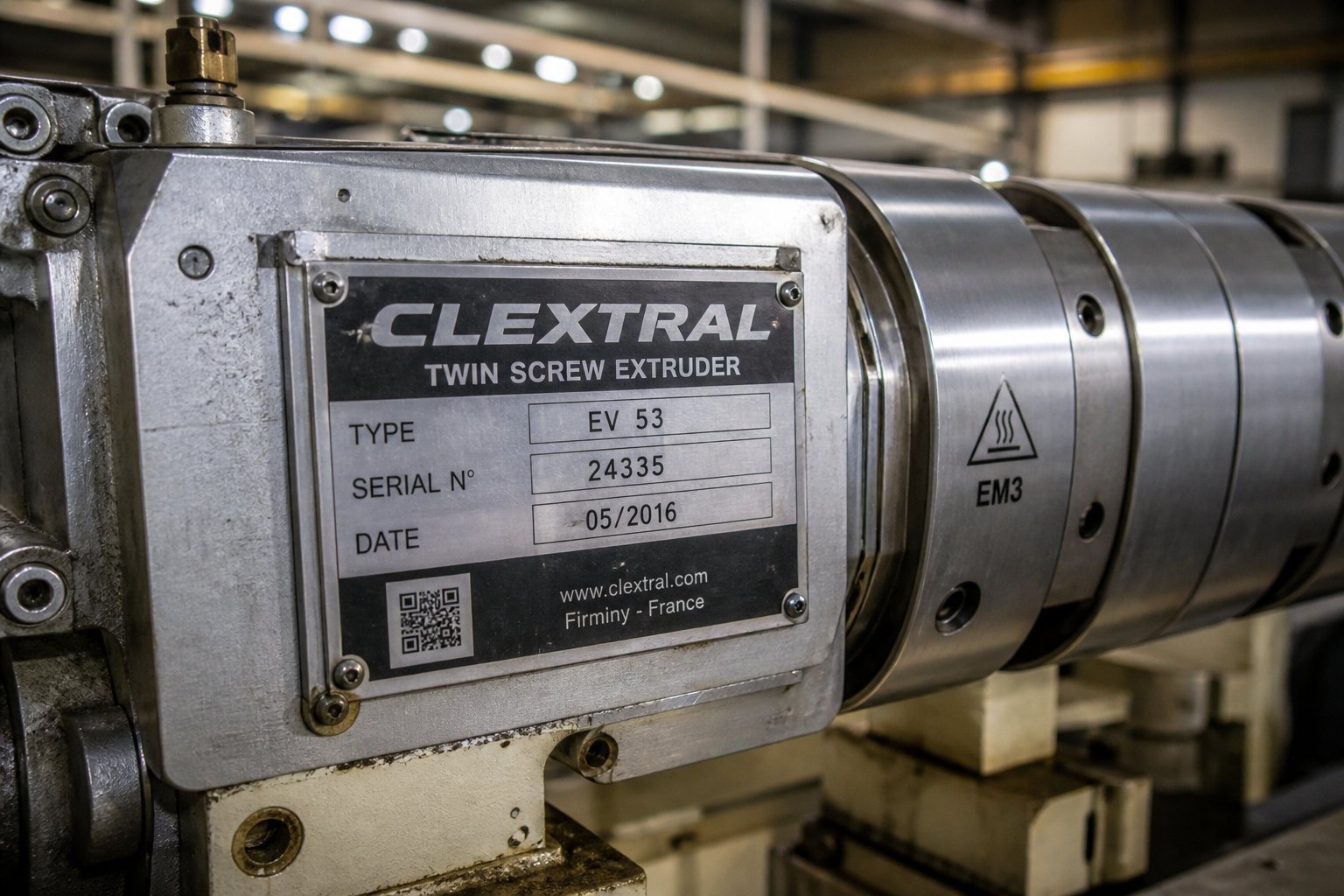
Major Brands in the Used Twin Screw Extruder Market
Spec sheets tell you what a machine can do — brand names tell you how easy it will be to keep it doing that five years from now. Browse any used equipment marketplace and you'll encounter a jumble of nameplates, some familiar, some half-remembered, and more than a few that trace back through corporate mergers that scrambled the branding entirely. Understanding which twin screw extruder manufacturers stand behind the machines you're evaluating — and what their aftermarket ecosystems look like — can save you from a purchase that looks strong on paper but becomes a sourcing headache in practice.
Established European OEM Brands on the Used Market
Four names dominate used listings for co-rotating and counter-rotating twin screw extruders, and each carries a distinct history worth knowing.
Coperion is the brand you'll see most often in used compounding equipment. The company's ZSK twin screw extruder line traces its roots back to 1957, when Werner und Pfleiderer delivered the first co-rotating, closely intermeshing ZSK — effectively the forefather of all modern co-rotating designs. Werner und Pfleiderer later became Werner & Pfleiderer, then Coperion through a series of corporate restructurings. If you spot a used listing labeled as a Werner Pfleiderer extruder, you're looking at an older Coperion-lineage machine. These units can still be excellent buys, but vintage matters: earlier ZSK generations feature lower torque densities and shorter L/D ratios than current production. The Coperion extruder installed base is enormous, which translates into strong parts availability and a deep network of service technicians who know the platform intimately.
KraussMaffei Berstorff is the second major European name. Berstorff, originally an independent German manufacturer founded in 1838, built a strong reputation in both co-rotating and counter-rotating designs before being absorbed into the KraussMaffei group. Used listings may reference "Berstorff," "KraussMaffei Berstorff," or simply the ZE series designation. The brand is well regarded for high free volume and robust mechanical design, and its installed base ensures reasonable aftermarket support for most model generations.
Leistritz, with over a century of screw technology experience, occupies a distinctive position among twin screw extruder manufacturers. The company's ZSE platform appears frequently in used listings for pilot-scale and specialty production machines, particularly in pharmaceutical hot-melt extrusion and R&D applications. Leistritz machines are recognized for versatility across both co-rotating and counter-rotating configurations, and the company maintains active support for its legacy platforms.
Brabender fills a different niche entirely. If you're searching for a used laboratory or small-scale research extruder, Brabender extruder models appear regularly. These compact machines serve formulation development, quality control testing, and academic research rather than high-volume production. Their smaller size means lower capital outlay, but replacement parts for older Brabender units can require more targeted sourcing than parts for production-scale OEMs.
The merger history behind these brands creates real confusion in the used market. A machine stamped "W&P" is a Werner & Pfleiderer — same engineering lineage as a modern Coperion. A "Berstorff" unit may or may not have KraussMaffei-era components depending on its manufacture date. Always cross-reference the serial number and build year against the manufacturer's historical records to confirm exactly which model generation you're evaluating.
Evaluating Brand-Specific Parts Availability
Here's where brand choice directly impacts your operating budget. Parts availability varies significantly depending on the manufacturer and the model's vintage. Legacy brands with large installed bases — Coperion and KraussMaffei Berstorff in particular — generally offer the strongest aftermarket ecosystems. OEM service centers stock common wear items, and third-party suppliers manufacture compatible screw elements and barrel liners for popular model lines.
That said, OEM replacement parts often carry premium pricing. A set of original-specification kneading blocks for a Coperion ZSK can cost substantially more than functionally equivalent elements from a specialized aftermarket supplier. This price gap drives many buyers toward compatible replacement parts — a perfectly viable strategy provided the supplier can match critical dimensions, metallurgy, and surface treatments. The key is confirming compatibility before purchase, not after installation.
Older and less common model variants present a different challenge. Discontinued platforms may have limited or no OEM parts pipeline, pushing buyers entirely toward aftermarket fabrication. If you're considering a machine from an earlier generation, factor in the cost and lead time of having replacement elements custom-manufactured from drawings or reverse-engineered from samples — before you finalize the purchase price negotiation.
Other Notable Manufacturers to Consider
Beyond the four dominant European names, you'll occasionally encounter machines from manufacturers with smaller but established market positions. Bausano, an Italian company founded in 1946, specializes in counter-rotating twin screw extruders for PVC and wood-plastic composite applications — a strong niche player with solid engineering but a smaller global parts network. Maris, another Italian manufacturer, builds co-rotating extruders for specialty compounding and has a loyal following in European markets. Icma San Giorgio offers both co-rotating and counter-rotating platforms and appears in used listings for general compounding lines. Japanese manufacturers like JSW (Japan Steel Works) and Kobe Steel also surface on the used market, particularly for high-torque applications and large-diameter devolatilization machines — these represent exceptional engineering but may require Japan-based sourcing channels for certain proprietary components.
Less common brands aren't automatically inferior, but they do carry an inherent risk: if the original manufacturer has a small installed base or limited presence in your region, sourcing replacement wear parts could involve longer lead times, higher per-unit costs, or the need for custom fabrication. That's a manageable challenge for a well-equipped maintenance team — and a potential dealbreaker for a buyer who expects plug-and-play simplicity.
To consolidate the landscape, here's a quick-reference summary of the major brands you'll encounter and what each brings to the table:
- Coperion (formerly Werner & Pfleiderer) — Largest installed base for co-rotating compounding extruders; excellent parts availability; benchmark ZSK platform spanning multiple torque-density generations.
- KraussMaffei Berstorff — Strong in both co-rotating and counter-rotating designs; high free volume architecture; solid European aftermarket network.
- Leistritz — Versatile co-rotating and counter-rotating platforms; particularly strong in pharma and R&D applications; active legacy support.
- Brabender — Laboratory and small-scale extrusion; ideal for R&D and QC testing; niche parts sourcing for older models.
- Bausano — Counter-rotating specialist for PVC pipe, profile, and WPC; Italian build quality; smaller global parts footprint.
- Maris / Icma San Giorgio — European specialty compounding machines; capable engineering but narrower aftermarket support compared to top-tier OEMs.
- JSW / Kobe Steel — Japanese precision engineering; high-torque, large-diameter platforms; parts sourcing may require Japan-based channels.
Brand familiarity and parts sourcing infrastructure should weigh heavily in any used purchase decision — often as heavily as the machine's physical condition. A well-maintained extruder from an OEM with deep aftermarket support will consistently cost less to operate over its remaining service life than a cheaper machine from a manufacturer whose parts require months of lead time and custom fabrication for every replacement cycle. That total-cost perspective becomes even more important when you turn your attention to the wear components that define the true condition of any used machine.
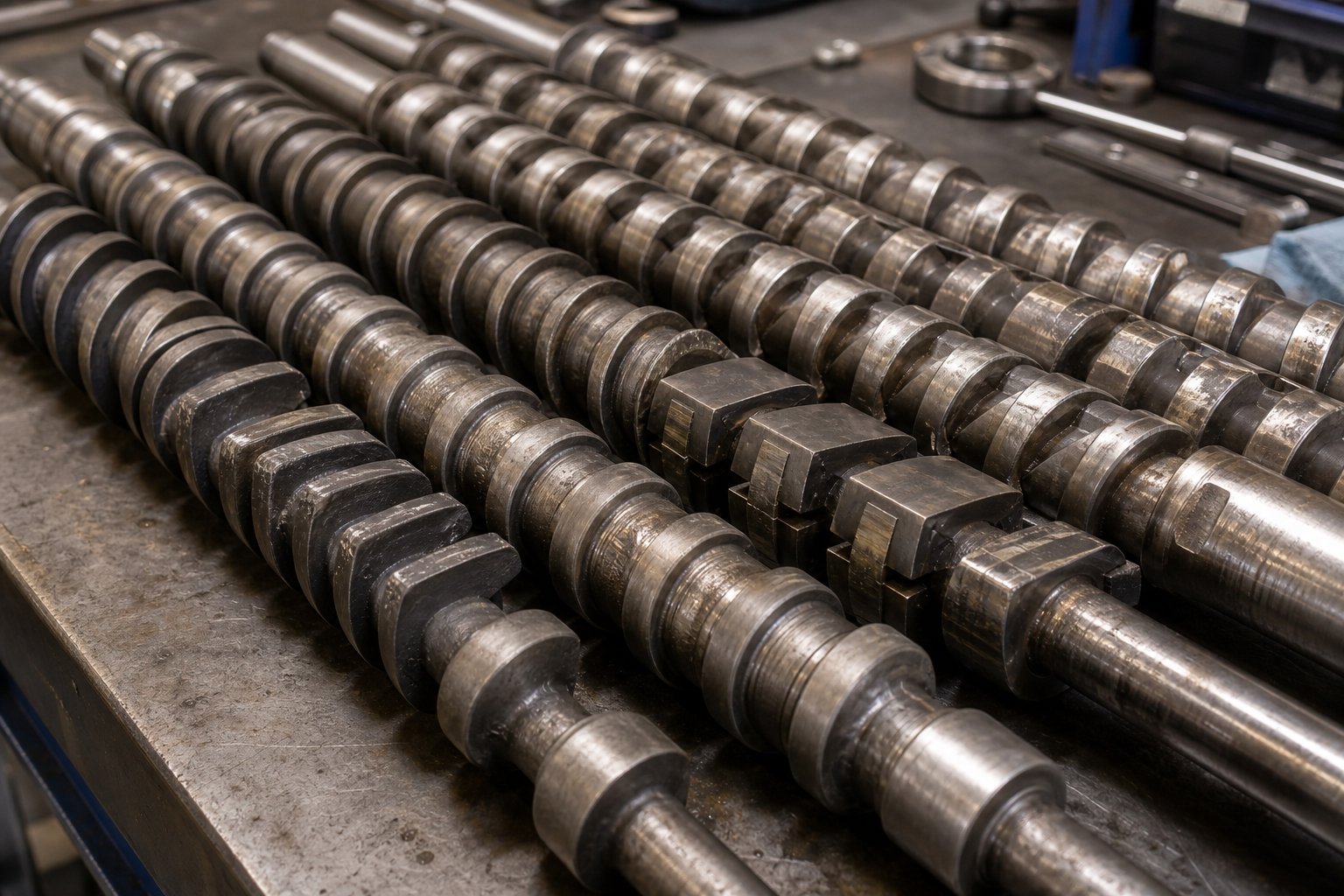
Critical Wear Components and How to Inspect a Used Extruder
A polished paint job and a clean control panel can make any used extruder look like a bargain. But the components that actually determine whether you're buying years of productive service or months of headaches are hidden inside the barrel, buried in the gearbox, and wrapped around the heating zones. Wear components are the silent truth-tellers of any used extruder equipment transaction — and sellers have little incentive to volunteer detailed condition data unless buyers know exactly what to ask for.
This section breaks down the parts that wear, how to evaluate their condition, and why building a replacement parts strategy before signing a purchase agreement is one of the smartest moves a buyer can make.
Screw Elements and Barrel Liner Condition
Screw elements and barrel liners absorb the brunt of every processing hour. They're the primary wear surfaces, ground down by a combination of abrasive fillers (glass fiber, calcium carbonate, talc), corrosive polymer byproducts, and the relentless metal-to-metal contact inherent in twin screw operation. The rate of degradation depends heavily on what materials the machine has processed — a unit that spent its life running unfilled polyolefins will show dramatically less wear than one that compounded glass-filled nylon.
What happens as these components wear? The screw flight outer diameter gradually shrinks while the barrel bore enlarges. That growing gap between screw tip and barrel wall — the flight clearance — is the single most important measurement you can request from a seller. As Plastics Technology details, increasing flight clearance reduces the machine's specific rate (output per screw revolution), forces higher screw speeds to maintain throughput, and drives discharge temperatures upward as the heat-transfer coefficient at the barrel wall deteriorates. The practical consequence? A worn machine consumes more energy, produces less consistent product, and eventually forces operators to reduce throughput to maintain quality — directly eroding profitability.
Here's how to protect yourself. Request dimensional wear data for both components:
- Screw element outer diameter (OD) — Measure at multiple points along each element's length, especially on kneading blocks and mixing elements where wear concentrates. Compare readings against OEM nominal dimensions. A general industry guideline flags concern when flight clearance reaches two to four times the original specification.
- Barrel bore inner diameter (ID) — Each barrel segment should be gauged independently, with particular attention to the melting and high-shear mixing zones where abrasive wear peaks. Barrels with bimetallic liners typically offer a finished liner thickness of approximately 0.060 inches when new — once that liner is worn through, the softer base metal behind it erodes rapidly.
In co-rotating machines, screws are commonly manufactured from vacuum-hardened tool steel with nitrided surfaces achieving surface hardness levels of HV 900 to 1100. Once the hardened surface layer wears through, the softer substrate beneath erodes at an accelerated pace. Similarly, barrel liners made from stellite or bimetallic alloys resist abrasion effectively until their protective layer is consumed. When evaluating a used extruder for sale, treat the remaining thickness of these hardened surfaces as a direct indicator of remaining service life.
One more detail buyers often miss: screw elements that have been refurbished carry their own history. Industry practice limits screw refurbishment — re-welding hard facing onto worn flight tips — to roughly three cycles before the base material degrades enough to risk delamination between the hard facing and the substrate. Ask the seller whether elements are original, refurbished, or a mix of both, and how many refurbishment cycles the screws have undergone.
Gearbox, Drive System, and Heating Components
If screw elements and barrels are the heart of the machine, the gearbox is the spine. It multiplies motor torque and transmits it to the screw shafts under enormous mechanical loads. Gearbox failure on an extruder line doesn't just stop production — it can cascade into screw damage, barrel misalignment, and repair bills that dwarf the original equipment purchase price.
Evaluating gearbox condition requires looking at three diagnostic layers:
- Oil analysis — A single oil sample reveals what's happening inside the gear train with a precision no external inspection can match. Rising iron particle counts signal gear tooth or bearing race wear. Copper spikes suggest bronze bushing or thrust washer degradation. Water contamination above 0.1% creates hydrogen embrittlement risk in bearing steel and compromises lubricant film strength. As industrial gearbox monitoring research shows, roughly 40% of gearbox failures originate from lubrication issues — the single most preventable failure category. Request the most recent oil analysis report, and if the seller can't produce one, budget for an independent analysis before closing any deal.
- Bearing condition and backlash — Worn bearings generate play in the gear mesh that manifests as backlash — measurable rotational looseness when you rock the input shaft. Excessive backlash indicates bearing fatigue, gear tooth surface degradation, or both. Ask the seller for backlash measurements and compare against OEM tolerances. If the machine has been sitting idle for an extended period, bear in mind that static corrosion on bearing surfaces can cause problems that won't appear until the machine runs under load.
- Oil change and maintenance history — Gearbox oil should be changed every 2,000 to 3,000 hours of operation. A machine with documented oil changes on schedule tells a very different story than one with no maintenance records. Synthetic industrial gear oil (typically ISO VG 320) is the standard for extruder gearboxes, and disciplined oil management can extend gearbox life from five years to ten or more. Missing records don't mean the gearbox is damaged — but they do mean you're buying blind on a component that can cost $15,000 to $25,000 to replace.
Beyond the gearbox, two other component categories demand inspection on any used machine:
Barrel heater bands and thermocouples sit at the intersection of process control and safety. Heater bands — typically cast aluminum or ceramic — burn out over time, creating dead zones in the temperature profile. A failed thermocouple is even more insidious: if it reads low, the controller drives the heater continuously, risking polymer degradation and barrel overheating. If it reads high, the heater stays off, leaving material partially unmelted. Calibrating every thermocouple and testing every heater zone under power should be part of any pre-purchase inspection. Replacement heater bands typically run $100 to $300 per zone, and most older machines need at least a partial heater replacement as part of recommissioning.
Die heads and pelletizing components complete the downstream end of the system. Strand dies, underwater pelletizer cutters, pelletizing blades, and die plates all wear during operation and require evaluation. Worn pelletizer blades produce irregular pellet geometry and generate fines that contaminate the product. Die plates with eroded holes produce inconsistent strand diameter, affecting pellet uniformity. These components are often excluded from used machine listings or mentioned only as "included" without condition details — always verify their presence and serviceability before assuming the price covers a complete, production-ready system.
Building a Replacement Parts Strategy Before Purchase
Here's the insight that separates experienced buyers from first-timers: the cost of a used extruder isn't just the purchase price — it's the purchase price plus the parts you'll need to bring the machine to production-ready condition. Smart buyers investigate parts availability and pricing before they commit to a machine, not after it arrives on the loading dock.
Start by identifying which components will need immediate replacement versus those that can run for another cycle. Then research sourcing channels for each category. OEM parts from major manufacturers like Coperion or KraussMaffei Berstorff deliver guaranteed dimensional accuracy and metallurgical specification — but they carry premium pricing that can significantly inflate your total investment. Aftermarket suppliers specializing in extruder components offer a cost-effective alternative, particularly for wear items like screw elements, heater bands, thermocouples, die heads, and pelletizing blades.
Suppliers like NANHAIYA, for example, focus specifically on extruder spare parts and serve maintenance teams, machine rebuilders, and plant buyers who need replacement components for specific used machines. Their ability to manufacture custom parts based on drawings or physical samples is especially valuable when you're working with older or less common machine models where OEM parts may be discontinued or carry extended lead times. Having a supplier who can reverse-engineer a worn screw element or replicate a die plate from a sample eliminates one of the biggest risks in used equipment ownership — the fear that a critical part failure will sideline the machine for weeks while you scramble for sourcing.
Before finalizing any purchase, build a checklist of wear components to inspect and budget for potential replacement:
- Screw elements — Kneading blocks, conveying elements, mixing elements, and reverse elements. Prioritize elements in the melting and high-shear mixing zones where wear rates are highest.
- Barrel liners — Individual barrel segments, especially those in the kneading and compression zones. Modular barrel designs allow replacement of worn segments without replacing the entire barrel assembly.
- Gearbox internals — Bearings, seals, and gear sets. Budget for a full oil change, filter replacement, and seal kit at minimum.
- Heater bands — All barrel heating zones. Test each zone under power and budget for replacement of any that show degraded output or inconsistent heating.
- Thermocouples — Every temperature measurement point on the barrel and die. Calibrate or replace any thermocouple that reads outside acceptable tolerance.
- Die heads and pelletizing blades — Inspect hole geometry, blade sharpness, and mounting surface flatness. Worn pelletizing components are among the cheapest to replace but most impactful on product quality.
- Rear seal assembly — The seal where screw shafts exit the barrel prevents molten polymer leakage and is a common failure point on older machines.
- Feed system components — Feeder screws, hopper agitators, and gravimetric load cells. Inconsistent feeding creates surging that undermines every downstream process parameter.
Total up the estimated replacement costs for the components that need immediate attention, add that figure to the purchase price, and you'll have a realistic picture of your true acquisition cost. That number — not the listing price alone — is what you should compare against new equipment quotes and competing used machine options. Plastic extruders for sale at attractive headline prices can quickly lose their appeal once replacement parts, reconditioning labor, and commissioning costs enter the equation.
With a clear understanding of wear component condition and parts sourcing strategy in place, the natural next question becomes: how does the full financial picture of buying used actually compare to purchasing new equipment — and what hidden costs do most buyers underestimate?
The Economics of Buying a Used Twin Screw Extruder for Sale vs New Equipment
Knowing what to inspect is half the equation. The other half is knowing what the entire investment actually costs — not just the number on the listing. Too many buyers fixate on the purchase price, celebrate the discount, and then watch their budget evaporate as transportation bills, replacement parts invoices, and commissioning labor stack up. Building a credible business case means accounting for every dollar, not just the obvious ones.
Capital Cost Advantages of Buying Used Equipment
The headline savings are real. Used extruders for sale typically trade at 30 to 60 percent below original new pricing, depending on machine age, condition, brand reputation, and specification level. A production-class co-rotating machine that listed for $400,000 new might appear on the used market at $150,000 to $250,000 — a gap large enough to fund ancillary equipment, raw material inventory, or an entire downstream pelletizing line.
Beyond sticker savings, two additional financial advantages deserve attention. First, reduced capital outlay compresses ROI timelines dramatically. A machine purchased at half the new price reaches break-even in roughly half the time, assuming comparable throughput — meaning every month past that point contributes pure margin rather than paying down the acquisition. Second, used equipment typically ships within weeks rather than the six- to twelve-month lead times common for new twin screw extruders for sale from major OEMs. For processors chasing a contract deadline or responding to a sudden capacity gap, that speed-to-production advantage can be worth more than the capital savings themselves.
Depreciation also works in the used buyer's favor. New industrial machinery absorbs its steepest value loss in the first three years — often 25 to 40 percent. Purchasing a machine that has already passed through that steep depreciation curve means your own ownership period experiences a much flatter value decline. If you ever resell, the gap between what you paid and what you recover is far narrower than it would be on a new unit.
Hidden Costs Buyers Must Factor Into the Total Investment
Here's where the math gets uncomfortable for unprepared buyers. The listing price for a twin screw extruder for sale — whether through a dealer, auction, or direct sale — covers the machine as-is, where-is. Everything required to transform that iron into a running production asset falls on your budget. These commonly overlooked cost categories can collectively add 20 to 50 percent on top of the purchase price:
- Transportation and rigging — Crating, flatbed freight, crane or forklift unloading, and precision placement on your production floor. Costs scale with machine weight and distance, and a production-scale extruder easily runs $5,000 to $15,000 or more for domestic transport.
- Refurbishment and reconditioning — Barrel re-lining, screw element replacement, gearbox overhaul, and surface restoration. Scope depends entirely on machine condition and can range from minimal touch-up to a comprehensive rebuild.
- Replacement wear parts — Screw elements, barrel liners, heater bands, and thermocouples that need immediate replacement based on inspection findings. This is the cost category most directly tied to the wear component evaluation covered in the previous section.
- Controls upgrades or PLC retrofits — Older machines may run obsolete control platforms with discontinued components. Upgrading to a modern PLC and HMI panel adds capability and reliability but can represent a meaningful budget line.
- Installation and commissioning labor — Mechanical alignment, electrical hookup, utility connections, dry-run testing, and initial heated startups all require skilled technicians. Budget for both internal labor and any specialized contractor time.
- Initial maintenance and calibration — Gearbox oil replacement, instrument calibration, safety system verification, and baseline wear measurements establish the starting point for your preventive maintenance program.
A thorough total-cost-of-ownership analysis stacks all of these line items against the fully loaded cost of a new plastic extruder machine for sale — including the new machine's financing charges, lead time cost, and any production revenue lost while waiting for delivery. In many cases, even after accounting for every hidden cost, the reconditioned used machine still delivers a compelling financial advantage. But buyers who budget only for the purchase price consistently find themselves upside down.
The true cost of a used twin screw extruder is the purchase price plus refurbishment, replacement parts, installation, and commissioning. Buyers who budget only for the listing price consistently underestimate their total investment by 20 to 50 percent.
The financial case sharpens further when you understand what refurbishment can actually accomplish — and how sourcing the right replacement parts can close the performance gap between a reconditioned machine and a new one at a fraction of the cost.
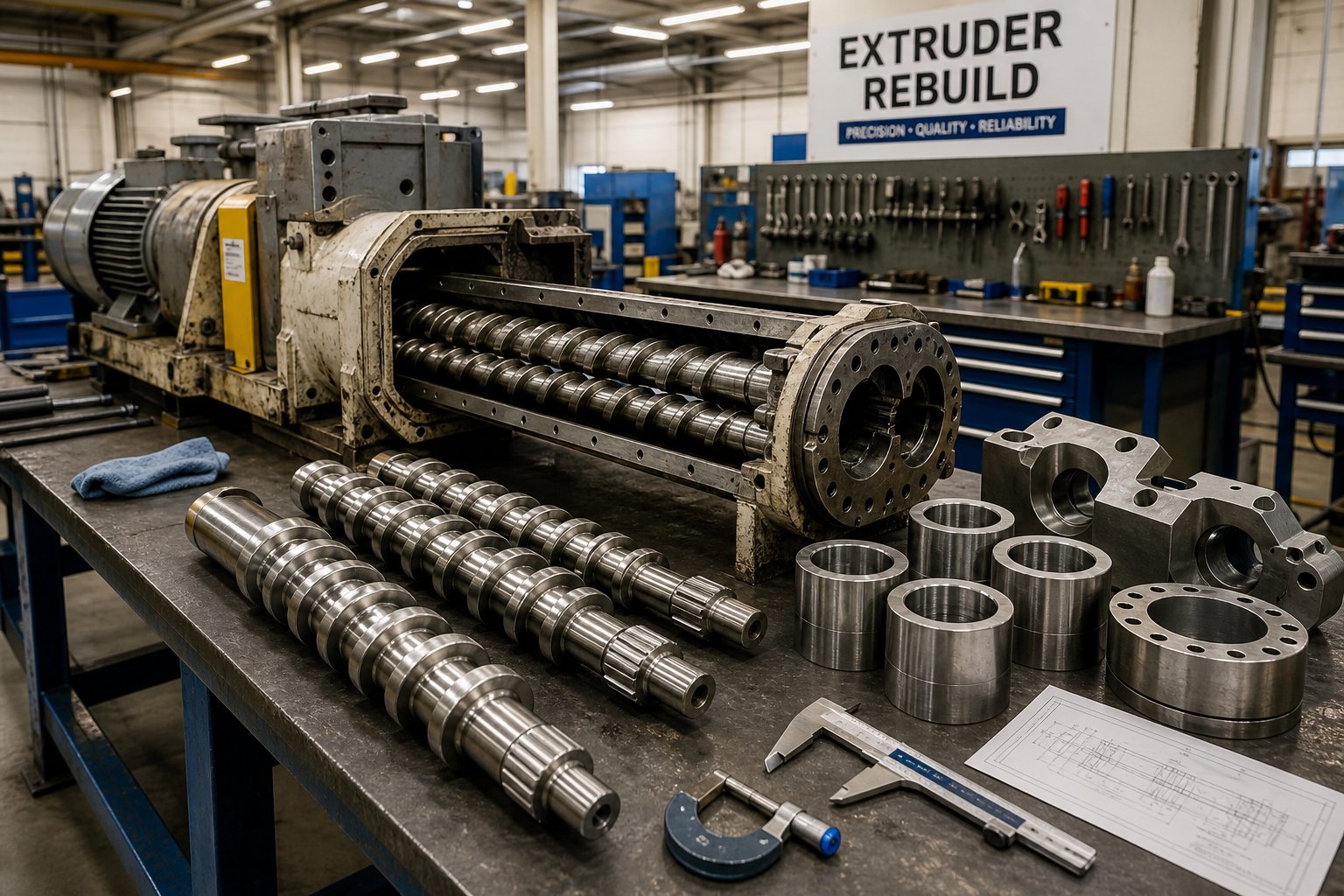
Refurbishment Options and Sourcing Replacement Parts
A reconditioned machine can deliver performance approaching new-equipment specifications — but only if the right components are addressed in the right order. Refurbishment isn't a single action; it's a layered project where each system upgrade builds on the one before it. Understanding the scope of what can be restored, what can be modernized, and where to source the parts that make it all possible turns an aging acquisition into a genuinely competitive production asset.
What Can Be Refurbished on a Used Twin Screw Extruder
Almost every major system on a used machine is a candidate for reconditioning — the question is always which components justify the investment. Start with the wear surfaces that directly contact process material, then work outward to mechanical, thermal, and electrical systems.
Barrel liners can be re-nitrided or replaced entirely. As reference data from industry maintenance guides confirms, barrels whose inner diameter has enlarged beyond tolerance can be bored out and fitted with new nitrided alloy steel bushings — a common repair for the homogenizing section, which typically experiences the fastest wear across a 5D to 7D length. Alternatively, the inner bore can be machined and re-cast with a bimetallic alloy liner 1 to 2mm thick, then precision-ground to finished size.
Screw elements follow a similar logic. Worn flight tips can be rebuilt through thermal spray or hard-facing overlay using wear-resistant alloys containing chromium, tungsten, cobalt, and boron — materials that restore both abrasion resistance and corrosion protection. However, remember the practical limit: industry practice caps hard-facing refurbishment at roughly three cycles before substrate integrity becomes a concern. Beyond that threshold, replacement elements are the safer path.
Gearbox overhauls typically involve replacing bearings, seals, and thrust washers while inspecting gear tooth surfaces for pitting or spalling. Fresh synthetic gear oil (ISO VG 320) and new filtration elements complete the mechanical restoration. For machines that have been sitting idle, static corrosion on bearing races may necessitate full bearing replacement regardless of hour-meter readings.
Thermal system reconditioning means replacing all heater bands and thermocouples — components that degrade predictably with age and thermal cycling. Feed systems, including hopper agitators, volumetric or gravimetric feeder screws, and load cells, often need recalibration or replacement to restore consistent material delivery. Finally, cosmetic restoration — repainting frames, replacing guards, and refurbishing safety covers — may seem superficial, but it protects against corrosion and signals to operators and auditors alike that the equipment has been properly cared for.
When all of these systems are addressed methodically, the reconditioned machine closes the performance gap with new equipment dramatically. Many refurbished units run within 5 to 10 percent of original OEM throughput and quality specifications — at a total investment still well below new-machine pricing.
Retrofit and Modernization Opportunities
Refurbishment restores original capability. Retrofitting goes a step further — it upgrades the machine beyond what it could do when it left the factory. This distinction matters especially for older platforms like a vintage Werner & Pfleiderer extruder or an early-generation Berstorff extruder, where the mechanical bones are solid but the control systems and auxiliaries reflect decades-old technology.
The highest-impact retrofit is typically a controls upgrade. Older machines may run relay logic, obsolete PLCs with discontinued processors, or analog temperature controllers that lack data logging and remote monitoring capability. Replacing these with a modern PLC platform and touchscreen HMI panel delivers several immediate benefits: tighter temperature control across all barrel zones, recipe storage and recall for faster changeovers, real-time trend monitoring that catches process drift before it becomes scrap, and compatibility with plant-wide SCADA or MES systems.
Drive system upgrades represent another high-value opportunity. Replacing a DC motor and analog drive with a modern AC inverter-duty motor and variable frequency drive (VFD) improves energy efficiency by 10 to 20 percent in many cases, reduces maintenance (no carbon brushes to monitor), and provides smoother torque delivery across the full speed range. For a Werner & Pfleiderer twin screw extruder from the 1990s or early 2000s, this single retrofit can transform the machine's operational profile while extending its productive lifespan by a decade or more.
Additional retrofit possibilities include updated safety interlocks that meet current regulatory standards, improved feed systems with loss-in-weight gravimetric control for tighter formulation accuracy, and upgraded barrel cooling circuits that replace corroded internal channels with external jacket cooling. Each of these modifications extends machine life and enhances efficiency — often pushing performance beyond the original factory specifications.
Sourcing Parts for Refurbishment Projects
Every refurbishment plan eventually collides with the same practical challenge: where do you actually get the parts? For popular current-production platforms, OEM channels remain an option — but at premium pricing and sometimes with lead times measured in months. For older or less common machines — think a 1980s-era Berstorff extruder or an early ZSK-generation Werner & Pfleiderer extruder — original parts may be discontinued entirely, leaving custom fabrication as the only viable path.
This is where specialized aftermarket suppliers become essential partners rather than optional alternatives. A supplier like NANHAIYA focuses specifically on extruder spare parts — screw-related components, heater bands, thermocouples, die heads, pelletizing blades, and custom-manufactured parts produced from engineering drawings or physical samples taken from the specific machine under refurbishment. That capability to reverse-engineer a worn component and produce a dimensional match eliminates the dependency on OEM parts pipelines that may no longer exist for your particular machine vintage.
The economics are straightforward. OEM replacement screw elements for a production-class twin screw extruder can run three to five times the cost of aftermarket equivalents manufactured to the same dimensional tolerances and comparable metallurgical specifications. Across a full set of elements for a 40:1 L/D machine, that multiplier translates into thousands of dollars in savings — budget that can be redirected toward gearbox overhaul, controls upgrades, or spare parts inventory.
Regardless of sourcing channel, approach refurbishment in a prioritized sequence that addresses the most performance-critical systems first and works outward to supporting components:
- Screw elements and barrel liners — These define mixing performance, throughput capability, and product quality. No other upgrade matters if the wear surfaces can't maintain proper clearances.
- Gearbox overhaul — Bearings, seals, oil, and gear inspection. A failed gearbox halts production entirely and risks cascading damage to screws and barrels.
- Heater bands and thermocouples — Accurate, responsive temperature control is non-negotiable for consistent processing. Replace any zone that shows degraded output or suspect readings.
- Drive system and motor — Evaluate whether the existing motor and drive meet current requirements or whether an AC drive retrofit is justified by energy savings and reliability gains.
- Feed systems — Restore or upgrade feeders to ensure consistent, accurate material delivery — the foundation of stable extrusion.
- Electrical controls and safety systems — Modernize PLC, HMI, and safety interlocks to current standards. This step often unlocks process data capabilities the original machine never offered.
- Cosmetic restoration and guarding — Repaint, replace damaged covers, and ensure all safety guards meet regulatory requirements for operator protection.
Following this sequence ensures that each investment builds on a solid foundation. Upgrading controls on a machine with worn screws wastes the precision those controls provide. Conversely, installing new screw elements into a machine with a failing gearbox risks destroying the new components before they ever reach steady-state production.
A well-planned refurbishment transforms a used purchase from a gamble into an engineered outcome — one where every dollar spent maps directly to measurable production capability. The final piece of that transformation is what happens after the machine arrives at your facility: installation, commissioning, and the preventive maintenance program that protects your investment from day one.
Post-Purchase Steps From Installation to Production
The machine is bought. The refurbishment plan is funded. Replacement parts are on order. Everything looks great on paper — until the truck backs up to your dock and you realize the production floor isn't ready, the electrical panel can't handle the load, or nobody planned how to get a 12,000-pound extruder through a standard warehouse door. The gap between owning a used twin screw extruder and actually running one is where ambition meets logistics, and cutting corners here can stall your entire timeline.
Installation Planning and Site Preparation
Imagine your machine arrives on a flatbed next Monday morning. Would your facility be ready to receive it? Site preparation is the most overlooked phase of any used extrusion equipment for sale transaction — and one of the most consequential. Skipping it leads to costly improvisation under time pressure.
Start with floor loading capacity. A production-class twin screw extruder with gearbox, motor, and barrel assembly can weigh anywhere from 3,000 to over 20,000 pounds depending on screw diameter and configuration. Many older industrial buildings have floor load ratings that struggle with concentrated point loads from machine feet and gearbox mounts. Confirm your slab thickness, reinforcement, and load-bearing capacity before the machine ships — not after the rigging crew is standing idle on your clock.
Next, verify your utility infrastructure. Electrical service requirements are the most common showstopper. A used machine originally wired for 480V three-phase in one facility may need transformer adjustments or panel upgrades in yours. Cooling water supply — typically required for barrel cooling zones and gearbox oil cooling — needs adequate flow rate, pressure, and temperature control. Compressed air feeds pneumatic actuators on vent stuffers, diverter valves, and strand pelletizer systems. Map each utility requirement against your existing infrastructure and budget for upgrades early.
Beyond utilities, think about the broader production environment. Ventilation and fume extraction matter for any process generating volatiles — recycled polymers and reactive extrusion applications in particular. Material handling infrastructure — bulk silos, conveying lines, day bins, and gravimetric feeders — must connect to the extruder's feed throat at the correct height and orientation. Downstream equipment like water baths, strand pelletizers, or underwater pelletizing systems need aligned layout with adequate spacing for operator access and maintenance. As industry installation guides emphasize, pre-installation planning typically requires two to four weeks of collaborative effort between facility engineers and equipment specialists — time that pays dividends by preventing delays and cost overruns during the physical installation phase.
One practical tip buyers rarely hear: consult with rigging specialists who have specific experience moving heavy extrusion equipment. General-purpose riggers may underestimate the precision alignment requirements of an extruder barrel and gearbox assembly. Misalignment introduced during placement creates vibration and accelerated bearing wear that you won't detect until thousands of operating hours later — long after the riggers have left.
Commissioning Steps and Initial Production Runs
With the machine physically installed and all utilities connected, commissioning is the systematic process that transforms a stationary piece of iron into a verified production asset. Think of it the way experienced equipment manufacturers describe it: if installation is like positioning an airplane on the runway, commissioning is the preflight checklist, taxi, and controlled climb to cruising altitude. Skipping steps doesn't save time — it creates the kind of problems that ground your line for days.
A general commissioning sequence for a used twin screw extruder for sale that has been refurbished and installed proceeds through six deliberate stages:
- Mechanical inspection and alignment verification — Confirm barrel-to-gearbox alignment, screw shaft runout, coupling torque, and all fastener torque values. Check that barrel segments are properly clamped and aligned with no gaps at segment joints. Verify that the feed throat is clear and properly aligned with the upstream feeder.
- Electrical and controls checkout — Power up the control panel and verify every circuit. Test motor rotation direction, confirm all safety interlocks function correctly, and verify that emergency stop buttons kill power immediately from every station. Check that every temperature zone heater responds to controller commands and that all thermocouples read within calibration tolerances.
- Dry-run testing without material — Run the screws at low speed with an empty barrel to listen for unusual mechanical noise, verify gearbox oil pressure, confirm cooling water flow through all circuits, and check vibration levels. This stage catches installation errors — a misaligned coupling, a binding screw element, or a gearbox issue — before polymer makes everything harder to diagnose.
- Initial heated startup with purge compound — Bring all barrel zones up to processing temperature gradually, allowing thermal expansion to stabilize. Introduce a purge compound at low screw speed to flush residual material from the previous user's last run and verify material flow through the die head. Monitor motor amperage for signs of excessive resistance.
- Gradual introduction of production materials — Begin feeding your actual production material at conservative parameters: reduced screw speed, moderate feed rate, and a temperature profile set slightly above your expected optimum. Watch melt temperature, die pressure, and motor load closely. Expect the first several hours to produce off-spec material — this is normal and anticipated.
- Systematic optimization — Incrementally adjust screw speed, barrel temperature profile, and feed rate toward target conditions. Fine-tune vacuum levels at vent ports, adjust side feeder timing if applicable, and dial in pelletizer cut speed to achieve target pellet geometry. Document every parameter change and its effect on product quality.
Plan for this process to take two to five days for a single machine, with the expectation that some troubleshooting will be required. As experienced commissioning professionals note, things will go wrong — a wiring issue, a sensor reading that doesn't match expectations, a heater zone that behaves differently under load than it did during static testing. Budget the time to work through these issues methodically rather than rushing to hit a production deadline. Continuous 24- to 48-hour runs after initial startup often reveal issues that short test runs miss, so plan for extended operation during the first week if your schedule allows.
Establishing a Preventive Maintenance Program From Day One
Here's a truth that applies doubly to used equipment: the maintenance program you establish in the first week determines the machine's performance for the next five years. New machines arrive with factory baselines and OEM maintenance schedules. A used machine arrives with an unknown history and wear patterns that are already in motion. Your job is to establish baselines immediately — before the first production run buries maintenance priorities under output targets.
The following initial maintenance priorities should be completed and documented within the first two weeks of operation:
- Baseline wear measurements of screws and barrels — Record screw flight OD and barrel bore ID at every accessible point. These measurements become the reference against which you'll track clearance growth over time, with re-measurement recommended every 500 to 1,000 operating hours depending on material abrasiveness.
- Gearbox oil analysis and replacement — Even if the oil was changed during refurbishment, pull a sample after the first 100 hours of operation. This initial sample captures any break-in debris or residual contamination from the installation process and establishes a clean analytical baseline for trending.
- Calibration of all temperature and pressure instruments — Verify every thermocouple, pressure transducer, and melt temperature probe against a traceable reference. Document readings and tag any instrument that falls outside acceptable tolerance for immediate replacement.
- Inspection and documentation of all electrical connections — Thermal cycling during initial startup can loosen terminal connections. Re-torque all power and control wiring connections after the first 48 hours of heated operation. Inspect VFD parameters and confirm motor protection settings match the installed motor's nameplate data.
- Establishment of a spare parts inventory for critical wear components — Stock at least one set of the screw elements that see the highest wear rates (typically kneading blocks in the melting zone), a spare set of heater bands for the most demanding barrel zones, replacement thermocouples, and a gearbox seal kit. Having these parts on the shelf turns a potential multi-week production outage into a planned weekend maintenance event.
From this foundation, build a structured preventive maintenance schedule that covers daily visual checks (oil levels, temperature zone readings, unusual noise or vibration), weekly lubrication and connection verification, and monthly or quarterly dimensional measurements of critical wear surfaces. The investment in disciplined maintenance documentation pays compound returns — not only in extended machine life and reduced unplanned downtime, but in resale value if you ever choose to move the equipment to a different line or sell it forward.
The twin screw extruders market rewards buyers who treat the purchase as the beginning of a process, not the end of one. Informed buyers who understand the technology, evaluate machines against documented specifications, negotiate with a clear picture of total cost, plan refurbishment in the right sequence, and establish maintenance discipline from the first hour of operation will consistently extract the best value from the used extrusion equipment for sale market. The checklist sellers hope you skip is exactly the one that turns a used twin screw extruder into a genuinely competitive production asset — purchased smart, reconditioned methodically, and maintained for the long run.
Frequently Asked Questions About Buying a Used Twin Screw Extruder
1. How much does a used twin screw extruder typically cost compared to new equipment?
Used twin screw extruders generally sell at 30 to 60 percent below original new pricing, depending on factors like machine age, brand, screw diameter, condition, and specification level. However, the listing price alone does not represent the true acquisition cost. Buyers should budget an additional 20 to 50 percent on top of the purchase price for transportation, refurbishment, replacement wear parts such as screw elements and barrel liners, potential PLC or controls upgrades, installation labor, and commissioning. Sourcing aftermarket replacement components from specialized suppliers like NANHAIYA (nhyscrews.com) rather than OEM channels can significantly reduce the refurbishment portion of that total investment, especially for older or discontinued machine models where original parts carry premium pricing or extended lead times.
2. What is the difference between co-rotating and counter-rotating twin screw extruders?
Co-rotating twin screw extruders feature screws turning in the same direction with fully intermeshing flights, producing high shear, excellent dispersive and distributive mixing, and a self-wiping action that prevents material stagnation. They dominate polymer compounding, masterbatch production, reactive extrusion, and recycled polymer processing. Counter-rotating designs have screws turning in opposite directions, generating lower shear with a calendering effect that gently disperses materials under controlled conditions. This makes them ideal for shear-sensitive formulations like rigid PVC pipe and profiles, wood-plastic composites, and heavily filled compounds. Co-rotating machines also tend to have a deeper aftermarket parts ecosystem due to their larger global installed base, which is an important consideration when purchasing used equipment.
3. What wear components should I inspect before buying a used twin screw extruder?
The most critical components to inspect are screw elements and barrel liners, as these are the primary wear surfaces subject to abrasive and corrosive degradation. Request dimensional measurements of screw flight outer diameter (OD) and barrel bore inner diameter (ID), then compare readings against OEM tolerances. Beyond screws and barrels, evaluate the gearbox through oil analysis reports, bearing backlash measurements, and maintenance history. Test all barrel heater bands and thermocouples under power to identify dead zones or inaccurate readings. Finally, inspect die heads and pelletizing components for wear. Building a replacement parts sourcing strategy before purchase — using suppliers like NANHAIYA that can manufacture custom parts from drawings or samples — prevents costly surprises after the machine arrives at your facility.
4. Which brands of used twin screw extruders offer the best aftermarket parts support?
Coperion (formerly Werner & Pfleiderer) holds the largest installed base for co-rotating compounding extruders worldwide, which translates into the strongest aftermarket parts ecosystem including both OEM and third-party compatible components. KraussMaffei Berstorff ranks second with solid European aftermarket networks supporting both co-rotating and counter-rotating platforms. Leistritz maintains active legacy support for its versatile ZSE platforms, particularly in pharmaceutical and R&D sectors. Brands with smaller global footprints — such as Bausano, Maris, or Icma San Giorgio — may require more targeted sourcing efforts. For any brand, specialized aftermarket parts suppliers can manufacture replacement screw elements, heater bands, thermocouples, die heads, and pelletizing blades to match original specifications, often at significantly lower cost than OEM channels.
5. Can a used twin screw extruder be upgraded to match modern machine performance?
Yes, strategic retrofits can push a used machine's performance beyond its original factory specifications. The highest-impact upgrade is typically replacing obsolete relay logic or discontinued PLC platforms with modern programmable controllers and touchscreen HMI panels, enabling tighter temperature control, recipe storage, and real-time process monitoring. Drive system retrofits — swapping DC motors for AC inverter-duty motors with variable frequency drives — can improve energy efficiency by 10 to 20 percent while reducing maintenance. Additional upgrades include modern safety interlocks, loss-in-weight gravimetric feeders for tighter formulation accuracy, and improved barrel cooling circuits. Combined with proper reconditioning of wear components like screw elements and barrel liners, a well-refurbished and retrofitted machine can deliver throughput and quality within 5 to 10 percent of new-equipment benchmarks at a fraction of the cost.
Written by
Nanhaiya Technical Team
Zhoushan Nanhaiya Plastic Machinery Co., Ltd.
The Nanhaiya technical team supports screw and barrel manufacturing projects through application review, technical communication, custom manufacturing coordination, and production and quality control.
Discuss Your Application
Related Articles
More insights on screw barrel technology and plastics processing.
What Nobody Tells You About Screw Barrel For Plastic Machine Design
Oct 10, 2026
Learn how screw barrel for plastic machine design affects melt quality, throughput, and wear life. Covers geometry, resin matching, troubleshooting, and sourcing.
Read Article
Single Screw Extruder for Sheet: Stop Guessing, Start Specifying
Oct 9, 2026
Learn how to specify a single screw extruder for sheet production. Covers screw geometry, resin-specific processing, troubleshooting, and maintenance best practices.
Read Article
PE Pipe Extruder Machine: What Datasheets Won't Tell You
Oct 9, 2026
Learn how a PE pipe extruder machine works, key specs explained, material grade selection, maintenance tips, and buyer guidance beyond the datasheet.
Read ArticleLooking for something else?
Search by material, symptom or product and jump straight to the relevant page.
These are navigation suggestions based on keyword matching — not a quotation, not a delivery commitment, and not a substitute for engineering review. Final specification is confirmed by our engineers against your drawings and processed material.
Need help with screw barrel selection?
Share your machine model, processed material and application. Our team can help with pricing and technical support.