

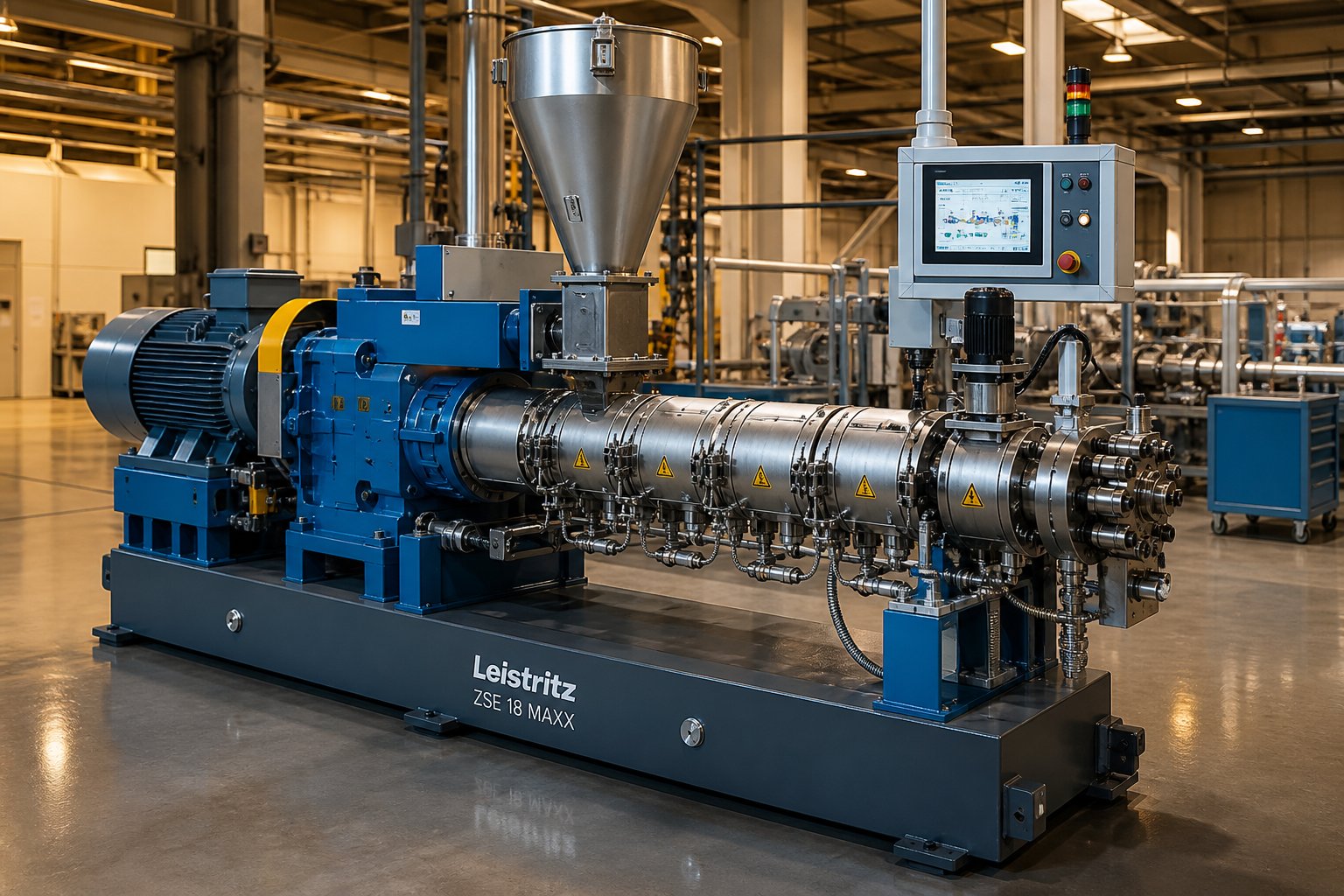
What Are Co-Rotating Twin Screw Extruders and Why They Hold Value
Imagine two screws spinning side by side in the same direction, their flights interlocking like precisely engineered gears. That's the core idea behind the co-rotating twin screw extruder - and it's the reason these machines dominate everything from polymer compounding to pharmaceutical processing.
A co-rotating twin screw extruder is a processing machine featuring two parallel, intermeshing screws that rotate in the same direction inside a shared barrel. The interlocking screw geometry creates a self-wiping action that continuously cleans material from both screw surfaces and barrel walls, preventing stagnation and ensuring uniform mixing, melting, and conveying of materials through distinct processing zones.
But why should you care about self-wiping geometry when you're shopping for used extrusion equipment? Because it's one of the key reasons these machines retain their value - and their performance - long after initial deployment.
How Co-Rotating Twin Screw Extrusion Works
The self-wiping principle is deceptively simple. As both screws rotate in the same direction, the flight of one screw sweeps the channel of the other. This creates a figure-eight flow pattern that forces material through a series of carefully designed processing zones: conveying, melting, mixing, and metering. Each zone serves a specific purpose in transforming raw feedstock into a finished product.
In the conveying zones, forward-pumping screw elements pull material downstream. The mixing zones - typically fitted with kneading blocks - apply intense shear forces that break down agglomerates and blend multiple components into a homogeneous melt. Finally, the metering zone builds stable pressure to push material through the die. Because the intermeshing screws constantly scrape material off each other and the barrel wall, you'll notice virtually no dead spots where polymer can stagnate and thermally degrade. This is a critical advantage over non-intermeshing designs, where residual material buildup can cause thermal decomposition and compromise product quality.
The result? Co-rotating twin screw extruders deliver the high-shear dispersive mixing and precise residence time control that reactive extrusion and advanced compounding demand. It's why the fully intermeshing co-rotating design has become the industry mainstream for everything from glass-fiber-reinforced compounds to nanoparticle dispersion.
Why Modularity Matters for Used Equipment
Here's what makes a used twin screw extruder fundamentally different from a used single-screw machine: modularity. Co-rotating extruders are built from segmented, interchangeable components. The barrel is assembled from individual sections, each with independent heating and cooling. The screws themselves aren't monolithic shafts - they're assembled from dozens of individual elements slid onto splined shafts. Conveying elements, kneading blocks, mixing elements, and reverse-flight elements can all be swapped, rearranged, or replaced independently.
This modular architecture has a profound impact on the used equipment market. A worn kneading block doesn't mean scrapping the entire screw - you replace that single element. A damaged barrel section gets swapped out while the rest of the barrel continues service. This makes used extruders uniquely viable as second-life assets. You're not gambling on the condition of one monolithic component; you're evaluating a system where every wear item can be individually assessed and renewed.
Combined with robust gearbox designs rated for decades of continuous operation, co-rotating twin-screw extruder platforms routinely deliver 20 to 30 years of productive service life. That longevity, paired with component-level serviceability, is exactly why well-maintained used extruders command strong resale prices - and why informed buyers consistently find exceptional value in the secondary market.
Of course, not every twin screw design works the same way. The difference between co-rotating and counter-rotating configurations runs deeper than rotational direction, and choosing the wrong one for your application is a costly mistake no equipment listing will warn you about.
Co-Rotating vs Counter-Rotating Twin Screw Extruders Compared
Both co-rotating and counter-rotating designs fall under the double screw extruder umbrella, yet they behave like fundamentally different machines. Rotational direction alone changes how material flows, how shear is applied, and what kinds of products you can realistically produce. If you're browsing used listings, confusing one for the other isn't just an inconvenience - it can mean buying equipment that physically cannot do your job.
Mechanical Differences Between Co-Rotating and Counter-Rotating Designs
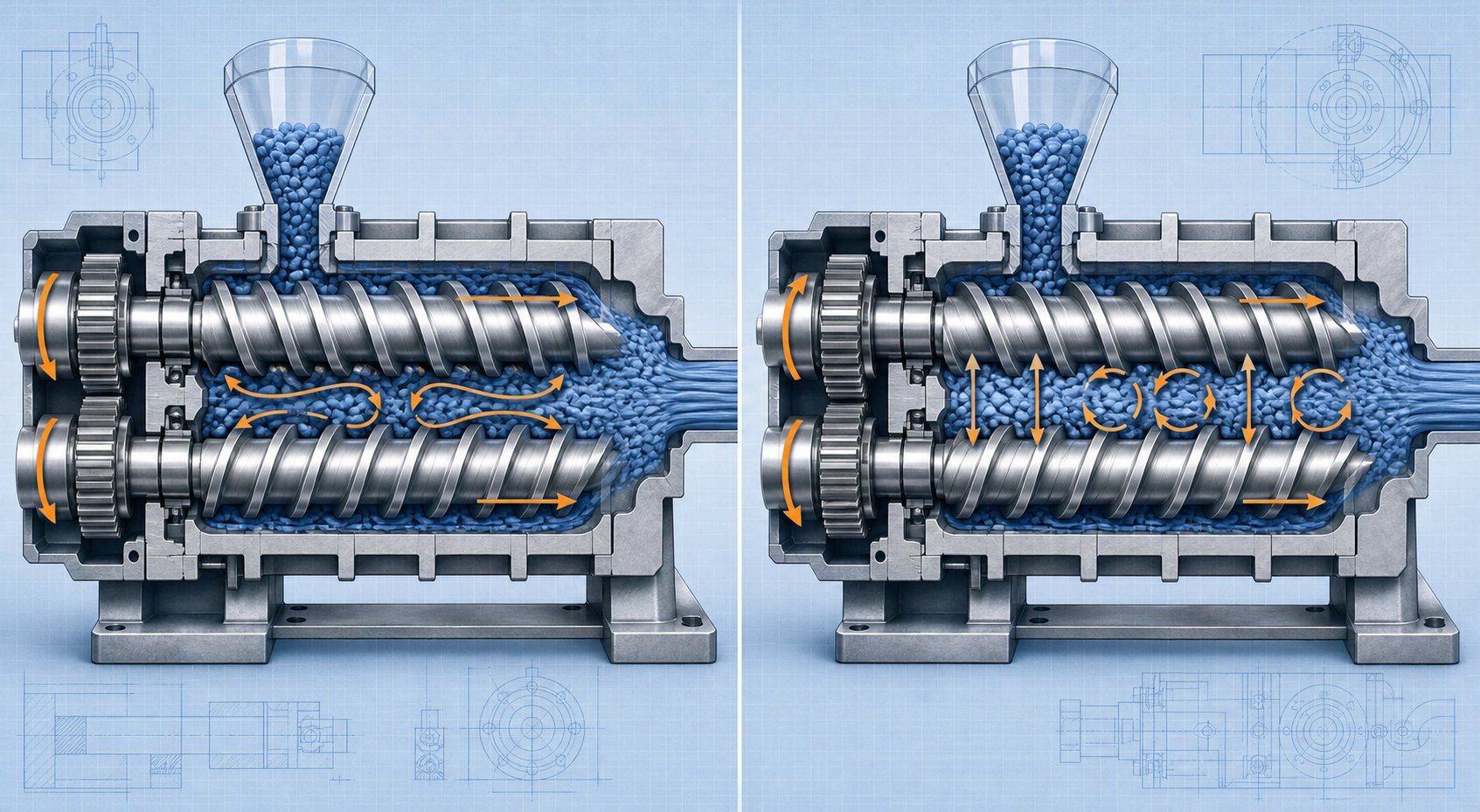
Picture two screws side by side. In a co-rotating design, both turn the same way - clockwise, for instance. Material follows a figure-eight path as it's transferred from one screw to the other, traveling around and between the intermeshing flights. This continuous transfer creates intense dispersive mixing and high shear, which is exactly why co-rotating configurations excel at blending polymers with additives, breaking down filler agglomerates, and performing reactive chemistry inside the barrel.
Counter-rotating screws, by contrast, spin in opposite directions. Where the screws meet at the top, their flights move toward each other, creating a calendering or squeezing effect. Material gets trapped in enclosed C-shaped chambers between the flights and the barrel wall, then pushed forward in a more piston-like, positive-displacement manner. This generates significantly higher pressure buildup but much lower shear intensity compared to co-rotating systems.
The geometry differences extend further. Most co-rotating twin-screw extruders use a parallel barrel design with fully intermeshing, self-wiping screw profiles. Counter-rotating machines, however, frequently use a conical twin screw extruder layout where the screws taper from a large diameter at the feed end to a smaller diameter at the discharge. This conical geometry provides a natural compression ratio and accommodates larger gearbox bearings at the wide end, but it sacrifices the modularity that makes parallel co-rotating designs so adaptable.
Wear patterns differ too. Co-rotating screws experience relatively even wear across their intermeshing profiles because material flows freely between them. Counter-rotating screws endure concentrated stress at the intermeshing zone - the point where flights approach each other - which limits maximum operating speeds and makes high-RPM operation impractical for most counter-rotating double screw extruder machine configurations.
| Characteristic | Co-Rotating (Parallel) | Counter-Rotating (Parallel or Conical) |
|---|---|---|
| Mixing Capability | Excellent dispersive and distributive mixing | Good distributive mixing; limited dispersive capability |
| Throughput Potential | High; scales well with screw speed | Moderate; limited by inter-screw stress at high RPM |
| Pressure Buildup | Moderate; relies on screw geometry and die restriction | High; positive-displacement pumping action |
| Typical Screw Speed Range | 200 - 1,200+ RPM | 10 - 150 RPM (most applications) |
| Typical Applications | Compounding, masterbatch, reactive extrusion, devolatilization | PVC pipe and profile extrusion, sheet extrusion, low-shear processing |
| Wear Patterns | Even wear across screw profiles; individual element replacement | Concentrated wear at intermeshing zone; conical screws often replaced as complete sets |
| Modularity | Highly modular segmented screws and barrels | Limited modularity, especially in conical designs |
Choosing the Right Configuration for Your Application
So which configuration do you actually need? The answer comes down to your process requirements - not the price tag on a used listing.
If your operation involves polymer compounding, blending masterbatches, incorporating high filler loadings, or performing any kind of reactive extrusion, a co-rotating parallel design is almost certainly the right choice. These machines thrive on high-speed, high-shear processing and offer the screw configuration flexibility to fine-tune your process over time.
Counter-rotating extruders earn their place in applications where gentle material handling and high discharge pressure matter more than aggressive mixing. PVC processing is the classic example. PVC is notoriously heat-sensitive, and the low-shear, positive-displacement conveying of a counter-rotating machine - especially a conical twin screw extruder - protects the material from thermal degradation while generating the pressure needed to push melt through complex pipe and profile dies.
Here's where this knowledge becomes critical for used equipment buyers: a used co-rotating machine listed at an attractive price is worthless if your application demands the gentle processing and high-pressure characteristics of a counter-rotating design - and vice versa. You'll find both types advertised simply as "twin screw extruders" in many dealer listings, sometimes with no clear distinction between the two configurations. Before you even begin evaluating machine condition or negotiating price, confirm that the rotational direction and geometry match your specific process. A mismatched extruder isn't a bargain; it's an expensive storage problem.
Understanding configuration is your first filter. The next layer of evaluation digs into the technical specifications that actually determine what a machine can produce - numbers that appear in every listing but rarely get explained in terms buyers can act on.
Key Technical Specifications Every Buyer Should Understand
Every used equipment listing throws a wall of numbers at you - 50mm, 40:1, 18 Nm/cm³, 150kW. Sellers present them like a resume, expecting the figures alone to justify the asking price. But here's the problem: without understanding what each specification actually controls, you can't tell whether a machine fits your process or falls short of it. These numbers interact in ways that aren't obvious, and the gaps between what a listing highlights and what it leaves out are exactly where bad purchasing decisions hide.
Think of this section as the decoder ring for spec sheets. You'll walk away knowing which numbers matter most, what ranges to target, and which specifications to double-check before committing a dollar.
Screw Diameter and L/D Ratio Explained
If you could ask only one question about a used twin-screw extruder machine, make it this: what's the screw diameter? Measured in millimeters, this single dimension is the primary driver of throughput capacity - and it scales faster than most buyers expect. Throughput potential increases roughly with the square of the diameter. Jump from a 26mm laboratory screw extruder to a 50mm production unit and you haven't just doubled your output - you've roughly quadrupled it.
Used machines cover a wide spectrum. Laboratory units run 16-26mm, processing anywhere from half a kilogram to about 30 kg/h. Pilot-scale machines sit in the 27-40mm range at 20-200 kg/h - enough for product qualification and small production runs. Full production extruders start at 40mm and climb past 130mm for high-volume compounding operations pushing several thousand kilograms per hour. When matching diameter to your needs, work backward from your required annual output to a realistic hourly target. Then look for machines that can deliver that rate comfortably - at roughly 70-80% of maximum capacity, not pinned at the ceiling where wear accelerates and process flexibility disappears.
The second specification buyers encounter - and frequently misunderstand - is the L/D ratio. This is simply the barrel's effective processing length divided by its bore diameter, expressed as a ratio like 36:1 or 44:1. Think of it as the machine's "runway." A longer runway gives material more time and more functional zones for feeding, melting, mixing, venting, and pressure building before it reaches the die.
Modern co-rotating extruders typically range from 36:1 to 48:1, with high-performance compounding lines pushing to 60:1 and beyond. Older machines - the kind that populate the used market - sometimes run shorter at 24:1 to 32:1. That doesn't automatically disqualify them, but it does limit processing flexibility. Here's a practical breakdown of what different L/D ranges can handle:
| L/D Ratio Range | Best Suited For | Limitations |
|---|---|---|
| 24:1 - 32:1 | Simple compounding, thermally sensitive materials, pre-blended formulations | Limited space for multiple feed ports or vacuum venting stages |
| 36:1 - 44:1 | General-purpose compounding, masterbatch, moderate filler loading, single-stage devolatilization | May constrain complex multi-stage processes |
| 44:1 - 52:1 | High-filler compounds, multi-stage venting, downstream side feeding of glass fiber or minerals | Higher capital cost, more barrel zones to maintain |
| 52:1 - 60:1+ | Reactive extrusion, difficult dispersions, multiple downstream feed and vent stages | Longest residence time; risk of thermal degradation for sensitive polymers |
When comparing used listings, always evaluate L/D alongside screw diameter. Two machines with identical 50mm screws behave very differently if one runs at 32:1 and the other at 44:1. The longer machine offers more processing zones and greater recipe flexibility, which typically commands a higher price - but only justifies that premium if your application genuinely needs the extra barrel length.
Torque Density and Specific Energy Input
If screw diameter determines how much material a machine can move, torque density determines how hard it can work that material. This is the single most important specification for evaluating a co-rotating extruder twin screw's true capability - and the one most buyers overlook.
Torque density is expressed as Nm/cm³ and measures the rotational force a gearbox delivers relative to the center distance between screw shafts, cubed. Why does this matter so much? Because torque is what pushes polymer through the barrel against viscous resistance. Run a glass-fiber-filled polyamide or a 70% calcium carbonate compound, and the screws face enormous resistance compared to processing neat polyolefins. If the gearbox can't deliver sufficient torque, you'll hit the drive's limit before reaching your target throughput - effectively shrinking the machine below what its diameter promises.
Modern high-performance machines achieve torque densities around 18 Nm/cm³, roughly 30% higher than older-generation platforms operating in the 10-13 Nm/cm³ range. Many used machines on the market fall into that older category. That doesn't disqualify them for every application - unfilled or lightly filled compounds may never stress a 10 Nm/cm³ gearbox. But if your formulation involves heavy filler loading or high-viscosity engineering resins, an older torque rating becomes a hard ceiling on performance.
Closely related is specific energy input - the amount of mechanical energy transferred to the material per unit mass, typically measured in kWh/kg. This metric directly correlates with product quality. Too little specific energy and fillers remain poorly dispersed, yielding weak or inconsistent product. Too much and you risk thermal degradation, especially with heat-sensitive polymers. Experienced processors monitor specific energy as a process fingerprint: a consistent value run after run signals stable quality, while shifts indicate screw wear, feed rate changes, or material variation. When evaluating a used twin-screw extruder machine, ask the seller for historical process data that includes specific energy trends - it reveals more about the machine's real condition than any cosmetic inspection.
RPM Ranges and Drive System Considerations
Maximum screw speed - expressed in revolutions per minute - directly affects both throughput and mixing intensity. Co-rotating extruders typically operate anywhere from 200 to over 1,200 RPM, with modern high-speed designs pushing even higher. Faster screw speeds increase output and shear rate, but they also generate more frictional heat and accelerate wear on screw elements and barrel liners.
Here's where used equipment evaluation gets nuanced. A listing might advertise a maximum RPM of 600, but that number only means something if the gearbox and drive motor can actually sustain it. A worn gearbox with damaged bearings or excessive backlash won't deliver rated torque at high speeds without vibration, noise, and accelerated self-destruction. Similarly, a motor that's been rewound multiple times may not reach its original power rating under continuous load.
The practical rule for used equipment? A machine's real performance envelope isn't defined by nameplate specifications - it's defined by the current condition of its gearbox, motor, and drive electronics. A well-maintained 15-year-old machine with documented oil analysis and bearing replacements may outperform a neglected 5-year-old unit with an impressive spec sheet. Always request gearbox maintenance records, oil analysis history, and vibration test data. If none exist, budget for a professional gearbox assessment before purchase - because a gearbox rebuild can cost anywhere from 15 to 40% of the used machine's purchase price.
Before signing anything, make sure you've verified these critical specifications against your actual process requirements:
- Screw diameter - matched to your target throughput at 70-80% of maximum rated capacity
- L/D ratio - sufficient for your number of required feed ports, vent stages, and mixing zones
- Torque density (Nm/cm³) - adequate for the viscosity and filler loading of your specific materials
- Motor power (kW) - confirmed against actual gearbox efficiency, not just nameplate rating
- Maximum RPM - verified through gearbox condition assessment, not just specification sheets
- Number of barrel zones - enough for independent temperature control across all functional sections
- Feed and vent port positions - compatible with your downstream feeding and devolatilization requirements
- Gearbox maintenance history - documented oil analysis, bearing condition, and backlash measurements
Any specification gap between what the machine offers and what your process demands isn't a minor inconvenience - it's a fundamental constraint that no amount of screw configuration changes or process tuning can overcome. The specs define the playing field. Your job is to confirm the field is big enough before you step onto it.
Specifications tell you what a machine can theoretically do. The industries and applications driving demand for these machines tell you something equally important: whether the used market has what you need, and how well a particular configuration holds its resale value.
Industries and Applications That Drive Demand
A machine's specifications describe its potential. But it's the application - the specific industrial process the machine performs day after day - that determines whether a used listing is worth pursuing or completely irrelevant to your operation. Co-rotating twin screw extruders serve an impressively broad range of industries, and each one configures machines differently, wears components in distinct patterns, and creates unique buying opportunities on the secondary market.
Understanding where demand comes from also reveals something sellers rarely discuss: which applications create the healthiest supply of well-maintained used equipment, and which ones tend to produce machines that have been run hard and put away wet.
Polymer Compounding and Masterbatch Production
This is the heartland. The vast majority of co-rotating extruders in service - and by extension, the vast majority appearing on the used market - spend their lives as compounding extruders. Their job? Blending base polymers with fillers, reinforcements, colorants, stabilizers, and functional additives to create custom compounds that downstream processors convert into finished products.
Imagine a polypropylene resin that needs 40% talc filler for automotive interior stiffness, or a polyamide requiring 30% glass fiber reinforcement for structural components. A twin screw compounding extruder handles these demanding recipes because its self-wiping, high-shear design can break down filler agglomerates, wet out fiber surfaces, and distribute additives uniformly throughout the polymer matrix - all in a single continuous pass.
Masterbatch production operates on the same principle but pushes concentration even higher. Color masterbatches might contain 40-70% pigment in a carrier resin, while additive masterbatches pack flame retardants, UV stabilizers, or antimicrobial agents at elevated loadings. The twin screw extruder plastic processing industry relies on masterbatch because it lets downstream converters add precise concentrations through simple let-down ratios, avoiding the dust, mess, and inconsistency of adding raw additives at the molding press.
For used equipment buyers, compounding and masterbatch operations are important because they produce the largest pool of available machines. A compounder that ran talc-filled polypropylene for a decade will show different wear patterns than one processing carbon-black masterbatch. Abrasive fillers like glass fiber and minerals accelerate barrel liner and screw element wear, so always ask what materials the machine processed before you evaluate its condition.
Reactive Extrusion and Devolatilization
Here's where co-rotating extruders do something single-screw machines simply cannot replicate at scale: perform chemical reactions inside the barrel itself. Reactive extrusion uses the extruder as a continuous chemical reactor, leveraging precise temperature control, residence time distribution, and mixing intensity to drive reactions like grafting, chain extension, controlled degradation, and even full polymerization.
Consider maleic anhydride grafting onto polyolefins - a common process for creating compatibilizers that let otherwise immiscible polymers blend together. The extruder for polymer grafting must deliver exact shear rates and temperatures across specific barrel zones while simultaneously managing the peroxide initiator's decomposition kinetics. Co-rotating designs excel here because their modular screw configurations can isolate reaction zones from mixing zones and venting zones within the same barrel.
Devolatilization is the complementary process. Vacuum venting zones along the barrel extract solvents, moisture, residual monomers, and volatile byproducts from the polymer melt. The self-wiping screw action continuously exposes fresh melt surface to the vacuum, dramatically improving mass transfer efficiency. This capability is essential for solvent-based polymer processes, post-consumer recycling where contaminants must be removed, and pharmaceutical applications where residual solvent limits are tightly regulated.
Used machines configured for reactive extrusion or devolatilization often come equipped with specialized barrel sections featuring vacuum ports, side stuffers, and liquid injection nozzles. These configurations carry a premium because they're ready for complex processes - but only if those specific capabilities match what you actually need.
Specialized Applications Beyond Plastics
Co-rotating twin screw technology has expanded well beyond traditional plastics compounding, and several high-growth sectors are reshaping both new equipment demand and secondary market availability.
Pharmaceutical hot-melt extrusion (HME) uses twin screw extruders to create solid dispersions that improve the bioavailability of poorly soluble drug compounds. HME enhances solubility by dispersing active pharmaceutical ingredients into thermoplastic polymer matrices under precisely controlled conditions, producing solid dispersions and controlled-release formulations. Machines used in pharmaceutical settings are typically smaller-diameter units (16-27mm) maintained to exceptionally high standards, making them attractive used purchases for labs and contract development organizations.
Food processing employs twin screw extrusion for texturizing plant proteins, producing snack foods, creating breakfast cereals, and manufacturing pet food. Battery electrode compounding has emerged as a fast-growing application, with extruders blending active materials, conductive additives, and binders into uniform slurries for lithium-ion cell production. And plastics recycling - driven by circular economy mandates worldwide - increasingly relies on co-rotating extruders to recompound post-consumer waste with stabilizers and compatibilizers, restoring usable properties to degraded polymers.
Ranked by how frequently these applications generate available used equipment, here's what buyers typically encounter:
- Polymer compounding and masterbatch production - by far the largest source of used co-rotating equipment, spanning all diameter ranges
- Plastics recycling and reclamation - growing rapidly as recycling mandates expand; machines often show higher wear from abrasive contaminants
- Reactive extrusion and devolatilization - specialty configurations with vacuum ports and liquid injection; less common but highly valuable when found
- Food and pet food extrusion - machines require thorough sanitation assessment; food-grade construction adds value
- Pharmaceutical hot-melt extrusion - smaller-diameter machines with excellent maintenance histories; supply is limited and prices tend to be firm
- Battery electrode and advanced materials compounding - still relatively new; few used machines available yet, but expect this category to grow
Why does this ranking matter? Because your target application determines where to focus your search - and what to expect when you find a machine. A used extruder that spent its life running neat polymers in a pharmaceutical cleanroom presents a completely different risk profile than one that processed 60% glass-fiber-reinforced nylon in a high-volume automotive compounder. The application history shapes barrel wear, screw condition, gearbox loading history, and even the relevance of the installed control system.
Matching application to equipment isn't just a technical exercise. It's also a financial one. The same machine carries different resale values depending on what it was configured to do and how hard it worked - which raises an equally important question: does buying used actually save you money once all the hidden costs are counted?
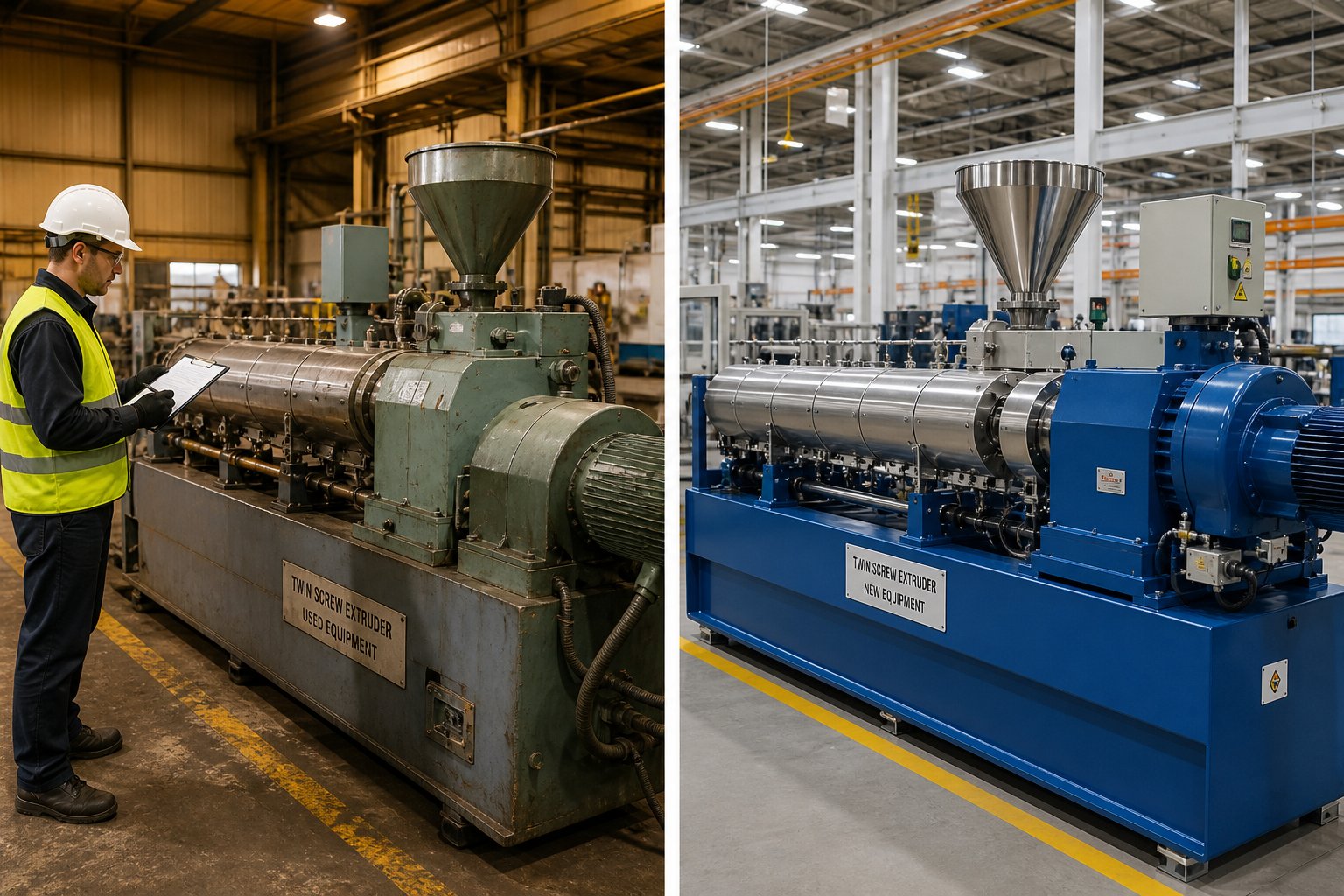
Buying Used vs New Twin Screw Extruders
The short answer is yes - buying used can absolutely save you money. The longer, more honest answer? It depends on which costs you're counting. Equipment dealers listing a used twin screw extruder for sale have every incentive to highlight the upfront price gap between used and new. They have far less incentive to walk you through the expenses that show up after the invoice is paid.
Let's lay out both sides with the transparency this decision deserves.
Cost Savings and Faster Deployment
The financial case for used extruder equipment starts with the sticker price. Used co-rotating twin screw extruders typically sell for 30-60% less than equivalent new machines, depending on age, condition, and brand. For a mid-size production compounder, that difference can represent hundreds of thousands of dollars freed up for raw materials, downstream equipment, or working capital.
Then there's the time factor. Lead times for new co-rotating extruders from major OEMs routinely stretch to 9-18 months, and complex custom configurations can push even further. Used equipment? A machine already sitting in a dealer's warehouse or available through a plant closure can be on your floor in weeks, not quarters. For startups racing toward revenue or established compounders responding to sudden contract wins, that speed advantage translates directly into money.
There's a broader market-access story, too. Production-grade co-rotating extruders from top-tier manufacturers represent significant capital investments when purchased new. Used extruders for sale level the playing field, giving smaller compounders and contract manufacturers access to machines that would otherwise sit far beyond their capital budgets. A reconditioned 50mm Coperion ZSK or Leistritz ZSE at a fraction of the new price can launch a viable compounding operation that competing on new equipment pricing alone might never get off the ground.
Hidden Costs and Risks to Evaluate
Here's where the conversation gets uncomfortable - and where sellers tend to go quiet. The purchase price of a used machine is the most visible cost, but it's rarely the final one. Several categories of expense sit just off-screen, and failing to budget for them turns a "great deal" into a financial headache.
Consider installation engineering. A new machine purchase typically includes factory commissioning support, foundation drawings, and utility specifications. Buy used, and you're often on your own. You'll need a qualified rigger for transport and setting, an electrician to connect power (often 480V three-phase in North America), plumbing for cooling water circuits, and potentially structural engineering for floor loading - especially with larger-diameter machines that weigh several tons.
Control system obsolescence is another cost that catches buyers off guard. A machine built in the early 2000s might run on a PLC platform that the manufacturer no longer supports, with HMI screens running discontinued operating systems. Upgrading controls to a modern, supportable platform can add 10-20% to the total project cost, but ignoring it creates a ticking clock: when that legacy controller fails, your entire line goes down until a replacement is sourced or a full retrofit is completed.
Operator training, utility infrastructure upgrades, and potential compliance gaps with current safety or environmental standards round out the hidden cost picture. None of these are deal-breakers on their own, but collectively they can narrow the price advantage significantly if you haven't planned for them.
| Evaluation Dimension | Used Equipment | New Equipment |
|---|---|---|
| Upfront Cost | 30-60% lower than new equivalent | Full manufacturer pricing; financing often available |
| Lead Time | Weeks to a few months | 9-18+ months from order to delivery |
| Warranty Coverage | Limited or none; some dealers offer 30-90 day warranties | Comprehensive manufacturer warranty (typically 12-24 months) |
| Control System Modernity | Often outdated PLC/HMI platforms; may require retrofit | Current-generation controls with full manufacturer support |
| Spare Parts Availability | Depends on brand and model age; aftermarket sources may be needed | Full OEM parts support with documented lead times |
| Customization Flexibility | Limited to existing configuration; modifications possible but costly | Built to order with exact barrel layout, port positions, and drive sizing |
| Installation Support | Typically buyer's responsibility | Often includes commissioning, training, and startup assistance |
When Buying Used Makes Strategic Sense
So when does buying used win - even after accounting for the extras? Several scenarios consistently favor used extruder equipment over new:
- Startup and market-entry operations where capital conservation is critical and speed to production matters more than having the latest technology
- Proven, stable processes that don't require cutting-edge control systems or maximum torque density - think commodity compounding or established masterbatch formulations
- Redundancy and backup capacity where a second line provides insurance against downtime on the primary system
- R&D and pilot-scale work where a smaller used machine enables process development without justifying full-scale new equipment investment
Conversely, new equipment is the stronger choice when your application demands the highest torque densities, when you're processing novel materials that require precise screw and barrel metallurgy, or when regulatory requirements mandate full equipment documentation and traceability from the OEM.
The modular nature of co-rotating designs tilts the equation further toward used. Unlike monolithic equipment where a single worn component can devalue the entire machine, co-rotating extruders let you replace individual screw elements, swap barrel sections, and upgrade drive components independently. This means a well-chosen used machine can be selectively refurbished to near-new performance in the areas that matter most for your process - at a fraction of the cost of buying everything new.
Whether you search for a plastic extruder machine for sale from a major dealer or a used twin screw extruder for sale through a plant liquidation, the real question isn't simply "new or used." It's whether you understand the total cost of ownership well enough to know which path delivers better value for your specific situation. And a major piece of that equation - one that directly affects both purchase confidence and long-term costs - is knowing which brands hold their value and which ones create parts-sourcing headaches years down the road.
Top Brands on the Used Co-Rotating Extruder Market
A spec sheet tells you what a machine can do. The brand name on its nameplate tells you something equally important: how easy it will be to find replacement parts, locate a technician who knows the platform, and resell the equipment when the time comes. Browse any used listing aggregator and you'll encounter a jumble of nameplates - some familiar, some confusing, and more than a few that trace through corporate mergers that scrambled the branding entirely. Knowing which twin screw extruder manufacturers stand behind the machines you're evaluating separates a confident acquisition from a sourcing headache that doesn't reveal itself until something wears out.
Coperion and the Werner and Pfleiderer Legacy
If one name dominates used co-rotating equipment listings, it's Coperion - or more precisely, the Werner & Pfleiderer nameplate that still appears on thousands of machines in active service worldwide. The connection confuses many buyers, so here's the short version: Werner & Pfleiderer, a Stuttgart-based engineering firm, delivered the first commercial ZSK co-rotating twin screw extruder in 1957, based on Rudolf Erdmenger's pioneering self-wiping screw profile. The company was later acquired by Krupp, then restructured into ThyssenKrupp, and ultimately combined with other businesses around 2000-2001 to form Coperion.
Why does this matter for used equipment buyers? Because a machine stamped "Werner & Pfleiderer" and a machine stamped "Coperion" share the same engineering DNA. The ZSK series remains in production under the Coperion name, and the dimensional standards for barrels, screw elements, and shaft splines have maintained continuity across generations. That consistency means a werner & pfleiderer twin screw extruder from the 1990s can still source compatible replacement components through both Coperion's OEM channels and a broad network of aftermarket suppliers.
The ZSK platform's robust gearbox design and extensive screw element library - dozens of conveying, kneading, and mixing element geometries - are the reasons these machines hold value so tenaciously on the secondary market. Coperion's massive installed base also means technicians with hands-on ZSK experience are easier to find than specialists for any other twin-screw extruder manufacturer's platform.
Leistritz, KraussMaffei Berstorff, and Other Leading Brands
Coperion may lead the pack, but several other brands appear consistently across used listings and deserve informed attention.
Leistritz occupies a distinctive niche. With over a century of screw technology experience, the company's ZSE platform is widely recognized in pharmaceutical hot-melt extrusion and R&D applications. If you're searching for a laboratory twin screw extruder or a pilot-scale machine for formulation development, Leistritz units appear frequently - and their maintenance histories tend to be exceptionally well-documented, reflecting the quality-driven industries they serve.
KraussMaffei Berstorff brings another layer of history. Berstorff, originally an independent German manufacturer founded in 1838, built a strong reputation in both co-rotating and counter-rotating designs before being absorbed into the KraussMaffei group. Used listings may reference "Berstorff," "KraussMaffei Berstorff," or the ZE series designation. These machines are well regarded for high free volume and robust mechanical design, particularly in larger-diameter compounding applications.
JSW (The Japan Steel Works) is the name to watch for high-torque applications. The TEX series features advanced engineering and modular screw designs that handle demanding materials with impressive consistency. JSW machines surface on the used market less frequently than European brands, and certain proprietary components may require Japan-based sourcing channels - a factor worth weighing during your evaluation.
Entek, an American manufacturer based in Oregon, rounds out the major players with a value-oriented approach. Their machines are well-suited for processors who want solid co-rotating performance without the premium pricing that European OEMs command. Entek's smaller installed base means aftermarket parts availability is narrower, but the company maintains active support for its equipment.
| Brand | Notable Model Series | Typical Size Range (Used) | Reputation Notes |
|---|---|---|---|
| Coperion (formerly Werner & Pfleiderer) | ZSK Mc18, ZSK MEGAcompounder, ZSK MEGAvolume | 18mm - 380mm+ | Industry benchmark; largest installed base; strongest parts ecosystem and resale value |
| Leistritz | ZSE MAXX, ZSE HP | 18mm - 100mm+ | Pharmaceutical and lab specialist; excellent documentation standards; versatile configurations |
| KraussMaffei Berstorff | ZE BluePower, ZE UTX | 25mm - 180mm+ | Strong in large-diameter compounding; high free volume designs; solid European aftermarket |
| JSW (Japan Steel Works) | TEX Series | 25mm - 170mm+ | High-torque engineering; excellent for demanding compounds; some proprietary components |
| Entek | QC3 Series, HT Series | 27mm - 103mm | American-made; value-oriented pricing; smaller installed base limits aftermarket options |
How Brand Affects Resale Value and Parts Availability
Brand isn't just a nameplate - it's a predictor of your ongoing costs. Machines from Coperion and KraussMaffei Berstorff consistently command premium resale prices because buyers trust the platforms, technicians know them, and replacement components are available through multiple channels. That premium cuts both ways: you'll pay more to acquire these machines used, but you'll recover more if you ever resell.
Leistritz holds its value particularly well in the pharmaceutical and laboratory segment, where the brand carries strong credibility with regulatory auditors and validation teams. A Leistritz ZSE with a documented maintenance history and GMP-compliant configuration can fetch a firm asking price that sellers have little reason to negotiate.
Lesser-known brands - regional manufacturers, companies that have exited the market, or older platforms from firms that were acquired and discontinued - present a different calculation. The upfront savings can be substantial, sometimes 40-50% below what an equivalent Coperion would cost. But those savings can evaporate quickly if every replacement screw element or barrel liner requires custom fabrication from drawings or reverse-engineering from worn samples. Before committing to any off-mainstream brand, verify that at least one reliable aftermarket supplier can produce compatible wear components within acceptable lead times. That single verification step protects you from discovering, mid-production, that a critical part has a 12-week lead time and no alternative source.
Brand recognition also influences operator confidence and training costs. A production team experienced with ZSK machines can transfer that knowledge to another ZSK vintage with minimal retraining. Switching to an unfamiliar platform means investing in learning curves - not just for operators, but for maintenance staff who need to understand different barrel clamping systems, screw element interchange procedures, and control system architectures.
Knowing which brand you're buying tells you what to expect in ongoing support and costs. The next critical question is what you'll find inside that branded machine when you open it up for inspection - because the nameplate means nothing if the barrel bores are worn, the gearbox is failing, or the heater bands are dead.
How to Inspect and Evaluate a Used Twin Screw Extruder Before Purchase
A polished nameplate and a fresh coat of paint can make any machine look healthy. But the components that actually determine whether a used twin screw extruder will perform reliably - barrel bores, screw element flight tips, gearbox internals - are hidden inside the machine where a quick walk-around reveals nothing. This is the section sellers hope you'll skip. Don't.
A systematic physical and mechanical inspection is your single best defense against buying someone else's problem. It's also the foundation for every negotiation leverage point you'll use later. Here's exactly what to check, how to check it, and what the measurements actually mean.
Barrel Bore Wear and Liner Condition Assessment
The barrel bore is where your polymer meets metal, and wear here directly degrades mixing efficiency, throughput consistency, and product quality. As the bore enlarges beyond its original specification, the clearance between screw flight tips and barrel wall increases. That growing gap allows material to leak backward instead of being pushed forward, reducing pumping efficiency and creating inconsistent shear - exactly the kind of subtle performance erosion that a seller's test run on neat resin won't reveal.
Measuring barrel bore wear requires a telescoping bore gauge inserted from each end of the barrel, recording inner diameter readings at multiple points along the length. Compare every measurement against the original bore specification. Industry guidelines from the SPI (now the Plastics Industry Association) provide dimensional tolerance standards indicating when a barrel has worn beyond acceptable limits. As a practical benchmark, bore diameters exceeding 0.1-0.15mm beyond nominal on typical production-size machines signal significant wear that impacts performance.
Pay special attention to barrel sections that housed kneading blocks or high-shear mixing zones - these sections endure the most abrasive contact and wear fastest, particularly in machines that processed glass-fiber-reinforced or mineral-filled compounds. Most co-rotating barrels use bi-metallic liners - a wear-resistant alloy bonded to the inner bore surface of a softer structural barrel body. Inspect for any delamination, cracking, or flaking of this liner. Repairable liner wear means the barrel section can be resleeved or relined. Liner separation or deep scoring typically means that section needs full replacement. The distinction matters enormously for your cost estimate.
Screw Element Evaluation and Flight Tip Clearance
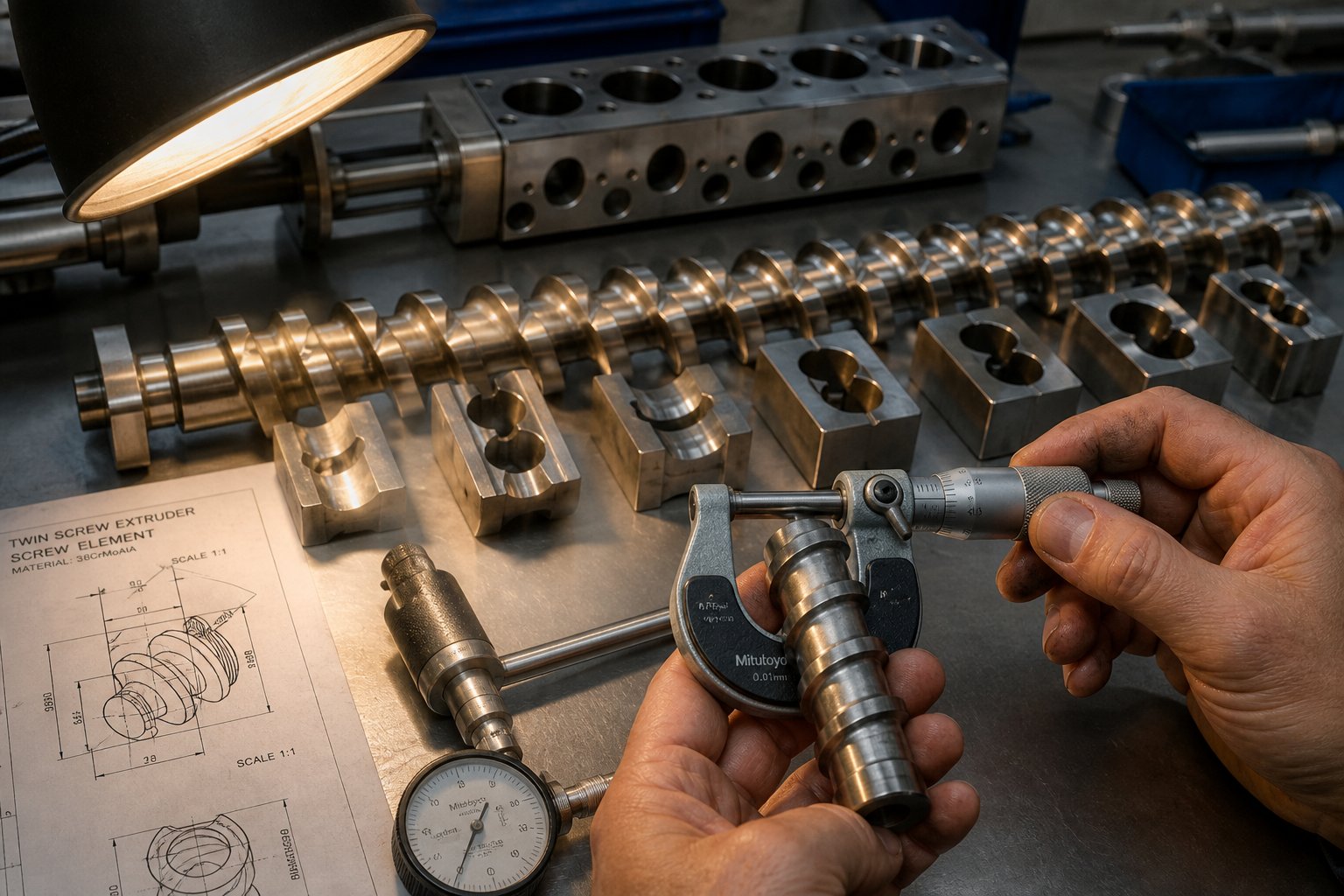
If you take away one inspection technique from this entire article, make it this: measure flight tip clearance on every screw element. Flight tip clearance - the gap between the outermost edge of a screw element's flight and the barrel wall - is the most immediate, quantifiable indicator of remaining element life.
To evaluate screw elements, first have them removed from the shaft and cleaned of all residual polymer. Place each element on a clean, flat surface and use a micrometer to measure the outer diameter across the flight tips. Compare this measurement to the element's original OD specification. Using a parallel test bar spanning two flights helps obtain accurate readings on helical conveying elements. Any reduction in OD translates directly to increased clearance inside the barrel, meaning reduced self-wiping efficiency, lower forward pumping capability, and degraded mixing performance.
Kneading blocks deserve extra scrutiny. Their disc surfaces and leading edges take the brunt of dispersive mixing forces, and worn kneading elements lose their ability to generate the shear needed for effective filler dispersion. Look for rounding of originally sharp disc edges, uneven wear patterns suggesting shaft misalignment, and surface pitting that could indicate corrosive attack from processed materials.
Don't stop at the elements themselves. Inspect the splined screw shafts for keyway wear, twisting, or deformation. Elements that fit loosely on worn shafts won't transmit torque consistently, creating vibration and uneven processing. A twin screw plastic extruder with worn shafts may need a costly shaft replacement before any new or refurbished elements can function properly - a hidden expense that element measurements alone won't catch.
Gearbox, Drive System, and Barrel Alignment Checks
The gearbox is the single most expensive component in a co-rotating extruder, and its condition defines the machine's true performance ceiling regardless of what the nameplate says. Unfortunately, it's also the hardest component to evaluate without specialized tools.
Start with the gearbox oil. Request an oil analysis report - or take a sample yourself and send it to an independent lab. Oil analysis reveals metal particle contamination (indicating gear or bearing wear), moisture ingress, and lubricant degradation. Elevated levels of iron, chromium, or bronze particles tell a story that no visual inspection can match. If the seller has historical oil analysis records showing a consistent trend, you're looking at a machine with a genuine maintenance program behind it. If no records exist, treat that absence as a red flag.
Vibration testing with an accelerometer on the gearbox housing, measured at operating speed, detects bearing irregularities, gear mesh problems, and structural looseness that may not produce audible noise yet. Backlash measurement - checking rotational free play in the gear train - reveals cumulative wear in gear tooth profiles. Excessive backlash means torque transmission is inconsistent, which shows up as output surging and reduced process stability under load.
Drive motor evaluation is more straightforward. Check insulation resistance with a megohmmeter, verify that the motor reaches rated speed under load without excessive current draw, and ask whether the motor has ever been rewound. A rewound motor may not achieve its original efficiency or thermal rating.
Finally, barrel alignment. Misaligned barrel sections impose lateral loads on screw shafts that accelerate wear on elements, shafts, and bearings alike. A precision straight-edge or laser alignment tool run along the assembled barrel reveals any deviations. Even small misalignments compound over time, so this check is non-negotiable for any twin screw plastic extruder you're seriously considering.
Before walking away from any inspection, use this checklist to confirm you've covered every critical point:
- Barrel bore diameter measurements - recorded at multiple points along each barrel section with a bore gauge, compared against original specs
- Bi-metallic liner condition - checked for delamination, cracking, deep scoring, or corrosion pitting
- Screw element outer diameter measurements - every conveying element and kneading block measured with a micrometer for flight tip wear
- Kneading block disc edge condition - visually inspected for rounding, chipping, and uneven wear
- Screw shaft spline condition - checked for keyway wear, twisting, and element fit looseness
- Gearbox oil analysis - tested for metal particles, moisture, and lubricant breakdown
- Gearbox vibration and backlash - measured with accelerometer and rotational free-play test
- Drive motor insulation resistance - verified with megohmmeter; rewind history documented
- Barrel section alignment - checked with laser alignment or precision straight-edge across full barrel length
- Heating zone functionality - every barrel zone heater band energized and verified to reach setpoint within expected time
- Cooling zone functionality - cooling water circuits flushed and tested for flow rate, leaks, and solenoid valve operation
- Thermocouple accuracy - spot-checked against a calibrated reference at operating temperatures
- Control system condition - PLC, HMI, and drive electronics powered up and tested for responsiveness and error codes
- Test run under load - requested whenever possible using representative materials at target throughput to verify integrated system performance
That last point deserves emphasis. A static inspection catches wear and damage. Only a test run under realistic processing conditions - with actual polymer and fillers, not just neat resin at low speed - reveals how a used extruder truly performs as an integrated system. Temperature stability, torque utilization, throughput consistency, and product quality under load are the ultimate truth test. If a seller refuses a loaded test run, ask yourself what they're protecting you from seeing.
Thorough inspection produces something beyond confidence - it produces data. And that data, especially wear measurements expressed in concrete numbers, becomes your most powerful tool when the conversation turns to what the machine should actually cost.
Pricing Factors and Cost Expectations for Used Extruders
Inspection data gives you clarity on machine condition. It also gives you something equally valuable: a foundation for understanding what a machine is actually worth - and whether the asking price reflects reality or wishful thinking. The used co-rotating extruder market lacks the transparent pricing you'd find in, say, the used car world. There's no "Blue Book" for a 1998 Coperion ZSK 40. Sellers set prices based on a mix of replacement cost, perceived demand, and how urgently they need the floor space. Buyers who understand the variables driving that price hold a decisive advantage.
Factors That Determine Used Extruder Pricing
What makes one used machine list at twice the price of a seemingly identical unit? The twin screw extruder price on the secondary market is shaped by a cluster of interacting variables - not a single spec or condition metric. Here are the primary drivers:
- Screw diameter - Larger machines cost more, and the relationship isn't linear. A 92mm production extruder commands multiples of what a 40mm unit fetches, reflecting the exponential relationship between diameter and throughput capacity.
- L/D ratio - Longer barrels mean more processing zones, more flexibility, and higher value. A 44:1 machine will typically price above an otherwise identical 32:1 unit.
- Brand reputation - Coperion ZSK machines consistently command premium pricing over less recognized brands, driven by parts availability, technician familiarity, and buyer confidence.
- Machine age and operating hours - Newer machines retain more value, but condition matters more than calendar age. A well-maintained 20-year-old extruder can outprice a neglected 8-year-old unit.
- Barrel and screw wear condition - This is where your inspection data pays off. Machines with documented wear measurements within OEM tolerances justify significantly higher pricing than units sold without dimensional data.
- Control system modernity - A machine running a current-generation PLC and touchscreen HMI is worth measurably more than one with obsolete relay logic or a discontinued controller platform.
- Complete line vs. standalone extruder - A fully integrated extrusion line including gravimetric feeders, strand pelletizer, water bath, control cabinet, and downstream handling equipment carries a different extruder machine price than a bare extruder without auxiliaries. Complete lines offer production-ready convenience but cost more. Standalone units give buyers flexibility to pair the extruder with existing downstream equipment.
The interplay between these factors explains why identical model numbers can show wildly different asking prices across dealer listings. A plastic extruder machine price that seems unreasonably low often signals missing components, undisclosed wear, or obsolete controls - costs that will eventually land on your desk even if they're absent from the listing.
Understanding Equipment Condition Tiers
Used equipment dealers categorize machines into condition tiers that directly affect pricing, risk, and what you receive for your money. These labels appear in nearly every listing, but their definitions aren't standardized across the industry - so understanding what each tier genuinely includes (and what it doesn't) protects you from assumptions that cost real money.
| Condition Tier | Price Range Relative to New | What's Typically Included | Warranty Expectations | Risk Level |
|---|---|---|---|---|
| As-Is | 20-40% of new equivalent | Machine sold in current condition; no repairs, no testing, no dimensional verification; buyer assumes all risk | None - sold without any warranty or performance guarantee | Highest - unknown wear, potential hidden damage, possible missing components |
| Reconditioned | 35-55% of new equivalent | Cleaned, inspected, worn consumables replaced (heater bands, thermocouples, seals); electrical tested; cosmetic restoration; dimensional wear data typically provided | Limited - often 30-90 days covering major mechanical and electrical components | Moderate - key wear surfaces documented, but gearbox internals and barrel liners may not be fully addressed |
| Rebuilt | 50-75% of new equivalent | Restored to near-original OEM specifications; new or refurbished screws and barrels; gearbox overhauled; control system updated or replaced; full documentation package | More substantial - 6-12 months on mechanical and electrical systems is common | Lowest - approaches new-equipment reliability with documented restoration history |
The plastic extrusion machine cost difference between these tiers reflects real work performed - or not performed. An "as-is" machine at a tempting price might need $50,000 or more in barrel resleeving, screw element replacement, and controls upgrades before it's production-ready. A "rebuilt" machine at nearly double the as-is price might be ready to run the week it arrives. Calculating total investment across each tier, rather than comparing sticker prices alone, reveals which option actually costs less in the end.
Negotiation Leverage Points
Here's where your inspection homework converts directly into dollars saved. Sellers expect casual buyers who glance at the machine and negotiate on gut feeling. They're far less prepared for a buyer who walks in with bore gauge readings, flight tip measurements, and a gearbox oil analysis report.
Three negotiation advantages consistently shift pricing in the buyer's favor:
- Documented wear data - Present specific barrel bore and screw element measurements alongside OEM tolerance specs. If the barrel is 0.12mm over nominal in the mixing zone, you can calculate the exact cost of resleeving or replacement and request a corresponding price reduction. Numbers are harder to argue with than opinions.
- Market availability of the specific model - If the machine you're evaluating is one of a dozen similar units currently available from various dealers, the seller knows you have alternatives. Conversely, if it's a rare configuration or an in-demand diameter with limited used supply, your leverage decreases. Research current inventory across multiple dealers before making an offer.
- Seller urgency - Plant closures, lease expirations, and bankruptcy liquidations create time pressure that works in your favor. A seller who needs the machine off the floor by a deadline is far more flexible on price than a dealer holding inventory with no carrying-cost pressure. Ask about the machine's history and the reason for the sale - the answers often reveal how much room exists in the asking price.
One additional tactic experienced buyers use: request a test run with your actual process materials before finalizing the price. If the machine can't sustain target throughput without exceeding torque limits or producing unacceptable product quality, you've uncovered a performance gap that justifies either a significant price adjustment or walking away entirely. A seller confident in their machine will welcome the test. One who resists it is telling you something important.
Price, of course, is only the acquisition cost. What keeps the machine running year after year - and what truly determines whether your investment pays off - depends on something most buyers don't think about until it's too late: sourcing the replacement parts that every used extruder will inevitably need.
Spare Parts Sourcing and Refurbishment Planning
You've negotiated a fair price, signed the purchase agreement, and arranged transport. The machine arrives, gets installed, and starts running. Then, three months in, a kneading block shows measurable flight tip wear, a heater band fails on barrel zone four, and a thermocouple reads erratically. Welcome to the reality every owner of used plastic extruders eventually faces: the machine itself was just the first purchase. Keeping it running demands a steady supply of wear parts - and for older or discontinued models, finding those parts can be harder than finding the machine in the first place.
This is the cost category that separates buyers who thrive from those who regret their purchase. Planning your parts pipeline before you need it - ideally before you even finalize the acquisition - transforms a reactive scramble into a manageable line item.
Common Wear Parts and Replacement Cycles
Every co-rotating twin screw extruder consumes certain components over time. The question isn't whether you'll replace them, but how often - and that depends almost entirely on what materials the machine processes.
Screw elements top the list. Kneading blocks and forward-conveying elements endure the most direct material contact, and their flight tips gradually erode with every kilogram processed. As reference, industry guidelines suggest replacing screw elements when approximately 5% of the starting outer diameter has been lost across three-quarters of the element's length. For barrel liners, the corresponding threshold is roughly a 5% increase in bore diameter over a length of one screw diameter. These aren't arbitrary numbers - they mark the point where reduced self-wiping efficiency and increased back-leakage begin measurably degrading output quality and throughput consistency.
How fast you hit those thresholds varies dramatically by application. A machine compounding unfilled polyolefins might run thousands of hours between element changes. Switch to 40% glass-fiber-reinforced nylon, and the abrasive glass fibers can cut element life by 60-80%. Mineral fillers like calcium carbonate and talc fall somewhere in between. Abrasive wear - the most common type in twin screw extruders - depends on volume of material processed rather than simple calendar time, making it difficult to predict unless the abrasive characteristics of your specific formulation are already known from experience.
Corrosive and adhesive wear round out the picture. Corrosive wear shows up as pitting or dimpling on metal surfaces when chemically aggressive processing materials attack the screw or barrel metallurgy. Adhesive wear occurs when metal surfaces rub together - for instance, when screws deflect and contact the barrel wall or each other during low-torque conditions between production runs. Both types accelerate component degradation beyond what abrasion alone would produce.
Beyond screws and barrels, several other components follow their own replacement cycles. Heater bands fatigue from repeated thermal cycling and eventually lose output or fail open. Thermocouples drift over time, introducing temperature control errors that compromise product quality. Die heads accumulate wear at flow-restrictive surfaces, and pelletizing blades dull with use, affecting pellet geometry and cut quality. None of these are catastrophic individually, but neglecting any of them degrades the precision that makes co-rotating extruders valuable in the first place.
Sourcing Replacement Parts for Older and Discontinued Models
Here's the challenge that blindsides many buyers of used equipment: the brand on the nameplate may no longer exist as an independent company. Corporate acquisitions, mergers, and product line discontinuations have reshuffled the twin screw extruder landscape repeatedly over the past three decades. Werner & Pfleiderer became Coperion. Berstorff was absorbed into KraussMaffei. Smaller regional manufacturers have disappeared entirely, leaving machines in active service with no OEM parts channel at all.
Even when the original manufacturer still operates, OEM replacement parts for older model generations often carry premium pricing and extended lead times. A set of kneading blocks for a 25-year-old machine sourced through the OEM channel might cost three to five times what an aftermarket equivalent runs - and take weeks longer to arrive. For operators running production schedules with tight delivery commitments, that combination of high cost and long lead time is simply unworkable.
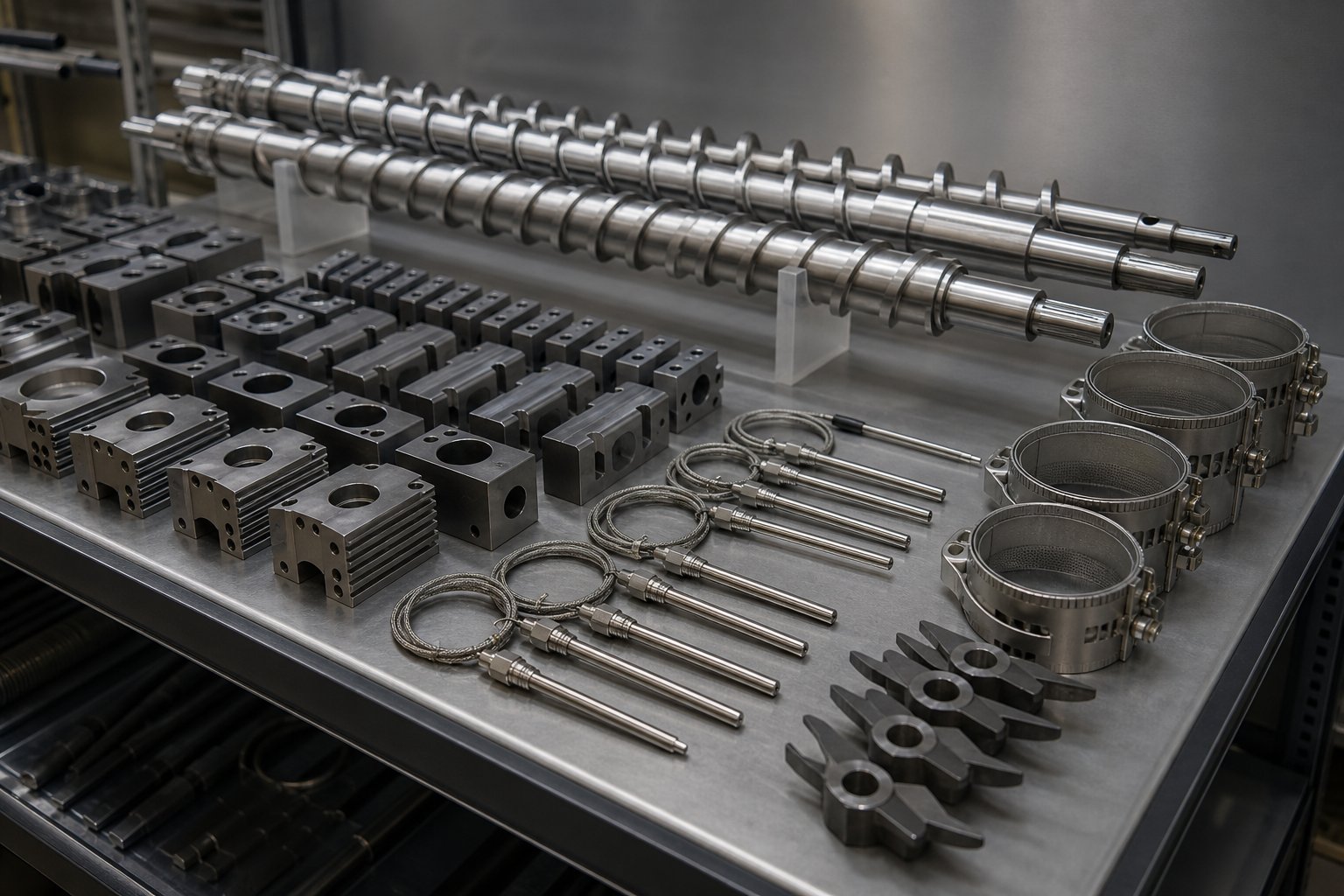
This is where aftermarket parts suppliers become essential partners rather than optional alternatives. Companies that can manufacture replacement screw elements, barrel liners, and other wear components from customer-supplied drawings - or reverse-engineer them from worn samples - keep older equipment economically viable long after OEM support fades. NANHAIYA's extruder spare parts catalog, for example, serves exactly this need: maintenance teams and machine rebuilders can source screw-related components, heater bands, thermocouples, die heads, and pelletizing blades manufactured from drawings or physical samples, covering the full spectrum of wear items that used co-rotating extruders demand.
The reverse-engineering approach works particularly well for extruder components because the geometries involved - screw flight profiles, kneading disc configurations, barrel bore specifications - are well-defined and measurable. A worn screw element can be dimensionally captured, corrected back to original specifications during the design reconstruction process, and produced without depending on the original manufacturer's tooling or cooperation. This capability effectively decouples the machine's operational lifespan from the original manufacturer's willingness to support it.
Whether you're browsing twin screw extruders for sale from a major dealer or evaluating a plastic extruder for sale through a plant liquidation, build your parts sourcing strategy around these key categories that every used co-rotating extruder will eventually require:
- Screw elements - conveying elements, kneading blocks, mixing elements, and reverse-flight elements; the highest-turnover wear items, especially in abrasive compound processing
- Barrel liners and barrel sections - bi-metallic liners subject to bore wear; individual sections replaceable without scrapping the entire barrel assembly
- Screw shafts - splined shafts that transmit torque to elements; keyway wear eventually requires shaft replacement or re-machining
- Heater bands and cartridge heaters - thermal cycling causes fatigue failure; maintain spares for every barrel zone configuration
- Thermocouples and temperature sensors - calibration drift and physical damage require periodic replacement to maintain process control accuracy
- Die heads and die plates - wear at flow-restrictive surfaces affects product geometry; custom fabrication from drawings often required for older models
- Pelletizing blades and cutting components - consumables that affect pellet quality; replacement frequency depends on throughput and material hardness
- Gearbox seals, bearings, and lubricants - preventive replacement on a scheduled basis prevents catastrophic gearbox failure
- Electrical components - contactors, fuses, drive electronics, and PLC modules; sourcing becomes critical when control platforms reach end-of-life
Smart buyers verify parts availability for their target machine before finalizing the purchase - not after. Contact both OEM channels and aftermarket suppliers like NANHAIYA with specific model information and request lead time and pricing quotes for the most common wear items. If nobody can supply critical components within reasonable timeframes, that information changes the entire value equation - no matter how attractive the listing price appeared when you first spotted the machine among hundreds of plastic extruders for sale online.
Parts sourcing is one piece of a larger puzzle. Bringing together every element covered in this article - from specification matching and brand evaluation to physical inspection and total cost analysis - requires a structured decision framework that keeps the entire process organized and prevents critical steps from falling through the cracks.
Your Pre-Purchase Decision Framework and Next Steps
You've absorbed a lot of ground - screw configurations, torque densities, barrel bore tolerances, brand ecosystems, pricing tiers, and parts sourcing strategies. Individually, each topic equips you to evaluate one dimension of a used co-rotating twin screw extruder purchase. But a capital equipment decision isn't a series of isolated checks. It's a sequential process where each step depends on the one before it, and skipping any single stage introduces risk that compounds through every stage that follows.
What separates experienced equipment buyers from first-timers isn't superior technical knowledge - it's having a repeatable workflow that ensures nothing critical gets missed under the pressure of deadlines, competing listings, and persuasive sellers. Here's that workflow, distilled into the sequence that consistently produces the best outcomes.
The Pre-Purchase Evaluation Workflow
Think of this as your flight checklist. Pilots don't skip steps because they've flown a thousand times before - and you shouldn't skip steps because the listing looks perfect or the price feels right. Follow this sequence from first inquiry to signed agreement:
- Define your application requirements in writing - Document the specific polymers, fillers, throughput targets, and product quality specifications your process demands. Every downstream decision flows from this foundation.
- Identify target technical specifications - Translate your application requirements into concrete machine specs: screw diameter range, minimum L/D ratio, required torque density, number of barrel zones, and feed or vent port positions.
- Search available inventory across multiple sources - Cast a wide net. Check specialized dealers, OEM remarketing programs, plant closure auctions, and online extrusion equipment for sale listings. Compare at least three to five candidates that meet your specification criteria.
- Verify brand and model suitability - Confirm the extruder's configuration type (co-rotating vs. counter-rotating), verify the OEM's current support status, and check aftermarket parts availability for the specific model series.
- Conduct a thorough physical inspection - Measure barrel bore diameters, screw element flight tip clearances, and gearbox condition using oil analysis and vibration testing. Request a loaded test run with representative materials whenever possible.
- Assess spare parts availability and lead times - Contact both OEM channels and aftermarket suppliers with the machine's exact model information. Request pricing and delivery timelines for the highest-turnover wear components before committing to purchase.
- Evaluate total cost of ownership - Add installation engineering, utility infrastructure, control system upgrades, operator training, and projected spare parts consumption to the purchase price. Compare this total against new-equipment alternatives on equal terms.
- Negotiate final terms using inspection data - Present documented wear measurements, parts sourcing costs, and any required upgrades as concrete justification for price adjustments. Structure payment milestones around delivery condition verification.
Each step generates information that feeds the next. Skip the application definition, and you'll waste weeks evaluating machines that can't run your process. Skip the parts availability check, and you might discover six months post-purchase that a critical kneading block has a 14-week lead time and no alternative source. The sequence matters as much as the individual steps.
Building Your Support Network Before You Buy
Here's something most buying guides won't tell you: the machine is only one piece of a successful acquisition. The partners you line up before the purchase determine whether that machine transitions smoothly from a dealer's floor to productive operation - or stalls in a costly limbo of installation delays, integration problems, and maintenance surprises.
Four roles need to be filled before you commit to any used twin screw extruder purchase:
- An experienced process engineer - Someone who can match your formulation requirements to specific extruder specifications, evaluate screw configurations, and validate that the candidate machine will actually deliver the mixing, throughput, and product quality your application demands.
- A qualified rigger and millwright team - These machines weigh thousands of pounds. Professional rigging, transport, placement, and leveling protect both the equipment and your facility. Improper handling during installation is one of the fastest ways to damage a gearbox or misalign barrel sections before the first production run.
- A controls integrator - Older used twin screw extruders frequently require PLC or HMI upgrades to replace discontinued platforms. A controls integrator who has worked with extrusion equipment can scope the retrofit accurately, avoiding both under-specified upgrades that still leave you vulnerable and over-engineered solutions that inflate costs unnecessarily.
- A dependable spare parts supplier - This relationship pays dividends for the entire life of the machine. Identify suppliers who can provide screw elements, barrel liners, heater bands, thermocouples, die components, and pelletizing blades - ideally from both OEM and aftermarket channels. Resources like NANHAIYA's extruder spare parts catalog allow plant buyers and machine rebuilders to confirm parts availability for their target machine during the evaluation phase, before the purchase agreement is signed. Verifying that critical wear components can be sourced at reasonable cost and lead time is one of the most impactful due-diligence steps you can take - and one of the most frequently skipped.
Assembling this network before the purchase - not after - turns potential post-acquisition surprises into planned, budgeted activities. You'll know installation costs before you negotiate. You'll know controls retrofit scope before you calculate total cost of ownership. And you'll know parts availability before you discover that a worn element has no sourcing path.
Informed buyers who understand their equipment specifications, inspect thoroughly using quantified measurements, and plan for ongoing maintenance costs before signing a purchase agreement consistently achieve better outcomes in the used co-rotating twin screw extruder market than those who lead with price alone.
The used market for twin screw extruders rewards preparation and punishes shortcuts. Every section of this guide - from configuration selection and specification decoding to brand evaluation, physical inspection, pricing analysis, and parts sourcing - exists to put you on the informed side of that divide. Sellers won't volunteer the information covered here. But now you have it, organized into a framework you can execute step by step, machine by machine, until the right extruder is running on your floor and delivering the value you planned for.
Frequently Asked Questions About Used Twin Screw Corotating Extruders
1. How much do used co-rotating twin screw extruders cost compared to new ones?
Used co-rotating twin screw extruders typically sell for 30-60% less than equivalent new machines. However, the final cost depends on condition tier. 'As-is' units run 20-40% of new pricing but carry the highest risk and may need significant refurbishment. 'Reconditioned' machines fall around 35-55% of new cost with basic wear parts replaced and inspection data provided. 'Rebuilt' units range from 50-75% of new pricing but approach new-equipment reliability. Always calculate total cost of ownership - including installation, control system upgrades, and initial spare parts inventory - rather than comparing sticker prices alone.
2. What is the difference between co-rotating and counter-rotating twin screw extruders?
Co-rotating twin screw extruders feature two screws spinning in the same direction, creating a figure-eight material flow that delivers intense dispersive mixing at high speeds (200-1,200+ RPM). They excel at polymer compounding, masterbatch production, and reactive extrusion. Counter-rotating extruders spin screws in opposite directions, generating a calendering effect with positive-displacement conveying at lower speeds (10-150 RPM). This gentler processing suits heat-sensitive materials like PVC. Counter-rotating models often use conical barrel designs with limited modularity, while co-rotating machines use parallel, fully modular barrel and screw configurations that make them more serviceable on the used market.
3. What should I inspect before buying a used twin screw extruder?
Focus on four critical areas. First, measure barrel bore diameters with a bore gauge at multiple points and compare against OEM specs - increases beyond 0.1-0.15mm signal significant wear. Second, measure every screw element's outer diameter to assess flight tip clearance, paying extra attention to kneading blocks. Third, evaluate the gearbox through oil analysis for metal particles, vibration testing, and backlash measurement. Fourth, test all heating and cooling zones for functionality. Always request a loaded test run with representative materials at target throughput, as static inspections cannot reveal integrated performance issues like torque limitations or temperature instability under production conditions.
4. How do I find replacement parts for older or discontinued twin screw extruder models?
OEM parts channels for older models often carry premium pricing and extended lead times, especially when the original manufacturer has been acquired or restructured. Aftermarket suppliers fill this gap by manufacturing replacement screw elements, barrel liners, heater bands, thermocouples, die heads, and pelletizing blades from customer drawings or reverse-engineered samples. Suppliers like NANHAIYA (nhyscrews.com) specialize in producing these components for maintenance teams and machine rebuilders. Before purchasing any used extruder, contact both OEM and aftermarket sources with your exact model information to confirm lead times and pricing for high-turnover wear items - this single verification step can fundamentally change the value equation of a used machine.
5. Which brands of used co-rotating twin screw extruders hold the best resale value?
Coperion (formerly Werner & Pfleiderer) ZSK series machines consistently command the highest resale prices due to the largest installed base, broadest parts ecosystem, and widest technician familiarity. KraussMaffei Berstorff holds strong value in large-diameter compounding applications. Leistritz retains premium pricing in pharmaceutical and laboratory segments where its ZSE platform carries regulatory credibility. JSW TEX series machines are valued for high-torque applications but surface less frequently on the used market. Lesser-known brands may offer 40-50% savings over equivalent Coperion units, but those savings can disappear if replacement components require custom fabrication with long lead times.
Written by
Nanhaiya Technical Team
Zhoushan Nanhaiya Plastic Machinery Co., Ltd.
The Nanhaiya technical team supports screw and barrel manufacturing projects through application review, technical communication, custom manufacturing coordination, and production and quality control.
Discuss Your Application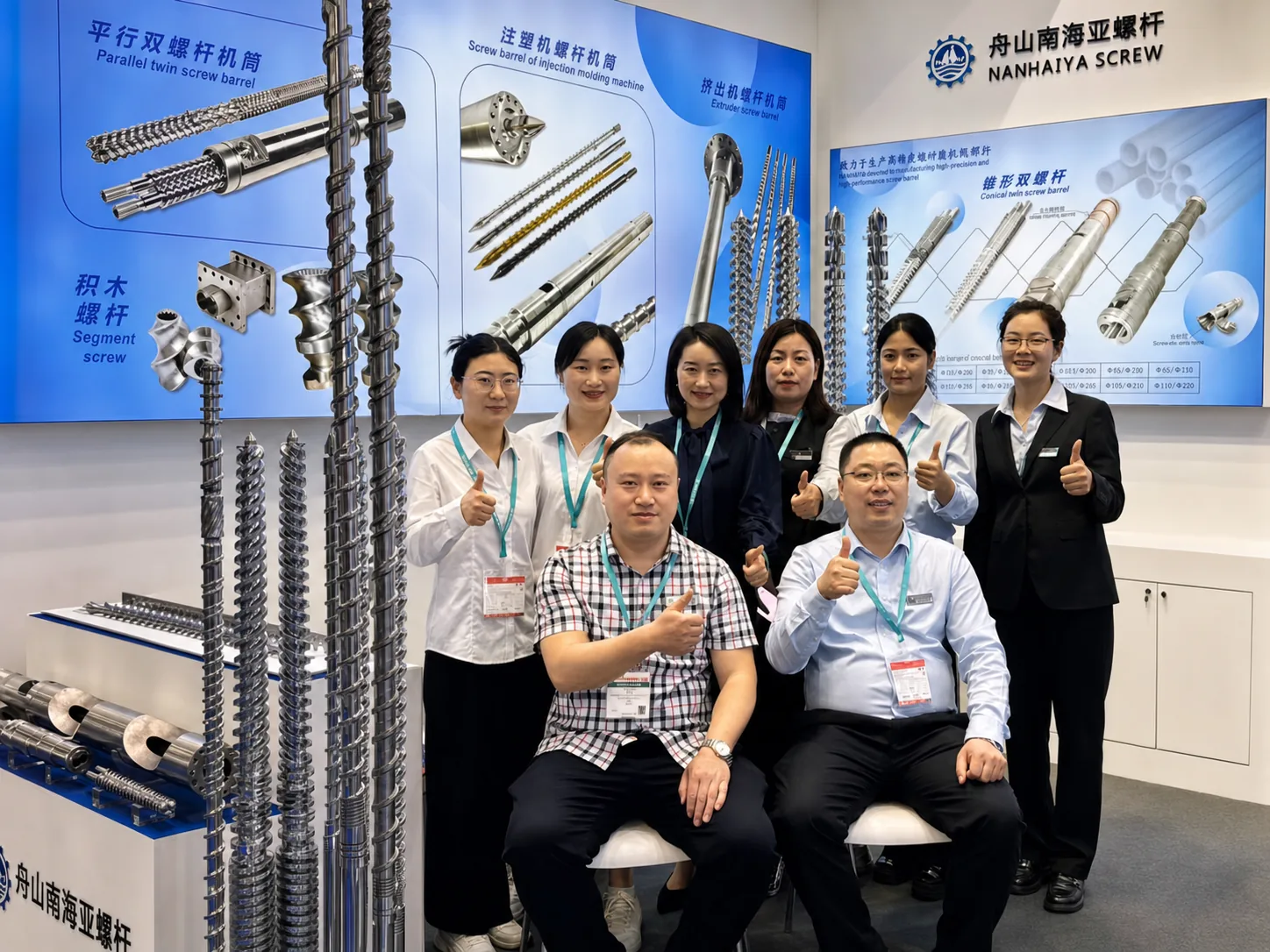
Related Articles
More insights on screw barrel technology and plastics processing.
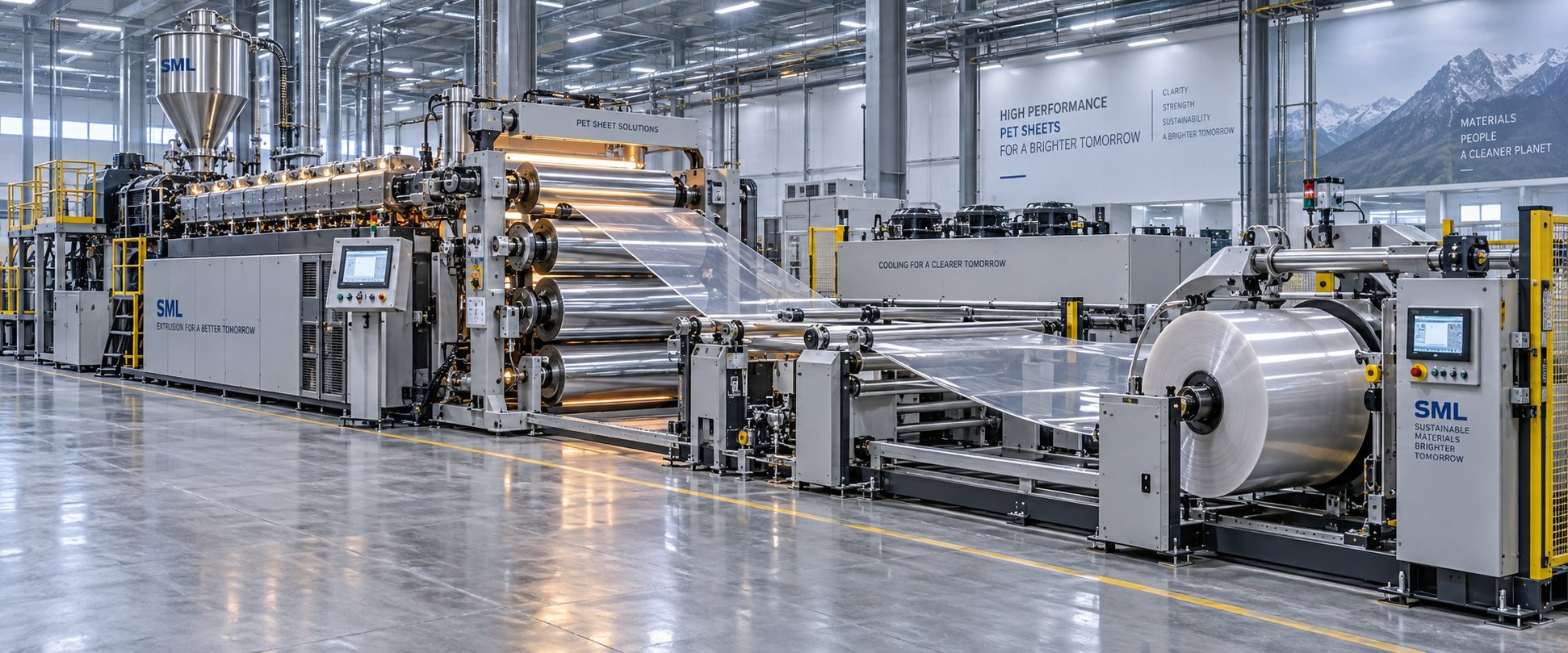
Pet Sheet Extrusion Machine Secrets Your Supplier Won't Share
Oct 15, 2026
Learn how a PET sheet extrusion machine works, key components, specs by production scale, troubleshooting defects, and buyer tips your supplier won't share.
Read Article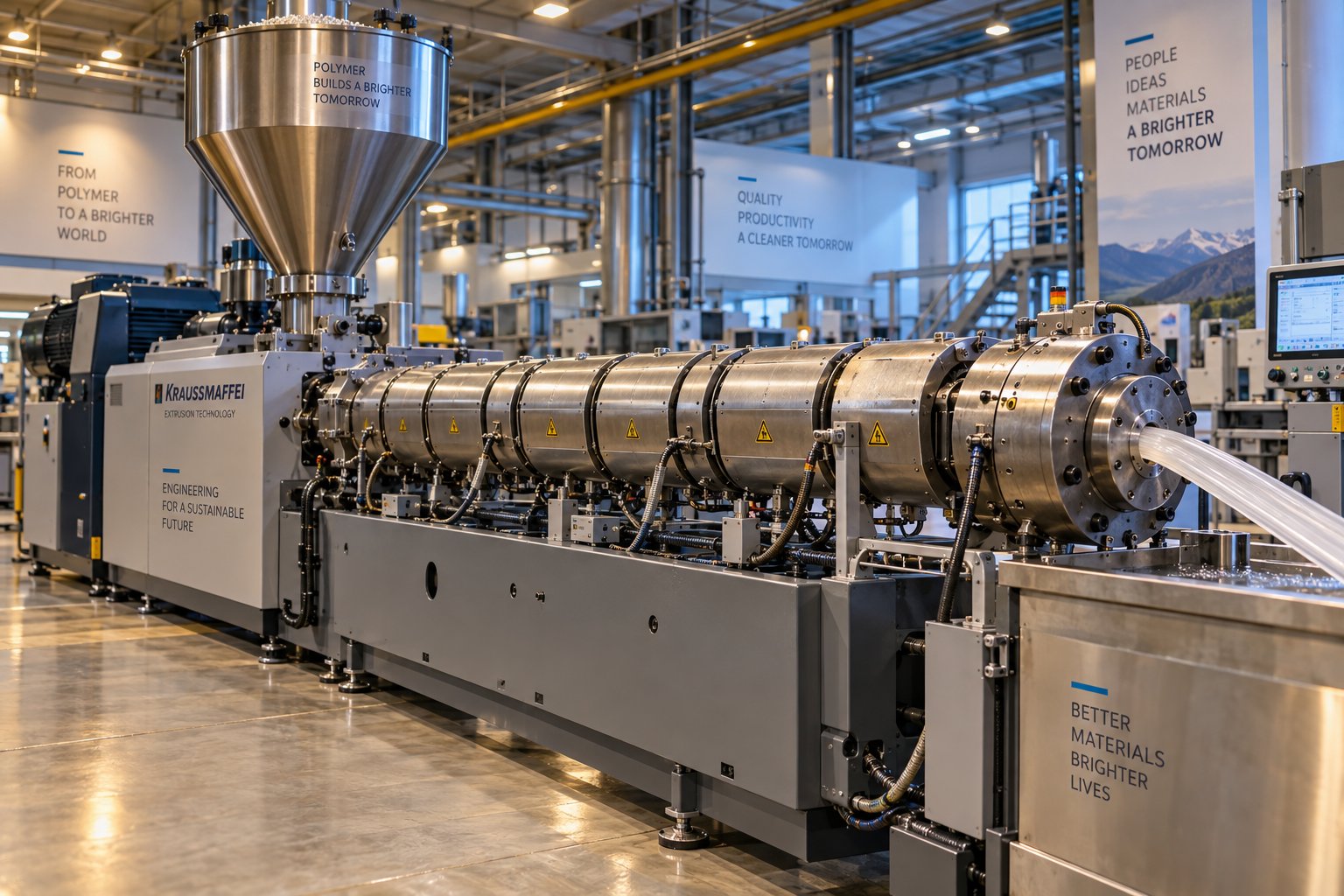
Extruder Machine Decoded: From Raw Pellet To Finished Product
Oct 6, 2026
Learn how an extruder machine works, compare single-screw vs. twin-screw types, and get expert guidance on specs, troubleshooting, and selection.
Read Article
PE Pipe Making Machine Decoded: From Raw Resin to Flawless Pipe
Oct 4, 2026
Learn how a PE pipe making machine works, from resin to finished pipe. Covers components, material grades, automation, troubleshooting, and buyer selection tips.
Read ArticleLooking for something else?
Search by material, symptom or product and jump straight to the relevant page.
These are navigation suggestions based on keyword matching — not a quotation, not a delivery commitment, and not a substitute for engineering review. Final specification is confirmed by our engineers against your drawings and processed material.
Need help with screw barrel selection?
Share your machine model, processed material and application. Our team can help with pricing and technical support.