

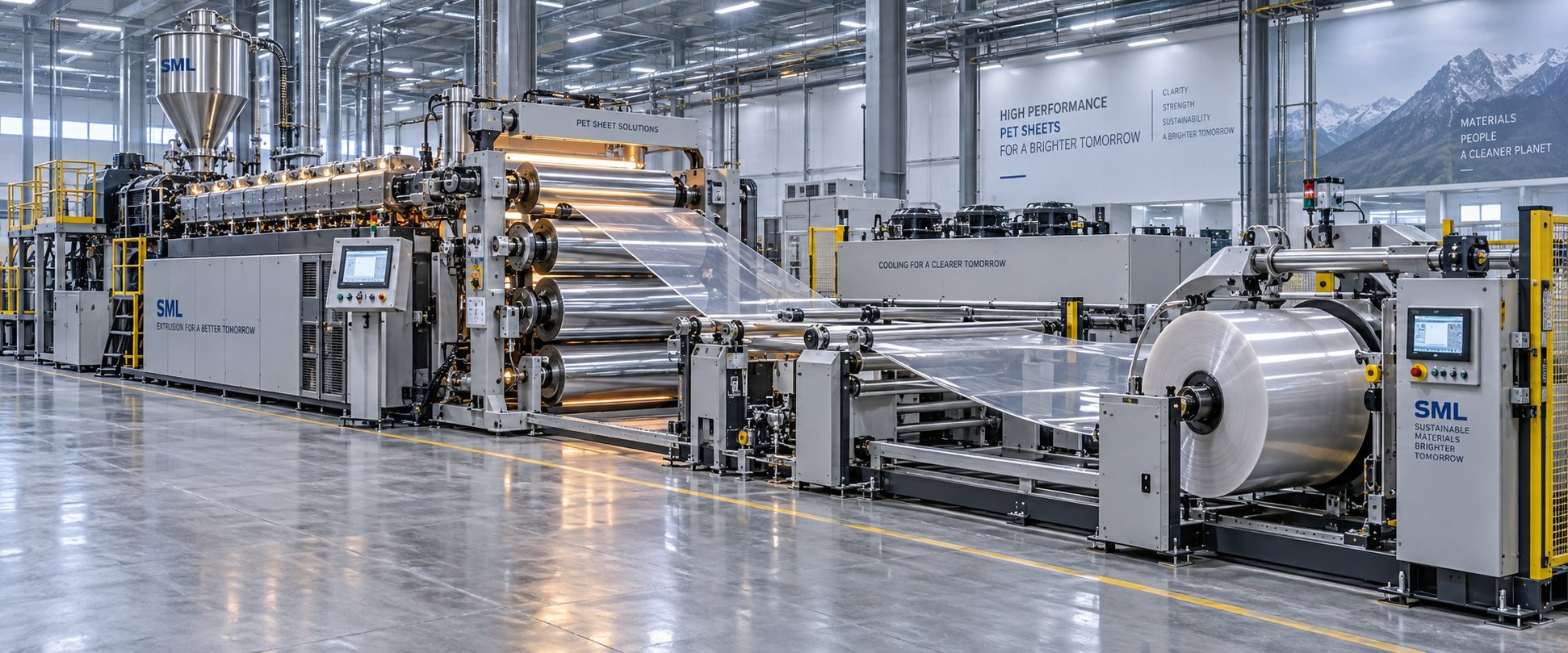
What Is a PET Sheet Extrusion Machine and Why It Matters
Ever wondered how those crystal-clear food trays or clamshell packages lining grocery store shelves actually get made? The answer starts with a single, highly specialized piece of equipment that most people outside the plastics industry never think about.
Defining the PET Sheet Extrusion Machine
A PET sheet extrusion machine is a continuous production system that melts polyethylene terephthalate (PET) resin pellets and forces the molten polymer through a flat die to produce uniform, high-clarity plastic sheets used in thermoforming, packaging, and display applications.
PET itself is a thermoplastic polymer prized for its exceptional optical clarity, mechanical strength, and chemical resistance. When processed into flat sheet form, it becomes the foundation material for an enormous range of everyday products. Think blister packs protecting electronics on retail hooks, bakery containers showcasing pastries, disposable food trays keeping produce fresh, and rigid display materials used in point-of-sale marketing. Each of these starts life as a continuous ribbon of PET sheet rolling off an extrusion line.
Why PET Dominates Sheet Packaging Applications
So why does PET hold such a commanding position in sheet packaging? A few properties make it nearly impossible to beat. It offers excellent clarity, strength, and chemical resistance, which is exactly what food-contact and retail packaging demand. PET sheets thermoform easily into complex shapes without losing structural integrity, making them ideal for clamshell containers, fruit trays, and protective blister packaging. The material is also FDA-approved for direct food contact and highly recyclable, giving it a sustainability edge that buyers increasingly require.
You'll notice PET showing up across nearly every thermoforming application where transparency and product visibility matter. That's no accident. Its combination of stiffness at thin gauges, barrier properties, and glossy surface finish makes it the go-to choice for converters and brand owners alike.
PET Sheet Extrusion vs Other Plastic Forming Methods
How does pet sheet extrusion compare to other plastic forming methods like injection molding or blow molding? The differences are fundamental. Extrusion is a continuous process where melted plastic is pushed through a die by a rotating screw to form flat sheets at speeds of 5 to 20 meters per minute. Injection molding, by contrast, fills enclosed mold cavities under extreme pressure to create complex three-dimensional solid parts. Blow molding inflates a molten tube or preform against a mold to produce hollow items like bottles and containers.
Imagine it this way: injection molding sculpts individual parts, blow molding inflates hollow shapes, and a sheet extrusion machine continuously rolls out flat material ready for downstream thermoforming. Extrusion also benefits from significantly lower tooling costs compared to injection molding, making it the economical choice for high-volume sheet production. Each method serves a distinct purpose, but when the goal is producing continuous rolls or stacks of flat PET sheet, extrusion is the only practical technology.
Understanding what this equipment does and why PET dominates is just the starting point. The real value, and where most suppliers stay frustratingly vague, lies in what actually happens inside the machine at every stage of production.
Step-by-Step PET Sheet Extrusion Process Explained
The difference between a flawless PET sheet and one riddled with bubbles, haze, or thickness variation almost always traces back to what happens, or doesn't happen, at specific stages of the production process. Most supplier brochures gloss over these stages with a sentence or two. Here, you'll get the full picture of every step in a pet extrusion line, from raw pellet to finished roll.
Raw Material Preparation and Drying
PET resin is extremely hygroscopic, meaning it aggressively absorbs moisture from the surrounding air. If that moisture isn't removed before the polymer enters the extruder barrel, hydrolytic degradation occurs at melt temperatures, breaking polymer chains and destroying the mechanical properties and clarity of the finished extrusion sheet. This makes moisture control the single most critical pre-processing step for PET.
The preparation sequence begins with crystallization and ends with dehumidifying drying:
- Crystallization: Amorphous PET pellets are heated in a crystallization tower, aligning polymer chains to raise the glass transition temperature. This prevents pellets from sticking together and clogging the drying hopper. As industry sources note, crystallization typically occurs at temperatures below 149°C for 30 to 90 minutes.
- Dehumidifying drying: Crystallized pellets move into a desiccant dryer, where hot, ultra-dry air with a dew point below -40°C circulates through the hopper in a closed loop. The target is reducing moisture content to below 50 ppm (0.005%). The APR's Standard Laboratory Processing Practices specify drying at 160°C for 4 to 6 hours using desiccant air, confirming how seriously the industry treats this step.
- Gravimetric or volumetric dosing: Dried pellets are metered into the extruder feed throat by a dosing system. Gravimetric feeders weigh material in real time for precise throughput control, while volumetric feeders rely on consistent bulk density. Gravimetric dosing is preferred for tight-tolerance pet extrusion because it compensates automatically for pellet size and density variations.
Melting, Filtering, and Die Extrusion
Once dried material enters the barrel, three interconnected stages transform solid pellets into a precisely conditioned melt stream:
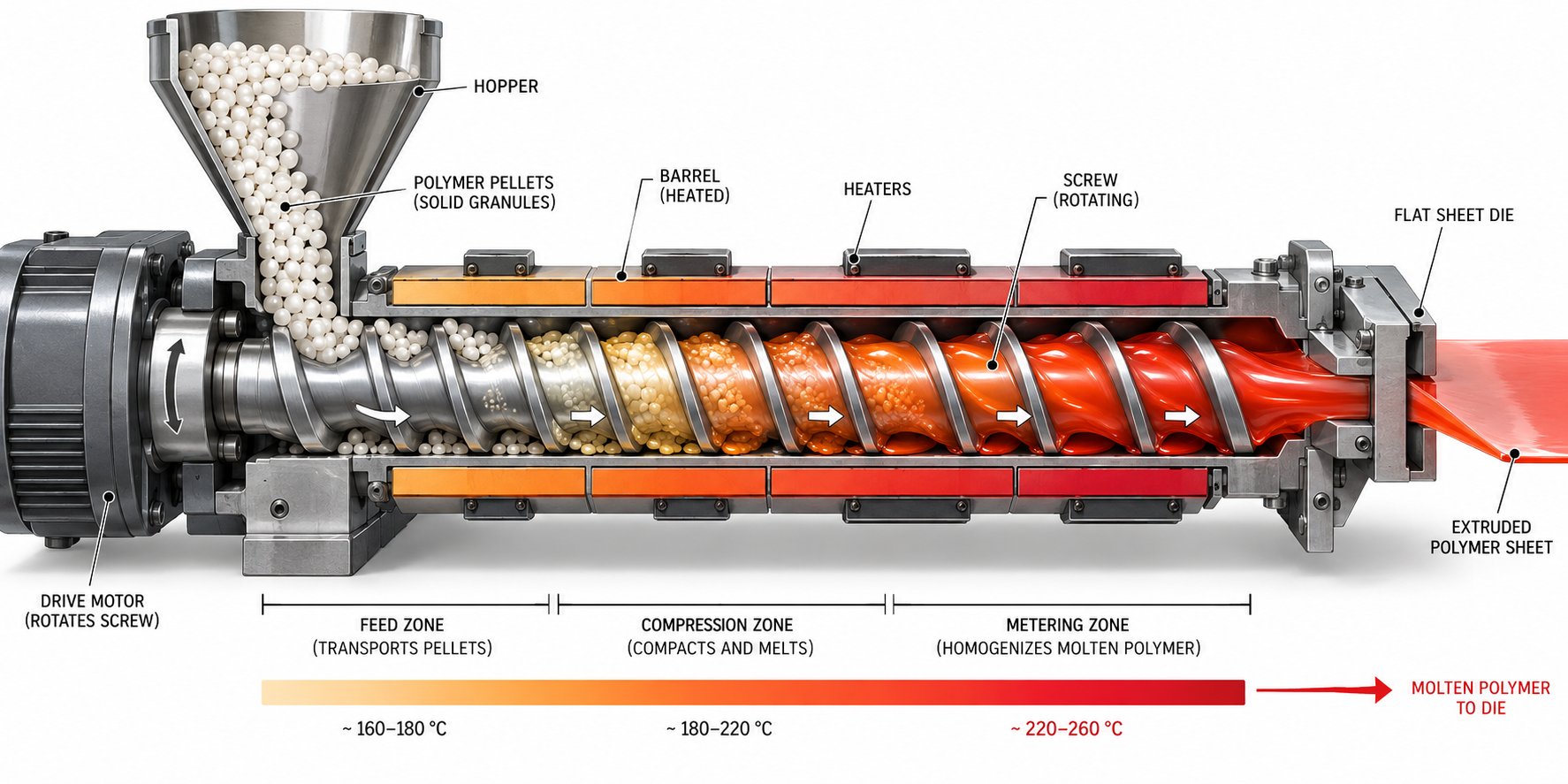
- Melting and plasticizing: The rotating screw conveys pellets through progressively hotter barrel zones, applying shear and conducted heat to create a homogeneous molten polymer. Temperature zone profiles span from the feed throat through the metering section, and each zone must be carefully set according to OEM documentation for the specific resin grade and screw design being used. Specialized barrier screws help separate unmelted solids from the melt pool, improving consistency.
- Melt filtration: The molten PET passes through a screen changer fitted with mesh filter packs. APR laboratory protocols reference a 40/250/40 mesh configuration for standard pelletizing, while their sheet extrusion practice uses a 40/150/40 mesh as the minimum filtration level. Screen changers, whether hydraulic slide-plate or continuous-belt types, trap gels, contaminants, and degraded polymer particles that would otherwise become visible defects in the final sheet.
- Gear pump metering: A melt pump, positioned between the screen changer and the die, stabilizes pressure fluctuations caused by screw pulsation. By delivering the melt at a constant volumetric flow rate, the gear pump directly improves sheet thickness uniformity, which is one of the most critical quality metrics for downstream thermoforming operations.
- Flat-die extrusion: The pressurized melt enters a flat sheet die, typically a coat-hanger or T-slot design, which spreads the polymer uniformly across the full width of the die opening. Internal flow channels and adjustable die lips ensure even melt distribution from edge to edge. Die temperature control is critical here: too hot and the sheet sags; too cool and flow restrictions cause die lines or uneven gauge.
Calendering, Cooling, and Winding
The molten curtain exiting the die is still soft and shapeless. The downstream equipment gives it final form, surface quality, and dimensional precision:
- Three-roll calendering and polishing: The melt curtain drops into the nip of a three-roll calender stack, where chrome-plated, independently temperature-controlled rolls simultaneously cool, gauge, and polish the sheet. Roll temperatures and gap settings determine whether the sheet emerges as amorphous and transparent (APET) or semi-crystalline and opaque (CPET). Maintaining a precise, consistent gap between the die exit and the calender nip is essential to avoid surface imperfections like water marks or orange-peel textures.
- Cooling conveyor: After leaving the calender stack, the sheet travels across a cooling conveyor or additional chill rolls that bring it down to a stable handling temperature. Uniform cooling across the sheet width prevents residual stress and warping.
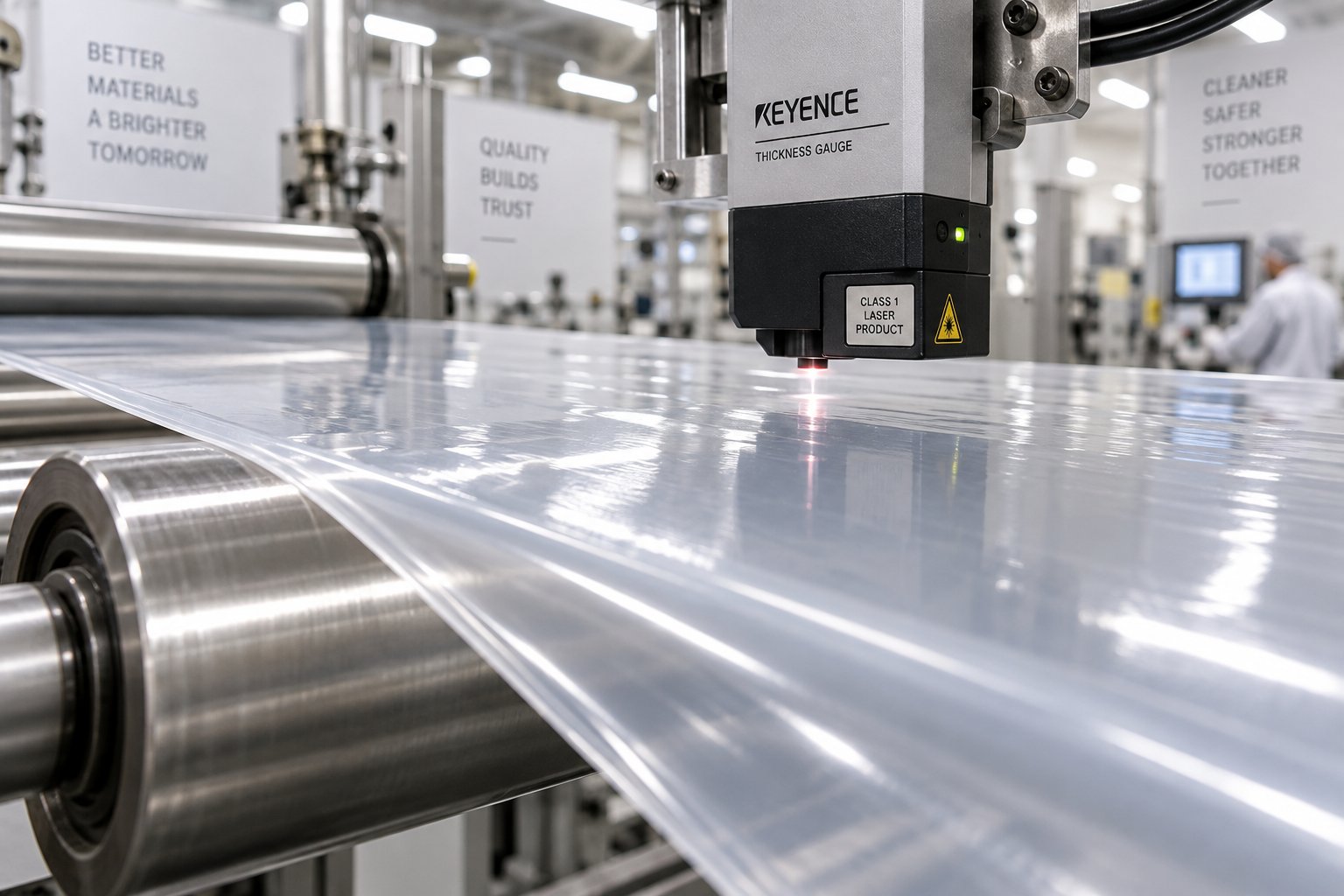
- Inline thickness gauging: Beta-ray or X-ray scanning gauges continuously measure sheet thickness as it moves down the line. These systems detect gauge variations in real time, feeding data back to the die lip adjustment system or gear pump to maintain tight tolerances required by thermoforming customers.
- Edge trimming: Excess material along both sheet edges is trimmed by rotary knives or razor blades. The trimmed strips are immediately granulated by an inline edge-trim granulator and recirculated back into the extrusion process, minimizing material waste.
- Winding or stacking: Finally, the finished sheet is wound onto rolls using tension-controlled winders for thin-gauge product, or cut and stacked into flat stacks for heavier-gauge sheets. Active and passive roller systems apply controlled pneumatic pressure during winding to keep the sheet flat, wrinkle-free, and ready for shipment or inline thermoforming.
Each of these twelve stages influences the next. A drying shortfall at stage two cascades into bubbles at stage four, which no amount of downstream adjustment can fix. That interconnected nature is exactly why understanding the complete pet extrusion process matters far more than knowing any single component in isolation, and why the individual components themselves deserve a much closer look.
Key Components of a Complete PET Sheet Extrusion Line
Knowing the process steps is one thing. Knowing which piece of sheet extrusion equipment handles each step, and exactly how it shapes the quality of your finished product, is where real operational knowledge begins. A complete pet sheet extrusion line is a chain of interdependent machines, and the weakest link defines your output ceiling. Here's what every component actually does and why it matters.
Extruder, Screen Changer, and Melt Pump
The extruder is the heart of any extrusion line. Inside its heated barrel, a precision-machined screw rotates to convey, compress, and melt PET pellets into a homogeneous polymer stream. The barrel houses multiple independently controlled heating zones fitted with heater bands, while cooling fans prevent localized overheating. The drive motor powers the screw, and its torque rating directly limits your maximum throughput. Screw geometry, including compression ratio, barrier flights, and mixing sections, determines how uniformly the PET melts and how much shear heat the polymer absorbs.
Immediately downstream sits the screen changer. Whether hydraulic slide-plate or manual bolt-type, this device holds mesh filter packs that trap gels, contaminants, and degraded polymer fragments before they reach the die. Think of it as the last line of defense against visible defects in your finished sheet. Continuous-flow screen changers allow filter changes without stopping the line, a significant advantage during long production runs.
The gear pump, or melt pump, slots in between the screen changer and the die. It uses two closely fitted, counter-rotating gears to deliver a fixed volume of molten PET per revolution, effectively decoupling the die from normal screw-side pressure fluctuations. The result is steadier melt delivery and tighter thickness tolerances across the sheet. Not every line includes one, but for PET applications where gauge consistency is critical for downstream thermoforming, a melt pump is a worthwhile investment.
Flat Die and Calender Stack
The flat sheet die is where formless melt becomes a defined sheet profile. Two primary designs dominate: the coat-hanger die and the T-slot die. Coat-hanger dies feature a teardrop-shaped manifold that gradually reduces in cross-sectional area from center to sides, equalizing pressure drop and flow velocity across the full die width. T-slot dies use a constant cross-section manifold, which can cause uneven flow distribution and polymer hang-up at the edges. For PET sheet production, coat-hanger designs are the industry standard because uniform melt distribution directly translates to consistent thickness from edge to edge.
Adjustable die lips, controlled by push-pull bolts or thermal expansion bolts, allow operators to fine-tune the gap across the die width. Even minor lip gap deviations create proportionally large thickness variations in thin-gauge PET sheet, so precision here is non-negotiable.
The three-roll calender stack receives the molten curtain as it exits the die. These chrome-plated rolls are independently temperature-controlled, and their surface finish determines the sheet's optical quality. Advanced calender systems allow precision electromechanical control over roll gaps, enabling product thicknesses ranging from 0.2 mm to 40 mm depending on the material and configuration. For PET specifically, calender roll temperature is the primary lever for controlling crystallinity: cooler rolls produce transparent amorphous sheet (APET), while warmer rolls encourage semi-crystalline structure (CPET).
Downstream Equipment and Quality Monitoring
Everything after the calender stack focuses on stabilizing, measuring, trimming, and collecting the finished sheet. The haul-off unit, sometimes called the take-off unit, pulls the sheet through the downstream section at a controlled speed. The ratio of haul-off speed to extruder output rate is actually the primary lever for gauge control, making it one of the most influential pieces of equipment on the entire line despite its relatively simple appearance.
Inline thickness gauges, typically beta-ray or X-ray scanning systems, continuously measure sheet gauge as it travels down the line. These systems catch thickness drift in real time and can feed corrections back to die lip adjustments or gear pump speed, closing the quality loop before defective material accumulates. Modern alternatives using millimeter-wave technology are also gaining traction because they eliminate the regulatory overhead associated with nuclear-based gauges.
The edge-trim granulator handles the narrow strips trimmed from both sheet edges by rotary knives. Rather than discarding this material, the granulator immediately reduces it to regrind that recirculates back into the extrusion process, keeping material waste to a minimum. Finally, the winder or sheet stacker collects the finished product. Thin-gauge sheet is wound onto rolls under precise tension control to avoid wrinkles and telescoping, while heavier-gauge sheet is cut to length and stacked flat.
The table below summarizes how each major component contributes to the quality of your final product:
| Component | Primary Function | Impact on Sheet Quality |
|---|---|---|
| Extruder (barrel, screw, motor, heater bands, cooling fans) | Melts and homogenizes PET resin into a uniform melt stream | Determines melt consistency, temperature uniformity, and maximum throughput capacity |
| Screen Changer | Filters contaminants, gels, and degraded polymer from the melt | Prevents visible inclusions, die lines, and surface defects in the finished sheet |
| Gear / Melt Pump | Stabilizes melt pressure and delivers constant volumetric flow to the die | Reduces thickness variation by isolating the die from screw-side pressure pulsation |
| Flat Sheet Die (coat-hanger or T-slot) | Distributes melt uniformly across full sheet width | Controls cross-web thickness uniformity and edge quality |
| Three-Roll Calender Stack | Cools, gauges, and polishes the sheet; controls crystallinity | Defines surface finish, optical clarity, dimensional accuracy, and APET vs CPET structure |
| Haul-Off / Take-Off Unit | Pulls sheet through downstream equipment at controlled speed | Primary control lever for final sheet thickness via speed-to-output ratio |
| Inline Thickness Gauge (beta-ray, X-ray, or mm-wave) | Continuously measures sheet gauge in real time | Enables closed-loop thickness correction, reducing scrap and out-of-spec production |
| Edge-Trim Granulator | Granulates trimmed edge strips for regrind recirculation | Minimizes material waste and reduces raw material cost per kilogram of output |
| Winder / Sheet Stacker | Collects finished sheet onto rolls or cut stacks | Prevents wrinkles, telescoping, and surface damage during storage and transport |
Every component on this list influences the next one downstream. A perfectly configured die means nothing if the calender rolls aren't set correctly, and the best calender stack can't fix a poorly filtered melt. That interconnectedness is why evaluating a pet sheet extrusion machine requires more than checking a spec sheet. The real question is how these components perform together under production conditions, and that depends heavily on the technical specifications and parameters behind each one.
Technical Specifications and Machine Parameters for Every Pet Sheet Line
Supplier catalogs love to highlight a single headline number, usually maximum output in kilograms per hour, and leave everything else buried in footnotes or behind a "contact us" button. That approach makes comparison shopping nearly impossible. To cut through the fog, you need a structured view of how pet sheet production line specifications scale across different machine classes.
Specifications by Production Scale
PET sheet lines generally fall into three production tiers: laboratory or pilot systems for R&D and small-batch testing, mid-range lines for moderate commercial output, and high-output industrial configurations built for continuous, multi-shift operation. The table below maps the key parameters across these categories using commonly referenced industry ranges. Keep in mind that exact values vary significantly by manufacturer, screw design, and line configuration.
| Parameter | Laboratory / Pilot Line | Mid-Range Production | High-Output Industrial |
|---|---|---|---|
| Screw Diameter | 20 - 45 mm | 50 - 75 mm | 90 - 150+ mm |
| L/D Ratio | 24:1 - 32:1 | 32:1 - 36:1 | 36:1 - 40:1 |
| Main Motor Power | 5 - 30 kW | 55 - 132 kW | 150 - 500+ kW |
| Output Capacity | 5 - 50 kg/hr | 100 - 500 kg/hr | 500 - 2,000+ kg/hr |
| Line Speed | 1 - 5 m/min | 5 - 15 m/min | 15 - 30+ m/min |
| Sheet Width | 150 - 400 mm | 600 - 1,000 mm | 1,000 - 1,800+ mm |
| Sheet Thickness Range | 0.1 - 2.0 mm | 0.15 - 2.0 mm | 0.15 - 2.5 mm |
To put this in concrete terms, a production-grade twin-screw pet sheet line like the SWT-75S-1000 features a 75 mm screw diameter, a 40:1 L/D ratio, a 132 kW permanent magnet synchronous motor, and delivers 350 to 500 kg/hr across sheet widths up to 800 mm at thicknesses of 0.2 to 2.0 mm. That places it squarely in the mid-range-to-high-output category, which is the sweet spot for most commercial thermoforming operations. Always request the full specification sheet from your supplier and verify numbers against actual production trials with your target resin grade.
Screw Geometry and Its Effect on Output
Specifications like screw diameter and L/D ratio only tell part of the story. The internal geometry of the screw, specifically its compression ratio, barrier design, and mixing sections, has an outsized effect on how well the machine actually processes PET.
- Compression ratio: This is the ratio of the feed zone channel depth to the metering zone channel depth. Higher compression ratios generate more shear and pressure, which accelerates melting but can also overheat a heat-sensitive polymer like PET if pushed too far. Most PET screws use moderate compression ratios tailored to the resin's melt viscosity.
- Barrier flights: A barrier screw adds a secondary flight that physically separates unmelted pellets from the melt pool. This improves melt homogeneity and reduces the risk of unmelted gels reaching the die, a common source of surface defects in finished sheet.
- Mixing sections: Located near the screw tip, dispersive and distributive mixing elements break up agglomerates and homogenize color concentrates or additives. As NC State Extension research explains, wider kneading elements promote dispersive mixing that breaks down clumps, while narrower elements focus on distributive mixing that spreads ingredients evenly. Getting this balance right is critical for PET, which degrades quickly under excessive shear.
The takeaway? Two extrusion sheet lines with identical screw diameters and L/D ratios can produce dramatically different melt quality if their internal screw geometries diverge. Always ask your supplier for compression ratio, barrier design details, and mixing element configuration, not just the headline dimensions.
Multi-Layer Co-Extrusion Configuration Parameters
Single-layer lines handle one extruder feeding one die. Co-extrusion configurations like A/B/A or A/B/C change the equation entirely. An A/B/A structure uses two outer layers of virgin PET sandwiching a core layer of recycled PET, allowing manufacturers to hit recycled-content targets without sacrificing surface quality or food-contact compliance.
From a machinery standpoint, co-extrusion means adding one or two satellite extruders alongside the primary unit, plus a feedblock or multi-manifold die that merges the melt streams into a single layered sheet. Each satellite extruder has its own screw diameter, motor, and temperature control, typically sized smaller than the main extruder since the outer layers are thinner. The die itself must be engineered with separate flow channels that converge precisely to maintain consistent layer ratios across the full sheet width.
This added complexity increases capital cost, floor space requirements, and operator skill demands. However, for producers targeting premium packaging markets or high-rPET-content products, the ability to engineer each layer independently makes co-extrusion a strategic investment rather than a luxury. If you're evaluating a pet sheet line for multi-layer production, confirm that the supplier provides layer ratio control, separate temperature management for each extruder, and validated feedblock designs for PET specifically.
Specifications and screw geometry tell you what a machine can do on paper. The real performance gap between extruder types, especially single-screw versus twin-screw configurations, reveals itself in how each design handles PET's unique processing demands.
Single-Screw vs Twin-Screw Extruders for PET Sheet Production
Ask five pet sheet extruder machine suppliers which extruder configuration is "best" for PET, and you'll likely get five different answers, each conveniently matching whatever they happen to sell. The reality is more nuanced. Single-screw and twin-screw extruders aren't better or worse in absolute terms; they solve different processing problems. Understanding the mechanical principles behind each design is the only way to make a decision that serves your production goals instead of your supplier's inventory.
How Single-Screw Extruders Process PET
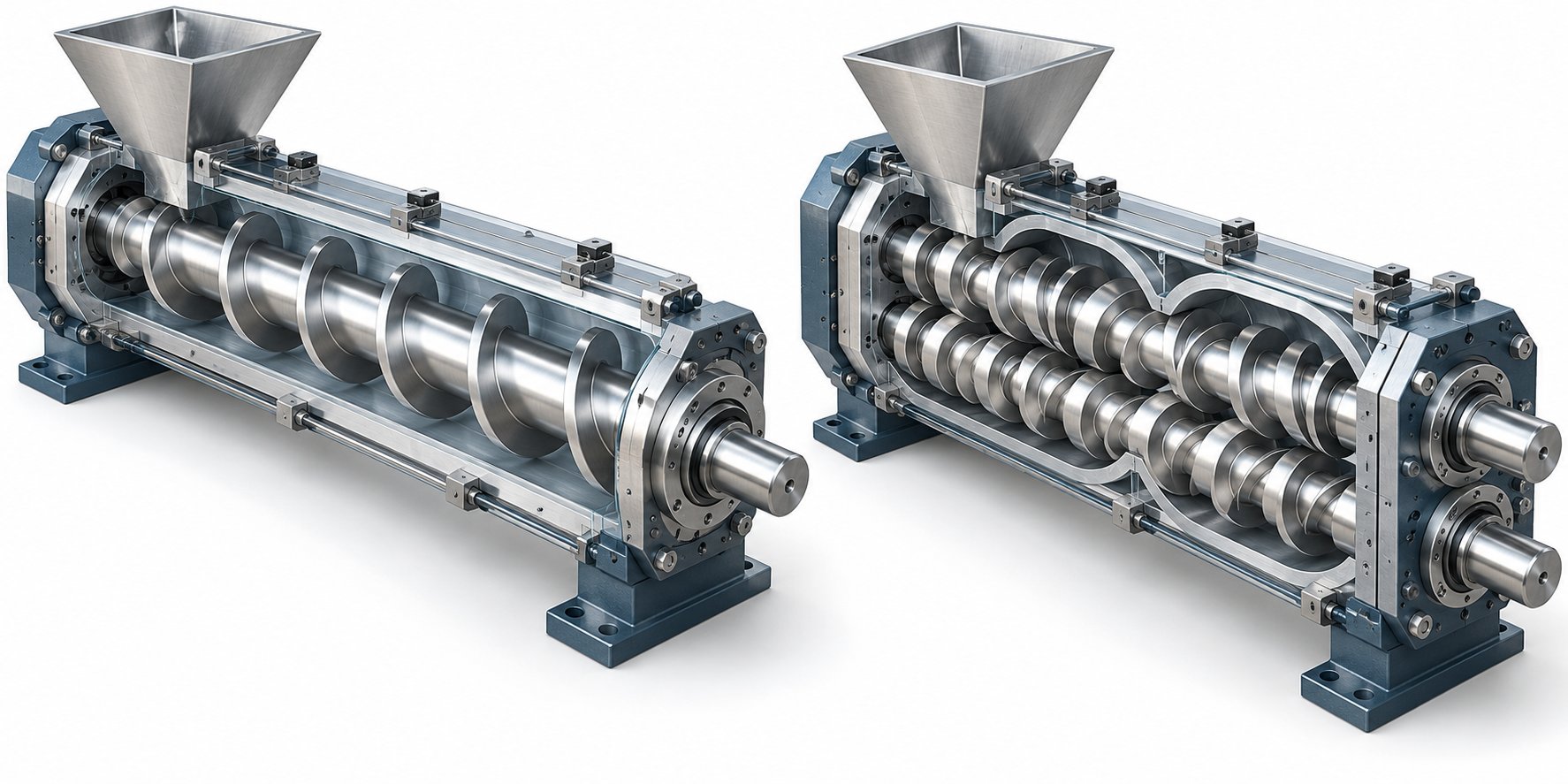
A single-screw pet sheet extruder relies on a single helical screw rotating inside a cylindrical barrel. Material transport happens primarily through drag flow: friction between the resin pellets, the screw channel walls, and the barrel surface pulls the polymer forward as the screw turns. As the channel depth decreases from the feed zone to the metering zone, the polymer compresses, melts from conducted heat and shear friction, and eventually exits as a homogeneous melt stream ready for the die.
This simplicity is actually the design's greatest strength. A single-screw system has fewer moving parts, a straightforward transmission, and well-established control parameters. For operators running virgin PET pellets through a standard sheet line, these machines deliver reliable, predictable performance shift after shift. Capital costs run significantly lower than twin-screw alternatives, and maintenance is more accessible because the core mechanical system, one screw inside one barrel, is inherently less complex.
For PET specifically, single-screw extruders work best with properly dried virgin resin and vented two-stage screw designs that include a decompression zone for residual moisture removal. The screw typically features a low compression ratio of 2.5:1 to 3:1, barrier flights to separate solids from the melt pool, and an L/D ratio of 28:1 to 32:1 to provide enough barrel length for gradual, controlled melting without thermally degrading PET's narrow processing window.
Here's what most suppliers won't volunteer: the barrel and screw are consumable components. They wear over time, and their precision directly governs melt consistency, temperature uniformity, and output stability. A worn screw with degraded flight clearances can't maintain the tight processing control PET demands, leading to thickness variation, yellowing, and increased reject rates. That's why sourcing high-quality replacement components matters as much as the original machine purchase. Suppliers like NANHAIYA offer custom-engineered and replacement single screw barrels designed specifically for sheet extrusion applications, giving operators a practical path to restore extruder performance without replacing the entire machine.
Twin-Screw and Multi-Screw Alternatives
Twin-screw extruders take a fundamentally different approach to polymer processing. Two screws, either co-rotating or counter-rotating, turn inside a figure-eight-shaped barrel bore. In co-rotating designs, both screws spin in the same direction with intermeshing, self-wiping elements that actively push material from one screw to the other. This intermeshing action creates positive displacement conveying, meaning the machine physically forces material forward rather than relying on friction-based drag flow.
What does this mean in practical terms? Three significant advantages emerge:
- Superior mixing and dispersion: The intermeshing screw elements create intense distributive and dispersive mixing that single-screw designs simply can't match. This is critical when processing blended feedstocks or incorporating additives.
- Better devolatilization: Twin-screw systems can be configured with multiple vent ports along the barrel, providing far more aggressive moisture and volatile removal than a single vent zone on a single-screw design. For rPET flake that carries higher moisture loads and more contaminants, this is a substantial processing advantage.
- Modular screw configuration: Twin-screw systems typically use segmented, building-block screw elements that can be rearranged along the shaft to optimize conveying, melting, mixing, and venting zones for specific materials. This flexibility makes them adaptable to changing feedstock quality.
Counter-rotating twin screws work differently, with the two screws turning in opposite directions. They're less common in PET sheet production but find use in certain profile and pipe extrusion applications, particularly with PVC.
Planetary or multi-screw extruders represent a niche third category, using a central screw surrounded by multiple smaller planetary screws for exceptionally high surface-area mixing. These are rare in standard PET sheet production and primarily serve specialty compounding or reactive extrusion applications.
The trade-off? Twin-screw pet extruder systems carry substantially higher capital costs, roughly two to three times that of comparable single-screw machines. The cost difference stems from high-torque precision gearboxes, modular segmented screw elements manufactured from premium alloy steels, and more sophisticated control systems. Maintenance complexity is also higher because of the tight tolerances between intermeshing elements.
Choosing the Right Extruder Configuration
So which configuration should you choose? The answer depends almost entirely on your feedstock and your end-product requirements. The following comparison breaks it down:
| Factor | Single-Screw Extruder | Twin-Screw Extruder (Co-Rotating) |
|---|---|---|
| Capital Cost | Lower | 2-3x higher |
| Mixing Capability | Moderate (barrier and mixing sections) | Excellent (intermeshing self-wiping elements) |
| Maintenance Complexity | Lower; simpler mechanical system | Higher; tight tolerances, modular elements |
| Best For | Virgin PET sheet, standard packaging lines | High-rPET blends, compounding, multi-material recipes |
| rPET Suitability | Good for moderate rPET content with proper drying | Excellent; superior devolatilization handles variable feedstock |
| Energy Efficiency | Generally more efficient for standard processing | Higher energy per kg, but can offset with reduced scrap rates |
For the majority of commercial PET sheet operations running predominantly virgin resin or moderate recycled content, single-screw extruders remain the industry workhorse. They're proven, cost-effective, and deliver the output consistency that thermoforming customers demand. As industry specialists confirm, in large-scale processing of pure PET materials, single-screw machines dominate due to their exceptional cost-effectiveness and stability.
Twin-screw configurations earn their premium when feedstock variability is high, when recycled content exceeds 50%, or when the line must handle compounding and reactive processing alongside sheet production. Some advanced operations even combine both in a tandem arrangement: a single-screw extruder for pre-melting and coarse filtration, followed by a co-rotating twin-screw for deep degassing and fine homogenization.
Regardless of which configuration you choose, one principle stays constant: barrel and screw quality is the foundation of consistent melt quality and long machine life. A pet sheet extruder is only as good as its core wear components. That reality makes the material properties of PET itself, the very characteristics that drive all of these design decisions, essential knowledge for anyone operating or purchasing these machines.
PET Material Properties That Drive Machine Design
Every design decision behind a pet extrusion machine, from screw geometry to calender roll temperature, traces back to the physical and chemical behavior of PET itself. Suppliers rarely explain why their machines are built the way they are, but the answer is always the same: the polymer demands it. Understanding these pet sheet material properties gives you the knowledge to evaluate equipment intelligently and troubleshoot problems at their source.
Intrinsic Viscosity and Melt Behavior
Imagine trying to push honey through a narrow slot versus pushing water. The resistance you feel is viscosity, and for PET, a single measurement called intrinsic viscosity (IV) captures how the polymer will behave under processing conditions. IV quantifies the average molecular weight and polymer chain length of PET resin, and it is, as ICPG's technical team describes, perhaps the most important characteristic of PET.
PET sheet production typically requires resin with an IV in the 0.70 to 0.82 dL/g range. This places it within the film and bottle grade categories, where polymer chains are long enough to deliver the mechanical strength, clarity, and forming characteristics that thermoformed packaging demands. Higher IV means longer chains, more molecular entanglements, and a stiffer material with greater melt viscosity. Lower IV yields a more fluid melt that flows easily but sacrifices tensile strength and impact resistance in the finished sheet.
Why does this matter for your pet extruder machine? Because IV directly affects melt viscosity, which in turn determines die pressure, screw torque requirements, and achievable line speeds. Processing PET with low or unknown IV can lead to variation in extrusion pressure, unstable melt viscosity, and sheet thickness deviations, potentially causing brittleness or structural defects during downstream thermoforming. Recycled PET (rPET) compounds this challenge because its IV is typically lower than virgin resin, as the metallic catalysts used during initial polymerization degrade and cannot be reactivated during recycling. Blending rPET with virgin material requires careful IV management to keep the combined feedstock within the target processing window.
Moisture Sensitivity and Drying Requirements
PET is hygroscopic, meaning it absorbs moisture from ambient air readily. That characteristic alone shapes the entire upstream section of every pet extrusion machine line. Here's why: at melt temperatures, water molecules attack the ester bonds in PET's polymer backbone through a process called hydrolytic degradation. Each broken bond shortens a polymer chain, reducing IV and destroying the mechanical properties and optical clarity the material is valued for. Bubbles, haze, and reduced tensile strength in the finished sheet are all telltale signs of inadequately dried resin.
Drying to below 50 ppm moisture content is non-negotiable. Achieving this requires a dedicated crystallizer-dryer system upstream of the extruder, typically using desiccant air with dew points below -40°C circulating through a hopper at controlled temperatures for several hours. The crystallization step is equally critical: amorphous PET pellets must be pre-crystallized before entering the dryer hopper, otherwise they soften, stick together, and block airflow. This isn't an optional accessory; it's a fundamental system requirement dictated by PET's chemistry.
The downstream consequences of poor drying extend beyond sheet defects. As industry research confirms, when half-dried or wet PET is processed, the resulting product suffers from reduced IV, driving up scrap rates, waste, and production delays. This reality is precisely why every serious pet sheet extrusion line specification starts with the drying system, not the extruder.
Crystallization Control for APET and CPET
PET occupies a unique position among thermoplastics because it can be produced in two fundamentally different states: amorphous (APET) or semi-crystalline (CPET). The end product you need determines which state you target, and the calender roll temperature and cooling rate are the primary levers for controlling which form emerges from the extrusion line.
Research from NETZSCH Analyzing & Testing demonstrates this relationship clearly through DSC measurements: the higher the cooling rate, the less time polymer chains have to rearrange into crystalline structures, resulting in a higher amorphous content. Quenching the molten sheet rapidly on cold calender rolls produces transparent, glass-clear APET ideal for food trays, clamshell packaging, and blister packs. Conversely, slower cooling on warmer rolls gives polymer chains enough time to organize into ordered crystalline regions, producing opaque, heat-resistant CPET suited for oven-safe trays and containers that must withstand elevated temperatures.
This crystallization behavior has direct implications for how the entire machine is configured. Calender roll temperatures, cooling conveyor lengths, and line speeds must all be matched to the target product type. A line set up for APET production that accidentally runs with calender rolls set too warm will produce hazy, partially crystallized sheet that's unsuitable for transparent packaging, a costly mistake caused entirely by ignoring the relationship between cooling rate and crystallinity.
The following list summarizes the key PET properties and their direct machine-design implications:
- Intrinsic viscosity (0.70 - 0.82 dL/g for sheet): Dictates screw design choices including compression ratio, barrier flight geometry, and metering zone depth. Higher-IV resins demand more screw torque and higher die pressures, influencing motor sizing and die construction.
- Moisture sensitivity (must dry below 50 ppm): Requires crystallizer-dryer systems upstream of the extruder as non-optional equipment. Drives the need for sealed hopper connections and nitrogen blanketing in high-performance lines.
- Narrow thermal processing window: PET degrades quickly at excessive temperatures, requiring precise barrel temperature profiling across all zones. Barrier screws with controlled shear help prevent localized overheating.
- Crystallization behavior (APET vs CPET): Calender roll temperature and cooling rate must be matched to the target product. APET requires rapid quenching on cold rolls; CPET requires slower cooling on heated rolls.
- IV sensitivity to processing conditions: Excessive residence time, moisture, or shear heat all reduce IV during extrusion. Screw designs must minimize residence time, and gear pumps help maintain consistent throughput to prevent material sitting in the barrel too long.
- rPET variability: Recycled feedstock arrives with lower and less consistent IV, demanding enhanced devolatilization, finer filtration, and potentially twin-screw configurations for adequate mixing and degassing.
These material characteristics aren't abstract science; they're the engineering constraints that every component on the line must accommodate. When any of these constraints get violated, whether through insufficient drying, improper screw selection, or incorrect calender settings, the result shows up as a specific, identifiable defect in the finished sheet. Knowing how to trace those defects back to their root causes is what separates experienced operators from everyone else.
Troubleshooting Common PET Sheet Extrusion Defects
A bubble in the sheet. A yellow tint that wasn't there yesterday. Faint streaks running in the machine direction that customers keep rejecting. Every pet sheet extrusion defect tells a story, and the plot almost always leads back to one of the material constraints or machine interactions covered above. The frustrating part? Most supplier manuals list defects without connecting them to actionable root causes. Here's the practical reference that fills that gap for any sheet extrusion line running PET.
Moisture-Related and Thermal Degradation Defects
The most damaging category of defects on any plastic sheet extrusion line starts before the extruder even turns on. Insufficient drying allows residual water to trigger hydrolytic degradation inside the barrel, breaking polymer chains and producing visible bubbles, surface haze, and measurable IV loss in the finished sheet. As ACERETECH's troubleshooting data confirms, even small amounts of moisture contamination affect optical properties and reduce transparency, sometimes before operators notice obvious bubbles.
Yellowing falls into a related but distinct category: thermal degradation. When barrel temperatures run too high, when material sits in the barrel too long at reduced throughput, or when excessive regrind accumulates thermal history from repeated processing cycles, PET oxidizes and discolors. You'll notice a yellowish tint, reduced transparency, and deteriorated visual quality that makes the sheet unsuitable for clear packaging applications. The fix isn't simply lowering temperatures across the board, because a colder barrel can increase melt viscosity and force the screw to work harder, generating even more shear heat. Instead, the corrective path involves optimizing the temperature profile zone by zone, maintaining stable production speeds to minimize residence time, and controlling regrind ratios.
Thickness Variation and Die Line Issues
Uneven sheet thickness is arguably the most commercially damaging defect because thermoforming customers reject entire rolls that fall outside gauge tolerance. The causes span multiple components: incorrect die lip gap settings create cross-web flow imbalances, melt pump malfunctions allow pressure surges to reach the die, and misaligned calender rolls introduce machine-direction gauge variation. Gauge Advisor's troubleshooting framework emphasizes a critical diagnostic step: determine whether the variation is cross-direction, machine-direction, or random before touching any settings. That pattern distinction alone eliminates half of the possible causes.
Die lines, those persistent streaks running along the sheet surface, almost always trace back to a stationary contamination source. Material buildup on the die lip, a nick or scratch on the die land surface, or insufficient upstream filtration allowing degraded polymer to drag across the exit point are the usual culprits. Cleaning the lip resolves the immediate symptom, but preventing recurrence requires addressing the contamination, degradation, or filtration gap that caused the buildup in the first place.
Surface defects from gel particles deserve special mention. Degraded PET forms cross-linked gels that pass through coarse screen packs and embed in the finished sheet as visible inclusions. Upgrading screen mesh fineness, scheduling regular equipment purges, and maintaining consistent barrel temperatures all reduce gel formation at the source.
The table below organizes the most common pet sheet extrusion defects into a quick-reference diagnostic tool:
| Defect | Likely Root Cause | Corrective Action |
|---|---|---|
| Bubbles in sheet | Excessive moisture in PET resin (above 50 ppm); insufficient vacuum degassing | Verify moisture at extruder throat, not just dryer outlet; extend drying time; check desiccant dryer dew point and airflow |
| Haze or cloudiness | Moisture contamination; material degradation; calender rolls too warm for APET | Improve drying performance; reduce barrel temperatures to limit degradation; lower calender roll temperatures to suppress crystallization |
| Yellowing or discoloration | Excessive barrel temperature; long residence time; overuse of regrind with accumulated thermal history | Optimize zone-by-zone temperature profile per OEM guidance; maintain stable throughput to minimize residence time; limit regrind percentage |
| Uneven thickness (cross-web) | Incorrect die lip gap settings; uneven melt flow distribution in the die manifold | Recalibrate die lip bolts; verify coat-hanger die flow channels are clean and unobstructed |
| Uneven thickness (machine-direction) | Melt pump malfunction or pressure surging; calender roll misalignment; haul-off speed variation | Inspect melt pump gears and seals; verify calender roll parallelism; check haul-off drive feedback and stability |
| Die lines or streaks | Contamination or buildup at die lip; damaged die land surface; insufficient melt filtration | Clean die lips using approved procedure; inspect and polish die land; upgrade screen mesh or increase screen change frequency |
| Gel particles or black specks | Degraded PET from stagnant zones in barrel or die; inadequate screen mesh fineness; contaminated regrind | Purge barrel and die regularly; install finer filtration packs; audit regrind quality and inspect incoming material |
| Crystallization hazing (APET) | Calender rolls running too hot, allowing partial crystallization during cooling | Reduce calender roll temperatures to quench sheet rapidly; increase line speed if cooling capacity allows |
| Edge cracking or breakage | Excessive internal stress from uneven cooling; degraded material with reduced toughness | Balance cooling uniformity across sheet width; improve raw material quality; adjust winding tension |
One principle cuts across every row in that table: preventive maintenance of barrel, screw, and die components is the most cost-effective way to avoid recurring defects. Worn screw flights reduce melt homogeneity. Scored die surfaces create permanent streak patterns. Degraded heater bands cause temperature excursions. Fixing these components before they produce defects costs a fraction of the scrap, downtime, and customer complaints that result from reactive troubleshooting.
Inline Quality Monitoring Systems
Catching defects after they've wound onto a finished roll means the damage is already done. That's why modern PET sheet extrusion lines increasingly rely on inline quality monitoring to detect problems in real time. The two most impactful systems are thickness gauges and surface inspection cameras.
Beta-ray and X-ray scanning gauges traverse the sheet width continuously, building a cross-web thickness profile that reveals persistent high and low lanes invisible to spot measurements. As Gauge Advisor's application guidance explains, a scanning profile shows where the minimum actually sits and whether the average can move closer to target without increasing risk. This visibility converts what was once a reactive sampling exercise into proactive, data-driven gauge control. Some systems feed measured profiles directly back to automatic die-bolt adjustment, closing the control loop without operator intervention.
Surface inspection cameras use high-resolution imaging to detect gels, black specks, die lines, and other surface anomalies at production speed. These systems flag contamination events and degradation trends that periodic visual checks inevitably miss, especially on wide, fast-moving webs where intermittent defects can escape the human eye.
Together, these monitoring tools transform a plastic sheet extrusion line from a system that discovers problems at the end of a roll into one that identifies and corrects them as they develop. The investment pays for itself through reduced scrap, faster startups, lower material giveaway from intentional overbuild, and stronger traceability when customers demand roll-level quality evidence. Still, even the best monitoring system can't compensate for a poorly selected machine. Choosing the right equipment in the first place requires a structured evaluation framework that most buyers never receive from their suppliers.
Buyer's Guide to Selecting the Right PET Sheet Machine
Knowing how to spot defects and trace them to root causes is powerful knowledge, but it only matters if you're running the right machine in the first place. Most buyers walk into procurement discussions armed with output targets and a budget ceiling, only to discover months after installation that the line can't handle their actual feedstock, doesn't meet their quality tolerances, or came from a supplier who vanishes after commissioning. A structured pet sheet machine buyer guide eliminates that risk by forcing the right questions before money changes hands.
Matching Machine Capacity to Production Goals
The first decision is deceptively simple: how much sheet do you actually need to produce? But "how much" isn't just a single number. You need to match throughput capacity, sheet dimensions, and end-product application simultaneously, because a machine sized perfectly for one variable can be wildly wrong for another.
Start by defining your target output in kilograms per hour, then cross-reference it against the production scale tiers. Industry buying guides break capacity into four common ranges:
| Production Capacity | Typical User Profile | Key Consideration |
|---|---|---|
| 300 - 500 kg/hr | Small-scale or startup producers | Lower CapEx, but higher per-kg fixed overhead |
| 500 - 800 kg/hr | Mid-sized packaging manufacturers | Balance of investment and operational efficiency |
| 800 - 1,500 kg/hr | Large-scale packaging operations | Requires robust drying, filtration, and downstream systems |
| 1,500+ kg/hr | Industrial-scale continuous operations | Highest capital cost but lowest per-kg production expense |
Here's a mistake buyers frequently make: sizing the line exactly to current demand. Operating a pet sheet extrusion machine at full capacity around the clock leaves zero room for growth, maintenance windows, or product changeovers. A smarter approach builds in 15-20% headroom above your current peak demand. That buffer protects your uptime and gives you expansion capacity without requiring a second line.
Your end-product application also shapes the equipment specification. Food-grade APET trays demand exceptional optical clarity and strict contamination control, which means higher-grade filtration and precision calender stacks. Industrial CPET for oven-safe containers requires heated calender rolls and controlled cooling to achieve the semi-crystalline structure discussed earlier. Display materials and signage may prioritize wider sheet widths and heavier gauges, pushing you toward larger-diameter screws and more powerful drive motors. Define the product first, and the machine specification follows logically.
Evaluating Manufacturers and After-Sales Support
Sounds straightforward? The real complexity starts when you try to evaluate plastic sheet extrusion machine manufacturers themselves. A polished website and competitive quote tell you almost nothing about whether a supplier can actually deliver a stable, well-commissioned line with dependable long-term support.
As industry evaluation frameworks emphasize, a reliable plastic sheet extrusion line manufacturer should be assessed as a long-term engineering partner, not just a machine seller. That means looking beyond catalog claims and digging into operational evidence. Ask for reference customer lists, ideally producers running similar materials and products to yours. Then actually contact those references and ask specific questions: How long did commissioning take? How stable is the line after six months? How quickly does the supplier respond when something breaks?
Before signing a purchase order, work through this checklist of questions with every supplier you're evaluating:
- How many PET-specific installations have you completed in the past three years, and can you provide direct reference contacts?
- What is the standard commissioning timeline, and what production metrics define a successful handover?
- Do you maintain local spare parts inventory, or do all parts ship from the factory?
- Does your control system support remote diagnostics, and is remote technical support included in the warranty?
- What operator and maintenance training is provided before and after production launch?
- Can the line be upgraded later for higher output, different materials, or co-extrusion capability?
- Who owns the PLC software access, passwords, and backup files after commissioning?
- What is the documented warranty scope, and what falls outside warranty coverage?
- Which key components (gearboxes, motors, barrel, screw, heaters) are sourced from third parties, and what brands are used?
- What factory acceptance testing (FAT) do you perform before shipment, and can the buyer attend?
Any supplier who hesitates on these questions, or redirects you back to a glossy brochure, is showing you exactly how they'll behave when your line goes down at 2 AM on a Friday. Transparency at the quoting stage is the single best predictor of support quality after installation.
rPET Compatibility and Multi-Layer Line Economics
One area where buyers consistently underestimate complexity is rPET processing. Recycled PET bottle flakes carry lower and more variable intrinsic viscosity, higher contamination loads, and greater moisture content than virgin resin. A machine configured for virgin pellets won't necessarily handle 100% post-consumer rPET flakes without significant upgrades. Comprehensive buying guides stress that if you plan to process bottle flakes directly, the extrusion line must be equipped with advanced drying, filtration, and vacuum degassing systems specifically engineered for contaminated feedstock.
What does that look like in practice? The drying system needs higher capacity and longer residence times to handle flake geometry, which dries differently than uniform pellets. Filtration must step up to finer mesh screens and continuous-flow screen changers capable of managing the higher contaminant loads rPET carries, including paper residue, aluminum particles, and polymer impurities. Screw design may need modification too: enhanced mixing sections and venting zones help manage the volatile compounds and moisture that rPET releases during melting. Don't assume rPET compatibility based on a supplier's verbal assurance. Verify it by asking for documented installations running your target rPET percentage with measurable quality results.
The economics shift further when you consider multi-layer co-extrusion. An A/B/A configuration, with virgin PET skin layers sandwiching an rPET core, lets you meet recycled-content targets and food-contact compliance simultaneously. The capital investment for these systems is higher than single-layer lines because you're adding dedicated co-extruders, feedblocks, and multi-manifold dies. However, the raw material savings from using lower-cost recycled flake in the core layer, which can represent 60-80% of total sheet thickness, often deliver payback within 12 to 24 months. In a market where raw materials account for 60-70% of total operational expenses, even modest per-kilogram savings compound rapidly at industrial production volumes.
The decision framework comes down to total cost of ownership, not purchase price alone. A line priced 20% below its competitors means nothing if it can't process your target feedstock, lacks spare parts availability, or requires constant operator intervention to hold gauge tolerance. Conversely, a higher-CapEx machine with superior drying, filtration, and automation can generate returns that dwarf the price difference within the first year of operation. The buyers who get this right are the ones who evaluate machines the way they evaluate any capital asset: by projecting lifetime cost, not just invoice cost.
Equipment selection locks in your capabilities for years. But even a perfectly chosen line degrades over time, and the emerging technologies reshaping PET sheet production are redefining what "state of the art" looks like. Staying competitive demands attention to both innovation and the maintenance strategies that protect your investment long after the purchase order is signed.
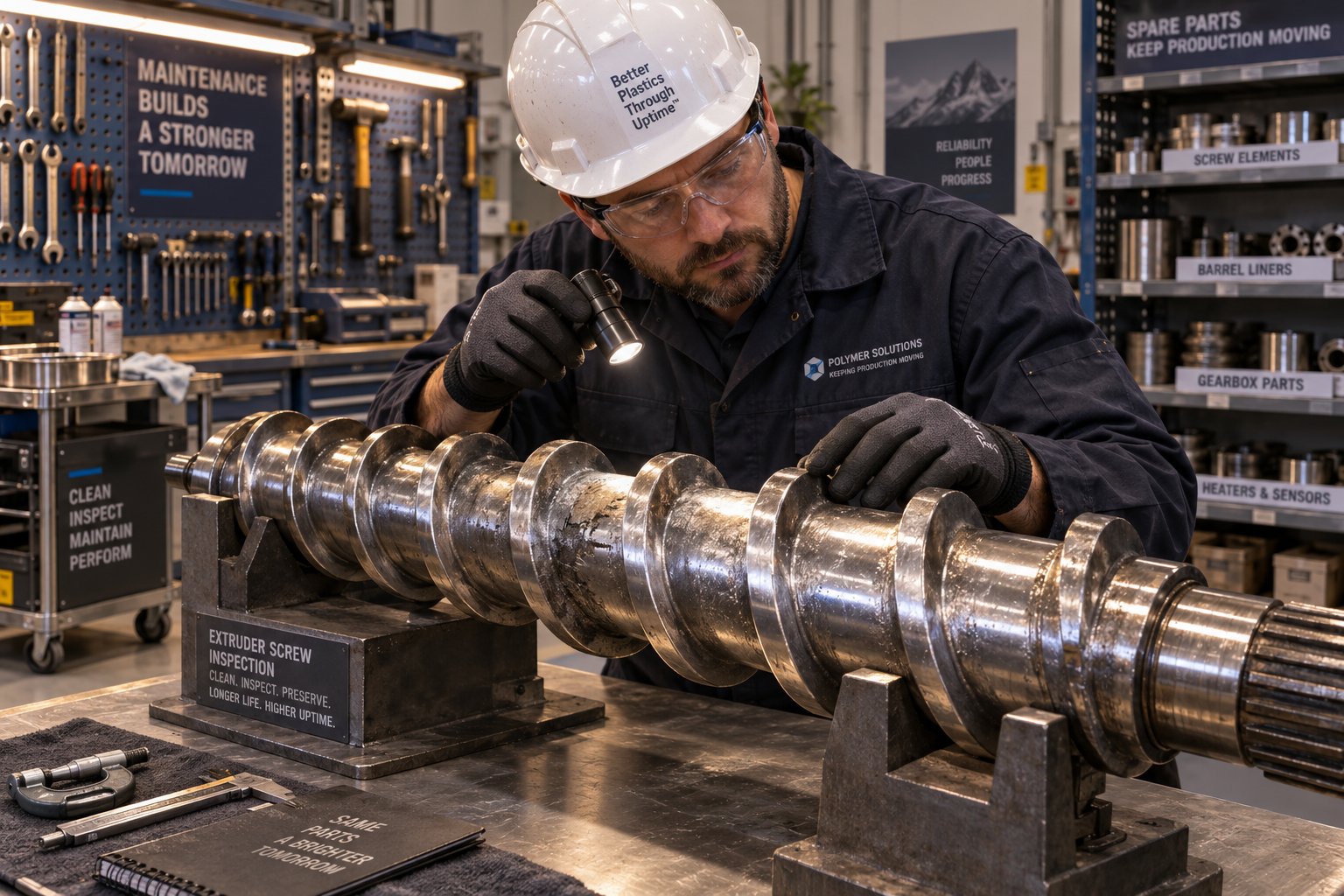
Emerging Trends and Long-Term PET Sheet Extrusion Maintenance
A perfectly selected and commissioned line doesn't stay perfect on its own. Wear is constant, technology evolves, and the gap between a well-maintained machine and a neglected one widens with every production hour. Staying competitive means paying attention to both the plastic extrusion machine trends reshaping the industry and the hands-on maintenance routines that keep your current equipment performing at its best.
Innovations Shaping Modern PET Sheet Lines
The wave of extrusion technology unveiled at K 2025 and in the months following points to two clear priorities across equipment builders: eliminating process bottlenecks and making recycled feedstocks easier to handle cleanly.
Drying-free direct extrusion is arguably the most impactful trend for PET processors. Battenfeld-Cincinnati's Dual Vent Technology (DVT), demonstrated on the BC 120-40 DVT extruder, uses two independent degassing zones along the processing unit to pull moisture and volatiles directly from the melt. The company says this can reduce or even eliminate the need for pre-drying, letting processors run untreated regrind without sacrificing quality. For PET sheet operators who spend hours and significant energy crystallizing and drying resin before it ever touches the screw, that's a potential game changer. Similarly, Erema's Volex water-stripping process doses water into the melt to multiply exposed surface area roughly 1,000-fold, boosting volatile removal by up to 40% in recycled pellets.
Energy-efficient servo-driven motors continue replacing older hydraulic and AC drive systems across both PET and pp sheet extrusion line configurations. Permanent magnet synchronous motors deliver higher torque density at lower energy consumption, and the solEX NG platform from Battenfeld-Cincinnati claims roughly 25% higher output on certain polymers compared with earlier designs, partly through improved drive efficiency.
Advanced inline monitoring is where the biggest long-term operational gains are materializing. Coperion's new Lifecycle Manager uses operating hours and performance data to forecast service needs and log maintenance history, while condition-monitoring on their ZSK 58 Mc18 watches for vibration anomalies in the motor, gearbox, and process section. Milacron's MosaicX control platform now monitors over 50 parameters simultaneously with graphical trending across multiple extruders and downstream equipment. Even barrel wear itself is getting the digital treatment: GL Control's Citris system uses an optical measuring head to scan the full internal geometry of an extruder barrel, generating 3D images from up to 50 million data points that flag wear or localized breakouts against a reference state.
Taken together, these innovations share a common thread: they give processors more data, more control, and fewer reasons to accept "run it until it breaks" as a maintenance philosophy.
Preventive Maintenance for Barrels, Screws, and Dies
Technology trends are exciting, but the most immediate ROI for any pet sheet extrusion maintenance program comes from disciplined, scheduled upkeep of the components that wear every hour the line runs. Preventive maintenance directly impacts three things operators care about most: uptime, sheet quality consistency, and energy efficiency.
Imagine your extrusion line as a chain where every component degrades on its own timeline. Heater bands lose efficiency gradually, raising duty cycles from a normal 40-70% range toward 90% or higher before failing entirely. Screen changers accumulate pressure drop as contaminants load the mesh. Die lip surfaces develop micro-scratches that evolve into persistent die lines. And barrel and screw surfaces lose dimensional precision one micron at a time, invisibly degrading melt homogeneity until the day output drops noticeably or reject rates spike.
Predictive maintenance data from extrusion operations shows that monitoring these degradation curves, rather than waiting for failure, typically delivers a 35-50% reduction in unplanned downtime within the first six months. The financial case is equally stark: a catastrophic screw seizure on a production extruder can cost $31,500 to $153,000 when factoring in the replacement screw, potential barrel re-bore, production loss, material waste, and expedited shipping. A planned replacement with advance ordering and scheduled downtime reduces that total to $11,500 to $36,500.
The following intervals provide a practical starting framework for critical component maintenance. Adjust based on your specific materials, production intensity, and OEM recommendations:
- Barrel and screw measurement: Every 2,000-4,000 operating hours, or during any planned shutdown. Track flight clearance, metering depth, and barrel bore diameter against original specifications. New screws typically maintain 0.002-0.004 inches of clearance per side; performance degrades noticeably at 0.010-0.012 inches.
- Heater bands: Inspect and test resistance quarterly. Replace individual bands when duty cycle trends consistently above 85% or when zone temperature undershoots setpoint by more than 5°F.
- Thermocouples: Calibrate or replace annually, or sooner if zone temperature readings become noisy with swings that don't correlate to adjacent zones.
- Screen changer: Inspect sealing surfaces and hydraulic seals every 1,000-2,000 hours. Replace screen packs based on melt pressure rise rate, not fixed time intervals. Schedule a change when pressure reaches 80% of your pre-set maximum.
- Die lip surfaces: Inspect and clean at every product changeover. Polish or recondition die lands when persistent die lines no longer respond to cleaning.
- Gear pump: Check for seal leakage and pressure stability monthly. Full rebuild intervals depend on throughput and polymer type, but 8,000-12,000 hours is a common benchmark.
- Gearbox oil: Analyze oil quality every 2,000 hours. Monitor gearbox temperature continuously as a leading indicator of bearing wear.
When to Replace vs Recondition Critical Wear Parts
Every barrel and screw eventually crosses a threshold where continuing to run costs more in scrap, energy, and lost output than replacing the component outright. The challenge is knowing exactly where that threshold sits for your operation.
The telltale signs of wear accumulate gradually. You'll notice output dropping at the same screw RPM, operators compensating by increasing speed, melt temperature creeping above barrel setpoints by 8-15°F, and motor amperage climbing as the screw works harder to push the same volume of material. Tracking the ratio of output rate to screw RPM over time builds a wear curve specific to your screw, barrel, and material combination. After two or three replacement cycles with full data, you can predict replacement timing within weeks, converting a potential emergency into a planned event.
The replace-versus-recondition decision follows a straightforward logic:
| Wear Condition | Measurement Indicators | Recommended Action |
|---|---|---|
| Mild wear | Flight clearance under 0.006 inches; output within 95% of baseline | Continue monitoring; plan for future service |
| Moderate wear | Flight clearance 0.006-0.010 inches; output 85-95% of baseline; melt temp +8-15°F above setpoint | Schedule reconditioning: hard-face screw flights, hone barrel bore |
| Severe wear | Flight clearance exceeds 0.010 inches; output below 85% of baseline; melt temp more than 15°F above setpoint | Replace screw and evaluate barrel; reconditioning is no longer cost-effective |
| Cracks, shaft distortion, or scoring | Visible damage during inspection | Replace immediately; do not attempt reconditioning |
Material type dramatically affects wear timelines. Practical operator data shows virgin PET screws lasting 1.5 to 3 years, while lines processing recycled material see lifespans drop to 8-18 months. Filled or reinforced compounds accelerate wear even further, sometimes requiring replacement every 4-10 months.
Here's the cost-saving insight most operators miss: you don't need to replace the entire extruder when the barrel and screw wear out. Sourcing precision-manufactured replacement barrels from dedicated suppliers like NANHAIYA, which engineers custom and replacement single screw barrels specifically for sheet extrusion applications, can restore extruder performance to original specifications at a fraction of full machine replacement cost. For operations managing aging extrusion lines, this approach extends the productive life of proven equipment while maintaining the melt quality and dimensional consistency that PET sheet demands.
Whether you're investing in the latest drying-free extrusion technology or extending the life of a reliable workhorse through disciplined maintenance and quality replacement components, the underlying principle stays the same: long-term success with PET sheet extrusion depends on understanding what's happening inside your machine, not just watching what comes out the other end.
Frequently Asked Questions About PET Sheet Extrusion Machines
1. What is the most critical step before running PET through a sheet extrusion machine?
Drying the PET resin to below 50 ppm moisture content is the single most critical pre-processing step. PET is highly hygroscopic, and any residual moisture triggers hydrolytic degradation at melt temperatures, breaking polymer chains and causing bubbles, haze, and reduced mechanical strength in the finished sheet. This requires a dedicated crystallizer-dryer system using desiccant air with dew points below -40°C, typically running for 4 to 6 hours at around 160°C. Skipping or shortcutting this step produces defects that no amount of downstream adjustment can correct.
2. How do I choose between a single-screw and twin-screw extruder for PET sheet production?
The choice depends primarily on your feedstock composition. Single-screw extruders are the industry standard for processing virgin PET or moderate recycled content because they offer lower capital cost, simpler maintenance, and proven reliability. Twin-screw extruders cost two to three times more but provide superior mixing and devolatilization, making them ideal when recycled PET content exceeds 50% or when processing variable-quality feedstocks. Regardless of configuration, barrel and screw quality remains critical. Suppliers like NANHAIYA offer custom-engineered replacement single screw barrels specifically designed for sheet extrusion, helping operators maintain peak performance over time.
3. What causes yellowing or discoloration in extruded PET sheet?
Yellowing in PET sheet is caused by thermal degradation, which occurs when barrel temperatures are set too high, when material sits in the barrel too long at reduced throughput, or when excessive regrind with accumulated thermal history is reintroduced into the process. PET oxidizes under these conditions, producing a yellowish tint and reduced transparency. The corrective approach involves optimizing barrel temperature profiles zone by zone based on OEM guidance, maintaining stable production speeds to minimize residence time, and carefully limiting the percentage of regrind blended back into the feedstock.
4. What output capacity should I look for when buying a PET sheet extrusion line?
Output capacity should be matched to your current production demand plus 15-20% headroom for growth, maintenance windows, and product changeovers. Small-scale producers typically start at 300-500 kg/hr, mid-sized packaging manufacturers target 500-800 kg/hr, large operations run 800-1,500 kg/hr, and industrial-scale continuous lines exceed 1,500 kg/hr. Beyond raw throughput, you must also consider sheet width, thickness range, and end-product application, as food-grade APET trays, oven-safe CPET containers, and display materials each impose different equipment requirements on filtration, calender design, and cooling systems.
5. How often should I replace the screw and barrel on a PET sheet extruder?
Replacement intervals vary significantly based on the material being processed. Lines running virgin PET typically see screw lifespans of 1.5 to 3 years, while recycled PET operations may require replacement every 8 to 18 months due to higher abrasion and contamination. Key indicators include output dropping at the same screw RPM, melt temperature climbing more than 8-15°F above setpoint, and flight clearance exceeding 0.010 inches. Rather than replacing the entire extruder, operators can source precision-manufactured replacement barrels from specialists like NANHAIYA to restore performance to original specifications at a fraction of full machine cost.
Written by
Nanhaiya Technical Team
Zhoushan Nanhaiya Plastic Machinery Co., Ltd.
The Nanhaiya technical team supports screw and barrel manufacturing projects through application review, technical communication, custom manufacturing coordination, and production and quality control.
Discuss Your Application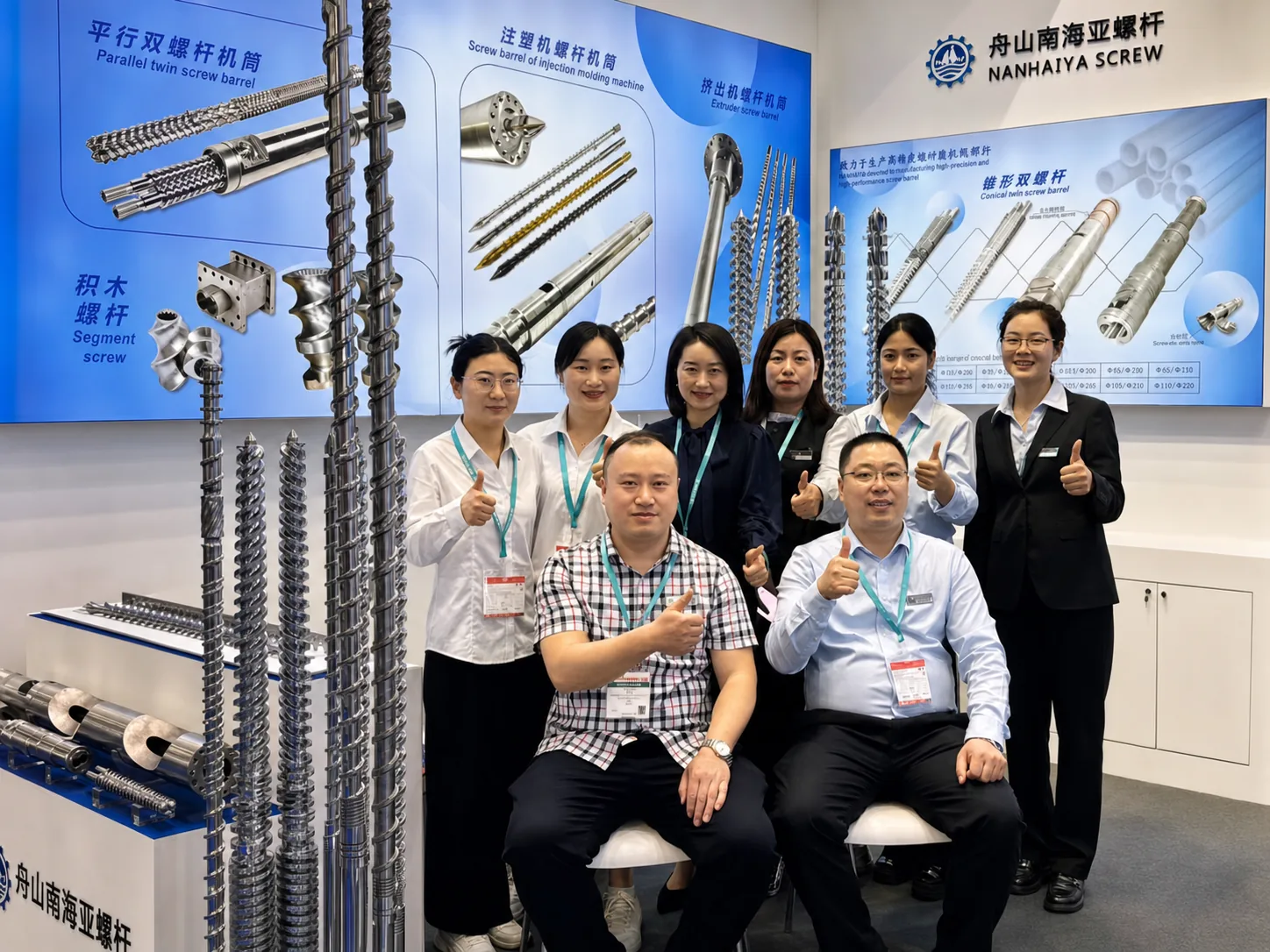
Related Articles
More insights on screw barrel technology and plastics processing.
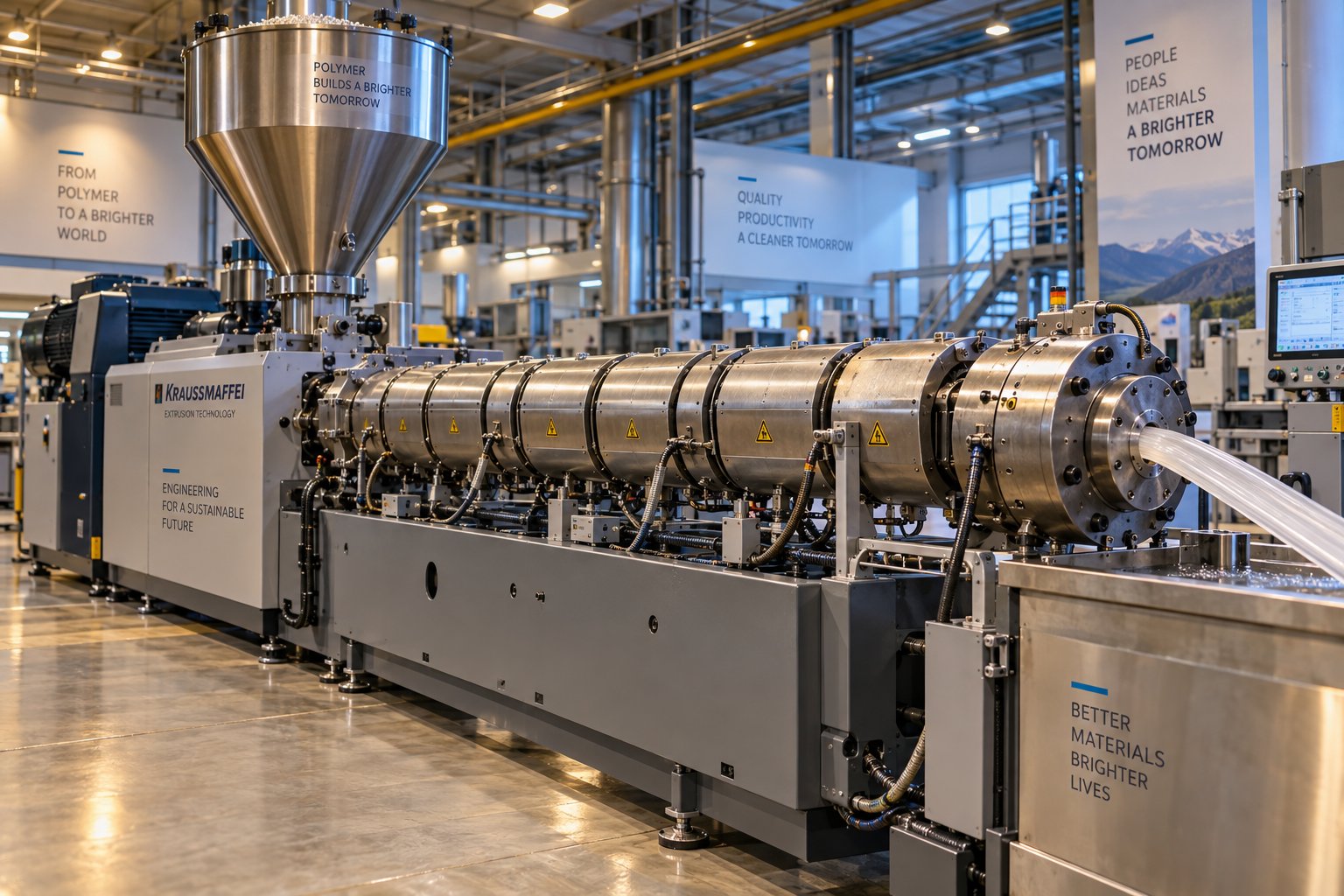
Extruder Machine Decoded: From Raw Pellet To Finished Product
Oct 6, 2026
Learn how an extruder machine works, compare single-screw vs. twin-screw types, and get expert guidance on specs, troubleshooting, and selection.
Read Article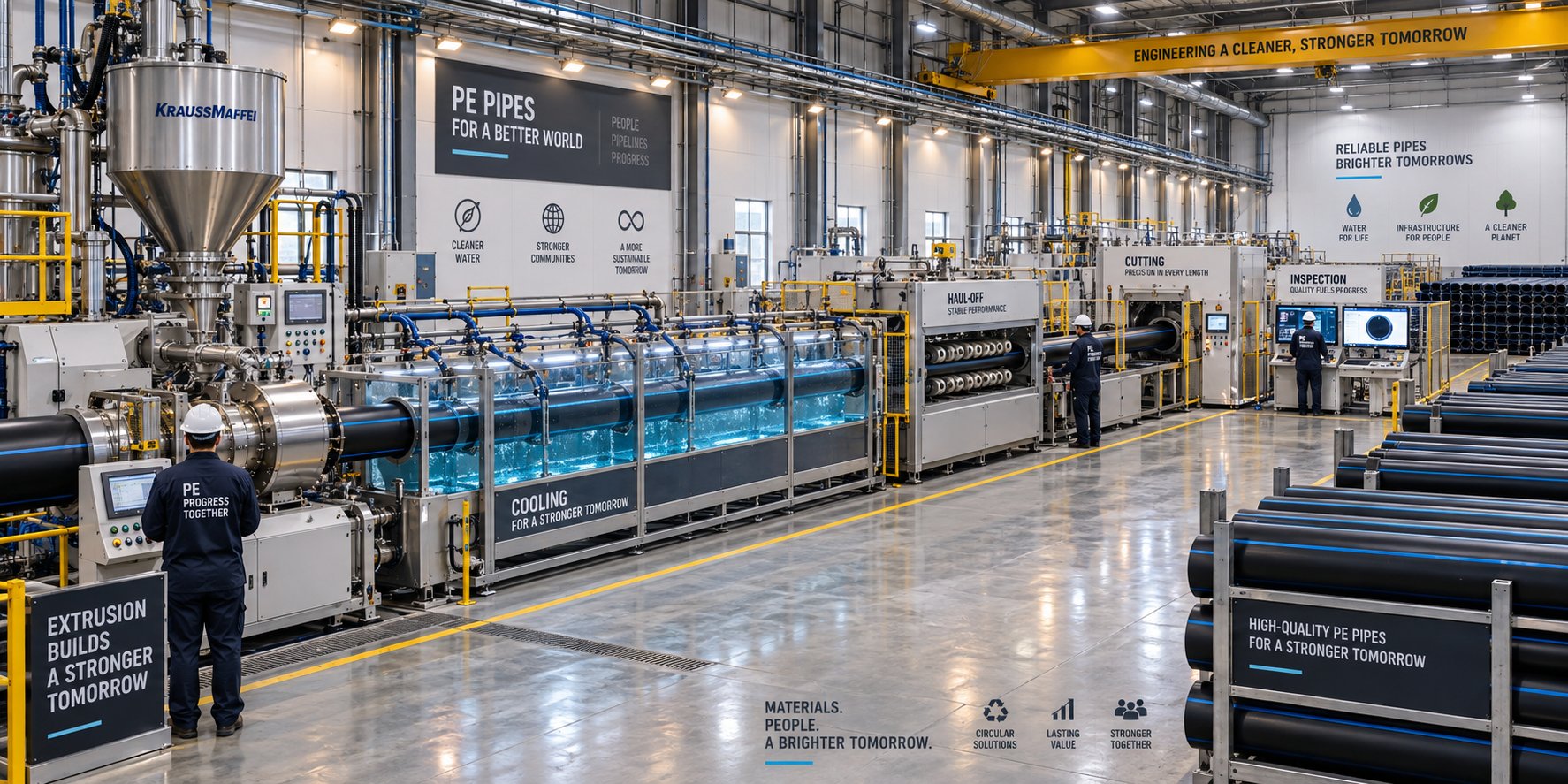
PE Pipe Making Machine Decoded: From Raw Resin to Flawless Pipe
Oct 4, 2026
Learn how a PE pipe making machine works, from resin to finished pipe. Covers components, material grades, automation, troubleshooting, and buyer selection tips.
Read Article
PVC Profile Making Machine Decoded: From Raw Resin To Profit
Oct 3, 2026
Learn how a PVC profile making machine works — extrusion process steps, key technical parameters, die design, calibration methods, maintenance, and total cost of ownership.
Read ArticleLooking for something else?
Search by material, symptom or product and jump straight to the relevant page.
These are navigation suggestions based on keyword matching — not a quotation, not a delivery commitment, and not a substitute for engineering review. Final specification is confirmed by our engineers against your drawings and processed material.
Need help with screw barrel selection?
Share your machine model, processed material and application. Our team can help with pricing and technical support.