

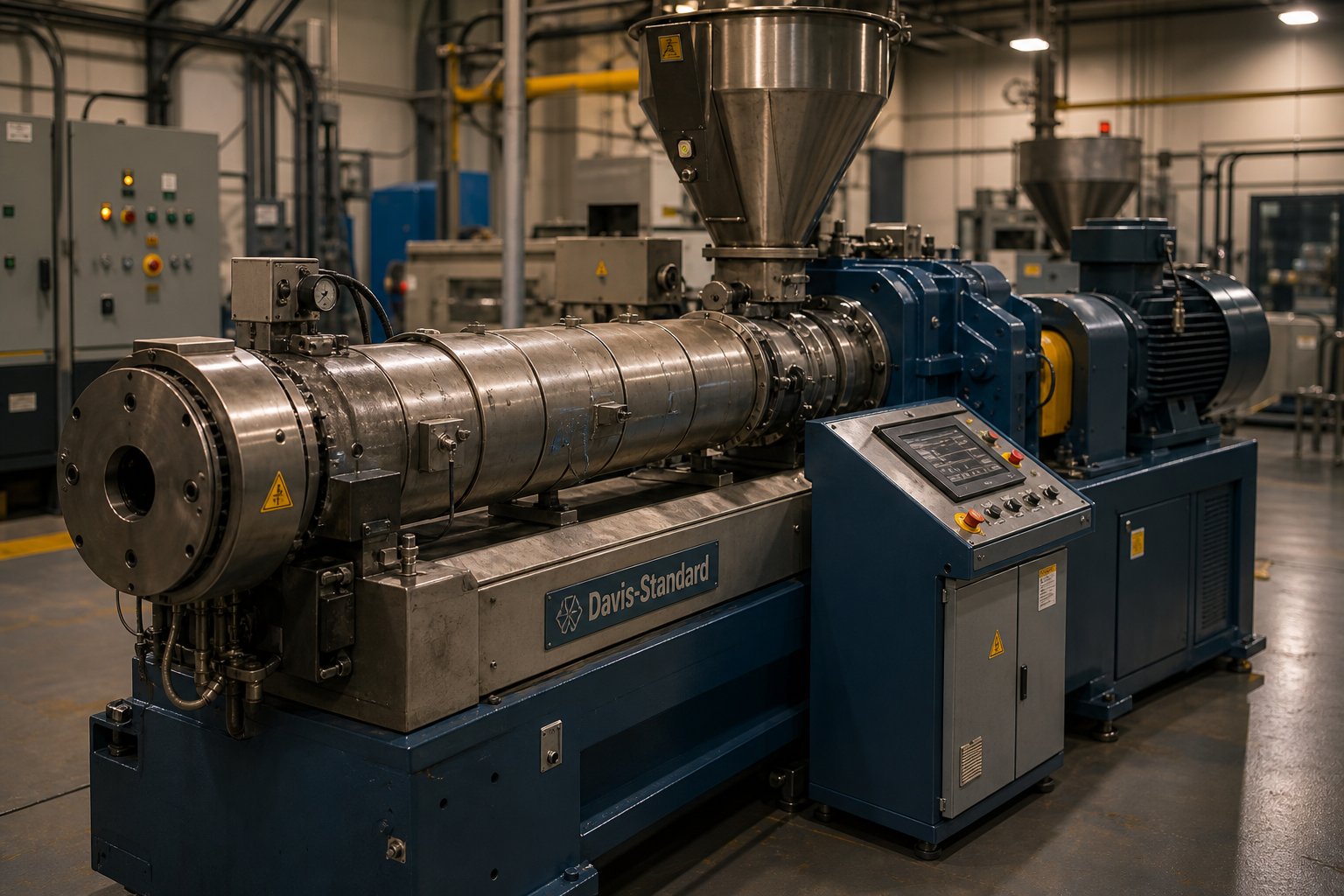
What a Single Screw Extruder Is and How It Works
A single screw extruder is a continuous processing machine that uses one rotating screw inside a heated barrel to melt, mix, and push thermoplastic material through a shaped die, producing a consistent cross-sectional profile such as pipe, film, sheet, or custom shapes.
If you're shopping for used single screw extruders, here's a reality most sellers won't tell you: you can't judge a deal without understanding what you're actually looking at. So what is an extrusion machine at its core? It's a carefully engineered system of interdependent components, and weakness in any single one can quietly drain your productivity and profits. Let's break it down in plain terms.
Core Components of a Single Screw Extruder
Every single screw extruder, whether brand new or decades old, relies on the same fundamental building blocks working in harmony. When you're evaluating a used extruder machine, knowing what each part does helps you spot problems a seller might gloss over.
- Screw — The heart of the system. This helical shaft rotates inside the barrel to convey, compress, melt, and meter the plastic material forward toward the die.
- Barrel — A precision-machined steel cylinder that encloses the screw, forming the sealed chamber where all the heating, mixing, and pressurizing takes place.
- Feed throat — The entry point where raw material drops from the hopper into the barrel. It's typically water-cooled to prevent pellets from melting prematurely and bridging.
- Heater bands — Electrical heating elements clamped around the barrel in multiple zones, each independently controlled to maintain the precise temperature profile required for a given polymer.
- Drive motor — Supplies the rotational energy that turns the screw. You'll encounter both AC and DC motor configurations, each with different implications for maintenance and parts availability.
- Gear reducer — Converts the motor's high-speed, low-torque output into the low-speed, high-torque rotation the screw actually needs. It also houses the thrust bearing assembly that resists back-pressure from the die.
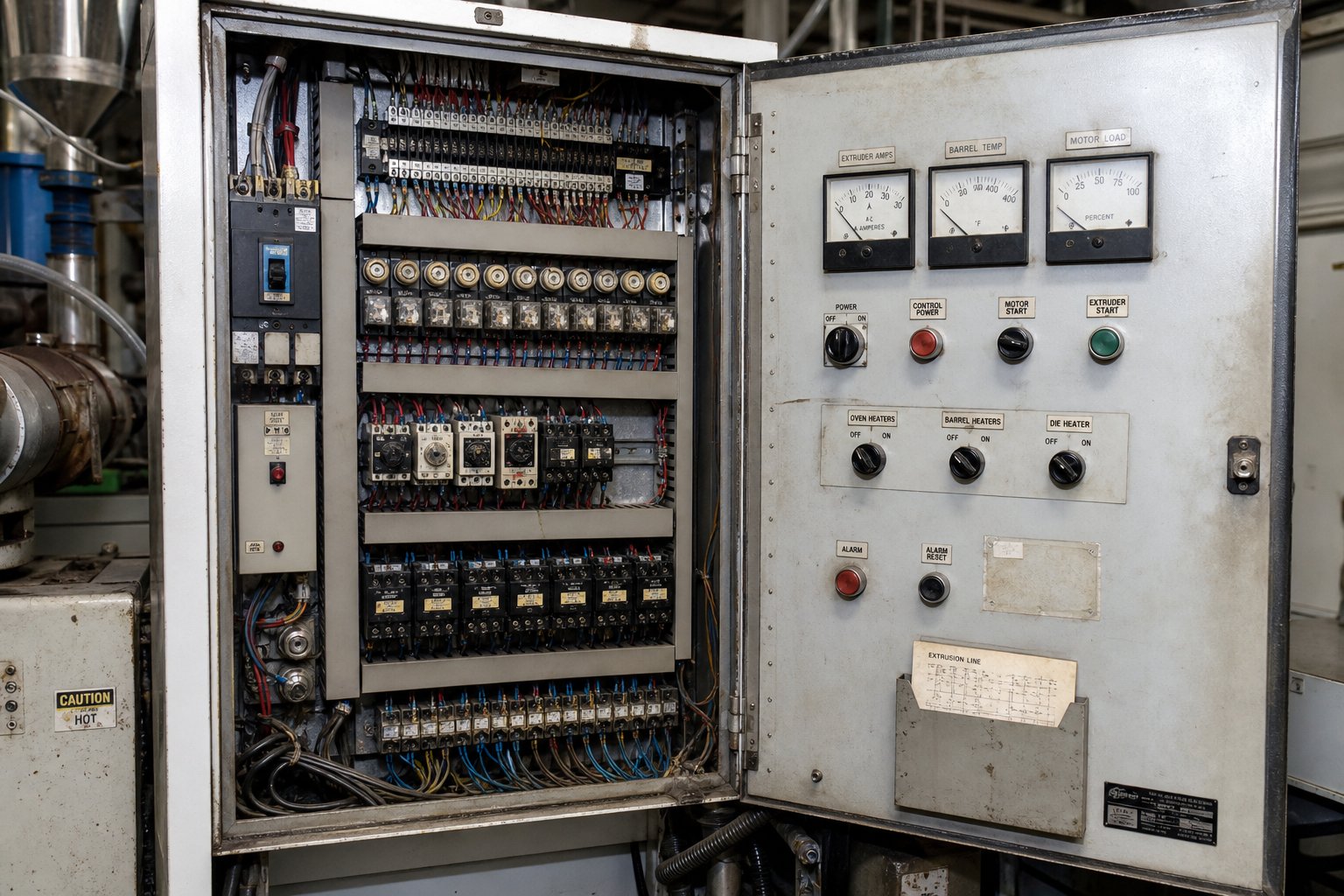
- Control panel — The operator interface that manages barrel zone temperatures, screw speed, motor amperage readouts, and safety interlocks. Panels range from simple analog controllers to modern PLC-based systems.
How the Extrusion Process Works Step by Step
Imagine dropping a handful of small plastic pellets into the top of the machine. What is a plastic extruder actually doing with those pellets? The screw's geometry divides the barrel into three functional zones, and each zone has a specific job.
In the feed zone, the screw's deep channel flights grab the solid pellets and push them forward. Friction between the material, barrel wall, and screw surface is what keeps everything moving — without the right friction balance, pellets simply spin in place. The barrel begins heating the material, but at this stage the plastic is still mostly solid.
As material enters the compression zone, the screw channel gradually becomes shallower. This squeezes the pellets together, eliminating air gaps and dramatically increasing pressure. Combined with rising barrel temperatures and shear heat generated by the screw's rotation, the solid pellets transition into a viscous melt. This is where the real plasticization happens.
Finally, in the metering zone, the channel depth remains constant and shallow. The screw's job here is to homogenize the melt — ensuring uniform temperature, consistent viscosity, and steady pressure — before pushing it through a screen pack and out through the die. The die's internal shape determines the final product profile, whether that's a round pipe, a flat sheet, or a complex window frame cross-section.
Why Understanding the Machine Matters When Buying Used
Here's where this knowledge pays for itself. Every component listed above wears differently, fails differently, and costs a different amount to repair or replace. A plastic extruder with a worn screw and barrel might look perfectly fine on the outside while quietly delivering inconsistent output that ruins your margins. A machine with an obsolete control panel might run today but become impossible to service next year.
When you understand how each part contributes to the extrusion process, you can ask the right questions, request the right measurements, and see through vague assurances like "runs great" or "low hours." That understanding is the difference between finding a genuinely valuable used extrusion machine and inheriting someone else's expensive problem — which is exactly what the rest of this guide will help you navigate.
Single Screw vs Twin Screw Extruders Compared
Before you spend hours browsing listings for used single screw extruders, there's a more fundamental question worth answering first: is a single screw extruder machine actually the right type for your process? It's a question many buyers skip entirely, and it can lead to purchasing a perfectly functional machine that simply doesn't suit the job. A quick comparison between single and twin screw designs will either confirm you're on the right track or save you from a costly mismatch.
How Single and Twin Screw Designs Differ Mechanically
The distinction starts with a straightforward structural difference. A single screw extruder uses one rotating screw inside a cylindrical barrel. A twin screw extruder uses two screws — either co-rotating (both turning the same direction) or counter-rotating (turning opposite directions) — housed inside a figure-eight shaped barrel bore. Those two screws can be intermeshing, meaning their flights overlap and interact, or non-intermeshing, where they operate side by side with minimal engagement.
That mechanical difference creates dramatically different processing behaviors. In a single screw design, the polymer follows a helical channel down one screw. Shear rate is highest at the barrel wall and drops toward the screw root, which means the material near the center of the channel receives less mixing energy. As Plastics Technology explains, this velocity stratification limits how thoroughly a single screw can mix the contents of its channel.
Twin-screw extruders overcome this limitation through screw-to-screw material transfer. Intermeshing designs can move the entire channel's contents from one screw to the other — repeatedly — applying short bursts of high shear to small portions of the melt without overheating the bulk. The screws also run starved (not fully filled), which provides available volume for those transfers with minimal pressure drop. This is why twin screw extruders deliver far more intensive distributive and dispersive mixing than any single screw design can practically achieve.
For buyers, the takeaway is practical: if your process depends on thorough internal mixing — blending multiple additives, dispersing fillers, or reacting components — a single screw extruder is not designed to deliver that, regardless of brand or condition. Conversely, if your feedstock is already compounded into uniform pellets and your line mainly needs stable melting, pressure, and output, the added complexity of twin-screw extruders may not add real production value.
Choosing the Right Extruder Type for Your Process
Think of it this way: single screw extruders excel at steady-state melting and pumping. They take consistent pelletized material and deliver it reliably to a die at uniform pressure and temperature. That makes them the workhorse for pipe, profile, film, sheet, and tubing production lines where the resin arrives pre-compounded and the priority is output stability.
Twin screw extruders earn their place when the extruder itself must do the mixing. Compounding machines that blend base resins with high filler loads, color masterbatch lines, reactive extrusion processes, and operations handling PVC dry-blend powder all benefit from the intensive mixing and controlled residence time that twin screw architecture provides. If you see a twin screw extruder for sale alongside single screw listings and wonder whether it might be the better buy, the answer depends entirely on whether your process actually needs that mixing capability.
The table below puts the key decision factors side by side to help you confirm which type fits your application before you move into evaluating specific machines.
| Factor | Single Screw Extruder | Twin Screw Extruder |
|---|---|---|
| Typical Applications | Pipe, profile, film, sheet, tubing, and wire coating from pre-compounded pellets | Compounding, masterbatch production, reactive extrusion, PVC powder processing, and recycling with variable feedstock |
| Mixing Capability | Low to moderate — adequate for homogenizing pre-compounded melts | Moderate to high — capable of dispersive and distributive mixing of additives, fillers, and blends |
| Throughput Consistency | Excellent for steady-state operation with uniform feed material | Very good, though more sensitive to feed consistency and screw configuration |
| Maintenance Complexity | Lower — fewer wear components, simpler screw removal and cleaning | Higher — more wear parts, segmented screw elements, and tighter process control requirements |
| Operator Skill Required | Moderate — easier to train new operators | Higher — demands deeper process knowledge for setup and troubleshooting |
| Used Market Price Range | Generally lower acquisition cost for comparable bore sizes | Generally higher, reflecting greater mechanical complexity and broader processing capability |
One critical pattern emerges from this comparison: the right extruder is not the more sophisticated one — it's the one whose capabilities match your actual material and product. Buying a twin screw for a straightforward PE pipe line adds cost and complexity without adding value. Buying a single screw for a high-filler compounding operation sets you up for frustration and poor product quality, no matter how good the deal looks.
With the right extruder type confirmed, the next logical step is matching machine specifications to your specific application — because even within the single screw category, the bore size, L/D ratio, and screw geometry that a pipe producer needs look very different from what a film line requires.
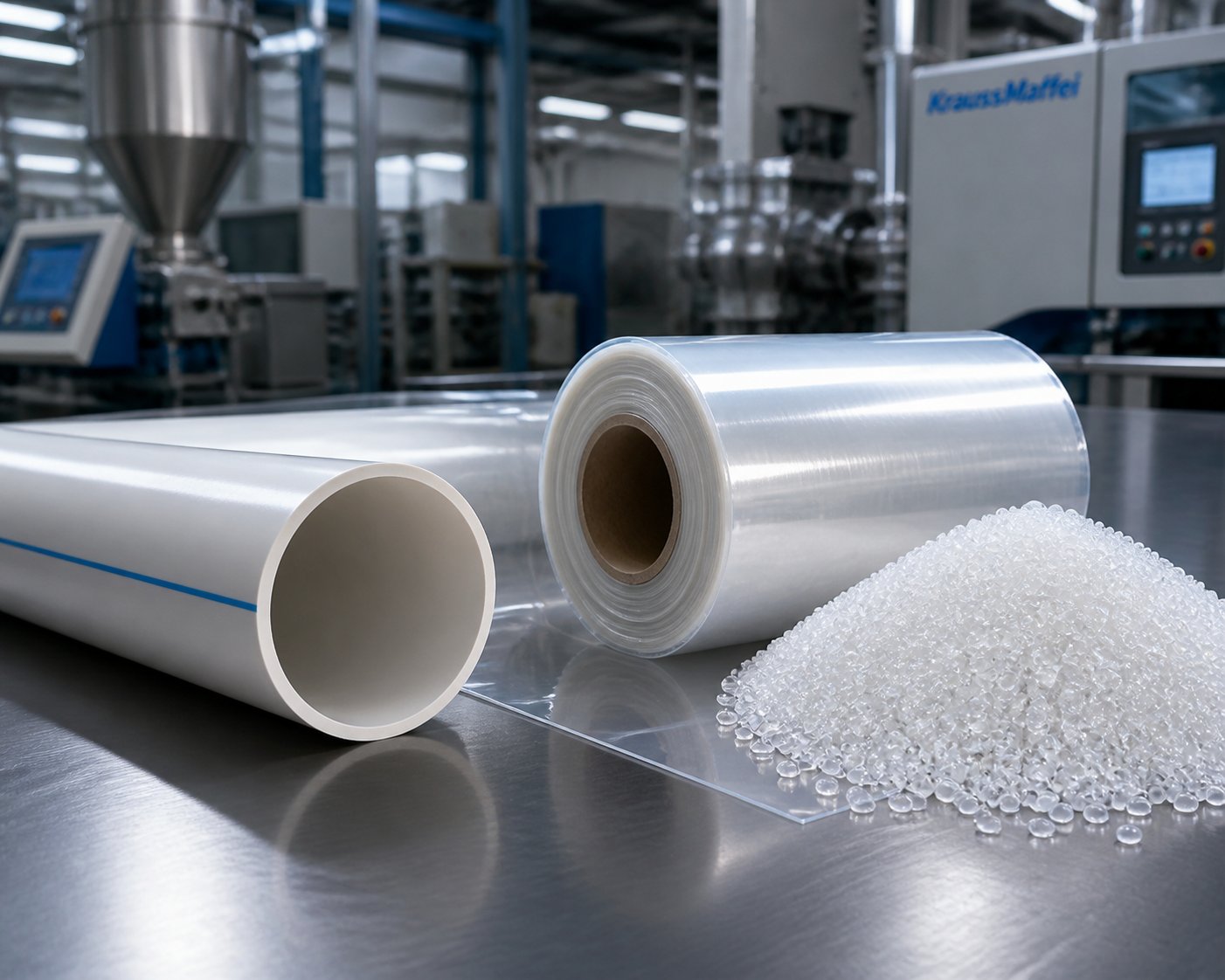
Matching a Used Extruder to Your Application
A used single screw extruder that's perfect for one product line can be completely wrong for another — even if the bore size, brand, and asking price all look reasonable. The specifications that matter most shift dramatically depending on whether you're producing pipe, blowing film, casting sheet, or pelletizing recycled material. Starting from your end product and working backward to the machine specs is the fastest way to filter out listings that will never work for you.
Pipe and Profile Extrusion Requirements
If you're running a plastic pipe extrusion machine or producing custom profiles, the extruder needs to deliver a stable, consistent melt at relatively high pressures. That puts specific demands on three specifications most sellers won't bring up on their own.
L/D ratio matters here more than in almost any other application. A PVC extruder processing rigid pipe compound typically needs an L/D of 24:1 to 28:1 to achieve full plasticization without degrading the heat-sensitive resin. Polyolefin pipe producers can often use slightly shorter L/D ratios, but anything below 24:1 risks unmelted material reaching the die — and that shows up as weak spots in the pipe wall.
Screw design is the next filter. PVC pipe and profile applications demand low-compression screws with gradual transitions to avoid generating excessive shear heat. Polyethylene and polypropylene pipe, by contrast, tolerates higher compression ratios and benefits from barrier screw designs that separate the solid bed from the melt pool. Buying a used plastic pipe extruder with a PE-optimized screw for a PVC line — or vice versa — guarantees problems from day one.
Barrel bore size directly determines the range of pipe diameters you can produce. Smaller bore machines (2.5" to 3.5") suit pipe diameters up to roughly 110mm, while larger bores (4.5" to 6") handle pipe up to 315mm or beyond. A plastic profile extrusion machine follows similar logic: the more complex the profile cross-section, the higher the melt pressure required, which pushes you toward a larger bore with adequate drive power. Equally important, confirm that the used extruder's output flange and barrel centerline height are compatible with your downstream calibration tanks, haul-offs, and saws.
Film and Sheet Extrusion Requirements
Blown film and flat sheet lines are far less forgiving of melt inconsistency than pipe operations. Even small temperature variations in the melt stream translate into gauge bands — visible thickness variations that ruin the finished product's appearance and mechanical performance.
You'll want to focus on tight melt temperature uniformity, which means looking for machines with a sufficient number of independently controlled barrel heating and cooling zones. A plastic sheet extrusion machine running HDPE or PP sheet typically needs at least four to five barrel zones plus a separate adapter zone to hold melt temperature within a 2-3 degree Celsius window across the entire output stream.
Screw geometry is equally critical for film and sheet. Barrier screws — designs that use a secondary flight to physically separate unmelted solids from the melt — reduce the chance of unmelt particles reaching the die. Mixing sections such as Maddock or pineapple mixers further homogenize temperature and composition. When evaluating used plastic extrusion machines for film or sheet work, always ask what screw type is installed and whether it's original to the machine or a replacement. A general-purpose metering screw on a blown film line will produce mediocre gauge uniformity no matter how well-maintained the rest of the machine is.
Output rate consistency also demands attention. Film and sheet dies are sensitive to pressure surges — even brief ones — that create thickness variations downstream. A worn screw or barrel combination that causes output pulsation might be tolerable on a pipe line but completely unacceptable for film production.
Pelletizing and Recycling Line Considerations
Recycling and pelletizing operations occupy the opposite end of the tolerance spectrum. These lines often handle inconsistent feedstock — regrind flake, post-industrial scrap, or post-consumer waste with variable moisture, contamination, and melt flow index. That reality actually works in a buyer's favor when shopping for used equipment, because pelletizing and recycling lines can tolerate a wider range of machine conditions than precision film or profile work demands.
The feed section, however, needs to be robust. Regrind and flake material is bulkier and less uniform than virgin pellets, which means the feed throat and early screw flights take more abuse. Check for excessive wear in the first few diameters of the screw and barrel, where abrasive contaminants in recycled feedstock concentrate their damage.
Vented barrels are another key consideration. Moisture-laden regrind releases steam and volatiles during melting, and without a vent port to evacuate those gases, you'll see porosity, bubbles, and surface defects in the finished pellet. Many used single screw extruders were originally built for non-vented operation. Retrofitting a vent is sometimes possible but adds cost and complexity — so a machine already equipped with venting carries a real advantage for recycling applications.
Use the checklist below to quickly match any used extruder listing to your target application before investing time in a full inspection.
- Pipe and profile: Bore size matched to target pipe diameter range; L/D ratio of 24:1 to 28:1 for PVC or 24:1+ for polyolefins; low-compression screw for PVC, barrier screw for PE/PP; drive power adequate for sustained high melt pressure; downstream flange and centerline height compatibility.
- Film and sheet: Minimum four to five independent barrel heating/cooling zones; barrier or mixing screw design for melt homogeneity; consistent output rate with no pulsation; L/D ratio of 24:1 to 30:1 depending on resin; drive motor sized for continuous duty at target throughput.
- Pelletizing and recycling: Robust, unworn feed section capable of handling bulky regrind; vented barrel for moisture and volatile removal; L/D ratio of 28:1 or higher for adequate devolatilization; sufficient motor power to process variable-viscosity feedstock; screen changer compatibility at the barrel discharge.
Every application carries its own non-negotiable specifications — and the ones that matter most are rarely highlighted in a seller's listing description. Knowing your checklist before you start browsing turns a chaotic used equipment market into a focused search. Of course, the brand name stamped on the machine influences more than just bragging rights — it directly affects your ability to source replacement parts, find qualified service technicians, and protect your investment's resale value down the road.
Major OEM Brands and What They Mean for Used Buyers
Browse any listing page for used single screw extruders and you'll see the same handful of brand names appearing over and over — Davis Standard, NRM, American Kuhne, Welex, Milacron, Battenfeld Gloucester. Sellers love to lead with the brand because it sounds impressive. But what does that name actually tell you about the machine's long-term viability in your plant? More than most buyers realize — and less than most sellers imply.
Established North American and European OEM Brands
Among plastic extruder manufacturers with equipment commonly circulating on the secondary market, a few names dominate for good reason. Understanding their current status helps you anticipate what ownership will look like five years from now, not just the day the machine arrives.
Davis Standard remains one of the most recognized extruder manufacturers globally and continues to actively produce equipment and support legacy machines. If you find a Davis Standard extruder for sale, you're generally looking at strong OEM parts availability and broad technician familiarity. Their machines span a wide range of bore sizes and applications, making them among the most frequently listed used extruders.
American Kuhne is another active manufacturer with a solid reputation for precision-built extrusion systems. An American Kuhne extruder tends to hold value well because the company still offers parts, service documentation, and technical support. American Kuhne extrusion lines show up frequently in film, tubing, and medical-grade applications, so you'll sometimes find machines configured with specialized screw designs and tighter-than-standard tolerances.
NRM has a long legacy in the extrusion industry, though the brand has changed hands over the years. An NRM extruder can still be a solid purchase, but buyers should verify current parts sourcing channels directly rather than assuming the original supply chain is intact. Many NRM machines were built with robust gearboxes and heavy-duty frames that hold up well mechanically, even after decades of service.
Welex built a strong name particularly in sheet extrusion. Their machines are well-regarded for flat die applications, and you'll find them frequently in thermoforming supply chains. Parts availability is generally reasonable, though it's worth confirming directly with the current rights holder for your specific model.
Milacron is a broad plastics machinery group whose extrusion equipment benefits from a large installed base. That installed base means replacement components — screws, barrels, heater bands, control boards — are often available through both OEM and aftermarket channels.
Battenfeld Gloucester machines are commonly found in blown film operations. The Battenfeld Gloucester name carries recognition in European and North American markets, though buyers should check whether current ownership structures affect parts and service access for older models.
One critical step applies regardless of brand: contact the OEM or its successor company directly before you buy. Ask whether they still stock parts for your specific model and serial number range. A five-minute phone call can reveal whether you're buying into a well-supported platform or an orphaned machine.
How Brand Affects Parts Availability and Resale Value
Here's the pattern that experienced buyers understand: machines from well-known plastic extrusion machine manufacturers tend to hold their resale value better — not because they're inherently superior in every technical dimension, but because the ecosystem around them remains intact. Replacement screws, barrels, gearbox components, drive boards, and even operator manuals are easier to source. Maintenance technicians are more likely to have hands-on experience with the platform. And when it's time to sell, the next buyer recognizes the name and trusts the machine's pedigree.
Lesser-known or discontinued brands often enter the market at noticeably lower asking prices. That discount can look tempting, but it carries a hidden cost: every replacement part becomes a research project. You may need to reverse-engineer components, commission custom replacements from aftermarket shops, or accept longer lead times that translate into longer downtime. Documentation — wiring diagrams, hydraulic schematics, screw geometry specs — may be unavailable entirely.
The table below puts these trade-offs in perspective so you can weigh the initial savings against the long-term ownership implications.
| Consideration | Well-Known OEM Brand | Lesser-Known or Discontinued Brand |
|---|---|---|
| Parts Sourcing Ease | OEM parts often still available; strong aftermarket support due to large installed base | Parts may require custom fabrication or extensive searching; limited aftermarket options |
| Documentation Availability | Manuals, wiring diagrams, and screw specs generally obtainable from OEM or user networks | Documentation frequently missing; may need to reverse-engineer specifications |
| Technician Familiarity | Service technicians more likely to have direct experience with the platform | Finding technicians with model-specific knowledge can be difficult and costly |
| Resale Trajectory | Holds value relatively well; recognized brands attract broader buyer pool at resale | Depreciates faster; smaller buyer pool makes resale slower and less predictable |
Does this mean you should automatically reject an unfamiliar brand? Not necessarily. A lesser-known machine in excellent mechanical condition — with verified screw and barrel measurements, a sound gearbox, and a modern control system — can still deliver strong value, especially if you have the in-house technical capability to support it. The key is pricing that discount realistically, factoring in the higher parts risk rather than treating the lower sticker price as pure savings.
Brand reputation gives you a starting point, but it's no substitute for actually inspecting the machine. Even the most respected name in the industry can't protect you from a worn barrel, a failing thrust bearing, or an obsolete control panel that the seller conveniently forgot to mention — which is exactly why a structured, component-by-component inspection matters more than any nameplate.
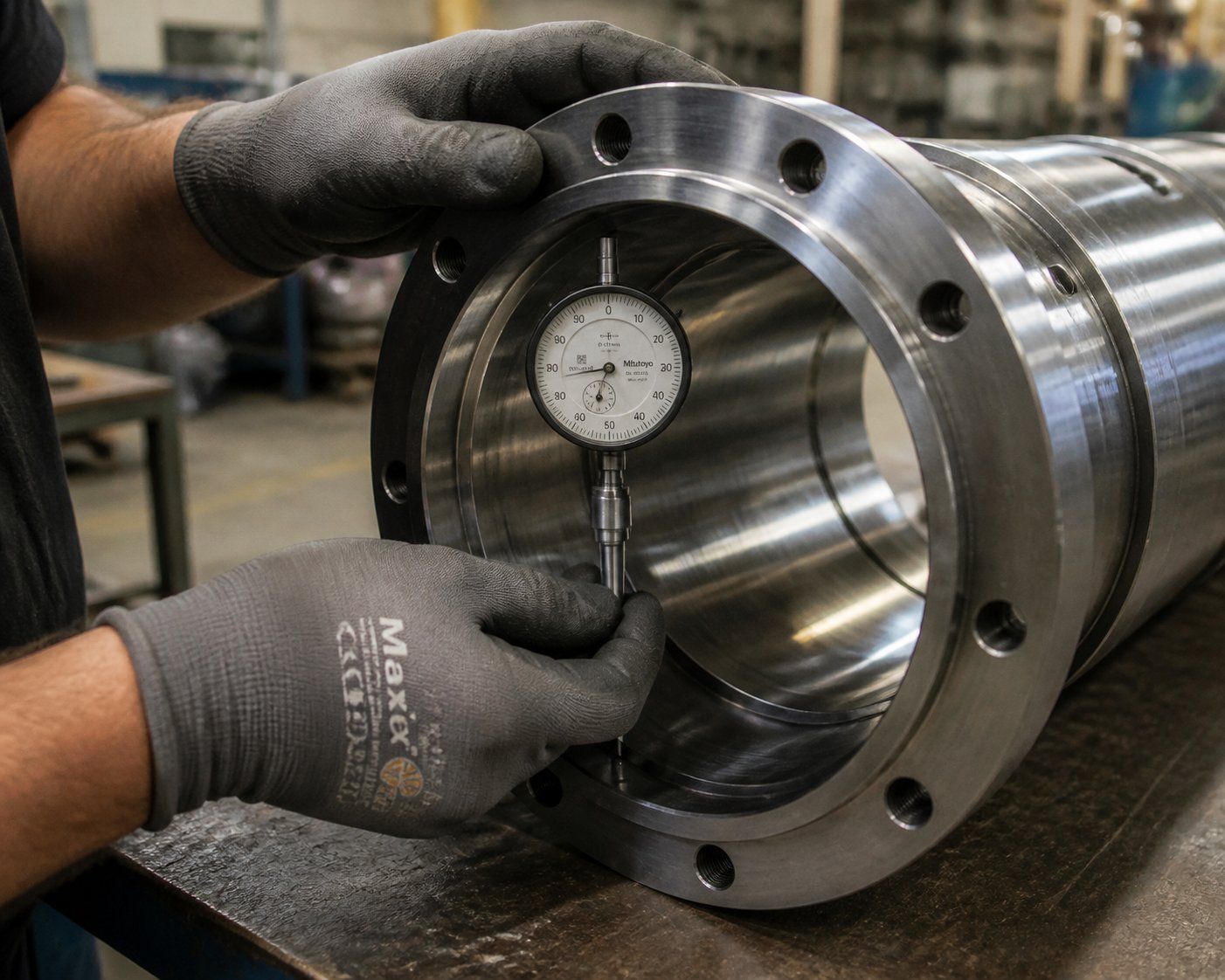
How to Inspect a Used Single Screw Extruder Before Purchase
Screw and barrel wear measurements are the single most important data points to request before purchasing any used extruder. Without documented bore and flight OD readings taken at multiple points along the barrel length, every other claim about the machine's condition is speculation.
A polished exterior and a confident seller can make any used extruder look like a bargain. But the components that actually determine whether that machine will produce quality output — or drain your budget in unplanned repairs — are hidden inside the barrel, behind panel doors, and buried in maintenance records you haven't seen yet. This inspection guide organizes the critical checkpoints by category so you can evaluate any used extruder equipment systematically, whether you're standing on a warehouse floor or reviewing documentation remotely before traveling to see the machine.
Mechanical Inspection Points
The mechanical condition of an industrial extruder tells you more about its true value than any seller's description ever will. Start with the two most critical wear components: the screw and barrel.
Screw flight wear is measured by comparing the outer diameter (OD) of the screw flights to the original specification. Flights wear down over time, and the resulting increase in clearance between flight tip and barrel bore directly reduces pumping efficiency. Ask for micrometer readings at the feed, compression, and metering sections — wear is rarely uniform, and localized wear patterns reveal what materials the machine has been processing.
Barrel bore measurements require a telescoping gauge or bore gauge inserted at several points along the barrel's length. A new barrel has a consistent bore diameter; a worn one shows enlargement — particularly in the compression and metering zones where melt pressure and abrasive contact are highest. Forge Reliability notes that screw-to-barrel clearance increases are progressive and directly reduce the machine's ability to develop pressure and convey material efficiently. Even a few thousandths of an inch of additional clearance can cause measurable output loss and melt quality degradation.
Gearbox and thrust bearing condition deserve careful attention because these components absorb enormous loads during operation — the thrust bearing alone can carry 50,000 to 200,000 pounds of axial force depending on screw diameter. Listen for unusual noise during operation, check for axial play in the screw shaft, and request oil analysis records. Dark or foamy oil, elevated iron or copper particle counts, and rising operating temperatures under stable load all point to internal wear that can lead to catastrophic failure if ignored.
Feed throat wear is frequently overlooked but matters. The feed throat opening takes a beating from abrasive pellets and regrind, and excessive wear here disrupts the feeding consistency that everything downstream depends on.
Electrical and Control System Evaluation
Electrical systems are where the most commonly underestimated refurbishment costs hide. A mechanically sound used extruder with an obsolete control system can require tens of thousands of dollars in upgrades before it runs reliably in your facility.
Motor condition should be verified through insulation resistance testing (commonly called a "megger" test). This measures whether the motor windings' insulation has degraded from moisture, heat, or age. A motor that passes a visual inspection can still be one thermal event away from a burnout if insulation resistance has dropped below acceptable thresholds.
Drive type and age carry significant implications. Many used extruders still run DC drives, which were standard for decades but are increasingly difficult and expensive to service. Replacement DC drive boards and SCR assemblies face growing obsolescence, with some components on lead times stretching beyond a year. AC drive conversions are possible but add substantial cost to the acquisition. When you find a used extruder for sale already equipped with a modern AC inverter drive, that's a genuine value advantage — not just a line item on the spec sheet.
Heater band continuity should be checked with a simple resistance measurement across each band. A single failed heater may go unnoticed by the seller because adjacent zones compensate, masking the fault while creating localized cold spots that degrade melt quality. Infrared thermography of barrel zones under operating conditions can rapidly reveal failed or degrading heaters that resistance checks alone might miss.
Thermocouple accuracy drifts over time, and an inaccurate thermocouple means the temperature you see on the display doesn't match what's actually happening inside the barrel. Cross-checking thermocouple readings against a calibrated reference probe at the same insertion point takes minutes and can reveal errors of 10 degrees or more — enough to shift your process window entirely.
Control panel technology is the area where many buyers get blindsided. As Plastics Technology highlights, a surprising number of extrusion lines still operate without PLCs or with severely outdated ones — meaning no diagnostic features, no runaway heater protection, and no data logging. Upgrading from an analog or legacy relay-based panel to a modern PLC with an HMI touchscreen can cost a substantial portion of the machine's purchase price. Automated extrusion equipment with current-generation controls is increasingly the expectation for safe, efficient operation, and the gap between what older panels offer and what modern production requires is widening every year.
Safety and Documentation Checks
Safety components and paperwork might feel like afterthoughts during the excitement of evaluating a potential purchase, but they carry real financial and legal weight.
Test every safety interlock and emergency stop on the machine. Barrel guards should be intact and properly secured — missing or modified guards are a red flag that suggests the machine may have been operated without proper safety protocols. Verify that the e-stop circuit actually kills motor power rather than simply sending a software command that could be overridden.
Documentation is where many deals fall apart after the purchase, not before. Request everything the seller has: original OEM manuals, wiring diagrams, screw geometry specifications, maintenance logs, and any records of refurbishment or component replacement. Maintenance logs are particularly revealing — a machine with consistent, documented service history is a fundamentally different proposition than one with no records at all, even if both appear to be in similar condition today.
Use the comprehensive checklist below as a printable reference when evaluating any extrusion equipment for sale. Each item represents a data point that separates informed buyers from hopeful ones.
- Screw: Flight OD measurements at feed, compression, and metering zones compared to original specs; visual inspection for cracks, corrosion, or hardface wear-through; check for straightness.
- Barrel: Bore diameter measurements at minimum five points along the length using a telescoping or bore gauge; note any ovality or localized enlargement; check liner condition if bimetallic.
- Gearbox: Listen for abnormal noise under load; check for axial and radial play; request oil analysis records; note oil level, color, and any metallic debris on magnetic drain plugs.
- Thrust bearing: Assess axial play in the screw shaft; request temperature history under stable load; look for signs of past overheating or replacement.
- Feed throat: Inspect bore surface for grooving or erosion; verify cooling water circuit is functional and unobstructed.
- Drive motor: Perform insulation resistance test; check nameplate data against actual wiring; look for signs of overheating, moisture ingress, or bearing noise.
- Drive system: Identify DC vs. AC configuration; assess obsolescence risk of drive boards, SCR stacks, or inverter modules; confirm availability of replacement components.
- Heater bands: Measure resistance on each band; check terminal connections for discoloration or corrosion; verify each zone reaches setpoint independently.
- Thermocouples: Cross-check readings against a calibrated reference probe; replace any with readings that deviate more than a few degrees.
- Control panel: Identify PLC model and software version; assess HMI condition and responsiveness; verify all safety functions are programmed and operational; confirm parameter backup availability.
- Safety systems: Test every e-stop and interlock; inspect barrel guards for completeness and secure mounting; verify lockout/tagout provisions.
- Documentation: Request OEM manuals, wiring diagrams, screw and barrel specifications, maintenance logs, and refurbishment records; note any gaps.
Every item on this list represents something a seller hopes you won't ask about — because the answers often reveal costs that aren't reflected in the asking price. The mechanical internals, electrical systems, and documentation together paint the full picture of what you're actually buying. Yet even when a machine checks most of these boxes, there's one area that demands deeper technical knowledge to evaluate correctly: the metallurgy and wear condition of the barrel and screw themselves, where subtle differences in construction determine how much useful life the machine truly has left.
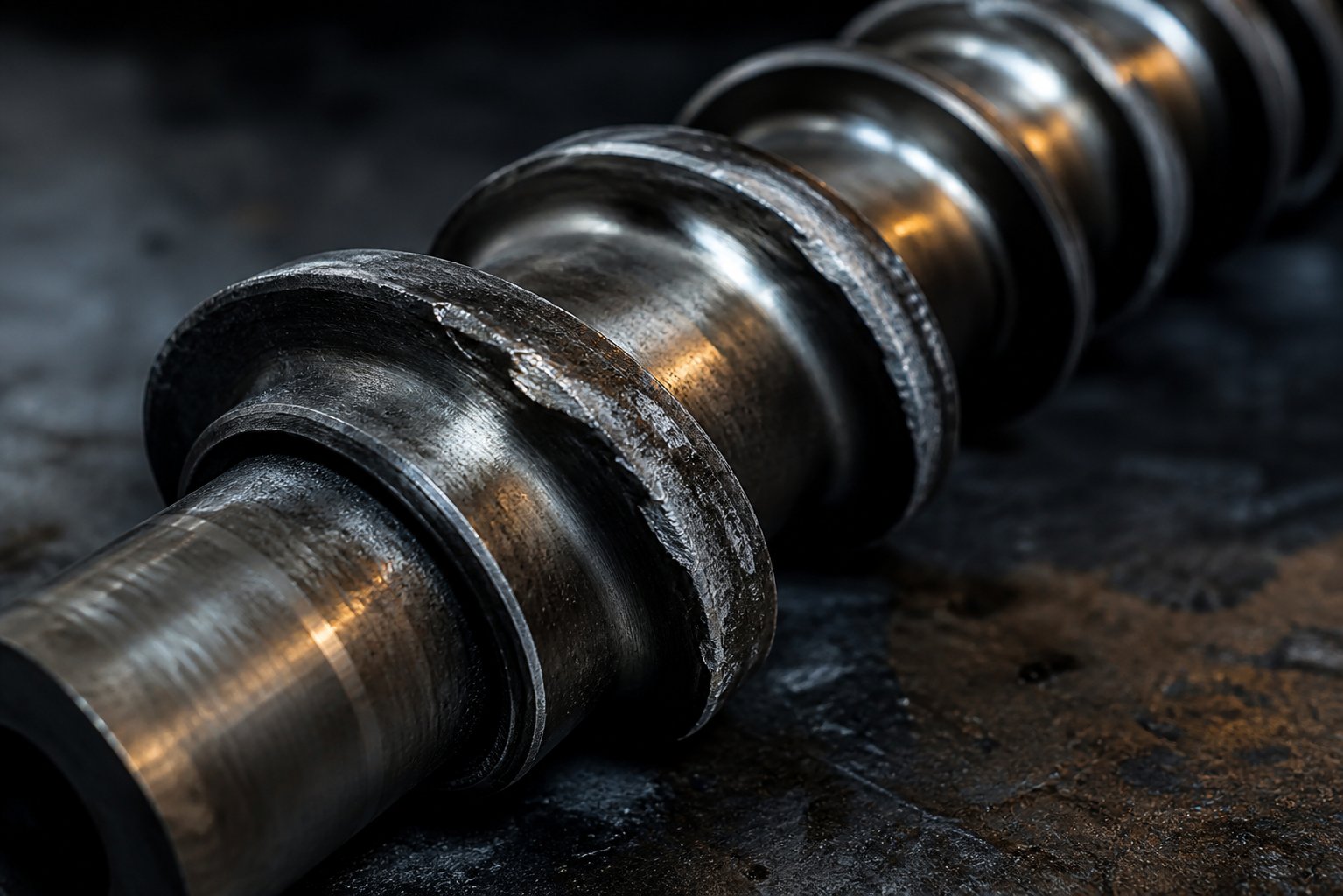
Understanding Barrel and Screw Wear in Used Equipment
You've measured the bore. You've miked the screw flights. The numbers tell you wear exists — but what do they actually mean? A barrel that's worn 0.008" in the metering zone could have years of productive life left or could be weeks from catastrophic failure, depending entirely on how it was built. The metallurgy hiding beneath the surface determines everything: how the machine wore, how much life remains, and whether repair, replacement, or walking away makes the most financial sense. This is the layer of evaluation that separates experienced buyers from those who learn expensive lessons after the invoice clears.
Nitrided vs Bimetallic Barrels and What Wear Patterns Reveal
Every barrel on a single screw extrusion machine falls into one of two primary construction categories, and identifying which type you're looking at changes how you interpret every measurement you've taken.
Gas-nitrided barrels are the more common and less expensive option. The process hardens the barrel's inner surface by diffusing nitrogen into the base steel at elevated temperatures, creating a hardened case typically 0.010" to 0.020" deep. This case provides good wear resistance for non-abrasive polymers — think unfilled polyethylene, polypropylene, and polystyrene. The trade-off is finite depth. Once the nitrided layer wears through, the softer base steel beneath erodes rapidly, and the wear rate accelerates dramatically. On used screw extruders, nitrided barrels tend to wear relatively uniformly along their length, which means bore measurements at multiple points will show a consistent, gradual increase in diameter. If readings jump sharply at specific locations, that's a red flag — it often indicates the nitrided case has been breached locally, possibly from running abrasive materials the barrel was never designed to handle.
Bimetallic-lined barrels use a centrifugally cast alloy lining — commonly boron-based alloys for abrasion resistance or nickel-based alloys for corrosion resistance — bonded to the inside of the base steel barrel. Tungsten carbide-rich linings offer the highest wear resistance for heavily filled or glass-reinforced resins. As Plastics Technology notes, today's bimetallic barrels using centrifugally cast alloys with high tungsten carbide content can provide exceptionally long service life. The lining thickness is typically 0.040" to 0.080", giving far more wear allowance than a nitrided case.
However, bimetallic barrels present a different end-of-life failure mode. Rather than uniform erosion, a worn bimetallic barrel may show lining separation — the alloy layer debonds from the backing steel and can crack, spall, or flake into the melt stream. When evaluating a used single screw plastic extruder with a bimetallic barrel, look for sudden bore diameter changes between adjacent measurement points. A bore that reads within spec at one location but jumps several thousandths just inches away may indicate lining delamination rather than simple wear. Delamination is not repairable in any practical sense and means the barrel needs replacement.
Here's a practical approach: take bore measurements at a minimum of five evenly spaced points along the barrel's working length. Compare each reading to the barrel's original nominal bore (stamped on the nameplate or available from the OEM). For a nitrided barrel, gradual increases of 0.002" to 0.004" per side over the original bore suggest moderate wear with useful life remaining in non-abrasive service. For a bimetallic barrel, the same increase is well within the lining's depth — but irregular readings or localized spikes warrant deeper investigation before committing to purchase.
Screw Metallurgy and Flight Wear Assessment
The screw tells the other half of the wear story. Its metallurgy determines not just how quickly it wears, but how it interacts with the barrel lining — and getting this pairing wrong accelerates damage to both components.
Tool steel screws (commonly 4140 or 4340 steel, through-hardened) are the baseline option for a plastic single screw extruder. They offer adequate wear life with non-abrasive polymers but erode relatively quickly under glass-filled or mineral-filled materials. On a used machine, tool steel flights that have lost more than 0.010" to 0.015" diametrically from their original OD are approaching the point where output loss, melt quality degradation, and pressure instability become measurable. Davis Standard's maintenance guidelines provide useful reference thresholds: a "low" wear reading may cause noticeable output reduction, "medium" wear means planning for rebuild or replacement, and "high" wear calls for immediate action.
Chrome-plated screws add a thin layer of hard chrome (typically 0.002" to 0.004" thick) over the flight lands. This improves release properties and provides modest wear protection. However, chrome plating can chip or flake — particularly if the screw has been improperly cleaned with steel wire brushes or abrasive tools. On a used thermoplastic extruder, inspect chrome-plated flights for pitting, peeling, or discolored areas that signal the plating has been compromised. Once the chrome is gone, the underlying steel wears rapidly.
Hardfaced or coated screws represent the premium tier. Stellite or tungsten carbide hardfacing welded onto flight lands provides superior abrasion resistance for an extruder for polymer compounds containing glass fiber, mineral fillers, or other abrasive additives. The critical compatibility point that industry experts emphasize is that the screw hardfacing material must be metallurgically compatible with the barrel lining. Softer hardfacing alloys running against the hardest bimetallic linings can gall — metal-to-metal contact that welds and fractures at a microscopic level, causing accelerated damage to both components. When evaluating a used machine, ask what hardfacing alloy is on the screw and what lining is in the barrel, then verify compatibility.
To interpret flight OD measurements accurately, you need the screw's original specification — either from OEM documentation or from the manufacturer's records based on the serial number. Measure flight OD at multiple points along the screw using an OD bar micrometer, as described in Davis Standard's feedscrew maintenance guide. Pay special attention to the compression zone and any mixing sections, where wear concentrates due to higher melt pressure and shear forces. If measurements show the screw has worn past the "medium" threshold for its diameter range, you're looking at a component that will need rebuilding or replacement regardless of how good the rest of the machine looks.
When Replacement Makes More Sense Than Searching for Perfect Condition
Here's the practical reality that reshapes how smart buyers approach the used market: a mechanically sound screw plastic extruder with a solid gearbox, a good motor, a robust frame, and modern controls — but with a worn screw and barrel — can still be an excellent investment. The key is understanding that barrels and screws are wear components by design. They are meant to be replaced over the machine's lifecycle, just like brake pads on a vehicle.
Searching endlessly for a used machine with perfect screw and barrel condition often means overpaying for the overall package, because sellers price that pristine condition into the asking number. Meanwhile, a lower-priced machine with worn internals plus a precision-manufactured replacement barrel and screw can deliver identical performance at a lower total cost. As industry repair specialists note, when wear is moderate to severe — or when processing abrasive materials — full replacement with properly specified components restores original performance and provides a known, predictable service life that a partially worn set simply cannot guarantee.
This is where specialized manufacturers become a critical resource. Companies like NANHAIYA can produce replacement single screw barrels matched to a buyer's specific machine model, original OEM drawings, physical samples, or field-measured dimensions. That capability means a used extruder with documented barrel wear isn't a deal-breaker — it's a negotiating point. You factor the replacement cost into your total acquisition budget, negotiate the purchase price accordingly, and end up with a machine whose frame, gearbox, motor, and controls are proven, paired with internals that are effectively brand new.
The decision framework is straightforward. If the gearbox, thrust bearing, motor, and frame are sound, replacing the screw and barrel is almost always more cost-effective than paying a premium for a machine with less wear on those same components. Conversely, if bore measurements reveal that a bimetallic lining has delaminated, or if a nitrided barrel has worn through its hardened case entirely, replacement is no longer optional — it's the only path back to reliable production.
Barrel and screw metallurgy may seem like a niche technical detail, but it directly determines the math behind every used equipment purchase. It tells you what you're actually buying beneath the paint and nameplates — and more importantly, what restoring that machine to full productivity will actually cost. Those costs, combined with acquisition price, freight, installation, and commissioning, are what define the true economics of buying used rather than new.
The True Cost of Buying a Used Extruder
An asking price on a listing is not a cost. It's a starting number — and sometimes not even the largest one. Buyers who budget only for the purchase price of a plastic extruder machine routinely discover that freight, installation, wear part replacement, and electrical work add 30% to 60% on top of what they expected to spend. Building a realistic total budget before you commit separates a smart acquisition from an expensive surprise.
Acquisition Cost Factors That Drive Used Extruder Pricing
When you compare two machines listed as extruders for sale, the price gap between them usually traces back to a handful of variables — and understanding which ones actually matter to your operation prevents you from overpaying for features you don't need or underpaying for a machine that will cost more to bring online than a pricier alternative.
Bore size and L/D ratio are the primary specification drivers. A 4.5" bore, 30:1 L/D machine commands significantly more than a 2.5" bore, 24:1 unit because it processes more material per hour and supports a wider range of applications. Drive horsepower follows the same logic — higher HP means greater throughput capacity and higher resale demand.
Brand reputation influences the extruder machine price in ways that go beyond name recognition, as covered earlier. Machines from active OEMs with available parts and technician networks hold value better than orphaned brands, even at equivalent specifications.
Machine age and condition interact in ways that aren't always intuitive. A 20-year-old machine with documented maintenance, a recent AC drive conversion, and verified screw and barrel measurements can legitimately be worth more than a 10-year-old unit with no records and an obsolete DC drive. Condition is measurable; age alone is not a reliable proxy for it.
Included downstream equipment — vacuum sizing tanks, haul-offs, cutters, or winders sold alongside the extruder — can shift the value equation dramatically. A complete line ready for production eliminates the cost and compatibility headaches of sourcing individual downstream components separately.
Total Cost of Ownership Beyond the Purchase Price
The purchase price is the most visible cost but rarely the largest one over the first year of ownership. The expenses below are the ones buyers most frequently underestimate — and the ones that determine whether your total plastic extrusion machine cost delivers real value or quietly erodes your margins.
- Freight and rigging: Used extruders weigh thousands of pounds. Shipping a 4.5" machine cross-country on a flatbed, plus crane or forklift offloading and positioning inside your plant, can represent a significant percentage of the purchase price. Get firm freight quotes before you commit — not after.
- Installation and commissioning: Bolting the machine to the floor is the easy part. Aligning the extruder to downstream equipment, connecting cooling water lines, and running the initial process trials to confirm output quality all require time, labor, and often outside technical assistance.
- Electrical hookup: Verify your facility's voltage, amperage, and phase configuration against the machine's requirements before purchase. A machine that needs 480V three-phase service in a plant wired for 208V creates an infrastructure expense that can rival the cost of the extruder itself. As Wanplas notes, electrical service upgrades can range from $20,000 to $80,000 or more depending on existing capacity and distance from electrical panels.
- Replacement of wear parts: Even if screw and barrel measurements are acceptable, heater bands, thermocouples, seals, and screen packs should be budgeted for replacement. These are low-cost items individually, but the cumulative expense adds up — and deferred replacement risks unplanned downtime that costs far more.
- Control system upgrades: Outdated PLCs, analog temperature controllers, and legacy DC drives may function today but carry rising obsolescence risk. Budget for a controls upgrade if the machine isn't already running current-generation components — this is frequently the single largest hidden cost in a used equipment purchase.
- Initial maintenance: Oil changes, gearbox inspection, motor bearing lubrication, cooling circuit flushing, and alignment verification should all happen before you run the first production batch. Treat these as non-negotiable startup costs, not optional line items.
When buyers ask about pvc extrusion machine price or what a comparable plastic extruder machine price should be, the honest answer is that the purchase price alone tells you almost nothing. Two identical machines at the same asking price can have vastly different total costs depending on condition, included components, and how much work each one needs before it produces sellable output.
The Refurbishment Decision Framework
Here's the decision that trips up more buyers than any other: should you pay more for a machine in better condition, or buy a cheaper one and invest the savings in refurbishment? The answer depends entirely on which components need work.
Think of a used extruder as two categories of components stacked together. The first category — the gearbox, thrust bearing assembly, motor, and structural frame — is expensive to repair or rebuild and represents the machine's core mechanical integrity. The second category — screws, barrels, heater bands, thermocouples, seals, and control electronics — consists of wear items and upgradeable systems designed to be replaced over the machine's service life.
When the core is sound, a lower-priced extruder machine for sale that needs new wear components can represent the best value in the entire used market. You're paying less for the platform while investing specifically in the parts that restore output quality and reliability. The total — acquisition plus refurbishment — often undercuts what a comparable machine in turnkey condition sells for, while giving you brand-new internals with a known service life rather than partially worn components with uncertain remaining capacity.
The economics shift sharply when the core needs attention. A gearbox rebuild alone can cost a substantial fraction of the machine's purchase price. A motor rewind or replacement adds another significant layer. If both the gearbox and motor need work, the combined refurbishment cost frequently approaches or exceeds the price of a better-condition machine — and you still carry the risk that additional problems emerge once disassembly begins. In these cases, the cheaper machine is rarely the cheaper option.
Apply this simple test to any extruder for sale: request documented measurements and condition assessments for the gearbox, thrust bearing, and motor first. If those three are sound, everything else is solvable at predictable cost. If any of them are questionable, recalculate aggressively — because the real price of that machine is about to climb well past the number on the listing.
Even with a realistic budget and a solid refurbishment plan, the total cost picture remains incomplete without accounting for the mistakes that catch buyers off guard after the purchase is finalized — the ones that no listing description and no seller's assurance will ever warn you about.
Common Mistakes When Buying Used Extruders
Budgets get built, inspections get scheduled, and deals get negotiated — yet buyers still lose money on used extruders in predictable, repeatable ways. The mistakes below aren't obscure edge cases. They're the three patterns that account for the majority of post-purchase regret across the used plastic processing equipment market, and every one of them is avoidable with the right awareness before you sign.
Overlooking Control System Obsolescence
Imagine buying a machine that runs perfectly on day one — and becomes unserviceable 14 months later because a single drive board fails and the manufacturer discontinued it three years ago. That's not a hypothetical scenario. It's the reality facing buyers who treat a functioning control system as proof that it will keep functioning.
Older PLCs, DC drive systems, and legacy HMI panels remain common across used plastics machinery listings. Many of these systems still operate — technically. But "operating" and "supportable" are two very different things. Plastics Technology reports that a surprising number of extrusion lines still run without modern PLCs or with severely outdated versions, leaving operators without diagnostics, runaway heat protection, or process data logging. The same source highlights that supply-chain disruptions have pushed lead times for some legacy industrial control components beyond 10 to 13 months — meaning a single failed part can idle your line for the better part of a year.
The financial sting compounds quickly. Replacement SCR assemblies for older DC drives, obsolete PLC modules, and discontinued touchscreen HMI panels aren't just hard to find — they're expensive when you do find them, often priced at multiples of what comparable current-generation components cost. Meanwhile, finding maintenance technicians who know how to troubleshoot a 1990s-era relay panel or a proprietary controller from a defunct manufacturer becomes harder with every retirement wave. As Plastics Technology's analysis of workforce trends points out, the Baby Boomer technicians who understood these older platforms are leaving the industry, and the younger workforce expects intuitive, self-diagnostic systems — not banks of analog meters and undocumented wiring.
A full control system upgrade — new PLC, AC inverter drive, modern HMI, and updated safety programming — can cost a substantial portion of the machine's purchase price. If you're evaluating used plastic processing machinery for sale and the listing mentions an older control platform, price that upgrade into your total budget from the start. Treating it as a "future improvement" is how buyers end up spending more on controls than they paid for the machine.
Failing to Verify Screw and Barrel Measurements
This is the single most common — and most costly — mistake in the used extruder market. A seller says the machine is in "good condition" or has "low hours," and the buyer accepts that characterization without requesting any quantitative data to back it up.
Here's why that's dangerous: you cannot assess screw and barrel wear visually. A screw that looks clean and shiny can still have flights worn 0.015" below nominal — enough to reduce output by 10-15% and make consistent melt quality impossible. A barrel that appears pristine on the outside can have bore enlargement in the compression zone that no amount of external inspection will reveal. The only way to know is documented measurements: bore readings at multiple points along the barrel length, and flight OD readings at the feed, compression, and metering sections of the screw.
Yet buyers routinely skip this step. Some feel uncomfortable asking the seller for data. Others assume that a reputable brand name or a reasonable asking price implies acceptable condition. Neither assumption holds up. As covered in the inspection section of this guide, wear is progressive and cumulative — every hour of operation removes material from the screw flights and barrel bore, and neither component regenerates itself.
When you buy used plastic equipment without measurement data, you're not buying a machine at a known condition — you're gambling. The fix is straightforward: before committing to any purchase, request written bore and flight measurements or arrange for an independent measurement service to take readings on-site. If the seller resists providing this data, that resistance itself tells you something valuable about what those numbers might reveal.
Underestimating Installation and Commissioning Costs
The third pattern hits after the purchase, during the phase buyers rarely plan for in detail. Rigging, freight, electrical infrastructure, foundation work, and startup optimization all carry real costs — and the combined total frequently surprises buyers who assumed the hard spending was over once the machine was paid for.
Rigging and freight for heavy machinery — a mid-size extruder can weigh 8,000 to 15,000 pounds or more — involves flatbed transport, crane or heavy forklift service, and precise positioning inside your facility. These aren't standardized costs; they vary based on distance, access constraints at both the pickup and delivery sites, and whether the machine needs to be disassembled for transport.
Electrical infrastructure is where the biggest surprises hide. A machine requiring 480V three-phase, 200-amp service doesn't care that your facility is wired for 208V or that your nearest panel is 150 feet away. Industry checklists consistently flag power requirements as a critical pre-purchase verification point. Matching voltage, amperage, and phase configuration to your existing infrastructure — or budgeting for the upgrade if they don't match — needs to happen before the deal closes, not during installation week.
Foundation and platform preparation is another often-forgotten line item. Extruders generate vibration and exert concentrated floor loads through their mounting points. Inadequate foundations cause alignment drift between the extruder and downstream equipment, which translates directly into product quality problems.
Startup and process optimization take time even when everything is installed correctly. Dialing in barrel temperatures, screw speed, and backpressure for your specific resin and die combination requires trial runs, material waste, and operator hours. If you're setting up an extrusion line for sale to a customer or starting production on a deadline, build at least one to two weeks of commissioning time into your project plan.
The best-value used extruder is not always the cheapest one — it is the one whose total cost of ownership, including all refurbishment and installation costs, delivers the lowest cost per kilogram of quality output.
Each of these three mistakes shares a common root cause: focusing on the purchase price as if it represents the total investment. It doesn't. The purchase price is just the entry ticket. What you spend on controls, wear parts, transport, electrical work, and commissioning determines whether that ticket leads to a profitable production line — or a lesson you'd rather not repeat. Smart buyers plan for all of it upfront, which is exactly the mindset that carries into the final, often-overlooked phase of used equipment ownership: keeping the machine productive long after the initial deal is done.
Keeping a Used Extruder Productive with the Right Parts
The deal is closed, the machine is installed, and the first production runs are underway. This is the moment most buying guides stop talking — and the moment where long-term profitability is actually decided. A used extruder's purchase price is a sunk cost the day the wire transfer clears. What determines your return on that investment is how effectively you maintain output quality, minimize unplanned downtime, and control ongoing operating costs from this point forward. That comes down to a deliberate, proactive approach to wear parts and spare component sourcing — not a scramble when something fails at 2 a.m. on a Thursday.
Prioritizing Wear Parts for Immediate Replacement
Here's a principle that experienced operators of plastic extrusion equipment follow without exception: certain low-cost components should be replaced preventively on any used acquisition, regardless of how good they looked during inspection. The logic is simple — these items are inexpensive individually but carry outsized failure consequences.
- Heater bands: Even bands that test within resistance tolerances during the pre-purchase inspection may be near end of life. A failed heater band creates a cold zone in the barrel that disrupts melt uniformity, causes pressure fluctuations, and can produce off-spec product for hours before the root cause is identified. Replacing all bands at acquisition — typically a few hundred dollars per zone — eliminates this risk entirely.
- Thermocouples: Drift in thermocouple accuracy is invisible without calibration testing, and even small errors compound across multiple barrel zones. Fresh thermocouples ensure the temperatures you see on the HMI actually match what's happening inside the barrel, giving your process parameters a reliable foundation from day one.
- Seals and gaskets: Barrel flange seals, adapter gaskets, and feed throat o-rings degrade with heat cycling over time. A leaking barrel flange doesn't just waste material — it creates a safety hazard and can damage adjacent components. These are commodity items that cost almost nothing compared to the downtime a failure causes.
- Screen packs and breaker plates: If included with the machine, assume they need replacement. Clogged or damaged screens restrict flow, elevate backpressure, and mask the extruder's true output capability during initial process trials.
Screws and barrels fall into a different category. Unlike heater bands and thermocouples, these are high-value components that should be replaced based on measurement data, not as a blanket preventive measure. If your pre-purchase inspection documented bore and flight OD readings within acceptable tolerances, the existing screw and barrel can continue in service — but you should establish baseline measurements and schedule follow-up readings at regular intervals. Plastics extrusion machinery running abrasive or filled compounds may need re-measurement every six months; lines processing unfilled polyolefins can often extend that interval to annually. The point is to track the wear trend, not react to a sudden failure.
Building a Maintenance and Spare Parts Strategy
The single biggest operational risk with used plastic extruders isn't a catastrophic breakdown — it's an unplanned shutdown caused by a component you could have had on the shelf but didn't. Building a spare parts strategy before you need it is what separates facilities that measure downtime in hours from those that measure it in weeks.
Start by identifying your critical spares — the components whose failure would stop production immediately and whose replacement involves lead time longer than your tolerance for downtime. For most single screw extrusion lines, that list includes:
- A spare screw (or at minimum, a screw rebuild kit with hardfaced flight material)
- A replacement barrel or verified barrel source with confirmed lead time
- Drive motor bearings or a complete spare motor
- Key drive components (inverter module for AC drives, or SCR stack and firing boards for legacy DC systems)
- A set of heater bands for every barrel zone
- Thermocouples matched to your barrel's insertion depth and type
- Gearbox oil of the correct specification and quantity for a full change
- PLC backup program on secure, accessible media
For OEM-branded machines from active manufacturers, your first call should go to the original equipment maker's parts department. Confirm which components they still stock for your model and serial number range, and get current pricing and lead times in writing. Even if you don't order immediately, knowing the OEM timeline establishes your planning baseline — and reveals any gaps where OEM supply has been discontinued or stretched to unacceptable delivery windows.
Those gaps are where specialized aftermarket manufacturers become essential. For barrels and screws especially, plastic extrusion machine suppliers who focus on precision replacement components can often deliver faster and at lower cost than original equipment channels — particularly for older machines where OEM parts carry long lead times or have been discontinued entirely. NANHAIYA, for example, manufactures custom single screw barrels engineered to match specific machine models using original drawings, physical samples, or field-measured dimensions. That flexibility is particularly valuable for buyers of used extruders for sale who inherit machines where OEM documentation is incomplete or the original manufacturer no longer supports the platform. Having a verified barrel supplier identified and quoted before you need a replacement turns a potential multi-week production stoppage into a planned maintenance event.
Beyond individual component sourcing, think about downstream extrusion equipment in your spare parts planning as well. Haul-off belts, cutter blades, vacuum pump rebuild kits, and cooling system components all wear on their own schedules. A spare parts strategy that covers only the extruder while ignoring the rest of the line creates a false sense of security — your production stops just as completely whether the extruder fails or the haul-off seizes.
The broader principle is straightforward: proactive spare parts sourcing for plastics extrusion equipment is not an expense — it's insurance against the kind of unplanned downtime that turns a smart used equipment purchase into a regrettable one. Identify your critical components, establish relationships with both OEM and aftermarket suppliers, stock what you can justify, and maintain documented lead times for everything else. The machine you bought was someone else's proven workhorse. With the right parts strategy, it becomes yours.
Frequently Asked Questions About Used Single Screw Extruders
1. How do you check the condition of a used single screw extruder before buying?
Start with documented screw flight OD and barrel bore measurements taken at multiple points along the barrel length — these are the most critical data points. Compare readings against original OEM specifications to quantify wear. Beyond internals, evaluate the gearbox for abnormal noise and axial play, request oil analysis records, perform motor insulation resistance testing, and verify control system components are still supported by their manufacturers. A comprehensive inspection also covers heater band continuity, thermocouple accuracy, safety interlock functionality, and a full review of maintenance logs and refurbishment history.
2. What is the difference between a single screw extruder and a twin screw extruder?
A single screw extruder uses one rotating screw inside a cylindrical barrel, excelling at steady-state melting and pumping of pre-compounded pellets for applications like pipe, film, sheet, and profile production. A twin screw extruder uses two screws — co-rotating or counter-rotating — inside a figure-eight bore, delivering far more intensive mixing through screw-to-screw material transfer. Twin screws are preferred for compounding, reactive extrusion, and high-filler formulations. For buyers evaluating used equipment, choosing the wrong type leads to either unnecessary complexity and cost or inadequate processing capability, regardless of machine condition or price.
3. Is it worth buying a used extruder with a worn screw and barrel?
Yes, provided the gearbox, thrust bearing, motor, and frame are mechanically sound. Screws and barrels are designed as wear components meant to be replaced over a machine's lifecycle. A lower-priced used extruder paired with precision-manufactured replacement internals — sourced from specialists like NANHAIYA who build custom single screw barrels matched to specific machine models, drawings, or measured dimensions — can deliver like-new performance at a lower total cost than a higher-priced machine with partially worn components. The key is factoring replacement costs into your total acquisition budget and negotiating the purchase price accordingly.
4. What hidden costs should I budget for when buying a used single screw extruder?
Beyond the purchase price, budget for freight and rigging (heavy machinery transport, crane offloading, and positioning), electrical hookup (verify voltage, amperage, and phase compatibility with your facility), wear part replacement (heater bands, thermocouples, seals, and screen packs should be replaced preventively), control system upgrades (obsolete PLCs and DC drives carry significant replacement costs), installation and commissioning labor, foundation preparation, cooling water connections, and initial process optimization trial runs. These combined costs commonly add 30% to 60% on top of the acquisition price.
5. Which brands of used single screw extruders hold their value best?
Machines from active OEM manufacturers with strong parts availability and broad technician familiarity tend to hold value best. Davis Standard and American Kuhne remain actively manufacturing with solid legacy support. NRM, Welex, Milacron, and Battenfeld Gloucester also carry strong market recognition, though buyers should verify current parts sourcing channels for specific model and serial number ranges. Well-known brands command higher resale prices because replacement components are easier to source, service documentation is more accessible, and the next buyer recognizes the platform — reducing resale friction compared to lesser-known or discontinued brands.
Written by
Nanhaiya Technical Team
Zhoushan Nanhaiya Plastic Machinery Co., Ltd.
The Nanhaiya technical team supports screw and barrel manufacturing projects through application review, technical communication, custom manufacturing coordination, and production and quality control.
Discuss Your Application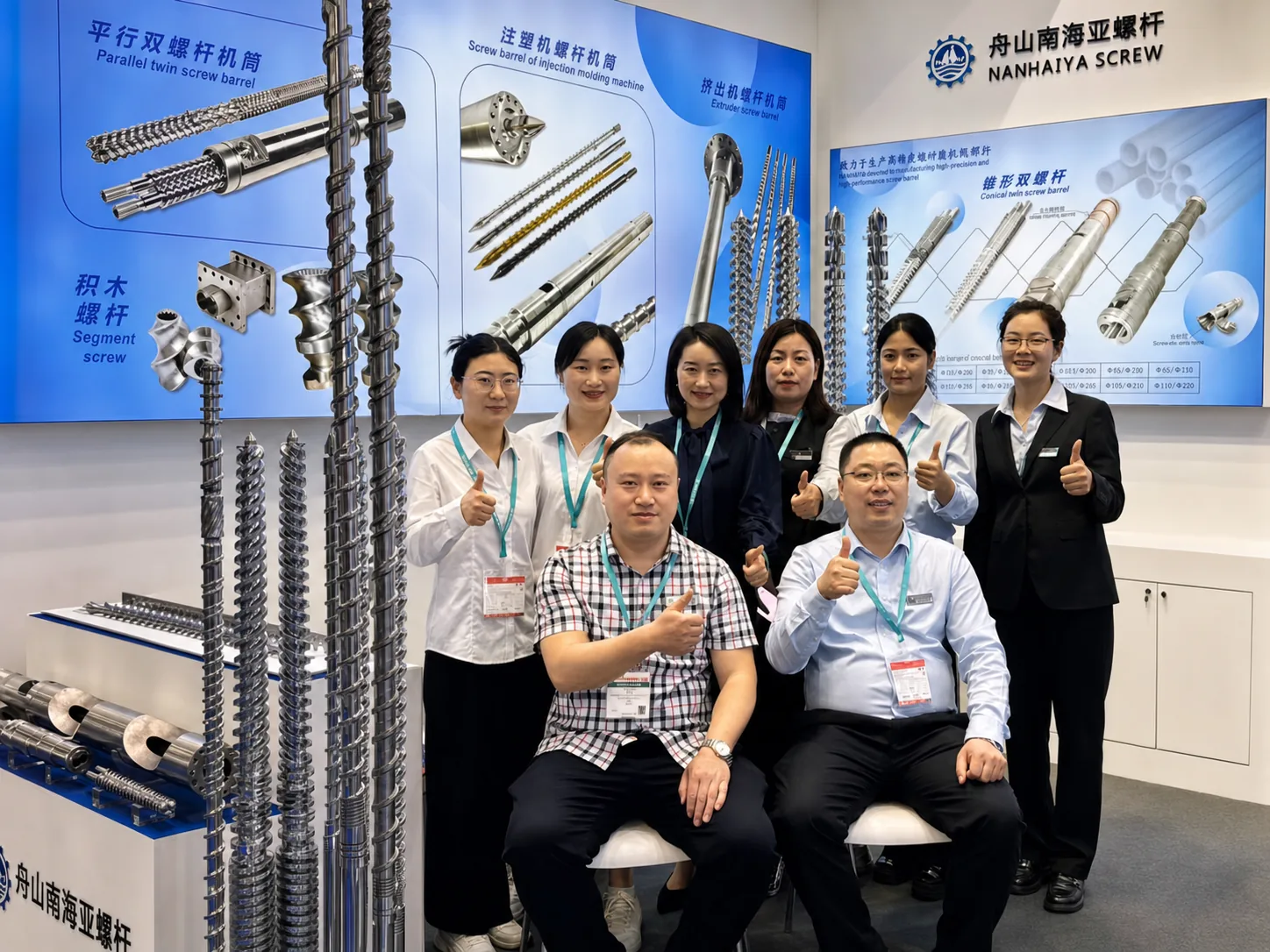
Related Articles
More insights on screw barrel technology and plastics processing.
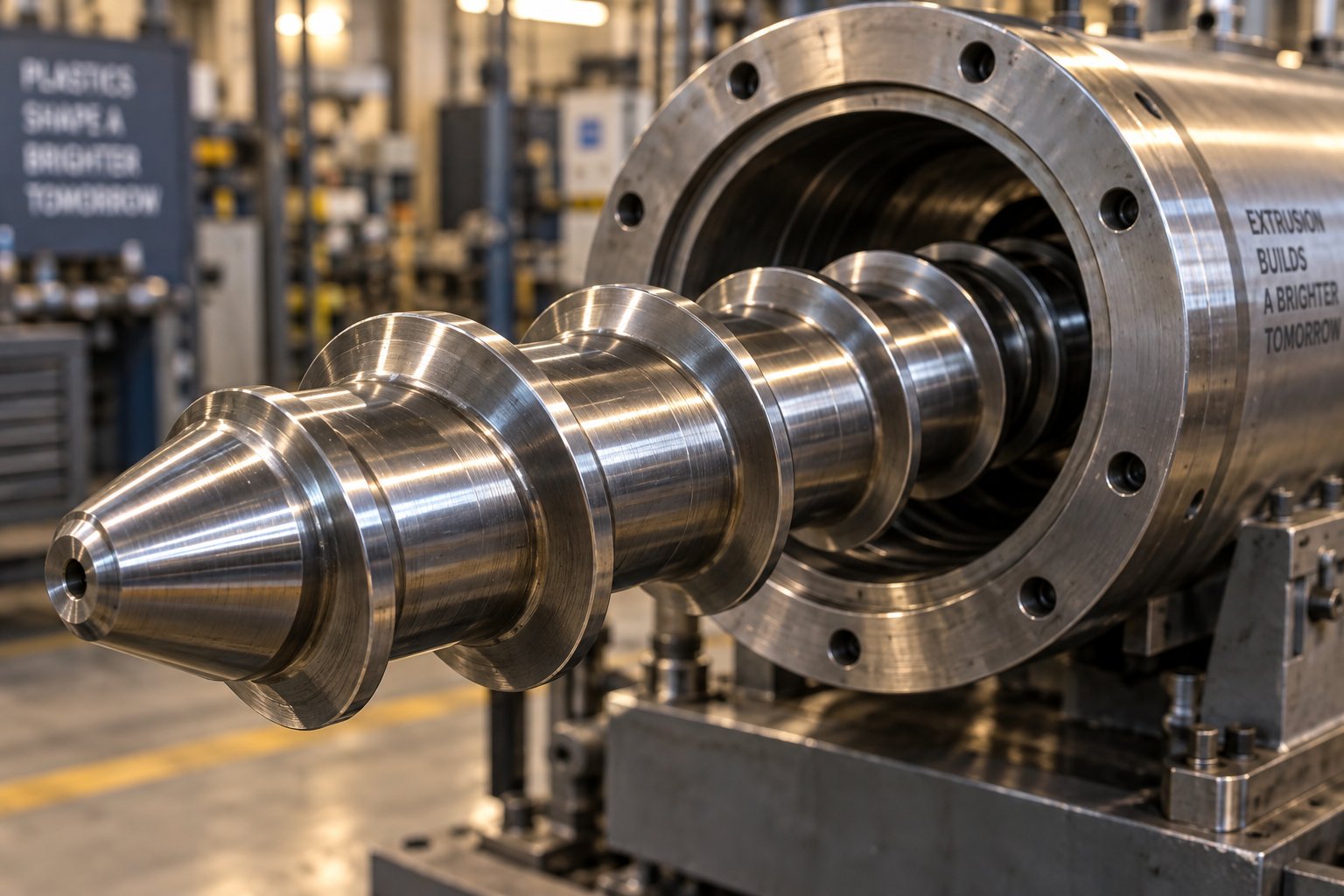
What Nobody Tells You About Screw Barrel For Plastic Machine Design
Oct 10, 2026
Learn how screw barrel for plastic machine design affects melt quality, throughput, and wear life. Covers geometry, resin matching, troubleshooting, and sourcing.
Read Article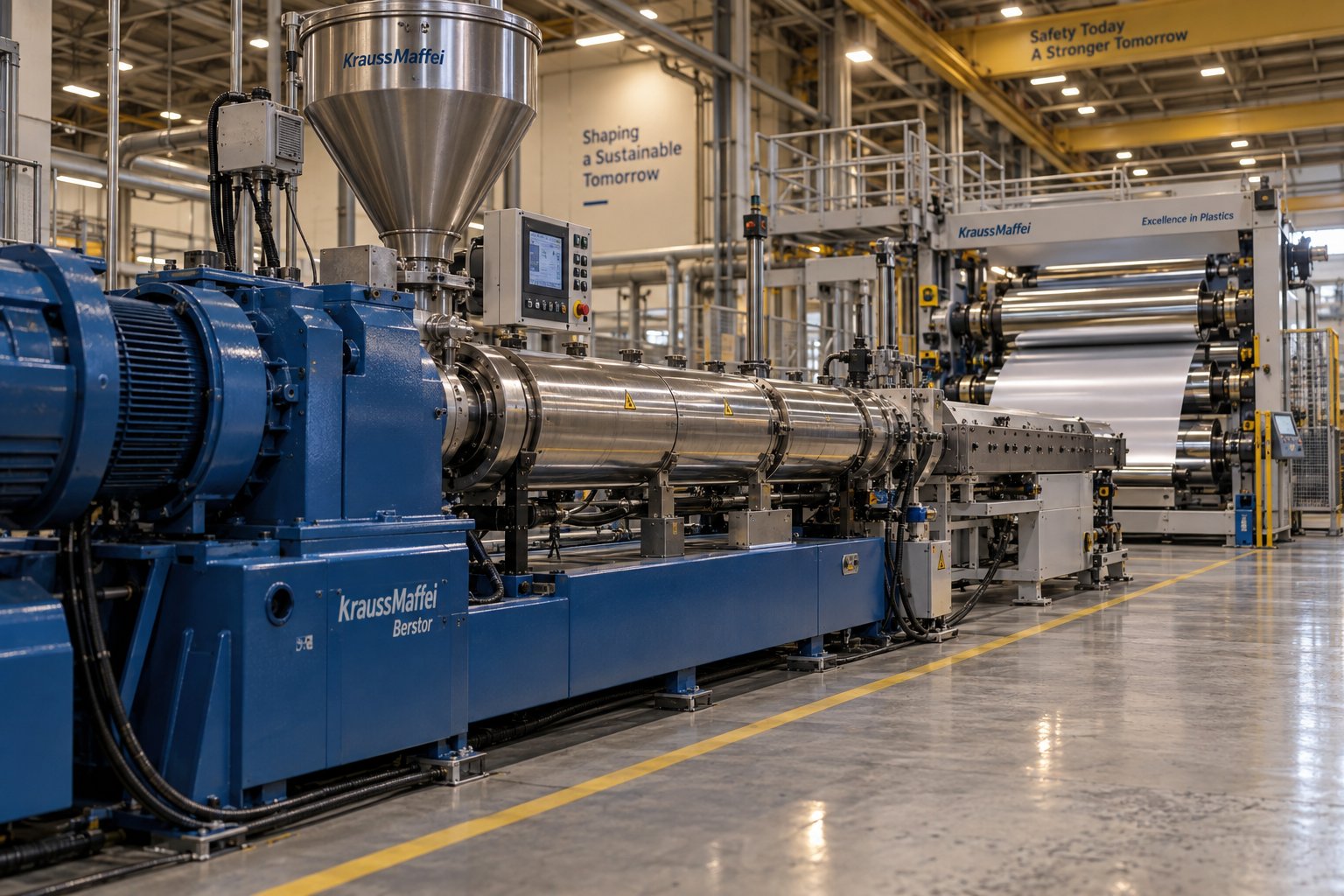
Single Screw Extruder for Sheet: Stop Guessing, Start Specifying
Oct 9, 2026
Learn how to specify a single screw extruder for sheet production. Covers screw geometry, resin-specific processing, troubleshooting, and maintenance best practices.
Read Article
PE Pipe Extruder Machine: What Datasheets Won't Tell You
Oct 9, 2026
Learn how a PE pipe extruder machine works, key specs explained, material grade selection, maintenance tips, and buyer guidance beyond the datasheet.
Read ArticleLooking for something else?
Search by material, symptom or product and jump straight to the relevant page.
These are navigation suggestions based on keyword matching — not a quotation, not a delivery commitment, and not a substitute for engineering review. Final specification is confirmed by our engineers against your drawings and processed material.
Need help with screw barrel selection?
Share your machine model, processed material and application. Our team can help with pricing and technical support.