

What Is a Counter-Rotating Twin Screw Extruder and Why Buy Used
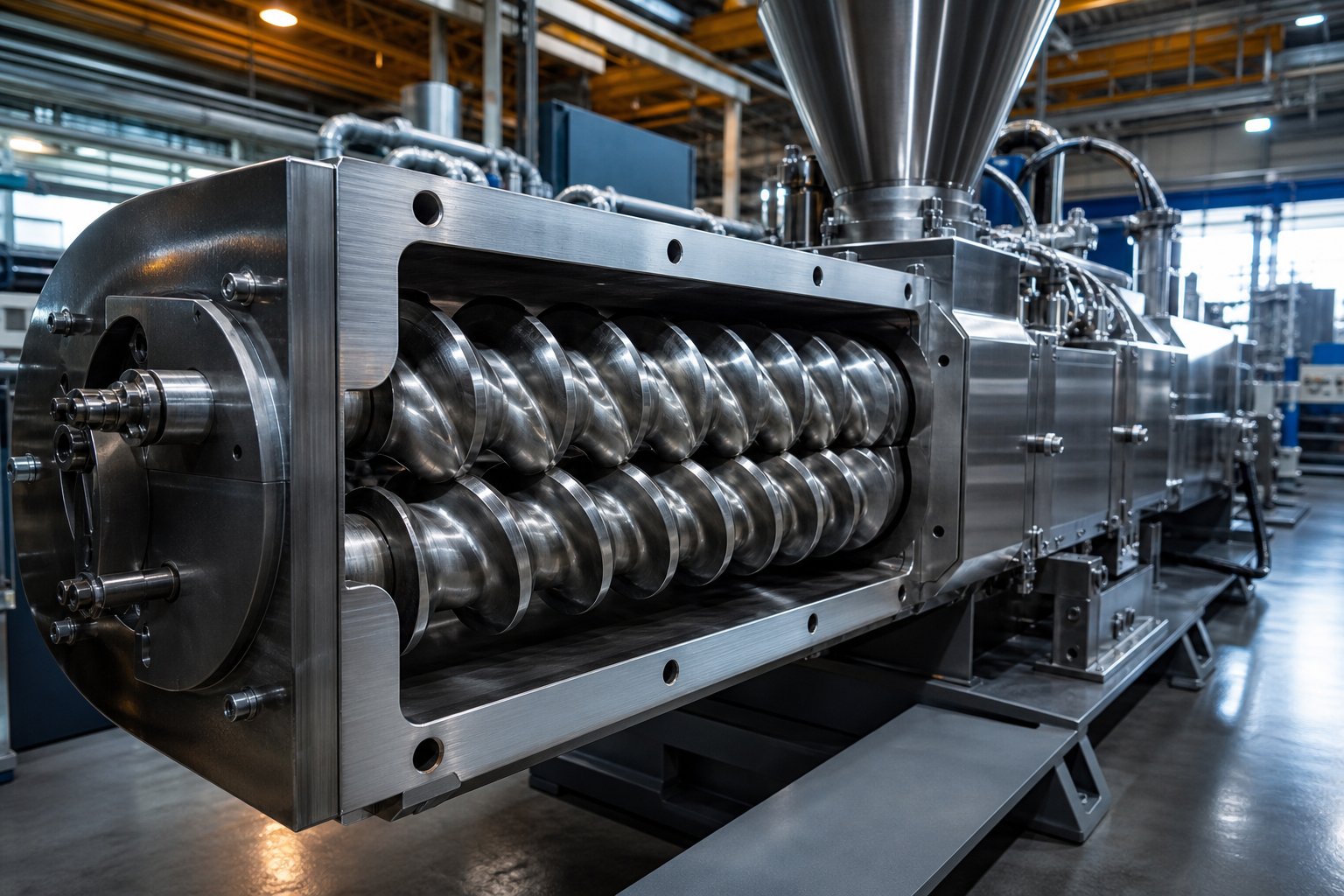
Imagine two screws sitting side by side inside a barrel, each spinning in the opposite direction — one clockwise, the other counterclockwise. That simple mechanical difference defines the entire personality of a counter-rotating twin screw extruder and separates it from every other extrusion platform on the market. If you're shopping for one of these machines secondhand, understanding what makes them tick is the first step toward spotting the deals worth pursuing and the listings worth ignoring.
This guide takes a buyer-advocate approach. No dealer pitches, no manufacturer spin. Just the technical intelligence and practical red flags you need to evaluate a used counter rotating twin screw extruder with confidence.
How Counter-Rotating Twin Screw Extruders Work
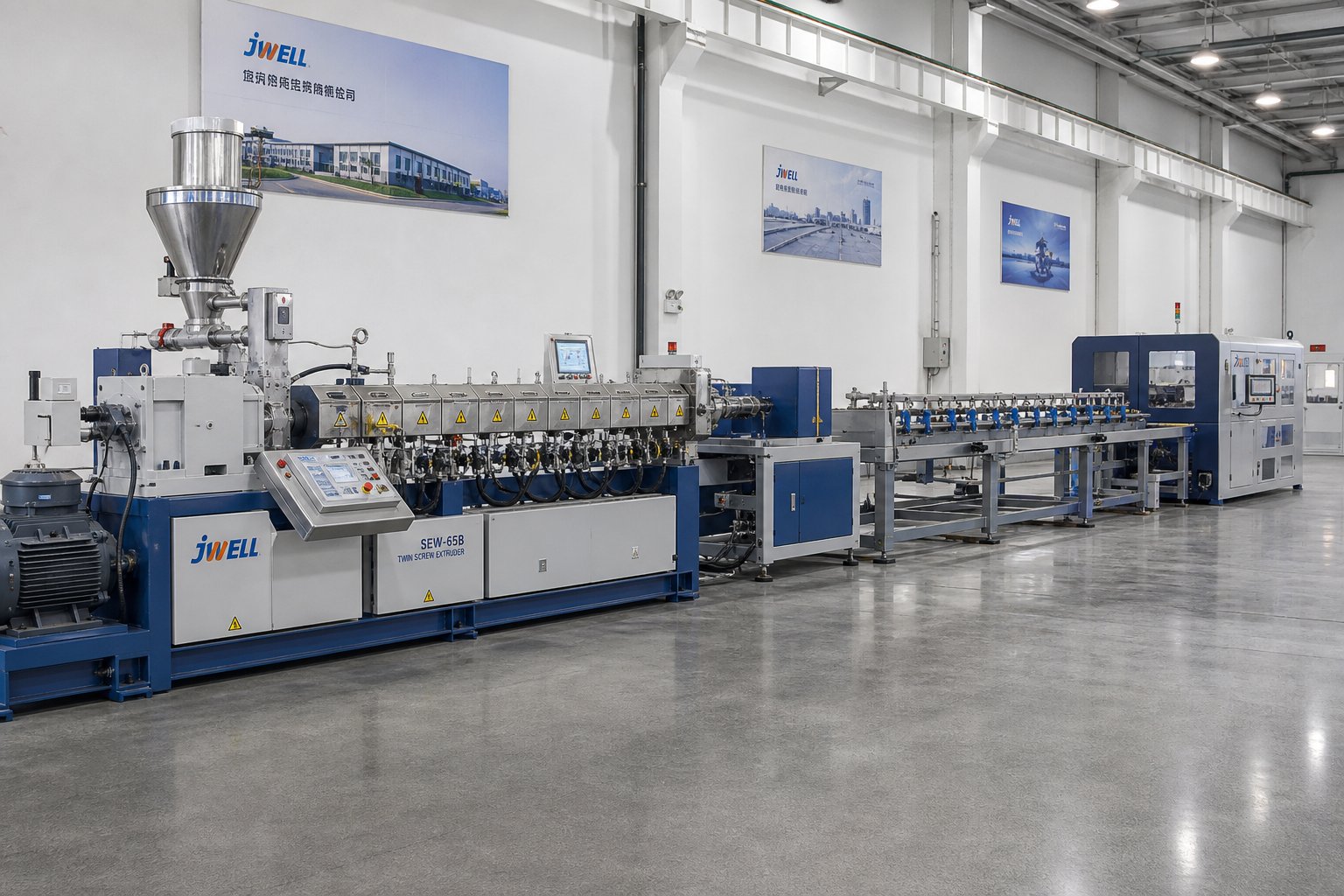
A counter-rotating twin screw extruder uses two intermeshing screws that rotate in opposite directions, creating enclosed C-shaped chambers that transport material through positive displacement with low shear stress and stable pressure output — ideal for heat-sensitive polymers like PVC.
Here's what makes that matter. In a co-rotating twin-screw extruder, the screws spin the same way and aggressively hand material off between flights, generating high shear and intense mixing. Counter-rotating designs do the opposite. As material enters the intermeshing zone, it gets drawn in by opposing screw rotations, compressed, and pushed forward in discrete pockets. The result is a gentle, almost pump-like conveying action.
This low-shear transport keeps frictional heat generation minimal. Materials that would yellow, decompose, or degrade under aggressive mixing — rigid PVC being the classic example — stay thermally stable throughout processing. A calendering effect at the intermeshing region also provides effective dispersive mixing of additives under relatively gentle conditions, making counter-rotating machines well suited for PVC formulations where moderate dispersion outperforms fully microscopic breakdown.
You'll also notice that these machines operate under a high degree of fill and can achieve stable extrusion even at comparatively low screw speeds. That positive displacement behavior means they handle slippery powders and dry-blend formulations without the feeding instabilities that plague other extruder types. For processors working with calcium carbonate-heavy compounds or talc-filled recipes, this characteristic alone can justify the configuration choice.
Why Counter-Rotating Machines Enter the Used Market
So why would anyone sell a machine built for such a specific, in-demand niche? The reasons are usually practical, not problematic:
- Plant closures and consolidations — Mergers, facility relocations, and corporate restructuring release perfectly functional equipment onto the secondary market.
- Capacity upgrades — A processor outgrows a 65mm twin screw extruder and moves to a 92mm platform, making the smaller machine surplus.
- Technology and controls modernization — Older machines with outdated PLCs or DC drive systems get replaced by lines with current automation, even when the mechanical components remain sound.
- Product line shifts — A manufacturer pivots from PVC pipe to a different product category and no longer needs counter-rotating capability.
None of these scenarios mean the equipment is worn out. In fact, high-quality used machinery can cost 50% to 70% less than equivalent new equipment with similar specifications, and well-maintained extruders from premium OEMs often retain strong performance long after their first owner moves on. Used extruders frequently offer immediate availability as well — a major advantage when new machine lead times can stretch 12 to 18 months.
The secondary market for used extruders for sale is a legitimate sourcing channel. Savvy buyers treat it as a strategic tool, not a compromise. The key is knowing exactly what to look for — and what sellers might not volunteer.
That evaluation starts with understanding the fundamental differences between counter-rotating and co-rotating configurations, and how those differences shape what you should inspect, what wears out, and what holds its value on the resale market.
Counter-Rotating vs Co-Rotating Twin Screw Extruders for Used Buyers
Every used listing labels its machine as either "co-rotating" or "counter-rotating" — but those two words carry dramatically different implications for wear patterns, parts sourcing, and long-term resale value. If you're evaluating a used counter rotating twin screw extruder alongside co-rotating alternatives, you need to understand how each configuration ages, where each one fails, and which one fits your process before a dollar changes hands.
Mechanical and Processing Differences That Matter for Used Buyers
The core mechanical distinction is straightforward. In a co-rotating extruder twin screw design, both screws spin the same direction, creating intense shear fields between the screws and between each screw and the barrel wall. Material gets forcibly transferred from one screw to the next at the intermeshing zone, producing aggressive mixing and a self-wiping action that minimizes stagnation. Counter-rotating twin screw extruders reverse one screw's direction, drawing material inward at the intermeshing region under compression. Transport relies on positive displacement rather than complex handoff patterns, which means shear stress drops substantially.
Why does this matter when you're inspecting used equipment? Because each configuration wears differently under stress.
Co-rotating machines experience their heaviest wear along the barrel bore and at kneading block flight tips — the zones where high-shear mixing grinds hardened surfaces against abrasive fillers. Counter-rotating designs concentrate stress differently. The intermeshing zone subjects material to repeated compressive and elongational deformation — a calendering effect — and the opposing screw rotations place unique axial loads on thrust bearings and gearbox internals. You'll encounter barrel wear concentrated in the compression and metering sections, and the gearbox typically endures higher sustained thrust loads than its co-rotating counterpart.
Think of it this way: a co-rotating machine wears from shear friction. A counter-rotating machine wears from pressure and compression. Knowing which pattern applies to the double screw extruder you're evaluating tells you exactly where to aim your inspection caliper.
The table below puts every critical difference side by side so you can compare configurations with your specific application and inspection priorities in mind.
| Evaluation Criteria | Co-Rotating Twin Screw Extruder | Counter-Rotating Twin Screw Extruder |
|---|---|---|
| Shear Intensity | High — aggressive shear fields at intermeshing zone and barrel wall | Low to moderate — relies on calendering and compressive action |
| Pressure Generation | Moderate — requires specific discharge elements for pressure buildup | High — positive displacement creates strong, stable pressure output |
| Self-Wiping Capability | Excellent — continuous flight-to-flight wiping reduces material stagnation | Limited — enclosed C-shaped chambers reduce but do not eliminate buildup |
| Typical Applications | Polymer compounding, masterbatch, reactive extrusion, nanocomposites, recycling | Rigid PVC pipe and profiles, WPC decking, calcium carbonate compounds, shear-sensitive formulations |
| Common Failure Points in Used Machines | Kneading block flight tip erosion, barrel bore wear in mixing zones, screw element spline wear | Thrust bearing fatigue, gearbox axial load damage, barrel wear in compression/metering zones, intermeshing zone clearance increase |
| Parts Availability | Broad — large global installed base supports deep OEM and aftermarket supply | Narrower — specialized applications mean fewer suppliers and sometimes longer lead times |
| Resale Value Retention | Strong — high demand across multiple industries sustains resale prices | Steady but niche — consistent demand in PVC and WPC sectors, fewer competing buyers |
Which Configuration Holds Value Better on the Used Market
Co-rotating twin-screw extruders dominate the global compounding landscape. Their versatility across polymers, fillers, and reactive processes means a much larger pool of potential buyers exists when these machines hit the secondary market. That broader demand supports stronger resale prices and faster turnover — sellers can move co-rotating inventory relatively quickly because the buyer base spans automotive, packaging, recycling, and specialty chemical sectors.
Counter-rotating twin screw extruders tell a different story. Their market is narrower but remarkably consistent. PVC pipe and profile extrusion drives the bulk of demand, with wood-plastic composite production and heavily filled compound processing rounding out the buyer pool. Because fewer of these machines trade hands, finding the right one can take longer — but when listings do appear, pricing often reflects the specialized nature of the equipment rather than competitive bidding wars. A well-maintained counter-rotating machine from a recognized OEM can still command a strong price, but the buyer universe is smaller, so negotiations tend to carry more flexibility.
What does this mean for your purchasing strategy? If you're sourcing an extruder twin screw configuration for PVC or WPC production, expect to search patiently but negotiate firmly. Fewer competing buyers gives you leverage. If you're considering a co-rotating machine, prepare for tighter pricing but wider selection. Either way, the configuration you choose must match your application first — resale value is a secondary consideration that only matters if the machine actually runs your product well.
Configuration, however, is just one layer of the decision. Within the counter-rotating category itself, a second fork in the road awaits: conical versus parallel screw geometry — a distinction that shapes everything from feed characteristics to barrel wear inspection techniques.
Conical vs Parallel Counter-Rotating Extruders Explained
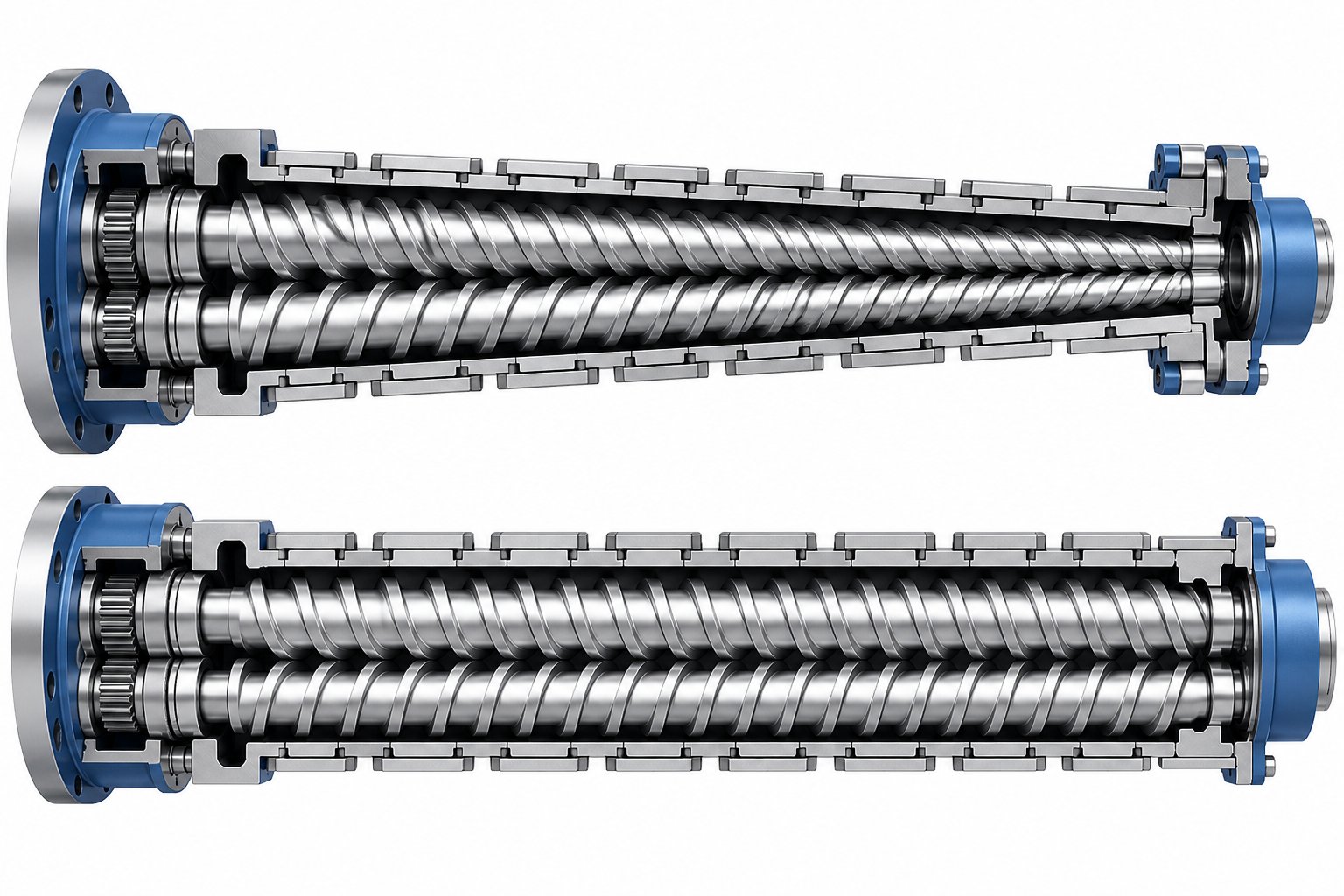
Picture two machines sitting on a dealer's floor. Both are counter-rotating twin screw extruders. Both process PVC. But pull the barrels apart, and you'll see two fundamentally different screw geometries — one tapered like a funnel, the other straight as a rifle bore. That difference determines feed behavior, pressure characteristics, wear patterns, and how difficult it is to inspect and recondition the machine you're about to buy. Choosing the wrong geometry for your application is a mistake no purchase price can offset.
Conical Counter-Rotating Extruders and Their Ideal Applications
A conical twin screw extruder features screws that taper from a large diameter at the feed end to a smaller diameter at the discharge. Imagine a pair of tapered cones meshing together inside a matching barrel bore. The larger feed section accepts high volumes of low-bulk-density powder — exactly what you encounter with dry-blend PVC formulations — while the progressively narrowing geometry naturally compresses and plasticizes the material as it moves toward the die.
This built-in compression ratio is the conical design's signature advantage. There's no need for elaborate screw element configurations to generate pressure. The geometry itself does the work, creating excellent plasticizing performance at relatively low screw speeds and minimal shear. For rigid PVC pipe, window profiles, and sheet applications, conical counter-rotating machines have been the industry workhorse for decades.
When shopping for used conical extruders, you'll frequently encounter brands like Krauss Maffei, Cincinnati Milacron, and Battenfeld Cincinnati — manufacturers with deep histories in PVC processing equipment. These OEM names carry weight in the resale market because their build quality and parts ecosystems are well established.
Here's where used buyers face a unique challenge, though. That tapered barrel bore is harder to measure accurately than a straight cylinder. Standard bore gauges need careful positioning along the taper gradient, and any wear assessment must account for the changing nominal diameter along the barrel length. Reconditioning a conical barrel — resleeving or honing — requires specialized tooling that not every rebuild shop carries. If you're evaluating a used conical machine, confirm upfront that your reconditioning partner has experience with tapered bore geometries before committing.
Parallel Counter-Rotating Extruders and Where They Excel
Parallel counter-rotating extruders use two constant-diameter screws inside a straight-bore barrel — the same basic cylindrical geometry found in co-rotating platforms, but with opposing rotation. This configuration allows for higher length-to-diameter (L/D) ratios, which translates to longer processing zones and more residence time for demanding compounding tasks.
Where conical machines dominate PVC dry-blend processing, parallel counter-rotating designs carve out their niche in applications requiring extended mixing residence time at low shear. Think heavily filled calcium carbonate compounds, wood-plastic composite (WPC) decking formulations, and certain twin screw extruder plastic compounding processes where thermal sensitivity demands gentle material handling over a longer barrel length.
From a maintenance standpoint, parallel barrels are simpler to inspect. A standard bore gauge swept through the cylinder gives consistent readings against a single nominal diameter. Wear mapping is straightforward, and barrel liners — when the machine uses a bimetallic design — follow conventional replacement procedures. For a plastic twin screw extruder on the used market, that inspection simplicity translates into faster, more confident condition assessments.
The trade-off? Parallel counter-rotating machines show up less frequently in used equipment listings than their conical counterparts. The conical design's dominance in PVC extrusion means the installed base skews heavily toward tapered geometry, so the secondary market reflects that imbalance. If your application calls for a parallel configuration, expect a longer search — but also expect less competition from other buyers.
| Feature | Conical Counter-Rotating | Parallel Counter-Rotating |
|---|---|---|
| Screw Geometry | Tapered — larger feed diameter narrowing to smaller metering diameter | Constant diameter — uniform cylindrical bore throughout |
| Typical L/D Ratio | Relatively short (commonly 17:1 to 26:1 equivalent) | Higher ratios available (commonly 22:1 to 40:1) |
| Primary Applications | Rigid PVC pipe, window profiles, PVC sheet, foam PVC | WPC decking, heavily filled compounds, specialty low-shear compounding |
| Feed Characteristics | Excellent for low-bulk-density powders and dry blends due to large feed opening | Good powder intake, but smaller feed opening relative to output diameter |
| Compression Mechanism | Geometry-driven — natural compression from taper ratio | Screw-element-driven — compression achieved through flight depth changes |
| Wear Inspection Complexity | Higher — tapered bore requires position-specific measurements and specialized gauging | Lower — constant-diameter bore allows standard bore gauge sweeps |
| Reconditioning Difficulty | More specialized — tapered honing and resleeving require dedicated tooling | Standard procedures — conventional cylindrical liner replacement |
| Used Market Availability | More common — large global installed base in PVC processing | Less common — narrower installed base, longer search times typical |
The takeaway is practical: define your target application before you start browsing listings. If you're running rigid PVC pipe or profiles, a conical machine from a reputable OEM is likely your fastest path to production. If your process involves WPC, high-filler-loading compounds, or other twin screw plastic extruder applications requiring extended low-shear residence time, a parallel configuration is worth the longer search.
Getting the geometry right narrows your search. But geometry alone doesn't tell you whether a specific machine can actually deliver the throughput, torque, and mixing performance your production targets demand — that's where technical specifications come in, and where the gap between a machine's nameplate ratings and its real-world condition can cost you dearly.
Key Technical Specifications and What They Mean for Used Equipment
A nameplate bolted to the side of a used counter rotating twin screw extruder tells you what the machine could do on the day it shipped from the factory. It says nothing about what the machine can do today. That gap — between rated specifications and actual current performance — is where buyers get burned most often. Understanding what each specification controls, and how time and use erode it, gives you the framework to ask the right questions before you commit.
Critical Specifications Every Buyer Must Understand
Every twin screw extruder machine carries a set of core specifications that define its processing envelope. For counter-rotating designs, these specifications interact differently than they would on a co-rotating platform. Here's what each one means in practical terms:
- Screw Diameter — This is the single most important sizing parameter. It determines the machine's throughput range, the scale of downstream equipment required, and often the class of applications the extruder can handle. A 65mm screw extruder suits moderate-volume PVC profile work; a 92mm or 110mm machine targets high-output pipe production. When evaluating used equipment, remember that larger diameters also mean higher replacement costs for screws and barrel liners.
- L/D Ratio (Length-to-Diameter) — This ratio controls how much barrel length is available for feeding, melting, mixing, and pressure buildup. Counter-rotating conical machines typically run shorter L/D ratios (17:1 to 26:1), relying on taper geometry rather than barrel length for compression. Parallel counter-rotating machines can reach 40:1, giving more residence time for demanding compounds. A longer L/D ratio doesn't automatically mean better — it means different processing characteristics. Match it to your material's plasticizing requirements.
- Screw Speed Range (RPM) — Counter-rotating extruders generally operate at lower screw speeds than co-rotating machines, often in the 5 to 40 RPM range for conical designs. That low-speed operation is deliberate — it preserves the low-shear advantage. When reviewing used equipment specifications, check whether the drive system can actually deliver the speed range your process needs. An extruder for polymer processing that demands tight thermal control benefits from precise, low-end speed regulation, and older DC drives sometimes struggle with stability below 10% of rated speed.
- Torque Density — Expressed as torque per unit of screw center distance (Nm/cm³), this figure tells you how much mechanical energy the gearbox can transmit to the screws. It's critical for processing heavily filled compounds, stiff PVC formulations, and any material that resists flow. Higher torque density means the machine can handle tougher recipes without overloading the drive. On used equipment, the gearbox's ability to sustain its rated torque may have degraded — a point we'll explore shortly.
- Motor Horsepower (kW) — The installed motor power must match your production requirements at the screw speeds you plan to run. An undersized motor limits throughput; an oversized motor wastes energy and capital. Pay attention to whether the motor has been replaced during the machine's service life — a swap to a smaller motor may indicate the previous owner derated the machine for lighter-duty work.
- Throughput Capacity (kg/hr) — Rated throughput is the theoretical maximum output under ideal conditions with a specific material. Actual throughput depends on formulation density, screw condition, barrel wear, die resistance, and downstream pull speed. Treat nameplate throughput as a ceiling, not a guarantee — especially on used equipment with unknown hours.
These specifications don't exist in isolation. Screw diameter sets the throughput potential, L/D ratio shapes the processing window, screw speed fine-tunes shear and output, and torque density defines the mechanical limit. When shopping for a used machine, you need all of them to align with your application — one mismatched parameter can render an otherwise attractive listing useless for your needs.
How Wear Degrades Specifications Over Time
Here's the reality that trips up inexperienced buyers: wear doesn't announce itself on a data sheet. A machine's nameplate still reads "500 kg/hr" long after barrel bore wear has quietly dropped actual capacity to 380 kg/hr. Understanding exactly how degradation manifests helps you look past the label and evaluate what the machine can actually deliver.
Barrel bore wear is the most common culprit. As the barrel's inner diameter increases from abrasive compounds and normal operation, clearances between the screw flights and barrel wall grow. In a counter-rotating extruder, those clearances directly control the seal between adjacent C-shaped chambers. Wider clearances mean more material leaks backward between chambers instead of moving forward — pumping efficiency drops, output decreases, and melt pressure becomes unstable. Industry experts note that barrel and screw wear can lead to increased energy use, reduced throughput, and potential for further equipment damage, making precise measurement essential before any purchase decision.
Screw flight wear compounds the problem. As flight tips erode, the effective outer diameter of each screw shrinks. This further widens the screw-to-barrel clearance and reduces the volume of material each chamber can positively displace per revolution. Throughput drops below original ratings, and the machine needs higher screw speeds to compensate — which increases shear, defeats the purpose of a counter-rotating design, and accelerates wear further. It's a vicious cycle.
Gearbox wear is subtler but equally costly. Bearing surfaces degrade, gear teeth develop micro-pitting, and lubrication systems lose effectiveness. The result is reduced effective torque — the gearbox can no longer safely transmit its rated load without overheating or generating excessive vibration. A machine rated for 12 Nm/cm³ torque density may only sustain 9 Nm/cm³ before triggering overload alarms, meaning stiff PVC compounds or high-filler recipes that ran fine when the machine was new will now stall or trip the drive.
This is why requesting a test run is non-negotiable. A laboratory twin screw extruder purchase might involve small enough capital to tolerate some condition uncertainty, but production-scale equipment demands verification. Ask the seller to run the machine under load — ideally with your material or a comparable formulation — and measure actual output rates, melt pressure stability, motor amperage draw, and gearbox temperature rise over a sustained period. A structured testing protocol recommends running for a minimum of four hours at 80% rated capacity, measuring output weight every 30 minutes and flagging any variation exceeding plus or minus 2%.
Beyond test runs, request production records if available. Maintenance logs, screw and barrel measurement reports, and historical throughput data all paint a picture of how hard the machine has worked and how well it has been maintained. Compare documented measurements against the OEM's original tolerance specifications — even a laboratory twin screw extruder used for R&D purposes accumulates wear that shows up in bore gauge readings over time.
If a seller won't allow a test run or can't provide measurement data, treat that silence as information in itself. A confident seller with a well-maintained machine has nothing to hide. A seller who deflects inspection requests or insists on "as-is" terms without documentation is shifting risk directly onto your balance sheet.
Specifications on paper set the boundaries of what a machine was designed to do. Inspection and testing reveal what it can actually do right now. Bridging that gap requires a systematic, counter-rotating-specific checklist — one that accounts for the unique stress patterns, wear zones, and failure modes these machines develop over years of service.
Pre-Purchase Inspection Checklist for Counter-Rotating Extruders
You've identified the right configuration, matched your specifications, and found a promising listing. The machine looks great in photos. The seller says it ran beautifully until the plant closed last year. But photographs and assurances aren't data — and when you're committing five or six figures to a used twin screw extruder, the only thing that protects your investment is a systematic, hands-on inspection tailored to counter-rotating designs. Generic checklists miss the failure modes unique to opposing screw rotation. This one doesn't.
Barrel and Screw Condition Assessment for Counter-Rotating Designs
The barrel and screws are where performance lives or dies. Counter-rotating intermeshing geometry creates wear signatures that differ fundamentally from what you'd find in a co-rotating machine, and measuring them requires technique adjustments most general inspectors overlook.
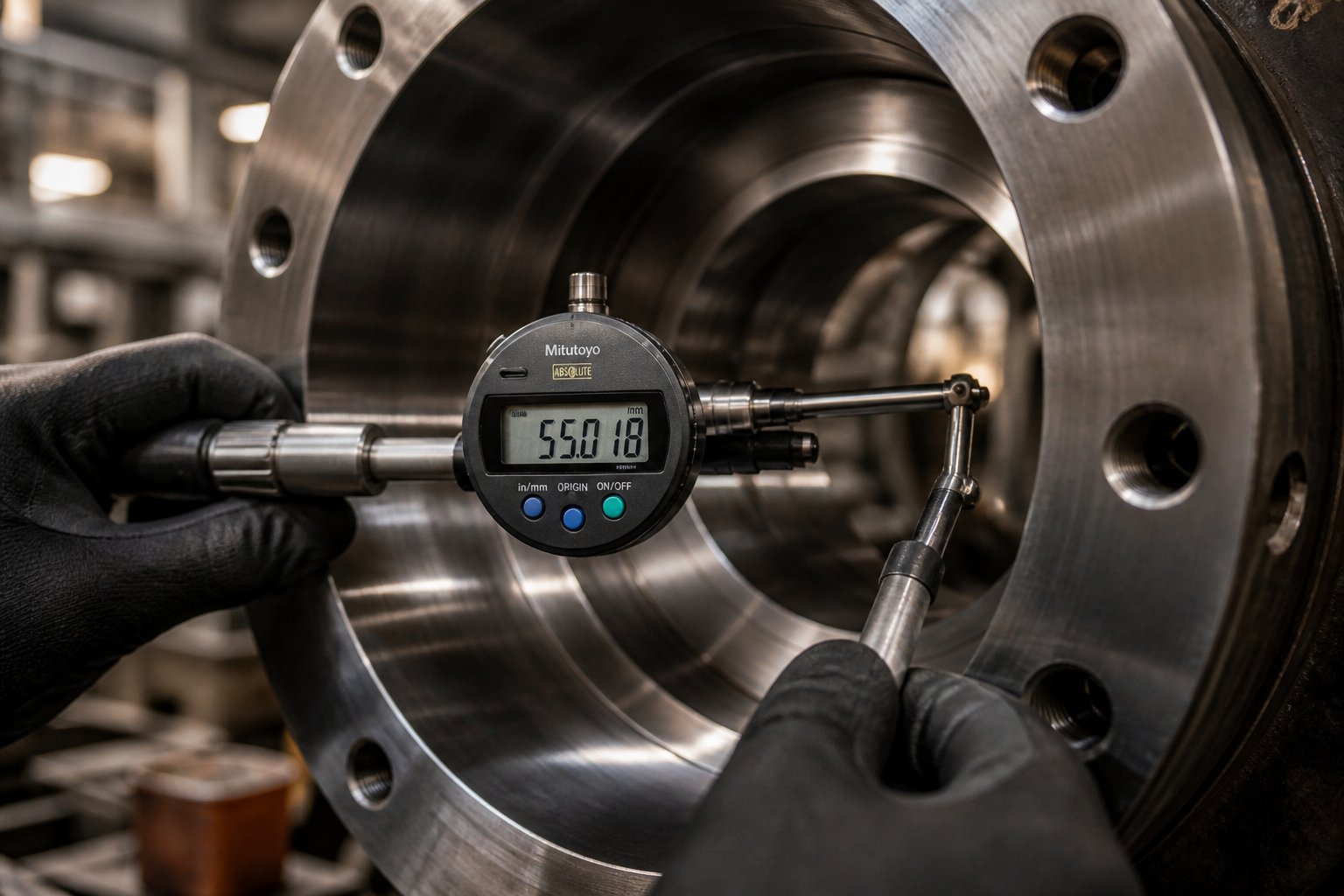
Start by understanding what you're measuring. In a parallel counter-rotating extruder, the barrel bore is a constant-diameter cylinder — a standard telescoping bore gauge swept at multiple points along the length gives you clean, repeatable readings against a single nominal dimension. Check ovality at each measurement station by taking readings at 0, 90, and 45 degrees. Any bore location showing ovality greater than 0.05 mm warrants close attention, because oval wear accelerates leakage between adjacent C-shaped conveying chambers and directly erodes pumping efficiency.
Conical barrels are trickier. The tapered bore means every axial position has a different nominal diameter. You need the OEM's original bore specification chart — or an equivalent engineering drawing — to know what the bore should measure at each point along the taper. Without that reference document, you're measuring wear blindly. If the seller can't provide taper specifications, contact the OEM or a specialized reconditioning shop before the inspection to obtain baseline dimensions.
Screw condition assessment follows. Counter-rotating screws wear most aggressively at the intermeshing zone, where the opposing flights pass each other under compressive load. Look for material buildup in the root of screw flights — a sign of dead zones caused by excessive clearance. Check flight tip width at multiple points along each screw; narrowing flight tips indicate erosion that's already reducing throughput capacity.
Follow this ordered sequence to keep your assessment systematic and thorough:
- Obtain OEM bore specifications — Secure original barrel bore dimensions (taper chart for conical, nominal diameter for parallel) before arriving on site.
- Measure barrel bore at minimum five axial stations — Record diameter readings at the feed zone, early compression, mid-barrel, late compression, and metering zone. Take three angular measurements at each station to capture ovality.
- Calculate clearance deviation — Subtract nominal bore diameter from measured diameter at each station. Flag any location where wear exceeds 0.10 mm beyond nominal as requiring reconditioning evaluation.
- Inspect screw flight tips — Measure flight outer diameter at intervals corresponding to your barrel measurement stations. Compare against original screw OD specifications.
- Examine the intermeshing zone closely — Look for scoring, galling, or uneven polish patterns on screw flanks near the apex. These indicate metal-to-metal contact history from improper clearance or foreign object ingestion.
- Check screw straightness — Roll each screw on V-blocks (for parallel designs) or use dial indicator runout checks. Bent screws create uneven barrel contact, accelerate localized wear, and cause vibration under load.
- Inspect barrel liner condition — For bimetallic barrels, look for liner delamination, cracking at heater band zones, or corrosion pitting. Tap-test suspect areas — a hollow or dull tone suggests liner separation from the barrel body.
- Document everything photographically — Photograph bore gauge readings, screw surfaces, and any anomalies. These records become critical during price negotiation and reconditioning planning.
Gearbox, Thrust Bearings, and Drive System Inspection
If the barrel and screws are the heart of a counter-rotating extruder, the gearbox is its spine — and it absorbs punishment that co-rotating gearboxes never experience. Here's why: when two screws rotate in opposite directions, material compressed between them generates axial forces that push both screws outward, away from the intermeshing zone. Those opposing thrust loads slam directly into the gearbox's thrust bearings from two directions simultaneously. Over thousands of operating hours, this bidirectional axial stress fatigues bearing surfaces, degrades thrust bearing preload, and eventually manifests as measurable axial play.
Check thrust bearing condition by measuring axial endplay at the screw shaft outputs. The OEM specification typically allows 0.03 to 0.08 mm of total endplay on counter-rotating designs. Anything beyond 0.12 mm suggests bearing wear that will affect melt pressure stability and may require a full bearing replacement — a repair that can run into five figures depending on the machine size and OEM.
Gearbox backlash measurement comes next. Secure one screw shaft and apply rotational force to the other while measuring angular displacement with a dial indicator at the shaft output. Excessive backlash — typically beyond 0.15 degrees of arc — indicates gear tooth surface degradation. Listen for rhythmic clicking or knocking during any test run; these sounds often signal gear tooth micro-pitting that backlash measurement alone won't reveal.
Oil analysis offers a window into gearbox internals without disassembly. Request the most recent oil sample report, or take a sample yourself during the inspection. Elevated iron and copper particle counts point to gear and bearing surface wear. Water contamination above 200 ppm indicates seal failure. Dark, oxidized oil with acid number increases above baseline suggests the machine ran hot or exceeded oil change intervals — both indicators of deferred maintenance.
Drive system evaluation rounds out this section. Check motor insulation resistance with a megohmmeter — readings below 1 megohm per kV of rated voltage suggest moisture intrusion or insulation breakdown. For machines with older DC motors and SCR drives, verify that the drive holds stable speed at both the low end (5-10% of rated RPM) and high end of the speed range. Instability at low speeds is common in aging DC systems and directly undermines the precise, low-RPM operation that counter-rotating processing demands. Used extrusion equipment with DC drives often benefits from an AC vector drive retrofit, so factor that potential upgrade cost into your total budget.
Electrical, Controls, and Safety Compliance Checks
Mechanical condition tells you whether the machine can run. Electrical and controls condition tells you whether it can run safely, legally, and productively in your facility.
Older used extruder equipment frequently carries outdated control systems — relay logic, early-generation PLCs with discontinued programming software, or proprietary HMI panels that can't be serviced or updated. Ask yourself: if this controller fails six months after purchase, can I get a replacement or repair it? If the answer involves tracking down a retired engineer who remembers the platform, that's a cost multiplier hiding behind a low purchase price.
Safety compliance is equally critical, especially for equipment crossing international borders. Within the European Economic Area, industrial machinery must carry CE marking — the manufacturer's declaration that the machine met applicable safety directives at the time of first market placement. Machines manufactured before the Machinery Directive took effect in 1995 may never have carried CE marking, and any machine that has undergone substantial modifications may have invalidated its original certification. When importing used equipment into the EU, the importer legally assumes the manufacturer's responsibility and must ensure CE compliance before putting the machine into service — a process that can involve a notified body inspection and full conformity assessment.
Run through this list of red-flag conditions during every electrical and controls inspection:
- Missing or damaged safety interlocks on barrel guards, hopper covers, or die zone enclosures — These are non-negotiable safety features. Replacement and recertification add cost and delay.
- Electrical panel wiring that shows signs of amateur modification — Spliced wires, unlabeled circuits, or added components without proper documentation indicate work performed outside professional standards.
- Control system running on a discontinued platform with no migration path — If the PLC, HMI, or drive controller can't be repaired, reprogrammed, or replaced with current-production equivalents, the machine's operational lifespan is limited by electronics obsolescence.
- Thermocouple or heater band zones showing erratic temperature readings — Temperature control accuracy is essential for PVC processing. Erratic zones suggest failed thermocouples, degraded heater bands, or corroded connections that affect product quality.
- No CE marking or Declaration of Conformity documentation on equipment intended for EU installation — Operating machinery without required certification exposes you to administrative penalties, insurance coverage exclusions, and significant legal liability in the event of an incident.
- Ground fault or insulation resistance test failures — These indicate electrical safety hazards that must be resolved before the machine operates under any jurisdiction's electrical codes.
- Emergency stop circuits that are bypassed, defeated, or non-functional — Walk away immediately. No price justifies a machine where someone disabled the last line of operator safety.
A thorough inspection following this checklist takes time — typically a full day for a production-scale counter-rotating extruder when done properly. Don't let a seller rush you. Every hour spent measuring, testing, and documenting on the seller's floor saves you multiples of that time and cost in post-purchase surprises.
Even the most rigorous inspection, though, can't fix a fundamentally compromised machine. Some conditions are simply beyond economical repair — and knowing when to walk away from a used counter rotating twin screw extruder is just as valuable as knowing how to evaluate one.
Red Flags and Deal-Breakers When Buying Used Extruders
Not every used extruder deserves a second chance. Some machines carry damage so deep that no reconditioning budget — no matter how generous — can restore them to reliable production service. The discipline to walk away from a bad deal protects your capital far more effectively than the best negotiating skills. Here's where to draw the line.
Structural and Mechanical Deal-Breakers
Certain conditions move a machine from "needs work" to "not worth the risk." These aren't judgment calls — they're hard stops that experienced buyers treat as non-negotiable rejection criteria.
Barrel bore wear beyond resleeving thresholds tops the list. When a bimetallic barrel liner has worn through its hardened layer — typically around 0.060 inches thick — you're cutting into the soft backing material. At that point, resleeving becomes the only option, and if the barrel's outer shell shows heat distortion or corrosion damage, even resleeving may not be viable. A barrel with an iron-based bimetallic liner will typically outlast about three screw service lives, but once that liner is consumed, the barrel itself becomes the constraint.
Cracked barrel flanges are another absolute deal-breaker. Flange cracks propagate under the cyclic thermal and mechanical loads of extrusion. Welding a cracked flange might hold temporarily, but the repaired zone becomes a stress riser that's likely to fail again — potentially during production, with molten polymer under pressure behind it.
Overheating damage to barrel metallurgy shows up as discoloration, warping, or localized soft spots in the barrel wall. Sustained overtemperature events change the steel's microstructure, reducing hardness and fatigue resistance permanently. No heat treatment or surface coating reverses that damage.
On the gearbox side, excessive backlash indicating imminent gear failure is a clear signal to step back. A gearbox rebuild can approach 60% of a new unit's cost — and once it crosses that threshold, replacement typically offers better long-term value. If the gearbox housing itself is cracked, warped, or corroded, even a rebuild isn't viable because the housing defines whether the entire unit can hold precision tolerances.
Thrust bearing play beyond serviceable limits rounds out the mechanical deal-breakers. In counter-rotating machines, opposing axial forces hammer thrust bearings relentlessly. When endplay exceeds OEM tolerances significantly — say, double the maximum allowable specification — the bearing seats and shaft journals may also be worn, turning a bearing swap into a full shaft and housing rebuild. At that point, reconditioning economics often collapse.
The common thread? Each of these conditions makes repair costs unpredictable and often disproportionate to the machine's market value. A used extruder priced attractively becomes a money pit when any one of these issues hides beneath the surface.
Documentation and History Red Flags
Mechanical conditions you can measure. Documentation gaps require a different kind of vigilance — and they often reveal more about a machine's true history than any bore gauge reading.
Imagine finding used plastic extruders listed at appealing prices, complete with glossy photos and fresh paint. Everything looks solid. But when you ask for maintenance records, the seller shrugs. Run hours? Unknown. Original OEM manuals? Lost in a move. That silence should speak volumes.
Missing maintenance records don't automatically disqualify a machine, but they dramatically increase your uncertainty. Without service history, you can't confirm whether critical components — thrust bearings, gearbox internals, barrel liners — were ever replaced or simply run until failure. That uncertainty should translate directly into a lower offer price and a more aggressive inspection scope.
Watch especially for signs of undisclosed catastrophic failure repairs. Fresh weld marks on the barrel, mismatched paint between sections, or a gearbox serial number that doesn't correspond to the machine's original build sheet all suggest the equipment survived a major event that the seller isn't volunteering. A machine that experienced a screw crash, barrel rupture, or gearbox seizure may have been repaired well — or it may carry hidden stress fractures and alignment issues that only show up under sustained production loads.
Perhaps the most telling red flag of all: a seller who won't allow an on-site inspection or test run. Legitimate sellers of plastic extruders for sale understand that buyers need to verify condition firsthand. A seller who insists on "as-is, where-is" terms without inspection access is asking you to absorb 100% of the condition risk — and that's rarely a bet worth taking on production-critical equipment.
| Red Flag | Why It Matters |
|---|---|
| No maintenance or service records available | Impossible to verify component replacement history, lubrication intervals, or whether recurring failures were addressed — increases hidden repair risk substantially |
| Unknown or undocumented total run hours | Run hours drive wear on screws, barrels, bearings, and gearbox internals — without this data, you cannot estimate remaining service life or plan maintenance budgets |
| Missing original OEM manuals, drawings, or parts lists | Slows maintenance response, complicates parts sourcing, and makes reconditioning more expensive because technicians must reverse-engineer specifications |
| Evidence of crash damage or catastrophic failure repair | Screw crashes and barrel ruptures create stress concentrations and alignment distortions that may not be visible externally but cause premature failure under production loads |
| Seller refuses on-site inspection or test run | Prevents verification of actual machine condition — shifts all risk to the buyer and often indicates problems the seller knows about but won't disclose |
| Mismatched serial numbers or altered data plates | Complicates parts sourcing, makes warranty or recall verification impossible, and may indicate the machine was assembled from multiple units after separate failures |
| Fresh cosmetic paint over structural areas | Can conceal cracks, corrosion, weld repairs, or impact damage on barrel flanges, frame members, and gearbox housings — always investigate what's underneath |
| Price dramatically below comparable market listings | Deep discounts often reflect undisclosed condition problems, missing accessories, obsolete controls, or removal complexity that the seller has already priced into a quick-exit strategy |
This table isn't meant to make you paranoid — it's meant to make you precise. Every red flag has a rational explanation, and some can be resolved through deeper inspection, price adjustment, or post-purchase reconditioning. The goal is transparency: identify the risks before they become your problems, negotiate accordingly, and reserve your walk-away authority for the conditions that genuinely can't be fixed at a reasonable cost.
For machines that clear these hurdles but still show manageable wear, a different question takes center stage: what does it actually cost to bring a used counter rotating twin screw extruder back to full production capability — and where do you source the parts to make that happen?
Refurbishment and Replacement Parts for Used Counter-Rotating Machines
You've found a used counter rotating twin screw extruder that passed your inspection — mostly. The barrel bore shows moderate wear in the metering section. Screw flights are thinning near the intermeshing zone. The gearbox sounds fine, but the oil analysis flagged early-stage bearing wear. The machine isn't a deal-breaker, but it's not production-ready either. So the real question becomes: is it cheaper to recondition this machine or keep searching for a better one?
That answer depends entirely on understanding what reconditioning involves, what each repair actually costs relative to the machine's value, and whether you can source the parts you'll need — especially when the original twin-screw extruder manufacturer stopped supporting the model years ago.
Screw and Barrel Reconditioning Options
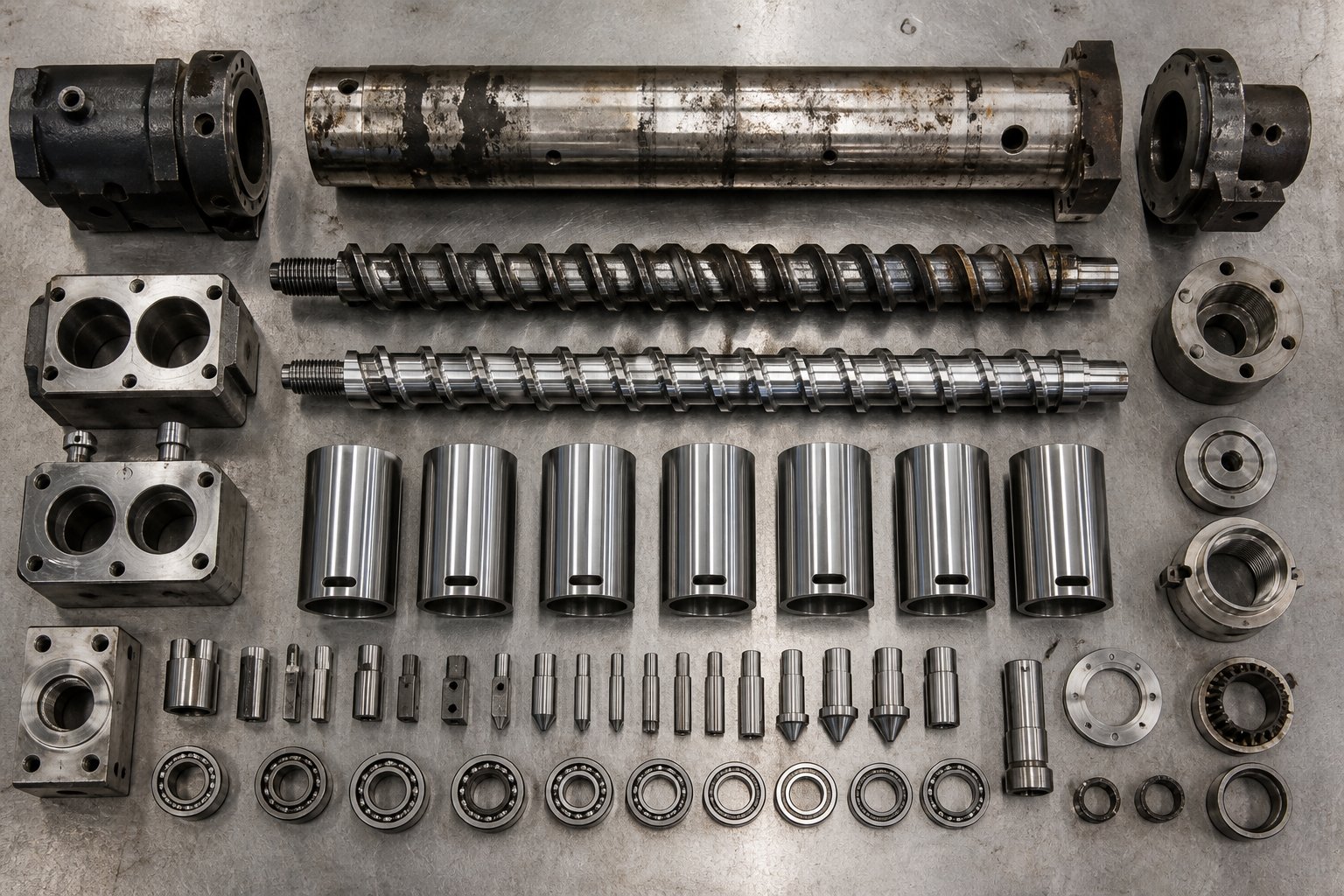
Screws and barrels are consumable components. Every hour of operation grinds away material from flight tips, barrel liners, and intermeshing surfaces. The question isn't whether they'll need reconditioning — it's which method gives you the best return for your specific wear condition.
Here are the primary reconditioning approaches, ranked roughly from least to most invasive:
- Renitriding — If screw surfaces show early-stage wear but the flight geometry is still within tolerance, renitriding restores the hardened surface layer without adding material. This is the lightest intervention available and works best when you catch wear early. It won't rebuild lost dimensions, though — it only re-hardens what's already there.
- Hard-facing (weld overlay) — When screw flight tips have worn below tolerance, hard-facing builds them back up with abrasion-resistant alloy deposited by welding. The rebuilt flights are then machined back to original outer diameter specifications. This is cost-effective when flight tip wear is the primary issue and the screw core remains straight and structurally sound. For counter-rotating screws, hard-facing must restore not just the flight OD but also the flank geometry at the intermeshing zone — a detail that general machine shops sometimes overlook.
- Barrel liner replacement — Bimetallic barrels use a hardened inner liner bonded to a softer steel shell. When the liner wears through its hardened layer, the only viable repair is pulling the old liner and installing a new one. This is a major reconditioning step and requires a shop with centrifugal casting or press-fit liner installation capability. For conical barrels, liner replacement is even more specialized because the tapered bore geometry demands custom-fit liners matched to the exact taper angle.
- Complete screw replacement — Sometimes reconditioning simply doesn't pencil out. If a screw is bent, cracked at the root, or worn so heavily that hard-facing would consume more material than the original flight contained, replacement is the economical choice. New screws manufactured to OEM specifications — or reverse-engineered from the worn originals — often deliver better long-term value than repeated repairs on a compromised core.
Here's a critical detail that separates counter-rotating reconditioning from single-screw or co-rotating work: counter-rotating screw sets must always be reconditioned as matched pairs. The two screws intermesh with extremely tight clearances, and those clearances must be uniform along the entire barrel length. If you hard-face one screw and leave the other untouched, the dimensional mismatch at the intermeshing zone creates uneven wear, vibration, and potentially metal-to-metal contact that damages both screws and the barrel. Any reputable reconditioning shop will insist on receiving both screws together and measuring them as a set before and after any work.
When does reconditioning make more sense than sourcing a different used machine entirely? A useful rule of thumb: if screw and barrel reconditioning costs exceed 40% to 50% of the machine's current market value, start comparing the total cost against what a better-condition machine would run. Factor in downtime during reconditioning — a twin screw compounding extruder pulled offline for a full barrel reline and screw rebuild may be out of service for six to ten weeks, depending on shop backlog and parts availability.
Gearbox Rebuilds and Drive System Upgrades
Gearbox reconditioning is where costs can escalate fast if you're not strategic about scoping the work. A full rebuild of a counter-rotating extruder gearbox involves disassembly, cleaning, inspection of every shaft, gear, and bearing, and replacement of worn components — essentially the process Coperion outlines for maximizing system availability: disassembly and inspection, visual and magnetic particle testing of all parts, validation of shaft alignment and tolerances, and creation of a detailed report with clear recommendations.
For counter-rotating machines specifically, pay attention to these rebuild priorities:
- Thrust bearing replacement — The opposing axial loads inherent to counter-rotation make thrust bearings the highest-wear gearbox component. Replacing them proactively during any gearbox-open event is standard practice. Don't wait for failure — a thrust bearing that seizes under load can take out shafts, gears, and the housing in seconds.
- Gear tooth inspection — Look for micro-pitting, spalling, and root cracks using magnetic particle or dye penetrant testing. Surface-hardened gears that have lost their case hardening depth through sustained high loads should be replaced, not polished and reinstalled.
- Housing bore and bearing seat measurement — Even if the gears and bearings are replaced, worn housing bores prevent proper bearing seating and alignment. Oversize bearing seats can sometimes be line-bored and fitted with oversized bearing races, but severely worn housings may require the gearbox housing itself to be replaced or repaired by metalizing and re-machining.
- Seal replacement — Every shaft seal, gasket, and O-ring should be replaced during any rebuild. The cost of seals is negligible compared to the labor of disassembly, and reusing aged seals is a false economy that invites oil leaks and contamination within months of reassembly.
Drive system upgrades present a separate — and often highly worthwhile — opportunity. Many used counter-rotating extruders still run on older DC motors with SCR (silicon-controlled rectifier) drives. These systems worked reliably for decades, but they suffer from two growing problems: replacement SCR components are increasingly scarce, and DC drives deliver poor speed regulation at the low end of the RPM range — exactly where counter-rotating machines spend most of their operating time.
Retrofitting to a modern AC vector drive paired with an AC induction or permanent magnet motor solves both issues. You get precise speed control across the entire range, regenerative braking capability, reduced maintenance (no brushes to replace), and a drive platform with a current supply chain. The retrofit typically costs less than a full gearbox rebuild and can extend the machine's productive lifespan by a decade or more. If you're budgeting for a used compounding extruder purchase, build the DC-to-AC conversion cost into your total acquisition plan from the start rather than treating it as a surprise expense later.
Sourcing Replacement Parts for Older Counter-Rotating Models
This is where many used equipment purchases quietly unravel. You buy the machine at a fair price, complete the inspection, budget for reconditioning — and then discover that the OEM discontinued your model's parts catalog seven years ago. Suddenly, a straightforward barrel liner replacement turns into a sourcing odyssey.
The challenge is real. Counter-rotating extruders serve a narrower market than their co-rotating counterparts, which means OEMs discontinue parts support for older models more readily. Product lines evolve, companies merge or disappear, and the machine you bought may have decades of service life left while the parts catalog stopped caring first. Twin screw extruder manufacturers naturally focus their resources on current-production models, leaving legacy equipment owners to find alternative channels.
Your first move should always be contacting the OEM or its successor company directly. Even when a model is officially discontinued, many manufacturers maintain archives of engineering drawings and can produce parts on a custom-order basis — at a premium, and often with extended lead times. If the original twin-screw extruder manufacturer no longer exists, check whether another company acquired their product line and inherited the documentation.
Beyond OEM channels, specialized aftermarket suppliers fill the gap. These companies manufacture replacement screws, barrel liners, heater bands, thermocouples, die heads, pelletizing blades, and other wear components based on original drawings or reverse-engineered from worn samples. The process is straightforward: you provide the old part — even a heavily worn one — along with any dimensional data you have, and the supplier produces a functional replacement, often with the option to upgrade materials for longer service life.
Companies like NANHAIYA, for instance, specialize in producing custom extruder spare parts from drawings or physical samples — a capability directly relevant to buyers reconditioning used counter-rotating machines where OEM parts availability has dried up. Other aftermarket suppliers operate in this space as well, so comparing quotes across two or three vendors for critical components like screw sets and barrel liners is good procurement practice.
Whichever sourcing route you choose, keep these principles in mind:
- Always obtain dimensional verification — Any aftermarket replacement part should come with an inspection report documenting critical dimensions against the original specification or your reverse-engineered drawing.
- Specify material and hardness requirements explicitly — A replacement screw built from the wrong steel grade or heat-treated to the wrong hardness will wear faster than the original, negating any cost savings.
- Order matched screw sets — As discussed earlier, counter-rotating screws must intermesh precisely. Never source one screw from one supplier and the second from another unless both are working from the same dimensional master.
- Secure documentation for future reorders — The most valuable outcome of a reverse-engineering exercise isn't just the replacement part — it's the drawing. A dimensioned drawing held on file converts the next replacement from an emergency into a routine purchase order.
Parts sourcing often determines whether a used machine investment ultimately pays off or spirals into frustration. Building your supply chain before you finalize the purchase — not after — gives you realistic cost estimates for ongoing maintenance and prevents unpleasant discoveries once the machine is already on your floor.
Reconditioning budgets and parts availability, however, only capture one dimension of the financial picture. The true cost of deploying a used counter rotating twin screw extruder extends well beyond the purchase price and the rebuild invoice — into installation, integration, training, and operational expenses that many first-time buyers underestimate dramatically.
Pricing Factors and Total Cost of Ownership Beyond Purchase Price
A reconditioning budget tells you what it takes to restore the machine. But what determines whether the asking price itself is fair — and what expenses beyond the invoice quietly double your real investment? Most buyers fixate on the sticker price, run a quick mental comparison against new equipment quotes, and feel confident they're getting a deal. The reality is more layered. The twin screw extruder price you negotiate at the point of sale is just one input in a much larger cost equation — and the variables that surround it determine whether your used purchase delivers genuine savings or simply defers expenses into less convenient moments.
Factors That Influence Used Counter-Rotating Extruder Pricing
Not all used counter-rotating machines are priced equal, even when they look similar on paper. Several factors interact to set market value, and understanding their relative weight helps you evaluate whether a listing is priced aggressively, fairly, or optimistically. Here they are, organized from most to least impactful on the final extruder machine price:
- Screw diameter and throughput class — This is the single biggest pricing lever. A 92mm or 110mm production machine commands a fundamentally different price tier than a 35mm or 45mm unit. Larger diameters mean higher material costs for screws and barrels, beefier gearboxes, and greater production revenue potential — all of which support higher resale values.
- Condition tier: as-is vs. refurbished vs. rebuilt — An "as-is" machine sold out of a closed plant with no warranties or test runs sits at the bottom of the pricing spectrum. A professionally refurbished unit with documented reconditioning work, new wear parts, and a test-run report commands a significant premium. A fully rebuilt machine with new screws, barrel liners, gearbox overhaul, and updated controls approaches 60% to 75% of new equipment cost but delivers near-new reliability. The plastic extrusion machine cost difference between these tiers can be substantial — make sure you know which tier you're actually evaluating.
- OEM brand reputation — Well-known brands like Battenfeld Cincinnati and Krauss Maffei typically command premium resale values. Their build quality, parts ecosystem, and service network familiarity reduce the buyer's risk and ongoing support costs — advantages the market prices in. Lesser-known or regional OEM brands may offer identical specifications at lower prices, but parts sourcing and technical documentation become your responsibility.
- Machine vintage and controls generation — A 2015-vintage extruder with current-generation PLC and AC drives holds value far better than a mechanically identical 1998 unit running obsolete DC drives and a discontinued HMI platform. Controls obsolescence depresses pricing more aggressively than moderate mechanical wear because it carries both replacement cost and production risk.
- Included downstream equipment — Some listings include calibration tables, haul-offs, saws, or pelletizers as a package. Bundled downstream equipment can represent genuine added value — or it can mask a higher effective price for the extruder itself. Break the package apart and value each component individually.
- Geographic location and logistics — A machine sitting in your region avoids international shipping, customs duties, and import compliance costs. Equipment located overseas may carry an attractive plastic extruder machine price, but rigging, ocean freight, port handling, and inland transport can add 10% to 20% to the landed cost. Factor in removal complexity as well — a machine bolted to a mezzanine in an operating plant costs more to extract than one sitting on a warehouse floor.
Rather than quoting specific dollar figures — which fluctuate with market conditions, currency exchange rates, and regional supply and demand — the most reliable approach is to benchmark any listing against current market comparables. Check active listings on industrial equipment marketplaces, request dealer quotes on similar models, and compare condition-adjusted pricing across at least three sources before settling on your target negotiation range.
Hidden Costs That Inflate Total Investment
Here's where disciplined buyers separate themselves from everyone else. The purchase price gets the machine on a truck. Everything that follows gets it into production — and those "everything" costs add up faster than most first-time buyers anticipate.
Purchase price typically represents only 50% to 70% of the total deployment cost for a used counter-rotating twin screw extruder. Installation, integration, spare parts stocking, training, and first-year maintenance expenses frequently equal or exceed the gap between used and new equipment pricing if not budgeted from the start.
Consider each of these cost categories before you finalize your acquisition budget:
Installation and rigging. A production-scale counter-rotating extruder weighs several tons and requires professional rigging, crane service, and often foundation work — vibration-isolated concrete pads, anchor bolt patterns matched to the machine's footprint, and leveling to gearbox manufacturer specifications. Utility connections add another layer: three-phase power at the correct voltage and amperage, cooling water supply and return lines, compressed air for pneumatic controls, and ventilation for fume extraction. Industry analysis confirms that these relocation and integration expenses are among the most consistently underestimated costs in used equipment projects.
Controls and automation compatibility. Does the machine's PLC communicate with your plant's SCADA system? Will the HMI integrate with your existing data collection infrastructure? Older control platforms may require protocol converters, gateway modules, or complete controls retrofits to function within a modern plant network. Even something as simple as a mismatched communication protocol — Modbus RTU versus Ethernet/IP, for instance — can generate engineering costs that weren't visible during the equipment evaluation.
Spare parts stocking. A new machine ships with a recommended spare parts list and readily available inventory from the OEM. A used machine — especially one from a discontinued product line — requires you to proactively identify and stock critical wear parts before something breaks. Heater bands, thermocouples, barrel liner segments, drive belts, and gearbox seals should all be on your shelf before the first production run. The cost is modest relative to the machine price, but the consequence of not having them — unplanned downtime while you scramble for parts — is disproportionately expensive.
Operator and maintenance training. If your team has never run this specific OEM platform, plan for a learning curve. Different manufacturers use different control interfaces, maintenance access designs, and screw-pull procedures. Training costs might involve bringing in a contract technician familiar with the platform, sending your team to a workshop, or simply accepting reduced efficiency during the first few weeks of operation.
Ongoing maintenance cost differences. Counter-rotating machines carry inherently different maintenance profiles than single-screw or co-rotating equipment your team may already know. The gearbox demands closer monitoring due to opposing thrust loads. Screw-to-barrel clearance checks need to follow counter-rotating measurement protocols. Oil analysis intervals may differ from what your preventive maintenance schedule currently covers. Budget for the adjustment period, and don't assume your existing maintenance routines transfer directly.
Taken together, these hidden costs don't invalidate the used equipment value proposition — they refine it. A used counter rotating twin screw extruder still delivers significant savings over new equipment when the total deployment budget is calculated honestly from the start. The buyers who get burned are the ones who compare only the purchase price against a new machine quote and mistake the difference for pure savings. The smart approach? Build a complete cost model that includes every line item above, compare that total against the new equipment alternative, and make your decision based on the real numbers rather than the headline discount.
With a realistic budget in hand and a clear understanding of both visible and hidden costs, the final step is assembling these insights into a coherent buying process — and surrounding yourself with the right support network to keep the machine running profitably long after the purchase closes.
Smart Buying Steps and Building Your Support Network
You've absorbed the technical details, studied the red flags, and built a realistic picture of what a used counter rotating twin screw extruder actually costs to deploy. That knowledge is powerful — but only if you organize it into a repeatable process you can execute under the time pressure and competitive dynamics of real-world equipment sourcing. Buyers who approach the used market with a clear sequence of decisions consistently outperform those who react opportunistically to whatever listing happens to appear first.
Matching Your Application to the Right Used Machine
Every successful used equipment purchase follows the same logic: start with what you need to produce, then work backward to the machine that produces it. Skip a step, and you risk buying a capable machine that's capable of the wrong things. Here's the decision framework distilled into a sequence you can follow from initial planning through final commitment:
- Define your target application precisely — Specify the material (rigid PVC dry blend, WPC formulation, filled compound), the end product (pipe, profile, sheet, pellet), and the required output rate. Vague requirements produce vague searches.
- Select conical or parallel configuration — Match your material's feeding characteristics and plasticizing needs to the right screw geometry. PVC dry-blend pipe and profile work typically points to conical. WPC, high-filler compounds, or processes needing extended residence time favor parallel.
- Establish required specifications — Lock in your minimum screw diameter, L/D ratio, torque density, motor power, and throughput range based on your production targets. These become your non-negotiable search filters.
- Search the used market systematically — Browse industrial equipment marketplaces, contact specialized dealers, and monitor auction listings. When you find a used twin screw extruder for sale that matches your specification filters, request detailed photos, measurement reports, and maintenance history before scheduling a site visit.
- Inspect against counter-rotating-specific criteria — Apply the barrel bore, screw flight, gearbox, thrust bearing, and controls checklist covered earlier in this guide. Don't substitute a generic inspection — counter-rotating machines wear differently, and your checklist must reflect that.
- Assess reconditioning needs and costs — Based on inspection findings, price out screw hard-facing, barrel relining, gearbox bearing replacement, and any drive system upgrades. Get firm quotes from reconditioning shops before you finalize your offer on the machine.
- Calculate total cost of ownership — Add purchase price, reconditioning costs, rigging and installation, utility connections, controls integration, spare parts stocking, and operator training. Compare that total — not just the sticker price — against the cost of new equipment or alternative used listings.
- Negotiate and close with confidence — Armed with inspection data, reconditioning quotes, and a complete cost model, you negotiate from a position of knowledge rather than hope. Every documented deficiency becomes a line item that justifies your offer price.
This sequence works whether you're evaluating a single listing or comparing twin screw extruders for sale across multiple dealers and geographies. The discipline is in following every step rather than skipping ahead when a deal feels urgent. Urgency is the seller's advantage — preparation is yours.
Building a Reliable Support Network Before You Buy
Here's something experienced buyers understand that first-timers often learn the hard way: the machine itself is only as good as the support ecosystem surrounding it. A used counter rotating twin screw extruder sitting on your production floor without reliable access to inspection expertise, reconditioning services, and replacement parts is a liability disguised as an asset.
Build these relationships before you sign a purchase order — not after something breaks:
- Independent inspection specialists — Identify a mechanic or engineering consultant experienced with counter-rotating extruder gearboxes, barrel measurement techniques, and drive system evaluation. This person accompanies you to the seller's site and validates your findings. Their day rate is trivial compared to the cost of missing a cracked barrel flange or a failing thrust bearing.
- Reconditioning and rebuild shops — Establish contact with at least one shop capable of counter-rotating screw hard-facing, conical barrel relining, and gearbox overhaul. Confirm their turnaround times and material capabilities before you need them. A shop that quotes six weeks for a screw rebuild today might quote twelve weeks when your machine is already disassembled on their floor.
- Aftermarket parts suppliers — This is arguably the most critical link in the chain, especially for older or discontinued models where OEM support has thinned out. You need suppliers who can manufacture replacement screw elements, heater bands, thermocouples, die heads, pelletizing blades, and other custom components from drawings or reverse-engineered samples. Companies like NANHAIYA serve exactly this role — producing custom extruder spare parts based on drawings or physical samples, which directly addresses the parts availability challenge buyers of used counter-rotating machines face when original OEM channels are no longer responsive. Having a reliable aftermarket partner on speed dial transforms parts sourcing from an emergency scramble into a routine procurement task.
- Equipment appraisers — A certified equipment appraiser provides an independent fair market value assessment that protects you from overpaying and strengthens your negotiating position. Their valuation considers condition, vintage, brand, and current market dynamics — the same factors that drive pricing but viewed through an objective lens rather than a seller's optimism.
- Controls and automation integrators — If the machine runs an older PLC platform or requires a DC-to-AC drive conversion, have a controls integrator scoped and budgeted before closing. Their assessment of what it takes to connect the machine to your plant's SCADA and data systems prevents post-purchase surprises that delay production startup.
Think of this network as your insurance policy against the unknowns that every used equipment purchase carries. No inspection catches everything. No seller discloses everything. But a buyer backed by trusted specialists in inspection, reconditioning, and parts supply can handle whatever surfaces after the deal closes — quickly, cost-effectively, and without production panic.
One final perspective worth carrying into every negotiation. When you browse extrusion equipment for sale — whether it's a single twin screw extruder for sale from a closing plant or a full production line offered through an auction house — remember that the listings represent someone else's surplus, not necessarily your solution. A plastic extruder machine for sale at an attractive price only becomes a smart purchase when it aligns with your application requirements, passes your inspection criteria, fits within your total cost model, and connects to a support network that keeps it running. Every step in this guide exists to help you make that distinction clearly.
The used market for extruders for sale rewards patience, preparation, and precision. Sellers who hide red flags count on buyers who skip steps. You've now got the framework to be the buyer who doesn't.
Frequently Asked Questions About Used Counter Rotating Twin Screw Extruders
1. What is the difference between counter-rotating and co-rotating twin screw extruders?
Counter-rotating twin screw extruders feature screws spinning in opposite directions, producing low shear and positive displacement conveying ideal for heat-sensitive materials like rigid PVC. Co-rotating extruders spin both screws the same way, generating high shear and aggressive mixing suited for polymer compounding and reactive extrusion. For used buyers, the distinction matters because each configuration wears differently: counter-rotating machines stress thrust bearings and gearbox internals through opposing axial loads, while co-rotating machines wear primarily at kneading block flight tips and barrel mixing zones. Parts availability also differs — co-rotating machines have a broader aftermarket supply chain, whereas counter-rotating parts sourcing can require specialized aftermarket suppliers like NANHAIYA who manufacture custom replacement components from drawings or samples.
2. How do you inspect a used counter-rotating twin screw extruder before buying?
A thorough inspection requires measuring barrel bore diameter at a minimum of five axial stations to detect ovality and wear beyond nominal tolerances, checking screw flight tip dimensions against original OEM specifications, and examining the intermeshing zone for scoring or galling. Gearbox inspection should include thrust bearing endplay measurement (flagging anything beyond 0.12 mm), backlash testing, and oil analysis for elevated metal particle counts. Electrical checks should cover motor insulation resistance, control system functionality, and safety interlock verification. For conical machines, you need the OEM's taper specification chart since every axial position has a different nominal diameter. Always request a test run under load for at least four hours at 80% rated capacity, measuring output consistency and monitoring gearbox temperature rise throughout.
3. Should I buy a conical or parallel counter-rotating extruder?
Your application dictates the choice. Conical counter-rotating extruders excel at processing low-bulk-density PVC dry blends for pipe, window profiles, and sheet production because their tapered geometry naturally compresses material without requiring high screw speeds. Parallel counter-rotating extruders offer higher L/D ratios (up to 40:1 versus roughly 17:1 to 26:1 for conical) and suit applications needing extended residence time at low shear, such as wood-plastic composite decking and heavily filled calcium carbonate compounds. On the used market, conical machines appear more frequently due to a larger installed base in PVC processing, while parallel units require longer search times but face less buyer competition. Conical barrels are also harder to inspect and recondition due to their tapered bore geometry, which demands specialized gauging and tooling.
4. What are the biggest red flags when buying a used twin screw extruder?
The most critical deal-breakers include barrel bore wear beyond resleeving thresholds (where the bimetallic liner is worn through its hardened layer), cracked barrel flanges that risk failure under thermal and mechanical cycling, and gearbox backlash exceeding 0.15 degrees of arc indicating imminent gear failure. Documentation red flags are equally serious: missing maintenance records, unknown run hours, evidence of undisclosed crash damage repairs (mismatched paint, fresh weld marks), and sellers who refuse on-site inspection or test runs. A price dramatically below comparable market listings often signals hidden problems rather than a genuine bargain. Any of these conditions should either prompt a significantly reduced offer or a decision to walk away entirely.
5. Where can I find replacement parts for older or discontinued counter-rotating extruders?
Start by contacting the original OEM or its successor company, as many maintain drawing archives and can produce parts on custom order even for discontinued models. When OEM channels are unresponsive, specialized aftermarket suppliers become essential. Companies like NANHAIYA (nhyscrews.com) manufacture replacement screw elements, barrel liners, heater bands, thermocouples, die heads, and pelletizing blades from original drawings or reverse-engineered samples — a critical resource for buyers reconditioning used machines with limited OEM support. When sourcing aftermarket parts, always request dimensional inspection reports, specify material and hardness requirements explicitly, and order counter-rotating screws as matched pairs to maintain proper intermeshing clearances. Keeping dimensioned drawings on file after any reverse-engineering work converts future replacements from emergencies into routine orders.
Written by
Nanhaiya Technical Team
Zhoushan Nanhaiya Plastic Machinery Co., Ltd.
The Nanhaiya technical team supports screw and barrel manufacturing projects through application review, technical communication, custom manufacturing coordination, and production and quality control.
Discuss Your Application
Related Articles
More insights on screw barrel technology and plastics processing.
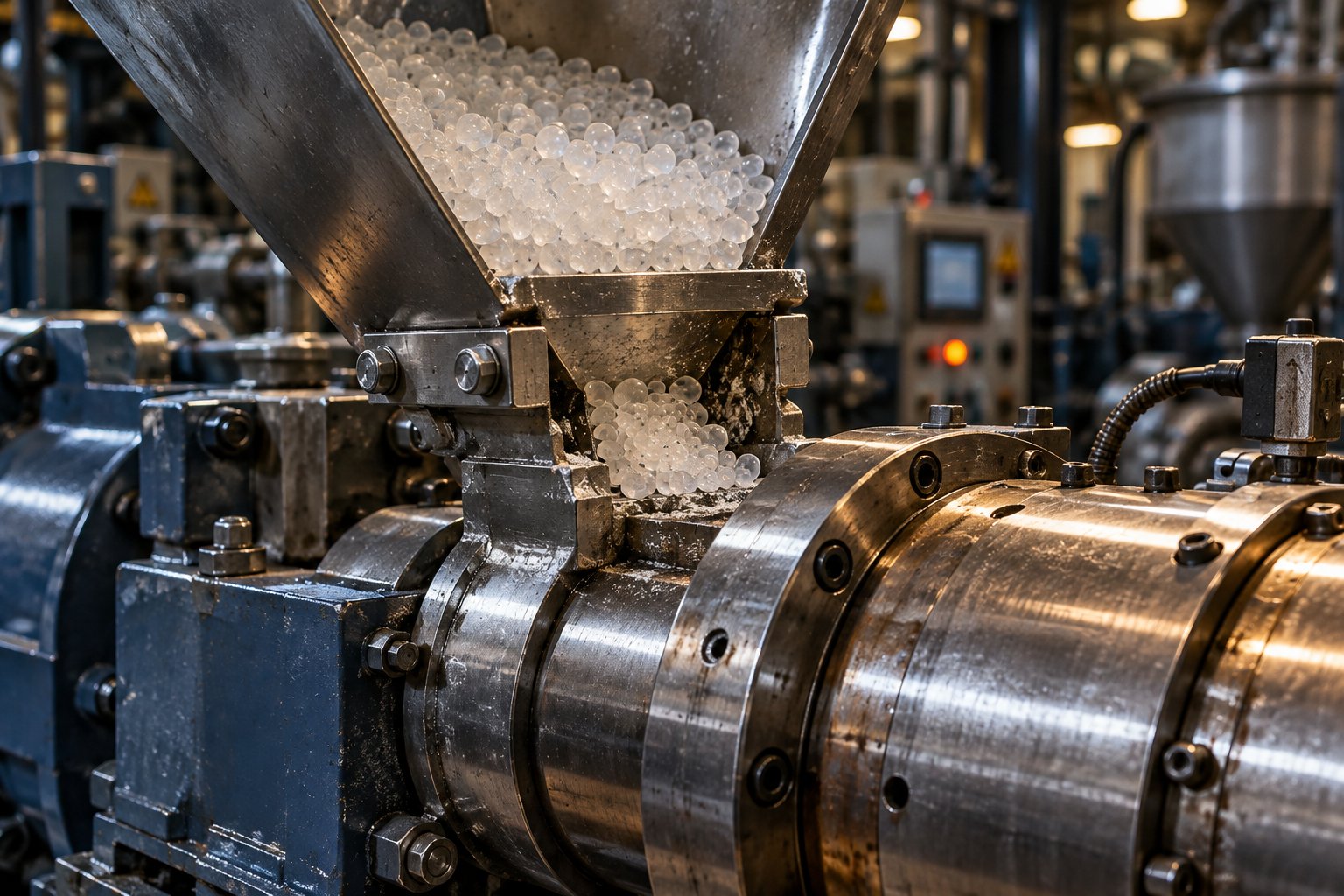
Your Extruder Feeding Instability Isn't Random — Here's Why
Oct 22, 2026
Extruder feeding instability causes surging output and scrap. Learn the 6 root causes, polymer-specific fixes, wear diagnostics, and preventive protocols.
Read Article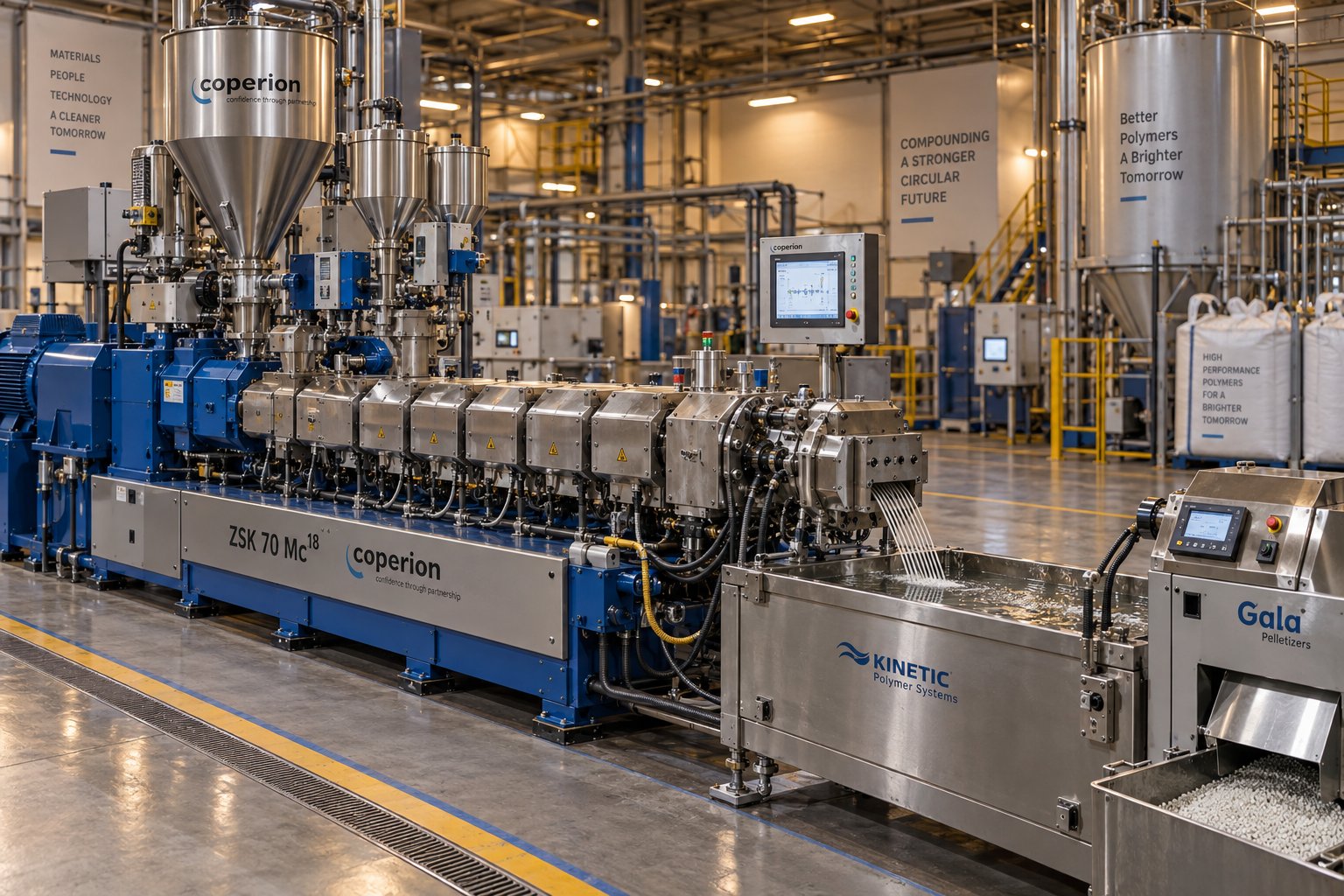
Parallel Twin Screw Extruder for Compounding Demystified: Lab to Line
Oct 21, 2026
Learn how a parallel twin screw extruder for compounding works—from screw element design and zone configuration to lab-to-production scale-up and process optimization.
Read Article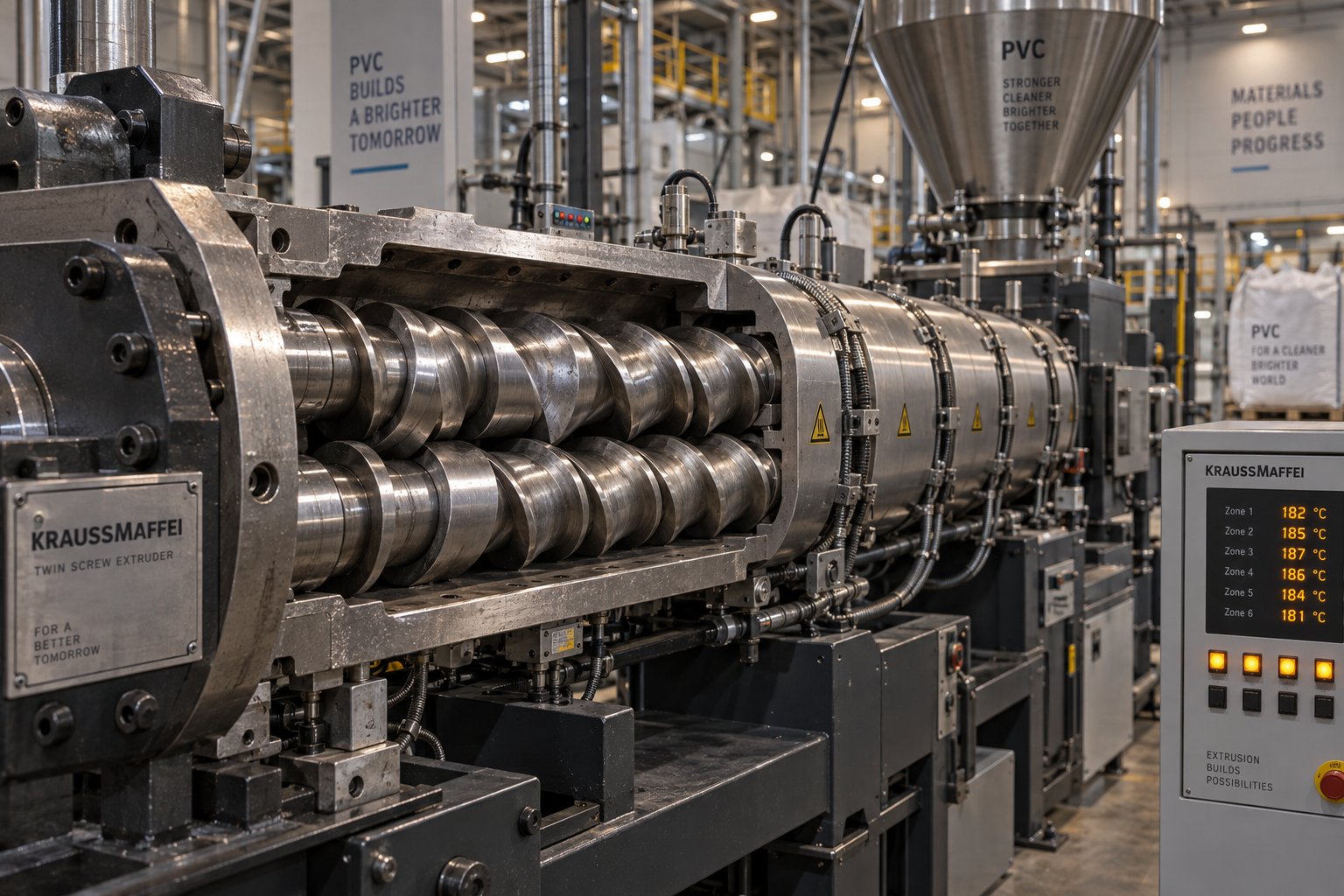
Twin Screw Extruder for PVC: The Setup Mistake Draining Profit
Oct 21, 2026
Learn how to match twin screw extruder configurations to PVC applications. Covers conical vs parallel, counter-rotating vs co-rotating, wear management, and troubleshooting.
Read ArticleLooking for something else?
Search by material, symptom or product and jump straight to the relevant page.
These are navigation suggestions based on keyword matching — not a quotation, not a delivery commitment, and not a substitute for engineering review. Final specification is confirmed by our engineers against your drawings and processed material.
Need help with screw barrel selection?
Share your machine model, processed material and application. Our team can help with pricing and technical support.