

What Is a Twin Screw PVC Extruder and Why Does It Matter
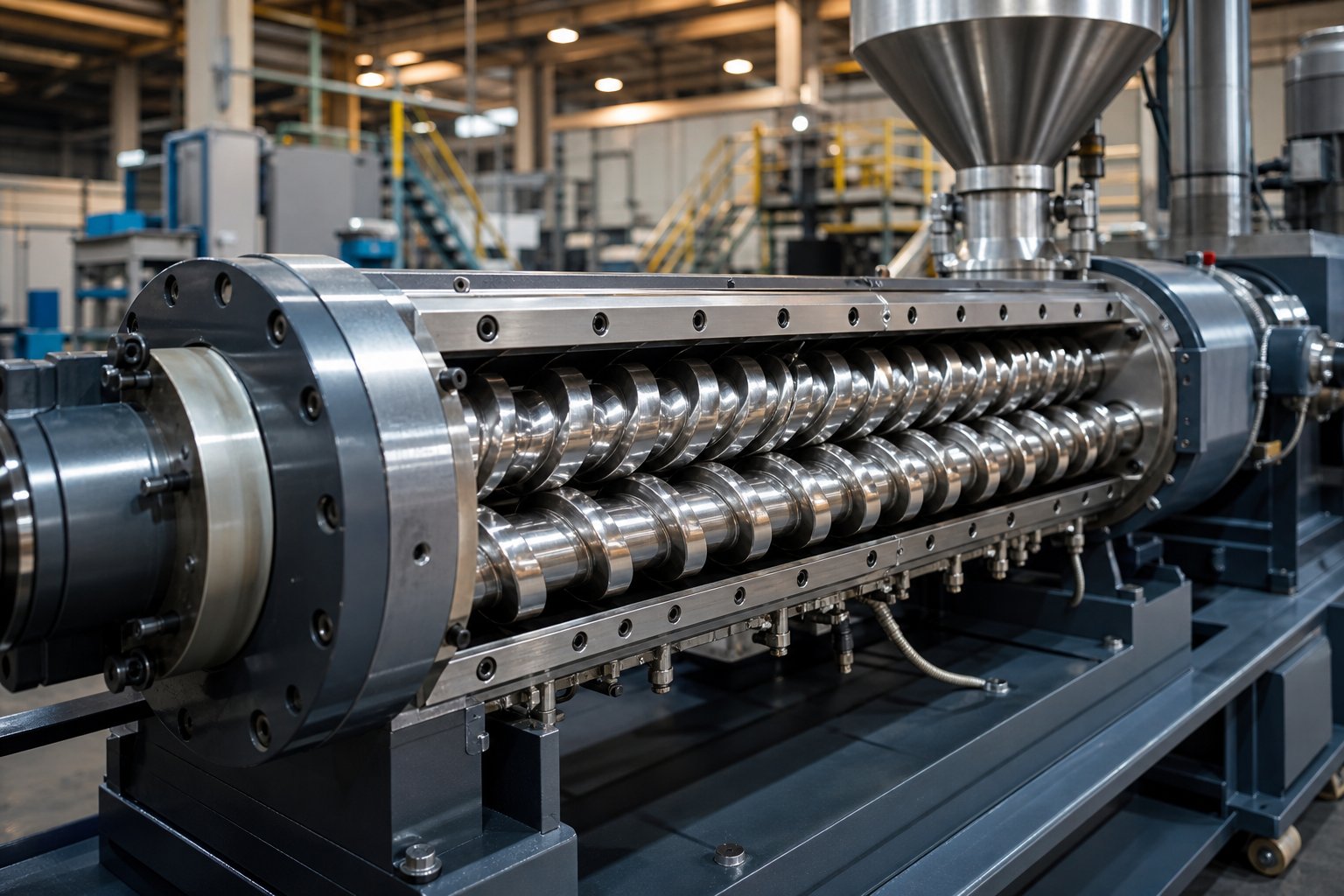
A twin screw PVC extruder is a specialized plastics processing machine that uses two intermeshing screws rotating inside a heated barrel to convey, melt, mix, and shape PVC compounds into finished products such as pipes, window profiles, sheets, siding, and cable insulation. Unlike general-purpose equipment, this type of twin screw extruder machine is engineered specifically to handle PVC's demanding thermal behavior - delivering precise control over temperature, shear, and residence time so the material reaches its target form without breaking down along the way.
PVC ranks among the most widely processed thermoplastics on the planet, yet it behaves nothing like polyethylene or polypropylene on a production line. That contradiction - massive global demand paired with extreme processing sensitivity - is exactly why your choice of extruder configuration can make or break product quality.
What a Twin Screw PVC Extruder Actually Does
Imagine feeding a dry powder blend of PVC resin, stabilizers, lubricants, and fillers into a hopper. From there, two closely intermeshing screws grab the loose material and push it forward through the barrel. As the blend advances, it encounters progressively higher temperatures and mechanical shear. The screws compact the powder, generate frictional heat alongside barrel heaters, and transform the dry blend into a homogeneous, plasticized melt. That melt is then forced through a die at the barrel's exit, producing a continuous profile, pipe, or sheet with consistent dimensions.
The entire twin screw extrusion process depends on balancing three variables simultaneously: heat input, shear rate, and the time the material spends inside the barrel. Get that balance right, and you'll produce parts with uniform wall thickness, smooth surfaces, and strong mechanical properties. Get it wrong, and degradation begins - sometimes invisibly at first, then showing up as yellowed product, brittle sections, or rough surfaces that send scrap rates through the roof.
When people search for extruders meaning in the context of plastics processing, this is the core concept: machines that force polymer material through a shaped die by means of rotating screws inside a heated barrel. A twin-screw extruder simply doubles that screw arrangement to achieve far superior mixing and conveying control - a distinction that becomes critical when the polymer in question is PVC.
Why PVC Stands Apart from Other Polymers in Extrusion
Most thermoplastics offer a comfortable gap between the temperature where they melt and the temperature where they start to break down. PVC does not. Its practical processing window typically falls between roughly 160°C and 210°C depending on the formulation, while the onset of thermal degradation through dehydrochlorination lurks just above that range. Even brief exposure to excess heat triggers a chain reaction that releases corrosive hydrochloric acid gas, discolors the product, and damages metal equipment surfaces.
PVC also relies on a complex additive package - thermal stabilizers, internal and external lubricants, impact modifiers, processing aids, and fillers - all of which must be uniformly dispersed throughout the melt. Poor distribution of any single additive can create localized weak points, surface defects, or accelerated degradation zones inside the barrel. This heavy dependence on additives, combined with sensitivity to shear-generated heat, means PVC cannot simply be "run hotter and faster" like many polyolefins.
PVC's decomposition temperature is dangerously close to its processing temperature, which makes twin screw design choices non-negotiable for quality output.
That narrow margin between successful fusion and destructive breakdown is the central challenge every PVC processor faces - and it shapes every decision about screw geometry, barrel zoning, and throughput speed that follows.
Why PVC Processing Demands Twin Screw Technology Over Single Screw
A single screw extruder works fine for many thermoplastics - polyethylene film, polypropylene strapping, even basic ABS profiles. So why does PVC almost always end up on a twin screw machine instead? The answer traces directly back to that dangerously narrow processing window. When your polymer can degrade within seconds of overheating, you need mixing precision and thermal control that a single-screw design simply cannot deliver.
Superior Mixing and Self-Wiping Action
PVC dry blend is not a simple, single-ingredient feedstock. It arrives at the extruder hopper loaded with stabilizers, lubricants, impact modifiers, processing aids, and often mineral fillers - each one demanding uniform distribution throughout the melt. A single screw relies primarily on drag flow along the barrel wall, which produces limited cross-channel mixing. The result? Pockets of poorly dispersed additives, inconsistent stabilizer coverage, and localized hot spots where degradation takes hold.
Twin screw extruders solve this through intermeshing screw geometry. The two screws create multiple high-shear zones - between the screw flights and the barrel wall, and critically, in the intermesh region where material is transferred from one screw to the other. This geometry delivers both distributive mixing (splitting and recombining melt streams to spread additives evenly) and dispersive mixing (applying shear and elongational forces to break down agglomerates). For a compound that depends on six or more additive categories working in concert, that dual mixing capability is not optional - it is essential.
Equally important is the self-wiping effect. In a twin screw extruder, each screw continuously scrapes material off the other, preventing polymer from sitting in one spot and cooking. For heat-sensitive PVC, even a small stagnation zone can trigger dehydrochlorination, producing dark specks and corrosive gas. The self-wiping action keeps material moving in a first-in, first-out sequence, dramatically reducing the risk of localized degradation that plagues single screw systems running PVC.
Controlled Shear and Predictable Residence Time
Shear generates heat. In PVC screw extrusion, uncontrolled frictional heating is one of the fastest paths to degradation. Single screw machines offer limited ability to independently adjust shear intensity - the screw speed that drives output also drives shear rate, locking the two variables together.
Twin screw extruders break that link. Their segmented screw designs allow engineers to place specific elements - conveying flights, kneading blocks, or neutral mixing discs - at precise locations along the barrel. This means high-shear mixing zones can be isolated to the sections where they are needed, while gentler conveying elements occupy the rest of the process length. The outcome is a tighter, more predictable residence time distribution. Research on twin screw systems has shown that residence times can range from as short as 5 seconds to several minutes, depending on screw configuration and fill level - a flexibility that lets processors tailor thermal exposure to PVC's exact tolerance.
Positive conveying characteristics also play a role here. Because twin screw extruders actively push material forward through the intermeshing flight geometry, output becomes more consistent and process parameters more repeatable from batch to batch. For PVC pipe and profile producers who need dimensional stability across an entire production run, that repeatability translates directly into fewer rejects and tighter tolerances.
Starve Feeding and Process Flexibility
Here is where twin screw extruders gain a decisive operational advantage. Most twin screw machines run starve-fed, meaning the feed rate into the barrel is controlled by an external metering device - typically a loss-in-weight feeder - rather than by the screws themselves. This decouples two variables that a single screw extruder forces together: throughput and screw speed.
Why does that matter for PVC? Imagine switching from a rigid PVC pipe formulation to a flexible PVC cable compound on the same line. Rigid PVC demands lower shear, shorter residence time, and a carefully controlled temperature ramp. Flexible PVC, loaded with plasticizer, needs more intensive mixing and a different thermal profile entirely. On a starve-fed twin screw system, you can adjust the feed rate independently of screw rpm to fine-tune energy input for each formulation. Lower the feed rate at a given screw speed, and materials spend more time in the mixing zones for better homogeneity. Increase the rate, and you reduce thermal exposure for shear-sensitive blends.
This independent control makes twin screw extruders remarkably versatile across the full spectrum of PVC applications - from high-output rigid pipe lines to specialty flexible compounds - without requiring a complete machine changeover. It is a level of process flexibility that single screw machines, bound by their flood-fed, drag-flow operation, simply cannot match.
Of course, choosing twin screw technology is just the starting point. The real performance differences emerge when you decide between the two dominant twin screw configurations - conical and parallel - each engineered for distinctly different PVC processing priorities.
Conical vs Parallel Twin Screw Extruders for PVC Applications
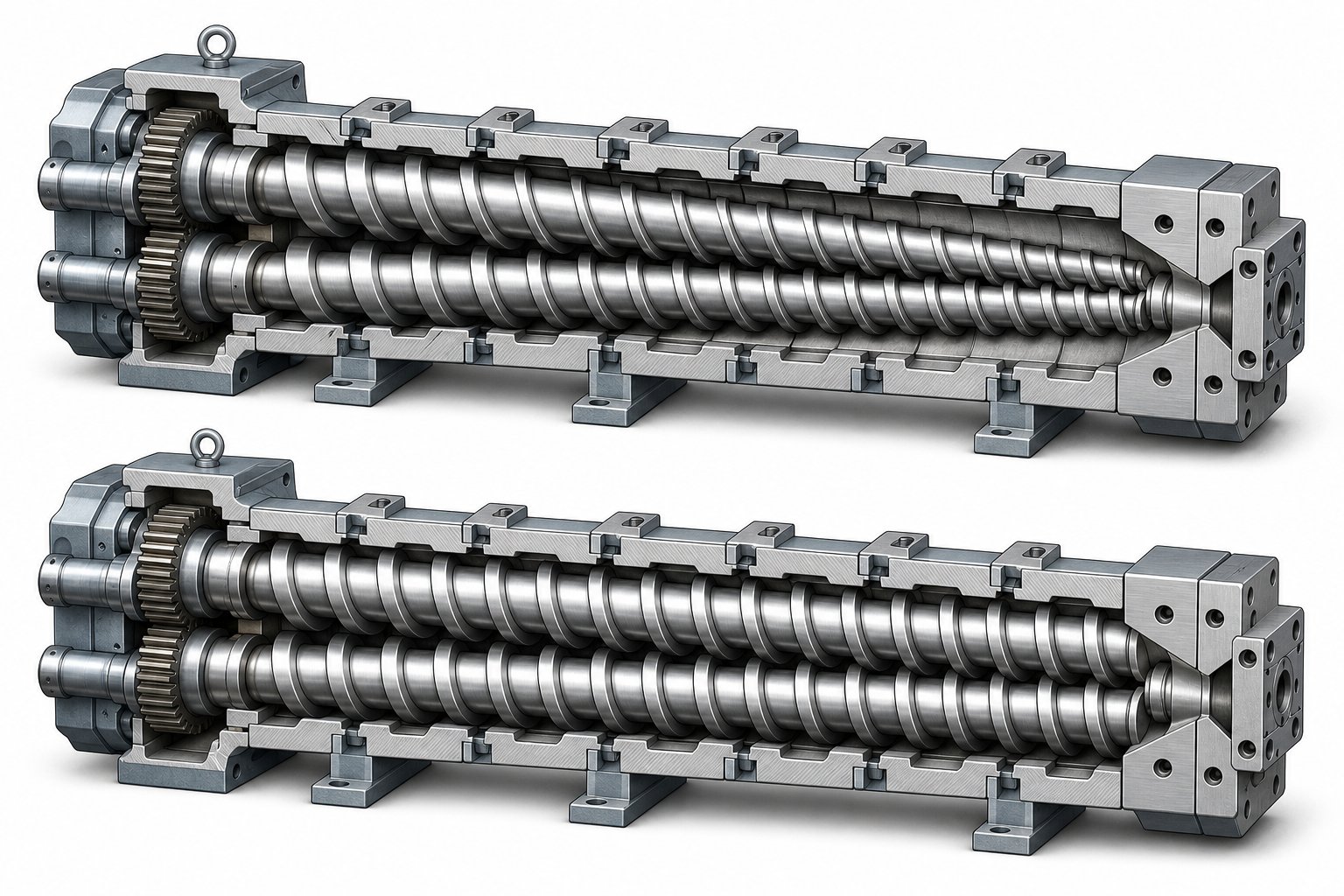
Selecting twin screw technology over single screw is the first decision. The second - and arguably more consequential one - is choosing between conical and parallel screw geometry. Each double screw extruder configuration handles PVC differently, and picking the wrong one for your application leads to compromised melt quality, wasted energy, or both. Here is how the two designs stack up when PVC is the material on the line.
How Conical Twin Screw Extruders Serve PVC Pipe and Profile Lines
Picture two tapered screws sitting side by side, with a large feed-end diameter narrowing to a smaller discharge-end diameter. That converging geometry is the defining feature of every conical twin screw extruder, and it creates natural compression without requiring aggressive screw elements or high rotational speeds.
Why does that matter for PVC? Dry blend - the most common feedstock for rigid PVC production - has a low bulk density, often around 0.5 to 0.6 g/cm³. The oversized feed section of a conical barrel accepts this fluffy powder easily, pulling it in at high volume. As the material travels toward the narrower discharge end, the decreasing channel volume compacts the blend gradually, generating melt pressure at the die in a controlled, progressive manner. You get high output pressure with moderate screw speeds, which keeps frictional heat in check - exactly what PVC's tight thermal window demands.
Conical designs dominate rigid PVC pipe, window profile, sheet, and WPC (wood-plastic composite) extrusion for this reason. They process dry blend directly, deliver gentle and controlled plasticizing, and build sufficient die pressure for thick-walled products without pushing the melt into the degradation zone. Counter-rotating intermeshing operation, standard in conical machines, further limits shear intensity and ensures positive conveying with minimal backflow.
One critical factor that processors often overlook is barrel condition. A worn or dimensionally inconsistent barrel erodes all the thermal and pressure advantages the conical design provides. Manufacturers like NANHAIYA specialize in custom and replacement conical twin screw barrels engineered for consistent plasticizing performance across PVC pipe, profile, sheet, and WPC applications - a practical sourcing consideration for any processor evaluating or maintaining conical twin screw equipment.
Where Parallel Twin Screw Extruders Excel in PVC Compounding
Parallel twin screw extruders take a fundamentally different approach. Both screws share the same diameter from feed to discharge, and the most widely used parallel configuration - the co rotating twin screw extruder - spins both screws in the same direction. This co-rotating intermeshing arrangement generates higher shear and more intensive distributive mixing than counter-rotating conical machines.
For PVC, that intensity is a double-edged sword. It is exactly what you need for compounding operations: blending PVC resin with high filler loadings, producing color masterbatch, or manufacturing flexible PVC cable compounds where thorough plasticizer incorporation is essential. Parallel designs also offer greater screw design freedom, since extending the processing length simply means adding barrel sections and stretching screw pitches - no diameter increase required. That modularity makes them highly adaptable to different formulations and throughput targets.
Understanding the distinction between a co rotating and counter rotating twin screw extruder is essential here. Co-rotating parallel machines prioritize mixing energy and throughput, while counter-rotating conical machines prioritize gentle plasticizing and pressure buildup. Neither is universally "better" - the right choice depends entirely on whether your PVC application is a direct extrusion job or a compounding operation. Parallel extruders can also offer a wider processing window in certain pipe extrusion scenarios, particularly for larger diameter machines where gearbox technology and screw length flexibility become deciding factors.
Side-by-Side Comparison for PVC Applications
The following table puts the two double screw extruder machine configurations head to head across the parameters that matter most for PVC processing. Use it as a quick reference when evaluating which platform fits your production requirements.
| Parameter | Conical Twin Screw Extruder | Parallel Twin Screw Extruder |
|---|---|---|
| Screw Geometry | Tapered screws - large feed diameter narrowing to smaller discharge diameter | Constant diameter screws from feed to discharge; modular segmented design |
| Rotation Direction | Counter-rotating (intermeshing) | Typically co-rotating (intermeshing); counter-rotating variants available |
| Feeding Behavior | Excellent acceptance of low-bulk-density PVC dry blend due to large feed opening | Starve-fed via external feeders; suited for pellets, pre-compounded material, or high-filler blends |
| Shear Level | Low to moderate - gentle plasticizing with natural compression | Moderate to high - intensive distributive and dispersive mixing |
| Typical PVC Applications | Rigid PVC pipe, window profiles, sheet, siding, WPC decking | PVC compounding, color masterbatch, flexible PVC cable compounds, high-filler formulations |
| Output Capacity Range | Approximately 50 - 800+ kg/hr (varies with screw size) | Approximately 100 - 2,000+ kg/hr (scalable via barrel extension) |
| Best Suited PVC Type | Rigid PVC (uPVC) and WPC dry blend formulations | Flexible PVC, heavily filled rigid PVC compounds, specialty formulations |
Notice how the two configurations occupy complementary rather than competing spaces. A processor running rigid PVC pipe from dry blend will almost always gravitate toward a conical machine for its gentle thermal profile and superior powder feeding. A compounder producing flexible PVC pellets for wire and cable, on the other hand, needs the mixing intensity and throughput scalability of a parallel platform.
Whichever geometry sits on your production floor, the screws and barrel inside it are doing the real work - and the way those screw elements are configured along the barrel length determines whether your melt comes out perfectly homogenized or riddled with quality problems.
Screw Element Configuration and L/D Ratio Selection for PVC
Every twin screw PVC extruder shares the same basic anatomy - screws inside a barrel, heaters around it, and a die at the end. Yet two machines with identical barrel diameters can produce dramatically different melt quality depending on how the screw elements are arranged and what L/D ratio governs the process length. These internal design decisions are where PVC extrusion either succeeds quietly or fails expensively, and most processors never see the details until something goes wrong.
Screw Zones and Element Functions in PVC Processing
Think of the twin screws inside your barrel not as a single uniform tool, but as a sequence of specialized zones - each one performing a distinct job on the PVC material as it moves from hopper to die. Getting the geometry of each zone right is critical, because PVC punishes mistakes with degradation, poor fusion, or inconsistent output.
Feed zone. This is where everything starts. Conveying elements with deep flights and wide pitch grab the low-bulk-density PVC dry blend from the hopper and push it forward without applying significant shear or heat. The goal here is volume intake, not melting. If the plastic extrusion screw elements in this zone are too aggressive - shallow flights or tight pitch - the powder compacts prematurely, trapping air pockets that surface later as voids or bubbles in the finished product. Properly designed feed zone elements keep the material loose and flowing, giving trapped air a chance to escape back through the hopper before compression begins.
Compression and transition zone. As material advances past the feed section, flight depth decreases and channel volume shrinks. This compaction squeezes air out of the powder bed while increasing particle-to-particle contact. Frictional heat and barrel heater energy begin softening the PVC, initiating the plasticizing process. The compression ratio - the relationship between feed channel depth and metering channel depth - must be carefully matched to the formulation's bulk density and melt behavior. Too aggressive a compression ratio drives melt temperature above PVC's safe window. Too gentle, and the blend arrives at downstream zones only partially fused.
Metering and mixing zone. This is where homogenization happens under controlled shear. Kneading elements or mixing discs break up any remaining unmelted particles and distribute additives - stabilizers, lubricants, fillers - uniformly throughout the melt. For PVC, the extruder screw elements in this zone walk a tightrope: enough shear energy to complete fusion and achieve additive dispersion, but not so much that frictional heating pushes the melt into the degradation range. Element stagger angle, disc width, and the number of kneading blocks all influence shear intensity here.
Pumping zone. The final section builds consistent melt pressure to push the homogenized PVC through the die. Deep-flighted conveying elements with tight tolerances create the pressure gradient needed for uniform flow distribution across the die lips. Inconsistent pressure in this zone shows up immediately as wall thickness variations in pipes or dimensional waviness in profiles.
What ties all four zones together is a simple principle: the twin screw and barrel system must apply just enough energy to fully plasticize PVC and distribute its additives, then immediately move the melt out through the die before thermal damage accumulates. Every flight depth, every pitch angle, and every compression ratio decision either supports or undermines that principle.
How L/D Ratio Impacts PVC Melt Quality and Thermal Exposure
L/D ratio - the total processing length of the screw divided by its diameter - is one of the most consequential specifications on any twin screw extruder data sheet. It determines how long PVC stays inside the barrel and how much mixing energy the material absorbs before exiting. For a polymer that degrades within seconds of overheating, this number is not just a spec - it is a quality lever.
Conical twin screw machines typically operate with shorter L/D ratios, roughly 17:1 to 22:1. That compact processing length limits the time PVC spends under heat and shear - an intentional design choice for rigid PVC pipe and profile extrusion where the formulation is relatively simple and the dry blend only needs gentle, controlled plasticizing. The shorter barrel means fewer heating zones, less accumulated frictional energy, and a faster path from powder to die.
Parallel twin screw extruders, by contrast, commonly run L/D ratios from 25:1 all the way up to 40:1 or higher. That extended barrel length provides room for additional mixing sections, multiple feed ports for downstream additive injection, and dedicated venting zones - features essential for PVC compounding work where thorough dispersion of plasticizers, high filler loadings, or color concentrates is the priority. The trade-off is straightforward: more barrel length improves homogeneity and process flexibility, but it also increases the total thermal exposure that each PVC particle endures.
Sounds like a simple longer-versus-shorter decision? It is not. The plastic extruder screw configuration within a given L/D ratio matters just as much as the ratio itself. A 36:1 barrel filled predominantly with gentle conveying elements can treat PVC more kindly than a 22:1 barrel packed with aggressive kneading blocks. Still, L/D ratio sets the baseline for several interconnected process variables that every operator should understand:
- Residence time: Longer L/D ratios increase the average time PVC spends inside the barrel. For rigid PVC, shorter residence times reduce degradation risk. For compounding applications requiring thorough additive incorporation, extended residence time is a necessary trade-off.
- Melt temperature uniformity: A longer processing length provides more zones for gradual, controlled heating - reducing thermal gradients within the melt. However, accumulated shear heating across a long barrel can push the bulk melt temperature higher than barrel zone setpoints alone would suggest.
- Mixing quality: Additional barrel length allows more mixing elements to be placed along the twin screws, improving distributive and dispersive mixing. This is advantageous for complex formulations but unnecessary - and potentially harmful - for straightforward rigid PVC dry blends.
- Energy consumption: Longer barrels require more drive torque and heating energy. Processors running simple rigid PVC formulations on unnecessarily long L/D machines waste energy and increase per-kilogram production costs with no corresponding quality benefit.
The practical takeaway is this: match L/D ratio to formulation complexity. A rigid PVC pipe line running a well-stabilized dry blend has no business on a 40:1 parallel compounder, just as a heavily filled flexible PVC cable compound will never achieve adequate dispersion on a 17:1 conical machine. Getting this match wrong is one of the most common - and most expensive - mistakes processors make when specifying or repurposing twin screw equipment.
Still, even a perfectly configured screw and an ideal L/D ratio cannot compensate for poor thermal management along the barrel itself. PVC's razor-thin margin between fusion and decomposition demands precise temperature zoning strategies - and that is where many otherwise well-designed extrusion lines quietly lose control of product quality.
Managing PVC Thermal Sensitivity and Degradation Risks
Screw geometry and L/D ratio set the foundation, but the real battle for PVC quality happens in the thermal domain. Every degree of barrel temperature, every second of residence time, and every rpm of screw speed either keeps PVC safely inside its processing window or nudges it toward irreversible breakdown. No other commodity polymer extruder application demands this level of thermal vigilance - and no other material punishes carelessness so quickly.
Understanding PVC's Narrow Processing Window
PVC degrades through a chemical reaction called dehydrochlorination - the sequential stripping of hydrogen chloride (HCl) from the polymer backbone. What makes this so dangerous is proximity: PVC needs temperatures in the range of roughly 160°C to 210°C to fuse into a workable melt, yet degradation can initiate at temperatures only marginally above that window, depending on the formulation and stabilizer package. Compare that to polyethylene, which processes comfortably between 180°C and 240°C with a degradation onset well above 300°C. The margin for error with PVC is measured in a handful of degrees rather than a comfortable hundred.
Once dehydrochlorination starts, the consequences cascade. Released HCl is corrosive - it attacks screw and barrel surfaces, damages die components, and creates an acidic environment inside the extruder feed barrel that accelerates further decomposition. The reaction is autocatalytic, meaning the HCl gas produced in the early stages catalyzes additional breakdown, turning a small hot spot into a runaway degradation event. Visually, you'll notice conjugated polyene sequences forming along the damaged polymer chains, which absorb visible light and produce the telltale color progression: white to pale yellow, deep yellow, brown, and eventually black.
Unlike polyolefins or engineering plastics, PVC cannot tolerate over-processing or extended thermal exposure without visible quality loss - making barrel temperature control the single most critical variable in any twin screw PVC extrusion line.
This narrow window dictates every aspect of extruder system setup. Barrel zone temperatures, screw speed, feed rate, cooling capacity, and even die geometry all must be tuned to keep the PVC melt safely fused without crossing the degradation threshold. Treat any one of these variables as an afterthought, and you'll see the results in every meter of product that exits the die.
Barrel Temperature Zoning and Heat Management Strategies
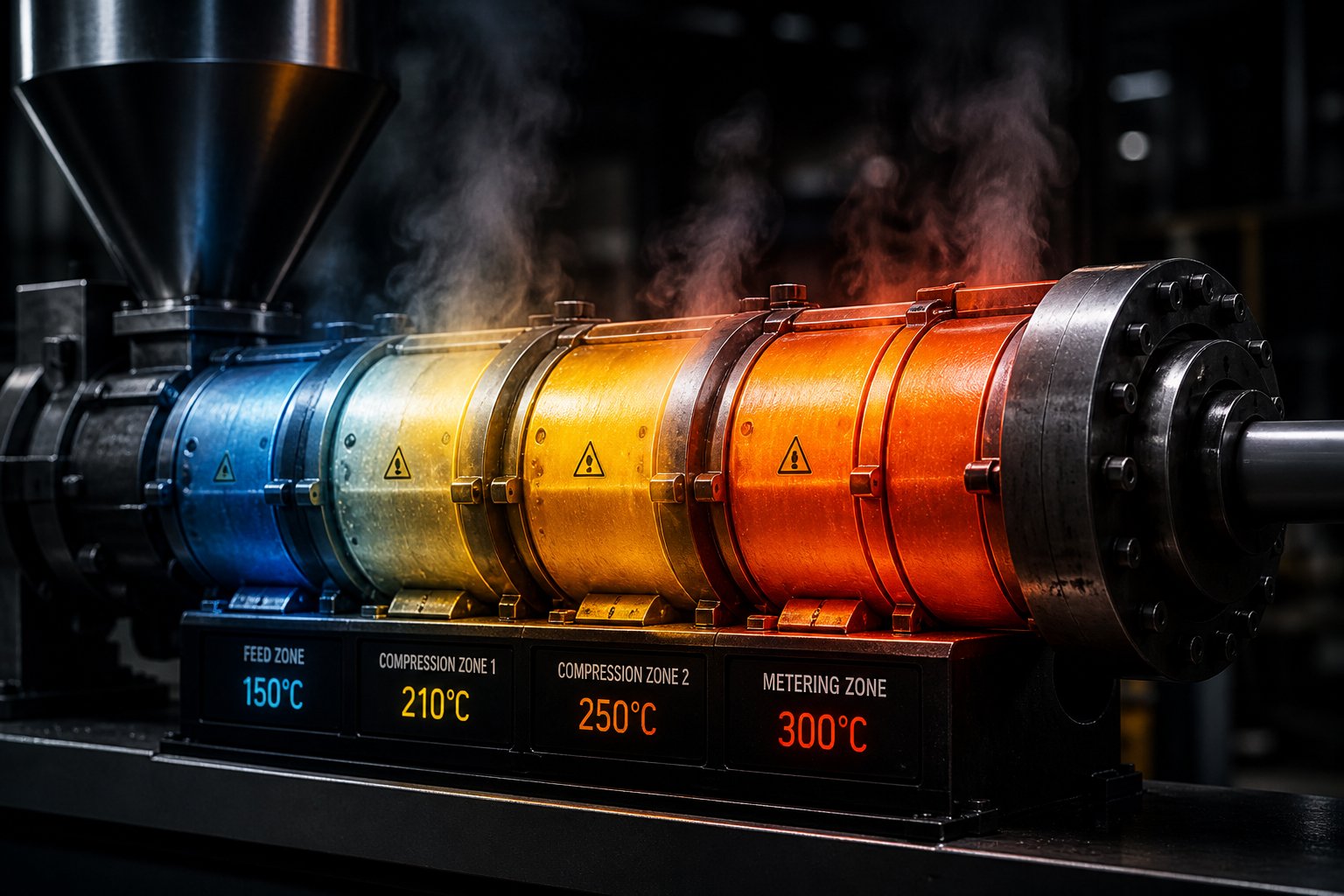
Effective heat management in a barrel extruder running PVC starts with how temperature zones are profiled from feed end to die. The goal is a gradual, controlled ramp - not a sudden thermal shock. A typical rigid PVC profile might begin with a feed zone set around 150-165°C to soften the dry blend gently, climb through a compression zone at 170-180°C for initial plasticizing, and then level off or even decrease slightly in the metering zone to counteract the shear-generated heat accumulating in the melt. Pushing any upstream zone too high causes premature fusion that traps air, while overheating downstream zones drives the already-plasticized melt into the degradation range.
Screw speed management adds another layer of complexity. Faster screw rotation increases throughput - but it also increases frictional heating inside the melt. For PVC, operators must find the sweet spot where throughput targets are met without generating excess shear heat that barrel cooling cannot remove. Running too fast and relying on aggressive cooling to compensate is a losing strategy; the melt temperature at the screw root and in the intermesh region can exceed the barrel wall temperature by 10-20°C, creating hidden degradation zones that setpoint readings never reveal.
This is precisely why modern twin screw extruder designs incorporate dedicated cooling circuits to actively pull excess heat from critical barrel zones. Some extruder systems use forced-air cooling on the barrel exterior, while others employ liquid-cooled barrel jackets for faster thermal response. Internal screw cooling is another approach - channels within the screw core allow water or a heat-transfer medium to absorb heat directly from the melt-contact surface. At high output rates, however, screw core walls may need to be thickened for mechanical strength, which can reduce the cooling channel diameter and limit cooling effectiveness.
The most advanced polymer extruder platforms address this trade-off by reducing specific energy input overall - designing screw elements and barrel geometry so that less frictional heat is generated in the first place, rather than producing excess heat and then struggling to remove it. Lower specific energy input means less cooling demand, which in turn allows stronger screw shafts capable of handling higher torque without overheating the melt. It is a design philosophy that aligns perfectly with PVC's unforgiving thermal constraints.
Practical barrel temperature management also means monitoring melt temperature independently of barrel zone setpoints. A thermocouple inserted directly into the melt stream near the die adapter provides the real number - and for PVC, that number should never be taken on faith from barrel heater displays alone. A 5°C gap between actual melt temperature and your target can mean the difference between a clean, white product and one showing the first signs of yellowing.
Thermal control, however, only addresses one dimension of PVC's processing sensitivity. The formulation itself - the stabilizers, lubricants, impact modifiers, and fillers blended into the PVC resin - determines how much thermal abuse the compound can absorb before quality collapses. And the way those additives interact with extruder settings opens an entirely separate set of variables that most processors underestimate.
PVC Formulations and Additive Interactions in Twin Screw Extrusion
PVC resin on its own is essentially unusable. Without stabilizers it degrades during processing, without lubricants it sticks to every metal surface it touches, and without impact modifiers it shatters under stress. The additive package blended into PVC resin before it ever reaches the extruder hopper is what transforms a brittle, heat-sensitive powder into a material capable of producing durable pipes, flexible cables, and weather-resistant profiles. Yet here is the part most processors underestimate: every additive you add changes how the compound behaves inside the twin screw extruder plastic processing zones - altering melt viscosity, fusion speed, shear sensitivity, and thermal stability in ways that demand corresponding adjustments to screw speed, temperature profiles, and feed rates.
Key Additives and Their Roles in the Twin Screw Process
A typical rigid PVC dry blend might contain eight to twelve individual ingredients beyond the base resin. Each one serves a specific function, and each one interacts with extruder settings differently. Here is what goes into the hopper and why it matters for the machine running beneath it:
- Thermal stabilizers (calcium-zinc, tin-based, lead-based where regulations permit): These prevent dehydrochlorination during processing by scavenging released HCl and replacing labile chlorine atoms on the PVC backbone. Stabilizer type and dosage directly influence how much thermal headroom the formulation has inside the barrel. Under-dosing leads to yellowing and degradation at standard processing temperatures. Over-dosing wastes material and can alter melt rheology, sometimes increasing torque unexpectedly. Calcium-zinc systems, now dominant in many markets due to regulatory shifts away from lead, tend to offer a narrower stability window than legacy lead-based packages, requiring tighter temperature control from the extruder.
- Internal lubricants (metal stearates such as calcium stearate, zinc stearate): These reduce friction between PVC molecules within the melt, lowering internal viscosity and reducing shear-generated heat. In the context of twin screw processing, internal lubricants effectively widen the safe operating window by suppressing frictional temperature rise in high-shear mixing zones. Too little internal lubricant and the melt runs hot, overloading the barrel cooling system. Too much delays fusion, leaving partially gelled particles in the finished product.
- External lubricants (paraffin waxes, oxidized polyethylene wax, Fischer-Tropsch waxes): These migrate to the interface between the PVC melt and metal surfaces - screw flights, barrel walls, and die lips - creating a slip layer that prevents sticking. External lubricant balance is critical for any twin screw plastic extruder because excess external lubricant causes plate-out (a waxy buildup on screw and barrel surfaces) while insufficient lubrication leads to sharkskin texture, increased torque, and premature die wear.
- Impact modifiers (chlorinated polyethylene - CPE, acrylic modifiers - ACR, methacrylate-butadiene-styrene - MBS): These rubbery or elastomeric particles improve toughness and crack resistance in rigid PVC products. From an extrusion standpoint, impact modifiers increase melt elasticity and can alter die swell behavior. Insufficient modifier levels often result in cracking, brittleness, and poor weather resistance in finished profiles and pipes.
- Processing aids (acrylic-based copolymers): These promote earlier and more uniform fusion of PVC particles, increase melt strength, and improve surface finish. Inside the compounding extruder barrel, processing aids essentially accelerate the point at which dry blend transforms into a homogeneous melt - allowing shorter residence times or lower barrel temperatures while still achieving complete gelation. For processors pushing throughput on conical machines, adequate processing aid levels can mean the difference between a fully fused melt and one that exits the die with visible grain structure.
- Fillers (calcium carbonate, titanium dioxide): Calcium carbonate is the most common filler in PVC, improving stiffness, dimensional stability, and reducing raw material cost. Titanium dioxide provides opacity and UV resistance. High filler loading, however, increases abrasive wear on screw flights and barrel liners, raises melt viscosity, and can reduce melt strength. Formulations exceeding 15-20 phr of mineral filler typically demand wear-resistant barrel metallurgy - bimetallic linings or nitrided steels - to maintain consistent performance over extended production runs.
What makes PVC formulation so challenging is that these additives do not operate in isolation. The internal-to-external lubricant ratio, for instance, simultaneously affects fusion speed, melt temperature, surface quality, and plate-out tendency. Adjusting one component almost always requires compensating adjustments elsewhere in the package - and corresponding tweaks to the extruder's temperature profile and screw speed to maintain process stability.
How Formulation Type Drives Extruder Configuration
Not all PVC compounds are created equal, and the gap between formulation types is wide enough to demand fundamentally different extruder setups. Consider three common scenarios that illustrate how formulation drives machine configuration.
Rigid PVC pipe and profile formulations typically contain 100 parts PVC resin with minimal plasticizer, moderate stabilizer levels, a balanced lubricant package, and calcium carbonate filler in the range of 5 to 15 phr. These formulations demand lower shear and shorter residence times because the high PVC resin content means the melt is inherently shear-sensitive. A conical twin screw extruder with an L/D ratio of 17:1 to 22:1, running at moderate screw speeds with a gradual barrel temperature ramp, handles these blends efficiently. Aggressive mixing elements are unnecessary and counterproductive - the additive package is relatively simple, and over-mixing generates excess heat that eats into the limited thermal budget.
Flexible PVC compounds for cable insulation, hose, or film tell a completely different story. These formulations contain 40 to 80 phr of liquid plasticizer (typically DOP, DINP, or DOTP), which must be thoroughly absorbed and distributed throughout the PVC matrix. That absorption demands more intensive mixing, higher shear energy, and longer barrel residence time than rigid formulations require. A twin screw compounding extruder with a parallel co-rotating configuration and an L/D ratio of 30:1 or longer is the natural fit here. The extended processing length provides room for plasticizer injection ports, dedicated mixing sections, and venting zones to remove residual volatiles - features a short conical machine simply cannot accommodate.
WPC (wood-plastic composite) PVC formulations push equipment demands in yet another direction. These blends incorporate 30 to 60 percent wood flour or cellulose fiber by weight alongside the PVC matrix, creating a highly abrasive, moisture-laden feedstock. The abrasive filler loading wears screw flights and barrel bores aggressively, demanding hardened metallurgy - often bimetallic barrel linings with tungsten carbide or boron alloy coatings. Moisture from the wood component must be driven off during processing, requiring effective venting or pre-drying to prevent foaming and surface defects. Screw elements in a compounding twin screw extruder running WPC must balance aggressive conveying to handle the high-fill-ratio blend with moderate shear to avoid thermally degrading the wood fibers alongside the PVC.
The practical lesson is straightforward: your formulation should dictate your machine configuration, not the other way around. Processors who purchase a twin screw extruder plastic processing line first and then try to force-fit their formulation into its operating envelope almost always end up chasing quality problems - plate-out, incomplete fusion, discoloration - that could have been avoided with proper formulation-to-machine matching from the start.
Even when that match is right, however, there is one process variable that quietly undermines finished product quality more often than any temperature setting or screw speed error: inadequate removal of trapped air, moisture, and volatile gases from the melt before it reaches the die.
Venting and Degassing in Twin Screw PVC Extrusion
PVC dry blend is not a solid block of plastic. It is a loose powder filled with entrapped air between particles, residual moisture from storage or mixing, and volatile compounds released by stabilizers, lubricants, and other additives as they encounter processing heat. If those gases stay locked inside the melt when it reaches the die, they show up in the finished product as bubbles, pinholes, rough surfaces, and weakened mechanical properties. Proper venting is one of the most overlooked steps in twin screw PVC extrusion - and one of the easiest ways to destroy an otherwise well-run process.
Why Degassing Is Critical for PVC Extrusion Quality
Consider what happens inside the barrel of a plastic twin screw extruder processing rigid PVC dry blend. The loose powder entering the feed zone contains a significant volume of air trapped between individual particles - sometimes representing 40 to 50 percent of the bulk volume. As the screws compact and plasticize that powder, the air has to go somewhere. At the same time, thermal stabilizers and lubricants begin releasing low-molecular-weight volatile compounds as barrel temperatures climb past 160°C. Moisture absorbed during storage or blending also flashes into steam.
If these gases remain trapped in the melt, they create voids and gas pockets that compromise the structural integrity of the finished product. A PVC pressure pipe with internal voids fails under hydrostatic testing. A window profile with subsurface bubbles develops visible blistering after sun exposure. Even cosmetically, trapped volatiles produce a dull, rough surface finish that signals poor quality to customers before any mechanical test is ever run.
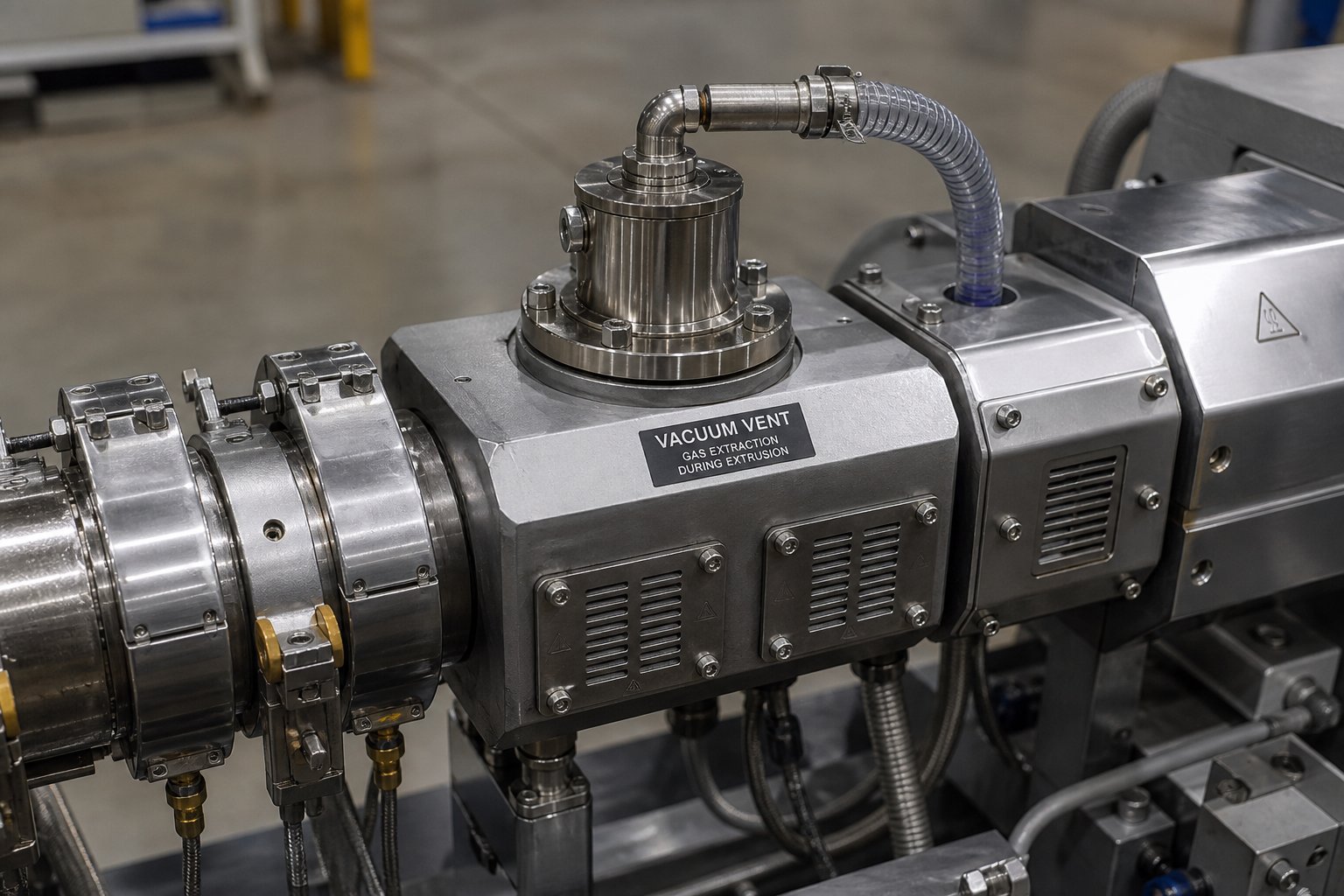
Twin-screw extruders address this by incorporating dedicated venting zones along the barrel. In a typical configuration, the intake section acts as an atmospheric vent - allowing a significant portion of entrapped air to escape backward through the feed opening as the screws begin compacting the dry blend. This atmospheric venting also helps heat the material more efficiently, since trapped air acts as an insulator that slows thermal transfer. Downstream, after the powder has passed through a compression zone and initial plasticizing has begun, a second vent port - usually operated under vacuum - removes the remaining air and volatile compounds from the partially fused melt. The goal is a void-free melt reaching the die, with volatile content reduced to levels where it cannot compromise wall integrity or surface quality.
Vent Port Placement and Vacuum Degassing Considerations
Effective venting is not simply a matter of drilling a hole in the barrel and connecting a pump. The screw element geometry beneath each vent zone must be carefully designed to create a low-pressure, partially filled section where gases can escape without the melt pushing up and out through the vent port. In practical terms, this means placing deep-flighted conveying elements or reverse-pitch sections just upstream of the vent to create a pressure drop. The melt level drops, exposing fresh surface area to the vent opening, and trapped gases rise out of the material and into the vacuum line.
A critical component in any twin-screw extruder machine running PVC is the powder lock positioned upstream of the vacuum vent. This screw section creates a material seal that prevents the vacuum from pulling un-plasticized dry blend backward through the barrel - a problem that would cause powdering at the vent, contaminate the vacuum system, and starve downstream zones of material. Without a properly functioning powder lock, vacuum venting becomes counterproductive rather than beneficial.
Vacuum level itself requires careful management. You might assume that maximizing vacuum produces the cleanest melt - but for PVC, that is not always true. High vacuum can cause the dry blend to gel prematurely in the venting zone. When material fuses too early beneath the vent, the air trapped within the already-gelled mass can no longer escape, resulting in air inclusions embedded deep in the pipe or profile wall. A well-designed extruder twin screw configuration incorporates venting-safe screw geometry that achieves a void-free product even at vacuum levels below the theoretical maximum. This design philosophy provides an important safety margin - meaning that an aging vacuum pump or a minor seal leak does not immediately translate into rejected product.
Early vent placement along the barrel offers additional advantages for PVC processors. Positioning the vacuum vent further upstream provides more screw length downstream for final mixing and homogenization at the screw tip, improving overall melt consistency. For twin-screw extruders processing quick-gelling PVC variants like MPVC or CPVC, early venting is particularly valuable because it removes volatiles before the material reaches full fusion, avoiding the trapped-gas problem entirely.
How do you know if your venting setup is falling short? The symptoms are consistent and recognizable. Watch for these warning signs during production and in finished product inspection:
- Surface pitting: Small craters or pinhole marks on the product surface caused by gas bubbles bursting at the die exit or during cooling.
- Internal voids: Hollow pockets within the wall structure that reduce burst pressure in pipes and load-bearing capacity in profiles - often invisible until cross-sectional inspection or pressure testing.
- Inconsistent wall thickness: Gas pockets displace melt flow within the die, causing localized thin spots that compromise dimensional tolerances and structural performance.
- Reduced impact strength: Voids act as stress concentrators within the PVC matrix, dramatically lowering resistance to sudden impact loads - a critical failure mode for pressure pipe and outdoor profile applications.
Any of these defects appearing consistently points to a venting problem that no amount of temperature adjustment or screw speed tweaking can fix. The solution lies in verifying vent port cleanliness, vacuum pump performance, powder lock integrity, and screw element configuration beneath the vent zones.
Venting failures, however, are only one category of quality defect that haunts PVC extrusion lines. Plate-out, discoloration, poor fusion, and output surging each have their own root causes - and their own corrective actions - that processors need systematically mapped out to keep scrap rates under control.
Troubleshooting Common PVC Twin Screw Extrusion Problems
Scrap bins fill up for reasons. Every defect that lands in reject trays - yellowed profiles, brittle pipe sections, waxy barrel deposits, surging output - traces back to a specific mismatch between formulation behavior and machine settings. The challenge is that PVC extrusion defects rarely announce their root cause on the surface. A discolored product could stem from excessive barrel temperature, worn screw elements creating stagnation zones, or a lubricant imbalance that shifted the melt's thermal tolerance. Diagnosing accurately, rather than guessing and adjusting blindly, is what separates efficient troubleshooting from expensive trial-and-error.
Plate-Out, Degradation, and Discoloration
If you have ever pulled screws from a twin screw PVC extruder and found a stubborn, waxy or crusty film coating the flight surfaces, you have encountered plate-out firsthand. This buildup - a mixture of migrated additives, degradation byproducts, and partially reacted lubricants - accumulates on screw flights, barrel walls, and die lips over time. It restricts flow channels, contaminates the melt stream, and eventually releases in flakes that embed themselves in the finished product as surface streaks or internal inclusions.
Plate-out in the twin screw extrusion process is almost always a lubrication balance and compatibility problem rather than a simple "too much wax" issue. When external lubricant levels are disproportionately high relative to internal lubricants, excess wax migrates to metal surfaces and deposits at the die lip. Stabilizer-lubricant incompatibility compounds the problem - certain calcium-zinc stabilizer systems interact poorly with specific wax blends, accelerating deposit formation. The first corrective step is rebalancing the internal-to-external lubricant ratio, then optimizing the wax package to reduce deposit-forming components. Track cleaning intervals and deposit severity as your validation metric.
Degradation and discoloration follow a different mechanism but often appear alongside plate-out. Yellowing or browning of the extrudate signals thermal degradation - the dehydrochlorination reaction stripping HCl from the PVC backbone and producing conjugated polyene sequences that absorb visible light. Brown or black specks indicate more advanced localized degradation, typically originating from dead zones, hot spots, or retained carbonized material inside the barrel, adapter, or die. Worn screw elements are a frequent culprit here: as flight tips erode, the clearance between screw and barrel widens, creating stagnation pockets where PVC sits under heat far longer than the designed residence time. That trapped material degrades, carbonizes, and eventually releases into the melt stream as dark contaminants.
A practical diagnostic approach starts with timing. Specks that appear primarily after startup or restart point to retained degraded material from hot-hold periods. Specks that worsen steadily during a production run suggest die or adapter buildup releasing in cycles. And specks that follow a specific material batch or regrind lot indicate external contamination rather than internal degradation - a distinction that prevents unnecessary teardowns.
Poor Fusion, Surging, and Output Inconsistency
Poor fusion is one of the most insidious defects in PVC extrusion because it can pass visual inspection while still compromising mechanical performance. When PVC particles are not fully melted and homogenized, the finished product retains a grainy internal structure - individual particle boundaries that act as stress concentrators under load. A pipe that looks fine on the outside but contains poorly fused material in its wall fails unexpectedly during pressure testing or impact events.
What causes incomplete fusion? The usual suspects are an insufficient L/D ratio for the formulation's complexity, screw speed set too low for adequate shear input, or an incorrect temperature profile that does not deliver enough thermal energy in the compression and metering zones. On a screw plastic extruder running rigid PVC dry blend, inadequate processing aid levels in the formulation can also delay fusion - the resin particles simply do not soften and merge quickly enough within the available barrel length. Increasing compression zone temperatures is often the first corrective step, but only after verifying that the issue is not related to worn screws that have lost their compression ratio through flight tip erosion.
Surging - periodic fluctuations in output rate, die pressure, or both - creates visible dimensional inconsistency in the finished product. Wall thickness oscillates, pipe ovality increases, and profile dimensions wander outside tolerance. In screw extruders processing PVC, surging typically originates from one of three sources: inconsistent feeding (bridging in the hopper, erratic feeder output, or moisture-induced powder clumping), worn screw flights that allow melt to slip backward past the compression zone, or an improper compression ratio that cannot maintain steady pressure buildup. Lubrication drift during a production run can also trigger surging - as the barrel heats up and reaches thermal equilibrium, the lubricant balance shifts, altering fusion behavior and melt viscosity in ways that destabilize output.
Die drool - a slow ooze of degraded or phase-separated material accumulating at the die exit lips - is the fifth defect that quietly degrades product quality on twin extruder lines running PVC. It builds up gradually, eventually dropping onto the product surface as contamination or causing streaks and drag marks. Die drool often shares root causes with plate-out: lubricant imbalance, additive incompatibility, or a temperature profile that causes partial melt resolidification near the die lip.
The following table consolidates all five defects into a quick-reference troubleshooting resource. Use it to match what you are seeing on the production floor to its most likely cause and the corrective action most likely to resolve it.
| Defect | Symptoms | Common Causes | Corrective Actions |
|---|---|---|---|
| Plate-Out | Waxy or crusty buildup on screw flights, barrel walls, and die lips; surface streaks on product; shortened cleaning intervals | External lubricant excess; stabilizer-lubricant incompatibility; wax package mismatch; temperature profile causing partial melt resolidification near die | Rebalance internal vs. external lubricant ratio; optimize wax blend for compatibility; consider lower-plate-out stabilizer package; adjust die zone temperature |
| Degradation / Discoloration | Yellowing or browning of extrudate; dark brown or black specks embedded in product; corrosive HCl odor near vent or die | Excessive barrel temperature; dead zones or stagnation from worn screw elements; long residence time; insufficient stabilizer dosage or synergy; hot-hold or start/stop events | Reduce melt temperature; inspect and replace worn screw elements to eliminate dead spots; shorten residence time; strengthen stabilizer-co-stabilizer synergy; improve shutdown/startup procedures |
| Poor Fusion | Grainy or rough internal structure; visible particle boundaries in cross-section; reduced impact and burst strength; surface grain texture | Insufficient L/D ratio for formulation; low screw speed; inadequate compression zone temperature; low processing aid levels; worn flights reducing compression ratio | Increase compression and metering zone temperatures gradually; raise screw speed within safe shear limits; verify processing aid dosage; replace worn screws to restore compression ratio |
| Surging | Periodic fluctuations in die pressure; oscillating wall thickness; dimensional instability in profiles and pipes; inconsistent extrudate speed | Inconsistent feeding (bridging, feeder malfunction, moisture clumping); worn screw flights allowing backflow; improper compression ratio; lubrication drift during run | Inspect and calibrate feeding system; replace worn screw flights; verify compression ratio matches formulation bulk density; stabilize lubricant balance and recheck temperature profile |
| Die Drool | Slow accumulation of material at die exit lips; surface contamination or drag marks on product; periodic drips onto extrudate | Lubricant imbalance causing phase separation at die; additive incompatibility; excessive die lip temperature; low-molecular-weight volatiles condensing at die exit | Rebalance lubricant package; verify additive compatibility; adjust die zone temperature; ensure adequate upstream degassing to reduce volatile carryover to die |
One thread runs through nearly every row in that table: worn or damaged screw and barrel components amplify defect severity across the board. Stagnation zones from eroded flights worsen degradation. Lost compression ratio from worn screws causes poor fusion and surging. Increased clearances reduce mixing efficiency, leaving additive distribution uneven enough to trigger plate-out and die drool. Addressing the defect symptom without evaluating the condition of the hardware underneath it is like treating a fever without checking for infection - the symptom may temporarily improve, but the underlying problem keeps producing new ones.
Selecting and Sourcing the Right Twin Screw Barrel for PVC Lines
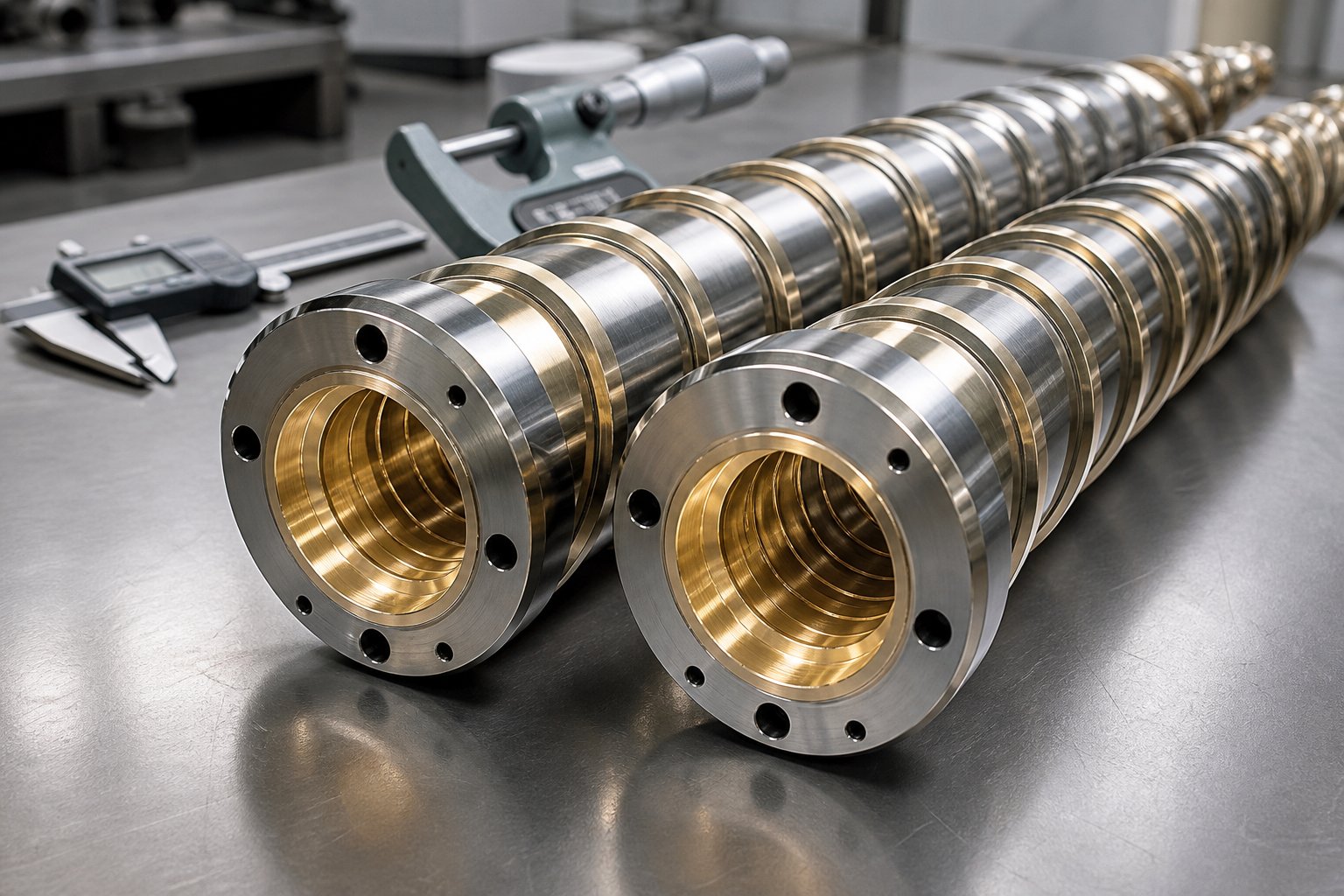
That connection between worn hardware and recurring defects is not a coincidence - it is a cost signal. Screws and barrels are the most wear-critical components on any twin screw PVC extruder, and their condition directly determines output consistency, energy efficiency, and the frequency of every troubleshooting cycle described above. Yet many processors treat extruder screw and barrel replacement as a reactive emergency rather than a planned procurement decision, scrambling for parts only after quality has already deteriorated and scrap costs have mounted.
Key Factors When Evaluating Twin Screw Barrels and Screws
Whether you are sourcing a replacement barrel for an aging conical line or evaluating a new twin screw extruder for sale, the selection criteria remain the same. PVC's dual attack - HCl corrosion from thermal degradation combined with abrasive wear from calcium carbonate and mineral fillers - means that generic barrel specifications designed for polyolefins will fail prematurely on PVC and WPC applications. Getting the right part starts with asking the right questions before you ever request a twin screw extruder price quote.
- Metallurgy match: Verify that the barrel liner material suits your specific PVC compound. Nitrided bores handle clean, low-filler rigid PVC adequately, but abrasive WPC blends and highly filled formulations demand bimetallic linings - typically nickel-based or tungsten-carbide-loaded alloys - to resist both corrosion and mechanical wear simultaneously.
- Dimensional tolerances: Bore diameter consistency along the full barrel length directly affects plasticizing uniformity. Even minor taper deviations in a conical barrel alter compression behavior, shifting melt temperature and pressure in ways that compound across every production hour.
- Surface finish quality: A smooth, defect-free bore surface minimizes stagnation points where PVC can hang up, overheat, and degrade. Rough machining marks or casting porosity in the liner create micro dead zones that seed the black specks and discoloration problems covered earlier.
- Supplier customization capability: PVC lines span dozens of OEM platforms from twin screw extruder manufacturers worldwide. Your barrel supplier must be able to engineer replacements to match the exact screw geometry, heating zone layout, and mounting interface of your specific machine - not offer a close-enough catalog approximation.
- Lead time reliability: Unplanned downtime on a PVC pipe or profile line costs far more per day than the barrel itself. A supplier who quotes four weeks and delivers in eight turns a maintenance event into a production crisis. Evaluate delivery track records as seriously as you evaluate metallurgy specs.
Worn screws and barrels do not just reduce output - they increase energy consumption as the drive system compensates for lost compression efficiency, and they widen the melt temperature distribution that PVC's narrow processing window cannot tolerate. Timely replacement, guided by periodic bore diameter measurements and flight-tip inspections, prevents the slow slide from marginal quality into full-blown defect outbreaks.
Building a Reliable Supply Chain for Replacement Components
The growing twin screw extruders market - valued at USD 2.91 billion in 2024 and projected to grow at a CAGR of over 5% through 2034 - reflects expanding global PVC processing capacity. More installed machines mean more barrels and screws reaching the end of their service life, and more processors competing for quality replacement parts from qualified twin-screw extruder manufacturer sources.
For operations running conical twin screw lines producing PVC pipe, profiles, sheet, or WPC decking, having a dependable barrel supplier is not a convenience - it is operational insurance. NANHAIYA is one specialist worth evaluating. They offer custom-engineered conical twin screw barrels designed specifically for PVC and WPC extrusion applications, with a focus on consistent plasticizing performance and production support. Their product page provides detailed specifications and allows processors to request custom configurations matched to specific OEM platforms - a practical starting point for anyone sourcing replacement barrels alongside their existing supplier relationships.
Regardless of which supplier you choose, the principle stays the same: match the extruder screw and barrel to your actual compound, verify metallurgy and dimensional precision against your line's requirements, and build a sourcing relationship that delivers reliable lead times before you need them urgently. The cheapest barrel on the quote sheet is rarely the cheapest barrel over its operating life - and on a PVC line, the cost of getting that decision wrong shows up in every meter of product that exits the die.
Frequently Asked Questions About Twin Screw PVC Extruders
1. Why is a twin screw extruder preferred over a single screw extruder for PVC processing?
PVC requires extremely precise thermal and shear control because its decomposition temperature sits only a few degrees above its processing temperature. Twin screw extruders provide intermeshing, self-wiping screw geometry that delivers superior distributive and dispersive mixing - essential for evenly incorporating PVC's complex additive packages of stabilizers, lubricants, and fillers. Their positive conveying action prevents material stagnation that causes localized degradation, and starve-fed operation decouples feed rate from screw speed, giving operators independent control over energy input. Single screw machines lack these capabilities and cannot match the residence time control or mixing uniformity PVC demands.
2. What is the difference between conical and parallel twin screw extruders for PVC?
Conical twin screw extruders use tapered, counter-rotating screws that naturally compress low-bulk-density PVC dry blend as it moves from a large feed opening to a smaller discharge end. They excel at gentle plasticizing for rigid PVC pipe, profile, and sheet extrusion. Parallel twin screw extruders maintain constant screw diameter and typically co-rotate, generating higher shear for intensive mixing. They are best suited for PVC compounding, flexible PVC cable compounds, and high-filler formulations. The choice depends on whether the application prioritizes gentle direct extrusion or thorough compounding and mixing.
3. What L/D ratio should I use for PVC twin screw extrusion?
The ideal L/D ratio depends on your formulation complexity. Conical twin screw extruders typically use shorter L/D ratios of 17:1 to 22:1, which limit thermal exposure and suit straightforward rigid PVC dry blends. Parallel machines run longer ratios from 25:1 to 40:1 or more, providing additional mixing sections and venting zones needed for flexible PVC compounding or heavily filled formulations. Matching L/D ratio to your specific compound prevents both under-mixing (causing poor fusion) and over-processing (causing thermal degradation).
4. How do I prevent PVC degradation and discoloration during twin screw extrusion?
Preventing degradation starts with a carefully profiled barrel temperature ramp - typically a gradual increase from 150-165 degrees C at the feed zone through 170-180 degrees C in the compression zone, leveling or decreasing slightly in metering zones to offset shear heat. Monitor actual melt temperature with an in-stream thermocouple rather than relying on barrel zone displays. Keep screw speed at the lowest level that meets throughput targets to minimize frictional heating. Inspect screws regularly for flight wear that creates stagnation zones, and verify that your stabilizer dosage and lubricant balance match your processing conditions. Suppliers like NANHAIYA offer precision-engineered conical twin screw barrels that help maintain consistent plasticizing and reduce dead spots contributing to degradation.
5. Why is venting important in twin screw PVC extrusion and how does it work?
PVC dry blend contains trapped air (up to 40-50 percent of bulk volume), residual moisture, and volatile compounds from additives that must be removed before the melt reaches the die. Without proper degassing, these gases cause surface pitting, internal voids, inconsistent wall thickness, and reduced impact strength in finished products. Twin screw extruders use atmospheric venting at the feed section and vacuum-assisted vent ports downstream after initial plasticizing. Screw elements beneath vent zones create low-pressure, partially filled sections so gases escape without melt pushing through the port. Proper powder lock design upstream of the vacuum vent prevents dry blend from being pulled backward into the vacuum system.
Written by
Nanhaiya Technical Team
Zhoushan Nanhaiya Plastic Machinery Co., Ltd.
The Nanhaiya technical team supports screw and barrel manufacturing projects through application review, technical communication, custom manufacturing coordination, and production and quality control.
Discuss Your Application
Related Articles
More insights on screw barrel technology and plastics processing.
Your Extruder Feeding Instability Isn't Random — Here's Why
Oct 22, 2026
Extruder feeding instability causes surging output and scrap. Learn the 6 root causes, polymer-specific fixes, wear diagnostics, and preventive protocols.
Read Article
Parallel Twin Screw Extruder for Compounding Demystified: Lab to Line
Oct 21, 2026
Learn how a parallel twin screw extruder for compounding works—from screw element design and zone configuration to lab-to-production scale-up and process optimization.
Read Article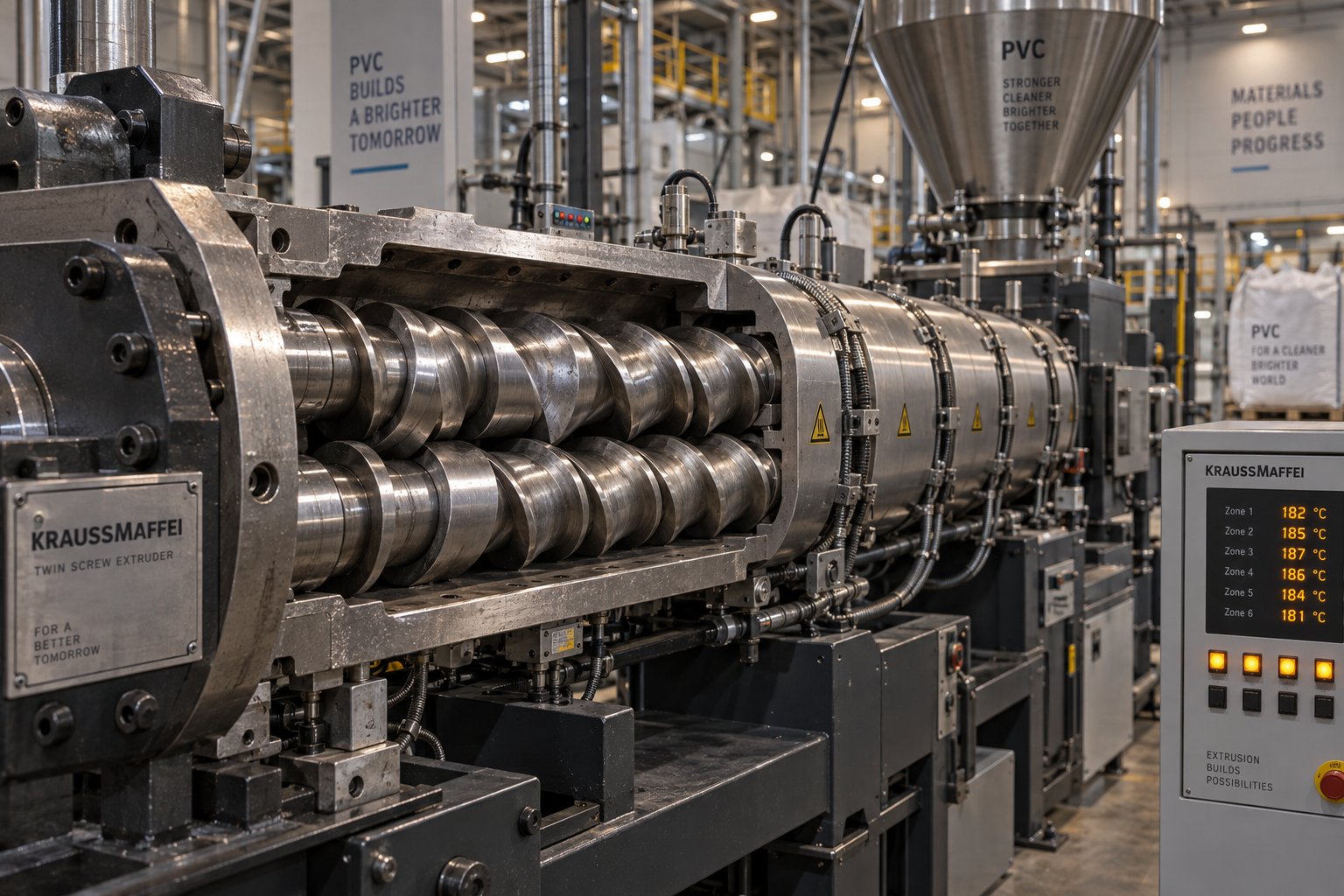
Twin Screw Extruder for PVC: The Setup Mistake Draining Profit
Oct 21, 2026
Learn how to match twin screw extruder configurations to PVC applications. Covers conical vs parallel, counter-rotating vs co-rotating, wear management, and troubleshooting.
Read ArticleLooking for something else?
Search by material, symptom or product and jump straight to the relevant page.
These are navigation suggestions based on keyword matching — not a quotation, not a delivery commitment, and not a substitute for engineering review. Final specification is confirmed by our engineers against your drawings and processed material.
Need help with screw barrel selection?
Share your machine model, processed material and application. Our team can help with pricing and technical support.