

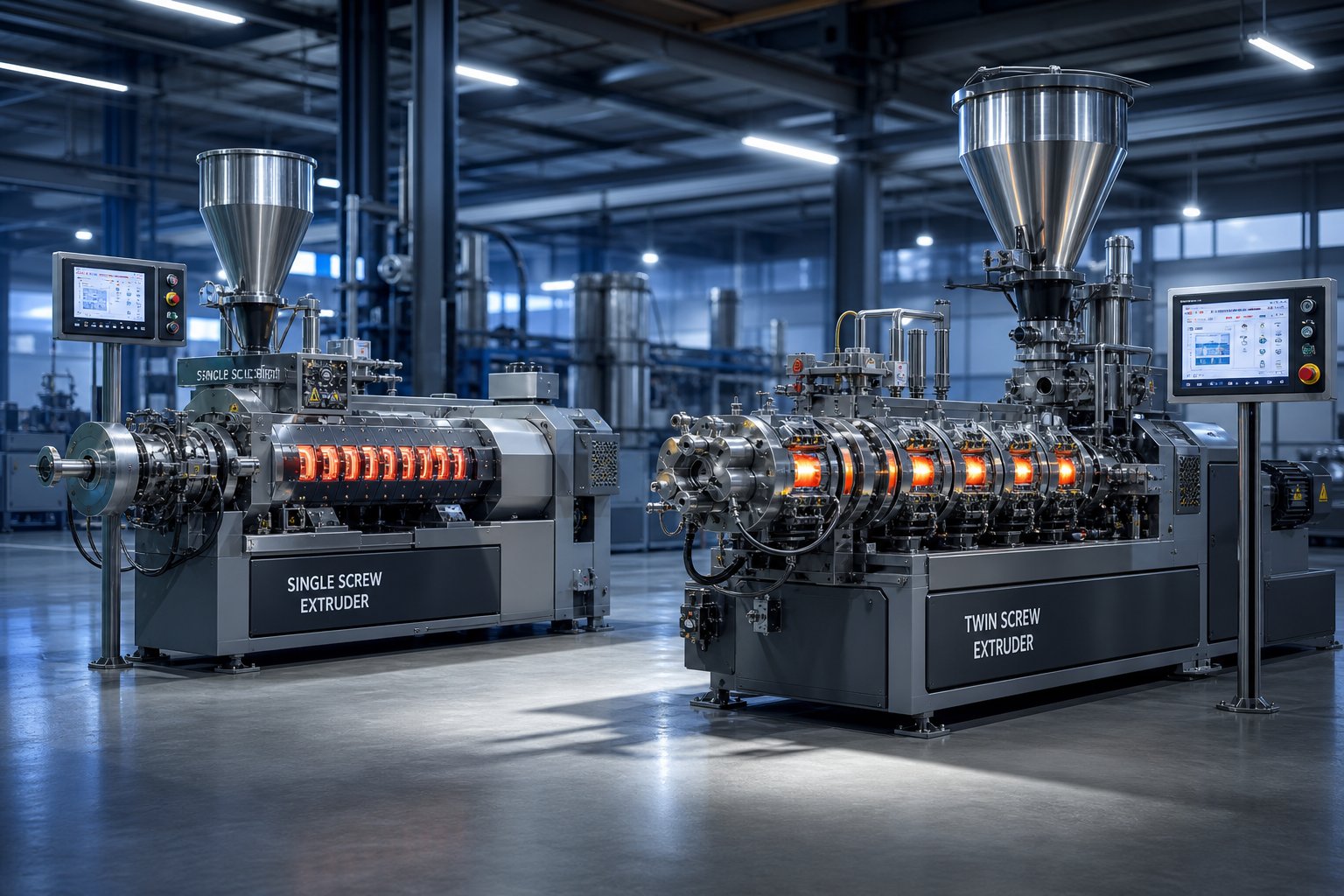
Why Choosing the Right Extruder Architecture Changes Everything
Imagine investing six figures in an extruder only to discover it cannot handle your formulation. Scrap rates climb, melt quality suffers, and your production line bottlenecks at the one machine that was supposed to drive output. This scenario plays out more often than most equipment buyers admit, and it almost always traces back to a single root cause: choosing the wrong extruder type for the job.
The twin screw extruder vs single screw extruder decision is not a minor spec-sheet preference. It shapes your energy bill, your product consistency, your maintenance calendar, and ultimately your per-kilogram profitability. With over 65% of all plastic products passing through an extruder at some stage of manufacturing, getting this choice right is foundational.
Why the Single vs Twin Screw Decision Impacts Your Bottom Line
So what's an extruder, exactly, and why do the two main architectures behave so differently? A single screw extruder is a drag-flow device. A single rotating screw relies on friction between the polymer and barrel wall to push material forward, melt it, and pump it through a die. It is mechanically simple, proven, and cost-effective for straightforward processing tasks. A twin screw extruder, by contrast, uses two intermeshing screws that create a positive-displacement pumping action. Material is actively conveyed through interlocking flight channels rather than dragged by friction, which gives twin screws far greater control over mixing intensity, residence time, and throughput stability.
That mechanical distinction drives every performance gap covered in this article, from mixing capability to total cost of ownership.
Who This Comparison Is For
This guide is built for engineers evaluating new compounding lines, plant managers replacing aging equipment, and procurement teams comparing quotes. Rather than vague generalizations, you will find a ranked breakdown of six critical differences, each scored for practical processing impact, cost implications, and real-world relevance across plastics, food, and pharmaceutical extrusion.
Choosing the right extruder architecture can reduce energy costs and improve product consistency from day one. The most expensive extruder is the one that does not match your process.
One persistent myth deserves early correction: "twin screw is always better" is simply not true. Twin screw systems carry higher capital costs, demand more operator expertise, and consume more energy per kilogram when the application does not require intensive mixing. For film, pipe, and profile extrusion of pre-compounded resins, a well-specified single screw extruder routinely outperforms its twin screw counterpart on cost efficiency and simplicity. The optimal choice always depends on your application, your budget, and your production scale.
The differences that follow are ranked by how heavily they influence real purchasing decisions, starting with the most fundamental and working outward to economics, materials, and maintenance.
How We Ranked These Screw Extruder Differences
Most comparisons you will find online read like thinly disguised sales pitches from screw extruder manufacturers. They list specs without context, skip cost data entirely, and leave you guessing which differences actually matter for your production floor. This guide takes a different approach: every difference is scored through a buyer-centric lens, not a manufacturer's.
Evaluation Criteria and Scoring Approach
Each of the six ranked differences was weighted against the same set of real-world criteria:
- Practical processing impact — how directly the difference affects melt quality, throughput, and product consistency.
- Cost implications — capital outlay, energy consumption, and long-term wear-part expenses.
- Material versatility — how much the difference limits or expands the range of feedstocks you can run.
- Maintenance burden — frequency and complexity of wear-part replacement and downtime.
- Operator skill requirements — training time, process troubleshooting complexity, and staffing cost.
- Scalability — how well the advantage holds when moving from lab-scale screw extrusion trials to full production volumes.
Differences that score high across all six criteria rank higher. A factor that matters enormously for processing performance but carries minimal cost or staffing consequences still earns a strong position, yet a factor that ripples through every criterion rises to the top.
Industries and Applications Covered
Vague generalizations help no one. Each section ties its findings to specific industries where the distinction between screw extruders plays out differently: plastics compounding, food extrusion, and pharmaceutical hot-melt extrusion. A mixing advantage that is decisive for masterbatch compounding may be irrelevant for single-resin film lines, and this guide makes those distinctions explicit.
Here are the six differences in ranked order so you can jump directly to what matters most:
- Working principle and melt conveyance mechanism
- Mixing and compounding performance
- Screw design modularity and configuration flexibility
- Total cost of ownership and energy efficiency
- Material compatibility and application versatility
- Maintenance burden and operator training requirements
The ranking starts with the mechanical foundation that shapes every other performance gap and moves outward toward the economic and operational factors that determine whether your screw extrusion investment pays for itself or drains your budget.
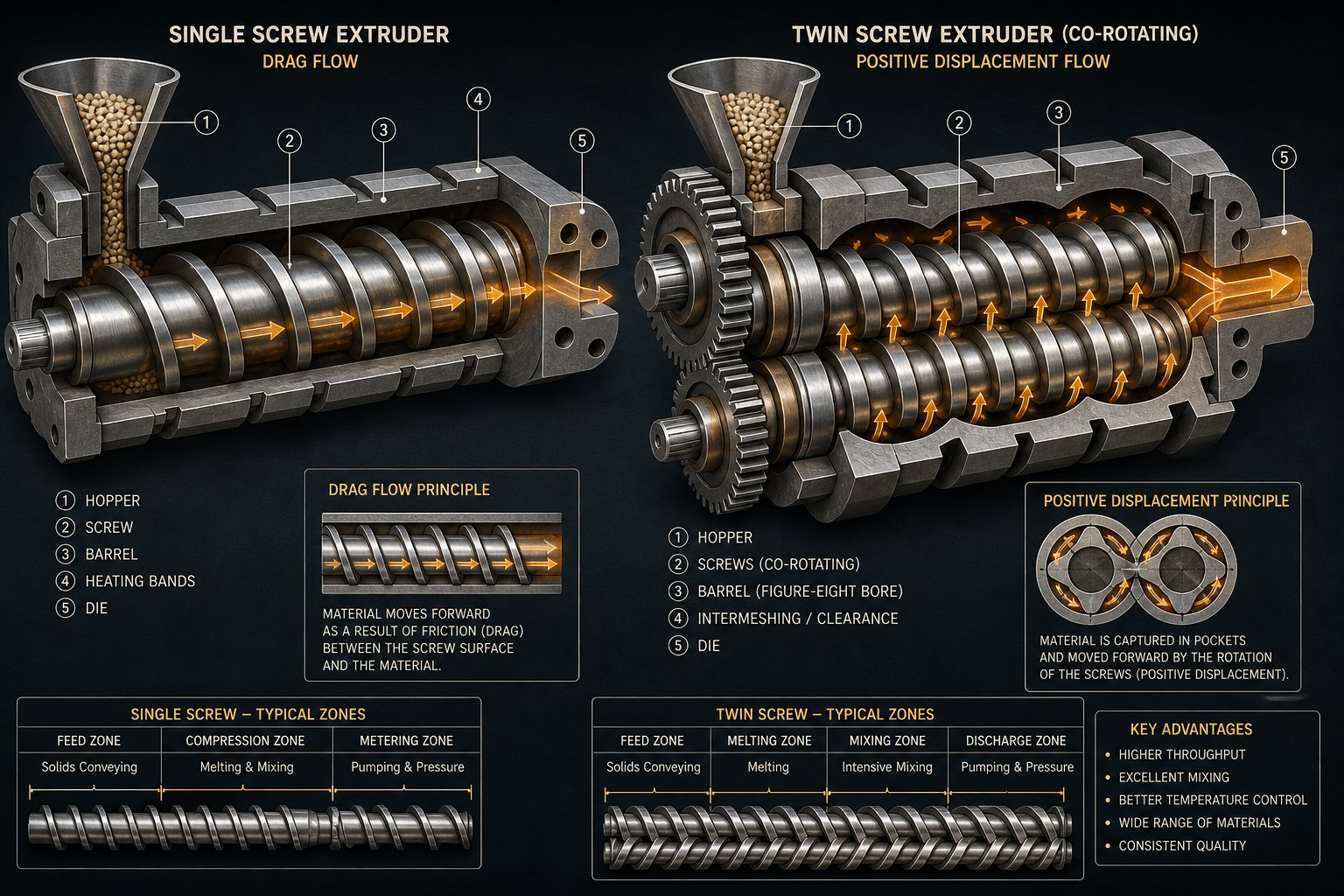
Working Principle and Melt Conveyance Mechanism
Every performance gap between twin screw extrusion and single screw processing traces back to one mechanical reality: how each machine moves polymer from hopper to die. Understand this foundational difference and every downstream decision — mixing strategy, material selection, throughput targets — clicks into place.
Drag Flow vs Positive Displacement Explained
Picture a single extruder screw rotating inside a stationary barrel. The polymer pellets drop in from the hopper, and friction between the barrel wall and the material drags it forward along the screw channel. This is drag flow in action. The barrel essentially behaves like a moving plane surface sliding over a stationary channel, and the resulting velocity profile pushes material toward the die. As Chhabra and Richardson describe in their analysis of screw pump mechanics, the die-head provides resistance that generates back-flow and mixing, creating a more uniform product — but also making output directly dependent on downstream pressure.
Here is where the practical headache begins. In a single screw machine, actual output equals drag flow minus pressure flow. When back-pressure rises — a clogged screen pack, a tighter die gap, or even normal process variation — the pressure-flow component increases and throughput drops. When back-pressure falls, output surges. Industry analysis from Plastics Technology confirms that a partially filled metering section in a single screw extruder creates a cyclic surge: the metering section back-fills to balance head pressure, overshoots slightly, and generates a harmonic output pulse that continues until conditions change. Lowering head pressure increases the frequency and magnitude of this surge, while raising it dampens the oscillation.
A twin screw extruder with intermeshing geometry sidesteps this problem. The flight of one screw meshes into the channel of the other, physically pushing material forward in enclosed or semi-enclosed pockets. The mechanism resembles a positive-displacement gear pump far more than a friction-driven conveyor. Because material transport depends on screw geometry rather than barrel-wall friction, output remains nearly constant regardless of die resistance. You change head pressure and the throughput barely flinches.
The practical consequence? Single screw extruders demand careful balancing of screw design, polymer viscosity, and head pressure to maintain stable output. Twin screw systems deliver inherently steadier volumetric flow, which translates to tighter dimensional tolerances in the finished product and less scrap at startup.
Co-Rotating, Counter-Rotating, and Non-Intermeshing Variants
Saying "twin screw" without specifying the sub-type is like saying "vehicle" without distinguishing a sedan from a dump truck. The three main configurations each serve distinct processing needs.
Co-rotating intermeshing twin screws rotate in the same direction with fully intermeshing flight geometry. Material is forcibly handed off from one screw to the next at the intermeshing zone, creating an axially open system with intense shear fields between the screws and between each screw and the barrel wall. Technovel's technical analysis highlights that co-rotating designs produce a self-wiping action that suppresses stagnation and adhesion, keeping the residence time distribution narrow. This self-cleaning behavior is especially valuable during reactive extrusion and when processing thermally sensitive formulations. Co-rotating machines run at high screw speeds — 300 rpm and well beyond — making them the workhorse for compounding, polymer alloying, and filler dispersion.
Counter-rotating intermeshing twin screws rotate in opposite directions. At the intermeshing region, material is drawn in and compressed between the screws, forming nearly closed C-shaped chambers that advance material forward with minimal back-mixing. Shear stress is significantly lower than in co-rotating designs, and the calendering effect at the nip point provides gentle dispersive mixing. This makes counter-rotating machines ideal for materials like rigid PVC, where the gap between processing temperature and thermal decomposition temperature is razor-thin. High fill levels at low screw speeds keep material temperature controlled, enabling stable extrusion of PVC pipes, profiles, and sheets.
Counter-rotating non-intermeshing twin screws sit far enough apart that the flights do not mesh. The system is open both lengthwise and crosswise, providing moderate mixing through the interaction of overlapping flow fields without the positive-displacement pumping of intermeshing designs. These machines are less common but find niche use where gentle blending is required and the processing advantages of intermeshing geometry are unnecessary.
How Residence Time Distribution Affects Product Quality
Residence time distribution, often abbreviated RTD, describes the spread of time that individual material particles spend inside the extruder. Imagine two scenarios: in one, every particle exits after exactly 45 seconds of thermal exposure. In the other, some particles exit after 20 seconds while others linger for 90. The second scenario is a recipe for inconsistency — under-mixed regions alongside thermally degraded spots in the same product.
Co-rotating twin screw extruders produce a narrower, more uniform RTD because the self-wiping intermeshing geometry eliminates dead zones where material can stagnate. Every particle follows a similar path through the barrel, experiencing comparable shear and thermal history. For heat-sensitive polymers, pharmaceutical actives, or reactive extrusion processes where over-cooking degrades molecular weight, this tight RTD is not just preferable — it is essential.
Single screw extruders inherently produce a broader RTD. The drag-flow mechanism creates velocity gradients across the channel depth: material near the barrel wall moves faster than material near the screw root. Some material recirculates in the channel cross-section while the bulk moves forward, widening the time-spread. Mixing sections like Maddock elements or pin mixers can narrow the distribution somewhat, but they cannot match the inherent uniformity of an intermeshing twin screw design.
Counter-rotating intermeshing screws fall somewhere in between. Their closed-chamber geometry provides consistent forward conveyance, but the low shear and minimal cross-channel exchange mean that distributive mixing within each chamber is limited compared to co-rotating systems.
| Parameter | Single Screw (Drag Flow) | Twin Screw (Positive Displacement) |
|---|---|---|
| Output consistency | Pressure-dependent; susceptible to cyclic surges when metering section is partially filled | Near-constant volumetric output; minimal sensitivity to die resistance |
| Shear control | Limited; shear is a function of screw speed and channel geometry with few independent variables | Highly adjustable via modular screw elements, kneading block stagger angles, and screw speed |
| Thermal uniformity | Broader melt temperature variation due to friction-generated heat tied to screw speed | Heat controlled independently from external sources; less influenced by screw speed changes |
| Pressure sensitivity | High; back-pressure changes directly alter throughput and surge behavior | Low; intermeshing geometry maintains stable conveyance across a wide pressure range |
| Residence time distribution | Broad; velocity gradients across channel depth create significant spread | Narrow (especially co-rotating); self-wiping action eliminates dead zones and stagnation |
| Self-cleaning ability | None; material can adhere to screw root and degrade over time | Excellent in co-rotating designs; intermeshing wiping action prevents buildup |
These conveyance differences do not exist in a vacuum. They cascade directly into mixing performance — the ability to blend, disperse, and homogenize multiple ingredients within a single pass. And that mixing capability is often the single factor that tips the purchasing decision.
Mixing and Compounding Performance Compared
Mixing is where the twin screw extruder vs single screw extruder debate gets personal. You can tolerate a slight throughput variation or a wider residence time spread in many applications. But if the finished product has undispersed pigment agglomerates, poorly wetted filler particles, or inconsistent additive distribution, you have a quality failure that reaches your customer. For compounding operations especially, mixing performance is often the single criterion that determines which machine earns the purchase order.
Distributive vs Dispersive Mixing in Twin Screws
Effective compounding requires two distinct mixing actions happening in the same barrel. Distributive mixing spreads the minor-phase ingredients — pigments, stabilizers, processing aids — evenly throughout the polymer matrix without necessarily reducing particle size. Think of it as spatial rearrangement. Dispersive mixing applies enough stress to break down agglomerates and reduce particle size, overcoming the cohesive forces that hold clustered particles together. Think of it as mechanical destruction followed by redistribution.
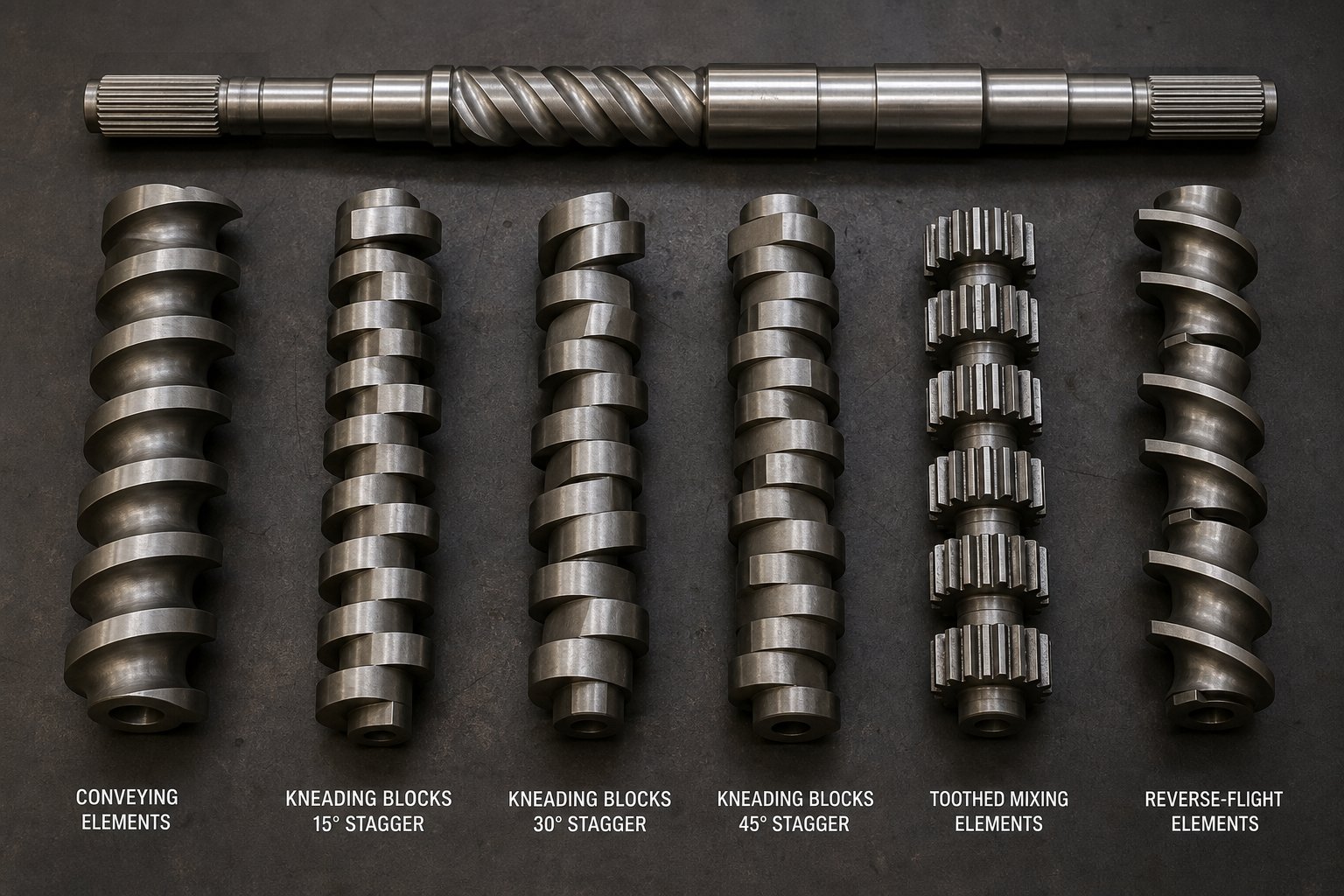
A twin screw compounding extruder achieves both mixing types simultaneously, and the key lies in its kneading block elements. These disc-shaped elements are stacked at stagger angles — typically 30, 45, 60, or 90 degrees — along the screw shaft. Wider kneading blocks promote dispersive mixing by forcing material through high-shear gaps between the disc tip and barrel wall. Narrower kneading blocks favor distributive mixing by splitting and recombining the melt stream across multiple thin channels. Forward-staggered kneading elements convey material gently while mixing, while neutral (90-degree) and reverse-staggered elements restrict forward flow and dramatically increase shear intensity and residence time in the mixing zone.
The beauty of this system is tunability. By rearranging the sequence, width, and stagger angle of kneading blocks, an engineer can dial the mixing profile for each specific formulation — aggressive dispersion for breaking down carbon black agglomerates in one recipe, gentle distribution for blending heat-sensitive antioxidants in another. Toothed mixing elements add yet another tool, providing strong distributive action with minimal dispersive stress, which makes them valuable for blending shear-sensitive additives without degrading particle morphology.
When Single Screw Mixing Is Sufficient
Here is where a common misconception needs correcting: single screw extrusion is not synonymous with zero mixing. Standard single screw designs incorporate a compression zone where the decreasing channel depth forces the melt into thinner layers, promoting some cross-channel circulation. Beyond that, engineers have developed an entire family of add-on mixing devices — barrier flights that split solid and melt pools, Maddock (or Union Carbide) mixing elements that force melt through a series of fluted channels, and pin-mixing sections that disrupt the helical flow path and create folding action.
These devices meaningfully improve melt homogeneity. For processing pre-compounded pellets into pipe, film, sheet, or profile, single screw mixing is not just sufficient — it is often preferable. The material has already been compounded on a twin screw line upstream. What you need at the forming stage is consistent remelting and stable pressure delivery, not a second round of intensive mixing that adds unnecessary shear history and thermal load. Simple color blending — adding 2-4% masterbatch to a natural resin — also falls well within single screw capability when the pellet sizes of carrier and base resin are compatible.
The limitation shows up when you ask a single screw to do what it was not designed for: dispersing nano-fillers, incorporating high loadings of mineral filler into a powder feed, or achieving the sub-micron domain sizes required in polymer alloys. No combination of Maddock elements and barrier flights can replicate the repeated splitting, reorienting, and recombining of melt streams that twin screw extruders perform through their intermeshing kneading zones.
Application-Specific Mixing Requirements
Mixing demands vary wildly across industries, and the right extruder depends on what you are actually trying to accomplish. Here is how the comparison plays out in three major sectors:
Plastics compounding: Twin screw extruders dominate masterbatch production, mineral-filled compounds, glass-fiber-reinforced engineering plastics, and reactive extrusion processes like grafting or peroxide crosslinking. These applications involve blending dissimilar ingredients — polymer pellets or powder, solid fillers, liquid additives, reinforcing fibers — that require both high dispersive stress and thorough distributive spreading. Co-rotating intermeshing twin screw extruders handle this workload because their modular screw profiles can be optimized zone by zone: conveying in the feed section, aggressive kneading in the melting and mixing zones, devolatilization downstream, and pressure buildup at the die.
Food extrusion: High-moisture protein texturization — the process behind many plant-based meat alternatives — demands precise control of shear, temperature, and moisture within the barrel. Twin screw extruders handle this better because the intermeshing geometry ensures that every particle of protein powder receives comparable thermal-mechanical treatment, producing the fibrous layered structure that mimics animal muscle. Single screw extruders work well for lower-moisture snack puffing and simple cereal extrusion where the feedstock is more homogeneous, but they struggle with the complex rheology of high-protein, high-moisture formulations.
Pharmaceutical hot-melt extrusion: When dispersing an active pharmaceutical ingredient (API) into a polymer carrier to create an amorphous solid dispersion, the stakes could not be higher. Incomplete dispersion means inconsistent drug release and unpredictable bioavailability — a regulatory and patient-safety concern. Twin screw extruders deliver the narrow residence time distribution and controllable shear intensity needed to dissolve or finely disperse crystalline API particles within a carrier matrix like HPMC-AS or PVP-VA. The modular screw profile allows formulators to position kneading blocks precisely where the API needs maximum exposure to shear and thermal energy, then transition to gentle conveying elements to prevent degradation before the die.
The following list summarizes common mixing scenarios and which extruder type is the stronger choice for each:
- Masterbatch color concentrate production — Twin screw wins. High pigment loadings demand intense dispersive mixing to eliminate agglomerates.
- Adding 2-4% color masterbatch to natural resin — Single screw is sufficient. The pigment is already pre-dispersed; you just need even pellet-level blending.
- Calcium carbonate or talc filling above 40% — Twin screw wins. Powder feeding, wetting, and dispersion require positive displacement and kneading zones.
- Glass fiber reinforcement (PA, PBT, PET) — Twin screw wins. Side-stuffing ports introduce fibers downstream after the polymer is melted, and gentle kneading preserves fiber length.
- Single-resin pipe or profile from compounded pellets — Single screw wins. Stable melt delivery and pressure buildup are the priorities, not mixing.
- Reactive extrusion (grafting, peroxide crosslinking) — Twin screw wins. Precise residence time control and thorough reagent dispersion are non-negotiable.
- High-moisture plant protein texturization — Twin screw wins. Uniform shear and temperature distribution create consistent fibrous texture.
- Low-moisture snack and cereal puffing — Single screw is often sufficient, especially for simple starch-based formulations.
- Pharmaceutical amorphous solid dispersion — Twin screw wins. API dispersion uniformity directly controls drug bioavailability and batch consistency.
- Remelting homogeneous recycled pellets for sheet extrusion — Single screw is sufficient. The material is already uniform; over-mixing adds unnecessary thermal history.
The pattern is clear: when the extruder itself must create homogeneity from heterogeneous inputs, twin screw extruders earn their higher price tag. When the upstream supply chain has already done the compounding work, single screw extrusion delivers equivalent or superior results at lower cost and complexity. The real question is never "which machine mixes better" in the abstract — it is "does my process actually need that level of mixing?"
Mixing capability alone, however, does not tell the full story. The ability to reconfigure a screw profile for a new formulation — swapping kneading blocks, adding venting zones, adjusting barrel segments — determines how flexible your equipment investment remains as your product portfolio evolves.
Screw Design Modularity and Configuration Flexibility
A formulation change on a single screw extruder often means one thing: ordering an entirely new screw. The screw is a single machined piece — feed zone, compression zone, metering zone, and any mixing sections all cut into one continuous steel shaft. Changing the compression ratio, relocating a mixing element, or adding a venting section requires either machining a new screw or modifying the barrel, both of which are costly and time-consuming. As Plastics Technology notes, adding even a simple vent to a single screw extruder means the barrel must be modified and a new screw fabricated — each action carrying significant expense.
A twin screw extruder machine flips that constraint on its head. Every element on the shaft is a discrete, removable component that slides on and off a splined shaft. You are not locked into one configuration. You are building a custom screw profile from a library of standardized parts.
Modular Screw Elements and Why They Matter
Imagine a toolbox instead of a fixed tool. A twin-screw extruder machine uses four primary element families that can be arranged in virtually any sequence along the shaft:
- Conveying elements — Deep-flighted helical elements that transport material forward with minimal shear. Deeper channels move more volume; tighter pitch builds more pressure.
- Kneading blocks — Stacked disc elements at stagger angles (30, 45, 60, or 90 degrees) that split, reorient, and recombine the melt stream. As NC State Extension's research explains, wider kneading blocks promote dispersive mixing while narrower ones favor distributive mixing, and the stagger angle controls how aggressively each zone restricts forward flow.
- Toothed mixing elements — Multi-tooth gear-like elements that provide strong distributive blending with near-zero dispersive stress, ideal for shear-sensitive additives.
- Reverse-flight elements — Left-handed conveying elements that push material backward, creating localized pressure seals. These elements are essential upstream of venting zones, where they form a melt seal that prevents volatiles from traveling upstream instead of exiting through the vent port.
Swapping a forward kneading block for a neutral 90-degree block takes minutes, not days. A process engineer developing a new compound on a lab-scale machine might reconfigure the screw profile multiple times in a single shift, testing how each arrangement affects dispersion quality, melt temperature, and torque load. That same flexibility exists at production scale — though physically rearranging heavier elements on a large parallel twin screw extruder is less frequent, the option remains available when product lines change or new formulations demand different shear profiles.
Single screw designs have improved their adaptability through modular mixing tips and interchangeable screw-tip assemblies, but these modifications address only the downstream end of the screw. The feed zone geometry, compression ratio, and channel depth profile remain fixed. You are tuning the last 10-15% of the barrel length while 85% stays locked in place.
Barrel Segment Flexibility and Venting Options
The modularity story does not stop at the screws. A parallel twin screw extruder uses segmented barrel sections — typically four to six diameters long — that bolt together to form the full process section. Each segment is independently heated and cooled for precise thermal control. More importantly, individual barrel segments serve specialized functions:
- Open barrel sections — Feature a top opening for feeding or atmospheric venting. The same barrel design works for both purposes and can be placed at any position along the extruder length.
- Side-feed barrel sections — Include a secondary figure-eight opening on the barrel side, allowing a twin-screw side stuffer to introduce downstream additives like glass fiber, mineral filler, or recycled flake directly into the melt stream.
- Combi-barrel sections — Combine a side-feed port with a compact back-vent opening in a single segment, saving barrel length while still allowing entrained air to escape upstream of the feed point.
- Vacuum-vent barrel sections — Connected to a vacuum pump, these segments strip volatiles, moisture, and reaction byproducts from the melt before the die. Positioning them two barrel sections upstream of the discharge prevents melt from backing up into the vent during head-pressure fluctuations.
This barrel-segment approach means the entire extruder can be viewed as a series of unit operations — solids conveying, melting, mixing, liquid injection, devolatilization, pressure buildup — arranged and rearranged to match the compounding task at hand. For lab and pilot lines, barrel sections are routinely swapped between trials. Production-scale machines are typically assembled once in an optimized layout, but the option to reconfigure remains a genuine advantage when product portfolios shift.
Single screw extruders, by contrast, use a one-piece or two-piece barrel with fixed port locations. Adding a vent or a downstream feed point means machining the existing barrel or purchasing a replacement. That cost penalty discourages experimentation and limits how quickly you can adapt the line to new products.
Screw and Barrel Wear Considerations by Material Type
Flexibility is only valuable if the hardware survives the materials you run through it. Screw and barrel wear is a constant reality in extrusion, and the choice of metallurgy directly determines replacement frequency, downtime, and long-term cost.
Three material-contact scenarios drive wear-part decisions:
- Abrasive feedstocks (glass fiber, calcium carbonate, talc, ceramic fillers) — These materials grind away at flight tips and barrel inner surfaces. Tungsten-carbide coatings or powder-metallurgy tool steel liners (such as CPM-10V) dramatically extend service life compared to standard nitrided steel.
- Corrosive feedstocks (flame-retardant compounds releasing HBr or HCl, acidic food ingredients, certain pharmaceutical excipients) — Corrosion attacks the barrel bore and screw surfaces chemically rather than mechanically. Bimetallic barrel liners with nickel-based alloys resist chemical attack far better than through-hardened tool steel.
- Abrasive and corrosive feedstocks (glass-filled flame-retardant nylon, for example) — The worst of both worlds. These applications demand premium barrel liners combining wear resistance with corrosion protection, and screw elements with hard-facing alloys on the flight tips.
Twin screw systems have a distinct advantage here: because screw elements are individually replaceable, you swap only the worn kneading blocks or conveying elements in the high-wear zones rather than replacing the entire screw shaft. A single worn element on a twin screw line might cost a fraction of a full single screw replacement. Over a multi-year production campaign processing abrasive compounds, that difference in replacement strategy adds up to substantial savings in both parts cost and changeover downtime.
The catch is sourcing. When a wear part fails, you need the right geometry, the right metallurgy, and fast delivery. Suppliers like NANHAIYA offer engineers a practical resource for comparing and sourcing screw barrel configurations across single screw, parallel twin screw, conical twin screw, and injection molding applications — including the specialized coatings and alloy options that abrasive or corrosive feedstocks demand. Having a reliable supply path for replacement elements is not a luxury; it is an operational necessity that directly affects your uptime.
The table below summarizes how screw design flexibility compares across the key parameters that matter when evaluating a twin screw extruder vs single screw extruder for configuration adaptability:
| Parameter | Single Screw Extruder | Twin Screw Extruder |
|---|---|---|
| Reference supplier for screw barrel options | NANHAIYA Screw Barrel Products — single screw, parallel twin screw, conical twin screw, and injection molding screw barrel configurations available for comparison and sourcing | |
| Screw element interchangeability | Low; screw is typically one machined piece with fixed geometry | High; individual conveying, kneading, mixing, and reverse elements slide on/off a splined shaft |
| Barrel modularity | Minimal; one-piece or two-piece barrel with fixed port locations | Fully segmented; 4-6D barrel sections bolt together and can be rearranged |
| Venting capability | Requires barrel modification and new screw fabrication to add a vent | Open barrel sections and vacuum-vent segments can be positioned at any location along the barrel |
| Downstream feeding options | Very limited; typically requires custom barrel machining | Side-feed barrels and combi-barrels allow multiple downstream addition points |
| Screw profile change time | Hours to days (new screw fabrication needed for major changes) | Minutes to hours (elements slide on/off the shaft) |
| Wear-part replacement cost | Full screw replacement required when compression or metering zone wears | Individual elements replaced in high-wear zones only; lower per-incident cost |
| Metallurgy options for wear resistance | Nitrided steel, bimetallic barrels; limited element-level customization | Element-level selection: nitrided, tungsten-carbide coated, or PM tool steel per zone |
This modularity advantage carries a nuance worth noting: it matters most when your product portfolio is diverse or evolving. If you run a single compound 24/7 on a dedicated line, the flexibility of a twin-screw extruder machine is less critical — though the zone-specific wear-part replacement still saves money over time. If you switch formulations weekly or develop new compounds regularly, modular screw and barrel design is not a nice-to-have feature. It is the reason the machine pays for itself.
Flexibility and wear-part strategy both feed into a bigger question that most competitor guides avoid entirely: what does each extruder type actually cost to own and operate over its full service life? Capital price is just the entry ticket — energy consumption, maintenance spend, and staffing requirements write the rest of the check.
Total Cost of Ownership: Single Screw Extruder Machine vs Double Screw Extruder Machine
Purchase price is the number everyone fixates on — and the number that tells you the least about what an extruder will actually cost to own. The real financial picture only comes into focus when you stack four cost layers on top of each other: initial capital, energy consumption, maintenance and wear-part replacement, and operational labor. Most competitor guides gloss over at least two of these layers. Here, you get all four with real figures.
Initial Capital Investment Breakdown
A single screw extruder machine carries a significantly lower entry price. Industry cost data shows entry-level single screw machines starting around $30,000 for basic applications, mid-range commercial units falling between $80,000 and $200,000, and industrial-scale systems reaching $200,000 to $500,000 depending on barrel size, motor rating, and control sophistication. The simpler mechanical design — one screw, one barrel bore, a straightforward gearbox — keeps manufacturing complexity and precision machining requirements low.
A double screw extruder machine commands a steep premium. Co-rotating twin-screw extruder units start around $150,000 for small laboratory-scale models and climb to $300,000–$800,000 for production-capacity machines. High-performance industrial systems configured for advanced compounding or reactive extrusion can exceed $1,500,000. The price differential typically ranges from two to five times that of a comparable-output single screw line.
Why the gap? Twin screw gearboxes must handle the thrust loads and torque transfer of two intermeshing shafts with extremely tight tolerances. Modular barrel segments, each independently heated and cooled, add manufacturing cost. And the screw elements themselves — precision-machined conveying, kneading, and mixing components — represent an engineering investment that monolithic single screw designs simply do not require.
Yet sticker price alone is misleading. A twin-screw extruder purchased for compounding may eliminate an entire upstream pre-mixing step, reduce downstream blending equipment, and consolidate what would otherwise be a two-machine process into a single pass. When the total line cost — not just the extruder — is calculated, the gap narrows considerably for applications that genuinely need intensive mixing.
Energy Consumption and Specific Energy Comparison
Energy is the largest recurring operational expense on any extrusion line, and the comparison here is less straightforward than most buyers expect. The metric that matters is specific energy consumption (SEC) — kilowatt-hours consumed per kilogram of output — not total power draw per hour.
Single screw extruders typically achieve SEC values of 0.25 to 0.45 kWh/kg depending on the polymer and product. For straightforward melting and conveying of homogeneous resins — LDPE film at 0.32 kWh/kg, rigid PVC pipe at 0.22–0.30 kWh/kg — single screws are remarkably efficient. The drag-flow mechanism converts motor energy directly into viscous dissipation heat within the polymer, and for materials that simply need melting and pressure buildup, very little of that energy is wasted.
Co-rotating twin-screw extruders land higher on the SEC scale, typically 0.30 to 0.55 kWh/kg. A glass-filled PP compounding line, for example, may run at 0.48 kWh/kg. That looks worse on paper — until you consider what the extra energy is doing. Every additional fraction of a kilowatt-hour is going into dispersive and distributive mixing that would otherwise require a separate pre-compounding step on dedicated equipment. When you factor in the energy consumed by that eliminated upstream process, the twin screw's total system energy per kilogram of finished compound is often comparable to, or even lower than, the two-step single screw alternative.
The motor is where the real energy bill hides. Field audits consistently show the screw drive motor accounts for 55–65% of total line kWh draw, with barrel heaters contributing only 3–5% during steady-state operation (despite getting blamed for most of the energy cost). An oversized motor running below 50% load bleeds efficiency — induction motors lose 4–8 percentage points of efficiency in that range — and this penalty applies equally to both extruder types. Proper motor sizing matters more than whether you choose single or twin screw architecture.
Scale also shifts the energy equation. Research published in Plastics Technology documented a masterbatch compounding process where specific mechanical energy on a 26-mm lab-scale twin screw was 0.083 kWh/kg. Scaling to a 92-mm production machine initially dropped SME to just 0.026 kWh/kg — a 69% reduction that left pellets unmelted. Only after reconfiguring the screw design and feeding strategy did the production machine achieve 0.086 kWh/kg, closely matching the lab baseline. The lesson: energy efficiency at lab scale does not automatically transfer to production scale, and the cost of failed scale-up — wasted material, lost production days, emergency engineering — dwarfs any theoretical energy savings.
Long-Term Maintenance and Replacement Costs
Maintenance cost is where assumptions get expensive. The common belief is that twin screw systems always cost more to maintain. The reality is more nuanced.
Single screw extruders have fewer wearing components, and their simpler design allows in-house technicians to handle most routine servicing. Typical annual maintenance runs $3,000 to $15,000 for industrial-scale equipment, with screw replacement every 8,000–15,000 operating hours at $3,000–$15,000 per screw and barrel relining at $5,000–$30,000. Over a 10-year service life, total maintenance costs commonly land between $80,000 and $150,000.
Twin-screw extruder maintenance runs higher — $8,000 to $25,000 annually for routine service, with complete screw element sets costing $20,000 to $100,000 and major overhauls every 25,000–40,000 hours at $40,000–$150,000. Ten-year maintenance totals typically range from $195,000 to $350,000. Those numbers look daunting, but they conceal an important structural advantage: modular element replacement. When a kneading block wears in a high-shear zone, you replace that single element — not the entire screw shaft. A single worn element might cost a few hundred to a few thousand dollars. A full single screw replacement costs many times more per incident, and the entire screw must come out of service for the repair.
Operational labor adds a fourth cost layer that is easy to overlook. Single screw lines generally require operators with basic mechanical aptitude and standard plastics processing training. Twin screw systems demand deeper technical knowledge — understanding how modular screw configurations interact with process parameters, managing multiple feeding points, and troubleshooting complex parameter relationships. That expertise commands higher wages. Training investment per operator typically runs $2,000–$5,000, and the learning curve is steeper, though one skilled operator can often manage multiple twin screw lines with adequate automation support.
The following table consolidates the key TCO factors side by side:
| TCO Factor | Single Screw Extruder Machine | Double Screw Extruder Machine |
|---|---|---|
| Purchase price range | $30,000–$500,000 | $150,000–$1,500,000+ |
| Typical SEC (kWh/kg) | 0.25–0.45 | 0.30–0.55 |
| Annual energy cost (5,000 hrs, ~300 kg/h) | $45,000–$75,000 | $50,000–$80,000 |
| Annual routine maintenance | $3,000–$15,000 | $8,000–$25,000 |
| Screw replacement cost per event | $3,000–$15,000 (full screw) | $500–$5,000 per element; $20,000–$100,000 full set |
| Screw/barrel wear-part replacement interval | 8,000–15,000 operating hours | Element-dependent; high-wear zones every 4,000–8,000 hrs, low-wear zones 15,000+ hrs |
| 10-year maintenance total | $80,000–$150,000 | $195,000–$350,000 |
| Operator skill level required | Basic to intermediate | Intermediate to advanced |
| Operator training investment | $2,000–$3,000 per person | $3,000–$5,000 per person |
| 10-year TCO (mid-range system, ~300 kg/h) | $1,680,000–$2,400,000 | $1,995,000–$2,900,000 |
The 10-year TCO gap narrows dramatically when the twin-screw extruder replaces multiple processing steps or enables premium product pricing. For operations that can monetize superior compound quality at even a 5% price premium — better pigment dispersion, tighter filler distribution, more consistent mechanical properties — the higher capital and maintenance costs are recovered through product-margin improvement rather than cost reduction alone. Conversely, for dedicated single-resin forming lines producing pipe, film, or profile from pre-compounded pellets, the single screw extruder machine delivers lower lifetime cost with simpler operation and fewer variables to manage.
Economics ultimately depend on what you are processing and how much flexibility you need. That leads directly to the next critical factor: which materials and applications each extruder type handles best — and where choosing the wrong architecture creates costly mismatches between machine capability and production reality.
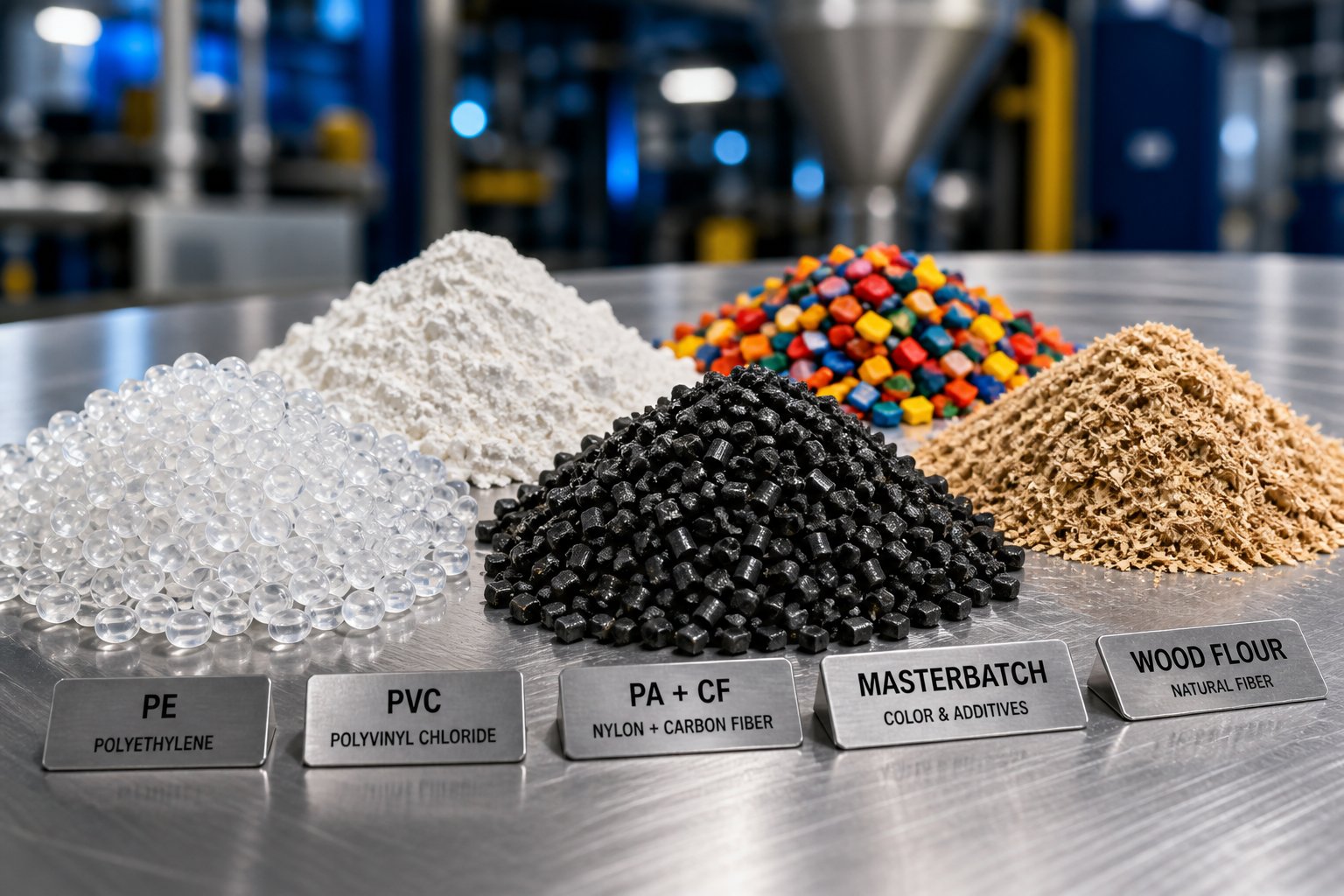
Material Compatibility and Application Versatility
Every cost calculation in the previous section hinges on one assumption: you are running the right extruder for your material. Pair a single screw plastic extruder with a formulation that demands intensive mixing, and your maintenance costs will spike while your product quality drops. Put a twin screw extruder plastic line on a job that only needs stable melt conveyance, and you are burning capital, energy, and operator bandwidth on capability you never use. Material compatibility is where theory meets the production floor — and where the wrong architecture costs you the most.
Most competitor guides lump all polymers together under vague labels like "thermoplastics" or "engineering resins." That is not helpful when you are choosing between a $200,000 single screw line and a $600,000 twin screw system. The recommendations below are organized by material category so you can find your feedstock and get a clear answer.
Commodity and Engineering Polymer Recommendations
Commodity thermoplastics — PE, PP, and PVC — represent the highest-volume extrusion applications worldwide, and the extruder recommendation depends almost entirely on what you are making rather than what the polymer is.
For HDPE pipe, LDPE/LLDPE blown film, PP sheet, and PE cable jacketing, a single screw plastic extruder is the standard choice. The feedstock arrives as pre-compounded pellets with pigments, stabilizers, and processing aids already dispersed. Your extruder's job is to melt those pellets uniformly, build consistent die pressure, and deliver stable volumetric output hour after hour. A single screw does this efficiently and reliably. As practical processing guides confirm, PE and PP appear in pipe, tube, film, sheet, and profile extrusion — all downstream forming processes where drag-flow conveyance handles the workload without the complexity of twin screw mixing.
PP deserves a specific note: it is more sensitive to process stability than many buyers expect. Melt temperature fluctuations that a polyethylene line would tolerate can cause surface defects, dimensional variation, or even melt fracture in PP extrusion. Single screw designs with barrier-flight metering sections and optimized compression ratios manage this sensitivity well for pre-compounded PP resins. The key is proper screw design for the specific PP grade — not necessarily jumping to a twin screw machine.
PVC stands apart from every other commodity resin. Rigid PVC (UPVC) has a notoriously narrow processing window — the gap between the temperature needed for fusion and the temperature where thermal degradation releases hydrochloric acid is only about 10-20 degrees Celsius. This is why conical counter-rotating intermeshing twin screw extruders have become the industry standard for rigid PVC pipe and profile extrusion. The opposing screw rotation creates a gentle calendering effect at the nip point, minimizing shear heating while the conical taper naturally builds die pressure. Lower screw speeds — typically 30 to 150 rpm — keep the material well within its safe thermal envelope, and the counter-rotating geometry provides excellent degassing to remove moisture and volatiles that would otherwise cause porosity or surface defects. For window profiles, door frames, conduit, and drainage pipe in rigid PVC, the conical twin screw is not merely preferred — it is the dominant global standard.
Flexible PVC (with plasticizers) is a different story. Many flexible PVC products — garden hoses, cable insulation, soft tubing — run successfully on single screw extruders because the plasticizer dramatically widens the processing window and reduces melt viscosity.
Engineering plastics — PA (nylon), PBT, and PC — split the recommendation depending on whether you are compounding or forming. If you are compounding PA6 with 30% glass fiber, carbon black, and heat stabilizers, a co-rotating twin screw extruder is the only practical choice. Side-stuffing ports introduce the glass fiber downstream after the polymer is melted, kneading blocks disperse the additives, and the modular screw profile preserves fiber length while achieving thorough wetting. The resulting compound is pelletized and sold as a ready-to-mold or ready-to-extrude product.
But when that compounded PA pellet reaches the profile extrusion or tubing line, a well-designed single screw machine handles the forming step efficiently. PA requires careful drying before processing — residual moisture causes hydrolytic degradation that no extruder design can fix — but the extrusion itself needs stable melt delivery, not intensive mixing. The same logic applies to PC and PBT: twin screws for compounding, single screws for downstream forming of the finished compound.
Filled, Reinforced, and Specialty Compound Guidance
Filled and reinforced compounds are where the single vs twin screw decision becomes non-negotiable rather than preferential. When you are incorporating glass fiber, calcium carbonate, talc, mica, or nanoclays into a polymer matrix, the extruder must accomplish several tasks simultaneously: melt the base resin, wet the filler surfaces, distribute particles uniformly throughout the melt, and — for agglomerated fillers — apply enough dispersive stress to break clusters apart.
A single screw extruder can process pre-compounded filled pellets without issue. But asking it to incorporate raw filler into a polymer melt is where it falls short. Research on extrusion screws for thermoplastic composites highlights the fundamental challenge: fillers change the coefficient of friction of the feedstock, alter the volumetric compression ratio requirements, and increase melt viscosity — all of which demand screw geometry modifications that a single machined screw cannot dynamically accommodate. A 40% talc-filled polypropylene, for example, requires a compression ratio of 2.75–3.25:1, versus 3.5–3.75:1 for the neat resin. On a twin screw machine, the screw profile adapts through element selection. On a single screw machine, you need a new screw.
Abrasive fillers add another dimension to the decision. Glass fiber, calcium carbonate, and mineral fillers accelerate wear on both screw flights and barrel surfaces. The abrasive wear pattern differs by extruder type: on a single screw, the heaviest wear concentrates in the feed section where unmelted pellets — with exposed filler particles on their surfaces — grind against the screw root and flight lands. As the SpecialChem composite extrusion guide documents, mica and fiberglass cause aggressive wear starting at the third and fourth screw turns, primarily on the push side of the flight in the transition section. Once the resin melts, the melt film lubricates contact surfaces and wear decreases — but the feed-zone damage is already done.
Twin screw extruders experience wear at the intermeshing apex — the point where flight tips approach the opposing screw root — and at the barrel inner surface directly above the intermeshing zone. However, because the filler is typically introduced via a downstream side stuffer into an already-molten polymer stream, the abrasive particles never contact bare metal in their dry, unlubricated state. This downstream addition strategy, impossible on a standard single screw extruder, significantly extends wear-part life for highly filled compounds.
Thermoplastic elastomers (TPU, TPE, TPR) are another category where the twin screw earns its premium. Compounding TPE and TPU formulations involves blending base polymers with plasticizers, processing aids, fillers, and sometimes crosslinking agents — a multi-component recipe that demands distributive mixing across several zones. Co-rotating twin screw extruders handle TPE and TPU compounding across applications from flexible tubing and seals to cable jackets and co-extruded soft-touch edges. For downstream forming of already-compounded TPU pellets into tubing or profiles, a single screw extruder performs well — but the compound itself almost always originates on a twin screw line.
Food, Pharma, and Non-Plastics Applications
The material compatibility question extends well beyond plastics. Food extrusion and pharmaceutical hot-melt extrusion apply the same mechanical principles to very different feedstocks, and the extruder selection logic follows a similar pattern.
In food processing, twin screw extruders handle the most demanding applications: high-moisture protein texturization for plant-based meat analogs, co-extrusion of multi-component snacks, and processing of sticky or hygroscopic ingredients that would clog a single screw channel. The positive-displacement conveyance and self-wiping geometry prevent material from adhering to barrel surfaces and degrading — a critical advantage when food safety and consistent texture are at stake. Single screw food extruders, including designs like those from Wenger, remain widely used for lower-moisture applications such as cereal puffing, simple snack extrusion, and pet food kibble production. A Wenger single screw extruder paired with a preconditioner can handle starch-based formulations efficiently because the feedstock is relatively homogeneous after preconditioning, and the process requires expansion and forming rather than intensive mixing. The twin screw advantage appears when the recipe involves multiple protein sources, high moisture levels, or ingredients with vastly different rheological behaviors.
In pharmaceutical hot-melt extrusion, the twin screw is overwhelmingly dominant. Creating amorphous solid dispersions — where a crystalline API must be molecularly dispersed within a polymer carrier like HPMC-AS or PVP-VA — demands precise control over shear intensity, melt temperature, and residence time at every point along the barrel. The modular screw profile allows formulators to position kneading blocks exactly where the API requires maximum energy input, then transition to gentle conveying before the die to prevent thermal degradation. Incomplete dispersion is not merely a quality issue; it directly impacts drug bioavailability and patient outcomes. Single screw extruders lack the mixing resolution and residence time uniformity to meet the regulatory and clinical standards that pharmaceutical applications demand.
The following list provides a quick-scan reference matching specific materials and product types to their recommended extruder architecture:
- HDPE/MDPE pipe from pre-compounded pellets — Single screw. Stable melt pressure and consistent output are the priorities.
- LDPE/LLDPE blown film — Single screw. Drag-flow conveyance delivers the steady output and narrow melt-temperature window that film quality requires.
- PP sheet and profile from compounded resin — Single screw. Process stability matters more than mixing intensity for pre-compounded PP.
- Rigid PVC (UPVC) pipe and window profile — Conical counter-rotating twin screw. Gentle shear and excellent degassing protect the narrow PVC processing window.
- Flexible PVC hose and cable coating — Single screw. Plasticizer widens the processing window enough for straightforward single screw extrusion.
- PA + glass fiber compounding (30–50% GF) — Co-rotating twin screw. Downstream side-stuffing preserves fiber length; kneading blocks achieve wetting and dispersion.
- PA or PBT profile/tubing from compounded pellets — Single screw. Proper drying and stable melt delivery are the keys, not further mixing.
- PC transparent cover and lighting profile — Single screw for forming from compounded pellets; twin screw for compounding PC blends or alloys.
- Calcium carbonate or talc masterbatch (60–80% filler) — Co-rotating twin screw. High filler loadings require positive displacement, powder feeding, and intense kneading.
- Color masterbatch production — Co-rotating twin screw. Pigment agglomerate dispersion demands high dispersive stress not achievable in single screw designs.
- TPU/TPE compounding — Co-rotating twin screw. Multi-component recipes with plasticizers and additives need distributive and dispersive mixing zones.
- TPU tubing from compounded pellets — Single screw. The compound is already homogeneous; stable melt delivery is the forming-stage requirement.
- High-moisture plant protein texturization — Twin screw. Uniform shear and thermal history across every particle create consistent fibrous structure.
- Low-moisture cereal and snack puffing — Single screw (often with preconditioner). Starch-based feedstocks are relatively homogeneous after preconditioning.
- Pharmaceutical amorphous solid dispersion — Twin screw. Precise API dispersion and narrow residence time distribution are non-negotiable for bioavailability and regulatory compliance.
- Wood-plastic composite (WPC) decking and fencing — Counter-rotating twin screw. High wood-flour loading with moisture removal requires gentle shear and multiple venting zones.
A clear pattern runs through every recommendation: the extruder type should match the process demand, not the polymer name. The same PA resin calls for a twin screw during compounding and a single screw during profile forming. The same PVC chemistry runs on a conical twin screw as rigid pipe but on a single screw as flexible cable insulation. Labeling one extruder type as universally "better" for a given polymer ignores the processing stage that actually determines the right machine.
Matching the right material to the right extruder protects your product quality — but it also shapes what happens after the machine is installed. Abrasive fillers, corrosive additives, and multi-component feeding strategies each place distinct demands on maintenance schedules, wear-part lifespans, and the operators who keep the line running.
Maintenance Burden and Operator Training for Single Screw Extrusion Machines and Twin-Screw Extruders
Specs on paper do not keep a production line running. The people operating the machine, the wear patterns grinding away inside the barrel, and the control systems governing every temperature zone and feeder — these practical realities determine whether your extruder delivers consistent output year after year or slowly drains your budget through unplanned downtime and quality drift. Surprisingly, most comparison guides skip these operational details entirely, leaving buyers to discover them after the purchase order is signed.
Operator Training and Skill Requirements
A single screw extrusion machine is, by design, a forgiving platform to learn on. One screw, one barrel, one feed point, and a handful of temperature zones. A new operator can grasp the startup sequence — set zone temperatures, start the screw at low speed, introduce feed, ramp to production speed, monitor melt pressure and motor amps — within a few supervised shifts. Troubleshooting follows a straightforward cause-and-effect logic: if melt pressure climbs, check the screen pack or die; if motor amps spike, verify the temperature profile or check for contamination; if output surges, examine the feed consistency. The mental model is linear, and most process upsets trace to a single variable.
Twin-screw extruders demand a fundamentally different operator mindset. You are managing modular screw configurations where changing one kneading block alters shear, residence time, and melt temperature simultaneously. Multiple feeding points — a main hopper, one or two side stuffers, possibly a liquid injection pump — all interact with each other. Adjusting the side-stuffer speed affects fill level in the mixing zone, which changes torque, which shifts melt temperature, which influences devolatilization efficiency downstream. The mental model is not linear; it is a web of interacting parameters that requires genuine process understanding, not just procedural knowledge.
Here is what the training path typically looks like for each platform:
- Single screw — basic operation competency: 2 to 4 weeks. Covers startup and shutdown procedures, temperature profile setup, screen pack changes, and basic output monitoring.
- Single screw — independent troubleshooting: 2 to 3 months. Operator can diagnose surging, identify worn screw symptoms, and adjust process parameters without supervision.
- Single screw — full process ownership: 6 to 12 months. Includes die changes, screw swaps, and optimization of new resin grades within the established product range.
- Twin screw — basic operation competency: 4 to 8 weeks. Covers startup sequencing across multiple feeders, basic screw element identification, and safety protocols for high-torque modular shafts.
- Twin screw — independent troubleshooting: 4 to 6 months. Operator understands how screw profile changes affect process outcomes and can adjust feeder ratios, barrel temperatures, and screw speed in response to quality deviations.
- Twin screw — full process ownership: 12 to 24 months. Includes screw profile design for new formulations, optimization of devolatilization zones, and integration of gravimetric feeder calibration with downstream quality targets.
The staffing implication is real. Skilled twin screw operators command higher wages, and losing one to turnover creates a longer competency gap than losing a single screw operator. Plants running twin-screw extruders on multiple shifts often invest in cross-training programs and detailed written procedures specifically to buffer against this risk.
Wear Patterns and Replacement Strategies
Every screw plastic extruder wears — the question is where, how fast, and what it costs to fix. The wear patterns differ fundamentally between the two architectures, and understanding those patterns drives smarter maintenance budgeting.
On a single screw extrusion machine, the heaviest wear concentrates in the compression (transition) zone. This is where partially melted pellets are squeezed between a shrinking channel depth and the barrel wall. Solid polymer fragments, especially those containing abrasive fillers, grind against the trailing edge of the screw flight and the barrel bore. The result is a gradual increase in the clearance between flight tip and barrel — and once that clearance exceeds roughly 0.3 to 0.5 mm, the screw loses its ability to generate pressure efficiently. Output drops, melt temperature becomes less uniform, and quality suffers. Because the screw is a single machined piece, correcting this wear means pulling the entire screw for regrinding or replacement. Barrel relining follows a similar all-or-nothing logic: the worn section cannot be isolated without machining the entire bore.
Twin-screw extruders experience wear at two primary locations: the intermeshing apex — where the flight tips of one screw nearly contact the root of the opposing screw — and the barrel inner surface directly above the intermeshing zone. In co-rotating designs, the self-wiping action that provides such excellent mixing also concentrates mechanical contact stress at the flight crests. Maintenance data from twin screw compounding lines shows that kneading zones wear fastest because shear stresses peak where the screws wipe against each other and the barrel wall. For a 75 mm extruder processing filled compounds, screw and barrel segments in high-wear zones may need replacement or refurbishment every two to three years.
Here is where the modularity advantage pays dividends in practice: you replace only the worn kneading blocks or conveying elements in the affected zone, not the entire shaft. A single worn element on a 75 mm twin screw might cost a few hundred to a few thousand dollars. A full screw replacement for a comparable single screw machine runs $3,000 to $15,000. And because twin screw barrel segments are bolted together, you can pull one four-diameter segment, swap in a spare, and resume production — often within a shift. Replacing a full single screw barrel requires pulling the entire screw, removing the barrel assembly, and either relining or replacing the whole unit, which can mean days of downtime.
The myth that twin screw maintenance is always more expensive collapses under this logic. The per-incident cost of element replacement is lower, the ability to target only the worn zone eliminates wasteful whole-unit swaps, and the modular barrel segments allow zone-specific refurbishment. What is genuinely more expensive is the breadth of spare parts inventory you need to carry — multiple element types in various metallurgies — and the higher skill required to diagnose which element is worn and how to reconfigure the profile after replacement.
Process Control and Automation Integration
The control architecture surrounding each extruder type reflects the inherent process complexity. A single screw line can operate effectively with PID temperature controllers on each barrel zone, a variable-frequency drive controlling screw speed, and a melt-pressure transducer at the die. These are mature, well-understood control loops. An experienced operator watching melt pressure and motor amps can keep a single screw line producing within spec for an entire shift with minimal intervention.
Twin-screw extruder lines typically integrate a more sophisticated control ecosystem. Gravimetric (loss-in-weight) feeders continuously weigh raw material in each hopper and adjust feed rate in a closed-loop process to maintain precise formulation ratios — a necessity when you are blending three, four, or more components simultaneously. Load cell drift of even a few percent can throw off additive ratios, so weekly calibration checks using known weights are standard practice. Beyond feeders, production-grade twin screw lines often incorporate in-line rheometers for real-time melt viscosity monitoring, NIR probes for composition verification, and SCADA systems that log hundreds of process variables per second for batch traceability and SPC analysis.
This level of instrumentation is not optional overhead — it is what makes multi-component compounding repeatable. But it also means more sensors to calibrate, more software to maintain, and more data to interpret. The maintenance burden shifts partly from mechanical to electronic: thermocouple calibration, load cell verification, VFD cooling fan replacement, and PLC battery checks all join the preventive maintenance calendar. Industry maintenance guidelines recommend annual thermocouple calibration, VFD fan replacement every three to five years, and regular backup of PLC programs and recipe databases to prevent catastrophic data loss during power events.
Does this mean every twin screw line requires a controls engineer on staff? Not necessarily. Modern SCADA platforms with alarm management and recipe-driven operation have lowered the barrier considerably. But the initial setup, validation, and ongoing calibration of these systems represent a real cost — in both dollars and attention — that single screw lines simply do not impose.
The cheapest maintenance program is the one that replaces only what is worn, catches problems before they cascade, and keeps operators trained well enough to tell the difference.
Maintenance burden and operator readiness rarely grab headlines, but they quietly shape your total cost of ownership more than most buyers realize. With these operational realities laid bare, the next step is pulling every comparison thread together — conveyance, mixing, modularity, cost, materials, and maintenance — into a single decision framework that lets you match the right extruder to your exact situation.

Complete Side-by-Side Comparison: Double Screw Extruder vs Single Screw
Six differences, dozens of sub-factors, and hundreds of data points have been laid out across the preceding sections. That depth is valuable when you are drilling into a specific concern — but it can also make the big picture harder to see. What you need before signing a purchase order is a single reference that lines up every critical parameter in one view, followed by a structured process for filtering those parameters through your own production reality.
The table below consolidates the comparison across 15 parameters that consistently drive real purchasing decisions. Each row designates a clear advantage where one exists, or flags the answer as application-dependent when neither architecture holds a universal edge. Whether you are evaluating an extruder twin screw configuration for a new compounding line or sizing a single screw for film production, this matrix gives you the quick-scan comparison that most guides leave out.
15-Parameter Side-by-Side Comparison Table
| Parameter | Single Screw Extruder | Twin Screw Extruder | Advantage |
|---|---|---|---|
| Conveyance mechanism | Drag flow — output depends on barrel-wall friction and is pressure-sensitive | Positive displacement — intermeshing geometry delivers near-constant volumetric output | Twin screw |
| Mixing intensity | Low to moderate; relies on add-on mixing sections (Maddock, barrier flights) | High; kneading blocks achieve simultaneous distributive and dispersive mixing | Twin screw |
| Throughput range | 5 kg/h (lab) to 2,000+ kg/h (large-diameter industrial) | 1 kg/h (micro-compounder) to 4,000+ kg/h (large co-rotating production) | Depends on application |
| Screw modularity | Single machined piece; profile changes require a new screw | Modular elements slide on/off splined shafts; profile changes take minutes to hours | Twin screw |
| Venting capability | Limited; requires barrel modification and new screw to add a vent port | Open barrel and vacuum-vent segments positionable anywhere along the barrel | Twin screw |
| Feeding options | Single main hopper; downstream feeding requires custom barrel work | Main hopper plus multiple side-stuffer and liquid-injection ports | Twin screw |
| Self-cleaning ability | None; stagnant material can degrade on screw root | Excellent in co-rotating designs; intermeshing wipe action prevents buildup | Twin screw (co-rotating) |
| Residence time distribution | Broad; velocity gradients across channel depth create significant time spread | Narrow; self-wiping geometry eliminates dead zones, especially in co-rotating variants | Twin screw |
| Temperature control precision | Moderate; shear heat tightly coupled to screw speed, limiting independent thermal control | High; segmented barrel zones with independent heating and cooling per section | Twin screw |
| Energy efficiency (kWh/kg) | 0.25–0.45 kWh/kg; lower specific energy for melting and conveying homogeneous resins | 0.30–0.55 kWh/kg; higher input justified when mixing eliminates upstream pre-compounding | Depends on application |
| Initial capital cost | $30,000–$500,000; simpler gearbox and barrel design keep price low | $150,000–$1,500,000+; complex gearbox, modular barrels, and precision elements drive cost up | Single screw |
| Long-term maintenance cost | Lower absolute spend ($80K–$150K over 10 years), but full screw replacement required when worn | Higher absolute spend ($195K–$350K over 10 years), but zone-specific element replacement reduces per-incident cost | Depends on application |
| Operator skill level | Basic to intermediate; linear cause-and-effect troubleshooting, shorter training cycle | Intermediate to advanced; multi-variable parameter interactions, 12–24 months to full ownership | Single screw |
| Material versatility | Best suited for pre-compounded pellets; limited capability with powders, high-filler, or multi-component feeds | Handles pellets, powders, flakes, liquids, and multi-component recipes with ease | Twin screw |
| Scalability (lab to production) | Straightforward scale-up for single-resin forming; geometry ratios translate predictably | Requires careful SME matching during scale-up; screw profile and feed strategy must be re-validated | Depends on application |
| Typical L/D ratio range | 24:1 to 36:1 for most forming applications | 32:1 to 52:1 for compounding; longer barrels accommodate more process zones | Depends on application |
A few patterns jump out immediately. The twin screw plastic extruder dominates every parameter related to mixing, modularity, and feedstock flexibility. The single screw fights back hard on cost, simplicity, and energy efficiency for straightforward forming operations. And a full third of the parameters — throughput range, energy efficiency, maintenance cost, scalability, and L/D ratio — land in the "depends on application" column, which is exactly why a cookie-cutter recommendation fails every time.
Numbers in a table, however, only help if you know how to filter them through your own situation. A double screw extruder that scores well on 12 of 15 parameters is still the wrong purchase if the three parameters it loses on — cost, operator skill, and energy — are your binding constraints. The checklist below gives you a systematic way to work through that filter.
Six-Step Decision Checklist for Equipment Buyers
- Define your primary process goal. Are you compounding a multi-ingredient formulation from raw components, or are you forming a finished product from pre-compounded pellets? Compounding almost always points toward twin screw. Forming — pipe, film, sheet, profile — usually points toward single screw. If your process requires both, consider whether a two-machine workflow (twin screw for compounding, single screw for forming) delivers better results than asking one machine to do everything.
- Identify your feedstock characteristics. What form does your raw material take — pellets, powder, flake, liquid? How many components does your recipe include? Are any of them abrasive, corrosive, or heat-sensitive? Multi-component powder-based recipes with abrasive fillers push you firmly toward twin screw. Homogeneous pellet feeds with no downstream additives favor single screw simplicity.
- Estimate your production volume. What throughput do you need in kilograms per hour, and how many operating hours per year? At low volumes and during R&D, a small twin screw offers unmatched flexibility. At high-volume dedicated production of a single product, a properly sized single screw often delivers lower cost per kilogram. Mid-volume operations processing multiple formulations benefit from the twin screw's ability to switch profiles without purchasing new screws.
- Calculate your budget constraints honestly. Include not just the extruder purchase price, but the full downstream line — die, cooling, haul-off, pelletizer or winder. Add projected energy costs, maintenance forecasts, and wear-part inventory. A twin screw machine that eliminates a separate pre-mixing step or a downstream blending unit may cost more at the extruder but less at the line level.
- Assess your in-house operator expertise. Do you have experienced compounding operators, or will you be training from scratch? A twin screw line in the hands of an undertrained operator produces inconsistent output and accelerated wear. If your team is new to extrusion, a single screw platform shortens the learning curve and reduces early-stage quality risk. If you are hiring experienced compounding technicians, a twin screw unlocks its full potential from day one.
- Evaluate your future product-line flexibility needs. Will you be running the same product for the next decade, or do you expect new formulations, new materials, and evolving customer requirements? If your product roadmap is stable and narrow, buy the simplest machine that meets your specs. If it is broad and unpredictable, invest in modularity. The ability to reconfigure a screw profile and barrel layout for a formulation that does not exist yet is worth real money — but only if you actually use it.
The best extruder is the one that matches your specific process, material, and business requirements — not the one with the most features or the longest spec sheet.
Working through these six steps will not give you a single universal answer — that is the point. It will give you a clear, defensible rationale for your specific decision, one that accounts for your feedstock, your volume, your team, and your budget rather than relying on generic advice. With that framework in hand, the final step is translating your analysis into concrete action: matching buyer profiles to extruder recommendations and identifying the practical next steps that separate informed decision-makers from impulse buyers.
Final Recommendations: Matching Extruder Type to Your Buyer Profile
Six differences, fifteen parameters, and a structured decision checklist — all of it distills down to one practical question: which extruder should you buy? The answer depends less on which machine is technically superior in the abstract and more on who you are, what you are processing, and where your operation is headed. The recommendations below map four common buyer profiles to clear extruder choices, each grounded in the conveyance, mixing, modularity, cost, material, and maintenance realities covered throughout this guide.
Recommendations by Buyer Profile
1. The plastics compounder scaling up from toll processing. You have been outsourcing compounding and paying a per-kilogram toll fee that erodes your margins. Your formulations involve multiple fillers, additives, or polymer blends. A co-rotating twinscrew extruder is your path forward. The modular screw profile lets you optimize each new recipe in-house, and the positive-displacement conveyance handles powder feeds, side-stuffed fibers, and liquid additives that a single screw simply cannot manage. Yes, the capital outlay is two to five times higher than a plastic single screw extruder of similar throughput. But you are eliminating a toll processing markup on every kilogram you produce — and gaining direct control over compound quality, lead times, and formulation IP. The payback period for compounders bringing production in-house typically runs 18 to 36 months.
2. The profile or film extruder seeking reliable throughput. Your feedstock arrives as pre-compounded pellets. Your priority is steady melt pressure, tight dimensional tolerances, and maximum uptime. A well-specified single screw extruder is the right tool. Drag-flow conveyance delivers the stable, pressure-consistent output that pipe, profile, blown film, and sheet lines demand. Energy consumption per kilogram stays lower because you are melting and pumping — not mixing. Operator training is shorter, the spare-parts inventory is simpler, and the gearbox is less complex. Spending twin screw money on a forming application wastes capital on mixing capability you will never use.
3. The R&D lab needing maximum flexibility. You develop new formulations weekly, test unfamiliar polymers, and need to iterate screw configurations between trials. A small-scale co-rotating twin screw extruder — typically 16 mm to 27 mm diameter — gives you the broadest experimental range per dollar invested. Modular elements let you rebuild the screw profile in minutes. Segmented barrels accept side feeders, liquid injection ports, and vacuum vents wherever your process requires them. The narrow residence time distribution protects heat-sensitive experimental compounds from thermal degradation. Lab-scale single screw extruders have their place for downstream forming trials, but for formulation development, the twin screw's configurability is irreplaceable.
4. The plant manager replacing aging equipment. Your current extruder has reached end-of-life, and you need a drop-in replacement that minimizes disruption. Start by auditing what the old machine actually does — not what it could theoretically do. If the line runs a single pre-compounded resin into pipe or profile, replacing it with another single screw extruder of modern design saves money and avoids retraining. If the aging machine is a twin screw compounder, replacing it with a modern twin screw of the same diameter class preserves your existing screw element inventory, barrel spares, and operator expertise. Switching architectures during a replacement — going from single to twin or vice versa — should only happen if your product portfolio has fundamentally changed since the original purchase.
One important caveat: the industry is evolving beyond the strict single-versus-twin binary. Hybrid approaches are gaining traction. Planetary roller extruders combine aspects of both architectures, offering intensive mixing at lower shear than conventional co-rotating twins — attractive for PVC dry-blend processing. Single screw extruders fitted with high-performance mixing sections, such as extensional mixing elements or cavity-transfer mixers, can bridge the gap for applications needing moderate compounding without the full cost of a twin screw platform. These alternatives do not replace the core architectures for their primary applications, but they expand the middle ground for processes that fall between pure forming and intensive compounding.
Practical Next Steps Before You Purchase
Knowing which extruder type fits your profile is the starting point. Converting that knowledge into a confident purchase requires concrete action. The following steps separate buyers who make informed, defensible equipment decisions from those who rely on a sales presentation and a gut feeling.
- Request application-specific trials. Reputable single screw extruder manufacturers and twin screw suppliers operate application labs or partner with testing centers. Run your actual material — not a generic demo resin — through the candidate machine at your target throughput. Measure melt temperature uniformity, output stability, and product quality on real samples. Industry testing protocols recommend a minimum 72-hour continuous run to catch wear-related performance drift that short demos miss.
- Benchmark energy consumption during test runs. Record kilowatt-hours at the motor, heater banks, and auxiliaries while processing your material at production rates. Calculate specific energy consumption (kWh/kg) and compare it against the values in your TCO model. A machine that looks efficient on a spec sheet may consume significantly more energy under your real-world conditions — especially during scale-up from lab to production, where specific mechanical energy must be carefully matched.
- Consult screw and barrel suppliers to evaluate geometry and metallurgy options. Your extruder OEM specifies the standard screw and barrel package, but aftermarket suppliers often provide a broader range of element geometries, alloy options, and coatings optimized for your specific feedstock. Explore NANHAIYA's screw barrel product collection to compare configurations across single screw, parallel twin screw, conical twin screw, and injection molding screw barrel options — including the wear-resistant metallurgies that abrasive or corrosive compounds demand. Having a vetted spare-parts source in place before commissioning eliminates emergency lead times when wear parts need replacement.
- Validate operator readiness before commissioning. If your team lacks experience with the selected extruder type, budget for manufacturer-led training before the machine arrives — not after. For twin screw purchases, plan for 12 to 24 months of supervised ramp-up to full process ownership. For single screw lines, a 6-month timeline is realistic.
- Negotiate a spare-parts package with your purchase. Wear parts fail at predictable intervals. Include a starter kit of high-wear screw elements, barrel liners, and screen packs in your purchase agreement. For twin screw lines, stock the kneading blocks and conveying elements in the zones most exposed to your feedstock. For single screw lines, carry a spare screw and a set of barrel thermocouples.
- Document your decision rationale. Write down the process goal, feedstock characteristics, volume projections, budget constraints, and operator assessment that drove your choice. When the next equipment decision arrives — or when a colleague questions the purchase — you will have a defensible record rather than a fading memory of a vendor demo.
The best extruder is the one that matches your specific process, material, and business requirements — not the one with the most impressive spec sheet or the lowest sticker price.
Every extruder purchase is a bet on your production future. The six ranked differences in this guide — conveyance mechanism, mixing performance, screw modularity, total cost of ownership, material compatibility, and maintenance burden — give you the analytical framework to make that bet with confidence. Whether you land on a plastic single screw extruder for dedicated forming or a twinscrew compounder for multi-ingredient development, the decision that holds up over ten years is the one built on process reality, not on assumptions.
Frequently Asked Questions: Twin Screw Extruder vs Single Screw Extruder
1. What is the main difference between a twin screw extruder and a single screw extruder?
The core difference lies in how each machine moves material. A single screw extruder relies on drag flow, where friction between the polymer and the barrel wall pushes material forward. This makes output sensitive to back-pressure changes. A twin screw extruder uses two intermeshing screws that create positive-displacement pumping, physically pushing material through interlocking flight channels. This delivers near-constant volumetric output regardless of die resistance, tighter melt temperature control, and a narrower residence time distribution — all of which translate to more consistent product quality, especially for multi-component formulations.
2. Is a twin screw extruder always better than a single screw extruder?
No — this is one of the most common misconceptions in the industry. Twin screw extruders excel at compounding, mixing multi-ingredient formulations, and processing challenging feedstocks like powders or high-filler compounds. However, for downstream forming operations such as pipe, film, sheet, and profile extrusion using pre-compounded pellets, a single screw extruder is typically the smarter choice. It costs less to purchase and operate, consumes less energy per kilogram for melting and conveying homogeneous resins, requires less operator expertise, and delivers the stable melt pressure that forming processes demand. The right extruder is the one that matches your specific process requirements.
3. How much more does a twin screw extruder cost compared to a single screw extruder?
Twin screw extruders generally cost two to five times more than comparable-output single screw machines. Entry-level single screw units start around $30,000, with industrial systems reaching $200,000-$500,000. Co-rotating twin screw extruders begin at roughly $150,000 for lab-scale models and can exceed $1,500,000 for high-capacity production lines. However, sticker price alone is misleading. Twin screw systems can eliminate upstream pre-mixing equipment and consolidate multi-step processes into a single pass, which narrows the total line-cost gap. Over a 10-year service life, total cost of ownership for a mid-range single screw line runs approximately $1.68-$2.4 million versus $2.0-$2.9 million for a twin screw — a gap that shrinks further when the twin screw enables premium product pricing or eliminates toll-compounding fees. Sourcing wear parts from suppliers like NANHAIYA (nhyscrews.com/products) for both single and twin screw configurations also helps manage long-term replacement costs.
4. Which extruder type is better for PVC processing?
It depends on the PVC formulation. Rigid PVC (UPVC) for pipes and window profiles almost universally runs on conical counter-rotating twin screw extruders. Rigid PVC has an extremely narrow processing window — only about 10-20 degrees Celsius between fusion temperature and thermal degradation — and the conical twin screw design provides gentle shear at the nip point, low screw speeds (30-150 rpm), and excellent degassing to keep material safely within that thermal envelope. Flexible PVC containing plasticizers is a different case entirely. The plasticizer dramatically widens the processing window and lowers melt viscosity, making flexible PVC products like garden hoses and cable insulation well-suited to standard single screw extrusion.
5. What operator skills are needed to run a twin screw extruder versus a single screw extruder?
Single screw extruders have a shorter learning curve. New operators typically reach basic competency in 2-4 weeks and independent troubleshooting ability within 2-3 months. The cause-and-effect relationships are largely linear — one variable change produces one predictable outcome. Twin screw extruders require a deeper understanding of how modular screw elements, multiple feed points, and barrel zone interactions affect each other simultaneously. Basic competency takes 4-8 weeks, independent troubleshooting requires 4-6 months, and full process ownership — including screw profile design for new formulations — can take 12-24 months. This higher skill threshold means twin screw operators typically command higher wages, and losing a trained operator creates a longer competency gap that can affect production consistency.
Written by
Nanhaiya Technical Team
Zhoushan Nanhaiya Plastic Machinery Co., Ltd.
The Nanhaiya technical team supports screw and barrel manufacturing projects through application review, technical communication, custom manufacturing coordination, and production and quality control.
Discuss Your Application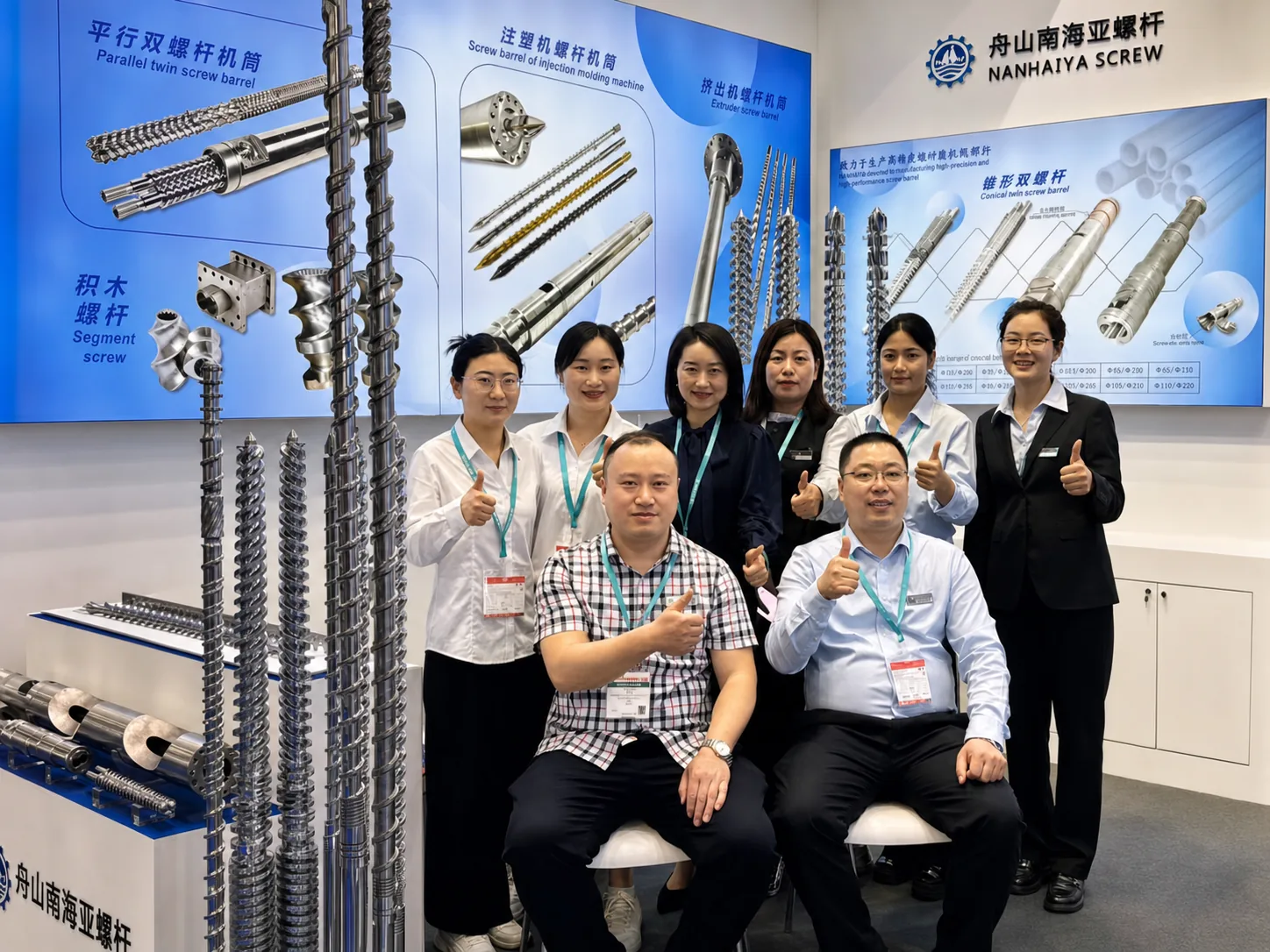
Related Articles
More insights on screw barrel technology and plastics processing.
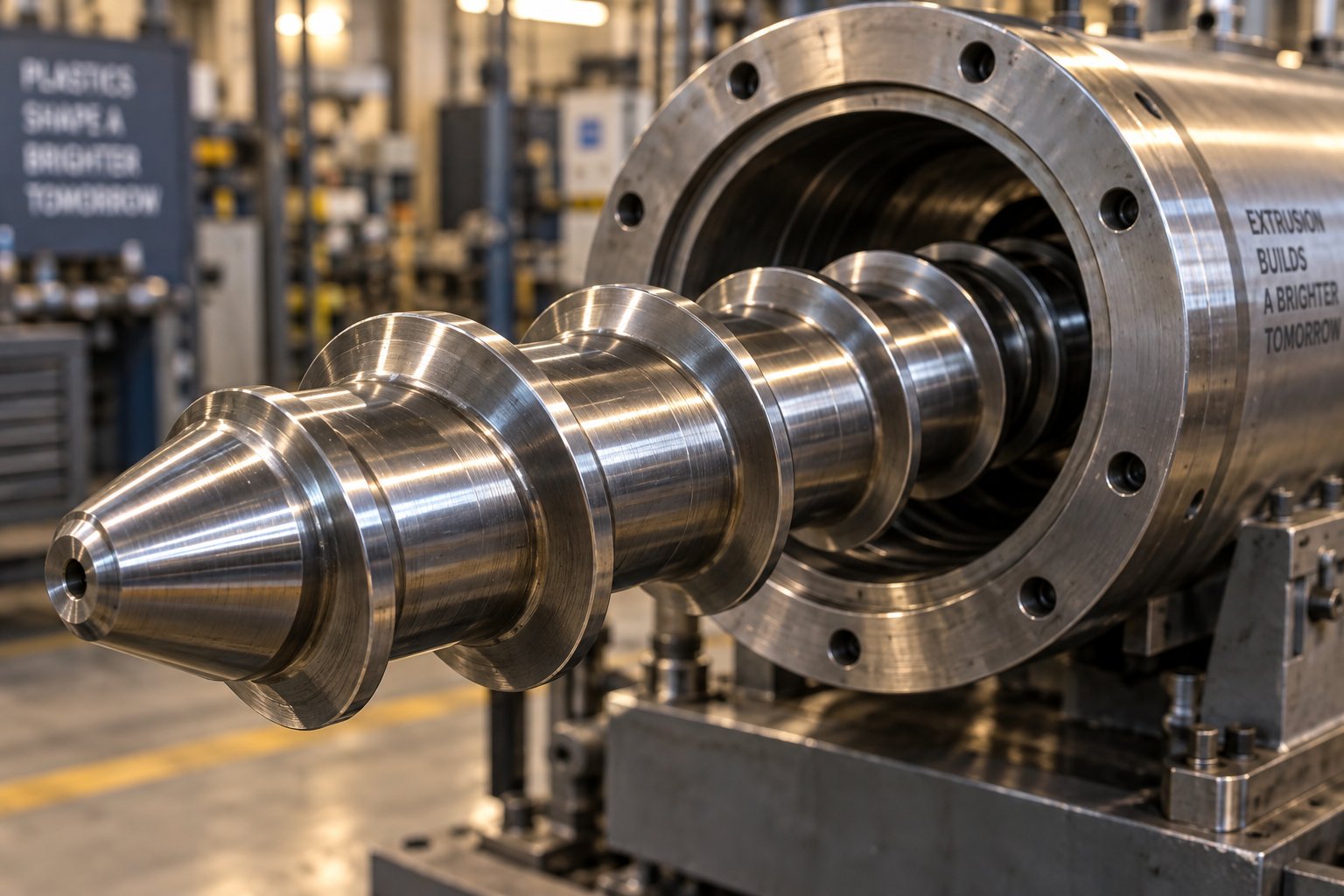
What Nobody Tells You About Screw Barrel For Plastic Machine Design
Oct 10, 2026
Learn how screw barrel for plastic machine design affects melt quality, throughput, and wear life. Covers geometry, resin matching, troubleshooting, and sourcing.
Read Article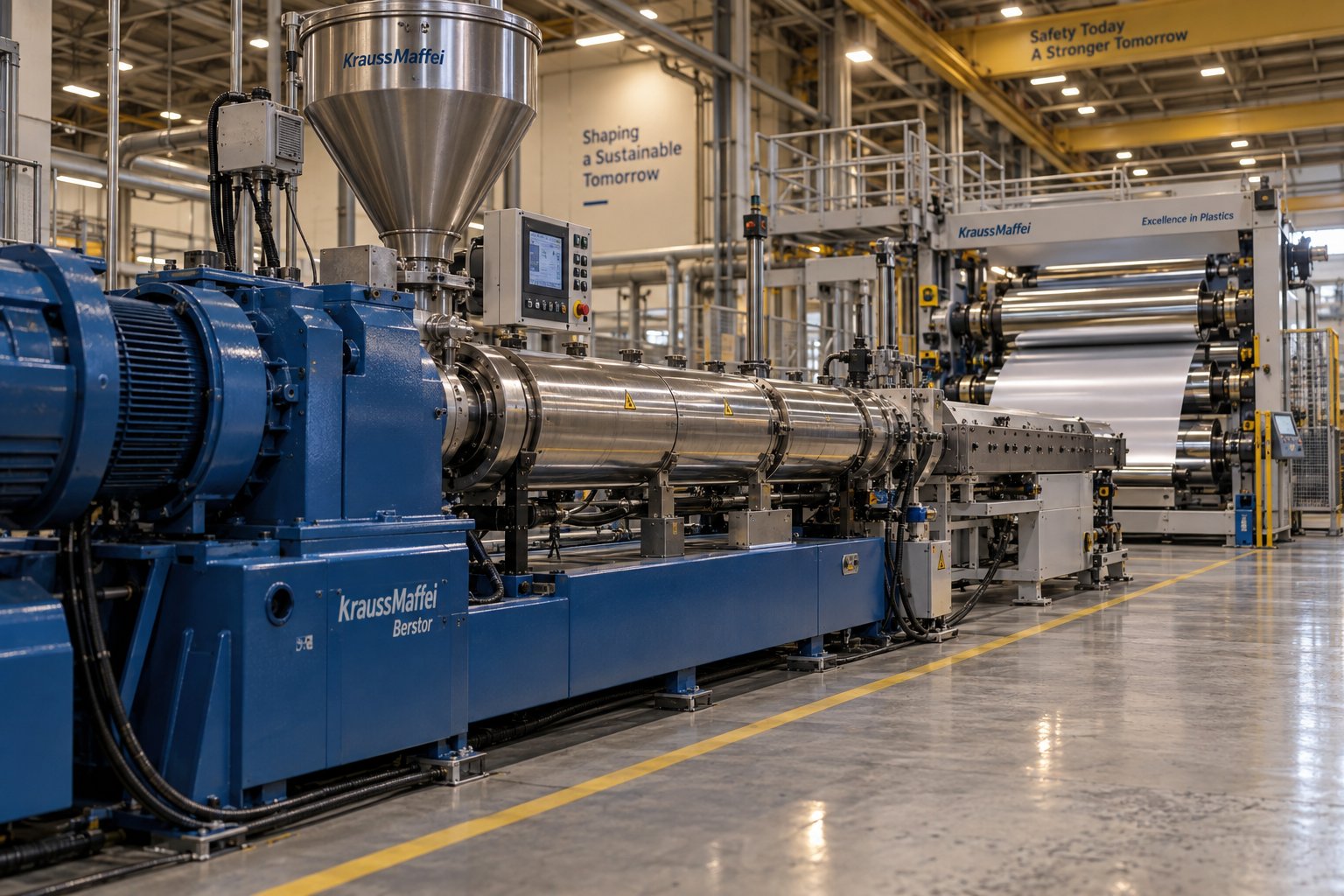
Single Screw Extruder for Sheet: Stop Guessing, Start Specifying
Oct 9, 2026
Learn how to specify a single screw extruder for sheet production. Covers screw geometry, resin-specific processing, troubleshooting, and maintenance best practices.
Read Article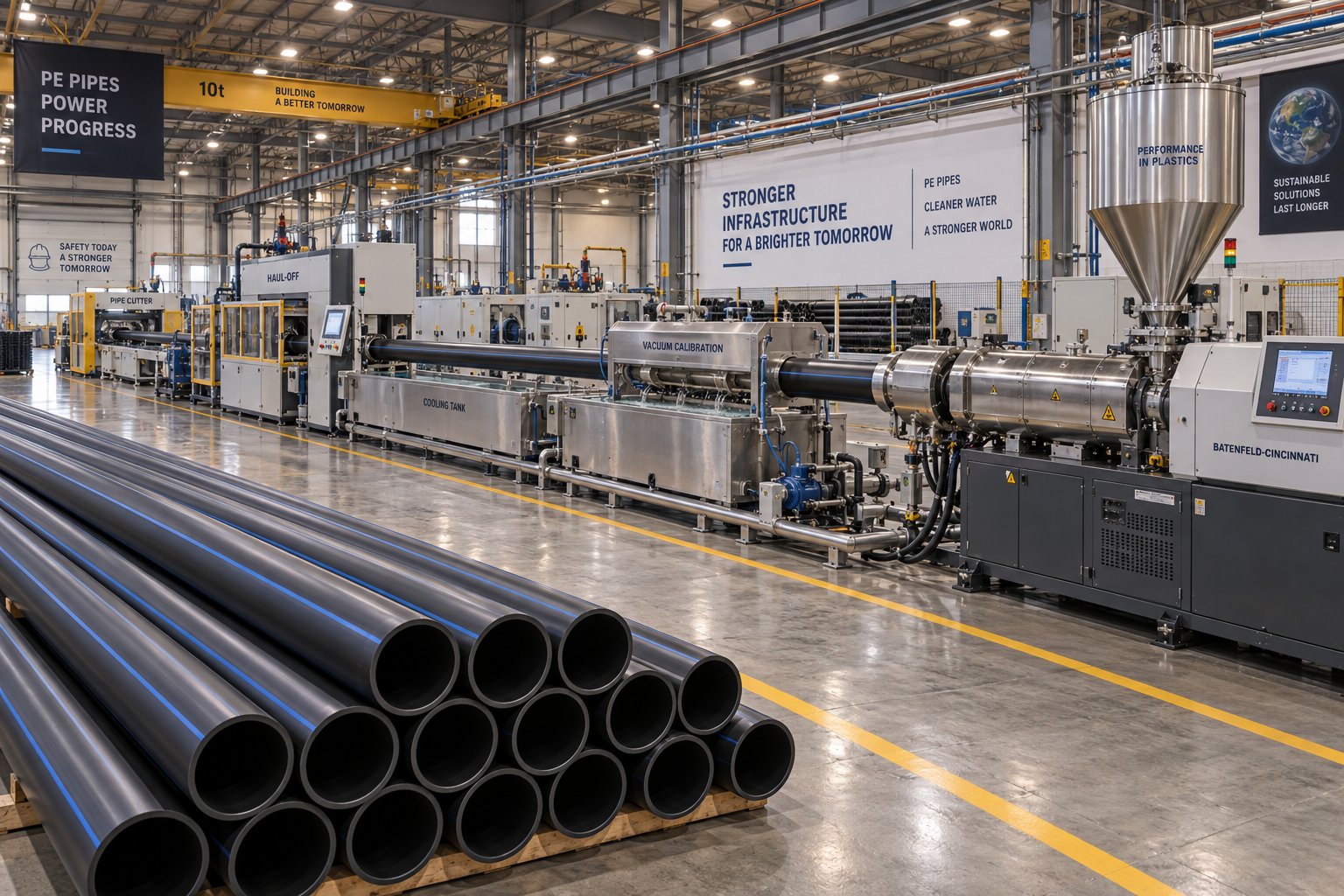
PE Pipe Extruder Machine: What Datasheets Won't Tell You
Oct 9, 2026
Learn how a PE pipe extruder machine works, key specs explained, material grade selection, maintenance tips, and buyer guidance beyond the datasheet.
Read ArticleLooking for something else?
Search by material, symptom or product and jump straight to the relevant page.
These are navigation suggestions based on keyword matching — not a quotation, not a delivery commitment, and not a substitute for engineering review. Final specification is confirmed by our engineers against your drawings and processed material.
Need help with screw barrel selection?
Share your machine model, processed material and application. Our team can help with pricing and technical support.