

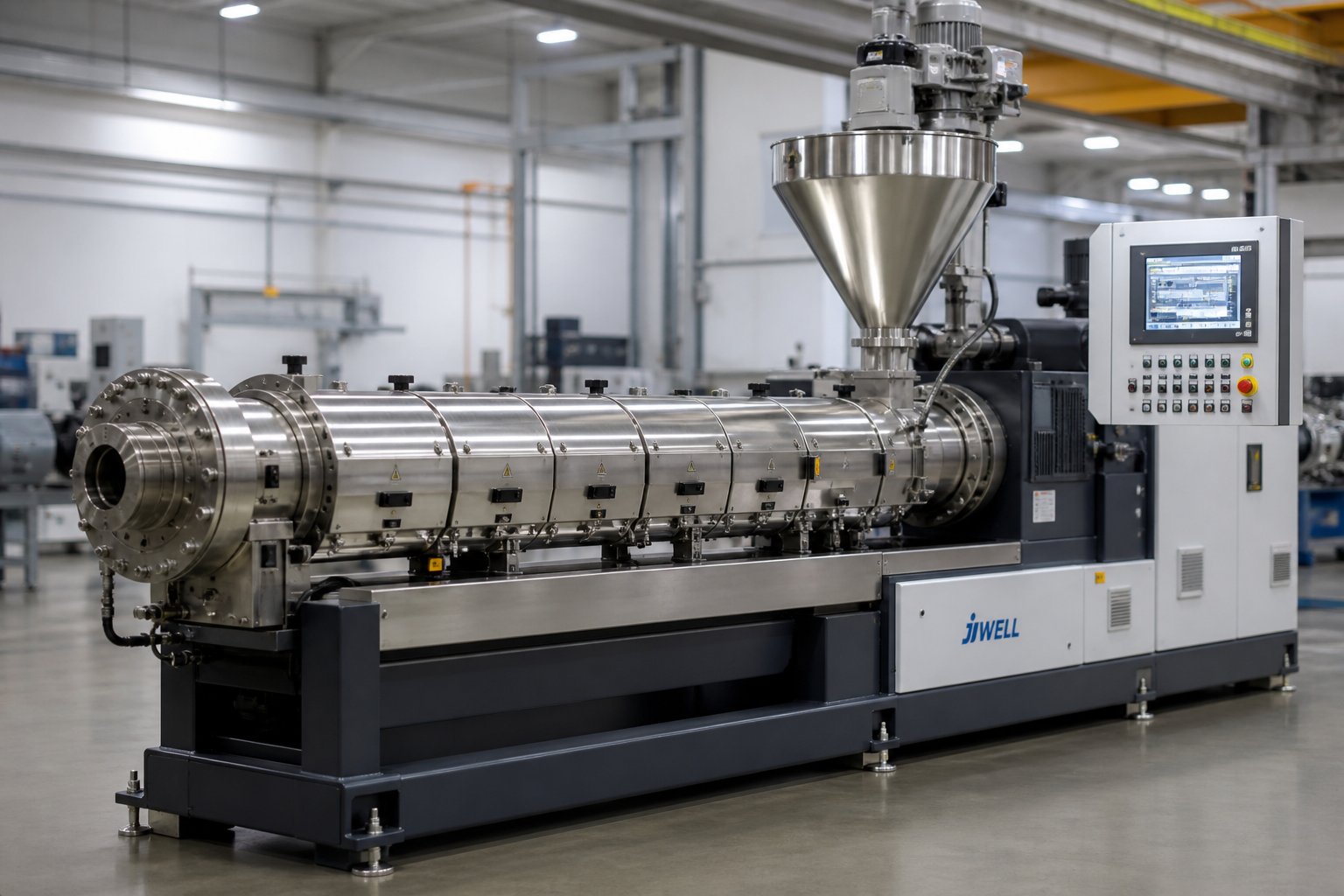
What a Twin Screw Extruder Is and Why It Matters
Whether you're sourcing your first plastic extruder for a compounding line or hunting for a deal on pre-owned equipment, the twin screw extruder sits at the center of the conversation. It is the workhorse behind everything from polymer compounding to snack food production — and the phrase "twin screw extruder used" actually carries two meanings worth exploring. One refers to the wide range of applications where this extruder machine is put to work. The other points to the growing market for buying a used twin screw extruder at a fraction of new-equipment cost. This guide covers both angles in depth.
A twin screw extruder is an extrusion machine that uses two intermeshing screws rotating inside a heated barrel to convey, melt, mix, and shape raw materials — most commonly polymers, food ingredients, or pharmaceutical compounds — into finished pellets, profiles, or parts.
What Is a Twin Screw Extruder
Imagine two helical screws placed side by side inside a segmented, temperature-controlled barrel. As they rotate, their flights nest into each other, creating a self-wiping action that continuously moves material forward while applying controlled shear and heat. That is the core operating principle of every twin screw extruder machine on the market.
The mechanical design breaks down into several critical components:
- Motor and gearbox — supply the torque and speed that drive both screws simultaneously.
- Barrel — a segmented, heated housing divided into multiple independently controlled temperature zones, typically six to twelve.
- Screws — modular shafts fitted with interchangeable conveying, kneading, and mixing elements.
- Feed system — a hopper and often a gravimetric feeder that introduce raw materials at a controlled rate.
- Die — the shaped orifice at the discharge end that forms the molten material into pellets, strands, sheets, or profiles.
Each component influences process performance, and — critically for used equipment buyers — each one is a potential wear point that must be evaluated before signing a purchase order.
Why Twin Screw Technology Dominates Modern Processing
Single screw designs excel at straightforward melting and forming of a single polymer. A twin-screw extruder, however, opens up an entirely different level of capability. The intermeshing flight geometry delivers both distributive and dispersive mixing, meaning it can evenly spread additives throughout a melt while also breaking down agglomerates at the particle level. That dual mixing action is why co-rotating twin screws handle filler loadings as high as 60-80% — levels that would choke a single screw extruder.
Three factors explain why industries keep choosing this platform:
- Versatility — the same screw extruder can process engineering plastics, food starches, or pharmaceutical actives with a change of screw configuration and barrel setup.
- Modularity — screw elements can be rearranged along the shaft to match a new recipe in hours, not weeks.
- Process flexibility — precise control over residence time, temperature, and shear makes it possible to run reactive extrusion, devolatilization, and high-speed compounding on one machine.
These advantages hold whether the equipment rolled off the factory floor last year or a decade ago — which is exactly why the secondary market for these machines stays active. The real question is knowing what applications demand which configurations, and what to look for when a "great deal" lands in your inbox.
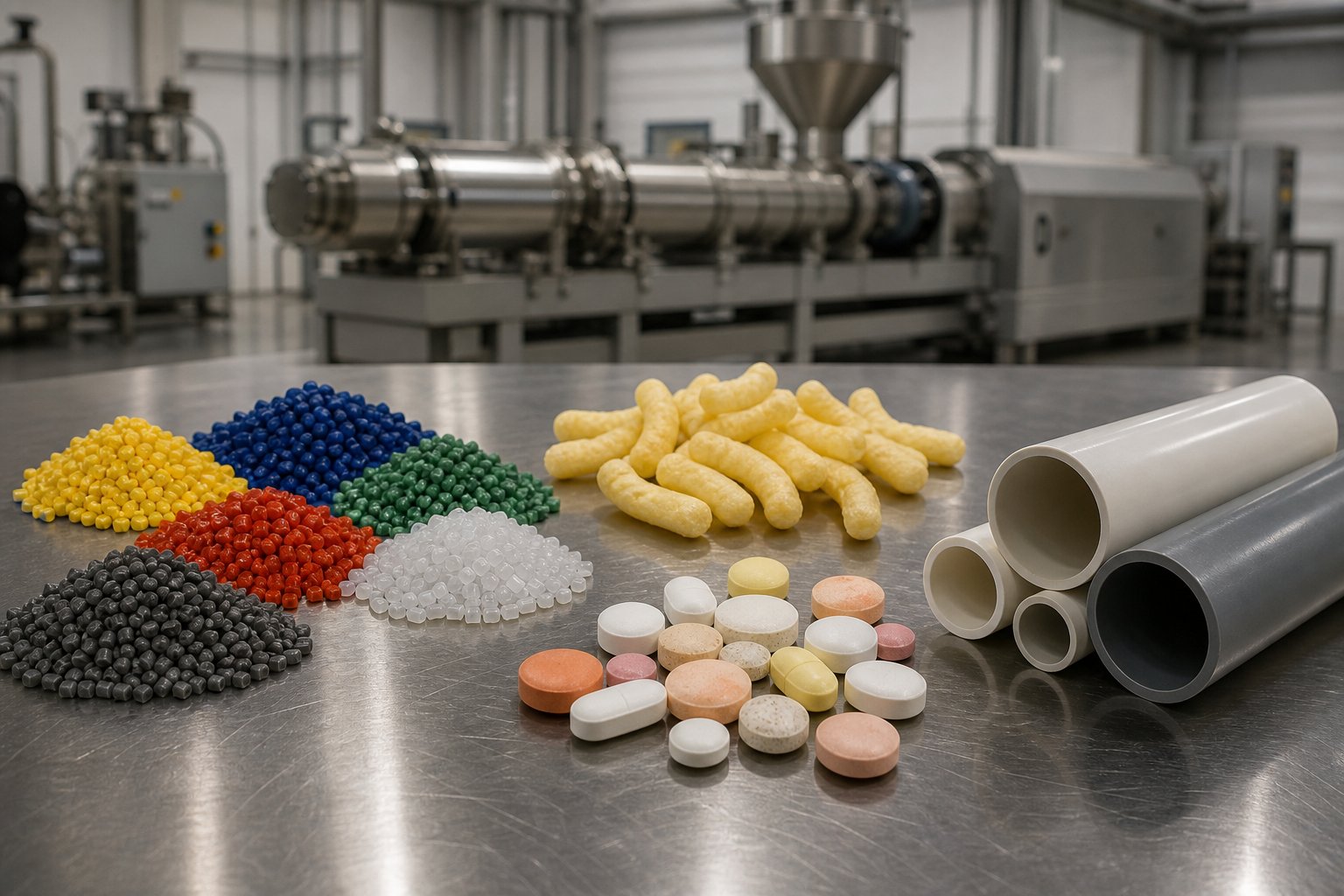
Key Industries and Applications Where Twin Screw Extruders Are Used
A twin screw extruder's value comes down to one thing — what you do with it. The same fundamental machine architecture serves wildly different industries, from compounding glass-fiber-filled nylon to puffing breakfast cereal. That breadth of application matters whether you're specifying a new plastic extrusion machine or evaluating a used one, because the industry a machine previously served tells you a lot about its condition, barrel metallurgy, and remaining service life.
Here is a breakdown of the major verticals and process types where these machines earn their keep.
Plastics Compounding and Masterbatch Production
This is the largest single market for twin screw extruders — and the one you'll encounter most often when shopping for used equipment. A compounding extruder blends a base polymer with fillers, colorants, flame retardants, UV stabilizers, impact modifiers, or reinforcing fibers to produce a compounded pellet ready for injection molding or downstream extrusion. Think of it as creating a custom recipe from commodity ingredients.
Typical products include:
- Masterbatch — concentrated color or additive pellets that are let down into natural resin during final processing.
- Filled compounds — calcium carbonate, talc, or glass-fiber-filled resins that improve stiffness, dimensional stability, or cost per kilogram.
- Engineering plastics — high-performance blends of PA, PBT, PC/ABS, or PPO with precise additive packages for automotive, electrical, or aerospace applications.
Because plastic compounding equipment handles abrasive fillers and high torque loads, barrels and screw elements on machines pulled from these lines tend to show more wear than those from softer applications. That's a critical detail for any used-equipment buyer to keep in mind.
Food Processing and Pharmaceutical Applications
You might not immediately associate an industrial extruder with the food aisle, but twin screws are behind many products you eat every day. Snack puffs, shaped breakfast cereals, textured vegetable protein, and pet food kibble all rely on the combination of heat, pressure, and shear that a twin screw barrel delivers. The starch gelatinization and protein texturization that happen inside the barrel would be nearly impossible to replicate at scale with any other technology.
On the pharmaceutical side, hot-melt extrusion has become a go-to method for improving the bioavailability of poorly soluble drug compounds. An extruder for polymer-based drug delivery disperses an active pharmaceutical ingredient (API) within a polymer matrix at a molecular level, creating amorphous solid dispersions that dissolve faster in the body. This process demands extremely tight temperature control, food-grade or pharma-grade contact surfaces, and scrupulous documentation — all factors that differentiate a pharmaceutical-grade thermoplastic extruder from a standard plastics compounder.
Recycling and Chemical Processing
Sustainability pressures have turned plastics recycling into one of the fastest-growing application segments. Twin screw extruders process post-consumer and post-industrial plastic waste — everything from washed HDPE bottle flake to mixed polyolefin streams — and convert it back into usable pellets. The machine's self-wiping geometry and venting capability are essential here, because recycled feedstocks often contain moisture, volatiles, and contaminants that must be removed during processing.
Beyond recycling, reactive extrusion uses the barrel as a continuous chemical reactor. Grafting maleic anhydride onto polyolefin backbones, producing silane-crosslinked polyethylene for cable insulation, and controlled degradation of polypropylene for melt-blown nonwovens are all examples of chemical modification performed inside a twin screw barrel. Devolatilization — stripping solvents or residual monomers under vacuum — is another process where twin screws outperform virtually every alternative, thanks to the high surface renewal rates generated by intermeshing flights.
To put the full scope in perspective, here are the major application categories at a glance:
- Polymer compounding — blending resins with fillers, fibers, and additives to produce custom pellets for injection molding or profile extrusion.
- Masterbatch production — creating concentrated color or additive carriers at high pigment loadings.
- Food extrusion — cooking, texturizing, and shaping cereal, snack, and pet food products under controlled shear and temperature.
- Pharmaceutical hot-melt extrusion — dispersing APIs in polymer matrices for controlled-release drug delivery systems.
- Plastics recycling — reprocessing post-consumer and post-industrial waste into clean, pelletized compounds.
- Reactive extrusion and devolatilization — performing chemical grafting, crosslinking, or solvent removal as a continuous in-barrel process.
- Pipe and profile extrusion — directly forming PVC or polyolefin pipe, window profiles, and decking boards using a plastic pipe extruder paired with downstream sizing and cooling equipment.
- Rubber and elastomer compounding — mixing rubber with carbon black, plasticizers, and cure agents for automotive seals, hoses, and gaskets.
The takeaway here is straightforward: application requirements should always drive equipment selection. A machine built for food-grade snack extrusion features stainless steel barrels, sanitary crevice-free designs, and food-safe lubricants — specifications that differ dramatically from a heavy-duty plastic extrusion equipment line designed for abrasive mineral-filled compounds. When you encounter a twin screw extruder on the secondary market, the first question is never "how much?" It's "what was this machine built — and used — to do?" That answer shapes every evaluation step that follows, starting with the configuration of the screws themselves.
Co-Rotating vs Counter-Rotating Twin Screw Configurations
Knowing what a twin screw extruder does is only half the picture. The direction those two screws rotate relative to each other changes the machine's personality entirely — its mixing behavior, shear intensity, pressure-building capability, and the range of materials it can handle. When you're evaluating a used double screw extruder, this single specification tells you more about what the machine can and cannot do than almost any other data point on the nameplate.
Twin-screw extruders split into two fundamental families: co-rotating and counter-rotating. Let's break down each one and why the distinction shapes both process selection and purchase decisions.
Co-Rotating Intermeshing Twin Screw Extruders
In a co-rotating twin screw extruder, both screws turn in the same direction — either both clockwise or both counterclockwise. Picture two screws spinning together, their intermeshing flights forcing material into a continuous figure-eight flow path. As material passes through the intermeshing zone, it is handed off from one screw to the other, undergoing repeated splitting, reorientation, and recombination.
This geometry delivers several characteristics that matter in practice:
- Intense distributive and dispersive mixing — high shear fields develop both between the screws and between screw flights and the barrel wall, breaking down filler agglomerates and distributing additives uniformly throughout the melt.
- Self-wiping action — the intermeshing flights continuously scrape material from each other's surfaces, minimizing dead zones and keeping residence time distribution narrow. This is especially critical during reactive extrusion or when processing thermally sensitive formulations.
- Modular screw design — co-rotating machines use interchangeable screw elements — conveying, kneading, and mixing segments — that can be rearranged on the shaft to tune shear, residence time, and pressure for a specific application.
- High throughput capability — the open flow channels and adjustable degree of fill allow operators to push high volumes, making these machines the standard for compounding, devolatilization, and reactive extrusion.
This configuration dominates the compounding market. If you're shopping for a used machine that previously ran polymer blends, masterbatch, nanocomposites, or pharmaceutical hot-melt extrusion, you're almost certainly looking at a co-rotating platform. Major OEM names like Coperion, Leistritz, and KraussMaffei Berstorff have built their reputations largely around this design.
For used-equipment buyers, the modularity of co-rotating twin-screw extruders is a double-edged sword. It means you can reconfigure the machine for a new application — but only if compatible screw elements are available and affordable. That detail deserves serious investigation before signing any purchase agreement.
Counter-Rotating Twin Screw Extruders
Flip one screw's rotation, and you get a fundamentally different machine. In a counter-rotating twin screw extruder, the screws spin in opposite directions — one clockwise, one counterclockwise. Material gets drawn into the gap between the screws and advances forward inside approximately closed "C-shaped" chambers, creating a positive-displacement conveying action similar to a gear pump.
The practical implications are significant:
- Low shear, controlled heat — because material spends less time in high-shear zones, the counter-rotating design generates far less frictional heat. This is essential for thermally unstable materials that degrade at elevated temperatures.
- High-pressure buildup — the near-sealed chambers generate stable, consistent die pressure, which translates directly into tighter dimensional tolerances on extruded products.
- Calendering effect — at the intermeshing region, material undergoes compressive and elongational deformation, providing effective dispersive mixing under gentle conditions.
Rigid PVC is the classic counter-rotating application. PVC has a narrow processing window — its decomposition temperature sits dangerously close to its melt temperature. A pvc extruder machine built on a counter-rotating platform can hold extrusion temperatures low while still achieving stable melt flow, which is why this configuration is the industry standard for PVC pipe, sheet, and profile production. If you encounter a pvc extrusion machine on the used market, chances are high it's a counter-rotating design — often a conical twin screw variant — specifically engineered for that purpose.
Counter-rotating machines also appear in cable coating, certain rubber applications, and direct extrusion lines where consistent output pressure matters more than aggressive mixing.
The table below puts the two configurations side by side across the parameters that matter most — whether you're selecting a machine for a new process or evaluating a used unit for purchase:
| Parameter | Co-Rotating | Counter-Rotating |
|---|---|---|
| Mixing Intensity | High — excellent distributive and dispersive mixing via figure-eight flow | Moderate — dispersive mixing through calendering effect; limited cross-screw flow |
| Shear Level | High — intense shear in intermeshing zone | Low to moderate — gentle processing, minimal frictional heat |
| Typical Applications | Polymer compounding, masterbatch, reactive extrusion, devolatilization, pharmaceutical HME | PVC pipe and profile extrusion, cable coating, direct extrusion of heat-sensitive materials |
| Modularity | Highly modular — interchangeable conveying, kneading, and mixing elements | Modular options available but more constrained by intermeshing geometry |
| Throughput Range | Wide — lab scale (6 mm) through industrial (400+ mm diameter) | Focused on medium to high output; excels at stable, high-volume profile extrusion |
| Pressure Stability | Moderate — some pulsation at die | High — near-positive displacement delivers consistent die pressure |
| Common OEM Brands | Coperion, Leistritz, KraussMaffei Berstorff, JSW, Nanjing-based manufacturers | KraussMaffei Berstorff, Cincinnati Milacron, Battenfeld (now part of Battenfeld-Cincinnati), Jwell |
Here's the bottom line for anyone browsing the used market: buying the wrong configuration for your process isn't just inefficient — it can be a deal-breaker. A co-rotating machine built for high-shear compounding won't gently extrude rigid PVC pipe without risking thermal degradation. A counter-rotating unit designed for stable profile extrusion won't deliver the aggressive mixing needed for nanocomposite dispersion. Matching rotation type to your application is the first filter, and it should happen before you ever ask about price or hours on the meter.
Configuration type, however, only tells you what a machine can do. The specific arrangement of screw elements along the barrel — kneading blocks, conveying segments, reverse elements — determines what it actually will do with your material. And that screw layout is where used-equipment evaluation gets truly nuanced.
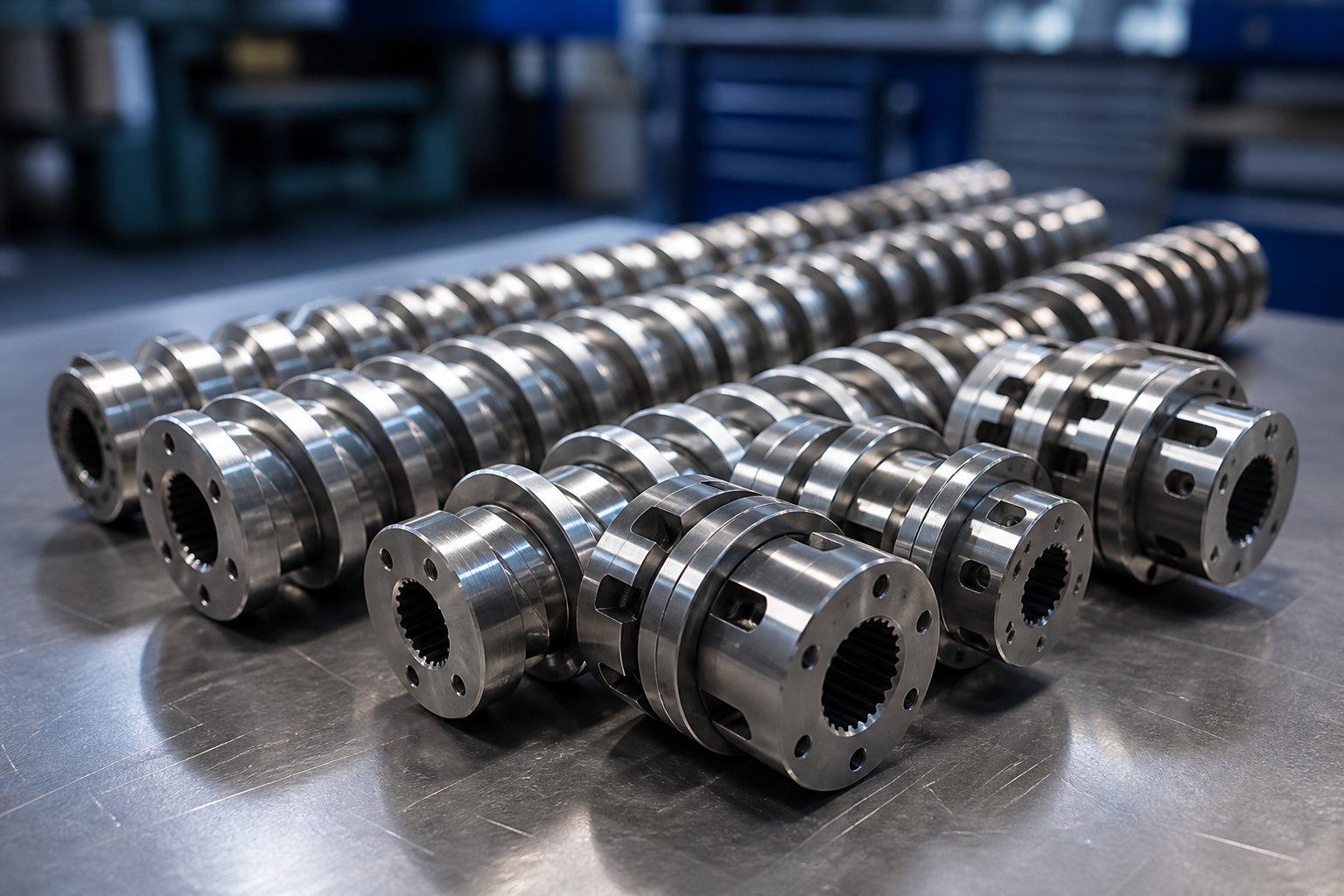
Understanding Screw Element Design and Configuration
Every plastic twin screw extruder shares the same fundamental hardware — barrel, motor, gearbox, die. Yet two identically built machines can produce completely different results depending on which screw elements sit on the shafts and how they're arranged. That arrangement is the screw configuration, and it is arguably the single most important variable in twin screw extrusion. For anyone evaluating a used machine, understanding these elements separates an informed purchase from an expensive mistake.
Types of Screw Elements and Their Functions
Think of a twin screw extruder's shaft as a spine, and each screw element as a vertebra. Slide the right combination onto the shaft, and you build a machine perfectly tuned for your process. Use the wrong combination, and performance falls apart.
Co-rotating twin screw extruders rely on a "building block" modular design where individual elements slide onto a splined shaft and can be swapped without replacing the entire screw. Here are the primary element types you'll encounter:
- Forward conveying elements — helical flights that move material downstream. Large-pitch variants are used in the feed zone to accept bulk solids, while progressively smaller pitches build pressure as the material approaches the die. These are the workhorses of material transport.
- Reverse conveying elements — left-handed flights that push material backward against the main flow. They create a melt seal and increase upstream pressure, which is essential for devolatilization zones and side-feeder inlets.
- Forward kneading blocks — a stack of offset discs with a net forward-pumping effect. These provide moderate distributive mixing without excessive residence time, making them ideal for initial blending of additives into the melt.
- Neutral kneading blocks (90-degree stagger) — discs offset at 90 degrees produce zero net conveying, forcing material to dwell longer in the mixing zone. They strongly increase residence time and back-mixing, delivering intense shear that balances pressure or breaks down agglomerates.
- Reverse kneading blocks — discs stacked in a left-handed orientation that actively oppose forward flow. They generate the highest local shear and are used for aggressive dispersive mixing and creating strong melt seals upstream of vent ports.
- Toothed mixing elements (TME/ZME) — gear-shaped or slotted elements that repeatedly split and recombine the melt stream. They excel at distributive mixing — spreading pigments, fibers, and minor additives evenly throughout the matrix — without applying the high shear stress of kneading blocks.
The interplay between these elements is where the real engineering happens. Narrower kneading discs generate more frequent pressure fluctuations and stronger dispersive action, while wider discs deliver smoother, gentler distributive mixing. Stagger angle acts as another tuning lever: low angles favor forward transport with moderate shear, and steeper angles trade throughput for intensified mixing.
How Screw Configuration Affects Process Performance
Picture the barrel of a twin screw compounding extruder divided into sequential process zones — feeding, melting, mixing, venting, and metering. The screw elements assigned to each zone dictate precisely where the polymer melts, how thoroughly additives disperse, how long the material dwells at temperature, and how much pressure builds before the die.
A well-designed configuration starts with large-lead conveying elements at the feed throat to grip incoming pellets or powder, transitions into smaller-pitch segments and kneading blocks to introduce shear heat for melting, advances into mixing zones with carefully selected kneading disc widths and stagger angles for additive dispersion, and finishes with tight-pitch metering elements that build stable die pressure. Reverse elements or reverse kneading blocks placed upstream of vent ports seal the melt and create the low fill level needed for efficient degassing.
Here's what this means for anyone shopping the used market: a screw plastic extruder originally configured for color masterbatch — where gentle distributive mixing dominates — will almost certainly need a different set of elements to handle an abrasive, heavily filled mineral compound requiring aggressive dispersive mixing. The same barrel, motor, and gearbox may be perfectly adequate, but the screw elements themselves may need to be rebuilt from scratch.
That reality makes element availability and compatibility a critical factor in any purchase decision. Modular screw design is one of the greatest advantages of co-rotating twin screw extruders and even some modular plastic profile extruders used in downstream applications — but that advantage only holds if replacement and reconfiguration elements are accessible and affordable. Before buying any used equipment, ask pointed questions: Are the current screw elements included? What is their measured condition? Can new elements matching this OEM's shaft spline geometry be sourced from the manufacturer or an aftermarket supplier?
Without clear answers, you're not buying a versatile screw extruder — you're buying a very heavy paperweight. And the financial gap between those two outcomes often comes down to a handful of wear parts that the next chapter of the buying decision centers on: the honest economics of used versus new twin screw extruders.
The Economics of Buying Used vs New Twin Screw Extruders
Screw elements and barrel metallurgy might define what a machine can do — but the financial math defines whether it makes sense to buy one at all. A twin screw extruder price from a major OEM can represent one of the largest single capital expenditures on a processing floor, and the spread between a new build and a comparable used unit is wide enough to fund an entire downstream line. Yet price alone never tells the full story. The real question is total cost of ownership over the equipment's productive life, and that calculation looks very different depending on your application, your timeline, and your tolerance for risk.
Cost Savings and Financial Advantages of Used Equipment
Capital equipment depreciates fast — and twin screw extruders are no exception. A machine that cost six figures new can lose a substantial portion of its value within the first few years of service, even if the barrel, gearbox, and drive system remain mechanically sound. Industry norms suggest that used equipment typically sells for roughly 50% less than new-equipment pricing, though the actual discount varies widely depending on brand, condition, age, and how urgently the seller needs to move the asset. Specialized or well-maintained machines from premium OEMs hold their value better, while older or less popular models may trade at even steeper discounts.
That depreciation curve works in the buyer's favor. You're acquiring the same tonnage of steel, the same gearbox torque rating, and the same barrel metallurgy — just without the "new" premium baked into the plastic extrusion machine cost. For many operations, the savings are substantial enough to redirect capital toward raw materials, tooling, or other production infrastructure.
Buying a used extruder makes the most strategic sense in several scenarios:
- Startups with limited capital — a pre-owned machine gets you into production faster and at lower financial risk than a new build that may take months to deliver and years to pay off.
- Product trials and R&D validation — if you're testing a new formulation or process concept, tying up six figures in brand-new equipment before the market validates the product is a gamble. A used unit lets you prove the process before committing to a full-scale investment.
- Non-critical secondary lines — your primary production line may justify the latest technology, but a backup or overflow line running proven formulations rarely needs cutting-edge features.
- Applications where older technology is fully adequate — standard polymer compounding, basic masterbatch, and many recycling operations don't require the newest PLC platforms or the tightest screw-to-barrel clearances. A well-maintained machine from a decade ago can deliver identical product quality.
There's also the lead-time advantage. New twin screw extruders from top-tier manufacturers can carry delivery windows of several months or longer, depending on configuration complexity and order backlog. Used extrusion equipment, by contrast, is typically available immediately. When a production gap needs filling or an opportunity has a short window, that availability alone can justify the purchase.
Risks and Limitations of Buying Used
Every advantage comes with a tradeoff, and used extruders carry risks that deserve honest discussion rather than glossy sales talk.
The most significant concern is unknown maintenance history. A machine that was properly serviced — gearbox oil changed on schedule, barrel bore measured annually, screw elements rotated and inspected — can have years of productive life remaining. A machine that was run hard and neglected may look fine externally while hiding worn thrust bearings, scored barrel liners, or a gearbox approaching failure. Without documentation, you're relying on inference and inspection rather than certainty.
Other risks include:
- Hidden wear on critical components — barrel bore enlargement, screw element flight tip erosion, and damaged kneading block edges may not be visible without measurement tools and disassembly.
- Outdated control systems — a machine built fifteen or twenty years ago may run on a PLC platform or HMI that the original manufacturer no longer supports. Replacing an obsolete control system can add tens of thousands to your actual plastic extruder machine price.
- Limited or no warranty — most used equipment sales are as-is. Some reputable dealers offer short-term return policies, but the comprehensive warranty coverage that comes with a new machine is rarely available.
- Refurbishment costs — replacing barrel liners, screw elements, heater bands, and thermocouples to bring a used machine up to production-ready condition can erode the initial savings if the wear is more extensive than expected.
There are also situations where buying new is simply the better path. High-precision pharmaceutical hot-melt extrusion demands documented material traceability, validated process parameters, and guaranteed barrel surface finishes that are difficult to certify on a pre-owned machine. Applications requiring specialized screw geometry, exotic barrel alloys, or tight OD/ID tolerances are best served by a new build tailored to the process. And if your facility relies on integrated automation — with the extruder communicating directly with upstream feeders, downstream pelletizers, and a plant-wide SCADA system — a modern platform with current communication protocols will save headaches that no amount of upfront savings can justify.
The table below lays out the comparison across the factors that matter most to capital equipment buyers:
| Factor | Used Twin Screw Extruder | New Twin Screw Extruder |
|---|---|---|
| Upfront Cost | Significantly lower — often 40-60% below new pricing depending on age, brand, and condition | Full list price plus options; highest initial capital outlay |
| Lead Time | Immediate to weeks; equipment is typically in stock or available after minimal preparation | Months to over a year for custom-configured machines from premium OEMs |
| Warranty Coverage | Limited or none; some dealers offer short-term return policies | Full manufacturer warranty covering mechanical and electrical components |
| Customization Options | Limited to available screw and barrel configurations; modifications possible but add cost | Fully customizable — barrel metallurgy, screw geometry, control platform, and auxiliaries built to spec |
| Risk Level | Moderate to high — dependent on inspection rigor and seller transparency | Low — manufacturer-backed quality assurance and commissioning support |
| Spare Parts Availability | May be limited for discontinued models; aftermarket suppliers can fill gaps | Full OEM parts support with documented part numbers and drawings |
| Depreciation Impact | Minimal — most depreciation has already occurred | Steepest in the first three to five years of ownership |
| Technology Currency | May feature older control systems, less energy-efficient drives, or outdated safety standards | Current-generation PLC platforms, energy-efficient motors, and compliance with latest safety codes |
There's a third option that sits between the two extremes and often represents the sweet spot: refurbished equipment. A refurbished twin screw extruder has been disassembled, inspected, and rebuilt with new wear components — barrel liners, screw elements, heater bands, thermocouples, and often an updated control panel. You get the lower entry cost of a used machine combined with documented component condition and, in some cases, a limited warranty from the refurbisher. It's not as cheap as a straight used purchase, and it's not as customizable as a new build, but for many buyers it strikes the right balance between budget and confidence.
The smartest used-equipment purchases are never impulse decisions — they are calculated bets backed by thorough mechanical inspection, honest risk assessment, and a clear understanding of the refurbishment costs needed to match the machine to the application.
That brings up the obvious next question: if you've decided that a used or refurbished machine fits your budget and application, how do you actually evaluate one? What do you measure, what do you ask, and what should you never skip? The answer is a structured inspection process — and it starts well before you ever set foot on the seller's floor.
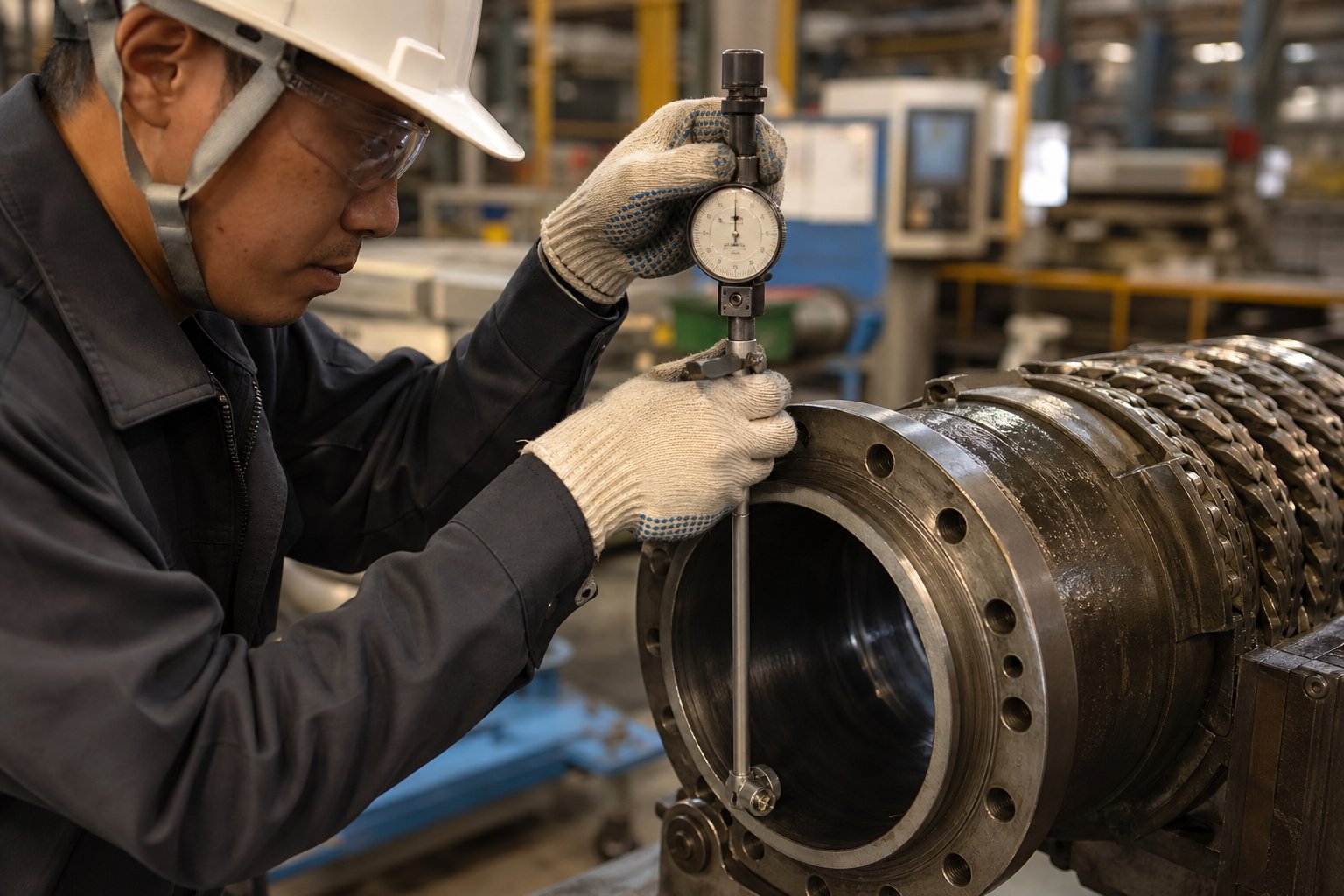
How to Evaluate a Used Twin Screw Extruder Before Buying
A structured inspection process isn't optional — it's the only thing standing between you and a six-figure mistake. Whether you're browsing a used twin screw extruder for sale from a dealer's warehouse or flying out to inspect a machine still bolted to a production floor, every evaluation follows the same logic: start with the mechanical heart of the equipment, move to the electrical and control systems, and finish with the paperwork trail that reveals what the hardware alone can't tell you.
Skipping any layer of this process means accepting risk you can't quantify. Here's how experienced buyers work through each one.
Mechanical Inspection Points for Barrels and Screws
The barrel and screws are the components that define the true value of any used extruder equipment. Everything else — motor, gearbox, frame — supports these two parts. If they're worn beyond acceptable limits, the machine isn't a bargain at any price.
Barrel bore measurement is where every serious inspection begins. A technician uses a dial bore gauge and micrometer to take readings every two to three inches along the entire barrel length. These frequent, precise measurements expose localized wear that a quick visual pass would miss entirely. You're looking for enlargement of the bore diameter beyond the manufacturer's tolerance — typically a few thousandths of an inch above nominal. The most severe wear usually appears near the middle of the barrel, where polymer melting generates the highest shear forces against the liner surface.
Beyond diameter, visually inspect the barrel bore for scoring, pitting, corrosion, and signs of washout near the feed throat. Cracked barrel sections or segments that show evidence of heavy welding repairs are immediate red flags — these indicate past mechanical failures or attempts to extend a barrel well past its useful life. Barrel liner integrity matters too. Bimetallic liners resist abrasive wear far better than standard nitrided steel, and a liner that has worn through to the base metal will degrade rapidly.
Screw element condition is equally critical. Pull the screws and examine every element individually. You're checking for:
- Flight tip wear — reduced outer diameter increases clearance between screw and barrel, which kills mixing efficiency and reduces throughput.
- Pitting and corrosion — often caused by processing corrosive additives or acidic polymers, this surface degradation traps material and creates quality defects in the end product.
- Chipped or broken kneading blocks — a fractured kneading disc can damage the barrel bore or lodge downstream, and replacement elements may be expensive or hard to source.
- Spline wear on element bores — excessive play between screw elements and the shaft creates wobble, accelerating barrel wear and reducing positional accuracy of mixing zones.
The gearbox deserves its own focused inspection. Listen for whining, knocking, or any unusual noise during operation — these can signal bearing wear, gear tooth damage, or lubrication starvation. Request an oil analysis report if one exists. Metal particles in the lubricant indicate internal wear that may not yet produce audible symptoms but points toward impending failure. Check the thrust bearings specifically; they absorb the full axial load generated by the screws, and replacement is one of the most expensive gearbox repairs. Excessive axial play at the screw shafts suggests thrust bearing degradation.
Remaining service life isn't a single number — it's a judgment call based on all these data points together. A barrel with uniform, minor wear across its length may have thousands of productive hours ahead. The same barrel with a deep groove near the melting zone may need replacement before it processes a single batch of your material. Measurement data transforms guesswork into informed decision-making.
Electrical Systems and Control Assessment
A mechanically sound machine with a failing electrical system is just as problematic as one with worn screws. Electrical issues tend to be less visible than mechanical wear, which is exactly why they catch unprepared buyers off guard.
Start with the drive motor. Check the motor nameplate against the original equipment specification — has it been replaced with a different horsepower or voltage rating? As industry experts emphasize, adequate torque for your specific application is non-negotiable. A used extruder for sale may look right on paper, but if the motor and gearbox combination doesn't deliver enough torque for your target throughput, you'll hit a performance ceiling that no screw design can overcome. Run the motor and observe amperage draw under load — erratic readings, excessive current draw at low speeds, or tripped overloads suggest winding insulation breakdown or bearing issues inside the motor itself.
Heater bands are consumable items, but their condition reveals a lot about how the machine was maintained. Test each zone independently. Dead zones — heaters that draw no current — indicate burned-out bands that need replacement. Intermittent zones point to loose connections or degraded wiring. Check thermocouple accuracy by comparing displayed temperatures against a calibrated handheld probe. Thermocouples drift over time, and inaccurate temperature readings lead to off-spec product quality and potential material degradation.
The control panel is where many used equipment deals quietly fall apart. Identify the PLC platform and HMI — is it a current-generation system, or does it run on hardware the manufacturer discontinued years ago? Obsolete controls create two problems: replacement parts become scarce and expensive, and integration with modern plant networks may be impossible. When evaluating a plastic extruder machine for sale or a plastic extrusion machine for sale from a dealer, always ask whether the control system's PLC and HMI replacement parts are still commercially available. If the answer is vague, budget for a full controls upgrade — which can represent a significant additional investment.
A laboratory extruder presents a slightly different electrical profile. Smaller-scale machines often feature benchtop-style controls and lower-voltage drive systems that may be simpler to evaluate but harder to upgrade. Whether the machine is lab-scale or production-scale, the same principle applies: the electrical system must support reliable, repeatable operation from day one.
Documentation and Seller Questions
Hardware inspection tells you the machine's current condition. Documentation tells you how it got there — and gives you the best available prediction of where it's headed. The questions below should be addressed before you finalize any purchase of used extrusion equipment for sale:
- Request complete maintenance records. A seller who maintained a preventive maintenance schedule — with documented gearbox oil changes, barrel inspections, and heater band replacements — signals a machine that was cared for. Missing records aren't automatically disqualifying, but they shift more risk onto the buyer.
- Check the hour meter reading. Total runtime hours provide context for all the wear data you've collected. A machine with 25,000 hours and moderate barrel wear tells a very different story than one with 8,000 hours and the same wear pattern.
- Ask what materials were previously processed. Abrasive mineral fillers, corrosive flame retardants, and glass fiber compounds accelerate wear far faster than unfilled polyolefins. Knowing the processing history helps you predict remaining component life.
- Determine the reason for sale. Capacity upgrade? Plant closure? Persistent mechanical problems the seller couldn't resolve? The answer shapes your risk assessment. As one industry checklist recommends, ask directly: "If you were to put this on another one-year run, what would you do to the machine?"
- Inventory all spare parts included. Extra screw elements, replacement barrel segments, backup heater bands, or spare thermocouples included with the sale reduce your near-term operating costs and signal a seller who invested in the machine's longevity.
- Confirm that the machine can be inspected under power. A seller willing to run the equipment demonstrates confidence in its condition. A seller who insists on selling without a powered demonstration raises an immediate question: what don't they want you to see?
- Verify safety features and interlocks. Confirm that all safety guards, emergency stops, and interlocks are present and functional. Missing safety equipment isn't just a red flag for machine condition — it's a compliance liability the moment the equipment enters your facility.
- Assess logistics and rigging. Consider the machine's current location, disassembly requirements, and transportation cost to your plant. A great deal on a used twin screw extruder can lose its luster fast when rigging and freight add five figures to the total.
The single most important rule when buying any used extruder: always request a test run under power before purchasing. A machine that cannot be demonstrated running is a machine hiding something.
A thorough evaluation protects your investment, but it also reveals something equally important — the identity of the machine itself. OEM brand, model series, and manufacturing era all influence parts availability, resale value, and long-term serviceability. Recognizing what you're looking at when a nameplate says Coperion, Leistritz, or Berstorff is the next layer of buyer intelligence that separates informed decisions from hopeful ones.
Major OEM Brands in the Used Twin Screw Extruder Market
A nameplate tells you more than just who built the machine. It tells you how easy — or how painful — the next decade of ownership will be. Among twin screw extruder manufacturers, brand reputation directly affects three things that matter long after the purchase invoice is paid: spare parts availability, aftermarket support infrastructure, and eventual resale value if you decide to move the equipment later. Recognizing the key players and what each brings to the table is essential buyer intelligence.
European and American Twin Screw Extruder Manufacturers
Walk into any used-equipment dealer's warehouse or browse an online auction listing, and a handful of names appear over and over again. These are the brands that built the global compounding and extrusion industry, and their machines dominate the secondary market for good reason.
Coperion sits at the top of virtually every conversation about co-rotating twin screws. Originally founded as Werner & Pfleiderer in Stuttgart, Germany, the company introduced the ZSK platform in 1957 — a design that has evolved through multiple generations and remains the benchmark for high-performance compounding. A Coperion extruder on the used market, particularly a ZSK model, commands premium resale prices precisely because the brand's install base is enormous, OEM parts remain available for even older vintages, and process engineers worldwide are trained on the platform. The current flagship ZSK Mc18 delivers a specific torque of 18 Nm/cm3, but earlier generations — the Mc Plus, the Mega Compounder, and even classic Werner Pfleiderer extruder models — still run productively in plants around the world. Parts compatibility across generations is strong, which keeps total cost of ownership manageable.
Leistritz, also based in Germany, occupies a distinct niche. The company is a family-owned operation with deep roots in precision engineering, and its ZSE iMAXX series covers everything from 18 mm laboratory units to 180 mm production machines. Leistritz has built a particularly strong reputation in pharmaceutical hot-melt extrusion and specialty polymer processing — applications where tight tolerances and meticulous documentation matter more than raw throughput. On the used market, Leistritz machines appear less frequently than Coperion units simply because fewer were produced, but they hold their value well and benefit from consistent OEM support.
KraussMaffei Berstorff brings a different kind of versatility. The Berstorff extruder legacy includes both co-rotating and counter-rotating configurations, making this one of the few brands you'll encounter across compounding, PVC pipe, profile extrusion, and recycling applications. The ZE BluePower series features a high outer-to-inner diameter ratio (Da/Di = 1.65) that delivers strong torque density and generous free volume — a combination that handles low-bulk-density fillers and masterbatch concentrates particularly well. Founded in 1838, KraussMaffei is one of the oldest machinery manufacturers in the world, and its global service network means parts and technical support are accessible in most major industrial markets.
Other European and American names worth knowing include Battenfeld-Cincinnati (Austria), which specializes in PVC and pipe extrusion lines with both parallel and conical twin screw designs; ENTEK (USA), which builds co-rotating machines entirely in the United States with torque densities rivaling Coperion and JSW; and ICMA San Giorgio (Italy), a manufacturer with over a century of history in co-rotating twin screw technology for compounding and reactive extrusion. Among plastic extruder manufacturers in this tier, the common thread is deep engineering capability, broad parts availability, and established aftermarket support — all factors that protect used-equipment buyers long after the initial transaction.
Asian Manufacturers and Market Availability
The Asian segment of the twin screw extruder market has evolved dramatically. Two Japanese manufacturers stand out for engineering precision that matches or exceeds European peers, while a growing wave of Chinese builders has reshaped the landscape for mid-market and budget-conscious buyers.
JSW (Japan Steel Works) has delivered more than 2,300 twin screw extruders under its TEX brand since entering the plastics machinery market in 1950. The current TEX-alphaIII achieves a specific torque of 18.2 Nm/cm3 — among the highest in the world — with screw diameters ranging from 26.5 mm up to 443 mm for ultra-large devolatilization applications. JSW machines are prized for exceptional build quality and longevity, and they command strong resale values on the used market. Parts availability is generally good through JSW's global network, though lead times for specialty components can run longer than some European competitors.
Kobe Steel (Kobelco) is another Japanese manufacturer with significant presence in twin screw extrusion, particularly for polymer alloys, tire compounds, and applications requiring continuous mixing immediately followed by sheet forming via their proprietary Twin Screw Roller-head (TSR) system. Kobelco machines appear on the used market less frequently, but their build quality ensures long service life and solid residual value.
Nanjing-based Chinese manufacturers represent the fastest-growing segment among extrusion equipment manufacturers globally. Companies like USEON, Kerke (Nanjing WANPLAS), JWELL, and Cowin Extrusion produce co-rotating and counter-rotating twin screw extruders at price points significantly below European and Japanese competitors — often 30-55% of the total installed cost. Top-tier Chinese builders have closed much of the torque-density and process-control gap for mainstream compounding, masterbatch, PVC, and large polyolefin applications. However, the used market picture for Chinese-built machines is more nuanced. Resale values tend to be lower, and parts interchangeability between manufacturers can be inconsistent. Due diligence matters far more when evaluating a used Chinese-built machine — verifying the actual OEM, confirming screw element specifications, and establishing whether replacement parts can be sourced reliably.
The table below summarizes the major brands you're most likely to encounter when shopping for a used twin screw extruder, along with the details that influence long-term ownership experience:
| Manufacturer | Headquarters | Primary Configuration | Common Model Series | Used Market Availability & Notes |
|---|---|---|---|---|
| Coperion | Stuttgart, Germany | Co-rotating | ZSK Mc18, ZSK Mc Plus, STS Mc11 | High availability; strong resale values; excellent OEM and aftermarket parts supply across generations |
| Leistritz | Nuremberg, Germany | Co-rotating | ZSE iMAXX, ZSE MAXX | Moderate availability; strong in lab and pharma applications; good OEM support |
| KraussMaffei Berstorff | Munich, Germany | Co-rotating & counter-rotating | ZE BluePower, ZE UTX, KMD conical series | Moderate to high availability; versatile across compounding and PVC; global service network |
| Battenfeld-Cincinnati | Vienna, Austria | Counter-rotating (parallel & conical) | Parallel & conical TSE lines | Common in PVC pipe and profile; parts well supported in European markets |
| ENTEK | Lebanon, Oregon, USA | Co-rotating | HT72, QC3 | Growing used market presence; US-built with strong domestic parts and service support |
| JSW (Japan Steel Works) | Tokyo, Japan | Co-rotating | TEX-alphaIII, TEX-alpha series | Premium resale value; exceptional build quality; parts available through global JSW network |
| Kobe Steel (Kobelco) | Kobe, Japan | Co-rotating | KTX, TSR | Less frequent on used market; strong in polymer alloys and rubber; holds value well |
| USEON | Nanjing, China | Co-rotating | SAT, SAT-X, U+ | Increasing used market presence; competitive pricing; verify parts sourcing before purchase |
| JWELL | Shanghai, China | Co-rotating & counter-rotating | Parallel & conical TSE lines | Common in PVC and sheet lines; broad product range; parts availability varies by model |
| Nanjing regional OEMs | Nanjing, China (various) | Co-rotating | Varies widely | Highest availability at lowest price points; quality and parts support vary significantly between builders |
One pattern stands out clearly across this landscape: parts availability is the single most important differentiator for long-term ownership of any used machine. A Coperion ZSK or a JSW TEX purchased on the secondary market benefits from decades of installed base, well-documented part numbers, and multiple supply channels — both OEM and aftermarket. An older or discontinued model from a smaller extruder manufacturer, by contrast, may leave you scrambling to source a critical screw element or barrel segment when something wears out mid-campaign. Before committing to any brand or model on the used market, confirm that replacement wear parts — screw elements, barrel liners, heater bands, and thermocouples — can be sourced within a timeframe your production schedule can tolerate.
Knowing which nameplate you're looking at is the foundation. But brand recognition alone doesn't protect you from buying a machine with hidden problems. The real insider knowledge lies in spotting the warning signs that experienced buyers have learned — often the hard way — to watch for before any money changes hands.
Red Flags When Buying a Used Twin Screw Extruder
Recognizing the brand on the nameplate is a solid first step — but even a premium-name machine can be a money pit if you miss the warning signs hiding beneath the surface. Experienced buyers who regularly scout twin screw extruders for sale have developed a mental checklist of deal-breakers, refined through costly lessons. These red flags fall into two categories: what the hardware tells you and what the paperwork — or lack of it — reveals.
Mechanical Red Flags to Watch For
The mechanical condition of a used twin screw extruder determines whether you're buying a productive asset or an expensive repair project. Some issues are visible during a walkthrough, but the most dangerous ones require measurement, listening, and knowing what "normal" looks and sounds like.
Barrel wear beyond tolerance tops the list. As Plastics Technology notes, extruder performance degrades significantly once flight clearance exceeds roughly four times the original specification — a threshold that translates to reduced throughput, higher discharge temperatures, and energy waste. Bore measurements taken every few inches along the barrel length will expose localized wear that visual inspection alone can't detect. If the seller hasn't measured the barrel recently, bring your own bore gauges or hire an independent inspector.
Screw element condition is the next critical checkpoint. Flight tips that have worn down to the base metal beneath the hard facing won't recover — they need replacement. Broken or chipped kneading block discs are especially concerning because fragments can score the barrel bore, compounding damage across multiple components. Industry guidelines suggest that pitting, corrosion, and visible surface erosion on screw flights indicate accelerated wear, often from processing abrasive fillers like glass fiber or calcium carbonate.
Gearbox health rounds out the mechanical trifecta. Listen carefully during a powered run. A healthy gearbox produces a consistent, low hum. Whining at specific speeds points to damaged gear teeth. Knocking or rhythmic thumping suggests bearing failure. Request an oil analysis report — metal particles in the lubricant confirm internal wear that may not produce audible symptoms yet but signals impending trouble. Check for excessive axial play at the screw shafts, which indicates thrust bearing degradation. Thrust bearing replacement is one of the most expensive gearbox repairs on any extruder, sometimes rivaling the cost of a new gearbox entirely.
Other mechanical warning signs include:
- Scored or grooved barrel liners — deep scratches inside the bore accelerate wear on new screw elements and compromise product quality through material stagnation in the grooves.
- Cracked or heavily welded barrel sections — welding a cracked barrel is a temporary fix at best. It alters the heat transfer characteristics of that zone and often fails again under thermal cycling. Walk away from any machine showing extensive weld repairs on barrel segments.
- Spline wear on screw shafts — if individual elements wobble on the shaft, the resulting runout accelerates barrel wear and makes precise screw configuration impossible.
Operational and Documentation Warning Signs
Hardware wears out — that's expected. What separates a good used-equipment deal from a bad one is often found not in the steel, but in the story behind the machine. When sellers can't — or won't — provide documentation, your risk profile changes dramatically.
Here is a consolidated red-flag checklist that covers both mechanical and operational warning signs. If you encounter more than two or three of these on a single machine, proceed with extreme caution — or walk away entirely:
- No maintenance records available — a machine without documented service history is a machine with an unknown past. You can't verify gearbox oil change intervals, barrel measurement trends, or heater band replacement frequency.
- Barrel bore measurements exceeding 4x original flight clearance — at this level, throughput and mixing efficiency have already degraded substantially, and the barrel likely needs relining or replacement.
- Broken, chipped, or heavily worn kneading block elements — these are among the most expensive screw elements to replace and their failure can cause cascading damage downstream.
- Gearbox noise, excessive axial play, or contaminated oil — any of these symptoms suggest internal gearbox wear that could lead to catastrophic failure under production loads.
- Non-standard modifications or welded repairs — custom-fabricated brackets, re-welded barrel sections, or non-OEM motor installations often indicate past problems that were patched rather than properly resolved.
- Obsolete control system with no parts pathway — a PLC platform discontinued by its manufacturer leaves you one failed board away from a machine that can't run. Budget tens of thousands for a controls upgrade if the existing system is end-of-life.
- Missing safety guards or disabled interlocks — this isn't just a maintenance red flag; it's a compliance liability that signals a facility where operational shortcuts were tolerated.
- Seller unwilling to allow powered inspection — this is the single biggest warning sign. A seller who refuses to run the machine under power before sale is hiding something. No exception.
- Metal contamination in previously produced material — if the seller still has product samples or if metal particles were found in output, internal erosion from barrel or screw wear is actively contaminating the process stream.
- Frequent maintenance trips or protection circuit faults in recent history — recurring electrical trips, overload shutdowns, or unplanned maintenance events point to systemic issues that go beyond simple wear.
Every red flag on that list adds potential cost to your purchase — cost that doesn't appear on the invoice but shows up later in replacement parts, lost production hours, and emergency service calls. That's why savvy buyers calculate total acquisition cost, not just the sticker price, before committing to any used plastics machinery purchase.
Always factor the cost of replacement wear parts — screw elements, barrel liners, heater bands, and thermocouples — into your total acquisition cost. A machine priced attractively can become the most expensive option on the table once you add the components needed to bring it to production-ready condition.
This is where the relationship between upfront pricing and long-term parts sourcing becomes critical. When evaluating plastic extruders for sale on the secondary market, experienced buyers research parts availability before negotiating a price. Some older or discontinued models from a smaller extruder manufacturer may have limited OEM support, making aftermarket and third-party plastic extruder suppliers essential for ongoing operation. For example, specialists like NANHAIYA manufacture replacement screw elements, barrel segments, heater bands, thermocouples, and other critical components based on drawings or samples from virtually any OEM platform — a capability that can significantly reduce the total cost of ownership for used equipment, particularly when original manufacturer parts carry long lead times or premium pricing.
The math is simple: if you can source quality wear parts at competitive prices from reliable aftermarket suppliers, that "bargain" extruder for sale with moderate wear suddenly becomes viable again. If you can't source parts at all, even a lightly used machine becomes a stranded asset the moment something wears out. Run the parts-cost calculation before you sign — not after.
Spotting these red flags protects you from overpaying for a problem. But what happens after you've found a solid machine, negotiated a fair price, and had it shipped to your facility? The transition from "purchased" to "producing quality product" depends entirely on how you handle installation, commissioning, and the maintenance strategy you build from day one.
After the Purchase — Setup and Long-Term Maintenance for Used Extruder Machines
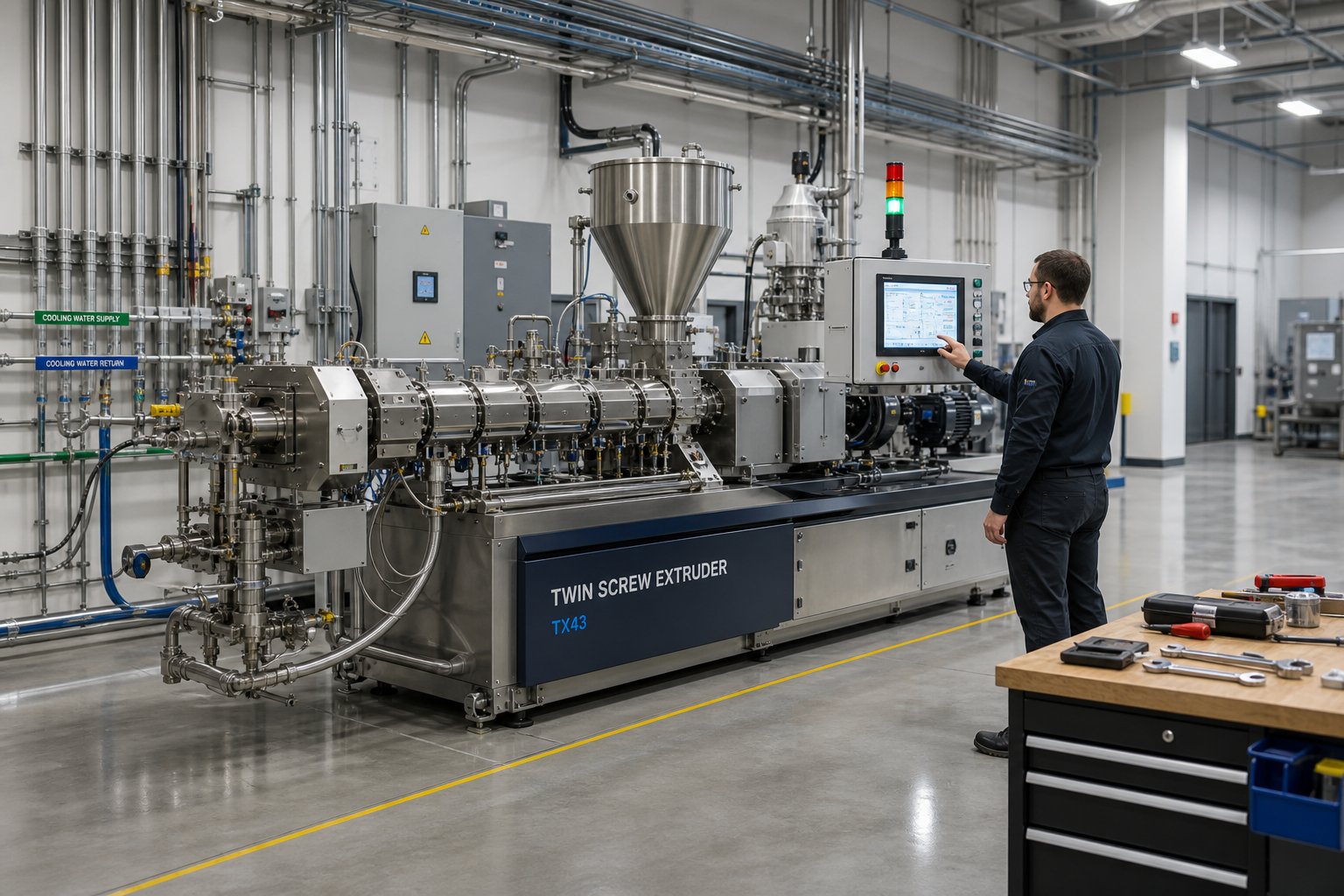
A signed purchase agreement and a truck pulling into your loading dock mark the beginning of a new phase — one where preparation, precision, and planning determine whether your investment pays off or stalls out. Installing a used twin screw extruder isn't the same as plugging in a piece of office equipment. These are industrial extrusion machinery systems that demand proper site infrastructure, careful mechanical alignment, and a deliberate commissioning sequence before they produce a single quality pellet. Rush this phase, and you risk damaging components that survived years of service at their previous home.
Installation and Commissioning Best Practices
Before the machine arrives, your facility needs to be ready. Site preparation involves more than clearing floor space — it requires confirming that your building can actually support the equipment and supply everything it needs to run.
Utility requirements come first. Verify that your electrical service matches the motor's voltage, phase, and amperage specifications. A double screw extruder machine with a 200 HP drive pulling full load on startup demands substantial inrush current — if your transformer or breaker panel can't handle it, you'll trip protection circuits before the screws complete a single revolution. Beyond electricity, confirm adequate supply of cooling water (flow rate and temperature), compressed air for pneumatic actuators and diverter valves, and ventilation or exhaust capacity if the machine includes vacuum venting ports.
With utilities confirmed, focus on alignment and leveling. The extruder barrel, gearbox, and motor must sit on a foundation that is flat, level, and rigid enough to prevent deflection under operating loads. Even minor misalignment between the gearbox output shaft and the barrel bore accelerates wear on spline connections, thrust bearings, and screw elements — exactly the components you just spent time inspecting before purchase. Use precision leveling instruments and shim the base as needed. For larger extruders, grouted anchor bolts are standard practice.
Initial test runs should follow a conservative protocol. Start by running the screws at low speed without material to verify rotation direction, listen for gearbox noise, and confirm that all heater zones reach setpoint. Then introduce a clean, unfilled virgin polymer — something forgiving like LDPE or natural PP — at low feed rates and moderate screw speeds. This first run establishes baseline operating parameters: motor amperage at a given throughput, melt temperature at each zone, die pressure, and specific energy consumption. Document everything. These baseline numbers become your reference point for detecting drift, wear, and process deviations in the months ahead.
Resist the temptation to run production material on day one. Extruders that have been sitting idle — sometimes for months during transit and installation — need their barrel heaters thermally cycled, their cooling circuits flushed, and their lubrication systems verified before processing anything that matters.
Building a Preventive Maintenance and Spare Parts Strategy
A well-maintained extruder can operate reliably for 15 to 20 years, delivering steady returns on even a modest capital investment. Neglected machines, by contrast, degrade fast — and unplanned downtime on a production line can cost thousands per day in lost output alone, not counting emergency repair bills. The difference between those two outcomes is a preventive maintenance schedule that starts the moment commissioning is complete.
Your maintenance plan should address every major system on a defined interval:
- Gearbox oil changes — change lubricant every 2,000 to 3,000 operating hours using the manufacturer's recommended grade, typically a synthetic industrial gear oil (ISO VG 320). Annual oil analysis — roughly $100 per sample — detects wear metals long before audible symptoms appear, potentially extending gearbox life from five years to ten or more.
- Barrel and screw inspections — measure barrel bore diameter and screw element flight tips at least annually. For extruders processing abrasive filled compounds, increase frequency to every six months. Once the gap between flight and barrel wall exceeds 0.3 to 0.5 mm (depending on screw diameter), mixing efficiency drops noticeably.
- Heater band replacement cycles — test each heating zone individually on a quarterly basis. Individual band heaters typically cost $100 to $300 per zone to replace, but a single failed zone left undetected can overheat the polymer, cause degradation, and warp the barrel — repairs that cost orders of magnitude more.
- Thermocouple calibration — calibrate annually by comparing displayed readings against a handheld reference probe. A thermocouple that drifts even a few degrees can silently push your process out of specification.
- Drive system servicing — clean motor cooling fans, check belt tension or coupling alignment, and perform insulation resistance testing on motor windings annually. Proactively replace VFD cooling fans every three to five years at a cost of roughly $200 per fan rather than waiting for failure to halt production.
- Cooling system maintenance — descale water cooling channels every six months to prevent mineral buildup that reduces heat transfer. Clean air cooling fans monthly to prevent dust insulation that causes heater overtemperature.
Beyond scheduled tasks, implement a daily operator log where your team records motor amperage, melt temperature, die pressure, and any unusual sounds or vibrations. Trending this data over weeks and months reveals gradual changes — a slowly climbing torque reading, a zone that takes longer to reach setpoint — that signal developing problems well before they escalate into emergencies.
The foundation of any maintenance program, however, is parts availability. You can have the best inspection schedule in the industry, but if a worn kneading block or a failed heater band takes four weeks to arrive from overseas, your production line sits idle regardless. For a plastic extruder machine — especially one purchased used — building a reliable spare parts pipeline is not optional. It's the single most important factor in minimizing unplanned downtime.
Critical spares to keep on hand include kneading blocks and conveying elements (the fastest-wearing screw components), a rear seal kit, a set of replacement thermocouples, spare heater bands for each zone size, and a PLC battery backup. Stocking these items typically costs $3,000 to $5,000 but eliminates the production losses that come with waiting weeks for international shipment. For any extruder machine for plastic processing — whether it's a Coperion, Leistritz, JSW, or a Nanjing-built platform — establishing a relationship with an aftermarket parts supplier that can manufacture components from drawings or samples is a strategic advantage. Suppliers like NANHAIYA specialize in exactly this capability, producing screw elements, barrel segments, heater bands, thermocouples, die heads, pelletizing blades, and custom parts for machines from virtually any OEM. When original manufacturer support is limited — as it often is for older or discontinued models — this kind of aftermarket resource keeps your extruders running without the markup or lead time of OEM channels.
To bring this all together, here is a recommended first-90-days action plan for anyone who has just taken ownership of a used twin screw extruder:
- Days 1-7: Complete site preparation. Verify electrical service capacity, cooling water supply, compressed air availability, and ventilation. Level and anchor the machine on its foundation. Connect all utilities and confirm proper function of every circuit, valve, and fitting before introducing any material.
- Days 8-14: Perform a full mechanical baseline. Measure barrel bore diameter at multiple points along its length. Pull screws and document the condition of every element — flight tip diameter, surface condition, and kneading block integrity. Record gearbox oil condition, check for axial play, and submit an oil sample for analysis.
- Days 15-21: Commission the electrical and control systems. Test every heater zone, calibrate all thermocouples, verify motor rotation and amperage draw at no load, and confirm that all safety interlocks and emergency stops function correctly. Back up the PLC program and all stored recipes to an external drive.
- Days 22-30: Run virgin material test campaigns. Process unfilled polymer at low, medium, and high throughput rates. Record motor load, melt temperature, die pressure, and specific energy at each operating point. These numbers establish your performance baselines.
- Days 31-45: Introduce production materials gradually. Start with your least demanding formulation and scale up to more abrasive or filled compounds. Monitor all baseline parameters for deviation. Adjust screw configuration if mixing or throughput performance doesn't meet process requirements.
- Days 46-60: Finalize your preventive maintenance schedule. Based on baseline data and material demands, set inspection intervals for barrel, screws, gearbox, heaters, and thermocouples. Assign responsibilities and create a maintenance logbook — digital or physical — that operators update daily.
- Days 61-75: Build your spare parts inventory. Order critical spares — kneading blocks, conveying elements, seal kits, heater bands, and thermocouples — from your OEM or aftermarket supplier. Confirm lead times for non-stock items so you know exactly how fast replacements can arrive in an emergency.
- Days 76-90: Conduct a full review and optimize. Compare actual operating data against your initial baselines. Identify any zones of accelerated wear, temperature instability, or throughput limitations. Adjust your maintenance intervals and spare parts stock levels based on real-world performance rather than assumptions.
Buying a used twin screw extruder is a calculated decision, not a leap of faith. The deal you spotted — whether it was a Coperion ZSK from a plant closure, a Leistritz lab unit from a process development center, or a Nanjing-built compounder at a fraction of new-equipment pricing — only becomes a good investment when you back it with disciplined inspection, honest risk assessment, proper commissioning, and a maintenance strategy that keeps the machine producing quality product year after year. The red flags in this guide exist to protect your capital. The maintenance framework exists to protect your uptime. And the parts strategy exists to ensure that when something finally does wear out — because every extruder eventually demands new components — you already know where to get what you need, how fast it can arrive, and what it will cost. That's the difference between buying used equipment and buying used equipment intelligently.
Frequently Asked Questions About Twin Screw Extruders — Applications and Used Equipment
1. What is a twin screw extruder used for?
A twin screw extruder is used across a wide range of industries including plastics compounding, masterbatch production, food processing, pharmaceutical hot-melt extrusion, plastics recycling, reactive extrusion, PVC pipe and profile extrusion, and rubber compounding. The machine's two intermeshing screws deliver intense mixing, self-wiping action, and precise temperature control, making it suitable for blending polymers with fillers, colorants, flame retardants, and reinforcing fibers. In food applications it cooks and texturizes snack puffs, cereals, and pet food, while pharmaceutical manufacturers use it to create amorphous solid dispersions for improved drug bioavailability.
2. What is the difference between co-rotating and counter-rotating twin screw extruders?
Co-rotating twin screw extruders have both screws turning in the same direction, producing high-shear distributive and dispersive mixing ideal for polymer compounding, devolatilization, and reactive extrusion. They feature highly modular screw designs with interchangeable elements. Counter-rotating extruders spin the screws in opposite directions, generating low shear and high-pressure buildup suited to thermally sensitive materials like rigid PVC. Choosing the wrong configuration for your process can cause material degradation or inadequate mixing, so matching rotation type to your application should be the first decision before evaluating price or machine hours.
3. How do you inspect a used twin screw extruder before buying?
A thorough inspection covers three layers. First, measure the barrel bore diameter at multiple points to detect localized wear and examine screw elements for flight tip erosion, broken kneading blocks, and corrosion. Listen for gearbox noise and request an oil analysis report. Second, test every heater zone, calibrate thermocouples against a reference probe, and verify the PLC and HMI platform are still supported with available replacement parts. Third, review maintenance records, hour meter readings, materials previously processed, and the reason for sale. The most critical rule is to always request a powered test run — a seller who refuses to demonstrate the machine running is concealing a problem.
4. Is it worth buying a used twin screw extruder instead of a new one?
Used twin screw extruders can offer significant savings — industry norms suggest roughly 40-60% below new-equipment pricing depending on brand, age, and condition. They are particularly worthwhile for startups, product trials, backup production lines, and standard compounding applications where older technology performs equally well. However, buyers must factor in potential refurbishment costs for barrel liners, screw elements, heater bands, and control system upgrades. Refurbished machines represent a middle ground, offering documented component condition and sometimes a limited warranty at a cost between used and new. The key is calculating total cost of ownership, not just the sticker price.
5. How do you source replacement parts for a used twin screw extruder?
Parts availability is the single most important factor in long-term used-equipment ownership. Premium OEM brands like Coperion, Leistritz, and JSW maintain broad parts support even for older models. For discontinued or less common machines, aftermarket suppliers become essential. Specialists such as NANHAIYA (nhyscrews.com) manufacture replacement screw elements, barrel segments, heater bands, thermocouples, die heads, and pelletizing blades from drawings or samples for virtually any OEM platform. Stocking critical spares — kneading blocks, conveying elements, seal kits, and heater bands — before production begins prevents costly unplanned downtime when components eventually wear out.
Written by
Nanhaiya Technical Team
Zhoushan Nanhaiya Plastic Machinery Co., Ltd.
The Nanhaiya technical team supports screw and barrel manufacturing projects through application review, technical communication, custom manufacturing coordination, and production and quality control.
Discuss Your Application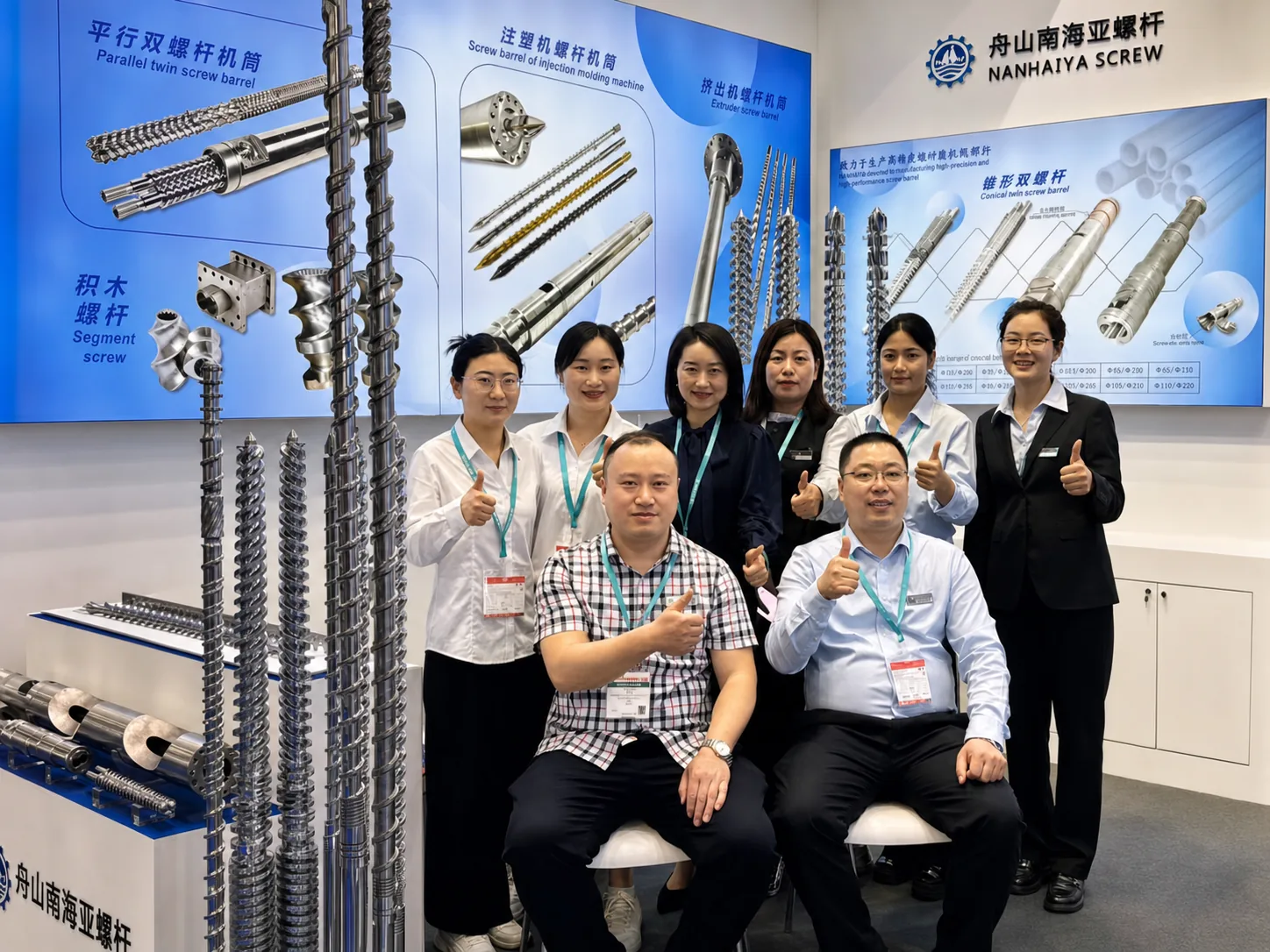
Related Articles
More insights on screw barrel technology and plastics processing.
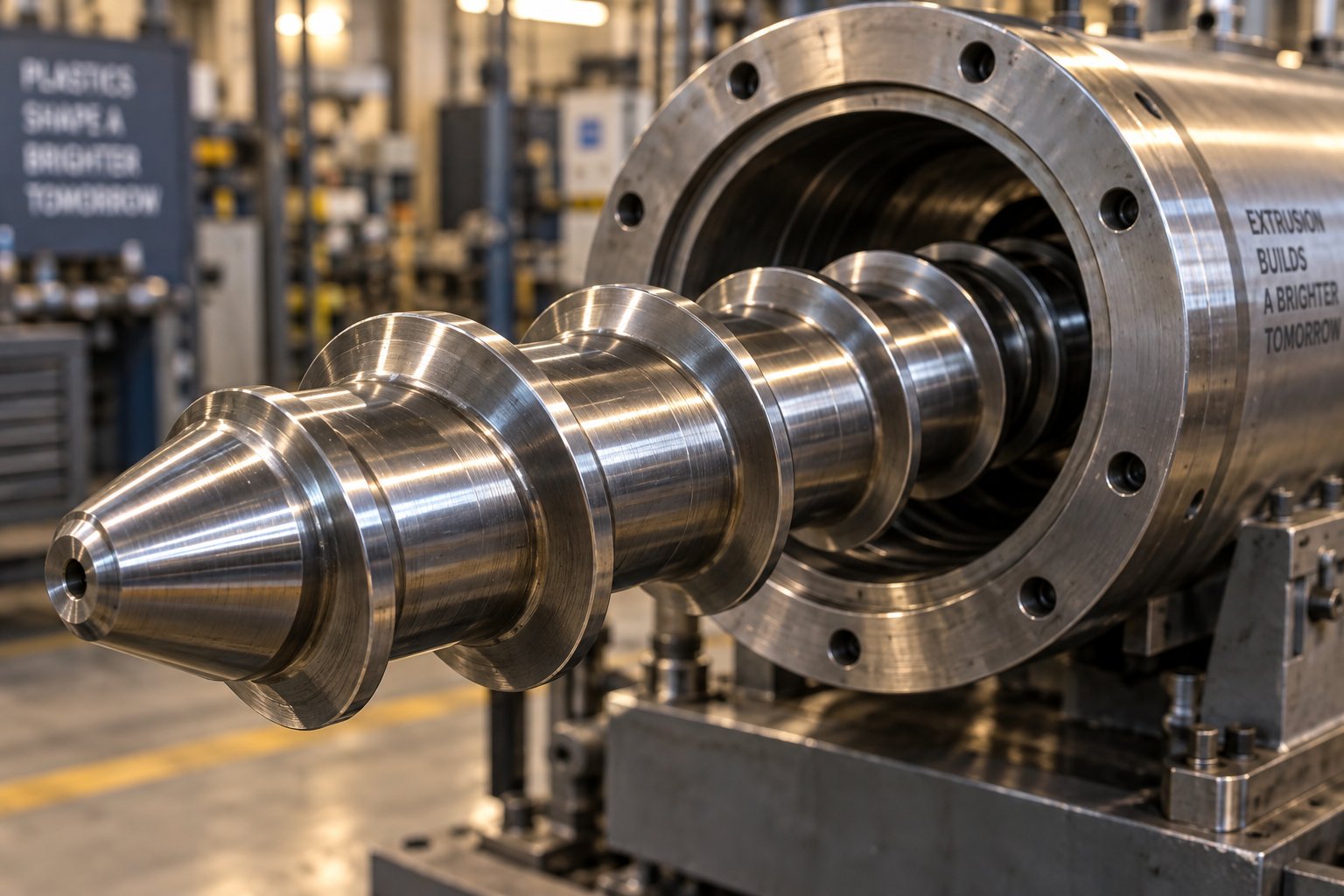
What Nobody Tells You About Screw Barrel For Plastic Machine Design
Oct 10, 2026
Learn how screw barrel for plastic machine design affects melt quality, throughput, and wear life. Covers geometry, resin matching, troubleshooting, and sourcing.
Read Article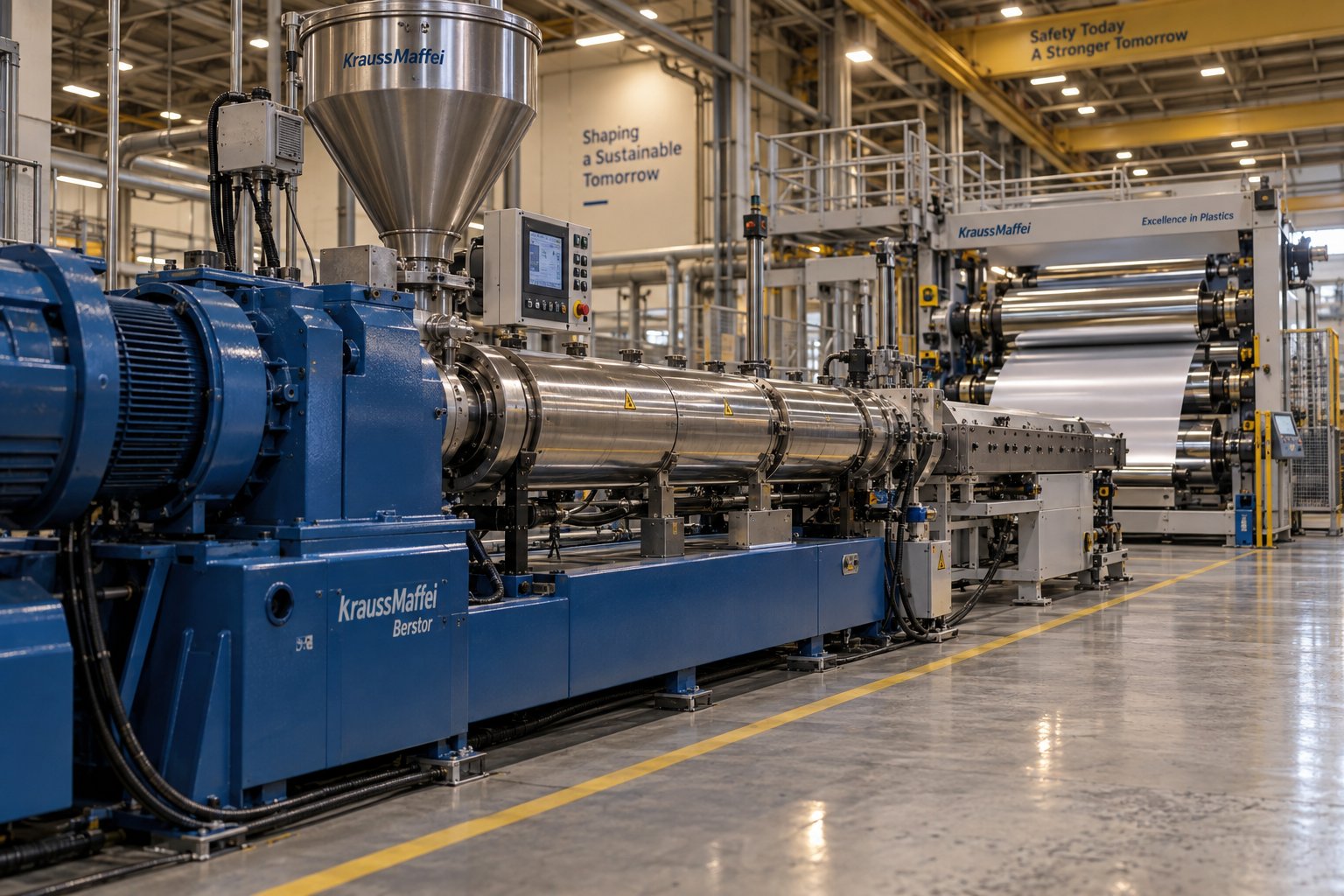
Single Screw Extruder for Sheet: Stop Guessing, Start Specifying
Oct 9, 2026
Learn how to specify a single screw extruder for sheet production. Covers screw geometry, resin-specific processing, troubleshooting, and maintenance best practices.
Read Article
PE Pipe Extruder Machine: What Datasheets Won't Tell You
Oct 9, 2026
Learn how a PE pipe extruder machine works, key specs explained, material grade selection, maintenance tips, and buyer guidance beyond the datasheet.
Read ArticleLooking for something else?
Search by material, symptom or product and jump straight to the relevant page.
These are navigation suggestions based on keyword matching — not a quotation, not a delivery commitment, and not a substitute for engineering review. Final specification is confirmed by our engineers against your drawings and processed material.
Need help with screw barrel selection?
Share your machine model, processed material and application. Our team can help with pricing and technical support.