

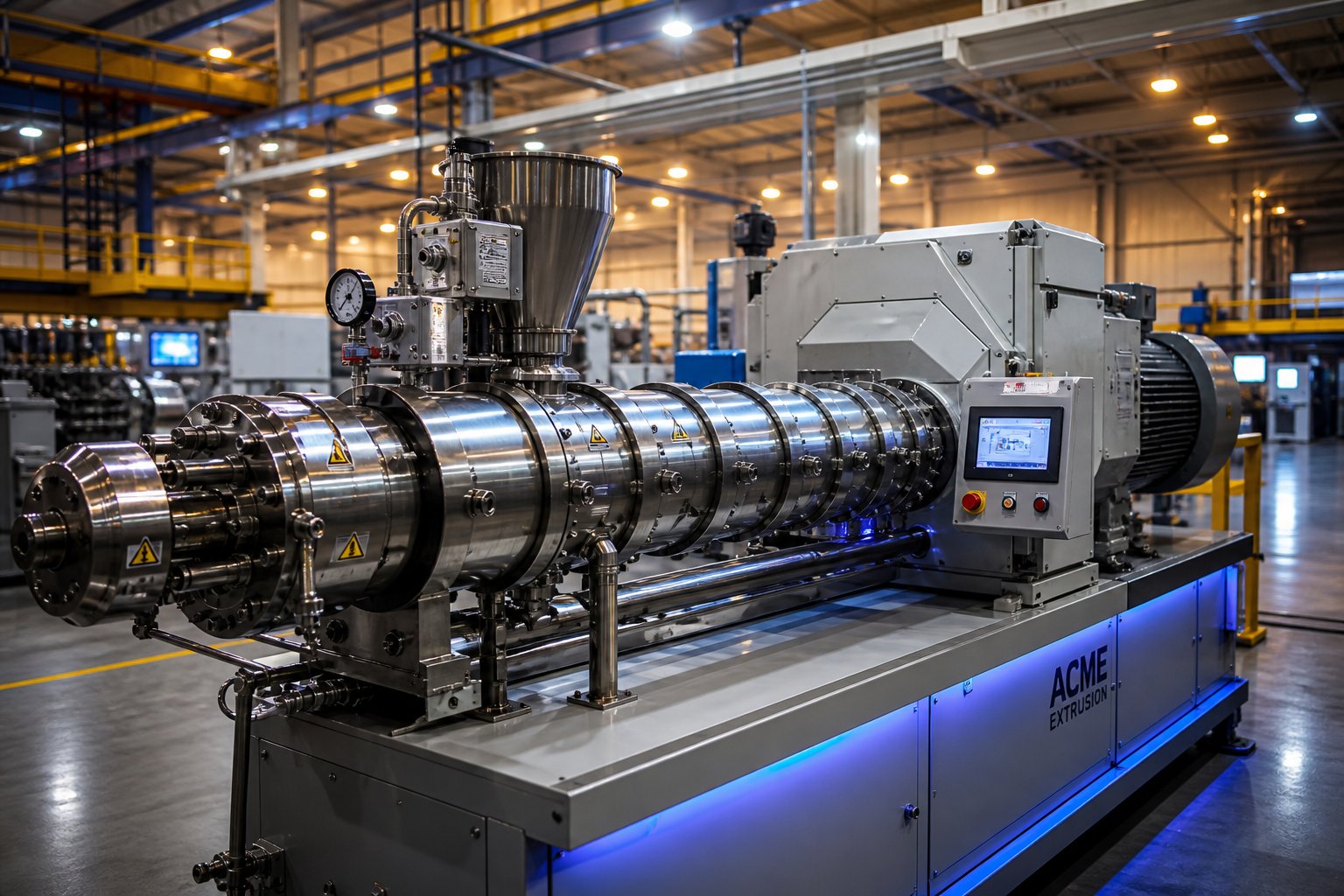
What Twin Screw Extruder Manufacturers Do and Why Your Choice Matters
Twin screw extruder manufacturers are companies that design, engineer, and build complete twin screw extrusion systems — machines equipped with two intermeshing screws rotating inside a heated barrel to compound, mix, and process materials ranging from polymers and food ingredients to pharmaceuticals and chemicals. The global manufacturer landscape spans dozens of producers across Europe, Asia, and North America, each with different engineering philosophies, price points, and application strengths. For buyers, that complexity creates a real problem: how do you separate genuine engineering partners from assembly houses repackaging generic components?
This article is not a supplier listicle. It is an independent research guide built for procurement teams, plant engineers, and operations leaders who need a structured framework to evaluate their options — and, more importantly, to spot red flags before a purchase order locks them in.
What Twin Screw Extruder Manufacturers Actually Produce
A full-line twin screw extruder manufacturer controls the design and production of every critical subsystem: the barrel sections, modular screw elements, high-torque gearbox, drive motor, and integrated control unit. These components work as a tightly interdependent system. The barrel metallurgy must match the screw element geometry. The gearbox must deliver sufficient torque density without overheating. The control architecture must coordinate temperature zones, screw speed, and feed rates in real time.
Not every company marketing twin screw extruders actually engineers them from the ground up. Some are niche component makers producing only replacement screw elements or barrel liners. Others are resellers or trading companies that source assembled machines from contract factories and rebrand them. Both play legitimate roles in the supply chain, but you'll run into trouble if you mistake one for the other during the evaluation process. Understanding where a supplier sits in this hierarchy — full-line OEM, niche component specialist, or reseller — is the first filter every buyer should apply.
Why Choosing the Right Manufacturer Is a High-Stakes Decision
A twin screw extruder is not a commodity purchase. The manufacturer you select directly determines your achievable throughput, finished product quality, energy consumption per kilogram of output, maintenance frequency, and spare parts costs for years to come. A poorly matched machine can quietly erode margins through excessive downtime, inconsistent melt quality, or premature wear that demands constant screw and barrel replacements.
Selecting a twin screw extruder manufacturer is not just a procurement task — it is an engineering partnership that shapes your operational performance for a decade or more.
The stakes rise further when you consider that switching costs are enormous. Ripping out an underperforming extruder and replacing it mid-production disrupts supply chains, wastes capital, and delays capacity plans. Getting it right the first time is not optional — it is a competitive necessity.
In the sections ahead, you'll find a buyer-focused breakdown of configuration types and which manufacturers specialize in each, the technical differentiators that separate premium twin screw extruders from budget alternatives, practical pricing tier guidance, application-to-manufacturer mapping, and a detailed due diligence checklist designed to catch the warning signs most buyers only recognize after the contract is signed.
Co-Rotating vs Counter-Rotating Manufacturer Specializations
Every twin screw extruder on the market falls into one of two fundamental architectures — and most manufacturers lean heavily toward one or the other. Buyers who skip this distinction end up evaluating companies that were never a fit for their process in the first place. Understanding the two configurations and how they segment the manufacturer landscape is the fastest way to cut a sprawling global supplier list down to a manageable shortlist.
Co-Rotating Intermeshing Extruders and Their Leading Producers
In a co-rotating twin-screw extruder, both screws rotate in the same direction using a fully intermeshing geometry. This creates intense shear fields — both between the screws and between the screw flights and the barrel wall — that deliver exceptional dispersive and distributive mixing. A defining feature is the self-wiping action that occurs at the intermeshing zone: material is forcibly transferred from one screw to the next, virtually eliminating dead zones and suppressing stagnation. The result is a narrow residence time distribution, which is critical when processing thermally sensitive polymers or running reactive extrusion chemistry.
These characteristics make co-rotating configurations the dominant choice for polymer compounding, masterbatch production, nanocomposite dispersion, and polymer alloy development. Imagine you're blending carbon nanotubes into a polymer matrix — the filler dispersion state directly controls the final material properties, and only a co-rotating double screw extruder delivers the controlled, high-intensity mixing needed to break apart agglomerates without degrading the base resin.
The manufacturer landscape for co-rotating twin screw extrusion skews toward two broad categories. European heritage OEMs — particularly German and Italian firms — have decades of engineering legacy in this space and typically offer the highest torque densities, tightest screw element tolerances, and most extensive process engineering support. On the other end, established Chinese producers have scaled rapidly, offering high-volume production of co-rotating systems at significantly lower price points. Both categories serve legitimate market needs, but their engineering depth, metallurgy options, and after-sales infrastructure differ substantially — a distinction that matters more as application complexity increases.
Counter-Rotating Extruders and Specialized Manufacturer Focus
Counter-rotating twin-screw extruders flip the script. The two screws rotate in opposite directions, drawing material into the intermeshing zone under compression rather than high shear. A calendering effect develops between the screws — material undergoes repeated compressive and elongational deformation, dispersing additives under relatively gentle conditions. Shear heating stays low, and the machine can operate at high fill levels and comparatively low rotational speeds.
This matters enormously for materials like rigid PVC, which has a notoriously low thermal decomposition temperature and poor melt flow. Push rigid PVC through a co-rotating extruder twin screw setup, and the high shear can trigger degradation before the material even reaches the die. A counter-rotating configuration holds extrusion temperatures low enough to keep the material stable while still achieving the plasticization needed for pipes, profiles, and sheet products.
Fewer manufacturers specialize in this segment. Counter-rotating systems represent a narrower market niche compared to the expansive co-rotating compounding world. Buyers in the PVC pipe and profile industry will find that their viable supplier pool is inherently smaller — and that the manufacturers who do focus here tend to carry deep application-specific expertise, often with proprietary screw geometries optimized for specific PVC formulations.
How Configuration Type Narrows Your Manufacturer Shortlist
Matching the right architecture to your process is not a minor technical detail — it is the single most efficient filter you can apply before spending weeks on RFQs and factory visits. Here is a practical sequence to follow:
- Define your process requirements first. Do you need high shear dispersive mixing for compounding, reactive extrusion, or filler incorporation? Co-rotating twin-screw extruders are almost certainly the right architecture. Do you need gentle conveying with minimal shear heating for PVC or other thermally sensitive shaping operations? Counter-rotating configurations should be your starting point.
- Filter manufacturers by configuration expertise. Ask each potential supplier what percentage of their installed base uses the configuration you need. A manufacturer whose portfolio is 90% co-rotating may offer a counter-rotating model on paper but lack the process engineering depth to support it — and vice versa.
- Evaluate secondary criteria only after the configuration filter. Factors like pricing, lead time, geographic proximity, and after-sales support all matter, but none of them matter if the machine architecture does not match your material and process demands.
- Watch for generalist claims. Some suppliers market themselves as experts in both configurations equally. While a handful of large OEMs genuinely support both, many smaller producers stretch their positioning beyond their real engineering strengths. Request application-specific reference installations, not just product catalog pages.
This single step — identifying whether you need a co-rotating or counter-rotating extruder twin screw system — immediately eliminates a large portion of the global supplier market and lets you focus your evaluation energy where it counts. The harder question comes next: among the manufacturers that do build your required configuration, how do you tell the OEMs apart from resellers and component suppliers who may look identical on a website?
OEM Manufacturers vs Resellers vs Parts Suppliers Explained
A polished website, a professional product catalog, and a responsive sales team can make any extruder company look like a vertically integrated manufacturer. But behind that facade, the supplier you are evaluating could be an original equipment manufacturer engineering machines from scratch, a reseller rebranding someone else's hardware, or a specialized component supplier focused exclusively on replacement parts. Each plays a real role in the market — the danger is not that these categories exist, but that buyers routinely confuse one for another and build their expectations around the wrong foundation.
Original Equipment Manufacturers and What Sets Them Apart
A true OEM extruder manufacturer designs and builds complete twin-screw extruder systems in-house. That means the company controls the engineering of the barrel, screw elements, gearbox, drive system, and control architecture under one roof. They own the manufacturing tolerances, manage the metallurgical specifications, assemble the final machine, and commission it at the customer's facility.
What does this look like in practice? You'll typically see OEMs maintaining their own CNC machining centers, metallurgy labs, and test extrusion lines. When you buy from a genuine twin-screw extruder manufacturer at the OEM level, the purchase price usually bundles full system integration, process engineering consultation, operator training, and a warranty that covers the entire machine — not just individual components. If something goes wrong during startup, there is one phone number to call and one engineering team accountable for the outcome.
That accountability is the core differentiator. An OEM cannot point fingers at a third-party gearbox supplier or blame a subcontracted barrel vendor because they own the entire design chain.
Resellers and Distributors in the Extruder Market
Resellers and distributors occupy a different position. These companies purchase finished or semi-finished industrial extruder systems from a contract manufacturer — often overseas — then rebrand, market, and sell them under their own name. Some add genuine value through local warehousing, regional technical support, and faster spare parts delivery. Others function primarily as trading intermediaries with minimal engineering involvement.
Pros
- Potentially lower upfront pricing due to sourcing from lower-cost production regions
- Local language support and regional service networks
- Faster initial response times for buyers in the same geography
Cons
- Limited ability to customize screw configurations, barrel metallurgy, or control systems beyond what the original factory offers
- Engineering accountability becomes murky — when a process issue arises, the reseller may lack the technical depth to diagnose it and must relay questions back to the actual manufacturer
- Warranty enforcement can be complicated when the entity selling the machine is not the entity that built it
None of this makes resellers illegitimate. But it does mean you need to ask direct questions about who actually engineers and assembles the machine. If the answer involves a factory the reseller does not own or control, your due diligence process should extend to that factory as well.
Specialized Parts and Component Suppliers
The third category includes aftermarket parts suppliers who manufacture replacement screw elements, barrel sections, barrel liners, and other wear components designed to be compatible with various OEM platforms. These companies do not build complete extruder systems. Instead, they serve the ongoing maintenance and replacement needs of plants already operating industrial extruder equipment from established OEMs.
For buyers evaluating a new machine purchase, this distinction matters because a parts supplier's website can sometimes look remarkably similar to a full-line extruder manufacturer's site — complete with product photos of assembled machines that are actually customer installations, not their own builds. Recognizing a component specialist for what it is prevents misaligned expectations during the RFQ stage.
The table below breaks down how these three supplier categories compare across the dimensions that matter most during procurement:
| Dimension | OEM Manufacturer | Reseller / Distributor | Parts & Component Supplier |
|---|---|---|---|
| Engineering Control | Full in-house design of all subsystems | Limited — relies on source factory's engineering | Focused on component-level engineering only |
| Customization Capability | High — screw geometry, barrel metallurgy, L/D ratio, and controls can be tailored | Low to moderate — constrained by source factory's standard options | Component-specific — custom screw elements or barrel liners, not full systems |
| Pricing Transparency | Direct factory pricing; cost structure visible | Markup over source factory cost; less visibility into base pricing | Competitive on individual components; no full-system pricing |
| Warranty Scope | Covers complete machine and process performance | Varies — may cover machine but exclude process guarantees | Covers supplied components only |
| Spare Parts Availability | Direct access; may have longer lead times and higher pricing | Dependent on source factory inventory and logistics chain | Core business — typically fast lead times and broad compatibility |
Before you draft an RFQ or schedule a factory visit, verify which category your potential supplier actually falls into. Ask whether they design and machine their own gearboxes. Ask if the test extrusion line on their website is located in their own facility. Ask for the name and location of the factory where final assembly takes place. These are simple questions, and a credible extruder company will answer them without hesitation.
Knowing whether you are dealing with an OEM, a reseller, or a parts specialist sets the right expectations — but it still leaves a critical question unanswered. Among the genuine OEMs on your shortlist, what specific technical factors separate a premium machine from a budget one, and where exactly do lower-cost producers cut corners?
Technical Factors That Separate Premium From Budget Manufacturers
Two twin screw extruders can look nearly identical in a product catalog — same screw diameter, same L/D ratio, same advertised throughput — yet perform drastically differently on the factory floor. The divergence lives in the engineering details that spec sheets gloss over and sales teams rarely volunteer. If you want to evaluate twin screw extruder manufacturers with any real rigor, you need engineering literacy in three areas: drive system torque density, barrel metallurgy, and screw element manufacturing precision.
Torque Density and Drive System Engineering
Torque density, measured in Nm/cm³, is the single most revealing performance metric for a twin screw extruder's drive system. It tells you how much usable torque the gearbox delivers relative to the cross-sectional area of the screws it drives. Higher torque density means you can push more material through a given screw diameter — or process tougher, higher-viscosity compounds — without upgrading to a physically larger machine.
Here is why this matters for manufacturer evaluation: premium producers invest heavily in proprietary gearbox designs, often using planetary gearbox configurations that achieve the torque density and angular synchronization precision that parallel-shaft layouts struggle to match at higher loads. Modern high-performance twin-screw extruders now deliver torque densities around 18 Nm/cm³ — a 30% jump over previous-generation machines — enabling throughput gains that were previously torque-limited, particularly on glass-filled polyamides and heavily reinforced polypropylene.
Budget manufacturers, by contrast, typically source generic gearboxes from third-party suppliers and pair them with standard motors. These systems often land in the 5-10 Nm/cm³ range, which is serviceable for simple blending tasks but becomes a bottleneck the moment you try to compound abrasive or high-viscosity formulations. The Coperion extruder gearbox on the ZSK Mc18 platform, for example, achieves 18 Nm/cm³, while even within Coperion's own lineup, the older ZSK Mv PLUS series delivers 11.3 Nm/cm³ — illustrating how dramatically torque density varies even within a single manufacturer's portfolio, let alone across the broader market.
A subtle but critical trap: some suppliers quote peak torque ratings on their spec sheets rather than continuous-duty capacity. A gearbox rated at 12,000 Nm peak but only 8,000 Nm continuous will spend its operating life running at effective capacity limits if the screw was sized to that peak figure. Industry best practice is to run at 80% of continuous torque rating — not 80% of peak — to protect thrust bearings and extend gearbox life. The theoretical calculation life for extruder thrust bearings targets approximately 12,000 hours under design load, and exceeding that load even modestly compresses bearing life in ways that do not show up until months into production.
Barrel Metallurgy and Wear Resistance
If the gearbox is where premium manufacturers invest in performance, the barrel is where budget manufacturers most often cut costs — and the consequences rarely surface during commissioning. They emerge six to twelve months later, when accelerated wear forces unplanned shutdowns and premature component replacements.
Barrel liner materials fall along a clear hierarchy. At the entry level, nitrided steel barrels (using alloys like 38CrMoAlA) provide surface hardness in the range of HV 850-1000 after gas nitriding treatment. This level of hardness handles standard unfilled polymers adequately but wears rapidly when processing abrasive fillers — glass fiber, calcium carbonate, or mineral additives that act like sandpaper against the barrel bore.
Mid-tier manufacturers offer bimetallic barrel linings, where a wear-resistant alloy — often a nickel- or cobalt-based matrix embedded with tungsten carbide particles — is centrifugally cast into the barrel bore. These liners dramatically extend service life when running filled compounds. Premium producers go further, offering full tungsten carbide linings or specialized corrosion-resistant alloys for applications involving halogenated polymers, fluoropolymers, or chemically aggressive additives that attack standard steel.
The cost difference between a nitrided barrel and a bimetallic or carbide-lined barrel is significant upfront, which is precisely why it is a favorite target for cost reduction. A budget machine with nitrided-only barrels processing 30% glass-filled nylon may deliver acceptable output during acceptance testing, but the bore wear rate in that application can be several times faster than it would be in a properly lined barrel. You end up paying the metallurgy premium anyway — just in the form of replacement barrels, unplanned downtime, and inconsistent product quality rather than a higher initial purchase price.
Screw Element Precision and Modular Design Quality
Twin screw extruders rely on a modular screw architecture — individual conveying, kneading, and mixing elements assembled onto a splined shaft in a specific sequence tailored to the process. The quality of those elements, and the precision with which they are manufactured, directly controls mixing performance, material degradation, and output consistency.
The geometry used in modern twin-screw extruder screw elements traces back to Erdmenger profiles, where the self-wiping intermeshing geometry demands extremely tight tolerances between the two screws and between each screw and the barrel wall. Even small deviations create dead zones where material stagnates and degrades, or clearance gaps where mixing intensity drops and product homogeneity suffers.
Premium manufacturers machine screw elements on high-precision CNC equipment, holding straightness tolerances within 0.015 mm/m and surface finishes down to Ra 0.4 micrometers. These tolerances ensure that kneading blocks deliver the intended dispersive or distributive mixing action — wider kneading discs for breaking apart agglomerates, narrower discs for gentle distribution — without creating unintended shear peaks or flow restrictions. Budget producers working to looser tolerances may deliver screw elements that fit the shaft and appear visually acceptable, but their mixing performance under real-world operating conditions will be measurably inferior.
The melt pump and extrusion pump systems downstream of the screw section also interact with element precision. Inconsistent melt homogeneity caused by poorly toleranced screw elements creates pressure fluctuations that ripple through melt pumps and die systems, degrading dimensional control in the final product. The screw elements and the downstream pressure management hardware are not isolated subsystems — they form a coupled chain, and weakness at the screw element level cascades forward.
Before entering an RFQ conversation with any manufacturer, request documentation on these specific technical parameters:
- Torque density rating (Nm/cm³) — continuous duty, not peak — along with the Do/Di ratio of the screw geometry
- Barrel metallurgy options — nitrided, bimetallic, or tungsten carbide — with material specifications for each liner grade
- Screw element tolerance class — including straightness, concentricity, and surface finish specifications
- L/D ratio range — and whether the stated ratio includes or excludes the die section
- Maximum operating temperature — both barrel zone capability and the thermal limits of the barrel liner metallurgy
Any manufacturer confident in their engineering will provide this data without hesitation. Vague responses or redirections toward marketing brochures should raise immediate concern — and that pattern of evasion connects directly to the broader challenge of comparing manufacturers against each other when their specification sheets are designed more to impress than to inform.

Comparing Twin Screw Extruder Manufacturers by Key Decision Criteria
Spec sheets create an illusion of comparability. Every manufacturer publishes screw diameter ranges, throughput figures, and L/D ratios — but the numbers rarely sit on the same foundation. One supplier measures throughput using free-flowing HDPE pellets at minimal back-pressure. Another quotes the same metric on a 40% calcium carbonate-filled polypropylene compound with a strand pelletizing die attached. Both print a "kg/h" figure that looks directly comparable until you try to replicate either result on your own production floor.
The twin screw extruders market is projected to grow steadily, with twin screw machines forecast to capture 55.0% share of the broader extruder and compounding equipment segment. That scale attracts a wide range of producers — from global engineering firms with century-old pedigrees to emerging regional assemblers. What buyers actually need is not a ranked list of brand names. They need a structured segmentation framework that reveals where each manufacturer category sits in terms of engineering depth, and a reliable method for stripping the marketing polish off published specifications.
How to Segment the Global Manufacturer Landscape
Rather than evaluating suppliers one-by-one against an endless checklist, you can organize the global manufacturer field into three broad tiers. Each tier carries distinct strengths, limitations, and risk profiles that map to different buyer priorities.
Tier 1: European Heritage OEMs. These are companies with German, Swiss, or Italian engineering roots — firms that have been refining twin screw technology for decades. Their flagship platforms typically deliver torque densities in the 15-18 Nm/cm³ range, supported by proprietary gearbox designs and extensive application labs. A Coperion extruder like the ZSK Mc18, for instance, reaches 18 Nm/cm³ and has been the reference platform for engineering plastics compounding for over 60 years. This tier also includes the ancillary ecosystem: Coperion K-Tron feeders integrate gravimetric feeding directly into the extrusion control loop, illustrating how European OEMs often control the entire upstream and downstream process chain — not just the extruder itself. Expect the longest lead times (8-14 months is typical), the highest purchase prices, and the deepest engineering support including process simulation, pilot trials, and commissioning teams.
Tier 2: Established Asian Manufacturers. Japanese producers — notably The Japan Steel Works and Kobe Steel — match or exceed European torque density benchmarks. JSW's TEX-aIII platform delivers 18.2 Nm/cm³, putting it at the top of the global performance ladder. Chinese manufacturers in this tier are a different profile: companies with genuine in-house design capability, CNC-machined screw elements, and growing international install bases. Their torque densities typically range from 10-15 Nm/cm³ on flagship models, but they offer significantly shorter lead times (3-6 months) and total installed costs that can run 30-55% below European equivalents. The trade-off is usually thinner global service networks and smaller application labs.
Tier 3: Emerging Regional Players. This tier includes newer manufacturers, smaller OEMs serving primarily domestic markets, and companies that are functionally assemblers — sourcing gearboxes, motors, and barrel components from various suppliers and integrating them into a final product. Pricing is the lowest, but so is engineering accountability. Torque densities commonly sit below 10 Nm/cm³, metallurgy options are limited, and process engineering support may consist of a product manual and a phone number. For simple blending tasks or low-volume production, this tier can work. For anything demanding — abrasive fillers, tight quality tolerances, or 24/7 operation — the risk profile climbs sharply.
The table below provides a blank evaluation template you can populate with real data as you gather quotes and visit factories. Use it as a standardized comparison framework to eliminate the apples-to-oranges problem that plagues most extruder procurement exercises.
| Evaluation Field | European Heritage OEM | Established Asian Producer | Emerging Regional Player | Your Shortlisted Supplier A | Your Shortlisted Supplier B |
|---|---|---|---|---|---|
| Headquarters Region | Germany / Switzerland / Italy | Japan / China (Tier 1-2 cities) | Varies widely | [Fill in] | [Fill in] |
| Screw Diameter Range (mm) | 18 - 380+ | 16 - 443 (Japan); 25 - 360 (China) | 35 - 135 typical | [Fill in] | [Fill in] |
| L/D Ratio Options | 32:1 to 60:1+ | 32:1 to 56:1 | 32:1 to 44:1 typical | [Fill in] | [Fill in] |
| Throughput Range (kg/h) | 5 - 2,500+ per machine | 10 - 60,000 (mega-scale polyolefin) | 50 - 1,000 typical | [Fill in] | [Fill in] |
| Torque Density (Nm/cm³) | 15 - 18 | 13 - 18.2 | 5 - 10 | [Fill in] | [Fill in] |
| Primary Industry Focus | Engineering plastics, pharma, compounding | Polyolefin, masterbatch, recycling | General compounding, PVC | [Fill in] | [Fill in] |
| Configuration Type | Primarily co-rotating; select counter-rotating | Co-rotating dominant; conical options | Varies | [Fill in] | [Fill in] |
| Notable Differentiator | Proprietary gearboxes, deep application labs, global service | Price-to-performance ratio, speed of delivery | Lowest upfront cost | [Fill in] | [Fill in] |
Print this template, or build a spreadsheet version, and insist that every shortlisted supplier provide the data to fill in their column using the same measurement conditions. That last detail — measurement conditions — is where the real analytical work begins.
Reading Between the Lines of Manufacturer Spec Sheets
You've gathered brochures, downloaded PDFs, and collected quotes with impressive-sounding numbers. The problem is that those numbers are not neutral. They are positioning tools. Learning to decode them separates informed buyers from those who get surprised after installation.
Throughput claims: what material, what die, what conditions? A manufacturer stating "up to 2,500 kg/h" is technically accurate if they ran neat polyethylene pellets through an open barrel exit with no die resistance. Your actual application — say, a 30% talc-filled polypropylene compound extruded through a strand die into an underwater pelletizer — will deliver dramatically less. Always ask: what polymer was used, what filler loading, and what die configuration was attached during the throughput test? If the supplier cannot or will not specify, treat the number as a theoretical ceiling, not a practical target. Coperion's published figure of 2,500 kg/h for the ZSK 58 Mc18 is tied to specific test conditions — responsible manufacturers document those conditions because they know sophisticated buyers will verify them.
Motor power: continuous or peak? This is the electrical equivalent of the torque density trap discussed earlier. A spec sheet listing a 250 kW motor could mean 250 kW continuous duty (S1 rating) or 250 kW at a short-term peak overload (S6 or S3 rating). The difference matters because your process does not run at peak for fifteen seconds — it runs continuously for shifts or days at a time. A machine sized to its peak motor rating will thermally derate under sustained load, quietly throttling your actual throughput below what you budgeted for.
L/D ratio: where does the measurement end? Some manufacturers define L/D as the total barrel length divided by the screw diameter. Others include the die adapter or transition section in that length. A machine advertised as 48:1 L/D might offer only 40:1 of actual processing length if eight diameters of that ratio are occupied by the die adapter and transition zone. This distinction determines how many functional barrel zones you have for feeding, melting, mixing, venting, and pressure building — and whether you can configure the screw profile with enough flexibility for your specific process.
Screw speed: rated maximum vs. practical operating range. A manufacturer may list a maximum screw speed of 1,200 RPM, but if the gearbox can only sustain that speed under minimal load, your real operating speed will sit far lower. The relevant question is not "what is the maximum speed" but "at what speed can the machine deliver its rated torque continuously without exceeding thermal or mechanical limits."
Specification sheets are marketing documents engineered to present the most favorable numbers under the most generous conditions — always request test data from comparable applications before treating any published figure as a procurement baseline.
The gap between published specs and real-world performance is where many purchasing mistakes originate. A manufacturer confident in their machine's capabilities will welcome the request for application-specific test data, reference installations running similar compounds, and detailed measurement condition documentation. One that deflects those requests is telling you something important — even if the words sound reassuring. The next logical step is mapping these tiered manufacturer categories and decoded specifications against your specific application, because the "best" machine on paper can still be the wrong machine for your process.
Matching Your Application to the Right Manufacturer Category
A manufacturer with world-class torque density and flawless barrel metallurgy can still be the wrong choice if their engineering team has never run your material through their machine. Application expertise is not interchangeable. A producer that excels at polyolefin compounding may have zero experience with pharmaceutical hot-melt extrusion — and the certifications, process controls, and regulatory documentation those two applications demand could not be more different. The smartest way to use the tiered manufacturer landscape from the previous section is to overlay it with your specific application requirements, then see which intersections actually exist.
Polymer Compounding and Masterbatch Production
Imagine you are running a compounding machine at full capacity — blending 40% glass fiber into a polyamide 6,6 matrix while simultaneously dosing heat stabilizers, colorants, and impact modifiers through separate feeders. The twin screw extruder handling that job needs several things working in concert: high torque density to push viscous, abrasive melt through a long barrel, excellent dispersive mixing to break apart fiber bundles without excessive fiber length degradation, and distributive mixing to spread additives uniformly through the polymer matrix.
Side feeders become essential here. Glass fibers, mineral fillers, and other solids cannot be dumped into the main feed throat alongside the polymer pellets — they need to enter downstream, after the polymer is already molten, to avoid excessive attrition and feed throat bridging. Any twin screw extruder manufacturer serious about compounding applications will offer multiple side feeder ports with independently controlled gravimetric dosing. If a supplier's standard machine only accommodates a single side feeder location, that is a signal their platform was not designed with high-filler-loading compounding as a primary use case.
Downstream integration matters just as much. Strand pelletizing — where extruded strands are water-cooled and chopped — works well for standard compounds, but high-throughput operations and moisture-sensitive materials increasingly demand underwater pelletizing systems that cut pellets directly at the die face under water. Not every manufacturer offers tight integration with underwater pelletizing equipment, and the ones that do not will leave you coordinating between separate suppliers for the extruder and the pelletizer — a gap that creates finger-pointing when something goes wrong at the interface.
For polymer compounding and masterbatch production, co-rotating configurations dominate. European Tier 1 and established Asian Tier 2 producers are the strongest fit, with Tier 1 offering deeper process engineering support for complex formulations and Tier 2 delivering a compelling price-to-performance ratio for standard plastic compounding equipment applications.
Laboratory and Pilot-Scale Research
R&D labs and pilot plants operate under fundamentally different constraints than production floors. You might have only a few hundred grams of an experimental polymer blend to test. You need to change screw configurations rapidly between trials. Temperature control must be precise enough to isolate thermal effects from mechanical mixing effects. And the data you collect must be reliable enough to predict how a formulation will behave when scaled up to a 75 mm or 95 mm production extruder.
A laboratory twin screw extruder typically starts at screw diameters around 16 mm, with throughput as low as 0.5 kg/h for initial feasibility studies. Slightly larger models — 20 mm to 36 mm diameter — bridge the gap between pure research and pilot production, delivering 3 to 100 kg/h depending on model size and material type. The key requirement is geometric similarity to production-scale machines: if the lab extruder's screw element designs, L/D ratios, and mixing principles do not mirror the larger platform you will eventually scale to, your pilot data becomes unreliable. Screw configuration optimization performed on a benchtop twin screw extruder should translate directly to a production machine with minimal re-engineering.
Here is where manufacturer selection gets tricky. Not all production-scale twin screw extruder manufacturers offer credible lab-scale equipment. Some bolt a small-diameter barrel onto an existing drive platform as an afterthought, resulting in a machine that technically runs but lacks the instrumentation, modular flexibility, and temperature zone density that research applications demand. A dedicated lab extruder should feature multiple independently controlled temperature zones — typically four to ten depending on size — PID control with precision within plus or minus 1 degree Celsius, comprehensive torque and pressure data acquisition, and rapid screw changeover capability that lets you swap configurations in under 30 minutes.
If your primary need is R&D, evaluate manufacturers who treat lab-scale equipment as a core product line rather than a catalog footnote. Ask how many lab machines they have installed globally and whether they provide scale-up support to bridge the gap between their 20 mm pilot extruder and their 65 mm production platform.
Recycling and Post-Consumer Resin Processing
The recycling segment has shifted from a niche afterthought to a strategic priority, driven by regulatory mandates and brand-owner commitments to recycled content targets. Processing post-consumer resin, however, is nothing like compounding virgin pellets. Contaminated feedstocks introduce volatile organic compounds, residual moisture, paper and metal fragments, and inconsistent melt viscosity — all of which create challenges that a standard compounding line was never designed to handle.
Volatile removal is the first critical capability. Post-consumer plastics release gases during melting — degradation byproducts, residual inks, adhesive residues, and absorbed odors — that must be extracted through multiple vacuum venting zones along the barrel. A twin screw extruder built for recycling applications typically needs two or more vacuum vents, compared to the single vent that suffices for most virgin polymer compounding. Manufacturers that prioritize this segment will offer extended L/D ratios (48:1 or higher) specifically to accommodate additional venting and degassing zones without sacrificing mixing or pressure-building length.
Melt filtration is the second non-negotiable. Screens and filter systems positioned between the extruder and the die catch contaminants — but the filter design must handle continuous operation without constant shutdowns for screen changes. Automatic backflush filtration systems or continuous screen changers are essential for commercial-scale recycling, and the extruder's pressure profile must be engineered to accommodate the pressure drop across those filters without destabilizing the process.
Odor reduction, often overlooked in procurement discussions, directly determines whether recycled resin can meet end-market specifications. Multiple staged devolatilization steps — atmospheric venting followed by progressively deeper vacuum zones — strip out low-molecular-weight compounds responsible for off-odors. If a manufacturer cannot detail their devolatilization zone design or demonstrate successful volatile removal on post-consumer streams, their machine will produce resin that fails sensory testing at the converter level.
When evaluating producers for recycling applications, prioritize manufacturers with demonstrated experience processing contaminated feedstocks — not just those who claim their standard compounding platform "can also handle recycling."
Specialty Applications
Several high-value application segments demand capabilities and certifications that go well beyond mechanical performance, narrowing the viable manufacturer field to a small subset of the global market.
Pharmaceutical hot-melt extrusion uses twin screw extruders to disperse active pharmaceutical ingredients into polymer matrices, improving drug solubility and enabling controlled-release formulations. As industry research confirms, hot-melt extrusion enhances bioavailability of poorly soluble drugs and produces solid dispersions with tightly controlled residence time and temperature. The equipment must comply with GMP standards, feature full material traceability, and support validated cleaning procedures — requirements that eliminate most general-purpose industrial extruder manufacturers from consideration.
Food extrusion — producing snack foods, textured vegetable proteins, and pet food — requires food-contact-compliant materials throughout the barrel and screw assembly, along with hygienic design principles that prevent microbial contamination. Regulatory compliance (FDA, EU food-contact regulations) must be documented and auditable.
Battery electrode processing — an emerging application driven by lithium-ion battery manufacturing — uses twin screw extruders to mix electrode slurries with precise composition control. This demands explosion-proof electrical classifications, inert atmosphere capabilities, and ultra-precise gravimetric feeding of multiple dry powders and binders.
Each of these specialty segments requires you to verify not just mechanical capability but regulatory compliance, industry-specific process expertise, and reference installations in your exact application. A manufacturer who is exceptional at polyolefin compounding may have no path to GMP compliance or food-contact certification — and those gaps cannot be closed with a firmware update.
Top Evaluation Priorities Ranked by Application
With such diverse requirements across applications, it helps to have a clear hierarchy of what to evaluate first. The following ranking reflects the factors that most directly determine success or failure within each application category:
- Polymer compounding and masterbatch: Torque density and side feeder integration first, followed by barrel metallurgy for abrasion resistance, then downstream pelletizing compatibility, and finally after-sales spare parts availability.
- Laboratory and pilot-scale research: Modular screw and barrel flexibility first, followed by geometric scale-up similarity to production platforms, instrumentation and data acquisition depth, then minimum batch size capability.
- Recycling and post-consumer resin: Devolatilization zone design first, followed by melt filtration integration, barrel and screw wear resistance for contaminated feedstocks, then throughput stability under variable feed quality.
- Pharmaceutical hot-melt extrusion: GMP compliance and validation support first, followed by residence time distribution control, cleaning validation capability, then regulatory documentation package.
- Food extrusion: Food-contact material certification first, followed by hygienic design and cleanability, temperature control precision, then regulatory audit readiness.
- Battery electrode processing: Explosion-proof classification first, followed by inert atmosphere capability, gravimetric feeding precision for dry powders, then material compatibility with electrode chemistries.
Notice the pattern: the top priority for each application is almost never the same metric. A buyer evaluating twin screw extruder manufacturers purely on torque density and throughput — the two numbers most prominently displayed in every brochure — would make a solid decision for compounding but a potentially dangerous one for pharma or battery applications. Your application dictates your evaluation criteria, not the other way around.
Application fit narrows the manufacturer field, but it does not answer the question that ultimately decides whether a project stays on budget: what will this machine actually cost to buy, install, and operate over its full service life? That financial picture extends far beyond the number on the purchase order.

Twin Screw Extruder Price Tiers and Total Cost of Ownership Framework
Here is the uncomfortable truth about twin screw extruder pricing: the purchase price on your quotation represents somewhere between 25% and 40% of what that machine will actually cost you over its operating life. Buyers who fixate on the invoice amount — comparing a $90,000 double screw extruder machine against a $280,000 European platform — are running the wrong calculation entirely. The real financial question is not "how much does this twin screw extruder cost to buy?" It is "how much does this machine cost per kilogram of saleable product over the next decade?"
No manufacturer will frame the conversation that way voluntarily. Lower-priced suppliers emphasize the purchase savings. Premium producers talk about throughput and uptime but rarely quantify the full ownership picture in concrete terms. This section fills that gap with a structured pricing tier framework and a total cost of ownership model you can apply to any twin screw extruder for sale on the global market.
Understanding Indicative Pricing Tiers
Twin screw extruder pricing does not follow a single linear scale. It segments into three broad brackets shaped by six primary cost drivers: screw diameter, L/D ratio, throughput capacity, drive system quality, automation level, and manufacturer origin. Each factor compounds the others — a 75 mm machine with a 48:1 L/D ratio, proprietary high-torque gearbox, and full PLC automation from a German OEM sits in a fundamentally different cost universe than a 75 mm machine with a 36:1 ratio, sourced gearbox, and basic temperature controllers from an emerging regional producer.
Rather than quoting specific dollar figures — which shift with exchange rates, raw material costs, and supplier negotiations — the table below indexes pricing against the entry-level tier to show relative cost multipliers. This lets you calibrate expectations regardless of when or where you are sourcing.
| Tier | Typical Characteristics | Relative Price Range | What the Premium Buys You |
|---|---|---|---|
| Entry-Level | Emerging regional producers; sourced gearboxes (5-10 Nm/cm³); nitrided barrels; basic analog or simple PLC controls; limited L/D options (32:1-40:1); minimal process engineering support | 1x (baseline) | Functional machine for simple blending, low-filler compounds, and intermittent production schedules |
| Mid-Range | Established Asian OEMs with in-house design capability; moderate torque density (10-15 Nm/cm³); bimetallic barrel options; touchscreen PLC with data logging; broader L/D range (36:1-48:1); basic commissioning support | 2x - 3x | Reliable production-grade performance for standard compounding, masterbatch, and recycling; faster lead times than premium tier; growing spare parts networks |
| Premium | European heritage OEMs and top-tier Japanese producers; proprietary gearboxes (15-18+ Nm/cm³); full metallurgy selection including tungsten carbide; advanced automation with recipe management, remote diagnostics; L/D up to 60:1; comprehensive process engineering, pilot trials, and global service infrastructure | 4x - 6x | Maximum throughput per screw diameter, tightest quality tolerances, lowest unplanned downtime, deepest application engineering support, and longest documented equipment lifespans |
A few nuances matter here. First, screw diameter is the single biggest lever on absolute price within any tier. A 25 mm laboratory twin screw extruder machine from a mid-range producer might cost less than an entry-level 95 mm production unit simply because the physical scale — gearbox size, barrel mass, motor power — drives material and machining costs exponentially. Second, automation level can swing the price by 15-30% within the same tier. A fully instrumented twin-screw extruder machine with recipe storage, gravimetric feeder integration, and remote monitoring costs meaningfully more than a bare-bones version of the same mechanical platform. Third, manufacturer origin interacts with every other factor. Industry pricing data shows that most industrial twin screw extruder models fall between $80,000 and $300,000, with lab-scale units starting around $20,000 and custom large-scale lines reaching $800,000 or more — but those ranges span multiple tiers simultaneously, which is exactly why tier-based thinking is more useful than raw price ranges.
The Total Cost of Ownership Framework
Purchase price is the visible tip of the cost iceberg. The submerged mass — representing 60% to 75% of true ownership expense — hides in operational budgets, maintenance ledgers, and production loss reports that rarely feed back into the original procurement decision. A structured TCO framework forces those hidden costs into view before you commit capital.
Consider a concrete illustration. A $60,000 entry-level twin screw extruder and a $150,000 mid-to-premium machine targeting the same 500 kg/h application look like a $90,000 savings on the purchase order. But over five years, the entry-level unit's higher energy consumption, more frequent screw and gearbox repairs, and 10% unplanned downtime rate can push its total ownership cost to approximately $490,000 — while the higher-quality machine totals roughly $270,000 over the same period. The "cheap" machine costs 45% more to own.
That pattern repeats across manufacturing equipment categories broadly. Facilities that adopt TCO analysis for capital equipment decisions report 22% lower total ownership costs and 35% fewer unplanned failures compared to those that purchase on price alone. The principle applies with particular force to twin screw extruders because the machine runs continuously, processes abrasive or corrosive materials, and depends on precision wear components that degrade at rates directly tied to build quality.
Use the following checklist to build a TCO model for any twin screw extruder machine you are evaluating. Every line item should carry a dollar estimate — even a rough one — to transform this from a conceptual exercise into a quantitative comparison tool:
- Installation and commissioning costs — foundation work, utility connections, alignment, startup supervision, and factory acceptance test travel expenses
- Operator training — initial training programs (typically $2,000 to $5,000 per operator), plus ongoing refresher training as staff turns over
- Energy consumption per kilogram of output — request specific energy data (kWh/kg) for your target material and throughput, not just motor nameplate power; co-rotating twin screw systems typically consume 0.12 to 0.22 kWh/kg for compound applications, but this varies significantly with formulation complexity
- Spare parts pricing and availability — obtain a priced spare parts list during the RFQ phase, not after installation; screw element sets for twin screw systems can range from $20,000 to $100,000 depending on configuration and metallurgy
- Planned maintenance intervals and costs — routine annual servicing for twin screw extruders typically runs $8,000 to $25,000, with major overhauls every 25,000 to 40,000 operating hours costing $40,000 to $150,000
- Unplanned downtime frequency and cost — calculate your hourly production value and multiply by estimated annual downtime hours; entry-level machines can experience 10-15% downtime rates versus 1-3% for premium platforms
- Equipment lifespan — a well-maintained twin screw extruder from a quality manufacturer typically delivers 10 to 15 years of productive service; budget machines may require major rebuild or replacement significantly sooner
One detail that catches buyers off guard: energy cost escalation. TCO models using current energy prices understate future costs for equipment with 10-15 year lifecycles. Energy costs rising at just 3% annually compound to 34% higher expense by year ten. A twin screw extruder machine consuming 0.25 kWh/kg versus one consuming 0.15 kWh/kg might look like a marginal difference today — but that gap widens every year the machines operate.
Budget Alignment Strategy
Knowing the pricing tiers and TCO framework is only useful if you can map them to your actual situation. The goal is not to buy the most expensive machine you can afford, nor the cheapest one that technically works. It is to match your investment level to your application risk profile.
When entry-level is sufficient: If your operation involves simple dry blending, low-volume trial production, or processing unfilled polymers on a single-shift schedule, an entry-level double screw extruder machine can deliver acceptable results. The lower throughput demands, absence of abrasive fillers, and intermittent operating schedule reduce the wear, downtime, and energy penalties that make cheap machines expensive at scale. Small startups testing a product concept or regional converters running short campaigns often find this tier pragmatically sound — provided they budget for earlier-than-expected wear component replacements.
When mid-range delivers the best value: Standard polymer compounding, masterbatch production at moderate volumes, and recycling operations typically hit the sweet spot in the mid-range tier. You get reliable bimetallic barrel options that handle filled compounds without accelerated wear, torque densities adequate for most commercial formulations, and enough automation to maintain consistent quality across shifts. For the majority of industrial buyers looking at a twin screw extruder for sale, this tier represents the strongest return on investment — especially from established Asian producers whose quality has converged significantly with European platforms over the past decade while maintaining a 30-55% cost advantage.
When premium is justified: Three scenarios push the calculus decisively toward premium investment. First, 24/7 continuous production where every hour of unplanned downtime directly erodes margin — the availability gap between premium and entry-level machines translates into hundreds of thousands of dollars in lost production annually. Second, applications with tight quality tolerances — automotive-grade engineering plastics, medical compounds, or electronic-grade masterbatch — where mixing consistency and process repeatability are non-negotiable. Third, regulated industries requiring full documentation trails, validated process parameters, and audit-ready equipment compliance. In these scenarios, the 4x to 6x price multiplier is not a luxury. It is insurance against production failures that cost far more than the premium itself.
The budget conversation, however, cannot end at the purchase order. Even the most carefully selected twin screw extruder machine will eventually need its manufacturer claims validated in person — and the due diligence process that separates confident buyers from hopeful ones begins well before the wire transfer, with questions most sellers would rather you did not ask.
Red Flags and Due Diligence When Evaluating Manufacturers
Most buyers discover warning signs in hindsight. The gearbox that failed three months after commissioning, the spare parts lead time that stretched from "two weeks" to four months, the warranty claim that got stuck in an endless loop between a reseller and the actual factory — these problems almost always had visible precursors during the evaluation phase. The difference between buyers who catch them and buyers who don't is not intelligence or experience. It is having a structured checklist that forces the right questions at the right time.
This section turns that hindsight into a reusable due diligence framework. Whether you are evaluating an industrial extruder machine from a European heritage OEM or sourcing compounding machinery from an emerging Asian producer, these red flags, questions, and verification steps apply universally.
Red Flags That Should Trigger Caution
Not every warning sign means you should walk away. Some indicate a manufacturer that is disorganized but capable. Others point to deeper problems — engineering gaps, quality control shortcuts, or a business model built on winning orders rather than supporting customers. The key is recognizing when a pattern of small concerns adds up to a systemic risk.
Watch for these signals during your evaluation process:
- Unwillingness to provide reference customers. Any credible manufacturer with an established install base should be able to connect you with existing users running similar applications. A claim of "confidentiality" covering every single customer is a deflection, not a policy. You are not asking for proprietary formulation details — you are asking whether the machine works as advertised.
- Vague or missing technical specifications. If a supplier's response to detailed torque density, barrel metallurgy, or screw tolerance questions is a glossy brochure rather than engineering data, treat that as information the manufacturer either does not have or does not want you to scrutinize. As discussed earlier in this article, specification sheets are marketing documents — the absence of underlying engineering documentation is far more telling than the brochure itself.
- No in-house testing or commissioning capability. A manufacturer that cannot run your material on their own test line before shipment is asking you to become their test site. Compounding machines and pelletizing systems are process-critical equipment — accepting one without verified performance data is a gamble with your production schedule as collateral.
- Pressure to skip the factory acceptance test. Phrases like "our quality system makes FAT unnecessary" or "we can handle any issues after delivery" should immediately raise your guard. A real-world case documented by industry professionals illustrates the cost: a buyer who skipped on-site FAT to save roughly $5,000 in travel costs later spent $50,000 resolving a gearbox specification error that would have been caught in ten minutes during a pre-shipment inspection.
- Unclear warranty terms regarding wear parts. Screw elements, barrel liners, and seals are consumable components, and manufacturers know they will wear. The question is whether wear-related failures within a reasonable operational window are covered, and how "reasonable" is defined. A warranty that excludes all wear components from day one effectively covers only manufacturing defects — which is a much narrower promise than most buyers assume they are receiving.
- Inconsistent answers from sales and engineering teams. If the sales representative quotes one throughput figure and the process engineer quietly corrects it during a technical call, you are seeing a gap between marketing ambition and engineering reality. Pay attention to who in the organization is making the promises — and whether those people have the technical authority to back them up.
- Reluctance to share sub-supplier information. When you ask who manufactures the gearbox, what brand of bearings are installed, or which PLC platform the control system uses, a transparent supplier answers immediately. Evasiveness on component sourcing often signals that generic or unbranded parts are being used — components that may be difficult to service or replace once the machine is in your facility.
Essential Questions for the RFQ Process
An RFQ that only asks for price, lead time, and basic specifications misses the information that actually determines long-term success. The following questions are designed to surface the operational realities behind marketing claims. Send them to every manufacturer on your shortlist — and pay as much attention to the completeness and speed of their responses as to the answers themselves.
- What is your installed base for my specific application? Not total machines sold — machines running the same polymer, the same filler loading, or the same end-product category you need. A manufacturer with 500 installations in PVC pipe extrusion may have zero experience with glass-filled engineering plastics compounding. Installed base relevance matters more than installed base size.
- Can you provide test run data on comparable materials? Request documented throughput, specific energy consumption (kWh/kg), melt temperature profiles, and product quality metrics from trials using materials similar to yours. If no comparable data exists, ask whether you can ship 50-100 kg of your production material to the factory for a trial run before committing to an order — a practice that experienced procurement teams consider essential for catching screw configuration mismatches that only appear under real processing conditions.
- What is the lead time for critical spare parts? Specifically ask about screw elements, barrel sections, gearbox bearings, and heating elements. Two-week lead times are manageable. Eight-week lead times mean you need to carry significant spare parts inventory from day one — a cost that should factor into your total ownership calculation.
- Do you offer remote diagnostics and ongoing process support? A manufacturer willing to connect remotely to your control system for troubleshooting signals confidence in their equipment and commitment to after-sales service. One that treats every support call as a billable service event is running a different business model — one you should understand before signing the contract.
- What metallurgy options do you provide for barrels and screw elements? You need specifics: alloy designations, hardness ratings (HRC or HV), and recommended application ranges for each option. A supplier offering only nitrided steel barrels is not necessarily a red flag — but it tells you the machine was designed for unfilled polymers, and your 35% mineral-filled compound will eat through those barrels faster than anyone's brochure will admit.
- What is your gearbox warranty period, and what does it cover? Gearbox failures are among the most expensive repair events on any twin screw extruder. Industry standards vary, but credible OEMs typically warrant the gearbox for at least 18-24 months from commissioning. Ask specifically whether the warranty covers thrust bearing replacement, seal leakage, and lubricant system components — not just the gear set itself.
- What are your standard payment terms, and are milestone payments tied to verified deliverables? A payment structure that demands 80-90% of the total before the machine is tested puts all the financial risk on the buyer. Negotiate milestone payments linked to documented progress: a portion at order confirmation, a portion at pre-shipment inspection completion, and a retention held until successful commissioning at your site.
The Factory Visit and Acceptance Test
Websites can be fabricated. Brochures can be designed by agencies that have never seen a barrel bore. Even video tours can be selectively edited. A physical factory visit remains the single most reliable method for verifying whether a manufacturer's capabilities match their claims — and it is the step most frequently skipped by buyers who later regret it.
When you walk a manufacturing facility, you are looking for evidence that cannot be faked on a screen. Observe the CNC machining centers — are they modern enough to hold the screw element tolerances the manufacturer claims? Check the quality control area: is there a coordinate measuring machine (CMM) for dimensional verification, or are inspectors relying on handheld gauges? Look at the assembly floor: is it clean and organized, or cluttered with partially assembled machines in various states of neglect? And critically, look for a test extrusion line — a functioning compounding machines setup where the manufacturer can actually run material through a completed extruder before shipping it to you.
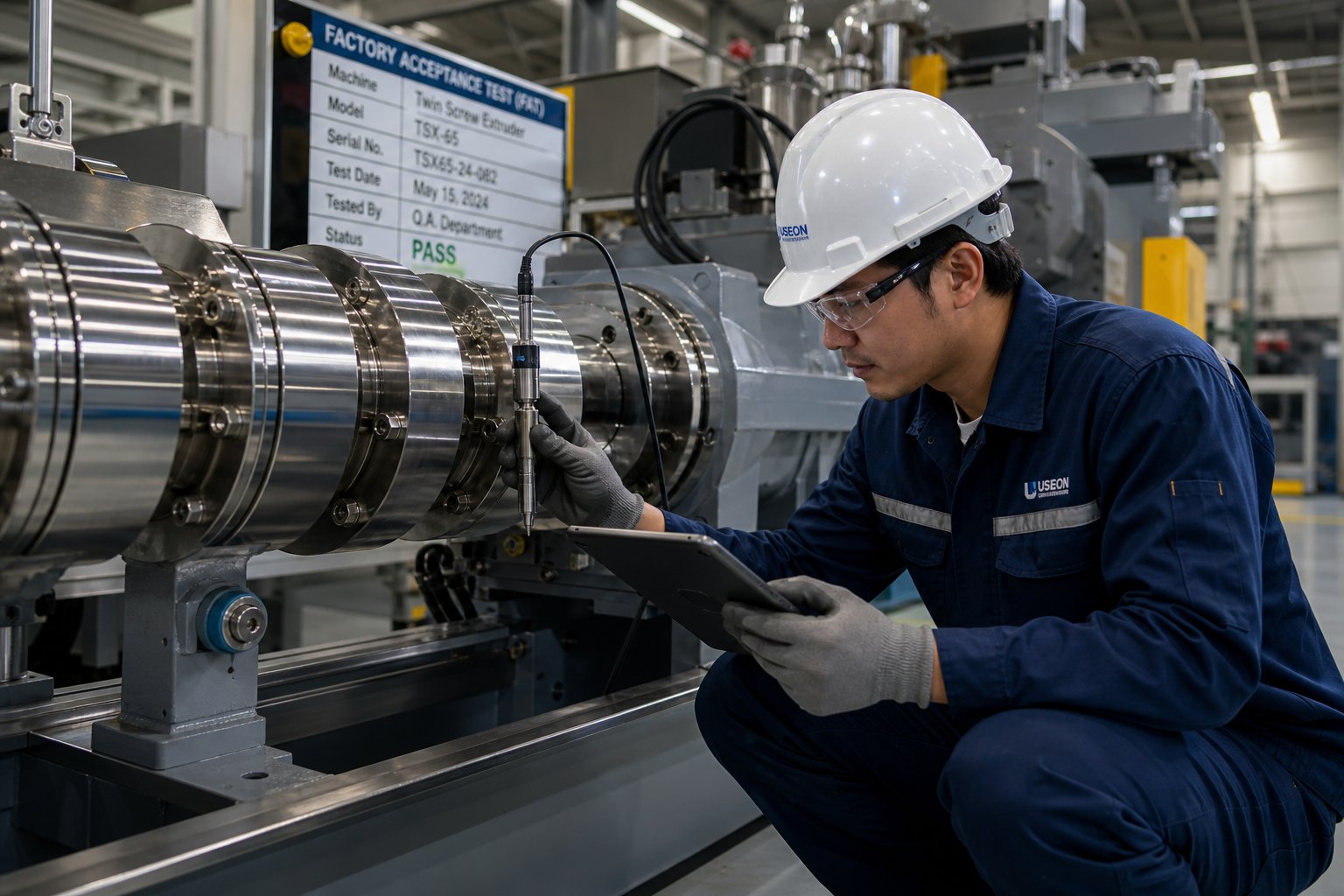
The Factory Acceptance Test itself is your last checkpoint before financial and logistical commitment becomes irreversible. A properly structured FAT verifies that the machine as built matches your purchase order specifications — screw diameter, L/D ratio, motor power, control system configuration, barrel metallurgy, and every other line item you negotiated. It then goes further, testing actual performance: output capacity against rated specs, melt temperature stability, screw speed accuracy, motor current under load, and vibration levels at bearing housings.
Based on documented FAT protocols, acceptance thresholds should be defined in writing before you travel — not negotiated on the factory floor. Typical benchmarks include output at or above 95% of rated capacity (measured by weighing output over a 30-minute run), melt temperature stability within plus or minus 3 degrees Celsius at the die exit, screw speed accuracy within plus or minus 1% of the setpoint, and vibration levels at or below 4.5 mm/s RMS per ISO 10816. These criteria should be signed by both parties in advance and attached to the purchase contract.
The load test — running your actual production material, not the manufacturer's standard test resin — is the most revealing phase. A machine that performs beautifully on neat polypropylene pellets may struggle immediately when fed your 30% glass-filled polyamide. Shipping 50-100 kg of your real formulation to the factory at least two weeks before the scheduled FAT eliminates the single most common source of post-delivery surprises. If the manufacturer resists load testing with your material — citing scheduling, die availability, or any other reason — that resistance is itself a data point you should weigh heavily.
Negotiate FAT terms into the purchase contract at the outset, not as an afterthought. Specify who bears travel costs, what happens if acceptance criteria are not met on the first attempt, how many re-test opportunities are permitted, and what remediation timeline the manufacturer commits to for any deficiencies discovered during the test. Document everything — photographs, data logs, parameter screenshots, and serial numbers — because this documentation becomes your legal record if disputes arise after delivery.
Any manufacturer reluctant to host a factory visit or perform a factory acceptance test on your actual production material should be moved to the bottom of your shortlist — or removed from it entirely.
Due diligence is not a single event. It is a cumulative process that begins with red flag screening, sharpens through structured RFQ questioning, and culminates in physical verification at the factory. Buyers who complete all three phases rarely end up in the dispute resolution scenarios that haunt those who shortcut the process. The remaining question — how to distill everything covered so far into a weighted scoring system that produces a defensible manufacturer selection — requires one final framework.
Building Your Twin Screw Extruder Evaluation Scorecard and Sourcing Strategy
Red flags have been cataloged. RFQ questions have been drafted. Factory visit protocols are ready. The challenge now is synthesizing all of that information into a single, defensible decision — one you can present to stakeholders, defend under scrutiny, and revisit if circumstances change. A weighted evaluation scorecard does exactly that. It transforms subjective impressions and scattered data points into a structured, quantitative comparison that makes the rationale behind your manufacturer selection transparent and repeatable.
Equally important — and almost universally overlooked during procurement — is the component sourcing strategy you will need from the moment the machine starts running. Screw elements wear. Barrels erode. Heating elements fail. The manufacturer you select today determines your options for sourcing those replacement parts for the next decade. Treating the equipment purchase and the ongoing parts supply chain as separate decisions is a mistake that costs production plants real money every year.
Building Your Manufacturer Evaluation Scorecard
A scorecard works by forcing two things that informal evaluation avoids: explicit weighting of what matters most to your operation, and consistent scoring of every shortlisted supplier against identical criteria. The weighted scoring framework approach eliminates the halo effect — where a supplier's strength in one area creates an unearned assumption of strength in others — and prevents the loudest voice in the room from driving the decision.
The table below provides a reusable evaluation matrix tailored to twin screw extruder manufacturers. Each row represents a criteria category drawn from the technical, commercial, and operational factors covered throughout this article. The weight column reflects how much that category matters relative to the others — and this is where strategic discussion should happen before anyone starts scoring.
| Criteria Category | Weight (1-5) | Manufacturer A Score (1-5) | Manufacturer A Weighted | Manufacturer B Score (1-5) | Manufacturer B Weighted |
|---|---|---|---|---|---|
| Technical Capability (torque density, barrel metallurgy, screw element precision, L/D range) | [Assign] | [Score] | [Weight x Score] | [Score] | [Weight x Score] |
| After-Sales Support (spare parts lead time, field service availability, remote diagnostics, training programs) | [Assign] | [Score] | [Weight x Score] | [Score] | [Weight x Score] |
| Geographic Proximity (local service center, regional warehouse, time zone alignment for support calls) | [Assign] | [Score] | [Weight x Score] | [Score] | [Weight x Score] |
| Industry Specialization (installed base in your application, process engineering depth, reference customers) | [Assign] | [Score] | [Weight x Score] | [Score] | [Weight x Score] |
| Pricing and TCO (purchase price, energy efficiency, spare parts cost, projected maintenance burden, equipment lifespan) | [Assign] | [Score] | [Weight x Score] | [Score] | [Weight x Score] |
| Customization Flexibility (screw configuration options, barrel zone modularity, control system adaptability, downstream integration) | [Assign] | [Score] | [Weight x Score] | [Score] | [Weight x Score] |
| Weighted Total | — | — | [Sum] | — | [Sum] |
How you assign weights reveals what your organization truly values — and different buyer profiles should weight these categories very differently. Consider three scenarios:
A 24/7 production plant running a plastic twin screw extruder on continuous shifts should weight After-Sales Support and Pricing/TCO at 5 each, because unplanned downtime directly erodes margin and spare parts availability determines how quickly production resumes after a wear event. Technical Capability still matters (a 4 weighting is reasonable), but a machine that scores perfectly on torque density yet has an eight-week spare parts lead time will cost you far more in lost production than one with slightly lower specs and next-day component delivery.
An R&D laboratory evaluating a twin screw compounding extruder for formulation development should weight Customization Flexibility and Technical Capability highest — a 5 and a 5. Modular screw and barrel configurations that can be reconfigured between trials, precise instrumentation, and geometric scale-up similarity to production platforms matter more than geographic proximity or aggressive pricing. After-Sales Support can drop to a 2 or 3, since lab machines run fewer hours and experience less wear.
A mid-sized compounder sourcing a plastic compounding machine for standard filled-polyolefin production benefits from balanced weighting — Technical Capability at 4, Pricing/TCO at 4, After-Sales Support at 3, Industry Specialization at 3, and the remaining categories at 2. This profile reflects the reality that no single factor dominates; the machine needs to be technically adequate, commercially competitive, and supportable over its full service life.
The scoring itself should follow a consistent rubric. A score of 5 means the manufacturer significantly exceeds requirements in meaningful ways. A 4 means they fully meet requirements with notable strengths. A 3 means adequate — basic requirements met without distinction. A 2 indicates partial gaps that require workarounds. A 1 means the manufacturer fails to meet requirements in ways that matter. Define these thresholds before the evaluation team begins scoring, and require evidence citations — "Score 4 based on reference call with Customer X confirming 98% uptime over 18 months" — for every rating assigned. Scores without evidence are opinions, not evaluations.
One final safeguard: run a sensitivity analysis after scoring is complete. Shift the weights by one point in each direction for the top two categories and recalculate. If the winning manufacturer changes, your decision is sensitive to weighting assumptions that deserve deeper discussion. If the ranking holds across reasonable weight variations, you have a robust selection.
Why Screw and Barrel Sourcing Is Part of the Manufacturer Decision
Here is what procurement teams consistently underestimate: the ongoing cost of screw elements and barrel replacements over a twin screw extruder's operating life often rivals or exceeds the original equipment purchase price. A compounding twin screw extruder processing abrasive mineral-filled compounds may require partial or full screw element replacement every 3,000 to 6,000 operating hours. Barrel sections in high-wear zones may need relining or replacement every 8,000 to 15,000 hours. At continuous 24/7 operation, those intervals translate to component replacements measured in months, not years.
Sourcing these components exclusively through the original equipment manufacturer is the default path — and it is frequently the most expensive one. OEM spare parts carry premium pricing that reflects the brand value, distribution overhead, and captive-customer dynamics that any monopoly supplier enjoys. Lead times compound the problem. A European OEM shipping replacement barrel sections to a plant in Southeast Asia may quote six to ten weeks for delivery. For a production line running a twin screw plastic extruder at full capacity, six weeks of degraded output due to worn components is not a minor inconvenience — it is a measurable financial loss.
Factory-direct component suppliers occupy a different position in the supply chain. These manufacturers specialize in producing replacement screw elements, barrel sections, and barrel liners engineered to be compatible with major OEM platforms. They control their own metallurgy, machining, and quality inspection processes — the same capabilities that define a genuine OEM, applied at the component level rather than the complete-machine level. The result is typically shorter lead times, more competitive pricing, and access to specialized metallurgy options that the original manufacturer may not offer or may price prohibitively.
NANHAIYA's screw and barrel product collection is one such factory-direct resource. Their catalog covers screws and barrels for extrusion, injection molding, compounding, pelletizing, and replacement projects — spanning the compatibility range that plastic extrusion plants, equipment buyers, and procurement teams need when maintaining diverse extruder fleets. Whether you operate a screw extruder granulator line producing recycled pellets or a high-performance compounding system running engineering plastics, the ability to source wear components from a dedicated manufacturer rather than routing every order through the OEM's spare parts department gives your operation a meaningful cost and lead-time advantage.
The strategic case for aftermarket component sourcing extends beyond simple cost savings. Consider the scenarios where it makes the most operational sense:
- Reducing spare parts inventory costs. Carrying a full set of OEM-priced replacement screw elements as safety stock can tie up $25,000 to $100,000 in inventory. Factory-direct suppliers offering compatible elements at lower price points let you maintain the same inventory coverage with less capital locked up — or carry broader coverage for the same budget, reducing the risk of extended downtime waiting for a specific element that was not in stock.
- Shortening replacement lead times. When a kneading block or conveying element wears beyond tolerance on a Friday afternoon, the difference between a two-week and a six-week lead time is the difference between a minor production disruption and a major schedule miss. Component specialists focused exclusively on screw and barrel manufacturing often maintain larger ready-to-ship inventories of common element geometries than OEMs whose primary business is selling complete machines.
- Accessing specialized metallurgy options. Your OEM may offer two or three barrel liner grades. A dedicated component supplier frequently offers a wider metallurgy menu — including application-specific alloys optimized for particular polymer-filler combinations. If your screw extruder granulator application involves processing highly abrasive recycled feedstock with metal contaminants, a tungsten carbide liner grade that your OEM does not catalog could double barrel life and cut your per-kilogram wear cost in half.
- Maintaining competitive leverage. Having a qualified alternative source for wear components prevents you from becoming entirely captive to the OEM's spare parts pricing. Even if you continue sourcing primarily through the original manufacturer, the existence of a validated alternative keeps pricing honest and lead time commitments realistic.
The practical takeaway is straightforward: your manufacturer evaluation scorecard should include a line item for spare parts ecosystem — not just the OEM's own parts pricing and availability, but the breadth of compatible aftermarket options that exist for that platform. A twin screw extruder built on widely adopted screw element geometries and standard barrel bore dimensions gives you sourcing flexibility that a proprietary, closed-architecture platform does not. That flexibility translates directly into lower long-term operating costs and reduced vulnerability to supply chain disruptions.
Choosing a twin screw extruder manufacturer is one decision. Managing the machine profitably for the next decade is a continuous series of decisions — and the component sourcing strategy you establish early determines whether those decisions feel like routine maintenance or recurring emergencies. Buyers who build both the equipment selection and the parts supply chain into a single integrated procurement strategy end up with lower total cost of ownership, faster response times when wear events occur, and the operational resilience that keeps production lines running while competitors wait for shipments.
Frequently Asked Questions About Twin Screw Extruder Manufacturers
1. What is the difference between a twin screw extruder OEM and a reseller?
An OEM designs, machines, assembles, and commissions complete twin screw extruder systems in-house, controlling engineering tolerances, barrel metallurgy, gearbox design, and warranty coverage end to end. A reseller purchases finished or semi-finished machines from a contract factory — often overseas — then rebrands and sells them. While resellers may offer local support and lower upfront pricing, they typically cannot customize screw configurations or barrel materials beyond what the source factory provides, and engineering accountability can become unclear when process issues arise. Before engaging any supplier, ask directly whether they engineer and assemble the machine themselves, and request the name and location of the factory where final assembly occurs.
2. How much does a twin screw extruder cost?
Twin screw extruder pricing spans a wide range depending on screw diameter, L/D ratio, drive system quality, automation level, and manufacturer origin. Lab-scale units can start around $20,000, while most industrial production models fall between $80,000 and $300,000. Custom large-scale lines may reach $800,000 or more. However, the purchase price typically represents only 25% to 40% of total ownership cost over the machine's lifespan. Energy consumption, spare parts — which can run $20,000 to $100,000 per screw element set — planned maintenance ($8,000 to $25,000 annually), and unplanned downtime collectively outweigh the initial invoice. Buyers should build a full total cost of ownership model before comparing quotes.
3. What is torque density in a twin screw extruder and why does it matter?
Torque density, measured in Nm/cm3, quantifies how much usable torque the gearbox delivers relative to the cross-sectional area of the screws. Higher torque density allows greater throughput at the same screw diameter or enables processing of tougher, higher-viscosity compounds without upgrading to a larger machine. Premium manufacturers achieve 15 to 18+ Nm/cm3 using proprietary gearbox designs, while budget producers sourcing generic gearboxes often land between 5 and 10 Nm/cm3. Critically, buyers should always confirm whether a quoted torque rating is continuous-duty or peak, since a gearbox rated at peak torque will derate under the sustained loads typical of real production.
4. What should a factory acceptance test (FAT) include for a twin screw extruder?
A properly structured FAT should verify that the machine matches purchase order specifications — screw diameter, L/D ratio, motor power, barrel metallurgy, and control system configuration. Performance testing should confirm output at or above 95% of rated capacity, melt temperature stability within plus or minus 3 degrees Celsius, screw speed accuracy within 1%, and vibration levels at or below 4.5 mm/s RMS per ISO 10816. The most revealing phase is the load test using your actual production material rather than the manufacturer's standard test resin. Ship 50 to 100 kg of your real formulation to the factory at least two weeks before the FAT. Acceptance criteria should be documented and signed by both parties before testing begins.
5. Can I source replacement screw elements and barrels from aftermarket suppliers instead of the original manufacturer?
Yes, and many production plants do so strategically. Factory-direct component suppliers like NANHAIYA (nhyscrews.com/products) manufacture replacement screw elements, barrel sections, and barrel liners compatible with major OEM platforms. These specialists often deliver shorter lead times, more competitive pricing, and a wider metallurgy menu than OEM spare parts channels. The approach is especially valuable for reducing spare parts inventory costs, shortening replacement turnaround during unplanned wear events, and accessing specialized alloy options — such as tungsten carbide liners for abrasive applications — that an OEM may not catalog. Having a qualified aftermarket source also prevents captive-customer pricing dynamics with the original manufacturer.
Written by
Nanhaiya Technical Team
Zhoushan Nanhaiya Plastic Machinery Co., Ltd.
The Nanhaiya technical team supports screw and barrel manufacturing projects through application review, technical communication, custom manufacturing coordination, and production and quality control.
Discuss Your Application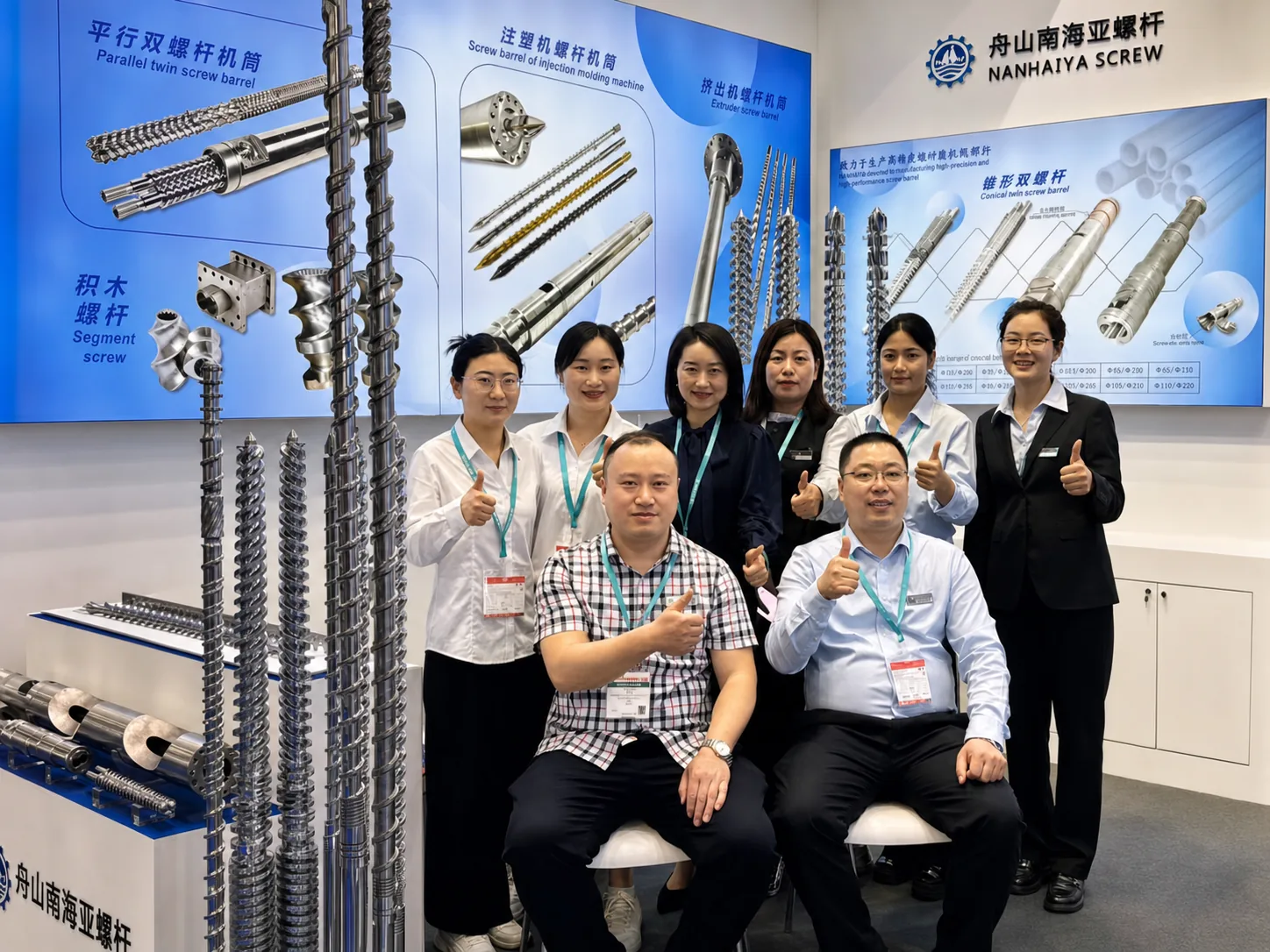
Related Articles
More insights on screw barrel technology and plastics processing.
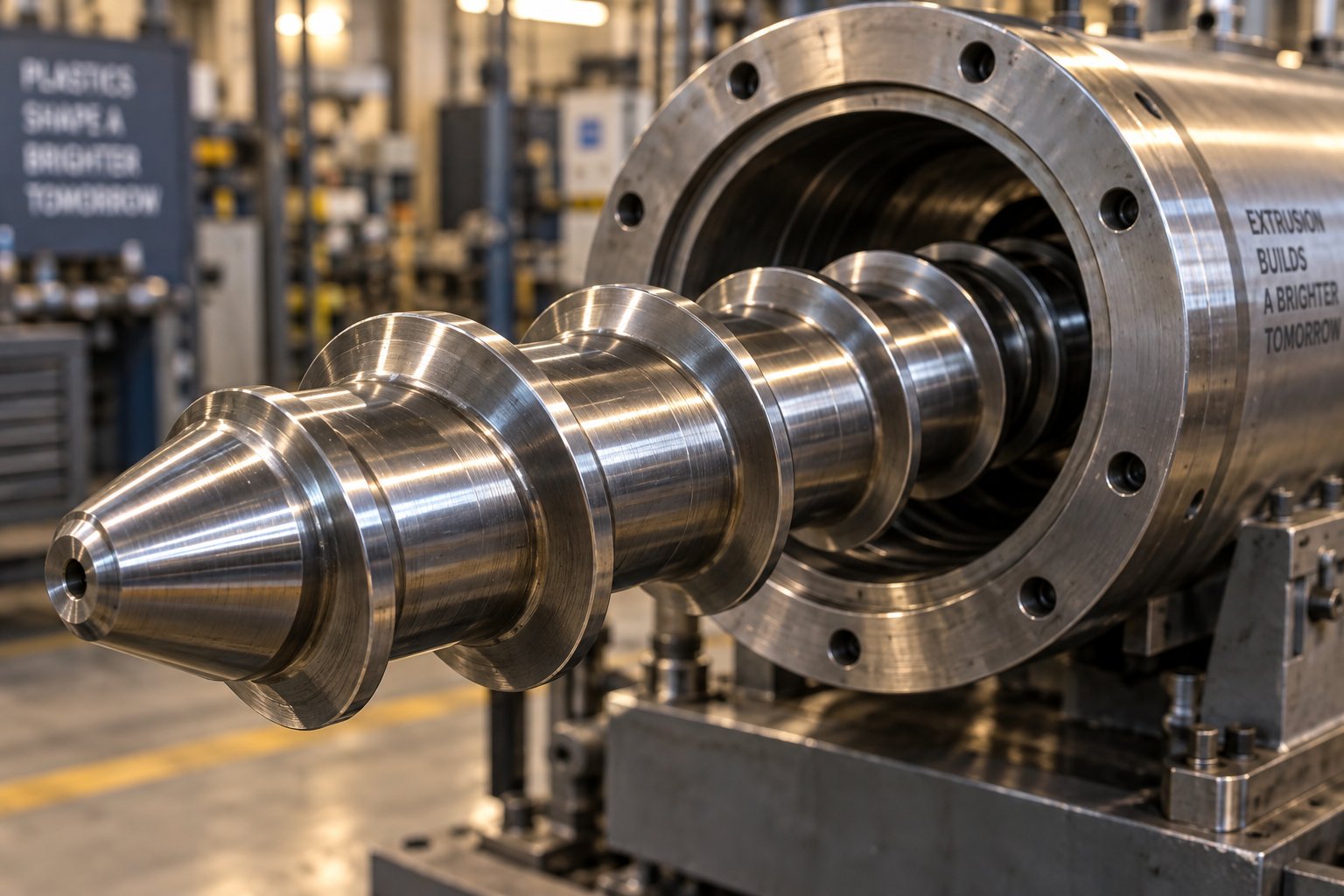
What Nobody Tells You About Screw Barrel For Plastic Machine Design
Oct 10, 2026
Learn how screw barrel for plastic machine design affects melt quality, throughput, and wear life. Covers geometry, resin matching, troubleshooting, and sourcing.
Read Article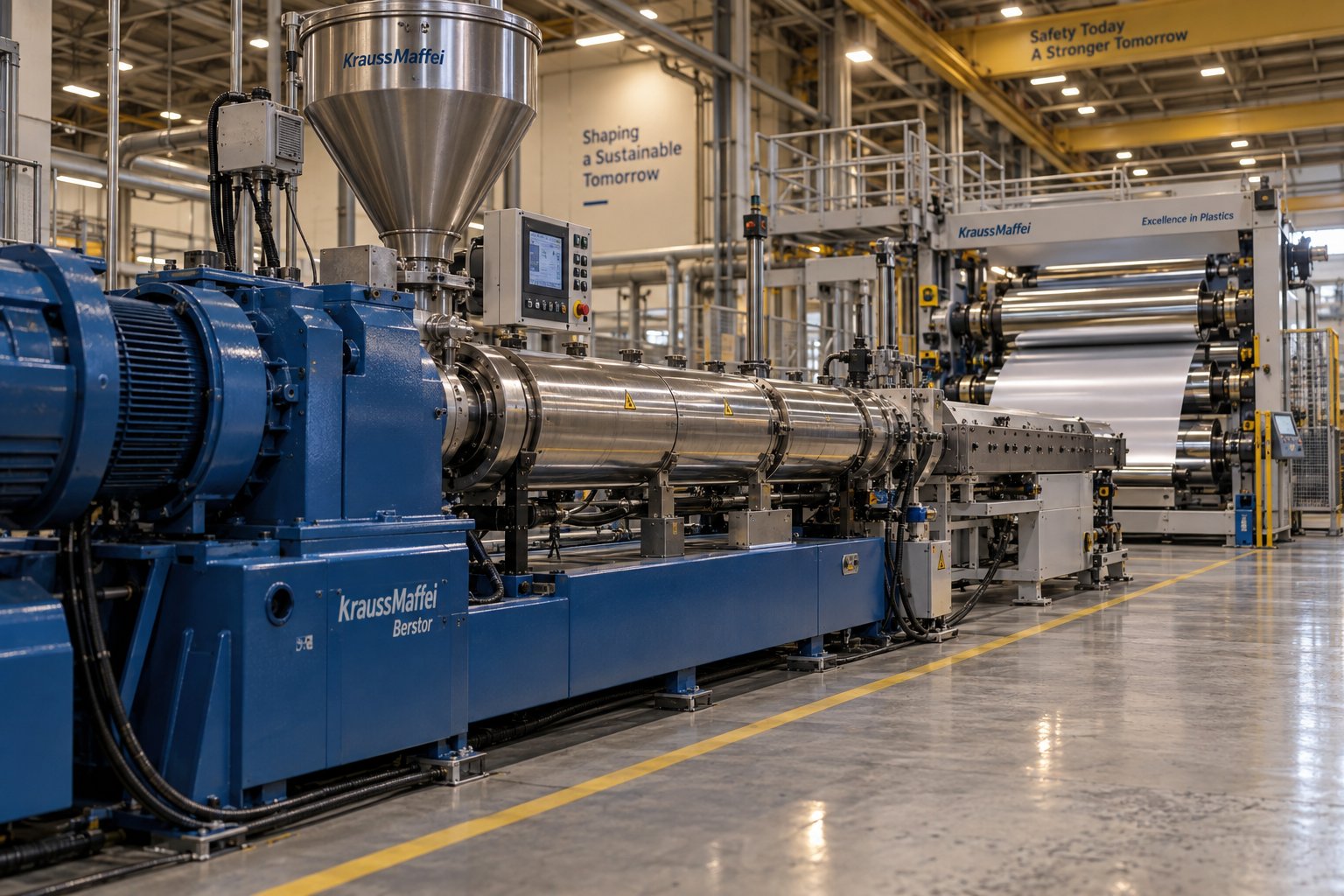
Single Screw Extruder for Sheet: Stop Guessing, Start Specifying
Oct 9, 2026
Learn how to specify a single screw extruder for sheet production. Covers screw geometry, resin-specific processing, troubleshooting, and maintenance best practices.
Read Article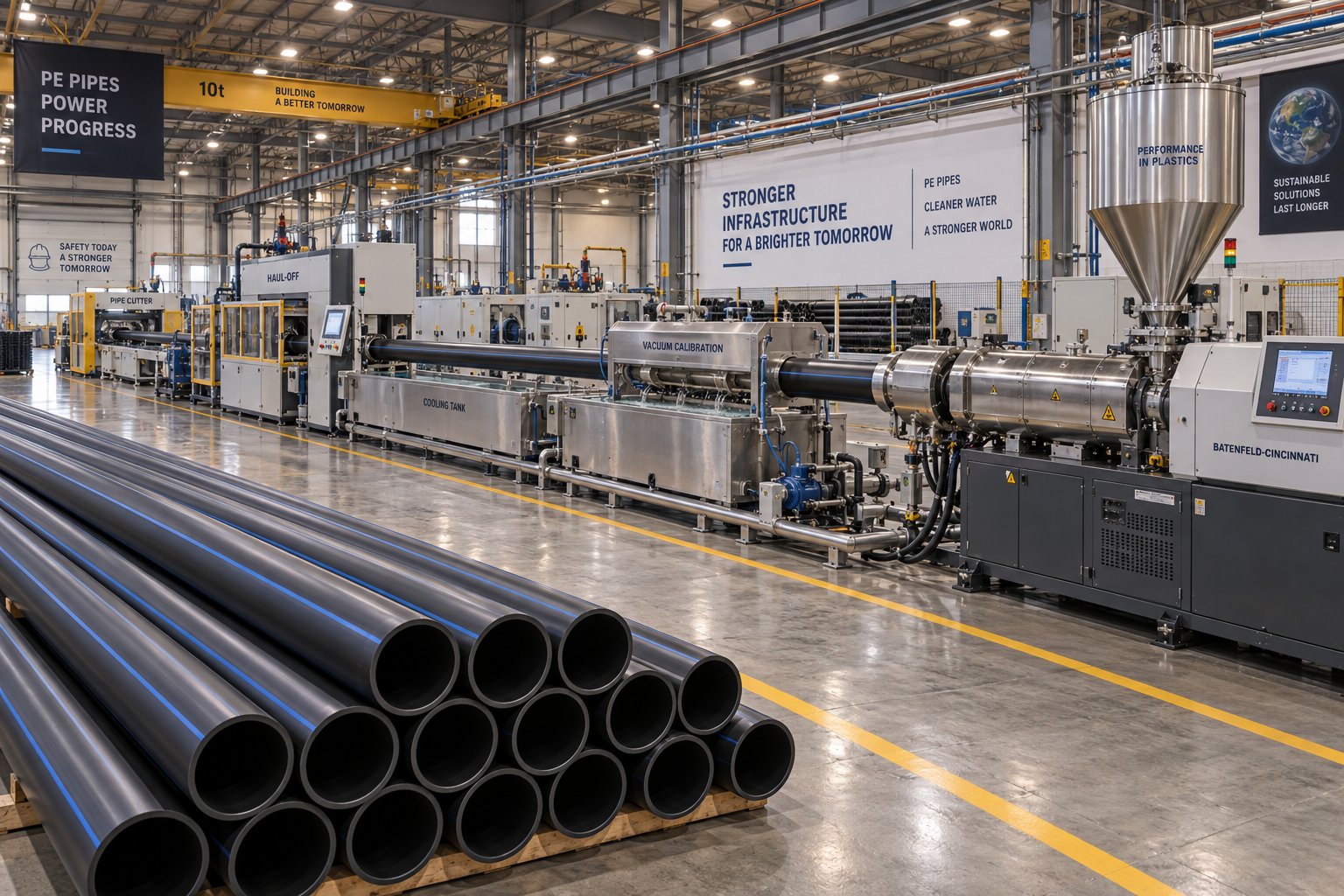
PE Pipe Extruder Machine: What Datasheets Won't Tell You
Oct 9, 2026
Learn how a PE pipe extruder machine works, key specs explained, material grade selection, maintenance tips, and buyer guidance beyond the datasheet.
Read ArticleLooking for something else?
Search by material, symptom or product and jump straight to the relevant page.
These are navigation suggestions based on keyword matching — not a quotation, not a delivery commitment, and not a substitute for engineering review. Final specification is confirmed by our engineers against your drawings and processed material.
Need help with screw barrel selection?
Share your machine model, processed material and application. Our team can help with pricing and technical support.