

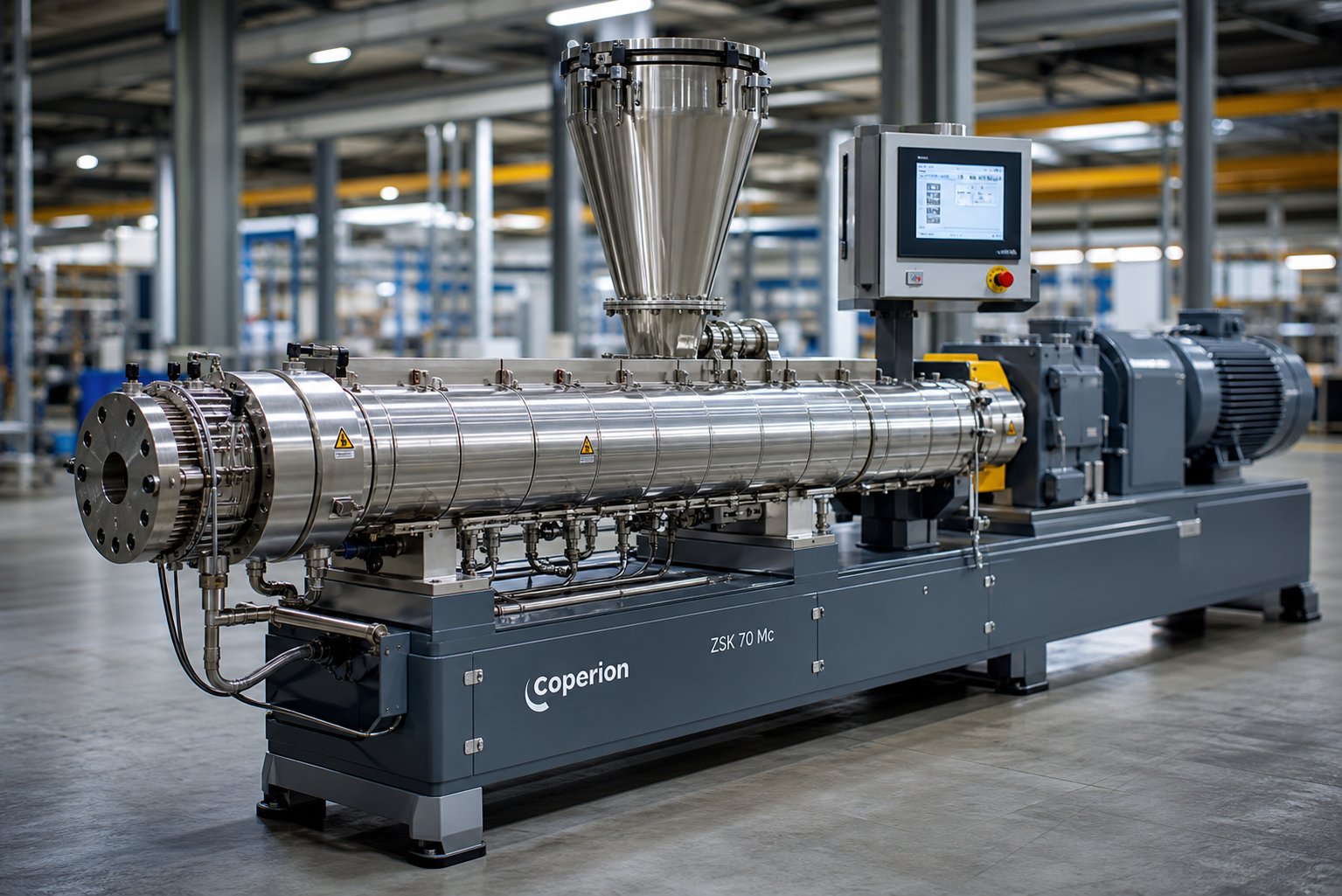
What Twin Screw Extruder Machines Are and Why Manufacturer Choice Matters
Imagine investing six or seven figures in a machine that will run around the clock for the next 15 years — and discovering too late that the company behind it cut corners on metallurgy, outsourced its gearbox, or lacks a spare parts depot within a thousand miles of your plant. That scenario plays out more often than most buyers realize, and it starts with a single misstep: choosing a twin screw extruder machine manufacturer based on price alone.
This guide is written from an independent buyer's-advisor perspective, with no affiliation to any single manufacturer. The goal is straightforward — arm you with the technical knowledge and evaluation frameworks needed to separate genuine engineering partners from private-label assemblers.
What Is a Twin Screw Extruder Machine
A twin screw extruder machine uses two intermeshing screws rotating inside a heated barrel to convey, melt, mix, and shape polymers and other materials. Unlike single screw systems that rely primarily on frictional drag, the twin-screw extruder generates positive displacement and intense shear through its intermeshing geometry, delivering superior mixing, compounding, and material dispersion.
Twin screw extrusion systems come in two principal configurations. In a co-rotating setup, both screws turn in the same direction, producing high shear stress and a self-wiping action that keeps dead zones to a minimum — ideal for compounding, reactive extrusion, and polymer blending. A counter-rotating configuration spins the screws in opposite directions, generating lower shear and a calendering effect between the flights. This gentler approach suits thermally sensitive materials like rigid PVC, where excessive heat can cause degradation.
Both configurations share a modular design philosophy. Barrel segments and screw elements — conveying flights, kneading blocks, mixing zones — can be rearranged to match specific process requirements. That modularity is a hallmark of the double screw extruder concept and one reason these machines span an enormous throughput range, from benchtop lab units processing just a few kilograms per hour to industrial-scale lines handling many tons per hour.
Compared to a single screw extruder, the twin screw extruder offers tighter control over residence time distribution, better dispersive and distributive mixing, and the ability to handle highly filled or reactive formulations. These advantages explain why the double screw extruder machine has become the workhorse of modern compounding facilities worldwide.
Why Your Choice of Manufacturer Matters More Than You Think
A twin screw extruder is only as reliable as the engineering depth, material quality, and after-sales ecosystem behind it. Two machines with nearly identical spec sheets can deliver wildly different results over a decade of production — because the real differentiators hide beneath the surface: gearbox torque density, screw element metallurgy, control system sophistication, and the speed at which you can source replacement wear parts when a barrel liner fails at 2 a.m.
This guide serves three distinct stakeholder perspectives:
- Process engineers evaluating technical capability — screw configuration flexibility, torque ratings, temperature control precision, and mixing performance.
- Procurement managers comparing commercial terms — total cost of ownership, warranty structure, lead times, and spare parts pricing.
- Plant managers focused on operational reliability — uptime track records, service response times, and the manufacturer's ability to support equipment over its full lifecycle.
In the sections ahead, you'll find a clear breakdown of OEM manufacturers versus assemblers, a regional landscape analysis, a weighted evaluation framework you can apply directly to your RFQ process, and application-specific guidance for matching the right manufacturer to your industry vertical. Each section builds on the last, giving you a complete toolkit for one of the highest-impact capital equipment decisions your facility will make.
The distinction between a true OEM and a company that simply bolts together sourced components under its own brand is, arguably, the single most overlooked factor in that decision — and it deserves a closer look.
OEM Manufacturers vs. Assemblers and Why the Distinction Matters
Picture two twin screw extruder manufacturers with nearly identical brochures — same screw diameter range, similar throughput claims, comparable control panels. On paper, they look interchangeable. In practice, one engineered every critical component in-house, while the other purchased a gearbox from one vendor, barrels from another, screw elements from a third, and bolted everything together under a private label. That difference rarely shows up in a spec sheet, yet it determines how your machine performs five, ten, and fifteen years after commissioning.
The extruder industry draws a sharp line between two business models. True OEM manufacturers engineer, design, and fabricate their machines from the ground up — including the screw elements, barrel segments, gearboxes, and process control architecture. They own the intellectual property behind each subsystem, which means they control quality at every stage and can trace a defect back to its root cause. Assemblers, on the other hand, source major components from multiple third-party suppliers, integrate them into a frame, apply their own nameplate, and sell the result as a finished machine. Both models exist across every region — from Nanjing to Stuttgart — and the distinction has nothing to do with country of origin.
Why does this matter so much? Because quality control, warranty enforcement, spare parts continuity, and long-term technical support all hinge on whether the extruder company standing behind the machine actually built what's inside it.
How to Identify a True OEM Twin Screw Extruder Manufacturer
Telling a genuine OEM from a skilled assembler takes a bit of detective work, but the clues are consistent. When you visit a factory — or even review its marketing materials critically — look for these indicators:
- In-house metallurgy and heat-treatment capabilities. True OEMs operate their own nitriding furnaces, HIP (hot isostatic pressing) lines, or partnerships with metallurgical labs they've qualified over years. They can provide full material certificates — hardness values, alloy compositions, heat-treatment protocols — for every screw element and barrel liner.
- Proprietary screw element geometry design. An OEM doesn't just copy a standard profile from a textbook. It develops its own kneading block angles, mixing element geometries, and conveying flight profiles, backed by simulation tools and process data from hundreds of installations.
- Self-manufactured gearboxes vs. outsourced units. The gearbox is the mechanical heart of a twin screw extruder, and its torque density directly limits throughput. Leading OEMs like Coperion design and produce their own high-torque-density gearboxes — the Coperion extruder gearbox in the ZSK Mc18 series, for example, delivers a specific torque of 18 Nm/cm3. Assemblers typically buy generic gearbox units from catalog suppliers, which limits both peak torque and long-term serviceability.
- In-house R&D or application testing center. A manufacturer that maintains a pilot line with 25-65 mm extruders available for customer trials is investing in process knowledge, not just metal fabrication. This capability signals an engineering-first mindset.
- Documented installation base with verifiable references. Genuine twin screw extruder manufacturers can point to specific installations — polymer type, throughput, years in service — and connect you with reference customers. Assemblers tend to offer vague claims without traceable details.
You'll notice a pattern: every checkpoint above points back to depth of engineering ownership. An OEM doesn't just assemble a machine — it understands why each component is specified the way it is, because it designed that component. That depth is what lets the manufacturer troubleshoot a torque spike at 3 a.m. or redesign a screw configuration when you switch from calcium carbonate to glass fiber.
Risks of Purchasing from Assemblers
Assemblers aren't inherently dishonest — many are transparent about their supply chain model. The risk isn't deception; it's structural. When multiple independent suppliers contribute critical subsystems, several predictable problems emerge:
Inconsistent component quality. A barrel sourced from one foundry and screw elements from another may meet individual specifications, yet produce suboptimal results together. Tolerances stack up. Metallurgical compatibility between mating surfaces isn't guaranteed. The Coperion gearbox, for instance, is engineered as a matched system with its drive motor and screw shaft assembly — a generic gearbox integrated by an assembler lacks that system-level optimization.
Spare parts uncertainty years later. Imagine needing a replacement kneading block or barrel liner segment seven years after purchase. A true OEM manufactures those parts on the same CNC machines, using the same alloy specifications, and ships them from its own inventory. An assembler may find that its original barrel supplier has changed alloy grades, discontinued a product line, or gone out of business entirely. That supply chain fragility translates directly into extended downtime.
Weaker engineering support during commissioning and scale-up. When a process issue arises — poor dispersion, surging output, excessive melt temperature — the assembler's support team often lacks the design-level understanding needed to diagnose root causes. They can swap parts, but they can't redesign a screw profile from first principles or simulate a modified barrel temperature zone layout.
Limited customization for niche applications. Reactive extrusion, pharmaceutical hot-melt processing, and high-loading mineral filler compounds all demand screw configurations tailored to specific rheological and thermal profiles. An extruder company that doesn't own its screw element design capability simply cannot offer the same level of process customization that an OEM can.
The bottom line? Assemblers often win on upfront price — sometimes by 20-40%. But the total cost of ownership over a machine's 15-20 year life tells a different story. Unplanned downtime waiting for non-standard spare parts, reduced throughput from mismatched component tolerances, and limited technical support during recipe changes can erode that initial savings many times over. Understanding this dynamic is the first step toward making a manufacturer selection that holds up across the full lifecycle of your investment.
Of course, the OEM-vs.-assembler question plays out differently depending on where in the world the manufacturer operates — and each major region brings its own engineering philosophy, pricing structure, and service infrastructure to the table.

Global Manufacturer Landscape by Region
Where a twin screw extruder is designed and built shapes everything from its price tag and lead time to the depth of after-sales support you can expect a decade after installation. Five regions dominate the global manufacturing landscape, each bringing a distinct engineering philosophy, cost structure, and service model. Understanding these regional profiles helps you build a smarter shortlist — long before the first RFQ goes out.
European Manufacturers and the German Engineering Tradition
Germany sits at the epicenter of twin screw extrusion heritage. The lineage runs deep: the original Werner & Pfleiderer twin screw extruder, developed in Stuttgart in the late 19th century, laid the foundation for modern co-rotating intermeshing technology. That legacy lives on through Coperion, which traces its roots to Hermann Werner's 1879 engineering workshop and today reports more than 15,000 installed compounding systems worldwide. The Coperion extruder portfolio — anchored by the ZSK series — spans from the compact ZSK 18 MEGAlab for pilot work to the ZSK MEGAcompounder for industrial-scale throughput, with operations in locations including Coperion Sabetha KS and Coperion Whitewater WI supporting North American customers with local service and spare parts.
Beyond Coperion, the German tier includes Leistritz, whose ZSE MAXX series delivers specific torque up to 15 Nm/cm³ and an OD/ID ratio of 1.66, and KraussMaffei, whose ZE BluePower series covers screw diameters from 42 mm to 166 mm at speeds reaching 1,200 rpm. Austrian and Swiss niche builders round out the European landscape.
What unites these manufacturers? A shared emphasis on proprietary metallurgy, conservative incremental refinement over decades, and comprehensive global service networks. Coperion K-Tron, the company's feeding technology division, exemplifies the ecosystem approach — pairing precision gravimetric feeders with twin screw extruders so the entire compounding line operates as an integrated system. European machines typically command premium pricing, but they also hold strong residual value on the secondary market, which partially offsets the initial investment.
Chinese Manufacturers and the Value Proposition
China has become the largest production base for twin screw extruders by sheer volume, and the landscape is far more nuanced than a single "budget" label suggests. At one end, you'll find assemblers offering entry-level industrial extruder packages at 40-60% below European pricing — functional for straightforward compounding tasks, but limited in torque density, metallurgical sophistication, and long-term parts continuity. At the other end, a growing tier of advanced Chinese OEMs operates ISO-certified facilities, holds multiple invention patents, and develops proprietary screw element geometries backed by in-house R&D centers.
Nanjing has emerged as the primary hub, home to dozens of twin screw extruder manufacturers ranging from small workshops to companies with 30+ years of continuous development and export footprints spanning 60 countries. Lead times from Chinese suppliers are generally shorter — often 8 to 14 weeks versus 16 to 30 weeks for European equivalents — and turnkey line integration (feeding, extrusion, pelletizing, and packaging) is increasingly offered as a single-source package. The key for buyers is rigorous due diligence: separating genuine OEMs with in-house design capability from assemblers repackaging commodity components.
| Region | Typical Price Tier | Lead Time Range | Engineering Approach | Service Network Strength | Best Suited For |
|---|---|---|---|---|---|
| Germany / Europe | Premium | 16 - 30 weeks | Proprietary R&D, incremental refinement, system-level integration | Global depots, strong in EU and North America | High-performance compounding, regulated industries, demanding applications |
| China | Value to Mid-Range | 8 - 14 weeks | Rapid innovation, turnkey line focus, increasing patent activity | Growing; strongest in Asia, expanding globally | Cost-sensitive projects, standard compounding, recycling lines |
| Japan | Premium to High-Mid | 14 - 24 weeks | Precision engineering, advanced automation, materials science depth | Strong in Asia-Pacific, selective global presence | Specialty polymers, fiber-reinforced materials, reaction extrusion |
| United States | Mid-Range to Premium | 12 - 20 weeks | Application-driven innovation, quick-change flexibility, high torque density | Excellent in North America, limited elsewhere | North American operations, specialized compounding, flexible production |
| Italy | Mid-Range | 12 - 20 weeks | PVC and WPC specialization, energy-efficient designs | Moderate; strongest in Europe, Middle East, and Africa | PVC pipe and profile, wood-plastic composites, recycling |
Japanese, American, and Italian Market Positions
Japan brings a materials-science-first mentality to twin screw extruders. The Japan Steel Works (JSW), established in 1907, builds its TEX series around ultra-precise machining tolerances and advanced automation — strengths that shine in fiber-reinforced composites, reaction extrusion, and specialty polymer devolatilization. Japanese machines tend to occupy a premium-to-high-mid price band, with service networks concentrated in Asia-Pacific.
American manufacturers like CPM Extrusion Group — with over 5,000 extrusion systems delivered globally — and ENTEK, whose HT72 series achieves an industry-leading 18 Nm/cm³ torque density, focus on application-driven innovation and rapid regional service. ENTEK's QC³ quick-change system, designed for small-to-medium lot compounding, reflects a distinctly American emphasis on production flexibility. Davis-Standard's Thermatic® extruders cover diameters from 40 mm to 250 mm with L/D ratios up to 40:1, targeting conventional polymer processing with strong local support infrastructure. The trade-off? North American service excellence rarely extends overseas with the same depth.
Italian builders carve out a focused niche. Bausano, founded in 1946, has built nearly eight decades of expertise around counter-rotating twin screw extruders for PVC pipe and profile extrusion, while ICMA San Giorgio brings co-rotating MCM series machines to masterbatch, recycling, and wood-plastic composite applications. Italian manufacturers often deliver a compelling mid-range value proposition — strong engineering at price points below German competitors — with particular depth in PVC and WPC processing segments.
Regional origin, however, only tells part of the story. Two manufacturers from the same city can differ dramatically in engineering depth, service responsiveness, and total value delivered. That's why a structured evaluation framework — one that weights the factors most relevant to your specific operation — is essential for turning this regional landscape into a confident shortlist.
A Weighted Evaluation Framework for Comparing Twin-Screw Extruder Manufacturers
You've mapped the regional landscape and identified whether a supplier is a true OEM or an assembler. The next challenge? Comparing three, four, or five shortlisted companies in a way that's defensible, repeatable, and tailored to your specific operation. Gut instinct won't survive a capital approval committee — and spreadsheets full of raw specs don't capture what actually drives long-term satisfaction with an industrial extruder machine purchase.
A weighted scoring framework solves this problem by forcing your team to define what matters most before evaluating any extruder manufacturer. It replaces subjective debate with structured analysis, reduces bias, and produces a documented rationale you can revisit when stakeholders ask, "Why did we pick this supplier?"
The Five Pillars of Manufacturer Evaluation
Every twin-screw extruder manufacturer can be assessed across five core dimensions. Each pillar captures a different layer of value — from what's bolted to the factory floor to what happens when something breaks at midnight.
1. Machine Quality and Engineering Depth. This is the foundation. Evaluate the metallurgy of screw elements and barrel liners — are they nitrided steel, bimetallic, or powder metallurgy alloys? Examine gearbox torque density (measured in Nm/cm³), because that number directly limits how hard you can push the machine. Assess the sophistication of the extruder machine controller: does it offer multi-zone PID temperature management, real-time torque monitoring, and recipe storage, or just basic on/off functionality? A high score here signals deep engineering ownership.
2. Price-to-Performance Ratio. Forget "lowest price." The meaningful metric is value per unit of throughput and product quality. A machine priced 30% higher that delivers 20% more output with tighter melt temperature control may cost less per kilogram of finished compound over its lifetime. Compare quoted pricing against torque capacity, maximum speed, barrel length options, and included automation features.
3. After-Sales Service and Spare Parts Network. How fast can you get a replacement kneading block or barrel segment? Does the manufacturer maintain regional spare parts depots, or does every order ship from a single factory overseas? Response times for technical support — especially during commissioning and the first year of production — separate top-tier extruders manufacturers from the rest.
4. Application Expertise and Testing Capability. Does the manufacturer operate a process lab or trial center where you can run your actual formulation before purchasing? Companies that invest in pilot-scale testing facilities demonstrate confidence in their technology and give you a risk-reduction tool that's hard to replicate with spec sheets alone.
5. Customization and Scalability. Can the manufacturer offer a complete pathway from a laboratory twin screw extruder to full production scale within a single platform? Consistency in screw geometry, barrel design, and extruder machine controller architecture across machine sizes makes scale-up predictable rather than experimental.
| Evaluation Criterion | Suggested Weight Range | High Score (4-5) Indicators | Low Score (1-2) Indicators |
|---|---|---|---|
| Machine Quality & Engineering Depth | 25% - 35% | In-house metallurgy, proprietary gearbox design, torque density above 10 Nm/cm³, advanced control system with recipe management | Generic sourced gearbox, basic PLC controls, no material certificates provided for wear components |
| Price-to-Performance Ratio | 15% - 25% | Competitive cost per kg of throughput, strong energy efficiency specs, automation features included in base price | Low headline price but stripped-down configuration, high cost for essential options, poor energy efficiency |
| After-Sales Service & Spare Parts | 15% - 25% | Regional spare parts depots, 24-48 hr critical parts delivery, dedicated service engineers, documented response time SLAs | Single-source parts supply, multi-week lead times for wear components, no local service presence |
| Application Expertise & Testing | 10% - 20% | In-house pilot lab, published application data, process engineers available for trials, documented installation base in your industry | No testing facility, limited process knowledge, few or no verifiable references in your application area |
| Customization & Scalability | 10% - 15% | Full range from lab to production scale, modular barrel/screw platform, flexible L/D ratios, proven scale-up methodology | Single machine size offered, fixed configurations, no lab-to-production pathway |
How to Weight Criteria for Your Specific Purchase
The weight distribution should mirror your operational reality — not a generic template. Consider two contrasting buyer profiles:
A startup scaling from R&D to commercial production will lean heavily on Customization & Scalability (raise to 15%) and Application Expertise (raise to 20%). The ability to develop a formulation on a small machine and transfer it confidently to a production-scale extruder — within the same manufacturer's platform — eliminates months of trial-and-error and reduces scale-up risk dramatically.
A high-volume compounder adding a second or third production line already knows its process. Uptime is everything. Shift weight toward After-Sales Service & Spare Parts (raise to 25%) and Machine Quality (keep at 30-35%). Spare parts speed, preventive maintenance programs, and energy efficiency at sustained high throughput become the decisive factors. Price-to-Performance still matters, but it's evaluated through a total-cost-of-ownership lens rather than purchase-order comparison.
A contract compounder serving diverse end markets needs maximum flexibility. Application Expertise and Customization both deserve elevated weights, because the machine must handle frequent recipe changes and a wide material portfolio — from mineral-filled polyolefins one week to glass-fiber-reinforced nylon the next.
The scoring exercise itself delivers value beyond the final number. When your cross-functional team — process engineering, procurement, plant operations — sits down to debate whether service speed deserves 15% or 25%, you're aligning organizational priorities before a purchase order is signed. That alignment pays dividends long after the machine is installed.
With a structured framework in hand, the next logical step is matching it to the real-world applications that define your production requirements — because the best extruder manufacturer for masterbatch production may not be the best fit for battery electrode compounding or pharmaceutical hot-melt extrusion.
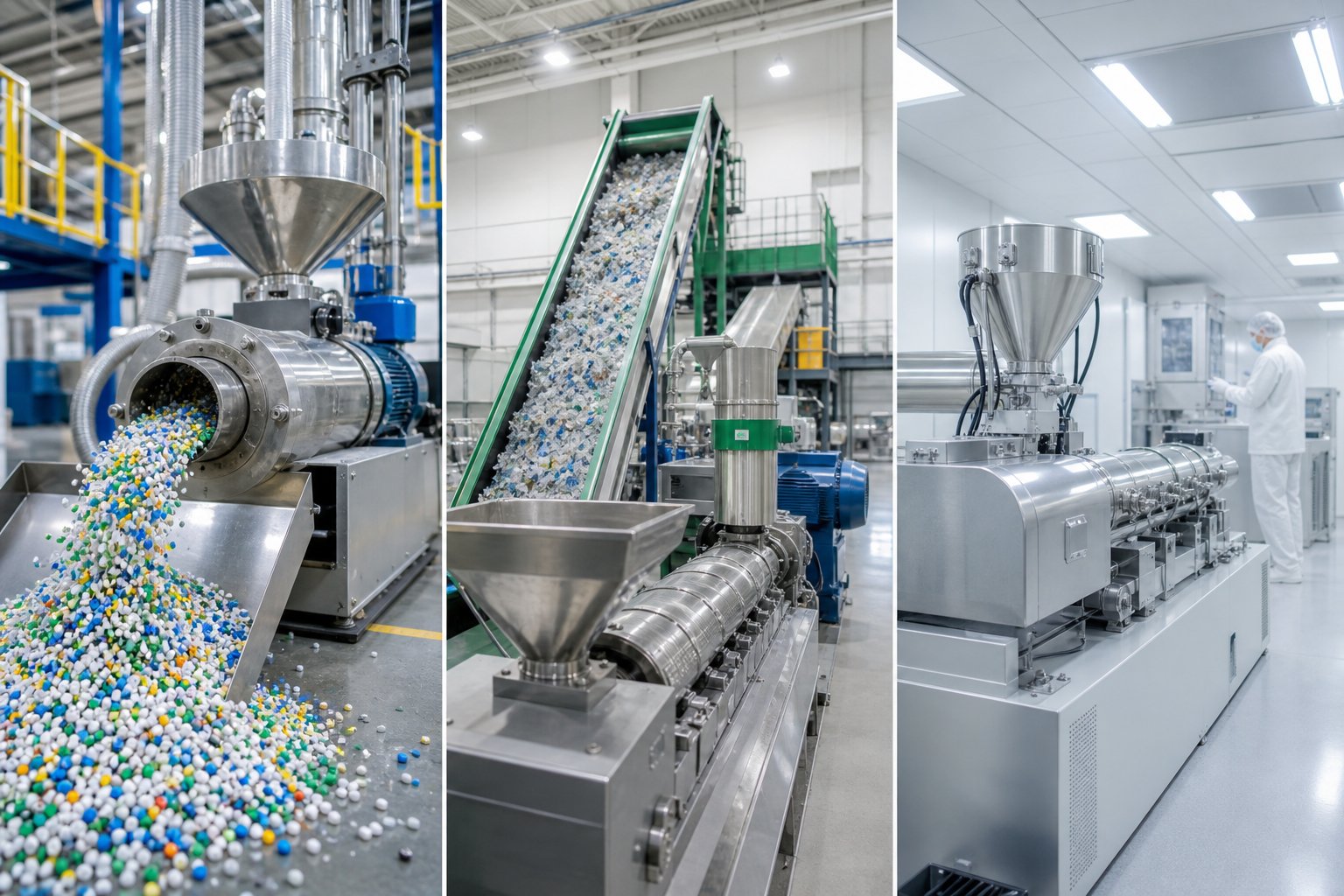
Industry-Specific Applications and Manufacturer Specializations
A manufacturer that excels at engineering plastics compounding may stumble badly when asked to design a screw configuration for pharmaceutical hot-melt extrusion — or a food-grade textured protein line. Twin screw extruder machine manufacturers tend to concentrate their R&D investment, application know-how, and reference installations within specific industry verticals. Matching your application to a manufacturer's proven specialization is one of the fastest ways to shrink a long list of potential suppliers into a confident shortlist.
Plastics Compounding and Masterbatch Production
Plastics compounding remains the single largest application segment for twin screw extruders, accounting for roughly 45% of global demand. Within this space, color masterbatch, additive masterbatch, and filled compound production each impose demanding — and sometimes conflicting — requirements on the machine and the manufacturer behind it.
Think about what a color masterbatch line needs: exceptional dispersive and distributive mixing to break down pigment agglomerates into sub-micron particles, precise temperature control to prevent thermal degradation of heat-sensitive colorants, and tight residence time distribution to deliver batch-to-batch color consistency. A compounding twin screw extruder running 60% titanium dioxide loading in polyethylene, by contrast, prioritizes raw torque density and abrasion-resistant metallurgy over mixing subtlety.
When evaluating a plastic compounding machine for these applications, the manufacturer capabilities that matter most include:
- High specific torque density — ideally above 13 Nm/cm³ for mineral-filled compounds and glass-fiber-reinforced grades, where the screws fight constant resistance from abrasive fillers.
- Modular screw element library — at least 20+ element types (conveying, kneading blocks at various stagger angles, mixing, and distributive elements) to fine-tune dispersion for each recipe.
- Downstream pelletizing integration — manufacturers with proven strand, underwater, or water-ring pelletizing experience reduce the integration risk that comes from cobbling together equipment from multiple vendors.
- Wear-resistant barrel and screw metallurgy — bimetallic HIP liners, tungsten carbide coatings, or powder metallurgy alloys that extend replacement intervals when processing abrasive formulations.
Manufacturers like Coperion, KraussMaffei, JSW, and several advanced Chinese OEMs have deep reference libraries in plastics compounding. Smaller or newer suppliers may offer competitive plastic compounding equipment for standard formulations but lack the process data and application engineering depth required for complex recipes involving shear-sensitive additives or high-loading mineral fillers.
Recycling, Bioplastics, and Battery Materials
Three high-growth application segments are reshaping which twin screw extruder machine manufacturers gain market share — and which fall behind.
Post-consumer recycled (PCR) plastics processing presents a unique set of challenges. Contaminated, variable-feedstock waste streams demand robust melt filtration compatibility, multi-stage vacuum degassing to remove moisture, volatiles, and odors, and corrosion-resistant screw and barrel metallurgy to handle the acidic byproducts of degraded polymers. A twin screw compounding extruder designed for virgin polyolefin compounding may lack the vent port quantity, vacuum system capacity, and filtration interface geometry needed for real-world recycled content processing. Manufacturers investing heavily in recycling-specific configurations — extended L/D ratios, additional degassing zones, and screen changer integration — are capturing share as recycled content regulations tighten worldwide.
Bioplastics compounding demands a different kind of precision. Materials like PLA, PHA, and starch-based blends are thermally sensitive, moisture-reactive, and often require narrow processing windows. Manufacturers that offer tight multi-zone temperature control, gentle conveying element configurations, and validated drying-to-extrusion workflows have a decisive edge. Coperion food equipment technology, originally developed for food-grade processing, has proven transferable to bioplastics applications where hygiene standards and thermal sensitivity overlap.
Battery electrode material processing is perhaps the most dramatic emerging application. As Thermo Fisher Scientific's research details, twin screw extruders are now critical for mixing active materials, binders, and conductive additives into the homogeneous slurries and dry electrode formulations that lithium-ion battery production demands. This application requires cleanroom-compatible machine designs, specialized screw metallurgy to prevent metallic contamination, and extremely precise process control to maintain the uniformity that directly impacts battery cell performance and safety. Only a handful of manufacturers — those with dedicated R&D programs and contamination-controlled process environments — can credibly serve this sector.
Food, Pharmaceutical, and Specialty Applications
Twin screw extrusion extends well beyond plastics. Food processing — including textured vegetable proteins, breakfast cereals, snack foods, pet food, and aqua feed — relies on the same intermeshing screw geometry for cooking, gelatinization, and protein texturization. Even meat extruder applications for analog and hybrid protein products use twin screw platforms. Pharmaceutical hot-melt extrusion (HME) leverages the compounding machine's mixing precision to create solid dispersions, controlled-release drug delivery systems, and continuously manufactured dosage forms under GMP conditions.
Some manufacturers maintain entirely separate divisions or facility certifications for these non-plastics verticals. Choosing a manufacturer certified for food-contact or pharmaceutical-grade production isn't just about the machine itself — it's about the documentation, cleaning validation protocols, material traceability, and regulatory compliance infrastructure that surrounds it.
- Plastics compounding and masterbatch — Critical manufacturer capabilities: high torque density, extensive modular screw element library, proven downstream pelletizing integration.
- Recycling and circular economy — Critical manufacturer capabilities: multi-stage degassing design, melt filtration compatibility, corrosion-resistant metallurgy for contaminated feedstocks.
- Bioplastics and sustainable polymers — Critical manufacturer capabilities: precise multi-zone thermal management, gentle conveying profiles, validated processing of moisture-sensitive materials.
- Battery electrode and energy storage materials — Critical manufacturer capabilities: cleanroom-compatible design, contamination-free screw metallurgy, ultra-precise process control and monitoring.
- Food, pharmaceutical, and specialty — Critical manufacturer capabilities: GMP/food-grade facility certification, full material traceability and documentation, cleaning validation and regulatory compliance support.
Matching your industry vertical to a manufacturer's demonstrated specialization cuts through marketing noise and focuses your evaluation on what the supplier can actually prove — with installed references, application data, and tested screw configurations. Yet even the perfect application fit doesn't answer one of the most consequential questions in any capital equipment decision: what will this machine truly cost you over the next 15 to 20 years of operation?
Total Cost of Ownership Beyond the Twin Screw Extruder Price
A twin screw extruder price on a purchase order tells you what the machine costs on day one. It tells you almost nothing about what it will cost over 15 to 20 years of continuous operation. Yet most buyers — even experienced procurement teams — still anchor their manufacturer comparison on that initial number. The result? Facilities that saved 25% at the point of sale end up spending 40% more over a decade in energy, wear parts, unplanned downtime, and lost production.
Total cost of ownership (TCO) flips that equation. It captures every dollar the machine demands across its operational life: the electricity feeding its motor, the replacement screw elements and barrel liners consumed by abrasive fillers, the maintenance labor, and the production hours lost when a gearbox bearing fails at peak season. Industry TCO analyses suggest that the initial purchase price represents only 30% to 50% of what a twin screw extruder actually costs over five years — and that ratio tilts even further toward operating expenses over a full 10- to 20-year horizon. Understanding these hidden cost drivers is what separates a smart capital decision from an expensive mistake.
Energy Consumption and Drive Efficiency
Energy is the silent budget killer. A screw extruder running two shifts per day, five days a week, can easily consume $15,000 to $60,000 in electricity annually depending on motor size, throughput, and drive efficiency. Multiply that across a machine's 15-year lifespan and you're looking at a cumulative energy bill that rivals — or exceeds — the original purchase price.
Three engineering decisions made by the manufacturer determine where your machine falls on that cost spectrum:
Motor efficiency ratings. Premium-tier manufacturers specify IE3 or IE4 class motors as standard, delivering 2% to 5% better efficiency than older IE1 or IE2 units. That margin may sound small, but on a 250 kW drive running 4,000+ hours per year, the difference translates to measurable annual savings — compounding year after year for the life of the machine.
Gearbox design and torque density. A well-engineered gearbox converts motor power to screw torque with minimal mechanical loss. High-torque-density gearboxes — like those developed by leading OEMs at 13-18 Nm/cm³ — allow the machine to achieve target throughput at lower screw speeds, reducing specific energy consumption (kWh per kilogram of processed material). Cheap gearboxes with lower torque ratings force operators to compensate with higher speeds, which not only wastes energy but accelerates wear throughout the drivetrain.
Barrel heating and cooling systems. Efficient barrel temperature management relies on well-designed zone heating elements and responsive cooling circuits. Some manufacturers use cast aluminum heaters with integral cooling channels that offer faster response and lower energy waste compared to mica band heaters. The thermal efficiency of the barrel system affects how precisely you can control melt temperature — and every unnecessary degree of overheating represents wasted energy and potential polymer degradation.
You'll also encounter a choice between direct-drive and belt-drive configurations. Direct-drive systems couple the motor to the gearbox without belts or pulleys, eliminating the 3% to 5% energy loss from belt slip and flex. They also reduce maintenance since there are no belts to tension, inspect, or replace. Belt-drive setups cost less upfront and offer easy speed ratio changes, but their ongoing energy penalty and maintenance demands make them a poor TCO choice for continuous production lines. An energy-efficient plastic profile extruders supplier or compounding line builder that defaults to direct-drive architecture signals a focus on operational economics, not just sticker price.
Screw and Barrel Wear Rates and Replacement Costs
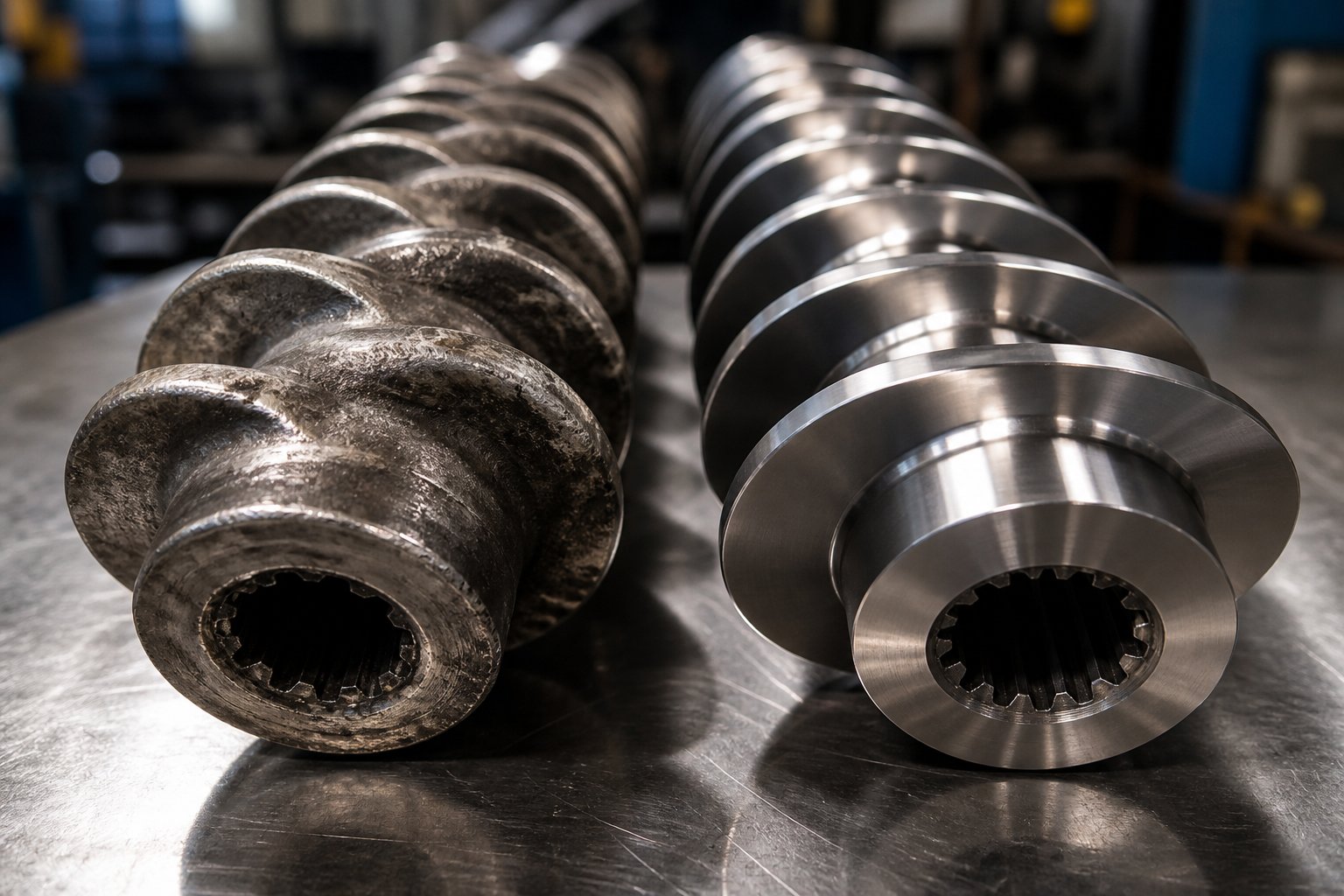
If energy is the silent cost, wear parts are the loud one — and they hit harder than most buyers anticipate. Replacement screw elements and barrel liners represent one of the single largest ongoing cost categories for any twin screw extruder, particularly in abrasive compounding applications.
Here's why this matters so much: as screw flight outer diameter wears down, the clearance between the screw and barrel bore widens. That increasing gap allows more polymer to leak backward across the flights instead of moving forward. The result is a measurable drop in output — documented studies show 8% to 15% throughput loss as clearance grows from 0.1 mm to 0.5 mm on a typical industrial machine. Melt temperature uniformity deteriorates simultaneously, and mixing quality falls off. You're producing less product, at lower quality, while consuming roughly the same energy.
The metallurgy choices made by the manufacturer at the design stage determine how quickly this degradation begins:
Nitrided steel (the baseline) provides a hard surface layer of 0.3 to 0.7 mm depth. It's adequate for unfilled commodity polymers, but in abrasive compounding with glass fiber or mineral fillers, the nitrided case can wear through in 2,000 to 4,500 operating hours — triggering a replacement cycle that repeats multiple times per year in 24/7 operations.
Bimetallic liners with tungsten carbide or high-chromium iron-based alloys push bore hardness to 60-72 HRC and extend barrel life by a factor of three to five compared to standard nitrided barrels.
Tungsten carbide coatings applied via HVOF thermal spray on screw flights achieve effective hardness above 1,100 HV, while powder metallurgy alloys like CPM 10V deliver uniform carbide distribution that resists severe abrasion for 15,000 to 20,000+ hours in heavily filled applications.
Consider a concrete example. A 75 mm twin screw compounding extruder processing 40% glass-filled PA66 might consume a standard nitrided screw set every 4,000 hours — roughly every six months of two-shift production. At $8,000 to $12,000 per replacement set, plus $12,000 to $40,000 in downtime-related production losses per changeover, the annual wear-parts cost can approach or exceed the original purchase price of a budget machine.
This is where parts sourcing strategy becomes a critical TCO lever. OEM replacement parts typically guarantee exact metallurgical and dimensional compatibility, but they carry premium pricing — often 30% to 50% above third-party alternatives. Qualified aftermarket suppliers with in-house heat treatment, hardfacing, and precision grinding capabilities can deliver comparable performance at lower cost, provided they supply documented material certificates and hardness verification. Whether you're evaluating a twin screw extruder for sale or planning the long-term maintenance budget for an existing line, confirming that competitively priced, high-quality replacement screw and barrel components are readily available — from the OEM, from qualified third parties, or from factory-direct specialists like NANHAIYA — should rank as high on your checklist as the machine's throughput spec.
Maintenance, Downtime, and Spare Parts Access
Beyond wear components, a twin screw extruder demands a disciplined preventive maintenance program: gearbox oil analysis and replacement, coupling inspections, barrel alignment checks, calibration of temperature controllers and pressure sensors, and periodic evaluation of upstream and downstream ancillaries — from the extruder hopper and gravimetric feeding system to the melt pump or extrusion pump that stabilizes die pressure. Each of these elements contributes to the machine's overall reliability profile.
Imagine a melt pump bearing failing without warning on a line that feeds a continuous sheet die. The downstream process stops instantly. If the manufacturer maintains a regional spare parts depot with critical components in stock, a replacement pump can arrive within 24 to 48 hours. If the only source is a factory 8,000 miles away, you could be looking at two weeks of dead production — a loss that dwarfs any savings from choosing a lower-priced machine.
Mean time between failures (MTBF) varies significantly across manufacturers and correlates strongly with engineering depth. Top-tier OEMs engineer gearboxes, drive couplings, and barrel assemblies for MTBF figures that keep unplanned downtime below 1% to 2% of scheduled production hours. Budget machines from assemblers commonly experience 8% to 15% unplanned downtime — a gap that translates into hundreds of thousands of dollars in lost output over a decade.
Manufacturer service network density is the multiplier. A supplier with field service engineers stationed within a few hours' drive of your facility can dispatch technical support for commissioning issues, process optimization, and emergency repairs with minimal delay. A distant manufacturer without regional presence turns every service event into a logistics project.
To give you a clear picture of where the money actually goes, here are the top TCO cost categories ranked by their typical cumulative impact over a 10-year ownership period:
- Unplanned downtime and lost production — the single largest TCO driver, often accounting for 30% to 40% of total lifetime cost. Every hour the machine sits idle costs far more than the most expensive spare part.
- Energy consumption — the steady, relentless cost that accumulates daily. Over 10 years, energy typically represents 20% to 30% of TCO, heavily influenced by motor efficiency, gearbox design, and screw/barrel clearance condition.
- Screw element and barrel liner replacements — the dominant maintenance expense, responsible for 15% to 25% of TCO in abrasive compounding applications. Metallurgy quality at the point of manufacture directly determines replacement frequency.
- Preventive maintenance labor and consumables — gearbox oil changes, coupling replacements, heater band swaps, temperature controller calibration, and inspection of ancillary components including the extruder hopper feed throat and downstream extrusion pump or melt pump assemblies. Typically 5% to 10% of TCO.
- Initial purchase price — often just 15% to 25% of the total 10-year ownership cost. The number that gets the most attention during procurement delivers the least predictive value for long-term economics.
The purchase price of a twin screw extruder is a deposit on its total cost of ownership — not the final bill.
When you evaluate TCO honestly, the competitive landscape shifts. Manufacturers whose machines cost more upfront but deliver lower specific energy consumption, longer screw and barrel service life, faster spare parts access, and fewer unplanned downtime events consistently emerge as the lower-cost option over any realistic ownership horizon. The discipline of TCO analysis also reveals which certifications and quality standards a manufacturer should meet — because the documentation behind a machine's build quality is what gives you confidence that the TCO projections on paper will hold up on the factory floor.
Certifications and Quality Standards Every Buyer Should Verify
A TCO projection is only as credible as the manufacturing quality behind it — and manufacturing quality, in turn, is only verifiable when it's documented. Certifications, compliance marks, and metallurgical records serve as the paper trail that separates a rigorously managed twin-screw extruder machine factory from one that relies on verbal assurances. Yet surprisingly few buyers dig into this documentation during the RFQ process. They compare torque specs and pricing in granular detail, then accept a photocopied ISO certificate at face value without verifying its scope, its accreditation body, or whether it even covers the division building their machine.
That oversight can prove costly. Here's what to look for — and how to verify it.
ISO Certifications and Manufacturing Quality Systems
Two ISO standards show up most often in twin screw extruder plastic machinery manufacturing, and each tells you something different about how the facility operates:
ISO 9001 (Quality Management Systems) confirms that the manufacturer has established documented processes for design, production, inspection, and continuous improvement. It doesn't guarantee that a specific machine is flawless — it guarantees that a system exists to catch and correct problems consistently. For a plastic twin screw extruder buyer, ISO 9001 certification signals that incoming raw materials are inspected against specifications, machining tolerances are verified at defined checkpoints, and nonconforming products are tracked and addressed rather than quietly shipped.
ISO 14001 (Environmental Management Systems) indicates that the manufacturer manages its environmental footprint — waste disposal, emissions, energy use — according to an internationally recognized framework. While less directly tied to machine quality, ISO 14001 certification matters for buyers operating under corporate sustainability mandates or supplying end-markets (automotive, consumer electronics) that audit their supply chain's environmental credentials.
Sector-specific certifications add another layer. A manufacturer building a twin screw plastic extruder for food-contact or pharmaceutical applications may hold certifications aligned with FDA 21 CFR, EU Regulation 1935/2004, or GMP guidelines — each imposing stricter requirements on material traceability, surface finish, and cleaning validation than general-purpose ISO 9001 alone.
Here's where most buyers stop — and where the diligent ones start. Simply seeing an ISO logo on a brochure isn't enough. ISO certificate verification requires examining the certificate number, the scope of certification, the expiration date, and the accreditation body behind the certification body that conducted the audit. The International Accreditation Forum (IAF) maintains a searchable database aggregating data from 75 accreditation bodies and over 1,362 certification bodies, enabling you to confirm that the certificate was issued by an accredited — not self-appointed — auditor. A non-accredited ISO certificate, while not automatically fraudulent, operates outside the international oversight system, meaning there's no higher authority to escalate concerns to if something goes wrong.
Request the full certificate — not a summary — and verify that its scope explicitly covers extruder manufacturing at the facility producing your machine. A company might hold ISO 9001 for its sales office while the actual production floor operates under no certified quality system at all.
CE Marking, Safety Standards, and Regional Compliance
If your twin screw extruder plastic processing line will operate in Europe, every piece of equipment on it must carry a CE mark. CE marking indicates conformity with applicable EU Directives — primarily the Machinery Directive (2006/42/EC), the Low Voltage Directive (2014/35/EU), and the EMC Directive (2014/30/EU) for electrical equipment. Contrary to a common misconception, CE marking is not a rubber stamp: it requires the manufacturer to compile a Technical File containing risk assessments, design drawings, harmonized standards references, and test reports, along with a signed Declaration of Conformity. For complex machinery like extruders, a Notified Body may need to review or witness testing.
Shipping a twin-screw extruder machine into the EU without valid CE documentation exposes both the manufacturer and the importer to legal liability. Yet some overseas suppliers apply the CE mark without completing the underlying conformity assessment — treating it as a sticker rather than a compliance process. Ask for the Declaration of Conformity and the list of harmonized standards applied. If the manufacturer can't produce these documents, the CE mark on the machine is, for practical purposes, meaningless.
For North American installations, the regulatory landscape works differently. UL (Underwriters Laboratories) listing involves mandatory third-party testing, while CSA certification is required for Canadian markets. Neither is technically a legal mandate in the way CE marking is for Europe, but Authority Having Jurisdiction (AHJ) inspectors and insurance underwriters routinely require UL or CSA marks before approving an installation. NFPA 79 (Electrical Standard for Industrial Machinery) governs the design of electrical panels, motor controls, and safety interlocks on machines installed in the United States.
Buyers sourcing from overseas manufacturers — whether European, Chinese, or Japanese — should confirm during the RFQ stage that electrical panels, safety guarding, emergency stop circuits, and interlock systems will be built to the destination country's standards. A chemicalresistant extrusion machine designed for corrosive polymer processing, for instance, may also require ATEX or IECEx certification if it operates in a hazardous atmosphere environment. Retrofitting non-compliant equipment after delivery is expensive and sometimes structurally impractical.
Material Traceability and Metallurgical Documentation
Certifications tell you about the system. Material documentation tells you about the machine. Serious manufacturers provide full material certificates — also called mill test reports or EN 10204 3.1 certificates — for every critical wear component: screw elements, barrel liners, shaft assemblies, and coupling components. These documents trace each part back to its raw material heat number, alloy composition, heat treatment protocol, and final hardness measurement.
Why does this matter? Because when a screw element fails prematurely, the material certificate is the only evidence that tells you whether the failure resulted from a design issue, a process overload, or a metallurgical deficiency at the supplier level. Without traceability, warranty claims become guesswork — and the manufacturer has every incentive to blame your process rather than its materials.
When evaluating any twin screw extruder machine manufacturer during the RFQ process, use this certification and documentation checklist to ensure nothing critical is missed:
- ISO 9001 certificate — Verify the certificate number, expiration date, scope of coverage (must include extruder manufacturing at the producing facility), and accreditation body through the IAF database.
- ISO 14001 certificate (if required by your corporate sustainability policy) — Same verification steps as ISO 9001.
- Sector-specific certifications — FDA compliance documentation, EU food-contact regulation conformity, or GMP certification if applicable to your end-use industry.
- CE Declaration of Conformity (for EU/EEA installations) — Request the full declaration, the Technical File summary, and the list of harmonized standards applied. Confirm Notified Body involvement where required.
- UL/CSA/NFPA 79 compliance (for North American installations) — Confirm that electrical panels, safety interlocks, guarding, and emergency stop circuits meet destination-country standards.
- Material certificates for screw elements and barrel liners — EN 10204 3.1 or equivalent, documenting alloy composition, heat treatment parameters, and hardness values (HRC/HV).
- Gearbox and drivetrain documentation — Material certifications for critical gear components, bearing specifications, and documented torque rating validation.
- Facility audit availability — Willingness to accept buyer or third-party audits of the manufacturing facility, heat treatment operations, and quality inspection processes.
- ATEX/IECEx certification (if operating in hazardous atmospheres) — Particularly relevant for chemicalresistant extrusion machine installations processing volatile or flammable compounds.
Any manufacturer that hesitates to provide these documents — or produces vague, unverifiable substitutes — is telling you something important about how it manages quality behind closed doors. Treat documentation transparency as a non-negotiable screening criterion, not a nice-to-have. It protects your warranty position, supports your own regulatory compliance obligations, and gives your engineering team the data needed to make informed maintenance decisions for years to come.
Certifications and documentation capture where a manufacturer stands today. But the extrusion industry isn't standing still — and the trends reshaping it will determine which suppliers remain competitive, and which fall behind, over the next decade.

Emerging Market Trends Reshaping Manufacturer Selection
Regulations evolve. Materials science advances. Factory floors go digital. Each of these shifts recalibrates what "the right manufacturer" looks like — and a supplier that checked every box five years ago may already be falling behind if it hasn't adapted to the forces rewriting the twin screw extruders market. For buyers making a capital commitment that spans 15 to 20 years, understanding where the industry is headed matters just as much as understanding where it stands today.
Three macro trends deserve close attention, because each one is actively changing which twin screw extruder machine manufacturers gain market share — and which lose it.
Recycling Mandates and Circular Economy Demands
Recycled content regulations are no longer a distant policy discussion — they're commercial reality. The EU's Packaging and Packaging Waste Regulation (PPWR), which applies from August 2026, mandates minimum post-consumer recycled content targets starting in 2030: 30% for contact-sensitive PET packaging, 10% for contact-sensitive non-PET packaging including PP and HDPE, and 30% for single-use beverage bottles. Those targets escalate sharply by 2040 — reaching 50%, 25%, and 65% respectively. Meanwhile, individual U.S. states including California, New Jersey, and Washington have enacted their own PCR content mandates with phased percentage increases, and China introduced nine new national standards for recycled plastics that took effect in February 2026.
What does this mean for your next extruder purchase? Demand for machines capable of processing contaminated, variable-feedstock post-consumer waste is surging — and not every manufacturer is equipped to meet it. Processing real-world recycled streams, as opposed to clean regrind, introduces moisture, paper labels, adhesive residues, mixed polymer contamination, and volatile organic compounds that can corrode barrel liners, foul screw elements, and degrade product quality.
The manufacturer capabilities that matter in this space are specific and testable:
- Robust multi-stage degassing — multiple atmospheric and vacuum vent ports along extended L/D ratios to strip moisture, trapped air, and volatile contaminants from melts that contain far more outgassing potential than virgin resins.
- Advanced filtration compatibility — seamless integration with continuous screen changers and backflush melt filtration systems, including the mechanical interface geometry and pressure management needed to maintain stable throughput despite variable contaminant loading.
- Corrosion-resistant metallurgy — screw elements and barrel liners made from alloys that resist the acidic byproducts of degraded PET, chlorine from PVC cross-contamination, and other chemically aggressive species found in post-consumer waste streams.
Manufacturers that have invested in recycling-specific extruder configurations — purpose-built barrel layouts, optimized vent zone geometries, and validated downstream integration with strand or underwater pelletizing system equipment — hold a growing competitive advantage. Those still treating recycling as a secondary afterthought, offering only minor modifications to virgin-polymer machine platforms, will struggle to deliver the process stability and product consistency that tightening global regulations demand.
Digital Integration, Industry 4.0, and Smart Extrusion
Imagine monitoring every extruder in your compounding plant from a single dashboard — tracking torque loads, melt temperatures, throughput rates, and energy consumption per kilogram in real time, with the system flagging anomalies before they escalate into unplanned shutdowns. That vision is no longer futuristic. Leading manufacturers are embedding it directly into their machine platforms.
Coperion's C-Beyond 4.0 portfolio illustrates the trajectory. Its digital platform integrates an intuitive graphical user interface across all extruder families, intelligent diagnosis and monitoring functions (Smart Machine Features) that display probable causes and solution approaches when alarms trigger, and an OEE (Overall Equipment Effectiveness) app that provides production managers with automated evaluation and visualization of availability, performance, and quality data. Predictive maintenance capabilities — displaying wear-part replacement intervals and enabling direct spare parts ordering — reduce unplanned downtime by transforming reactive service calls into scheduled maintenance events. In a real-world deployment, German compounder Colorplasticchemie (cpc) adopted the C-Beyond platform across its ZSK twin screw extruders and reported improved production transparency, better downtime planning, and real-time tracking of energy use and CO₂ emissions per kilogram produced.
Equally important is what sits behind the user interface: open communication protocols. Coperion's implementation of the OPC 40084 interface — built on the OPC UA standard jointly established by EUROMAP, VDMA, and leading machinery manufacturers — enables its extruders to communicate seamlessly with higher-ranking manufacturing execution systems (MES) in heterogeneous, multi-vendor production environments. Why does this matter to you? Because a proprietary, locked-down control system ties you to a single supplier for every future software upgrade and integration project. An open protocol gives your IT and automation teams the freedom to connect the extruder to plant-wide analytics, ERP systems, and third-party monitoring tools without vendor lock-in.
When evaluating manufacturers, ask pointed questions about digital capabilities:
- Does the control architecture support OPC UA or equivalent open protocols?
- Are IoT sensors and remote monitoring available as factory options, or only as costly retrofits?
- Can the system collect and export process data — temperatures, pressures, torques, throughputs — for your own analytics platform?
- Does the manufacturer offer a predictive maintenance module linked to its spare parts ordering system?
Digital capability is rapidly becoming a manufacturer differentiator on par with mechanical engineering depth. A machine that can't communicate with your plant network in 2026 will feel as outdated as one without variable-speed drives felt a decade ago.
Scalability from Lab to Production Within One Platform
Developing a new compound formulation on a laboratory twin screw extruder is one thing. Transferring it to a production-scale line without months of re-optimization is something else entirely. That gap — between recipe development and commercial-scale manufacturing — has traditionally been one of the most expensive and time-consuming stages in any compounding project.
A growing number of manufacturers are closing that gap by offering complete scale-up pathways within a single platform architecture. The concept is straightforward: you start with a benchtop twin screw extruder — screw diameters as small as 12 to 18 mm, throughputs of 0.5 to 5 kg/h — to screen formulations, establish processing windows, and optimize screw configurations. Because the screw geometry, OD/ID ratio, and barrel zone layout are geometrically consistent with the manufacturer's larger machines, the process parameters transfer predictably to a pilot-scale unit (26 to 40 mm) and then to a full production extruder (50 to 135 mm+).
This matters most when you're working with novel materials — bioplastics, battery electrode slurries, recycled-content blends with variable feedstock properties — where published processing data is sparse and trial-and-error is unavoidable. A benchtop extruder that shares its fundamental design DNA with the production machine you'll eventually purchase reduces scale-up risk from a leap of faith to a calculated step. It also lets you validate downstream integration — including pelletizing, cooling, and underwater pelletizing system configurations — at pilot scale before committing to full production equipment.
Not every manufacturer offers this continuity. Some build lab machines as standalone products with screw geometries and barrel proportions that don't map cleanly to their production range. Others don't offer laboratory extruders at all, leaving buyers to develop formulations on a competitor's platform and then hope the transfer works. When scalability is critical to your business — as it increasingly is in fast-evolving segments like biopolymers, advanced recycling, and energy storage materials — the manufacturer's ability to provide a seamless lab-to-production pathway deserves significant weight in your evaluation framework.
As recycling regulations, digital integration, and lab-to-production scalability reshape the twin screw extruders market, buyers should revisit the evaluation criteria discussed earlier — shifting additional weight toward manufacturer capabilities in regulatory-driven application engineering, open-protocol digital architecture, and platform-consistent scale-up pathways.
These trends aren't speculative — they're already influencing purchase decisions and reshaping competitive dynamics among twin screw extruder machine manufacturers worldwide. The question for every buyer is whether the manufacturer on your shortlist is investing ahead of these curves or scrambling to catch up. Answering that question with confidence requires a structured selection workflow — one that translates all of the criteria, regional insights, and trend analysis discussed so far into a practical, step-by-step purchasing process.
A Step-by-Step Manufacturer Selection Workflow for Buyers
Frameworks, regional maps, and trend analyses are valuable — but only if they translate into decisions. The gap between "knowing what to evaluate" and "actually running a disciplined selection process" is where most buyers lose money, time, or both. What follows is a practical workflow modeled on real-world capital equipment procurement, designed to move you from an undefined need to a signed purchase order with confidence at every stage.
Needs Assessment and Long-List Creation
Every successful equipment purchase starts with a clear-eyed definition of what your compounding plant or processing facility actually requires — not what a salesperson tells you that you need. Before contacting a single supplier, your cross-functional team should align on three foundational questions:
What does the process demand? Define your target throughput range, the polymer types and filler systems you'll process, your required screw diameter and L/D ratio, and the downstream equipment the extruder must integrate with — strand cutters, water-ring systems, or an extruder pelletizer for underwater strand cutting. If you're developing new formulations, determine whether you also need access to laboratory extruders for recipe screening before committing to production-scale compounding machinery.
What does the budget allow? Establish both the capital expenditure ceiling and the acceptable total cost of ownership over a realistic horizon — five years minimum, ten years preferred. Refer to the TCO framework from earlier sections to ensure energy, wear parts, and downtime costs are factored in alongside purchase price.
Which manufacturers belong on the initial long list? Use the regional landscape analysis and application specialization insights discussed earlier to identify six to eight candidates. Include at least one supplier from each pricing tier (premium, mid-range, value) so your final comparison reflects the full market spectrum. Verify at this stage whether each candidate is a true OEM or an assembler — that distinction alone will eliminate suppliers who can't deliver the engineering depth your application demands.
RFQ Preparation, Technical Evaluation, and Final Selection
With your requirements documented and your long list built, the process moves into structured evaluation. The following workflow mirrors best practices from industrial capital equipment procurement and keeps every step traceable and defensible:
- Prepare a detailed RFQ document. Specify throughput, polymer types, filler loadings, downstream integration requirements (including pelletizing system configuration), electrical standards for your destination country, and automation expectations. A thorough RFQ ensures apples-to-apples comparison across all respondents — vague specs invite vague proposals.
- Issue the RFQ to your shortlisted manufacturers. Allow three to four weeks for complex extruder for polymer compounding proposals. Require responses in a standardized format covering machine specifications, pricing breakdown, lead time, warranty terms, and spare parts pricing for critical wear components.
- Score proposals using the weighted evaluation framework. Apply the five-pillar scoring model — Machine Quality, Price-to-Performance, After-Sales Service, Application Expertise, and Customization/Scalability — with weights calibrated to your buyer profile.
- Conduct trial runs at manufacturer test centers. For finalists, request processing trials on your actual materials. Running your formulation on the manufacturer's pilot-scale screw extruders reveals mixing quality, energy consumption, and throughput performance in ways no spec sheet can replicate.
- Verify certifications and check references. Confirm ISO 9001 scope and accreditation, CE or UL compliance for your installation region, and material certificates for screw elements and barrel liners. Contact at least three reference customers operating similar applications.
- Evaluate spare parts strategy and replacement sourcing. The screw and barrel assembly is the heart of any twin screw extruder — and its metallurgy, manufacturing precision, and replacement availability should receive as much scrutiny as the machine's headline throughput number. Confirm OEM spare parts pricing, lead times, and regional depot availability. Simultaneously, identify qualified alternative sources: factory-direct suppliers like NANHAIYA offer a practical resource for comparing screw and barrel specifications, materials, and pricing across extrusion, compounding, and pelletizing applications — giving your procurement team a benchmark that strengthens your negotiating position regardless of which manufacturer you select.
- Negotiate warranty, service terms, and payment structure. Push beyond standard terms. Negotiate extended warranty on gearbox and drivetrain, guaranteed spare parts availability for a defined period (10+ years), response time SLAs for technical support, and milestone-based payment tied to delivery and successful commissioning.
- Make the final selection and document the rationale. Record your scoring, trial results, reference feedback, and negotiation outcomes. This documentation protects the decision against second-guessing and provides a baseline for evaluating manufacturer performance post-installation.
One thread runs through every step of this workflow: the screw and barrel assembly deserves disproportionate attention. It's the component set that wears, that determines product quality, that drives ongoing maintenance costs, and that you'll need to replace multiple times over the machine's life. Whether you're sourcing a new extruder for polymer compounding or adding capacity to an existing compounding plant, confirming that high-quality replacement screw elements and barrel segments are available — from the OEM, from qualified aftermarket specialists, or from factory-direct channels — is the single most important safeguard against long-term cost surprises.
Capital equipment decisions of this magnitude reward discipline over impulse. Follow the workflow. Score the criteria honestly. Verify what the manufacturer claims. And remember that the best twin screw extruder machine manufacturers don't just sell you a machine — they become engineering partners whose quality, responsiveness, and technical depth will shape your production economics for the next two decades.
Frequently Asked Questions About Twin Screw Extruder Machine Manufacturers
1. What is the difference between an OEM twin screw extruder manufacturer and an assembler?
An OEM manufacturer engineers, designs, and fabricates every critical component in-house — including screw elements, barrel segments, gearboxes, and control systems. An assembler sources major components from multiple third-party suppliers and integrates them under its own brand. This distinction directly impacts quality control consistency, spare parts availability over the machine's 15-20 year lifespan, warranty enforcement, and the depth of technical support during commissioning and process optimization. Buyers can identify true OEMs by checking for in-house metallurgy capabilities, proprietary screw element geometry design, self-manufactured gearboxes, and dedicated R&D or application testing centers.
2. How much does a twin screw extruder actually cost over its lifetime?
The initial purchase price typically represents only 15% to 25% of the total 10-year ownership cost. The largest cost driver is unplanned downtime and lost production, accounting for 30% to 40% of lifetime expenses. Energy consumption adds another 20% to 30%, while screw element and barrel liner replacements contribute 15% to 25% in abrasive compounding applications. Preventive maintenance labor and consumables account for 5% to 10%. Buyers who focus solely on purchase price often end up spending 40% more over a decade than those who evaluate total cost of ownership, factoring in drive efficiency, wear-part metallurgy, and service network proximity.
3. Which countries produce the best twin screw extruders?
Each major manufacturing region offers distinct strengths. Germany and Europe deliver premium precision engineering with deep service networks and strong residual value — companies like Coperion trace over 140 years of kneading process heritage. China provides the largest production volume with competitive pricing and shorter lead times (8-14 weeks vs. 16-30 weeks for European machines), ranging from budget assemblers to advanced OEMs with patented technology. Japan excels in precision machining and specialty polymer applications, the United States offers application-driven innovation with strong regional support, and Italy specializes in PVC and wood-plastic composite processing. The best choice depends on your application, budget, and service requirements rather than region alone.
4. What certifications should I verify when choosing a twin screw extruder manufacturer?
Key certifications include ISO 9001 for quality management systems and ISO 14001 for environmental management. For European installations, valid CE marking with a complete Declaration of Conformity and Technical File is mandatory. North American buyers should confirm UL, CSA, and NFPA 79 compliance for electrical panels and safety systems. Beyond certifications, request EN 10204 3.1 material certificates for screw elements and barrel liners documenting alloy composition, heat treatment protocols, and hardness values. Verify ISO certificates through the International Accreditation Forum (IAF) database to confirm they were issued by accredited auditors and that their scope covers the actual production facility building your machine.
5. How do I choose the right twin screw extruder manufacturer for my specific application?
Start by matching your industry vertical to a manufacturer's demonstrated specialization and installed reference base. Plastics compounding demands high torque density and extensive modular screw libraries. Recycling applications require multi-stage degassing and corrosion-resistant metallurgy. Battery electrode processing needs cleanroom-compatible designs. Then apply a weighted scoring framework across five pillars: machine quality and engineering depth, price-to-performance ratio, after-sales service and spare parts network, application expertise with testing capability, and customization with scalability. Adjust the weight of each criterion to your buyer profile — startups prioritize scalability, high-volume compounders emphasize uptime and spare parts speed, and contract compounders need maximum flexibility. For ongoing screw and barrel sourcing, factory-direct suppliers like NANHAIYA (nhyscrews.com/products) provide a practical benchmark for comparing specifications and pricing.
Written by
Nanhaiya Technical Team
Zhoushan Nanhaiya Plastic Machinery Co., Ltd.
The Nanhaiya technical team supports screw and barrel manufacturing projects through application review, technical communication, custom manufacturing coordination, and production and quality control.
Discuss Your Application
Related Articles
More insights on screw barrel technology and plastics processing.
Extruder Machine Decoded: From Raw Pellet To Finished Product
Oct 6, 2026
Learn how an extruder machine works, compare single-screw vs. twin-screw types, and get expert guidance on specs, troubleshooting, and selection.
Read Article
PE Pipe Making Machine Decoded: From Raw Resin to Flawless Pipe
Oct 4, 2026
Learn how a PE pipe making machine works, from resin to finished pipe. Covers components, material grades, automation, troubleshooting, and buyer selection tips.
Read Article
PVC Profile Making Machine Decoded: From Raw Resin To Profit
Oct 3, 2026
Learn how a PVC profile making machine works — extrusion process steps, key technical parameters, die design, calibration methods, maintenance, and total cost of ownership.
Read ArticleLooking for something else?
Search by material, symptom or product and jump straight to the relevant page.
These are navigation suggestions based on keyword matching — not a quotation, not a delivery commitment, and not a substitute for engineering review. Final specification is confirmed by our engineers against your drawings and processed material.
Need help with screw barrel selection?
Share your machine model, processed material and application. Our team can help with pricing and technical support.