

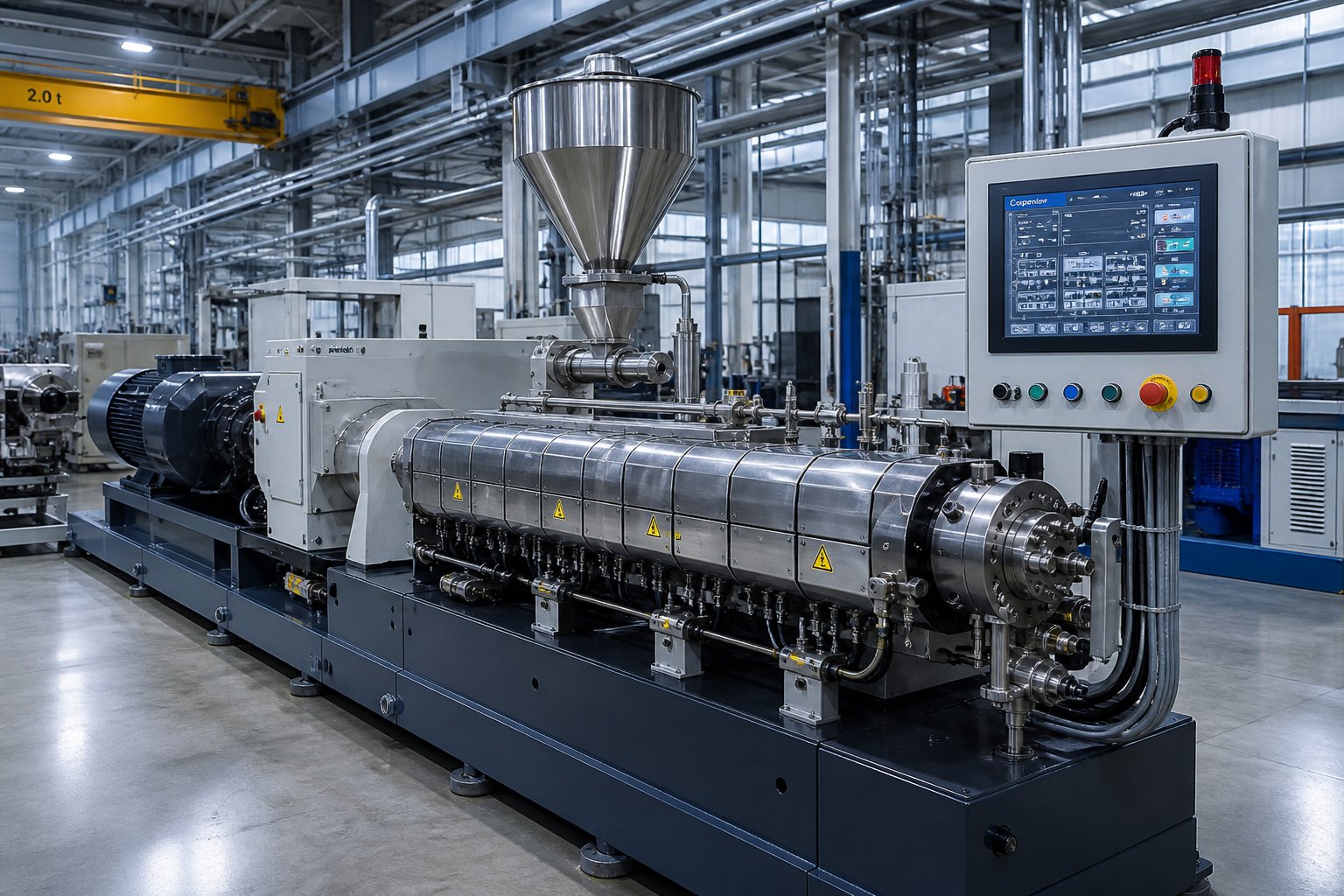
What a Twin Screw Extruder Does and Why It Matters
A twin screw extruder is a high-performance processing machine that uses two intermeshing screws rotating inside a heated barrel to mix, melt, compound, and shape thermoplastic and other materials. Think of it as the industrial workhorse behind nearly every compounded plastic pellet, PVC pipe, color masterbatch, and engineered polymer you encounter daily. Raw materials enter as powders, pellets, or granules at one end, and a finished, homogeneous melt emerges at the other—ready for pelletizing, sheeting, or profile shaping.
Unlike a single screw extruder, which relies on one rotating screw and depends heavily on friction-based conveying, a twin screw extruder machine generates its processing power through the intermeshing action of two parallel screws. This design delivers far greater control over mixing intensity, residence time, and temperature—making it the default choice when material uniformity and process flexibility are non-negotiable.
If you're evaluating any twin screw extruder machine for sale, whether brand new from an OEM or a decade-old unit on a used equipment marketplace, you need to understand what's happening inside that barrel before you can judge whether a listing is a deal or a disaster. This guide breaks down the technology, walks through critical specifications, and gives you a practical framework for making confident purchasing decisions.
How a Twin Screw Extruder Works
Every double screw extruder follows the same fundamental processing sequence, regardless of brand or size. Here are the core functional stages material passes through from hopper to die:
- Feeding – Raw materials such as pellets, powders, or granules enter the barrel through a hopper or dedicated feeder system, establishing a consistent flow onto the screws.
- Melting – As the intermeshing screws convey and compress the material forward, controlled barrel heating zones and mechanical shear forces gradually plasticize the solid feed into a molten state.
- Mixing – Specialized screw elements—kneading blocks, mixing sections, and varied flight geometries—deliver intensive distributive and dispersive mixing, ensuring additives, fillers, and pigments are uniformly dispersed throughout the melt.
- Degassing – Venting or vacuum zones along the barrel remove trapped air, moisture, and volatile compounds, directly improving the quality and consistency of the final product.
- Die extrusion – The homogenized melt is pumped through a shaped die to produce strands for pelletizing, profiles, sheets, or other finished forms.
Why Twin Screw Extruders Dominate Compounding
So why do twin screw extruders command such a dominant position across industries? It comes down to three engineering advantages that single-screw machines simply can't match at the same level.
First, the self-wiping action created by intermeshing screw flights continuously cleans the barrel walls and screw surfaces. This prevents material buildup, reduces degradation of heat-sensitive polymers, and makes changeovers between products significantly faster. Second, modular screw design allows processors to rearrange individual screw elements—conveying sections, kneading blocks, mixing zones—along the shaft to tailor the machine's behavior to a specific material or application. You'll notice that this flexibility is a recurring theme throughout this guide. Third, the superior mixing capability of two intermeshing screws generates the shear forces and material turnover needed to achieve uniform dispersion of fillers, reinforcements, and additives at loadings that would overwhelm a single-screw system.
These advantages explain why twin screw extruders have become indispensable across plastics compounding, food processing, pharmaceutical hot-melt extrusion, recycling operations, and specialty chemical production.
Understanding how a twin screw extruder processes material is the single most important step you can take before shopping for one. Specifications, brand names, and price tags only mean something when you can connect them back to what actually happens inside the barrel.
The real complexity—and the real risk for buyers—begins when you encounter the two fundamentally different screw configurations available on the market and need to determine which one fits your process.
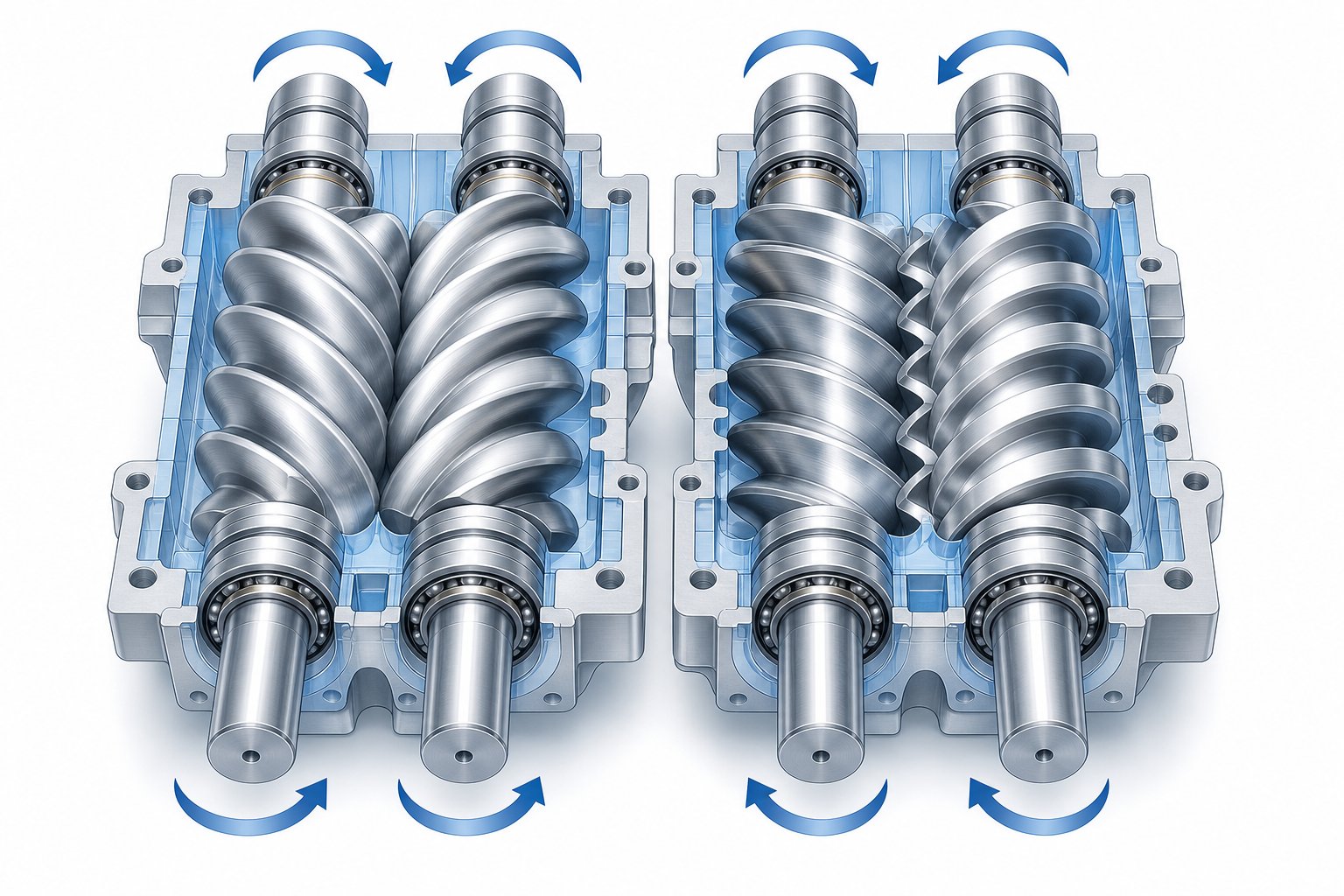
Co-Rotating vs Counter-Rotating Configurations Explained
Every twin screw extruder machine for sale falls into one of two fundamental camps based on how its screws rotate relative to each other. Get this distinction wrong, and you could end up with a machine that fights your material instead of processing it. The difference between co-rotating and counter-rotating configurations shapes everything—from mixing intensity and shear levels to the types of polymers you can safely run.
Here's the mechanical core of it. In a co rotating twin screw extruder, both screws spin in the same direction—either both clockwise or both counterclockwise. They typically use a fully intermeshing geometry where the flight of one screw reaches into the channel of the other. Material follows a figure-eight path as it transfers between screws, creating intense shear fields and thorough mixing. In a counter-rotating design, the screws spin in opposite directions. Material gets drawn into the gap between them and advances forward under compression. Counter-rotating machines can be either intermeshing or non-intermeshing, and this sub-classification further affects shear behavior and conveying characteristics.
Co-Rotating Twin Screw Extruder Design and Strengths
The co rotating twin screw extruder is the dominant configuration in modern compounding. Its popularity isn't accidental—it stems from a combination of engineering advantages that make it remarkably versatile.
Because both screws turn in the same direction, the intermeshing zone creates a self-wiping action that continuously cleans material from screw surfaces and barrel walls. This virtually eliminates dead zones where polymer could stagnate and degrade. The result is a narrow residence time distribution, which is critical for reactive extrusion and thermally sensitive formulations.
Mixing performance is where co-rotating designs truly shine. Intense shear fields develop both between the two screws and between screw flights and the barrel wall. Add kneading blocks and specialized mixing elements into the modular screw configuration, and you'll get both dispersive mixing—breaking apart filler agglomerates down to sub-micron scale—and distributive mixing that spreads those particles uniformly throughout the melt. Major OEMs like Coperion (known for the ZSK series) and Leistritz have built their reputations primarily on co-rotating platform designs for exactly this reason.
Speed is another defining trait. Co-rotating twin-screw extruders routinely operate at 400 to 900 RPM, with some high-performance models pushing beyond 1,200 RPM. This translates directly into high throughput capacity, making them the go-to choice for large-volume compounding, masterbatch production, polymer alloying, and reactive extrusion processes.
Counter-Rotating Twin Screw Extruder Advantages
Imagine you need to extrude rigid PVC—a material with a low decomposition temperature and poor melt flow. Push it through a high-shear co-rotating machine, and you risk thermal degradation before the material even reaches the die. This is precisely where counter-rotating designs earn their place.
In a counter-rotating configuration, the opposing screw rotation draws material inward at the intermeshing region and compresses it forward. This creates a strong positive conveying action that maintains stable output even at low screw speeds—typically 30 to 150 RPM. The calendering effect generated between the screws provides gentle dispersive mixing through compressive and elongational deformation rather than aggressive shear. Material temperature stays low, and heat-sensitive polymers survive the process intact.
The conical twin screw extruder is a specialized counter-rotating variant where the screws taper from a large diameter at the feed end to a smaller diameter at the discharge end. This geometry naturally builds pressure as material moves forward, delivering superior pumping capability without the need for high RPM. Conical twin-screw extruders dominate PVC pipe extrusion, profile production, and wood-plastic composite (WPC) processing. Their tapered design also allows for greater operating torque and load capacity compared to parallel counter-rotating machines of similar output.
Counter-rotating non-intermeshing parallel designs occupy a separate niche entirely. Because the screws never physically engage each other, shear forces drop to the lowest levels of any twin screw configuration. This makes them well suited for high-level devolatilization, pharmaceutical hot-melt extrusion, and specialty chemical processes where residence time flexibility and thermal gentleness outweigh the need for intensive mixing.
Which Configuration Fits Your Application
Choosing between a co rotating and counter rotating twin screw extruder comes down to matching the machine's characteristics to your material and process requirements. The table below distills the critical differences into a quick-reference decision tool you can use when comparing listings side by side.
| Criteria | Co-Rotating (Parallel, Intermeshing) | Counter-Rotating (Parallel or Conical, Intermeshing) |
|---|---|---|
| Mixing Intensity | High—strong dispersive and distributive mixing via shear and elongational flow | Moderate—gentle calendering effect, compressive mixing dominates |
| Shear Level | High shear, adjustable through screw speed and element selection | Low to moderate shear, ideal for thermally sensitive materials |
| Throughput Range | High—screw speeds of 400-1,200+ RPM enable large-volume output | Low to moderate—operates at 30-150 RPM with stable conveying |
| Self-Wiping Capability | Excellent—fully intermeshing geometry eliminates dead zones | Good in intermeshing designs; limited in non-intermeshing variants |
| Typical Applications | Compounding, masterbatch, polymer alloys, reactive extrusion, recycling | PVC pipe and profile, WPC, shear-sensitive polymers, devolatilization |
| Common Industries | Plastics compounding, automotive, food, pharma, recycling | Building products, PVC processing, specialty chemicals, pharma |
A machine that looks perfect on paper—right brand, attractive price, low hours—becomes a liability if it's the wrong configuration for your material. Confirming whether a listing is co-rotating or counter-rotating should be your very first filter, before you ever look at screw diameter, motor power, or price. Those specifications only gain meaning when evaluated within the context of the correct configuration, and understanding how to decode them is the next critical skill every buyer needs.
How to Read and Interpret Twin Screw Extruder Specifications
Marketplace listings and manufacturer catalogs throw numbers at you—screw diameter, L/D ratio, motor kW, throughput in kg/h, barrel zones—as though these figures speak for themselves. They don't. A spec sheet is only useful if you understand what each number actually controls inside the barrel and how it connects to your specific processing goal. Most buyers scanning listings for a twin screw extruder machine for sale skip this step and compare machines purely on price and brand. That's how expensive mismatches happen.
This section breaks down the critical specifications you'll encounter, explains what they mean in practical terms, and gives you the context to separate a well-suited machine from a poor fit—regardless of what the price tag says.
Screw Diameter and L/D Ratio Decoded
Screw diameter is the single strongest predictor of throughput capacity. A larger diameter means more free volume between the screw flights and barrel wall, which translates directly into how many kilograms per hour the machine can move. You'll see screw diameters ranging from as small as 16 mm on laboratory units up to 130 mm or more on high-output production lines. When comparing two listings side by side, the machine with the larger screw diameter will almost always have the higher throughput ceiling—assuming the motor and gearbox can deliver the torque to fill that volume.
The L/D ratio—length-to-diameter ratio—tells you something different. It describes how long the processing section is relative to the screw diameter, and it governs residence time, the number of functional zones available, and overall processing intensity. A screw extruder with a 40:1 L/D ratio on a 50 mm diameter machine has a process section roughly 2,000 mm long. That extra length provides space for additional kneading blocks, mixing zones, venting ports, and side-feeding stations.
Common L/D ratios for co-rotating twin screw extruders fall between 32:1 and 48:1, with some specialized configurations reaching up to 60:1. Shorter ratios—20:1 to 28:1—suit applications like color masterbatch production or thermally sensitive materials where you want high shear mixing with minimal residence time. Medium ratios of 32:1 to 36:1 cover general-purpose compounding, glass fiber reinforcement, and engineering plastics. Longer ratios of 36:1 to 48:1 become essential for devolatilization, reactive extrusion, and heavily filled compounds that need extended processing length for thorough mixing and degassing.
Here's the practical takeaway: if a listing advertises an attractive price on a double screw extruder machine with a 28:1 L/D ratio, but your process requires multiple vacuum venting stages and downstream side-stuffing, that barrel simply isn't long enough. The ratio must match the complexity of your process, not just the output target.
Torque Rating and Motor Power Explained
Motor power in kilowatts gets the most attention on spec sheets because it's an easy number to compare. But raw kW is misleading without understanding the torque that actually reaches the screws. The gearbox sits between the motor and the screw shafts, and its design determines how much rotational force—torque—gets transmitted to the process at any given screw speed.
Torque per unit of free volume is the true performance indicator for any twin-screw extruder machine. It defines the maximum viscosity and filler loading the machine can handle before the gearbox or screw shafts hit their mechanical limit. A machine rated at 200 kW sounds powerful, but if the gearbox is designed for a maximum speed of 1,200 RPM, each Newton-meter of available torque is spread thinner than the same motor geared for 600 RPM. As the HSEI extrusion concept explains, the relationship is straightforward: torque equals 9,550 multiplied by motor kW divided by maximum RPM. A higher-kW motor paired with a higher-RPM gearbox doesn't necessarily give you more torque—it may simply give you more speed.
Why does this matter when browsing listings? If your application involves processing highly filled compounds—mineral-loaded polypropylene at 80% filler, for example—you need substantial torque to push that viscous, abrasive material through kneading zones. A machine with a high-speed, lower-torque configuration designed for unfilled polymer blending will hit its torque ceiling and trip safety shutdowns long before reaching your target throughput. Always ask for the torque rating in Newton-meters, not just the motor kW.
Specific energy—the amount of motor power consumed per kilogram of material processed—adds another useful dimension. It's calculated by dividing the applied power (accounting for percent torque utilization, RPM ratio, and gearbox efficiency) by the throughput rate in kg/h. Maintaining specific energy records allows you to compare how different screw extruders handle the same material, even across different machine sizes. A process consistently drawing 0.15 to 0.25 kW per kg/h is running in a normal range for many compounding operations, and deviations from that baseline can signal screw wear, feedstock changes, or process drift.
Barrel Zones and Throughput Capacity
The number of barrel zones on a twin screw extruder directly affects how precisely you can control the temperature profile along the process section. Each zone is independently heated and cooled, allowing you to create graduated thermal profiles—cool at the feed throat to prevent premature melting, intensely heated through the plastication zone, cooled slightly before the vent to reduce melt viscosity for better devolatilization, and stabilized at the discharge.
Lab-scale machines may have as few as 4 to 6 zones, while production-scale screw extruders typically feature 8 to 12 or more independently controlled sections. More zones give you finer thermal resolution and greater flexibility to process different materials on the same platform. If you're evaluating a used machine and find it has fewer zones than your process demands, retrofitting additional barrel sections is possible on modular designs—but it's an added cost you need to factor into the total purchase equation.
Throughput capacity—listed in kg/h on nearly every spec sheet—deserves a healthy dose of skepticism. Published figures almost always represent the maximum achievable throughput under ideal conditions with a specific material, screw configuration, and RPM setting. Your actual throughput will vary based on material bulk density, filler loading, required mixing intensity, and venting requirements. A machine rated at 500 kg/h for unfilled polyethylene might only deliver 200 kg/h when processing a 60% calcium carbonate compound because the higher melt viscosity forces lower screw speeds and reduced fill levels to avoid exceeding the torque limit.
The table below puts these specifications into practical context across three common machine scales. These represent general industry ranges—not specific model data—to help you calibrate expectations when reading listings.
| Specification | Lab-Scale Extruder | Mid-Range Production Extruder | Large Industrial Extruder |
|---|---|---|---|
| Screw Diameter | 16 - 27 mm | 35 - 65 mm | 75 - 135 mm |
| L/D Ratio | 24:1 - 40:1 | 32:1 - 48:1 | 36:1 - 52:1 |
| Motor Power Range | 2.2 - 15 kW | 22 - 200 kW | 250 - 1,000+ kW |
| Typical Throughput | 0.5 - 50 kg/h | 50 - 800 kg/h | 800 - 10,000+ kg/h |
| Barrel Zones | 4 - 8 | 8 - 12 | 10 - 16+ |
Use this as a sanity check. If a listing describes a 27 mm machine claiming 300 kg/h throughput, something doesn't add up—and that disconnect should prompt deeper questions about the accuracy of the entire listing. Specifications are only as valuable as your ability to verify them, and knowing who manufactured the machine adds an important layer of credibility to the numbers on the page.
Leading Twin Screw Extruder Brands Worth Knowing
A spec sheet gains credibility—or loses it—the moment you identify who built the machine. When browsing listings for a twin screw extruder machine for sale, you'll encounter manufacturer names ranging from globally recognized engineering houses to smaller regional builders. Knowing what each brand represents helps you gauge machine provenance, estimate resale value, and predict how easy or painful sourcing replacement parts will be years down the road.
Premium European Twin Screw Extruder Brands
European twin screw extruder manufacturers have set the engineering benchmarks that the rest of the industry measures itself against. Here are the names you'll see most often.
Coperion is widely regarded as the global leader in co-rotating compounding technology. The Coperion extruder lineup, particularly the ZSK Mc18 series, delivers a specific torque of 18 Nm/cm3—an industry-leading figure. The ZSK platform has evolved over more than 60 years, and current models achieve roughly 35 times the throughput of the original 1957 design at the same shaft center distance. If you encounter a Coperion extruder on the used market, you're looking at a machine with strong resale value and excellent parts availability worldwide.
Leistritz brings over a century of screw technology expertise. The ZSE iMAXX series offers specific torque up to 15 Nm/cm3 and an OD/ID ratio of 1.66. Leistritz is particularly strong in specialty applications—pharmaceutical hot-melt extrusion, thermoplastic elastomers, and R&D pilot lines. Their versatility across plastics and pharma makes Leistritz machines highly sought after in the used equipment market.
Berstorff, a legacy name in German extrusion engineering, is now part of KraussMaffei. The combined entity produces the ZE BluePower series, which features an exceptionally high Da/Di ratio of 1.65 and torque density up to 16 Nm/cm3. You'll still find standalone Berstorff machines on used equipment listings—many built to the exacting German standards that earned the brand its reputation decades ago.
Werner & Pfleiderer is another heritage name that frequently appears in used marketplace searches. As one of the original pioneers of co-rotating twin screw extrusion, Werner Pfleiderer extruder technology laid the groundwork for much of what Coperion produces today (Coperion absorbed the Werner & Pfleiderer extrusion division). Older W&P machines still run reliably in plants around the world, though sourcing OEM-specific parts can require more effort than it would for current-production brands.
Bausano, founded in 1946 near Turin, Italy, occupies a distinct niche. This manufacturer specializes in counter-rotating twin screw extruders for PVC pipe, profile, and wood-plastic composite processing. Bausano's MD Nextmover series uses a proprietary Multidrive transmission and electromagnetic induction heating that claims up to 35% energy savings. If your application involves PVC or shear-sensitive materials, Bausano is a name worth tracking.
Other Notable Manufacturers and Emerging Players
Beyond the premium European tier, several other twin screw extruder manufacturers serve important market segments.
Brabender is best known for lab-scale and benchtop extruders used in material development and quality testing. Icma S. Giorgio and Maris, both Italian, serve niche compounding and masterbatch markets with capable co-rotating platforms. In Japan, JSW (Japan Steel Works) produces the TEX series with specific torque reaching 18.2 Nm/cm3—matching or exceeding top European figures—while Kobe Steel (Kobelco) focuses on tire compounds and polymer alloys.
Major Asian manufacturers from China have emerged as serious contenders for mid-market compounding and masterbatch applications. Companies like USEON, JWELL, and others now offer machines at 30-55% of European pricing with lead times of 3-6 months compared to 8-14 months from European OEMs. The technology gap has narrowed significantly for mainstream applications, though European and Japanese brands still hold clear advantages in ultra-high-performance, GMP pharmaceutical, and mission-critical 24/7 production environments.
Brand reputation directly affects two things buyers often underestimate: resale value and parts availability. A used Coperion or Leistritz machine retains more of its original value than a lesser-known brand, partly because replacement screw elements and barrel segments remain available through established supply chains. Machines from discontinued brands or smaller regional builders may offer lower purchase prices, but sourcing wear parts can become a costly headache over time.
Here's a quick-reference summary of each brand's primary focus:
- Coperion (Germany) – High-performance co-rotating compounding; engineering plastics, polyolefins, pharma
- Leistritz (Germany) – Versatile co-rotating designs; specialty polymers, pharma HME, R&D and pilot scale
- KraussMaffei Berstorff (Germany) – High free volume co-rotating extruders; compounding, recycling, petrochemical
- Werner & Pfleiderer (Germany) – Legacy co-rotating pioneer; heritage machines common on the used market
- Bausano (Italy) – Counter-rotating specialist; PVC pipe, profile, WPC
- Brabender (Germany) – Lab-scale and benchtop extruders; material testing and R&D
- Icma S. Giorgio / Maris (Italy) – Niche co-rotating compounding; masterbatch, specialty plastics
- JSW (Japan) – Ultra-high torque co-rotating; engineering plastics, devolatilization, reactive extrusion
- Kobe Steel / Kobelco (Japan) – Continuous mixing; tire compounds, polymer alloys
- Asian manufacturers (China) – Competitive pricing; masterbatch, general compounding, PVC, large polyolefin lines
Brand reputation is a useful signal, but it should never be the sole driver of a purchasing decision. Machine condition, specifications matched to your application, and long-term parts availability matter just as much—sometimes more—than the nameplate on the gearbox housing.
Recognizing these brands and what they represent gives you a sharper eye when scanning listings. But a familiar logo on a machine doesn't answer the deeper strategic question every buyer faces: should you invest in a brand-new unit with full customization and warranty coverage, or does a quality used machine deliver a smarter return on your capital?
New vs Used Twin Screw Extruders: Which Investment Makes Sense?
That deeper strategic question—new or used—is where many buyers either save hundreds of thousands of dollars or lock themselves into regrettable compromises. The answer isn't universal. It depends entirely on your production requirements, capital position, regulatory environment, and tolerance for risk. Both paths carry distinct advantages and hidden costs that only become visible when you look beyond the purchase price.
Roughly 30-50% of the twin screw extruder machines listed for sale at any given time are used or refurbished units. That's a massive pool of equipment, and it exists because these machines are built to last decades when properly maintained. But longevity doesn't automatically make every used extruder a bargain—just as a factory-fresh machine doesn't guarantee the best return on your investment. The right choice comes down to matching your specific situation to the strengths each option offers.
When Buying a New Twin Screw Extruder Makes Sense
Certain scenarios tilt the equation firmly toward new equipment, regardless of the higher upfront cost. If any of the following conditions describe your situation, a new machine is likely worth the premium.
Precise application requirements demand custom screw geometry. New machines allow you to specify every element of the screw configuration—conveying sections, kneading block stagger angles, mixing elements, and distributor designs—optimized for your exact material and throughput target. You also get to select barrel metallurgy tailored to your process: standard nitrided steel for general compounding, bimetallic liners for abrasive glass-fiber-reinforced materials, or nickel-alloy barrels for corrosive fluoropolymer processing. This level of customization simply isn't available when buying used extruders, where you inherit whatever configuration the previous owner needed.
Your production environment demands maximum uptime. High-volume compounding operations running 24/7 can lose $500 to $5,000 per hour during unplanned downtime. A new machine arrives with zero wear on critical components, a full manufacturer warranty (typically 1-2 years, with some OEMs offering 5-year coverage on core parts like gearboxes), and access to factory commissioning support that ensures the line starts up correctly the first time.
Regulatory compliance is non-negotiable. Food-contact, pharmaceutical GMP, and medical-grade polymer processing all require comprehensive documentation trails—material certificates, calibration records, weld inspections, surface finish certifications, and validation protocols. New machines come with this documentation as standard. Recreating it for a used machine, if even possible, adds significant time and cost that can erase any savings from the lower purchase price.
Latest control technology matters for your operation. Modern PLC and HMI systems with recipe management, real-time process monitoring, data logging, and remote diagnostics capabilities represent a generational leap over the control platforms on machines built even ten years ago. While control system retrofits are possible on used equipment, they typically add 15-25% to the purchase cost and require weeks of integration and testing.
When a Used Twin Screw Extruder Is the Smarter Investment
Imagine you're launching a compounding startup with strong technical knowledge but limited capital. Or picture an R&D team that needs a production-scale machine to validate formulations before committing to a full line. In these scenarios—and several others—used extrusion equipment delivers a compelling return on investment that new machinery simply can't match.
Startups and capital-constrained operations benefit immediately from the 30-50% price reduction that used extruders typically carry compared to equivalent new models. A quality used extruder from a premium European brand often retains 70-80% of its original processing capability while costing half as much. That freed-up capital can be directed toward feeders, pelletizers, raw materials, and the working capital that actually gets a business generating revenue.
R&D and pilot-scale work is another classic use case. Research teams developing new formulations or testing process parameters rarely need the latest automation features or pristine barrel bores. What they need is a mechanically sound machine with modular screw flexibility and a reliable drive system—exactly what a well-maintained used unit provides. Many university labs and corporate R&D centers actively seek used extruders for sale specifically because they offer full process simulation capability at a fraction of new-equipment pricing.
Non-critical or secondary production lines present another strong case. If you're running a supplementary line for lower-specification products, trial batches, or overflow capacity, the incremental output from a used machine generates revenue that far exceeds its acquisition cost. The key qualification here is that the material and process pairing are well established—you already know the screw configuration works, so cutting-edge features add little practical value.
Known brand heritage boosts confidence. A used Coperion ZSK, Leistritz ZSE, or KraussMaffei Berstorff machine with documented maintenance history often represents a better long-term asset than a brand-new unit from an unproven manufacturer. Premium machines are engineered for 20-30 year service lives, and many used units on the market have logged only a fraction of their total capacity.
Cost Considerations Beyond the Purchase Price
Whether you're leaning toward new or used, the sticker price on any twin screw extruder machine for sale tells you only part of the financial story. Total cost of ownership over five to ten years frequently exceeds the initial purchase by a factor of two to three. One industry TCO analysis showed that a $60,000 budget extruder accumulated $490,000 in five-year costs—including energy, maintenance, and downtime—while a $150,000 higher-quality machine totaled only $270,000 over the same period. The "cheaper" machine cost 45% more in the long run.
Here are the total cost of ownership factors every buyer should quantify before signing a purchase order:
- Installation and commissioning – Rigging, utility connections, alignment, and startup support typically add 2-5% of the purchase price for new machines and can run higher for used equipment requiring reconditioning or relocation.
- Replacement screws and barrels – These are the highest-wear, highest-cost consumable components on any twin screw extruder. Depending on material abrasiveness, screw elements may need replacement every 12-36 months. A full set of OEM replacement elements for a mid-size machine can cost $15,000 to $50,000.
- Spare parts availability – Machines from current-production brands have readily available spare parts. Discontinued models or niche manufacturers may require custom fabrication of replacement components at premium pricing and extended lead times.
- Energy efficiency differences between generations – Newer drive systems and motor technologies can deliver 15-30% energy savings compared to older machines. For a line consuming 150 kW running 6,000 hours per year, that efficiency gap translates into $15,000-$30,000 annually at typical industrial electricity rates.
- Control system upgrades – Retrofitting modern PLCs, HMIs, and sensor packages onto older used extrusion equipment typically costs $10,000-$40,000 depending on complexity, plus integration downtime.
- Training – Operator training on new platforms, safety certification, and process development time represent real costs that are easy to overlook during the purchasing phase but directly impact how quickly the machine reaches productive operation.
- Gearbox and drive maintenance – Gearbox rebuilds on premium twin screw extruders can approach $30,000-$80,000—sometimes rivaling the purchase price of the used machine itself. Oil analysis, vibration testing, and bearing inspections before purchase can prevent this costly surprise.
The bottom line? A used extruder listed at $75,000 that needs $25,000 in new screw elements, a $15,000 control upgrade, and $10,000 in commissioning costs is really a $125,000 investment. That may still be an excellent deal compared to a $250,000 new machine—but only if you've calculated the true number before committing.
The purchase price is the most visible cost and the least reliable predictor of total investment. Budget for the machine you'll actually operate—not just the machine you'll buy.
Understanding the financial framework is essential, but numbers on a spreadsheet can't tell you whether the screws are worn, the gearbox is sound, or the control system is obsolete. Translating this cost analysis into a hands-on evaluation requires a systematic inspection process—one that separates machines worth buying from machines hiding expensive problems beneath a fresh coat of paint.
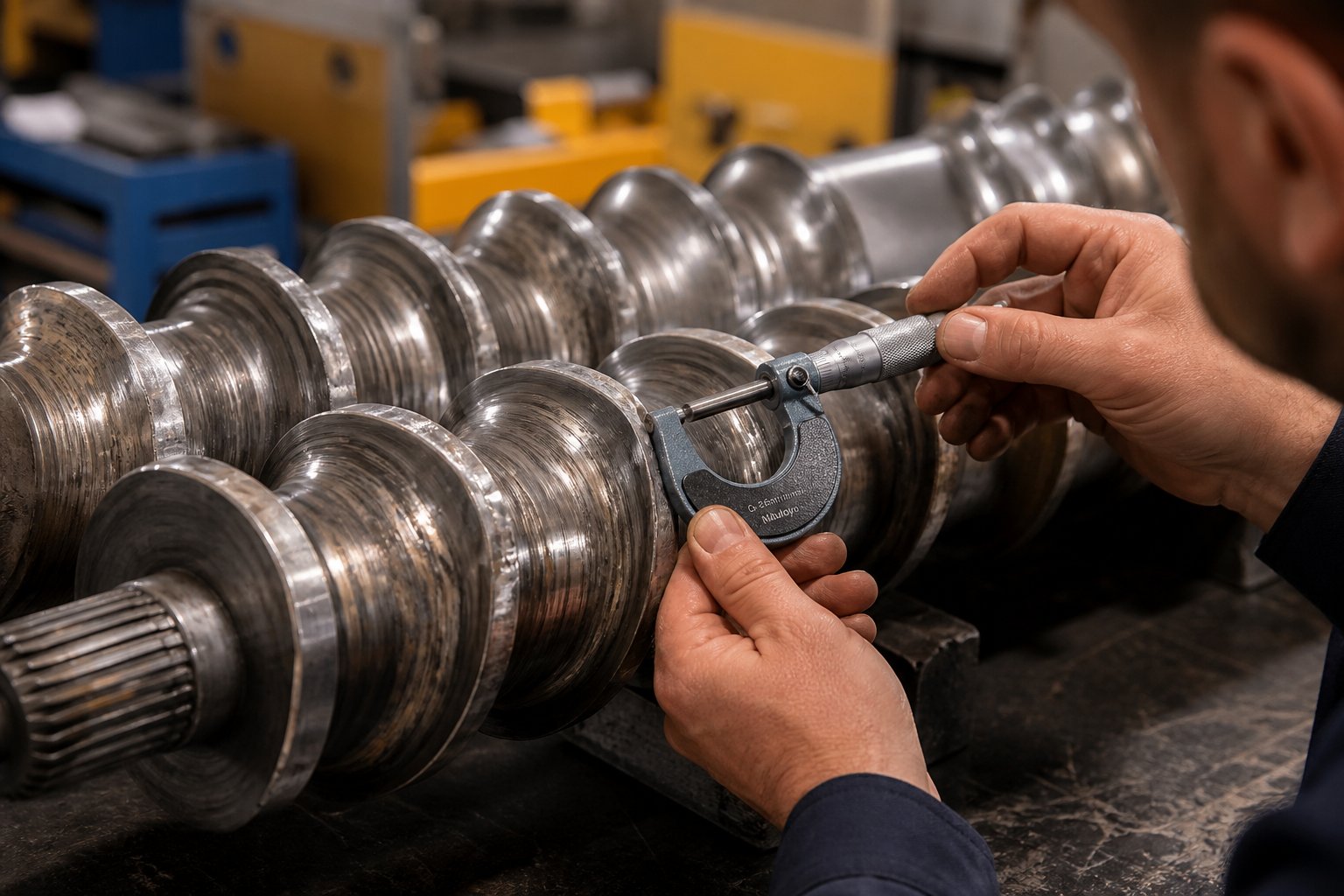
Inspection Checklist for Evaluating a Used Twin Screw Extruder for Sale
A fresh coat of paint can hide a lot of problems. So can a clean barrel exterior, a polished hopper, and a confident seller. The only way to know what you're actually buying when evaluating a used twin screw extruder is to measure, test, and document the condition of every critical system before money changes hands. This inspection checklist gives you the same evaluation framework that experienced equipment dealers use internally—the one most buyers never see.
Screw and Barrel Wear Assessment
Screws and barrels are the heart of any extruder, and they're also the components most susceptible to wear. They're the most expensive to replace, too—a full set of screw elements for a mid-size twin screw extruder can run $15,000 to $50,000, and barrel segments aren't far behind. Skipping this assessment is the single most costly mistake a buyer can make.
Start with the screw elements. Measure the flight outer diameter at every other flight and compare each reading against the original manufacturer specifications. Worn flights reduce the effective seal between screw and barrel, allowing material to flow backward ("leakage flow") and destroying mixing efficiency. As Arlington Machinery's inspection protocol details, the root diameter should also be measured between every other flight and at each axis through the feed and metering sections. Technicians should check the root for washouts—localized erosion patterns that indicate the screw has been processing abrasive materials—and examine the nose threads and shank for blemishes or galling.
Barrel inspection follows the same precision-first approach. After a thorough purge and cleaning of the bore with brass gauze (while cooling to room temperature to prevent thermal distortion), use a dial bore gauge and micrometer to take measurements every two to three inches down the entire barrel length. This frequency catches localized wear zones that a less rigorous check would miss. Pay particular attention to the area near the mid-barrel where polymer melting takes place—this is where the most wear typically accumulates. Check the feed hole area for cracks, washout spots, and deformation. Any ovality in the bore indicates uneven wear or potential alignment issues.
The screw-barrel clearance gap is the single most critical wear indicator. On a new machine, this gap is precisely engineered—typically 0.1 to 0.3 mm depending on screw diameter. As wear increases the gap, mixing efficiency drops, energy consumption rises, throughput suffers, and melt quality degrades. If clearance measurements exceed manufacturer tolerances by more than 50%, you're looking at components that need near-term replacement. Factor that cost directly into your offer price.
Gearbox and Drive System Evaluation
Here's a sobering reality: a gearbox rebuild or replacement on a premium twin screw extruder can approach the cost of the entire used machine. The gearbox transmits every Newton-meter of torque from the motor to the screw shafts, and it does so under extreme loads, high temperatures, and continuous duty cycles. Faults that start invisibly inside the gearbox housing can cascade into catastrophic—and catastrophically expensive—failures.
A thorough gearbox evaluation should cover these areas:
- Oil analysis results – Request the most recent oil sample report. Rising iron particle counts indicate gear tooth or bearing race wear. Copper spikes suggest bushing degradation. Silicon contamination points to failed seals allowing abrasive ingress. According to gearbox condition monitoring data, iron readings above 200 ppm, copper above 80 ppm, or water content exceeding 0.1% all signal critical conditions that demand immediate attention.
- Vibration testing – Gear mesh frequency analysis reveals tooth wear, while bearing defect frequencies (BPFO, BPFI) identify raceway damage weeks before audible symptoms appear. Elevated 2x running speed vibration is a classic misalignment indicator. If the seller can't provide vibration data, bring your own analyst.
- Noise during operation – Run the machine and listen. Grinding, whining, or rhythmic clicking that changes with RPM points to gear tooth damage or bearing faults. Healthy gearboxes produce a consistent, smooth hum.
- Operating hours – Request the hour meter reading. Gearboxes on twin screw extruders are typically designed for 40,000 to 80,000 hours before major overhaul. A machine with 35,000 hours may be approaching the zone where bearing replacements and gear inspections become necessary.
If oil analysis shows iron levels trending upward across consecutive samples—even if absolute values are still below critical thresholds—that rising trend is an early warning of accelerating wear. A single reading is a snapshot; a trend is a forecast.
Controls, Electrical Systems, and Documentation
A mechanically perfect extruder with an obsolete control system is a machine you can't run safely or efficiently. Evaluate the electrical and control infrastructure with the same rigor you'd apply to the screws and gearbox.
Control system age matters more than most buyers realize. PLCs and HMIs from the early 2000s or earlier may still function, but replacement parts are increasingly scarce, software support has ended, and integration with modern plant networks or data logging systems is often impossible without a full retrofit. Ask whether the controls use currently supported hardware and software platforms.
Heater bands and thermocouples directly affect product quality. Burned-out heater bands create cold spots in the barrel that disrupt the temperature profile. Degraded thermocouples feed inaccurate temperature readings back to the controller, causing the system to overheat or underheat zones without the operator knowing. Test each zone individually—set a target temperature and verify that the zone reaches it within a reasonable time, holds it steady, and responds accurately to setpoint changes.
Safety system compliance is non-negotiable. Confirm that emergency stops, interlock guards, over-temperature shutdowns, and over-torque trip circuits all function correctly. Non-compliant safety systems can expose your operation to regulatory penalties, insurance complications, and—most importantly—worker injury.
Finally, documentation tells the machine's story. Industry best practice calls for requesting the machine's make, model, year, operating hours, complete maintenance records, and details on previously processed materials. A seller who can produce organized maintenance logs, hour meter records, and processing history is selling a machine that was cared for. A seller who can't produce any records is selling a question mark.
The following table consolidates the key inspection points into a single reference checklist:
| Component | What to Inspect | Acceptable Condition | Red Flags |
|---|---|---|---|
| Screw Elements | Flight OD, root diameter, surface condition, washout patterns | Measurements within 50% of original clearance tolerance; no visible erosion or galling | Flight diameter significantly below spec; deep washouts on root; missing or mismatched elements |
| Barrel Bore | Bore diameter every 2-3 inches, ovality, feed zone cracks, mid-barrel wear zone | Uniform bore within manufacturer tolerance; no cracks at feed opening | Ovality exceeding 0.05 mm; visible scoring or grooves; cracked feed throat area |
| Gearbox | Oil analysis (Fe, Cu, Si, water), vibration spectrum, noise, hour meter | Oil metals within normal limits; smooth vibration signature; hours below 60% of rated life | Rising iron or copper trends; grinding or clicking sounds; missing oil analysis history |
| Motor and Drive | Voltage/current under load, insulation resistance, bearing temperature | Readings within nameplate ratings; stable current draw; bearings below 80°C | Current spikes or fluctuations; overheating; evidence of rewinding |
| Heater Bands | Zone heat-up time, temperature stability, visual condition | All zones reach setpoint within expected time; steady hold ±2°C | Dead zones; visible burn damage; zones that overshoot or fail to reach temperature |
| Thermocouples | Accuracy vs reference thermometer, response time | Readings within ±2°C of reference at operating temperatures | Readings that drift, lag, or differ significantly from reference |
| Control System | PLC/HMI model and age, software version, data logging capability | Currently supported platform; functional recipe management and alarms | End-of-life hardware; no spare parts available; no software support |
| Safety Systems | E-stops, interlocks, guards, over-torque trips, over-temperature shutdowns | All systems functional and compliant with current standards | Bypassed interlocks; missing guards; non-functional emergency stops |
| Documentation | Maintenance logs, hour meters, processing history, original manuals | Organized records showing regular maintenance and known processing history | No records available; conflicting information; missing hour meter |
Questions Every Buyer Should Ask the Seller
Inspection data only tells half the story. The seller holds context that no measurement can reveal. Before committing to any used extruder equipment purchase, work through this list of questions—and pay attention not just to the answers, but to how readily and confidently they're provided.
- Why are you selling this machine? – Legitimate reasons include plant consolidation, capacity upgrades, process changes, or business closure. Vague or evasive answers warrant caution. A seller offloading a machine due to chronic mechanical issues won't always volunteer that information.
- What materials has this machine processed? – A machine that spent its life running unfilled polyolefins will have dramatically less screw and barrel wear than one processing 70% glass-fiber-reinforced nylon. Previous materials also affect contamination risk if you're switching to a different polymer family.
- Can you provide the complete maintenance history? – Regular oil changes, scheduled screw element replacements, and documented gearbox inspections indicate a well-managed asset. The absence of records doesn't necessarily mean neglect—but it does mean you're absorbing more risk.
- Is the original manufacturer documentation available? – Manuals, electrical schematics, screw configuration drawings, and parts lists simplify every future maintenance task and make sourcing used extruder equipment spares significantly easier.
- Can I conduct a test run or witness a demonstration? – A seller willing to power up the machine and run material through it has nothing to hide. A seller who refuses—or claims it's "not set up for a test"—may be concealing operational problems. If a live test isn't possible, request recent video of the machine operating under load.
- What spare parts are included with the sale? – Extra screw elements, spare heater bands, thermocouples, and gearbox oil filters add real value. They also signal that the previous owner invested in proper maintenance infrastructure.
- Has the gearbox ever been rebuilt or serviced? – A gearbox that was professionally rebuilt with documented bearing replacements and gear inspections can be more reliable than one with original components at high hours. But an undocumented "repair" performed by an unqualified shop is a gamble.
Every answer you collect during this process feeds directly into your total cost of ownership calculation. A used extruder for sale at an attractive headline price can quickly become an expensive project if the screws need replacement, the gearbox is approaching end-of-life, and the control system requires a retrofit. Conversely, a machine priced slightly higher but backed by complete documentation, recent screw measurements, and clean oil analysis results may represent the true bargain in the listing.
When browsing any used extrusion equipment for sale, remember that the inspection is your negotiation leverage. Every worn component, every missing document, and every unanswered question is a data point that justifies adjusting your offer downward—or walking away entirely.
With a clear picture of the machine's condition in hand, the next step is connecting those findings to your actual processing requirements. A mechanically sound machine is still the wrong machine if its configuration doesn't match your application—and each industry segment demands specific capabilities that only certain extruder setups can deliver.
Matching Extruder Specifications to Your Processing Needs
A machine can pass every inspection checkpoint—clean oil analysis, tight screw-barrel clearances, responsive controls—and still be fundamentally wrong for your process. Mechanical soundness and application fit are two entirely separate evaluations, and confusing one for the other is how buyers end up with a perfectly maintained machine that can't do the job they purchased it for.
Each industry segment and material family places distinct demands on extruder configuration, screw geometry, L/D ratio, and ancillary features. The specifications that matter most for a plastics compounding operation barely overlap with those critical for PVC pipe extrusion or pharmaceutical R&D. This disconnect catches buyers who shop by price and brand alone, without first defining the specific processing capabilities their application requires.
Here's how to match what the listing says to what your production floor actually needs.
Plastics Compounding and Masterbatch Production
Compounding and masterbatch work represent the largest single market for co-rotating twin screw extruders—and they're among the most demanding applications from a machine capability standpoint. If you're evaluating a twin screw compounding extruder, these are the specifications that separate a capable machine from an underperformer.
High torque is non-negotiable. Compounding operations routinely process heavily filled formulations—40-80% mineral filler, 20-50% glass fiber, or concentrated pigment loadings that dramatically increase melt viscosity. The extruder's gearbox must deliver sufficient torque density (measured in Nm/cm3) to push these viscous, abrasive compounds through intensive kneading zones without tripping overload protections. Machines with specific torque ratings below 10 Nm/cm3 will struggle with highly filled systems, while premium platforms offering 15-18 Nm/cm3 handle virtually any compounding formulation.
Generous L/D ratios provide the processing length these applications demand. A typical plastic twin screw extruder used for compounding runs an L/D of 40:1 to 48:1. That extra barrel length accommodates multiple functional zones: an initial conveying section, melting and kneading zones, a side-stuffing port where fillers and fibers enter downstream, additional mixing sections after the side feeder, one or two vacuum venting stations for moisture and volatile removal, and a final pressure-building zone before the die. Try to compress all of that into a 32:1 barrel, and you'll sacrifice either mixing quality or devolatilization—neither of which your customers will tolerate.
Side stuffing capability is essential for any compound involving mineral fillers, glass fibers, or carbon fibers. Introducing these abrasive or fragile additives downstream—after the polymer is already molten—protects fiber length, reduces screw wear, and prevents the bridging problems that occur when dry powders compete with polymer pellets at the main feed throat. A machine listing that mentions side feeder ports, or a barrel configuration with open ports at the 40-60% length position, signals a setup designed for serious compounding work.
Screw diameters for production-scale compounding typically fall between 50 mm and 95 mm, producing throughputs of 200 to 3,000+ kg/h depending on material and formulation complexity. Twin screw compounding processes combine polymers with additives, fillers, metal powders, and reinforcing fibers to create homogenous composite materials—and achieving that homogeneity at commercial rates requires machines built specifically for the task.
PVC Profile and Pipe Extrusion
PVC behaves unlike almost every other thermoplastic you'll encounter. It has no true melting point—it degrades thermally before flowing freely—and it demands a processing window so narrow that the wrong extruder configuration will destroy the material before it reaches the die. This is why conical twin screw extruders and parallel counter-rotating designs dominate the PVC segment, and why a co-rotating compounder, no matter how well maintained, is the wrong machine for this job.
Counter-rotating screws provide the gentle shear and positive pumping action that PVC requires. The opposing screw rotation compresses material forward through calendering rather than aggressive shear, keeping melt temperatures low enough to avoid decomposition. Conical configurations add another advantage: the tapered barrel geometry naturally builds pressure as material moves from the larger-diameter feed end toward the smaller discharge end, delivering strong pumping force without demanding high RPM.
A twin screw plastic extruder for PVC pipe production typically operates at screw speeds of just 20 to 40 RPM—a fraction of the 400-1,200 RPM range common in co-rotating compounders. This low-speed, high-torque operation preserves material integrity while maintaining the stable melt pressure that uniform pipe wall thickness demands. Screw diameters for PVC pipe lines range from 55 mm to 110 mm in conical designs, with throughputs of 150 to 800+ kg/h depending on pipe diameter and wall specification.
If you encounter a counter-rotating or conical machine listed for sale, verify that its screw and barrel materials are appropriate for PVC—typically nitrided steel or bimetallic linings resistant to the hydrochloric acid that PVC can release during processing. A machine previously used for polyolefin compounding may have barrel metallurgy that corrodes rapidly when exposed to PVC chemistry.
Laboratory, Pilot-Scale, and R&D Applications
Not every buyer is shopping for a production workhorse. Research teams, university labs, and material development departments need machines that prioritize precision, flexibility, and low material consumption over raw throughput. A laboratory twin screw extruder serves an entirely different purpose than a production machine—but it's no less important to get the specification match right.
A benchtop twin screw extruder typically features screw diameters of 16 to 20 mm, while slightly larger lab scale twin screw extruder models run 20 to 27 mm screws. These compact machines process as little as 500 grams per batch, making them ideal for formula development, small-batch trial production, and performance testing where high-value polymers or rare additives make material waste unacceptable. Despite their small size, quality lab extruders replicate the full processing sequence of their industrial counterparts—feeding, plasticizing, mixing, degassing, and die extrusion—with temperature control accuracy of ±1°C and precise torque monitoring.
L/D ratios on lab machines commonly range from 32:1 to 48:1, providing enough barrel length for meaningful process simulation. Modular screw and barrel configurations allow researchers to swap elements between experiments, testing different kneading block arrangements and mixing intensities without committing to a permanent setup. This modularity is arguably more valuable on a lab machine than on a production unit, because the entire purpose is experimentation and iteration.
Key features to look for in a lab-scale machine include:
- Gravimetric metering feeders – Ensure accurate, repeatable material dosing at low feed rates, critical for generating publishable and scalable data
- Full vacuum exhaust – Replicates industrial devolatilization, essential for realistic sample quality
- Quick-open barrel design – Speeds cleaning between formula changes, reducing downtime between experiments
- Data acquisition and logging – Records torque, temperature, pressure, and screw speed for every run, enabling true process reproducibility
Here's a practical consideration buyers often miss: lab-validated formulations must scale up to production equipment. A laboratory twin screw extruder that uses the same screw element geometry—just scaled down—as mainstream production platforms makes that transition far smoother than a machine with proprietary, non-standard element designs. When evaluating lab units for sale, check whether the screw element profiles are compatible with common production-scale platforms.
Recycling and Specialty Applications
Twin screw extruders have expanded well beyond traditional plastics compounding into recycling, food processing, and pharmaceutical manufacturing—each with distinct configuration requirements that sharply narrow the pool of suitable machines.
Plastics recycling demands machines that can tolerate contamination, variable feed quality, and high moisture content. Co-rotating extruders with generous L/D ratios (44:1 to 52:1) are preferred because they provide enough barrel length for aggressive devolatilization—often requiring two or three vacuum vent ports to remove moisture, trapped air, and decomposition byproducts from post-consumer or post-industrial scrap. Side-feeding capability allows processors to introduce virgin material, stabilizers, or compatibilizers downstream. Barrel and screw metallurgy must withstand the abrasive contaminants (paper labels, adhesive residue, metal particles) that inevitably accompany recycled feedstock.
Food processing applications use twin screw extruders for snack production, cereal manufacturing, protein texturization, and encapsulation. These machines require food-grade stainless steel contact surfaces, sanitary barrel designs that can be fully disassembled for cleaning, and precise low-shear screw configurations that process starch-based or protein-based materials without burning or degradation. Regulatory compliance—FDA, EU food contact regulations—adds documentation requirements that significantly affect which machines qualify.
Pharmaceutical hot-melt extrusion uses small-to-medium co-rotating extruders (typically 16 to 40 mm screw diameter) to disperse active pharmaceutical ingredients within polymer carriers, improving drug bioavailability and enabling controlled-release formulations. GMP compliance, full batch traceability, validated cleaning procedures, and 21 CFR Part 11 compatible data systems are baseline requirements. A standard industrial compounder—even a new one—won't meet these standards without extensive modification.
The table below maps each major application type to the extruder configuration and specifications most likely to deliver successful results. Use it as a starting filter when scanning listings to quickly eliminate machines that don't fit your segment.
| Application | Recommended Configuration | Typical Screw Diameter | Suggested L/D Ratio | Key Features Needed |
|---|---|---|---|---|
| Plastics Compounding / Masterbatch | Co-rotating, parallel, intermeshing | 50 - 95 mm | 40:1 - 48:1 | High torque, side stuffers, vacuum venting, modular screws |
| PVC Pipe and Profile | Counter-rotating, conical or parallel | 55 - 110 mm (conical) | 20:1 - 28:1 (conical); 32:1 (parallel) | Low-shear screw geometry, corrosion-resistant metallurgy, precise temperature control |
| Laboratory / Pilot-Scale R&D | Co-rotating, parallel, intermeshing | 16 - 27 mm | 32:1 - 48:1 | Modular screws, gravimetric feeders, data logging, quick-open barrel |
| Plastics Recycling | Co-rotating, parallel, intermeshing | 50 - 95 mm | 44:1 - 52:1 | Multiple vacuum vents, side feeding, wear-resistant metallurgy, high L/D |
| Food Processing | Co-rotating, parallel, intermeshing | 30 - 70 mm | 28:1 - 40:1 | Stainless steel contact surfaces, sanitary design, low-shear screw profiles |
| Pharmaceutical HME | Co-rotating, parallel, intermeshing | 16 - 40 mm | 25:1 - 40:1 | GMP compliance, full traceability, validated cleaning, 21 CFR Part 11 data systems |
Notice a pattern? The "right" machine changes dramatically based on what you're processing and why. A co-rotating compounder that excels at glass-fiber-reinforced nylon would destroy PVC. A conical extruder that produces flawless pipe would be useless for reactive extrusion research. And a pharmaceutical-grade lab unit carries compliance costs that make no sense for a recycling operation.
Matching specifications to application is the step that prevents the most expensive purchasing mistakes—the ones where the machine works perfectly but produces the wrong results. Yet even after locking in the right extruder configuration, most buyers overlook the peripheral equipment and replacement parts that ultimately determine whether the line runs profitably or drains capital with every scheduled maintenance cycle.
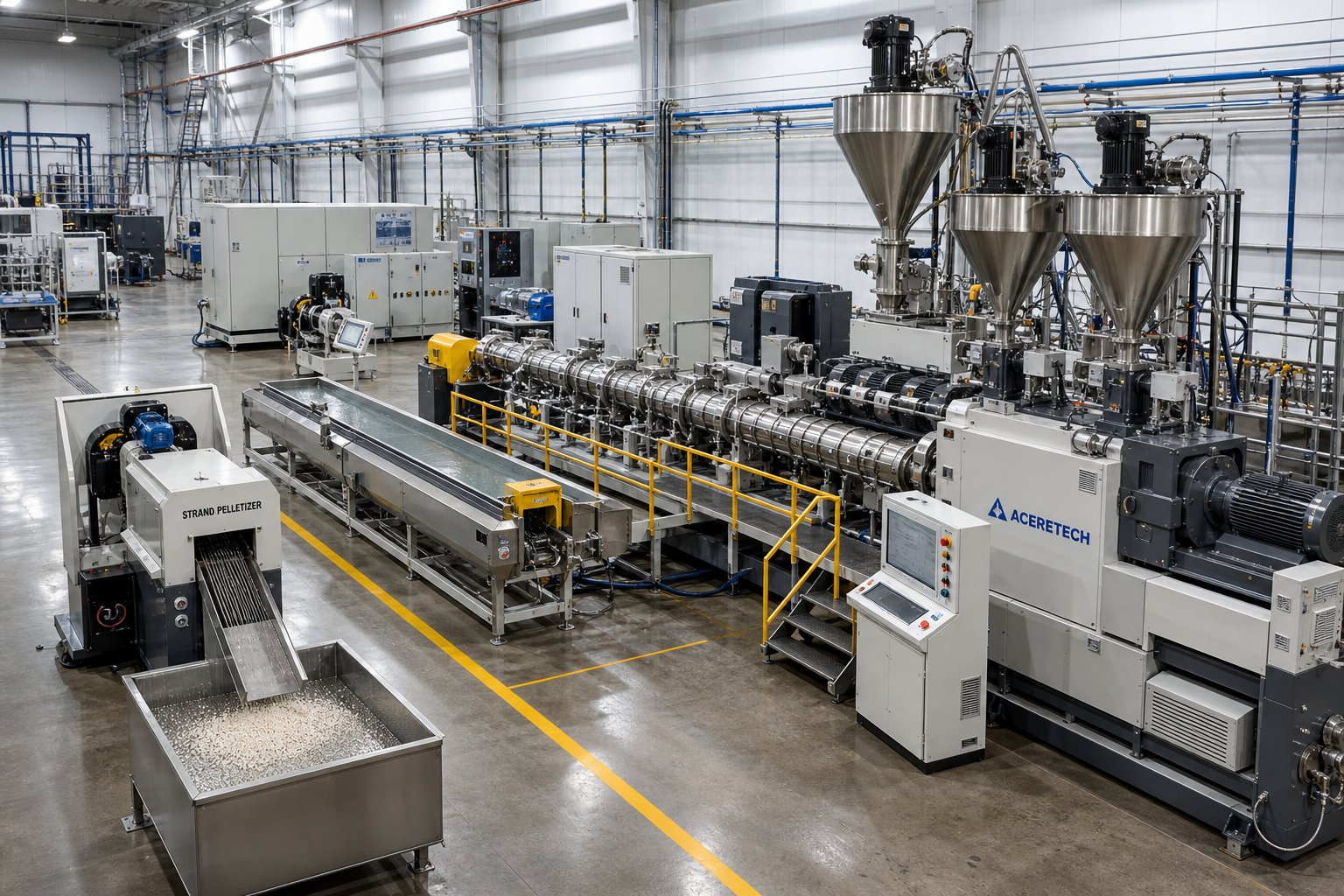
Essential Peripheral Equipment and Replacement Parts for Twin Screw Extruders
Here's a budgeting mistake that catches nearly every first-time buyer: you negotiate a competitive price on the extruder itself, plan for installation, secure your raw materials—and then realize you have no feeder system, no pelletizer, and no reliable source for the screw elements that will need replacing within the first year of production. The extruder is the centerpiece, but it can't produce a single usable pellet without the upstream and downstream equipment that surrounds it. And it won't keep running profitably without a sourcing strategy for the wear parts that degrade with every hour of operation.
When evaluating any extrusion equipment for sale, the peripheral systems and replacement part costs deserve as much attention as the extruder's own specifications. Overlooking them doesn't just create budget overruns—it creates production bottlenecks that can idle a perfectly good machine for weeks.
Upstream Equipment and Feeding Systems
Feeding determines everything downstream. An inconsistent feed rate causes surging at the die, fluctuating melt pressure, uneven filler dispersion, and off-spec product that gets scrapped or regraded. The sophistication of your feeding system should match the precision your process demands.
Loss-in-weight (LIW) feeders are the gold standard for compounding and masterbatch operations. They continuously weigh the material in the hopper and adjust the feed rate in real time to maintain a precise gravimetric target—typically holding accuracy within ±0.5% of the setpoint. If you're dosing expensive additives, color concentrates, or reactive components where even minor ratio variations produce rejectable product, LIW feeders aren't optional. As Leistritz's extrusion engineering guidelines emphasize, the LIW feeder refill device should deliver material at 8 to 10 times the maximum running rate to minimize time in less-accurate refill mode. Hopper angles must account for the angle of repose and flow characteristics of each specific material, and low-bulk-density powders require minimized vertical drop distances to prevent fluidization.
Volumetric feeders offer a simpler, lower-cost alternative for applications where gravimetric precision isn't critical—general-purpose compounding with stable bulk density feedstocks, or secondary additive streams where ±2-3% accuracy is acceptable. They meter material by volume rather than weight, making them susceptible to feed rate drift when bulk density varies between lots.
Side stuffers introduce fillers, fibers, and reinforcements downstream into the already-molten polymer. Twin-screw side feeders are sized to handle the required volumetric throughput of the additive stream, and oversizing the side stuffer screws is a common recommendation to prevent starving and bridging. For liquid additives—plasticizers, coupling agents, peroxides—dedicated liquid injection systems with precision metering pumps deliver controlled flow rates directly into the barrel at the appropriate processing zone.
Downstream Equipment and Pelletizing Systems
Whatever the extruder produces must be cooled, sized, and collected. The downstream system must match the extruder's throughput capacity—otherwise it becomes the bottleneck that caps your entire line's output.
Strand pelletizing is the most common downstream configuration for compounding lines. Molten strands exit the die, travel through a water bath for cooling, pass over an air knife or air-drying conveyor, and feed into a strand cutter that chops them into uniform pellets. It's reliable, easy to troubleshoot, and well suited for throughputs up to approximately 1,500 kg/h on a single die. The tradeoff is that strand breakage at higher rates or with certain materials (brittle compounds, highly filled systems) can reduce efficiency and require operator intervention.
Underwater pelletizing (UWP) systems cut the melt directly at the die face while submerged in a circulating water stream. The water instantly solidifies the pellets, producing uniform, spherical granules with minimal dust. UWP handles high throughputs—well beyond what strand systems manage—and excels with sticky, soft, or low-viscosity materials that resist strand formation. The cost is significantly higher, and the die plate requires precision maintenance to prevent leaking or uneven cutting.
Die-face (hot-face) cutting uses rotating blades at the die face with air quench cooling instead of water. This approach suits materials sensitive to moisture pickup and operations where water-free processing is preferred. Cooling conveyors—vibratory, belt, or fluidized bed—then bring pellet temperatures down to handling levels before packaging or storage.
When browsing plastic extruders for sale, check whether the listing includes downstream equipment or whether you'll need to source it separately. A complete extrusion line with matched feeding, pelletizing, and cooling systems saves weeks of integration work compared to assembling components from different vendors.
Replacement Screws, Barrels, and Wear Parts
This is the ongoing cost that separates informed buyers from surprised ones. Screw elements and barrel segments are consumable components—they wear down with every kilogram of material processed, and they will need replacement. The question isn't whether, but when and at what cost.
Processing abrasive materials like glass-fiber-reinforced compounds or mineral-filled masterbatch accelerates wear dramatically. A screw plastic extruder running 60% calcium carbonate polypropylene may need new kneading elements every 6 to 12 months, while the same machine processing unfilled polyolefins might go 24 to 36 months between replacements. Twin screw extruder spare parts—including conveying elements, kneading blocks, mixing elements, barrel liners, screw shafts, and seals—represent the largest recurring maintenance expense in any compounding operation.
OEM replacement parts deliver guaranteed dimensional accuracy and metallurgical specifications, but they carry premium pricing that can strain maintenance budgets, especially for plants running multiple extruder lines. A single set of OEM screw elements for a mid-size machine can range from $15,000 to $50,000, and barrel segment replacements add substantially to that figure.
Factory-direct suppliers have emerged as a practical alternative for procurement teams seeking cost-effective wear part sourcing without sacrificing quality. NANHAIYA (nhyscrews.com/products), for example, offers screw and barrel solutions compatible with various twin screw extruder brands—covering extrusion, compounding, and pelletizing applications. By manufacturing directly rather than distributing through OEM channels, suppliers like NANHAIYA provide replacement screw elements and barrel segments at factory-direct pricing, giving plastic extrusion plants a way to manage the plastic extrusion machine cost of ongoing wear part replacement without the markups that come with traditional OEM supply chains.
The key when sourcing from any aftermarket supplier is to verify dimensional tolerances, material hardness specifications, and metallurgical composition against original equipment standards. Quality replacement parts should match OEM specifications for flight geometry, surface finish, and wear resistance—whether they're nitrided tool steel for general compounding or bimetallic compositions for highly abrasive applications.
The following list summarizes the major peripheral categories and their relative importance across different application types. Use it as a budgeting checklist when evaluating any twin screw extruder machine for sale:
- Loss-in-weight feeders – Critical for compounding, masterbatch, pharma, and food; important for recycling; optional for basic PVC extrusion
- Side stuffers / downstream feeders – Essential for filled compounds and fiber-reinforced materials; not typically needed for unfilled or PVC processing
- Pelletizing system (strand, underwater, or die-face) – Required for any pellet-producing line; type selection depends on material properties and throughput
- Cooling conveyors and classifiers – Necessary for all pelletizing operations; capacity must match extruder throughput
- Replacement screw elements – High importance across all applications; budget as a recurring annual cost, not a one-time purchase
- Replacement barrel segments and liners – High importance for abrasive materials; moderate for general compounding; plan for replacement every 2-5 years depending on wear rate
- Liquid injection and metering systems – Essential for reactive extrusion, plasticizer dosing, and specialty chemical applications
- Vacuum systems for devolatilization – Critical for recycling, moisture-sensitive polymers, and reactive extrusion; less common in PVC or basic masterbatch lines
Every item on this list carries a price tag that belongs in your total acquisition budget—not as an afterthought six months into production. Factoring peripheral equipment and replacement parts into your purchasing framework from day one transforms the way you evaluate listings, compare pricing, and negotiate deals. It also shifts the conversation from "what does the extruder cost?" to the far more useful question: "what does it cost to run a complete, productive extrusion line?"
Smart Strategies for Finding the Right Twin Screw Extruder for Sale
That question—what does it cost to run a complete, productive extrusion line—should shape every step of your purchasing process from the very first search query. You've built the knowledge: how the technology works, which configuration fits your application, what specifications actually matter, how to inspect wear components, and why peripheral equipment and replacement parts belong in the budget from the start. The final piece is putting that knowledge into a systematic sourcing and evaluation strategy that prevents expensive mistakes and surfaces genuinely good deals.
Whether you're searching for a twin screw extruder for sale through an OEM catalog, scanning used equipment marketplaces, or fielding offers from multiple dealers, the process works best when it follows a structured sequence rather than an opportunistic chase after the lowest sticker price.
Where to Find Twin Screw Extruders for Sale
The sourcing channel you choose affects price, risk, warranty coverage, and how much due diligence falls on your shoulders. Each channel serves a different buyer profile, and understanding those differences prevents mismatched expectations.
OEM manufacturers sell new equipment directly, offering full customization of screw geometry, barrel metallurgy, control systems, and automation packages. You'll pay the highest twin screw extruder price through this channel, but you receive a machine built precisely for your application, backed by a factory warranty (typically 1-2 years) and commissioning support. This path suits buyers with well-defined, high-volume production requirements and the budget to match.
Specialized used equipment dealers like Machinio, Exapro, Perry Videx, and Aaron Equipment maintain inventoried, inspected machines with documented specifications. Pricing falls significantly below new—typically 30-50% of new extruder machine price levels for comparable capacity. Quality dealers provide wear measurement reports, electrical condition summaries, and sometimes limited warranties. This channel works well for experienced buyers who can evaluate inspection data and negotiate reconditioning costs into the deal.
Auction platforms and liquidation sales offer the lowest entry prices but also the highest risk. When manufacturing plants close or upgrade, entire extrusion lines go to auction through platforms like BidSpotter and Aaron Equipment auctions. You can find twin screw extruders for sale at deep discounts—sometimes 60-70% below new equivalent pricing. The tradeoff? Equipment is almost always sold as-is, with limited documentation and no warranty. Thorough pre-auction inspection is essential, and you should budget generously for reconditioning.
Factory-direct outlets and Asian manufacturers occupy a growing segment. Companies in China offer new twin screw extruders at 30-55% of European OEM pricing, with increasingly competitive specifications for mainstream compounding and masterbatch applications. Lead times tend to run 3-6 months for build-to-order machines. The key risk factors are compliance certification (CE, UL), spare parts logistics across time zones, and after-sales support accessibility.
| Sourcing Channel | Typical Price Range (Relative) | Warranty Likelihood | Best for Which Buyer Type |
|---|---|---|---|
| OEM Manufacturer (New) | Highest | High — 1-2 year standard, extended options available | High-volume producers, regulated industries, buyers needing full customization |
| Specialized Used Equipment Dealer | Mid — 30-50% below new | Moderate — limited 30-90 day warranties from reputable dealers | Experienced buyers, capacity expansion, secondary production lines |
| Auction / Liquidation | Lowest — 40-70% below new | Low — typically sold as-is with no warranty | Technically capable buyers comfortable with reconditioning risk |
| Factory-Direct (Asian Manufacturers) | Low to Mid — 30-55% below European OEM | Moderate — manufacturer warranty included, but remote support | Cost-focused buyers with flexible timelines and in-house maintenance capability |
Sounds like a lot of options? It is—and that's precisely why a systematic comparison framework matters more than speed. A plastic extruder for sale that looks perfect in a listing can fall apart under structured evaluation, while a less flashy listing from a dealer you almost overlooked might turn out to be the strongest value in the market.
A Systematic Approach to Comparing Listings
When you're comparing multiple extruders for sale side by side, emotion and urgency are your enemies. A structured, step-by-step process keeps the focus on data rather than impulse—and it ensures you don't skip the evaluation steps that catch hidden problems before they become your problems.
- Define your process requirements first. Before browsing a single listing, document the material you'll process, the required throughput, the screw configuration type (co-rotating or counter-rotating), minimum L/D ratio, torque requirements, and any regulatory or industry-specific compliance needs. This specification sheet becomes your filter—any machine that doesn't meet minimum requirements gets eliminated immediately, regardless of price.
- Shortlist machines meeting minimum specifications. Search across multiple sourcing channels simultaneously—OEM catalogs, used equipment platforms, dealer inventories, and auction calendars. Flag every listing that matches your defined specs. At this stage, a plastic extruder machine for sale only earns a spot on the shortlist if the published specifications align with your documented requirements. Don't stretch to "close enough."
- Request detailed inspection data for every shortlisted machine. For used equipment, ask for screw flight diameter measurements vs. original specs, barrel bore gauge data, gearbox oil analysis reports, motor insulation test results, control system details, and hour meter readings. For new machines, request detailed technical proposals with guaranteed performance specifications and reference customer contacts. A seller who can't or won't provide this data is a seller you should pass on.
- Verify screw and barrel condition independently. This is the step most buyers skip—and the one that saves the most money. For any used machine under serious consideration, commission an independent measurement of screw-barrel clearances. Compare those measurements to manufacturer tolerance specifications. If the clearance exceeds acceptable limits, price a full set of replacement screw elements and barrel segments into your cost model before proceeding.
- Assess total cost of ownership, not just purchase price. Build a spreadsheet that captures the extruder machine price, installation and commissioning costs, any required control system upgrades, estimated annual energy consumption, and—critically—replacement parts sourcing costs. Factor in screw and barrel replacement as a recurring line item. Factory-direct suppliers like NANHAIYA offer screw and barrel solutions at pricing that can significantly reduce ongoing wear part expenses compared to OEM channels, making total cost projections more favorable for used equipment where near-term replacements may be needed. Include this parts sourcing estimate in every comparison—it's the cost most buyers discover too late.
- Negotiate with full knowledge of reconditioning costs. Armed with inspection data, replacement part quotes, and total cost of ownership projections, you negotiate from a position of strength. Every worn screw element, every aging heater band, every obsolete PLC component is a quantifiable cost that justifies adjusting your offer downward. Present your data clearly—sellers respect informed buyers, and documented findings create legitimate negotiating room that vague complaints never achieve.
This sequence works whether you're evaluating a single extruder machine for sale or comparing a dozen listings across three continents. The discipline of following it consistently is what separates buyers who find genuine value from buyers who discover hidden costs months after the purchase order clears.
Final Pre-Purchase Recommendations
After walking through technology fundamentals, configuration choices, specification decoding, brand evaluation, new-versus-used tradeoffs, inspection protocols, application matching, and peripheral equipment budgeting, the purchasing decision ultimately rests on three principles that have held true across every twin screw extruder acquisition I've seen succeed—and every one I've seen fail.
First, match specifications to your application before considering price—the cheapest machine is always the one that does the job correctly. Second, always inspect screw and barrel wear on any used equipment, because these components alone can add $15,000 to $100,000 to your true acquisition cost. Third, budget for peripheral equipment and replacement parts from the start, including factory-direct screw and barrel sourcing through suppliers like NANHAIYA, so that your total investment reflects the real cost of running a productive line—not just the cost of owning an idle machine.
The twin screw extruder market offers genuine opportunities at every price point—from auction-priced used units that deliver years of additional service to fully customized new machines built for decades of high-output production. The red flags this guide has outlined aren't reasons to avoid buying. They're reasons to buy with your eyes open, your specifications defined, your inspection data in hand, and your total cost of ownership calculated before you sign anything.
A systematic buyer who follows this framework won't eliminate every risk—no purchasing process can. But you'll eliminate the preventable risks: the configuration mismatches, the undiscovered screw wear, the forgotten peripheral costs, and the parts sourcing surprises that turn a promising acquisition into an expensive lesson. Every twin screw extruder machine for sale tells a story in its specifications, its wear patterns, and its documentation. Your job is to read that story clearly before you make it part of yours.
Frequently Asked Questions About Twin Screw Extruder Machines for Sale
1. What is the price range for a twin screw extruder machine?
Twin screw extruder pricing varies widely based on size, brand, and condition. New lab-scale units (16-27 mm screw diameter) can start around $30,000-$80,000, while mid-range production machines (35-65 mm) typically cost $100,000-$400,000 from OEM manufacturers. Large industrial extruders (75-135 mm) from premium brands like Coperion or Leistritz may exceed $500,000. Used equipment generally sells for 30-50% below equivalent new pricing. However, the purchase price only tells part of the story—total cost of ownership over five years, including replacement screw elements, barrel segments, energy consumption, and peripheral equipment, can exceed the initial investment by two to three times. Factory-direct screw and barrel suppliers like NANHAIYA (nhyscrews.com/products) can help reduce ongoing wear part expenses compared to OEM-priced replacements.
2. What is the difference between co-rotating and counter-rotating twin screw extruders?
Co-rotating twin screw extruders have both screws spinning in the same direction, generating high shear and intensive mixing through a self-wiping, intermeshing geometry. They operate at 400-1,200+ RPM and excel at plastics compounding, masterbatch production, and reactive extrusion. Counter-rotating extruders spin screws in opposite directions, producing lower shear through a calendering effect at just 30-150 RPM. This gentler action makes them ideal for heat-sensitive materials like PVC, where excessive shear causes thermal degradation. Conical counter-rotating designs, which taper from a large feed diameter to a smaller discharge diameter, dominate PVC pipe and profile extrusion. Choosing the wrong configuration for your material is one of the most expensive mistakes a buyer can make, so confirming rotation type should be your first filter when evaluating any listing.
3. How do I inspect a used twin screw extruder before buying?
A thorough inspection should cover three critical systems. First, measure screw flight outer diameters and barrel bore dimensions against original manufacturer specs—the screw-barrel clearance gap is the most important wear indicator, and exceeding tolerances by more than 50% signals near-term replacement is needed. Second, evaluate the gearbox through oil analysis (watch for rising iron and copper particle counts), vibration testing, and operational noise assessment, since gearbox rebuilds can cost $30,000-$80,000. Third, verify control system functionality, heater band responsiveness, thermocouple accuracy, and safety system compliance. Always request maintenance logs, hour meter readings, and processing history. Ask the seller for a live test run or recent operating video, and factor all identified reconditioning costs into your offer price before negotiating.
4. What L/D ratio do I need for my twin screw extruder application?
The ideal L/D ratio depends on your processing complexity. Shorter ratios of 20:1 to 28:1 suit PVC extrusion and applications requiring minimal residence time. General-purpose compounding, glass fiber reinforcement, and engineering plastics typically need 32:1 to 40:1. Applications demanding multiple functional zones—such as heavily filled compounds with side stuffing, dual vacuum venting, and intensive mixing—require 40:1 to 48:1 or longer. Plastics recycling operations often push to 44:1-52:1 to accommodate aggressive devolatilization through multiple vent ports. A machine with an L/D ratio that is too short for your process cannot be easily extended, so matching this specification to your specific mixing, venting, and feeding requirements is essential before purchase.
5. Should I buy a new or used twin screw extruder?
The decision depends on your production demands, capital position, and risk tolerance. New machines make sense when you need custom screw geometry, latest control technology, full warranty coverage, or regulatory documentation for food or pharmaceutical applications. Used extruders deliver strong ROI for startups with limited capital, R&D and pilot-scale operations, secondary production lines, and well-established processes where cutting-edge features add little value. Quality used machines from premium European brands often retain 70-80% of original processing capability at roughly half the cost. Whichever path you choose, calculate total cost of ownership—not just the sticker price. Include installation, control system upgrades, energy efficiency differences, and recurring screw and barrel replacement costs. Sourcing wear parts from factory-direct suppliers like NANHAIYA can meaningfully reduce long-term operating expenses for both new and used equipment.
Written by
Nanhaiya Technical Team
Zhoushan Nanhaiya Plastic Machinery Co., Ltd.
The Nanhaiya technical team supports screw and barrel manufacturing projects through application review, technical communication, custom manufacturing coordination, and production and quality control.
Discuss Your Application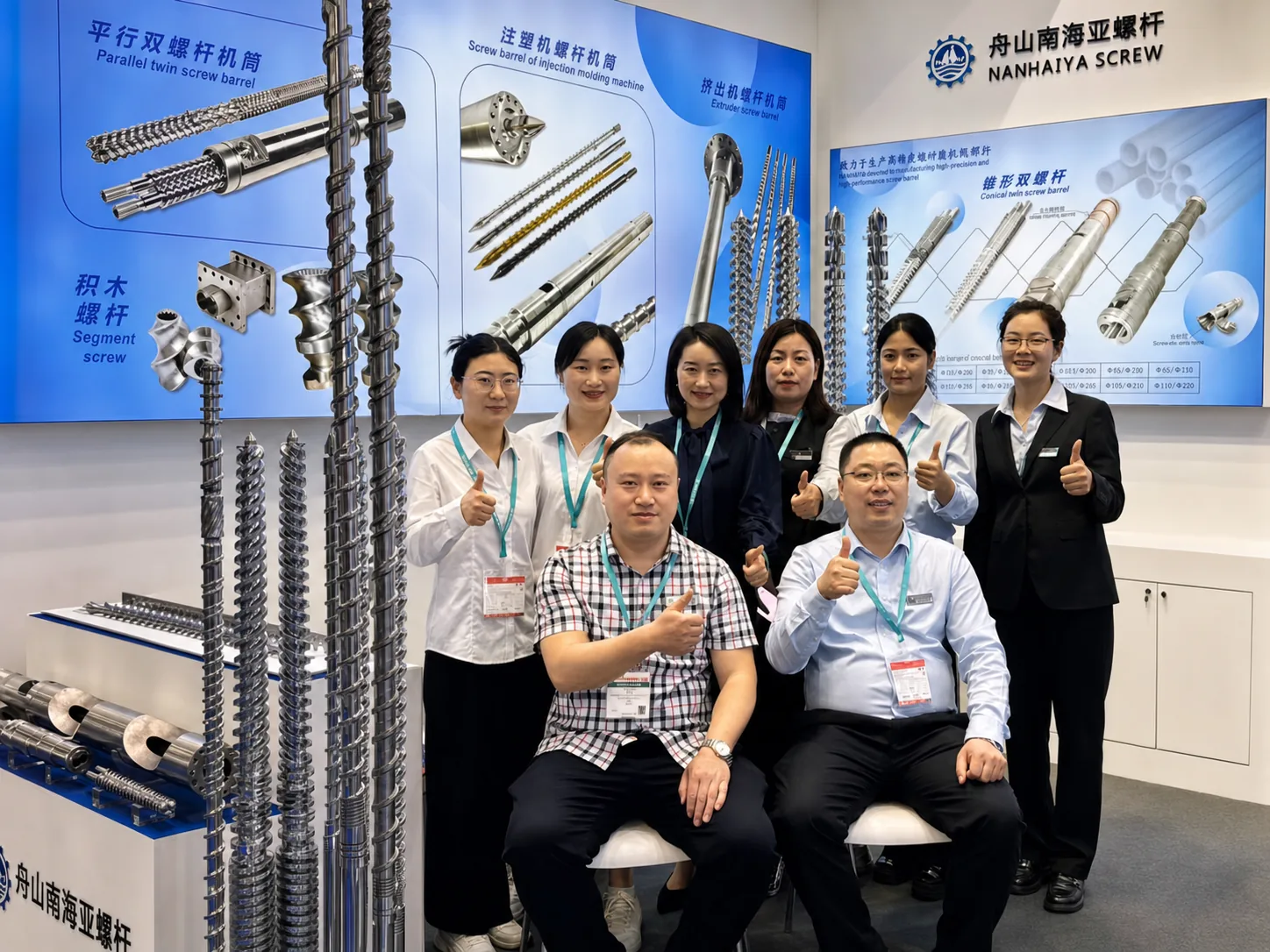
Related Articles
More insights on screw barrel technology and plastics processing.
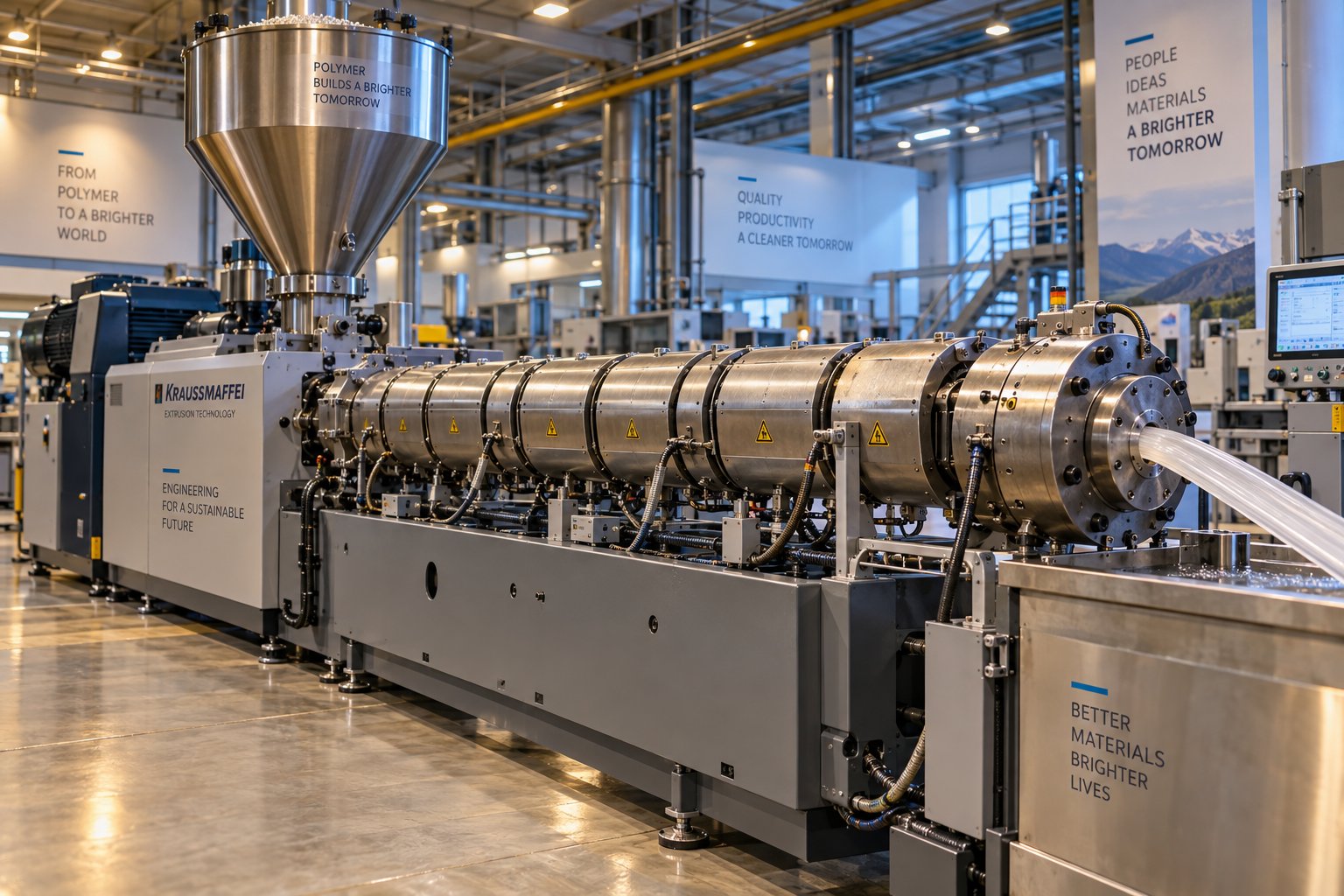
Extruder Machine Decoded: From Raw Pellet To Finished Product
Oct 6, 2026
Learn how an extruder machine works, compare single-screw vs. twin-screw types, and get expert guidance on specs, troubleshooting, and selection.
Read Article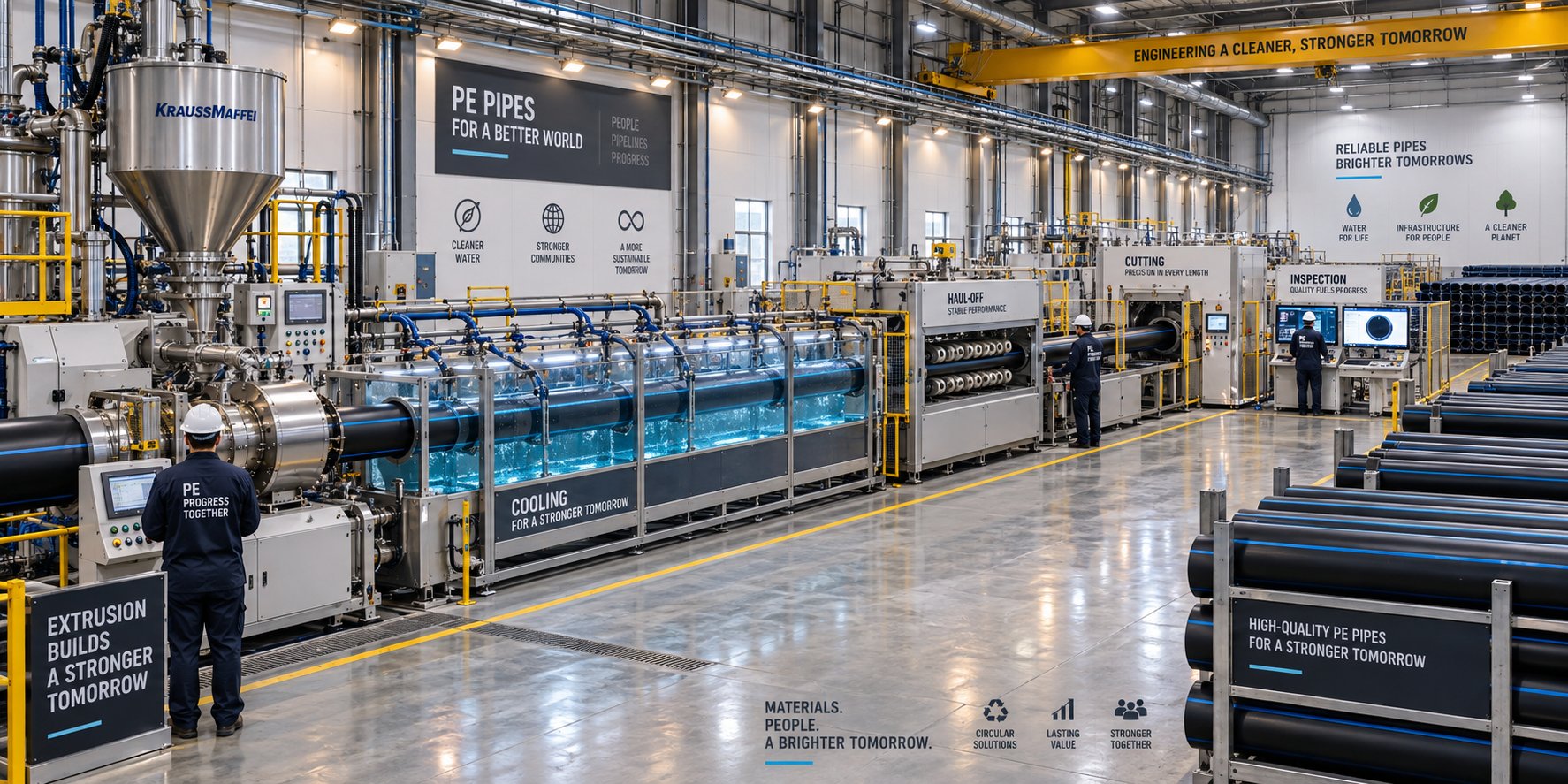
PE Pipe Making Machine Decoded: From Raw Resin to Flawless Pipe
Oct 4, 2026
Learn how a PE pipe making machine works, from resin to finished pipe. Covers components, material grades, automation, troubleshooting, and buyer selection tips.
Read Article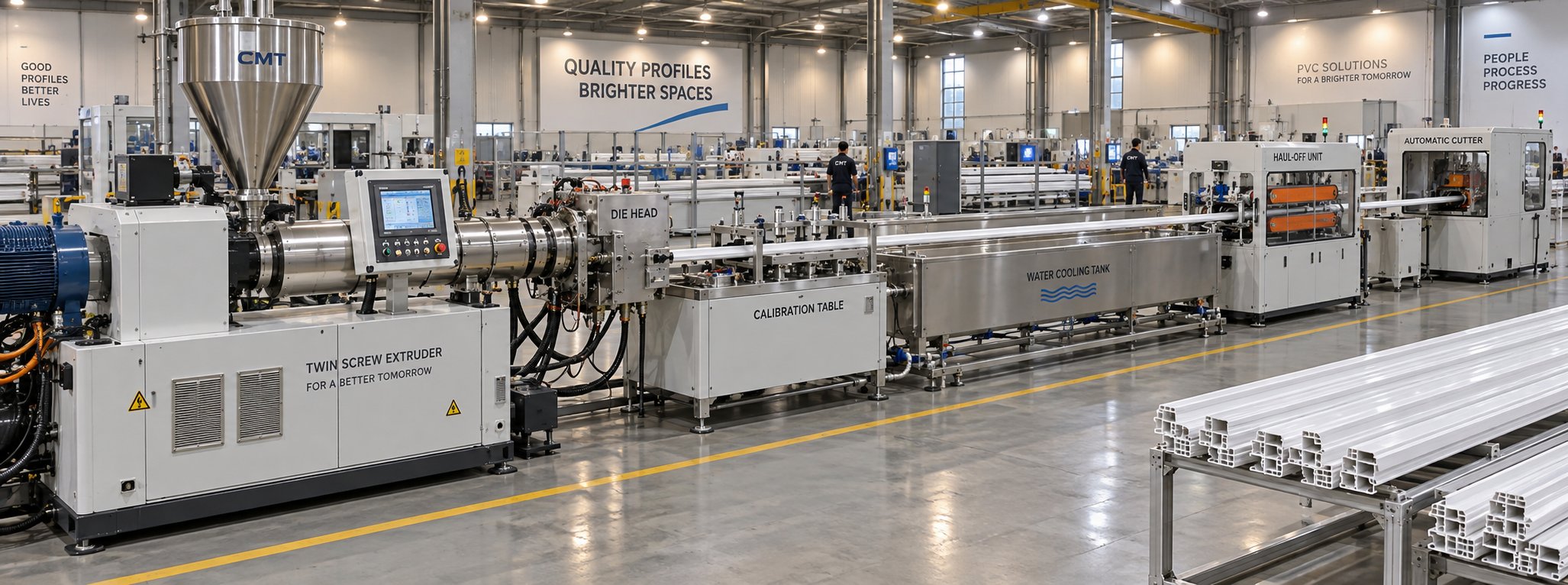
PVC Profile Making Machine Decoded: From Raw Resin To Profit
Oct 3, 2026
Learn how a PVC profile making machine works — extrusion process steps, key technical parameters, die design, calibration methods, maintenance, and total cost of ownership.
Read ArticleLooking for something else?
Search by material, symptom or product and jump straight to the relevant page.
These are navigation suggestions based on keyword matching — not a quotation, not a delivery commitment, and not a substitute for engineering review. Final specification is confirmed by our engineers against your drawings and processed material.
Need help with screw barrel selection?
Share your machine model, processed material and application. Our team can help with pricing and technical support.