

What Is a Twin Screw Extruder and Why Recycling Needs One
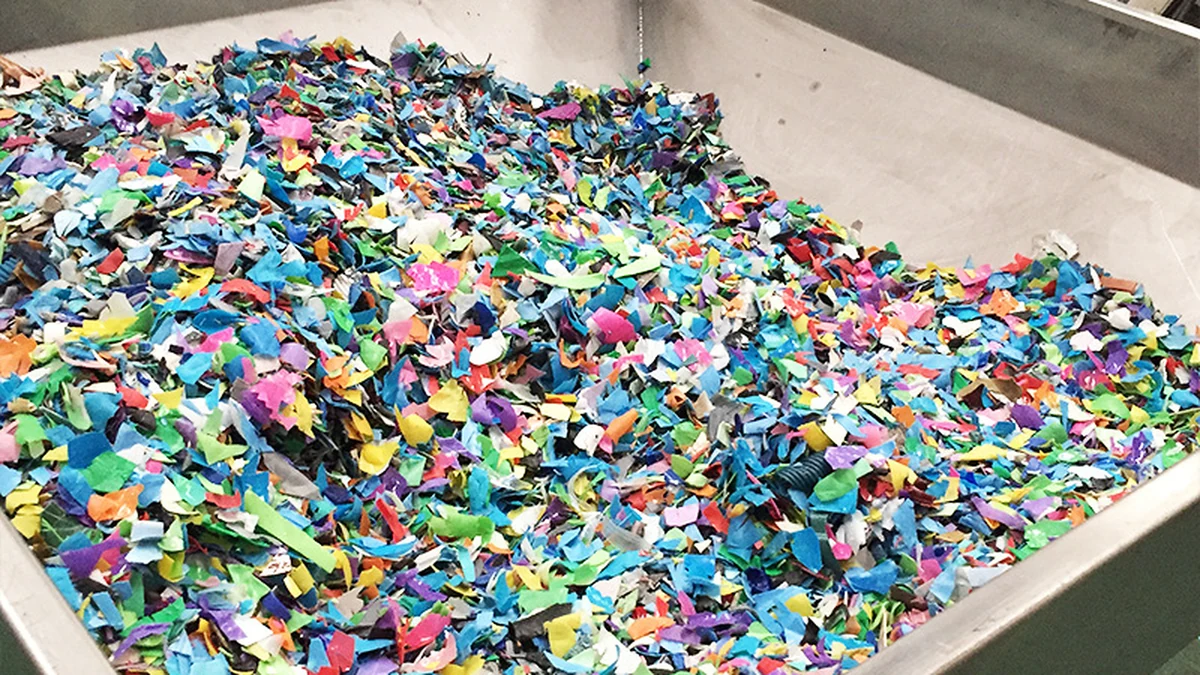
Imagine feeding a machine dirty, mixed, inconsistent plastic flake and pulling out clean, uniform pellets that brand owners actually want to buy. That is exactly the job a twin screw extruder for recycling is designed to do, and it is the reason this machine sits at the heart of nearly every modern plastics recycling operation.
A twin screw extruder is a polymer processing machine that uses two intermeshing screws rotating inside a heated barrel to melt, mix, devolatilize, and homogenize plastic feedstock into consistent, high-quality output suitable for pelletizing or direct forming.
The technology is not new, but its importance has surged. A growing wave of Extended Producer Responsibility (EPR) legislation and recycled content mandates across the United States and globally is pushing manufacturers to incorporate more post-consumer recycled (PCR) material into their products. Seven U.S. states already run active EPR programs for packaging, and five states enforce minimum recycled content standards for containers and packages. That regulatory pressure means recyclers must produce pellets that meet strict mechanical, aesthetic, and safety specifications, and a twin screw extruder is the technology that makes that possible.
Three broad recycling paradigms rely on this equipment. Mechanical recycling uses the extruder to melt, filter, and re-pelletize sorted plastic waste. Chemical recycling leverages twin screw systems for depolymerization feed preparation or reactive processing. Upcycling compounding goes a step further, blending recycled resin with additives, fillers, and stabilizers to produce engineering-grade compounds that rival virgin material. In each case, the twin screw extruder is the central workhorse.
What a Twin Screw Extruder Actually Does
Picture two screws placed side by side inside a figure-eight-shaped barrel bore. As they rotate, the flights of one screw mesh into the channel of the other, creating an intense, self-wiping conveying and mixing action. This is what separates a twin screw extruder from a single screw design. A single screw depends heavily on friction between the barrel wall and the polymer to push material forward. A twin screw extruder, by contrast, uses positive displacement created by the intermeshing geometry, giving it far greater control over material transport and mixing intensity.
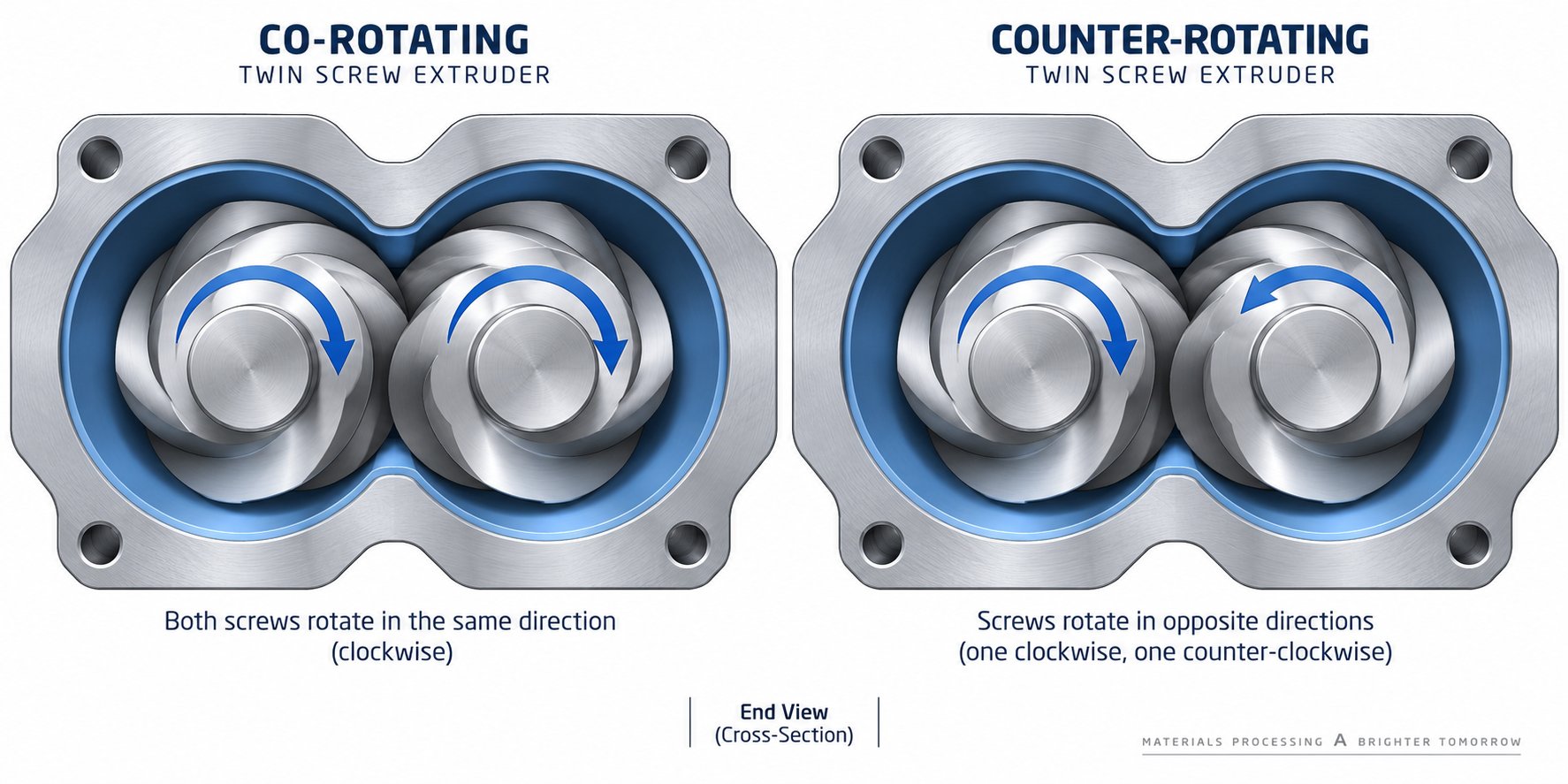
These screws can rotate in the same direction, known as co-rotating, or in opposite directions, called counter-rotating. Co-rotating configurations dominate recycling and compounding work because their self-wiping action prevents stagnant material from degrading inside the barrel. Counter-rotating designs generate lower shear and serve a narrower set of applications. Both types share the same fundamental advantage over single screw machines: dramatically better distributive and dispersive mixing, which matters enormously when your feedstock is anything but uniform.
Whether you are evaluating a production-scale line or a lab scale twin screw extruder for developing new recycled formulations, the working principle remains the same. Two screws, tight intermeshing, and a modular barrel system create a precisely controllable processing environment from feed throat to die face.
Why Recycling Demands Advanced Extrusion
Virgin polymer arrives at an extruder in predictable pellet form with consistent melt flow, moisture content, and zero contamination. Recycled feedstock is the opposite. You'll encounter variable bulk densities from flake to regrind, fluctuating melt flow index values from batch to batch, residual moisture, paper labels, adhesive residues, and trace metals. Every one of these inconsistencies works against producing a clean, sellable pellet.
A twin screw extruder addresses these challenges through three core advantages. First, its modular screw design lets processors arrange conveying elements, kneading blocks, and mixing sections in whatever sequence the specific feedstock demands. Second, the barrel can incorporate multiple venting or vacuum ports for staged devolatilization, pulling moisture and volatile contaminants out of the melt at different points along the process. Third, the superior mixing intensity ensures additives like stabilizers, compatibilizers, and colorants are uniformly distributed, even when the incoming material varies in composition.
These capabilities are not optional extras in recycling; they are operational necessities. The more contaminated and variable the feed stream, the more critical the twin screw extruder's flexibility becomes. That flexibility also extends to the exact processing parameters, including temperature profiles, screw speeds, and feed rates, all of which must be tuned differently for recycled material than for virgin resin.
How the Twin Screw Extrusion Process Handles Recycled Plastics
Tuning temperature profiles, screw speeds, and feed rates for recycled material is not a matter of guesswork. It starts with understanding exactly what happens to a recycled polymer flake from the moment it drops into the feed throat until it exits the die as a clean, pressurized melt strand. Every centimeter of barrel length serves a specific purpose, and when you are processing contaminated, variable feedstock, each of those functional zones must work harder than it would with virgin resin.
Think of twin screw extrusion as a carefully sequenced series of transformations. The recycled flake enters as a chaotic mix of irregular shapes, moisture, and trace contaminants. By the time it reaches the die, it should be a homogeneous, degassed, specification-grade melt. The journey between those two states unfolds across five distinct functional zones, each engineered to tackle a specific processing challenge.
Functional Zones From Feed Throat to Die
A screw plastic extruder designed for recycling divides its barrel length into zones that match the sequential needs of the material. Here is the progression from inlet to outlet:
- Feeding and Solids Conveying Zone — Recycled flake or regrind enters through the feed throat and meets deep-flighted conveying screw elements. The challenge here is bulk density variation. Virgin pellets flow predictably, but recycled flake can range from lightweight film shreds to dense regrind chunks, sometimes within the same batch. Gravimetric feeders help stabilize the mass flow, but the screw geometry in this zone must also accommodate low-bulk-density materials without starving the barrel or creating feed surges. Feed throat temperature is typically kept low, sometimes with active cooling, to prevent premature softening that could cause material to bridge or stick to the screws.
- Melting and Plasticizing Zone — As material advances, it encounters tighter screw channels and initial kneading elements that convert mechanical energy into heat. The polymer transitions from solid to melt through a combination of barrel heating and frictional shear. Recycled feedstock often has a broader melting range than virgin material because it includes mixed polymer fractions, degraded chains, and residual contaminants. This zone must provide enough energy to fully plasticize the material without overheating portions that have already melted, a balancing act that demands careful barrel temperature profiling.
- Mixing and Kneading Zone — This is where the twin screw extrusion process truly earns its reputation. Kneading blocks at various stagger angles subject the melt to intense dispersive and distributive mixing. Contaminants are broken down, additives are incorporated, and the melt approaches compositional uniformity. For recycled streams carrying incompatible polymer traces or poorly dispersed pigment residues, this zone does the heavy lifting. The intermeshing, self-wiping screw geometry ensures that no material pocket stagnates and degrades, which is a persistent risk when processing thermally sensitive recycled polymers.
- Devolatilization and Degassing Zone — Recycled plastics carry volatiles that virgin resin simply does not: residual moisture, printing ink solvents, adhesive decomposition products, and degradation byproducts. In this zone, screw elements shift back to deep-channel conveying designs that reduce melt pressure and create a partially filled barrel section. Vent ports, often connected to vacuum pumps, draw volatiles out of the exposed melt surface. Multi-stage degassing with two or even three vent ports is common in recycling applications, especially for post-consumer material where contamination levels are unpredictable. Proper vent zone design prevents melt from surging into the vacuum line, a frequent headache when processing low-viscosity or highly filled recycled streams.
- Pressure Buildup and Discharge Zone — The final barrel section uses tight-pitch conveying elements to compress and pressurize the melt for delivery through a screen changer, melt filter, and die. Stable melt pressure in this zone directly affects pellet quality and screen changer life. Recycled material, with its variable viscosity, can produce pressure fluctuations that are far more pronounced than those seen in virgin processing, making consistent metering in this zone critical for downstream equipment performance.
Each zone does not operate in isolation. The temperature set in the mixing section influences how much volatile extraction happens downstream. The feed rate dictates how full the barrel runs, which in turn affects residence time in the devolatilization zone. Getting one zone right while neglecting another leads to pellets that fail quality tests.
How Processing Parameters Differ From Virgin Material
If you have experience running virgin resin, you'll notice that recycled feedstock flips several familiar assumptions. The parameter adjustments are not minor tweaks. They reflect fundamental differences in how degraded, contaminated material responds to heat and shear.
Temperature profiles start lower and climb more gradually. Recycled polymers have already been through at least one heat history, which shortens their molecular chains and narrows their thermal processing window. Setting barrel temperatures too high too early accelerates further degradation, producing discoloration, odor, and loss of mechanical properties. A practical approach is to keep the feed and early melting zones 10 to 20 degrees Celsius below the settings you would use for virgin material of the same polymer type, then allow the profile to rise gently toward the mixing zone. As processing experts note, the extrusion temperature profile must always account for the highest melting temperature among all material components, but for recycled blends with mixed fractions, this principle requires even more careful zone-by-zone calibration.
Screw speed must balance throughput against shear-induced degradation. Higher screw speeds generate more shear, which improves mixing but also raises melt temperature and can further degrade already-weakened polymer chains. For recycled material, processors typically operate at moderate screw speeds and compensate for mixing intensity through screw element configuration rather than raw rotational speed. Monitoring motor current is a useful real-time indicator of shear load. If current spikes, the material is experiencing excessive resistance, signaling the need to adjust either speed or temperature in the mixing section.
Feed rate must accommodate bulk density variation. Unlike virgin pellets that flow at a predictable rate, recycled flake and regrind can vary dramatically in bulk density. Film flake might weigh 50 to 150 kg per cubic meter, while regrind from rigid containers could exceed 400 kg per cubic meter. Starve feeding, where a gravimetric feeder meters material into the extruder at a controlled rate independent of screw speed, is the standard approach for recycling lines. This prevents overfeeding that would choke the venting zones and underfeeding that would reduce throughput and destabilize pressure.
Degassing demands are significantly more aggressive. Where a virgin resin line might need a single atmospheric vent, recycled feedstock often requires two or three vacuum-assisted degassing stages. Each stage strips a different category of volatile: the first pulls bulk moisture and light organics, while subsequent stages target higher-boiling-point contaminants that only release at elevated melt temperatures deeper in the barrel. Vent zone barrel temperatures are typically set slightly lower to reduce the risk of melt leakage through the ports, a detail that experienced operators learn to manage through coordinated temperature and screw speed adjustments.
The overarching lesson is that no single parameter set works universally. Every recycled stream brings its own contamination profile, thermal history, and rheological behavior. The twin screw platform's modular design, combined with independently controlled barrel zone temperatures and variable-speed drives, gives processors the flexibility to dial in the right balance. That adaptability is exactly why durable twin screw systems meet the challenges of recycling feedstock that would overwhelm simpler extrusion equipment.
Still, the extrusion process itself is only half the equation. The direction those intermeshing screws rotate, co-rotating or counter-rotating, fundamentally changes the mixing behavior, shear profile, and range of polymers the machine can handle effectively.
Co-Rotating vs Counter-Rotating Configurations for Recycling
That rotational direction is not just a mechanical detail. It dictates the entire mixing philosophy of the machine, the shear forces imposed on the polymer, and ultimately which recycled materials the extruder can process without degrading them. For anyone specifying an extruder for polymer recycling, this is one of the first and most consequential choices you will face.
Both configurations use two intermeshing screws housed inside a figure-eight barrel bore, but the flow fields they generate are fundamentally different. Understanding those differences helps you match machine capability to feedstock reality.
Co-Rotating Extruders for High-Performance Recycling
In a co-rotating design, both screws turn in the same direction, and the fully intermeshing geometry creates a flow pattern where material is forcibly transferred from one screw flight to the next at the intermeshing zone. This produces two critical advantages for recycling work.
First, the self-wiping action. Because each screw flight sweeps the surface of its partner, very few dead zones exist inside the barrel, and material stagnation is effectively eliminated. Stagnant polymer pockets are a serious problem in recycling because thermally degraded feedstock is already near the edge of its processing window. Any material that lingers too long in a hot zone will char, discolor, or generate degradation byproducts that contaminate the entire batch. Self-wiping geometry keeps the residence time distribution narrow, which is essential for maintaining consistent output quality from inconsistent recycled feed.
Second, the mixing intensity. Co-rotating screws generate high shear stress both between the screws themselves and between each plastic extruder screw and the barrel wall. Kneading blocks add elongational flow to the picture, creating a complex deformation history that breaks down contaminant agglomerates and disperses trace incompatible polymers throughout the melt. This is exactly the kind of thorough mixing that post-consumer recycled streams demand, where a bale of HDPE flake might carry traces of PP, PET labels, adhesive residues, and residual moisture.
The vast majority of post-consumer and post-industrial recycling lines use co-rotating intermeshing designs. Their ability to handle multi-stage venting, downstream side feeding, and high screw speeds ranging from 100 to over 1,000 rpm makes them the default choice for any application requiring intensive mixing, devolatilization, or additive compounding with recycled resin.
When Counter-Rotating Designs Make Sense
Counter-rotating extruders take the opposite approach. The two screws spin in opposing directions, drawing material inward at the intermeshing region and advancing it forward under compression. Mixing in this configuration relies primarily on compressive and elongational deformation rather than the intense shear fields characteristic of co-rotating machines.
Why would you want less shear? Because some polymers simply cannot tolerate it. Rigid PVC is the textbook example. It has a low thermal decomposition temperature, poor melt flow, and a narrow processing window where the difference between a stable melt and a degrading one can be just a few degrees. The high shear conditions inside a co-rotating extruder can generate enough frictional heat to push PVC past that threshold. A counter-rotating machine, operating at high fill levels and low screw speeds, holds the extrusion temperature down while a calendering effect at the intermeshing zone provides gentle but effective dispersive mixing of stabilizers and other additives.
For PVC pipe, sheet, and profile recycling, counter-rotating designs remain the preferred configuration. They also find use in other shear-sensitive applications where preserving molecular weight matters more than achieving the highest possible mixing intensity.
The table below summarizes the practical differences between these two configurations as they apply to recycled feedstock processing:
| Criteria | Co-Rotating Intermeshing | Counter-Rotating Intermeshing |
|---|---|---|
| Mixing Intensity | High — strong shear and elongational flow | Moderate — compressive and calendering action |
| Shear Level | High, adjustable via screw speed and element selection | Low to moderate, inherently gentler |
| Self-Wiping Ability | Excellent — minimal dead zones, narrow residence time distribution | Limited — higher risk of material stagnation |
| Typical L/D Ratios | 32:1 to 56:1 (up to 60:1 possible) | 16:1 to 28:1 (shorter barrel lengths typical) |
| Typical Screw Speed Range | 100 to 1,200+ rpm | 10 to 50 rpm |
| Throughput Capacity | Broad range, scalable with diameter | Lower relative throughput per unit diameter |
| Best-Suited Recycled Polymers | PE, PP, PET, PA, ABS, PS, mixed polyolefins | Rigid PVC, shear-sensitive specialty polymers |
| Common Recycling Applications | Post-consumer compounding, devolatilization, upcycling, reactive extrusion | PVC pipe and profile recycling, low-shear blending |
L/D Ratio Selection for Recycling
The length-to-diameter ratio of the twin screw and barrel assembly determines how much processing real estate you have to work with. A longer L/D means more barrel sections available for feeding, melting, mixing, devolatilizing, and pressure buildup. For recycling, more is almost always better.
Standard compounding applications might run comfortably at 32:1 or 36:1, but recycling operations routinely push to 40:1, 48:1, or even 56:1. The reason is straightforward: recycled feedstock demands extra processing stages that virgin material does not. You need additional barrel length for multi-stage vacuum venting to remove moisture and volatile contaminants. You may need a downstream side-stuffer port for introducing fillers or additives after the polymer is already melted. And you often need extended mixing zones to homogenize material that varies in composition from one minute to the next.
Industry references confirm that typical L/D ratios for co-rotating machines range from 32:1 to 48:1, with configurations up to 60:1 available for processes that need extended devolatilization or reactive extrusion stages. Recycling applications land squarely in the upper half of that range.
Choosing an L/D that is too short forces compromises. You might sacrifice venting capacity to fit enough mixing elements, or cut the mixing zone short to accommodate adequate venting. Either trade-off degrades pellet quality. For heavily contaminated post-consumer streams, starting your specification at 44:1 or longer gives the screw designer enough room to address all the process demands without forcing one zone to compensate for another.
Configuration decisions like these, co-rotating versus counter-rotating and short versus long L/D, shape what the extruder can do. But the real question most recyclers face is even more fundamental: should they be using a twin screw machine at all, or could a single screw extruder handle the job?
Twin Screw vs Single Screw Extruders for Recycling Compared
It is a fair question, and one that carries serious financial weight. A twin screw extruder machine can cost two to three times more than a comparable single screw system, largely because of its high-torque distribution gearbox, modular segmented screw elements, and more sophisticated control systems. That price gap demands justification, and the answer depends entirely on what you are feeding into the machine and what you need coming out.
Single screw extruders rely on a single rotating screw to convey, melt, and pump polymer forward. They depend on friction between the barrel wall and the material to generate forward movement and mixing. That mechanism works beautifully when the feedstock is clean, uniform, and needs minimal compounding. But recycling feedstock rarely fits that description, and the performance gap between the two technologies widens as feedstock complexity increases.
The following table lays out the comparison across the dimensions that matter most in a recycling operation:
| Dimension | Twin Screw Extruders | Single Screw Extruder |
|---|---|---|
| Mixing Capability | Excellent — high dispersive and distributive mixing from intermeshing, self-wiping geometry | Basic — limited to drag-induced shear between screw and barrel wall |
| Feedstock Flexibility | Handles mixed, contaminated, variable-density post-consumer streams | Best with clean, consistent, uniform feedstock such as post-industrial regrind |
| Throughput Range | Wide range, from lab scale to 10,000+ kg/hr depending on screw diameter | Very high throughput achievable, especially for simple melt-and-pelletize operations |
| Devolatilization Effectiveness | Strong — multiple vacuum vent ports supported by modular barrel design and partially filled screw channels | Limited — fewer venting opportunities and less exposed melt surface area |
| Additive Incorporation | Excellent — downstream side feeders and liquid injection ports integrate seamlessly | Restricted — most additives must be pre-blended with feedstock before entering the extruder |
| Energy Efficiency per kg of Output | Higher specific energy input per kg, but lower reject rates and less reprocessing can offset this | Lower specific energy for clean streams; overall efficiency drops when feedstock variability causes rejects |
| Capital Cost | 2 to 3 times higher due to gearbox complexity, modular screw elements, and advanced controls | Lower upfront investment with simpler mechanical design |
| Maintenance Complexity | Higher — modular screws and barrels require periodic inspection and element replacement | Lower — fewer wear components, simpler disassembly |
Where Twin Screw Extruders Outperform Single Screw
The advantages cluster around four capabilities that recycled feedstock demands. First, self-wiping screw geometry eliminates stagnant material zones where degraded polymer would otherwise char and contaminate the output. Second, the modular screw design lets you rearrange conveying, kneading, and mixing elements to match each specific waste stream without buying a new machine. Third, twin screw extruders accommodate multi-stage devolatilization across a long barrel, pulling moisture and volatiles from the melt at several points. Fourth, downstream feed ports allow you to introduce fillers, stabilizers, or compatibilizers directly into the melt rather than trying to pre-mix them with irregularly shaped flake.
These advantages compound in real-world recycling. When you are processing a bale of mixed post-consumer polyolefins carrying moisture, label residues, and trace incompatible polymers, the twin-screw extruder's ability to simultaneously melt, clean, mix, and compound in a single pass is not a luxury. It is what makes the output sellable. As industry professionals have noted, twin screw extruders should be considered whenever the processor plans to add fillers, plasticizers, or run multiple materials through the same line.
When a Single Screw Still Makes Sense
Not every recycling application calls for a twin extruder. Imagine a processor running clean, sorted post-industrial film trim from a single source. The material has a known melt flow index, low moisture, negligible contamination, and requires no additive compounding. The goal is simply to melt and re-pelletize it efficiently.
In that scenario, a single screw extruder delivers reliable output at a lower capital and operating cost. Its simpler gearbox, fewer wear parts, and straightforward operation make it the more economical choice for high-volume reprocessing of consistent, clean streams. In large-scale recycling of pure materials like PET bottle flakes or PE film industrial scrap, single screw extruders dominate due to their cost-effectiveness and stability.
The key distinction is feedstock predictability. When incoming material is stable, a single screw handles the job well. When variability, contamination, or compounding requirements enter the picture, the twin screw platform justifies its higher investment through superior output quality and fewer rejects.
Tandem Extrusion as a Hybrid Solution
What if you could combine the mixing muscle of a twin screw with the pumping efficiency and cost advantage of a single screw? That is exactly what tandem extrusion delivers, and it is gaining traction as a preferred architecture for high-throughput recycling lines.
In a tandem setup, a co-rotating twin screw extruder handles the first stage: melting, intensive mixing, degassing, and compounding. The homogenized melt then transfers directly into a single screw extruder that serves as the second stage, stabilizing melt pressure and providing smooth, consistent delivery to the screen changer and pelletizer. Each extruder operates in its optimal torque and speed range, which improves energy efficiency and reduces thermal degradation compared to pushing a single twin screw extruder machine to handle both the mixing and pumping duties alone.
This two-stage approach solves a practical problem. Twin screw extruders excel at mixing and devolatilization but are less efficient at building the stable, high melt pressure that downstream equipment requires. Single screw extruders pump melt forward beautifully but lack the mixing performance to handle contaminated or variable recycled feedstock on their own. Connecting the two in series plays to each machine's strength.
A well-known commercial example is the Erema Corema system, which couples a single screw extruder with a Coperion co-rotating twin screw extruder so the first stage handles pre-melting and coarse filtration while the second stage provides deep degassing, additive incorporation, and fine compounding. The result is recycled pellets with quality levels that neither machine could achieve alone.
The common misconception worth challenging here is that twin screw extruders are universally superior. They are not. They are superior for complex feedstock, demanding compounding tasks, and applications requiring intensive devolatilization. For straightforward reprocessing of clean material, a single screw is more cost-effective. And for high-throughput recycling that demands both thorough mixing and stable melt delivery, the tandem configuration often represents the smartest investment.
Context drives the decision. The extruder type you choose shapes what output quality you can achieve, but within whatever machine you select, the screw element configuration is what actually determines how well it handles your specific recycled feedstock.
Screw Element Configuration Strategies for Recycled Feedstock
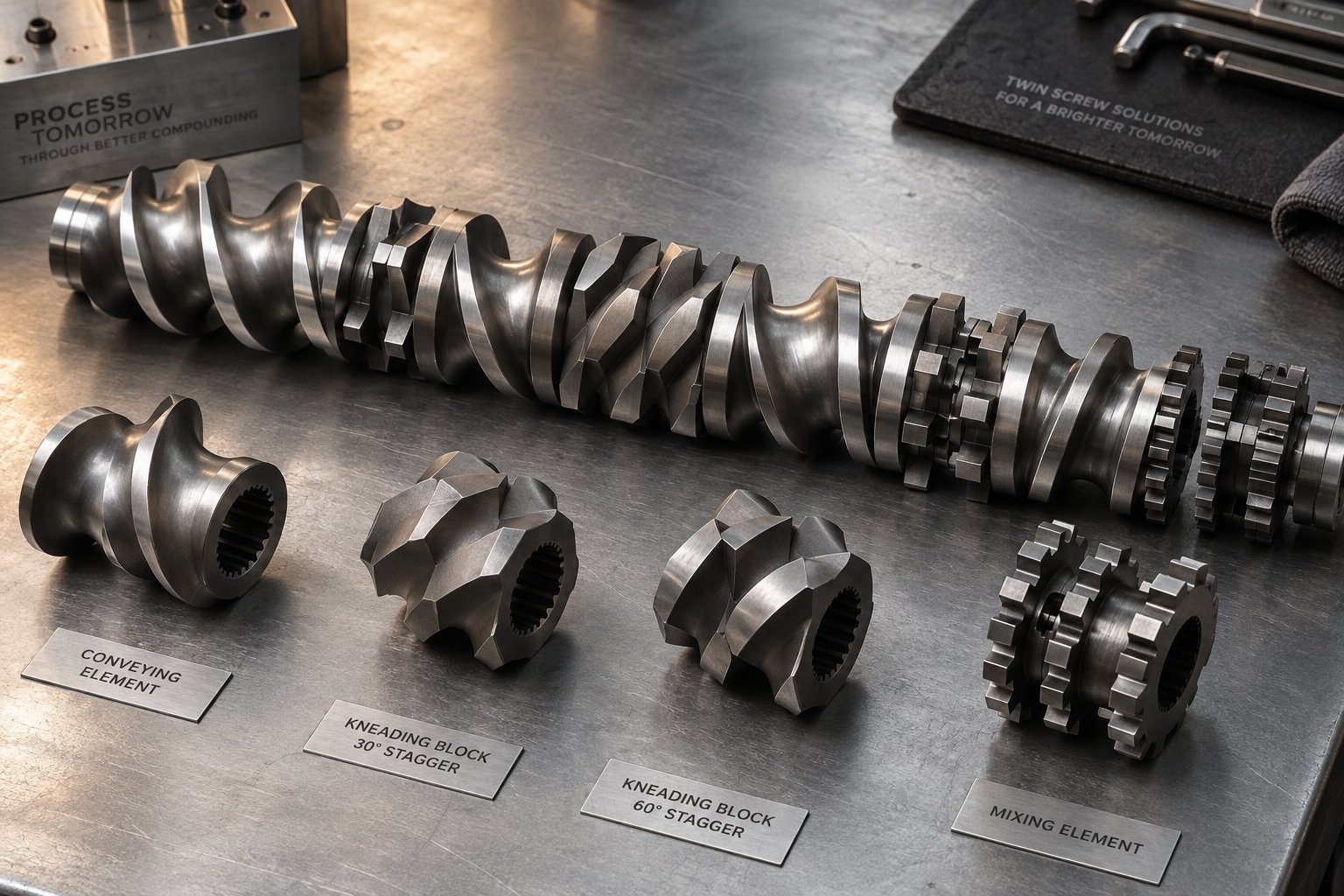
That screw element configuration is, quite literally, the recipe inside the machine. On a parallel twin screw extruder, the screws are not monolithic shafts machined in a single piece. They are modular assemblies: individual elements of varying geometry slide onto a keyed shaft and are locked in sequence, much like beads on a string. Rearranging those elements changes the processing behavior of every zone along the barrel. For recycling, where no two feedstock streams behave alike, this modularity is the single most important engineering advantage the platform offers.
Designing a screw profile, as researchers at NC State Extension describe it, is a blend of art and science. No gold standard exists because every material exhibits unique flow properties influenced by temperature, shear rate, and extruder geometry. That reality is amplified in recycling, where incoming material properties can shift from hour to hour.
Conveying, Kneading, and Mixing Elements Explained
Imagine building a custom obstacle course for molten plastic. Each element type serves a distinct function, and the order you place them in determines how aggressively or gently the polymer is processed. Here are the core building blocks you will work with on any double screw extruder designed for recycling:
- Conveying elements (forward pitch) — These feature deep, helical flights that move material forward along the barrel without applying significant shear. Larger-pitch conveying elements transport higher volumes at lower pressure, making them ideal for the feed zone where bulky recycled flake needs to be pulled in efficiently. Smaller-pitch elements compress the melt and build pressure toward the die end. As a general rule, conveying ability decreases as pitch decreases, while pressure buildup increases.
- Kneading blocks (forward, neutral, and reverse stagger) — Kneading elements are the primary mixing workhorses. They consist of a series of lobed discs offset at stagger angles, commonly 30, 45, 60, or 90 degrees. Forward-staggered kneading blocks provide moderate mixing while still pushing material downstream. Neutral (90-degree) blocks do not convey at all, forcing material to dwell and absorb more shear energy. Reverse-staggered blocks actively push material backward, creating a restriction that maximizes shear and residence time in that section. Wider kneading discs promote dispersive mixing, which breaks down contaminant agglomerates, while narrower discs favor distributive mixing, which spreads additives evenly throughout the melt.
- Reverse elements (left-handed pitch) — These are standard conveying elements with a reversed flight direction. Placed strategically along the screw, they create a dam that restricts forward flow, forcing the upstream zone to fill completely. This is critical before devolatilization ports, where a fully filled section followed by a sudden transition to deep-channel conveying elements creates the pressure drop needed to flash off volatiles. The length of reverse elements is typically kept shorter than the screw diameter to avoid dangerous pressure peaks.
- Toothed mixing elements — These specialized elements feature rows of teeth rather than continuous flights. They provide gentle distributive mixing with a forward conveying effect and are often placed just before compression zones to blend solid and liquid ingredients without excessive shear. In recycling, they are useful for incorporating liquid additives or blending color concentrates into the melt stream.
Each element type interacts with its neighbors. A kneading block placed immediately after a large-pitch conveying element creates a sharp transition from low-pressure transport to high-shear mixing. That transition is where most of the melting and dispersive work happens. Understanding these interactions is what separates a well-optimized screw profile from one that simply pushes material through the barrel.
Configuring Screws for Post-Consumer vs Post-Industrial Feedstock
Not all recycled plastic is created equal, and the screw configuration must reflect that reality. The distinction between post-consumer and post-industrial waste streams drives fundamentally different design philosophies.
Post-consumer feedstock arrives dirty. Think curbside-collected HDPE bottles carrying label adhesive, residual food contamination, trace PET from caps or labels, and moisture levels that can fluctuate wildly between bales. Processing this material demands an aggressive screw profile. You will typically see multiple kneading block sections with tight stagger angles, including neutral and reverse blocks, to ensure thorough melting and dispersive breakdown of contaminant particles. Between these intensive mixing sections, the configuration incorporates two or three vacuum venting zones, each preceded by a reverse element dam and followed by deep-channel conveying elements that partially empty the barrel and expose maximum melt surface area for volatile extraction. A laboratory twin screw extruder running small batches of post-consumer material for formulation development would mirror this general architecture at a smaller scale, proving the configuration before committing to production-line volumes.
Post-industrial feedstock, by contrast, is typically clean, single-source material: edge trim, startup purge, off-spec pellets, or sprues from injection molding. Contamination is low, moisture is manageable, and the polymer has experienced only one prior heat history. The priority here shifts from cleaning to preserving. Aggressive kneading sections are unnecessary and counterproductive because excessive shear degrades molecular weight, reducing mechanical properties in the final pellet. A gentler screw profile with moderate forward kneading blocks, fewer mixing sections, and perhaps a single atmospheric vent is usually sufficient. The goal is to melt, lightly homogenize, and re-pelletize with minimal thermal and mechanical damage.
The practical takeaway? A processor running both post-consumer and post-industrial streams on the same machine can swap screw element configurations between campaigns. That modularity means one extruder body can serve two very different applications, provided you invest in the appropriate element sets and take the time to optimize each profile.
Wear Challenges With Recycled Feedstock
Here is a reality that catches many operators off guard: recycled feedstock is dramatically harder on screws and barrels than virgin resin. The contaminants that make recycled material difficult to process also accelerate the wear rate of the very components doing the processing.
Three distinct wear mechanisms attack screws and barrels simultaneously in recycling applications:
- Abrasive wear — The most common culprit. Mineral fillers, glass fiber residues, paper fiber from labels, sand, and metallic particles from shredding equipment act like sandpaper against flight lands and barrel walls. As flight clearances open up, melting efficiency drops and output consistency degrades. Some aggressive fillers can reduce screw and barrel useful life by 50% or more compared to unfilled polymer processing.
- Corrosive wear — PVC recycling is the classic trigger, releasing hydrochloric acid during processing that attacks iron-based metallurgies. But corrosive attack is not limited to PVC. Flame retardant residues, halogenated additives, and decomposition byproducts from contaminated post-consumer streams can all create acidic conditions inside the barrel. Corrosion weakens the metal surface, making it even more vulnerable to mechanical abrasion in a destructive feedback loop.
- Adhesive wear — Metal-to-metal contact between screw flight tips and the barrel bore generates extreme localized stress that welds and tears microscopic surface layers. In recycling, this is often triggered when tramp metal, a stray bolt, a shredder blade fragment, or aluminum foil contamination, passes through the extruder and forces the screw against the barrel wall. Evidence shows up as scoring or galling on the barrel inner diameter and burring on flight land edges.
Combating these wear modes requires deliberate material selection. Flight lands on screw elements are commonly hardfaced with tungsten carbide or stellite alloys to resist abrasion. Barrel liners use centrifugally cast bimetallic alloys with high carbide content for long-term resistance. For corrosive applications, nickel-based alloys replace iron-heavy compositions. Surface treatments like nitriding add a hardened case to base metals, extending service intervals between replacements.
The economics are straightforward. A set of premium wear-resistant screw elements and barrel liners costs more upfront but can deliver two to four times the service life of standard components in a recycling environment. When you factor in the cost of unplanned downtime, lost production, and degraded output quality from worn clearances, the investment in proper metallurgy pays for itself quickly.
Screw element configuration and wear management together determine how effectively your extruder handles a given recycled stream. But the polymer itself adds another layer of complexity. Each plastic type, from polyolefins to engineering resins, responds differently to heat, shear, and chemical exposure, demanding its own set of processing adjustments.
Polymer-by-Polymer Guide to Twin Screw Recycling
Those processing adjustments are not abstract principles. They take very specific, very different forms depending on whether you are running recycled HDPE bottles, PET thermoform trim, ground PVC pipe, or reclaimed nylon carpet fiber. Each polymer carries its own thermal personality, degradation tendencies, and contamination profile, and each one demands a distinct approach on the compounding extruder. A screw configuration and temperature profile that produces excellent recycled PP pellets could destroy a PET stream or thermally decompose PVC in minutes.
The table below provides a concise reference for the most commonly recycled polymer families, summarizing the key challenge, screw design emphasis, temperature considerations, and typical additive strategies for each:
| Polymer | Key Processing Challenge | Screw Configuration Emphasis | Critical Temperature Considerations | Common Additives in Recycled Compounding |
|---|---|---|---|---|
| PE (HDPE, LDPE, LLDPE) | Viscosity loss from chain scission; variable melt flow between sources | Moderate kneading for melting; extended mixing zones for additive dispersion; multi-stage venting for moisture and odor | 190-230 deg C typical; avoid exceeding 240 deg C to limit oxidative degradation | Antioxidants, UV stabilizers, peroxide crosslinkers for viscosity rebuilding, compatibilizers for mixed PE/PP streams |
| PP | Beta-scission under shear causes rapid MFI increase; odor from oxidation byproducts | Gentler kneading than PE; careful balance of shear to avoid further chain degradation; vacuum venting for volatile organic compounds | 200-240 deg C; keep mixing zone temperatures as low as possible to limit chain scission | Peroxide crosslinkers or chain extenders to rebuild viscosity, hindered phenol antioxidants, calcium stearate acid scavengers, talc or glass fiber for stiffness recovery |
| PET | Extreme moisture sensitivity causing hydrolytic IV loss; crystallization challenges during pelletizing | Aggressive multi-stage vacuum devolatilization; short high-shear zones to minimize thermal residence time; rapid pressure buildup for underwater pelletizing | 260-280 deg C; pre-drying to below 50 ppm moisture is strongly recommended even with vacuum venting | Chain extenders (epoxy-functional styrene-acrylic oligomers) to rebuild intrinsic viscosity, nucleating agents, acetaldehyde scavengers for food-contact applications |
| PVC | Very low thermal stability; releases HCl gas at processing temperatures close to its melt point | Low-shear counter-rotating design preferred; if co-rotating, use gentle forward kneading with wide stagger angles and reduced screw speed | 160-190 deg C maximum; even brief overheating triggers autocatalytic degradation | Thermal stabilizers (Ca-Zn, Ba-Zn systems), lubricants (paraffin wax, oxidized PE wax), impact modifiers (CPE, acrylic), CaCO3 filler |
| PS and HIPS | Low melt strength; devolatilization of residual styrene monomer; brittleness in recycled grades | Moderate dispersive mixing; deep-channel vent zones for effective styrene monomer extraction under vacuum | 200-230 deg C; minimize residence time to reduce monomer regeneration and yellowing | Styrenic block copolymers (SEBS, SBS) for impact improvement, mineral oil for flow enhancement, antioxidants |
| PA (Nylon 6, Nylon 66) | Hygroscopic nature causes hydrolytic chain scission; viscosity drops rapidly if moisture is present during processing | Extended vacuum devolatilization zones; pre-drying critical; moderate kneading to disperse glass fiber reinforcement without excessive fiber breakage | 240-280 deg C depending on grade; melt temperature must exceed crystalline melting point but stay below degradation onset | Chain extenders (bisoxazolines, carbodiimides), glass fiber and mineral reinforcement, heat stabilizers, compatibilizers when blended with polyolefins |
| ABS | Butadiene rubber phase degrades under heat and UV; recycled grades lose impact strength and yellow | Moderate shear kneading; gentle temperature profile to preserve rubber phase; single or dual vacuum venting for volatile removal | 210-240 deg C; avoid hot spots that accelerate butadiene crosslinking and embrittlement | Impact modifiers, antioxidants, UV stabilizers, compatibilizers (e.g., maleic anhydride grafted SAN) when blended with other engineering plastics |
Recycling Polyolefins Through Twin Screw Extrusion
PE and PP together represent the highest-volume recycled plastics on the planet, and they share a frustrating trait: every time they pass through an extruder, their molecular weight drops. For PE, the dominant mechanism is chain scission driven by oxidation. For PP, the problem is even more acute because its tertiary carbon backbone is inherently susceptible to beta-scission under shear, causing the melt flow index to climb with each reprocessing cycle. The result is a recycled resin that flows too easily, lacks the melt strength needed for film or blow molding, and exhibits reduced impact and tensile performance compared to virgin material.
Twin screw extrusion addresses this degradation through in-line additive compounding. Processors use the machine's superior mixing capability to uniformly disperse property-restoring additives directly into the recycled melt. Peroxide crosslinkers, for example, can partially re-bridge broken polymer chains in PE, rebuilding viscosity and melt strength. For PP, reactive chain extenders serve a similar function. Antioxidant packages, typically combinations of hindered phenols and phosphite co-stabilizers, interrupt the oxidation cycle that causes ongoing degradation during processing and in the final product's service life.
Mixed polyolefin streams present an additional challenge: PE and PP are thermodynamically incompatible. When recycled together without treatment, the resulting blend has poor phase adhesion and dramatically reduced elongation at break. Compatibilizers such as polyolefin elastomers and styrenic block copolymers solve this by improving the interfacial bonding between the two polymer phases. As low as 3% by weight of a well-chosen compatibilizer can improve impact strength and tensile elongation of an uncompatibilized HDPE/PP mixture by a factor of three while maintaining the stiffness benefit contributed by the PP component. These compatibilizers are typically added through downstream side feeders on the double screw extruder machine, entering the melt after the initial plasticization zone for optimal dispersion.
Processors developing new recycled polyolefin formulations often start on a lab twin screw extruder, running small batches at various compatibilizer and stabilizer loadings to map the property response before scaling to production. This approach saves material cost and accelerates formulation optimization, particularly when dealing with variable post-consumer feedstock where batch-to-batch consistency is never guaranteed.
Handling PET, PVC, and Engineering Plastics
PET recycling is a moisture management exercise above all else. The polyester backbone undergoes hydrolytic chain scission in the presence of even trace moisture at melt temperatures, causing intrinsic viscosity (IV) to plummet. An IV drop of just 0.05 dl/g can shift a bottle-grade resin out of specification for its intended application. Pre-drying to below 50 ppm moisture content before feeding is the industry standard, and even with thorough pre-drying, multi-stage vacuum venting on the extruder provides a critical safety net. Chain extenders based on epoxy-functional oligomers have become essential tools for recycled PET compounding, chemically rebuilding molecular weight in the melt to restore IV values close to virgin levels. The mixing efficiency of a twin screw platform ensures these reactive additives disperse uniformly and reach their target reaction sites within the short residence time available.
PVC stands apart from every other commodity resin because its thermal processing window is dangerously narrow. The decomposition temperature sits only 10 to 20 degrees Celsius above its melt processing temperature, and once degradation begins, the released hydrochloric acid autocatalytically accelerates further breakdown. This is why counter-rotating twin screw designs dominate PVC recycling: their lower shear and reduced frictional heating keep the melt safely within that tight window. When a co-rotating machine is used for PVC, operators reduce screw speed dramatically, employ wide-stagger-angle kneading blocks, and set barrel temperatures conservatively. Heavy stabilizer loadings are non-negotiable, and the barrel and screw metallurgy must resist the corrosive attack of HCl gas.
Engineering plastics like nylon (PA) and ABS bring their own complications. Nylon is hygroscopic, absorbing moisture from ambient air that triggers hydrolytic degradation the moment it enters the melt phase. Thorough pre-drying combined with vacuum devolatilization during extrusion is the standard protocol. Recycled nylon, especially from carpet fiber or automotive underhood parts, is frequently compounded with glass fiber reinforcement on the twin screw extruder to rebuild the mechanical performance lost through degradation. ABS demands careful thermal management to preserve its butadiene rubber phase, which crosslinks and embrittles when exposed to excessive heat. Moderate screw speeds and a flat, controlled temperature profile help maintain impact strength in recycled ABS compounds.
The overarching lesson across all these polymers is that no single screw configuration, temperature profile, or additive package works universally. Flexibility through modular screw design, multi-zone barrel temperature control, and the ability to introduce additives at multiple points along the barrel is what makes twin screw extrusion the platform of choice for recycling operations handling diverse polymer streams. Each resin type represents a unique puzzle, and the modular twin screw architecture gives processors the pieces to solve it.
Solving each polymer puzzle on its own is one thing. The greater commercial opportunity lies in using the compounding extruder not just to reprocess recycled material, but to actively enhance it, transforming low-value flake into specification-grade compounds that compete directly with virgin resin in demanding applications.
Upcycling Through Twin Screw Compounding and Additive Integration
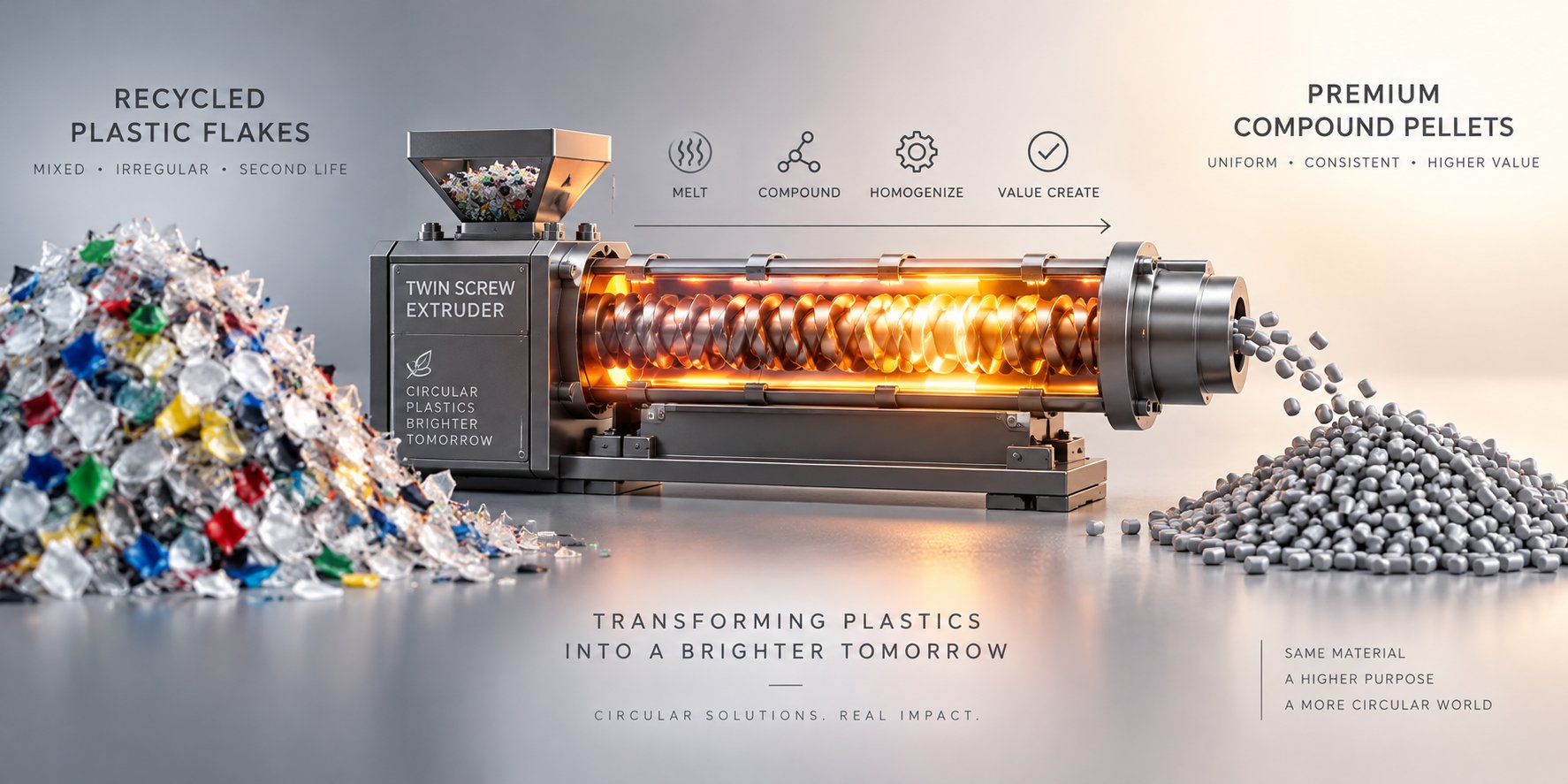
That transformation is where the real economics of plastics recycling shift. Simply melting and re-pelletizing recycled flake produces a commodity product that sells at a steep discount to virgin resin. Compounding, by contrast, turns that same flake into an engineered material with defined mechanical, thermal, and aesthetic properties, one that commands a price premium because it meets the same specifications brand owners require from virgin grades. The twin screw extrusion process is the enabling technology behind this upgrade, and the difference between pelletizing and true upcycling often determines whether a recycling operation is profitable or marginal.
Consider recycled polypropylene as a concrete example. On its own, reprocessed PP suffers from reduced stiffness, lower impact strength, and poor surface appearance compared to virgin material. But compound it with glass fiber, talc, or calcium carbonate during extrusion, and the picture changes dramatically. Research published in the American Journal of Applied Sciences demonstrated that adding micron-sized glass fibers, talc, and CaCO3 at various ratios to recycled PP granules through compounding extrusion improved both physical and thermal properties, bringing them close to or even exceeding original virgin PP performance. That kind of property restoration is what opens doors to automotive interior components, appliance housings, and industrial packaging where recycled content alone is not enough to win the specification.
How Compounding Restores Recycled Polymer Properties
A polymer extruder doing simple re-pelletization performs one basic function: melt and reshape. A twin screw compounder performs dozens of functions simultaneously. It disperses solid fillers down to their primary particle size, distributes liquid stabilizers uniformly across billions of polymer chains, triggers controlled chemical reactions between chain extenders and degraded polymer end groups, and homogenizes all of these components into a single-phase or well-structured multi-phase melt, all within a residence time measured in seconds.
The mechanisms that make this work fall into two categories. Dispersive mixing applies high shear stress to break apart filler agglomerates, pigment clusters, or incompatible polymer domains into their smallest effective units. Distributive mixing then spreads those units evenly throughout the melt volume, ensuring that every pellet exiting the die carries the same composition. Twin screw machines excel at both because the intermeshing screw geometry forces material through narrow clearances and constantly reorients flow patterns, exposing every melt element to the same processing history.
Specific compounding strategies target specific deficiencies in recycled polymers:
- Reinforcing fillers and fibers — Glass fiber (typically 10-30% by weight) and talc (5-20%) restore flexural modulus and heat deflection temperature in recycled PP and PE, making them viable for structural and semi-structural applications in automotive and consumer goods.
- Chain extenders — Epoxy-functional oligomers and bisoxazolines chemically rebuild molecular weight in recycled PET and nylon by reacting with hydroxyl and carboxyl chain ends, recovering intrinsic viscosity and melt strength that hydrolytic and thermal degradation have stripped away.
- Compatibilizers — Maleic anhydride grafted polyolefins and styrenic block copolymers improve interfacial adhesion in mixed polymer streams, turning an incompatible PE/PP blend into a usable alloy with balanced mechanical properties.
- Stabilizer packages — Hindered phenol antioxidants interrupt oxidative chain scission during processing, while hindered amine light stabilizers (HALS) and UV absorbers protect the finished product from photodegradation during outdoor service, extending the useful life of recycled compounds by years.
- Impact modifiers — Elastomeric additives like EPDM, POE, or acrylic core-shell particles restore ductility and impact resistance that repeated processing has reduced, particularly critical for recycled ABS, HIPS, and polyolefin grades destined for consumer-facing products.
- Processing aids and lubricants — Fluoropolymer-based processing aids reduce melt fracture and die buildup, while metallic stearates act as acid scavengers and internal lubricants, both improving throughput and surface quality of recycled output.
Each of these additive categories addresses a measurable property gap between recycled and virgin material. The twin screw platform's ability to introduce them at precisely the right point along the barrel, through gravimetric main feeders, downstream side stuffers, or liquid injection ports, ensures each additive reaches its target within the melt under optimal conditions.
Meeting Brand Owner and Regulatory Quality Standards
Property restoration in the lab means nothing unless it translates into pellets that pass the quality gates set by the end user. Brand owners in automotive, packaging, electronics, and consumer goods specify recycled content not as a charitable gesture but as a regulatory and marketing requirement, and they will not accept material that compromises part performance, appearance, or safety. The bar is set at virgin-equivalent, and in many cases, the recycled compound must pass the exact same test protocols as its virgin counterpart.
This is where the precision of the twin screw extrusion process becomes a commercial differentiator. Consistent dispersive and distributive mixing ensures that mechanical properties like tensile strength, flexural modulus, and Izod impact remain within a tight specification window from pellet to pellet and lot to lot. Thorough devolatilization removes odor-causing volatiles that would disqualify material from automotive interior or food-adjacent packaging applications. Uniform colorant dispersion eliminates the streaking and specking that instantly identifies recycled material to the consumer's eye.
Regulatory standards add another layer. Food-contact applications for recycled PET demand compliance with FDA letter-of-no-objection processes or EFSA guidelines, which set strict limits on contaminant migration levels. Automotive OEMs require recycled compounds to meet the same flammability, fogging, and emissions specifications as virgin grades. These are not aspirational targets. They are pass-fail gates, and the compounding step on the twin screw extruder is where compliance is built into the material.
The result is a clear value chain: low-cost recycled flake enters the extruder, and specification-grade compound exits, carrying documentation that proves it meets the same standards buyers apply to virgin resin. That documented quality is what transforms recycling from a waste-management exercise into a materials business. Yet delivering that quality consistently at scale depends on more than the extruder alone. It requires a fully integrated recycling line, with every upstream and downstream component engineered to support the extruder's performance.
Building a Complete Recycling Line Around the Twin Screw Extruder
That fully integrated recycling line is not a collection of machines bolted together in a row. It is a carefully orchestrated extruder system where every piece of upstream and downstream equipment directly affects the quality, throughput, and profitability of the final pellet. The plastic twin screw extruder sits at the center of this system, but its performance is only as strong as the weakest link feeding it or receiving its output.
Think of it this way: you can install the most advanced twin-screw extruder machine available, configure its screws perfectly, and dial in flawless processing parameters. But if the incoming flake carries tramp metal that damages your screw elements, or if your pelletizer cannot keep pace with the extruder's throughput, you will still produce off-spec pellets and eat into your margins. Every component matters, and understanding how they connect to the extruder helps you build a line that runs reliably rather than one that limps from problem to problem.
The following table maps the complete equipment sequence in a typical extrusion twin screw recycling line, showing how each component contributes to the final output:
| Sequence | Equipment | Primary Function | Impact on Extruder Performance |
|---|---|---|---|
| 1 | Shredder / Granulator | Reduces bales, containers, or scrap into 8-15 mm flake or chips | Determines particle size uniformity; oversized pieces cause feed bridging |
| 2 | Washing and Separation Line | Removes dirt, labels, adhesives, and cross-polymer contamination via friction wash and float-sink tanks | Reduces contaminant load on the extruder's melt filtration and venting zones |
| 3 | Dewatering and Drying System | Lowers surface moisture from 30-40% to 1-4% via centrifugal and optional thermal drying | Prevents steam generation in the barrel that causes vent flooding and melt instability |
| 4 | Metal Detection and Removal | Catches ferrous, non-ferrous, and stainless steel fragments via magnets and eddy current separators | Protects screw elements and barrel bore from catastrophic adhesive wear and scoring |
| 5 | Gravimetric Feeding System | Meters flake into the extruder at a controlled mass flow rate independent of bulk density variation | Stabilizes fill ratio across all barrel zones, preventing starving or overfeeding |
| 6 | Twin Screw Extruder | Melts, mixes, devolatilizes, compounds, and pressurizes the polymer melt | Central processing unit — all other equipment exists to support its operation |
| 7 | Screen Changer / Melt Filter | Removes solid contaminants from the melt before pelletizing | Protects die and pelletizer; filtration fineness determines pellet cleanliness |
| 8 | Pelletizing System | Converts melt strands into uniform pellets via strand, underwater, or water-ring cutting | Final shape and cooling determine pellet geometry, moisture content, and packaging readiness |
| 9 | Inline Quality Monitoring | Measures melt pressure, temperature, color, and optionally MFI in real time | Enables closed-loop process adjustment to maintain consistent pellet quality |
Upstream Equipment That Feeds the Extruder
Imagine pouring a bag of mixed nuts into a funnel designed for marbles. The shapes do not match, the sizes vary, and half of them jam at the opening. That is essentially what happens when poorly prepared recycled feedstock hits the feed throat of an extruder. Upstream equipment exists to prevent that scenario, and complete recycling lines typically include six equipment categories arranged in sequence before the extruder even comes into play.
Shredding and granulating establish the baseline particle size. For most twin screw recycling applications, the target is 8 to 15 mm flake, small enough to feed consistently but large enough to avoid dusting and static cling problems that plague finely ground material. Undersized particles pack too densely in the feed zone and resist the screw's conveying action; oversized pieces bridge across the feed throat and cause intermittent starving.
Washing and separation tackle contamination at the source. Friction washers remove surface dirt and label adhesives. Float-sink tanks separate polymers by density, sending HDPE and PP floating while sinking heavier contaminants like PVC fittings, rubber gaskets, and stones. Hot washing adds a chemical cleaning step for food-contact applications. Every gram of contamination removed upstream is a gram that does not clog your melt filter, foul your vent ports, or degrade your screw elements downstream.
Drying brings moisture into a range the extruder can manage. Centrifugal dewatering typically reduces surface moisture from 30-40% down to 2-4%, which is sufficient for most HDPE and PP recycling. PET, nylon, and other hygroscopic polymers need additional thermal drying to reach sub-50 ppm levels. Feeding wet material into a twin screw barrel causes explosive steam generation in the melt zone, leading to vent flooding, pressure instability, and porous pellets.
Metal detection is non-negotiable. Ferrous traps and eddy current separators positioned between the dryer and the feeder catch fragments that shredder blades, conveyor bolts, and mixed-waste contamination introduce. Even a single metallic particle wedged between a screw flight and the barrel wall can score both surfaces, opening clearances that reduce melting efficiency for thousands of operating hours afterward.
Finally, the gravimetric feeder bridges the gap between variable incoming flake and the extruder's need for steady mass flow. Unlike volumetric feeders that dispense by volume (and therefore fluctuate wildly when bulk density changes from 50 kg/m3 film flake to 400 kg/m3 rigid regrind), gravimetric systems weigh material continuously and adjust feed rate in real time. This stabilizes the fill level across the extruder's functional zones and ensures that devolatilization ports see the partially filled barrel conditions they require to function properly.
Downstream Systems for Filtration and Pelletizing
The melt exits the extruder as a hot, pressurized stream that still carries solid contaminants no amount of upstream washing can fully eliminate: paper fiber fragments, paint flecks, cross-linked polymer gels, and mineral particles all survive the melting process. Melt filtration is the last line of defense before pelletizing, and the choice of screen changer technology has a direct impact on uptime, pellet quality, and operating cost.
Two proven filtration designs dominate recycling applications. Piston screen changers with automatic back-flushing use wire mesh filter packs inserted into hydraulically actuated pistons. When contaminant buildup raises differential pressure, the system back-flushes one screen cavity while the others remain in production, providing near-continuous filtration with mesh sizes as fine as 32 microns. These systems are well-suited to moderately contaminated streams where filtration precision is critical.
For heavily contaminated post-consumer feedstock, continuous laser-drilled disc filters offer a different advantage. Steel screen discs with laser-cut orifices are continuously wiped by rotating scrapers, clearing contaminant buildup without interrupting melt flow. These filters handle contamination levels of 3-5% and maintain extremely stable melt pressure over extended production runs. The choice between cyclical and continuous filtration depends on contamination level, contaminant type (hard particles versus soft foreign plastics), and the throughput stability your pelletizing system requires.
Pelletizing converts the filtered melt into the finished product. Three methods serve different recycling applications:
- Strand pelletizing — Melt exits through a multi-hole die as continuous strands, which are cooled in a water bath and chopped by a rotating blade. The simplest and lowest-cost option, it works well for standard-viscosity recycled polyolefins but struggles with low-melt-strength materials that break during the water bath conveyance.
- Underwater pelletizing — The die face sits submerged in a pressurized water chamber, and rotating blades cut pellets directly at the die. Immediate quenching produces spherical, uniform pellets with low residual moisture. This method handles a wide viscosity range and is the preferred choice for recycled PET, high-throughput polyolefin lines, and any application requiring consistent pellet geometry.
- Water-ring pelletizing — A centrifugal water curtain surrounds the die face, cooling and transporting pellets as they are cut. It occupies a middle ground between strand and underwater systems in both cost and capability, and is popular for recycled PE and PP lines in the 500 to 2,000 kg/hr throughput range.
Inline quality monitoring closes the loop. Sensors measuring melt pressure, melt temperature, and motor current provide real-time visibility into process stability. More advanced systems add optical color measurement, inline rheometry, or near-infrared spectroscopy to detect composition drift before it produces off-spec pellets. The investment in monitoring pays for itself by catching quality deviations in minutes rather than hours, reducing the volume of reject material that must be reprocessed.
The Role of Barrel and Screw Quality in Line Reliability
Every component in the recycling line matters, but none endures the punishment that the barrel and screw assembly absorbs hour after hour. These are the most wear-intensive components in the entire system, and their condition directly determines whether your line produces consistent, specification-grade pellets or gradually drifts toward widening tolerances, degraded mixing, and mounting reject rates.
The wear dynamics are relentless. Clearances between the screw flight outside diameter and the barrel inner wall are typically minimal, around 0.001 inch per side per inch of diameter, to achieve efficient heat transfer and shear. The moment those clearances widen from abrasive or corrosive attack, melting efficiency drops, mixing quality degrades, and operators begin compensating with higher screw speeds, elevated barrel temperatures, or increased backpressure. Each of those compensations introduces its own quality penalties, from thermal degradation to inconsistent melt homogeneity, and the problem compounds over time until planned or unplanned downtime forces a rebuild.
In recycling, this wear cycle accelerates dramatically. Abrasive fillers, mineral contaminants, and metallic particles from the waste stream attack flight lands and barrel liners far more aggressively than clean virgin polymer ever would. Corrosive byproducts from PVC contamination, flame retardant residues, or ink decomposition attack iron-based metallurgies. And tramp metal that slips past upstream detection creates adhesive wear events that can score the barrel bore in seconds.
Barrel and screw material composition, surface treatment, and manufacturing precision are not afterthoughts in this environment. They are operational lifelines. Centrifugally cast bimetallic barrel liners with high tungsten carbide content resist abrasive attack far longer than standard nitrided steel. Nickel-based alloy liners address corrosion from halogenated contaminants. Precision bore tolerances ensure that new screws achieve the tight clearances needed for optimal mixing from the first hour of operation.
This is where purpose-engineered components make a measurable difference in line economics. NANHAIYA's custom parallel twin screw barrels are designed specifically for the demanding conditions that recycling, pelletizing, and compounding operations impose. Built to handle abrasive contaminants, corrosive byproducts, and the high throughput cycles typical of recycling lines, these barrels are engineered for extended wear life in environments that would shorten the service interval of standard components. For operators running post-consumer feedstock where barrel and screw wear directly determines maintenance frequency and output consistency, investing in barrels built for recycling rather than adapted from general-purpose designs reduces unplanned downtime and keeps pellet quality within specification longer.
The payoff of a well-integrated line is clear: upstream preparation protects the extruder, the extruder transforms the material, downstream filtration and pelletizing shape the final product, and wear-resistant barrel and screw components keep the entire system producing at peak quality for the longest possible intervals. Each decision reinforces the others. But assembling the right components depends on a decision-making framework that matches your specific operation, your feedstock, and your quality targets.
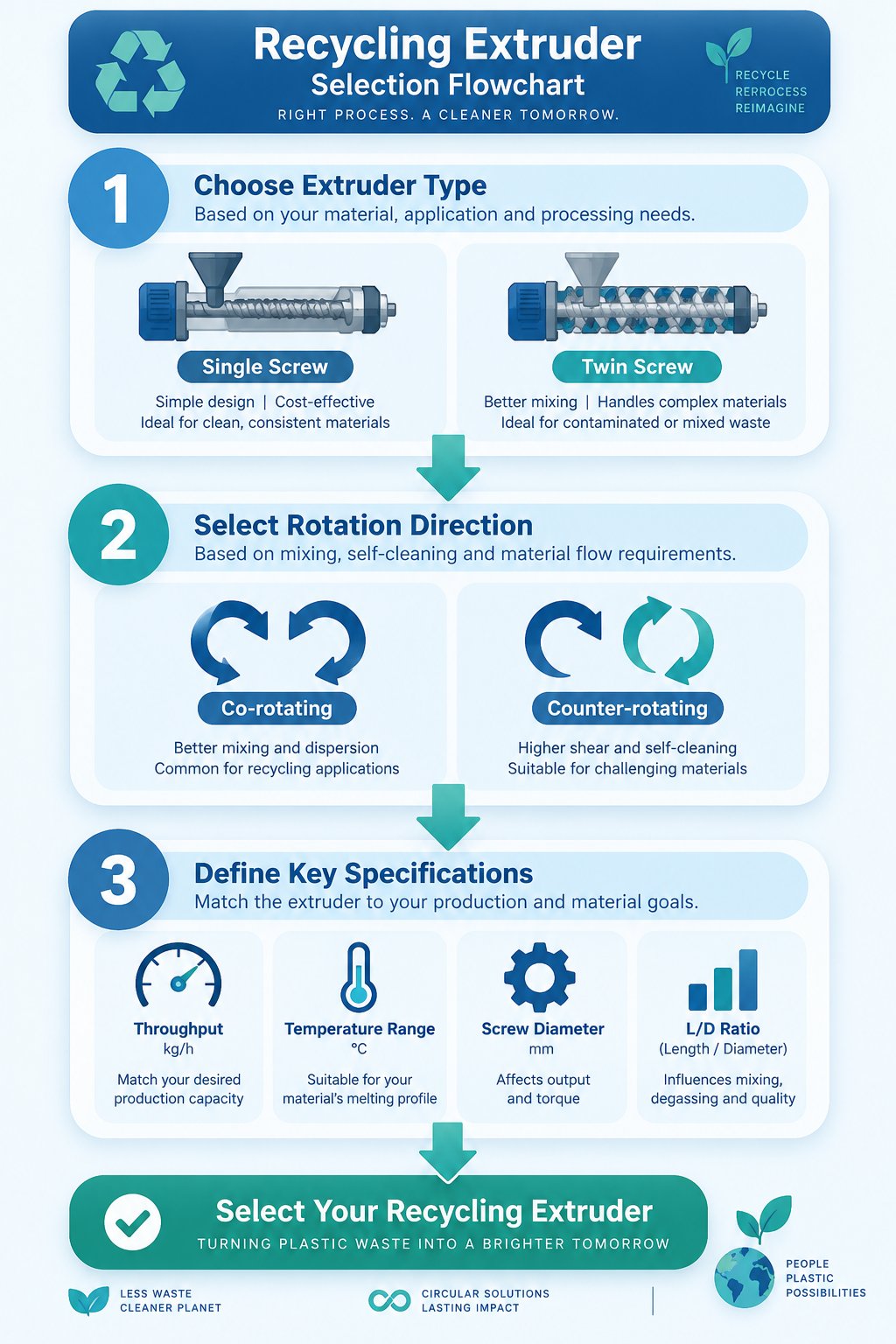
How to Choose the Right Twin Screw Extruder for Your Recycling Operation
A decision-making framework turns that collection of technical knowledge into action. You understand functional zones, screw configurations, polymer-specific parameters, and line integration. The question now is: how do you translate all of that into a purchase order that matches your feedstock, your output targets, and your budget without over-spending or under-specifying?
Most recyclers approach extruder selection by starting with screw diameter or motor horsepower. That is working backward. The right sequence begins with the end product and traces the processing demands back to the machine. Three decisions, made in the right order, narrow the field faster than any specification spreadsheet.
Three Critical Decisions for Recycling Extruder Selection
Think of these as gates. Each one eliminates a category of equipment and sharpens your focus for the next decision. Here is the sequence experienced processors follow:
- Decision 1: Twin screw or single screw?
This is not about which technology is "better." It is about what your feedstock demands and what your buyer accepts. Ask yourself these questions:- Does the incoming material carry variable contamination, mixed polymer fractions, or moisture that requires multi-stage devolatilization?
- Will you need to incorporate additives, fillers, stabilizers, or compatibilizers during extrusion to meet output specifications?
- Does your buyer's acceptance test include dispersive quality metrics like gel counts, specks per area, or filler distribution uniformity?
- Decision 2: Co-rotating or counter-rotating?
Once you have committed to a twin screw plastic extruder, the rotation direction follows directly from your polymer type:- Processing PVC or another shear-sensitive polymer where thermal degradation onset is dangerously close to melt temperature? Counter-rotating designs keep shear low and temperatures controlled.
- Processing polyolefins, PET, nylon, ABS, PS, or mixed streams that need intensive mixing, multi-stage venting, and high screw speeds? Co-rotating intermeshing is the standard choice, and it covers the vast majority of recycling applications.
- Decision 3: Which specifications matter most?
This is where the details separate a well-matched machine from an expensive mistake. Prioritize these specifications in order of impact on recycling performance:- L/D ratio — For post-consumer recycling with multi-stage degassing and additive compounding, start at 44:1 or longer. Shorter ratios force compromises between mixing, venting, and pressure buildup zones.
- Torque density (Nm/cm3) — This is the most underappreciated specification in extruder twin screw selection. Torque density measures how much rotational force the gearbox delivers relative to the free volume between the screws. High-viscosity recycled polymers and heavily filled compounds place enormous loads on the drive system. A machine with adequate motor power but insufficient gearbox torque will hit its limit before reaching target throughput, forcing operators to reduce screw speed or feed rate. Modern high-performance gearboxes deliver 11.3 to 18 Nm/cm3, and recycling operations processing filled or high-viscosity streams should target the upper end of that range.
- Barrel bore diameter — Determines throughput ceiling and the available free volume for devolatilization. Larger bores process more material per revolution but also increase capital cost, floor space requirements, and the size of every downstream component. Match bore diameter to your realistic production target, not to aspirational maximum capacity.
- Screw and barrel metallurgy — In recycling, this specification directly determines maintenance intervals and total cost of ownership. Standard nitrided steel screws and barrels may last 8,000 to 12,000 hours processing clean virgin polymer, but recycled feedstock with abrasive fillers, mineral contaminants, or corrosive byproducts can cut that life in half or worse. Specify bimetallic barrel liners with high carbide content for abrasion resistance, or nickel-based alloys for corrosive environments. Screw elements should feature hardfaced flight lands rated for the specific wear mode your feedstock presents.
Specification Priorities and Common Mistakes to Avoid
The most expensive mistakes in extruder selection are not buying the wrong brand. They are mismatching the machine's capability to the feedstock's demands. Two patterns repeat across the industry:
Over-specifying for clean post-industrial streams. A processor running sorted, single-source PP edge trim from their own production line does not need a 52:1 L/D co-rotating twin screw with triple vacuum venting and a high-torque gearbox. That is a machine built for contaminated post-consumer compounding, and deploying it on clean regrind wastes capital, floor space, energy, and maintenance budget. A shorter L/D twin screw or even a well-configured single screw handles this application at a fraction of the cost. As industry buying guides emphasize, the right starting point is defining your output specification and failure modes, then selecting the simplest system that reliably achieves them.
Under-specifying for contaminated post-consumer feedstock. This is the costlier error because it does not just waste money; it produces unsellable pellets. Processors who choose a shorter L/D ratio or skip vacuum venting stages to save on capital find themselves running lower throughput, higher reject rates, and more frequent screen changes than the business plan assumed. Similarly, choosing standard-metallurgy screw elements and barrels for a feedstock carrying glass fiber residues, mineral fillers, or PVC contamination leads to accelerated wear, widening clearances, and a steady decline in mixing quality that eventually forces an unplanned rebuild. In recycling, the barrel and screw assembly is the component that absorbs the most punishment, and the decision to invest in proper metallurgy here has a larger impact on long-term profitability than almost any other line item on the purchase order.
This is precisely why barrel and screw sourcing deserves the same scrutiny as extruder selection itself. Purpose-engineered components designed for recycling conditions outperform general-purpose equivalents by a wide margin. NANHAIYA's custom parallel twin screw barrels illustrate this principle in practice: built to serve compounding, recycling, masterbatch, and pelletizing producers, these barrels are engineered from the ground up for the abrasive contaminants, corrosive decomposition products, and high-cycle throughput demands that recycled feedstock imposes. Rather than adapting a standard barrel to survive recycling service, the approach starts with the wear environment and works backward to material composition, surface treatment, and bore precision, delivering extended service intervals that keep the line producing specification-grade pellets longer between maintenance windows.
Sounds like a lot of decisions? It is. But a structured approach simplifies the process. Here is a condensed checklist you can bring into any supplier conversation:
- Define the target pellet specification first: MFI range, contamination limits, mechanical property minimums, color and odor requirements.
- Characterize your feedstock honestly: moisture content, contamination type and percentage, polymer composition variability, bulk density range.
- Match extruder type to feedstock complexity, not to budget pressure.
- Select co-rotating or counter-rotating based on polymer shear sensitivity.
- Specify L/D ratio based on the number of processing stages (venting, side feeding, mixing) your feedstock requires.
- Verify gearbox torque density is sufficient for your target throughput at the viscosity range your recycled polymer presents.
- Demand barrel and screw metallurgy matched to your specific wear and corrosion environment, not generic recommendations.
- Require suppliers to quote saleable pellets per hour at your feedstock condition, not theoretical maximum throughput on virgin resin.
Every recycling operation is different. The feedstock varies, the end market varies, and the budget varies. But the decision framework stays the same: start from the pellet your buyer needs, work backward through the process demands, and select the twin-screw extruder configuration and components that reliably deliver that pellet at the lowest total cost of ownership. Get the framework right, and the specification details fall into place.
Twin Screw Extruder for Recycling: Frequently Asked Questions
1. What is the difference between a twin screw extruder and a single screw extruder for recycling?
A twin screw extruder uses two intermeshing screws that create self-wiping, positive-displacement mixing, making it ideal for contaminated, variable recycled feedstock that needs devolatilization and additive compounding. A single screw extruder relies on barrel-wall friction to move material, which works well for clean, consistent post-industrial regrind but lacks the mixing intensity and venting flexibility recycled streams typically require. Twin screw machines cost two to three times more upfront, but their ability to produce specification-grade pellets from challenging feedstock often justifies the investment through lower reject rates and higher pellet value.
2. Why is a co-rotating twin screw extruder preferred over counter-rotating for most recycling applications?
Co-rotating designs dominate recycling because their self-wiping geometry eliminates stagnant material zones where degraded polymer would char and contaminate output. They support high screw speeds (100 to 1,200+ rpm), long L/D ratios up to 56:1 or beyond, and multi-stage vacuum venting, all essential for processing post-consumer plastics with variable contamination. Counter-rotating extruders operate at much lower speeds and shorter L/D ratios, generating less shear. They serve a narrower but important niche, primarily PVC recycling, where the polymer's low thermal stability requires the gentler processing conditions counter-rotating machines provide.
3. What L/D ratio should I choose for a twin screw extruder used in plastics recycling?
For post-consumer recycling involving multi-stage degassing, additive compounding, and downstream side feeding, an L/D ratio of 44:1 or longer is recommended. Ratios of 48:1 to 56:1 are common in demanding recycling lines. Shorter ratios like 32:1 to 36:1 may suffice for cleaner post-industrial streams that need minimal venting or compounding. Choosing too short an L/D forces trade-offs between mixing, devolatilization, and pressure buildup zones, ultimately compromising pellet quality. The extra barrel length gives screw designers room to address all processing demands without sacrificing any single zone's performance.
4. How does screw element configuration affect recycled plastic quality?
Modular screw elements let processors tailor the extrusion profile to each feedstock. Conveying elements transport material with low shear, kneading blocks at various stagger angles provide dispersive and distributive mixing to break down contaminants and incorporate additives, and reverse elements create flow restrictions that ensure complete barrel filling before devolatilization ports. Post-consumer streams typically require aggressive kneading sections with multiple vacuum venting zones, while post-industrial material benefits from gentler configurations that preserve molecular weight. Purpose-built barrel and screw components, such as NANHAIYA's custom parallel twin screw barrels, further extend service life when processing abrasive or corrosive recycled feedstock.
5. Can a twin screw extruder upcycle recycled plastic to compete with virgin resin?
Yes. Through in-line compounding, a twin screw extruder incorporates glass fiber, talc, chain extenders, compatibilizers, UV stabilizers, and impact modifiers directly into the recycled melt. These additives restore or enhance mechanical, thermal, and aesthetic properties that degradation has reduced. For example, adding glass fiber and talc to recycled polypropylene during extrusion can bring stiffness and heat resistance close to virgin-grade levels, qualifying the material for automotive and appliance applications. The twin screw platform's superior dispersive and distributive mixing ensures uniform additive distribution, producing pellets that meet the same test protocols brand owners apply to virgin compounds.
Written by
Nanhaiya Technical Team
Zhoushan Nanhaiya Plastic Machinery Co., Ltd.
The Nanhaiya technical team supports screw and barrel manufacturing projects through application review, technical communication, custom manufacturing coordination, and production and quality control.
Discuss Your Application
Related Articles
More insights on screw barrel technology and plastics processing.
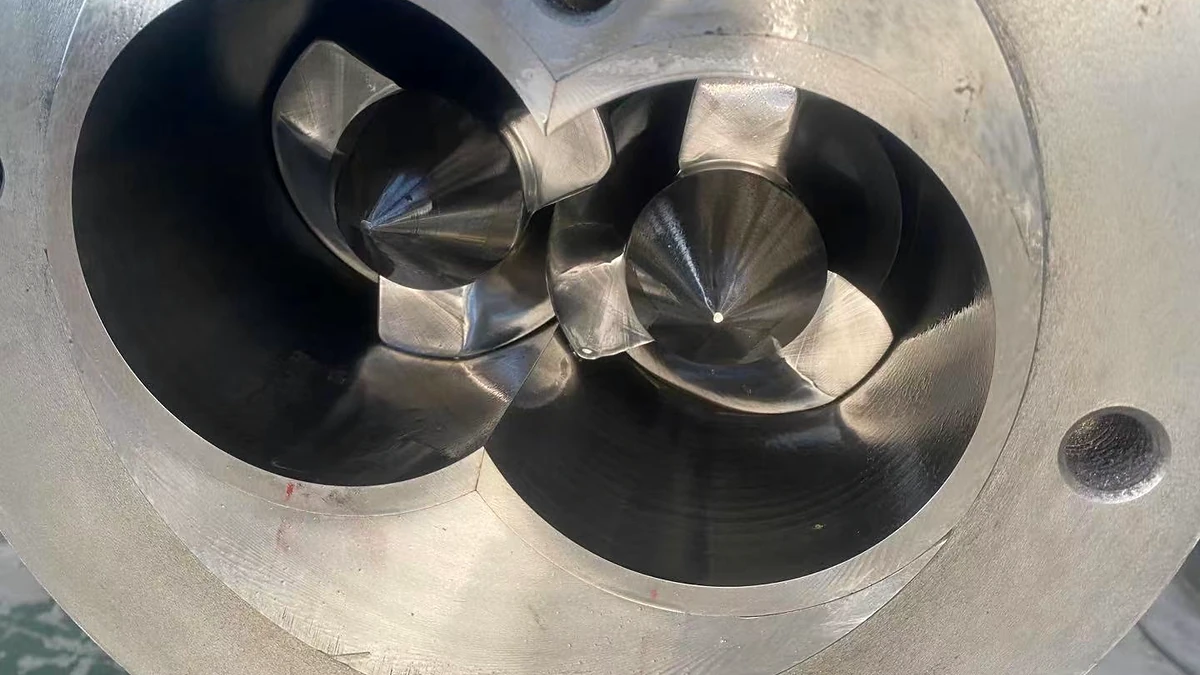
Wrong Screw Barrel For PVC Pipe Quietly Kills Output Quality
Oct 29, 2026
Learn how to choose the right screw barrel for PVC pipe extrusion. Covers sizing, materials, coatings, troubleshooting, and total cost of ownership guidance.
Read Article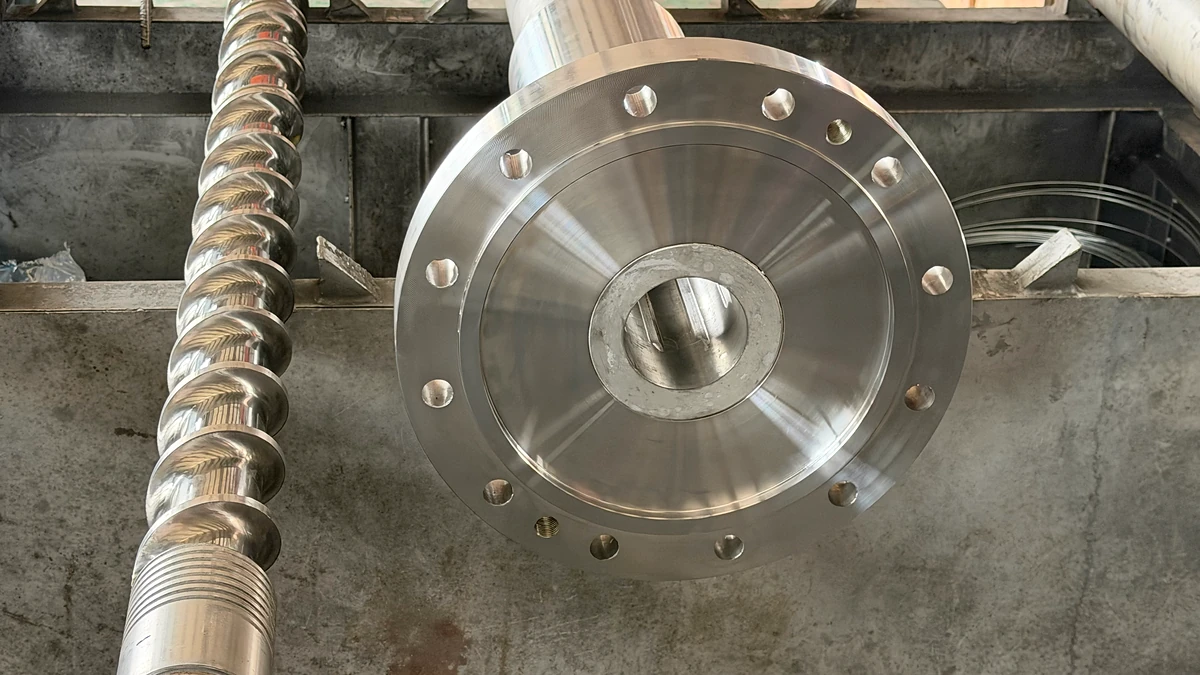
Why Your Extruder Screw Barrel For Recycling Is Killing Pellet Quality
Oct 29, 2026
Learn how extruder screw barrel design affects recycled pellet quality. Covers screw zones, polymer-specific specs, wear management, and troubleshooting tips.
Read Article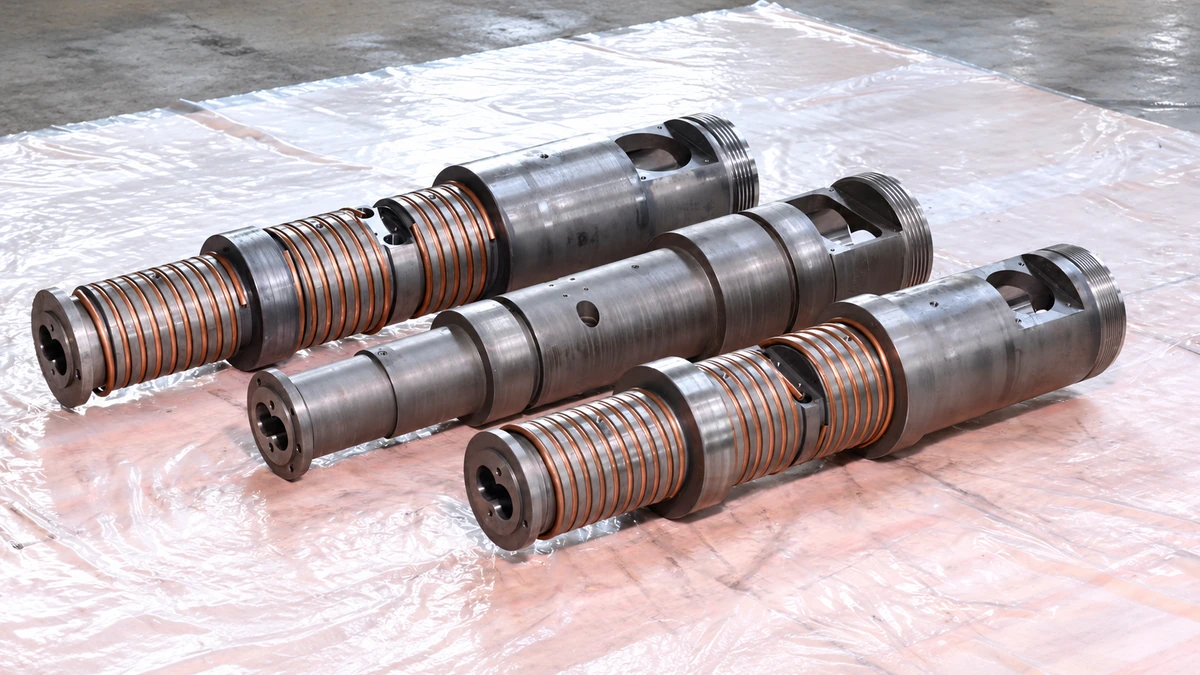
Inside an Extruder Barrel Manufacturer: From Raw Steel to Replacement
Oct 28, 2026
Learn how an extruder barrel manufacturer turns raw steel into precision barrels — covering materials, bimetallic vs nitrided linings, wear modes, and supplier evaluation.
Read ArticleLooking for something else?
Search by material, symptom or product and jump straight to the relevant page.
These are navigation suggestions based on keyword matching — not a quotation, not a delivery commitment, and not a substitute for engineering review. Final specification is confirmed by our engineers against your drawings and processed material.
Need help with screw barrel selection?
Share your machine model, processed material and application. Our team can help with pricing and technical support.