

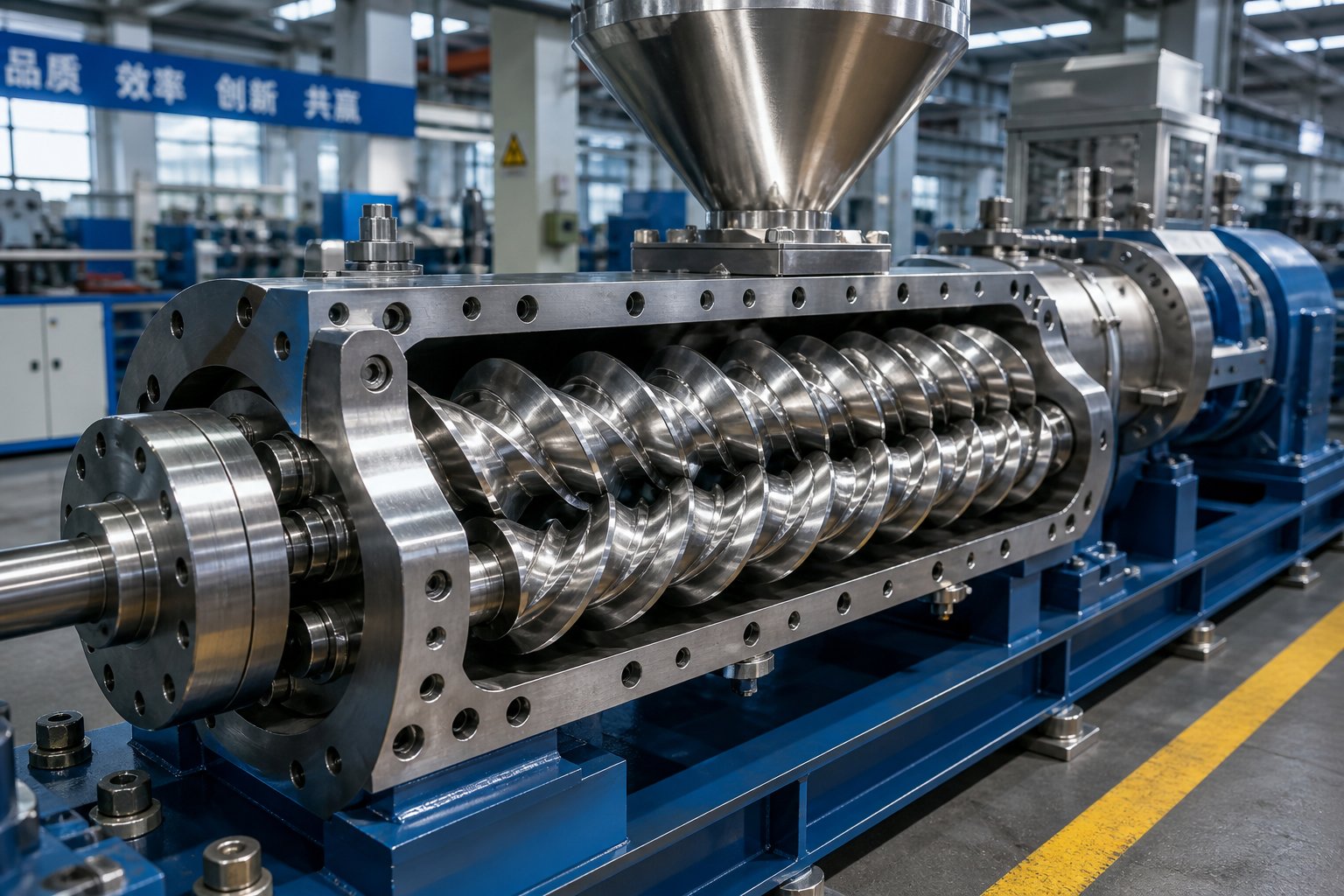
What Twin Screw Extruders Are and Why China Leads Production
A twin screw extruder is a machine that uses two intermeshing screws rotating inside a heated barrel to convey, melt, mix, and shape raw materials into finished or semi-finished products. It is the workhorse behind polymer compounding, pelletizing, reactive extrusion, and devolatilization processes across the plastics, food, pharmaceutical, and chemical industries. If you have ever handled a plastic pellet, chewed an extruded snack, or swallowed a controlled-release tablet, there is a good chance a twin-screw extruder played a role in making it.
What makes twin screw extruders distinct from single-screw machines is their superior mixing capability. The intermeshing action between the two screws generates high shear forces that break down raw materials thoroughly, disperse additives uniformly, and produce a consistent, homogeneous melt. That level of control is why industries demanding precision — from engineering plastics to pharmaceutical drug delivery — rely on this technology as their processing backbone.
And increasingly, they source that technology from China.
How Twin Screw Extruders Work
Imagine two long, helical screws placed side by side inside a steel barrel, their flights interlocking like tightly meshed gears. As a motor drives the screws to rotate, raw material — typically pellets, powder, or granules — enters through a hopper at one end. From there, the process unfolds in stages.
First, the screws grab and convey the material forward. As it moves deeper into the barrel, heat from the barrel walls and friction from the screws' shearing action begin to melt the material. Dedicated kneading and mixing zones, built from modular screw elements, deliver intensive blending that ensures every additive, filler, or reinforcement is evenly distributed throughout the melt. Venting zones can remove trapped air or volatile gases to improve final product quality. Finally, the homogenized molten material is pushed through a shaped die at the exit, forming it into pellets, profiles, sheets, or whatever the application demands.
The barrel itself is divided into multiple independently controlled temperature zones, giving operators precise command over the thermal profile from feed to die. This modularity — the ability to swap screw elements, rearrange mixing sections, and add or reposition venting ports — is one of the twin screw extruder's greatest practical strengths. You are not locked into a single process configuration. You can reconfigure the machine as your product requirements evolve.
Why China Dominates Global Twin Screw Extruder Production
China's rise as the world's leading source of twin screw extruders did not happen overnight. It grew from decades of concentrated industrial investment, a deep pool of metallurgical and mechanical engineering talent, and the natural clustering of specialized manufacturers, component suppliers, and supporting industries into tightly knit regional ecosystems.
The global twin screw extruder market was valued at approximately USD 4.8 billion in 2025 and is projected to reach USD 7.01 billion by 2036, with China growing at 4.0% CAGR — the fastest rate among all major markets studied.
That growth rate reflects something more than just low-cost manufacturing. Chinese manufacturers have steadily improved technical capability, with domestic OEMs now capturing growing share in mid-range and increasingly higher-specification segments. Fact.MR's market analysis notes that expanding plastics compounding capacity in China drives volume demand, while domestic manufacturers gain share through improving technical capability and competitive pricing.
Consider the sheer scale: cities like Nanjing alone host dozens of specialized twin screw extruder manufacturers, supported by local screw element fabricators, barrel metallurgy specialists, motor and drive suppliers, and control system integrators. From January to November 2022, China exported approximately 109,000 extruder units while importing only about 1,000 — a trade surplus that underscores just how deeply embedded this manufacturing capability has become. For international buyers, this concentration translates into competitive bidding, faster lead times, and the ability to visit multiple factories in a single trip.
The result is a sourcing landscape where a china extruder is no longer synonymous with "budget alternative." Many Chinese manufacturers now integrate European-brand motors, drives, and control systems into their machines. The real question for buyers is no longer whether to source from China, but how to navigate the ecosystem intelligently — understanding which configurations match their process needs, which specifications actually matter, and which claims on a quote deserve closer scrutiny.
That scrutiny begins with understanding the two fundamental rotation configurations that define what any twin screw extruder can and cannot do.
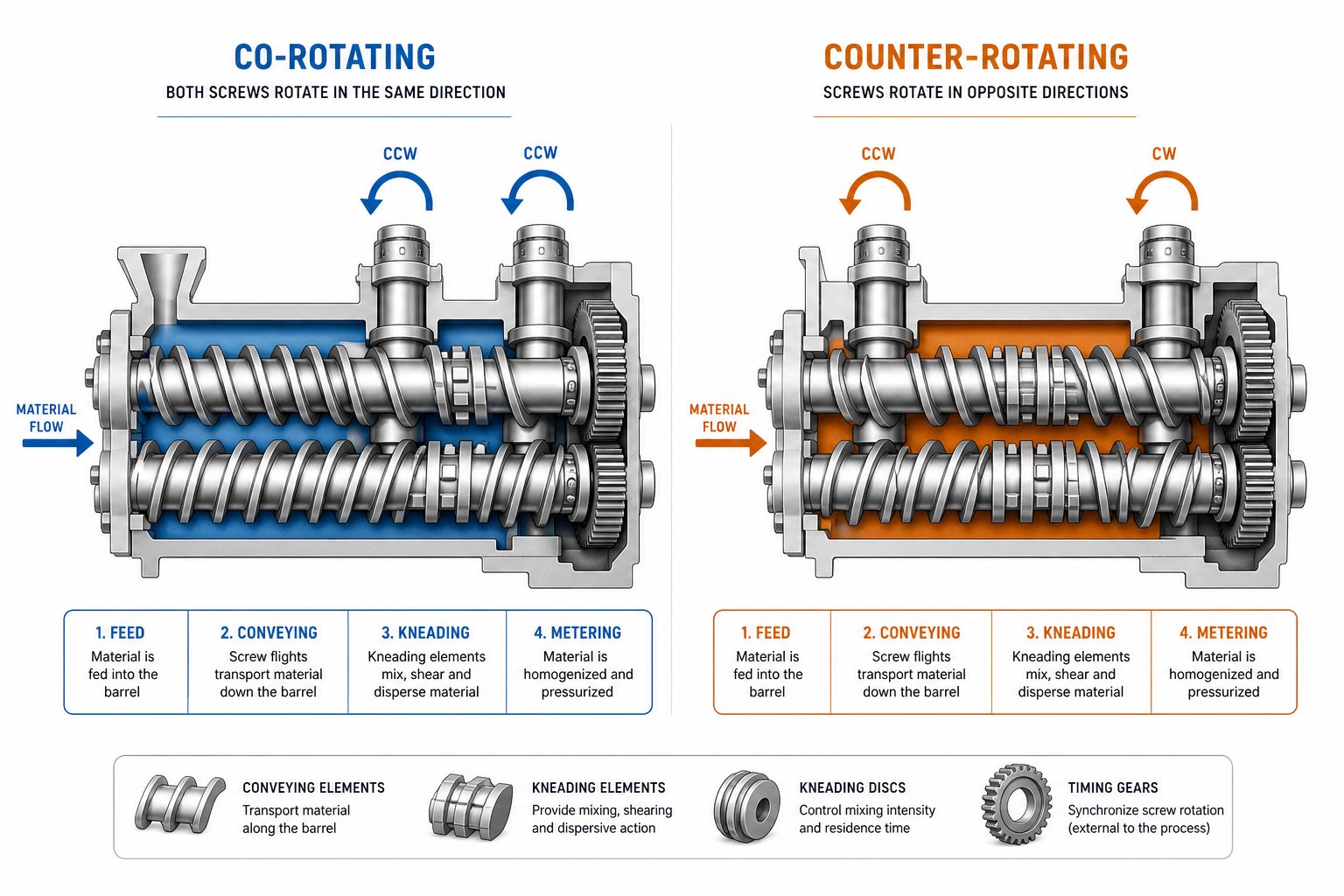
Co-Rotating vs Counter-Rotating Twin Screw Extruders Explained
Every twin screw extruder on a Chinese supplier's spec sheet will list one of two rotation configurations: co-rotating or counter-rotating. This single detail shapes how the machine mixes, conveys, and thermally treats your material. Get it wrong, and no amount of motor power or barrel length will compensate. Yet most quotes bury this choice in a line of abbreviations, assuming you already know what it means for your process.
Here is what it actually means — and why it matters more than almost any other specification on the page.
Co-Rotating Twin Screw Extruder Mechanics and Applications
In a co rotating twin screw extruder, both screws spin in the same direction. Picture two interlocking spirals turning together — material caught between them gets forcibly handed off from one screw flight to the next at the intermeshing zone. This creates a self-wiping action that continuously scrapes residual material off each screw's surface, virtually eliminating dead zones and stagnation.
The practical consequences are significant. Self-wiping keeps the residence time distribution narrow, meaning every particle of material spends roughly the same amount of time inside the barrel. That uniformity is critical for reactive extrusion, where even small variations in thermal exposure can ruin a batch. It also means easier changeovers between products — less material left behind inside the machine translates directly into less purge waste and faster color or formulation transitions.
Mixing intensity is another defining strength. Intense shear fields develop between the screws and between each screw and the barrel wall. When you add kneading block elements into the screw design, elongational flow components join the mix, imposing a complex deformation history on the material that breaks down filler agglomerates, controls polymer alloy phase morphology, and promotes mass transfer during chemical reactions. The combination of screw elements can be arranged freely, allowing engineers to dial in exactly where and how much energy enters the melt.
You will find co-rotating configurations dominating these applications:
- Polymer compounding — blending resins with inorganic fillers, organic additives, and even nanoscale reinforcements like carbon nanotubes or cellulose nanofibers
- Masterbatch production — achieving precise pigment dispersion at high throughput
- Reactive extrusion — in-barrel polymerization, grafting, and compatibilization reactions that demand tight thermal and residence time control
- Filled and reinforced compounds — glass fiber, mineral, or flame-retardant loaded formulations where dispersive and distributive mixing quality determines final mechanical properties
In short, when the job demands aggressive mixing, process flexibility, and modularity, the co-rotating extruder twin screw configuration is almost always the starting point.
Counter-Rotating Designs and When They Excel
Flip one screw's rotation direction, and the machine's behavior changes fundamentally. In a counter-rotating twin screw extruder, the two screws turn in opposite directions. At the intermeshing zone, material gets drawn inward and compressed rather than handed off — think of it as two rollers pulling fabric into a nip. This creates a calendering effect, where material undergoes repeated compressive and elongational deformation under relatively gentle conditions.
The shear stress between the screws drops considerably compared to a co-rotating design. That lower shear translates to less frictional heat generation — a crucial advantage when you are working with materials that degrade easily at elevated temperatures. Material transport relies heavily on screw rotation itself rather than on pressure buildup, and stable extrusion can be maintained even at comparatively low screw speeds under a high degree of fill.
Rigid PVC is the textbook example. It has a notoriously low thermal decomposition temperature and poor melt flow characteristics. Subject it to the high-shear environment of a co-rotating machine, and you risk degradation before proper plastication even occurs. The counter-rotating configuration, by contrast, holds extrusion temperatures low through its combination of high fill and low rotational speed. The calendering effect at the intermeshing zone provides moderate dispersion — exactly what PVC formulations need, where fully microscopic dispersion is less desirable than controlled, gentle blending of stabilizers and processing aids.
Counter-rotating twin-screw extruders are the go-to choice for:
- PVC pipe and profile extrusion — window frames, conduit, drainage pipe, decking profiles
- PVC sheet and film production — rigid and semi-rigid sheet for thermoforming
- Heat-sensitive specialty compounds — any formulation where shear-induced temperature rise must be tightly controlled
- Direct extrusion forming — applications requiring stable, low-pressure output with positive displacement pumping characteristics
Choosing the Right Configuration for Your Process
When you are comparing quotes from Chinese manufacturers, the rotation configuration should be one of the first checkboxes you verify — not an afterthought buried in fine print. The table below lays out the key performance differences side by side, giving you a quick reference for matching machine type to process requirements.
| Performance Dimension | Co-Rotating | Counter-Rotating |
|---|---|---|
| Shear Level | High — intense shear fields between screws and barrel | Low to moderate — gentler deformation via calendering effect |
| Mixing Intensity | Excellent dispersive and distributive mixing | Good dispersive mixing under gentle conditions; limited distributive mixing |
| Self-Wiping Capability | Fully self-wiping; minimal dead zones | Limited self-wiping; greater potential for material stagnation |
| Pressure Generation | Moderate — relies on downstream die resistance | High — positive displacement pumping builds pressure efficiently |
| Throughput Range | Wide — scalable from lab (few kg/hr) to industrial (>2,000 kg/hr) | Moderate — typically optimized for specific output ranges |
| Residence Time Control | Narrow distribution; highly controllable | Broader distribution; less flexibility |
| Temperature Sensitivity | Higher shear generates more frictional heat | Lower shear minimizes heat generation; ideal for thermally sensitive materials |
| Typical Applications | Compounding, masterbatch, reactive extrusion, nanocomposites, filled compounds | PVC pipe/profile extrusion, PVC sheet, heat-sensitive formulations, direct forming |
A common mistake among first-time buyers sourcing twin-screw extruders from China is choosing based on price alone without confirming that the rotation type matches their material and application. A bargain on a counter-rotating machine is no bargain at all if your process demands the high-shear compounding performance only a co-rotating design can deliver — and vice versa.
The rotation configuration is not a preference — it is an engineering requirement dictated by your material's rheology and thermal behavior. Match the machine to the process first, then negotiate price.
Rotation direction, however, is only half the geometric story. Twin screw extruders also differ in whether those screws run parallel to each other or taper from a larger feed diameter down to a smaller output end — a distinction that shapes torque delivery, intake behavior, and the range of materials a machine can handle efficiently.
Conical vs Parallel Twin Screw Extruder Architectures
Rotation direction tells you how the screws interact with each other. Architecture — whether those screws are parallel or conical — tells you something equally important: how the machine handles material intake, builds pressure, and delivers torque. When you browse catalogs from Chinese manufacturers, you will encounter both designs, often from the same supplier. The difference is not cosmetic. It fundamentally shapes which materials the twin screw extruder machine can process efficiently and which applications it suits best.
Yet most supplier websites treat this as a checkbox rather than a decision point. Here is what each architecture actually does — and how to pick the right one.
Parallel Twin Screw Extruder Architecture
A parallel twin screw extruder uses two screws of identical diameter running side by side at a fixed center distance throughout the entire barrel length. Both co-rotating and counter-rotating configurations are available in parallel form, though the co-rotating parallel design dominates the global compounding market by a wide margin.
Why the popularity? Versatility. Parallel designs accommodate a broad range of length-to-diameter (L/D) ratios — typically from 32:1 up to 52:1 or even higher — by simply adding or removing modular barrel sections. Imagine being able to extend your machine's processing length to add another mixing zone, a side feeder for downstream filler addition, or an extra venting port for devolatilization. That kind of reconfigurability is only practical when every barrel section and screw element shares the same diameter and can be freely rearranged.
This modularity extends to the screw elements themselves. Conveying elements, kneading blocks, mixing elements, and reverse-flight elements can be stacked along a common splined shaft in virtually any sequence. You can redesign the screw profile for a new formulation without purchasing an entirely new screw — just rearrange or swap individual elements. For operations that process multiple product families on a single line, this flexibility pays dividends year after year.
Scalability is another strength. Parallel designs are available from lab-scale units with screw diameters as small as 16-20 mm all the way up to production machines exceeding 130 mm. The same fundamental screw geometry that works at bench scale can be scaled up with predictable results, making process development and technology transfer straightforward. It is no coincidence that polymer compounding, masterbatch production, reactive extrusion, and engineering plastics modification all gravitate toward parallel co-rotating machines as the preferred configuration.
Conical Twin Screw Extruder Architecture
A conical twin screw extruder takes a completely different geometric approach. Instead of maintaining a constant diameter, each screw tapers from a larger diameter at the feed end to a smaller diameter at the discharge end. Picture two elongated cones set at an angle, their flights intermeshing as they converge toward the die.
This taper creates a natural compression ratio built directly into the screw geometry. At the feed end, the larger cross-section provides a generous intake volume — excellent for swallowing low-bulk-density materials like dry-blend PVC powder that a parallel design might struggle to pull in efficiently. As the material moves toward the narrower discharge end, it gets progressively compressed. Pressure builds steadily and naturally without requiring the aggressive kneading elements that a parallel machine would need for the same effect.
Torque delivery also benefits from the tapered geometry. The larger root diameter at the feed zone gives the screws greater mechanical strength precisely where the material is most resistant — in its cold, unmelted state. That high torque at the feed end is why conical designs handle stiff PVC dry blends so reliably, even at the low screw speeds typical of counter-rotating operation.
The practical advantages are clear for specific applications:
- PVC pipe and profile extrusion — the dominant use case globally, where gentle processing and controlled pressure generation are essential
- Low-bulk-density materials — powders and dry blends that need generous feed-zone volume for consistent intake
- Compact installations — the converging screw geometry results in a shorter overall machine length compared to a parallel design of equivalent processing capacity
- Simpler gearbox design — the angled screw arrangement creates natural separation between the drive shafts, allowing a less complex and often less expensive transmission system
The trade-off? Conical screws are not modular in the same way parallel screws are. You cannot rearrange individual screw elements along the shaft — the taper is machined as a single piece. Changing your screw geometry means replacing the entire screw, not just swapping a few kneading blocks. L/D ratios are also relatively fixed and shorter than what parallel designs offer, which limits the number of functional zones you can fit along the barrel.
Application-Based Architecture Selection
The comparison below puts the key differences between these two double screw extruder machine architectures into a single reference. Use it to match your process requirements to the design that delivers the best fit — not just the lowest quote.
| Selection Criteria | Parallel Twin Screw | Conical Twin Screw |
|---|---|---|
| Screw Diameter Range | Wide range (approx. 16 mm to 300+ mm) | Defined by large-end/small-end ratio (e.g., 55/110 mm, 65/132 mm, 80/156 mm) |
| L/D Ratio Flexibility | Highly flexible (32:1 to 52:1+); adjustable by adding barrel segments | Relatively fixed and shorter; limited by taper geometry |
| Torque Characteristics | Uniform along screw length; dependent on gearbox rating | Naturally high at feed zone due to larger root diameter |
| Material Suitability | Broad — engineering plastics, masterbatch, filled compounds, reactive systems | Specialized — PVC dry blends, low-bulk-density powders, heat-sensitive formulations |
| Modularity | Fully modular — screw elements and barrel sections interchangeable | Non-modular — screws typically machined as single pieces |
| Primary Use Cases | Compounding, pelletizing, reactive extrusion, devolatilization, masterbatch | PVC pipe, PVC profiles, PVC sheet, rigid and flexible PVC products |
Application requirements should drive architecture selection, not price alone. A conical machine optimized for PVC will underperform in compounding applications — and a parallel machine is overkill and operationally inefficient for straightforward PVC profile extrusion.
Choosing the right architecture narrows the field of potential suppliers considerably. But the real complexity begins when you start comparing the technical specifications within your chosen category — screw diameter, L/D ratio, torque density, and motor power — where the numbers on competing quotes can look deceptively similar while hiding meaningful differences in actual machine capability.
Critical Technical Specifications Every Buyer Must Evaluate
You have settled on a rotation configuration. You have picked your architecture. The next step feels simple: compare quotes. But open three spec sheets from three different twin screw extruder manufacturers in China, and you will likely stare at columns of numbers — screw diameter, L/D ratio, torque density, motor power, max RPM — that look superficially similar yet tell very different stories about what each machine can actually do on your production floor.
The problem is not a lack of data. It is a lack of context. Suppliers assume you know how to read between the lines. This section gives you the decoder ring.
Screw Diameter, L/D Ratio, and What They Tell You
Screw diameter is the single most consequential sizing parameter on any twin-screw extruder machine. It determines throughput ceiling, torque requirements, and the scale of your operation. Chinese manufacturers offer diameters spanning the full spectrum — from compact lab-scale units starting around 16-20 mm up through production workhorses at 75-95 mm and heavy industrial machines reaching 135 mm or beyond. Some global OEMs push past 200 mm for mega-capacity lines, but the vast majority of buyer inquiries from international markets land in the 35-95 mm range.
Here is the critical relationship most quotes do not explain: production capacity scales approximately with the square of the screw diameter. Doubling the diameter does not double your output — it roughly quadruples it. That means a jump from a 50 mm machine to a 75 mm machine represents far more than a 50% capacity increase. Understanding this scaling law prevents both undersizing, which creates bottlenecks, and oversizing, which wastes capital and energy running a machine well below its efficient operating window.
L/D ratio — the length of the screw divided by its diameter — determines how much processing the material undergoes before exiting the die. Most co-rotating twin screw compounding extruders from Chinese suppliers fall within the 32:1 to 68:1 range, though 36:1 to 48:1 covers the sweet spot for standard compounding applications.
Think of L/D ratio as the machine's processing runway:
- 32:1 to 36:1 — Adequate for simple blending, color concentrate dispersion, and formulations that need minimal residence time
- 40:1 to 48:1 — The versatile mid-range, suitable for most compounding tasks including filled compounds, engineering plastics modification, and moderate devolatilization
- 52:1 to 68:1 — Extended processing length for reactive extrusion, multi-stage devolatilization, and processes requiring long residence time or multiple downstream feed and vent positions
A longer L/D ratio does not automatically mean a better machine. It means a more capable machine for processes that demand extended thermal and mechanical treatment. For simple blending operations, that extra barrel length just adds cost, energy consumption, and unnecessary residence time that could degrade heat-sensitive materials.
Torque Density Grades Decoded
If screw diameter determines how much material you can push through, torque density determines how hard you can work that material along the way. Measured in Nm/cm³ — the torque available per unit of screw cross-sectional area — this specification reveals more about a machine's true capability than almost any other number on the quote.
Modern co-rotating twin screw extruders typically deliver torque densities ranging from 5.0 to 18.1 Nm/cm³, and Chinese manufacturers now span nearly the full range. To make sense of that spectrum, consider the practical tiers:
- 5.0 - 6.1 Nm/cm³ (Standard tier) — Cost-effective machines suited for standard compounding, simple blending, and applications where the material does not fight the screws too aggressively. A solid choice for commodity plastics, basic masterbatch, and recycling operations.
- 7.6 - 9.4 Nm/cm³ (High-performance tier) — Capable of handling more demanding formulations including moderately filled compounds, engineering polymers, and applications requiring elevated screw speeds. This range covers the majority of serious production compounding work.
- 10.4 - 12.8 Nm/cm³ (Super-torque tier) — Machines at this level compete directly with premium European models. They handle high-viscosity polymers, heavily filled systems (think 60%+ mineral loading or long glass fiber reinforcement), and tough reactive extrusion processes that would stall a lower-torque machine.
- Above 13 Nm/cm³ — The ultra-premium range occupied by top-tier global OEMs, designed for the most extreme processing challenges.
Why does this matter to you as a buyer? Because a machine quoted with insufficient torque density for your formulation will either run below its rated throughput, generate excessive melt temperature from overworked screws, or simply trip its overload protection and shut down. A higher torque density gives you headroom — the ability to push throughput, process tougher materials, and handle formulation variations without running the drive system at its absolute limit.
When comparing quotes, ask suppliers to state torque density explicitly in Nm/cm³. If a spec sheet lists only total motor torque without normalizing it to the screw cross-section, you cannot make a meaningful comparison between machines of different diameters.
Screw Speed, Throughput, and Motor Power Relationships
Maximum screw speed, listed in RPM, often gets treated as a bragging right. Sounds impressive when one supplier quotes 900 RPM and another quotes 600 RPM. But higher RPM is not inherently better — it is situationally better, depending on your material and process.
Co-rotating machines span a wide operational range. High-speed operation (1,000 to 1,800 RPM) suits high-shear compounding where aggressive mixing and maximum throughput are the priorities. Medium-speed operation (400 to 900 RPM) balances output with product quality for most standard applications. Lower speeds (200 to 600 RPM) are ideal for heat-sensitive or reactive materials where excessive shear would cause degradation.
The relationship between screw speed and throughput is not linear. Doubling the RPM does not double your output if the feed system cannot keep up, or if the material's thermal limits force you to back off. What actually determines practical throughput is the interplay between three factors:
- Screw speed — drives conveying rate and shear input
- Motor power (kW) — determines the energy budget available for melting, mixing, and conveying against die resistance
- Specific energy consumption — calculated as torque multiplied by speed divided by throughput, this metric reveals how efficiently the machine converts electrical energy into useful processing work
When evaluating a twin-screw extruder machine, right-sizing means matching motor power to your target throughput at the screw speed your material requires. An oversized motor driving a machine at 30% capacity wastes energy and capital. An undersized motor running at its limit shortens drive train life and limits your ability to scale production later.
Ask the supplier what throughput their machine achieves at your target formulation and screw speed — not just the maximum theoretical output with an easy-flowing polymer. Real-world numbers are what your production schedule depends on.
Modular Design and Its Buyer Implications
You will see "modular barrel and screw design" listed as a feature on nearly every parallel co-rotating machine from Chinese manufacturers. It sounds like a standard checkbox item, but the practical implications are anything but standard — and the degree of modularity varies more than suppliers typically let on.
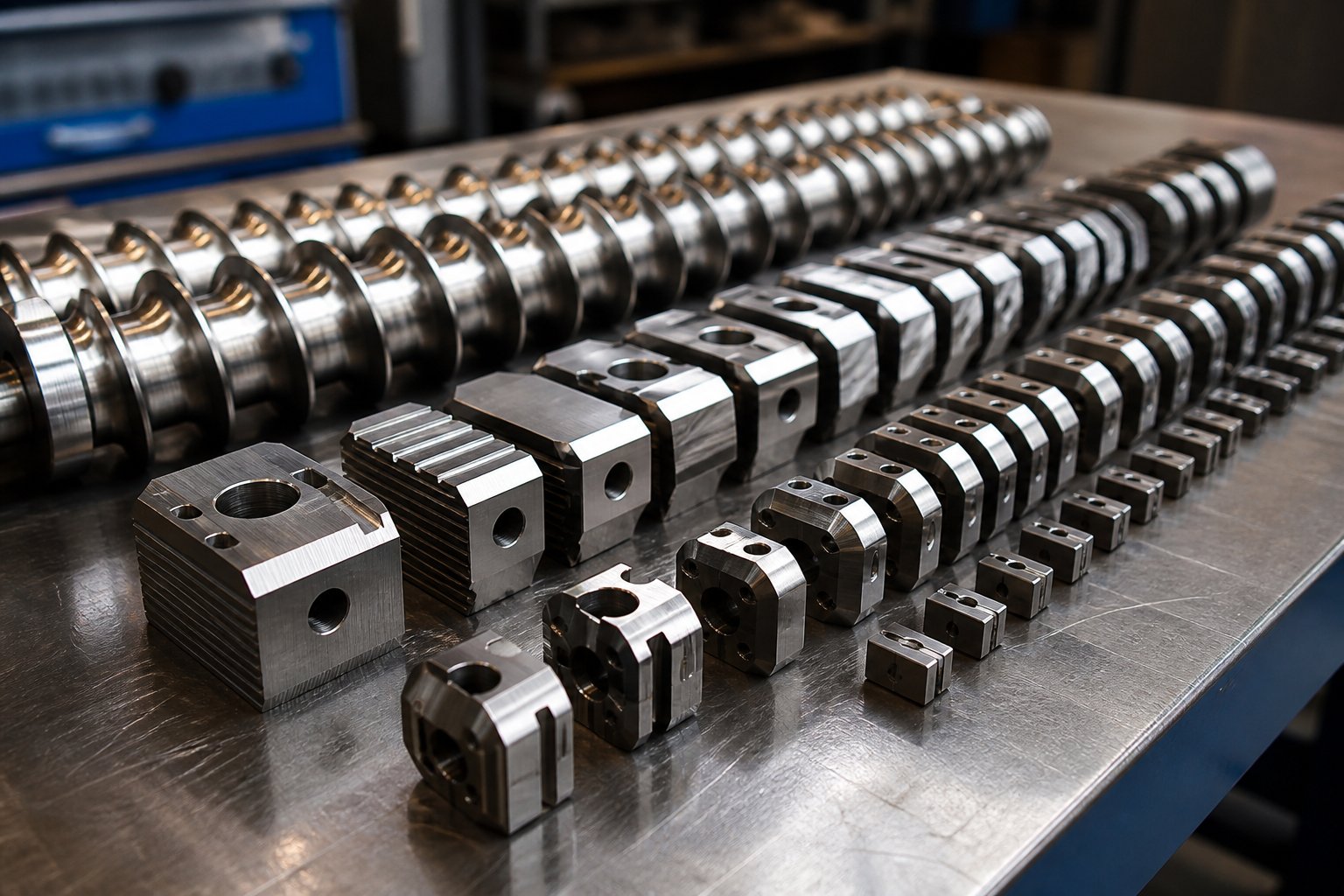
True modularity means the barrel is assembled from individual segments, each independently heated and cooled, bolted together in sequence. The screw is built from discrete elements — conveying elements, kneading blocks of varying stagger angles, mixing elements, and reverse-flight elements — slid onto a splined shaft and locked in position. This building-block approach lets you:
- Reconfigure mixing intensity by swapping kneading block arrangements
- Add or reposition venting ports for devolatilization without replacing the entire barrel
- Move side-feeder locations to change where fillers or additives enter the melt stream
- Optimize conveying versus mixing zone ratios for different formulations
- Replace worn individual elements rather than entire screws, reducing maintenance costs
The buyer implication is significant: a modular machine purchased for one product line today can be reconfigured for a different product line tomorrow. You are buying flexibility, not just a fixed process tool. But modularity only delivers that value if the element catalog is comprehensive, if replacement elements are readily available, and if the dimensional tolerances are tight enough that elements from different production batches interchange without issues.
When comparing twin screw extruder manufacturers, ask specifically how many screw element types are available for the platform, what the lead time is for replacement elements, and whether elements from other machines of the same diameter can be cross-fitted. A machine with a broad, well-stocked element library is worth considerably more than one with limited screw configuration options — even if the base price is higher.
The table below consolidates the key specification categories into a single reference. Use it to decode any spec sheet and quickly identify where one machine genuinely outperforms another versus where the numbers just look different.
| Specification | What It Measures | Higher-Capability Indicator |
|---|---|---|
| Screw Diameter (mm) | Machine size and throughput potential | Larger diameter = higher throughput ceiling (scales with diameter squared) |
| L/D Ratio | Processing length relative to screw size | Higher ratio (44:1 to 68:1) = more processing zones; suited for reactive extrusion and multi-stage processes |
| Torque Density (Nm/cm³) | Torque per unit of screw cross-section | Above 10 Nm/cm³ = capable of high-viscosity, heavily filled, and engineering-grade materials |
| Do/Di Ratio | Outer-to-inner screw diameter ratio; determines free volume | Higher ratio (1.65 to 1.80) = greater free volume for low-bulk-density materials and high throughput |
| Max Screw Speed (RPM) | Rotational speed ceiling | Higher RPM (900+) = stronger shear and throughput potential, but must match material thermal limits |
| Motor Power (kW) | Energy available for processing | Higher power supports higher throughput; evaluate relative to screw diameter and target output |
| Number of Barrel Zones | Independent temperature control segments | More zones = finer thermal profile control along the barrel length |
| Screw Element Options | Variety of modular elements available | Broader catalog = greater process flexibility and optimization potential |
Numbers in isolation deceive. A machine boasting 900 RPM maximum speed means little if its torque density cannot sustain meaningful throughput at that speed with your material. Similarly, a generous L/D ratio adds cost without benefit if your process only needs 36:1 of barrel length. The skill in evaluating spec sheets lies in reading these parameters as an interconnected system — not as individual line items to be maximized independently.
Specifications, of course, do not exist in a vacuum. They emerge from the manufacturing ecosystems where these machines are designed and built — and understanding where in China your twin screw extruder actually comes from reveals a great deal about the supply chain, component quality, and after-sales infrastructure standing behind those numbers.
Inside China's Twin Screw Extruder Manufacturing Hubs
A spec sheet tells you what a machine can do. It does not tell you where that machine was designed, which component suppliers feed the factory, or how deep the local talent pool runs. Yet for international buyers, these geographic details shape everything from lead times and audit logistics to spare parts availability and long-term service responsiveness. China's twin screw extruder industry is not evenly distributed across the country — it is concentrated in specific regional clusters, each with its own manufacturing identity, supply chain strengths, and pricing dynamics.
Knowing which cluster your potential supplier operates in gives you a practical advantage that no product brochure will provide.
The Nanjing Cluster and Jiangsu Province Dominance
If the global twin screw extruder industry has a capital city, it is Nanjing. This single metropolitan area in Jiangsu province hosts a staggering concentration of manufacturers — more than 90% of China's twin screw extruder manufacturing enterprises are clustered in and around Nanjing. That is not a typo. Nearly every major Chinese extruder brand you will encounter during your sourcing process either operates from Nanjing directly or maintains deep ties to the Jiangsu manufacturing ecosystem.
Why such extreme concentration? The answer lies in decades of self-reinforcing industrial clustering. When a critical mass of twin-screw extruder manufacturer operations settled in one area, the supporting ecosystem followed. Metallurgy specialists capable of producing nitrided and bimetallic barrel liners set up shop nearby. Precision CNC machining houses dedicated to screw element fabrication opened within driving distance. Motor and gearbox suppliers, electrical control panel integrators, and heat treatment facilities all gravitated toward the same region. University programs at institutions like Nanjing Tech University and Southeast University began training engineers specifically for extrusion equipment design.
The result is an ecosystem where a manufacturer can source virtually every component locally — from hardened screw elements and precision-bored barrels to servo-driven feeding systems and PLC control cabinets — without waiting for cross-country shipments. That proximity compresses lead times, enables rapid prototyping of custom configurations, and creates intense competitive pressure that keeps pricing sharp. When your neighboring factory also builds twin screw extruders, you cannot afford to let quality slip or delivery dates slide.
For buyers, the Nanjing cluster offers a practical logistical benefit that is easy to overlook: you can visit three, four, or even five competing chinese extruder manufacturers in a single business trip. Compare factory floors side by side. Observe CNC machining precision at one plant in the morning and assembly procedures at another in the afternoon. That density of options makes on-site due diligence dramatically more efficient than sourcing from scattered, isolated factories.
Surrounding areas within Jiangsu province extend the ecosystem further. Cities like Zhenjiang, Changzhou, and Wuxi host secondary manufacturers and component suppliers that feed into the Nanjing-centered supply chain. The broader Jiangsu region also benefits from proximity to Shanghai's international port infrastructure, simplifying export logistics for machines headed overseas.
Other Regional Manufacturing Centers
While Nanjing dominates whole-machine production, other Chinese regions have carved out important niches in the broader extrusion equipment value chain.
Zhoushan, Zhejiang Province — This island city off China's eastern coast has built a distinct reputation as a specialized hub for screw and barrel manufacturing. Companies based in Zhoushan focus on precision-machined screws, bimetallic barrels, and replacement wear components for both twin screw and single screw platforms. Many Zhoushan manufacturers serve OEM clients — including some of the Nanjing-based extruder builders — while simultaneously supplying the aftermarket with replacement parts. If you are sourcing screw barrels or wear components rather than complete machines, Zhoushan is a name you will encounter repeatedly.
Guangdong Province — Southern China's manufacturing powerhouse contributes to the twin screw extruder ecosystem primarily through downstream equipment integration and ancillary systems. Pelletizing systems, die heads, water bath cooling tanks, strand cutters, and automation controls often originate from Guangdong-based suppliers. Some complete machine builders also operate in the Pearl River Delta region, though their numbers are far smaller than the Nanjing cluster.
Sichuan Province — A smaller but growing center for extrusion equipment manufacturing, with several enterprises serving domestic and regional markets. The Sichuan cluster benefits from lower operating costs compared to coastal provinces, which can translate to competitive pricing on certain machine categories.
What does this geographic diversity mean for you as a buyer? It means different tiers of specialization, quality, and price exist across China's manufacturing landscape. A Nanjing-based OEM assembling complete extruder lines with locally sourced precision components operates within a very different cost structure and quality framework than a smaller operation in an inland province working with a thinner local supply chain. Matching your quality expectations and budget to the right regional ecosystem is part of intelligent sourcing — not every buying scenario requires the premium cluster, and not every budget application should default to the lowest-cost region.
Supply Chain Advantages of Manufacturing Clusters
Sourcing from established manufacturing clusters rather than isolated factories delivers tangible benefits that show up in your project timeline, quality assurance process, and total cost of ownership. Here is what concentrated ecosystems enable:
- Faster lead times — Local component availability means manufacturers are not waiting weeks for critical parts to arrive from distant suppliers. Barrel sections, screw elements, gearboxes, and electrical panels are often available within days, not months.
- Easier quality auditing — Visiting multiple competing factories in a single trip lets you compare build quality, machining precision, and assembly standards firsthand. You can also visit the component suppliers feeding those factories to verify claims about material grades and manufacturing processes.
- Competitive bidding pressure — When dozens of manufacturers operate in close proximity, pricing stays competitive by default. You benefit from a market that self-corrects against inflated quotes because every supplier knows the buyer can walk down the road to a competitor.
- Deep technical talent pool — Clusters attract and retain engineers, machinists, and process specialists who build careers within the industry. That depth of experience translates into better machine design, more knowledgeable sales engineering support, and stronger troubleshooting capability when issues arise post-installation.
- Established spare parts supply — Ongoing access to replacement screw elements, barrel liners, heating bands, and other wear components is far more reliable when your machine originates from a cluster with multiple component suppliers. You are not dependent on a single source for critical spares.
- Simplified logistics coordination — Machines, spare parts kits, and downstream ancillary equipment can often be consolidated into a single shipment from a concentrated geographic area, reducing freight complexity and cost.
Isolated factories can certainly produce good machines. But they carry higher supply chain risk — longer lead times for components, fewer local alternatives when a supplier underperforms, and less competitive pricing pressure to keep them sharp. For first-time buyers especially, the established clusters offer a safety net of redundancy that simplifies every stage of the procurement process.
Geography reveals the infrastructure behind the machine. But the question that hangs over every sourcing conversation — whether spoken or not — is how these Chinese-made machines genuinely stack up against their European counterparts in real-world production environments.
How Chinese Machines Compare with European OEM Brands
This is the conversation every supplier avoids. Chinese manufacturers downplay the gaps. European sales teams exaggerate them. And buyers are left sorting through marketing noise when what they actually need is a straight answer: where do Chinese twin screw extruders hold their own, and where do they still fall short?
The honest answer is more nuanced than either side would prefer. The twin screw extruders market has shifted dramatically over the past decade, and the old binary of "European quality versus Chinese price" no longer captures reality. Here is what does.
Where Chinese Manufacturers Have Closed the Gap
For standard compounding, masterbatch production, PVC extrusion, and mid-range engineering plastics modification, the performance gap between top-tier Chinese machines and their European counterparts has narrowed to the point where it is functionally irrelevant for most production environments. A well-built 65 mm co-rotating extruder from a reputable Nanjing manufacturer running color masterbatch at 500 kg/h will produce pellets indistinguishable from those made on a German machine costing two to three times as much.
Several factors drove this convergence. First, many Chinese OEMs now spec European-brand components in their builds — Siemens or ABB drives, Flender or SEW gearboxes, Omron or Schneider controls, and ceramic or infrared heating systems sourced from established global suppliers. The machine frame, barrel, and screws are Chinese-made, but the drivetrain and control architecture often share DNA with European competitors.
Second, manufacturing precision has risen sharply. CNC machining centers capable of holding tight tolerances on screw elements and barrel bores are now standard equipment in leading Chinese factories. Torque density figures from top-tier Chinese manufacturers have climbed into the 13 to 15 Nm/cm³ range — still below the 18 Nm/cm³ ceiling set by Coperion and JSW, but more than sufficient for the vast majority of compounding applications.
Third, lead times and customization responsiveness represent areas where Chinese suppliers do not just match European brands — they beat them convincingly. Where a German or Japanese OEM might quote 8 to 14 months for delivery, a Chinese manufacturer frequently ships in 3 to 6 months. Custom screw configurations, non-standard barrel arrangements, and application-specific modifications happen faster because in-house engineering teams iterate without the layered approval processes that slow larger multinational organizations.
Rapid delivery is not a minor convenience. For a co extruder line needed to meet a contract deadline or a backup machine required to keep production running during maintenance windows, cutting six months off the delivery schedule has tangible financial value that narrows the effective price gap even further.
Where European OEMs Still Hold Advantages
Transparency demands acknowledging the areas where premium European manufacturers maintain a genuine edge — not because their machines are inherently "better" in some abstract sense, but because specific applications demand capabilities that the best Chinese OEMs have not yet fully matched.
Ultra-high-torque applications remain the clearest differentiator. When your formulation involves 60%+ glass fiber loading, high-viscosity polymer alloys, or reactive extrusion processes that push screw torque to its absolute limit over sustained production runs, the 18+ Nm/cm³ torque density and the metallurgical consistency behind it still favor established European and Japanese platforms. Running a machine at 95% of its torque ceiling for 8,000 hours per year is a very different engineering challenge than running at 70% — and the gearbox, shaft, and spline profile tolerances that enable that sustained performance reflect decades of incremental refinement.
Metallurgical consistency in screw elements is another area where premium OEMs hold an advantage. It is not that Chinese manufacturers cannot produce high-quality screw elements — many do. The difference shows up in batch-to-batch uniformity over years of replacement part orders. When you need a kneading block delivered in 2028 that performs identically to the one installed in 2024, the quality management systems and material traceability protocols at top European OEMs provide a higher level of assurance.
Proprietary process engineering know-how separates machine sellers from process partners. Companies like Coperion and Leistritz maintain extensive application laboratories, simulation software (like JSW's proprietary TEX-FAN platform), and process engineering teams that can design and validate a complete screw configuration for your specific formulation before you commit to a purchase order. Some Chinese manufacturers are building this capability, but the depth of application data accumulated over 130+ years of combined experience at leading European houses is not something that can be replicated quickly.
Integrated digital process control platforms — real-time torque monitoring, predictive maintenance algorithms, MES/SCADA integration, and Industry 4.0 connectivity — are more mature on European machines. Chinese manufacturers increasingly offer PLC-based automation, but the software ecosystem and data analytics layer that sits on top of the hardware remains less developed.
Finally, long-term reliability track records carry weight in industries where equipment failure has severe consequences. Some Davis-Standard extruders are documented to have operated for over 50 years of continuous service. That kind of multi-decade field data simply does not exist yet for Chinese-built machines, regardless of how well they are currently engineered.
The Value Proposition for Different Buyer Profiles
The right machine depends on who you are, what you process, and what your production environment demands. Neither origin automatically wins — the match between machine capability and application requirement does.
Buyers who benefit most from Chinese-sourced machines:
- Cost-sensitive operations where equipment price significantly impacts project viability — Chinese machines typically cost 30 to 55% of equivalent European models
- Standard compounding, masterbatch, and PVC extrusion applications that do not require torque densities above 15 Nm/cm³
- Manufacturers in developing markets building initial production capacity, where faster ROI from lower capital investment outweighs marginal performance differences
- Second-line or backup capacity additions where the machine supplements rather than replaces an existing production workhorse
- Operations requiring rapid delivery — when a 3 to 6 month lead time versus 8 to 14 months determines whether you win or lose a supply contract
- Custom or non-standard configurations where fast engineering iteration and willingness to adapt are more valuable than catalog standardization
Buyers who may need European-tier equipment:
- Mission-critical pharmaceutical production under GMP, where equipment pedigree, cleaning validation documentation, and regulatory compliance history are non-negotiable
- Ultra-precision applications — triple screw extruder configurations, advanced polymer alloy development, or nano-scale dispersion work where process control margins are razor-thin
- Operations where the end customer of the equipment owner mandates specific OEM brands as a supply chain qualification requirement
- Facilities processing extremely abrasive or high-viscosity formulations at sustained maximum torque, where the difference between 15 and 18 Nm/cm³ directly impacts uptime
- Global operations requiring an established worldwide service network with guaranteed spare parts lead times under 48 hours
The decision is rarely about overall quality. It is about matching machine capability to specific application requirements and total cost of ownership — a calculation where a $150,000 Chinese machine delivering identical output to a $450,000 European model is not the cheaper option, but the smarter one.
Knowing where Chinese machines compete and where they do not is valuable context. But context alone does not protect your capital. The practical challenge that follows every sourcing decision — verifying that the specific manufacturer you have chosen actually delivers what their spec sheet promises — requires a systematic due diligence process that most buyers learn the hard way.
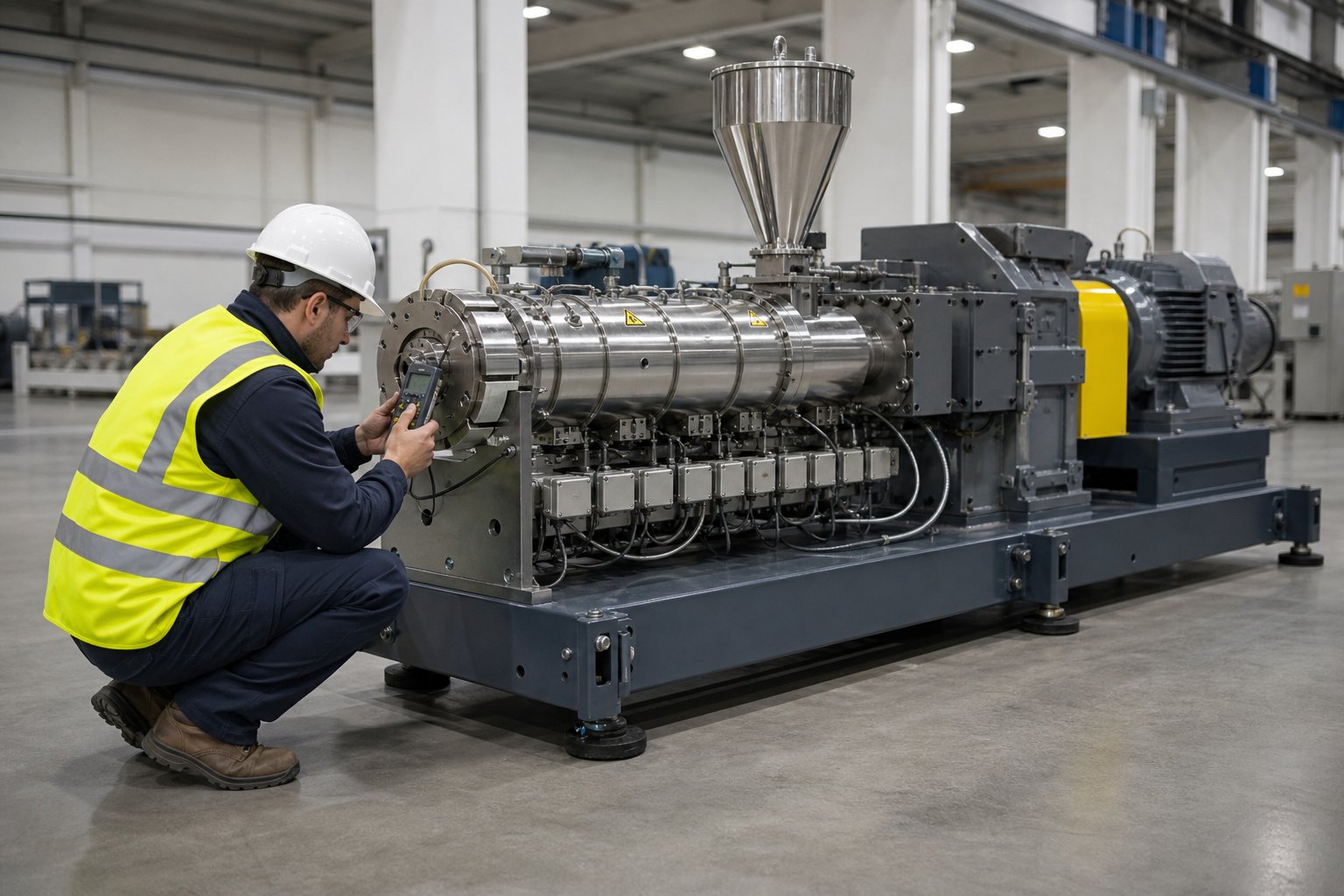
Quality Verification and Manufacturer Due Diligence
Every twin screw extruder supplier in China will tell you their machines are "high quality." Every spec sheet looks polished. Every factory tour shows the cleanest corner of the production floor. But the gap between what gets presented during a sales process and what actually ships to your facility months later is where procurement risk lives — and it is a gap that no supplier has any incentive to help you measure.
The uncomfortable truth is this: the due diligence burden falls entirely on you as the buyer. Chinese manufacturer websites are sales tools, not audit reports. The information they omit — production consistency, metallurgical traceability, actual versus claimed capacity — matters far more than the glossy photos they include. What follows is the verification framework that separates buyers who get burned from buyers who build reliable supply chains.
Remote and On-Site Manufacturer Auditing
Imagine walking onto a twin screw extruder factory floor for the first time. What should you actually look at? The answer is not the showroom model sitting under perfect lighting near the entrance. It is the machines at various stages of assembly deeper inside the shop — and the infrastructure supporting them.
Start with machining precision. The quality of a twin screw extruder lives or dies in the tolerances of its screw elements and barrel bores. Walk past the CNC machining centers and observe what equipment the factory uses. Modern five-axis CNC machines capable of holding tight tolerances on hardened screw elements signal serious manufacturing capability. Older manual lathes handling critical components suggest corners are being cut where they should not be.
Assembly cleanliness tells its own story. Screw elements, barrel liners, and gearbox components are precision-fit parts. A factory that assembles them in a cluttered, debris-strewn environment is introducing contamination and dimensional interference risks that will show up as premature wear and performance inconsistency in your production facility. Look for dedicated assembly areas with organized workstations, proper torque tools, and documented assembly procedures.
Testing procedures are equally revealing. A credible extruder manufacturer china buyers can trust will run every machine under load before shipment — not just spin the screws briefly and call it tested. Ask to see the test bay. Is there a dedicated area with electrical hookups, cooling water, and data logging equipment? Or does "testing" mean a quick power-on check that verifies the motor turns without actually validating performance under realistic conditions?
Perhaps the most important observation is comparing actual production capacity against claimed capacity. Count the machines visibly in production. Check how many assembly bays are active versus empty. A factory claiming to produce 200 machines per year but showing only a handful of units in various build stages is either overstating capacity or subcontracting major portions of production — both of which carry risk. Industry auditing research confirms that if utilization regularly exceeds the 85% threshold, the factory may face delays when ramping up for large or urgent orders.
Not every buyer can fly to Nanjing for a factory walkthrough. Remote verification has matured significantly as an alternative, though it carries inherent limitations. Video call audits using live, uninterrupted camera feeds through the production flow — from raw material storage through machining, assembly, and testing — can reveal a great deal. The key word is uninterrupted. A supplier showing only pre-recorded clips or curated screenshots is controlling your field of view, which defeats the purpose.
Third-party inspection services bridge the gap for buyers who cannot be physically present. Firms specializing in Chinese manufacturing audits deploy local inspectors who understand the equipment category, speak the language, and follow structured evaluation protocols. A standard on-site audit typically costs between $150 and $398 per auditor-day, with comprehensive evaluations spanning two to five days and covering over 400 checkpoints. That investment is trivial compared to the cost of receiving a machine that cannot hold specification.
Certifications and What They Actually Indicate
Certifications are one of the most misunderstood elements in the sourcing process. Buyers treat them as proof of quality. Suppliers display them as marketing collateral. The reality sits somewhere in between — and understanding what each certification genuinely verifies protects you from false confidence.
- ISO 9001 (Quality Management System) — This certifies that the supplier maintains a documented quality management system covering design, production, and support processes. It does not certify that any specific machine is high quality. As certification analysis makes clear, ISO 9001 tells you the supplier follows their own processes consistently — not that those processes produce the best machine for your application. A factory with excellent documentation can still make mediocre machines if their design specifications are mediocre. Verification step: search the registrar's public directory or use the IAF CertSearch database to confirm active certification status and verify that the certified scope covers the actual facility producing your equipment.
- CE Marking (European Conformity) — Here is the detail most buyers miss: for most machinery categories, CE marking is a self-declaration. The manufacturer assesses compliance with relevant EU directives — primarily the Machinery Directive 2006/42/EC — and affixes the mark. No government body tests or approves the product. A CE mark tells you the manufacturer claims the product meets EU safety directives. Verification step: request the Declaration of Conformity (DoC) document. A legitimate twin screw extruder supplier provides it without hesitation. If the DoC is vague about which specific EU directives were assessed, treat that as a warning.
- SGS Inspection Reports — SGS and similar third-party testing organizations provide independent verification of specific attributes: material composition, dimensional compliance, performance parameters. Unlike ISO or CE, an SGS report is tied to a specific test on a specific machine or component at a specific time. It does not transfer to other units or future production runs. Verification step: confirm that the report references the exact model and serial number relevant to your order.
- Industry-Specific Certifications — Depending on your application, additional standards may apply: ATEX for explosion-proof environments, FDA compliance for food-contact processing, GMP documentation for pharmaceutical equipment. These carry more weight than generic quality certifications because they address application-specific safety and regulatory requirements that directly affect whether you can legally operate the machine in your facility.
One critical principle underlies all certification verification: a certificate issued for Plant A does not automatically cover Plant B. If your machines ship from a different facility than the one named on the ISO certificate, the certification may not apply. Always verify that the scope matches the actual production location.
Requesting and Interpreting Test Run Data
A factory acceptance test — commonly abbreviated as FAT — is your last practical opportunity to confirm that the machine meets your purchase specification before it leaves the supplier's factory. Yet many buyers either skip this step entirely, accept a short video of the machine running as sufficient evidence, or fail to define what "passing" actually means before the test date arrives.
A proper FAT for a twin screw extruder is not a demonstration. It is a controlled procurement hold point with defined acceptance criteria. Procurement control frameworks for China-sourced industrial equipment emphasize that the FAT scope and acceptance criteria should be agreed before the test is scheduled — not improvised when the inspector shows up at the factory gate.
When you request a FAT from your twin screw extruder factory, specify these parameters at minimum:
- Throughput at your target formulation — Not maximum theoretical output with an easy-flowing polymer, but actual achievable throughput with your specific material. If the supplier cannot run your exact formulation, request a comparable surrogate and document the substitution.
- Melt temperature uniformity — Measure melt temperature at the die exit across multiple points and over sustained operation. Temperature variation beyond your process tolerance indicates barrel zone control issues or screw design problems that will haunt you in production.
- Torque stability — Monitor torque readings during the test run. Erratic torque fluctuations suggest inconsistent feeding, worn gearbox components, or screw element fit issues. Stable torque under load is a reliable indicator of mechanical integrity.
- Energy consumption — Record specific energy input (kWh/kg) at your target throughput. This metric reveals processing efficiency and becomes your baseline for evaluating operational costs post-installation.
- Screw speed versus output relationship — Document actual throughput at multiple screw speed setpoints to verify that the machine's performance curve matches the supplier's claims.
Critically, insist on recorded actual measured values, not just pass/fail checkmarks on an internal QC sheet. A FAT report stating "throughput: PASS" without listing the actual kg/h achieved is commercially useless. You need numbers you can hold the supplier accountable to — and numbers you can compare against future production performance to detect degradation.
The FAT should also include equipment identification verification: confirm that the machine being tested — its serial number, nameplate data, motor specifications, and installed components — matches what your purchase order specifies. Cases of suppliers substituting lower-grade components between the test unit and the shipped unit are not hypothetical. They happen, and equipment identification checks are your primary defense.
One more nuance worth noting: schedule the FAT before final packing. Once equipment is crated, visual, dimensional, and functional checks become difficult or impossible. A pre-shipment inspection after packing verifies shipment readiness — quantity, crating quality, marking, and documentation — but it cannot substitute for the technical validation that a proper FAT delivers while the machine is still accessible.
Red Flags During the Evaluation Process
Some warning signs are obvious. Others are subtle enough that buyers rationalize them away until problems surface after the machine arrives. The following red flags, drawn from real-world sourcing failures, should trigger heightened scrutiny — not automatic disqualification, but a conscious decision to investigate further before committing capital.
- Reluctance to provide reference customers — A manufacturer with a legitimate track record of exporting co extruders and compounding lines will readily connect you with existing customers in your region or application area. Vague deflections ("our customers prefer confidentiality") in response to every reference request suggest either a thin export history or dissatisfied customers.
- Inconsistent specification claims — The quote says 800 RPM maximum speed. The catalog says 600 RPM. The sales engineer verbally mentions 1,000 RPM. When specifications shift depending on who you ask or which document you read, the engineering discipline behind the machine is suspect.
- Pressure to skip test runs — "We don't usually do FAT for this model" or "testing will delay your shipment by two weeks" are statements designed to prioritize the supplier's schedule over your risk management. A factory confident in its machines welcomes the opportunity to prove performance.
- Unwillingness to allow factory visits — Legitimate manufacturers in Nanjing and other established clusters routinely host international buyers. Pushback against on-site visits — especially when paired with excuses about "factory renovations" or "scheduling conflicts" that persist across months — raises serious questions about what the factory does not want you to see.
- Unusually low pricing without clear justification — When one quote comes in 40% below the next lowest bid without an obvious explanation (smaller machine, lower torque rating, domestic-only components), the discount is coming from somewhere. Thinner barrel walls, lower-grade screw metallurgy, undersized gearboxes, and omitted safety features are not visible in a PDF quote — but they become painfully visible in production.
- Restricted access during audits — If the factory tour conveniently avoids the raw material warehouse, the machining area, or the waste/scrap zone, those are precisely the areas worth insisting on seeing. Audit professionals flag restricted access to raw material storage or waste treatment zones as a common warning sign of deeper compliance issues.
- Certificates that cannot be independently verified — An ISO 9001 certificate that does not name the registrar who issued it is almost certainly forged. A CE mark without a Declaration of Conformity available on request means the mark was likely self-applied without performing the required conformity assessment.
Not every red flag means you should walk away. But every red flag you choose to ignore should be a conscious, documented decision — not an oversight. The following priority framework helps you allocate due diligence effort where it matters most:
- Essential (non-negotiable) — Verify factory existence, confirm production capacity is real, validate certifications independently, and conduct or commission a factory acceptance test with defined acceptance criteria.
- Strongly recommended — Visit the factory in person or commission a third-party audit. Request and contact reference customers. Compare component sourcing claims (European drives, imported gearboxes) against actual installed equipment.
- Recommended — Audit the component supply chain upstream of the final assembler. Verify screw element and barrel metallurgy through independent material testing. Review the manufacturer's warranty claim history and after-sales service infrastructure.
- Advisable for high-value orders — Engage an independent process engineer to review the proposed screw configuration for your specific formulation. Commission a third-party pre-shipment inspection after FAT to verify packing, documentation, and shipment conformity.
Due diligence costs money and takes time. Skipping it costs more. The investment in proper verification is not an overhead — it is insurance against receiving a machine that looks right on paper but fails to perform where it counts: on your production floor, running your material, shift after shift.
Verification establishes what a machine is. But the total financial commitment extends well beyond the FOB price on the purchase order — and the gap between a quoted price and the actual cost of getting that machine operational in your facility is where budgets quietly unravel.
Pricing, Import Logistics, and Total Landed Cost Analysis
Here is the number most buyers fixate on: the FOB price printed on the proforma invoice. It feels concrete. It fits neatly into a budget spreadsheet. And it is dangerously incomplete. By the time a twin screw extruder leaves a Chinese factory floor and runs its first production cycle in your facility, the actual cost can be 20 to 60 percent higher than that quoted unit price — a gap that catches underprepared buyers off guard and turns what looked like a smart procurement decision into a budget crisis.
Understanding the full cost picture before you commit a deposit is not optional. It is the single most important financial exercise in the entire purchasing process.
Understanding Price Tiers for Chinese Twin Screw Extruders
When you start collecting quotes for a twin screw extruder for sale from Chinese manufacturers, you will notice that pricing spans a remarkably wide range. That spread is not random — it reflects genuine differences in machine capability, component quality, and the cost structure behind each manufacturer.
Think of the market in three broad tiers:
- Lab-scale and small production units (screw diameters roughly 20-35 mm) — These entry-level machines serve R&D departments, university labs, and small-batch specialty compounders. Pricing sits at the lower end of the spectrum, reflecting smaller physical scale, lower motor power requirements, and simpler drive systems. They are ideal for formulation development and process validation before committing to full production equipment.
- Mid-range production machines (screw diameters roughly 40-75 mm) — This is where the bulk of international buyer inquiries land. Machines in this range handle serious compounding throughput for masterbatch, filled compounds, engineering plastics, and recycled materials. Comparative data from parallel twin screw extruder manufacturers shows pricing for machines in this class ranging from approximately $140,000 to $250,000, depending on specifications, component sourcing, and automation level.
- High-capacity industrial lines (screw diameters 90 mm and above) — Large-scale production workhorses designed for continuous, high-volume output. These machines carry proportionally higher price tags driven by heavier gearboxes, larger motors, more extensive barrel cooling systems, and more sophisticated automation and process control integration.
What drives the twin screw extruder price differences between Chinese manufacturers offering seemingly comparable machines? Five factors account for most of the variation:
- Component sourcing — A machine built with a domestic Chinese motor and inverter drive costs meaningfully less than one equipped with a Siemens servo drive, an SEW or Flender gearbox, and Schneider control architecture. Both configurations work, but the imported-component machine typically delivers better energy efficiency, tighter speed control, and longer service intervals.
- Screw and barrel metallurgy — Nitrided steel screw elements are standard. Bimetallic or tungsten carbide-lined barrels cost more but last dramatically longer in abrasive applications. A low quote often signals that wear-resistant metallurgy was downgraded — a saving that evaporates when you are replacing barrels twice as often.
- Build quality and tolerances — Frame rigidity, alignment precision, weld quality, and surface finish may not appear on a spec sheet, but they directly affect vibration levels, bearing life, and long-term dimensional stability under thermal cycling.
- Automation level — A basic PLC with a touchscreen panel is standard. Integrated recipe management, real-time torque monitoring, closed-loop gravimetric feeding, and SCADA connectivity add cost — and operational value that compounds over thousands of production hours.
- Application engineering support — Some manufacturers include screw configuration design, process parameter recommendations, and post-installation optimization support in their pricing. Others quote the bare machine and charge separately for everything else.
The commonly cited savings versus European OEMs — typically 45 to 70 percent on the purchase price — are real. But comparing twin screw extruders for sale solely on sticker price without examining what sits behind each number is how buyers end up with a "bargain" that costs more to operate over its lifetime than the machine it was supposed to be cheaper than.
Shipping, Customs, and Total Landed Cost
The factory price is where budgeting begins. It is not where it ends. Every cost between the factory gate and your production floor is yours to bear — and the line items add up faster than most first-time importers expect.
Freight considerations: Twin screw extruders ship almost exclusively by sea freight. These are heavy, large-footprint machines that make air freight economically absurd except for genuinely urgent spare parts. Most mid-range extruder lines ship as Full Container Load (FCL), typically requiring a 40-foot container or a flat rack for oversized configurations. Transit times vary by destination: roughly 20 to 30 days to Southeast Asian ports, 30 to 40 days to European ports, and 25 to 35 days to major US ports. Sea freight costs fluctuate with global container rates, but they consistently represent the second-largest cost line after the machine itself.
Customs duties: Every country classifies extrusion equipment under specific Harmonized System (HS) codes, and the duty rate applied to your machine depends on getting that classification right. Misclassifying a twin screw extruder under the wrong HS code can trigger either underpayment penalties or unnecessary overpayment — both avoidable with proper pre-import classification. Duty rates vary significantly by country and trade agreement status, so consult your customs broker before finalizing budget projections.
Documentation requirements: Your shipment will not clear customs without a complete document package. At minimum, prepare for:
- Commercial invoice with accurate machine description, value declaration, and Incoterms
- Bill of lading (the document of title that controls cargo release at the destination port)
- Certificate of origin confirming Chinese manufacture
- Packing list detailing crate contents, weights, and dimensions
- CE Declaration of Conformity if importing into EU markets
- Marine cargo insurance certificate — standard coverage runs 0.3 to 1% of declared value, and skipping it on high-value machinery is one of the most avoidable risks in importing
Inland transport and installation: Getting a multi-ton machine from the port to your factory floor involves flatbed trucking, crane offloading, rigging into position, electrical hookup, cooling water connection, and commissioning. None of this is included in ocean freight pricing. Depending on distance, machine weight, and site access requirements, these final-mile costs can add meaningfully to the total — and they are routinely overlooked until the container arrives at the port.
The table below organizes every cost component into a complete landed cost framework. Use it as a budgeting checklist before you sign any purchase order.
| Cost Category | What It Covers | Typical Range / Notes |
|---|---|---|
| FOB Factory Price | Machine manufacture, standard QC, factory packaging | Base quote; does not include anything after the factory gate |
| Inland Transport (Origin) | Factory to Chinese export port | Usually included in FOB pricing; verify with supplier |
| Sea Freight | Ocean shipping, container charges, port handling at origin | Varies by container type (FCL/flat rack), route, and market rates |
| Marine Cargo Insurance | Loss or damage protection during transit | 0.3% to 1% of declared cargo value |
| Customs Duty | Import tariff based on HS code classification and declared value | Varies by destination country; typically 0% to 8% for machinery |
| Customs Brokerage | Document processing, classification, regulatory clearance | Fixed fee or percentage; varies by broker and complexity |
| Destination Port Handling | Terminal handling, container release, local port charges | Varies by port; heavier machines incur higher handling fees |
| Inland Transport (Destination) | Port to buyer's facility — flatbed trucking, crane offloading | Driven by distance, machine weight, and site access logistics |
| Installation and Commissioning | Rigging, electrical/water hookup, alignment, startup, operator training | May include supplier technician travel costs from China |
| Pre-Shipment Inspection | Third-party verification before the machine leaves the factory | Typically $300 to $800 per inspection day |
A real-world cost breakdown for a mid-range industrial machine illustrates the gap clearly: a factory price of $18,000 became a total landed cost of $22,900 — a 27% increase before the first production cycle. For twin screw extruders, where factory prices run six figures, that percentage translates into tens of thousands of dollars in costs that simply do not appear on the proforma invoice.
Payment Terms and Contract Structures
How you pay matters almost as much as what you pay. Payment structure directly affects your financial exposure at every stage of the transaction — and the terms you accept signal to the supplier whether you are a seasoned importer or a first-time buyer who can be managed.
The overwhelming majority of Chinese twin screw extruder transactions use T/T (telegraphic transfer) — a bank-to-bank wire split into at least two installments tied to production milestones. The industry-standard structure works like this:
- 30/70 (the default) — 30% deposit wired after signing the proforma invoice to lock in the order and fund raw material procurement. The remaining 70% balance is wired after the supplier provides a copy of the Bill of Lading, confirming the machine is produced, loaded, and in the shipping line's possession. This "balance against BL copy" mechanic is the buyer's core protection: you do not release the majority of funds until the goods physically exist and are en route.
- 30/40/30 (recommended for first orders) — Adds a critical middle milestone: 30% deposit, then 40% after an independent pre-shipment inspection confirms the machine meets specification, then 30% final balance against BL copy. This structure costs slightly more in inspection fees but dramatically reduces the risk of paying for equipment that does not match what was promised.
- 50/50 — Sometimes requested when raw materials are expensive, tooling costs are high, or the order value is relatively small. Higher deposit exposure for the buyer, so ask the supplier to justify the ratio with specifics.
For larger orders — particularly those exceeding $100,000 — a Letter of Credit (L/C) offers the highest level of buyer protection. Governed by the ICC's UCP 600 rules, an L/C uses the buyer's bank as an intermediary guarantor: the supplier receives payment only after presenting shipping documents that match the L/C's terms exactly. The trade-off is cost and complexity — L/C bank fees typically run $500 to $3,000+ per transaction, and setup takes one to three weeks. Most Chinese factories accept L/Cs but prefer T/T for the simpler cash flow mechanics.
Regardless of payment method, three contractual protections deserve non-negotiable status:
- Always wire to a verified corporate bank account — The beneficiary name must match the company name on the proforma invoice and business license exactly. A request to wire to a personal account is the loudest red flag in Chinese trade.
- Include a pre-shipment inspection clause in the purchase contract — Build it into the agreement from the start, not as a last-minute negotiation ask. Language like "second payment installment conditional on passing inspection report" makes inspection a contractual milestone, not a favor.
- Specify governing law and dispute resolution — CIETAC arbitration in China or HKIAC arbitration in Hong Kong are the most practical enforcement mechanisms for cross-border machinery disputes. Avoid vague jurisdiction clauses that leave you with no realistic legal recourse.
Payment terms improve with relationship maturity. A supplier who insists on 30/70 for your first order may offer 20/80 or even open-account terms by your fourth or fifth purchase — but only if you have built a track record of prompt, clean payment against agreed milestones. The financial terms you get on order number two are directly shaped by how professionally you handled order number one.
The machine purchase itself, however, is only the beginning of a procurement relationship that extends far beyond the initial transaction. Screws and barrels are wear components with finite lifespans, and the ongoing cost of replacing, upgrading, and optimizing these critical parts often rivals or exceeds the original equipment investment over a machine's operational life.
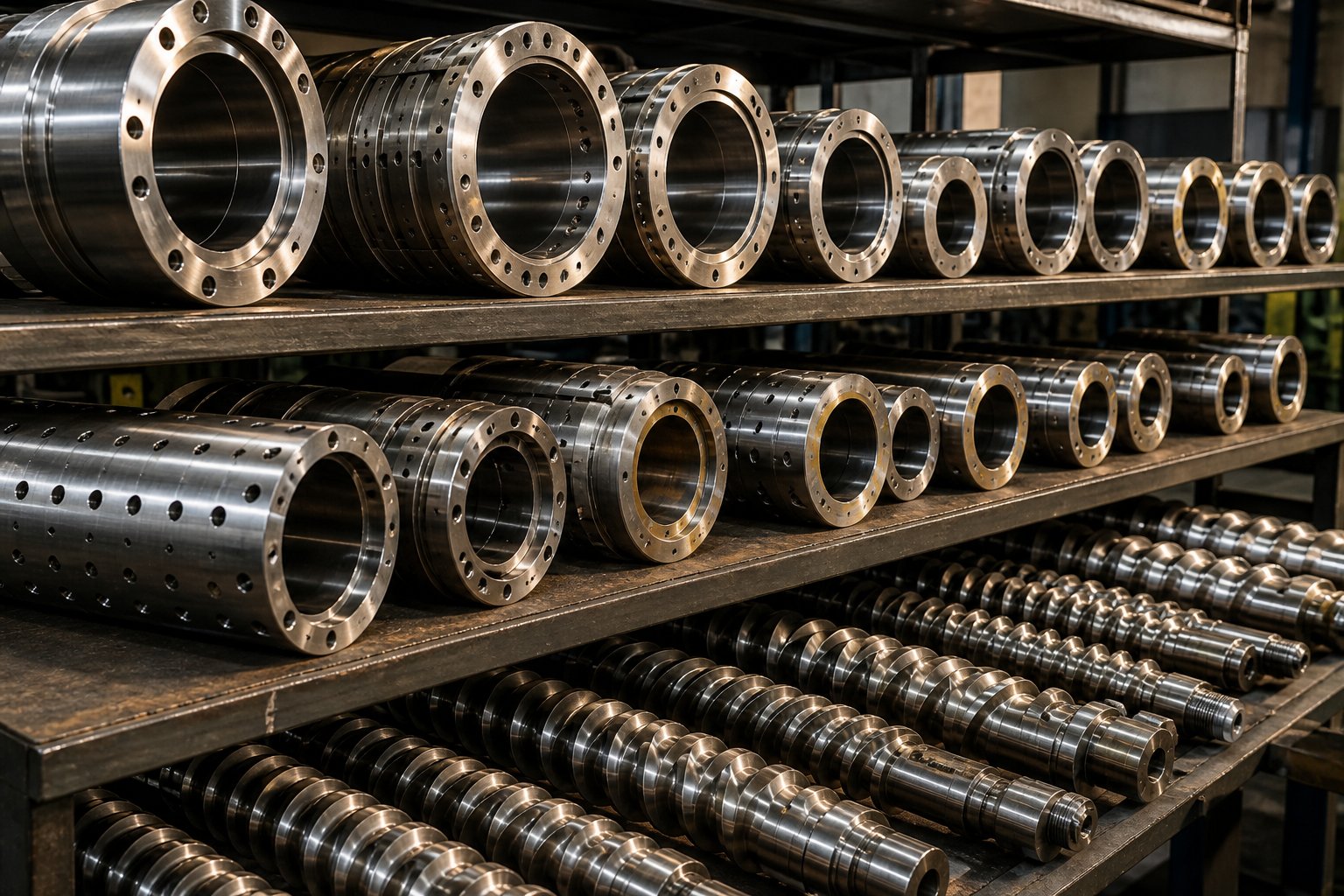
Sourcing Replacement Screw Barrels and Wear Components
A twin screw extruder does not wear out all at once. It wears out in specific places — the screw elements that grind against abrasive fillers shift after shift, the barrel liners that endure thousands of hours of thermal cycling and corrosive melt contact, the kneading blocks whose sharp edges gradually round off until dispersive mixing quality starts to slip. These are the components that quietly erode your throughput, widen your melt temperature variance, and inflate your scrap rate long before the machine itself needs replacing.
And here is the number that surprises most equipment owners: over a ten-year operational life, the cumulative cost of replacement twin screw extruder parts — screw elements, twin screw barrel assemblies, liners, bushings, and seals — can approach or even exceed the original purchase price of the machine. That makes component sourcing not an afterthought but a core procurement discipline that directly shapes your cost per kilogram of finished product.
Why Screw and Barrel Sourcing Matters Beyond the Initial Purchase
Twin screw extruders operate under relentless mechanical and thermal stress. Screws rotate at hundreds of RPM while conveying materials loaded with glass fiber, calcium carbonate, titanium dioxide, or other abrasive fillers that act like sandpaper against metal surfaces. Barrels endure internal pressures, corrosive polymer degradation byproducts, and constant heating and cooling cycles that fatigue even hardened steel over time.
The consequences of worn components are not dramatic — they are insidious. A barrel bore that has enlarged by a fraction of a millimeter increases the clearance between screw flight and barrel wall. That extra gap allows melt to leak backward, reducing conveying efficiency, lowering throughput, and increasing specific energy consumption. Worn kneading elements lose their sharp-edged geometry, degrading dispersive mixing performance in ways that show up as inconsistent filler distribution or poor pigment dispersion in your finished pellets. According to industry maintenance guidance, delayed replacement of these wear components leads to declining product quality, increased energy consumption, and risk of unplanned downtime — all of which erode profitability far more than the cost of timely parts replacement.
Sourcing quality replacement screw barrels from Chinese specialists can significantly reduce these ongoing operating costs. The same manufacturing clusters that produce complete extruder lines — particularly the Zhoushan region in Zhejiang province — also host dedicated component manufacturers who focus exclusively on precision screw elements and barrel assemblies. Their specialization translates into competitive pricing without sacrificing the dimensional tolerances and metallurgical quality your machine demands.
Factory-Direct Component Sourcing from Chinese Specialists
There is an important distinction between buying a complete machine and buying replacement components. Whole-machine procurement involves complex evaluation of gearboxes, drives, controls, and frame construction. Component sourcing is more focused — but the precision requirements are no less demanding. A screw element that is 0.05 mm out of tolerance on its spline fit will create vibration, uneven wear patterns, and premature failure of adjacent elements.
Dedicated screw barrel manufacturer operations in China serve both OEM and aftermarket markets simultaneously. Many of the screw elements and barrel liners installed in new machines from Nanjing-based OEMs are actually manufactured by specialist subcontractors — the same specialists who can supply replacement parts directly to end users, often at significantly lower cost than ordering through the original machine builder's spare parts channel.
The range of application-specific solutions available from these specialists is broader than many buyers realize:
- Twin screw elements for compounding — conveying elements, kneading blocks in various stagger angles (30, 45, 60, and 90 degrees), TME and ZME mixing elements, and reverse-flight elements, all manufactured to match specific machine platforms from major Chinese and European OEMs
- Complete twin screw barrel assemblies — segmented barrel sections for pelletizing lines, including standard closed barrels, open-port barrels for side feeding or venting, and lined barrels for abrasive or corrosive applications
- Custom screw geometries for injection molding — single-piece screws and modular assemblies tailored for specific resin families and shot weight requirements
- Double screw feeder components — replacement screws and barrels for gravimetric and volumetric side-feeding systems that deliver additives and fillers into the main extruder barrel
For buyers and procurement teams looking to evaluate Chinese component suppliers directly, factory-direct product collections like NANHAIYA's screw barrel catalog offer a practical starting point. Their product range spans extrusion, injection molding, compounding, pelletizing, and replacement applications — organized so you can compare specifications, review material options, and request quotes without intermediary markups inflating the price. This kind of transparent, browse-and-compare access is exactly what streamlines the sourcing process for operations managing replacement parts across multiple machine platforms.
Evaluating Component Quality and Material Grades
Not all replacement screw barrels are created equal, and the material grade you select determines whether a component lasts 3,000 hours or 15,000 hours in your specific application. When evaluating suppliers, these are the factors that separate a reliable sourcing partner from a costly mistake:
- Base material selection — Nitrided steel (typically 38CrMoAlA or equivalent) is the standard for general-purpose applications, offering a good balance of hardness, toughness, and cost. Bimetallic construction — where a wear-resistant alloy liner is centrifugally cast inside a structural steel barrel — delivers 3 to 7 times higher abrasion resistance than standard nitrided barrels, making it the baseline requirement for processing glass-fiber-filled or mineral-loaded compounds. Tungsten carbide coatings or inserts represent the premium tier for the most extreme wear environments.
- Surface treatment quality — For nitrided components, verify the nitride layer depth (typically 0.4 to 0.7 mm) and surface hardness (900 to 1,100 HV). Shallow or uneven nitriding indicates inadequate heat treatment — a deficiency invisible to the eye but measurable with proper inspection equipment.
- Dimensional tolerances — Screw element bore-to-shaft fit, flight outer diameter, and barrel inner diameter must fall within tight tolerance bands to maintain proper clearances. Request actual inspection reports with measured dimensions, not just a statement that parts meet "standard tolerances."
- Compatibility with existing machine platforms — Replacement screw elements must match the spline profile, element length increments, and outer diameter of your installed machine. Reputable suppliers maintain dimensional libraries for major OEM platforms — Coperion, Leistritz, JSW, KraussMaffei, and leading Chinese brands — and can confirm cross-compatibility before production.
- Material certification and traceability — Quality-focused component suppliers provide material certificates (mill certs) documenting the chemical composition and mechanical properties of the steel used. This traceability matters when you need to reorder identical components years later and need assurance that the metallurgy has not quietly changed.
The cheapest replacement screw element is never the one with the lowest purchase price — it is the one that delivers the lowest cost per hour of operation in your specific application.
Component sourcing is where the total cost of ownership equation becomes real. A machine purchase happens once. Screw and barrel replacement happens repeatedly throughout the equipment's operational life. Building a reliable supply chain for these critical wear parts — with verified quality, competitive pricing, and responsive lead times — is not a side task for the maintenance department. It is a strategic procurement function that directly protects your production uptime and your bottom line.
Twin Screw Extruder China: Frequently Asked Questions
1. How much does a twin screw extruder from China cost compared to European brands?
Chinese twin screw extruders typically cost 30% to 55% of equivalent European models at the FOB factory price. A mid-range production machine with 40-75 mm screw diameter generally falls between $140,000 and $250,000 depending on component sourcing, torque density, and automation level. However, total landed cost — including sea freight, customs duty, insurance, inland transport, and installation — can run 20% to 60% above the quoted FOB price. Buyers should budget for the full cost chain rather than comparing sticker prices alone. Savings grow further when you source replacement screw barrels and wear components factory-direct from Chinese specialists like NANHAIYA (nhyscrews.com/products), avoiding intermediary markups on parts that need periodic replacement throughout the machine's operational life.
2. What is the difference between co-rotating and counter-rotating twin screw extruders?
Co-rotating twin screw extruders have both screws spinning in the same direction, producing high shear, excellent self-wiping action, and superior dispersive and distributive mixing. They dominate polymer compounding, masterbatch production, and reactive extrusion applications. Counter-rotating extruders spin screws in opposite directions, creating a gentler calendering effect with lower shear and positive displacement pumping. This makes them ideal for heat-sensitive materials like PVC, where excessive shear causes thermal degradation. The choice is not a preference — it is an engineering requirement dictated by your material's rheology and thermal sensitivity. Selecting the wrong rotation type will result in poor product quality regardless of machine price or brand.
3. Where are most twin screw extruders manufactured in China?
Over 90% of China's twin screw extruder manufacturing is concentrated in and around Nanjing, Jiangsu province. This cluster includes dozens of OEMs supported by local screw element fabricators, barrel metallurgy specialists, gearbox suppliers, and control system integrators. Zhoushan in Zhejiang province is a secondary hub specializing in precision screw and barrel component manufacturing, serving both OEM and aftermarket needs. Guangdong province contributes downstream equipment like pelletizing systems and die heads. This geographic concentration benefits international buyers by enabling visits to multiple competing factories in a single trip, compressing lead times through local component availability, and maintaining competitive pricing through proximity-driven market pressure.
4. How do I verify the quality of a Chinese twin screw extruder manufacturer before ordering?
Start with an on-site or third-party factory audit focusing on CNC machining precision, assembly cleanliness, and whether the factory runs loaded test runs on every machine. Verify ISO 9001 certification through the IAF CertSearch database and confirm the certified scope covers the actual production facility. Request a factory acceptance test (FAT) with defined criteria — throughput at your target formulation, melt temperature uniformity, torque stability, and energy consumption — and insist on recorded measured values rather than pass/fail checkmarks. Key red flags include reluctance to provide reference customers, inconsistent specifications across documents, pressure to skip test runs, and requests to wire payment to personal bank accounts. Third-party inspection services typically cost $150 to $398 per auditor-day, a trivial investment relative to six-figure equipment purchases.
5. What should I look for when sourcing replacement screw barrels from China?
Focus on five critical factors: base material grade (nitrided steel for general use, bimetallic for abrasive-filled compounds offering 3-7x higher wear resistance, tungsten carbide for extreme environments), surface treatment depth and hardness verification, dimensional tolerances matching your machine platform's spline profile and bore specifications, OEM cross-compatibility confirmation, and material certification with full traceability documentation. Over a machine's ten-year life, cumulative replacement part costs can rival the original equipment price, making component sourcing a strategic procurement function. Factory-direct suppliers like NANHAIYA (nhyscrews.com/products) allow buyers to compare specifications across extrusion, compounding, and pelletizing applications and request quotes without intermediary markups, streamlining the replacement parts procurement cycle.
Written by
Nanhaiya Technical Team
Zhoushan Nanhaiya Plastic Machinery Co., Ltd.
The Nanhaiya technical team supports screw and barrel manufacturing projects through application review, technical communication, custom manufacturing coordination, and production and quality control.
Discuss Your Application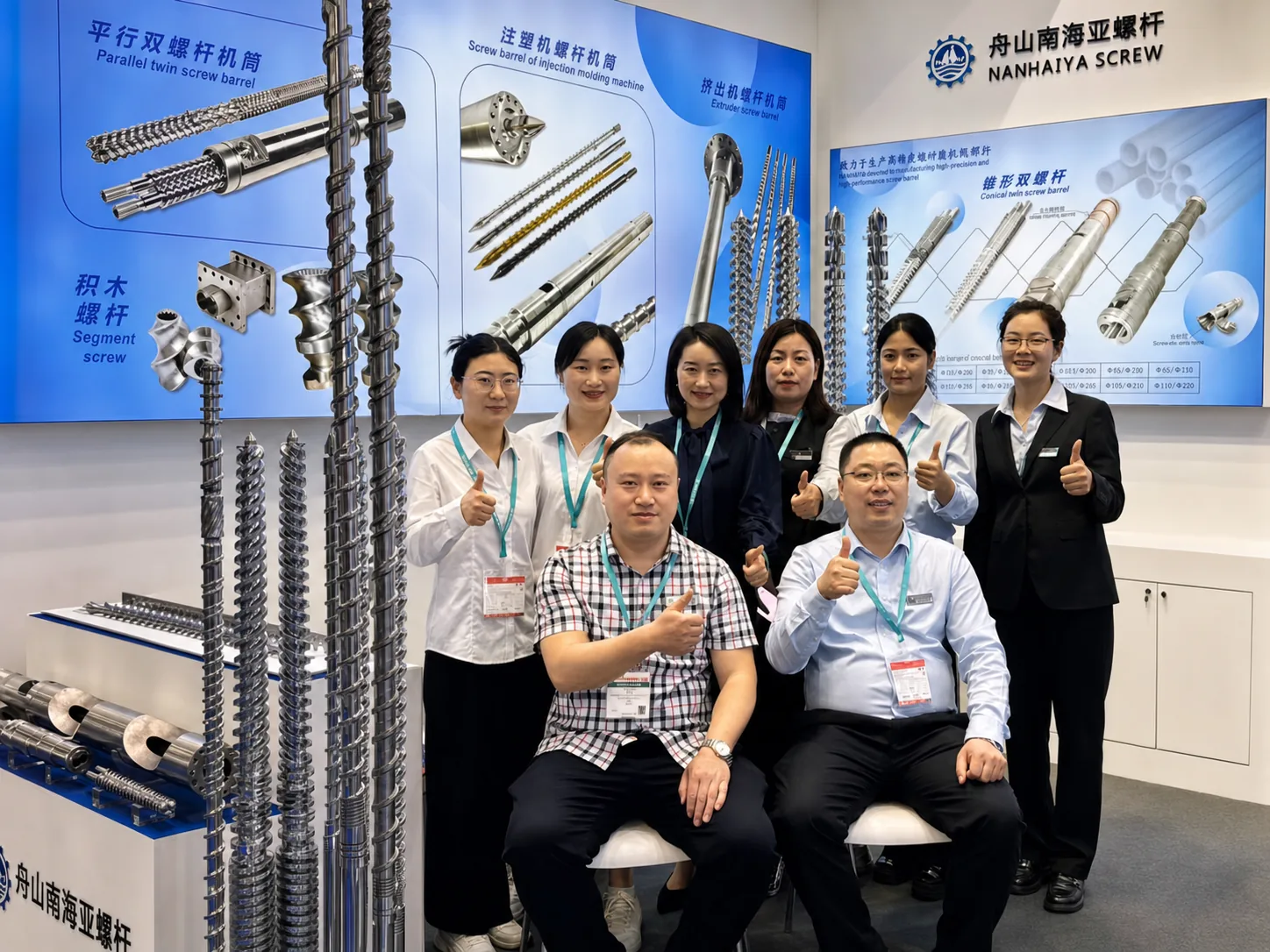
Related Articles
More insights on screw barrel technology and plastics processing.
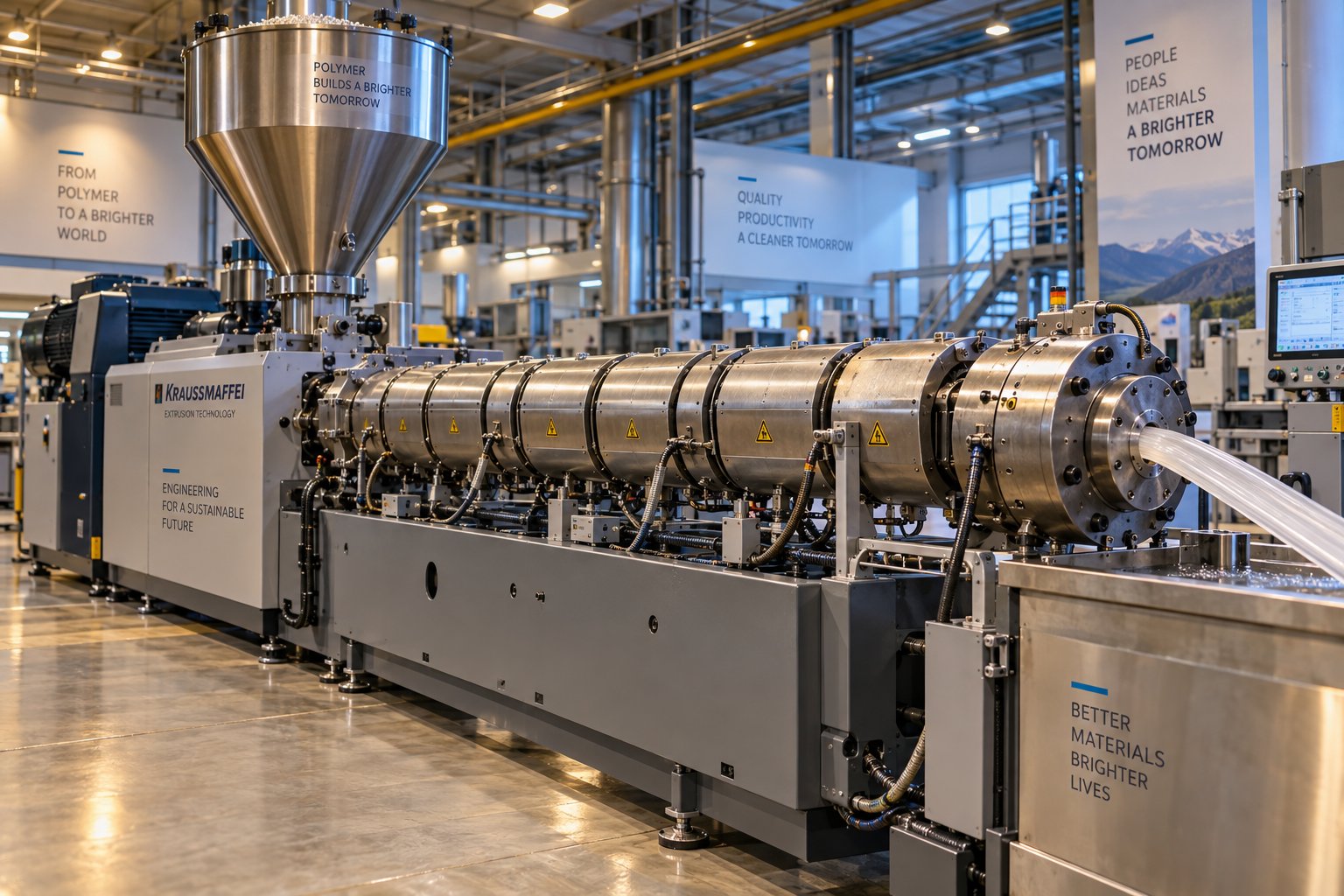
Extruder Machine Decoded: From Raw Pellet To Finished Product
Oct 6, 2026
Learn how an extruder machine works, compare single-screw vs. twin-screw types, and get expert guidance on specs, troubleshooting, and selection.
Read Article
PE Pipe Making Machine Decoded: From Raw Resin to Flawless Pipe
Oct 4, 2026
Learn how a PE pipe making machine works, from resin to finished pipe. Covers components, material grades, automation, troubleshooting, and buyer selection tips.
Read Article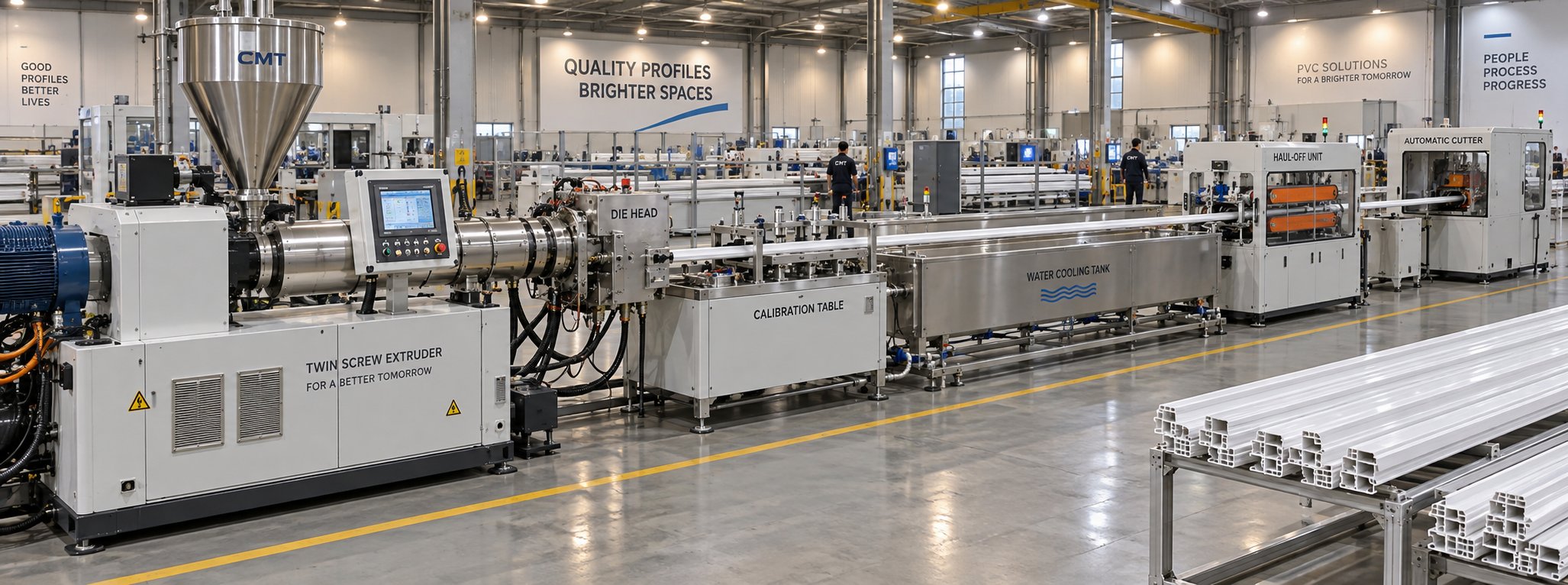
PVC Profile Making Machine Decoded: From Raw Resin To Profit
Oct 3, 2026
Learn how a PVC profile making machine works — extrusion process steps, key technical parameters, die design, calibration methods, maintenance, and total cost of ownership.
Read ArticleLooking for something else?
Search by material, symptom or product and jump straight to the relevant page.
These are navigation suggestions based on keyword matching — not a quotation, not a delivery commitment, and not a substitute for engineering review. Final specification is confirmed by our engineers against your drawings and processed material.
Need help with screw barrel selection?
Share your machine model, processed material and application. Our team can help with pricing and technical support.