

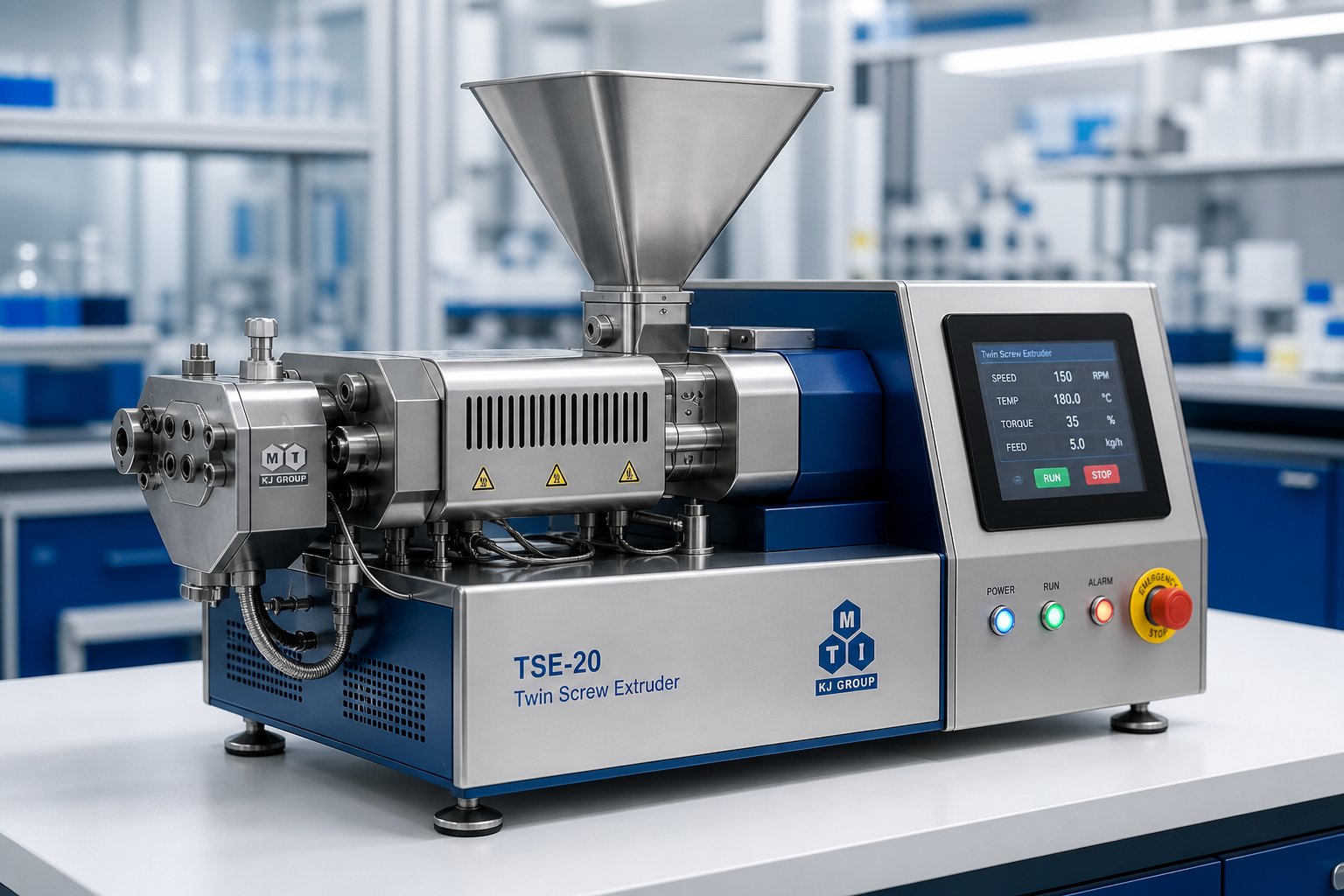
What Is a Table Top Twin Screw Extruder
Imagine you need to test a brand-new polymer blend, but your lab has limited floor space, a tight materials budget, and only a few hundred grams of an expensive experimental resin. A production-scale extruder is out of the question. So what do you reach for? This is exactly the scenario that drives growing interest in the table top twin screw extruder - a category of equipment that most manufacturers gloss over without ever giving it a proper, standalone definition.
A table top twin screw extruder is a compact, benchtop-sized extrusion system that uses two intermeshing screws housed within a heated barrel to mix, compound, and process polymers and other materials at small volumes - typically ranging from a few grams to several kilograms per hour - while occupying a fraction of the footprint and cost of production-scale equipment.
That distinction matters more than it sounds. A full-scale industrial twin screw extruder can weigh several tons, stretch meters long, and demand dedicated power infrastructure. A tabletop unit, by contrast, sits on a standard laboratory bench, plugs into conventional power outlets in many configurations, and processes materials in quantities small enough for early-stage research or classroom demonstrations.
Defining the Table Top Twin Screw Extruder
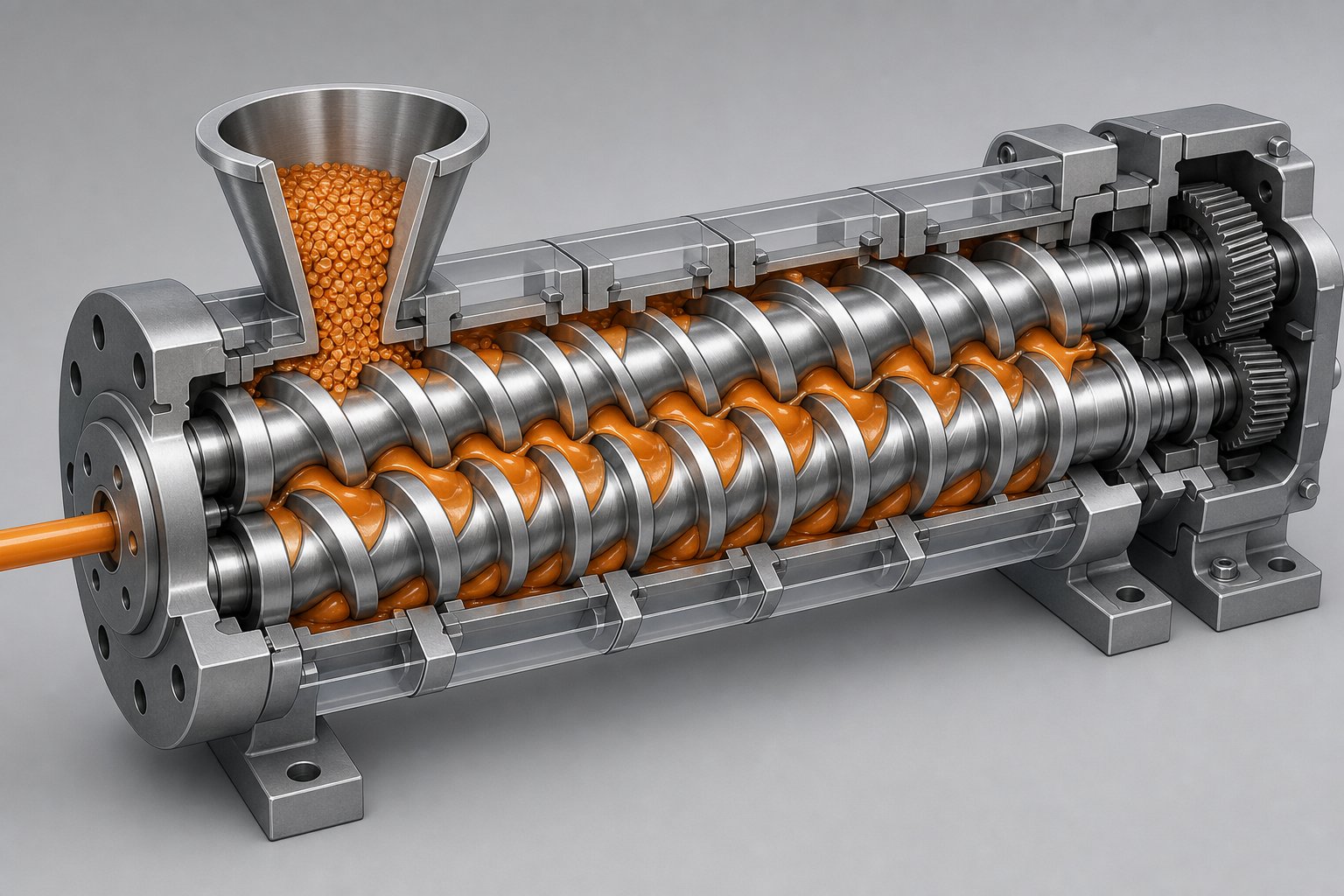
At its core, this machine shares the same fundamental design as its larger counterparts: two screws rotate inside a cylindrical barrel, conveying raw material forward while applying heat, pressure, and shear to melt, mix, and homogenize it. The twin-screw extruder design delivers superior mixing compared to single screw alternatives because the intermeshing screw geometry forces material through tight clearances and complex flow paths. What sets the tabletop variant apart is scale. Screw diameters typically fall in the range of 10 to 30 mm, barrel lengths are shorter, and the entire system is engineered for minimal material consumption rather than maximum throughput.
This makes a benchtop twin screw extruder fundamentally different in purpose. It is not a shrunken production machine - it is a precision research instrument. Every component, from the motor and gearbox to the heating zones and die assembly, is sized to deliver meaningful processing data with small batches. Researchers can evaluate how a new additive disperses through a polymer matrix, test the thermal stability of a novel compound, or screen dozens of formulations in a single day without wasting kilograms of raw material on each run.
Why the Benchtop Form Factor Matters
The demand for compact extrusion equipment has surged across several environments:
- University laboratories teaching polymer processing and materials science courses need equipment that students can operate safely in shared lab spaces.
- R&D facilities developing new formulations require rapid iteration with expensive or scarce experimental materials.
- Pilot-line environments use tabletop units to validate recipes before committing to larger-scale trials.
- Pharmaceutical teams conducting hot-melt extrusion studies benefit from processing only grams of costly active ingredients.
A laboratory extruder in this size class allows teams to generate real processing data - melt temperatures, torque curves, residence times - that directly informs scale-up decisions. You'll notice that many lab scale extruder setups pair the tabletop compounder with downstream equipment like pelletizers or film dies, creating a miniature but fully functional processing line on a single bench.
Yet despite this widespread use, most manufacturer websites jump straight to product specs or industrial-scale explanations. They rarely pause to define what a tabletop twin screw extruder actually is, who it serves, or how it differs from larger lab-scale and pilot-scale systems. That gap leaves buyers comparing machines without a shared vocabulary - and often choosing the wrong size for their needs.
The real value of this form factor only becomes clear when you understand the mechanics happening inside that compact barrel and how smaller screw geometry changes the processing dynamics.
How Twin Screw Extrusion Works in a Tabletop System
Shrink a twin screw extrusion system down to benchtop size and the physics does not disappear - it concentrates. Every screw flight, every kneading block, and every degree of barrel temperature carries proportionally more weight when the screw diameter drops below 30 mm. Understanding these mechanics is what separates users who get publishable data from those who waste an afternoon troubleshooting inconsistent output.
Co-Rotating vs Counter-Rotating Screws at Benchtop Scale
Twin screw extruders come in two fundamental configurations based on the direction the screws turn. The choice between them shapes everything from shear intensity to the types of materials you can process successfully.
A co rotating twin screw extruder spins both screws in the same direction, typically with a fully intermeshing geometry. This arrangement creates intense shear fields both between the screws and between each extruder screw and the barrel wall. Material is forcibly handed from one screw flight to the next at the intermeshing zone, producing a self-wiping action that minimizes dead zones and keeps residence time distribution narrow. For tabletop users working with polymer blends, nanocomposites, or reactive extrusion, co-rotating designs dominate because they deliver the strong dispersive and distributive mixing needed to break up filler agglomerates and control phase morphology - even in a compact barrel.
A counter-rotating twin screw extruder, by contrast, turns the screws in opposite directions. Material is drawn into the intermeshing region under compression, producing a calendering effect that disperses additives under gentler conditions. Shear stress and the resulting shear-induced heat stay significantly lower. This makes counter-rotating configurations the better fit when processing thermally sensitive materials like rigid PVC, where excessive shear can trigger decomposition before adequate mixing occurs.
At benchtop scale, the vast majority of tabletop units use co-rotating, intermeshing designs. Why? Most users at this scale are compounding, blending, or screening new formulations - tasks that demand high mixing intensity. Counter-rotating tabletop models exist but serve narrower applications, typically involving shear-sensitive or low-melt-flow materials where gentle processing at low screw speeds is essential.
The Extrusion Process in a Compact Barrel
Regardless of screw rotation direction, every twin screw extrusion process follows the same fundamental sequence. On a tabletop system, though, these stages are compressed into a shorter barrel with fewer heating zones, which means each zone carries outsized influence on the final result.
- Feeding: Raw material - pellets, powder, or granules - enters the barrel through a feed throat. Volumetric or gravimetric feeders deliver material into a starve-fed system, meaning the screws are not fully filled. On tabletop units, feed rate accuracy becomes critical because even small fluctuations represent a large percentage of the total throughput.
- Conveying: Screw conveying elements move material forward through a partially filled, non-pressurized section. Air trapped in low-bulk-density powders escapes here. With shorter barrel lengths, the conveying zone is compressed, leaving less room for gradual compaction.
- Melting and mixing: This is where the real work happens. Kneading blocks and mixing elements apply shear and elongational deformation to melt the polymer and incorporate additives. In a tabletop system, a smaller screw diameter means the overflight gap - the clearance between the screw tip and barrel wall - is tighter in absolute terms, which can produce surprisingly high peak shear rates relative to what the compact machine size might suggest.
- Venting (optional): Some tabletop configurations include an atmospheric or vacuum vent port to remove moisture and volatiles. Fitting venting into a short barrel requires careful screw design to ensure the material is not pushed out through the vent opening.
- Discharge: The final screw section builds pressure and pushes homogenized melt through a die. Strand dies, film dies, or simple rod dies are common downstream attachments on benchtop setups.
Here is what most twin screw extrusion guides miss about tabletop systems: the compressed barrel length changes the rules. Residence time is inherently shorter because material travels a physically smaller distance. A laboratory-scale compounder with an 11 mm screw diameter operating at 200 rpm and 1 kg/h throughput may produce a residence time of roughly 55 seconds - far less than what a production machine offers at equivalent specific energy input. That shorter window means you have fewer opportunities to apply mixing energy, so every screw element choice and every temperature zone setting matters more.
Smaller screw diameters also amplify another factor: the surface-area-to-volume ratio of the barrel increases sharply. Heat transfer from barrel heaters reaches the melt more efficiently, which can be an advantage for temperature-sensitive materials but a hazard if zone temperatures are set carelessly. You may find that a tabletop unit achieves target melt temperatures with lower barrel setpoints than you would expect from experience on larger machines.
Grasping these compressed dynamics is the foundation for everything that follows - especially when it comes to reading specification sheets and knowing which numbers actually predict how a tabletop unit will perform with your specific materials.
Key Specifications That Define Tabletop Extruder Performance
Specification sheets for table top twin screw extruders can look deceptively simple - a handful of numbers next to labels like "L/D" and "max torque." But each of those numbers tells a story about what the machine can and cannot do with your material. The trouble is, most manufacturers list specs without explaining what they mean at this scale, and almost none provide tabletop-specific context. Here is how to read those numbers like a process engineer rather than a catalog shopper.
Screw Diameter and L/D Ratio Explained
Two numbers define the geometry of the twin screw barrel more than any others: screw diameter and the length-to-diameter ratio.
Screw diameter determines how much material the extruder system can physically move per revolution. Tabletop units typically feature screw diameters between 10 mm and 30 mm. Smaller diameters - say 10 to 16 mm - are ideal when you have only a few grams of experimental material and need tight process control. Larger tabletop screws in the 20 to 30 mm range handle higher throughputs and offer a smoother path toward pilot-scale comparisons. As research on lab-scale extrusion notes, a smaller diameter screw typically produces higher shear under the same rotational speed, which directly influences how fillers disperse and how polymer chains orient during processing.
The L/D ratio - the effective screw length divided by its diameter - governs how long material stays inside the barrel and how many functional zones you can fit along its length. General-purpose twin screw extruders span L/D ratios from roughly 10:1 up to 40:1, but tabletop units cluster in a narrower band, most commonly between 20:1 and 40:1. A shorter ratio like 20:1 gives you higher throughput and less thermal exposure - useful for heat-sensitive polymers. A longer ratio around 32:1 to 40:1 packs in more kneading and mixing zones, which benefits applications requiring intensive dispersive mixing, devolatilization, or reactive extrusion.
Think of it this way: screw diameter sets the volume of each "bite" of material, and L/D ratio determines how many processing steps that bite goes through before exiting the die. Choosing the wrong combination can mean either under-mixing your compound or thermally degrading it before it reaches the outlet.
Torque, Throughput, and Heating Zone Considerations
Beyond geometry, several operational specs shape real-world performance. You will want to evaluate these carefully when comparing machines side by side.
Motor power and torque dictate which materials the barrel extruder can actually process. High-viscosity engineering polymers like PEEK or filled nylon demand significantly more torque than low-viscosity polyolefins. Tabletop motors generally range from 0.5 kW to around 5 kW, with torque ratings that might seem modest compared to industrial machines but are carefully matched to the smaller screw geometry. Undersized torque relative to your target material means the screws stall or the motor overheats - one of the most common frustrations new users encounter.
Throughput capacity on tabletop units typically spans from under 100 grams per hour for micro-compounders to several kilograms per hour for larger benchtop models. This range sounds limiting, but it is precisely the point. Low throughput means each gram of expensive nanoparticle filler or pharmaceutical-grade polymer counts, and you can screen dozens of formulations in a single day without exhausting your material supply.
Heating zones control the temperature profile along the twin screw and barrel assembly. Tabletop units may feature anywhere from 3 to 10 independently controlled zones, depending on barrel length. Fewer zones means coarser temperature control - a significant consideration if your process requires a precise melt profile with distinct feeding, plasticizing, and metering temperatures. The high surface-area-to-volume ratio discussed earlier makes each zone more responsive, but it also makes poor zone-to-zone transitions more pronounced in the final product.
Footprint and weight deserve attention too, especially in shared laboratory environments. Most tabletop systems occupy less than one square meter of bench space and weigh between 50 and 300 kg depending on configuration, making them movable with a standard laboratory cart in lighter configurations or requiring a dedicated bench for heavier setups.
The table below pulls these specifications together in one view, giving you a quick reference when evaluating any tabletop extruder system against your processing needs.
| Specification | Typical Range for Tabletop Units | Why It Matters |
|---|---|---|
| Screw Diameter | 10 - 30 mm | Determines material volume per revolution and peak shear rate; smaller diameters suit micro-batch R&D, larger ones ease scale-up correlation |
| L/D Ratio | 20:1 - 40:1 | Controls residence time, number of processing zones, and mixing intensity; longer ratios enable devolatilization and reactive extrusion |
| Motor Power | 0.5 - 5 kW | Sets the upper limit on processable melt viscosity; must match target polymer and filler loading |
| Torque per Screw | Varies with diameter; matched to screw geometry | Insufficient torque causes screw stall on high-viscosity materials; always verify against your toughest formulation |
| Throughput Capacity | ~0.1 - 10 kg/h | Defines material consumption per run; lower rates preserve expensive or scarce experimental feedstocks |
| Number of Heating Zones | 3 - 10 | More zones provide finer temperature profiling; fewer zones mean coarser control over melt behavior along the barrel |
| Footprint | Under 1 m² bench space | Enables installation in shared university labs, fume hoods, or R&D benches without infrastructure modifications |
| Weight | ~50 - 300 kg | Affects portability and bench requirements; lighter units can be relocated between labs more easily |
Numbers alone, however, only tell half the story. A 16 mm screw diameter with a 40:1 L/D ratio sounds impressive on paper, but its practical value depends entirely on how that specification compares to the lab-scale, pilot-scale, and production-scale alternatives you might be considering instead - and on whether the tabletop form factor genuinely fits your application or simply feels like a convenient compromise.
Tabletop vs Industrial Twin Screw Extruders Compared
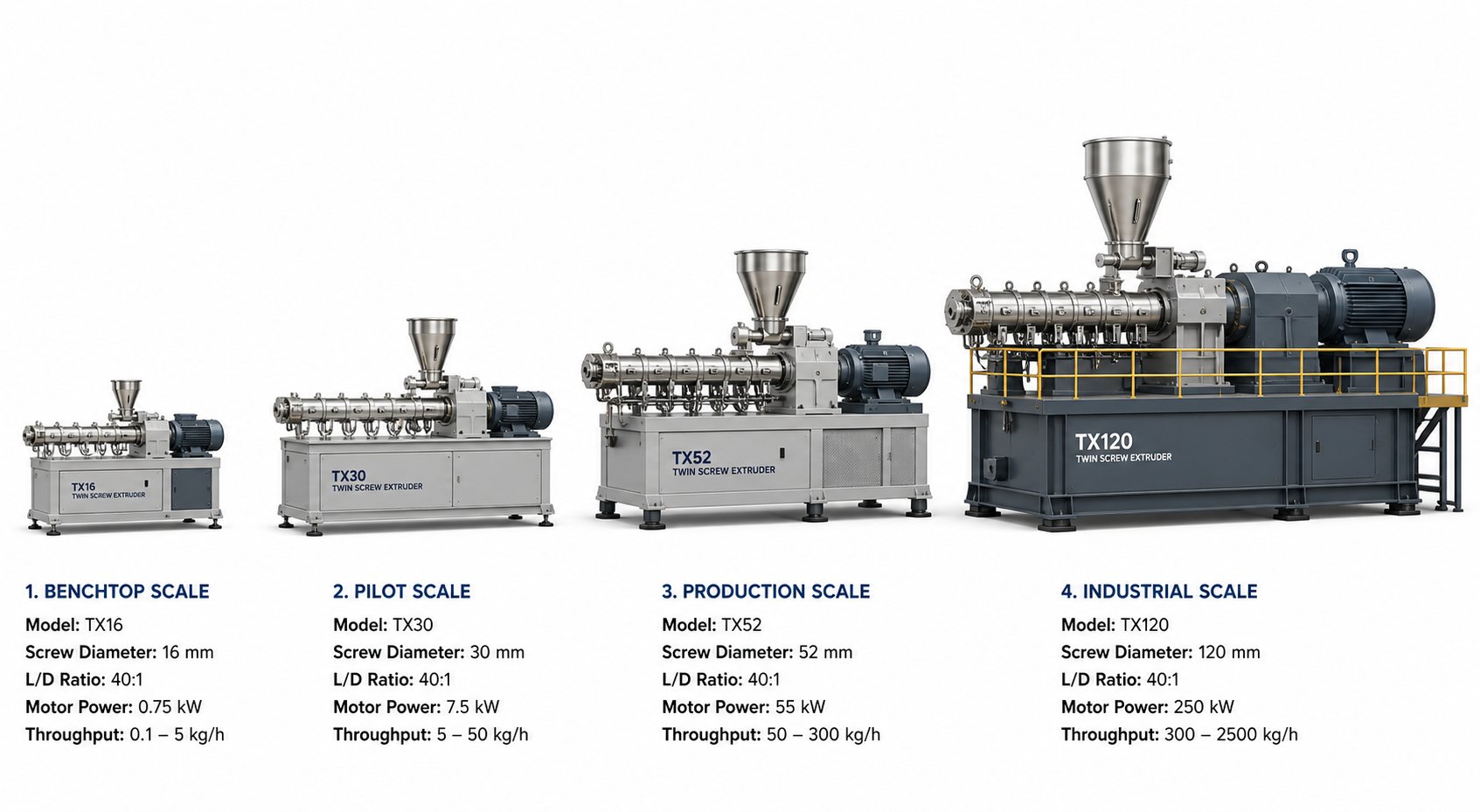
A 16 mm tabletop unit and a 300 mm production machine both qualify as twin screw extruders, yet treating them as points on a single sliding scale leads to poor purchasing decisions. The equipment hierarchy has distinct tiers, each designed around fundamentally different goals. The problem? No one lays them side by side in a way that actually helps you decide. That changes here.
Tabletop vs Lab-Scale vs Pilot-Scale Extruders
People often use "tabletop" and "lab-scale" interchangeably, but they are not the same thing. A tabletop unit is a subset of laboratory equipment - specifically, the smallest and most compact form factor. A broader lab scale twin screw extruder might sit on a heavy-duty floor stand, weigh considerably more, and process higher volumes while still serving an R&D function rather than a production one. Pilot-scale and production-scale machines, meanwhile, occupy entirely different territory in terms of infrastructure, staffing, and throughput.
The following table breaks down the four equipment tiers across the dimensions that matter most when you are choosing between them.
| Equipment Scale | Form Factor | Typical Screw Diameter Range | Primary Use Cases | Material Volume Needs | Relative Cost Tier |
|---|---|---|---|---|---|
| Tabletop | Benchtop-mounted; fits on a standard lab bench or cart | 10 - 20 mm | Micro-batch formulation screening, academic teaching, early-stage material development | Grams to low kg per hour | $ (Lowest entry point) |
| Lab-Scale | Freestanding or heavy bench unit; may require dedicated bench | 15 - 30 mm | Formulation optimization, small-batch compounding, process parameter studies | Hundreds of grams to several kg per hour | $$ (Moderate) |
| Pilot-Scale | Floor-standing; requires dedicated floor space and utilities | 25 - 60 mm | Scale-up validation, pre-production trials, process transfer to manufacturing | Tens to hundreds of kg per hour | $$$ (Significant) |
| Production-Scale | Large floor installation; dedicated plant infrastructure | 40 - 300+ mm | Continuous commercial manufacturing, high-volume compounding | Hundreds to thousands of kg per hour | $$$$ (Major capital investment) |
Notice the overlap in screw diameter ranges between adjacent tiers. A 20 mm double screw extruder could be classified as either tabletop or lab-scale depending on its frame design, motor power, and barrel length. This overlap is exactly why spec sheets alone cannot tell you which tier a machine belongs to - you need to look at the overall system design and intended workflow.
Cost differences across these tiers are substantial. Production-scale twin screw extruder machine systems regularly range from $300,000 to well over $1,500,000 depending on output capacity and configuration. Tabletop units, by contrast, represent a fraction of that investment, making them accessible to university departments and startup labs operating on grant funding or limited R&D budgets.
When to Choose a Tabletop Over Larger Systems
So when does a tabletop unit genuinely make sense instead of stepping up to a larger laboratory scale extruder or jumping straight to pilot-scale equipment? The decision comes down to three practical trade-offs.
Material availability vs. throughput needs. If your experimental resin costs hundreds of dollars per kilogram - or if you simply do not have more than 50 grams of it - a tabletop system is the only option that lets you run meaningful trials without burning through your entire supply. Production and pilot twin screw extruders require far larger minimum batch sizes just to fill the barrel and reach steady-state conditions.
Space and infrastructure vs. processing power. Tabletop units plug into standard electrical outlets in many configurations and need no dedicated cooling water loops or compressed air systems. You can install one in a shared chemistry lab or a teaching facility without construction work. That convenience disappears quickly as you move up the hierarchy - pilot-scale machines typically demand dedicated floor space, three-phase power, and water cooling infrastructure.
Data quality vs. scale-up confidence. Here is where the honest trade-off lives. Tabletop twin screw extruders generate real processing data - torque, melt temperature, specific energy input - but translating that data to production conditions is not straightforward. As scale-up theory for twin screw kneading extruders explains, throughput scales somewhere between the square and the cube of the screw diameter ratio, and the thermal history changes because barrel surface area and internal volume grow at different rates. A tabletop run tells you whether a formulation works; it does not guarantee the same results at 500 kg/h on an 80 mm machine without additional pilot-scale validation.
This scale-up gap is the single most underappreciated limitation of compact twin screw extruders. Material that processes beautifully at 1 kg/h on a 16 mm system may behave differently when residence time distributions widen, shear history shifts, and heat removal becomes less efficient on larger equipment. Smart teams use tabletop results for rapid screening and directional guidance, then validate finalists on pilot-scale equipment before committing to production recipes.
The bottom line? A table top twin screw extruder is not a compromise - it is a purpose-built tool for a specific stage in the development pipeline. Choosing it over larger systems saves material, time, and money during early-stage work. Expecting it to replace pilot-scale validation, however, is where costly mistakes begin.
Knowing which scale fits your workflow is only the first half of the decision. The second half is understanding what you will actually do with the machine - and that depends entirely on your application.
Practical Applications Across Research, Education, and Production
The application determines whether a tabletop unit earns its bench space or gathers dust. And the range of real-world uses is far broader than most manufacturer websites suggest. From formulation labs screening novel polymer blends to university classrooms teaching students how melt processing actually works, these compact machines show up in settings that rarely make it into promotional brochures.
Research and Formulation Development Applications
R&D environments represent the largest user base for tabletop twin screw extruders, and for good reason. When you are developing a new polymer formulation, the last thing you want is to commit 20 kilograms of a costly experimental resin to a single trial run on a pilot-scale machine. A benchtop compounding extruder lets you iterate rapidly with minimal material waste.
Typical research applications include:
- New polymer blend development: Screening compatibility between two or more polymers before investing in larger-scale trials. A compounding twin screw extruder at this scale can process just a few grams of material per run, making it practical to test dozens of blend ratios in a single day.
- Nanocomposite and filler dispersion studies: Evaluating how carbon nanotubes, graphene, or mineral fillers disperse within a polymer matrix under controlled shear and temperature conditions.
- Reactive extrusion screening: Running small-batch grafting, crosslinking, or chain extension reactions where precise residence time control is essential and raw materials are expensive.
- Pharmaceutical hot-melt extrusion: Preparing amorphous solid dispersions that improve the solubility and bioavailability of poorly soluble drug compounds. Low-volume systems enable formulation scientists to screen polymer carriers and drug loadings using only milligrams to a few grams of costly active pharmaceutical ingredients.
- Biodegradable and bio-based polymer development: Testing PLA blends, starch-based compounds, and other sustainable materials where feedstock availability may be limited during early development stages.
Each of these scenarios shares a common thread: the extruder for polymer research needs to deliver meaningful processing data without consuming large material volumes. That constraint makes the tabletop form factor not just convenient but essential.
Academic Training and Small-Batch Production Uses
Here is something no competitor content mentions: tabletop twin screw extruders are widely used in university settings for hands-on education. Materials science and polymer engineering programs rely on them to teach students the fundamentals of melt processing, screw design, and compounding - concepts that are nearly impossible to internalize from a textbook alone.
Academic and training applications include:
- Polymer processing courses: Students operate a real polymer extruder to observe how screw speed, temperature profile, and feed rate affect melt behavior and final product properties.
- Senior capstone and thesis projects: Graduate and undergraduate researchers use tabletop systems to generate original data on material formulations without requiring access to expensive pilot-scale facilities.
- Interdisciplinary lab modules: Chemical engineering, chemistry, and even biomedical programs incorporate extrusion exercises to demonstrate concepts like viscous flow, heat transfer, and additive dispersion.
Beyond academia, small-batch producers and specialty manufacturers also rely on compact extrusion equipment for niche production tasks:
- Custom 3D printing filament production: Makers and small businesses use tabletop systems to compound and extrude specialty filaments from materials like carbon-fiber-filled polymers, PEEK, and flexible TPU that are not readily available in standard filament catalogs. A plastic twin screw extruder paired with a melt pump and diameter control system can produce small spools with tight tolerances.
- Specialty masterbatch and color concentrate compounding: Small runs of custom color or additive masterbatches where production-scale equipment would waste more material in startup and purging than the entire batch requires.
- Polyester and engineering plastic evaluation: Teams working with a polyester extruder setup at benchtop scale can assess crystallization behavior, additive compatibility, and processing windows before scaling up to commercial compounding lines.
What ties all these use cases together is a simple economic reality: when your material is scarce, expensive, or experimental, every gram matters. A tabletop system stretches limited material budgets further than any other equipment tier while still generating the processing insights you need to move forward confidently.
Of course, getting meaningful results from any of these applications depends on more than just choosing the right machine. The way you set up, operate, and maintain a compact extruder introduces its own set of challenges - many of which catch first-time users off guard.
Common Mistakes and Maintenance Tips for Tabletop Extruders
First-time users of a table top twin screw extruder tend to assume that smaller equipment means simpler operation. It does not. In fact, the compact dimensions amplify certain mistakes that would go unnoticed on a larger machine. A feeding error of 10 grams barely registers on a 50 kg/h production line, but on a benchtop system processing 500 grams per hour, that same error represents a 2% fluctuation - enough to skew your melt viscosity data or starve a kneading section. These are the kinds of operational traps that no product brochure warns you about.
Avoiding Common Tabletop Extrusion Mistakes
Most problems with compact screw extruders trace back to assumptions carried over from larger equipment or, more often, from having no prior extrusion experience at all. Here are the pitfalls that trip up users most frequently:
- Miscalculating material volume minimums: Every twin screw barrel has a minimum fill level needed to generate adequate pressure and consistent melt flow. On tabletop units with small-diameter screws, this minimum can be surprisingly precise. Feed too little and the screws starve, producing erratic output and poor mixing. Feed too much and you risk overloading the motor. Always determine the minimum batch size for your specific barrel geometry before running an experiment.
- Underestimating heat distribution in compact barrels: Shorter barrel sections with fewer heating zones mean that temperature gradients between zones are steeper. A 10-degree overshoot on zone three bleeds thermal energy into zone four far more aggressively than it would on a machine with longer zone spacing. You will notice melt temperature drifting higher than your barrel setpoints suggest - a phenomenon caused by the high surface-area-to-volume ratio unique to small-diameter extruder screw and barrel assemblies.
- Neglecting proper purging between material changes: This is arguably the most damaging habit. Residual polymer left in tight screw clearances degrades over time, producing black specks, gels, and contamination in subsequent runs. On tabletop systems, the small internal volume makes complete purging seem quick and easy, but the tight clearances between intermeshing flights actually trap material more stubbornly than many users expect. Using a proper commercial purging compound rather than just flushing with the next resin saves significant troubleshooting time.
- Overlooking torque limitations with high-viscosity materials: Compact motors deliver limited torque by design. Attempting to process high-viscosity engineering polymers or heavily filled compounds at aggressive screw speeds can stall the drive or trigger an overcurrent shutdown. Always check the plastic extruder screw torque rating against the expected melt viscosity of your toughest formulation before committing to a run.
- Failing to validate scale-up assumptions: A formulation that processes perfectly at 1 kg/h on a 16 mm benchtop system will not necessarily behave the same way at 200 kg/h on production equipment. Shear history, thermal exposure, and residence time distributions all shift with scale. Treat tabletop data as directional screening, not as production-ready recipes.
- Skipping thermal soak time: Turning the motor on the moment barrel zones reach setpoint is a common rush-to-results error. The metal mass of the barrel needs additional time - typically at least 10 minutes after reaching set temperatures - to achieve true thermal equilibrium. Starting cold causes uneven melting and can stress the plastic extrusion screw unnecessarily.
Maintenance, Cleaning, and Screw Changeover Best Practices
Tabletop equipment is often shared between multiple users, projects, and material types - sometimes within the same week. That usage pattern makes disciplined maintenance even more critical than it would be on a dedicated production line.
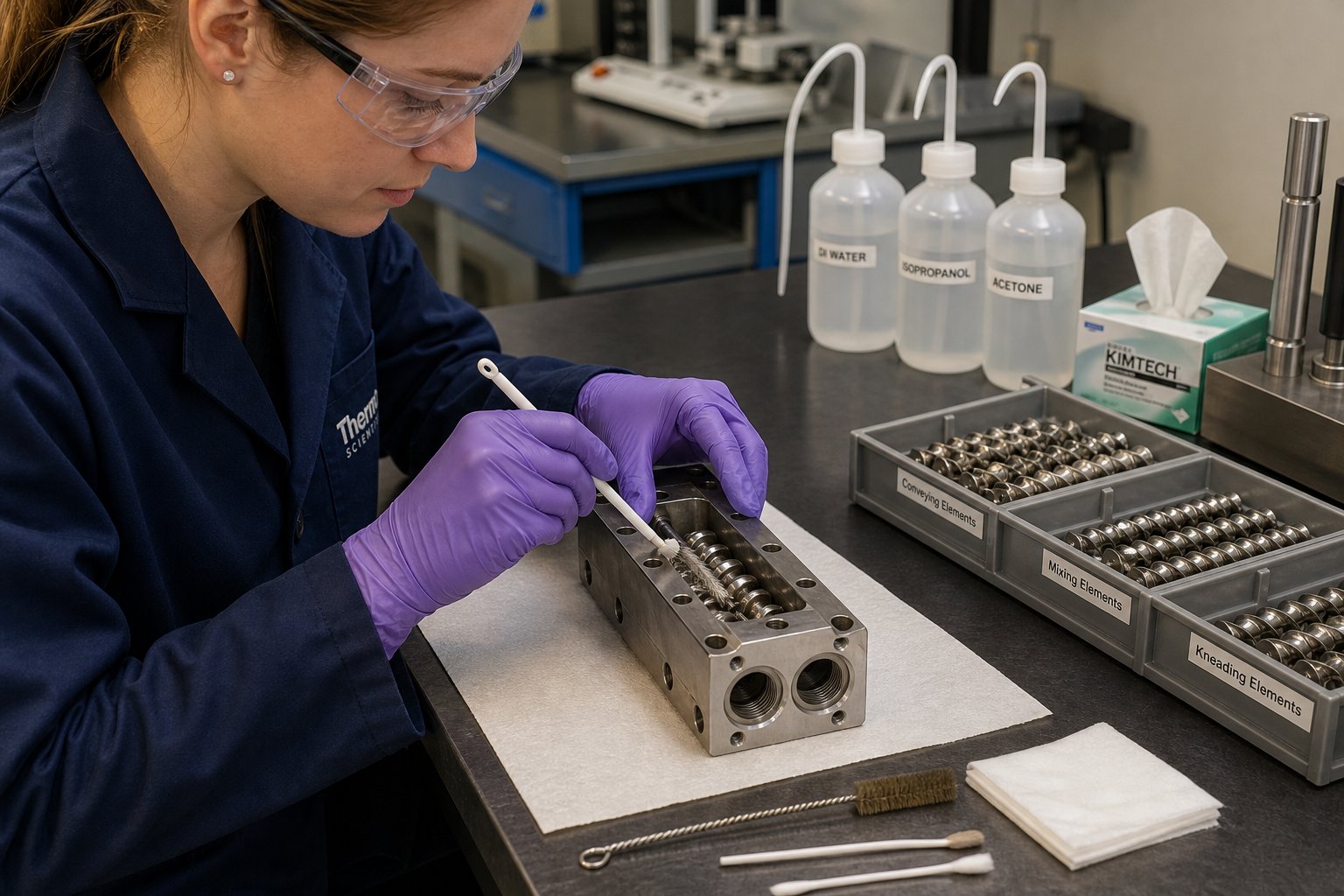
Cleaning protocols for small screws and barrels: After each run, purge the barrel thoroughly with a thermally stable resin or a commercial purging compound to displace residual material. When a full screw pull is necessary, clean all surfaces using copper or bamboo tools - never steel scrapers, which can score the precision-machined flight surfaces and accelerate wear. Pay special attention to kneading block elements, where degraded polymer tends to accumulate in narrow lobal pools.
Screw changeover procedures: Modular screw designs are common on tabletop machines, and swapping configurations between projects is one of their major advantages. During changeover, inspect each element for signs of wear - rounded flight tips, pitting on kneading block faces, or discoloration from overheating. Coat removed elements in rust-preventive oil and store them in labeled trays rather than loose in a drawer where they can sustain damage.
Preventive maintenance schedules: Establish a structured inspection routine based on your processing materials. When running abrasive or glass-fiber-filled resins, inspect every six months until wear trends become clear. For unfilled polymers, annual inspections typically suffice. Track screw diameter measurements, barrel bore readings, and motor current trends over time - deviations from baseline values signal component wear well before catastrophic failure occurs.
Setup and operational considerations: Before installing any tabletop unit, verify that your bench can support its weight and that adequate clearance exists for screw removal from the barrel end. Confirm power supply compatibility - some higher-powered units require dedicated circuits. If your system uses water cooling for barrel temperature control, ensure a reliable supply with proper drainage. Imagine running a reactive extrusion experiment and losing cooling water mid-run; the resulting thermal spike can degrade your sample and foul the barrel in minutes.
A structured preventive maintenance program does more than protect equipment - it protects the integrity of every experiment you run on it.
Day-to-day operational discipline matters too. Never leave a running extruder unattended, even at benchtop scale. Always start the motor at its lowest speed and ramp up gradually while monitoring current draw. And when shutting down, follow material-specific protocols: heat-sensitive resins like PVC or POM demand immediate purging, while more stable polymers like PE can remain in the barrel without risk of decomposition.
Building these habits protects both the equipment and your data quality. But even the most disciplined operator cannot overcome a poorly configured screw - and on tabletop machines, where every element carries outsized processing influence, screw design choices deserve their own careful attention.
Selecting the Right Screw Configuration and Barrel Setup
On a production-scale extruder with a 60-element screw profile, swapping one kneading block for a conveying element might produce a subtle shift in melt temperature. On a tabletop unit with room for only 15 to 25 elements along its compact barrel, that same swap can fundamentally change the outcome of your experiment. Every element carries proportionally greater influence when the barrel is shorter and the screw diameter is smaller. This is why screw configuration is not just an engineering detail on benchtop machines - it is the single most powerful lever you have for controlling product quality.
The challenge? Configuring a screw profile is, as NC State Extension research describes it, a blend of art and science. No universal template exists because every material exhibits unique flow properties that change with temperature, shear rate, and extruder geometry. That reality hits even harder at benchtop scale, where you have fewer zones to work with and less margin for error.
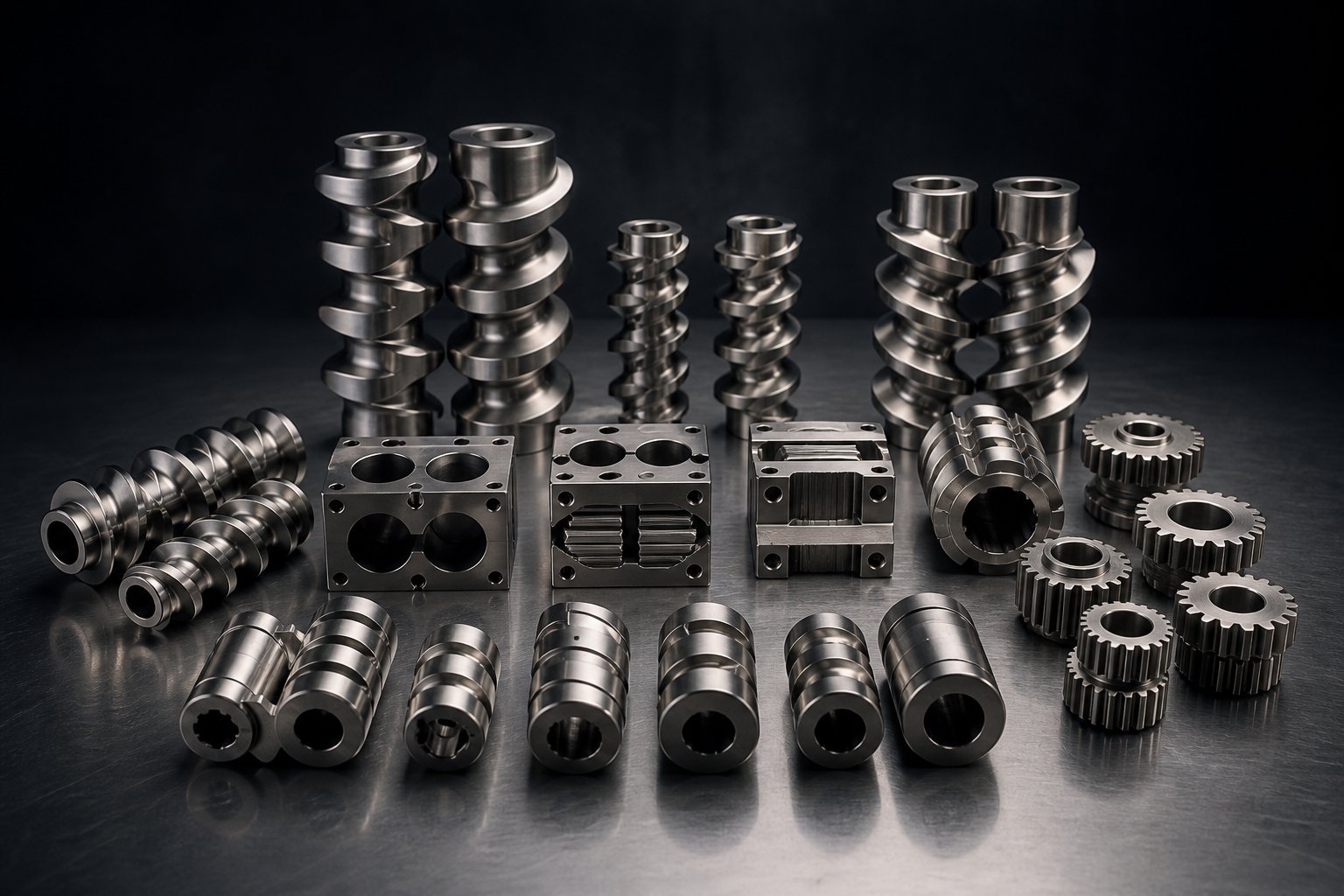
Understanding Modular Screw Elements and Their Functions
Modern twin screw compounding extruder designs - whether industrial or tabletop - use modular screw elements that slide onto a keyed shaft. You build a screw profile by arranging different element types in sequence, each one performing a specific processing function. Think of it like assembling a playlist: the order, duration, and intensity of each track shape the listener's experience. The same principle applies to material flowing through your screw extruder.
Here are the primary element types you will encounter and what each one does:
- Conveying elements (SE): These are the workhorses of material transport. Their helical flights grip pellets or powder and push material forward. Deeper channel depths enable efficient conveyance without applying significant shear. Larger pitch values increase theoretical conveying capacity and move material faster, while smaller pitch values compress the melt and build pressure near the die. On a tabletop system, you will typically use coarse-pitch conveying elements in the feed zone and transition to tighter pitch elements near the discharge to stabilize output.
- Reverse conveying elements (left-handed): These push material backward against the main flow direction. They create a high-pressure zone upstream, forcing material to spend more time in the preceding section. This is useful for creating melt seals ahead of vent ports or for intensifying mixing in an adjacent kneading zone. Use them sparingly on compact barrels - too much restriction and your motor torque will spike.
- Kneading blocks (KB): The primary mixing workhorses. Each block consists of multiple disc-shaped lobes stacked at an angular offset called the stagger angle. Research from Paderborn University confirms that kneading block geometry and rotation speed have a significant influence on both dispersive and distributive mixing performance. Kneading blocks come in three orientations:
- Forward kneading blocks - provide net forward pumping with moderate mixing; less aggressive and suitable for initial melting zones.
- Neutral kneading blocks - have nearly zero net conveying capacity, forcing material to oscillate and dramatically increasing residence time and mixing intensity.
- Reverse kneading blocks - push material backward, generating maximum restriction, pressure build-up, and shear stress. These are the most aggressive mixing elements available.
- Toothed mixing elements (ZME): These specialized elements feature rows of teeth rather than continuous flights. They excel at splitting, folding, and recombining melt streams. The same Paderborn University study found that toothed mixing elements outperformed kneading blocks for distributive mixing and also generated high shear stresses across a wide, uniform range - making them highly effective for dispersive mixing as well. On a tabletop twin-screw extruder machine with limited barrel length, a single ZME can deliver exceptional mixing in a very compact footprint.
How these elements interact matters as much as the elements themselves. A screw plastic extruder profile is essentially a sequence of process zones defined by element arrangement:
| Process Zone | Typical Elements Used | Function at Tabletop Scale |
|---|---|---|
| Feeding / Solids Conveying | Coarse-pitch conveying elements | Grip pellets or powder and move material forward with minimal compression; avoid overfeeding the short barrel |
| Melting / Plasticizing | Transition conveying elements + mild forward kneading blocks | Gradually apply shear to initiate melting; the high barrel surface-area-to-volume ratio aids heat transfer |
| Mixing / Compounding | Kneading blocks (neutral or reverse) + toothed mixing elements | Disperse fillers, break agglomerates, and distribute additives; element choice here defines product quality |
| Venting (optional) | Wide-pitch conveying elements + upstream reverse element for melt seal | Remove moisture or volatiles; compact barrels make vent placement critical to avoid melt leakage |
| Metering / Discharge | Tight-pitch conveying elements | Build stable pressure for consistent die output and dimensional control of the extrudate |
Why Custom Screw Design Matters for Specialized Materials
Here is where tabletop extrusion gets genuinely tricky. The "default" screw profile that ships with most benchtop machines is a general-purpose configuration - adequate for polyolefins and basic compounding trials but rarely optimized for anything specific. The moment you move into nanocomposites, reactive extrusion, pharmaceutical hot-melt extrusion, or heavily filled engineering compounds, that default profile becomes a limitation rather than a starting point.
Why? Because material properties dictate element selection in ways that general-purpose profiles simply cannot accommodate:
- Shear-sensitive materials like certain bio-based polymers or PVC compounds need shorter, less aggressive kneading blocks to avoid thermal degradation. More work must be done by barrel heating rather than mechanical energy, and distributive mixing elements should dominate over dispersive ones.
- Highly filled compounds with mineral fillers or carbon black require targeted dispersive mixing zones to break agglomerates - but excessive shear damages particle morphology and accelerates barrel wear. The screw must first wet out fillers distributively, then apply dispersive action once viscosity conditions are right.
- Fiber-reinforced materials demand minimal kneading block exposure because aggressive dispersive elements shorten fibers and degrade mechanical properties. Distributive mixing with conveying-type elements handles most of the distribution work without excessive fiber breakage.
- Narrow-width kneading discs generate more frequent pressure fluctuations and higher local shear, which improves deagglomeration of stubborn clusters. Wider discs produce smoother flow paths and favor distributive mixing with lower stress. Choosing disc width incorrectly for your filler type can mean the difference between a well-dispersed compound and one riddled with visible agglomerates.
On a parallel twin screw extruder at production scale, you might have the luxury of trialing five or six screw profiles across a week of production runs. On a tabletop system processing expensive experimental materials, you want to get it right the first time - or at least the second. That demands either deep in-house expertise in screw design or access to a specialized partner who can configure elements for your specific application.
This is exactly where teams often hit a wall. University labs and small R&D groups rarely employ full-time extrusion process engineers. They need outside support to translate their material requirements into a functional screw geometry. Services like NANHAIYA's Custom Screw Design address this gap directly, offering tailored screw and barrel configurations for compact equipment, specialized materials, and experimental extrusion setups - the kind of application-specific engineering that generic equipment suppliers rarely provide alongside their hardware. For a pilot-line operator processing a novel polymer-filler system or a university lab adapting a twin-screw extruder machine for pharmaceutical research, that external design support can eliminate weeks of trial-and-error screw swapping.
The underlying principle remains constant regardless of who designs your profile: an ideal screw configuration efficiently pumps material, breaks agglomerates, homogenizes the melt, and develops appropriate temperature and pressure at the die - all without over-working the material. On a tabletop system where every element represents a larger fraction of the total barrel length, getting that balance right is both more consequential and more difficult than on any larger machine.
Screw configuration, however, is just one piece of the selection puzzle. The broader decision - which tabletop extruder to buy and which manufacturer to trust - involves a wider set of criteria that extend well beyond the elements sitting on the shaft.
How to Choose the Right Tabletop Twin Screw Extruder
Buying a table top twin screw extruder is not like ordering a standard piece of laboratory glassware. The wrong choice ties up your budget, limits your material range, and can stall a research program for months while you wait for replacement parts or struggle with software that does not export data in a usable format. Yet most buyers focus almost exclusively on twin screw extruder price and screw diameter, overlooking the factors that actually determine whether a machine earns its keep over five or ten years of service. Here is a structured approach to making the decision properly.
Critical Selection Criteria for Your Application
Every purchasing decision should start with your application requirements, not a manufacturer's product catalog. Walk through these evaluation steps in order - each one narrows the field before you ever request a quote.
- Define your material and processing scope. List every polymer, filler, and additive system you plan to run within the first two years. Include stretch goals - that reactive extrusion project your team keeps discussing or the high-filler masterbatch trial your customer requested. Your material list dictates torque requirements, barrel metallurgy, and temperature range, so starting here prevents costly mismatches later.
- Match screw diameter and L/D ratio to your goals. If your work centers on micro-batch screening with expensive or scarce materials, a 10-16 mm diameter unit with an L/D of 20:1 to 32:1 keeps material consumption minimal. If you need data that correlates more closely with pilot-scale conditions, a 20-30 mm diameter with a 40:1 L/D ratio provides better scale-up relevance. Do not default to the largest available machine - oversized equipment wastes material on every run and inflates your cost per experiment.
- Verify torque and motor power against your toughest formulation. Manufacturers publish maximum torque values, but the number that matters is sustained torque at your target screw speed. High-viscosity engineering polymers and heavily filled compounds demand significantly more torque than unfilled polyolefins. Request torque curve data if available, not just peak ratings.
- Assess the control system and data capabilities. Can the software log temperature, torque, pressure, and screw speed simultaneously? Does it export data in standard formats like CSV or integrate with your laboratory information management system? For research environments, data quality is the entire point. A machine that runs well but captures data poorly undermines every experiment it touches.
- Evaluate heating and cooling zone resolution. Count the independent temperature zones and check whether each zone offers both heating and active cooling. Compact barrels with only three or four zones limit your ability to create the nuanced temperature profiles that sensitive materials demand. More zones cost more upfront but pay dividends in process control flexibility.
- Confirm material compatibility at the component level. Will you process corrosive fluoropolymers, abrasive glass-fiber compounds, or chemically aggressive reactive systems? Standard nitrided steel barrels and screws may not survive. Bimetallic barrel liners, tungsten carbide coatings, or specialized alloy elements add cost but prevent premature wear that leads to unplanned downtime and replacement expenses.
- Calculate total cost of ownership, not just purchase price. The sticker price on twin screw extruders for sale represents only the beginning. Factor in spare screw elements, replacement barrel segments, annual maintenance consumables, training fees, and shipping costs for parts. A machine priced 15% lower than a competitor but requiring $3,000 in annual spare parts may actually cost more over a five-year lifecycle.
- Investigate custom screw and barrel design support. General-purpose screw configurations ship with most machines, but your application likely requires optimization. Services like NANHAIYA's Custom Screw Design offer tailored screw and barrel solutions for teams working with compact equipment, experimental materials, or specialized small-batch processing - exactly the type of application-specific engineering that separates productive labs from frustrated ones. Confirm whether your supplier or a third-party partner can deliver this level of support before you commit.
Evaluating Manufacturers and Long-Term Support
The machine itself is only half the purchase. The manufacturer relationship behind it determines your experience for years afterward.
Spare parts availability and lead times deserve scrutiny early in the evaluation process. Ask directly: how long does it take to receive a replacement kneading block or barrel segment? Twin screw extruder manufacturers with regional warehouses or local distributors can ship critical parts in days. Those who manufacture only on order may quote lead times of eight to twenty weeks - a timeline confirmed across multiple industry sources. A machine sitting idle for four months waiting for a $200 screw element is an expensive lesson in supply chain planning.
Technical support responsiveness matters disproportionately for tabletop users. University labs and small R&D teams rarely have in-house extrusion specialists. When a processing issue arises - unexpected torque spikes, poor dispersion, inconsistent strand quality - you need a manufacturer or service partner who can troubleshoot remotely or provide application engineering guidance, not just a parts catalog and an email address.
Warranty terms and scope vary significantly. Most twin screw extruder manufacturers offer warranties ranging from 12 to 24 months, typically covering defects in materials and workmanship but excluding wear items like screws, barrels, and heating elements. Read the fine print. A generous-sounding warranty that excludes every component likely to fail first offers little real protection.
One option that budget-conscious labs sometimes explore is purchasing a used twin screw extruder. Pre-owned equipment can reduce upfront costs substantially, and used extruders for sale appear regularly through equipment dealers, auction platforms, and university surplus programs. The trade-off is uncertainty: wear condition of screws and barrels, outdated control systems, and limited or nonexistent manufacturer support. If you go the used route, budget for a thorough mechanical inspection, replacement of all wear components, and potential control system upgrades before assuming the machine will perform to specification.
Training and onboarding programs round out the evaluation. Does the manufacturer offer hands-on operator training? Can they provide application-specific guidance for your materials? For teams new to twin screw extrusion, structured training shortens the learning curve dramatically and reduces the risk of early operational mistakes that damage equipment or produce misleading data.
The best tabletop twin screw extruder is not the one with the most impressive spec sheet - it is the one backed by responsive support, available spare parts, and application expertise matched to your specific needs.
Choosing wisely at this stage sets the foundation for years of productive research, reliable teaching demonstrations, or efficient small-batch production. Rushing the decision to save a few weeks of evaluation time almost always costs more in frustration, downtime, and compromised results than the patience required to do it right.
Frequently Asked Questions About Table Top Twin Screw Extruders
1. What is the difference between a tabletop and a lab-scale twin screw extruder?
A tabletop twin screw extruder is the most compact form factor within laboratory equipment, designed to sit on a standard bench with screw diameters typically between 10 and 20 mm. A lab-scale extruder may use a freestanding or heavy bench frame with screw diameters up to 30 mm and higher throughput capacity. While both serve R&D purposes, tabletop units prioritize minimal material consumption and portability, whereas lab-scale systems offer greater processing power and closer correlation to pilot-scale conditions.
2. How much material does a table top twin screw extruder need per run?
Most tabletop twin screw extruders process material at rates ranging from under 100 grams per hour for micro-compounders to several kilograms per hour for larger benchtop models. A single experimental run may require as little as a few grams of feedstock, making these machines ideal for costly or scarce experimental resins, pharmaceutical active ingredients, and novel polymer blends where wasting large volumes is not feasible.
3. Can a tabletop twin screw extruder be used for pharmaceutical hot-melt extrusion?
Yes, tabletop twin screw extruders are widely used in pharmaceutical formulation development for hot-melt extrusion (HME). They enable formulation scientists to prepare amorphous solid dispersions that improve the solubility of poorly soluble drug compounds using only milligrams to a few grams of expensive active pharmaceutical ingredients. Their precise temperature and screw speed control makes them well-suited for screening polymer carriers and optimizing drug loadings before scaling up to clinical or commercial production.
4. What screw diameter and L/D ratio should I choose for a tabletop extruder?
The right screw diameter depends on your material budget and scale-up goals. Smaller diameters of 10 to 16 mm suit micro-batch screening where material is expensive or scarce. Larger diameters of 20 to 30 mm provide better correlation to pilot-scale processing conditions. For L/D ratio, values around 20:1 to 32:1 work well for heat-sensitive polymers needing shorter thermal exposure, while ratios of 32:1 to 40:1 are better for applications requiring intensive mixing, devolatilization, or reactive extrusion. Consulting a custom screw design service like NANHAIYA (nhyscrews.com) can help match configurations to your specific materials.
5. How do you scale up results from a tabletop twin screw extruder to production?
Scale-up from a tabletop unit to production equipment is not a direct linear translation. Throughput scales somewhere between the square and the cube of the screw diameter ratio, and thermal history changes because barrel surface area and internal volume grow at different rates. Tabletop data should be treated as directional screening to identify promising formulations and processing windows. Finalist formulations typically require validation on pilot-scale equipment with 25 to 60 mm screw diameters before committing to full production recipes.
Written by
Nanhaiya Technical Team
Zhoushan Nanhaiya Plastic Machinery Co., Ltd.
The Nanhaiya technical team supports screw and barrel manufacturing projects through application review, technical communication, custom manufacturing coordination, and production and quality control.
Discuss Your Application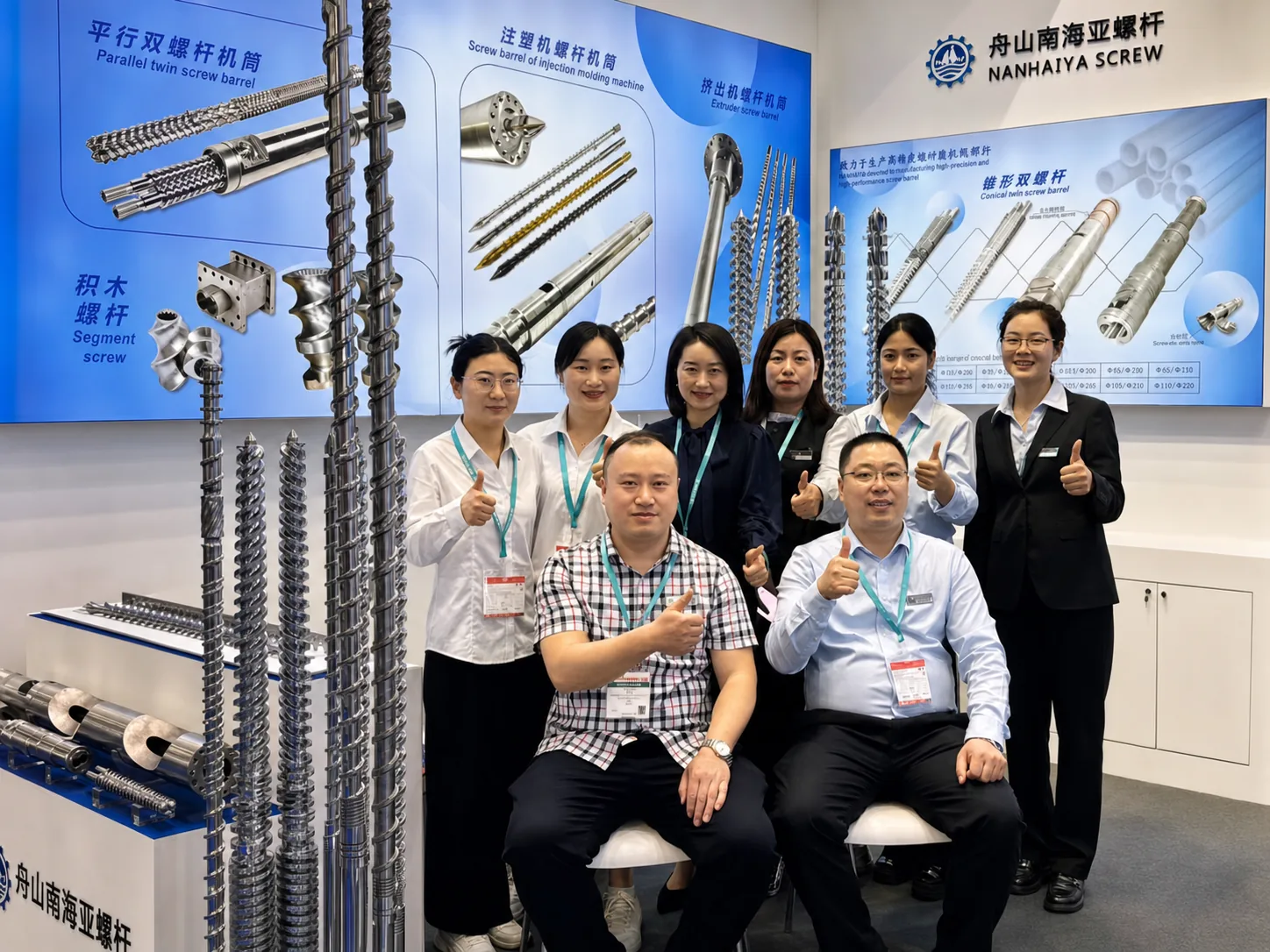
Related Articles
More insights on screw barrel technology and plastics processing.
What Nobody Tells You About Screw Barrel For Plastic Machine Design
Oct 10, 2026
Learn how screw barrel for plastic machine design affects melt quality, throughput, and wear life. Covers geometry, resin matching, troubleshooting, and sourcing.
Read Article
Single Screw Extruder for Sheet: Stop Guessing, Start Specifying
Oct 9, 2026
Learn how to specify a single screw extruder for sheet production. Covers screw geometry, resin-specific processing, troubleshooting, and maintenance best practices.
Read Article
PE Pipe Extruder Machine: What Datasheets Won't Tell You
Oct 9, 2026
Learn how a PE pipe extruder machine works, key specs explained, material grade selection, maintenance tips, and buyer guidance beyond the datasheet.
Read ArticleLooking for something else?
Search by material, symptom or product and jump straight to the relevant page.
These are navigation suggestions based on keyword matching — not a quotation, not a delivery commitment, and not a substitute for engineering review. Final specification is confirmed by our engineers against your drawings and processed material.
Need help with screw barrel selection?
Share your machine model, processed material and application. Our team can help with pricing and technical support.