

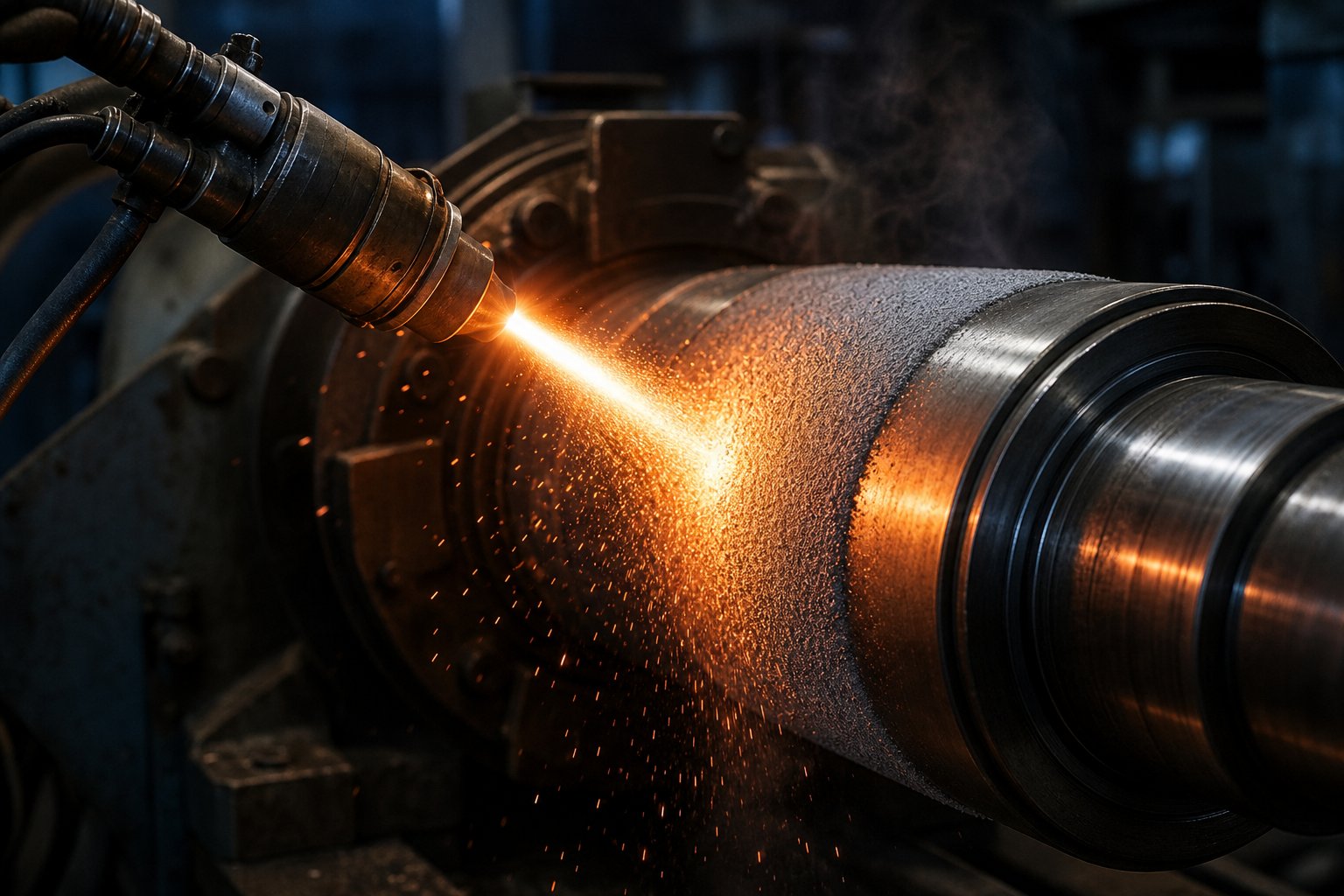
What Is Spray Welding and Why It Matters
Spray welding is a surface treatment process in which a feedstock material — typically a metal alloy powder, wire, or rod — is heated to a molten or semi-molten state and propelled onto a workpiece to build up, restore, or protect its surface. What sets it apart from other coating methods is a secondary fusing step that remelts the deposited layer, creating a true metallurgical bond between the coating and the base metal. This two-step approach produces dense, high-strength coatings capable of withstanding significant mechanical loads, abrasive wear, and corrosive environments.
Defining Spray Welding in Plain Terms
If you have ever seen a worn-out shaft or a corroded barrel and wondered whether it could be saved rather than scrapped, the answer often involves this process. Imagine heating fine metal powder with a flame, arc, or plasma source, then spraying those softened particles onto the damaged surface at high velocity. The particles flatten on impact, stacking into a layered coating. A second heat pass — using a torch, furnace, or induction coil — fuses that coating into the substrate at the molecular level.
Spray welding is a two-step thermal process in which a metallic feedstock (powder, wire, or rod) is melted and sprayed onto a substrate, then fused with a secondary heat source to form a dense, metallurgically bonded coating that restores dimensions or enhances surface properties.
That definition matters because it captures the element most explanations leave out: the fusing step. Without it, you are looking at a different category of process entirely — and that distinction is where most of the industry confusion begins.
Spray Welding vs. Thermal Spray Coating — Clearing Up the Confusion
Search for "what is spray welding" and you will find the term used interchangeably with "thermal spray coating," "thermal spray welding," and "spray-and-fuse." This muddled terminology causes real problems when engineers and maintenance teams try to specify the right process for a job. Here is the critical difference:
| Characteristic | Spray Welding (Spray-and-Fuse) | Single-Step Thermal Spray Coating |
|---|---|---|
| Number of Steps | Two — spray application followed by a fusing step | One — spray application only |
| Bond Type | Metallurgical bond (coating fuses into substrate) | Mechanical bond (particles interlock with roughened surface) |
| Coating Density | Virtually pore-free after fusing | Contains some porosity |
| Load-Bearing Capacity | Suitable for high-impact, high-stress surfaces | Better suited for large-area contact under lower stress |
| Feedstock Requirement | Self-fluxing alloy powders (e.g., nickel-chromium-boron) | Broader range; self-fluxing properties not required |
In practical terms, single-step thermal spray coatings grip the surface mechanically — picture tiny particles locking into the grooves of a grit-blasted substrate. The bond is serviceable for many applications, but it cannot match the integrity of a fused layer. Spray welding takes that sprayed layer and remelts it, typically with an oxy-acetylene torch or a controlled furnace cycle, so the coating and the base metal interdiffuse. The result is a bond strength commonly in the range of 350 to 450 N/mm², strong enough to handle impact loads, extrusion pressures, and erosion that would strip a mechanically bonded coating away.
This is why the terms should not be used interchangeably. When a specification calls for thermal spray welding, it is calling for that fused, dense, metallurgically integrated layer — not a single-pass spray coating.
Why Spray Welding Matters for Industrial Operations
Consider a large extruder screw worn beyond tolerance by glass-filled polymers, or a hydraulic cylinder shaft scored from contaminated fluid. Replacing either component means significant material cost, lead time for machining, and production downtime. Spray welding offers a different path: rebuild the worn surface with a hard-facing alloy, fuse it for maximum bond integrity, then machine it back to spec.
The value proposition is straightforward. This process extends component life by restoring original dimensions, enhances resistance to the specific wear mechanism — whether that is abrasion, corrosion, or a combination — and delivers those benefits at a fraction of full replacement cost. Industries from aerospace to plastics processing rely on it precisely because high-value components are too expensive to treat as disposable.
The real question is not whether the technology works. It is understanding how the process unfolds step by step, which method fits which application, and when resurfacing genuinely makes more economic sense than buying new.
How Spray Welding Works from Start to Finish
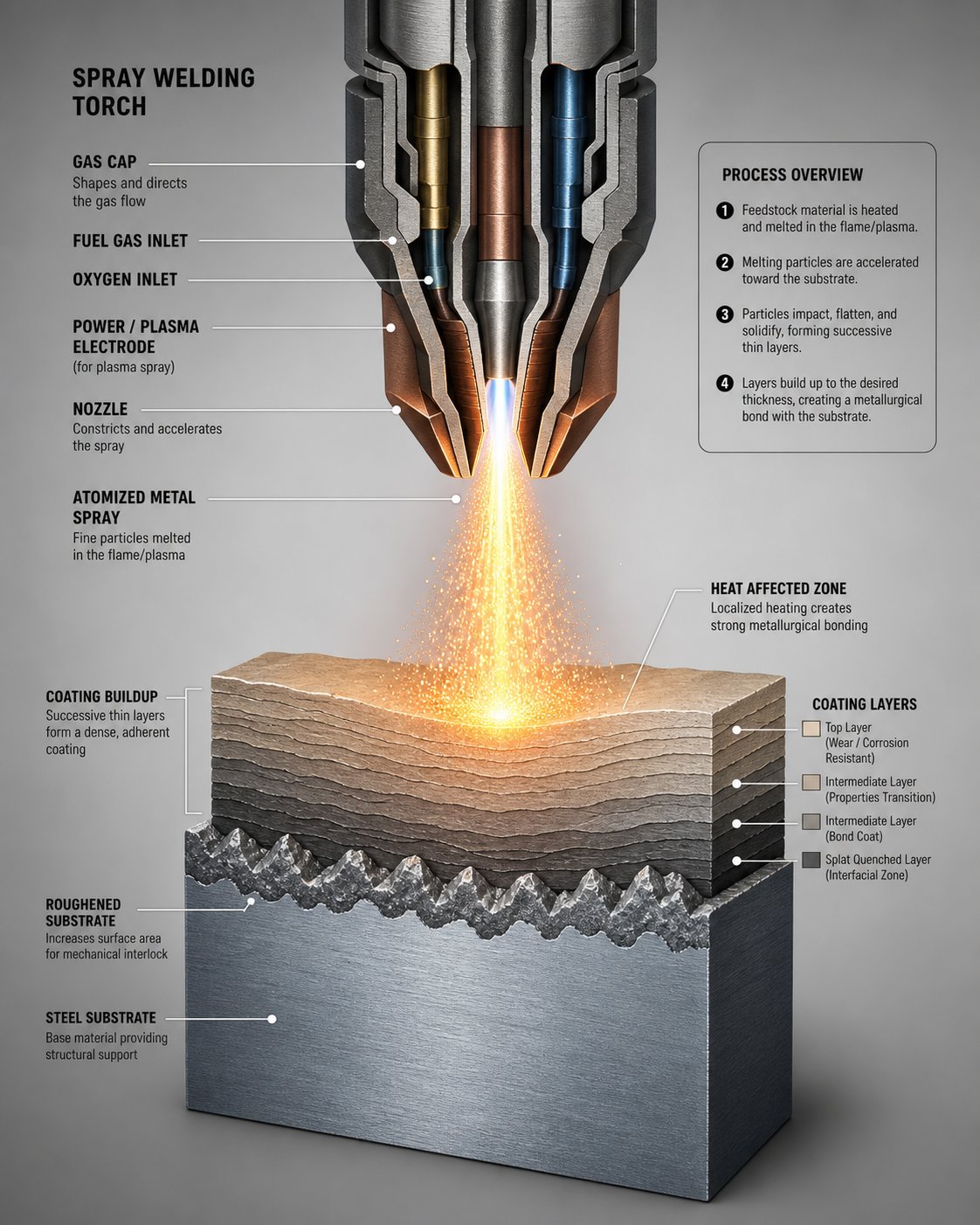
Knowing what spray welding is and understanding how to actually execute it are two very different things. Most explanations stop at "heat the powder, spray it on, fuse it." That three-sentence summary skips every detail that separates a durable, long-lasting spray weld from one that peels off during the first shift. Here is the full lifecycle — from the moment you identify a worn component to the point it passes final inspection and goes back into service.
- Problem identification — Assess the component for wear patterns, dimensional loss, and base metal condition.
- Surface preparation — Clean, degrease, and grit-blast the substrate to create proper adhesion conditions.
- Equipment setup — Select the spray device, feedstock alloy, gas supply, and process parameters.
- Spray application — Deposit the coating material in controlled passes.
- Fusing — Remelt the deposited layer to achieve metallurgical bonding.
- Finishing — Grind or machine the surface back to dimensional tolerance.
- Quality verification — Inspect bond integrity, surface finish, and final dimensions.
Each of these steps directly influences the outcome. Skip one, rush another, and the coating fails — sometimes dangerously. Let's walk through the critical phases in detail.
Surface Preparation and Pre-Treatment
If there is one step that determines whether a spray weld succeeds or fails, it is surface preparation. You could use the finest nickel-chromium-boron spray welding powder on the market, dial in perfect torch settings, and still watch the coating delaminate within hours — all because the substrate was not properly prepared.
Preparation typically follows three stages:
- Cleaning and degreasing — All oil, grease, rust, paint, and surface contaminants must be removed completely. Even a thin film of residual oil creates a barrier that prevents particle adhesion. Solvent cleaning or vapor degreasing is standard; for heavily contaminated parts, alkaline cleaning baths may be necessary.
- Grit blasting — The cleaned surface is blasted with angular abrasive media — typically aluminum oxide grit — to create a rough, aggressive texture. This roughened profile gives the sprayed particles a gripping surface to mechanically interlock with during the initial spray pass. As AERA technical specialist Chuck Lynch notes, the surface must be "grit blasted to leave an aggressive surface texture to give the spray on alloy a gripping surface to bond to." A surface that is too smooth will not hold the coating; one that is too rough can trap contaminants in deep valleys.
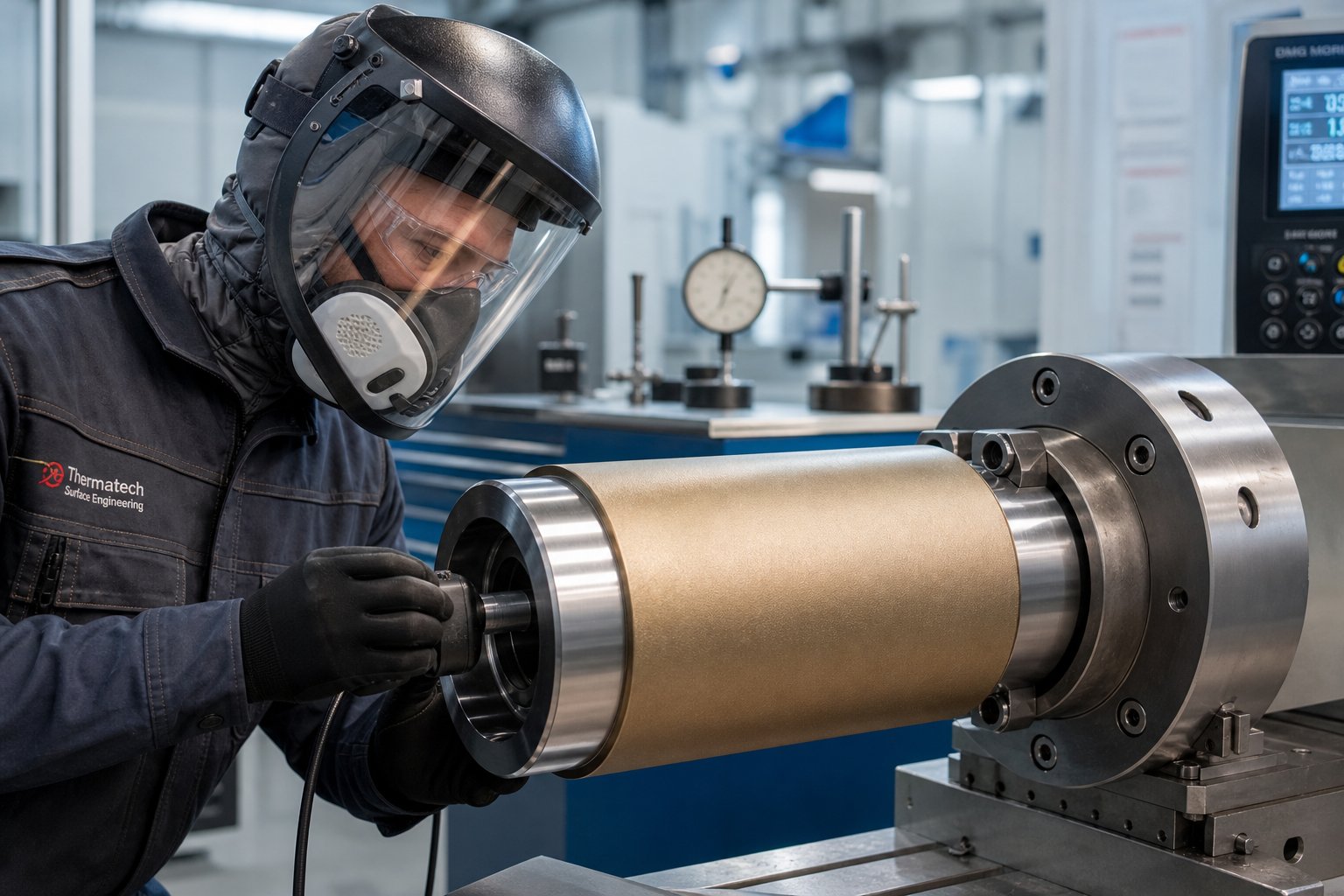
- Masking and preheating — Areas that should not receive overspray are masked with tape, painted-on masking compounds, or mechanical plugs. Plugs are preferred where practical because they install and remove faster and are often reusable. The substrate is then preheated — usually to around 200-300°F (95-150°C) — to drive off residual moisture and reduce thermal shock when molten particles hit the surface.
What happens when you skip these steps? Poor adhesion is the immediate consequence. In the worst cases, the sprayed coating can separate during post-spray machining — sending fragments of hardened alloy across the shop floor. That is not just a failed repair; it is a genuine safety hazard.
The Spray Application Phase
With the substrate properly prepared, the actual welding spray process begins. The feedstock material — whether powder, wire, or rod — is fed into the spray device, where an energy source heats it to a molten or semi-molten state. A gas stream then atomizes and accelerates these particles toward the workpiece at high velocity.
Here is what the operator is managing in real time:
- Feedstock delivery — Powder-fed systems use gravity or pressurized carriers to meter spray welding powder into the flame or plasma stream at a controlled rate. Wire-fed systems spool wire through the gun, where an arc or flame melts the tip continuously. Consistent feed rate is essential; too little starves the coating, too much creates uneven buildup.
- Standoff distance — The gap between the spray gun nozzle and the workpiece surface typically ranges from 6 to 12 inches, depending on the process and material. Too close, and excessive heat distorts the substrate or causes the coating to oxidize. Too far, and particles cool before impact, producing a porous, weakly bonded layer.
- Pass technique — The operator moves the gun across the surface in overlapping passes, much like painting with a spray can — except the "paint" is molten metal traveling at hundreds of feet per second. Each pass deposits a thin layer, usually 0.002 to 0.005 inches thick. Building up to the target thickness requires multiple passes with consistent speed and overlap.
- Layer thickness control — Total coating thickness depends on the application. A crankshaft seal surface might need a minimum wall thickness of 0.015 inches, while a heavily worn shaft could require building up 0.030 to 0.050 inches of material before final grinding brings it back to the standard outside diameter. Thicker buildups demand more careful heat management to avoid cracking from thermal stress.
For cylindrical components like shafts and rollers, the workpiece is typically mounted in a lathe and rotated while the spray gun traverses along its length. This rotation ensures uniform coverage and consistent layer thickness — something nearly impossible to achieve freehand on a round part.
Fusing, Finishing, and Quality Verification
The deposited coating at this stage looks complete, but it is not yet a true spray weld. The particles have mechanically interlocked with the roughened substrate and with each other, but the metallurgical bond that gives this process its strength has not formed. That requires fusing.
During fusing, a secondary heat source — most commonly an oxy-acetylene torch for manual work, a vacuum or atmosphere furnace for batch processing, or induction heating for cylindrical parts — reheats the coating to its melting point. Self-fluxing alloy powders, which contain boron and silicon as fluxing agents, become fluid and wet the substrate surface. The coating and base metal interdiffuse at the interface, creating a dense, virtually pore-free layer bonded at the molecular level. You will actually see the surface "sweat" or take on a glassy appearance as the alloy reaches its fusing temperature — a visual cue experienced operators rely on to judge the process.
After fusing and controlled cooling, the component moves to finishing. The fused surface is typically harder than the original part, so precision grinding or CNC machining is used to bring it back to dimensional tolerance and achieve the required surface finish. Seal surfaces, for example, demand very specific roughness values — a surface that is too rough will chew through seals, while one that is too smooth may not retain the lubricant film properly.
The final gate is quality verification. Depending on the application, this can include:
- Dimensional inspection — Micrometers, bore gauges, or coordinate measuring machines confirm the component meets drawing tolerances.
- Surface finish measurement — Profilometers verify roughness values are within specification.
- Visual and dye-penetrant inspection — Surface-level cracks, porosity, or incomplete fusion are identified before the part leaves the shop.
- Bond integrity testing — On qualification samples, destructive testing or hardness profiling across the coating-to-substrate interface confirms proper metallurgical bonding.
Every one of these steps feeds into the next. A poorly prepared surface leads to weak adhesion. Inconsistent spray passes create uneven thickness that complicates fusing. Inadequate fusing leaves porosity that becomes a crack initiation site under load. The practitioners who get consistently good results treat the process as a chain — and they know exactly which link breaks first when shortcuts are taken.
Of course, the specific parameters at each stage shift dramatically depending on which spray method you are using. Flame spray, arc spray, plasma spray, HVOF — each brings different energy levels, particle velocities, and material options to the table.
Types of Spray Welding Methods and How They Compare
Different energy sources, particle speeds, and feedstock formats produce dramatically different coating results — even when the general process looks similar from across the shop floor. Choosing the wrong method for a given application can mean coatings that crack under load, bond strengths too low for the operating environment, or costs far out of proportion to the problem being solved. Here is a side-by-side breakdown of the five major sub-types, followed by practical guidance on when each one earns its place.
Flame Spray, Arc Spray, Plasma Spray, HVOF, and Detonation Gun Compared
The table below captures the critical differences across process parameters that matter most to engineers and maintenance teams evaluating their options. Data points reflect TWI's technical documentation on thermal spray processes and established industry benchmarks.
| Process Name | Energy Source | Feedstock Type | Particle Velocity | Bond Strength | Typical Coating Thickness | Relative Cost | Best-Suited Applications |
|---|---|---|---|---|---|---|---|
| Flame Spray | Oxy-fuel combustion (acetylene, propane, propylene) | Powder or wire | 30 - 120 m/s | Low to moderate | 0.1 - 2.5 mm | Low | General-purpose repair, corrosion-resistant coatings, economical restoration |
| Arc Spray | DC electric arc between two consumable wires | Wire only | 100 - 250 m/s | Moderate to high | 0.1 - 10+ mm | Low to moderate | Large-surface buildup, corrosion protection, high-deposition-rate applications |
| Plasma Spray | DC electric arc generating ionized plasma gas | Powder | 200 - 300 m/s | Moderate to high | 0.05 - 3 mm | Moderate to high | High-melting-point ceramics, aerospace components, biomedical implants |
| HVOF (High-Velocity Oxy-Fuel) | Combustion of liquid or gas fuel with oxygen | Powder | 400 - 800 m/s (supersonic) | Very high | 0.1 - 2 mm | High | Dense, hard coatings for wear-critical surfaces, turbine parts, roll surfaces |
| Detonation Gun | Detonation of acetylene-oxygen mixture | Powder | 800 - 1000+ m/s | Very high | 0.05 - 0.5 mm | Very high | Precision aerospace coatings, critical-wear surfaces requiring benchmark quality |
A few patterns jump out immediately. Particle velocity is the single biggest driver of bond strength and coating density. Flame spraying sits at the low end — affordable and versatile, but producing coatings with higher porosity and lower bond strength. At the other extreme, detonation gun spraying launches particles at supersonic speeds, creating coatings so dense they often serve as the quality benchmark for all other processes.
When and Why to Choose Each Method
Selecting the right method comes down to matching the process capabilities to the problem at hand:
- Flame spray welding — Your best starting point for economical, general-purpose repair work. If you are restoring a worn shaft in a maintenance shop without specialized equipment, a manual oxy-fuel spray gun paired with a self-fluxing nickel alloy powder gets the job done at minimal capital cost. The lower particle velocities mean lower initial bond strength, but the subsequent fusing step closes that gap significantly.
- Arc spray welding — When you need to cover large surface areas quickly, this is the productivity leader. TWI identifies it as the highest-productivity thermal spray process, and its wire-fed design supports thick buildups efficiently. Corrosion protection on structural steel, bridge components, and large-diameter cylinders are natural fits. Keep in mind that the DC arc produces UV light, ozone, and fume — the same hazards you would manage in any arc welding environment.
- Plasma spray — The precision option. When you need to deposit high-melting-point ceramics, exotic metallic alloys, or tightly controlled coating thicknesses for aerospace or medical applications, plasma spraying delivers. Vacuum plasma spraying (VPS) pushes quality even higher but at substantially greater cost.
- HVOF — If bond strength and coating density are non-negotiable — think turbine blades, pump impellers, or paper mill rolls — HVOF's supersonic particle velocities produce coatings with very low porosity and excellent wear resistance. The investment is higher, but the performance justifies it for critical-wear surfaces.
- Detonation gun — Reserved for applications where nothing less than the highest coating quality will do. Aerospace components and precision wear surfaces benefit from detonation gun coatings, but the cost and specialized equipment limit it to high-value scenarios.
In practice, many service providers maintain flame and arc spray capabilities for everyday repair work while subcontracting HVOF or detonation gun jobs for specialty applications. You do not need every method in-house — you need the right method for the wear problem in front of you.
Understanding Spray Transfer in MIG Welding Context
A fair number of people searching for "spray arc welding" or "mig spray welding" are actually looking for information about spray transfer mode in MIG (GMAW) welding — a completely different concept that is worth clarifying here to avoid confusion.
Spray arc MIG welding is not a surface coating process. It is a metal transfer mode within the MIG welding process itself, where the filler wire melts and crosses the arc as a stream of fine, high-frequency droplets rather than large globular drops. This transfer mode kicks in above a threshold voltage and amperage combination, and it is prized for structural and fabrication welding rather than surface restoration.
So what does spray transfer provide when welding carbon steel? It delivers deep penetration into the base metal, high deposition rates that speed up joint completion, a smooth and uniform bead profile with minimal spatter, and excellent fusion characteristics on thicker sections. These qualities make spray arc transfer ideal for welding heavy plate, structural beams, and pressure vessels — applications where you are joining materials, not rebuilding worn surfaces.
The key distinction: spray welding (spray-and-fuse) adds material to a surface to restore or protect it. Spray arc MIG welding joins two pieces of metal together using a specific droplet transfer mode. Both use the word "spray," both involve melting metal — but they solve entirely different problems. If your goal is resurfacing a worn component, you are in the right article. If you need to weld structural carbon steel joints with deep penetration, spray transfer in MIG welding is your tool.
With the method options mapped out, the natural next question becomes practical: what equipment and materials do you actually need to perform these processes — and what does a realistic setup look like at different scales of operation?
Essential Equipment and Materials for Spray Welding
The answer depends heavily on scale. A maintenance shop handling occasional shaft repairs and a production facility resurfacing hundreds of rollers per month operate at completely different levels of investment and complexity. Yet both setups share the same fundamental equipment categories — they just occupy different ends of the capability spectrum. Here is what each category involves and why it matters.
Spray Guns, Torches, and Automated Systems
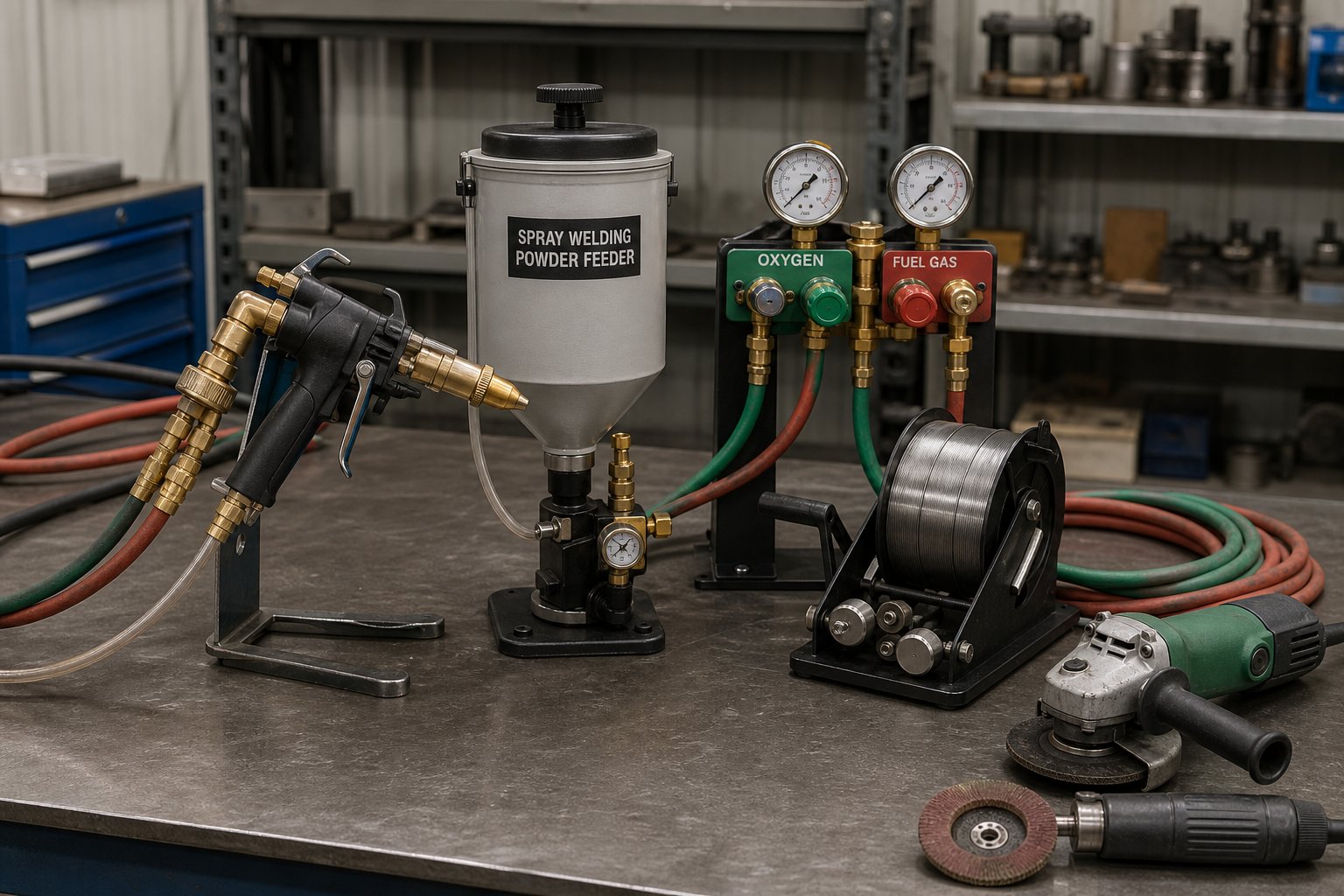
The spray device itself is the centerpiece of any setup, and three broad categories cover the range from entry-level to fully industrial:
- Manual oxy-fuel spray guns — The most accessible entry point. A handheld spray welder powered by an oxygen-fuel gas flame can handle powder or wire feedstock and is well-suited for small-shop repair work — rebuilding worn journals, restoring seal surfaces, or applying corrosion-resistant overlays on individual components. Capital cost is modest, operator training is manageable, and the equipment footprint is small. If you are evaluating a basic spray welding kit for in-house maintenance, this is typically where you start.
- Dedicated arc spray units — A spray arc welder uses a DC power supply to strike an arc between two consumable wires, atomizing and propelling the molten metal with compressed air. These units deliver higher deposition rates than flame spray guns and handle thick buildups efficiently. They are a natural fit for operations that frequently coat large surfaces or need rapid material application — think structural corrosion protection or large-diameter cylinder restoration.
- Automated plasma and HVOF systems — At the production end, robotic or CNC-controlled spray systems deliver repeatable coating quality at volumes that manual operation cannot sustain. These rigs integrate programmable gun traverse, workpiece rotation, and real-time process monitoring. The investment is substantial, but for shops running spray welding MIG-scale production volumes on wear components, automation pays for itself through consistency and throughput.
What separates a budget setup from an industrial-grade system is not just the spray device — it is the precision and repeatability of everything feeding into it.
Powder Feeders, Wire Feeders, and Gas Supply Systems
The spray gun is only as good as the material delivery system behind it. Inconsistent feedstock flow produces uneven coatings, porosity, and wasted alloy — all problems that show up during fusing or, worse, during service.
For powder-fed processes, two delivery methods dominate. Gravity-fed systems mount a powder container directly above the torch body, using a pinch valve to meter material into the gas stream passing through the gun. They are simple, affordable, and reliable for lower feed rates. Carrier-gas-fed systems, by contrast, use externally positioned powder feeders that push powder through a hose and into the torch via a pressurized stream of air or nitrogen. These offer finer flow control and support higher deposition rates — a meaningful advantage when coating consistency matters on critical components.
Wire-fed systems are mechanically simpler: a motorized spool mechanism feeds wire at a controlled rate into the arc or flame zone. The key variable is wire selection — stainless steel wire for corrosion resistance, zinc or aluminum wire for cathodic protection, or specialty alloys for specific wear applications.
Gas supply requirements vary by method. A basic oxy-fuel spray welding kit needs oxygen and a fuel gas such as acetylene or hydrogen. Plasma systems add argon, nitrogen, hydrogen, or helium as plasma-forming and shielding gases. HVOF setups consume oxygen and a liquid or gaseous fuel (kerosene, hydrogen, or propylene) at high flow rates. Every gas line needs proper regulators, flashback arrestors, and flow meters — cutting corners on gas delivery is a direct path to inconsistent coatings and safety incidents.
Feedstock alloy selection is where coating performance is really determined. Nickel-chromium-boron self-fluxing powders remain the workhorse for spray welding because their boron and silicon content acts as a built-in flux during fusing, producing dense, pore-free coatings. Cobalt-based alloys deliver superior hot hardness for high-temperature wear. Tungsten carbide composites — typically in a nickel or cobalt matrix — provide extreme abrasion resistance for components processing filled polymers or mineral slurries. The right alloy matched to the right wear mechanism is half the battle.
Fusing Equipment and Post-Processing Tools
Since spray welding requires that critical second heat pass, you need fusing equipment alongside your spray setup — a detail often overlooked when budgeting for the process.
- Oxy-acetylene torches — The most common fusing tool for manual spray welding. The operator plays a neutral or slightly reducing flame across the sprayed surface, watching for the characteristic "sweating" appearance that signals the self-fluxing alloy has reached its fusing temperature. Skill-dependent, but effective for individual components and field repairs.
- Vacuum or atmosphere furnaces — For batch fusing of multiple components or parts requiring tightly controlled thermal profiles, furnace fusing eliminates operator variability. A controlled atmosphere (typically vacuum or inert gas) prevents oxidation during the fusing cycle, producing consistently high-quality bonds. The tradeoff is capital cost and part-size limitations.
- Induction heating systems — Ideal for cylindrical components like shafts, rollers, and barrels. An induction coil heats the sprayed surface rapidly and uniformly without heating the entire part, reducing distortion risk. This localized approach is particularly effective for long components where torch fusing would create uneven heat distribution.
- Precision grinding and CNC machining — After fusing, the hardened coating must be brought back to dimensional tolerance. Cylindrical grinding, surface grinding, or CNC turning handles this final step. Keep in mind that fused spray weld coatings are often significantly harder than the base metal — 40 to 65 HRC is typical — so tooling and wheel selection must account for that hardness.
- Inspection instruments — Micrometers, bore gauges, surface profilometers, and dye-penetrant testing kits round out the essential equipment list for quality verification.
Taken together, a complete spray welding setup is more than just a gun and some powder. It is an integrated chain — material delivery, energy source, fusing capability, and finishing equipment — where each link supports the next. Shops that invest in the full chain get predictable results. Those that patch together half a system tend to learn expensive lessons in rework and scrap.
Having the right equipment, though, only matters if it is pointed at the right application. Some components and wear scenarios reward spray welding with dramatic returns, while others are better served by alternative approaches entirely.
Where Spray Welding Delivers the Most Value
A worn shaft sitting on a maintenance bench presents a straightforward question: scrap it and wait weeks for a replacement, or rebuild the surface and get it back in production? The answer often hinges on whether the repair method can deliver a coating strong enough to handle the original operating conditions. Spray welding applications span dozens of industries, but certain scenarios consistently produce the most compelling returns — situations where high-value components suffer predictable wear patterns that are expensive to replace but well-suited to resurfacing.
Restoring Worn Shafts, Bearings, and Cylindrical Components
Spray welding for shaft repair is one of the most established and widely practiced applications in industrial maintenance. Picture a motor shaft with a bearing journal worn 0.020 inches below tolerance. The shaft itself — often forged from 4140 or 1045 carbon steel, precision-machined, heat-treated, and dynamically balanced — represents thousands of dollars in material and labor. Replacing it means sourcing new stock, machining from scratch, and absorbing weeks of lead time. Resurfacing that same journal with a nickel-based self-fluxing alloy, fusing it to achieve full metallurgical bonding, and grinding back to specification typically costs a fraction of that and can be completed in days rather than weeks.
The metallurgical bond created during the fuse step is what makes this viable for load-bearing surfaces. A mechanically bonded coating might hold up under light contact, but bearing journals experience continuous radial loading, vibration, and micro-movement. A fused spray metal coating interdiffuses with the base steel, creating an interface strong enough to withstand those forces without delaminating or cracking at the bond line.
Common cylindrical components restored through this process include:
- Bearing journals and seats — Rebuilt to tight tolerances (often within 0.0005 inches of specification) with surface finishes of 8 to 16 microinches Ra, depending on whether the application uses sleeve or anti-friction bearings.
- Pump shafts and valve stems — Seal and packing areas develop circumferential wear grooves over time. Nickel-chromium alloys work particularly well here because they resist corrosion, wear evenly against sealing materials, and can be tooled and polished to a smooth finish without the porosity or hard carbide particles that would abrade mating components.
- Rollers and cylinders — Paper mill rolls, printing cylinders, and conveyor rollers that have been ground below minimum serviceable diameter can have their surfaces rebuilt with arc-sprayed 400-series stainless steel, then machined back to size. As the AWS Committee on Thermal Spray has documented, this approach can extend roll life almost limitlessly through repeated resurfacing cycles.
- Crankshafts and spindles — High-value rotating components where replacement lead times and costs make repair the obvious economic choice.
One practical note worth emphasizing: field repair capability is a genuine advantage for shaft restoration. Arc spray equipment requires only electrical power and compressed air, making it portable enough to coat a spun bearing or failed seal area on-site — sometimes without even removing the shaft from its housing. The coating is applied while the shaft rotates, then tooled with a portable lathe and polished with emery tape. For operations where every hour of downtime carries a steep cost, that portability is not a convenience — it is a financial necessity.
Protecting Surfaces Against Corrosion and Abrasive Wear
Not every spray welding application is reactive. Some of the highest-value uses are preventive — applying hard-facing alloys to new or refurbished components before they ever see service, specifically because the operating environment will destroy unprotected surfaces.
Imagine a slurry pump impeller processing mineral-laden fluid. The abrasive particles in suspension act like liquid sandpaper, eroding metal surfaces at rates that can make a new impeller unserviceable within months. Coating that impeller with a tungsten carbide composite — fine carbide particles suspended in a corrosion-resistant nickel or cobalt matrix — transforms its service life. The carbide particles provide extreme hardness (often exceeding 60 HRC) to resist abrasive cutting, while the metallic matrix holds them in place and resists the corrosive chemistry of the fluid.
Matching the coating to the specific wear mechanism is critical. The choice is not simply "hard coating vs. soft coating" — it is a diagnosis of what is actually destroying the surface:
- Abrasive wear (particle erosion, sliding abrasion) — Tungsten carbide composites or chromium carbide blends provide the hardness needed to resist material removal by hard particles.
- Corrosive attack (chemical dissolution, oxidation) — Nickel-chromium-boron alloys resist a broad range of chemical environments, including acids, alkalis, and salt-laden atmospheres. Cold spray welding — a solid-state variant that deposits particles below their melting point — is gaining traction for corrosion protection on temperature-sensitive substrates where traditional fusing would alter the base metal's properties.
- Combined abrasion and corrosion — Many real-world environments attack components through both mechanisms simultaneously. A chemical processing pump shaft might face acidic fluid and suspended solids at the same time. Here, the coating selection must balance hardness with chemical resistance — a tungsten carbide in a nickel-chromium matrix often represents the best compromise.
- Adhesive wear (galling, metal-to-metal contact) — Cobalt-based alloys like Stellite grades resist galling where two metal surfaces slide against each other under load, such as valve seats and gate faces.
Military and marine maintenance programs have relied on these preventive applications for decades. Naval repair procedures call for corrosion-resistant spray metal coatings on pump housings, impellers, valves, and hatches exposed to seawater — using aluminum bronze or nickel aluminum for naval bronze castings and Monel or nickel copper for nickel-based alloys. The material applied for repair matches or exceeds the performance of the original base metal, ensuring the restored component can survive its operating environment.
Applications in Plastics Processing and Extrusion Equipment
Few industries punish metal surfaces as relentlessly as plastics processing. An extruder screw rotating inside a heated barrel, pushing molten polymer filled with glass fibers, mineral fillers, or flame retardants, faces a triple assault: severe abrasion from hard filler particles, chemical corrosion from processing additives and decomposition byproducts, and progressive metal-to-metal wear as clearances open up between the screw flights and barrel bore.
The consequences go beyond just worn metal. As screw flight outside diameters wear down, the clearance between flight and barrel wall increases. That growing gap allows molten polymer to slip backward over the flights instead of being pushed forward — a condition known as slippage. Slippage degrades output rate, destabilizes melt pressure, increases energy consumption, and ultimately compromises the quality of the extruded or molded product. Similarly, a barrel bore worn beyond tolerance loses its ability to contain and convey material efficiently.
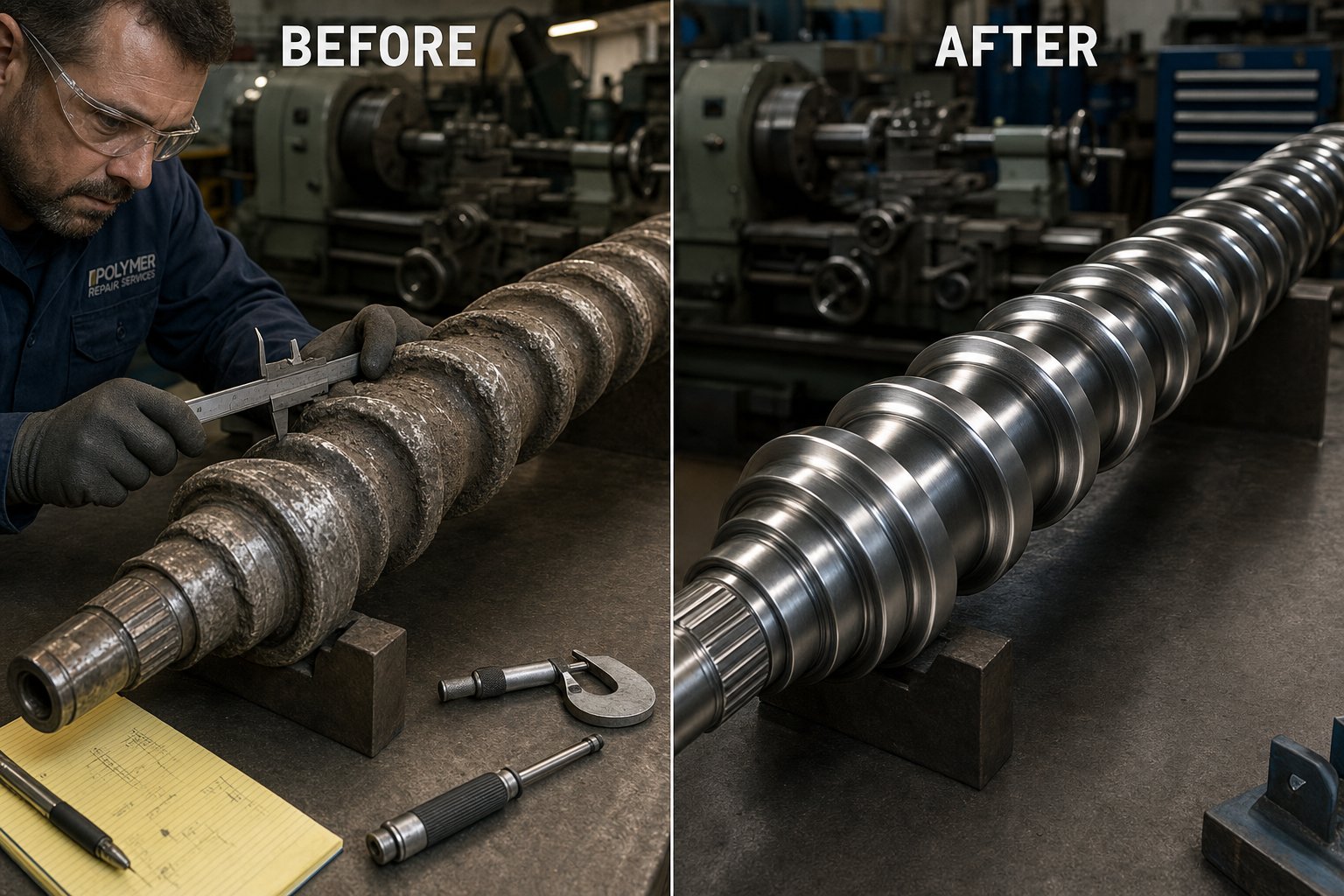
Spray welding addresses both sides of this problem. Worn screw flights can be rebuilt with hard-facing alloys, restoring the critical flight-to-barrel clearance. The fused metallurgical bond ensures the coating withstands the continuous shear forces and pressures inherent in extrusion — forces that would strip a mechanically bonded coating within hours of operation.
For root and flight protection on screws processing highly filled thermoplastic composites, SpecialChem's technical guidance identifies several proven approaches, including spray welding and fusion with tungsten carbide suspended materials for comprehensive screw protection. This method coats the channel root and flight sides with an abrasion-resistant overlay, protecting the base steel from the eroding action of fillers like glass fiber, mica, and calcium carbonate that cause aggressive wear — particularly in the feed section and early transition zone where polymer is still in pellet form and fillers are exposed on pellet surfaces.
Components in the plastics processing sector that regularly benefit from spray welding include:
- Extruder screws — single-screw and twin-screw designs, including flight rebuilds, root protection, and full encapsulation
- Extruder barrels — bore restoration and hard-facing of liner surfaces
- Injection molding screws and barrels — subject to the same abrasion and corrosion mechanisms as extrusion equipment
- Screw tips, check rings, and non-return valve components
- Feed screws and side-stuffer screws used in compounding operations
- Die components and adapter rings exposed to abrasive or corrosive polymer melts
What makes this application area particularly compelling from an economic standpoint is the cost structure of the components involved. A large extruder screw — machined from specialty steel, heat-treated, and finished to precise tolerances — can represent a five- or six-figure investment. When abrasive wear reduces its effectiveness, the financial case for resurfacing rather than replacing is often overwhelming. The same logic applies to barrels, where the bimetallic liner itself is a significant portion of the total cost.
The pattern across all of these applications is consistent: spray welding delivers its greatest value where the component is expensive to replace, the wear pattern is well-understood, and the metallurgical bond from fusing provides the durability the operating environment demands. That raises an important follow-up question — exactly how much does resurfacing save compared to full replacement, and when does repair stop making economic sense?
Cost Analysis and the Repair vs. Replacement Decision
Understanding where spray welding delivers value means nothing if you cannot put a dollar figure next to it. Most guides skip the economics entirely, leaving engineers and maintenance managers to guess whether resurfacing actually saves money or just delays an inevitable replacement. The spray welding cost equation is more straightforward than you might expect — but it depends on variables that differ for every component sitting in your shop.
Spray Welding vs. Full Component Replacement
Consider what actually goes into replacing a worn extruder screw, hydraulic cylinder, or turbine shaft. You are paying for raw material — often specialty alloy steel — plus CNC machining, heat treatment, surface finishing, and quality inspection. Then add lead time. A new high-performance feedscrew can take weeks or even months to manufacture, and every day that machine sits idle drains revenue without producing a single part.
Spray welding changes that math dramatically. As Hayden Corp.'s Daniel Hayden explains, the total work scope for a thermal spray repair is considerably smaller than full replacement because most of the original component remains functional and correct — only the damaged zone needs attention. The repair cost typically covers preparatory machining to remove the damage, coating the repair zone, and finish machining afterward. That scope translates to significantly lower cost and shorter turnaround.
In plastics processing, the savings can be especially dramatic. Industry experts note that an experienced screw manufacturer can rebuild worn screws to like-new condition for a fraction of the cost of new equipment — and with proper technique, a single screw can be rebuilt multiple times over its service life. Some manufacturers report rebuilding the same screw six to eight times before the base material is finally exhausted.
Beyond direct cost, the opportunity cost of downtime often tips the balance even further. A spray welding repair that takes days instead of the weeks required for new fabrication means your production line returns to revenue generation faster. For operations running around the clock, that time difference alone can exceed the repair cost itself.
Comparing Costs Across Surface Treatment Methods
Spray welding is not the only option for restoring or protecting worn surfaces, and the smartest decision sometimes means choosing a different method entirely. The table below stacks the most common approaches against each other across the dimensions that matter most when budgeting a repair.
| Method | Relative Cost | Bond Quality | Coating Thickness Range | Turnaround Time | Environmental Considerations |
|---|---|---|---|---|---|
| Spray Welding (Spray-and-Fuse) | Low to moderate | Metallurgical bond (high strength after fusing) | 0.1 - 2.5 mm typical | Days to 1-2 weeks | Metallic fume management required; no hazardous chemical baths |
| Hard Chrome Plating | Low to moderate | Electrochemical bond (moderate adhesion) | 0.025 - 0.5 mm | Days to 1-2 weeks | Hexavalent chromium is a known carcinogen; increasing regulatory restrictions worldwide |
| Weld Overlay / Hardfacing | Low to moderate | Full fusion weld (very high strength) | 1 - 10+ mm | Days to weeks | Standard welding fume controls; high heat input can distort thin components |
| Laser Cladding | High | Metallurgical bond (very high strength, minimal heat-affected zone) | 0.2 - 3 mm | Days to weeks | Low waste; minimal distortion; requires skilled operators and significant equipment investment |
| Full Component Replacement | Highest | N/A (new part) | N/A | Weeks to months | Full material and energy consumption for new manufacture; longest lead time |
The spray welding vs hard chrome comparison deserves particular attention. Hard chrome plating has been the go-to surface treatment for decades, but tightening environmental regulations around hexavalent chromium are driving up compliance costs and limiting availability. Spray welding produces a thicker, metallurgically bonded coating without the toxic chemistry — and HVOF-applied chromium carbide or tungsten carbide coatings often outperform chrome plating in hardness, wear life, and corrosion resistance. For pump sleeves and hydraulic rams, this is already a well-proven swap.
Laser cladding offers exceptional precision and minimal heat distortion, but at a cost premium that only makes sense for high-value components requiring extremely tight tolerances or when extensive post-coating machining — such as threading or milling — is needed. Traditional weld overlay provides the strongest bond of any repair method, yet the high heat input risks warping thin-walled or precision-machined parts that spray welding handles comfortably.
Making the Repair-or-Replace Decision
Rather than defaulting to either extreme — always repair or always replace — the most cost-effective approach treats each component as a case-by-case evaluation. Ask yourself these questions before committing:
- How severe is the wear? If base metal loss is within the maximum recommended coating thickness for the selected alloy, repair is typically viable. If the component is so far gone that structural integrity is compromised, replacement may be the only safe option.
- What caused the failure? Rebuilding a surface without addressing the root cause — misalignment, contaminated fluid, unsuitable material — guarantees a repeat failure. A good spray welding repair services provider will assess the failure mode before quoting a repair.
- Can the coating outperform the original surface? This is one of spray welding's underappreciated advantages. As Hayden notes, it is often as easy to apply a superior material as it would be to replace with something identical — meaning the repaired component can actually last longer than it did originally.
- Is a spare available or in rotation? Operations that maintain spare screws, shafts, or rollers can send worn components out for resurfacing while spares keep production running. This rotating maintenance approach, documented in multiple thermal spray repair case studies, effectively gives components unlimited service life at minimal recurring cost.
- Does the service provider understand your specific application? A general machine shop may be able to spray a coating, but understanding the operating tolerances, alloy requirements, and failure patterns of your particular equipment is a different level of expertise.
This last point matters more than many operators realize. Specialists who focus on specific industries bring a depth of knowledge that generalists cannot match. For instance, NANHAIYA's alloy spray welding service is built specifically for extrusion and injection molding operators — a focus that shapes everything from alloy selection for glass-filled polymer abrasion to dimensional targets for screw-flight-to-barrel clearances. That kind of application-specific experience helps operators avoid unnecessary full replacement of worn screws and barrels by identifying which components are genuinely candidates for repair and which have reached end of life.
The bottom line is simple. Spray welding cost is almost always a fraction of replacement cost for high-value precision components. The real question is whether repair is viable for the specific wear condition, material, and performance requirements at hand — and honest evaluation of that question is what separates a reliable service provider from one that takes on jobs it should not.
That said, spray welding is not a universal solution. Every process has limitations, and pretending otherwise does a disservice to anyone relying on this information to make real decisions.
Limitations, Safety, and Troubleshooting Common Defects
Every process that promises significant cost savings deserves equally honest scrutiny about where it falls short. Spray welding limitations are real, the safety hazards are serious, and defects happen even to experienced operators. Ignoring any of these realities leads to failed coatings, injured workers, or both. Here is what you need to know before committing to a job — or evaluating whether a service provider is cutting corners.
Bond Strength Limitations and Geometry Constraints
Even a properly fused spray weld coating does not behave identically to a full-penetration fusion weld. The metallurgical bond formed during fusing is strong — typically 350 to 450 N/mm² — but it is a surface-level interdiffusion, not a through-thickness joint. For components subjected to severe point loading, repeated high-impact forces, or peel stresses, that distinction matters. A fused coating on a shaft journal handles continuous radial load beautifully; that same coating on gear teeth experiencing concentrated point contact and shear forces is a different story entirely.
Geometry imposes even harder limits. Thermal spray processes are fundamentally line-of-sight operations — the spray gun must have a direct, unobstructed path to every surface being coated. This creates several practical constraints:
- Internal cavities and small bores — Specialized inside-diameter spray guns exist, but they are process-specific and limited in reach. The smallest feasible bore diameter is typically around 4 to 5 inches, with a maximum depth of roughly 24 to 48 inches. Anything smaller or deeper is generally impractical. Compare this to chrome plating, which flows into tight spaces via a dip process with no line-of-sight requirement.
- Sharp edges and corners — Mechanically bonded thermal spray coatings are vulnerable to chipping at exposed edges because there is no metallurgical anchor holding the coating from both sides. Spray-and-fuse coatings actually perform better in this regard — the fusing step creates a bond that adheres better when it wraps around an edge — but irregularly shaped parts with multiple corners remain challenging. Cylindrical and flat geometries are ideal; complex castings with recesses and undercuts are not.
- Multi-face parts — A component requiring coating on several non-parallel surfaces must be repositioned for each face, increasing setup time and cost. In some cases, this repositioning pushes the total price beyond feasibility compared to alternative treatments.
- Maximum coating thickness — Practical limits exist. While arc spray can build up 10+ mm of material, most spray-and-fuse applications top out at 2 to 2.5 mm per layer before residual stress and cracking become concerns. Components worn far beyond that range may not be candidates for resurfacing.
- Substrate compatibility — The base metal must tolerate the fusing temperature without distortion, metallurgical degradation, or excessive grain growth. Hardened tool steels that lose their temper at fusing temperatures, thin-walled parts prone to warping, and heat-sensitive alloys all present challenges that must be evaluated case by case.
None of these limitations make the process impractical — they make it selective. Knowing what it cannot do is just as important as knowing what it can.
Safety Hazards and PPE Requirements
Spray welding safety requirements are more demanding than most operators expect, particularly if their experience is limited to conventional welding. The American Welding Society's Safety Fact Sheet No. 20 identifies a unique combination of hazards created by these processes — hazards that are compounded by the high temperatures, velocities, and material chemistries involved.
Here are the primary risks:
- Respirable dust and metallic fumes — Finely divided airborne particles from the spray arc or combustion stream present both inhalation and explosion hazards. Nickel and chromium-containing alloys are particularly concerning because chronic exposure to their fumes is linked to serious respiratory disease. The AWS mandates adequate ventilation, properly designed dust collection systems, and approved respirators complying with ANSI Z88.2 for most spray and abrasive blasting operations.
- Extreme noise levels — This is one hazard that catches people off guard. HVOF systems generate sound levels up to 150 dBA — louder than a jet engine at close range. Even low-velocity oxy-fuel processes hit 110 dBA, and plasma arc reaches 132 dBA. Hearing protection is not optional; it is legally required under OSHA 29 CFR 1910.95.
- UV and infrared radiation — Electrical processes (arc and plasma spray) produce intense ultraviolet radiation capable of damaging eyes and burning exposed skin. The AWS recommends lens shades of No. 9 to 12 for electrical processes and No. 3 to 6 for combustion processes. Total eye and skin protection is required — not suggested, required.
- Burn and fire risk — The gas stream from a thermal spray gun exceeds 3,000°F. Molten particle overspray, hot substrates, and combustible materials in the work area all create fire hazards that demand the same precautions as any hot-work operation.
- Electrical shock — Arc spray, plasma arc, and plasma induction systems carry electrical hazards comparable to arc welding equipment. Proper grounding, insulated tooling, and lockout/tagout procedures are essential.
- Compressed gas hazards — Multiple high-pressure gas cylinders (oxygen, fuel gases, argon, nitrogen, hydrogen) are standard in any spray welding setup. Improper handling, inadequate regulators, or missing flashback arrestors create risks ranging from leaks to catastrophic cylinder failure.
- Chemical interaction hazards — One particularly insidious risk: chlorinated hydrocarbon solvent vapors in the vicinity of arc or plasma spraying can produce hazardous phosgene gas when exposed to the process's ultraviolet radiation. Solvent cleaning stations must be isolated from spray areas.
Given these hazards, the required PPE list for spray welding operations is extensive:
- Approved respiratory protection (supplied-air respirator or appropriate cartridge respirator rated for metallic fumes)
- Full-face shield or safety goggles with correct lens shade for the specific process
- Hearing protection rated for the noise level of the spray method in use
- Flame-resistant clothing covering all exposed skin
- Heat-resistant gloves rated for handling hot components and resisting molten particle splatter
- Safety boots with metatarsal guards
- Hard hat in overhead spray applications
If a shop is running spray welding operations without every item on that list, they are operating outside recognized safety standards. This is not a process where you can improvise protection and hope for the best.
Troubleshooting Common Spray Welding Defects
Even with proper equipment and trained operators, defects occur. The difference between a shop that produces reliable coatings and one that struggles with rework often comes down to how quickly they identify the root cause and correct it. The table below covers the most common spray welding defects troubleshooting scenarios — organized by what you see, why it happened, and how to fix it.
| Defect | Likely Causes | Corrective Actions |
|---|---|---|
| Poor adhesion / delamination | Inadequate surface preparation (insufficient grit blasting, residual oil or grease); substrate temperature too low during spraying; incorrect standoff distance; contaminated abrasive media | Re-blast to proper surface profile using clean, angular abrasive; degrease thoroughly before blasting; preheat substrate to recommended temperature; verify standoff distance per equipment specs |
| Porosity (excessive voids in coating) | Standoff distance too great (particles cool before impact); spray angle not perpendicular to surface; insufficient particle velocity; moisture in gas supply; inadequate fusing temperature or dwell time | Reduce standoff distance to manufacturer-recommended range; maintain 90-degree spray angle; check gas pressures and flow rates; install or replace gas line dryers; increase fusing temperature or extend dwell time to achieve full coalescence |
| Cracking (during or after fusing) | Coating applied too thick in a single pass; excessive thermal stress from rapid heating or cooling during fuse cycle; substrate and coating thermal expansion mismatch; base metal contamination at interface | Build coating in thinner layers; control heating and cooling rates during fusing (especially on large or thick-walled parts); verify alloy compatibility with substrate; ensure interface is clean before spraying |
| Uneven thickness | Inconsistent gun traverse speed; irregular workpiece rotation; nozzle wear causing asymmetric spray pattern; powder feed rate fluctuations; operator fatigue on long manual passes | Calibrate traverse speed and rotation rate; inspect and replace worn nozzles; verify consistent feed rate with test sprays; consider automated traverse for long or repetitive components |
| Discoloration or oxidation | Fusing temperature too high; fusing atmosphere not sufficiently reducing (excess oxygen); spray distance too close causing overheating of deposited layers; contaminated fuel gas | Monitor fusing temperature with pyrometer rather than visual estimation alone; adjust torch flame to slightly reducing; increase standoff distance if surface overheating is observed; verify gas purity and cylinder condition |
A few patterns emerge from that table. Surface preparation failures and thermal management errors account for the vast majority of defects. You will also notice that many corrective actions point back to fundamentals — clean surfaces, correct distances, controlled temperatures — rather than exotic fixes. The operators who treat these basics as non-negotiable spend far less time troubleshooting than those who treat them as suggestions.
One additional tip worth bookmarking: keep a spray log for every job. Record the alloy used, gas pressures, standoff distance, preheat temperature, number of passes, and fusing parameters. When a defect appears — and eventually one will — that log transforms a guessing game into a systematic diagnosis. Without it, you are troubleshooting blind.
Knowing these limitations and risks does not diminish the value of the process — it sharpens your ability to deploy it correctly. The remaining question is a practical one: should you build this capability in-house, or is partnering with a specialist the smarter path for your operation?
Choosing the Right Spray Welding Path for Your Operation
That question — build internally or partner externally — is not a philosophical debate. It is a financial and operational decision shaped by how often you need the process, what types of components you are servicing, and whether the capital investment delivers a return within a reasonable timeframe. Both paths work. The wrong choice is defaulting to one without evaluating the other.
DIY Spray Welding vs. Professional Service Providers
In-house spray welding makes strong economic sense under specific conditions. If your facility generates a steady, predictable volume of repair work — dozens of shafts per quarter, regular roller resurfacing cycles, or ongoing preventive hard-facing on new components — the math favors owning the equipment and training the operators. You gain faster turnaround because parts never leave your building, tighter control over scheduling and quality, and lower per-job cost once the capital investment is amortized.
The catch is everything that comes before that first successful spray weld. You are investing in equipment across the full chain — spray device, powder or wire feeders, gas supply infrastructure, fusing equipment, and precision grinding or machining capability. You are recruiting or training technicians with a specialized skill set that, as thermal spray industry analysts note, can be both difficult to find and expensive to retain. And you are committing to ongoing education as alloy formulations, equipment technology, and application techniques evolve.
For many operations, particularly those handling occasional repairs or working with specialized alloys they do not spray regularly, outsourcing to a professional spray welding service provider is the more practical path. The advantages mirror the limitations of the in-house approach:
- No capital equipment burden — You pay for services on a per-job basis, avoiding the upfront investment in spray systems, fusing equipment, and finishing machinery that may sit idle between projects.
- Access to broader expertise — A dedicated service provider works across multiple alloy systems, spray methods, and component types daily. That accumulated experience translates to faster problem diagnosis, better alloy selection, and fewer trial-and-error cycles on your parts.
- Scalability without headcount — When your repair volume spikes — a planned shutdown, a batch of worn screws pulled during an audit — an external partner absorbs the surge without you hiring temporary technicians or running overtime.
- Reduced safety and compliance overhead — The respiratory protection, ventilation systems, noise controls, and hazardous fume management discussed in the previous section become the service provider's responsibility, not yours.
The tradeoff is control. Outsourcing introduces dependencies on someone else's schedule, quality systems, and priorities. Communication gaps can lead to mismatched expectations — especially if the provider does not deeply understand the application your component serves. That risk, however, is manageable if you know what to look for when choosing a partner.
What to Look for in a Spray Welding Service Partner
Not all service providers are created equal, and the evaluation criteria go well beyond price per job. A general machine shop that occasionally sprays a coating is a fundamentally different proposition from a specialist built around specific industries and wear problems. Here is what separates a reliable partner from a risky one:
- Industry-specific experience — This is the single most important differentiator. A provider serving plastics processing understands screw geometry, barrel bore tolerances, flight-to-barrel clearance specifications, and the specific wear patterns caused by glass-filled polymers or corrosive additives. A general shop may be technically capable of spraying a coating, but without that application context, they are guessing at alloy selection and dimensional targets. The same principle applies across sectors — a provider experienced with hydraulic cylinders knows different things than one focused on turbine components.
- Alloy selection expertise — The right provider does not just apply whatever powder is on the shelf. They diagnose the wear mechanism — abrasion, corrosion, combined attack, adhesive wear — and match the coating chemistry to the problem. Ask how they determine alloy selection for a given job. If the answer is vague, keep looking.
- Quality verification capabilities — A credible spray welding service provider can demonstrate how they verify bond integrity, dimensional accuracy, and surface finish. Look for documented inspection procedures, calibrated instruments, and willingness to share inspection reports. As IMR Test Labs outlines, the two primary evaluation categories — metallurgical examination and mechanical testing — identify critical coating performance parameters and potential in-service issues. A provider that skips verification is a provider that ships problems back to you.
- Honest repair viability assessment — The best partners will tell you when a component is beyond economical repair. A provider that says "yes" to every job regardless of condition is either inexperienced or prioritizing revenue over your outcome. The willingness to recommend replacement when repair is not viable is a sign of integrity, not lost business.
- Turnaround time and communication — Especially for operations where downtime is costly, a provider's ability to quote realistic timelines and communicate proactively about delays or complications is essential. Ask for references from customers in similar industries and verify their experience.
- Repair-first philosophy — Look for providers whose entire service model is oriented around extending component life rather than selling new parts. This alignment of incentives means they are motivated to maximize the value of every repair, not push you toward replacement when resurfacing would serve you better.
To illustrate what this looks like in practice, consider NANHAIYA's alloy spray welding service — a provider purpose-built for extrusion and injection molding operators. Their service is designed around the specific problems this article has discussed in depth: screw wear from abrasive fillers, barrel bore erosion, corrosion from processing chemicals, slippage caused by worn flight clearances, and the progressive performance degradation that follows. Rather than operating as a general-purpose coating shop, they focus on the component geometries, alloy systems, and dimensional tolerances unique to plastics processing equipment. That specialization embodies the evaluation criteria listed above — industry-specific knowledge, application-driven alloy selection, and a repair-oriented approach that helps operators avoid replacing components that still have serviceable life left in them.
Taking the Next Step
If you have read this far, you likely have a specific component in mind — a worn screw, an undersized shaft, a corroded barrel, or a part that keeps failing in the same spot. Before committing to any solution path, take a step back and assess three things:
- Identify the wear pattern and root cause. Is the damage abrasive, corrosive, adhesive, or some combination? Has the failure source been addressed, or will a rebuilt surface wear out just as quickly? A repair without root-cause correction is just an expensive delay.
- Measure the actual material loss. Quantify how much dimensional change has occurred. This determines whether spray welding can restore the component within practical coating thickness limits, or whether the damage is too severe for resurfacing.
- Evaluate the economics honestly. Compare the total cost of repair — including turnaround time, any production impact, and expected service life of the restored component — against the total cost of replacement. Factor in the possibility that a spray-welded surface with a superior alloy may actually outperform the original, extending the next service interval.
Spray welding is not the answer to every worn component. But for high-value parts facing predictable wear in demanding environments — particularly in plastics processing, hydraulic systems, and rotating equipment — it consistently delivers the best balance of cost, performance, and turnaround. The key is matching the right method, the right alloy, and the right service partner to the specific problem sitting on your maintenance bench.
Stop replacing parts you could resurface for less. Start by understanding what you are actually dealing with — and choosing the path that makes the most sense for your operation, your budget, and your production schedule.
Frequently Asked Questions About Spray Welding
1. What is the difference between spray welding and thermal spray coating?
The core difference lies in the number of steps and the resulting bond type. Spray welding is a two-step process: material is first sprayed onto the substrate, then fused with a secondary heat source (torch, furnace, or induction coil) to create a metallurgical bond where the coating and base metal interdiffuse at the molecular level. Single-step thermal spray coating skips the fusing step entirely, relying on mechanical interlocking between sprayed particles and a roughened surface. This means spray welding produces denser, virtually pore-free coatings with bond strengths commonly reaching 350-450 N/mm², making them suitable for high-stress, load-bearing surfaces. Thermal spray coatings retain some porosity and are better suited for lower-stress, large-area applications. Choosing between them depends on the mechanical demands your component will face in service.
2. How much does spray welding cost compared to replacing a worn component?
While exact figures vary by component size, alloy selection, and wear severity, spray welding repair typically costs significantly less than full replacement for high-value precision parts. The savings come from a much smaller work scope — only the damaged zone is addressed, while the rest of the original component remains intact. You also save on lead time, since repairs measured in days replace manufacturing timelines of weeks or months. For plastics processing equipment like extruder screws, industry specialists report that worn screws can be rebuilt to like-new condition for a fraction of new equipment cost, and a single screw may be rebuilt multiple times before the base material is exhausted. Providers like NANHAIYA (nhyscrews.com/services/alloy-spray-welding) specialize in helping extrusion and injection molding operators evaluate whether repair or replacement is the more economical choice for their specific situation.
3. What types of components are best suited for spray welding repair?
Spray welding delivers the strongest returns on expensive, precision-machined components with predictable, surface-level wear patterns. The most common candidates include bearing journals and shaft seal surfaces worn below tolerance, pump shafts and valve stems with circumferential wear grooves, paper mill and printing rollers ground below minimum serviceable diameter, hydraulic cylinder rods with scoring or corrosion, and extruder screws and barrels in plastics processing where abrasive fillers erode flight clearances. The ideal candidate is a component where the base structure remains sound but the working surface has lost critical dimensions or protective properties. Components with severe structural damage, through-wall cracks, or wear exceeding practical coating thickness limits (typically 2-2.5 mm for spray-and-fuse) may be better served by full replacement.
4. What safety precautions are required for spray welding operations?
Spray welding presents a unique combination of hazards that demand comprehensive protection. Required PPE includes approved respiratory protection rated for metallic fumes (especially critical when spraying nickel or chromium alloys), full-face shields or safety goggles with correct lens shades (No. 9-12 for arc/plasma processes, No. 3-6 for combustion), hearing protection (HVOF systems can reach 150 dBA), flame-resistant clothing, heat-resistant gloves, and safety boots with metatarsal guards. Beyond PPE, the workspace needs adequate ventilation or dust collection systems to manage respirable particles, proper compressed gas handling with flashback arrestors, and separation of chlorinated solvent cleaning stations from spray areas to prevent phosgene gas formation. OSHA hearing conservation standards (29 CFR 1910.95) and ANSI Z88.2 respiratory protection standards apply.
5. Can spray welding make a repaired part last longer than the original?
Yes, and this is one of spray welding's most underappreciated advantages. Because the process applies a coating on top of the base metal, you are not limited to the original material's properties. A carbon steel shaft that wore prematurely can be resurfaced with a nickel-chromium-boron alloy offering superior hardness and corrosion resistance. An extruder screw that suffered abrasive wear from glass-filled polymers can be rebuilt with tungsten carbide composite coatings far harder than the original steel. Industry experts confirm it is often just as easy to apply a superior material as it would be to replicate the original, meaning the repaired component can outperform its factory specification and extend the interval before the next service cycle is needed.
Written by
Nanhaiya Technical Team
Zhoushan Nanhaiya Plastic Machinery Co., Ltd.
The Nanhaiya technical team supports screw and barrel manufacturing projects through application review, technical communication, custom manufacturing coordination, and production and quality control.
Discuss Your Application
Related Articles
More insights on screw barrel technology and plastics processing.
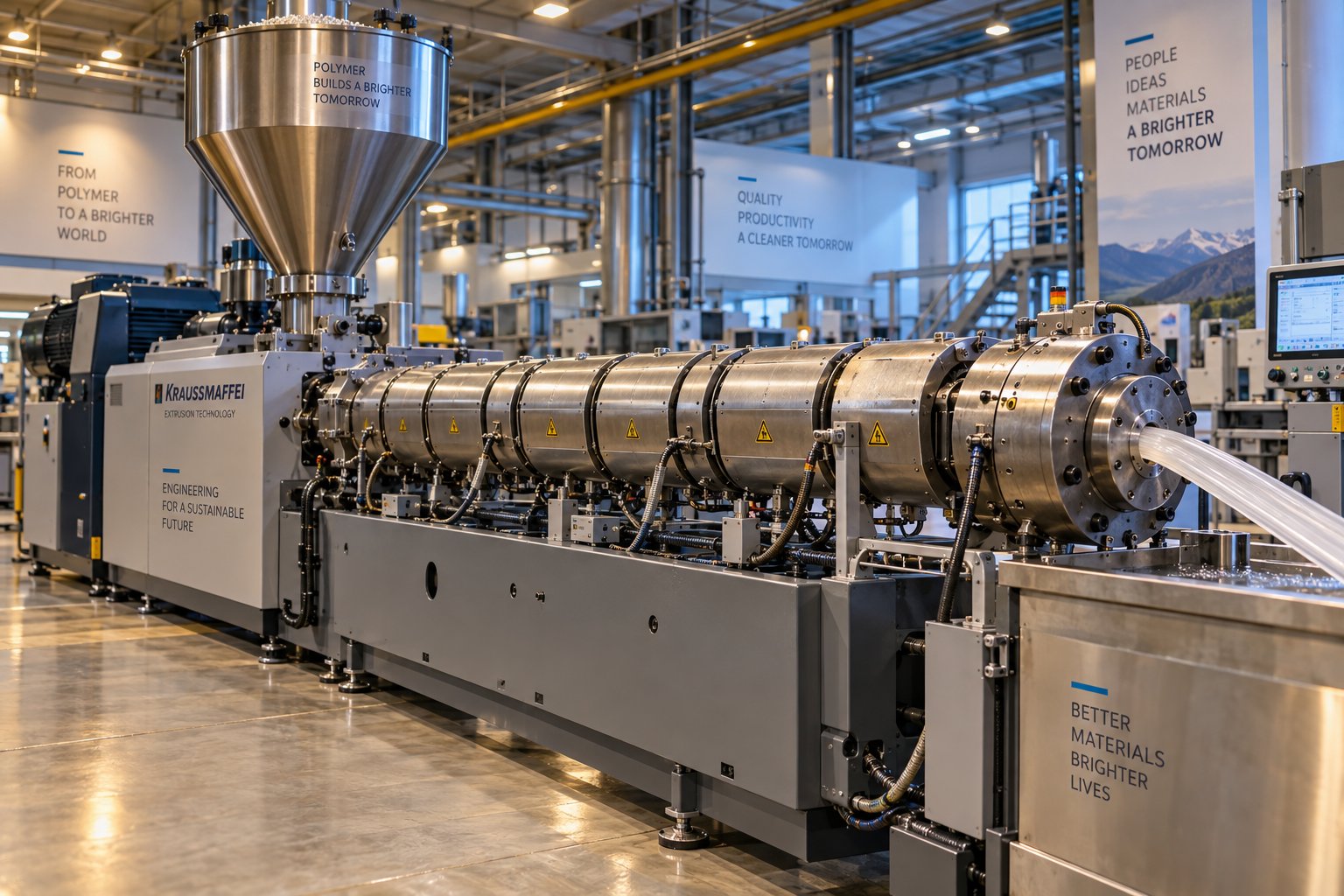
Extruder Machine Decoded: From Raw Pellet To Finished Product
Oct 6, 2026
Learn how an extruder machine works, compare single-screw vs. twin-screw types, and get expert guidance on specs, troubleshooting, and selection.
Read Article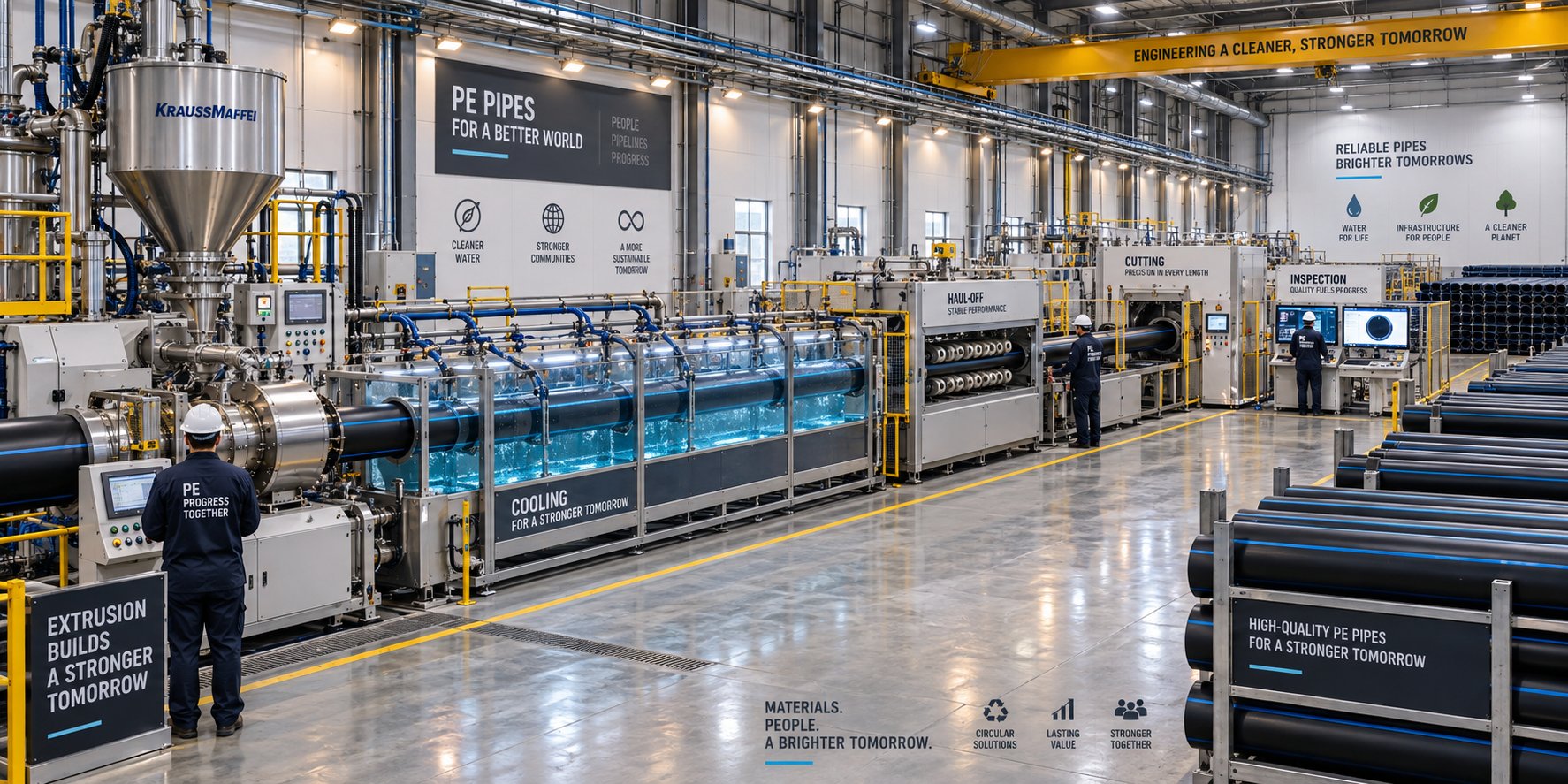
PE Pipe Making Machine Decoded: From Raw Resin to Flawless Pipe
Oct 4, 2026
Learn how a PE pipe making machine works, from resin to finished pipe. Covers components, material grades, automation, troubleshooting, and buyer selection tips.
Read Article
PVC Profile Making Machine Decoded: From Raw Resin To Profit
Oct 3, 2026
Learn how a PVC profile making machine works — extrusion process steps, key technical parameters, die design, calibration methods, maintenance, and total cost of ownership.
Read ArticleLooking for something else?
Search by material, symptom or product and jump straight to the relevant page.
These are navigation suggestions based on keyword matching — not a quotation, not a delivery commitment, and not a substitute for engineering review. Final specification is confirmed by our engineers against your drawings and processed material.
Need help with screw barrel selection?
Share your machine model, processed material and application. Our team can help with pricing and technical support.