

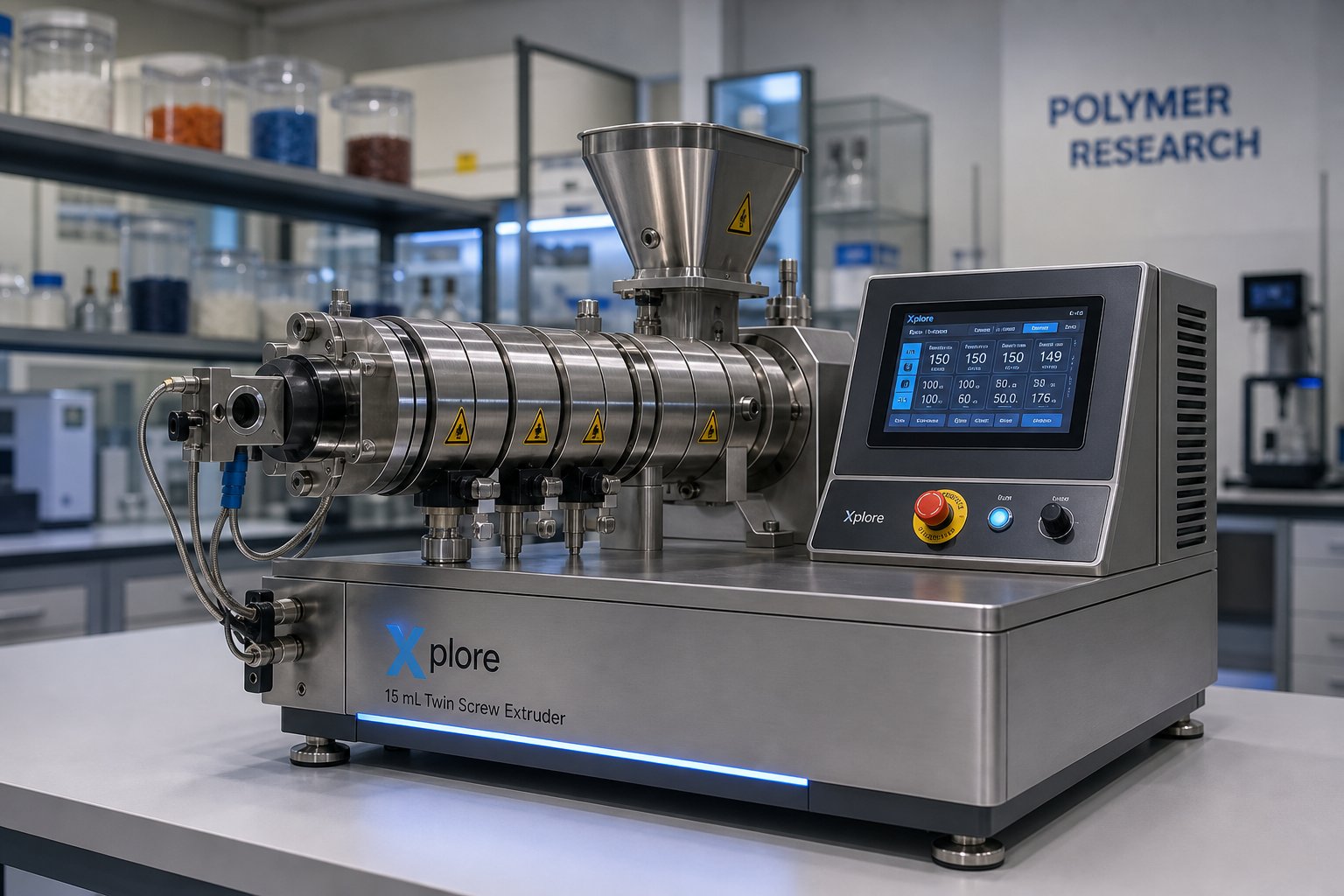
What Is a Small Twin Screw Extruder and Why It Matters
A small twin screw extruder is a compact, precision-engineered processing machine that uses two intermeshing screws rotating inside a heated barrel to convey, melt, mix, and shape materials at low volumes. With screw diameters typically ranging from 5 mm to 35 mm, these machines are purpose-built for formulation development, low-volume compounding, and specialty processing tasks where full-scale production equipment would be impractical and wasteful.
Most twin screw extruder coverage treats the category as a monolith, lumping benchtop research tools together with high-throughput industrial lines. This article takes a different approach. Here, the focus is entirely on the small-scale niche — the machines that sit on lab benches, occupy corners of university research facilities, and anchor pilot-line operations where every gram of material counts.
Why does this distinction matter? Because for researchers, formulators, and pilot-line engineers, choosing the right small-scale twin-screw extruder can mean the difference between burning through expensive raw materials on oversized equipment and running dozens of precise formulation trials with minimal waste.
A small twin screw extruder lets researchers test formulations with grams of material instead of kilograms, cutting development costs and timelines dramatically.
Defining the Small Twin Screw Extruder
At its core, every twin screw extruder machine operates on the same fundamental principle: two screws rotate inside a temperature-controlled barrel, working together to transport raw materials forward while applying heat, shear, and pressure. This mechanical action melts polymer resins, disperses fillers and additives, and produces a homogeneous melt that exits through a die for shaping or pelletizing.
What sets the small category apart from production-scale twin screw extruders is more than just physical size. These machines are engineered for tighter tolerances, lower throughput ranges — sometimes as little as 0.5 kg/h — and precise parameter control with temperature accuracy within ±1°C. Their segmented, modular barrel designs allow researchers to reconfigure screw elements in one to two hours, adapting the same machine for compounding, reactive extrusion, or degassing tasks without purchasing separate equipment. Lab-grade models typically need only 500 grams to 5 kilograms of material per run, a fraction of what industrial extruders demand.
Who Uses Small Twin Screw Extruders and Why
The user base for these machines spans a surprisingly wide range of disciplines:
- Polymer scientists developing new blends, masterbatches, and filled compounds with minimal raw material consumption
- Pharmaceutical formulators creating amorphous solid dispersions through hot-melt extrusion, where active ingredients can cost thousands of dollars per kilogram
- Food scientists running texturized protein trials, snack formulation experiments, and encapsulation studies
- Materials researchers at universities exploring nanocomposites, biodegradable polymers, and advanced engineering plastics
- Pilot-line operators validating process parameters before committing to full-scale production runs
The rationale for choosing small over jumping directly to production machinery comes down to four practical advantages. First, reduced material waste — you can screen dozens of formulations using the same amount of resin that a single production run would consume. Second, faster iteration cycles, since quick screw changeovers and small batch sizes let teams test multiple variables in a single day. Third, lower capital entry points that make advanced extrusion capability accessible to academic labs and startup R&D teams. And fourth, the ability to produce regulatory-grade samples, particularly valuable in pharmaceutical and food-contact applications where documentation and traceability start at the bench.
The real power of these machines, though, lies in how their different configurations serve different stages of the development pipeline — from micro-compounders handling gram-scale screening to pilot units producing kilogram-scale validation batches.
Types of Small Twin Screw Extruders from Benchtop to Pilot Scale
Not every small twin screw extruder is built for the same job. A graduate student screening polymer blends with five grams of an experimental resin has fundamentally different equipment needs than a pilot-line engineer producing 50-kilogram validation batches for a customer trial. Yet most equipment guides treat these machines as interchangeable. They are not.
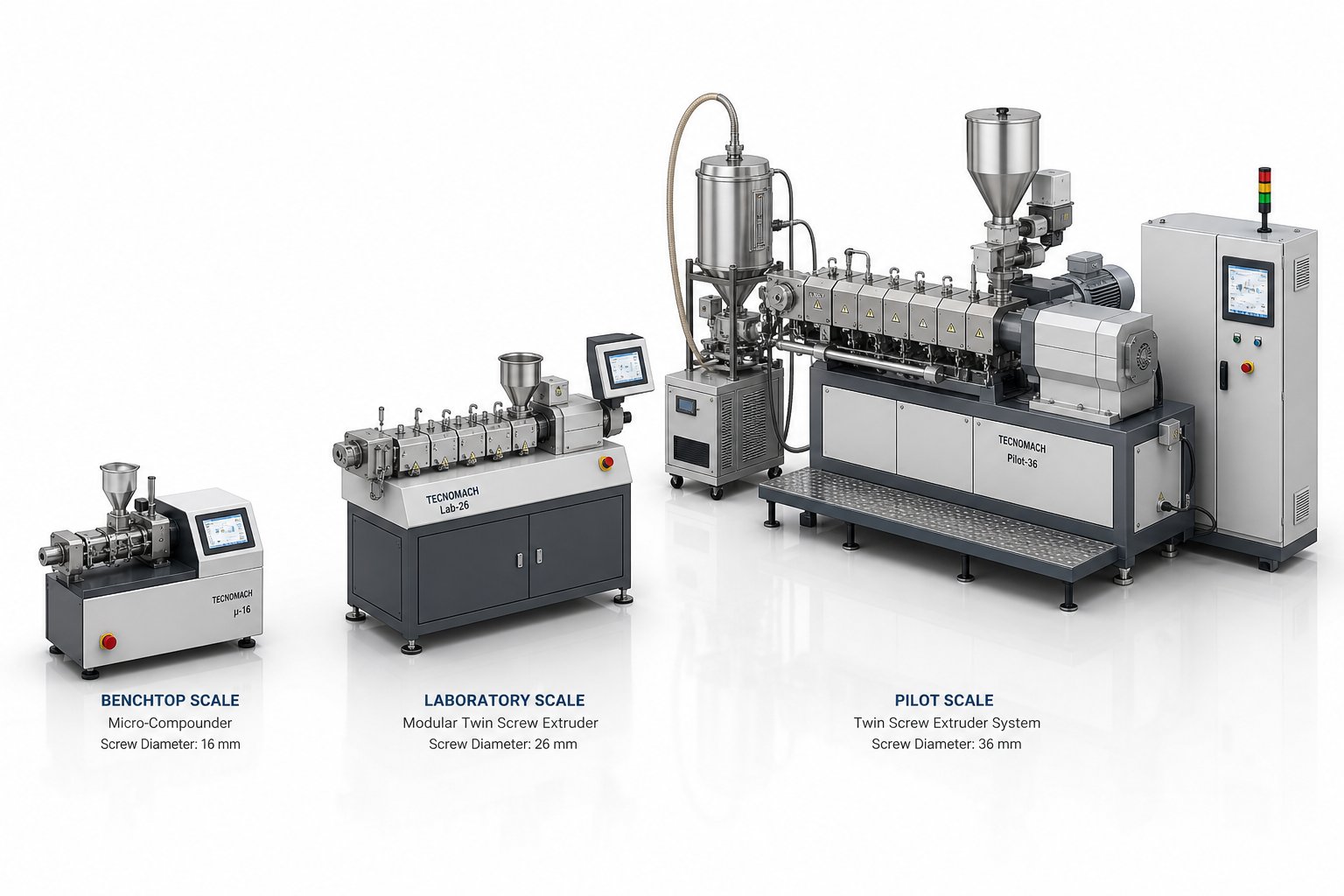
The small-scale twin screw extruder category actually breaks down into three distinct classes, each engineered for a specific stage of the development pipeline. Choosing the wrong class leads to frustrating mismatches — either wasting precious material on a machine that is too large, or bottlenecking your workflow on one that is too small. The table below lays out the key distinctions at a glance.
| Category | Typical Screw Diameter | Throughput Range | Primary Use Case | Ideal User |
|---|---|---|---|---|
| Benchtop / Desktop Micro-Compounder | 5 - 16 mm | Grams to ~5 kg/h | Early-stage formulation screening, feasibility studies | University researchers, pharmaceutical formulators, early R&D teams |
| Laboratory Twin Screw Extruder | 16 - 27 mm | 0.5 - 50 kg/h | Formulation optimization, material characterization, continuous small-batch processing | Polymer scientists, materials labs, formulation development teams |
| Pilot-Scale Small Twin Screw Extruder | 27 - 35 mm | 10 - 100 kg/h | Process validation, scale-up trials, small-batch production, customer samples | Pilot-line operators, process engineers, companies bridging to full production |
Benchtop and Desktop Micro-Compounders
Imagine you have synthesized a novel polymer in the lab and you only have 20 grams to work with. Running that through a standard lab scale extruder would be impossible — most of the material would be lost in dead zones and startup purges. This is exactly where benchtop twin screw extruder systems earn their place.
These micro-compounders represent the smallest units available, with screw diameters typically between 5 mm and 16 mm. They are designed specifically for situations where material is either extremely scarce or prohibitively expensive — think experimental drug compounds, newly synthesized polymers, or rare bio-based resins. At this scale, some machines operate in a recirculating batch mode, cycling a small charge of material through the screws repeatedly to achieve thorough mixing without requiring continuous feed. Others offer true continuous processing at gram-per-minute flow rates, depending on the design.
The trade-off is straightforward: you gain the ability to evaluate formulations using minimal material, but throughput is too low for anything beyond initial screening and feasibility testing. These machines answer one question well — "Does this formulation concept work?" — before you commit larger quantities to the next stage.
Laboratory Twin Screw Extruders
Once a formulation passes initial screening, the work shifts from "does it work?" to "how do we optimize it?" That transition demands a laboratory extruder capable of continuous processing with modular flexibility.
A laboratory twin screw extruder in the 16 mm to 27 mm screw diameter range bridges the gap between micro-scale screening and pilot production. These machines run continuously rather than in batch mode, producing enough material for comprehensive testing — mechanical property evaluation, rheological characterization, aging studies, and even small regulatory submission samples. Throughput typically spans from under 1 kg/h up to roughly 50 kg/h depending on the specific model and material.
What makes this class particularly valuable for R&D is modularity. Lab scale twin screw extruder systems feature segmented barrels and interchangeable screw elements — conveying sections, kneading blocks, mixing elements, and reverse-flight segments — that can be rearranged to create custom processing profiles. Need aggressive dispersive mixing for a nanofiller study? Swap in additional kneading blocks. Processing a heat-sensitive bioplastic? Shorten the mixing zone and add venting segments. Typical screw configuration changes take roughly 15 to 30 minutes, enabling researchers to test multiple process designs within a single day.
These machines also feature the kind of instrumentation that serious process development requires: multiple independent temperature zones with PID control, melt pressure sensors, torque monitoring, and data acquisition systems that log parameters for later analysis and scale-up reference. Lab scale extruder models in this range represent the workhorse tier for most materials research and formulation development programs.
Pilot-Scale Small Twin Screw Extruders
A formulation that performs beautifully on a 20 mm laboratory extruder does not automatically translate to a 65 mm or 75 mm production machine. Residence time distributions shift, heat transfer dynamics change, and feeding behavior can look entirely different at larger diameters. Pilot-scale units exist precisely to close this gap.
With screw diameters in the 27 mm to 35 mm range and throughputs reaching up to 100 kg/h, pilot-scale extruders replicate production-scale process conditions — shear rates, specific energy input, and thermal profiles — at significantly reduced material consumption. They serve as the critical validation step before committing to full-scale equipment purchases that can represent six- or seven-figure investments.
Beyond process validation, pilot units fill practical business needs. They can produce customer samples in sufficient quantity for application testing, generate material for extended product qualification, and even support limited small-batch manufacturing runs. For organizations developing new compounds or entering new markets, a lab twin screw extruder at pilot scale reduces the financial risk of scaling up by revealing process challenges early — when corrections are inexpensive rather than catastrophic.
Understanding which of these three categories matches your objectives is the essential first step. Get this decision right, and every downstream choice — screw configuration, barrel metallurgy, ancillary equipment — falls into place more naturally. Get it wrong, and you will find yourself either starved for throughput or burning through material you cannot afford to waste. The next critical decision involves screw geometry itself, where the choice between co-rotating and conical configurations shapes what your extruder can actually accomplish.
Co-Rotating vs. Conical Small Twin Screw Extruders
Screw geometry is not a minor spec-sheet detail — it determines how your material moves, melts, and mixes inside the barrel. Two dominant configurations show up across the small twin screw extruder landscape: co-rotating parallel designs and conical (counter-rotating, converging-barrel) designs. Each brings a distinct set of strengths, and picking the wrong one for your application creates processing headaches that no amount of parameter tuning can fix.
So how do you tell them apart, and which one belongs in your lab or pilot line? The answer depends entirely on what you need the machine to do.
Co-Rotating Intermeshing Design
A co-rotating twin screw extruder features two parallel screws turning in the same direction inside a figure-eight barrel bore. The screws intermesh tightly, and their matched rotation creates a self-wiping action — each screw continuously scrapes material off its partner, preventing buildup and stagnation zones inside the barrel.
This self-wiping behavior delivers two practical benefits that matter enormously at lab and pilot scale. First, it reduces cross-contamination between runs. When you are switching from a carbon-black-filled compound to a white masterbatch trial, the last thing you want is residual dark material bleeding into your next sample. The self-cleaning profile minimizes purge time and material waste during changeovers. Second, it eliminates dead spots where heat-sensitive polymers or pharmaceutical compounds could degrade.
The real hallmark of this configuration, though, is mixing performance. Co-rotating intermeshing geometry generates both distributive mixing — spreading components uniformly throughout the melt — and dispersive mixing — breaking down agglomerates of fillers, pigments, or active ingredients into individual particles. That dual-action capability is why co-rotating designs dominate in compounding, reactive extrusion, and any twin screw extrusion process where homogeneity is the primary goal.
Modularity seals the advantage. Co-rotating parallel twin screw extruder systems use interchangeable screw elements — conveying flights, kneading blocks of various stagger angles, mixing elements, and reverse segments — that slide onto a common shaft. Researchers can reconfigure the screw profile in under an hour to shift from gentle conveying to aggressive high-shear dispersion without purchasing a new screw set. This flexibility makes co-rotating machines the default choice in R&D labs and pilot facilities processing diverse materials and formulations.
Conical Twin Screw Design
Picture two screws that start wide at the feed end and taper progressively toward the discharge — that is the defining feature of a conical twin screw extruder. The converging barrel geometry naturally compresses material as it travels forward, generating high pressure without requiring additional compression elements in the screw design.
This built-in compression delivers strong conveying force, which is particularly useful for materials that are difficult to feed — bulky powders, low-bulk-density flakes, or rigid PVC dry blends that resist being pulled into a parallel barrel. The tapering geometry packs material efficiently and builds the melt pressure needed to push it through a die, all within a surprisingly compact machine footprint.
Conical designs also feature a mechanically simpler drive system. Because the screws converge at an angle, the large-diameter feed end provides generous root area for robust bearings and gear engagement, delivering high torque capacity relative to the machine's overall size. The trade-off? Most conical extruders use integrated, one-piece screws rather than modular elements. That means the screw profile is fixed at the time of manufacture — you cannot swap in different kneading blocks or rearrange mixing zones the way you can on a co-rotating parallel machine.
At small scale, conical configurations tend to show up in direct extrusion applications — producing profiles, pipes, sheets, or film from pre-compounded material — rather than in compounding or formulation development work. They excel where the job is melting and shaping a known material under high pressure, not exploring new formulations that demand flexible process design.
Parallel vs. Conical at a Glance
Choosing between these two geometries does not have to be complicated. The table below distills the comparison into the five criteria that matter most when selecting a small twin screw extruder for lab or pilot use.
| Criterion | Co-Rotating Parallel | Conical (Counter-Rotating) |
|---|---|---|
| Mixing Capability | Excellent distributive and dispersive mixing; ideal for compounding and reactive extrusion | Moderate mixing; better suited to melting and pressure generation than intensive blending |
| Self-Cleaning Behavior | Fully self-wiping; minimal residue between runs, fast changeovers | Limited self-cleaning; material can accumulate in taper transitions |
| Compactness | Longer barrel for a given L/D ratio due to constant screw diameter | Shorter overall length thanks to converging geometry; fits tighter spaces |
| Typical Applications | Compounding, masterbatch, reactive extrusion, pharmaceutical HME, formulation R&D | PVC profile and pipe extrusion, high-pressure direct forming, pre-compounded material shaping |
| Screw Modularity | Fully modular; interchangeable elements allow rapid process reconfiguration | Integrated one-piece screws; profile fixed at manufacture, new screw required for changes |
Here is the practical takeaway: if your work involves developing new formulations, dispersing additives, or running multiple material systems through the same machine, a co-rotating parallel twin screw extruder is almost certainly the right fit. Its modularity and mixing superiority are built for exactly that kind of exploratory, multi-material workflow. If your objective is direct extrusion of a single established material — particularly PVC — where high-pressure output and a compact footprint matter more than mixing versatility, a conical design earns its place.
Of course, screw geometry is only half the equation. How these machines stack up against their single-screw counterparts at small scale reveals another layer of trade-offs that shapes purchasing decisions in labs and pilot lines alike.
Twin Screw vs. Single Screw Extruders at Small Scale
Every lab manager or R&D engineer who budgets for extrusion equipment eventually faces the same question: do we really need a double screw extruder, or can a single screw machine handle the job? At production scale, the answer often depends on throughput economics. At lab and pilot scale, though, the deciding factor shifts almost entirely to mixing performance and process flexibility — and that is where the two architectures diverge sharply.
Understanding why twin screw designs dominate small-scale compounding and formulation work, while single screw extruders occupy a narrower but still legitimate role, prevents both overspending and underperforming. Let's break down the comparison where it matters most.
Mixing and Compounding Performance Compared
The fundamental difference comes down to how material moves through each machine. In a single screw extruder, polymer advances primarily by drag flow — the rotating screw pushes material against the stationary barrel wall, and friction drives it forward. As extrusion authority Jim Frankland explains in Plastics Technology, the shear rate in a single screw channel is highest at the barrel surface and drops to near zero at the screw root. This velocity gradient creates stratified flow, meaning the material at the top of the channel experiences very different conditions than material at the bottom.
The practical consequence? Incomplete turnover of the melt. Additives, fillers, and pigments tend to stay in roughly the same radial position as they travel down the channel, making thorough homogenization difficult without adding flow-restricting mixing elements — which in turn reduce output and raise melt temperature.
A double screw extruder machine solves this problem through a completely different mechanism. Twin intermeshing screws can transfer the entire channel contents from one screw to the other, repeatedly, as material progresses down the barrel. Each transfer event exposes a new fraction of the melt to high shear in the intermeshing zone while keeping overall shear stress on the bulk material manageable. This combination delivers both distributive mixing — spreading components uniformly throughout the melt — and dispersive mixing — breaking apart agglomerates of fillers, pigments, or nanoparticles that cling together.
For tasks common in small-scale R&D — dispersing nanofillers into polymer matrices, blending immiscible polymer pairs, incorporating high loadings of mineral additives, or embedding active pharmaceutical ingredients into carrier polymers — twin screw extruders are fundamentally superior. The intermeshing geometry provides intensive, controllable mixing without the temperature penalties that plague single screw machines when you try to achieve comparable homogeneity.
Process Flexibility and Control
Imagine you need to run a glass-fiber-reinforced nylon compound on Monday, a reactive grafting trial on Wednesday, and a degassing study on a moisture-sensitive bioplastic on Friday — all on the same machine. With a modular co-rotating screw extruder, you simply rearrange screw elements to create a different process profile for each job. Swap conveying elements for kneading blocks where you need dispersion, add reverse segments to build back-pressure, or insert open barrel sections for atmospheric or vacuum venting. Each configuration change takes under an hour.
Single screw machines offer far less of this configurability. While devices like the Maddock mixer can provide a single stage of full melt turnover and localized high shear, stacking multiple mixing sections onto a single screw creates cumulative pressure drop that reduces output and elevates melt temperature to potentially damaging levels. As a result, single screw extruders tend to work best with a fixed screw design matched to a specific material and process — not the kind of flexibility that R&D labs need.
Residence time distribution (RTD) is another critical differentiator. Twin screw extruders operating in starve-fed mode produce a narrow, well-controlled RTD because material spends a predictable amount of time in each barrel zone. Researchers can fine-tune this by adjusting screw speed and feed rate independently — a capability single screw machines lack, since their output is directly coupled to screw speed. For heat-sensitive materials like certain pharmaceutical polymers, biodegradable resins, or reactive chemistries where even seconds of excess thermal exposure can cause degradation, that tight RTD control is not a luxury. It is a processing requirement.
Data acquisition reinforces this advantage. Modern lab-scale double screw extruder systems typically feature independent temperature control across multiple barrel zones, inline torque monitoring, melt pressure sensors, and logging software that records every parameter for scale-up documentation. Single screw machines at comparable scale often offer fewer instrumentation options, limiting the quality of process data available for later production transfer.
When a Single Screw Still Makes Sense
None of this means single screw extruders have no place in a small-scale operation. For certain applications, they remain the more practical — and more economical — choice. The key is matching the machine to the task honestly, without paying for mixing capability you will never use.
Single screw extruders can be the better option when the job involves simple melting and forming of a pre-compounded material, producing profiles, tubing, or film from a resin that already contains all necessary additives. They also carry a lower equipment cost, which matters for academic labs with tight budgets that only need basic melt processing. Their mechanical simplicity translates to easier maintenance and fewer components that can wear or fail.
So how do you decide? Consider the following criteria:
- Does your process require intensive mixing or dispersion? If yes, a twin screw design is essential. Single screw machines cannot replicate intermeshing-zone mixing.
- Will you process multiple different materials or formulations? If yes, the modularity of twin screw extruders saves significant time and cost versus owning multiple fixed-geometry single screws.
- Is your material heat-sensitive or reactive? If yes, the independent speed-throughput control and narrow RTD of a twin screw system provides the thermal precision you need.
- Is your primary task melting and shaping a single, pre-compounded resin? If yes, a single screw extruder handles this efficiently at lower capital cost.
- Is budget the overriding constraint with minimal mixing requirements? If yes, a single screw machine delivers basic extrusion capability at the lowest entry price.
- Do you need detailed process data for scale-up? If yes, twin screw systems typically offer superior instrumentation and data logging.
For the majority of small-scale compounding, formulation development, and reactive extrusion work, twin screw extruders are the default for good reason — their mixing physics and process flexibility are built for exactly the kind of exploratory, multi-variable work that defines R&D. Single screw machines earn their place in a narrower lane: straightforward melt processing where simplicity and cost efficiency outweigh mixing performance.
The real value of these machines, though, becomes clearest when you look at what researchers actually do with them day to day — and the range of industries where small-scale twin screw extrusion has become indispensable stretches far beyond traditional plastics.

Key Applications Across Industries and Research Fields
Polymer compounding may be the first application that comes to mind, but it barely scratches the surface. From pharmaceutical labs formulating life-saving drugs to battery research facilities developing next-generation electrodes, small twin screw extruders have become essential processing tools wherever intensive mixing at small volumes meets tight process control. What separates practical understanding from a superficial overview is knowing exactly what these machines do in each field — not just where they show up.
Polymer Compounding and Materials Research
Think about the workflow behind a new engineering plastic. A polymer scientist starts with a base resin and needs to answer a chain of questions: Which filler gives the best stiffness-to-toughness balance? What compatibilizer keeps an immiscible polymer blend from delaminating? How much flame retardant can you load before processability collapses?
A compounding twin screw extruder at lab scale turns each of those questions into a quick, low-cost experiment. Researchers prepare small batches — sometimes as little as 50 to 200 grams — for each formulation variant, run them through the extruder, and collect pellets or strands for mechanical testing, microscopy, and thermal analysis. In a single day, a well-organized team can screen a dozen masterbatch compositions or filler dispersion levels using the same machine by swapping screw configurations and adjusting temperature profiles between runs.
Typical compounding tasks performed on this type of plastic compounding equipment include:
- Masterbatch creation with concentrated pigment or additive loadings
- Filler dispersion studies using nano-silica, carbon nanotubes, or mineral reinforcements
- Compatibilizer screening for immiscible polymer blends like PA/PP or PLA/PBAT
- Polymer blend optimization, where component ratios and processing temperatures are varied systematically
The material savings alone are significant. Running the same set of experiments on a production-scale compounding extruder would consume hundreds of kilograms of resin and additives. An extruder for polymer research at the 16 mm to 27 mm scale accomplishes the same exploratory work with a fraction of the material — and generates data that directly informs scale-up decisions later.
Pharmaceutical Hot-Melt Extrusion
Here is a problem that keeps pharmaceutical formulators up at night: roughly 40% of marketed drugs and up to 90% of pipeline compounds suffer from poor aqueous solubility, which limits how much active ingredient actually reaches the bloodstream after a patient swallows a tablet. One of the most effective solutions is creating an amorphous solid dispersion — embedding the crystalline drug molecule into a polymer carrier matrix at a molecular level, converting it into an amorphous form with dramatically improved dissolution behavior.
Twin screw extrusion is the dominant manufacturing method for these dispersions, and small-scale machines play a critical early-stage role. Active pharmaceutical ingredients (APIs) are expensive — sometimes exceeding $10,000 per kilogram for novel compounds. Running formulation trials on a 11 mm or 16 mm extruder lets formulators evaluate drug-polymer compatibility, identify optimal processing temperatures, and determine drug loading limits using as little as 10 grams of API per run. As pharmaceutical extrusion expert Dr. Feng Zhang notes, a small extruder can process 10 grams and yield 3 to 4 grams of usable extrudate — enough for critical analytical characterization.
Precise temperature control matters enormously here. Many APIs begin degrading at temperatures only 20 to 30 degrees above their processing window. Small twin screw extruders with multiple independent heating zones and tight PID control let formulators walk that thermal tightrope while maintaining the mixing intensity needed to dissolve crystalline drug particles into the polymer melt. The most commonly used carrier polymers — copovidone, hypromellose, and hypromellose acetate succinate — each have distinct melt viscosity profiles that require careful temperature and screw speed balancing.
Food Science and Bioplastics Development
Walk into a food science lab working on plant-based protein and you will likely find a lab-scale twin screw extruder at the center of the operation. Texturized vegetable protein — the chewy, fibrous material that gives plant-based meat alternatives their structure — is produced through high-moisture extrusion, where proteins are subjected to heat, shear, and pressure inside the barrel to create aligned fiber structures.
Food scientists use small-scale machines to optimize extrusion parameters for novel protein sources like pea, faba bean, or microalgae. Each protein feedstock behaves differently under shear, and finding the right combination of barrel temperature profile, screw speed, and moisture content requires extensive iteration. Running those trials on equipment consuming just a few kilograms of material per hour keeps raw material costs manageable during early development.
Beyond protein texturization, lab-scale twin screw extrusion supports snack formulation studies, flavor and nutrient encapsulation trials, and development of novel starch-based food products. The same mixing versatility that makes these machines ideal for polymer compounding translates directly to food processing, where uniform ingredient distribution and controlled thermal treatment determine product quality.
Bioplastics research follows a parallel trajectory. As the industry pushes toward biodegradable alternatives to conventional plastics, researchers are compounding PLA, PHA, starch blends, and other bio-based resins with plasticizers, nucleating agents, and natural fiber reinforcements. A small-scale compounding extruder allows rapid evaluation of formulation candidates — testing dozens of additive combinations before committing promising ones to pilot-scale validation.
Advanced and Specialty Material Processing
Some of the most exciting work happening on small twin screw extruders falls outside traditional polymer or pharmaceutical categories entirely. Emerging applications are expanding the role of these machines into fields that would have seemed unlikely a decade ago:
- Conductive polymer compounding — dispersing carbon black, graphene, or carbon nanotubes into polymer matrices for EMI shielding, antistatic packaging, or flexible electronics
- Ceramic feedstock preparation — mixing ceramic powders with polymer binders to create injection-moldable or 3D-printable feedstocks for advanced ceramics manufacturing
- Battery electrode material mixing — continuous compounding of cathode and anode slurries for lithium-ion batteries, where twin screw mixing delivers superior dispersion quality and reduced solvent consumption compared to conventional planetary mixers
- Recycled plastic upcycling research — blending post-consumer waste streams with compatibilizers and performance additives to restore mechanical properties, supporting circular economy initiatives
- Solid-state battery development — processing solid electrolyte materials and gel polymer separators under controlled inert atmospheres using lab-scale extruders housed inside glove boxes
The common thread across every one of these applications is the same: researchers need intensive, controllable mixing at volumes small enough to conserve scarce or expensive materials, combined with the process flexibility to adjust parameters rapidly as they explore uncharted formulation territory. That dual requirement — mixing quality plus small-batch economics — is precisely what defines the value proposition of a small twin screw extruder regardless of the industry it serves.
Yet delivering that mixing quality consistently depends on something most application guides overlook entirely: the screw and barrel components themselves. Their geometry, metallurgy, and configuration determine whether the extruder performs as designed or falls short — a distinction that becomes even more critical as screw diameters shrink and processing tolerances tighten.
Screw and Barrel Design Considerations for Small Extruders
Here is something that catches many first-time users off guard: a twin screw barrel set on a 16 mm lab extruder operates with radial clearances measured in hundredths of a millimeter. At those tolerances, even modest wear on a flight tip or barrel liner changes the shear field enough to shift dispersion quality, alter residence time, and compromise the reproducibility of your results. On a 92 mm production machine, the same absolute amount of wear represents a far smaller fraction of total channel depth and has a proportionally smaller effect on process behavior.
This is why screw and barrel design decisions carry outsized weight at small scale. The geometry of each screw element, the metallurgy of the contact surfaces, and the overall configuration of the twin screw and barrel assembly determine whether your extruder delivers the mixing performance, wear life, and process flexibility that your application demands. Get these choices right and the machine becomes a precision instrument. Get them wrong and you will spend more time troubleshooting inconsistent results than generating useful data.
Screw Element Configuration for Small-Scale Processing
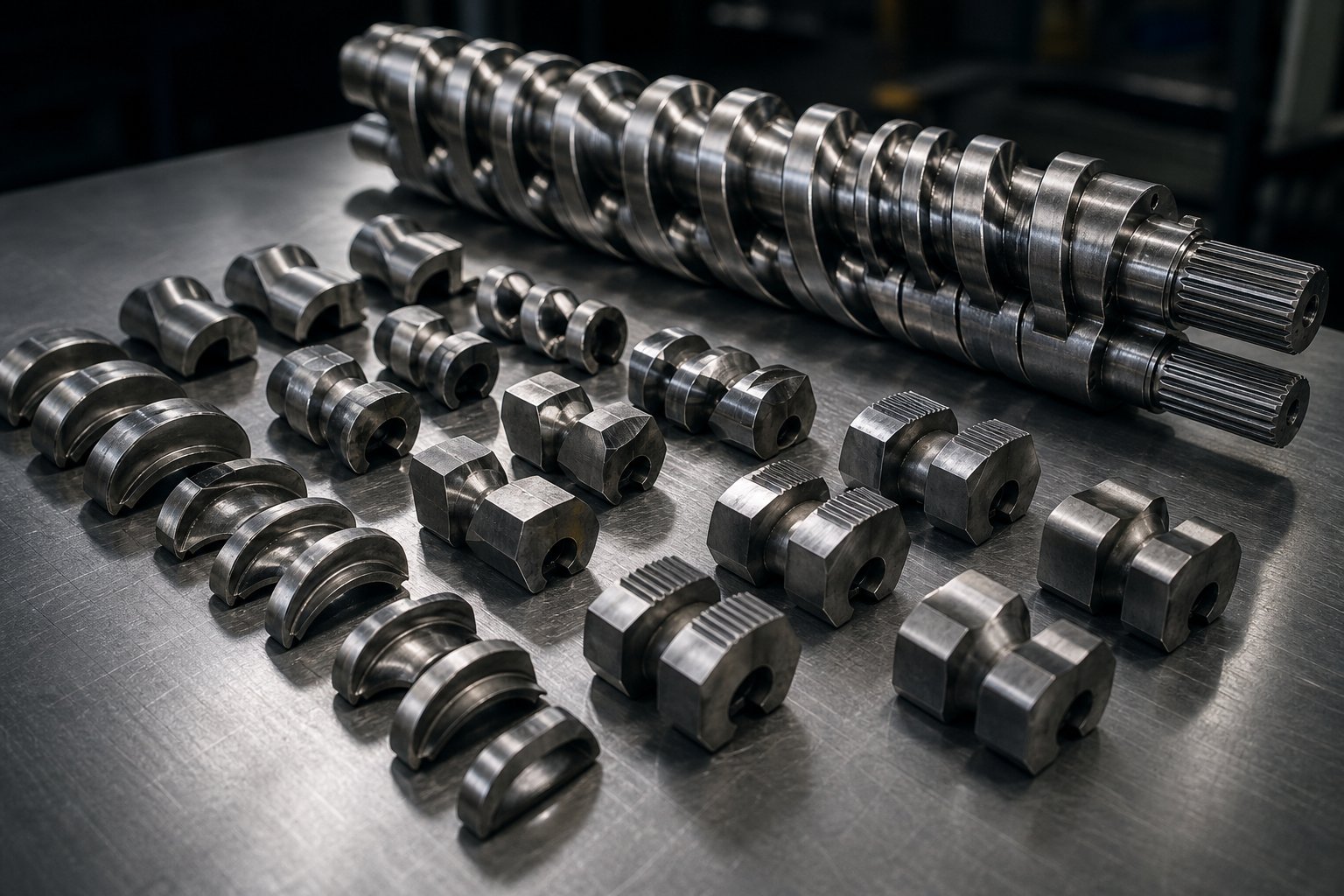
Every modular co-rotating extruder builds its screw profile from a library of individual elements that slide onto a keyed shaft. As NC State Extension's extrusion processing guide explains, configuring these elements is a blend of art and science — no gold standard exists because every material exhibits unique flow properties influenced by temperature, shear rate, and extruder geometry. Four main element families do the work:
- Conveying elements — Deep-flighted screws that transport material forward efficiently without imparting significant shear. Deeper channels mean higher screw volume and gentler handling, making these the default choice in feed zones and transition sections.
- Kneading blocks — Stacked lobed discs offset at specific angles (commonly 30, 45, 60, or 90 degrees) that create the mixing action central to compounding. Wider kneading elements promote dispersive mixing by applying strong shear stress to break apart agglomerates, while narrow elements favor distributive mixing that spreads components uniformly without particle breakdown.
- Toothed mixing elements — Specialized segments that combine distributive mixing with gentle material handling, useful for blending heat-sensitive formulations where aggressive kneading blocks would cause thermal degradation.
- Reverse elements — Left-handed conveying or kneading segments that push material backward, creating a restriction that increases fill level, residence time, and localized pressure upstream. These are essential for building the back-pressure needed for degassing zones or ensuring complete melting before a mixing section.
The arrangement of kneading elements alone illustrates how much control a well-designed screw profile provides. Forward-offset kneading blocks convey material gently while mixing. Neutral (90-degree) blocks stop forward conveyance entirely, forcing material to dwell and absorb energy — an aggressive configuration that maximizes shear. Reverse kneading blocks push material backward, creating maximum restriction and the highest shear intensity of any element type.
Why does all of this matter more on a small-diameter screw plastic extruder than on a large production machine? Because channel depths on a 16 mm screw are roughly one-quarter those on a 62 mm screw. A single additional kneading disc or a change in stagger angle produces a proportionally larger shift in pressure drop, fill level, and energy input at the smaller scale. Researchers working on small extruders quickly discover that moving one element position — or swapping a 30-degree kneading block for a 60-degree one — can be the difference between a well-dispersed compound and an under-mixed or thermally degraded one. Careful documentation of every screw configuration and its resulting process behavior is not optional at this scale. It is the foundation for reproducible results and successful scale-up later.
Barrel and Screw Metallurgy Options
The materials your screws and barrel liners are made from determine how long they last, how well they resist chemical attack, and ultimately how much it costs to keep your extruder performing to specification. At small scale, metallurgy choices become especially consequential because replacement parts represent a larger share of the original machine cost — and because the tight clearances that define small-extruder performance degrade faster when wear accelerates.
Three broad metallurgy tiers cover the vast majority of barrel extruder and screw applications:
- Nitrided tool steels — The most cost-effective option for general-purpose polymer compounding. Surface hardening through nitriding creates a wear-resistant case that handles unfilled and lightly filled polymers well. Suitable for R&D programs processing standard thermoplastics like PE, PP, PS, and ABS without abrasive additives.
- Through-hardened tool steels and powder metallurgy (PM/HIP) alloys — Required when processing abrasive fillers such as glass fiber, mineral compounds, carbon fiber, or ceramic powders. Industry experience from ENTEK shows a dramatic shift in materials of construction over the past decade: Hot Isostatic Pressed (HIP) alloys now account for roughly 60% of screw and barrel production, up from just 10% previously, driven by demand for superior wear resistance. Many manufacturers now build screws in a bi-metallic construction — a tough core that resists torque overloads paired with a hard, wear-resistant HIP outer shell — because solid HIP elements, while extremely hard, are brittle and prone to breakage under torque spikes.
- Corrosion-resistant alloys (Hastelloy, Inconel, high-chromium steels) — Essential for processing chemically aggressive materials. Pharmaceutical reactive chemistries, fluoropolymers, and certain specialty chemical compounds attack standard steels through corrosive wear, indicated by pitted surfaces and the rounding-off of sharp edges. High-nickel alloys like Hastelloy offer superior corrosion protection through elevated nickel and chromium content. The trade-off is significant: these exotic alloys typically have Rockwell C hardness values of 35 or less, meaning they resist chemical attack well but wear faster under abrasion. They are also expensive to source and machine. For these reasons, corrosion-resistant alloys are reserved for applications where chemical severity justifies the premium.
Modern barrel construction has also evolved to reduce long-term costs. Rather than manufacturing barrels as single-use monolithic pieces, most quality manufacturers now build them with replaceable liners. The barrel body — containing cooling passages, thermocouple wells, injection ports, and mounting hardware — can be reused indefinitely. When the liner wears out, you replace only the liner rather than the entire barrel assembly, significantly reducing the total cost of maintaining a twin screw barrel set over the life of the machine.
A practical rule of thumb guides screw-versus-barrel metallurgy pairing: the screw should be made from material that is equal to or slightly softer than the barrel liner. Since screw geometries are more complex and cheaper to replace than barrels, you want the screw to be the sacrificial wear component. This deliberate asymmetry extends barrel life and keeps your most expensive wear part in service longer.
When Custom Screw Design Becomes Essential
Off-the-shelf screw configurations work well for common materials and established processes. But anyone who has tried processing a novel nanocomposite formulation, an experimental pharmaceutical dispersion, or an unusually abrasive ceramic feedstock on a standard screw profile knows the frustration: inadequate dispersion, excessive melt temperature, inconsistent output, or rapid wear that degrades results after just a few hours of operation.
At lab and pilot scale, these problems are amplified. You cannot compensate for a poorly matched screw design by simply increasing barrel length or adding mixing stages — the machine's physical constraints are fixed, and every element position counts. The margin for error in screw profile design shrinks as screw diameter decreases.
Several situations reliably push teams beyond standard configurations:
- Processing materials with unusual rheological behavior — extremely high or low viscosity melts, shear-thickening suspensions, or compounds with narrow thermal processing windows
- Achieving dispersion targets for high-aspect-ratio fillers like carbon nanotubes or graphene nanoplatelets, where standard kneading blocks provide insufficient shear or excessive fiber breakage
- Running reactive extrusion processes that require precise residence time control through strategically placed restrictive elements
- Adapting screws for compact or non-standard barrel extruder geometries found in specialized research equipment
For R&D labs, universities, and small-batch processors facing these challenges, working with a specialist who understands both screw design principles and the unique constraints of compact equipment makes a measurable difference. NANHAIYA's Custom Screw Design Services support exactly this type of work — tailoring screw and barrel solutions for teams processing specialized materials, running experimental extrusion programs, or operating equipment where standard geometries simply do not deliver the required performance. Rather than iterating through multiple off-the-shelf element combinations hoping to find one that works, a purpose-designed screw profile addresses the material and process requirements directly.
Whether you are optimizing element arrangement on an existing machine or specifying metallurgy for an aggressive new compound, the twin screw and barrel components are where process performance is ultimately won or lost. That reality becomes even more relevant when formulations developed on these carefully configured small machines need to move to larger equipment — a transition where the quality of your lab-scale screw design and process documentation directly determines how smoothly the scale-up goes.
Scaling Up from Lab Extruder to Production Equipment
You have spent weeks perfecting a formulation on your laboratory scale extruder. The dispersion looks flawless under a microscope, mechanical properties hit every target, and your process parameters are locked in with clean, repeatable data. Then you transfer those exact settings to a 92 mm production machine — and watch unmelted pellets pour out the discharge end into a waste drum.
That scenario is not hypothetical. It is a documented case study from Dow's scale-up research, where a masterbatch compounded successfully on a 26 mm lab twin screw extruder failed dramatically when transferred directly to commercial-scale equipment. The specific mechanical energy (SME) input dropped by 67% at the larger diameter, producing phase separation, poor mixing, and a process that could not even pelletize the output.
Stories like this reveal a critical truth about scaling twin screw extrusion: some process parameters translate across machine sizes, and some absolutely do not. Knowing which is which — and planning for the differences — separates a smooth production launch from months of costly troubleshooting.
Parameters That Scale and Parameters That Do Not
When researchers move from a small extruder system to a larger one, they naturally want to carry forward the conditions that produced good results. Certain variables do remain relatively consistent across geometrically similar machines — those sharing the same length-to-diameter (L/D) ratio and outer-diameter-to-inner-diameter (OD/ID) screw ratio. Others shift in ways that catch even experienced engineers off guard.
What tends to transfer well:
- Specific mechanical energy (SME) — Expressed as kilowatt-hours per kilogram, SME captures the energy the screws deliver into the melt per unit mass. It is the single most reliable scale-up reference parameter. In the Dow case study, the optimized process on the 26 mm extruder produced an SME of 0.083 kWh/kg. Every time the pilot (40 mm) or production (92 mm) machine was adjusted to match that SME value, product quality and process stability recovered.
- Temperature profiles — Barrel zone setpoints serve as a useful starting framework, though they often require fine-tuning at larger diameters due to changed heat transfer dynamics.
- Screw speed-to-throughput ratios — Maintaining a comparable ratio of RPM to feed rate helps preserve fill level and mixing intensity, even though absolute values change.
- Screw profile philosophy — The general sequence of conveying, melting, mixing, and pressure-building zones should mirror the lab-scale design, serving as the starting point for the larger machine.
What changes significantly:
- Heat transfer dynamics — This is the biggest trap in twin screw extrusion scale-up. As barrel diameter increases, the surface-area-to-volume ratio drops dramatically. A 26 mm extruder has far more barrel surface per unit of melt volume than a 92 mm machine. That means the larger extruder has less ability to add or remove heat through the barrel wall. Thermo Fisher's scale-up analysis emphasizes that if a small-scale process relies heavily on external barrel heating or cooling to maintain melt temperature, those conditions become impossible to replicate at production scale.
- Residence time distribution (RTD) — Larger barrels and changed fill levels alter how long material spends in each processing zone. Even with proportional screw speeds, the RTD profile shifts, which can affect degradation of heat-sensitive materials or completion of reactive extrusion chemistries.
- Feeding behavior — A loss-in-weight feeder delivering 500 g/h of powder into a 16 mm lab extruder behaves very differently from a gravimetric system feeding 200 kg/h into a production line. Bridging, segregation, and flow inconsistencies that never appeared at small scale can surface at higher rates.
The concept of geometric similarity ties these factors together. When a lab twin screw extruder and its production counterpart share the same OD/ID ratio and L/D ratio, the fundamental flow geometry of the screw channels remains proportional. This proportionality is what allows parameter-based scale-up to work at all. Without it — say, transferring a process from one vendor's 18 mm machine to a different vendor's 50 mm design with a different OD/ID ratio — predicting behavior becomes far more complex because the relationship between screw geometry and process response changes in ways that are difficult to model.
Geometric similarity, however, has limits. It preserves proportional relationships but cannot override the physics of changed surface-area-to-volume ratios or the non-linear behavior of complex polymer melts at different shear rates. It is a necessary starting condition, not a guarantee.
Common Scale-Up Challenges and How to Mitigate Them
Even with careful planning, scale transitions reveal surprises. The following pitfalls appear repeatedly across polymer and pharmaceutical extrusion scale-up projects — and each has practical countermeasures.
- Changed mixing intensity at larger diameters. Screw tip speed increases linearly with diameter at the same RPM. A 92 mm screw spinning at the same rotational speed as a 26 mm screw delivers roughly 3.5 times higher tip speed — and correspondingly higher peak shear rates. For temperature-sensitive pharmaceutical excipients or shear-degradable polymers, this can push material past its processing window. The fix: reduce RPM on the larger machine and compensate by increasing kneading section length or modifying element stagger angles to maintain total energy input without excessive peak shear. As Pharmaceutical Technology reports, tight tolerances that improve self-wiping behavior and specialized mixing element designs can also reduce peak shear effects at larger scale.
- Altered fill levels affecting degassing. Vacuum venting zones require partially filled screw channels to expose fresh melt surface and allow volatiles to escape. If fill level increases at larger scale — due to changed throughput-to-speed ratios or different starve-feed behavior — venting efficiency drops. Residual moisture or volatiles that were easily removed on the lab machine may persist in the production extrudate. Mitigation involves monitoring fill levels explicitly through pressure sensors and adjusting feed rate or screw speed to maintain comparable free volume in venting sections.
- Feeding inconsistencies when changing feeder types. Laboratory scale extruder work often uses premixed feeds — all components blended before entering the hopper — because small volumes make split-feeding with multiple micro-feeders impractical. Production processes, however, frequently use split-feeding, where polymer and additives enter the barrel at different locations through separate gravimetric feeders. Since the feeding method significantly affects how and where mixing occurs inside the barrel, switching from premix to split-feed during scale-up changes the process fundamentally. The solution: match feeding configurations between scales whenever possible, or at minimum, document and account for the difference during process transfer.
- Thermal management differences. A well-designed laboratory process should approach adiabatic operation at steady state — meaning the dominant energy input comes from the mechanical work of the screws, not from external barrel heaters. If your small-scale process depends on barrel heating to achieve target melt temperatures, that dependence will become a liability at larger diameters where the barrel simply cannot supply or remove enough heat per unit volume. The best mitigation starts during lab development: design the process to be thermally self-sufficient as early as possible.
One practice that pays dividends across all four challenges is rigorous documentation during lab work. Record every screw configuration, temperature profile, torque reading, SME value, feed rate, and RPM — not just final optimized conditions but also the failed runs and parameter sweeps that defined the boundaries of your process window. That data becomes the roadmap for the pilot and production teams who will need to troubleshoot deviations. Without it, scale-up becomes trial and error at a much more expensive scale.
The Role of Pilot-Scale Extruders as a Bridge
Jumping directly from a 16 mm or 20 mm twin-screw extruder machine to a 70 mm or 92 mm production line is technically possible — but risky. The Dow case study illustrates why: even with geometrically similar equipment, the transition from 26 mm to 92 mm required two rounds of significant screw design and process modifications before achieving stable operation. The intermediate step on a 40 mm pilot extruder revealed problems — pressure instability, phase separation, SME mismatch — that were manageable at that scale but would have been far more costly to diagnose and fix on the production machine.
Pilot-scale extruders, typically in the 27 mm to 40 mm screw diameter range, reduce scale-up risk by providing an intermediate validation point. They reveal heat transfer limitations, feeding challenges, and mixing intensity changes at a scale where material consumption is still reasonable and process adjustments can be made quickly. A problem that wastes 20 kg of material on a pilot line could waste 200 kg or more on a production extruder — not counting downtime, cleanup, and requalification costs.
Selecting the right pilot machine matters as much as using one at all. The pilot extruder should share geometric similarity — same OD/ID ratio, same L/D ratio, and the same screw element design family — with both the lab machine that generated the original data and the target production extruder. This continuity ensures that SME, shear rate, and residence time relationships remain comparable across all three scales, giving process engineers a coherent data set to work with rather than three disconnected experiments.
This three-stage workflow — lab, pilot, production — is standard practice in both polymer and pharmaceutical extrusion development. In the pharma space, mid-size extruders in the 12 mm to 20 mm range are used explicitly for process development and clinical-scale trials, with scale-up proceeding to 26 mm to 32 mm pilot machines and eventually to 40 mm to 70 mm commercial units. Some drug manufacturers even choose to remain at the mid-size scale for commercial production when volumes justify it, avoiding the risks of an unnecessary jump to larger equipment.
The underlying principle applies universally, regardless of industry: each scale transition should change only the equipment size, not the fundamental process. When geometric similarity supports parameter alignment, and when thorough lab-stage documentation provides a clear reference framework, moving from a small extruder system to full-scale production becomes less an act of faith and more an engineering exercise grounded in data.
Successful scale-up, however, does not end when the production line starts running. The wear patterns, maintenance demands, and replacement economics of small-scale machines follow their own rules — and understanding those realities before purchase prevents unpleasant surprises in your operating budget.
Maintenance Costs and Ownership Realities for Small Twin Screw Extruders
Buying the machine is the easy part. Keeping it running at peak performance year after year — that is where the real cost picture emerges. And for small twin screw extruders, the maintenance and ownership economics follow different rules than their production-scale counterparts. Tighter tolerances, proportionally expensive replacement parts, and wear patterns that degrade performance faster all combine to make informed maintenance practices not just good housekeeping, but a genuine financial strategy.
Yet this is exactly the topic that most equipment guides skip entirely. They cover specifications, applications, and screw configurations in detail, then leave buyers to discover the operational realities on their own — usually through an unexpected repair bill or a batch of inconsistent extrudate that traces back to worn screw flights nobody thought to inspect. Here is what you actually need to know before writing a purchase order.
Maintenance Requirements Unique to Small-Scale Machines
Imagine a screw flight tip that has worn down by just 0.05 mm. On a 75 mm production extruder, that amount of wear barely registers — it represents a tiny fraction of the total channel depth and has minimal impact on shear field or mixing performance. On a 16 mm lab extruder, however, the same 0.05 mm of wear changes the radial clearance by a much larger percentage. That seemingly insignificant loss can shift dispersion quality, alter residence time distribution, and compromise the reproducibility of your experimental data.
This proportional sensitivity is the defining maintenance challenge at small scale. As Glycon Corp.'s Jeff Kuhman explains, the original clearances between screw flights and barrel wall are typically just 0.001 inch per side per inch of diameter — and as soon as the screw begins rotation, wear starts. On production machines, the effects build gradually and operators compensate with incremental adjustments to RPM, temperature, or back-pressure. On lab-scale equipment, the window between "running fine" and "producing unreliable data" is narrower because every thousandth of an inch matters more.
Three early warning signs that wear may be affecting your small extruder's performance mirror what Graham Engineering's technical team identifies for all extruder scales, but they tend to appear sooner and more abruptly on compact machines:
- Gel formation in natural or unfilled materials — indicating excessive clearance, particularly near the front end of the barrel, where degraded polymer accumulates in expanded gaps
- New process instabilities — unexpected torque fluctuations or pressure spikes that suggest wear has developed upstream, often near the feed throat where the highest axial loads concentrate
- Gradual RPM creep at constant output — if process records show you are increasing screw speed over time to maintain the same throughput, clearances have widened enough to reduce pumping efficiency
Cleaning and changeover procedures deserve special attention at this scale as well. Small barrels have limited internal volume, which means residual material from a previous run occupies a proportionally larger fraction of the total process volume. Switching from a carbon-black-filled compound to a pharmaceutical-grade formulation without thorough purging risks cross-contamination that would invalidate the next batch entirely. On a 16 mm machine, even a few grams of trapped material in a dead zone or behind a kneading block can show up as specks or off-spec composition in your extrudate.
Graham Engineering's maintenance guidance emphasizes a practical approach for small screws: push them out a few flights at a time during removal and brush them off close to the barrel opening, rather than attempting to pull the entire screw in one motion. This prevents the flexing and scoring damage that thin-root-diameter screws are especially prone to during handling. When using gauze on barrel cleaning brushes, verify that the gearbox quill is cleared of any debris afterward.
A structured preventive maintenance routine catches problems before they compromise your work. The following checklist covers the essentials for lab and pilot-scale machines:
- Screw and barrel wear inspection — Measure flight diameters with a flight micrometer and barrel bore with a bore gauge at regular intervals based on run hours, not calendar time. Log all values and track trends. A borescope provides visual inspection of barrel interior and feed throat condition without full disassembly.
- Gearbox lubrication — Follow the manufacturer's recommended oil change schedule, and do not skip the break-in oil change on new machines. Run a magnet through old oil or strain it through a fine screen to check for metal particles that could indicate gear wear.
- Heater band testing — Verify that all barrel heater bands are functioning at rated output. A failed heater zone often goes unnoticed initially because adjacent zones compensate, but the resulting uneven temperature profile creates processing inconsistencies.
- Thermocouple calibration — Confirm that all thermocouples are properly seated and contacting the barrel steel. Verify grounded-junction continuity to the armored sheath to avoid erratic temperature readings.
- Die cleaning and inspection — Check die land surfaces for buildup, scoring, or erosion that affects extrudate dimensional accuracy. On small dies, even minor lip damage creates visible defects.
- Feed throat cooling verification — Ensure cooling channels are free from mineral deposits or debris, especially if using hard water. Restricted cooling causes premature melting in the feed zone, leading to bridging and inconsistent solids conveying.
One additional recommendation from experienced maintenance engineers: convert calendar-based maintenance schedules to run-time-based intervals wherever possible. A gearbox that has accumulated 300 hours of operation during a year does not need the same service frequency as one running 2,000 hours. Installing a run-hour meter — many current options include wireless connectivity — lets you base maintenance decisions on actual machine use rather than arbitrary dates.
Pricing Context and Total Cost of Ownership
How much does a small twin screw extruder cost? The honest answer is: it depends enormously on which class of machine you need, how you configure it, and what you plan to process. Rather than quoting specific twin screw extruder price figures that vary by manufacturer and configuration, here is how the general pricing landscape breaks down across the three machine categories covered earlier in this article.
Benchtop micro-compounders occupy the lower end of the investment range. These 5 mm to 16 mm screw diameter units represent the most accessible entry point for academic labs and early-stage R&D teams. The base machine cost is modest, but keep in mind that these systems often include integrated controls, data acquisition, and specialized micro-feeding equipment as part of the package — features that add value but also add to the initial outlay.
Fully configured laboratory extruder systems sit in the mid-range. A 16 mm to 27 mm lab extruder typically ships with multiple barrel sections, a starter set of screw elements, temperature controllers, a drive system with torque monitoring, and basic data logging. The price reflects the modularity and instrumentation that make these machines versatile enough to handle diverse formulation work.
Pilot-scale lines with downstream equipment represent the upper end. A 27 mm to 35 mm pilot extruder configured with gravimetric feeders, a strand pelletizer or underwater pelletizing system, a cooling bath, and integrated process control software constitutes a complete extrusion line — and is priced accordingly. These systems approach the cost territory of smaller industrial machines, though they serve a fundamentally different purpose.
Focusing exclusively on the purchase price, however, misses most of the story. An extruder manufacturer's quoted price covers the base equipment, but total cost of ownership (TCO) includes several additional factors that accumulate steadily over the machine's service life:
- Spare screws and barrels — Most labs need at least one backup screw set and may require multiple configurations optimized for different material families. Each set represents a meaningful additional investment.
- Ancillary equipment — Feeders (volumetric or gravimetric), pelletizers, cooling baths, vacuum pumps for degassing, and downstream collection systems are rarely included in base machine pricing but are essential for a functional extrusion line.
- Installation and commissioning — Site preparation, utility connections, alignment, and initial operator training add upfront costs that vary by extruder company and machine complexity.
- Training — Proper operator training reduces the risk of screw damage from force-feeding, incorrect assembly, or improper purging — all common sources of avoidable wear on small machines.
- Consumables and utilities — Purge compounds, cleaning materials, replacement thermocouples, and energy consumption contribute ongoing operating costs.
Industry data illustrates why TCO thinking matters. As one manufacturer's TCO analysis demonstrates, the initial purchase price may represent only 30% to 50% of total five-year costs when energy consumption, maintenance, repairs, and downtime are factored in. For a twin screw extruder for sale at a seemingly attractive price point, the long-term economics can look very different if screw metallurgy is inadequate for your materials, if the gearbox requires early repair, or if the control system lacks the precision that your process demands.
This does not mean the most expensive machine is always the best choice. It means that comparing options on sticker price alone — without evaluating screw and barrel quality, drive system robustness, control system capability, and the manufacturer's support infrastructure — leads to decisions you will regret within the first year or two of operation.
Expected Service Life and Replacement Economics
How long do screws and barrels actually last on a small extruder? The answer ranges from "years" to "months" depending almost entirely on what you process through them. A lab running unfilled polyethylene or pharmaceutical-grade copovidone may see minimal wear over thousands of operating hours. A research team compounding 40% glass-fiber-reinforced nylon or ceramic-loaded feedstock can burn through a screw set in a fraction of that time.
As Plastics Technology reports, abrasive fillers and additives — glass fibers, mineral reinforcements, flame retardants, and metallic powders — can reduce screw and barrel useful life by 50% or more compared to processing unfilled resins. Three types of wear drive this degradation:
- Abrasive wear — the most common mechanism, caused by hard filler particles grinding against screw flights and barrel walls as material is conveyed and compressed
- Adhesive wear — metal-to-metal contact between screw flights and barrel surface, creating galling, scoring, and material transfer that damages both components
- Corrosive wear — chemical attack from reactive polymers, acidic degradation byproducts, or aggressive additives that weaken metal surfaces and accelerate mechanical wear
Here is where the economics become particularly pointed for small-scale equipment owners. On a production-scale extruder, a replacement screw set represents a relatively small percentage of the original machine cost — an expected consumable in a capital-intensive operation. On a lab-scale machine, those same replacement screws and barrels can represent 15% to 30% or more of the base equipment price. If your application chews through screw sets every few months due to abrasive wear, the cumulative replacement cost over a few years can rival the original purchase.
This economic reality circles back directly to the metallurgy decisions covered in the previous chapter. Choosing corrosion-resistant alloys for a corrosive chemistry application or HIP-processed wear-resistant alloys for abrasive compounds is not a luxury upgrade — it is a cost-management strategy. The upfront premium on harder, more durable screw materials pays for itself by extending replacement intervals and maintaining tighter tolerances longer.
Practical steps to maximize service life and control replacement costs include:
- Match metallurgy to your most demanding material — If even 20% of your processing involves abrasive fillers, specify screw and barrel materials for that worst case, not for the easy runs.
- Track wear quantitatively — Measure screw flight diameters and barrel bore dimensions at regular run-hour intervals and log the data. Trending wear rates lets you predict replacement timing and budget accordingly, avoiding both premature replacement and running-to-failure.
- Pair screw and barrel materials deliberately — The screw should be equal to or slightly softer than the barrel liner, so it wears preferentially. Screws are less expensive and faster to replace than barrels.
- Avoid force-feeding — Operators who push material into a small extruder that has lost solids conveying efficiency add axial load that deflects the screw, scoring the feed throat and accelerating wear in the most critical section of the barrel.
- Invest in proper cleaning procedures — Aggressive mechanical cleaning with improper tools can damage flight surfaces and barrel liners on small-diameter components far more easily than on robust production-scale parts.
The bottom line is straightforward: a small twin screw extruder is a precision instrument, and its ongoing value depends on treating it like one. Preventive maintenance based on run hours, quantitative wear tracking, and metallurgy choices informed by your actual material portfolio keep total ownership costs predictable — and keep your machine producing the reliable, reproducible results that justified the investment in the first place.
With maintenance realities and cost factors clearly in view, the remaining question is perhaps the most consequential one: how do you pull all of these considerations — machine class, screw geometry, application requirements, metallurgy, scale-up path, and budget — into a coherent equipment selection decision?
How to Select the Right Small Twin Screw Extruder
You have absorbed a lot of ground — machine classes, screw geometries, metallurgy options, application workflows, scale-up physics, and ownership economics. Each of those topics matters individually, but none of them answers the question that actually drives a purchase decision: which specific machine belongs in your lab, your pilot facility, or your small-batch production line?
Making that call requires more than browsing spec sheets from twin screw extruder manufacturers. It demands a structured evaluation that connects your processing objectives to the equipment features that serve them — and filters out the capabilities you are paying for but will never use. Think of the framework below as a decision tree you walk through before contacting any twin-screw extruder manufacturer, so that when you do reach out, you are asking precise questions instead of fielding generic sales pitches.
Matching Your Application to the Right Machine Class
Every equipment selection starts with the same discipline: defining what you actually need the machine to do, not what would be nice to have. Work through the following decision points in order — each answer narrows the field and makes the next question easier.
- Define your primary objective. Are you screening formulations at the earliest concept stage, where material availability is limited to grams? Are you optimizing an established formulation through systematic parameter studies that require continuous processing? Are you validating process conditions before committing to production-scale equipment? Or are you running small-batch manufacturing where the extruder is the production line? Each objective maps to a different machine class. Formulation screening points toward benchtop micro-compounders. Process development and optimization demand a laboratory twin screw extruder with modular screw and barrel capability. Pilot validation and small-batch production require pilot-scale units with throughput capacity and geometric similarity to your target production machine.
- Determine your throughput and batch size requirements. How much material do you need to process per run, and how much extrudate do you need for downstream testing? If 5 to 50 grams of output per trial is sufficient for analytical characterization, a micro-compounder handles the job. If you need kilograms of pellets for mechanical testing panels, rheological evaluation, or customer samples, a lab-scale machine in the 16 mm to 27 mm range is the minimum. If your downstream requirements include injection molding trial runs, extended aging studies, or regulatory submission quantities, pilot-scale throughput becomes necessary.
- Identify your material characteristics. This is where many buyers underestimate the impact on equipment specification. Is your material abrasive — containing glass fiber, mineral fillers, or ceramic powders that accelerate screw and barrel wear? Is it corrosive — involving reactive chemistries, fluoropolymers, or acidic degradation byproducts that attack standard steel? Is it heat-sensitive — demanding tight residence time control and narrow temperature windows to avoid degradation? Is it hygroscopic — requiring pre-drying and vacuum venting to produce bubble-free extrudate? Each characteristic drives specific requirements for metallurgy, barrel zone count, venting capability, and screw element selection.
- Assess your scale-up requirements. Will the formulations you develop on this machine eventually need to transfer to larger production equipment? If yes, geometric similarity between your lab or pilot extruder and the target production machine becomes a critical selection criterion — same OD/ID ratio, same L/D ratio, and compatible screw element families. If your small extruder serves as the final production platform with no planned scale-up, this constraint relaxes, and you can prioritize other features like compactness or cost efficiency.
- Evaluate your budget against total cost of ownership. As the previous chapter made clear, the purchase price tells only part of the story. Factor in spare screw sets, ancillary equipment, replacement intervals based on your material portfolio, training, and ongoing consumables. A plastic twin screw extruder with a higher sticker price but superior metallurgy and modular design may deliver lower five-year costs than a budget alternative that demands frequent screw replacements and lacks the flexibility to handle your evolving research program.
Walking through these five questions systematically eliminates entire categories of machines that do not fit — and sharpens your focus on the ones that do. The result is a shortlist defined by your actual requirements rather than a manufacturer's marketing priorities.
Essential Features to Evaluate Before Purchase
With your machine class identified, the next step is comparing specific models within that class. Not every plastic compounding machine is created equal, and the differences that matter most are often buried deep in technical specifications rather than highlighted on product pages. Use the following checklist as your evaluation framework when reviewing options from any compounding machinery supplier.
- Screw diameter and L/D ratio — These two numbers define the machine's processing envelope. Larger diameters within a class provide higher throughput but consume more material per run. Longer L/D ratios (40:1 or 48:1 versus 32:1) offer more barrel zones for complex screw profiles — critical for reactive extrusion, multi-stage venting, or processes that require extended mixing residence time. Shorter L/D ratios keep the machine compact and are sufficient for straightforward compounding tasks.
- Available screw element types — Confirm that the manufacturer offers a comprehensive element library: conveying elements in multiple pitch sizes, kneading blocks at various stagger angles (30, 45, 60, and 90 degrees), toothed mixing elements for gentle distributive blending, and reverse elements for building back-pressure. A limited element selection restricts your ability to optimize screw profiles for different materials and processes.
- Barrel zone count and temperature range — Each independently heated and cooled barrel zone gives you one more degree of freedom in crafting a temperature profile. For most lab-scale work, 8 to 12 zones provide adequate resolution. Verify that the maximum temperature rating covers your highest-processing-temperature material with margin to spare, and confirm that the cooling system — air or liquid — responds fast enough to prevent overshoot during startup or grade transitions.
- Torque and speed capabilities — The gearbox and drive motor determine how much energy the screws can deliver into your melt. High-viscosity polymers, heavily filled compounds, and reactive extrusion processes all demand high specific torque. Check the maximum torque rating at relevant operating speeds, not just peak motor power. A machine that delivers impressive torque only at its maximum RPM may struggle with the low-speed, high-torque demands of processing engineering thermoplastics or high-filler-loading formulations.
- Feeding options — Evaluate whether the machine supports both flood feeding and starve feeding, and whether it accommodates gravimetric or volumetric feeders. For R&D flexibility, the ability to add side feeders for downstream introduction of shear-sensitive additives, fibers, or liquid injection is a significant advantage. Micro-feeding capability matters if you plan to work with expensive or scarce materials at low flow rates.
- Data acquisition and control system — Reliable scale-up depends on thorough process documentation. Confirm that the control system logs temperature, screw speed, torque, melt pressure, and feed rate at intervals fine enough for meaningful analysis. PLC-based systems with touchscreen interfaces and data export capability are now standard on quality lab extruders. Some manufacturers offer remote monitoring and recipe management features that streamline multi-user lab environments.
- Barrel opening mechanism — Quick-open barrel designs — hydraulic or clam-shell — dramatically reduce cleaning time between material changeovers. For labs that process multiple formulations daily, this feature pays for itself in saved labor hours within the first year.
- Vacuum venting capability — If any of your materials are hygroscopic, contain volatile additives, or generate byproducts during processing, at least one vacuum vent port is essential. Verify the vacuum system's capacity and whether the barrel layout allows atmospheric venting as an alternative for less demanding applications.
Resist the temptation to over-specify. A university polymer lab screening five or six material families per year has different requirements than a contract R&D facility running a new formulation every week. Matching the specification level to your actual workflow prevents overpaying for capability you will rarely exercise.
Where to Find Expert Support for Custom Requirements
Here is a reality that the decision framework above will reveal for some readers: your application does not fit neatly into standard configurations. Maybe you are processing a novel nanocomposite that demands a screw profile no catalog offers. Perhaps your pilot-line extruder uses a non-standard barrel geometry that limits your element options. Or your university research program cycles through experimental materials so diverse — from battery electrode slurries to biodegradable polymer blends — that no single off-the-shelf screw set can serve them all effectively.
These are not edge cases. They are the daily reality for a significant fraction of small-scale extrusion users, and they represent the point where generic equipment selection guidance runs out of usefulness. When standard screw and barrel solutions underperform, the path forward is working with a specialist who can design components matched to your specific material, process, and machine constraints.
NANHAIYA's Custom Screw Design Services address exactly this gap — providing tailored screw and barrel solutions for R&D labs, pilot-line operators, and universities whose processing demands fall outside what stock configurations can deliver. Whether the challenge involves optimizing element geometry for a novel reactive extrusion chemistry, specifying wear-resistant metallurgy for an aggressive ceramic-filled compound, or designing a complete screw profile for compact equipment with unusual L/D constraints, custom engineering eliminates the trial-and-error cycle of testing one standard configuration after another hoping something works.
For teams that identified specialized needs through the decision points above — particularly those processing experimental materials, adapting equipment for new formulations, or working with compact extruders where every element position has an outsized impact on performance — engaging custom design support early in the equipment selection process saves both time and money compared to discovering the limitations of standard components after the machine is already installed and running.
Investing time in proper equipment selection upfront prevents costly mismatches between capability and need — and accelerates the research outcomes that justified the investment in the first place.
Selecting a small twin screw extruder is not a single decision. It is a sequence of connected choices — machine class, screw geometry, metallurgy, control capability, scale-up compatibility, and total cost of ownership — where each choice constrains and informs the next. Rush through the sequence and you end up with equipment that frustrates rather than enables your work. Walk through it methodically, using your actual application requirements as the filter at every step, and you end up with a machine that does exactly what you need it to do — reliably, reproducibly, and within a budget you can sustain over the long term.
Frequently Asked Questions About Small Twin Screw Extruders
1. What is the typical screw diameter range for a small twin screw extruder?
Small twin screw extruders generally feature screw diameters between 5 mm and 35 mm. Within that range, benchtop micro-compounders use 5 mm to 16 mm screws for gram-scale formulation screening, laboratory models use 16 mm to 27 mm screws for continuous process development and optimization, and pilot-scale units use 27 mm to 35 mm screws for kilogram-scale validation runs. The screw diameter you need depends on your throughput targets, material availability, and whether the data must support eventual scale-up to production equipment. Choosing the correct diameter class prevents wasting scarce materials on oversized machines or bottlenecking workflows on equipment that is too small for meaningful output.
2. What is the difference between a co-rotating and a conical small twin screw extruder?
Co-rotating parallel twin screw extruders use two screws turning in the same direction with self-wiping, intermeshing profiles. They excel at distributive and dispersive mixing, offer fully modular screw elements for rapid reconfiguration, and minimize cross-contamination during material changeovers. Conical twin screw extruders feature tapered screws in a converging barrel, generating high compression in a compact footprint with strong conveying force for difficult-to-feed materials like rigid PVC dry blends. However, conical designs typically use fixed one-piece screws that cannot be reconfigured. If your work centers on compounding, formulation R&D, or reactive extrusion requiring flexible process design, a co-rotating parallel machine is usually the better fit. Conical models serve direct extrusion of established materials where high-pressure output matters more than mixing versatility.
3. Why choose a twin screw extruder over a single screw extruder for lab-scale work?
At lab and pilot scale, twin screw extruders outperform single screw machines in three critical areas. First, mixing quality: intermeshing screws transfer melt between channels repeatedly, delivering both distributive and dispersive mixing that single screw drag-flow mechanics cannot replicate. Second, process flexibility: modular screw elements on twin screw machines let researchers reconfigure conveying, kneading, venting, and compression zones within an hour, while single screw profiles are largely fixed. Third, residence time control: twin screw extruders operating in starve-fed mode provide narrow, predictable residence time distributions essential for heat-sensitive pharmaceuticals and biodegradable resins. Single screw machines remain a practical choice for simple melting and shaping of pre-compounded materials where intensive mixing is unnecessary and lower equipment cost is the priority.
4. How do you scale up formulations from a small twin screw extruder to production equipment?
Successful scale-up relies on transferring parameters that remain consistent across geometrically similar machines while accounting for those that change. Specific mechanical energy (SME), expressed in kWh/kg, is the most reliable scale-up reference metric. Temperature profiles and screw speed-to-throughput ratios also transfer reasonably well. However, heat transfer dynamics shift significantly because larger barrels have lower surface-area-to-volume ratios, and residence time distributions change with altered fill levels. The recommended approach follows a three-stage workflow: lab-scale development on a small extruder, intermediate validation on a pilot-scale machine sharing the same OD/ID and L/D ratios, and final transfer to production equipment. Rigorous documentation of every parameter during lab work, including failed runs, creates the roadmap that pilot and production teams need for efficient troubleshooting.
5. Can custom screw designs improve small twin screw extruder performance?
Yes, custom screw designs often become essential when processing novel or challenging materials at small scale. Standard off-the-shelf screw configurations work well for common polymers, but they frequently underperform with unusual rheological behaviors, high-aspect-ratio nanofillers, reactive extrusion chemistries requiring precise residence time control, or non-standard barrel geometries found in specialized research equipment. At small diameters, channel depths are shallow and clearances tight, so even minor changes in element geometry produce outsized effects on mixing, pressure, and thermal input. Specialists like NANHAIYA offer custom screw design services (https://www.nhyscrews.com/services/custom-screw-design) tailored for R&D labs, universities, and pilot-line operators who need purpose-engineered screw and barrel solutions rather than iterating through multiple stock configurations.
Written by
Nanhaiya Technical Team
Zhoushan Nanhaiya Plastic Machinery Co., Ltd.
The Nanhaiya technical team supports screw and barrel manufacturing projects through application review, technical communication, custom manufacturing coordination, and production and quality control.
Discuss Your Application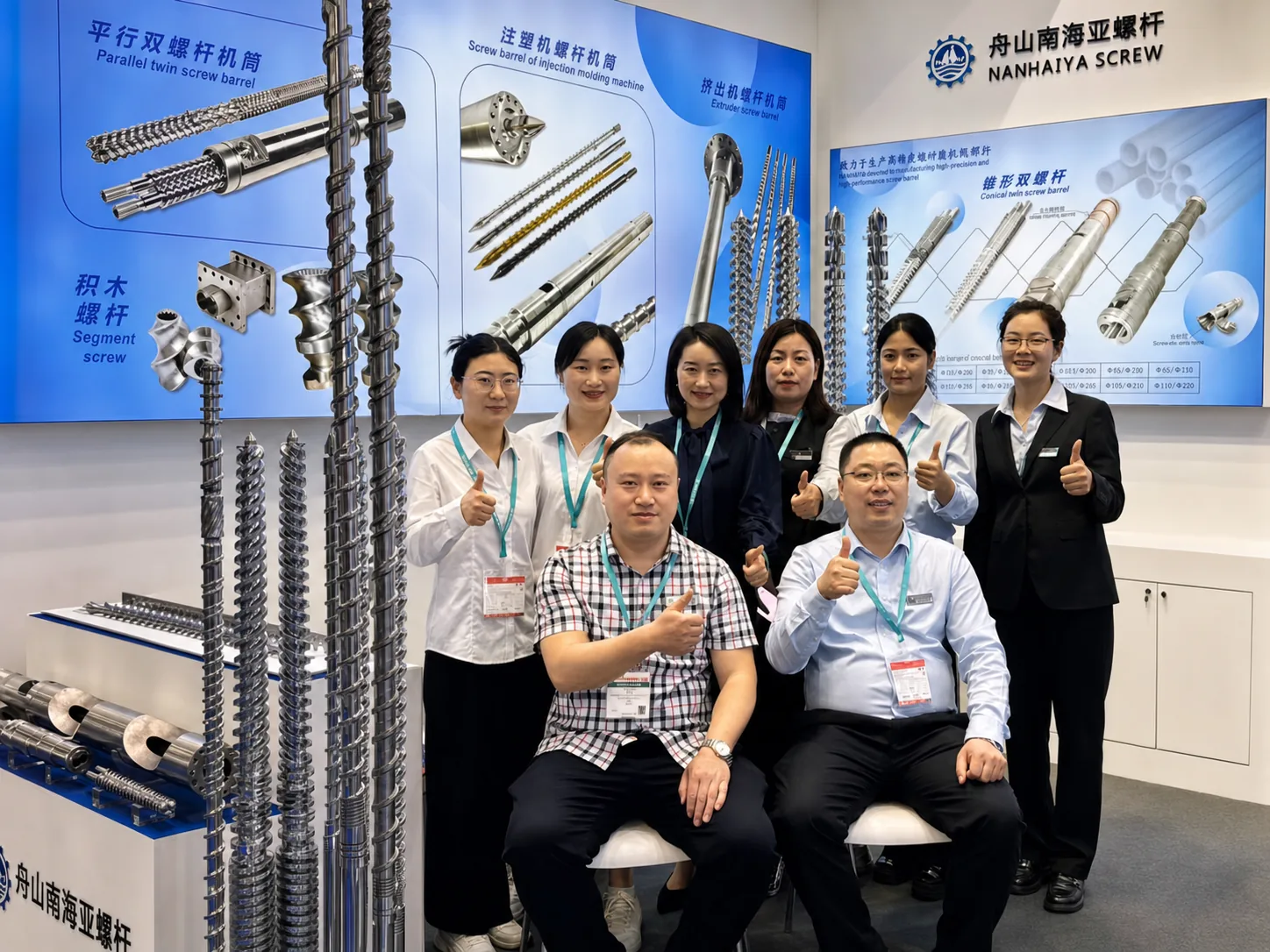
Related Articles
More insights on screw barrel technology and plastics processing.
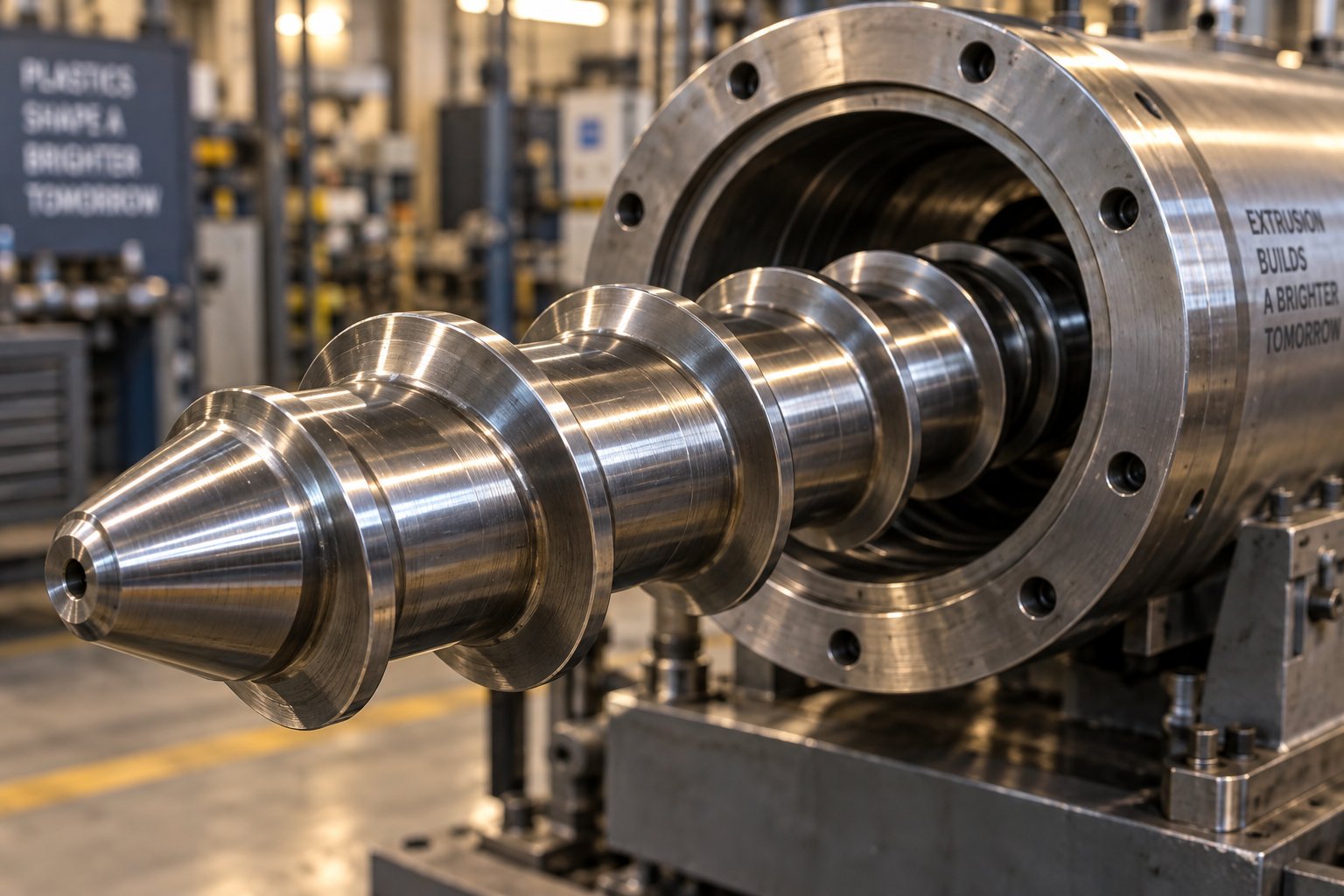
What Nobody Tells You About Screw Barrel For Plastic Machine Design
Oct 10, 2026
Learn how screw barrel for plastic machine design affects melt quality, throughput, and wear life. Covers geometry, resin matching, troubleshooting, and sourcing.
Read Article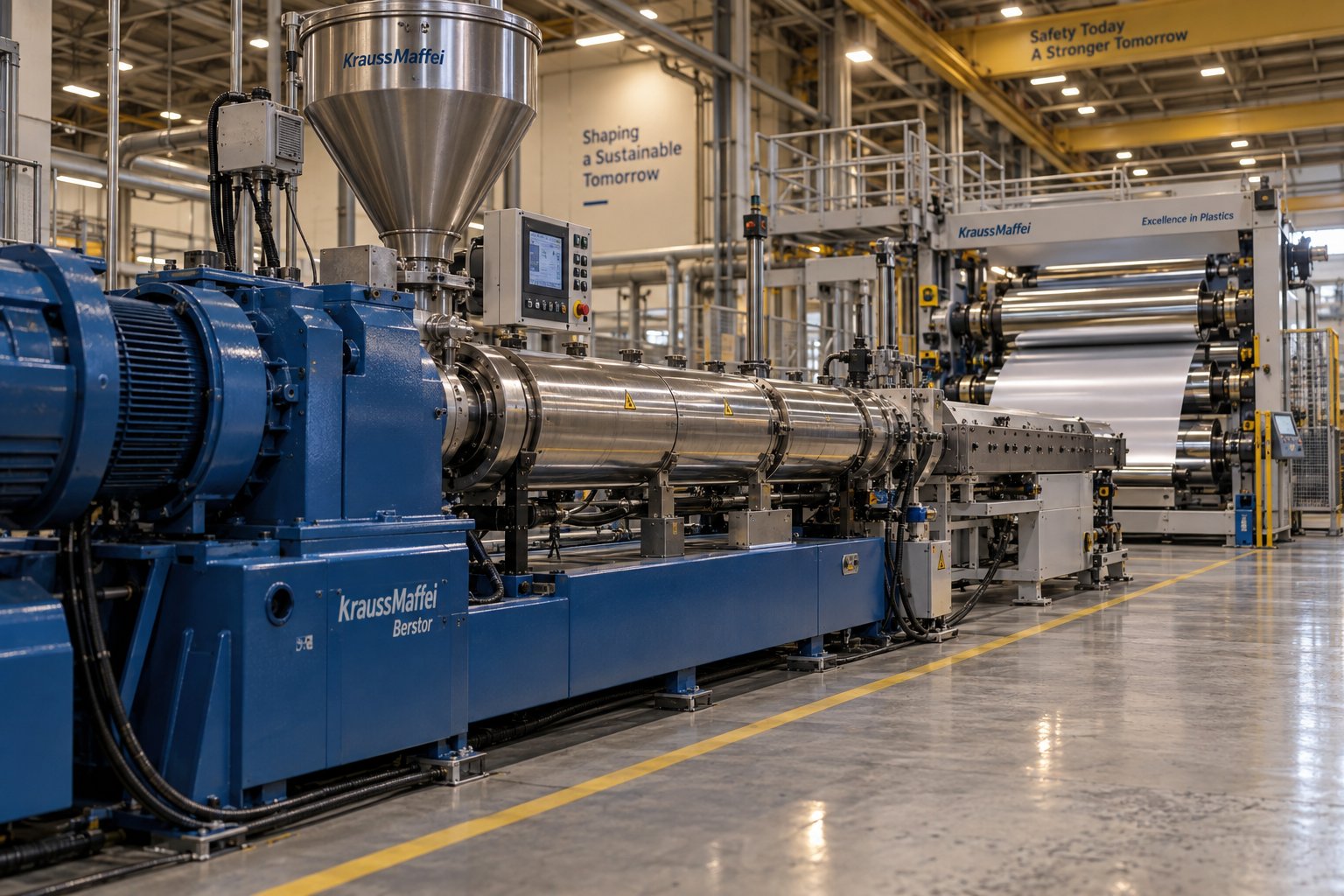
Single Screw Extruder for Sheet: Stop Guessing, Start Specifying
Oct 9, 2026
Learn how to specify a single screw extruder for sheet production. Covers screw geometry, resin-specific processing, troubleshooting, and maintenance best practices.
Read Article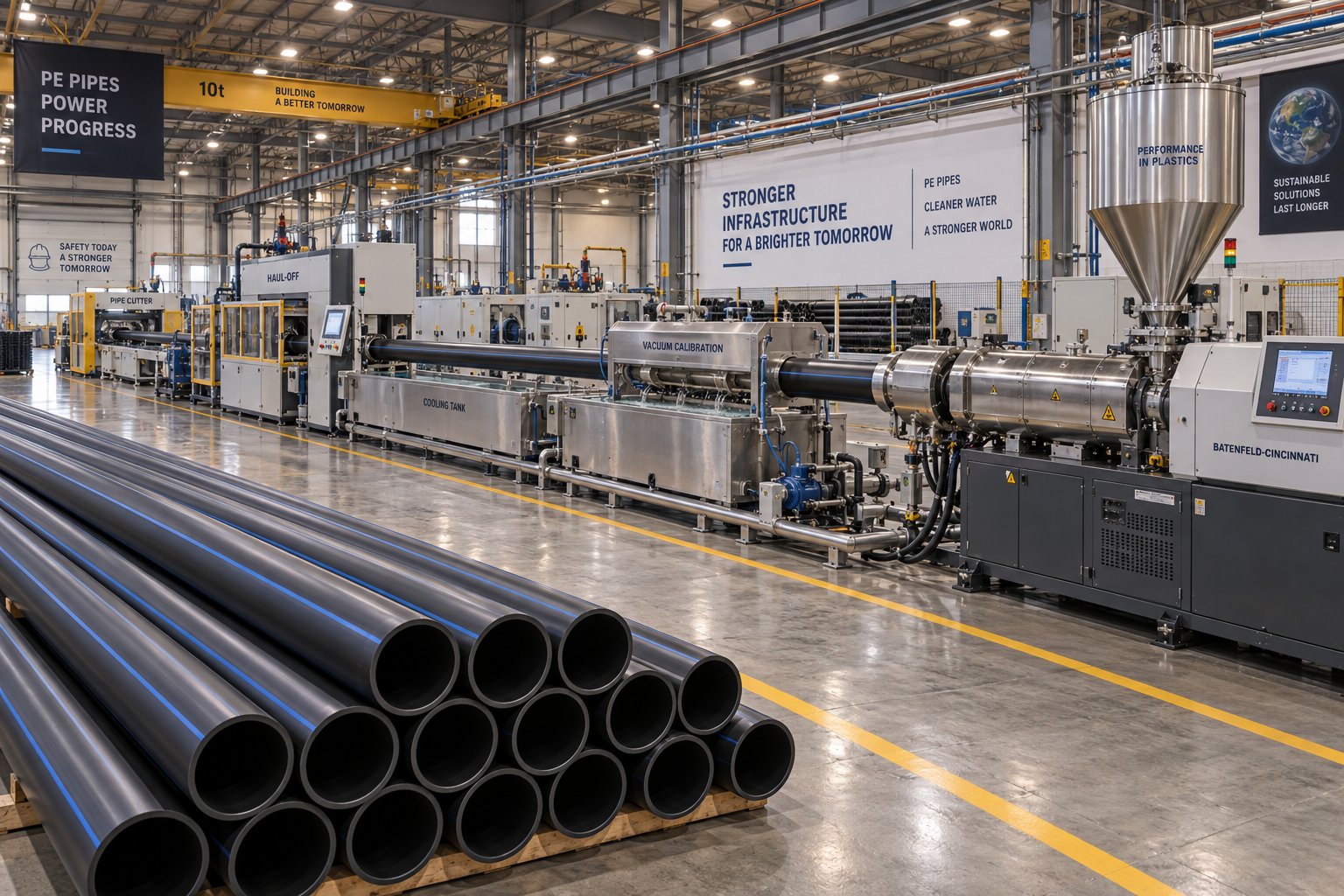
PE Pipe Extruder Machine: What Datasheets Won't Tell You
Oct 9, 2026
Learn how a PE pipe extruder machine works, key specs explained, material grade selection, maintenance tips, and buyer guidance beyond the datasheet.
Read ArticleLooking for something else?
Search by material, symptom or product and jump straight to the relevant page.
These are navigation suggestions based on keyword matching — not a quotation, not a delivery commitment, and not a substitute for engineering review. Final specification is confirmed by our engineers against your drawings and processed material.
Need help with screw barrel selection?
Share your machine model, processed material and application. Our team can help with pricing and technical support.