

Why Choosing the Right Extruder Configuration Changes Everything
Imagine committing six or seven figures to a piece of equipment — only to discover two years later that it can't handle the materials you need to run. In plastics processing, few decisions carry as much long-term weight as choosing between a single screw vs twin screw extruder. The extruder you select directly shapes your throughput, part quality, energy bill, and ultimately your return on investment for the entire life of the machine.
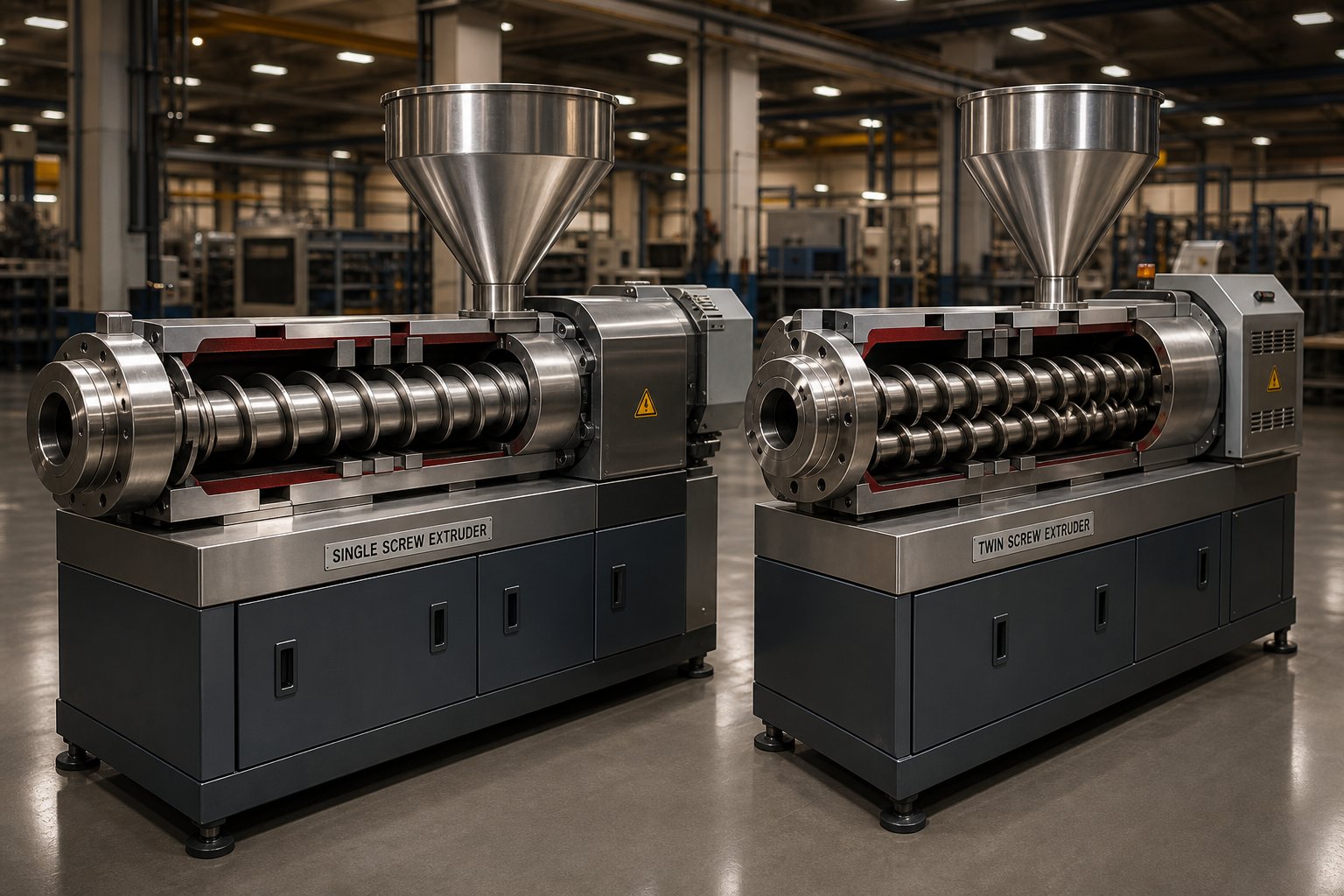
So, what's an extruder at the most basic level? A single screw extruder uses one rotating screw inside a heated barrel to melt, convey, and pump polymer into a die. It's the workhorse behind films, pipes, sheets, and profiles worldwide. A twin screw extruder, by contrast, uses two intermeshing screws that deliver far superior mixing and the flexibility to handle complex, multi-component formulations — from filled compounds to reactive blends.
Here's what most comparison guides get wrong: they treat twin screw machines as a single category. In reality, co-rotating, counter-rotating, parallel, and conical configurations each behave so differently that picking the wrong twin screw sub-type can be just as costly as choosing the wrong extruder family altogether. This guide ranks and reviews five distinct extruder configurations — standard single screw, co-rotating parallel twin screw, counter-rotating twin screw, conical twin screw, and tandem/lab-scale setups — covering working principles, ideal materials, cost considerations, and maintenance complexity.
Why Extruder Selection Impacts Every Downstream Metric
Your screw configuration dictates how uniformly the polymer melts, how long it stays inside the barrel, and how many kilowatt-hours you burn per kilogram of output. A mismatch between machine and material creates uneven melt homogeneity, wider residence time distribution, and higher specific energy consumption — problems that ripple through every downstream process from calibration to packaging. In short, the extruder isn't just one link in the chain; it sets the ceiling for every metric that follows.
What This Guide Covers That Others Miss
You'll find dedicated breakdowns of each twin screw sub-type, a total cost of ownership analysis that goes beyond sticker price, and material-specific guidance for PVC, PE, PP, and engineering plastics. A comprehensive comparison table maps each configuration against mixing capability, energy efficiency, maintenance burden, and more — giving you a single reference point most resources fail to provide.
Choosing the wrong extruder type can increase per-unit production costs by double-digit percentages while simultaneously reducing product consistency — a compounding penalty that grows more expensive with every production hour.
The first step toward making the right call is understanding exactly how these machines will be measured against each other — and that starts with a clear evaluation framework.
How We Evaluated and Ranked These Five Screw Extruder Types
A fair comparison between five fundamentally different machines requires more than listing specs side by side. Each screw extruder configuration — from a basic single extruder screw to a modular co-rotating twin — excels in some areas and falls short in others. Without a structured framework, it's easy to cherry-pick data that favors whatever equipment a particular vendor happens to sell. The evaluation criteria below were designed to prevent exactly that.
Seven Evaluation Criteria for Extruder Comparison
Every configuration reviewed in this guide was scored against seven performance and economic factors. Think of these as the lenses through which each screw extrusion system is examined:
- Mixing and dispersive capability — How effectively does the machine achieve both distributive mixing (uniform spatial distribution of additives) and dispersive mixing (breaking down agglomerates and reducing particle size)?
- Throughput capacity and scalability — Can the design scale from lab trials to full production volumes without sacrificing process consistency?
- Material versatility across polymer families — Does the extruder handle polyolefins, engineering resins, thermally sensitive PVC, and highly filled systems with equal competence?
- Energy efficiency per kilogram of output — What is the specific energy consumption (kWh/kg), and how does it shift when the task moves from simple melting to intensive compounding?
- Maintenance complexity and spare parts frequency — How often do screws, barrels, and mixing elements need replacement, and how specialized is the labor involved?
- Total cost of ownership (TCO) — Beyond purchase price, what are the cumulative costs of installation, operator training, energy, consumables, and unplanned downtime over a typical equipment lifecycle?
- Process flexibility — Can the same machine handle compounding, devolatilization, reactive extrusion, and direct extrusion, or is it locked into a narrow process window?
How We Weighted Each Factor
Not every criterion carries equal importance. Mixing capability and material suitability received the highest weight for a simple reason: if a screw extruder can't physically perform the required task — say, dispersing 40% calcium carbonate into polypropylene — no amount of energy savings or low purchase price makes it viable. These two factors act as pass/fail gates before economic analysis even begins.
TCO and energy efficiency served as the primary economic filters. Two machines that both meet the technical requirements can still differ dramatically in lifetime cost. Specific energy consumption for simple melting tasks typically ranges from 0.15 to 0.30 kWh/kg, while intensive compounding pushes that figure to 0.25-0.45 kWh/kg — a gap that compounds into tens of thousands of dollars annually on a mid-size production line.
One point deserves emphasis: no single extruder type wins across all seven criteria. The best choice always depends on the specific application, production scale, and material being processed. A configuration that dominates in compounding flexibility may deliver poor economics for a straightforward pipe extrusion line running pre-compounded resin.
Understanding the underlying conveying mechanisms ties the entire comparison together. A single screw extruder relies on drag flow — material advances because friction between the polymer and the barrel wall exceeds friction on the screw surface. Twin screw designs, particularly intermeshing variants, use positive displacement, where the geometry of the interlocking screws physically pushes material forward. This fundamental mechanical difference explains why the two families behave so differently in mixing intensity, residence time control, and self-cleaning ability — themes you'll see surface repeatedly in the reviews that follow.
Standard Single Screw Extruder — The Reliable Production Workhorse
Drag flow versus positive displacement — that mechanical distinction introduced above plays out most visibly in the machine that still dominates global installed capacity: the standard single screw extruder. By some industry estimates, single screw extruder machines account for the vast majority of all extrusion lines running today. The reason is straightforward. When the job is to take a pre-compounded pellet, melt it consistently, and push it through a die at high pressure, no other configuration delivers a better balance of simplicity, reliability, and cost.
How Single Screw Extrusion Works
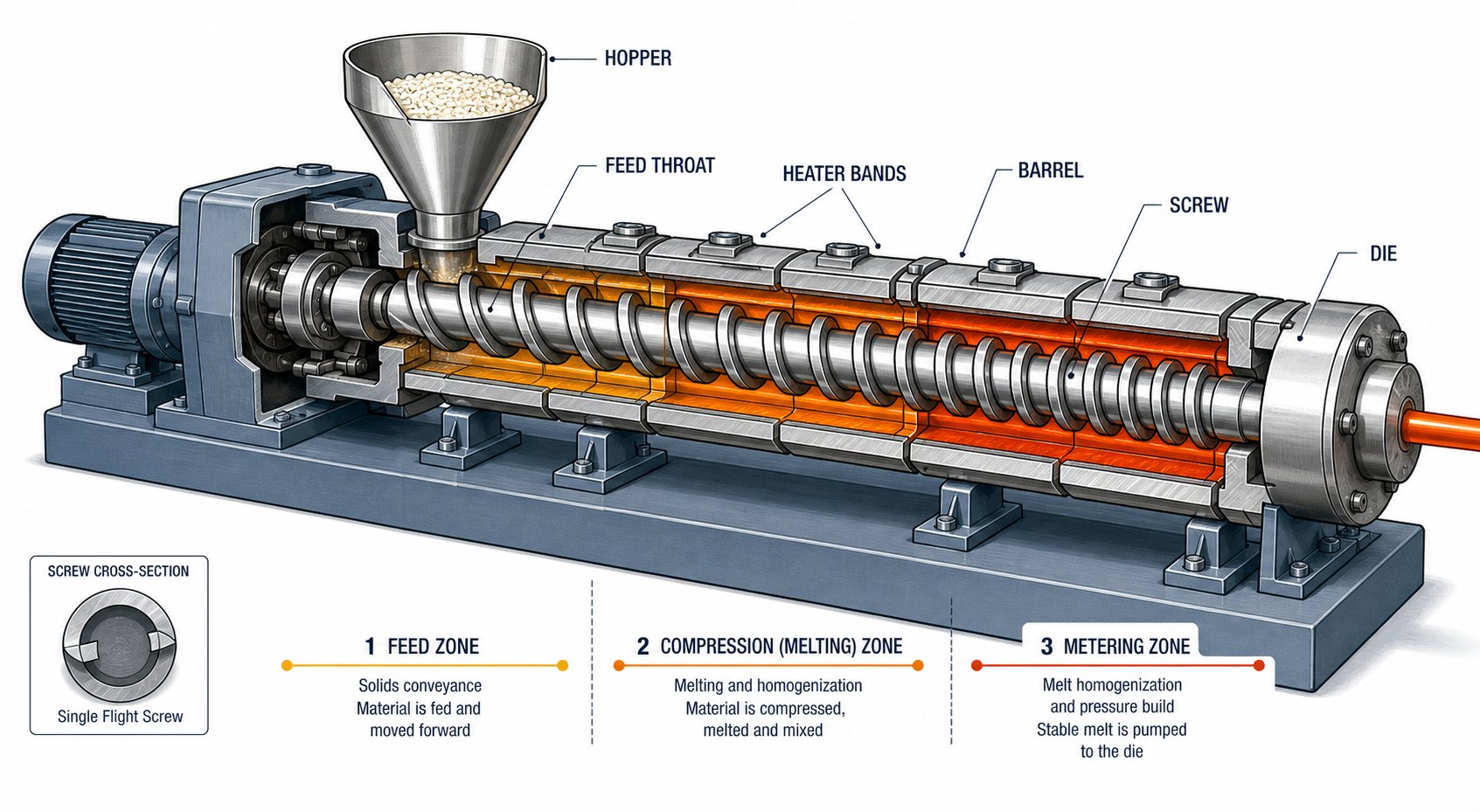
Picture a single helical screw rotating inside a tightly fitted heated barrel. Raw material — usually pellets or granules — drops from a hopper into the barrel's feed throat. From there, the screw's rotation drags the material forward. This is the drag-flow conveying mechanism: material advances because friction between the polymer and the barrel wall exceeds friction between the polymer and the screw root. No interlocking geometry forces the material forward; movement depends entirely on that frictional balance.
Inside the barrel, a single screw plastic extruder divides the process into three functional zones:
- Feed zone — Deep screw flights accept incoming pellets and compact them into a solid bed, pushing trapped air back toward the hopper. The channel depth here is at its maximum to handle the relatively low bulk density of unmelted pellets.
- Transition (compression) zone — The channel depth gradually decreases, compressing the solid bed against the barrel wall. This compression generates intense frictional heat — barrel-side pressure in this section can easily reach 400 bar (approximately 6,000 psi) — and drives the melting process. Barrel heaters supplement the frictional energy to ensure complete melting.
- Metering zone — A shallow, constant-depth channel ensures the now-molten polymer exits the screw at a uniform flow rate and temperature. This zone is responsible for building the pressure needed to push melt through the screen pack, adapter, and die.
Screw geometry is everything. Parameters like flight depth, pitch, compression ratio, and the length-to-diameter (L/D) ratio determine whether a single screw extrusion machine melts material efficiently or sends unmelted particles downstream. Modern screws typically feature L/D ratios between 24:1 and 36:1, with higher ratios providing more residence time for thorough melting and homogenization. Mixing sections — barrier flights, pin-mixing elements, or Maddock-style heads — are frequently added to ensure no solid particles survive the journey through the barrel.
Best Applications and Material Suitability
Where does a plastic single screw extruder truly shine? In any high-volume, steady-state process where the incoming material is already compounded and the primary job is melting, pressurizing, and shaping. The most common applications include:
- Film blowing — PE and PP blown film lines rely almost exclusively on single screw machines for their consistent melt delivery and excellent pressure stability.
- Pipe and tube extrusion — HDPE, MDPE, and PP pipe lines depend on the strong pumping capability and uniform output a single screw provides.
- Sheet and flat-die extrusion — PS, PET, and PP sheet lines use single screw extruders for their volumetric consistency across wide dies.
- Profile extrusion — Window frames, decking trims, and custom profiles often run on single screw systems when the compound arrives pre-blended.
- Wire and cable coating — The precise pressure control of a single screw extrusion system makes it well suited for applying thin, uniform insulation layers at high line speeds.
Can a single screw handle filled compounds? Yes — to a point. Low filler loadings (under 20-25% by weight) with pre-dispersed masterbatch are manageable. Push beyond that into high-filler-loading territory, or demand tight color consistency across production runs, and the limited distributive mixing of a single screw design becomes a bottleneck. The machine simply wasn't designed to break apart agglomerates or blend multiple additive streams with the intensity that those tasks require.
Pros and Cons of Single Screw Extruders
Pros
- Lower capital cost — Purchase price is typically 40-60% less than a comparably sized twin screw system, making it the budget-friendly entry point for many processors.
- Simpler operation — Fewer process variables and a fixed screw geometry mean shorter operator training cycles and less room for setup errors.
- Lower maintenance costs — One screw, one barrel, fewer wear parts. Replacement intervals are longer, and spare-parts inventory is leaner.
- Excellent pressure-building capability — The metering zone's shallow channel geometry generates the high, stable die pressure that film, pipe, and sheet processes demand.
- High volumetric efficiency for consistent materials — When input pellets are uniform in size and composition, output stability is exceptional.
Cons
- Limited mixing capability — Distributive and dispersive mixing are inherently weak compared to intermeshing twin screw designs. Add-on mixing elements help but cannot close the gap entirely.
- Poor self-cleaning characteristics — Material changeovers require purging compound and significant downtime; residual polymer clings to the screw root and flight flanks.
- Less suitable for heat-sensitive materials — Processing PVC on a single screw demands specialized screw designs (often with lower compression ratios and precise temperature zoning) to avoid thermal degradation. Without those modifications, the risk of burning or discoloration is high.
- Difficult to scale down for R&D — Small-diameter single screws suffer from disproportionate surface-area-to-volume ratios, making lab-scale trials less representative of production behavior.
Single screw extruders are not outdated — they remain the optimal choice for the majority of direct extrusion applications. Dismissing them in favor of a twin screw for a simple film or pipe line is a fast path to overspending on equipment, training, and maintenance without gaining any meaningful quality advantage.
Their limitations become apparent, however, the moment the process shifts from straightforward melting and pumping to intensive compounding, reactive processing, or handling of thermally sensitive polymers at high additive loadings. That's precisely where a different screw architecture — one built around intermeshing, co-rotating geometry — takes over.
Co-Rotating Parallel Twin Screw Extruder — The Compounding Champion
A single screw extruder moves material forward through friction. Remove that friction — say, by feeding a sticky additive paste or a low-bulk-density powder — and conveying efficiency drops sharply. The co-rotating parallel twin screw extruder solves this problem at the hardware level. Two screws turning in the same direction, their flights tightly intermeshing, physically push material forward regardless of friction conditions. That mechanical advantage is the reason this configuration has become the gold standard for polymer compounding, masterbatch production, and reactive extrusion worldwide.
Positive Displacement Conveying and Modular Design
Imagine two helical screws placed side by side inside a figure-eight barrel bore. As both screws rotate in the same direction, the flight of one screw sweeps through the channel of the other. Material trapped between the flights is carried forward in a controlled, C-shaped cavity — a mechanism known as positive displacement. Unlike drag flow, this approach doesn't depend on the polymer gripping the barrel wall. Whether you're feeding sticky elastomer crumb, free-flowing pellets, or fine calcium carbonate powder, the screws keep pushing material toward the die.
This intermeshing geometry also creates a powerful self-wiping action. The flank of one screw continuously scrapes the root of its partner, preventing stagnant pockets where heat-sensitive material could degrade. The result is a remarkably narrow residence time distribution — nearly every polymer particle spends the same amount of time inside the barrel. For reactive extrusion processes like maleic anhydride grafting, that uniformity is non-negotiable: too long and the polymer over-reacts; too short and the reaction never completes.
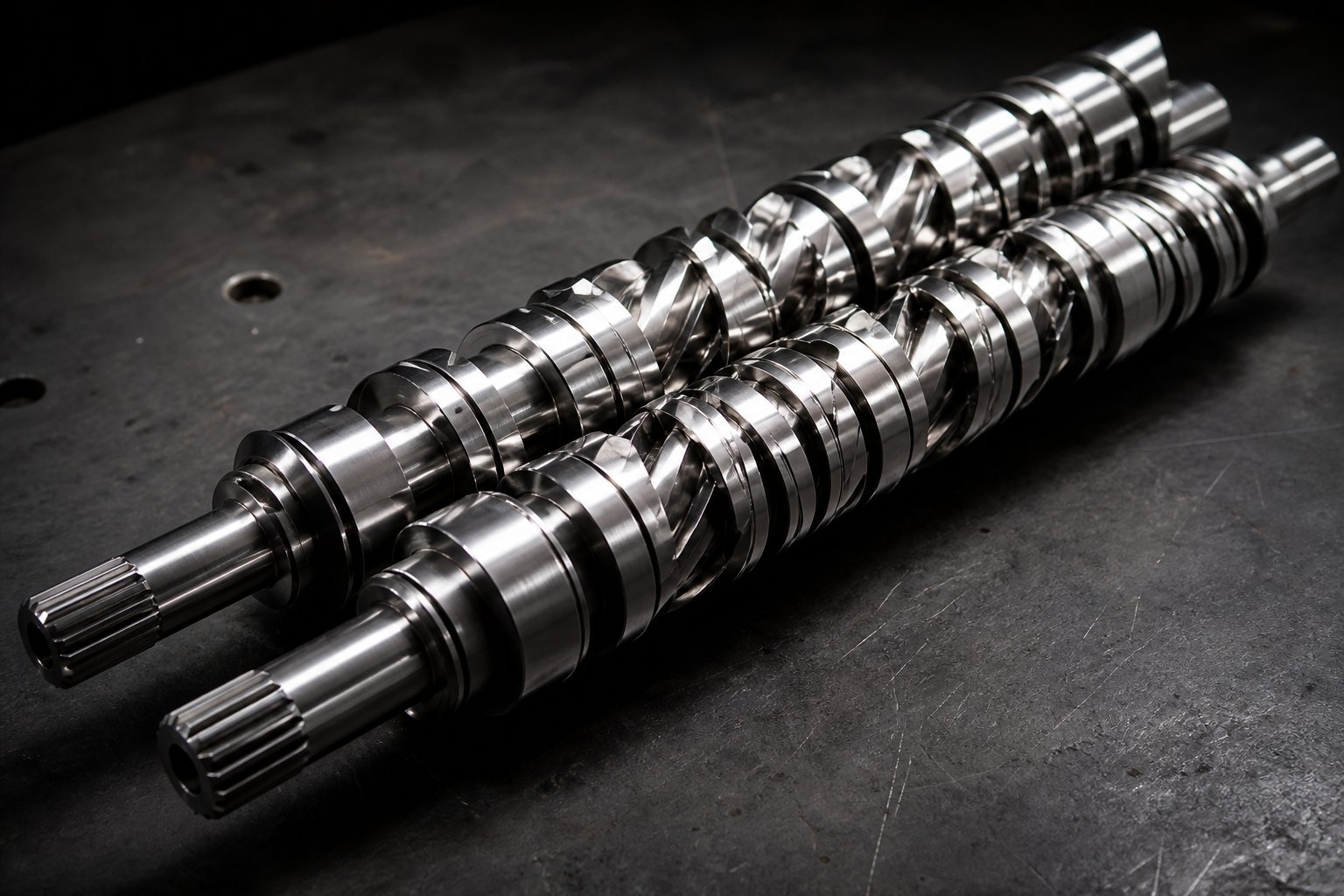
What truly sets the co-rotating twin screw apart, though, is its modular screw element system. Rather than machining a single fixed-geometry screw, engineers assemble individual elements onto a splined shaft. The toolkit includes:
- Conveying elements — Forward-pumping flights that transport material through low-intensity zones.
- Kneading blocks — Offset discs (available at 30, 45, 60, and 90 degree stagger angles) that create high-shear and elongational flow regions for breaking apart pigment agglomerates or filler clumps.
- Mixing elements — Gear-type or toothed designs that redistribute material without applying excessive shear.
- Reverse elements — Backward-pumping flights that act as melt seals, building pressure upstream for venting zones or increasing residence time in targeted barrel sections.
This modularity means the same machine can be reconfigured for a gentle color-blending task one week and a high-intensity glass-fiber dispersion the next — simply by rearranging elements along the shaft. No other extruder type offers this level of process-level customization.
Where Co-Rotating Twin Screws Dominate
If your process involves combining multiple ingredients into a uniform compound, a co-rotating twin screw compounding extruder is almost certainly the right tool. The applications where this configuration dominates include:
- Polymer compounding with fillers and additives — Calcium carbonate, talc, glass fiber, and flame retardant loadings of 40-60% by weight are routine. The intense mixing breaks down agglomerates and distributes particles uniformly through the polymer matrix.
- Color masterbatch production — Superior dispersive mixing delivers higher color strength from less pigment. Industry data suggests that a well-dispersed black masterbatch on a co-rotating line might require 15% carbon black versus 20% on a less capable machine — a raw-material saving that adds up rapidly over large production runs.
- Reactive extrusion — Grafting, controlled degradation (viscracking), and even continuous condensation polymerization benefit from the narrow residence time distribution and precise temperature zoning.
- Devolatilization — Multi-stage vacuum venting removes residual monomers, solvents, and moisture down to levels below 50 ppm, which is critical for engineering plastics like PA and PET that hydrolyze easily.
- Engineering plastic blends — PC/ABS, PA/PP, and PBT/PET alloys require the high-shear environment only a compounding extruder of this caliber can provide to achieve fine, stable morphologies.
Co-rotating designs also handle multiple feed streams with ease. Gravimetric feeders dose the base resin at the main hopper, while downstream side stuffers introduce glass fibers, liquid additives, or heat-sensitive stabilizers exactly where they're needed along the barrel. This staged feeding strategy protects fragile additives from unnecessary shear exposure — a capability that single screw machines and even some counter-rotating twins simply cannot replicate.
Pros and Cons at a Glance
Pros
- Exceptional distributive and dispersive mixing — Kneading block configurations can be tuned from gentle blending to aggressive agglomerate breakup, covering virtually any compounding challenge.
- Self-wiping for fast material changeover — The intermeshing screws scrape themselves clean, reducing purge time and material waste between recipes. Some processors report completing color changes in under 15 minutes.
- Modular screw design for process optimization — Swapping elements takes hours, not days, letting engineers fine-tune shear profiles without purchasing a new machine.
- Excellent venting capability — Open-channel geometry combined with reverse-flight melt seals creates efficient devolatilization zones that single screw systems struggle to match.
- Superior handling of multiple feed streams — Side feeders and liquid injection ports allow staged addition of different components at optimal barrel positions.
Cons
- Higher capital investment — A co-rotating parallel twin screw extruder typically costs two to two-and-a-half times more than a comparably sized single screw line. A 75 mm compounding line, for example, can run around $180,000 compared to roughly $80,000 for a single screw system of similar output.
- Requires more skilled operators — Modular screw assembly, multi-zone temperature control, and gravimetric feeding all demand deeper process knowledge. Training cycles are longer and labor costs per operator are higher.
- Higher energy consumption for simple melting tasks — If all you need is to melt and pump a pre-compounded pellet, the co-rotating design's positive displacement mechanism consumes more energy per kilogram than a well-optimized single screw doing the same job.
- Screw and barrel wear from abrasive fillers — High loadings of glass fiber, calcium carbonate, or mineral fillers accelerate wear in the kneading and mixing zones. Key wear zones include the feeding section (where solids scrub the barrel wall), the filler introduction zone, and the mid-barrel area where screw deflection causes edge contact with the barrel bore. As the twin screw barrel and elements wear, the clearance between screw and barrel increases, mixing efficiency drops, and product quality suffers — often before operators notice a visible problem.
That last point deserves special attention. Because worn screw and barrel sets degrade mixing performance gradually, many compounders don't act until reject rates spike. Sourcing high-quality replacement twin screw barrels and elements — built from wear-resistant alloys or powder metallurgy steels — is essential for maintaining consistent output. NANHAIYA's parallel twin screw barrel catalog is one practical resource for engineers comparing options; the same product collection also covers single screw barrel configurations, giving processors a single sourcing point regardless of which extruder type they operate.
Despite these considerations, the co-rotating twin screw extruder's total cost of ownership often favors it over alternatives for compounding applications. Higher throughput per unit of screw diameter, lower pigment and additive consumption thanks to superior dispersion, and reduced labor cost per kilogram can offset the steeper upfront price within months on a busy production line. The key is matching the machine to the right task — a theme that becomes even sharper when you look at the co-rotating design's close mechanical cousin, the counter-rotating twin screw, which takes a fundamentally different approach to material handling and shear control.
Counter-Rotating Twin Screw Extruder — Precision Processing for Sensitive Materials
Both screws turning the same way produce intense shear and aggressive mixing. Reverse the rotation direction of one screw, and the machine's personality changes completely. The counter-rotating twin screw extruder operates on a fundamentally different conveying principle — one that trades raw mixing intensity for gentle, highly controlled material transport. That trade-off isn't a weakness; for an entire class of thermally sensitive polymers, it's the only reason stable extrusion is possible at all.
Understanding the difference between a co rotating and counter rotating twin screw extruder is just as critical as understanding the broader single screw vs twin screw extruder debate. Yet most comparison guides skip this distinction entirely, treating all twin-screw extruder configurations as interchangeable. They aren't.
How Counter-Rotating Screws Differ in Conveying
Imagine two gears meshing together, each turning in the opposite direction. Material drawn into the nip point between the screws gets trapped inside enclosed, C-shaped chambers formed by the intermeshing flights. These chambers act almost like the cavities in a gear pump: each one captures a discrete volume of material and carries it forward with minimal leakage back upstream. This is positive displacement at its most controlled.
The practical result? Material moves through the barrel with remarkably little back-mixing. Every particle follows a similar path and spends a nearly identical amount of time inside the machine. In extrusion engineering terms, the residence time distribution (RTD) is extremely narrow — far narrower than what a co-rotating design delivers. For processes where even a few seconds of extra thermal exposure can degrade the polymer, that precision is invaluable.
Contrast this with the co-rotating configuration. There, the open-channel geometry and self-wiping action create turbulent, figure-eight flow patterns that maximize shear stress and energy input. Material gets folded, stretched, and recirculated repeatedly — exactly what you want for dispersing glass fiber bundles, but exactly what you don't want when the polymer starts decomposing above a certain temperature threshold.
A counter-rotating twin screw extruder machine also generates what extrusion specialists call a calendering effect at the intermeshing region. As material passes between the two screws, it undergoes compressive and elongational deformation rather than the high-shear cutting action typical of co-rotating kneading blocks. Think of it as squeezing toothpaste between two rollers versus blending it in a high-speed mixer. The dispersion is gentler, and heat generation stays low — two characteristics that define this machine's core identity.
Ideal Use Cases for Counter-Rotating Configurations
Why do PVC processors overwhelmingly prefer counter-rotating designs? The answer comes down to chemistry. PVC has a notoriously low thermal decomposition temperature — roughly 140-160 degrees Celsius — yet it needs to be processed at melt temperatures close to that range. The margin for error is razor-thin. Apply too much shear, and the material yellows, releases hydrochloric acid gas, and loses mechanical properties. A co-rotating twin screw extruder, with its aggressive shear fields, can push PVC past that thermal limit almost instantly.
Counter-rotating machines sidestep this problem by operating at low screw speeds — typically 10 to 30 rpm — while maintaining stable conveying through their positive displacement geometry. The result is uniform gelation without localized hot spots, which is why this configuration dominates in:
- PVC pipe extrusion — Both rigid (uPVC) and chlorinated (CPVC) formulations benefit from the low-shear, low-temperature processing environment.
- PVC window profiles — Complex cross-sections demand uniform melt quality without degradation streaks; counter-rotating screws deliver exactly that.
- PVC sheet and foam board — Foaming agents are highly temperature-sensitive; the narrow RTD prevents premature gas release.
- Powder coatings — Thermosetting powder blends require controlled energy input and precise residence time to avoid pre-curing inside the barrel.
- Pharmaceutical and food-grade extrusion — Applications demanding narrow residence time distributions for regulatory compliance or product uniformity — such as hot-melt extrusion of active pharmaceutical ingredients — rely on the counter-rotating design's predictable material path.
There's another, often-overlooked advantage for powder processing. Slippery powders with poor frictional properties — calcium carbonate, talc, and mica at high concentrations — tend to spin uselessly inside a co-rotating barrel without moving forward. The enclosed C-shaped chambers of a counter-rotating twin-screw extruder eliminate that slipping problem entirely. The material physically cannot go backward, regardless of its surface friction characteristics.
Strengths and Limitations
Pros
- Excellent low-shear mixing for heat-sensitive materials — The calendering-style dispersion mechanism avoids the intense shear fields that cause thermal degradation in PVC, PVDC, and biodegradable polymers.
- Precise residence time control — Enclosed C-shaped chambers ensure nearly every particle spends the same time in the barrel, critical for reactive and thermally sensitive formulations.
- Strong pumping capability — The gear-pump-like conveying mechanism generates stable, consistent melt pressure at the die, reducing downstream variability.
- Well-suited for direct extrusion from powder — No need for a separate pre-densification or pelletizing step; powder dry-blends can be fed directly into the extruder and shaped in a single pass.
- Energy-efficient at low speeds — Operating at 10-30 rpm consumes less drive energy compared to co-rotating machines running at 200-600 rpm for equivalent PVC output.
Cons
- Lower maximum throughput at equivalent screw diameter — Because screw speeds must stay low to avoid generating excessive separating forces between the intermeshing screws, output per unit diameter lags behind co-rotating machines. A 65 mm counter-rotating extruder typically produces 150-250 kg/h of PVC compound, whereas a 65 mm co-rotating machine can push 400-800 kg/h in compounding mode.
- Less effective for high-intensity dispersive mixing — Breaking apart tightly bound pigment agglomerates or glass fiber bundles requires the aggressive shear that counter-rotating geometry simply doesn't provide.
- Limited screw speed range — The intermeshing geometry creates separating forces that push the screws apart at higher RPMs, placing a mechanical ceiling on rotation speed and, by extension, maximum output rate.
- Fewer modular screw element options — While some modern counter-rotating designs offer limited element interchangeability, the selection of kneading blocks and mixing elements is far smaller than what's available for co-rotating platforms.
- Average self-cleaning performance — Material changeovers take longer compared to the continuously self-wiping co-rotating design, since residual material can remain in the C-shaped chambers during transitions.
Not all twin screw extruders are interchangeable. The choice between co-rotating and counter-rotating configurations is every bit as consequential as the single screw versus twin screw decision — selecting the wrong rotation direction can mean the difference between flawless PVC pipe and a barrel full of decomposed resin.
The counter-rotating twin screw extruder carves out its niche by doing what no other configuration can: processing thermally fragile materials with surgical precision while maintaining stable, repeatable output. Yet even within the counter-rotating family, there's a further specialization — a tapered barrel geometry that squeezes even more performance out of low-bulk-density powders and PVC dry blends. That's the conical twin screw, and it brings its own set of advantages to the table.
Conical Twin Screw Extruder — The PVC Processing Specialist
A counter-rotating twin screw extruder already handles PVC with far more finesse than a co-rotating or single screw design ever could. So why would engineers take a machine that already works and reshape its screws into tapered cones? Because PVC dry blends create a problem that even standard parallel counter-rotating geometry doesn't fully solve: bulk density. A typical rigid PVC powder blend weighs roughly 0.5 to 0.6 g/cm3 — barely half the density of pelletized resin. Feeding that fluffy, poorly flowing powder into a constant-diameter barrel means the feed zone fills slowly, limiting throughput and creating inconsistent material intake. The conical twin screw extruder eliminates this bottleneck through geometry alone.
Why the Conical Geometry Matters
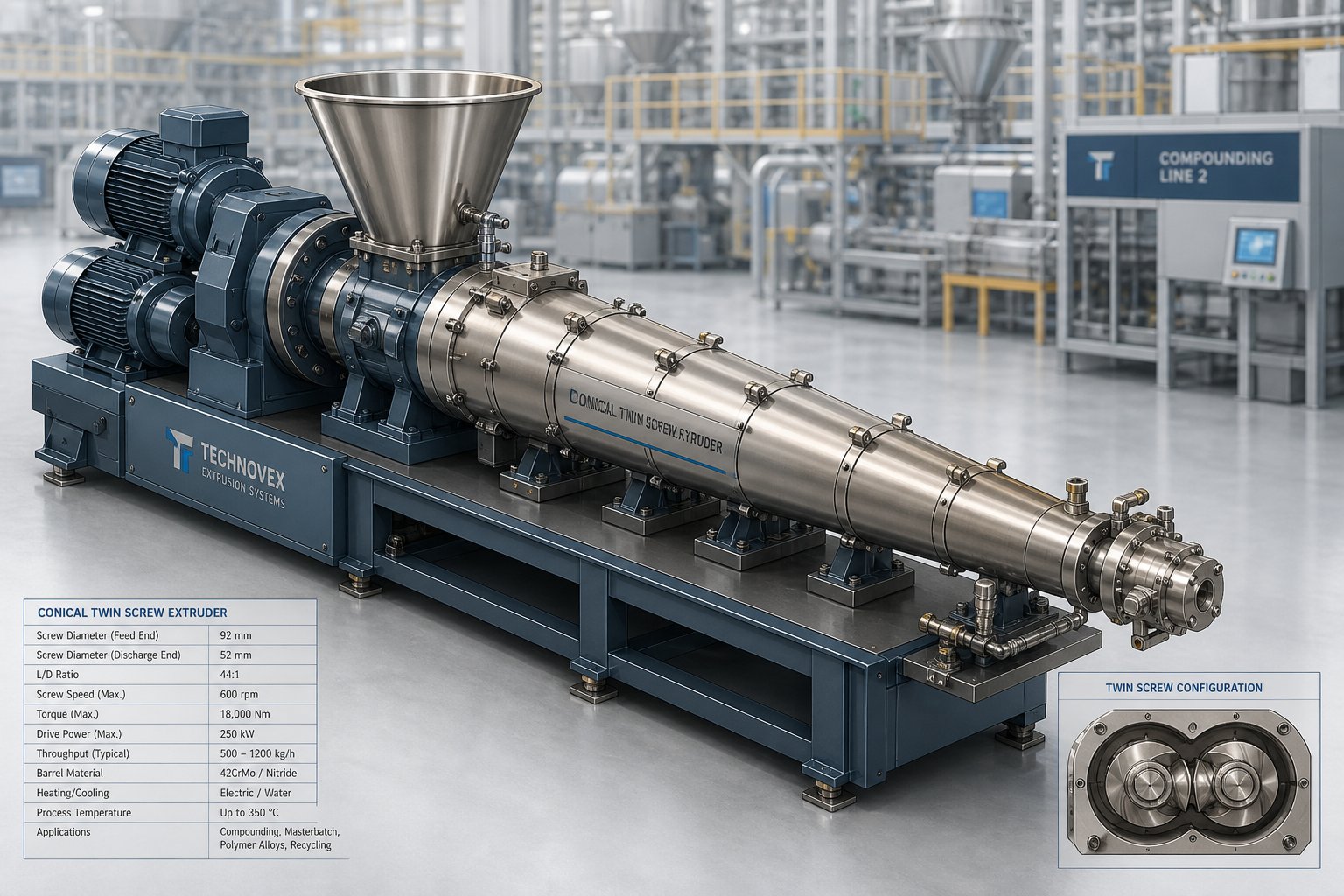
Imagine two ice cream cones placed side by side, wide ends facing the hopper and narrow tips pointing toward the die. That's essentially what a conical twin screw and barrel system looks like. The screws taper from a large diameter at the feed end — commonly 90 mm, 105 mm, 132 mm, or even 188 mm — down to a much smaller diameter at the discharge, sometimes less than half the inlet size.
This tapered profile delivers three mechanical advantages that parallel designs can't replicate:
- Oversized feed opening — The large-diameter inlet creates a wide cross-sectional area that accepts low-bulk-density powders, recycled flake, and even wood flour blends without bridging or starve-feeding. You'll notice that PVC processors rarely need to install a force-feeding device on a conical machine — the geometry handles intake naturally.
- Built-in compression — As material travels from the wide end toward the narrow discharge, the screw channel volume decreases progressively. This natural geometric compression compacts the powder, expels trapped air through upstream vent ports, and initiates melting — all without relying on complex barrel pressure zones or high screw speeds. The result is efficient degassing, steady compaction, and gentle preliminary plasticization in a single continuous motion.
- Higher torque where it matters most — The larger root diameter at the feed end means a thicker, stronger screw shaft precisely where the torque demand peaks. Feed-zone conveying of unpacked powder requires significant rotational force, and the conical geometry delivers that force without pushing the shaft toward its mechanical limits. Meanwhile, the smaller discharge-end diameter reduces the axial thrust load on the thrust bearing — under identical die pressure, a conical screw transmits substantially less backward force to the gearbox than a parallel screw of equivalent output capacity.
This last point has real consequences for equipment longevity. Lower thrust bearing loads translate directly into longer bearing life, fewer unplanned shutdowns, and reduced maintenance costs over the machine's operating lifetime.
Primary Applications and Material Fit
Walk through any PVC processing plant in China, Turkey, or central Europe, and you're likely to see rows of conical machines running profile and pipe lines around the clock. The plastic twin screw extruder in its conical form dominates these facilities for a clear reason: it processes PVC dry blend in a single pass — the so-called "one-step method" — eliminating the need for a separate pelletizing stage. That skipped step saves both capital equipment costs and the energy of melting the material twice.
Core applications include:
- PVC window and door profiles — Complex multi-cavity cross-sections demand uniform melt quality across the entire die width. The conical design's low screw speeds (typically 20-45 rpm) and controlled shear field prevent localized overheating, producing profiles with consistent color, smooth surfaces, and dimensional tolerances within 0.1 mm.
- PVC pipe — Water supply, drainage, and electrical conduit pipes require stable melt pressure at the die, typically between 15 and 30 MPa. The conical screw's gear-pump-like conveying delivers this consistently over run lengths measured in kilometers.
- PVC sheet and foam board — Foaming agents decompose within a narrow temperature band. The gentle, gradual shear profile of the conical barrel prevents premature blowing-agent activation, ensuring uniform cell structure throughout the foam cross-section.
- Wood-plastic composites (WPC) — Blends containing 40-70% wood flour by weight are bulky, abrasive, and heat-sensitive. The oversized feed zone ingests these low-density blends efficiently, while controlled processing temperatures stay below the threshold where wood fiber begins to darken or degrade.
The twin screw plastic extruder in conical form also finds growing use in recycled material processing. Post-consumer PVC flake and regrind vary significantly in bulk density from batch to batch — sometimes by 30% or more. A parallel extruder sized for the densest batch will starve-feed on the lightest one. The conical feed zone's generous volume absorbs that variation, maintaining more stable throughput without constant feeder adjustments.
Advantages and Drawbacks
Pros
- Excellent for low-bulk-density powder feeding — The wide feed opening handles PVC dry blends, wood flour, and recycled flake without pre-densification or force-feeding equipment.
- High torque at low screw speeds — Operating at 20-50 rpm, the conical design converts motor power into melt pressure efficiently while minimizing frictional heat buildup. Specific energy consumption for rigid PVC typically falls between 0.12 and 0.22 kWh/kg, meaningfully lower than high-speed parallel alternatives processing the same material.
- Compact machine footprint — Because the screws converge toward the discharge end, the overall machine length is shorter than a parallel twin screw of equivalent output. For plants with limited floor space, this difference can determine whether a new line fits into an existing building.
- Lower energy consumption for PVC applications — The combination of natural geometric compression and low rotational speeds reduces total drive energy compared to both parallel twin screw and single screw configurations running equivalent PVC formulations.
- Robust self-cleaning capability — The counter-rotating, closely intermeshing flights scrape against each other continuously, preventing material stagnation and carbonization — a critical advantage for production schedules requiring frequent color or formula changes.
Cons
- Limited to counter-rotating operation — The converging screw geometry doesn't lend itself to co-rotating configurations. You won't find a conical co-rotating machine on the market, which means the intense dispersive mixing available in parallel co-rotating systems is off the table.
- Less versatile for non-PVC applications — While conical machines can process PP, PE, ABS, and even some engineering resins, their design is optimized for the specific thermal and rheological profile of PVC. Running polyolefin compounding or engineering plastic blends on a conical line means accepting a narrower process window and less mixing flexibility than a parallel twin screw would provide.
- Screw and barrel replacement requires matched conical sets — Unlike parallel modular systems where individual elements can be swapped independently, a worn conical twin screw and barrel must be replaced as a matched pair. The tapered geometry demands precise dimensional alignment between screw and barrel, making partial replacements impractical and spare-parts inventory less flexible.
- Smaller process window for non-standard formulations — The fixed screw geometry (no modular kneading blocks or interchangeable mixing elements) limits your ability to fine-tune shear profiles for experimental or rapidly changing recipes. What works beautifully for a standard rigid PVC pipe compound may perform poorly on a specialty elastomer-modified PVC blend.
The conical twin screw extruder, then, occupies a very specific — but very large — slice of the extrusion market. It doesn't try to do everything. It does PVC and similar heat-sensitive processing better than anything else available, at lower energy costs and in a smaller physical footprint. For processors whose product lines center on PVC profiles, pipes, foam board, or WPC, it's often the only configuration worth serious consideration.
Yet real-world production rarely fits into a single machine category. Some processes need the mixing intensity of a co-rotating twin screw upstream and the pumping precision of a single screw downstream — simultaneously. Others require lab-scale validation before committing to any production platform at all. Those hybrid and scale-up scenarios demand a different kind of thinking entirely.
Tandem Lines and Lab-Scale Extruders — Beyond the Binary Choice
What happens when no single extruder type checks every box? In foam sheet production, for instance, you need aggressive mixing to dissolve a physical blowing agent into molten polymer — and then you need precise, low-shear cooling to bring the melt to the exact foaming temperature without thermal gradients. One machine can't do both well. That tension between mixing intensity and gentle downstream handling is why tandem extrusion lines and laboratory twin screw extruders exist — and why the single screw vs twin screw extruder debate sometimes misses the point entirely.
Tandem Extrusion Lines — When One Extruder Is Not Enough
A tandem line pairs two extruders in series, each assigned the task it does best. The primary extruder — typically a twin screw or a single screw with intensive mixing sections — handles melting, blowing-agent injection, and homogenization. The secondary extruder, almost always a large-diameter single screw, takes over for cooling and pressure building before the die.
Why not just use one long extruder? Because the physics fight you. Dissolving a physical blowing agent like supercritical CO2 or pentane into polystyrene requires melt temperatures around 220-235 degrees Celsius and pressures near 3,000 psi. But foaming that same melt uniformly demands cooling it to roughly 140 degrees Celsius before it hits the die. Trying to melt aggressively and cool gently inside the same barrel creates contradictory thermal demands that compromise both tasks.
The tandem solution is elegant. The primary extruder plasticates the resin and mixes in the blowing agent at high temperature. The hot melt then transfers into a secondary cooling extruder — typically 30-35% larger in diameter — where deep, multiflighted screw channels rotate slowly (often around 13 rpm versus 84 rpm in the primary) to minimize viscous heat generation while water-cooled barrel zones extract energy uniformly. The cooled melt exits through an annular die, expands into a foam tube, and gets slit into sheet.
This configuration captures the mixing superiority of the primary extruder with the pumping efficiency and thermal control of the single screw secondary. Applications where tandem lines dominate include:
- Foam sheet extrusion with physical blowing agents — PS foam trays, clamshell containers, and egg cartons are produced almost exclusively on tandem lines. The cooling extruder's performance directly sets the maximum production rate and foam quality.
- Highly filled compounds requiring gentle downstream handling — When an aggressive compounding step must be followed by careful pressure building without reintroducing shear damage, a screw extruder granulator setup in tandem preserves filler dispersion while forming uniform pellets or strands.
- Multi-layer coextrusion systems — Complex film and sheet structures use multiple extruders feeding a single die, with each extruder optimized for its specific layer material and throughput requirement.
One operational detail often overlooked: the pressure balance between primary and secondary extruders is critical. Ideally, the discharge pressure of the primary extruder equals the discharge pressure of the secondary, creating a zero axial pressure gradient in the cooling extruder. If the secondary must build additional die pressure on its own, the deep-channel screw operates below its optimal specific rotational rate — dissipating extra energy as heat and degrading foam uniformity. Tuning screw speeds to achieve that zero-gradient sweet spot takes persistence, but the payoff in consistent foam density and shrink properties is significant.
Laboratory and Benchtop Twin Screw Extruders for Scale-Up
Imagine spending $500,000 on a production-scale compounding line only to discover that your new flame-retardant formulation degrades during processing. A laboratory twin screw extruder — with screw diameters ranging from 11 to 20 mm — lets material developers validate formulations using as little as 5 to 20 grams of API or additive before committing to full-scale equipment. These compact machines replicate the modular screw architecture, self-wiping geometry, and multi-zone temperature control of their production-sized counterparts, making them genuine process development tools rather than toys.
A benchtop twin screw extruder serves as a screening tool — useful for identifying promising formulations quickly. However, equipment-design attributes at the benchtop scale (such as screw channel geometry and heat-transfer characteristics) are fundamentally different from production machines, so they should not be used for direct scale-up predictions. Mid-size extruders in the 12-20 mm range bridge that gap. They share the same outer-diameter-to-inner-diameter (OD/ID) screw ratio as larger machines — a key geometric parameter for maintaining similar shear and mixing conditions during scale-up.
The scale-up challenge itself is real, and underestimating it costs time and material. Three things change as screw diameter increases:
- Tip speed rises — At the same RPM, a larger screw has a higher flight-tip velocity, increasing peak shear stress on the material. Heat-sensitive polymers processed successfully at lab scale can degrade at production scale if screw speed isn't adjusted downward.
- Surface-to-volume ratio drops — A larger barrel has proportionally less surface area for heating or cooling relative to its internal volume. Volume scales by a factor of three while surface area only doubles, which can create thermal gradients that didn't exist at smaller scale.
- Residence time shifts — Throughput scaling rules like the Schuler method predict a theoretical feed rate for the larger machine, but practical adjustments are almost always needed to match residence time and specific energy to the smaller-scale baseline.
Successful scale-up hinges on maintaining two parameters: specific energy input (kWh/kg) and residence time distribution. In one documented trial, scaling from an 11 mm laboratory compounder to a 16 mm unit required reducing the theoretical feed rate from 3 kg/h down to 2.5 kg/h to match the smaller machine's residence time and specific energy of approximately 559 kJ/kg. Skipping that calibration step would have produced a different product at the larger scale — defeating the purpose of the lab work entirely.
Why the Choice Is Not Always Binary
These hybrid and scale-up scenarios reveal a truth that comparison tables alone can't capture: experienced processors rarely standardize on a single extruder type across their entire operation. A compounder might run co-rotating twin screws for masterbatch, conical twins for PVC profiles, single screws for PE pipe, and a tandem line for foam sheet — all under the same roof.
The most productive plastics operations deploy multiple extruder types across their production lines, selecting each configuration based on the specific process requirements of that line rather than forcing every application through a single machine architecture.
That practical reality makes a structured, side-by-side comparison even more valuable. When you're managing several extruder types simultaneously, you need a clear reference showing exactly where each configuration excels, where it falls short, and which material-process combinations demand which machine. That's precisely what a comprehensive head-to-head comparison delivers.
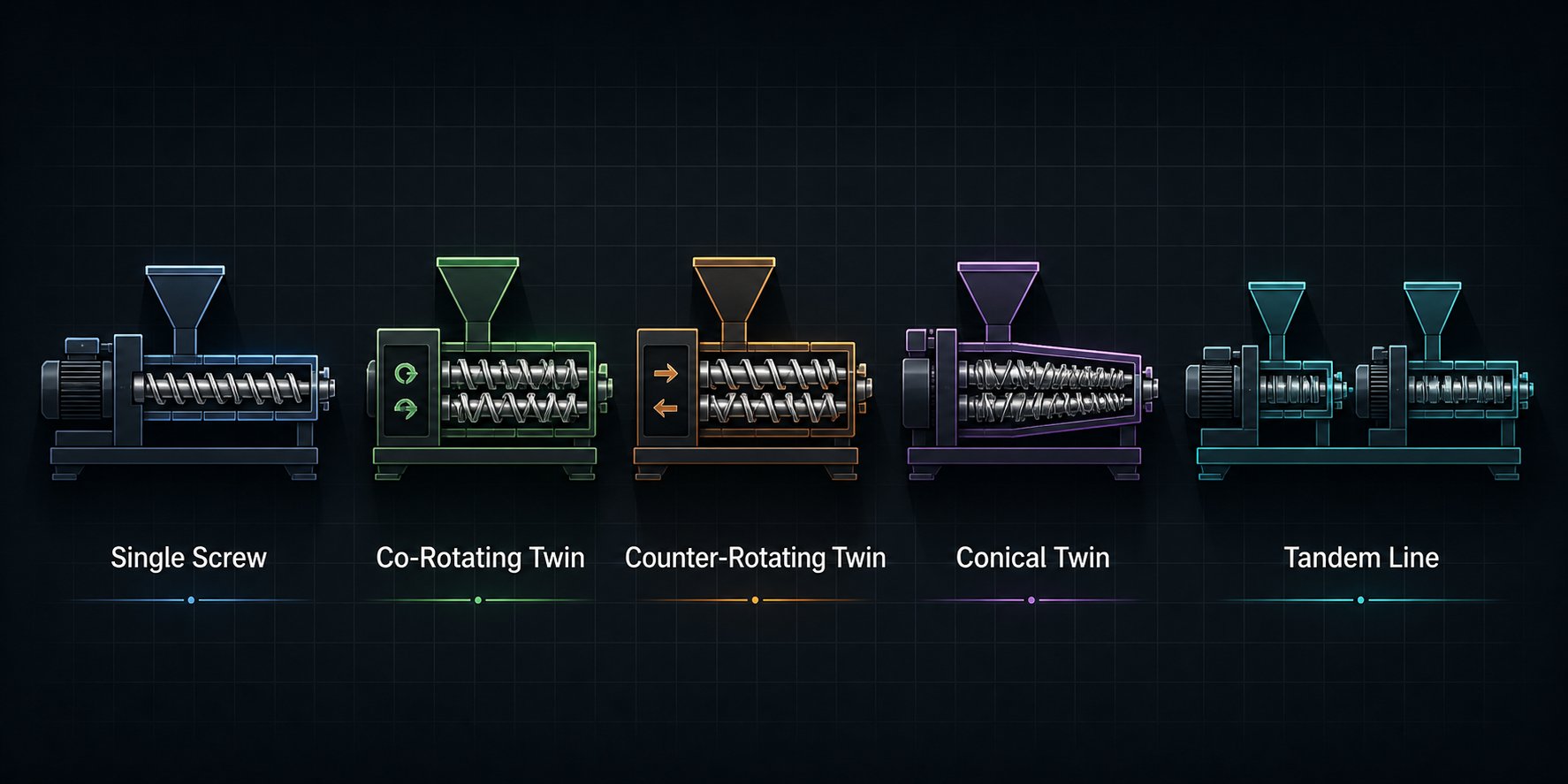
Head-to-Head Comparison Table and Material Matching Guide
Managing multiple screw extruders across a production floor means constantly answering the same question: which machine handles this specific job best? The reviews above covered each configuration in depth, but a single reference point — one you can bookmark and pull up during equipment planning meetings — is worth more than five separate explanations. The tables below consolidate every critical performance parameter into a direct, side-by-side comparison across all five extruder types discussed in this guide.
Complete Feature Comparison Across All Five Extruder Types
The single screw extruder sits in the first column as the baseline. Every twin screw variant is measured against it. Where you see a clear gap in mixing, venting, or self-cleaning, that gap reflects the fundamental mechanical differences — drag flow versus positive displacement — explored in earlier sections.
| Parameter | Single Screw | Co-Rotating Parallel Twin | Counter-Rotating Twin | Conical Twin Screw | Tandem Line |
|---|---|---|---|---|---|
| Conveying Mechanism | Drag flow (friction-dependent) | Positive displacement (self-wiping intermesh) | Positive displacement (enclosed C-chambers) | Positive displacement (tapered C-chambers) | Combined: twin screw primary + single screw secondary |
| Distributive Mixing | Low to moderate | Excellent | Moderate | Moderate | Excellent (primary stage) |
| Dispersive Mixing | Poor to low | Excellent | Low to moderate | Low | Excellent (primary stage) |
| Typical L/D Ratio | 24:1 to 36:1 | 32:1 to 52:1 | 10:1 to 22:1 | 12:1 to 18:1 (measured at large end) | Varies by stage (24:1–36:1 secondary) |
| Throughput vs. Screw Diameter | High | Very high | Moderate | Moderate | Very high (system level) |
| Shear Rate Level | Moderate | High to very high | Low to moderate | Low | Tunable per stage |
| Venting Capability | Limited (single vent port typical) | Excellent (multi-stage vacuum venting) | Good | Good | Excellent (multi-stage across both extruders) |
| Self-Cleaning Ability | Poor | Excellent | Moderate | Moderate to good | Varies by stage |
| Energy Efficiency — Simple Melting | Best (0.15–0.30 kWh/kg) | Lower (0.25–0.40 kWh/kg) | Good (0.18–0.28 kWh/kg) | Very good (0.12–0.22 kWh/kg) | Moderate (combined drive energy) |
| Energy Efficiency — Compounding | Poor (limited mixing forces high recirculation) | Best (0.25–0.45 kWh/kg) | Moderate | Not typical use | Good (twin primary handles mixing) |
| Maintenance Complexity | Low | Moderate to high | Moderate | Moderate | High (two drive systems) |
| Operator Skill Requirement | Low to moderate | High | Moderate | Moderate | High |
| Typical Screw Speed Range | 50–150 rpm | 200–1,200 rpm | 10–30 rpm | 20–50 rpm | Primary: 50–600 rpm; Secondary: 10–30 rpm |
| Best-Suited Materials | Pre-compounded PE, PP, PS, PET pellets | Filled compounds, masterbatch, engineering blends, reactive systems | PVC dry blend, powder coatings, pharma | PVC pipe/profile, WPC, recycled PVC | Foam (PS, PE, PP), highly filled systems needing gentle downstream |
Notice how no single column dominates every row. A twin screw extruder plastic compounding line crushes the mixing categories but loses on energy efficiency and maintenance simplicity for straightforward melting jobs. That trade-off is exactly why material-to-machine matching matters more than any blanket "twin is better" claim.
Material-to-Extruder Matching Guide
When the question shifts from "which machine is best?" to "which machine do I actually need for this product?", the answer almost always starts with the polymer and the process. The table below maps the most common material-application pairings to the recommended extruder configuration, based on the twin screw extrusion process characteristics and single screw strengths reviewed throughout this guide.
| Polymer / Application | Recommended Extruder Type | Why This Configuration |
|---|---|---|
| PE/PP film and pipe from pellets | Single screw | Best pumping efficiency, lowest operating cost for pre-compounded materials |
| Filled PP compounds (talc, CaCO3, glass fiber) | Co-rotating parallel twin screw | High-intensity dispersive mixing handles filler loadings above 30% by weight |
| PVC pipe and profiles from dry blend | Conical or counter-rotating twin screw | Low-shear, precise residence time prevents thermal degradation of heat-sensitive PVC |
| Engineering plastic blends (PC/ABS, PA/PP) | Co-rotating parallel twin screw | Modular screw design creates fine, stable blend morphologies under controlled shear |
| Color and additive masterbatch | Co-rotating parallel twin screw | Superior pigment dispersion reduces raw-material consumption per batch |
| Wood-plastic composites (WPC) | Conical twin screw | Oversized feed zone ingests low-bulk-density wood flour; low speeds prevent fiber degradation |
| Foam sheet (PS, PE, PP with physical blowing agents) | Tandem line | Primary extruder dissolves blowing agent; secondary cools melt to precise foaming temperature |
| Reactive extrusion (grafting, viscracking) | Co-rotating parallel twin screw | Narrow residence time distribution ensures uniform reaction across every polymer particle |
| Recycled post-consumer PVC | Conical twin screw | Tolerates bulk-density variation in regrind without starve-feeding |
| Recycled mixed polyolefins | Co-rotating parallel twin screw (double screw extruder) | Handles variable feedstock and incorporates compatibilizers in a single pass |
You'll notice a pattern: every time the process demands intensive mixing, multi-component blending, or reactive chemistry, twin screw extruders claim the recommendation. Every time the job is stable melting and die feeding of a uniform material, the single screw wins on economics. The twin screw extrusion advantage is real — but only when the application actually requires it.
Common Selection Mistakes to Avoid
Even with clear comparison data in front of them, engineering and procurement teams still fall into predictable traps. These are the errors that show up most often — and the ones that end up costing the most over a machine's 10-to-15-year productive life:
- Over-specifying a twin screw for simple melting tasks. Buying a co-rotating twin for a PE pipe line running pre-compounded pellets doubles your capital cost, increases energy draw by 30-50%, and demands higher-skilled operators — all without improving product quality by a single percentage point. If the material is already compounded, a single screw delivers better economics.
- Underestimating mixing requirements for filled compounds. Choosing a single screw to save money on a 40% CaCO3-filled PP compound virtually guarantees inconsistent filler distribution, surface defects, and elevated reject rates. The machine physically cannot generate the dispersive mixing those formulations demand.
- Confusing co-rotating and counter-rotating performance characteristics. Specifying a co-rotating twin screw for rigid PVC dry-blend processing exposes the material to shear levels that cause thermal decomposition. Conversely, expecting a counter-rotating machine to disperse tightly bound carbon black agglomerates at masterbatch concentrations leads to poor color strength and customer complaints. The rotation direction matters as much as the number of screws.
- Ignoring total cost of ownership by focusing only on purchase price. A twin screw extruder plastic processing line with a $200,000 price tag and $0.05/kg lower additive consumption can outperform a $90,000 single screw line within two years of full-capacity production. Conversely, a twin screw purchased for a job a single screw handles perfectly adds unnecessary TCO burden for the equipment's entire lifespan.
- Neglecting spare-parts lead times. Production-critical twin screw extruders running abrasive formulations consume wear parts faster than most buyers anticipate. Failing to establish a reliable screw and barrel supply chain before commissioning the line guarantees unplanned downtime at the worst possible moment.
Every one of these mistakes traces back to the same root cause: selecting equipment based on general reputation rather than specific process requirements. The comparison data above gives you the framework to avoid that trap — but translating data into a confident purchase decision requires a structured selection process, one that moves step by step from process definition through material analysis to total cost calculation.
How to Pick the Right Extruder for Your Specific Application
Comparison tables and material matching guides give you the data. What they don't give you is a sequence — a step-by-step path from "we need an extruder" to "we need this extruder, in this size, for this material, at this budget." Without that sequence, procurement teams tend to anchor on whatever parameter feels most urgent: price when budgets are tight, throughput when delivery deadlines loom, brand reputation when nobody wants to own a bad decision. The framework below forces a more disciplined approach — one that filters options in the right order so the final choice holds up under production reality, not just during the capital approval meeting.
Four-Step Extruder Selection Framework
Think of this as a funnel. Each step narrows the field of viable configurations before you spend time comparing specs or requesting quotes from twin screw extruder manufacturers or single screw extruder manufacturers. Skip a step, and you risk optimizing the wrong variable.
- Define your primary process. Are you running direct extrusion — melting pre-compounded pellets and shaping them through a die into pipe, film, sheet, or profiles? Or does the extruder itself need to perform compounding, reactive extrusion, or devolatilization? This single question eliminates entire machine categories immediately. Direct extrusion from pellets rarely justifies a co-rotating twin screw. Compounding with 40% filler rarely works on a single screw. Start here, and half the decision is already made.
- Identify your material requirements. What polymer family are you processing — polyolefins, PVC, engineering resins, thermoplastic elastomers? What is the filler or additive loading? Is the material thermally sensitive, moisture-sensitive, or abrasive? Does the feedstock arrive as pellets, powder, flake, or dry blend? PVC dry blend points toward conical or counter-rotating configurations. Pre-compounded HDPE pellets point toward single screw. Glass-fiber-filled PA6 points toward co-rotating twin screw. The material dictates the machine, not the other way around.
- Establish your production scale and throughput targets. A laboratory or pilot operation processing 5-50 kg/h has different equipment economics than a production line running 500-2,000 kg/h around the clock. Screw diameter, drive power, and downstream equipment all scale with throughput — and so does capital cost. A twin-screw extruder machine sized for 1,500 kg/h of compounded PP might cost three times more than one sized for 300 kg/h, even from the same twin-screw extruder manufacturer. Match the machine to your actual volume needs, not your most optimistic five-year forecast.
- Calculate total cost of ownership. Purchase price is the most visible number and the least useful predictor of long-term economics. A complete TCO analysis includes capital cost (machine, installation, commissioning), energy consumption at your actual production rate, maintenance labor and spare-parts spend over a realistic replacement cycle, operator training costs (higher for modular twin screw systems), and unplanned downtime — the hidden cost that often dwarfs all the others combined. Run these numbers over a 10-year horizon. A machine that costs 60% more upfront but saves $0.03/kg in additive consumption and runs 200 more production hours per year can deliver a lower cumulative cost by year three.
When to Choose Single Screw vs Twin Screw
After working through those four steps, most engineers land in one of three clear decision zones. If your answers still feel ambiguous, these rules sharpen the call:
Choose a single screw extruder when:
- The incoming material is pre-compounded pellets or granules with consistent bulk density and composition.
- The primary job is stable melting, pressure building, and die feeding — not mixing or blending.
- Maximum pumping efficiency and output stability matter more than mixing intensity.
- Capital budget is constrained and operator skill levels are moderate, since single screw extruder manufacturers offer simpler, lower-cost platforms with shorter training curves.
- The product line centers on PE/PP pipe, blown film, sheet, or profile extrusion from standard resins.
Choose a co-rotating parallel twin screw extruder when:
- The process requires compounding — blending base resin with fillers, pigments, stabilizers, or reinforcing fibers inside the extruder itself.
- Additive loading exceeds 20-25% by weight, demanding high-intensity dispersive and distributive mixing.
- Reactive extrusion, devolatilization, or multi-stream feeding is part of the process design.
- Frequent recipe changes justify the self-wiping, fast-changeover capability of intermeshing co-rotating screws.
- The application involves engineering plastic blends, masterbatch, or recycled mixed polyolefins requiring compatibilization.
Choose a counter-rotating or conical twin screw extruder when:
- The material is thermally sensitive — rigid PVC, CPVC, or biodegradable polymers with narrow processing windows.
- The feedstock is a low-bulk-density powder or dry blend that needs to be processed directly without a separate pelletizing step.
- The application is PVC pipe, window profiles, PVC foam board, or wood-plastic composites.
- Low screw speeds and gentle shear profiles are essential to prevent degradation, discoloration, or premature blowing-agent activation.
- Compact machine footprint matters — conical designs deliver equivalent PVC output in a shorter overall length than parallel alternatives.
One pattern worth emphasizing: if your operation spans multiple product families — say, PE pipe on one line and PVC profiles on another — you'll likely need more than one extruder type. That's not inefficiency; it's the same logic that leads a machine shop to own both lathes and milling machines. Each tool earns its floor space by doing its specific job better than any general-purpose alternative could.
Sourcing Quality Screw Barrels for Any Configuration
Regardless of which extruder type survives the selection framework above, one component determines whether the machine delivers consistent output for years or drifts out of specification within months: the screw and barrel set. Worn screws increase clearance, reduce mixing efficiency, and degrade melt homogeneity — problems that compound silently until reject rates spike or customers flag quality issues. For twin-screw extruder machines running abrasive fillers, barrel-bore wear rates of 0.1-0.2 mm per 1,000 operating hours are common, meaning a busy compounding line may need replacement elements every 12-18 months.
Smart procurement teams evaluate replacement screw barrel suppliers early — ideally during the equipment planning phase, not after the first unplanned shutdown. Key criteria include metallurgical quality (nitrided, bimetallic, or powder-metallurgy liners matched to the abrasion level of your formulation), dimensional tolerances that match OEM specifications, and lead times short enough to prevent extended downtime.
NANHAIYA's screw barrel product collection is a practical starting point for this evaluation. Engineers can compare single screw, parallel twin screw, conical twin screw, and injection molding screw barrel options side by side — streamlining the sourcing process across different plastic processing applications rather than hunting through separate suppliers for each extruder type. Having a single, reliable spare-parts supply chain that covers all your configurations reduces both procurement complexity and the risk of sitting on a dead line while waiting for a barrel shipment from an unfamiliar vendor.
The single screw vs twin screw extruder decision shapes your throughput, product quality, and operating costs for a decade or more. Get it right by following the process — define the task, match the material, size the output, and calculate the true cost — and the machine earns back every dollar. Get it wrong, and you'll pay for it on every production shift until the day you replace it.
Frequently Asked Questions About Single Screw vs Twin Screw Extruders
1. What is the main difference between a single screw and twin screw extruder?
The core difference lies in the conveying mechanism. A single screw extruder relies on drag flow, where friction between the polymer and barrel wall pushes material forward. Twin screw extruders use positive displacement through intermeshing screw flights that physically transport material regardless of friction conditions. This mechanical distinction drives every downstream difference: twin screws deliver far superior mixing intensity, self-wiping capability, and multi-stream feeding, while single screws offer simpler operation, lower capital cost, and better energy efficiency for straightforward melting and pumping of pre-compounded pellets.
2. When should I choose a single screw extruder over a twin screw?
A single screw extruder is the better economic and technical choice when your process involves melting pre-compounded pellets and shaping them through a die — applications like PE or PP blown film, pipe extrusion, sheet production, and wire coating. If your feedstock arrives as uniform pellets with consistent composition and your primary need is stable pressure building and high volumetric output rather than intensive mixing, a single screw delivers lower purchase cost (typically 40-60% less), simpler operation, and reduced maintenance burden. Over-specifying a twin screw for these tasks increases capital, energy, and training costs without improving product quality.
3. What is the difference between co-rotating and counter-rotating twin screw extruders?
Co-rotating twin screws turn in the same direction, creating high-shear, self-wiping flow patterns ideal for compounding, masterbatch production, and reactive extrusion. They run at high speeds (200-1,200 rpm) and offer modular screw elements for process customization. Counter-rotating twin screws turn in opposite directions, forming enclosed C-shaped chambers that gently transport material with minimal back-mixing. They operate at much lower speeds (10-30 rpm), producing less shear heat — making them essential for thermally sensitive materials like PVC. Choosing the wrong rotation direction can be as costly as selecting the wrong extruder family entirely.
4. Why are conical twin screw extruders preferred for PVC processing?
Conical twin screw extruders solve a specific problem that PVC dry blends create: low bulk density. PVC powder weighs roughly half as much per unit volume as pelletized resin, so a standard parallel barrel struggles to ingest enough material. The conical design features a large-diameter feed opening that narrows toward the discharge, naturally compacting powder, expelling trapped air, and initiating gentle melting — all without high screw speeds or excessive shear. Operating at just 20-50 rpm, the conical geometry keeps processing temperatures safely below PVC's narrow degradation threshold while delivering specific energy consumption as low as 0.12-0.22 kWh/kg.
5. How do I calculate total cost of ownership for an extruder?
A realistic total cost of ownership calculation extends well beyond the purchase price. Include capital cost (machine, installation, and commissioning), energy consumption at your actual production rate over a 10-year horizon, maintenance labor and spare-parts frequency (twin screws running abrasive fillers may need barrel replacement every 12-18 months), operator training costs (higher for modular twin screw systems), and unplanned downtime — often the single largest hidden cost. Also factor in material savings: a twin screw's superior mixing can reduce pigment or additive consumption per kilogram, potentially offsetting a higher upfront price within two to three years of full-capacity operation. Establishing a reliable screw barrel supplier, such as NANHAIYA's product collection at nhyscrews.com, early in the planning phase helps control spare-parts lead times and prevent costly production stoppages.
Written by
Nanhaiya Technical Team
Zhoushan Nanhaiya Plastic Machinery Co., Ltd.
The Nanhaiya technical team supports screw and barrel manufacturing projects through application review, technical communication, custom manufacturing coordination, and production and quality control.
Discuss Your Application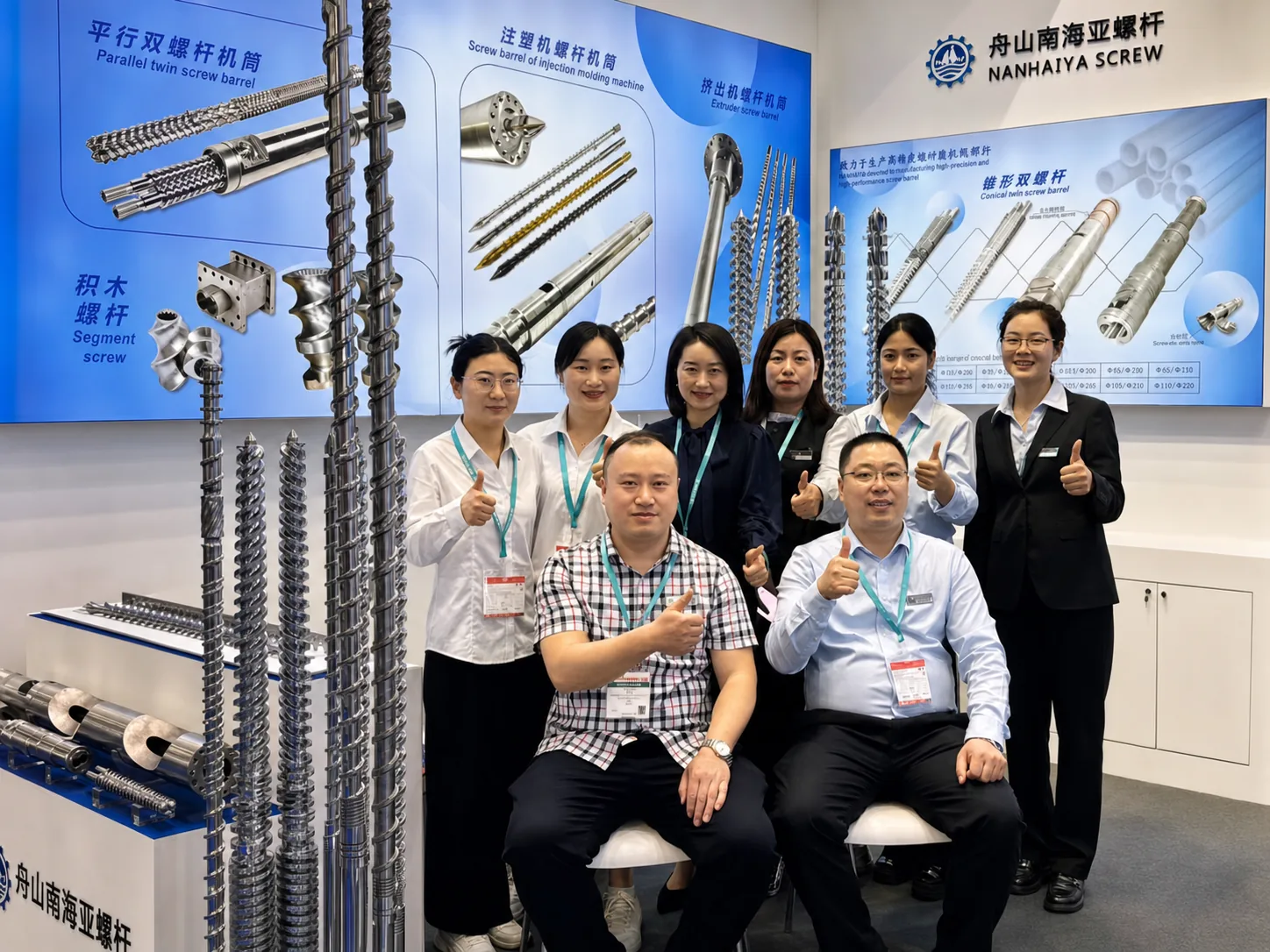
Related Articles
More insights on screw barrel technology and plastics processing.
What Nobody Tells You About Screw Barrel For Plastic Machine Design
Oct 10, 2026
Learn how screw barrel for plastic machine design affects melt quality, throughput, and wear life. Covers geometry, resin matching, troubleshooting, and sourcing.
Read Article
Single Screw Extruder for Sheet: Stop Guessing, Start Specifying
Oct 9, 2026
Learn how to specify a single screw extruder for sheet production. Covers screw geometry, resin-specific processing, troubleshooting, and maintenance best practices.
Read Article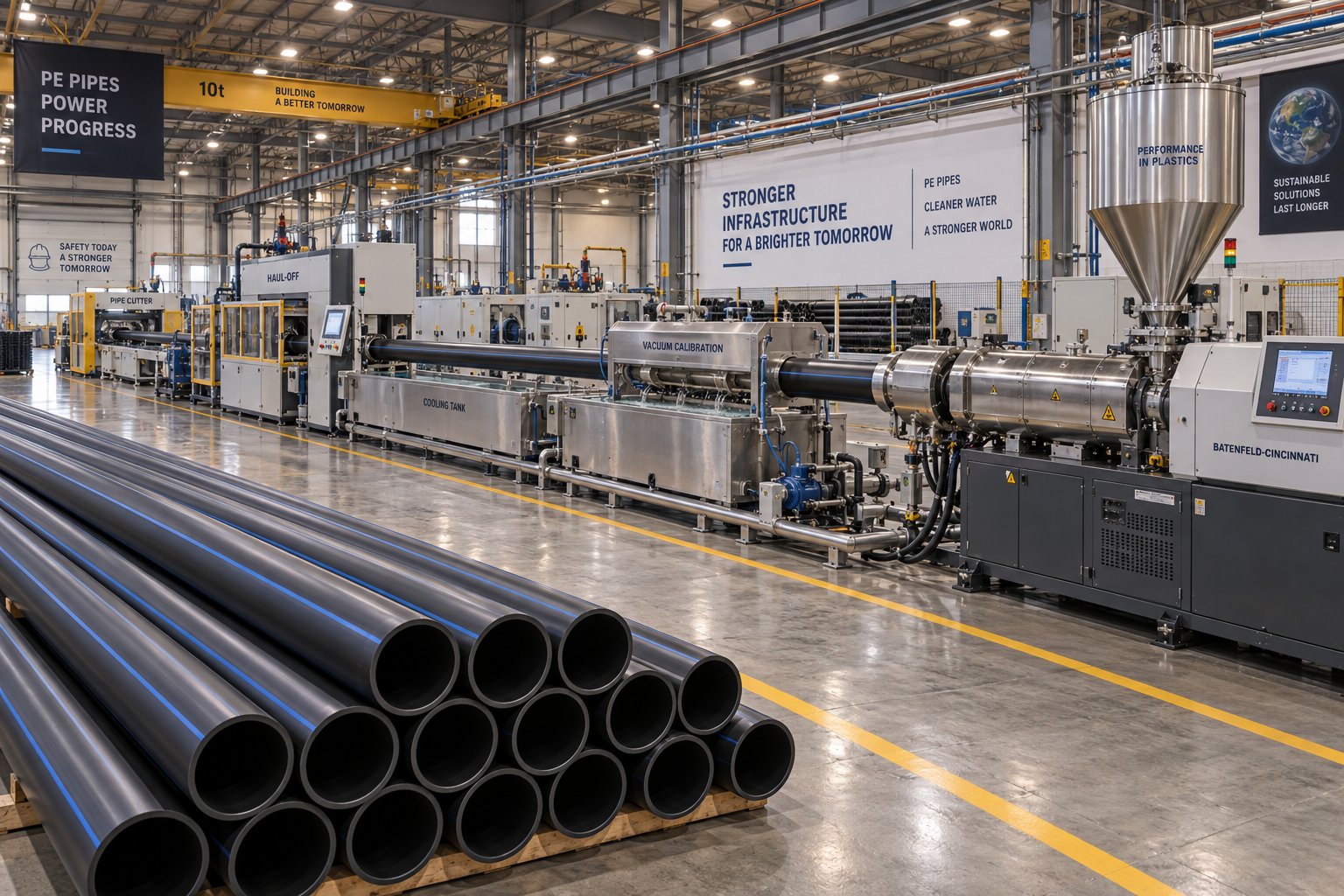
PE Pipe Extruder Machine: What Datasheets Won't Tell You
Oct 9, 2026
Learn how a PE pipe extruder machine works, key specs explained, material grade selection, maintenance tips, and buyer guidance beyond the datasheet.
Read ArticleLooking for something else?
Search by material, symptom or product and jump straight to the relevant page.
These are navigation suggestions based on keyword matching — not a quotation, not a delivery commitment, and not a substitute for engineering review. Final specification is confirmed by our engineers against your drawings and processed material.
Need help with screw barrel selection?
Share your machine model, processed material and application. Our team can help with pricing and technical support.