

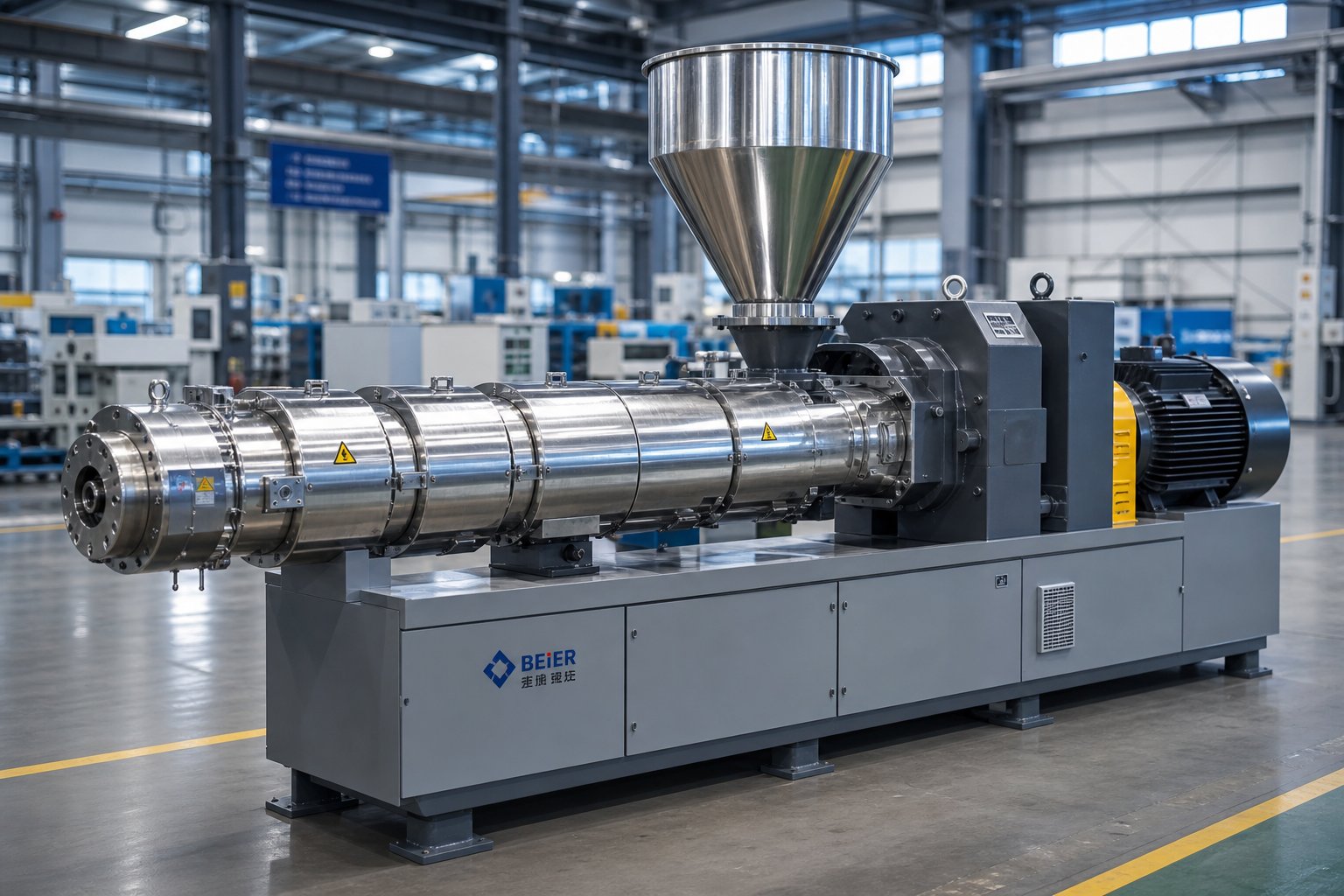
What Single Screw Extruder Manufacturers Do and Why It Matters
Single screw extruder manufacturers design, engineer, and build the machines that melt, convey, and shape thermoplastic polymers into continuous profiles, pipes, films, sheets, and pellets. Every plastic extruder machine in a production facility traces back to a manufacturer whose engineering decisions determine how reliably—and profitably—that line runs for years after installation.
These suppliers serve virtually every segment of the plastics processing industry. Pipe producers, blown-film converters, sheet extruders, profile fabricators, and pelletizing operations all depend on a well-built extrusion extruder as the heart of their production line. Choosing the wrong supplier doesn't just mean buying an underperforming machine—it means inheriting someone else's engineering compromises for the life of the equipment.
This article is built as an independent, buyer-oriented resource. Whether you're a procurement manager comparing quotes or a plant engineer writing equipment specifications, you'll find actionable guidance for evaluating and shortlisting suppliers—without the marketing spin.
What Single Screw Extruder Manufacturers Actually Provide
A capable single screw extruder manufacturer delivers far more than a standalone machine. The scope typically includes complete extrusion lines—extruder, die head, downstream equipment, and integrated controls—along with replacement wear components like screws and barrels, operator training, commissioning support, and long-term aftermarket service. Some specialize in turnkey systems for specific applications, while others focus on component-level supply. Understanding where a manufacturer's true capability begins and ends is one of the first steps in effective supplier evaluation.
Why Choosing the Right Manufacturer Matters
Your choice of manufacturer has downstream consequences that compound over time. Output consistency, mechanical uptime, energy consumption per kilogram of throughput, and the long-term maintenance burden all trace directly back to how well the original machine was engineered and built.
The manufacturer's engineering depth doesn't just affect the machine—it determines your production line's profitability for the next 10 to 20 years.
Imagine two identical resin formulations running on two different single screw extruders. One holds melt temperature within a tight window and delivers uniform output hour after hour. The other drifts, forcing operators to constantly adjust and scrap off-spec product. The difference? Manufacturer expertise baked into screw geometry, thermal management, and drive system design.
In the sections ahead, you'll find regional breakdowns of where these manufacturers operate, a practical framework for categorizing suppliers by size and specialty, detailed evaluation criteria, total cost of ownership analysis, and—critically—the red flags that most buyers miss until it's too late.
How Single Screw Extruders Work From Feed to Finished Melt
A single screw extruder machine looks deceptively simple from the outside—a motor, a barrel, and a screw spinning inside it. But the real engineering happens in the geometry of that single extruder screw, where raw polymer pellets transform into a homogeneous, pressurized melt ready to be shaped by a die. Understanding this process gives you a major advantage when sitting across the table from a manufacturer, because the questions you ask about screw design reveal whether you're dealing with a genuine engineering partner or a catalog reseller.
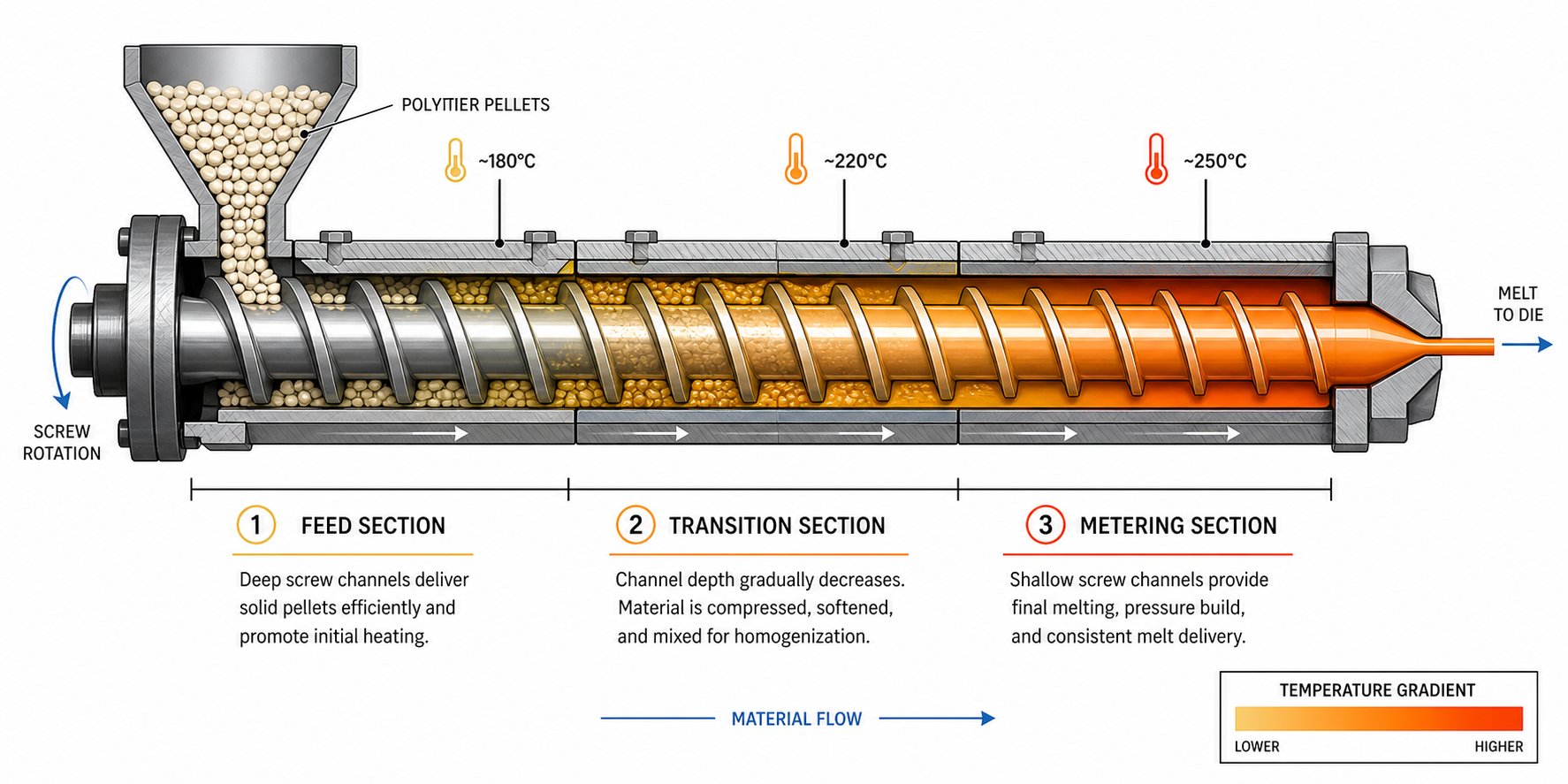
Every screw extruder divides the barrel into three functional zones, each performing a distinct job in the polymer's journey from solid pellet to finished melt. The design parameters governing each zone—channel depth, compression ratio, and length-to-diameter (L/D) ratio—directly affect throughput, melt quality, and which materials the machine can process effectively.
Feed, Compression, and Metering Zones Explained
Picture a stream of plastic pellets dropping from the hopper into the barrel. That's where the feed zone takes over. Here, the screw channel is deep—deep enough to accept a large volume of solid granules and convey them forward through friction between the pellets, barrel wall, and screw root. The channel depth in this zone determines how much raw material the extruder can ingest per revolution, which sets the ceiling for overall output capacity.
As the material advances, it enters the compression zone, where the screw channel gradually becomes shallower. Imagine the walls slowly closing in. This decreasing depth compacts the pellets together, squeezes out trapped air, and generates the frictional and shear heat needed to begin melting the polymer. The compression ratio—the volume ratio between the first flight in the feed zone and the last flight in the metering zone—is a critical design parameter. Too low, and the material doesn't melt completely. Too high, and heat-sensitive polymers degrade from excessive shear. For context, soft polyolefins like PE typically need a compression ratio around 2.5:1 to 3.0:1, while rigid engineering plastics such as ABS or PC may require 3.5:1 to 4.5:1.
Finally, the metering zone receives the nearly fully molten polymer. This zone has a constant, shallow channel depth designed to homogenize the melt temperature, build consistent pressure, and deliver a uniform flow rate to the die. It's the precision stage—any inconsistency here shows up directly as dimensional variation or surface defects in the final product.
| Zone Name | Function | What Buyers Should Evaluate |
|---|---|---|
| Feed Zone | Accepts solid pellets and conveys them forward via friction; deep channel depth maximizes material intake | Whether the manufacturer offers grooved feed zone options for hard-to-feed polymers like HDPE; cooling provisions to prevent premature melting |
| Compression Zone | Gradually compacts pellets, expels air, and generates shear heat to melt the polymer | Compression ratio matched to your specific resin; transition profile (gradual vs. rapid) suited to material thermal sensitivity |
| Metering Zone | Homogenizes melt temperature and viscosity; builds stable pressure for consistent die output | Channel depth optimized for target throughput and mixing quality; availability of mixing sections (Maddock, barrier) for improved melt uniformity |
The L/D ratio ties all three zones together. As Allan Griff's extrusion reference work explains, the most common L/D for single screw machines sits around 24:1, though modern designs for modified or filled plastics increasingly push to 28:1 or even 32:1. A longer screw provides more residence time for melting and mixing, but pushing the ratio too far risks thermal degradation of heat-sensitive materials and drives up energy consumption. When a manufacturer quotes you an L/D ratio, ask why they selected it for your application—not just what it is.
Why Screw Design Capability Separates Good Manufacturers
Here's where technical knowledge becomes a powerful filter for your supplier shortlist. A manufacturer that only offers general-purpose, three-zone screws is essentially selling you a compromise. That design might work adequately for commodity polyolefins running simple profiles—but the moment you introduce glass-filled nylon, flame-retardant ABS, or recycled feedstock with variable melt flow index, generic geometry falls short.
The manufacturers worth serious consideration are the ones investing in application-specific screw engineering. Barrier flight designs, for example, separate the melt and solid phases into dedicated channels so melting efficiency improves dramatically without increasing screw speed. Maddock mixing sections—placed near the screw tip—force the melt over a tight-clearance barrier ridge, straining out unmelted particles and improving thermal uniformity. Grooved feed zones, paired with a redesigned screw geometry that features a shallower feed and deeper metering section, solve the intake problems that plague slippery, high-density polymers.
Each of these features requires genuine R&D capability—testing, simulation, and iteration across different polymers and operating conditions. When you ask a manufacturer about their screw design process and they respond with detailed questions about your resin, throughput targets, and downstream equipment, that's a strong signal. If they simply point you to a standard catalog, you'll likely pay for that gap in expertise through lower output, higher scrap rates, or premature wear.
Buyers processing engineering plastics, specialty compounds, or post-consumer recycled materials should treat screw design capability as a non-negotiable evaluation criterion. It's the single technical factor that most directly separates an extruder for polymer precision from a machine that merely spins and pushes plastic forward—and it sets the stage for understanding how different manufacturer categories approach this challenge in very different ways.
Single Screw vs Twin Screw and What It Means for Manufacturer Selection
Most online comparisons between single screw and twin screw extruders read like a mechanical engineering textbook—useful for passing an exam, less useful for deciding which suppliers to contact. The real value of this comparison for buyers isn't academic. It's strategic. Your application determines which architecture you need, and that decision immediately filters half the manufacturers off your list. Get this step wrong, and you'll waste weeks evaluating companies that were never the right fit.
Applications Where Single Screw Extruders Excel
Single screw machines dominate applications where the primary job is melting a well-characterized polymer and pushing it through a die at consistent volume and pressure. Think of processes where the resin arrives pre-compounded and the extruder's role is shaping rather than formulating. That's a wide territory:
- Pipe extrusion — PP-R, PE, PVC, and HDPE pipes rely on steady-state melt delivery where single screw machines offer proven reliability and lower capital outlay.
- Blown and cast film — LDPE, LLDPE, and HDPE film production depends on tight melt uniformity, which well-designed barrier screws deliver with simpler maintenance than twin-screw alternatives.
- Sheet extrusion — PET, PP, PS, and PC sheet lines benefit from the consistent pressure generation and lower mechanical complexity of a single screw platform.
- Profile extrusion — Window profiles, decking, and custom industrial shapes run efficiently on single screw systems, especially in PVC and polyolefin processing.
- Simple pelletizing — When re-pelletizing clean regrind or converting virgin resin into specific pellet forms, single screw extruders handle the task at a fraction of the cost.
In each of these scenarios, you'll notice that the material arrives at the hopper in a relatively predictable state. The extruder doesn't need to blend incompatible components, inject reactive additives mid-process, or handle extreme filler concentrations. That predictability is exactly where single screw architecture shines—lower purchase price, simpler spare parts inventory, reduced operator training, and fewer potential failure points.
Twin screw extruders, by contrast, earn their higher price tag in applications that demand intensive mixing, high filler loading, or chemical reactions inside the barrel. USEON's technical comparison highlights that co-rotating twin screw extruders are the preferred platform for compounding masterbatches, blending engineering plastics with glass fiber or mineral fillers at concentrations above 40-50%, and performing reactive extrusion where monomers polymerize inside the barrel. Research from AIMPLAS confirms that reactive extrusion is carried out primarily on co-rotating twin screw extruders due to their superior mixing capacity and process design versatility. If your operation involves devolatilization, high-viscosity blending, or processing thermally sensitive compounds requiring precise residence time control, twin screw extruder manufacturers are the ones you should be calling.
How This Decision Shapes Your Manufacturer Shortlist
Here's the procurement insight that many buyers overlook: single screw extruder manufacturers and twin screw extruder manufacturers are often entirely different companies. The engineering challenges, screw metallurgy, gearbox design, and process control logic differ so fundamentally between the two architectures that most suppliers develop deep expertise in one and offer the other as a secondary capability—or not at all.
A manufacturer whose R&D team has spent decades perfecting barrier screw geometries for polyolefin film may have limited experience designing modular, segmented screws for a compounding line. Conversely, a twin-screw extruder manufacturer building self-cleaning, co-rotating systems for cable compound production may not have the thermal management finesse that high-quality sheet extrusion demands from a single screw platform.
Some larger companies do manufacture both types. But even within these organizations, you'll often find that engineering depth—and reference installations—skew heavily toward one architecture. When evaluating a dual-platform supplier, ask which type represents the majority of their installed base. That answer tells you where their real-world troubleshooting experience lives.
| Criteria | Single Screw Extruder | Twin Screw Extruder |
|---|---|---|
| Typical Applications | Pipe, blown/cast film, sheet, profile extrusion, simple pelletizing | Compounding, masterbatch, reactive extrusion, high-filler blends, devolatilization |
| Capital Cost Range | Lower — typically 30-50% less than equivalent-output twin screw systems | Higher — premium reflects complex gearbox, segmented barrel, and modular screw elements |
| Maintenance Complexity | Simpler — fewer wear components, single screw and barrel replacement straightforward | More involved — paired screws, segmented elements, tighter tolerances increase service demands |
| Throughput Range | Wide range from lab-scale (5 kg/hr) to large industrial (2,000+ kg/hr) | Wide range, but throughput can be adjusted independently of screw speed for greater process flexibility |
| Ideal Buyer Profile | Processors running pre-compounded resins who prioritize uptime, simplicity, and lower total cost of ownership | Compounders, material formulators, and recyclers who need intensive mixing and process versatility |
The twin screw extruder price premium isn't just about the machine itself—it extends to spare parts inventory, operator skill requirements, and ongoing maintenance budgets. For processors whose applications fall squarely in the single screw column, paying that premium delivers no meaningful return. Conversely, trying to force a single screw machine into a heavy compounding role creates melt quality problems that no amount of operator skill can overcome.
The practical takeaway is straightforward: define your application first, then let that decision guide which category of manufacturers you engage. Doing this early eliminates mismatched suppliers from your evaluation pipeline and focuses your procurement energy on the companies most likely to deliver a machine engineered for exactly what you need. And once you've narrowed the field to the right architecture, the next challenge becomes understanding how these remaining manufacturers differ from each other in size, specialization, and the value they actually deliver.
How to Categorize Single Screw Extruder Manufacturers by Size and Specialty
Narrowing the field to single screw architecture still leaves you with hundreds of potential suppliers worldwide. The trouble is, most buyer guides treat these companies as if they're interchangeable—dumping global OEMs, family-owned specialists, and low-cost importers into the same flat list. That approach wastes your evaluation time and hides critical differences in engineering depth, service infrastructure, and long-term reliability.
A more useful approach is to categorize every extruder manufacturer you encounter along two dimensions: company size and structure, and price tier with its associated value proposition. Once you map a prospective supplier into the right bucket, you'll know what to expect—and, just as importantly, what questions to ask before signing a purchase order.
Global OEMs vs Regional Specialists vs Niche Players
Think of the single screw extruder market as three distinct tiers of supplier, each with trade-offs that matter far more than their brochure language suggests.
Global OEMs are the large, internationally recognized machinery builders with multiple manufacturing sites, worldwide service networks, and extensive installed bases across dozens of countries. These companies offer turnkey extrusion lines—extruder, die, downstream, controls, and automation—engineered as integrated systems. You'll find dedicated application labs, in-house screw design simulation, and the ability to support installations with local field service engineers in major plastics processing regions. The trade-off? Premium pricing, longer lead times driven by complex project engineering, and less flexibility for small-order or non-standard customization. Global OEMs fit large-scale processors running high-volume industrial extruder lines who can justify the capital outlay through output consistency and minimized unplanned downtime.
Regional specialists operate within a defined geographic market—often a single country or continent—with strong reputations built over decades of serving local processors. These companies may not have field offices on five continents, but they compensate with faster lead times, more flexible machine customization, direct access to senior engineers during the sales and commissioning process, and pricing that reflects lower overhead structures. Many regional specialists have deep expertise in the dominant applications of their home market—PVC profile extrusion in Turkey, polyolefin film in Southeast Asia, or pipe production in South America. If your operation values a close working relationship with engineers who understand your local processing conditions, a regional specialist often delivers more practical value than a global brand name.
Niche players serve highly specific application verticals where general-purpose equipment simply won't perform. Medical tubing extruders, micro-extrusion systems for fiber optics, lab scale extruder machines for R&D departments, and laboratory extruders designed for small-batch material development all fall into this category. These manufacturers may build fewer than fifty machines per year, but each one reflects deep domain knowledge—tight tolerance control, cleanroom compatibility, specialized screw geometries for exotic polymers, or precise melt temperature regulation at very low throughput rates. If your application demands specialized capability, a niche player's focused expertise often outweighs the broader product portfolio of a larger competitor.
Segmenting Manufacturers by Price Tier and Value Proposition
Beyond company size, price tier is the categorization dimension that most directly shapes your buying experience. Each tier carries distinct characteristics, and understanding them prevents the common mistake of comparing quotes across tiers as if they represent the same thing.
Premium Tier (Primarily European and North American)
- Advanced direct-drive servo motor technology, precision-machined components, and sophisticated automation integration
- Comprehensive documentation packages including detailed engineering drawings, wiring schematics, and validated process parameters
- Extensive R&D investment in energy efficiency, screw design simulation, and process optimization for specialty polymers
- Typical buyers: large processors running 24/7 operations where uptime, energy savings, and consistent melt quality justify higher capital expenditure
- Trade-offs: highest upfront cost, longer delivery lead times, and spare parts pricing that reflects premium brand positioning
Mid-Range Established Tier (Growing Asian and Select Global Manufacturers)
- Competitive pricing—often 30-50% below premium-tier equivalents—paired with steadily improving engineering standards and build quality
- Increasing adoption of servo-driven systems, PLC-based controls from recognized brands, and international component sourcing for critical items like bearings and heaters
- Chinese extruder manufacturers have gained significant market share in this tier by combining aggressive pricing with rapidly improving metallurgy, machining tolerances, and control system integration
- Typical buyers: mid-sized processors expanding capacity, companies entering new product lines, and operations in price-competitive markets where capital efficiency matters
- Trade-offs: service network coverage may be thinner outside the manufacturer's home region; documentation and commissioning support can vary significantly between suppliers
Economy Import Tier
- Lowest upfront cost, sometimes 60-70% below premium equivalents, making these machines accessible for startup operations or secondary production lines
- Basic control systems, standard motor-gearbox configurations, and limited customization options
- Spare parts may use non-standard specifications, making aftermarket sourcing more challenging
- Typical buyers: startups, processors in developing markets, and operations where initial capital constraints outweigh long-term efficiency considerations
- Trade-offs: require significantly more buyer diligence—factory visits, reference checks, and independent quality verification become essential rather than optional; total cost of ownership can exceed mid-range machines within three to five years due to higher energy consumption, accelerated wear, and increased maintenance
One pattern worth noting: the boundaries between tiers are shifting. A decade ago, the gap between premium European machinery and Chinese-built alternatives was enormous in both engineering sophistication and build quality. That gap has narrowed considerably as established Asian manufacturers invest in CNC machining centers, hire engineers trained at European firms, and source critical components—drives, sensors, heating elements—from the same global suppliers that premium OEMs use. Buyers who dismissed Chinese or Indian manufacturers five years ago may find that certain mid-range suppliers now deliver machines comparable in performance to what the premium tier offered a generation earlier.
The key is matching your tier selection to your actual operational requirements. A processor running commodity LDPE bags on a two-shift schedule has fundamentally different needs than a medical device manufacturer extruding fluoropolymer tubing around the clock. Paying premium prices for the first scenario wastes capital. Chasing economy pricing for the second scenario invites quality failures that cost far more than the machine savings.
With a clear framework for categorizing manufacturers by both structure and price tier, the logical next question becomes geographic—because where a manufacturer is located shapes everything from engineering heritage and service accessibility to logistics costs and spare parts lead times.

Where Single Screw Extruder Manufacturers Are Located Around the World
Geography isn't just a shipping logistics detail. Where an extruder manufacturer is based tells you something fundamental about their engineering heritage, the standards they build to, the service infrastructure they can realistically offer your plant, and how quickly replacement parts arrive when a screw or barrel wears out mid-production. Buyers doing global supplier research quickly discover that plastics extrusion equipment manufacturing expertise clusters in specific regions, each carrying distinct strengths and trade-offs that no brochure will spell out honestly.
European Manufacturers and Their Engineering Heritage
Europe—particularly Germany, Italy, and the United Kingdom—remains the historical epicenter of extrusion machinery innovation. German extruders manufacturers have set global benchmarks in precision engineering, energy efficiency, and process control for decades. Companies like KraussMaffei and Battenfeld-Cincinnati dominate high-output polyolefin pipe and multi-layer co-extrusion, leveraging deep R&D investment and engineering cultures that prioritize long-term machine durability over first-cost competitiveness.
Italy contributes a strong tradition of robust mechanical design, particularly in blown film and profile extrusion, where companies like Bausano have carved out global reputations in high-filler PVC processing. The UK, meanwhile, hosts specialists like Boston Matthews—a manufacturer with over 65 years of heritage—whose expertise extends into challenging specialty material processing, including PEEK and fluorocarbon extrusion where standard equipment simply won't survive the processing temperatures and chemical aggressiveness involved.
The trade-off with European suppliers is straightforward: you're paying premium prices—often 2.5 to 3.5 times the cost of equivalent-output Asian machines—and accepting lead times that can stretch past 120 to 180 days during peak demand periods. For processors running specialty polymers, operating under strict regulatory frameworks, or requiring direct-drive servo technology with advanced automation, that premium often earns its return through lower energy costs and superior melt consistency over the machine's lifespan.
North American Manufacturers and Domestic Service Advantages
The North American market brings a different value proposition to the table. The United States and Canada host several established extruding equipment builders whose competitive edge lies less in cutting-edge innovation and more in deep domestic service networks, rapid spare parts availability, and seamless integration with local automation standards and electrical codes.
Davis-Standard, one of the largest extrusion machinery manufacturers in North America, exemplifies this approach. Their portfolio spans sheet, film, pipe, profile, and compounding lines, backed by extensive aftermarket support throughout the US, Canada, and Latin America. For plants operating in the Americas, the practical advantage is significant—field service engineers who can be on-site within days rather than weeks, spare parts warehoused domestically rather than shipped from overseas, and commissioning teams fluent in NFPA and NEC electrical standards without requiring adaptation. Buyers occasionally search for a davis standard extruder for sale on the secondary market, which speaks to the brand's longevity and the active resale demand that well-maintained American-built machines command.
Canadian and US manufacturers also benefit from proximity to major resin producers and the continent's large packaging, construction, and automotive supply chains, enabling close collaboration on application-specific machine configurations. The consideration? Pricing sits firmly in the premium tier, and product line breadth at any single manufacturer tends to be narrower than what you'd find from the largest European or Chinese groups.
Asian Manufacturers and the Evolving Quality Landscape
Asia is where the single screw extruder market has undergone its most dramatic transformation over the past decade. The region isn't monolithic, though—each manufacturing hub brings a very different profile to the table.
Japan occupies a tier of its own. Companies like JSW (Japan Steel Works) and Shibaura Machine (formerly Toshiba Machine) are renowned for precision machining tolerances, ultra-accurate temperature regulation, and engineering-grade build quality that rivals or exceeds European standards. Japanese extruders command pricing comparable to German machines but deliver exceptional performance in demanding applications—electronics-grade compounding, optical-quality sheet extrusion, and precision medical tubing. The consideration is limited customization flexibility and lead times that can stretch to 120-240 days.
Chinese extruder manufacturers represent the fastest-evolving segment of the global market. A decade ago, most Chinese-built plastics extrusion equipment served basic domestic applications with noticeable gaps in machining quality and control system sophistication. That picture has changed substantially. Established Chinese manufacturers like JWELL and Jinming now ship hundreds of extrusion lines annually to 50+ countries, equipping machines with Siemens motors, Flender gearboxes, and Swiss temperature controllers at 30-40% of European pricing. JWELL alone reports over 600 pipe extrusion lines per year—a production volume that exceeds most European competitors combined. The quality gap hasn't vanished entirely, but for standard pipe, film, sheet, and profile applications, well-vetted Chinese suppliers deliver increasingly competitive performance at capital costs that fundamentally change the payback calculation.
Taiwan has built a strong niche in mid-range blown film and sheet extrusion machinery, with manufacturers supplying reliable equipment to Southeast Asian and African markets at pricing that sits between Chinese economy and Japanese premium tiers.
India serves price-sensitive domestic and export markets, with growing manufacturing capacity in pipe and profile extrusion lines. Indian manufacturers are particularly competitive for PVC processing equipment sold into Africa, the Middle East, and South Asia, though export infrastructure and global service networks remain less mature than Chinese counterparts.
When evaluating a davis standard extruder for sale on the secondary market versus purchasing new Asian-built equipment, buyers often find that the total investment—including refurbishment, upgraded controls, and freight—can approach the cost of a new mid-range Chinese or Indian machine with a full warranty. That comparison underscores why geographic sourcing decisions require careful total-cost analysis rather than reflexive brand loyalty.
| Region | Strengths | Considerations | Typical Applications |
|---|---|---|---|
| Europe (Germany, Italy, UK) | Precision engineering, energy efficiency innovation, specialty polymer expertise, advanced automation, deep R&D | Premium pricing (2.5-3.5x Asian equivalents), longer lead times (120-180+ days), spare parts at premium cost | Specialty materials (PEEK, fluoropolymers), high-output polyolefin pipe, multi-layer co-extrusion, regulated industries |
| North America (USA, Canada) | Strong domestic service networks, rapid spare parts access, local automation/electrical code compliance, active secondary market | Premium pricing, narrower product line breadth at individual manufacturers, limited global service outside the Americas | Sheet, film, pipe, and profile for the Americas market; plants requiring fast domestic field service response |
| Japan | Exceptional machining precision, ultra-accurate process control, engineering-grade build quality | Pricing comparable to German machines, limited customization flexibility, extended lead times (120-240 days) | Electronics-grade compounding, optical-quality sheet, precision medical tubing, high-purity applications |
| China | Aggressive pricing (30-40% of European), rapidly improving quality, high production volume, short lead times (45-90 days), European-brand components standard on established builders | Quality varies significantly between established firms and small workshops; service network density outside Asia still developing; requires buyer due diligence | Standard pipe, film, sheet, profile, pelletizing; high-volume commodity processing; capacity expansion projects |
| Taiwan | Reliable mid-range quality, competitive pricing, strong blown film and sheet heritage | Smaller scale than Chinese or European competitors, limited service coverage in some regions | Blown film, sheet extrusion for Southeast Asian and African markets |
| India | Lowest-cost sourcing for basic equipment, growing manufacturing capacity, competitive in PVC processing | Export infrastructure and global service networks less mature, technology adoption trails China and Taiwan | PVC pipe and profile for domestic, African, Middle Eastern, and South Asian markets |
The bottom line on geographic sourcing is that no single region dominates across every evaluation criterion. European heritage delivers proven performance and specialty capability at a price. North American manufacturers offer unmatched domestic service for plants in the Americas. Japanese builders set the bar for precision. And Chinese extruder manufacturers have shifted from budget-only contenders to serious mid-range competitors whose quality trajectory continues to accelerate. Your optimal sourcing region depends on the specific balance of upfront cost, logistics complexity, service accessibility, and spare parts availability that your operation demands—and that balance looks different for a blown film converter in Ohio than it does for a pipe producer in Lagos.
Geography tells you where a manufacturer comes from. But it doesn't tell you whether their machines are engineered for your specific application—and that distinction matters just as much when you're building a serious shortlist.
Matching Manufacturer Specializations to Your Single Screw Extrusion Machine Application
A manufacturer based in the right region with the right price tier still might not be the right fit—if their engineering team has never built a line for your specific process. Imagine buying a single screw plastic extruder from a company whose reference list is packed with blown film installations when what you actually need is a high-tolerance medical tubing line. The motor spins, the barrel heats up, and the screw turns—but the screw geometry, downstream integration, die design, and control logic are all optimized for a completely different product. That mismatch shows up as dimensional inconsistency, excessive scrap, and months of frustrating process troubleshooting.
Application specialization is the filter that turns a broad manufacturer list into a focused shortlist of companies genuinely equipped to solve your processing challenge. The extrusion world splits into three broad verticals, and the manufacturers who lead in each one have developed distinct capabilities that don't transfer automatically across categories.
Pipe, Profile, and Tubing Extrusion Specialists
Pipe and profile extrusion places unique demands on the entire line—not just the extruder itself. A plastic tube extruder producing HDPE water pipe at 400mm diameter faces fundamentally different engineering requirements than a small-bore medical tubing line holding wall thickness to plus or minus 0.05mm. Manufacturers who serve this vertical well have invested in large-diameter screw and barrel capability, robust thrust bearing assemblies to handle the sustained back pressures of thick-wall pipe, and tight integration between extruder output and downstream calibration systems.
What separates a capable pipe-focused manufacturer? Their understanding of the full system—not just the extruder in isolation. As HDPE pipe extrusion research highlights, performance hinges on how the die head distributes melt flow uniformly across the pipe cross-section, how vacuum calibration tanks maintain dimensional stability during cooling, and how puller speed synchronizes precisely with extrusion rate to prevent stretching or wall thickness variation. A manufacturer that treats downstream equipment as an afterthought—or sources it from uncoordinated third parties—creates integration headaches that show up on every meter of pipe you produce.
- Large-diameter screw and barrel capability — Pipe extruders commonly run screw diameters from 45mm to 150mm or larger; manufacturers should demonstrate machining capability and wear-resistant metallurgy across this range
- PVC and HDPE processing expertise — These two materials dominate the pipe market but require very different screw designs, compression ratios, and thermal profiles; ask whether the manufacturer has proven configurations for both
- Downstream calibration integration — Vacuum sizing tanks, spray cooling baths, haul-off units, and cutting systems should be engineered as a matched system, not assembled from catalog components
- Tight dimensional tolerances — For pressure-rated pipe and medical tubing, ask the manufacturer what wall thickness tolerances their lines consistently achieve in production—not just in a controlled demo
- Questions to ask: What is your largest installed pipe line diameter? Can you provide production data showing dimensional consistency over an 8-hour run? Do you supply the die head and calibration tooling, or do I source those separately?
Processors running profile extrusion—window frames, decking boards, cable trunking—face a similar integration challenge. Complex cross-sections demand dies with carefully balanced flow channels and calibration tools machined to match the profile geometry exactly. A single screw extrusion machine builder experienced in profile work will typically offer in-house die design and prototyping, which dramatically shortens the time from concept to stable production compared to sourcing the die from a third party unfamiliar with the extruder's melt delivery characteristics.
Film, Sheet, and Coating Extrusion Specialists
Film and sheet extrusion is where melt quality becomes absolutely unforgiving. A pipe can tolerate minor melt temperature variation without visible consequences. A 25-micron blown film cannot. Every degree of thermal inconsistency, every unmelted particle, every micro-gel shows up as a visual defect, a weak spot, or a gauge band that your customer's quality inspector will reject.
Manufacturers specializing in this vertical invest heavily in screw designs that prioritize melt homogeneity above all else. Barrier screws with dedicated melt and solid channels, distributive mixing sections near the screw tip, and precisely controlled barrel temperature zones work together to deliver a melt stream with minimal temperature gradient across the cross-section. You'll notice that the best film-focused builders also offer deep expertise in co-extrusion—running multiple extruders feeding a multi-layer die—because modern packaging and industrial film increasingly requires three, five, or even seven functional layers in a single structure.
- Barrier screw designs — Essential for film-quality melt homogeneity; the manufacturer should offer application-tested barrier geometries rather than generic three-zone screws
- Precise temperature control — Look for multi-zone barrel heating and cooling with tight PID regulation, typically holding melt temperature within plus or minus 1-2 degrees Celsius
- Co-extrusion capability — If your products require multi-layer structures, the manufacturer needs proven experience integrating multiple plastic single screw extruder units into a coordinated co-extrusion system
- Die and air ring integration — For blown film, the relationship between extruder output stability, die lip geometry, and air ring cooling directly governs bubble stability and film thickness uniformity
- Questions to ask: What barrier screw geometry do you recommend for my specific resin? Can you demonstrate gauge variation data from a reference installation running similar materials? Do you build your own dies or partner with a die supplier?
Cast film, sheet, and extrusion coating each add their own requirements—flat die lip precision for sheet, high line speeds and nip roll integration for coating, chill roll temperature management for cast film—but the common thread is that the extruder manufacturer's screw design prowess and thermal control sophistication define the ceiling of what your line can achieve.
Pelletizing, Compounding, and Recycling Line Builders
Pelletizing and recycling represent the roughest operating environment a single screw extruder will encounter. The feedstock is unpredictable. Post-consumer recycled material arrives with moisture, residual ink volatiles, mixed polymer contamination, and wildly variable melt flow characteristics from batch to batch. A machine built for processing neat virgin resin will struggle—or fail outright—when asked to handle this kind of variability.
Manufacturers focused on this vertical build machines with contamination tolerance designed into every subsystem. Research into recycling extrusion emphasizes that vacuum degassing zones are critical for removing the trapped moisture and volatile organic compounds that recycled scrap carries into the melt, while continuous screen changers provide melt filtration that catches solid contaminants—paper fragments, char particles, metal fines—without stopping the line. For hygroscopic polymers like polyamide, moisture content must drop below roughly 200 ppm (0.02%) for clean extrusion, and integrated vacuum degassing achieves that target in a single pass, often eliminating the need for a separate drying system upstream.
- Vacuum degassing capability — Dedicated venting zones with vacuum ports strip moisture and volatiles from the melt; essential for any recycling application and strongly recommended for hygroscopic virgin polymers
- Melt filtration and continuous screen changers — Automatic or semi-automatic screen changers that index fresh mesh without stopping the line keep output flowing when contamination levels are high
- Flexible screw designs for variable feedstock — Recycled material batches vary in melt viscosity, contamination level, and bulk density; the manufacturer should offer screw geometries tested across a realistic range of input quality
- Strand and underwater pelletizing integration — Whether the manufacturer offers strand pelletizing for standard applications or underwater pelletizing for higher-throughput and moisture-sensitive materials, the die plate and cutter head must be designed as part of the system
- Questions to ask: What is your experience processing post-consumer recycled content with variable contamination? Do your lines include integrated vacuum degassing, or is that an add-on? What screen mesh sizes and change frequency should I expect for my feedstock quality?
The recycling sector's growth is accelerating the demand for single screw extruder manufacturers who can build machines tolerant of real-world recycled feedstock—not just lab-clean regrind. Processors entering this space should treat a manufacturer's recycling reference installations and field-proven degassing performance as a qualifying criterion, not a nice-to-have.
Application expertise determines whether your machine produces quality product from day one or becomes a years-long optimization project. But even after you've identified manufacturers with the right vertical specialization, a critical question remains: how do you verify that their claims hold up under scrutiny—and what warning signs should trigger you to walk away before signing the purchase order?
Red Flags and Due Diligence When Evaluating Extruder Manufacturers
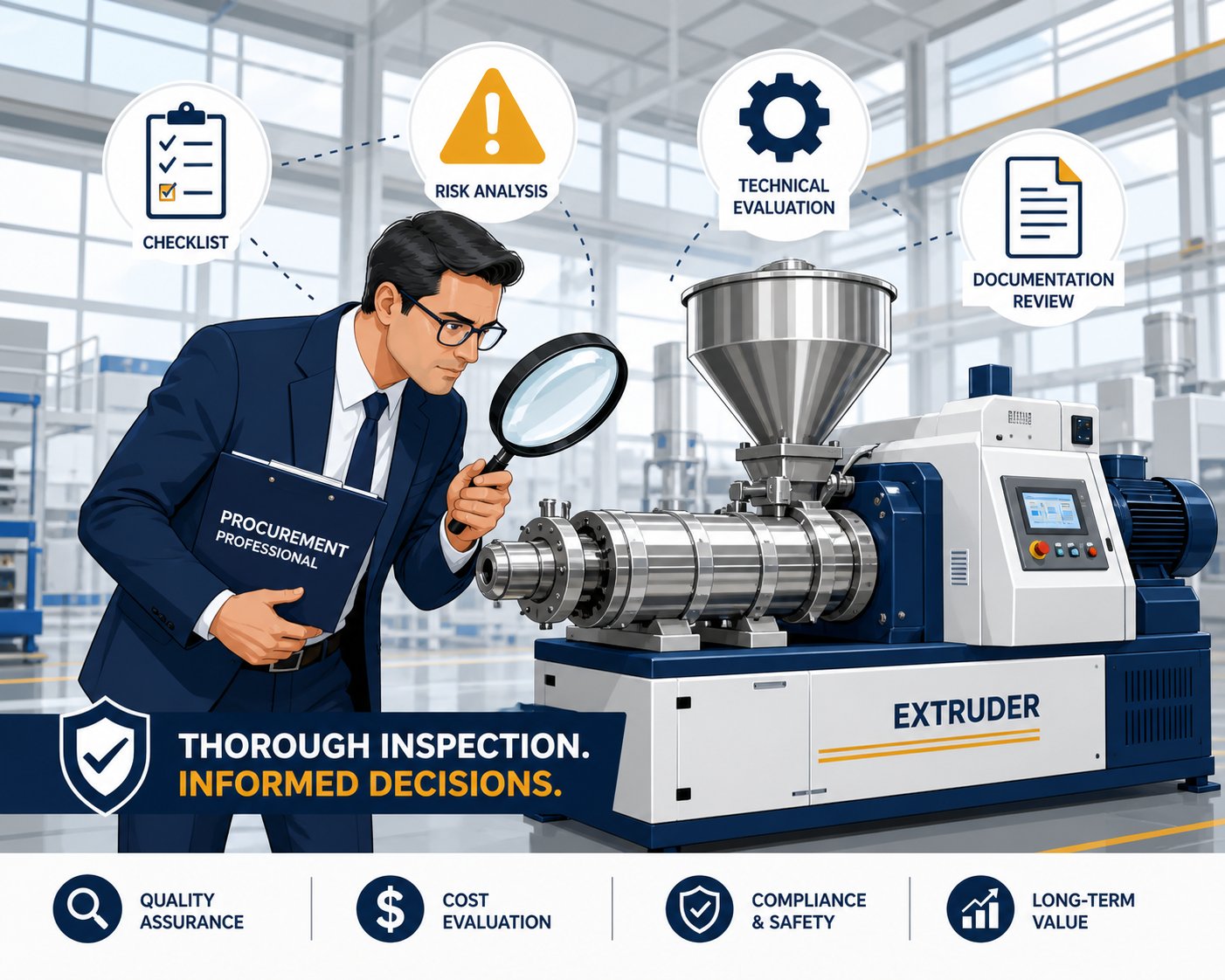
You've narrowed your search to the right architecture, the right region, and the right application specialty. On paper, a manufacturer checks every box. Their website looks polished, the pricing seems competitive, and the sales engineer says all the right things. Yet something feels slightly off—a question dodged, a document delayed, a reference that never materializes. These subtle signals are the ones that separate buyers who end up with reliable extruding machines from those who spend the next five years managing regret.
Most procurement guides focus on what to look for in a supplier. Fewer tell you what should make you walk away. That gap costs plastics processors real money—in downtime, in scrap, in spare parts you can't source, and in technical support that vanishes the moment the wire transfer clears. Whether you're evaluating a brand-new line or inspecting used extruder equipment on the secondary market, the due diligence principles are the same. The stakes just shift from engineering capability to mechanical condition.
Warning Signs That Should Disqualify a Manufacturer
Not every red flag is dramatic. Some of the most damaging ones are quiet—gaps in documentation, vague answers to specific questions, and an eagerness to rush past verification steps that exist to protect the buyer. Watch for these:
- No verifiable reference installations — A credible manufacturer should connect you with existing customers running similar applications. If they claim hundreds of installed lines but can't produce a single reference willing to take your call, something is wrong. As sourcing experts at China2West emphasize, suppliers who are transparent about their track record will have no hesitation connecting you with their clients.
- Reluctance to share test-run or trial data — You should be able to see melt temperature stability, throughput consistency, and energy consumption data from actual production runs—not just catalog specifications. A manufacturer who can't or won't provide this data likely doesn't collect it, which tells you how seriously they take process engineering.
- Vague or missing spare parts pricing — Ask for a priced spare parts list before you sign the machine purchase order. If the manufacturer hedges, delays, or provides only "upon request" pricing for critical wear items like screws and barrels, you're being set up for expensive surprises down the road.
- No local service or technical support infrastructure — A machine is only as reliable as the service network behind it. If the manufacturer has no field service capability—or even a responsive remote support team—in your operating region, every mechanical issue becomes a logistics crisis.
- Inability to provide engineering drawings — Detailed GA drawings, electrical schematics, and hydraulic/pneumatic diagrams aren't optional extras. They're essential for your maintenance team and for any future situation where you need to source replacement components independently. A manufacturer who treats drawings as proprietary secrets is limiting your operational flexibility.
- Pressure to skip factory acceptance testing (FAT) — FAT is your opportunity to verify machine performance against agreed specifications before the equipment ships. Any manufacturer who discourages, rushes, or charges excessive fees for FAT is signaling that their machine may not meet spec under scrutiny. Legitimate builders welcome FAT because it prevents costly disputes after delivery.
- Overpromising on lead times and performance — When a supplier guarantees outcomes that seem too good—delivery timelines dramatically shorter than competitors, output figures that defy physics for the screw diameter quoted—treat those claims with healthy skepticism. Industry experience consistently shows that overpromising and under-delivering often masks an inability to meet inflated expectations.
These warning signs apply equally to new equipment purchases and to the used plastic extruders market. When buying a used extruder, experienced machinery dealers recommend verifying machine history, requesting video proof of operation, and confirming warranty coverage in writing—because verbal assurances evaporate when disputes arise.
Essential Questions for Your Manufacturer Shortlist
Red flags tell you when to walk away. These questions tell you whether it's safe to stay. Before committing to any shortlisted supplier, work through this sequence systematically:
- What is your lead time for spare screws and barrels? — Wear components are consumables in extrusion. If the answer is "12 to 16 weeks," you need a backup sourcing plan before you buy the machine—not after your first screw wears out mid-production.
- Can you provide references for my specific application and polymer? — Not just "pipe extrusion" references, but references running your polymer at your target throughput. A manufacturer with ten blown film references and zero pipe installations isn't a pipe specialist, regardless of what the brochure says.
- What motor and drive technology do you use? — Is the machine driven by a direct-drive servo motor or a traditional AC motor with gearbox? What efficiency class is the motor rated to? Drive technology directly impacts energy cost, torque response, and long-term maintenance.
- Do you offer commissioning and operator training? — A machine delivered without commissioning support puts the burden of startup optimization entirely on your team. Clarify whether commissioning is included in the purchase price or quoted separately, and how many days of on-site training are provided.
- What warranty terms apply to wear components? — Standard machine warranties often exclude screws, barrels, heaters, and thermocouples. Understand exactly what's covered, for how long, and what conditions void the warranty.
- Can you supply detailed engineering drawings and electrical schematics? — This question alone reveals a manufacturer's confidence in their product and their willingness to support your long-term independence.
- What is included in your factory acceptance test protocol? — Ask to see the FAT procedure document. It should specify the test resin, target throughput, melt temperature range, motor load limits, and acceptance criteria you'll both sign off on.
- How do you handle warranty claims and field service requests? — Response time matters more than promises. Ask for the average resolution time on their last ten service tickets, not a best-case scenario.
Notice the pattern: every question is designed to surface verifiable facts rather than opinions. A manufacturer who answers these confidently—with data, documents, and customer names—has earned their place on your shortlist. One who deflects, generalizes, or promises to "get back to you" on most of them hasn't.
Common Procurement Mistakes to Avoid
Even experienced buyers fall into traps that seem obvious only in hindsight. Three mistakes account for the majority of regrettable extruder purchases:
Selecting on purchase price alone. This is the most common and most expensive error in the extruder buying process. A machine priced 40% below the next-lowest quote might genuinely offer better value—or it might deliver that savings by cutting corners on metallurgy, drive components, and quality control that you'll pay for many times over in energy waste, accelerated wear, and unplanned downtime. The purchase price is a single line item in a total cost equation that spans 10 to 20 years of operation.
Ignoring total cost of ownership. Energy consumption, wear part replacement frequency, maintenance labor, and production losses from downtime typically dwarf the original capital expenditure over the machine's service life. Yet most buyers compare only the invoice price. Ask every shortlisted manufacturer to provide energy consumption data at your target throughput, expected screw and barrel replacement intervals for your specific polymer, and recommended preventive maintenance schedules with associated labor estimates. Manufacturers who can't provide this information likely haven't engineered their machines with long-term operating cost in mind.
Not requesting material processing trials. If a manufacturer offers to run your actual resin on their equipment—or on a comparable reference machine—take them up on it. Processing trials reveal melt quality, throughput stability, and energy consumption under real conditions rather than theoretical ones. Any manufacturer who discourages trials, or who lacks the test facility to conduct them, is asking you to make a capital investment on faith.
Failing to evaluate aftermarket support before purchase. The relationship with your extruder manufacturer doesn't end at delivery—it intensifies. Screw and barrel wear, control system updates, process optimization as you introduce new resins, and unexpected mechanical issues all require responsive technical support. Evaluate the aftermarket support infrastructure—spare parts stocking, technical hotline response, field service coverage—with the same rigor you apply to the machine specification. A manufacturer with a brilliant machine and nonexistent post-sale support is a partnership that deteriorates exactly when you need it most.
These mistakes share a root cause: evaluating the machine in isolation rather than evaluating the relationship you're entering with the company behind it. Every extruder eventually wears. Every production line eventually needs support. The manufacturers worth buying from are the ones who have built their business around what happens after the invoice is paid—not just before.
With a clear picture of which red flags to watch for and which questions to ask, the next critical layer of the decision involves money—not just the purchase price, but the full financial picture of owning and operating a single screw extruder over its entire productive life.
Total Cost of Ownership Beyond the Extruder Purchase Price
Here's a number that should keep every procurement manager up at night: the plastic extruder machine price you negotiate today typically represents only 15-25% of what that equipment will cost your operation over its full productive life. The remaining 75-85% accumulates quietly—kilowatt by kilowatt, worn screw by worn screw, unplanned shutdown by unplanned shutdown—in operating expenses that most capital purchase evaluations never model properly. Two machines with identical invoice prices can differ by hundreds of thousands of dollars in total cost of ownership over a decade, and the cheaper-to-buy machine is often the more expensive one to run.
Understanding where the real money goes after delivery transforms how you evaluate single screw extruder manufacturers. It shifts the conversation from "what does this machine cost?" to "what will this machine cost me per kilogram of quality output over the next fifteen years?" That second question is the one that actually determines profitability—and the manufacturers who can answer it with data rather than hand-waving are the ones worth your purchase order.
Energy, Maintenance, and Wear Part Cost Breakdown
Energy is the silent heavyweight in plastic extrusion cost. For a typical production line running two or three shifts, electricity consumed by the extruder motor, barrel heaters, and cooling systems can exceed the original machine cost within the first three to five years of operation. The drive system architecture is the single largest variable in this equation. Older AC motor-gearbox configurations operate with inherent efficiency losses in both the motor and the gear train. Modern direct-drive servo systems eliminate the gearbox entirely, delivering torque directly to the screw with electrical efficiency ratings that can save 15-30% on motor energy consumption depending on operating conditions and resin viscosity.
Why does the motor-gearbox configuration matter so much? As extrusion expert Mark Spalding explains in Plastics Technology, the motor and gearbox should be selected so the extruder operates near 70% motor current load and about 70% of maximum screw speed. This leaves headroom for future rate increases and alternative resin processing. When these components are mismatched—something Spalding has encountered in nearly 30 extruders over 35 years—the line ends up either speed-limited or torque-limited, forcing operators to run at suboptimal conditions that waste energy and compromise melt quality. Asking a manufacturer about their motor and gearbox sizing philosophy for your specific application reveals whether they're engineering a solution or simply bolting on standard components.
Wear parts—screws and barrels—represent the second major recurring cost. Every polymer that passes through your extruder gradually erodes the screw flight OD and barrel bore. The rate of wear depends heavily on processed materials. Unfilled polyolefins are relatively gentle, allowing screws to run for years before clearance becomes an issue. Glass-fiber-reinforced compounds, calcium carbonate-filled formulations, and abrasive mineral-loaded masterbatches accelerate wear dramatically. As screw wear research published in Plastics Technology details, the majority of wear occurs in high-pressure areas—the transition section and the last few turns of metering—where increased pressure and temperature intensify friction. Mixing sections and barrier flights also wear as resin flows over their undercut geometry, gradually reducing dispersion quality and melting efficiency.
The financial impact of ignoring wear is insidious. When radial clearance between screw flights and barrel wall increases, leakage flow rises. The operator compensates by increasing screw speed, which raises melt temperature and energy consumption while still delivering lower throughput. A common rule of thumb considers flight clearance four times the original tolerance as the replacement threshold, but viscosity matters—higher-viscosity resins tolerate more clearance before output drops noticeably. By the time scrap rates spike or energy consumption becomes impossible to ignore, the screw may be so severely worn that rebuilding is no longer viable, forcing a full replacement at premium lead times and prices.
Planned maintenance and unplanned downtime round out the cost picture. Preventive tasks—heater band inspection, thermocouple calibration, gearbox oil analysis, cooling water system maintenance—are predictable and relatively inexpensive when scheduled. Unplanned downtime, by contrast, is the most expensive operating cost per hour in any extrusion plant. A single unexpected shutdown on a high-output line can consume more money in lost production during one eight-hour shift than the annual cost of a comprehensive preventive maintenance program.
| Cost Category | Cost Driver | Frequency | Mitigation Strategy |
|---|---|---|---|
| Energy | Motor efficiency class, drive system architecture (gearbox vs. direct-drive servo), barrel heater insulation, cooling system design | Continuous — every operating hour | Specify IE4/IE5 motors or direct-drive servo systems; insulate barrel heaters; compare energy consumption data from manufacturers at your target throughput |
| Wear Parts (Screw and Barrel) | Processed material abrasiveness (glass fiber, mineral fillers, recycled feedstock with contamination), screw speed, operating pressure, metallurgical quality of wear surfaces | Every 6-24 months for abrasive compounds; every 2-5+ years for unfilled polyolefins | Select nitrided or bimetallic barrels and hardfaced screws matched to your resin; establish baseline wear measurements; develop a rebuild-before-replace strategy |
| Planned Maintenance | Heater bands, thermocouples, gearbox oil, bearings, cooling water treatment, electrical component inspection | Quarterly to annually depending on component | Implement a documented preventive maintenance schedule; stock critical spares; train in-house maintenance technicians during commissioning |
| Unplanned Downtime | Catastrophic screw or barrel failure, drive system faults, control system failures, heater burnout, gearbox damage | Unpredictable — typically 1-4 events per year on poorly maintained lines; near-zero on well-managed equipment | Maintain spare screw and barrel sets; ensure manufacturer or aftermarket supplier can deliver replacements within days rather than months; implement condition monitoring |
When you line up quotes from multiple manufacturers for a PVC extrusion machine or a polyolefin film line, the purchase price difference might be $50,000 to $150,000 between competing bids. The total cost of ownership difference over ten years—driven by energy efficiency, wear part longevity, and maintenance burden—can easily reach $300,000 to $500,000 or more. That's why experienced buyers ask for energy consumption guarantees, wear part life estimates, and maintenance cost projections as part of the bid evaluation, not as an afterthought.
How Spare Parts Sourcing Impacts Long-Term Value
Imagine this scenario: your extruder has been running production for three years. Output is slipping, melt temperature is climbing, and your maintenance team pulls the screw to find flight OD clearance has doubled. You contact the original equipment manufacturer for a replacement barrel and screw. The quote comes back at a premium price, and the lead time is fourteen weeks. Your line sits idle—or limps along producing off-spec product—while you wait.
This scenario plays out in extrusion plants worldwide, and it highlights a strategic reality that most buyers overlook during the initial purchase: your long-term relationship with wear part suppliers matters as much as your relationship with the machine builder. OEM replacement parts carry the comfort of guaranteed compatibility, but they also carry pricing that reflects the manufacturer's monopoly position on their own spare parts. For many processors, that pricing structure turns routine maintenance into a budget crisis.
The alternative is establishing a parallel supply chain with specialized aftermarket barrel and screw manufacturers who can produce replacement components to OEM specifications. These suppliers work from machine models, original engineering drawings, physical samples of worn components, or even measured dimensions taken directly from the barrel bore—whatever reference pathway gets to a precision-machined replacement part without requiring OEM involvement. NANHAIYA, for example, specializes in custom replacement single screw barrels for a wide range of extruder makes and models, serving pipe, film, sheet, pelletizing, and recycling producers who need wear part replacements manufactured to exact specifications without being locked into OEM pricing and lead times.
The screw wear data supports this approach. As industry analysis from Plastics Technology emphasizes, an experienced screw manufacturer can rebuild worn screws to like-new condition for a fraction of the cost of a new screw, and well-executed rebuilds can extend screw life through six to eight rebuild cycles. Whether you're sourcing from the OEM, from a specialized aftermarket supplier, or pursuing a rebuild strategy, the key is having a plan in place before wear forces your hand. A processor who waits until production is already suffering from worn components is negotiating replacement parts from the weakest possible position.
Several practical steps protect you from spare parts dependency:
- Secure engineering drawings at purchase. Insist that detailed screw and barrel drawings—including flight geometry, metallurgy specifications, and dimensional tolerances—are part of the purchase documentation. These drawings enable any qualified aftermarket manufacturer to produce compatible replacements.
- Benchmark OEM spare parts pricing during the buying process. Request a priced spare parts list before signing the machine purchase order. This baseline lets you evaluate aftermarket alternatives objectively.
- Establish a relationship with at least one independent barrel and screw supplier early. Don't wait for your first wear event. Qualifying an aftermarket supplier like NANHAIYA in advance—sending drawings, confirming material grades, and verifying machining capability—means you have a ready alternative when the need arises.
- Implement baseline wear measurements. Record screw flight OD and barrel bore ID at commissioning and at regular intervals. Trending this data lets you predict replacement timing months in advance rather than reacting to sudden performance drops.
- Stock at least one spare screw for critical lines. The cost of a spare screw sitting on a rack is trivial compared to the production loss from a multi-week wait for a replacement.
The manufacturers who earn long-term loyalty are the ones who make spare parts sourcing straightforward—transparent pricing, reasonable lead times, and willingness to share the technical documentation that gives you sourcing flexibility. Those who use proprietary spare parts as a profit center, withholding drawings and quoting replacement components at multiples of fair market value, are essentially taxing you for choosing their machine. Factor that cost into your total ownership calculation, and the plastic extruder machine price gap between competing bids starts looking very different.
Total cost of ownership is ultimately a story about time—how a machine's financial demands evolve across years of daily production. That same time dimension shapes another critical evaluation factor: whether the manufacturer you're considering is building machines for today's requirements or engineering for the industry's trajectory. The technology trends reshaping extrusion equipment design right now will determine which machines age gracefully and which become obsolete long before their mechanical components wear out.
Emerging Trends Reshaping Single Screw Extruder Manufacturing
A machine that meets your throughput and quality targets today may fall short in three to five years—not because it wears out mechanically, but because regulatory requirements shift, energy costs climb, and your customers start demanding sustainability documentation you can't produce. The technology trends moving through the extrusion industry right now aren't incremental tweaks. They're structural changes to how plastic extruders are designed, controlled, and integrated into connected production environments. Buyers who evaluate manufacturers without asking about these trends risk purchasing equipment that performs well at commissioning but becomes a competitive liability as the industry moves forward.
Three converging forces are reshaping what forward-thinking single screw extruder manufacturers build and how they build it: energy efficiency standards that are eliminating older drive architectures, Industry 4.0 digital integration that is turning extruders into data-generating platforms, and sustainability requirements that are redefining which materials the machine must process. Understanding where each manufacturer stands on these fronts tells you whether you're buying a machine engineered for the next decade or one designed for the last one.
Energy Efficiency Standards and Direct-Drive Technology
Remember the total cost of ownership breakdown from the previous section—where energy consumption can exceed the original machine cost within three to five years? That reality is driving the most significant hardware shift in extruder design: the replacement of traditional AC motor-gearbox configurations with direct-drive servo systems paired with high-efficiency motors.
The regulatory pressure is real and accelerating. International motor efficiency classifications have progressed from IE1 through IE4 over the past two decades, and IE5 "Ultra Premium Efficiency" motors are now reaching commercial availability for the 1-200 kW power range most relevant to single screw extrusion. The EU has already mandated IE4 for motors in the 75-200 kW range, with broader IE4 requirements and IE5 considerations on the regulatory horizon. The US Department of Energy's updated rules align with IE4 for 1-500 hp general-purpose motors. China's GB standard revision is expected to adopt IE4 as the minimum for key industrial sectors.
What does this mean practically for extruder buyers? A manufacturer still offering standard IE2 or IE3 motors with conventional gearbox drives is selling you yesterday's technology at tomorrow's energy prices. Direct-drive servo systems eliminate the gearbox entirely—removing its mechanical losses, maintenance requirements, and lubrication demands—while delivering precise torque control at any screw speed. The energy savings aren't theoretical. Processors switching from geared AC drives to direct-drive servo platforms consistently report 15-30% reductions in motor energy consumption, with additional savings from eliminating gearbox oil changes, seal replacements, and the occasional catastrophic gear failure.
The technology pathway behind these gains is shifting from traditional induction motors toward synchronous designs. Synchronous reluctance motors (SynRM) have achieved IE4 efficiency across most of the industrial power range and IE5 in optimized configurations—without requiring the rare-earth permanent magnets that create supply chain vulnerabilities and cost volatility. PM-assisted SynRM designs use inexpensive ferrite magnets to boost torque density by 15-25%, offering a balanced cost-performance middle ground.
When evaluating manufacturers, ask a pointed question: what motor and drive technology ships as standard on your machines, and what are the upgrade options? A manufacturer who responds with specific motor efficiency class ratings, energy consumption data at your target throughput, and a clear explanation of their drive architecture is demonstrating engineering depth. One who deflects the question or treats the drive system as a commodity afterthought is telling you where their engineering priorities end.
Industry 4.0 Integration and Smart Extrusion
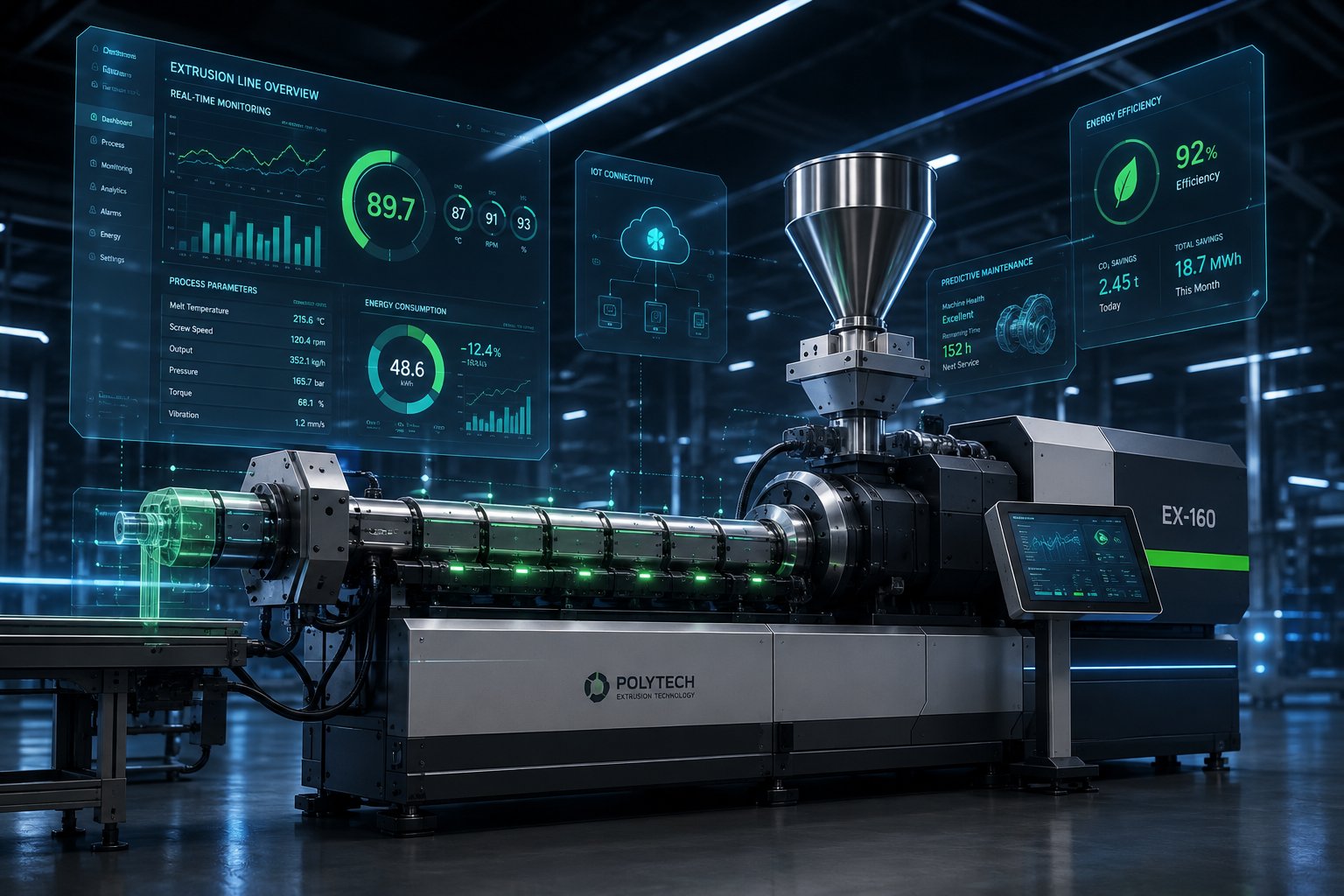
Imagine receiving a text alert on your phone at 2 AM telling you that barrel zone three on your film line is trending toward a heater failure—twelve hours before the heater actually burns out and shuts down production. That's not a futuristic concept. It's what leading extruder manufacturers are delivering through IoT-enabled machines with embedded sensor ecosystems, edge computing, and cloud-based analytics.
The shift from purely mechanical extrusion to data-driven extrusion is the defining Industry 4.0 trend in plastics processing. As SAP's Industry 4.0 framework describes, the core idea is integrating intelligent digital technologies into manufacturing processes to enhance productivity, efficiency, and flexibility through more intelligent decision-making. For extrusion specifically, that integration unfolds across three layers.
Embedded sensor packages are the foundation. Modern smart extruders ship with factory-installed triaxial accelerometers monitoring gearbox and bearing vibration, PT100/PT1000 resistance temperature detectors tracking winding and bearing temperatures, current transformers capturing phase current waveforms for load profiling, and humidity sensors guarding against insulation contamination. These aren't aftermarket bolt-ons—they're designed into the machine during manufacturing, with wiring routed to communication modules that speak standard industrial protocols.
Edge intelligence and digital twins represent the analytical layer. Rather than simply streaming raw sensor data to a cloud dashboard, the latest plastic extruders incorporate edge computing that processes data locally and compares real-time measurements against a physics-based digital twin of the machine. When the twin predicts that a bearing should be running at 62 degrees Celsius based on current load and ambient conditions, but the actual sensor reads 78 degrees, the system flags an anomaly and triggers a predictive maintenance workflow—before the bearing seizes and takes out production.
Cloud-based production analytics close the loop. Aggregated data from multiple extrusion lines—across shifts, across plants, across product changeovers—enables performance benchmarking, energy optimization, and quality trend analysis that no human operator could perform manually. Next-generation extrusion platforms are even incorporating AI-driven process control that automatically adjusts parameters in response to feedstock variability, reducing scrap and improving consistency without operator intervention.
The practical implication for buyers? Ask manufacturers what connectivity and monitoring capabilities their machines offer as standard, what protocols they support (OPC UA, MQTT, Ethernet/IP), and whether their systems integrate with your existing plant-level MES or SCADA platforms. A manufacturer who treats digital integration as a core engineering capability—rather than a marketing checkbox—delivers measurable value through reduced unplanned downtime and faster root-cause analysis when process deviations occur. Even for smaller operations not yet running full Industry 4.0 infrastructure, choosing a machine with embedded sensor capability preserves the option to connect and analyze later without expensive retrofits.
Sustainable Material Processing and Recycling Capability
Regulatory mandates for recycled content in packaging, construction materials, and automotive components are no longer coming—they're here. The EU's Packaging and Packaging Waste Regulation sets mandatory recycled content targets. Brand owners across consumer goods are publishing recycled content commitments. And processors who can't run post-consumer recycled (PCR) material, bio-based polymers, or ocean-bound plastics at production quality are watching contracts move to competitors who can.
This sustainability shift is fundamentally changing what buyers need from their extrusion equipment—and it separates forward-looking manufacturers from those still building machines exclusively for virgin resin processing. The challenge with recycled and bio-based feedstocks isn't just that they're different materials. It's that they're variable materials. PCR streams arrive with fluctuating melt flow indices, residual moisture, volatile organic compounds from inks and adhesives, and physical contamination that ranges from paper labels to metal fragments. Bio-based polymers like PLA and PHA have narrow processing windows and thermal sensitivities that punish the kind of temperature overshoot a standard three-zone screw tolerates on polyethylene.
Manufacturers investing seriously in this space are building machines with specific capabilities that address feedstock variability:
- Advanced degassing technology — Vacuum venting zones that strip moisture and volatiles from the melt in a single pass, eliminating the need for separate pre-drying systems and enabling direct processing of hygroscopic recycled and bio-based resins
- Integrated melt filtration — Continuous screen changers that remove solid contaminants without stopping the line, paired with automatic backflush systems that extend screen life when processing heavily contaminated recycled streams
- Flexible screw designs for variable feedstock quality — Screw geometries tested across a realistic range of melt viscosities and contamination levels, rather than optimized for a single neat resin grade
- Gentle thermal management for bio-polymers — Precise multi-zone barrel heating with tight PID control and liquid-cooled barrel sections that prevent the thermal degradation bio-based resins suffer under conventional heating profiles
- Laboratory scale extruder options for material qualification — R&D-focused manufacturers offer small-scale platforms that let processors trial new recycled or bio-based formulations before committing to full production runs, reducing the risk and cost of material qualification
The twin screw extruders market has historically dominated compounding and recycling applications due to superior mixing capability, but single screw platforms are increasingly competitive for recycling operations where the primary challenge is remelting and pelletizing—rather than intensive blending—of sorted, washed post-consumer material. Manufacturers who have engineered their single screw lines with vacuum degassing, robust filtration, and contamination-tolerant screw designs are capturing a growing share of the recycling equipment market at lower capital cost and simpler maintenance profiles than twin screw alternatives.
Sustainability is no longer a marketing differentiator—it is becoming a procurement requirement. Manufacturers who cannot demonstrate proven capability in processing recycled content, bio-based polymers, and variable-quality feedstocks are increasingly excluded from shortlists before the technical evaluation even begins.
The convergence of these three trends—energy efficiency regulation, digital integration, and sustainable material processing—creates a clear litmus test for any manufacturer on your shortlist. Ask each one: What motor efficiency class do you offer as standard? What monitoring and connectivity capabilities are built into your machines? And what is your demonstrated experience processing recycled or bio-based materials at production scale? The answers reveal whether a manufacturer is engineering for the industry's trajectory or simply selling what they've always built. And that distinction matters enormously when the machine you're buying today needs to remain competitive and compliant for the next decade of operation.
These trends define the landscape. The final challenge is converting all of this knowledge—architecture, geography, specialization, red flags, total cost of ownership, and technology trajectory—into a structured decision process that moves your evaluation from research to action.
How to Build Your Shortlist and Take the Next Step
You've absorbed a lot of ground—architecture selection, regional trade-offs, application specialization, warning signs, total cost modeling, and the technology trends that will separate future-ready machines from obsolete ones. That's valuable knowledge. But knowledge without a structured decision process leads to analysis paralysis, where procurement teams circle endlessly through spreadsheets and supplier websites without ever converging on a confident purchase decision.
The framework below distills everything covered in this article into a repeatable, step-by-step evaluation process. Whether you're sourcing your first plastic extruding machine or replacing aging equipment on a high-output line, this sequence keeps your evaluation focused on the factors that actually predict long-term satisfaction—and filters out the noise that doesn't.
A Step-by-Step Manufacturer Evaluation Framework
Think of this as your procurement roadmap. Each step builds on the one before it, progressively narrowing your field from hundreds of potential suppliers to the two or three who genuinely deserve a purchase order.
- Define your application and polymer requirements precisely. Start with the end product, not the machine. What polymer are you processing? What throughput do you need? What dimensional tolerances must the finished product meet? A clear application brief eliminates manufacturers who lack relevant experience before you waste time requesting quotes from them.
- Categorize potential manufacturers by tier and region. Map each prospective supplier into the taxonomy covered earlier—global OEM, regional specialist, or niche player—and identify their price tier. This step prevents the common mistake of comparing a premium European turnkey system against an economy import on price alone, as if they represent equivalent value propositions.
- Request reference installations in your specific application. Not generic references. References running your polymer, at your target throughput, producing your type of end product. A manufacturer who can connect you with three customers extruding HDPE pipe at 200 kg/hr provides exponentially more confidence than one who points to a general list of "satisfied clients" with no application context.
- Evaluate screw and barrel design capability. Ask detailed questions about screw geometry—barrier flights, mixing sections, compression ratios for your resin, grooved feed zone options. A manufacturer who responds with application-specific engineering recommendations is demonstrating the technical depth that translates directly into melt quality and output consistency on your production floor.
- Compare total cost of ownership, not just purchase price. Request energy consumption data at your target throughput, expected screw and barrel replacement intervals for your specific material, preventive maintenance schedules with labor estimates, and a priced spare parts list. The manufacturer whose plastic extruder machine for sale looks cheapest on the invoice may cost significantly more per kilogram of output over a ten-year operating horizon.
- Conduct factory acceptance testing (FAT). Insist on running your resin—or an agreed equivalent—on the actual machine before it ships. Verify throughput stability, melt temperature uniformity, motor load, and energy consumption against the specifications in your purchase agreement. Any manufacturer who resists FAT or treats it as optional is raising one of the clearest red flags in the evaluation process.
- Confirm aftermarket support and spare parts accessibility. Before you sign, verify lead times for replacement screws and barrels, field service response times in your region, availability of engineering drawings and electrical schematics, and warranty terms for wear components. A machine without accessible aftermarket support is a depreciating asset that becomes increasingly expensive to keep running.
Each step functions as a filter. Manufacturers who pass all seven earn a place in your final negotiation round. Those who stumble on reference checks, dodge technical questions, or resist factory testing reveal gaps that no amount of discount pricing can compensate for. The discipline of following this sequence—rather than jumping straight to price comparison—is what separates procurement teams who buy machines they're proud of from those who inherit problems they can't solve.
Building a Reliable Supply Chain for Your Extrusion Operation
Smart procurement doesn't end when the extruder arrives on your production floor. It extends into the years of daily operation that follow—and that's where your supply chain strategy for wear components and aftermarket support determines whether the machine remains a productive asset or becomes a maintenance headache.
The single most overlooked procurement decision is spare parts sourcing. As covered in the total cost of ownership analysis, screws and barrels are consumable components in any extrusion operation. They wear. They need replacement. And the lead time and cost of those replacements directly impact your uptime and operating margin. Relying exclusively on the original equipment manufacturer for every replacement barrel and screw locks you into a single-source dependency—the same vulnerability that supply chain diversification principles warn against for any critical input.
Building a diversified wear parts supply chain means establishing relationships with both your OEM and at least one specialized aftermarket barrel and screw manufacturer before your first wear event occurs. NANHAIYA exemplifies this approach—a specialized supplier of custom and replacement single screw barrels manufactured to match specific machine models, original engineering drawings, physical samples, or measured dimensions. Whether your operation runs pipe, film, sheet, pelletizing, or recycling lines, having a qualified aftermarket partner like NANHAIYA in your supply chain means you can source precision-machined replacement barrels without being locked into OEM pricing or waiting through extended OEM lead times.
Practically, this diversification strategy involves a few straightforward steps that pay dividends for years:
- Secure detailed screw and barrel drawings at the time of machine purchase — These documents enable any qualified manufacturer to produce compatible replacement components, giving you sourcing flexibility from day one
- Qualify an aftermarket barrel and screw supplier during commissioning, not during a crisis — Send drawings, confirm metallurgy specifications, and verify machining capability while your machine is still running on its original components
- Benchmark OEM spare parts pricing against aftermarket alternatives — Understanding the price differential helps you make informed sourcing decisions when replacement time arrives, rather than accepting the first quote under pressure
- Maintain baseline wear measurements — Tracking screw flight OD and barrel bore ID at regular intervals lets you predict replacement timing months in advance, giving you time to source from whichever supplier offers the best combination of quality, price, and delivery
This dual-source approach mirrors the supply chain diversification principles that resilient manufacturers apply across all critical inputs. A primary supplier handling 70-80% of volume and a secondary supplier covering 20-30% provides both competitive pricing tension and genuine supply security. The same logic applies to your extruder wear parts: having a proven alternative supplier qualified and ready eliminates the leverage imbalance that single-source OEM dependency creates.
Whether you're evaluating an extruder for sale from a premium European builder, a mid-range Asian manufacturer, or a refurbished machine on the secondary market, the long-term value equation always extends beyond the machine itself. The manufacturers and component suppliers you partner with—for the initial purchase, for ongoing technical support, and for the wear parts that keep your line producing quality product year after year—collectively determine your operation's cost competitiveness and production reliability.
The best extruder purchase decisions aren't made on lowest initial price. They're made on the strength of long-term partnerships—with machine builders who engineer for your application, and with component suppliers who keep your line running at peak performance long after the purchase order is forgotten.
Your next step is straightforward. Take the evaluation framework above, apply it to your current shortlist, and start asking the hard questions. The manufacturers who answer with confidence, data, and verifiable references are the ones who deserve your business. And the ones who help you build a reliable, diversified supply chain for every component of your extrusion operation—from complete extruders for sale to individual replacement barrels and screws—are the partners who will still be earning your trust a decade from now.
Frequently Asked Questions About Single Screw Extruder Manufacturers
1. What should I look for when choosing a single screw extruder manufacturer?
Focus on five key areas: verifiable reference installations matching your specific polymer and application, screw and barrel design capability (barrier flights, mixing sections, grooved feed zones), total cost of ownership data including energy consumption and wear part life estimates, aftermarket support infrastructure with transparent spare parts pricing and lead times, and willingness to conduct factory acceptance testing (FAT) on your resin before shipment. Manufacturers who can provide detailed engineering drawings, commissioning support, and operator training demonstrate the long-term partnership commitment that protects your investment. Avoid selecting on purchase price alone, as the cheapest machine often costs far more over a 10-to-20-year operating life due to higher energy use, faster wear, and limited service support.
2. How much does a single screw extruder cost, and what affects the total price?
The purchase price of a single screw extruder varies significantly by manufacturer tier and region. Premium European and North American machines may cost 2.5 to 3.5 times more than equivalent-output Asian-built equipment. However, the initial price typically represents only 15-25% of total cost of ownership. The remaining 75-85% comes from energy consumption, wear part replacements (screws and barrels), planned maintenance, and unplanned downtime over the machine's service life. Key cost drivers include motor efficiency class (IE4/IE5 vs. older standards), drive architecture (direct-drive servo vs. gearbox), processed material abrasiveness, and spare parts sourcing strategy. Partnering with specialized aftermarket barrel and screw suppliers like NANHAIYA can significantly reduce recurring wear part costs without sacrificing component quality.
3. What is the difference between single screw and twin screw extruders?
Single screw extruders excel at melting pre-compounded polymers and shaping them through a die at consistent pressure, making them ideal for pipe, blown/cast film, sheet, profile extrusion, and simple pelletizing. They offer 30-50% lower capital cost, simpler maintenance, and fewer wear components than twin screw alternatives. Twin screw extruders are preferred for applications requiring intensive mixing, such as compounding masterbatches, blending engineering plastics with high filler concentrations above 40-50%, reactive extrusion, and devolatilization. This architecture distinction directly affects manufacturer selection, since most suppliers specialize deeply in one type. Buyers should define their application requirements first, then shortlist only manufacturers with proven expertise and reference installations in the matching architecture.
4. Are Chinese single screw extruder manufacturers reliable?
The quality landscape among Chinese extruder manufacturers has evolved dramatically over the past decade. Established Chinese builders like JWELL and Jinming now export hundreds of extrusion lines annually to over 50 countries, equipping machines with European-brand components such as Siemens motors and Flender gearboxes at 30-40% of European pricing. However, quality varies significantly between well-established firms and smaller workshops, so buyer due diligence is essential. Request verifiable reference installations, conduct factory visits, insist on factory acceptance testing with your resin, and confirm aftermarket service coverage in your operating region. For standard pipe, film, sheet, and profile applications, well-vetted Chinese suppliers deliver increasingly competitive performance, though specialty material processing and advanced automation may still favor European or Japanese alternatives.
5. How often do single screw extruder barrels and screws need replacement?
Replacement intervals depend heavily on processed materials. Unfilled polyolefins are relatively gentle, allowing screws and barrels to run 2-5 years or longer before clearance becomes problematic. Glass-fiber-reinforced compounds, mineral-filled formulations, and abrasive recycled feedstocks can accelerate wear to the point where replacement is needed every 6-24 months. Most wear occurs in high-pressure areas like the transition section and the last few metering flights. Tracking screw flight outer diameter and barrel bore inner diameter at regular intervals helps predict replacement timing months in advance. Processors should secure engineering drawings at purchase and qualify at least one aftermarket barrel and screw supplier—such as NANHAIYA, which manufactures custom replacement single screw barrels from machine models, drawings, samples, or measured dimensions—to ensure fast, cost-effective replacement when wear occurs.
Written by
Nanhaiya Technical Team
Zhoushan Nanhaiya Plastic Machinery Co., Ltd.
The Nanhaiya technical team supports screw and barrel manufacturing projects through application review, technical communication, custom manufacturing coordination, and production and quality control.
Discuss Your Application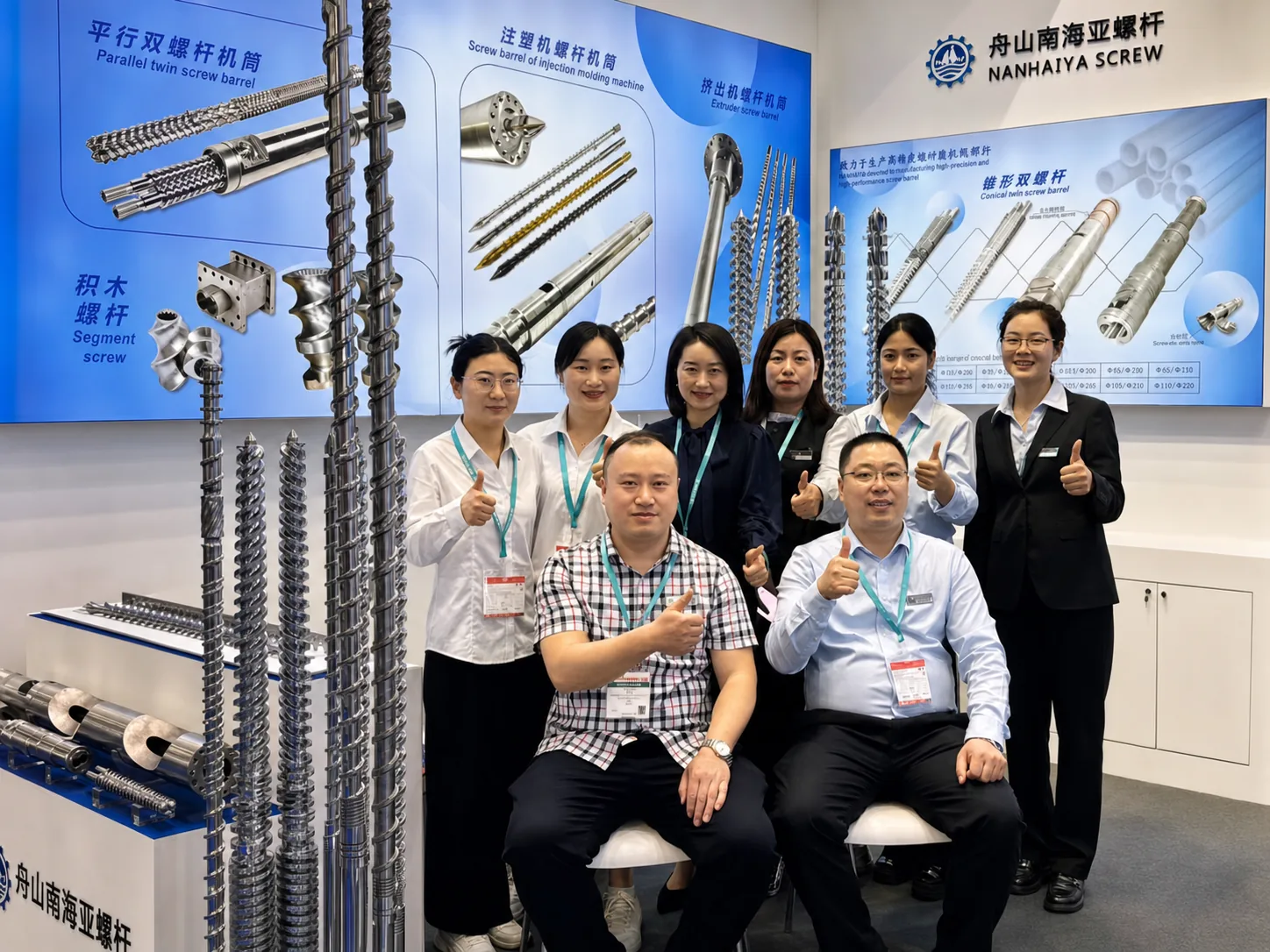
Related Articles
More insights on screw barrel technology and plastics processing.

Single Screw Extruder Supplier Red Flags You Can't Afford To Miss
Oct 22, 2026
Learn how to evaluate a single screw extruder supplier with this buyer's guide covering pricing, screw and barrel tech, new vs used trade-offs, and red flags.
Read Article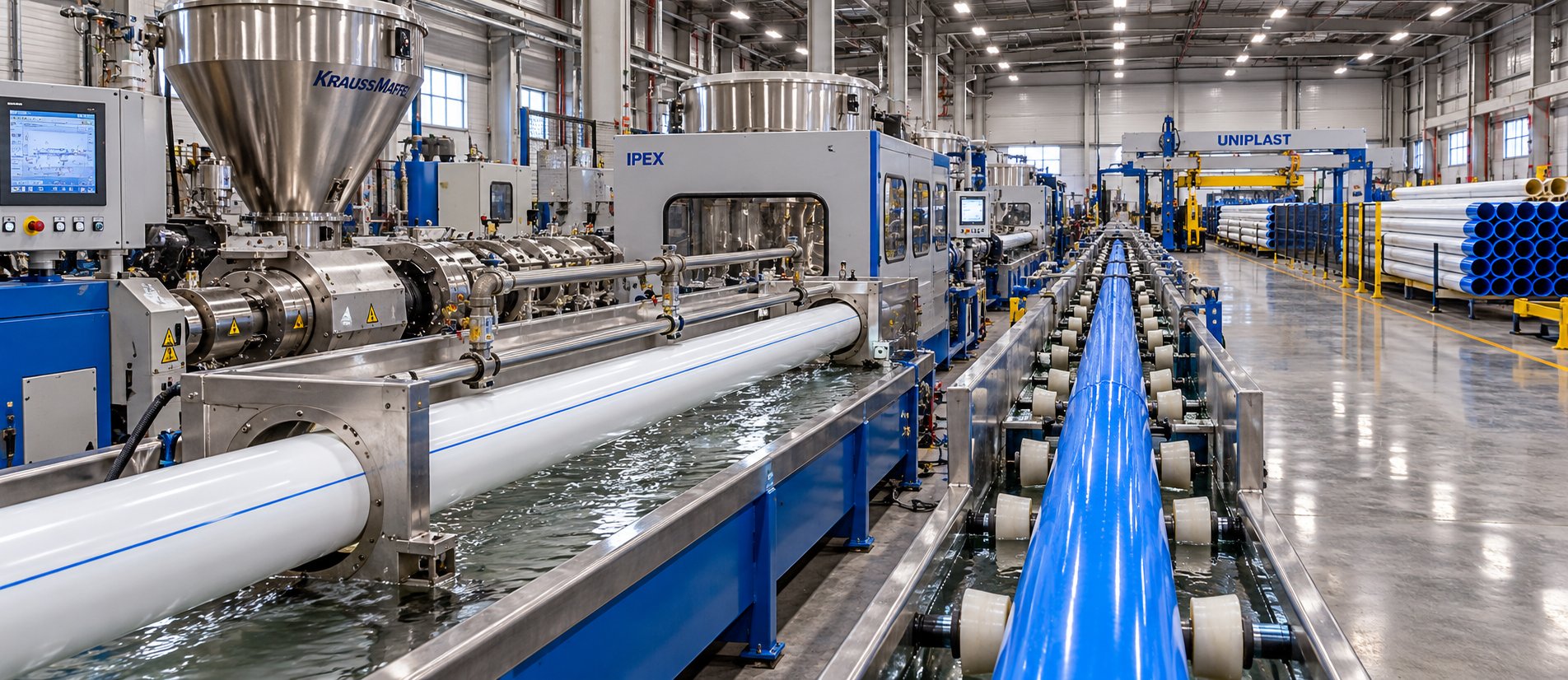
HDPE Pipe Making Machine Decoded: From Specs to Smart Purchase
Oct 15, 2026
Learn how HDPE pipe making machines work, from extruder specs and extrusion process steps to automation levels, maintenance costs, and smart buying tips.
Read Article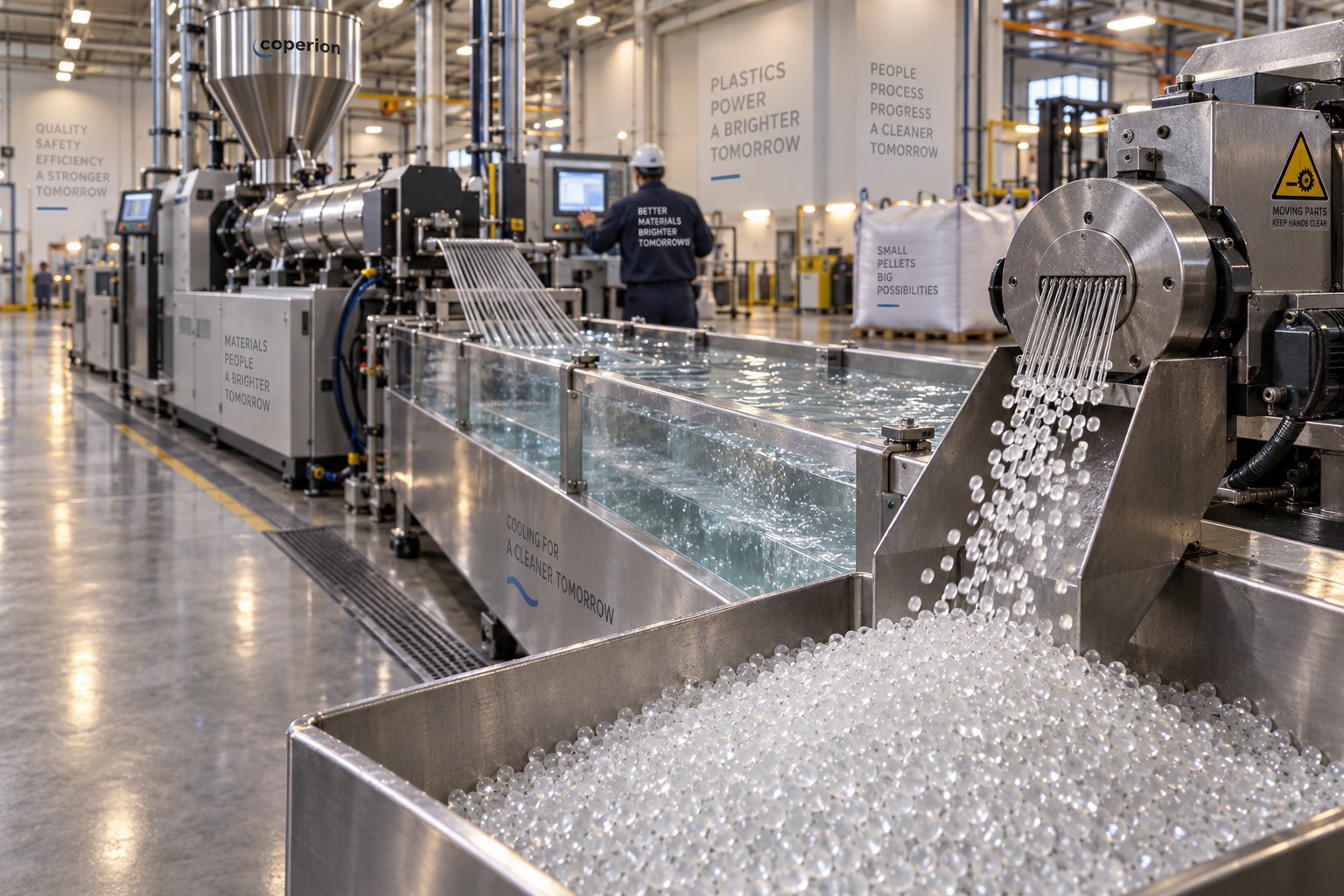
Pick the Wrong Plastic Pelletizing Line and You Pay Twice
Oct 14, 2026
Learn how to spec the right plastic pelletizing line for your resin, throughput, and budget. Covers strand, underwater, and air-cooled systems plus ROI planning.
Read ArticleLooking for something else?
Search by material, symptom or product and jump straight to the relevant page.
These are navigation suggestions based on keyword matching — not a quotation, not a delivery commitment, and not a substitute for engineering review. Final specification is confirmed by our engineers against your drawings and processed material.
Need help with screw barrel selection?
Share your machine model, processed material and application. Our team can help with pricing and technical support.