

What Is a Single Screw Extruder Barrel and Why It Matters
Imagine a component so critical that a fraction-of-a-millimeter change in its bore can tank your product quality overnight. That component is the single screw extruder barrel — and most processors underestimate it until something goes wrong.
Defining the Single Screw Extruder Barrel
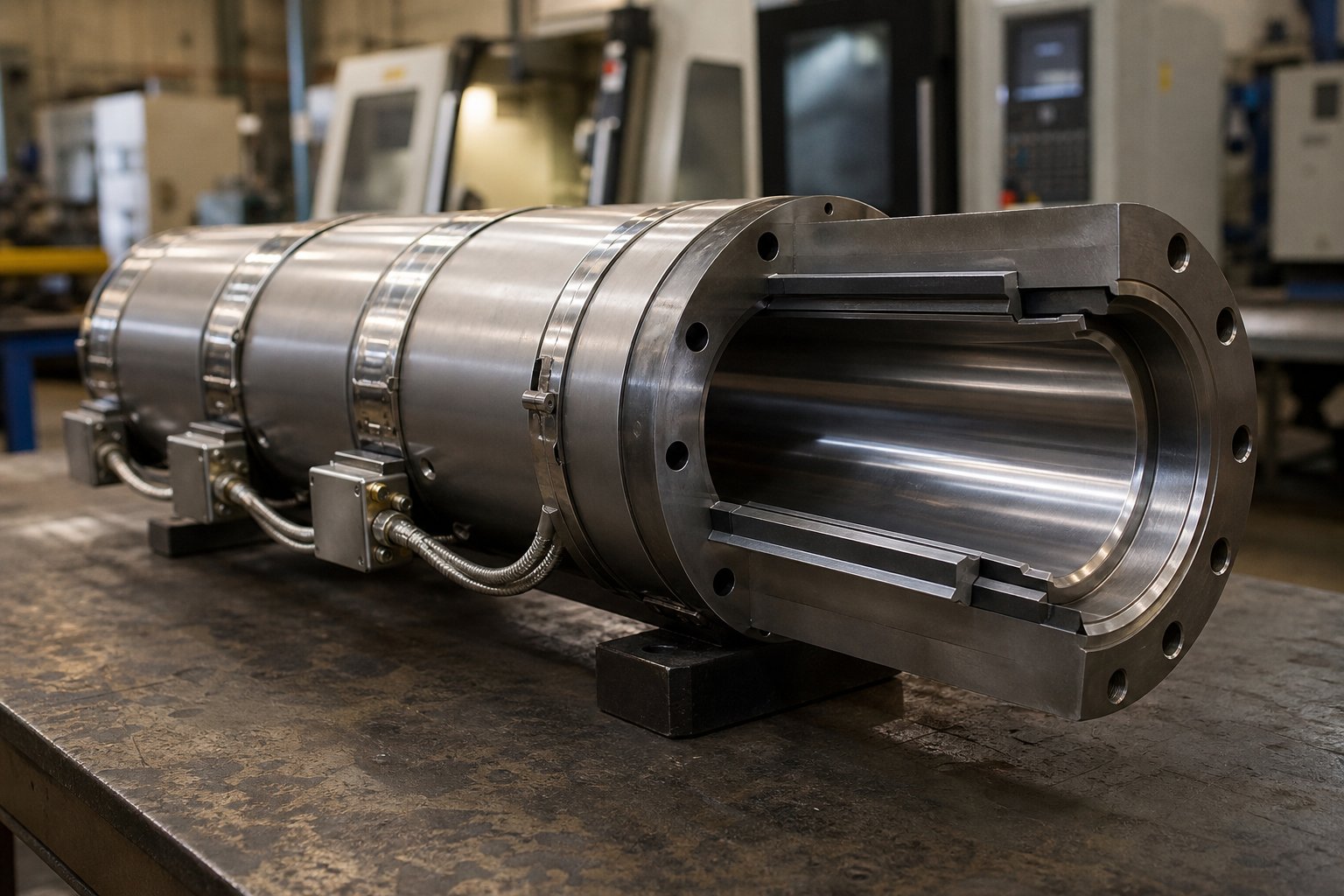
A single screw extruder barrel is the precision-machined cylindrical steel housing that encases the rotating screw, providing the controlled environment of heat, friction, and pressure required to melt, mix, and pressurize polymer material into a consistent, process-ready melt stream.
Think of the screw barrel as the stationary half of a finely tuned system. While the screw rotates to convey and compress material, the extruder barrel supplies the frictional surfaces, heat transfer interfaces, and pressure containment walls that make melting and mixing possible. Without tight bore tolerances and properly engineered wear surfaces, even the best-designed screw cannot deliver uniform output. Some industry professionals refer to this assembly informally as a screw tube, though the engineered reality is far more complex than that term suggests.
Why the Barrel Deserves Dedicated Attention
It is easy to focus on screw geometry and overlook the barrel entirely. In practice, however, the extruder screw barrel directly governs throughput capacity, melt temperature consistency, and final product quality. A worn or improperly specified barrel introduces melt leakage past the screw flights, uneven thermal profiles, and pressure instability — all of which degrade output before you ever reach the die.
One foundational specification ties everything together: the L/D ratio (length-to-diameter ratio). This ratio defines the barrel's effective processing length relative to its bore diameter. A single screw extruder with a 24:1 L/D behaves very differently from one at 30:1 or 36:1, because the ratio determines how much residence time, shear energy, and heat exposure the polymer receives inside the screw tube before exiting.
Key Barrel Terminology at a Glance
Before diving deeper, here is a quick-reference glossary of essential terms you will encounter throughout this guide:
| Term | Plain-Language Definition |
|---|---|
| L/D Ratio | The barrel's effective length divided by its bore diameter; governs residence time and melting capacity |
| Bore Diameter | The precise internal diameter of the barrel through which the screw rotates |
| Compression Ratio | The ratio of channel depth in the feed zone to channel depth in the metering zone, influenced by barrel-screw interaction |
| Nitriding Depth | The thickness of the hardened surface layer created by gas nitriding to resist wear |
| Bimetallic Liner | A centrifugally cast alloy layer bonded inside the barrel bore for superior abrasion or corrosion resistance |
| Barrel Bore Tolerance | The allowable deviation from the specified bore diameter; tighter tolerances mean more uniform melt flow |
Each of these specifications plays a direct role in how long a barrel lasts and how well it performs — but performance depends on understanding how the barrel and screw actually interact across the different processing zones.
How the Barrel and Screw Work Together as a System
A barrel sitting on a shelf is just a steel tube. An extruder screw without a barrel is just a helical shaft. Neither accomplishes anything alone. The real engineering happens at the interface between these two components — where friction, heat, and pressure transform loose plastic pellets into a homogeneous melt stream ready for shaping.
To understand why barrels fail, you first need to understand what the barrel is actually doing in each processing zone. Most technical resources describe these zones from the screw's perspective. Here, we flip that view and focus squarely on the barrel wall — because that is where conveying starts, melting accelerates, and pressure is ultimately contained.
Every single screw extruder barrel is functionally divided into three zones, each demanding different things from the barrel's inner surface:
- Feed zone: Receives solid pellets from the hopper and uses barrel wall friction to drag them forward along the screw channel.
- Compression (transition) zone: Compacts and melts the polymer as the decreasing channel depth between the screw root and barrel bore generates intense shear and frictional heat.
- Metering zone: Maintains uniform bore geometry to stabilize melt pressure, ensuring consistent volumetric output to the die.
Feed Zone and Solids Conveying at the Barrel Wall
Here is something that surprises many operators: in the feed section, the barrel wall does most of the heavy lifting. Solid pellets enter the barrel from the hopper and fill the screw channels. For those pellets to move forward rather than simply spinning with the screw, the friction between the pellets and the barrel's inner surface must exceed the friction between the pellets and the screw root.
Think of it like placing your hand on a rotating merry-go-round. If the surface underneath your hand is slippery but the railing you grip is rough, your hand moves with the railing. The barrel wall acts as that rough railing — its surface finish is deliberately engineered to create drag against the solid polymer bed, forcing material to advance axially along the screw channel.
Research into solid conveying behavior in single-screw extruders confirms that the friction conditions between the inner barrel wall and the conveyed material decisively influence throughput. In grooved-feed-zone designs, small grooves machined into the barrel bore mechanically lock pellets in place, preventing them from co-rotating with the screw and significantly boosting conveying stability — especially at higher screw speeds. Even in smooth barrel designs, the surface condition and temperature of the barrel wall in this zone directly control how much material reaches the compression zone per screw revolution.
This is also why the feed section of the barrel typically includes water cooling channels. If the barrel wall gets too hot near the hopper, pellets begin to soften prematurely, forming a sticky layer that reduces frictional drag and causes bridging. The barrel and screw must work in thermal opposition here — the barrel stays cool while the screw conveys.
Compression Zone and Shear-Driven Melting
As material advances into the compression zone, the geometry changes dramatically. The screw's root diameter increases, shrinking the channel depth. But from the barrel's perspective, the bore diameter remains constant. That means the gap between the barrel wall and the screw root narrows progressively, squeezing the polymer bed into a tighter and tighter space.
This is where the real energy transfer happens. The compressing material generates significant frictional heat — both from polymer-to-barrel contact and from internal shearing within the polymer bed itself. The barrel wall acts as a heated boundary surface, contributing conductive heat from external band heaters while simultaneously serving as the shear surface against which solid pellets are dragged and melted. A thin melt film forms along the barrel bore, and the screw's rotation continuously wipes this film away, exposing fresh solid material to the hot barrel surface.
The efficiency of this melting mechanism depends heavily on the barrel bore's dimensional accuracy. If the bore is out of round or has worn unevenly, the melt film thickness varies around the circumference. The result is inconsistent melting — some material over-shears and degrades while adjacent regions remain partially unmelted. For extruder screws and barrels to function as an effective melting system, the barrel bore must maintain its specified diameter within tight tolerances, typically within 0.02 to 0.05 mm depending on barrel size.
Metering Zone and Pressure Regulation
By the time polymer reaches the metering zone, it should be fully molten. The screw channel depth is at its shallowest and remains constant, and the barrel bore continues at the same nominal diameter. The barrel's job in this final zone is pressure containment — maintaining a uniform cylindrical bore that allows the extruder screw and barrel to work together as a precision melt pump.
Consistent bore geometry here translates directly into stable output. Any localized bore enlargement from wear disrupts the pressure profile, causing surging — rhythmic fluctuations in output rate and melt pressure that show up as dimensional variations in the extruded product.
The critical variable is the screw-barrel clearance gap — the radial distance between the outer edge of the screw flight and the barrel bore surface. In a new single extruder screw and barrel assembly, this gap is intentionally kept very small, often between 0.05 and 0.15 mm per side depending on bore diameter. That tight clearance prevents molten polymer from leaking backward over the screw flights (a phenomenon called backflow or pressure-driven leakage flow). As wear increases this clearance, backflow rises, reducing net forward output, increasing energy consumption, and degrading melt temperature uniformity.
A useful rule of thumb: when the diametral clearance between the screw flight outside diameter and the barrel bore exceeds roughly twice the original specification, output loss and melt quality degradation become operationally significant. At that point, either the screw, the barrel, or both need attention — which raises the question of what exactly causes a barrel bore to wear in the first place, and how different barrel materials resist those wear mechanisms.
Barrel Materials and Liner Technologies Explained
The answer to how a barrel bore resists wear — or fails to — comes down to what the barrel is made of and how its inner surface is engineered. Not all extruder barrels are created equal. Two barrels with identical bore diameters and L/D ratios can deliver wildly different service lives depending on their material construction and liner technology. Choosing the wrong material for your application is one of the fastest paths to premature failure, and it is a decision that often gets reduced to a single number on a spec sheet without enough context behind it.
Three primary barrel construction types dominate the market for screw and barrel assemblies. Each offers a distinct combination of hardness, wear resistance, and corrosion protection — and each fits a different processing scenario. Understanding the differences saves you from the costly mistake of over-specifying where you do not need to or, worse, under-specifying where you absolutely do.
Nitrided Steel Barrels and When They Work Best
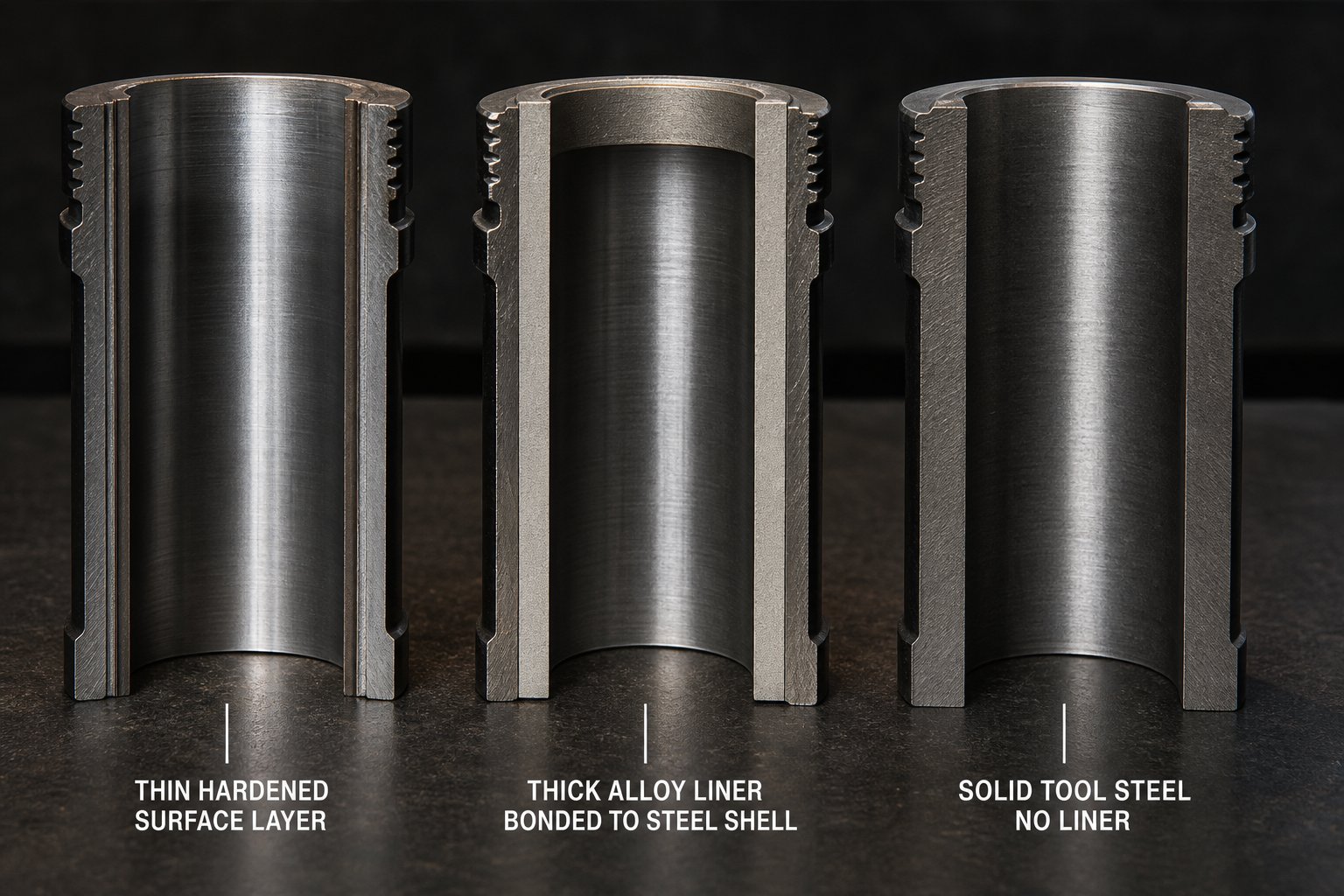
Nitrided barrels are the baseline — the most widely used construction for general-purpose extrusion. The process works like this: a barrel machined from alloy steel (commonly 38CrMoAlA or AISI 4140) is placed in a furnace where nitrogen gas diffuses into the steel surface at temperatures between 480°C and 530°C. This creates a hardened case — a thin layer of iron and alloy nitrides — that significantly raises surface hardness without altering the barrel's core toughness or dimensional stability.
The result is a bore surface reaching approximately 950 to 1,100 HV (roughly 68 to 72 HRC equivalent), with a case depth typically ranging from 0.3 to 0.7 mm. That hardened layer delivers reliable wear resistance in stable formulations — unfilled polyolefins, polystyrene, ABS, and similar commodity resins that do not carry abrasive fillers or release corrosive byproducts during processing.
The critical limitation? That hardened case is shallow. Once abrasive or corrosive conditions wear through the nitrided layer, the softer base steel underneath is exposed, and wear accelerates dramatically. In severely abrasive service — think glass-fiber-filled compounds or heavily mineral-loaded masterbatch — a nitrided barrel can burn through its protective layer within 2,000 to 3,000 operating hours. For non-abrasive polymers, however, nitrided extrusion barrels remain an excellent, cost-effective choice that delivers predictable performance over long production runs.
When does a deeper nitrided case make sense? If you are processing lightly filled compounds — say, 10% to 15% calcium carbonate in polyethylene — requesting a nitriding depth toward the upper end of the 0.5 to 0.7 mm range extends the barrel's useful life before the hardened layer wears through. Ion nitriding (plasma nitriding) can also improve the quality of that case by reducing the brittle "white layer" at the surface from 10–25 microns down to under 5 microns, which improves fatigue resistance and allows for tighter bore tolerances after treatment.
Bimetallic Barrels With Centrifugally Cast Liners
When your process pushes past what a nitrided surface can handle, bimetallic barrels step in. These are engineered as a two-layer system: a tough outer shell (typically 4140 or 4340 steel) provides structural strength, while a centrifugally cast alloy liner bonded metallurgically to the bore's inner surface delivers the wear and corrosion resistance.
During centrifugal casting, the barrel is rotated at high speed while molten alloy is poured inside. Centrifugal force distributes the alloy uniformly around the bore, creating a dense, metallurgically bonded liner typically 1.5 to 2.5 mm thick. That thickness is critical — it gives the barrel a far deeper wear allowance than a nitrided case, translating directly into longer service life in demanding applications.
The liner alloy itself is where the real customization happens. Two primary families dominate:
- Iron-based alloys (high chromium with tungsten carbide content) — the go-to choice for abrasive service. These liners resist the micro-cutting action of mineral fillers, glass fibers, and pigment particles. Bore hardness typically reaches 60 to 72 HRC.
- Nickel-based alloys (nickel-chromium matrix with embedded carbides) — designed for corrosive environments such as PVC, PVDC, or halogenated flame retardant compounds. The nickel matrix forms a passive film that resists attack from hydrogen chloride gas, while still providing meaningful abrasion resistance.
The performance gap is significant. Corrosive wear rates for nitrided 4140 steel in rigid PVC service typically run 0.08 to 0.15 mm per 1,000 operating hours, compared to just 0.01 to 0.03 mm for high-nickel, high-chromium bimetallic liners. That is a five-to-eight-fold improvement in bore preservation — which translates directly into fewer unplanned shutdowns, more consistent output, and lower total cost of ownership. The same bimetallic liner technology applies to twin screw barrel designs, where the intermeshing screw geometry makes bore integrity even more critical due to tighter clearance requirements.
Another advantage worth noting: when a bimetallic barrel eventually does wear, it can often be refurbished by boring out the spent liner and casting a new one. A nitrided barrel that has worn through its case typically requires full replacement.
Tool-Steel-Lined Barrels for Extreme Wear
At the top of the durability spectrum sit tool-steel-lined barrels — purpose-built for the most punishing applications. These use through-hardened tool steels such as D2 (AISI D2, 58–62 HRC) or CPM powder metallurgy grades (CPM 9V, 10V) as the barrel bore material, either as a solid one-piece construction or as a precision-fitted liner.
Why go to this extreme? Consider an extruder processing 40% to 60% glass-fiber-filled nylon or heavily mineral-loaded recycled feedstock around the clock. Standard nitrided barrels may last a few thousand hours. Bimetallic liners extend that significantly. But tool-steel-lined barrels, with their uniformly distributed vanadium or chromium carbides throughout the full wall thickness, can push service life multiples of three to five times beyond conventional bimetallic options in standardized ASTM G65 abrasion testing.
The trade-off is cost and complexity. Tool-steel-lined extruder barrels carry a substantial price premium and limited corrosion resistance compared to nickel-based bimetallic options. They are typically reserved for applications where abrasive wear is the overwhelmingly dominant failure mechanism and where the production volume justifies the investment.
Understanding Barrel Hardness Ratings in Practice
You will frequently encounter hardness values like "68 HRC" in barrel specifications. What does that number actually tell you — and where does it apply?
First, a clarification that trips up many buyers: 68 HRC does not describe the entire barrel. It refers specifically to the hardened bore surface — either the nitrided case or the inner face of a centrifugally cast liner. The barrel's outer shell, which provides structural support, sits at a much lower hardness (typically 28–35 HRC) to maintain toughness and resist cracking under thermal cycling and clamping loads.
Second, hardness alone does not predict service life. A nitrided barrel and a bimetallic barrel can both hit 68 HRC at the bore surface, yet the bimetallic version will dramatically outlast the nitrided one in abrasive service. The reason is depth — the nitrided case is 0.3 to 0.7 mm deep, while the bimetallic liner is 1.5 to 2.5 mm thick. Once abrasion penetrates the nitrided layer, hardness drops to the base steel's 28–32 HRC almost immediately. The bimetallic liner, by contrast, maintains its rated hardness through a much thicker wear allowance.
Third, hardness needs context. Processing unfilled LDPE film? A nitrided bore at 65–68 HRC is more than adequate. Running 30% glass-filled PA66 for automotive connectors? You need a bimetallic or tool-steel-lined bore at 62–72 HRC — and you need that hardness sustained through millimeters of material, not tenths of a millimeter. The same thinking applies when specifying a twin screw barrel for compounding operations, where aggressive filler loadings demand even more robust bore protection.
The following table summarizes how these three barrel types compare across the specifications that matter most when selecting extruder barrels for a specific application:
| Material Type | Hardness Range (HRC) | Abrasion Resistance | Corrosion Resistance | Typical Applications | Relative Cost |
|---|---|---|---|---|---|
| Nitrided Steel (e.g., 4140, 38CrMoAlA) | 65–72 (surface case only, 0.3–0.7 mm deep) | Moderate — adequate for unfilled or lightly filled polymers | Low to moderate — vulnerable to HCl and acidic byproducts | Unfilled PE, PP, PS, ABS; lightly filled commodity resins | $ |
| Bimetallic — Iron-Based Liner (high-Cr, WC content) | 60–72 (liner thickness 1.5–2.5 mm) | High — resists glass fibers, mineral fillers, and pigment abrasion | Moderate — better than nitrided but not optimized for corrosive chemistries | Glass-filled engineering plastics, mineral-filled masterbatch, recycling lines | $$ |
| Bimetallic — Nickel-Based Liner (Ni-Cr matrix) | 58–65 (liner thickness 1.5–2.5 mm) | Moderate to high — good abrasion resistance with superior chemical protection | High — passive film resists HCl attack from PVC and halogenated compounds | Rigid and flexible PVC, CPVC, fluoropolymers, halogenated FR compounds | $$$ |
| Tool-Steel-Lined (D2, CPM 10V) | 58–62+ (full wall thickness) | Very high — uniformly distributed carbides throughout the wear zone | Low to moderate — limited chemical resistance, best for purely abrasive service | Heavily glass-filled nylon (40%+), extreme mineral-filled compounds, high-output compounding | $$$$ |
Barrel material selection is ultimately an economic decision disguised as a technical one. The right screw and barrel combination balances the upfront investment against real-world service life, maintenance frequency, and the cost of downtime — which raises the question of how the barrel's thermal management system works alongside its material construction to protect both performance and longevity.
Barrel Heating and Cooling Systems Demystified
Even the most wear-resistant extrusion barrel will underperform if its thermal management is poorly configured. The barrel's liner protects against physical degradation, but it is the heating and cooling system wrapped around the barrel's exterior that determines whether the polymer inside melts uniformly, flows predictably, and exits the die in optimal condition. Getting this wrong introduces everything from unmelted gels to thermal degradation — problems that no liner upgrade can solve.
Band Heaters vs Cartridge Heaters for Barrel Zones
Most single screw extruder barrels rely on electric band heaters for zone heating. These clamp-on devices wrap around the barrel's outer circumference and deliver heat through the barrel wall into the polymer melt. Three types dominate the industry, each suited to different performance demands:
- Mica band heaters — the most common and economical choice. They use resistance wire sandwiched between layers of mica insulation inside a steel sheath. Mica band heaters respond quickly to temperature changes and work well for general-purpose single screw extrusion lines running commodity polymers. The catch is that they require tight contact with the barrel surface — any air gap between the heater and the barrel acts as an insulator, causing the element to overheat and burn out prematurely.
- Ceramic band heaters — built with resistance coils embedded in interlocking ceramic tiles beneath the outer sheath. The ceramic insulation provides superior heat retention and more uniform temperature distribution, even when the fit against the barrel is not perfectly tight. These are preferred for applications with high heat demands or where energy efficiency matters — the ceramic layer radiates heat inward toward the barrel while minimizing outward heat loss.
- Cast aluminum band heaters — tubular heating elements extruded into split aluminum cylinders. The aluminum housing delivers excellent thermal conductivity and maintains a tight grip on the barrel thanks to aluminum's low thermal expansion rate. These heaters reach sheath temperatures up to approximately 650°F (343°C) and offer contamination-free, long-lasting performance for screw extrusion processes that demand precise, responsive temperature control.
Here is how these three types compare side by side:
| Heater Type | Max Temperature | Heat Transfer Efficiency | Durability | Cost |
|---|---|---|---|---|
| Mica Band | ~850°F (454°C) | Good — requires tight barrel contact for optimal transfer | Moderate — susceptible to burnout if air gaps exist | Low |
| Ceramic Band | ~1,200°F (649°C) | High — ceramic insulation maximizes inward radiation and reduces outward loss | High — tolerates slight fit imperfections without premature failure | Moderate |
| Cast Aluminum | ~650°F (343°C) | Very high — aluminum's thermal conductivity ensures rapid, even heat delivery | Very high — robust construction with minimal maintenance needs | Moderate to high |
What about cartridge heaters? These cylindrical elements insert into bores drilled directly into the barrel wall rather than clamping around the outside. Cartridge heaters deliver heat from within the barrel's steel mass, producing faster thermal response and more intimate heat transfer to the bore surface. They appear most often in smaller-diameter extruders or in specialized heater screw configurations where space constraints or rapid thermal cycling rule out bulky external band heaters. The downside is that replacing a failed cartridge heater typically means more downtime — the element is embedded in the barrel rather than simply unbolted from the surface.
Cooling Systems and Thermal Balance
Heating alone does not equal temperature control. During steady-state operation, a significant portion of the heat in the polymer melt comes from viscous shear — the mechanical energy generated by the screw rotating against the barrel bore. In many cases, barrel heaters contribute less than half the total energy input once the extruder reaches running conditions. That means the barrel's cooling system becomes the primary tool for preventing overshoot.
Two cooling approaches are standard:
- Air cooling — blower fans direct ambient air across the barrel surface or through plenum chambers beneath shrouds at each zone. Air-cooled systems are simpler to install and maintain, with no pumps, filters, plumbing, or coolant treatment to worry about. They handle most general-purpose polyolefin, styrenic, and engineering-resin applications comfortably, and the industry has seen a growing shift from water to air cooling thanks to reduced downtime, lower operational costs, and the elimination of leak-related electrical hazards.
- Water-jacket cooling — liquid circulates through channels cast into the barrel wall or through separate cooling coils wrapped around the barrel. Water's higher heat capacity provides much faster and more aggressive cooling, which is essential for heat-sensitive polymers like PVC. During PVC processing, even a brief temperature overshoot can trigger thermal decomposition and the release of hydrochloric acid gas, making rapid cooling response non-negotiable. Water-jacket systems also appear on high-output lines where shear-generated heat exceeds what air cooling can remove.
A practical point worth remembering: if an extruder requires heavy cooling during normal production, that often signals a mismatch between the screw design and the material being processed, or a problem in the heater screw barrel system — not simply a cooling deficiency. Excessive cooling demand is a symptom worth investigating rather than just compensating for.
Temperature Profiling Strategies Along the Barrel
The number of independently controlled heating and cooling zones along an extrusion barrel depends on the barrel's length and L/D ratio. Smaller extruders — up to 3-inch bore diameter — typically run three or four zones, while larger machines often use six or more. Each zone has its own temperature sensor, controller, heater circuit, and cooling circuit, allowing operators to set different temperatures along the barrel's length.
Why does independent zone control matter? Because different polymers need different temperature gradients to melt efficiently and exit the barrel in optimal condition. Operators configure these gradients — commonly called temperature profiles — based on the resin's melting behavior, viscosity characteristics, and thermal sensitivity. Three profile strategies cover most scenarios:
- Ascending profile — temperatures increase progressively from the feed zone to the metering zone. This is the most common approach for semi-crystalline polymers like PE and PP, where a gradual increase helps complete melting without overheating the early zones.
- Flat profile — all zones are set to approximately the same temperature. This works for amorphous resins like PS or ABS that soften over a broad range and do not require a strong thermal gradient to melt uniformly.
- Reverse (hump-back) profile — temperatures peak in the middle zones and decrease toward the die end. This strategy reduces melt temperature at the barrel exit, which benefits heat-sensitive materials or processes where lower die-exit temperatures improve product properties such as surface finish or optical clarity.
Selecting the right profile is not guesswork — it is guided by the polymer's recommended processing temperature window, the screw geometry, and the target throughput rate. An ascending profile that works perfectly for HDPE pipe extrusion could degrade a flexible PVC compound, while a reverse profile that protects PVC would leave a high-crystallinity nylon insufficiently melted.
Thermal management and barrel material work as partners: the liner resists physical and chemical attack, while the heating and cooling system ensures the polymer stays within its safe processing window. When either system breaks down, wear accelerates — which raises the question of exactly how that wear manifests, how to measure it, and when the damage warrants action.
Barrel Wear Mechanisms and How to Diagnose Them
Barrel liners resist wear. Thermal management systems keep polymer within safe processing windows. Yet every single screw extruder barrel has a finite service life — and how quickly that life expires depends on three distinct wear mechanisms that often operate simultaneously. Recognizing which mechanism is driving your barrel's deterioration is not academic trivia. It determines whether the correct fix is a liner upgrade, an alignment correction, a material change, or a full barrel replacement.
Abrasive, Corrosive, and Adhesive Wear Explained
Picture the inside of a barrel bore after a few thousand hours of processing glass-fiber-filled nylon. You would find fine grooves scored along the bore surface — shallow channels cut by hard filler particles dragged across the steel under immense pressure. That is abrasive wear, and it is the most common form of barrel degradation. Mineral fillers such as calcium carbonate, silica, and titanium dioxide pigments act like microscopic sandpaper against the bore wall. Glass fibers are especially aggressive because their Mohs hardness exceeds that of most barrel liner alloys. The damage concentrates wherever the channel carries a high proportion of unmelted solids — typically the compression zone and the entry to any downstream mixing section, where solids can momentarily jam and generate extreme lateral forces.
Corrosive wear operates through an entirely different mechanism. Instead of physically cutting the bore surface, corrosive attack dissolves it chemically. PVC is the classic offender. During processing, PVC can release hydrogen chloride gas, which reacts with the barrel's iron-based surface to form iron chloride — a soluble compound that is continuously swept away by the flowing melt, exposing fresh metal for further attack. Fluoropolymers, flame-retardant compounds containing halogenated additives, and even some degraded engineering resins generate similarly aggressive byproducts. The telltale signature is a uniformly roughened, pitted bore surface rather than the directional scoring seen with abrasion.
Adhesive wear is the sneakiest of the three. It happens when the screw physically contacts the barrel wall — metal dragging against metal. In a properly aligned extruder, the screw should never touch the bore. But barrels sag under their own weight, foundations shift, support brackets loosen, and gearbox alignment drifts over time. Faulty barrel heaters can also warp the barrel by causing one side to expand more than the other, bending the bore off-center. When the screw deflects into the barrel wall, the resulting galling transfers material from one surface to the other, creating localized hot spots and accelerated wear patterns that spiral quickly.
In real-world extrusion lines, these mechanisms rarely act alone. A recycling line processing contaminated post-consumer feedstock, for example, may face abrasive wear from embedded grit and metal fragments, corrosive wear from mixed polymer degradation products, and adhesive wear from screw deflection caused by inconsistent melt viscosity. That layered attack is precisely why screws and barrels in recycling applications demand the most robust liner technologies available.
How to Measure and Diagnose Barrel Wear
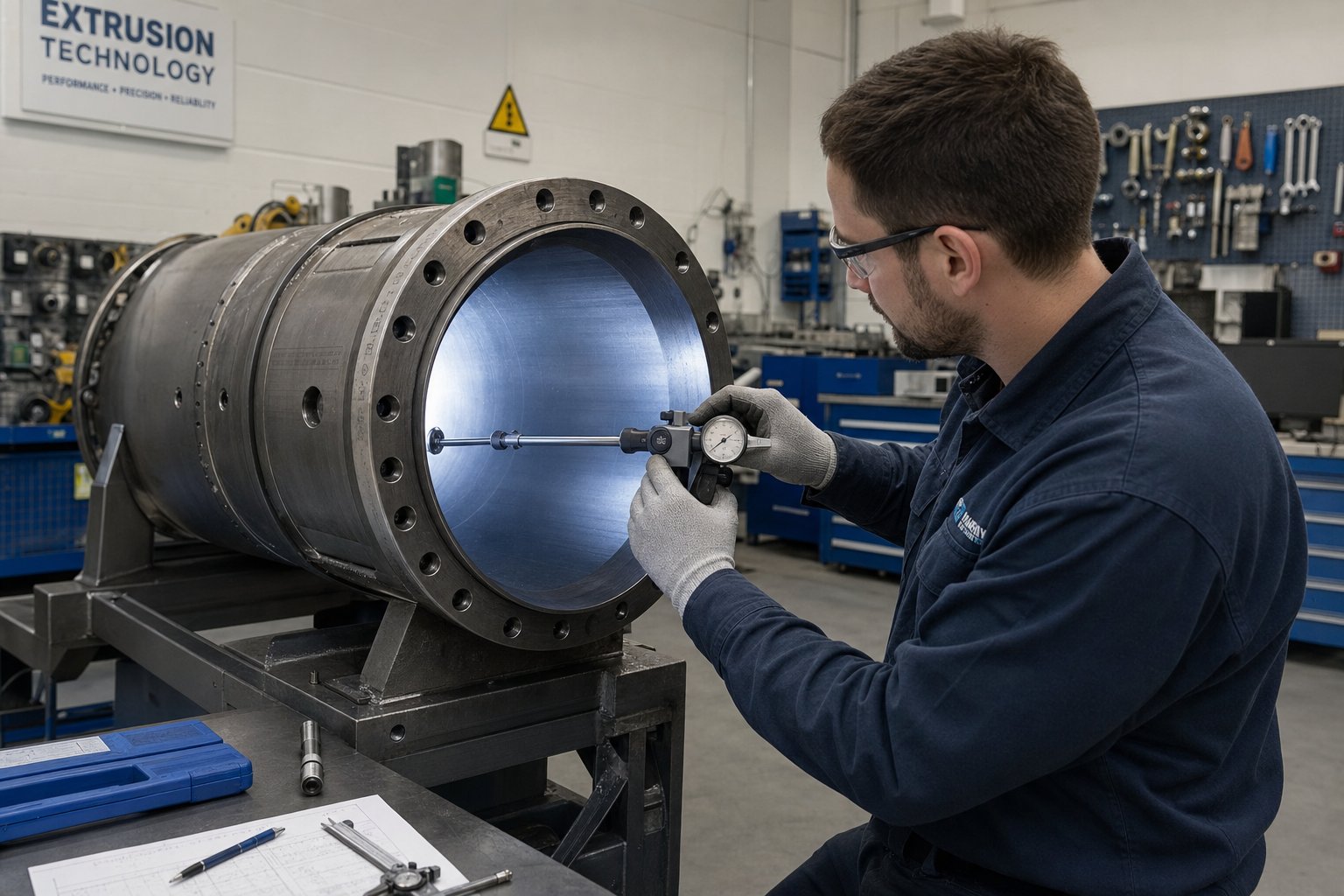
You cannot manage what you do not measure. Barrel wear diagnosis starts with a bore gauge — specifically, a telescoping gauge or an inside micrometer — and a systematic measurement protocol. Using a bore gauge, measure as far down each end of the barrel as possible, recording readings at multiple points along the barrel's length. Take measurements in at least two orientations (vertical and horizontal) at each point to detect ovality — a telltale indicator of adhesive wear or misalignment.
What counts as too much wear? A widely referenced industry guideline puts the nominal flight clearance at the screw diameter divided by 1,000 per side. For a 3.5-inch extruder, that means approximately 0.004 inches per side when new. Any clearance beyond that original specification represents wear. Many processors use the 4x rule as a threshold: when the flight clearance reaches four times the original value, performance degradation typically becomes operationally significant. Critical-duty applications like medical tubing may trigger replacement at just 2x the original clearance, while less demanding processes like corrugated pipe can tolerate higher levels.
The pattern of wear is just as revealing as the amount. Uniform bore enlargement along the full length suggests abrasive wear from filled compounds. Localized wear concentrated in the compression zone often points to solids wedging — a screw design issue forcing material to jam and push the plastic extruder screw sideways into the barrel wall. Wear isolated to one side of the bore, visible as an out-of-round condition, strongly indicates misalignment or a bent barrel. And widespread pitting without significant dimensional change usually signals corrosive attack.
Beyond physical measurements, the extruder itself offers diagnostic clues. Watch for these warning signs during production:
- Declining specific output (lb/hr per rpm) that forces higher screw speeds to maintain rate
- Rising discharge melt temperatures at constant throughput — a direct consequence of increased backflow over worn flight clearances
- Surging or pulsating output that was not present when the screws and barrels were new
- Higher motor amperage or energy consumption per pound of output
- Visible degradation, gels, or unmelted particles in the extrudate
- Increased sensitivity to back-pressure changes at the die
The best maintenance programs do not wait for these symptoms to appear. They establish baseline bore measurements when the barrel is new, then re-measure at scheduled intervals to build a wear trend. That trend data turns reactive troubleshooting into predictive maintenance — you know when the barrel will need attention before it starts costing you production quality.
When to Reline or Replace a Worn Barrel
A worn barrel presents two options: reline or replace. The right choice depends on the barrel's construction, the severity and location of wear, and the economics of your specific production line.
Relining — boring out the spent liner and centrifugally casting a new alloy layer — is viable for bimetallic barrels where the outer shell remains structurally sound and dimensionally stable. The normal finished thickness of a bimetallic liner is approximately 0.060 inches, and relining restores the bore to its original specification with fresh wear-resistant alloy. This option typically costs 40% to 60% less than a new barrel and offers a faster turnaround than full replacement — a meaningful advantage when production schedules are tight.
Relining reaches its limits, however, when the barrel shell has been compromised. Repeated thermal cycling can cause stress cracking in the outer wall. Severe corrosion may have attacked the base steel beneath the liner. And if the barrel has been warped by alignment issues or uneven heating, no amount of relining will restore concentricity — the bore will still be off-center relative to the gearbox shaft.
Full replacement becomes necessary in those scenarios, or when a nitrided barrel has worn through its hardened case entirely. Unlike bimetallic designs, nitrided barrels cannot be economically relined — the hardening is integral to the base steel's surface, and once it is gone, the barrel must be replaced. This is one reason bimetallic barrels deliver better total cost of ownership in demanding applications despite their higher upfront price: they can be rebuilt, while nitrided barrels cannot.
Extruder screws follow a parallel logic. A barrel with an iron-based bimetallic liner typically lasts for the service life of three screws. When you pull a worn screw, measure the barrel bore before installing the replacement. There is no point dropping a new screw into a worn barrel — the oversized clearance will immediately compromise performance and accelerate wear on the new screw's flight tips. Measure both components together, assess both together, and replace or refurbish based on the combined picture.
Economics should drive the final decision. A noncritical line running commodity resin at moderate output can tolerate more wear than a medical-grade or optical-film line where every tenth of a degree and every gram of output consistency matters. The cost of lost production quality, increased scrap, and higher energy consumption on a worn barrel often exceeds the cost of timely replacement — a calculation that becomes much easier when you have trend data from regular bore inspections.
Wear is inevitable. But the speed at which it progresses and the damage it causes are not fixed — they depend heavily on whether the barrel was correctly specified for the polymer being processed in the first place, which is exactly where many plants get the initial selection wrong.
Matching Barrel Specifications to Polymers and Applications
Getting the initial barrel selection wrong is one of the most expensive mistakes a plastics plant can make. You already know that nitrided, bimetallic, and tool-steel-lined barrels each offer different levels of protection. The real question is: which barrel goes with which polymer — and which extrusion application? The answer is not always obvious, because the same base resin can behave very differently depending on whether it is unfilled, mineral-loaded, halogenated, or contaminated with post-consumer debris.
What follows is a practical polymer-to-barrel matching reference designed to eliminate guesswork. Whether you are specifying a barrel for a new single screw plastic extruder or sourcing a replacement for an existing line, this framework maps the resin you process to the liner technology that will keep your bore intact.
Barrel Selection for Polyolefins and Commodity Resins
Polyolefins — polyethylene (HDPE, LDPE, LLDPE) and polypropylene — are the workhorses of single screw extrusion. They melt cleanly, generate no corrosive byproducts, and in their unfilled form carry no abrasive particles. For these materials, a standard nitrided barrel with a bore hardness of 950 to 1,100 HV and a case depth of 0.4 to 0.7 mm delivers reliable, cost-effective service across pipe, blown film, cast film, sheet, and general-purpose extrusion lines.
The same applies to other unfilled commodity resins like polystyrene (PS) and ABS. As long as no mineral fillers, glass fibers, or corrosive additives enter the mix, a well-manufactured nitrided bore handles the mechanical demands with predictable wear rates. Most polymer extruder lines running these resins can expect three to five years of service from a properly specified nitrided barrel — sometimes longer at moderate throughput rates.
Where does this break down? When processors add calcium carbonate, talc, or titanium dioxide pigments at loadings above roughly 10% to 15%. At that point, the abrasive filler particles begin wearing through the shallow nitrided case faster than the economics justify, and a step up to a bimetallic liner starts making financial sense.
Corrosion-Resistant Barrels for PVC Processing
PVC is the single most demanding commodity polymer from a barrel corrosion standpoint. During thermal processing, PVC releases hydrogen chloride (HCl) gas — a highly corrosive byproduct that attacks iron-based barrel surfaces aggressively. A standard nitrided barrel processing rigid PVC can lose bore integrity within 6 to 18 months, depending on throughput rate and stabilizer quality. The HCl does not just pit the surface; it dissolves it, continuously exposing fresh metal to further chemical attack.
This is why every reputable plastic single screw extruder manufacturer recommends bimetallic barrels with nickel-based liners for PVC service. The nickel-chromium alloy matrix forms a passive protective film that resists HCl attack, dramatically reducing corrosive wear rates. Industry data consistently shows that bimetallic barrels last two to three times longer than nitrided alternatives in equivalent PVC processing conditions — and the advantage grows even wider when processing CPVC, which requires higher melt temperatures and generates more aggressive decomposition products.
The same logic extends to any halogenated polymer or compound containing halogenated flame retardants. If the formulation releases acidic gases during processing, the barrel bore needs chemical protection that goes beyond surface nitriding. A nickel-based bimetallic liner is the baseline specification; severe cases may warrant additional HVOF coating on the screw flights as well.
Abrasion-Resistant Barrels for Filled Compounds and Recycling
Glass-fiber-filled nylons, mineral-loaded engineering plastics, and heavily pigmented masterbatch present the opposite challenge: pure mechanical abrasion. Glass fibers in particular — with a Mohs hardness exceeding most barrel alloys — act like microscopic cutting tools dragged at high velocity across the bore surface. A screw plastic extruder processing 30% glass-filled PA6 or PA66 will destroy a nitrided barrel bore in a fraction of the time it takes to wear through a bimetallic or tool-steel-lined alternative.
For these applications, iron-based bimetallic liners with high chromium and tungsten carbide content deliver the abrasion resistance needed to maintain bore integrity over extended production runs. At filler loadings above 40%, tool-steel-lined barrels become the more economical long-term choice despite their higher upfront cost.
Recycled feedstock introduces a uniquely challenging combination: abrasion plus corrosion. Post-consumer regrind often contains embedded contaminants — grit, metal fragments, label adhesive residues, and mixed polymer fractions that generate both mechanical wear and unpredictable chemical degradation products. A screw extruder granulator line processing heavily contaminated post-industrial or post-consumer waste needs a barrel that handles both failure modes simultaneously. Nickel-based bimetallic liners with enhanced carbide content represent the best compromise for these applications, offering meaningful protection on both fronts.
The following table maps common polymer families to their recommended barrel liner technologies, the primary concern driving that recommendation, and the typical extrusion applications where each combination appears:
| Polymer / Compound | Barrel Liner Recommendation | Key Concern | Typical Application |
|---|---|---|---|
| HDPE, LDPE, LLDPE (unfilled) | Standard nitrided (38CrMoAlA / 4140) | Moderate mechanical wear only | Pipe, blown film, cast film, sheet extrusion |
| PP homopolymer / copolymer (unfilled) | Standard nitrided | Moderate mechanical wear only | Raffia, fiber, sheet, thermoforming |
| PS, ABS, SAN (unfilled) | Standard nitrided | Low wear and no corrosive byproducts | Sheet, profile, general-purpose extrusion |
| PVC (rigid and flexible) | Nickel-based bimetallic liner | HCl corrosion from thermal degradation | Pipe, profile, cable insulation, pelletizing |
| CPVC | Nickel-based bimetallic liner (high-grade) | Severe HCl corrosion at elevated temperatures | Hot-water pipe, industrial fittings |
| Glass-filled PA6 / PA66 (15%–40%) | Iron-based bimetallic liner (high-Cr, WC) | Severe abrasive wear from glass fibers | Engineering profiles, automotive components |
| Mineral-filled PP / PE (CaCO3, talc >15%) | Iron-based bimetallic liner | Abrasive wear from hard filler particles | Masterbatch, filled sheet, compounding |
| Glass-filled PA (>40%) | Tool-steel-lined (D2, CPM 10V) | Extreme abrasion exceeding bimetallic capacity | High-performance compounding, pelletizing |
| Recycled polyolefins (post-consumer) | Nickel-based bimetallic with enhanced carbides | Combined abrasion from contaminants + corrosion from degradation products | Recycling pelletizing lines, regrind reprocessing |
| Halogenated FR compounds | Nickel-based bimetallic liner | Acidic gas release corroding bore surface | Cable sheathing, electronic housings |
Vented Barrel Configurations for Degassing and Moisture Removal
Some polymers and feedstocks introduce a problem that no liner technology can solve on its own: trapped moisture and volatile gases. Hygroscopic engineering resins like PET and nylon absorb atmospheric moisture that, if not removed before the die, creates bubbles, splay marks, and weakened extrudate. Recycled feedstock compounds the issue — post-consumer regrind often carries residual moisture, printing ink solvents, and low-molecular-weight degradation products that must be evacuated during processing.
This is where vented barrel configurations come in. A vented system pairs a two-stage screw with a barrel that includes one or more vent ports — openings in the barrel wall positioned at the transition between the first and second processing stages. In the first stage, the polymer melts and compresses normally. The screw geometry then deliberately decompresses the melt, allowing volatiles and moisture to escape through the vent port — typically under vacuum assist — before the second stage recompresses the degassed melt and builds pressure for the die.
Vent port placement is critical. The port must sit precisely where the screw's decompression zone begins — typically at around 60% to 65% of the total barrel length from the feed end. If the port is positioned too early, unmelted material can block it. Too late, and the melt has already recompressed, preventing effective volatile release. The vent opening itself is machined into the barrel wall and often includes a vacuum connection fitting, a sight glass for visual monitoring, and a removable plug for cleaning.
For recycling lines and pelletizing operations handling mixed or contaminated feedstock, a vented barrel is not optional — it is essential. Without degassing, volatiles trapped in the melt compromise pellet quality, cause foaming at the die, and introduce voids that weaken downstream products. Two-stage screw-barrel systems with vacuum venting have become standard in recycling and compounding operations precisely because they address this problem at the source, removing contaminants before they can affect the final product.
Matching the right barrel material to the right polymer is the foundation. But even a perfectly specified barrel will fail prematurely if it is installed incorrectly, aligned poorly, or neglected during routine shutdowns — realities that shift attention from barrel selection to barrel installation and maintenance practices.
Barrel Installation, Alignment, and Replacement Guidance
A perfectly specified barrel can still fail early if it goes into the machine crooked. Alignment errors, sloppy mounting, and neglected feed throat cooling cause more premature barrel failures than most processors realize — and these are entirely preventable problems. Whether you are installing a barrel on a new single screw extruder machine or swapping out a worn unit on a line that has been running for a decade, the procedures outlined here will protect your investment.
Barrel-to-Gearbox Alignment Best Practices
Every barrel installation starts with one non-negotiable rule: the barrel must be aligned to the drive quill of the gearbox — no exceptions. Trying to determine alignment by simply leveling the barrel is inaccurate because leveling only measures the vertical plane and tells you nothing about concentricity with the drive shaft. The correct method uses an optical or laser alignment scope inserted inside the drive quill. By rotating the quill and observing where the barrel bore deviates from the centerline, technicians can adjust support brackets until the barrel axis and gearbox axis share a single, straight reference line.
Why does this matter so much? A misaligned barrel forces the extrusion screw to ride against one side of the bore. That one-sided contact creates adhesive wear, generates localized hot spots, and can bend or even break screws over time. Documented consequences of poor alignment include premature wear, heater crawl, thermocouple shearing, increased drive load, and die movement — a cascade of failures that traces back to a single root cause.
Barrel supports play a critical role in maintaining alignment over time. The barrel must be free to expand thermally without distortion, so supports should never fully clamp around the barrel and lock it in place. Consider the math: steel expands at approximately 0.000006 inches per inch per degree Fahrenheit. A 4.5-inch, 36:1 barrel heated to a uniform 450°F grows roughly 0.320 inches longer than its room-temperature length. If supports prevent straight-line expansion, the barrel bends — and so does your bore centerline. Use two-point support systems with brass contact surfaces to prevent corrosion-induced freezing, and verify after initial heat-up that the barrel's expansion mark corresponds to calculated values. Placing dial indicators at 90-degree angles on the discharge flange during heat-up will quickly reveal any deflection caused by malfunctioning supports or unbalanced heating.
For single screw extrusion machines with bore diameters of 3.5 inches (90 mm) or smaller, the manufacturer's original alignment typically holds unless the L/D ratio is exceptionally long. Larger or longer extruders are a different story — their bases are rarely rigid enough to maintain factory alignment indefinitely. Periodic realignment using certified extruder alignment technicians pays for itself many times over in extended barrel and screw life.
Step-by-Step Barrel Removal and Replacement
Replacing a barrel on a production extruder is a significant maintenance event. Rushing the process or skipping steps risks damaging the new barrel, the gearbox, or — most critically — the people doing the work. Follow this sequence to ensure a safe, clean swap:
- Lock out and tag out the machine. Disconnect all power sources to the drive motor, heaters, and control system. Confirm zero energy before proceeding.
- Cool the barrel to a safe handling temperature. Residual heat in a barrel that has been running at 400°F or higher can cause severe burns. Allow adequate cool-down time, or run the cooling system with the heaters off to accelerate the process.
- Disconnect all heater wiring and thermocouple connections. Label every wire and connector before detaching — this eliminates guesswork during reinstallation. Careful handling prevents damage to thermocouple tips and heater lead wires.
- Remove band heaters and insulation covers. Slide heater bands off the barrel and set them aside for inspection. Check for cracked ceramic elements, burned-out mica sheets, or corroded clamp hardware — it makes no sense to reinstall a failing heater on a new barrel.
- Unbolt the barrel flange from the feed throat and gearbox mounting face. Break bolts in a star pattern to release clamping force evenly and prevent warping the flange face. For barrels secured with clamp-style connections, release clamp bolts uniformly.
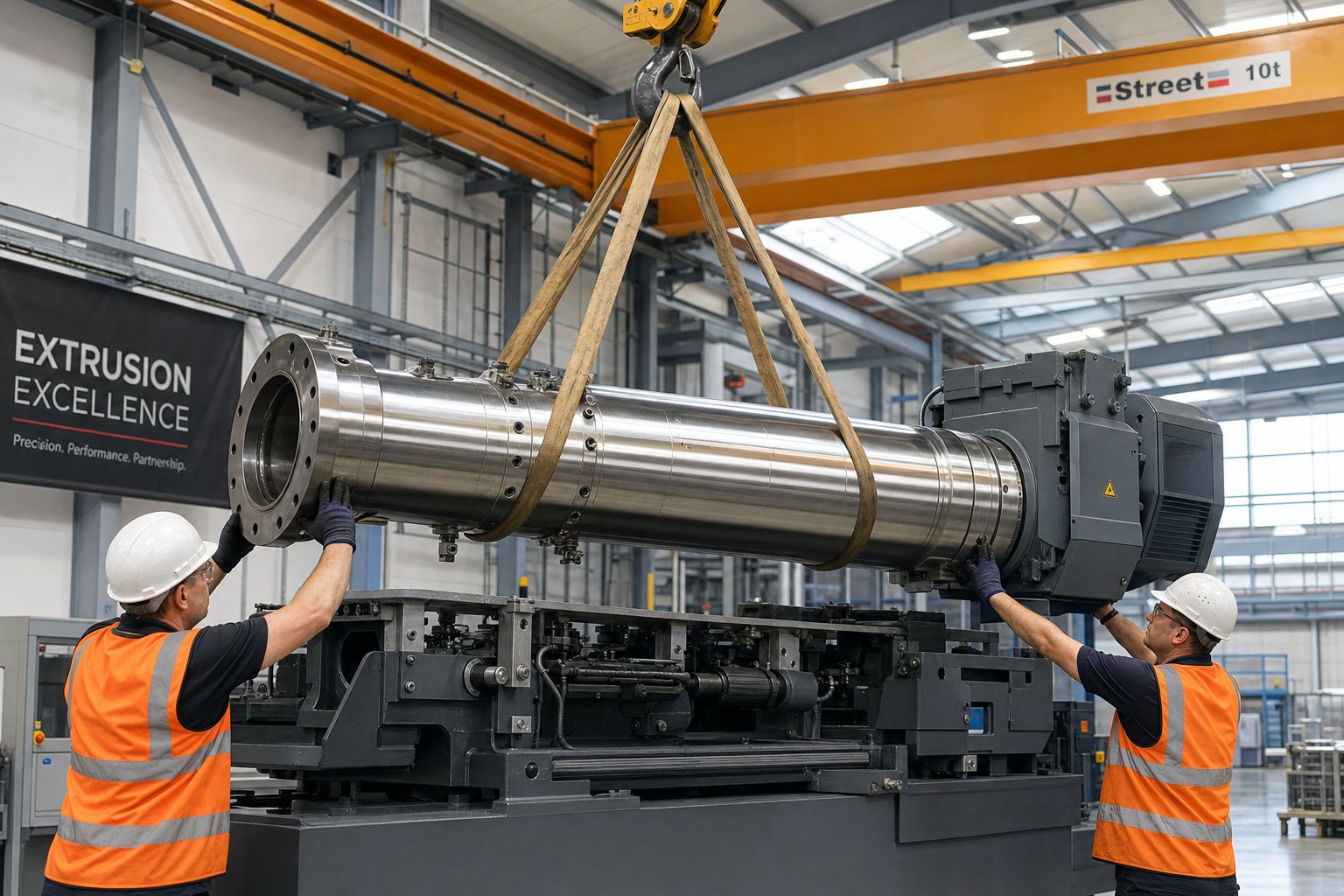
- Support the barrel with an overhead crane, chain hoist, or barrel cradle. Never allow the full barrel weight to hang unsupported from the gearbox end — the resulting moment load can damage gearbox bearings and the drive quill.
- Withdraw the screw first. With the flange unbolted and the barrel supported, carefully extract the extrusion screw from the barrel bore. Inspect it immediately for scoring, flight rounding, or deflection.
- Slide or extract the barrel from the machine frame. Barrels seized in their supports by thermal cycling may require hydraulic extraction equipment or the application of penetrating lubricant and gentle heat. Never hammer directly on the barrel — impact can crack nitrided surfaces or distort the bore.
- Clean and inspect all mounting surfaces. Remove old gasket material, sealant residue, and debris from the feed throat face, the gearbox mounting flange, and all support contact points. Check for nicks, burrs, or corrosion that could interfere with the new barrel's seating.
- Install the new barrel and align to the gearbox drive quill. Slide the new barrel into position, loosely secure the flange bolts, and perform the optical or laser alignment procedure before final torquing. The total out-of-alignment error should remain less than half the clearance between the screw and barrel bore to keep the screw centered.
- Torque all flange fasteners to specification. Use a calibrated torque wrench and follow the manufacturer's recommended values and tightening sequence. Under-torqued bolts allow melt leakage and flange separation under pressure; over-torqued bolts risk cracking flanges or stripping threads.
- Reconnect heaters, thermocouples, and cooling lines. Verify that every thermocouple tip contacts the barrel steel — a thermocouple that is not touching the barrel reads air temperature instead, causing dangerously inaccurate zone control. Confirm grounded thermocouple continuity to the armored sheath to avoid erratic readings.
- Perform a controlled heat-up and test run. Bring the barrel to operating temperature slowly, checking for deflection at the discharge flange with dial indicators. Run at low speed initially to verify stable output, consistent melt temperature, and no leaks at flange joints.
Feed Throat Configuration and Cooling
The junction between the hopper and the barrel — commonly called the feed throat or extruder feed barrel interface — deserves special attention during any installation or replacement. This transition zone is water-cooled for a specific reason: if heat from the barrel's first heating zone conducts backward into the feed throat, pellets soften prematurely and stick together. The resulting bridges block material flow, starve the screw, and cause output instability that mimics more serious problems downstream.
Cooling channels in the feed throat casting must remain free from mineral deposits and debris to ensure sufficient and uniform cooling. Hard water accelerates scale buildup inside these channels, progressively reducing heat transfer capacity. Flush the channels during every barrel change and inspect them annually even when no replacement is scheduled. Your machine manufacturer can recommend the most effective cleaning method for your specific casting design.
Feed throat inserts also warrant inspection. Many single screw extruder machines use hardened inserts at the feed opening to resist scoring from pellet abrasion. Scoring in the feed section, hub area, or feed throat can indicate a worn rear bushing at the upstream side of the throat, excessive axial screw deflection, or force-feeding practices that overload the feed zone. Replacing a barrel without inspecting and correcting these upstream conditions often leads to repeat failures — the new barrel inherits the same problems that shortened the old one's life.
Proper installation protects your barrel investment from day one. But the financial picture extends well beyond the installation itself — understanding the true cost of barrel ownership, from procurement through end-of-life, is what separates plants that budget reactively from those that plan strategically.
Understanding Barrel Costs and Procurement Essentials
Barrel installation and alignment protect your equipment mechanically. But there is another dimension that determines whether a barrel decision is truly successful: the financial one. Procurement teams and maintenance engineers alike often ask the same core question when a barrel reaches end-of-life — how much will this cost, and how do I make sure I am getting the right value? The answer is more layered than most expect, because the cheapest barrel on a purchase order is rarely the cheapest barrel to operate.
Factors That Drive Barrel Pricing
Barrel prices vary widely. Factory-level pricing for a small single screw barrel (25–45 mm bore) can start around USD 150 to 400, while medium bores (50–75 mm) typically run USD 400 to 1,000 and large-diameter barrels (80–150 mm) range from USD 800 to 2,000 or more. Adding a bimetallic liner upgrade increases the cost by USD 150 to 600 depending on bore size and alloy chemistry. These ranges shift further with tool-steel-lined construction, where the premium material and machining complexity push costs substantially higher.
Five primary variables control where any given barrel lands within — or outside — those ranges:
- Material grade — A standard nitrided barrel costs a fraction of a bimetallic design, which in turn costs less than a tool-steel-lined option. The alloy composition of the liner itself (iron-based versus nickel-based versus CPM powder metallurgy) drives additional cost tiers.
- Bore diameter and overall length — Larger, longer barrels require more raw material, more machining time, and more furnace capacity for heat treatment or centrifugal casting. A 150 mm barrel is not simply "bigger" than a 50 mm unit — it demands proportionally heavier infrastructure at every manufacturing step.
- Surface finish and bore tolerances — Tighter bore tolerances and finer surface finishes require additional grinding passes, more careful quality inspection, and higher reject rates during production. As Nordson's engineering team has noted, a smoothly finished and polished barrel — including the internal bore, external surfaces, and fastening sites — is not about aesthetics but about effective performance, heat transfer, and sealing.
- Design complexity — Vented barrels with precision-machined vent ports, specialized feed throat geometries, or non-standard flange configurations carry higher engineering and manufacturing costs than straight-bore replacement barrels.
- Lead time — Expedited delivery compresses the manufacturing schedule and typically commands a premium. Planning ahead and ordering during scheduled shutdowns rather than emergency breakdowns saves money on every order.
Buyers frequently wonder how much do screws cost relative to barrels. The answer depends on identical variables — material, diameter, length, and surface treatment — but screws and barrels should always be evaluated as a system rather than priced independently, because a mismatch between screw alloy and barrel liner accelerates wear on both components.
Total Cost of Ownership vs Upfront Price
Here is where most procurement decisions go wrong. Imagine two barrels for the same 90 mm extruder processing 25% glass-fiber-filled nylon. Barrel A is a standard nitrided unit priced at $1,200. Barrel B is a bimetallic with an iron-based centrifugally cast liner at $2,800. On the purchase order, Barrel A looks like the obvious winner.
In production, the math flips. The nitrided barrel wears through its hardened case in roughly 3,000 operating hours. The bimetallic barrel, with its thicker and harder liner, maintains acceptable bore tolerances for 12,000 hours or more. Over a 36-month production horizon running 24/7, you would replace Barrel A approximately eight times versus twice for Barrel B. Factor in the replacement labor — typically 4 to 8 hours of skilled maintenance time per event at loaded rates of $85 to $150 per hour — and each swap adds $340 to $1,200 in labor alone. Then add the unplanned downtime cost: a continuous extrusion line producing $1,500 to $5,000 of product per hour loses $12,000 to $40,000 in revenue for every 8-hour shutdown.
The total cost of ownership calculation becomes straightforward:
A barrel purchased based only on price can ultimately cost more than higher-priced alternatives when you account for replacement frequency, downtime, labor, energy losses, and product quality degradation.
Energy consumption adds another layer. Documented studies show a 6% to 12% increase in specific energy consumption (kWh/kg) as screw-to-barrel clearance widens from 0.1 mm to 0.5 mm. A worn barrel does not just produce less — it consumes more power per pound of output while doing so. Over thousands of operating hours, that energy penalty accumulates into a significant cost that never appears on the original barrel invoice.
Plants evaluating used extruders or used single screw extruders face an amplified version of this calculation. A used machine may arrive with a barrel that is already partially worn, making barrel condition assessment — bore measurements, liner inspection, wear trend estimation — one of the most important due diligence steps before committing to a purchase. The same applies when sourcing a Davis Standard extruder for sale or any other pre-owned equipment: the barrel's remaining service life directly affects the true acquisition cost.
Specifications to Prepare Before Ordering
Whether you are sourcing from the original equipment manufacturer or an aftermarket supplier, arriving at the quotation stage without complete specifications wastes time and invites errors. Incomplete drawings and unconfirmed dimensions are among the most common complaints in barrel procurement — and they lead to costly rework, delayed deliveries, and parts that do not fit.
Before requesting a quote, gather the following specifications:
- Bore diameter — The exact nominal bore size, confirmed by measurement rather than nameplate data if the barrel is a replacement for an existing machine
- Overall length — Including flange faces and any extensions beyond the heated zone
- Flange dimensions — Bolt circle diameter, bolt hole count and size, flange thickness, and the sealing surface profile (flat face, tongue-and-groove, or counterbored)
- Liner material specification — Nitrided, iron-based bimetallic, nickel-based bimetallic, or tool-steel-lined, with the specific alloy grade if known
- Heating zone layout — Number of zones, zone lengths, thermocouple and heater band locations along the barrel
- Feed port geometry — Feed opening shape (round, square, offset), dimensions, and orientation relative to the barrel's mounting position
- Vent port requirements — Location, diameter, and vacuum fitting specifications if a vented barrel is needed
- Machine make and model — This allows the supplier to cross-reference existing drawings and avoid dimensional errors
The choice between OEM replacement barrels and aftermarket suppliers involves real trade-offs. OEM barrels guarantee dimensional compatibility and typically ship with documentation tied to the original machine specifications. Aftermarket suppliers often deliver faster lead times and lower pricing, but quality varies significantly — always confirm material composition, hardness, and nitriding depth regardless of the source, and request traceable metallurgical documentation. A barrel that arrives at a lower price but with undocumented alloy chemistry is a gamble that can cost far more than the savings if the liner fails prematurely.
Cost is never just the number on the invoice. It is the sum of purchase price, installation labor, downtime risk, energy efficiency, and the years of reliable production you either gain or lose depending on how carefully the barrel was specified. That calculation naturally leads to a broader question: how do you choose a barrel supplier who consistently delivers on all of those variables?
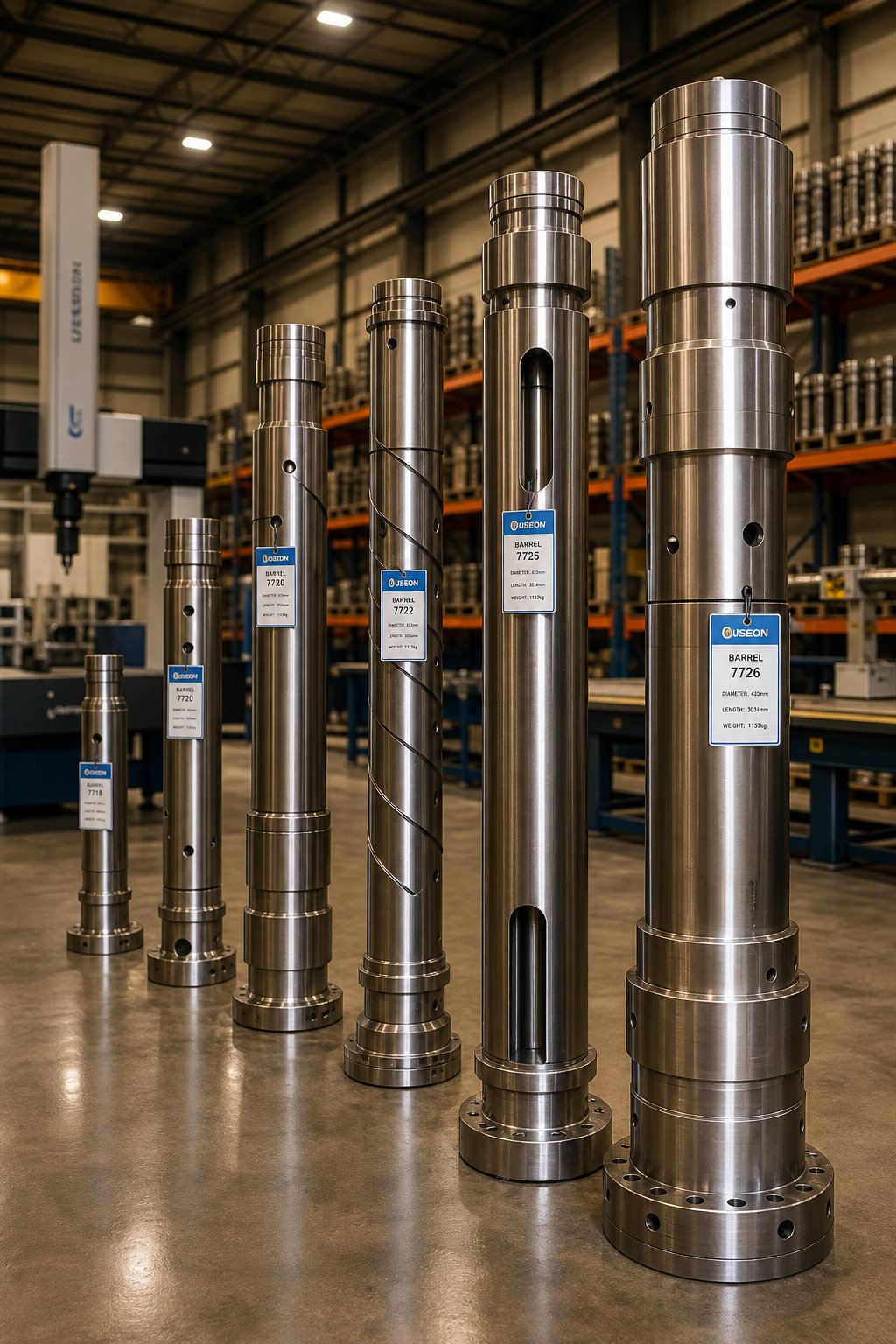
Selecting the Right Single Screw Barrel Supplier
You have matched your barrel liner to your polymer. You have nailed the thermal management. You know exactly when to reline versus replace. Yet all of that knowledge only delivers results if the barrel that arrives at your dock was manufactured correctly in the first place. The supplier behind that barrel determines whether your specifications translate into real-world performance — or into a premature failure that sends you right back through the procurement cycle.
Choosing a screw extruder supplier is not like choosing a commodity fastener vendor. Barrel quality depends on tightly controlled metallurgy, precision machining, and process knowledge that varies enormously across single screw extruder manufacturers. A structured evaluation framework takes the guesswork out of that decision.
Key Criteria for Evaluating Barrel Suppliers
Not every supplier claiming to produce high-quality barrels actually controls the processes that determine barrel life. Some machine the outer shell in-house but outsource centrifugal casting to a third party. Others cast their own liners but send barrels out for nitriding. Each outsourced step introduces a gap in process control — and those gaps show up as inconsistent field performance. Industry analysis consistently identifies vertical integration as one of the strongest predictors of reliable barrel service life.
When qualifying a new barrel partner, evaluate the following criteria — listed in order of impact on the barrel you ultimately receive:
- Comprehensive application coverage — Suppliers like NANHAIYA, whose single screw barrel program spans pipe, film, sheet, pelletizing, recycling, and general-purpose extrusion lines, can support an entire plant's barrel inventory from a single source. That breadth signals deep process knowledge across polymer families and extrusion configurations — not just one niche.
- In-house manufacturing capabilities — Look for suppliers that perform centrifugal casting, CNC boring and honing, gas or ion nitriding, and final grinding under one roof. When a single facility controls alloy chemistry, pour temperature, heat treatment cycles, and bore finishing, the finished barrel reflects coordinated quality rather than a patchwork of subcontracted steps.
- Material traceability and certification — Every alloy used in the barrel — base steel, bimetallic liner composition, hardfacing powder — should be backed by EN 10204 3.1 material certificates that trace chemistry and mechanical properties to the source mill. Suppliers who cannot provide this documentation are asking you to trust their word rather than verified data.
- Documented hardness and dimensional inspection — Barrel bore hardness should be tested per ASTM E18 (HRC) or ASTM E92 (HV) at multiple points along the bore length, with results included in the shipping documentation. Bore diameter measurements from coordinate measuring machines (CMM) confirm that the barrel meets its specified tolerances before it leaves the factory.
- Quality management system certification — ISO 9001:2015 is the baseline. For barrels entering automotive or medical device supply chains, IATF 16949 certification provides additional assurance that process controls, corrective actions, and continuous improvement are formally managed.
- Technical application engineering support — Can the supplier's team recommend the correct liner alloy for your specific polymer, filler loading, and operating conditions? A supplier that simply takes your order is a parts vendor. A supplier that challenges your specification when the data suggests a better option is a technical partner.
- Lead times and inventory strategy — Emergency barrel replacements are expensive — not because of the barrel itself but because of the production lost while waiting. Suppliers who stock common bore sizes or maintain semi-finished barrel blanks ready for final machining can cut lead times from weeks to days.
Ask any prospective supplier a direct question: which steps in your barrel production are performed in-house, and which are outsourced? The answer tells you more about the barrel's likely field life than any sales brochure.
Why Application Coverage Matters for Plant-Wide Support
Imagine running a plant with six extrusion lines — two for PE pipe, one for PP sheet, one for PVC profile, one for masterbatch pelletizing, and one recycling line. Each line processes a different polymer family, runs at different throughput rates, and subjects its barrel to a different combination of wear mechanisms. If you source each barrel from a different specialist, you end up managing five or six supplier relationships, five or six sets of documentation standards, and five or six different lead time expectations.
A supplier with broad application coverage eliminates that fragmentation. When one partner understands the abrasion challenges on your glass-filled pelletizing line and the corrosion demands on your PVC profile line, they can recommend barrel specifications that reflect your plant's complete operating picture — not just the narrow slice visible from a single-application perspective. They also maintain consistent documentation formats, standardized quality procedures, and a single point of contact for technical questions across your entire barrel inventory.
This is particularly valuable for US extruders and other processors operating multiple line types under one roof. Consolidating barrel procurement with a capable full-range supplier reduces administrative overhead, improves specification consistency, and often unlocks volume-based pricing that would not be available when splitting orders across specialists. NANHAIYA's single screw barrel catalog illustrates this approach — covering the full spectrum from standard commodity-resin barrels to corrosion-resistant and abrasion-resistant configurations, all engineered for the specific demands of each extrusion application type.
Building a Long-Term Barrel Replacement Strategy
The best barrel procurement decisions are never made in a crisis. They are made months or years earlier, when someone sat down and built a replacement strategy based on data rather than urgency. Here is how to build one:
Start with your wear data. If you have been measuring bore diameters at regular intervals — as covered in the diagnostics section — you already have the trend lines needed to predict when each barrel will reach its wear limit. Plot those trends and project forward. You will know, within a reasonable window, when each barrel on each line will need relining or replacement.
A Davis-Standard extruder running unfilled HDPE on a pipe line, for example, might show bore growth of 0.02 mm per 2,000 operating hours. At that rate, a nitrided barrel with 0.5 mm of wear allowance has roughly 50,000 hours of useful life — over five years of continuous operation. That timeline gives you the luxury of planning procurement, negotiating pricing, and scheduling the swap during a planned shutdown rather than scrambling after a quality failure.
Standardize specifications across similar lines. If three of your lines run similar bore diameters and polymer types, specify identical barrel configurations for all three. Standardization allows your supplier to batch-produce barrels at lower per-unit cost and allows your maintenance team to stock a single spare that fits multiple machines.
Maintain a critical spares inventory. For your highest-output or most bottleneck-prone lines, keeping one spare barrel on the shelf — fully machined, inspected, and ready to install — converts an emergency shutdown into a planned swap. The carrying cost of that spare is a fraction of the production loss from waiting six to eight weeks for a new barrel to be manufactured and shipped.
Review supplier performance annually. Track actual service life against quoted expectations. If a barrel consistently falls short of the supplier's projected hours, the metallurgy, the manufacturing process, or the specification itself needs investigation. If it consistently exceeds expectations, you have found a supplier worth keeping — and one worth expanding to additional lines.
The single screw extruder barrel is ultimately a wear item. It will need replacement. The question is whether that replacement happens on your schedule or on the barrel's — and whether the replacement delivers the same reliable performance or better. Building a relationship with a supplier who covers your full application range, controls their own manufacturing, documents every step, and provides technical support when specifications get complex is the single most effective strategy for keeping your extrusion lines running at peak performance, year after year.
Frequently Asked Questions About Single Screw Extruder Barrels
1. How long does a single screw extruder barrel typically last?
Service life varies significantly based on the barrel's liner material and the polymer being processed. A standard nitrided barrel running unfilled polyolefins can last three to five years under moderate throughput conditions. However, the same nitrided barrel processing 30% glass-fiber-filled nylon may wear through its hardened case in just 2,000 to 3,000 operating hours. Bimetallic barrels with centrifugally cast liners extend service life considerably — often lasting 12,000 hours or more in abrasive applications, which can equate to roughly three times the lifespan of multiple nitrided barrels. Regular bore diameter measurements at scheduled intervals help predict remaining life so you can plan replacements before quality suffers.
2. What is the difference between a nitrided barrel and a bimetallic barrel?
A nitrided barrel is made from alloy steel whose bore surface has been hardened through a gas diffusion process, creating a thin wear-resistant case typically 0.3 to 0.7 mm deep. It works well for processing unfilled commodity resins like PE, PP, and PS. A bimetallic barrel, by contrast, features a centrifugally cast alloy liner that is metallurgically bonded inside the bore, typically 1.5 to 2.5 mm thick. This thicker wear zone provides far greater protection against abrasion from glass fibers and mineral fillers, or corrosion from polymers like PVC that release acidic byproducts. Bimetallic barrels also offer a refurbishment advantage — the worn liner can be bored out and recast, whereas a nitrided barrel must be fully replaced once its shallow hardened layer is consumed.
3. How do you know when a single screw extruder barrel needs replacing?
Several measurable indicators signal that a barrel has reached the end of its useful life. The most reliable method is bore diameter measurement using telescoping gauges or inside micrometers at multiple points along the barrel length. A common industry threshold is the 4x rule: when radial flight-to-bore clearance reaches four times the original specification, performance degradation becomes operationally significant. Operational symptoms include declining specific output at constant screw speed, rising melt temperatures, output surging or pulsation, increased motor amperage per pound of throughput, and visible gels or unmelted particles in the extrudate. Tracking bore measurements over time builds trend data that enables predictive scheduling rather than reactive emergency replacements.
4. What barrel material is best for PVC extrusion?
PVC processing demands a nickel-based bimetallic barrel liner. During thermal processing, PVC releases hydrogen chloride gas, which aggressively attacks iron-based barrel surfaces through chemical dissolution rather than mechanical abrasion. Standard nitrided barrels can lose bore integrity within 6 to 18 months in rigid PVC service. Nickel-chromium alloy liners form a passive protective film that resists HCl corrosion, reducing wear rates by a factor of five to eight compared to nitrided steel. CPVC applications require an even higher-grade nickel-based liner due to elevated processing temperatures that accelerate decomposition. Suppliers like NANHAIYA (nhyscrew.com) offer corrosion-resistant single screw barrel configurations specifically engineered for PVC pipe, profile, and cable insulation lines.
5. Why is barrel-to-gearbox alignment so important in a single screw extruder?
Misalignment between the barrel bore and gearbox drive quill forces the rotating screw to ride against one side of the barrel wall, creating metal-to-metal contact known as adhesive wear. This one-sided contact generates localized hot spots, accelerates bore erosion in a non-uniform pattern, and can bend or break screws over time. Documented consequences include premature barrel and screw wear, heater band displacement, thermocouple shearing, increased drive motor load, and die movement affecting product dimensions. Proper alignment requires an optical or laser scope inserted into the drive quill — simply leveling the barrel is insufficient because it only addresses the vertical plane and ignores concentricity. Periodic realignment checks, especially on larger extruders with L/D ratios above 30:1, pay for themselves many times over in extended component life.
Written by
Nanhaiya Technical Team
Zhoushan Nanhaiya Plastic Machinery Co., Ltd.
The Nanhaiya technical team supports screw and barrel manufacturing projects through application review, technical communication, custom manufacturing coordination, and production and quality control.
Discuss Your Application
Related Articles
More insights on screw barrel technology and plastics processing.
What Nobody Tells You About Screw Barrel For Plastic Machine Design
Oct 10, 2026
Learn how screw barrel for plastic machine design affects melt quality, throughput, and wear life. Covers geometry, resin matching, troubleshooting, and sourcing.
Read Article
Single Screw Extruder for Sheet: Stop Guessing, Start Specifying
Oct 9, 2026
Learn how to specify a single screw extruder for sheet production. Covers screw geometry, resin-specific processing, troubleshooting, and maintenance best practices.
Read Article
PE Pipe Extruder Machine: What Datasheets Won't Tell You
Oct 9, 2026
Learn how a PE pipe extruder machine works, key specs explained, material grade selection, maintenance tips, and buyer guidance beyond the datasheet.
Read ArticleLooking for something else?
Search by material, symptom or product and jump straight to the relevant page.
These are navigation suggestions based on keyword matching — not a quotation, not a delivery commitment, and not a substitute for engineering review. Final specification is confirmed by our engineers against your drawings and processed material.
Need help with screw barrel selection?
Share your machine model, processed material and application. Our team can help with pricing and technical support.