

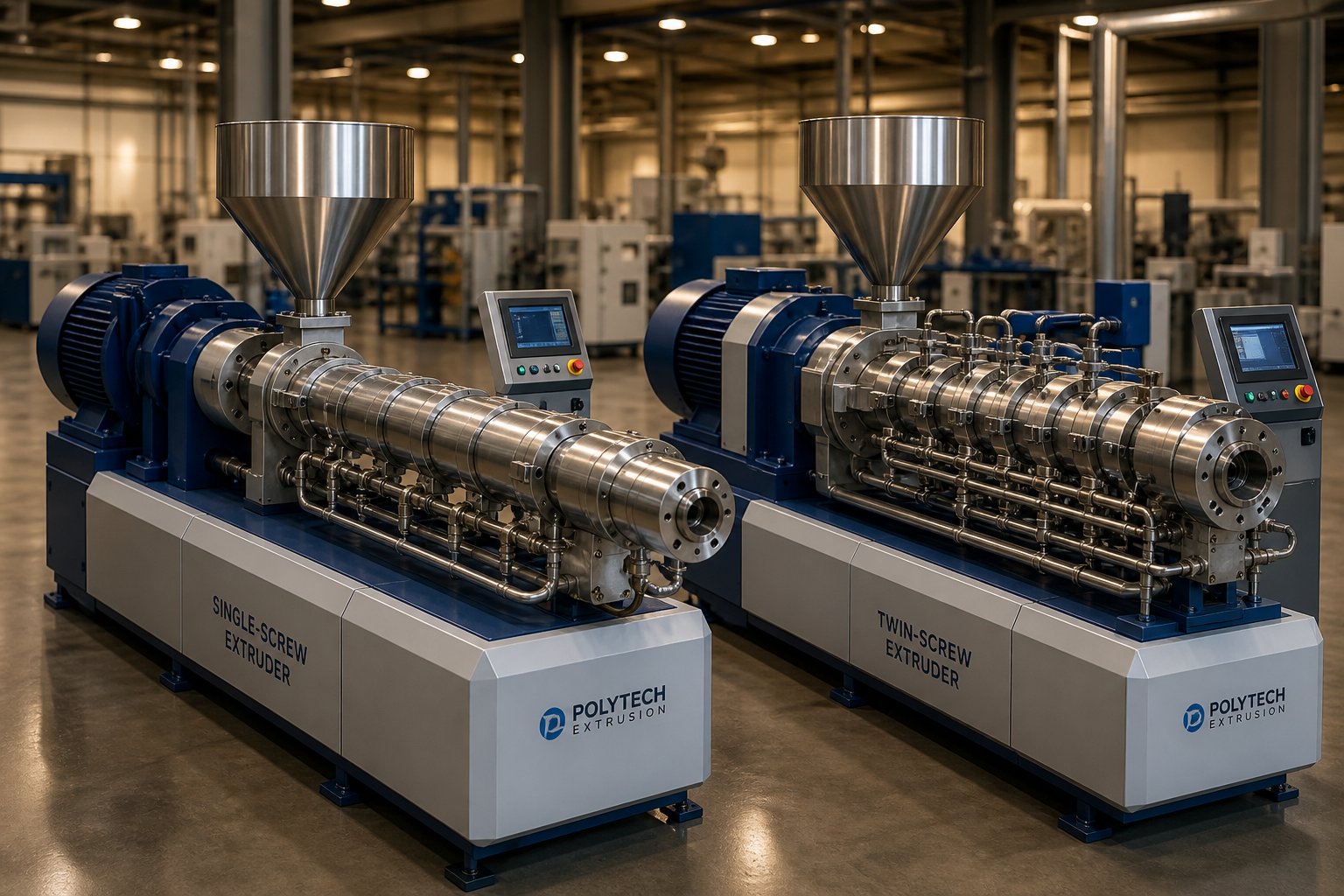
What Screw Extruders Do and Why the Difference Between Single and Twin Matters
Imagine spending six figures on a piece of equipment only to discover it can't handle your material properly. That scenario plays out more often than you'd think — and it almost always traces back to one decision: choosing the wrong type of screw extruder.
What Is a Screw Extruder
So, what's an extruder in practical terms? At its core, a screw extruder is a continuous polymer processing machine built around one elegantly simple mechanism — a rotating Archimedean screw housed inside a heated barrel. As the screw turns, it conveys raw material (typically thermoplastic pellets, powder, or flakes) forward through the barrel, where a combination of mechanical shear and external heat melts the material. The resulting melt is then pressurized and forced through a die to create a shaped product — pipes, profiles, films, pellets, or sheet.
A screw extruder is a machine that uses one or more helical screws rotating inside a barrel to continuously convey, melt, mix, and shape polymeric materials.
That definition covers every variant, but the engineering reality splits sharply into two main categories: a single screw extruder, which uses one rotating screw, and a twin screw extruder, which uses two screws working in tandem inside a figure-eight barrel bore. Each design handles the fundamental tasks of screw extrusion — feeding, melting, mixing, and pressurizing — through fundamentally different mechanisms, and those differences ripple through every aspect of your operation.
Why the Single vs Twin Distinction Matters
Picking between a single screw extruder and a twin screw extruder isn't a minor specification detail. It's a decision that determines throughput capacity, mixing quality, the shear and thermal history your polymer experiences, capital cost, maintenance burden, and ultimately, downstream product quality. A plastics engineering reference from Elsevier puts it plainly: single screw extruders are favored for their low cost, simple design, ruggedness, and reliability, while twin screw extruders are more efficient at providing homogeneous mixing of additives, fillers, and liquids.
The gap between those two descriptions might sound straightforward, but the real-world consequences are anything but. Choose a single screw machine for a compounding job that demands intense dispersive mixing, and you'll fight color streaks, undispersed filler agglomerates, and inconsistent mechanical properties. Choose a twin screw system for a simple pipe line running pre-compounded pellets, and you've overspent on capital while adding maintenance complexity you didn't need.
This article walks through every factor that separates these two extruder families — working principles zone by zone, screw geometry parameters, twin screw sub-types, mixing mechanisms, venting and devolatilization capabilities, total cost of ownership, and a structured decision framework you can apply to your own process. The goal is vendor-neutral clarity: giving plant managers and equipment buyers the engineering context to match the right screw extruder to the right application, without overpaying or underperforming.
The differences start at the most fundamental level — how each machine moves material through its barrel and what that means for process control.
How Single Screw and Twin Screw Extruders Work Zone by Zone
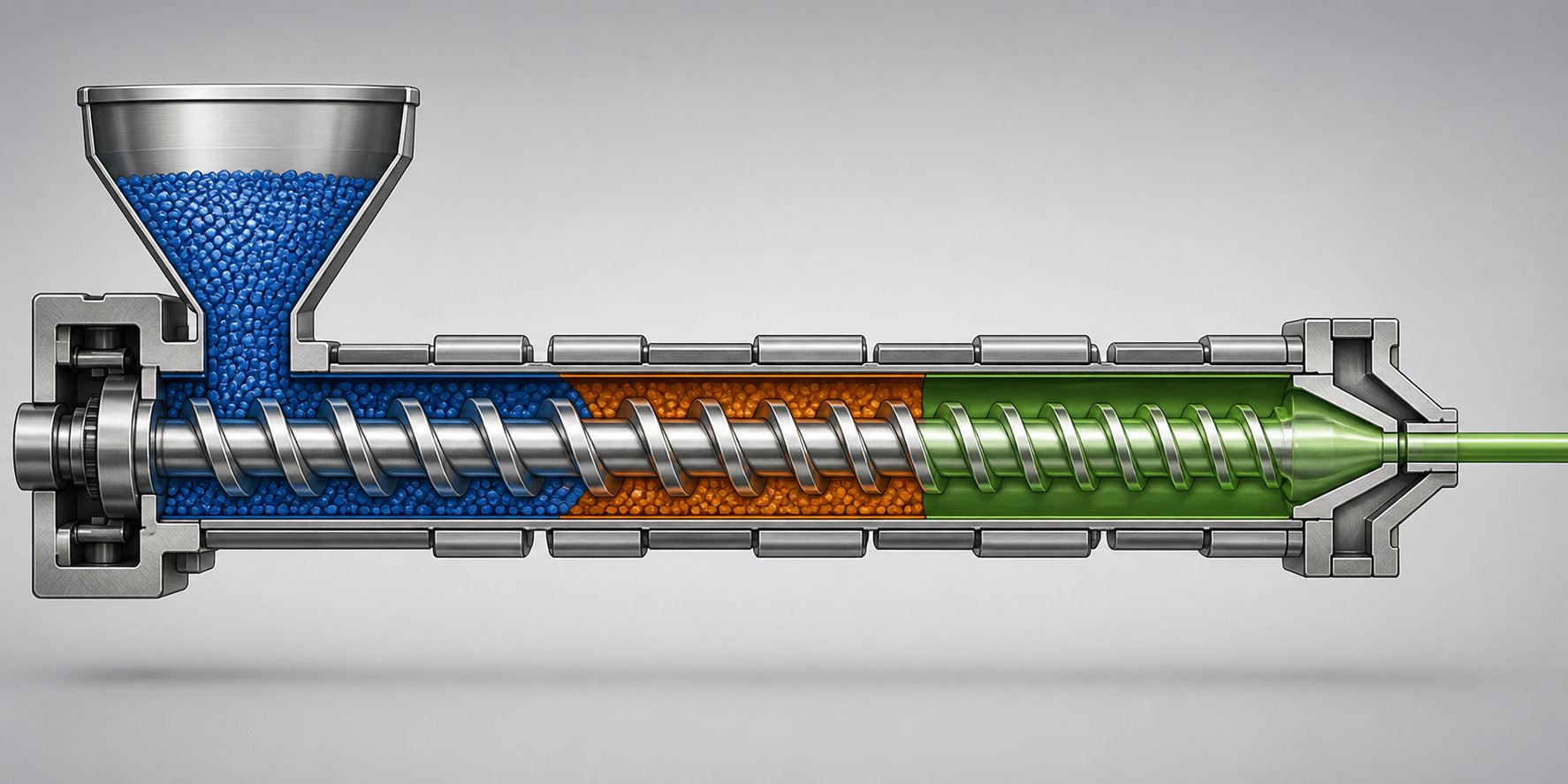
Every screw extruder moves polymer through a sequence of functional zones, each responsible for a specific transformation — from loose solid pellets to a homogeneous, pressurized melt. But the way a single screw extruder machine handles those transformations is mechanically and operationally different from the twin screw extrusion process. Understanding the zone-by-zone breakdown reveals why two machines with similar-looking specifications can deliver drastically different results on the factory floor.
Functional Zones of a Single Screw Extruder
A conventional single screw extrusion setup divides its screw into three classic zones, each with a distinct channel geometry tailored to a specific job.
Feed zone (solids conveying). This is where raw pellets enter the barrel from the hopper and begin moving forward. The screw channel here is at its deepest, giving pellets room to fall in and compact. Friction between the pellets and the barrel wall is the primary driving force — the barrel "grabs" the material and drags it forward relative to the screw. This drag-flow mechanism means the feed zone's conveying rate is tightly coupled to screw speed. The feed zone typically occupies roughly 50-60% of the total screw length, and its depth remains constant throughout.
Transition zone (compression/melting). As material advances, the screw channel gradually becomes shallower, compressing the pellets against the heated barrel wall. This compression, combined with conducted heat from external band heaters and frictional shear, melts the polymer. A thin melt film forms at the barrel surface and is scraped off by the advancing screw flight, collecting on the pushing side of the channel. Research into single screw extrusion melting models describes this as a solid bed that progressively narrows as melt accumulates around it. The compression ratio — the ratio of feed-zone channel depth to metering-zone channel depth — governs how aggressively pressure and shear build during this stage.
Metering zone (melt pumping). The final section features the shallowest, constant-depth channel. Its job is threefold: homogenize the melt temperature, stabilize the flow rate, and generate enough pressure to push the polymer through the die. Because the channel is shallow, shear rates are higher here, which helps even out temperature variations — but also means heat-sensitive materials face the greatest risk of degradation in this zone.
A critical detail often overlooked: single screw extruders are almost always flood-fed. Gravity fills the hopper, and the screw channel in the feed section stays fully packed with material. The practical consequence? You cannot independently control throughput and screw speed. If you increase screw RPM to boost output, you simultaneously change the shear rate, residence time, and melt temperature. That coupling limits your ability to fine-tune one process variable without disturbing the others.
Functional Zones of a Twin Screw Extruder
Twin screw extrusion flips several of these constraints by introducing a modular screw architecture and a fundamentally different feeding strategy.
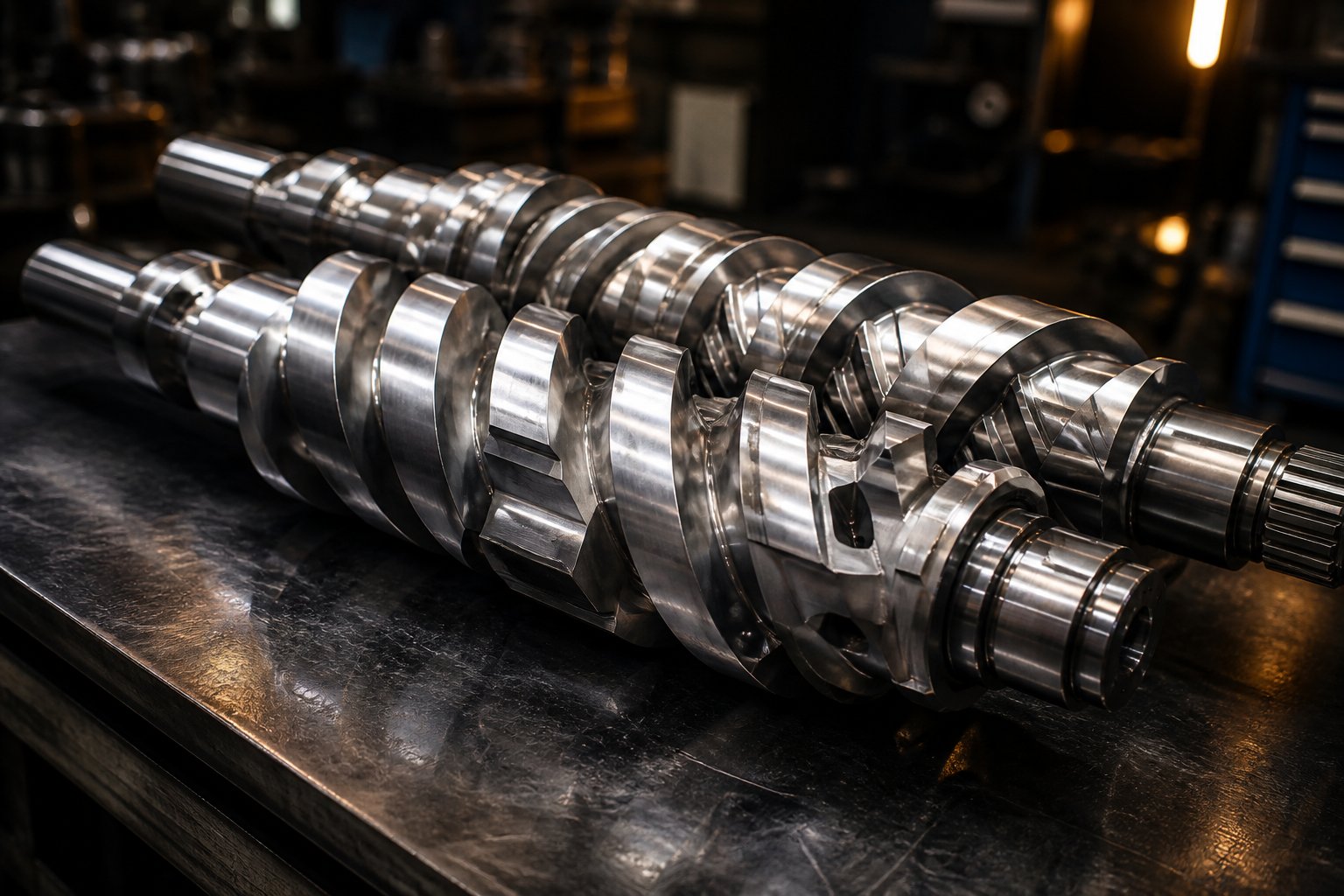
Instead of a single monolithic screw with fixed geometry, a twin screw extruder assembles its screw profile from interchangeable elements that slide onto a splined shaft. Each element type serves a specific purpose:
- Conveying elements — deep-flighted segments that transport material forward efficiently, with minimal shear input. Deeper channels provide higher volumetric throughput per revolution.
- Kneading blocks — stacked disc-shaped elements offset at various stagger angles (commonly 30, 45, 60, or 90 degrees). Wider kneading blocks deliver intense dispersive mixing by forcing material through tight intermeshing gaps, while narrower kneading elements contribute more toward distributive mixing.
- Mixing elements — specialized designs like toothed mixing elements that combine distributive and dispersive action for enhanced homogenization.
- Reverse elements — left-handed conveying or kneading segments that push material backward, creating a localized dam that increases fill level, residence time, and pressure upstream. These are essential for building melt seals ahead of vent ports.
This modularity means engineers can rearrange the screw profile to match the exact demands of a new material or formulation — without buying a new screw. You'll notice this is a massive advantage when running multiple products on the same line.
Equally important is the feeding method. Co-rotating twin screw extruders are typically starve-fed using a gravimetric feeder that meters material into the barrel at a precisely controlled rate. The screw channel in the feed section is only partially filled, and the material is conveyed forward by positive displacement — the intermeshing action of the two screws physically pushes material from one screw to the other in a figure-eight path, rather than relying on barrel friction.
Why does starve feeding matter so much? Because it decouples throughput from screw speed. The feeder sets the output rate. The screw speed independently controls how much shear and energy the material receives and how long it stays in the barrel. That separation gives operators two independent control levers — feed rate and RPM — to dial in the exact residence time, fill ratio, and energy input their process needs. Optimization research published in Polymers found that starve-fed single screw extrusion outperformed flood-fed operation on both throughput and specific energy consumption, underscoring the inherent advantage of decoupled process control.
Key Contrasts at a Glance
When you line up these two systems side by side, the operational differences become unmistakable:
- Conveying mechanism — Single screw relies on drag flow (barrel friction); twin screw uses positive displacement through intermeshing action.
- Feed method — Single screw is flood-fed (gravity hopper, fully filled channel); twin screw is starve-fed (gravimetric feeder, partially filled channel).
- Residence time distribution — Single screw produces a broad distribution because drag-based flow creates velocity gradients across the channel depth; twin screw delivers a narrow distribution thanks to self-wiping geometry that prevents stagnant zones.
- Pressure generation capability — Single screw excels at building high die pressure in the metering zone; co-rotating twin screw generates moderate pressure, often requiring a gear pump for high-pressure downstream processes.
- Process flexibility — Single screw offers limited independent control (throughput and screw speed are coupled); twin screw provides independent adjustment of feed rate, screw speed, and screw configuration.
These contrasts aren't academic — they dictate which materials each machine handles well, how much process latitude operators have during production, and ultimately, the quality consistency of the finished product. The next layer of differentiation lies in the screw geometry parameters that shape how each zone performs its job.
Screw Geometry Parameters That Shape Extruder Performance
Zones alone don't tell the full story. Two screw extruders can share identical zone layouts yet deliver vastly different melt quality, throughput, and energy consumption. The variable that explains the gap? Screw geometry. Dimensions like channel depth, flight angle, and length-to-diameter ratio govern how aggressively material is sheared, how efficiently heat transfers into the melt, and how much pressure the machine can build. Getting these numbers right is the difference between a stable process and a chronic headache.
Key Screw Geometry Parameters Explained
Before comparing the two extruder families, it helps to define the handful of geometric variables that every single extruder screw and twin screw design shares.
- L/D ratio (length-to-diameter ratio) — The screw's functional length divided by its outer diameter. A longer L/D gives material more time in the barrel for melting, mixing, and degassing. As Far East Network's screw guide notes, a longer screw also allows higher RPM without incomplete melting, because the extended barrel length compensates for the shorter per-revolution residence time. Single screw extruders typically run L/D ratios from 24:1 to 36:1, while twin screw machines routinely reach 40:1 to 60:1 — or even higher — thanks to modular barrel sections that can be bolted together.
- Compression ratio — The ratio of the feed-zone channel depth to the metering-zone channel depth. It controls how strongly the polymer is compacted and sheared during melting. A typical general-purpose compression ratio falls between 2:1 and 3:1. For lightweight bulk-density materials like crushed film, ratios of 4:1 to 5:1 are common to accommodate the extra volume of incoming flakes. Higher compression generates more shear heat — useful for fast melting, but risky for heat-sensitive resins that can degrade or burn if over-compressed.
- Channel depth — The distance from the screw root to the flight tip. Deeper channels in the feed zone allow more material intake per revolution, boosting throughput. However, deeper channels also weaken heat conduction from the barrel wall to the material at the screw root, slowing the preheating process. Shallower channels in the metering zone increase shear rate and pressure but reduce volumetric capacity.
- Flight width — The axial thickness of the helical ridge (flight) that forms the channel walls. Wider flights reduce the open channel area available for material flow but provide a larger sealing surface to minimize leakage between the flight tip and the barrel bore.
- Helix angle — The angle of the screw flight relative to a plane perpendicular to the screw axis. It determines the axial velocity component of the drag flow. Standard single screw designs use a helix angle near 17.66 degrees (a square-pitch screw where pitch equals diameter). Variations shift the balance between conveying speed and channel residence time.
How Geometry Differs Between Single and Twin Screw Designs
A single extruder screw is typically machined as one continuous piece with fixed zone lengths. You choose the geometry at purchase time, and changing it means buying an entirely new screw. Twin screws, by contrast, are assembled from modular elements on a splined shaft, so every geometric parameter can be rearranged to suit a new formulation.
Beyond that modularity, twin screw geometry introduces several parameters that simply don't exist in single screw designs:
- Intermeshing depth — The radial overlap between the two screws. In a fully intermeshing, self-wiping co-rotating design, the flight of one screw sweeps the root of the other, preventing dead zones and ensuring narrow residence time distribution.
- Stagger angle of kneading blocks — The angular offset between adjacent kneading discs. As Cowin Extrusion's configuration guide explains, a 30-degree stagger provides minimal mixing with strong forward conveying, 45 degrees delivers moderate mixing, 60 degrees shifts toward stronger mixing with reduced conveying, and a 90-degree neutral block generates intense mixing with zero forward conveying capability.
- Do/Di ratio (outer diameter to inner diameter) — This ratio governs the free volume available inside the barrel for material to occupy. A higher Do/Di gives more free volume and torque capacity per unit screw diameter, which matters for processing highly filled or high-viscosity compounds. Twin screws also offer single-start, double-start, or triple-start flight configurations, each trading capacity against shear intensity.
The table below summarizes how these core parameters typically compare across both extruder families.
| Parameter | Single Screw Typical Range | Twin Screw Typical Range | Effect on Processing |
|---|---|---|---|
| L/D ratio | 24:1 – 36:1 | 40:1 – 60:1+ | Higher L/D increases melting time, mixing residence, and throughput ceiling at elevated RPM |
| Compression ratio | 2:1 – 4:1 (up to 5:1 for film flakes) | Not defined per screw; controlled by element selection | Higher ratios increase shear heat but raise degradation risk for sensitive polymers |
| Channel depth (metering zone) | Shallow, constant across metering section | Varies element by element; deeper in conveying, shallower in kneading zones | Shallower channels boost shear and pressure; deeper channels favor throughput and gentle processing |
| Helix angle | ~17.66° (square pitch common) | Variable via pitch selection (large, medium, small pitch elements) | Steeper angles increase axial conveying speed; shallower angles extend residence time |
Notice that twin screws replace fixed geometric ratios with modular element choices. Instead of specifying a single compression ratio, engineers select a sequence of conveying elements, kneading blocks, and reverse elements that collectively achieve the desired shear, mixing, and pressure profile. That flexibility is precisely why the same twin screw machine can run a glass-fiber-filled nylon compound one week and a color masterbatch the next — with only a screw reconfiguration between jobs.
Geometry sets the boundaries of what each machine can do, but it doesn't tell you which twin screw configuration fits a given application. Co-rotating, counter-rotating, conical, parallel — each layout applies those geometric parameters in a distinct way, with real consequences for mixing intensity, pressure generation, and material suitability.
Twin Screw Extruder Types and When to Choose Each Configuration
Saying "twin screw extruder" is a bit like saying "car" — it covers a surprisingly wide range of machines with very different personalities. Two screws can rotate in the same direction or in opposite directions. They can run in parallel or taper from a large feed diameter to a smaller discharge end. They can intermesh tightly, partially, or not at all. Each configuration applies the geometric parameters discussed above in a distinct way, and picking the wrong layout for your material can undermine every other process decision you make.
Three questions sort out the landscape quickly: Which direction do the screws rotate? Do they intermesh? And are they parallel or conical? Here's how each answer reshapes performance.
Co-Rotating Intermeshing Twin Screw Extruders
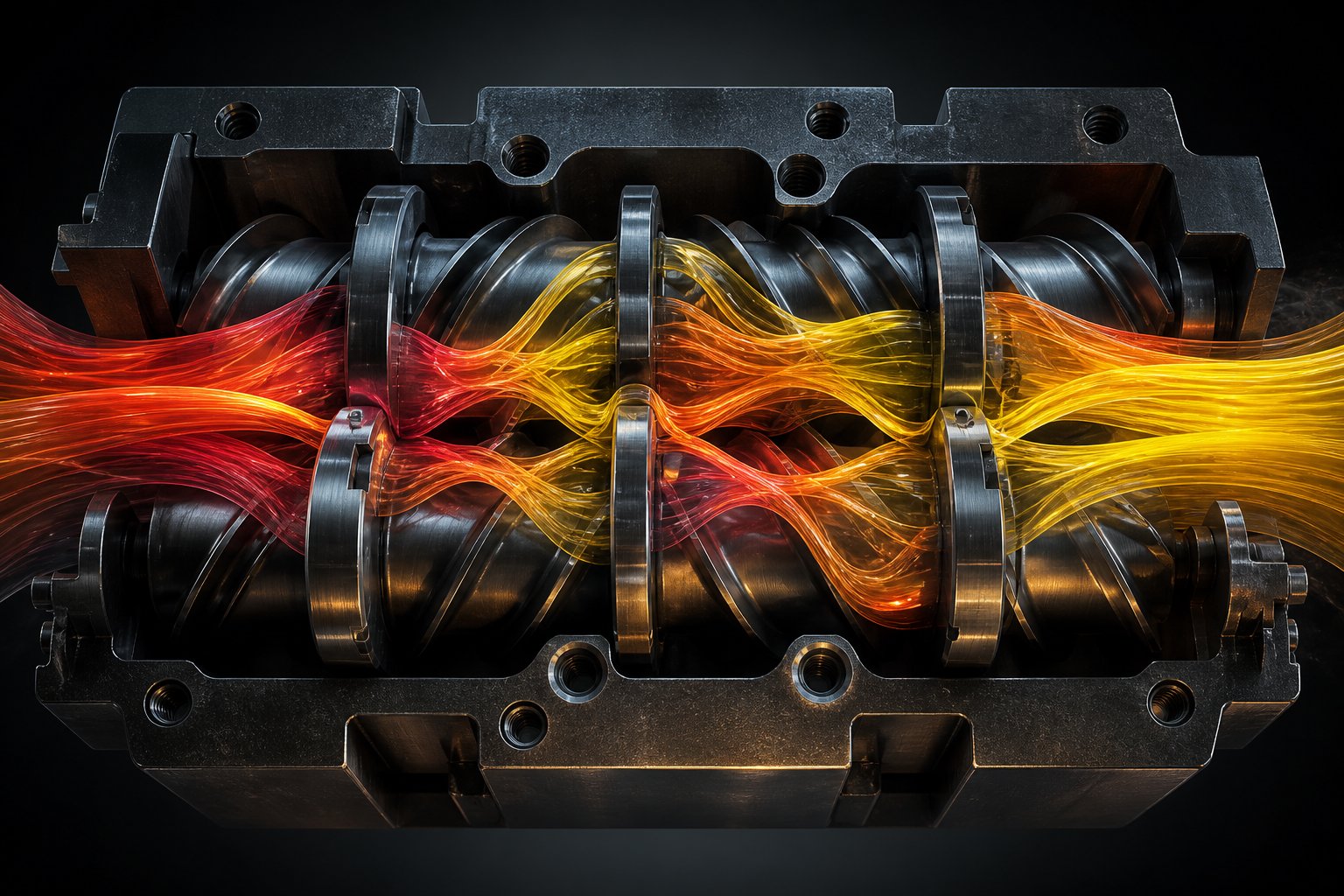
In a co-rotating twin screw extruder, both screws turn in the same direction — typically at identical speeds. The fully intermeshing geometry means the flight of one screw sweeps through the channel of the other, creating a figure-eight (or "infinity-shaped") flow pattern that continuously transfers material from screw to screw. This hand-off mechanism is what gives the co-rotating design its two most celebrated traits: self-wiping action and intense mixing.
Self-wiping matters because it prevents material from stagnating on any barrel or screw surface. As Technovel's engineering analysis explains, the self-wiping behavior keeps the residence time distribution narrow — a critical advantage for reactive extrusion and heat-sensitive polymers where even small pockets of stagnant material can cause degradation, gels, or off-spec product.
Mixing performance is equally distinctive. High shear fields develop both between the two screws and between each screw and the barrel wall. Kneading blocks introduce an elongational flow component on top of that shear, and because the screw profile is modular, engineers can position mixing-intensive elements exactly where the process needs them. The result is a machine that excels at both distributive and dispersive mixing — spreading minor components uniformly while also breaking down agglomerates and incompatible phase domains.
Typical applications reflect these strengths:
- Compounding — incorporating inorganic fillers, glass fibers, carbon nanotubes, or cellulose nanofibers into a polymer matrix
- Color masterbatch production — achieving uniform pigment dispersion without color streaking
- Polymer blending and alloying — controlling phase morphology in immiscible blends through precise shear and elongational mixing
- Reactive extrusion — driving in-line polymerization, grafting, or compatibilization reactions where narrow residence time distribution ensures consistent conversion
- Devolatilization — removing residual monomers, moisture, or solvents through multiple vent ports enabled by starve-fed, partially filled screw sections
One trade-off to keep in mind: the high intermeshing and shear intensity that make co-rotating machines outstanding mixers also mean they generate only moderate die pressure compared to a single screw extruder. High-pressure downstream processes — like certain sheet dies or coating applications — may require a gear pump between the extruder and the die.
Counter-Rotating Intermeshing Twin Screw Extruders
Flip the rotation direction of one screw, and the machine's character changes substantially. In a counter-rotating twin screw extruder, the screws turn toward each other at the top of the barrel (or away from each other, depending on convention), drawing material into the nip region between them. Instead of the figure-eight hand-off seen in co-rotating designs, material here is compressed and calendered as it passes through the intermeshing zone — much like the nip between two calender rolls.
This calendering effect produces high localized pressure in the nip, yet the overall shear stress across the barrel is lower than in a co-rotating machine. Technovel's comparison of co-rotating and counter-rotating configurations emphasizes that the counter-rotating type allows extrusion temperature to be held low through operation at high fill and low screw speed — exactly the conditions needed for materials that lack thermal stability.
Rigid PVC is the textbook example. PVC dry blends have a dangerously narrow window between fusion temperature and thermal decomposition temperature. Subject them to the intense shear of a co-rotating extruder, and you risk burning the material before it's fully gelled. The counter-rotating design sidesteps this problem by relying on compressive and elongational deformation rather than aggressive shear, enabling stable processing at lower barrel temperatures.
Beyond PVC, counter-rotating intermeshing extruders find use in profile extrusion, sheet production, and applications where gentle but effective dispersion of additives is more desirable than the microscopic-level mixing a co-rotating machine provides. The calendering effect at the intermeshing zone is particularly effective for dispersive mixing of stabilizers and lubricants in PVC formulations.
Material transport in counter-rotating designs depends more strongly on screw rotation itself — closer to positive displacement — so stable extrusion is achievable at comparatively low RPM. However, the opposed rotation creates separating forces between the screws, which limits the maximum screw speed and, consequently, the throughput ceiling relative to co-rotating machines of similar diameter.
Conical vs Parallel Twin Screw Configurations
Rotation direction isn't the only design fork. Twin screws can also be arranged in parallel — maintaining the same diameter along their entire length — or in a conical configuration, where the screws taper from a large feed-end diameter to a smaller discharge-end diameter. Both layouts are typically counter-rotating for PVC applications, though the practical implications differ significantly.
Conical twin screw extruders pack a clever mechanical advantage into a compact footprint. The large-diameter feed end provides generous intake volume for bulky PVC dry blends, while the taper naturally compresses material as it advances — functioning as a built-in compression zone without requiring complex screw geometry changes. The wide spacing between screw shafts at the feed end also leaves room for robust, high-torque gearbox designs. That combination of high torque capacity, natural compression, and compact machine length made conical twin screw extruder designs the dominant choice for PVC pipe and profile lines for decades.
The trade-off? Conical screws are fixed geometry — you can't rearrange modular elements the way you can on a parallel machine. Rollepaal's engineering comparison highlights that conical extruders face limitations in screw length available for generating pressure and mixing, potentially narrowing the processing window. Achieving optimal gelation while effectively venting air can be challenging, sometimes forcing operators to compromise on fusion level to prevent air inclusions.
Parallel twin screw extruders maintain a consistent screw diameter from feed to discharge, which opens the door to modular barrel sections and interchangeable screw elements — even on counter-rotating designs. This modularity provides greater screw design freedom, a wider processing window, and easier scale-up. Need more output? You can extend the barrel length by adding sections and stretching pitches, rather than increasing diameter as a conical design would require. Rollepaal also notes that advances in finite element method (FEM)-designed gearboxes have largely eliminated the historical torque advantage conical extruders once held, making parallel configurations increasingly preferred for larger pipe sizes.
Parallel twin screw extruders also offer better venting flexibility — an early vent position is easier to incorporate when barrel sections are uniform and interchangeable.
Configuration Comparison at a Glance
The table below puts all three major twin-screw extruder configurations side by side across the performance dimensions that matter most for equipment selection.
| Feature | Co-Rotating Intermeshing | Counter-Rotating Intermeshing | Counter-Rotating Non-Intermeshing |
|---|---|---|---|
| Mixing intensity | Very high — combines shear and elongational flow through modular kneading blocks | Moderate — relies on calendering-type compressive and elongational deformation | Low to moderate — gentler processing with minimal screw interaction |
| Shear level | High — intense shear fields between screws and between screw and barrel | Low to moderate — suited for thermally sensitive materials | Low — screws operate more independently with friction-based conveying |
| Pressure generation | Moderate — often requires a gear pump for high-pressure dies | High — positive-displacement-like transport at the nip builds substantial pressure | Low to moderate — less effective sealing reduces pressure capability |
| Self-wiping capability | Excellent — fully self-wiping geometry eliminates dead zones | Partial — intermeshing provides some wiping but less complete than co-rotating | None — screws do not contact each other's surfaces |
| Primary applications | Compounding, masterbatch, reactive extrusion, polymer blending, devolatilization | PVC pipe, PVC sheet, PVC profile extrusion, shear-sensitive material processing | Controlled reactive extrusion, gentle blending, specialty applications requiring minimal shear |
Notice how the co-rotating and counter-rotating designs occupy almost opposite ends of the mixing-versus-gentleness spectrum. That polarity is exactly why understanding your material's thermal sensitivity and your process's mixing demands is so critical before signing a purchase order. A co-rotating machine that excels at dispersing nano-fillers would be the wrong tool for a rigid PVC profile line — and vice versa.
Configuration determines how mixing happens inside the barrel. The next question is equally important: how much mixing does your application actually need, and at what point does a single screw extruder with well-chosen mixing elements deliver results that are good enough?
Mixing Mechanisms That Separate Single From Twin Screw Performance
Configuration, geometry, and zone layout all contribute to extruder performance — but if you had to name one factor that most sharply divides single screw from twin screw machines, it's mixing. Mixing quality determines whether your pigment disperses uniformly or leaves visible streaks, whether filler agglomerates break down to their target particle size or survive intact into the finished part, and whether a polymer blend develops the morphology needed for its mechanical properties. Two types of mixing govern these outcomes, and each extruder family handles them very differently.
Distributive vs Dispersive Mixing Explained
Sounds complex? It doesn't have to be. Think of distributive and dispersive mixing as two separate jobs that sometimes need to happen in the same barrel — but require entirely different mechanical actions.
Distributive mixing is the spatial rearrangement of minor components to achieve a uniform concentration throughout the polymer matrix. Imagine dropping a spoonful of cream into a cup of coffee and stirring — you're spreading it around, dividing it into thinner and thinner layers until every sip tastes the same. No particle size reduction is involved. The goal is simply even distribution.
Dispersive mixing is the application of stress — shear or elongational — to break down agglomerates, droplets, or solid particles below a critical size. Going back to the coffee analogy, imagine those cream droplets are actually tiny clumps of cocoa powder. Stirring alone won't break them apart; you need to crush them against the side of the cup with a spoon. Dispersive mixing demands force above a threshold stress that overcomes the cohesive bonds holding the agglomerate together.
Both types are essential for producing a homogeneous compound. A material can be distributed but not dispersed — particles spread evenly throughout the polymer yet still existing as large clumps, producing blotchy color or inconsistent mechanical properties. Equally, a material can be dispersed but not distributed — particles broken down to fine sizes but concentrated in one region of the melt, creating localized hot spots or uneven additive levels. Compounding engineering guidance from Plastics Technology emphasizes that both dispersive and distributive mixing must be achieved to produce a truly homogeneous compound.
Twin screw extruders can independently optimize both distributive and dispersive mixing through modular screw element selection, while single screw extruders are inherently limited in dispersive mixing due to the absence of intermeshing zones.
That distinction is the single most important technical differentiator between these two extruder families — and it drives nearly every application-matching decision covered later in this article.
Why Single Screw Extruders Struggle With Mixing
A single screw plastic extruder generates mixing almost entirely through drag-induced shear in the screw channel and minor cross-channel circulatory flow. As melt moves forward in the metering zone, the rotating screw drags material against the stationary barrel, creating a velocity gradient across the channel depth. Some cross-channel flow develops perpendicular to the down-channel direction, producing a slow circulatory pattern. Over many screw revolutions, this circulation gradually folds and reorients the melt layers — but the process is slow, incomplete, and far from intensive.
To improve this baseline, single screw machines can be fitted with dedicated mixing elements. Jim Frankland's analysis in Plastics Technology categorizes these into two families:
- Dispersive (high-shear) mixers — The Maddock (also known as Leroy or UCC) and Egan designs force polymer melt through narrow clearance channels, subjecting it to intense shear. They were originally developed to improve melt quality from conventional (non-barrier) screws and proved especially effective with crystalline polymers like polyolefins. More recently, spiral Maddock mixers combine features of both original designs and are widely used.
- Distributive mixers — Saxton, pin, and pineapple designs divide the melt into multiple streams that recombine repeatedly, creating an exponential number of layers. Pin mixers can handle materials of substantially varying viscosity by generating near-infinite divisions. Pineapple mixers converge those divisions at varying angles for chaotic mixing, making them particularly useful for color distribution.
Here's the catch: these add-on elements improve performance, but they operate within the fundamental constraint of a single screw channel. There is no intermeshing zone where material is forcibly transferred from one screw to another. There is no kneading block whose stagger angle and disc width can be independently configured to dial in a precise ratio of dispersive to distributive action. A 2007 particle tracking study by Connelly and Kokini directly compared single and twin screw mixers and demonstrated that twin screw systems are significantly better for mixing — a conclusion the industry has validated across decades of compounding practice.
Frankland makes a practical point that further illustrates the limitation: barrier screws were designed to complete melting within the barrier section itself, theoretically eliminating the need for high-shear mixers downstream. Yet many barrier screws in the field are still equipped with dispersive mixers, which needlessly increase melt temperature, reduce output through added pressure drop, and waste energy. In most single screw applications, a distributive mixer is the better downstream choice — it homogenizes temperature and color with minimal thermal penalty.
When a Single Screw With Mixing Elements Is Good Enough
Does every process need twin screw mixing? Absolutely not. For many operations, a well-designed single screw extruder with a barrier flight section and a properly selected distributive mixer delivers results that are more than adequate — at a fraction of the capital cost. Practical scenarios where a single screw machine excels include:
- Pipe and simple profile extrusion from pre-compounded pellets, where the resin supplier has already handled filler dispersion and additive incorporation
- Blown film and cast film production using pre-colored or pre-stabilized polyolefin resins
- Sheet extrusion for thermoforming, particularly with single-polymer feedstocks that need melting and pressurizing but not intensive blending
- Screw extruder granulator applications for reprocessing clean, single-stream production scrap where only remelting and re-pelletizing are required
The key qualifier in every case is that the material arrives at the extruder already compounded. The single screw's job is to melt, homogenize temperature, and pressurize — tasks it handles efficiently with lower capital and maintenance costs. Problems arise only when operators ask a single screw to do the compounding itself — incorporating raw pigments, dispersing mineral fillers, or blending immiscible polymers at the extruder.
Mixing-Intensive Applications for Twin Screw Compounding
At the other end of the spectrum, certain applications make mixing quality non-negotiable — and that's precisely where a compounding twin screw extruder earns its investment. In these processes, the modular screw configuration allows engineers to place wide-disc kneading blocks for dispersive action exactly where agglomerates need breaking, followed by narrow-disc elements for distributive spreading, and then neutral or reverse blocks to ensure the mixing section stays highly filled and efficient. Plastics Technology's screw configuration series explains that wide kneading discs plow through the polymer, smearing materials with high shear forces that promote dispersion, while narrow discs slice through the melt in a scissoring action that promotes distribution.
Research at Paderborn University using 3D CFD flow simulations with particle tracking confirmed these design principles quantitatively. Their study found that toothed mixing elements (ZME) achieved the best distributive mixing index across all tested screw elements and rotation speeds, while also generating high, evenly distributed shear stresses that support dispersive action — making them effective dual-purpose elements in a twin screw compounding extruder configuration.
Applications where a compounding extruder with twin screws is the clear choice include:
- Nano-filler dispersion — Carbon black, carbon nanotubes, nano-clays, and graphene nanoplatelets all tend to form tightly bound agglomerates that require high dispersive shear to break down to their ultimate particle size. Carbon black is a classic case: individual particles fuse during combustion into aggregates, and those aggregates cluster into agglomerates held by weak van der Waals forces. Only repeated passes through high-stress kneading zones can reduce them to the aggregate level needed for uniform color development.
- Reactive extrusion — In-line grafting, compatibilization, and controlled degradation reactions demand narrow residence time distribution so every polymer chain experiences similar thermal and chemical history. The self-wiping action of co-rotating twin screws prevents dead spots that would cause over-reaction or under-reaction.
- Polymer blending with incompatible phases — Creating stable morphologies in blends like PP/EPDM or PA/ABS requires intense dispersive mixing to reduce the minor phase domain size below a critical threshold, followed by distributive mixing to spread those domains uniformly.
- Devolatilization of residual monomers — Removing volatile species from the melt requires partially filled barrel sections where surface renewal exposes fresh melt to vacuum. The starve-fed operation and modular barrel design of twin screw extruders make multi-stage devolatilization straightforward — a topic that ties directly into how each extruder type handles venting.
The mixing discussion highlights a pattern worth emphasizing: the more your process asks the extruder to transform the material — not just melt it — the stronger the case for twin screw technology. Devolatilization, venting, and residence time control push that logic even further, because they depend on the same starve-fed, self-wiping architecture that makes twin screw mixing possible in the first place.
Venting, Devolatilization, and Residence Time Differences
Mixing determines how well additives disperse through the melt — but what about the substances you need to remove? Moisture, trapped air, residual monomers, and volatile solvents all compromise finished-part quality if they remain locked inside the polymer at the die. Getting them out requires effective venting and devolatilization, and these capabilities differ dramatically between the two extruder families. Residence time distribution plays an equally critical — though less visible — role, silently influencing thermal degradation, gel formation, and batch-to-batch consistency.
Venting and Devolatilization Capabilities Compared
Imagine trying to release steam from a pipe that's completely packed with material. There's nowhere for the vapor to go. That's essentially the challenge a flood-fed single screw extruder faces when you add a vent port. Because the screw channel runs fully filled along most of its length, creating a low-fill zone where volatiles can escape — without melt flooding the vent opening — requires careful placement of a decompression section with deeper screw channels. In practice, most single screw machines support only one vent port, and maintaining a reliable melt seal upstream of that port is notoriously tricky. If the seal weakens, molten polymer surges into the vent, blocking it and forcing a line shutdown.
Twin screw extruders handle this problem with far more elegance. Starve-fed operation inherently produces partially filled screw sections — exactly the conditions needed for volatiles to migrate out of the melt and escape through open vent ports. Engineers build reliable melt seals by placing restrictive elements (reverse-pitch conveying segments or tightly staggered kneading blocks) upstream of each vent opening. Between those seals, the low fill level exposes thin melt layers with high surface-area-to-volume ratios, dramatically improving mass transfer of volatile species out of the polymer.
The result? Twin-screw extruders routinely accommodate multiple atmospheric and vacuum vent ports along the barrel length. A technical analysis from Plastics Technology describes how most twin-screw compounding lines use both atmospheric vents — for removing entrained air at side feeders, for instance — and vacuum vents positioned near the die for extracting residual volatiles. Machines can even be configured with multiple vacuum vents to handle large volumes of solvents or monomers while achieving very low residual volatile levels in the finished pellet.
Vacuum venting takes devolatilization further by reducing the partial pressure above the melt, which increases the thermodynamic driving force for volatile removal. Most compounding processes operate vacuum vents in the range of 20 to 27 inches of mercury (approximately 100-300 mbar). When even that isn't enough, processors can inject stripping agents — typically small amounts of water — upstream of the vacuum vent to reduce the partial pressure of the target volatile species and boost extraction efficiency.
One practical complication deserves mention: vacuum vent flooding. Even on an extruder twin screw setup, melt can reach the vacuum vent opening if the backup length — the length of filled screw needed to generate downstream pressure — grows too long. This happens when screens foul, die holes freeze off, or pumping elements wear over time. As the same Plastics Technology analysis explains, solutions include increasing screen area, adding a melt pump downstream, extending the barrel to move the vacuum vent upstream, or replacing worn screw elements. For materials that foam or expand under vacuum — making them prone to climbing out of the vent — mechanical vent stuffers (small twin-screw devices mounted in the vent opening) physically prevent melt escape while still allowing gases to pass through.
The bottom line: if your process demands removal of moisture, monomers, or solvents, the multi-vent capability of twin screw extruders is a decisive advantage. Single screw machines can handle light venting duties, but asking them to perform deep devolatilization pushes against a fundamental architectural limitation.
Residence Time Distribution and Its Impact on Material Quality
Residence time distribution — often abbreviated RTD — describes the spread of time individual material elements spend inside the extruder barrel. A narrow RTD means nearly every particle of polymer experiences a similar thermal and mechanical history. A broad RTD means some material races through quickly while other portions linger far longer than the average, accumulating excess heat and shear.
Single screw extruders inherently produce broader RTD. Why? The drag-flow conveying mechanism creates a velocity gradient across the channel depth — material near the barrel wall moves faster (carried by barrel friction), while material near the screw root moves slower. This velocity profile means different melt layers traverse the barrel at different speeds, spreading out the residence time spectrum. Dead spots in corners, behind flight tips, and in poorly swept areas widen that spread further.
Twin screw extruders — especially co-rotating intermeshing designs — deliver significantly narrower RTD. The self-wiping geometry continuously scrapes material off every surface, eliminating stagnant zones where polymer could linger. The positive-displacement conveying action produces a more uniform velocity profile, so material elements move through the barrel at closer to the same speed. The difference is measurable and meaningful for product quality.
Why does broad RTD matter in practice? Because the consequences show up directly in your finished product:
- Thermal degradation of heat-sensitive polymers — Material trapped in slow-moving zones accumulates excess thermal history, breaking polymer chains, generating discoloration, and reducing mechanical properties. PVC, EVOH, and biopolymers like PLA are particularly vulnerable.
- Inconsistent additive dispersion — When some melt passes through mixing zones quickly and other portions linger, the degree of additive incorporation varies across the extrudate cross-section, producing inconsistent physical properties.
- Color streaking — Uneven residence times mean pigment particles experience different shear histories, leading to visible streaks or shade variations in the final product — a defect that's immediately obvious and difficult to correct downstream.
- Gel formation — Polymer that stagnates and overheats crosslinks or partially degrades, forming small gel particles (sometimes called "fish eyes" in film) that create visual defects, weak points, and surface blemishes.
For processes where tight thermal control and uniform melt history are non-negotiable — reactive extrusion, biopolymer processing, optical-grade compounds — the narrow RTD of twin screw extruders isn't just a nice feature. It's a quality requirement.
Practical Operational Differences
Beyond process physics, day-to-day operation reveals another layer of contrast that rarely appears in spec sheets but affects labor costs, downtime, and material waste.
Startup and shutdown. Single screw extruders are generally simpler to start up. Fill the hopper, set barrel temperatures, turn on the screw, and wait for steady-state melt flow. The loose tolerances between screw flight and barrel wall forgive cold starts more gracefully. Shutdown is similarly straightforward — purge with a general-purpose resin, reduce temperatures, and stop the screw. The downside? Those same loose tolerances make complete purging difficult. Residual material hides in deep channel sections and behind flights, often requiring extended purging cycles or mechanical disassembly for thorough cleaning.
Twin screw extruders demand more careful startup procedures. The tighter clearances between intermeshing screws and barrel bore mean running the machine dry or forcing cold material through can damage screw elements or barrel liners. Operators typically bring barrel temperatures to setpoint before introducing material at low screw speed, then gradually ramp up feed rate and RPM together. Shutdown follows a similarly methodical sequence — reducing throughput, purging at low speed, and ensuring the barrel is clear before cooling down.
Here's the operational payoff, though: self-wiping action makes color and material changeovers significantly faster on twin screw extruders. Because the intermeshing geometry continuously scrapes surfaces clean, the new material pushes the old material out more completely and more quickly. A changeover that might consume 30-45 minutes and several kilograms of purge compound on a single screw machine can often be accomplished in 10-15 minutes on a self-wiping twin screw — a difference that adds up fast on lines running multiple products per shift.
These venting, residence time, and operational differences don't exist in isolation — they interact with every parameter discussed in previous sections. The real question is how all of these factors stack up when you place a single screw and twin screw machine side by side across every performance dimension that influences a purchasing decision.
Single Screw vs Twin Screw Extruder Head-to-Head Comparison
Working principles, geometry, mixing mechanisms, venting capability, residence time behavior — the previous sections examined each of these dimensions in depth. Useful for understanding the engineering, but when you're standing in front of a purchasing decision, you need the full picture in one place. This section pulls every performance factor together into a scannable reference you can bring into your next equipment meeting.
Feature-by-Feature Comparison Table
The table below lines up a single screw extruder against a twin screw extruder machine across the parameters that most directly affect product quality, process flexibility, and cost of ownership. For each row, the "advantage" column identifies which type typically wins — or flags cases where the answer depends on the specific configuration or application.
| Parameter | Single Screw Extruder | Twin Screw Extruder | Advantage |
|---|---|---|---|
| Conveying mechanism | Drag flow — relies on friction between barrel wall and polymer | Positive displacement — intermeshing screws physically push material forward | Twin screw (more consistent, less material-dependent) |
| Feed method | Flood-fed (gravity hopper, fully filled channel) | Starve-fed (gravimetric feeder, partially filled channel) | Twin screw (decouples throughput from screw speed) |
| Distributive mixing | Limited — relies on cross-channel circulation; improved with add-on mixers (Saxton, pineapple, pin) | Excellent — modular kneading blocks and toothed mixing elements create repeated folding and recombination | Twin screw |
| Dispersive mixing | Poor without dedicated elements; Maddock-type mixers help but cannot match intermeshing shear fields | Excellent — wide kneading discs and high-shear zones break agglomerates below critical particle size | Twin screw |
| Venting capability | Typically one vent port; melt seal management is challenging in a fully filled channel | Multiple atmospheric and vacuum vent ports; starve-fed operation creates partially filled zones ideal for devolatilization | Twin screw |
| L/D ratio range | 24:1 to 36:1 | 40:1 to 60:1+ (modular barrels bolt together) | Twin screw (more residence time and functional zones) |
| Residence time distribution | Broad — drag-flow velocity gradients and dead zones spread the RTD | Narrow — self-wiping geometry eliminates stagnant pockets | Twin screw (critical for heat-sensitive and reactive processes) |
| Pressure generation | High — shallow metering zone builds substantial die pressure | Moderate for co-rotating; high for counter-rotating intermeshing | Single screw for high-pressure dies; depends on configuration for twin |
| Throughput flexibility | Limited — output and screw speed are coupled | High — feed rate and screw speed are independently adjustable | Twin screw |
| Energy efficiency | Good for simple melting and pumping tasks | Higher specific energy input for compounding, but lower scrap rates offset total energy per kg of salable product | Depends on application |
| Capital cost | Lower — simpler design, fewer components | Higher — modular screws, complex gearbox, gravimetric feeders | Single screw |
| Maintenance complexity | Lower — fewer wear components, simpler screw removal | Higher — modular screw elements and barrel liners require periodic inspection, especially in abrasive-filler applications | Single screw |
| Changeover speed | Slower — difficult to fully purge deep channels and unswiped surfaces | Faster — self-wiping action clears old material quickly | Twin screw |
| Typical applications | Pipe, profile, blown film, cast film, sheet extrusion of pre-compounded resin | Compounding, masterbatch, reactive extrusion, devolatilization, polymer blending, filled compounds | Application-dependent |
A few patterns jump out immediately. The twin screw extruder dominates whenever the process requires mixing, venting, or tight residence time control. The single screw extruder wins on simplicity, pressure generation, and initial cost — advantages that matter most when the feed material arrives already compounded and the extruder's job is primarily melting and shaping. Neither machine is universally better. The right choice hinges on what you're asking the extruder to do.
Application Matching for Common Plastic Processing Scenarios
Theory is helpful, but most equipment buyers start from the opposite direction — they know what product they need to make and want to know which machine fits. The list below maps the most common plastic processing scenarios to the extruder type best suited for each.
- Pipe and profile extrusion (simple polymers like PE, PP) — Single screw extruder. Pre-compounded pellets need only melting and high-pressure pumping through a profile die. The single screw's excellent pressure generation and lower capital cost make it the natural fit.
- PVC pipe and profile extrusion — Conical twin screw extruder or counter-rotating parallel twin screw. PVC dry blends require gentle fusion at low shear to avoid thermal decomposition, plus the ability to handle bulky powder feeds. Conical designs provide high torque in a compact footprint; parallel designs offer modular flexibility and easier scale-up for large-diameter pipes.
- Blown film and cast film production — Single screw extruder with barrier screw and distributive mixer. Pre-colored or pre-stabilized polyolefin resins need uniform melt temperature and gel-free output, which a well-designed barrier screw delivers efficiently.
- Compounding and masterbatch production — Co-rotating twin screw extruder. Incorporating pigments, fillers, reinforcing fibers, or stabilizers at target loadings requires both dispersive and distributive mixing at levels only the intermeshing, modular screw architecture of a double screw extruder can achieve.
- Reactive extrusion — Co-rotating twin screw extruder. In-line grafting, compatibilization, and controlled polymerization reactions demand narrow residence time distribution and precise thermal management — exactly the conditions the self-wiping, starve-fed co-rotating design provides.
- Devolatilization (moisture, monomers, solvents) — Twin screw plastic extruder (typically co-rotating). Multiple vacuum vent ports and partially filled screw sections enable efficient volatile removal that single screw systems simply cannot replicate at the same depth.
- Laboratory R&D and small-batch development — A laboratory twin screw extruder with small-diameter screws (typically 12 mm to 27 mm). These benchtop or pilot-scale double screw extruder machines allow researchers to evaluate new formulations, optimize screw configurations, and generate representative samples before committing to production-scale equipment.
- Recycled plastic reprocessing — Depends on contamination level. Clean, single-stream regrind can run on a single screw extruder with a vented barrel. Mixed or contaminated streams benefit from a twin screw machine's superior venting, mixing, and tolerance of variable feed quality.
Notice how the decision often comes down to whether the extruder needs to transform the material (mix, react, devolatilize) or simply form it (melt and shape). Transformation demands twin screw capability. Forming favors single screw economy.
One factor that cuts across every application on this list is the screw and barrel hardware itself. Regardless of whether you're running a single screw line for pipe or a co-rotating twin screw for compounding, the metallurgy, dimensional tolerances, and surface treatments of your screw and barrel components directly influence wear life, energy efficiency, and product consistency. Engineers comparing options across these categories can browse NANHAIYA's screw barrel product collection, which organizes single screw, parallel twin screw, conical twin screw, and injection molding screw barrel options side by side — making it easier to match the right barrel specification to the extruder type and application requirements identified in the list above.
Matching the machine to the application is only half the equation, though. The other half — the one that separates a smart purchase from a regrettable one — is a structured decision framework that accounts for material sensitivity, mixing demands, venting needs, throughput flexibility, and budget constraints all at once.
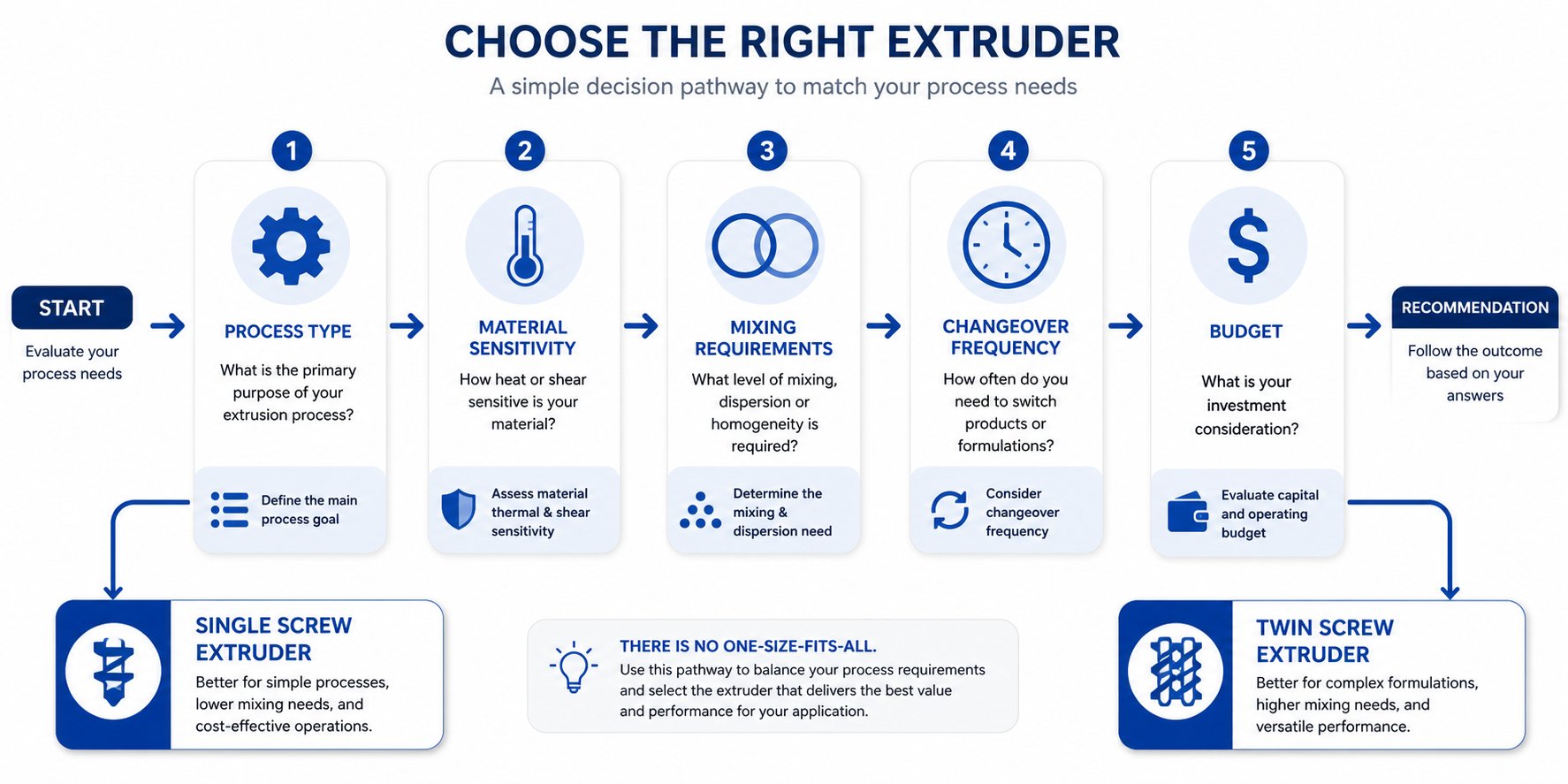
A Decision Framework for Choosing the Right Extruder Type
Comparison tables and application lists point you in the right direction, but real purchasing decisions aren't made in neat rows and columns. They happen in messy meetings where budget pressure collides with process requirements, where the material your customer wants to run next quarter doesn't match the resin you're running today, and where a wrong call means either overspending on equipment or underspending on capability. What's missing from most extruder buying guides is a repeatable, step-by-step process that forces each critical variable into the open before anyone signs a purchase order.
The framework below works whether you're specifying a full-scale single screw extrusion machine for a dedicated pipe line, evaluating a twin-screw extruder machine for a new compounding operation, or even sizing a benchtop twin screw extruder for laboratory development work. Walk through each step in sequence — skipping one almost always leads to a mismatch you'll only discover after commissioning.
Step-by-Step Extruder Selection Checklist
- Define the primary process — is it forming/shaping or compounding/reacting? This is the single most decisive question. If the extruder's job is to melt pre-compounded pellets and push them through a die to create a pipe, profile, film, or sheet, you're in forming territory. If the extruder must incorporate raw additives, disperse fillers, blend incompatible polymers, graft functional groups, or strip volatiles, you're in compounding or reactive territory. Forming points toward a single screw. Compounding or reacting points toward a twin screw. Everything else in this checklist refines that initial direction.
- Characterize the material — is it shear-sensitive, moisture-sensitive, or thermally unstable? Materials like rigid PVC, EVOH, and many biopolymers have narrow processing windows where excessive shear or residence time causes degradation. If your resin falls into this category, you need either the gentle calendering action of a counter-rotating twin screw or the narrow residence time distribution of a co-rotating design running at controlled fill levels. A plastic single screw extruder can handle thermally stable polyolefins comfortably, but forcing a shear-sensitive material through a deep-channel, flood-fed single screw often creates hot spots and degradation that show up as discoloration, reduced mechanical properties, or gel particles in the finished product.
- Assess mixing requirements — does the application require dispersive mixing of fillers or reactive blending? As the previous sections demonstrated, dispersive mixing — breaking agglomerates below a critical size — is where single screw machines hit their ceiling. If your process demands nano-filler dispersion, high-loading mineral filling, pigment concentrate production, or reactive compatibilization, you need the intermeshing kneading zones only a twin screw can provide. If the feed material arrives already compounded and the extruder only needs to homogenize melt temperature, a single screw with a barrier flight and distributive mixer is typically sufficient.
- Determine throughput and flexibility needs — single product line vs frequent changeovers? A dedicated line running one product 24/7 favors the simplicity and lower maintenance of a single screw setup. A line that switches between multiple formulations — different filler loadings, different polymer matrices, different color batches — benefits enormously from the modular screw configuration and fast self-wiping changeovers of a twin screw extruder. Consider how many product changes per week you anticipate. Each changeover on a single screw machine can consume 30-45 minutes and several kilograms of purge material. On a self-wiping twin screw, that same changeover might take 10-15 minutes. Over hundreds of changeovers per year, the time and material savings alone can justify the twin screw's higher capital cost.
- Evaluate venting needs — does the material require devolatilization? If your process involves removing moisture from hygroscopic polymers, stripping residual monomers after polymerization, or extracting solvents from a solution process, multiple vacuum vent ports are essential. Twin screw extruders accommodate these readily through their starve-fed, partially filled screw sections. Single screw machines support limited venting — usually one atmospheric or vacuum port — and managing the melt seal to prevent vent flooding is significantly more challenging. If deep devolatilization is a core process requirement, a twin screw is not optional — it's a necessity.
- Set budget parameters — capital cost ceiling and acceptable payback period. This step comes last intentionally. Too many equipment decisions start with budget and work backward, which leads to buying a cheaper machine that can't meet process requirements. By the time you reach this step, you'll have a clear technical picture of what the process demands. If those demands point to a twin screw but the budget only supports a single screw, the honest answer isn't to buy the cheaper machine and hope for the best — it's to either adjust the budget, phase the investment, or redesign the process (for example, by purchasing pre-compounded material instead of compounding in-house). A twin screw extruder plastic compounding line typically costs significantly more upfront than a comparable-throughput single screw setup, but the payback analysis should include scrap reduction, changeover savings, quality consistency, and the ability to bring compounding in-house rather than paying a toll compounder.
When a Single Screw Extruder Is the Right Choice
Run through the checklist above, and you'll find that a single screw extrusion machine lands as the clear winner in a well-defined set of scenarios. These share a common thread: the material arrives ready to process, and the extruder's job is to melt it, pressurize it, and push it through a die with dimensional accuracy and thermal consistency.
- Pre-compounded pellet processing — When your resin supplier has already incorporated fillers, stabilizers, colorants, and impact modifiers, the extruder doesn't need to mix. It needs to melt efficiently and build die pressure. A single screw handles this at lower capital and operating cost than any twin screw alternative.
- Simple pipe and profile extrusion — PE, PP, and HDPE pipe lines running pre-compounded material are the classic single screw application. High metering-zone pressure, steady output, and straightforward operation make it the production workhorse.
- Blown film and cast film — Film lines demand excellent melt homogeneity and gel-free output, which a well-designed barrier screw with a distributive mixer delivers. The single screw's ability to generate consistent high pressure at the die lip is a practical advantage for maintaining uniform film gauge.
- Sheet extrusion for thermoforming — Single-polymer sheet lines benefit from the single screw's simplicity, especially when running large volumes of one material with infrequent changeovers.
- High die-pressure applications — Certain coating dies, small-orifice pelletizing dies, and specialty profile tooling require pressures that exceed what a co-rotating twin screw can generate without an auxiliary gear pump. A single screw's metering zone builds that pressure natively.
The common qualifier across every scenario: the extruder is forming, not transforming. The moment you ask a plastic single screw extruder to perform significant mixing, compounding, or volatile removal, you're pushing against architectural limits that no amount of screw optimization can fully overcome.
When a Twin Screw Extruder Is Justified
Flip the checklist answers toward material transformation — mixing, reacting, devolatilizing, blending — and the twin screw becomes not just preferable but often the only viable option.
- Compounding with fillers or additives — Incorporating glass fibers, mineral fillers, carbon black, flame retardants, or stabilizers into a polymer matrix at controlled loading levels requires the dispersive and distributive mixing that only intermeshing kneading blocks can deliver. A twin-screw extruder machine with a properly configured screw profile ensures uniform filler distribution and consistent mechanical properties pellet to pellet.
- Polymer blending — Creating alloys or blends from immiscible polymers (PP/EPDM, PA/ABS, PC/ABS) demands intense shear to reduce minor-phase domain size and distributive mixing to spread those domains uniformly. The modular screw architecture lets engineers place mixing elements exactly where phase morphology development occurs.
- Reactive extrusion — In-line grafting, compatibilization, controlled degradation, and chain extension reactions all require narrow residence time distribution so every polymer chain experiences a similar thermal and chemical history. The self-wiping, starve-fed operation of a co-rotating twin screw is engineered precisely for this.
- Devolatilization — Removing moisture, residual monomers, or solvents from the melt is a core twin screw strength. Multiple vacuum vent ports, partially filled barrel sections, and the option to inject stripping agents make deep volatile removal practical in a single pass.
- Processes demanding tight residence time control — Heat-sensitive polymers, bioplastics, and optical-grade compounds all suffer from broad residence time distribution. The narrow RTD of a self-wiping co-rotating twin screw prevents the thermal degradation, gels, and color inconsistencies that plague single screw processing of these materials.
- Frequent product changeovers — Operations running multiple formulations per shift recover the twin screw's higher capital cost through faster purging, less scrap, and reduced downtime during color and material transitions.
- R&D and formulation development — A benchtop twin screw extruder or laboratory-scale machine allows researchers to screen new formulations, optimize screw configurations, and produce representative samples using small material quantities — capabilities that a single screw machine of any size cannot replicate due to its fixed screw geometry and limited mixing control.
If your process demands only melting and pressurizing a pre-compounded material, a single screw extruder is typically more cost-effective. If your process requires mixing, reacting, or removing volatiles, a twin screw extruder pays for itself through quality and consistency gains.
That principle sounds simple, and it is — once you've worked through the checklist. The mistake most buyers make isn't misunderstanding the technology. It's skipping one of the six evaluation steps and discovering the gap only after the machine is bolted to the floor. Material characterization gets overlooked because the current resin is easy to process, but next year's product roadmap introduces a shear-sensitive blend. Venting requirements get underestimated because the raw material spec sheet lists low moisture content, but real-world warehouse storage pushes moisture levels higher than the datasheet assumes. Budget analysis focuses on purchase price and ignores the scrap rate differential that erodes margins month after month.
A structured framework prevents those blind spots. It also produces a documented rationale you can hand to management, procurement, or a lender — showing exactly why the selected extruder type fits the process and where the return on investment originates. That documentation becomes even more valuable when the discussion shifts from which machine to buy to how much each kilogram of output actually costs over the equipment's full service life.
Total Cost of Ownership and Sourcing Reliable Screw Barrel Components
A decision framework tells you which extruder type fits your process. But the invoice price on the purchase order is only the opening chapter of what that machine will actually cost you. Capital expenditure gets all the attention during procurement meetings — yet it typically represents just 30% to 50% of the total cost of ownership over a five-year horizon. The rest hides in energy bills, spare parts orders, maintenance labor, changeover losses, and scrap bins. Ignoring those costs when choosing between a single screw extruder and a twin screw extruder is like picking a car based solely on the sticker price without asking about fuel economy, tire replacement intervals, or insurance premiums.
Total Cost of Ownership Beyond the Purchase Price
Imagine two compounding lines producing the same filled polypropylene compound at 500 kg/h. One runs a single screw extruder; the other runs a co-rotating plastic twin screw extruder with modular screw elements. The twin screw machine costs significantly more upfront — but which line is cheaper to operate over five years? The answer depends on at least six cost categories that most equipment buyers underweight or skip entirely.
Energy consumption per kilogram of output. Twin screw compounding extruders typically consume more specific energy (kWh/kg) than single screw machines performing simple melting and pumping tasks, because the intensive mixing action absorbs more mechanical energy. However, the comparison flips when both machines attempt the same compounding job. A single screw machine compensating for poor mixing by running at higher screw speeds, elevated barrel temperatures, and increased backpressure can drive specific energy consumption up by 6% to 12% as screw clearance widens through wear — energy that produces heat, not better product.
Maintenance frequency and labor. Twin screw extruders have more wear components — modular screw elements, segmented barrel liners, splined shafts — each requiring periodic inspection and replacement. Single screw machines have fewer parts to monitor but are harder to purge completely, which can mask developing wear until quality deterioration forces an emergency shutdown. As Plastics Technology notes, operators often make incremental adjustments to compensate for wear — raising screw speed, adjusting temperatures, increasing backpressure — without realizing these "tweaks" are steadily eroding production efficiency until the damage reaches a tipping point.
Spare parts cost and lead time. This is where the difference between single screw extruder manufacturers and twin screw extruder manufacturers becomes tangible. A worn single screw typically means replacing one monolithic screw — a significant expense, but a single line item. A worn twin screw and barrel set may require replacing individual kneading blocks, conveying elements, or barrel liner segments in the highest-wear zones. The per-element cost is lower, but the frequency can be higher, especially in abrasive-filler applications where glass fiber above 15% loading demands high-hardness alloys to prevent rapid flight clearance loss. Screw and barrel clearances in single screw machines are typically set at 0.1% to 0.2% of screw diameter. Once abrasion widens that gap beyond roughly 0.5 mm on a 90 mm screw, output drops 8% to 15% and melt temperature uniformity deteriorates — triggering a replacement event whether you planned for it or not.
Downtime costs during changeovers. Lines running multiple formulations accumulate changeover downtime that compounds across weeks and months. A single screw extruder's slower purging — 30 to 45 minutes per changeover versus 10 to 15 minutes on a self-wiping twin screw — means more lost production hours and more purge compound consumed. For a line producing $3,000 per hour of product, each additional 20 minutes of changeover time costs $1,000 in lost output. Multiply that by 200 changeovers per year, and the difference becomes a six-figure annual cost driver.
Scrap and rework rates driven by mixing quality. This is the hidden cost most procurement analyses miss entirely. Inadequate mixing produces inconsistent filler distribution, color variation, and gel defects — all of which generate scrap, rework, or customer rejections. TCO analyses from equipment manufacturers estimate that unplanned downtime alone — driven partly by quality excursions — can account for 10% to 15% of production hours on lower-quality equipment, versus roughly 1% on well-specified lines. In precision compounding for automotive or medical applications, scrap costs from a single quality event can exceed $50,000.
The table below summarizes how these cost categories typically compare across both extruder types. Directional indicators (higher/lower) are used because absolute numbers vary with machine size, throughput, material, and regional labor rates.
| TCO Category | Single Screw Extruder | Twin Screw Extruder | Notes |
|---|---|---|---|
| Initial capital cost | Lower | Higher (typically 1.5x to 3x for comparable throughput) | Twin screw cost premium reflects modular screws, complex gearbox, and gravimetric feeding systems |
| Energy per kg of output | Lower for simple melting/pumping; rises as operators compensate for wear | Higher for compounding tasks due to intensive mixing; more stable over service life | Fair comparison requires matching the same processing task, not just the same throughput |
| Screw/barrel replacement frequency | Less frequent for unfilled polymers; accelerates sharply with abrasive fillers | More frequent element-level replacements, but targeted to high-wear zones only | Twin screw barrel segments and individual elements can be replaced without replacing the entire assembly |
| Changeover downtime | Higher — longer purging cycles, more purge material consumed | Lower — self-wiping geometry clears old material faster | Advantage grows with the number of product changes per week |
| Scrap rate tendency | Lower for pre-compounded, single-product runs; higher when asked to mix or compound | Lower for compounding, blending, and reactive processes due to superior mixing and narrow RTD | Quality-driven scrap is the most underestimated cost in extruder selection |
The pattern is consistent: for dedicated forming lines running pre-compounded material with infrequent changeovers, the single screw extruder's lower capital and maintenance costs translate to a genuine TCO advantage. For compounding, blending, reactive processing, or multi-product operations, the twin screw extruder's higher purchase price is typically recovered — often within 12 to 24 months — through lower scrap, faster changeovers, and more consistent product quality.
Sourcing Quality Screw Barrels for Long-Term Reliability
Here's a reality that cuts across every row in the table above: the metallurgy, dimensional precision, and surface treatment of your screw and barrel components determine how long each TCO cycle lasts. A poorly manufactured twin screw barrel that wears out in 4,000 hours instead of 18,000 doesn't just cost you one replacement — it accelerates the entire replacement cycle by a factor of four, multiplying downtime, labor, and parts costs accordingly. The same principle applies to single screw barrels, where flight clearance loss from substandard metallurgy degrades output and melt quality long before anyone realizes the screw is worn.
The global feed screw and barrel market reached $1.86 billion in 2025, and roughly 54% of newly installed extruders now use bimetallic barrel construction. That shift reflects a hard-learned lesson across the industry: the screw and barrel represent under 5% of a typical extruder's capital cost, yet they govern 60% to 75% of its lifetime operating economics through wear-driven downtime, energy consumption, and melt quality.
What should you evaluate when sourcing replacement or upgrade components? Five factors separate a procurement decision that extends your TCO cycle from one that shortens it:
- Base alloy and hardfacing selection matched to your wear mechanism — Abrasive wear from glass or mineral fillers demands different metallurgy than corrosive wear from PVC or halogenated flame retardants. Specifying a generic "wear-resistant" screw without identifying whether your dominant wear driver is abrasion, corrosion, adhesion, or erosion is the single most common cause of premature failure in screw and barrel assemblies.
- Dimensional tolerances and concentricity — Flight-to-barrel clearances are typically minimal — around 0.001 inch per side, per inch of diameter. A screw that isn't straight or concentric will contact the barrel wall during rotation, causing adhesive wear (galling) that destroys both components far faster than normal abrasive wear ever would. Every screw should be checked for straightness and concentricity before installation.
- Surface treatments appropriate to operating temperature — Nitriding provides a surface hardness of 950 to 1,100 HV but only to a shallow case depth of 0.3 to 0.7 mm. Once abrasive wear removes that layer — sometimes within 2,000 to 3,000 hours in severe service — the softer substrate is exposed and wear accelerates dramatically. Higher-performance options like Stellite overlay, HVOF tungsten carbide coatings, or CPM powder metallurgy tool steels deliver 4x to 8x longer service life in abrasive compounding applications, with TCO reductions of 60% or more over a 36-month horizon.
- Material certification and documentation — Reputable twin screw extruder manufacturers and component suppliers provide EN 10204 3.1 material certificates, multi-point hardness testing records, and metallographic cross-sections for hardfaced or bimetallic assemblies. If a supplier cannot produce these documents, you have no verifiable assurance that the metallurgy matches the specification — and no basis for predicting field life.
- Compatibility between screw and barrel alloys — Softer materials gall more easily against harder surfaces. The screw flight hardfacing and barrel liner alloy must be selected as a compatible pair — not specified independently. A hardness differential of 2 to 4 HRC between screw and barrel, with the barrel slightly harder, is standard best practice to protect the more expensive component.
For plant managers and equipment buyers evaluating screw and barrel options across different extruder types, having a single resource that organizes components by machine category simplifies comparison significantly. NANHAIYA's screw barrel product catalog does exactly this — presenting single screw barrels, parallel twin screw barrels, conical twin screw barrels, and injection molding screw barrel options in a structured format that lets engineers compare specifications side by side. Whether you're sourcing a replacement twin screw barrel for an existing compounding line or specifying components for a new plastic twin screw extruder installation, evaluating metallurgy, surface treatments, and dimensional tolerances during procurement is every bit as important as the extruder selection decision itself. A specialist supplier like NANHAIYA helps engineers match the right barrel and screw specification to their specific application requirements — an alignment that directly determines whether your TCO calculation plays out as projected or collapses under premature wear.
The title of this article promised a straightforward warning: pick wrong, pay more. Every section has reinforced that message from a different angle — working principles, geometry, mixing, venting, application matching, decision frameworks, and now total cost of ownership. The extruder itself is only half the equation. The screw and barrel inside it are the other half. Get both decisions right, and your line runs efficiently for years. Get either one wrong, and you'll spend the difference — and then some — in downtime, scrap, energy, and replacement parts that could have been avoided with a more rigorous evaluation upfront.
Frequently Asked Questions About Single Screw and Twin Screw Extruders
1. What is the main difference between a single screw extruder and a twin screw extruder?
The core difference lies in how each machine conveys and processes material. A single screw extruder uses one rotating screw inside a barrel and relies on drag flow from barrel-wall friction to move polymer forward. It is flood-fed, meaning throughput and screw speed are coupled. A twin screw extruder uses two intermeshing screws and is typically starve-fed via a gravimetric feeder, which decouples throughput from screw speed. This gives operators independent control over residence time, shear input, and feed rate. Twin screw machines also offer modular screw configurations, superior dispersive and distributive mixing, multiple venting ports, and narrower residence time distribution — making them the preferred choice for compounding, reactive extrusion, and devolatilization. Single screw machines excel at melting and pressurizing pre-compounded materials for forming applications like pipe, film, and sheet extrusion, where their simpler design and lower capital cost provide a clear advantage.
2. When should I choose a twin screw extruder over a single screw extruder?
A twin screw extruder is justified whenever your process requires the extruder to transform the material rather than simply melt and shape it. Specific scenarios include compounding with fillers or additives (glass fiber, mineral fillers, carbon black), polymer blending of immiscible phases (PP/EPDM, PA/ABS), reactive extrusion involving in-line grafting or compatibilization, devolatilization of moisture or residual monomers, and processing heat-sensitive polymers that demand narrow residence time distribution. Frequent product changeovers also favor twin screw machines because self-wiping geometry enables faster purging — often 10 to 15 minutes versus 30 to 45 minutes on a single screw. If your operation handles multiple formulations per shift, the time and material savings from faster changeovers can offset the twin screw's higher capital cost within 12 to 24 months. Engineers sourcing screw and barrel components for either extruder type can compare options across categories at NANHAIYA's product catalog (https://www.nhyscrews.com/products).
3. What is the difference between co-rotating and counter-rotating twin screw extruders?
Co-rotating twin screw extruders have both screws turning in the same direction, producing a figure-eight flow path with excellent self-wiping action and intense dispersive and distributive mixing. They dominate in compounding, masterbatch production, reactive extrusion, and devolatilization. Counter-rotating twin screw extruders have screws turning in opposite directions, creating a calendering effect in the nip zone that delivers high localized pressure with lower overall shear. This makes them ideal for shear-sensitive materials like rigid PVC, where the narrow window between fusion and decomposition temperatures demands gentle processing. Counter-rotating designs also come in conical and parallel configurations — conical types offer high torque and natural compression in a compact footprint for PVC pipe lines, while parallel types provide modular screw flexibility and easier scale-up for larger output requirements.
4. How does screw and barrel quality affect extruder performance and total cost of ownership?
Screw and barrel components typically represent under 5% of an extruder's capital cost but govern 60% to 75% of its lifetime operating economics. Poorly manufactured components that wear prematurely cause flight clearance loss, which increases energy consumption by 6% to 12%, reduces output by 8% to 15%, and degrades melt quality — leading to scrap, rework, and unplanned downtime. Key factors to evaluate during procurement include base alloy selection matched to your dominant wear mechanism (abrasion vs. corrosion), dimensional tolerances and concentricity, surface treatment durability (nitriding, Stellite, HVOF tungsten carbide), material certification documentation, and compatibility between screw and barrel alloy hardness. NANHAIYA's screw barrel product catalog (https://www.nhyscrews.com/products) organizes single screw, parallel twin screw, conical twin screw, and injection molding screw barrel options to help engineers match the right metallurgy and specification to their application.
5. Can a single screw extruder be used for compounding plastics?
A single screw extruder can perform light mixing tasks when fitted with add-on elements like Maddock dispersive mixers or Saxton and pineapple distributive mixers, but it cannot match the compounding capability of a twin screw machine. The fundamental limitation is architectural: single screws lack intermeshing zones where material is forcibly transferred between screws, and they cannot replicate the modular kneading block configurations that allow twin screws to independently optimize dispersive and distributive mixing. For applications using pre-compounded pellets — such as pipe extrusion, blown film, or sheet production — a single screw with a barrier flight and distributive mixer delivers adequate melt homogeneity at lower cost. However, when the process requires incorporating raw pigments, dispersing mineral or nano-fillers, blending immiscible polymers, or performing reactive processing, a twin screw extruder is necessary to achieve the mixing intensity and consistency the application demands.
Written by
Nanhaiya Technical Team
Zhoushan Nanhaiya Plastic Machinery Co., Ltd.
The Nanhaiya technical team supports screw and barrel manufacturing projects through application review, technical communication, custom manufacturing coordination, and production and quality control.
Discuss Your Application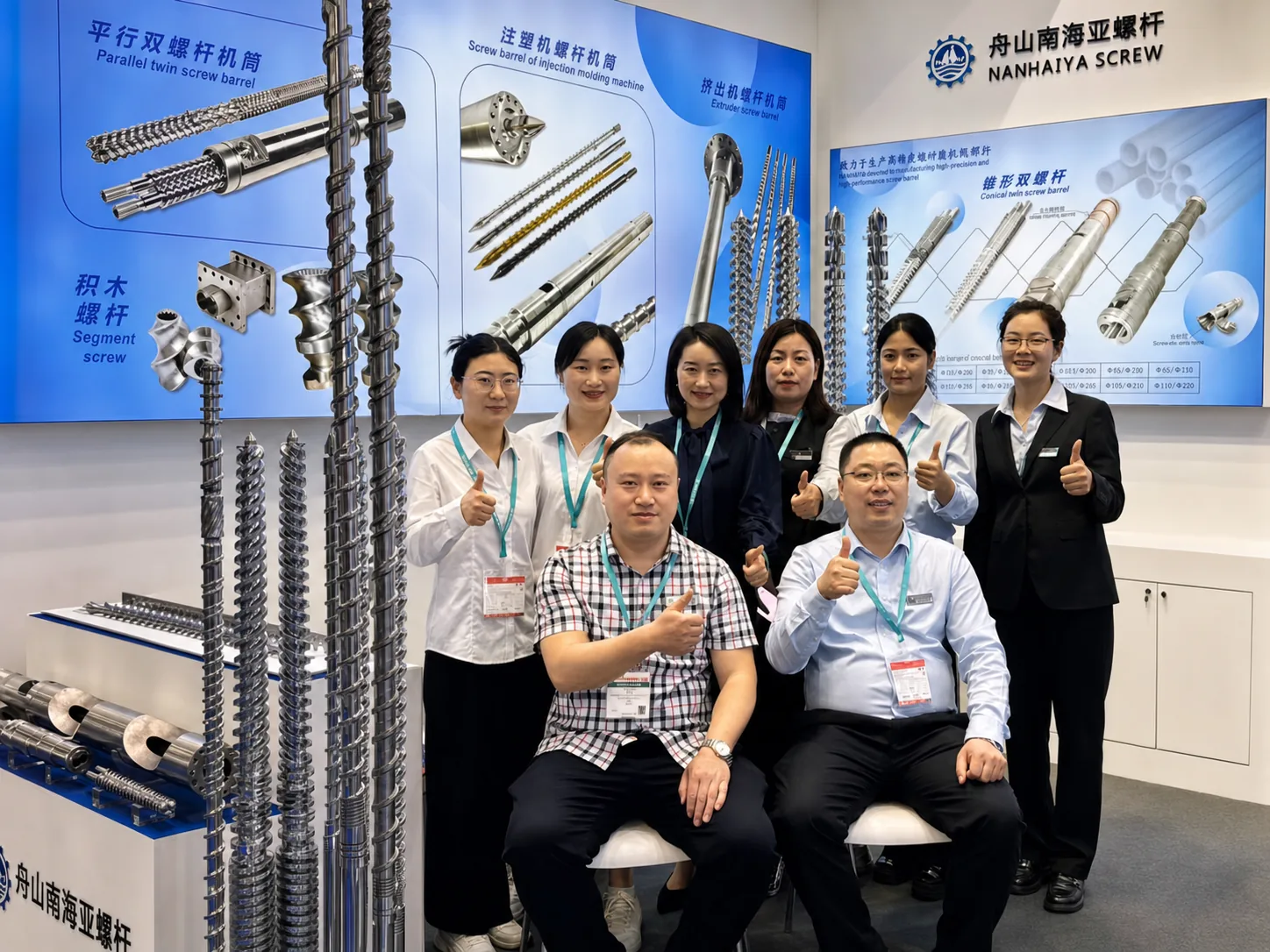
Related Articles
More insights on screw barrel technology and plastics processing.
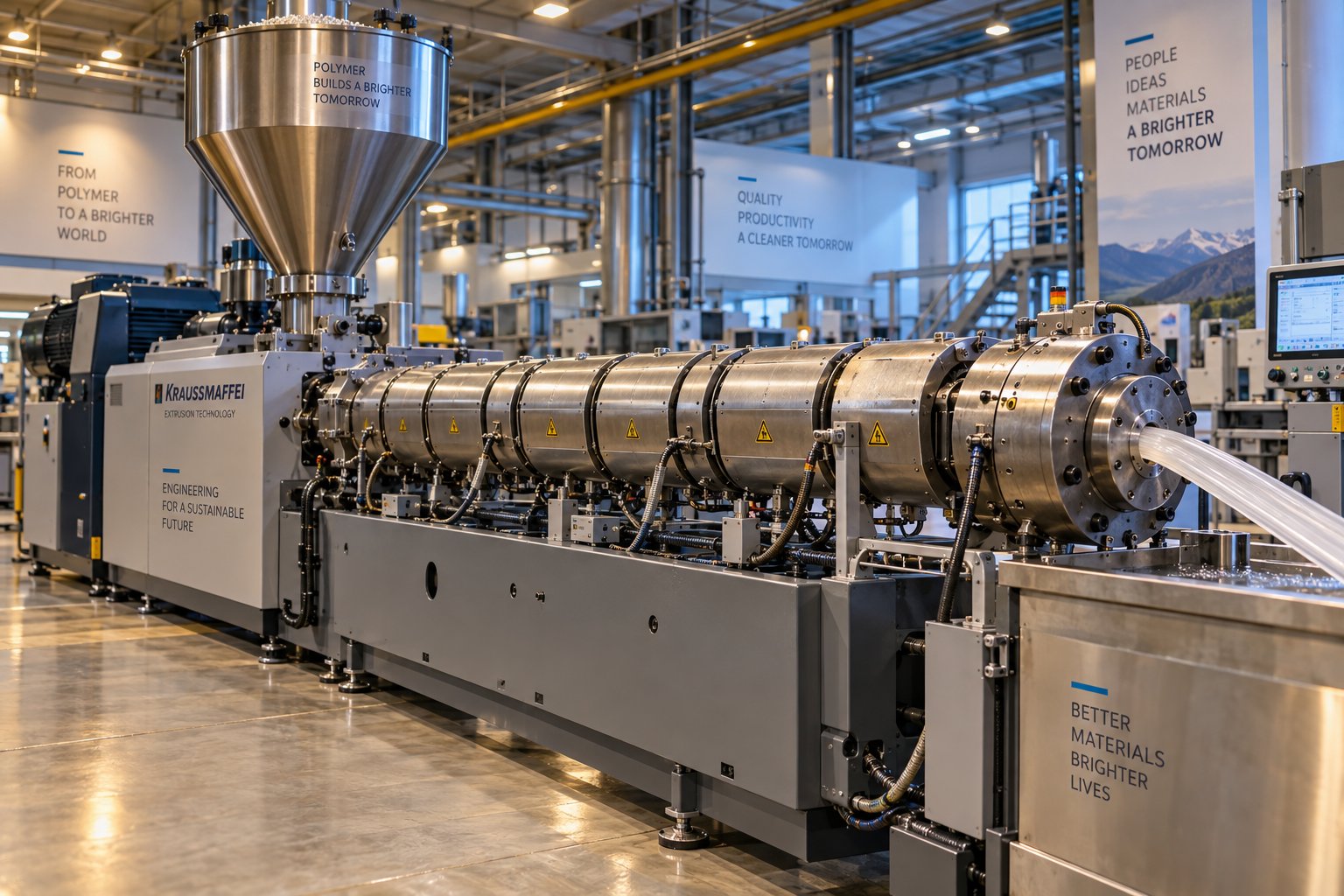
Extruder Machine Decoded: From Raw Pellet To Finished Product
Oct 6, 2026
Learn how an extruder machine works, compare single-screw vs. twin-screw types, and get expert guidance on specs, troubleshooting, and selection.
Read Article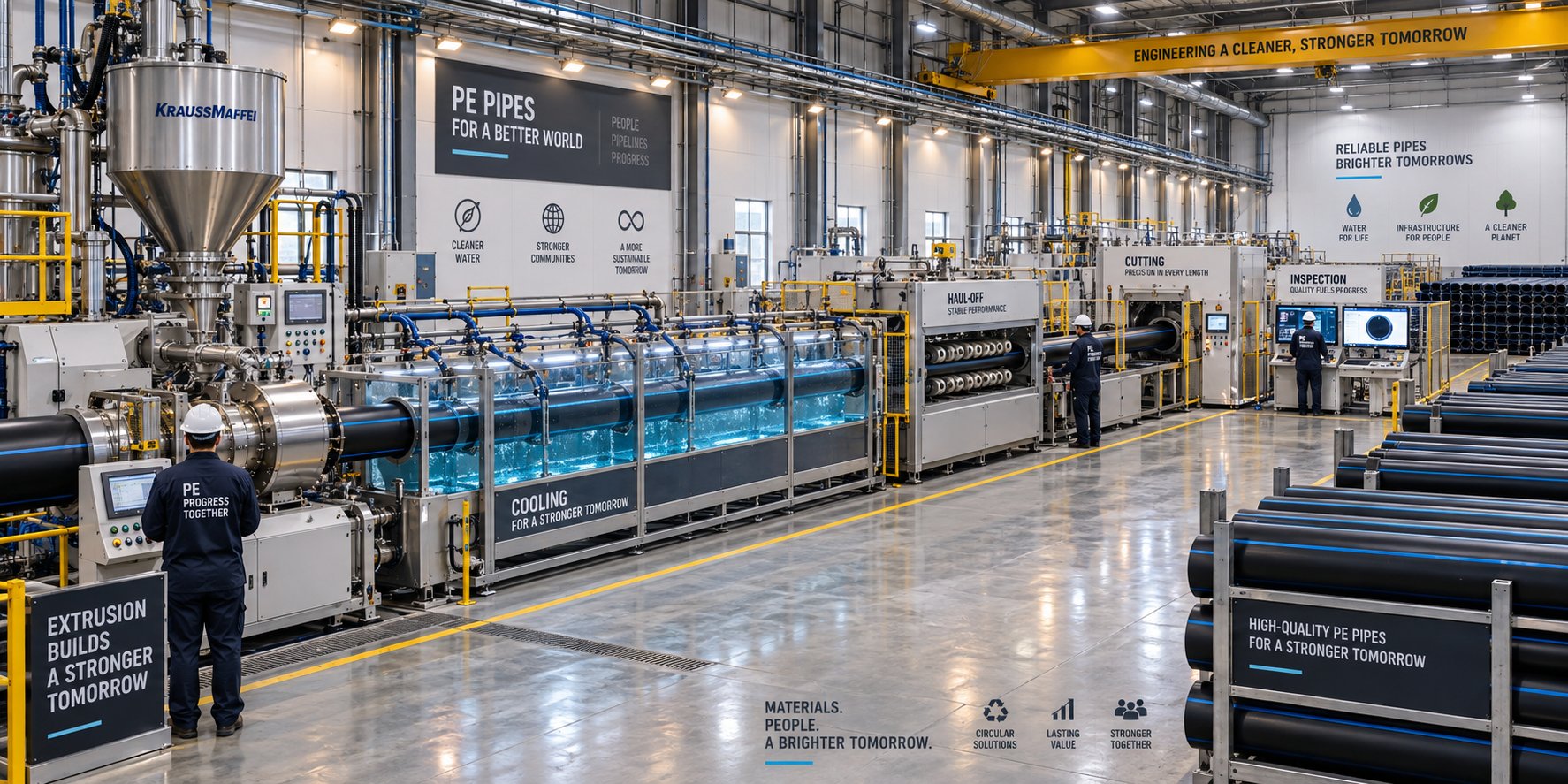
PE Pipe Making Machine Decoded: From Raw Resin to Flawless Pipe
Oct 4, 2026
Learn how a PE pipe making machine works, from resin to finished pipe. Covers components, material grades, automation, troubleshooting, and buyer selection tips.
Read Article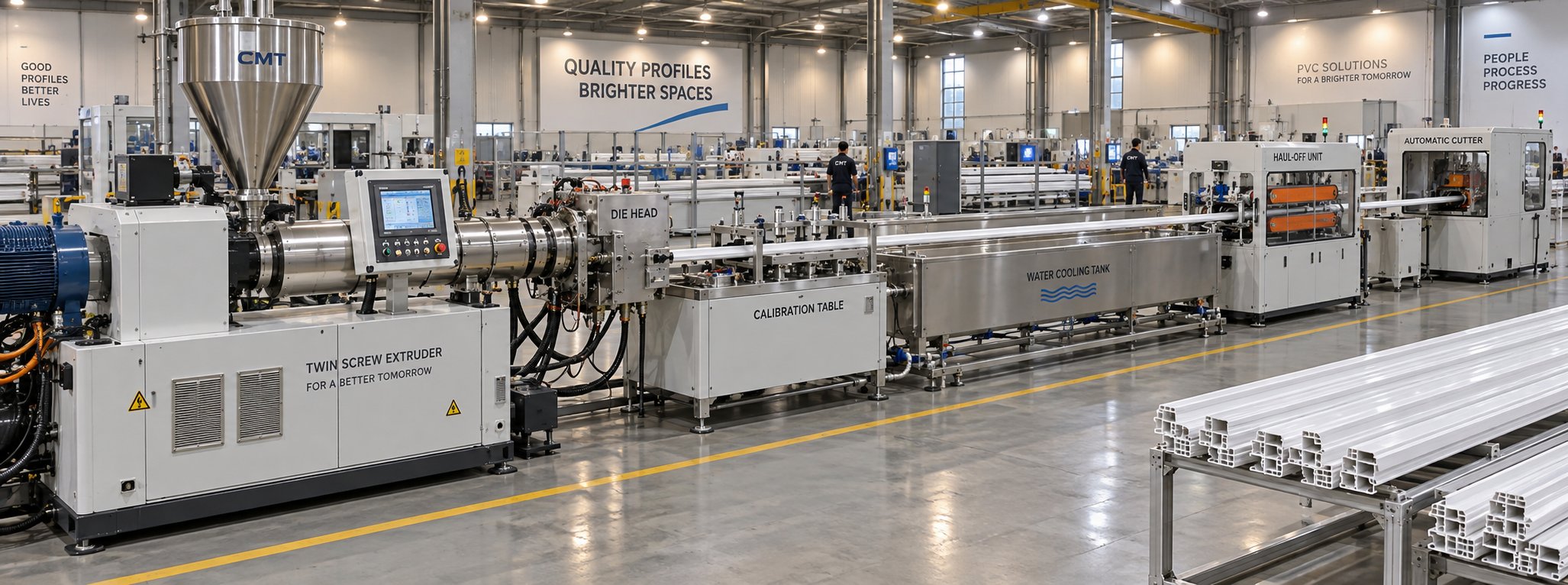
PVC Profile Making Machine Decoded: From Raw Resin To Profit
Oct 3, 2026
Learn how a PVC profile making machine works — extrusion process steps, key technical parameters, die design, calibration methods, maintenance, and total cost of ownership.
Read ArticleLooking for something else?
Search by material, symptom or product and jump straight to the relevant page.
These are navigation suggestions based on keyword matching — not a quotation, not a delivery commitment, and not a substitute for engineering review. Final specification is confirmed by our engineers against your drawings and processed material.
Need help with screw barrel selection?
Share your machine model, processed material and application. Our team can help with pricing and technical support.