

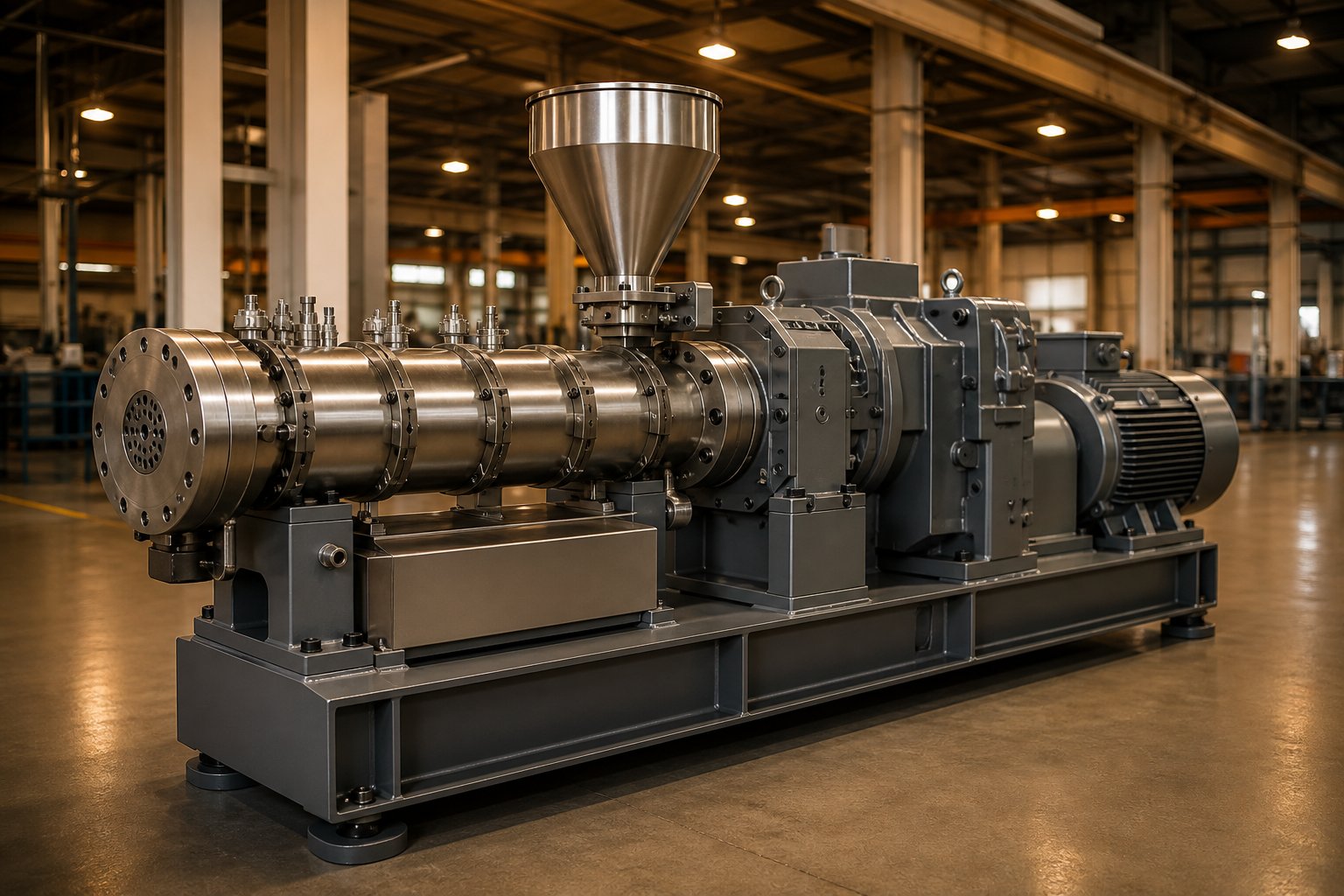
Understanding Twin Screw Extruder Technology From the Ground Up
A twin screw extruder is an industrial machine that uses two intermeshing screws rotating inside a heated barrel to melt, mix, and shape polymers and other materials. It is the workhorse behind everything from plastic compounding and masterbatch production to PVC pipe extrusion and food processing. Before you consider buying a second hand twin screw extruder, you need to understand exactly what you are evaluating - and that starts with the technology itself.
How Twin Screw Extrusion Works
Imagine two long, helical screws sitting side by side inside a tight, heated barrel. Raw material - pellets, powder, or a combination - enters through a feed throat at one end. As the screws rotate, they convey the material forward through distinct processing zones: feeding, melting, intensive mixing, and finally discharge through a die or into downstream equipment.
What makes twin screw extruders fundamentally different from a single screw extruder machine? It comes down to mixing. A single screw design relies mostly on drag flow along the barrel wall. A parallel twin screw extruder, by contrast, generates complex flow fields both between the two screws and between each screw and the barrel. This creates far superior distributive and dispersive mixing - breaking down agglomerates while simultaneously spreading additives evenly throughout the melt. The intermeshing geometry also produces a self-wiping action that prevents material from stagnating, keeping residence time tight and consistent.
Co-Rotating vs. Counter-Rotating Designs
Not all twin screw extruders behave the same way. The two main configurations - co-rotating and counter-rotating - serve very different purposes.
In a co-rotating design, both screws spin in the same direction. Material is forcibly handed off between flights at the intermeshing zone, creating intense shear and excellent mixing. In the counter-rotating configuration, the screws turn in opposite directions. Material is drawn in and compressed between them, producing a gentler calendering effect with lower shear stress.
- Co-rotating advantages: High-intensity mixing, narrow residence time distribution, self-wiping capability, freely configurable screw elements - ideal as a compounding machine, for polymer alloys, and reactive extrusion.
- Counter-rotating advantages: Lower shear heating, stable conveying at low speeds, excellent for thermally sensitive materials - preferred for rigid PVC pipe, sheet, and profile extrusion where temperature control is critical.
Why Twin Screw Extruders Command Premium Value
Here is something that directly affects your purchase decision. Twin screw extruders serve an extraordinarily broad range of industries - plastics compounding, food processing, pharmaceuticals, and specialty chemicals. That cross-industry demand keeps resale values strong, even for older models.
Twin screw extruders retain value in the secondary market largely because of their modular barrel and screw configurations. A single machine can be reconfigured for entirely different applications simply by rearranging screw elements and barrel sections - a flexibility no single screw design can match.
This modularity also means a well-maintained used machine can be adapted to your specific process rather than locked into its previous owner's application. The real question, though, is whether buying used actually makes financial sense compared to purchasing new - and the answer depends on factors most sellers would rather you did not think too carefully about.
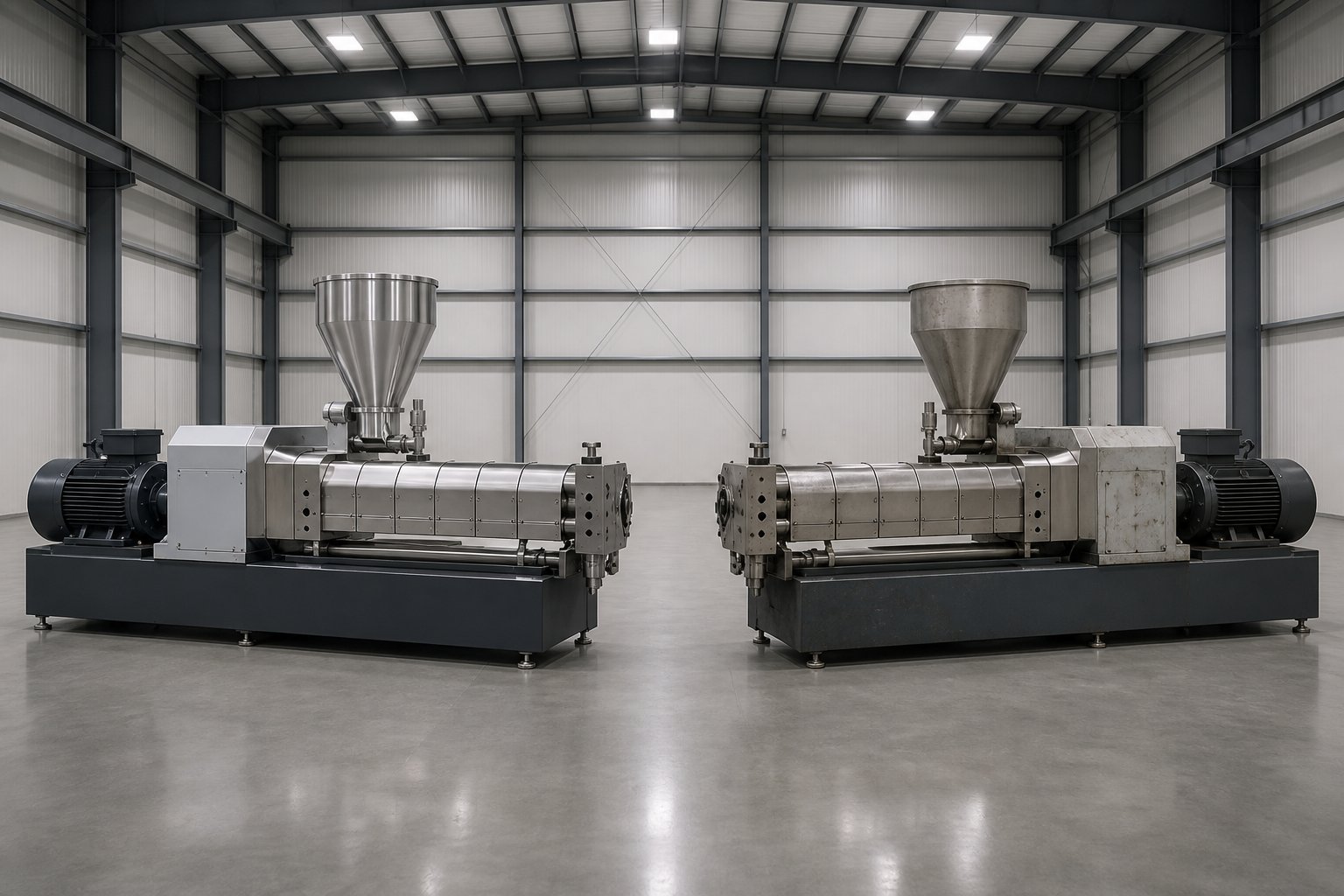
Second Hand vs. New Twin Screw Extruders and When Each Makes Sense
Every buyer reaches the same crossroads: spend significantly more on a brand-new machine, or allocate that capital toward a used twin screw extruder that might deliver nearly identical output? The honest answer is not as simple as sellers on either side want you to believe. Both paths carry real advantages and genuine trade-offs - and the right choice depends entirely on your specific production needs, financial situation, and timeline.
Capital Cost Savings and Depreciation Reality
Heavy industrial equipment follows a depreciation curve that works heavily in the used buyer's favor. Much like construction machinery and other capital-intensive assets, twin screw extruders experience their steepest value drop during the first few years of ownership. Equipment depreciation begins the moment a machine enters service, and that initial decline can be dramatic - often representing the single largest portion of total value loss over the machine's entire productive life.
What does this mean in practical terms? A lightly used twin screw extruder for sale - perhaps three to five years old with moderate production hours - may be available at a fraction of its original purchase price while still retaining the vast majority of its mechanical capability. The first owner absorbed the heaviest depreciation hit. You benefit from a machine that performs like it has years of productive life ahead, at a substantially lower entry cost.
Rather than quoting specific twin screw extruder price figures that could be outdated by the time you read this, check current marketplace listings from reputable dealers and auction platforms for real-time pricing. What you will consistently notice is a significant gap between new equipment pricing and comparable used models - a gap that represents genuine capital you can redirect toward auxiliary equipment, raw materials, or facility upgrades.
Lead Time and Production Urgency
Here is a factor that catches many buyers off guard. Ordering a new twin screw extruder from a major OEM is not like buying off a shelf. Manufacturing lead times for new machines can stretch anywhere from several months to well over half a year, depending on the manufacturer's backlog, the complexity of your specifications, and global supply chain conditions. If your production schedule cannot wait that long - say you have landed a new contract, need to replace a failed machine, or are scaling up to meet sudden demand - those months of waiting translate directly into lost revenue.
A second hand twin screw extruder, by contrast, already exists. It can often be inspected, purchased, shipped, and operational in your facility within weeks rather than months. That speed-to-production advantage is not trivial. For buyers facing urgent capacity needs, it can be the single most compelling reason to go used - even before considering the cost savings.
When Buying New Is the Right Call
Fairness demands acknowledging the scenarios where purchasing new genuinely makes more sense. If your application demands the latest generation of process controls, energy-efficient drive systems, or Industry 4.0 connectivity features, those technologies may not be available on older used models without expensive retrofitting. Similarly, if you require a specific OEM warranty to satisfy customer audits, regulatory requirements, or internal risk management policies, a new machine purchase provides that coverage from day one.
Customization is another legitimate consideration. New machines can be built to your exact barrel configuration, screw geometry, and control specifications. With a used extruder for sale, you are working within the boundaries of what is available on the secondary market - though the modularity of twin screw designs does offer significant reconfiguration flexibility, as discussed earlier.
The following comparison lays out the key decision factors side by side, presented as an objective framework rather than a push in either direction:
| Decision Factor | Buying New | Buying Second Hand |
|---|---|---|
| Capital Cost | Full retail price; highest upfront investment | Significantly lower; first owner absorbs steepest depreciation |
| Lead Time | Months for manufacturing and delivery | Weeks from purchase to operation in many cases |
| Warranty Coverage | Full OEM warranty included | Typically limited or no warranty; depends on seller |
| Technology Level | Latest controls, drives, and efficiency features | Previous generation; may require control upgrades |
| Customization Options | Built to exact specifications | Limited to available configurations; modular designs allow some adaptation |
| Depreciation Risk | Steepest value loss occurs immediately after purchase | Depreciation curve has already flattened; lower financial risk |
Neither column wins across every row - and that is exactly the point. A used twin screw extruder for sale can be an outstanding investment when the numbers align with your production reality. A new machine earns its premium when cutting-edge capability or full warranty protection are non-negotiable. The critical mistake is making this decision based on price alone without evaluating the technical specifications that actually determine whether a machine fits your process - and that is where the conversation needs to go next.
Critical Technical Specifications Every Buyer Must Evaluate
A spec sheet full of numbers means nothing if you do not understand what those numbers actually do in the real world. Sellers list screw diameter, L/D ratio, torque rating, and motor power - but they rarely explain how those figures translate into the throughput, mixing quality, and material flexibility your production line demands. This gap between data and understanding is where costly purchasing mistakes are born.
Whether you are evaluating a large-scale compounding line or a laboratory scale extruder for R&D, these core specifications determine whether a machine will deliver what you need - or leave you with an expensive problem.
Screw Diameter and L/D Ratio Explained
Think of screw diameter as the primary indicator of a machine's throughput capacity. A larger diameter means more material can be conveyed, melted, and mixed per revolution. In practical terms, a 26 mm extruder is suited for lab work and small batches, while a 90+ mm machine handles high-volume production runs measured in tons per hour.
The L/D ratio - screw length divided by screw diameter - tells you something equally important: how much processing the material undergoes before it exits the machine. A typical twin screw extruder L/D ratio ranges from 20:1 to 48:1, and each range serves different purposes. Shorter ratios (20:1 to 28:1) work well for applications requiring intensive mixing with minimal residence time - color masterbatch production, for example, where thermal sensitivity demands speed. Medium ratios (28:1 to 36:1) cover the broadest range of general compounding work, including engineering plastics and fiber-reinforced compounds. Longer ratios (36:1 to 48:1) provide extended residence time for devolatilization, reactive extrusion, or heavily filled formulations that need thorough mixing and degassing.
Why does this matter when shopping for a used machine? Because a pipe extruder configured with a 32:1 L/D ratio will not perform well if your application demands aggressive devolatilization that requires 40:1 or longer. You cannot simply add barrel sections to an existing machine without matching gearbox, shaft, and frame specifications. The L/D ratio you buy is largely the L/D ratio you are committed to - so match it to your process from the start.
Torque Rating and Its Impact on Performance
If screw diameter determines how much material a machine can handle, torque determines what kinds of materials it can handle. For compounding applications especially, torque is arguably the single most important specification on the sheet.
Specific torque - expressed as Newton-meters per cubic centimeter of free volume, or Nm/cm3 - measures how much rotational force the drive system can deliver relative to the processing volume available. Higher specific torque means the machine can process higher-viscosity polymers, heavily filled compounds, and demanding formulations without the motor bogging down or the shafts reaching their mechanical limits. A torque-limited process occurs when there is not enough power from the motor to turn the screws and pump materials through the process section and die system - effectively capping your maximum throughput regardless of what other specifications suggest.
Machine generations matter here. Older twin screw extruders typically feature lower torque density than modern designs. Advances in shaft metallurgy, spline geometry, and asymmetrical shaft profiles have allowed newer machines to transmit significantly more torque through the same screw diameter. When evaluating a used machine, compare its torque rating not just against your process requirements but against current-generation machines of the same screw size. A substantial torque gap may limit what materials and formulations you can run economically.
Throughput Capacity and Drive Power
Throughput is not a single fixed number - it is the product of the relationship between screw speed, available torque, free volume, and the material being processed. A machine rated for a certain maximum screw RPM can theoretically double its output when speed doubles, but only if no other boundary condition intervenes. In practice, constraints like torque limits, volume limits, or dispersive mixing requirements set the real ceiling.
The ratio of outside screw diameter to inside screw diameter (OD/ID ratio) is an often-overlooked indicator of available free volume. A higher OD/ID ratio means more material can occupy the screw channels at any given moment. Machines with a 1.66 OD/ID ratio can offer roughly 30% more throughput than machines with a 1.55 ratio at the same screw diameter, all else being equal.
The following table provides general guidance on how different screw diameter classes correspond to throughput ranges and typical applications. These are approximate ranges - actual performance depends on material properties, screw configuration, and process conditions:
| Screw Diameter Class | General Throughput Range | Typical Applications |
|---|---|---|
| 16-20 mm | Low (lab/pilot scale) | R&D, small-batch testing, laboratory scale extruder work, formulation development |
| 25-35 mm | Low to moderate | Specialty compounding, masterbatch, small production runs, pilot-to-production bridging |
| 50-65 mm | Moderate to high | Production-scale compounding, engineering plastics, PVC extruder machine applications, pipe extruder lines |
| 75-95 mm | High | High-volume compounding, large-scale masterbatch, commodity polymer processing |
| 100+ mm | Very high | Maximum throughput production, large-volume commodity compounding, direct extrusion lines |
When evaluating a used machine, verify that the installed motor power aligns with the gearbox and screw specifications. A machine that has been re-motored with an undersized drive - or one whose original motor has degraded - will not reach its rated throughput regardless of the nameplate data.
Machine Age, Production Hours, and Barrel Wear
Here is what most sellers would rather you did not focus on: a machine's calendar age tells you far less than its actual production hours and maintenance history. A ten-year-old extruder that ran single shifts processing unfilled polymers may be in better mechanical condition than a five-year-old machine that ran around the clock compounding abrasive glass-fiber-filled materials.
Barrel and screw wear is the primary concern. As material flows through the extruder, abrasive fillers, corrosive additives, and high-shear processing gradually erode barrel bores and screw element flights. This wear increases clearances between screw and barrel, reducing pumping efficiency and mixing quality. One practical indicator is rising specific energy consumption - if the machine requires more kilowatt-hours per kilogram of output than its baseline, wear is the likely culprit. A screen changer positioned downstream may also show increased pressure fluctuation as worn screws deliver less consistent melt flow.
Before committing to any purchase, insist on answers to these critical wear-related questions:
- Barrel bore measurements: Has the barrel been measured recently with a bore gauge? What are the current diameters compared to original specifications? Wear beyond 0.1 to 0.2 mm typically signals the need for barrel liner replacement.
- Screw element condition: Have the screw elements been inspected for flight tip wear, cracking, or corrosion? Are original or replacement elements currently installed?
- Total production hours: What are the logged operating hours, and what materials were primarily processed? Abrasive compounds accelerate wear dramatically compared to neat polymers.
- Gearbox oil analysis: Has the gearbox oil been tested for metal particles? Elevated metal content in oil samples is an early warning of bearing or gear tooth wear that could lead to catastrophic failure.
- Specific energy consumption trends: Has the energy required per kilogram of throughput increased over time? Rising SEC at constant operating conditions is a reliable indicator of progressive mechanical wear.
- Maintenance and rebuild history: Have any barrel sections, screw shafts, or gearbox components been replaced or rebuilt? If so, what documentation exists?
Any seller who cannot - or will not - answer these questions is waving a red flag you should not ignore. The specifications on a nameplate describe what a machine could do when it left the factory. Wear data tells you what it can actually do today. And that distinction becomes even more important when you start matching technical specifications to specific brand reputations and their implications in the used equipment market.
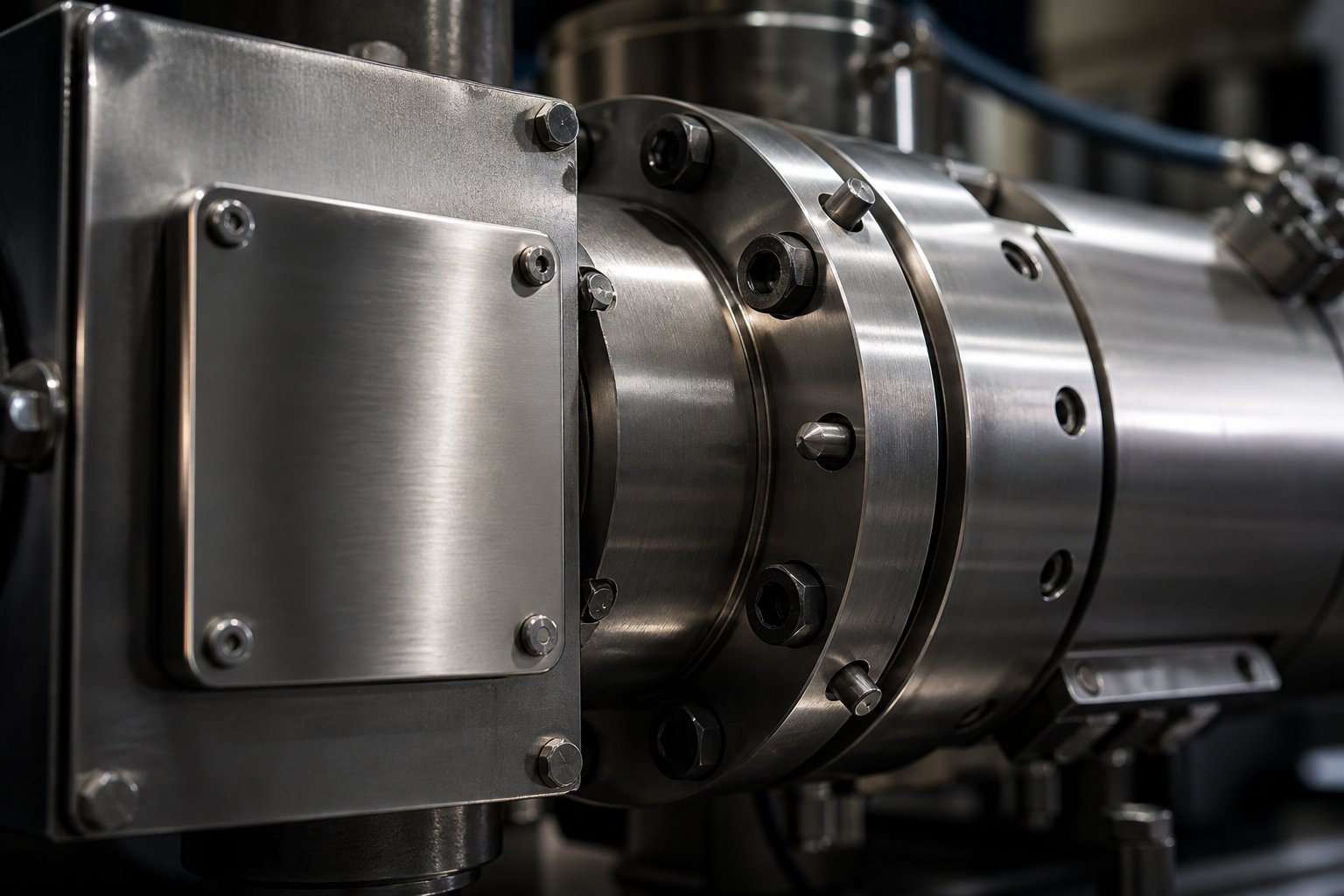
Major OEM Brands and What They Mean in the Used Market
Specifications tell you what a machine can theoretically do. The brand name on its nameplate tells you something equally important: how easy it will be to find replacement parts five years from now, whether a technician in your region knows the platform, and how much value the machine retains if you ever need to resell. In the second hand twin screw extruder market, brand reputation is not just a matter of prestige - it directly shapes your total cost of ownership and long-term operational risk.
Browse any used equipment listing aggregator and you will encounter a jumble of nameplates - some instantly recognizable, some confusing, and more than a few that trace through corporate mergers that have scrambled the branding entirely. Knowing which manufacturers stand behind the machines you are evaluating separates a confident purchase from a parts-sourcing headache that does not reveal itself until something wears out.
Premium European OEMs and Their Market Position
If one name dominates used co-rotating twin screw extruder listings, it is Coperion - or more precisely, the Werner & Pfleiderer nameplate that still appears on thousands of machines in active service worldwide. The connection confuses many buyers, so here is the short version: Werner & Pfleiderer, a Stuttgart-based engineering firm, delivered the first commercial ZSK co-rotating twin screw extruder in 1957. The company was later restructured through Krupp and ThyssenKrupp before ultimately becoming Coperion around 2000-2001. The ZSK platform remains in production under the Coperion name, and dimensional standards for barrels, screw elements, and shaft splines have maintained continuity across generations. That engineering consistency means a Werner & Pfleiderer machine from the 1990s can still source compatible replacement components through both OEM channels and a broad aftermarket network.
Coperion's massive installed base also means technicians with hands-on ZSK experience are easier to find than specialists for almost any other platform. This combination - proven engineering, deep parts availability, and workforce familiarity - is precisely why Coperion machines consistently command premium resale values. You will pay more to acquire one used, but you will recover more if you ever sell it, and you will spend less time chasing down spare parts during its operational life.
Leistritz occupies a distinctive niche in the secondary market. With over a century of screw technology experience, the company's ZSE platform is widely recognized in pharmaceutical hot-melt extrusion and R&D applications. Used Leistritz units tend to come with exceptionally well-documented maintenance histories, reflecting the quality-driven industries they serve. If you are searching for a smaller-diameter machine for formulation development or specialty compounding, Leistritz models appear frequently - and their brand credibility with regulatory auditors adds tangible value in regulated industries.
KraussMaffei Berstorff brings another layer of history. Berstorff, originally an independent German manufacturer founded in 1838, built a strong reputation in both co-rotating and counter-rotating designs before being absorbed into the KraussMaffei group. Used listings may reference "Berstorff," "KraussMaffei Berstorff," or the ZE series designation - all pointing to the same engineering lineage. These machines are well regarded for their high free volume barrel designs and robust mechanical construction, particularly in larger-diameter compounding applications.
Bausano, an Italian manufacturer founded in 1946, holds a strong position in the counter-rotating segment. Specializing in PVC pipe, profile, and wood-plastic composite extrusion, Bausano machines are a common sight in used listings targeting those applications. Their proprietary Multidrive transmission and electromagnetic induction heating systems are distinctive features that retain practical value on the secondary market - though buyers should verify that service support for these proprietary systems is available in their region before committing.
Emerging Manufacturers and Value Propositions
The used equipment landscape is no longer exclusively populated by European and Japanese nameplates. Asian manufacturers - particularly Chinese companies like JWELL Machinery - appear with increasing frequency across dealer inventories and auction platforms. JWELL, established in 1995 with manufacturing bases across multiple Chinese provinces, offers both parallel and conical twin screw configurations. Their strength lies in whole-line solutions for PVC pipe, sheet, and profile extrusion, much like how specialized blown film extruder manufacturers focus on turnkey film production systems rather than standalone components.
The value proposition of these machines is straightforward: lower acquisition cost, even on the secondary market. A used JWELL or comparable Asian-manufactured extruder may be priced substantially below what an equivalent Coperion or Leistritz commands. For buyers running established, well-understood processes - standard PVC compounding, commodity sheet extrusion, or moderate-complexity blown film extrusion machine applications - that price gap can represent genuine savings without meaningful performance compromise.
The trade-offs, however, are real. Parts sourcing for Asian-manufactured equipment can present different challenges than European machines. Technical documentation may be less comprehensive. Service networks outside the manufacturer's home region are typically thinner than those supporting Coperion or KraussMaffei platforms. And resale values tend to depreciate more steeply, meaning the exit economics are less favorable if your production needs change. None of these are deal-breakers, but they should factor into your total cost calculation with clear eyes.
How Brand Choice Affects Spare Parts and Support
This is where brand selection has its most tangible financial impact - not at the point of purchase, but in the years of operation that follow. OEM spare parts availability varies dramatically between brands and even between model generations within the same brand. A Coperion ZSK from the early 2000s benefits from one of the broadest aftermarket ecosystems in the industry. A machine from a regional manufacturer that exited the market a decade ago? Every replacement screw element or barrel liner may require custom fabrication from drawings or reverse engineering from worn samples.
Some discontinued models have thriving aftermarket parts ecosystems because the original designs were widely adopted and well-documented. Others do not. The difference between these two scenarios can mean the gap between a three-day parts lead time and a twelve-week custom manufacturing project - all while your production line sits idle. Just as experienced blown film machine manufacturer operations depend on reliable component supply chains to keep lines running, your used extruder investment depends on verifying parts access before you sign the purchase agreement.
Before committing to any brand on the used market, evaluate it against these criteria:
- Parts availability: Can you source critical wear components - screw elements, barrel liners, heater bands, thermocouples - from multiple suppliers? Is the machine's dimensional standard supported by aftermarket manufacturers, or are you locked into a single OEM channel with premium pricing?
- Technical documentation quality: Does the machine come with original engineering drawings, screw configuration records, and maintenance manuals? Brands with strong documentation standards make troubleshooting and parts ordering far more efficient.
- Service network coverage: Are there technicians in your geographic region who have hands-on experience with this brand and model series? Training a general millwright to work on an unfamiliar platform takes time and carries risk during the learning curve.
- Resale value trajectory: Does this brand hold its value on the secondary market, or does it depreciate steeply? Premium brands like Coperion and Leistritz retain value partly because buyer demand stays consistent - the same factors that make them easy to buy used also make them easy to sell used.
A final point worth underscoring: brand alone does not guarantee quality in the used market, just as an unfamiliar nameplate does not automatically signal inferior equipment. A meticulously maintained machine from a lesser-known blown film machine supplier or extruder manufacturer can outperform a neglected unit from a premium OEM. Brand gives you a reasonable baseline for parts access, service availability, and resale confidence - but the machine's actual condition, verified through the technical inspection process, is always the ultimate arbiter of value.
Knowing which brand you are buying sets your expectations for ongoing support and costs. The deeper question - whether a specific machine's configuration actually fits your production process - depends on matching the equipment to your application. And different applications demand very different extruder setups, screw designs, and auxiliary equipment.
Matching Applications and Materials to the Right Used Extruder
A machine that excels in one application can be completely wrong for another - even if every number on the spec sheet looks impressive. Twin screw extruders are not interchangeable. The screw configuration, torque class, barrel layout, and auxiliary equipment surrounding the extruder all shift dramatically based on what you are actually trying to produce. Buying a second hand twin screw extruder without understanding these application-specific demands is like purchasing a truck based solely on horsepower without asking whether it can haul what you need to move.
This section breaks down the major application categories, what each one requires from the extruder, and what to look for - and look out for - when shopping the used market.
Polymer Compounding and Masterbatch Production
Compounding is the most common application for co-rotating twin screw extruders, and it is also the most demanding from a mechanical standpoint. The job is conceptually simple: blend a base polymer with additives, fillers, pigments, or reinforcing fibers to create a compound with specific performance characteristics. The execution, however, requires aggressive mixing intensity, precise temperature control, and a machine that can handle high torque loads without flinching.
Why do co-rotating designs dominate here? Because co-rotating twin screw extruders offer modular screw configurations that allow processors to design a process tailored to each formulation. You can arrange conveying elements, kneading blocks, and distributive mixing elements in virtually any sequence along the shaft. That flexibility is essential when your compounding machine needs to handle everything from calcium carbonate-filled polypropylene one week to glass-fiber-reinforced nylon the next.
When evaluating a used extruder for compounding, pay close attention to these requirements:
- High specific torque: Filled and reinforced compounds demand serious rotational force. If the machine's torque rating is marginal for your target formulations, you will hit throughput ceilings that no amount of screw optimization can overcome.
- Side feeder ports: Most compounding operations require downstream introduction of fillers, fibers, or secondary polymers. Verify that the barrel has side feeder openings in the correct positions - and that side feeders are included with the machine or readily available.
- Vacuum venting: Devolatilization zones with vacuum ports are essential for removing moisture, trapped air, and volatile byproducts. Missing or poorly positioned vent ports can compromise compound quality.
- Downstream pelletizing equipment: A compounding extruder without a strand pelletizer, underwater pelletizer, or water-ring die face cutter is only half a production line. Factor in the cost and availability of downstream equipment when calculating total acquisition cost.
Pipe and Profile Extrusion Applications
Pipe and profile extrusion is a fundamentally different beast. Instead of producing pellets for later processing, the extruder feeds a continuous melt stream directly through a shaping die - and the quality of that melt stream determines whether you get a dimensionally stable pipe or an expensive pile of scrap.
Counter-rotating twin screw extruders are the established choice for PVC pipe extrusion machine and profile applications. The reason traces back to material behavior. PVC is thermally sensitive - it degrades if exposed to excessive shear heating. Counter-rotating screws generate a gentler calendering action that conveys and plasticizes PVC without the intense shear peaks that co-rotating designs produce. That controlled, low-shear conveying keeps melt temperatures in the safe processing window and delivers the homogeneous melt quality that pipe and profile dies demand.
A used pvc extrusion machine setup requires more than just the extruder itself. Imagine the complete production line: raw material feeding and blending, the extruder with its die head, a vacuum sizing tank that shapes and cools the extrudate to precise dimensions, a haul-off unit that pulls at a controlled rate, and a cutting station. If you are shopping for a plastic pipe extrusion machine on the secondary market, evaluate the entire line - not just the extruder in isolation. A pvc pipe extrusion machine with a mismatched or missing calibration table, for instance, will not produce pipe within specification regardless of how well the extruder performs.
Corrugated pipe machine applications add another layer of complexity. Double-wall corrugated pipe production requires a corrugation unit - essentially a traveling mold system - synchronized precisely with the extruder's output rate. These integrated systems are less commonly available as complete used lines, so finding one with all components intact and properly matched represents significant value.
For sheet and film applications, a pet sheet extrusion line built around a twin screw extruder demands excellent melt homogeneity and pressure stability. PET processing, in particular, requires thorough drying and devolatilization to prevent hydrolytic degradation - so verify that the used line includes adequate drying capacity and venting capability for moisture-sensitive resins.
Food, Pharmaceutical, and Specialty Applications
Step into food processing or pharmaceutical manufacturing, and the rules change entirely. The technical performance requirements still matter, but they take a back seat to regulatory compliance, material traceability, and hygienic design standards that most industrial-grade machines were never built to satisfy.
Food-contact and pharmaceutical twin screw extrusion demands specific material certifications for every surface that touches the product - barrels, screw elements, die plates, and seals. FDA-compliant or EU-regulation-compliant metallurgy is not optional. Clean-in-place (CIP) capability, which allows thorough internal cleaning without full disassembly, is strongly preferred and sometimes mandatory. Documentation of all material contact surfaces - alloy grades, surface finishes, gasket materials - must be verifiable and traceable.
Buyers in regulated industries must verify a used machine's full compliance history before purchase. A machine that previously processed industrial chemicals may carry contamination risks or lack the material certifications required for food or pharmaceutical contact, regardless of how thoroughly it has been cleaned.
Pharmaceutical hot-melt extrusion, used for producing solid dosage forms with improved bioavailability, typically relies on smaller-diameter co-rotating extruders with precise temperature control and carefully documented process parameters. Used machines from brands with strong pharmaceutical pedigrees - Leistritz and Thermo Fisher Scientific, for example - carry a built-in credibility advantage during regulatory audits. A machine without a documented chain of custody, validated cleaning records, and traceable component certifications will face significant hurdles in a GMP-regulated environment.
Application-to-Specification Matching Checklist
Matching your production needs to the right used machine means checking several interdependent variables at once. The following checklist distills each major application category into its key specification requirements:
- Polymer compounding / masterbatch: Co-rotating configuration, L/D ratio of 32:1 to 48:1, high specific torque (11+ Nm/cm3), side feeders, vacuum venting, downstream pelletizer.
- PVC pipe and profile extrusion: Counter-rotating configuration (parallel or conical), L/D ratio of 20:1 to 28:1, moderate torque, matched die head and downstream sizing/cooling equipment, haul-off and cutter.
- Corrugated pipe production: Counter-rotating or co-rotating extruder paired with synchronized corrugation unit, appropriate die tooling, cooling system with adequate capacity.
- PET sheet extrusion: Co-rotating configuration with strong devolatilization capability, L/D ratio of 36:1 or higher, pre-drying system, flat die and polishing stack or chill roll downstream.
- Food processing: Co-rotating configuration, food-grade contact materials with FDA/EU certification, CIP capability, documented material traceability for all wetted parts.
- Pharmaceutical hot-melt extrusion: Co-rotating configuration (often 16-27 mm diameter), precise zone temperature control, GMP-compliant documentation, validated cleaning records, full component traceability.
A machine that checks every box for your application category dramatically reduces the risk of costly surprises after purchase. But even a perfectly matched used extruder can harbor hidden mechanical problems that only surface after installation - problems that cosmetic cleaning and fresh paint are specifically designed to conceal.
Risks and Pitfalls to Avoid When Buying Used Extrusion Equipment
Fresh paint, a power-washed exterior, and a seller who assures you the machine "ran perfectly until we shut down" - that is often all that separates a confident buyer from a five-figure repair bill. The uncomfortable truth about the second hand twin screw extruder market is that cosmetic presentation and actual mechanical condition have almost nothing to do with each other. A machine can look showroom-ready on the outside while hiding barrel wear, gearbox fatigue, corroded cooling channels, and obsolete controls on the inside.
This section exists to protect your capital. Every pitfall covered here comes from scenarios that real buyers encounter - and that most sellers have little incentive to volunteer.
Common Hidden Problems in Used Twin Screw Extruders
Some mechanical issues are visible during a walk-around inspection. Others require instruments, experience, and a willingness to look where sellers hope you will not. Here are the problems that catch buyers most frequently off guard:
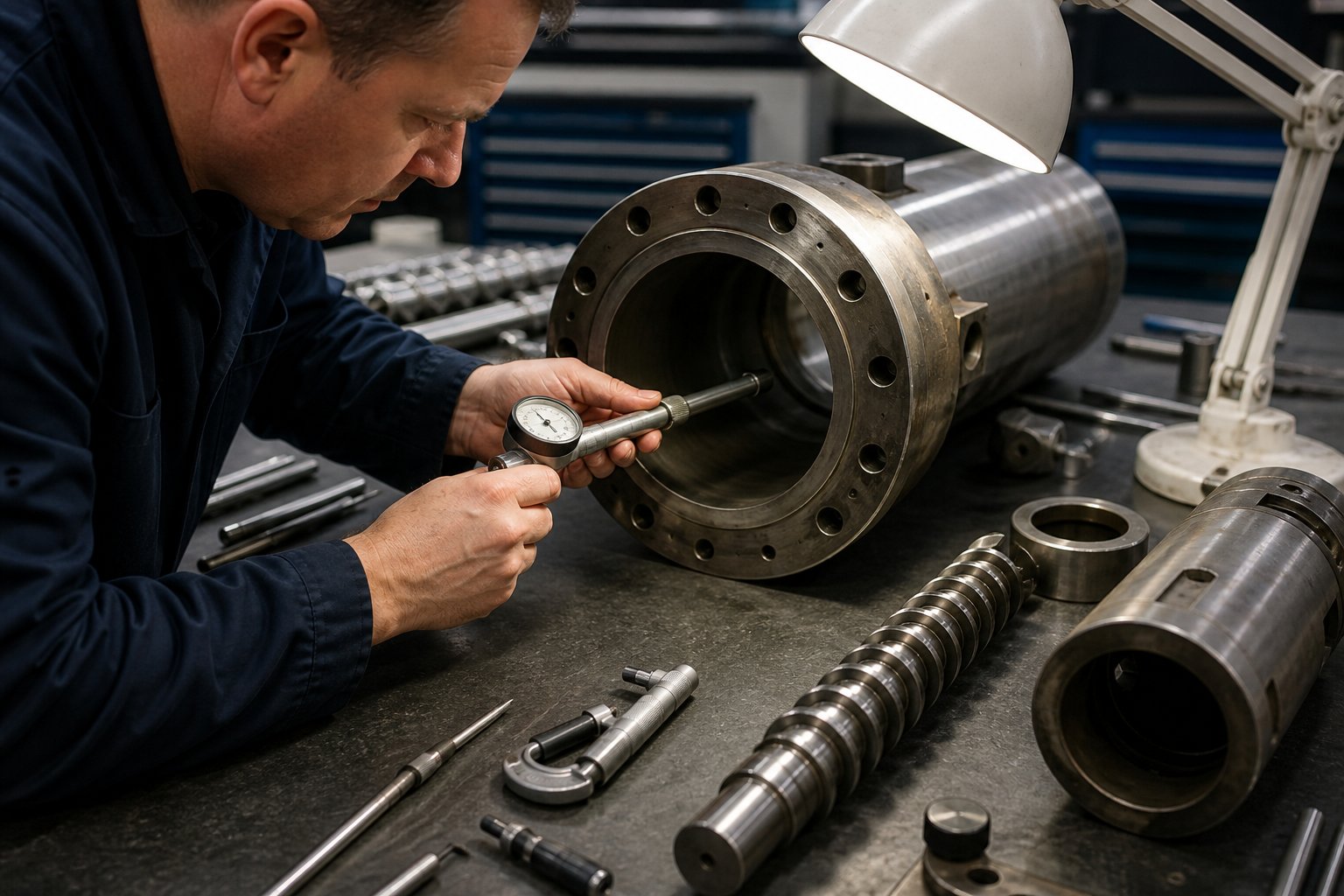
Barrel wear beyond tolerance. This is the single most common hidden deficiency in used extrusion equipment. As abrasive compounds cycle through the barrel over thousands of production hours, the bore diameter gradually increases. That dimensional change widens the clearance between screw flights and barrel wall, degrading pumping efficiency, reducing mixing quality, and dropping throughput below rated capacity. The insidious part? Barrel and screw wear can increase energy consumption, reduce output, and accelerate further equipment damage - yet nothing about the machine's external appearance reveals any of it. Only bore gauge measurements at multiple positions along the barrel length expose the truth.
Gearbox damage from overloading. A twin screw extruder gearbox endures tremendous sustained loads - particularly in counter-rotating machines, where opposing axial forces hammer thrust bearings from two directions simultaneously. Previous owners who routinely pushed throughput beyond design limits or processed materials exceeding the machine's torque rating leave behind micro-pitted gear teeth, fatigued thrust bearings, and worn shaft journals. These conditions may not produce obvious noise during a brief demonstration but will manifest as overheating, vibration, and eventual failure under sustained production loads.
Cracked barrel segments. Thermal cycling - repeated heating and cooling over years of operation - can fatigue barrel flange connections and even the barrel walls themselves. Hairline cracks at flange bolt holes or along heating zone transitions are difficult to spot visually, especially after a fresh coat of paint. Yet a cracked barrel segment under production pressure represents a genuine safety hazard, with molten polymer potentially escaping at temperatures exceeding 200 degrees Celsius.
Corroded cooling channels. Every barrel section contains internal cooling bores that circulate water or oil to regulate zone temperatures. Over time, especially in facilities with poor water treatment, these channels corrode internally, reducing cooling capacity and creating hot spots that the control system cannot compensate for. You cannot see this corrosion from the outside. You discover it when zone temperatures refuse to stabilize during your first production run.
Outdated or non-compliant electrical wiring. Rewiring is expensive, and many used machines arrive with wiring that no longer meets current electrical codes in the buyer's jurisdiction. Brittle insulation, undersized conductors, missing ground connections, and junction boxes that do not meet IP protection ratings are common in older equipment. These are not cosmetic concerns - they are safety liabilities that may require significant electrical work before the machine can legally operate.
The pattern across all of these problems is the same: cosmetic cleaning masks serious mechanical issues. A thorough pre-purchase inspection is not optional - it is the only barrier between you and these hidden costs.
Control System Obsolescence and Upgrade Costs
Imagine purchasing a mechanically sound used injection molding machine or twin screw extruder at an attractive price, only to discover that the PLC controlling the entire process was discontinued a decade ago and cannot be repaired, reprogrammed, or even connected to your plant network. This scenario plays out regularly in the used equipment market - and it applies equally to used injection moulding equipment, used injection molding equipment, and extrusion platforms.
Control system obsolescence is one of the most underestimated cost risks in used machinery purchases. Older extruders frequently carry early-generation PLCs with proprietary programming software that no longer runs on current operating systems. HMI panels may use discontinued touchscreen hardware that cannot be sourced for replacement. Industry specialists confirm that obsolescence is a key driver behind control upgrade requests - components that still function today may become impossible to service or replace when they eventually fail.
The financial implications extend well beyond the control hardware itself. A complete controls retrofit on an extruder - replacing the PLC, HMI, temperature controllers, and drive interface - can represent a substantial portion of the machine's purchase price. According to aftermarket control suppliers, even a streamlined retrofit solution for a single extruder can cost around $10,000 to $20,000, while comprehensive upgrades involving drives and motors carry higher price tags depending on scope.
Drive system technology adds another dimension. An estimated 60 to 70 percent of extruders ten years old or older still run on DC motors with SCR drives. DC technology is significantly less energy-efficient than modern AC systems - typically 10 to 15 percent less efficient during operation - and replacement SCR components grow scarcer each year. Converting from DC to AC drives and motors typically offers a two- to three-year payback period through energy savings alone, but that conversion cost must be budgeted from the start, not discovered after the purchase is finalized.
Before committing to any used machine, ask yourself a simple question: if this controller or drive fails six months after purchase, can I get it repaired or replaced quickly and affordably? If the answer requires tracking down obsolete components on surplus electronics markets, that risk should be reflected in either a lower purchase price or a pre-budgeted controls upgrade line item in your acquisition plan.
Your Pre-Purchase Inspection Checklist
A systematic inspection protocol protects you from the hidden problems described above. Skipping steps or rushing through the process under pressure from a seller is how buyers end up with machines that cost twice what they expected. Follow this sequence from start to finish:
- Barrel bore measurement: Use a telescoping bore gauge or internal micrometer at a minimum of five axial stations along the barrel length. Record readings at 0, 90, and 45 degrees at each station to detect ovality. Compare results against the OEM's original bore specifications - any location showing wear beyond 0.1 to 0.2 mm from nominal warrants further evaluation.
- Screw element inspection: Remove the screws if possible and inspect flight tip width, root diameter, and surface condition along the entire length. Look for cracking, corrosion, erosion patterns, and material buildup in flight roots. Counter-rotating screw sets must be evaluated as matched pairs - dimensional mismatch between screws causes accelerated wear and vibration.
- Gearbox oil analysis: Pull an oil sample or request the most recent analysis report. Elevated iron and copper particle counts indicate gear and bearing surface degradation. Water contamination above 200 ppm signals seal failure. Dark, oxidized oil with high acid numbers suggests the machine ran hot or missed oil change intervals.
- Motor insulation testing: Use a megohmmeter to measure motor winding insulation resistance. Readings below 1 megohm per kilovolt of rated voltage suggest moisture intrusion or insulation breakdown that risks motor failure under load.
- Control system evaluation: Power up the control system and verify that all zone temperature controllers, drive interfaces, and safety interlocks respond correctly. Check PLC model and firmware version against the manufacturer's current support status. Test the HMI for dead pixels, unresponsive touch zones, and communication errors with field devices.
- Safety system verification: Confirm that all emergency stop circuits function correctly, guard interlocks prevent operation with doors open, and safety relays have not been bypassed. Check for proper grounding, and verify that electrical enclosures carry the correct IP ratings for your operating environment.
- Documentation review: Request original OEM manuals, screw configuration records, maintenance logs, production hour records, and any barrel or gearbox measurement history. Missing documentation does not automatically disqualify a machine, but it increases your uncertainty and should influence your offer price downward.
- Production trial under load: If at all possible, run the machine with your material or a comparable formulation at 80 percent of rated capacity for a sustained period. Monitor output consistency, melt pressure stability, motor amperage, and gearbox temperature rise. A structured testing protocol recommends running for at least four hours, weighing output every 30 minutes, and flagging any variation exceeding plus or minus two percent.
The total cost of ownership for a used twin screw extruder includes not just the purchase price but also refurbishment, spare parts replacement, control system upgrades, shipping, rigging, installation, utility connections, and commissioning. Buyers who compare only the sticker price against new equipment quotes consistently underestimate their real investment.
A seller who welcomes this level of inspection signals confidence in the machine's condition. A seller who resists, rushes, or insists on "as-is" terms without allowing verification is asking you to absorb 100 percent of the condition risk. Treat that resistance as the most informative data point of the entire evaluation - it tells you more than any bore gauge reading ever could.
Regulatory and Compliance Verification
Mechanical and electrical condition are not the only risks hiding in a used equipment purchase. Regulatory compliance gaps can delay or prevent installation entirely - a scenario that stings especially hard when the machine is already on a flatbed truck headed to your facility.
CE marking. Within the European Economic Area, industrial machinery must carry CE marking - the manufacturer's declaration that the machine met applicable safety directives at the time of first market placement. Machines manufactured before the Machinery Directive took effect in 1995 may never have been CE-marked. Any machine that has undergone substantial modifications - a controls retrofit, structural alterations, or changes to safety systems - may have invalidated its original certification. When importing used equipment into the EU, the importer legally assumes the manufacturer's compliance responsibility and must ensure conformity before putting the machine into service.
Electrical safety standards. Different regions enforce different electrical codes. A second hand moulding machine or extruder built for a 480V/60Hz North American facility will require transformer and wiring modifications for 400V/50Hz European operation - and vice versa. Verify voltage, frequency, and phase configuration compatibility before purchase, and budget for any required electrical modifications.
Application-specific certifications. As discussed in the previous section, food-contact and pharmaceutical applications demand material certifications, surface finish standards, and traceability documentation that go far beyond general industrial machinery requirements. A used injection molding machine previously processing automotive components cannot simply be cleaned and repurposed for medical device production without extensive requalification and documentation.
The practical takeaway is straightforward: verify compliance status before you commit, not after delivery. A phone call to your local regulatory authority or a consultation with an equipment compliance specialist costs far less than discovering post-purchase that your machine requires a full conformity assessment before it can legally operate.
Knowing what can go wrong is essential. Equally important is understanding what it takes to fix the problems that fall within economically viable repair territory - because the line between a machine that needs refurbishment and a machine that deserves to be walked away from depends entirely on the quality and cost of the reconditioning process.
The Refurbishment Process and How to Judge Reconditioning Quality
A seller describes a used twin screw extruder as "fully reconditioned" - but what does that actually mean? In some cases, it means the machine was completely disassembled, every wear component was measured and replaced to factory tolerances, and the finished unit passed a documented production trial before relisting. In other cases, it means someone wiped down the exterior, applied fresh paint, and replaced a few heater bands. Both machines carry the same "reconditioned" label. The difference between them could be tens of thousands of dollars in unexpected repairs within your first year of ownership.
Distinguishing genuine reconditioning from cosmetic cleanup is one of the most valuable skills a used equipment buyer can develop. It requires understanding what a proper refurbishment involves step by step, what documentation should accompany the finished machine, and where to source the replacement components that make the entire process economically viable - especially for older or discontinued models where original manufacturer support has dried up.
What Professional Reconditioning Actually Includes
Think of a proper reconditioning as a full forensic rebuild. Every system on the machine gets disassembled, inspected, measured against original specifications, and either restored to tolerance or replaced. The scope is comprehensive, and skipping any step compromises the reliability of the finished product.
Here is what the process looks like when done correctly, in the logical order a professional rebuild shop follows from teardown through final testing:
- Complete disassembly and cleaning: The machine is fully stripped - barrel sections separated, screws removed, gearbox opened, motor disconnected, all electrical enclosures emptied. Every component is chemically cleaned, degreased, and prepared for inspection. This step alone reveals conditions that no external inspection can detect: hidden corrosion, hairline cracks at barrel flanges, and material buildup in cooling channels.
- Dimensional inspection and documentation: Critical components are measured against OEM specifications. Barrel bores are gauged at multiple axial stations. Screw element flight tips, root diameters, and spline fits are recorded. Gearbox shafts, bearings, and gear tooth profiles are inspected. All measurements are documented as "before" data - the baseline that justifies every subsequent decision about repair or replacement.
- Barrel reconditioning or replacement: Barrel repair methods depend on the severity of wear. Barrels with remaining nitrided layer can be bored and honed to a new diameter, with new screws manufactured to match. More heavily worn barrels may be re-lined with cast alloy at 1 to 2 mm thickness and then precision-machined to size. In cases where the homogenizing section has worn fastest - typically a 5 to 7D length section - that segment can be bored and fitted with a nitrided alloy steel bushing rather than replacing the entire barrel.
- Screw element replacement or repair: Worn screw elements can be restored through several methods. Thermal spraying with wear-resistant alloy followed by grinding to size offers a cost-effective option. For more severe wear, hardfacing with overlay alloy containing chromium, tungsten, cobalt, and boron compounds adds 1 to 2 mm of material and significantly improves wear and corrosion resistance. Hard chrome plating is another option, though the chrome layer can be prone to flaking under aggressive processing conditions. In many cases, full replacement of worn elements with new ones is the most economical long-term choice.
- Gearbox rebuild: Every shaft, gear set, bearing, and seal is inspected. Thrust bearings - particularly critical in counter-rotating machines - are measured for endplay and replaced if beyond tolerance. Gear teeth are checked for micro-pitting and surface fatigue. Oil seals and gaskets are replaced as standard practice. The reassembled gearbox is filled with fresh lubricant and run under no-load conditions to verify smooth operation before reinstallation.
- Motor evaluation and replacement: Motor winding insulation resistance is tested. Bearings are inspected for play and noise. For DC motors, brush wear and commutator condition are assessed. If rewinding is required, the cost-benefit analysis often favors replacing with a modern AC motor paired with a vector drive - a combination that delivers better efficiency, speed regulation, and long-term serviceability.
- Heater band and thermocouple replacement: All heater bands are tested for continuity, insulation resistance, and uniform heat output. Thermocouples are calibrated against reference standards. Degraded components are replaced entirely - this is not a place to economize, since inaccurate temperature control directly compromises product quality and can damage heat-sensitive polymers.
- Control system upgrade: Obsolete PLCs and HMI panels are replaced with current-production alternatives. Temperature controllers, drive interfaces, and communication protocols are updated to integrate with modern plant networks. All I/O points are tested under simulated and live conditions.
- Full safety system review: Emergency stop circuits, guard interlocks, overtemperature shutoffs, and motor overload protections are tested to current safety standards. Any bypassed or non-functional safety devices are restored. Electrical enclosures are verified for proper IP ratings and grounding.
- Test run and final documentation: The fully reassembled machine is run under load - ideally with production-representative material - for a sustained period. Output rates, melt pressure stability, zone temperature accuracy, motor amperage draw, and gearbox temperature are all recorded. The final documentation package includes before-and-after measurements, a complete list of replaced components, test run data, and updated compliance certificates.
That ten-step process is what genuine reconditioning looks like. It is thorough, time-consuming, and not cheap - but it produces a machine with documented, verifiable condition rather than a question mark wrapped in fresh paint.
How to Assess Reconditioning Quality
So how do you tell whether a "reconditioned" machine actually went through that process? The documentation tells the story. A properly reconditioned second hand twin screw extruder should come with a package that includes before-and-after dimensional measurements for barrels and screws, a detailed list of every replaced component with part numbers and material specifications, test run data showing stable performance under production conditions, and updated electrical and safety compliance certificates where applicable.
When that documentation is incomplete or absent, you should treat the machine's claimed condition with skepticism. Here are the red flags that suggest superficial reconditioning rather than genuine refurbishment:
- No before-and-after barrel bore measurements: If the reconditioning shop did not measure barrel wear before and after their work, they could not have made informed decisions about which components to replace. This is the most basic step in any legitimate rebuild.
- Fresh paint covering structural surfaces: Paint on barrel flanges, gearbox housings, and frame welds conceals cracks, corrosion, and repair marks. A professional reconditioning shop documents surface conditions photographically before any cosmetic work.
- Generic claims without specific component lists: "All wear parts replaced" means nothing without a parts manifest. Which screw elements were replaced? What material grade? Which barrel sections were re-lined versus retained? Vague language hides vague work.
- No test run data or only brief idle-run records: Running a machine for ten minutes at no load proves it turns on. It proves nothing about production capability, thermal stability, or mechanical soundness under sustained operation. Demand extended loaded test data.
- Mismatched or unbranded replacement components: Screw elements or barrel liners installed without material certification, hardness verification, or dimensional inspection reports may be substandard parts that wear prematurely - undermining the entire reconditioning investment within months.
- Seller refuses to identify the reconditioning shop: Reputable rebuild facilities stand behind their work. If the seller will not name who performed the reconditioning or provide contact information for verification, the claimed scope of work cannot be independently confirmed.
The economic logic behind reconditioning decisions also deserves careful thought. As industry experts advise, the decision to repair or replace worn screws and barrels should be analyzed from a total economic perspective. Simply comparing repair cost against replacement cost is only one dimension. You also need to consider the ratio of repair cost to expected post-repair service life versus the cost of new components relative to their expected service life. The option with the lower cost-per-operating-hour ratio is the genuinely economical choice - a calculation that sometimes favors replacement even when repair appears cheaper upfront.
Sourcing Quality Replacement Components
Every step of the reconditioning process described above depends on one critical factor: access to quality replacement parts. From screw elements and barrel liners to heater bands, thermocouples, die heads, and pelletizing blades, the components going into a rebuilt machine determine whether the refurbishment delivers years of reliable service or merely resets the clock on the same failure trajectory.
This is where reconditioning older or discontinued machine models hits its most practical obstacle. Twin screw extruders operate under high mechanical and thermal stress, and their modular design means a single machine can contain dozens of individual screw elements, multiple barrel segments, and numerous electrical components - all of which are subject to wear and eventual replacement. When the original manufacturer no longer stocks parts for your model, every worn component becomes a sourcing project.
OEM channels remain the first option when available. Major manufacturers like Coperion and Leistritz maintain parts inventories and engineering archives for many legacy models, though lead times can be extended and pricing typically reflects the premium positioning of the brand. For current-production models, OEM parts offer the advantage of guaranteed dimensional compatibility and documented material specifications.
For machines where OEM support has become limited, prohibitively expensive, or entirely unavailable, specialized aftermarket suppliers fill a critical gap. These companies manufacture replacement components - screw elements, barrel liners, shafts, heater bands, thermocouples, die heads, and more - based on original engineering drawings or reverse-engineered from worn samples. The process is straightforward: you provide the old part along with whatever dimensional data you have, and the supplier produces a functional replacement, often with the option to upgrade materials for extended service life in demanding applications.
Suppliers like NANHAIYA specialize in this exact capability, offering comprehensive extruder spare parts including screw-related components, heater bands, thermocouples, die heads, pelletizing blades, and custom parts manufactured from drawings or samples. This kind of aftermarket resource is particularly valuable when reconditioning older machines - a used plastic moulding machine or twin screw extruder from a discontinued product line may have decades of productive life remaining if quality replacement components can be sourced reliably. The ability to produce custom parts from physical samples eliminates the dependency on OEM documentation that may no longer exist, converting what would otherwise be an equipment write-off into a viable reconditioning project.
Regardless of whether you source through OEM channels, aftermarket specialists, or a combination of both, apply these principles to every component purchase:
- Request dimensional inspection reports: Any reputable supplier should provide measured dimensions for critical features - bore diameters, flight tip widths, spline profiles - confirming the part meets required tolerances before shipping.
- Specify material and hardness requirements explicitly: Do not assume the supplier will match original specifications unless you state them clearly. For barrels processing abrasive filled compounds, bimetallic liners offer superior wear resistance over standard nitrided surfaces. For screw elements, tool steel grades and surface treatments should match or exceed original specifications.
- Keep dimensioned drawings on file: After any reverse-engineering effort, retain the resulting drawings permanently. This converts future replacements from emergency sourcing projects into routine reorders - dramatically reducing lead times and costs for the life of the machine.
- Order counter-rotating screws as matched pairs: As noted in the inspection chapter, counter-rotating screw sets must maintain uniform intermeshing clearances along their entire length. Replacing one screw while retaining a worn partner creates dimensional mismatch that accelerates wear on both components and the barrel.
The quality of replacement parts flowing into a reconditioning project directly determines the quality of the machine that comes out. Cutting corners on component sourcing to save a few percentage points on the rebuild budget is a false economy that costs far more in premature wear, unplanned downtime, and repeat repairs. Investing in properly specified, dimensionally verified components from reliable suppliers is what transforms a used machine from a gamble into a genuine production asset.
A well-reconditioned machine is only half the equation, though. Getting that machine from the seller's floor to your production line - rigged, shipped, installed, connected, and commissioned - introduces its own set of challenges that many first-time used equipment buyers dramatically underestimate.
Logistics and Installation Planning for Used Heavy Machinery
Picture this: you have found the perfect second hand twin screw extruder, negotiated a fair price, completed a thorough inspection, and signed the purchase agreement. The hard part is over, right? Not even close. Between the moment you take ownership and the moment that machine produces its first kilogram of saleable product, a series of logistical and engineering challenges await - challenges that routinely blindside first-time used equipment buyers and inflate total project costs by 20 percent or more when poorly planned.
Moving a machine that weighs several tons, requires precise leveling, demands specific electrical and utility connections, and must integrate seamlessly with your existing upstream and downstream equipment is not a weekend project. It is an engineering exercise that deserves the same rigor you applied to the machine evaluation itself.
Rigging, Crating, and Shipping Considerations
A twin screw extruder - even a modest 50 mm laboratory-scale unit with its gearbox and motor - can weigh well over a ton. Production-scale machines with 75+ mm screws, heavy-duty gearboxes, and integrated base frames commonly tip the scales at several tons before you add auxiliary equipment like feeders, pelletizers, or control cabinets. That kind of weight demands specialized rigging from the very first lift.
Professional riggers use overhead cranes, gantry systems, or mobile crane trucks to lift the machine from its current position onto transport. Improper rigging - wrong sling angles, inadequate capacity, or lifting from non-designated points - can crack barrel flanges, bend feed section housings, or damage gearbox alignment in ways that do not become apparent until commissioning. Always insist on lifting from the manufacturer's designated lift points, which should be documented in the original installation manual. If the manual is missing, a qualified rigger can identify safe attachment points based on the machine's structural geometry.
Shipping options depend on distance, machine dimensions, and urgency. For domestic moves, flatbed trailers are the standard choice for complete extruder lines. Overwidth or overheight loads may require permits, pilot vehicles, and route surveys to avoid bridge clearance and road restriction issues. For international shipments, heavy equipment logistics specialists recommend planning three to six months ahead for complex cross-border moves - accounting for customs documentation, import duties, and potential inspection delays at the destination port.
Container shipping offers a more protected option for machines that fit within standard 20-foot or 40-foot container dimensions. Flat rack containers accommodate larger units that exceed standard height or width limits. Either way, proper crating is essential. Industrial-grade wooden crates with internal bracing, shock-absorbing cushioning, and VCI (vapor corrosion inhibitor) wrapping protect exposed machined surfaces from vibration damage and humidity during transit. Skimping on crating to save a few hundred dollars is a false economy when a single damaged barrel flange or bent feeder mounting bracket can cost thousands to repair or replace.
International buyers face additional layers of complexity. Customs documentation must accurately declare the machine's value, classification code, country of origin, and condition (used versus new, since duties may differ). Some countries impose import restrictions or require pre-shipment inspection certificates for used industrial machinery. Sorting these requirements out after the machine is loaded onto a vessel - rather than before - is a recipe for port storage fees and weeks of delay.
Site Preparation and Installation Requirements
While the machine is in transit, your facility needs to be ready to receive it. Skipping site preparation or treating it as an afterthought leads to the exact scenario every production manager dreads: a multi-ton extruder sitting on your loading dock with nowhere to go because the floor cannot support it, the electrical supply does not match, or the cooling water connections have not been plumbed.
Foundation and floor loading. Twin screw extruders generate significant static and dynamic loads. The static weight alone demands reinforced concrete capable of supporting the machine plus its ancillary equipment without deflection. Industry installation guidelines recommend floor load capacities of at least 5,000 kg per square meter for standard extrusion lines, with additional allowance for dynamic forces generated during operation. If your existing floor does not meet this threshold, reinforcement work - which can cost several thousand dollars depending on area and depth - needs to happen before the machine arrives, not after.
Leveling is equally critical. The machine's base frame must be shimmed and leveled to within tight tolerances - typically plus or minus 0.1 mm in both horizontal and vertical planes. Misalignment by even a small margin causes uneven screw loading, accelerated barrel wear, and inconsistent product quality. A laser level or precision machinist's level is required for this work; eyeballing it is not an option.
Electrical supply. This is where international purchases get complicated fast. A machine built for a 480V/60Hz North American facility will not simply plug into a 400V/50Hz European power grid. Voltage, frequency, and phase configuration must all match. If they do not, you are looking at transformer installation, motor rewinding or replacement, and drive system reconfiguration - costs that can easily reach several thousand dollars for a production-scale extruder. Even domestically, verify that your facility's electrical panel has sufficient amperage to handle the extruder's main drive motor, heater circuits, and auxiliary equipment simultaneously. Twin screw extruders with production-scale motors can draw 80 amps or more on three-phase supply.
Cooling water and compressed air. Every barrel section needs cooling capability, typically through circulating water at controlled temperature and flow rates. You will need a dedicated water supply circuit with adequate flow - 15 to 20 liters per minute is common for production-scale twin screw lines - along with a chiller or cooling tower if your facility water temperature is not reliably within the 15 to 25 degree Celsius range. Compressed air supplies pneumatic actuators for screen changers, diverter valves, and pelletizing systems. Ensure your compressor capacity and line sizing can handle the additional demand without starving other equipment on the same circuit.
Ventilation and exhaust. Extrusion processes generate heat and, depending on the material being processed, volatile fumes that must be managed. Adequate workshop ventilation - a minimum of 200 cubic meters per hour of airflow - protects operators and prevents heat buildup around the machine. For materials that release hazardous vapors, localized exhaust hoods at the die exit and vent ports may be required to comply with occupational health regulations.
Commissioning and Integration With Existing Lines
The machine is in place, bolted down, leveled, and connected to power, water, and air. The temptation to start feeding material immediately is strong - resist it. Commissioning is the systematic process of verifying that every system functions correctly before production begins, and skipping steps here risks damaging the equipment or producing off-spec product that wastes both material and time.
A structured commissioning sequence typically follows this progression:
- Mechanical alignment verification: Recheck leveling after anchor bolt torquing, since tightening bolts can shift the frame. Verify barrel centerline alignment with downstream equipment - die heads, cooling tanks, or pelletizers must be coaxial with the extruder output.
- Electrical testing: Power up the control system with the main drive locked out. Verify all zone temperature controllers heat to setpoint accurately, motor rotation direction is correct (jog briefly at low speed), and all sensors report within expected ranges. As commissioning guides emphasize, heating should be staged - bring barrels to an intermediate temperature first, hold for an extended soak period, then ramp to process temperature - rather than jumping directly to operating temperatures.
- Safety system validation: Test every emergency stop button, guard interlock, and overtemperature shutdown. Confirm that the machine cannot operate with safety guards removed or doors open. These tests are non-negotiable, and any bypassed safety circuits discovered during commissioning must be restored before proceeding.
- Initial no-load run: Run the screws at low speed (5 to 10 RPM) with no material and listen for abnormal sounds - grinding, squeaking, or rhythmic knocking that may indicate misalignment, insufficient lubrication, or loose fasteners. Monitor gearbox and motor temperatures for at least 30 minutes to establish baselines.
- Loaded production trial: Introduce material at low feed rates and gradually increase toward target throughput. Monitor melt pressure, motor amperage, zone temperatures, and output consistency throughout the ramp-up. This is where integration with your existing line is truly tested - does the feeder deliver material at consistent rates? Does the pelletizer or die head downstream accept the extruder's output without surging or backpressure issues?
Integration with existing upstream and downstream equipment is often the most time-consuming part of commissioning a used machine. Your gravimetric feeder may communicate on a different protocol than the extruder's control system. The pelletizer's speed control may need recalibration to match the new extruder's output characteristics. Even physical height differences between the extruder discharge and downstream equipment can require custom transition pieces or platform modifications. For complete production lines - whether for pipe extrusion, blown film extrusion machine setups, or thermoforming machines feed systems - every element in the chain must be synchronized for consistent operation.
Budget commissioning costs - including potential technician travel expenses, electrical contractor fees, and trial material waste - as a dedicated line item in your total acquisition cost. Buyers who treat commissioning as an afterthought routinely underestimate their real investment by thousands of dollars.
If the machine was purchased internationally or from a brand you have limited experience with, consider engaging a commissioning technician from the manufacturer or an independent specialist familiar with the platform. Their daily rate and travel expenses are a fraction of the cost of troubleshooting integration problems through trial and error on your own - and their experience can compress a two-week commissioning timeline into days.
With the machine installed, commissioned, and producing, the finish line might feel close. But the real return on your investment is determined not by the first production run - it is determined by how effectively you maintain the equipment, manage spare parts inventory, and plan for the inevitable component replacements that keep a used machine running at peak performance year after year.
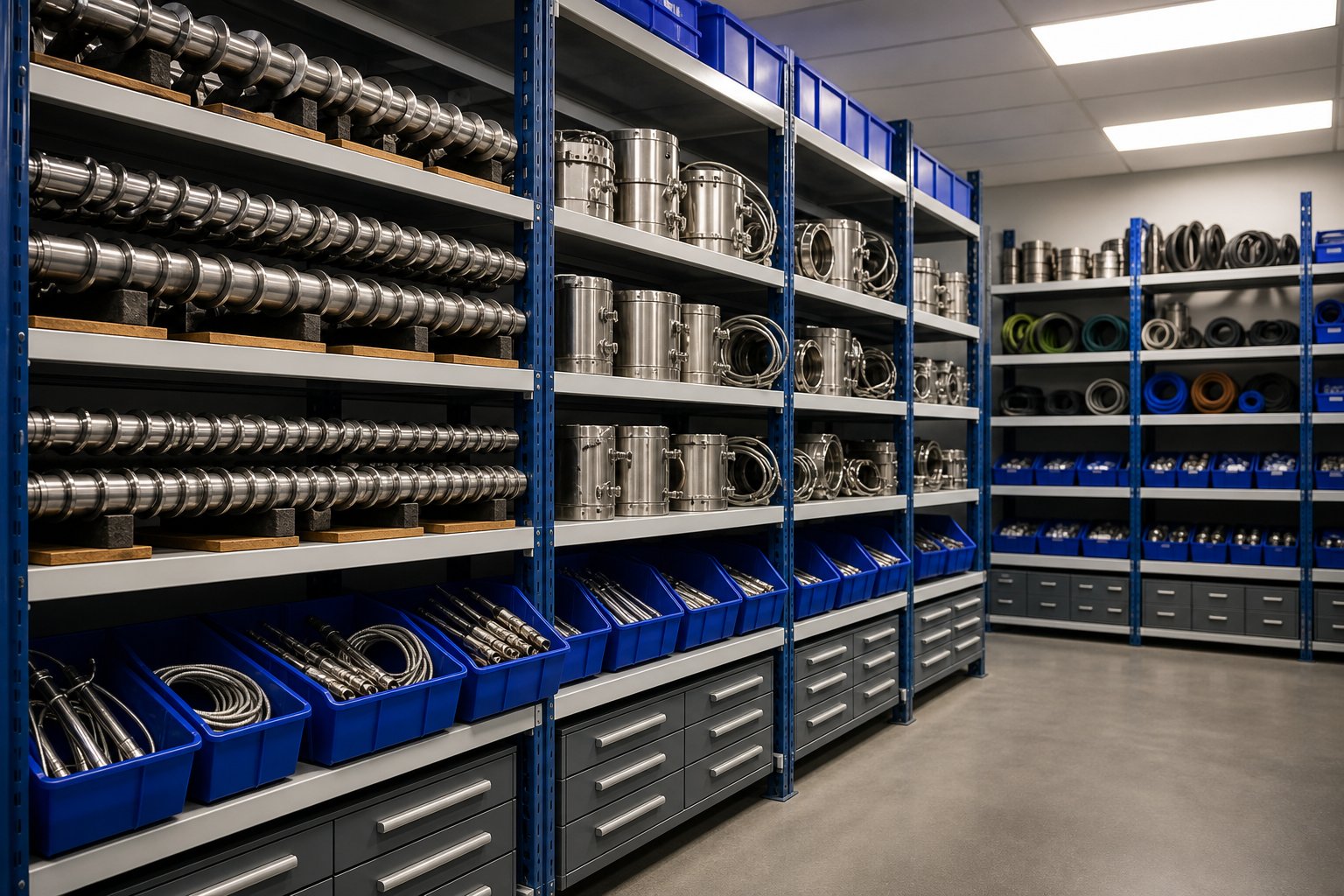
Long-Term Maintenance and Spare Parts Strategy for Used Extruders
The purchase price, refurbishment cost, shipping invoice, and commissioning expenses are behind you. Your second hand twin screw extruder is running, producing saleable product, and justifying the investment decision. So what separates buyers who extract a decade of reliable service from those who face cascading breakdowns within two years? Almost always, it comes down to two things: a disciplined preventive maintenance routine and a proactive spare parts strategy that keeps critical components on-site before they are desperately needed.
Used equipment does not come with the comfortable safety net of a full OEM warranty or a dedicated service contract. You are the warranty department now. And that responsibility, handled well, actually becomes a competitive advantage - because a thoughtfully maintained used machine can match or exceed the uptime of a poorly maintained new one at a fraction of the capital cost.
Preventive Maintenance Strategies That Extend Machine Life
Preventive maintenance is not about fixing things when they break. It is about catching small changes - a slight torque increase, a sluggish cooling zone, an oil sample with elevated metal particles - before they escalate into unplanned shutdowns that cost you production hours and emergency repair premiums.
The core principle is simple: watch trend drift before failure. When the same formula and same settings no longer produce the same torque, pressure, output, or pellet quality, the machine is sending a maintenance signal. Ignoring that signal does not save time - it converts a planned, controlled repair into an emergency scramble with far higher costs and far longer downtime.
A practical maintenance schedule should be structured around four tiers, each catching different categories of wear and degradation:
- Daily (every production shift): Check gearbox oil level and look for leakage. Confirm barrel heater response across all zones. Verify cooling water flow and valve status. Listen for abnormal sounds from the gearbox, drive, or barrel - grinding, rhythmic knocking, or squealing. Review pressure and torque readings against established baselines. Inspect feeder output consistency and hopper cleanliness. Check vacuum system performance if equipped. Record observations in a shift log with actual notes, not just checkmarks.
- Weekly: Inspect feeder calibration accuracy using gravimetric verification. Check vacuum pump oil condition and vent port cleanliness. Test heater band response times by observing how quickly each zone recovers from a deliberate temperature drop. Verify safety interlocks and emergency stop circuits. Inspect pelletizer blade sharpness and cutting quality. Review cooling water temperature differential across barrel zones.
- Monthly: Inspect screw elements for visible wear indicators if accessible through vent ports or by pulling screws on scheduled downtime. Check coupling alignment between motor, gearbox, and screw shafts. Verify sensor calibration for pressure transducers, thermocouples, and speed encoders. Inspect die components for wear, buildup, or corrosion. Review production data trends for gradual changes in specific energy consumption.
- Annually (or by accumulated production hours): Perform full barrel bore measurements at multiple axial stations and compare against baseline data. Pull and inspect all screw elements for flight tip wear, cracking, and corrosion. Conduct gearbox oil analysis for metal particle counts, water contamination, and acid number. Test motor winding insulation resistance. Flush and inspect cooling channels for scale buildup and flow restriction. Review the complete electrical system for insulation degradation, loose connections, and contactor wear. Update maintenance records with all measured data.
For lines processing abrasive materials - glass fiber compounds, mineral-filled formulations, or flame-retardant systems - shorten these intervals significantly. A line running 40 percent glass-fiber-reinforced nylon will wear barrel bores and screw flights far faster than one processing unfilled polyethylene. As maintenance specialists emphasize, the best interval should be adjusted by process history - if torque rises predictably after a certain number of hours under a specific formulation, that formulation deserves its own maintenance rule rather than being lumped into a generic calendar schedule.
One often-overlooked maintenance habit deserves special emphasis: tracking pellet quality as a diagnostic tool. Pellet defects frequently point back to upstream equipment conditions before other instruments detect a problem. Black specks signal screw residue or dead zones. Gels indicate poor melting or degraded material buildup. Size variation suggests pressure fluctuation or cutter wear. Yellowish discoloration points to temperature drift or extended residence time. Treating your pellet inspection as a frontline maintenance sensor - not just a quality control step - gives you an early warning system that complements your instrument readings.
Building a Strategic Spare Parts Inventory
Imagine this scenario: your extruder's main heater band on zone four fails at 2 AM during a critical production run. If you have a replacement heater band on the shelf, your maintenance technician swaps it out in under an hour and production resumes before the shift ends. If you do not, you are placing an emergency order, paying expedited shipping premiums, and losing days of production while waiting for delivery. Multiply that scenario across every wear component on the machine, and the value of a strategic spare parts inventory becomes unmistakable.
For used equipment owners, proactive parts stocking is even more important than for new machine operators. Why? Because your machine may be a model generation that the OEM no longer prioritizes in its parts inventory. Lead times that were once two weeks may have stretched to eight. Emergency availability that was once guaranteed may no longer exist. You cannot afford to be reactive when your supply chain is inherently less responsive than it would be for a current-production machine.
At minimum, keep these critical components on-site or pre-ordered with a confirmed supplier:
- Screw elements: Stock at least one complete set of the kneading blocks and conveying elements that occupy your highest-wear zones. For compounding applications with abrasive fillers, these elements may need replacement every 2,000 to 4,000 production hours.
- Barrel liners or replacement barrel segments: If your machine uses bimetallic barrel liners, keep the segment corresponding to the highest-wear zone - typically the mixing and metering sections - ready for swap-in.
- Heater bands: Stock one replacement for each barrel zone size. Heater bands fail unpredictably, and mismatched wattage or dimensions from a generic supplier can create temperature control problems.
- Thermocouples: Keep a minimum of two spares per type used on the machine. Thermocouple drift is a common cause of subtle process instability that operators chase for days before identifying the root cause.
- Seals and gaskets: Gearbox shaft seals, barrel flange gaskets, and cooling channel O-rings degrade over time and during every disassembly cycle. These are inexpensive components that cause expensive downtime when unavailable.
- Bearings: Gearbox output shaft bearings and thrust bearings are high-load components with finite service lives. Having replacements staged reduces gearbox rebuild downtime from weeks to days.
- Drive belts and couplings: If your machine uses belt-driven auxiliary equipment - feeders, pelletizers, or cooling fans - keep replacement belts in stock. Coupling elastomers for motor-to-gearbox connections should also be available.
- Pelletizer blades and die plates: For downstream equipment, dull blades produce inconsistent pellet geometry, and worn die plates affect strand quality. These are consumable items that should be rotated on a scheduled basis.
The financial logic is compelling. A $200 heater band sitting on your shelf for six months costs you virtually nothing in carrying expense. That same heater band, needed urgently when none is available, can cost you thousands in lost production, expedited freight, and overtime labor. Sourcing parts proactively - rather than reactively during breakdowns - is not just good practice. It is one of the highest-return investments a used equipment owner can make.
Partnering With Reliable Parts Suppliers
Building a spare parts inventory is only half the equation. The other half is establishing relationships with suppliers who can reliably deliver quality components - not just today, but five or ten years from now when your machine is another generation deeper into its service life and OEM support has thinned further.
Used equipment owners face a sourcing landscape with three broad categories of supplier, each offering distinct trade-offs. The right strategy for most operations is not choosing one exclusively but building a diversified supply chain that balances cost, quality, speed, and custom capability.
| Sourcing Factor | Aftermarket Specialist (e.g., NANHAIYA) | OEM Direct | Generic Supplier |
|---|---|---|---|
| Cost | Moderate - typically 30-60% below OEM pricing | Premium - highest price point reflects brand markup | Lowest - but quality variance can negate savings |
| Lead Time | Competitive - established manufacturing workflows for common components | Variable - fast for stocked items, extended for legacy models | Often fast for standard items, unpredictable for specialized parts |
| Quality Assurance | Strong - dimensional inspection reports and material certifications provided | Highest - guaranteed compatibility with original specifications | Inconsistent - ranges from acceptable to substandard without verification |
| Custom Capability | Excellent - can manufacture from drawings, samples, or reverse-engineered worn parts | Limited to catalog items for current models; legacy custom work is expensive | Minimal - typically limited to off-the-shelf standard dimensions |
| Availability for Older Models | Strong advantage - specializes in serving discontinued and legacy equipment | Declining over time as models age out of active support | Poor - rarely stocks specialized extrusion components for older platforms |
For owners of twin screw extruders for sale in the used converting equipment and used converting machinery market - or for those operating older machines acquired through those channels - the aftermarket specialist category deserves particular attention. These suppliers exist specifically because the gap between what OEMs offer for legacy equipment and what plant operators actually need has grown wide enough to support an entire industry segment.
NANHAIYA, for example, serves maintenance teams, machine rebuilders, and plant buyers with comprehensive replacement parts for extrusion and processing equipment. Their catalog spans screw-related components, heater bands, thermocouples, die heads, pelletizing blades, and custom parts manufactured from drawings or samples - covering essentially the full range of wear components that used extruder owners need to maintain. The ability to produce custom components from physical samples is especially valuable for older machines where original engineering drawings may have been lost and OEM part numbers have been discontinued. Rather than scrapping a mechanically sound machine because one critical component cannot be sourced, you send the worn part to a capable aftermarket supplier and receive a functional replacement manufactured to specification.
Regardless of which supplier categories you draw from, a few principles apply universally:
- Establish relationships before emergencies: Contact potential suppliers, request sample quotes, and verify their capability with a small initial order while your machine is running well. Discovering that a supplier cannot meet your tolerances during a breakdown is the worst possible timing.
- Maintain detailed component records: Keep a master file with part numbers, material specifications, dimensional drawings, and supplier contact information for every critical component on your machine. This file turns future reorders into routine transactions rather than research projects.
- Diversify your supply chain: Relying on a single supplier - whether OEM or aftermarket - creates a single point of failure. Qualify at least two sources for your highest-criticality components.
- Evaluate total cost, not unit price: A cheaper screw element that wears out in half the time costs more per operating hour than a premium one. As parts management specialists note, the decision between OEM and aftermarket parts comes down to squaring your priorities with your budget - factoring in how long a part will last alongside its initial cost.
A second hand twin screw extruder is not a disposable asset. With disciplined maintenance, strategic spare parts planning, and reliable supplier partnerships, these machines deliver years - sometimes decades - of productive service that more than justifies the initial investment. The sellers who moved the machine off their floor may not have told you everything about its condition. But the long-term value you extract from it? That is entirely in your hands.
Frequently Asked Questions About Second Hand Twin Screw Extruders
1. How much can I save buying a second hand twin screw extruder instead of new?
Used twin screw extruders typically cost a fraction of their original price because heavy industrial equipment experiences its steepest depreciation in the first few years. A lightly used machine - three to five years old with moderate production hours - may retain most of its mechanical capability while the first owner absorbs the biggest value drop. However, the real savings calculation must include refurbishment, control system upgrades, shipping, installation, and commissioning costs. Always check current marketplace listings for real-time pricing rather than relying on outdated estimates, and compare the total cost of ownership rather than just the sticker price.
2. What should I inspect before buying a used twin screw extruder?
A thorough pre-purchase inspection should cover barrel bore measurements at multiple axial stations to detect wear beyond tolerance, screw element flight tip and root diameter checks, gearbox oil analysis for metal particles indicating internal wear, motor winding insulation resistance testing, full control system evaluation for obsolescence risk, and safety system verification. Ideally, request a production trial under load for at least four hours using your target material or a comparable formulation. Ask for documented maintenance logs, production hour records, and any barrel measurement history. Sellers who resist detailed inspections are signaling a condition risk you should factor heavily into your decision.
3. Which twin screw extruder brands hold value best on the used market?
Premium European OEMs like Coperion (including legacy Werner and Pfleiderer machines) and Leistritz consistently command the highest resale values. Their strong global parts networks, well-documented engineering standards, and large installed bases make them easier to maintain, service, and eventually resell. KraussMaffei Berstorff and Bausano also hold value well in their respective niches. Asian manufacturers like Jwell offer lower acquisition costs but may depreciate more steeply and present different challenges around parts sourcing and regional service network coverage. Brand choice directly impacts long-term spare parts availability, so evaluate aftermarket support before committing.
4. How do I source spare parts for an older or discontinued twin screw extruder model?
When OEM support diminishes for legacy models, specialized aftermarket suppliers become essential. Companies like NANHAIYA (nhyscrews.com) manufacture replacement components including screw elements, barrel liners, heater bands, thermocouples, die heads, and pelletizing blades based on original drawings or reverse-engineered from worn samples. This capability is particularly valuable for discontinued machines where OEM part numbers no longer exist. Building relationships with aftermarket specialists before an emergency arises, maintaining detailed component records with dimensions and material specifications, and qualifying at least two supply sources for critical wear parts are best practices that dramatically reduce unplanned downtime and emergency sourcing costs.
5. What is the difference between a genuinely reconditioned used extruder and a cosmetically cleaned one?
Genuine reconditioning involves complete disassembly, dimensional inspection of all critical components against OEM specifications, barrel re-lining or replacement where wear exceeds tolerance, screw element replacement, gearbox rebuild with new bearings and seals, motor evaluation, heater and thermocouple replacement, control system upgrades, safety system restoration, and a documented production trial under load. A cosmetically cleaned machine may only have fresh paint and superficial tidying. Key red flags for superficial work include missing before-and-after bore measurements, no itemized replaced-component list, absence of extended loaded test data, and a seller who refuses to identify the reconditioning shop. Always demand the full documentation package before accepting any reconditioned claim.
Written by
Nanhaiya Technical Team
Zhoushan Nanhaiya Plastic Machinery Co., Ltd.
The Nanhaiya technical team supports screw and barrel manufacturing projects through application review, technical communication, custom manufacturing coordination, and production and quality control.
Discuss Your Application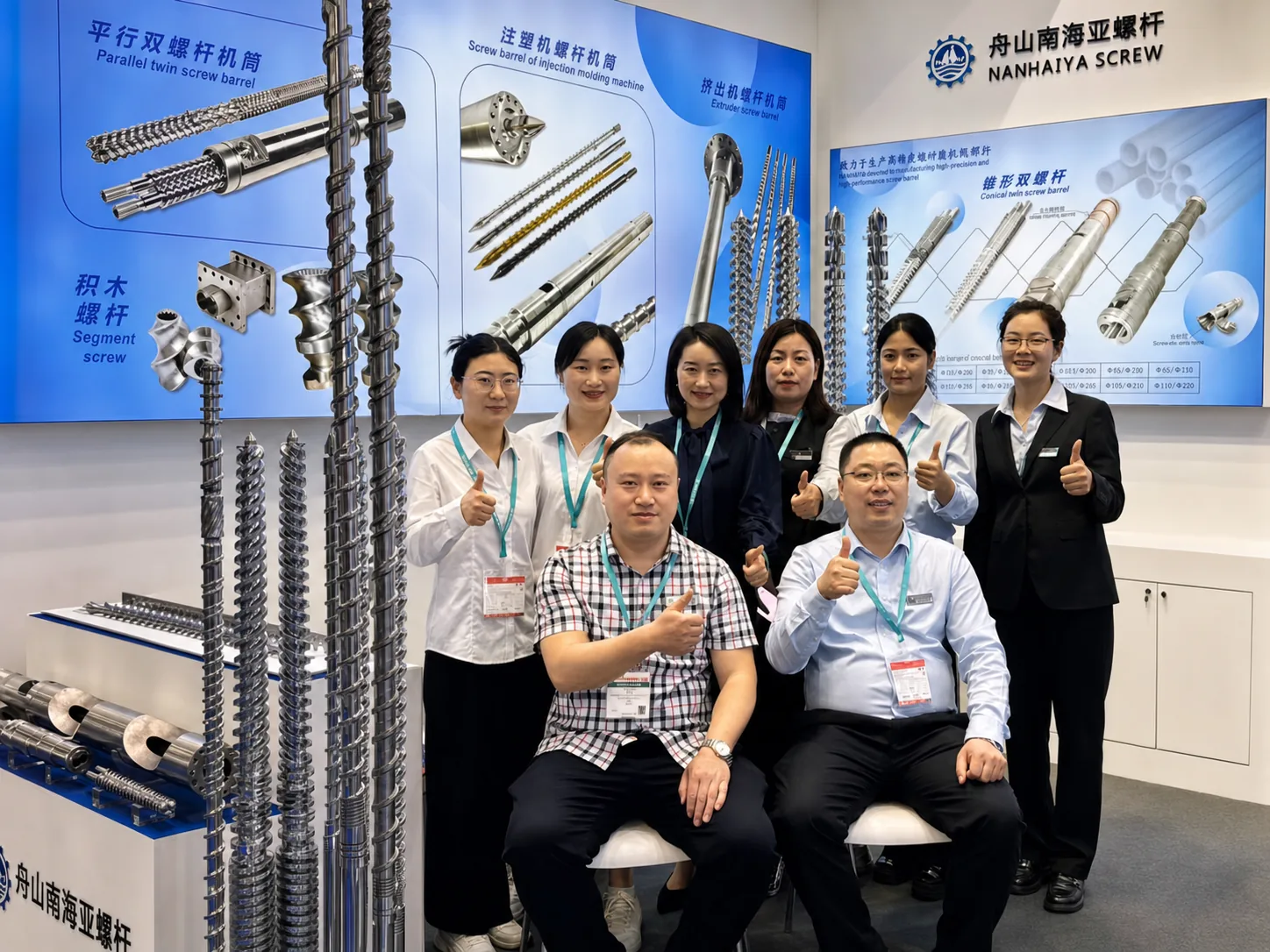
Related Articles
More insights on screw barrel technology and plastics processing.
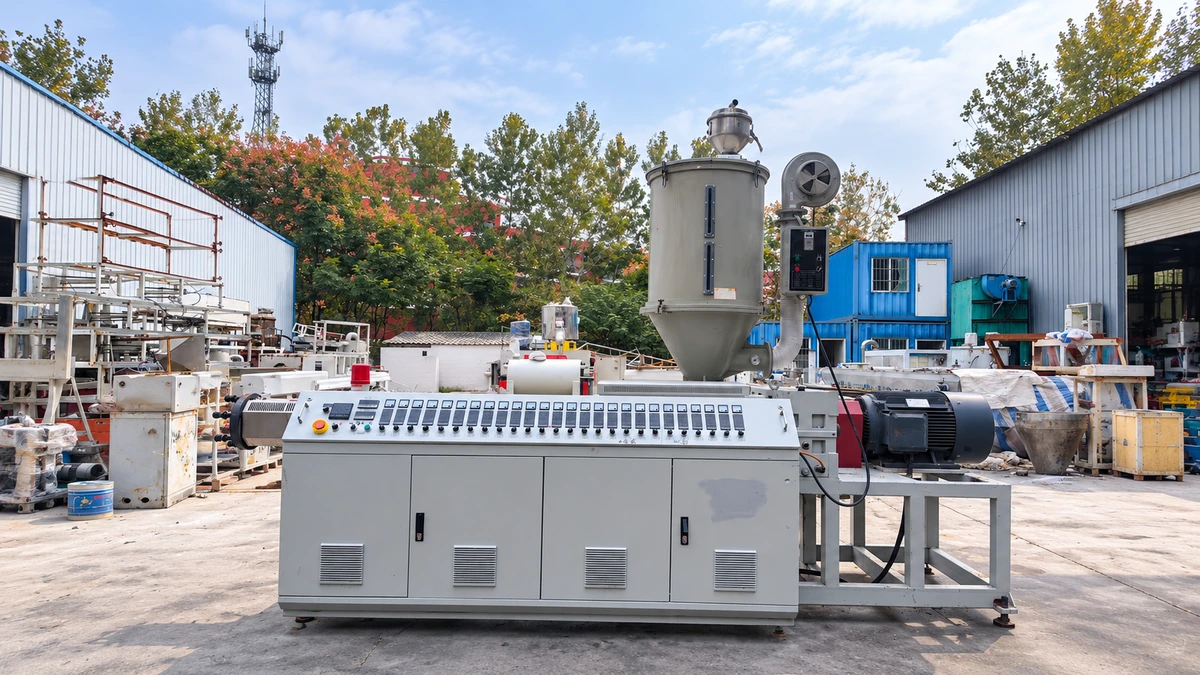
Single Screw Extruder Supplier Red Flags You Can't Afford To Miss
Oct 22, 2026
Learn how to evaluate a single screw extruder supplier with this buyer's guide covering pricing, screw and barrel tech, new vs used trade-offs, and red flags.
Read Article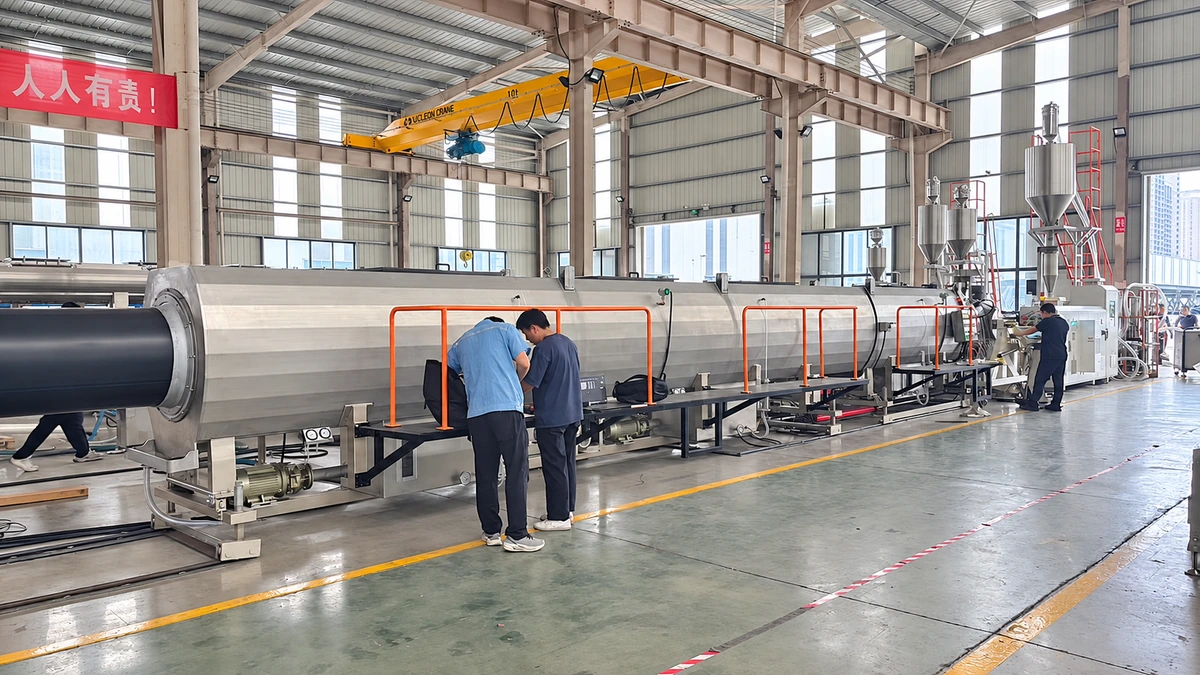
HDPE Pipe Making Machine Decoded: From Specs to Smart Purchase
Oct 15, 2026
Learn how HDPE pipe making machines work, from extruder specs and extrusion process steps to automation levels, maintenance costs, and smart buying tips.
Read Article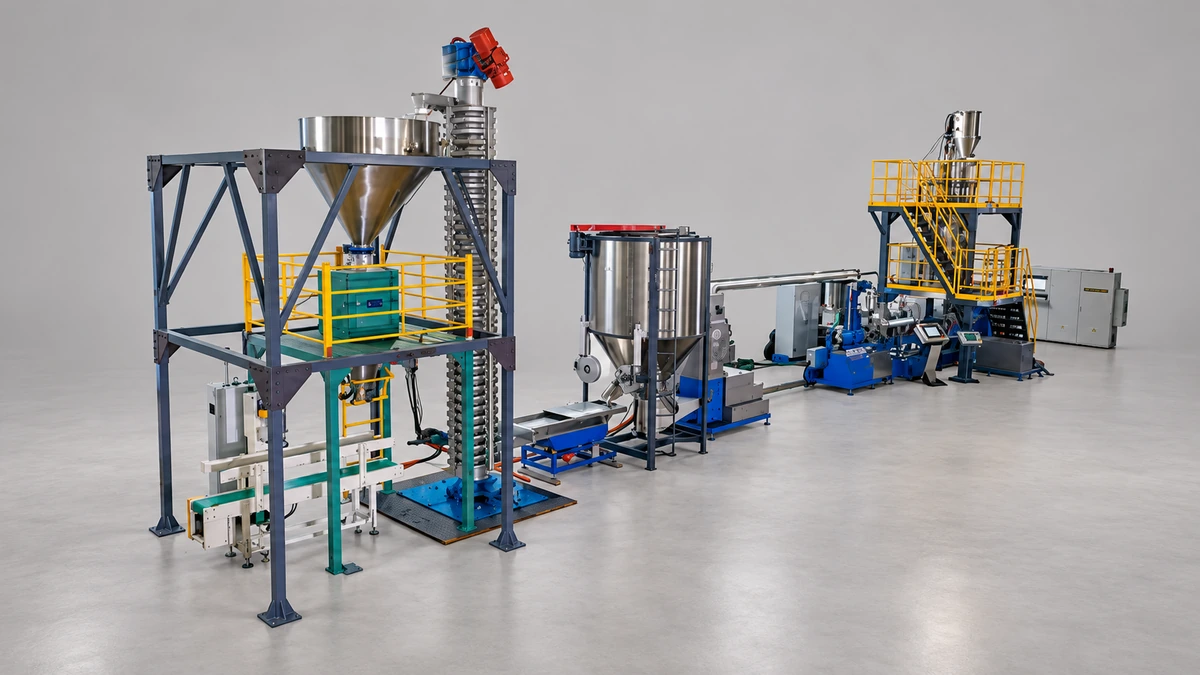
Pick the Wrong Plastic Pelletizing Line and You Pay Twice
Oct 14, 2026
Learn how to spec the right plastic pelletizing line for your resin, throughput, and budget. Covers strand, underwater, and air-cooled systems plus ROI planning.
Read ArticleLooking for something else?
Search by material, symptom or product and jump straight to the relevant page.
These are navigation suggestions based on keyword matching — not a quotation, not a delivery commitment, and not a substitute for engineering review. Final specification is confirmed by our engineers against your drawings and processed material.
Need help with screw barrel selection?
Share your machine model, processed material and application. Our team can help with pricing and technical support.