

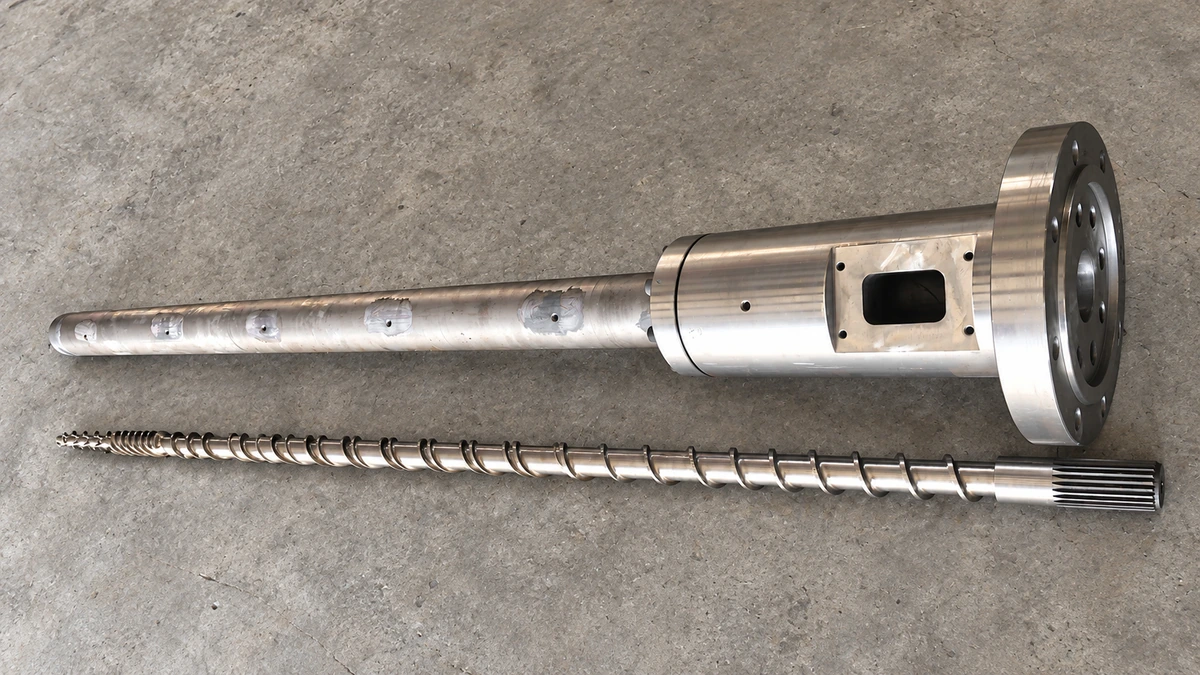
What a Screw Barrel Supplier Actually Provides
Imagine ordering a critical replacement part for your production line, only to discover weeks later that it bleeds throughput, spikes your scrap rate, and forces an unplanned shutdown. That scenario plays out more often than most processors care to admit — and it almost always traces back to one overlooked decision: who supplied the screw and barrel.
A screw barrel supplier does far more than ship metal components in a crate. The best ones deliver engineered plasticating solutions tailored to specific extrusion and injection molding operations. That means matching screw geometry, metallurgy, and surface treatments to the exact polymers, fillers, and production targets a facility runs every day. When you're evaluating vendors, you're really evaluating their ability to solve processing problems before those problems ever reach your shop floor.
The Role of Screws and Barrels in Plastics Processing
The screw and barrel form the plasticating core of every extruder and injection molding machine. Together, they perform three essential jobs: conveying solid polymer pellets forward, generating the heat and shear needed to melt them into a homogeneous mass, and metering that melt at consistent pressure through a die or into a mold cavity. As Plastics Technology notes, the original clearances between the barrel's inside diameter and the screw flight's outside diameter are typically just 0.001 in. per side per inch of diameter — tight tolerances engineered to maximize heat transfer and shear rate. Even small deviations from spec degrade melt quality, reduce output, and accelerate wear.
The screw and barrel are the heart of any plasticating system. The supplier behind them determines whether that heart beats reliably for years — or fails when you can least afford it.
Why Your Supplier Choice Matters More Than You Think
Poor screw design or substandard barrel materials don't just shorten component life. They trigger a cascade of hidden costs: operators nudge up screw speed, raise backpressure, and adjust barrel temperatures to compensate for declining melt quality. Those incremental tweaks consume more energy, extend cycle times, and often go unnoticed until part quality or production rates hit unacceptable levels. Research from industry sources suggests that wear or poor screw design alone can reduce throughput by over 20% while significantly increasing energy consumption. A reliable screw barrel supplier helps you avoid that downward spiral by specifying the right injection molding screws and barrels — or extrusion components — for your exact application from the start.
Who This Guide Is For
This guide is written for three audiences: plastic processors running production lines who need dependable replacement screws and barrels with minimal downtime, equipment manufacturers seeking consistent OEM-quality supply partnerships, and maintenance teams looking for rapid turnaround on worn or damaged components. Whether you're sourcing your first set of screws and barrels or re-evaluating an existing vendor relationship, you'll find a structured framework here that covers design parameters, materials and surface treatments, manufacturing processes, supplier evaluation criteria, pricing factors, and the red flags that signal a vendor isn't worth your purchase order. No competitor guide currently addresses all of these dimensions with any real depth — and that gap is exactly what this article fills.
Screw Barrel Design Parameters Every Buyer Should Understand
You don't need an engineering degree to vet a screw barrel supplier — but you do need to speak enough of the language to separate a knowledgeable partner from a glorified parts dealer. Three design parameters sit at the core of every screw and barrel conversation: L/D ratio, compression ratio, and zone geometry. Understanding what they mean, how they interact, and why they matter for your specific polymers gives you the leverage to ask pointed technical questions instead of nodding along while a sales rep reads from a catalog.
L/D Ratio and Its Impact on Melt Quality
L/D ratio — length-to-diameter ratio — describes how long the screw is relative to its diameter. A 90 mm screw that measures 2,160 mm in flighted length has a 24:1 L/D. Sounds simple, but this single number has an outsized effect on melt homogeneity and residence time.
A longer screw gives the polymer more time under heat and shear, which generally improves melt uniformity. As veteran extrusion engineer Allan Griff explains, "More length may mean more output if heating, melting, or mixing are output limits." The most common L/D for single-screw extruders lands around 24:1, but complex polymers, compounding operations, and vented degassing applications often push that to 30:1 or even 36:1. Shorter ratios — 20:1 to 22:1 — suit simple polyolefins that melt easily and don't require intensive mixing.
Here's the practical takeaway: when you tell a supplier what polymers you run and what output targets you need, the L/D ratio they recommend reveals whether they're engineering a solution or simply quoting stock. A credible vendor will explain why a specific ratio fits your process — and acknowledge trade-offs, like increased shear heat at higher L/D values that can degrade thermally sensitive resins.
Compression Ratio Explained in Plain Language
Compression ratio is the ratio of the volume of the first screw flight (in the feed zone) to the volume of the last flight (in the metering zone). On a constant-pitch screw, it's often simplified to the ratio of first-to-last channel depths, typically falling between 2:1 and 4:1.
Think of it this way: imagine the polymer pellets entering a funnel that gradually narrows. A high compression ratio — say 3.5:1 or 4:1 — squeezes the material aggressively, generating more frictional heat and faster melting. That works well for crystalline polyolefins like HDPE and PP that need significant energy input to melt. A low compression ratio — around 1.8:1 to 2.5:1 — applies gentler pressure, which is critical for heat-sensitive or shear-sensitive materials like PVC or certain engineering resins. Push a shear-sensitive polymer through a high-compression screw and you'll see degradation, discoloration, or worse.
One important nuance Griff highlights: compression ratio alone is "an indefinite number and cannot properly describe a screw unless at least one channel depth is known." A supplier who quotes only a compression ratio without specifying actual channel depths may be oversimplifying the design — or may not have the depth of knowledge your application demands.
Feed, Transition, and Metering Zone Geometry
Every standard plasticating screw divides into three functional zones, and each one plays a distinct role in transforming solid pellets into a uniform melt. Understanding this sequence helps you evaluate whether a supplier's screw design actually matches your processing goals — or whether they're offering a generic geometry that "works for most things."
- Feed zone: The deepest section of the screw channel, designed to accept solid pellets from the hopper and convey them forward. Channel depth here must be sufficient to handle the bulk density of your resin without starving the screw or causing inconsistent intake.
- Transition (compression) zone: The channel gradually becomes shallower, compressing the polymer bed. This compression expels trapped air between pellets and generates the frictional heat that initiates melting. The taper rate — how quickly the channel depth decreases — directly affects how smoothly the polymer transitions from solid to melt.
- Metering zone: A constant, shallow channel depth that stabilizes the now-molten polymer at uniform pressure and temperature before it exits through the die or enters the mold. As Aprios notes, this zone "stabilizes and homogenizes the melt," and its design directly influences shot-to-shot or meter-to-meter consistency.
Advanced screw designs layer additional features on top of this basic three-zone architecture. Barrier screws, for instance, add a secondary flight in the transition zone that physically separates unmelted solids from the melt pool — boosting melting efficiency by 15-25% in high-output HDPE and PP applications. Maddock mixing sections, mixing pins, and wave geometries further refine melt homogeneity. A screw manufacturing machine capable of cutting these complex geometries with tight tolerances is essential, and not every supplier's screw production machine is up to the task. When a vendor claims to offer barrier or mixing screw designs, ask about the specific screw making machine and CNC capabilities behind those claims.
| Design Parameter | Definition | Typical Range | Processing Impact |
|---|---|---|---|
| L/D Ratio | Flighted screw length divided by screw diameter | 20:1 to 36:1 | Higher ratios improve melt homogeneity and mixing; lower ratios suit simple polymers with gentle processing needs |
| Compression Ratio | Feed zone channel depth divided by metering zone channel depth | 1.8:1 to 4.5:1 | Higher ratios increase shear and melting speed for crystalline resins; lower ratios protect heat-sensitive materials from degradation |
| Feed Zone Depth | Channel depth in the intake section of the screw | Varies by diameter and resin bulk density | Must accommodate pellet size and bulk density to ensure consistent solid conveying without bridging |
| Transition Zone Taper | Rate of channel depth reduction from feed to metering | Gradual to aggressive (application-dependent) | Controls melting rate and pressure buildup; too aggressive a taper can cause surging or premature wear |
| Metering Zone Depth | Constant shallow channel depth in the final screw section | Determined by compression ratio and output target | Governs melt pressure stability, temperature uniformity, and output consistency at the die or nozzle |
| Flight Width | Thickness of the screw flight land | ~10% of barrel diameter | Wider flights waste screw length and generate excess heat; narrower flights increase leakage flow over the clearance |
| Screw-to-Barrel Clearance | Gap between screw flight OD and barrel bore ID | 0.05 - 0.25 mm (size-dependent) | Tighter clearance maximizes pumping efficiency; excessive clearance from wear reduces output and melt quality |
This table gives you a scannable reference to carry into any supplier conversation. A vendor who can walk through each parameter, explain how their recommended values map to your specific polymer and throughput targets, and justify trade-offs is demonstrating real engineering capability. One who deflects these questions or offers only standard catalog geometries may lack the technical depth your operation requires.
Design parameters, though, only tell half the story. The materials and surface treatments applied to those precisely machined geometries determine whether a screw and barrel will hold their tolerances for years of production — or wear out in months under the wrong conditions.
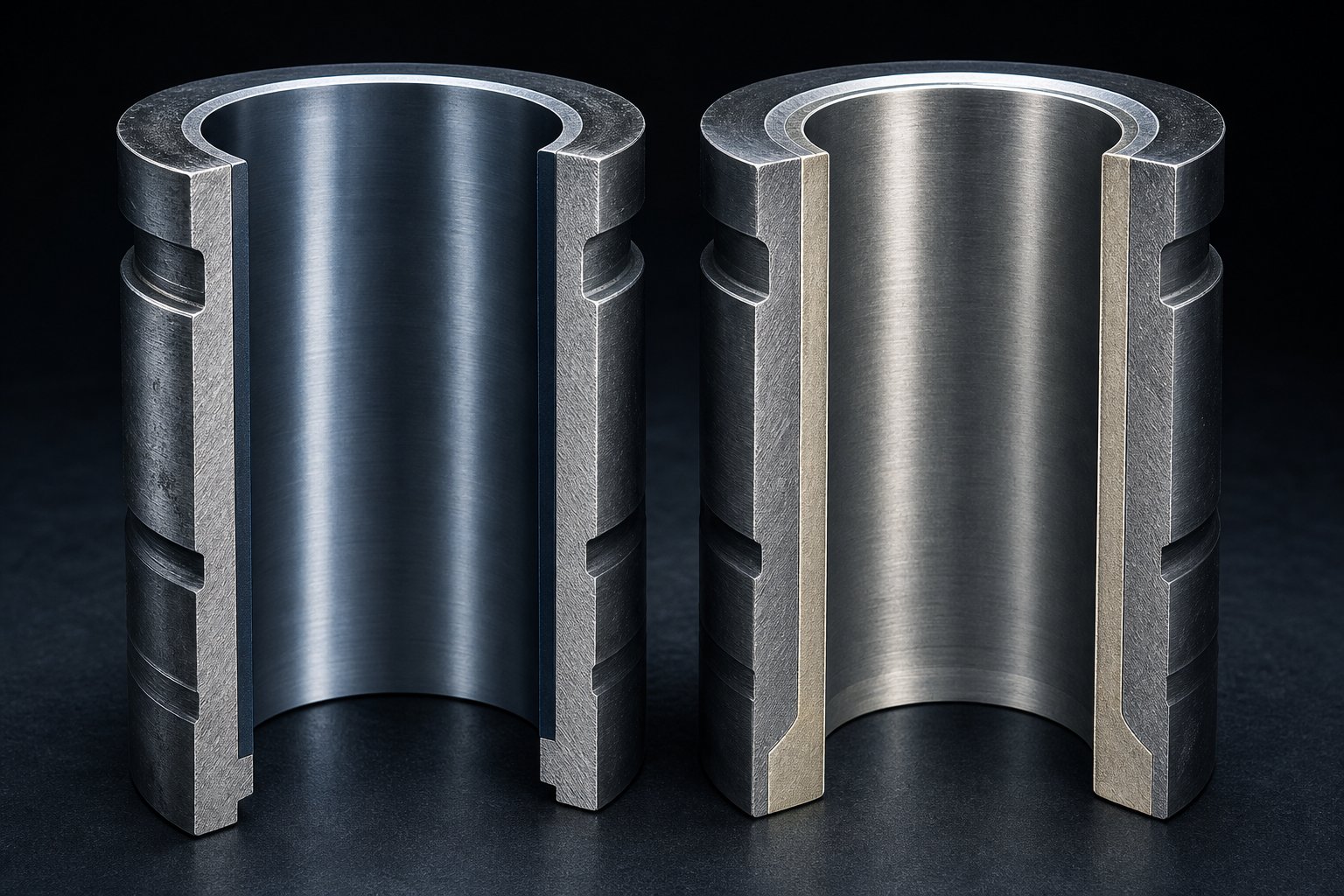
Screw Barrel Materials and Surface Treatments Compared
A perfectly machined screw geometry means nothing if the metallurgy underneath can't survive what your polymer throws at it. Glass fiber acts like sandpaper. PVC releases hydrochloric acid as it degrades. Recycled feedstock carries metal fines and grit. The material and surface treatment on your screw and barrel determine whether those components hold tight tolerances for years — or erode to the point of uselessness in a matter of months. Yet this is the exact area where most buyers accept vague claims at face value, and where a knowledgeable screw barrel supplier separates itself from the pack.
Nitrided Steel and What Nitriding Depth Really Means
Nitriding is the most common and most economical surface treatment in the industry. The process works by diffusing nitrogen atoms into the surface of a specially selected steel — typically a nitriding-grade alloy like 38CrMoAlA (DIN 1.8509), 34CrAlNi7, or 31CrMoV9 — at elevated temperatures. The nitrogen reacts with aluminum, chromium, and other alloying elements in the steel to form a hard nitride case on the surface without adding a separate layer of different material.
Two numbers tell you whether a nitriding job was done properly: nitriding depth and surface hardness. Nitriding depth — formally known as nitriding hardness depth (NHD) per DIN 50190-3 — measures how far the hardened case extends into the steel. On a typical screw or barrel, that case runs roughly 0.4 to 0.7 mm deep. Surface hardness, measured in Vickers (HV) or converted to Rockwell C (HRC), indicates how resistant that case is to mechanical wear — quality nitriding on 38CrMoAlA typically achieves 900 to 1,100 HV at the surface.
Here's the practical catch most buyers miss: that hardened case is thin. For clean, unfilled polymers like natural PP, PE, PS, or ABS, nitriding delivers reliable service life at a fraction of the cost of more advanced treatments. But the moment you introduce abrasive fillers — glass fiber, talc, calcium carbonate, mineral reinforcement — those hard particles start cutting through the case. Once the nitrided layer wears through, the softer core steel underneath erodes rapidly. Corrosive chemistry, such as HCl released during PVC processing, similarly overwhelms a nitrided surface. That boundary is exactly where bimetallic construction takes over.
Bimetallic Barrels and Alloy Types Compared
"Bimetallic" simply means two metals: a structural base steel body, plus a wear- and corrosion-resistant alloy layer metallurgically bonded to the working surfaces. The barrel and screw get their protective layers through different processes — a distinction worth understanding when you're comparing vendors.
On the barrel, the alloy is applied by centrifugal casting. Molten alloy is poured into the barrel bore while the barrel spins at high speed, forcing the alloy outward against the bore wall to form a dense, even lining roughly 2.0 to 3.0 mm thick. That's three to seven times thicker than a nitrided case, which is precisely why bimetallic barrels outlast nitrided ones under abrasive or corrosive conditions.
On the screw, a hardfacing alloy is deposited onto the flight lands by PTA (plasma transferred arc) welding, building a layer about 1.0 to 1.5 mm thick that is then machined back to final geometry.
The alloy chemistry is where the real selection happens, and it breaks into three families:
- Fe-based (iron-based) alloys: The general-purpose wear grade. High hardness (HRC 58–62), strong abrasion resistance, and moderate temperature tolerance up to around 400°C. These are the workhorse linings for applications where mechanical wear dominates and corrosion isn't the primary threat — think mineral-filled polyolefins or moderately abrasive compounds.
- Ni-based (nickel-based) alloys: These shift the balance toward corrosion resistance. Nickel-chromium-cobalt-boron compositions trade some anti-wear performance for superior resistance to chemical attack, handling temperatures up to 450°C. They're the go-to for PVC processing, chemically aggressive melts, and mixed-duty applications where both corrosion and wear are present. Adding vanadium to the nickel base creates balanced grades that handle uncertain or variable feedstocks.
- Co-based (cobalt-based) alloys and tungsten-carbide-loaded grades: Cobalt-based alloys like the Stellite family offer good wear resistance at elevated temperatures and some corrosion resistance, often used for metal-to-metal wear situations. Tungsten-carbide-loaded alloys — whether in the barrel lining or as screw hardfacing (such as Colmonoy 83, a Ni+WC+Cr+C composition) — deliver the highest abrasion resistance available. These premium grades tolerate temperatures up to 600°C and are specified for the most demanding jobs: heavy glass-fiber loading, high mineral filler content, and contaminated recycled feedstock.
A critical point about tungsten-carbide-bearing alloys: their bulk hardness numbers (HRC 50–55 for Colmonoy 83) can actually look lower than simpler alloys. That surprises buyers who equate hardness with wear resistance. The embedded carbide particles do the heavy abrasion-fighting work, not the matrix hardness alone. A supplier who understands this distinction demonstrates real metallurgical knowledge.
Surface Treatments for Specialized Applications
Beyond nitriding and bimetallic construction, two additional treatments cover niche but important needs:
- Hard chrome plating: An electroplated layer offering good corrosion resistance and low friction, making it a common choice for PVC screws where chemical attack from hydrochloric acid is the dominant threat. Chrome's limitation is thickness — it's a thin coating with limited abrasion resistance, so it fails on heavily filled or glass-reinforced materials. For moderate corrosion without heavy filler, chrome is cost-effective. Double or triple plating builds a thicker protective layer for more aggressive chemistry.
- Tungsten carbide coatings (HVOF or spray-applied): Applied as a surface coating rather than a metallurgically bonded layer, these provide extreme surface hardness for wear-intensive applications. They're a wear specialist, not a corrosion specialist — a distinction that trips up buyers who assume the most expensive option covers every threat.
The table below puts all of these options side by side so you can match material and treatment to your specific processing conditions:
| Material / Treatment | Wear Resistance | Corrosion Resistance | Best Applications | Relative Cost | Expected Lifespan Range |
|---|---|---|---|---|---|
| Nitrided steel (e.g., 38CrMoAlA) | Moderate | Moderate | Clean, unfilled polymers (PP, PE, PS, ABS) | Lowest | Baseline — adequate for non-abrasive duty; shortest life under filled or corrosive resins |
| Bimetallic, Fe-based alloy | High | Low–Moderate | Mineral-filled compounds, moderately abrasive resins | Medium | 2–3x nitrided life under abrasive conditions |
| Bimetallic, Ni-based alloy | Moderate–High | High | PVC, corrosive resins, mixed abrasive + corrosive duty | Medium–High | Significantly longer than nitrided under corrosive chemistry |
| Bimetallic, WC-loaded (tungsten carbide) | Highest | Moderate–High | Glass-fiber-filled nylon, heavy mineral loading, recycled feedstock with contaminants | High | Longest service life under severe abrasion; handles temperatures up to ~600°C |
| Hard chrome plating | Low–Moderate | Good | Unfilled or lightly filled PVC, food-grade processing requiring low friction | Low | Adequate under corrosive-but-not-abrasive conditions; thin layer limits rebuild life |
| Tungsten carbide coating (HVOF) | Highest | Low (alone) | Extreme abrasion — heavy glass-fiber, high mineral filler | High | Longest wear life in abrasive-only applications; does not address corrosion without pairing |
| Hardfacing — Ni-based (Colmonoy 56) | High | Good | Mildly corrosive + abrasive resins; rebuildable screw flights | Medium | Re-weldable — multiple rebuilds possible, extending total service life |
| Hardfacing — WC-loaded (Colmonoy 83) | Highest | Good | Glass-filled nylon, severe abrasion on screw flights | Medium–High | Top-tier flight wear resistance; re-weldable for rebuilds |
One pattern jumps out from this table: no single treatment wins on every axis. A treatment that fights corrosion doesn't necessarily fight wear, and vice versa. Tungsten carbide is the abrasion champion but won't stop acidic pitting on its own. Chrome handles corrosion beautifully but gets ground through by glass fiber. The most demanding applications — heavily filled PVC, contaminated recycled feed — often require a combination: a bimetallic barrel with a corrosion-resistant lining paired with a hardfaced or chrome-plated screw.
Ask any prospective supplier to specify exact alloy compositions and treatment specifications in writing. A vendor who claims "bimetallic" without identifying the alloy family, hardness values, and lining thickness is asking you to buy on trust — and trust without documentation is how processors end up replacing components far ahead of schedule.
Knowing what materials and treatments belong on your screws and barrels is essential. Equally important is understanding how those components are actually manufactured — because the same alloy specification can produce wildly different results depending on whether it's processed by a supplier with rigorous quality control or one cutting corners at every stage.
How Quality Screw Barrels Are Manufactured
Two barrels sitting side by side on a shipping pallet can look nearly identical — same diameter, same length, same polished finish. Yet one might deliver three years of reliable production while the other wears out in nine months. The difference isn't visible to the naked eye. It lives inside the manufacturing process: how the raw steel was selected, how it was forged and machined, how precisely the heat treatment was controlled, and how rigorously every dimension was inspected before the component left the factory floor.
Understanding this production sequence gives you a powerful tool for evaluating any screw barrel supplier. When you know what each step should look like, you can ask targeted questions that expose whether a vendor controls quality at every stage — or cuts corners where they think buyers won't notice.
From Raw Material to Finished Component
The journey from a block of alloy steel to a finished screw or barrel follows a defined sequence. Each step builds on the previous one, and skipping or rushing any stage compromises the final product. Here's the full production flow used by credible manufacturers:
- Raw material selection and traceability: Everything starts with the steel. Quality manufacturers source premium-grade nitriding alloys — 38CrMoAlA, EN41B (DIN 1.8509), or equivalent grades — from certified suppliers who provide chemical composition certificates and mechanical property test reports. This traceability matters because even slight variations in aluminum or chromium content affect how well the steel responds to nitriding later. Budget operators often skip material certification entirely, buying whatever bar stock is cheapest on the open market.
- Pre-heat treatment (quenching and tempering): Before any machining begins, the raw steel undergoes quenching and tempering — sometimes called T-conditioning — to establish the core mechanical strength. As industry guidance emphasizes, this step is "necessary to ensure strength, because it is strength + hardness which works against wear resistance, and alone hardness" from gas nitriding is not enough. Skipping or improperly controlling this pre-treatment produces a barrel that's hard on the surface but structurally weak underneath — a recipe for premature failure under processing loads.
- Forging or bar stock preparation: The steel is either forged from billet or cut from bar stock into rough cylindrical blanks oversized for the final dimensions. Forging improves grain flow and internal structure, yielding better fatigue resistance and durability compared to simple bar stock. The rough blanks are turned to approximate dimensions, leaving sufficient material for precision machining later.
- Deep hole drilling and gun drilling (barrels): Barrel bores require specialized deep hole or gun drilling equipment capable of holding bore tolerances within microns over lengths that can exceed two meters. Concentricity at this stage is critical — if the bore drifts off-center, no amount of downstream correction can fix it. This is one of the steps most vulnerable to quality shortcuts, because proper gun drilling machines represent a significant capital investment that budget shops often lack.
- CNC machining of screw flights and barrel profiles: CNC lathes, milling centers, and thread-cutting equipment shape the screw's flight geometry — feed zone depths, transition tapers, metering channels, and any barrier or mixing sections — to precise tolerances. Custom screw machining for complex geometries like barrier flights or wave sections demands multi-axis CNC capability and experienced programmers. On barrels, the bore is machined to its final inside diameter, and external features like feed ports, thermocouple holes, and mounting surfaces are cut. Quality manufacturers hold flight depth accuracy to ±0.01 mm at this stage.
- Nitriding or bimetallic centrifugal casting: This is where the surface protection discussed in the previous chapter gets applied. Gas nitriding diffuses nitrogen into the steel surface to build a hard case of 900–1,100 HV. Alternatively, bimetallic barrels undergo centrifugal casting — molten alloy is poured into the spinning barrel bore, forming a dense protective lining. Bimetallic screws receive hardfacing via PTA welding on the flight lands. The quality of this step depends heavily on process control: furnace temperature uniformity during nitriding, spin speed and alloy temperature during centrifugal casting, and welding parameters during hardfacing.
- Precision grinding and honing: After heat treatment or bimetallic application, components undergo final grinding to hit exact dimensional targets. Barrel bores are honed to achieve surface finishes in the Ra 0.3–0.5 µm range. Screw flight outer diameters are ground to establish the correct clearance with the barrel bore — typically 0.05 to 0.25 mm depending on diameter. This grinding stage also corrects any minor distortion introduced by heat treatment. Advanced machine products and finishing equipment at this step distinguish a premium operation from a shop relying on manual methods.
- Polishing and surface finishing: Screw surfaces undergo manual and machine polishing to remove micro-burrs and machining marks, achieving finishes as smooth as Ra 0.2–0.4 µm. This isn't cosmetic — smoother surfaces reduce friction, improve melt flow, and resist material buildup that can cause degradation spots in heat-sensitive polymers.
- Quality inspection and documentation: Every finished component goes through dimensional verification, hardness testing, and concentricity measurement before release. Inspection reports and test certificates ship with the parts.
Critical Quality Control Checkpoints
Not every step in that sequence carries equal risk. Certain checkpoints function as gatekeepers — if quality breaks down at these points, the final product will underperform regardless of how well everything else was executed. Here's where to focus your questions when evaluating a supplier's process:
- Incoming material verification: Does the supplier test raw steel against the mill certificate, or do they accept the certificate at face value? Reputable manufacturers run independent chemical analysis and mechanical testing — including hardness and tensile strength — before any material enters production.
- Bore concentricity after drilling: Coordinate measuring machines (CMMs) and bore gauges should verify that the barrel bore runs true along its full length. Even a few hundredths of a millimeter of drift will cause uneven wear and inconsistent melt quality.
- Hardness verification after heat treatment: Vickers or Rockwell hardness tests at multiple points along the treated surface confirm that nitriding or bimetallic processes achieved uniform case depth and hardness. A single spot-check at one end isn't sufficient — hardness can vary along the length if furnace conditions or casting parameters weren't controlled tightly.
- Final dimensional inspection: Quality-focused manufacturers use CMMs, profile projectors, and ultrasonic flaw detection to verify every critical dimension against the engineering drawing. They also check concentricity, parallelism (especially for twin-screw configurations), and smooth rotation of paired components.
Buyers can — and should — request copies of dimensional inspection reports and hardness test certificates for their specific order. A supplier who resists this request is waving a red flag.
What Separates Premium Manufacturing from Budget Operations
The production steps above are well known throughout the industry. The difference between a premium screw barrel supplier and a budget operator rarely comes down to what steps they perform — it comes down to how they control those steps and whether they own the equipment to do so in-house.
Suppliers who control the entire process under one roof — from raw material intake through final inspection — can track quality at every transition. When a problem surfaces, they can trace it back to the exact furnace run, CNC program, or steel batch that caused it. Suppliers who outsource critical stages like heat treatment, deep hole drilling, or bimetallic casting to third-party shops lose that traceability. Each handoff introduces variability and reduces accountability.
Industry standards reinforce this point. Euromap standards define screw and barrel dimensions, tolerances, and interface geometries for injection molding and extrusion equipment, giving buyers a benchmark to verify that components will fit and function correctly. DIN material standards — like DIN 1.8509 for nitriding steel — specify chemical composition ranges and mechanical property minimums. A credible supplier should reference these standards fluently and demonstrate compliance through documentation, not just verbal assurances.
One practical tip drawn from the reference materials deserves highlighting: always ask your supplier to provide an AutoCAD or equivalent engineering drawing of your screw barrel set. As experienced procurement professionals know, having this drawing lets you collect comparable quotations from multiple manufacturers, because the drawing specifies all materials, dimensions, and machining requirements in a format any qualified shop can quote against. A supplier who refuses to share a drawing may be protecting a monopoly on your replacement parts rather than protecting genuine intellectual property.
Manufacturing quality, though, is only one dimension of a sourcing decision. The type of supplier you buy from — original equipment manufacturer versus aftermarket specialist — introduces its own set of trade-offs in pricing, lead time, and flexibility that can shape your total cost picture just as dramatically.
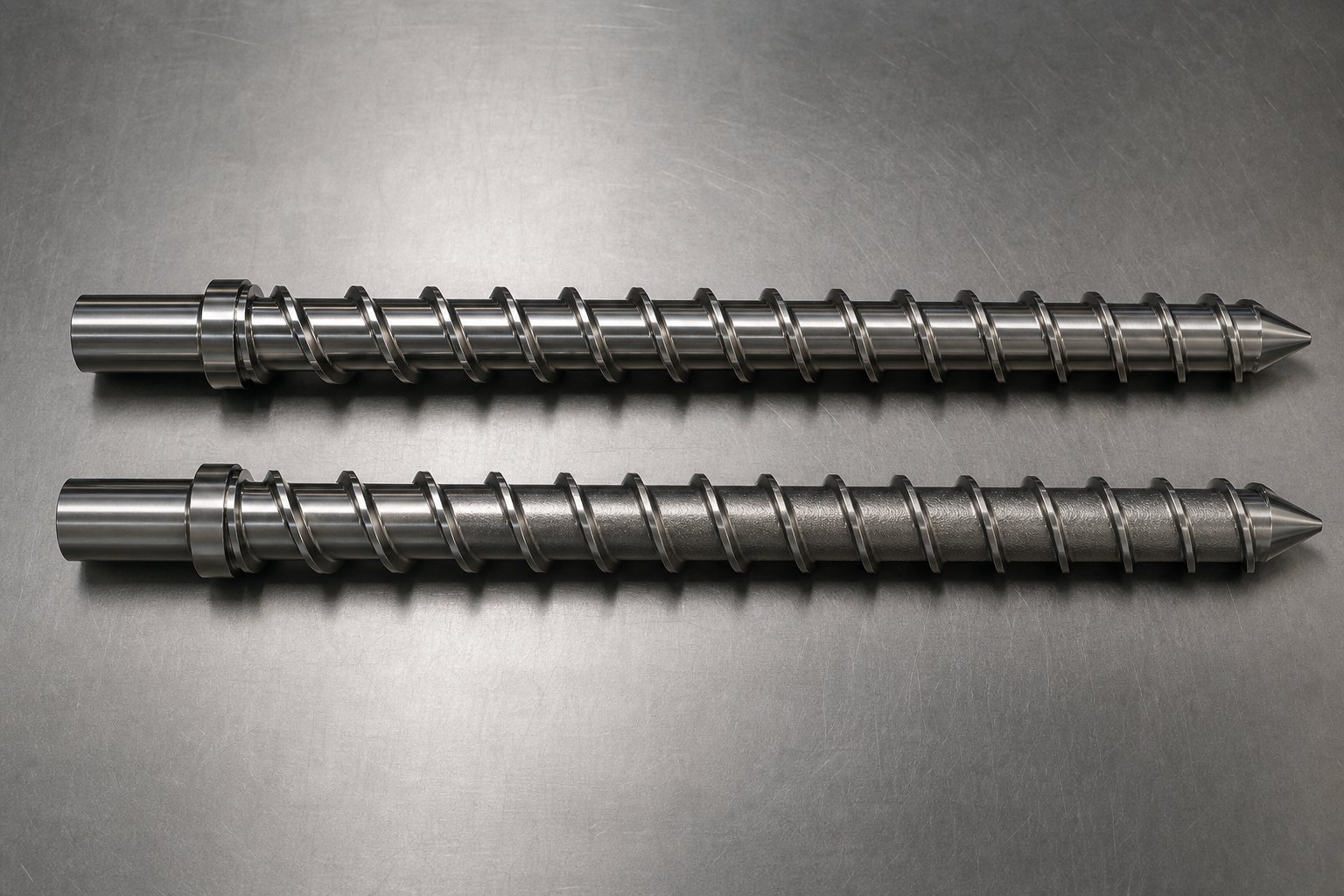
OEM vs Aftermarket Screw Barrel Suppliers
Here's a distinction that rarely gets discussed in buyer guides but shapes nearly every sourcing decision you'll make: are you buying from an OEM screw barrel supplier or an aftermarket replacement specialist? The two operate under fundamentally different business models, serve different needs, and deliver different value propositions. Conflating them — or assuming one is universally superior — leads to mismatched expectations and wasted purchase orders.
OEM Suppliers and Their Role in Equipment Manufacturing
An OEM (original equipment manufacturer) supplier provides screws and barrels to machine builders — companies like KraussMaffei, Engel, JSW, or Cincinnati Milacron — as original components integrated into new equipment. These parts are engineered to exact specifications dictated by the machine builder's design team, matched to specific equipment models, and validated through the builder's own testing protocols.
When you order a replacement through your machine builder's parts department, you're almost certainly getting an OEM-sourced component. The dimensional compatibility is guaranteed because the part was made from the same drawings as your original. Warranty coverage is straightforward — the machine builder stands behind it. Quality is consistent because the machine builder imposes its own inspection standards on top of the supplier's internal QC.
The trade-offs? Price premiums of 30–60% over equivalent aftermarket components are common, because you're paying for the machine builder's markup, warranty overhead, and brand assurance. Lead times can stretch to 8–16 weeks depending on the builder's supply chain. And customization is essentially zero — you get the original specification, even if your processing needs have evolved since the machine was installed.
Aftermarket Replacement Suppliers and Their Advantages
Aftermarket suppliers specialize in manufacturing replacement or upgraded screws and barrels outside the machine builder's supply chain. They reverse-engineer or work from customer-supplied drawings to produce components that match or exceed OEM dimensional and material specifications — often with significant advantages in flexibility, speed, and cost.
Think of it this way: imagine you run a fleet of extruders processing glass-filled nylon. Your OEM screws came with standard nitrided steel flights — adequate for the machine builder's generic specification, but wearing out every 12 months under your specific abrasive compound. An aftermarket specialist can produce a drop-in replacement with tungsten-carbide hardfacing on the flights, tripling wear life without changing a single dimension that affects fit or function.
Many experienced plastic processors — particularly those managing large equipment fleets or running demanding filled compounds — eventually migrate to aftermarket sourcing precisely because of this flexibility. Typical aftermarket lead times run 3–6 weeks, sometimes faster for standard sizes. Per-unit pricing often falls 25–45% below OEM equivalents for comparable or superior metallurgy. The federal screw works the same way whether it came from the machine builder's catalog or from a specialized aftermarket shop — what matters is dimensional accuracy, material quality, and process control during manufacturing.
The risk? Compatibility. An aftermarket supplier working without verified drawings may produce components with subtle dimensional errors — a bore diameter 0.05 mm too tight, a feed port location slightly off, a flange bolt pattern that doesn't quite align. These issues are manageable when you work with an experienced specialist who requests your old components for measurement or works from confirmed engineering drawings, but they become expensive problems with a supplier who guesses at specifications.
Choosing Between OEM and Aftermarket Based on Your Situation
The right path depends on where you sit in the equipment lifecycle and what your operation actually needs. Here's a structured comparison to help you decide:
| Evaluation Factor | OEM Supplier | Aftermarket Supplier |
|---|---|---|
| Quality Consistency | High — controlled by machine builder specs and QC oversight | Variable — ranges from excellent (specialized shops) to poor (low-cost operators); depends heavily on individual supplier capability |
| Price Range | Premium (30–60% above aftermarket equivalents) | Competitive (25–45% below OEM for comparable specs) |
| Lead Time | 8–16 weeks typical; longer for less common models | 3–6 weeks typical; some stock standard sizes for immediate shipment |
| Customization Flexibility | None — original spec only, no modifications | High — can modify geometry, upgrade materials, add barrier flights or mixing sections |
| Warranty Terms | Machine builder warranty; clear claim process | Supplier-specific warranty; varies widely — always confirm in writing |
| Compatibility Risk | Negligible — exact fit guaranteed by original drawings | Low-to-moderate — mitigated by verified drawings, sample measurement, or trial orders |
| Engineering Support | Limited to original design — unlikely to optimize for changed materials or conditions | Often extensive — experienced specialists consult on screw design improvements tailored to current processing needs |
A practical rule of thumb: source OEM when your machine is under warranty, when you're running the exact same polymer and process conditions the machine was commissioned for, or when you need a guaranteed drop-in fit without any engineering involvement. Source aftermarket when your processing conditions have changed, when you need improved wear life or throughput beyond the original design, when lead time is critical, or when budget constraints make OEM pricing unsustainable across a multi-machine fleet.
Geography adds another layer to this decision. The global sourcing landscape for screws and barrels spans several major manufacturing regions, each with distinct trade-offs:
- China (Zhoushan, Jieyang, Foshan): The largest concentration of screw and barrel manufacturers globally. Pricing runs 40–60% below European or American equivalents. Quality ranges from world-class (ISO-certified factories with CNC grinding, CMM inspection, and full bimetallic capability) to dangerously inconsistent. Lead times of 3–5 weeks are standard. Communication can require patience across time zones and language barriers, though many export-focused factories employ English-speaking technical sales teams.
- Taiwan: Positioned between mainland China and Europe on both price and quality. Strong precision machining culture with tighter average quality floors than mainland China. Pricing runs 20–35% below European levels. Lead times of 4–6 weeks. Good English communication in the export sector.
- Germany and Italy: Premium quality, premium price. German manufacturers (concentrated around the plastics machinery corridor) and Italian specialists deliver exceptional precision and metallurgical control. Pricing sits at the top of the market. Lead times of 6–12 weeks. Best suited for high-value applications where component failure costs dwarf the price difference — medical device molding, optical components, or aerospace-grade compounding.
- United States: A smaller but capable domestic base, often focused on reconditioning, repair, and rapid-turnaround replacements rather than high-volume new production. Pricing is comparable to European levels. The advantage is proximity — faster shipping, easier communication, and the ability to visit facilities for audits. Companies like federal screw works in Big Rapids, Michigan, illustrate the broader American precision machining tradition, though buyers should verify that any domestic supplier has specific plasticating screw and barrel expertise rather than general machining capability alone.
Many processors blend these sources strategically: OEM parts for warranty-sensitive new machines, a vetted aftermarket specialist in Asia for high-volume standard replacements, and a domestic shop for emergency turnarounds when a critical barrel fails mid-production. The key is matching supplier geography and type to the urgency, complexity, and budget of each specific order — not locking into a single source that can't flex with your operational reality.
Regardless of whether you choose OEM or aftermarket, domestic or overseas, the evaluation process itself follows the same fundamental framework — a structured checklist of capabilities, certifications, and documentation that separates credible partners from risky vendors.
How to Evaluate a Screw Barrel Supplier Step by Step
Knowing what separates OEM from aftermarket and China from Germany gives you strategic direction — but it doesn't tell you whether a specific vendor on your shortlist actually deserves your purchase order. For that, you need a repeatable evaluation framework: a structured set of criteria you can apply to every candidate, regardless of geography or business model, that exposes capability gaps before they become production problems.
Most buyers default to comparing quotes on price and lead time alone. That's like choosing a surgeon based on fees and appointment availability. The evaluation criteria below dig into the factors that actually predict whether a screw barrel supplier will deliver components that perform — or parts that end up costing you multiples of their purchase price in downtime, scrap, and frustration.
Certifications and Manufacturing Capabilities to Verify
Certifications aren't magic, but they do establish a baseline. An ISO 9001 certification confirms that a supplier operates a documented quality management system — meaning they have written procedures for production, inspection, corrective action, and continuous improvement. ISO 14001 adds environmental management accountability, which matters if your own supply chain policies require environmental compliance from vendors. Neither certification guarantees that every part will be perfect, but both signal that the organization has invested in systematic quality control rather than relying on ad hoc inspection.
Beyond certificates hanging on a wall, you want to understand what's actually on the factory floor. The critical question is whether the supplier controls key manufacturing stages in-house or farms them out. A vendor with their own CNC turning centers, deep-hole drilling machines, nitriding furnaces, centrifugal casting equipment, and precision grinding lines can manage quality at every transition point. One that outsources heat treatment to one shop, bimetallic casting to another, and grinding to a third introduces handoff risk at each stage — and loses the traceability that makes root-cause analysis possible when something goes wrong.
When you're evaluating capabilities, ask specifically about the equipment used for bore honing, flight grinding, and final finishing. These downstream operations directly determine whether the component meets the tight tolerances — bore straightness, concentricity, surface finish — that separate a reliable part from a problematic one. General-purpose machine shops, even well-run ones like a typical northern screw machine operation or a precision house like American Bolt and Screw in Fontana, may excel at fastener or turned-part production without possessing the specialized deep-bore and flight-grinding equipment that plasticating screws and barrels demand.
Documentation and Quality Assurance Standards
A supplier's willingness to provide documentation tells you almost as much as the documentation itself. Credible manufacturers generate and archive inspection records at multiple stages — incoming material certificates, heat treatment logs, hardness test results, dimensional inspection reports, and concentricity measurements. As industrial procurement guidance emphasizes, effective supplier verification layers multiple checks rather than relying on any single method.
Material traceability is a particular litmus test. You should be able to trace the steel in your barrel back to its mill certificate, verifying the alloy grade, chemical composition, and mechanical properties. For bimetallic components, the supplier should identify the exact alloy used for the centrifugal-cast lining or PTA hardfacing — not just "bimetallic" or "wear-resistant," but the specific alloy family, hardness specification, and lining thickness. Requesting this documentation during the quotation phase, before you've committed a purchase order, reveals how transparent the supplier is willing to be.
Quality assurance processes should include, at minimum:
- Incoming material verification — independent hardness and composition testing against mill certificates, not blind acceptance of supplier paperwork.
- In-process dimensional checks — bore diameter and concentricity after drilling, flight depth accuracy during CNC machining, and straightness verification before and after heat treatment.
- Hardness testing after surface treatment — Vickers or Rockwell measurements at multiple points along the component length, confirming uniform nitriding depth or consistent bimetallic lining hardness.
- Final inspection — CMM (coordinate measuring machine) verification of all critical dimensions against the engineering drawing, surface roughness measurement, and visual inspection for defects.
Ask for sample inspection reports from previous orders. A supplier confident in their quality will share these readily; one who hedges or delays is signaling that their documentation practices may not withstand scrutiny.
Customization, Lead Times, and After-Sales Support
The ability to customize screw geometry and material specifications for your exact polymer and application is what separates a true engineering partner from a catalog parts vendor. You want a supplier who asks detailed questions about your resin types, filler content, processing temperatures, output targets, and quality requirements — then recommends specific L/D ratios, compression ratios, zone geometries, and metallurgies tailored to those inputs. A vendor who quotes without asking about your application is either offering a generic design or doesn't have the expertise to do otherwise.
Lead times and minimum order quantities (MOQs) affect operational flexibility. For standard replacement components, 3–6 weeks is a reasonable benchmark from most established manufacturers. Custom-engineered or bimetallic components may require 5–8 weeks. MOQs vary widely — some suppliers accommodate single-piece orders for custom work, while others require minimums of 5–10 units to justify setup costs. Clarify these terms upfront, because a supplier with attractive unit pricing but a 20-piece MOQ doesn't help if you need two replacement screws for a single machine.
After-sales support is often overlooked during initial vetting but becomes critically important over the component's lifecycle. Not all manufacturers are equipped for comprehensive reconditioning — only those with specialized equipment like horizontal bore honing machines, vertical bore grinders, and PTA welding systems can offer full refurbishment services that extend component life at a fraction of replacement cost. A supplier who can recondition your worn screws and barrels — re-nitriding, re-chroming, weld-building worn flights, or re-boring and honing barrel bores — delivers value that extends far beyond the initial sale.
Technical consultation is the final piece. Can the supplier's engineering team help you troubleshoot processing issues — melt temperature inconsistency, surging, excessive wear rates — and recommend design changes based on that analysis? This capability separates vendors who sell parts from partners who solve problems.
Here's a consolidated checklist you can carry into any supplier evaluation, whether you're visiting a factory floor or conducting a remote assessment:
- Certifications: Does the supplier hold current ISO 9001 certification? Can they provide the certificate number for independent verification with the issuing body?
- In-house capabilities: Do they own CNC machining centers, deep-hole drilling equipment, nitriding furnaces or bimetallic centrifugal casting lines, precision grinders, and honing machines — or do they outsource critical stages?
- Material traceability: Can they provide mill certificates for raw steel and specify exact alloy compositions for bimetallic linings and hardfacing materials?
- Quality inspection: Do they perform CMM dimensional verification, multi-point hardness testing, concentricity measurement, and surface roughness checks — and will they share reports for your specific order?
- Customization depth: Do they ask about your polymer types, fillers, processing conditions, and output targets before recommending a screw design? Can they engineer barrier screws, mixing sections, or application-specific geometries?
- Lead times and MOQs: What are standard and custom lead times? What is the minimum order quantity, and is single-piece ordering available for custom work?
- After-sales support: Do they offer reconditioning, re-nitriding, hardfacing rebuilds, and bore re-grinding? Is technical consultation available for troubleshooting processing problems?
- Application breadth: Have they served plastic processors, equipment OEMs, and maintenance teams across multiple industries — or is their experience limited to a narrow segment?
- References: Can they provide contact information for existing customers willing to speak about quality, delivery reliability, and responsiveness?
- Communication responsiveness: Do they respond to technical inquiries within 24–48 hours with detailed, substantive answers — or do replies arrive late and vague?
- Sample or trial order policy: Will they accept a small initial order so you can validate fit, finish, and metallurgy before committing to volume?
- Product catalog structure: Is their offering organized clearly by application, equipment type, and material option — making it easy for buyers to identify relevant solutions? For example, NANHAIYA's screw barrel product center structures its catalog around custom and replacement screw and barrel solutions for both extrusion and injection molding equipment, segmented by application — a layout that lets processors, OEMs, and maintenance teams quickly locate what's relevant to their specific machines and materials.
Score each criterion honestly. A supplier who checks every box may not exist at your target price point — but one who falls short on material traceability, inspection documentation, or communication responsiveness is likely to cost you far more in the long run than the premium you'd pay for a more capable partner.
The cheapest quote rarely delivers the lowest total cost. Evaluate suppliers on the full spectrum — certifications, capabilities, documentation, customization, and support — before you compare a single price.
This framework tells you what to look for. Equally important is knowing what to look out for — the specific warning signs that reveal a supplier is cutting corners, obscuring quality gaps, or simply lacking the capability to deliver what they promise.
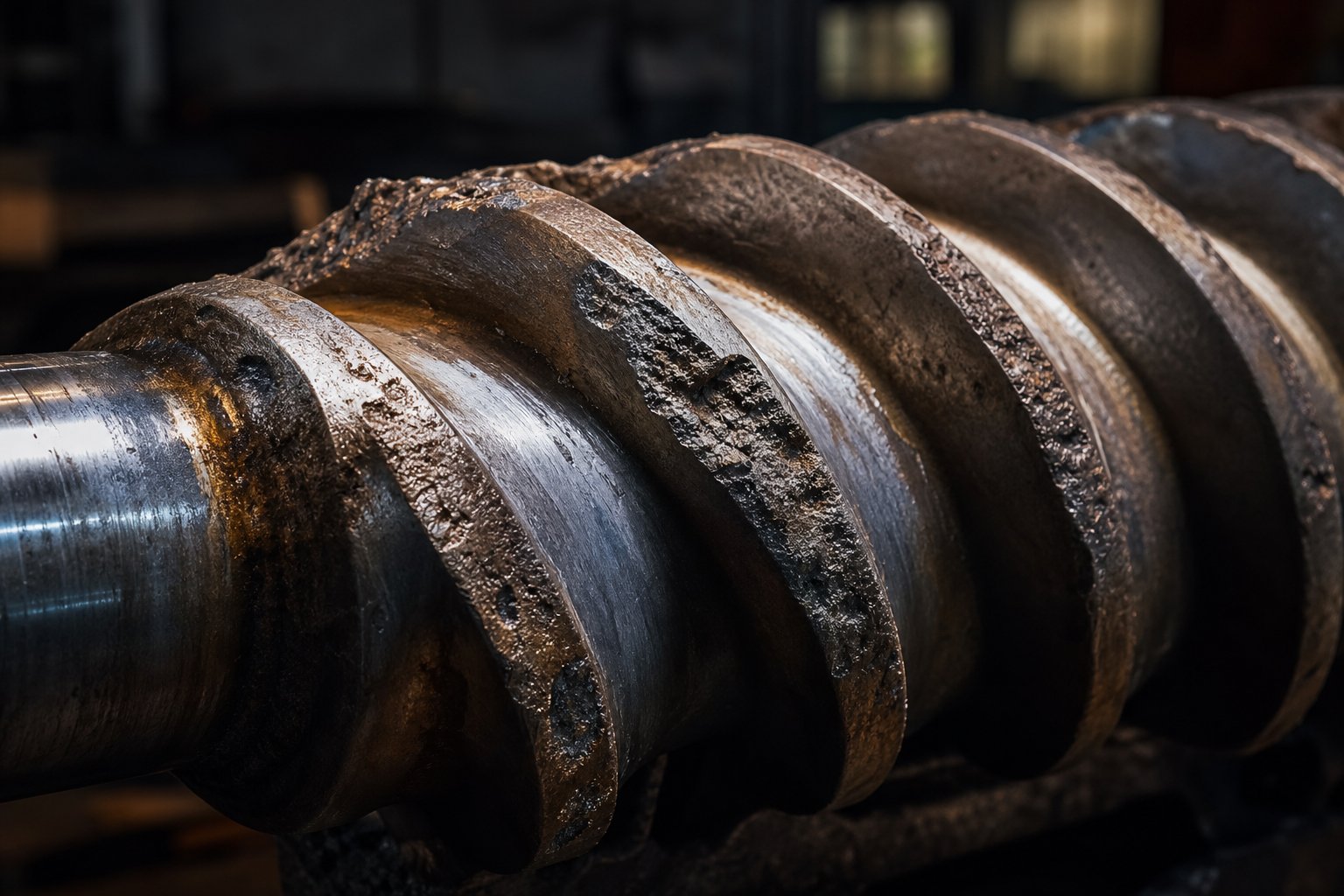
Red Flags When Choosing a Screw Barrel Supplier
A solid evaluation checklist tells you what a good vendor looks like. But some of the most expensive sourcing mistakes happen not because buyers failed to find the right supplier — they happen because buyers failed to spot a wrong one. The warning signs are rarely dramatic. They show up as small evasions, missing documents, oddly low numbers on a quote, or responses that always seem to arrive a day late and a detail short. Learning to recognize these patterns early saves you from the slow-motion disaster of installing a screw or barrel that wears out months ahead of schedule, shuts down a production line, and costs multiples of what you thought you saved.
Material and Documentation Warning Signs
The fastest way to gauge a supplier's credibility is to ask for specifics about what's actually going into your components. Legitimate manufacturers maintain thorough material records and share them without hesitation. When those records are absent — or when answers stay vague — you're looking at a supplier who either doesn't control their own inputs or doesn't want you examining them too closely.
- No material certifications available: You ask for the mill certificate showing steel grade, chemical composition, and mechanical properties — and get silence, a redirect, or a promise that never materializes. Without this documentation, you have no way to confirm whether the barrel you're buying is actually 38CrMoAlA nitriding steel or a cheaper substitute that won't respond properly to heat treatment.
- Vague alloy claims: The supplier says "bimetallic" but can't — or won't — specify the alloy family (Fe-based, Ni-based, WC-loaded), the hardness specification, or the lining thickness. As discussed earlier in this guide, "bimetallic" without supporting detail is a marketing label, not a technical specification. A credible vendor names the exact alloy, cites hardness values, and documents lining depth.
- No dimensional inspection reports: If a supplier can't produce a CMM report or hardness test certificate for a sample order, their quality control process is either nonexistent or too informal to generate reliable records. Either scenario puts your production at risk.
- Resistance to providing engineering drawings: A supplier who refuses to share the dimensional drawing for your screw and barrel set may be protecting a captive replacement parts arrangement — not protecting genuine intellectual property. Without a drawing, you can't solicit competitive quotes or verify that what you receive matches what you ordered.
When you encounter any of these gaps, probe diplomatically. A simple question like "Can you walk me through your incoming material verification process?" reveals volumes. Suppliers with real QC systems describe specific steps — independent hardness testing, spectrometer analysis, lot-level traceability. Suppliers without them deflect with generalities like "we work with trusted mills" or "quality is guaranteed."
Communication and Transparency Red Flags
How a supplier handles your pre-sale inquiries predicts exactly how they'll handle your post-sale problems. Pay close attention to response patterns during the quotation phase — they rarely improve after your money changes hands.
- Slow or non-substantive responses: Technical questions that take a week to answer — or come back with generic catalog language instead of application-specific detail — signal that the supplier either lacks in-house engineering expertise or doesn't prioritize your business. A standby screw machine supplier should respond to inquiries within 24–48 hours with substantive, detailed answers.
- No customer references: Ask for two or three existing customers in your industry who would take a phone call. A supplier who can't or won't provide references is either too new to have a track record or has a track record they'd rather you not hear about. When you do get references, ask the three questions outlined in our evaluation framework — particularly whether the customer has been quietly qualifying alternatives.
- Resistance to factory audits or site visits: For any relationship expected to exceed a meaningful annual spend, a supplier audit is standard practice across manufacturing industries. A vendor who discourages visits, delays scheduling, or restricts what you can see on the factory floor is concealing something — whether it's outsourced production, inadequate equipment, or working conditions that don't match their marketing materials.
- No sample or trial order policy: Reputable suppliers welcome small initial orders as a chance to demonstrate quality before a full-volume commitment. A vendor who insists on large minimum quantities with no trial option is asking you to bet your production on unproven components. That's their gamble to offer, not yours to accept.
Pricing Red Flags That Signal Hidden Compromises
Price is where the most dangerous red flags hide, because an unusually low quote feels like good news — until the parts arrive.
- Pricing 30–50% below comparable quotes without explanation: If three qualified vendors quote a bimetallic barrel at similar price points and a fourth comes in at half the cost, something has been cut. It might be the alloy grade, the nitriding depth, the lining thickness, or the precision of the final grinding. As sourcing experts in adjacent industrial sectors note, a 15–20% gap between suppliers often reflects genuine economies of scale, but a 35–50% discount on comparable specifications almost never does. Ask the low-price vendor directly: "Your quote is significantly below market — can you explain what material or process differences account for the gap?" Their answer, or lack of one, tells the story.
- No breakdown of cost components: A supplier who won't itemize how material grade, surface treatment, machining complexity, and order volume affect their pricing may be obscuring the fact that they're using cheaper inputs. Transparent vendors explain their pricing logic because it reinforces buyer confidence.
- 100% upfront payment with no escrow or milestone terms: Standard commercial practice for custom-manufactured industrial components involves a deposit (typically 30–50%) with the balance due upon inspection or shipment. A supplier demanding full payment before production — with no third-party protection — introduces financial risk on top of quality risk.
The cheapest screw barrel quote often leads to the most expensive total outcome — premature wear, unplanned downtime, scrapped production, and an emergency replacement order at rush pricing.
Here's the counterintuitive truth that experienced buyers discover: reputable suppliers actually welcome detailed technical questions, documentation requests, and even factory audits. These interactions signal a serious, quality-conscious buyer — exactly the kind of customer a capable manufacturer wants to build a long-term relationship with. If your questions make a vendor uncomfortable, the discomfort itself is a data point. A cal screw or barrel that arrives without proper documentation isn't a bargain — it's a liability sitting inside your machine, waiting to fail.
Spotting these warning signs keeps you from wasting a purchase order on the wrong vendor. But even with a qualified supplier in hand, one critical question remains unanswered: what should a screw and barrel actually cost, and how do you evaluate whether a given price represents genuine value or just a bigger number?
What Drives Screw Barrel Pricing and Total Cost
You've identified a credible supplier, verified their certifications, and confirmed they can deliver the metallurgy your process demands. Then the quote arrives — and you're staring at a number that seems either surprisingly high or suspiciously low, with no framework for understanding why. Screw and barrel pricing is one of the least transparent areas in plastics processing procurement. The "same" screw can be quoted anywhere from a few hundred to several thousand dollars depending on six interacting variables, and without understanding those variables, you can't tell whether a quote represents fair value, a premium for quality you don't need, or a discount hiding corners you can't afford to cut.
Let's break open the black box.
Material Grade as the Primary Cost Driver
If you take nothing else away from this section, remember this: material grade is the single largest swing factor in screw and barrel pricing. The jump from standard nitrided steel to bimetallic construction, and from basic bimetallic to premium tungsten-carbide-loaded alloys, creates cost differentials that dwarf every other variable on the quote.
Standard nitriding steel — 38CrMoAlA is the industry default — represents the lowest-cost option. It's the economical baseline and perfectly appropriate for clean, unfilled polymers. But the moment your application involves abrasive fillers or corrosive chemistry, nitrided steel becomes false economy because its thin hardened case wears through quickly, forcing premature replacement.
Stepping up to bimetallic construction roughly doubles the material cost. You're paying for centrifugal-cast alloy linings in barrels and PTA-welded hardfacing on screw flights — additional processing steps, more expensive alloy powders, and tighter quality control at each stage. Within the bimetallic category, Fe-based alloys sit at the lower end, Ni-based alloys in the middle, and tungsten-carbide-loaded grades at the premium tier.
At the top of the range, powder metallurgy tool steels like CPM 10V carry a raw material premium of approximately 2.5x to 4x over D2 tool steel. That sounds steep — until you learn that CPM 10V screws routinely exceed 20,000 hours of service life in severely abrasive conditions where nitrided 4140 fails at 3,000 hours. The material premium buys time, and time is the real currency in continuous production.
Size, Customization, and Surface Treatment Costs
Beyond material grade, four additional factors layer onto the final price:
Physical size and diameter. This one's intuitive — a larger screw consumes more raw steel and requires bigger lathes, grinders, and heat-treat furnaces. Diameter and flighted length both drive cost upward. A 150 mm, 30:1 L/D screw demands substantially more machine time than a 45 mm, 24:1 unit — and the machines capable of handling that size represent significant capital investment that gets amortized into your quote. Not every machine shop can accommodate large-diameter, long-length plasticating components; specialized equipment from facilities with deep-bore capability is required, which is why geographic clusters of screw barrel manufacturing — whether in Zhoushan, China or precision machining districts elsewhere — command different rate structures than a general-purpose shop.
Surface treatment complexity. Nitriding alone adds moderate cost — a controlled furnace cycle at 480-530°C for 24-72 hours. Hard chrome plating adds an electrochemical step. Hardfacing with Stellite or tungsten carbide alloys via PTA welding adds a highly skilled, time-intensive process. HVOF thermal spray of WC-Co coatings requires specialized spray equipment and post-spray grinding. Each additional treatment layer adds processing time, equipment cost, and quality inspection requirements. As industry analysis confirms, surface treatment is often the biggest single price swing because it's where wear resistance is literally purchased.
Design complexity. A simple single-flight general-purpose screw is the cheapest geometry to machine. Adding barrier flights, mixing sections, vented two-stage designs, or twin-screw kneading elements multiplies engineering time, CNC programming complexity, and machining passes. A barrier screw with a dispersive mixing section might cost 40-60% more to manufacture than a standard three-zone geometry — but can deliver 20%+ more output, making it a sound investment when matched to the right application.
Tolerances. Tighter tolerances require more careful machining, additional grinding passes, and more extensive inspection. Precision film extrusion or medical device molding demands tolerances that general pipe and profile work doesn't need. Paying for precision beyond what your application requires is waste; under-specifying tolerance for demanding work causes quality problems from day one.
Order volume. Setup, CNC programming, and fixturing represent largely fixed costs spread across however many pieces you order. A one-off replacement carries all of that overhead on a single unit. Batch orders of 5-10 pieces amortize those costs, dropping the per-unit price meaningfully. If you know you'll need spares — or manage a multi-machine fleet consuming the same screw geometry — ordering together saves more than most buyers realize.
Origin country. As covered in the OEM vs. aftermarket chapter, geographic sourcing creates substantial cost differentials. Chinese manufacturers typically price 40-60% below European equivalents for comparable specifications. Taiwanese suppliers fall 20-35% below European levels. American and German shops command premium rates reflecting higher labor costs and overhead structures. The price gap doesn't automatically equal a quality gap — but it does mean you need to verify quality independently rather than assuming price correlates to performance.
| Cost Factor | Impact Level | Explanation |
|---|---|---|
| Material grade (nitrided vs. bimetallic vs. WC-loaded) | High | Largest single cost variable; premium alloys can cost 2.5x to 4x more than standard nitriding steel but deliver 4x to 8x longer service life |
| Physical size (diameter x flighted length) | High | Larger components consume more raw steel and require bigger, more expensive machines; cost scales roughly with volume of material removed |
| Surface treatment type | High | Nitriding adds moderate cost; hardfacing (Stellite, WC) and HVOF coatings add significant processing time, skilled labor, and specialized equipment costs |
| Design complexity | Medium-High | Barrier flights, mixing sections, twin-screw elements, and vented designs require more engineering, programming, and machining passes than simple GP geometries |
| Tolerances | Medium | Tighter tolerances demand more grinding passes, slower machining feeds, and more extensive inspection — each adding time and cost |
| Order quantity | Medium | Fixed setup costs amortized across more units reduce per-piece pricing; batch orders of 5-10+ units typically yield meaningful discounts |
| Origin country | Medium-High | Labor rates, overhead structures, and local material costs create 40-60% price differentials between low-cost and premium manufacturing regions |
| Lead time (standard vs. rush) | Low-Medium | Expedited orders requiring overtime, queue-jumping, or air freight add 15-30% surcharges at most suppliers |
Total Cost of Ownership vs Purchase Price
Here's where most procurement decisions go sideways. The purchase price on a quote is not the cost of owning that screw or barrel — it's just the entry fee. The real cost accumulates over the component's operational life and includes factors that never appear on the invoice.
Consider the full lifecycle cost stack:
- Installation labor: Replacing a 100-150 mm extruder screw typically requires 4-8 hours of skilled maintenance work. At loaded labor rates of $85-$150 per hour for industrial maintenance technicians in North America, that's $340 to $1,200 per change-out event — before counting the parallel resources needed to manage the shutdown.
- Unplanned downtime: This is the dominant cost driver that purchase-price optimization ignores. A continuous extrusion line producing $1,500-$5,000 of product per hour loses $12,000 to $40,000 in a single unplanned 8-hour maintenance shutdown — before scrap costs, restart waste, and customer delivery disruptions.
- Energy efficiency degradation: As screw flights wear and barrel clearances widen, specific energy consumption (kWh per kg of polymer processed) increases by 6% to 12%. Over thousands of operating hours, that energy penalty compounds into real money on your utility bill.
- Quality losses: Widening clearances reduce melt homogeneity, increase temperature variation, and degrade mixing quality. In precision applications — automotive compounds, medical tubing, optical-grade film — a single quality event caused by worn components can generate scrap costs exceeding $50,000.
- Break-in procedures: New screws and barrels require a controlled break-in period — gradual speed ramp-up over the first few hours of operation to allow mating surfaces to conform without galling. Rushing this step causes adhesive wear damage that shortens component life from the start.
A quantified example makes this concrete. Data from a Tier-1 European compounder processing 45% calcium carbonate-filled polypropylene showed that a bimetallic screw with HVOF WC-17Co flight overlay experienced only 0.12 mm of flight clearance loss at 4,500 operating hours — compared to 0.8 mm for a solid nitrided 4140 screw at the same interval. The projected service life extension: 6.7x. The net savings per replacement cycle: approximately EUR 18,000 in avoided downtime and labor alone. The premium assembly cost roughly 4x more upfront but delivered a 62% reduction in total 36-month operating cost.
That math flips the procurement conversation entirely. The question isn't "what does this screw cost?" — it's "what does this screw cost per processing hour?"
Reconditioning vs. replacement: One final cost lever that experienced buyers exploit is refurbishment. Worn screws can be rebuilt — flight lands ground down, re-hardfaced via PTA welding, then re-ground to original dimensions. Worn barrels can be bored out and re-lined with fresh centrifugal-cast alloy. Refurbishment cost typically runs 40% to 60% of new-component pricing while restoring 85% to 95% of original service life. The decision of when to refurbish versus replace depends on core condition: if the screw root diameter has worn significantly, or if magnetic particle inspection reveals fatigue cracking, replacement is the safer path. But for components with sound core structures and only surface-level degradation, reconditioning stretches your capital budget substantially.
Track your components' wear progression over time. Chart output rates, specific energy consumption, and melt temperature variability against operating hours. When adjustments to screw speed, backpressure, and barrel temperatures reach their practical limits — what industry experts call the point of diminishing returns — you know it's time to rebuild or replace. Planning for that moment, rather than reacting to it, lets you schedule maintenance during planned downtime, have replacement parts on hand, and avoid the panic pricing of a rush order when a critical machine goes down unexpectedly.
Evaluate cost per processing hour — not purchase price per component. A screw that costs 4x more upfront but lasts 6x longer and eliminates two unplanned shutdowns isn't expensive. It's the cheapest option you have.
Pricing clarity helps you compare quotes fairly and justify investment in premium components where the application demands it. But knowing what a screw and barrel should cost also prepares you for the final piece of the sourcing puzzle: matching the right supplier — with the right capabilities and the right service model — to your specific operational reality.
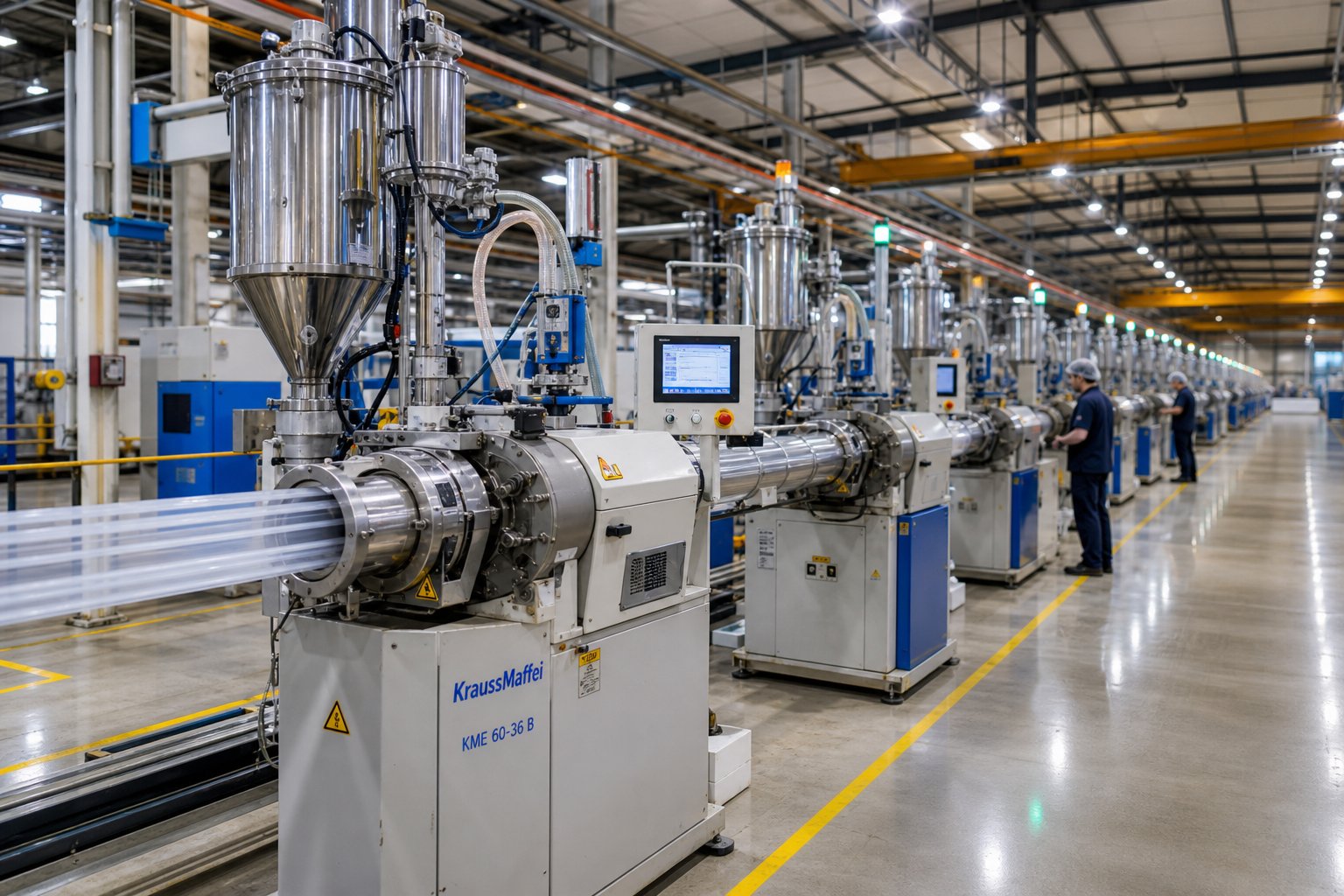
Matching the Right Supplier to Your Processing Needs
You've walked through design parameters, metallurgy, manufacturing quality, OEM versus aftermarket trade-offs, evaluation frameworks, red flags, and pricing mechanics. That's a lot of ground — but all of it converges on one practical question: which screw barrel supplier actually fits your operation? The answer depends on who you are, what you run, and where your biggest pain points live. A plastic processor replacing worn components on a busy extrusion line has fundamentally different priorities than a screw machine manufacturer sourcing OEM-quality supply for new equipment builds. Let's map the right supplier profile to each buyer type.
Matching Supplier Strengths to Your Operational Needs
Plastic processors running production lines. Your primary enemy is unplanned downtime. Every hour a machine sits idle while you wait for a replacement screw or barrel is revenue lost and delivery commitments missed. You need a supplier who stocks common sizes for fast turnaround, offers bimetallic and hardfaced options matched to your specific resins and fillers, and provides reconditioning services that extend component life between full replacements. Look for feed screw manufacturers and barrel specialists who ask about your polymer types, filler content, and output targets before recommending a solution — not vendors who simply quote whatever you ask for without questioning whether it's actually the right specification. Trial orders on a single machine let you validate dimensional fit, metallurgy, and wear performance before committing your entire fleet.
Equipment manufacturers seeking OEM-quality partnerships. Consistency matters more than cost-per-piece at this level. You're integrating screws and barrels into machines that carry your brand name and your warranty, so dimensional accuracy, material traceability, and batch-to-batch repeatability are non-negotiable. The ideal partner operates full in-house capability — CNC machining, heat treatment, bimetallic casting, precision grinding, and CMM inspection under one roof — and can scale production volume without sacrificing tolerance control. Euromap and DIN compliance should be documented, not just claimed. A long-term supply agreement with scheduled quality audits protects your brand and your customers far more effectively than shopping each order to the lowest bidder.
Maintenance teams needing rapid turnaround. When a barrel fails mid-run and production is bleeding money by the hour, your supplier's response time becomes the most valuable spec on the page. Prioritize vendors who maintain inventory of standard barrel blanks and screw blanks ready for final machining, who can turn emergency orders in days rather than weeks, and who offer field measurement services or work from your worn components to reverse-engineer replacements without requiring drawings you may not have. Reconditioning capability — re-nitriding, flight rebuild via PTA welding, bore honing — is especially valuable here because it gets your existing components back into service at 40-60% of replacement cost and a fraction of the lead time.
Emerging Trends in Screw Barrel Technology
Supplier selection isn't only about solving today's problems. The plastics industry is shifting beneath your feet, and the screws and barrels running your machines five years from now will face demands that barely exist today. Three trends deserve your attention as you evaluate which suppliers are building for the future — and which are coasting on yesterday's capabilities.
Advanced bimetallic alloys and nano-coatings. Alloy development hasn't stopped at Colmonoy 83. New tungsten-carbide formulations with optimized particle size distribution, nano-structured coating technologies, and improved carbide-in-matrix compositions are pushing wear resistance beyond what was achievable even five years ago. As industry experts note, manufacturers investing in advanced metallurgy and precision engineering will lead the next generation of extrusion and injection molding technology. A supplier who can discuss these emerging alloy options — and explain which applications justify the premium — signals engineering depth that will keep your operation competitive.
Energy-efficient screw designs. With energy costs rising globally and sustainability metrics entering procurement scorecards, screw geometries engineered for lower specific energy consumption (kWh per kg of processed polymer) are gaining traction. Optimized barrier designs, advanced mixing sections, and computational fluid dynamics-driven flight profiles reduce the shear energy wasted as heat, cutting electricity consumption by 8-15% on some applications without sacrificing output. Ask prospective suppliers whether they offer energy-optimized designs — and whether they can quantify the expected improvement for your specific resin and throughput target.
Barrels and screws for bio-plastics and recycled materials. The rapid growth of bio-based engineering plastics — bio-PA, bio-PE, and even bio-PEEK — along with the increasing use of post-consumer recycled (PCR) feedstock, introduces processing challenges that standard screw designs weren't built for. Bio-based polymers often have different melting behaviors and narrower processing windows than their fossil-based counterparts. Recycled materials carry contaminants — metal fines, mixed polymer fractions, inconsistent melt flow indices — that accelerate wear unpredictably. The EU's Packaging and Packaging Waste Regulation (PPWR), effective from August 2026, mandates minimum recycled content percentages that will push even more processors toward PCR feedstock. Suppliers who have already engineered screw geometries and metallurgies specifically for these materials position you ahead of a regulatory curve that's tightening fast.
Taking the Next Step Toward Better Sourcing
Every section of this guide has reinforced one theme: the right screw barrel supplier isn't the cheapest, the fastest, or the closest — it's the one whose engineering capabilities, material quality, and service model align with your specific processing demands.
The best screw barrel supplier is the one whose engineering capabilities, material quality, and service model align with your specific processing demands — not the one with the lowest quote or the glossiest catalog.
Here's how to put this guide to work immediately:
- Audit your current components: Measure screw flight clearances, check barrel bore dimensions, and chart your wear progression. Know where you stand before you start shopping.
- Define your specification: Document your polymer types, filler content, processing temperatures, output targets, and any quality problems you're experiencing. Hand this to every prospective supplier and compare how each one responds.
- Apply the evaluation checklist: Use the criteria from Chapter 6 — certifications, in-house capabilities, material traceability, inspection documentation, customization depth, lead times, and after-sales support — to score at least three candidates before placing a PO.
- Watch for red flags: Missing material certifications, vague alloy claims, resistance to documentation requests, and pricing that can't be explained are disqualifying signals, not negotiation starting points.
- Calculate total cost of ownership: Evaluate cost per processing hour, not purchase price per component. Factor in installation labor, downtime risk, energy efficiency, and reconditioning potential.
For plastic processors, equipment manufacturers, and maintenance teams ready to explore custom or replacement screw and barrel solutions, NANHAIYA's screw barrel product center offers a practical starting point. Their catalog is structured around extrusion and injection molding applications with clear segmentation by equipment type and material option — the kind of buyer-focused organization that makes it straightforward to identify relevant solutions and initiate a technical conversation grounded in the criteria this guide has outlined.
Ultimately, vetting a screw barrel supplier is an investment that pays returns on every production hour your machines run afterward. A thorough evaluation takes days. A bad sourcing decision costs months. The framework is in your hands — use it before you sign the next purchase order.
Frequently Asked Questions About Choosing a Screw Barrel Supplier
1. What is the difference between a nitrided barrel and a bimetallic barrel?
A nitrided barrel has a thin hardened case (0.4-0.7 mm deep) formed by diffusing nitrogen into the steel surface, reaching 900-1,100 HV hardness. It works well for clean, unfilled polymers like PP, PE, and ABS. A bimetallic barrel features a centrifugal-cast alloy lining 2.0-3.0 mm thick bonded inside the bore, offering three to seven times more wear-resistant material than nitriding. Bimetallic barrels are essential for processing glass-fiber-filled resins, mineral-loaded compounds, or corrosive polymers like PVC. When requesting quotes from any screw barrel supplier, ask them to specify the exact alloy family — Fe-based, Ni-based, or tungsten-carbide-loaded — along with hardness values and lining thickness rather than accepting a generic 'bimetallic' label.
2. How do I know when to replace my extruder screw and barrel versus reconditioning them?
The decision hinges on core condition. If the screw root diameter remains sound and magnetic particle inspection shows no fatigue cracking, reconditioning — re-nitriding, PTA weld-building worn flights, or re-boring and honing the barrel — typically restores 85-95% of original service life at 40-60% of new-component cost. However, if clearances have widened beyond the point where process adjustments can compensate, or if output rates and energy consumption have degraded significantly, full replacement is the safer and more cost-effective path. Tracking wear progression over time by charting output rates, specific energy consumption, and melt temperature variability against operating hours helps you plan replacements during scheduled downtime rather than reacting to emergency failures. Suppliers like NANHAIYA (https://www.nhyscrews.com/products) that offer both new components and reconditioning services give you flexibility to choose the most economical option for each situation.
3. What certifications should a reliable screw barrel supplier have?
At minimum, look for current ISO 9001 certification, which confirms the supplier operates a documented quality management system covering production procedures, inspection protocols, corrective actions, and continuous improvement. ISO 14001 adds environmental management accountability, relevant if your supply chain policies require vendor environmental compliance. Beyond certifications, verify that the supplier can provide mill certificates for raw steel, hardness test reports at multiple points along each component, CMM dimensional inspection reports, and material traceability documentation linking finished parts back to specific steel batches. A certificate on the wall establishes a baseline, but the willingness to share order-specific quality documentation is the real indicator of a supplier's commitment to transparency and consistent manufacturing standards.
4. Should I buy screw barrels from OEM suppliers or aftermarket specialists?
It depends on your operational priorities. OEM suppliers provide components made from the machine builder's original drawings, guaranteeing dimensional compatibility and straightforward warranty coverage — but at price premiums of 30-60% and lead times of 8-16 weeks. Aftermarket specialists manufacture replacements that match or exceed OEM specs, often at 25-45% lower cost with 3-6 week lead times, plus the ability to customize geometry and upgrade metallurgy for your specific resins and conditions. A practical approach is to source OEM for machines under warranty or running original process conditions, and use vetted aftermarket suppliers when you need improved wear life, faster delivery, or design modifications that address processing challenges the original specification didn't anticipate.
5. What factors have the biggest impact on screw barrel pricing?
Material grade is the single largest cost driver — stepping from standard nitrided steel to bimetallic construction roughly doubles the price, and premium tungsten-carbide-loaded alloys can cost 2.5x to 4x more than basic tool steel. Physical size (diameter and flighted length), surface treatment complexity (nitriding vs. hardfacing vs. HVOF coating), design complexity (standard three-zone vs. barrier or mixing geometries), machining tolerances, order quantity, and manufacturing origin country all layer onto the final quote. However, evaluating purchase price alone is misleading. Total cost of ownership — factoring in installation labor, unplanned downtime risk, energy efficiency degradation, and reconditioning potential — gives a far more accurate picture. A component costing 4x more upfront but lasting 6x longer often delivers the lowest cost per processing hour.
Written by
Nanhaiya Technical Team
Zhoushan Nanhaiya Plastic Machinery Co., Ltd.
The Nanhaiya technical team supports screw and barrel manufacturing projects through application review, technical communication, custom manufacturing coordination, and production and quality control.
Discuss Your Application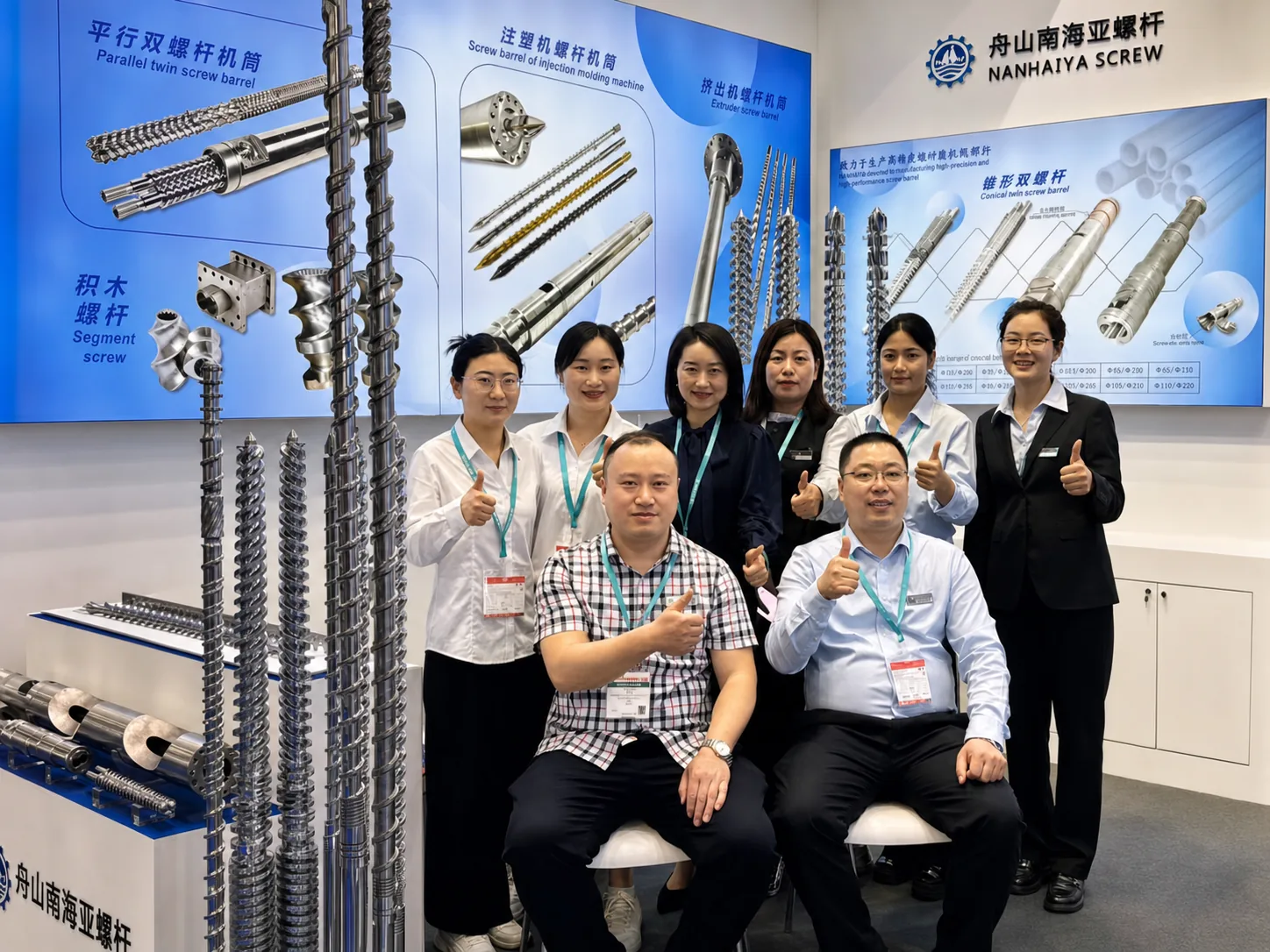
Related Articles
More insights on screw barrel technology and plastics processing.
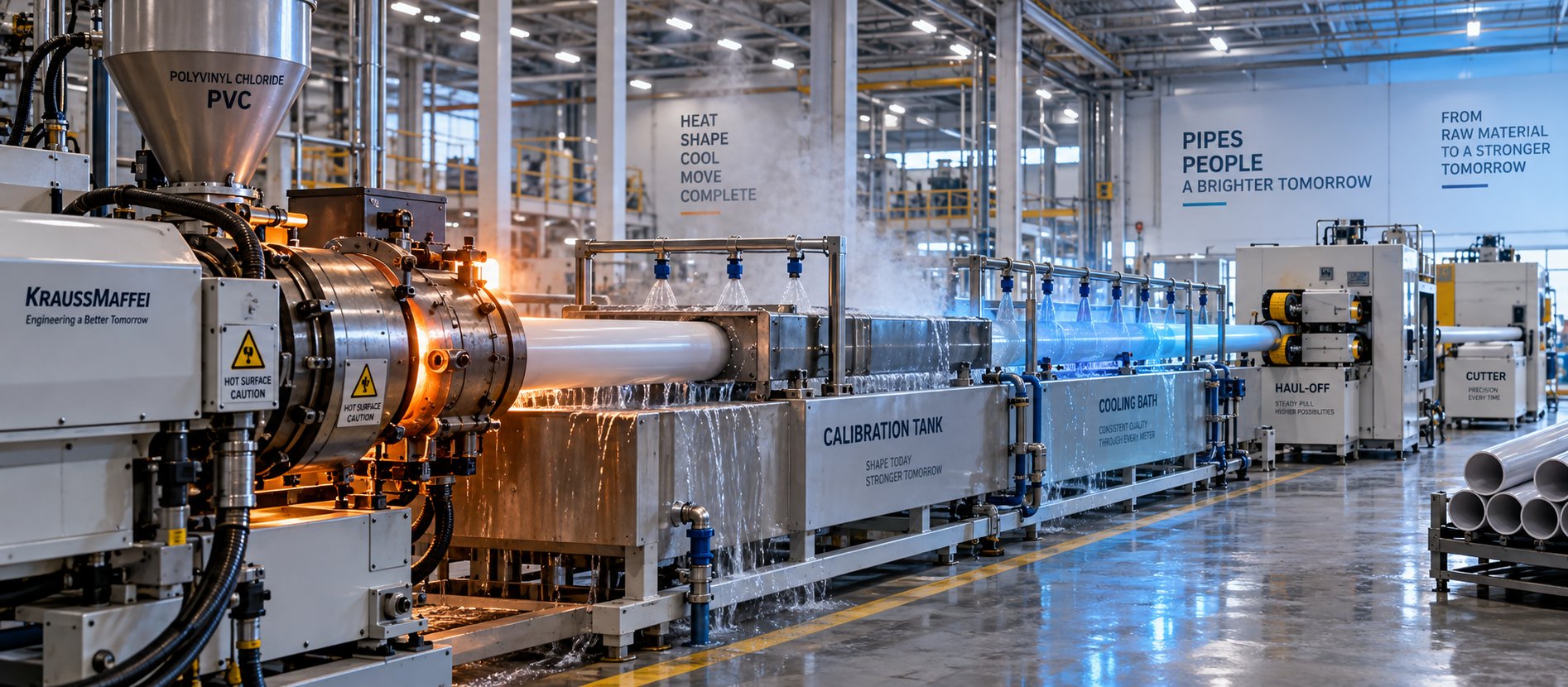
PVC Pipe Making Machine: What No Supplier Will Tell You First
Oct 21, 2026
Learn what a PVC pipe making machine really includes, how each component works, extruder types compared, maintenance schedules, defect fixes, and buying tips.
Read Article
What Your Film Extrusion Machine Datasheet Won't Tell You
Oct 20, 2026
Film extrusion machine guide covering blown vs cast processes, multilayer configurations, screw specs, resin selection, and supplier evaluation for production engineers.
Read Article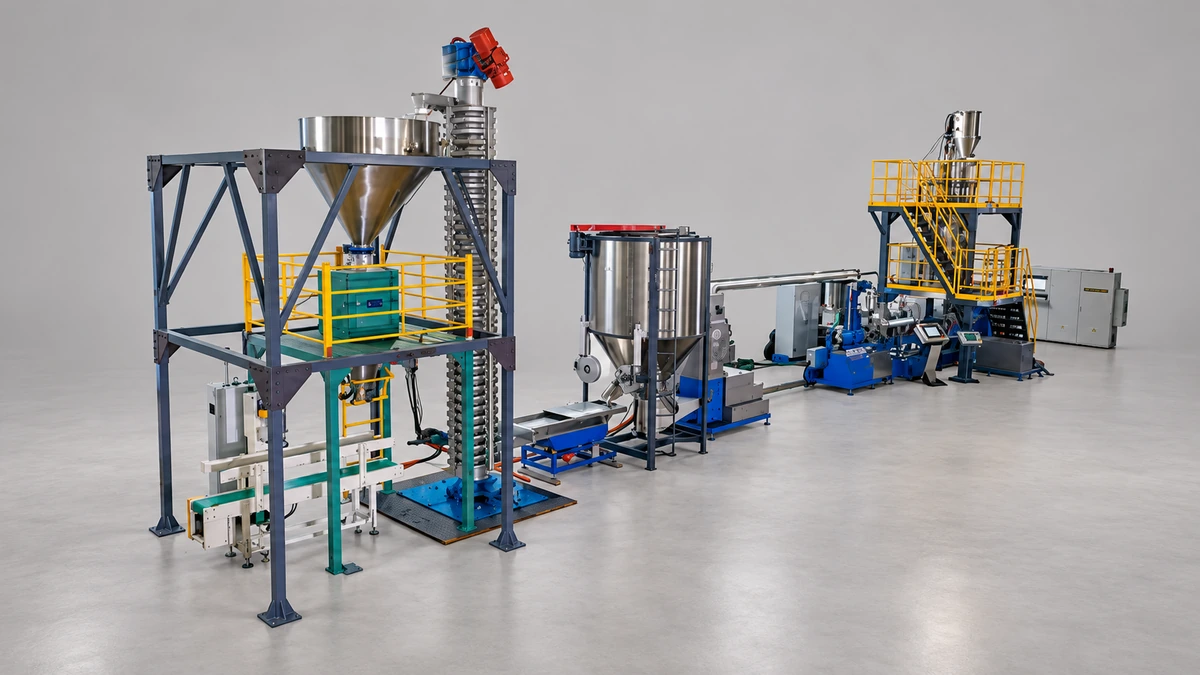
Raw Scrap to Perfect Pellets: Plastic Pelletizing Machine Guide
Oct 19, 2026
Learn how a plastic pelletizing machine converts scrap into uniform pellets. Covers cutting methods, extruder types, quality control, costs, and maintenance.
Read ArticleLooking for something else?
Search by material, symptom or product and jump straight to the relevant page.
These are navigation suggestions based on keyword matching — not a quotation, not a delivery commitment, and not a substitute for engineering review. Final specification is confirmed by our engineers against your drawings and processed material.
Need help with screw barrel selection?
Share your machine model, processed material and application. Our team can help with pricing and technical support.