

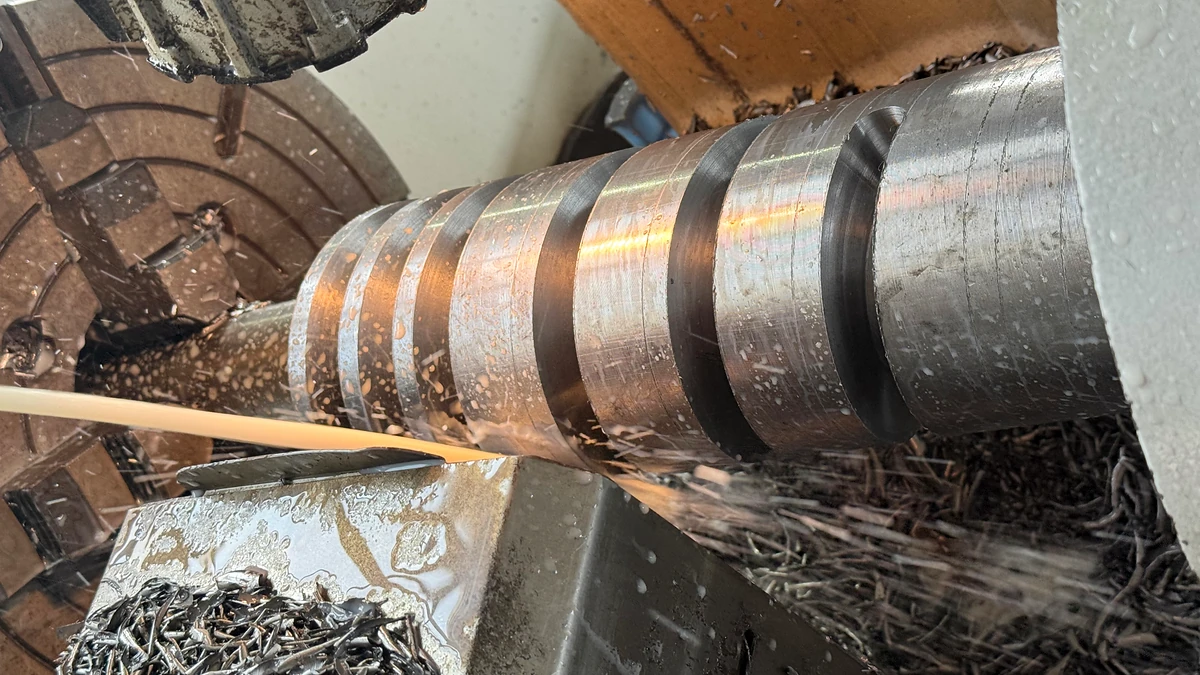
What Every Buyer Should Know Before Comparing Screw Barrel Prices
Screw barrel price is more than a number on an invoice. It represents the total investment in a mission-critical plastics processing component — encompassing the quoted unit cost, shipping and customs fees, installation labor, material compatibility, and the long-term wear life that determines how often you'll be placing that order again. When you search for pricing information online, you'll quickly discover that most results offer vague generalities or thinly veiled sales pitches rather than the actionable intelligence buyers actually need.
This guide changes that. It's built entirely around the buyer's perspective, breaking down every factor that shapes what you'll actually pay — and what you'll get for your money.
What Screw Barrel Price Really Means for Buyers
Imagine you receive two quotes for what appears to be the same extruder screw barrel. One comes in at $4,500 and the other at $7,200. Which is the better deal? Without knowing the alloy specification, dimensional tolerances, heat treatment method, surface finish, shipping terms, and expected wear life, that question is impossible to answer. The quoted price and the true landed cost are two very different figures.
Most online resources fail buyers at exactly this point. They list a cheap price extruder screw barrel without clarifying whether the quote is FOB (freight on board at the factory gate) or delivered, whether it includes nitrided steel or a bimetallic liner, or whether the dimensional tolerances will actually match your machine. A quote missing these details is not a price — it's a guess. Seasoned procurement teams know that normalizing quotes across suppliers requires understanding the full scope behind every number, from raw material grade to warranty terms.
Why Pricing Transparency Matters in Plastics Processing
Screw barrels are not commodity parts you swap out without consequences. They are the heart of the plasticating unit, and the clearances between the screw flight outside diameter and the barrel inner wall are typically just 0.001 inch per side, per inch of diameter. That precision directly controls heat transfer, shear rate, and melt quality. An uninformed purchasing decision — choosing cheap price extruder screws and barrels based solely on the lowest quote — can trigger a cascade of problems: inconsistent melt output, higher scrap rates, increased energy consumption, and ultimately unplanned downtime that dwarfs whatever you saved on the purchase.
As wear progresses, operators typically compensate by increasing screw speed, adjusting barrel temperatures, or raising backpressure. These incremental tweaks often go unnoticed until they dramatically impact part quality or productivity. At that point, there's no quick fix unless replacement parts are already on hand.
The cheapest screw barrel is rarely the most affordable one when measured over its full service life. A barrel that lasts twice as long at a moderately higher price almost always delivers a lower cost per production hour.
This article delivers what most pricing resources don't: realistic cost frameworks across single, twin, and conical configurations; a material-to-price breakdown ranked from entry-level nitrided steel to premium tungsten carbide; a total cost of ownership model; and a step-by-step guide to running an RFQ process that produces quotes you can actually compare. Every section is designed to help you spend smarter — not just spend less.
The starting point for any informed purchase is understanding how screw barrel type and configuration set the baseline for what you should expect to pay.
Price Ranges by Screw Barrel Type and Configuration
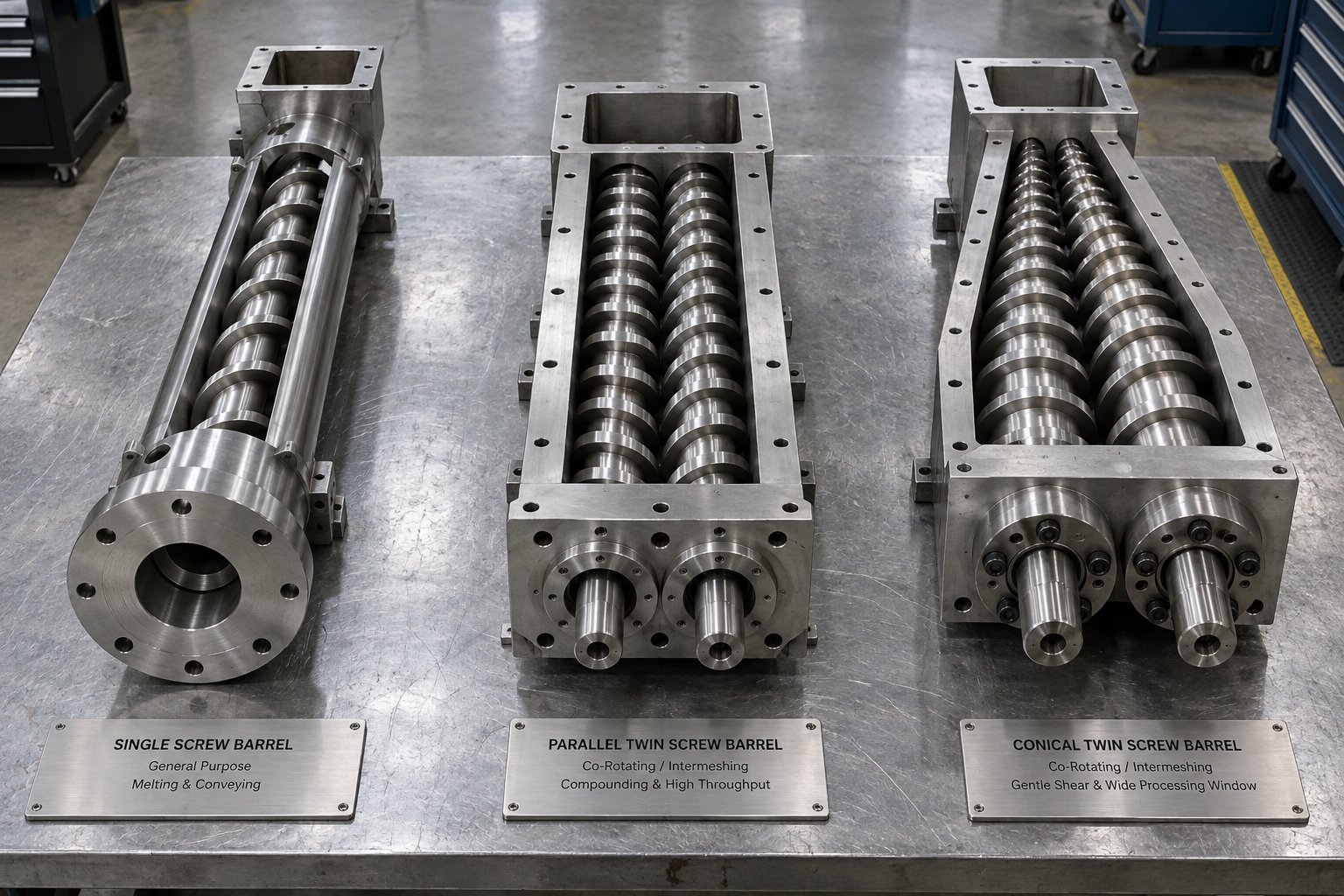
Not all screw barrels are priced the same way — and not all of them should be. The configuration you need dictates the manufacturing complexity, raw material volume, and precision tolerances required, all of which feed directly into what you'll pay. Whether you're sourcing a cheap price screw and barrel for extruder replacement or investing in a high-performance compounding setup, understanding the cost landscape across the three major categories gives you a realistic anchor before you ever pick up the phone to request a quote.
Single Screw Barrel Price Positioning
Single screw barrels represent the most accessible entry point in terms of pricing. You're dealing with one cylindrical bore, one screw, and relatively straightforward machining operations. That simplicity keeps costs lower — but "lower" is still relative. The final figure scales with three primary variables: barrel diameter, L/D ratio (length-to-diameter), and the material treatment applied to the bore surface.
A small-diameter barrel (say, 30-50 mm) with a standard nitrided liner sits comfortably in the budget tier. Move up to a 90-120 mm diameter with a bimetallic lining and a 30:1 or higher L/D ratio, and you'll find yourself in mid-range territory. Premium pricing kicks in when you combine large diameters, extended L/D ratios, and specialized alloys like tungsten carbide — the kind of setup demanded by filled or abrasive materials. Think of single screw pricing as your baseline. Every other configuration builds upward from here.
Parallel Twin Screw and Barrel Price Expectations
If you've searched for a cheap price parallel twin screw and barrel, you've probably noticed the jump from single screw quotes. There's a straightforward reason: parallel twin configurations require two precisely machined, intermeshing bores within a single barrel housing, along with matched screw element sets that must maintain tight clearances across their full length. Manufacturing tolerances are significantly tighter, and the raw material input is substantially greater.
Industry pricing data confirms that high-quality twin screw barrels can range from $10,000 to $50,000 depending on size, materials, and vendor. Parallel twin setups also frequently use modular screw elements — kneading blocks, mixing elements, conveying segments — that are priced and replaced individually, adding another cost layer that buyers sourcing a cheap price screw and barrel for plastic applications sometimes overlook during initial budgeting.
Conical Twin Screw Barrel Pricing Considerations
Conical twin screw barrels occupy a unique position in the pricing spectrum. The tapered bore geometry — larger at the feed end, narrowing toward the discharge — creates manufacturing challenges distinct from parallel designs. Machining a precisely tapered dual-bore housing demands specialized tooling and careful quality control at every stage.
However, conical designs often use shorter overall barrel lengths to achieve comparable processing performance, which can partially offset the per-unit machining premium. Their superior mixing capabilities and effective thermal management make them popular for PVC processing and similar applications where gentle, consistent plasticating matters more than raw throughput volume.
| Screw Barrel Type | Typical Diameter Range | Relative Cost Level (Single Screw = 1.0x) | Primary Cost Drivers |
|---|---|---|---|
| Single Screw | 25 mm – 200 mm | 1.0x (Baseline) | Diameter, L/D ratio, bore liner material |
| Parallel Twin Screw | 20 mm – 135 mm (per screw) | 2.0x – 3.5x | Dual-bore precision, modular element sets, tighter tolerances |
| Conical Twin Screw | 35/75 mm – 80/156 mm (small/large end) | 1.8x – 3.0x | Tapered bore machining, specialized tooling, alloy requirements |
This framework is deliberately relative rather than absolute because actual dollar figures fluctuate with alloy specifications, supplier geography, and order volume. What the table does reveal is the cost relationship between types — a parallel twin barrel at 3x the baseline price of a comparable single screw unit is entirely normal, not a sign of price gouging.
Yet the type and configuration only set the starting point. The material lining that bore — nitrided steel, Fe-based bimetallic, Ni-based alloy, or tungsten carbide — introduces another layer of cost variation that can rival the configuration premium itself.
How Material and Alloy Composition Affect Screw Barrel Cost
That material lining inside the bore is, in many cases, the single biggest variable separating a cheap price single screw barrel from one costing two or three times as much. Two barrels can share identical external dimensions, the same flange geometry, and the same L/D ratio — yet carry dramatically different price tags because of the alloy protecting the working surface. Understanding what each metallurgy tier delivers in wear resistance, corrosion protection, and service life is the key to matching your budget with your actual processing demands.
Nitrided Steel and Standard Alloy Pricing
Gas-nitrided barrels sit at the entry-level price tier, and for many applications, they're exactly the right choice. The process starts with a nitriding-grade steel — most commonly 38CrMoAlA, EN-41B, or Nitralloy 135M — that is surface-hardened by diffusing nitrogen into the bore at 500-550 degrees Celsius. The result is a hardened case reaching 950-1100 HV (roughly 65-70 HRC equivalent), but only about 0.4-0.6 mm deep.
That shallow case depth is both the strength and the limitation. For non-abrasive virgin polyolefins like LDPE, HDPE, and general-purpose PP, a properly manufactured nitrided barrel can deliver 5-10 years of reliable service. The cost advantage is significant — nitrided represents the 1.0x baseline against which every other material option is measured. However, once abrasive fillers or corrosive compounds start wearing through that thin hardened layer, the soft core beneath is exposed, and wear accelerates rapidly. There is no second chance with a nitrided barrel in demanding service.
Bimetallic Screw and Barrel Cost Factors
Bimetallic barrels take a fundamentally different approach: instead of hardening the surface of a single steel, they use a high-strength outer shell with a wear-resistant alloy liner centrifugally cast inside the bore. That liner typically runs 1.5-3.0 mm thick — providing roughly five to six times the wear reserve of nitriding. The price premium reflects this: expect to pay 1.8x to 3.0x the cost of an equivalent nitrided unit, depending on the alloy grade and barrel size.
Here's where the distinction between Fe-based and Ni-based alloys becomes critical for buyers seeking a competitive price screw and barrel for plastic processing:
Fe-based bimetallic liners (Fe-Cr-B alloys) feature chromium and boron carbides in an iron matrix, achieving 58-62 HRC. They're the cost-effective step up from nitrided steel — ideal for general abrasion from fillers like calcium carbonate, talc, and moderate fiber content. If your operation processes filled compounds but doesn't deal with corrosive chemistry, Fe-based liners hit the sweet spot between price and protection.
Ni-based bimetallic liners (Ni-Cr-B-W alloys) carry a meaningful price jump above Fe-based options. The nickel matrix with chromium, boron, and tungsten carbides delivers 60-65 HRC hardness along with substantially better corrosion resistance. This is the non-negotiable specification for PVC, CPVC, halogenated flame retardants, and any formulation that releases corrosive byproducts during processing. Skipping the Ni-based upgrade in these environments — even to secure a competitive price parallel twin screw and barrel — is a false economy that typically results in barrel failure within 12-18 months.
Premium Alloys and Tungsten Carbide Pricing
At the top of the cost spectrum sit tungsten-carbide-rich liners and HVOF (High Velocity Oxygen Fuel) tungsten carbide coatings, reaching 65-75 HRC. These are engineered for the most punishing applications: high-percentage glass fiber compounding, mineral-filled engineering plastics, and wood-plastic composites where standard bimetallic liners still wear too quickly.
The price reflects the material reality — tungsten carbide raw materials are expensive, the application processes are technically demanding, and the machining required after lining is slower and costlier. A WC-rich lined barrel might cost three to four times a comparable nitrided unit. Yet in glass-fiber-reinforced PA66 compounding at 30% loading, field data shows these barrels delivering 42+ months of service where a nitrided barrel failed in just 8 months — making the effective cost per month roughly half that of the cheaper option.
Here's the full material hierarchy, ranked from lowest to highest relative cost:
- Nitrided steel (1.0x baseline) — entry-level pricing, suitable for clean virgin polymers with no abrasive fillers or corrosive chemistry
- Fe-based bimetallic (1.8x - 2.2x) — moderate premium, justified for mildly to moderately abrasive compounds including calcium carbonate and talc-filled materials
- Ni-based bimetallic (2.2x - 3.0x) — significant step up, required for corrosive processing environments such as PVC, CPVC, and halogenated formulations
- Tungsten carbide (WC-rich or HVOF) (3.0x - 4.0x+) — premium tier, essential for severe abrasion from glass fiber, mineral reinforcements, and contaminated recycled feedstreams
The percentage jumps between tiers are substantial, but they don't tell the complete story. A barrel that costs three times as much yet lasts five times longer doesn't just save money — it eliminates production disruptions, reduces scrap, and stabilizes output quality in ways that never appear on the purchase order. That distinction between purchase price and true ownership cost deserves its own closer look.
The True Cost of Choosing the Cheapest Screw Barrel
A barrel costing three times more but lasting five times longer sounds like an obvious win on paper. So why do so many buyers still default to the lowest quote? The answer usually comes down to upfront budget pressure and the difficulty of quantifying what a cheap extruder screw barrel price actually costs once it's installed and running. Let's break that down — because the penalties of choosing the cheapest option rarely show up on the purchase order.
What Low-Price Screw Barrels Actually Cost You
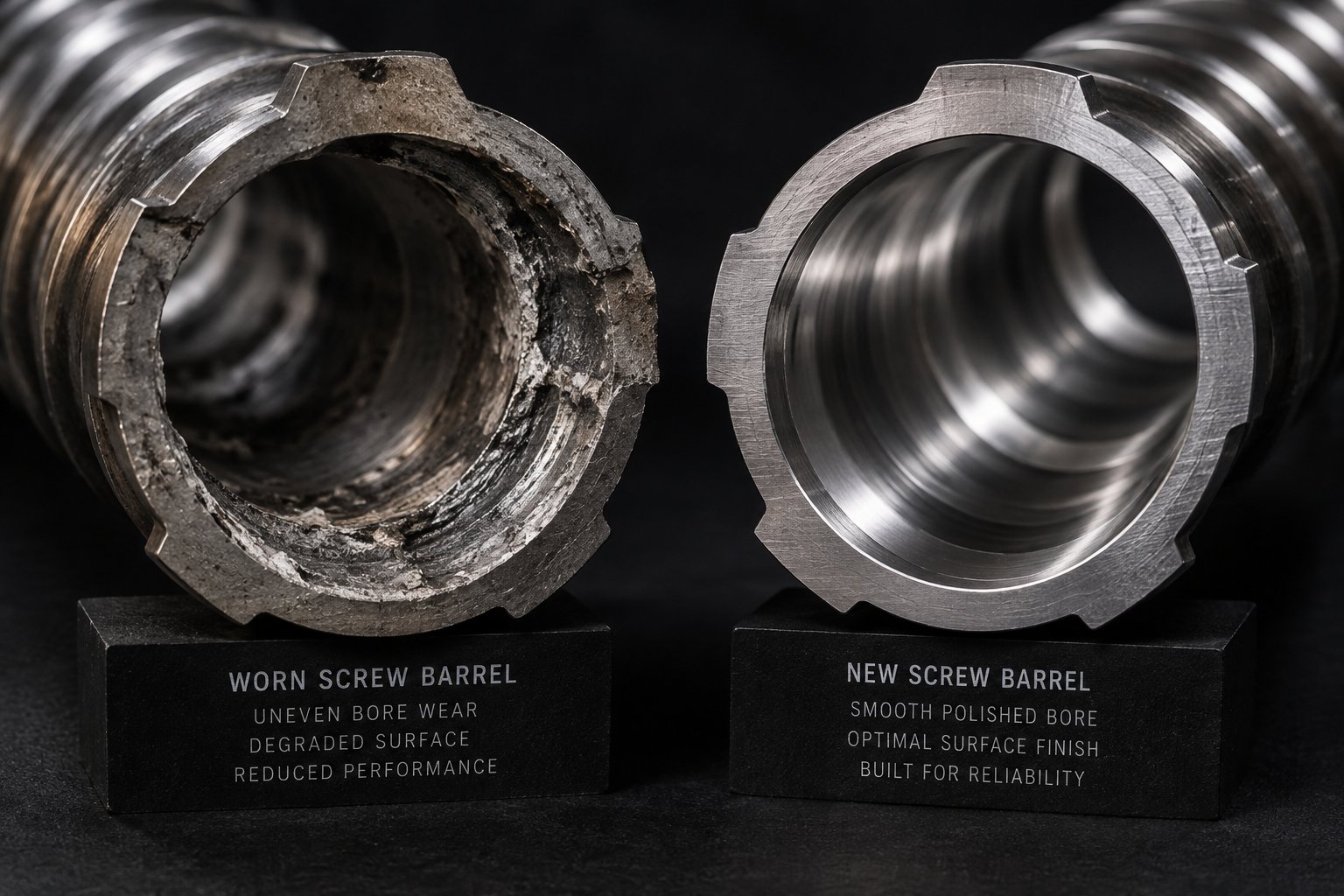
When a manufacturer cuts the price of a screw barrel significantly below market norms, something has been sacrificed. You just can't always see it from a photo or a spec sheet. Here's what typically gives way:
Looser dimensional tolerances. The gap between the screw flight OD and the barrel bore is measured in thousandths of an inch. Industry data from Magog Industries shows that for a 50 mm screw, the minimum clearance should sit around 0.10 mm — and for a larger 152 mm unit, around 0.30 mm. When that gap is sloppy from day one, melt film forms unevenly, material slips backward across the flights instead of moving forward, and output consistency drops before you've even logged your first production month.
Inferior metallurgy. Budget barrels frequently use lower-grade steel or inconsistent bimetallic liner thickness. The result is accelerated wear — particularly in the transition zone where shear forces peak. A 10% decrease in screw OD from wear can produce a 25% reduction in output, a figure originally documented by Anderson at Flite Technology. That throughput loss alone can dwarf the initial savings within months.
Poor heat treatment. Insufficient nitriding depth or inconsistent hardness across the bore surface means the hardened case wears through prematurely, exposing the soft core beneath. Once that threshold is crossed, wear accelerates exponentially rather than linearly.
Suboptimal screw geometry. Cheap screws often use simplified flight designs that increase energy consumption. As wear progresses, operators compensate by raising screw speed, adjusting temperatures, and increasing backpressure. These corrections mask the problem temporarily but drive up electricity costs — by as much as £3,500 per year on a single machine, even before accounting for wasted material and lost production time.
The pattern is consistent: replacement frequency and unplanned downtime from cheap barrels routinely exceed the initial savings. Whether you're evaluating a conical twin screw with barrel for extruder price or a straightforward single screw replacement, the lowest quote rarely delivers the lowest annual cost.
Total Cost of Ownership vs. Purchase Price
Purchase price is a single data point. Total Cost of Ownership (TCO) is the full picture. Here's the framework experienced procurement teams use to compare what they'll actually spend over the life of a screw barrel:
TCO = Purchase Price + Shipping/Customs + Installation + Energy Cost Differential + Downtime During Replacement + Throughput Efficiency Variance + Wear Life
Each element matters. A factory price extruder screw barrel that arrives with a 4-6 week lead time but lasts 8,000 production hours creates a fundamentally different cost profile than a budget alternative lasting 3,000 hours — even if the upfront price is half. You're not just buying twice as many barrels; you're absorbing twice the installation labor, twice the alignment verification, and twice the production interruption. In high-volume extrusion running 24/7, a single unplanned barrel change can cost more in lost output than the barrel itself.
A screw barrel lasting 8,000 hours at a moderate price consistently outperforms one lasting 3,000 hours at half the price — the math is not close.
To make this comparison concrete, use the following framework when evaluating competing quotes for any extruder screw barrel price:
| TCO Factor | Budget Barrel | Mid-Range Barrel | How to Evaluate |
|---|---|---|---|
| Purchase Price | Lower upfront cost | Higher upfront cost | Normalize quotes to same scope (material, tolerances, shipping terms) |
| Estimated Wear Life | Shorter (often 2,000–4,000 hrs) | Longer (often 6,000–10,000 hrs) | Request alloy specification and expected service hours for your material |
| Annual Replacement Cost | Higher due to frequent replacement | Lower due to extended intervals | Divide purchase price by estimated wear life in years |
| Downtime Cost Impact | More frequent shutdowns | Fewer production interruptions | Calculate lost output value per hour of downtime on your line |
| Net Cost per Production Hour | Typically higher when all factors included | Typically lower despite higher purchase price | Total all costs above and divide by actual production hours delivered |
The "How to Evaluate" column is the key. Every buyer's specific numbers will differ based on machine size, material being processed, and production schedule. But the pattern holds across virtually every scenario: when you calculate net cost per production hour rather than staring at the invoice total, the mid-range barrel wins. It's not even a matter of opinion — it's arithmetic.
Of course, the purchase price and wear life only capture what happens inside the barrel bore. A full accounting of what you'll spend also includes several costs that never appear on the supplier's quote at all — costs that can quietly inflate the real price by 15-30% beyond the unit figure.
Hidden Costs That Inflate the Real Screw Barrel Price
That 15-30% premium beyond the unit figure isn't hypothetical — it's the reality buyers encounter when freight invoices arrive, installation crews clock in, and a barrel that looked identical on paper doesn't quite fit the existing machine. These are the costs no supplier's quote volunteers, and they can reshape your entire budget calculation if you're not prepared.
Shipping, Customs, and International Logistics Costs
Picture a single screw barrel measuring 2,400 mm long, weighing 350 kg, and requiring careful handling to protect machined bore surfaces. This isn't a standard parcel — it's an oversized, heavy, high-value freight shipment. Domestic trucking alone can add meaningful cost, but international logistics is where the numbers really escalate.
Ocean freight rates for heavy cylindrical components fluctuate with container availability, fuel surcharges, and port congestion. For buyers sourcing a factory price extruder screw barrel or a factory price single screw barrel from overseas manufacturers, shipping expenses can represent 8-15% of the unit price on smaller barrels and 5-10% on larger, higher-value units. Air freight — sometimes necessary for emergency replacements — can push that figure dramatically higher.
Beyond freight itself, customs duties and import tariffs introduce another layer. Steel-based machinery components typically carry specific tariff classifications, and rates vary significantly depending on the country of origin and destination. A buyer comparing a factory price screw and barrel for extruder from one country against a seemingly similar quote from another may discover a 5-12% duty differential that completely reshapes the landed cost comparison.
Here's where Incoterms become essential. When one supplier quotes FOB (Free On Board) and another quotes CIF (Cost, Insurance, and Freight), you're not comparing equivalent numbers. An FOB price excludes ocean freight and insurance entirely — those become your responsibility. A DDP (Delivered Duty Paid) quote includes everything to your door. Failing to normalize for these terms is one of the most common mistakes buyers make when chasing what appears to be a factory price parallel twin screw and barrel. The "cheaper" quote sometimes costs more once you've arranged your own logistics.
Installation, Alignment, and Compatibility Expenses
A barrel arrives at your facility. It matches the quoted dimensions. The alloy is correct. Everything looks right — until your maintenance team discovers the flange bolt pattern is 2 mm off, or the feed throat bore diameter sits just outside your machine's tolerance band. What happens next is expensive: custom machining, adapter plates, shimming, and hours of labor that were never budgeted.
Even when dimensional compatibility is confirmed, proper installation demands more than sliding a barrel into place. Davis-Standard emphasizes that barrel alignment to the drive quill of the gearbox is non-negotiable — and the longer the barrel, the more critical this becomes. A poorly aligned extruder barrel causes premature wear on both the screw and barrel, bent and broken screws, unstable barrels, heater crawl, thermocouple shearing, and additional drive load. Simply leveling the barrel is not sufficient; correct procedure requires optical or laser alignment scopes inside the drive quill to establish a fixed centerline.
Consider the thermal dimension as well. Steel expands at 0.000006 inches per inch per degree Fahrenheit. A 4.5-inch, 36:1 barrel operating at 450°F grows approximately 0.320 inches longer when heated from room temperature. If barrel supports don't allow free expansion in a straight line, the barrel bends — creating uneven wear patterns that shorten its life and degrade melt quality from day one. Replacement barrels sourced from a new supplier must account for support system compatibility, not just bore dimensions.
Dimensional verification before purchase — sharing detailed drawings, confirming flange specs, verifying feed throat geometry — prevents these surprises. Yet many buyers skip this step when comparing factory price extruder screws and barrels, treating dimensional fit as a given rather than a risk that needs active management.
Warranty Terms and After-Sale Support Value
Two barrels at identical prices can carry wildly different risk profiles based purely on what happens after the sale. One supplier might offer a 12-month warranty covering material defects and dimensional accuracy, with responsive technical support for installation questions. Another might offer no warranty at all — or one so narrowly worded that it excludes the very failure modes most likely to occur in service.
Warranty terms worth evaluating include coverage duration, what constitutes a qualifying defect, who bears return shipping costs, and whether the supplier provides replacement or only credit. Technical support availability matters too: can you reach an engineer when your maintenance team has questions during a weekend barrel swap? Does the supplier provide dimensional inspection reports and material test certificates proactively, or only when pressed?
Return policies are another hidden variable. If a barrel arrives and doesn't meet specifications, who pays for return freight on a 350 kg component? That single cost can eliminate the savings that made the supplier attractive in the first place.
Before finalizing any screw barrel purchase, budget for the full spectrum of costs that sit outside the quoted unit price:
- Freight and logistics — domestic trucking, ocean or air freight, packaging, and handling for oversized components
- Customs and duties — import tariffs, brokerage fees, and documentation costs that vary by origin and destination
- Installation labor — skilled technician hours for barrel removal, new barrel fitting, and system reassembly
- Alignment and fit-up — laser or optical alignment services, barrel support verification, and thermal expansion checks
- Compatibility testing — dimensional verification against machine drawings before shipment, trial runs after installation
- Potential rework costs — custom machining, adapter fabrication, or shimming if the replacement doesn't match perfectly
Any one of these line items can add 3-8% to your effective purchase price. Stack several together — as commonly happens with international sourcing — and the gap between quoted price and true landed cost becomes impossible to ignore. The good news? Many of these costs are negotiable or avoidable, especially when you understand how order volume, customization choices, and supplier relationships create leverage on the final number.
How Volume and Customization Shape Your Final Price
Those hidden costs — freight, duties, installation, rework — are real, but they're not fixed. The purchasing context surrounding every order creates leverage that can meaningfully shift the per-unit figure in your favor. Three variables stand out above all others: how many units you're ordering, how much customization you're requesting, and whether you've structured an ongoing relationship with your supplier. Get these right, and you'll secure a good price for screw and barrel for plastic processing without sacrificing the quality that keeps your line running.
How Order Volume Drives Per-Unit Screw Barrel Pricing
Every screw barrel starts with setup — tooling configuration, CNC programming, alloy preparation, and quality inspection protocols. Whether the shop produces one barrel or twenty from that setup, the fixed costs remain roughly the same. Spread across a single unit, those costs are fully absorbed into your quote. Spread across a batch of ten or more, they shrink dramatically on a per-piece basis.
Material purchasing follows a similar pattern. A manufacturer buying bimetallic alloy rod for one barrel pays list price. The same manufacturer ordering alloy for a quarterly production run of fifty barrels negotiates volume pricing from the raw material supplier — and passes a portion of that savings forward. Production scheduling efficiency improves too: running consecutive identical or similar barrels minimizes changeover time on lathes, boring machines, and grinding equipment, reducing the labor hours embedded in each unit.
Where do meaningful discounts typically begin? For standard single screw barrels, order quantities of five to ten units often unlock the first price break. At twenty or more, the economics shift further. Parallel twin screw and barrel sets — with their higher per-unit value — may see noticeable discounts at lower volume thresholds, sometimes as few as three to five matched sets, because the absolute dollar value of the order justifies setup amortization even at smaller quantities.
Keep in mind that volume doesn't always mean ordering everything at once. Many buyers consolidate demand across multiple machines or facilities into a single purchase order, achieving volume pricing without overstocking any single location.
Customization Levels and Their Price Impact
Not all custom work carries the same cost premium. Think of customization as a spectrum — and knowing where your requirement falls on it helps you anticipate how much it will add to the base price.
At the low end, a standard catalog replacement barrel — matching an existing OEM specification with no modifications — carries zero customization premium. You're buying a known geometry in a known alloy, and the manufacturer may already have production templates on file. This is where buyers seeking a good price and quality fe-base alloy screw and barrel find the most competitive quotes.
One step up, minor dimensional modifications — adjusting overall length by a few millimeters, adapting a flange bolt pattern, or specifying a slightly different bore finish — add modest engineering review time but rarely change the fundamental manufacturing process. Expect a 5-15% premium over catalog pricing.
Custom screw geometry design pushes the cost higher. When a buyer specifies unique flight depths, non-standard compression ratios, barrier flight configurations, or specialized mixing sections, the manufacturer invests engineering time in design validation and may need to produce dedicated tooling. This is common for buyers seeking a good price and quality nickel based alloy screw and barrel optimized for a specific corrosive compound — the alloy and the geometry both require tailoring.
Specialized material specifications — requesting a particular bimetallic alloy grade, a specific hardness range with certified testing, or regulatory-compliant documentation for food-contact applications — add both material cost and administrative overhead.
At the top of the spectrum, complete reverse-engineering from a worn sample demands the most effort. The manufacturer must measure a degraded component, reconstruct the original design intent, account for wear-induced dimensional changes, and produce engineering drawings from scratch. This service is invaluable when OEM drawings are unavailable, but it commands the highest customization premium — sometimes 30-50% above a standard replacement for the same size barrel.
Supply Agreements and Long-Term Pricing Benefits
Imagine you replace screw barrels across a fleet of twelve extruders, cycling through three to four replacements per year. Each time you request a fresh quote, you're starting from zero — no committed volume, no pricing history, no priority in the production queue. Annual supply contracts and blanket purchase orders change that dynamic entirely.
A blanket PO covering your projected annual demand — even if deliveries are staggered quarterly — gives the manufacturer planning visibility. They can reserve alloy inventory, schedule your jobs during slower production windows, and reduce the administrative cost of processing multiple individual orders. In return, you lock in favorable per-unit pricing and, just as importantly, priority lead times that protect you from the 8-12 week waits that catch unprepared buyers during peak demand periods.
Preferred supplier agreements go further still. By committing a higher share of your screw barrel spend to a single qualified manufacturer, you gain negotiating leverage on pricing, access to dedicated engineering support, and often first access to process improvements or new alloy options. The manufacturer benefits from predictable revenue, which further incentivizes competitive pricing.
To put all of these variables in perspective, here are the factors that most influence what you'll ultimately pay — ranked by their typical impact on the final screw barrel price:
- Barrel diameter and length — the single largest determinant of raw material volume and machining time
- Material and alloy specification — the gap between nitrided steel and tungsten carbide can represent a 3-4x cost difference
- Customization complexity — from zero-premium catalog replacements to high-premium reverse-engineered designs
- Order volume — batch economics that reduce per-unit cost through setup amortization and material purchasing leverage
- Supplier type (manufacturer vs. distributor) — factory-direct sourcing eliminates intermediary markups that can add 20-40% to the price
- Geographic sourcing region — labor rates, raw material access, and logistics costs that vary significantly between manufacturing hubs
Each factor interacts with the others. A large-diameter, Ni-based bimetallic barrel ordered as a one-off custom design from a distributor in a high-cost region will sit at the top of any pricing range. The same barrel ordered in a batch of ten, factory-direct, with a standing supply agreement? That's an entirely different conversation. Understanding these levers doesn't just help you predict costs — it gives you the vocabulary and the framework to negotiate them effectively.
Still, volume and customization only explain part of the pricing puzzle. The specific application you're running — whether it's general-purpose polyolefin, glass-filled engineering resin, recycled feedstock, or food-grade production — imposes its own set of material and compliance requirements that push the cost into distinct tiers.
Why Your Application Determines the Right Price Tier
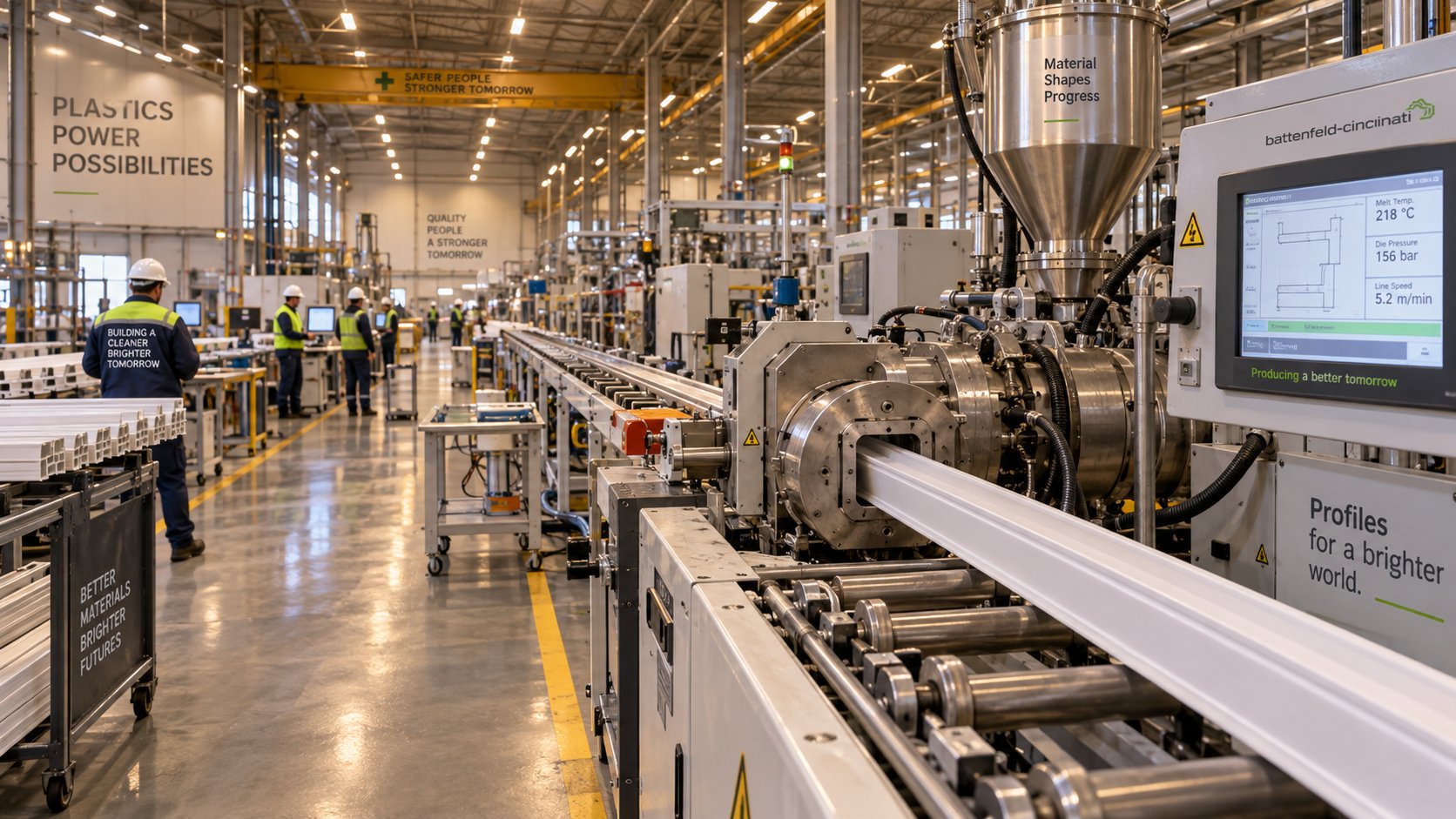
A buyer searching for a low price extruder screw barrel might find two seemingly identical options — same diameter, same L/D ratio, same bimetallic liner. Yet one costs 40% more. The difference? One is certified for food-contact processing, the other isn't. Application requirements impose material, documentation, and tolerance specifications that generic pricing guides rarely account for — and these specifications don't bend to fit your budget. They're set by the physics of wear, the chemistry of your feedstock, or the regulations governing your end market.
Food-Grade and Medical-Grade Processing Requirements
When your extruded product contacts food or enters a medical device, the barrel lining isn't just a wear surface — it's a regulatory compliance point. FDA material safety standards and EU food-contact regulations mandate specific alloy compositions, certified surface finishes, and complete traceability documentation from raw material through final inspection. Corrosion-resistant alloys — typically Ni-based bimetallic liners at minimum — are essentially non-negotiable because even trace amounts of iron corrosion products migrating into the melt stream can create contamination risks.
Beyond the alloy itself, you're paying for mirror-polished bore finishes that prevent material hang-up, comprehensive material test certificates with full chemical composition reporting, and sometimes third-party validation audits of the manufacturing process. A buyer hoping to source low price extruder screws and barrels for food-grade extrusion will find that the compliance documentation alone adds 10-20% to the cost compared to an identical barrel sold without certification. Skipping those certifications isn't an option — a single regulatory failure can trigger product recalls that cost thousands of times more than the barrel premium.
Recycling Operations and Abrasive Material Challenges
Recycling operations face a painful pricing paradox. Post-consumer and post-industrial recycled plastics contain contaminants — metal fragments, glass particles, paper residue, mineral fillers, sand, and other foreign materials — that dramatically accelerate abrasive wear on both screw flights and barrel bores. These operations need premium wear protection, yet they typically run on tighter margins than virgin resin processors.
A low price fe-base alloy screw and barrel might seem like a reasonable compromise, but in heavily contaminated recycled HDPE or mixed-stream feedstock, even Fe-based bimetallic liners wear through surprisingly fast. Some of the most aggressive contaminants can reduce screw and barrel useful life by 50% or more. Recyclers processing cleaner, pre-sorted industrial regrind can often get acceptable service life from Fe-based liners. But operations handling mixed post-consumer waste — with its unpredictable contamination profile — frequently discover that tungsten-carbide-rich liners deliver the lowest cost per ton of processed material, despite carrying the highest upfront price.
The takeaway is counterintuitive: the application with the tightest margins often demands the most expensive barrel.
High-Output Production and Precision Extrusion Demands
High-throughput operations running 24/7 amplify every performance variable. A barrel with slightly loose tolerances might produce acceptable output on a single-shift operation, but across 8,000+ annual production hours, those marginal inefficiencies compound into measurable losses — higher energy consumption, inconsistent melt temperatures, and elevated scrap rates. Maintaining optimal screw-to-barrel clearance becomes critical when every percentage point of throughput efficiency translates to significant revenue.
Precision profile extrusion — think medical tubing, optical film, or tight-tolerance weatherstripping — adds another dimension. These applications demand screw geometries optimized for melt homogeneity and temperature uniformity, not just raw throughput. Custom barrier flight designs, specialized mixing sections, and tighter-than-standard bore tolerances all increase the upfront cost. Yet the ROI is tangible: fewer out-of-spec meters of product, reduced trimming waste, and more consistent downstream processing. For buyers running precision lines, the right question isn't how to find the lowest screw barrel price — it's how to find the specification that minimizes cost per acceptable unit produced.
| Application Type | Typical Material Requirement | Relative Price Tier | Key Cost Driver |
|---|---|---|---|
| General Purpose (virgin polyolefins, PS) | Nitrided steel or Fe-based bimetallic | Base – Low | Standard alloy and tolerances; minimal documentation |
| Filled Compounds (CaCO3, talc, low-% glass) | Fe-based bimetallic | Low – Moderate | Abrasion resistance; harder flight hardfacing |
| Recycling (post-consumer, post-industrial) | Fe-based to WC-rich bimetallic (depending on contamination level) | Moderate – High | Unpredictable abrasive contaminants; accelerated wear rates |
| Food-Grade (FDA/EU compliant) | Ni-based bimetallic with certified surface finish | Moderate – High | Corrosion-resistant alloy; regulatory documentation and traceability |
| Medical-Grade | Ni-based bimetallic or specialized corrosion-resistant alloys | High – Premium | Stringent material certifications; validation audits; polished bore finish |
This matrix reveals a pattern that catches many first-time buyers off guard: the application with the lowest product margins (recycling) and the application with the strictest regulatory burden (medical) both push toward the upper end of the pricing spectrum — for entirely different reasons. General-purpose processing is the only category where aggressively pursuing the lowest cost doesn't carry significant hidden risk.
Recognizing where your application sits on this grid is half the battle. The other half is knowing which cost levers you can actually pull — maintenance practices that extend barrel life, alloy specifications matched precisely to your needs rather than over-engineered, and sourcing strategies that cut out unnecessary markups — without compromising the performance your application demands.
Smart Strategies to Reduce Screw Barrel Costs
Knowing which cost levers exist is one thing. Pulling the right ones — without triggering premature failure or production headaches — is where the real savings materialize. Every strategy below targets a specific slice of the total ownership cost, from extending the productive life of the barrel already on your machine to eliminating intermediary markups that inflate the price of its replacement. Whether you're sourcing a low price single screw barrel for a straightforward polyolefin line or a low price parallel twin screw and barrel for a compounding operation, these tactics apply across configurations and budgets.
Proper Maintenance to Maximize Screw Barrel Life
The most overlooked cost reduction strategy doesn't involve purchasing at all — it involves keeping the barrel you already own in service longer. Every additional thousand hours of production life you extract from an existing barrel directly reduces your annualized cost per production hour, effectively lowering the real price of that component without spending a cent on a replacement.
Regular purging between material changes prevents resin degradation and carbon buildup inside the barrel bore. Residual material that chars or cross-links acts as an abrasive contaminant, accelerating wear on both the screw flights and the barrel liner. Turner Group and Reiloy USA emphasize that properly maintained screws and barrels produce higher-quality parts, reduce scrap and rework, and lower energy consumption — because efficiently functioning components ensure smooth plastic flow and consistent heating.
Proper shutdown procedures matter just as much. Leaving heat-sensitive resin sitting in a hot barrel during unplanned stops allows thermal degradation that produces corrosive byproducts — particularly with PVC, PVDC, and flame-retardant formulations. A disciplined shutdown protocol that purges with a thermally stable resin and follows documented cool-down steps protects the bore surface between production runs.
Correct torque management and screw speed discipline prevent another category of avoidable damage. Running a screw at excessive RPM beyond the design intent generates unnecessary shear heat, increases mechanical loading on flights and barrel walls, and can cause metal-to-metal contact at the flight tips — especially as clearances open up from normal wear. Scheduled wear measurement programs, where maintenance teams periodically gauge screw OD and barrel bore ID at multiple points along the length, catch gradual wear trends before they cross the threshold into unplanned breakdowns. Catching a wear trend at 60% of the condemn limit gives you time to plan a replacement during scheduled downtime rather than scrambling during a production emergency — when rush freight and overtime labor can double the effective cost.
Matching Material Specifications to Actual Processing Needs
Here's a scenario that plays out more often than manufacturers like to admit: a buyer processes unfilled polypropylene on a single screw extruder, yet orders a Ni-based bimetallic barrel because "it's the best." That barrel might cost 2.5x more than a properly nitrided unit — and for clean, non-corrosive PP, it delivers virtually zero additional wear life benefit. The money spent on premium corrosion resistance is wasted because there's no corrosive chemistry to resist.
The reverse is equally damaging. A processor running rigid PVC who selects an Fe-based bimetallic liner to save 25% over Ni-based will likely face barrel replacement within 12-18 months as hydrochloric acid byproducts attack the iron matrix. The "savings" evaporate long before the first replacement arrives.
Right-sizing your alloy selection means matching the metallurgy to the actual wear and corrosion mechanisms present in your specific process — nothing more, nothing less. A practical decision framework looks like this:
No abrasive fillers, no corrosive chemistry? Nitrided steel delivers full value at the lowest cost. Moderate abrasion from calcium carbonate or talc at loadings under 20%? Fe-based bimetallic provides the cost-effective upgrade. Corrosive compounds, halogenated additives, or PVC processing? Ni-based bimetallic is the minimum viable specification. High-percentage glass fiber or heavily contaminated recycled streams? Tungsten carbide earns its premium. As the PIPLL bimetallic selection guide emphasizes, the decision should stem from actual wear and corrosion evidence — documented polymer grade, filler content, temperature profile, and observed damage patterns — not from a generic hardness claim or an assumption that more expensive automatically means better.
This discipline alone can reduce your screw barrel spending by 20-40% on lines where the previous specification was chosen by habit rather than analysis.
Factory-Direct Sourcing as a Cost Strategy
Distributor markups on screw barrels are substantial — often 20-40% above the manufacturer's price — because distributors carry inventory costs, sales overhead, and margin requirements that get layered onto every unit. For commodity purchases where convenience and small-quantity availability matter, that markup buys genuine value. But for a planned screw barrel replacement where you know your specifications, lead time allows for production scheduling, and you can communicate technical details directly, buying factory-direct removes an entire cost layer without sacrificing quality.
The economics echo a broader procurement principle. As Inline Plastics' analysis of direct-versus-distribution purchasing notes, buying directly from a manufacturer shines when your business orders consistently, understands its specifications clearly, and can manage the logistics. The per-piece pricing advantage is real — but it works best when you're not relying on the distributor's flexibility, emergency stock, or multi-category bundling.
For screw barrel buyers specifically, factory-direct sourcing offers an additional advantage beyond price: direct communication with the engineering team that designs and machines the component. Instead of relaying technical questions through a sales intermediary, you discuss alloy selection, tolerance requirements, and screw geometry directly with the people who control the manufacturing outcome. That connection improves specification accuracy, reduces the risk of ordering the wrong configuration, and often accelerates lead times because there's no information handoff delay.
NANHAIYA is one example of this model in practice — a factory-direct source providing custom and replacement screw barrels for extrusion and injection molding applications. Plastic processors, equipment builders, and maintenance teams working with manufacturers like NANHAIYA access manufacturer pricing without intermediary markups while maintaining direct engineering communication for custom specifications and dimensional verification. When your goal is securing a low price screw and barrel for extruder replacement without compromising on metallurgy or tolerances, eliminating the distribution layer is one of the most impactful moves available.
To consolidate these strategies into an actionable checklist, here are the cost optimization tactics that consistently deliver the greatest impact:
- Scheduled wear monitoring — periodic measurement of screw OD and barrel bore ID to catch wear trends early, enabling planned replacements during scheduled downtime rather than costly emergency swaps
- Correct alloy selection — matching metallurgy to your actual processing duty based on documented wear and corrosion evidence, avoiding both over-specification and under-specification
- Factory-direct purchasing — sourcing from manufacturers rather than distributors when specifications are known and lead times allow, eliminating 20-40% intermediary markups
- Volume consolidation — combining demand across multiple machines, production lines, or facilities into single purchase orders to unlock batch pricing and raw material volume discounts
- Proper startup and shutdown protocols — disciplined purging, controlled cool-down, and thermal management practices that prevent avoidable degradation and extend barrel service life
Each tactic operates on a different part of the cost equation — maintenance extends the denominator (more production hours per barrel), alloy matching right-sizes the numerator (appropriate purchase price for the duty), and sourcing strategy compresses the unit cost itself. Applied together, they can reduce your effective screw barrel cost per production hour by 30-50% compared to the common pattern of over-specifying metallurgy, buying through distributors at list price, and replacing reactively after unplanned failures.
These strategies put you in a stronger position — but the final test comes when you sit down to request and compare actual quotes. The way you structure that RFQ process, the specifications you provide, and the criteria you use to evaluate supplier responses determine whether all this knowledge translates into a genuinely better deal.
Mastering the RFQ Process to Get the Best Screw Barrel Deal
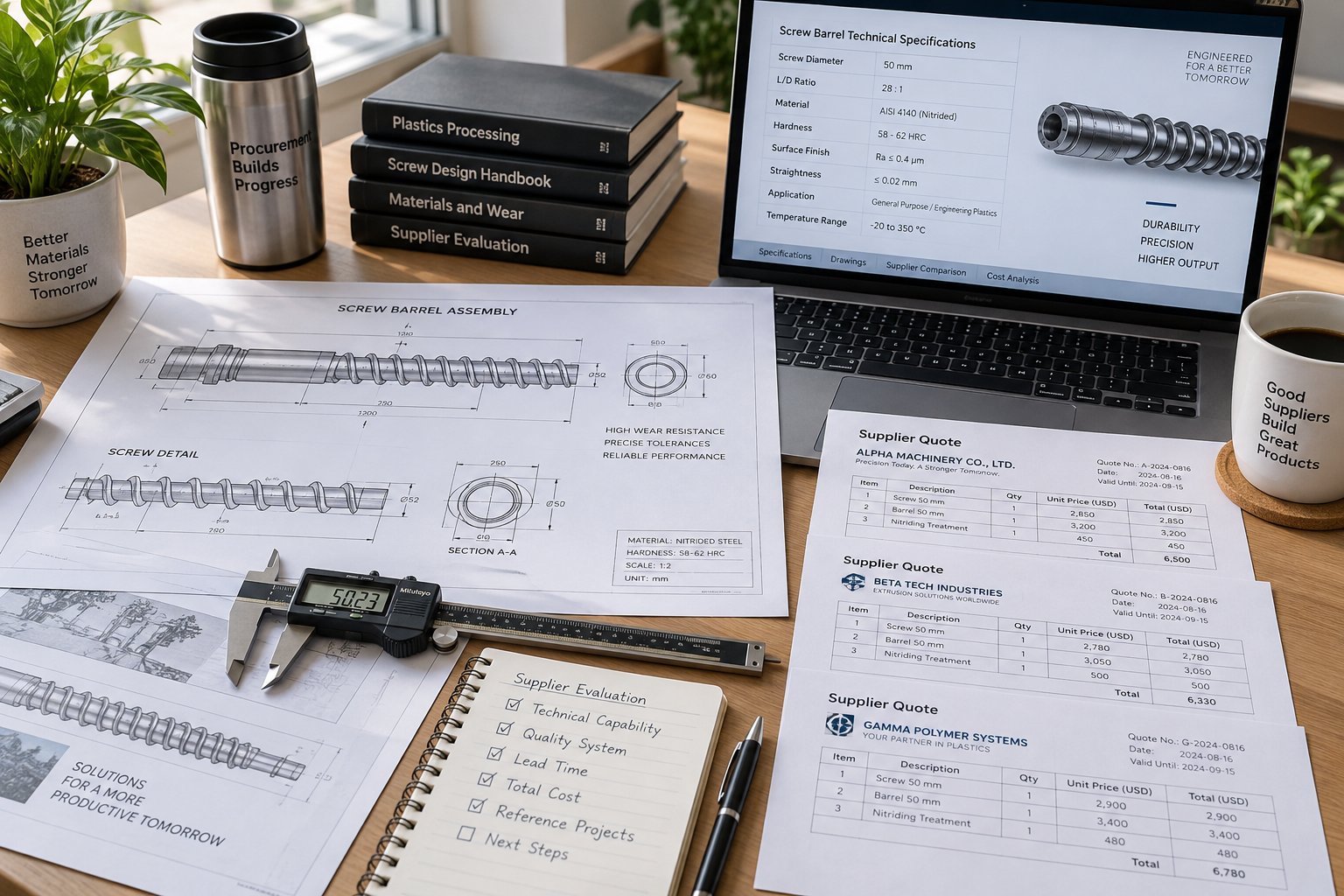
All the pricing intelligence in the world won't help if your Request for Quotation produces quotes you can't meaningfully compare. An incomplete or vague RFQ forces every supplier to fill in the gaps with their own assumptions — and assumptions are where price for screw and barrel for plastic diverges from reality. The result? Three quotes that look like they're for the same barrel but actually describe three different products at three different quality levels. Here's how to run a process that eliminates that ambiguity and surfaces the genuinely best deal.
What Information to Prepare Before Requesting Quotes
Think of your RFQ as the contract before the contract. A well-structured specification brief lets every supplier quote the same part, in the same material, to the same standard — so the numbers you receive are actually comparable. An incomplete RFQ, on the other hand, produces surprises, and surprises in critical wear components are always expensive.
Before contacting any supplier, gather the following details — missing even one forces the manufacturer to guess, which inflates the quote, delays the response, or delivers the wrong part entirely:
- Machine make and model — identifies the mounting configuration, flange type, and compatibility requirements
- Barrel diameter and length — the single largest driver of raw material volume and machining cost
- L/D ratio — determines processing performance characteristics and must match your machine's gearbox and drive specifications
- Material being processed — polymer type, filler content, additive chemistry, and contamination profile directly dictate the required alloy
- Required alloy or liner type — nitrided, Fe-based bimetallic, Ni-based bimetallic, or tungsten carbide, based on your application duty
- Quantity needed — both immediate order and projected annual demand, since volume breakpoints affect per-unit pricing
- Delivery timeline — standard lead time versus expedited requirements, which carry different cost profiles
- Special certifications or documentation — FDA compliance, material test certificates, dimensional inspection reports, hardness verification, or third-party audit requirements
Providing all eight data points accomplishes two things simultaneously. It ensures every supplier quotes the same scope, and it signals to the manufacturer that you're a knowledgeable buyer — which often results in more competitive pricing and more detailed technical engagement. As one industry specification guide puts it bluntly: the quality of the quote you receive is capped by the quality of the specification you send.
How to Compare Supplier Quotes Fairly
You've sent identical RFQs to four suppliers. The responses arrive, and the unit prices range from $5,800 to $9,200. Sounds like an easy decision? Not so fast. One quote includes full heat treatment and CIF shipping to your port. Another quotes the bare barrel FOB factory gate, with nitriding listed as an optional add-on. A third bundles a 12-month warranty; the fourth offers none. You're not comparing screw and barrel for plastic prices — you're comparing different products with different risk profiles at different delivery points.
Fair comparison requires normalizing every quote to the same scope. The Incoterms normalization method used in international procurement applies directly here: convert every offer to the same to-door basis by mapping responsibility boundaries, adding missing cost legs, and documenting every assumption. An FOB quote that looks 20% cheaper than a DDP quote might actually cost more once you've added ocean freight, insurance, port handling, import duties, and last-mile trucking.
Use this framework to align quotes side by side before making any decision:
| Quote Element | What to Verify | Why It Matters |
|---|---|---|
| Unit Price | Confirm what's included — raw barrel only, or fully finished with liner, heat treatment, and surface finish | A "lower" price excluding finishing steps is not actually lower |
| Material Specification | Exact alloy grade (e.g., 38CrMoAlA with Ni-based bimetallic liner), not generic terms like "alloy steel" | Vague material descriptions make quality comparison impossible |
| Dimensional Tolerances | Stated bore tolerance, screw straightness, and critical fit dimensions with +/- values | Loose tolerances reduce melt quality and accelerate wear from day one |
| Surface Treatment | Nitriding depth, hardness range (HV or HRC), and whether included in quoted price | Some suppliers list heat treatment as an add-on that inflates the final cost |
| Shipping Terms | Incoterm specified (EXW, FOB, CIF, DDP) and what each includes | Normalizing to the same delivery point reveals the true landed cost gap |
| Lead Time | Production days for first article and for repeat orders | Faster lead times reduce downtime risk; rush orders carry premium pricing |
| Warranty Coverage | Duration, scope (material defects, dimensional accuracy), and claim process | A lower price with no warranty shifts all risk to the buyer |
| Payment Terms | Deposit percentage, milestone structure, and net payment period | Favorable terms improve cash flow and reduce prepayment risk |
Walking through each row forces you to see past the headline number. A supplier quoting $6,500 with full bimetallic lining, CIF delivery, dimensional inspection reports, and a 12-month warranty is offering fundamentally more value than a $5,800 quote for a nitrided-only barrel, FOB, with no documentation and no warranty. The second quote isn't cheaper — it just looks that way before you normalize.
Red Flags and Trust Signals in Supplier Evaluation
Beyond the numbers, the way a supplier responds to your RFQ tells you as much about future performance as the quote itself. When you're evaluating screw and barrel for plastic prices across multiple vendors, watch for these warning signs:
Prices dramatically below market. If one quote comes in 40-50% below every competitor for the same specification, something has been omitted or substituted. Either the alloy isn't what's claimed, the tolerances are looser than stated, or essential processing steps have been skipped. As reference data from Guangyou Screw's supplier evaluation framework highlights, common failure modes like premature wear, corrosion, and screw fracture under high torque all trace back to shortcuts in metallurgy, heat treatment, or machining.
Vague material certifications. A response that says "high-quality alloy steel" or "bimetallic barrel" without naming the specific grade, hardness range, or alloy depth is a red flag. Legitimate manufacturers specify details like nitrided hardness (HV850-1000), nitrided case depth (0.45-0.7 mm), or bimetallic alloy depth (0.8-2.0 mm) because they control and measure these parameters during production.
No dimensional inspection reports. If the supplier can't or won't provide bore diameter measurements, straightness readings, or surface roughness values, you have no way to verify that the delivered barrel will fit your machine — let alone perform to specification.
Conversely, trustworthy suppliers demonstrate their capabilities through tangible evidence:
Detailed technical drawings returned with the quote, confirming that the supplier understands your machine's geometry. Material test certificates tied to specific production batches, proving alloy composition and heat treatment results. Reference customers in your industry segment, indicating proven performance in applications similar to yours. Proactive engineering feedback — a supplier who questions a specification that doesn't match your stated application duty is demonstrating competence, not being difficult.
Manufacturers like NANHAIYA exemplify these trust signals in practice, serving plastic processors, equipment builders, and maintenance teams with factory-direct custom and replacement screw barrels for extrusion and injection molding. When a supplier provides detailed specifications, communicates engineering rationale, and documents quality at every stage, you're looking at a partner — not just a vendor. That distinction matters far more than saving a few percentage points on the single screw extruder barrel factory price, because the cheapest quote from an opaque supplier carries risks that no warranty clause can fully offset.
Whether you're sourcing your first replacement barrel or managing annual procurement across a fleet of machines, the RFQ process is where every insight from this guide converges into action. Prepare complete specifications. Normalize quotes to the same scope. Evaluate suppliers on evidence, not promises. The buyers who consistently secure the best value on screw barrel purchases aren't the ones chasing the lowest number — they're the ones who know exactly what that number includes.
Frequently Asked Questions About Screw Barrel Pricing
1. How much does a screw barrel cost on average?
Screw barrel pricing varies widely based on type, size, and material. Single screw barrels with nitrided liners represent the most affordable tier, while parallel twin screw barrels can cost 2x to 3.5x the single screw baseline due to dual-bore precision machining. High-quality twin screw barrels may range from $10,000 to $50,000 depending on diameter, alloy specification, and manufacturer. Material upgrades from nitrided steel to tungsten carbide can multiply the base cost by 3x to 4x. For the most accurate pricing, buyers should request quotes from factory-direct manufacturers like NANHAIYA (nhyscrews.com), providing complete specifications including diameter, L/D ratio, alloy type, and quantity to receive comparable, scope-matched quotes.
2. Why are twin screw barrels more expensive than single screw barrels?
Twin screw barrels command higher prices because they require two precisely machined, intermeshing bores within a single housing, along with matched screw element sets that maintain extremely tight clearances across their full length. Parallel twin configurations demand significantly tighter manufacturing tolerances and use more raw material than single screw designs. Additionally, many parallel twin setups use modular screw elements — kneading blocks, mixing segments, and conveying elements — that are individually priced and replaced, adding another cost layer. Conical twin designs introduce tapered bore machining challenges that require specialized tooling. These manufacturing complexities make twin screw barrels 1.8x to 3.5x the cost of a comparable single screw unit.
3. Is it better to buy a cheap screw barrel or invest in a premium one?
In nearly every scenario, the mid-range or premium barrel delivers a lower cost per production hour than the cheapest option. Budget barrels often feature looser dimensional tolerances, inferior metallurgy, and shallow heat treatment — leading to accelerated wear, inconsistent melt quality, higher energy consumption, and more frequent replacements. A barrel lasting 8,000 hours at a moderate price consistently outperforms one lasting 3,000 hours at half the price when you factor in replacement labor, downtime, and lost throughput. The total cost of ownership framework — combining purchase price, shipping, installation, energy differentials, downtime, and wear life — almost always favors quality over the lowest upfront number.
4. How can I reduce screw barrel costs without sacrificing quality?
Five proven strategies help lower your effective screw barrel cost. First, implement scheduled wear monitoring to catch degradation early and plan replacements during scheduled downtime instead of costly emergency swaps. Second, match your alloy specification precisely to your processing duty — over-specifying wastes budget while under-specifying causes premature failure. Third, source factory-direct from manufacturers like NANHAIYA rather than through distributors, eliminating 20-40% in intermediary markups. Fourth, consolidate volume across machines or facilities into single purchase orders to unlock batch pricing. Fifth, maintain disciplined startup, shutdown, and purging protocols that extend barrel service life and reduce annualized replacement costs.
5. What hidden costs should I budget for when buying a screw barrel?
Beyond the quoted unit price, buyers should anticipate several additional expenses that can inflate the real cost by 15-30%. Shipping heavy, oversized barrels internationally can add 5-15% of the unit price, especially with ocean or air freight. Customs duties and import tariffs vary by country of origin and can create a 5-12% differential between suppliers. Installation requires skilled labor for barrel fitting, laser or optical alignment to the gearbox drive quill, and thermal expansion verification. Compatibility issues — mismatched flange patterns, feed throat bore differences — may require custom machining or adapter fabrication. Finally, warranty terms and after-sale support vary dramatically between suppliers, and a barrel with no warranty shifts all failure risk entirely to the buyer.
Written by
Nanhaiya Technical Team
Zhoushan Nanhaiya Plastic Machinery Co., Ltd.
The Nanhaiya technical team supports screw and barrel manufacturing projects through application review, technical communication, custom manufacturing coordination, and production and quality control.
Discuss Your Application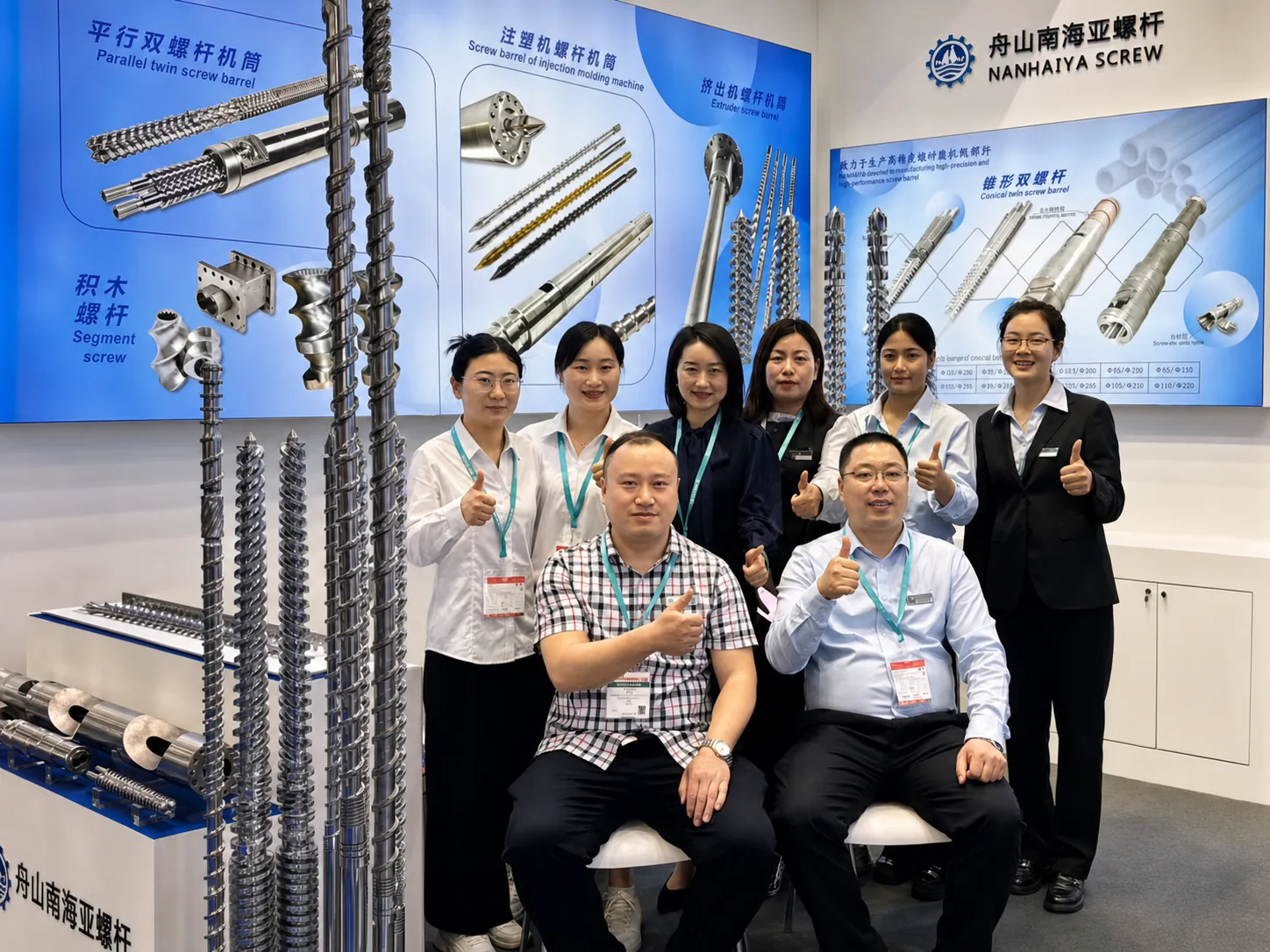
Related Articles
More insights on screw barrel technology and plastics processing.
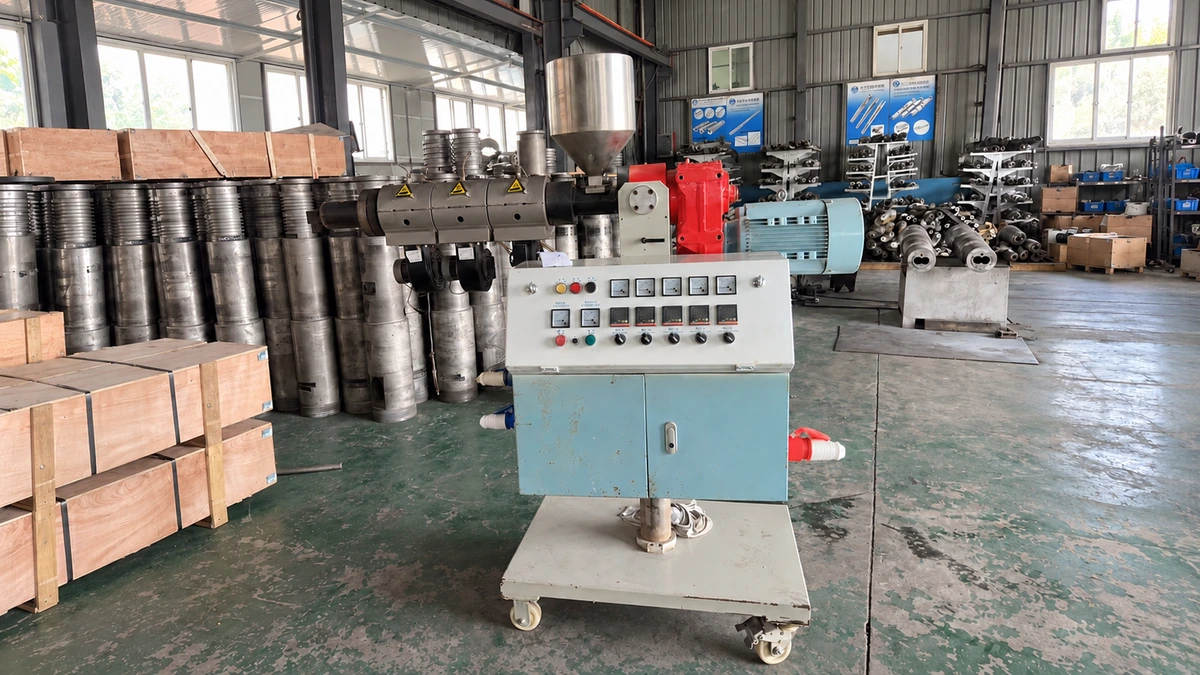
Extruder Barrel Supplier Red Flags Every Buyer Learns Too Late
Oct 30, 2026
Learn how to evaluate an extruder barrel supplier with red-flag checklists, capability matrices, metallurgy comparisons, and pre-order questions for smarter procurement.
Read Article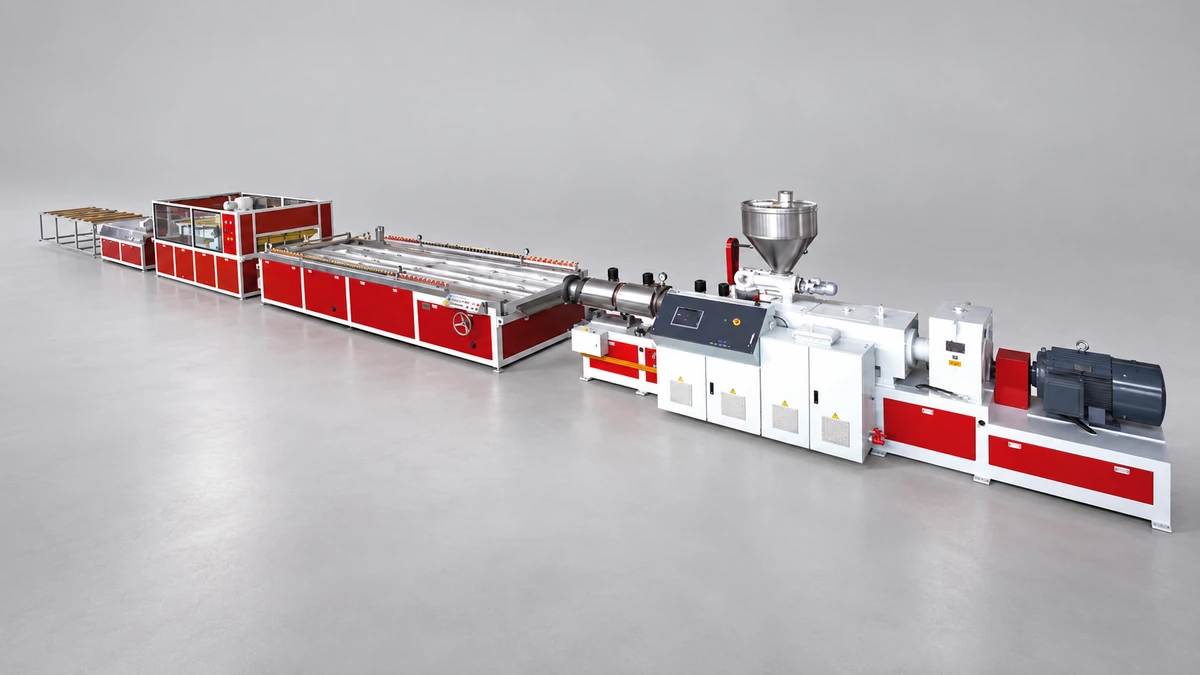
What Most Buyers Get Wrong About WPC Extrusion Machine Selection
Oct 29, 2026
Learn how to select the right WPC extrusion machine by comparing extruder types, resin systems, wear-part metallurgy, and capacity planning to avoid costly mistakes.
Read Article
Counter Rotating Twin Screw Extruder Manufacturer: What Buyers Miss
Oct 29, 2026
Learn how to evaluate a counter rotating twin screw extruder manufacturer with expert guidance on gearbox engineering, barrel metallurgy, TCO analysis, and a sourcing checklist.
Read ArticleLooking for something else?
Search by material, symptom or product and jump straight to the relevant page.
These are navigation suggestions based on keyword matching — not a quotation, not a delivery commitment, and not a substitute for engineering review. Final specification is confirmed by our engineers against your drawings and processed material.
Need help with screw barrel selection?
Share your machine model, processed material and application. Our team can help with pricing and technical support.