

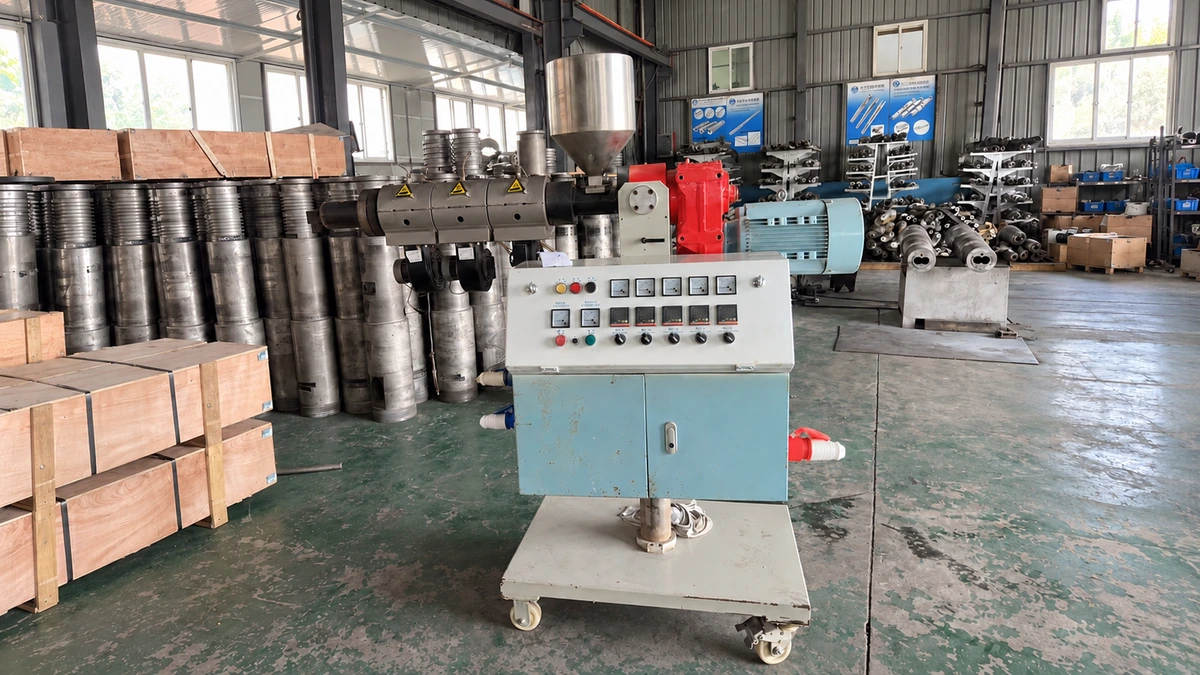
What an Extruder Barrel Supplier Does and Why It Matters
An extruder barrel supplier is a vendor that manufactures, distributes, or refurbishes the cylindrical steel housings that enclose the screw in extrusion and injection molding machines. These extruder barrels must withstand extreme thermal loads, continuous mechanical stress, and chemical attack from molten polymers—making them one of the highest-value wear components in any plastics processing operation. The vendor you choose for this component sits at a critical junction in your supply chain: between raw-material metallurgy and the finished performance of every part your line produces.
Defining the Extruder Barrel Supplier Role
Imagine your extrusion line as a chain. The screw barrel is the link that connects material science to machine output. Your supplier's metallurgical expertise, manufacturing tolerances, and quality systems directly determine how long that link holds—and what happens when it doesn't.
A reliable supplier does far more than ship a cylinder to your dock. They select or specify liner alloys matched to your process, hold bore tolerances tight enough to maintain proper flight clearance with the screw, and engineer feed-zone cooling channels in the extruder feed barrel so heat management stays predictable across shifts. Whether you're sourcing a standard replacement or a custom-engineered barrel for a specialty application, the supplier's depth of technical capability shapes everything downstream: melt consistency, dimensional accuracy of your product, energy consumption, and scrap rates.
Why Supplier Selection Is a Strategic Decision
Here's the cost-of-failure reality most buyers underestimate. A screw barrel with inconsistent liner hardness or an out-of-spec bore doesn't fail dramatically on day one. It degrades quietly. Flight clearance opens up faster than expected, output per RPM drops, and operators compensate by running the screw harder—which accelerates wear and drives discharge temperatures higher. Industry data from extrusion troubleshooting experts highlights that worn barrels and screws can force throughput reductions of 13% or more, directly cutting line profitability and capacity.
The financial cascade is steep. A catastrophic screw seizure triggered by a substandard barrel can cost $31,500 to $153,000 when you factor in the replacement screw, potential barrel re-bore, production loss across three to five days of unplanned downtime, scrapped material, and expedited shipping. Compare that to a planned replacement with a quality barrel from a vetted supplier, and the total drops to roughly $11,500 to $36,500.
The barrel is the most thermally and mechanically stressed component in any extrusion line—its supplier deserves the same due diligence you give your resin supplier.
This article is written entirely from the buyer's side of the table. Every section that follows gives procurement professionals, maintenance engineers, and plant managers a practical framework for evaluating suppliers—not a catalog of product features. You'll find red flags to watch for, questions to ask, and decision tools you can put to work on your next purchase order.
The starting point for any smart evaluation? Understanding that not all barrel suppliers operate the same way—and the type of vendor you're dealing with changes your risk profile entirely.
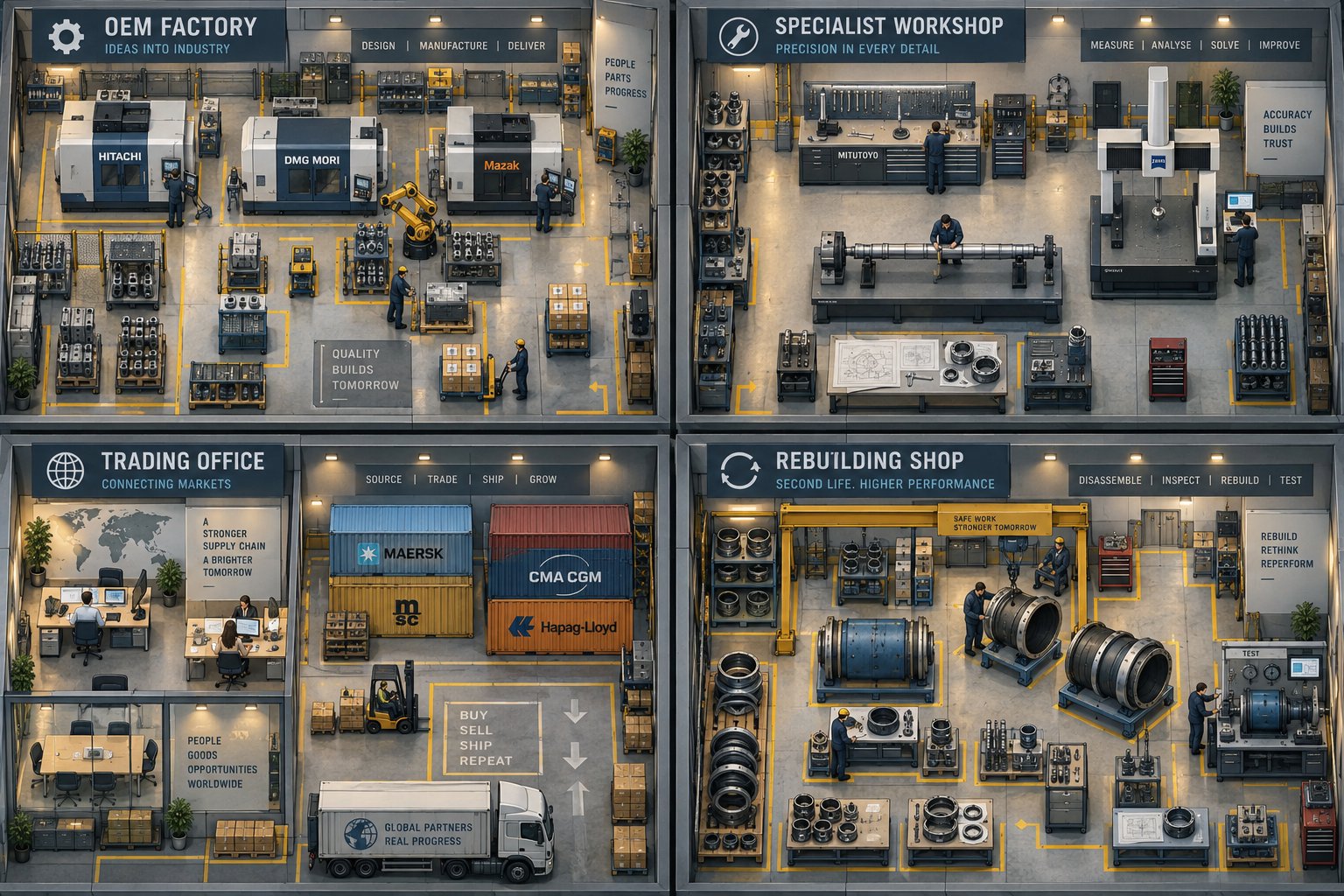
Four Types of Barrel Suppliers and When Each One Fits
Most buyers treat the barrel supply market as a single category. You search for a part number, collect a few quotes, and pick the lowest price that seems credible. That approach misses a crucial distinction: the vendors behind those quotes often operate under fundamentally different business models, and each model carries a different risk profile for your operation. Understanding which type you're actually dealing with is the first filter in any smart procurement process.
The market breaks down into four distinct categories. Each one occupies a different position in terms of pricing, quality assurance, lead time, and the kind of buyer it serves best.
OEM Manufacturers vs Aftermarket Specialists
OEM manufacturers produce extrusion barrels and extruder screws specifically for the machine brands they support. When you order a replacement barrel through your machine builder's parts department, you're typically buying from this channel. The value proposition is straightforward: guaranteed dimensional compatibility, documented metallurgy that matches the original specification, and full machine-builder warranty backing. The tradeoff? Premium pricing—often 30% to 60% above aftermarket equivalents—and lead times that can stretch to 12 or even 16 weeks, particularly for less common bore sizes or twin screw barrel configurations.
OEM sourcing makes the most sense when your machine is still under warranty, when the barrel design includes proprietary features like specialized port locations, or when you need an exact-match paper trail for regulated production environments.
Aftermarket specialists, by contrast, reverse-engineer compatible replacements. The best ones invest in their own metallurgical R&D, maintain detailed dimensional databases for hundreds of machine models, and produce barrels that meet or exceed OEM specifications. You'll notice shorter lead times—typically six to ten weeks—because these suppliers carry standard sizes in inventory or run them in regular production batches. Pricing usually falls 20% to 40% below OEM channels. The key risk? Not all aftermarket suppliers are equal. A reputable specialist will provide full material certifications, bore tolerance reports, and references from plants running the same machine platform. One that can't provide those documents is a red flag you'll learn about in detail later in this article.
Trading Companies, Brokers, and Rebuilders
Trading companies and brokers occupy a very different space. They don't manufacture anything. Instead, they source barrels from third-party factories—often overseas—and resell them under their own brand or as unbranded components. Some brokers add value through quality inspection and logistics coordination. Many, however, lack in-house metallurgical expertise and cannot verify the alloy composition or hardness of what they're shipping. If you encounter pricing that seems dramatically below market, you're likely looking at a broker sourcing from a factory with limited quality controls. Extruder screw wear issues that surface prematurely after installing a broker-sourced barrel often trace back to liner alloys that don't match the quoted specification.
Rebuilders and reclaimers represent a completely different value proposition. These suppliers take your worn barrel, measure the existing bore wear, and restore it through resleeving or relining with bimetallic or tool steel liners. A quality rebuilder documents before-and-after bore dimensions, uses liner materials that perform equal to or better than the original lining, and delivers a dimensionally straight, on-size barrel at a fraction of new-barrel cost. This path makes strong economic sense for large or elaborately equipped barrels—think water-jacketed, pin-style, or large rubber mixer barrels—where full replacement would be significantly more expensive. The risk with rebuilders is narrower: you need to verify that the base barrel steel is structurally sound and that the rebuilder's warranty terms are clearly defined.
| Supplier Type | Typical Lead Time | Price Range (Relative) | Quality Control Level | Best For | Key Risk |
|---|---|---|---|---|---|
| OEM Manufacturer | 10-16 weeks | $$$$ | High (machine-builder standards) | Warranty-covered machines, regulated production, proprietary barrel designs | Premium cost; long lead times; limited flexibility on alloy upgrades |
| Aftermarket Specialist | 6-10 weeks | $$-$$$ | Medium to High (varies by supplier) | Cost-conscious plants needing OEM-equivalent performance with faster delivery | Quality varies widely; must verify certifications and references |
| Trading Company / Broker | 4-8 weeks | $-$$ | Low to Medium (limited in-house verification) | Non-critical applications; buyers with ability to independently inspect incoming barrels | No control over manufacturing quality; alloy specs may not match quotes |
| Rebuilder / Reclaimer | 4-8 weeks | $-$$ | Medium to High (reputable rebuilders) | Large or complex barrels where base steel is sound; budget-constrained replacements | Base barrel condition limits achievable tolerances; not suitable for severe wear |
This framework gives you an immediate sorting tool. Before you even compare prices, identify which category each vendor on your quote list falls into. A $12,000 quote from an aftermarket specialist with full material traceability is a fundamentally different proposition than a $9,000 quote from a broker who cannot name the factory producing the barrel.
Knowing the supplier type, though, is only the first filter. The next critical variable is whether the vendor's capabilities actually align with what your specific application demands—from the polymer you're processing to the throughput targets you need to hit.
How Your Application Should Drive Supplier Selection
Too many barrel purchases start with a quote request that reads little more than "need a replacement barrel for our 90mm extruder." That's like walking into a pharmacy and asking for "something for pain" without mentioning whether you've got a headache or a broken ankle. The barrel extruder combination on your production floor faces a specific set of demands—polymer chemistry, filler loading, processing temperatures, throughput targets—and each of those variables narrows the field of suppliers who can actually deliver what you need. Getting this decision logic right before you contact a single vendor saves you from the most expensive mistake in barrel procurement: buying a technically mismatched barrel from a perfectly friendly supplier.
Polymer Type as the Starting Point for Barrel Selection
Your resin dictates the battlefield conditions inside the barrel. Three distinct threat categories drive liner selection, and each one points you toward a different supplier capability.
Abrasive fillers. Glass-fiber-reinforced nylons, mineral-filled polypropylenes, and other engineering compounds containing hard particulates act like sandpaper against the barrel's inner surface. Research from SpecialChem's guide on extrusion screws for thermoplastic composites confirms that fillers like mica and fiberglass cause aggressive abrasive wear, particularly in the feed and transition sections where the polymer is still in pellet form and hasn't yet created a lubricating melt film. For these applications, you need a supplier offering bimetallic barrels with tungsten-carbide-enriched liners—alloys that can extend barrel life by four to five times compared to standard bimetallic linings. If a vendor can't specify which abrasion-resistant alloy family they're quoting, they're not equipped for this job.
Corrosive off-gases. PVC and fluoropolymer processing generates hydrochloric acid and other corrosive byproducts that attack iron-based metallurgies from the inside out. As Plastics Technology notes, corrosion is the gradual destruction of materials by chemical attack, and it aggressively targets components with a high iron matrix. A screw plastic extruder running PVC demands nickel-based or nickel-cobalt alloy liners engineered to resist both chemical breakdown and mechanical wear simultaneously. Your supplier must have documented experience with corrosion-resistant alloy portfolios—not just a generic "we can do PVC" claim.
Processing temperature. High-temperature engineering resins like PEEK, PEI, and PPS push barrel operating temperatures above 400 degrees Celsius. At these extremes, liner hardness can degrade, thermal expansion management becomes critical, and the feed-zone cooling design in the barrel must prevent heat migration from softening incoming pellets. A supplier whose experience centers on commodity polyolefins may lack the thermal engineering depth these applications require.
The practical takeaway? Your polymer family is the first filter. It immediately eliminates suppliers whose alloy portfolio or manufacturing experience doesn't match your processing environment.
Output Volume and Replacement Cycle Planning
A plant running a twin screw and barrel configuration across three shifts, 300-plus days per year, faces a fundamentally different procurement challenge than a small custom molder running two shifts on a single line. Volume changes what matters most in a supplier relationship.
High-throughput operations burn through barrel life faster—sometimes replacing barrels every 8,000 to 12,000 operating hours depending on the compound. At that pace, you're not just buying a barrel. You're buying a supply chain. The right supplier for this scenario offers metallurgical consistency across multiple barrels so that every replacement delivers the same wear life and process behavior as the last one. They maintain inventory programs for your standard sizes, guarantee lead times on repeat orders, and provide dimensional inspection data that lets you verify incoming barrels against a known baseline. Evaluating these vendors on unit price alone is a trap; a barrel that costs 15% less but delivers 30% shorter service life is the more expensive option by any measure.
Smaller operations, on the other hand, may prioritize flexibility. Low minimum order quantities, willingness to produce one-off custom bore sizes, and technical support for matching the barrel to an unusual screw geometry become more valuable than inventory depth. A supplier who requires a five-barrel MOQ is a poor fit if you only need one barrel every 18 months.
Here's a practical step that pays for itself immediately: before you reach out to any vendor, document your application variables in a simple brief. This gives every supplier you contact the same baseline information, makes their quotes directly comparable, and signals that you're a serious buyer who knows their process.
- Polymer family — commodity (PE, PP, PS), engineering (PA, POM, PC), or specialty (PVC, PVDF, PEEK)
- Filler type and percentage — glass fiber, mineral, carbon fiber, flame retardant, or unfilled
- Processing temperature range — barrel zone setpoints from feed to discharge
- Annual throughput — total kilograms or pounds processed per year on that line
- Current barrel life in operating hours — how long your existing barrel lasts before wear forces a change
- Primary wear mechanism observed — abrasive wear (bore enlargement), corrosive pitting, or adhesive galling
That last variable—primary wear mechanism—deserves extra attention. Abrasion and corrosion are the two dominant failure modes, and they pull you toward very different liner chemistries. Abrasion-dominant applications, common in glass-filled compounds, call for liners loaded with hard carbide particles. Corrosion-dominant applications, typical in PVC and halogenated polymers, require nickel-rich alloys that resist chemical degradation even at the cost of some abrasion resistance. Many real-world applications involve both mechanisms simultaneously, which is why some buyers need suppliers capable of providing dual-protection alloys—a capability not every vendor offers.
With your application variables documented and your wear profile identified, you've built a technical filter that instantly separates capable suppliers from those who are guessing. The next logical question becomes how to evaluate the metallurgy itself—specifically, how to read a supplier's alloy specifications and construction claims so you can compare quotes on equal technical footing.
Barrel Metallurgy Decoded for Procurement Teams
You've identified your wear mechanism, documented your application variables, and filtered your supplier list by type. Here's where the conversation shifts from "who should I buy from" to "what exactly am I buying?" Three barrel construction methods dominate the market, and each one shows up differently on a supplier quote. Knowing what separates them—and which questions each construction type demands—turns metallurgy from a mystery into a procurement advantage.
Nitrided, Bimetallic, and HIP-Treated Barrels Compared
Think of these three methods as tiers on a performance-and-cost ladder. Each tier solves a different problem, and choosing the wrong rung wastes money in one direction or the other.
Nitrided barrels represent the baseline. The process diffuses nitrogen into the surface of an alloy steel barrel—typically 38CrMoAlA or AISI 4140—creating a hardened case that reaches roughly 950 to 1,100 HV (approximately 65 to 72 HRC equivalent on the surface). No new material is added. The case depth runs just 0.3 to 0.7 mm, which means the protection is real but thin. Once abrasive filler grinds through that shallow layer, softer core steel sits underneath, and wear accelerates sharply. For a screw extruder processing unfilled commodity polymers like PE, PP, or PS, nitrided construction delivers excellent value. For anything abrasive or corrosive, it's the wrong tool for the job.
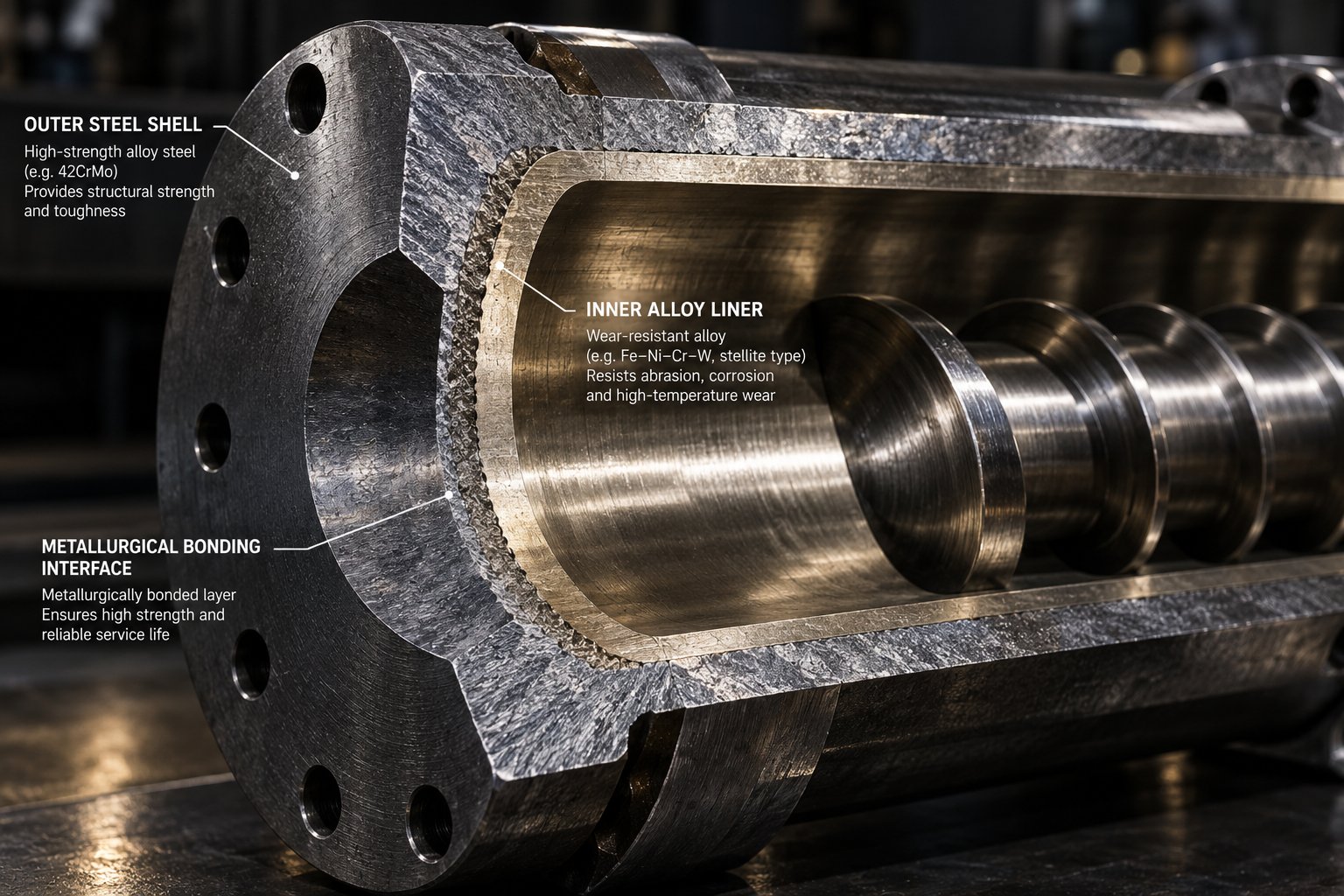
Bimetallic centrifugal-cast barrels step up dramatically. A wear-resistant alloy is poured as molten metal into the spinning barrel body, where centrifugal force throws it against the inner wall and it solidifies as a dense, metallurgically bonded liner. The result is a 2.0 to 3.0 mm alloy lining running the full bore length—roughly four to eight times thicker than a nitrided case. That thickness is the critical difference. A bimetallic liner wears down gradually and linearly, giving you predictable service life you can plan around, rather than the sudden performance cliff that nitrided barrels produce on abrasive compounds.
Within bimetallic construction, the alloy family is where the real specification work happens. Three families cover the vast majority of applications:
- Iron-based alloys (high chromium, boron, and sometimes tungsten carbide particles in an iron matrix) — the general-purpose workhorse for abrasive service. Hardness typically reaches HRC 58 to 65. These liners handle glass-fiber-reinforced engineering plastics, mineral-filled compounds, and recycled feed at a reasonable cost premium over nitriding.
- Nickel-based alloys with tungsten carbide — engineered for severe abrasion. The tungsten carbide particles embedded in the nickel matrix provide abrasion resistance that exceeds what hardness numbers alone suggest. As field engineering data confirms, hardness and abrasion resistance are not the same property—embedded carbide particles do the heavy lifting against glass fiber and mineral grit, even when the matrix hardness reads lower than iron-based alternatives. These liners suit high-loading compounds and the most demanding extrusion screw and barrel pairings.
- Nickel-cobalt alloys — the dual-threat option for combined abrasion and corrosion. Some suppliers designate these with proprietary codes such as HK-series alloys or equivalent Xaloy 800-series and Reiloy R304 designations. These liners are the standard specification for PVC processing, halogenated flame-retardant compounds, and any application where corrosive off-gases attack the barrel bore simultaneously with mechanical wear. If your plastic extruder screw and barrel run rigid PVC, this alloy family is non-negotiable.
HIP-treated (hot isostatic pressed) barrels sit at the top of the performance ladder. HIP uses extremely high temperatures and isostatic gas pressure to bond a pre-formed powder metallurgy liner to the barrel bore. The result is near-zero porosity, exceptional bond integrity, and the ability to use alloy compositions that centrifugal casting cannot accommodate. HIP liners deliver the longest service life in the most severe applications—think high-speed twin-screw compounding at heavy filler loadings—but the process is capital-intensive and the cost premium over centrifugal casting is significant. For most single-screw and standard twin-screw applications, bimetallic centrifugal casting delivers the performance-to-cost balance procurement teams need. HIP enters the conversation when you're processing extreme compounds at volumes where every hour of additional barrel life justifies the investment.
When evaluating supplier quotes across these construction methods, ask three specific questions that separate informed vendors from vague ones: What is the exact liner thickness you're quoting? What hardness testing method and range can you certify? And how do you verify bonding integrity between the liner and the base steel? Suppliers who can answer all three without hesitation are demonstrating manufacturing confidence. Those who deflect—or worse, offer only a single generic answer—may not control the process tightly enough to deliver consistent results.
Reading an Alloy Specification on a Supplier Quote
Here's a scenario you'll recognize if you've ever collected barrel quotes from multiple vendors. One supplier lists "bimetallic barrel, nickel alloy liner, HRC 58-62." Another quotes "centrifugal-cast iron-boron alloy, HRC 60-65." A third simply writes "wear-resistant alloy lining." How do you compare these? Without a systematic way to read alloy specifications, you're comparing apples to unknowns.
Start with the alloy composition. A credible supplier specifies the major elements in the liner—iron, nickel, chromium, boron, tungsten carbide content—either by published alloy grade name or by percentage composition. Industry-standard grade names exist for common formulations: for example, iron-based liners often correspond to designations like Xaloy 102 or equivalent, while nickel-based corrosion-resistant liners align with Xaloy 800-series or similar proprietary codes. If a supplier uses their own internal grade designation, ask them to provide the composition breakdown so you can cross-reference it against known alloy families. A vendor who won't—or can't—provide this data is asking you to buy on trust alone.
Next, verify hardness in context. Hardness numbers are only meaningful when you know the test method (HRC vs. HV), the location tested (liner surface vs. cross-section), and the alloy's behavior at your actual processing temperature. Room-temperature hardness data can mislead, especially for injection molding screws and barrels and extrusion screw assemblies operating above 350 degrees Celsius, where thermal softening reduces effective hardness by several HRC points. Ask whether the supplier's quoted hardness represents room-temperature measurement or operational conditions.
Finally, look for liner thickness and bonding documentation. A centrifugally cast liner should measure 2.0 to 3.0 mm thick, verified by metallographic cross-section or ultrasonic testing. Bond quality between the liner and the base steel barrel determines whether the liner stays put under thermal cycling and mechanical stress. Reputable suppliers provide cross-section photographs or ultrasonic bond-integrity reports as standard documentation. If your quote doesn't mention liner thickness at all, ask why—and treat a vague response as a warning.
| Construction Method | Typical Hardness Range (HRC) | Best Application Fit | Relative Cost | What to Verify on a Supplier Quote |
|---|---|---|---|---|
| Nitrided Steel | 65-72 HRC equivalent (surface) | Unfilled commodity polymers (PE, PP, PS, ABS) | $ (Baseline) | Case depth (should be 0.3-0.7 mm); base steel grade; nitriding method (gas vs. ion/plasma) |
| Bimetallic — Iron-Based Liner | 58-65 HRC | General abrasive service: glass-filled, mineral-filled, recycled feed | $$ - $$$ | Alloy composition with element percentages; liner thickness (2.0-3.0 mm); bond integrity documentation |
| Bimetallic — Nickel/WC Liner | 55-62 HRC | Severe abrasion: high glass loading, heavy mineral fill | $$$ - $$$$ | Tungsten carbide content; alloy grade name; hardness at operating temperature; cross-section metallography |
| Bimetallic — Nickel-Cobalt Liner | 50-60 HRC | Combined abrasion + corrosion: PVC, halogenated FR compounds | $$$ - $$$$ | Corrosion resistance certification; alloy grade (HK-series or equivalent); documented PVC processing history |
| HIP (Hot Isostatic Pressed) | 60-68 HRC | Extreme abrasion/corrosion at high throughput; high-speed twin-screw compounding | $$$$+ | Porosity testing results; powder alloy grade and composition; HIP process parameters; bond integrity verification |
If a supplier cannot tell you the exact alloy composition and hardness range of the liner they are quoting, treat that as a disqualifying red flag.
This table gives you a side-by-side reference you can bring into any quote review meeting. Print it, share it with your maintenance team, and use it to hold every vendor to the same standard of transparency. The suppliers who welcome that scrutiny are the ones worth keeping on your shortlist.
Metallurgy, though, is only one dimension of supplier capability. Two vendors can both offer the right alloy and still differ dramatically in manufacturing precision—bore tolerances, finishing quality, and production flexibility. Evaluating those operational capabilities requires a different kind of tool: a structured scoring matrix that lets you compare finalists across every dimension that affects barrel performance in the field.
Building a Supplier Capability Matrix
Alloy grades and construction methods tell you what a barrel is made of. They don't tell you whether the screw barrel manufacturer quoting that alloy can actually produce it to the precision your machine demands. Two vendors can both quote a nickel-based bimetallic liner on paper—yet deliver wildly different bore straightness, concentricity, and surface finish in practice. The gap between quoted metallurgy and delivered geometry is where barrel failures hide, and it's a gap that only a structured comparison framework can expose.
A supplier capability matrix is exactly that framework. Think of it as a standardized scorecard you send to every vendor on your shortlist, forcing each one to answer the same technical and commercial questions in a format you can compare side by side. Instead of evaluating suppliers based on how convincing their sales pitch sounds, you evaluate them based on verifiable manufacturing capabilities—and the ones who can't fill in the blanks reveal their limitations before you place an order, not after.
Single Screw vs Twin Screw Production Capabilities
This distinction matters more than most buyers realize. Manufacturing a single-screw barrel is fundamentally different from producing a segmented parallel or conical twin screw barrel—and a supplier that excels at one may struggle with the other.
Single-screw barrels are continuous cylinders with a single through-bore. The manufacturing challenge centers on achieving uniform liner thickness, consistent bore diameter across the full barrel length, and precise alignment of extruder terminals such as feed ports, vent ports, and thermocouple wells. A supplier experienced with machines like a Davis Standard single screw extruder or similar platforms will have fixturing, deep-hole boring equipment, and centrifugal casting setups optimized for long, uninterrupted bore profiles.
Twin-screw barrels introduce an entirely different level of complexity. Parallel twin-screw barrels feature two overlapping figure-eight bores that must maintain exact center-to-center distance and identical bore diameters across every segment. Conical twin-screw barrels add a taper to both bores, requiring CNC machining with tighter positional tolerances. Segmented designs—common in compounding—demand that each barrel segment aligns perfectly with its neighbors at the flange interfaces. A supplier without dedicated twin-screw boring and honing equipment simply cannot hold these tolerances reliably, regardless of how good their metallurgy is.
When you're evaluating vendors, ask a direct question: do you manufacture twin-screw barrels on dedicated equipment, or do you adapt your single-screw production line? The answer reveals whether you're dealing with a specialist or a generalist stretching beyond their core capability.
Scoring Suppliers on Tolerance and Finishing Quality
Vague quality claims are one of the most common red flags in barrel procurement. Phrases like "precision machined" or "high-quality bore finish" sound reassuring but communicate nothing measurable. What you need from every supplier on your shortlist are three specific numbers:
- Bore diameter tolerance — the allowable deviation from nominal bore size, typically expressed in thousandths of a millimeter or tenths of a thousandth of an inch. For most extrusion barrels, industry-standard tolerance runs +/- 0.02 to 0.03 mm on diameter.
- Bore straightness per meter — how much the bore's central axis deviates from a perfect straight line over a given length. Precision metrology systems can measure axial straightness with repeatability better than 0.5 micrometers, so there's no technical excuse for a supplier who can't report this value. A typical specification for extrusion barrels is 0.015 mm straightness per meter of barrel length. Anything significantly looser than that creates uneven flight clearance between screw and barrel, which accelerates localized wear and produces inconsistent melt quality.
- Surface roughness (Ra value) — the arithmetic average roughness of the finished bore surface. An Ra of 0.4 micrometers is the commonly referenced benchmark for honed extrusion barrel bores. A rougher surface increases friction, generates excess heat, and can trap degraded polymer that contaminates subsequent production runs.
These three measurements are not exotic or unreasonable requests. Every competent screw barrel manufacturer tracks them as part of standard quality control. If a supplier hesitates to share these numbers—or responds with a generic "we meet industry standards" without specifying which standards—you've just learned something important about their manufacturing confidence.
Beyond bore geometry, two additional capability dimensions separate serious vendors from part-time producers. The first is heat treatment control. In-house heat treatment—nitriding furnaces, quench-and-temper lines, stress-relief ovens—gives a supplier direct control over case depth, core hardness, and dimensional stability after processing. Outsourced heat treatment adds a handoff point where specifications can be miscommunicated or poorly controlled. Ask whether the supplier runs their own heat treatment, and if they outsource, ask for the name and certification status of their subcontractor.
The second is alloy portfolio breadth. A vendor offering only one or two liner alloys may not be able to match the right metallurgy to your specific wear profile. You want to see at least three to four alloy families available—iron-based abrasion-resistant, nickel-based severe-abrasion, nickel-cobalt corrosion-resistant, and ideally a high-performance option like a tungsten-carbide-loaded matrix or HIP capability. Portfolio breadth signals engineering depth, not just sales flexibility.
The capability matrix below gives you a ready-to-use template. Send it to every supplier you're evaluating and compare the completed responses side by side. The vendors who fill it in completely and confidently are telling you something valuable—and the ones who leave blanks or push back on providing specifics are telling you something equally valuable.
| Capability Dimension | Supplier A | Supplier B | Supplier C |
|---|---|---|---|
| Barrel Types Offered (Single / Parallel Twin / Conical Twin) | |||
| Max Bore Diameter | |||
| Liner Alloy Options (list all available families) | |||
| Heat Treatment (In-House / Outsourced — name subcontractor) | |||
| Bore Tolerance Specification (+/- mm on diameter) | |||
| Bore Straightness Specification (mm per meter) | |||
| Surface Roughness Ra (micrometers) | |||
| Lead Time — Standard Sizes | |||
| Lead Time — Custom Orders | |||
| Minimum Order Quantity | |||
| Customer References Available (Y/N — industry segment) |
A supplier willing to share detailed tolerance specifications upfront is signaling manufacturing confidence—those who deflect are often hiding capability gaps.
Print this matrix, email it to your procurement team, and use it as the standard intake form for every barrel sourcing project. It eliminates subjective impressions and replaces them with comparable data points. You'll find that strong suppliers actually appreciate the structure—it lets their capabilities speak clearly against competitors who rely on relationships or low pricing to win orders.
A completed capability matrix narrows your field to suppliers who can demonstrably make what you need. But capability alone doesn't guarantee reliability. The next layer of due diligence involves verifying that those capabilities are backed by certifications, traceable documentation, and transparent quality systems—and learning to spot the warning signs that a supplier's claims don't hold up under scrutiny.

Certifications, Documentation, and Red Flags
A filled-in capability matrix and a competitive quote can look impressive on screen. But how do you know the supplier behind that paperwork actually delivers what they promise—barrel after barrel, year after year? Capability claims without verifiable documentation are just marketing. This is where trust-and-verification enters the procurement process, and it's the step most buyers skip until a bad barrel teaches them the lesson the hard way.
Certifications and Documentation That Build Confidence
Start with the certification most buyers check first: ISO 9001. It's widely recognized, and virtually every serious barrel vendor references it somewhere on their website. But here's a distinction that trips up even experienced procurement teams—ISO 9001 certifies the supplier's management system, not the quality of any individual barrel they ship. As quality system specialists explain, the standard governs how a manufacturer controls materials, processes, records, and corrective action. It requires documented procedures, lot tracking, and a corrective action loop that catches nonconformances and closes them. What it does not do is guarantee that the injection screw or barrel in your next shipment meets a specific hardness or dimensional target. Think of ISO 9001 as proof that the supplier has a system in place to produce consistent results—not proof that they actually did on your order.
That's why ISO 9001 is the floor, not the ceiling. Beyond that baseline, you should request documentation that ties directly to the barrels you're buying:
- Material test certificates (MTCs) — traceable to the specific barrel lot, not generic certificates recycled across orders. A credible MTC identifies the raw steel heat number, the liner alloy batch, and the chemical composition verified by spectrometric analysis.
- Metallurgical test reports — hardness testing results (with method, location, and number of test points specified), microstructure photographs from cross-section samples showing liner bond integrity, and alloy composition verification confirming the quoted grade matches what was actually cast.
- Dimensional inspection reports — bore diameter measurements at multiple stations along the barrel length, straightness data, surface roughness readings, and concentricity verification for twin-bore barrels. These reports should reference calibrated instruments with current calibration certificates.
A supplier who provides all of this without being asked is signaling process maturity. One who provides it only when pressed is acceptable but worth monitoring. One who can't provide it at all? That's your first red flag.
Factory audits add another layer of confidence. Whether you visit in person or request a virtual tour, the goal is the same: verify that the production environment matches the supplier's claims. A well-structured factory audit checks production capacity, quality management systems, incoming material controls, equipment calibration, and traceability records. Auditors compare documented procedures with actual factory practices—because written procedures that workers don't consistently follow are a common finding. For barrel procurement specifically, you'll want to observe the centrifugal casting setup, deep-hole boring equipment, honing stations, and heat treatment facilities. If the supplier claims in-house heat treatment but the tour reveals no furnaces on site, that discrepancy tells you everything you need to know.
Even a virtual factory tour—a live video walkthrough of the production floor—can reveal critical information. You'll see the age and condition of equipment, the organization of the workspace, how work-in-progress barrels are stored and identified, and whether quality inspection stations are integrated into the production flow or isolated as an afterthought. Suppliers confident in their operations welcome this scrutiny. Those who resist it are worth questioning.
Warning Signs of an Unreliable Barrel Supplier
Red flags rarely announce themselves. They show up as small evasions during the quoting process, vague answers during technical conversations, or missing details in documentation that should be standard. Individually, each one might seem minor. Collectively, they paint a picture of a supplier whose actual capabilities fall short of their claims. Here are the warning signs experienced buyers have learned—often through costly failures—to treat as disqualifiers:
- Refusal to provide material certifications — A vendor who says "we don't normally share that" or "our certs are proprietary" is hiding something. Every legitimate barrel manufacturer can produce MTCs for the steel and liner alloy used in your barrel. Refusal signals either that they don't test their materials or that the results wouldn't match what they quoted. Either way, you're buying blind.
- Inability to specify bore tolerances — If the supplier can't tell you the bore diameter tolerance, straightness specification, or surface roughness they hold, they likely aren't measuring these parameters consistently. For injection molding screws and barrels, where flight-to-bore clearance directly affects melt quality and shot consistency, this gap is unacceptable.
- No customer references — A supplier who has been producing quality barrels for years will have satisfied customers willing to confirm it. No references—or references only from unrelated industries—suggests limited real-world track record in plastics processing applications.
- Pricing dramatically below market without explanation — A quote that undercuts competitors by 40% or more isn't a bargain—it's a warning. The cost structure for quality bimetallic barrels includes expensive alloy materials, precision machining time, and rigorous inspection. When a price seems too good to be true, the savings are typically coming from cheaper alloys, thinner liners, or skipped quality steps. As sourcing experts caution, unexplained price instability and lack of transparency around costs often indicate deeper operational problems.
- Vague or missing alloy composition data — "Wear-resistant alloy" is not a specification. If the supplier can't name the alloy family, provide elemental composition percentages, or reference an industry-standard grade equivalent, they may not control—or even know—what's being cast into their barrels. This is especially dangerous when you're sourcing barrels for corrosive PVC compounds or heavily glass-filled engineering resins, where the wrong alloy fails catastrophically rather than gradually.
- No defined warranty terms — Reputable suppliers stand behind their products with written warranties that specify coverage duration, what constitutes a valid claim, and the remedy offered (replacement, credit, or pro-rated adjustment). A vendor who offers only verbal assurances or hedges when asked to put warranty terms in writing is telling you they don't trust their own product enough to guarantee it.
- Unwillingness to share production photos or permit factory visits — This is one of the most telling red flags in any manufacturing relationship. Industry due-diligence specialists note that refusal to allow factory visits can indicate the supplier is actually a trading company outsourcing production to an unnamed manufacturer—meaning you have no visibility into or control over who is actually making your barrels. Even suppliers located overseas should be willing to provide a virtual walkthrough or share dated production photographs showing your barrel at key manufacturing stages.
Any single red flag from this list warrants a direct conversation with the supplier—give them the chance to address it transparently. But two or more? That pattern typically indicates systemic capability or integrity issues that won't improve after you place an order. The cost of walking away from a questionable vendor is always lower than the cost of installing a barrel that fails early, contaminates product, or forces an unplanned shutdown on a high-volume injection screw or extrusion line.
Knowing what documentation to demand and which warning signs to heed gives you a defensive framework. The next step is building an offensive one—a structured set of questions you can bring into any supplier conversation to extract the specific technical and commercial information you need before committing to a purchase order.
Questions Every Buyer Should Ask Before Ordering
Red flags tell you when to walk away. But what about the conversations that happen before a red flag appears? The suppliers who make your shortlist have passed the initial screening—they seem credible, their capability matrix looks solid, and their pricing falls within a reasonable range. The difference between a good outcome and a costly mistake often comes down to whether you asked the right questions during the quoting stage. Skip them, and gaps in the extruder screw barrel specification, delivery logistics, or after-sales support only surface once you've committed capital and production schedule to the order.
The questions below follow the natural flow of a procurement conversation: technical first, then commercial, then post-sale. Print them, bookmark them, or drop them into your next RFQ email. They're designed to force clarity from every vendor on your list—and the way a supplier responds reveals as much as the answers themselves.
Technical and Specification Questions
Start every supplier conversation here. These questions establish whether the vendor can actually engineer and manufacture a barrel matched to your process, or whether they're simply quoting dimensions from your drawing without understanding the application behind them.
Feed-zone cooling deserves particular attention. On screw extruders processing heat-sensitive polymers or running at high screw speeds, the cooling channel design in the feed section directly determines whether incoming pellets convey smoothly or bridge and starve the screw. A supplier who treats feed-zone cooling as an afterthought—or worse, doesn't discuss it at all—may not have the thermal engineering depth your application requires.
Barrel zone layout and thermocouple well placement also separate experienced vendors from order-takers. If your machine controller relies on accurate zone temperature feedback to maintain melt quality, thermocouple wells drilled at imprecise depths or angles introduce measurement error that your operators will fight shift after shift.
Commercial and Logistics Questions
Technical capability means nothing if the barrel shows up late, damaged, or buried under unfavorable payment terms. These questions protect you on the business side of the relationship—and they're the ones buyers most often forget to ask until a problem forces the conversation.
Shipping standards matter more for barrels than for most industrial components. Extruder screws and barrels are heavy, long, and dimensionally sensitive. A barrel that arrives with a bent bore or corroded bore surface because it was inadequately packaged is functionally scrap, regardless of how well it was manufactured. Ask how the supplier packages and ships—wooden crates, bore plugs, anti-corrosion wrapping, and shock-resistant padding are baseline expectations for any reputable vendor.
Warranty scope is another area where vagueness costs buyers real money. "We stand behind our product" is not a warranty. You need written terms specifying duration, what types of failure are covered, and what documentation you'll need to file a claim.
Use the following numbered list as your complete pre-order question set, organized in recommended asking order:
- What is the exact bore diameter and the tolerance range (in mm) you hold on production barrels for this size?
- What liner alloy are you quoting, and can you provide the elemental composition or an equivalent industry-standard grade designation?
- What is the guaranteed hardness range (HRC or HV) of the liner, and at how many points along the bore length do you test?
- What is the liner thickness specification, and how do you verify it—cross-section metallography, ultrasonic testing, or both?
- What heat treatment process do you use, and is it performed in-house or outsourced? If outsourced, who is the subcontractor?
- How are feed-zone cooling channels designed, and what coolant flow rate are they engineered to handle?
- What is your barrel zone layout for this bore size, and how do you position and drill thermocouple wells?
- What bore straightness specification (mm per meter) do you hold, and what measurement equipment do you use to verify it?
- What surface roughness (Ra) does your finishing process achieve on the bore?
- What is your minimum order quantity for standard sizes versus custom bore or length specifications?
- What is the lead time for a first order, and how does it change on repeat orders for the same barrel?
- What are your standard payment terms, and do you offer any flexibility for ongoing supply agreements?
- How do you package and ship finished barrels to prevent bore damage, corrosion, and handling impact during transit?
- What are your written warranty terms—duration, covered failure modes, claim process, and remedy (replacement, credit, or pro-rated)?
- Do you provide technical assistance with screw-barrel matching for specific polymer applications?
- Can you perform barrel resleeving or relining services if this barrel wears and the base steel remains sound?
- What is the process for filing a warranty claim, and what documentation will you require from me?
- Can you provide references from customers running similar machine platforms or processing similar materials?
Questions 1 through 9 cover the technical foundation. A supplier who answers them with specific numbers, documented alloy grades, and named testing methods is demonstrating the engineering transparency you want in a long-term partner. Questions 10 through 14 lock down the commercial terms that protect your budget and timeline. Questions 15 through 18 probe after-sales capability—a dimension that separates transactional vendors from true partners.
Pay close attention to how quickly and completely each supplier responds. A vendor who returns detailed answers within a few business days likely has this information organized and accessible—which reflects how they run their production floor. One who takes weeks, provides partial responses, or pushes back on "too many questions" is showing you exactly how they'll handle communication when something goes wrong mid-order.
One last note: these questions work best when you've already documented your application variables—polymer, filler, temperature range, throughput, and wear mechanism—as outlined earlier in this article. Sending that application brief alongside your question list gives the supplier context to provide specific, relevant answers rather than generic boilerplate. It also tests whether they engage with your application details or ignore them entirely. A vendor who reads your brief and follows up with clarifying questions of their own is demonstrating the kind of technical engagement that leads to correctly specified extruder screws and barrels—not just technically acceptable ones, but optimally matched ones.
Armed with detailed answers to these questions, you'll have the data you need to make a confident final decision. But one major choice remains that can dramatically affect both your budget and your barrel's performance: whether to buy new or invest in a professionally rebuilt barrel. That decision depends on variables most suppliers won't volunteer unless you know what to ask—and what to look for.
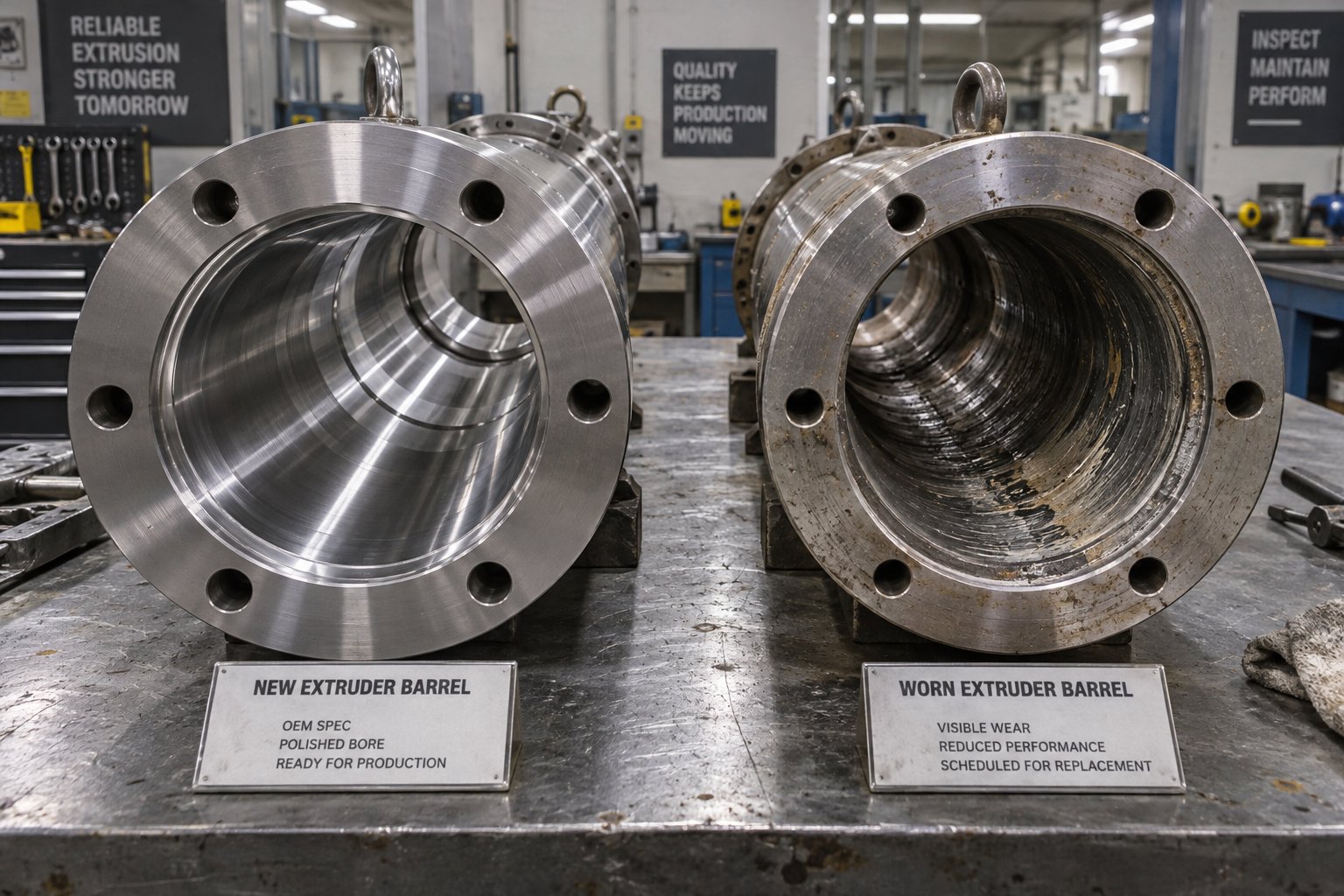
New vs Rebuilt Barrels: Which Option Protects Your Bottom Line
You've screened supplier types, verified certifications, asked the hard questions, and narrowed your shortlist. But before you finalize a purchase order, one fundamental decision can shift your total cost of ownership by 30% to 60% in either direction: should you buy a brand-new extruder barrel, or invest in a professionally rebuilt one? Most suppliers won't volunteer an honest answer because it depends entirely on your situation—not their inventory. Getting this call right requires understanding both the scenarios where only a new barrel makes sense and the conditions under which a rebuilt barrel delivers equivalent performance at a fraction of the cost.
When New Barrels Are the Only Smart Choice
Rebuilding isn't always an option. Several real-world scenarios make a new barrel the only defensible decision, regardless of budget pressure.
Severe dimensional wear beyond resleeving tolerances. Every barrel has a structural shell—the base steel cylinder that supports the liner. When bore enlargement from years of abrasive service has consumed the original liner and begun cutting into that base steel, there's insufficient material left to bond a new liner to reliably. As JWELL's engineering guidance emphasizes, you should replace the part when cracks, deep scoring, severe ovality, extensive corrosion, or structural damage make restoration unreliable. A rebuilder who accepts a barrel in this condition without disclosing the limitations is doing you a disservice.
Processing highly abrasive compounds. Glass-fiber loadings above 30%, mineral-filled engineering resins, and recycled feedstock with metal contamination create the harshest wear environments in plastics processing. In these applications, extruder screws and barrels burn through liner material at accelerated rates. A relined barrel starts with a thinner effective liner than a factory-new bimetallic barrel because the resleeving process removes additional base material to create a clean bonding surface. That thinner starting point translates directly into shorter service life on severe-abrasion compounds—a tradeoff that rarely pencils out when you calculate cost per operating hour rather than purchase price alone.
Alloy upgrade requirements. Imagine you've been running a nitrided barrel on unfilled HDPE, and now the production plan shifts to a 40% glass-filled nylon. Your existing barrel's metallurgy is fundamentally wrong for the new compound, and no amount of rebuilding changes the alloy family. A new bimetallic barrel with the correct tungsten-carbide-enriched liner is the only path that protects both output quality and barrel longevity. The same logic applies when switching from commodity resins to corrosive PVC—you need a purpose-built nickel-cobalt liner, not a refurbished version of the wrong specification.
Proprietary or non-standard bore geometry. Some machine platforms—especially older units like a Davis Standard extruder for sale on the secondary market—may feature barrel configurations that rebuilders cannot easily match without the original engineering drawings. When the barrel includes integrated venting ports, specialized feed-throat geometry, or non-standard flange configurations, sourcing a new barrel from a supplier with full engineering capability eliminates the dimensional risk that a rebuild introduces.
Evaluating Rebuilt Barrel Quality and Supplier Claims
When the base steel is structurally sound, the bore hasn't worn past resleeving limits, and the existing alloy family matches your application, a rebuilt barrel becomes a genuinely smart procurement decision. The economics are compelling: professional resleeving typically costs 40% to 60% of a comparable new barrel, and turnaround times often run shorter because the base cylinder is already in hand.
But not all rebuilders deliver equal results. Here's what separates a reputable rebuilder from one cutting corners.
Pre-rebuild documentation. A credible rebuilder measures and records bore diameter, ovality, and straightness at multiple stations along the barrel's full length before they begin any work. These before measurements serve two purposes: they confirm the barrel is a viable candidate for rebuilding, and they establish a baseline that the after measurements can be compared against. If a rebuilder skips this step—or can't show you the data—you have no way to verify that the finished barrel actually improved.
After-rebuild dimensional reports. The completed barrel should ship with the same documentation you'd expect from a new-barrel supplier: bore diameter at multiple stations, straightness verification, surface roughness readings, and liner hardness test results. Established specialists like American Screw & Barrel offer barrel inspection, rebuilding, and partial sleeving services with OEM-specification restoration—demonstrating that the rebuild market includes vendors who hold themselves to new-barrel standards. Any rebuilder who cannot or will not provide equivalent documentation is asking you to accept their work on faith.
Material certifications for the new liner. The resleeving alloy should come with traceable material test certificates, just like a new bimetallic barrel. Liner composition, hardness, and thickness data should be documented and tied to your specific barrel—not recycled from a generic report.
Warranty terms. Reputable rebuilders offer written warranties comparable to new-barrel suppliers, typically covering premature liner failure, bond separation, and dimensional nonconformance. If a rebuilder's warranty is significantly weaker than what new-barrel vendors offer for the same alloy family, the cost savings may not justify the risk.
For operations that need both new and rebuilt barrels—perhaps new bimetallic barrels for abrasive compounding lines and relined barrels for commodity extrusion—working with a single supplier that covers both categories simplifies procurement and creates accountability. Factory-direct suppliers like NANHAIYA offer custom new barrels alongside replacement screw barrels for extrusion and injection molding, giving plastic processors, equipment builders, and maintenance teams a single-source option that eliminates the complexity of managing separate vendors for new and replacement components.
Before you commit to either path, run through this decision checklist. It distills the new-vs-rebuilt choice into the five variables that actually determine the right answer for your specific barrel:
- Current bore wear measurement — Has bore enlargement consumed the liner and penetrated into base steel? If yes, rebuild is not viable.
- Base steel condition — Is the structural shell free of cracks, deep scoring, and excessive ovality? Sound base steel is the prerequisite for any successful reline.
- Alloy upgrade needs — Does your application require a different liner alloy than the barrel currently contains? If yes, a new barrel with the correct metallurgy is the safer path.
- Budget constraints — Can you invest in a new barrel, or does a 40-60% cost reduction through resleeving better serve your current capital plan?
- Lead-time urgency — Do you need the barrel in weeks rather than months? Rebuilds often ship faster because the base cylinder already exists.
Walk through each variable honestly, and the decision usually makes itself. The trap most buyers fall into isn't choosing wrong between new and rebuilt—it's failing to evaluate the decision systematically and defaulting to whichever option the supplier they're already talking to happens to sell.
With the new-vs-rebuilt question resolved, one final step remains: pulling every evaluation criterion from this article into a single, actionable checklist that turns your research into a confident purchasing decision.
Making Your Final Extruder Barrel Supplier Decision with Confidence
You've done the work. You understand the four supplier types and what each one means for your risk profile. You know how to match barrel metallurgy to your polymer, filler, and wear mechanism. You can read an alloy specification on a quote without guessing, score vendors against a structured capability matrix, and spot the red flags that signal a supplier whose claims outpace their capabilities. You've even resolved the new-vs-rebuilt question based on your barrel's actual condition rather than a sales pitch.
All of that knowledge, though, only creates value when it drives a decision. The gap between thorough research and a confident purchase order is where many buyers stall—overwhelmed by variables or second-guessing their own judgment. This final section closes that gap. It consolidates every evaluation criterion from the preceding sections into a single prioritized checklist you can use on your very next screw and barrel procurement project, and it lays out the practical next steps that move you from shortlist to signed order.
Your Consolidated Supplier Evaluation Checklist
Think of this checklist as the distilled operating procedure for every barrel purchase going forward. Each item maps directly to a framework or red-flag filter covered earlier in this article. Work through them in order—each step narrows the field so the next one becomes more focused and efficient.
- Verify the supplier type fits your need. Determine whether each vendor on your quote list is an OEM manufacturer, aftermarket specialist, trading company, or rebuilder. Eliminate any trading company or broker that cannot demonstrate in-house metallurgical capability or name their manufacturing source. Match the supplier category to your situation—OEM for warranty-covered or proprietary machines, aftermarket specialists for cost-effective OEM-equivalent performance, rebuilders when your base steel is sound and alloy requirements haven't changed.
- Match barrel metallurgy to your application. Confirm that the quoted construction method—nitrided, bimetallic centrifugal-cast, or HIP—aligns with your polymer family, filler type, processing temperature, and primary wear mechanism. Verify the specific alloy family (iron-based, nickel/WC, or nickel-cobalt) against your documented application brief. Reject any quote that lists only generic terms like "wear-resistant alloy" without elemental composition or grade-equivalent data.
- Confirm certifications and documentation. Require ISO 9001 certification as a baseline. Request lot-specific material test certificates, metallurgical test reports (hardness, microstructure, alloy verification), and dimensional inspection reports. If the supplier cannot or will not provide these documents, remove them from your shortlist—regardless of pricing.
- Use the capability matrix to compare finalists. Send the standardized capability matrix template to every remaining vendor. Compare responses side by side on barrel types offered, maximum bore diameter, liner alloy portfolio, heat treatment control (in-house vs. outsourced), bore tolerance specifications, straightness and surface roughness data, lead times, minimum order quantities, and available customer references. Vendors who leave blanks or respond with vague language are self-selecting out of your consideration set.
- Ask the pre-order questions. Work through the full 18-question list—technical, commercial, and after-sales—with each finalist. Evaluate not just the content of their answers but the speed, completeness, and specificity of their responses. Suppliers who engage deeply with your application details and ask clarifying questions of their own are demonstrating the technical partnership mindset that produces correctly specified extrusion barrels, not just technically acceptable ones.
- Evaluate after-sales support terms. Confirm whether the supplier offers technical assistance with screw-barrel matching, barrel resleeving or relining services for future wear, and a clearly documented warranty with defined duration, covered failure modes, claim process, and remedy. A vendor who supports you after the sale—not just during the quoting stage—is the one worth building a long-term relationship with.
This six-step sequence is designed to be reusable. Save it as a procurement SOP, share it with your maintenance engineering team, and apply it consistently across every barrel sourcing project. Consistency in your evaluation process is what prevents the one-off shortcuts that lead to the red flags this entire article was written to help you avoid.
Taking the Next Step with Confidence
Here's the practical path from checklist to committed order. Shortlist two to three suppliers who scored strongest across the evaluation criteria above. Before placing a full production order, request a sample material test report from each finalist—ideally from a barrel they've recently produced in a bore size and alloy family similar to yours. Reviewing an actual MTC, dimensional inspection report, and hardness test record from a real production barrel tells you more about a supplier's quality systems than any brochure or website ever will.
If you're sourcing for a high-volume operation running multiple extrusion lines, consider placing a trial order for a single barrel first. Run it alongside your current barrel supplier's product on a comparable machine and compare wear rates, dimensional consistency, and process stability over a defined evaluation period. This head-to-head data eliminates guesswork and gives you documented justification for shifting volume to the stronger vendor.
For buyers evaluating factory-direct options—a model that scored favorably throughout this article for its transparency, cost efficiency, and quality traceability—NANHAIYA is one supplier worth including on your shortlist. They serve plastic processors, equipment builders, and maintenance teams as a factory-direct source for custom and replacement screw barrels across both extrusion and injection molding applications. Their direct-manufacturing model aligns with several quality indicators discussed in this article: in-house production control, the ability to provide lot-specific documentation, and a product range broad enough to cover both new barrels and replacement components from a single source. Evaluate them against your capability matrix alongside your other finalists—strong suppliers welcome that kind of structured comparison.
One final perspective worth carrying into every future barrel purchase: the goal is not to find the cheapest extrusion barrels on the market. It's to find the supplier whose metallurgical expertise, manufacturing precision, documentation practices, and support infrastructure align with your specific operational needs—and then to build a relationship that turns a transactional purchase into a strategic partnership. Plants that treat barrel procurement as a repeating commodity buy end up cycling through vendors, chasing price breaks, and absorbing the hidden costs of inconsistent quality. Plants that invest in vetting and then commit to a capable, transparent supplier enjoy predictable barrel life, stable process performance, and a vendor who understands their application deeply enough to recommend improvements proactively.
The difference between those two outcomes isn't luck. It's the due diligence you've just equipped yourself to perform. Use the frameworks, ask the questions, demand the documentation, and trust the data over the sales pitch. Your next barrel purchase—and every one after it—will be stronger for it.
Frequently Asked Questions About Choosing an Extruder Barrel Supplier
1. What are the main types of extruder barrel suppliers?
There are four main types: OEM manufacturers who build barrels for specific machine brands with guaranteed compatibility, aftermarket specialists who reverse-engineer compatible replacements at lower cost, trading companies or brokers who resell barrels sourced from third-party factories, and rebuilders who restore worn barrels through resleeving or relining. Each type carries a different risk profile, lead time, and price range. OEM suppliers offer the highest compatibility assurance but at premium pricing and longer lead times (10-16 weeks), while aftermarket specialists typically deliver in 6-10 weeks at 20-40% below OEM pricing. Brokers may offer the lowest prices but often lack metallurgical verification capabilities, and rebuilders can restore barrels at 40-60% of new-barrel cost when the base steel is structurally sound.
2. How do I know if an extruder barrel supplier is unreliable?
Key warning signs include refusal to provide material test certificates traceable to your specific barrel lot, inability to specify bore diameter tolerances or surface roughness values, no customer references from plastics processing operations, pricing dramatically below market without a clear explanation, vague alloy composition data such as listing only 'wear-resistant alloy' instead of specific elemental percentages, absence of written warranty terms, and unwillingness to share production photos or permit factory visits. Two or more of these red flags appearing together typically indicate systemic capability or integrity issues. A trustworthy supplier like NANHAIYA (nhyscrews.com/products) operates as a factory-direct source and welcomes transparency throughout the procurement process.
3. What is the difference between nitrided and bimetallic extruder barrels?
Nitrided barrels use a surface-hardening process that diffuses nitrogen into alloy steel, creating a thin hardened case of only 0.3-0.7 mm depth. They work well for unfilled commodity polymers like PE, PP, and PS but wear quickly on abrasive compounds. Bimetallic barrels feature a centrifugally cast alloy liner that is 2.0-3.0 mm thick — roughly four to eight times thicker than a nitrided case. This liner wears gradually and predictably rather than failing suddenly when the thin nitrided case is breached. Bimetallic barrels come in several alloy families: iron-based for general abrasion resistance, nickel-based with tungsten carbide for severe abrasion, and nickel-cobalt for combined abrasion and corrosion protection in PVC processing. The cost increases with each tier, but so does service life and application suitability.
4. When should I choose a rebuilt extruder barrel instead of buying new?
A rebuilt barrel makes strong economic sense when the base steel cylinder is structurally sound (free of cracks, deep scoring, and excessive ovality), bore enlargement has not consumed the liner and penetrated into base steel, and your application does not require a different liner alloy than what the barrel originally contained. Professional resleeving typically costs 40-60% of a comparable new barrel with shorter turnaround times. However, you should always buy new when processing highly abrasive compounds above 30% glass-fiber loading, when upgrading from nitrided to bimetallic construction, when switching to a corrosion-resistant alloy for PVC processing, or when bore wear exceeds resleeving tolerances. Always verify that your rebuilder provides before-and-after dimensional reports and material certifications equivalent to new-barrel standards.
5. What questions should I ask an extruder barrel supplier before placing an order?
Start with technical questions: exact bore diameter tolerance, liner alloy composition with elemental data or industry-standard grade equivalent, guaranteed hardness range and testing methodology, liner thickness verification method, heat treatment process and whether it is in-house or outsourced, feed-zone cooling channel design, and bore straightness and surface roughness specifications. Then cover commercial terms: minimum order quantities, lead times for standard versus custom orders, payment terms, shipping and packaging standards for heavy cylindrical components, and written warranty terms including duration, covered failure modes, and claim process. Finally, probe after-sales support: technical assistance with screw-barrel matching, resleeving or relining services, and available customer references from similar applications. How quickly and completely a supplier responds reveals as much as the answers themselves.
Written by
Nanhaiya Technical Team
Zhoushan Nanhaiya Plastic Machinery Co., Ltd.
The Nanhaiya technical team supports screw and barrel manufacturing projects through application review, technical communication, custom manufacturing coordination, and production and quality control.
Discuss Your Application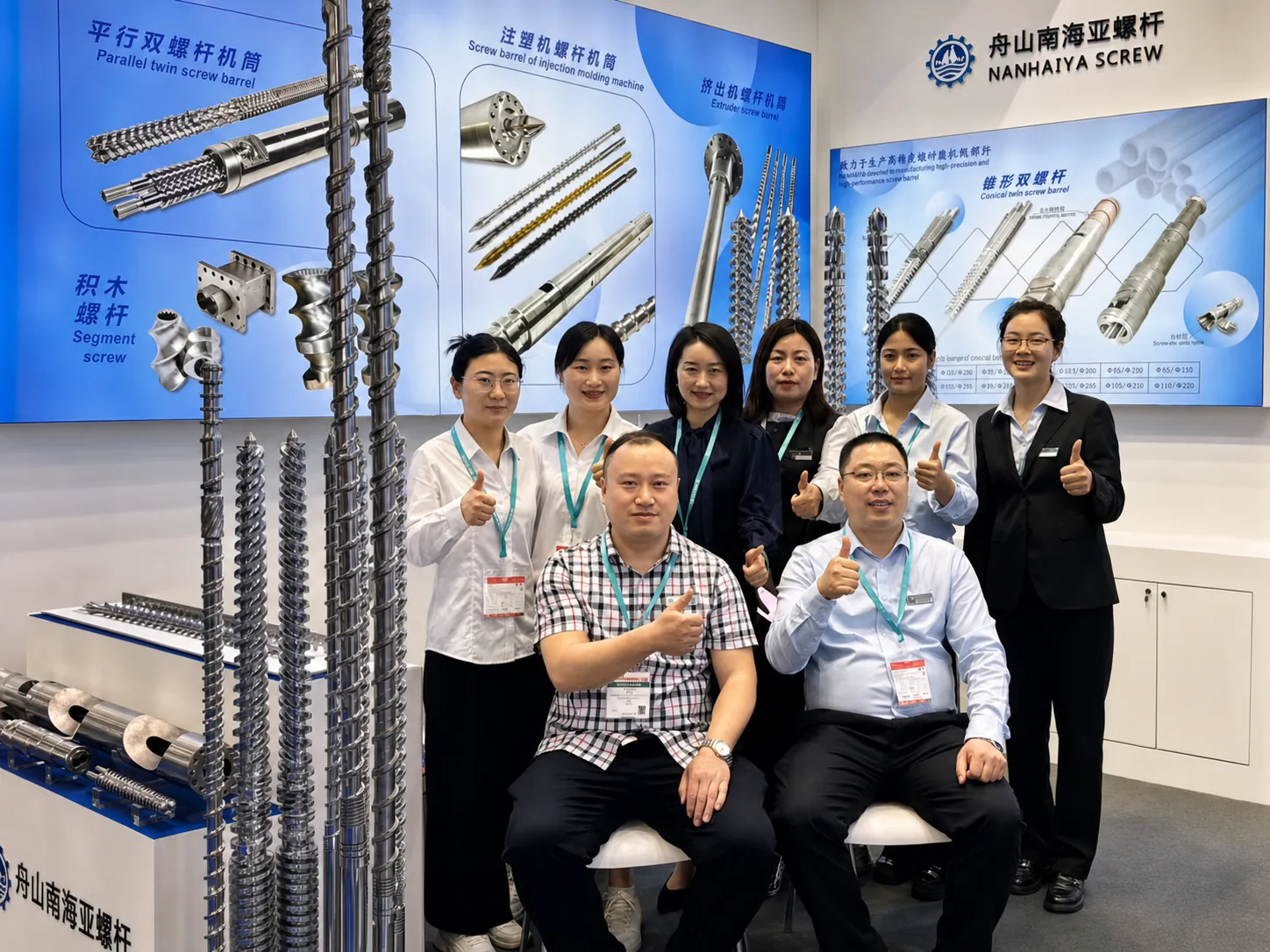
Related Articles
More insights on screw barrel technology and plastics processing.
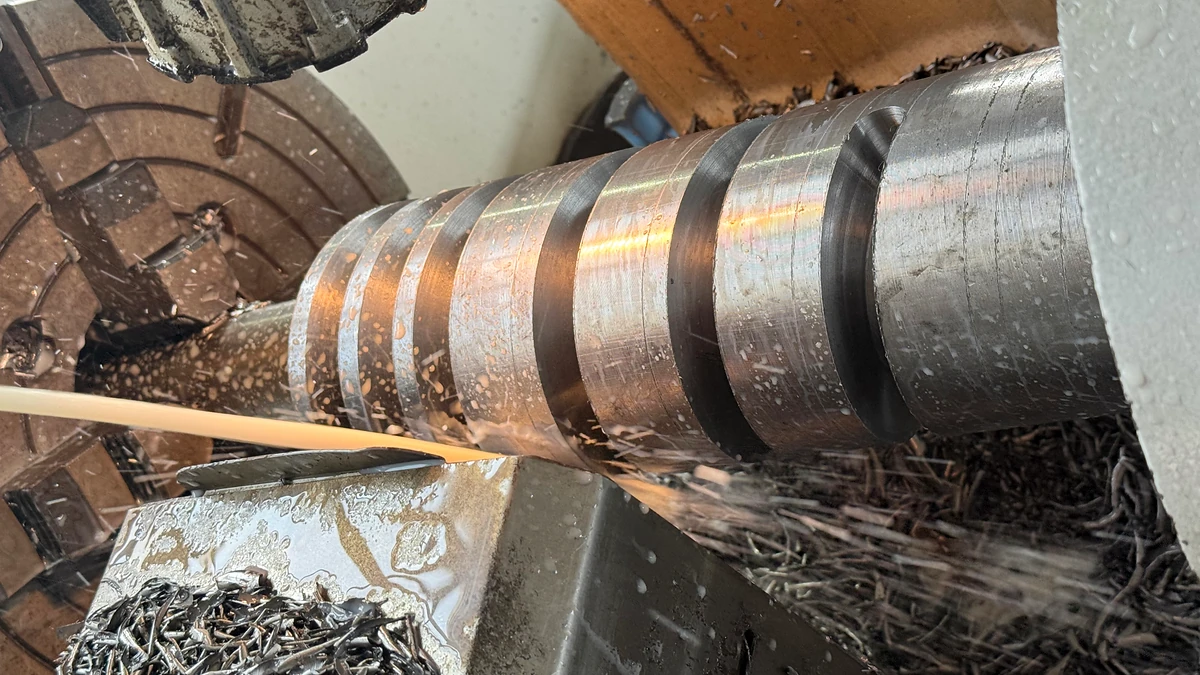
What Really Drives Screw Barrel Price (It's Not Just Steel)
Oct 30, 2026
Learn what really drives screw barrel price — from material alloys and configuration types to hidden costs, TCO analysis, and smart sourcing strategies for buyers.
Read Article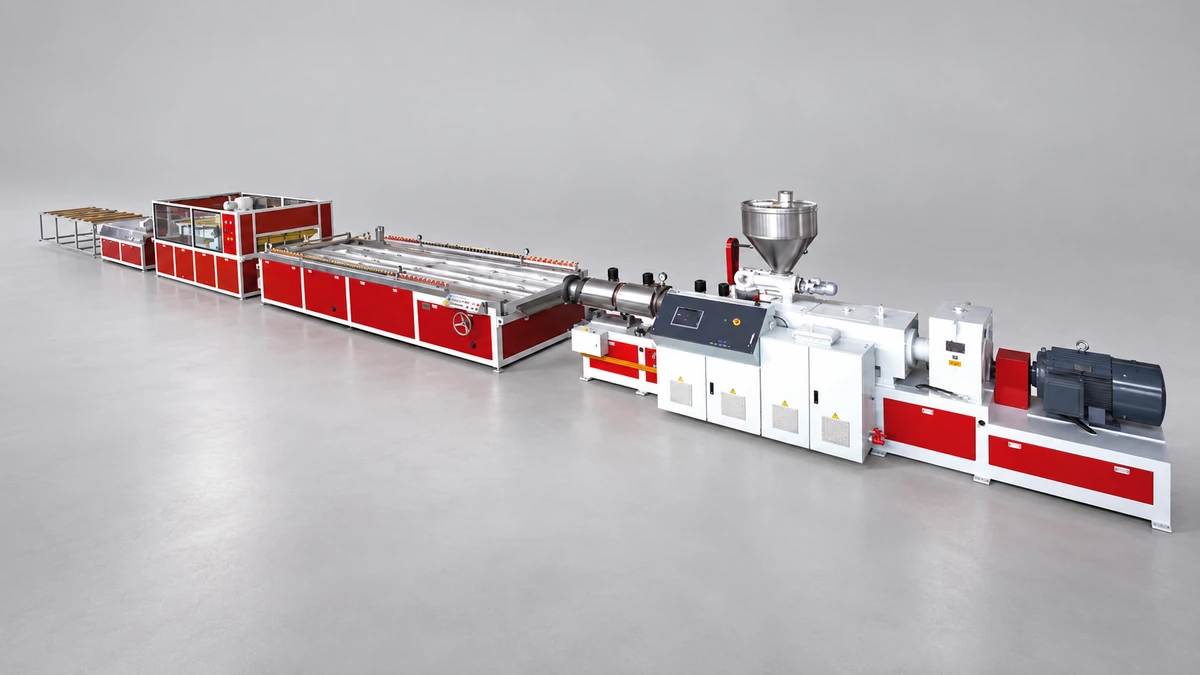
What Most Buyers Get Wrong About WPC Extrusion Machine Selection
Oct 29, 2026
Learn how to select the right WPC extrusion machine by comparing extruder types, resin systems, wear-part metallurgy, and capacity planning to avoid costly mistakes.
Read Article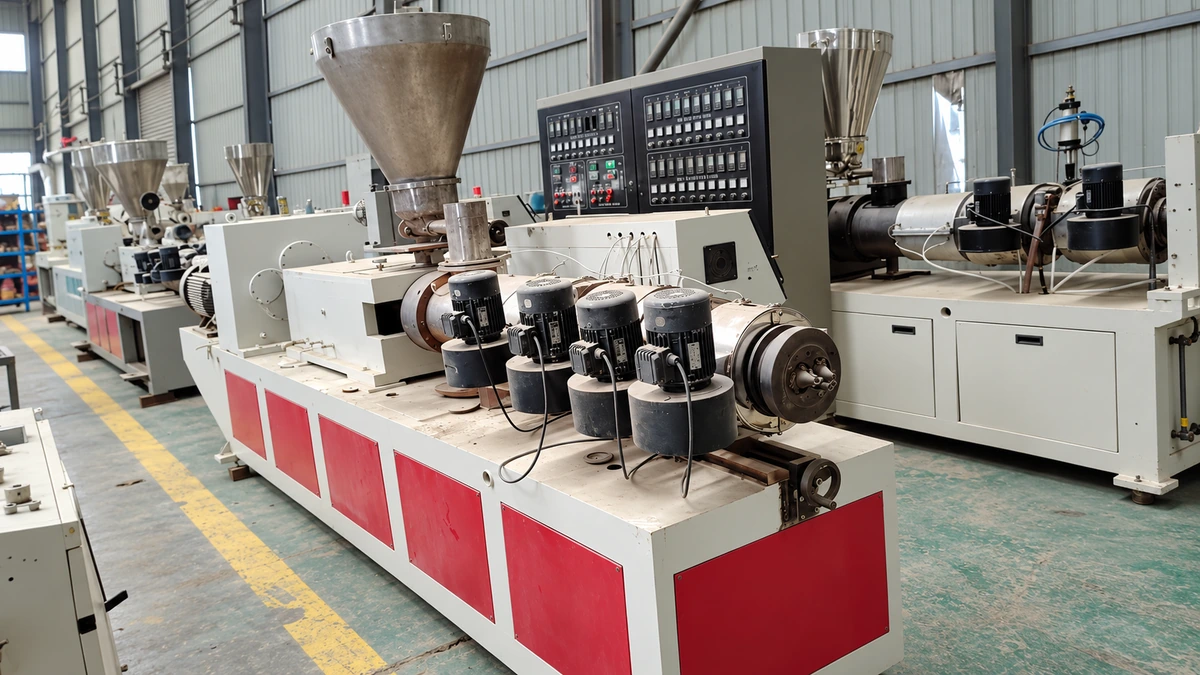
Counter Rotating Twin Screw Extruder Manufacturer: What Buyers Miss
Oct 29, 2026
Learn how to evaluate a counter rotating twin screw extruder manufacturer with expert guidance on gearbox engineering, barrel metallurgy, TCO analysis, and a sourcing checklist.
Read ArticleLooking for something else?
Search by material, symptom or product and jump straight to the relevant page.
These are navigation suggestions based on keyword matching — not a quotation, not a delivery commitment, and not a substitute for engineering review. Final specification is confirmed by our engineers against your drawings and processed material.
Need help with screw barrel selection?
Share your machine model, processed material and application. Our team can help with pricing and technical support.