

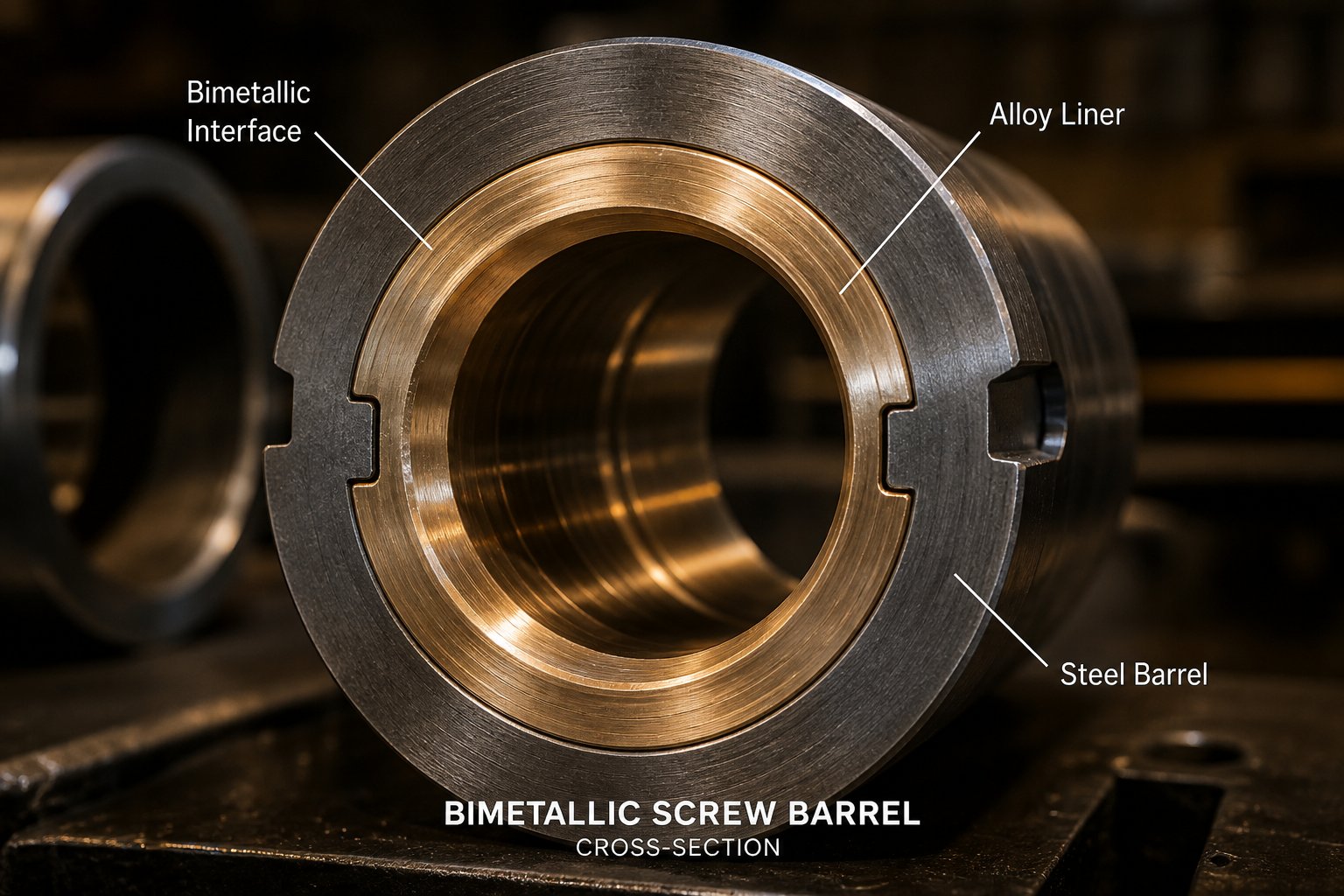
Why Screw Barrel Material Is the Most Critical Decision in Plastics Processing
Imagine running a production line at full capacity, only to watch output quality nosedive because your barrel is corroding from the inside out. Or picture pulling a screw for routine inspection and finding the flight OD worn down far past acceptable tolerances after just a few months. These scenarios happen every day in plastics processing facilities around the world, and they almost always trace back to one root cause: the wrong screw barrel material.
The screw and barrel together form the heart of every injection molding machine and extruder. They consume nearly 70% of a line's total energy and shoulder full responsibility for melting, mixing, pressurizing, and conveying polymer into a finished part or profile. When the alloys and surface treatments that make up these components don't match the demands of the resin, filler system, and operating temperature, the consequences cascade quickly: premature wear, melt contamination, unplanned downtime, and replacement costs that can dwarf the original component price.
What Is Screw Barrel Material and Why Does It Matter
Screw barrel material refers to the base steel grade, alloy liner, and surface treatment used to manufacture the screw and barrel of an injection molding machine or extruder. It determines the component's resistance to abrasion, corrosion, thermal fatigue, and mechanical stress, directly influencing production quality, equipment lifespan, and total cost of ownership.
That definition sounds straightforward, but the decision behind it is anything but simple. You're not choosing a single metal. You're choosing a system: a base steel that provides structural strength, potentially a bimetallic alloy liner that lines the barrel bore for wear or corrosion protection, and a surface treatment or coating that fine-tunes hardness and chemical resistance. Get any one of those layers wrong, and the entire plasticating unit underperforms.
As industry analysis from Plastics Technology highlights, screw wear is a gradual process that often goes unnoticed until scrap rates spike, energy consumption soars, or catastrophic failure occurs. The material you specify upfront is your first and most effective line of defense against all three outcomes.
Key Factors That Drive Material Selection
Every plastic injection molding screw barrel material decision comes down to balancing four interrelated performance drivers. Understanding them is the first step toward avoiding costly mismatches:
- Abrasion resistance — Glass fibers, mineral fillers, and even recycled streams loaded with contaminants grind against barrel and screw surfaces under high pressure. The harder and more carbide-rich the alloy, the longer it resists this mechanical erosion.
- Corrosion resistance — Polymers like PVC release hydrochloric acid during processing, while fluoropolymers can generate hydrofluoric acid. Without the right nickel-based or corrosion-resistant alloy, barrel walls pit and degrade from chemical attack.
- Thermal stability — High-performance resins such as PEEK and PEI push melt temperatures above 400 degrees Celsius. The base steel must maintain its hardness and dimensional integrity at these extremes without cracking from thermal fatigue.
- Mechanical strength — Injection molding barrels endure cyclical pressure spikes, while extruder barrels face continuous torque loads. The steel grade must deliver sufficient toughness and fatigue resistance to handle these forces over thousands of operating hours.
No single alloy maximizes all four properties simultaneously. That trade-off is precisely what makes choosing the right bimetallic screw barrel material, surface treatment, and base steel grade such a high-stakes engineering exercise. The sections ahead break down each variable in detail, covering steel grade comparisons, bimetallic alloy families, surface treatment options, machine-type requirements, and a resin-to-material matching guide designed to eliminate guesswork from your next specification.
Definitive Reference Table of Screw Barrel Material Grades and Hardness
Balancing those four selection drivers — abrasion resistance, corrosion resistance, thermal stability, and mechanical strength — starts with knowing exactly which steel grades are available and what each one brings to the table. Yet many processors specify a grade based on habit or supplier default rather than on a careful comparison of properties. The result? A screw barrel steel grade comparison chart that exists only in the heads of a few experienced engineers, never documented in one place.
This section changes that. Below you'll find a consolidated reference covering the most widely used base materials for screws and barrels, along with international designation cross-references that prevent costly mix-ups when sourcing globally.
Common Screw Barrel Steel Grades at a Glance
Whether you're running commodity polyolefins or processing abrasive glass-filled engineering resins, the base steel grade sets the foundation for every performance characteristic that follows. Here is a side-by-side look at seven materials you'll encounter most often:
| Material Grade | International Equivalents (AISI / DIN / JIS / GB) | Typical Hardness Range (HRC) | Primary Strengths | Primary Limitations | Best-Fit Applications |
|---|---|---|---|---|---|
| AISI 4140 | DIN 42CrMo4 / JIS SCM440 / GB 42CrMo | 28–32 (pre-hardened); up to 50 (quench & tempered) | Good toughness, machinability, and fatigue resistance; cost-effective | Limited wear resistance without surface treatment; unsuitable for abrasive or corrosive resins | General-purpose screws for non-abrasive, non-corrosive polymers (PE, PP, PS) |
| 38CrMoAlA (SACM645) | DIN 41CrAlMo7 / JIS SACM645 / EN41B (approx.) | 65–72 HRA surface after nitriding (approx. 900–1050 HV) | Excellent nitriding response; hard surface with tough core; economical | Nitrided layer is thin — heavy abrasive wear breaks through; poor corrosion resistance against HCl or HF | Standard nitrided barrels for commodity and lightly filled resins |
| AISI H13 (SKD61) | DIN X40CrMoV5-1 / JIS SKD61 / GB 4Cr5MoSiV1 | 44–54 | Outstanding hot hardness and thermal fatigue resistance; good toughness at elevated temperatures | Lower abrasion resistance than high-carbide grades; higher cost than 4140 | High-temperature processing (PEEK, PEI, PPS); hot-runner components; barrels subject to thermal cycling |
| AISI D2 | DIN X155CrVMo12-1 / JIS SKD11 / GB Cr12Mo1V1 | 58–65 | High carbon (1.4–1.6% C) and chromium (11–13% Cr) deliver superior wear resistance and compressive strength | Difficult to machine; relatively brittle; limited corrosion resistance despite chromium content | Screw elements and barrel liners for moderately abrasive compounds; long-run cold-work tooling |
| CPM 9V | Powder metallurgy grade (no direct DIN/JIS/GB equivalent) | 53–58 | Extremely uniform carbide distribution; exceptional toughness combined with high abrasion resistance | Premium cost; limited supplier availability; requires specialized heat treatment | Screw flights and mixing elements in highly abrasive glass- or mineral-filled compounds |
| Inconel 625 | UNS N06625 / DIN NiCr22Mo9Nb (2.4856) | Generally rated by tensile strength rather than HRC (~25–35 HRC equivalent) | Exceptional resistance to pitting, crevice corrosion, and oxidation; performs well above 800 °C | Low hardness means poor abrasion resistance; very high material and machining cost | Barrel components in fluoropolymer (PTFE, FEP) and other highly corrosive polymer lines |
| Stellite 6 | Co-based alloy (UNS R30006) | 38–44 (as-cast); maintains hardness at red heat | Combined abrasion and corrosion resistance; retains hardness at elevated temperatures; excellent galling resistance | Very high cost; difficult to machine — typically applied as weld overlay or hardfacing | Screw flight tips, check rings, and valve seats in corrosive-abrasive dual-threat applications (e.g., filled PVC) |
Note: Hardness values represent typical ranges under standard heat-treatment conditions. Actual results vary with section size, quench medium, and tempering parameters. Always confirm specifications with your material supplier.
A few patterns jump out immediately. Cost-effective grades like AISI 4140 and the 38CrMoAlA nitriding steel screw barrel cover the vast majority of standard processing, but they reach their limits fast once fillers or corrosive gases enter the picture. At the opposite end, specialty alloys like Inconel 625 and Stellite 6 solve extreme chemistry problems — yet they would be overkill (and budget-killers) for a line running unfilled polypropylene. Matching grade to application is where the real engineering discipline lies, and the resin-to-material guide later in this article will map those pairings precisely.
International Material Designation Cross-Reference
If you've ever received a quote referencing SKD61 from a Japanese supplier and wondered whether it matches the H13 tool steel screw barrel applications you originally specified, you're not alone. Global sourcing means global confusion — and a misidentified grade can mean a barrel that underperforms or fails prematurely.
As MISUMI's standards comparison guide emphasizes, two comparable steel specifications across different standards may share the same mechanical properties and chemical composition yet still not be exactly equivalent. Finely tuned nuances in processing techniques and permissible composition ranges can create differences that matter under demanding plasticating conditions.
The cross-reference table below maps the designations most frequently confused in screw barrel procurement:
| Common Name | AISI / SAE | DIN (Germany) | JIS (Japan) | GB (China) | EN (Europe) |
|---|---|---|---|---|---|
| Chrome-Moly Structural Steel | 4140 | 42CrMo4 (1.7225) | SCM440 | 42CrMo | 42CrMo4 |
| Nitriding Steel | — (no direct AISI) | 41CrAlMo7 (1.8509) | SACM645 | 38CrMoAlA | EN41B (approx.) |
| Hot-Work Tool Steel | H13 | X40CrMoV5-1 (1.2344) | SKD61 | 4Cr5MoSiV1 | X40CrMoV5-1 |
| High-Cr Cold-Work Tool Steel | D2 | X155CrVMo12-1 (1.2379) | SKD11 | Cr12Mo1V1 | X155CrVMo12-1 |
International equivalents are approximate. Chemical composition ranges can differ slightly between standards — always verify actual mill certificate data against your engineering specification before approving production.
Having a reliable cross-reference prevents a surprisingly common procurement error: assuming that matching names means matching performance. A barrel spec'd as 42CrMo in a Chinese GB standard, for example, aligns closely with AISI 4140, but subtle variances in allowable sulfur or phosphorus content could affect machinability or toughness in edge cases. When injection molding machine screw barrel material hardness is critical to your application, request the actual chemical analysis — not just the grade name.
Steel grades and their hardness numbers, however, tell only part of the story. Many barrels never enter service as bare steel. Instead, they receive either a bimetallic alloy liner or a surface treatment that fundamentally changes the wear and corrosion profile of the bore. Understanding how those technologies work — and when they outperform even the best nitrided steel — is what separates a good specification from a great one.
Bimetallic Screw Barrel Technology Explained From Alloy Selection to Performance
A nitrided barrel relies on a hardened case just 0.4 to 0.6 mm deep. Once abrasive fillers or corrosive off-gases eat through that thin shell, the soft core underneath is exposed and wear accelerates dramatically — there is no second line of defense. Bimetallic construction solves this fundamental limitation by placing a thick, purpose-engineered alloy liner inside a structural steel shell, creating two distinct layers that each do what they do best.
For processors running abrasive glass-filled compounds, corrosive PVC formulations, or unpredictable recycled streams, understanding how bimetallic barrels are manufactured — and which alloy family suits which threat — is the difference between a barrel that lasts three years and one that fails in under twelve months.
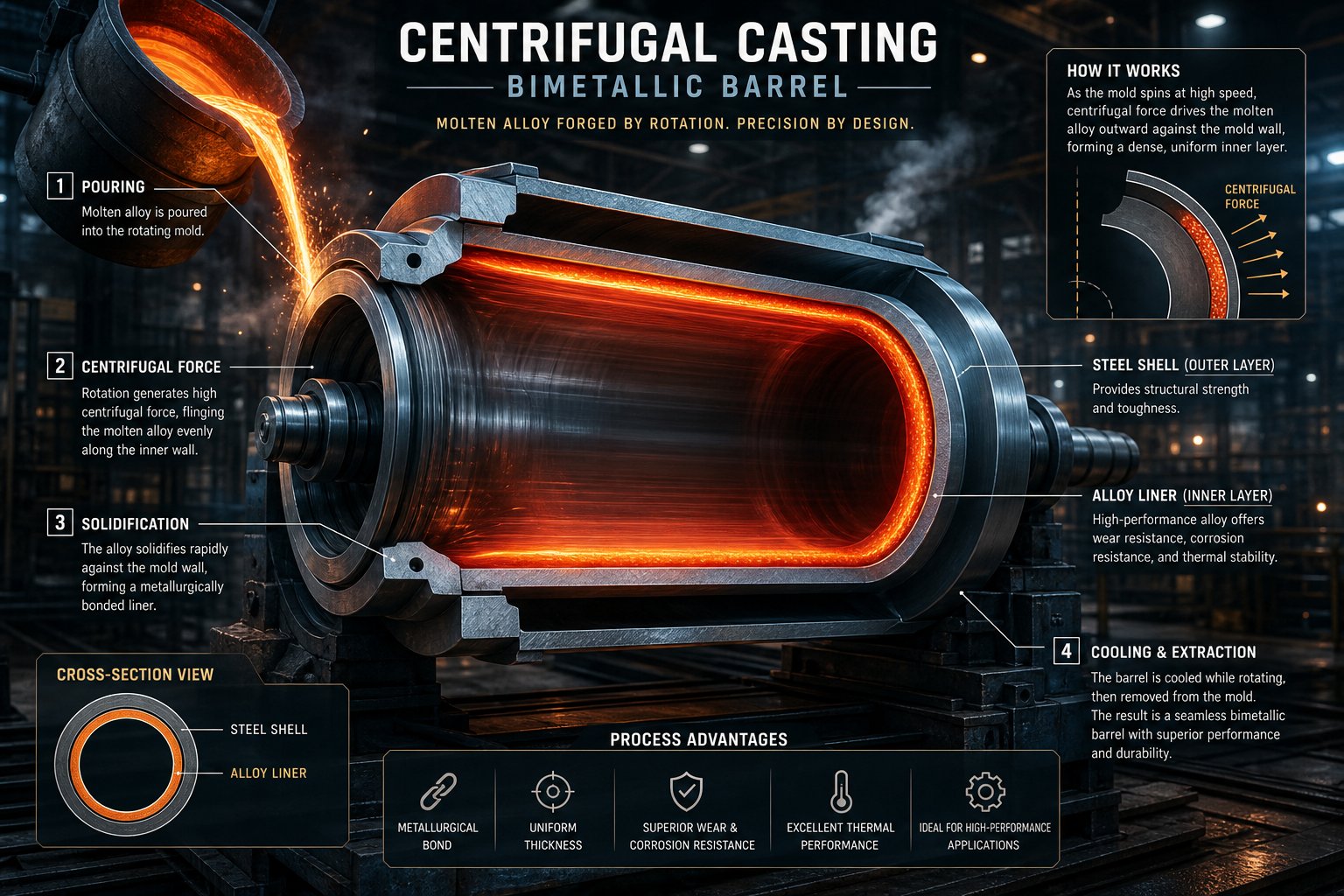
How Bimetallic Barrels Are Made Through Centrifugal Casting
The bimetallic barrel centrifugal casting process sounds complex, but the principle is elegantly simple: spin a heated barrel shell at high speed, pour molten alloy into its bore, and let centrifugal force do the work of distributing and bonding the liner uniformly against the inner wall.
Here is how it unfolds step by step:
- Barrel shell preparation — A structural steel tube, typically 38CrMoAlA or an equivalent chrome-moly grade, is precision-machined on both the inner and outer diameters. The bore is slightly oversized to accommodate the liner thickness.
- Heating — The barrel shell is placed in a furnace and heated to approximately 1000 to 1100 degrees Celsius, close to the melting point of the liner alloy. This temperature ensures a strong metallurgical bond between the shell and the incoming alloy.
- Alloy melting — The wear-resistant or corrosion-resistant alloy is weighed precisely and melted separately. Accuracy here matters: too little alloy produces a thin, uneven liner, while too much creates machining waste and potential stress concentrations.
- Centrifugal casting — The heated barrel is transferred quickly to a centrifugal casting machine and rotated at controlled high speed. The molten alloy is poured into the spinning bore, and centrifugal force pushes it outward against the barrel wall. This force produces a dense, porosity-free liner that fuses metallurgically with the steel shell — not just a mechanical bond, but an atomic-level fusion.
- Cooling and finishing — The assembly cools under controlled conditions to prevent cracking from thermal shock. Once cooled, the bore is honed to final dimensions, typically achieving a surface roughness of Ra 0.4 micrometers or better and bore straightness within 0.015 mm/m.
The result is a barrel with a structural outer shell that handles mechanical loads, heat transfer, and mounting stresses, while the inner liner — ranging from 1.5 to 3.0 mm thick — handles the punishing contact with abrasive fillers and corrosive polymer melts. That liner thickness is critical: it provides five to six times more wear-resistant material reserve than a nitrided case, meaning the barrel maintains its working geometry far longer under aggressive processing conditions.
Fe-Based vs Ni-Based vs Co-Based Bimetallic Alloys
Not all bimetallic liners are created equal. The alloy family you choose must match the dominant threat your resin system poses. Think of it this way: you wouldn't wear a raincoat to a sandstorm, and you wouldn't wear body armor in a downpour. Each alloy family is engineered for a specific type of attack.
- Fe-based alloys (Fe-Cr-B) — These liners use an iron matrix loaded with chromium, boron, and tungsten carbides. The carbide particles act like embedded armor plates, resisting the mechanical grinding action of glass fibers, calcium carbonate, talc, and mineral fillers. Typical surface hardness falls in the 58 to 62 HRC range. If your primary enemy is abrasion from filled compounds, an Fe-based liner is often the most cost-effective upgrade from nitrided steel.
- Ni-based alloys (Ni-Cr-B-W) — A nickel matrix provides inherent chemical resistance that iron simply cannot match. These liners excel in environments where PVC, CPVC, halogenated flame retardants, or fluoropolymers release hydrochloric or hydrofluoric acid during processing. They also incorporate carbide phases for moderate abrasion resistance, reaching 60 to 65 HRC. When corrosion is the dominant failure mode — or when you're battling both corrosion and abrasion simultaneously, as in CaCO3-filled PVC — Ni-based alloys are the standard recommendation.
- Co-based and WC-rich alloys — For the most extreme applications, tungsten carbide particles dispersed in a nickel or cobalt matrix push hardness to 65 to 70 HRC or higher. These liners handle severe abrasion from high glass-fiber loadings (30% and above) in engineering plastics like PA66-GF and PBT-GF. HVOF (High Velocity Oxygen Fuel) tungsten carbide spray coatings can reach 70 to 75 HRC for the most punishing scenarios. The trade-off? Significantly higher cost and longer lead times.
Choosing between these families isn't guesswork — it follows directly from your polymer and filler chemistry. A twin screw extruder barrel material specification for compounding glass-filled nylon demands a WC-rich liner. An extruder screw barrel material choice for rigid PVC pipe production calls for Ni-based protection. And a standard polyolefin film line? It likely doesn't need bimetallic construction at all.
When Bimetallic Construction Outperforms Nitrided Steel
The decision between nitrided and bimetallic isn't always obvious, especially when budget pressures push teams toward the lower initial price tag. The right way to evaluate it is through total cost of ownership over the barrel's service life — not the purchase order amount.
Consider four decision criteria before specifying:
- Volume of abrasive or corrosive resin processed — Lines running more than 6,000 hours per year on filled or corrosive materials push nitrided barrels past their limits quickly.
- Cost per hour of downtime — If a barrel swap costs $450 per hour in lost production and takes 18 hours to complete, every unplanned replacement burns over $8,000 before you even pay for the new barrel.
- Expected barrel lifespan targets — If your maintenance plan assumes a 3-to-5-year replacement cycle, a nitrided barrel processing 30% CaCO3-filled PVC won't make it past 18 months.
- Total cost of ownership — A bimetallic barrel may cost 2 to 3 times more upfront, but its service life in demanding applications is 3 to 5 times longer, making it the cheaper option per operating hour.
The table below lays out the comparison in concrete terms:
| Attribute | Nitrided Steel Barrel | Bimetallic Barrel |
|---|---|---|
| Initial Cost (relative) | 1.0x | 1.8 - 3.0x |
| Effective Wear Depth | 0.4 - 0.6 mm | 1.5 - 3.0 mm |
| Service Life (clean polyolefins) | 24 - 48 months | 60 - 120 months |
| Service Life (filled PVC, 20%+ CaCO3) | 12 - 18 months | 36 - 60 months |
| Service Life (30%+ glass fiber) | 6 - 12 months | 24 - 48 months |
| Corrosion Resistance | Moderate | Good to excellent (Ni-based liners) |
| Refurbishment Option | Re-nitride if dimensions allow | Re-machine within liner; re-cast possible |
| Ideal Use Cases | Virgin PE, PP, PS; low-filler compounds; moderate throughput | Filled compounds, glass-fiber reinforced resins, PVC, recycled streams, high-output lines |
Performance data reflects typical industry ranges for properly manufactured barrels. Source: engineering comparison data from extruder component manufacturers and field service records.
Here is the number that settles most debates: in a five-year total cost model for a twin-screw line running CaCO3-filled PVC at 6,000 hours per year, a nitrided barrel path costs roughly $3.38 per operating hour versus $1.20 per hour for bimetallic — nearly three times more expensive when you factor in multiple replacements, downtime, scrap, and ancillary labor. The higher purchase price pays for itself within 18 to 24 months in most abrasive or corrosive applications.
That said, over-specifying bimetallic for a clean polyolefin line wastes capital with no operational return. A well-made nitrided barrel on virgin HDPE pipe extrusion can deliver five or more years of reliable service at roughly half the upfront cost. The key is matching the barrel architecture to the actual wear threat — not defaulting to the most expensive option out of caution.
Selecting the right alloy liner and barrel construction, however, is only half of the equation. The surface treatments and coatings applied to screws and barrel bores add another layer of protection — or introduce new failure modes if chosen poorly. Understanding how nitriding, chrome plating, tungsten carbide overlay, and emerging PVD/CVD coatings compare in hardness, depth, and application fit is the next critical piece of the specification puzzle.
Surface Treatments and Coatings Compared From Nitriding to Carbide Overlay
Even the best alloy liner or steel grade rarely enters service in its bare, as-machined state. A surface treatment or coating acts as the final armor layer — the first point of contact between the screw barrel material and the aggressive mix of molten polymer, abrasive fillers, and corrosive gases swirling through the bore. Choose the right treatment and you extend component life by years. Choose the wrong one and that expensive base material underneath wears through far sooner than the datasheet promised.
Yet most processors treat surface finishing as an afterthought, deferring to whatever their supplier offers as standard. That default approach ignores significant performance differences between gas nitriding, ion nitriding, chrome plating, tungsten carbide overlay, and newer vapor-deposition technologies. Each one occupies a distinct niche defined by hardness, depth, chemical resistance, and cost. Understanding those trade-offs turns surface treatment selection from a line item on a purchase order into a strategic decision.
Gas Nitriding vs Ion Nitriding for Barrel Inner Surfaces
Gas nitriding remains the most widely used surface hardening method for screw barrels. The process introduces nitrogen into the steel surface at relatively low temperatures of 500 to 550 degrees Celsius — well below the austenitizing range — so parts experience minimal distortion and maintain excellent dimensional control. Ammonia gas decomposes at the barrel surface, releasing atomic nitrogen that diffuses inward and reacts with alloying elements like chromium, molybdenum, and aluminum to form extremely hard nitride compounds.
The resulting gas nitriding screw barrel surface hardness depends heavily on the steel grade. A 38CrMoAlA barrel, rich in aluminum and chromium, develops a nitrided case reaching approximately 900 to 1,050 HV (roughly 65 to 72 HRA). That case depth, however, is limited: commercial applications typically produce layers of 200 to 300 micrometers, rarely exceeding 600 micrometers. Once abrasive fillers grind through that thin shell, the softer core is exposed and wear accelerates rapidly.
A significant concern with gas nitriding is the formation of a brittle "white layer" — a gamma-prime (Fe4N) compound zone on the outermost surface. While extremely hard, this layer is also very brittle and can spall under mechanical stress, creating contamination risks in sensitive applications. A two-stage Floe process reduces white-layer thickness by adding a higher-temperature diffusion stage at 550 to 565 degrees Celsius, but it doesn't eliminate the layer entirely.
Ion (plasma) nitriding solves several of these limitations. Parts are processed in a vacuum chamber where a high-voltage electrical charge accelerates individual nitrogen atoms directly into the steel surface. This plasma-driven mechanism heats the part, cleans the surface, and drives nitrogen absorption simultaneously. The advantages over gas nitriding are practical and measurable:
- Faster cycle times — Surface saturation with nitrogen occurs more rapidly, shortening process duration and reducing energy costs.
- Selective masking — Plasma control allows operators to nitride only specific zones of the barrel without chemical stop-off paints, achieving precision that gas nitriding cannot match.
- Reduced distortion — Already minimal with gas nitriding, distortion drops even further under plasma processing, delivering excellent control of case depth, chemistry, and uniformity.
- Environmental benefits — No ammonia emissions and no cyanide salt baths mean cleaner operations and simpler regulatory compliance.
Both methods, however, share a fundamental limitation: they modify only the outermost fraction of a millimeter. Against mildly abrasive unfilled resins that is more than sufficient. Against 30% glass-filled nylon running at high throughput, neither offers the depth of protection that bimetallic construction or overlay coatings provide.
Chrome Plating and Tungsten Carbide Overlay for Screw Flights
When corrosion rather than abrasion is the primary threat, hard chrome plating offers a proven barrier. A layer of electrolytically deposited chromium — typically 25 to 75 micrometers thick — creates a dense, chemically inert surface that resists attack from HCl off-gassing in PVC and from mildly acidic degradation products in many engineering plastics. Chrome-plated bores also provide a low-friction surface that improves melt conveyance and reduces hang-up zones where degraded polymer can accumulate.
The catch? Chrome plating vs nitriding screw barrel performance diverges sharply once abrasive fillers enter the picture. Chrome deposits are relatively thin and lack the carbide reinforcement needed to resist particle erosion. A chrome-plated barrel running CaCO3-filled PVC may hold up against chemical attack beautifully while the chrome itself is gouged away by the mineral filler within months. That makes chrome plating ideal for corrosion-only scenarios — unfilled or lightly filled PVC, certain medical-grade resins, and cosmetic-quality applications — but a poor standalone choice for filled compounds.
Tungsten carbide overlay occupies the opposite extreme. Applied to screw flights, mixing sections, and high-wear zones through thermal spray processes like HVAF or HVOF, tungsten carbide coatings deliver extraordinary abrasion resistance. HVAF-deposited WC-CoCr coatings exceed 1,600 HV — roughly twice the hardness of a nitrided surface — and can be applied in thicknesses from 100 micrometers up to 1.5 mm or more. Even a 100-micrometer tungsten carbide overlay screw flight coating is gas-tight, forming an impermeable barrier that protects the base metal from both mechanical and chemical attack.
The WC-CoCr composition is particularly effective because the cobalt-chrome binder matrix adds meaningful corrosion resistance on top of the extreme wear protection provided by the tungsten carbide particles. This dual capability makes it a go-to solution for screws processing glass-filled engineering resins, mineral-loaded masterbatch, and recycled materials containing unpredictable contaminants.
Emerging PVD and CVD Coating Technologies
Physical Vapor Deposition (PVD) and Chemical Vapor Deposition (CVD) represent the newest frontier in screw and barrel surface engineering. Both deposit thin, extremely hard films — but through fundamentally different mechanisms that determine where each excels.
PVD operates at relatively low temperatures (200 to 400 degrees Celsius) and uses sputtering or evaporation to deposit coatings typically less than 5 micrometers thick. That thinness suits precision components where tight tolerances must be preserved, but limits durability in heavy-wear screw barrel applications. PVD is also a line-of-sight process, meaning it struggles to coat complex internal geometries uniformly — a significant drawback for barrel bores.
CVD overcomes both limitations. It produces coatings ranging from 25 to 75 micrometers with uniform coverage on both external and internal surfaces, including non-line-of-sight areas. The resulting films are dense, pore-free, and offer superior resistance to abrasion, erosion, and chemical attack. Some advanced CVD processes now operate at reduced temperatures around 450 to 500 degrees Celsius, broadening compatibility with heat-sensitive substrates.
Neither technology has displaced nitriding or tungsten carbide overlay as a mainstream screw barrel treatment yet. Current adoption is concentrated in specialty and high-value applications — medical-grade processing, ultra-clean compounding, and niche aerospace polymer work — where the coating's purity, uniformity, and chemical inertness justify the higher cost. As deposition equipment becomes more accessible and process costs decline, expect CVD in particular to gain ground as a barrel bore treatment for corrosion-intensive applications.
The following table pulls all these treatments together for direct comparison. Use it alongside the steel grade and bimetallic alloy tables from earlier sections to build a complete material-plus-surface specification:
| Treatment Type | Typical Surface Hardness | Depth of Treatment | Abrasion Resistance | Corrosion Resistance | Relative Cost | Best Application |
|---|---|---|---|---|---|---|
| Gas Nitriding | 900 - 1,050 HV (65 - 72 HRA) | 0.2 - 0.6 mm | Moderate | Low to moderate | Low | Standard barrels for unfilled or lightly filled commodity resins |
| Ion (Plasma) Nitriding | 900 - 1,100 HV | 0.1 - 0.5 mm | Moderate | Low to moderate | Low to medium | Precision barrels requiring selective zone hardening and minimal distortion |
| Hard Chrome Plating | 850 - 1,050 HV (66 - 70 HRC equivalent) | 0.025 - 0.075 mm | Low | High | Medium | PVC and corrosive resin barrels without heavy filler loads |
| Tungsten Carbide Overlay (HVAF/HVOF) | 1,200 - 1,600+ HV | 0.1 - 1.5 mm | Very high | Moderate to high (WC-CoCr) | High | Screw flights and mixing elements in glass-filled, mineral-filled, and recycled compounds |
| PVD Coating | 2,000 - 3,500 HV (film hardness) | < 0.005 mm | Low (thin film limits durability) | Moderate | Medium to high | Precision components, low-wear or decorative applications, heat-sensitive substrates |
| CVD Coating | 1,500 - 3,000 HV (film hardness) | 0.025 - 0.075 mm | High | High (pore-free structure) | High | Specialty corrosion- and wear-critical barrel bores, medical and aerospace polymer processing |
Hardness values reflect typical ranges reported in coating and surface treatment literature. Film hardness for PVD and CVD coatings measures the coating itself, not the substrate; effective wear resistance depends on both film hardness and thickness. G77 screw and barrel material testing, along with ASTM G65 abrasion testing, can validate real-world performance for specific treatment-substrate combinations.
The optimal treatment is never a standalone decision. It depends on the interaction between the polymer being processed, filler content and hardness, processing temperature, production volume, and — critically — the base material underneath. A tungsten carbide overlay on a poorly chosen substrate steel will delaminate. A nitrided case on an alloy lacking sufficient aluminum or chromium won't reach target hardness. Every layer in the system must work together.
That systems-level thinking extends beyond the barrel bore to the machine itself. The wear mechanisms, critical zones, and replacement economics differ significantly between single-screw extruders, twin-screw extruders, and injection molding machines — and those differences reshape which materials and treatments make sense for each platform.
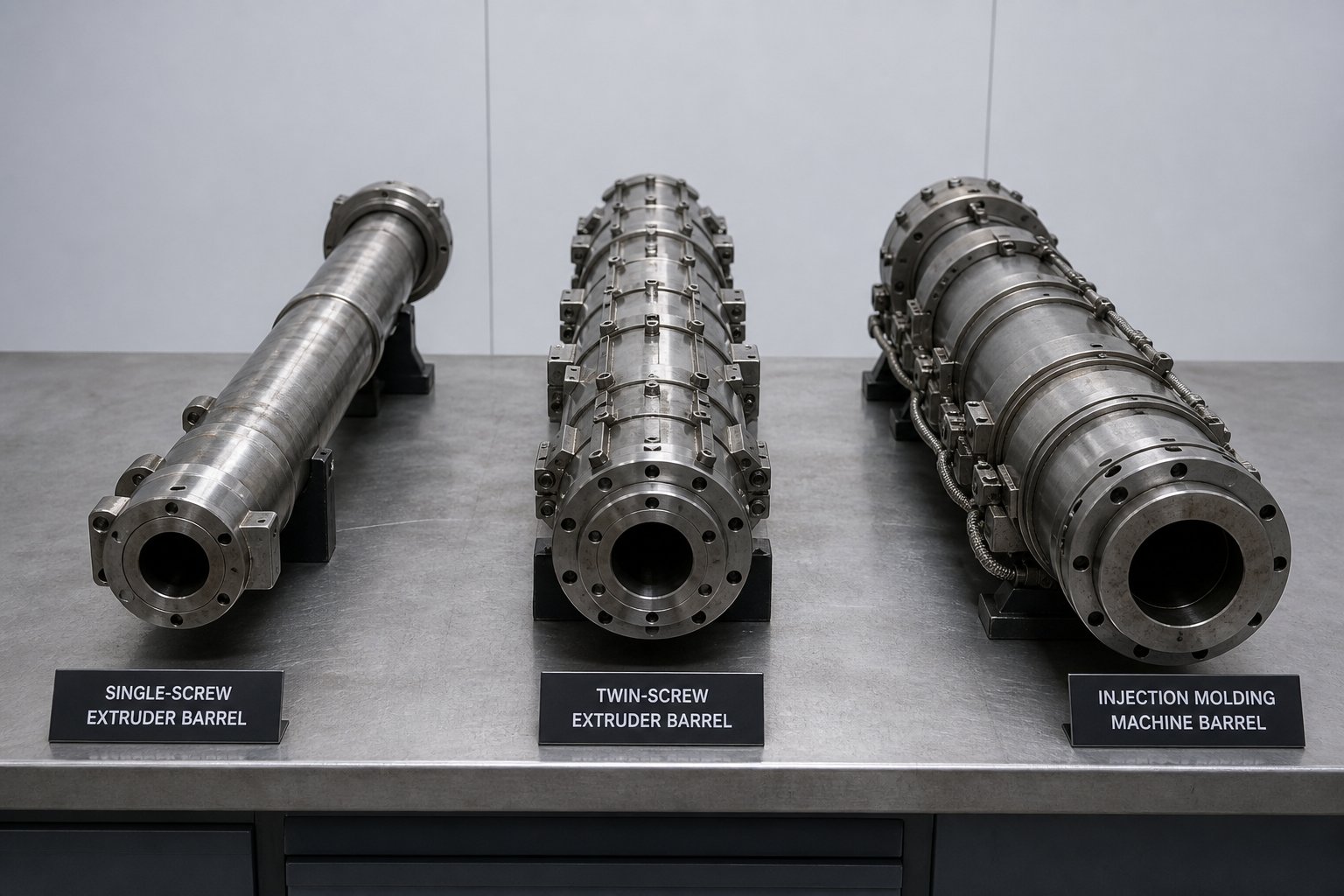
How Machine Type Changes Your Screw Barrel Material Requirements
A tungsten carbide overlay that performs brilliantly on a single-screw film line could be completely wrong for a co-rotating twin-screw compounder — even if both machines process the same resin. Why? Because the wear mechanism, pressure profile, and barrel architecture differ fundamentally from one machine type to the next, and those differences reshape every material and surface treatment decision.
Most specification guides treat all plasticating equipment as a single category. In practice, single-screw extruder barrel material selection, twin-screw segmented barrel hardness requirements, and injection molding machine barrel wear zones each demand a tailored approach. Overlooking these distinctions is one of the fastest paths to premature failure.
Single-Screw Extruder Barrel Material Requirements
Single-screw extruders push polymer in one direction through a smooth-bore barrel. The dominant wear pattern is unidirectional abrasion concentrated along the barrel wall opposite the pushing flight. As extrusion wear research published by Plastics Technology documents, flight clearance in a new extruder is roughly the nominal screw diameter divided by 1,000 — about 0.004 inches per side for a 3.5-inch machine. As that clearance grows, specific output drops and discharge temperature climbs, sometimes reducing throughput by 13% or more before the screw is pulled.
For clean polyolefin or polystyrene lines, a nitrided 38CrMoAlA barrel paired with a through-hardened 4140 screw handles years of service at reasonable cost. When abrasive fillers enter the picture — glass fibers, calcium carbonate, silica — an iron-based bimetallic liner becomes essential. The liner's thick carbide-rich layer resists the continuous grinding action that would eat through a nitrided case in months. An iron-based bimetallic barrel in a single-screw extruder typically lasts three times the service life of the screw it houses, meaning you'll cycle through multiple screws before the barrel itself needs replacement.
Twin-Screw Extruder Barrel Material Challenges
Twin-screw extruders introduce an entirely different set of stresses. Two intermeshing, co-rotating screws create intense shear in the overflight gap — the narrow space between each screw tip and the barrel wall. Leistritz's engineering data shows that peak shear rates in this gap can exceed 4,800 per second on a 77.5 mm machine running at 600 RPM. That concentrated mechanical energy hammers the barrel bore from two rotating contact points rather than one, accelerating localized wear.
What makes twin-screw barrel material selection uniquely challenging is the segmented barrel design. Instead of a single monolithic tube, the barrel consists of multiple bolt-together segments, each independently heated and cooled. Every segment must deliver consistent hardness and wear resistance across its bore surface; a single weak segment creates a bottleneck that accelerates wear across the entire process section.
Replacing one damaged segment in a twin-screw system is far more complex and expensive than swapping a single-screw barrel. Segments must be precisely aligned, thermally matched, and often individually honed to maintain bore concentricity across the full barrel length. This replacement complexity is why twin-screw applications frequently justify premium materials — Ni-based or WC-rich bimetallic liners — even when the resin alone might not demand them. The cost of a single unplanned segment replacement, including disassembly labor, realignment, and lost production, can dwarf the price difference between a standard and an upgraded alloy.
Injection Molding Barrel Material Considerations
Injection molding machines face yet another wear profile. Unlike continuous-extrusion equipment, they operate in cycles: plasticating, injection, hold, and cooling. Each injection shot drives a sudden pressure spike through the barrel and nozzle, subjecting the bore to cyclical mechanical stress that resembles fatigue loading more than steady-state abrasion.
The most vulnerable injection molding machine barrel wear zones are concentrated in two areas:
- The check-ring (non-return valve) zone — Polymer flows backward past the check ring during every plasticating stroke. This reciprocating flow, combined with abrasive fillers, carves wear grooves into the barrel bore just ahead of the screw tip. It's the injection molder's equivalent of a single-screw extruder's flight-clearance problem, except the motion reverses direction thousands of times per day.
- The transition and metering zone — Heat-sensitive resins like PVC, POM, and certain flame-retarded compounds off-gas corrosive byproducts as they approach melt temperature. These gases attack the barrel surface in the transition zone where temperatures are highest and residence time is longest, creating pitting and erosion that no amount of abrasion resistance can prevent without corrosion-resistant alloys.
Barrels on injection molding machines also tend to sit at processing temperature for extended periods during color changes, mold swaps, and shift transitions. This prolonged heat soak stresses the steel's thermal stability — one reason H13 hot-work tool steel is often specified for machines processing PEEK, PEI, or PPS above 380 degrees Celsius.
The table below consolidates these machine-specific differences into a single reference you can use when writing or reviewing a barrel specification:
| Dimension | Single-Screw Extruder | Twin-Screw Extruder | Injection Molding Machine |
|---|---|---|---|
| Primary Wear Mechanism | Continuous unidirectional abrasion along barrel wall opposite pushing flight | Intermeshing shear at two overflight gaps; high-intensity dispersive mixing zones | Cyclical pressure spikes; reciprocating check-ring abrasion; corrosive off-gassing |
| Critical Barrel Zone | Transition (compression) section where solids compact against barrel wall | Mixing and kneading block segments; feed-zone throat area | Check-ring zone ahead of screw tip; transition zone where corrosive gases concentrate |
| Recommended Base Material | 38CrMoAlA (nitriding steel) for standard duty; 4140 shell with bimetallic liner for filled compounds | 38CrMoAlA or H13 segments with bimetallic liners; consistent hardness across all segments critical | 38CrMoAlA for commodity resins; H13 for high-temperature engineering plastics; bimetallic for corrosive or filled grades |
| Recommended Surface Treatment | Gas nitriding for unfilled resins; Fe-based bimetallic for abrasive fillers | Ni-based or WC-rich bimetallic liners; ion nitriding for light-duty compounding | Nitriding for general purpose; chrome plating for unfilled PVC; Ni-based bimetallic for corrosive-abrasive resins |
| Typical Replacement Interval Factors | Screw replaced at 2x to 4x original flight clearance; barrel lasts roughly 3 screw lifetimes with bimetallic liner | Segment-by-segment evaluation; worn segments replaced individually; higher labor and alignment costs justify premium materials upfront | Check-ring zone wears fastest; barrel life depends heavily on resin corrosivity and filler loading; cyclical stress can cause fatigue cracking in undertreated steels |
Replacement intervals vary widely based on resin system, filler loading, throughput rate, and processing temperature. Values above represent general industry guidance — always validate against your specific operating conditions.
One pattern stands out across all three platforms: the more complex and expensive the barrel replacement, the more aggressively you should invest in material quality upfront. Twin-screw segmented barrels sit at the top of that cost curve, which is why processors running demanding compounds on twin-screw equipment rarely regret specifying bimetallic liners from the start.
Machine type tells you where and how wear happens. The next critical variable is what drives it — and that comes down to the specific polymer family flowing through the bore. Different resins attack barrels through entirely different mechanisms, and matching your material specification to the chemistry of your feedstock is where mismatches cause the most expensive surprises.
Matching Screw Barrel Material to the Polymer You Process
A barrel built from the perfect steel, lined with the ideal bimetallic alloy, and treated with a precisely matched surface coating will still fail prematurely if none of those choices account for the specific polymer flowing through it. The resin itself is the variable that ties every preceding decision together — it dictates whether abrasion, corrosion, thermal fatigue, or some combination of all three will be the dominant threat to your equipment.
Yet most processors choose their screw barrel material based on general categories like "wear-resistant" or "corrosion-resistant" without mapping those labels to their actual feedstock. The result is either under-specification, where a standard nitrided barrel disintegrates under a corrosive PVC compound, or over-specification, where a premium Ni-based bimetallic liner sits on a machine running clean polypropylene — protecting against a threat that doesn't exist while the budget bleeds unnecessarily.
The tables and guidance below eliminate that guesswork. They map specific polymer families to recommended base materials, alloy liners, and surface treatments based on the actual wear mechanisms each resin system generates.
Commodity and Engineering Resin Material Recommendations
Commodity polymers and unfilled engineering plastics are the easiest to specify for — but even within this group, filler content changes the equation dramatically. A polyamide barrel running neat nylon operates in a completely different wear regime than one processing screw barrel material for glass filled nylon at 35% loading.
| Polymer Family | Typical Fillers / Additives | Dominant Wear Mechanism | Recommended Base Material | Recommended Surface Treatment or Liner |
|---|---|---|---|---|
| Polyolefins (PE, PP) | None or low-level colorants | Mild abrasion | AISI 4140 or 38CrMoAlA | Standard gas nitriding |
| Styrenics (PS, ABS, SAN) | None to light pigments | Mild abrasion; cosmetic surface demands | 38CrMoAlA | Gas nitriding; chrome plating optional for cosmetic-grade parts |
| Unfilled Engineering Plastics (PA, PET, POM, PC) | None or minor stabilizers | Moderate abrasion; mild hydrolytic attack at melt temperature | 38CrMoAlA or H13 | Gas or ion nitriding |
| Glass-Filled Engineering Plastics (PA-GF, PBT-GF, PPS-GF) | 15% to 50% glass fiber | Severe abrasion — glass fibers at Mohs 5.5 to 6.5 act as micro-cutting tools | 4140 or 4340 shell with bimetallic liner; CPM 9V or D2 for screws | Fe-based bimetallic liner (barrel); tungsten carbide overlay or Stellite hardfacing (screw flights) |
| Mineral-Filled Compounds (PA-CaCO3, PP-Talc, PP-Mica) | 20% to 60% mineral filler | Moderate to severe abrasion depending on loading and particle hardness | 4140 shell with Fe-based bimetallic liner | Fe-based bimetallic liner; WC overlay for loadings above 40% |
A few critical observations jump out from this breakdown. Standard nitrided steel handles commodity polyolefins and unfilled styrenics beautifully — there is no reason to spend more. But the moment glass fiber enters the compound, the wear regime shifts from gentle sliding contact to aggressive micro-cutting. Industry data shows that abrasive wear accounts for 60% to 70% of total wear in filled polymer processing, and glass fibers at Mohs 5.5 to 6.5 are hard enough to chew through nitrided surfaces within a few thousand hours.
For processors running glass filled nylon at 30% or higher loading, the combination of an Fe-based bimetallic barrel and a CPM 10V or D2 screw with tungsten carbide flight overlay has become the de facto industry standard. Documented comparisons show that D2 tool steel delivers four to six times the abrasion resistance of nitrided 4140 at equivalent geometry, extending service life from roughly 3,000 hours to 12,000 to 15,000 hours in 30% glass-filled nylon service.
Corrosive and High-Temperature Polymer Material Solutions
Corrosion is the failure mechanism most often missed during initial specification. Unlike abrasion, which announces itself through measurable clearance increases and declining output, corrosive attack can silently pit and erode barrel bore surfaces for months before symptoms appear — and by then, the damage is irreversible.
| Polymer Family | Corrosive Byproduct | Severity | Recommended Base Material | Recommended Surface Treatment or Liner |
|---|---|---|---|---|
| PVC and CPVC | Hydrochloric acid (HCl) | Moderate to high — HCl concentrations in processing zones can reach 50 to 200 ppm | 4140 shell with Ni-based bimetallic liner | Ni-based bimetallic liner (barrel); Stellite 6 or Stellite 12 PTA overlay (screw flights); chrome plating as minimum for unfilled formulations |
| Halogenated Flame Retardants (FR-ABS, FR-PC/ABS) | HCl, HBr | Moderate to high | 4140 shell with Ni-based bimetallic liner | Ni-based bimetallic liner; Stellite overlay on screw |
| Fluoropolymers (PTFE, FEP, PVDF) | Hydrofluoric acid (HF) | Very high — HF attacks virtually all iron-based alloys | Inconel 625 or Hastelloy C-276 components | Ni-based bimetallic with Hastelloy or Inconel liner; Hastelloy C-276 weld overlay on screw |
| High-Temp Engineering Polymers (PEEK, PEI, PPS) | Minimal direct corrosion; thermal fatigue is primary threat | Low corrosion / high thermal stress — barrel temperatures exceed 380 degrees Celsius | H13 (SKD61) hot-work tool steel or high-alloy tool steel | Controlled nitriding; Stellite overlay for abrasive-filled grades |
PVC deserves special attention because it represents one of the highest-volume applications where corrosion drives barrel failure. The PVC processing barrel corrosion resistant material solution is straightforward in principle — use a Ni-based bimetallic liner — but the details matter enormously. Corrosive wear rates for nitrided 4140 in rigid PVC service run 0.08 to 0.15 mm per 1,000 operating hours, compared to just 0.01 to 0.03 mm for high-nickel bimetallic constructions. Over a 6,000-hour production year, that difference translates to 0.48 to 0.90 mm of bore enlargement with nitrided steel versus 0.06 to 0.18 mm with a proper Ni-based liner. The nitrided barrel may be finished within 12 to 18 months; the bimetallic version can last four to five years.
Fluoropolymer processing pushes the corrosion challenge to its extreme. Hydrofluoric acid is one of the most aggressive chemicals in industrial processing, and it attacks virtually every iron-based alloy including stainless steels. The best screw barrel material for PEEK processing is comparatively easier to specify — H13 provides the thermal fatigue resistance needed at 380 to 420 degrees Celsius barrel temperatures — but fluoropolymers like PTFE and FEP demand the full Hastelloy or Inconel treatment. Anything less corrodes on a timeline measured in weeks, not years.
An important nuance: at operating temperatures above 350 degrees Celsius, conventional tool steels begin to soften, meaning the room-temperature hardness on a datasheet no longer reflects actual in-service performance. Stellite alloys retain useful hardness to 600 degrees Celsius and above, while H13 holds 42 to 48 HRC at 450 degrees Celsius. For high-temperature polymer processing, always evaluate hot hardness rather than ambient hardness when comparing candidates.
Why Recycled Plastics Demand Upgraded Barrel Materials
Recycled and post-consumer regrind streams represent the fastest-growing category of barrel wear problems — and the most unpredictable. When you process virgin PE or PP, you know exactly what's flowing through the bore. When you process post-consumer recycled material, you're gambling with every pellet.
Here is what commonly hides inside recycled polymer streams:
- Metal fragments — Staples, wire pieces, aluminum foil residue, and steel shavings from shredding equipment. These act as extremely aggressive abrasives with hardness far exceeding any polymer filler.
- Paper and cellulose fibers — While soft individually, they absorb moisture and promote hydrolytic degradation of both polymer and barrel surface.
- Sand, grit, and soil particles — Common in post-consumer agricultural film and packaging waste. Silica-based contaminants at Mohs 7 are harder than glass fiber and cause rapid erosive wear.
- Inconsistent filler loads — Mixed regrind from multiple product streams can deliver wildly varying percentages of glass fiber, CaCO3, talc, or pigment concentrates within the same batch, making wear rates impossible to predict from a single material analysis.
- Mixed polymer chemistry — Contamination with PVC or halogenated plastics in a nominally polyolefin recycle stream introduces unexpected corrosive attack that standard nitrided barrels are completely unprepared for.
This unpredictability is precisely why recycle material screw and barrel specifications should default to bimetallic construction. Mechanical recycling installations now exceed 17,000 worldwide, and every one of them faces accelerated wear compared to equivalent virgin-polymer lines. Industry sourcing guidance consistently recommends specifying at least one alloy tier above what you would choose for virgin resin of the same polymer type — if a virgin PE line runs fine on nitrided steel, the recycled PE equivalent should move to an Fe-based bimetallic liner as the minimum starting point.
For recycled streams known to contain mixed plastics with potential PVC contamination, a Ni-based bimetallic liner adds corrosion protection alongside the abrasion resistance. The cost premium over standard nitrided construction is typically 1.8 to 3.0 times, but in recycling applications where contaminant profiles vary batch to batch, the insurance value of that upgrade almost always pays for itself within the first year of operation.
The cardinal rule of recycled-stream barrel specification: design for the worst contaminant you might encounter, not the average one.
Matching the right alloy and surface treatment to your specific polymer eliminates the largest source of premature barrel failure. But there's a subtlety that even experienced processors overlook — the relationship between barrel hardness and screw hardness. These two components don't operate independently. They wear against each other, and controlling which one wears first is a deliberate engineering strategy that protects your most expensive component and minimizes total replacement cost.
Screw and Barrel Material Pairing Strategy for Controlled Wear
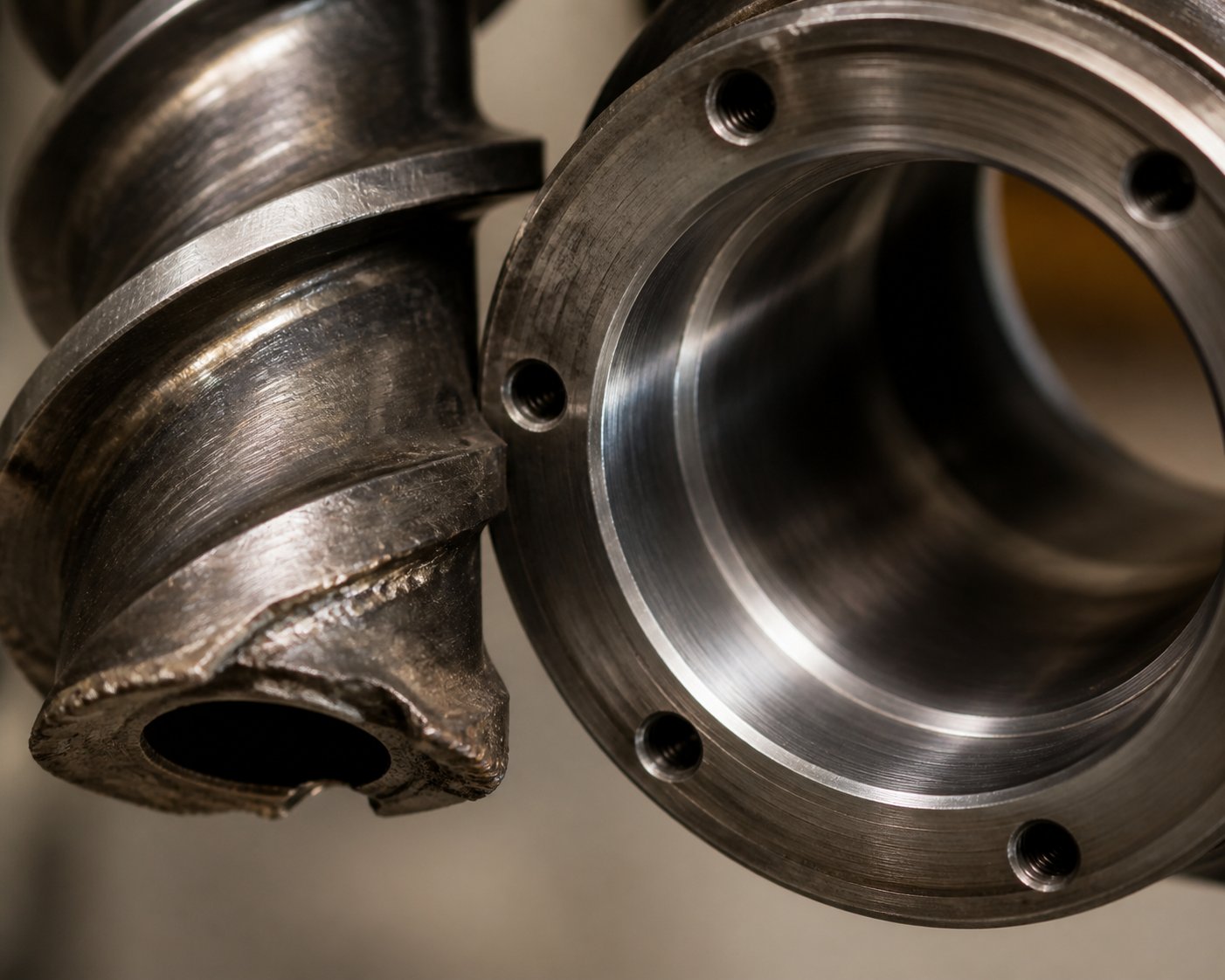
Choosing the right barrel alloy and the right screw alloy are two separate decisions — but they only work when those decisions are made together. A screw and a barrel are not independent components that happen to share a housing. They form a tribological system: two surfaces in constant relative motion, pressing against each other under heat, pressure, and abrasive polymer melt. The hardness relationship between them determines which component sacrifices itself first, and getting that relationship wrong is one of the most expensive mistakes in plastics processing.
The Differential Hardness Principle for Controlled Wear
Imagine two gears meshing inside a gearbox. If both are made from identical steel at identical hardness, wear distributes unpredictably across both — sometimes damaging the more expensive, harder-to-replace part. The same principle applies inside every plasticating unit. The goal is controlled, preferential wear: you deliberately engineer the screw to wear slightly faster than the barrel so that the cheaper, easier-to-replace component absorbs the damage.
Why the screw and not the barrel? Economics and logistics provide the answer. As ENTEK's metallurgy engineers explain, barrel manufacturing involves significantly more material removal and machining complexity — cooling passages, thermocouple wells, injection ports, counter-bored bolt holes — making barrels considerably more expensive to replace than screws. A screw, while geometrically complex, requires less total machining investment and can typically be swapped in a fraction of the downtime a barrel replacement demands.
The practical execution is straightforward: specify the barrel bore surface 3 to 8 HRC points harder than the screw flight OD. That differential ensures the screw flight tips wear down gradually and predictably while the barrel bore retains its geometry. You replace two or three screws over the barrel's service life instead of replacing the barrel itself — a sequence that minimizes both component cost and unplanned downtime.
A critical warning: reversing that relationship — installing a screw harder than the barrel — creates a screw barrel wear pattern material mismatch that leads to barrel scoring, uneven bore enlargement, and dramatically shortened barrel life. Davis-Standard's engineering guidance reinforces this point directly: make sure screw and barrel materials are matched so that one is not inducing premature wear in the other. A scored barrel bore cannot be repaired by simply installing a new screw — the damage is permanent until the barrel is replaced or re-lined.
Recommended Screw and Barrel Material Pairings by Application
Knowing the principle is one thing. Applying it across different resin systems, filler loads, and machine types requires specific pairing recommendations. The table below matches common application scenarios to proven barrel-screw combinations, target hardness differentials, and the expected wear behavior each pairing produces:
| Application Scenario | Recommended Barrel Material and Treatment | Recommended Screw Material and Treatment | Target Hardness Differential (Barrel vs. Screw) | Expected Wear Pattern |
|---|---|---|---|---|
| General-purpose commodity resins (PE, PP, PS) | 38CrMoAlA, gas nitrided (65 - 72 HRA surface) | AISI 4140, through-hardened and tempered (28 - 34 HRC) | Barrel surface 5 - 8 HRC harder | Screw flight tips wear gradually; barrel bore retains geometry through 2 - 3 screw lifetimes |
| Moderately filled compounds (PP-talc, PA with 15 - 25% GF) | Fe-based bimetallic liner (58 - 62 HRC) | AISI 4340, through-hardened (38 - 44 HRC); Stellite 6 flight tip inlay | Barrel liner 15 - 20+ HRC harder than screw body; flight inlay approaches barrel hardness | Screw body wears first; Stellite flight tips extend screw service life significantly; barrel liner outlasts multiple screws |
| Heavily filled abrasive compounds (PA-GF 30%+, PBT-GF, mineral masterbatch) | Fe-based or WC-rich bimetallic liner (60 - 70 HRC) | D2 or CPM 9V tool steel (58 - 62 HRC); tungsten carbide overlay on flight OD | Barrel liner 3 - 8 HRC harder than screw body; WC overlay matches or slightly trails barrel hardness | Screw body and root wear preferentially; WC-overlaid flights slow tip erosion; barrel liner remains the last component needing replacement |
| PVC and halogenated polymers (rigid PVC, CPVC, FR compounds) | Ni-based bimetallic liner (60 - 65 HRC) | AISI 4140, nitrided; Stellite 6 or Colmonoy 83 flight tip overlay | Barrel liner 5 - 10 HRC harder than screw surface | Screw flights absorb corrosive-abrasive wear; Stellite tips resist HCl pitting; Ni-based barrel liner provides long-term corrosion barrier |
| Fluoropolymers (PTFE, FEP, PVDF) | Ni-based bimetallic with Hastelloy or Inconel liner | Inconel 625 or Hastelloy C-276 screw (25 - 35 HRC) | Minimal differential — corrosion resistance prioritized over hardness hierarchy | Both components resist HF attack; low abrasion allows softer alloys; wear rate is slow and uniform |
| High-temperature polymers (PEEK, PEI, PPS) | H13 (SKD61), controlled nitriding (48 - 54 HRC base + nitrided surface) | H13 or high-alloy tool steel, tempered (44 - 50 HRC) | Barrel surface 4 - 6 HRC harder | Thermal fatigue is primary risk rather than abrasion; matched hot-hardness values prevent differential softening at operating temperatures above 380 degrees Celsius |
Hardness differentials are guidelines based on typical industry practice. Actual specifications should account for specific filler type, loading percentage, throughput rate, and screw speed.
Several patterns emerge from these pairings. For general-purpose and moderately filled applications, the best screw material to pair with bimetallic barrel construction is a through-hardened chrome-moly steel like 4140 or 4340, often enhanced with Stellite or Colmonoy 83 flight tip inlays to slow tip erosion without approaching barrel-liner hardness. For heavily abrasive compounds, D2 or CPM 9V screws with tungsten carbide overlay close the hardness gap with the barrel liner — but should still trail it slightly to preserve the preferential-wear hierarchy.
Fluoropolymer processing is the notable exception to the differential hardness rule. When hydrofluoric acid is the dominant threat, corrosion resistance trumps hardness hierarchy entirely. Both screw and barrel must survive chemical attack first; traditional abrasive wear runs a distant second. That's why Inconel-on-Inconel or Hastelloy-on-Hastelloy pairings are standard despite offering relatively low hardness numbers.
Processing parameters amplify or moderate the severity of any pairing decision. Higher screw speeds increase flight-tip velocity against the barrel wall, accelerating adhesive and abrasive wear. Elevated back pressure forces more polymer through the flight clearance gap, intensifying shear-driven erosion. And higher melt temperatures soften both components, effectively shrinking the hardness differential you engineered at room temperature. A screw and barrel hardness differential pairing that works perfectly at 220 degrees Celsius for polypropylene may collapse at 400 degrees Celsius for PEEK if both materials soften at similar rates — which is exactly why hot-hardness data, not just ambient HRC values, matters for high-temperature applications.
Even the most carefully engineered pairing, however, cannot prevent all failure modes. Certain combinations of resin chemistry, filler abrasion, and thermal stress create conditions where material selection alone isn't enough — and understanding those failure patterns before they destroy your equipment is what separates reactive maintenance from proactive engineering.
Common Material Failure Modes and How to Solve Them
Proper material pairings and hardness differentials set the stage for long barrel life — but real-world processing rarely follows the textbook. Unforeseen filler spikes, temperature excursions, moisture contamination, and resin degradation all conspire to push even well-specified components past their limits. When that happens, failure follows a handful of recognizable patterns. Diagnosing the pattern correctly is half the battle, because each one points to a different root cause and demands a different material-level fix.
The three most destructive failure modes in plastics processing — abrasive wear, corrosive attack, and thermal fatigue or seizure — each leave distinct forensic evidence on screws and barrels. Recognizing those signatures early, before output collapses or catastrophic damage occurs, lets you intervene with targeted material upgrades rather than expensive emergency replacements.
Solving Abrasive Wear in Filled Compound Processing
Screw barrel abrasive wear from glass filled resin is the single most common reason processors replace screws and barrels ahead of schedule. Glass fibers, mineral powders, ceramic microspheres, and even wood flour act as micro-cutting tools suspended in a viscous melt stream. Every rotation of the screw drives these particles against the barrel bore and flight surfaces under pressures that can exceed 150 MPa in the compression zone. The result is a relentless grinding action that no untreated steel can survive for long.
- Symptoms: Gradual loss of output rate at constant RPM. Rising melt temperature as increased flight clearance forces higher screw speeds. Visible grooves or scoring on the barrel bore, especially in the transition and metering sections. As screw wear research confirms, a common threshold considers flight clearance at four times the original tolerance to be the cutoff for replacement — though lower-viscosity resins show output loss much sooner.
- Root cause: Base material hardness is insufficient to resist the Mohs hardness of the filler. Glass fibers sit at Mohs 5.5 to 6.5, silica particles reach Mohs 7, and ceramic fillers can exceed Mohs 8. A standard nitrided case at 900 to 1,050 HV cannot resist sustained contact with these particles, particularly once the thin hardened layer — just 0.2 to 0.6 mm deep — is breached.
- Prescribed material solution: Upgrade the barrel to an Fe-based bimetallic liner with high chromium and tungsten carbide content, delivering 58 to 65 HRC across a 1.5 to 3.0 mm thick wear layer. For the screw, apply tungsten carbide overlay (WC-CoCr) on flight OD surfaces via HVAF or HVOF thermal spray, achieving surface hardness of 1,200 to 1,400 HV. For severely abrasive compounds above 30% glass fiber loading, consider CPM 9V or D2 tool steel screw bodies paired with Stellite 6 flight tip inlays to extend service life further.
One detail processors often overlook: the severity of root wear is greatly impacted by filler particle shape. Larger particles with sharper corners wear surfaces more aggressively than smaller, rounder particles — even at the same loading percentage. When fillers must be added to the feed throat rather than downstream, exposure to unmelted polymer with minimal lubrication intensifies erosion in the solids-conveying zone. Relocating filler addition to a downstream port, where molten polymer provides a lubricating film, can extend component life significantly even before any material upgrade.
Preventing Corrosion Failure in PVC and Fluoropolymer Lines
PVC barrel corrosion failure prevention is a topic that separates experienced processors from those learning expensive lessons. Unlike abrasive wear, which announces itself through measurable clearance changes and declining throughput, corrosion works silently. Pitting, intergranular cracking, and grain-boundary attack can hollow out a barrel bore for months before any performance symptom appears on the operator's dashboard.
- Symptoms: Black specks or dark residue on molded parts — evidence of degraded polymer hanging up in corroded pits and valleys. Corrosion shows as pitting, intergranular cracking, or dark deposits on screw flights and barrel wall during pull-out inspections. Surging or inconsistent output caused by irregular bore geometry. Localized discoloration on the barrel exterior near the transition zone, indicating internal acid attack has progressed through the wall.
- Root cause: PVC decomposes at processing temperatures to release hydrochloric acid (HCl), which attacks iron-based alloys aggressively. Fluoropolymers such as PTFE, FEP, and PVDF release hydrofluoric acid (HF) — an even more destructive agent that penetrates virtually every iron-based alloy, including many stainless steels. Halogenated flame retardants in compounds like FR-ABS and FR-PC/ABS generate HCl and HBr, creating similar corrosive environments. In every case, the acid concentration is highest in dead-flow zones and at the peak melt temperature region of the barrel, making the transition section the most vulnerable.
- Prescribed material solution: For PVC and halogenated compounds, specify a Ni-based bimetallic barrel liner paired with a Stellite 6 or Colmonoy 56 hardfaced screw. The nickel matrix resists HCl attack, while the hardfacing alloy protects screw flights from both chemical and mechanical erosion. Chrome plating (50 to 80 micrometers) is acceptable as a minimum barrier for unfilled or lightly filled PVC but lacks the thickness to survive combined corrosive-abrasive duty. For fluoropolymers, nothing short of Hastelloy C-276 or Inconel 625 components should be considered — the barrel liner, screw body, and all melt-contact surfaces must resist HF simultaneously.
A practical prevention step that complements the material solution: establish pull-out inspection intervals of every 6 to 12 months for corrosive-resin lines, as industry guidelines recommend. Corrosion damage caught early — before it breaches the liner — can often be addressed by re-honing or re-machining within the existing bimetallic layer. Damage caught late may require a full barrel replacement at five to ten times the cost of a scheduled inspection.
Avoiding Thermal Fatigue and Seizure in High-Performance Resin Processing
High-temperature engineering polymers like PEEK, PEI, and PPS push barrel temperatures above 380 degrees Celsius — a range where standard tool steels begin to soften and lose the hardness they were heat-treated to achieve. The failure mode here is not grinding or chemical dissolution. It is thermal fatigue: repeated heating and cooling cycles create micro-cracks on the barrel bore surface that propagate over time, eventually leading to spalling, dimensional instability, or catastrophic fracture.
- Symptoms: Hairline surface cracks visible during bore inspection, particularly in zones subject to rapid thermal cycling (near heater band interfaces and cooling channel transitions). Progressive bore enlargement that doesn't match abrasive-wear patterns. Heat check marks resembling the crazing pattern on a dried mud flat — a classic sign of thermal fatigue in hot-work tooling.
- Root cause: Standard steels like 4140 and even nitrided 38CrMoAlA lack the hot-hardness retention needed above 350 degrees Celsius. As the steel softens, each thermal cycle plastically deforms the surface slightly. Over thousands of cycles, cumulative plastic strain initiates cracks. Compounding the problem, some high-performance resins exhibit narrow processing windows where even small temperature deviations cause rapid viscosity changes, generating localized pressure spikes that accelerate fatigue.
- Prescribed material solution: Specify H13 (SKD61) hot-work tool steel with controlled tempering. H13 retains 42 to 48 HRC at 450 degrees Celsius — far above the softening threshold of chrome-moly grades — and its vanadium and molybdenum carbides resist thermal fatigue cracking that would destroy lower-alloy steels. For screws, match with H13 or a high-alloy tool steel tempered to 44 to 50 HRC, maintaining the barrel-harder-than-screw hierarchy even at operating temperature.
Seizure events represent a related but distinct failure mode. Specialty resins with high moisture sensitivity — certain polyamides, polycarbonates, and notably Trogamid (a transparent amorphous nylon) — can undergo sudden viscosity spikes when undried material enters the melt zone. When Trogamid material seizes up screw and barrel assemblies, the root cause is almost always inadequate pre-drying. Moisture flashes to steam inside the barrel, creating localized pressure surges that can lock the screw in place, score the barrel bore, and in extreme cases twist shear pins or trip motor overloads.
- Symptoms: Sudden torque spike on the drive motor. Screw rotation stalls or becomes erratic. Barrel bore shows localized galling marks — areas where metal has transferred between screw and barrel surfaces under extreme friction.
- Root cause: Moisture-driven steam pressure combined with rapid viscosity changes creates metal-to-metal contact that exceeds the lubrication capacity of the polymer melt. Processing conditions — not just material grade — are the primary culprit.
- Prescribed material solution: Proper material selection helps mitigate damage when seizure occurs, but it cannot prevent the event itself. Use H13 or a similarly tough tool steel with high galling resistance for both screw and barrel. Ensure adequate barrel venting in the transition zone to relieve steam pressure. And critically, enforce strict drying protocols: Trogamid, for instance, requires drying to below 0.1% moisture content before processing. Material selection and process discipline work in tandem here — one without the other leaves you exposed.
Across all three failure modes, a consistent theme emerges: the earlier you diagnose the wear pattern, the more targeted and cost-effective the fix. Waiting until output collapses or a screw seizes limits your options to emergency replacement at premium lead times and prices. Proactive bore inspections, wear-rate tracking, and periodic screw pull-outs give you the data to intervene at the right time with the right material upgrade.
For processors facing complex or overlapping failure modes — say, a glass-filled flame-retardant polyamide that combines severe abrasion with HBr corrosion — a specialist manufacturer like NANHAIYA can analyze your specific wear patterns, polymer chemistry, and filler content to recommend targeted material and surface-treatment combinations. That kind of application-specific evaluation bridges the gap between the general guidance in this article and the precise specification your particular production line demands.
Diagnosing and solving individual failure modes is essential, but the most durable protection comes from building a systematic decision framework that accounts for every variable simultaneously — resin chemistry, machine type, wear zone, base material, surface treatment, and screw-barrel pairing — before a single pellet enters the hopper.
How to Choose the Right Screw Barrel Material for Your Application
Steel grades, bimetallic alloy families, surface treatments, machine-type considerations, resin-to-material matching, differential hardness pairings, and failure-mode diagnostics — you've now seen every variable that shapes a screw barrel material decision. Each section of this guide tackled one piece of the puzzle in isolation. The challenge facing every processor, though, is that these variables don't operate in isolation. They interact, compound, and sometimes contradict each other, which is exactly why so many specifications end up either over-engineered or dangerously under-specified.
What you need is a repeatable process — a decision framework that walks you through the variables in the right sequence, so nothing gets overlooked and every choice feeds logically into the next. Think of it as a pre-flight checklist for your barrel specification. Skip a step and you might not notice the problem until you're already airborne.
Step-by-Step Material Selection Decision Framework
This screw barrel material selection guide by resin type and application compresses every preceding section into seven sequential steps. Work through them in order, because each step narrows the options for the one that follows:
- Identify your primary resin and filler system. Start with the polymer family — polyolefin, styrenic, engineering thermoplastic, PVC, fluoropolymer, or high-temperature specialty. Then quantify the filler: type (glass fiber, mineral, ceramic), percentage by weight, and particle geometry (round vs. angular, fine vs. coarse). This single step determines whether abrasion, corrosion, or thermal stress will be your dominant threat. Refer to the resin-to-material matching tables in Section 6 for your starting-point recommendation.
- Assess corrosion risk based on polymer chemistry. Does your resin release corrosive byproducts during processing? PVC generates HCl. Fluoropolymers release HF. Halogenated flame retardants produce HCl or HBr. Acetals generate formic acid. If any corrosive agent is present — even at low concentrations — your specification must include corrosion-resistant alloys. A nitrided barrel that handles abrasion well can still fail catastrophically from chemical attack if this step is skipped.
- Determine machine type and critical wear zones. Single-screw extruders wear primarily in the transition section opposite the pushing flight. Twin-screw extruders concentrate shear damage at intermeshing overflight gaps across segmented barrels. Injection molding machines suffer cyclical stress at the check-ring zone and corrosive off-gassing in the transition section. The machine-type comparison table from Section 5 maps each platform to its recommended base material and surface treatment.
- Select your base material grade. Use the steel grade reference table from Section 2 to match your application severity to the right foundation. AISI 4140 and 38CrMoAlA cover commodity and lightly filled processing. H13 handles high-temperature polymers. D2 and CPM 9V serve heavily abrasive screw applications. Inconel 625 and Hastelloy address extreme corrosion from fluoropolymers.
- Choose the appropriate surface treatment or bimetallic liner. This decision flows directly from Steps 1 and 2. Unfilled commodity resins? Gas nitriding is sufficient. Moderate fillers or mild corrosion? Ion nitriding or chrome plating. Abrasive filled compounds? Fe-based bimetallic liner on the barrel and tungsten carbide overlay on the screw. Corrosive resins? Ni-based bimetallic liner. The surface treatment comparison table from Section 4 provides hardness, depth, and cost data for every option.
- Verify screw-barrel hardness pairing. Confirm that the barrel bore surface will be 3 to 8 HRC harder than the screw flight OD for standard applications. Check the pairing table from Section 7 against your selected materials. If your screw alloy approaches or exceeds barrel-liner hardness, adjust one or both to restore the differential — otherwise you risk barrel scoring and dramatically shortened barrel life. For fluoropolymer applications, corrosion resistance takes priority over the hardness hierarchy.
- Validate against processing parameters. Cross-check your material selections against actual operating conditions: barrel temperature profile, screw RPM range, back pressure settings, and target throughput. High screw speeds accelerate flight-tip wear and may justify a harder overlay. Elevated melt temperatures above 350 degrees Celsius demand hot-hardness evaluation rather than room-temperature HRC numbers. And high back pressure forces more polymer through the flight clearance, intensifying shear-driven erosion that a marginal specification won't survive.
Running through these seven steps before issuing a purchase order takes less than an hour. Skipping them — or collapsing them into a single phone call asking the supplier for "something wear-resistant" — is how processors end up with barrels that fail in months instead of years, or with over-specified components that drain capital without delivering measurable benefit.
Screw barrel material selection is not a single-variable decision. It is a system-level optimization across resin chemistry, filler abrasion, corrosion risk, machine design, processing conditions, and total cost of ownership — and every variable must be evaluated in context with the others.
That systems perspective is the single most important takeaway from this entire article. A barrel alloy that scores perfectly on an abrasion-resistance chart still fails if the resin produces acid that eats through it. A surface treatment with outstanding hardness numbers still underperforms if the base steel beneath it softens at your operating temperature. And the best screw barrel material for plastics processing on paper still causes problems if the screw paired with it creates a hardness mismatch that scores the bore.
Building a Long-Term Material Strategy With Expert Support
This framework gives you a structured path to narrow your options — but it also reveals how many interacting variables influence the final specification. Resin chemistry, filler characteristics, machine geometry, processing parameters, cost targets, and replacement logistics all pull the decision in different directions simultaneously. For straightforward applications like unfilled polyolefin extrusion, the framework delivers a clear answer quickly. For complex scenarios — recycled streams with unpredictable contaminants, glass-filled flame-retardant compounds combining abrasion with corrosion, or high-temperature polymers pushing barrel steels toward their softening threshold — the interactions between variables grow exponentially.
That complexity is where working with a specialist manufacturer adds the most value. Rather than guessing at edge cases or defaulting to the most expensive option as insurance, a partner who evaluates all variables holistically can pinpoint the optimal combination and catch specification errors before they become production problems.
NANHAIYA's custom screw design service is built for exactly this kind of multi-variable evaluation. Their engineering team assesses plastic type, filler content, corrosion risk, wear conditions, machine type, and production volume together — then recommends specific base materials, bimetallic alloy liners, surface treatments, and screw-barrel pairings validated against your actual processing requirements. Instead of choosing from a catalog, you get a specification engineered for the resin you run, the machine you run it on, and the lifespan you need from the investment.
For processors who have already narrowed their options using the guidance in this article, that kind of specialist consultation serves as the final validation step — confirming that the alloy, treatment, and pairing choices all work together as a system before the barrel goes into production. For those facing novel or overlapping wear challenges, it can be the difference between a specification that works on the first attempt and one that sends you back to the drawing board after an expensive early failure.
The best screw barrel material for plastics processing is never the hardest, the most corrosion-resistant, or the most expensive. It is the one that matches your specific combination of polymer chemistry, filler abrasion, machine wear zones, processing temperatures, and cost constraints — chosen deliberately, paired correctly, and validated before it ever touches molten plastic.
Frequently Asked Questions About Screw Barrel Material
1. What is the best screw barrel material for processing glass-filled nylon?
Glass-filled nylon at 30% or higher loading demands an Fe-based bimetallic barrel liner (58-65 HRC) paired with a D2 or CPM 9V tool steel screw featuring tungsten carbide overlay on the flight OD. Glass fibers rank Mohs 5.5 to 6.5, which rapidly erodes standard nitrided surfaces. This combination can extend service life from roughly 3,000 hours with nitrided steel to 12,000-15,000 hours. A specialist manufacturer like NANHAIYA can evaluate your specific glass-fiber percentage, particle geometry, and throughput rate to recommend the optimal alloy liner and screw coating pairing through their custom screw design service.
2. What is the difference between a nitrided barrel and a bimetallic barrel?
A nitrided barrel relies on a hardened surface case just 0.2 to 0.6 mm deep created by diffusing nitrogen into the steel, while a bimetallic barrel features a centrifugally cast alloy liner 1.5 to 3.0 mm thick fused to a structural steel shell. Bimetallic barrels provide five to six times more wear-resistant material reserve and can be engineered with Fe-based alloys for abrasion resistance or Ni-based alloys for corrosion protection. Nitrided barrels cost less upfront but wear through quickly in abrasive or corrosive applications, often costing nearly three times more per operating hour over a five-year period when factoring in multiple replacements and downtime.
3. Why should the barrel be harder than the screw in plastics processing?
The differential hardness principle ensures controlled, preferential wear on the screw rather than the barrel. Barrels involve more complex machining — cooling passages, thermocouple wells, injection ports — making them significantly more expensive and time-consuming to replace. By specifying the barrel bore 3 to 8 HRC harder than the screw flight OD, processors ensure the lower-cost screw wears first and can be replaced two to three times before the barrel needs attention. Reversing this relationship risks barrel scoring and uneven bore enlargement, which are irreversible without full barrel replacement or re-lining.
4. Which screw barrel material resists PVC corrosion best?
Ni-based bimetallic barrel liners deliver the strongest corrosion resistance for PVC processing. PVC releases hydrochloric acid (HCl) during melting, which attacks iron-based alloys aggressively. Corrosive wear rates for nitrided 4140 barrels in rigid PVC service run 0.08 to 0.15 mm per 1,000 hours, compared to just 0.01 to 0.03 mm for high-nickel bimetallic constructions. Pair the Ni-based barrel with Stellite 6 or Colmonoy 56 hardfaced screw flights for complete corrosive-abrasive protection. Chrome plating is acceptable only for unfilled or lightly filled PVC formulations where abrasion is minimal.
5. How do I choose screw barrel material for recycled plastics processing?
Recycled streams contain unpredictable contaminants — metal fragments, sand, mixed polymers, and inconsistent filler loads — making bimetallic barrel construction the recommended starting point. Specify at least one alloy tier above what you would choose for virgin resin of the same type: if virgin PE runs on nitrided steel, recycled PE should use an Fe-based bimetallic liner at minimum. For streams with potential PVC contamination, upgrade to a Ni-based liner that adds corrosion protection. NANHAIYA's custom screw design service can assess your specific recycled-stream contaminant profile and recommend the right base material, liner alloy, and surface treatment combination.
Written by
Nanhaiya Technical Team
Zhoushan Nanhaiya Plastic Machinery Co., Ltd.
The Nanhaiya technical team supports screw and barrel manufacturing projects through application review, technical communication, custom manufacturing coordination, and production and quality control.
Discuss Your Application
Related Articles
More insights on screw barrel technology and plastics processing.
What Nobody Tells You About Screw Barrel For Plastic Machine Design
Oct 10, 2026
Learn how screw barrel for plastic machine design affects melt quality, throughput, and wear life. Covers geometry, resin matching, troubleshooting, and sourcing.
Read Article
Single Screw Extruder for Sheet: Stop Guessing, Start Specifying
Oct 9, 2026
Learn how to specify a single screw extruder for sheet production. Covers screw geometry, resin-specific processing, troubleshooting, and maintenance best practices.
Read Article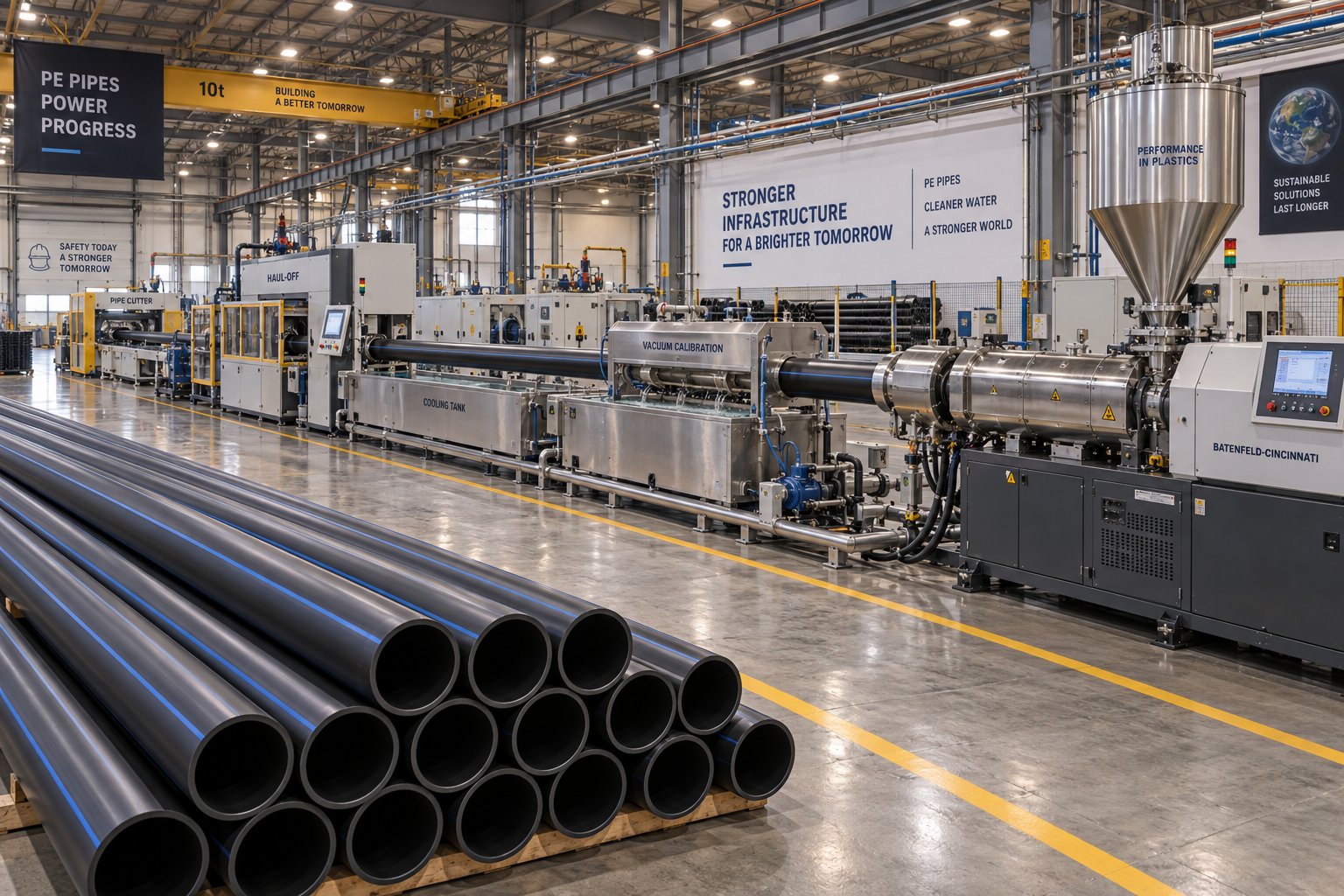
PE Pipe Extruder Machine: What Datasheets Won't Tell You
Oct 9, 2026
Learn how a PE pipe extruder machine works, key specs explained, material grade selection, maintenance tips, and buyer guidance beyond the datasheet.
Read ArticleLooking for something else?
Search by material, symptom or product and jump straight to the relevant page.
These are navigation suggestions based on keyword matching — not a quotation, not a delivery commitment, and not a substitute for engineering review. Final specification is confirmed by our engineers against your drawings and processed material.
Need help with screw barrel selection?
Share your machine model, processed material and application. Our team can help with pricing and technical support.