

What Is a Screw Barrel and Why Manufacturing Precision Matters
Imagine your plastics processing line running flawlessly — consistent melt quality, minimal scrap, predictable cycle times. That ideal scenario hinges on two components most people never think about until something goes wrong: the screw and barrel. These aren't just mechanical parts bolted inside your machine. They're the engine behind every kilogram of plastic you process.
A screw barrel is the core plasticizing assembly inside extrusion and injection molding machines, consisting of a rotating screw inside a stationary heated cylinder (barrel), responsible for feeding, melting, mixing, and pressurizing plastic resins into a homogeneous melt ready for shaping.
The quality of these components — and the precision of the screw barrel manufacturer who produces them — directly determines melt consistency, energy efficiency, finished part quality, and overall equipment uptime. Yet most information available online about screws and barrels reads like a product catalog rather than an educational resource. This guide changes that. Whether you're an engineer specifying replacement parts, a procurement professional evaluating suppliers, or a plant manager trying to reduce downtime, you'll find the technical foundation you need to make informed decisions about every aspect of screw barrel selection and sourcing.
What Screw Barrels Actually Do Inside Processing Machines
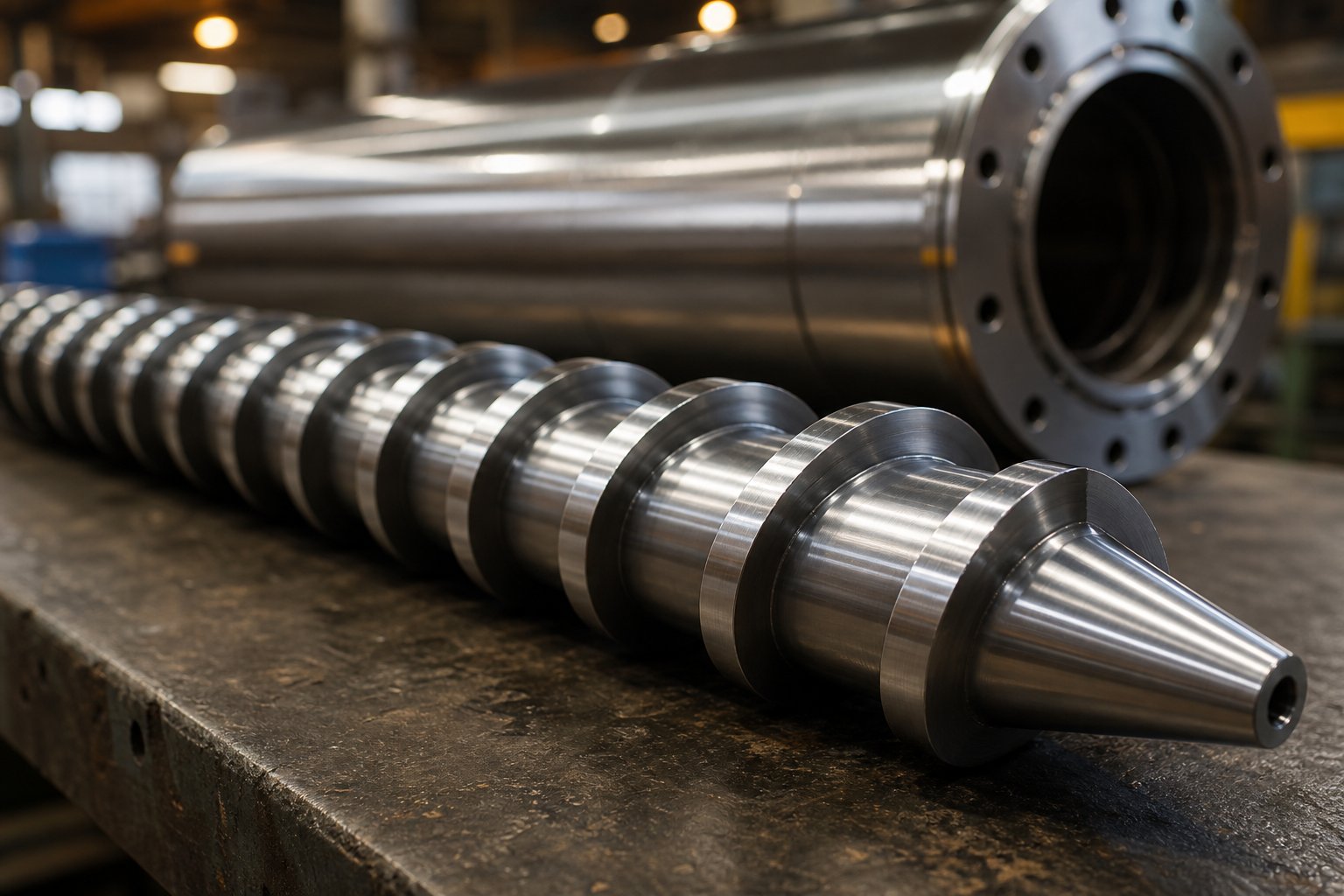
Think of the screw and barrel as a tightly coordinated partnership. The screw is the rotating element — a precision-machined helical shaft that conveys plastic pellets forward from the hopper, generates frictional heat through mechanical shear, and builds the pressure needed to push molten polymer through a die or into a mold cavity. The barrel is the stationary cylinder that surrounds the screw, providing structural containment under extreme pressures while delivering supplemental heat through external heater bands arranged in independently controlled temperature zones.
Here's what makes this partnership remarkable: in many processing setups, shear heating generated by the screw accounts for 60-80% of the total heat input needed to melt the resin. The barrel's heater zones handle the remaining thermal energy and fine-tune the melt temperature profile along the length of the machine. Together, the screw and barrel transform solid plastic pellets into a uniform, pressurized melt — a process that sounds simple but demands extraordinary precision in component manufacturing to execute reliably at production speeds.
The barrel also serves as a wear surface and a pressure vessel. It must maintain tight dimensional tolerances on its internal bore despite operating temperatures that can exceed 300°C and pressures reaching thousands of psi. Any deviation in bore straightness or diameter uniformity creates uneven flow channels that compromise melt quality and accelerate component wear.
Why Manufacturer Quality Determines Processing Outcomes
You'll notice a pattern across every plastics processing challenge — inconsistent shot weights, poor color dispersion, premature component failure, excessive energy consumption — and it almost always traces back to the precision (or lack of it) built into the screws and barrels during manufacturing.
Consider just three critical dimensions and the processing outcomes they control:
- Screw flight tolerances: Even small variations in flight outer diameter or flight width directly affect the clearance gap between screw and barrel. That gap governs leakage flow, shear rate, and shot-to-shot consistency in injection molding.
- Barrel bore straightness: A bore that deviates from true center creates asymmetric wear patterns, uneven melt distribution, and hot spots that degrade heat-sensitive resins.
- Metallurgical quality: The base material grade, heat treatment precision, and surface hardening depth determine how long a component lasts under abrasive, corrosive, or high-temperature processing conditions.
Feed screw manufacturers who cut corners on any of these factors produce components that may look identical on a spec sheet but deliver dramatically different results on the production floor. A barrel with a bore that's straight to within 0.025 mm per meter performs fundamentally differently from one held to looser tolerances — and the difference shows up in your scrap rate, your energy bills, and your maintenance schedule.
This is precisely why selecting the right manufacturer matters far beyond comparing unit prices. The real cost of a screw and barrel lives in the downstream outcomes it produces over its entire service life. Understanding what separates precision-manufactured components from commodity alternatives starts with knowing the different types available and what each is designed to do.
Types of Screw Barrels Used in Plastics Processing
Not every plastics application demands the same screw barrel configuration. A blown film line running LDPE operates in a completely different world than a compounding extruder blending glass-filled nylon — and the screw barrel design reflects that. Choosing the wrong type doesn't just cost money. It limits throughput, compromises melt quality, and accelerates wear. So before you evaluate any screw barrel manufacturer, you need to understand what you're buying and why it matters for your specific process.
The table below breaks down the four primary screw barrel configurations you'll encounter across the plastics industry:
| Screw Type | Typical Applications | Processing Advantages | Common Resin Types | Typical L/D Ratios |
|---|---|---|---|---|
| Single Screw | Profile extrusion, blown film, sheet extrusion, injection molding | Simple design, cost-effective, versatile, easy maintenance | PE, PP, PS, PET, ABS, nylons | 20:1 to 36:1 |
| Parallel Twin Screw (Co-Rotating) | Compounding, reactive extrusion, devolatilization, masterbatch | Excellent mixing, self-wiping action, modular screw elements | Engineering resins, filled compounds, blends | 32:1 to 52:1 |
| Conical Twin Screw (Counter-Rotating) | PVC pipe, PVC profiles, WPC decking | High conveying pressure, gentle shear, good feeding of dry blends | Rigid and flexible PVC, wood-plastic composites | Expressed as taper ratio (e.g., 93/188 mm) |
| Planetary Roller | PVC calendering feedstock, temperature-sensitive compounding | Exceptional temperature control, high surface renewal, uniform melt | PVC, thermally sensitive compounds | Varies by design |
Single Screw Systems for Extrusion and Injection Molding
Single screw designs dominate the industry for good reason. They're straightforward, reliable, and adaptable to an enormous range of applications. When people talk about injection molding screws and barrels, they're almost always referring to single screw systems. The same goes for most profile extrusion, sheet lines, and blown film operations.
What makes them so popular? Simplicity is the starting point. A single rotating screw inside a cylindrical barrel is mechanically uncomplicated compared to multi-screw alternatives, which translates directly into lower upfront cost, simpler maintenance, and faster turnaround on replacement parts. Every screw barrel manufacturer produces single screw configurations, meaning buyers have the widest selection of diameters, L/D ratios, and material options available.
Single screws are manufactured in diameters ranging from as small as 18 mm for lab-scale machines up to 300 mm or more for high-output extrusion lines. L/D ratios typically range from 20:1 for basic processing to 36:1 for applications requiring extended melting and mixing residence time. That flexibility makes them the workhorse configuration across packaging, consumer goods, construction, and automotive sectors alike.
Twin Screw Configurations for Compounding and Specialty Processing
When a single screw can't deliver the mixing intensity, throughput control, or material handling capability your process demands, twin screw systems step in. Two distinct configurations serve very different roles.
Parallel co-rotating twin screws are the backbone of polymer compounding. Two screws of identical diameter rotate in the same direction inside a figure-eight barrel bore. Their intermeshing, self-wiping flight geometry prevents material buildup and dead spots while delivering intensive distributive and dispersive mixing. This makes them ideal for blending polymers with fillers, pigments, and additives — as well as for reactive extrusion and devolatilization. The modular screw element design also means processors can reconfigure the screw profile for different formulations without replacing the entire shaft. Think of it as a screw production machine you can customize recipe by recipe.
Conical counter-rotating twin screws take a fundamentally different approach. Here, two tapered screws rotate in opposite directions, with the larger diameter at the feed end narrowing toward the discharge. This geometry creates higher conveying pressure and a naturally increasing compression along the screw length — properties that make conical designs dominant in PVC pipe and profile extrusion. Their gentle shear characteristics are particularly valuable for processing heat-sensitive PVC dry-blend formulations, where excessive shear would cause thermal degradation. Conical screws also excel at feeding powdery materials thanks to the larger intake area at the feed end.
Planetary and Specialty Screw Designs
Some applications push beyond what even twin screw systems can handle efficiently. Planetary roller extruder screws represent the most specialized end of the spectrum. Imagine a central spindle surrounded by multiple smaller planetary screws that orbit inside a barrel with internal helical teeth. This arrangement creates an extraordinarily high surface area for heat exchange and material turnover, delivering exceptional temperature control during processing.
Where does this matter most? PVC calendering feedstock preparation is the classic application. The process demands thorough melting and homogenization of PVC compounds while keeping melt temperature within a very narrow window to prevent degradation. Planetary roller designs achieve this by constantly renewing the material surface against the barrel wall, pulling heat out as quickly as it's generated through shear.
Manufacturing these components is far more complex than producing standard single or twin screw configurations. The precision required to machine a central spindle, multiple planetary spindles, and an internally toothed barrel — all to tolerances tight enough for smooth intermeshing — demands advanced CNC capabilities that not every screw making machine shop possesses. This is one area where a manufacturer's machining sophistication becomes immediately apparent in the finished product's performance.
Each of these configurations places distinct demands on the screw's internal geometry — the specific dimensions of flights, channels, and zones that ultimately control how plastic transforms from solid pellets into a processable melt.
Screw Geometry Fundamentals Every Buyer Should Understand
You can look at two screws sitting side by side on a shop floor and they might appear nearly identical — same diameter, same overall length, same steel finish. But run them in the same machine with the same resin, and you'll get wildly different output rates, melt temperatures, and part quality. The difference lives in the geometry: the precise dimensions of channels, flights, and functional zones machined into the screw by the manufacturer. Understanding these details is what separates an informed buyer from someone simply matching catalog numbers.
Feed Zone, Compression Zone, and Metering Zone Explained
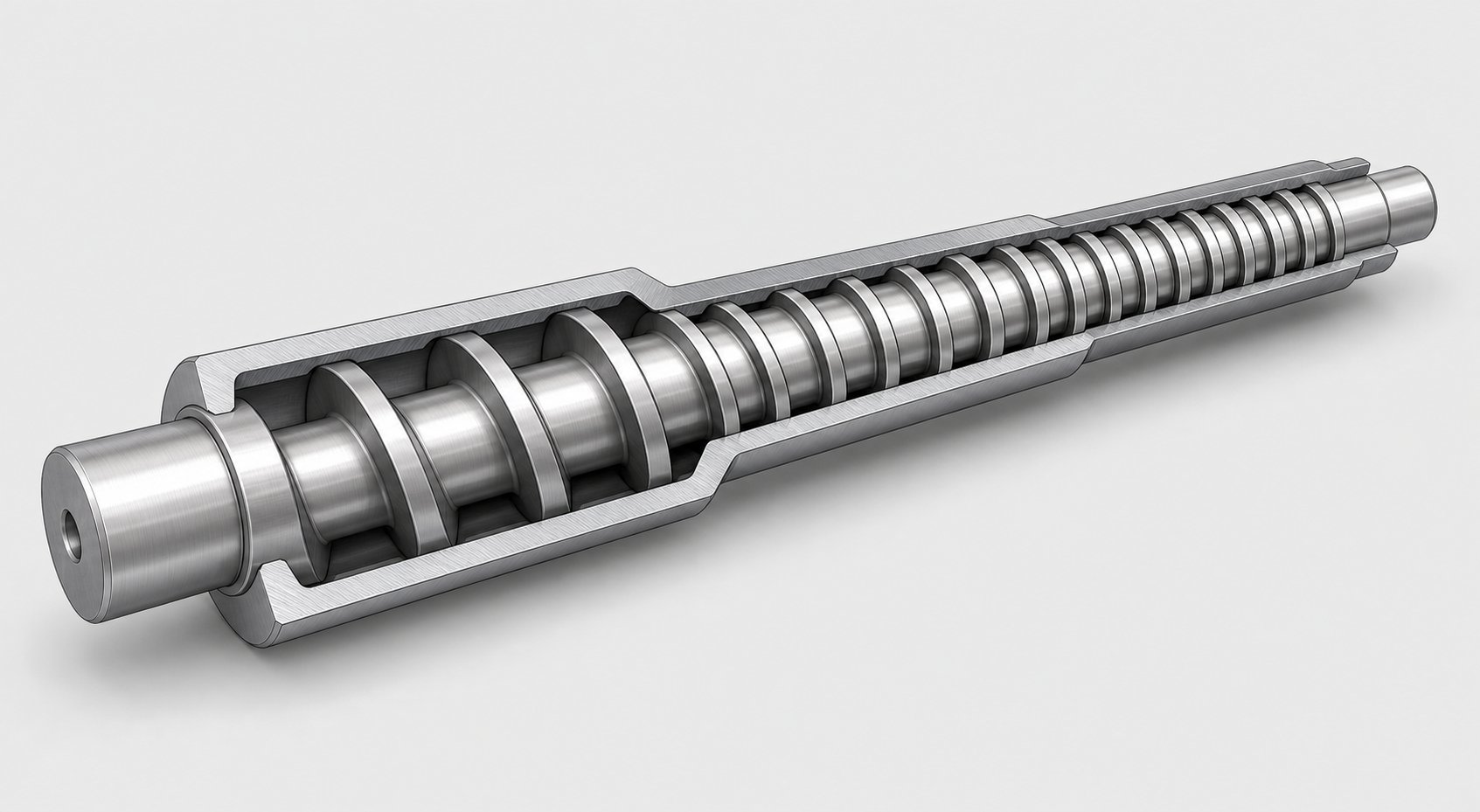
Every plasticating screw is divided into three fundamental zones, each responsible for a distinct phase of the melting process. Picture plastic pellets entering one end and a uniform, pressurized melt exiting the other — these three zones make that transformation happen.
The feed zone is where solid pellets enter the screw channel from the hopper. Its defining feature is a deep, constant channel depth — deep enough to accept and convey loose pellets forward efficiently. This zone typically spans 4 to 8 flights and acts as a volumetric pump, pulling material in and pushing it toward the heated barrel wall. The deeper the channel here, the more material can be conveyed per revolution.
The compression zone (also called the transition zone) is where the real transformation begins. Channel depth progressively decreases along this section, building pressure that prevents air between pellets from continuing down the barrel while forcing the softening plastic into tighter contact with the heated barrel wall. This combination of compression and barrel-wall contact drives the melting process. A screw machine manufacturer's precision in machining this taper directly affects how smoothly and completely the resin transitions from solid to melt.
The metering zone finishes the job. Its channel depth is constant but much shallower than the feed zone, creating a controlled environment that homogenizes melt temperature, eliminates remaining unmelted particles, and delivers consistent volumetric output to the die or nozzle. A well-designed metering zone reduces surging and pressure fluctuations — both critical for dimensional consistency in the finished product.
These three zones are linked by a key design parameter: the compression ratio. This is the ratio of the feed zone channel depth to the metering zone channel depth (in a constant-pitch screw). Most general-purpose screws fall in the range of 2:1 to 4:1, but the right value depends entirely on the resin being processed. Low-viscosity, easy-melting resins like LDPE work well with lower compression ratios, while crystalline polymers like nylon or PET often require higher ratios to generate enough pressure for complete melting. Specifying the wrong compression ratio for your resin is one of the fastest paths to processing headaches — from incomplete melting to thermal degradation.
Critical Dimensions That Define Screw Performance
Beyond the three-zone layout, several key dimensions interact to determine how a screw actually performs on the production floor.
L/D ratio (length-to-diameter ratio) is the single most-quoted screw specification, and for good reason. A screw with a 60 mm diameter and a length of 1,500 mm has an L/D of 25:1. The most common L/D across general extrusion applications sits around 24:1, though screws of 30:1 or longer are increasingly common for applications demanding more melting residence time and mixing. A higher L/D gives each functional zone more length to do its job — improving melt homogeneity, mixing quality, and pressure consistency. However, longer isn't always better. Heat-sensitive resins like PVC or silane-crosslinkable XLPE can degrade when exposed to the extended residence time a high L/D creates.
Flight width — the thickness of the helical flight measured along the screw axis — typically measures around 10% of the barrel diameter. This might seem like a minor detail, but it governs the balance between pressure generation and heat buildup. Wider flights generate more pressure and reduce leakage flow over the flight tip, but they also create more frictional heat in the clearance gap. Narrow flights allow higher throughput but sacrifice some sealing effectiveness. Any reputable screw barrel manufacturer optimizes this dimension for the specific application rather than defaulting to a standard value.
Helix angle determines the screw's conveying efficiency. Most standard screws use a square pitch — meaning the distance between adjacent flights equals the screw diameter — which produces a helix angle of approximately 17.66 degrees. Increasing the pitch (and thus the helix angle) improves conveying rate but reduces the number of flights within a given screw length, affecting residence time and mixing.
Root diameter is what changes across the three zones to create different channel depths. In the feed zone, the root diameter is smallest (deepest channel). Through the compression zone, it increases progressively. In the metering zone, it reaches its maximum (shallowest channel). The precision of these root diameter transitions — how smoothly the taper is machined through the compression zone — has a direct impact on melting uniformity and pressure stability. This is where custom screw machining capability truly matters.
Barrier Flights, Mixing Sections, and Vented Designs
Standard three-zone screws handle a wide range of applications, but many processing situations demand specialized features engineered into the screw geometry. These advanced designs represent where a screw manufacturing machine shop's engineering depth becomes evident — they require tighter tolerances, more complex programming, and deeper application knowledge than standard configurations.
A barrier screw introduces a secondary flight within the compression zone, creating two parallel channels — one for unmelted solids and one for melt. The clearance over this barrier flight is large enough for molten polymer to pass through but small enough to block solid pellets (which are typically around 1.5 mm). As material advances, the melt channel grows in volume while the solids channel shrinks, draining excess melt away from the pellets so they generate more frictional heat as they rub against one another. The result is more efficient melting per screw revolution — a meaningful advantage for throughput-limited operations.
A Maddock section (sometimes called a Maddock mixer) occupies roughly two diameters of screw length and replaces conventional flights with pairs of fluted grooves separated by a barrier ridge. Melt enters the inlet flutes, flows over the barrier ridge — which has a clearance of roughly 0.020 to 0.030 inches (0.50 to 0.75 mm) — and exits through outlet flutes. Unmelted particles can't pass over the ridge intact, so the section acts as both a strainer and a thermal homogenizer. It's commonly combined with barrier designs for maximum effectiveness.
Beyond these two staples, several other specialty designs address specific processing challenges:
- Pineapple mixers: Feature diamond-shaped protrusions that split and recombine melt flow repeatedly. Primary function: distributive mixing for color and additive dispersion. Ideal for applications demanding uniform pigment distribution.
- Spiral dam mixers: Use a helical restriction that forces melt through a controlled gap, combining dispersive action with forward conveying. Primary function: breaking up gels and unmelted particles. Ideal for recycled-content processing or resins prone to gel formation.
- Mixing pins: Rings of studs projecting from the screw root that disrupt streamlined flow. Primary function: low-intensity distributive mixing without significant pressure drop. Ideal for heat-sensitive resins where aggressive mixing elements would cause degradation.
- Vented (two-stage) screws: Feature a complete first-stage screw (feed, compression, metering) followed by a sudden deep-channel decompression zone where a barrel vent port extracts moisture, volatiles, or trapped air under vacuum. A second compression and metering stage then re-pressurizes the melt for discharge. Primary function: devolatilization without a separate drying step. Ideal for moisture-sensitive resins like nylon and PC, or for processing regrind with trapped volatiles.
Vented designs deserve special attention because they impose strict engineering constraints. The second-stage metering section must have greater pumping capacity than the first stage to prevent melt from backing up through the vent port — a ratio of 1.5:1 to 2.0:1 in front-to-rear metering depths is typical. Getting this balance wrong floods the vent with polymer, defeating the entire purpose of the design.
Each of these geometric choices influences how aggressively the screw processes material — and aggressive processing accelerates wear. The metallurgy and surface treatments applied to screw and barrel surfaces determine whether that wear happens over months or years, making material selection the next critical factor in the evaluation equation.
Materials Science Behind Screw Barrel Manufacturing
Geometry determines how a screw processes material. Metallurgy determines how long it survives while doing so. You can machine the most perfectly optimized screw design ever conceived, but if you build it from the wrong alloy for the resin being processed, it will wear out in a fraction of its intended service life. This is the domain where a screw barrel manufacturer's true expertise becomes visible — and where the gap between an informed purchase and an expensive mistake is widest.
Every alloy decision involves trade-offs between hardness, toughness, corrosion resistance, machinability, and cost. There is no universal "best" material. The right choice depends on what's being processed, how aggressively the compound attacks metal surfaces, and what total service life the operation demands.
Base Materials: From Nitrided Steel to Tool Steel Grades
The base material forms the structural backbone of every screw. It needs to handle torsional loads, resist bending over long L/D ratios, and provide a suitable substrate for surface treatments or hard-facing overlays. Three families cover the vast majority of applications.
AISI 4140 and 4340 pre-hardened steel is the industry workhorse, accounting for roughly 80% of all installed extruder screws globally. Pre-hardened to 28-32 HRC, these chrome-moly alloys offer good strength, excellent weldability for hard-facing overlay, and reasonable cost. On their own, however, they lack the hardness to handle anything beyond unfilled commodity polymers. That's where nitriding comes in.
The nitriding process — either gas or ion (plasma) — diffuses nitrogen into the steel surface at temperatures between 480°C and 530°C. This creates a hardened case layer reaching 950 to 1,100 HV (approximately 68-72 HRC equivalent) at a depth of 0.3 to 0.7 mm. Here's the critical advantage: because nitriding occurs at relatively low temperatures, it causes minimal dimensional distortion, meaning screws can be nitrided after final machining. The core retains its original toughness while the surface gains significant wear resistance. Ion nitriding offers tighter control over the compound layer, reducing the brittle white layer thickness to under 5 microns compared to 10-25 microns in conventional gas nitriding — an improvement that boosts fatigue resistance.
The limitation? That hardened case is shallow. In severely abrasive applications — glass-filled nylons, mineral-loaded compounds — the nitrided layer can wear through within 2,000 to 3,000 operating hours, exposing the much softer substrate beneath and accelerating wear dramatically.
D2 tool steel (AISI D2 / DIN 1.2379) steps in for moderately to severely abrasive applications. This high-carbon, high-chromium steel through-hardens to 58-62 HRC, delivering 4x to 6x the abrasion resistance of nitrided 4140 at equivalent flight geometry. In 30% glass-filled nylon service, D2 screws typically extend service life from about 3,000 hours (nitrided 4140) to 12,000-15,000 hours. The trade-offs are moderate corrosion resistance and lower impact toughness compared to powder metallurgy grades.
CPM powder metallurgy tool steels (CPM 9V, 10V, and 15V) represent the top tier. Produced through the Crucible Particle Metallurgy process, these grades achieve a uniform distribution of vanadium carbide particles — each with an individual hardness around 2,500 HV — that eliminates the carbide segregation found in conventionally cast tool steels. The performance difference is dramatic: CPM 10V outperforms D2 by 3x to 5x in standardized ASTM G65 abrasion testing, and routinely exceeds 20,000 hours of service life in highly mineral-filled HDPE applications. The raw material premium runs roughly 2.5x to 4x the cost of D2, but total cost of ownership over a 36-month horizon almost always favors CPM grades in severe abrasive service.
For high-temperature engineering polymers like PEEK and PPS (processed at 380°C-420°C barrel temperatures), H13 hot-work tool steel becomes relevant. Heat-treated to 44-52 HRC, H13 retains useful hardness to approximately 550°C — a critical property since conventional tool steels soften significantly above 400°C. Hot hardness at operating temperature, not room-temperature hardness on a data sheet, is what governs real-world performance.
For corrosive processing environments — fluoropolymers, PVC, halogenated flame retardants — specialty stainless steels and nickel alloys provide the chemical resistance that carbon-based tool steels simply cannot match. Hastelloy C-276 (Ni-16Mo-15Cr-4W) stands as the gold standard for extreme corrosion, particularly in fluoropolymer processing where hydrogen fluoride gas attacks virtually all carbon steels at measurable rates.
Bimetallic Barrel Linings and Hard-Facing Alloys
If screws are all about geometry and surface treatment, barrels are all about layered construction. The bimetallic concept solves an engineering problem that would otherwise force an unacceptable compromise: the properties that make an alloy wear-resistant (extreme hardness, high carbide content) also make it brittle, difficult to machine, and unsuitable as a structural pressure vessel.
Bimetallic barrel construction separates these two jobs. A tough carbon steel outer shell — typically 4140 or 4340 — provides the structural strength to contain processing pressures that can exceed 20,000 psi in injection molding. Inside that shell, a centrifugally cast wear-resistant alloy lining handles the abrasive, corrosive contact with the polymer melt.
The centrifugal casting process works like this: wear-resistant alloy powder is placed inside a pre-bored barrel, heated until molten, and the barrel is spun at controlled speed. Centrifugal force drives the molten alloy against the inside wall, creating a metallurgically bonded liner with uniform thickness — ideally 1.6 mm (0.063 in.) — and minimal porosity. The quality of this casting determines barrel life, and it depends heavily on tightly controlling alloy chemistry, pour temperature, mold preheat, rotation speed, and post-cast heat treatment. Manufacturers who perform centrifugal casting in-house have direct control over each of these variables. Those who outsource the casting and only machine the finished barrel inherit whatever metallurgical quality their supplier delivers.
Three families of barrel lining alloys dominate the market, each engineered for different processing demands:
- Iron-based bimetallic alloys (high chromium and tungsten carbide content) are the go-to for general abrasive service. Bore hardness typically reaches 60-72 HRC with liner thickness of 2.0-2.5 mm. These alloys handle glass-fiber reinforcements and mineral fillers effectively at a reasonable price point.
- Nickel-boron and nickel-based alloys provide combined abrasion and corrosion resistance. The nickel matrix forms a passive film that resists chemical attack from HCl and other acidic byproducts, while embedded tungsten carbides maintain abrasion performance. This makes nickel-based liners the standard for PVC processing, halogenated flame-retardant compounds, and other chemically aggressive environments. Corrosive wear rates for nickel-based bimetallic barrels run 0.01 to 0.03 mm per 1,000 hours in PVC service, compared to 0.08 to 0.15 mm for nitrided 4140 — a 4x to 8x improvement.
- Cobalt-based alloys from the Stellite and Colmonoy families deliver premium performance where both abrasion and corrosion are severe. Stellite 6 (Co-28Cr-4W-1C) deposits at 36-45 HRC and maintains 35-40 HRC even at 600°C — temperatures where conventional tool steels have softened below useful hardness. Stellite 12 reaches 45-52 HRC at room temperature. These alloys are also applied as screw flight hard-facing overlays via plasma transferred arc (PTA) welding or laser cladding, providing corrosive wear rates 8x to 12x lower than nitrided 4140 in chlorinated polymer service.
For screw flight hard-facing specifically, tungsten carbide-cobalt (WC-Co) thermal spray coatings applied via HVOF (high-velocity oxygen fuel) reach coating hardness of 1,100-1,400 HV with bond strength exceeding 70 MPa. But in corrosive environments, the cobalt binder becomes the weak link — it dissolves in HCl-rich conditions. Replacing cobalt with a nickel-chromium binder (WC-CrC-Ni variants) reduces corrosion susceptibility by 5x to 8x while maintaining hardness above 1,000 HV.
Matching Material Selection to Resin Processing Demands
With this many alloy options available, how do you narrow the field? The answer lies in matching the dominant wear mechanism of your specific resin system to the metallurgical solution designed to resist it. The table below maps common resin categories to recommended screw surface treatments and barrel lining alloy families:
| Resin Category | Dominant Wear Mechanism | Recommended Screw Treatment | Recommended Barrel Lining | Typical Hardness Range |
|---|---|---|---|---|
| Commodity unfilled (PE, PP, PS) | Mild adhesive wear | Gas or ion nitrided 4140/4340 | Standard iron-based bimetallic or nitrided bore | 950-1,100 HV (screw surface); 60-65 HRC (liner) |
| Commodity with mineral fillers (CaCO3, talc up to 30%) | Moderate abrasion | Nitrided D2 tool steel or iron-based hard-facing overlay | Iron-based bimetallic with tungsten carbide | 58-62 HRC (D2); 60-72 HRC (liner) |
| Engineering-grade (nylon, PC, POM, PBT) | Moderate abrasion + mild corrosion from hydrolysis | D2 or H13 tool steel, nitrided | Iron-based bimetallic or nickel-based for moisture-sensitive grades | 48-62 HRC depending on grade |
| Corrosive resins (PVC, CPVC, fluoropolymers, halogenated FR compounds) | Corrosive + moderate abrasion | Stellite 6 or 12 PTA overlay; Hastelloy C-276 for fluoropolymers | Nickel-based bimetallic alloy | 36-52 HRC (Stellite); corrosion rate 0.01-0.03 mm/1,000 hrs |
| Highly abrasive glass-filled compounds (30%+ glass fiber) | Severe abrasion | CPM 10V/15V or WC-Co HVOF coating on 4340 core | Tungsten carbide iron-based bimetallic | 1,100-1,400 HV (WC-Co); 60-72 HRC (liner) |
| Corrosive + abrasive (glass-filled PVC, filled fluoropolymers) | Combined corrosion and severe abrasion | WC-CrC-Ni HVOF coating or Stellite 12 PTA overlay | Nickel-based bimetallic with tungsten carbide reinforcement | 1,000+ HV (coating); nickel-matrix liner |
A few important notes on reading this table. First, these are starting-point recommendations, not absolute prescriptions. Filler loading percentage, processing temperature, and screw geometry all shift the optimal choice. For every 10% increment in hard filler loading above 20%, you should generally move up at least one tier in the alloy selection matrix. Second, screw and barrel materials must be considered as a system. Maintaining a hardness differential of 2 to 4 HRC between screw and barrel — with the barrel slightly harder — protects the more expensive barrel component from adhesive wear. Mismatching screw hard-facing materials with carbide-lined barrels can actually lead to catastrophic wear, so always verify compatibility before pairing components from different suppliers.
Third, consider hot hardness — not just room-temperature numbers. When you're processing PEEK at 400°C, an alloy's hardness at that operating temperature determines real-world wear resistance. H13 retains 42-48 HRC at 450°C. Stellite 6 holds 35-40 HRC at 600°C. Conventional D2, by contrast, softens significantly above 400°C despite its impressive room-temperature rating.
Material selection sets the performance ceiling for any screw and barrel assembly. But even premium alloys must survive a complex manufacturing sequence — from rough machining through heat treatment to final inspection — where each step either preserves or compromises the metallurgical properties built into the raw material.
The Screw Barrel Manufacturing Process From Start to Finish
Ever wonder what actually happens between a steel billet arriving at a factory and a finished screw barrel shipping out to a processing plant? Most buyers never see the inside of a production facility, and most supplier websites skip straight from raw material claims to finished product photos. That gap hides the details that matter most when evaluating whether a manufacturer can deliver components that perform to specification — because every step in the manufacturing sequence either builds quality into the part or introduces a flaw that shows up later on the production floor.
Here's the complete manufacturing sequence, broken down step by step:
- Raw material selection and incoming inspection. Everything starts with choosing the right steel grade for the application — alloy steel, nitriding steel, or bimetallic alloy stock, depending on the intended resin and wear conditions. Reputable manufacturers test incoming bar stock or forgings for hardness, chemical composition, and internal soundness before any machining begins. Forgings are preferred over bar stock for demanding applications because the forging process compresses the grain structure, eliminating internal voids and improving fatigue resistance.
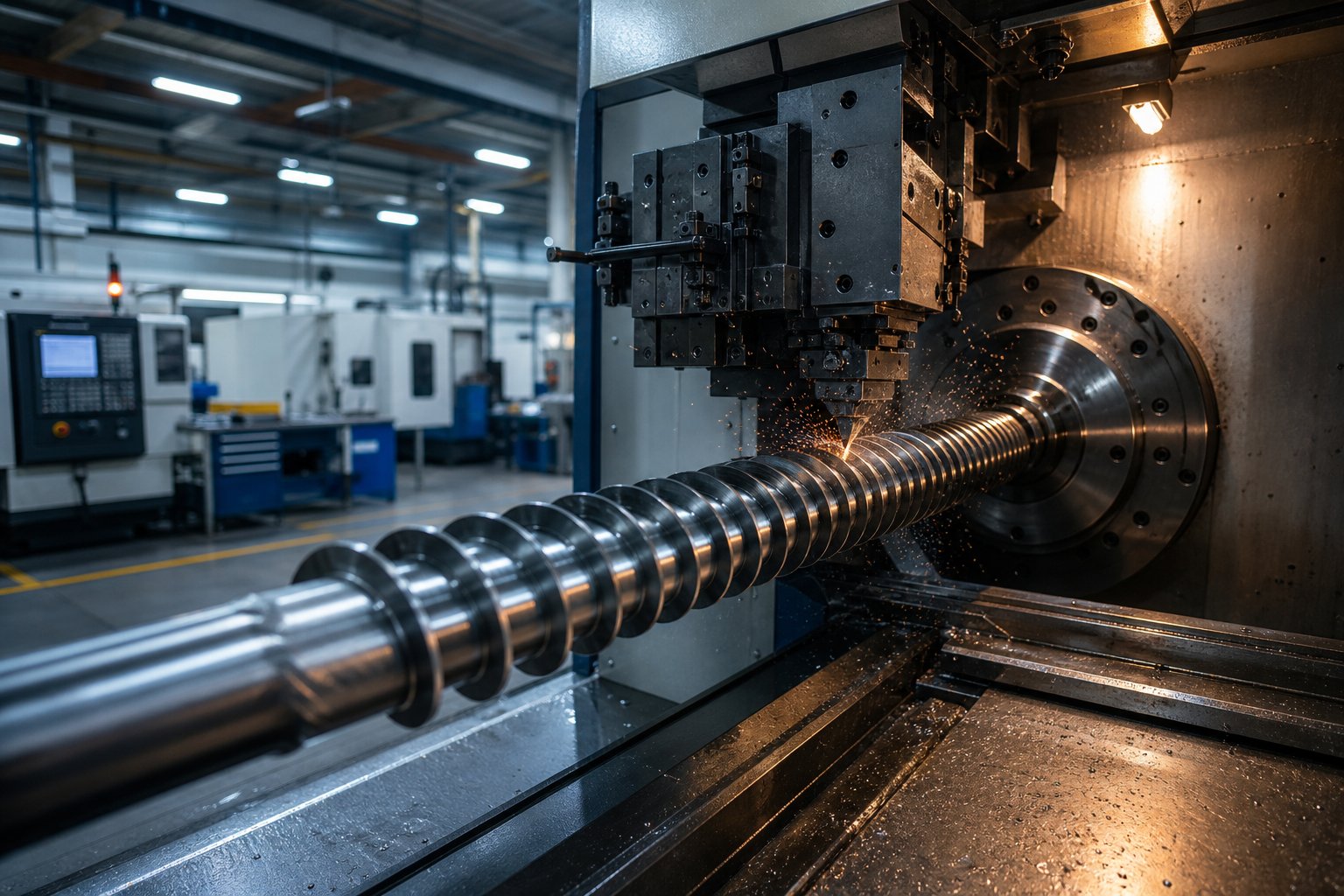
- Rough machining to establish basic geometry. For screws, this means mounting the raw material on CNC lathes and turning the shaft to approximate the final profile — establishing root diameters across feed, compression, and metering zones, and roughing in the flight geometry. For barrels, the critical operation is gun drilling or deep-hole boring to create the internal bore. Gun drilling uses a single-flute cutting tool fed with high-pressure coolant to produce straight, deep holes — a technically demanding process where bore straightness must be held to fractions of a millimeter over lengths that can exceed two meters.
- Flight welding and hard-facing for screws. This is where a screw transitions from a basic machined shaft into a wear-resistant processing component. In abrasive applications, manufacturers apply hard-facing alloy directly to screw flight lands using plasma transferred arc (PTA) welding or laser cladding. PTA welding deposits a layer of wear-resistant alloy — typically tungsten carbide, cobalt-based, or nickel-based compositions — onto the flight surface with metallurgical bonding to the substrate. Laser cladding achieves similar results with a smaller heat-affected zone, reducing distortion on precision components. This single step can extend flight life by 3x to 10x compared to an untreated surface in filled-resin service.
- Centrifugal casting of bimetallic barrel linings. For barrels destined for abrasive or corrosive processing, the pre-bored barrel receives its wear-resistant inner lining through centrifugal casting. Powdered alloy is loaded into the barrel, heated to melting temperature, and the barrel is rotated at controlled speed. Centrifugal force distributes the molten alloy uniformly against the inner wall, creating a dense, metallurgically bonded liner. The precision of this step — controlling pour temperature, rotation speed, mold preheat, and cooling rate — determines liner density, porosity, and bond integrity. It's one of the most quality-sensitive operations in the entire process.
- Heat treatment and surface hardening. After welding and lining operations, components undergo their primary heat treatment cycle. Screws may receive quench-and-temper hardening to achieve target core hardness, followed by gas or ion nitriding to create a hardened surface case. The sequence matters: nitriding occurs at lower temperatures (480-530°C) than quench-and-temper, so it's performed last to avoid softening the nitrided case. Barrels with bimetallic liners receive a controlled post-cast stress relief and tempering cycle to optimize liner hardness while maintaining the outer shell's toughness. Getting the temperature profiles and soak times right at this stage is non-negotiable — overheating can soften the liner alloy or decarburize the barrel surface, while under-treating leaves residual stresses that cause distortion during final machining.
- Precision finish machining. With heat treatment complete, components move to final dimensional machining. Screws undergo precision cylindrical grinding on their flight outer diameters and root surfaces to achieve final tolerances — flight OD clearance relative to the barrel bore typically falls in the range of 0.05 to 0.15 mm depending on screw diameter and application. Barrels undergo bore honing, a process that uses abrasive stones rotating inside the bore to achieve the final diameter, roundness, and surface finish. Surface finish on a honed barrel bore directly affects melt flow behavior and polymer adhesion to the barrel wall, so this isn't simply a cosmetic step.
- Final inspection and quality verification. The last gate before shipping involves a comprehensive dimensional and metallurgical audit. You'll find capable manufacturers performing bore straightness measurement using optical or laser gauges, screw flight diameter verification at multiple points along the length, hardness testing on both surface and core locations, and surface finish evaluation using profilometers. Components that pass every check receive documentation — inspection reports, hardness certifications, and dimensional records — that travel with the part and serve as the manufacturer's quality guarantee.
Raw Material Selection and Initial Rough Machining
The foundation of every reliable screw and barrel begins in the stockyard. Material grade selection isn't a casual decision — it's driven by the specific resin, filler content, and processing temperatures the finished component will face. A screw destined for unfilled polyethylene requires fundamentally different steel than one built for 40% glass-filled nylon. Manufacturers who maintain relationships with certified steel mills and perform incoming material verification — spectrographic analysis, ultrasonic testing for internal defects, and hardness confirmation — catch problems before they become machined into a $15,000 component.
Rough machining transforms raw steel into recognizable geometry. For screws, CNC turning operations establish the stepped root diameters that define feed, compression, and metering zones, along with the helical flight profile. For barrels, the deep-hole boring process is arguably the most precision-critical rough operation in the entire sequence. A bore that drifts off-center even slightly produces a barrel with varying wall thickness — thinner on one side, thicker on the other — creating uneven heat transfer and structural weak points under pressure. Top-tier manufacturers use dedicated gun-drilling machines with in-process monitoring to track bore deviation in real time.
Flight Welding, Hard-Facing, and Bimetallic Lining
Imagine running a screw with bare 4140 steel flights through a resin loaded with glass fiber. Those flights would erode visibly within weeks. Hard-facing transforms that vulnerability into lasting performance. During PTA welding, a transferred plasma arc melts a stream of alloy powder directly onto the flight land surface. The molten alloy bonds metallurgically with the base steel — not just sitting on top like a coating, but fusing into a composite structure that resists chipping and delamination under the shear forces of processing. Laser cladding achieves the same metallurgical bond with a more focused heat input, which means less thermal distortion and a thinner heat-affected zone in the substrate. For screws running highly abrasive compounds, this is the single most impactful manufacturing step in determining service life.
On the barrel side, the centrifugal casting process is equally decisive. The quality of a bimetallic liner depends on variables that only experienced manufacturers control consistently: the alloy powder chemistry, the pour temperature (too hot and the alloy mixes excessively with the base metal; too cool and porosity increases), the rotation speed (which must generate enough centrifugal force to densify the liner without segregating heavier carbide particles), and the cooling rate after casting. A well-executed centrifugal cast produces a liner with less than 1% porosity and a smooth, uniform inner surface ready for final honing.
Heat Treatment, Finish Machining, and Final Inspection
Heat treatment is where metallurgical intentions become physical reality. The hardness numbers on a material data sheet only materialize if the quench rate, tempering temperature, and soak duration are precisely controlled. A screw quenched too aggressively develops internal stresses that can cause cracking during nitriding or even during service. One tempered at the wrong temperature misses its target hardness by several HRC points — a difference the naked eye can't detect but a processed resin absolutely will, through accelerated wear and shortened replacement intervals.
Finish grinding and honing bring every dimension to its final specification. For screws, cylindrical grinding machines equipped with diamond or CBN (cubic boron nitride) wheels produce the mirror-smooth flight surfaces and precise outer diameters that ensure consistent clearance inside the barrel bore. For barrels, honing progressively refines the bore to target diameter, roundness, and surface roughness — typically in the range of 0.2 to 0.8 micrometers Ra, depending on the application. Surface finish that's too rough increases frictional drag and creates sites for polymer degradation. Too smooth, and certain resins lose the barrel-wall grip they need for effective conveying in the feed zone.
Final inspection ties everything together. Dimensional verification confirms that every feature matches the engineering drawing. Hardness testing — performed on the screw surface, flight lands, barrel bore, and core material — validates that heat treatment achieved its targets. Bore straightness measurement, typically conducted with laser alignment equipment, ensures the barrel bore runs true across its full length. Manufacturers who document these results and provide traceable inspection reports demonstrate a level of quality commitment that separates precision producers from shops simply cutting metal to approximate dimensions.
A well-manufactured screw and barrel assembly leaves the factory at its peak performance capability. From that point forward, the processing environment begins working to degrade it — through mechanisms that vary dramatically depending on what's being run through the machine.
Understanding Wear Mechanisms and the Rebuild vs. Replace Decision
Your screw and barrel started life at peak dimensional precision. Every flight clearance, every bore diameter, every surface finish value matched the engineering drawing. But the moment resin pellets begin flowing, degradation starts — and the way that degradation unfolds depends entirely on what you're processing. Diagnosing the specific wear mechanism attacking your components isn't just academic. It's the difference between selecting the right replacement metallurgy and repeating the same failure cycle with a brand-new part.
Abrasive, Corrosive, and Adhesive Wear in Screw Barrels
Three distinct mechanisms account for virtually all screw and barrel wear in plastics processing. They look different under a microscope, they attack different surfaces, and they demand fundamentally different material solutions. Many processors experience two or even all three simultaneously — but understanding each one individually is the starting point for solving the problem.
Abrasive wear is the most straightforward to visualize. Glass fibers, mineral fillers like calcium carbonate and talc, pigment particles, and even certain recycled-content contaminants act like microscopic sandpaper, physically eroding metal from screw flight lands, barrel bore surfaces, and channel root areas. The damage pattern is predictable: flight outer diameters shrink, increasing the clearance gap between screw and barrel. That growing gap allows more material to leak backward over the flights instead of being conveyed forward, reducing throughput and shot-to-shot consistency. In barrel bores, abrasive wear typically concentrates along the bottom of the bore in horizontal machines — gravity pushes the melt pool and its suspended hard particles against the lower surface. You'll often see ovality develop in cross-sections of heavily worn barrels, with the vertical diameter exceeding the horizontal by measurable amounts.
Corrosive wear operates through an entirely different pathway. Certain resins release chemically aggressive byproducts during processing. PVC generates hydrochloric acid (HCl) as it thermally degrades. Fluoropolymers like PTFE and FEP can release hydrogen fluoride (HF) — one of the most aggressive acids known. Flame-retardant compounds containing halogenated additives produce their own cocktail of corrosive gases. These chemical species attack the metal surface at a molecular level, dissolving protective oxide layers and progressively consuming base metal. Unlike abrasive wear, which leaves visible scratches and gouges, corrosive wear produces a smoother, more uniform surface degradation that can be harder to detect visually but equally destructive to dimensional tolerances. The insidious part? Corrosion accelerates at higher temperatures, meaning the hottest zones of the barrel often degrade fastest.
Adhesive wear is the least understood but potentially most damaging mechanism. It occurs when the clearance gap between screw flight lands and barrel bore becomes so small — or disappears entirely — that metal-to-metal contact occurs under load. At the microscopic level, high-pressure contact between the two surfaces causes localized welding at asperity peaks. As the screw rotates, these micro-welds tear apart, transferring metal fragments from one surface to the other. The result is rapid, catastrophic scoring that damages both components simultaneously. Adhesive wear often follows a chain reaction: initial abrasive or corrosive wear reduces flight diameters unevenly, causing screw deflection. The deflected screw contacts the barrel wall, triggering adhesive wear that accelerates the damage exponentially.
Recognizing which mechanism is dominant matters because the solutions are different. Abrasive wear calls for harder surfaces — CPM tool steels, tungsten carbide hard-facing, or bimetallic barrel linings with embedded carbide particles. Corrosive wear demands chemical resistance — nickel-based alloys, Stellite overlays, or stainless steel constructions. Adhesive wear requires maintaining adequate clearance through proper metallurgical pairing, ensuring the screw and barrel have a hardness differential that prevents galling, and addressing any alignment or deflection issues in the machine itself.
In many real-world operations — glass-filled PVC being a notorious example — all three mechanisms attack simultaneously. Glass fibers abrade surfaces while HCl corrodes them, and the combined dimensional loss eventually closes clearances enough to trigger adhesive contact. These compound-wear scenarios are exactly where a screw barrel manufacturer's metallurgical expertise becomes indispensable, because no single alloy excels against all three mechanisms equally.
When to Rebuild and When to Replace
So your screw flights are worn, your barrel bore is oversized, and output has dropped to the point where something has to be done. You're facing the classic decision every processor encounters: rebuild the existing components, or purchase new ones? The answer isn't always obvious, and getting it wrong costs real money — either by investing in a rebuild that doesn't last, or by replacing a component that had thousands of productive hours still available with a simple restoration.
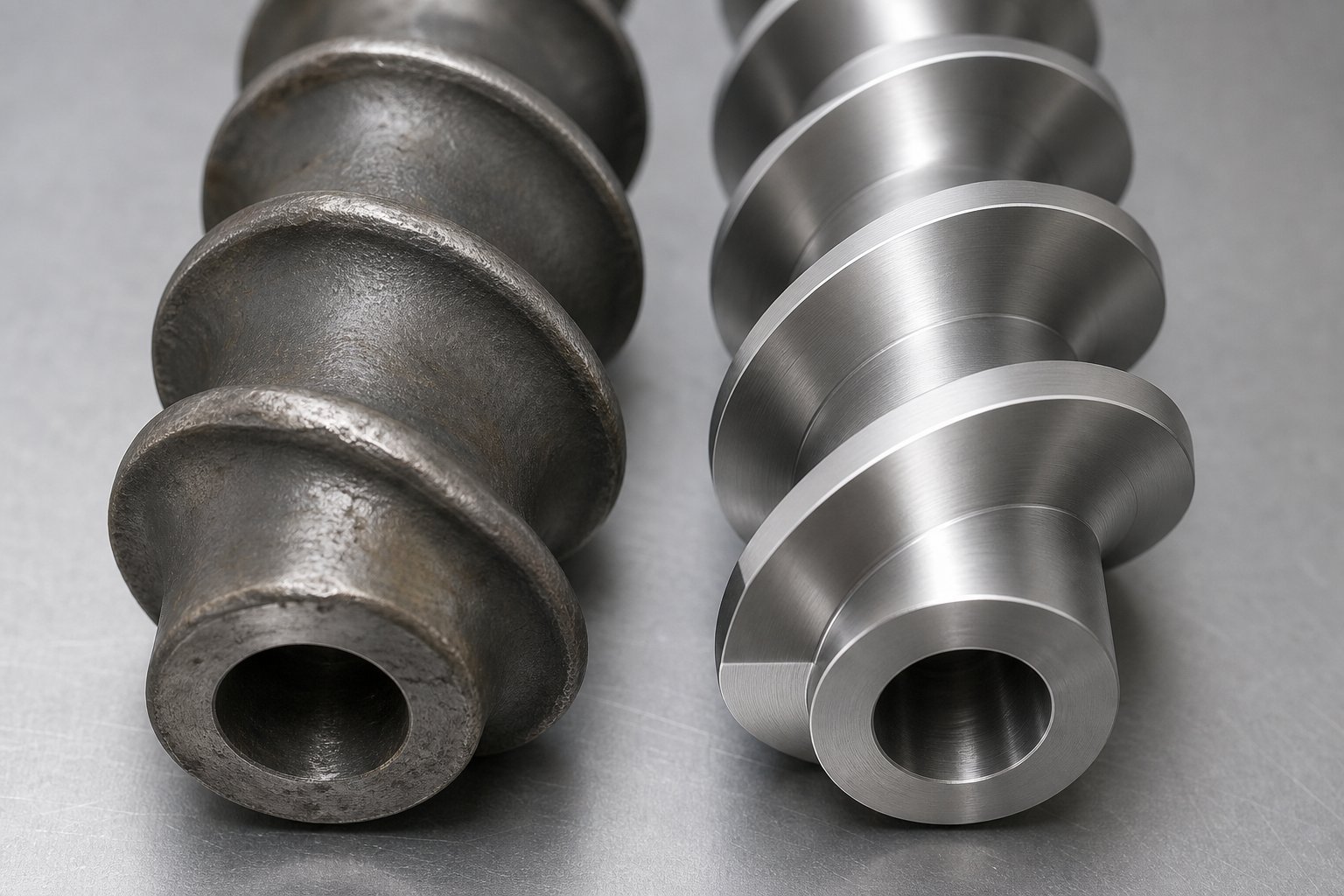
The rebuild process for screws typically follows a well-established sequence. First, the worn screw is cleaned and inspected to assess the extent of damage. If wear is confined to the flight land surfaces — the outermost edges that contact the barrel bore — and the screw core (root diameter) remains within acceptable tolerances, rebuilding is viable. Common restoration methods include weld overlay on the flight crest using PTA welding, re-machining to original dimensions, surface hard chrome plating for improved flowability, and full-length polishing. For a standby screw machine that sees intermittent service, or a northern screw machine operation processing mild compounds, a well-executed rebuild can deliver excellent value.
Barrel rebuilds follow a different path. A worn cylinder can be repaired by honing the inner diameter to a larger oversize dimension. For nitrided barrels, this means boring to the new diameter, re-nitriding to restore surface hardness, and then performing a final honing pass to achieve dimensional precision. For bimetallic barrels, only the honing step is typically needed since the alloy liner retains its wear properties. The catch? The screw, valve assembly, and end cap must then be adjusted to match the new oversized bore — making these components non-standard and requiring dedicated spare parts going forward.
Replacement makes more sense under several specific conditions. When the screw core diameter has been reduced beyond safe structural limits — either through wear or from repeated rebuilds that progressively consume the substrate — welding new flight material onto a compromised core creates a component that may fail catastrophically under torsional load. Metallurgical damage from overheating events, where the steel has been annealed or decarburized, compromises the entire component regardless of how much flight material remains. And sometimes the smartest move is recognizing that replacing a worn general-purpose screw with an upgraded design — a barrier screw, an optimized mixing configuration, or a higher-performance metallurgy — delivers a return that goes far beyond simply restoring original performance.
The following table provides a practical comparison to guide your decision:
| Factor | Rebuild | Replace |
|---|---|---|
| Typical cost (relative to new) | 30% to 60% of new component cost | 100% (standard) or 110-130% (upgraded design/metallurgy) |
| Turnaround time | 1 to 3 weeks depending on repair scope | 3 to 8 weeks for custom; faster for standard sizes from stock |
| Expected service life after completion | 50% to 70% of original new-component life | 100% of rated life; potentially longer with upgraded materials |
| Ideal conditions | Wear limited to flight surfaces; core structurally sound; no metallurgical damage; same screw design remains appropriate | Core diameter reduced beyond limits; overheating damage; opportunity to upgrade design or metallurgy; cal screw configurations where tolerances are extremely tight |
| Risk factors | Rebuilt flights may not bond as strongly as original; non-standard oversized barrels require dedicated spares | Higher upfront cost; longer lead time; requires accurate dimensional data from the machine |
| Best for | Budget-constrained operations; mild-wear applications; components with significant remaining core life | Severe-wear applications; performance upgrades; components with structural compromise |
One critical point that reference materials consistently emphasize: not all manufacturers are equipped for comprehensive refurbishment. Rebuild quality depends entirely on the shop's welding expertise, machining precision, and heat treatment capability. A poorly executed rebuild — one with inadequate weld penetration, improper alloy selection, or sloppy re-machining — can actually perform worse than the worn component it replaced. Seeking advice from experienced suppliers who possess both rebuilding capability and professional knowledge to evaluate each case individually is a crucial first step.
It's also worth noting that a repaired screw generally will not last as long as a new one. The weld-overlay process introduces a heat-affected zone into the base metal beneath each flight, and the bond between deposited alloy and substrate — while metallurgically sound — rarely matches the homogeneous strength of a flight machined from solid tool steel. For operations running highly abrasive compounds around the clock, this reduced second-life expectancy tilts the math toward replacement. For shops processing unfilled or lightly filled commodity resins, where wear rates are measured in years rather than months, rebuilding can deliver two or three additional service cycles before replacement becomes necessary.
Whether you rebuild or replace, the component you install next will face the same processing environment that wore out its predecessor. And those processing demands vary enormously depending on the industry you serve — packaging lines running at maximum throughput impose very different stresses than medical-grade molding operations requiring absolute precision.
How Screw Barrel Requirements Differ Across Industries
A packaging plant blowing polyethylene film at 500 kg/hour and a medical molder producing biocompatible catheter tubing at 12 kg/hour both rely on screws and barrels — but the similarities end there. Resin chemistry, throughput targets, regulatory constraints, and dominant wear mechanisms shift so dramatically between industry verticals that a screw barrel manufacturer's experience in your specific sector often matters as much as their machining capability. A supplier who excels at building screws for commodity film lines may have zero relevant expertise for fluoropolymer medical components, and vice versa.
Understanding what each industry demands from its plasticizing components helps you ask the right questions during supplier evaluation — and avoid the costly assumption that a screw is just a screw.
Packaging and Consumer Goods Processing Requirements
Packaging dominates global plastics consumption, and the economics are unforgiving. Blown film, cast film, sheet extrusion, and thin-wall injection molding operations run around the clock at razor-thin margins where every percentage point of throughput, every gram of scrap, and every kilowatt of energy consumption shows up on the bottom line. In this environment, screw and barrel performance isn't a maintenance concern — it's a profit driver.
Consider a typical blown film line. The extruder screw must deliver a perfectly homogeneous melt at maximum output rate, because even minor temperature inconsistencies in the melt stream translate into gauge variation in the finished film. A blown film extruder's screw design directly affects the blow-up ratio stability, film clarity, and tensile properties of the end product. Screws optimized for high-output LDPE or LLDPE processing typically feature barrier flight designs with aggressive mixing sections to maximize melting efficiency per revolution — squeezing every possible kilogram per hour from a given screw diameter.
Sheet extrusion and thermoforming feedstock production impose similar demands. Melt uniformity directly governs sheet thickness consistency, and thickness variation means rejected parts downstream. Thin-wall injection molding for food containers and consumer goods packaging pushes cycle times to their absolute minimum, where shot-to-shot weight consistency depends on maintaining tight screw-to-barrel clearances over millions of cycles.
The metallurgical demands in packaging are generally moderate — most commodity PE, PP, and PS compounds are non-corrosive and carry minimal filler loads. Standard nitrided 4140 screws paired with iron-based bimetallic barrels handle the majority of packaging applications effectively. The real differentiator is screw geometry optimization: a well-designed barrier screw with the right compression ratio and mixing section can boost output by 15-25% compared to a generic general-purpose design running the same resin on the same machine. That's where a manufacturer's application engineering depth pays dividends far beyond component cost.
Automotive, Medical, and Construction Applications
Step outside the packaging world, and the performance demands on screws and barrels intensify in very different directions depending on the sector.
Automotive processing pushes wear resistance to its limits. Modern automotive compounds — glass-filled nylons at 30-50% loading, talc-filled TPOs, long-fiber reinforced polypropylene, and mineral-loaded engineering blends — are among the most abrasive materials any screw barrel will ever encounter. Glass fibers in particular act as relentless cutting agents, eroding flight lands and barrel bores at rates that can consume a standard nitrided screw in under 3,000 hours. Automotive processors routinely specify CPM powder metallurgy tool steel screws or tungsten carbide hard-faced flights paired with carbide-reinforced bimetallic barrels — premium metallurgies that push component costs significantly higher but deliver service lives measured in years rather than months.
Medical plastics processing introduces a completely different set of constraints. The resins themselves — PEEK, polysulfone, fluoropolymers, medical-grade polycarbonate, and biocompatible TPEs — often require processing temperatures above 350°C and may release corrosive byproducts. Melt quality standards are extraordinarily tight because defects in medical devices can have life-threatening consequences. Screws must deliver absolute temperature homogeneity with minimal degradation, which typically means shorter L/D ratios, gentler compression profiles, and corrosion-resistant alloys like H13 or Hastelloy. Cleanability and material traceability also matter — some medical processors require full metallurgical certifications and documented cleaning procedures for every component that contacts the polymer melt.
Construction applications present a combination challenge. PVC pipe and profile extrusion — the dominant construction plastics process — involves a resin that is both corrosive and moderately abrasive. PVC releases hydrochloric acid during processing, attacking unprotected metal surfaces, while calcium carbonate fillers and titanium dioxide pigments add abrasive wear on top of the chemical attack. Successful PVC processing demands screws and barrels built from corrosion-resistant materials — nickel-based bimetallic liners, stainless steel or nickel alloy screw substrates — with compression ratios kept between 1.5:1 and 2.5:1 for rigid PVC to avoid the localized overheating that triggers thermal degradation. Wood-plastic composite (WPC) decking extrusion adds another layer of complexity, introducing moisture, wood fiber abrasion, and corrosive volatiles simultaneously.
The distinct requirements across these verticals highlight why a manufacturer's application portfolio matters. Here's a quick summary of what each industry prioritizes:
- Packaging and consumer goods: Maximum throughput, barrier screw designs for melt homogeneity, optimized mixing sections, moderate metallurgy (nitrided steel, standard bimetallic barrels), fast replacement turnaround to minimize downtime on 24/7 production lines.
- Automotive: Premium abrasion-resistant metallurgies (CPM tool steels, tungsten carbide coatings), heavy-duty bimetallic barrels with carbide-reinforced liners, screw designs engineered for high glass-fiber loading without excessive fiber breakage.
- Medical: Corrosion-resistant alloys (H13, Hastelloy, specialty stainless), precise melt temperature control, gentle compression profiles, full material traceability and documentation, cleanroom-compatible surface finishes.
- Construction (PVC/WPC): Combined corrosion and abrasion resistance (nickel-based bimetallic liners, Stellite or nickel alloy screw surfaces), low compression ratios, degassing capability for volatile management, precise temperature control across narrow processing windows.
A manufacturer that serves all of these segments must maintain genuinely broad capabilities — in metallurgy, in custom screw design, and in application engineering. That's a tall order, and it's one reason why evaluating a supplier's real-world project history across industries tells you more than any brochure claim. For processors and equipment manufacturers exploring custom or replacement solutions tailored to specific application demands, NANHAIYA's screw barrel product center offers a resource designed around the diverse requirements of extrusion and injection molding operations spanning these segments.
Recognizing what your industry demands from its screw and barrel components is the first half of the equation. The second half — systematically evaluating whether a given manufacturer can actually deliver on those demands — requires a structured approach that goes far beyond requesting a quote and comparing prices.
How to Choose the Right Screw Barrel Manufacturer
A quote lands on your desk. The price looks reasonable, the lead time works, and the spec sheet lists the right steel grade. So you sign the PO and move on, right? Not if you want components that actually perform. Selecting a screw barrel manufacturer based on price and delivery alone is like hiring an engineer based solely on their commute time — you're ignoring the factors that actually determine the outcome.
The challenge is that every supplier claims precision machining, quality materials, and custom capability. Those words appear on virtually every manufacturer's website, from a small federal screw works operation in a regional machine shop to a large-scale international production facility. Separating genuine capability from marketing language requires a structured evaluation approach — one that examines what a manufacturer actually does, not just what they say.
Key Evaluation Criteria for Screw Barrel Manufacturers
When you strip away the brochure language, six concrete factors determine whether a manufacturer can deliver components that perform reliably in your specific application. Evaluate each one systematically before committing to a supplier relationship:
- Metallurgical capabilities and material options. Can the manufacturer source and process the full range of base materials your applications demand — from standard nitrided 4140 for commodity resins to CPM powder metallurgy tool steels for severe abrasive service? Do they perform bimetallic centrifugal casting and flight hard-facing in-house, or do they outsource these critical steps? In-house control over metallurgy means direct accountability for the alloy quality that drives component lifespan.
- In-house machining precision and equipment quality. Ask about their CNC turning, deep-hole boring, cylindrical grinding, and bore honing equipment — and request tolerance specifications they routinely hold, not just what they claim as maximum capability. A shop running modern CNC grinders with sub-micron positioning accuracy produces fundamentally different components than one relying on manually operated legacy equipment. Request sample inspection reports from recent jobs to verify their actual working tolerances.
- Engineering support and custom design capability. Does the manufacturer employ application engineers who can analyze your resin data, review your processing parameters, and recommend optimized screw geometries? Or do they simply manufacture to your print without questioning whether the design is appropriate? The ability to suggest improvements — a different compression ratio for your resin, a barrier flight configuration to boost output, a mixing section to solve a dispersion problem — separates a technical partner from a job shop.
- Quality control processes and inspection documentation. Look for manufacturers who perform and document bore straightness measurement, hardness testing at multiple locations, dimensional verification along the full component length, and surface finish evaluation. Traceability matters — material certifications, heat treatment records, and final inspection reports should accompany every shipment. If a supplier can't provide this documentation, you have no way to verify that the component meets its specification.
- Lead times and responsiveness for new and replacement orders. Production downtime while waiting for a replacement screw or barrel costs far more than the component itself. Evaluate both standard lead times for new custom orders and emergency turnaround capability for replacement parts. Some manufacturers maintain semi-finished stock in common diameters and lengths, enabling significantly faster delivery on urgent orders. Ask specifically about their process for rush replacements — a manufacturer who treats your emergency with the same priority as a routine order isn't one you want to depend on when a production line is down.
- Application experience with your specific resins and processes. A manufacturer who has built hundreds of screws for glass-filled nylon injection molding understands the wear patterns, metallurgical demands, and design nuances that come with that territory. One who has never worked with your resin family is essentially experimenting on your dime. Ask for reference projects in your industry segment and, if possible, speak with existing customers running similar applications.
This checklist isn't theoretical — it reflects the factors that consistently determine whether a screw and barrel investment delivers its expected return or becomes an expensive lesson in cutting corners.
Domestic vs. International Sourcing Considerations
The domestic-versus-international debate generates strong opinions, but the honest answer is that neither option is universally superior. Each involves real trade-offs, and the right choice depends on your operational priorities.
Domestic manufacturers — whether a precision federal screw shop in Big Rapids, Michigan, or a specialty plastics components producer in Ohio — typically deliver faster lead times because shorter shipping distances and simpler logistics eliminate the weeks of ocean freight and customs clearance that international orders require. Communication is more straightforward: same time zone, same language, and no cultural barriers that can cause specification misunderstandings. For rush replacement orders, where every day of downtime bleeds money, having a domestic source capable of two-week turnaround can be worth a significant price premium. Domestic sourcing also simplifies ongoing technical support — site visits, joint troubleshooting, and iterative design refinements all become easier when your manufacturer is a short flight away rather than across an ocean.
International manufacturers, particularly those in established production hubs like China's Zhoushan region, can offer meaningful cost advantages on standard specifications at volume. As industry analysis notes, China has become a global hub for screw and barrel production due to mature supply chains, specialized manufacturing clusters, and competitive labor costs. For processors ordering multiple sets of standard-geometry screws and barrels with well-defined specifications, the per-unit savings can be substantial — often 30% to 50% below domestic pricing for comparable quality levels.
The key qualifier in that sentence is "comparable quality levels." Total landed cost — not per-unit price — is what actually matters. International sourcing adds freight costs, import duties, customs brokerage fees, and the carrying cost of larger inventory buffers needed to protect against longer replenishment cycles. Quality inconsistencies that slip through on a shipment from 8,000 miles away are far more expensive to resolve than issues caught during a domestic supplier visit. And when a critical dimension is wrong on an internationally sourced barrel, the rework or replacement cycle stretches to months instead of days.
Many experienced processors adopt a hybrid approach: domestic sourcing for custom-engineered components, rush replacements, and applications requiring close technical collaboration, with international sourcing reserved for high-volume standard specifications where the design is fully proven and the risk of quality variation is well-managed. The deciding factors typically break down like this:
| Factor | Favors Domestic Sourcing | Favors International Sourcing |
|---|---|---|
| Lead time sensitivity | Rush orders, emergency replacements, prototype iterations | Planned orders with 8-12 week lead time acceptable |
| Customization complexity | Novel screw designs, iterative engineering collaboration, tight-tolerance specialty components | Standard geometries with well-documented specifications |
| Order volume | Single units or small batches where setup costs dominate | Multiple sets where per-unit manufacturing cost dominates |
| Technical support needs | Ongoing design optimization, on-site troubleshooting, application engineering partnership | Specifications fully defined, minimal post-sale support needed |
| Total cost priority | When downtime cost, logistics risk, and quality assurance overhead outweigh unit price savings | When volume-driven unit cost reduction delivers net savings after all landed costs |
Building a Productive Manufacturer Relationship
Here's what separates processors who consistently get great results from their screw and barrel purchases from those who lurch between suppliers chasing the lowest quote: the first group treats their manufacturer as a technical partner. The second treats them as a commodity vendor.
The difference shows up in every interaction. A partnership approach means sharing your processing data — melt temperatures, back pressures, screw speeds, cycle times, resin data sheets — so the manufacturer can recommend optimized designs rather than simply building to a generic specification. It means inviting your supplier's engineers to review worn components and diagnose failure modes, because their experience across hundreds of similar applications gives them pattern-recognition capability your in-house team may lack. And it means providing honest feedback on component performance so the manufacturer can refine their recommendations over time.
What should you expect from a manufacturer who earns the "partner" designation? Several things that go well beyond accepting purchase orders:
- Proactive design recommendations based on your specific resin, filler content, and production targets — not just quoting whatever geometry you request.
- Material selection guidance that balances performance requirements against budget constraints, identifying where premium metallurgies deliver genuine ROI versus where standard options are perfectly adequate.
- Wear analysis and failure diagnosis on returned components, with documented findings that inform the next purchase decision.
- Flexible production capability that accommodates both planned new-build orders and unplanned emergency replacements without sacrificing quality under time pressure.
- Transparent documentation — material certifications, heat treatment records, dimensional inspection reports, and hardness test results — provided as standard practice, not as a special request.
Manufacturers who invest in these capabilities are signaling that they view their role as helping you optimize processing performance, not simply selling metal. That alignment of interests is what produces better components, longer service life, and lower total cost of ownership over time.
For plastic processors, equipment manufacturers, and maintenance teams evaluating their options, NANHAIYA's screw barrel product center is built around exactly this partnership model — providing custom and replacement screw and barrel solutions for extrusion and injection molding equipment, with the engineering depth and production flexibility to support diverse application requirements across the industry segments covered throughout this guide.
Choosing the right manufacturing partner establishes the foundation. But the industry itself isn't standing still — advances in alloy technology, precision machining, and engineering methodology are steadily raising the bar for what well-manufactured screw and barrel components can deliver.
Emerging Trends and Innovations in Screw Barrel Manufacturing
The screw and barrel sitting inside your machine today was designed with yesterday's materials, machined on yesterday's equipment, and engineered for yesterday's resins. That's not a criticism — it's an observation about how rapidly the landscape is shifting. Processing demands are intensifying across every sector simultaneously: higher recycled content with unpredictable contamination, bio-based polymers with unfamiliar thermal profiles, and engineering compounds loaded with fillers that would have been considered extreme a decade ago. These pressures are forcing innovation at every level of screw barrel manufacturing — from the alloys being developed to the tolerances being held to the way designs are conceived in the first place.
Advanced Alloys and Coating Technologies
Material science is evolving faster in this space than at any point in the past twenty years. The push toward specialty polymers, bio-based plastics, and high-performance engineering materials has intensified the need for wear solutions that simply didn't exist a generation ago. Standard nitrided steel and conventional bimetallic linings still handle the majority of commodity processing, but the fastest-growing application segments are the ones that destroy commodity metallurgies.
Advanced powder metallurgy tool steels — grades like CPM 15V and newer proprietary compositions — are pushing abrasion resistance boundaries by embedding higher concentrations of vanadium and niobium carbides in tougher matrix alloys. The result is screws that survive highly filled recycled streams where contamination levels vary unpredictably from lot to lot. Thermal spray coatings are evolving in parallel. Next-generation HVOF and plasma-sprayed coatings now incorporate ceramic-reinforced bimetallic compositions — think chromium carbide and aluminum oxide particles dispersed in nickel-chromium matrices — that deliver both abrasion and corrosion resistance in a single coating system. For processors handling glass-filled PVC or halogenated flame-retardant compounds, these combination coatings eliminate the historical compromise between hardness and chemical resistance.
Circular economy pressures are a significant catalyst here. Recycling post-consumer plastics introduces metal fragments, paper fibers, sand, and other contaminants that conventional nitrided screws were never designed to handle. Manufacturers developing wear solutions specifically for recycled-content processing — where the "resin" is really an unpredictable mixture — are gaining a genuine competitive edge. Similarly, bio-based polymers such as PLA, PHA, and starch blends introduce processing behaviors and degradation byproducts that don't map neatly onto traditional resin categories, pushing alloy developers to create tailored surface treatments rather than defaulting to existing options.
Precision Manufacturing and Tighter Tolerance Capabilities
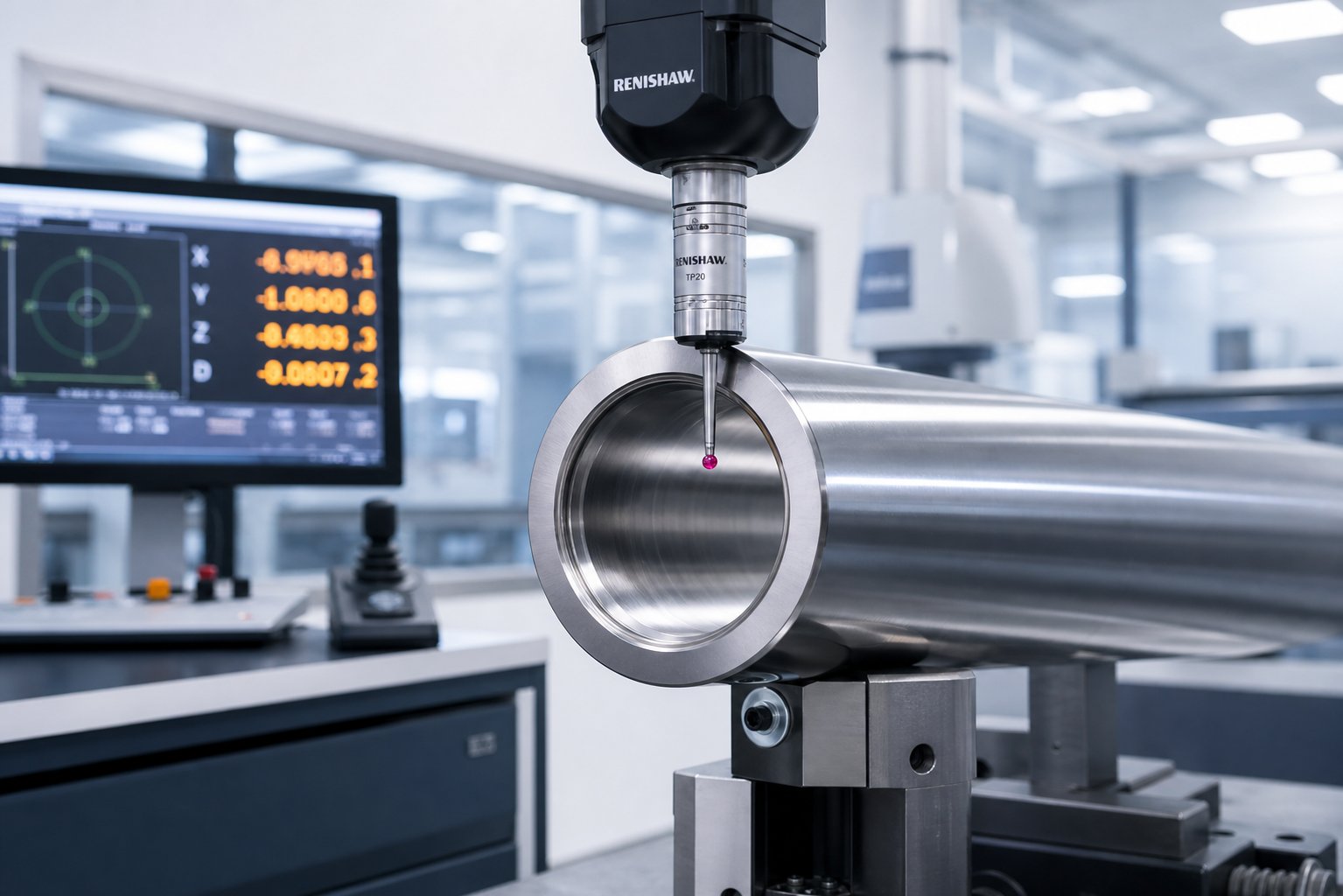
Imagine measuring the straightness of a two-meter barrel bore to within 0.02 mm — and doing it consistently across hundreds of units per year. That level of precision was aspirational a decade ago. Today, it's becoming standard practice among leading manufacturers, driven by advances in CNC machining centers, automated cylindrical grinding systems, and coordinate measuring machine (CMM) inspection technology.
Modern multi-axis CNC lathes with sub-micron positioning repeatability enable manufacturers to machine complex screw flight geometries — barrier flights, variable-pitch transitions, and mixing element profiles — with dimensional consistency that manual or semi-automated equipment simply cannot match. Automated grinding systems equipped with in-process gauging continuously measure and compensate for tool wear during finish operations, holding flight outer diameters and root transitions to tolerances that directly improve melt homogeneity and reduce energy consumption on the production floor.
On the inspection side, CMM systems and laser bore measurement equipment are transforming quality verification from a sampling exercise into a comprehensive audit. Rather than checking bore diameter at three or four points along a barrel's length, manufacturers can now map the entire bore profile — diameter, roundness, and straightness — at millimeter intervals. This data density doesn't just catch defects. It generates statistical process control information that feeds back into machining parameters, continuously tightening the manufacturing process itself. Precision machining techniques ensuring tighter dimensional tolerances translate directly into improved melt homogeneity and reduced energy consumption — benefits that compound over thousands of operating hours.
The growing emphasis on bore straightness, concentricity, and surface finish specifications reflects a broader industry shift. Processors pursuing greater consistency and energy efficiency are specifying tighter tolerances not because they've read a technical paper, but because they've measured the production difference between a screw barrel set held to premium tolerances and one built to "good enough" standards. That performance gap is widening as resins become more demanding and quality expectations escalate.
The Shift Toward Application-Engineered Solutions
Perhaps the most consequential trend isn't about a specific alloy or machine tool — it's about how screw barrel designs are conceived. The industry is moving decisively away from catalog-standard screws toward application-specific designs optimized through processing data analysis and, increasingly, simulation software.
What does this look like in practice? Instead of selecting a general-purpose screw from a standard offerings list and hoping it works well enough, processors share their resin data sheets, target throughput rates, melt temperature requirements, and quality specifications with the manufacturer's engineering team. That team then analyzes the processing parameters — sometimes using advanced simulation software to optimize screw geometry and channel design — to predict flow patterns, temperature profiles, and shear rates before any metal is cut. Recent academic research has demonstrated that CFD simulation of screw designs can effectively guide development of alternative geometries, reducing the costly trial-and-error approach that historically dominated screw design optimization. These simulations enable the more cost-effective design of custom screw concepts that would not have been feasible through experimental methods alone.
This shift redefines the relationship between processor and screw barrel manufacturer. The manufacturer isn't simply filling an order to print — they're functioning as an engineering partner who brings cross-application insight to every project. A manufacturer who has optimized screws for dozens of different glass-filled nylon formulations recognizes patterns that even an experienced processor running a single compound might miss. That accumulated knowledge, combined with modern simulation tools, produces designs tailored to specific production goals rather than generic compromises.
The convergence of these trends — advanced machine products and alloys, tighter manufacturing precision, and data-driven design — points toward a future where screw and barrel components are increasingly treated as engineered systems rather than replaceable wear parts. For processors willing to engage with manufacturers at this level, the payoff shows up in longer component life, higher throughput, better melt quality, and lower total cost of ownership. The screw barrel manufacturer who thrives in this environment won't be the one offering the lowest price per kilogram of steel — it will be the one delivering the most value per hour of production uptime.
Frequently Asked Questions About Screw Barrel Manufacturers
1. What is the difference between a single screw and twin screw barrel system?
Single screw systems use one rotating screw inside a cylindrical barrel and are the most widely used configuration for profile extrusion, blown film, and injection molding due to their simplicity and cost-effectiveness. Twin screw systems come in two main types: parallel co-rotating designs excel at compounding, reactive extrusion, and devolatilization thanks to their self-wiping, modular screw elements, while conical counter-rotating designs generate higher conveying pressure and gentler shear, making them ideal for heat-sensitive PVC pipe and profile extrusion. Your choice depends on the resin, required mixing intensity, and throughput targets of your specific process.
2. How do I know when to rebuild a screw barrel versus replacing it entirely?
Rebuilding is cost-effective when wear is limited to flight land surfaces and the screw core remains structurally sound, typically costing 30-60% of a new component and delivering 50-70% of original service life. Replacement becomes the better option when the core diameter has been reduced beyond safe structural limits, when overheating has caused metallurgical damage like annealing or decarburization, or when upgrading to a superior screw design or metallurgy offers a meaningful performance improvement. For processors running highly abrasive compounds continuously, the reduced second-life expectancy of rebuilt components often tilts the total cost-of-ownership math toward replacement. NANHAIYA's product center at https://www.nhyscrews.com/products supports both custom replacement and rebuild evaluation for extrusion and injection molding equipment.
3. What materials are best for screw barrels processing abrasive or corrosive resins?
For abrasive resins with glass fiber or mineral fillers, CPM powder metallurgy tool steels (such as CPM 10V or 15V) or tungsten carbide hard-faced flights paired with carbide-reinforced bimetallic barrel liners deliver the longest service life, often exceeding 20,000 operating hours. For corrosive resins like PVC and fluoropolymers, nickel-based bimetallic barrel linings and Stellite or Hastelloy C-276 screw overlays provide the chemical resistance needed to withstand hydrochloric acid and hydrogen fluoride byproducts. When both abrasion and corrosion are present simultaneously, WC-CrC-Ni HVOF coatings or nickel-based bimetallic liners with tungsten carbide reinforcement address both wear mechanisms in a single solution.
4. What is the L/D ratio in a screw barrel and why does it matter?
The L/D ratio, or length-to-diameter ratio, measures the screw's functional length relative to its outer diameter. For example, a 60 mm diameter screw with 1,500 mm of flighted length has an L/D of 25:1. This ratio directly affects residence time, melting efficiency, and mixing quality. General-purpose extrusion screws commonly use L/D ratios around 24:1, while applications requiring more intensive melting or mixing may use 30:1 or higher. However, longer isn't always better — heat-sensitive resins like PVC can degrade when exposed to the extended residence time a high L/D creates, so the optimal ratio must be matched to the specific polymer being processed.
5. How should I evaluate a screw barrel manufacturer before placing an order?
Focus on six concrete criteria: metallurgical capabilities including in-house bimetallic casting and hard-facing; machining precision verified through sample inspection reports rather than claimed tolerances; engineering support with application engineers who can recommend optimized designs; documented quality control with traceable inspection reports, hardness certifications, and bore straightness data; lead time responsiveness for both planned and emergency replacement orders; and verified application experience with your specific resins and processes. Requesting references from customers in your industry segment and reviewing actual inspection documentation will reveal far more about a manufacturer's true capability than catalog claims. Platforms like NANHAIYA's product center at https://www.nhyscrews.com/products are designed to connect processors with custom engineering support tailored to their specific application demands.
Written by
Nanhaiya Technical Team
Zhoushan Nanhaiya Plastic Machinery Co., Ltd.
The Nanhaiya technical team supports screw and barrel manufacturing projects through application review, technical communication, custom manufacturing coordination, and production and quality control.
Discuss Your Application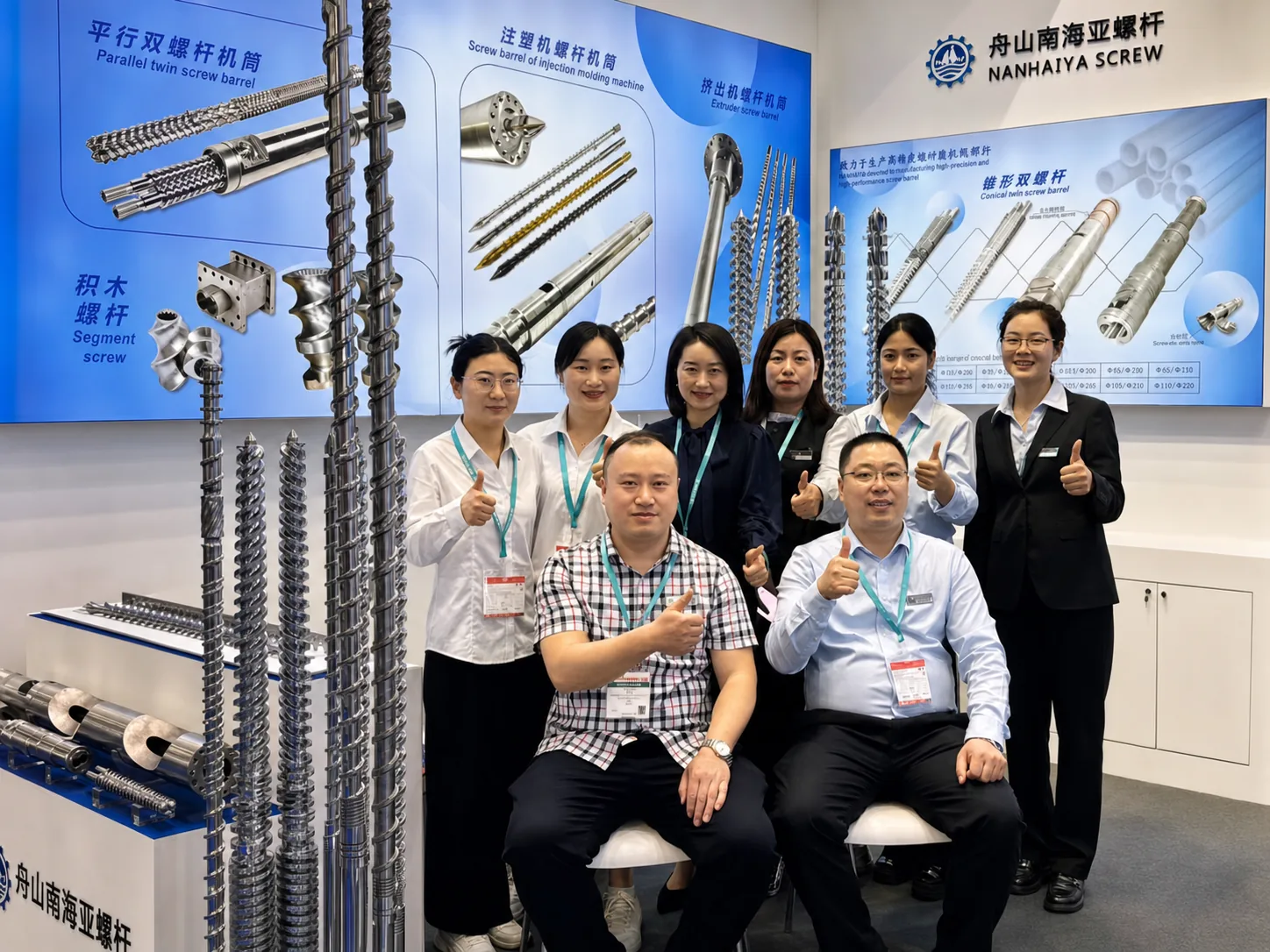
Related Articles
More insights on screw barrel technology and plastics processing.
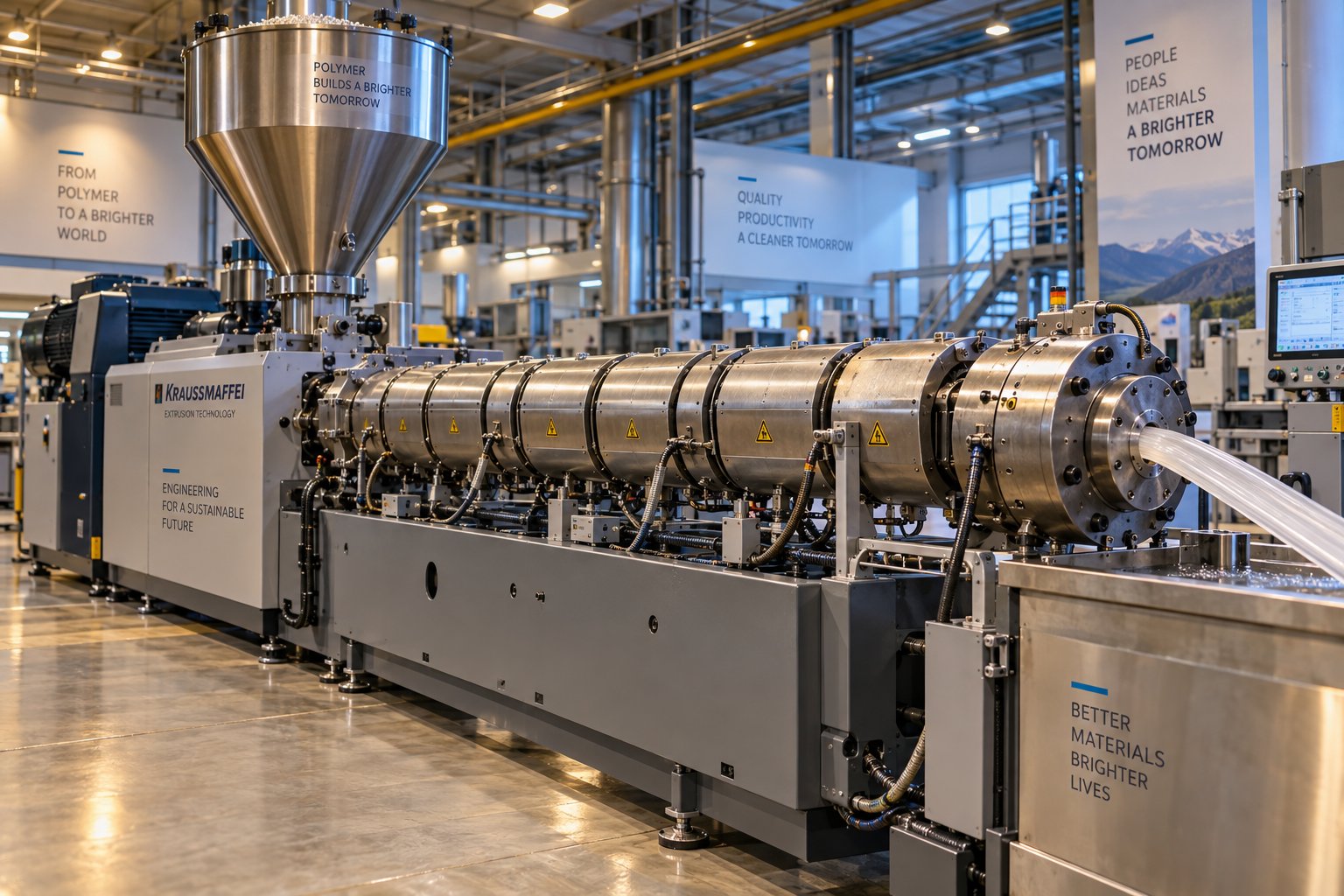
Extruder Machine Decoded: From Raw Pellet To Finished Product
Oct 6, 2026
Learn how an extruder machine works, compare single-screw vs. twin-screw types, and get expert guidance on specs, troubleshooting, and selection.
Read Article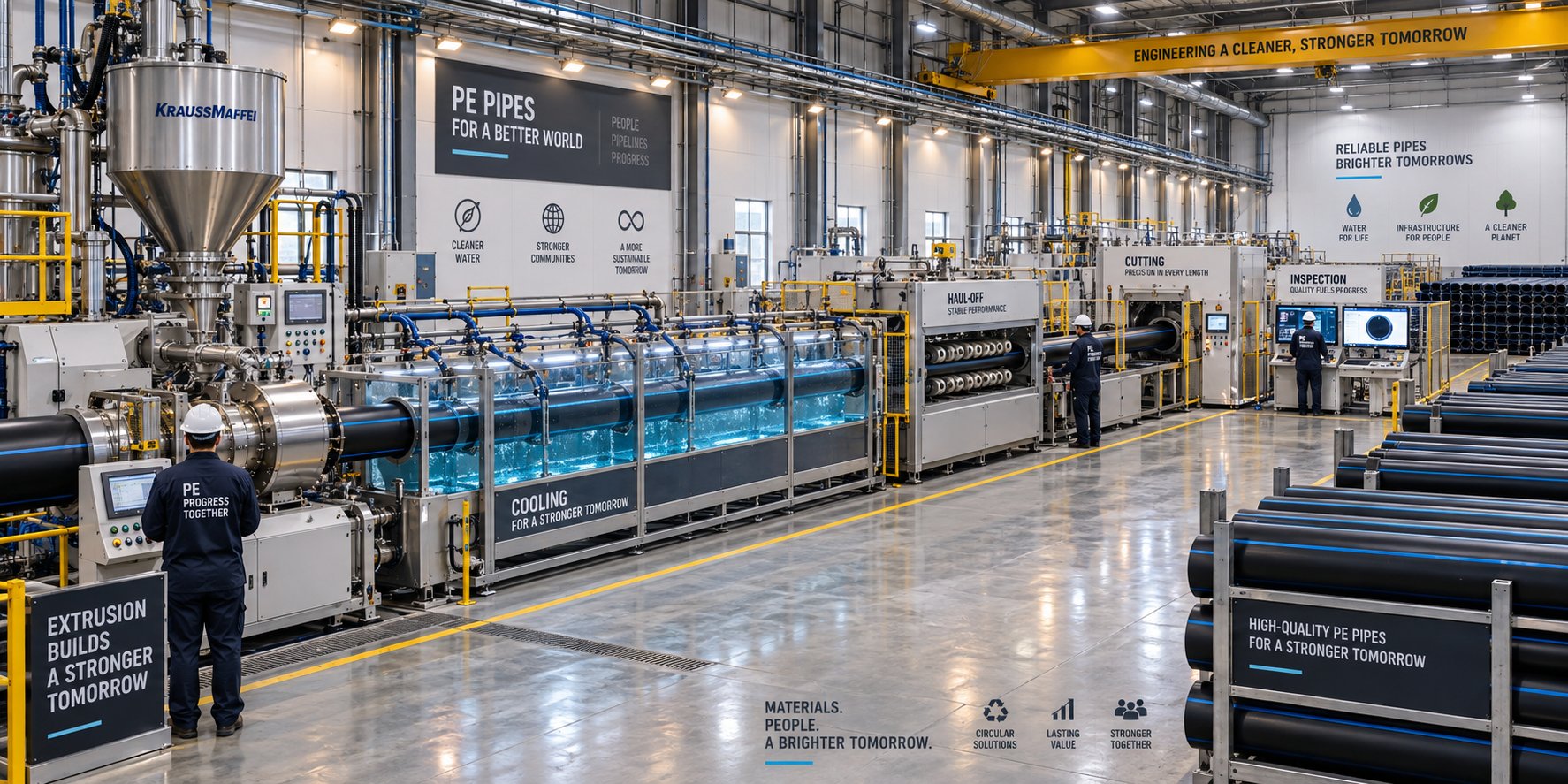
PE Pipe Making Machine Decoded: From Raw Resin to Flawless Pipe
Oct 4, 2026
Learn how a PE pipe making machine works, from resin to finished pipe. Covers components, material grades, automation, troubleshooting, and buyer selection tips.
Read Article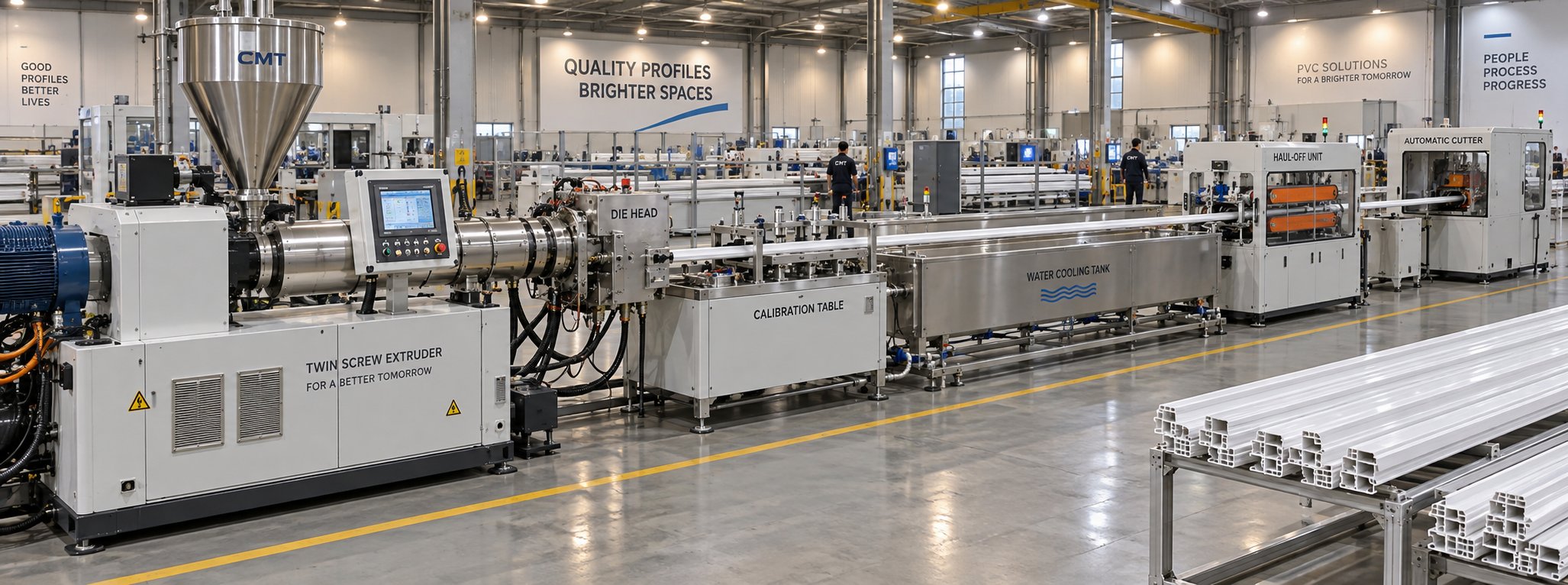
PVC Profile Making Machine Decoded: From Raw Resin To Profit
Oct 3, 2026
Learn how a PVC profile making machine works — extrusion process steps, key technical parameters, die design, calibration methods, maintenance, and total cost of ownership.
Read ArticleLooking for something else?
Search by material, symptom or product and jump straight to the relevant page.
These are navigation suggestions based on keyword matching — not a quotation, not a delivery commitment, and not a substitute for engineering review. Final specification is confirmed by our engineers against your drawings and processed material.
Need help with screw barrel selection?
Share your machine model, processed material and application. Our team can help with pricing and technical support.