

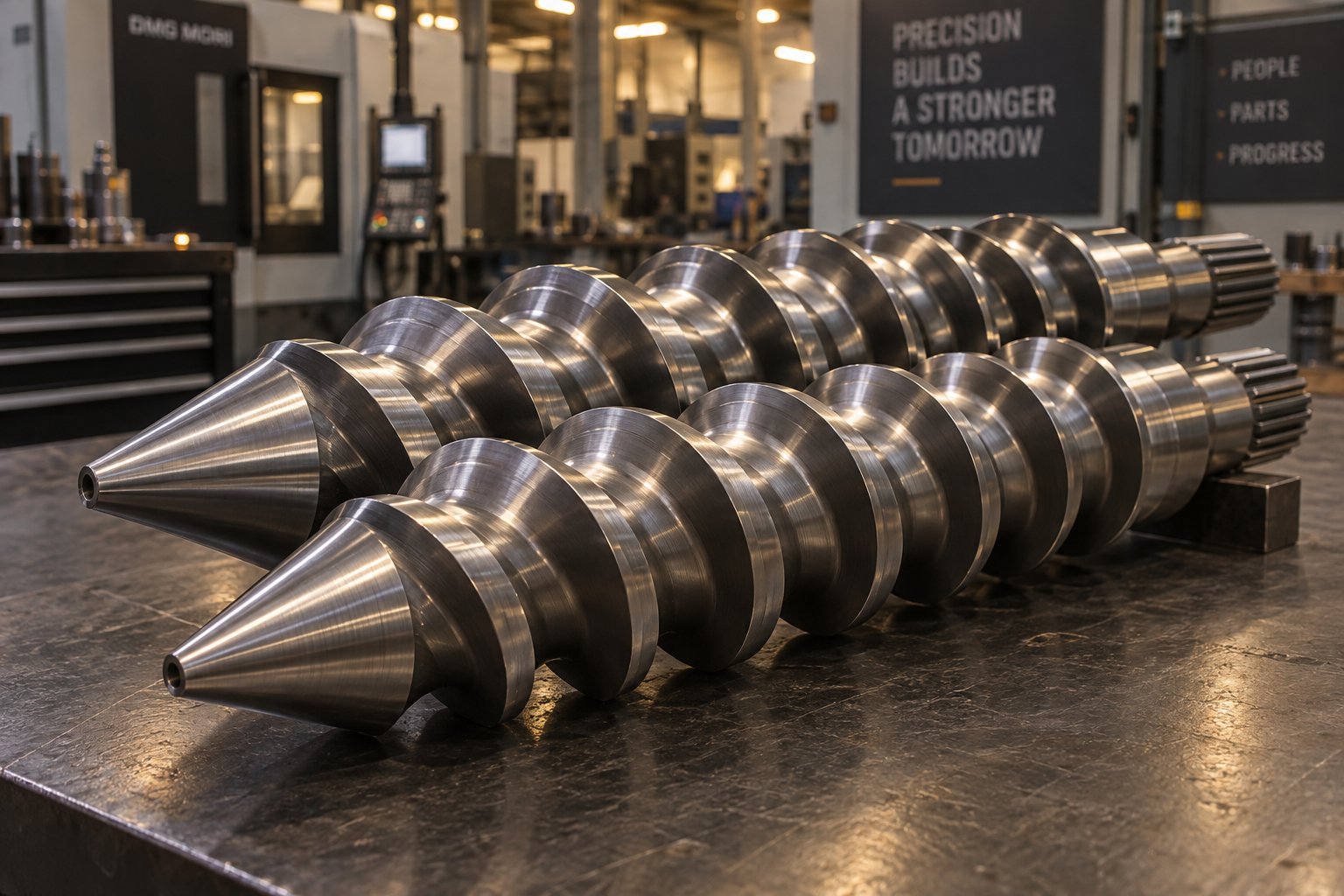
What a Screw Barrel for PVC Profile Actually Does
Imagine a PVC window profile rolling off your extrusion line with wavy surfaces, inconsistent wall thickness, or subtle discoloration. You check the die, the calibrator, even the haul-off speed. Everything looks fine. The real culprit? It is almost always upstream, hidden inside the extruder itself, where the screw barrel quietly shapes every property of the final product.
What Is a Screw Barrel in PVC Profile Extrusion
A screw barrel for PVC profile extrusion is the assembly at the core of every profile extruder. It combines one or more rotating screws inside a heated cylindrical barrel, and together these components perform four critical jobs: conveying raw PVC compound from the hopper, melting it through a blend of conducted heat and frictional energy, mixing it into a homogeneous state, and metering it at stable pressure into the profile die. Think of the extruder screw barrel as both engine and refinery in one unit. Raw powder or pellets enter at one end; a precisely controlled, uniform melt exits the other.
If you have browsed supplier catalogs, you will notice designations like 65/132 or 80/156 attached to conical twin-screw models. These numbers are not arbitrary. They represent the small-end diameter and the large-end diameter of the tapered screws, measured in millimeters. A 65/132 barrel screw set, for example, tapers from 132 mm at the feed opening down to 65 mm at the discharge end. This naming convention gives engineers and purchasing teams an instant reference for the physical scale, output class, and compatibility of the extrusion screw barrel they are evaluating.
Why the Screw Barrel Is the Heart of Profile Quality
Every quality attribute you measure on a finished PVC profile, including melt homogeneity, surface gloss, dimensional accuracy, and wall-thickness consistency, traces back to how well the barrel screws plasticize the compound. A well-designed screw barrel delivers a melt with uniform temperature and viscosity across its entire cross-section. That uniformity is what allows the die to produce sharp corners, smooth surfaces, and repeatable dimensions, run after run.
No downstream equipment, not the calibration table, the haul-off, or the cutter, can compensate for a poorly plasticized melt leaving the extruder. Quality is made or lost inside the screw barrel.
This is precisely why choosing the right screw barrel for PVC profile production is not a purchasing afterthought. It is a technical decision that determines throughput, scrap rates, energy consumption, and ultimately the profitability of the entire line. The sections ahead dig into the engineering details that make that decision an informed one, starting with the material that makes PVC extrusion uniquely demanding.
Why PVC Demands Specialized Screw Barrel Engineering
PVC is not polyethylene. It is not polypropylene. And it certainly does not behave like ABS. Yet many processors treat their extruder screw and barrel selection as though all thermoplastics are interchangeable. That assumption is where output problems, excessive scrap, and premature hardware failures quietly begin. Rigid PVC has a thermal personality all its own, and every element of the screw and barrel must be engineered around it.
The Narrow Processing Window of Rigid PVC
Most commodity plastics give you a comfortable temperature range to work with. Polyethylene, for instance, can tolerate a spread of 60 degrees Celsius or more between its melting point and the onset of degradation. Rigid PVC offers no such luxury. The gap between the temperature needed for complete fusion and the temperature where the polymer begins to break down is remarkably small, often just 10 to 20 degrees Celsius depending on the formulation.
What does that mean in practice? Shear heat must be precisely controlled across every millimeter of screw length. A localized hot spot, whether caused by excessive flight clearance, a worn barrel zone, or an aggressive compression ratio, can push the melt past its thermal limit in seconds. When that happens, PVC does not simply soften or discolor. It releases hydrogen chloride (HCl) gas, a corrosive, toxic byproduct that attacks the barrel bore from the inside, endangers operators breathing nearby air, and leaves brown or black streaks in the extrudate that send finished profiles straight to the scrap bin.
Industry data on rigid PVC rheology highlights another complication. RPVC viscosity at near-zero shear rates can be roughly eight times higher than a comparable polyethylene, which means starting torque demands are enormous. Once the screw reaches processing speeds, viscosity drops to about twice that of PE, but the material remains far more sensitive to any temperature overshoot. This is why most RPVC extruders are geared to much lower maximum screw speeds, often in the range of 25 to 35 feet per minute peripheral speed, trading rotational speed for the torque and gentle shear control that PVC requires.
How PVC Degrades and What That Means for Barrel Design
To understand why extruder screws and barrels for PVC look so different from general-purpose designs, you need a basic picture of what happens when the polymer overheats. PVC's molecular backbone is studded with chlorine atoms bonded to carbon. When thermal or mechanical energy exceeds a critical threshold, those carbon-chlorine bonds begin to break. This triggers a chain reaction called dehydrochlorination, or "chain-stripping," where HCl molecules peel away one after another along the polymer chain.
The consequences cascade quickly. The stripped polymer chains form conjugated double-bond sequences that absorb visible light, producing the yellowing and eventually charring you see in degraded profiles. Meanwhile, the freed HCl gas is intensely corrosive, attacking even hardened steel surfaces inside the barrel bore. Dead spots, areas where material stagnates due to poor flight geometry or worn clearances, become degradation incubators. The longer PVC sits in a low-flow pocket, the more heat it absorbs and the more likely it is to cross that critical temperature threshold.
This degradation mechanism drives every major design decision in a PVC-specific screw and barrel assembly. You cannot simply take a screw designed for polyolefins, drop it into an extruder, and expect acceptable results. The hardware must be purpose-built around PVC's intolerance for thermal abuse. Here are the key design consequences that follow directly from the material's chemistry:
- Controlled shear throughout the screw length — Deep metering sections and low compression ratios reduce average shear rates, keeping frictional heat generation within PVC's narrow safe zone. Counter-rotating twin-screw designs achieve this particularly well because they run partially filled for much of their length, relying more on conducted barrel heat and mechanical conveying than on viscous shear.
- Corrosion-resistant metallurgy — Because even well-controlled PVC processing produces trace amounts of HCl, barrel liners and screw surfaces must resist chemical attack. Nitrided steels offer a baseline level of protection, while bimetallic barrel liners provide significantly longer service life in demanding formulations.
- Optimized compression ratio — Unlike high-compression screws used for polyolefins, PVC screws use a moderate, gradual compression to avoid sudden pressure spikes and localized overheating. The goal is thorough densification without violent shear.
- Elimination of stagnation zones — Every flight transition, mixing element, and channel geometry must be designed to keep material moving. Dead spots are degradation zones. Self-wiping intermeshing screw profiles, smooth channel transitions, and polished flight surfaces all work together to prevent material from lingering in one place long enough to overheat and decompose.
These four principles are not optional enhancements. They are fundamental requirements that separate a properly engineered screw barrel for PVC profile extrusion from a generic design that will quietly destroy both product quality and the hardware itself. The specific screw architecture chosen, whether conical twin, parallel twin, or single screw, determines how effectively each of these principles can be implemented in practice.
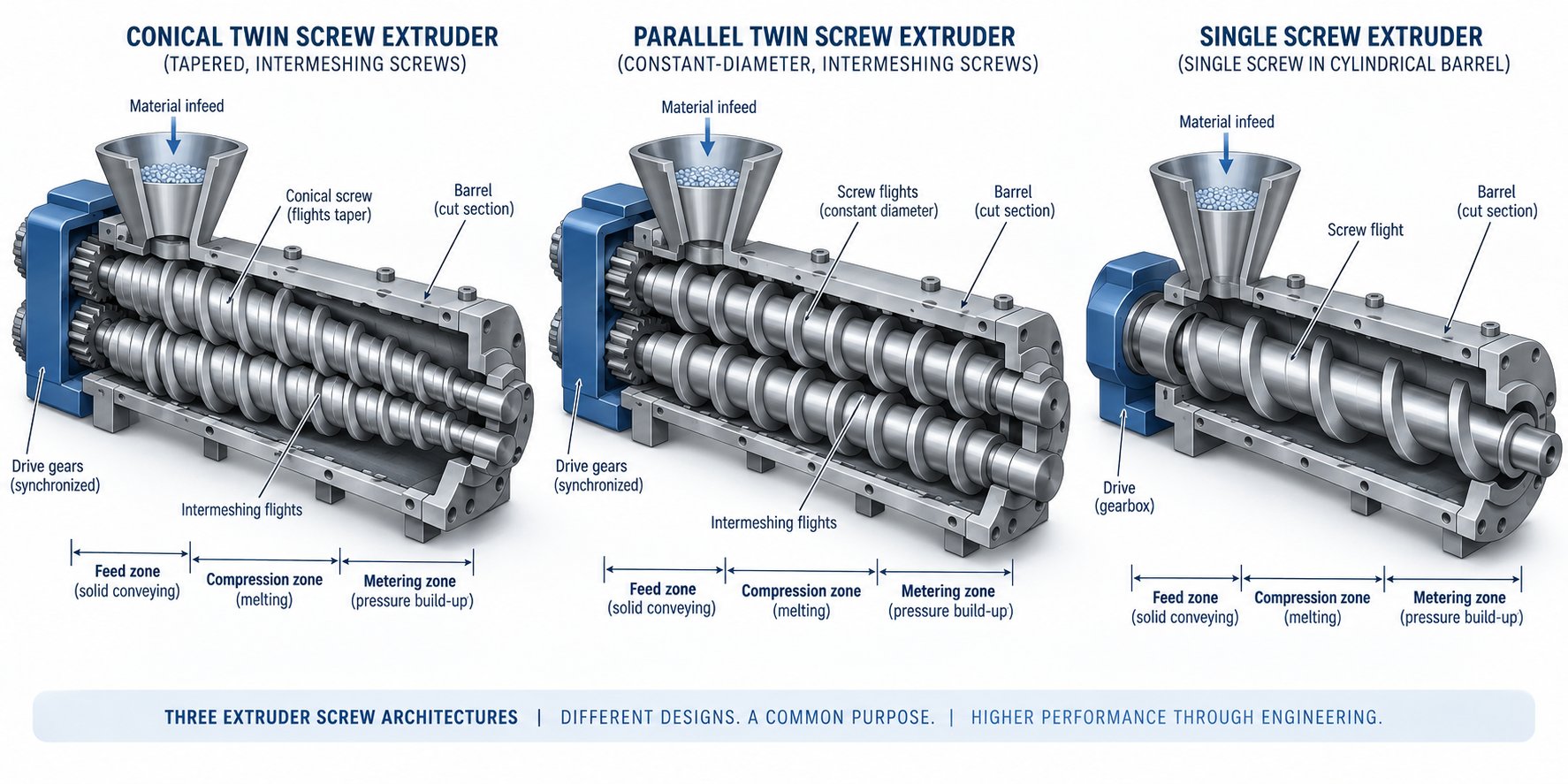
Conical Twin vs Parallel Twin vs Single Screw Configurations
Controlled shear, corrosion-resistant metallurgy, gentle compression, zero stagnation — those four design mandates sound straightforward on paper. But the screw architecture you choose determines how easily each mandate can be met, and how much engineering compromise you are forced to accept along the way. Three architectures dominate PVC profile extrusion, and each delivers a very different balance of capability, cost, and complexity.
Conical Twin Screw Barrels for PVC Profiles
Picture two tapered, intermeshing screws mounted side by side, converging from a large feed diameter down to a smaller discharge diameter. That is the conical twin screw and barrel in a nutshell. The geometry is elegant in its simplicity: the wide feed end provides a generous intake opening perfectly suited to low-bulk-density PVC dry-blend powder, while the natural taper along the screw length creates progressive compression without relying on abrupt changes in flight depth.
Why does this matter for PVC? Several reasons stack up quickly. The large feed throat pulls in powder consistently, reducing the intake instability that plagues smaller openings. As material travels toward the narrower discharge end, it compresses gradually — exactly the kind of gentle densification rigid PVC demands. Shear intensity stays low because the conical geometry distributes energy over a relatively short overall barrel length, typically around 60 to 70 percent the length of an equivalent parallel design. And because the screws intermesh in a counter-rotating arrangement, they produce a self-wiping action that continuously sweeps material from one flight to the next, eliminating the stagnation zones where PVC would otherwise degrade.
These advantages explain why conical twin screw barrels are the default choice for PVC window profiles, door frames, skirting boards, and decorative trim across most of the global market.
Parallel Twin Screw and Single Screw Alternatives
Parallel twin screw barrel designs use two screws of constant diameter running side by side inside a figure-eight bore. They excel in applications requiring intense mixing, high filler dispersion, or very high throughput — think compounding lines or large-diameter pipe extrusion. However, their constant-diameter geometry means compression must be achieved entirely through changes in flight depth and pitch, which can generate more localized shear than PVC tolerates comfortably. They also tend to have a longer footprint and higher capital cost compared to conical alternatives at similar output levels.
Single screw extruders sit at the opposite end of the complexity spectrum. One screw, one cylindrical barrel, lower purchase price, simpler maintenance. They handle pelletized PVC compounds and reprocessed material well enough for straightforward profiles. But single screw designs lack the self-wiping, positive-conveying action of a twin screw and barrel setup. Mixing homogeneity depends heavily on screw design, and feeding PVC powder — rather than pre-compounded pellets — can be inconsistent without specialized grooved feed sections.
Which Architecture Suits Which PVC Profile Application
Choosing between these three configurations is not a matter of personal preference. It comes down to matching the architecture's strengths against your specific profile geometry, formulation type, and output target. The table below maps each architecture against the criteria that matter most in PVC profile production.
| Criteria | Conical Twin Screw | Parallel Twin Screw | Single Screw |
|---|---|---|---|
| Typical PVC Profile Applications | Window frames, door profiles, decorative trim, skirting boards | Large-section profiles, high-output pipe, compounding | Simple profiles, reprocessed PVC, pellet-fed lines |
| Output Range (kg/hr) | 80 – 800+ | 200 – 1,500+ | 30 – 300 |
| Shear Intensity | Low to moderate — ideal for heat-sensitive PVC | Moderate to high — requires careful screw design for rigid PVC | Variable — depends entirely on screw geometry |
| Residence Time | Short and uniform due to positive conveying | Moderate; longer barrel length increases exposure | Longer and less uniform; risk of stagnation in deep channels |
| Machine Footprint | Compact — shorter barrel length for equivalent output | Longer — constant-diameter screws require more length | Moderate — single barrel, moderate length |
| Relative Capital Cost | Moderate | High | Low |
| Powder vs. Pellet Feed | Excellent for PVC powder dry-blend | Good for powder with proper feed system | Best suited for pellets; powder feeding is inconsistent |
You will notice a clear pattern in the table. Conical twin screw barrels dominate the sweet spot where most PVC profile extrusion takes place: moderate to high output, powder-fed formulations, and profiles that demand tight dimensional tolerances with flawless surface finish. The tapered geometry, short residence time, and self-wiping action align almost perfectly with rigid PVC's processing demands.
Parallel designs earn their place when output volumes push beyond what the largest conical sizes can handle, or when the formulation requires aggressive mixing that justifies the higher shear risk. Single screw extruders remain a practical option for simpler applications where pellet feed and lower capital expenditure outweigh the mixing and conveying advantages of twin configurations.
Selecting the right architecture, though, is only the first decision. Within each configuration, the specific screw geometry — flight depth, compression ratio, pitch, and helix angle — determines whether that architecture actually delivers on its theoretical promise or quietly underperforms.
Screw Geometry Parameters That Define Extrusion Performance
Flight depth, compression ratio, pitch, helix angle — these are not isolated dimensions on an engineering drawing. They are interconnected variables that collectively dictate whether a screw and barrel extruder gently plasticizes rigid PVC into a flawless melt or quietly shoves it past its thermal limits. Change one parameter without adjusting the others, and you can turn a well-behaved extrusion line into a source of degraded profiles and unexplained scrap. Here is what each parameter actually controls and why it matters for PVC.
L/D Ratio, Compression Ratio, and Flight Depth Explained
The L/D ratio (length-to-diameter ratio) describes how long the screw's working section is relative to its diameter. A screw barrel extruder with an L/D of 24:1 has a working length twenty-four times its diameter. More length means the material spends more time inside the barrel, giving it additional opportunity to absorb heat, mix thoroughly, and reach a uniform melt state. Common L/D values for single-screw designs range from about 20:1 up to 30:1 or beyond, while conical twin-screw systems achieve equivalent plasticizing performance in a physically shorter barrel because their tapered geometry compresses the melt progressively. The tradeoff is straightforward: a longer L/D improves mixing and melting capacity, but it also increases residence time — a critical concern for heat-sensitive PVC, where every additional second inside the barrel raises degradation risk.
The compression ratio is the volume ratio between the feed zone's first flight channel and the metering zone's last flight channel. In a constant-pitch screw, it simplifies to the ratio of feed-zone channel depth to metering-zone channel depth. Polyethylene screws commonly run compression ratios of 2.5:1 to 3.5:1, but PVC demands a much gentler squeeze. Typical values for rigid PVC fall in the 1.5:1 to 2.5:1 range. Why the restraint? A higher compression ratio forces more mechanical energy into the polymer over a shorter distance, generating the kind of intense, localized shear heat that breaks carbon-chlorine bonds. The result is HCl release, discoloration, and barrel corrosion — all the failure modes discussed earlier.
Flight depth (also called channel depth) is the distance from the screw root to the top of the flight. It changes along the screw's length to serve different functions. Deep flights in the feed zone accommodate low-bulk-density PVC powder. As the channel gradually becomes shallower through the compression zone, material is compacted and begins to melt. In the metering zone, a constant, relatively shallow depth homogenizes the melt and builds stable pressure before the die. If the metering depth is too shallow, excessive shear raises melt temperature beyond PVC's safe window. If it is too deep, pressure generation suffers and the melt arrives at the die unevenly, producing wall-thickness variations in the finished profile.
Pitch, Helix Angle, and Flight Width in PVC Applications
Pitch is the axial distance between corresponding points on adjacent flights — essentially, how far forward material advances with each screw revolution. Many screws are designed with square pitch, meaning the pitch equals the screw diameter, which makes it easy to estimate L/D simply by counting the number of turns. A larger pitch moves material faster, boosting throughput but reducing the time available for heat absorption and mixing. A smaller pitch slows conveyance, increasing shear exposure — a dangerous trade for PVC unless counterbalanced by other geometry adjustments.
The helix angle is closely related to pitch. It describes the angle of the flight spiral relative to a plane perpendicular to the screw axis. A steeper helix angle (larger pitch) favors forward conveyance; a shallower angle increases the cross-channel flow component, improving distributive mixing. For PVC profile extrusion, the helix angle must balance adequate forward movement with enough mixing action to homogenize stabilizers, lubricants, and fillers without generating excessive shear energy.
Flight width (sometimes called land width) is the thickness of the flight at its outermost edge — the surface that rides closest to the barrel wall. As a general guideline, flight width runs around 10% of barrel diameter. Wider flights create more shear in the thin clearance gap between flight tip and barrel bore, increasing heat generation. Narrower flights reduce that shear but allow more material to leak backward over the flight, cutting pumping efficiency. For PVC, getting this balance wrong means either overheating the melt or losing the pressure stability the die needs to produce consistent profiles.
The table below brings all six parameters together, showing how each one functions, what PVC-specific design thinking looks like, and what goes wrong when a barrel screw extruder is specified without proper attention to the material's thermal sensitivity.
| Geometric Parameter | Definition | PVC-Specific Design Consideration | Consequence of Incorrect Specification |
|---|---|---|---|
| L/D Ratio | Ratio of screw working length to its diameter | Moderate values preferred; conical twins achieve effective plasticizing in shorter physical length | Too high: extended residence time causes thermal degradation. Too low: incomplete melting and poor mixing. |
| Compression Ratio | Volume ratio of the feed-zone channel to the metering-zone channel | Kept low (1.5:1 to 2.5:1) to limit shear-induced heat buildup | Too high: localized overheating triggers HCl release and discoloration. Too low: poor densification and incomplete fusion. |
| Flight Depth | Distance from screw root to flight tip; varies along screw length | Deep in the feed zone for powder intake; gradual reduction through compression; constant in metering | Too shallow in feed: restricted throughput. Too deep in metering: weak pressure, uneven wall thickness. Too shallow in metering: excessive melt temperature. |
| Pitch | Axial distance between adjacent flights | Often square pitch; may be reduced in metering zone to improve pressure stability | Too large: insufficient residence time, poor melt homogeneity. Too small: excessive shear exposure for heat-sensitive PVC. |
| Helix Angle | Angle of the flight spiral relative to a plane perpendicular to the screw axis | Balanced to allow adequate mixing of stabilizers and fillers without excessive cross-channel shear | Too steep: material rushes through with poor mixing. Too shallow: increased shear heat and risk of degradation. |
| Flight Width | Thickness of the flight at its outermost tip (land width) | Approximately 10% of barrel diameter; avoids excessive clearance shear while maintaining pumping efficiency | Too wide: generates excessive heat in the flight-to-barrel gap. Too narrow: increased back-leakage reduces output and pressure stability. |
Notice the recurring theme: every parameter circles back to the same constraint — controlling heat. In a polyolefin barrel screw extruder, you can often compensate for an aggressive geometry by adjusting barrel zone temperatures or increasing cooling. PVC offers no such margin. The geometry itself must be inherently gentle, because once shear-generated heat pushes the compound past its degradation threshold, no amount of barrel cooling can pull it back.
That is exactly why these six parameters cannot be tuned in isolation. Increasing compression ratio to improve densification, for instance, only works if flight depth transitions are gradual enough and pitch is long enough to prevent shear spikes at the compression zone entry. Widening the flight to improve pumping demands a corresponding adjustment in screw speed to avoid overheating the clearance layer. In a well-designed screw barrel for PVC profile extrusion, every dimension reflects a deliberate, system-level compromise — not a collection of independently optimized numbers.
These geometric relationships become even more tangible when you trace how each parameter plays out across the three functional zones of the screw: feed, compression, and metering. Each zone imposes its own demands on flight depth, channel volume, and surface interaction with the PVC compound.
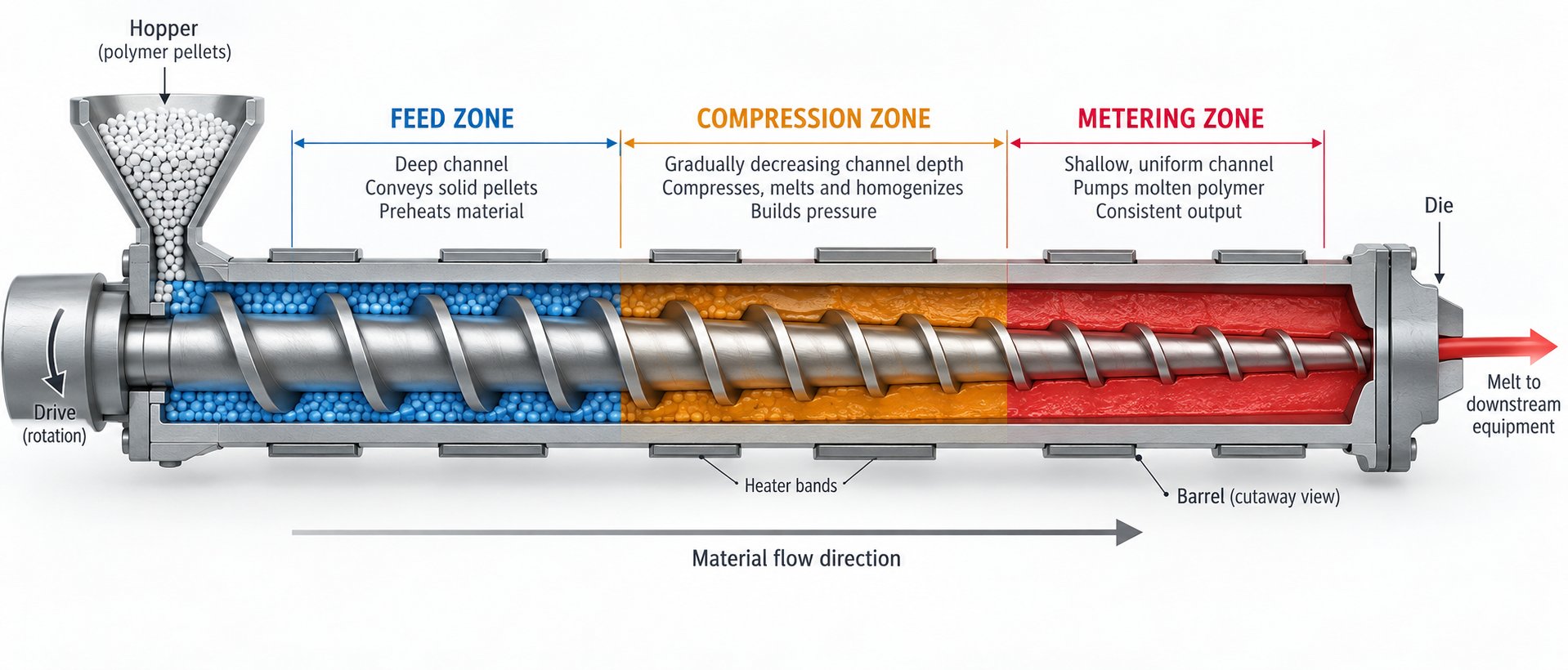
The Three Functional Zones of a PVC Profile Screw Barrel
Flight depth, compression ratio, pitch — those geometric parameters only mean something when you see how they behave inside each zone of the screw. A barrel and screw assembly is not a single uniform device. It is three distinct machines joined end to end, each with its own job, its own design constraints, and its own failure modes when the geometry is wrong. For PVC profile extrusion, the penalty for getting any zone wrong is not just reduced throughput. It is degraded compound, corroded hardware, and scrap profiles that no amount of downstream adjustment can save.
Feed Zone Design for PVC Powder Intake
The feed zone is where everything starts — and where many output problems quietly originate. Its job is deceptively simple: grab PVC dry-blend powder from the hopper and convey it forward into the compression zone at a consistent, predictable rate. The challenge is that PVC powder has very low bulk density compared to pre-compounded pellets. Those fluffy, irregular particles contain a lot of trapped air, and they do not flow like ball bearings. They bridge, they clump, and they resist being pulled into a rotating screw channel unless the geometry actively helps them along.
This is why the feed zone uses the deepest flights anywhere on the screw. Deep channels provide enough volume to capture a useful mass of powder per revolution despite the material's low packing density. If you have ever wondered why conical twin screws start at a much larger diameter — 132 mm or 156 mm at the feed end — this is a big part of the answer. That larger diameter creates wider, deeper channels precisely where the powder needs the most room.
Some barrel designs go further by incorporating a groove feed screw barrel configuration, where the barrel bore in the feed section features machined axial or helical grooves. These grooves increase friction between the powder and the barrel wall, preventing the material from simply spinning with the screw without advancing. As extrusion engineering references note, grooved feed sections improve intake of difficult-to-feed polymers significantly, though they also demand a screw with a shallower feed section and deeper metering — a geometry tradeoff that must be handled carefully with rigid PVC to avoid excessive shear downstream.
Feed strategy matters here too. In a flood-fed system, gravity fills the screw channels as fast as they present themselves beneath the hopper opening. In a starve-fed approach, a metering device upstream controls the feed rate independently of screw speed. Flood feeding is standard for most PVC profile lines using conical twin screws, because the intermeshing, counter-rotating design provides positive conveying that naturally meters material forward. Starve feeding sees more use in parallel twin screw systems or specialty applications where precise residence time control is critical.
Compression and Transition Zone for Controlled Melting
Once the powder has been captured and conveyed forward, it enters the compression zone — the section where loose particles must be transformed into a dense, partially fused mass. The mechanism is straightforward in concept: channel depth gradually decreases, squeezing the material into a smaller cross-sectional area. This compaction drives out trapped air, forces particles into intimate contact, and begins generating the frictional and shear energy that, combined with conducted heat from the barrel wall, initiates the melting process.
For PVC, the word "gradually" is not a suggestion. It is an engineering mandate. An abrupt reduction in channel depth — the kind of aggressive compression taper that works perfectly well for polyethylene or polypropylene — creates a sudden spike in local shear rate. Imagine squeezing toothpaste through a tube that narrows by half over just a few centimeters versus one that tapers gently over its full length. The abrupt restriction generates intense localized pressure and heat. In polyethylene, that extra energy simply accelerates melting. In PVC, it triggers dehydrochlorination, the chain-stripping degradation that releases corrosive HCl gas and discolors the extrudate.
A properly designed compression zone for PVC profile extrusion spreads the volume reduction across a longer section of the screw, allowing energy input to build incrementally. The taper rate — how quickly channel depth decreases per unit of screw length — must match the formulation's thermal sensitivity. Heavily stabilized compounds can tolerate a slightly steeper taper; lightly stabilized or high-filler formulations need an even more gradual transition. This is one reason why barrel types in twin screw extruder designs vary so widely. Different conical twin models may have the same feed and discharge diameters yet use meaningfully different compression profiles tuned to specific PVC formulation families.
Metering Zone for Uniform Melt Delivery
By the time material reaches the metering zone, it should be fully fused — a homogeneous, bubble-free melt with consistent temperature throughout its cross-section. The metering zone's job is to maintain that state while building the stable, uniform pressure needed to push the melt through the profile die at a constant rate. It accomplishes this with a constant channel depth, shallower than the feed zone but deep enough to avoid the punishing shear that would push melt temperature beyond PVC's safe processing window.
Think of the metering zone as the quality-assurance checkpoint inside the barrel and screw. Temperature variations that slipped through the compression zone get blended out here as material undergoes additional mixing in the constant-depth channel. Pressure fluctuations are dampened, giving the die a steady, predictable flow. When this zone is properly designed, you get dimensional stability, consistent wall thickness, and the kind of smooth surface finish that PVC window and door profiles demand.
When it is not? The consequences show up immediately on the finished profile — and sometimes inside the barrel itself. Zone-level design errors compound each other. A feed zone that underperforms starves the compression zone of material, which then overworks whatever compound it does receive. A compression zone that is too aggressive sends overheated, partially degraded melt into a metering zone that cannot fix what has already been damaged. Here are the most common problems that trace directly back to zone design mistakes:
- Feed bridging — PVC powder clumps and arches above the screw flights, creating intermittent starvation. This typically results from insufficient flight depth, poor barrel wall friction, or a feed throat geometry that does not match the powder's flow characteristics.
- Incomplete fusion — The extrudate contains unmelted or poorly fused particles, visible as rough texture, whitish specks, or mechanical weakness. This occurs when the compression zone is too short, the compression ratio is too low, or barrel heating is inadequate relative to throughput.
- Melt fracture — The profile surface develops sharkskin texture, waviness, or periodic ridges. While die design plays a role, the root cause is often an unstable melt leaving the metering zone with inconsistent viscosity or pressure pulsations caused by improper channel depth.
- Uneven wall thickness — Profile cross-sections show thicker and thinner regions that shift over time. This points to pressure instability in the metering zone, frequently caused by excessive wear that has increased the clearance between screw flights and barrel bore well beyond original tolerances.
Each of these failures costs real money — in scrap, in downtime, in energy wasted processing material that never becomes a sellable product. And each one is preventable through proper zone-by-zone design that respects PVC's narrow processing demands. The materials chosen for the barrel liner and screw surface determine how long that carefully designed geometry holds its tolerances before wear starts quietly eroding performance.
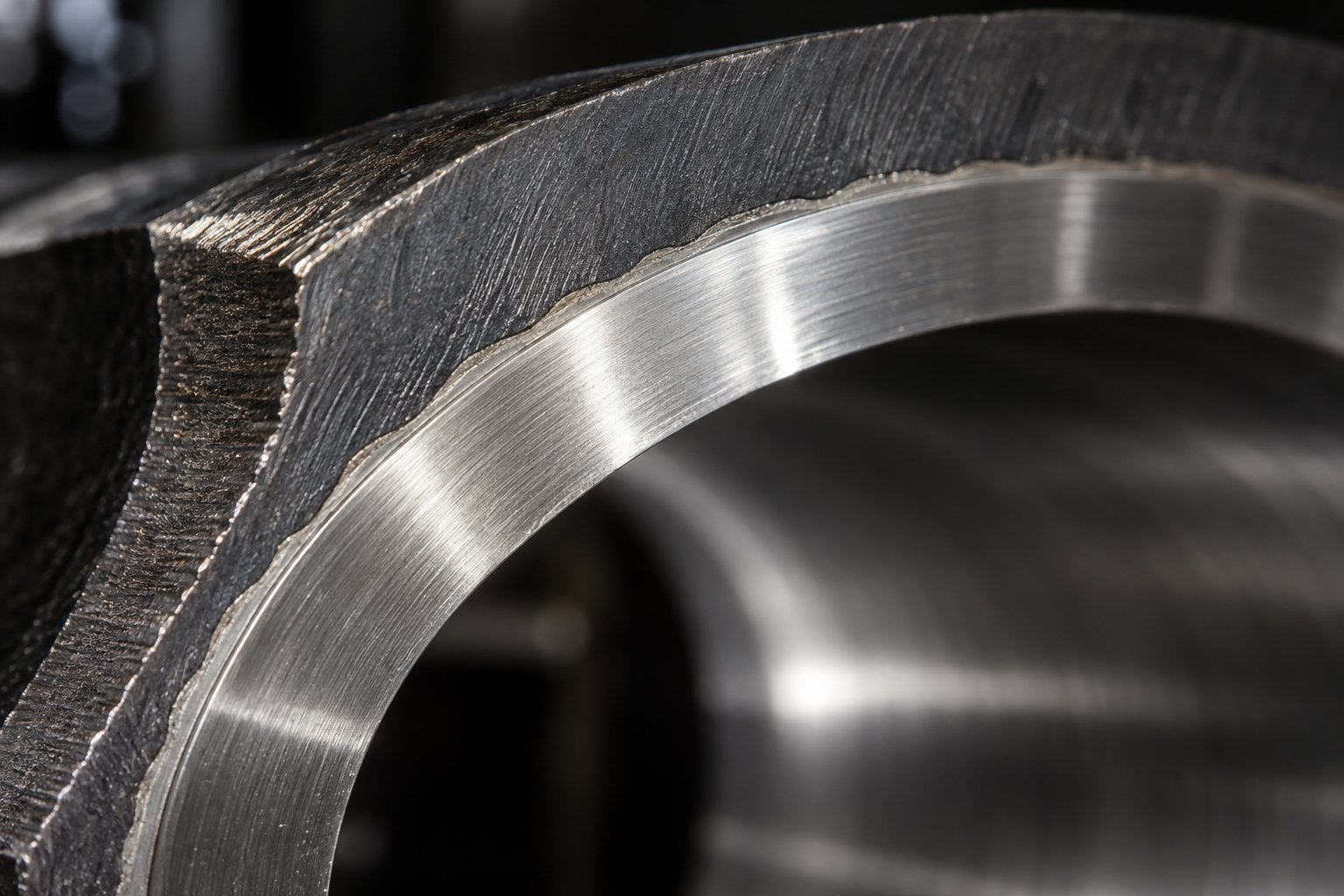
Materials and Surface Treatments That Determine Barrel Lifespan
A perfectly designed screw geometry is only as durable as the metal it is machined from. You could specify the ideal compression ratio, the gentlest taper, and flawless flight depths — and still watch performance degrade within months if the barrel and screw materials cannot withstand the chemical and abrasive assault that PVC compounds deliver shift after shift. The metallurgy inside your screw barrel for PVC profile extrusion is not a line item to cut costs on. It is the factor that determines whether your carefully engineered geometry holds its tolerances for years or quietly drifts out of spec in a single production season.
Base Steel Alloys and Nitriding for PVC Screw Barrels
The foundation of most extruder screw barrels starts with the base steel. For PVC processing, one alloy dominates the global supply chain: 38CrMoAlA, a chromium-molybdenum-aluminum nitriding steel widely used by manufacturers across China and Asia. Its European equivalent is designated 1.8550 (34CrAlNi7-10), and it serves a similar role in barrels produced for Western OEMs. What makes these steels special is not their raw hardness — it is their ability to accept a deep, uniform nitrided layer during post-machining heat treatment while retaining excellent core toughness.
The process itself is straightforward in principle. After the barrel bore is precision-machined and the screw flights are ground to final dimensions, the components are placed in a sealed furnace and exposed to a nitrogen-rich atmosphere at elevated temperature for an extended soak period. Nitrogen atoms diffuse into the steel surface, forming hard iron-nitride compounds that create a wear-resistant case typically 0.5 to 0.8 mm deep. The resulting surface hardness reaches approximately HV 900 to 1,100 — equivalent to roughly HRC 60 to 65 — while the core remains ductile enough to absorb operational stresses without cracking.
For unfilled or lightly filled PVC dry-blend formulations, a properly nitrided barrel and screw can deliver a perfectly adequate service life. The hard surface resists the moderate abrasion of PVC powder particles and provides a reasonable barrier against the trace HCl that even well-stabilized compounds produce. Many standard PVC profile lines running clean formulations with minimal calcium carbonate filler operate for years on nitrided components before wear reaches a point that affects output or quality.
So when does nitriding stop being enough? The answer lives inside your PVC formulation — specifically, in the mineral filler content.
Bimetallic Liners and When They Become Essential
Imagine running sandpaper against a hardened steel plate. The plate resists at first, but over thousands of passes, the grit wins. That is essentially what happens when calcium carbonate particles — angular, abrasive mineral grains — circulate through a nitrided barrel bore under pressure, at temperature, revolution after revolution. The nitrided case, hard as it is, measures less than a millimeter thick. Once that layer wears through, you are down to the softer base steel, and wear accelerates dramatically.
This is where the bimetallic screw barrel enters the conversation. A bimetallic barrel uses a centrifugally cast inner liner of a harder, more corrosion-resistant alloy — typically a nickel-based, iron-based, or carbide-enriched composition — metallurgically bonded to the tougher structural steel body. The liner thickness generally falls in the 1 to 2 mm range, but the critical difference is not just thickness. It is the nature of the material itself. These alloys are engineered specifically to resist both abrasive wear from mineral fillers and chemical attack from HCl gas — the two primary enemies of barrel longevity in PVC extrusion.
The performance difference is not subtle. Industry testing and field data consistently show that a well-selected bimetallic screw barrel material delivers three to seven times the abrasion resistance of a standard nitrided barrel, depending on the specific alloy grade chosen. In practical terms, that means a barrel that might last 18 months on a high-CaCO3 formulation in nitrided construction could potentially run four to six years in bimetallic form — with tighter bore tolerances maintained throughout, which directly translates to more consistent plasticizing performance and lower scrap rates.
The economics shift decisively as filler content rises. At low CaCO3 levels — say, under 5 to 10 parts per hundred resin — the abrasive load is modest, and nitrided components often deliver a cost-effective service life. But PVC profile formulations commonly incorporate 15, 20, even 40 or more parts of calcium carbonate to reduce raw material cost and improve stiffness. At these loading levels, every additional percentage point of filler chips away at barrel geometry faster, widening the clearance between screw flights and bore wall, increasing melt back-leakage, and gradually strangling output. A bimetallic screw barrel manufacturer worth working with will match the liner alloy to your specific filler type and loading — because not all calcium carbonates are equally abrasive, and not all liner alloys provide the same balance of wear and corrosion resistance.
The table below puts the two construction types side by side, so you can see where each fits and where each falls short.
| Criteria | Nitrided-Only Construction | Bimetallic Construction |
|---|---|---|
| Initial Cost | Lower — typically 30 to 50% less than bimetallic | Higher upfront investment |
| Wear Life (unfilled/lightly filled PVC) | Good — adequate for clean, low-filler formulations | Excellent — but cost premium may not be justified at low filler levels |
| Wear Life (medium to high CaCO3 loading) | Significantly reduced — nitrided layer wears through relatively quickly | 3 to 7 times longer than nitrided, depending on alloy selection |
| Corrosion Resistance (HCl exposure) | Moderate — nitrided layer offers some chemical barrier | Superior — nickel-based and chromium-enriched alloys resist HCl attack |
| Repairability | Limited — once nitrided case is worn, re-nitriding restores only partial depth; base steel may already be damaged | Better — some liner systems allow re-boring and re-lining; worn screws can be hard-faced and reground |
| Recommended PVC Formulation Type | Virgin or near-virgin PVC with minimal mineral filler; clean regrind | CaCO3-filled profiles, recycled PVC with contaminants, high-output lines where sustained dimensional stability justifies the investment |
| Dimensional Stability Over Time | Bore enlargement accelerates once the thin nitrided case wears through | Liner maintains tighter bore tolerances far longer, preserving plasticizing efficiency |
Notice the pattern: the decision is not about which construction is "better" in absolute terms. A nitrided barrel running unfilled PVC compound on a moderate-output line is not a compromise — it is a sensible, cost-effective match. But the moment your formulation starts leaning on mineral fillers for cost savings or stiffness enhancement, the economics flip. The higher upfront cost of bimetallic construction gets repaid through longer service intervals, tighter quality tolerances, and fewer unplanned shutdowns to swap worn barrels.
What the table cannot show, though, is how dramatically the rest of your PVC formulation — stabilizer chemistry, lubricant balance, impact modifier content — shifts the demands placed on both the screw geometry and the materials it is made from. The barrel sees every ingredient you put into the hopper, and each one leaves its mark in a different way.
How PVC Formulation Variables Shape Screw Barrel Design
Every ingredient in your PVC dry blend — from the resin itself to the last fraction of a percent of external lubricant — interacts with the screw barrel in a distinct, measurable way. Two processors running identical extruder hardware on different formulations can see wildly different wear rates, melt quality, and output stability. The formulation is not just a chemistry problem. It is a hardware specification problem, and ignoring that link is one of the fastest ways to quietly kill output on an otherwise capable line.
How CaCO3 Filler Loading Changes Screw Barrel Requirements
Calcium carbonate is the workhorse filler in PVC profile extrusion. It reduces raw material cost, improves stiffness, and helps control shrinkage — all valuable benefits. But every particle of CaCO3 you add to the formulation is an abrasive mineral grain that circulates through the screw and barrel under heat and pressure, grinding against flight tips and bore surfaces with every revolution.
The mechanical consequences escalate faster than most processors expect. At modest filler levels — under 10 parts per hundred resin — the abrasive load is manageable, and a nitrided barrel holds up reasonably well. Push filler content into the 20 to 40 phr range commonly used in cost-driven profile production, and you are running something closer to a mineral processing operation than a simple plastic extrusion. Wear rates on nitrided surfaces can increase several-fold, and the clearance between screw flights and barrel bore widens measurably within months rather than years.
High CaCO3 loading also changes the melt's behavior. The compound becomes stiffer and more viscous, demanding higher compression ratios to achieve adequate densification. Flight geometry may need modification — wider channels to accommodate the denser, less compressible mixture, and more gradual compression tapers to prevent the kind of localized pressure spikes that overheat rigid PVC. As one industry reference puts it, the goal in high-filler screw design is consistent pressure build-up, not maximum melting speed. Standard catalog screws designed for clean, lightly filled PVC simply cannot deliver that balance without modification. This is precisely where a custom screw and barrel, engineered around a specific filler type and loading level, pays for itself in extended service life and stable output.
Stabilizers, Lubricants, and Impact Modifiers in the Design Equation
Filler content gets the most attention, but stabilizer chemistry quietly shapes the processing environment inside the barrel in ways that directly affect hardware selection and screw surface specification.
Consider the global shift in stabilizer systems. In Europe, lead-based stabilizers have been phased out under REACH regulations, replaced predominantly by calcium-zinc (Ca-Zn) systems. North America is transitioning away from tin-based stabilizers toward the same mixed-metal alternatives. Asia is following a similar trajectory, moving from lead toward Ca-Zn and other non-toxic options. Each stabilizer family creates a different thermal and chemical environment inside the barrel:
- Lead-based stabilizers — Historically common and thermally robust, but increasingly restricted globally. They offer wide processing windows and minimal corrosion risk to barrel surfaces, which is why older screw designs paired with lead-stabilized formulations often lasted for years. Processors still running these systems may not yet feel the hardware pressure that a stabilizer change will introduce.
- Tin-based stabilizers — The traditional standard in North America. They provide excellent thermal stability and transparency but are used at lower loading levels than mixed-metal alternatives. The concern is supply volatility, environmental risk, and a narrower margin for dosing error.
- Calcium-zinc (Ca-Zn) stabilizers — The rising global standard. Non-toxic, compliant with RoHS and REACH, and available with self-lubricating properties that change the friction dynamics inside the barrel. However, Ca-Zn systems require 1.5 to 3.0 phr loading compared to lower loadings for tin, and they introduce the risk of zinc burning — a phenomenon where zinc soaps react with HCl to form zinc chloride, a Lewis acid that can cause rapid, catastrophic degradation if concentrations build up in stagnation zones.
What does this mean for your screw barrel? A processor switching from tin to Ca-Zn is not just changing a chemical additive. They are changing the corrosion profile inside the barrel, the lubrication dynamics along every flight surface, and potentially the processing temperature window. Screw surfaces that performed well under tin stabilization may develop different wear patterns under Ca-Zn chemistry, and dead spots that were tolerable before become degradation risks when zinc burning enters the equation.
Lubricant balance adds another layer of complexity. PVC formulations rely on a careful blend of internal lubricants (which reduce melt viscosity and inter-particle friction) and external lubricants (which create a slip layer between the melt and the barrel wall). When the balance tips too far toward external lubrication, the compound slides along the barrel surface without absorbing enough conducted heat, resulting in incomplete fusion. Too much internal lubrication reduces viscosity excessively, weakening the pressure needed for consistent die filling. The ideal screw surface finish — how smooth or slightly textured the flight surfaces are — depends directly on this lubricant balance. A highly polished screw may encourage too much slip in externally lubricated formulations, while a rougher finish may generate excessive shear in internally lubricated ones.
Impact modifiers such as CPE (chlorinated polyethylene) or acrylic modifiers round out the formulation picture. They improve the toughness and weather resistance of finished profiles, but they also change the melt's elastic behavior. Higher impact modifier content increases melt elasticity, which demands more distributive mixing to achieve uniform dispersion. If the screw's mixing capability is insufficient — too few mixing elements, or flight geometry that favors conveying over blending — you end up with localized concentrations of modifier that create visible surface defects and inconsistent mechanical properties in the finished profile.
Matching Hardware to Regional Formulation Differences
Here is a reality that any experienced screw barrel manufacturer will confirm: the "standard" PVC profile formulation does not exist. A window profile compounder in Germany running Ca-Zn stabilizers, coated CaCO3, and acrylic impact modifiers is processing a fundamentally different material than a manufacturer in India using lead-based stabilizers, uncoated filler at high loading, and CPE modifiers. A plant in the United States transitioning from tin to mixed-metal stabilization is navigating yet another chemical landscape entirely.
These regional differences arise from a tangle of factors — raw material availability, regulatory environments, cost pressures, and processing traditions built up over decades. The practical consequence is that a screw barrel designed and optimized for one region's dominant formulation can underperform when dropped into a line running a different chemical recipe. This is true even when the barrel size, output target, and profile geometry are identical.
The following list maps the key formulation variables to their direct hardware implications, giving you a practical checklist for evaluating whether your current screw barrel truly matches what you are feeding it:
- Filler type and loading (CaCO3, TiO2, other minerals) — Determines abrasive wear rate, required barrel liner hardness, and whether bimetallic construction is justified. Higher loading demands harder liners and may require adjusted compression ratios and flight geometry. Any reputable bimetallic screw barrel manufacturer in India, China, or Europe will ask about filler content before recommending a liner alloy.
- Stabilizer system (lead, tin, Ca-Zn, Ba-Zn) — Influences corrosion exposure, processing temperature range, and stagnation sensitivity. Ca-Zn systems in particular require screw designs with minimal dead spots to prevent zinc burning.
- Internal vs. external lubricant ratio — Affects barrel-wall friction, conducted heat transfer, and the ideal screw surface finish. A lubricant rebalance during a stabilizer transition may require corresponding hardware adjustments.
- Impact modifier type and loading (CPE, acrylic, MBS) — Changes melt elasticity and mixing demand. Higher modifier content favors screws with enhanced distributive mixing capability.
- Resin K-value — Lower K-values (57-60) produce lower-viscosity melts suited for thin-wall profiles; higher K-values (65-70) increase melt strength for structural applications but raise torque and shear demands on the screw.
- Regrind or recycled content — Introduces variability in melt behavior, potential contaminants, and inconsistent bulk density. Screws processing high regrind percentages need robust feeding geometry and enhanced mixing sections.
The message is clear: your screw barrel does not exist in isolation from your formulation. Every ingredient choice you make — or that your regional supply chain imposes — shifts the demands on compression ratio, metallurgy, surface treatment, and mixing geometry. A one-size-fits-all approach may produce acceptable profiles for a while, but it leaves performance on the table and often accelerates wear in ways that only become obvious after thousands of production hours. Matching hardware to your actual formulation, not a generic one, is the difference between a line that runs and a line that runs well.
The logical next question, of course, is which barrel size delivers the right output for your specific profile and formulation — a decision that depends on matching physical screw dimensions to both production targets and profile complexity.
Sizing Guide for Matching Screw Barrels to PVC Profile Lines
You have selected the right architecture, dialed in the geometry, chosen the metallurgy that matches your formulation — but none of that matters if you bolt a barrel onto your extruder that is fundamentally the wrong size for the profiles you need to produce. Barrel sizing is where engineering theory meets production reality, and surprisingly few processors approach this decision with the data it deserves. A conical screw barrel that is too small starves your line of output capacity. One that is too large wastes energy, extends residence time beyond what rigid PVC tolerates, and ties up capital in capability you will never use.
Understanding Size Designations for Conical Twin Screw Barrels
If you have ever browsed a supplier catalog for conical twin screw barrels, you have seen the number pairs: 51/105, 55/110, 65/132, 80/156, 92/188. These designations follow a simple convention. The first number is the small-end screw diameter in millimeters — the discharge side where homogenized melt exits toward the die. The second number is the large-end diameter — the feed side where PVC powder enters the barrel. A 65/132 unit, for example, starts at 132 mm at the intake and tapers down to 65 mm at the output.
Why does this taper matter for sizing? Because the feed-end diameter dictates how much powder the barrel can swallow per revolution, while the discharge-end diameter controls final melt pressure and shear intensity. Smaller designations like the 51/105 or 55/110 are compact units designed for specialty profiles, trim pieces, or lower-volume production runs where flexibility matters more than raw throughput. Mid-range sizes — the 65/132 is arguably the global workhorse — handle the bulk of standard window profile, door frame, and skirting board production. Larger units such as the 80/156 and 92/188 are built for high-volume lines extruding wide multi-cavity profiles or thick structural sections where output demands push past 400 kg/hr.
The 80/156 conical twin screw barrel, for instance, is specifically engineered to balance production efficiency with energy consumption for medium-to-high-scale PVC pipe and profile operations. It provides enough feed-throat volume to handle heavily filled powder blends while maintaining the gentle compression gradient that rigid PVC demands.
Matching Barrel Size to Profile Complexity and Output Targets
Picking a barrel size is not just about choosing the biggest unit your budget allows. Three variables interact to determine the right fit: the cross-sectional complexity of the profile, the wall thickness specification, and your target output rate in kilograms per hour.
Complex profiles — think multi-chamber window systems with thin internal walls, co-extruded sealing channels, and tight corner radii — require extremely uniform melt pressure and temperature. A barrel that is oversized for the die's flow demand forces the screws to run at very low speed, extending residence time and increasing degradation risk. Conversely, a barrel that is too small forces high screw speeds, generating excessive shear and struggling to maintain consistent die pressure across intricate flow channels.
Wall thickness plays a parallel role. Thicker-walled structural profiles consume more material per meter of output, demanding higher volumetric throughput. Thin-wall decorative profiles need less material but tighter melt homogeneity, shifting the priority from raw output to plasticizing quality.
The table below maps common conical twin screw barrel sizes to their practical operating envelopes, giving you a starting framework for matching hardware to production requirements.
| Barrel Size (mm) | Typical Output Range (kg/hr) | Suited Profile Types | Motor Power Class (kW) |
|---|---|---|---|
| 51/105 | 30 – 80 | Small decorative trim, cable trunking, narrow edge banding | 15 – 22 |
| 55/110 | 50 – 120 | Interior trim, small skirting boards, accessory profiles | 22 – 37 |
| 65/132 | 100 – 250 | Standard window profiles, door frames, medium skirting boards | 37 – 55 |
| 80/156 | 200 – 400 | Multi-chamber window systems, wide structural profiles, PVC pipe | 55 – 90 |
| 92/188 | 350 – 800+ | High-volume window lines, large multi-cavity profiles, thick structural sections | 90 – 160 |
Notice that the output ranges overlap. A 65/132 running an efficient formulation at the upper end of its speed range can approach the lower output territory of an 80/156. The deciding factor is often not peak capacity but sustained stability — can the barrel maintain uniform melt quality at the target throughput, hour after hour, without pushing screw speed into the zone where shear heat becomes a problem? If you find yourself routinely running a 65/132 at maximum RPM to hit your production target, you are not saving money by avoiding the next size up. You are burning through barrel life, increasing energy cost per kilogram, and tightening the margin between acceptable melt quality and degradation.
When Custom Specifications Are Worth the Investment
Standard catalog screw barrels handle the vast majority of common PVC profile applications. Their geometries are proven across thousands of installations, and their availability as replacement parts keeps downtime manageable. But "common" and "optimal" are not the same thing.
A custom-designed screw barrel for PVC profile extrusion — one where the compression profile, flight geometry, and liner metallurgy are tuned specifically to your formulation and your profile's die geometry — can deliver measurable improvements that standard components cannot. Processors who have made this investment typically report gains in three areas: output stability (fewer fluctuations in throughput and die pressure), surface quality (smoother finish, fewer die lines), and barrel longevity (because the screw is not fighting the formulation, wear patterns are more uniform and slower to develop).
When does the custom route justify its higher upfront cost? Consider it seriously when any of these conditions apply: your formulation uses filler loadings above 20 phr, your profile geometry has unusually thin walls or complex multi-chamber cross-sections, you are switching stabilizer systems and existing output quality has shifted, or your current barrel is wearing out faster than the manufacturer's projected service interval.
Manufacturers like NANHAIYA specialize in both custom and replacement conical twin screw barrels designed for PVC profile, PVC pipe, PVC board, foam board, and WPC extrusion. Their approach emphasizes matching barrel specifications to the processor's actual formulation and production conditions, with a focus on stable plasticizing performance and ongoing production support — the kind of partnership that turns a hardware purchase into a long-term output advantage.
Choosing the right size and specification is the beginning, not the end. Even the best-matched barrel gradually loses its edge as thousands of operating hours take their toll on bore dimensions and flight clearances. Knowing how to measure that wear, recognize its symptoms, and decide between refurbishment and replacement is what separates processors who react to quality problems from those who prevent them.
Wear Monitoring, Maintenance, and Knowing When to Replace
Even a perfectly sized, custom-specified screw barrel for PVC profile extrusion starts losing its edge the moment the first revolution begins. Wear is not a question of "if" — it is a question of how fast, how evenly, and how soon it starts affecting the profiles rolling off your line. The processors who avoid surprise shutdowns and costly emergency replacements are not the ones running better steel. They are the ones measuring, tracking, and acting before wear becomes visible on the finished product.
How to Measure Screw Barrel Wear and Interpret the Results
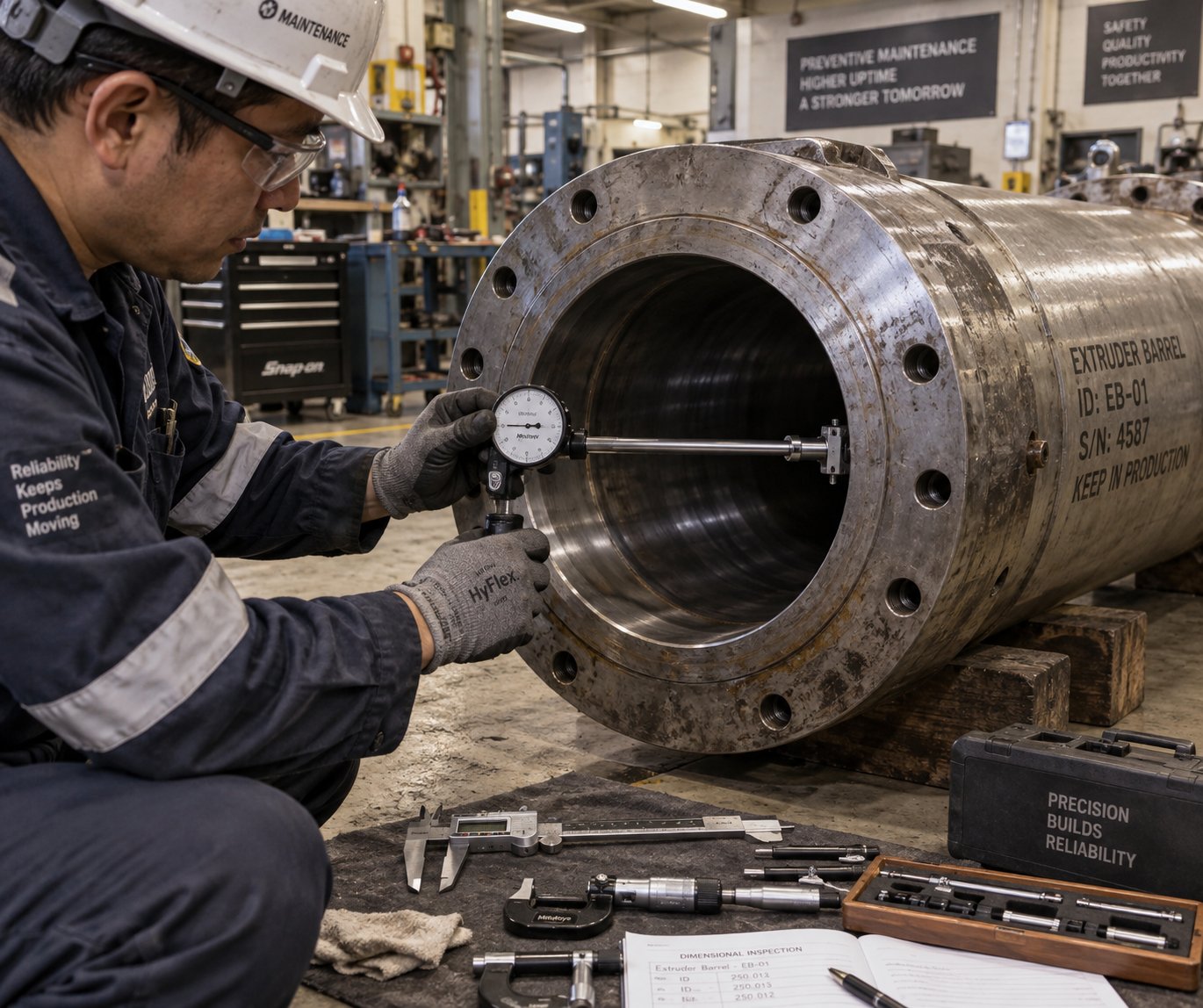
Measuring wear comes down to two instruments and a disciplined routine. A bore gauge checks the barrel's internal diameter at multiple points along its length, while an outside-diameter micrometer measures the screw flight tips at corresponding stations. The difference between these readings — the diametral clearance between screw and barrel — is the single most telling number in your entire maintenance program.
Before measuring, remove all residual PVC from the screw using brass scrapers or copper gauze. Never use steel wire brushes — they damage flight surfaces and distort readings. If a granite inspection table is available, roll the screw across it to check for bowing, using feeler gauges to quantify any deflection. Then measure flight OD at consistent intervals — every five to ten diameters of screw length — and record barrel bore ID at matching positions from both ends of the barrel as far as your bore gauge can reach.
Compare every reading against the original factory specifications. Fresh components ship with a designed clearance — typically a few hundredths of a millimeter per side, depending on screw diameter. As wear progresses, this gap widens. Material that should be pumped forward over the flight tips leaks backward instead, reducing plasticizing efficiency, raising melt temperature, and starving the die of consistent pressure. Industry references such as the SPI Dimensional Guidelines establish screw and barrel wear tolerances that categorize clearance growth into low, medium, and high severity bands, each tied to a recommended action — from continued monitoring through immediate replacement.
A single measurement tells you where things stand today. Repeating that measurement at regular intervals — quarterly for lines running filled PVC, semi-annually for clean formulations — builds a wear-rate trend you can plot on a simple chart. That trend line lets you project when clearance will cross into the action zone, giving your team weeks or months of lead time to source parts and schedule downtime rather than scrambling after quality has already collapsed.
Warning Signs That a Screw Barrel Needs Attention
Not every plant has the discipline or downtime budget for routine bore gauge inspections. Fortunately, a worn screw barrel broadcasts its condition through production symptoms long before it fails catastrophically. The trick is recognizing these signals for what they are — hardware degradation — rather than chasing phantom problems in the die, calibrator, or formulation. Watch for these indicators:
- Declining output at constant screw speed — When the clearance between screw and barrel widens, pumping efficiency drops. The motor turns at the same RPM, but less material moves forward. Operators compensate by increasing speed, which accelerates wear further.
- Rising melt temperature at unchanged settings — Widened clearances increase back-leakage, forcing material to recirculate and absorb additional shear energy. You will see discharge temperatures creep up even though barrel zone setpoints have not changed.
- Visible degradation marks on profiles — Brown streaks, black specks, or surface discoloration indicate that PVC is overheating somewhere inside the barrel, often in worn metering zones where leakage flow creates localized hot spots.
- Uneven wall thickness — Pressure instability from a worn metering zone delivers inconsistent flow to the die, causing wall-thickness variations that shift from run to run or even within a single profile.
- Increasing energy consumption — A worn screw barrel forces the motor to work harder to achieve the same throughput, driving up electricity cost per kilogram produced.
- Screw slippage or surging — Severely worn flight tips lose their ability to convey material forward reliably, producing periodic output fluctuations visible as pulsation at the die exit.
If you are adjusting process parameters more frequently to maintain the same product quality, that pattern alone should trigger an inspection. Those incremental tweaks — a few more RPM here, a slightly higher barrel zone temperature there — are your operators unconsciously compensating for hardware that is no longer performing to specification.
Replacement, Refurbishment, or Upgrade Decisions
Your measurements confirm excessive wear. The production symptoms match. The question now is what to do about it — and the answer is not always "buy new."
Refurbishment makes sense when wear is moderate and the base steel remains structurally sound. For screws, this typically means hard-facing worn flight tips using PTA (plasma transferred arc) welding with a nickel-tungsten-cobalt alloy, then precision grinding back to original flight OD. For barrels, re-nitriding can restore surface hardness if the bore dimensions have not drifted too far from spec. These interventions generally cost 30 to 50 percent of a new component and can restore a meaningful portion of original service life — a practical option when budget constraints are tight and the wear pattern is localized.
Full replacement becomes the only sound option when bore diameter has grown beyond safe re-boring limits, when corrosive pitting from HCl has penetrated below the nitrided case, or when your wear-trend data shows that a repaired component will be back at threshold within a single production quarter. In these situations, the economics of repair simply do not hold up — you end up paying twice for what should have been one decisive investment.
Here is where replacement becomes an opportunity rather than just an expense: if your original barrel was nitrided-only and your formulation has shifted toward higher CaCO3 loading or a more corrosive Ca-Zn stabilizer system, replacing with a bimetallic barrel can extend the next service interval by a factor of three to five times. The upfront cost is higher, but the total cost of ownership — factoring in longer run life, tighter tolerances, and fewer shutdowns — drops significantly.
For PVC profile manufacturers sourcing custom or replacement conical twin screw barrels, working with a manufacturer that understands the full picture — formulation chemistry, wear mechanisms, and production targets — shortens the path from measurement data to a correctly specified component. NANHAIYA, for example, supports PVC profile, pipe, board, and WPC extrusion processors with both replacement and custom-engineered conical twin screw barrels, combining stable plasticizing performance with the production support needed to restore or upgrade extrusion line output without extended downtime.
The best time to measure your screw barrel is before you suspect a problem. The second-best time is right now.
Wear monitoring is not a one-time project. It is an ongoing discipline that transforms barrel replacement from a reactive emergency into a planned, budgetable maintenance event. The processors who track clearance trends, recognize production symptoms early, and choose between refurbishment and replacement based on data — not desperation — are the ones whose lines keep running profitably long after competitors have stopped to troubleshoot problems they should have seen coming.
Frequently Asked Questions About Screw Barrels for PVC Profile Extrusion
1. What makes PVC profile extrusion different from processing other plastics like polyethylene or ABS?
Rigid PVC has an extremely narrow processing window, often only 10 to 20 degrees Celsius between full fusion and the onset of degradation. Unlike polyethylene, which tolerates a 60-degree spread, PVC releases corrosive hydrogen chloride gas when overheated. This means every aspect of the screw barrel, from compression ratio to flight geometry, must be engineered to minimize shear heat and eliminate stagnation zones. General-purpose screw barrels designed for polyolefins generate excessive localized shear that can destroy both the PVC product and the barrel itself.
2. Why are conical twin screw barrels preferred over single screw designs for PVC window profiles?
Conical twin screw barrels offer several advantages that align with PVC's processing demands. Their tapered geometry provides a large feed opening ideal for low-bulk-density PVC powder, while the natural taper creates gentle, progressive compression without abrupt shear spikes. Counter-rotating intermeshing screws deliver self-wiping action that prevents material stagnation, a key degradation trigger for PVC. Single screw extruders lack this positive conveying and self-cleaning capability, making them better suited for pellet-fed or simpler profile applications. Manufacturers like NANHAIYA offer conical twin screw barrels specifically optimized for PVC profile, pipe, board, and WPC extrusion at nhyscrews.com.
3. How do I know when my screw barrel needs replacement versus refurbishment?
Refurbishment is viable when wear is moderate and the base steel remains structurally sound. Screws can be hard-faced with nickel-tungsten-cobalt alloy and reground, while barrels can be re-nitrided if bore dimensions have not drifted too far. Full replacement is necessary when bore diameter exceeds safe re-boring limits, corrosive pitting has penetrated below the nitrided case, or wear-trend data shows a repaired component will reach threshold again within one production quarter. Key warning signs include declining output at constant screw speed, rising melt temperature without setpoint changes, visible degradation marks on profiles, and increasing energy consumption.
4. What is the difference between a nitrided screw barrel and a bimetallic screw barrel for PVC extrusion?
A nitrided barrel has a thin hardened surface layer (0.5 to 0.8 mm deep, approximately HRC 60-65) created by diffusing nitrogen into the base steel. It works well for unfilled or lightly filled PVC formulations. A bimetallic barrel features a centrifugally cast inner liner (1 to 2 mm thick) of a harder, corrosion-resistant alloy bonded to the structural steel body. Bimetallic construction delivers three to seven times the abrasion resistance of nitrided barrels and is essential when CaCO3 filler content exceeds 10 to 15 parts per hundred resin, as mineral particles rapidly wear through the thinner nitrided layer.
5. How does CaCO3 filler content in PVC formulations affect screw barrel selection?
Calcium carbonate filler acts as an abrasive mineral that grinds against flight tips and bore surfaces under heat and pressure. At low loadings under 10 phr, nitrided barrels provide adequate service life. At 20 to 40 phr, common in cost-driven PVC profile production, wear rates on nitrided surfaces can multiply several-fold, and clearances widen within months. High filler content also increases melt viscosity, potentially requiring adjusted compression ratios and modified flight geometry for adequate densification. Bimetallic construction becomes the economically sound choice at medium-to-high filler levels, and a qualified screw barrel manufacturer will match the liner alloy to the specific filler type and loading.
Written by
Nanhaiya Technical Team
Zhoushan Nanhaiya Plastic Machinery Co., Ltd.
The Nanhaiya technical team supports screw and barrel manufacturing projects through application review, technical communication, custom manufacturing coordination, and production and quality control.
Discuss Your Application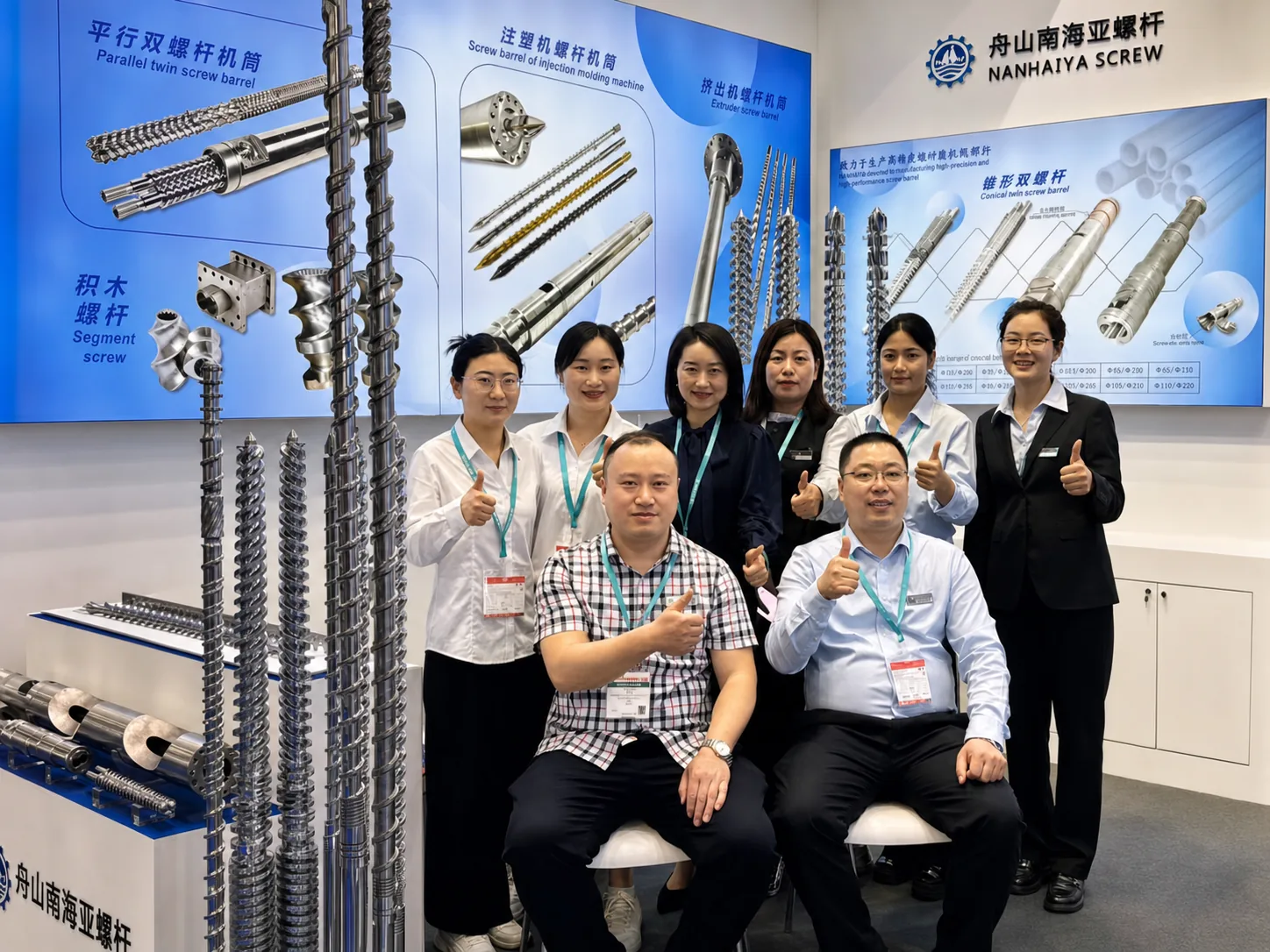
Related Articles
More insights on screw barrel technology and plastics processing.
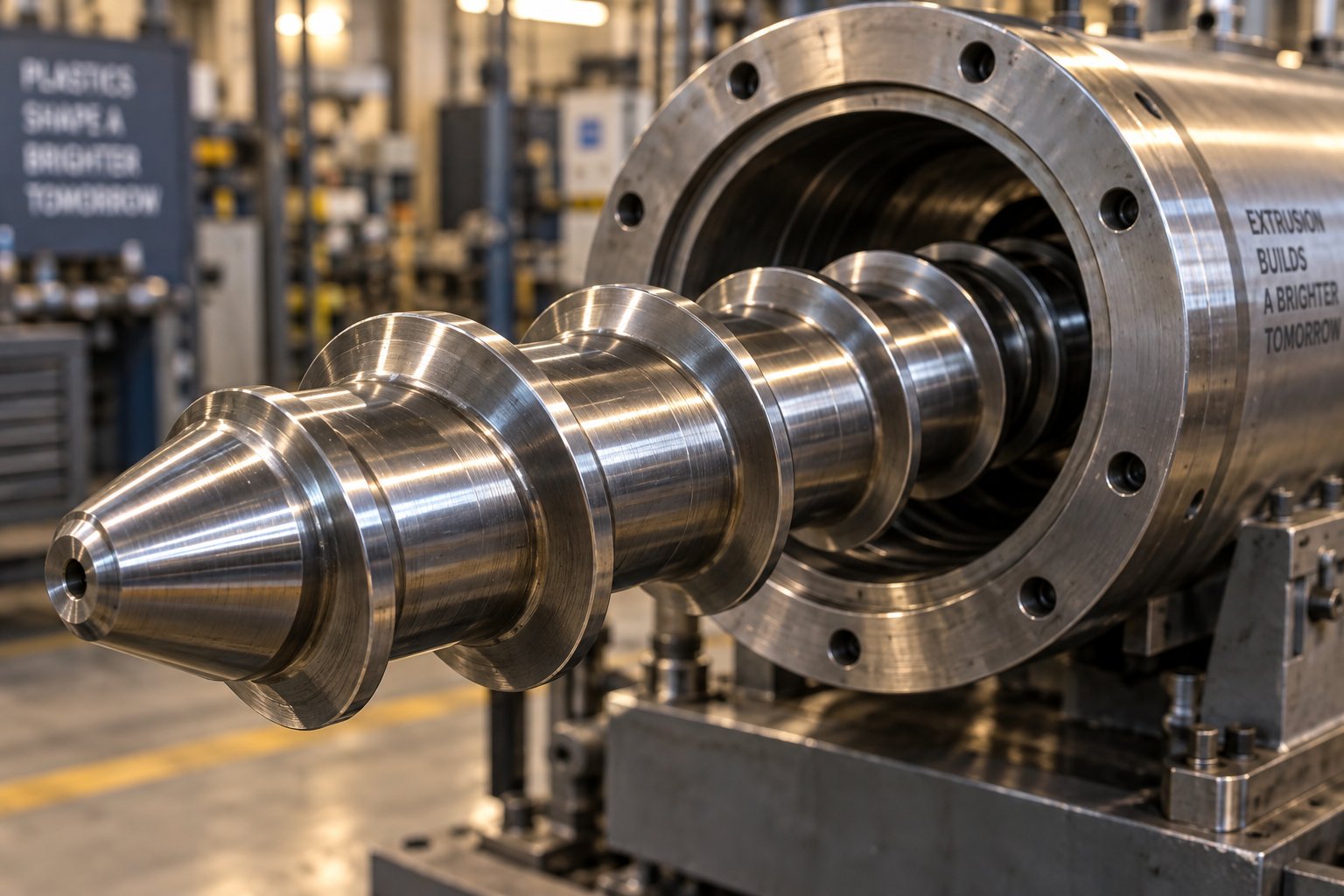
What Nobody Tells You About Screw Barrel For Plastic Machine Design
Oct 10, 2026
Learn how screw barrel for plastic machine design affects melt quality, throughput, and wear life. Covers geometry, resin matching, troubleshooting, and sourcing.
Read Article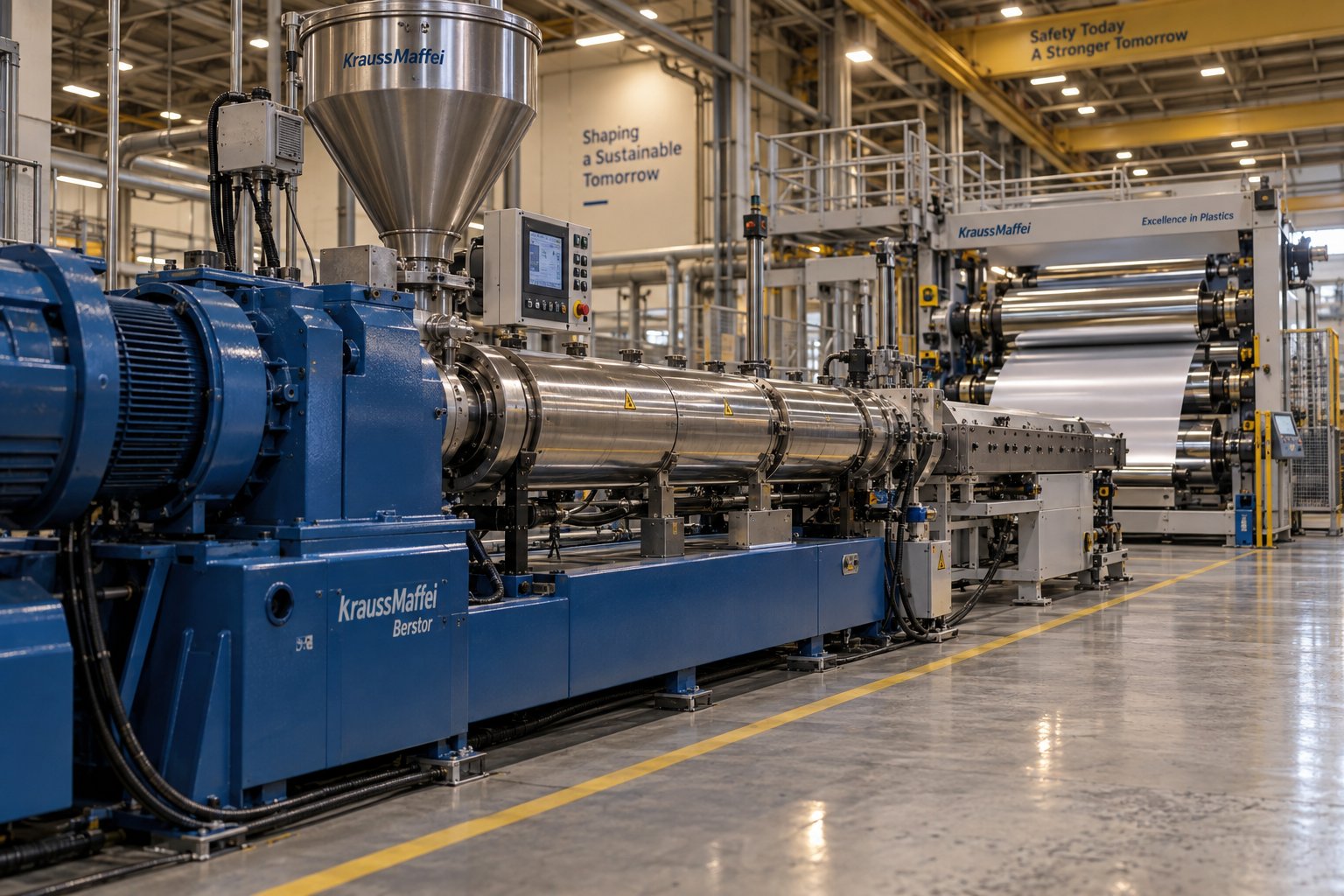
Single Screw Extruder for Sheet: Stop Guessing, Start Specifying
Oct 9, 2026
Learn how to specify a single screw extruder for sheet production. Covers screw geometry, resin-specific processing, troubleshooting, and maintenance best practices.
Read Article
PE Pipe Extruder Machine: What Datasheets Won't Tell You
Oct 9, 2026
Learn how a PE pipe extruder machine works, key specs explained, material grade selection, maintenance tips, and buyer guidance beyond the datasheet.
Read ArticleLooking for something else?
Search by material, symptom or product and jump straight to the relevant page.
These are navigation suggestions based on keyword matching — not a quotation, not a delivery commitment, and not a substitute for engineering review. Final specification is confirmed by our engineers against your drawings and processed material.
Need help with screw barrel selection?
Share your machine model, processed material and application. Our team can help with pricing and technical support.