

What Recycled Plastic Extrusion Is and Why It Matters
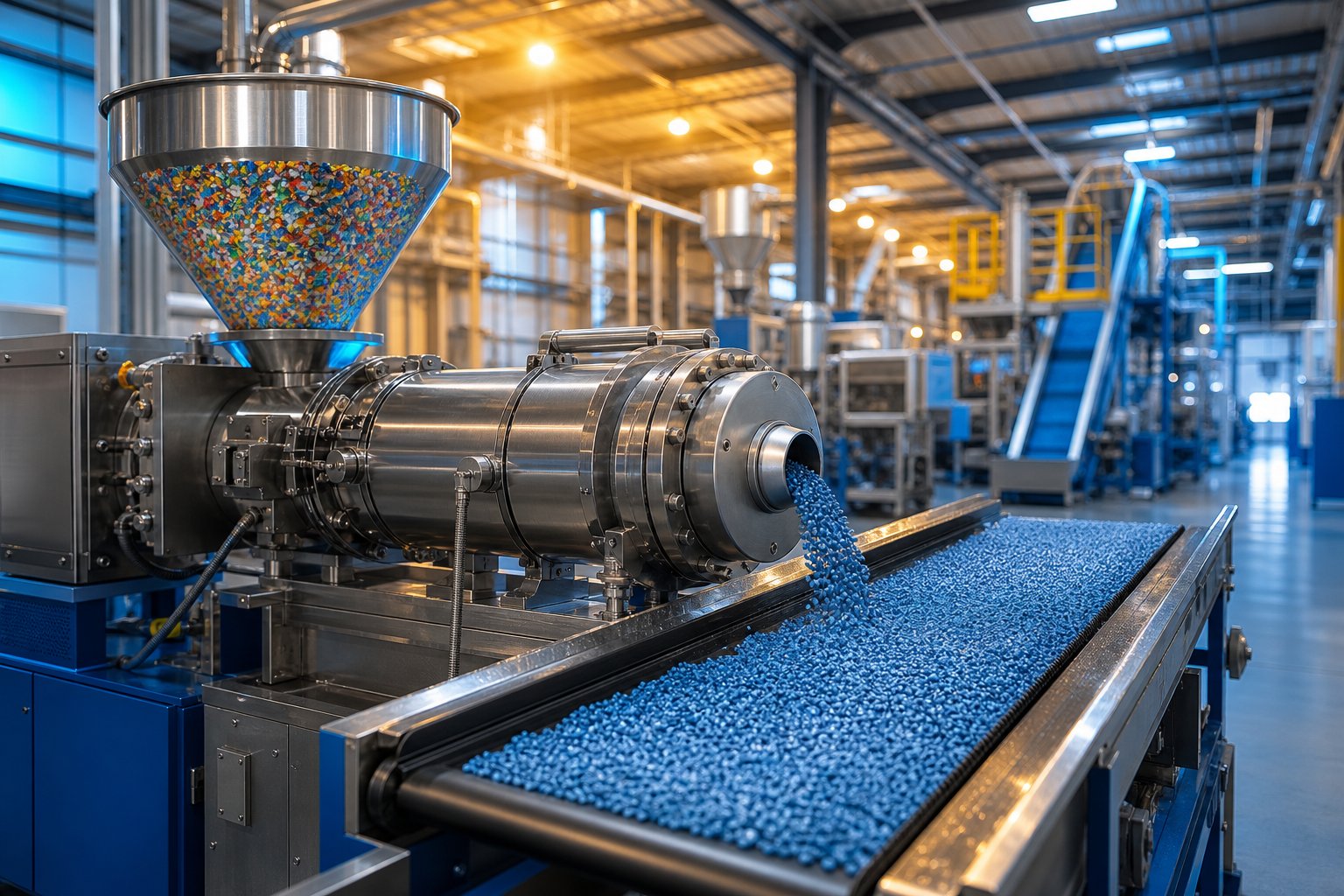
Imagine taking a crumpled water bottle, a discarded milk jug, or a scrap of industrial film and transforming it into a brand-new pipe, sheet, or pellet ready for manufacturing. That transformation is the core promise of recycled plastic extrusion, and it is reshaping how the plastics industry thinks about waste, resources, and product design.
Recycled plastic extrusion is the industrial process of melting post-consumer or post-industrial plastic waste and forcing it through a shaped die to produce new usable products, including pipes, profiles, films, sheets, and pellets.
Sounds straightforward? At a high level, it is. But the details beneath that definition are where the real engineering challenge, and the real opportunity, lives. This guide goes far deeper than a surface-level overview. It covers the materials science behind resin behavior, the zone-by-zone dynamics inside the barrel, resin-specific processing strategies, additive formulations, defect troubleshooting, and equipment selection, giving you a complete, actionable resource.
Defining Recycled Plastic Extrusion in Modern Manufacturing
So what is extrusion in the context of recycled plastics? At its simplest, plastic extrusion is a continuous manufacturing process: raw material enters a heated barrel, a rotating screw melts and conveys it forward, and the molten polymer is pushed through a die that shapes it into a continuous profile. The definition for extrusion stays the same whether you are processing virgin pellets or recycled flake, but the practical reality changes dramatically.
When you work with virgin resin, you are dealing with a consistent, well-characterized feedstock. Pellet geometry is uniform. Moisture content is controlled at the production plant. Melt flow properties are predictable within a tight specification window. Recycled feedstock introduces a fundamentally different set of variables:
- Variable feedstock quality: Flake size, shape, and bulk density shift from batch to batch, affecting how material feeds into the barrel.
- Prior thermal history: Every previous heat cycle the polymer has endured shortens its molecular chains, altering viscosity and mechanical properties.
- Contamination: Labels, adhesives, residual food matter, mixed-polymer traces, and pigment residues all enter the extruder alongside the target resin.
Understanding the meaning extrusion carries in this recycled context is critical. You are not just melting and shaping plastic. You are managing degradation, compensating for inconsistency, and engineering around contamination, all while maintaining output quality that end-use markets demand.
Why Recycled Plastic Extrusion Matters for the Circular Economy
The environmental case for extruding recycled plastics is not built on vague green claims. It rests on measurable cause-and-effect relationships that directly impact resource consumption, energy budgets, and waste streams.
Reduced petroleum dependence. Every kilogram of post-consumer resin that enters an extruder displaces virgin feedstock derived from crude oil or natural gas. Virgin plastic production begins with petroleum extraction, cracking, and polymerization, a chain of energy-intensive chemical processes. Recycled feedstock skips all of that.
Lower energy consumption. Remelting an existing polymer requires significantly less energy than synthesizing it from monomers. Lifecycle analyses consistently show that reprocessing plastic waste uses 30% to 70% less energy than manufacturing new polymers, depending on the resin type and regional energy mix. The U.S. EPA reports that recycling HDPE and PP alone can lower lifecycle emissions by 40% to 60%.
Landfill diversion with economic value. Extruded recycled products, whether pipes for construction, sheets for packaging, or pellets for downstream molding, retain real market value. That economic incentive keeps plastic waste circulating as a resource rather than accumulating in landfills or leaking into ecosystems. Each ton of recycled PET, for example, can prevent roughly 1.5 tons of CO2-equivalent emissions when you combine avoided virgin production with reduced disposal impacts.
These benefits are real, but they do not come free. Recycled extrusion demands deeper process knowledge, more specialized equipment, and a materials-science-informed approach that accounts for every resin's unique degradation behavior. The chapters ahead deliver exactly that, walking you through molecular-level feedstock challenges, step-by-step extruder dynamics, resin-by-resin processing guides, additive strategies, defect troubleshooting, and equipment design, so you can turn variable flake into consistently high-quality output.

Why Recycled Plastics Behave Differently Inside the Extruder
You know recycled feedstock is inconsistent. You can see it in the variable flake colors, feel it in the shifting bulk density, and measure it in batch-to-batch melt flow fluctuations. But what exactly is happening at the molecular level that makes extruding plastic from recycled streams so much more demanding than running virgin pellets? The answer lies in three overlapping phenomena: polymer chain degradation from prior thermal history, contamination chemistry that disrupts melt behavior, and elevated moisture absorption that triggers hydrolytic breakdown. Understanding these mechanisms is what separates a processor who constantly fights quality issues from one who anticipates and controls them.
Polymer Chain Degradation and Thermal History Effects
Every time a polymer passes through a plastic extruder or any melt-processing step, it accumulates damage. The long molecular chains that give plastics their strength, flexibility, and melt integrity get shorter. This happens through two primary mechanisms working simultaneously: thermo-oxidative degradation and thermo-mechanical degradation.
Thermo-oxidative degradation occurs when the polymer is exposed to elevated temperatures in the presence of oxygen. Free radicals form along the polymer backbone, triggering chain scission, the breaking of molecular chains into shorter fragments. Research on polymer extrusion processing has demonstrated that this effect intensifies with higher temperatures and longer residence times. A study on twin-screw extrusion found that the zero shear viscosity of certain polyesters dropped by as much as tenfold when processing temperature increased from 180 °C to 260 °C at low screw speeds, directly reflecting severe molecular weight reduction from chain scission.
Thermo-mechanical degradation adds another layer. The shearing forces generated by the rotating screw physically tear polymer chains apart, especially at high viscosities and low screw speeds where material spends more time under stress. Interestingly, higher screw speeds can partially compensate by reducing residence time, even though shear intensity increases. The net effect still favors shorter exposure over lower shear for most recycled resins.
Different polymers degrade through distinct pathways, and this matters enormously when you are extruding recycled material:
- rPET is especially vulnerable to hydrolytic chain scission, where trace moisture attacks ester bonds and cleaves chains. It also suffers from thermo-oxidative random scission, reducing intrinsic viscosity (IV) with each heat cycle. The cumulative IV loss directly weakens melt strength, making processes like sheet extrusion and fiber spinning increasingly difficult.
- rPP undergoes beta-scission, a preferential breaking pattern at tertiary carbon atoms along the backbone. This progressively lowers molecular weight and narrows the processing window, causing the melt flow index (MFI) to climb with each reprocessing pass.
- rHDPE can experience an opposite complication: under excessive shear or in the presence of residual peroxide contaminants, polyethylene chains may crosslink rather than break. These crosslinked regions form insoluble gels that persist through the melt, creating visible defects in finished products.
The directional trend is consistent across all commodity resins: each heat cycle shifts the MFI upward as molecular weight drops. For a recycled flake stream with unknown processing history, you may be working with material that has already lost 10% to 30% of its original molecular weight before it ever reaches your hopper. That accumulated damage is invisible to the eye but profoundly affects how the material flows, fills, and performs.
Contamination Chemistry and Its Impact on Melt Quality
Virgin resin arrives with a certificate of analysis and a predictable composition. Recycled streams carry chemical baggage from their prior lives, and each type of contamination creates a specific problem inside the barrel.
Residual labels and adhesives are among the most common contaminants. Pressure-sensitive adhesive residues and paper label fragments that survive the washing process char at typical extrusion temperatures, producing black specks and localized degradation. Even trace amounts can compromise surface quality in demanding applications.
Mixed-polymer contamination poses a more insidious threat. Consider PVC accidentally entering a PET reclaim stream. PVC begins thermally degrading at temperatures well below PET's processing range, releasing hydrogen chloride (HCl) gas. That HCl acts as an acid catalyst, accelerating PET chain scission and causing severe discoloration, even at contamination levels as low as 50 to 100 ppm. Differential scanning calorimetry (DSC) analysis of recycled pellets has shown that even visually similar pellets can conceal secondary polymer phases, such as LLDPE contamination in a PP stream, that only become apparent through thermal characterization.
Pigment residues limit color options for finished products and can interfere with optical sorting in subsequent recycling loops. Carbon black pigments, widely used in packaging, effectively block near-infrared (NIR) sorting, creating a downstream recyclability barrier.
Food residue and organic matter cause outgassing during melting, introducing voids and bubbles into the extrudate. The volatile organic compounds released can also deposit on downstream equipment surfaces and inside venting ports, requiring more frequent maintenance.
Moisture Absorption Differences Versus Virgin Resin
Imagine two piles of PET, one in pristine pellet form straight from the reactor, the other ground into irregular flakes from post-consumer bottles. The flake pile absorbs moisture far more aggressively, and here is why:
- Increased surface area: Grinding multiplies the exposed surface relative to volume. More surface means more contact points for atmospheric moisture to adsorb and penetrate.
- Residual contamination: Trace surfactants, adhesive residues, and organic matter left from washing act as hygroscopic sites that attract and hold water.
- Storage conditions: Post-consumer flake often spends days or weeks in open bins, warehouses, or transport containers without climate control, absorbing ambient humidity far beyond what a sealed virgin pellet silo would allow.
The consequences of insufficient drying are severe, particularly for condensation polymers like rPET and recycled polyamide (rPA). The Association of Plastic Recyclers (APR) standard practices specify that PET must be dried below 50 ppm moisture content before extrusion, using desiccant dryers operating at 150 °C to 160 °C for four to six hours. rPA typically requires drying to below 200 ppm. When these thresholds are not met, three problems emerge in rapid succession:
- Hydrolysis: Water molecules attack ester or amide bonds in the polymer backbone, accelerating chain scission beyond what thermal history alone would cause. In rPET, even 100 ppm of residual moisture can produce measurable IV loss during a single extrusion pass.
- Bubble formation: Moisture flashing to steam inside the barrel creates voids that appear as foamy surfaces, internal bubbles, or silver streaks in the finished extrudate.
- Reduced mechanical properties: The combined effect of hydrolytic molecular weight loss and void formation degrades tensile strength, impact resistance, and transparency, pushing the final product further from virgin-equivalent performance.
These three factors, accumulated chain degradation, contamination chemistry, and moisture sensitivity, do not operate in isolation. They compound each other. A recycled PET flake with moderate thermal history, a trace of PVC contamination, and marginally high moisture content will degrade far more aggressively than any one of those factors alone would predict. That compounding effect is precisely why the step-by-step process inside the extruder, from feed zone through die, must be engineered specifically for recycled feedstock rather than simply borrowed from virgin processing recipes.
Inside the Extruder Step by Step: From Flake to Finished Product
Compounding chain degradation, stubborn contaminants, and unpredictable moisture levels create a processing environment that demands precision at every stage, not just inside the barrel, but well before flake ever touches the hopper and well after the melt exits the die. Most descriptions of the plastic extrusion process reduce the entire sequence to five or six bullet points: sort, wash, dry, extrude, pelletize. That glosses over the zone-by-zone engineering that actually determines whether your output is sellable or scrap.
Here is the complete sequence, broken down to show what is really happening at each stage and why recycled feedstock forces adjustments that virgin processing never requires.
- Sorting and resin identification (NIR spectroscopy, density separation)
- Washing to remove surface contaminants
- Size reduction via shredding and granulating
- Pre-drying to target moisture thresholds
- Feed zone solids conveying into the barrel
- Compression zone melting and compaction
- Metering zone homogenization and pressure building
- Degassing/venting for volatile removal
- Melt filtration through screen changers
- Die shaping or pelletizing into finished form
Each stage carries specific challenges when the feedstock is recycled material. Let's walk through them.
Feedstock Preparation Before the Hopper
Everything that reaches the extruder machine is shaped by what happens upstream. Sorting is the first quality gate. Near-infrared (NIR) spectroscopy identifies polymer types at high speed, separating PET from HDPE, PP from PS. Density separation, often using float-sink tanks or hydrocyclones, catches materials that NIR may miss, particularly dark-colored plastics that absorb infrared light. Even small sorting errors, such as PVC slipping into a PET stream, can trigger the acid-catalyzed degradation discussed earlier.
Washing removes surface-level contamination: dirt, food residue, label adhesive, and residual cleaning agents. Hot caustic wash systems are standard for bottle flake, while cold wash lines handle less contaminated post-industrial streams. The goal is to strip contaminants before they enter the barrel, because removing them after melting is exponentially harder.
Size reduction through shredding and granulating creates flake or regrind with a target particle size, typically 8 to 12 mm for most extrusion lines. Here is where a critical variable emerges: recycled flake does not behave like uniform virgin pellets. Flake geometry is irregular, thickness varies, and bulk density can swing significantly between batches or even within a single gaylord. A batch of thick bottle flake packs tightly and feeds well. A batch of thin film regrind is fluffy, bridges in hoppers, and starves the screw. These differences in bulk density and particle shape directly control how material enters the barrel, and they demand feeding strategies you would never need for pellets.
Pre-drying closes out the preparation stage. Hygroscopic resins like rPET and rPA must reach strict moisture thresholds, below 50 ppm for rPET, as the APR guidelines specify, using desiccant dryers at 150 °C to 160 °C for four to six hours. Polyolefins are less moisture-sensitive, but post-consumer rHDPE and rPP still benefit from drying to prevent steam-driven surface defects. Skipping or shortcutting this step is one of the most common and costly mistakes in the extrusion process for recycled materials.
Feed Zone Behavior With Recycled Material
What is an extruder, at its most fundamental level? It is a solids-conveying, melting, and pumping machine. And that first job, conveying solids, is where recycled feedstock creates its first headache.
In the feed zone, the screw's deep-channel flights grab incoming material and drag it forward through friction against the barrel wall. With uniform virgin pellets, this works predictably: consistent particle size means consistent packing, consistent friction, and consistent throughput. With recycled flake, the story changes.
Irregular flake shapes create air pockets and inconsistent packing density inside the screw channel. Thin film regrind is particularly problematic, its low bulk density means the screw channel fills with more air than polymer. The result is starve-feeding: the screw cannot convey enough material to keep the downstream zones fully loaded. Output surges and dips cyclically, melt pressure fluctuates, and product dimensions wander out of tolerance.
Two proven solutions address this instability. Grooved feed sections, where the barrel bore in the feed zone features longitudinal or helical grooves, dramatically improve grip on irregular flake. The grooves prevent material from rotating with the screw and force it forward, even when particle geometry is uncooperative. Force-feeding devices, also called crammer feeders, use an auger or ram above the feed throat to physically push low-bulk-density material, such as fluffy film regrind, into the screw at a consistent rate. For very light feedstock, a crammer feeder is often the only way to achieve stable throughput.
Gravimetric feeders add another layer of control. Rather than relying on gravity and screw friction alone, these devices measure the actual mass flow rate entering the barrel and adjust feed speed in real time. When bulk density varies batch to batch, a gravimetric feeder compensates automatically, keeping the downstream zones consistently loaded.
Compression and Metering Zone Dynamics
Once material advances past the feed zone, the screw channel depth decreases progressively, compressing the solids bed and initiating melting. In this compression zone, the polymer transitions from solid flake to a viscous melt, and contamination makes that transition less predictable than it would be with virgin resin.
Contaminants alter local melt viscosity in unpredictable ways. A pocket of label adhesive behaves differently under shear than the surrounding polymer. A cluster of higher-melting-point flake takes longer to soften. These inconsistencies create localized viscosity gradients that produce uneven melting and, if not managed, allow unmolten particles to pass through to downstream zones.
Recycled plastics may require adjusted compression ratios compared to their virgin counterparts. A gentler compression ratio, meaning a more gradual decrease in channel depth, reduces the intensity of shear heating. Since recycled feedstock has already consumed part of its thermal stability through prior processing, minimizing additional shear-induced heat helps preserve what molecular weight remains. Too aggressive a compression ratio risks pushing already-degraded material past its thermal limits, causing discoloration, further chain scission, and increased volatile generation.
The metering zone, the final section of the screw, must deliver consistent pressure and a homogeneous melt despite all the variability inherited from upstream. Mixing elements, such as Maddock-style dispersive mixers or pin-style distributive mixers, break up remaining unmolten particles, distribute additives evenly, and smooth out temperature gradients across the melt cross-section.
Vented or degassing configurations play a critical role here. Recycled feedstock carries trapped moisture, residual washing water, adhesive volatiles, ink solvents, and degradation byproducts that must be removed before the melt reaches the die. A vented two-stage extruder machine uses a decompression zone midway along the barrel where the screw channel suddenly deepens, dropping melt pressure and allowing volatiles to escape through a vent port. Vacuum-assisted degassing pulls these gases out more aggressively. As ACERETECH's engineering team notes, for materials such as PE films, PP woven bags, and PET bottle flakes with high moisture or volatile content, the degassing process directly impacts pellet appearance, melt stability, product odor, and downstream product quality. Dual-stage degassing systems, combining an atmospheric vent with a secondary vacuum port, provide the most thorough volatile removal for heavily contaminated streams.
Downstream Processing Through the Die
The melt leaving the metering zone still is not ready for final shaping. Melt filtration stands between the extruder and the die, serving as the last line of defense against solid contaminants. A screen changer holds fine metal mesh packs that trap unmelted particles, char, paper fragments, metal fines, and gels while allowing clean polymer to pass through. For recycled lines running at production scale, continuous or hydraulic screen changers are standard because they allow mesh replacement without stopping the line, a necessity when contamination loads are high and downtime is expensive.
The screw and the screen changer must be specified together. The screw's metering section needs to build enough pressure to push melt through fine filter screens, and that back-pressure requirement feeds directly into screw geometry decisions. A screw designed in isolation, without accounting for filtration pressure drop, may fall short on output once screens are installed.
After filtration, the melt reaches the die, where it takes its final shape. Die design for recycled melt must account for the wider viscosity variability that contamination and chain degradation introduce. Flow channels are often designed with slightly more generous land lengths and less restrictive geometries to tolerate melt inconsistency without producing die lines or uneven wall thickness.
From the die, the process branches depending on the target product:
- Strand pelletizing: The melt exits through a multi-hole die plate as strands, which are cooled in a water bath and chopped into pellets by a strand cutter. Simple and proven, but sensitive to strand breakage if melt strength is low.
- Underwater pelletizing: The melt is cut at the die face by rotating blades inside a water chamber, producing uniform, spherical pellets. Better suited for high-throughput recycled lines where consistent pellet geometry matters.
- Direct extrusion: Instead of pelletizing, the filtered recycled melt feeds directly into a pipe die, profile die, sheet die, or film blowing head. This eliminates one entire heat cycle, preserving molecular weight and reducing energy consumption, but demands tighter upstream quality control because there is no intermediate quality inspection point between the extruder and the finished product.
Each of these downstream paths inherits every upstream decision. The quality of sorting, the thoroughness of washing, the precision of drying, the consistency of feeding, the effectiveness of degassing, and the fineness of filtration all compound into the final product quality. That compounding effect is why recycled extrusion demands a systems-level approach, and why understanding what each resin specifically needs through the entire process is the next critical step.
Resin-by-Resin Guide to Extruding Recycled Plastics
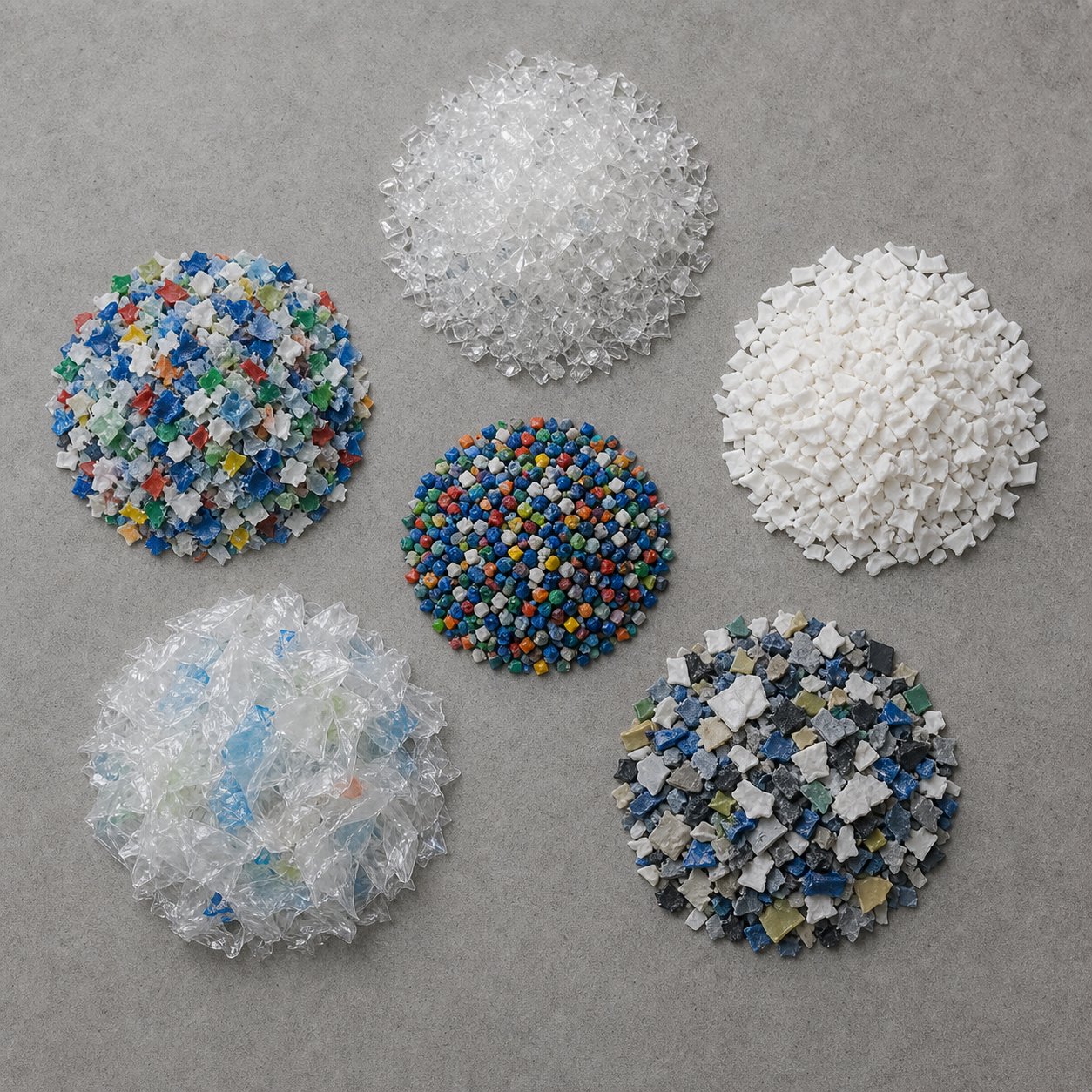
Every resin enters the barrel with its own molecular personality, and recycled grades amplify those differences dramatically. A processing recipe tuned for rHDPE pipe extrusion will fail spectacularly if you swap in rPET flake without adjusting temperatures, drying protocols, and screw speed. The table below distills the critical processing variables for six major recycled commodity resins into a single reference. Use it as a starting point, then read on for the deeper resin-specific considerations that the numbers alone cannot capture.
| Resin | Typical Processing Temp Range | Key Extrusion Challenges | Required Pre-Treatment | Common Extruded Products | Property Differences vs. Virgin |
|---|---|---|---|---|---|
| rPET | 260 - 280 °C | Hydrolytic IV loss, moisture sensitivity, melt strength drop | Desiccant drying to <50 ppm moisture; chain extender addition | Sheet extrusion (thermoforming), fiber/filament, bottle-to-bottle pellets | Lower IV and melt strength; reduced clarity without decontamination; narrower processing window |
| rHDPE | 180 - 230 °C | Mixed-color streams limiting aesthetics; potential crosslinking under excessive shear | Washing; moderate drying; melt filtration for particulate removal | Pipe extrusion, profile extrusion, blow-molded containers, lumber | Slight MFI increase; color limitations; broadly comparable mechanical performance |
| rLDPE | 160 - 220 °C | Gel formation from crosslinked particles; print ink contamination; low bulk density | Hot wash for ink removal; force-feeding for low-density film regrind; fine-mesh filtration | Extruded films (stretch, agricultural, refuse sack), bags | Higher gel count; reduced optical clarity; ink-related odor and discoloration |
| rPP | 190 - 240 °C | Beta-scission reducing molecular weight; narrower processing window; LDPE cross-contamination | Drying recommended; contaminant sorting; potential stabilizer replenishment | Automotive parts, caps/closures, fibers, packaging, crates | Higher MFI; lower impact strength; thermo-oxidative degradation markers present |
| rPS | 180 - 230 °C | Brittleness amplification; limited reprocessing cycles; volatile styrene monomer release | Sorting to exclude EPS; drying; degassing for residual monomer | Sheet extrusion (disposable trays), insulation, picture frames | Reduced elongation at break; increased yellowing; lower impact resistance |
| rPVC | 150 - 190 °C (strict control) | HCl release from thermal degradation; narrow safe temperature window; regulatory restrictions | Precise sorting; stabilizer addition (Ca/Zn or organotin systems); low-shear screw design | Extruded PVC pipe, window profiles, cable conduit, fencing | Requires stabilizer replenishment; color shift; potential for dehydrochlorination at processing errors |
rPET and rHDPE Processing Considerations
rPET is arguably the most demanding recycled resin to extrude well. Its core vulnerability is moisture. Because PET is a condensation polymer, even small quantities of water trigger hydrolytic chain scission at processing temperatures, rapidly destroying intrinsic viscosity (IV). Industry best practice requires desiccant drying below 50 ppm moisture content, and many processors target 30 ppm for demanding sheet extrusion or bottle-to-bottle applications.
Even with impeccable drying, rPET arrives at the hopper carrying the scars of its prior thermal history. Research at the Federal University of Campina Grande found that post-consumer rPET showed an IV of roughly 0.72 dL/g compared to 0.88 dL/g for the corresponding bottle-grade virgin resin, a 22% drop in molecular weight accumulated through collection, washing, and prior processing. That IV loss translates directly to reduced melt strength, which limits rPET's ability to hold shape in sheet extrusion and makes fiber spinning more sensitive to processing parameters.
Chain extenders offer a practical countermeasure. Epoxy-functional styrene-acrylic oligomers, such as the Joncryl family, react with PET's carboxyl and hydroxyl end-groups to rejoin broken chain segments and rebuild molecular weight. The same research demonstrated that adding just 1.0% of an epoxidic chain extender to recycled post-consumer PET was sufficient to stabilize molar mass during reprocessing, while 1.5% actively increased it. At the higher concentration, molar mass increases of 34% were recorded for recycled PET, and reprocessing tests showed that adequately additivated PET maintained its molecular weight through repeated extrusion cycles without additional chain extender, effectively "protecting" the polymer for future processing.
rHDPE, by contrast, is one of the most forgiving recycled resins to process. Its polyolefin chemistry resists hydrolysis entirely, so drying is less critical. The main challenges are practical rather than chemical. Post-consumer HDPE streams from curbside collection are typically mixed-color, meaning extruded plastic products from these streams default to gray or black unless the processor invests in color sorting. For structural applications like pipe extrusion and profile extrusion, color matters less than mechanical integrity, and rHDPE generally delivers strength and stiffness close to virgin grades. Processors should watch for crosslinking tendencies under excessive shear, which manifest as gels in the finished product, but moderate screw speeds and proper melt filtration keep this risk manageable.
rLDPE, rPP, rPS, and rPVC Extrusion Notes
rLDPE dominates the recycled film extrusion market, but it arrives with its own set of headaches. Post-consumer film regrind has extremely low bulk density, demanding force-feeding or crammer systems to achieve stable throughput. The bigger quality concern is gels: crosslinked particles formed during prior processing or by contaminant interactions create visible defects in extruded films that are unacceptable for transparent or printed applications. Fine-mesh melt filtration, typically 100 to 150 mesh or finer, is essential. Print ink contamination from printed film waste introduces pigments, solvents, and binders that cause discoloration, odor, and outgassing. Hot-wash pre-treatment and degassing extruders mitigate these issues but rarely eliminate them entirely.
rPP brings a narrower processing window than its virgin counterpart. Beta-scission progressively reduces molecular weight, raising MFI and lowering melt strength. Research on recycled automotive PP confirmed the presence of thermo-oxidative degradation markers, specifically a carbonyl absorption band at 1715 cm-1 detected through FT-IR spectroscopy, directly indicating chain degradation accumulated during the polymer's service life and prior recycling passes. Cross-contamination with LDPE, a common occurrence in mixed-polyolefin waste streams, introduces an immiscible second phase. While PE and PP have similar chemical structures, they are thermodynamically immiscible, creating interfacial weakness. DSC analysis of recycled PP has revealed secondary melting peaks around 128 °C attributable to LDPE contamination at levels approaching 10%. Compatibilizers can bridge this gap, but processors must first identify that the contamination exists through thermal or spectroscopic characterization.
rPS presents a limited recycling window. Each reprocessing cycle amplifies the material's inherent brittleness, as molecular weight loss reduces the already modest elongation at break. Volatile styrene monomer released during melting creates odor and potential workplace exposure concerns, making degassing essential. Expanded polystyrene (EPS) must be separated from the solid PS stream because its extremely low bulk density and different melt behavior create feeding and processing instabilities.
rPVC requires the most cautious approach of any commodity resin. PVC begins releasing hydrogen chloride gas at temperatures only slightly above its processing range, so pvc extrusion with recycled feedstock demands exceptionally precise temperature control and well-maintained stabilizer systems. Calcium-zinc or organotin stabilizer packages must be replenished during compounding because the original stabilizers are partially consumed during the product's first life. If barrel temperatures drift even 10 to 15 °C above the safe window, dehydrochlorination accelerates rapidly, corroding barrel and screw surfaces, degrading the melt, and producing toxic fumes. Regulatory restrictions in some markets further complicate extruded PVC from recycled sources, particularly for food-contact and potable-water applications.
Each resin's unique degradation pathway and contamination profile demands tailored additive intervention, and that is precisely the gap between processors who merely reprocess plastic waste and those who engineer recycled products that compete with virgin quality.
Additives and Compatibilizers That Restore Recycled Resin Performance
Tailored processing recipes and careful screw design can only compensate so far for the molecular damage recycled feedstock carries into the barrel. At a certain point, the polymer itself needs chemical intervention, molecules that repair broken chains, bridge immiscible phases, and replenish protective systems consumed during prior service life. This is the domain of additives and compatibilizers, and it represents one of the most impactful yet underexplored levers in plastics extrusion with recycled content.
Why is additive intervention so critical? Every heat cycle depletes the original stabilizer package while simultaneously shortening polymer chains and generating reactive degradation byproducts. By the time post-consumer flake reaches your extruder, the resin has already spent a significant share of its built-in protection. Without replenishment and targeted chemical repair, each subsequent extrusion manufacturing step accelerates the downward spiral, pushing mechanical properties further from the virgin baseline.
Chain Extenders, Compatibilizers, and Stabilizer Systems
Chain extenders tackle the most fundamental damage: shortened polymer chains. These reactive molecules contain functional groups that bond with the broken chain ends of condensation polymers, effectively stitching fragments back together to rebuild molecular weight and restore melt strength. For rPET, epoxy-functional styrene-acrylic oligomers, such as the widely used Joncryl family, are particularly effective. A study published in RSC Advances demonstrated that incorporating just 1 phr of a styrene-acrylic-glycidyl methacrylate chain extender into an rPET/rLLDPE blend reduced the melt flow index from 57 g/10 min down to 23 g/10 min, a value considered suitable for industrial melt processing. The chain extender formed crosslinking nodes with rPET chains, maintaining their molecular architecture and preventing the IV collapse that normally accompanies reprocessing. Tensile strength improved by approximately 36%, and elongation at break jumped from roughly 3% to around 80%, transforming a brittle blend into a toughened material.
You'll notice the effect is not just about restoring one property. Chain extension simultaneously recovers melt strength for processability, tensile performance for end-use durability, and elongation for impact resistance, all from a single additive intervention at low loading levels.
Compatibilizers solve a different problem entirely: what happens when your recycled stream contains two or more immiscible polymer types. Imagine extruding a mixed polyolefin stream where rPE and rPP coexist. These polymers are chemically similar but thermodynamically immiscible, forming separated phases with weak interfaces that delaminate under stress. Maleic anhydride-grafted polymers, such as SEBS-g-MA, act as molecular bridges. The maleic anhydride groups react with hydroxyl or carboxyl end-groups on one polymer phase, while the polyolefin backbone of the compatibilizer dissolves into the other phase, creating an anchored interface. The same RSC Advances research showed that adding 5% SEBS-g-MA compatibilizer to an rPET/rLLDPE blend boosted impact strength by roughly 200% compared to the uncompatibilized blend. Microscopic analysis confirmed the transformation from separated globular phases to a co-continuous morphology with dramatically improved interfacial adhesion.
When a compatibilizer and chain extender work together, the results are multiplicative, not merely additive. The compatibilizer enhances phase interaction while the chain extender preserves molecular weight, enabling extrusion plastics operations to process mixed-waste streams that would otherwise yield unusable output.
Stabilizer systems address the depleted protective chemistry in recycled resins. Two categories of antioxidants are essential:
- Primary antioxidants (radical scavengers): Hindered phenolic antioxidants intercept free radicals generated during melt processing, halting the chain reaction of thermo-oxidative degradation before it propagates.
- Secondary antioxidants (peroxide decomposers): Phosphite and thioester-based stabilizers decompose hydroperoxides, the precursors to radicals, providing a second layer of defense that extends thermal stability during precision extrusion operations requiring tight property control.
- UV stabilizers: Recycled plastics destined for outdoor applications face accelerated photodegradation because their original UV stabilizer reserves are partially or fully consumed. Hindered amine light stabilizers (HALS) and UV absorbers must be replenished. As SpecialChem's stabilization guide notes, grades specifically designed for recycled resin not only provide conventional UV protection but also neutralize degradation-promoting residues that contaminated recyclate may carry.
- Heat stabilizers: Especially critical for rPVC, where calcium-zinc or organotin systems must be replenished to prevent dehydrochlorination during reprocessing.
- Acid neutralizers and decontaminants: Post-consumer recycled streams may contain metal residues and acidic byproducts that act as pro-oxidants, accelerating degradation. Dedicated additive packages designed for post-consumer recyclate, such as BASF's IrgaCycle series, address both conventional stabilization and contaminant neutralization in a single system.
One caution worth noting: if your recycled feedstock retains residual stabilizers from its original formulation, adding a full stabilizer package on top may push total concentration past the solubility threshold. Excess stabilizer migrates to the surface, causing blooming, plate-out on downstream equipment, or surface haze. Batch-to-batch variability in residual stabilizer content makes this a moving target, so processors working with inconsistent post-consumer streams should monitor surface quality closely and adjust loadings accordingly.
Blending Strategies to Close the Virgin-Recycled Quality Gap
Additives restore chemistry. Blending manages specifications. Many processors achieve target mechanical properties by mixing virgin and recycled resin at controlled ratios, and the optimal ratio depends entirely on the application's performance demands.
A recent study on recycled polypropylene blends illustrates the practical dynamics clearly. Blending 25% post-consumer rPP with 75% virgin PP yielded 96% of the virgin elastic modulus and 101% of its yield strength, a nearly imperceptible performance gap. Increasing recycled content to 50% still retained useful mechanical properties, but oxidation induction time dropped sharply, indicating the recycled fraction's depleted stabilizer reserves were dragging overall durability downward. At 100% rPP, elongation at break fell by 63% and oxidative stability plummeted by 82%, underscoring why high recycled content without additive intervention is a recipe for premature field failure.
Importantly, many properties in these blends followed the Law of Mixtures, meaning performance scaled proportionally with blend composition. That predictability is valuable: it lets processors model target properties mathematically and dial in the minimum virgin content needed to meet a specification, minimizing cost while maximizing recycled uptake.
The blend ratio is always application-dependent. A drainage pipe buried underground faces very different performance thresholds than a food-contact thermoforming sheet or an automotive interior panel. Processors should define the critical property, whether tensile strength, impact resistance, oxidation stability, or optical clarity, and work backward to find the blend ratio that satisfies it with the smallest margin of safety needed for batch-to-batch feedstock variation.
Beyond blending at the processor level, an increasingly important lever sits further upstream: the design-for-recyclability movement. Upstream packaging designers and product engineers are making choices today that directly affect how easily a product can be recycled years from now, and how heavy the additive burden will be when that recycled material eventually reaches an extrusion line. Key design decisions include:
- Mono-material construction: Replacing multi-polymer laminates with single-resin structures eliminates the need for compatibilizers entirely.
- Barrier layer selection: Choosing barrier materials that are compatible with the base resin, such as EVOH in polyolefin packaging, rather than incompatible options like nylon or PVDC, simplifies downstream reprocessing.
- Colorant choices: Avoiding carbon black pigments preserves NIR sortability; selecting detectable pigments or moving to clear packaging reduces the color-mixing problem that forces recycled output into low-value gray and black products.
- Adhesive and label systems: Wash-off adhesives and direct printing reduce contamination that would otherwise char in the extruder and generate black specks.
Every upstream simplification reduces the downstream additive load, processing complexity, and quality risk. When design-for-recyclability converges with smart additive strategies and informed blending, the gap between recycled and virgin quality narrows to the point where many end-use applications cannot tell the difference. Reaching that point consistently, however, requires not only the right chemistry entering the barrel but also the ability to recognize and correct the defects that inevitably arise when recycled feedstock introduces variability that no additive package can entirely eliminate.

Troubleshooting Common Extrusion Defects in Recycled Plastics
Additives and compatibilizers can close much of the performance gap between recycled and virgin resin, but they cannot eliminate every processing anomaly that variable feedstock introduces. Gels appear in your extruded plastic profiles. Black specks dot your sheet. Output surges without warning. These defects are not random; each one traces back to a specific cause rooted in the unique chemistry and physical inconsistency of recycled material. Knowing which defect points to which root cause is what separates a shift spent chasing ghosts from a targeted correction that gets the line back on spec in minutes.
Identifying Gels, Black Specks, and Die Lines in Recycled Extrudate
Gels are among the most frustrating defects in plastic extrusions made from recycled feedstock. These small, raised, translucent or opaque bumps are either crosslinked polymer particles or unmolten contaminants that resist the shearing and thermal energy inside the barrel. In rLDPE and rHDPE, gels frequently originate from material that has undergone excessive thermal history in prior processing cycles, forming crosslinked networks that no longer dissolve into the surrounding melt. Insufficient melt filtration lets these particles pass straight through to the die, embedding themselves in the finished product. Fine-mesh screen packs, typically 100 to 150 mesh or higher, are essential for capturing gels, but the true fix often starts upstream with better feedstock sorting and controlled processing temperatures that minimize additional crosslinking.
Black specks tell a different story. These dark particles are charred polymer, created when degraded feedstock or stagnant material overheats in dead spots within the barrel, screw flights, or die lip and screen pack areas. Long residence times and high temperatures exacerbate the problem. A contaminated recycled stream accelerates char formation because organic residues, adhesive fragments, and mixed-polymer traces degrade faster than the base resin. Eliminating black specks requires purging stagnation zones, polishing screw and die surfaces to remove buildup, and maintaining barrel temperatures just high enough to melt the polymer without degrading it.
Die lines, those linear streaks running in the machine direction across extruded plastic shapes, result from two main causes in recycled processing. First, hard contaminants such as metal fines, calcium carbonate filler particles, or sand grains physically score the die lip surface, creating permanent grooves that imprint on every meter of product until the die is re-polished. Second, inconsistent melt homogeneity from poorly dispersed contamination creates localized viscosity differences that produce flow streaks as the melt passes through the die land. Diamond-polished die lips with surface roughness below 0.05 micrometers reduce susceptibility, while improved upstream mixing sections help equalize melt viscosity before it reaches the die.
Diagnosing Surging, Uneven Melt, and Surface Defects
Have you ever watched your extruder output cycle rhythmically between too fast and too slow, even with every set point holding steady? That is surging, and it is one of the most common disruptions in recycled feedstock lines. The root cause is almost always inconsistent solids conveying in the feed zone. Recycled flake varies in bulk density, particle shape, and flow behavior far more than virgin pellets. When a pocket of low-density film regrind enters the screw channel, it packs loosely, conveys poorly, and temporarily starves the downstream zones. Output drops. Then a denser batch arrives, the channel fills completely, and output spikes. The cycle repeats every few minutes.
Extrusion troubleshooting expert Mark A. Spalding of Dow identifies improper temperatures in the solids conveying section as the most common root cause of flow surging in smooth-bore extruders. Hot feed casings and overheated screw roots reduce the forwarding forces needed to push solids forward, creating cyclical instability. Grooved feed barrel sections improve grip on irregular flake, gravimetric feeders compensate for bulk density swings in real time, and proper cooling of the feed casing and screw root restores the friction balance needed for stable conveying.
Uneven melt temperature is a subtler problem but equally damaging. Contamination alters local viscosity within the melt stream: a cluster of higher-melting-point particles or a pocket of degraded material creates thermal gradients that persist into the die. These gradients produce thickness variation in plastic extrusion profiles, warpage in extruded plastic tubing, and inconsistent gloss across sheet surfaces. Dispersive mixing elements within the screw, or static mixers installed between the extruder and the die, improve thermal and compositional homogeneity by repeatedly splitting and recombining the melt.
Surface roughness from outgassing is the third major category. Moisture or volatiles trapped in recycled feedstock flash to vapor inside the barrel, creating bubbles that migrate to the surface of the extrudate. The result ranges from faint silver streaks to aggressive foaming, depending on the volatile load. Vacuum venting systems with kneading blocks to refresh the melt surface are particularly effective at stripping these gases before they reach the die. For hygroscopic resins like rPET, proper pre-drying remains the first and most important defense.
The table below consolidates these defects, their recycled-material-specific causes, and the corrective actions that address each one. Bookmark it as a quick-reference diagnostic tool for your production floor.
| Defect Type | Probable Cause in Recycled Material | Recommended Corrective Action |
|---|---|---|
| Gels (raised bumps) | Crosslinked particles from excessive thermal history; unmolten contaminants; insufficient filtration | Increase screen pack mesh (100-150+); reduce barrel temperatures to limit further crosslinking; improve feedstock sorting |
| Black specks | Charred polymer from stagnant barrel/screw dead spots; degraded organic contaminants in feedstock | Purge dead zones; polish screw flights and die lips; reduce residence time; lower temperatures in metering zone |
| Die lines | Abrasive contaminants (metal, sand, fillers) scoring die lip; inconsistent melt viscosity from poor mixing | Re-polish die to mirror finish (Ra <0.05 um); add dispersive mixing section; increase melt filtration fineness |
| Surging (output oscillation) | Inconsistent flake bulk density starving feed zone; hot feed casing or screw root reducing forwarding friction | Install gravimetric feeder; use grooved feed barrel; verify feed casing and screw cooling water flow |
| Uneven melt temperature | Contamination creating localized viscosity gradients; mixed-polymer phases with different melt points | Add Maddock or pin-style mixing elements; install static mixer downstream; improve upstream sorting |
| Surface roughness / bubbles | Moisture-induced outgassing; volatile release from inks, adhesives, or degradation byproducts | Pre-dry to resin-specific moisture threshold; add vacuum venting with kneading blocks; use degassing extruder configuration |
| Discoloration / yellowing | Thermo-oxidative degradation from depleted antioxidant reserves; pigment contamination in feedstock | Replenish antioxidant package; reduce melt temperature; shorten residence time; improve color sorting upstream |
Each corrective action in this table connects back to the upstream decisions covered in earlier sections: feedstock preparation quality, screw and barrel configuration, additive strategies, and degassing system design. Defect troubleshooting is never about fixing one variable in isolation. It is about reading the symptom, tracing it to its origin in the process chain, and adjusting the right lever. The equipment itself, particularly screw geometry, barrel metallurgy, and ancillary systems, determines how many of those levers you actually have available to pull.
Equipment and Screw Barrel Design for Recycled Feedstock
Knowing which defect to trace and which lever to pull is only half the equation. The other half is whether your plastic extrusion machine actually gives you those levers in the first place. A screw geometry designed for virgin HDPE pellets will not deliver the mixing intensity, residence time, or degassing capacity that recycled flake demands. A standard barrel lining will wear out in months, not years, when processing post-consumer streams loaded with sand, metal fragments, and mineral fillers. Equipment selection for recycled feedstock is not about buying the biggest or most expensive extruder machine. It is about matching specific hardware configurations to the unique physical and chemical challenges that recycled material introduces at every stage of the process.
Screw Design and L/D Ratio for Recycled Feedstock
The screw is the heart of any recycled plastic extruder, and its geometry directly controls melting efficiency, mixing quality, degassing capability, and throughput stability. Three design parameters matter most when the feedstock is recycled material rather than virgin resin.
Longer L/D ratios provide the residence time recycled plastics need. The L/D ratio, the screw's working length divided by its diameter, determines how long material stays inside the barrel. Virgin pellets with consistent particle size, predictable melt behavior, and minimal contamination can process well on screws with L/D ratios of 24:1 to 28:1. Recycled feedstock rarely cooperates that easily. Irregular flake geometry takes longer to compact. Contamination requires more thorough mixing. Volatiles need time and barrel length to escape through vent ports. For these reasons, recycled plastic extrusion lines typically benefit from L/D ratios of 30:1 to 36:1, with some high-contamination applications pushing to 40:1. As Far East Network's screw engineering guide explains, a longer screw allows significantly higher rotation speeds without sacrificing melt quality, because the extended barrel length ensures complete melting even at faster throughput rates. For recycled streams where feedstock variability is the norm, that extra processing length is not optional, it is the buffer that keeps output consistent.
Barrier screw designs with dispersive mixing elements break up gels and unmolten contaminants. A standard full-flight screw, one continuous helical channel from feed to metering, works adequately for clean virgin resin. Recycled material needs more. Barrier flight designs split the screw channel into a solids channel and a melt channel, with a secondary flight that allows only fully melted polymer to cross over. This forces premature melting of stubborn contaminants that would otherwise survive to the die. Adding dispersive mixing sections, such as Maddock mixers or dalmage elements, further intensifies the breakdown of gels, crosslinked particles, and poorly dispersed additives. The trade-off is a slight reduction in maximum throughput, since mixing elements create back-flow resistance. But for recycled processing, the improvement in melt homogeneity is almost always worth that small output penalty.
Vented barrel configurations are essential for volatile removal. A waste plastic extrusion machine processing post-consumer material must deal with moisture vapor, residual ink solvents, adhesive decomposition gases, and degradation byproducts that have no equivalent in virgin processing. Two-stage vented screws feature a decompression zone midway along the barrel where channel depth suddenly increases, dropping melt pressure to near atmospheric and allowing trapped volatiles to escape through a vent port. Vacuum-assisted venting enhances this effect for heavily contaminated streams. Without adequate degassing, those volatiles end up as bubbles, surface roughness, and internal voids in the finished product.
Wear-resistant metallurgy protects your investment. This is where recycled feedstock exacts its heaviest toll on equipment. Post-consumer streams carry abrasive contaminants that virgin resin simply does not: sand and soil particles from improperly washed flake, calcium carbonate fillers from original formulations, glass fiber reinforcements in engineering resin regrind, and occasional metal fragments from collection and sorting systems. Standard nitrided screws and barrels wear noticeably faster under these conditions. Industry experience confirms that calcium carbonate, talc, glass fibers, and residual sand all accelerate screw wear dramatically compared to processing pure resin. For recycled lines, bimetallic barrel linings with tungsten carbide or boron alloy inlays, combined with hard-surfaced screw flights using powder metallurgy coatings, extend service life from months to years. The upfront premium for these wear-resistant components typically pays for itself within two to three barrel replacement cycles avoided.
For processors sourcing screw barrel components tailored to recycled feedstock challenges, NANHAIYA's plastic extruder machine and screw barrel resource page offers application-specific guidance across pipe, profile, film, sheet, WPC, and granulation equipment, including bimetallic barrel options and custom screw geometries designed for the abrasion resistance and mixing intensity that recycled material demands.
Ancillary Equipment for Recycled Plastic Extrusion Lines
The extruder itself is only one component in a recycled plastic extrusion machine line. Ancillary equipment handles the feedstock variability, contamination, moisture, and pressure inconsistency that recycled processing introduces. Underinvesting in ancillary systems is one of the most common mistakes processors make when transitioning from virgin to recycled material, it starves a well-designed extruder of the stable input it needs to perform.
Screen changers are the last physical barrier between contamination and your die. For recycled lines, the choice between manual and continuous screen changers comes down to contamination load and product tolerance. Manual slide-plate changers work for lightly contaminated post-industrial regrind where screen changes are infrequent. But high-contamination post-consumer streams, especially rLDPE film regrind and unwashed rHDPE flake, clog screens rapidly. A plastic recycling extruder processing these materials benefits from continuous or hydraulic screen changers that swap filter packs without stopping the line. As extrusion filtration analysis explains, every manual screen change produces a sudden pressure drop event that propagates to the die exit, causing wall thickness variation and dimensional shifts in the finished product. For tight-tolerance applications, that scrap segment after each change adds up quickly.
Melt pumps sit between the screen changer and the die, delivering consistent volumetric flow regardless of upstream pressure fluctuations. When screen contamination builds progressively, backpressure rises and output drifts. A gear-type melt pump isolates the die from these pressure variations, maintaining stable dimensions even as the screen loads. For recycled extrusion equipment configurations producing pipe, tubing, or precision profiles, a melt pump often makes the difference between meeting and missing dimensional tolerances.
Gravimetric feeders address the bulk density variability that plagues recycled flake. Unlike volumetric feeders that deliver a constant volume regardless of how densely material packs, gravimetric systems measure actual mass flow and adjust feed speed in real time. When a batch of dense bottle flake transitions to fluffy film regrind in the same production run, the feeder compensates automatically, keeping the screw consistently loaded and eliminating the surging that inconsistent feeding produces.
Dryer systems for recycled material must be sized differently than those for virgin pellets. Recycled flake absorbs more moisture due to its high surface-area-to-volume ratio, residual surface contamination, and less controlled storage conditions. A desiccant dryer rated for 4 hours of residence time with virgin PET pellets may need 5 to 6 hours for recycled PET flake to reach the same sub-50 ppm moisture target. Undersized dryers are a silent quality killer, delivering material that looks dry but carries enough residual moisture to trigger hydrolysis in the barrel.
Here is a checklist of essential extrusion equipment components for a recycled feedstock line:
- Grooved feed barrel section for consistent solids conveying of irregular flake
- Crammer or force-feeder for low-bulk-density film regrind
- Gravimetric feeder for real-time mass flow compensation
- Desiccant dryer sized for recycled material's higher moisture load and longer drying times
- Vented/degassing barrel with vacuum capability for volatile removal
- Barrier screw with dispersive mixing elements for gel breakdown and melt homogeneity
- Bimetallic barrel and hard-faced screw flights for abrasion resistance
- Continuous or hydraulic screen changer for uninterrupted melt filtration
- Melt pump for pressure-stable die feeding
- Melt temperature and pressure sensors at multiple barrel zones for process monitoring
Each component on this list addresses a specific failure mode that recycled feedstock introduces. Skip the grooved feed section, and you get surging. Skip the melt pump, and screen loading drifts your dimensions. Skip the bimetallic barrel, and you are replacing hardware every few months instead of every few years.
The financial calculus matters here too. A recycled plastic extrusion machine line equipped with the right ancillary systems costs more upfront than a bare-bones configuration, but the total cost of ownership, measured in scrap rates, downtime, component replacement frequency, and product consistency, is dramatically lower. How those economics play out in practice, alongside the regulatory landscape that increasingly governs what recycled products can enter the market, is the next critical dimension processors need to evaluate.
Economics and Regulatory Landscape of Recycled Plastic Extrusion
Equipping a line with bimetallic barrels, continuous screen changers, and gravimetric feeders is a smart engineering decision, but engineering decisions do not happen in a vacuum. They happen inside budgets. And those budgets are shaped by two forces that sit outside the barrel entirely: the volatile economics of recycled feedstock versus virgin resin, and an increasingly complex web of regulations that dictate where recycled extruded products can legally be sold. Misread either one, and even a technically flawless extrusion operation can find itself running at a loss or locked out of its target market.
Cost Factors and Operational Viability
Is recycled feedstock cheaper than virgin? The honest answer: it depends on the week. Recycled flake pricing fluctuates with collection rates, contamination levels in the waste stream, regional demand for post-consumer resin (PCR), and, critically, crude oil prices. When oil is cheap, virgin polyethylene and polypropylene drop in price, and recycled alternatives lose their cost advantage. When oil spikes, the calculus flips. The 2026 Middle East tensions illustrate this dynamic starkly: with crude oil prices pushing above $115 per barrel, virgin polymer costs in Europe jumped up to 30%, suddenly making recycled material the more economical option for many plastic extrusion companies.
That volatility makes financial planning tricky. A processor who signed a supply contract for recycled HDPE flake at a favorable spread over virgin resin might see that spread evaporate, or widen dramatically, within a single quarter. Plastic extrusion services built around recycled content need pricing models that account for this inherent instability rather than assuming a fixed cost advantage.
Energy consumption adds another layer. Remelting an existing polymer skips the energy-intensive polymerization step, and the savings are significant: recycled plastic production typically consumes roughly 75% less energy than manufacturing virgin resin from petroleum feedstock. But those headline savings do not tell the full operational story. Recycled lines demand additional energy for pre-drying hygroscopic flake, running vacuum degassing systems, powering continuous screen changers, and operating at slower throughput rates when contamination forces reduced screw speeds. These supplemental energy costs can offset a meaningful portion of the remelting advantage, particularly for heavily contaminated post-consumer streams.
Capital expenditure is the third economic variable processors must model. A recycled feedstock line requires equipment that a virgin-only operation simply does not need, or needs less frequently:
| Additional Capital Item | Why Recycled Processing Requires It | Impact on Cost Structure |
|---|---|---|
| Continuous screen changers | High contamination loads clog screens rapidly | Higher upfront cost vs. manual changers; reduces downtime and scrap |
| Desiccant dryer systems (oversized) | Recycled flake absorbs more moisture; longer drying cycles needed | Larger capital outlay; higher energy draw per kg processed |
| Degassing/vacuum venting systems | Volatiles from inks, adhesives, and degradation byproducts | Adds barrel cost and maintenance complexity |
| Gravimetric feeders and crammer systems | Bulk density variation causes surging without active compensation | Moderate capital cost; significant scrap reduction |
| Bimetallic barrels and hard-faced screws | Abrasive contaminants (sand, fillers, metal) accelerate wear | Premium over nitrided components; dramatically extends replacement intervals |
| More frequent screw/barrel replacement | Even with wear-resistant metallurgy, recycled streams shorten service life | Ongoing maintenance cost higher than virgin-only operations |
The bottom line for plastic extruder manufacturers and processors alike: recycled extrusion is not automatically cheaper or more expensive than virgin processing. The true economics depend on feedstock procurement strategy, contamination level management, equipment investment decisions, and, unavoidably, oil market conditions that no individual processor controls. The processors who thrive are the ones who model all these variables together rather than fixating on raw material cost alone.
Regulatory Compliance and Certification Standards
Even if the economics work in your favor, you cannot sell recycled extruded products into regulated end-use markets without meeting the applicable compliance standards. And those standards are tightening rapidly, driven by consumer safety concerns, brand-owner sustainability commitments, and legislative mandates for minimum recycled content.
FDA food-contact compliance for rPET. In the United States, the FDA evaluates recycled plastics for food-contact use on a case-by-case basis. The agency's primary concerns are threefold: that contaminants absorbed during the product's first use could migrate into food from the recycled packaging, that non-food-grade polymers could be inadvertently incorporated into the recycled stream, and that additives in the recycled material may not comply with food-contact regulations. Processors seeking clearance submit detailed information about their recycling process, decontamination protocols, and challenge test results to the FDA, which then issues an informal advisory letter, commonly called a "letter of no objection," indicating whether the process is expected to produce PCR plastic of suitable purity. This is not a formal approval but rather a risk assessment that brand owners and converters rely on as evidence of food-contact suitability. The FDA maintains a public database of recycled plastics submissions that have received favorable opinions.
EU regulatory framework. European processors face the EU's REACH regulation, which requires that recycled materials meet the same substance restrictions as virgin alternatives, including limits on substances of very high concern (SVHCs) that may accumulate in post-consumer waste streams. The EU Packaging and Packaging Waste Regulation (PPWR), effective from August 2026, sets increasingly ambitious mandatory recycled content targets for packaging, with non-compliance exposing companies to a plastic levy of EUR 0.80 per kilogram on non-recycled plastic packaging. For any plastic extrusion company operating in or exporting to Europe, these rules are not aspirational; they are enforceable obligations with direct financial consequences.
Recycled content certification and traceability. Brand owners increasingly require independent verification that recycled content claims are real, not just marketing statements. The Association of Plastic Recyclers (APR) recently expanded its PCR Certification Program to verify the percentage of recycled content in finished and semi-finished plastic products, not just in pellet or flake form at the recycler level. The new standard is built on ISO chain-of-custody and traceability requirements, providing independent third-party verification that product-level recycled content claims are substantiated. APR has aligned this program with RecyClass's Recycled Plastics Traceability Certification in Europe, supporting harmonized verification across North American and European markets.
For processors, traceability means maintaining chain-of-custody documentation from feedstock supplier through extrusion to finished product. That paper trail, or increasingly digital trail, must demonstrate that the recycled content in a given product batch originated from verified post-consumer or post-industrial sources, was processed through validated systems, and meets the claimed percentage.
Here are the key regulatory bodies and certifications that recycled plastic extrusion operations should have on their compliance radar:
- U.S. FDA - Letter of no objection process for food-contact recycled plastics; case-by-case evaluation of decontamination efficacy
- EU REACH - Substance restrictions and SVHC limits applicable to recycled content entering European markets
- EU PPWR - Mandatory recycled content targets for packaging; EUR 0.80/kg levy on non-recycled plastic packaging
- CSRD / Scope 3 reporting - Corporate sustainability reporting requirements where recycled content directly reduces reported supply chain emissions
- APR PCR Certification - Third-party verification of recycled content claims at both recycler and producer levels, aligned with ISO chain-of-custody standards
- RecyClass Recycled Plastics Traceability Certification - European counterpart to APR certification, enabling cross-Atlantic harmonization of recycled content verification
- SCS Global Services - Recycled content and environmental claim certification
- ISCC PLUS - International Sustainability and Carbon Certification for circular and bio-based materials, including mass-balance chain-of-custody models
The regulatory direction is unmistakable: more mandates, more verification, more traceability. Processors who view compliance as a checkbox exercise will find themselves perpetually scrambling to catch up. Those who embed regulatory readiness into their operations, from feedstock sourcing documentation through process validation to product-level certification, position themselves as preferred suppliers to the brand owners and converters who are driving demand for verified recycled content.
Economics and regulation define the business boundaries. But within those boundaries, emerging technologies are rapidly expanding what recycled extrusion can achieve, reshaping feedstock quality, process control, and product architectures in ways that promise to close the remaining gap between recycled and virgin performance.

Innovations and Next Steps for Recycled Plastic Extrusion Success
Tightening mandates and shifting economics are redrawing the competitive landscape, but they are also accelerating a wave of extrusion technology breakthroughs that would have seemed impractical even five years ago. Chemical recycling is scaling from pilot curiosity to commercial reality. Machine learning algorithms are learning to adjust barrel temperatures in real time. Filtration systems are cleaning themselves. And multi-layer die architectures are hiding recycled content inside virgin-quality skins. Each of these innovations chips away at the quality and consistency gap that has historically limited where recycled extrudate can compete with its virgin counterpart.
Emerging Technologies Reshaping Recycled Extrusion
Chemical recycling feedstock is entering extrusion supply chains at meaningful volumes. Pyrolysis, the process of thermally decomposing plastic waste into hydrocarbon oil in an oxygen-free environment, has crossed the threshold from experimental to industrial. The global chemical recycling of plastics market reached an estimated $19.46 billion in 2026, with volume projected to grow from 1.70 million tons to 11.90 million tons by 2035, a seven-fold increase. ExxonMobil is targeting 500,000 tonnes of annual pyrolysis recycling capacity by end of 2026, while BASF's ChemCycling program feeds pyrolysis oil directly into existing steam crackers to produce certified circular polymer.
Why does this matter for your extrusion line? Pyrolysis-derived polymer is molecularly identical to virgin resin. It carries the same melt flow characteristics, the same thermal stability, and the same processing window as conventional feedstock. Unlike mechanically recycled flake, it introduces no contamination variability, no IV loss, and no gel risk. The European Commission's February 2026 ratification of updated rules recognizing chemically recycled PET as contributing to PPWR recycled content mandates created the regulatory gateway that brand owners needed to commit procurement budgets. For processors running plastic extrusion machines, chemical recycling feedstock represents a near-virgin quality input that counts as recycled content on the label, a combination that dramatically simplifies processing while satisfying tightening regulatory targets.
The trade-off, for now, is cost. Certified circular polymer carries a premium over both virgin resin and mechanical PCR. That premium reflects pyrolysis technology costs, upgrading infrastructure, and limited supply relative to demand. As capacity scales toward the projected 11.90 million tons by 2035, pricing pressure should ease, but processors evaluating chemical recycling feedstock today should model it as a strategic option for high-value applications, not a wholesale replacement for mechanical recycling across all product lines.
AI-driven process optimization is turning variable feedstock into stable output. Imagine an extrusion line that senses a shift in melt viscosity from a new batch of recycled flake and automatically adjusts screw speed, temperature profile, and feed rate before the operator notices a problem. That scenario is no longer hypothetical. Research at Case Western Reserve University has demonstrated neural network control systems for blown film extrusion with recycled polyethylene that achieve near-perfect prediction of melt pressure and temperature when trained on actual measured process data. The system adjusts input parameters in real time to stabilize production regardless of whether the recycled content percentage shifts between batches.
The broader AI market in manufacturing is projected to grow from roughly $5 billion in 2024 to nearly $50 billion by 2030, a tenfold expansion. For recycled extrusions, where feedstock variability is the fundamental processing challenge, machine learning offers the most direct path to consistent output quality without the constant operator intervention that variable flake traditionally demands. The key lesson from current research is data quality: models trained on set-point temperatures rather than actual measured temperatures produce unreliable predictions. Processors investing in AI-driven control must first invest in the sensor infrastructure, real-time melt pressure transducers, inline viscometers, and actual temperature probes, that generates the training data these algorithms require.
Advanced melt filtration with automated backflush enables continuous operation. Traditional screen changers, even continuous hydraulic models, still require periodic intervention as contamination loads accumulate. The latest generation of self-cleaning filtration systems uses automated backflush cycles that reverse a small portion of the melt flow through the contaminated screen, purging trapped particles without stopping production or introducing pressure spikes. For high-throughput recycled lines running post-consumer rLDPE or mixed polyolefin streams, these systems dramatically reduce downtime and scrap associated with screen changes, turning what was a periodic disruption into a background maintenance function.
Multi-layer co-extrusion architectures place recycled content where it matters most. Not every application needs 100% recycled material on the surface. Three-layer co-extrusion, typically in an A/B/A or A/B/C configuration, enables processors to use recycled resin in the core layer while maintaining virgin or high-quality material on the outer skin layers. The result is a product that meets surface finish, optical clarity, and food-contact requirements on the outside while maximizing recycled uptake on the inside. This approach is already standard in PP food packaging, where virgin outer layers provide thermoformability and barrier performance while recycled content core layers reduce material cost and satisfy regulatory recycled content thresholds. Modular plastic profile extruders designed for multi-layer output further expand this capability into pipe, profile, and sheet applications, enabling processors to tailor layer ratios to specific end-use requirements without dedicated single-purpose equipment.
Building a High-Performance Recycled Extrusion Operation
Technology alone does not build a successful recycled extrusion operation. The processors who consistently produce sellable, specification-compliant extruded products from recycled feedstock share a common pattern: they treat equipment, process knowledge, and feedstock preparation as equally critical and inseparable elements of a single system.
Here are the actionable steps that tie this entire guide together:
- Characterize your feedstock before you process it. Invest in DSC, MFI testing, and moisture analysis for every new supplier lot. You cannot set the right barrel temperatures if you do not know what polymer blend, contamination profile, and thermal history you are actually extruding.
- Match screw geometry to your specific resin and contamination profile. A general-purpose screw is a compromise that serves no application optimally. Barrier flights, dispersive mixing sections, and vented configurations should be selected based on the resin family and contamination severity your line runs most frequently.
- Implement additive strategies proactively, not reactively. Replenish antioxidant packages, add chain extenders for condensation polymers, and use compatibilizers for mixed streams before quality problems appear, not after reject rates force your hand.
- Size your ancillary equipment for recycled material's actual demands. Dryers, screen changers, and feeders designed for virgin pellets will underperform with recycled flake. Oversize drying capacity by 25 to 50%, specify continuous filtration, and use gravimetric feeding as standard practice.
- Build regulatory compliance into your operations from day one. Traceability documentation, certification readiness, and chain-of-custody record-keeping are cheaper and easier to implement before your first customer audit than after a failed one.
- Evaluate emerging feedstock and control technologies on a rolling basis. Chemical recycling supply is expanding rapidly. AI-driven process control is maturing. Modular plastic profile extruders and multi-layer co-extrusion systems are becoming more accessible. The competitive landscape will favor processors who adopt these tools early over those who wait for them to become industry defaults.
For processors upgrading existing lines or building new recycled extrusion capacity, sourcing the right screw barrel and machine components is a practical first step that determines how many of these strategies your line can actually execute. NANHAIYA's screw barrel and extruder machine resource page provides application-specific component guidance across pipe, profile, film, sheet, WPC, and granulation equipment, offering a useful starting point for evaluating bimetallic barrels, custom screw designs, and replacement components tailored to the demands of recycled material processing.
Successful recycled plastic extrusion rests on three pillars: equipment engineered for variable feedstock, deep process knowledge of resin-specific behavior, and rigorous feedstock preparation that eliminates problems before they reach the barrel. Compromise any one of the three, and the other two cannot compensate.
The trajectory of this field points unmistakably toward higher recycled content, tighter quality standards, and smarter processing systems. Chemical recycling is expanding the definition of what counts as recycled feedstock. AI is learning to manage the variability that human operators struggle with. Multi-layer architectures are opening applications that single-layer recycled extrusions could never reach. The processors who invest in understanding their materials at the molecular level, equip their lines for the specific challenges recycled feedstock presents, and stay ahead of the regulatory curve will not just survive the circular economy transition. They will lead it.
Frequently Asked Questions About Recycled Plastic Extrusion
1. What is the difference between recycled and virgin plastic extrusion?
Recycled plastic extrusion uses post-consumer or post-industrial waste as feedstock instead of newly produced pellets. The key differences lie in feedstock variability: recycled flake has irregular geometry affecting feed behavior, prior thermal history that shortens polymer chains and raises melt flow index, and contamination from labels, adhesives, mixed polymers, and pigments. These factors require processors to use longer L/D ratio screws (30:1 to 36:1), barrier flight designs with dispersive mixing elements, vented barrel configurations for degassing, bimetallic barrel linings for abrasion resistance, and additive packages including chain extenders and stabilizers. Virgin extrusion typically runs on standard screws with shorter L/D ratios and minimal pre-treatment. Companies like NANHAIYA offer custom screw barrel configurations at nhyscrews.com specifically designed for the unique demands of recycled feedstock processing across pipe, profile, film, sheet, and granulation lines.
2. Why does recycled PET need to be dried before extrusion?
Recycled PET is a condensation polymer with ester bonds that are highly susceptible to hydrolytic chain scission when moisture is present at processing temperatures (260-280 degrees Celsius). Recycled PET flake absorbs significantly more moisture than virgin pellets due to its increased surface area from grinding, residual contamination acting as hygroscopic sites, and uncontrolled storage conditions. Industry standards require drying rPET below 50 ppm moisture content using desiccant dryers at 150-160 degrees Celsius for four to six hours. If moisture exceeds this threshold, even by a small margin, water molecules attack ester bonds during extrusion, causing rapid intrinsic viscosity loss, bubble formation in the extrudate, and degraded mechanical properties including reduced tensile strength and transparency. Many processors targeting demanding sheet or bottle-to-bottle applications dry to 30 ppm for additional safety margin.
3. What additives are needed to improve recycled plastic quality during extrusion?
Recycled plastics typically require several additive categories to compensate for accumulated degradation. Chain extenders, such as epoxy-functional styrene-acrylic oligomers, reconnect broken polymer chains to rebuild molecular weight and melt strength - studies show just 1.0-1.5% loading can stabilize or increase molar mass by up to 34% in recycled PET. Compatibilizers like maleic anhydride-grafted polyolefins bridge immiscible polymer phases in mixed-waste streams, boosting impact strength by up to 200%. Primary antioxidants (hindered phenolics) and secondary antioxidants (phosphites) replenish depleted stabilizer reserves to prevent further thermo-oxidative degradation. UV stabilizers such as HALS must be added for outdoor applications since original UV protection is consumed during prior service life. For rPVC specifically, calcium-zinc or organotin heat stabilizers require replenishment to prevent dehydrochlorination. Processors should monitor additive loading carefully, as over-concentration can cause surface blooming.
4. How do you troubleshoot gels and black specks in recycled plastic extrusion?
Gels and black specks are the two most common visual defects in recycled extrudate, and each has distinct root causes. Gels are crosslinked or unmolten particles, most frequent in rLDPE and rHDPE, caused by excessive thermal history creating crosslinked networks, contaminant particles that resist melting, or insufficient melt filtration. Corrective actions include increasing screen pack mesh to 100-150 or finer, reducing barrel temperatures to limit further crosslinking, and improving upstream feedstock sorting. Black specks are charred polymer fragments from degraded feedstock or stagnant material overheating in dead spots within the barrel, screw flights, or die areas. Fixes involve purging stagnation zones regularly, polishing screw and die surfaces to remove carbonized buildup, reducing residence time by optimizing screw speed, and lowering metering zone temperatures. Both defects benefit from proper barrier screw designs with dispersive mixing sections that break up problematic particles before they reach the die.
5. What equipment upgrades are essential for extruding recycled plastics?
Transitioning from virgin to recycled feedstock demands several critical equipment upgrades. A grooved feed barrel section and crammer feeder ensure stable solids conveying despite irregular flake geometry and low bulk density. Gravimetric feeders compensate for batch-to-batch density variation in real time. Desiccant dryers must be oversized by 25-50% compared to virgin specifications because recycled flake absorbs more moisture and requires longer drying cycles. Vented or degassing barrel configurations with vacuum capability remove volatiles from inks, adhesives, and degradation byproducts. Barrier screws with dispersive mixing elements improve melt homogeneity and break up gels. Bimetallic barrels and hard-faced screw flights resist accelerated wear from abrasive contaminants like sand, fillers, and metal fragments. Continuous or hydraulic screen changers enable uninterrupted filtration of heavily contaminated streams. A melt pump between the screen changer and die stabilizes pressure and maintains dimensional consistency. Suppliers such as NANHAIYA at nhyscrews.com provide application-specific screw barrel solutions including bimetallic options for recycled material lines.
Written by
Nanhaiya Technical Team
Zhoushan Nanhaiya Plastic Machinery Co., Ltd.
The Nanhaiya technical team supports screw and barrel manufacturing projects through application review, technical communication, custom manufacturing coordination, and production and quality control.
Discuss Your Application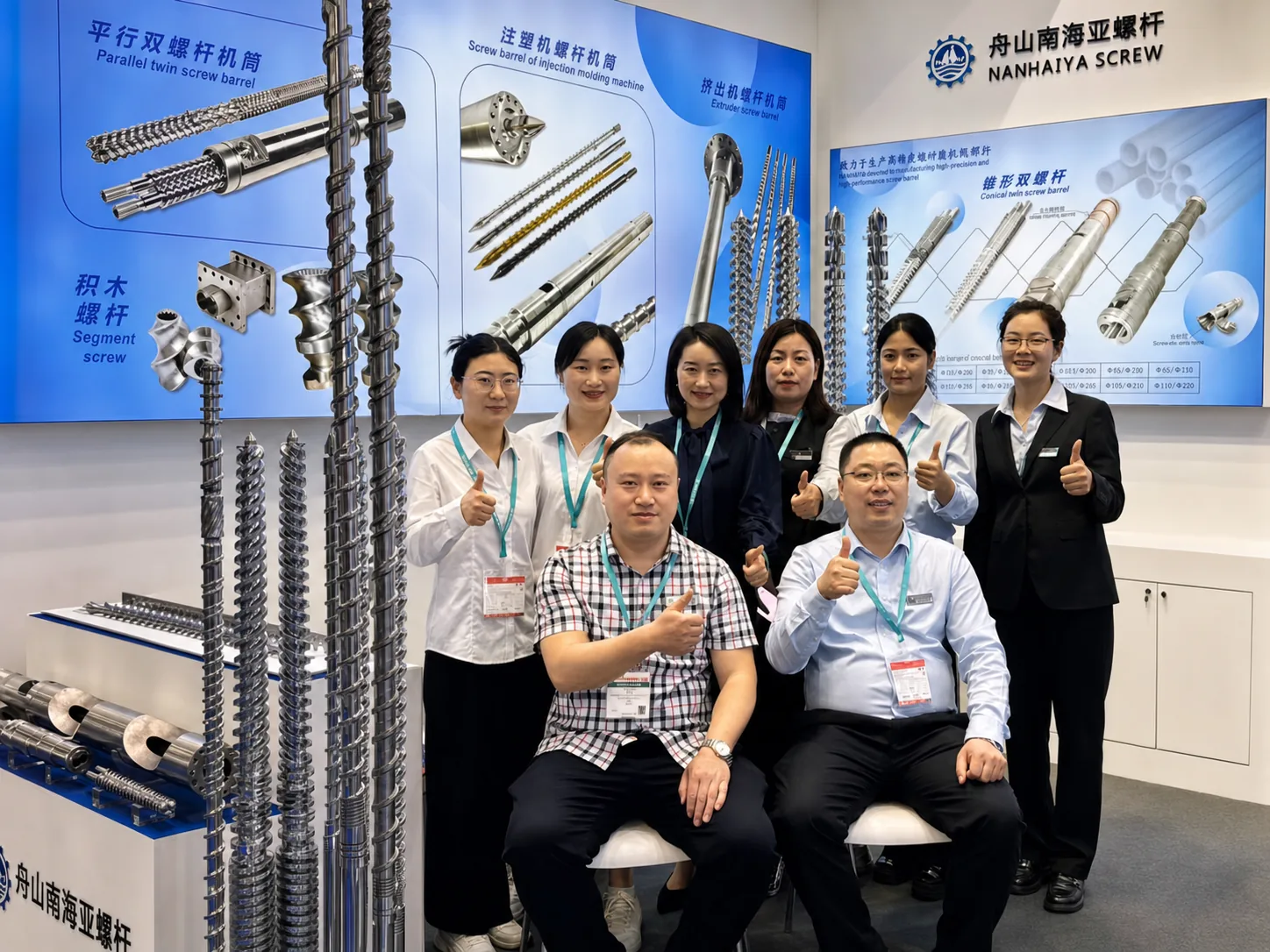
Related Articles
More insights on screw barrel technology and plastics processing.
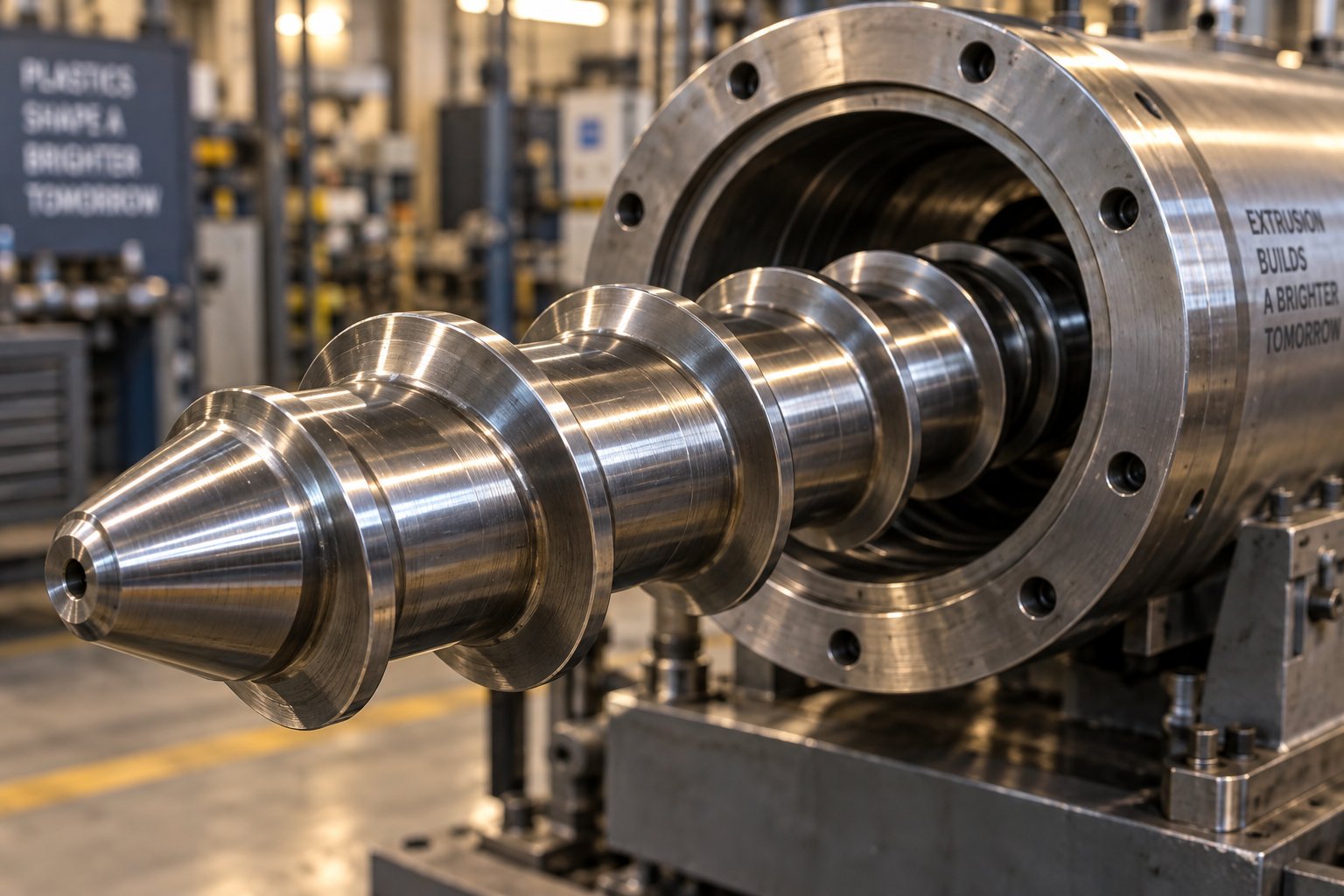
What Nobody Tells You About Screw Barrel For Plastic Machine Design
Oct 10, 2026
Learn how screw barrel for plastic machine design affects melt quality, throughput, and wear life. Covers geometry, resin matching, troubleshooting, and sourcing.
Read Article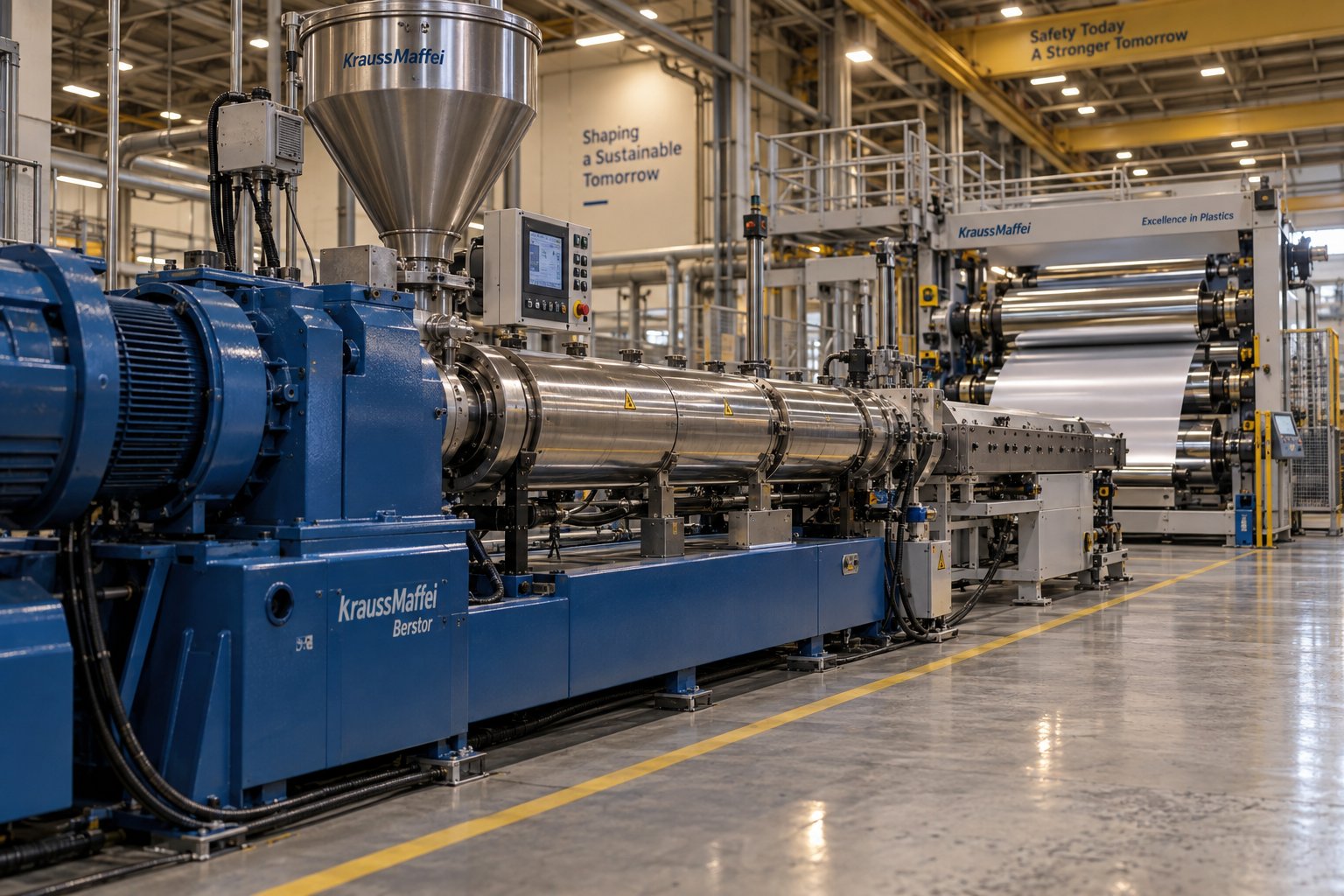
Single Screw Extruder for Sheet: Stop Guessing, Start Specifying
Oct 9, 2026
Learn how to specify a single screw extruder for sheet production. Covers screw geometry, resin-specific processing, troubleshooting, and maintenance best practices.
Read Article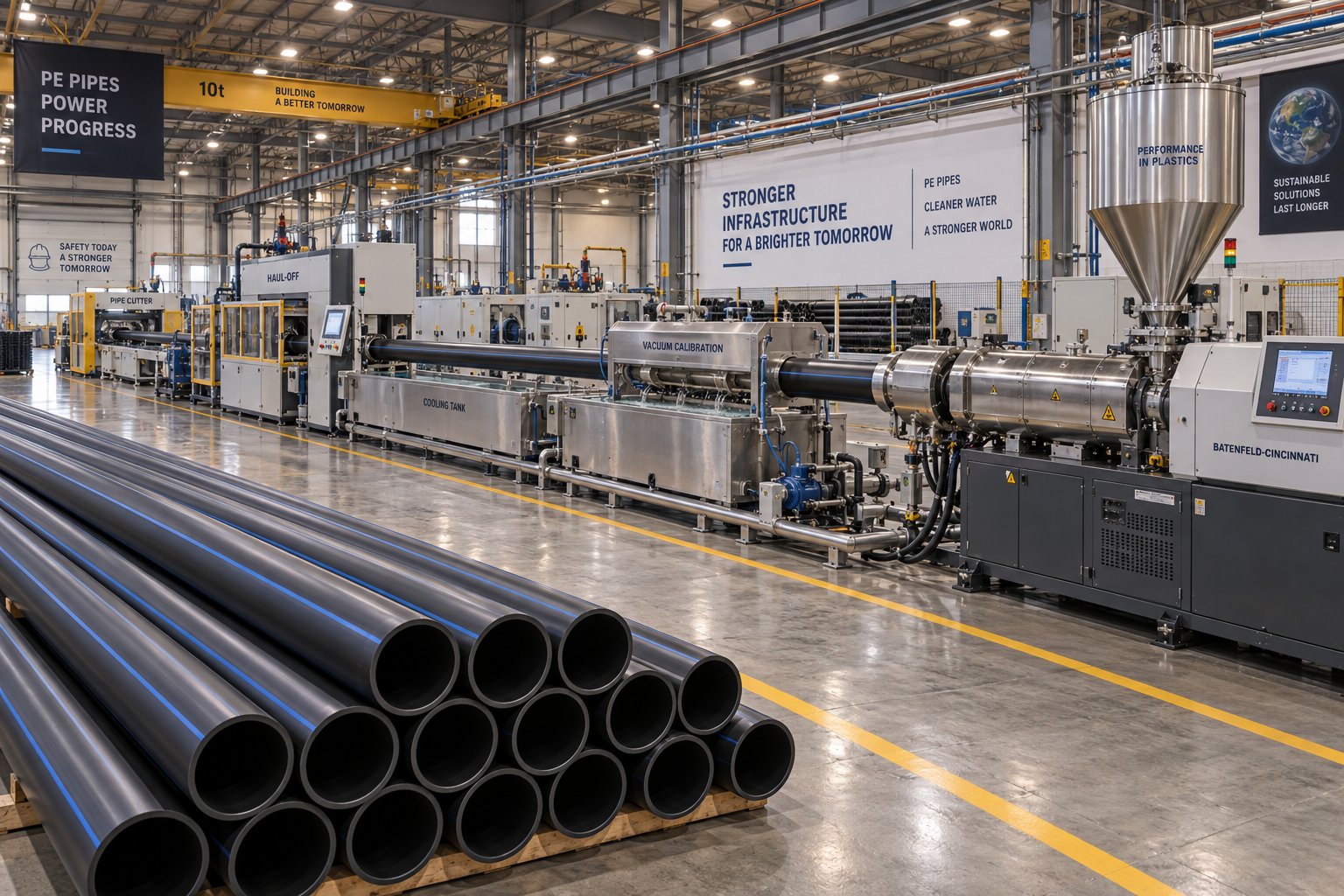
PE Pipe Extruder Machine: What Datasheets Won't Tell You
Oct 9, 2026
Learn how a PE pipe extruder machine works, key specs explained, material grade selection, maintenance tips, and buyer guidance beyond the datasheet.
Read ArticleLooking for something else?
Search by material, symptom or product and jump straight to the relevant page.
These are navigation suggestions based on keyword matching — not a quotation, not a delivery commitment, and not a substitute for engineering review. Final specification is confirmed by our engineers against your drawings and processed material.
Need help with screw barrel selection?
Share your machine model, processed material and application. Our team can help with pricing and technical support.